<?xml version="1.0" encoding="ISO-8859-1"?><article xmlns:mml="http://www.w3.org/1998/Math/MathML" xmlns:xlink="http://www.w3.org/1999/xlink" xmlns:xsi="http://www.w3.org/2001/XMLSchema-instance">
<front>
<journal-meta>
<journal-id>0120-0690</journal-id>
<journal-title><![CDATA[Revista Colombiana de Ciencias Pecuarias]]></journal-title>
<abbrev-journal-title><![CDATA[Rev Colom Cienc Pecua]]></abbrev-journal-title>
<issn>0120-0690</issn>
<publisher>
<publisher-name><![CDATA[Facultad de Ciencias Agrarias, Universidad de Antioquia]]></publisher-name>
</publisher>
</journal-meta>
<article-meta>
<article-id>S0120-06902013000300003</article-id>
<title-group>
<article-title xml:lang="en"><![CDATA[Estimation of growth in intact grazing Holstein steers]]></article-title>
<article-title xml:lang="es"><![CDATA[Estimación del crecimiento en terneros enteros Holstein en pastoreo]]></article-title>
<article-title xml:lang="pt"><![CDATA[Estimativa do crescimento de novilhos da raça Holandesa em pastejo]]></article-title>
</title-group>
<contrib-group>
<contrib contrib-type="author">
<name>
<surname><![CDATA[Velásquez Vélez]]></surname>
<given-names><![CDATA[Raúl]]></given-names>
</name>
<xref ref-type="aff" rid="A01"/>
</contrib>
<contrib contrib-type="author">
<name>
<surname><![CDATA[Noguera]]></surname>
<given-names><![CDATA[Ricardo R]]></given-names>
</name>
<xref ref-type="aff" rid="A03"/>
</contrib>
<contrib contrib-type="author">
<name>
<surname><![CDATA[Posada]]></surname>
<given-names><![CDATA[Sandra L]]></given-names>
</name>
<xref ref-type="aff" rid="A03"/>
</contrib>
<contrib contrib-type="author">
<name>
<surname><![CDATA[Hoyos Velásquez]]></surname>
<given-names><![CDATA[Alvaro]]></given-names>
</name>
<xref ref-type="aff" rid="A03"/>
</contrib>
<contrib contrib-type="author">
<name>
<surname><![CDATA[Cerón]]></surname>
<given-names><![CDATA[Juan Manuel]]></given-names>
</name>
<xref ref-type="aff" rid="A04"/>
</contrib>
</contrib-group>
<aff id="A01">
<institution><![CDATA[,Universidad Nacional de Colombia Facultad de Ciencias Agrarias Departamento de Producción Animal]]></institution>
<addr-line><![CDATA[Medellín ]]></addr-line>
<country>Colombia</country>
</aff>
<aff id="A02">
<institution><![CDATA[,Universidad Nacional de Colombia Facultad de Ciencias Agrarias Departamento de Producción Animal]]></institution>
<addr-line><![CDATA[Medellín ]]></addr-line>
<country>Colombia</country>
</aff>
<aff id="A03">
<institution><![CDATA[,Universidad Nacional de Colombia Facultad de Ciencias Agrarias ]]></institution>
<addr-line><![CDATA[Medellin ]]></addr-line>
<country>Colombia</country>
</aff>
<aff id="A04">
<institution><![CDATA[,Cooperativa Lechera de Antioquia  ]]></institution>
<addr-line><![CDATA[Medellin ]]></addr-line>
<country>Colombia</country>
</aff>
<pub-date pub-type="pub">
<day>00</day>
<month>09</month>
<year>2013</year>
</pub-date>
<pub-date pub-type="epub">
<day>00</day>
<month>09</month>
<year>2013</year>
</pub-date>
<volume>26</volume>
<numero>3</numero>
<fpage>169</fpage>
<lpage>176</lpage>
<copyright-statement/>
<copyright-year/>
<self-uri xlink:href="http://www.scielo.org.co/scielo.php?script=sci_arttext&amp;pid=S0120-06902013000300003&amp;lng=en&amp;nrm=iso"></self-uri><self-uri xlink:href="http://www.scielo.org.co/scielo.php?script=sci_abstract&amp;pid=S0120-06902013000300003&amp;lng=en&amp;nrm=iso"></self-uri><self-uri xlink:href="http://www.scielo.org.co/scielo.php?script=sci_pdf&amp;pid=S0120-06902013000300003&amp;lng=en&amp;nrm=iso"></self-uri><abstract abstract-type="short" xml:lang="en"><p><![CDATA[Background: animal growth does not follow a linear pattern. Accordingly, fitted non-linear models are used to analyze the relationship between growth rate and age. Objective: to assess the ability of several mathematical models (Gompertz, Brody, and von Bertalanffy) to describe growth and development patterns of grazing Holstein males (Bos taurus). Methods: twenty eight intact Holstein steers (average weight 203.8 &plusmn; 37.5 kg) were used in the study. The animals grazed on Kikuyu grass pastures (Pennisetum clandestinum) and were supplemented with 1 kg dry matter of reconstituted grain silage until weight reached 301.9 &plusmn; 47.9 kg. Animals were weighed at the beginning of the experiment and monthly thereafter from 14 to 21 months of age. The Marquardt's iterative algorithm of PROC NLIN procedure for non-linear models available in the SAS software was used to fit the data to each model and estimate the parameters. Results: Brody model reached the highest estimated value for adult weight (1,097.6 kg) while the Gompertz model displayed the lowest value (795 kg). Bertalanffy model indicated the lowest estimate for maturity index (0.0028) while the highest estimate was obtained by Gompertz (0.0047), being statistically different (p<0.05). Conclusions: Gompertz model best described growth of intact Holstein steers under rotational grazing and feed supplementation.]]></p></abstract>
<abstract abstract-type="short" xml:lang="es"><p><![CDATA[Antecedentes: los animales en crecimiento no siguen un patrón lineal; así que para describir este patrón se necesitan modelos no lineales ajustados, que analicen la relación entre la velocidad de crecimiento y la edad del animal. Objetivo: evaluar los modelos matemáticos Gompertz, Brody y von Bertalanffy de acuerdo con su capacidad para describir el patrón de crecimiento y desarrollo de los machos Holstein (Bos taurus) en pastoreo. Métodos: el estudio experimental se realizó con 28 novillos enteros de raza Holstein, con peso vivo promedio de 203,8 &plusmn; 37,5 Kg. Los animales permanecieron en pastoreo rotacional de pasto kikuyo (Pennisetum clandestinum) y fueron suplementados con 1 Kg de materia seca de silo de grano reconstituido hasta alcanzar un peso promedio de 301,9 Kg. &plusmn; 47,9 Kg. Los animales fueron pesados al inicio del experimento y luego con intervalos de 30 días, obteniendo información desde los 14 hasta los 21 meses de vida. El ajuste de los datos a cada modelo y las estimativas de los parámetros se realizaron por medio iterativo del algoritmo Marquardt del procedimiento para modelos no lineales PROC NLIN de SAS. Resultados: el modelo Brody alcanzó el mayor valor estimado para el parámetro ''peso maduro'' (1097, 6 Kg) y el modelo Gompertz obtuvo el menor valor (795 Kg). El modelo de Bertalanffy presentó el menor estimativo del parámetro ''índice de madurez'' (0,0028), mientras que el mayor estimativo lo presentó el modelo de Gompertz (0,0047), mostrando diferencia significativa (p<0,05). Conclusiones: el modelo de Gompertz fue el que mejor describió el patrón de crecimiento de los machos Holstein en pastoreo rotacional con suplementación.]]></p></abstract>
<abstract abstract-type="short" xml:lang="pt"><p><![CDATA[Antecedentes: os animais no seu crescimento não seguem um patrão lineal, pelo qual são necessários modelos matemáticos não lineais, que estudem a relação entre a taxa de crescimento e a idade do animal. Objetivo: avaliar os modelos Gompertz, Brody e von Bertalanffy na sua capacidade para descrever o crescimento de machos inteiros da raça holandês em condições de pastejo. Métodos: o estudo foi realizado com 28 animais não castrados da raça holandês, cujo peso vivo ao inicio do experimento foi de 203,8 &plusmn; 37,5 Kg. Os animais foram mantidos em um sistema de pastejo rotacionado com capim kikuyu (Pennisetum clandestinum) e suplementados com 1 Kg de matéria seca de silagem de grão reconstituído até atingir um peso médio de 301,9 &plusmn; 47,9 Kg. Todos os animais foram pesados ao inicio do experimento e depois a intervalos de 30 dias, obtendo informação entre os 14 e 21 meses de vida. O ajuste dos dados a cada modelo e as estimativas dos parâmetros foram realizadas com o procedimento PROC NLIN do SAS. Resultados: o modelo Brody atingiu o maior valor estimado para o parâmetro ''peso à maturidade'' (1097,6 Kg) e o modelo Gompertz obteve o menor valor (795 Kg). O modelo von Bertalanffy apresentou a menor estimativa do parâmetro ''índice de maturidade'' (0,0028) entanto que o maior valor foi encontrado no modelo Gompertz (0,0047) (p<0,05). Conclusões: o modelo Gompertz foi o que melhor descreveu o crescimento de machos da raça Holandês mantidos em condições de pastejo rotacionado com suplementação.]]></p></abstract>
<kwd-group>
<kwd lng="en"><![CDATA[Brody]]></kwd>
<kwd lng="en"><![CDATA[dairy steers]]></kwd>
<kwd lng="en"><![CDATA[Gompertz]]></kwd>
<kwd lng="en"><![CDATA[mathematical models]]></kwd>
<kwd lng="en"><![CDATA[von Bertalanffy]]></kwd>
<kwd lng="es"><![CDATA[Brody]]></kwd>
<kwd lng="es"><![CDATA[Gompertz]]></kwd>
<kwd lng="es"><![CDATA[modelos matemáticos]]></kwd>
<kwd lng="es"><![CDATA[novillos de lechería]]></kwd>
<kwd lng="es"><![CDATA[von Bertalanffy]]></kwd>
<kwd lng="pt"><![CDATA[Brody]]></kwd>
<kwd lng="pt"><![CDATA[Gompertz]]></kwd>
<kwd lng="pt"><![CDATA[modelos matemáticos]]></kwd>
<kwd lng="pt"><![CDATA[novilhos de origem leiteira]]></kwd>
<kwd lng="pt"><![CDATA[von Bertalanffy]]></kwd>
</kwd-group>
</article-meta>
</front><body><![CDATA[  <font size="2" face="Verdana, Arial, Helvetica, sans-serif">     <p align="right"><b>ORIGINAL ARTICLES</b></p>     <p align="right">&nbsp;</p>     <p align="center"><b><font size="4">Estimation of growth in intact grazing Holstein steers<sup><a name="b1"></a><a href="#1">&curren;</a></sup>  </font></b></p>     <p>&nbsp;</p>     <p align="center"><b><font size="3">Estimaci&oacute;n del crecimiento en terneros enteros Holstein en pastoreo </font></b></p>     <p>&nbsp;</p>     <p align="center"><b><font size="3">Estimativa do crescimento de novilhos da ra&ccedil;a Holandesa em pastejo </font></b></p>     <p>&nbsp;</p>     <p>&nbsp;</p>     ]]></body>
<body><![CDATA[<p><b>Ra&uacute;l Vel&aacute;squez V&eacute;lez<sup>1*</sup>, Zoot, MSc; Ricardo R Noguera<sup>2</sup>, Zoot, MSc, PhD; Sandra L Posada<sup>2</sup>, Zoot, MSc,   PhD; Alvaro Hoyos Vel&aacute;squez<sup>2</sup>, Zoot; Juan Manuel Cer&oacute;n<sup>3</sup>, Zoot.</b></p>     <p>* Corresponding author: Ra&uacute;l Vel&aacute;squez V&eacute;lez. Departamento de Producci&oacute;n Animal, Facultad de Ciencias Agrarias, Universidad Nacional de Colombia,   Medell&iacute;n, Colombia. Tel: (054) 430 91 31. E-mail: <a href="mailto:ravelasquezv@unal.edu.co">ravelasquezv@unal.edu.co</a></p>     <p><sup>1</sup> Departamento de Producci&oacute;n Animal, Facultad de Ciencias Agrarias, Universidad Nacional de Colombia, Medell&iacute;n, Colombia.</p>     <p>   <sup>2</sup> Grupo de Investigaci&oacute;n en Ciencias Agrarias- GRICA, Facultad de Ciencias Agrarias, Universidad de Antioquia, AA 1226,   Medellin, Colombia.</p>     <p>   <sup>3</sup> Cooperativa Lechera de Antioquia (COLANTA), Medellin, Colombia.  </p>     <p>&nbsp;</p>     <p>(Received: February 13, 2012; accepted: October 13, 2012)</p>     <p>&nbsp;</p> <hr size="1" />     <p><b>Summary</b></p>     <p>   <b>Background:</b> animal growth does not follow a linear pattern. Accordingly, fitted non-linear models are used   to analyze the relationship between growth rate and age. <b>Objective:</b> to assess the ability of several mathematical   models (Gompertz, Brody, and von Bertalanffy) to describe growth and development patterns of grazing Holstein   males (<i>Bos taurus</i>). Methods: twenty eight intact Holstein steers (average weight 203.8 &plusmn; 37.5 kg) were used   in the study. The animals grazed on Kikuyu grass pastures (<i>Pennisetum clandestinum</i>) and were supplemented   with 1 kg dry matter of reconstituted grain silage until weight reached 301.9 &plusmn; 47.9 kg. Animals were weighed at   the beginning of the experiment and monthly thereafter from 14 to 21 months of age. The Marquardt's iterative   algorithm of PROC NLIN procedure for non-linear models available in the SAS software was used to fit the data   to each model and estimate the parameters. <b>Results:</b> Brody model reached the highest estimated value for adult   weight (1,097.6 kg) while the Gompertz model displayed the lowest value (795 kg). Bertalanffy model indicated   the lowest estimate for maturity index (0.0028) while the highest estimate was obtained by Gompertz (0.0047),   being statistically different (p&lt;0.05). <b>Conclusions:</b> Gompertz model best described growth of intact Holstein   steers under rotational grazing and feed supplementation.</p>     ]]></body>
<body><![CDATA[<p>   <b>Key words:</b> Brody, dairy steers, Gompertz, mathematical models, von Bertalanffy.</p> <hr size="1" />     <p><b>Resumen</b></p>     <p>   <b>Antecedentes:</b> los animales en crecimiento no siguen un patr&oacute;n lineal; as&iacute; que para describir este patr&oacute;n   se necesitan modelos no lineales ajustados, que analicen la relaci&oacute;n entre la velocidad de crecimiento y la   edad del animal. <b>Objetivo:</b> evaluar los modelos matem&aacute;ticos Gompertz, Brody y von Bertalanffy de acuerdo   con su capacidad para describir el patr&oacute;n de crecimiento y desarrollo de los machos Holstein (<i>Bos taurus</i>) en   pastoreo. <b>M&eacute;todos:</b> el estudio experimental se realiz&oacute; con 28 novillos enteros de raza Holstein, con peso vivo   promedio de 203,8 &plusmn; 37,5 Kg. Los animales permanecieron en pastoreo rotacional de pasto kikuyo (<i>Pennisetum   clandestinum</i>) y fueron suplementados con 1 Kg de materia seca de silo de grano reconstituido hasta alcanzar   un peso promedio de 301,9 Kg. &plusmn; 47,9 Kg. Los animales fueron pesados al inicio del experimento y luego   con intervalos de 30 d&iacute;as, obteniendo informaci&oacute;n desde los 14 hasta los 21 meses de vida. El ajuste de los   datos a cada modelo y las estimativas de los par&aacute;metros se realizaron por medio iterativo del algoritmo   Marquardt del procedimiento para modelos no lineales PROC NLIN de SAS. <b>Resultados:</b> el modelo Brody   alcanz&oacute; el mayor valor estimado para el par&aacute;metro ''peso maduro'' (1097, 6 Kg) y el modelo Gompertz obtuvo   el menor valor (795 Kg). El modelo de Bertalanffy present&oacute; el menor estimativo del par&aacute;metro ''&iacute;ndice de   madurez'' (0,0028), mientras que el mayor estimativo lo present&oacute; el modelo de Gompertz (0,0047), mostrando   diferencia significativa (p&lt;0,05). <b>Conclusiones:</b> el modelo de Gompertz fue el que mejor describi&oacute; el patr&oacute;n   de crecimiento de los machos Holstein en pastoreo rotacional con suplementaci&oacute;n.</p>     <p>   <b>Palabras clave:</b> Brody, Gompertz, modelos matem&aacute;ticos, novillos de lecher&iacute;a, von Bertalanffy.</p> <hr size="1" />     <p><b>Resumo</b></p>     <p>   <b>Antecedentes:</b> os animais no seu crescimento n&atilde;o seguem um patr&atilde;o lineal, pelo qual s&atilde;o necess&aacute;rios   modelos matem&aacute;ticos n&atilde;o lineais, que estudem a rela&ccedil;&atilde;o entre a taxa de crescimento e a idade do animal.   <b>Objetivo:</b> avaliar os modelos Gompertz, Brody e von Bertalanffy na sua capacidade para descrever o   crescimento de machos inteiros da ra&ccedil;a holand&ecirc;s em condi&ccedil;&otilde;es de pastejo. <b>M&eacute;todos:</b> o estudo foi realizado   com 28 animais n&atilde;o castrados da ra&ccedil;a holand&ecirc;s, cujo peso vivo ao inicio do experimento foi de 203,8 &plusmn;   37,5 Kg. Os animais foram mantidos em um sistema de pastejo rotacionado com capim kikuyu (<i>Pennisetum   clandestinum</i>) e suplementados com 1 Kg de mat&eacute;ria seca de silagem de gr&atilde;o reconstitu&iacute;do at&eacute; atingir um peso   m&eacute;dio de 301,9 &plusmn; 47,9 Kg. Todos os animais foram pesados ao inicio do experimento e depois a intervalos de   30 dias, obtendo informa&ccedil;&atilde;o entre os 14 e 21 meses de vida. O ajuste dos dados a cada modelo e as estimativas   dos par&acirc;metros foram realizadas com o procedimento PROC NLIN do SAS. <b>Resultados:</b> o modelo Brody   atingiu o maior valor estimado para o par&acirc;metro ''peso &agrave; maturidade'' (1097,6 Kg) e o modelo Gompertz   obteve o menor valor (795 Kg). O modelo von Bertalanffy apresentou a menor estimativa do par&acirc;metro ''&iacute;ndice de maturidade'' (0,0028) entanto que o maior valor foi encontrado no modelo Gompertz (0,0047) (p&lt;0,05). <b>Conclus&otilde;es:</b> o modelo Gompertz foi o que melhor descreveu o crescimento de machos da ra&ccedil;a Holand&ecirc;s mantidos em condi&ccedil;&otilde;es de pastejo rotacionado com suplementa&ccedil;&atilde;o.</p>     <p>   <b>Palabras chave:</b> Brody, Gompertz, modelos matem&aacute;ticos, novilhos de origem leiteira, von Bertalanffy.</p> <hr size="1" />     <p>&nbsp;</p>     <p><b><font size="3">Introduction</font></b></p>     <p>   Specialized dairy systems in Colombia   consider beef as a byproduct of milk production.   COLANTA's packing plant (FRIGOCOLANTA   meat packing plant; Cooperativa Lechera Colanta,   Medellin, Colombia) processes more than 50,000   calves per year, averaging 4 days of age, 45 kg body   weight, and USD $40 to $50 market value; carcass   yield does not exceed 45%. Breeding, fattening,   and rearing of those animals would yield 8000   tons of additional meat to the country, representing   an additional income of nearly USD $23.5 million   (Cer&oacute;n, 2011).</p>     ]]></body>
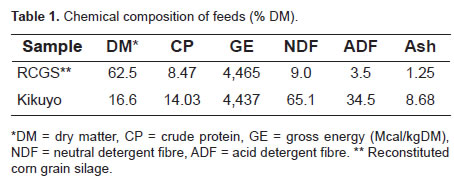
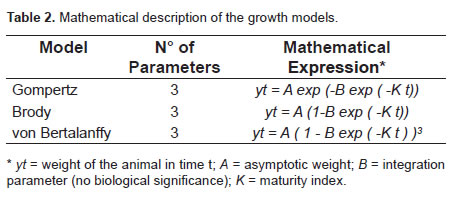
<body><![CDATA[<p>Animal growth does not follow a linear pattern,   so fitted non-linear models are needed to establish   the relationship between growth rate and animal   age in order to generate a growth curve (Souza <i>et al.</i>, 1994). Animal growth models have a sigmoidal   shape in which the following phases can be   differentiated: a) <i>Acceleration phase</i>: ideally should   have its origin at point (0,0) and is characterized for a rapid and positive growth rate peaking at the inflection point of the curve; b) <i>Deceleration phase</i>: begins at the inflection point and occurs where growth rate begins to decrease due to a number of physiological factors that hinder growth; c) <i>Linear phase</i>: when the animal stops growing or when growth is directed towards tissue replenishment (Noguera <i>et al.</i>, 2008).</p>     <p>The Gompertz (Winsor, 1932), Brody (Brody,   1945), and von Bertalanffy (von Bertalanffy, 1957)   mathematical models are among the most frequently   used functions for describing the growth of flora and   fauna. Those models include three parameters, two   of which have a biological interpretation, and a third   representing a mathematical constant. Parameter   A is the asymptotic weight or adult weight, and   represents the estimated weight at a certain age.   Parameter K is the maturity index or the earliness of   maturity estimate (Nobre <i>et al.</i>, 1987). The greater   the K parameter, the greater the prematureness of   the animal, and vice versa (Brown <i>et al.</i>, 1976).   Parameter B is called integration parameter and has no biological meaning.</p>     <p>The aim of this study was to evaluate Gompertz,   Brody, and von Bertalanffy mathematical models in   their ability to describe growth and development of intact grazing Holstein steers (<i>Bos taurus</i>).</p>     <p>&nbsp;</p>     <p><b><font size="3">Materials and Methods</font></b></p>     <p>   <i>Sources of information</i></p>     <p>   The data used in this study included weight   records of 28 intact Holstein steers averaging   203.8 &plusmn; 37.5 kg live weight at the beginning of the   experiment. These animals were kept in a rotational   grazing system with feed supplementation. The   analyzed data covers a period ranging from 420 to   635 days of age (14 to 21.1 months).</p>     <p><i>Location and management</i></p>     <p>   The experiment was conducted at Los Dolores   farm, in La Esperanza rural settlement located in   Abejorral municipality (Antioquia, Colombia) from   May to December of 2011. This municipality is located at 2,125 meters ASL, with 17&deg; C average   temperature, and 80% average relative humidity.   Rainfall level is 2100 mm per year, and it is   regarded as a tropical lower-montane wet forest   (TLM-wf) (Holdridge, 1978).</p>     <p>Animals grazed on Kikuyu grass (<i>Pennisetum   clandestinum</i>) pastures and were supplemented with   reconstituted corn grain silage (RCGS) with water   plus 2% urea (1 kg/day, dry base). This supplement   was individually offered in a plastic container   placed in the paddock. Nutritional composition   of the diet is presented in <a href="#t1">table 1</a>. Animals were   offered water and mineralized salt (8% P) <i>ad   libitum</i>. Paddock size and rotation periods were   programmed to ensure a 45-d grazing interval and a 3-d maximum occupation period per paddock.</p>     ]]></body>
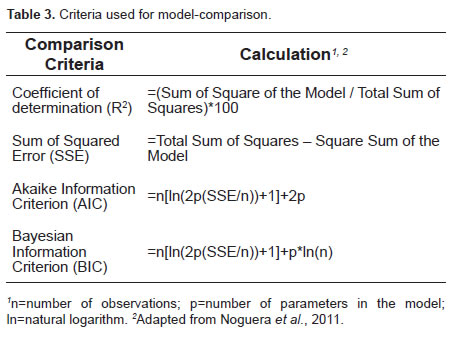
<body><![CDATA[<p align="center"><a name="t1"></a><img src="/img/revistas/rccp/v26n3/v26n3a3t1.jpg"/></p>     <p>Animal health management followed the   recommendations of the Colombian Agricultural   Institute (ICA, 2007). Animals were weighed   on a monthly basis since the beginning of the   experiment, thus obtaining information from 14 to   21 months of age. Weighings were always taken at   the same time, and no food was offered during the previous 12 hours.</p>     <p>This study was approved by the animal   experimentation ethics committee of the Faculty of   Agricultural Sciences at the University of Antioquia.</p>     <p><i>Statistical analysis</i></p>     <p>The growth functions evaluated are presented   in <a href="#t2">table 2</a>. Data fit for each model and parameter   estimates were established using Marquardt's   iterative algorithm of the PROC NLIN procedure   for non-linear models available in the SAS software package (SAS, 2001).</p>     <p align="center"><a name="t2"></a><img src="/img/revistas/rccp/v26n3/v26n3a3t2.jpg"/></p>     <p>Selection of the best model included the   following criteria:</p>     <p>1. The sum of squared errors (SSE). The model   with the lowest SSE best represents the data set   (Noguera <i>et al.</i>, 2008).</p>     <p>2. The Akaike information criterion (AIC; Akaike,   1973). This criterion weighs values among   the maximum likelihood logarithm function   using the residual variance and the number of   parameters in the model.</p>     <p>3. The Bayesian Information Criterion (BIC;   Schwarz, 1978). It is based on a probability   integrated into the Bayesian theory.</p>     ]]></body>
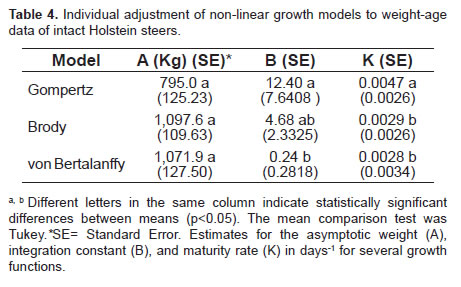
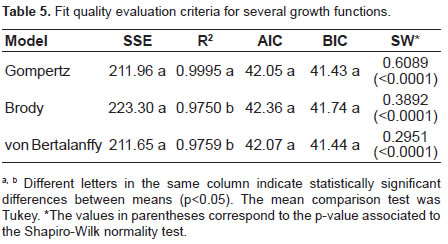
<body><![CDATA[<p>4. The coefficient of determination (R2; Noguera <i>et al.</i>, 2011).</p>     <p>The analysis of residuals was another criterion   used to assess the fit of the models. Residuals were   calculated as the difference between observed   and predicted values. <a href="#t3">Table 3</a> shows how the   calculations were performed for each criteria used to compare the models.</p>     <p align="center"><a name="t3"></a><img src="/img/revistas/rccp/v26n3/v26n3a3t3.jpg"/></p>     <p>Additionally, genetic correlations were   conducted between the model parameters with their   level of significance through the PROC CORR procedure of the SAS software (SAS, 2001).</p>     <p>To verify compliance with the normality assumption   of all residues from each model, the Shapiro-Wilk   (SW) test was used through the PROC UNIVARIATE procedure of the SAS software (SAS, 2001).</p>     <p>The models were compared to determine their   goodness of fit through analysis of variance of their   evaluation criteria variance using the PROC GLM   procedure of SAS (SAS, 2001), and the Tukey test   for comparison of means. Differences were set at   p&lt;0.05. Total degrees of freedom were 83 (29 for the model and 54 for the error).</p>     <p>&nbsp;</p>     <p><b><font size="3">Results </font></b></p>     <p>Parameter estimates resulting from individually   fitting non-linear growth models to weightage   data of the animals are presented in <a href="#t4">table 4</a>.   Among the studied models, Brody reached the   highest numerical estimated value for parameter   A and Gompertz had the lowest value although   no significant differences were found (p&gt;0.05).   Parameter K estimate by the Bertalanffy model was   similar to that obtained by the Brody model; both   values were lower than those obtained through the   Gompertz model (p&lt;0.05).</p>     <p align="center"><a name="t4"></a><img src="/img/revistas/rccp/v26n3/v26n3a3t4.jpg"/></p>     ]]></body>
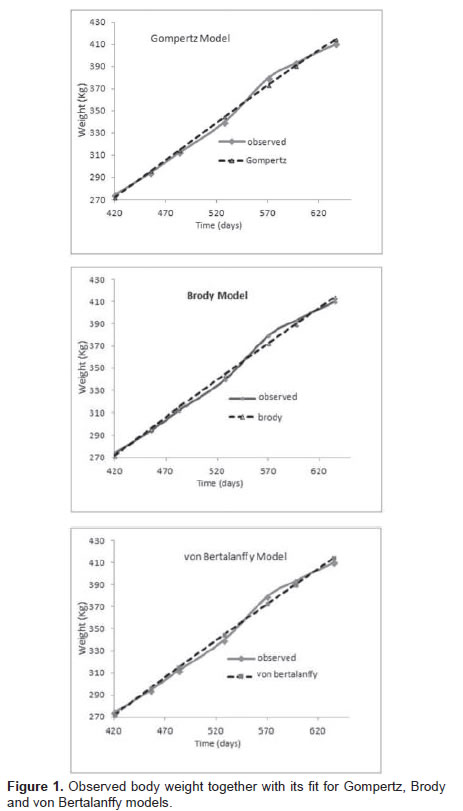
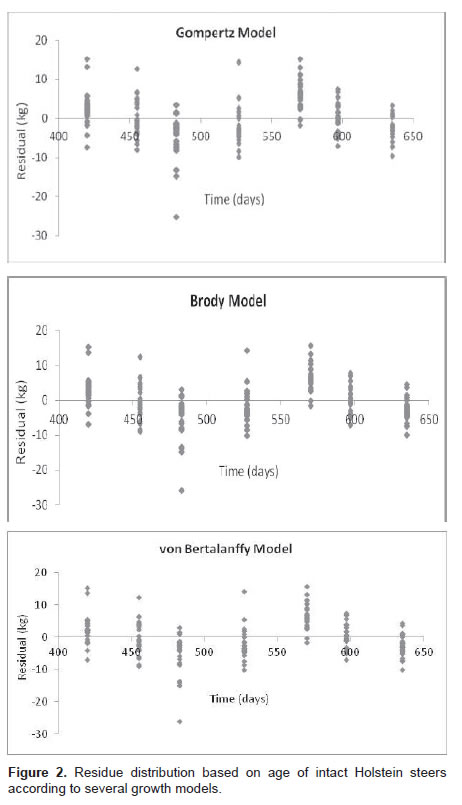
<body><![CDATA[<p><a href="#t5">Table 5</a> shows values of the different quality   fit criteria represented by SSE, R<sup>2</sup>, AIC, and BIC   for each of the studied models. The models with   low SSE provided more accurate predictions   of the phenomenon to be modeled. In this case, Bertalanffy showed a better fit than the other two models, however no significant difference was observed (p&gt;0.05). The highest coefficient of determination (R<sup>2</sup>) was obtained with Gompertz (p&lt;0.05), while Brody and Bertalanffy models had similar R<sup>2</sup> (p&gt;0.05). This provides evidence that Gompertz is the most adjusted model.</p>     <p align="center"><a name="t5"></a><img src="/img/revistas/rccp/v26n3/v26n3a3t5.jpg"/></p>     <p>The AIC and BIC criteria can determine how   well the models fit to a database; the best models   are those having low estimation values. The values   for the three models were equivalent (p&gt;0.05),   indicating that it makes no difference to choose   any one. Visually, models presented very similar   behavior regarding their ability to fit throughout the   study (<a href="#f1">Figure 1</a>). The difference between observed   and predicted values was very similar among the   evaluated models (<a href="#f2">Figure 2</a>), indicating that animal   weigth was similarly predicted by the models across time.</p>     <p align="center"><a name="f1"></a><img src="/img/revistas/rccp/v26n3/v26n3a3f1.jpg"/></p>     <p align="center"><a name="f2"></a><img src="/img/revistas/rccp/v26n3/v26n3a3f2.jpg"/></p>     <p>No individual model stood out by showing   higher residual alternation (i.e., animal weight was   both overestimated and underestimated throughout the studied age range).</p>     <p>&nbsp;</p>     <p><b><font size="3">Discussion </font></b></p>     <p>Mathematical models are based on assumptions   to fit the data; this is evidenced by the difference   in A, B, and K estimates (<a href="#t4">Table 4</a>). Despite this,   predicted values were very close to real values,   which was confirmed by the criteria used to evaluate   their goodness of fit.</p>     <p>According to Posada <i>et al.</i> (2011), total sum of   squares (TSS) in different models is the same for   a dataset, while Sum Squared Error (SSE) only   depends on model fit. Likewise, models with low   SSE fit better with only one dataset. According to   this premise, the models studied in this work have   similar goodness of fit used to describe the growth   curve in intact Holstein steers within the period sampled.</p>     ]]></body>
<body><![CDATA[<p>The opposite happens with the coefficient of   determination (R<sup>2</sup>); high values indicate greater   goodness of fit. In this case, the highest value   was observed with Gompertz, which was higher   (p&lt;0.05) than those of Brody and von Bertalanffy models (<a href="#t5">Table 5</a>).</p>     <p>Growth curve was similar for all three models   (<a href="#f1">Figure 1</a>), fulfilling the assumption of normality   of the residuals (<a href="#t5">Table 5</a>), and obtaining a good fit   of the models to the data (estimated growth curve).   This condition of normality in the model residual   ensures that the inference on the parameters was appropriate (Posada <i>et al.</i>, 2011).</p>     <p>In this study, A, B, and K ranged from 795 to   1097.6, 0.236 to 12.403, and 0.0028 to 0.0047,   respectively (<a href="#t4">Table 4</a>). According to Silva <i>et al.</i>   (2002) there is a genetic correlation between   parameters A and K, indicating antagonism between   the estimates for those parameters. Thus, this   study confirmed that a negative correlation exists   between mature weight (A) and maturity rate (K),   as a negative correlation was found (r) for all three   models. The values were r = -0.56 (p = 0.002) for   von Bertalanffy, r = -0.56 (p = 0.0019) for Brody, and r = -0.44 (p = 0.019) between these parameters.</p>     <p>Several authors have referred to the close and   negative correlation between those parameters,   reporting&#8212;for instance&#8212;values of r = -0.736   (Kratochv&iacute;lov&aacute;, <i>et al.</i>, 2002), r = -0.69 (Marshall,   <i>et al.</i>, 1984) and r = -0.57 (DeNise and Brinks,   1985). Genetic correlation between A and K   is antagonistic between the estimates of those   parameters. Therefore, when selecting animals with   a high maturity rate, animals tended to achieve   lower adult weight. However, Holstein breeding   programs aim to achieve both. This indicates that   both a large body structure and precocity must   be simultaneously present (Kratochv&iacute;lov&aacute; <i>et al.</i>,   2002). The values reported by Kratochv&iacute;lov&aacute; <i>et al.</i>   (2002) for Holstein cattle were A = 643.45 and K   = 0.00367. These were low for A and intermediate   for K when compared with values in our study.   Similarly, upon comparison with Zebu cattle, values   found in the same models were low for A (Brody:   923.5; Gompertz: 640.5; and von Bertalanffy:   689.8) and high for K (Brody: 0.0010; Gompertz:   0.0028; and von Bertalanffy: 0.0022) as in the study conducted by Posada <i>et al.</i> (2011).</p>     <p>In this study, values for A were high and values   for K were low. This indicates that animals will   reach asymptotic weight at an older age based   on a slower development. This is consistent with   reports by Herrera <i>et al.</i> (2008) who claim that   animals with high asymptotic weights (A) are less   premature, as they have low values for growth rate   (K). Additionaly, prediction of asymptotic weight   through growth curves can be affected by the type   of environment and food during breeding, fattening, and rearing (Arango and Van Vleck, 2002).</p>     <p>The value for A found in this study with   Gompertz model is 13 kg higher than that reported   by Herrera <i>et al.</i> (2008) for Holstein X Zebu steers   and other Zebu crosses weighing 520 kg. This,   paired with increased growth rate (K), indicates less   precocity for pure Holstein steers. The integration   constant (B), has no biological significance in the   model; data found in this study was 12 points higher than that reported by Herrera <i>et al.</i> (2008).</p>     <p>Comparing asymptotic weight (A) in this study   with that reported by Brown <i>et al.</i> (1972) who   worked with Angus and Herford steers, Holstein   outweighed Angus and Hereford by 3 and 84 kg,   respectively, while growth rates of Angus and   Hereford were greater than those of Holstein,   indicating greater precocity in Holstein. This can   be understood with the assertions by Brown <i>et al.</i>   (1972) who concluded that animals with different   values of A may have similar or different values of   K. Only when two animals are growing with similar   mature weights can K be interpreted as a measure   of the differences in growth rate. Otherwise K   measures differences in growth rate compared to   asymptotic weight. Furthermore, different growth   patterns are achieved when two mature animals   have similar weights but different K values, or   similar K values but different mature weights.   Additionally, different mature weights and different   K values may or may not represent different growth patterns.</p>     <p>On the other hand, the Gompertz model had   the greatest goodness of fit to the data in this study   because, besides having a good mathematical fit (R<sup>2</sup>,   SSE, AIC, BIC), it also shows suitable biological   consistency in the estimated mature weight and is   consistent with the value obtained by Kratochv&iacute;lov&aacute;   <i>et al.</i> (2002), which was 643.35 kg for Holstein   steers. Similarly, if we take into account the   marketing and processing weights of Holstein steers   in the U.S. reported by Siemens (1996) &#8212;ranging   from 535 to 636 kg&#8212;, Forni <i>et al.</i> (2006) mentioned   that these alternative models are valid for predicting   adult weight, considering that adult weight comes   after profit and is a valuable contribution to beef cattle genetic improvement programs.</p>     <p>Regarding the available mathematical models,   Gompertz is not the most commonly used model   for describing growth curves in steers, but rather   the model proposed by Brody. However, in this   case Gompertz showed better goodness of fit for   the coefficient of determination (p&lt;0.05) than   Brody's model. Furthermore, these results agree   with those reported by Silva <i>et al.</i> (2002) who   concluded that Brody's function overestimates   asymptotic weight and the Gompertz function   has the highest percentage of convergence.   Furthermore, Bergamasco <i>et al.</i> (2001) found that   Brody overestimates asymptotic weight in female   Holstein cattle. Likewise, Silva <i>et al.</i> (2002) stated   that Brody's model is most suitable when a small   number of weighings is available, which is the case in our study.</p>     <p>According to these results, it can be stated that   the Gompertz model was the best at describing   growth of intact Holstein steers under rotational grazing with supplementation.</p>     ]]></body>
<body><![CDATA[<p>&nbsp;</p> </font> <hr size="1" /> <font size="2" face="Verdana, Arial, Helvetica, sans-serif">     <p><font size="3"><b>Notas</b></font></p> </font>     <p><font size="2" face="Verdana, Arial, Helvetica, sans-serif"><a name="1"></a><a href="#b1">&curren;</a> To cite this article: Vel&aacute;squez R, Noguera RR, Posada SL, Hoyos A, Cer&oacute;n JM. Estimation of growth in intact grazing Holstein steers. Rev Colomb Cienc Pecu   2013; 26:169-176. </font></p>  <hr size="1" />     <p>&nbsp;</p> <font size="2" face="Verdana, Arial, Helvetica, sans-serif">     <p>&nbsp;</p>     <p><b><font size="3">Acknowledgements </font></b></p>     <p>Authors would like to thank the Colombian   Ministry of Agriculture and Rural Development   and the Sustainability Project 2011-2012 (Estrategia   de sostenibilidad CODI, University of Antioquia)   for providing the resources for the study. We also   wish to thank FRIGOCOLANTA for allowing us   to use its facilities, and to Vel&aacute;squez-Duque family   in Abejorral municipality for assistance with data collection.</p>     <p>&nbsp;</p>     <p><b><font size="3">References</font></b></p>     <!-- ref --><p>   Akaike H. Information theory and an extension of the maximum   likelihood principle. In: B.N. Petrov and F.Csaki, editors. 2nd   International Symposium on Information Theory 1973:267-281.    &nbsp;&nbsp;&nbsp;&nbsp;&nbsp;&nbsp;&nbsp;&nbsp;[&#160;<a href="javascript:void(0);" onclick="javascript: window.open('/scielo.php?script=sci_nlinks&ref=000092&pid=S0120-0690201300030000300001&lng=','','width=640,height=500,resizable=yes,scrollbars=1,menubar=yes,');">Links</a>&#160;]<!-- end-ref --></p>     <!-- ref --><p>   Arango JA, Van Vleck LD. Size of beef cows: early ideas, new   developments. Genet Mol Res 2002; 1:51-63.    &nbsp;&nbsp;&nbsp;&nbsp;&nbsp;&nbsp;&nbsp;&nbsp;[&#160;<a href="javascript:void(0);" onclick="javascript: window.open('/scielo.php?script=sci_nlinks&ref=000094&pid=S0120-0690201300030000300002&lng=','','width=640,height=500,resizable=yes,scrollbars=1,menubar=yes,');">Links</a>&#160;]<!-- end-ref --></p>     <!-- ref --><p>   Bergamasco AF, Aquino LH, Muniz JA. Estudo da curva de   crescimento de f&ecirc;meas da ra&ccedil;a Holandesa. Ci&ecirc;nc Agrotec 2001;   25:235-242.    &nbsp;&nbsp;&nbsp;&nbsp;&nbsp;&nbsp;&nbsp;&nbsp;[&#160;<a href="javascript:void(0);" onclick="javascript: window.open('/scielo.php?script=sci_nlinks&ref=000096&pid=S0120-0690201300030000300003&lng=','','width=640,height=500,resizable=yes,scrollbars=1,menubar=yes,');">Links</a>&#160;]<!-- end-ref --></p>     <!-- ref --><p>   Brown JE, Brown CJ, Butts WT. A discussion of the genetic   aspect of weight, mature weight and rate of maturing in   Hereford and Angus cattle. J Anim Sci 1972; 34 4:525-537.    &nbsp;&nbsp;&nbsp;&nbsp;&nbsp;&nbsp;&nbsp;&nbsp;[&#160;<a href="javascript:void(0);" onclick="javascript: window.open('/scielo.php?script=sci_nlinks&ref=000098&pid=S0120-0690201300030000300004&lng=','','width=640,height=500,resizable=yes,scrollbars=1,menubar=yes,');">Links</a>&#160;]<!-- end-ref --></p>     <!-- ref --><p>   Brody S. Bioenergetics and growth. New YorK: Reinhold   Publishing Corp; 1945.    &nbsp;&nbsp;&nbsp;&nbsp;&nbsp;&nbsp;&nbsp;&nbsp;[&#160;<a href="javascript:void(0);" onclick="javascript: window.open('/scielo.php?script=sci_nlinks&ref=000100&pid=S0120-0690201300030000300005&lng=','','width=640,height=500,resizable=yes,scrollbars=1,menubar=yes,');">Links</a>&#160;]<!-- end-ref --></p>     <!-- ref --><p>   Brown JE, Fitzhugh HA, Cartwright TC. A comparison of nonlinear   models for describing weight-age relationships in cattle. J   Anim Sci 1976; 42:810-818.    &nbsp;&nbsp;&nbsp;&nbsp;&nbsp;&nbsp;&nbsp;&nbsp;[&#160;<a href="javascript:void(0);" onclick="javascript: window.open('/scielo.php?script=sci_nlinks&ref=000102&pid=S0120-0690201300030000300006&lng=','','width=640,height=500,resizable=yes,scrollbars=1,menubar=yes,');">Links</a>&#160;]<!-- end-ref --></p>     <!-- ref --><p>   DeNise SK, Brinks JS. Genetic and environmental aspects of   the growth curve parameters in beef cows. J Anim Sci 1985;   61:1431-1440.    &nbsp;&nbsp;&nbsp;&nbsp;&nbsp;&nbsp;&nbsp;&nbsp;[&#160;<a href="javascript:void(0);" onclick="javascript: window.open('/scielo.php?script=sci_nlinks&ref=000104&pid=S0120-0690201300030000300007&lng=','','width=640,height=500,resizable=yes,scrollbars=1,menubar=yes,');">Links</a>&#160;]<!-- end-ref --></p>     <!-- ref --><p>   Forni S, Piles M, Blasco A, Varona L, Oliveira HN, L&ocirc;bo RB,   Albuquerque LG. Genetic analysis of growth curve parameters applying a von Bertalanffy function to beef cattle longitudinal   data. 8th World Congress on Genetics Applied to Livestock   Production, Belo Horizonte, MG, Brasil 2006; p. 3-16.    &nbsp;&nbsp;&nbsp;&nbsp;&nbsp;&nbsp;&nbsp;&nbsp;[&#160;<a href="javascript:void(0);" onclick="javascript: window.open('/scielo.php?script=sci_nlinks&ref=000106&pid=S0120-0690201300030000300008&lng=','','width=640,height=500,resizable=yes,scrollbars=1,menubar=yes,');">Links</a>&#160;]<!-- end-ref --></p>     <!-- ref --><p>   Herrera AC, Vergara OD, Cer&oacute;n-Mu&ntilde;oz MF, Agudelo DA,   Arboleda EM. Curvas de crecimiento en bovinos cruzados   utilizando el modelo Brody. Livest Res Rural Dev 2008; 20:140&nbsp;&nbsp;&nbsp;&nbsp;&nbsp;&nbsp;&nbsp;&nbsp;[&#160;<a href="javascript:void(0);" onclick="javascript: window.open('/scielo.php?script=sci_nlinks&ref=000108&pid=S0120-0690201300030000300009&lng=','','width=640,height=500,resizable=yes,scrollbars=1,menubar=yes,');">Links</a>&#160;]<!-- end-ref --><!-- ref --><p>   Holdridge L. Ecolog&iacute;a basada en zonas de vida. San   Jos&eacute;:IICA;1978.    &nbsp;&nbsp;&nbsp;&nbsp;&nbsp;&nbsp;&nbsp;&nbsp;[&#160;<a href="javascript:void(0);" onclick="javascript: window.open('/scielo.php?script=sci_nlinks&ref=000109&pid=S0120-0690201300030000300010&lng=','','width=640,height=500,resizable=yes,scrollbars=1,menubar=yes,');">Links</a>&#160;]<!-- end-ref --></p>     <!-- ref --><p>   ICA, Instituto Colombiano Agropecuario. Resoluci&oacute;n No   002341 de 23 de agosto 2007.    &nbsp;&nbsp;&nbsp;&nbsp;&nbsp;&nbsp;&nbsp;&nbsp;[&#160;<a href="javascript:void(0);" onclick="javascript: window.open('/scielo.php?script=sci_nlinks&ref=000111&pid=S0120-0690201300030000300011&lng=','','width=640,height=500,resizable=yes,scrollbars=1,menubar=yes,');">Links</a>&#160;]<!-- end-ref --></p>     ]]></body>
<body><![CDATA[<!-- ref --><p>   Kratochv&iacute;lov&aacute; M, Hy&aacute;nkov&aacute; L, Kn&iacute;&#382;etov&aacute; H, Fiedler J, Urban   F. Growth curve analysis in cattle from early maturity and   mature body size viewpoints. Czech J Anim Sci 2002; 47 4:125-   132.    &nbsp;&nbsp;&nbsp;&nbsp;&nbsp;&nbsp;&nbsp;&nbsp;[&#160;<a href="javascript:void(0);" onclick="javascript: window.open('/scielo.php?script=sci_nlinks&ref=000113&pid=S0120-0690201300030000300012&lng=','','width=640,height=500,resizable=yes,scrollbars=1,menubar=yes,');">Links</a>&#160;]<!-- end-ref --></p>     <!-- ref --><p>   Marshall TE, Mohler MA, Stewart TS. Relationship of lifetime   productivity with mature weight and maturation rate in Red Poll   cows. Anim Prod 1984; 39:383-387.    &nbsp;&nbsp;&nbsp;&nbsp;&nbsp;&nbsp;&nbsp;&nbsp;[&#160;<a href="javascript:void(0);" onclick="javascript: window.open('/scielo.php?script=sci_nlinks&ref=000115&pid=S0120-0690201300030000300013&lng=','','width=640,height=500,resizable=yes,scrollbars=1,menubar=yes,');">Links</a>&#160;]<!-- end-ref --></p>     <!-- ref --><p>   Nobre PR, Rosa A, Silva LO, Evangelista SR. Curvas   de crescimento de gado Nelore ajustadas para diferentes   freq&uuml;&ecirc;ncias de pesagens. Pesq agropec bras 1987; 22:1027-   1037.    &nbsp;&nbsp;&nbsp;&nbsp;&nbsp;&nbsp;&nbsp;&nbsp;[&#160;<a href="javascript:void(0);" onclick="javascript: window.open('/scielo.php?script=sci_nlinks&ref=000117&pid=S0120-0690201300030000300014&lng=','','width=640,height=500,resizable=yes,scrollbars=1,menubar=yes,');">Links</a>&#160;]<!-- end-ref --></p>     <!-- ref --><p>   Noguera RR, Pereira RL, Solarte SE. Comparaci&oacute;n de modelos   no lineales para describir curvas de crecimiento en cuyes (Cavia   porcellus) desde el nacimiento hasta la edad de sacrificio. Livest   Res Rural Dev 2008; 20:5.    &nbsp;&nbsp;&nbsp;&nbsp;&nbsp;&nbsp;&nbsp;&nbsp;[&#160;<a href="javascript:void(0);" onclick="javascript: window.open('/scielo.php?script=sci_nlinks&ref=000119&pid=S0120-0690201300030000300015&lng=','','width=640,height=500,resizable=yes,scrollbars=1,menubar=yes,');">Links</a>&#160;]<!-- end-ref --></p>     <!-- ref --><p>   Noguera RR, Ortiz DR, Marin LS. Comparaci&oacute;n de modelos   matem&aacute;ticos para describir curvas de lactancia en cabras   Sannen y Alpina. Livest Res Rural Dev 2011; 23:11.    &nbsp;&nbsp;&nbsp;&nbsp;&nbsp;&nbsp;&nbsp;&nbsp;[&#160;<a href="javascript:void(0);" onclick="javascript: window.open('/scielo.php?script=sci_nlinks&ref=000121&pid=S0120-0690201300030000300016&lng=','','width=640,height=500,resizable=yes,scrollbars=1,menubar=yes,');">Links</a>&#160;]<!-- end-ref --></p>     ]]></body>
<body><![CDATA[<!-- ref --><p>   Posada S, Rosero R, Rodr&iacute;guez N, Costa A. Estimaci&oacute;n de   par&aacute;metros de curvas de crecimiento de ganado Nellore criado   en confinamiento. Rev MVZ C&oacute;rdoba 2011; 16:2701-2710.    &nbsp;&nbsp;&nbsp;&nbsp;&nbsp;&nbsp;&nbsp;&nbsp;[&#160;<a href="javascript:void(0);" onclick="javascript: window.open('/scielo.php?script=sci_nlinks&ref=000123&pid=S0120-0690201300030000300017&lng=','','width=640,height=500,resizable=yes,scrollbars=1,menubar=yes,');">Links</a>&#160;]<!-- end-ref -->  </p>     <!-- ref --><p>SAS/STAT. Guide for Personal Computer. Versi&oacute;n 8.2. Cary   (NC): SAS Institute Incorporation; 2001.    &nbsp;&nbsp;&nbsp;&nbsp;&nbsp;&nbsp;&nbsp;&nbsp;[&#160;<a href="javascript:void(0);" onclick="javascript: window.open('/scielo.php?script=sci_nlinks&ref=000125&pid=S0120-0690201300030000300018&lng=','','width=640,height=500,resizable=yes,scrollbars=1,menubar=yes,');">Links</a>&#160;]<!-- end-ref --></p>     <!-- ref --><p>   Siemens M. Managing Holstein steers for beef production. US   department of agriculture, University of Wisconsin. &#91;access   date: January 9, 2012&#93;. URL: <a href="http://learningstore.uwex.edu/assets/pdfs/A3659.pdf" target="_blank">http://learningstore.uwex.edu/assets/pdfs/A3659.pdf</a> 1996.    &nbsp;&nbsp;&nbsp;&nbsp;&nbsp;&nbsp;&nbsp;&nbsp;[&#160;<a href="javascript:void(0);" onclick="javascript: window.open('/scielo.php?script=sci_nlinks&ref=000127&pid=S0120-0690201300030000300019&lng=','','width=640,height=500,resizable=yes,scrollbars=1,menubar=yes,');">Links</a>&#160;]<!-- end-ref --></p>     <!-- ref --><p>   Souza JC, Bianchini SE. Estimativa do peso de bovinos   de corte, aos 24 meses, da ra&ccedil;a Nelore, usando curvas de   crescimento. Rev Bras Zootecn 1994; 23:85-91.    &nbsp;&nbsp;&nbsp;&nbsp;&nbsp;&nbsp;&nbsp;&nbsp;[&#160;<a href="javascript:void(0);" onclick="javascript: window.open('/scielo.php?script=sci_nlinks&ref=000129&pid=S0120-0690201300030000300020&lng=','','width=640,height=500,resizable=yes,scrollbars=1,menubar=yes,');">Links</a>&#160;]<!-- end-ref --></p>     <!-- ref --><p>   Schwarz G. Estimating the dimension of a model. Annals of   statistics 6 1978;461-464.    &nbsp;&nbsp;&nbsp;&nbsp;&nbsp;&nbsp;&nbsp;&nbsp;[&#160;<a href="javascript:void(0);" onclick="javascript: window.open('/scielo.php?script=sci_nlinks&ref=000131&pid=S0120-0690201300030000300021&lng=','','width=640,height=500,resizable=yes,scrollbars=1,menubar=yes,');">Links</a>&#160;]<!-- end-ref --></p>     ]]></body>
<body><![CDATA[<!-- ref --><p>   Silva FF, Aquino LH, Oliveira AI. Estimativas de par&acirc;metros   gen&eacute;ticos de curva de crescimento de gado nelore (<i>Bos indicus</i>).   Ci&ecirc;nc Agrotec 2002; 34:1562-1567.    &nbsp;&nbsp;&nbsp;&nbsp;&nbsp;&nbsp;&nbsp;&nbsp;[&#160;<a href="javascript:void(0);" onclick="javascript: window.open('/scielo.php?script=sci_nlinks&ref=000133&pid=S0120-0690201300030000300022&lng=','','width=640,height=500,resizable=yes,scrollbars=1,menubar=yes,');">Links</a>&#160;]<!-- end-ref --></p>     <!-- ref --><p>   von Bertalanffy L. Quantitative laws in metabolism and growth.   The quarterly review of biology 1957; 32:217-231.    &nbsp;&nbsp;&nbsp;&nbsp;&nbsp;&nbsp;&nbsp;&nbsp;[&#160;<a href="javascript:void(0);" onclick="javascript: window.open('/scielo.php?script=sci_nlinks&ref=000135&pid=S0120-0690201300030000300023&lng=','','width=640,height=500,resizable=yes,scrollbars=1,menubar=yes,');">Links</a>&#160;]<!-- end-ref --></p>     <!-- ref --><p> Winsor CP. The Gompertz curve as a growth curve. Proc Natl   Acad Sci 1932; 18:1-7.    &nbsp;&nbsp;&nbsp;&nbsp;&nbsp;&nbsp;&nbsp;&nbsp;[&#160;<a href="javascript:void(0);" onclick="javascript: window.open('/scielo.php?script=sci_nlinks&ref=000137&pid=S0120-0690201300030000300024&lng=','','width=640,height=500,resizable=yes,scrollbars=1,menubar=yes,');">Links</a>&#160;]<!-- end-ref --></p> </font>      ]]></body><back>
<ref-list>
<ref id="B1">
<nlm-citation citation-type="">
<person-group person-group-type="author">
<name>
<surname><![CDATA[Akaike]]></surname>
<given-names><![CDATA[H]]></given-names>
</name>
</person-group>
<article-title xml:lang="en"><![CDATA[Information theory and an extension of the maximum likelihood principle]]></article-title>
<person-group person-group-type="editor">
<name>
<surname><![CDATA[Petrov]]></surname>
<given-names><![CDATA[B.N.]]></given-names>
</name>
<name>
<surname><![CDATA[Csaki]]></surname>
<given-names><![CDATA[F.]]></given-names>
</name>
</person-group>
<source><![CDATA[2nd International Symposium on Information Theory]]></source>
<year>1973</year>
<page-range>267-281</page-range></nlm-citation>
</ref>
<ref id="B2">
<nlm-citation citation-type="journal">
<person-group person-group-type="author">
<name>
<surname><![CDATA[Arango]]></surname>
<given-names><![CDATA[JA]]></given-names>
</name>
<name>
<surname><![CDATA[Van Vleck]]></surname>
<given-names><![CDATA[LD]]></given-names>
</name>
</person-group>
<article-title xml:lang="en"><![CDATA[Size of beef cows: early ideas, new developments]]></article-title>
<source><![CDATA[Genet Mol Res]]></source>
<year>2002</year>
<volume>1</volume>
<page-range>51-63</page-range></nlm-citation>
</ref>
<ref id="B3">
<nlm-citation citation-type="journal">
<person-group person-group-type="author">
<name>
<surname><![CDATA[Bergamasco]]></surname>
<given-names><![CDATA[AF]]></given-names>
</name>
<name>
<surname><![CDATA[Aquino]]></surname>
<given-names><![CDATA[LH]]></given-names>
</name>
<name>
<surname><![CDATA[Muniz]]></surname>
<given-names><![CDATA[JA]]></given-names>
</name>
</person-group>
<article-title xml:lang="pt"><![CDATA[Estudo da curva de crescimento de fêmeas da raça Holandesa]]></article-title>
<source><![CDATA[Ciênc Agrotec]]></source>
<year>2001</year>
<volume>25</volume>
<page-range>235-242</page-range></nlm-citation>
</ref>
<ref id="B4">
<nlm-citation citation-type="journal">
<person-group person-group-type="author">
<name>
<surname><![CDATA[Brown]]></surname>
<given-names><![CDATA[JE]]></given-names>
</name>
<name>
<surname><![CDATA[Brown]]></surname>
<given-names><![CDATA[CJ]]></given-names>
</name>
<name>
<surname><![CDATA[Butts]]></surname>
<given-names><![CDATA[WT]]></given-names>
</name>
</person-group>
<article-title xml:lang="en"><![CDATA[A discussion of the genetic aspect of weight, mature weight and rate of maturing in Hereford and Angus cattle]]></article-title>
<source><![CDATA[J Anim Sci]]></source>
<year>1972</year>
<volume>34</volume>
<numero>4</numero>
<issue>4</issue>
<page-range>525-537</page-range></nlm-citation>
</ref>
<ref id="B5">
<nlm-citation citation-type="book">
<person-group person-group-type="author">
<name>
<surname><![CDATA[Brody]]></surname>
<given-names><![CDATA[S]]></given-names>
</name>
</person-group>
<source><![CDATA[Bioenergetics and growth]]></source>
<year>1945</year>
<publisher-loc><![CDATA[New YorK ]]></publisher-loc>
<publisher-name><![CDATA[Reinhold Publishing Corp]]></publisher-name>
</nlm-citation>
</ref>
<ref id="B6">
<nlm-citation citation-type="journal">
<person-group person-group-type="author">
<name>
<surname><![CDATA[Brown]]></surname>
<given-names><![CDATA[JE]]></given-names>
</name>
<name>
<surname><![CDATA[Fitzhugh]]></surname>
<given-names><![CDATA[HA]]></given-names>
</name>
<name>
<surname><![CDATA[Cartwright]]></surname>
<given-names><![CDATA[TC]]></given-names>
</name>
</person-group>
<article-title xml:lang="en"><![CDATA[A comparison of nonlinear models for describing weight-age relationships in cattle]]></article-title>
<source><![CDATA[J Anim Sci]]></source>
<year>1976</year>
<volume>42</volume>
<page-range>810-818</page-range></nlm-citation>
</ref>
<ref id="B7">
<nlm-citation citation-type="journal">
<person-group person-group-type="author">
<name>
<surname><![CDATA[DeNise]]></surname>
<given-names><![CDATA[SK]]></given-names>
</name>
<name>
<surname><![CDATA[Brinks]]></surname>
<given-names><![CDATA[JS]]></given-names>
</name>
</person-group>
<article-title xml:lang="en"><![CDATA[Genetic and environmental aspects of the growth curve parameters in beef cows]]></article-title>
<source><![CDATA[J Anim Sci]]></source>
<year>1985</year>
<volume>61</volume>
<page-range>1431-1440</page-range></nlm-citation>
</ref>
<ref id="B8">
<nlm-citation citation-type="confpro">
<person-group person-group-type="author">
<name>
<surname><![CDATA[Forni]]></surname>
<given-names><![CDATA[S]]></given-names>
</name>
<name>
<surname><![CDATA[Piles]]></surname>
<given-names><![CDATA[M]]></given-names>
</name>
<name>
<surname><![CDATA[Blasco]]></surname>
<given-names><![CDATA[A]]></given-names>
</name>
<name>
<surname><![CDATA[Varona]]></surname>
<given-names><![CDATA[L]]></given-names>
</name>
<name>
<surname><![CDATA[Oliveira]]></surname>
<given-names><![CDATA[HN]]></given-names>
</name>
<name>
<surname><![CDATA[Lôbo]]></surname>
<given-names><![CDATA[RB]]></given-names>
</name>
<name>
<surname><![CDATA[Albuquerque]]></surname>
<given-names><![CDATA[LG]]></given-names>
</name>
</person-group>
<source><![CDATA[Genetic analysis of growth curve parameters applying a von Bertalanffy function to beef cattle longitudinal data]]></source>
<year></year>
<conf-name><![CDATA[8th World Congress on Genetics Applied to Livestock Production]]></conf-name>
<conf-date>2006</conf-date>
<conf-loc>Belo Horizonte MG</conf-loc>
<page-range>3-16</page-range></nlm-citation>
</ref>
<ref id="B9">
<nlm-citation citation-type="journal">
<person-group person-group-type="author">
<name>
<surname><![CDATA[Herrera]]></surname>
<given-names><![CDATA[AC]]></given-names>
</name>
<name>
<surname><![CDATA[Vergara]]></surname>
<given-names><![CDATA[OD]]></given-names>
</name>
<name>
<surname><![CDATA[Cerón-Muñoz]]></surname>
<given-names><![CDATA[MF]]></given-names>
</name>
<name>
<surname><![CDATA[Agudelo]]></surname>
<given-names><![CDATA[DA]]></given-names>
</name>
<name>
<surname><![CDATA[Arboleda]]></surname>
<given-names><![CDATA[EM]]></given-names>
</name>
</person-group>
<article-title xml:lang="es"><![CDATA[Curvas de crecimiento en bovinos cruzados utilizando el modelo Brody]]></article-title>
<source><![CDATA[Livest Res Rural Dev]]></source>
<year>2008</year>
<volume>20</volume>
<page-range>140</page-range></nlm-citation>
</ref>
<ref id="B10">
<nlm-citation citation-type="book">
<person-group person-group-type="author">
<name>
<surname><![CDATA[Holdridge]]></surname>
<given-names><![CDATA[L]]></given-names>
</name>
</person-group>
<source><![CDATA[Ecología basada en zonas de vida]]></source>
<year>1978</year>
<publisher-loc><![CDATA[San José ]]></publisher-loc>
<publisher-name><![CDATA[IICA]]></publisher-name>
</nlm-citation>
</ref>
<ref id="B11">
<nlm-citation citation-type="">
<collab>ICA, Instituto Colombiano Agropecuario</collab>
<source><![CDATA[Resolución No 002341 de 23 de agosto 2007]]></source>
<year></year>
</nlm-citation>
</ref>
<ref id="B12">
<nlm-citation citation-type="journal">
<person-group person-group-type="author">
<name>
<surname><![CDATA[Kratochvílová]]></surname>
<given-names><![CDATA[M]]></given-names>
</name>
<name>
<surname><![CDATA[Hyánková]]></surname>
<given-names><![CDATA[L]]></given-names>
</name>
<name>
<surname><![CDATA[Knížetová]]></surname>
<given-names><![CDATA[H]]></given-names>
</name>
<name>
<surname><![CDATA[Fiedler]]></surname>
<given-names><![CDATA[J]]></given-names>
</name>
<name>
<surname><![CDATA[Urban]]></surname>
<given-names><![CDATA[F]]></given-names>
</name>
</person-group>
<article-title xml:lang="en"><![CDATA[Growth curve analysis in cattle from early maturity and mature body size viewpoints]]></article-title>
<source><![CDATA[Czech J Anim Sci]]></source>
<year>2002</year>
<volume>47</volume>
<numero>4</numero>
<issue>4</issue>
<page-range>125- 132</page-range></nlm-citation>
</ref>
<ref id="B13">
<nlm-citation citation-type="journal">
<person-group person-group-type="author">
<name>
<surname><![CDATA[Marshall]]></surname>
<given-names><![CDATA[TE]]></given-names>
</name>
<name>
<surname><![CDATA[Mohler]]></surname>
<given-names><![CDATA[MA]]></given-names>
</name>
<name>
<surname><![CDATA[Stewart]]></surname>
<given-names><![CDATA[TS]]></given-names>
</name>
</person-group>
<article-title xml:lang="en"><![CDATA[Relationship of lifetime productivity with mature weight and maturation rate in Red Poll cows]]></article-title>
<source><![CDATA[Anim Prod]]></source>
<year>1984</year>
<volume>39</volume>
<page-range>383-387</page-range></nlm-citation>
</ref>
<ref id="B14">
<nlm-citation citation-type="journal">
<person-group person-group-type="author">
<name>
<surname><![CDATA[Nobre]]></surname>
<given-names><![CDATA[PR]]></given-names>
</name>
<name>
<surname><![CDATA[Rosa]]></surname>
<given-names><![CDATA[A]]></given-names>
</name>
<name>
<surname><![CDATA[Silva]]></surname>
<given-names><![CDATA[LO]]></given-names>
</name>
<name>
<surname><![CDATA[Evangelista]]></surname>
<given-names><![CDATA[SR]]></given-names>
</name>
</person-group>
<article-title xml:lang="pt"><![CDATA[Curvas de crescimento de gado Nelore ajustadas para diferentes freqüências de pesagens]]></article-title>
<source><![CDATA[Pesq agropec bras]]></source>
<year>1987</year>
<volume>22</volume>
<page-range>1027- 1037</page-range></nlm-citation>
</ref>
<ref id="B15">
<nlm-citation citation-type="journal">
<person-group person-group-type="author">
<name>
<surname><![CDATA[Noguera]]></surname>
<given-names><![CDATA[RR]]></given-names>
</name>
</person-group>
<source><![CDATA[Livest Res Rural Dev]]></source>
<year>2008</year>
<volume>20</volume>
<page-range>5</page-range></nlm-citation>
</ref>
<ref id="B16">
<nlm-citation citation-type="journal">
<person-group person-group-type="author">
<name>
<surname><![CDATA[Noguera]]></surname>
<given-names><![CDATA[RR]]></given-names>
</name>
<name>
<surname><![CDATA[Ortiz]]></surname>
<given-names><![CDATA[DR]]></given-names>
</name>
<name>
<surname><![CDATA[Marin]]></surname>
<given-names><![CDATA[LS]]></given-names>
</name>
</person-group>
<article-title xml:lang="es"><![CDATA[Comparación de modelos matemáticos para describir curvas de lactancia en cabras Sannen y Alpina]]></article-title>
<source><![CDATA[Livest Res Rural Dev]]></source>
<year>2011</year>
<volume>23</volume>
<page-range>11</page-range></nlm-citation>
</ref>
<ref id="B17">
<nlm-citation citation-type="journal">
<person-group person-group-type="author">
<name>
<surname><![CDATA[Posada]]></surname>
<given-names><![CDATA[S]]></given-names>
</name>
<name>
<surname><![CDATA[Rosero]]></surname>
<given-names><![CDATA[R]]></given-names>
</name>
<name>
<surname><![CDATA[Rodríguez]]></surname>
<given-names><![CDATA[N]]></given-names>
</name>
<name>
<surname><![CDATA[Costa]]></surname>
<given-names><![CDATA[A]]></given-names>
</name>
</person-group>
<article-title xml:lang="es"><![CDATA[Estimación de parámetros de curvas de crecimiento de ganado Nellore criado en confinamiento]]></article-title>
<source><![CDATA[Rev MVZ Córdoba]]></source>
<year>2011</year>
<volume>16</volume>
<page-range>2701-2710</page-range></nlm-citation>
</ref>
<ref id="B18">
<nlm-citation citation-type="book">
<collab>SAS/STAT</collab>
<source><![CDATA[Guide for Personal Computer. Versión 8.2]]></source>
<year>2001</year>
<publisher-loc><![CDATA[Cary^eNC NC]]></publisher-loc>
<publisher-name><![CDATA[SAS Institute Incorporation]]></publisher-name>
</nlm-citation>
</ref>
<ref id="B19">
<nlm-citation citation-type="book">
<person-group person-group-type="author">
<name>
<surname><![CDATA[Siemens]]></surname>
<given-names><![CDATA[M]]></given-names>
</name>
</person-group>
<source><![CDATA[Managing Holstein steers for beef production]]></source>
<year></year>
<publisher-name><![CDATA[US department of agriculture, University of Wisconsin]]></publisher-name>
</nlm-citation>
</ref>
<ref id="B20">
<nlm-citation citation-type="journal">
<person-group person-group-type="author">
<name>
<surname><![CDATA[Souza]]></surname>
<given-names><![CDATA[JC]]></given-names>
</name>
<name>
<surname><![CDATA[Bianchini]]></surname>
<given-names><![CDATA[SE]]></given-names>
</name>
</person-group>
<article-title xml:lang="pt"><![CDATA[Estimativa do peso de bovinos de corte, aos 24 meses, da raça Nelore, usando curvas de crescimento]]></article-title>
<source><![CDATA[Rev Bras Zootecn]]></source>
<year>1994</year>
<volume>23</volume>
<page-range>85-91</page-range></nlm-citation>
</ref>
<ref id="B21">
<nlm-citation citation-type="journal">
<person-group person-group-type="author">
<name>
<surname><![CDATA[Schwarz]]></surname>
<given-names><![CDATA[G]]></given-names>
</name>
</person-group>
<article-title xml:lang="en"><![CDATA[Estimating the dimension of a model]]></article-title>
<source><![CDATA[Annals of statistics]]></source>
<year>1978</year>
<volume>6</volume>
<page-range>461-464</page-range></nlm-citation>
</ref>
<ref id="B22">
<nlm-citation citation-type="journal">
<person-group person-group-type="author">
<name>
<surname><![CDATA[Silva]]></surname>
<given-names><![CDATA[FF]]></given-names>
</name>
<name>
<surname><![CDATA[Aquino]]></surname>
<given-names><![CDATA[LH]]></given-names>
</name>
<name>
<surname><![CDATA[Oliveira]]></surname>
<given-names><![CDATA[AI]]></given-names>
</name>
</person-group>
<article-title xml:lang="pt"><![CDATA[Estimativas de parâmetros genéticos de curva de crescimento de gado nelore (Bos indicus)]]></article-title>
<source><![CDATA[Ciênc Agrotec]]></source>
<year>2002</year>
<volume>34</volume>
<page-range>1562-1567</page-range></nlm-citation>
</ref>
<ref id="B23">
<nlm-citation citation-type="journal">
<person-group person-group-type="author">
<name>
<surname><![CDATA[von Bertalanffy]]></surname>
<given-names><![CDATA[L.]]></given-names>
</name>
</person-group>
<article-title xml:lang="en"><![CDATA[Quantitative laws in metabolism and growth]]></article-title>
<source><![CDATA[The quarterly review of biology]]></source>
<year>1957</year>
<volume>32</volume>
<page-range>217-231</page-range></nlm-citation>
</ref>
<ref id="B24">
<nlm-citation citation-type="journal">
<person-group person-group-type="author">
<name>
<surname><![CDATA[Winsor]]></surname>
<given-names><![CDATA[CP]]></given-names>
</name>
</person-group>
<article-title xml:lang="en"><![CDATA[The Gompertz curve as a growth curve]]></article-title>
<source><![CDATA[Proc Natl Acad Sci]]></source>
<year>1932</year>
<volume>18</volume>
<page-range>1-7</page-range></nlm-citation>
</ref>
</ref-list>
</back>
</article>