<?xml version="1.0" encoding="ISO-8859-1"?><article xmlns:mml="http://www.w3.org/1998/Math/MathML" xmlns:xlink="http://www.w3.org/1999/xlink" xmlns:xsi="http://www.w3.org/2001/XMLSchema-instance">
<front>
<journal-meta>
<journal-id>0120-0690</journal-id>
<journal-title><![CDATA[Revista Colombiana de Ciencias Pecuarias]]></journal-title>
<abbrev-journal-title><![CDATA[Rev Colom Cienc Pecua]]></abbrev-journal-title>
<issn>0120-0690</issn>
<publisher>
<publisher-name><![CDATA[Facultad de Ciencias Agrarias, Universidad de Antioquia]]></publisher-name>
</publisher>
</journal-meta>
<article-meta>
<article-id>S0120-06902013000300004</article-id>
<title-group>
<article-title xml:lang="en"><![CDATA[Estimation of genetic parameters for test-day milk yield in first calving buffaloes]]></article-title>
<article-title xml:lang="es"><![CDATA[Estimación de parámetros genéticos para producción de leche en el día de control en búfalas de primer parto]]></article-title>
<article-title xml:lang="pt"><![CDATA[Estimação de parâmetros genéticos para produção do leite no dia do controle em búfalas de primeiro parto]]></article-title>
</title-group>
<contrib-group>
<contrib contrib-type="author">
<name>
<surname><![CDATA[Hurtado-Lugo]]></surname>
<given-names><![CDATA[Naudin A]]></given-names>
</name>
<xref ref-type="aff" rid="A02"/>
<xref ref-type="aff" rid="A03"/>
</contrib>
<contrib contrib-type="author">
<name>
<surname><![CDATA[de Sousa]]></surname>
<given-names><![CDATA[Severino C]]></given-names>
</name>
<xref ref-type="aff" rid="A04"/>
</contrib>
<contrib contrib-type="author">
<name>
<surname><![CDATA[Aspilcueta]]></surname>
<given-names><![CDATA[Rúsbel R]]></given-names>
</name>
<xref ref-type="aff" rid="A02"/>
</contrib>
<contrib contrib-type="author">
<name>
<surname><![CDATA[Gutiérrez]]></surname>
<given-names><![CDATA[Swammy Y]]></given-names>
</name>
<xref ref-type="aff" rid="A03"/>
</contrib>
<contrib contrib-type="author">
<name>
<surname><![CDATA[Cerón-Muñoz]]></surname>
<given-names><![CDATA[Mario F]]></given-names>
</name>
<xref ref-type="aff" rid="A03"/>
<xref ref-type="aff" rid="A01"/>
</contrib>
<contrib contrib-type="author">
<name>
<surname><![CDATA[Tonhati]]></surname>
<given-names><![CDATA[Humberto]]></given-names>
</name>
<xref ref-type="aff" rid="A02"/>
</contrib>
</contrib-group>
<aff id="A01">
<institution><![CDATA[,Universidad de Antioquia Facultad de Ciencias Agrarias ]]></institution>
<addr-line><![CDATA[Medellín ]]></addr-line>
<country>Colombia</country>
</aff>
<aff id="A02">
<institution><![CDATA[,Universidade Estadual Paulista (UNESP) Faculdade de Ciências Agrárias e Veterinárias ]]></institution>
<addr-line><![CDATA[São Paulo ]]></addr-line>
<country>Brasil</country>
</aff>
<aff id="A03">
<institution><![CDATA[,Universidad de Antioquia Facultad de Ciencias Agrarias ]]></institution>
<addr-line><![CDATA[Medellín ]]></addr-line>
<country>Colombia</country>
</aff>
<aff id="A04">
<institution><![CDATA[,Universidade Federal do Piauí (UFPI) Departamento de Zootecnia ]]></institution>
<addr-line><![CDATA[ Piauí]]></addr-line>
<country>Brasil</country>
</aff>
<pub-date pub-type="pub">
<day>00</day>
<month>09</month>
<year>2013</year>
</pub-date>
<pub-date pub-type="epub">
<day>00</day>
<month>09</month>
<year>2013</year>
</pub-date>
<volume>26</volume>
<numero>3</numero>
<fpage>177</fpage>
<lpage>185</lpage>
<copyright-statement/>
<copyright-year/>
<self-uri xlink:href="http://www.scielo.org.co/scielo.php?script=sci_arttext&amp;pid=S0120-06902013000300004&amp;lng=en&amp;nrm=iso"></self-uri><self-uri xlink:href="http://www.scielo.org.co/scielo.php?script=sci_abstract&amp;pid=S0120-06902013000300004&amp;lng=en&amp;nrm=iso"></self-uri><self-uri xlink:href="http://www.scielo.org.co/scielo.php?script=sci_pdf&amp;pid=S0120-06902013000300004&amp;lng=en&amp;nrm=iso"></self-uri><abstract abstract-type="short" xml:lang="en"><p><![CDATA[Background: the milk yield records measured along lactation provide an example of repeated measures; the random regression models are an appealing approach to model repeated measures and to estimate genetic parameters. Objective: to estimate the genetic parameters by modeling the additive genetic and the residual variance for test-day milk yield in first calving buffaloes. Methods: 3,986 test-day data from 1,246 first lactations of crossbred buffalo daughters of 23 sires and 391 dams between 1997 and 2008 from five farms were used. The model included the genetic and permanent environment additive as the random effect and the contemporary group (year, month of test-day) and age at calving as covariable (linear) fixed effects. The fixed (third order) and random (third to ninth order) regressions were obtained by Legendre polynomials. The residual variances were modeled with a homogeneous structure and various heterogeneous classes. The variance components were estimated using the WOMBAT statistical program (Meyer, 2006). Results: according to the likelihood ratio test, the best model included four variance classes, considering Legendre polynomials of the fourth order for permanent environment and additive genetic effects. The heritabilities estimates were low, varying from 0.0 to 0.14. The estimates of genetic correlations were high and positive among PDC1 and PDC8, except for PCD9, which was negative. This indicates that for any of the selection criteria adopted, the indirect genetic gain is expected for all lactation curves, except for PCD9. Conclusion: heterogeneity of residual variances should be considered in models whose goal is to examine the alterations of variances according to day of lactation.]]></p></abstract>
<abstract abstract-type="short" xml:lang="es"><p><![CDATA[Antecedentes: los registros de producción de leche medidos a lo largo de la lactancia son un ejemplo de medidas repetidas, los modelos de regresión aleatoria presentan un enfoque atractivo para modelar medidas repetidas y para estimar parámetros genéticos. Objetivo: estimar parámetros genéticos a través de la modelación de la varianza genética y residual para producción de leche en el día de control en búfalas de primer parto. Métodos: fueron analizados 3986 controles de producción de leche en la primera lactancia de 1246 búfalas, hijas de 391 hembras y 23 toros, durante los años 1997 hasta 2008 en 5 fincas. El modelo incluyó como efectos aleatorios genético aditivo y de ambiente permanente, como efectos fijos grupo contemporáneo compuesto por mes, año de control y la covariable de la edad de la búfala al parto (lineal). Las regresiones fijas (3er orden) y aleatorias (3er a 9no orden) fueron obtenidas mediante polinomios de Legendre. Las varianzas residuales fueron modeladas con una estructura homogénea y varias clases heterogéneas. Los componentes de varianza fueron estimados utilizando el programa WOMBAT. Resultados: de acuerdo con la prueba de la razón de verosimilitud, el mejor modelo fue con 4 clases de varianzas residuales, siendo considerado un polinomio de Legendre de cuarto orden para el efecto de ambiente permanente y genético aditivo. Las heredabilidades fueron bajas, variando desde 0,00 hasta 0,14. Las correlaciones genéticas fueron altas y positivas entre los PDC1 a PDC8, excepto en el PDC9 que fue negativo con respecto a los demás controles. Conclusiones: es necesario considerar la heterogeneidad de varianzas residuales en los modelos estudiados, con el fin de modelar los cambios en las variaciones respecto a los días en lactancia.]]></p></abstract>
<abstract abstract-type="short" xml:lang="pt"><p><![CDATA[Antecedentes: os registros da produção do leite medidos ao longo da lactação, apresentam um exemplo de medidas repetidas. Os modelos de regressão aleatória apresentam abordagem atraente para modelar medidas repetidas e estimar parâmetros genéticos. Objetivo: estimar parámetros genéticos mediante a modelação das variâncias genéticas e residual da produção do leite no dia do controle em búfalas de primeiro parto. Métodos: foram analisados 3986 controles de produção de leite em primeiras lactações de 1246 búfalas, filhas de 391 fêmeas e 23 touros, entre 1997 e 2008 em 5 fazendas. No modelo foram incluídos como efeitos aleatórios o genético aditivo e ambiente permanente, e como fixos o grupo contemporâneo (mês e ano de controle) e a covariável a idade da búfala ao parto (Lineal). As regressões fixas (3&deg; ordem) e aleatórias (3&deg; a 9&deg; ordem) foram obtidas mediante polinômios ortogonais de Legendre. As variâncias residuais foram modeladas mediante estruturas homogêneas e diferentes classes heterogêneas. Os componentes de variância foram estimadas mediante o software WOMBAT. Resultados: de acordo com a prova da máxima verossimilhança, o melhor modelo foi com 4 classes de variâncias residuais, sendo considerado polinômios de Legendre de quarto ordem para o efeito de ambiente permanente e genético aditivo. As herdabilidades foram baixas, variando desde 0,00 até 0,14. As correlações genéticas foram altas e positivas entre o PDC1 e PDC8, a exceção do PDC9 que apresentou valores negativos com respeito aos outros controles. Conclusões:é necessário considerar heterogeneidade de variâncias nos modelos estudados, tentando modelar as mudanças nas variações respeito aos dias em lactação.]]></p></abstract>
<kwd-group>
<kwd lng="en"><![CDATA[biomodeling]]></kwd>
<kwd lng="en"><![CDATA[genetic correlations]]></kwd>
<kwd lng="en"><![CDATA[Legendre polynomials]]></kwd>
<kwd lng="en"><![CDATA[random regression models]]></kwd>
<kwd lng="es"><![CDATA[biomodelación]]></kwd>
<kwd lng="es"><![CDATA[correlación genética]]></kwd>
<kwd lng="es"><![CDATA[modelos de regresión aleatoria]]></kwd>
<kwd lng="es"><![CDATA[polinomios de Legendre]]></kwd>
<kwd lng="pt"><![CDATA[biomodelagem]]></kwd>
<kwd lng="pt"><![CDATA[correlação genética]]></kwd>
<kwd lng="pt"><![CDATA[modelos de regressão aleatória]]></kwd>
<kwd lng="pt"><![CDATA[polinômios de Legendre]]></kwd>
</kwd-group>
</article-meta>
</front><body><![CDATA[  <font size="2" face="Verdana, Arial, Helvetica, sans-serif">     <p align="right"><b>ORIGINAL ARTICLES</b></p>     <p align="right">&nbsp;</p>     <p align="center"><b><font size="4">Estimation of genetic parameters for test-day milk yield in first calving buffaloes<sup><a name="b1"></a><a href="#1">&curren;</a></sup></font></b></p>     <p>&nbsp;  </p>     <p align="center"><b><font size="3">Estimaci&oacute;n de par&aacute;metros gen&eacute;ticos para producci&oacute;n de leche en el d&iacute;a de control en b&uacute;falas de primer   parto</font></b></p>     <p>&nbsp;  </p>     <p align="center"><b><font size="3">Estima&ccedil;&atilde;o de par&acirc;metros gen&eacute;ticos para produ&ccedil;&atilde;o do leite no dia do controle em b&uacute;falas de primeiro   parto</font></b></p>     <p align="center">&nbsp;</p>     <p align="center">&nbsp;</p>     ]]></body>
<body><![CDATA[<p>   <strong>Naudin A Hurtado-Lugo<sup>1,2</sup>, Zoot, PhD (c); Severino C de Sousa<sup>3</sup>, Zoot, PhD; R&uacute;sbel R Aspilcueta<sup>1</sup>, Zoot,   PhD; Swammy Y Guti&eacute;rrez<sup>2</sup>,Tec Pec, Est Zoot; Mario F Cer&oacute;n-Mu&ntilde;oz<sup>2*</sup>, Zoot, PhD; Humberto Tonhati<sup>1</sup>,   Zoot, PhD.</strong></p>     <p>* Corresponding author: Mario Fernando Cer&oacute;n Mu&ntilde;oz. Facultad de Ciencias Agrarias. Universidad de Antioquia. Carrera 75 No. 65-87. Ciudadela de Robledo. Medell&iacute;n, Colombia. Tel (574) 2199140. E-mail: <a href="mailto:cerongamma@gmail.com">cerongamma@gmail.com</a></p>     <p>   1 Universidade Estadual Paulista (UNESP), Faculdade de Ci&ecirc;ncias Agr&aacute;rias e Veterin&aacute;rias 14884900 Jaboticabal, S&atilde;o   Paulo, Brasil.</p>     <p>   <sup>2</sup> Grupo de Gen&eacute;tica, Mejoramiento y Modelaci&oacute;n Animal (GaMMA), Facultad de Ciencias Agrarias, Universidad de   Antioquia UdeA; Calle 70 No. 52-51, Medell&iacute;n, Colombia.</p>     <p>   <sup>3</sup> Universidade Federal do Piau&iacute; (UFPI), Departamento de Zootecnia, Bom Jesus, Piau&iacute;, Brasil.</p>     <p>&nbsp;  </p>     <p>(Received: August 20, 2012; accepted: April 10, 2013) </p>     <p>&nbsp;</p> <hr size="1" />     <p><b>Summary</b></p>     <p>   <b>Background:</b> the milk yield records measured along lactation provide an example of repeated measures;   the random regression models are an appealing approach to model repeated measures and to estimate genetic   parameters. <b>Objective:</b> to estimate the genetic parameters by modeling the additive genetic and the residual   variance for test-day milk yield in first calving buffaloes. <b>Methods:</b> 3,986 test-day data from 1,246 first   lactations of crossbred buffalo daughters of 23 sires and 391 dams between 1997 and 2008 from five farms   were used. The model included the genetic and permanent environment additive as the random effect and   the contemporary group (year, month of test-day) and age at calving as covariable (linear) fixed effects. The   fixed (third order) and random (third to ninth order) regressions were obtained by Legendre polynomials.   The residual variances were modeled with a homogeneous structure and various heterogeneous classes.   The variance components were estimated using the WOMBAT statistical program (Meyer, 2006). <b>Results:</b>  according to the likelihood ratio test, the best model included four variance classes, considering Legendre   polynomials of the fourth order for permanent environment and additive genetic effects. The heritabilities   estimates were low, varying from 0.0 to 0.14. The estimates of genetic correlations were high and positive   among PDC1 and PDC8, except for PCD9, which was negative. This indicates that for any of the selection criteria adopted, the indirect genetic gain is expected for all lactation curves, except for PCD9. <b>Conclusion:</b>  heterogeneity of residual variances should be considered in models whose goal is to examine the alterations   of variances according to day of lactation.</p>     ]]></body>
<body><![CDATA[<p>   <b>Key words</b>: biomodeling, genetic correlations, Legendre polynomials, random regression models.</p> <hr size="1" />     <p><b>Resumen</b></p>     <p>   <b>Antecedentes:</b> los registros de producci&oacute;n de leche medidos a lo largo de la lactancia son un ejemplo   de medidas repetidas, los modelos de regresi&oacute;n aleatoria presentan un enfoque atractivo para modelar   medidas repetidas y para estimar par&aacute;metros gen&eacute;ticos. <b>Objetivo:</b> estimar par&aacute;metros gen&eacute;ticos a trav&eacute;s de   la modelaci&oacute;n de la varianza gen&eacute;tica y residual para producci&oacute;n de leche en el d&iacute;a de control en b&uacute;falas de   primer parto. <b>M&eacute;todos:</b> fueron analizados 3986 controles de producci&oacute;n de leche en la primera lactancia de   1246 b&uacute;falas, hijas de 391 hembras y 23 toros, durante los a&ntilde;os 1997 hasta 2008 en 5 fincas. El modelo incluy&oacute;   como efectos aleatorios gen&eacute;tico aditivo y de ambiente permanente, como efectos fijos grupo contempor&aacute;neo   compuesto por mes, a&ntilde;o de control y la covariable de la edad de la b&uacute;fala al parto (lineal). Las regresiones   fijas (3er orden) y aleatorias (3er a 9no orden) fueron obtenidas mediante polinomios de Legendre. Las varianzas   residuales fueron modeladas con una estructura homog&eacute;nea y varias clases heterog&eacute;neas. Los componentes   de varianza fueron estimados utilizando el programa WOMBAT. <b>Resultados:</b> de acuerdo con la prueba de   la raz&oacute;n de verosimilitud, el mejor modelo fue con 4 clases de varianzas residuales, siendo considerado   un polinomio de Legendre de cuarto orden para el efecto de ambiente permanente y gen&eacute;tico aditivo. Las   heredabilidades fueron bajas, variando desde 0,00 hasta 0,14. Las correlaciones gen&eacute;ticas fueron altas y   positivas entre los PDC1 a PDC8, excepto en el PDC9 que fue negativo con respecto a los dem&aacute;s controles.   <b>Conclusiones:</b> es necesario considerar la heterogeneidad de varianzas residuales en los modelos estudiados,   con el fin de modelar los cambios en las variaciones respecto a los d&iacute;as en lactancia.</p>     <p>   <b>Palabras clave:</b> biomodelaci&oacute;n, correlaci&oacute;n gen&eacute;tica, modelos de regresi&oacute;n aleatoria, polinomios de   Legendre</p> <hr size="1" />     <p><b>Resumo</b></p>     <p>   <b>Antecedentes:</b> os registros da produ&ccedil;&atilde;o do leite medidos ao longo da lacta&ccedil;&atilde;o, apresentam um exemplo   de medidas repetidas. Os modelos de regress&atilde;o aleat&oacute;ria apresentam abordagem atraente para modelar   medidas repetidas e estimar par&acirc;metros gen&eacute;ticos. <b>Objetivo:</b> estimar par&aacute;metros gen&eacute;ticos mediante a   modela&ccedil;&atilde;o das vari&acirc;ncias gen&eacute;ticas e residual da produ&ccedil;&atilde;o do leite no dia do controle em b&uacute;falas de primeiro   parto. <b>M&eacute;todos:</b> foram analisados 3986 controles de produ&ccedil;&atilde;o de leite em primeiras lacta&ccedil;&otilde;es de 1246   b&uacute;falas, filhas de 391 f&ecirc;meas e 23 touros, entre 1997 e 2008 em 5 fazendas. No modelo foram inclu&iacute;dos   como efeitos aleat&oacute;rios o gen&eacute;tico aditivo e ambiente permanente, e como fixos o grupo contempor&acirc;neo   (m&ecirc;s e ano de controle) e a covari&aacute;vel a idade da b&uacute;fala ao parto (Lineal). As regress&otilde;es fixas (3&deg; ordem) e   aleat&oacute;rias (3&deg; a 9&deg; ordem) foram obtidas mediante polin&ocirc;mios ortogonais de Legendre. As vari&acirc;ncias residuais   foram modeladas mediante estruturas homog&ecirc;neas e diferentes classes heterog&ecirc;neas. Os componentes de   vari&acirc;ncia foram estimadas mediante o software WOMBAT. <b>Resultados:</b> de acordo com a prova da m&aacute;xima   verossimilhan&ccedil;a, o melhor modelo foi com 4 classes de vari&acirc;ncias residuais, sendo considerado polin&ocirc;mios   de Legendre de quarto ordem para o efeito de ambiente permanente e gen&eacute;tico aditivo. As herdabilidades   foram baixas, variando desde 0,00 at&eacute; 0,14. As correla&ccedil;&otilde;es gen&eacute;ticas foram altas e positivas entre o PDC1 e   PDC8, a exce&ccedil;&atilde;o do PDC9 que apresentou valores negativos com respeito aos outros controles. <b>Conclus&otilde;es:</b>&eacute; necess&aacute;rio considerar heterogeneidade de vari&acirc;ncias nos modelos estudados, tentando modelar as mudan&ccedil;as nas varia&ccedil;&otilde;es respeito aos dias em lacta&ccedil;&atilde;o.</p>     <p>   <b>Palavras chave:</b> biomodelagem, correla&ccedil;&atilde;o gen&eacute;tica, modelos de regress&atilde;o aleat&oacute;ria, polin&ocirc;mios de   Legendre.</p> <hr size="1" />     <p>&nbsp;</p>     <p>&nbsp;</p>     <p><b><font size="3">Introduction</font></b></p>     ]]></body>
<body><![CDATA[<p>   Random regression models (RRM) can be   applied to test-day milk yield as an alternative to   standard procedures used for the genetic evaluation   of longitudinal traits in dairy cattle. According to   Meyer (2006), RRM allow to fit random lactation   curves for each individual expressed as deviations   from the average lactation curve of the population   or of groups of individuals. RRM allows the   prediction of breeding values for the lactation curve   as a whole; in other words, for any desired point   on the curve (Kirkpatrick <i>et al.</i>, 1990). Moreover,   these models assume that the shape of the lactation   curve is influenced by different random effects, such   as genetic and permanent environmental effects.   In addition, RRM consider the deviation of the   lactation curve of animals in relation to the fixed   curve for subclasses of effects to which it belongs   (Ara&uacute;jo <i>et al.</i>, 2007).</p>     <p>Studies on dairy cattle using RRM are based   on orthogonal functions to model the (co)variance   structure for random genetic effects and residual   classes (Strabel and Misztal, 1999). Among these   functions are orthogonal Legendre polynomials   of different orders, which are used to analyze   patterns of genetic variation and are influenced by   environmental or management conditions across   the curve. In general, the reliability of heritabilities   obtained with RRM is greater than that obtained   with finite dimensional models, indicating that   RRM allow the detection of a greater genetic   variability across lactation (Brotherstone <i>et al.</i>,   2000; Pool <i>et al.</i>, 2000). The goal of the present   study was to estimate the genetic parameters by   modeling the additive genetic and the residual   variance for test-day milk yield in first calving buffaloes.</p>     <p>&nbsp;</p>     <p><b><font size="3">Materials and Methods</font></b></p>     <p>   <i>Location and animals</i></p>     <p>   The information was collected in five farms   located in the province of Cordoba. The province of   Cordoba is located in Colombia's northeast, north of   the western mountain range between the geographic   coordinates 09&deg;26'16''N to 07&deg;22'05''N and   74&deg;47'43''W to 76&deg;30'01''W. Its climate is warm   tropical, where the average annual rainfall ranges   from 1300 mm in the coastal zone to approximately   3000 to 4000 mm in the upper area of the Sinu   and San Jorge Rivers (Ballesteros <i>et al.</i>, 2006);   rainfall pattern is unimodal with a rainy season   between May and November and a dry season   from December to April (Corporaci&oacute;n Aut&oacute;noma   Regional de los Valles del Sin&uacute; y San Jorge, 2005).   Crossbred animals with high percentage of Brazilian   and Bulgarian Murrah breeds were used. Animals   grazed on native grass fields mixed with Brachiaria   Spp grass and some forage legumes; females were   milked once a day.</p>     <p><i>Study design</i></p>     <p>   This study used 3986 test-day milk yield records   (TDMY) from 1,246 females during their first   lactation. These females were descendants of 23   sires and 391 dams born between 1997 and 2008.   Buffalo cows younger than 22 months and older   than 48 months at calving were removed from the   study. TDMY was estimated between 5 and 270   days after calving and was divided into intervals   of 30 days, corresponding to nine test-day records   (TDMY1 to TDMY9) for first lactation cows. Only   cows that had their first test-day record before 45   days after calving were considered in the analyses.   TDMY was divided into nine classes (1 to 9) of   days in lactation.</p>     <p><i>Statistical analysis</i></p>     <p>   The characteristic of milk production was   analyzed by means of single trait random regression   models. All models included as random effect:   the additive genetic, permanent environment   and residuals effects of the animal; and as fixed   effects: the contemporary group (year, month of   test-day) and age at calving as covariable (linear).   The fixed (third order) and random (third to ninth   order) regressions were obtained by Legendre   polynomials. The residual variances were modeled   with a homogeneous structure and heterogeneous   classes. The variance components were estimated   using WOMBAT program (Meyer, 2006). In matrix   form, the model can be represented by:</p>     ]]></body>
<body><![CDATA[<p align="center">y = Xb + Za + Wp + e</p>     <p>Where:</p>     <p><i>y</i> = vector of observations.</p>     <p><i>b</i> = vector of fixed effects (CG, (co)variate age   of dam at calving, and average curve of the   population).</p>     <p><i>a</i> = vector of solutions for additive genetic random   regression coefficients.</p>     <p><i>ap</i> = vector of solutions for permanent   environmental random regression coefficients.</p>     <p><i>e</i> = vector of different residual effects.</p>     <p><i>X, Z, W</i> = incidence matrices for fixed and random   additive genetic and permanent environmental   effects, respectively.</p>     <p>The dimension of vector <i>a</i> consists of <i>k<sub>a</sub></i> x <i>N<sub>a</sub></i>  coefficients, where:</p>     <p><i>k<sub>a</sub></i> corresponds to the order of the polynomial.</p>     ]]></body>
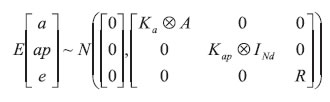
<body><![CDATA[<p><i>N<sub>a</sub></i> is the number of animals in the relationship   matrix.</p>     <p>   The dimension of vector ap consists of <i>k<sub>ap</sub></i> x <i>N<sub>d</sub></i>  coefficients, where:</p>     <p>   <i>k<sub>ap</sub></i> corresponds to the order of the polynomial and   <i>N<sub>d</sub></i> is the number of animals with records.</p>     <p>For analysis, it was assumed that the records   were distributed with mean X&beta;. The following   assumptions were made for additive genetic, permanent environmental and residual effects:</p>     <p align="center"><img src="/img/revistas/rccp/v26n3/v26n3a4g1.jpg"/></p>     <p>Where:</p>     <p>   <i>K<sub>a</sub></i> and <i>K<sub>ap</sub></i> are covariance matrices between additive   genetic and permanent environmental random   regression coefficients, respectively.</p>     <p><i>A</i> is the relationship matrix between individuals.</p>     <p><i>I<sub>Nd</sub></i> is the identity matrix of dimension <i>N<sub>d</sub></i>.</p>     <p><img src="/img/revistas/rccp/v26n3/v26n3a4g2.jpg"/> is the Kronecker product between matrices.</p>     ]]></body>
<body><![CDATA[<p>R is a block diagonal matrix containing residual   variances. It was assumed that the residuals are   independent.</p>     <p>The random additive genetic and permanent   environmental effects were modeled using third- to   sixth-order Legendre polynomials. A homogeneous   (R) and a heterogenous (r) structure with nine   classes (each month was considered to be a different   class) were adopted for residual variances. In   addition, heterogeneous variances with smaller   classes were also considered, which were divided   according to similarity between variances based   on the nine residual classes. Thus, test-day records   for milk yield were divided into four classes (1, 2   to 4, 5 to 8, and 9). The general RRM is given as <i>LEGk<sub>a</sub></i>.<i>k<sub>ap</sub></i>_<i>R</i> or<i> LEGk<sub>a</sub>.k<sub>ap</sub>_r</i>, where:</p>     <p><i>k<sub>a</sub></i> and <i>k<sub>ap</sub></i> correspond to the order of the   covariance function for additive genetic and permanent environmental effects, respectively.</p>     <p><i>R</i> or <i>r</i> is the structure of residual variances.</p>     <p>The covariance functions were estimated by the   restricted maximum likelihood method using the WOMBAT statistical program (Meyer, 2006).</p>     <p>We assumed independence of the residuals.   The citation of the RRM follows the pattern of   <i>LEGk<sub>a</sub>.k<sub>ap</sub>_r</i>, referring to the order of the covariance   function for the additive genetic effects (<i>k<sub>a</sub></i>),   permanent environmental effects (<i>k<sub>ap</sub></i>) and the   residual variances structure (<i>r</i>). For example, the   LEG4,6_4 model denotes an analysis fitting a   fourth and sixth order Legendre polynomial for the   additive genetic and the permanent environmental   effects, respectively, and the residual variances modeled with a step function with four classes.</p>     <p>The different models were compared using   the logarithm of the likelihood function (log L),   the likelihood ratio test (LRT) at 1% probability,   restricted maximum likelihood Akaike (AIC) and   Schwarz Bayesian (BIC) information criteria, and   examination of variances and correlations estimated   for the traits. The information criteria can be described as: <i>AIC</i> = &#8211;2log<i>L</i> + 2<i>p</i> and <i>BIC</i> = &#150;2log<i>L</i> + <i>p</i>log(<i>N&#150;r(X)</i>, where:</p>     <p><i>p</i> is the number of parameters estimated.</p>     <p>   <i>N</i> is the number of data.</p>     <p><i>r(X)</i> is the rank of the incidence matrix of fixed effects in the model.</p>     ]]></body>
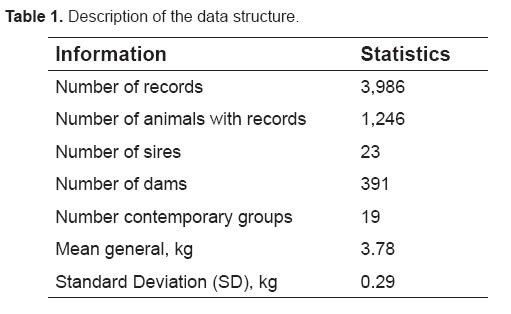
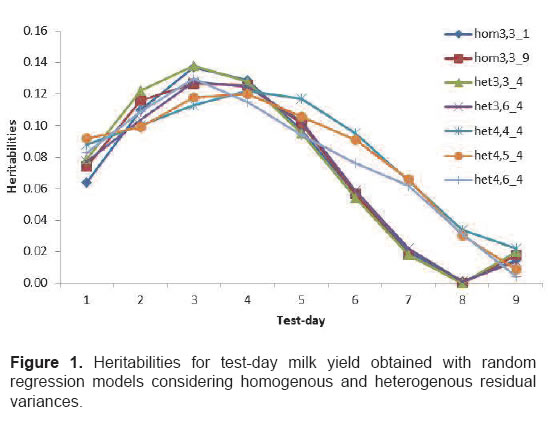
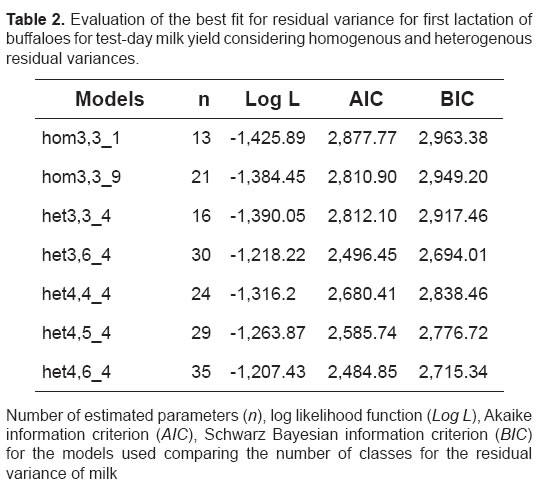
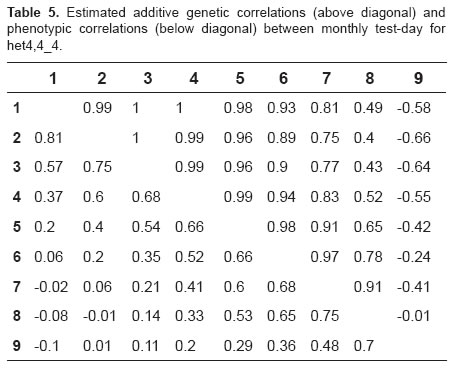
<body><![CDATA[<p>   <i>log L</i> is the logarithm of the restricted maximum   likelihood function (Wolfinger, 1993).</p>     <p>&nbsp;</p>     <p><b><font size="3">Results</font></b></p>     <p>   The phenotypic mean of TDMY was 3.78 &plusmn;   0.29 kg (<a href="#t1">Table 1</a>). Milk production was 3.69 &plusmn;   0.09 kg at the beginning of the lactation curve and   4.01 &plusmn; 0.52 at peak lactation, declining thereafter to   2.25 &plusmn; 0.68 kg.</p>     <p align="center"><a name="t1"></a><img src="/img/revistas/rccp/v26n3/v26n3a4t1.jpg"/></p>     <p>For the homogenous models (hom3,3_1),   random additive genetic and permanent   environmental effects were kept constant, assuming   a homogenous residual variance structure (hom).   For the heterogeneous models (het3,3_9, het3,3_4,   het3,6_4, het4,4_4, het4,5_4, and het4,6_4), the   random effects of residual variance were divided into four classes of heterogeneous variance (het).</p>     <p>The heritabilities obtained by the models ranged   from 0.00 to 0.14 (<a href="#f1">Figure 1</a>). In general, the highest   heritabilities were observed between TDMY2 and   TDMY5 (0.09 to 0.14) and the lowest estimates   on TDMY8 and TDMY9 (0.00 to 0.03). For all   seven models tested, additive genetic, permanent   environmental and phenotypic variances were   greater at the beginning of lactation and lower at   the conclusion, ranging from 0.38 kg<sup>2</sup> to 0.04 kg<sup>2</sup>,   from 1.65 kg<sup>2</sup> to 0.20 kg<sup>2</sup>, and from 1.98 kg<sup>2</sup> to   0.53 kg<sup>2</sup>, respectively. Residual variances were low   (0.001 kg<sup>2</sup>) at the beginning of lactation and high (1.95 kg<sup>2</sup>) at the conclusion.</p>     <p align="center"><a name="f1"></a><img src="/img/revistas/rccp/v26n3/v26n3a4f1.jpg"/></p>     <p>In general, the heterogeneous models presented   lower log likelihood function (Log L), Akaike   information criterion (AIC) and Schwarz Bayesian   information criterion (BIC) values (<a href="#t2">Table 2</a>). The   BIC, which penalizes models with a larger number   of parameters more rigorously, selected het3,6_4   and het4,4_4 as the best models for milk production.   As a consequence, these models would be more   adequate to describe the TDMY variation. <a href="/img/revistas/rccp/v26n3/v26n3a4t3.jpg" target="_blank">Table 3</a>  shows the eigenvalues associated with the matrix of   random regression coefficients for additive genetic   and permanent environmental effects obtained with   the two best models (het3,6_4 and het4,4_4) for TDMY according to the BIC.</p>     <p align="center"><a name="t2"></a><img src="/img/revistas/rccp/v26n3/v26n3a4t2.jpg"/></p>     ]]></body>
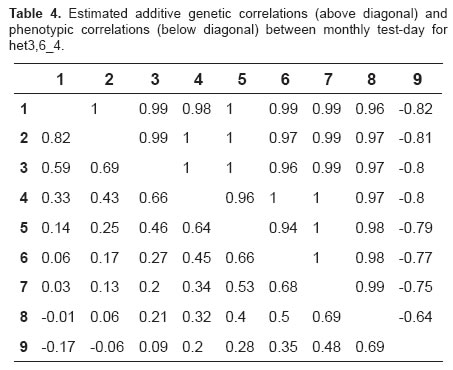
<body><![CDATA[<p>The models of lower order are sufficient to   capture all the milk production variation, with   a fourth coefficient for the additive part being   associated with a zero eigenvalue, unlike the   permanent environmental effect. For the two   models, the fourth regression coefficient for   additive genetic variance, but not for permanent   environmental variance, was associated with an   eigenvalue of zero. The first eigenvalue explained   more than 70% of the variation in milk yield data.   The variability in additive genetic and permanent   environmental effects was primarily explained by the first eigenvalues (&gt; 92%).</p>     <p>The genetic variances obtained with the selected   models (het3,6_4 and het4,4_4) were greater at   the beginning of lactation, with the highest values   being observed on test days 3 and 1, respectively   (Figure 2). The permanent environmental variances   obtained with models het3,6_4 and het4,4_4   showed a similar trend, with values ranging from   1.20 kg<sup>2</sup> to 0.49 kg<sup>2</sup> and from 1.29 kg<sup>2</sup> to 0.49 kg<sup>2</sup>,   respectively. The phenotypic variances obtained   with models het4,4_4 and het3,6_4 were greater at   the beginning of lactation, with maximum values   on test day 1 (1.37 kg<sup>2</sup> and 1.45 kg2, respectively)   (<a href="/img/revistas/rccp/v26n3/v26n3a4f2.jpg" target="_blank">Figure 2</a>). Conversely, residual variances ranged   from 0.06 kg<sup>2</sup> to 0.36 kg<sup>2</sup> and from 0.03 kg<sup>2</sup> to 0.48 kg<sup>2</sup>, respectively.</p>      <p>For the selected models, the correlations between   regression coefficients for additive genetic effects   ranged from -0.82 to 1.0 across lactation, with the   observation of high and positive genetic correlations   between consecutive test days (<a href="#t4">Tables 4</a> and <a href="#t5">5</a>), and   low and positive correlations between more distant   test days. For the two models, negative genetic   correlations were observed between TDMY9 and   the other test days, with high correlations (-0.82)   at the beginning of lactation and low correlations (-0.01) at the end of lactation (<a href="#t4">Tables 4</a> and <a href="#t5">5</a>).</p>     <p align="center"><a name="t4"></a><img src="/img/revistas/rccp/v26n3/v26n3a4t4.jpg"/></p>     <p align="center"><a name="t5"></a><img src="/img/revistas/rccp/v26n3/v26n3a4t5.jpg"/></p>     <p>High and positive phenotypic correlations were   observed between adjacent test days and low and   negative correlations between more distant test   days, ranging from -0.17 to 0.82 and from -0.10 to   0.81 for models het3,6_4 and het4,4_4, respectively (Tables <a href="#t4">4</a> and <a href="#t5">5</a>).</p>     <p>&nbsp;</p>     <p><b><font size="3">Discussion</font></b></p>     <p>   TDMY followed the typical shape of the   lactation curve in dairy buffaloes (Ara&uacute;jo et al,.   2007; Hurtado-Lugo et al,. 2005). The models   considering homogenous residual variances across   lactation presented higher AIC and BIC values and   consequent problems in the estimation of TDMY   (<a href="#t2">Table 2</a>). The results indicated that variances differ   across lactation and residual variances therefore   need to be modeled using heterogeneous variance   structures (<a href="#t2">Table 2</a>). Comparison of the models   based on step functions showed that models   including classes of residual variances provided   better estimates than those considering homogeneity   of variances. In addition, superparameterized   models (<i>n</i>) were penalized rigorously by the BIC   criterion when compared to the AIC criterion   (<a href="#t2">Table 2</a>). The difference in the estimates between   models based on the AIC and BIC selection criteria   might be related to the small number of test-day   observations. In general, the heterogeneous models   presented higher log L values (<a href="#t2">Table 2</a>). In the study   of Ara&uacute;jo <i>et al.</i> (2007), second order models were   more efficient when the number of residual classes   was high. However, fourth order polynomial models   with four residual classes showed the highest log   L value. In this investigation, models het3,6_4   and het4,4_4, presented the lowest log L, AIC and   BIC values and were therefore the most efficient in   describing the variation in milk production across   the lactation curve.</p>     <p>According to Pool <i>et al.</i> (2000), the shape of the   lactation curve can be modeled with sufficiently   high precision using a third order Legendre   polynomial for the additive genetic component   and a fourth order polynomial for permanent   environmental effects. On the other hand, Lopez-   Romero and Caraba&ntilde;o (2003) suggested low order   Legendre polynomials for additive and permanent   environmental variances to be the most adequate to   model milk production in first lactation cows. The   eigenvalues obtained in the present study suggest   that the dimension of random effects can be reduced   without the loss of information, disagreeing with   the log L and AIC values for additive genetic and   permanent environmental effects and agreeing with the BIC value for additive genetic effects. However, according to Legarra <i>et al.</i> (2004), the reduction of the dimension of random effects as a result of eigenvalues close to zero is not indicated in all cases since the adoption of this criterion may lead to simplistic and inadequate models.</p>     ]]></body>
<body><![CDATA[<p>The heritability estimates obtained with the   models tested ranged from 0.00 to 0.14. All models,   except for those selected (het3,6_4 and het4,4_4),   presented estimation problems at the end of the   lactation curve (<a href="#f1" target="_blank">Figure 1</a>). As a consequence of this   fact, Meyer (2005) suggested that models using high   order polynomials are more flexible and are able to   model variances on a continuous scale. However,   these polynomials tend to place greater emphasis   on the extremes of the trajectory, causing estimation problems at these points.</p>     <p>Greater heritabilities at the beginning and at the   end of lactation have been reported for dairy cattle   (Brotherstone <i>et al.</i>, 2000). The same trend at the   beginning of lactation was observed in the present   study. In contrast, heritabilities were lower at the   end of the lactation curve. This finding might be due   to the fact that buffalo farming is a recent activity in   Colombia and that production data are limited due   to the small number of animals and zootechnical   records. Ara&uacute;jo <i>et al.</i> (2007), who studied milk   production in buffaloes as a function of age using   RRM with low order Legendre polynomials,   estimated heritabilities of 0.08 to 0.40. These   estimates are higher than those obtained in the present study.</p>     <p>The estimates obtained with model het4,4_4   presented higher AIC and BIC values than those   obtained with model het3,6_4. However, the latter   model included a larger number of parameters (<i>n</i>).   Therefore, het4,4_4 was the best model. This model   was selected based on the fact that less complex   models (<i>n</i>) are easier to interpret from a biological   standpoint. On the other hand, this fact indicates   the need to include a larger number of zootechnical   data from the herd. According to Meyer (2005),   Legendre polynomials place greater emphasis on   observations at the extremes of the lactation curve,   generating estimation problems at these points.   This fact may explain the difficulty in modeling   TDMY since cows are affected by postpartum   stress at the beginning of lactation, as well as by a   negative energy balance. In addition, the number of production records is low at the end of lactation.</p>     <p>The phenotypic variances obtained with the two   models showed a similar variation across lactation   (<a href="/img/revistas/rccp/v26n3/v26n3a4f2.jpg" target="_blank">Figure 2</a>), with the observation of higher variances   at the beginning of lactation and peak values on the   first test day. Kettunen <i>et al.</i> (2000) reported higher   phenotypic variances at the beginning and at the end of lactation for first lactating Holstein cows.</p>     <p>Using the models selected, the genetic   correlations presented their greatest differences   between TDMY6 and TDMY8 (Tables <a href="#t4">4</a> and <a href="#t5">5</a>).   The unexpected negative genetic correlations   between TDMY9 and the other test days might   be due to the lack of fit of polynomials at the end   of lactation. In addition, the small number of   zootechnical records from TDMY9 may cause estimation problems at these points.</p>     <p>Negative genetic correlations at the beginning   and at the end of lactation have been reported   for dairy cattle using RRM. These results might   be explained by postpartum stress and the small   number of records at the end of lactation (4,13). The   genetic correlations obtained with model het3,6_4   differ from those reported by Ara&uacute;jo <i>et al.</i> (2007),   suggesting that the genetic correlations between milk yields were close to unity in Murrah buffaloes.</p>     <p>The phenotypic correlations varied, with the   observation of higher estimates between test days   at the beginning of lactation and lower estimates   between more distant test days. Similar results have   been reported by Hurtado-Lugo <i>et al.</i> (2005), who   used finite dimensional models and found higher   phenotypic correlations between adjacent test   days (0.64 to 0.84) and lower correlations between   more distant test days (0.01 to 0.30). Kettunen   <i>et al.</i> (2000) estimated phenotypic correlations   of 0.20 to 0.74, with the highest estimates being   observed between adjacent test days and the lowest   correlations between test days at the beginning and at the end of lactation.</p>     <p>In conclusion, the present results demonstrate the need to consider heterogeneity of residual variances in the models tested in order to describe variations in days of lactation. The function with four residual variance classes was the best to model milk production across lactation. However, all model selection criteria used indicated het3,6_4 to be the best model (lowest AIC and BIC values), whereas model het4,4_4 was the most parsimonious because of its lower complexity at the time of biological interpretation.</p>     <p>&nbsp;</p>  <hr size="1" />      <p><b><font size="3">Notas</font></b></p> <a name="1"></a><a href="#b1">&curren;</a> To cite this article: Hurtado-Lugo NA, De Sousa SC, Aspilcueta RR, Guti&eacute;rrez SY, Cer&oacute;n-Mu&ntilde;oz MF, Tonhati H. Estimation of genetic parameters for test-day milk yield in first calving buffaloes. Rev Colomb Cienc Pecu 2013; 26:177-185.  </font> <hr size="1" /> <font size="2" face="Verdana, Arial, Helvetica, sans-serif">     ]]></body>
<body><![CDATA[<p>&nbsp;</p>     <p>&nbsp;</p>     <p><b><font size="3">Acknowledgements</font></b></p>     <p>   This research was financially supported by   the Colombian Ministry of Agriculture and   Rural Development, Colombian Cattle Breeders   Federation (FEDEGAN), Funda&ccedil;&atilde;o de Apoio &agrave;   Pesquisa do Estado de S&atilde;o Paulo (FAPESP-Process   N &ordm; 2009/53773-1), the University of Antioquia,   CODI/UdeA sustainability 2011-2012 and the   Colombian Buffalo Breeders Association. Project   title: ''Consolidation of the registration system   in buffaloes and milk control, and Impact on production and improvement of Colombian herds''.</p>     <p>&nbsp;</p>     <p><b><font size="3">References</font></b></p>     <!-- ref --><p>   Ara&uacute;jo C, Ramos A, Ara&uacute;jo S, Chaves C, Schierholt A.   Buffaloes milk yield analysis using random regression models.   Ital J Anim Sci 2007; 6 Sup 2:279-282.    &nbsp;&nbsp;&nbsp;&nbsp;&nbsp;&nbsp;&nbsp;&nbsp;[&#160;<a href="javascript:void(0);" onclick="javascript: window.open('/scielo.php?script=sci_nlinks&ref=000109&pid=S0120-0690201300030000400001&lng=','','width=640,height=500,resizable=yes,scrollbars=1,menubar=yes,');">Links</a>&#160;]<!-- end-ref --></p>     <!-- ref --><p>   Ballesteros J, Fern&aacute;ndez C, Due&ntilde;as R. Introducci&oacute;n a la   Diversidad Faun&iacute;stica del Departamento de C&oacute;rdoba. Informe   t&eacute;cnico. Monter&iacute;a-Colombia: Universidad de C&oacute;rdoba, Facultad   de Ciencias B&aacute;sicas e Ingenier&iacute;as; 2006.    &nbsp;&nbsp;&nbsp;&nbsp;&nbsp;&nbsp;&nbsp;&nbsp;[&#160;<a href="javascript:void(0);" onclick="javascript: window.open('/scielo.php?script=sci_nlinks&ref=000111&pid=S0120-0690201300030000400002&lng=','','width=640,height=500,resizable=yes,scrollbars=1,menubar=yes,');">Links</a>&#160;]<!-- end-ref --></p>     ]]></body>
<body><![CDATA[<!-- ref --><p>   Brotherstone S, White IMS, Meyer K. Genetic modeling of   daily yield using orthogonal polynomials and parametric curves.   J Anim Sci 2000; 70:407-415.    &nbsp;&nbsp;&nbsp;&nbsp;&nbsp;&nbsp;&nbsp;&nbsp;[&#160;<a href="javascript:void(0);" onclick="javascript: window.open('/scielo.php?script=sci_nlinks&ref=000113&pid=S0120-0690201300030000400003&lng=','','width=640,height=500,resizable=yes,scrollbars=1,menubar=yes,');">Links</a>&#160;]<!-- end-ref --></p>     <!-- ref --><p>   Corporaci&oacute;n Aut&oacute;noma Regional de los Valles del Sin&uacute; y San   Jorge-CVS, Recuperaci&oacute;n de la vegetaci&oacute;n relictual de &aacute;reas   prioritarias de la zona de vida BS-T en el departamento de   C&oacute;rdoba. Bogot&aacute;, 2005.    &nbsp;&nbsp;&nbsp;&nbsp;&nbsp;&nbsp;&nbsp;&nbsp;[&#160;<a href="javascript:void(0);" onclick="javascript: window.open('/scielo.php?script=sci_nlinks&ref=000115&pid=S0120-0690201300030000400004&lng=','','width=640,height=500,resizable=yes,scrollbars=1,menubar=yes,');">Links</a>&#160;]<!-- end-ref --></p>     <!-- ref --><p>   Hurtado-Lugo N, Cer&oacute;n-Mu&ntilde;oz M, Guti&eacute;rrez-Valencia A,   Tonhati H, Henao A. Producci&oacute;n de leche en b&uacute;falas de la Costa   Atl&aacute;ntica Colombiana. Liv Res Rur Dev 2005; 17 (139). &#91;access   date March 10, 2012&#93; URL: <a href="http://www.lrrd.org/lrrd17/12/hurt17139.htm" target="_blank">http://www.lrrd.org/lrrd17/12/hurt17139.htm</a>&nbsp;&nbsp;&nbsp;&nbsp;&nbsp;&nbsp;&nbsp;&nbsp;[&#160;<a href="javascript:void(0);" onclick="javascript: window.open('/scielo.php?script=sci_nlinks&ref=000117&pid=S0120-0690201300030000400005&lng=','','width=640,height=500,resizable=yes,scrollbars=1,menubar=yes,');">Links</a>&#160;]<!-- end-ref --><!-- ref --><p>   Kettunen A, M&auml;ntysaari E, P&ouml;s&ouml; J. Estimation of genetic   parameters for daily milk yield of primiparous Ayrshire cows   by random regression test-day models. Livest Prod Sci 2000;   66:251-261.    &nbsp;&nbsp;&nbsp;&nbsp;&nbsp;&nbsp;&nbsp;&nbsp;[&#160;<a href="javascript:void(0);" onclick="javascript: window.open('/scielo.php?script=sci_nlinks&ref=000118&pid=S0120-0690201300030000400006&lng=','','width=640,height=500,resizable=yes,scrollbars=1,menubar=yes,');">Links</a>&#160;]<!-- end-ref --></p>     <!-- ref --><p>   Kirkpatrick M, Lofsvold D, Bulmer M. Analysis of the   inheritance, selection and evolution of growth trajectories.   Genetics 1990; 124:979-993.    &nbsp;&nbsp;&nbsp;&nbsp;&nbsp;&nbsp;&nbsp;&nbsp;[&#160;<a href="javascript:void(0);" onclick="javascript: window.open('/scielo.php?script=sci_nlinks&ref=000120&pid=S0120-0690201300030000400007&lng=','','width=640,height=500,resizable=yes,scrollbars=1,menubar=yes,');">Links</a>&#160;]<!-- end-ref --></p>     <!-- ref --><p>   Legarra A, Misztal I, Bertrand JK. Constructing covariance   functions for random regression models for growth in Gelbvieh   beef cattle. J Anim Sci 2004; 82:1564-1571.    &nbsp;&nbsp;&nbsp;&nbsp;&nbsp;&nbsp;&nbsp;&nbsp;[&#160;<a href="javascript:void(0);" onclick="javascript: window.open('/scielo.php?script=sci_nlinks&ref=000122&pid=S0120-0690201300030000400008&lng=','','width=640,height=500,resizable=yes,scrollbars=1,menubar=yes,');">Links</a>&#160;]<!-- end-ref --></p>     <!-- ref --><p>   L&oacute;pez-Romero P, Caraba&ntilde;o M. Comparing alternative random   regression models to analyse first-lactation daily milk yield data   in Holstein-Friesian cattle. Livest Prod Sci 2003; 82: 81-86.    &nbsp;&nbsp;&nbsp;&nbsp;&nbsp;&nbsp;&nbsp;&nbsp;[&#160;<a href="javascript:void(0);" onclick="javascript: window.open('/scielo.php?script=sci_nlinks&ref=000124&pid=S0120-0690201300030000400009&lng=','','width=640,height=500,resizable=yes,scrollbars=1,menubar=yes,');">Links</a>&#160;]<!-- end-ref --></p>     <!-- ref --><p>   Meyer K. Random regression analyses using B-splines to   model growth of Australian Angus cattle. Genet Sel Evol 2005;   37:473-500.    &nbsp;&nbsp;&nbsp;&nbsp;&nbsp;&nbsp;&nbsp;&nbsp;[&#160;<a href="javascript:void(0);" onclick="javascript: window.open('/scielo.php?script=sci_nlinks&ref=000126&pid=S0120-0690201300030000400010&lng=','','width=640,height=500,resizable=yes,scrollbars=1,menubar=yes,');">Links</a>&#160;]<!-- end-ref --></p>     <!-- ref --><p>   Meyer K. ''WOMBAT'' - Digging deep for quantitative genetic   analyses by restricted maximum likelihood. Proceedings of the   8th world congress on genetics applied to Livestock Production; 2006 Ago 13-18; Belo Horizonte.    &nbsp;&nbsp;&nbsp;&nbsp;&nbsp;&nbsp;&nbsp;&nbsp;[&#160;<a href="javascript:void(0);" onclick="javascript: window.open('/scielo.php?script=sci_nlinks&ref=000128&pid=S0120-0690201300030000400011&lng=','','width=640,height=500,resizable=yes,scrollbars=1,menubar=yes,');">Links</a>&#160;]<!-- end-ref --></p>     <!-- ref --><p>   Pool M, Janss L, Meuwissen T. Genetic Parameters of Legendre   polynomials for first parity lactation curves. J Dairy Sci 2000;   83:2640-2649.    &nbsp;&nbsp;&nbsp;&nbsp;&nbsp;&nbsp;&nbsp;&nbsp;[&#160;<a href="javascript:void(0);" onclick="javascript: window.open('/scielo.php?script=sci_nlinks&ref=000130&pid=S0120-0690201300030000400012&lng=','','width=640,height=500,resizable=yes,scrollbars=1,menubar=yes,');">Links</a>&#160;]<!-- end-ref --></p>     <!-- ref --><p>   Strabel T, Misztal I. Genetic parameters for first and second   lactation milk yields of Polish Black and White cattle with   random regression test-day models. J Dairy Sci 1999; 82:2805-   2810.    &nbsp;&nbsp;&nbsp;&nbsp;&nbsp;&nbsp;&nbsp;&nbsp;[&#160;<a href="javascript:void(0);" onclick="javascript: window.open('/scielo.php?script=sci_nlinks&ref=000132&pid=S0120-0690201300030000400013&lng=','','width=640,height=500,resizable=yes,scrollbars=1,menubar=yes,');">Links</a>&#160;]<!-- end-ref --></p>     <!-- ref --><p>   Wolfinger R. Covariance structure selection in general mixed   models. Commun Stat Simul Comput 1993; 22:1079&#8211;110&nbsp;&nbsp;&nbsp;&nbsp;&nbsp;&nbsp;&nbsp;&nbsp;[&#160;<a href="javascript:void(0);" onclick="javascript: window.open('/scielo.php?script=sci_nlinks&ref=000134&pid=S0120-0690201300030000400014&lng=','','width=640,height=500,resizable=yes,scrollbars=1,menubar=yes,');">Links</a>&#160;]<!-- end-ref --><p>&nbsp;</p> </font>      ]]></body><back>
<ref-list>
<ref id="B1">
<nlm-citation citation-type="journal">
<person-group person-group-type="author">
<name>
<surname><![CDATA[Araújo]]></surname>
<given-names><![CDATA[C]]></given-names>
</name>
<name>
<surname><![CDATA[Ramos]]></surname>
<given-names><![CDATA[A]]></given-names>
</name>
<name>
<surname><![CDATA[Araújo]]></surname>
<given-names><![CDATA[S]]></given-names>
</name>
<name>
<surname><![CDATA[Chaves]]></surname>
<given-names><![CDATA[C]]></given-names>
</name>
<name>
<surname><![CDATA[Schierholt]]></surname>
<given-names><![CDATA[A]]></given-names>
</name>
</person-group>
<article-title xml:lang="en"><![CDATA[Buffaloes milk yield analysis using random regression models]]></article-title>
<source><![CDATA[Ital J Anim Sci]]></source>
<year>2007</year>
<volume>6</volume>
<numero>2</numero>
<issue>2</issue>
<page-range>279-282</page-range></nlm-citation>
</ref>
<ref id="B2">
<nlm-citation citation-type="book">
<person-group person-group-type="author">
<name>
<surname><![CDATA[Ballesteros]]></surname>
<given-names><![CDATA[J]]></given-names>
</name>
<name>
<surname><![CDATA[Fernández]]></surname>
<given-names><![CDATA[C]]></given-names>
</name>
<name>
<surname><![CDATA[Dueñas]]></surname>
<given-names><![CDATA[R]]></given-names>
</name>
</person-group>
<source><![CDATA[Introducción a la Diversidad Faunística del Departamento de Córdoba. Informe técnico]]></source>
<year>2006</year>
<publisher-loc><![CDATA[Montería ]]></publisher-loc>
<publisher-name><![CDATA[Universidad de Córdoba, Facultad de Ciencias Básicas e Ingenierías]]></publisher-name>
</nlm-citation>
</ref>
<ref id="B3">
<nlm-citation citation-type="journal">
<person-group person-group-type="author">
<name>
<surname><![CDATA[Brotherstone]]></surname>
<given-names><![CDATA[S]]></given-names>
</name>
<name>
<surname><![CDATA[White]]></surname>
<given-names><![CDATA[IMS]]></given-names>
</name>
<name>
<surname><![CDATA[Meyer]]></surname>
<given-names><![CDATA[K.]]></given-names>
</name>
</person-group>
<article-title xml:lang="en"><![CDATA[Genetic modeling of daily yield using orthogonal polynomials and parametric curves]]></article-title>
<source><![CDATA[J Anim Sci]]></source>
<year>2000</year>
<volume>70</volume>
<page-range>407-415</page-range></nlm-citation>
</ref>
<ref id="B4">
<nlm-citation citation-type="">
<collab>Corporación Autónoma Regional de los Valles del Sinú y San Jorge-CVS</collab>
<source><![CDATA[Recuperación de la vegetación relictual de áreas prioritarias de la zona de vida BS-T en el departamento de Córdoba]]></source>
<year>2005</year>
<publisher-loc><![CDATA[Bogotá ]]></publisher-loc>
</nlm-citation>
</ref>
<ref id="B5">
<nlm-citation citation-type="journal">
<person-group person-group-type="author">
<name>
<surname><![CDATA[Hurtado-Lugo]]></surname>
<given-names><![CDATA[N]]></given-names>
</name>
<name>
<surname><![CDATA[Cerón-Muñoz]]></surname>
<given-names><![CDATA[M]]></given-names>
</name>
<name>
<surname><![CDATA[Gutiérrez-Valencia]]></surname>
<given-names><![CDATA[A]]></given-names>
</name>
<name>
<surname><![CDATA[Tonhati]]></surname>
<given-names><![CDATA[H]]></given-names>
</name>
<name>
<surname><![CDATA[Henao]]></surname>
<given-names><![CDATA[A]]></given-names>
</name>
</person-group>
<article-title xml:lang="es"><![CDATA[Producción de leche en búfalas de la Costa Atlántica Colombiana]]></article-title>
<source><![CDATA[Liv Res Rur Dev]]></source>
<year>2005</year>
<volume>17</volume>
<numero>139</numero>
<issue>139</issue>
</nlm-citation>
</ref>
<ref id="B6">
<nlm-citation citation-type="journal">
<person-group person-group-type="author">
<name>
<surname><![CDATA[Kettunen]]></surname>
<given-names><![CDATA[A]]></given-names>
</name>
<name>
<surname><![CDATA[Mäntysaari]]></surname>
<given-names><![CDATA[E]]></given-names>
</name>
<name>
<surname><![CDATA[Pösö]]></surname>
<given-names><![CDATA[J]]></given-names>
</name>
</person-group>
<article-title xml:lang="en"><![CDATA[Estimation of genetic parameters for daily milk yield of primiparous Ayrshire cows by random regression test-day models]]></article-title>
<source><![CDATA[Livest Prod Sci]]></source>
<year>2000</year>
<volume>66</volume>
<page-range>251-261</page-range></nlm-citation>
</ref>
<ref id="B7">
<nlm-citation citation-type="journal">
<person-group person-group-type="author">
<name>
<surname><![CDATA[Kirkpatrick]]></surname>
<given-names><![CDATA[M]]></given-names>
</name>
<name>
<surname><![CDATA[Lofsvold]]></surname>
<given-names><![CDATA[D]]></given-names>
</name>
<name>
<surname><![CDATA[Bulmer]]></surname>
<given-names><![CDATA[M]]></given-names>
</name>
</person-group>
<article-title xml:lang="en"><![CDATA[Analysis of the inheritance, selection and evolution of growth trajectories]]></article-title>
<source><![CDATA[Genetics]]></source>
<year>1990</year>
<volume>124</volume>
<page-range>979-993</page-range></nlm-citation>
</ref>
<ref id="B8">
<nlm-citation citation-type="journal">
<person-group person-group-type="author">
<name>
<surname><![CDATA[Legarra]]></surname>
<given-names><![CDATA[A]]></given-names>
</name>
<name>
<surname><![CDATA[Misztal]]></surname>
<given-names><![CDATA[I]]></given-names>
</name>
<name>
<surname><![CDATA[Bertrand]]></surname>
<given-names><![CDATA[JK]]></given-names>
</name>
</person-group>
<article-title xml:lang="en"><![CDATA[Constructing covariance functions for random regression models for growth in Gelbvieh beef cattle]]></article-title>
<source><![CDATA[J Anim Sci]]></source>
<year>2004</year>
<volume>82</volume>
<page-range>1564-1571</page-range></nlm-citation>
</ref>
<ref id="B9">
<nlm-citation citation-type="journal">
<person-group person-group-type="author">
<name>
<surname><![CDATA[López-Romero]]></surname>
<given-names><![CDATA[P]]></given-names>
</name>
<name>
<surname><![CDATA[Carabaño]]></surname>
<given-names><![CDATA[M]]></given-names>
</name>
</person-group>
<article-title xml:lang="en"><![CDATA[Comparing alternative random regression models to analyse first-lactation daily milk yield data in Holstein-Friesian cattle]]></article-title>
<source><![CDATA[Livest Prod Sci]]></source>
<year>2003</year>
<volume>82</volume>
<page-range>81-86</page-range></nlm-citation>
</ref>
<ref id="B10">
<nlm-citation citation-type="journal">
<person-group person-group-type="author">
<name>
<surname><![CDATA[Meyer]]></surname>
<given-names><![CDATA[K]]></given-names>
</name>
</person-group>
<article-title xml:lang="en"><![CDATA[Random regression analyses using B-splines to model growth of Australian Angus cattle]]></article-title>
<source><![CDATA[Genet Sel Evol]]></source>
<year>2005</year>
<volume>37</volume>
<page-range>473-500</page-range></nlm-citation>
</ref>
<ref id="B11">
<nlm-citation citation-type="confpro">
<person-group person-group-type="author">
<name>
<surname><![CDATA[Meyer]]></surname>
<given-names><![CDATA[K]]></given-names>
</name>
</person-group>
<source><![CDATA[''WOMBAT'' - Digging deep for quantitative genetic analyses by restricted maximum likelihood]]></source>
<year></year>
<conf-name><![CDATA[8th world congress on genetics applied to Livestock Production]]></conf-name>
<conf-date>2006 Ago 13-18</conf-date>
<conf-loc>Belo Horizonte </conf-loc>
</nlm-citation>
</ref>
<ref id="B12">
<nlm-citation citation-type="journal">
<person-group person-group-type="author">
<name>
<surname><![CDATA[Pool]]></surname>
<given-names><![CDATA[M]]></given-names>
</name>
<name>
<surname><![CDATA[Janss]]></surname>
<given-names><![CDATA[L]]></given-names>
</name>
<name>
<surname><![CDATA[Meuwissen]]></surname>
<given-names><![CDATA[T]]></given-names>
</name>
</person-group>
<article-title xml:lang="en"><![CDATA[Genetic Parameters of Legendre polynomials for first parity lactation curves]]></article-title>
<source><![CDATA[J Dairy Sci]]></source>
<year>2000</year>
<volume>83</volume>
</nlm-citation>
</ref>
<ref id="B13">
<nlm-citation citation-type="journal">
<person-group person-group-type="author">
<name>
<surname><![CDATA[Strabel]]></surname>
<given-names><![CDATA[T]]></given-names>
</name>
<name>
<surname><![CDATA[Misztal]]></surname>
<given-names><![CDATA[I]]></given-names>
</name>
</person-group>
<article-title xml:lang="en"><![CDATA[Genetic parameters for first and second lactation milk yields of Polish Black and White cattle with random regression test-day models]]></article-title>
<source><![CDATA[J Dairy Sci]]></source>
<year>1999</year>
<volume>82</volume>
<page-range>2805- 2810</page-range></nlm-citation>
</ref>
<ref id="B14">
<nlm-citation citation-type="journal">
<person-group person-group-type="author">
<name>
<surname><![CDATA[Wolfinger]]></surname>
<given-names><![CDATA[R]]></given-names>
</name>
</person-group>
<article-title xml:lang="en"><![CDATA[Covariance structure selection in general mixed models]]></article-title>
<source><![CDATA[Commun Stat Simul Comput]]></source>
<year>1993</year>
<volume>22</volume>
<page-range>1079-110</page-range></nlm-citation>
</ref>
</ref-list>
</back>
</article>