<?xml version="1.0" encoding="ISO-8859-1"?><article xmlns:mml="http://www.w3.org/1998/Math/MathML" xmlns:xlink="http://www.w3.org/1999/xlink" xmlns:xsi="http://www.w3.org/2001/XMLSchema-instance">
<front>
<journal-meta>
<journal-id>0120-0690</journal-id>
<journal-title><![CDATA[Revista Colombiana de Ciencias Pecuarias]]></journal-title>
<abbrev-journal-title><![CDATA[Rev Colom Cienc Pecua]]></abbrev-journal-title>
<issn>0120-0690</issn>
<publisher>
<publisher-name><![CDATA[Facultad de Ciencias Agrarias, Universidad de Antioquia]]></publisher-name>
</publisher>
</journal-meta>
<article-meta>
<article-id>S0120-06902013000300006</article-id>
<title-group>
<article-title xml:lang="en"><![CDATA[Effects of heat stress on reproductive efficiency of high yielding Holstein cows in a hot-arid environment]]></article-title>
<article-title xml:lang="es"><![CDATA[Efecto del estrés calórico sobre la eficiencia reproductiva de vacas Holstein de alta producción de leche en un ambiente cálido y árido]]></article-title>
<article-title xml:lang="pt"><![CDATA[Efeitos do estresse térmico sobre a eficiência reprodutiva de vacas leiteiras da raça Holandês de alto rendimento em um ambiente quente e árido]]></article-title>
</title-group>
<contrib-group>
<contrib contrib-type="author">
<name>
<surname><![CDATA[Mellado]]></surname>
<given-names><![CDATA[Miguel]]></given-names>
</name>
<xref ref-type="aff" rid="A01"/>
<xref ref-type="aff" rid="A02"/>
</contrib>
<contrib contrib-type="author">
<name>
<surname><![CDATA[Sepulveda]]></surname>
<given-names><![CDATA[Edgar]]></given-names>
</name>
<xref ref-type="aff" rid="A03"/>
</contrib>
<contrib contrib-type="author">
<name>
<surname><![CDATA[Meza-Herrera]]></surname>
<given-names><![CDATA[Cesar]]></given-names>
</name>
<xref ref-type="aff" rid="A04"/>
</contrib>
<contrib contrib-type="author">
<name>
<surname><![CDATA[Veliz]]></surname>
<given-names><![CDATA[Francisco G]]></given-names>
</name>
<xref ref-type="aff" rid="A03"/>
</contrib>
<contrib contrib-type="author">
<name>
<surname><![CDATA[Arevalo]]></surname>
<given-names><![CDATA[Jose R]]></given-names>
</name>
<xref ref-type="aff" rid="A05"/>
</contrib>
<contrib contrib-type="author">
<name>
<surname><![CDATA[Mellado]]></surname>
<given-names><![CDATA[Jesus]]></given-names>
</name>
<xref ref-type="aff" rid="A02"/>
</contrib>
<contrib contrib-type="author">
<name>
<surname><![CDATA[De Santiago]]></surname>
<given-names><![CDATA[Angeles]]></given-names>
</name>
<xref ref-type="aff" rid="A03"/>
</contrib>
</contrib-group>
<aff id="A01">
<institution><![CDATA[,Universidad Autónoma Agraria Antonio Narro Departamento de Nutrición Animal ]]></institution>
<addr-line><![CDATA[Saltillo ]]></addr-line>
<country>Mexico</country>
</aff>
<aff id="A02">
<institution><![CDATA[,Universidad Autónoma Agraria Antonio Narro Departamento de Nutrición Animal ]]></institution>
<addr-line><![CDATA[Saltillo ]]></addr-line>
<country>Mexico</country>
</aff>
<aff id="A03">
<institution><![CDATA[,Universidad Autónoma Agraria Antonio Narro Facultad de Medicina Veterinaria ]]></institution>
<addr-line><![CDATA[Torreon ]]></addr-line>
<country>Mexico</country>
</aff>
<aff id="A04">
<institution><![CDATA[,Universidad Autónoma Chapingo  ]]></institution>
<addr-line><![CDATA[Bermejillo ]]></addr-line>
<country>Mexico</country>
</aff>
<aff id="A05">
<institution><![CDATA[,Universidad de la Laguna Departamento de Parasitología ]]></institution>
<addr-line><![CDATA[La Laguna ]]></addr-line>
<country>España</country>
</aff>
<pub-date pub-type="pub">
<day>00</day>
<month>09</month>
<year>2013</year>
</pub-date>
<pub-date pub-type="epub">
<day>00</day>
<month>09</month>
<year>2013</year>
</pub-date>
<volume>26</volume>
<numero>3</numero>
<fpage>193</fpage>
<lpage>200</lpage>
<copyright-statement/>
<copyright-year/>
<self-uri xlink:href="http://www.scielo.org.co/scielo.php?script=sci_arttext&amp;pid=S0120-06902013000300006&amp;lng=en&amp;nrm=iso"></self-uri><self-uri xlink:href="http://www.scielo.org.co/scielo.php?script=sci_abstract&amp;pid=S0120-06902013000300006&amp;lng=en&amp;nrm=iso"></self-uri><self-uri xlink:href="http://www.scielo.org.co/scielo.php?script=sci_pdf&amp;pid=S0120-06902013000300006&amp;lng=en&amp;nrm=iso"></self-uri><abstract abstract-type="short" xml:lang="en"><p><![CDATA[Background: high environmental temperature coupled with high humidity can result in reproductive failure in dairy cattle, with a drastic reduction in reproductive efficiency of dairy herds. Objective: to study the effect of high environmental temperature on reproduction performance of Holstein cows treated with recombinant bovine somatotropin (rbST) throughout lactation in an arid environment. Methods: reproductive variables (n=18,037 services) from a large dairy herd were evaluated with respect to the maximum temperaturehumidity index (THI) prior to breeding, on the breeding day, and after breeding. The GENMOD procedure of SAS was used to assess the effect of THI and month of breeding on pregnancy by artificial insemination (P/AI). Results: increased THI from &le; 70 to &ge; 95 units was associated with a decrease in P/AI from 47% to 26%. P/AI for cows inseminated on extremely hot days (THI= 85 to 90) preceded by cooler temperatures was six percent points higher than cows subjected to high temperatures before breeding. P/AI was higher (p<0.05) from January to March (39% to 41%) compared with the rest of the year (27% to 35%). The average number of inseminations per pregnancy was higher (p<0.05) from May to July (3.0 to 3.4) compared to other months (2.1 to 3.0). Conclusions: in this particular hot-arid environment (maximum temperature &gt;38 &ordm;C most of the year, and 230 mm mean annual rainfall), heat stress shortly before or after breeding severely compromises the breeding success of high yielding Holstein cows.]]></p></abstract>
<abstract abstract-type="short" xml:lang="es"><p><![CDATA[Antecedentes: la asociación entre temperaturas ambientales elevadas y alta humedad conduce a fallas reproductivas, disminuyendo la fertilidad de hatos lecheros. Objetivo: determinar el efecto de temperaturas ambientales elevadas sobre el comportamiento reproductivo de vacas Holstein mantenidas en un ambiente árido y cálido y tratadas con hormona del crecimiento (rbST) durante toda la lactancia. Métodos: las variables reproductivas (n=18037 servicios) de una explotación comercial fueron evaluadas con respecto al máximo índice temperatura humedad (THI) antes, durante y después de la inseminación de las vacas. El procedimiento GENMOD de SAS se utilizó para determinar el efecto del THI y el mes de inseminación sobre las tasas de preñez (P/AI). Resultados: el incremento del THI de &le; 70 a &ge; 95 unidades se asoció con una disminución en el P/AI de 47% a 26%. El P/AI para las vacas inseminadas en días con un ITH de 85 a 90, pero con temperaturas menos cálidas antes de la inseminación, fue de seis puntos porcentuales más altos (30% vs. 36%) que en las vacas expuestas a ITH más altos antes de la inseminación. El P/AI fue mayor (p<0,05) de enero a marzo (39% a 41%) comparado con el resto de los meses del año (27-35%). El número de servicios por preñez fue mayor (p<0,05) de mayo a julio (3,0 a 3,4) que en los otros meses del año (2,1 a 3,0). Conclusiones: en este ambiente extremadamente caliente (temperaturas máximas &gt; 38 &deg;C la mayor parte del año) y árido (promedio de precipitación anual de 230 mm), el estrés calórico poco antes o después de la inseminación disminuye drásticamente las probabilidades de establecer una gestación en vacas de alta producción de leche.]]></p></abstract>
<abstract abstract-type="short" xml:lang="pt"><p><![CDATA[Antecedentes: a associação entre alta temperatura e umidade no ambiente pode originar problemas reprodutivos, diminuindo o índice de fertilidade dos rebanhos leiteiros. Objetivo: avaliar o efeito da elevada temperatura ambiente sobre o desempenho reprodutivo de vacas da raça Holandês mantidas num ambiente quente e árido, as quais foram tratadas com somatotropina bovina recombinante (rBST) durante toda a lactação. Métodos: as variáveis reprodutivas (n = 18037 serviços) de um rebanho leiteiro foram avaliadas em relação ao máximo índice de temperatura-umidade (THI), antes, durante e depois da inseminação artificial das vacas. O procedimento GENMOD do SAS foi usado para avaliar o efeito do THI e do mês de reprodução sobre as taxas de gestação por inseminação artificial (P/AI). Resultados: o aumento do THI de &le; 70 para &ge; 95 unidades foi associado com a diminuição no índice P/AI, de 47% a 26%. Em dias com THI de 85 - 90, mas com menor temperatura ambiental antes da inseminação, o índice P/AI foi 6% maior do que nas vacas expostas a superior THI. O índice P/AI foi maior (p<0,05) de janeiro a março (39% a 41%), em comparação aos outros meses do ano (27 a 35%). O número médio de inseminações por prenhez foi superior (p<0,05) de maio a julho (3,0 a 3,4) quando comparado aos outros meses do ano (2,1 a 3,0). Conclusões: em ambiente quente e seco (temperaturas máximas &gt; 38&deg;C a maior parte do ano, média de precipitação anual de 230 mm) o estresse térmico antes e depois da inseminação reduz drasticamente a possibilidade de estabelecer uma gestação em vacas de alta produção de leite.]]></p></abstract>
<kwd-group>
<kwd lng="en"><![CDATA[days open]]></kwd>
<kwd lng="en"><![CDATA[fertility]]></kwd>
<kwd lng="en"><![CDATA[rbST]]></kwd>
<kwd lng="en"><![CDATA[services per pregnancy]]></kwd>
<kwd lng="es"><![CDATA[días abiertos]]></kwd>
<kwd lng="es"><![CDATA[fertilidad]]></kwd>
<kwd lng="es"><![CDATA[rbST]]></kwd>
<kwd lng="es"><![CDATA[servicios por preñez]]></kwd>
<kwd lng="pt"><![CDATA[dias abertos]]></kwd>
<kwd lng="pt"><![CDATA[fertilidade]]></kwd>
<kwd lng="pt"><![CDATA[rbST]]></kwd>
<kwd lng="pt"><![CDATA[serviços por prenhez]]></kwd>
</kwd-group>
</article-meta>
</front><body><![CDATA[  <font size="2" face="Verdana, Arial, Helvetica, sans-serif">     <p align="right"><b>ORIGINAL ARTICLES</b></p>     <p align="right">&nbsp;</p>     <p align="center"><b><font size="4">Effects of heat stress on reproductive efficiency of high yielding Holstein cows in a hot-arid environment<sup><a name="b1"></a><a href="#1">&curren;</a></sup></font></b></p>     <p>&nbsp;  </p>     <p align="center"><b><font size="3">Efecto del estr&eacute;s cal&oacute;rico sobre la eficiencia reproductiva de vacas Holstein de alta producci&oacute;n de leche   en un ambiente c&aacute;lido y &aacute;rido</font></b></p>     <p>&nbsp;  </p>     <p align="center"><b><font size="3">Efeitos do estresse t&eacute;rmico sobre a efici&ecirc;ncia reprodutiva de vacas leiteiras da ra&ccedil;a Holand&ecirc;s de alto   rendimento em um ambiente quente e &aacute;rido</font></b></p>     <p>&nbsp;  </p>     <p>&nbsp;</p>     ]]></body>
<body><![CDATA[<p><b>Miguel Mellado<sup>1*</sup>, IAZ, MSc, PhD; Edgar Sepulveda<sup>2</sup>, MVZ, MSc; Cesar Meza-Herrera<sup>3</sup>, IAZ, MSc, PhD;   Francisco G Veliz<sup>2</sup>, MVZ, MSc, PhD; Jose R Arevalo<sup>4</sup>, MSc, PhD; Jesus Mellado<sup>1</sup> IS, MSc, PhD; Angeles De   Santiago2 MVZ, MSc, PhD.</b></p>     <p>   * Corresponding author: Miguel Mellado, Universidad Aut&oacute;noma Agraria Antonio Narro, Departamento de Nutrici&oacute;n Animal, Saltillo, Mexico 25315. E-mail: <a href="mailto:mmellbosq@yahoo.com">mmellbosq@yahoo.com</a></p>     <p>   <sup>1</sup> Universidad Aut&oacute;noma Agraria Antonio Narro, Departamento de Nutrici&oacute;n Animal, Saltillo, Mexico.</p>     <p>   <sup>2</sup> Universidad Aut&oacute;noma Agraria Antonio Narro, Facultad de Medicina Veterinaria, Torreon, Mexico.</p>     <p>   <sup>3</sup> Universidad Aut&oacute;noma Chapingo, Unidad Regional Universitaria de Zonas &Aacute;ridas, Bermejillo, Mexico.</p>     <p>   <sup>4</sup> Departamento de Parasitolog&iacute;a, Ecolog&iacute;a y Gen&eacute;tica, Universidad de la Laguna, La Laguna, Espa&ntilde;a.</p>     <p>&nbsp;  </p>     <p>(Received: May 4, 2012; accepted: October 31, 2012) </p>     <p>&nbsp;</p> <hr size="1" />     <p><b>Summary</b></p>     ]]></body>
<body><![CDATA[<p>   <b>Background:</b> high environmental temperature coupled with high humidity can result in reproductive   failure in dairy cattle, with a drastic reduction in reproductive efficiency of dairy herds. <b>Objective:</b> to study   the effect of high environmental temperature on reproduction performance of Holstein cows treated with   recombinant bovine somatotropin (rbST) throughout lactation in an arid environment. <b>Methods:</b> reproductive   variables (n=18,037 services) from a large dairy herd were evaluated with respect to the maximum temperaturehumidity   index (THI) prior to breeding, on the breeding day, and after breeding. The GENMOD procedure   of SAS was used to assess the effect of THI and month of breeding on pregnancy by artificial insemination   (P/AI). <b>Results:</b> increased THI from &le; 70 to &ge; 95 units was associated with a decrease in P/AI from 47% to   26%. P/AI for cows inseminated on extremely hot days (THI= 85 to 90) preceded by cooler temperatures was   six percent points higher than cows subjected to high temperatures before breeding. P/AI was higher (p&lt;0.05)   from January to March (39% to 41%) compared with the rest of the year (27% to 35%). The average number   of inseminations per pregnancy was higher (p&lt;0.05) from May to July (3.0 to 3.4) compared to other months   (2.1 to 3.0). Conclusions: in this particular hot-arid environment (maximum temperature &gt;38 &ordm;C most of the   year, and 230 mm mean annual rainfall), heat stress shortly before or after breeding severely compromises the   breeding success of high yielding Holstein cows.</p>     <p><b>Key words:</b> days open, fertility, rbST, services per pregnancy.</p> <hr size="1" />     <p><b>Resumen</b></p>     <p>   <b>Antecedentes:</b> la asociaci&oacute;n entre temperaturas ambientales elevadas y alta humedad conduce a fallas   reproductivas, disminuyendo la fertilidad de hatos lecheros. <b>Objetivo:</b> determinar el efecto de temperaturas   ambientales elevadas sobre el comportamiento reproductivo de vacas Holstein mantenidas en un ambiente &aacute;rido y c&aacute;lido y tratadas con hormona del crecimiento (rbST) durante toda la lactancia. M&eacute;todos: las variables reproductivas (n=18037 servicios) de una explotaci&oacute;n comercial fueron evaluadas con respecto al m&aacute;ximo &iacute;ndice temperatura humedad (THI) antes, durante y despu&eacute;s de la inseminaci&oacute;n de las vacas. El procedimiento GENMOD de SAS se utiliz&oacute; para determinar el efecto del THI y el mes de inseminaci&oacute;n sobre las tasas de pre&ntilde;ez (P/AI). <b>Resultados:</b> el incremento del THI de &le; 70 a &ge; 95 unidades se asoci&oacute; con una disminuci&oacute;n en el P/AI de 47% a 26%. El P/AI para las vacas inseminadas en d&iacute;as con un ITH de 85 a 90, pero con temperaturas menos c&aacute;lidas antes de la inseminaci&oacute;n, fue de seis puntos porcentuales m&aacute;s altos (30% vs. 36%) que en las vacas expuestas a ITH m&aacute;s altos antes de la inseminaci&oacute;n. El P/AI fue mayor (p&lt;0,05) de enero a marzo (39% a 41%) comparado con el resto de los meses del a&ntilde;o (27-35%). El n&uacute;mero de servicios por pre&ntilde;ez fue mayor (p&lt;0,05) de mayo a julio (3,0 a 3,4) que en los otros meses del a&ntilde;o (2,1 a 3,0). <b>Conclusiones:</b> en este ambiente extremadamente caliente (temperaturas m&aacute;ximas &gt; 38 &deg;C la mayor parte del a&ntilde;o) y &aacute;rido (promedio de precipitaci&oacute;n anual de 230 mm), el estr&eacute;s cal&oacute;rico poco antes o despu&eacute;s de la inseminaci&oacute;n disminuye dr&aacute;sticamente las probabilidades de establecer una gestaci&oacute;n en vacas de alta producci&oacute;n de leche.</p>     <p>   <b>Palabras clave:</b> d&iacute;as abiertos, fertilidad, rbST, servicios por pre&ntilde;ez.</p> <hr size="1" />     <p>   <b>Resumo</b></p>     <p>   <b>Antecedentes:</b> a associa&ccedil;&atilde;o entre alta temperatura e umidade no ambiente pode originar problemas   reprodutivos, diminuindo o &iacute;ndice de fertilidade dos rebanhos leiteiros. <b>Objetivo:</b> avaliar o efeito da elevada   temperatura ambiente sobre o desempenho reprodutivo de vacas da ra&ccedil;a Holand&ecirc;s mantidas num ambiente   quente e &aacute;rido, as quais foram tratadas com somatotropina bovina recombinante (rBST) durante toda a   lacta&ccedil;&atilde;o. <b>M&eacute;todos:</b> as vari&aacute;veis reprodutivas (n = 18037 servi&ccedil;os) de um rebanho leiteiro foram avaliadas em   rela&ccedil;&atilde;o ao m&aacute;ximo &iacute;ndice de temperatura-umidade (THI), antes, durante e depois da insemina&ccedil;&atilde;o artificial   das vacas. O procedimento GENMOD do SAS foi usado para avaliar o efeito do THI e do m&ecirc;s de reprodu&ccedil;&atilde;o   sobre as taxas de gesta&ccedil;&atilde;o por insemina&ccedil;&atilde;o artificial (P/AI). Resultados: o aumento do THI de &le; 70 para &ge;   95 unidades foi associado com a diminui&ccedil;&atilde;o no &iacute;ndice P/AI, de 47% a 26%. Em dias com THI de 85 - 90,   mas com menor temperatura ambiental antes da insemina&ccedil;&atilde;o, o &iacute;ndice P/AI foi 6% maior do que nas vacas   expostas a superior THI. O &iacute;ndice P/AI foi maior (p&lt;0,05) de janeiro a mar&ccedil;o (39% a 41%), em compara&ccedil;&atilde;o   aos outros meses do ano (27 a 35%). O n&uacute;mero m&eacute;dio de insemina&ccedil;&otilde;es por prenhez foi superior (p&lt;0,05) de   maio a julho (3,0 a 3,4) quando comparado aos outros meses do ano (2,1 a 3,0). <b>Conclus&otilde;es:</b> em ambiente   quente e seco (temperaturas m&aacute;ximas &gt; 38&deg;C a maior parte do ano, m&eacute;dia de precipita&ccedil;&atilde;o anual de 230 mm)   o estresse t&eacute;rmico antes e depois da insemina&ccedil;&atilde;o reduz drasticamente a possibilidade de estabelecer uma   gesta&ccedil;&atilde;o em vacas de alta produ&ccedil;&atilde;o de leite.</p>     <p>   <b>Palavras chave:</b> dias abertos, fertilidade, rbST, servi&ccedil;os por prenhez.</p> <hr size="1" />     <p>&nbsp;</p>     <p>&nbsp;</p>     ]]></body>
<body><![CDATA[<p><b><font size="3">Introduction</font></b></p>     <p>   The adverse effects of high environmental   temperatures in temperate and tropical regions   on the reproductive processes of dairy cattle have   been well documented. They include an increased   incidence of estrus-detection failures due to reduced   estrus duration and intensity (Wolfenson <i>et al.</i>,   1988; Younas <i>et al.</i>, 1993), as well as reduced   motor activity and other estrus signs (Hansen and   Arechiga, 1999). Failures also include alterations of   endocrine environment and follicular development   patterns (Shehab-El-Deen <i>et al.</i>, 2010) leading to   low oocyte competence to develop into blastocysts   (Ferreira <i>et al.</i>, 2011), persistence of dominant   follicles, and reduced quality of oocytes (Roth,   2008). High temperatures also negatively affect   embryo survival rate prior to attachment (Ealy <i>et al.</i>,   1993; Garc&iacute;a-Ispierto <i>et al.</i>, 2006).</p>     <p>Most studies reporting negative effects of   high environmental temperatures on dairy cow   fertility were published more than 20 years ago   when milk yield was much lower than it is today   and before the commercial use of recombinant   bovine somatotropin (rbST) in dairy cows. Genetic   selection for milk production coupled with the use   of rbST throughout lactation increases the metabolic   heat production (Wheelock <i>et al.</i>, 2010), which in   turn increases susceptibility to high environmental   temperatures. Thus, it is pertinent to revisit the impact of heat load on high yielding cows.</p>     <p>The objective of this study was to determine the   relationship between environmental temperature   and pregnancy by artificial insemination (P/AI)   in a herd of high yielding Holstein cows. The   hypothesis proposed that high temperature-humidity   index (THI) on the day of breeding, 3 days prior   to breeding, and 3 days following breeding are associated with reduced likelihood of pregnancy.</p>     <p>&nbsp;</p>     <p><b><font size="3">Materials and Methods</font></b></p>     <p>   <i>Herd, housing and feeding</i></p>     <p>   The study was conducted in a large commercial   dairy herd located in northeastern Mexico (26&deg;   23' N, 104&deg; 47' W; elevation 1140 m; mean annual   temperature 27 &ordm;C; mean annual rainfall 230 mm).   This study followed institutional guidelines approved   by the Animal Care and Use Committee of The   Antonio Narro Agrarian Autonomous University.   These guidelines are based on the norms set by the   Canadian Council on Animal Care (1993).</p>     <p>The herd included approximately 5,000 lactating   Holstein cows housed in open, dirt pens. All pens   were equipped with electric fans installed on shade   roofs. The animals were fed total mixed diets   formulated to provide recommended total daily   nutrients (1.62 Mcal/kg NEl, 18% crude protein) for   670 kg dairy cows producing &gt; 33 kg milk/d (NRC,   2001). Cows were fed <i>ad libitum</i> four times per day   at 06:00, 10:00, 12:00, and 16:00 h. Feed refusal constituted approximately 10% of the daily offer.</p>     <p>Throughout the study cows were milked three   times per day (06:00, 14:00, and 21:00 h) in   milking parlors. All cows were administered rbST   (Lactotropin, 500 mg of zinc bovine somatotropin,   Elanco Animal Health, Mexico) via subcutaneous   injection every 14 d beginning at 60 days in milk   (DIM) and continuing until 2 weeks before drying   off. Lactation order in the study varied from 1   to 8, with cow body condition scores ranging   from 2.75 to 3.5 (scale 1 to 5). The average milk   yield for 305 days was approximately 13,200 kg   throughout the duration of the study. The average   number of inseminations was 3.7 (range = 1 to 14   inseminations). The average DIM was 234 (standard deviation = 89).</p>     ]]></body>
<body><![CDATA[<p><i>Reproductive management</i></p>     <p>   Cows were routinely vaccinated against bovine   viral diarrhea, infectious bovine rhinotracheitis,   bovine respiratory syncytial virus, parainfluenza,   and leptospirosis (with the five most common   serovars, and all in the same vaccine; Bayovac   Horizon 9&reg;, Bayer of Mexico, Mexico City,   Mexico). Inseminations began after 50 d of   calving. The cows received typical reproductive   management, which included estrus detection at   08:00 and 17:00 h, using the am/pm-breeding   rule; well-trained herd personnel performed AI.   Pregnancy status was assessed 45 to 50 days after   AI by transrectal palpation, conducted by the herd   veterinarian.</p>     <p>Breeding records representing 18,037 services   were analyzed. Data were screened to include only   cows that were lactating, had at least one service   or a maximum of 8 services, had an interval to   first service greater than 40 d and less than 160 d,   with no previous abortion or hormonally induced   lactation, and cows not culled &lt;50 d after the last   service. Lactation number and sire used for breeding   were registered. P/AI was defined as the number of   cows pregnant at 45 to 50 d after-service divided by the total number of cows bred.</p>     <p><i>Meteorological data</i></p>     <p>   For the duration of the study, meteorological   data were obtained from a station located 2 km   away. Information, consisting of daily maximum   temperatures and relative humidity, was used to   calculate the temperature-humidity index (THI; highest daily temperature in Celsius degrees; RH   refers to maximum relative humidity) for each day   using the following equation (Mader, 2003):</p>     <p align="center">   THI = (0.8 &times; temperature) + &#91;(% RH/100) &times;</p>     <p align="center"> (temperature &minus; 14.4)&#93; + 46.4</p>     <p>Since nighttime conditions were warm during   most of the year it is believed that an unimportant   underestimation of the heat load existed. Likewise,   given that wind speed was low at the study site   and that this weather component in combination   with other climatic variables has not been a good   predictor of dairy cattle fertility (AL-Katanani <i>et al.</i>, 1999), this variable was not included in the study.</p>     <p><i>Statistical analysis</i></p>     <p>   The GENMOD procedure of SAS (SAS   Institute, Cary, NC, USA) was used to assess   the effect of THI (independent variable) on   P/AI (dependent variable). The main effects in the   models were THI at AI or 1 or 3 days before or after   breeding; lactation number of cows and interval to   service were included in the model as covariates. To   test the effect of previous or subsequent THI with   respect to THI on the day of service, THI classes   were defined as 75 to 80, 80 to 85 and 85 to 90. The   model used for P/AI was:</p>     ]]></body>
<body><![CDATA[<p align="center">Y<sub>ijk</sub> = &mu; + b<sub>1</sub>(X<sub>k</sub>) + b<sub>2</sub>(Z<sub>k</sub>) + A<sub>i</sub> + D<sub>j</sub> + e<sub>ijk</sub></p>     <p>Where:</p>     <p>   &mu; = overall mean;</p>     <p>   b<sub>1</sub>(X<sub>k</sub>)= covariate adjustment for lactation number;</p>     <p>   b<sub>2</sub>(Z<sub>k</sub>) = covariate adjustment for individual cow's   previous interval to service;</p>     <p>   A<sub>i</sub> = temperature classes (75 to 80, 80 to 85 and   85 to 90 for maximum temperature on the day   of breeding);</p>     <p>   Dj = deviations of temperature 1 or 3 days   before or 1 or 3 days after the day of   breeding;</p>     <p>   e<sub>ijk</sub> = residual effect.</p>     <p>The GENMOD procedure of SAS was also used   to assess the statistical significance of the effect of   month of breeding on P/AI. Year and THI on the   days of breeding were included in the analysis as   covariates; therefore, pregnancy results are reported   as covariate-adjusted means. Treatment means   were separated using the probability of a statistical   difference (PDIFF option of SAS). Statistical   differences were considered significant at p&le;0.05.   The effect of month of breeding on the number   of services per pregnancy was evaluated by the   bivariate Wilcoxon rank sum test (proc npar1way;   SAS) without adjustment for confounders. Days   open for pregnant cows were analyzed by the   LIFETEST procedure of SAS using both strata   and time statements (SAS Institute Inc., Cary, NC, USA).</p>     <p>Exponential regression and Pearson correlation   analyses were used to determine the relationship   between THI and P/AI. For this particular analysis   THI was divided into six classes, with the first class   being &lt;80; subsequent classes were set at each four units thereafter until the last class, which was &gt;96.</p>     ]]></body>
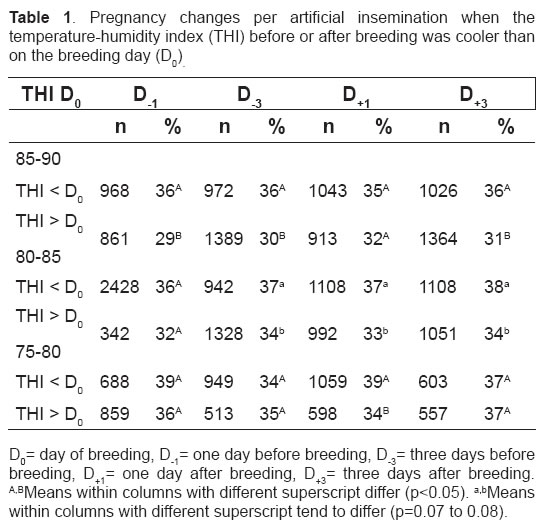
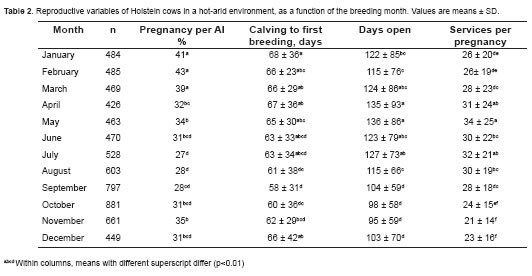
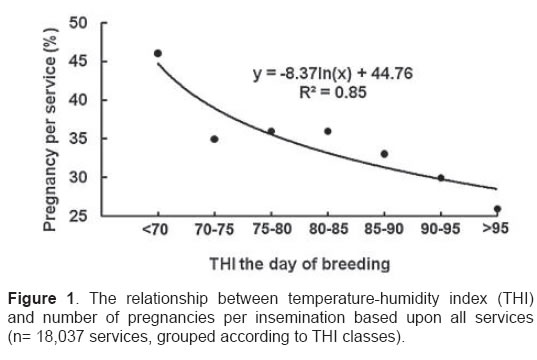
<body><![CDATA[<p>&nbsp;</p>     <p><b><font size="3">Results </font></b></p>     <p>The nonlinear relationship between THI increase   on the breeding day and P/AI is shown in <a href="#f1">figure 1</a>.   The P/AI ratio decreased sharply when THI exceeded   70 to 75 units. In contrast, P/AI decreased sharply   when THI exceeded 70 to 75 units. Pregnancy rates   declined to a lesser extend with THI &gt;75 units. As   THI increased &gt;95 P/AI dropped from 32% to 26%.   Eighty five percent of the total P/AI variation was accounted for by the THI on the breeding day.</p>     <p align="center"><a name="f1"></a><img src="/img/revistas/rccp/v26n3/v26n3a6f1.jpg"/></p>     <p>When heat load was as its maximum on the breeding day (THI=85 to 90), low environmental temperature 1 or 3 d prior to breeding increased the likelihood of pregnancy (p&lt;0.05; <a href="#t1">Table 1</a>). Similarly, low THI 3 d after breeding improved P/AI (p&lt;0.05). With less heat (THI=80 to 85) at breeding, low THI 3 d prior to breeding tended to increase P/AI (p&lt;0.07). Likewise, low THI 1 or 3 d post-breeding tended to increase P/AI (p&lt;0.08). With mild heat stress (THI=70 to 80), low THI 1 d post-breeding increased P/AI (p&lt;0.05).</p>     <p align="center"><a name="t1"></a><img src="/img/revistas/rccp/v26n3/v26n3a6t1.jpg"/></p>     <p>Influences of breeding month on fertility are   presented in <a href="#t2">table 2</a>. The P/AI decreased from April   to December; the highest P/AI were observed in   the winter months (approx. 40%). The time to first   breeding was shorter among cows bred during fall,   relative to those calving in other seasons. Likewise,   cows bred in autumn showed lower days open   than cows calving in other seasons. Services per   pregnancy were higher among cows bred for the   first time in spring and summer, relative to those bred in autumn and winter.</p>     <p align="center"><a name="t2"></a><img src="/img/revistas/rccp/v26n3/v26n3a6t2.jpg"/></p>     <p>&nbsp;</p>     <p><b><font size="3">Discussion </font></b></p>     ]]></body>
<body><![CDATA[<p><i>THI effect on breeding</i></p>     <p>The overall P/AI (33%) was lower than that   reported for artificially inseminated dairy cows in   warm climates of the southeastern United States   (Jordan, 2003; Huang <i>et al.</i>, 2008), but higher than   values for dairy operations in Georgia and Florida   (De la Sota <i>et al.</i>, 1998; De Vries and Risco, 2005).   The low P/AI observed in the present study was   apparently due to a drastic heat stress experienced   by cows, associated with great metabolic heat load   due to the high milk yield (Wheelock <i>et al.</i>, 2010)   derived from the rbST treatment and exacerbated by the environmental heat gain through solar radiation input, elevated environmental temperature, mild air movement and poor night cooling.</p>     <p>The logarithmic association between THI and   pregnancy rate found in the present study, showing   that pregnancy rate diminishes with increasing   environmental temperature, is congruous with patterns   observed in dairy cattle maintained in hot weather,   where pregnancy rates are drastically reduced when   cows are exposed to high heat loads before, during, or   after breeding (Garcia-Ispierto <i>et al.</i>, 2007; Morton <i>et al.</i>, 2007; Ben Salem and Bouraoui, 2009).</p>     <p>For the THI &gt;80, the P/AI in the present study   was sensitive to high THI prior or after breeding.   Fertility has been found to be responsive to heat   stress exerted 12 days before estrus, particularly on   day 2 before breeding (AL-Katanani <i>et al.</i>, 1999),   the day after estrus (Cavestany <i>et al.</i>, 1985), and   days 1 to 7 d after breeding (Putney <i>et al.</i>, 1989).   The detrimental effect of elevated heat load before   breeding is related with a low diameter of the   dominant follicle and biochemical alterations of the   follicular fluid (Leroy <i>et al.</i>, 2004; Shehab-El-Deen   <i>et al.</i>, 2010), which result in inferior oocyte and   granulosa cell quality (Ferreira <i>et al.</i>, 2011; Payton   <i>et al.</i>, 2011). Hyperthermia of oocytes also hampers   embryonic development, even in the absence of   subsequent heat stress (Edwards <i>et al.</i>, 2009), which   compromises fertility (Lopez-Gatius, 2003). Heat   stress before breeding causes delay in ovulation,   and follicular persistency can lead to ovulation of   a low quality, aged oocyte which is associated with   low fertilization rate and embryonic mortality (Al-   Katanani <i>et al.</i>, 2001; Roth <i>et al.</i>, 2001; Sartori <i>et al.</i>, 2002).</p>     <p>On the other hand, hyperthermia after breeding   compromises uterine environment with decreased   blood flow to the uterus (Reynolds <i>et al.</i>, 1985)   and increased uterine temperature, which can lead   to implantation failure and embryonic mortality   (Hansen 2007; Morton <i>et al.</i>, 2007). These effects   are thought to be associated with the production   of heat-shock proteins by the endometrium during   heat stress (Jin-Xiang <i>et al.</i>, 2009) and reduced   interferon-tau production by the conceptus   (Thatcher <i>et al.</i>, 1994). Moreover, heat stress   can affect endometrial prostaglandin secretion   (Putney <i>et al.</i>, 1989) causing abnormal luteal   activity (Koivisto <i>et al.</i>, 2008) leading to premature   luteolysis and embryo loss (Ealy <i>et al.</i>, 1993; Santolaria <i>et al.</i>, 2010).</p>     <p><i>Month of breeding effect</i></p>     <p>The P/AI differed among months, peaking in   winter months and sharply decreasing in spring   and summer months (<a href="#t2">Table 2</a>), which demonstrates   a clear environmental impact on the reproductive   performance of cows. Spring and summer are the   warmest periods of the year in this area; thus, high   environmental temperature during this period seems   to explain this fertility depression. Reduction of   fertility in cows during the warm months of the year   has been reported in tropical and subtropical (ALKatanani   <i>et al.</i>, 1999; Ben Salem and Bouraoui,   2009) as well as temperate (Garc&iacute;a-Ispierto <i>et al.</i>,   2007; Nabenishi <i>et al.</i>, 2011) regions of the world.   This reduced summer fertility in dairy cows is due   to poor estrus expression (Flores <i>et al.</i>, 2004) as   a result of reduced estradiol secretion from the   dominant follicle developed in a low luteinizing   hormone environment (De Rensis and Scaramuzzi,   2003). Heat stress has also been associated with   impaired early embryo development (Ryan <i>et al.</i>,   1993; Sartori <i>et al.</i>, 2002) and increased embryo   mortality in cattle (Wolfenson <i>et al.</i>, 2000; B&eacute;nyei <i>et al.</i>, 2001; Hansen, 2007).</p>     <p>The P/AI in September and October did not   differ from those values observed in summer,   which suggests that the effects of heat stress had   a carry-over effect into subsequent less warm   months. Apparently, hyperthermia has a longterm   effect on antral follicles that will develop into   large dominant follicles some weeks later. Days   open increased the most for cows bred during   spring months, suggesting the greatest decrease in   reproductive performance occurred during summer   and fall. These results are in line with Cavestany <i>et al.</i> (1985). Likewise, services per pregnancy were   greater from April to July, which agrees with Ray   <i>et al.</i> (1992), who reported that cows calving in the   spring or summer in Arizona required the highest number of services per conception.</p>     <p>These results reaffirm that high yielding   dairy cows in a hot-arid environment at 26&ordm; N are   extremely sensitive to heat load either few days   before, during, or shortly after breeding. The sharp   impact of heat load on P/AI is clearly manifested at   THI&gt;70. This study also shows there is a marked   seasonal effect on P/AI in Holstein cows, indicating   that efforts should be conveyed to minimize   environmental stress of high yielding cows   breeding during spring and summer in this hot arid environment.</p>     <p>&nbsp;</p> </font> <hr size="1" /> <font size="2" face="Verdana, Arial, Helvetica, sans-serif">     ]]></body>
<body><![CDATA[<p><b><font size="3">Notas</font></b></p>     <p><a name="1"></a><a href="#b1">&curren;</a>To cite this article: Mellado M, Sepulveda A, Meza-Herrera C, Veliz FG, Arevalo JR, Mellado J, De Santiago A. Effects of heat stress on reproductive efficiency in high yielding Holstein cows in a hot arid environment. Rev Colomb Cienc Pecu 2013; 26:193-200. </p>  </font> <hr size="1" /> <font size="2" face="Verdana, Arial, Helvetica, sans-serif">     <p>&nbsp;</p>     <p><b><font size="3">Acknowledgments </font></b></p>     <p>This study was a part of the national research   program, financially supported by the SAGARPACONACYT   (Mexico); project: 2010-144591. The   authors wish to thank Martha Alicia de la Rosa for her help ordering the data.</p>     <p>&nbsp;</p>     <p><b><font size="3">References</font></b></p>     <!-- ref --><p>   AL-Katanani YM, Webb DW, Hansen PJ. Factors affecting   seasonal variation in 90-day nonreturn rate to first service   in lactating Holstein cows in a hot climate. J Dairy Sci 1999;   82:2611-2616.    &nbsp;&nbsp;&nbsp;&nbsp;&nbsp;&nbsp;&nbsp;&nbsp;[&#160;<a href="javascript:void(0);" onclick="javascript: window.open('/scielo.php?script=sci_nlinks&ref=000090&pid=S0120-0690201300030000600001&lng=','','width=640,height=500,resizable=yes,scrollbars=1,menubar=yes,');">Links</a>&#160;]<!-- end-ref --></p>     <!-- ref --><p>   Ben Salem M, Bouraoui R. Heat stress in Tunisia, Effects on   dairy cows and potential means of alleviating it. S Afr J Anim   Sci 2009; 39:256-259.    &nbsp;&nbsp;&nbsp;&nbsp;&nbsp;&nbsp;&nbsp;&nbsp;[&#160;<a href="javascript:void(0);" onclick="javascript: window.open('/scielo.php?script=sci_nlinks&ref=000092&pid=S0120-0690201300030000600002&lng=','','width=640,height=500,resizable=yes,scrollbars=1,menubar=yes,');">Links</a>&#160;]<!-- end-ref --></p>     <!-- ref --><p>   B&eacute;nyei B, G&aacute;sp&aacute;rdy A, Barros CWC. Changes in embryo   production results and ovarian recrudescence during the   acclimation to the semiarid tropics of embryo donor Holstein-   Frisian cows raised in a temperate climate. Anim Repr Sci 2001;   68:57-68.    &nbsp;&nbsp;&nbsp;&nbsp;&nbsp;&nbsp;&nbsp;&nbsp;[&#160;<a href="javascript:void(0);" onclick="javascript: window.open('/scielo.php?script=sci_nlinks&ref=000094&pid=S0120-0690201300030000600003&lng=','','width=640,height=500,resizable=yes,scrollbars=1,menubar=yes,');">Links</a>&#160;]<!-- end-ref --></p>     <!-- ref --><p>   Canadian Council on Animal Care. Guide to the Care and Use   of Experimental Animals. Vol. 1, 2nd ed. Olfert ED, Cross BM   A, McWilliam A (Ed). Ontario, Canada: 1993. p. 211.    &nbsp;&nbsp;&nbsp;&nbsp;&nbsp;&nbsp;&nbsp;&nbsp;[&#160;<a href="javascript:void(0);" onclick="javascript: window.open('/scielo.php?script=sci_nlinks&ref=000096&pid=S0120-0690201300030000600004&lng=','','width=640,height=500,resizable=yes,scrollbars=1,menubar=yes,');">Links</a>&#160;]<!-- end-ref --></p>     <!-- ref --><p>   Cavestany D, El-Wishy AB, Foote RH. Effect of season and   high environmental temperature on fertility of Holstein cattle. J   Dairy Sci 1985; 68:1471-1478.    &nbsp;&nbsp;&nbsp;&nbsp;&nbsp;&nbsp;&nbsp;&nbsp;[&#160;<a href="javascript:void(0);" onclick="javascript: window.open('/scielo.php?script=sci_nlinks&ref=000098&pid=S0120-0690201300030000600005&lng=','','width=640,height=500,resizable=yes,scrollbars=1,menubar=yes,');">Links</a>&#160;]<!-- end-ref --></p>     <!-- ref --><p>   De la Sota RL, Burke JM, Risco CA, Moreira F, DeLorenzo   MA, Thatcher WW. Evaluation of timed insemination during   summer heat stress in lactating dairy cattle. Theriogenology   1998; 49:761-770.    &nbsp;&nbsp;&nbsp;&nbsp;&nbsp;&nbsp;&nbsp;&nbsp;[&#160;<a href="javascript:void(0);" onclick="javascript: window.open('/scielo.php?script=sci_nlinks&ref=000100&pid=S0120-0690201300030000600006&lng=','','width=640,height=500,resizable=yes,scrollbars=1,menubar=yes,');">Links</a>&#160;]<!-- end-ref --></p>     <!-- ref --><p>   De Rensis F, Scaramuzzi RJ. Heat stress and seasonal effects on   reproduction in the dairy cow &#8211; a review. Theriogenology 2003;   60:1139-1151.    &nbsp;&nbsp;&nbsp;&nbsp;&nbsp;&nbsp;&nbsp;&nbsp;[&#160;<a href="javascript:void(0);" onclick="javascript: window.open('/scielo.php?script=sci_nlinks&ref=000102&pid=S0120-0690201300030000600007&lng=','','width=640,height=500,resizable=yes,scrollbars=1,menubar=yes,');">Links</a>&#160;]<!-- end-ref --></p>     <!-- ref --><p>   De Vries A, Risco CA. Trends and seasonality of reproductive   performance in Florida and Georgia dairy herds from 1976 to   2001. J Dairy Sci 2005; 88:3155-3162.    &nbsp;&nbsp;&nbsp;&nbsp;&nbsp;&nbsp;&nbsp;&nbsp;[&#160;<a href="javascript:void(0);" onclick="javascript: window.open('/scielo.php?script=sci_nlinks&ref=000104&pid=S0120-0690201300030000600008&lng=','','width=640,height=500,resizable=yes,scrollbars=1,menubar=yes,');">Links</a>&#160;]<!-- end-ref --></p>     <!-- ref --><p>   Ealy AD, Drost M, Hansen PJ. Developmental changes in   embryonic resistance to adverse effects of maternal heat stress   in cows. J Dairy Sci 1993; 76:2899-2905.    &nbsp;&nbsp;&nbsp;&nbsp;&nbsp;&nbsp;&nbsp;&nbsp;[&#160;<a href="javascript:void(0);" onclick="javascript: window.open('/scielo.php?script=sci_nlinks&ref=000106&pid=S0120-0690201300030000600009&lng=','','width=640,height=500,resizable=yes,scrollbars=1,menubar=yes,');">Links</a>&#160;]<!-- end-ref --></p>     <!-- ref --><p>   Edwards JL, Bogart AN, Rispoli LA, Saxton AM, Schrick   FN. Developmental competence of bovine embryos from heat   stressed ova. J Dairy Sci 2009; 92:563-570.    &nbsp;&nbsp;&nbsp;&nbsp;&nbsp;&nbsp;&nbsp;&nbsp;[&#160;<a href="javascript:void(0);" onclick="javascript: window.open('/scielo.php?script=sci_nlinks&ref=000108&pid=S0120-0690201300030000600010&lng=','','width=640,height=500,resizable=yes,scrollbars=1,menubar=yes,');">Links</a>&#160;]<!-- end-ref --></p>     <!-- ref --><p>   Ferreira RM, Ayres H, Chiaratti MR, Ferraz ML, Ar&aacute;ujo AB,   Rodrigues CA, Watanabe YF, Vireque AA, Joaquim DC, Smith   LC, Meirelles FV, Baruselli PS. The low fertility of repeatbreeder   cows during summer heat stress is related to a low   oocyte competence to develop into blastocysts. J Dairy Sci   2011; 94:2383-2392.    &nbsp;&nbsp;&nbsp;&nbsp;&nbsp;&nbsp;&nbsp;&nbsp;[&#160;<a href="javascript:void(0);" onclick="javascript: window.open('/scielo.php?script=sci_nlinks&ref=000110&pid=S0120-0690201300030000600011&lng=','','width=640,height=500,resizable=yes,scrollbars=1,menubar=yes,');">Links</a>&#160;]<!-- end-ref --></p>     <!-- ref --><p>   Flores R, Looper ML, Thomas MG, Hallford DM. Influence   of bovine somatotropin on characteristics of estrus and   reproduction of Holstein cows during summer months. Prof   Anim Sci 2004; 20:191-197.    &nbsp;&nbsp;&nbsp;&nbsp;&nbsp;&nbsp;&nbsp;&nbsp;[&#160;<a href="javascript:void(0);" onclick="javascript: window.open('/scielo.php?script=sci_nlinks&ref=000112&pid=S0120-0690201300030000600012&lng=','','width=640,height=500,resizable=yes,scrollbars=1,menubar=yes,');">Links</a>&#160;]<!-- end-ref --></p>     <!-- ref --><p>   Garcia-Ispierto FG, Lopez-Gatius P, Bech-Sabat G, Santolaria   P, Yaniz JL, Nogareda C, De Rensis F, Lopez-Bejar M. Climate   factors affecting pregnancy rate of high-producing dairy cows   in northeastern Spain. Theriogenology 2007; 67:1379-1385.    &nbsp;&nbsp;&nbsp;&nbsp;&nbsp;&nbsp;&nbsp;&nbsp;[&#160;<a href="javascript:void(0);" onclick="javascript: window.open('/scielo.php?script=sci_nlinks&ref=000114&pid=S0120-0690201300030000600013&lng=','','width=640,height=500,resizable=yes,scrollbars=1,menubar=yes,');">Links</a>&#160;]<!-- end-ref --></p>     <!-- ref --><p>   Garc&iacute;a-Ispierto I, L&oacute;pez-Gatius F, Santolaria P, Y&aacute;niz JL,   Nogareda C, L&oacute;pez-B&eacute;jar M, De Rensis F. Relationship   between heat stress during the peri-implantation period and   early fetal loss in dairy cattle. Theriogenology 2006; 65:799-   807.    &nbsp;&nbsp;&nbsp;&nbsp;&nbsp;&nbsp;&nbsp;&nbsp;[&#160;<a href="javascript:void(0);" onclick="javascript: window.open('/scielo.php?script=sci_nlinks&ref=000116&pid=S0120-0690201300030000600014&lng=','','width=640,height=500,resizable=yes,scrollbars=1,menubar=yes,');">Links</a>&#160;]<!-- end-ref --></p>     <!-- ref --><p>   Hansen PJ. To be or not to be, determinants of embryonic   survival following heat shock. Theriogenology 2007;   68:S40-S48.    &nbsp;&nbsp;&nbsp;&nbsp;&nbsp;&nbsp;&nbsp;&nbsp;[&#160;<a href="javascript:void(0);" onclick="javascript: window.open('/scielo.php?script=sci_nlinks&ref=000118&pid=S0120-0690201300030000600015&lng=','','width=640,height=500,resizable=yes,scrollbars=1,menubar=yes,');">Links</a>&#160;]<!-- end-ref --></p>     <!-- ref --><p>   Hansen PJ, Arechiga CF. Strategies for managing reproduction   in the heat stressed dairy cow. J Anim Sci 1999; 77:Suppl2 36-   50.    &nbsp;&nbsp;&nbsp;&nbsp;&nbsp;&nbsp;&nbsp;&nbsp;[&#160;<a href="javascript:void(0);" onclick="javascript: window.open('/scielo.php?script=sci_nlinks&ref=000120&pid=S0120-0690201300030000600016&lng=','','width=640,height=500,resizable=yes,scrollbars=1,menubar=yes,');">Links</a>&#160;]<!-- end-ref --></p>     <!-- ref --><p>   Huang C, Tsuruta S, Bertrand JK, Misztal I, Lawlor TJ, Clay JS.   Environmental effects on conception rates of Holsteins in New   York and Georgia. J Dairy Sci 2008; 91:818-825.    &nbsp;&nbsp;&nbsp;&nbsp;&nbsp;&nbsp;&nbsp;&nbsp;[&#160;<a href="javascript:void(0);" onclick="javascript: window.open('/scielo.php?script=sci_nlinks&ref=000122&pid=S0120-0690201300030000600017&lng=','','width=640,height=500,resizable=yes,scrollbars=1,menubar=yes,');">Links</a>&#160;]<!-- end-ref --></p>     <!-- ref --><p>   Jin-Xiang Y, Li-Juan X, Cui-Ling L, Xue-Sen Z, Tao L, Min   C, Zhao-Yuan H, Fei G, Yi-Xun L. Increased expression of   heat shock protein 105 in rat uterus of early pregnancy and its   significance in embryo implantation. Repr Biol Endocr 2009;   7:23-32.    &nbsp;&nbsp;&nbsp;&nbsp;&nbsp;&nbsp;&nbsp;&nbsp;[&#160;<a href="javascript:void(0);" onclick="javascript: window.open('/scielo.php?script=sci_nlinks&ref=000124&pid=S0120-0690201300030000600018&lng=','','width=640,height=500,resizable=yes,scrollbars=1,menubar=yes,');">Links</a>&#160;]<!-- end-ref --></p>     <!-- ref --><p>   Jordan ER. Effects of heat stress on reproduction. J Dairy Sci   2003; 86:E104-E114.    &nbsp;&nbsp;&nbsp;&nbsp;&nbsp;&nbsp;&nbsp;&nbsp;[&#160;<a href="javascript:void(0);" onclick="javascript: window.open('/scielo.php?script=sci_nlinks&ref=000126&pid=S0120-0690201300030000600019&lng=','','width=640,height=500,resizable=yes,scrollbars=1,menubar=yes,');">Links</a>&#160;]<!-- end-ref --></p>     <!-- ref --><p>   Koivisto MB, Costa MTA, Perri SHV, Vicente WRR,   Kornmatitsuk B, Chantaraprateep P, Kornmatitsuk S, Kindahl   H. Different types of postpartum luteal activity affected by   the exposure of heat stress and subsequent reproductive   performance in Holstein lactating cows. Reprod Dom Anim   2008; 43:515-519.    &nbsp;&nbsp;&nbsp;&nbsp;&nbsp;&nbsp;&nbsp;&nbsp;[&#160;<a href="javascript:void(0);" onclick="javascript: window.open('/scielo.php?script=sci_nlinks&ref=000128&pid=S0120-0690201300030000600020&lng=','','width=640,height=500,resizable=yes,scrollbars=1,menubar=yes,');">Links</a>&#160;]<!-- end-ref --></p>     <!-- ref --><p>   Leroy JLMR, Vanholder T, Delanghe JR, Opsomer G, Van   Soom A, Bols PEJ, Dewulf J, de Kruif A. Metabolic changes   in follicular fluid of the dominant follicle in high-yielding dairy   cows early post partum. Theriogenology 2004; 62:1131-1143.    &nbsp;&nbsp;&nbsp;&nbsp;&nbsp;&nbsp;&nbsp;&nbsp;[&#160;<a href="javascript:void(0);" onclick="javascript: window.open('/scielo.php?script=sci_nlinks&ref=000130&pid=S0120-0690201300030000600021&lng=','','width=640,height=500,resizable=yes,scrollbars=1,menubar=yes,');">Links</a>&#160;]<!-- end-ref --></p>     <!-- ref --><p>Lopez-Gatius F. Is fertility declining in dairy cattle? A   retrospective study in northeastern Spain. Theriogenology 2003; 60:89-99.    &nbsp;&nbsp;&nbsp;&nbsp;&nbsp;&nbsp;&nbsp;&nbsp;[&#160;<a href="javascript:void(0);" onclick="javascript: window.open('/scielo.php?script=sci_nlinks&ref=000132&pid=S0120-0690201300030000600022&lng=','','width=640,height=500,resizable=yes,scrollbars=1,menubar=yes,');">Links</a>&#160;]<!-- end-ref --></p>     <!-- ref --><p>   Mader TL. Environmental stress in confined beef cattle. J Anim   Sci 2003; 81E-Suppl:E110-E119.    &nbsp;&nbsp;&nbsp;&nbsp;&nbsp;&nbsp;&nbsp;&nbsp;[&#160;<a href="javascript:void(0);" onclick="javascript: window.open('/scielo.php?script=sci_nlinks&ref=000134&pid=S0120-0690201300030000600023&lng=','','width=640,height=500,resizable=yes,scrollbars=1,menubar=yes,');">Links</a>&#160;]<!-- end-ref --></p>     <!-- ref --><p>   Morton JM, Tranter WP, Mayer DG, Jonsson NN. Effects of   environmental heat on pregnancy rates in lactating dairy cows,   critical periods of exposure. J Dairy Sci 2007; 90:2271-2278.    &nbsp;&nbsp;&nbsp;&nbsp;&nbsp;&nbsp;&nbsp;&nbsp;[&#160;<a href="javascript:void(0);" onclick="javascript: window.open('/scielo.php?script=sci_nlinks&ref=000136&pid=S0120-0690201300030000600024&lng=','','width=640,height=500,resizable=yes,scrollbars=1,menubar=yes,');">Links</a>&#160;]<!-- end-ref --></p>     <!-- ref --><p>   Nabenishi H, Ohta H, Nishimoto T, Morita T, Ashizawa K,   Tsuzuki Y. Effect of the temperature-humidity index on body   temperature and conception rate of lactating dairy cows in   southwestern Japan. J Repr Dev 2011; 57:450-456.    &nbsp;&nbsp;&nbsp;&nbsp;&nbsp;&nbsp;&nbsp;&nbsp;[&#160;<a href="javascript:void(0);" onclick="javascript: window.open('/scielo.php?script=sci_nlinks&ref=000138&pid=S0120-0690201300030000600025&lng=','','width=640,height=500,resizable=yes,scrollbars=1,menubar=yes,');">Links</a>&#160;]<!-- end-ref --></p>     <!-- ref --><p>   Payton RR, Rispoli LA, Saxton AM, Edwards JL. Impact of   heat stress exposure during meiotic maturation on oocyte,   surrounding cumulus cell, and embryo RNA populations. J Repr   Dev 2011; 57:481-491.    &nbsp;&nbsp;&nbsp;&nbsp;&nbsp;&nbsp;&nbsp;&nbsp;[&#160;<a href="javascript:void(0);" onclick="javascript: window.open('/scielo.php?script=sci_nlinks&ref=000140&pid=S0120-0690201300030000600026&lng=','','width=640,height=500,resizable=yes,scrollbars=1,menubar=yes,');">Links</a>&#160;]<!-- end-ref --></p>     <!-- ref --><p>   Putney DJ, Torres CAA, Gross TS, Thatcher WW, Plante C,   Drost M. Modulation of uterine prostaglandin biosynthesis   by pregnant and nonpregnant cows at day 17 post-estrus in   response to in vivo and in vitro heat stress. Anim Repr Sci   1989; 20:131-147.    &nbsp;&nbsp;&nbsp;&nbsp;&nbsp;&nbsp;&nbsp;&nbsp;[&#160;<a href="javascript:void(0);" onclick="javascript: window.open('/scielo.php?script=sci_nlinks&ref=000142&pid=S0120-0690201300030000600027&lng=','','width=640,height=500,resizable=yes,scrollbars=1,menubar=yes,');">Links</a>&#160;]<!-- end-ref --></p>     <!-- ref --><p>   Ray DE, Halbach TJ, Armstrong DV. Season and lactation   number effects on milk production and reproduction of dairy   cattle in Arizona. J Dairy Sci 1992; 75:2976-2983.    &nbsp;&nbsp;&nbsp;&nbsp;&nbsp;&nbsp;&nbsp;&nbsp;[&#160;<a href="javascript:void(0);" onclick="javascript: window.open('/scielo.php?script=sci_nlinks&ref=000144&pid=S0120-0690201300030000600028&lng=','','width=640,height=500,resizable=yes,scrollbars=1,menubar=yes,');">Links</a>&#160;]<!-- end-ref --></p>     <!-- ref --><p>   Reynolds LP, Ferrell CL, Nienaber JA, Ford SP. Effects of   chronic environmental heat stress on blood flow and nutrient   uptake of the gravid bovine uterus and foetus. J Agric Sci 1985;   104:289-297.    &nbsp;&nbsp;&nbsp;&nbsp;&nbsp;&nbsp;&nbsp;&nbsp;[&#160;<a href="javascript:void(0);" onclick="javascript: window.open('/scielo.php?script=sci_nlinks&ref=000146&pid=S0120-0690201300030000600029&lng=','','width=640,height=500,resizable=yes,scrollbars=1,menubar=yes,');">Links</a>&#160;]<!-- end-ref --></p>     <!-- ref --><p>   Roth Z. Heat stress, the follicle, and its enclosed oocyte,   Mechanisms and potential strategies to improve fertility in dairy   cows. Repr Dom Anim 2008; 43:238-244.    &nbsp;&nbsp;&nbsp;&nbsp;&nbsp;&nbsp;&nbsp;&nbsp;[&#160;<a href="javascript:void(0);" onclick="javascript: window.open('/scielo.php?script=sci_nlinks&ref=000148&pid=S0120-0690201300030000600030&lng=','','width=640,height=500,resizable=yes,scrollbars=1,menubar=yes,');">Links</a>&#160;]<!-- end-ref --></p>     <!-- ref --><p>   Roth Z, Arav A, Bor A, Zeron Y, Braw-Tal R, Wolfenson D.   Improvement of quality of oocytes collected in the autumn by   enhanced removal of impaired follicles from previously heatstressed   cows. Reproduction 2001; 122:737-744.    &nbsp;&nbsp;&nbsp;&nbsp;&nbsp;&nbsp;&nbsp;&nbsp;[&#160;<a href="javascript:void(0);" onclick="javascript: window.open('/scielo.php?script=sci_nlinks&ref=000150&pid=S0120-0690201300030000600031&lng=','','width=640,height=500,resizable=yes,scrollbars=1,menubar=yes,');">Links</a>&#160;]<!-- end-ref --></p>     <!-- ref --><p>   Ryan DP, Prichard JF, Kopel E, Godke RA. Comparing early   embryo mortality in dairy-cows during hot and cool seasons of   the year. Theriogenology 1993; 39:719-737.    &nbsp;&nbsp;&nbsp;&nbsp;&nbsp;&nbsp;&nbsp;&nbsp;[&#160;<a href="javascript:void(0);" onclick="javascript: window.open('/scielo.php?script=sci_nlinks&ref=000152&pid=S0120-0690201300030000600032&lng=','','width=640,height=500,resizable=yes,scrollbars=1,menubar=yes,');">Links</a>&#160;]<!-- end-ref --></p>     <!-- ref --><p>   Santolaria P, L&oacute;pez-Gatius F, Garc&iacute;a-Ispierto I, Bech-S&agrave;bat   G, Angulo E, Carretero T, S&aacute;nchez-Nadal JA, Y&aacute;niz J. Effects   of cumulative stressful and acute variation episodes of farm   climate conditions on late embryo/early fetal loss in high   producing dairy cows. Int J Biomet 2010; 54:193-198.    &nbsp;&nbsp;&nbsp;&nbsp;&nbsp;&nbsp;&nbsp;&nbsp;[&#160;<a href="javascript:void(0);" onclick="javascript: window.open('/scielo.php?script=sci_nlinks&ref=000154&pid=S0120-0690201300030000600033&lng=','','width=640,height=500,resizable=yes,scrollbars=1,menubar=yes,');">Links</a>&#160;]<!-- end-ref --></p>     <!-- ref --><p>   Sartori R, Sartor-Bergfelt R, Mertens SA, Guenther JN,   Parrish JJ, Wiltbank MC. Fertilization and early embryonic   development in heifers and lactating cows in summer and   lactating and dry cows in winter. J Dairy Sci 2002; 85:2803-   2812.    &nbsp;&nbsp;&nbsp;&nbsp;&nbsp;&nbsp;&nbsp;&nbsp;[&#160;<a href="javascript:void(0);" onclick="javascript: window.open('/scielo.php?script=sci_nlinks&ref=000156&pid=S0120-0690201300030000600034&lng=','','width=640,height=500,resizable=yes,scrollbars=1,menubar=yes,');">Links</a>&#160;]<!-- end-ref --></p>     <!-- ref --><p>   Shehab-El-Deen MAMM, Leroy JLMR, Fadel MS, Saleh SYA,   Maes D, Van Soom A. Biochemical changes in the follicular fluid of the dominant follicle of high producing dairy cows exposed to heat stress early post-partum. Anim Repr Sci 2010; 117:189-200.    &nbsp;&nbsp;&nbsp;&nbsp;&nbsp;&nbsp;&nbsp;&nbsp;[&#160;<a href="javascript:void(0);" onclick="javascript: window.open('/scielo.php?script=sci_nlinks&ref=000158&pid=S0120-0690201300030000600035&lng=','','width=640,height=500,resizable=yes,scrollbars=1,menubar=yes,');">Links</a>&#160;]<!-- end-ref --></p>     <!-- ref --><p>   Thatcher W, Macmillan KL, Hansen PJ, Bazer FW. Embryonic   losses, cause and prevention. In: Fields MJ, Sand RS (Ed).   Factors affecting calf crop. CRC Press: Boca Raton, FL: 1994.   p. 135-153.    &nbsp;&nbsp;&nbsp;&nbsp;&nbsp;&nbsp;&nbsp;&nbsp;[&#160;<a href="javascript:void(0);" onclick="javascript: window.open('/scielo.php?script=sci_nlinks&ref=000160&pid=S0120-0690201300030000600036&lng=','','width=640,height=500,resizable=yes,scrollbars=1,menubar=yes,');">Links</a>&#160;]<!-- end-ref --></p>     <!-- ref --><p>   Wheelock JB, Rhoads RP, VanBaale MJ, Sanders SR,   Baumgard LH. Effects of heat stress on energetic metabolism in   lactating Holstein cows. J Dairy Sci 2010; 93:644-655.    &nbsp;&nbsp;&nbsp;&nbsp;&nbsp;&nbsp;&nbsp;&nbsp;[&#160;<a href="javascript:void(0);" onclick="javascript: window.open('/scielo.php?script=sci_nlinks&ref=000162&pid=S0120-0690201300030000600037&lng=','','width=640,height=500,resizable=yes,scrollbars=1,menubar=yes,');">Links</a>&#160;]<!-- end-ref --></p>     <!-- ref --><p>   Wolfenson D, Flamenbaum I, Berman A. Hyperthermia and   body energy store effects on estrous behaviour, pregnancy rate,   and corpus luteum function in dairy cows. J Dairy Sci 1988;   71:3497-3504.    &nbsp;&nbsp;&nbsp;&nbsp;&nbsp;&nbsp;&nbsp;&nbsp;[&#160;<a href="javascript:void(0);" onclick="javascript: window.open('/scielo.php?script=sci_nlinks&ref=000164&pid=S0120-0690201300030000600038&lng=','','width=640,height=500,resizable=yes,scrollbars=1,menubar=yes,');">Links</a>&#160;]<!-- end-ref --></p>     <!-- ref --><p>   Wolfenson D, Roth Z, Meidan R. Impaired reproduction in   heat-stressed cattle, basic and applied aspects. Anim Repr Sci   2000; 61:535-547.    &nbsp;&nbsp;&nbsp;&nbsp;&nbsp;&nbsp;&nbsp;&nbsp;[&#160;<a href="javascript:void(0);" onclick="javascript: window.open('/scielo.php?script=sci_nlinks&ref=000166&pid=S0120-0690201300030000600039&lng=','','width=640,height=500,resizable=yes,scrollbars=1,menubar=yes,');">Links</a>&#160;]<!-- end-ref --></p>     <!-- ref --><p>   Younas M, Fuquay JW, Smith AE, Moore AB. Estrus and   endocrine responses of lactating Holstein to forced ventilation   during summer. J Dairy Sci 1993; 76:430-434.    &nbsp;&nbsp;&nbsp;&nbsp;&nbsp;&nbsp;&nbsp;&nbsp;[&#160;<a href="javascript:void(0);" onclick="javascript: window.open('/scielo.php?script=sci_nlinks&ref=000168&pid=S0120-0690201300030000600040&lng=','','width=640,height=500,resizable=yes,scrollbars=1,menubar=yes,');">Links</a>&#160;]<!-- end-ref --></p> </font>      ]]></body><back>
<ref-list>
<ref id="B1">
<nlm-citation citation-type="journal">
<person-group person-group-type="author">
<name>
<surname><![CDATA[AL-Katanani]]></surname>
<given-names><![CDATA[YM]]></given-names>
</name>
<name>
<surname><![CDATA[Webb]]></surname>
<given-names><![CDATA[DW]]></given-names>
</name>
<name>
<surname><![CDATA[Hansen]]></surname>
<given-names><![CDATA[PJ]]></given-names>
</name>
</person-group>
<article-title xml:lang="en"><![CDATA[Factors affecting seasonal variation in 90-day nonreturn rate to first service in lactating Holstein cows in a hot climate]]></article-title>
<source><![CDATA[J Dairy Sci]]></source>
<year>1999</year>
<volume>82</volume>
<page-range>2611-2616</page-range></nlm-citation>
</ref>
<ref id="B2">
<nlm-citation citation-type="journal">
<person-group person-group-type="author">
<name>
<surname><![CDATA[Ben Salem]]></surname>
<given-names><![CDATA[M]]></given-names>
</name>
<name>
<surname><![CDATA[Bouraoui]]></surname>
<given-names><![CDATA[R]]></given-names>
</name>
</person-group>
<article-title xml:lang="en"><![CDATA[Heat stress in Tunisia, Effects on dairy cows and potential means of alleviating it]]></article-title>
<source><![CDATA[S Afr J Anim Sci]]></source>
<year>2009</year>
<volume>39</volume>
<page-range>256-259</page-range></nlm-citation>
</ref>
<ref id="B3">
<nlm-citation citation-type="journal">
<person-group person-group-type="author">
<name>
<surname><![CDATA[Bényei]]></surname>
<given-names><![CDATA[B]]></given-names>
</name>
<name>
<surname><![CDATA[Gáspárdy]]></surname>
<given-names><![CDATA[A]]></given-names>
</name>
<name>
<surname><![CDATA[Barros]]></surname>
<given-names><![CDATA[CWC]]></given-names>
</name>
</person-group>
<article-title xml:lang="en"><![CDATA[Changes in embryo production results and ovarian recrudescence during the acclimation to the semiarid tropics of embryo donor Holstein- Frisian cows raised in a temperate climate]]></article-title>
<source><![CDATA[Anim Repr Sci]]></source>
<year>2001</year>
<volume>68</volume>
<page-range>57-68</page-range></nlm-citation>
</ref>
<ref id="B4">
<nlm-citation citation-type="book">
<collab>Canadian Council on Animal Care</collab>
<source><![CDATA[Guide to the Care and Use of Experimental Animals]]></source>
<year>1993</year>
<volume>1</volume>
<edition>2nd</edition>
<page-range>211</page-range><publisher-name><![CDATA[Ontario]]></publisher-name>
</nlm-citation>
</ref>
<ref id="B5">
<nlm-citation citation-type="journal">
<person-group person-group-type="author">
<name>
<surname><![CDATA[Cavestany]]></surname>
<given-names><![CDATA[D]]></given-names>
</name>
<name>
<surname><![CDATA[El-Wishy]]></surname>
<given-names><![CDATA[AB]]></given-names>
</name>
<name>
<surname><![CDATA[Foote]]></surname>
<given-names><![CDATA[RH]]></given-names>
</name>
</person-group>
<article-title xml:lang="en"><![CDATA[Effect of season and high environmental temperature on fertility of Holstein cattle]]></article-title>
<source><![CDATA[J Dairy Sci]]></source>
<year>1985</year>
<volume>68</volume>
<page-range>1471-1478</page-range></nlm-citation>
</ref>
<ref id="B6">
<nlm-citation citation-type="journal">
<person-group person-group-type="author">
<name>
<surname><![CDATA[De la Sota]]></surname>
<given-names><![CDATA[RL]]></given-names>
</name>
<name>
<surname><![CDATA[Burke]]></surname>
<given-names><![CDATA[JM]]></given-names>
</name>
<name>
<surname><![CDATA[Risco]]></surname>
<given-names><![CDATA[CA]]></given-names>
</name>
<name>
<surname><![CDATA[Moreira]]></surname>
<given-names><![CDATA[F]]></given-names>
</name>
<name>
<surname><![CDATA[DeLorenzo]]></surname>
<given-names><![CDATA[MA]]></given-names>
</name>
<name>
<surname><![CDATA[Thatcher]]></surname>
<given-names><![CDATA[WW]]></given-names>
</name>
</person-group>
<article-title xml:lang="en"><![CDATA[Evaluation of timed insemination during summer heat stress in lactating dairy cattle]]></article-title>
<source><![CDATA[Theriogenology]]></source>
<year>1998</year>
<volume>49</volume>
<page-range>761-770</page-range></nlm-citation>
</ref>
<ref id="B7">
<nlm-citation citation-type="journal">
<person-group person-group-type="author">
<name>
<surname><![CDATA[De Rensis]]></surname>
<given-names><![CDATA[F]]></given-names>
</name>
<name>
<surname><![CDATA[Scaramuzzi]]></surname>
<given-names><![CDATA[RJ]]></given-names>
</name>
</person-group>
<article-title xml:lang="en"><![CDATA[Heat stress and seasonal effects on reproduction in the dairy cow - a review]]></article-title>
<source><![CDATA[Theriogenology]]></source>
<year>2003</year>
<volume>60</volume>
<page-range>1139-1151</page-range></nlm-citation>
</ref>
<ref id="B8">
<nlm-citation citation-type="journal">
<person-group person-group-type="author">
<name>
<surname><![CDATA[De Vries]]></surname>
<given-names><![CDATA[A]]></given-names>
</name>
<name>
<surname><![CDATA[Risco]]></surname>
<given-names><![CDATA[CA]]></given-names>
</name>
</person-group>
<article-title xml:lang="en"><![CDATA[Trends and seasonality of reproductive performance in Florida and Georgia dairy herds from 1976 to 2001]]></article-title>
<source><![CDATA[J Dairy Sci]]></source>
<year>2005</year>
<volume>88</volume>
<page-range>3155-3162</page-range></nlm-citation>
</ref>
<ref id="B9">
<nlm-citation citation-type="journal">
<person-group person-group-type="author">
<name>
<surname><![CDATA[Ealy]]></surname>
<given-names><![CDATA[AD]]></given-names>
</name>
<name>
<surname><![CDATA[Drost]]></surname>
<given-names><![CDATA[M]]></given-names>
</name>
<name>
<surname><![CDATA[Hansen]]></surname>
<given-names><![CDATA[PJ]]></given-names>
</name>
</person-group>
<article-title xml:lang="en"><![CDATA[Developmental changes in embryonic resistance to adverse effects of maternal heat stress in cows]]></article-title>
<source><![CDATA[J Dairy Sci]]></source>
<year>1993</year>
<volume>76</volume>
<page-range>2899-2905</page-range></nlm-citation>
</ref>
<ref id="B10">
<nlm-citation citation-type="journal">
<person-group person-group-type="author">
<name>
<surname><![CDATA[Edwards]]></surname>
<given-names><![CDATA[JL]]></given-names>
</name>
<name>
<surname><![CDATA[Bogart]]></surname>
<given-names><![CDATA[AN]]></given-names>
</name>
<name>
<surname><![CDATA[Rispoli]]></surname>
<given-names><![CDATA[LA]]></given-names>
</name>
<name>
<surname><![CDATA[Saxton]]></surname>
<given-names><![CDATA[AM]]></given-names>
</name>
<name>
<surname><![CDATA[Schrick]]></surname>
<given-names><![CDATA[FN]]></given-names>
</name>
</person-group>
<article-title xml:lang="en"><![CDATA[Developmental competence of bovine embryos from heat stressed ova]]></article-title>
<source><![CDATA[J Dairy Sci]]></source>
<year>2009</year>
<volume>92</volume>
<page-range>563-570</page-range></nlm-citation>
</ref>
<ref id="B11">
<nlm-citation citation-type="journal">
<person-group person-group-type="author">
<name>
<surname><![CDATA[Ferreira]]></surname>
<given-names><![CDATA[RM]]></given-names>
</name>
<name>
<surname><![CDATA[Ayres]]></surname>
<given-names><![CDATA[H]]></given-names>
</name>
<name>
<surname><![CDATA[Chiaratti]]></surname>
<given-names><![CDATA[MR]]></given-names>
</name>
<name>
<surname><![CDATA[Ferraz]]></surname>
<given-names><![CDATA[ML]]></given-names>
</name>
<name>
<surname><![CDATA[Aráujo]]></surname>
<given-names><![CDATA[AB]]></given-names>
</name>
<name>
<surname><![CDATA[Rodrigues]]></surname>
<given-names><![CDATA[CA]]></given-names>
</name>
<name>
<surname><![CDATA[Watanabe]]></surname>
<given-names><![CDATA[YF]]></given-names>
</name>
<name>
<surname><![CDATA[Vireque]]></surname>
<given-names><![CDATA[AA]]></given-names>
</name>
<name>
<surname><![CDATA[Joaquim]]></surname>
<given-names><![CDATA[DC]]></given-names>
</name>
<name>
<surname><![CDATA[Smith]]></surname>
<given-names><![CDATA[LC]]></given-names>
</name>
<name>
<surname><![CDATA[Meirelles]]></surname>
<given-names><![CDATA[FV]]></given-names>
</name>
<name>
<surname><![CDATA[Baruselli]]></surname>
<given-names><![CDATA[PS]]></given-names>
</name>
</person-group>
<article-title xml:lang="en"><![CDATA[The low fertility of repeatbreeder cows during summer heat stress is related to a low oocyte competence to develop into blastocysts]]></article-title>
<source><![CDATA[J Dairy Sci]]></source>
<year>2011</year>
<volume>94</volume>
<page-range>2383-2392</page-range></nlm-citation>
</ref>
<ref id="B12">
<nlm-citation citation-type="journal">
<person-group person-group-type="author">
<name>
<surname><![CDATA[Flores]]></surname>
<given-names><![CDATA[R]]></given-names>
</name>
<name>
<surname><![CDATA[Looper]]></surname>
<given-names><![CDATA[ML]]></given-names>
</name>
<name>
<surname><![CDATA[Thomas]]></surname>
<given-names><![CDATA[MG]]></given-names>
</name>
<name>
<surname><![CDATA[Hallford]]></surname>
<given-names><![CDATA[DM]]></given-names>
</name>
</person-group>
<article-title xml:lang="en"><![CDATA[Influence of bovine somatotropin on characteristics of estrus and reproduction of Holstein cows during summer months]]></article-title>
<source><![CDATA[Prof Anim Sci]]></source>
<year>2004</year>
<volume>20</volume>
<page-range>191-197</page-range></nlm-citation>
</ref>
<ref id="B13">
<nlm-citation citation-type="journal">
<person-group person-group-type="author">
<name>
<surname><![CDATA[Garcia-Ispierto]]></surname>
<given-names><![CDATA[FG]]></given-names>
</name>
<name>
<surname><![CDATA[Lopez-Gatius]]></surname>
<given-names><![CDATA[P]]></given-names>
</name>
<name>
<surname><![CDATA[Bech-Sabat]]></surname>
<given-names><![CDATA[G]]></given-names>
</name>
<name>
<surname><![CDATA[Santolaria]]></surname>
<given-names><![CDATA[P]]></given-names>
</name>
<name>
<surname><![CDATA[Yaniz]]></surname>
<given-names><![CDATA[JL]]></given-names>
</name>
<name>
<surname><![CDATA[Nogareda]]></surname>
<given-names><![CDATA[C]]></given-names>
</name>
<name>
<surname><![CDATA[De Rensis]]></surname>
<given-names><![CDATA[F]]></given-names>
</name>
<name>
<surname><![CDATA[Lopez-Bejar]]></surname>
<given-names><![CDATA[M]]></given-names>
</name>
</person-group>
<article-title xml:lang="en"><![CDATA[Climate factors affecting pregnancy rate of high-producing dairy cows in northeastern Spain]]></article-title>
<source><![CDATA[Theriogenology]]></source>
<year>2007</year>
<volume>67</volume>
<page-range>1379-1385</page-range></nlm-citation>
</ref>
<ref id="B14">
<nlm-citation citation-type="journal">
<person-group person-group-type="author">
<name>
<surname><![CDATA[García-Ispierto]]></surname>
<given-names><![CDATA[I]]></given-names>
</name>
<name>
<surname><![CDATA[López-Gatius]]></surname>
<given-names><![CDATA[F]]></given-names>
</name>
<name>
<surname><![CDATA[Santolaria]]></surname>
<given-names><![CDATA[P]]></given-names>
</name>
<name>
<surname><![CDATA[Yániz]]></surname>
<given-names><![CDATA[JL]]></given-names>
</name>
<name>
<surname><![CDATA[Nogareda]]></surname>
<given-names><![CDATA[C]]></given-names>
</name>
<name>
<surname><![CDATA[López-Béjar]]></surname>
<given-names><![CDATA[M]]></given-names>
</name>
<name>
<surname><![CDATA[De Rensis]]></surname>
<given-names><![CDATA[F]]></given-names>
</name>
</person-group>
<article-title xml:lang="en"><![CDATA[Relationship between heat stress during the peri-implantation period and early fetal loss in dairy cattle]]></article-title>
<source><![CDATA[Theriogenology]]></source>
<year>2006</year>
<volume>65</volume>
<page-range>799- 807</page-range></nlm-citation>
</ref>
<ref id="B15">
<nlm-citation citation-type="journal">
<person-group person-group-type="author">
<name>
<surname><![CDATA[Hansen]]></surname>
<given-names><![CDATA[PJ]]></given-names>
</name>
</person-group>
<article-title xml:lang="en"><![CDATA[To be or not to be, determinants of embryonic survival following heat shock]]></article-title>
<source><![CDATA[Theriogenology]]></source>
<year>2007</year>
<volume>68</volume>
<page-range>S40-S48</page-range></nlm-citation>
</ref>
<ref id="B16">
<nlm-citation citation-type="journal">
<person-group person-group-type="author">
<name>
<surname><![CDATA[Hansen]]></surname>
<given-names><![CDATA[PJ]]></given-names>
</name>
<name>
<surname><![CDATA[Arechiga]]></surname>
<given-names><![CDATA[CF]]></given-names>
</name>
</person-group>
<article-title xml:lang="en"><![CDATA[Strategies for managing reproduction in the heat stressed dairy cow]]></article-title>
<source><![CDATA[J Anim Sci]]></source>
<year>1999</year>
<volume>77</volume>
<numero>^s2</numero>
<issue>^s2</issue>
<supplement>2</supplement>
<page-range>36- 50</page-range></nlm-citation>
</ref>
<ref id="B17">
<nlm-citation citation-type="journal">
<person-group person-group-type="author">
<name>
<surname><![CDATA[Huang]]></surname>
<given-names><![CDATA[C]]></given-names>
</name>
<name>
<surname><![CDATA[Tsuruta]]></surname>
<given-names><![CDATA[S]]></given-names>
</name>
<name>
<surname><![CDATA[Bertrand]]></surname>
<given-names><![CDATA[JK]]></given-names>
</name>
<name>
<surname><![CDATA[Misztal]]></surname>
<given-names><![CDATA[I]]></given-names>
</name>
<name>
<surname><![CDATA[Lawlor]]></surname>
<given-names><![CDATA[TJ]]></given-names>
</name>
<name>
<surname><![CDATA[Clay]]></surname>
<given-names><![CDATA[JS]]></given-names>
</name>
</person-group>
<article-title xml:lang="en"><![CDATA[Environmental effects on conception rates of Holsteins in New York and Georgia]]></article-title>
<source><![CDATA[J Dairy Sci]]></source>
<year>2008</year>
<volume>91</volume>
<page-range>818-825</page-range></nlm-citation>
</ref>
<ref id="B18">
<nlm-citation citation-type="journal">
<person-group person-group-type="author">
<name>
<surname><![CDATA[Jin-Xiang]]></surname>
<given-names><![CDATA[Y]]></given-names>
</name>
<name>
<surname><![CDATA[Li-Juan]]></surname>
<given-names><![CDATA[X]]></given-names>
</name>
<name>
<surname><![CDATA[Cui-Ling]]></surname>
<given-names><![CDATA[L]]></given-names>
</name>
<name>
<surname><![CDATA[Xue-Sen]]></surname>
<given-names><![CDATA[Z]]></given-names>
</name>
<name>
<surname><![CDATA[Tao]]></surname>
<given-names><![CDATA[L]]></given-names>
</name>
<name>
<surname><![CDATA[Min]]></surname>
<given-names><![CDATA[C]]></given-names>
</name>
<name>
<surname><![CDATA[Zhao-Yuan]]></surname>
<given-names><![CDATA[H]]></given-names>
</name>
<name>
<surname><![CDATA[Fei]]></surname>
<given-names><![CDATA[G]]></given-names>
</name>
<name>
<surname><![CDATA[Yi-Xun]]></surname>
<given-names><![CDATA[L]]></given-names>
</name>
</person-group>
<article-title xml:lang="en"><![CDATA[Increased expression of heat shock protein 105 in rat uterus of early pregnancy and its significance in embryo implantation]]></article-title>
<source><![CDATA[Repr Biol Endocr]]></source>
<year>2009</year>
<volume>7</volume>
<page-range>23-32</page-range></nlm-citation>
</ref>
<ref id="B19">
<nlm-citation citation-type="journal">
<person-group person-group-type="author">
<name>
<surname><![CDATA[Jordan]]></surname>
<given-names><![CDATA[ER]]></given-names>
</name>
</person-group>
<article-title xml:lang="en"><![CDATA[Effects of heat stress on reproduction]]></article-title>
<source><![CDATA[J Dairy Sci]]></source>
<year>2003</year>
<volume>86</volume>
<page-range>E104-E114</page-range></nlm-citation>
</ref>
<ref id="B20">
<nlm-citation citation-type="journal">
<person-group person-group-type="author">
<name>
<surname><![CDATA[Koivisto]]></surname>
<given-names><![CDATA[MB]]></given-names>
</name>
<name>
<surname><![CDATA[Costa]]></surname>
<given-names><![CDATA[MTA]]></given-names>
</name>
<name>
<surname><![CDATA[Perri]]></surname>
<given-names><![CDATA[SHV]]></given-names>
</name>
<name>
<surname><![CDATA[Vicente]]></surname>
<given-names><![CDATA[WRR]]></given-names>
</name>
<name>
<surname><![CDATA[Kornmatitsuk]]></surname>
<given-names><![CDATA[B]]></given-names>
</name>
<name>
<surname><![CDATA[Chantaraprateep]]></surname>
<given-names><![CDATA[P]]></given-names>
</name>
<name>
<surname><![CDATA[Kornmatitsuk]]></surname>
<given-names><![CDATA[S]]></given-names>
</name>
<name>
<surname><![CDATA[Kindahl]]></surname>
<given-names><![CDATA[H]]></given-names>
</name>
</person-group>
<article-title xml:lang="en"><![CDATA[Different types of postpartum luteal activity affected by the exposure of heat stress and subsequent reproductive performance in Holstein lactating cows]]></article-title>
<source><![CDATA[Reprod Dom Anim]]></source>
<year>2008</year>
<volume>43</volume>
<page-range>515-519</page-range></nlm-citation>
</ref>
<ref id="B21">
<nlm-citation citation-type="journal">
<person-group person-group-type="author">
<name>
<surname><![CDATA[Leroy]]></surname>
<given-names><![CDATA[JLMR]]></given-names>
</name>
<name>
<surname><![CDATA[Vanholder]]></surname>
<given-names><![CDATA[T]]></given-names>
</name>
<name>
<surname><![CDATA[Delanghe]]></surname>
<given-names><![CDATA[JR]]></given-names>
</name>
<name>
<surname><![CDATA[Opsomer]]></surname>
<given-names><![CDATA[G]]></given-names>
</name>
<name>
<surname><![CDATA[Van Soom]]></surname>
<given-names><![CDATA[A]]></given-names>
</name>
<name>
<surname><![CDATA[Bols]]></surname>
<given-names><![CDATA[PEJ]]></given-names>
</name>
<name>
<surname><![CDATA[Dewulf]]></surname>
<given-names><![CDATA[J]]></given-names>
</name>
<name>
<surname><![CDATA[de Kruif]]></surname>
<given-names><![CDATA[A]]></given-names>
</name>
</person-group>
<article-title xml:lang="en"><![CDATA[Metabolic changes in follicular fluid of the dominant follicle in high-yielding dairy cows early post partum]]></article-title>
<source><![CDATA[Theriogenology]]></source>
<year>2004</year>
<volume>62</volume>
<page-range>1131-1143</page-range></nlm-citation>
</ref>
<ref id="B22">
<nlm-citation citation-type="journal">
<person-group person-group-type="author">
<name>
<surname><![CDATA[Lopez-Gatius]]></surname>
<given-names><![CDATA[F]]></given-names>
</name>
</person-group>
<article-title xml:lang="en"><![CDATA[Is fertility declining in dairy cattle? A retrospective study in northeastern Spain]]></article-title>
<source><![CDATA[Theriogenology]]></source>
<year>2003</year>
<volume>60</volume>
<page-range>89-99</page-range></nlm-citation>
</ref>
<ref id="B23">
<nlm-citation citation-type="journal">
<person-group person-group-type="author">
<name>
<surname><![CDATA[Mader]]></surname>
<given-names><![CDATA[TL]]></given-names>
</name>
</person-group>
<article-title xml:lang="en"><![CDATA[Environmental stress in confined beef cattle]]></article-title>
<source><![CDATA[J Anim Sci]]></source>
<year>2003</year>
<volume>81E</volume>
<numero>^sSuppl</numero>
<issue>^sSuppl</issue>
<supplement>Suppl</supplement>
<page-range>E110-E119</page-range></nlm-citation>
</ref>
<ref id="B24">
<nlm-citation citation-type="journal">
<person-group person-group-type="author">
<name>
<surname><![CDATA[Morton]]></surname>
<given-names><![CDATA[JM]]></given-names>
</name>
<name>
<surname><![CDATA[Tranter]]></surname>
<given-names><![CDATA[WP]]></given-names>
</name>
<name>
<surname><![CDATA[Mayer]]></surname>
<given-names><![CDATA[DG]]></given-names>
</name>
<name>
<surname><![CDATA[Jonsson]]></surname>
<given-names><![CDATA[NN]]></given-names>
</name>
</person-group>
<article-title xml:lang="en"><![CDATA[Effects of environmental heat on pregnancy rates in lactating dairy cows, critical periods of exposure]]></article-title>
<source><![CDATA[J Dairy Sci]]></source>
<year>2007</year>
<volume>90</volume>
<page-range>2271-2278</page-range></nlm-citation>
</ref>
<ref id="B25">
<nlm-citation citation-type="journal">
<person-group person-group-type="author">
<name>
<surname><![CDATA[Nabenishi]]></surname>
<given-names><![CDATA[H]]></given-names>
</name>
<name>
<surname><![CDATA[Ohta]]></surname>
<given-names><![CDATA[H]]></given-names>
</name>
<name>
<surname><![CDATA[Nishimoto]]></surname>
<given-names><![CDATA[T]]></given-names>
</name>
<name>
<surname><![CDATA[Morita]]></surname>
<given-names><![CDATA[T]]></given-names>
</name>
<name>
<surname><![CDATA[Ashizawa]]></surname>
<given-names><![CDATA[K]]></given-names>
</name>
<name>
<surname><![CDATA[Tsuzuki]]></surname>
<given-names><![CDATA[Y]]></given-names>
</name>
</person-group>
<article-title xml:lang="en"><![CDATA[Effect of the temperature-humidity index on body temperature and conception rate of lactating dairy cows in southwestern Japan]]></article-title>
<source><![CDATA[J Repr Dev]]></source>
<year>2011</year>
<volume>57</volume>
<page-range>450-456</page-range></nlm-citation>
</ref>
<ref id="B26">
<nlm-citation citation-type="journal">
<person-group person-group-type="author">
<name>
<surname><![CDATA[Payton]]></surname>
<given-names><![CDATA[RR]]></given-names>
</name>
<name>
<surname><![CDATA[Rispoli]]></surname>
<given-names><![CDATA[LA]]></given-names>
</name>
<name>
<surname><![CDATA[Saxton]]></surname>
<given-names><![CDATA[AM]]></given-names>
</name>
<name>
<surname><![CDATA[Edwards]]></surname>
<given-names><![CDATA[JL]]></given-names>
</name>
</person-group>
<article-title xml:lang="en"><![CDATA[Impact of heat stress exposure during meiotic maturation on oocyte, surrounding cumulus cell, and embryo RNA populations]]></article-title>
<source><![CDATA[J Repr Dev]]></source>
<year>2011</year>
<volume>57</volume>
<page-range>481-491</page-range></nlm-citation>
</ref>
<ref id="B27">
<nlm-citation citation-type="journal">
<person-group person-group-type="author">
<name>
<surname><![CDATA[Putney]]></surname>
<given-names><![CDATA[DJ]]></given-names>
</name>
<name>
<surname><![CDATA[Torres]]></surname>
<given-names><![CDATA[CAA]]></given-names>
</name>
<name>
<surname><![CDATA[Gross]]></surname>
<given-names><![CDATA[TS]]></given-names>
</name>
<name>
<surname><![CDATA[Thatcher]]></surname>
<given-names><![CDATA[WW]]></given-names>
</name>
<name>
<surname><![CDATA[Plante]]></surname>
<given-names><![CDATA[C]]></given-names>
</name>
<name>
<surname><![CDATA[Drost]]></surname>
<given-names><![CDATA[M]]></given-names>
</name>
</person-group>
<article-title xml:lang="en"><![CDATA[Modulation of uterine prostaglandin biosynthesis by pregnant and nonpregnant cows at day 17 post-estrus in response to in vivo and in vitro heat stress]]></article-title>
<source><![CDATA[Anim Repr Sci]]></source>
<year>1989</year>
<volume>20</volume>
<page-range>131-147</page-range></nlm-citation>
</ref>
<ref id="B28">
<nlm-citation citation-type="journal">
<person-group person-group-type="author">
<name>
<surname><![CDATA[Ray]]></surname>
<given-names><![CDATA[DE]]></given-names>
</name>
<name>
<surname><![CDATA[Halbach]]></surname>
<given-names><![CDATA[TJ]]></given-names>
</name>
<name>
<surname><![CDATA[Armstrong]]></surname>
<given-names><![CDATA[DV]]></given-names>
</name>
</person-group>
<article-title xml:lang="en"><![CDATA[Season and lactation number effects on milk production and reproduction of dairy cattle in Arizona]]></article-title>
<source><![CDATA[J Dairy Sci]]></source>
<year>1992</year>
<volume>75</volume>
<page-range>2976-2983</page-range></nlm-citation>
</ref>
<ref id="B29">
<nlm-citation citation-type="journal">
<person-group person-group-type="author">
<name>
<surname><![CDATA[Reynolds]]></surname>
<given-names><![CDATA[LP]]></given-names>
</name>
<name>
<surname><![CDATA[Ferrell]]></surname>
<given-names><![CDATA[CL]]></given-names>
</name>
<name>
<surname><![CDATA[Nienaber]]></surname>
<given-names><![CDATA[JA]]></given-names>
</name>
<name>
<surname><![CDATA[Ford]]></surname>
<given-names><![CDATA[SP]]></given-names>
</name>
</person-group>
<article-title xml:lang="en"><![CDATA[Effects of chronic environmental heat stress on blood flow and nutrient uptake of the gravid bovine uterus and foetus]]></article-title>
<source><![CDATA[J Agric Sci]]></source>
<year>1985</year>
<volume>104</volume>
<page-range>289-297</page-range></nlm-citation>
</ref>
<ref id="B30">
<nlm-citation citation-type="journal">
<person-group person-group-type="author">
<name>
<surname><![CDATA[Roth]]></surname>
<given-names><![CDATA[Z]]></given-names>
</name>
</person-group>
<article-title xml:lang="en"><![CDATA[Heat stress, the follicle, and its enclosed oocyte, Mechanisms and potential strategies to improve fertility in dairy cows]]></article-title>
<source><![CDATA[Repr Dom Anim]]></source>
<year>2008</year>
<volume>43</volume>
<page-range>238-244</page-range></nlm-citation>
</ref>
<ref id="B31">
<nlm-citation citation-type="journal">
<person-group person-group-type="author">
<name>
<surname><![CDATA[Roth]]></surname>
<given-names><![CDATA[Z]]></given-names>
</name>
<name>
<surname><![CDATA[Arav]]></surname>
<given-names><![CDATA[A]]></given-names>
</name>
<name>
<surname><![CDATA[Bor]]></surname>
<given-names><![CDATA[A]]></given-names>
</name>
<name>
<surname><![CDATA[Zeron]]></surname>
<given-names><![CDATA[Y]]></given-names>
</name>
<name>
<surname><![CDATA[Braw-Tal]]></surname>
<given-names><![CDATA[R]]></given-names>
</name>
<name>
<surname><![CDATA[Wolfenson]]></surname>
<given-names><![CDATA[D]]></given-names>
</name>
</person-group>
<article-title xml:lang="en"><![CDATA[Improvement of quality of oocytes collected in the autumn by enhanced removal of impaired follicles from previously heatstressed cows]]></article-title>
<source><![CDATA[Reproduction]]></source>
<year>2001</year>
<volume>122</volume>
<page-range>737-744</page-range></nlm-citation>
</ref>
<ref id="B32">
<nlm-citation citation-type="journal">
<person-group person-group-type="author">
<name>
<surname><![CDATA[Ryan]]></surname>
<given-names><![CDATA[DP]]></given-names>
</name>
<name>
<surname><![CDATA[Prichard]]></surname>
<given-names><![CDATA[JF]]></given-names>
</name>
<name>
<surname><![CDATA[Kopel]]></surname>
<given-names><![CDATA[E]]></given-names>
</name>
<name>
<surname><![CDATA[Godke]]></surname>
<given-names><![CDATA[RA]]></given-names>
</name>
</person-group>
<article-title xml:lang="en"><![CDATA[Comparing early embryo mortality in dairy-cows during hot and cool seasons of the year]]></article-title>
<source><![CDATA[Theriogenology]]></source>
<year>1993</year>
<volume>39</volume>
<page-range>719-737</page-range></nlm-citation>
</ref>
<ref id="B33">
<nlm-citation citation-type="journal">
<person-group person-group-type="author">
<name>
<surname><![CDATA[Santolaria]]></surname>
<given-names><![CDATA[P]]></given-names>
</name>
<name>
<surname><![CDATA[López-Gatius]]></surname>
<given-names><![CDATA[F]]></given-names>
</name>
<name>
<surname><![CDATA[García-Ispierto]]></surname>
<given-names><![CDATA[I]]></given-names>
</name>
<name>
<surname><![CDATA[Bech-Sàbat]]></surname>
<given-names><![CDATA[G]]></given-names>
</name>
<name>
<surname><![CDATA[Angulo]]></surname>
<given-names><![CDATA[E]]></given-names>
</name>
<name>
<surname><![CDATA[Carretero]]></surname>
<given-names><![CDATA[T]]></given-names>
</name>
<name>
<surname><![CDATA[Sánchez-Nadal]]></surname>
<given-names><![CDATA[JA]]></given-names>
</name>
<name>
<surname><![CDATA[Yániz]]></surname>
<given-names><![CDATA[J]]></given-names>
</name>
</person-group>
<article-title xml:lang="en"><![CDATA[Effects of cumulative stressful and acute variation episodes of farm climate conditions on late embryo/early fetal loss in high producing dairy cows]]></article-title>
<source><![CDATA[Int J Biomet]]></source>
<year>2010</year>
<volume>54</volume>
<page-range>193-198</page-range></nlm-citation>
</ref>
<ref id="B34">
<nlm-citation citation-type="journal">
<person-group person-group-type="author">
<name>
<surname><![CDATA[Sartori]]></surname>
<given-names><![CDATA[R]]></given-names>
</name>
<name>
<surname><![CDATA[Sartor-Bergfelt]]></surname>
<given-names><![CDATA[R]]></given-names>
</name>
<name>
<surname><![CDATA[Mertens]]></surname>
<given-names><![CDATA[SA]]></given-names>
</name>
<name>
<surname><![CDATA[Guenther]]></surname>
<given-names><![CDATA[JN]]></given-names>
</name>
<name>
<surname><![CDATA[Parrish]]></surname>
<given-names><![CDATA[JJ]]></given-names>
</name>
<name>
<surname><![CDATA[Wiltbank]]></surname>
<given-names><![CDATA[MC]]></given-names>
</name>
</person-group>
<article-title xml:lang="en"><![CDATA[Fertilization and early embryonic development in heifers and lactating cows in summer and lactating and dry cows in winter]]></article-title>
<source><![CDATA[J Dairy Sci]]></source>
<year>2002</year>
<volume>85</volume>
<page-range>2803- 2812</page-range></nlm-citation>
</ref>
<ref id="B35">
<nlm-citation citation-type="journal">
<person-group person-group-type="author">
<name>
<surname><![CDATA[Shehab-El-Deen]]></surname>
<given-names><![CDATA[MAMM]]></given-names>
</name>
<name>
<surname><![CDATA[Leroy]]></surname>
<given-names><![CDATA[JLMR]]></given-names>
</name>
<name>
<surname><![CDATA[Fadel]]></surname>
<given-names><![CDATA[MS]]></given-names>
</name>
<name>
<surname><![CDATA[Saleh]]></surname>
<given-names><![CDATA[SYA]]></given-names>
</name>
<name>
<surname><![CDATA[Maes]]></surname>
<given-names><![CDATA[D]]></given-names>
</name>
<name>
<surname><![CDATA[Van Soom]]></surname>
<given-names><![CDATA[A]]></given-names>
</name>
</person-group>
<article-title xml:lang="en"><![CDATA[Biochemical changes in the follicular fluid of the dominant follicle of high producing dairy cows exposed to heat stress early post-partum]]></article-title>
<source><![CDATA[Anim Repr Sci]]></source>
<year>2010</year>
<volume>117</volume>
<page-range>189-200</page-range></nlm-citation>
</ref>
<ref id="B36">
<nlm-citation citation-type="book">
<person-group person-group-type="author">
<name>
<surname><![CDATA[Thatcher]]></surname>
<given-names><![CDATA[W]]></given-names>
</name>
<name>
<surname><![CDATA[Macmillan]]></surname>
<given-names><![CDATA[KL]]></given-names>
</name>
<name>
<surname><![CDATA[Hansen]]></surname>
<given-names><![CDATA[PJ]]></given-names>
</name>
<name>
<surname><![CDATA[Bazer]]></surname>
<given-names><![CDATA[FW]]></given-names>
</name>
</person-group>
<article-title xml:lang="en"><![CDATA[Embryonic losses, cause and prevention]]></article-title>
<person-group person-group-type="editor">
<name>
<surname><![CDATA[Fields]]></surname>
<given-names><![CDATA[MJ]]></given-names>
</name>
<name>
<surname><![CDATA[Sand]]></surname>
<given-names><![CDATA[RS]]></given-names>
</name>
</person-group>
<source><![CDATA[Factors affecting calf crop]]></source>
<year>1994</year>
<page-range>135-153</page-range><publisher-loc><![CDATA[Boca Raton^eFL FL]]></publisher-loc>
<publisher-name><![CDATA[CRC Press]]></publisher-name>
</nlm-citation>
</ref>
<ref id="B37">
<nlm-citation citation-type="journal">
<person-group person-group-type="author">
<name>
<surname><![CDATA[Wheelock]]></surname>
<given-names><![CDATA[JB]]></given-names>
</name>
<name>
<surname><![CDATA[Rhoads]]></surname>
<given-names><![CDATA[RP]]></given-names>
</name>
<name>
<surname><![CDATA[VanBaale]]></surname>
<given-names><![CDATA[MJ]]></given-names>
</name>
<name>
<surname><![CDATA[Sanders]]></surname>
<given-names><![CDATA[SR]]></given-names>
</name>
<name>
<surname><![CDATA[Baumgard]]></surname>
<given-names><![CDATA[LH]]></given-names>
</name>
</person-group>
<article-title xml:lang="en"><![CDATA[Effects of heat stress on energetic metabolism in lactating Holstein cows]]></article-title>
<source><![CDATA[J Dairy Sci]]></source>
<year>2010</year>
<volume>93</volume>
<page-range>644-655</page-range></nlm-citation>
</ref>
<ref id="B38">
<nlm-citation citation-type="journal">
<person-group person-group-type="author">
<name>
<surname><![CDATA[Wolfenson]]></surname>
<given-names><![CDATA[D]]></given-names>
</name>
<name>
<surname><![CDATA[Flamenbaum]]></surname>
<given-names><![CDATA[I]]></given-names>
</name>
<name>
<surname><![CDATA[Berman]]></surname>
<given-names><![CDATA[A]]></given-names>
</name>
</person-group>
<article-title xml:lang="en"><![CDATA[Hyperthermia and body energy store effects on estrous behaviour, pregnancy rate, and corpus luteum function in dairy cows]]></article-title>
<source><![CDATA[J Dairy Sci]]></source>
<year>1988</year>
<volume>71</volume>
<page-range>3497-3504</page-range></nlm-citation>
</ref>
<ref id="B39">
<nlm-citation citation-type="journal">
<person-group person-group-type="author">
<name>
<surname><![CDATA[Wolfenson]]></surname>
<given-names><![CDATA[D]]></given-names>
</name>
<name>
<surname><![CDATA[Roth]]></surname>
<given-names><![CDATA[Z]]></given-names>
</name>
<name>
<surname><![CDATA[Meidan]]></surname>
<given-names><![CDATA[R]]></given-names>
</name>
</person-group>
<article-title xml:lang="en"><![CDATA[Impaired reproduction in heat-stressed cattle, basic and applied aspects]]></article-title>
<source><![CDATA[Anim Repr Sci]]></source>
<year>2000</year>
<volume>61</volume>
<page-range>535-547</page-range></nlm-citation>
</ref>
<ref id="B40">
<nlm-citation citation-type="journal">
<person-group person-group-type="author">
<name>
<surname><![CDATA[Younas]]></surname>
<given-names><![CDATA[M]]></given-names>
</name>
<name>
<surname><![CDATA[Fuquay]]></surname>
<given-names><![CDATA[JW]]></given-names>
</name>
<name>
<surname><![CDATA[Smith]]></surname>
<given-names><![CDATA[AE]]></given-names>
</name>
<name>
<surname><![CDATA[Moore]]></surname>
<given-names><![CDATA[AB]]></given-names>
</name>
</person-group>
<article-title xml:lang="en"><![CDATA[Estrus and endocrine responses of lactating Holstein to forced ventilation during summer]]></article-title>
<source><![CDATA[J Dairy Sci]]></source>
<year>1993</year>
<volume>76</volume>
<page-range>430-434</page-range></nlm-citation>
</ref>
</ref-list>
</back>
</article>