<?xml version="1.0" encoding="ISO-8859-1"?><article xmlns:mml="http://www.w3.org/1998/Math/MathML" xmlns:xlink="http://www.w3.org/1999/xlink" xmlns:xsi="http://www.w3.org/2001/XMLSchema-instance">
<front>
<journal-meta>
<journal-id>0120-0690</journal-id>
<journal-title><![CDATA[Revista Colombiana de Ciencias Pecuarias]]></journal-title>
<abbrev-journal-title><![CDATA[Rev Colom Cienc Pecua]]></abbrev-journal-title>
<issn>0120-0690</issn>
<publisher>
<publisher-name><![CDATA[Facultad de Ciencias Agrarias, Universidad de Antioquia]]></publisher-name>
</publisher>
</journal-meta>
<article-meta>
<article-id>S0120-06902013000300007</article-id>
<title-group>
<article-title xml:lang="en"><![CDATA[Sex-related head size and shape dimorphism in Mapaná snakes (Bothrops asper) kept in captivity]]></article-title>
<article-title xml:lang="es"><![CDATA[Dimorfismo sexual en la forma y tamaño de la cabeza de serpientes Mapaná (Bothrops asper) mantenidas en cautiverio]]></article-title>
<article-title xml:lang="pt"><![CDATA[Dimorfismo sexual no tamanho e na forma da cabeça de serpente de Mapana (Bothrops asper) mantidos sob condições de cativeiro]]></article-title>
</title-group>
<contrib-group>
<contrib contrib-type="author">
<name>
<surname><![CDATA[Henao-Duque]]></surname>
<given-names><![CDATA[Ana M]]></given-names>
</name>
<xref ref-type="aff" rid="A02"/>
</contrib>
<contrib contrib-type="author">
<name>
<surname><![CDATA[Ceballos]]></surname>
<given-names><![CDATA[Claudia P]]></given-names>
</name>
<xref ref-type="aff" rid="A01"/>
<xref ref-type="aff" rid="A03"/>
</contrib>
</contrib-group>
<aff id="A01">
<institution><![CDATA[,Universidad de Antioquia Facultad de Ciencias Agrarias ]]></institution>
<addr-line><![CDATA[Medellín ]]></addr-line>
<country>Colombia</country>
</aff>
<aff id="A02">
<institution><![CDATA[,Universidad de Antioquia  ]]></institution>
<addr-line><![CDATA[Medellín ]]></addr-line>
<country>Colombia</country>
</aff>
<aff id="A03">
<institution><![CDATA[,Universidad de Antioquia Facultad de Ciencias Agrarias ]]></institution>
<addr-line><![CDATA[Medellín ]]></addr-line>
<country>Colombia</country>
</aff>
<pub-date pub-type="pub">
<day>00</day>
<month>09</month>
<year>2013</year>
</pub-date>
<pub-date pub-type="epub">
<day>00</day>
<month>09</month>
<year>2013</year>
</pub-date>
<volume>26</volume>
<numero>3</numero>
<fpage>201</fpage>
<lpage>210</lpage>
<copyright-statement/>
<copyright-year/>
<self-uri xlink:href="http://www.scielo.org.co/scielo.php?script=sci_arttext&amp;pid=S0120-06902013000300007&amp;lng=en&amp;nrm=iso"></self-uri><self-uri xlink:href="http://www.scielo.org.co/scielo.php?script=sci_abstract&amp;pid=S0120-06902013000300007&amp;lng=en&amp;nrm=iso"></self-uri><self-uri xlink:href="http://www.scielo.org.co/scielo.php?script=sci_pdf&amp;pid=S0120-06902013000300007&amp;lng=en&amp;nrm=iso"></self-uri><abstract abstract-type="short" xml:lang="en"><p><![CDATA[Background: sexual size dimorphism in snakes is generally well documented, however, sexual shape dimorphism has been poorly studied. As snakes are considered gape-limited predators, identifying patterns of sexual size and head shape dimorphism can help elucidate the life history of these organisms. Objective: to detect differences between sexes regarding head size and shape dimorphism of Mapaná snakes (Bothrops asper) maintained in captivity under the same diet in order to determine if it has a plastic or genetic origin. Methods: geometric morphometrics were used to quantify the head size and shape of male and female Mapaná snakes. Results: our results suggest that head shape is sexually dimorphic, being relatively wider in females compared to males. In both sexes head shape also varied with snout-vent length (SVL), growing wider as body size increases. Head size was also sexually dimorphic, with female head being larger than that of males of the same body length. Head size also increased with SVL. However, female head size increased disproportionally faster when compared to males. Conclusions: evidence of sexual differences in head size and shape of Mapaná snakes raised under the same diet was found. These findings suggest that sexual head size and shape dimorphism is not a plastic response given that both sexes were maintained under similar conditions,which suggests a strong genetic basis. Sexual shape dimorphism is also being mediated by stronger phenotypic changes of females while males seem to have a more constrained phenotypic head development.]]></p></abstract>
<abstract abstract-type="short" xml:lang="es"><p><![CDATA[Antecedentes: el dimorfismo sexual en el tamaño de las serpientes está bien documentado, sin embargo el dimorfismo sexual en la forma ha sido pobremente estudiado. Dado que la dieta de las serpientes está limitada por el ancho de su hocico, identificar patrones de dimorfismo sexual en la forma y tamaño de la cabeza es útil para comprender mejor su historia de vida. Objetivo: detectar evidencias de dimorfismo sexual en el tamaño y forma de la cabeza de serpientes Mapaná (Bothrops asper) mantenidas bajo la misma dieta para determinar si su origen es genético o plástico. Métodos: se utilizó morfometría geométrica para cuantificar el tamaño y la forma de la cabeza de machos y hembras. Resultados: los resultados sugieren que la forma de la cabeza es sexualmente dimórfica, siendo más ancha en las hembras. En ambos sexos, la forma de la cabeza varió positivamente con la longitud hocico-cola (SVL). El tamaño de la cabeza también fue sexualmente dimórfico, siendo más grande en las hembras que en machos de la misma talla. El tamaño de la cabeza también aumentó con la SVL; sin embargo, este aumento fue desproporcionalmente más rápido en las hembras. Conclusiones: se encontraron evidencias de dimorfismo sexual en el tamaño y la forma de la cabeza de serpientes Mapaná alimentadas con la misma dieta. Los hallazgos sugieren que este dimorfismo sexual es de origen genético y no es una respuesta plástica, debido a que ambos sexos fueron mantenidos bajo condiciones homogéneas.Este dimorfismo es además mediado por un ambio fenotípico más fuerte en las hembras, mientras que los machos parecen tener un desarrollo fenotípico más canalizado.]]></p></abstract>
<abstract abstract-type="short" xml:lang="pt"><p><![CDATA[Antecedentes: o dimorfismo sexual no tamanho das serpentes está bem documentado, no entanto o dimorfismo sexual na forma tem sido pobremente estudado. Dado que a dieta das serpentes é limitada pela largura de seu focinho, identificar padrões de dimorfismo sexual no tamanho e forma da cabeça é útil para compreender melhor a sua história de vida. Objetivo: investigar as evidências de dimorfismo sexual no tamanho e forma da cabeça da serpente Jararaca (Bothrops asper), mantidas em condições homogêneas para ambos os sexos com o intuito de esclarecer se a origem deste dimorfismo é plástica ou genética. Métodos: neste estudo utilizamos morfometria geométrica para quantificar o tamanho e o formato da cabeça de machos e fêmeas. Resultados: nossos resultados sugerem que a forma da cabeça é sexualmente dimórfica, sendo mais larga nas fêmeas. Este formato teve uma variação positiva com o comprimento rostro-cauda, este efeito foi observado em ambos os sexos. O tamanho da cabeça também é sexualmente dimórfico, sendo maior nas fêmeas do que nos machos do mesmo tamanho. O tamanho da cabeça também aumentou com o tamanho, no entanto, esse aumento foi desproporcionalmente mais rápido nas fêmeas. Conclusões: neste estudo foram encontradas evidências de dimorfismo sexual no tamanho e na forma da cabeça das serpentes Jararaca alimentadas com a mesma dieta. Sugerimos que este dimorfismo sexual é de origem genética, e não é uma resposta plástica, e é mediado por uma mudança fenotípica mais forte nas fêmeas, enquanto os machos parecem ter um desenvolvimento fenotípico mais canalizado.]]></p></abstract>
<kwd-group>
<kwd lng="en"><![CDATA[Colombia]]></kwd>
<kwd lng="en"><![CDATA[geometric morphometrics]]></kwd>
<kwd lng="en"><![CDATA[phenotypic plasticity]]></kwd>
<kwd lng="en"><![CDATA[sexual dimorphism]]></kwd>
<kwd lng="es"><![CDATA[Colombia]]></kwd>
<kwd lng="es"><![CDATA[dimorfismo sexual]]></kwd>
<kwd lng="es"><![CDATA[morfometría geométrica]]></kwd>
<kwd lng="es"><![CDATA[plasticidad fenotípica]]></kwd>
<kwd lng="pt"><![CDATA[Colômbia]]></kwd>
<kwd lng="pt"><![CDATA[dimorfismo sexual]]></kwd>
<kwd lng="pt"><![CDATA[morfometria geométrica]]></kwd>
<kwd lng="pt"><![CDATA[plasticidade fenotípica]]></kwd>
</kwd-group>
</article-meta>
</front><body><![CDATA[  <font size="2" face="Verdana, Arial, Helvetica, sans-serif">     <p align="right"><b>ORIGINAL ARTICLES</b></p>     <p align="right">&nbsp;</p>     <p align="center"><b><font size="4">Sex-related head size and shape dimorphism in Mapan&aacute; snakes (Bothrops asper) kept in captivity<sup><a name="b1"></a><a href="#1">&curren;</a></sup></font></b></p>     <p>&nbsp;  </p>     <p align="center"><b><font size="3">Dimorfismo sexual en la forma y tama&ntilde;o de la cabeza de serpientes Mapan&aacute; (Bothrops asper)   mantenidas en cautiverio</font></b></p>     <p>&nbsp;  </p>     <p align="center"><b><font size="3">Dimorfismo sexual no tamanho e na forma da cabe&ccedil;a de serpente de Mapana (Bothrops asper) mantidos   sob condi&ccedil;&otilde;es de cativeiro</font></b></p>     <p>&nbsp;  </p>     <p>&nbsp;</p>     ]]></body>
<body><![CDATA[<p><b>Ana M Henao-Duque<sup>1</sup>, MV; Claudia P Ceballos<sup>2</sup>, MV, MSc, PhD.</b></p>     <p>* Corresponding author: Claudia P Ceballos. Facultad de Ciencias Agrarias, Universidad de Antioquia A.A. 1226, Medell&iacute;n, Colombia. E-mail: <a href="mailto:claudiaceb@gmail.com">claudiaceb@gmail.com</a></p>     <p>   1 Programa de Ofidismo/Escorpionismo, Universidad de Antioquia, A.A. 1226, Medell&iacute;n, Colombia.</p>     <p>   2 Grupo de Investigaci&oacute;n en Ciencias Veterinarias-CENTAURO, Facultad de Ciencias Agrarias, Universidad de Antioquia   A.A. 1226, Medell&iacute;n, Colombia.</p>     <p>&nbsp;  </p>     <p>(Received: May 25, 2012; accepted: October 29, 2012) </p>     <p>&nbsp;</p> <hr size="1" />     <p><b>Summary</b></p>     <p>   <strong>Background</strong>: sexual size dimorphism in snakes is generally well documented, however, sexual shape   dimorphism has been poorly studied. As snakes are considered gape-limited predators, identifying patterns   of sexual size and head shape dimorphism can help elucidate the life history of these organisms. <b>Objective</b>:   to detect differences between sexes regarding head size and shape dimorphism of Mapan&aacute; snakes (<i>Bothrops   asper</i>) maintained in captivity under the same diet in order to determine if it has a plastic or genetic origin.   <b>Methods:</b> geometric morphometrics were used to quantify the head size and shape of male and female   Mapan&aacute; snakes. <b>Results:</b> our results suggest that head shape is sexually dimorphic, being relatively wider   in females compared to males. In both sexes head shape also varied with snout-vent length (SVL), growing   wider as body size increases. Head size was also sexually dimorphic, with female head being larger than that   of males of the same body length. Head size also increased with SVL. However, female head size increased   disproportionally faster when compared to males. <b>Conclusions:</b> evidence of sexual differences in head size   and shape of Mapan&aacute; snakes raised under the same diet was found. These findings suggest that sexual head   size and shape dimorphism is not a plastic response given that both sexes were maintained under similar   conditions,which suggests a strong genetic basis. Sexual shape dimorphism is also being mediated by stronger   phenotypic changes of females while males seem to have a more constrained phenotypic head development.</p>     <p>   <b>Key words:</b> Colombia, geometric morphometrics, phenotypic plasticity, sexual dimorphism.</p> <hr size="1" />     ]]></body>
<body><![CDATA[<p><b>Resumen</b></p>     <p>   <b>Antecedentes:</b> el dimorfismo sexual en el tama&ntilde;o de las serpientes est&aacute; bien documentado, sin embargo el   dimorfismo sexual en la forma ha sido pobremente estudiado. Dado que la dieta de las serpientes est&aacute; limitada   por el ancho de su hocico, identificar patrones de dimorfismo sexual en la forma y tama&ntilde;o de la cabeza es &uacute;til   para comprender mejor su historia de vida. <b>Objetivo:</b> detectar evidencias de dimorfismo sexual en el tama&ntilde;o   y forma de la cabeza de serpientes Mapan&aacute; (<i>Bothrops asper</i>) mantenidas bajo la misma dieta para determinar   si su origen es gen&eacute;tico o pl&aacute;stico. <b>M&eacute;todos:</b> se utiliz&oacute; morfometr&iacute;a geom&eacute;trica para cuantificar el tama&ntilde;o y   la forma de la cabeza de machos y hembras. <b>Resultados:</b> los resultados sugieren que la forma de la cabeza   es sexualmente dim&oacute;rfica, siendo m&aacute;s ancha en las hembras. En ambos sexos, la forma de la cabeza vari&oacute;   positivamente con la longitud hocico-cola (SVL). El tama&ntilde;o de la cabeza tambi&eacute;n fue sexualmente dim&oacute;rfico,   siendo m&aacute;s grande en las hembras que en machos de la misma talla. El tama&ntilde;o de la cabeza tambi&eacute;n aument&oacute;   con la SVL; sin embargo, este aumento fue desproporcionalmente m&aacute;s r&aacute;pido en las hembras. <b>Conclusiones:</b>  se encontraron evidencias de dimorfismo sexual en el tama&ntilde;o y la forma de la cabeza de serpientes Mapan&aacute;   alimentadas con la misma dieta. Los hallazgos sugieren que este dimorfismo sexual es de origen gen&eacute;tico y   no es una respuesta pl&aacute;stica, debido a que ambos sexos fueron mantenidos bajo condiciones homog&eacute;neas.Este   dimorfismo es adem&aacute;s mediado por un ambio fenot&iacute;pico m&aacute;s fuerte en las hembras, mientras que los machos   parecen tener un desarrollo fenot&iacute;pico m&aacute;s canalizado.</p>     <p>   <b>Palabras clave:</b> Colombia, dimorfismo sexual, morfometr&iacute;a geom&eacute;trica, plasticidad fenot&iacute;pica.</p> <hr size="1" />     <p>   <b>Resumo</b></p>     <p>   <b>Antecedentes:</b> o dimorfismo sexual no tamanho das serpentes est&aacute; bem documentado, no entanto o   dimorfismo sexual na forma tem sido pobremente estudado. Dado que a dieta das serpentes &eacute; limitada pela   largura de seu focinho, identificar padr&otilde;es de dimorfismo sexual no tamanho e forma da cabe&ccedil;a &eacute; &uacute;til para   compreender melhor a sua hist&oacute;ria de vida. <b>Objetivo:</b> investigar as evid&ecirc;ncias de dimorfismo sexual no   tamanho e forma da cabe&ccedil;a da serpente Jararaca (Bothrops asper), mantidas em condi&ccedil;&otilde;es homog&ecirc;neas para   ambos os sexos com o intuito de esclarecer se a origem deste dimorfismo &eacute; pl&aacute;stica ou gen&eacute;tica. <b>M&eacute;todos:</b>  neste estudo utilizamos morfometria geom&eacute;trica para quantificar o tamanho e o formato da cabe&ccedil;a de machos   e f&ecirc;meas. <b>Resultados:</b> nossos resultados sugerem que a forma da cabe&ccedil;a &eacute; sexualmente dim&oacute;rfica, sendo   mais larga nas f&ecirc;meas. Este formato teve uma varia&ccedil;&atilde;o positiva com o comprimento rostro-cauda, este   efeito foi observado em ambos os sexos. O tamanho da cabe&ccedil;a tamb&eacute;m &eacute; sexualmente dim&oacute;rfico, sendo   maior nas f&ecirc;meas do que nos machos do mesmo tamanho. O tamanho da cabe&ccedil;a tamb&eacute;m aumentou com o   tamanho, no entanto, esse aumento foi desproporcionalmente mais r&aacute;pido nas f&ecirc;meas. <b>Conclus&otilde;es:</b> neste   estudo foram encontradas evid&ecirc;ncias de dimorfismo sexual no tamanho e na forma da cabe&ccedil;a das serpentes   Jararaca alimentadas com a mesma dieta. Sugerimos que este dimorfismo sexual &eacute; de origem gen&eacute;tica, e n&atilde;o &eacute; uma resposta pl&aacute;stica, e &eacute; mediado por uma mudan&ccedil;a fenot&iacute;pica mais forte nas f&ecirc;meas, enquanto os machos parecem ter um desenvolvimento fenot&iacute;pico mais canalizado.</p>     <p>   <b>Palavras chave:</b> Col&ocirc;mbia, dimorfismo sexual, morfometria geom&eacute;trica, plasticidade fenot&iacute;pica.</p> <hr size="1" />     <p>&nbsp;</p>     <p>&nbsp;</p>     <p><b><font size="3">Introduction</font></b></p>     <p>   Sexual size dimorphism (SSD) has been   well described in vertebrates, including snakes   (Shine, 1994; Fairbairn <i>et al.</i>, 2007). Snakes are   an interesting group to study SSD because they   exhibit both patterns: female-biased SSD, in which   females are the larger sex (Solorzano and Cerdas,   1989; Rivas and Burghardt, 2001; Krause <i>et al.</i>,   2003; Furtado <i>et al.</i>, 2006; Pinto <i>et al.</i>, 2008) and   the less common male-biased SSD, in which males   are the larger sex (Taylor and Denardo, 2005;   Dubey <i>et al.</i>, 2009). Comparatively, there have   been fewer empirical studies conducted on sexual   shape dimorphism (SShD); some examples include   reptiles such as tuataras (Herrel <i>et al.</i> 2010), lizards   (Kaliontzopoulou <i>et al.</i>, 2008; Kuo <i>et al.</i>, 2009b;   Ljubisavljevic <i>et al.</i>, 2010), and snakes (Vincent   <i>et al.</i>, 2004b; Smith and Collyer, 2008; Tomovic   <i>et al.</i>, 2010). In particular, the study of SSD and   SShD on snakes' heads is important because they   are considered gape-limited predators, and thus studying how head size and shape varies with sex,   body size, diet, and environment can direct our   understanding of not only the life history of the   species, but also of the mechanisms originating   and/or maintaining sexual dimorphism itself.</p>     ]]></body>
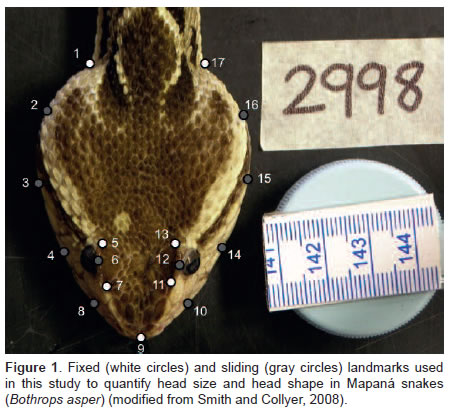
<body><![CDATA[<p>Among the ultimate (evolutionary) mechanisms   originating and/or maintaining SSD and SShD are   natural selection in the form of niche partitioning via   prey divergence (Vincent <i>et al.</i>, 2004a), fecundity   selection when larger females have larger clutches   compared to smaller females (Kuo <i>et al.</i>, 2009a),   or sexual selection when larger males are more   successful in male-male combats to gain access to   mating (Shine, 1994, 2000; Ljubisavljevic <i>et al.</i>,   2010). Conversely, proximate mechanisms include   differential growth rates in which one sex grows   faster than the other with both sexes reaching sexual   maturity at the same age (Shine and Crews, 1988;   Shine, 1994; Lerner and Mason, 2001), or when   both sexes grow at the same rate, but one sex reaches   sexual maturity at a relatively older age (Andrews,   1982; Parker and Plummer, 1987; Kozlowski,   1989). The environment itself can also have an   effect on body and head size and shape in reptiles   via phenotypic plasticity (Vincent <i>et al.</i>, 2004;   Ceballos and Valenzuela, 2011). For example, head   SSD and SShD was studied in wild cottonmouth   snakes (<i>Agkistrodon piscivorus</i>), a male-biased SSD   species. In this study, head SShD was supported with   males having longer quadrate bones, which allows   the lower jaw to open further and consume larger   prey relative to females (Vincent <i>et al.</i>, 2004). In a   second study, Gaboon vipers (<i>Bitis gabonica</i>) fed in   captivity under a low-food diet had narrower heads   compared to vipers fed a more abundant diet (Bonnet   <i>et al.</i>, 2001). In the latter study, however, head shape   differences between sexes were not found. Thus,   these studies fail to prove whether plasticity is a   proximate mechanism of sexual dimorphism for the heads of snakes.</p>     <p>In this study, we used geometric morphometrics   to test for differences in head SSD and SShD of   Mapan&aacute; snakes (<i>Bothrops asper</i>). Because we used   snakes of both sexes maintained in captivity under   homogeneous conditions and fed the same type of   prey (see methods), this study should also help to   elucidate if head sexual dimorphism has a plastic   origin as has been suggested (Bonnet <i>et al.</i>, 2001;   Vincent <i>et al.</i>, 2004); or if, on the contrary, it has a genetic origin.</p>     <p>Linear measurements have traditionally been   used to study head size and shape in reptiles   (Bonnet <i>et al.</i>, 2001; Vincent <i>et al.</i>, 2004b; Kuo   <i>et al.</i>, 2009a; Tomovic <i>et al.</i>, 2010). However,   descriptions of shape variation are limited to a   function of specific linear measurements, such   as size measurements (e.g., head width relative   to lateral head length) (Vincent <i>et al.</i>, 2004b; Kuo   <i>et al.</i>, 2009a). Geometric morphometrics (GM)   is a more developed technique (Rohlf and Slice,   1990) by which biological shape (size-free) and   size are quantified to detect even subtle differences   in morphology (Ceballos <i>et al.</i>, 2013; Valenzuela   <i>et al.</i>, 2004). Another advantage of GM is that   it allows us to graph average shapes for a better   visualization of morphological variation. Only one   study has used GM techniques to test for head SSD   and SShD in snakes, but only morphological head   differences associated to the region of origin were   found (Smith and Collyer, 2008). Likewise, because   diet shifts occur with ontogeny in snakes (Ford and   Hampton, 2009; Sasa <i>et al.</i>, 2009) we also tested for   any effect of body length (correspondent to age) on   head size and shape and any potential interaction between sex and body length.</p>     <p><i>Bothrops asper</i> (Viperidae), locally known as   the Mapan&aacute; snake, is a venomous species of special   interest because they are responsible for most (50-   70%) ophidian accidents in Colombia (Otero <i>et al.</i>,   1992). This species is widely distributed in America,   reaching from Mexico to Ecuador (Campbell   and Lamar, 2004) and has a large phenotypic   variation in its scales and blotches (Saldarriaga   <i>et al.</i>, 2009). It exhibits a female-biased SSD   pattern with females having greater SVL, more   dorsal and ventral scale rows, and shorter venttip   of tail length when compared to males (Sasa   <i>et al.</i>, 2009). <i>B. asper</i> is an overall diet generalist   consuming mammals, anurans, snakes, lizards, and   birds (Martins <i>et al.</i>, 2002), however, it exhibits an   ontogenetic shift in prey types, from ectotherms as   juveniles to endotherms as adults (Campbell and   Lamar, 2004). In addition, some studies have found subtle differences in prey in the stomach content between males and females (Sasa <i>et al.</i>, 2009), suggesting potential sexual differences in the diet.</p>     <p>&nbsp;</p>     <p><b><font size="3">Materials and methods </font></b></p>     <p><i>Captivity conditions at the serpentarium</i></p>     <p>All snakes are measured (total body length and   snout-vent length, cm), weighed, and sexed upon   arrival to the collection. The sexing method consists   of inserting a sexing probe into the vent (Stahl,   2001). If the probe penetrates 1 to 2 ventral scales the   individual is classified as a female, but if the probe   penetrates 3 or more ventral scales it is classified as   a male (Stahl, 2001). Snakes are fed approximately   10% of its body weight with lab albino mice of   different ages, which range between newborn 1 to 2 g   mice for newborn snakes every 10 d; 2 to 4 g mice for   juvenile snakes every 15 d; and up to 26 g mice for   adult snakes every 30 d. Water is offered <i>ad libitum</i>.   Snakes are housed in wooden boxes of three different   sizes (from 28.5 x 33 x 13 cm to 58 x 36 x 22 cm),   depending on the size of the snake. Environmental   temperature and humidity are not controlled and are   expected to be similar to those of the city of Medell&iacute;n   (Antioquia, Colombia): average temperature of 23 &deg;C   (range 16 to 28 &deg;C), and relative humidity between 50-65% (IDEAM, 2005).</p>     <p><i>Data Collection</i></p>     <p>A total of 114 <i>Bothrops asper</i> are currently   maintained under captive conditions at the   Serpentarium at the University of Antioquia in   Medell&iacute;n. Of this sample, there were 44 males (37   adults and 7 juveniles) and 70 females (65 adults   and 5 juveniles). Male individuals under 99.5 cm,   and females under 111.3 cm total body length were   considered juveniles (Solorzano and Cerdas, 1989).   We evaluated all snakes (n=114) to test for the   existence of head SSD and SShD. Most (n=107) of   the snakes came from the Magdalena region, while   the remainder came from the pacific region (Choc&oacute;,   n=2), Caribbean region (Maracaibo, n=3), while 2 were of unknown origin.</p>     ]]></body>
<body><![CDATA[<p>Because snakes entered the collection at different   life stages (12.3% were born <i>in situ</i>, 37.7% entered   as juveniles, 19.3% entered as adults, and 30.7%   have no records), some of these animals may have   reached sexual maturity in the wild. Thus, in order   to test if sexual dimorphism also develops under   captive conditions with both sexes receiving the   same prey type, we used animals that achieved   sexual maturity in captivity. These are animals with   initial total body length under 50 cm, above 100 cm   at present. Only 22 animals, 15 females and 7 males filled this criterion.</p>     <p>Body weight (BW, g), total body length   (TBL, cm) and snout-vent length (SVL, cm)   were measured, and dorsal views of the heads of   all snakes in collection were photographed. To   record this information each snake was sedated by   introducing it into a 25 gallon container filled with   carbon dioxide gas for approximately 2 m. Dorsal   views of the snakes' heads were photographed   with a digital camera (Olympus SP-500UZ, Center   Valley, PA, USA) attached to a tripod. Total body   length (cm) and snout-vent linear length (SVL, cm)   were recorded using a metric tape. Then, snakes   were returned to their cages where they were   monitored until their full recovery. The sedation   and manipulation process took approximately 5   m per individual. Data on initial body weight and   initial total body length were obtained from the   Serpentarium records. This protocol was approved   by the Animal Experimentation Ethics Committee   of the University of Antioquia, Act 72, issued on September 22, 2011.</p>     <p><i>Geometric-morphometric head size and shape quantification</i></p>     <p>   To quantify head size and head shape of Mapan&aacute;   snakes we used GM methods (Rohlf and Slice,   1990). A total of 17 landmarks were digitized from   photographs of the dorsal side of the snake. Seven of   these represented fixed anatomical points, while 10   were sliding semi-landmarks that captured the contour   of the head and the supraocular scales (modified from   Smith and Collyer, 2008; <a href="#f1">Figure 1</a>). Landmarks 1   and 17 were located at the head-neck inflexion point,   landmarks 5 to 7 and 11 to 13 around the supraocular   scales, landmark 9 at the most anterior and medial   point of the snout, and the remaining landmarks were   located equidistantly at the head contour. Sliding   landmarks were allowed to slide along the curve of the head, which improves fitting of the contour.   All landmarks were then subjected to a Generalized   Procrustes Analysis, which consists of superimposing   all landmarks in a coordinate system while holding   constant variation due to position, orientation, and   size (Rohlf and Slice, 1990). From this analysis   we obtained 14 shape variables that provided a   multivariate and size-free shape description of the   head shape of each animal, and a univariate measure   of head size (centroid size; see Bookstein, 1991).   Finally, with the objective of visualizing head shape   differences among groups, the average shapes were   calculated and graphed. Morphometric analyses   were performed with tpsDig, tpsRelw, and tpsSplin   software (Rohlf, 2001; 2003; 2004).</p>     <p align="center"><a name="f1"></a><img src="/img/revistas/rccp/v26n3/v26n3a7f1.jpg"/></p>     <p><i>Data Analysis</i></p>     <p>   We used the full set of animals (n=114) to test   for differences in the snake's head shape and size   associated to sex, TBL, and any potential interaction   (sex x TBL), by performing a permutational   multivariate and univariate analyses of variance,   respectively (Sokal and Rohlf, 1995). Nonparametric   multivariate analyses allowed us to   use landmarks in the whole head to fully capture   an accurate head shape, as opposed to using   landmarks in one half of the head and obtaining a   mathematically-calculated head shape which can   introduce perceived shape differences not present   in the dataset (Pessa <i>et al.</i>, 2008). These analyses   were implemented using the adonis function in the   Vegan package of the R program (Oksanen <i>et al.</i>,   2010). To test if head SSD and SShD is a plastic   effect or has a genetic basis, analyses were repeated   with a subset of animals (n=22) that achieved sexual   maturity in captivity (described above). Finally, to   test for sexual dimorphism in growth rates (body   weight and total body length) associated to captivity   we performed analyses of variance at both arrival   to collection and after being in captivity using the   same subset of animals (n=22).</p>     <p>&nbsp;</p>     <p><b><font size="3">Results </font></b></p>     <p><i>Head sexual shape dimorphism</i></p>     ]]></body>
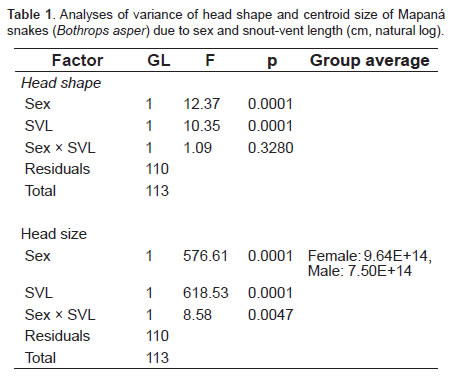
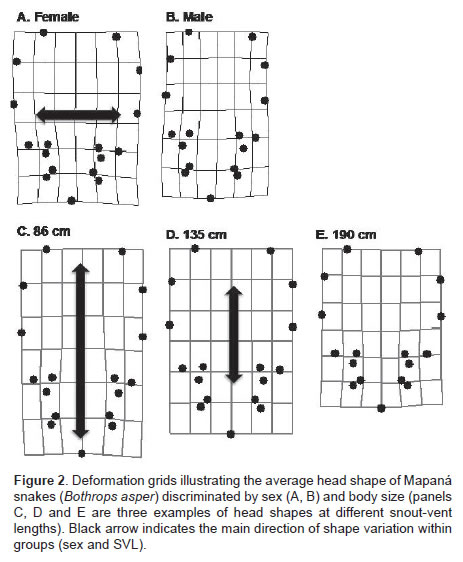
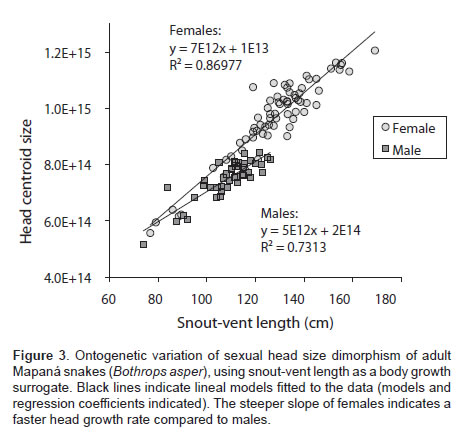
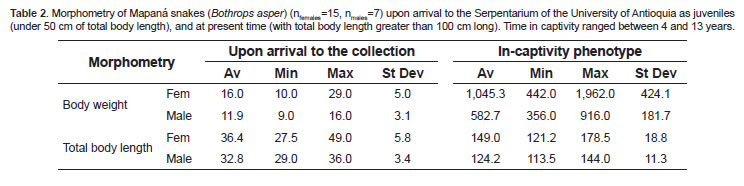
<body><![CDATA[<p>The head shape of <i>B. asper</i> was found to be   sexually dimorphic (<a href="#t1">Table 1</a>), with the head of   females relatively wider than the head of males   (<a href="#f2">Figure 2</a>, panels A and B). We also found that   head shape covaries with total body length,   independent of sex. The interaction sex &times; SVL was   not significant, indicating that allometric patterns   of head shape were consistent between males and   females. This pattern was generally described by   longer individuals having relatively shorter but   wider heads, while shorter individuals had relatively   longer and thinner heads (Figure 2, panels C to E).   Results did not change when the same analyses   were repeated with the subset of animals that   reached sexual maturity in captivity; head shape   remained sexually dimorphic (F=3.279, p=0.012), it   covaried with body length (F=2.985, p=0.019), and   such sexual shape dimorphism was independent of body length (F=1.824, p=0.103).</p>     <p align="center"><a name="t1"></a><img src="/img/revistas/rccp/v26n3/v26n3a7t1.jpg"/></p>     <p align="center"><a name="f2"></a><img src="/img/revistas/rccp/v26n3/v26n3a7f2.jpg"/></p>     <p><i>Sexual head size dimorphism</i></p>     <p>   The head size of <i>B. asper</i> was found to be   sexually dimorphic (<a href="#t1">Table 1</a>), with females   displaying about 28% larger heads than males on   average. Head size was also positively correlated   with SVL. The interaction sex &times; SVL was   significant, indicating that head size in one sex   increased as a function of SVL disproportionally   faster than in the other sex. To better understand   this relationship we fitted a linear model of head   size and SVL of each sex using the Test of slopes   function in the smart library in R software. We   found that the slope of females (b=7.44e+12,   p&lt;0.0001, R<sup>2</sup>=0.8684) was significantly steeper   (p&lt;0.0001) than the slope of males (b=5.34e+12,   p&lt;0.0001, R<sup>2</sup>=0.7312), confirming that head size in   females increased at a faster rate than it did in males   (<a href="#f3">Figure 3</a>).</p>     <p align="center"><a name="f3"></a><img src="/img/revistas/rccp/v26n3/v26n3a7f3.jpg"/></p>     <p>Using the subset of animals that reached   maturity in captivity we found that head size was   sexually dimorphic (F=131.004, p=0.0001), and that   head size covaried with total body length (F=0.399,   p=0.0001). In contrast to the results above, our   study shows that SSD was independent of body   length (F=4.175, p=0.053). However it should be   noted in absolute values the head size of females   also increases at a faster rate than that of males (b<sub>females</sub>=6E+12&gt;b<sub>males</sub>=3E+12).</p>     <p><i>Growth rates</i></p>     <p>   Using only individuals that reached maturity   in captivity (n=22) we found no differences in   body weight (F=7.5183, p&gt;0.06), or total body   length (F=2.4358, p&gt;0.1) between the sexes upon   arrival to the collection. However, these same   animals exhibited sexual differences in body   weight (F=7.5183, p=0.0125) and total body length   (F=10.273, p=0.004). This indicates that females   obtained greater length (TBL<sub>females</sub>=148.99 cm,   TBL<sub>males</sub>=124.18 cm) and weight (BW<sub>females</sub>=1045   g, BW<sub>males</sub>=582 g) than males in captive conditions   (<a href="#t2">Table 2</a>). As previously mentioned, body growth   was achieved by males and females fed the same   type of diet (mice) while varying only the amount   of food (number of mice offered) according to the   body weight of the snake. Conversion rates were   not calculated because food weight (mouse weight)   offered to each snake is not regularly recorded.</p>     <p align="center"><a name="t2"></a><img src="/img/revistas/rccp/v26n3/v26n3a7t2.jpg"/></p>     ]]></body>
<body><![CDATA[<p>&nbsp;</p>     <p><b><font size="3">Discussion </font></b></p>     <p>This study found that the head of <i>B. asper</i> is   sexually dimorphic in terms of shape and size, with   females having relatively wider and larger heads   compared to males. We also found that head size   and shape increases as body length increases. While   other forms of sexual dimorphism on body size,   numbers of scales, and tail coloration have been   reported for B. asper (Solorzano and Cerdas, 1989;   Sasa 2002; Hoyos <i>et al.</i> 2003; Sasa <i>et al.</i> 2009), this   is the first report on sexual shape dimorphism in the   head of this species. In addition, because we found   that head sexual dimorphism developed in snakes   maintained under the same feeding conditions, the   sole variation being the amount of food offered to   snakes with prey type remaining constant, we reject   a plasticity origin of head SSD and SShD (Bonnet   <i>et al.</i>, 2001; Vincent <i>et al.</i>, 2004). We suggest that   head SSD and SShD in <i>B. asper</i> is more likely to be   caused physiologically, thus indicating underlying genetic differences between sexes.</p>     <p>Finding head sexual differences in <i>B. asper</i> is   of particular importance given that they are gapelimited   predators (Forsman, 1991), and suggests that   the type of prey that each sex of <i>B. asper</i> consumes   in the wild may be mediated by its head size and   shape. Indeed, wild females in Costa Rica have been   reported to consume mainly rodents, while males   consume rodents in addition to birds and lizards   (Sasa <i>et al.</i>, 2009). Sexual differences in the venom   composition and volume have also been reported   in <i>Bothrops jararaca</i>, which suggests it may also   be possible in <i>B. asper</i>. Females of <i>B. jararaca</i>  produce five times more venom than males, and   that of females has a higher hemorrhagic and lethal   activity than that of males (Furtado <i>et al.</i>, 2006).   Other studies found that some peptides are found   only in the female venom of <i>B. jararaca</i> (Pimenta <i>et al.</i>, 2007). Further field studies on stomach content   discriminated by sex are needed to confirm if such   sexual differences in the diet are general in this   species, as it would support the niche partitioning   hypothesis (Furtado <i>et al.</i>, 2006) as an ultimate   mechanism maintaining head SSD and SShD in <i>B. asper</i>.</p>     <p>Likewise, a larger head and a wider gape may   not only facilitate the ingestion of larger prey by   females, but also facilitate the ingestion of more   mammals given larger prey items are generally   mammals compared to insects, reptiles and birds.   A recent study on the nutritional value of snake   prey found that mice are richer in energy and lipids   than lizards and crickets (Zuffi <i>et al.</i>, 2010), which   may favor lipid reserves needed by females during   vitellogenesis (Solorzano and Cerdas, 1989). Larger   <i>B. asper</i> females have been correlated with larger   clutches (Sasa <i>et al.</i>, 2009), thus, it seems there is a   direct relationship between a larger and wider head,   an energy-rich diet, and a fecundity advantage in females.</p>     <p>In addition to sex, we also found that head   size and shape also varied in terms of body   length, and thus age (under normal conditions).   Indeed, an ontogenetic shift in the diet and the   venom composition of <i>B. asper</i> has been reported.   Juveniles of <i>B. asper</i> consume mainly ectotherms,   such as frogs and lizards, while adults consume   mainly endotherms, including birds and mammals   (Sasa <i>et al.</i>, 2009). Accordingly, an ontogenetic   variability in the venom composition has also   been reported in <i>B. asper</i> (Saldarriaga <i>et al.</i>,   2003; Alape-Giron <i>et al.</i>, 2008), and its congeners   <i>B. atrox</i> (Saldarriaga <i>et al.</i>, 2003; Guercio <i>et al.</i>, 2006; Salazar <i>et al.</i>, 2007) and <i>B. jararaca</i> (Pimenta <i>et al.</i>, 2007; Zelanis <i>et al.</i>, 2010). Thus, observing these sexual and ontogenetic dietary shifts we suggest that juveniles of both sexes of   <i>B. asper</i> may prey mainly on ectotherms and that only adult females may switch to endotherms while adult males may maintain the same diet of juveniles. It would be interesting to test for diet differences between juveniles and adults while taking into account the sex as suggested above. Such information would also help to explain the large variability of the predator-prey mass ratio (0.002&#8211;0.889) observed for <i>Bothrops spp.</i> in general (Martins <i>et al.</i>, 2002).</p>     <p>Our findings show that females not only have   wider and larger heads, but that head size increases   at a relatively faster rate than males (<a href="#f3">Figure 3</a>). In   addition, the head shape of females is similar to   that of larger individuals (<a href="#f2">Figure 2</a>, panels A and   E), and the head shape of males resembles that of   smaller individuals (<a href="#f2">Figure 2</a>, panels B and C).   These observations have important developmental   implications (i.e., it suggests that head SSD and   SShD is driven by stronger phenotypic development   of females, while males seem to have a more   constrained development of the head phenotype).   Previous studies have shown that the sexual   hormone testosterone has a differential growth role   in male-biased or female-biased SSD species (Shine   and Crews, 1988; Lerner and Mason, 2001; John-   Alder and Cox, 2007). In the case of <i>B. asper</i>, a   female-biased SSD species, testosterone may inhibit   the head growth of males. Further experimental   studies manipulating testosterone availability may be useful to test this hypothesis.</p>     <p>&nbsp;</p> </font> <hr size="1" />      <p><font size="2" face="Verdana, Arial, Helvetica, sans-serif"><b><font size="3">Notas</font></b></font></p>     <p><font size="2" face="Verdana, Arial, Helvetica, sans-serif"><a name="1"></a><a href="#b1">&curren;</a> To cite this article: Henao-Duque AM, Ceballos CP. Sex-related head size and shape dimorphism in Mapan&aacute; snakes (Bothrops asper) kept in captivity. Rev Colomb Cienc Pecu 2013; 26:201-210. </font></p>  <hr size="1" />     ]]></body>
<body><![CDATA[<p>&nbsp;</p> <font size="2" face="Verdana, Arial, Helvetica, sans-serif">    <p>&nbsp;</p>     <p><b><font size="3">Acknowledgments</font></b></p>     <p>   We thank J. Asprilla at the Serpentarium of the   University of Antioquia for his observations on   the snakes that inspired this study and his logistic   support during data collection. We thank D.C.   Adams for valuable comments to an earlier version   of this manuscript. This study was logistically   supported by the Ophidism/Scorpionism program   and economically sponsored by the 2013-2014   Sustainability Program of the University of   Antioquia.</p>     <p>&nbsp;</p>     <p><b><font size="3">References</font></b></p>     <!-- ref --><p>   Alape-Giron A, Sanz L, Escolano J, Flores-Diaz M, Madrigal   M, Sasa M, Calvete JJ. Snake venomics of the lancehead   pitviper <i>Bothrops asper</i>: geographic, individual, and   ontogenetic variations. J Proteome Res 2008; 7:3556-3571.    &nbsp;&nbsp;&nbsp;&nbsp;&nbsp;&nbsp;&nbsp;&nbsp;[&#160;<a href="javascript:void(0);" onclick="javascript: window.open('/scielo.php?script=sci_nlinks&ref=000079&pid=S0120-0690201300030000700001&lng=','','width=640,height=500,resizable=yes,scrollbars=1,menubar=yes,');">Links</a>&#160;]<!-- end-ref --></p>     <!-- ref --><p>   Andrews RM. Patterns of growth in reptiles. In: Gans C, Pough   FH, editors. Biology of the reptilia. New York: Academic Press;   1982.    &nbsp;&nbsp;&nbsp;&nbsp;&nbsp;&nbsp;&nbsp;&nbsp;[&#160;<a href="javascript:void(0);" onclick="javascript: window.open('/scielo.php?script=sci_nlinks&ref=000081&pid=S0120-0690201300030000700002&lng=','','width=640,height=500,resizable=yes,scrollbars=1,menubar=yes,');">Links</a>&#160;]<!-- end-ref --></p>     ]]></body>
<body><![CDATA[<!-- ref --><p>   Bonnet X, Shine R, Naulleau G, Thiburce C. Plastic vipers:   influence of food intake on the size and shape of Gaboon vipers   (<i>Bitisgabonica</i>). J Zool Lond 2001; 255:341-351.    &nbsp;&nbsp;&nbsp;&nbsp;&nbsp;&nbsp;&nbsp;&nbsp;[&#160;<a href="javascript:void(0);" onclick="javascript: window.open('/scielo.php?script=sci_nlinks&ref=000083&pid=S0120-0690201300030000700003&lng=','','width=640,height=500,resizable=yes,scrollbars=1,menubar=yes,');">Links</a>&#160;]<!-- end-ref --></p>     <!-- ref --><p>   Bookstein FL. Morphometric tools for landmark data:   Geometry and Biology. New York: Cambridge Press; 1991.    &nbsp;&nbsp;&nbsp;&nbsp;&nbsp;&nbsp;&nbsp;&nbsp;[&#160;<a href="javascript:void(0);" onclick="javascript: window.open('/scielo.php?script=sci_nlinks&ref=000085&pid=S0120-0690201300030000700004&lng=','','width=640,height=500,resizable=yes,scrollbars=1,menubar=yes,');">Links</a>&#160;]<!-- end-ref --></p>     <!-- ref --><p>   Campbell JA, Lamar WW. The venomous reptiles of the   western hemisphere. Ithaca: Cornell University Press; 2004.    &nbsp;&nbsp;&nbsp;&nbsp;&nbsp;&nbsp;&nbsp;&nbsp;[&#160;<a href="javascript:void(0);" onclick="javascript: window.open('/scielo.php?script=sci_nlinks&ref=000087&pid=S0120-0690201300030000700005&lng=','','width=640,height=500,resizable=yes,scrollbars=1,menubar=yes,');">Links</a>&#160;]<!-- end-ref --></p>     <!-- ref --><p>   Ceballos CP, Valenzuela N. The role of sex-specific plasticity   in shaping sexual dimorphism in a long-lived vertebrate, the   snapping turtle <i>Chelydraserpentina</i>. Evol Biol 2011; 38:163-   181.    &nbsp;&nbsp;&nbsp;&nbsp;&nbsp;&nbsp;&nbsp;&nbsp;[&#160;<a href="javascript:void(0);" onclick="javascript: window.open('/scielo.php?script=sci_nlinks&ref=000089&pid=S0120-0690201300030000700006&lng=','','width=640,height=500,resizable=yes,scrollbars=1,menubar=yes,');">Links</a>&#160;]<!-- end-ref --></p>     <!-- ref --><p>   Ceballos CP, Hern&aacute;ndez O, Valenzuela N. Divergent sexspeci fic plasticity in long-lived vertebrates with contrasting sexual dimorphism. Evol Biol 2013 (DOI) 10.1007/s11692-013- 9249-0&nbsp;&nbsp;&nbsp;&nbsp;&nbsp;&nbsp;&nbsp;&nbsp;[&#160;<a href="javascript:void(0);" onclick="javascript: window.open('/scielo.php?script=sci_nlinks&ref=000091&pid=S0120-0690201300030000700007&lng=','','width=640,height=500,resizable=yes,scrollbars=1,menubar=yes,');">Links</a>&#160;]<!-- end-ref --><!-- ref --><p>   Dubey S, Brown GP, Madsen T, Shine R. Sexual selection   favours large body size in males of a tropical snake   (<i>Stegonotuscucullatus</i>, Colubridae). Anim Behav 2009; 77:177-   182.    &nbsp;&nbsp;&nbsp;&nbsp;&nbsp;&nbsp;&nbsp;&nbsp;[&#160;<a href="javascript:void(0);" onclick="javascript: window.open('/scielo.php?script=sci_nlinks&ref=000092&pid=S0120-0690201300030000700008&lng=','','width=640,height=500,resizable=yes,scrollbars=1,menubar=yes,');">Links</a>&#160;]<!-- end-ref --></p>     <!-- ref --><p>   Fairbairn DJ, Blanckenhorn WU, Szekely T. Sex, size and   gender roles. Evolutionary studies of sexual size dimorphism.   New York: Oxford University Press; 2007.    &nbsp;&nbsp;&nbsp;&nbsp;&nbsp;&nbsp;&nbsp;&nbsp;[&#160;<a href="javascript:void(0);" onclick="javascript: window.open('/scielo.php?script=sci_nlinks&ref=000094&pid=S0120-0690201300030000700009&lng=','','width=640,height=500,resizable=yes,scrollbars=1,menubar=yes,');">Links</a>&#160;]<!-- end-ref --></p>     <!-- ref --><p>   Ford NB, Hampton PM. Ontogenetic and sexual differences in   diet in an actively foraging snake, <i>Thamnophisproximus</i>. Can J   Zool/Rev Can Zool 2009; 87:254-261.    &nbsp;&nbsp;&nbsp;&nbsp;&nbsp;&nbsp;&nbsp;&nbsp;[&#160;<a href="javascript:void(0);" onclick="javascript: window.open('/scielo.php?script=sci_nlinks&ref=000096&pid=S0120-0690201300030000700010&lng=','','width=640,height=500,resizable=yes,scrollbars=1,menubar=yes,');">Links</a>&#160;]<!-- end-ref --></p>     <!-- ref --><p>   Forsman A. Variation in sexual size dimorphism and maximum   body size among adder populations: Effects of prey size. J Anim   Ecol 1991; 60:253-267.    &nbsp;&nbsp;&nbsp;&nbsp;&nbsp;&nbsp;&nbsp;&nbsp;[&#160;<a href="javascript:void(0);" onclick="javascript: window.open('/scielo.php?script=sci_nlinks&ref=000098&pid=S0120-0690201300030000700011&lng=','','width=640,height=500,resizable=yes,scrollbars=1,menubar=yes,');">Links</a>&#160;]<!-- end-ref --></p>     <!-- ref --><p>   Furtado MFD, Travaglia-Cardoso SR, Rocha MMT. Sexual   dimorphism in venom of <i>Bothrops jararaca</i> (Serpentes:   Viperidae). Toxicon 2006; 48:401-410.    &nbsp;&nbsp;&nbsp;&nbsp;&nbsp;&nbsp;&nbsp;&nbsp;[&#160;<a href="javascript:void(0);" onclick="javascript: window.open('/scielo.php?script=sci_nlinks&ref=000100&pid=S0120-0690201300030000700012&lng=','','width=640,height=500,resizable=yes,scrollbars=1,menubar=yes,');">Links</a>&#160;]<!-- end-ref --></p>     <!-- ref --><p>   Guercio RAP, Shevchenko A, Lopez-Lozano JL, Paba J,   Sousa MV, Ricart CAO. Ontogenetic variations in the venom   proteome of the Amazonian snake <i>Bothrops atrox</i>. Proteome Sci   2006; 4:1-14.    &nbsp;&nbsp;&nbsp;&nbsp;&nbsp;&nbsp;&nbsp;&nbsp;[&#160;<a href="javascript:void(0);" onclick="javascript: window.open('/scielo.php?script=sci_nlinks&ref=000102&pid=S0120-0690201300030000700013&lng=','','width=640,height=500,resizable=yes,scrollbars=1,menubar=yes,');">Links</a>&#160;]<!-- end-ref --></p>     <!-- ref --><p>   Herrel A, Moore JA, Bredeweg EM, Nelson NJ. Sexual   dimorphism, body size, bite force and male mating success in   tuatara. Biol J Linn Soc 2010; 100:287-292.    &nbsp;&nbsp;&nbsp;&nbsp;&nbsp;&nbsp;&nbsp;&nbsp;[&#160;<a href="javascript:void(0);" onclick="javascript: window.open('/scielo.php?script=sci_nlinks&ref=000104&pid=S0120-0690201300030000700014&lng=','','width=640,height=500,resizable=yes,scrollbars=1,menubar=yes,');">Links</a>&#160;]<!-- end-ref --></p>     <!-- ref --><p>   Hoyos MA, Otero R, Saldarriaga M, Jaramillo N. Divergencia   morfom&eacute;trica entre <i>Bothrops atrox</i> y <i>Bothrops asper</i> (Serpentes:   Viperidae). Actual Biol 2003; 25:157-165.    &nbsp;&nbsp;&nbsp;&nbsp;&nbsp;&nbsp;&nbsp;&nbsp;[&#160;<a href="javascript:void(0);" onclick="javascript: window.open('/scielo.php?script=sci_nlinks&ref=000106&pid=S0120-0690201300030000700015&lng=','','width=640,height=500,resizable=yes,scrollbars=1,menubar=yes,');">Links</a>&#160;]<!-- end-ref --></p>     <!-- ref --><p>IDEAM. Atlas climatol&oacute;gico de Colombia. Colombia: Imprenta Nacional de Colombia; 2005.    &nbsp;&nbsp;&nbsp;&nbsp;&nbsp;&nbsp;&nbsp;&nbsp;[&#160;<a href="javascript:void(0);" onclick="javascript: window.open('/scielo.php?script=sci_nlinks&ref=000108&pid=S0120-0690201300030000700016&lng=','','width=640,height=500,resizable=yes,scrollbars=1,menubar=yes,');">Links</a>&#160;]<!-- end-ref --></p>     <!-- ref --><p>   John-Alder H, Cox RM. Development of sexual size   dimorphism in lizards: testosterone as a bipotential growth   regulator. In: Fairbairn DJ, Blackenhorn WU, Sz&eacute;kely T,   editors. Sex, size and gender roles: evolutionary studies of   sexual size dimorphism. New York:Oxford University Press;   2007.    &nbsp;&nbsp;&nbsp;&nbsp;&nbsp;&nbsp;&nbsp;&nbsp;[&#160;<a href="javascript:void(0);" onclick="javascript: window.open('/scielo.php?script=sci_nlinks&ref=000110&pid=S0120-0690201300030000700017&lng=','','width=640,height=500,resizable=yes,scrollbars=1,menubar=yes,');">Links</a>&#160;]<!-- end-ref --></p>     <!-- ref --><p>   Kaliontzopoulou A, Carretero MA, Llorente GA. Head shape   allometry and proximate causes of head sexual dimorphism in     <i>Podarcis</i> lizards: joining linear and geometric morphometrics.   Biol J Linn Soc 2008; 93:111-124.    &nbsp;&nbsp;&nbsp;&nbsp;&nbsp;&nbsp;&nbsp;&nbsp;[&#160;<a href="javascript:void(0);" onclick="javascript: window.open('/scielo.php?script=sci_nlinks&ref=000112&pid=S0120-0690201300030000700018&lng=','','width=640,height=500,resizable=yes,scrollbars=1,menubar=yes,');">Links</a>&#160;]<!-- end-ref --></p>     <!-- ref --><p>   Kozlowski J. Sexual size dimorphism: A life history   perspective. Oikos 1989; 54:253-255.    &nbsp;&nbsp;&nbsp;&nbsp;&nbsp;&nbsp;&nbsp;&nbsp;[&#160;<a href="javascript:void(0);" onclick="javascript: window.open('/scielo.php?script=sci_nlinks&ref=000114&pid=S0120-0690201300030000700019&lng=','','width=640,height=500,resizable=yes,scrollbars=1,menubar=yes,');">Links</a>&#160;]<!-- end-ref --></p>     <!-- ref --><p>   Krause MA, Burghardt GM, Gillingham JC.Body size plasticity   and local variation of relative head and body size sexual   dimorphism in garter snakes (<i>Thamnophissirtalis</i>). J Zool 2003;   261:399-407.    &nbsp;&nbsp;&nbsp;&nbsp;&nbsp;&nbsp;&nbsp;&nbsp;[&#160;<a href="javascript:void(0);" onclick="javascript: window.open('/scielo.php?script=sci_nlinks&ref=000116&pid=S0120-0690201300030000700020&lng=','','width=640,height=500,resizable=yes,scrollbars=1,menubar=yes,');">Links</a>&#160;]<!-- end-ref --></p>     <!-- ref --><p>   Kuo C-Y, Lin Y-T, Lin Y-S. Sexual size and shape dimorphism   in an agamid lizard, <i>Japaluraswinhonis</i> (Squamata: Lacertilia:   Agamidae). Zool Stud 2009; 48:351-361.    &nbsp;&nbsp;&nbsp;&nbsp;&nbsp;&nbsp;&nbsp;&nbsp;[&#160;<a href="javascript:void(0);" onclick="javascript: window.open('/scielo.php?script=sci_nlinks&ref=000118&pid=S0120-0690201300030000700021&lng=','','width=640,height=500,resizable=yes,scrollbars=1,menubar=yes,');">Links</a>&#160;]<!-- end-ref --></p>     <!-- ref --><p>   Lerner DT, Mason RT. The influence of sex steroids on the   sexual size dimorphism in the red-spotted garter snake,     <i>Thamnophissirtalisconcinnus</i>. Gen Comp Endocr 2001;   124:218-225.    &nbsp;&nbsp;&nbsp;&nbsp;&nbsp;&nbsp;&nbsp;&nbsp;[&#160;<a href="javascript:void(0);" onclick="javascript: window.open('/scielo.php?script=sci_nlinks&ref=000120&pid=S0120-0690201300030000700022&lng=','','width=640,height=500,resizable=yes,scrollbars=1,menubar=yes,');">Links</a>&#160;]<!-- end-ref --></p>     <!-- ref --><p>   Ljubisavljevic K, Urosevic A, Aleksic I, Ivanovic A. Sexual   dimorphism of skull shape in a lacertid lizard species (<i>Podarcis</i>  spp., <i>Dalmatolacerta</i> sp., <i>Dinarolacerta</i> sp.) revealed by   geometric morphometrics. Zoology 2010; 113:168-174.    &nbsp;&nbsp;&nbsp;&nbsp;&nbsp;&nbsp;&nbsp;&nbsp;[&#160;<a href="javascript:void(0);" onclick="javascript: window.open('/scielo.php?script=sci_nlinks&ref=000122&pid=S0120-0690201300030000700023&lng=','','width=640,height=500,resizable=yes,scrollbars=1,menubar=yes,');">Links</a>&#160;]<!-- end-ref --></p>     <!-- ref --><p>   Martins M, Marques OAV, Sazima I. Ecological and   phylogenetic correlates of feeding habits in Neotropicalpitvipers   (genus <i>Bothrops</i>). In: Schuett GW, H&ouml;ggren M, Douglas ME,   Greene HW, editors. Biology of the vipers. Eagle Mountain:   Eagle Mountain Publishing; 2002. p. 307-328.    &nbsp;&nbsp;&nbsp;&nbsp;&nbsp;&nbsp;&nbsp;&nbsp;[&#160;<a href="javascript:void(0);" onclick="javascript: window.open('/scielo.php?script=sci_nlinks&ref=000124&pid=S0120-0690201300030000700024&lng=','','width=640,height=500,resizable=yes,scrollbars=1,menubar=yes,');">Links</a>&#160;]<!-- end-ref --></p>     <!-- ref --><p>   Oksanen J, Blanchet FG, Kindt R, Legendre P, O'Hara RB,   Simpson GL, Solymos P, Stevens M, Wagner H. Vegan:   community ecology package. R package version 1.17-4.2010.    &nbsp;&nbsp;&nbsp;&nbsp;&nbsp;&nbsp;&nbsp;&nbsp;[&#160;<a href="javascript:void(0);" onclick="javascript: window.open('/scielo.php?script=sci_nlinks&ref=000126&pid=S0120-0690201300030000700025&lng=','','width=640,height=500,resizable=yes,scrollbars=1,menubar=yes,');">Links</a>&#160;]<!-- end-ref --></p>     <!-- ref --><p>   Otero R, Tob&oacute;n GS, G&oacute;mez LF, Osorio R, Valderrama R,   Hoyos D, Urreta E, Molina S, Arboleda JJ. Accidente of&iacute;dico en   Antioquia y Choc&oacute;. Aspectos cl&iacute;nicos y epidemiol&oacute;gicos. Acta   Med Colomb 1992; 17:229-249.    &nbsp;&nbsp;&nbsp;&nbsp;&nbsp;&nbsp;&nbsp;&nbsp;[&#160;<a href="javascript:void(0);" onclick="javascript: window.open('/scielo.php?script=sci_nlinks&ref=000128&pid=S0120-0690201300030000700026&lng=','','width=640,height=500,resizable=yes,scrollbars=1,menubar=yes,');">Links</a>&#160;]<!-- end-ref --></p>     <!-- ref --><p>   Parker WS, Plummer MV. Population ecology. In: Seigel   RA, Collins JT, Novak SS, editors. Snakes: ecology and   evolutionary biology. New York: McGraw&#8211;Hill; 1987. p. 253-   301.    &nbsp;&nbsp;&nbsp;&nbsp;&nbsp;&nbsp;&nbsp;&nbsp;[&#160;<a href="javascript:void(0);" onclick="javascript: window.open('/scielo.php?script=sci_nlinks&ref=000130&pid=S0120-0690201300030000700027&lng=','','width=640,height=500,resizable=yes,scrollbars=1,menubar=yes,');">Links</a>&#160;]<!-- end-ref --></p>     <!-- ref --><p>   Pessa JE, Slice DE, Hanz KR, Broadbent TH, Rohrich RJ.   Aging and the shape of the mandible.Plas Reconstr Surg 2008;   121:196-200.    &nbsp;&nbsp;&nbsp;&nbsp;&nbsp;&nbsp;&nbsp;&nbsp;[&#160;<a href="javascript:void(0);" onclick="javascript: window.open('/scielo.php?script=sci_nlinks&ref=000132&pid=S0120-0690201300030000700028&lng=','','width=640,height=500,resizable=yes,scrollbars=1,menubar=yes,');">Links</a>&#160;]<!-- end-ref --></p>     <!-- ref --><p>   Pimenta DC, Prezoto BC, Konno K, Melo RL, Furtado MF,   Camargo ACM, Serrano SMT. Mass spectrometric analysis of   the individual variability of <i>Bothrops jararaca</i> venom fraction.   Evidence for sex-based variation among the bradykininpotentiating   peptides. Rapid Commun Mass Spectrom 2007;   21:1034-1042.    &nbsp;&nbsp;&nbsp;&nbsp;&nbsp;&nbsp;&nbsp;&nbsp;[&#160;<a href="javascript:void(0);" onclick="javascript: window.open('/scielo.php?script=sci_nlinks&ref=000134&pid=S0120-0690201300030000700029&lng=','','width=640,height=500,resizable=yes,scrollbars=1,menubar=yes,');">Links</a>&#160;]<!-- end-ref --></p>     <!-- ref --><p>   Pinto RR, Fernandes R, Marques OAV. Morphology and diet   of two sympatric colubrid snakes, <i>Chironiusflavolineatus</i> and   Chironiusquadricarinatus (Serpentes: Colubridae). Amphibia-   Reptilia 2008; 29:149-160.    &nbsp;&nbsp;&nbsp;&nbsp;&nbsp;&nbsp;&nbsp;&nbsp;[&#160;<a href="javascript:void(0);" onclick="javascript: window.open('/scielo.php?script=sci_nlinks&ref=000136&pid=S0120-0690201300030000700030&lng=','','width=640,height=500,resizable=yes,scrollbars=1,menubar=yes,');">Links</a>&#160;]<!-- end-ref --></p>     <!-- ref --><p>   Rivas JA, Burghardt GM. Understanding sexual size   dimorphism in snakes: wearing the snake's shoes. Anim Behav   2001; 62:F1-F6.    &nbsp;&nbsp;&nbsp;&nbsp;&nbsp;&nbsp;&nbsp;&nbsp;[&#160;<a href="javascript:void(0);" onclick="javascript: window.open('/scielo.php?script=sci_nlinks&ref=000138&pid=S0120-0690201300030000700031&lng=','','width=640,height=500,resizable=yes,scrollbars=1,menubar=yes,');">Links</a>&#160;]<!-- end-ref --></p>     <!-- ref --><p>   Rohlf FJ, Slice D. Extensions of the Procrustes method for the   optimal superimposition of landmarks. Syst Zool 1990; 39:40-   59.    &nbsp;&nbsp;&nbsp;&nbsp;&nbsp;&nbsp;&nbsp;&nbsp;[&#160;<a href="javascript:void(0);" onclick="javascript: window.open('/scielo.php?script=sci_nlinks&ref=000140&pid=S0120-0690201300030000700032&lng=','','width=640,height=500,resizable=yes,scrollbars=1,menubar=yes,');">Links</a>&#160;]<!-- end-ref --></p>     <!-- ref --><p>   Rohlf FJ. TpsDig, Version 1.31. Department of Ecology and   Evolution. State University of New York at Stony Brook, Stony   Brook, New York, USA. 2001.    &nbsp;&nbsp;&nbsp;&nbsp;&nbsp;&nbsp;&nbsp;&nbsp;[&#160;<a href="javascript:void(0);" onclick="javascript: window.open('/scielo.php?script=sci_nlinks&ref=000142&pid=S0120-0690201300030000700033&lng=','','width=640,height=500,resizable=yes,scrollbars=1,menubar=yes,');">Links</a>&#160;]<!-- end-ref --></p>     <!-- ref --><p>   Rohlf FJ. TpsRelw, Version 1.29. Department of Ecology and   Evolution, State University of New York at Stony Brook, New   York, USA. 2003.    &nbsp;&nbsp;&nbsp;&nbsp;&nbsp;&nbsp;&nbsp;&nbsp;[&#160;<a href="javascript:void(0);" onclick="javascript: window.open('/scielo.php?script=sci_nlinks&ref=000144&pid=S0120-0690201300030000700034&lng=','','width=640,height=500,resizable=yes,scrollbars=1,menubar=yes,');">Links</a>&#160;]<!-- end-ref --></p>     <!-- ref --><p>   Rohlf FJ. TpsSplin, Version 1.20. Department of Ecology and   Evolution. State University of New York at Stony Brook, Stony   Brook, New York, USA. 2004.    &nbsp;&nbsp;&nbsp;&nbsp;&nbsp;&nbsp;&nbsp;&nbsp;[&#160;<a href="javascript:void(0);" onclick="javascript: window.open('/scielo.php?script=sci_nlinks&ref=000146&pid=S0120-0690201300030000700035&lng=','','width=640,height=500,resizable=yes,scrollbars=1,menubar=yes,');">Links</a>&#160;]<!-- end-ref --></p>     <!-- ref --><p>   Salazar AM, Rodriguez-Acosta A, Giron ME, Aguilar I,   Guerrero B. A comparative analysis of the clotting and fibrinolytic activities of the snake venom (<i>Bothrops atrox</i>) from different geographical areas in Venezuela. Thromb Res 2007; 120:95-104.    &nbsp;&nbsp;&nbsp;&nbsp;&nbsp;&nbsp;&nbsp;&nbsp;[&#160;<a href="javascript:void(0);" onclick="javascript: window.open('/scielo.php?script=sci_nlinks&ref=000148&pid=S0120-0690201300030000700036&lng=','','width=640,height=500,resizable=yes,scrollbars=1,menubar=yes,');">Links</a>&#160;]<!-- end-ref --></p>     <!-- ref --><p>   Saldarriaga MM, Otero R, Nunez V, Toro MF, Diaz A, Gutierrez   JM. Ontogenetic variability of <i>Bothrops atrox</i> and <i>Bothrops   asper</i> snake venoms from Colombia. Toxicon 2003; 42:405-   411.    &nbsp;&nbsp;&nbsp;&nbsp;&nbsp;&nbsp;&nbsp;&nbsp;[&#160;<a href="javascript:void(0);" onclick="javascript: window.open('/scielo.php?script=sci_nlinks&ref=000150&pid=S0120-0690201300030000700037&lng=','','width=640,height=500,resizable=yes,scrollbars=1,menubar=yes,');">Links</a>&#160;]<!-- end-ref --></p>     <!-- ref --><p>   Saldarriaga MM, Sasa M, Pardo R, M&eacute;ndez MA. Phenotypic   differences in a cryptic predator: Factors influencing   morphological variation in the terciopelo <i>Bothrops asper</i>  (Garman, 1884; Serpentes: Viperidae). Toxicon 2009; 54:923-   937.    &nbsp;&nbsp;&nbsp;&nbsp;&nbsp;&nbsp;&nbsp;&nbsp;[&#160;<a href="javascript:void(0);" onclick="javascript: window.open('/scielo.php?script=sci_nlinks&ref=000152&pid=S0120-0690201300030000700038&lng=','','width=640,height=500,resizable=yes,scrollbars=1,menubar=yes,');">Links</a>&#160;]<!-- end-ref --></p>     <!-- ref --><p>   Sasa M, Wasko DK, Lamar WW. Natural history of the   terciopelo <i>Bothrops asper</i> (Serpentes: Viperidae) in Costa Rica.   Toxicon 2009; 54:904-22.    &nbsp;&nbsp;&nbsp;&nbsp;&nbsp;&nbsp;&nbsp;&nbsp;[&#160;<a href="javascript:void(0);" onclick="javascript: window.open('/scielo.php?script=sci_nlinks&ref=000154&pid=S0120-0690201300030000700039&lng=','','width=640,height=500,resizable=yes,scrollbars=1,menubar=yes,');">Links</a>&#160;]<!-- end-ref --></p>     <!-- ref --><p>   Sasa M. Morphological variation in the lancehead pitviper     <i>Bothrops asper</i> (Garman) (Serpentes: Viperidae) from middle   America. Rev Biol Trop 2002; 50:259-271.    &nbsp;&nbsp;&nbsp;&nbsp;&nbsp;&nbsp;&nbsp;&nbsp;[&#160;<a href="javascript:void(0);" onclick="javascript: window.open('/scielo.php?script=sci_nlinks&ref=000156&pid=S0120-0690201300030000700040&lng=','','width=640,height=500,resizable=yes,scrollbars=1,menubar=yes,');">Links</a>&#160;]<!-- end-ref --></p>     <!-- ref --><p>   Shine R, Crews D. Why male gartner snakes have small heads:   The evolution and endocrine control of sexual dimorphism.   Evolution 1988; 42:1105-1110.    &nbsp;&nbsp;&nbsp;&nbsp;&nbsp;&nbsp;&nbsp;&nbsp;[&#160;<a href="javascript:void(0);" onclick="javascript: window.open('/scielo.php?script=sci_nlinks&ref=000158&pid=S0120-0690201300030000700041&lng=','','width=640,height=500,resizable=yes,scrollbars=1,menubar=yes,');">Links</a>&#160;]<!-- end-ref --></p>     <!-- ref --><p>   Shine R. Sexual size dimorphism in snakes revisited. Copeia   1994; 2:326-346.    &nbsp;&nbsp;&nbsp;&nbsp;&nbsp;&nbsp;&nbsp;&nbsp;[&#160;<a href="javascript:void(0);" onclick="javascript: window.open('/scielo.php?script=sci_nlinks&ref=000160&pid=S0120-0690201300030000700042&lng=','','width=640,height=500,resizable=yes,scrollbars=1,menubar=yes,');">Links</a>&#160;]<!-- end-ref --></p>     <!-- ref --><p>   Shine R. Vertebral numbers in male and female snakes: the roles   of natural, sexual and fecundity selection. J Evol Biol 2000;   13:455-465.    &nbsp;&nbsp;&nbsp;&nbsp;&nbsp;&nbsp;&nbsp;&nbsp;[&#160;<a href="javascript:void(0);" onclick="javascript: window.open('/scielo.php?script=sci_nlinks&ref=000162&pid=S0120-0690201300030000700043&lng=','','width=640,height=500,resizable=yes,scrollbars=1,menubar=yes,');">Links</a>&#160;]<!-- end-ref --></p>     <!-- ref --><p>   Smith MT, Collyer ML. Regional variation and sexual   dimorphism in head form of the prairie rattlesnake   (<i>Crotalusviridisviridis</i>): comparisons using new analytical and collection methods. In: Beaman KR, Caldwell MD, Bush SP,   editors. The biology of rattlesnakes: Loma Linda university   Press, California; 2008.    &nbsp;&nbsp;&nbsp;&nbsp;&nbsp;&nbsp;&nbsp;&nbsp;[&#160;<a href="javascript:void(0);" onclick="javascript: window.open('/scielo.php?script=sci_nlinks&ref=000164&pid=S0120-0690201300030000700044&lng=','','width=640,height=500,resizable=yes,scrollbars=1,menubar=yes,');">Links</a>&#160;]<!-- end-ref --></p>     <!-- ref --><p>   Solorzano A, Cerdas L. Reproductive Biology and Distribution   of the Terciopelo, <i>Bothrops asper</i> Garman (Serpentes:   Viperidae), in Costa Rica. Herpetologica 1989; 45:444-450.    &nbsp;&nbsp;&nbsp;&nbsp;&nbsp;&nbsp;&nbsp;&nbsp;[&#160;<a href="javascript:void(0);" onclick="javascript: window.open('/scielo.php?script=sci_nlinks&ref=000166&pid=S0120-0690201300030000700045&lng=','','width=640,height=500,resizable=yes,scrollbars=1,menubar=yes,');">Links</a>&#160;]<!-- end-ref --></p>     <!-- ref --><p>   Stahl SJ, editor. Reptile production medicine. In: Seminars in   Avian and ExoticPet Medicine. Ciudad Saunders; 2001:140-150.    &nbsp;&nbsp;&nbsp;&nbsp;&nbsp;&nbsp;&nbsp;&nbsp;[&#160;<a href="javascript:void(0);" onclick="javascript: window.open('/scielo.php?script=sci_nlinks&ref=000168&pid=S0120-0690201300030000700046&lng=','','width=640,height=500,resizable=yes,scrollbars=1,menubar=yes,');">Links</a>&#160;]<!-- end-ref --></p>     <!-- ref --><p>   Taylor EN, Denardo DF. Sexual size dimorphism and growth   plasticity in snakes: an experiment on the Western Diamondbacked   Rattlesnake (<i>Crotalusatrox</i>). J Exp Zool A Comp Exp   Biol 2005; 303:598-607.    &nbsp;&nbsp;&nbsp;&nbsp;&nbsp;&nbsp;&nbsp;&nbsp;[&#160;<a href="javascript:void(0);" onclick="javascript: window.open('/scielo.php?script=sci_nlinks&ref=000170&pid=S0120-0690201300030000700047&lng=','','width=640,height=500,resizable=yes,scrollbars=1,menubar=yes,');">Links</a>&#160;]<!-- end-ref --></p>     <!-- ref --><p>   Tomovic LM, Crnobrnja-Isailovic JM, Ajtic RD, Aleksic   ID, Djordjevic SZ. When do meadow vipers (<i>Viperaursinii</i>)   become sexually dimorphic? ontogenetic patterns of sexual size   dimorphisms. J Zool Syst Evol Res 2010; 48:279-282.    &nbsp;&nbsp;&nbsp;&nbsp;&nbsp;&nbsp;&nbsp;&nbsp;[&#160;<a href="javascript:void(0);" onclick="javascript: window.open('/scielo.php?script=sci_nlinks&ref=000172&pid=S0120-0690201300030000700048&lng=','','width=640,height=500,resizable=yes,scrollbars=1,menubar=yes,');">Links</a>&#160;]<!-- end-ref --></p>     <!-- ref --><p>   Valenzuela N, Adams DC, Bowden RM, Gauger AC. Geometric   morphometric sex estimation for hatchling turtles: A powerful   alternative for detecting subtle sexual shape dimorphism.   Copeia 2004; 4:735-742.    &nbsp;&nbsp;&nbsp;&nbsp;&nbsp;&nbsp;&nbsp;&nbsp;[&#160;<a href="javascript:void(0);" onclick="javascript: window.open('/scielo.php?script=sci_nlinks&ref=000174&pid=S0120-0690201300030000700049&lng=','','width=640,height=500,resizable=yes,scrollbars=1,menubar=yes,');">Links</a>&#160;]<!-- end-ref --></p>     <!-- ref --><p>   Vincent SE, Herrel A, Irschick DJ. Ontogeny of   intersexual head shape and prey selection in the pitviper   <i>Agkistrodonpiscivorus</i>. Biol J Linn Soc 2004; 81:151-159.    &nbsp;&nbsp;&nbsp;&nbsp;&nbsp;&nbsp;&nbsp;&nbsp;[&#160;<a href="javascript:void(0);" onclick="javascript: window.open('/scielo.php?script=sci_nlinks&ref=000176&pid=S0120-0690201300030000700050&lng=','','width=640,height=500,resizable=yes,scrollbars=1,menubar=yes,');">Links</a>&#160;]<!-- end-ref --></p>     <!-- ref --><p>   Vincent SE, Herrel A, Irschick DJ. Sexual dimorphism   in head shape and diet in the cottonmouth snake   (<i>Agkistrodonpiscivorus</i>). J Zool 2004; 264:53-59.    &nbsp;&nbsp;&nbsp;&nbsp;&nbsp;&nbsp;&nbsp;&nbsp;[&#160;<a href="javascript:void(0);" onclick="javascript: window.open('/scielo.php?script=sci_nlinks&ref=000178&pid=S0120-0690201300030000700051&lng=','','width=640,height=500,resizable=yes,scrollbars=1,menubar=yes,');">Links</a>&#160;]<!-- end-ref --></p>     <!-- ref --><p>   Zelanis A, Tashima AK, Rocha MMT, Furtado MF, Camargo   ACM, Ho PL, Serrano SMT. Analysis of the ontogenetic   variationin the venom proteome/peptidomeof Bothrops   jararacareveals different strategies to deal with prey. J   Proteome Res 2010; 9:2278-2291.    &nbsp;&nbsp;&nbsp;&nbsp;&nbsp;&nbsp;&nbsp;&nbsp;[&#160;<a href="javascript:void(0);" onclick="javascript: window.open('/scielo.php?script=sci_nlinks&ref=000180&pid=S0120-0690201300030000700052&lng=','','width=640,height=500,resizable=yes,scrollbars=1,menubar=yes,');">Links</a>&#160;]<!-- end-ref --></p>     <!-- ref --><p>   Zuffi, M. A. L., S. Fornasiero, R. Picchiotti, P. Poli, and M.   Mele. Adaptive significance of food income in European   snakes: body size is related to prey energetics. Biol J Linn Soc   2010; 100:307-317.    &nbsp;&nbsp;&nbsp;&nbsp;&nbsp;&nbsp;&nbsp;&nbsp;[&#160;<a href="javascript:void(0);" onclick="javascript: window.open('/scielo.php?script=sci_nlinks&ref=000182&pid=S0120-0690201300030000700053&lng=','','width=640,height=500,resizable=yes,scrollbars=1,menubar=yes,');">Links</a>&#160;]<!-- end-ref --></p> </font>      ]]></body><back>
<ref-list>
<ref id="B1">
<nlm-citation citation-type="journal">
<person-group person-group-type="author">
<name>
<surname><![CDATA[Alape-Giron]]></surname>
<given-names><![CDATA[A]]></given-names>
</name>
<name>
<surname><![CDATA[Sanz]]></surname>
<given-names><![CDATA[L]]></given-names>
</name>
<name>
<surname><![CDATA[Escolano]]></surname>
<given-names><![CDATA[J]]></given-names>
</name>
<name>
<surname><![CDATA[Flores-Diaz]]></surname>
<given-names><![CDATA[M]]></given-names>
</name>
<name>
<surname><![CDATA[Madrigal]]></surname>
<given-names><![CDATA[M]]></given-names>
</name>
<name>
<surname><![CDATA[Sasa]]></surname>
<given-names><![CDATA[M]]></given-names>
</name>
<name>
<surname><![CDATA[Calvete]]></surname>
<given-names><![CDATA[JJ]]></given-names>
</name>
</person-group>
<article-title xml:lang="en"><![CDATA[Snake venomics of the lancehead pitviper Bothrops asper: geographic, individual, and ontogenetic variations]]></article-title>
<source><![CDATA[J Proteome Res]]></source>
<year>2008</year>
<volume>7</volume>
<page-range>3556-3571</page-range></nlm-citation>
</ref>
<ref id="B2">
<nlm-citation citation-type="book">
<person-group person-group-type="author">
<name>
<surname><![CDATA[Andrews]]></surname>
<given-names><![CDATA[RM]]></given-names>
</name>
</person-group>
<article-title xml:lang="en"><![CDATA[Patterns of growth in reptiles]]></article-title>
<person-group person-group-type="editor">
<name>
<surname><![CDATA[Gans]]></surname>
<given-names><![CDATA[C]]></given-names>
</name>
<name>
<surname><![CDATA[Pough]]></surname>
<given-names><![CDATA[FH]]></given-names>
</name>
</person-group>
<source><![CDATA[Biology of the reptilia]]></source>
<year>1982</year>
<publisher-loc><![CDATA[New York ]]></publisher-loc>
<publisher-name><![CDATA[Academic Press]]></publisher-name>
</nlm-citation>
</ref>
<ref id="B3">
<nlm-citation citation-type="journal">
<person-group person-group-type="author">
<name>
<surname><![CDATA[Bonnet]]></surname>
<given-names><![CDATA[X]]></given-names>
</name>
<name>
<surname><![CDATA[Shine]]></surname>
<given-names><![CDATA[R]]></given-names>
</name>
<name>
<surname><![CDATA[Naulleau]]></surname>
<given-names><![CDATA[G]]></given-names>
</name>
<name>
<surname><![CDATA[Thiburce]]></surname>
<given-names><![CDATA[C]]></given-names>
</name>
</person-group>
<article-title xml:lang="en"><![CDATA[Plastic vipers: influence of food intake on the size and shape of Gaboon vipers (Bitisgabonica)]]></article-title>
<source><![CDATA[J Zool Lond]]></source>
<year>2001</year>
<volume>255</volume>
<page-range>341-351</page-range></nlm-citation>
</ref>
<ref id="B4">
<nlm-citation citation-type="book">
<person-group person-group-type="author">
<name>
<surname><![CDATA[Bookstein]]></surname>
<given-names><![CDATA[FL]]></given-names>
</name>
</person-group>
<source><![CDATA[Morphometric tools for landmark data: Geometry and Biology]]></source>
<year>1991</year>
<publisher-loc><![CDATA[New York ]]></publisher-loc>
<publisher-name><![CDATA[Cambridge Press]]></publisher-name>
</nlm-citation>
</ref>
<ref id="B5">
<nlm-citation citation-type="book">
<person-group person-group-type="author">
<name>
<surname><![CDATA[Campbell]]></surname>
<given-names><![CDATA[JA]]></given-names>
</name>
<name>
<surname><![CDATA[Lamar]]></surname>
<given-names><![CDATA[WW]]></given-names>
</name>
</person-group>
<source><![CDATA[The venomous reptiles of the western hemisphere]]></source>
<year>2004</year>
<publisher-loc><![CDATA[Ithaca ]]></publisher-loc>
<publisher-name><![CDATA[Cornell University Press]]></publisher-name>
</nlm-citation>
</ref>
<ref id="B6">
<nlm-citation citation-type="journal">
<person-group person-group-type="author">
<name>
<surname><![CDATA[Ceballos]]></surname>
<given-names><![CDATA[CP]]></given-names>
</name>
<name>
<surname><![CDATA[Valenzuela]]></surname>
<given-names><![CDATA[N]]></given-names>
</name>
</person-group>
<article-title xml:lang="en"><![CDATA[The role of sex-specific plasticity in shaping sexual dimorphism in a long-lived vertebrate, the snapping turtle Chelydraserpentina]]></article-title>
<source><![CDATA[Evol Biol]]></source>
<year>2011</year>
<volume>38</volume>
<page-range>163- 181</page-range></nlm-citation>
</ref>
<ref id="B7">
<nlm-citation citation-type="journal">
<person-group person-group-type="author">
<name>
<surname><![CDATA[Ceballos]]></surname>
<given-names><![CDATA[CP]]></given-names>
</name>
<name>
<surname><![CDATA[Hernández]]></surname>
<given-names><![CDATA[O]]></given-names>
</name>
<name>
<surname><![CDATA[Valenzuela]]></surname>
<given-names><![CDATA[N]]></given-names>
</name>
</person-group>
<article-title xml:lang="en"><![CDATA[Divergent sexspeci fic plasticity in long-lived vertebrates with contrasting sexual dimorphism]]></article-title>
<source><![CDATA[Evol Biol]]></source>
<year>2013</year>
</nlm-citation>
</ref>
<ref id="B8">
<nlm-citation citation-type="journal">
<person-group person-group-type="author">
<name>
<surname><![CDATA[Dubey]]></surname>
<given-names><![CDATA[S]]></given-names>
</name>
<name>
<surname><![CDATA[Brown]]></surname>
<given-names><![CDATA[GP]]></given-names>
</name>
<name>
<surname><![CDATA[Madsen]]></surname>
<given-names><![CDATA[T]]></given-names>
</name>
<name>
<surname><![CDATA[Shine]]></surname>
<given-names><![CDATA[R]]></given-names>
</name>
</person-group>
<article-title xml:lang="en"><![CDATA[Sexual selection favours large body size in males of a tropical snake (Stegonotuscucullatus, Colubridae)]]></article-title>
<source><![CDATA[Anim Behav]]></source>
<year>2009</year>
<volume>77</volume>
<page-range>177- 182</page-range></nlm-citation>
</ref>
<ref id="B9">
<nlm-citation citation-type="book">
<person-group person-group-type="author">
<name>
<surname><![CDATA[Fairbairn]]></surname>
<given-names><![CDATA[DJ]]></given-names>
</name>
<name>
<surname><![CDATA[Blanckenhorn]]></surname>
<given-names><![CDATA[WU]]></given-names>
</name>
<name>
<surname><![CDATA[Szekely]]></surname>
<given-names><![CDATA[T]]></given-names>
</name>
</person-group>
<source><![CDATA[Sex, size and gender roles. Evolutionary studies of sexual size dimorphism]]></source>
<year>2007</year>
<publisher-loc><![CDATA[New York ]]></publisher-loc>
<publisher-name><![CDATA[Oxford University Press]]></publisher-name>
</nlm-citation>
</ref>
<ref id="B10">
<nlm-citation citation-type="journal">
<person-group person-group-type="author">
<name>
<surname><![CDATA[Ford]]></surname>
<given-names><![CDATA[NB]]></given-names>
</name>
<name>
<surname><![CDATA[Hampton]]></surname>
<given-names><![CDATA[PM]]></given-names>
</name>
</person-group>
<article-title xml:lang="en"><![CDATA[Ontogenetic and sexual differences in diet in an actively foraging snake, Thamnophisproximus]]></article-title>
<source><![CDATA[Can J Zool/Rev Can Zool]]></source>
<year>2009</year>
<volume>87</volume>
<page-range>254-261</page-range></nlm-citation>
</ref>
<ref id="B11">
<nlm-citation citation-type="journal">
<person-group person-group-type="author">
<name>
<surname><![CDATA[Forsman]]></surname>
<given-names><![CDATA[A]]></given-names>
</name>
</person-group>
<article-title xml:lang="en"><![CDATA[Variation in sexual size dimorphism and maximum body size among adder populations: Effects of prey size]]></article-title>
<source><![CDATA[J Anim Ecol]]></source>
<year>1991</year>
<volume>60</volume>
<page-range>253-267</page-range></nlm-citation>
</ref>
<ref id="B12">
<nlm-citation citation-type="journal">
<person-group person-group-type="author">
<name>
<surname><![CDATA[Furtado]]></surname>
<given-names><![CDATA[MFD]]></given-names>
</name>
<name>
<surname><![CDATA[Travaglia-Cardoso]]></surname>
<given-names><![CDATA[SR]]></given-names>
</name>
<name>
<surname><![CDATA[Rocha]]></surname>
<given-names><![CDATA[MMT]]></given-names>
</name>
</person-group>
<article-title xml:lang="en"><![CDATA[Sexual dimorphism in venom of Bothrops jararaca (Serpentes: Viperidae)]]></article-title>
<source><![CDATA[Toxicon]]></source>
<year>2006</year>
<volume>48</volume>
<page-range>401-410</page-range></nlm-citation>
</ref>
<ref id="B13">
<nlm-citation citation-type="journal">
<person-group person-group-type="author">
<name>
<surname><![CDATA[Guercio]]></surname>
<given-names><![CDATA[RAP]]></given-names>
</name>
<name>
<surname><![CDATA[Shevchenko]]></surname>
<given-names><![CDATA[A]]></given-names>
</name>
<name>
<surname><![CDATA[Lopez-Lozano]]></surname>
<given-names><![CDATA[JL]]></given-names>
</name>
<name>
<surname><![CDATA[Paba]]></surname>
<given-names><![CDATA[J]]></given-names>
</name>
<name>
<surname><![CDATA[Sousa]]></surname>
<given-names><![CDATA[MV]]></given-names>
</name>
<name>
<surname><![CDATA[Ricart]]></surname>
<given-names><![CDATA[CAO]]></given-names>
</name>
</person-group>
<article-title xml:lang="en"><![CDATA[Ontogenetic variations in the venom proteome of the Amazonian snake Bothrops atrox]]></article-title>
<source><![CDATA[Proteome Sci]]></source>
<year>2006</year>
<volume>4</volume>
<page-range>1-14</page-range></nlm-citation>
</ref>
<ref id="B14">
<nlm-citation citation-type="journal">
<person-group person-group-type="author">
<name>
<surname><![CDATA[Herrel]]></surname>
<given-names><![CDATA[A]]></given-names>
</name>
<name>
<surname><![CDATA[Moore]]></surname>
<given-names><![CDATA[JA]]></given-names>
</name>
<name>
<surname><![CDATA[Bredeweg]]></surname>
<given-names><![CDATA[EM]]></given-names>
</name>
<name>
<surname><![CDATA[Nelson]]></surname>
<given-names><![CDATA[NJ]]></given-names>
</name>
</person-group>
<article-title xml:lang="en"><![CDATA[Sexual dimorphism, body size, bite force and male mating success in tuatara]]></article-title>
<source><![CDATA[Biol J Linn Soc]]></source>
<year>2010</year>
<volume>100</volume>
<page-range>287-292</page-range></nlm-citation>
</ref>
<ref id="B15">
<nlm-citation citation-type="journal">
<person-group person-group-type="author">
<name>
<surname><![CDATA[Hoyos]]></surname>
<given-names><![CDATA[MA]]></given-names>
</name>
<name>
<surname><![CDATA[Otero]]></surname>
<given-names><![CDATA[R]]></given-names>
</name>
<name>
<surname><![CDATA[Saldarriaga]]></surname>
<given-names><![CDATA[M]]></given-names>
</name>
<name>
<surname><![CDATA[Jaramillo]]></surname>
<given-names><![CDATA[N]]></given-names>
</name>
</person-group>
<article-title xml:lang="es"><![CDATA[Divergencia morfométrica entre Bothrops atrox y Bothrops asper (Serpentes: Viperidae)]]></article-title>
<source><![CDATA[Actual Biol]]></source>
<year>2003</year>
<volume>25</volume>
<page-range>157-165</page-range></nlm-citation>
</ref>
<ref id="B16">
<nlm-citation citation-type="book">
<collab>IDEAM</collab>
<source><![CDATA[Atlas climatológico de Colombia]]></source>
<year>2005</year>
<publisher-name><![CDATA[Imprenta Nacional de Colombia]]></publisher-name>
</nlm-citation>
</ref>
<ref id="B17">
<nlm-citation citation-type="book">
<person-group person-group-type="author">
<name>
<surname><![CDATA[John-Alder]]></surname>
<given-names><![CDATA[H]]></given-names>
</name>
<name>
<surname><![CDATA[Cox]]></surname>
<given-names><![CDATA[RM]]></given-names>
</name>
</person-group>
<article-title xml:lang="en"><![CDATA[Development of sexual size dimorphism in lizards: testosterone as a bipotential growth regulator]]></article-title>
<person-group person-group-type="editor">
<name>
<surname><![CDATA[Fairbairn]]></surname>
<given-names><![CDATA[DJ]]></given-names>
</name>
<name>
<surname><![CDATA[Blackenhorn]]></surname>
<given-names><![CDATA[WU]]></given-names>
</name>
<name>
<surname><![CDATA[Székely]]></surname>
<given-names><![CDATA[T]]></given-names>
</name>
</person-group>
<source><![CDATA[Sex, size and gender roles: evolutionary studies of sexual size dimorphism]]></source>
<year>2007</year>
<publisher-loc><![CDATA[New York ]]></publisher-loc>
<publisher-name><![CDATA[Oxford University Press]]></publisher-name>
</nlm-citation>
</ref>
<ref id="B18">
<nlm-citation citation-type="journal">
<person-group person-group-type="author">
<name>
<surname><![CDATA[Kaliontzopoulou]]></surname>
<given-names><![CDATA[A]]></given-names>
</name>
<name>
<surname><![CDATA[Carretero]]></surname>
<given-names><![CDATA[MA]]></given-names>
</name>
<name>
<surname><![CDATA[Llorente]]></surname>
<given-names><![CDATA[GA]]></given-names>
</name>
</person-group>
<article-title xml:lang="en"><![CDATA[Head shape allometry and proximate causes of head sexual dimorphism in Podarcis lizards: joining linear and geometric morphometrics]]></article-title>
<source><![CDATA[Biol J Linn Soc]]></source>
<year>2008</year>
<volume>93</volume>
<page-range>111-124</page-range></nlm-citation>
</ref>
<ref id="B19">
<nlm-citation citation-type="journal">
<person-group person-group-type="author">
<name>
<surname><![CDATA[Kozlowski]]></surname>
<given-names><![CDATA[J]]></given-names>
</name>
</person-group>
<article-title xml:lang="en"><![CDATA[Sexual size dimorphism: A life history perspective]]></article-title>
<source><![CDATA[Oikos]]></source>
<year>1989</year>
<volume>54</volume>
<page-range>253-255</page-range></nlm-citation>
</ref>
<ref id="B20">
<nlm-citation citation-type="journal">
<person-group person-group-type="author">
<name>
<surname><![CDATA[Krause]]></surname>
<given-names><![CDATA[MA]]></given-names>
</name>
<name>
<surname><![CDATA[Burghardt]]></surname>
<given-names><![CDATA[GM]]></given-names>
</name>
<name>
<surname><![CDATA[Gillingham]]></surname>
<given-names><![CDATA[JC]]></given-names>
</name>
</person-group>
<article-title xml:lang="en"><![CDATA[Body size plasticity and local variation of relative head and body size sexual dimorphism in garter snakes (Thamnophissirtalis)]]></article-title>
<source><![CDATA[J Zool]]></source>
<year>2003</year>
<volume>261</volume>
<page-range>399-407</page-range></nlm-citation>
</ref>
<ref id="B21">
<nlm-citation citation-type="journal">
<person-group person-group-type="author">
<name>
<surname><![CDATA[Kuo]]></surname>
<given-names><![CDATA[C-Y]]></given-names>
</name>
<name>
<surname><![CDATA[Lin]]></surname>
<given-names><![CDATA[Y-T]]></given-names>
</name>
<name>
<surname><![CDATA[Lin]]></surname>
<given-names><![CDATA[Y-S]]></given-names>
</name>
</person-group>
<article-title xml:lang="en"><![CDATA[Sexual size and shape dimorphism in an agamid lizard, Japaluraswinhonis (Squamata: Lacertilia: Agamidae)]]></article-title>
<source><![CDATA[Zool Stud]]></source>
<year>2009</year>
<volume>48</volume>
<page-range>351-361</page-range></nlm-citation>
</ref>
<ref id="B22">
<nlm-citation citation-type="journal">
<person-group person-group-type="author">
<name>
<surname><![CDATA[Lerner]]></surname>
<given-names><![CDATA[DT]]></given-names>
</name>
<name>
<surname><![CDATA[Mason]]></surname>
<given-names><![CDATA[RT]]></given-names>
</name>
</person-group>
<article-title xml:lang="en"><![CDATA[The influence of sex steroids on the sexual size dimorphism in the red-spotted garter snake, Thamnophissirtalisconcinnus]]></article-title>
<source><![CDATA[Gen Comp Endocr]]></source>
<year>2001</year>
<volume>124</volume>
<page-range>218-225</page-range></nlm-citation>
</ref>
<ref id="B23">
<nlm-citation citation-type="journal">
<person-group person-group-type="author">
<name>
<surname><![CDATA[Ljubisavljevic]]></surname>
<given-names><![CDATA[K]]></given-names>
</name>
<name>
<surname><![CDATA[Urosevic]]></surname>
<given-names><![CDATA[A]]></given-names>
</name>
<name>
<surname><![CDATA[Aleksic]]></surname>
<given-names><![CDATA[I]]></given-names>
</name>
<name>
<surname><![CDATA[Ivanovic]]></surname>
<given-names><![CDATA[A]]></given-names>
</name>
</person-group>
<article-title xml:lang="en"><![CDATA[Sexual dimorphism of skull shape in a lacertid lizard species (Podarcis spp., Dalmatolacerta sp., Dinarolacerta sp.) revealed by geometric morphometrics]]></article-title>
<source><![CDATA[Zoology]]></source>
<year>2010</year>
<volume>113</volume>
<page-range>168-174</page-range></nlm-citation>
</ref>
<ref id="B24">
<nlm-citation citation-type="book">
<person-group person-group-type="author">
<name>
<surname><![CDATA[Martins]]></surname>
<given-names><![CDATA[M]]></given-names>
</name>
<name>
<surname><![CDATA[Marques]]></surname>
<given-names><![CDATA[OAV]]></given-names>
</name>
<name>
<surname><![CDATA[Sazima]]></surname>
<given-names><![CDATA[I]]></given-names>
</name>
</person-group>
<article-title xml:lang="en"><![CDATA[Ecological and phylogenetic correlates of feeding habits in Neotropicalpitvipers (genus Bothrops)]]></article-title>
<person-group person-group-type="editor">
<name>
<surname><![CDATA[Schuett]]></surname>
<given-names><![CDATA[GW]]></given-names>
</name>
<name>
<surname><![CDATA[Höggren]]></surname>
<given-names><![CDATA[M]]></given-names>
</name>
<name>
<surname><![CDATA[Douglas]]></surname>
<given-names><![CDATA[ME]]></given-names>
</name>
<name>
<surname><![CDATA[Greene]]></surname>
<given-names><![CDATA[HW]]></given-names>
</name>
</person-group>
<source><![CDATA[Biology of the vipers]]></source>
<year>2002</year>
<page-range>307-328</page-range><publisher-loc><![CDATA[Eagle Mountain ]]></publisher-loc>
<publisher-name><![CDATA[Eagle Mountain Publishing]]></publisher-name>
</nlm-citation>
</ref>
<ref id="B25">
<nlm-citation citation-type="">
<person-group person-group-type="author">
<name>
<surname><![CDATA[Oksanen]]></surname>
<given-names><![CDATA[J]]></given-names>
</name>
<name>
<surname><![CDATA[Blanchet]]></surname>
<given-names><![CDATA[FG]]></given-names>
</name>
<name>
<surname><![CDATA[Kindt]]></surname>
<given-names><![CDATA[R]]></given-names>
</name>
<name>
<surname><![CDATA[Legendre]]></surname>
<given-names><![CDATA[P]]></given-names>
</name>
<name>
<surname><![CDATA[O'Hara]]></surname>
<given-names><![CDATA[RB]]></given-names>
</name>
<name>
<surname><![CDATA[Simpson]]></surname>
<given-names><![CDATA[GL]]></given-names>
</name>
<name>
<surname><![CDATA[Solymos]]></surname>
<given-names><![CDATA[P]]></given-names>
</name>
<name>
<surname><![CDATA[Stevens]]></surname>
<given-names><![CDATA[M]]></given-names>
</name>
<name>
<surname><![CDATA[Wagner]]></surname>
<given-names><![CDATA[H]]></given-names>
</name>
</person-group>
<source><![CDATA[Vegan: community ecology package]]></source>
<year></year>
</nlm-citation>
</ref>
<ref id="B26">
<nlm-citation citation-type="journal">
<person-group person-group-type="author">
<name>
<surname><![CDATA[Otero]]></surname>
<given-names><![CDATA[R]]></given-names>
</name>
<name>
<surname><![CDATA[Tobón]]></surname>
<given-names><![CDATA[GS]]></given-names>
</name>
<name>
<surname><![CDATA[Gómez]]></surname>
<given-names><![CDATA[LF]]></given-names>
</name>
<name>
<surname><![CDATA[Osorio]]></surname>
<given-names><![CDATA[R]]></given-names>
</name>
<name>
<surname><![CDATA[Valderrama]]></surname>
<given-names><![CDATA[R]]></given-names>
</name>
<name>
<surname><![CDATA[Hoyos]]></surname>
<given-names><![CDATA[D]]></given-names>
</name>
<name>
<surname><![CDATA[Urreta]]></surname>
<given-names><![CDATA[E]]></given-names>
</name>
<name>
<surname><![CDATA[Molina]]></surname>
<given-names><![CDATA[S]]></given-names>
</name>
<name>
<surname><![CDATA[Arboleda]]></surname>
<given-names><![CDATA[JJ]]></given-names>
</name>
</person-group>
<article-title xml:lang="es"><![CDATA[Accidente ofídico en Antioquia y Chocó. Aspectos clínicos y epidemiológicos]]></article-title>
<source><![CDATA[Acta Med Colomb]]></source>
<year>1992</year>
<volume>17</volume>
<page-range>229-249</page-range></nlm-citation>
</ref>
<ref id="B27">
<nlm-citation citation-type="book">
<person-group person-group-type="author">
<name>
<surname><![CDATA[Parker]]></surname>
<given-names><![CDATA[WS]]></given-names>
</name>
<name>
<surname><![CDATA[Plummer]]></surname>
<given-names><![CDATA[MV]]></given-names>
</name>
</person-group>
<article-title xml:lang="en"><![CDATA[Population ecology]]></article-title>
<person-group person-group-type="editor">
<name>
<surname><![CDATA[Seigel]]></surname>
<given-names><![CDATA[RA]]></given-names>
</name>
<name>
<surname><![CDATA[Collins]]></surname>
<given-names><![CDATA[JT]]></given-names>
</name>
<name>
<surname><![CDATA[Novak]]></surname>
<given-names><![CDATA[SS]]></given-names>
</name>
</person-group>
<source><![CDATA[Snakes: ecology and evolutionary biology]]></source>
<year>1987</year>
<page-range>253- 301</page-range><publisher-loc><![CDATA[New York ]]></publisher-loc>
<publisher-name><![CDATA[McGraw-Hill]]></publisher-name>
</nlm-citation>
</ref>
<ref id="B28">
<nlm-citation citation-type="journal">
<person-group person-group-type="author">
<name>
<surname><![CDATA[Pessa]]></surname>
<given-names><![CDATA[JE]]></given-names>
</name>
<name>
<surname><![CDATA[Slice]]></surname>
<given-names><![CDATA[DE]]></given-names>
</name>
<name>
<surname><![CDATA[Hanz]]></surname>
<given-names><![CDATA[KR]]></given-names>
</name>
<name>
<surname><![CDATA[Broadbent]]></surname>
<given-names><![CDATA[TH]]></given-names>
</name>
<name>
<surname><![CDATA[Rohrich]]></surname>
<given-names><![CDATA[RJ]]></given-names>
</name>
</person-group>
<article-title xml:lang="en"><![CDATA[Aging and the shape of the mandible]]></article-title>
<source><![CDATA[Plas Reconstr Surg]]></source>
<year>2008</year>
<volume>121</volume>
<page-range>196-200</page-range></nlm-citation>
</ref>
<ref id="B29">
<nlm-citation citation-type="journal">
<person-group person-group-type="author">
<name>
<surname><![CDATA[Pimenta]]></surname>
<given-names><![CDATA[DC]]></given-names>
</name>
<name>
<surname><![CDATA[Prezoto]]></surname>
<given-names><![CDATA[BC]]></given-names>
</name>
<name>
<surname><![CDATA[Konno]]></surname>
<given-names><![CDATA[K]]></given-names>
</name>
<name>
<surname><![CDATA[Melo]]></surname>
<given-names><![CDATA[RL]]></given-names>
</name>
<name>
<surname><![CDATA[Furtado]]></surname>
<given-names><![CDATA[MF]]></given-names>
</name>
<name>
<surname><![CDATA[Camargo]]></surname>
<given-names><![CDATA[ACM]]></given-names>
</name>
<name>
<surname><![CDATA[Serrano]]></surname>
<given-names><![CDATA[SMT]]></given-names>
</name>
</person-group>
<article-title xml:lang="en"><![CDATA[Mass spectrometric analysis of the individual variability of Bothrops jararaca venom fraction. Evidence for sex-based variation among the bradykininpotentiating peptides]]></article-title>
<source><![CDATA[Rapid Commun Mass Spectrom]]></source>
<year>2007</year>
<volume>21</volume>
<page-range>1034-1042</page-range></nlm-citation>
</ref>
<ref id="B30">
<nlm-citation citation-type="journal">
<person-group person-group-type="author">
<name>
<surname><![CDATA[Pinto]]></surname>
<given-names><![CDATA[RR]]></given-names>
</name>
<name>
<surname><![CDATA[Fernandes]]></surname>
<given-names><![CDATA[R]]></given-names>
</name>
<name>
<surname><![CDATA[Marques]]></surname>
<given-names><![CDATA[OAV]]></given-names>
</name>
</person-group>
<article-title xml:lang="en"><![CDATA[Morphology and diet of two sympatric colubrid snakes, Chironiusflavolineatus and Chironiusquadricarinatus (Serpentes: Colubridae)]]></article-title>
<source><![CDATA[Amphibia- Reptilia]]></source>
<year>2008</year>
<volume>29</volume>
<page-range>149-160</page-range></nlm-citation>
</ref>
<ref id="B31">
<nlm-citation citation-type="">
<person-group person-group-type="author">
<name>
<surname><![CDATA[Rivas]]></surname>
<given-names><![CDATA[JA]]></given-names>
</name>
<name>
<surname><![CDATA[Burghardt]]></surname>
<given-names><![CDATA[GM]]></given-names>
</name>
</person-group>
<article-title xml:lang="en"><![CDATA[Understanding sexual size dimorphism in snakes: wearing the snake's shoes]]></article-title>
<source><![CDATA[]]></source>
<year></year>
</nlm-citation>
</ref>
<ref id="B32">
<nlm-citation citation-type="journal">
<person-group person-group-type="author">
<name>
<surname><![CDATA[Rohlf]]></surname>
<given-names><![CDATA[FJ]]></given-names>
</name>
<name>
<surname><![CDATA[Slice]]></surname>
<given-names><![CDATA[D.]]></given-names>
</name>
</person-group>
<article-title xml:lang="en"><![CDATA[Extensions of the Procrustes method for the optimal superimposition of landmarks]]></article-title>
<source><![CDATA[Syst Zool]]></source>
<year>1990</year>
<volume>39</volume>
<page-range>40- 59</page-range></nlm-citation>
</ref>
<ref id="B33">
<nlm-citation citation-type="book">
<person-group person-group-type="author">
<name>
<surname><![CDATA[Rohlf]]></surname>
<given-names><![CDATA[FJ]]></given-names>
</name>
</person-group>
<source><![CDATA[TpsDig, Version 1.31. Department of Ecology and Evolution]]></source>
<year>2001</year>
<publisher-loc><![CDATA[New York ]]></publisher-loc>
<publisher-name><![CDATA[State University of New York at Stony Brook, Stony Brook]]></publisher-name>
</nlm-citation>
</ref>
<ref id="B34">
<nlm-citation citation-type="book">
<person-group person-group-type="author">
<name>
<surname><![CDATA[Rohlf]]></surname>
<given-names><![CDATA[FJ]]></given-names>
</name>
</person-group>
<source><![CDATA[TpsRelw, Version 1.29]]></source>
<year>2003</year>
<publisher-loc><![CDATA[New York ]]></publisher-loc>
<publisher-name><![CDATA[Department of Ecology and Evolution, State University of New York at Stony Brook]]></publisher-name>
</nlm-citation>
</ref>
<ref id="B35">
<nlm-citation citation-type="book">
<person-group person-group-type="author">
<name>
<surname><![CDATA[Rohlf]]></surname>
<given-names><![CDATA[FJ]]></given-names>
</name>
</person-group>
<source><![CDATA[TpsSplin, Version 1.20]]></source>
<year>2004</year>
<publisher-loc><![CDATA[New York ]]></publisher-loc>
<publisher-name><![CDATA[Department of Ecology and Evolution. State University of New York at Stony Brook, Stony Brook]]></publisher-name>
</nlm-citation>
</ref>
<ref id="B36">
<nlm-citation citation-type="journal">
<person-group person-group-type="author">
<name>
<surname><![CDATA[Salazar]]></surname>
<given-names><![CDATA[AM]]></given-names>
</name>
<name>
<surname><![CDATA[Rodriguez-Acosta]]></surname>
<given-names><![CDATA[A]]></given-names>
</name>
<name>
<surname><![CDATA[Giron]]></surname>
<given-names><![CDATA[ME]]></given-names>
</name>
<name>
<surname><![CDATA[Aguilar]]></surname>
<given-names><![CDATA[I]]></given-names>
</name>
<name>
<surname><![CDATA[Guerrero]]></surname>
<given-names><![CDATA[B]]></given-names>
</name>
</person-group>
<article-title xml:lang="en"><![CDATA[A comparative analysis of the clotting and fibrinolytic activities of the snake venom (Bothrops atrox) from different geographical areas in Venezuela]]></article-title>
<source><![CDATA[Thromb Res]]></source>
<year>2007</year>
<volume>120</volume>
<page-range>95-104</page-range></nlm-citation>
</ref>
<ref id="B37">
<nlm-citation citation-type="journal">
<person-group person-group-type="author">
<name>
<surname><![CDATA[Saldarriaga]]></surname>
<given-names><![CDATA[MM]]></given-names>
</name>
<name>
<surname><![CDATA[Otero]]></surname>
<given-names><![CDATA[R]]></given-names>
</name>
<name>
<surname><![CDATA[Nunez]]></surname>
<given-names><![CDATA[V]]></given-names>
</name>
<name>
<surname><![CDATA[Toro]]></surname>
<given-names><![CDATA[MF]]></given-names>
</name>
<name>
<surname><![CDATA[Diaz]]></surname>
<given-names><![CDATA[A]]></given-names>
</name>
<name>
<surname><![CDATA[Gutierrez]]></surname>
<given-names><![CDATA[JM]]></given-names>
</name>
</person-group>
<article-title xml:lang="en"><![CDATA[Ontogenetic variability of Bothrops atrox and Bothrops asper snake venoms from Colombia]]></article-title>
<source><![CDATA[Toxicon]]></source>
<year>2003</year>
<volume>42</volume>
<page-range>405- 411</page-range></nlm-citation>
</ref>
<ref id="B38">
<nlm-citation citation-type="journal">
<person-group person-group-type="author">
<name>
<surname><![CDATA[Saldarriaga]]></surname>
<given-names><![CDATA[MM]]></given-names>
</name>
<name>
<surname><![CDATA[Sasa]]></surname>
<given-names><![CDATA[M]]></given-names>
</name>
<name>
<surname><![CDATA[Pardo]]></surname>
<given-names><![CDATA[R]]></given-names>
</name>
<name>
<surname><![CDATA[Méndez]]></surname>
<given-names><![CDATA[MA]]></given-names>
</name>
</person-group>
<article-title xml:lang="en"><![CDATA[Phenotypic differences in a cryptic predator: Factors influencing morphological variation in the terciopelo Bothrops asper (Garman, 1884; Serpentes: Viperidae)]]></article-title>
<source><![CDATA[Toxicon]]></source>
<year>2009</year>
<volume>54</volume>
<page-range>923- 937</page-range></nlm-citation>
</ref>
<ref id="B39">
<nlm-citation citation-type="journal">
<person-group person-group-type="author">
<name>
<surname><![CDATA[Sasa]]></surname>
<given-names><![CDATA[M]]></given-names>
</name>
<name>
<surname><![CDATA[Wasko]]></surname>
<given-names><![CDATA[DK]]></given-names>
</name>
<name>
<surname><![CDATA[Lamar]]></surname>
<given-names><![CDATA[WW]]></given-names>
</name>
</person-group>
<article-title xml:lang="en"><![CDATA[Natural history of the terciopelo Bothrops asper (Serpentes: Viperidae) in Costa Rica]]></article-title>
<source><![CDATA[Toxicon]]></source>
<year>2009</year>
<volume>54</volume>
<page-range>904-22</page-range></nlm-citation>
</ref>
<ref id="B40">
<nlm-citation citation-type="journal">
<person-group person-group-type="author">
<name>
<surname><![CDATA[Sasa]]></surname>
<given-names><![CDATA[M]]></given-names>
</name>
</person-group>
<article-title xml:lang="en"><![CDATA[Morphological variation in the lancehead pitviper Bothrops asper (Garman) (Serpentes: Viperidae) from middle America]]></article-title>
<source><![CDATA[Rev Biol Trop]]></source>
<year>2002</year>
<volume>50</volume>
<page-range>259-271</page-range></nlm-citation>
</ref>
<ref id="B41">
<nlm-citation citation-type="journal">
<person-group person-group-type="author">
<name>
<surname><![CDATA[Shine]]></surname>
<given-names><![CDATA[R]]></given-names>
</name>
<name>
<surname><![CDATA[Crews]]></surname>
<given-names><![CDATA[D]]></given-names>
</name>
</person-group>
<article-title xml:lang="en"><![CDATA[Why male gartner snakes have small heads: The evolution and endocrine control of sexual dimorphism]]></article-title>
<source><![CDATA[Evolution]]></source>
<year>1988</year>
<volume>42</volume>
<page-range>1105-1110</page-range></nlm-citation>
</ref>
<ref id="B42">
<nlm-citation citation-type="journal">
<person-group person-group-type="author">
<name>
<surname><![CDATA[Shine]]></surname>
<given-names><![CDATA[R]]></given-names>
</name>
</person-group>
<article-title xml:lang="en"><![CDATA[Sexual size dimorphism in snakes revisited]]></article-title>
<source><![CDATA[Copeia]]></source>
<year>1994</year>
<volume>2</volume>
<page-range>326-346</page-range></nlm-citation>
</ref>
<ref id="B43">
<nlm-citation citation-type="journal">
<person-group person-group-type="author">
<name>
<surname><![CDATA[Shine]]></surname>
<given-names><![CDATA[R]]></given-names>
</name>
</person-group>
<article-title xml:lang="en"><![CDATA[Vertebral numbers in male and female snakes: the roles of natural, sexual and fecundity selection]]></article-title>
<source><![CDATA[J Evol Biol]]></source>
<year>2000</year>
<volume>13</volume>
<page-range>455-465</page-range></nlm-citation>
</ref>
<ref id="B44">
<nlm-citation citation-type="book">
<person-group person-group-type="author">
<name>
<surname><![CDATA[Smith]]></surname>
<given-names><![CDATA[MT]]></given-names>
</name>
<name>
<surname><![CDATA[Collyer]]></surname>
<given-names><![CDATA[ML]]></given-names>
</name>
</person-group>
<article-title xml:lang="en"><![CDATA[Regional variation and sexual dimorphism in head form of the prairie rattlesnake (Crotalusviridisviridis): comparisons using new analytical and collection methods]]></article-title>
<person-group person-group-type="editor">
<name>
<surname><![CDATA[Beaman]]></surname>
<given-names><![CDATA[KR]]></given-names>
</name>
<name>
<surname><![CDATA[Caldwell]]></surname>
<given-names><![CDATA[MD]]></given-names>
</name>
<name>
<surname><![CDATA[Bush]]></surname>
<given-names><![CDATA[SP]]></given-names>
</name>
</person-group>
<source><![CDATA[The biology of rattlesnakes]]></source>
<year>2008</year>
<publisher-loc><![CDATA[California ]]></publisher-loc>
<publisher-name><![CDATA[Loma Linda university Press]]></publisher-name>
</nlm-citation>
</ref>
<ref id="B45">
<nlm-citation citation-type="journal">
<person-group person-group-type="author">
<name>
<surname><![CDATA[Solorzano]]></surname>
<given-names><![CDATA[A]]></given-names>
</name>
<name>
<surname><![CDATA[Cerdas]]></surname>
<given-names><![CDATA[L]]></given-names>
</name>
</person-group>
<article-title xml:lang="en"><![CDATA[Reproductive Biology and Distribution of the Terciopelo, Bothrops asper Garman (Serpentes: Viperidae), in Costa Rica]]></article-title>
<source><![CDATA[Herpetologica]]></source>
<year>1989</year>
<volume>45</volume>
<page-range>444-450</page-range></nlm-citation>
</ref>
<ref id="B46">
<nlm-citation citation-type="journal">
<person-group person-group-type="author">
<name>
<surname><![CDATA[Stahl]]></surname>
<given-names><![CDATA[SJ]]></given-names>
</name>
</person-group>
<article-title xml:lang="en"><![CDATA[Reptile production medicine]]></article-title>
<source><![CDATA[Seminars in Avian and ExoticPet Medicine. Ciudad Saunders]]></source>
<year>2001</year>
<page-range>140-150</page-range></nlm-citation>
</ref>
<ref id="B47">
<nlm-citation citation-type="journal">
<person-group person-group-type="author">
<name>
<surname><![CDATA[Taylor]]></surname>
<given-names><![CDATA[EN]]></given-names>
</name>
<name>
<surname><![CDATA[Denardo]]></surname>
<given-names><![CDATA[DF]]></given-names>
</name>
</person-group>
<article-title xml:lang="en"><![CDATA[Sexual size dimorphism and growth plasticity in snakes: an experiment on the Western Diamondbacked Rattlesnake (Crotalusatrox)]]></article-title>
<source><![CDATA[J Exp Zool A Comp Exp Biol]]></source>
<year>2005</year>
<volume>303</volume>
<page-range>598-607</page-range></nlm-citation>
</ref>
<ref id="B48">
<nlm-citation citation-type="journal">
<person-group person-group-type="author">
<name>
<surname><![CDATA[Tomovic]]></surname>
<given-names><![CDATA[LM]]></given-names>
</name>
<name>
<surname><![CDATA[Crnobrnja-Isailovic]]></surname>
<given-names><![CDATA[JM]]></given-names>
</name>
<name>
<surname><![CDATA[Ajtic]]></surname>
<given-names><![CDATA[RD]]></given-names>
</name>
<name>
<surname><![CDATA[Aleksic]]></surname>
<given-names><![CDATA[ID]]></given-names>
</name>
<name>
<surname><![CDATA[Djordjevic]]></surname>
<given-names><![CDATA[SZ]]></given-names>
</name>
</person-group>
<article-title xml:lang="en"><![CDATA[When do meadow vipers (Viperaursinii) become sexually dimorphic? ontogenetic patterns of sexual size dimorphisms]]></article-title>
<source><![CDATA[J Zool Syst Evol Res]]></source>
<year>2010</year>
<volume>48</volume>
<page-range>279-282</page-range></nlm-citation>
</ref>
<ref id="B49">
<nlm-citation citation-type="journal">
<person-group person-group-type="author">
<name>
<surname><![CDATA[Valenzuela]]></surname>
<given-names><![CDATA[N]]></given-names>
</name>
<name>
<surname><![CDATA[Adams]]></surname>
<given-names><![CDATA[DC]]></given-names>
</name>
<name>
<surname><![CDATA[Bowden]]></surname>
<given-names><![CDATA[RM]]></given-names>
</name>
<name>
<surname><![CDATA[Gauger]]></surname>
<given-names><![CDATA[AC]]></given-names>
</name>
</person-group>
<article-title xml:lang="en"><![CDATA[Geometric morphometric sex estimation for hatchling turtles: A powerful alternative for detecting subtle sexual shape dimorphism]]></article-title>
<source><![CDATA[Copeia]]></source>
<year>2004</year>
<volume>4</volume>
<page-range>735-742</page-range></nlm-citation>
</ref>
<ref id="B50">
<nlm-citation citation-type="journal">
<person-group person-group-type="author">
<name>
<surname><![CDATA[Vincent]]></surname>
<given-names><![CDATA[SE]]></given-names>
</name>
<name>
<surname><![CDATA[Herrel]]></surname>
<given-names><![CDATA[A]]></given-names>
</name>
<name>
<surname><![CDATA[Irschick]]></surname>
<given-names><![CDATA[DJ]]></given-names>
</name>
</person-group>
<article-title xml:lang="en"><![CDATA[Ontogeny of intersexual head shape and prey selection in the pitviper Agkistrodonpiscivorus]]></article-title>
<source><![CDATA[Biol J Linn Soc]]></source>
<year>2004</year>
<volume>81</volume>
<page-range>151-159</page-range></nlm-citation>
</ref>
<ref id="B51">
<nlm-citation citation-type="journal">
<person-group person-group-type="author">
<name>
<surname><![CDATA[Vincent]]></surname>
<given-names><![CDATA[SE]]></given-names>
</name>
<name>
<surname><![CDATA[Herrel]]></surname>
<given-names><![CDATA[A]]></given-names>
</name>
<name>
<surname><![CDATA[Irschick]]></surname>
<given-names><![CDATA[DJ]]></given-names>
</name>
</person-group>
<article-title xml:lang="en"><![CDATA[Sexual dimorphism in head shape and diet in the cottonmouth snake (Agkistrodonpiscivorus)]]></article-title>
<source><![CDATA[J Zool]]></source>
<year>2004</year>
<volume>264</volume>
<page-range>53-59</page-range></nlm-citation>
</ref>
<ref id="B52">
<nlm-citation citation-type="journal">
<person-group person-group-type="author">
<name>
<surname><![CDATA[Zelanis]]></surname>
<given-names><![CDATA[A]]></given-names>
</name>
<name>
<surname><![CDATA[Tashima]]></surname>
<given-names><![CDATA[AK]]></given-names>
</name>
<name>
<surname><![CDATA[Rocha]]></surname>
<given-names><![CDATA[MMT]]></given-names>
</name>
<name>
<surname><![CDATA[Furtado]]></surname>
<given-names><![CDATA[MF]]></given-names>
</name>
<name>
<surname><![CDATA[Camargo]]></surname>
<given-names><![CDATA[ACM]]></given-names>
</name>
<name>
<surname><![CDATA[Ho]]></surname>
<given-names><![CDATA[PL]]></given-names>
</name>
<name>
<surname><![CDATA[Serrano]]></surname>
<given-names><![CDATA[SMT]]></given-names>
</name>
</person-group>
<article-title xml:lang="en"><![CDATA[Analysis of the ontogenetic variationin the venom proteome/peptidomeof Bothrops jararacareveals different strategies to deal with prey]]></article-title>
<source><![CDATA[J Proteome Res]]></source>
<year>2010</year>
<volume>9</volume>
<page-range>2278-2291</page-range></nlm-citation>
</ref>
<ref id="B53">
<nlm-citation citation-type="journal">
<person-group person-group-type="author">
<name>
<surname><![CDATA[Zuffi]]></surname>
<given-names><![CDATA[M. A. L.]]></given-names>
</name>
<name>
<surname><![CDATA[Fornasiero]]></surname>
<given-names><![CDATA[S.]]></given-names>
</name>
<name>
<surname><![CDATA[Picchiotti]]></surname>
<given-names><![CDATA[R.]]></given-names>
</name>
<name>
<surname><![CDATA[Poli]]></surname>
<given-names><![CDATA[P.]]></given-names>
</name>
<name>
<surname><![CDATA[Mele]]></surname>
<given-names><![CDATA[M.]]></given-names>
</name>
</person-group>
<article-title xml:lang="en"><![CDATA[Adaptive significance of food income in European snakes: body size is related to prey energetics]]></article-title>
<source><![CDATA[Biol J Linn Soc]]></source>
<year>2010</year>
<volume>100</volume>
<page-range>307-317</page-range></nlm-citation>
</ref>
</ref-list>
</back>
</article>