<?xml version="1.0" encoding="ISO-8859-1"?><article xmlns:mml="http://www.w3.org/1998/Math/MathML" xmlns:xlink="http://www.w3.org/1999/xlink" xmlns:xsi="http://www.w3.org/2001/XMLSchema-instance">
<front>
<journal-meta>
<journal-id>0120-0690</journal-id>
<journal-title><![CDATA[Revista Colombiana de Ciencias Pecuarias]]></journal-title>
<abbrev-journal-title><![CDATA[Rev Colom Cienc Pecua]]></abbrev-journal-title>
<issn>0120-0690</issn>
<publisher>
<publisher-name><![CDATA[Facultad de Ciencias Agrarias, Universidad de Antioquia]]></publisher-name>
</publisher>
</journal-meta>
<article-meta>
<article-id>S0120-06902013000400003</article-id>
<title-group>
<article-title xml:lang="en"><![CDATA[Nutritional value of ten earless corn hybrids used for silage]]></article-title>
<article-title xml:lang="es"><![CDATA[Valor nutricional de diez híbridos de maíz sin mazorca utilizados para ensilaje]]></article-title>
<article-title xml:lang="pt"><![CDATA[Valor nutritivo de dez híbridos de milho sem espiga utilizados para silagem]]></article-title>
</title-group>
<contrib-group>
<contrib contrib-type="author">
<name>
<surname><![CDATA[Ferreira]]></surname>
<given-names><![CDATA[Geane DG]]></given-names>
</name>
<xref ref-type="aff" rid="A01"/>
<xref ref-type="aff" rid="A02"/>
</contrib>
<contrib contrib-type="author">
<name>
<surname><![CDATA[Jobim]]></surname>
<given-names><![CDATA[Clóves C]]></given-names>
</name>
<xref ref-type="aff" rid="A03"/>
</contrib>
<contrib contrib-type="author">
<name>
<surname><![CDATA[Oliveira]]></surname>
<given-names><![CDATA[Ronaldo L]]></given-names>
</name>
<xref ref-type="aff" rid="A04"/>
</contrib>
<contrib contrib-type="author">
<name>
<surname><![CDATA[Emile]]></surname>
<given-names><![CDATA[Jean C]]></given-names>
</name>
<xref ref-type="aff" rid="A05"/>
</contrib>
<contrib contrib-type="author">
<name>
<surname><![CDATA[Barrière]]></surname>
<given-names><![CDATA[Yves]]></given-names>
</name>
<xref ref-type="aff" rid="A05"/>
</contrib>
<contrib contrib-type="author">
<name>
<surname><![CDATA[Palmieri]]></surname>
<given-names><![CDATA[Adriana D]]></given-names>
</name>
<xref ref-type="aff" rid="A04"/>
</contrib>
</contrib-group>
<aff id="A01">
<institution><![CDATA[,Universidade Federal Rural de Pernambuco  ]]></institution>
<addr-line><![CDATA[ ]]></addr-line>
<country>Brazil</country>
</aff>
<aff id="A02">
<institution><![CDATA[,Universidade Federal Rural de Pernambuco  ]]></institution>
<addr-line><![CDATA[Pernambuco ]]></addr-line>
<country>Brazil</country>
</aff>
<aff id="A03">
<institution><![CDATA[,Universidade Estadual de Maringá  ]]></institution>
<addr-line><![CDATA[Paraná ]]></addr-line>
<country>Brazil</country>
</aff>
<aff id="A04">
<institution><![CDATA[,Universidade Federal da Bahia  ]]></institution>
<addr-line><![CDATA[Salvador ]]></addr-line>
<country>Brazil</country>
</aff>
<aff id="A05">
<institution><![CDATA[,Unité de Génétique et d'Amélioration des Plantes Fourragères  ]]></institution>
<addr-line><![CDATA[ ]]></addr-line>
<country>France</country>
</aff>
<pub-date pub-type="pub">
<day>00</day>
<month>12</month>
<year>2013</year>
</pub-date>
<pub-date pub-type="epub">
<day>00</day>
<month>12</month>
<year>2013</year>
</pub-date>
<volume>26</volume>
<numero>4</numero>
<fpage>255</fpage>
<lpage>262</lpage>
<copyright-statement/>
<copyright-year/>
<self-uri xlink:href="http://www.scielo.org.co/scielo.php?script=sci_arttext&amp;pid=S0120-06902013000400003&amp;lng=en&amp;nrm=iso"></self-uri><self-uri xlink:href="http://www.scielo.org.co/scielo.php?script=sci_abstract&amp;pid=S0120-06902013000400003&amp;lng=en&amp;nrm=iso"></self-uri><self-uri xlink:href="http://www.scielo.org.co/scielo.php?script=sci_pdf&amp;pid=S0120-06902013000400003&amp;lng=en&amp;nrm=iso"></self-uri><abstract abstract-type="short" xml:lang="en"><p><![CDATA[Background: corn plant silage is characterized by its high nutritional value and high energy content. However, it is important to determine corn silage characteristics that affect its nutritional value, such as the cell wall constituents. Objective: the objective of this experiment was to evaluate the chemical-bromatological composition and apparent digestibility of 10 corn hybrids (DK265bm3, DK265, HS5, HS6, HTV2, HTV27, Anjou285, Mexxal, Pistachio and Buxxil). Methods: the hybrids were planted at INRA (Unité of Génétique Amélioration des Plantes Fourragères, Lusignan, France) in an area of 150 m2. The experiment was conducted in triplicate. All evaluations were conducted in whole corn plants without ears. Results: the DK265bm3 hybrids presented the best values for enzymatic solubility and cell wall digestibility; it was associated with reduced cell wall KL and esterified p-coumaric acid content compared with the other hybrids. The corn hybrids were evaluated before ensilage using Near Infrared Spectrometry, and a significant difference for chemical composition was found among treatments. Conclusion: DK265bm3 showed superior digestibility of DM, OM, cellulose, NDF and IVDMD compared to the other hybrids.]]></p></abstract>
<abstract abstract-type="short" xml:lang="es"><p><![CDATA[Antecedentes: el ensilaje de maíz se caracteriza por su alto contenido nutricional y energético. No obstante, la determinación de las características del ensilaje de maíz que afectan su valor nutritivo, como los constituyentes de la pared de la planta, son de suma importancia. Objetivo: el objetivo del presente trabajo fue evaluar la composición química y digestibilidad de 10 híbridos de maíz (DK265bm3, DK265, HS5, SA6, HTV2, HTV27, Anjou285, Mexxal, pistacho y Buxxil). Métodos: los híbridos fueron plantados en el INRA (Unité of Génétique Amélioration des Plantes Fourragères, Lusignan, France) en 150 metros cuadrados, el experimento se realizó por triplicado. Todas las evaluaciones se llevaron a cabo en plantas enteras sin mazorcas. Resultados: el híbrido DK265bm3 mostró mejores valores de solubilidad y digestibilidad enzimática de la pared celular, y esto se asoció con una reducción de la pared celular y el contenido de ácido p-cumárico esterificado en comparación con otros híbridos. Los híbridos de maíz fueron evaluados antes del ensilaje con Espectrometría de Infrarrojo Cercano, y se encontraron diferencias entre los tratamientos para la composición química. Conclusión: el DK265bm3 mostró mayores valores de digestibilidad de la materia seca, orgánica, celulosa, fibra detergente neutra y digestibilidad in vitro de la materia seca, en comparación con los otros híbridos.]]></p></abstract>
<abstract abstract-type="short" xml:lang="pt"><p><![CDATA[Antecedentes: a silagem de milho é caracterizada pelo seu alto valor nutricional e energético. No entanto, a determinação das características da silagem de milho que afetam seu valor nutricional, como os constituintes da parede vegetal são de suma importância. Objetivo: avaliar a composição químico-bromatológica e a digestibilidade aparente de 10 híbridos de milho (DK265bm3, DK265, HS5, HS6, HTV2, HTV27, Anjou285, Mexxal, Pistachio e Buxxil). Métodos: os híbridos foram plantados no INRA (Unité of Génétique Amélioration des Plantes Fourragères, Lusignan, France) em 150 m&sup2; de área; o experimento foi conduzido em triplicata. Todas as avaliações foram conduzidas nas plantas inteiras sem espigas. Resultados: o híbrido DK265bm3 apresentou os melhores valores de solubilidade enzimática e digestibilidade da parede celular, e isto foi associado a redução da parede celular e do conteúdo de ácido p-coumárico esterificado comparado com os outros híbridos. Os híbridos de Milho foram avaliados antes da ensilagem usando o Espectometria de infravermelho próximo, e foi verificada a diferença entre os tratamentos para composição química. Conclusões: o hibrido de milho DK265bm3 mostrou valores superiores de digestibilidade da matéria seca, matéria orgânica, celulose, fibra em detergente neutro e digestibilidade in vitro da matéria seca, comparado aos outros híbridos.]]></p></abstract>
<kwd-group>
<kwd lng="en"><![CDATA[cattle]]></kwd>
<kwd lng="en"><![CDATA[digestibility]]></kwd>
<kwd lng="en"><![CDATA[hydroxycinnamic acid]]></kwd>
<kwd lng="en"><![CDATA[lignin]]></kwd>
<kwd lng="en"><![CDATA[ruminant]]></kwd>
<kwd lng="es"><![CDATA[ácido hidroxicinámico]]></kwd>
<kwd lng="es"><![CDATA[digestibilidad]]></kwd>
<kwd lng="es"><![CDATA[ganado]]></kwd>
<kwd lng="es"><![CDATA[lignina]]></kwd>
<kwd lng="es"><![CDATA[rumiante]]></kwd>
<kwd lng="pt"><![CDATA[ácido hidroxicinâmico]]></kwd>
<kwd lng="pt"><![CDATA[digestibilidade]]></kwd>
<kwd lng="pt"><![CDATA[gado]]></kwd>
<kwd lng="pt"><![CDATA[lignina]]></kwd>
<kwd lng="pt"><![CDATA[ruminante]]></kwd>
</kwd-group>
</article-meta>
</front><body><![CDATA[ <font size="2" face="Verdana, Arial, Helvetica, sans-serif">     <p align="right"><b>ORIGINAL ARTICLES</b></p>     <p align="center">&nbsp;</p>     <p align="center"><b><font size="4">Nutritional value of ten earless corn hybrids used for silage<sup><a name="b0"></a><a href="#0">&curren;</a></sup></font></b></p>     <p align="center">&nbsp;</p>     <p align="center"><b><font size="3">Valor nutricional de diez h&iacute;bridos de ma&iacute;z sin mazorca utilizados para ensilaje</font></b></p>     <p>&nbsp;</p>     <p align="center"><b><font size="3">Valor nutritivo de dez h&iacute;bridos de milho sem espiga utilizados para silagem </font></b></p>     <p>&nbsp;</p>     <p>&nbsp;</p>     ]]></body>
<body><![CDATA[<p><b>Geane DG Ferreira<sup>1*</sup>, Zootec, PhD; Cl&oacute;ves C Jobim<sup>2</sup>, Zootec, PhD; Ronaldo L Oliveira<sup>3</sup>, Zootec, PhD; Jean C Emile<sup>4</sup>, Agron, PhD; Yves Barri&egrave;re<sup>4</sup>, Agron, PhD; Adriana D Palmieri<sup>3</sup>, Zootec, Msc.</b> </p>     <p>* Corresponding author: Geane DG Ferreira. Universidade Federal Rural de Pernambuco, Unidade Acad&ecirc;mica de Garanhuns, Ci&ecirc;ncia animal, Garanhuns, Pernambuco, Brazil. (Tel) +87-37610882, (Fax) +87-37610552. Email: <a href="mailto:dias335@hotmail.com">dias335@hotmail.com</a></p>     <p>1Universidade Federal Rural de Pernambuco, Unidade Acad&ecirc;mica de Garanhuns, Ci&ecirc;ncia animal, Garanhuns,   Pernambuco, Brazil. </p>     <p>2Universidade Estadual de Maring&aacute;, Maring&aacute;, Paran&aacute;, Brazil. </p>     <p>3Universidade Federal da Bahia, Bahia, Salvador, Brazil. </p>     <p>4Unit&eacute; de G&eacute;n&eacute;tique et d'Am&eacute;lioration des Plantes Fourrag&egrave;res, France. </p>     <p>&nbsp;</p>     <p>(Received: March 1, 2012; accepted: February 22, 2013)</p>     <p>&nbsp;</p> <hr size="1" />     <p><b>Summary</b></p>     ]]></body>
<body><![CDATA[<p>   <b>Background:</b> corn plant silage is characterized by its high nutritional value and high energy content.   However, it is important to determine corn silage characteristics that affect its nutritional value, such as the cell   wall constituents. <b>Objective:</b> the objective of this experiment was to evaluate the chemical-bromatological   composition and apparent digestibility of 10 corn hybrids (DK265<i><i>bm3</i></i>, DK265, HS5, HS6, HTV2, HTV27,   Anjou285, Mexxal, Pistachio and Buxxil). <b>Methods:</b> the hybrids were planted at INRA (Unit&eacute; of G&eacute;n&eacute;tique   Am&eacute;lioration des Plantes Fourrag&egrave;res, Lusignan, France) in an area of 150 m2. The experiment was conducted   in triplicate. All evaluations were conducted in whole corn plants without ears. <b>Results:</b> the DK265<i>bm3</i>   hybrids presented the best values for enzymatic solubility and cell wall digestibility; it was associated with   reduced cell wall KL and esterified p-coumaric acid content compared with the other hybrids. The corn   hybrids were evaluated before ensilage using Near Infrared Spectrometry, and a significant difference for   chemical composition was found among treatments. <b>Conclusion:</b> DK265<i>bm3</i> showed superior digestibility   of DM, OM, cellulose, NDF and IVDMD compared to the other hybrids.</p>     <p>   <b>Key words:</b> cattle, digestibility, hydroxycinnamic acid, lignin, ruminant.</p> <hr size="1" />     <p><b>Resumen</b></p>     <p>   <b>Antecedentes:</b> el ensilaje de ma&iacute;z se caracteriza por su alto contenido nutricional y energ&eacute;tico. No   obstante, la determinaci&oacute;n de las caracter&iacute;sticas del ensilaje de ma&iacute;z que afectan su valor nutritivo, como los   constituyentes de la pared de la planta, son de suma importancia. Objetivo: el objetivo del presente trabajo   fue evaluar la composici&oacute;n qu&iacute;mica y digestibilidad de 10 h&iacute;bridos de ma&iacute;z (DK265<i>bm3</i>, DK265, HS5, SA6,   HTV2, HTV27, Anjou285, Mexxal, pistacho y Buxxil). <b>M&eacute;todos:</b> los h&iacute;bridos fueron plantados en el INRA   (Unit&eacute; of G&eacute;n&eacute;tique Am&eacute;lioration des Plantes Fourrag&egrave;res, Lusignan, France) en 150 metros cuadrados,   el experimento se realiz&oacute; por triplicado. Todas las evaluaciones se llevaron a cabo en plantas enteras sin   mazorcas. <b>Resultados:</b> el h&iacute;brido DK265<i>bm3</i> mostr&oacute; mejores valores de solubilidad y digestibilidad   enzim&aacute;tica de la pared celular, y esto se asoci&oacute; con una reducci&oacute;n de la pared celular y el contenido de &aacute;cido   p-cum&aacute;rico esterificado en comparaci&oacute;n con otros h&iacute;bridos. Los h&iacute;bridos de ma&iacute;z fueron evaluados antes del   ensilaje con Espectrometr&iacute;a de Infrarrojo Cercano, y se encontraron diferencias entre los tratamientos para   la composici&oacute;n qu&iacute;mica. <b>Conclusi&oacute;n:</b> el DK265<i>bm3</i> mostr&oacute; mayores valores de digestibilidad de la materia   seca, org&aacute;nica, celulosa, fibra detergente neutra y digestibilidad in vitro de la materia seca, en comparaci&oacute;n   con los otros h&iacute;bridos.</p>     <p>   <b>Palabras clave: </b>&aacute;cido hidroxicin&aacute;mico, digestibilidad, ganado, lignina, rumiante.</p> <hr size="1" />     <p><b>Resumo</b></p>     <p>   <b>Antecedentes:</b> a silagem de milho &eacute; caracterizada pelo seu alto valor nutricional e energ&eacute;tico. No entanto,   a determina&ccedil;&atilde;o das caracter&iacute;sticas da silagem de milho que afetam seu valor nutricional, como os constituintes   da parede vegetal s&atilde;o de suma import&acirc;ncia. Objetivo: avaliar a composi&ccedil;&atilde;o qu&iacute;mico-bromatol&oacute;gica e   a digestibilidade aparente de 10 h&iacute;bridos de milho (DK265<i>bm3</i>, DK265, HS5, HS6, HTV2, HTV27,   Anjou285, Mexxal, Pistachio e Buxxil). <b>M&eacute;todos:</b> os h&iacute;bridos foram plantados no INRA (Unit&eacute; of G&eacute;n&eacute;tique   Am&eacute;lioration des Plantes Fourrag&egrave;res, Lusignan, France) em 150 m&sup2; de &aacute;rea; o experimento foi conduzido   em triplicata. Todas as avalia&ccedil;&otilde;es foram conduzidas nas plantas inteiras sem espigas. <b>Resultados:</b> o h&iacute;brido   DK265<i>bm3</i> apresentou os melhores valores de solubilidade enzim&aacute;tica e digestibilidade da parede celular, e   isto foi associado a redu&ccedil;&atilde;o da parede celular e do conte&uacute;do de &aacute;cido p-coum&aacute;rico esterificado comparado   com os outros h&iacute;bridos. Os h&iacute;bridos de Milho foram avaliados antes da ensilagem usando o Espectometria   de infravermelho pr&oacute;ximo, e foi verificada a diferen&ccedil;a entre os tratamentos para composi&ccedil;&atilde;o qu&iacute;mica.   <b>Conclus&otilde;es:</b> o hibrido de milho DK265<i>bm3</i> mostrou valores superiores de digestibilidade da mat&eacute;ria seca,   mat&eacute;ria org&acirc;nica, celulose, fibra em detergente neutro e digestibilidade in vitro da mat&eacute;ria seca, comparado   aos outros h&iacute;bridos.</p>     <p>   <b>Palavras chave:</b> &aacute;cido hidroxicin&acirc;mico, digestibilidade, gado, lignina, ruminante.</p> <hr size="1" />     <p>&nbsp;</p>     <p>&nbsp;</p>     ]]></body>
<body><![CDATA[<p><b><font size="3">Introduction</font></b></p>     <p>   Corn plant silage has high nutritional value   and energy content. However, it is important to   determine corn silage characteristics that affect its   nutritional value, such as cell wall constituents (Oba   and Allen, 1999, 2000; Ballard <i>et al.</i>, 2001; Barri&egrave;re   <i>et al.</i>, 2001; Thomas <i>et al.</i>, 2001; Rodrigues <i>et al.</i>,   2002; Ferreira <i>et al.</i>, 2005). New corn varieties and   hybrids with superior nutritional profile for animal   feed are currently in the market (Oliveira <i>et al.</i>,   2011).</p>     <p>The lignification level of the cell wall constitutes   a limiting factor in forage digestibility (Baucher <i>et al.</i>, 1998; Boudet, 2000). Factors besides lignin also   influence digestibility. The arrangement between   lignin and its precursors and the other components   of the cell wall can be responsible for many of   the limitations observed in forage digestibility   (Jung, 1989, 1996; Morrison <i>et al.</i>, 1998;   Deschamps, 1999; Barri&egrave;re and Emile, 2000). Some   histological studies have demonstrated that lignincontaining   material is poorly degraded by rumen microorganisms (Akin, 1998).</p>     <p>Composition and contents of lignin in   genetically improved plants have been studied.   Mutants of brown midrib corn (<i>bm</i>) differ from   regular corn in that they present low lignin levels,   reduced levels of esterified p-coumaric acid and   syringin units in the lignin, resulting in improved   cell wall digestibility (Jung, 1996). A study by   M&eacute;chin (2000) investigating different corn lineages   showed improved cell wall digestibility for the <i>bm3</i>   lineage, which was associated with small lignin content.</p>     <p>The <i>bm3</i> hybrids present low cell wall lignin   levels and are therefore of interest for a comparative   study among different genotypes. According to   Barri&egrave;re and Argillier (1998), <i>bm</i> plants have   little commercial value, although they present   higher digestibility when compared with other   plants, which is essentially due to its lower forage   production. Given the possibility of obtaining   lineages of equivalent and/or superior quality to   <i>bm3</i>, researchers believe it might be possible to   obtain hybrids from eared corn lineages with the   same quality as <i>bm3</i> lineage hybrid, but superior DM production.</p>     <p>The objective of this study was to evaluate the   chemical-bromatological characteristics and the <i>in vitro</i> digestibility of earless corn genotypes.</p>     <p>&nbsp;</p>     <p><b><font size="3">Materials and methods</font></b></p>     <p>   Nine regular eared corn genotypes (DK265,   HS5, HS6, HTV2, HTV27, Anjou 285, Mexxal,   Pistachio and Boxxil), and a <i>bm</i> (DK265 <i>bm3</i>)   were planted at INRA (Unit&eacute; de G&egrave;n&egrave;tique et   d'Am&eacute;lioration des Plantes Fourrag&egrave;res, Lusignan,   France) using three repetitions and an average plot   size of 150 m2. A 0.75 m spacing between lines was   adopted for a density of 95,000 plants/ha. Seeding   was performed in May, 2002, and all of the hybrids   were harvested in September, 2002, 152 days after   planting.</p>     <p>Ten plants per plot were harvested at random to   determine the hybrid's chemical composition. After   this assessment, the samples were composed by   plot, and all ears were removed. The plants without   ears were pre-milled, identified, and dried in a   heater at 60 &ordm;C for 72 hours and then milled using   a 1 mm diameter sieve for subsequent chemical analyses.</p>     ]]></body>
<body><![CDATA[<p>The samples were analyzed to determine the   level of crude protein (CP), soluble carbohydrates   (according to AOAC, 1984), neutral detergent fiber   (NDF), acid detergent fiber (ADF), acid detergent   lignin (ADL; according to Goering and van Soest,   1970) and lignin Klason (LK; according to Effland,   1977). Lignification level (ADL and LK) was   expressed as a percentage of NDF. Ferulic acid and   p-coumaric acid contents were determined after   treating NDF with soda (according to Morrisson <i>et al.</i>, 1993). This method uses a combination of two   alkaline treatments in distinct dosages. Esterified   <i>p</i>-coumaric acid was determined by incubation   of NDF samples in soft alkaline hydrolysis   (NaOH, 2N) at room temperature for 20 hours   with mechanical shaking. Total ferulic acid was   determined by incubation of NDF samples in a   severe alkaline hydrolysis (NaOH, 4N) at 170 &ordm;C for   2 hours. Subsequently, samples from both the soft   and severe hydrolysis received the same treatment.   An internal pattern (p-anisic acid) was added before   the first centrifugation (380 x g for 10 min). The   liquid portion of the samples was adjusted to pH 2   using 3N hydrochloric acid for the samples from   the soft hydrolysis and 6N hydrochloric acid for   the samples from the severe hydrolysis. All samples   were placed in a refrigerator at 4 &ordm;C. Samples were   then centrifuged again to eliminate the insoluble   polymeric components (hemicelluloses and the   polysaccharide-lignin complexes) that formed   after acidification. The liquid portion was then   removed with the introduction of ethyl acetate, and   sodium sulfate (Na<sub>2</sub>SO<sub>4</sub>) was added to eliminate   the water content in the material. The solvent was   then vaporized under reduced pressure at 45 &ordm;C.   The residue containing hydroxycinnamic acid was   then recovered by adding 2.2 mL methanol before   high-performance liquid chromatography (HPLC) analysis, as described by Chabbert <i>et al.</i> (1994).</p>     <p>Dry matter <i>in vitro</i> digestibility (IVDMD) was   determined through enzymatic solubility according   to Ronsin (1990). This method involves a sequence   of digestive enzymatic attacks. For the first attack,   pepsin in acid was used and a secondary attack was achieved with the use of a mixture of celluloses and hemicelluloses. The difference between initial sample DM quantity and residual DM quantity after the enzymatic treatment constitutes the digested DM quantity.</p>     <p>Cell wall digestibility (INDSGP) was also   estimated by a mathematical equation obtained from   the dosage of the different chemical constituents   of the forage based on Near Infrared Spectrometry   (NIRS). From these dosages, digestibility was   determined by subtracting from the IVDMD the   quantities of amide, soluble carbohydrates and   proteins in the samples (INDSGP = 100*&#91;IVDMD&#8211;   amide&#8211;soluble carbohydrate&#8211;proteins&#93;/&#91;100&#8211;amide&#8211;   soluble carbohydrate&#8211;proteins&#93;) (Argillier <i>et al.</i>, 1996).</p>     <p>Besides INDSGP, cell wall digestibility (DNDF)   was also evaluated through an indirect method   according to Argellier <i>et al.</i> (1998), who presented   the hypothesis that the non-NDF fraction is   completely digested and that the equation (IVDNDF   = 100*(IVDMD&#8211;(100&#8211;NDF)/NDF) is based on the level of NDF and IVDMD.</p>     <p>It is important to emphasize that these two   indirect methods (INDSGP and IVDNDF) for   determining DNDF present flaws. For example, not   all proteins and amides are digested in the rumen and intestines.</p>     <p>The experimental approach used for these   evaluations was to split the plot blocks with ten   treatments and three repetitions according to the following mathematical model:</p>     <p>Y<sub>ij</sub> = &mu; + B<sub>j</sub> + e<sub>ij</sub></p>     <p>where:</p>     <p>   Y<sub>ijkl</sub> = observation of the genetic variety and the   repetition j </p>     <p>&mu; = general constant</p>     ]]></body>
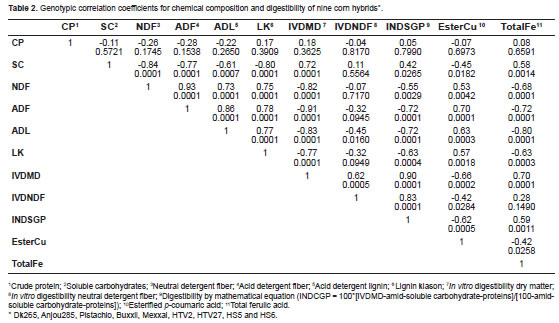
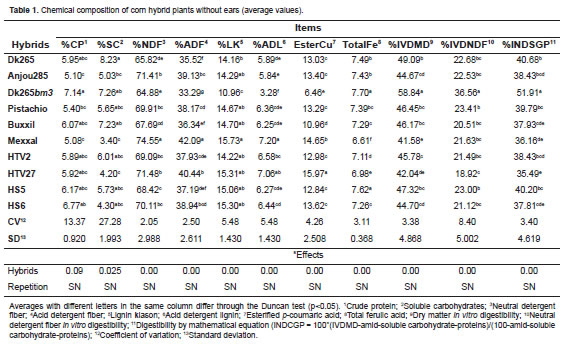
<body><![CDATA[<p>H<sub>i</sub> = effect of the hybrid i; i = 1, 2, 3, 4, 5, 6, 7, 8, 9 and 10</p>     <p>B<sub>j</sub> = effect of the block k; k = 1, 2 e 3</p>     <p>   e<sub>ij</sub> = random mistakes associated with each   observation Y<sub>ij</sub>.</p>     <p>The data were submitted a Duncan test yielding   5% probability when the test was significant.   Variables NDF, ADF, ADL, LK, esterified   p-coumaric acid, and total ferulic acid were   evaluated for each genotype (Dk265, Anjou285,   Pistache, Buxxil, Mexxal, HTV2, HTV27, HS5 and   HS6) in the regression equation with the objective   of better explaining the results concerning IVDMD, INDSGP and, mainly, IVDNDF.</p>     <p>&nbsp;</p>     <p><b><font size="3">Results</font></b></p>     <p>   The effect of genotype was significant (p&lt;0.05),   as determined by the Duncan test, for all the   chemical and digestibility characteristics evaluated   among the corn hybrids (<a href="#t1">Table 1</a>). Average values   for crude protein (CP) found in this experiment   varied from 5.08% to 7.14%.</p>     <p align="center"><a name="t1"></a><img src="/img/revistas/rccp/v26n4/v26n4a3t1.jpg"></p>     <p>Soluble carbohydrate content varied from 3.40%   to 8.23% among the evaluated hybrids (<a href="#t1">Table 1</a>).   However, it was verified that the highest values of   NDF (71.48%) and ADF (42.09%) were observed   in reduced soluble carbohydrate content genotypes.   Through correlation analysis results (<a href="#t2">Table 2</a>), it   was verified that NDF and ADF contents were   negatively correlated (r = -0.84 and -0.77) in regard to soluble sugar content.</p>     <p align="center"><a name="t2"></a><img src="/img/revistas/rccp/v26n4/v26n4a3t2.jpg"></p>     ]]></body>
<body><![CDATA[<p>The DK265<i>bm3</i> hybrid presented the smallest   NDF (P&lt;0.05) and ADF (33.29%) values and   the highest values (P&lt;0.05) for DM digestibility   (58.84%) and DNDF (36.56%) (<a href="#t1">Table 1</a>). However,   this hybrid did not differ (P&gt;0.05) from the DK265   hybrid in terms of NDF content (65.82%), and it   presented smaller (P&lt;0.05) LK (10.96%) and ADL   (3.28%) values than the DK265 hybrid (14.16% and   5.89%, respectively). In this study, the LK and ADL   contents also presented a negative correlation to IVDMD, INDSGP, and IVDNDF.</p>     <p>As shown in <a href="#t1">table 1</a>, the differences (P&lt;0.05)   in hydroxycinnamic acid content were verified   among the hybrids. The esterified coumaric acid   content varied from 6.46 mg/g to 15.97 mg/g of   NDF and the total ferulic acid content varied from   6.61 mg/g to 7.62 mg/g of NDF. Esterified   p-coumaric acid was negatively associated with IVDMD (r = -0.66), INDSGP (r = -0.62) and IVDNDF (r = -0.42) contents. The Mexxal, HTV2, and HTV27 genotypes presented a low total ferulic acid content associated with reduced digestibility (<a href="#t1">Table 1</a>). Conversely, the DK265<i>bm3</i> and DK265 genotypes presented high total ferulic acid content associated with good digestibility.</p>     <p>The total ferulic acid content was negatively   correlated with NDF content (r = -0.68), ADF   (r = -0.72), ADL (r = -0.80), LK (r = -0.63),   and positively correlated with DM digestibility (r = 0.70) (<a href="#t2">Table 2</a>).</p>     <p>It was confirmed that the best multiple regression   equation for IVDMD was achieved using the   variables NDF, ADF, ADL, LK, esterified p-coumaric   acid, and total ferulic acid (IVDMD = 30.36054 +   0.85393*NDF &#8211; 1.51373*ADF + 0.73632*ADL &#8211;   0.62914*LK &#8211; 0.00485*Cester + 0.34744*Ftotal;   Residual Standard Mistake (RSM) = 1.16; r2 = 85%).   However, the multiple regression equation using two   variables that better explained the results concerning   IVDMD was IVDMD = 89.27539-0.45282-*NDF- 2.74102*ADL; RSM = 1.28; r2 = 79%.</p>     <p>According to the multiple regression equation   analysis for INDSGP the best equation selected   used NDF, ADF, ADL, LK, esterified <i>p</i>-coumaric   acid, and total ferulic acid (INDSGP = 30.36054 +   0.85393*NDF-1.51373*ADF + 0.73632*ADL &#8211;   0.62914*LK &#8211;0.00485*Cester + 1.34744*Ftotal;   RSM = 1.40; r2 = 66%). However, the multiple   regression equation using two variables that   better explained the results concerning INDSGP   was INDSGP = 54.54912 &#8211; 2.55033*ADL &#8211; 0.45705*LK; RSM = 1.50; r2 = 54%.</p>     <p>As with IVDMD and INDSGP, the values   concerning IVDNDF were better explained   using multiple regression analysis with the same   variables (IVDNDF = -14.90636 + 1.57937*NDF   &#8211; 1.96071*ADF + 0.41507*ADL &#8211; 0.81950*LK   + 0.12213*Cester + 0.91468*Ftotal; RSM = 1.68;   R2 = 55%). However, the best equation to explain   IVDNDF used two variables, ADF and NDF, as   shown by the following equation: DNDF = -1.23464   &#8211; 1.98305*ADF + 1.41937NDF; RSM = 1.61; R2 = 51%.</p>     <p>&nbsp;</p>     <p><b><font size="3">Discussion</font></b></p>     <p>   The <i>bm3</i> hybrid presented the highest CP   content, which is similar to some eared hybrids.   These results were lower than the values found by   Oba and Allen (1999) who studied two corn hybrids   (9.7% and 9.5%), and by Rodrigues <i>et al.</i> (2002)   who evaluated the Agroceres 5011 hybrid (9.43%).   However, the values found by those authors were   obtained from entire plants in silage form, whereas   earless plants were used in the present work. Zeoula   <i>et al.</i> (2003), working with the stems and sheaths   of five corn hybrids at different phases of maturity   (25% to 40% MS) obtained CP values between   3.58% to 3.86%. However, Ferreira <i>et al.</i> (2005)   reported no significant differences among five   earless corn genotypes, with values ranging from   7.2% to 9.4%. Corn plants are characterized by   their high-energy content (mainly amide) and low   CP content, which can be influenced by agronomic   factors (insufficient and/or poorly implemented   fertilization) and genetic factors. Most recent   hybrids have low CP content as showed by Caetano   <i>et al.</i> (2011), who tested C805 hybrid and found low   CP values (2.91%).</p>     <p>The negative correlation between NDF and   ADF contents in regard to soluble sugar content   can be explained by the higher metabolic activity   in some plants, leading to decreased soluble   nitrate, protein, and carbohydrates, and an increase   in cell wall components (Van Soest, 1994). The   genetic characteristics of each plant must also be   considered, as they might lead to an increased or   decreased cell wall proportion. Similarly, the results   found between DK265<i>bm3</i> and DK265 hybrids   led us to assume that even if the NDF content   had a negative correlation with INDSGP content   (<a href="#t2">Table 2</a>), this did not explain the differences in   digestibility values; therefore, other factors were   involved, such as lignin content and possible connections to low molecular weight molecules.</p>     ]]></body>
<body><![CDATA[<p>The obtained values indicate that LK and ADL   contents could explain the variation in digestibility   values: 59% and 68% for IVDMD; 39% and 51%   for INDSGP; and 10% and 17% for DNDF content,   respectively. Mechin (2000) observed that 28% of   DNDF variation between corn lineages could be   explained by LK content and 25% of the variation   could be explained by NDF content. This negative effect of esterified coumaric acid on digestibility could be explained by the positive correlation with LK (r = 0.57) and ADL (r = 0.63). According to Argillier at al. (1996), <i>p</i>-coumaric acid is predominantly related to lignin, and its influence over polysaccharide degradation is probably related to direct and indirect negative effects of lignin. It can be inferred from these results that total ferulic acid content alone is insufficient to explain the results in terms of digestibility; therefore, other factors are involved, such as the proportion of ester types and ether bonds, which were not evaluated in the present work. This evidence has been confirmed by several authors (Jung, 1989; Marvin <i>et al.</i>, 1995; Morrison <i>et al.</i>, 1998; Deschamps, 1999; Barri&egrave;re and Emile, 2000; Ferreira <i>et al.</i>, 2005) who suggested that digestibility variations can be better explained by variations in lignin and total hydroxycinnamic acid content, specifically by their proportions of ester and ether bonds.</p>     <p>Argiller <i>et al.</i> (1996) studied the existing   variations in six corn hybrids and demonstrated 8%   difference in IVDNDF content between MBS847   x Co125 (36.4%) and F2 x F113 (44.4%) hybrids,   which presented similar lignin contents (21.3% and   21.4%, respectively). The authors also confirmed   differences in characteristics of hydroxycinnamic   acid and monomeric lignin composition, but   the MBS847 x Co125 hybrid presented higher   p-coumaric acid concentration and smaller   proportion of ether and ester ferulic acids compared   with the F2 x F113 hybrid. Mechin <i>et al.</i> (2000) did   not observe differences among lignin contents in the   W117, F2, and F251 corn hybrid lineages. However,   the observed differences between these lineages   were related to the digestibility of cell wall contents   ranging from 10% to 12%. The authors maintained   the theory that differences in digestibility can be   better explained by the kind of bonds between lignin and hemicelluloses.</p>     <p>The correlation analyses (<a href="#t2">Table 2</a>) demonstrated   that NDF explained 30% of the INDSGP results,   whereas the total ferulic acid content explained   only a fraction of the digestibility values. Therefore,   it was observed that NDF and total ferulic acid,   when individually evaluated, did not present the   same confidence level as when evaluated as a   whole to explain INDSGP values of the studied   hybrids. Mechin (2000), working with different   corn lineages, observed that only 28% of DNDF   results could be explained by LK content, and   58% of the results could be better explained   through the grouping of esterified <i>p</i>-coumaric   acid and the relationship between syringyl and   guaiacyl (S:G) units. In the present work, however,   chemical analyses were not performed in terms of   the monomeric composition of lignin or in terms   of the types of bonds between ferulic acid and   hemicelluloses, which can present negative effects on IVDNDF (Argillier <i>et al.</i>, 1996; Boudet, 2000).</p>     <p>The mutant genotype DK265<i>bm3</i> presented the   best results concerning the chemical evaluations   studied, and, due to these characteristics, it is   necessary to explain the existing variations between   regular/normal hybrids. The HTV27 genotype   presented low digestibility of the NDF fraction,   which was associated with small differences,   compared with the other studied genotypes, in the   contents of NDF, ADF, LK, and ADL. It is supposed   that other factors can interfere with digestibility,   such as the types of ester and ether connections, and   possible differences in the monomeric composition of lignin.</p>     <p>The multiple equations presented in this study   are a good resource to explain IVDMD results for   assessing cell wall using NIRS (INDSGP) and,   mainly, for evaluating NDF in vitro digestibility.   DK265<i>bm3</i> showed superior values compared with   the other hybrids for digestibility of DM, OM, cellulose, NDF, and IVDMD.</p>     <p>&nbsp;</p> <hr size="1" />     <p><a name="0" id="0"></a><a href="#b0">&curren;</a> To cite this article: Ferreira GDG, Jobim CC, Oliveira RL, Emile JC, Barri&egrave;re Y, Palmieri AD. Nutritional value of ten earless corn hybrids used for silage. Rev Colomb Cienc Pecu 2013; 26:255-262.</p> <hr size="1" />     <p>&nbsp;</p>     <p>&nbsp;</p>     <p><b><font size="3">References</font></b></p>     ]]></body>
<body><![CDATA[<!-- ref --><p>   Akin DE. Biological structure of lignocellulose and its   degradation in the rumem. Anim Feed Sci Tech 1998; 21:295-   310.    &nbsp;&nbsp;&nbsp;&nbsp;&nbsp;&nbsp;&nbsp;&nbsp;[&#160;<a href="javascript:void(0);" onclick="javascript: window.open('/scielo.php?script=sci_nlinks&ref=000083&pid=S0120-0690201300040000300001&lng=','','width=640,height=500,resizable=yes,scrollbars=1,menubar=yes,');">Links</a>&#160;]<!-- end-ref --></p>     <!-- ref --><p>   Argillier O, Barriere Y, Lila M, Jeanneteau A, Gelinet K,   Menanteau V. Genotypic variation in phenolic components   of cell-walls in relation to the digestibility of maize stalks.   Agronomie 1996; 16:123-130.    &nbsp;&nbsp;&nbsp;&nbsp;&nbsp;&nbsp;&nbsp;&nbsp;[&#160;<a href="javascript:void(0);" onclick="javascript: window.open('/scielo.php?script=sci_nlinks&ref=000085&pid=S0120-0690201300040000300002&lng=','','width=640,height=500,resizable=yes,scrollbars=1,menubar=yes,');">Links</a>&#160;]<!-- end-ref --></p>     <!-- ref --><p>   Association of official agricultural chemists &#8211; AOAC. Official   Methods of Analysis. 14th ed. Washington; 1984.    &nbsp;&nbsp;&nbsp;&nbsp;&nbsp;&nbsp;&nbsp;&nbsp;[&#160;<a href="javascript:void(0);" onclick="javascript: window.open('/scielo.php?script=sci_nlinks&ref=000087&pid=S0120-0690201300040000300003&lng=','','width=640,height=500,resizable=yes,scrollbars=1,menubar=yes,');">Links</a>&#160;]<!-- end-ref --></p>     <!-- ref --><p>   Ballard CS, Thomas ED, Tsang DS, Mandebvu P, Sniffen CJ,   Endres MI. Effect of corn silage hybrid on dry matter yield,   nutrient composition, <i>in vitro</i> digestion, intake by dairy heifers, and milk production by dairy cows. J Dairy Sci 2001; 84:442-   452.    &nbsp;&nbsp;&nbsp;&nbsp;&nbsp;&nbsp;&nbsp;&nbsp;[&#160;<a href="javascript:void(0);" onclick="javascript: window.open('/scielo.php?script=sci_nlinks&ref=000089&pid=S0120-0690201300040000300004&lng=','','width=640,height=500,resizable=yes,scrollbars=1,menubar=yes,');">Links</a>&#160;]<!-- end-ref --></p>     <!-- ref --><p>   Barri&egrave;re Y, Argillier O. <i>In vivo</i> silage feeding value of early   maize hybrids registered on France between 1958 and 1994.   Euphytica 1998; 99:175-182.    &nbsp;&nbsp;&nbsp;&nbsp;&nbsp;&nbsp;&nbsp;&nbsp;[&#160;<a href="javascript:void(0);" onclick="javascript: window.open('/scielo.php?script=sci_nlinks&ref=000091&pid=S0120-0690201300040000300005&lng=','','width=640,height=500,resizable=yes,scrollbars=1,menubar=yes,');">Links</a>&#160;]<!-- end-ref --></p>     ]]></body>
<body><![CDATA[<!-- ref --><p>   Barri&egrave;re Y, Emile JC. Le ma&iuml;s fourrage. III - Evaluation et   perspectives de progr&egrave;s g&eacute;n&eacute;tique sur les caract&egrave;res de valeur   alimentaire. Fourrages 2000; 163:221-238.    &nbsp;&nbsp;&nbsp;&nbsp;&nbsp;&nbsp;&nbsp;&nbsp;[&#160;<a href="javascript:void(0);" onclick="javascript: window.open('/scielo.php?script=sci_nlinks&ref=000093&pid=S0120-0690201300040000300006&lng=','','width=640,height=500,resizable=yes,scrollbars=1,menubar=yes,');">Links</a>&#160;]<!-- end-ref --></p>     <!-- ref --><p>   Barri&egrave;re Y, Verite R, Brunschwing P, Surault F, Emile JC.   Feeding value of corn silage estimated with sheep and dairy   cows is not altered by genetic incorporation of Bt176 resistance   to <i>Ostrinianubilalis</i>. J Dairy Sci 2001; 84:1863-1871.    &nbsp;&nbsp;&nbsp;&nbsp;&nbsp;&nbsp;&nbsp;&nbsp;[&#160;<a href="javascript:void(0);" onclick="javascript: window.open('/scielo.php?script=sci_nlinks&ref=000095&pid=S0120-0690201300040000300007&lng=','','width=640,height=500,resizable=yes,scrollbars=1,menubar=yes,');">Links</a>&#160;]<!-- end-ref --></p>     <!-- ref --><p>   Baucher M, Monties B, Montagu MV, Boerjan W. Biosynthesis   and genetic engineering of lignin. Crit Rev Plant Sci 1998;   17:125-197.    &nbsp;&nbsp;&nbsp;&nbsp;&nbsp;&nbsp;&nbsp;&nbsp;[&#160;<a href="javascript:void(0);" onclick="javascript: window.open('/scielo.php?script=sci_nlinks&ref=000097&pid=S0120-0690201300040000300008&lng=','','width=640,height=500,resizable=yes,scrollbars=1,menubar=yes,');">Links</a>&#160;]<!-- end-ref --></p>     <!-- ref --><p>   Caetano H, Oliveira MDS, Freitas J&uacute;nior JE, R&ecirc;go AC,   Carvalho MV, Renn&oacute; FP. Nutritional characteristics and <i>in vitro</i>  digestibility of silages from different corn cultivars harvested at   two cutting heights. Rev Bras Zootec 2011; 40:708-714.    &nbsp;&nbsp;&nbsp;&nbsp;&nbsp;&nbsp;&nbsp;&nbsp;[&#160;<a href="javascript:void(0);" onclick="javascript: window.open('/scielo.php?script=sci_nlinks&ref=000099&pid=S0120-0690201300040000300009&lng=','','width=640,height=500,resizable=yes,scrollbars=1,menubar=yes,');">Links</a>&#160;]<!-- end-ref --></p>     <!-- ref --><p>   Chabbert B, Tollier MT, Monties B, Barriere Y, Argillier O.   Biological variability in lignification of maize: expression of the   brown midrib <i>bm3</i> mutation in three maize cultivars. J Sci Food   Agr 1994; 64:349-355.    &nbsp;&nbsp;&nbsp;&nbsp;&nbsp;&nbsp;&nbsp;&nbsp;[&#160;<a href="javascript:void(0);" onclick="javascript: window.open('/scielo.php?script=sci_nlinks&ref=000101&pid=S0120-0690201300040000300010&lng=','','width=640,height=500,resizable=yes,scrollbars=1,menubar=yes,');">Links</a>&#160;]<!-- end-ref --></p>     ]]></body>
<body><![CDATA[<!-- ref --><p>   Ferreira GDG, Barri&egrave;re Y, Emile JC, Jobim CC, Lef&egrave;ve B. Valor   nutritivo de plantas de milho (<i>Zea mays L</i>.) sem espiga. Acta   Sci Anim Sci 2005; 27:433-438.    &nbsp;&nbsp;&nbsp;&nbsp;&nbsp;&nbsp;&nbsp;&nbsp;[&#160;<a href="javascript:void(0);" onclick="javascript: window.open('/scielo.php?script=sci_nlinks&ref=000103&pid=S0120-0690201300040000300011&lng=','','width=640,height=500,resizable=yes,scrollbars=1,menubar=yes,');">Links</a>&#160;]<!-- end-ref --></p>     <!-- ref --><p>   Goering HK, Van Soest PJ. Forage fiber analysis (apparatus,   reagents, procedures, and some applications). Agriculture   handbook no. 379. Washington: U.S. Agricultural Research   Service; 1970. USDA ARS Agric Handb 1970; 379p. U.S. Gov   Office, Washington DC.    &nbsp;&nbsp;&nbsp;&nbsp;&nbsp;&nbsp;&nbsp;&nbsp;[&#160;<a href="javascript:void(0);" onclick="javascript: window.open('/scielo.php?script=sci_nlinks&ref=000105&pid=S0120-0690201300040000300012&lng=','','width=640,height=500,resizable=yes,scrollbars=1,menubar=yes,');">Links</a>&#160;]<!-- end-ref --></p>     <!-- ref --><p>   Jung HG. Forage ligning and their effects on fibre digestibility.   Agronomie 1989; 81:33-38.    &nbsp;&nbsp;&nbsp;&nbsp;&nbsp;&nbsp;&nbsp;&nbsp;[&#160;<a href="javascript:void(0);" onclick="javascript: window.open('/scielo.php?script=sci_nlinks&ref=000107&pid=S0120-0690201300040000300013&lng=','','width=640,height=500,resizable=yes,scrollbars=1,menubar=yes,');">Links</a>&#160;]<!-- end-ref --></p>     <!-- ref --><p>   Jung HG. Genetic manipulation of cell walls. Identification   of cell wall traits that can be manipulated to improne forage   digestibility. In: Information conference with dairy and forage   industries. 1996. p. 9-14.    &nbsp;&nbsp;&nbsp;&nbsp;&nbsp;&nbsp;&nbsp;&nbsp;[&#160;<a href="javascript:void(0);" onclick="javascript: window.open('/scielo.php?script=sci_nlinks&ref=000109&pid=S0120-0690201300040000300014&lng=','','width=640,height=500,resizable=yes,scrollbars=1,menubar=yes,');">Links</a>&#160;]<!-- end-ref --></p>     <!-- ref --><p>   Marvin HJP, Krechting CF, Van Loo EN, Snijders HA, Dolstra   O. Relationship between stalk cell wall digestibility and fibre   composition in maize. J Sci Food Agric 1995; 69:215-221.    &nbsp;&nbsp;&nbsp;&nbsp;&nbsp;&nbsp;&nbsp;&nbsp;[&#160;<a href="javascript:void(0);" onclick="javascript: window.open('/scielo.php?script=sci_nlinks&ref=000111&pid=S0120-0690201300040000300015&lng=','','width=640,height=500,resizable=yes,scrollbars=1,menubar=yes,');">Links</a>&#160;]<!-- end-ref --></p>     ]]></body>
<body><![CDATA[<!-- ref --><p>   Mechin V. Etude de facteurs biochimiques et g&eacute;n&eacute;tiques   explicatifs de la variabilit&eacute; pour la valeur alimentaire du   ma&iuml;s fourrage &#91;doctoral thesis&#93;. INRA- Institut National   Agronomique, Lusignan, France; 2000.    &nbsp;&nbsp;&nbsp;&nbsp;&nbsp;&nbsp;&nbsp;&nbsp;[&#160;<a href="javascript:void(0);" onclick="javascript: window.open('/scielo.php?script=sci_nlinks&ref=000113&pid=S0120-0690201300040000300016&lng=','','width=640,height=500,resizable=yes,scrollbars=1,menubar=yes,');">Links</a>&#160;]<!-- end-ref --></p>     <!-- ref --><p>   Morrison TA, Jung HG, Buxton DR, Hatfield RD. Cell wall   composition of maize internode of varying maturity. Crop Sci   1998; 38:455-460.    &nbsp;&nbsp;&nbsp;&nbsp;&nbsp;&nbsp;&nbsp;&nbsp;[&#160;<a href="javascript:void(0);" onclick="javascript: window.open('/scielo.php?script=sci_nlinks&ref=000115&pid=S0120-0690201300040000300017&lng=','','width=640,height=500,resizable=yes,scrollbars=1,menubar=yes,');">Links</a>&#160;]<!-- end-ref --></p>     <!-- ref --><p>   Oba M, Allen MS. Effects of brown midrib 3 mutation in corn   silage on productivity of dairy cows fed two concentrations of   dietary neutral detergent fiber: 1. Feeding behavior and nutrient   utilization. J Dairy Sci 2000; 83:1333-1341.    &nbsp;&nbsp;&nbsp;&nbsp;&nbsp;&nbsp;&nbsp;&nbsp;[&#160;<a href="javascript:void(0);" onclick="javascript: window.open('/scielo.php?script=sci_nlinks&ref=000117&pid=S0120-0690201300040000300018&lng=','','width=640,height=500,resizable=yes,scrollbars=1,menubar=yes,');">Links</a>&#160;]<!-- end-ref --></p>     <!-- ref --><p>   Oba M, Allen MS. Effects of brown midrib 3 mutation in corn   silage on dry matter intake and productivity of high yielding   dairy cows. J Dairy Sci 1999; 82:135-142.    &nbsp;&nbsp;&nbsp;&nbsp;&nbsp;&nbsp;&nbsp;&nbsp;[&#160;<a href="javascript:void(0);" onclick="javascript: window.open('/scielo.php?script=sci_nlinks&ref=000119&pid=S0120-0690201300040000300019&lng=','','width=640,height=500,resizable=yes,scrollbars=1,menubar=yes,');">Links</a>&#160;]<!-- end-ref --></p>     <!-- ref --><p>   Oliveira GC, Moreira I, Souza ALP, Murakami AE, Parra ARP,   Carvalho PLO, Borile MD. Corns with different nutritional   profiles on growing and finishing pigs feeding (30 to 90 kg).   Asian-Aust. J Anim Sci 2011; 24:982-992.    &nbsp;&nbsp;&nbsp;&nbsp;&nbsp;&nbsp;&nbsp;&nbsp;[&#160;<a href="javascript:void(0);" onclick="javascript: window.open('/scielo.php?script=sci_nlinks&ref=000121&pid=S0120-0690201300040000300020&lng=','','width=640,height=500,resizable=yes,scrollbars=1,menubar=yes,');">Links</a>&#160;]<!-- end-ref --></p>     ]]></body>
<body><![CDATA[<!-- ref --><p>   Rodrigues PHM, Andrade SJT, Ruzante JM, Lima FR, Melotti   L. Nutritive value of corn silage under effect of inoculation with   lactic acid bacteria. Rev Bras Zootec 2002; 31:2380-2385.    &nbsp;&nbsp;&nbsp;&nbsp;&nbsp;&nbsp;&nbsp;&nbsp;[&#160;<a href="javascript:void(0);" onclick="javascript: window.open('/scielo.php?script=sci_nlinks&ref=000123&pid=S0120-0690201300040000300021&lng=','','width=640,height=500,resizable=yes,scrollbars=1,menubar=yes,');">Links</a>&#160;]<!-- end-ref --></p>     <!-- ref --><p>   Thomas ED, Mandebvu P, Ballard CS, Sniffen CJ, Carter MP,   Beck J. Comparison of corn silage hybrids for yield, nutrient   composition, <i>in vitro</i> digestibility, and yield by dairy cows. J   Dairy Sci 2001; 84:2217-2226.    &nbsp;&nbsp;&nbsp;&nbsp;&nbsp;&nbsp;&nbsp;&nbsp;[&#160;<a href="javascript:void(0);" onclick="javascript: window.open('/scielo.php?script=sci_nlinks&ref=000125&pid=S0120-0690201300040000300022&lng=','','width=640,height=500,resizable=yes,scrollbars=1,menubar=yes,');">Links</a>&#160;]<!-- end-ref --></p>     <!-- ref --><p>   Van Soest PJ. Nutritional ecology of the ruminant. 2nd ed.   Ithaca (NY): Cornell University Press; 1996. Ithaca Comstock   Publ Assoc 1994.    &nbsp;&nbsp;&nbsp;&nbsp;&nbsp;&nbsp;&nbsp;&nbsp;[&#160;<a href="javascript:void(0);" onclick="javascript: window.open('/scielo.php?script=sci_nlinks&ref=000127&pid=S0120-0690201300040000300023&lng=','','width=640,height=500,resizable=yes,scrollbars=1,menubar=yes,');">Links</a>&#160;]<!-- end-ref --></p>     <!-- ref --><p>   Zeoula LM, Beleze JRF, Cecato U, Jobim CC, Geron LJV,   Prado OPP, Falc&atilde;o AJS. Evaluation of five corn hybrids   (<i>Zea mays, L</i>.) at different maturity stages. 4. Dry matter   digestibility, organic matter and neutral detergent fiber (FDN) of   the vegetative portion and whole plant. Rev Bras Zootec 2003;   32:567-575.    &nbsp;&nbsp;&nbsp;&nbsp;&nbsp;&nbsp;&nbsp;&nbsp;[&#160;<a href="javascript:void(0);" onclick="javascript: window.open('/scielo.php?script=sci_nlinks&ref=000129&pid=S0120-0690201300040000300024&lng=','','width=640,height=500,resizable=yes,scrollbars=1,menubar=yes,');">Links</a>&#160;]<!-- end-ref --> </p>     <p>&nbsp;</p>     <p>&nbsp;</p> </font>    ]]></body>
<body><![CDATA[ ]]></body><back>
<ref-list>
<ref id="B1">
<nlm-citation citation-type="journal">
<person-group person-group-type="author">
<name>
<surname><![CDATA[Akin]]></surname>
<given-names><![CDATA[DE]]></given-names>
</name>
</person-group>
<article-title xml:lang="en"><![CDATA[Biological structure of lignocellulose and its degradation in the rumem]]></article-title>
<source><![CDATA[Anim Feed Sci Tech]]></source>
<year>1998</year>
<volume>21</volume>
<page-range>295- 310</page-range></nlm-citation>
</ref>
<ref id="B2">
<nlm-citation citation-type="journal">
<person-group person-group-type="author">
<name>
<surname><![CDATA[Argillier]]></surname>
<given-names><![CDATA[O]]></given-names>
</name>
<name>
<surname><![CDATA[Barriere]]></surname>
<given-names><![CDATA[Y]]></given-names>
</name>
<name>
<surname><![CDATA[Lila]]></surname>
<given-names><![CDATA[M]]></given-names>
</name>
<name>
<surname><![CDATA[Jeanneteau]]></surname>
<given-names><![CDATA[A]]></given-names>
</name>
<name>
<surname><![CDATA[Gelinet]]></surname>
<given-names><![CDATA[K]]></given-names>
</name>
<name>
<surname><![CDATA[Menanteau]]></surname>
<given-names><![CDATA[V]]></given-names>
</name>
</person-group>
<article-title xml:lang="en"><![CDATA[Genotypic variation in phenolic components of cell-walls in relation to the digestibility of maize stalks]]></article-title>
<source><![CDATA[Agronomie]]></source>
<year>1996</year>
<volume>16</volume>
<page-range>123-130</page-range></nlm-citation>
</ref>
<ref id="B3">
<nlm-citation citation-type="">
<collab>Association of official agricultural chemists - AOAC</collab>
<source><![CDATA[Official Methods of Analysis]]></source>
<year>1984</year>
<edition>14th</edition>
<publisher-loc><![CDATA[Washington ]]></publisher-loc>
</nlm-citation>
</ref>
<ref id="B4">
<nlm-citation citation-type="journal">
<person-group person-group-type="author">
<name>
<surname><![CDATA[Ballard]]></surname>
<given-names><![CDATA[CS]]></given-names>
</name>
<name>
<surname><![CDATA[Thomas]]></surname>
<given-names><![CDATA[ED]]></given-names>
</name>
<name>
<surname><![CDATA[Tsang]]></surname>
<given-names><![CDATA[DS]]></given-names>
</name>
<name>
<surname><![CDATA[Mandebvu]]></surname>
<given-names><![CDATA[P]]></given-names>
</name>
<name>
<surname><![CDATA[Sniffen]]></surname>
<given-names><![CDATA[CJ]]></given-names>
</name>
<name>
<surname><![CDATA[Endres]]></surname>
<given-names><![CDATA[MI]]></given-names>
</name>
</person-group>
<article-title xml:lang="en"><![CDATA[Effect of corn silage hybrid on dry matter yield, nutrient composition, in vitro digestion, intake by dairy heifers, and milk production by dairy cows]]></article-title>
<source><![CDATA[J Dairy Sci]]></source>
<year>2001</year>
<volume>84</volume>
<page-range>442- 452</page-range></nlm-citation>
</ref>
<ref id="B5">
<nlm-citation citation-type="journal">
<person-group person-group-type="author">
<name>
<surname><![CDATA[Barrière]]></surname>
<given-names><![CDATA[Y]]></given-names>
</name>
<name>
<surname><![CDATA[Argillier]]></surname>
<given-names><![CDATA[O]]></given-names>
</name>
</person-group>
<article-title xml:lang="en"><![CDATA[In vivo silage feeding value of early maize hybrids registered on France between 1958 and 1994]]></article-title>
<source><![CDATA[Euphytica]]></source>
<year>1998</year>
<volume>99</volume>
<page-range>175-182</page-range></nlm-citation>
</ref>
<ref id="B6">
<nlm-citation citation-type="journal">
<person-group person-group-type="author">
<name>
<surname><![CDATA[Barrière]]></surname>
<given-names><![CDATA[Y]]></given-names>
</name>
<name>
<surname><![CDATA[Emile]]></surname>
<given-names><![CDATA[JC]]></given-names>
</name>
</person-group>
<article-title xml:lang="fr"><![CDATA[Le maïs fourrage. III - Evaluation et perspectives de progrès génétique sur les caractères de valeur alimentaire]]></article-title>
<source><![CDATA[Fourrages]]></source>
<year>2000</year>
<volume>163</volume>
<page-range>221-238</page-range></nlm-citation>
</ref>
<ref id="B7">
<nlm-citation citation-type="journal">
<person-group person-group-type="author">
<name>
<surname><![CDATA[Barrière]]></surname>
<given-names><![CDATA[Y]]></given-names>
</name>
<name>
<surname><![CDATA[Verite]]></surname>
<given-names><![CDATA[R]]></given-names>
</name>
<name>
<surname><![CDATA[Brunschwing]]></surname>
<given-names><![CDATA[P]]></given-names>
</name>
<name>
<surname><![CDATA[Surault]]></surname>
<given-names><![CDATA[F]]></given-names>
</name>
<name>
<surname><![CDATA[Emile]]></surname>
<given-names><![CDATA[JC]]></given-names>
</name>
</person-group>
<article-title xml:lang="en"><![CDATA[Feeding value of corn silage estimated with sheep and dairy cows is not altered by genetic incorporation of Bt176 resistance to Ostrinianubilalis]]></article-title>
<source><![CDATA[J Dairy Sci]]></source>
<year>2001</year>
<volume>84</volume>
<page-range>1863-1871</page-range></nlm-citation>
</ref>
<ref id="B8">
<nlm-citation citation-type="journal">
<person-group person-group-type="author">
<name>
<surname><![CDATA[Baucher]]></surname>
<given-names><![CDATA[M]]></given-names>
</name>
<name>
<surname><![CDATA[Monties]]></surname>
<given-names><![CDATA[B]]></given-names>
</name>
<name>
<surname><![CDATA[Montagu]]></surname>
<given-names><![CDATA[MV]]></given-names>
</name>
<name>
<surname><![CDATA[Boerjan]]></surname>
<given-names><![CDATA[W]]></given-names>
</name>
</person-group>
<article-title xml:lang="en"><![CDATA[Biosynthesis and genetic engineering of lignin]]></article-title>
<source><![CDATA[Crit Rev Plant Sci]]></source>
<year>1998</year>
<volume>17</volume>
<page-range>125-197</page-range></nlm-citation>
</ref>
<ref id="B9">
<nlm-citation citation-type="journal">
<person-group person-group-type="author">
<name>
<surname><![CDATA[Caetano]]></surname>
<given-names><![CDATA[H]]></given-names>
</name>
<name>
<surname><![CDATA[Oliveira]]></surname>
<given-names><![CDATA[MDS]]></given-names>
</name>
<name>
<surname><![CDATA[Freitas]]></surname>
<given-names><![CDATA[Júnior JE]]></given-names>
</name>
<name>
<surname><![CDATA[Rêgo]]></surname>
<given-names><![CDATA[AC]]></given-names>
</name>
<name>
<surname><![CDATA[Carvalho]]></surname>
<given-names><![CDATA[MV]]></given-names>
</name>
<name>
<surname><![CDATA[Rennó]]></surname>
<given-names><![CDATA[FP]]></given-names>
</name>
</person-group>
<article-title xml:lang="en"><![CDATA[Nutritional characteristics and in vitro digestibility of silages from different corn cultivars harvested at two cutting heights]]></article-title>
<source><![CDATA[Rev Bras Zootec]]></source>
<year>2011</year>
<volume>40</volume>
<page-range>708-714</page-range></nlm-citation>
</ref>
<ref id="B10">
<nlm-citation citation-type="journal">
<person-group person-group-type="author">
<name>
<surname><![CDATA[Chabbert]]></surname>
<given-names><![CDATA[B]]></given-names>
</name>
<name>
<surname><![CDATA[Tollier]]></surname>
<given-names><![CDATA[MT]]></given-names>
</name>
<name>
<surname><![CDATA[Monties]]></surname>
<given-names><![CDATA[B]]></given-names>
</name>
<name>
<surname><![CDATA[Barriere]]></surname>
<given-names><![CDATA[Y]]></given-names>
</name>
<name>
<surname><![CDATA[Argillier]]></surname>
<given-names><![CDATA[O]]></given-names>
</name>
</person-group>
<article-title xml:lang="en"><![CDATA[Biological variability in lignification of maize: expression of the brown midrib bm3 mutation in three maize cultivars]]></article-title>
<source><![CDATA[J Sci Food Agr]]></source>
<year>1994</year>
<volume>64</volume>
<page-range>349-355</page-range></nlm-citation>
</ref>
<ref id="B11">
<nlm-citation citation-type="journal">
<person-group person-group-type="author">
<name>
<surname><![CDATA[Ferreira]]></surname>
<given-names><![CDATA[GDG]]></given-names>
</name>
<name>
<surname><![CDATA[Barrière]]></surname>
<given-names><![CDATA[Y]]></given-names>
</name>
<name>
<surname><![CDATA[Emile]]></surname>
<given-names><![CDATA[JC]]></given-names>
</name>
<name>
<surname><![CDATA[Jobim]]></surname>
<given-names><![CDATA[CC]]></given-names>
</name>
<name>
<surname><![CDATA[Lefève]]></surname>
<given-names><![CDATA[B]]></given-names>
</name>
</person-group>
<article-title xml:lang="pt"><![CDATA[Valor nutritivo de plantas de milho (Zea mays L.) sem espiga]]></article-title>
<source><![CDATA[Acta Sci Anim Sci]]></source>
<year>2005</year>
<volume>27</volume>
<page-range>433-438</page-range></nlm-citation>
</ref>
<ref id="B12">
<nlm-citation citation-type="book">
<person-group person-group-type="author">
<name>
<surname><![CDATA[Goering]]></surname>
<given-names><![CDATA[HK]]></given-names>
</name>
<name>
<surname><![CDATA[Van Soest]]></surname>
<given-names><![CDATA[PJ]]></given-names>
</name>
</person-group>
<source><![CDATA[Forage fiber analysis (apparatus, reagents, procedures, and some applications). Agriculture handbook]]></source>
<year>1970</year>
<volume>379</volume>
<publisher-loc><![CDATA[Washington ]]></publisher-loc>
<publisher-name><![CDATA[U.S. Agricultural Research Service]]></publisher-name>
</nlm-citation>
</ref>
<ref id="B13">
<nlm-citation citation-type="journal">
<person-group person-group-type="author">
<name>
<surname><![CDATA[Jung]]></surname>
<given-names><![CDATA[HG]]></given-names>
</name>
</person-group>
<article-title xml:lang="en"><![CDATA[Forage ligning and their effects on fibre digestibility]]></article-title>
<source><![CDATA[Agronomie]]></source>
<year>1989</year>
<volume>81</volume>
<page-range>33-38</page-range></nlm-citation>
</ref>
<ref id="B14">
<nlm-citation citation-type="">
<person-group person-group-type="author">
<name>
<surname><![CDATA[Jung]]></surname>
<given-names><![CDATA[HG]]></given-names>
</name>
</person-group>
<article-title xml:lang="en"><![CDATA[Genetic manipulation of cell walls. Identification of cell wall traits that can be manipulated to improne forage digestibility]]></article-title>
<source><![CDATA[Information conference with dairy and forage industries]]></source>
<year>1996</year>
<page-range>9-14</page-range></nlm-citation>
</ref>
<ref id="B15">
<nlm-citation citation-type="journal">
<person-group person-group-type="author">
<name>
<surname><![CDATA[Marvin]]></surname>
<given-names><![CDATA[HJP]]></given-names>
</name>
<name>
<surname><![CDATA[Krechting]]></surname>
<given-names><![CDATA[CF]]></given-names>
</name>
<name>
<surname><![CDATA[Van Loo]]></surname>
<given-names><![CDATA[EN]]></given-names>
</name>
<name>
<surname><![CDATA[Snijders]]></surname>
<given-names><![CDATA[HA]]></given-names>
</name>
<name>
<surname><![CDATA[Dolstra]]></surname>
<given-names><![CDATA[O]]></given-names>
</name>
</person-group>
<article-title xml:lang="en"><![CDATA[Relationship between stalk cell wall digestibility and fibre composition in maize]]></article-title>
<source><![CDATA[J Sci Food Agric]]></source>
<year>1995</year>
<volume>69</volume>
<page-range>215-221</page-range></nlm-citation>
</ref>
<ref id="B16">
<nlm-citation citation-type="">
<person-group person-group-type="author">
<name>
<surname><![CDATA[Mechin]]></surname>
<given-names><![CDATA[V]]></given-names>
</name>
</person-group>
<source><![CDATA[Etude de facteurs biochimiques et génétiques explicatifs de la variabilité pour la valeur alimentaire du maïs fourrage]]></source>
<year></year>
</nlm-citation>
</ref>
<ref id="B17">
<nlm-citation citation-type="journal">
<person-group person-group-type="author">
<name>
<surname><![CDATA[Morrison]]></surname>
<given-names><![CDATA[TA]]></given-names>
</name>
<name>
<surname><![CDATA[Jung]]></surname>
<given-names><![CDATA[HG]]></given-names>
</name>
<name>
<surname><![CDATA[Buxton]]></surname>
<given-names><![CDATA[DR]]></given-names>
</name>
<name>
<surname><![CDATA[Hatfield]]></surname>
<given-names><![CDATA[RD]]></given-names>
</name>
</person-group>
<article-title xml:lang="en"><![CDATA[Cell wall composition of maize internode of varying maturity]]></article-title>
<source><![CDATA[Crop Sci]]></source>
<year>1998</year>
<volume>38</volume>
<page-range>455-460</page-range></nlm-citation>
</ref>
<ref id="B18">
<nlm-citation citation-type="journal">
<person-group person-group-type="author">
<name>
<surname><![CDATA[Oba]]></surname>
<given-names><![CDATA[M]]></given-names>
</name>
<name>
<surname><![CDATA[Allen]]></surname>
<given-names><![CDATA[MS]]></given-names>
</name>
</person-group>
<article-title xml:lang="en"><![CDATA[Effects of brown midrib 3 mutation in corn silage on productivity of dairy cows fed two concentrations of dietary neutral detergent fiber: 1. Feeding behavior and nutrient utilization]]></article-title>
<source><![CDATA[J Dairy Sci]]></source>
<year>2000</year>
<volume>83</volume>
<page-range>1333-1341</page-range></nlm-citation>
</ref>
<ref id="B19">
<nlm-citation citation-type="journal">
<person-group person-group-type="author">
<name>
<surname><![CDATA[Oba]]></surname>
<given-names><![CDATA[M]]></given-names>
</name>
<name>
<surname><![CDATA[Allen]]></surname>
<given-names><![CDATA[MS]]></given-names>
</name>
</person-group>
<article-title xml:lang="en"><![CDATA[Effects of brown midrib 3 mutation in corn silage on dry matter intake and productivity of high yielding dairy cows]]></article-title>
<source><![CDATA[J Dairy Sci]]></source>
<year>1999</year>
<volume>82</volume>
<page-range>135-142</page-range></nlm-citation>
</ref>
<ref id="B20">
<nlm-citation citation-type="journal">
<person-group person-group-type="author">
<name>
<surname><![CDATA[Oliveira]]></surname>
<given-names><![CDATA[GC]]></given-names>
</name>
<name>
<surname><![CDATA[Moreira]]></surname>
<given-names><![CDATA[I]]></given-names>
</name>
<name>
<surname><![CDATA[Souza]]></surname>
<given-names><![CDATA[ALP]]></given-names>
</name>
<name>
<surname><![CDATA[Murakami]]></surname>
<given-names><![CDATA[AE]]></given-names>
</name>
<name>
<surname><![CDATA[Parra]]></surname>
<given-names><![CDATA[ARP]]></given-names>
</name>
<name>
<surname><![CDATA[Carvalho]]></surname>
<given-names><![CDATA[PLO]]></given-names>
</name>
<name>
<surname><![CDATA[Borile]]></surname>
<given-names><![CDATA[MD]]></given-names>
</name>
</person-group>
<article-title xml:lang="en"><![CDATA[Corns with different nutritional profiles on growing and finishing pigs feeding (30 to 90 kg). Asian-Aust]]></article-title>
<source><![CDATA[J Anim Sci]]></source>
<year>2011</year>
<volume>24</volume>
<page-range>982-992</page-range></nlm-citation>
</ref>
<ref id="B21">
<nlm-citation citation-type="journal">
<person-group person-group-type="author">
<name>
<surname><![CDATA[Rodrigues]]></surname>
<given-names><![CDATA[PHM]]></given-names>
</name>
<name>
<surname><![CDATA[Andrade]]></surname>
<given-names><![CDATA[SJT]]></given-names>
</name>
<name>
<surname><![CDATA[Ruzante]]></surname>
<given-names><![CDATA[JM]]></given-names>
</name>
<name>
<surname><![CDATA[Lima]]></surname>
<given-names><![CDATA[FR]]></given-names>
</name>
<name>
<surname><![CDATA[Melotti]]></surname>
<given-names><![CDATA[L]]></given-names>
</name>
</person-group>
<article-title xml:lang="en"><![CDATA[Nutritive value of corn silage under effect of inoculation with lactic acid bacteria]]></article-title>
<source><![CDATA[Rev Bras Zootec]]></source>
<year>2002</year>
<volume>31</volume>
<page-range>2380-2385</page-range></nlm-citation>
</ref>
<ref id="B22">
<nlm-citation citation-type="journal">
<person-group person-group-type="author">
<name>
<surname><![CDATA[Thomas]]></surname>
<given-names><![CDATA[ED]]></given-names>
</name>
<name>
<surname><![CDATA[Mandebvu]]></surname>
<given-names><![CDATA[P]]></given-names>
</name>
<name>
<surname><![CDATA[Ballard]]></surname>
<given-names><![CDATA[CS]]></given-names>
</name>
<name>
<surname><![CDATA[Sniffen]]></surname>
<given-names><![CDATA[CJ]]></given-names>
</name>
<name>
<surname><![CDATA[Carter]]></surname>
<given-names><![CDATA[MP]]></given-names>
</name>
<name>
<surname><![CDATA[Beck]]></surname>
<given-names><![CDATA[J]]></given-names>
</name>
</person-group>
<article-title xml:lang="en"><![CDATA[Comparison of corn silage hybrids for yield, nutrient composition, in vitro digestibility, and yield by dairy cows]]></article-title>
<source><![CDATA[J Dairy Sci]]></source>
<year>2001</year>
<volume>84</volume>
<page-range>2217-2226</page-range></nlm-citation>
</ref>
<ref id="B23">
<nlm-citation citation-type="book">
<person-group person-group-type="author">
<name>
<surname><![CDATA[Van Soest]]></surname>
<given-names><![CDATA[PJ]]></given-names>
</name>
</person-group>
<source><![CDATA[Nutritional ecology of the ruminant]]></source>
<year>1996</year>
<edition>2nd</edition>
<publisher-loc><![CDATA[Ithaca^eNY NY]]></publisher-loc>
<publisher-name><![CDATA[Cornell University Press]]></publisher-name>
</nlm-citation>
</ref>
<ref id="B24">
<nlm-citation citation-type="journal">
<person-group person-group-type="author">
<name>
<surname><![CDATA[Zeoula]]></surname>
<given-names><![CDATA[LM]]></given-names>
</name>
<name>
<surname><![CDATA[Beleze]]></surname>
<given-names><![CDATA[JRF]]></given-names>
</name>
<name>
<surname><![CDATA[Cecato]]></surname>
<given-names><![CDATA[U]]></given-names>
</name>
<name>
<surname><![CDATA[Jobim]]></surname>
<given-names><![CDATA[CC]]></given-names>
</name>
<name>
<surname><![CDATA[Geron]]></surname>
<given-names><![CDATA[LJV]]></given-names>
</name>
<name>
<surname><![CDATA[Prado]]></surname>
<given-names><![CDATA[OPP]]></given-names>
</name>
<name>
<surname><![CDATA[Falcão]]></surname>
<given-names><![CDATA[AJS]]></given-names>
</name>
</person-group>
<article-title xml:lang="en"><![CDATA[Evaluation of five corn hybrids (Zea mays, L.) at different maturity stages. 4. Dry matter digestibility, organic matter and neutral detergent fiber (FDN) of the vegetative portion and whole plant]]></article-title>
<source><![CDATA[Rev Bras Zootec]]></source>
<year>2003</year>
<volume>32</volume>
<page-range>567-575</page-range></nlm-citation>
</ref>
</ref-list>
</back>
</article>