<?xml version="1.0" encoding="ISO-8859-1"?><article xmlns:mml="http://www.w3.org/1998/Math/MathML" xmlns:xlink="http://www.w3.org/1999/xlink" xmlns:xsi="http://www.w3.org/2001/XMLSchema-instance">
<front>
<journal-meta>
<journal-id>0120-0690</journal-id>
<journal-title><![CDATA[Revista Colombiana de Ciencias Pecuarias]]></journal-title>
<abbrev-journal-title><![CDATA[Rev Colom Cienc Pecua]]></abbrev-journal-title>
<issn>0120-0690</issn>
<publisher>
<publisher-name><![CDATA[Facultad de Ciencias Agrarias, Universidad de Antioquia]]></publisher-name>
</publisher>
</journal-meta>
<article-meta>
<article-id>S0120-06902013000400006</article-id>
<title-group>
<article-title xml:lang="en"><![CDATA[Cellular response of the bovine mammary gland after Weissella confusa infusion to control Streptococcus agalactiae]]></article-title>
<article-title xml:lang="es"><![CDATA[Respuesta celular de la glándula mamaria bovina después de la infusión con Weissella confusa para el control de Streptococcus agalactiae]]></article-title>
<article-title xml:lang="en"><![CDATA[Resposta celular da glândula mamaria bovina após infusão com Weissella confusa para o controle de Streptococcus agalactiae]]></article-title>
</title-group>
<contrib-group>
<contrib contrib-type="author">
<name>
<surname><![CDATA[Serna-Cock]]></surname>
<given-names><![CDATA[Liliana]]></given-names>
</name>
<xref ref-type="aff" rid="A01"/>
<xref ref-type="aff" rid="A02"/>
</contrib>
<contrib contrib-type="author">
<name>
<surname><![CDATA[Enríquez]]></surname>
<given-names><![CDATA[Cruz E]]></given-names>
</name>
<xref ref-type="aff" rid="A02"/>
</contrib>
<contrib contrib-type="author">
<name>
<surname><![CDATA[Campos Gaona]]></surname>
<given-names><![CDATA[Rómulo]]></given-names>
</name>
<xref ref-type="aff" rid="A03"/>
</contrib>
<contrib contrib-type="author">
<name>
<surname><![CDATA[Vásquez]]></surname>
<given-names><![CDATA[Andrea]]></given-names>
</name>
<xref ref-type="aff" rid="A02"/>
</contrib>
</contrib-group>
<aff id="A01">
<institution><![CDATA[,Universidad Nacional de Colombia Sede Palmira  ]]></institution>
<addr-line><![CDATA[Valle ]]></addr-line>
<country>Colombia</country>
</aff>
<aff id="A02">
<institution><![CDATA[,Universidad Nacional de Colombia Sede Palmira  ]]></institution>
<addr-line><![CDATA[Valle ]]></addr-line>
<country>Colombia</country>
</aff>
<aff id="A03">
<institution><![CDATA[,Universidad Nacional de Colombia Sede Palmira  ]]></institution>
<addr-line><![CDATA[Valle ]]></addr-line>
<country>Colombia</country>
</aff>
<pub-date pub-type="pub">
<day>00</day>
<month>12</month>
<year>2013</year>
</pub-date>
<pub-date pub-type="epub">
<day>00</day>
<month>12</month>
<year>2013</year>
</pub-date>
<volume>26</volume>
<numero>4</numero>
<fpage>280</fpage>
<lpage>289</lpage>
<copyright-statement/>
<copyright-year/>
<self-uri xlink:href="http://www.scielo.org.co/scielo.php?script=sci_arttext&amp;pid=S0120-06902013000400006&amp;lng=en&amp;nrm=iso"></self-uri><self-uri xlink:href="http://www.scielo.org.co/scielo.php?script=sci_abstract&amp;pid=S0120-06902013000400006&amp;lng=en&amp;nrm=iso"></self-uri><self-uri xlink:href="http://www.scielo.org.co/scielo.php?script=sci_pdf&amp;pid=S0120-06902013000400006&amp;lng=en&amp;nrm=iso"></self-uri><abstract abstract-type="short" xml:lang="en"><p><![CDATA[Background: the use of lactic acid bacteria (LAB) as a potential therapeutic agent to control bovine mastitis was previously proposed. However, little is known about the cellular response of the bovine mammary gland in cattle infected with Streptococcus agalactiae and treated with LAB. Objective: to assess the cellular response by the mammary gland in lactating cows after infection with Streptococcus agalactiae followed by infusion with Weissella confusa as antibacterial treatment. Methods: healthy udder quarters of lactating cows were infected with S. agalactiae (10(7) cfu/mL). After 24 h of pathogen infusion, 50% of the quarters were infused with 109 cfu/mL of W. confusa (SW) and the remaining 50% were kept as control units (S). At days 1, 2, 3, 4, 5, 11, and 14 post-infusion of the pathogen, the clinical signs of mastitis and the degree of cellular response by the mammary gland were evaluated using the California mastitis test, somatic cell count, electrical conductivity, and differential leukocyte count in milk. Results: the SW quarters showed clinical inflammation of the mammary gland associated with a significant increase in somatic cell count, California mastitis test, electrical conductivity and high proportion of polymorphonuclear neutrophils. The results suggest that the infusion with W. confusa cells induced a higher cellular immune response in the bovine mammary gland than S. agalactiae alone. Conclusions: results indicate that W. confusa infusions for controlling S. agalactiae should not be adopted. However, the activation mechanism of somatic cells in the mammary gland needs to be elucidated.]]></p></abstract>
<abstract abstract-type="short" xml:lang="es"><p><![CDATA[Antecedentes: previamente se propuso el uso de bacterias ácido lácticas (LAB) como agentes terapéuticos potenciales para el control de mastitis bovina. Sin embargo, poco se ha investigado sobre la respuesta celular de la glándula mamaria bovina ante la aplicación de LAB en bovinos infectados con Streptococcus agalactiae. Objetivo: evaluar, en vacas lactantes, la respuesta celular de la glándula mamaria después de la infección con Streptococcus agalactiae y la infusión intrapezón con Weissella confusa como tratamiento. Métodos: cuartos sanos de ganado criollo Hartón del Valle en estado de lactancia, se infectaron con S. agalactiae (10(7)ufc/ mL). Transcurridas 24 horas post-infusión del patógeno, al 50% de los cuartos se les aplicó W. confusa a concentración de 10(9) ufc/mL (cuartos SW) y el 50% de los cuartos restantes se tomaron como unidades experimentales control (cuartos S). En los días 1, 2, 3, 4, 5, 11 y 14 pos-infusión del patógeno, se evaluaron signos clínicos de mastitis y el grado de respuesta celular de la glándula mamaria, a través de california mastitis test, recuento de células somáticas, conductividad eléctrica y diferencial de leucocitos en leche. Resultados: en los cuartos SW se observaron evidencias clínicas de inflamación de la glándula mamaria asociada con incremento significativo de recuento de células somáticas, California mastitis test, conductividad eléctrica, y altos porcentajes de neutrófilos polimorfonucleares. Los resultados sugieren que la infusión con células de W. confusa genera mayor respuesta celular en la glándula mamaria bovina que S. agalactiae. Conclusiones: los resultados indican que no puede utilizarse la infusión de células vivas de W. confusa como tratamiento para el control de S. agalactiae. Se debe investigar otro mecanismo de uso de la LAB para el tratamiento de mastitis bovina.]]></p></abstract>
<abstract abstract-type="short" xml:lang="pt"><p><![CDATA[Antecedentes: previamente foi proposto o uso de bactérias ácido-lácticas (LAB), como agentes terapêuticos potenciais para o controle da mastite bovina. No entanto, pouca pesquisa tem sido feita sobre a resposta celular da glândula mamária de bovinos após aplicação de LAB em bovinos infectados com Streptococcus agalactiae. Objetivo: avaliar, em vacas em período de lactação, a resposta celular da glândula mamária após a infecção com Streptococcus agalactiae e a infusão dentro da teta de Weissella confusa como tratamento. Métodos: tetas saudáveis de gado nativo Harton del Valle em lactação foram infectados com S. agalactiae (10(7)ufc/mL). Ventiquatro horas após a infusão do agente patogénico, a 50% dos quartos foi administrada W. confusa em concentração de 10(9) ufc/mL (quartos SW) e 50% dos quartos foram usados como unidades experimentais de controle (quartos S). Nos dias 1, 2, 3, 4, 5, 11 e 14 após a infusão do agente patogénico, foram avaliados os sinais clínicos de mastite e o grau de resposta celular da glândula mamária através do Califórnia Mastite Teste, contagem de células somáticas, condutividade elétrica e diferencial de leucócitos do leite. Resultados: nos quartos SW observou-se evidência clínica de inflamação da glândula mamária associado ao aumento significativo na contagem de células somáticas, Califórnia mastite teste, condutividade eléctrica, e altas porcentagens de neutrófilos polimorfonucleares. Os resultados sugerem que a infusão de células de W. confusa gera maior resposta celular na glândula mamária bovina que o S. agalactiae. Conclusões: os resultados indicam que a infusão de células vivas de W. confusa como um tratamento para o controle de S. agalactiae não pode ser usado. Outros métodos de uso da LAB para o tratamento de mastite devem ser pesquisados.]]></p></abstract>
<kwd-group>
<kwd lng="en"><![CDATA[bovine mastitis]]></kwd>
<kwd lng="en"><![CDATA[lactic acid bacteria]]></kwd>
<kwd lng="en"><![CDATA[leukocytes]]></kwd>
<kwd lng="es"><![CDATA[bacterias ácido lácticas]]></kwd>
<kwd lng="es"><![CDATA[leucocitos]]></kwd>
<kwd lng="es"><![CDATA[mastitis bovina]]></kwd>
<kwd lng="pt"><![CDATA[bactérias do ácido láctico]]></kwd>
<kwd lng="pt"><![CDATA[leucócitos]]></kwd>
<kwd lng="pt"><![CDATA[mastite bovina]]></kwd>
</kwd-group>
</article-meta>
</front><body><![CDATA[ <font size="2" face="Verdana, Arial, Helvetica, sans-serif">     <p align="right"><b>ORIGINAL ARTICLES</b></p>     <p align="center">&nbsp;</p>     <p align="center"><b><font size="4">Cellular response of the bovine mammary gland after <u><i>Weissella   confusa</i></u> infusion to control <i>Streptococcus agalactiae</i><sup><a name="b0"></a><a href="#0">&curren;</a></sup></font></b></p>     <p>&nbsp;  </p>     <p align="center"><b><font size="3">Respuesta celular de la gl&aacute;ndula mamaria bovina despu&eacute;s de la infusi&oacute;n con <u>Weissella confusa</u> para el   control de <u>Streptococcus agalactiae</u></font></b></p>     <p>&nbsp;  </p>     <p align="center"><b><font size="3">Resposta celular da gl&acirc;ndula mamaria bovina ap&oacute;s infus&atilde;o com <u>Weissella confusa</u> para o controle de   <u>Streptococcus agalactiae</u></font></b></p>     <p>&nbsp;  </p>     <p>&nbsp;</p>     ]]></body>
<body><![CDATA[<p><b>Liliana Serna-Cock<sup>1*</sup>, Bact, PhD; Cruz E Enr&iacute;quez<sup>2</sup>, Zoot, Msc; R&oacute;mulo Campos Gaona<sup>2</sup>, MV, PhD;   Andrea V&aacute;squez<sup>1</sup>, Ing Agroind.</b></p>     <p>* Corresponding author: Liliana Serna. Universidad Nacional de Colombia Sede Palmira, Facultad de Ingenier&iacute;a y Administraci&oacute;n, Valle, Colombia. AA 237, Valle, Colombia. Email: <a href="mailto:lserna@unal.edu.co">lserna@unal.edu.co</a></p>     <p>   1Universidad Nacional de Colombia Sede Palmira, Facultad de Ingenier&iacute;a y Administraci&oacute;n, AA 237. Valle, Colombia.</p>     <p>   2Universidad Nacional de Colombia Sede Palmira, Facultad de Ciencias Agropecuarias, AA 237, Valle, Colombia.</p>     <p>&nbsp;</p>     <p>   (Received: August 12, 2012; accepted: May 16, 2013) </p>     <p>&nbsp;</p> <hr size="1" />     <p><b>Summary</b></p>     <p>   <b>Background:</b> the use of lactic acid bacteria (LAB) as a potential therapeutic agent to control bovine   mastitis was previously proposed. However, little is known about the cellular response of the bovine   mammary gland in cattle infected with <i>Streptococcus agalactiae</i> and treated with LAB. <b>Objective:</b> to assess   the cellular response by the mammary gland in lactating cows after infection with Streptococcus agalactiae   followed by infusion with <i>Weissella confusa</i> as antibacterial treatment. <b>Methods:</b> healthy udder quarters   of lactating cows were infected with <i>S. agalactiae</i> (10<sup>7</sup> cfu/mL). After 24 h of pathogen infusion, 50% of   the quarters were infused with 109 cfu/mL of <i>W. confusa</i> (SW) and the remaining 50% were kept as control   units (S). At days 1, 2, 3, 4, 5, 11, and 14 post-infusion of the pathogen, the clinical signs of mastitis and   the degree of cellular response by the mammary gland were evaluated using the California mastitis test,   somatic cell count, electrical conductivity, and differential leukocyte count in milk. <b>Results:</b> the SW quarters   showed clinical inflammation of the mammary gland associated with a significant increase in somatic cell   count, California mastitis test, electrical conductivity and high proportion of polymorphonuclear neutrophils.   The results suggest that the infusion with <i>W. confusa</i> cells induced a higher cellular immune response in the   bovine mammary gland than <i>S. agalactiae</i> alone. <b>Conclusions:</b> results indicate that <i>W. confusa</i> infusions for   controlling <i>S. agalactiae</i> should not be adopted. However, the activation mechanism of somatic cells in the   mammary gland needs to be elucidated.</p>     <p>   <b>Key words:</b> bovine mastitis, lactic acid bacteria, leukocytes.</p> <hr size="1" />     ]]></body>
<body><![CDATA[<p><b>Resumen</b></p>     <p>   <b>Antecedentes:</b> previamente se propuso el uso de bacterias &aacute;cido l&aacute;cticas (LAB) como agentes terap&eacute;uticos   potenciales para el control de mastitis bovina. Sin embargo, poco se ha investigado sobre la respuesta celular   de la gl&aacute;ndula mamaria bovina ante la aplicaci&oacute;n de LAB en bovinos infectados con <i>Streptococcus agalactiae</i>.   <b>Objetivo:</b> evaluar, en vacas lactantes, la respuesta celular de la gl&aacute;ndula mamaria despu&eacute;s de la infecci&oacute;n con   <i>Streptococcus agalactiae</i> y la infusi&oacute;n intrapez&oacute;n con <i>Weissella confusa</i> como tratamiento. <b>M&eacute;todos:</b> cuartos   sanos de ganado criollo Hart&oacute;n del Valle en estado de lactancia, se infectaron con <i>S. agalactiae</i> (10<sup>7</sup>ufc/   mL). Transcurridas 24 horas post-infusi&oacute;n del pat&oacute;geno, al 50% de los cuartos se les aplic&oacute; <i>W. confusa</i> a   concentraci&oacute;n de 10<sup>9</sup> ufc/mL (cuartos SW) y el 50% de los cuartos restantes se tomaron como unidades   experimentales control (cuartos S). En los d&iacute;as 1, 2, 3, 4, 5, 11 y 14 pos-infusi&oacute;n del pat&oacute;geno, se evaluaron   signos cl&iacute;nicos de mastitis y el grado de respuesta celular de la gl&aacute;ndula mamaria, a trav&eacute;s de california mastitis   test, recuento de c&eacute;lulas som&aacute;ticas, conductividad el&eacute;ctrica y diferencial de leucocitos en leche. <b>Resultados:</b>  en los cuartos SW se observaron evidencias cl&iacute;nicas de inflamaci&oacute;n de la gl&aacute;ndula mamaria asociada con   incremento significativo de recuento de c&eacute;lulas som&aacute;ticas, California mastitis test, conductividad el&eacute;ctrica,   y altos porcentajes de neutr&oacute;filos polimorfonucleares. Los resultados sugieren que la infusi&oacute;n con c&eacute;lulas de   <i>W. confusa</i> genera mayor respuesta celular en la gl&aacute;ndula mamaria bovina que <i>S. agalactiae</i>. Conclusiones:   los resultados indican que no puede utilizarse la infusi&oacute;n de c&eacute;lulas vivas de <i>W. confusa</i> como tratamiento   para el control de <i>S. agalactiae</i>. Se debe investigar otro mecanismo de uso de la LAB para el tratamiento de   mastitis bovina.</p>     <p>   <b>Palabras clave:</b> bacterias &aacute;cido l&aacute;cticas, leucocitos, mastitis bovina.</p> <hr size="1" />     <p><b>Resumo</b></p>     <p>   <b>Antecedentes:</b> previamente foi proposto o uso de bact&eacute;rias &aacute;cido-l&aacute;cticas (LAB), como agentes   terap&ecirc;uticos potenciais para o controle da mastite bovina. No entanto, pouca pesquisa tem sido feita sobre   a resposta celular da gl&acirc;ndula mam&aacute;ria de bovinos ap&oacute;s aplica&ccedil;&atilde;o de LAB em bovinos infectados com   <i>Streptococcus agalactiae</i>. <b>Objetivo:</b> avaliar, em vacas em per&iacute;odo de lacta&ccedil;&atilde;o, a resposta celular da gl&acirc;ndula   mam&aacute;ria ap&oacute;s a infec&ccedil;&atilde;o com <i>Streptococcus agalactiae</i> e a infus&atilde;o dentro da teta de <i>Weissella confusa</i> como   tratamento. <b>M&eacute;todos:</b> tetas saud&aacute;veis de gado nativo Harton del Valle em lacta&ccedil;&atilde;o foram infectados com   <i>S. agalactiae</i> (10<sup>7</sup>ufc/mL). Ventiquatro horas ap&oacute;s a infus&atilde;o do agente patog&eacute;nico, a 50% dos quartos foi   administrada <i>W. confusa</i> em concentra&ccedil;&atilde;o de 10<sup>9</sup> ufc/mL (quartos SW) e 50% dos quartos foram usados   como unidades experimentais de controle (quartos S). Nos dias 1, 2, 3, 4, 5, 11 e 14 ap&oacute;s a infus&atilde;o do agente   patog&eacute;nico, foram avaliados os sinais cl&iacute;nicos de mastite e o grau de resposta celular da gl&acirc;ndula mam&aacute;ria   atrav&eacute;s do Calif&oacute;rnia Mastite Teste, contagem de c&eacute;lulas som&aacute;ticas, condutividade el&eacute;trica e diferencial de   leuc&oacute;citos do leite. <b>Resultados:</b> nos quartos SW observou-se evid&ecirc;ncia cl&iacute;nica de inflama&ccedil;&atilde;o da gl&acirc;ndula   mam&aacute;ria associado ao aumento significativo na contagem de c&eacute;lulas som&aacute;ticas, Calif&oacute;rnia mastite teste,   condutividade el&eacute;ctrica, e altas porcentagens de neutr&oacute;filos polimorfonucleares. Os resultados sugerem que a   infus&atilde;o de c&eacute;lulas de <i>W. confusa</i> gera maior resposta celular na gl&acirc;ndula mam&aacute;ria bovina que o <i>S. agalactiae</i>.   <b>Conclus&otilde;es:</b> os resultados indicam que a infus&atilde;o de c&eacute;lulas vivas de <i>W. confusa</i> como um tratamento para o   controle de S. agalactiae n&atilde;o pode ser usado. Outros m&eacute;todos de uso da LAB para o tratamento de mastite   devem ser pesquisados.</p>     <p>   <b>Palavras chave:</b> bact&eacute;rias do &aacute;cido l&aacute;ctico, leuc&oacute;citos, mastite bovina.</p> <hr size="1" />     <p>&nbsp;</p>     <p>&nbsp;</p>     <p><b><font size="3">Introduction</font></b></p>     <p>   Bovine mastitis is an inflammation of the   mammary gland usually caused by microbial   infections (Bradley, 2002). It is considered   one of the most prolific diseases responsible   for reducing milk production and quality in   infected animals, and requires specific veterinary   treatments (Aranguren Parra <i>et al.</i>, 2009). During   the development of the infection in the mammary   gland, a specialized defense system is activated,   recruiting polymorphonuclear neutrophils (PMNs),   macrophages and lymphocyte cells (Sladek and   Rysanek, 2010). The PMNs play a key role in   the defense against intramammary infections in   cows. They are unique leukocytes in milk capable of producing large quantities of reactive oxygen   species that destroy the invading bacteria, and   also indirectly interfere in the balance among   bactericidal activity, inflammatory response, and   tissue damage to the mammary gland (Mehrzad <i>et al.</i>, 2010).</p>     ]]></body>
<body><![CDATA[<p>Despite advances in veterinary science, nutrition,   and molecular biology, mastitis is still a problem in   dairy farms. Prevention strategies such as antibiotic   therapy have been proposed (Pellegrino <i>et al.</i>,   2008). However, these therapies are costly and   occasionally cause the elimination of innocuous or   beneficial organisms due to the low specificity of   antibiotics (Synnott <i>et al.</i>, 2009). Although the use   of antibiotics has been effective against mastitis, it   has resulted in higher pathogen resistance (Ochoa-   Zarzosa <i>et al.</i>, 2008). Consequently, there is a   growing need for alternative methods to control   mastitis in lactating cows. In recent years, the use   of lactic acid bacteria (LAB) strains for the control   of bovine mastitis has interested the research   community. Klostermann <i>et al.</i> (2008) reported   that intramammary applications of <i>Lactococcus   lactis</i> were as effective as conventional antibiotic   treatments against mastitis. Crispie <i>et al.</i> (2008)   reported that intramammary administration of <i>L.   lactis</i> to uninfected cows prompted an immune   modulation effect with significant recruitment   of PMNs and lymphocytes in the udder quarter   where LAB was applied. Furthermore, Beecher <i>et al.</i> (2009), using <i>L. lactis</i> to modulate the immune   response in the mammary gland, suggested the   potential of LAB to control mastitis without the use of antibiotics.</p>     <p>Serna-Cock <i>et al.</i> (2010) found that <i>W. confusa</i>,   a LAB isolated from the ruminal liquid of bovine   females, exhibited in vitro antimicrobial activity   against <i>S. agalactiae</i> and <i>Staphylococcus aureus</i>  (main pathogens responsible for bovine mastitis).   The objective of this study was to evaluate the   cellular response by the mammary gland in lactating   cows after induction of infection with <i>S. agalactiae</i>  and intrammary infusion with <i>W. confusa</i> as the antibacterial treatment.</p>     <p>&nbsp;</p>     <p><b><font size="3">Materials and methods</font></b></p>     <p>   <i>Ethical considerations</i></p>     <p>   The experiment was conducted at the Mario   Gonzales Aranda Farm at the National University   of Colombia in Palmira, Valle del Cauca,   Colombia. This research was approved by the   National University of Colombia, Palmira's Animal   Experimentation Ethics Committee (record number   5, dated May 23, 2012). The animals were under   the supervision of a veterinarian throughout the   entire experiment. The use of antibiotics was not   required at the end of the experiment. On day 14,   cows showed normal clinical signs in the mammary   glands (negative CMT test, somatic cell count &lt; 199,526 cells/mL).</p>     <p><i>Type of study</i></p>     <p>   Healthy udder quarters of Hart&oacute;n-del-Valle   lactating cows (native Colombian breed) were the   experimental units. Three conditions were used to   diagnose healthy udders: physical appearance, a   negative California Mastitis Test (CMT), and fewer   than 200,000 somatic cells/mL count (SCC) in milk.   The selected quarters were washed with potable   water, dried with a towel, and disinfected with 70%   (v/v) ethanol in water.</p>     <p><i>Intramammary infusion of <u>S. agalactiae</u></i></p>     <p>   A commercial strain of S. agalactiae (ATCC&reg;   13813<sup>TM</sup>) was used to induce mastitis in selected   quarters. The commercial pathogen strain was   reconstituted in nutrient broth (OXOID, England)   and incubated at 37 &deg;C for 24 h. Each selected   quarter received 1 mL aqueous solution of <i>S.   agalactiae</i> (10<sup>7</sup> colony-forming units: cfu/mL) via a   5 cm intramammary infusion through the nipple.</p>     ]]></body>
<body><![CDATA[<p><i>Intramammary infusion of <u>W. confusa</u></i></p>     <p>   A cryo-preserved <i>W. confusa</i> strain effective   against <i>S. aureus</i> and <i>S. agalactiae</i> was used (Serna-   Cock <i>et al.</i>, 2010). Bacterial growth was conducted   in MRS broth (De Man <i>et al.</i>, 1960) using   1000 mL Erlenmeyer flasks (700 mL effective   volume) without aeration, under continuous   agitation in an orbital shaker (model 5000I, VWR,   Radnor, PA, USA) set at 33 &deg;C and 100 rpm for 4 h. In previous experiments under these conditions,   the highest antimicrobial activity of W. confusa   against <i>S. aureus</i> was observed (Serna-Cock <i>et al.</i>,   2010). The initial inoculum of <i>W. confusa</i> was 10%   of the substrate volume after pH was adjusted to   6.0 using NaOH 4M. After incubation, the substrate   was aseptically poured into 45 mL centrifuge sterile   tubes and centrifuged for 31 min at 2860 x G (model   5804R CITI, Eppendorf, Germany). Then, the   supernatant was removed and the precipitate from   each tube was re-suspended in 1 mL physiological   water (0.9% w/v NaCl), gently agitated, and   centrifuged for 5 min at 2860 x g. The supernatant   was again discarded and cells of <i>W. confusa</i> with a   concentration of 109 cfu/mL were obtained. These   concentrated cells were aseptically stored in 15 mL   sterile tubes (5 mL effective volume) and lyophilized   at -20 &deg;C (0.120 mB absolute pressure, and -50 &deg;C   condenser temperature; LabConco, England) for   later use.</p>     <p>To treat the udder quarters infected with <i>S.   agalactiae</i>, lyophilized cells of <i>W. confusa</i> were first   reconstituted. At the time of the application into the   udder quarter, each tube of lyophilized cells was   reconstituted in 5 mL of sterile distilled water and   poured in sterile syringes. The intramammary LAB   infusion was performed 24 h after the <i>S. agalactiae</i>  infusion. Half of the infected quarters were   randomly infused with 5 mL of the 10<sup>9</sup> cfu/mL LAB   aqueous solution and half of the remaining quarters   were not infused and represented the experimental control units.</p>     <p><i>Milk sample collection and test determinations</i></p>     <p>   Milk samples were taken during morning hours   in sterile bottles at 1, 2, 3, 4, 5, 11, and 14 d postinfusion   of <i>S. agalactiae</i>. The degree of cellular   response of the mammary gland was assessed   by analyzing the milk samples for CMT, SCC,   electrical conductivity (EC), and differential   leukocyte count (polymorphonuclear neutrophils,   lymphocytes, and macrophage cells).</p>     <p>The CMT test results were grouped according   to the following classification (Contreras <i>et al.</i>,   1996): (0) absence of any variation in viscosity, no   thickening of the mixture; (1) distinct thickening,   no gel formation; (2) gel formation, immediate   thickening; and (3) gel formed and stacked to the   paddle. The SCC was measured using an automatic   cell counter (DeLaval Cell counter DCC 2828,   DeLaval, Sweden). The EC was conducted using   a Mastitis Detector (Milk Checker N-4 L, Oriental Instruments Co. Ltd., Japan).</p>     <p>The differential leukocyte count test was   conducted using light microscopy observations of   milk smears, stained with Wright dye and Giordano   buffer (MOL LABS, Colombia) as described by   Lindmark-Manson (2006), with modifications.   The modified differential leukocyte technique is   described as follows: 20 mL of milk was mixed with   20 mL of buffer solution (1L of di-ionized water,   7.65 g NaCl, 1.994 g Na<sub>2</sub>HPO<sub>4</sub>, and 0.21 g KH<sub>2</sub>PO<sub>4</sub>)   at pH 7.45. The milk-buffer mixture was centrifuged   for 10 min at 2860 x G and 4 &deg;C. The supernatant   was discarded and the pellet was re-suspended in   1 mL buffer solution and centrifuged for 10 min   at 2800 x G and 4 &deg;C. Once again, the supernatant   was discarded and the pellet re-suspended in   0.6 mL soy broth. A 0.01 mL portion of the obtained   suspension was spread into a plate slide forming a   thin film. The film was dried at room air conditions,   methanol added (MERCK, Germany) for 5 min and   then removed, dried again, and stained with Wright   dye and Giordano buffer for 8 min. Distilled water   was used to wash the film and 70% (v/v) ethanol in   water was used to remove any excess of water. Once   the film dried, each cell was differentiated by light microscopy at 100x (Gargouri <i>et al.</i>, 2008).</p>     <p><i>Experimental Design</i></p>     <p>   A completely randomized 2 x 7 factorial   design with three replicates was used. Factors   were: infusion at two levels <i>S. agalactiae</i> (S) and   <i>S. agalactiae</i> + <i>W. confusa</i> (SW) and evaluation   time at seven levels 1, 2, 3, 4, 5, 11 and 14 d postinfusion   of <i>S. agalactiae</i>.</p>     <p>The response variables were degree of cellular   response of the mammary gland through California   Mastitis Test (CMT), somatic cell count (SCC),   electrical conductivity (EC), and differentiation of   leukocytes in milk (polymorphonuclear neutrophils,   lymphocytes and macrophages cells). For the SCC,   a logarithmic transformation (Log<sub>10</sub>) was performed before conducting the analysis of variance.</p>     ]]></body>
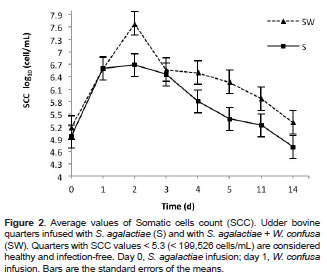
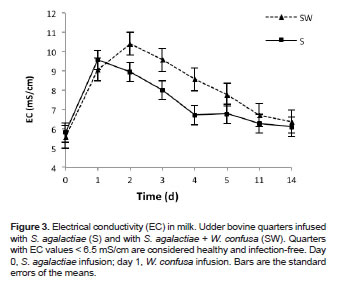
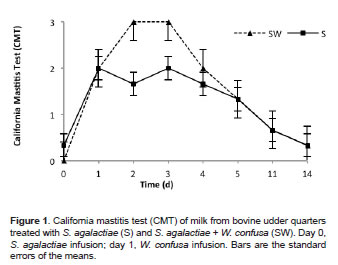
<body><![CDATA[<p>Analysis of variance tested the treatment   effects. Significant differences among means were   determined using the least significant difference   (LSD) test. SAS software (Version 9.2; SAS   Institute Inc., Cary, NC, USA) was used for statistical analysis.</p>     <p>&nbsp;</p>     <p><b><font size="3">Results</font></b></p>     <p>   <i>Assessment of CMT, SCC, and EC</i> </p>     <p>Figures <a href="#f1">1</a>, <a href="#f2">2</a> and <a href="#f3">3</a> show CMT, SCC, and EC   test results of milk from quarters inoculated with <i>S.   agalactiae</i> and then with <i>W. confusa</i>, respectively.   Significant statistical differences were found   (p&lt;0.05) due to evaluation time and treatments (S   vs. SW). The CMT in milk samples from the control   quarters (S) showed subclinical mastitis grade 2 at   24 h post-infusion of the pathogen (<a href="#f1">Figure 1</a>). After   day 2 post-infusion, the presence of subclinical   mastitis in the <i>S quarters</i> started decreasing until   average values were 0.33 at day 14. Milk samples   from the SW-treated quarters, showed mastitis grade   3 at 24 h and 48 h post-infusion of <i>W. confusa</i> (i.e.,   at days 2 and 3 post-infusion with <i>S. agalactiae</i>),   with apparent clinical signs of inflammation. Severe   induration was observed in addition to temperature   changes, suggesting that <i>W. confusa</i> intensified   the inflammatory response of the mammary gland.   At days 4, 5, 11, and 14, this response gradually   decreased (<a href="#f1">Figure 1</a>).</p>     <p align="center"><a name="f1"></a><img src="/img/revistas/rccp/v26n4/v26n4a6f1.jpg"></p>     <p align="center"><a name="f2"></a><img src="/img/revistas/rccp/v26n4/v26n4a6f2.jpg"></p>     <p align="center"><a name="f3"></a><img src="/img/revistas/rccp/v26n4/v26n4a6f3.jpg"></p>       <p>After 24 h of the pathogen infusion, SCC and EC   evidenced high values (p&lt;0.05), indicating that the   presence of <i>S. agalactiae</i> increased cell counts and   altered the normal ion composition of milk (Figures   <a href="#f2">2</a> and <a href="#f3">3</a>). EC values in milk from the S treated   quarters started decreasing at day 2 post-infusion,   while SCC values remained high until day 3 postinfusion.   A significant reduction in cell counts was   observed at day 4 (p&lt;0.05), reaching normal Log<sub>10</sub>  SCC values of 4.7 (i.e., 5.0x10<sup>4</sup> cells/mL) at day 14 (<a href="#f2">Figure 2</a>).</p>     <p>Significant differences (p&lt;0.05) were found   in SCC between S and SW treatments at 24 h   after infusion of <i>W. confusa</i> (day 2). The highest   Log<sub>10</sub> SCC value of 7.68 (i.e., 4.7x10<sup>7</sup> cells/mL)   corresponded to milk taken from the SW treated quarters. At day 3, no significant differences between S and SW treated quarters were found (p = 0.1216). However, at days 4, 5, and 11 SCC were significantly high in those quarters treated with SW (p = 0.0185), (p = 0.0054), and (p = 0.0309), respectively (<a href="#f2">Figure 2</a>). At day 14, Log<sub>10</sub> SCC values of 5.3 (i.e., 1.9x10<sup>5</sup> cells/mL) were obtained in the SW treated quarters.</p>     ]]></body>
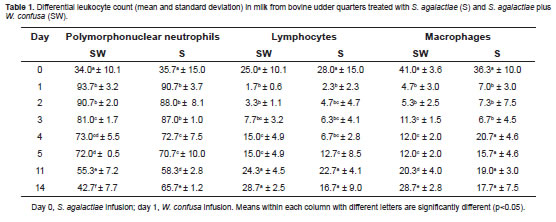
<body><![CDATA[<p>Significant differences (p&lt;0.05) were found   in EC between the S and SW treatments at 2, 3, 4,   5, and 11 days, with higher EC values in quarters   treated with <i>W. confusa</i>, which suggests that   milk from these quarters had a greater alteration   of sodium and chlorine ions due to the cellular response in the mammary gland.</p>     <p><i>Differential Leukocyte Count Determination</i></p>     <p>   <a href="#t1">Table 1</a> shows the differential leukocyte count   for the S and SW treatments. After 24 h postinfusion   of <i>S. agalactiae</i>, more than 90% PMNs   were found on the udder nipples. No significant   differences were found in the proportions of PNMs   (p = 0.3067), lymphocytes (p = 0.1002), and   macrophage cells (p = 0.3422) between the SW and   S treated quarters.</p>     <p align="center"><a name="t1"></a><img src="/img/revistas/rccp/v26n4/v26n4a6t1.jpg"></p>      <p>&nbsp;</p>     <p><b><font size="3">Discussion</font></b></p>     <p>   Previous <i>in vitro</i> studies demonstrated the   effectiveness of LAB against <i>S. aureus</i> and <i>S.   agalactiae</i>. Based on CMT, SCC, and EC results,   it is suggested that <i>W. confusa</i> generates a high and   rapid cellular response in the mammary gland. The   quarters infused with <i>W. confusa</i> showed greater   changes when compared to those infected with S.   agalactiae. The results also showed evidence of   clinical mastitis (severe induration, local fever, and   clot formations in milk).</p>     <p>Greene <i>et al.</i> (1991) compared the effects of   treating subclinical mastitis with intramammary   infusions of <i>Lactobacillus</i> or an antibiotic   preparation on cure rates and milk SCC. They   warned that the administration of <i>Lactobacillus</i>  or antibiotic treatment to all quarters based on   elevated composite SCC should not be adopted.   <i>Lactobacillus</i> increased SCC with no effect on the   infection rate. Similar results (i.e., increase in SCC) were found in this study with LAB W. confusa.</p>     <p>According to our PMNs, lymphocytes, and   macrophages results, the cellular response was the   same in both S and SW quarters. More studies are   needed to better understand cellular response in   the mammary gland after infusing <i>W. confusa</i>. It   is important to identify and differentiate how cell   activation occurs, or to identify the type of proin   flammatory cytokines that are activated in the mammary gland in the presence of <i>W. confusa</i>.</p>     <p>Studies with LAB <i>Lactococcus lactis</i> DPC 3147   on immune response after mammary gland infusion   with a probiotic culture showed that the greatest   increase in immune gene expression was observed   in interleukin (IL)-1&beta; and IL-8, which corresponded   with peaks in somatic cell counts (Beecher <i>et al.</i>,   2009). In this study, proportions of neutrophils,   lymphocytes and macrophages were assessed in   milk; therefore, more studies are needed to identify   and differentiate the specific type of lymphocytes present in both S and SW quarters.</p>     ]]></body>
<body><![CDATA[<p>The mammary gland response is specific for   each bacterial pathogen. Soltys and Quinn (1999)   reported that there was a difference in the type   of cells present in milk depending on the specific   mastitis-causing pathogen. These authors found that   <i>S. aureus</i> prompted a strong T CD4<sup>+</sup> lymphocyte   response, whereas <i>Streptococcus</i> spp. prompted a CD4<sup>+</sup> and CD8+ lymphocyte response.</p>     <p>According to these results, further research   should be conducted to elucidate (a) the ability of   <i>W. confusa</i> to adhere to the epithelial cells of the   teat canal, (b) the period of time the strain remains   in the teat canal, (c) canal and cistern histology   post inoculation, and (d) the activation mechanism   of somatic cells in the mammary gland post   inoculation. These further studies will determine   whether <i>W. confusa</i> should be included or excluded   in non-antibiotic formulations for the prevention and treatment of bovine mastitis.</p>     <p>Infusion of LAB <i>W. confusa</i> in bovine mammary   gland previously infected with <i>S. agalactiae</i>  produced further inflammation, high CMT, EC, and   high SCC as a result of a high proportion of PMNs   when compared to mammary glands where only   the pathogen was present. Results indicate that <i>W.   confusa</i> infusion, as a treatment for controlling   <i>S. agalactiae</i>, should not be adopted. However,   the activation mechanism of somatic cells in the mammary gland needs to be elucidated.</p>     <p>&nbsp;</p> <hr size="1" />     <p><a name="0"></a><a href="#b0">&curren;</a> To cite this article: Serna-Cock L, Enr&iacute;quez CE, Campos R, V&aacute;squez A. Cellular response of the bovine mammary gland after <i>Weissella confusa</i> infusion to  control <i>Streptococcus agalactiae</i>. Rev Colomb Cienc Pecu 2013; 26:280-287.</p> <hr size="1" />     <p>&nbsp;</p>     <p>&nbsp;</p>     <p>&nbsp;</p>     <p><b><font size="3">Acknowledgments</font></b></p>     <p>   The authors would like to express their   appreciation to Banco Santander and the Programa   Virginia Gutierrez de Pineda para j&oacute;venes   Investigadores e innovadores (COLCIENCIAS) for   funding this project.</p>     ]]></body>
<body><![CDATA[<p>&nbsp;</p>     <p><b><font size="3">References</font></b></p>     <!-- ref --><p>   Aranguren Parra AJ, L&oacute;pez Ortega AA, Mendoza CA, Ortega   Rivas E. Effect of clinic and subclinic mastitis on the plasmatic   concentration of metabolites, total protein, and albumen in   bovine females. Zootecnia Trop 2009; 27:57-63.    &nbsp;&nbsp;&nbsp;&nbsp;&nbsp;&nbsp;&nbsp;&nbsp;[&#160;<a href="javascript:void(0);" onclick="javascript: window.open('/scielo.php?script=sci_nlinks&ref=000085&pid=S0120-0690201300040000600001&lng=','','width=640,height=500,resizable=yes,scrollbars=1,menubar=yes,');">Links</a>&#160;]<!-- end-ref --></p>     <!-- ref --><p>   Beecher C, Daly M, Berry DP, Klostermann K, Flynn J, Meaney   W, Hill C, Mccarthy TV, Ross RP, Giblin L. Administration of   a live culture of <i>Lactococcus lactis</i> DPC 3147 into the bovine   mammary gland stimulates the local host immune response,   particularly IL-1 beta and IL-8 gene expression. J Dairy Res   2009; 76:340-348.    &nbsp;&nbsp;&nbsp;&nbsp;&nbsp;&nbsp;&nbsp;&nbsp;[&#160;<a href="javascript:void(0);" onclick="javascript: window.open('/scielo.php?script=sci_nlinks&ref=000087&pid=S0120-0690201300040000600002&lng=','','width=640,height=500,resizable=yes,scrollbars=1,menubar=yes,');">Links</a>&#160;]<!-- end-ref --></p>     <!-- ref --><p>   Bradley AJ. Bovine mastitis: an evolving disease. Vet J 2002;   164:116-128.    &nbsp;&nbsp;&nbsp;&nbsp;&nbsp;&nbsp;&nbsp;&nbsp;[&#160;<a href="javascript:void(0);" onclick="javascript: window.open('/scielo.php?script=sci_nlinks&ref=000089&pid=S0120-0690201300040000600003&lng=','','width=640,height=500,resizable=yes,scrollbars=1,menubar=yes,');">Links</a>&#160;]<!-- end-ref --></p>     <!-- ref --><p>   Contreras A, Sierra D, Corrales JC, Sanchez A, Marco J.   Physiological threshold of somatic-cell count and California   mastitis test for diagnosis of caprine subclinical mastitis. Small   Rumin Res 1996; 21:259-264.    &nbsp;&nbsp;&nbsp;&nbsp;&nbsp;&nbsp;&nbsp;&nbsp;[&#160;<a href="javascript:void(0);" onclick="javascript: window.open('/scielo.php?script=sci_nlinks&ref=000091&pid=S0120-0690201300040000600004&lng=','','width=640,height=500,resizable=yes,scrollbars=1,menubar=yes,');">Links</a>&#160;]<!-- end-ref --></p>     ]]></body>
<body><![CDATA[<!-- ref --><p>   Crispie F, Alonso-Gomez M, O'loughlin C, Klostermann K,   Flynn J, Arkins S, Meaney W, Ross RP, Hill C. Intramammary   infusion of a live culture for treatment of bovine mastitis: effect   of live lactococci on the mammary immune response. J Dairy   Res 2008; 75:374-384.    &nbsp;&nbsp;&nbsp;&nbsp;&nbsp;&nbsp;&nbsp;&nbsp;[&#160;<a href="javascript:void(0);" onclick="javascript: window.open('/scielo.php?script=sci_nlinks&ref=000093&pid=S0120-0690201300040000600005&lng=','','width=640,height=500,resizable=yes,scrollbars=1,menubar=yes,');">Links</a>&#160;]<!-- end-ref --></p>     <!-- ref --><p>   De Man JC, Rogosa M, Sharpe ME. A medium for the   cultivation of lactobacilli. J Applied Bacteriol 1960; 23:130-   135.    &nbsp;&nbsp;&nbsp;&nbsp;&nbsp;&nbsp;&nbsp;&nbsp;[&#160;<a href="javascript:void(0);" onclick="javascript: window.open('/scielo.php?script=sci_nlinks&ref=000095&pid=S0120-0690201300040000600006&lng=','','width=640,height=500,resizable=yes,scrollbars=1,menubar=yes,');">Links</a>&#160;]<!-- end-ref --></p>     <!-- ref --><p>   Gargouri A, Hamed H, Elfeki A. Total and differential bulk cow   milk somatic cell counts and their relation with lipolysis. Livest   Sci 2008; 113:274-279.    &nbsp;&nbsp;&nbsp;&nbsp;&nbsp;&nbsp;&nbsp;&nbsp;[&#160;<a href="javascript:void(0);" onclick="javascript: window.open('/scielo.php?script=sci_nlinks&ref=000097&pid=S0120-0690201300040000600007&lng=','','width=640,height=500,resizable=yes,scrollbars=1,menubar=yes,');">Links</a>&#160;]<!-- end-ref --></p>     <!-- ref --><p>   Greene WA, Gano AM, Smith KL, Hogan JS, Todhunter DA.   Comparison of probiotic and antibiotic intramammary therapy   of cattle with elevated somatic cell counts. J Dairy Sci 1991;   74:2976&#8211;2981.    &nbsp;&nbsp;&nbsp;&nbsp;&nbsp;&nbsp;&nbsp;&nbsp;[&#160;<a href="javascript:void(0);" onclick="javascript: window.open('/scielo.php?script=sci_nlinks&ref=000099&pid=S0120-0690201300040000600008&lng=','','width=640,height=500,resizable=yes,scrollbars=1,menubar=yes,');">Links</a>&#160;]<!-- end-ref --></p>     <!-- ref --><p>   Klostermann K, Crispie F, Flynn J, Ross RP, Hill C, Meaney W.   Intramammary infusion of a live culture of <i>Lactococcus lactis</i>  for treatment of bovine mastitis: comparison with antibiotic   treatment in field trials. J Dairy Res 2008; 75:365-373.    &nbsp;&nbsp;&nbsp;&nbsp;&nbsp;&nbsp;&nbsp;&nbsp;[&#160;<a href="javascript:void(0);" onclick="javascript: window.open('/scielo.php?script=sci_nlinks&ref=000101&pid=S0120-0690201300040000600009&lng=','','width=640,height=500,resizable=yes,scrollbars=1,menubar=yes,');">Links</a>&#160;]<!-- end-ref --></p>     ]]></body>
<body><![CDATA[<!-- ref --><p>   Lindmark-Mansson H, Branning C, Alden G, Paulsson M.   Relationship between somatic cell count, individual leukocyte   populations and milk components in bovine udder quarter milk.   Int Dairy J 2006; 16:717-727.    &nbsp;&nbsp;&nbsp;&nbsp;&nbsp;&nbsp;&nbsp;&nbsp;[&#160;<a href="javascript:void(0);" onclick="javascript: window.open('/scielo.php?script=sci_nlinks&ref=000103&pid=S0120-0690201300040000600010&lng=','','width=640,height=500,resizable=yes,scrollbars=1,menubar=yes,');">Links</a>&#160;]<!-- end-ref --></p>     <!-- ref --><p>   Mehrzad J, Paape M, Burvenich C. Role of neutrophils in   protection of udder from infection in high yielding dairy cows.   Iran J Vet Res 2010; 11:102-118.    &nbsp;&nbsp;&nbsp;&nbsp;&nbsp;&nbsp;&nbsp;&nbsp;[&#160;<a href="javascript:void(0);" onclick="javascript: window.open('/scielo.php?script=sci_nlinks&ref=000105&pid=S0120-0690201300040000600011&lng=','','width=640,height=500,resizable=yes,scrollbars=1,menubar=yes,');">Links</a>&#160;]<!-- end-ref --></p>     <!-- ref --><p>   Ochoa-Zarzosa A, Loeza-Lara PD, Torres-Rodriguez F, Loeza-   Angeles H, Mascot-Chiquito N, Sanchez-Baca S, Lopez-   Meza JE. Antimicrobial susceptibility and invasive ability of   Staphylococcus aureus isolates from mastitis from dairy backyard   systems. Antonie Van Leeuwenhoek 2008; 94:199-206.    &nbsp;&nbsp;&nbsp;&nbsp;&nbsp;&nbsp;&nbsp;&nbsp;[&#160;<a href="javascript:void(0);" onclick="javascript: window.open('/scielo.php?script=sci_nlinks&ref=000107&pid=S0120-0690201300040000600012&lng=','','width=640,height=500,resizable=yes,scrollbars=1,menubar=yes,');">Links</a>&#160;]<!-- end-ref --></p>     <!-- ref --><p>Pellegrino M, Giraudo J, Raspanti C, Nagel R, Odierno L,   Primo V, Bogni C. Experimental trial in heifers vaccinated with   <i>Staphylococcus aureus</i> avirulent mutant against bovine mastitis. Vet Microbiol 2008; 127:186-190.    &nbsp;&nbsp;&nbsp;&nbsp;&nbsp;&nbsp;&nbsp;&nbsp;[&#160;<a href="javascript:void(0);" onclick="javascript: window.open('/scielo.php?script=sci_nlinks&ref=000109&pid=S0120-0690201300040000600013&lng=','','width=640,height=500,resizable=yes,scrollbars=1,menubar=yes,');">Links</a>&#160;]<!-- end-ref --></p>     <!-- ref --><p>   Serna-Cock L, Valencia-Hernandez LJ, Campos-Gaona R.   Cin&eacute;tica de fermentaci&oacute;n y acci&oacute;n antimicrobiana de <i>Weissella   confusa</i> contra <i>Staphylococcus aureus</i> y <i>Streptococcus   agalactiae</i>. Rev Fac Ing Univ Antioquia 2010; 55:55-65.    &nbsp;&nbsp;&nbsp;&nbsp;&nbsp;&nbsp;&nbsp;&nbsp;[&#160;<a href="javascript:void(0);" onclick="javascript: window.open('/scielo.php?script=sci_nlinks&ref=000111&pid=S0120-0690201300040000600014&lng=','','width=640,height=500,resizable=yes,scrollbars=1,menubar=yes,');">Links</a>&#160;]<!-- end-ref --></p>     ]]></body>
<body><![CDATA[<!-- ref --><p>   Sladek Z, Rysanek D. Apoptosis of resident and inflammatory   macrophages before and during the inflammatory response of   the virgin bovine mammary gland. Acta Vet Scan 2010; 52:12.    &nbsp;&nbsp;&nbsp;&nbsp;&nbsp;&nbsp;&nbsp;&nbsp;[&#160;<a href="javascript:void(0);" onclick="javascript: window.open('/scielo.php?script=sci_nlinks&ref=000113&pid=S0120-0690201300040000600015&lng=','','width=640,height=500,resizable=yes,scrollbars=1,menubar=yes,');">Links</a>&#160;]<!-- end-ref --></p>     <!-- ref --><p>   Soltys J, Quinn MT. Selective recruitment of T-cell subsets to   the udder during staphylococcal and streptococcal mastitis:   Analysis of lymphocyte subsets and adhesion molecule   expression. Infect Immun 1999; 67:6293-6302.    &nbsp;&nbsp;&nbsp;&nbsp;&nbsp;&nbsp;&nbsp;&nbsp;[&#160;<a href="javascript:void(0);" onclick="javascript: window.open('/scielo.php?script=sci_nlinks&ref=000115&pid=S0120-0690201300040000600016&lng=','','width=640,height=500,resizable=yes,scrollbars=1,menubar=yes,');">Links</a>&#160;]<!-- end-ref --></p>     <!-- ref --><p>   Synnott AJ, KuangY, Kurimoto M, Yamamichi K, Iwano H,   Tanji Y. Isolation from sewage influent and characterization of   novel <i>Staphylococcus aureus</i> bacteriophages with wide host   ranges and potent lytic capabilities. Appl Environ Microb 2009;   75:4483-4490.    &nbsp;&nbsp;&nbsp;&nbsp;&nbsp;&nbsp;&nbsp;&nbsp;[&#160;<a href="javascript:void(0);" onclick="javascript: window.open('/scielo.php?script=sci_nlinks&ref=000117&pid=S0120-0690201300040000600017&lng=','','width=640,height=500,resizable=yes,scrollbars=1,menubar=yes,');">Links</a>&#160;]<!-- end-ref --></p>     <p>&nbsp;</p> </font>     ]]></body><back>
<ref-list>
<ref id="B1">
<nlm-citation citation-type="journal">
<person-group person-group-type="author">
<name>
<surname><![CDATA[Aranguren Parra]]></surname>
<given-names><![CDATA[AJ]]></given-names>
</name>
<name>
<surname><![CDATA[López Ortega]]></surname>
<given-names><![CDATA[AA]]></given-names>
</name>
<name>
<surname><![CDATA[Mendoza]]></surname>
<given-names><![CDATA[CA]]></given-names>
</name>
<name>
<surname><![CDATA[Ortega]]></surname>
<given-names><![CDATA[Rivas E]]></given-names>
</name>
</person-group>
<article-title xml:lang="en"><![CDATA[Effect of clinic and subclinic mastitis on the plasmatic concentration of metabolites, total protein, and albumen in bovine females]]></article-title>
<source><![CDATA[Zootecnia Trop]]></source>
<year>2009</year>
<volume>27</volume>
<page-range>57-63</page-range></nlm-citation>
</ref>
<ref id="B2">
<nlm-citation citation-type="journal">
<person-group person-group-type="author">
<name>
<surname><![CDATA[Beecher]]></surname>
<given-names><![CDATA[C]]></given-names>
</name>
<name>
<surname><![CDATA[Daly]]></surname>
<given-names><![CDATA[M]]></given-names>
</name>
<name>
<surname><![CDATA[Berry]]></surname>
<given-names><![CDATA[DP]]></given-names>
</name>
<name>
<surname><![CDATA[Klostermann]]></surname>
<given-names><![CDATA[K]]></given-names>
</name>
<name>
<surname><![CDATA[Flynn]]></surname>
<given-names><![CDATA[J]]></given-names>
</name>
<name>
<surname><![CDATA[Meaney]]></surname>
<given-names><![CDATA[W]]></given-names>
</name>
<name>
<surname><![CDATA[Hill]]></surname>
<given-names><![CDATA[C]]></given-names>
</name>
<name>
<surname><![CDATA[Mccarthy]]></surname>
<given-names><![CDATA[TV]]></given-names>
</name>
<name>
<surname><![CDATA[Ross]]></surname>
<given-names><![CDATA[RP]]></given-names>
</name>
<name>
<surname><![CDATA[Giblin]]></surname>
<given-names><![CDATA[L]]></given-names>
</name>
</person-group>
<article-title xml:lang="en"><![CDATA[Administration of a live culture of Lactococcus lactis DPC 3147 into the bovine mammary gland stimulates the local host immune response, particularly IL-1 beta and IL-8 gene expression]]></article-title>
<source><![CDATA[J Dairy Res]]></source>
<year>2009</year>
<volume>76</volume>
<page-range>340-348</page-range></nlm-citation>
</ref>
<ref id="B3">
<nlm-citation citation-type="journal">
<person-group person-group-type="author">
<name>
<surname><![CDATA[Bradley]]></surname>
<given-names><![CDATA[AJ]]></given-names>
</name>
</person-group>
<article-title xml:lang="en"><![CDATA[Bovine mastitis: an evolving disease]]></article-title>
<source><![CDATA[Vet J]]></source>
<year>2002</year>
<volume>164</volume>
<page-range>116-128</page-range></nlm-citation>
</ref>
<ref id="B4">
<nlm-citation citation-type="journal">
<person-group person-group-type="author">
<name>
<surname><![CDATA[Contreras]]></surname>
<given-names><![CDATA[A]]></given-names>
</name>
<name>
<surname><![CDATA[Sierra]]></surname>
<given-names><![CDATA[D]]></given-names>
</name>
<name>
<surname><![CDATA[Corrales]]></surname>
<given-names><![CDATA[JC]]></given-names>
</name>
<name>
<surname><![CDATA[Sanchez]]></surname>
<given-names><![CDATA[A]]></given-names>
</name>
<name>
<surname><![CDATA[Marco]]></surname>
<given-names><![CDATA[J]]></given-names>
</name>
</person-group>
<article-title xml:lang="en"><![CDATA[Physiological threshold of somatic-cell count and California mastitis test for diagnosis of caprine subclinical mastitis]]></article-title>
<source><![CDATA[Small Rumin Res]]></source>
<year>1996</year>
<volume>21</volume>
<page-range>259-264</page-range></nlm-citation>
</ref>
<ref id="B5">
<nlm-citation citation-type="journal">
<person-group person-group-type="author">
<name>
<surname><![CDATA[Crispie]]></surname>
<given-names><![CDATA[F]]></given-names>
</name>
<name>
<surname><![CDATA[Alonso-Gomez]]></surname>
<given-names><![CDATA[M]]></given-names>
</name>
<name>
<surname><![CDATA[O'loughlin]]></surname>
<given-names><![CDATA[C]]></given-names>
</name>
<name>
<surname><![CDATA[Klostermann]]></surname>
<given-names><![CDATA[K]]></given-names>
</name>
<name>
<surname><![CDATA[Flynn]]></surname>
<given-names><![CDATA[J]]></given-names>
</name>
<name>
<surname><![CDATA[Arkins]]></surname>
<given-names><![CDATA[S]]></given-names>
</name>
<name>
<surname><![CDATA[Meaney]]></surname>
<given-names><![CDATA[W]]></given-names>
</name>
<name>
<surname><![CDATA[Ross]]></surname>
<given-names><![CDATA[RP]]></given-names>
</name>
<name>
<surname><![CDATA[Hill]]></surname>
<given-names><![CDATA[C]]></given-names>
</name>
</person-group>
<article-title xml:lang="en"><![CDATA[Intramammary infusion of a live culture for treatment of bovine mastitis: effect of live lactococci on the mammary immune response]]></article-title>
<source><![CDATA[J Dairy Res]]></source>
<year>2008</year>
<volume>75</volume>
<page-range>374-384</page-range></nlm-citation>
</ref>
<ref id="B6">
<nlm-citation citation-type="journal">
<person-group person-group-type="author">
<name>
<surname><![CDATA[De Man]]></surname>
<given-names><![CDATA[JC]]></given-names>
</name>
<name>
<surname><![CDATA[Rogosa]]></surname>
<given-names><![CDATA[M]]></given-names>
</name>
<name>
<surname><![CDATA[Sharpe]]></surname>
<given-names><![CDATA[ME]]></given-names>
</name>
</person-group>
<article-title xml:lang="en"><![CDATA[A medium for the cultivation of lactobacilli]]></article-title>
<source><![CDATA[J Applied Bacteriol]]></source>
<year>1960</year>
<volume>23</volume>
<page-range>130- 135</page-range></nlm-citation>
</ref>
<ref id="B7">
<nlm-citation citation-type="journal">
<person-group person-group-type="author">
<name>
<surname><![CDATA[Gargouri]]></surname>
<given-names><![CDATA[A]]></given-names>
</name>
<name>
<surname><![CDATA[Hamed]]></surname>
<given-names><![CDATA[H]]></given-names>
</name>
<name>
<surname><![CDATA[Elfeki]]></surname>
<given-names><![CDATA[A]]></given-names>
</name>
</person-group>
<article-title xml:lang="en"><![CDATA[Total and differential bulk cow milk somatic cell counts and their relation with lipolysis]]></article-title>
<source><![CDATA[Livest Sci]]></source>
<year>2008</year>
<volume>113</volume>
<page-range>274-279</page-range></nlm-citation>
</ref>
<ref id="B8">
<nlm-citation citation-type="journal">
<person-group person-group-type="author">
<name>
<surname><![CDATA[Greene]]></surname>
<given-names><![CDATA[WA]]></given-names>
</name>
<name>
<surname><![CDATA[Gano]]></surname>
<given-names><![CDATA[AM]]></given-names>
</name>
<name>
<surname><![CDATA[Smith]]></surname>
<given-names><![CDATA[KL]]></given-names>
</name>
<name>
<surname><![CDATA[Hogan]]></surname>
<given-names><![CDATA[JS]]></given-names>
</name>
<name>
<surname><![CDATA[Todhunter]]></surname>
<given-names><![CDATA[DA]]></given-names>
</name>
</person-group>
<article-title xml:lang="en"><![CDATA[Comparison of probiotic and antibiotic intramammary therapy of cattle with elevated somatic cell counts]]></article-title>
<source><![CDATA[J Dairy Sci]]></source>
<year>1991</year>
<volume>74</volume>
<page-range>2976-2981</page-range></nlm-citation>
</ref>
<ref id="B9">
<nlm-citation citation-type="journal">
<person-group person-group-type="author">
<name>
<surname><![CDATA[Klostermann]]></surname>
<given-names><![CDATA[K]]></given-names>
</name>
<name>
<surname><![CDATA[Crispie]]></surname>
<given-names><![CDATA[F]]></given-names>
</name>
<name>
<surname><![CDATA[Flynn]]></surname>
<given-names><![CDATA[J]]></given-names>
</name>
<name>
<surname><![CDATA[Ross]]></surname>
<given-names><![CDATA[RP]]></given-names>
</name>
<name>
<surname><![CDATA[Hill]]></surname>
<given-names><![CDATA[C]]></given-names>
</name>
<name>
<surname><![CDATA[Meaney]]></surname>
<given-names><![CDATA[W]]></given-names>
</name>
</person-group>
<article-title xml:lang="en"><![CDATA[Intramammary infusion of a live culture of Lactococcus lactis for treatment of bovine mastitis: comparison with antibiotic treatment in field trials]]></article-title>
<source><![CDATA[J Dairy Res]]></source>
<year>2008</year>
<volume>75</volume>
<page-range>365-373</page-range></nlm-citation>
</ref>
<ref id="B10">
<nlm-citation citation-type="journal">
<person-group person-group-type="author">
<name>
<surname><![CDATA[Lindmark-Mansson]]></surname>
<given-names><![CDATA[H]]></given-names>
</name>
<name>
<surname><![CDATA[Branning]]></surname>
<given-names><![CDATA[C]]></given-names>
</name>
<name>
<surname><![CDATA[Alden]]></surname>
<given-names><![CDATA[G]]></given-names>
</name>
<name>
<surname><![CDATA[Paulsson]]></surname>
<given-names><![CDATA[M]]></given-names>
</name>
</person-group>
<article-title xml:lang="en"><![CDATA[Relationship between somatic cell count, individual leukocyte populations and milk components in bovine udder quarter milk]]></article-title>
<source><![CDATA[Int Dairy J]]></source>
<year>2006</year>
<volume>16</volume>
<page-range>717-727</page-range></nlm-citation>
</ref>
<ref id="B11">
<nlm-citation citation-type="journal">
<person-group person-group-type="author">
<name>
<surname><![CDATA[Mehrzad]]></surname>
<given-names><![CDATA[J]]></given-names>
</name>
<name>
<surname><![CDATA[Paape]]></surname>
<given-names><![CDATA[M]]></given-names>
</name>
<name>
<surname><![CDATA[Burvenich]]></surname>
<given-names><![CDATA[C]]></given-names>
</name>
</person-group>
<article-title xml:lang="en"><![CDATA[Role of neutrophils in protection of udder from infection in high yielding dairy cows]]></article-title>
<source><![CDATA[Iran J Vet Res]]></source>
<year>2010</year>
<volume>11</volume>
<page-range>102-118</page-range></nlm-citation>
</ref>
<ref id="B12">
<nlm-citation citation-type="journal">
<person-group person-group-type="author">
<name>
<surname><![CDATA[Ochoa-Zarzosa]]></surname>
<given-names><![CDATA[A]]></given-names>
</name>
<name>
<surname><![CDATA[Loeza-Lara]]></surname>
<given-names><![CDATA[PD]]></given-names>
</name>
<name>
<surname><![CDATA[Torres-Rodriguez]]></surname>
<given-names><![CDATA[F]]></given-names>
</name>
<name>
<surname><![CDATA[Loeza- Angeles]]></surname>
<given-names><![CDATA[H]]></given-names>
</name>
<name>
<surname><![CDATA[Mascot-Chiquito]]></surname>
<given-names><![CDATA[N]]></given-names>
</name>
<name>
<surname><![CDATA[Sanchez-Baca]]></surname>
<given-names><![CDATA[S]]></given-names>
</name>
<name>
<surname><![CDATA[Lopez-Meza]]></surname>
<given-names><![CDATA[JE]]></given-names>
</name>
</person-group>
<article-title xml:lang="en"><![CDATA[Antimicrobial susceptibility and invasive ability of Staphylococcus aureus isolates from mastitis from dairy backyard systems]]></article-title>
<source><![CDATA[Antonie Van Leeuwenhoek]]></source>
<year>2008</year>
<volume>94</volume>
<page-range>199-206</page-range></nlm-citation>
</ref>
<ref id="B13">
<nlm-citation citation-type="journal">
<person-group person-group-type="author">
<name>
<surname><![CDATA[Pellegrino]]></surname>
<given-names><![CDATA[M]]></given-names>
</name>
<name>
<surname><![CDATA[Giraudo]]></surname>
<given-names><![CDATA[J]]></given-names>
</name>
<name>
<surname><![CDATA[Raspanti]]></surname>
<given-names><![CDATA[C]]></given-names>
</name>
<name>
<surname><![CDATA[Nagel]]></surname>
<given-names><![CDATA[R]]></given-names>
</name>
<name>
<surname><![CDATA[Odierno]]></surname>
<given-names><![CDATA[L]]></given-names>
</name>
<name>
<surname><![CDATA[Primo]]></surname>
<given-names><![CDATA[V]]></given-names>
</name>
<name>
<surname><![CDATA[Bogni]]></surname>
<given-names><![CDATA[C]]></given-names>
</name>
</person-group>
<article-title xml:lang="en"><![CDATA[Experimental trial in heifers vaccinated with Staphylococcus aureus avirulent mutant against bovine mastitis]]></article-title>
<source><![CDATA[Vet Microbiol]]></source>
<year>2008</year>
<volume>127</volume>
<page-range>186-190</page-range></nlm-citation>
</ref>
<ref id="B14">
<nlm-citation citation-type="journal">
<person-group person-group-type="author">
<name>
<surname><![CDATA[Serna-Cock]]></surname>
<given-names><![CDATA[L]]></given-names>
</name>
<name>
<surname><![CDATA[Valencia-Hernandez]]></surname>
<given-names><![CDATA[LJ]]></given-names>
</name>
<name>
<surname><![CDATA[Campos-Gaona]]></surname>
<given-names><![CDATA[R]]></given-names>
</name>
</person-group>
<article-title xml:lang="es"><![CDATA[Cinética de fermentación y acción antimicrobiana de Weissella confusa contra Staphylococcus aureus y Streptococcus agalactiae]]></article-title>
<source><![CDATA[Rev Fac Ing Univ Antioquia]]></source>
<year>2010</year>
<volume>55</volume>
<page-range>55-65</page-range></nlm-citation>
</ref>
<ref id="B15">
<nlm-citation citation-type="journal">
<person-group person-group-type="author">
<name>
<surname><![CDATA[Sladek]]></surname>
<given-names><![CDATA[Z]]></given-names>
</name>
<name>
<surname><![CDATA[Rysanek]]></surname>
<given-names><![CDATA[D]]></given-names>
</name>
</person-group>
<article-title xml:lang="en"><![CDATA[Apoptosis of resident and inflammatory macrophages before and during the inflammatory response of the virgin bovine mammary gland]]></article-title>
<source><![CDATA[Acta Vet Scan]]></source>
<year>2010</year>
<volume>52</volume>
<page-range>12</page-range></nlm-citation>
</ref>
<ref id="B16">
<nlm-citation citation-type="journal">
<person-group person-group-type="author">
<name>
<surname><![CDATA[Soltys]]></surname>
<given-names><![CDATA[J]]></given-names>
</name>
<name>
<surname><![CDATA[Quinn]]></surname>
<given-names><![CDATA[MT]]></given-names>
</name>
</person-group>
<article-title xml:lang="en"><![CDATA[Selective recruitment of T-cell subsets to the udder during staphylococcal and streptococcal mastitis: Analysis of lymphocyte subsets and adhesion molecule expression]]></article-title>
<source><![CDATA[Infect Immun]]></source>
<year>1999</year>
<volume>67</volume>
<page-range>6293-6302</page-range></nlm-citation>
</ref>
<ref id="B17">
<nlm-citation citation-type="journal">
<person-group person-group-type="author">
<name>
<surname><![CDATA[Synnott]]></surname>
<given-names><![CDATA[AJ]]></given-names>
</name>
<name>
<surname><![CDATA[Kuang]]></surname>
<given-names><![CDATA[Y]]></given-names>
</name>
<name>
<surname><![CDATA[Kurimoto]]></surname>
<given-names><![CDATA[M]]></given-names>
</name>
<name>
<surname><![CDATA[Yamamichi]]></surname>
<given-names><![CDATA[K]]></given-names>
</name>
<name>
<surname><![CDATA[Iwano]]></surname>
<given-names><![CDATA[H]]></given-names>
</name>
<name>
<surname><![CDATA[Tanji]]></surname>
<given-names><![CDATA[Y]]></given-names>
</name>
</person-group>
<article-title xml:lang="en"><![CDATA[Isolation from sewage influent and characterization of novel Staphylococcus aureus bacteriophages with wide host ranges and potent lytic capabilities]]></article-title>
<source><![CDATA[Appl Environ Microb]]></source>
<year>2009</year>
<volume>75</volume>
<page-range>4483-4490</page-range></nlm-citation>
</ref>
</ref-list>
</back>
</article>