<?xml version="1.0" encoding="ISO-8859-1"?><article xmlns:mml="http://www.w3.org/1998/Math/MathML" xmlns:xlink="http://www.w3.org/1999/xlink" xmlns:xsi="http://www.w3.org/2001/XMLSchema-instance">
<front>
<journal-meta>
<journal-id>0120-0690</journal-id>
<journal-title><![CDATA[Revista Colombiana de Ciencias Pecuarias]]></journal-title>
<abbrev-journal-title><![CDATA[Rev Colom Cienc Pecua]]></abbrev-journal-title>
<issn>0120-0690</issn>
<publisher>
<publisher-name><![CDATA[Facultad de Ciencias Agrarias, Universidad de Antioquia]]></publisher-name>
</publisher>
</journal-meta>
<article-meta>
<article-id>S0120-06902014000100003</article-id>
<title-group>
<article-title xml:lang="en"><![CDATA[Presence of Salmonella spp. in reused broiler litter]]></article-title>
<article-title xml:lang="es"><![CDATA[Presencia de Salmonella spp. en cama reutilizada de pollos de engorde]]></article-title>
<article-title xml:lang="af"><![CDATA[Presença de Salmonella spp. em cama reutilizada de frangos de corte]]></article-title>
</title-group>
<contrib-group>
<contrib contrib-type="author">
<name>
<surname><![CDATA[Muniz]]></surname>
<given-names><![CDATA[Eduardo]]></given-names>
</name>
<xref ref-type="aff" rid="A01"/>
</contrib>
<contrib contrib-type="author">
<name>
<surname><![CDATA[Mesa]]></surname>
<given-names><![CDATA[Dany]]></given-names>
</name>
<xref ref-type="aff" rid="A01"/>
<xref ref-type="aff" rid="A03"/>
</contrib>
<contrib contrib-type="author">
<name>
<surname><![CDATA[Cuaspa]]></surname>
<given-names><![CDATA[Rocío]]></given-names>
</name>
<xref ref-type="aff" rid="A02"/>
</contrib>
<contrib contrib-type="author">
<name>
<surname><![CDATA[Souza]]></surname>
<given-names><![CDATA[Alexandre M]]></given-names>
</name>
<xref ref-type="aff" rid="A01"/>
</contrib>
<contrib contrib-type="author">
<name>
<surname><![CDATA[Santin]]></surname>
<given-names><![CDATA[Elizabeth]]></given-names>
</name>
<xref ref-type="aff" rid="A01"/>
</contrib>
</contrib-group>
<aff id="A01">
<institution><![CDATA[,Universidade Federal do Paraná Departamento de Medicina Veterinária ]]></institution>
<addr-line><![CDATA[ ]]></addr-line>
<country>Brasil</country>
</aff>
<aff id="A02">
<institution><![CDATA[,Universidade Federal do Paraná  ]]></institution>
<addr-line><![CDATA[ ]]></addr-line>
<country>Brasil</country>
</aff>
<aff id="A03">
<institution><![CDATA[,Universidade Federal do Paraná  ]]></institution>
<addr-line><![CDATA[Curitiba Parana]]></addr-line>
<country>Brazil</country>
</aff>
<pub-date pub-type="pub">
<day>00</day>
<month>03</month>
<year>2014</year>
</pub-date>
<pub-date pub-type="epub">
<day>00</day>
<month>03</month>
<year>2014</year>
</pub-date>
<volume>27</volume>
<numero>1</numero>
<fpage>12</fpage>
<lpage>27</lpage>
<copyright-statement/>
<copyright-year/>
<self-uri xlink:href="http://www.scielo.org.co/scielo.php?script=sci_arttext&amp;pid=S0120-06902014000100003&amp;lng=en&amp;nrm=iso"></self-uri><self-uri xlink:href="http://www.scielo.org.co/scielo.php?script=sci_abstract&amp;pid=S0120-06902014000100003&amp;lng=en&amp;nrm=iso"></self-uri><self-uri xlink:href="http://www.scielo.org.co/scielo.php?script=sci_pdf&amp;pid=S0120-06902014000100003&amp;lng=en&amp;nrm=iso"></self-uri><abstract abstract-type="short" xml:lang="en"><p><![CDATA[Background: reutilization of poultry litter for multiple broiler flocks is a common practice in modern production systems due to the increasing scarcity and cost of bedding materials, and the necessity to reduce environmental impact. However, this practice has been associated with sanitary risks, such as the presence of Salmonella spp. in broiler meat. Objective: a study was conducted to detect the presence of Salmonella spp. in reused litters. Methods: 1,280 litter samples from Midwestern Brazilian poultry farms were analyzed during seven consecutive flocks. Samples were collected from flocks aged 28 to 32 days. Disposable shoe covers were used for sample collections. Presence of Salmonella spp. was determined by microbiological isolation. During the interval period between flocks the litter was fermented prior to its reuse by covering it with a black plastic canvas for 7 days. Results: positive samples for Salmonella spp. decreased when the number of litter reuses increased compared with the first reuse of the litter. An anaerobic digestion process with biological and physicochemical changes in the litter material and microbial communities may explain the low survival of pathogenic bacteria such as Salmonella spp. Conclusions: our study demonstrates that litter reused after the fermentation process is a safe and recommended practice to reduce the presence of Salmonella spp.]]></p></abstract>
<abstract abstract-type="short" xml:lang="es"><p><![CDATA[Antecedentes: la reutilización de la cama de pollos de engorde es una práctica común en el sistema moderno de producción avícola, sustentada por la reducción en el impacto ambiental, escasez de este material y disminución de costos de producción. Sin embargo, esta reutilización se ha asociado con riesgos sanitarios, tales como presencia de Salmonella spp. en los lotes de pollo. Objetivo: se realizó un estudio con el fin de detectar la presencia de Salmonella spp. en camas reutilizadas y fermentadas de pollos de engorde pertenecientes a granjas comerciales. Métodos: se analizaron 1280 muestras de cama de diversas granjas avícolas ubicadas en el centro oeste de Brasil durante siete lotes consecutivos de pollos. Las muestras de cama fueron tomadas de galpones con aves entre los 28 y 32 días de edad, utilizando polainas. La presencia de Salmonella spp. se determinó mediante aislamiento microbiológico. Durante el intervalo entre lotes, la cama fue fermentada antes de cada reutilización cubriendo la superficie entera de la cama con una lona de plástico negra por siete días. Resultados: fue observada una disminución en las muestras positivas para Salmonella con la reutilización y fermentación de las camas entre lotes, significativa con respecto al primer reuso. Esto indica que puede estar ocurriendo un proceso de digestión anaeróbica que conduce a que los procesos biológicos y físico-químicos entre el material de la cama y la comunidad microbiana allí presentes, estén afectando la supervivencia de bacterias patógenas como Salmonella. Conclusiones: nuestro estudio demuestra que la reutilización de la cama es una práctica segura y recomendable cuando se realiza después del proceso de fermentación, debido a que reduce la presencia de Salmonella spp.]]></p></abstract>
<abstract abstract-type="short" xml:lang="pt"><p><![CDATA[Antecedentes: a reutilização de cama aviária por vários lotes é uma prática moderna do sistema de produção de aves, baseada na redução do impacto ambiental, escassez de este material e diminuição nos custos de produção. Porém, dita prática é associada com riscos sanitários como a presença de patógenos como Salmonella spp. nos lotes de frango. Objetivo: uma pesquisa foi realizada para detectar a presença de Salmonella spp. na cama reutilizada e fermentada de produtores de frango. Métodos: foram analisadas 1280 amostras de cama de diferentes produtores do Centro-oeste do Brasil durante sete lotes consecutivos. As amostras de cama foram coletadas com aves na idade entre 28 e 32 dias usando pró-pés descartáveis e a presença de Salmonella spp. foi determinada por isolamento bacteriológico. Durante o intervalo dos lotes a cama foi tratada antes da reutilização por meio da cobertura através de uma lona plástica preta em toda a superfície interna do aviário por sete dias. Resultados: foi observada uma diminuição no número de amostras positivas de Salmonella spp. com a reutilização e fermentação das camas entre os lotes, significativa em relação ao primeiro reuso. Isto indica que o processo de reutilização, seguido de fermentação anaeróbia do material da cama pela comunidade de microrganismos afetou a sobrevivência de bactérias patogênicas como Salmonella spp. Conclusões: este estudo evidencia que o reuso da cama é seguro e recomendado quando realizado após o processo de fermentação no intervalo do lote, devido a que diminui a presença de Salmonella spp.]]></p></abstract>
<kwd-group>
<kwd lng="en"><![CDATA[ammonia]]></kwd>
<kwd lng="en"><![CDATA[anaerobic digestion]]></kwd>
<kwd lng="en"><![CDATA[composting]]></kwd>
<kwd lng="en"><![CDATA[fermentation]]></kwd>
<kwd lng="en"><![CDATA[microbiota]]></kwd>
<kwd lng="es"><![CDATA[amonio]]></kwd>
<kwd lng="es"><![CDATA[compostaje]]></kwd>
<kwd lng="es"><![CDATA[digestión anaeróbica]]></kwd>
<kwd lng="es"><![CDATA[fermentación]]></kwd>
<kwd lng="es"><![CDATA[microbiota]]></kwd>
<kwd lng="pt"><![CDATA[amônia]]></kwd>
<kwd lng="pt"><![CDATA[compostagem]]></kwd>
<kwd lng="pt"><![CDATA[digestão anaeróbica]]></kwd>
<kwd lng="pt"><![CDATA[fermentação]]></kwd>
<kwd lng="pt"><![CDATA[microbiota]]></kwd>
</kwd-group>
</article-meta>
</front><body><![CDATA[  <font size="2" face="Verdana, Arial, Helvetica, sans-serif">     <p align="right"><b>ORIGINAL ARTICLES</b></p>     <p align="right">&nbsp;</p>     <p align="center"><b><font size="4">Presence of <i>Salmonella</i> spp. in reused broiler litter<sup><a name="b0"></a><a href="#0">&curren;</a></sup></font></b></p>     <p align="center">&nbsp;</p>     <p align="center"><b><font size="3">   Presencia de <i>Salmonella</i> spp. en cama reutilizada de pollos de engorde</font></b></p>     <p align="center">&nbsp;</p>     <p align="center"><b><font size="3">   Presen&ccedil;a de <i>Salmonella</i> spp. em cama reutilizada de frangos de corte</font></b></p>     <p>&nbsp;  </p>     <p>&nbsp;</p>     ]]></body>
<body><![CDATA[<p><b>Eduardo Muniz<sup>1</sup>, MV, MSc; Dany Mesa<sup>1*</sup>, MV; Roc&iacute;o Cuaspa<sup>2</sup>, Biol; Alexandre M Souza<sup>1</sup>, MV; Elizabeth   Santin1, MV, MSc, PhD.</b></p>     <p>  1Laborat&oacute;rio de Microbiologia e Ornitopatologia, Departamento de Medicina Veterin&aacute;ria, Universidade Federal do   Paran&aacute;, Brasil.</p>     <p>   2Departamento de Bioqu&iacute;mica e Biologia Molecular, Universidade Federal do Paran&aacute;, Brasil.  </p>     <p>* Corresponding author: Dany Mesa. Laborat&oacute;rio de Microbiologia e Ornitopatologia, Departamento de Medicina Veterin&aacute;ria, Universidade Federal do Paran&aacute;, Rua dos Funcion&aacute;rios 1540, Curitiba, Parana, Brazil. Email: <a href="mailto:dmesaf@unal.edu.co">dmesaf@unal.edu.co</a></p>     <p>&nbsp;</p>     <p>(Received: December 14, 2012; accepted: April 11, 2013) </p>     <p>&nbsp;</p> <hr size="1" />     <p><b>Summary</b></p>     <p>   <b>Background:</b> reutilization of poultry litter for multiple broiler flocks is a common practice in modern   production systems due to the increasing scarcity and cost of bedding materials, and the necessity to reduce   environmental impact. However, this practice has been associated with sanitary risks, such as the presence of   <i>Salmonella</i> spp. in broiler meat. <b>Objective:</b> a study was conducted to detect the presence of <i>Salmonella</i> spp. in   reused litters. <b>Methods:</b> 1,280 litter samples from Midwestern Brazilian poultry farms were analyzed during   seven consecutive flocks. Samples were collected from flocks aged 28 to 32 days. Disposable shoe covers   were used for sample collections. Presence of <i>Salmonella</i> spp. was determined by microbiological isolation.   During the interval period between flocks the litter was fermented prior to its reuse by covering it with a black   plastic canvas for 7 days. <b>Results:</b> positive samples for <i>Salmonella</i> spp. decreased when the number of litter   reuses increased compared with the first reuse of the litter. An anaerobic digestion process with biological and   physicochemical changes in the litter material and microbial communities may explain the low survival of   pathogenic bacteria such as <i>Salmonella</i> spp. Conclusions: our study demonstrates that litter reused after the   fermentation process is a safe and recommended practice to reduce the presence of <i>Salmonella</i> spp.</p>     <p>   <b>Key words:</b> ammonia, anaerobic digestion, composting, fermentation, microbiota.</p> <hr size="1" />     ]]></body>
<body><![CDATA[<p><b>Resumen</b></p>     <p>  <b>Antecedentes:</b> la reutilizaci&oacute;n de la cama de pollos de engorde es una pr&aacute;ctica com&uacute;n en el sistema   moderno de producci&oacute;n av&iacute;cola, sustentada por la reducci&oacute;n en el impacto ambiental, escasez de este   material y disminuci&oacute;n de costos de producci&oacute;n. Sin embargo, esta reutilizaci&oacute;n se ha asociado con riesgos sanitarios, tales como presencia de <i>Salmonella</i> spp. en los lotes de pollo. <b>Objetivo:</b> se realiz&oacute; un estudio con   el fin de detectar la presencia de <i>Salmonella</i> spp. en camas reutilizadas y fermentadas de pollos de engorde   pertenecientes a granjas comerciales. <b>M&eacute;todos:</b> se analizaron 1280 muestras de cama de diversas granjas   av&iacute;colas ubicadas en el centro oeste de Brasil durante siete lotes consecutivos de pollos. Las muestras de   cama fueron tomadas de galpones con aves entre los 28 y 32 d&iacute;as de edad, utilizando polainas. La presencia   de <i>Salmonella</i> spp. se determin&oacute; mediante aislamiento microbiol&oacute;gico. Durante el intervalo entre lotes, la   cama fue fermentada antes de cada reutilizaci&oacute;n cubriendo la superficie entera de la cama con una lona de   pl&aacute;stico negra por siete d&iacute;as. <b>Resultados:</b> fue observada una disminuci&oacute;n en las muestras positivas para   <i>Salmonella</i> con la reutilizaci&oacute;n y fermentaci&oacute;n de las camas entre lotes, significativa con respecto al primer   reuso. Esto indica que puede estar ocurriendo un proceso de digesti&oacute;n anaer&oacute;bica que conduce a que los   procesos biol&oacute;gicos y f&iacute;sico-qu&iacute;micos entre el material de la cama y la comunidad microbiana all&iacute; presentes,   est&eacute;n afectando la supervivencia de bacterias pat&oacute;genas como <i>Salmonella</i>. Conclusiones: nuestro estudio   demuestra que la reutilizaci&oacute;n de la cama es una pr&aacute;ctica segura y recomendable cuando se realiza despu&eacute;s   del proceso de fermentaci&oacute;n, debido a que reduce la presencia de <i>Salmonella</i> spp.</p>     <p><b>Palabras clave:</b> amonio, compostaje, digesti&oacute;n anaer&oacute;bica, fermentaci&oacute;n, microbiota.</p> <hr size="1" />     <p><b>Resumo</b></p>     <p>   <b>Antecedentes:</b> a reutiliza&ccedil;&atilde;o de cama avi&aacute;ria por v&aacute;rios lotes &eacute; uma pr&aacute;tica moderna do sistema de   produ&ccedil;&atilde;o de aves, baseada na redu&ccedil;&atilde;o do impacto ambiental, escassez de este material e diminui&ccedil;&atilde;o nos   custos de produ&ccedil;&atilde;o. Por&eacute;m, dita pr&aacute;tica &eacute; associada com riscos sanit&aacute;rios como a presen&ccedil;a de pat&oacute;genos   como <i>Salmonella</i> spp. nos lotes de frango. <b>Objetivo:</b> uma pesquisa foi realizada para detectar a presen&ccedil;a   de <i>Salmonella</i> spp. na cama reutilizada e fermentada de produtores de frango. <b>M&eacute;todos:</b> foram analisadas   1280 amostras de cama de diferentes produtores do Centro-oeste do Brasil durante sete lotes consecutivos.   As amostras de cama foram coletadas com aves na idade entre 28 e 32 dias usando pr&oacute;-p&eacute;s descart&aacute;veis e   a presen&ccedil;a de <i>Salmonella</i> spp. foi determinada por isolamento bacteriol&oacute;gico. Durante o intervalo dos lotes   a cama foi tratada antes da reutiliza&ccedil;&atilde;o por meio da cobertura atrav&eacute;s de uma lona pl&aacute;stica preta em toda a   superf&iacute;cie interna do avi&aacute;rio por sete dias. <b>Resultados:</b> foi observada uma diminui&ccedil;&atilde;o no n&uacute;mero de amostras   positivas de <i>Salmonella</i> spp. com a reutiliza&ccedil;&atilde;o e fermenta&ccedil;&atilde;o das camas entre os lotes, significativa em   rela&ccedil;&atilde;o ao primeiro reuso. Isto indica que o processo de reutiliza&ccedil;&atilde;o, seguido de fermenta&ccedil;&atilde;o anaer&oacute;bia do   material da cama pela comunidade de microrganismos afetou a sobreviv&ecirc;ncia de bact&eacute;rias patog&ecirc;nicas como   <i>Salmonella</i> spp. <b>Conclus&otilde;es:</b> este estudo evidencia que o reuso da cama &eacute; seguro e recomendado quando   realizado ap&oacute;s o processo de fermenta&ccedil;&atilde;o no intervalo do lote, devido a que diminui a presen&ccedil;a de <i>Salmonella</i>   spp.</p>     <p>   <b>Palavras chave:</b> am&ocirc;nia, compostagem, digest&atilde;o anaer&oacute;bica, fermenta&ccedil;&atilde;o, microbiota.</p> <hr size="1" />     <p>&nbsp;</p>     <p>&nbsp;</p>     <p><b><font size="3">Introduction</font></b></p>     <p>   Multiple broiler flocks are commonly reared on a   single batch of litter in intensive poultry production   systems. In these systems, birds are placed into   grow-out houses one day after hatching, directly on   litter bedding (Volkova <i>et al.</i>, 2009). Management   and processing is required to decrease the microbial   load before reusing the litter (Vizzier Thaxton <i>et al.</i>, 2003). With this purpose, fermentation has been   proposed as an optimal alternative to ensure the   microbiological quality of the litter (Macklin <i>et al.</i>,   2006). However, some doubts regarding potential   sanitary risks associated to this practice have been   also posed.</p>     ]]></body>
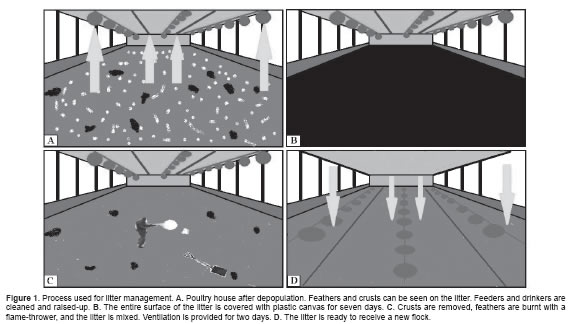
<body><![CDATA[<p>Many microorganisms in poultry litter originate   in bird excrement, including Enterobacteriaceae   and other bacteria with zoonotic capacity (Cook <i>et al.</i>, 2012; Fries <i>et al.</i>, 2005). Continuous exposure   to undesirable bacteria from litter can increase   contamination of the birds' digestive tract. Even   though enterobacteria do not cause health problems in chickens, it may become a human sanitary problem during slaughtering due to contamination when the carcass accidentally come in contact with contents from infected crop or intestine, compromising food safety and public health (Haapapuro <i>et al.</i>,1997).</p>     <p>Transference of pathogens into the food chain   may also occur when litter is applied to soil as an   organic fertilizer, resulting in the contamination of   fresh produce (Lovanh <i>et al.</i>, 2007; Volkova <i>et al.</i>,   2009). Contaminated litter can promote pathogen   perpetuation from one flock to another when it is   reused more than once. For this reason, reuse of   litter is not recommended when sanitary episodes have occurred.</p>     <p>Independent of litter destination (reuse for   subsequent flocks or used as fertilizer), treatment   to reduce or inactivate bacteria is vital for   decreasing animal and human health risks. Thus,   litter treatment is considered a needful condition in   good poultry production practices (Larrison <i>et al.</i>,   2010; Pope and Cherry, 2000). Total replacement   of the litter after every flock results in considerable   environmental impact due to the high amounts of   substrate required (e.g. wood shavings, straw or   sawdust) and the destination of this residue in the   environment (Pandey and Soupir, 2011; Pote <i>et al.</i>,   2011, Watts <i>et al.</i>, 2011). Furthermore, changing the   litter after every flock represents a significant cost in poultry production.</p>     <p>The purpose of this study was to evaluate the   presence of <i>Salmonella</i> after fermenting the litter by covering it with a canvas prior to each reuse.</p>     <p>&nbsp;</p>     <p><b><font size="3">Materials and methods</font></b></p>     <p>   <i>Experiments</i></p>     <p>   A total of 1,280 litter samples from several   poultry farms in Midwestern Brazil were analyzed   during seven consecutive flocks. The population   corresponds to 196 producers.</p>     <p><i>Litter management</i></p>     <p>   The procedure performed between flocks (<a href="#f1">Figure   1</a>) is briefly described as follows:</p>     ]]></body>
<body><![CDATA[<p align="center"><a name="f1"></a><img src="/img/revistas/rccp/v27n1/v27n1a03f1.jpg"></p>     <p>1. Cleaning and rising of the equipment (feeders,   drinkers, etc.) with soap and water immediately following depopulation (<a href="#f1">Figure 1A</a>).</p>     <p>   2. Watering the litter (20 liters/m<sup>2</sup>).</p>     <p>   3. All columns inside the shed were covered with   plastic canvas (approximately one square meter)   to protect them from the fermentation process.</p>     <p>   4. Displacing the litter from the shed sides to   create a space between the walls and the litter.</p>     <p>   5. Covering the litter with plastic canvas avoiding   air entrance (<a href="#f1">Figure 1B</a>).</p>     <p>   6. Removing the canvas after seven days of   fermentation, discarding the crusts and mixing   the litter.</p>     <p>   7. Applying the flame-thrower uniformly to the   entire surface to burn residue such as feathers   (<a href="#f1">Figure 1C</a>).</p>     <p>   8. Ventilating the house for two days before   placing the new flock of birds (<a href="#f1">Figure 1D</a>).</p>     <p>After this process was completed, one-day-old chicks were housed directly on the reused litter.</p>     ]]></body>
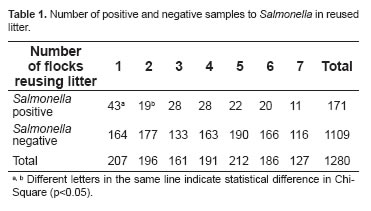
<body><![CDATA[<p><i>Sample collection</i></p>     <p>   Litter samples were collected when birds were   between 28 and 32 days of age. Collectors cleaned   their hands carefully before. Plastic boots with shoe   cover swabs were used for collection. Collectors   walked on the litter for about 10 min, focusing   placement of steps between feeders and drinkers,   given that these sites maintain a high concentration   of animals and therefore a greater amount of feces.   The sample was collected on the shoe cover surface   in contact with the litter. The shoe cover swabs were   placed inside sterile bags containing 1% buffered   peptone water solution and stored in cool boxes   or coolers with ice while microorganism samples   solubilized. Sample bags were sent to laboratory   after collection.</p>     <p><i>Laboratory processing</i></p>     <p>   Shoe cover swabs were discarded. Two aliquots of   the solution were transferred to selective enrichment   broths: 0.5 &plusmn; 0.05 mL into 10 mL Tetrathionate Broth   and 0.1 &plusmn; 0.02 mL into 10 mL Rappaport-Vassiliadis.   Both were incubated separately at 35 &plusmn; 2 &deg;C and 42   &plusmn; 2 &deg;C for 18 h and 24 h, respectively, and carefully   mixed by vortexing. Then, each culture was streaked   both in Brilliant Green agar and MacConkey agar   plates using 10 &mu;L inoculum for each. Agar plates   were incubated overnight at 35 &plusmn; 2 &deg;C and examined   for the presence of <i>Salmonella</i> spp. colonies   (BRASIL, 1995).</p>     <p><i>Statistical analysis</i></p>     <p>   The chi-squared test was used to verify whether   the frequency of positive samples for <i>Salmonella</i>   spp. was related to the number of litter reuses. The   criterion for statistical significance was p&lt;0.05.</p>     <p>&nbsp;</p>     <p><b><font size="3">Results</font></b></p>     <p>   Detection of <i>Salmonella</i> spp. in litter reused up to   seven times is shown in <a href="#t1">table 1.</a> A decrease in positive   samples was observed when comparing the new litter   with all subsequent reused litters after the covering   process, significant between the first flock with new   litter and the second flock with the first reuse.</p>     <p align="center"><a name="t1"></a><img src="/img/revistas/rccp/v27n1/v27n1a03t1.jpg"></p>     ]]></body>
<body><![CDATA[<p>Besides the observed <i>Salmonella</i> reduction   and beyond the aim of this report, a noteworthy   decrease of darkling beetle (<i>Alphitobius diaperinus</i>)   infestation was also observed after the covering   process. Although it was not measured, we consider   this an interesting observation for further studies   since the covering and fermentation processes   could also eliminate most insects and larvae without requiring the use of chemicals.</p>     <p>&nbsp;</p>     <p><b><font size="3">Discussion</font></b></p>     <p>   The farms included in this study used the littercovering   method between flocks as a strategy for poultry waste management. Ammonia concentration   increased during the anaerobic digestion and   fermentation process that probably occurred.   We believe this leads to a microbicidal action in   different populations, including <i>Salmonella</i> spp.   These results are in agreement with Roll <i>et al.</i>   (2011) who analyzed the presence of <i>Salmonella</i> in   reused litters of 14 consecutive flocks and observed   a reduction in the presence of <i>Salmonella</i> after   treatment with lime.</p>     <p>The fermentation process consists of the   hydrolysis of complex components, including fats,   proteins and polysaccharides, which are broken   down by microorganisms to their component   subunits with the posterior production of collectable   biogases (mainly methane and CO<sub>2</sub>) (Chen <i>et al.</i>, 2008; Kelleher <i>et al.</i>, 2002). Poultry waste is   composed of litter, bird manure, and other residues.   Due to high protein and amino acid metabolism,   poultry manure is rich in organic nitrogen in the   form of urea, which is mostly converted into   ammonia by microbial activity, consequently   undergoing a nitrification process (i.e. conversion   to nitrate) (Kelleher <i>et al.</i>, 2002). In this pathway   ammonia exists as either a gas (NH<sub>3</sub>) or as   ammonium (NH<sub>4</sub>  <sup>+</sup>), which is a hydrophobic, watersoluble   and highly permeable molecule to biological membranes.</p>     <p>Ammonia is proposed as an anaerobic digestion   inhibitor by the leak of proton-motive forces or   interference with the tricarboxilic acid cycle. The   first requires both a pH and electron gradient. The   second involves the amination of &alpha;-ketoglutarate, an   intermediate needed for the metabolism of organic compounds (Chen <i>et al.</i>, 2008; Krylova <i>et al.</i>, 1997).</p>     <p>Additional abiotic factors should be considered;   the temperature reached during fermentation   may also play a microbicidal role. The maximum   temperature in our study was 60 &deg;C (data not   shown). Kim <i>et al.</i> (2012) observed that reduction   of <i>Salmonella</i> can be achieved by exposing fresh   chicken litter to 70 &deg;C for 80.5 to 100.8 min.   Wilkinson <i>et al.</i> (2011) reported that <i>Salmonella</i>   <i>typhimurium</i> in fresh chicken litter was completely   eliminated in 1 h at 55 to 65 &deg;C under laboratory   conditions. Other abiotic parameters that regulate   microbiological conditions are pH (Payne <i>et al.</i>,   2007) and moisture (Eriksson de Rezende <i>et al.</i>,   2001). Different litter management and treatment   methods can modify those factors (Miles <i>et al.</i>, 2011; Torok <i>et al.</i>, 2009).</p>     <p>Microorganisms and their complex microbial   communities are responsible for most biochemical   transformations. Using a combination of culture   and molecular detection in intestinal chicken,   Lu <i>et al.</i> (2003a) reported that Gram-positive   bacteria and proteobacteria were the predominant   populations (including <i>Lactobacillus, Clostridium,   Staphylococcus</i> and <i>Streptococcus</i>) involved in   the decomposition of organic material, including   wood. This may explain the absence of important   animal and human pathogens from the environment.   Our study was conducted in Midwestern Brazil.   Composition of litter microbiota depends on the   geographical region (Cressman <i>et al.</i>, 2010) and   environmental conditions (Dumas <i>et al.</i>, 2011). It   should be noted that most of the studies have been conducted in North America.</p>     <p>It has been demonstrated that diversity of   intestinal bacterial populations increases as birds   age (Lu <i>et al.</i>, 2003b). Deposition of excreta   onto the litter rapidly alters biotic and abiotic   environments simultaneously as litter conditions   affect the intestinal microbiota and immune   responses (Chapman and Rayavarapu, 2007; Lee <i>et al.</i>, 2011). This supports our hypothesis that reusing   the litter under proper management conditions   may improve intestinal microbiota composition, important for the growth and health of the bird.</p>     <p>In conclusion, by reusing litter we observed   a reduction in the presence of <i>Salmonella</i> spp.,   which could contribute to reducing costs and usage   of raw litter material. Further studies are needed   to evaluate the impact of reusing the litter on the   presence of other relevant poultry pathogens such   as <i>Clostridium</i> and <i>Eimeria</i>, as well as its effect on   other physical traits, production cost, and its impact on natural resources.</p>     ]]></body>
<body><![CDATA[<p>&nbsp;</p> </font> <hr size="1" /> <font size="2" face="Verdana, Arial, Helvetica, sans-serif">     <p><a name="0"></a><a href="#b0">&curren;</a> To cite this article: S&aacute;nchez-Jim&eacute;nez MM, Ortiz-Rom&aacute;n LF, Castrill&oacute;n-Salazar LL, Giraldo-Echeverri CA, Olivera-Angel M. Application of a polymerase chain reaction test for the detection of Brucella canis from clinical samples of canines and humans. Rev Colomb Cienc Pecu 2014; 27:3-11.</p> </font> <hr size="1" /> <font size="2" face="Verdana, Arial, Helvetica, sans-serif">     <p>&nbsp;</p>     <p>&nbsp;</p>     <p><b><font size="3">References</font></b></p>     <!-- ref --><p>   BRASIL. M&eacute;todo Anal&iacute;tico de Carca&ccedil;as de Aves e Pesquisa   de <i>Salmonella</i>. Portaria n&deg;8 de 23 de janeiro de 1995. Bras&iacute;lia.   Programa Nacional de Sanidade Av&iacute;cola (PNSA) 1995.    &nbsp;&nbsp;&nbsp;&nbsp;&nbsp;&nbsp;&nbsp;&nbsp;[&#160;<a href="javascript:void(0);" onclick="javascript: window.open('/scielo.php?script=sci_nlinks&ref=000078&pid=S0120-0690201400010000300001&lng=','','width=640,height=500,resizable=yes,scrollbars=1,menubar=yes,');">Links</a>&#160;]<!-- end-ref --></p>     <!-- ref --><p>   Cook A, Odumeru J, Lee S, Pollari F. <i>Campylobacter</i>,   <i>Salmonella</i>, <i>Listeria monocytogenes</i>, verotoxigenic <i>Escherichia   coli</i>, and <i>Escherichia coli</i> prevalence, enumeration, and   subtypes on retail chicken breasts with and without skin. J Food   Prot 2012; 75:34-40.    &nbsp;&nbsp;&nbsp;&nbsp;&nbsp;&nbsp;&nbsp;&nbsp;[&#160;<a href="javascript:void(0);" onclick="javascript: window.open('/scielo.php?script=sci_nlinks&ref=000080&pid=S0120-0690201400010000300002&lng=','','width=640,height=500,resizable=yes,scrollbars=1,menubar=yes,');">Links</a>&#160;]<!-- end-ref --></p>     <!-- ref --><p>   Cressman MD, Yu Z, Nelson MC, Moeller SJ, Lilburn MS,   Zerby HN. Interrelations between the microbiotas in the litter   and in the intestines of commercial broiler chickens. Appl   Environ Microbiol 2010; 76:6572-6582.    &nbsp;&nbsp;&nbsp;&nbsp;&nbsp;&nbsp;&nbsp;&nbsp;[&#160;<a href="javascript:void(0);" onclick="javascript: window.open('/scielo.php?script=sci_nlinks&ref=000082&pid=S0120-0690201400010000300003&lng=','','width=640,height=500,resizable=yes,scrollbars=1,menubar=yes,');">Links</a>&#160;]<!-- end-ref --></p>     <!-- ref --><p>   Chapman HD, Rayavarapu S. Acquisition of immunity to   Eimeria maxima in newly hatched chickens reared on new or   reused litter. Avian Pathol 2007; 36:319-323.    &nbsp;&nbsp;&nbsp;&nbsp;&nbsp;&nbsp;&nbsp;&nbsp;[&#160;<a href="javascript:void(0);" onclick="javascript: window.open('/scielo.php?script=sci_nlinks&ref=000084&pid=S0120-0690201400010000300004&lng=','','width=640,height=500,resizable=yes,scrollbars=1,menubar=yes,');">Links</a>&#160;]<!-- end-ref --></p>     <!-- ref --><p>   Chen Y, Cheng J, Creamer K. Inhibition of anaerobic digestion   process: A review. Bioresour Technol 2008; 99:4044-4064.    &nbsp;&nbsp;&nbsp;&nbsp;&nbsp;&nbsp;&nbsp;&nbsp;[&#160;<a href="javascript:void(0);" onclick="javascript: window.open('/scielo.php?script=sci_nlinks&ref=000086&pid=S0120-0690201400010000300005&lng=','','width=640,height=500,resizable=yes,scrollbars=1,menubar=yes,');">Links</a>&#160;]<!-- end-ref --></p>     <!-- ref --><p>   Dumas MD, Polson SW, Ritter D, Ravel J, Gelb J, Jr., Morgan   R, Wommack KE. Impacts of poultry house environment on   poultry litter bacterial community composition. PLoS One   2011; 6:1-12.    &nbsp;&nbsp;&nbsp;&nbsp;&nbsp;&nbsp;&nbsp;&nbsp;[&#160;<a href="javascript:void(0);" onclick="javascript: window.open('/scielo.php?script=sci_nlinks&ref=000088&pid=S0120-0690201400010000300006&lng=','','width=640,height=500,resizable=yes,scrollbars=1,menubar=yes,');">Links</a>&#160;]<!-- end-ref --></p>     <!-- ref --><p>   Eriksson de Rezende CL, Mallinson ET, Gupte A, Joseph SW.   <i>Salmonella</i> spp. are affected by different levels of water activity   in closed microcosms. J Ind Microbiol Biot 2001; 26:222-225.    &nbsp;&nbsp;&nbsp;&nbsp;&nbsp;&nbsp;&nbsp;&nbsp;[&#160;<a href="javascript:void(0);" onclick="javascript: window.open('/scielo.php?script=sci_nlinks&ref=000090&pid=S0120-0690201400010000300007&lng=','','width=640,height=500,resizable=yes,scrollbars=1,menubar=yes,');">Links</a>&#160;]<!-- end-ref --></p>     <!-- ref --><p>   Fries R, Akcan M, Bandick N, Kobe A. Microflora of two   different types of poultry litter. Br Poult Sci 2005; 46:668-672.    &nbsp;&nbsp;&nbsp;&nbsp;&nbsp;&nbsp;&nbsp;&nbsp;[&#160;<a href="javascript:void(0);" onclick="javascript: window.open('/scielo.php?script=sci_nlinks&ref=000092&pid=S0120-0690201400010000300008&lng=','','width=640,height=500,resizable=yes,scrollbars=1,menubar=yes,');">Links</a>&#160;]<!-- end-ref --></p>     <!-- ref --><p>   Haapapuro ER, Barnard ND, Simon M. Review--animal waste   used as livestock feed: dangers to human health. Prev Med   1997; 26:599-602.    &nbsp;&nbsp;&nbsp;&nbsp;&nbsp;&nbsp;&nbsp;&nbsp;[&#160;<a href="javascript:void(0);" onclick="javascript: window.open('/scielo.php?script=sci_nlinks&ref=000094&pid=S0120-0690201400010000300009&lng=','','width=640,height=500,resizable=yes,scrollbars=1,menubar=yes,');">Links</a>&#160;]<!-- end-ref --></p>     <!-- ref --><p>   Kelleher BP, Leahy JJ, Henihan AM, O'Dwyer TF, Sutton D,   Leahy MJ. Advances in poultry litter disposal technology-a   review. Bioresour Technol 2002; 83:27-36.    &nbsp;&nbsp;&nbsp;&nbsp;&nbsp;&nbsp;&nbsp;&nbsp;[&#160;<a href="javascript:void(0);" onclick="javascript: window.open('/scielo.php?script=sci_nlinks&ref=000096&pid=S0120-0690201400010000300010&lng=','','width=640,height=500,resizable=yes,scrollbars=1,menubar=yes,');">Links</a>&#160;]<!-- end-ref --></p>     <!-- ref --><p>   Kim J, Diao J, Shepherd MW, Jr., Singh R, Heringa SD, Gong   C, Jiang X. Validating thermal inactivation of <i>Salmonella</i> spp.   in fresh and aged chicken litter. Appl Environ Microbiol 2012;   78:1302-1307.    &nbsp;&nbsp;&nbsp;&nbsp;&nbsp;&nbsp;&nbsp;&nbsp;[&#160;<a href="javascript:void(0);" onclick="javascript: window.open('/scielo.php?script=sci_nlinks&ref=000098&pid=S0120-0690201400010000300011&lng=','','width=640,height=500,resizable=yes,scrollbars=1,menubar=yes,');">Links</a>&#160;]<!-- end-ref --></p>     <!-- ref --><p>   Krylova NI, Khabiboulline RE, Naumova RP, Nagel MA. The   influence of ammonium and methods for removal during the   anaerobic treatment of poultry manure. J Chem Technol Biot   1997; 70:99-105.    &nbsp;&nbsp;&nbsp;&nbsp;&nbsp;&nbsp;&nbsp;&nbsp;[&#160;<a href="javascript:void(0);" onclick="javascript: window.open('/scielo.php?script=sci_nlinks&ref=000100&pid=S0120-0690201400010000300012&lng=','','width=640,height=500,resizable=yes,scrollbars=1,menubar=yes,');">Links</a>&#160;]<!-- end-ref --></p>     <!-- ref --><p>   Larrison EL, Byrd JA, Davis MA. Effects of litter amendments   on broiler growth characteristics and <i>Salmonella</i> colonization in   the crop and cecum. J Appl Poult Res 2010; 19:132-136.    &nbsp;&nbsp;&nbsp;&nbsp;&nbsp;&nbsp;&nbsp;&nbsp;[&#160;<a href="javascript:void(0);" onclick="javascript: window.open('/scielo.php?script=sci_nlinks&ref=000102&pid=S0120-0690201400010000300013&lng=','','width=640,height=500,resizable=yes,scrollbars=1,menubar=yes,');">Links</a>&#160;]<!-- end-ref --></p>     <!-- ref --><p>   Lee KW, Lillehoj HS, Lee SH, Jang SI, Ritter GD, Bautista   DA, Lillehoj EP. Impact of fresh or used litter on the posthatch   immune system of commercial broilers. Avian Dis 2011;   55:539-544.    &nbsp;&nbsp;&nbsp;&nbsp;&nbsp;&nbsp;&nbsp;&nbsp;[&#160;<a href="javascript:void(0);" onclick="javascript: window.open('/scielo.php?script=sci_nlinks&ref=000104&pid=S0120-0690201400010000300014&lng=','','width=640,height=500,resizable=yes,scrollbars=1,menubar=yes,');">Links</a>&#160;]<!-- end-ref --></p>     <!-- ref --><p>   Lovanh N, Cook KL, Rothrock MJ, Miles DM, Sistani K.   Spatial shifts in microbial population structure within poultry   litter associated with physicochemical properties. Poult Sci   2007; 86:1840-1849.    &nbsp;&nbsp;&nbsp;&nbsp;&nbsp;&nbsp;&nbsp;&nbsp;[&#160;<a href="javascript:void(0);" onclick="javascript: window.open('/scielo.php?script=sci_nlinks&ref=000106&pid=S0120-0690201400010000300015&lng=','','width=640,height=500,resizable=yes,scrollbars=1,menubar=yes,');">Links</a>&#160;]<!-- end-ref --></p>     <!-- ref --><p>   Lu J, Sanchez S, Hofacre C, Maurer JJ, Harmon BG, Lee MD.   Evaluation of broiler litter with reference to the microbial   composition as assessed by using 16S rRNA and functional   gene markers. Appl Environ Microbiol 2003a; 69:901-908.    &nbsp;&nbsp;&nbsp;&nbsp;&nbsp;&nbsp;&nbsp;&nbsp;[&#160;<a href="javascript:void(0);" onclick="javascript: window.open('/scielo.php?script=sci_nlinks&ref=000108&pid=S0120-0690201400010000300016&lng=','','width=640,height=500,resizable=yes,scrollbars=1,menubar=yes,');">Links</a>&#160;]<!-- end-ref --></p>     <!-- ref --><p>   Lu J, Idris U, Harmon B, Hofacre C, Maurer JJ, Lee MD.   Diversity and succession of the intestinal bacterial community   of the maturing broiler chicken. Appl Environ Microbiol 2003b;   69:6816-6824.    &nbsp;&nbsp;&nbsp;&nbsp;&nbsp;&nbsp;&nbsp;&nbsp;[&#160;<a href="javascript:void(0);" onclick="javascript: window.open('/scielo.php?script=sci_nlinks&ref=000110&pid=S0120-0690201400010000300017&lng=','','width=640,height=500,resizable=yes,scrollbars=1,menubar=yes,');">Links</a>&#160;]<!-- end-ref --></p>     <!-- ref --><p>   Macklin KS, Hess JB, Bilgili SF, Norton RA. Effects of inhouse   composting of litter on bacterial levels. J Appl Poult Res   2006; 15:531-537.    &nbsp;&nbsp;&nbsp;&nbsp;&nbsp;&nbsp;&nbsp;&nbsp;[&#160;<a href="javascript:void(0);" onclick="javascript: window.open('/scielo.php?script=sci_nlinks&ref=000112&pid=S0120-0690201400010000300018&lng=','','width=640,height=500,resizable=yes,scrollbars=1,menubar=yes,');">Links</a>&#160;]<!-- end-ref --></p>     <!-- ref --><p>   Miles DM, Rowe DE, Cathcart TC. High litter moisture content   suppresses litter ammonia volatilization. Poult Sci 2011;   90:1397-1405.    &nbsp;&nbsp;&nbsp;&nbsp;&nbsp;&nbsp;&nbsp;&nbsp;[&#160;<a href="javascript:void(0);" onclick="javascript: window.open('/scielo.php?script=sci_nlinks&ref=000114&pid=S0120-0690201400010000300019&lng=','','width=640,height=500,resizable=yes,scrollbars=1,menubar=yes,');">Links</a>&#160;]<!-- end-ref --></p>     <!-- ref --><p>   Pandey PK, Soupir ML. <i>Escherichia coli</i> inactivation kinetics   in anaerobic digestion of dairy manure under moderate,   mesophilic and thermophilic temperatures. AMB Express 2011;   1:18.    &nbsp;&nbsp;&nbsp;&nbsp;&nbsp;&nbsp;&nbsp;&nbsp;[&#160;<a href="javascript:void(0);" onclick="javascript: window.open('/scielo.php?script=sci_nlinks&ref=000116&pid=S0120-0690201400010000300020&lng=','','width=640,height=500,resizable=yes,scrollbars=1,menubar=yes,');">Links</a>&#160;]<!-- end-ref --></p>     <!-- ref --><p>   Payne JB, Osborne JA, Jenkins PK, Sheldon BW. Modeling the   growth and death kinetics of <i>Salmonella</i> in poultry litter as a   function of ph and water activity. Poult Sci 2007; 86:191-201.    &nbsp;&nbsp;&nbsp;&nbsp;&nbsp;&nbsp;&nbsp;&nbsp;[&#160;<a href="javascript:void(0);" onclick="javascript: window.open('/scielo.php?script=sci_nlinks&ref=000118&pid=S0120-0690201400010000300021&lng=','','width=640,height=500,resizable=yes,scrollbars=1,menubar=yes,');">Links</a>&#160;]<!-- end-ref --></p>     <!-- ref --><p>   Pope MJ, Cherry TE. An evaluation of the presence of   pathogens on broilers raised on poultry litter treatment-treated   litter. Poult Sci 2000; 79:1351-1355.    &nbsp;&nbsp;&nbsp;&nbsp;&nbsp;&nbsp;&nbsp;&nbsp;[&#160;<a href="javascript:void(0);" onclick="javascript: window.open('/scielo.php?script=sci_nlinks&ref=000120&pid=S0120-0690201400010000300022&lng=','','width=640,height=500,resizable=yes,scrollbars=1,menubar=yes,');">Links</a>&#160;]<!-- end-ref --></p>     <!-- ref --><p>   Pote DH, Way TR, Kleinman PJ, Moore PA, Jr., Meisinger JJ,   Sistani KR, Saporito LS, Allen AL, Feyereisen GW. Subsurface   application of poultry litter in pasture and no-till soils. J   Environ Qual 2011; 40:402-411.    &nbsp;&nbsp;&nbsp;&nbsp;&nbsp;&nbsp;&nbsp;&nbsp;[&#160;<a href="javascript:void(0);" onclick="javascript: window.open('/scielo.php?script=sci_nlinks&ref=000122&pid=S0120-0690201400010000300023&lng=','','width=640,height=500,resizable=yes,scrollbars=1,menubar=yes,');">Links</a>&#160;]<!-- end-ref --></p>     <!-- ref --><p>   Roll VF, Dai Pra MA, Roll AP. Research on <i>Salmonella</i> in   broiler litter reused for up to 14 consecutive flocks. Poult Sci   2011; 90:2257-2262.    &nbsp;&nbsp;&nbsp;&nbsp;&nbsp;&nbsp;&nbsp;&nbsp;[&#160;<a href="javascript:void(0);" onclick="javascript: window.open('/scielo.php?script=sci_nlinks&ref=000124&pid=S0120-0690201400010000300024&lng=','','width=640,height=500,resizable=yes,scrollbars=1,menubar=yes,');">Links</a>&#160;]<!-- end-ref --></p>     <!-- ref --><p>   Torok VA, Hughes RJ, Ophel-Keller K, Ali M, Macalpine   R. Influence of different litter materials on cecal microbiota   colonization in broiler chickens. Poult Sci 2009; 88:2474-2481.    &nbsp;&nbsp;&nbsp;&nbsp;&nbsp;&nbsp;&nbsp;&nbsp;[&#160;<a href="javascript:void(0);" onclick="javascript: window.open('/scielo.php?script=sci_nlinks&ref=000126&pid=S0120-0690201400010000300025&lng=','','width=640,height=500,resizable=yes,scrollbars=1,menubar=yes,');">Links</a>&#160;]<!-- end-ref --><!-- ref -->   Vizzier Thaxton Y, Balzli CL, Tankson JD. Relationship of   broiler flock numbers to litter microflora. J Appl Poult Res   2003; 12:81-84.    &nbsp;&nbsp;&nbsp;&nbsp;&nbsp;&nbsp;&nbsp;&nbsp;[&#160;<a href="javascript:void(0);" onclick="javascript: window.open('/scielo.php?script=sci_nlinks&ref=000127&pid=S0120-0690201400010000300026&lng=','','width=640,height=500,resizable=yes,scrollbars=1,menubar=yes,');">Links</a>&#160;]<!-- end-ref --></p>     <!-- ref --><p>   Volkova VV, Bailey RH, Wills RW. <i>Salmonella</i> in broiler   litter and properties of soil at farm location. PLoS One 2009;   4:e6403.    &nbsp;&nbsp;&nbsp;&nbsp;&nbsp;&nbsp;&nbsp;&nbsp;[&#160;<a href="javascript:void(0);" onclick="javascript: window.open('/scielo.php?script=sci_nlinks&ref=000129&pid=S0120-0690201400010000300027&lng=','','width=640,height=500,resizable=yes,scrollbars=1,menubar=yes,');">Links</a>&#160;]<!-- end-ref --></p>     <!-- ref --><p>   Watts DB, Way TR, Torbert HA. Subsurface application of   poultry litter and its influence on nutrient losses in runoff water   from permanent pastures. J Environ Qual 2011; 40:421-430.    &nbsp;&nbsp;&nbsp;&nbsp;&nbsp;&nbsp;&nbsp;&nbsp;[&#160;<a href="javascript:void(0);" onclick="javascript: window.open('/scielo.php?script=sci_nlinks&ref=000131&pid=S0120-0690201400010000300028&lng=','','width=640,height=500,resizable=yes,scrollbars=1,menubar=yes,');">Links</a>&#160;]<!-- end-ref --></p>     ]]></body>
<body><![CDATA[<!-- ref --><p>   Wilkinson KG, Tee E, Tomkins RB, Hepworth G, Premier R.   Effect of heating and aging of poultry litter on the persistence of   enteric bacteria. Poult Sci 2011; 90:10-18.    &nbsp;&nbsp;&nbsp;&nbsp;&nbsp;&nbsp;&nbsp;&nbsp;[&#160;<a href="javascript:void(0);" onclick="javascript: window.open('/scielo.php?script=sci_nlinks&ref=000133&pid=S0120-0690201400010000300029&lng=','','width=640,height=500,resizable=yes,scrollbars=1,menubar=yes,');">Links</a>&#160;]<!-- end-ref --></p> </font>      ]]></body><back>
<ref-list>
<ref id="B1">
<nlm-citation citation-type="book">
<collab>BRASIL</collab>
<source><![CDATA[Método Analítico de Carcaças de Aves e Pesquisa de Salmonella. Portaria n&deg;8 de 23 de janeiro de 1995]]></source>
<year>1995</year>
<publisher-loc><![CDATA[Brasília ]]></publisher-loc>
<publisher-name><![CDATA[Programa Nacional de Sanidade Avícola (PNSA)]]></publisher-name>
</nlm-citation>
</ref>
<ref id="B2">
<nlm-citation citation-type="journal">
<person-group person-group-type="author">
<name>
<surname><![CDATA[Cook]]></surname>
<given-names><![CDATA[A]]></given-names>
</name>
<name>
<surname><![CDATA[Odumeru]]></surname>
<given-names><![CDATA[J]]></given-names>
</name>
<name>
<surname><![CDATA[Lee]]></surname>
<given-names><![CDATA[S]]></given-names>
</name>
<name>
<surname><![CDATA[Pollari]]></surname>
<given-names><![CDATA[F]]></given-names>
</name>
</person-group>
<article-title xml:lang="en"><![CDATA[Campylobacter, Salmonella, Listeria monocytogenes, verotoxigenic Escherichia coli, and Escherichia coli prevalence, enumeration, and subtypes on retail chicken breasts with and without skin]]></article-title>
<source><![CDATA[J Food Prot]]></source>
<year>2012</year>
<volume>75</volume>
<page-range>34-40</page-range></nlm-citation>
</ref>
<ref id="B3">
<nlm-citation citation-type="journal">
<person-group person-group-type="author">
<name>
<surname><![CDATA[Cressman]]></surname>
<given-names><![CDATA[MD]]></given-names>
</name>
<name>
<surname><![CDATA[Yu]]></surname>
<given-names><![CDATA[Z]]></given-names>
</name>
<name>
<surname><![CDATA[Nelson]]></surname>
<given-names><![CDATA[MC]]></given-names>
</name>
<name>
<surname><![CDATA[Moeller]]></surname>
<given-names><![CDATA[SJ]]></given-names>
</name>
<name>
<surname><![CDATA[Lilburn]]></surname>
<given-names><![CDATA[MS]]></given-names>
</name>
<name>
<surname><![CDATA[Zerby]]></surname>
<given-names><![CDATA[HN]]></given-names>
</name>
</person-group>
<article-title xml:lang="en"><![CDATA[Interrelations between the microbiotas in the litter and in the intestines of commercial broiler chickens]]></article-title>
<source><![CDATA[Appl Environ Microbiol]]></source>
<year>2010</year>
<volume>76</volume>
<page-range>6572-6582</page-range></nlm-citation>
</ref>
<ref id="B4">
<nlm-citation citation-type="journal">
<person-group person-group-type="author">
<name>
<surname><![CDATA[Chapman]]></surname>
<given-names><![CDATA[HD]]></given-names>
</name>
<name>
<surname><![CDATA[Rayavarapu]]></surname>
<given-names><![CDATA[S]]></given-names>
</name>
</person-group>
<article-title xml:lang="en"><![CDATA[Acquisition of immunity to Eimeria maxima in newly hatched chickens reared on new or reused litter]]></article-title>
<source><![CDATA[Avian Pathol]]></source>
<year>2007</year>
<volume>36</volume>
<page-range>319-323</page-range></nlm-citation>
</ref>
<ref id="B5">
<nlm-citation citation-type="journal">
<person-group person-group-type="author">
<name>
<surname><![CDATA[Chen]]></surname>
<given-names><![CDATA[Y]]></given-names>
</name>
<name>
<surname><![CDATA[Cheng]]></surname>
<given-names><![CDATA[J]]></given-names>
</name>
<name>
<surname><![CDATA[Creamer]]></surname>
<given-names><![CDATA[K]]></given-names>
</name>
</person-group>
<article-title xml:lang="en"><![CDATA[Inhibition of anaerobic digestion process: A review]]></article-title>
<source><![CDATA[Bioresour Technol]]></source>
<year>2008</year>
<volume>99</volume>
<page-range>4044-4064</page-range></nlm-citation>
</ref>
<ref id="B6">
<nlm-citation citation-type="journal">
<person-group person-group-type="author">
<name>
<surname><![CDATA[Dumas]]></surname>
<given-names><![CDATA[MD]]></given-names>
</name>
<name>
<surname><![CDATA[Polson]]></surname>
<given-names><![CDATA[SW]]></given-names>
</name>
<name>
<surname><![CDATA[Ritter]]></surname>
<given-names><![CDATA[D]]></given-names>
</name>
<name>
<surname><![CDATA[Ravel]]></surname>
<given-names><![CDATA[J]]></given-names>
</name>
<name>
<surname><![CDATA[Gelb]]></surname>
<given-names><![CDATA[J]]></given-names>
</name>
<name>
<surname><![CDATA[Jr., Morgan]]></surname>
<given-names><![CDATA[R]]></given-names>
</name>
<name>
<surname><![CDATA[Wommack]]></surname>
<given-names><![CDATA[KE]]></given-names>
</name>
</person-group>
<article-title xml:lang="en"><![CDATA[Impacts of poultry house environment on poultry litter bacterial community composition]]></article-title>
<source><![CDATA[PLoS One]]></source>
<year>2011</year>
<volume>6</volume>
<page-range>1-12</page-range></nlm-citation>
</ref>
<ref id="B7">
<nlm-citation citation-type="journal">
<person-group person-group-type="author">
<name>
<surname><![CDATA[Eriksson]]></surname>
<given-names><![CDATA[de Rezende CL]]></given-names>
</name>
<name>
<surname><![CDATA[Mallinson]]></surname>
<given-names><![CDATA[ET]]></given-names>
</name>
<name>
<surname><![CDATA[Gupte]]></surname>
<given-names><![CDATA[A]]></given-names>
</name>
<name>
<surname><![CDATA[Joseph]]></surname>
<given-names><![CDATA[SW]]></given-names>
</name>
</person-group>
<article-title xml:lang="en"><![CDATA[Salmonella spp. are affected by different levels of water activity in closed microcosms]]></article-title>
<source><![CDATA[J Ind Microbiol Biot]]></source>
<year>2001</year>
<volume>26</volume>
<page-range>222-225</page-range></nlm-citation>
</ref>
<ref id="B8">
<nlm-citation citation-type="journal">
<person-group person-group-type="author">
<name>
<surname><![CDATA[Fries]]></surname>
<given-names><![CDATA[R]]></given-names>
</name>
<name>
<surname><![CDATA[Akcan]]></surname>
<given-names><![CDATA[M]]></given-names>
</name>
<name>
<surname><![CDATA[Bandick]]></surname>
<given-names><![CDATA[N]]></given-names>
</name>
<name>
<surname><![CDATA[Kobe]]></surname>
<given-names><![CDATA[A]]></given-names>
</name>
</person-group>
<article-title xml:lang="en"><![CDATA[Microflora of two different types of poultry litter]]></article-title>
<source><![CDATA[Br Poult Sci]]></source>
<year>2005</year>
<volume>46</volume>
<page-range>668-672</page-range></nlm-citation>
</ref>
<ref id="B9">
<nlm-citation citation-type="journal">
<person-group person-group-type="author">
<name>
<surname><![CDATA[Haapapuro]]></surname>
<given-names><![CDATA[ER]]></given-names>
</name>
<name>
<surname><![CDATA[Barnard]]></surname>
<given-names><![CDATA[ND]]></given-names>
</name>
<name>
<surname><![CDATA[Simon]]></surname>
<given-names><![CDATA[M]]></given-names>
</name>
</person-group>
<article-title xml:lang="en"><![CDATA[Review--animal waste used as livestock feed: dangers to human health]]></article-title>
<source><![CDATA[Prev Med]]></source>
<year>1997</year>
<volume>26</volume>
<page-range>599-602</page-range></nlm-citation>
</ref>
<ref id="B10">
<nlm-citation citation-type="journal">
<person-group person-group-type="author">
<name>
<surname><![CDATA[Kelleher]]></surname>
<given-names><![CDATA[BP]]></given-names>
</name>
<name>
<surname><![CDATA[Leahy]]></surname>
<given-names><![CDATA[JJ]]></given-names>
</name>
<name>
<surname><![CDATA[Henihan]]></surname>
<given-names><![CDATA[AM]]></given-names>
</name>
<name>
<surname><![CDATA[O'Dwyer]]></surname>
<given-names><![CDATA[TF]]></given-names>
</name>
<name>
<surname><![CDATA[Sutton]]></surname>
<given-names><![CDATA[D]]></given-names>
</name>
<name>
<surname><![CDATA[Leahy]]></surname>
<given-names><![CDATA[MJ]]></given-names>
</name>
</person-group>
<article-title xml:lang="en"><![CDATA[Advances in poultry litter disposal technology-a review]]></article-title>
<source><![CDATA[Bioresour Technol]]></source>
<year>2002</year>
<volume>83</volume>
<page-range>27-36</page-range></nlm-citation>
</ref>
<ref id="B11">
<nlm-citation citation-type="journal">
<person-group person-group-type="author">
<name>
<surname><![CDATA[Kim]]></surname>
<given-names><![CDATA[J]]></given-names>
</name>
<name>
<surname><![CDATA[Diao]]></surname>
<given-names><![CDATA[J]]></given-names>
</name>
<name>
<surname><![CDATA[Shepherd]]></surname>
<given-names><![CDATA[MW]]></given-names>
</name>
<name>
<surname><![CDATA[Jr.,]]></surname>
<given-names><![CDATA[Singh R]]></given-names>
</name>
<name>
<surname><![CDATA[Heringa]]></surname>
<given-names><![CDATA[SD]]></given-names>
</name>
<name>
<surname><![CDATA[Gong]]></surname>
<given-names><![CDATA[C]]></given-names>
</name>
<name>
<surname><![CDATA[Jiang]]></surname>
<given-names><![CDATA[X]]></given-names>
</name>
</person-group>
<article-title xml:lang="en"><![CDATA[Validating thermal inactivation of Salmonella spp. in fresh and aged chicken litter]]></article-title>
<source><![CDATA[Appl Environ Microbiol]]></source>
<year>2012</year>
<volume>78</volume>
<page-range>1302-1307</page-range></nlm-citation>
</ref>
<ref id="B12">
<nlm-citation citation-type="journal">
<person-group person-group-type="author">
<name>
<surname><![CDATA[Krylova]]></surname>
<given-names><![CDATA[NI]]></given-names>
</name>
<name>
<surname><![CDATA[Khabiboulline]]></surname>
<given-names><![CDATA[RE]]></given-names>
</name>
<name>
<surname><![CDATA[Naumova]]></surname>
<given-names><![CDATA[RP]]></given-names>
</name>
<name>
<surname><![CDATA[Nagel]]></surname>
<given-names><![CDATA[MA]]></given-names>
</name>
</person-group>
<article-title xml:lang="en"><![CDATA[The influence of ammonium and methods for removal during the anaerobic treatment of poultry manure]]></article-title>
<source><![CDATA[J Chem Technol Biot]]></source>
<year>1997</year>
<volume>70</volume>
<page-range>99-105</page-range></nlm-citation>
</ref>
<ref id="B13">
<nlm-citation citation-type="journal">
<person-group person-group-type="author">
<name>
<surname><![CDATA[Larrison]]></surname>
<given-names><![CDATA[EL]]></given-names>
</name>
<name>
<surname><![CDATA[Byrd]]></surname>
<given-names><![CDATA[JA]]></given-names>
</name>
<name>
<surname><![CDATA[Davis]]></surname>
<given-names><![CDATA[MA]]></given-names>
</name>
</person-group>
<article-title xml:lang="en"><![CDATA[Effects of litter amendments on broiler growth characteristics and Salmonella colonization in the crop and cecum]]></article-title>
<source><![CDATA[J Appl Poult Res]]></source>
<year>2010</year>
<volume>19</volume>
<page-range>132-136</page-range></nlm-citation>
</ref>
<ref id="B14">
<nlm-citation citation-type="journal">
<person-group person-group-type="author">
<name>
<surname><![CDATA[Lee]]></surname>
<given-names><![CDATA[KW]]></given-names>
</name>
<name>
<surname><![CDATA[Lillehoj]]></surname>
<given-names><![CDATA[HS]]></given-names>
</name>
<name>
<surname><![CDATA[Lee]]></surname>
<given-names><![CDATA[SH]]></given-names>
</name>
<name>
<surname><![CDATA[Jang]]></surname>
<given-names><![CDATA[SI]]></given-names>
</name>
<name>
<surname><![CDATA[Ritter]]></surname>
<given-names><![CDATA[GD]]></given-names>
</name>
<name>
<surname><![CDATA[Bautista]]></surname>
<given-names><![CDATA[DA]]></given-names>
</name>
<name>
<surname><![CDATA[Lillehoj]]></surname>
<given-names><![CDATA[EP]]></given-names>
</name>
</person-group>
<article-title xml:lang="en"><![CDATA[Impact of fresh or used litter on the posthatch immune system of commercial broilers]]></article-title>
<source><![CDATA[Avian Dis]]></source>
<year>2011</year>
<volume>55</volume>
<page-range>539-544</page-range></nlm-citation>
</ref>
<ref id="B15">
<nlm-citation citation-type="journal">
<person-group person-group-type="author">
<name>
<surname><![CDATA[Lovanh]]></surname>
<given-names><![CDATA[N]]></given-names>
</name>
<name>
<surname><![CDATA[Cook]]></surname>
<given-names><![CDATA[KL]]></given-names>
</name>
<name>
<surname><![CDATA[Rothrock]]></surname>
<given-names><![CDATA[MJ]]></given-names>
</name>
<name>
<surname><![CDATA[Miles]]></surname>
<given-names><![CDATA[DM]]></given-names>
</name>
<name>
<surname><![CDATA[Sistani]]></surname>
<given-names><![CDATA[K]]></given-names>
</name>
</person-group>
<article-title xml:lang="en"><![CDATA[Spatial shifts in microbial population structure within poultry litter associated with physicochemical properties]]></article-title>
<source><![CDATA[Poult Sci]]></source>
<year>2007</year>
<volume>86</volume>
<page-range>1840-1849</page-range></nlm-citation>
</ref>
<ref id="B16">
<nlm-citation citation-type="journal">
<person-group person-group-type="author">
<name>
<surname><![CDATA[Lu]]></surname>
<given-names><![CDATA[J]]></given-names>
</name>
<name>
<surname><![CDATA[Sanchez]]></surname>
<given-names><![CDATA[S]]></given-names>
</name>
<name>
<surname><![CDATA[Hofacre]]></surname>
<given-names><![CDATA[C]]></given-names>
</name>
<name>
<surname><![CDATA[Maurer]]></surname>
<given-names><![CDATA[JJ]]></given-names>
</name>
<name>
<surname><![CDATA[Harmon]]></surname>
<given-names><![CDATA[BG]]></given-names>
</name>
<name>
<surname><![CDATA[Lee]]></surname>
<given-names><![CDATA[MD]]></given-names>
</name>
</person-group>
<article-title xml:lang="en"><![CDATA[Evaluation of broiler litter with reference to the microbial composition as assessed by using 16S rRNA and functional gene markers]]></article-title>
<source><![CDATA[Appl Environ Microbiol]]></source>
<year>2003</year>
<month>a</month>
<volume>69</volume>
<page-range>901-908</page-range></nlm-citation>
</ref>
<ref id="B17">
<nlm-citation citation-type="journal">
<person-group person-group-type="author">
<name>
<surname><![CDATA[Lu]]></surname>
<given-names><![CDATA[J]]></given-names>
</name>
<name>
<surname><![CDATA[Idris]]></surname>
<given-names><![CDATA[U]]></given-names>
</name>
<name>
<surname><![CDATA[Harmon]]></surname>
<given-names><![CDATA[B]]></given-names>
</name>
<name>
<surname><![CDATA[Hofacre]]></surname>
<given-names><![CDATA[C]]></given-names>
</name>
<name>
<surname><![CDATA[Maurer]]></surname>
<given-names><![CDATA[JJ]]></given-names>
</name>
<name>
<surname><![CDATA[Lee]]></surname>
<given-names><![CDATA[MD]]></given-names>
</name>
</person-group>
<article-title xml:lang="en"><![CDATA[Diversity and succession of the intestinal bacterial community of the maturing broiler chicken]]></article-title>
<source><![CDATA[Appl Environ Microbiol]]></source>
<year>2003</year>
<month>b</month>
<volume>69</volume>
<page-range>6816-6824</page-range></nlm-citation>
</ref>
<ref id="B18">
<nlm-citation citation-type="journal">
<person-group person-group-type="author">
<name>
<surname><![CDATA[Macklin]]></surname>
<given-names><![CDATA[KS]]></given-names>
</name>
<name>
<surname><![CDATA[Hess]]></surname>
<given-names><![CDATA[JB]]></given-names>
</name>
<name>
<surname><![CDATA[Bilgili]]></surname>
<given-names><![CDATA[SF]]></given-names>
</name>
<name>
<surname><![CDATA[Norton]]></surname>
<given-names><![CDATA[RA]]></given-names>
</name>
</person-group>
<article-title xml:lang="en"><![CDATA[Effects of inhouse composting of litter on bacterial levels]]></article-title>
<source><![CDATA[J Appl Poult Res]]></source>
<year>2006</year>
<volume>15</volume>
<page-range>531-537</page-range></nlm-citation>
</ref>
<ref id="B19">
<nlm-citation citation-type="journal">
<person-group person-group-type="author">
<name>
<surname><![CDATA[Miles]]></surname>
<given-names><![CDATA[DM]]></given-names>
</name>
<name>
<surname><![CDATA[Rowe]]></surname>
<given-names><![CDATA[DE]]></given-names>
</name>
<name>
<surname><![CDATA[Cathcart]]></surname>
<given-names><![CDATA[TC]]></given-names>
</name>
</person-group>
<article-title xml:lang="en"><![CDATA[High litter moisture content suppresses litter ammonia volatilization]]></article-title>
<source><![CDATA[Poult Sci]]></source>
<year>2011</year>
<volume>90</volume>
<page-range>1397-1405</page-range></nlm-citation>
</ref>
<ref id="B20">
<nlm-citation citation-type="journal">
<person-group person-group-type="author">
<name>
<surname><![CDATA[Pandey]]></surname>
<given-names><![CDATA[PK]]></given-names>
</name>
<name>
<surname><![CDATA[Soupir]]></surname>
<given-names><![CDATA[ML]]></given-names>
</name>
</person-group>
<article-title xml:lang="en"><![CDATA[Escherichia coli inactivation kinetics in anaerobic digestion of dairy manure under moderate, mesophilic and thermophilic temperatures]]></article-title>
<source><![CDATA[AMB Express]]></source>
<year>2011</year>
<volume>1</volume>
<page-range>18</page-range></nlm-citation>
</ref>
<ref id="B21">
<nlm-citation citation-type="journal">
<person-group person-group-type="author">
<name>
<surname><![CDATA[Payne]]></surname>
<given-names><![CDATA[JB]]></given-names>
</name>
<name>
<surname><![CDATA[Osborne]]></surname>
<given-names><![CDATA[JA]]></given-names>
</name>
<name>
<surname><![CDATA[Jenkins]]></surname>
<given-names><![CDATA[PK]]></given-names>
</name>
<name>
<surname><![CDATA[Sheldon]]></surname>
<given-names><![CDATA[BW]]></given-names>
</name>
</person-group>
<article-title xml:lang="en"><![CDATA[Modeling the growth and death kinetics of Salmonella in poultry litter as a function of ph and water activity]]></article-title>
<source><![CDATA[Poult Sci]]></source>
<year>2007</year>
<volume>86</volume>
<page-range>191-201</page-range></nlm-citation>
</ref>
<ref id="B22">
<nlm-citation citation-type="journal">
<person-group person-group-type="author">
<name>
<surname><![CDATA[Pope]]></surname>
<given-names><![CDATA[MJ]]></given-names>
</name>
<name>
<surname><![CDATA[Cherry]]></surname>
<given-names><![CDATA[TE]]></given-names>
</name>
</person-group>
<article-title xml:lang="en"><![CDATA[An evaluation of the presence of pathogens on broilers raised on poultry litter treatment-treated litter]]></article-title>
<source><![CDATA[Poult Sci]]></source>
<year>2000</year>
<volume>79</volume>
<page-range>1351-1355</page-range></nlm-citation>
</ref>
<ref id="B23">
<nlm-citation citation-type="journal">
<person-group person-group-type="author">
<name>
<surname><![CDATA[Pote]]></surname>
<given-names><![CDATA[DH]]></given-names>
</name>
<name>
<surname><![CDATA[Way]]></surname>
<given-names><![CDATA[TR]]></given-names>
</name>
<name>
<surname><![CDATA[Kleinman]]></surname>
<given-names><![CDATA[PJ]]></given-names>
</name>
<name>
<surname><![CDATA[Moore]]></surname>
<given-names><![CDATA[PA]]></given-names>
</name>
<name>
<surname><![CDATA[Jr.,]]></surname>
<given-names><![CDATA[Meisinger JJ]]></given-names>
</name>
<name>
<surname><![CDATA[Sistani]]></surname>
<given-names><![CDATA[KR]]></given-names>
</name>
<name>
<surname><![CDATA[Saporito]]></surname>
<given-names><![CDATA[LS]]></given-names>
</name>
<name>
<surname><![CDATA[Allen]]></surname>
<given-names><![CDATA[AL]]></given-names>
</name>
<name>
<surname><![CDATA[Feyereisen]]></surname>
<given-names><![CDATA[GW]]></given-names>
</name>
</person-group>
<article-title xml:lang="en"><![CDATA[Subsurface application of poultry litter in pasture and no-till soils]]></article-title>
<source><![CDATA[J Environ Qual]]></source>
<year>2011</year>
<volume>40</volume>
<page-range>402-411</page-range></nlm-citation>
</ref>
<ref id="B24">
<nlm-citation citation-type="journal">
<person-group person-group-type="author">
<name>
<surname><![CDATA[Roll]]></surname>
<given-names><![CDATA[VF]]></given-names>
</name>
<name>
<surname><![CDATA[Dai]]></surname>
<given-names><![CDATA[Pra MA]]></given-names>
</name>
<name>
<surname><![CDATA[Roll]]></surname>
<given-names><![CDATA[AP]]></given-names>
</name>
</person-group>
<article-title xml:lang="en"><![CDATA[Research on Salmonella in broiler litter reused for up to 14 consecutive flocks]]></article-title>
<source><![CDATA[Poult Sci]]></source>
<year>2011</year>
<volume>90</volume>
<page-range>2257-2262</page-range></nlm-citation>
</ref>
<ref id="B25">
<nlm-citation citation-type="journal">
<person-group person-group-type="author">
<name>
<surname><![CDATA[Torok]]></surname>
<given-names><![CDATA[VA]]></given-names>
</name>
<name>
<surname><![CDATA[Hughes]]></surname>
<given-names><![CDATA[RJ]]></given-names>
</name>
<name>
<surname><![CDATA[Ophel-Keller]]></surname>
<given-names><![CDATA[K]]></given-names>
</name>
<name>
<surname><![CDATA[Ali]]></surname>
<given-names><![CDATA[M]]></given-names>
</name>
<name>
<surname><![CDATA[Macalpine]]></surname>
<given-names><![CDATA[R]]></given-names>
</name>
</person-group>
<article-title xml:lang="en"><![CDATA[Influence of different litter materials on cecal microbiota colonization in broiler chickens]]></article-title>
<source><![CDATA[Poult Sci]]></source>
<year>2009</year>
<volume>88</volume>
<page-range>2474-2481</page-range></nlm-citation>
</ref>
<ref id="B26">
<nlm-citation citation-type="journal">
<person-group person-group-type="author">
<name>
<surname><![CDATA[Vizzier]]></surname>
<given-names><![CDATA[Thaxton Y]]></given-names>
</name>
<name>
<surname><![CDATA[Balzli]]></surname>
<given-names><![CDATA[CL]]></given-names>
</name>
<name>
<surname><![CDATA[Tankson]]></surname>
<given-names><![CDATA[JD]]></given-names>
</name>
</person-group>
<article-title xml:lang="en"><![CDATA[Relationship of broiler flock numbers to litter microflora]]></article-title>
<source><![CDATA[J Appl Poult Res]]></source>
<year>2003</year>
<volume>12</volume>
<page-range>81-84</page-range></nlm-citation>
</ref>
<ref id="B27">
<nlm-citation citation-type="journal">
<person-group person-group-type="author">
<name>
<surname><![CDATA[Volkova]]></surname>
<given-names><![CDATA[VV]]></given-names>
</name>
<name>
<surname><![CDATA[Bailey]]></surname>
<given-names><![CDATA[RH]]></given-names>
</name>
<name>
<surname><![CDATA[Wills]]></surname>
<given-names><![CDATA[RW]]></given-names>
</name>
</person-group>
<article-title xml:lang="en"><![CDATA[Salmonella in broiler litter and properties of soil at farm location]]></article-title>
<source><![CDATA[PLoS One]]></source>
<year>2009</year>
<volume>4</volume>
<page-range>e6403</page-range></nlm-citation>
</ref>
<ref id="B28">
<nlm-citation citation-type="journal">
<person-group person-group-type="author">
<name>
<surname><![CDATA[Watts]]></surname>
<given-names><![CDATA[DB]]></given-names>
</name>
<name>
<surname><![CDATA[Way]]></surname>
<given-names><![CDATA[TR]]></given-names>
</name>
<name>
<surname><![CDATA[Torbert]]></surname>
<given-names><![CDATA[HA]]></given-names>
</name>
</person-group>
<article-title xml:lang="en"><![CDATA[Subsurface application of poultry litter and its influence on nutrient losses in runoff water from permanent pastures]]></article-title>
<source><![CDATA[J Environ Qual]]></source>
<year>2011</year>
<volume>40</volume>
<page-range>421-430</page-range></nlm-citation>
</ref>
<ref id="B29">
<nlm-citation citation-type="journal">
<person-group person-group-type="author">
<name>
<surname><![CDATA[Wilkinson]]></surname>
<given-names><![CDATA[KG]]></given-names>
</name>
<name>
<surname><![CDATA[Tee]]></surname>
<given-names><![CDATA[E]]></given-names>
</name>
<name>
<surname><![CDATA[Tomkins]]></surname>
<given-names><![CDATA[RB]]></given-names>
</name>
<name>
<surname><![CDATA[Hepworth]]></surname>
<given-names><![CDATA[G]]></given-names>
</name>
<name>
<surname><![CDATA[Premier]]></surname>
<given-names><![CDATA[R]]></given-names>
</name>
</person-group>
<article-title xml:lang="en"><![CDATA[Effect of heating and aging of poultry litter on the persistence of enteric bacteria]]></article-title>
<source><![CDATA[Poult Sci]]></source>
<year>2011</year>
<volume>90</volume>
<page-range>10-18</page-range></nlm-citation>
</ref>
</ref-list>
</back>
</article>