<?xml version="1.0" encoding="ISO-8859-1"?><article xmlns:mml="http://www.w3.org/1998/Math/MathML" xmlns:xlink="http://www.w3.org/1999/xlink" xmlns:xsi="http://www.w3.org/2001/XMLSchema-instance">
<front>
<journal-meta>
<journal-id>0120-0690</journal-id>
<journal-title><![CDATA[Revista Colombiana de Ciencias Pecuarias]]></journal-title>
<abbrev-journal-title><![CDATA[Rev Colom Cienc Pecua]]></abbrev-journal-title>
<issn>0120-0690</issn>
<publisher>
<publisher-name><![CDATA[Facultad de Ciencias Agrarias, Universidad de Antioquia]]></publisher-name>
</publisher>
</journal-meta>
<article-meta>
<article-id>S0120-06902014000200003</article-id>
<title-group>
<article-title xml:lang="en"><![CDATA[Contribution of intensive silvopastoral systems to animal performance and to adaptation and mitigation of climate change]]></article-title>
<article-title xml:lang="es"><![CDATA[Contribución de los sistemas silvopastoriles intensivos al desempeño animal y a la adaptación y mitigación al cambio climático]]></article-title>
<article-title xml:lang="pt"><![CDATA[Contribuição dos sistemas silvipastoris intensivos no desempenho dos animais e da adaptação e mitigação às mudanças climáticas]]></article-title>
</title-group>
<contrib-group>
<contrib contrib-type="author">
<name>
<surname><![CDATA[Cuartas Cardona]]></surname>
<given-names><![CDATA[César A]]></given-names>
</name>
<xref ref-type="aff" rid="A02"/>
</contrib>
<contrib contrib-type="author">
<name>
<surname><![CDATA[Naranjo Ramírez]]></surname>
<given-names><![CDATA[Juan F]]></given-names>
</name>
<xref ref-type="aff" rid="A02"/>
</contrib>
<contrib contrib-type="author">
<name>
<surname><![CDATA[Tarazona Morales]]></surname>
<given-names><![CDATA[Ariel M]]></given-names>
</name>
<xref ref-type="aff" rid="A02"/>
<xref ref-type="aff" rid="A03"/>
</contrib>
<contrib contrib-type="author">
<name>
<surname><![CDATA[Murgueitio Restrepo]]></surname>
<given-names><![CDATA[Enrique]]></given-names>
</name>
<xref ref-type="aff" rid="A02"/>
</contrib>
<contrib contrib-type="author">
<name>
<surname><![CDATA[Chará Orozco]]></surname>
<given-names><![CDATA[Julián D]]></given-names>
</name>
<xref ref-type="aff" rid="A02"/>
</contrib>
<contrib contrib-type="author">
<name>
<surname><![CDATA[Ku Vera]]></surname>
<given-names><![CDATA[Juan]]></given-names>
</name>
<xref ref-type="aff" rid="A04"/>
</contrib>
<contrib contrib-type="author">
<name>
<surname><![CDATA[Solorio Sánchez]]></surname>
<given-names><![CDATA[Francisco J]]></given-names>
</name>
<xref ref-type="aff" rid="A04"/>
</contrib>
<contrib contrib-type="author">
<name>
<surname><![CDATA[Flores Estrada]]></surname>
<given-names><![CDATA[Martha X]]></given-names>
</name>
<xref ref-type="aff" rid="A05"/>
</contrib>
<contrib contrib-type="author">
<name>
<surname><![CDATA[Solorio Sánchez]]></surname>
<given-names><![CDATA[Baldomero]]></given-names>
</name>
<xref ref-type="aff" rid="A05"/>
</contrib>
<contrib contrib-type="author">
<name>
<surname><![CDATA[Barahona Rosales]]></surname>
<given-names><![CDATA[Rolando]]></given-names>
</name>
<xref ref-type="aff" rid="A01"/>
<xref ref-type="aff" rid="A02"/>
<xref ref-type="aff" rid="A03"/>
</contrib>
</contrib-group>
<aff id="A01">
<institution><![CDATA[,Universidad Nacional de Colombia Facultad de Ciencias Agrarias ]]></institution>
<addr-line><![CDATA[Medellín ]]></addr-line>
<country>Colombia</country>
</aff>
<aff id="A02">
<institution><![CDATA[,Universidad Nacional de Colombia  ]]></institution>
<addr-line><![CDATA[ ]]></addr-line>
</aff>
<aff id="A03">
<institution><![CDATA[,Universidad Nacional de Colombia  ]]></institution>
<addr-line><![CDATA[ ]]></addr-line>
</aff>
<aff id="A04">
<institution><![CDATA[,Universidad Autonoma de Yucatán  ]]></institution>
<addr-line><![CDATA[ ]]></addr-line>
<country>Mexico</country>
</aff>
<aff id="A05">
<institution><![CDATA[,Universidad Autonoma de Yucatán  ]]></institution>
<addr-line><![CDATA[ ]]></addr-line>
<country>Mexico</country>
</aff>
<pub-date pub-type="pub">
<day>00</day>
<month>06</month>
<year>2014</year>
</pub-date>
<pub-date pub-type="epub">
<day>00</day>
<month>06</month>
<year>2014</year>
</pub-date>
<volume>27</volume>
<numero>2</numero>
<fpage>76</fpage>
<lpage>94</lpage>
<copyright-statement/>
<copyright-year/>
<self-uri xlink:href="http://www.scielo.org.co/scielo.php?script=sci_arttext&amp;pid=S0120-06902014000200003&amp;lng=en&amp;nrm=iso"></self-uri><self-uri xlink:href="http://www.scielo.org.co/scielo.php?script=sci_abstract&amp;pid=S0120-06902014000200003&amp;lng=en&amp;nrm=iso"></self-uri><self-uri xlink:href="http://www.scielo.org.co/scielo.php?script=sci_pdf&amp;pid=S0120-06902014000200003&amp;lng=en&amp;nrm=iso"></self-uri><abstract abstract-type="short" xml:lang="en"><p><![CDATA[According to FAO, world demand for animal products will double in the first half of this century as a result of increasing population and economic growth. During the same period, major changes are expected in world climate. Food security remains one of the highest priority issues in developing Latin American countries, a region where livestock production plays a fundamental role. Agricultural activities seriously threaten natural resources; therefore, it is necessary to ensure that livestock production contributes to satisfy the demand for animal products in a sustainable manner. Intensive silvopastoral systems (ISS) are becoming the technology of choice for Colombian and regional livestock sectors because it can help reduce the seasonality of plants and animal production, and therefore contribute to mitigate and adapt to the effects of climate change. We have recently gained knowledge on the nutritional and productive attributes of these systems. However, in recent years, the low carbon approach acquired importance in animal agriculture, which seeks to primarily promote the adoption of programs running parallel activities aimed at adapting to and mitigating climate change. This review outlines projections on the effects of climate change on the livestock industry, presents concepts on Greenhouse Gas flow and highlights evidence in support of the conclusion that ISS is an interesting option to allow the livestock sector in the region to adapt to climate change and to mitigate some of its effects. The adoption of ISS may help to remove up to 26.6 tons of CO2 eq/Ha/yr from the atmosphere.]]></p></abstract>
<abstract abstract-type="short" xml:lang="es"><p><![CDATA[Según la FAO, la demanda mundial de productos de origen animal se duplicará durante la primera mitad de este siglo como resultado del incremento de la población y del crecimiento económico y durante el mismo período se esperan grandes cambios en el clima a nivel mundial. La seguridad alimentaria sigue siendo una de las cuestiones de más alta prioridad en el desarrollo de los países latinoamericanos y la producción ganadera tiene un papel fundamental en muchos de estos países. Todos estos elementos tienen estrecha relación con la enorme presión sobre los recursos naturales, por tanto, es necesario que la producción ganadera se realice de manera sustentable. Los sistemas silvopastoriles intensivos (SSPi) se están convirtiendo en una opción tecnológica de implementación progresiva en la ganadería colombiana y de la región porque pueden reducir la estacionalidad de la producción vegetal y animal; y por lo tanto pueden mitigar los efectos del cambio climático y adaptarse a ellos. En los últimos años se ha avanzado en el conocimiento sobre los atributos nutricionales y productivos de éstos sistemas. Sin embargo, ultimamamente empieza a tener importancia el enfoque de agricultura baja en carbono que busca principalmente, adelantar programas de desarrollo donde se ejecuten paralelamente actividades orientadas a la adaptación y a la mitigación del cambio climático. La presente revisión incluye algunas proyecciones sobre los efectos del cambio climático en la ganadería, presenta algunos conceptos sobre el flujo de los gases de efecto invernadero (GEI) en los sistemas ganaderos. Resalta algunas evidencias que permiten afirmar que los SSPi son una opción interesante para que la ganadería de la región se adapte al cambio climático y mitigue algunos de sus efectos, dado que con el establecimiento de SSPi se pueden remover hasta 26,6 ton de CO2 equivalentes/Ha/año.]]></p></abstract>
<abstract abstract-type="short" xml:lang="pt"><p><![CDATA[Segundo a FAO, a demanda mundial de produtos de origem animal se duplicará durante a primeira metade deste século como resultado do aumento da população e dos recursos económicos; durante o mesmo período se esperam grandes mudanças no clima em todo o mundo. A segurança alimentar continua a ser uma das questões de maior prioridade no desenvolvimento dos países latino-americanos e a produção pecuária tem um papel fundamental em muitos destes. Todos estes elementos têm estreita relação com a enorme pressão sobre os recursos naturais, portanto, é necessário que a produção pecuária seja feita de uma maneira sustentável. Os sistemas silvipastoris intensivos (SSPi) estão se transformando em uma opção tecnológica de implementação progressiva na pecuária colombiana e da região porque podem reduzir a estacionalidade da produção vegetal e animal, portanto, podem mitigar os efeitos das mudanças climáticas e adaptar-se a eles. Nos últimos anos ocorreram avanços no conhecimento sobre os aspectos nutricionais e produtivos destes sistemas. No entanto, recentemente começou a ter importância o enfoque da agricultura com baixa produção de carbono que visa, principalmente, delinear programas de desenvolvimento onde se executem paralelamente atividades destinadas à adaptação e mitigação das mudanças climáticas. Esta revisão apresenta algumas projeções sobre os efeitos das mudanças climáticas na pecuária, apresenta alguns conceitos sobre o fluxo de gases do efeito estufa (GEEs) em sistemas de produção animal. Destaca algumas evidências para apoiar que os SSPi são uma opção interessante para permitir que a pecuária na região se adapte às mudanças climáticas e mitigue alguns dos seus efeitos, pois a adoção dos SSPi pode ajudar a remover até 26,6 tôn. CO2 eq/Ha/ano a partir da atmosfera.]]></p></abstract>
<kwd-group>
<kwd lng="en"><![CDATA[bovine]]></kwd>
<kwd lng="en"><![CDATA[GHG]]></kwd>
<kwd lng="en"><![CDATA[grasslands]]></kwd>
<kwd lng="en"><![CDATA[livestock]]></kwd>
<kwd lng="en"><![CDATA[sustainability]]></kwd>
<kwd lng="es"><![CDATA[bovinos]]></kwd>
<kwd lng="es"><![CDATA[ganadería]]></kwd>
<kwd lng="es"><![CDATA[GEI]]></kwd>
<kwd lng="es"><![CDATA[pasturas]]></kwd>
<kwd lng="es"><![CDATA[sustentabilidad]]></kwd>
<kwd lng="pt"><![CDATA[bovino]]></kwd>
<kwd lng="pt"><![CDATA[GEEs]]></kwd>
<kwd lng="pt"><![CDATA[pastagens]]></kwd>
<kwd lng="pt"><![CDATA[pecuária]]></kwd>
<kwd lng="pt"><![CDATA[sustentabilidade]]></kwd>
</kwd-group>
</article-meta>
</front><body><![CDATA[  <font size="2" face="Verdana, Arial, Helvetica, sans-serif">     <p align="right"><b>LITERATURE REVIEWS</b></p>     <p align="center">&nbsp;</p>     <p align="center"><b><font size="4">Contribution of intensive silvopastoral systems to animal   performance and to adaptation and mitigation of climate change<sup><a name="b0"></a><a href="#0">&curren;</a></sup></font></b></p>     <p>&nbsp;  </p>     <p align="center"><b><font size="3">Contribuci&oacute;n de los sistemas silvopastoriles intensivos al desempe&ntilde;o animal   y a la adaptaci&oacute;n y mitigaci&oacute;n al cambio clim&aacute;tico</font></b></p>     <p>&nbsp;  </p>     <p align="center"><b><font size="3">Contribui&ccedil;&atilde;o dos sistemas silvipastoris intensivos no desempenho dos animais   e da adapta&ccedil;&atilde;o e mitiga&ccedil;&atilde;o &agrave;s mudan&ccedil;as clim&aacute;ticas </font></b></p>     <p>&nbsp;</p>     <p>&nbsp;</p>     ]]></body>
<body><![CDATA[<p><b>C&eacute;sar A Cuartas Cardona<sup>1</sup>, PhD; Juan F Naranjo Ram&iacute;rez<sup>1</sup>, PhD; Ariel M Tarazona Morales<sup>1,2</sup>, PhD; Enrique Murgueitio   Restrepo<sup>1</sup>, MVZ; Juli&aacute;n D Char&aacute; Orozco<sup>1</sup>, PhD; Juan Ku Vera<sup>3</sup>, PhD; Francisco J Solorio S&aacute;nchez<sup>3</sup>, PhD; Martha X Flores Estrada<sup>4</sup>, MD; Baldomero Solorio S&aacute;nchez<sup>4</sup>, DVM, MSc; Rolando Barahona Rosales <sup>1,2*</sup>,PhD.</b></p>     <p>* Corresponding author: Rolando Barahona Rosales. Universidad Nacional de Colombia, Facultad de Ciencias Agrarias, Departamento de Producci&oacute;n Animal, AA 1779, Medell&iacute;n, Colombia. Email: <a href="mailto:rbarahonar@unal.edu.co">rbarahonar@unal.edu.co</a></p>     <p>1Centro para la investigaci&oacute;n en sistemas sostenibles de producci&oacute;n agropecuaria CIPAV.</p>     <p>   2Universidad Nacional de Colombia, Facultad de Ciencias Agrarias, Departamento de Producci&oacute;n Animal.</p>     <p>   3Universidad Autonoma de Yucat&aacute;n (Mexico).</p>     <p>   4Fundaci&oacute;n Produce Michoacan (Mexico).</p>     <p>&nbsp;</p>     <p>(Received: June 6, 2012; accepted: August 26, 2013)</p>     <p>&nbsp;</p> <hr size="1" />     <p><b>Summary</b></p>     ]]></body>
<body><![CDATA[<p>   According to FAO, world demand for animal products will double in the first half of this century as a result of   increasing population and economic growth. During the same period, major changes are expected in world climate.   Food security remains one of the highest priority issues in developing Latin American countries, a region where   livestock production plays a fundamental role. Agricultural activities seriously threaten natural resources; therefore, it   is necessary to ensure that livestock production contributes to satisfy the demand for animal products in a sustainable   manner. Intensive silvopastoral systems (ISS) are becoming the technology of choice for Colombian and regional   livestock sectors because it can help reduce the seasonality of plants and animal production, and therefore contribute   to mitigate and adapt to the effects of climate change. We have recently gained knowledge on the nutritional and   productive attributes of these systems. However, in recent years, the low carbon approach acquired importance in   animal agriculture, which seeks to primarily promote the adoption of programs running parallel activities aimed at   adapting to and mitigating climate change. This review outlines projections on the effects of climate change on the   livestock industry, presents concepts on Greenhouse Gas flow and highlights evidence in support of the conclusion   that ISS is an interesting option to allow the livestock sector in the region to adapt to climate change and to mitigate   some of its effects. The adoption of ISS may help to remove up to 26.6 tons of CO<sub>2</sub> eq/Ha/yr from the atmosphere.</p>     <p>   <b>Key words:</b> bovine, GHG, grasslands, livestock, sustainability.</p> <hr size="1" />     <p><b>Resumen</b></p>     <p>   Seg&uacute;n la FAO, la demanda mundial de productos de origen animal se duplicar&aacute; durante la primera mitad   de este siglo como resultado del incremento de la poblaci&oacute;n y del crecimiento econ&oacute;mico y durante el mismo   per&iacute;odo se esperan grandes cambios en el clima a nivel mundial. La seguridad alimentaria sigue siendo una de las   cuestiones de m&aacute;s alta prioridad en el desarrollo de los pa&iacute;ses latinoamericanos y la producci&oacute;n ganadera tiene   un papel fundamental en muchos de estos pa&iacute;ses. Todos estos elementos tienen estrecha relaci&oacute;n con la enorme   presi&oacute;n sobre los recursos naturales, por tanto, es necesario que la producci&oacute;n ganadera se realice de manera   sustentable. Los sistemas silvopastoriles intensivos (SSPi) se est&aacute;n convirtiendo en una opci&oacute;n tecnol&oacute;gica de   implementaci&oacute;n progresiva en la ganader&iacute;a colombiana y de la regi&oacute;n porque pueden reducir la estacionalidad   de la producci&oacute;n vegetal y animal; y por lo tanto pueden mitigar los efectos del cambio clim&aacute;tico y adaptarse   a ellos. En los &uacute;ltimos a&ntilde;os se ha avanzado en el conocimiento sobre los atributos nutricionales y productivos   de &eacute;stos sistemas. Sin embargo, ultimamamente empieza a tener importancia el enfoque de agricultura baja   en carbono que busca principalmente, adelantar programas de desarrollo donde se ejecuten paralelamente   actividades orientadas a la adaptaci&oacute;n y a la mitigaci&oacute;n del cambio clim&aacute;tico. La presente revisi&oacute;n incluye   algunas proyecciones sobre los efectos del cambio clim&aacute;tico en la ganader&iacute;a, presenta algunos conceptos sobre   el flujo de los gases de efecto invernadero (GEI) en los sistemas ganaderos. Resalta algunas evidencias   que permiten afirmar que los SSPi son una opci&oacute;n interesante para que la ganader&iacute;a de la regi&oacute;n se adapte al   cambio clim&aacute;tico y mitigue algunos de sus efectos, dado que con el establecimiento de SSPi se pueden remover   hasta 26,6 ton de CO<sub>2</sub> equivalentes/Ha/a&ntilde;o.</p>     <p>   <b>Palabras clave:</b> bovinos, ganader&iacute;a, GEI, pasturas, sustentabilidad.</p> <hr size="1" />     <p><b>Resumo</b></p>     <p>   Segundo a FAO, a demanda mundial de produtos de origem animal se duplicar&aacute; durante a primeira metade   deste s&eacute;culo como resultado do aumento da popula&ccedil;&atilde;o e dos recursos econ&oacute;micos; durante o mesmo per&iacute;odo   se esperam grandes mudan&ccedil;as no clima em todo o mundo. A seguran&ccedil;a alimentar continua a ser uma das   quest&otilde;es de maior prioridade no desenvolvimento dos pa&iacute;ses latino-americanos e a produ&ccedil;&atilde;o pecu&aacute;ria tem um   papel fundamental em muitos destes. Todos estes elementos t&ecirc;m estreita rela&ccedil;&atilde;o com a enorme press&atilde;o sobre   os recursos naturais, portanto, &eacute; necess&aacute;rio que a produ&ccedil;&atilde;o pecu&aacute;ria seja feita de uma maneira sustent&aacute;vel. Os   sistemas silvipastoris intensivos (SSPi) est&atilde;o se transformando em uma op&ccedil;&atilde;o tecnol&oacute;gica de implementa&ccedil;&atilde;o   progressiva na pecu&aacute;ria colombiana e da regi&atilde;o porque podem reduzir a estacionalidade da produ&ccedil;&atilde;o vegetal   e animal, portanto, podem mitigar os efeitos das mudan&ccedil;as clim&aacute;ticas e adaptar-se a eles. Nos &uacute;ltimos anos   ocorreram avan&ccedil;os no conhecimento sobre os aspectos nutricionais e produtivos destes sistemas. No entanto,   recentemente come&ccedil;ou a ter import&acirc;ncia o enfoque da agricultura com baixa produ&ccedil;&atilde;o de carbono que visa,   principalmente, delinear programas de desenvolvimento onde se executem paralelamente atividades destinadas &agrave; adapta&ccedil;&atilde;o e mitiga&ccedil;&atilde;o das mudan&ccedil;as clim&aacute;ticas. Esta revis&atilde;o apresenta algumas proje&ccedil;&otilde;es sobre os efeitos das mudan&ccedil;as clim&aacute;ticas na pecu&aacute;ria, apresenta alguns conceitos sobre o fluxo de gases do efeito estufa (GEEs) em sistemas de produ&ccedil;&atilde;o animal. Destaca algumas evid&ecirc;ncias para apoiar que os SSPi s&atilde;o uma op&ccedil;&atilde;o interessante para permitir que a pecu&aacute;ria na regi&atilde;o se adapte &agrave;s mudan&ccedil;as clim&aacute;ticas e mitigue alguns dos seus efeitos, pois a ado&ccedil;&atilde;o dos SSPi pode ajudar a remover at&eacute; 26,6 t&ocirc;n. CO<sub>2</sub> eq/Ha/ano a partir da atmosfera.</p>     <p>   <b>Palavras chave:</b> bovino, GEEs, pastagens, pecu&aacute;ria, sustentabilidade.</p> <hr size="1" />     <p>&nbsp;</p>     <p>&nbsp;</p>     ]]></body>
<body><![CDATA[<p><b><font size="3">Introduction</font></b></p>     <p>   The impacts of climate change on livestock   farming systems have been studied in depth. Several   studies have evaluated different scenarios of how   changes in the global environment affect the various   factors underlying primary production as well as   consequences on livestock systems (Steinfeld <i>et al.</i>,   2009; Nardone <i>et al.</i>, 2010; Thornton <i>et al.</i>, 2009;   Jones and Thornton, 2009; Seo <i>et al.</i>, 2010).</p>     <p>Beef production is mostly carried out outdoors,   which constitutes a comparative advantage; as it   requires little infrastructure can be conducted in a   wide range of climate conditions. However, this also makes the beef industry especially vulnerable not only to extreme environmental conditions, but also to rapid changes in these conditions (Nardone <i>et al.</i>, 2010).</p>     <p>Livestock production is affected by and depends   on meteorological and climate factors. Therefore,   climate change can have an enormous impact on   production, as some regions struggle with drought,   while other regions are forced to deal with floods;   some suffer both phenomena within the same year.   The impact of these changing conditions requires a   proper understanding by scientists and the public alike   and transfer of adequate technologies to producers   in order to better address climate change response (Steinfeld <i>et al.</i>, 2009).</p>     <p>In addition to difficulties related to plagues and   diseases, farmers are currently facing abiotic problems.   Both producers and agricultural researchers are   becoming increasingly aware of the existence of a water   stress in agriculture, mostly associated with changes in   the distribution and intensity of rainfall and with more   frequent reports of hail, frost and snow at high altitudes and prolonged droughts (McDowell, 2008).</p>     <p>It is now clear that there is a strong need to adopt   alternative, sustainable livestock production systems   that exploit the advantages of integrated management   in the biophysical neotropical context, whose natural   vocation and mixed forests are being wrongly used   as open grazing livestock systems. The silvopastoralbased   environmental conversion is a promising   alternative to deal with these problems (Murgueitio <i>et al.</i>, 2011). Intensive silvopastoral systems (ISS) can   play a major role in livestock production, especially   in tropical areas where the demand for high quality   food is increasing and where extreme events jeopardize   existing livestock production systems. This review first   will evaluate the possible impacts of climate change on   the tropical livestock sector, followed by a discussion on how ISS could be a tool to mitigate these effects.</p>     <p>Impacts of climate change on bovine production   Climate change and variability affect land use and   terrestrial ecosystems differently in different parts of   the world. This results from the strong interaction   between environmental and socioeconomic land use factors, which define the vulnerability and resilience of each production system (Steinfeld <i>et al.</i>, 2009; Jarvis <i>et al.</i>, 2010). Unfortunately, most of the current predictions of this phenomenon are qualitative, not quantitative (McDowell, 2008). Therefore, as a recommendation from the IPCC<sup><a name="b1"></a><a href="#1">1</a></sup>, countries must invest resources in modelling and predicting the impacts of climate change on agricultural and livestock production systems for the purpose of taking measures that could mitigate some effects, but above all, permit the adaptation of most systems to the expected changes (IDEAM, 2010; FEDEGAN, 2011).</p>     <p>The vast majority of pastoral livestock systems in   the world are completely dependent on the availability   of natural resources, and will therefore be affected by   increased seasonal and inter-annual climate variability   which could lead to reductions in the availability of   forage and in animal productivity (Steinfeld <i>et al.</i>,   2009; Nardone <i>et al.</i>, 2010; Berrang-Ford <i>et al.</i>, 2010;   Dulal <i>et al.</i>, 2011). Global scale modelling indicates   that the farming systems that depend on grazing will   be more drastically affected, particularly those in   Africa, Australia, Central America and South Asia.   In these regions, studies predict a loss of up to 50%   in the edible biomass that is available to livestock (Nardone <i>et al.</i>, 2010).</p>     <p>Climatic variation and extreme events can affect   livestock production through different mechanisms   that operate directly on the animal or indirectly by reductions in forage availability and/or quality.</p>     <p>Changes in climate will have a significant impact   on agricultural production systems, particularly in   the Colombian livestock sector. According to the   Colombian Cattle Federation (FEDEGAN) and the   Ministry of Agriculture and Rural Development   (MADR), the rainy season in the late 2010 and early   2011 negatively affected 20% of grazing land. The   most affected areas were the Atlantic Coast and   Central Colombia, where six million hectares were   flooded, thus preventing cattle from grazing. The   economic losses for farmers are difficult to estimate,   but there are reports of 115,322 animal deaths, the   displacement of more than 1.4 million heads of cattle   to other regions and damage to 66,158 properties. This was compounded by the scarcity of food for cattle after the flood subsided due to the slow recovery of the productive capacity of the grasslands (MADR, 2010; FEDEGAN, 2011).</p>     ]]></body>
<body><![CDATA[<p>&nbsp;</p>     <p><b><font size="3">Impacts on animal health</font></b></p>     <p>It is expected that global warming will affect   animals and humankind, either by direct or indirect   effects (Herrero <i>et al.</i>, 2009; Nardone <i>et al.</i>, 2010). In   response to extreme weather events, it is expected that   diseases directly related to environmental temperature   will change their patterns of occurrence adversely   affecting animal health (Herrero <i>et al.</i>, 2009; Steinfeld   <i>et al.</i>, 2009). Possible indirect effects are those related   to the ability of animals to adapt to changes in thermal   thresholds, changes in rumen microbial populations,   the distribution of disease vectors, the resistance of   infectious agents and the anticipated shortages of food,   water, and the possible increased transmission of   foodborne diseases to humans and animals (Herrero <i>et al.</i>, 2009; Nardone <i>et al.</i>, 2010).</p>     <p>Examples include the changes on the population   dynamics of ticks, external parasites that affect   cattle production and transmit diseases of economic   importance. The variations of weather factors such as   ambient temperature and humidity have contributed to   the change in the population dynamics of this arthropod   (Kivaria, 2010). This has already been reported   in Colombia by Bazarusanga <i>et al.</i> (2007), who   observed high activity and presence of <i>Riphicephalus</i>  (<i>Boophilus</i>) <i>microplus</i> nymphs during rainy season at   an altitude higher than 1,950 m.a.s.l. and temperatures   ranging between 14 and 17 &deg;C. These authors noted that   both temperature and precipitation play an important   role in the habitat suitability for these ectoparasites.   In turn, Benavides <i>et al.</i> (2003) reported an overall   parasitological prevalence of <i>Anaplasma marginale</i> of   34.6% and an overall serological prevalence of 30.8%   on farms located at altitudes above 2,400 m.a.s.l.   This contrasts with reports from the early 1970s,   that considered the upper limit for the distribution   of <i>Boophilus microplus</i> ticks and the hemoparasites   it transmits was 1800 m.a.s.l. (Vizca&iacute;no, 1972). This   is associated with the fact that the first response of   these arthropods to environmental changes are genetic   changes in diapause, i.e. in the arrest of development   stage, which allows the arthropods to mitigate the   otherwise negative effects of seasons with extreme weather occurrences (Emerson <i>et al.</i>, 2009).</p>     <p>&nbsp;</p>     <p><b><font size="3">Impacts on thermal comfort</font></b></p>     <p>Animals respond to changes in their environment   by adopting different acclimation mechanisms (Fregly   and Blatteis, 1996). However, in the face of extreme   climate change, they might not adapt completely   and therefore their physiological functions will be   affected, resulting in diminished animal health and   production performance (Blackshaw and Blackshaw,   1994; Nardone <i>et al.</i>, 2010; Soussana <i>et al.</i>, 2010).   The expressions of unacclimated animals are   multiple, but the most common include reduced   dry matter consumption, increased respiratory rate,   changes in water intake and hormonal signals that   affect the ability of corporal tissues to respond to   environmental stimuli (Fuquay, 1981; Blackshaw   and Blackshaw, 1994; Gaughan <i>et al.</i>, 2009). These   physiological responses contribute to dissipate   heat, but reduce animal and system performance   and production efficiency as a lower percentage of   intake energy can be used for production or growth (Ca&ntilde;as <i>et al.</i>, 2003).</p>     <p>Several studies indicate that the upper limit of the thermo   neutral zone for cattle is 30 &deg;C when relative humidity is   less than 80%, and 27 &deg;C when relative humidity   is approximately 80% (Fuquay, 1981; Blackshaw   and Blackshaw, 1994; Gaughan <i>et al.</i>, 2009; SCAHAW,   2001). Temperatures above these thresholds negatively   affect animal health and welfare and hence productive   performance (Gaughan <i>et al.</i>, 2009). For example,   animals exposed to temperatures higher than the   upper limit of their thermo neutral zone require   two to three times more water than when in thermo   neutral conditions (Gaughan <i>et al.</i>, 2009) and there is   evidence that shrubs present in ISS affect the systems'   microclimate, favoring the avoidance of heat stress.   Ceballos <i>et al.</i> (2011) suggest that the lower plant   stratum in the system favors heat exchange processes   between the animal and the system, allowing heat   dissipation and promoting thermal comfort, possibly   because the vegetation retains more moisture and   lower temperatures than the top tier. However, further   studies are needed to associate the effect of variables such as forms of heat transfer, evapotranspiration, radiation, and wind speed on the ability of animals to thermoregulate.</p>     <p>In this context, the differences between domestic   ruminants in their ability to adapt to heat stress are a key   criterion for selecting the most suitable animal biotype   for production in adverse weather conditions (Steinfeld <i>et al.</i>, 2009; Jarvis <i>et al.</i>, 2010; Murgueitio, 2011).</p>     <p>&nbsp;</p>     ]]></body>
<body><![CDATA[<p><b><font size="3">Impact on water availability and quality</font></b></p>     <p>According to several climate prediction models,   there will be changes both in rainfall patterns and   amounts on different areas of the world ranging from   rainfall reductions in arid regions to precipitation   increases in the northern hemisphere and wet areas.   Excessive rainfall can lead to reduced water quality and flood risks (Nakicenovic <i>et al.</i>, 2000).</p>     <p>Under global warming scenarios, water availability   will become the main limiting factor to all livestock   systems (CAWMA, 2007; Steinfeld <i>et al.</i>, 2009)   and will be the second most critical factor to world   sustainability, after food access (Janzen, 2011). It   is estimated that by 2025, as a result of population   growth and increased demand of this vital resource,   64% of the world population will live in locations suffering from water scarcity (Rosegrant <i>et al.</i>, 2002).</p>     <p>Sustainable farming systems in the tropics   should be based on alternative approaches, far   beyond the use of alternative inputs, seeking an   integral development of agro ecosystems and low   dependence on external inputs. The emphasis   should be on planning complex agricultural   systems where ecological interactions and synergies   between biological components replace external   human inputs in order to promote soil fertility,   system productivity, crop protection, and water   conservation, a resource that began to dwindle   dramatically in recent years (Preston and Leng, 2008).</p>     <p>A factor of great importance is that as ambient   temperature increases, greater evapotranspiration   and water demand by crops and grasslands will   be expected. Additionally, increased variability   in rainfall patterns and ambient temperatures can   have a negative effect on plant growth and thus   affect net primary productivity of the ecosystem (McDowell, 2008).</p>     <p>&nbsp;</p>     <p><b><font size="3">Impact on Biodiversity</font></b></p>     <p>The current rate and magnitude of species   extinction far exceed historical rates. The speed and   magnitude of climate change associated to increased   GHG emissions affect and will continue to affect   biodiversity, either directly or in combination with   other drivers of change (Millennium Ecosystem Assessment, 2005).</p>     <p>The contribution of changes in land use to emissions   of carbon dioxide has recently attracted the attention of   both researchers and policymakers. Deforestation   and its ties to extensive cattle farming become a   critical issue from the climate change perspective,   and its negative relationship with biodiversity loss   is currently widely accepted (Steinfeld <i>et al.</i>, 2009).   The priority is to recover and conserve biodiversity,   particularly in hot and dry ecosystems where a   significant fraction of livestock inventories graze,   given the fragility of these ecosystems (Harvey <i>et al.</i>, 2008; Murgueitio <i>et al.</i>, 2011).</p>     <p>At landscape scale, all forms of agroforestry   associated with the conservation and restoration of   riparian corridors contribute to generate connectivity   both at the farm and regional level and thus   significantly promote biodiversity conservation   (Harvey <i>et al.</i>, 2008; Calle and Piedrahita 2007; Murgueitio <i>et al.</i>, 2011).</p>     ]]></body>
<body><![CDATA[<p>&nbsp;</p>     <p><b><font size="3">Impact on animal performance</font></b></p>     <p>   Animal feeding is almost entirely dependent on   grassland forage availability in tropical systems.   During the long periods of drought, which occur   annually in most agricultural regions, production and   forage quality are reduced dramatically. This reduction   in forage biomass production is a major cause of the   low productivity levels of livestock observed in   the tropics. In Colombia this is demonstrated by   low growth rates, with animals being weaned at nine   months of age at 140 kg, being slaughtered a very late ages (30 to 42 months) at average weights of 450 kg   and 474 kg for steers and bulls respectively, which   corresponds to weight gains of 350 grams per day or   less (MADR, 2009).</p>     <p>&nbsp;</p>     <p><b><font size="3">Mechanisms of adaptation and mitigation to   climate change in intensive silvopastoral systems</font></b></p>     <p>Colombian investment in science and technology,   public policy efforts, technical assistance, and training   on climate change mitigation have increased recently   as demonstrated in various publications, notably the   2019 Strategic Plan of the Colombian Livestock   Sector (FEDEGAN, 2006). Among existing projects,   special attention should be placed on two such   publications financed by the Global Environment   Facility (GEF) and the World Bank, which seek the   implementation of such acts, the ISS, and other best   management practices to achieve a cost-effective   reduction of GHG emissions from livestock and to   reduce their vulnerability to climate change. The   first is the ''Integrated Silvopastoral Approaches to   Ecosystem Management'' project, completed in 2008   and the second is the ''Main streaming Biodiversity   in Sustainable Cattle Ranching'' project, which began implementation in 2011 (Char&aacute; <i>et al.</i>, 2011).</p>     <p>One of the systems promoted by these institutional   strategies is ISS. It provides high fodder shrub   densities (more than 10,000/Ha), i.e. the association   of the leguminous shrub <i>Leucaena leucocephala</i>  (Lam.) de Wit. with high biomass producing grasses   and native or introduced timber trees, which are   grazed under intensive rotational grazing with the   use of electric fences and provide a permanent supply   of drinking water. Under these conditions, high   stocking rates are achieved, with high milk and meat   production. These systems increase biodiversity   (compared to conventional production systems) and   reduce vulnerability to extreme weather changes.   In addition, ISS can be a tool to help this sector   mitigate and adapt to climate change (Murgueitio <i>et al.</i>, 2011).</p>     <p>Although humans have used leucaena for   thousands of years, its commercial use in cattle   grazing systems as part of grass-legume associations   began nearly 40 years ago in Australia, where there   are currently more than 200,000 hectares of this   system (Leucaena Network, 2009). In Colombia,   with more than 5,400 ha of Leucaena-based ISS,   these systems began two decades ago, and since   then they have been considerably modified to   include different arrangements of plant strata,   with the addition of timber, fruit and palm   trees. When the Mainstreaming Biodiversity in   Sustainable Cattle Ranching project is completed,   approximately 12,000 new hectares of ISS will   have been implemented in Colombia (Char&aacute; <i>et al.</i>,   2011). The use of leucaena SP was restarted five   years ago in the Apatzingan Valley, Michoac&aacute;n   (Mexico). Today there are approximately 3,200   hectares already planted and 10,000 new hectares   are projected for 14 Mexican states starting in 2012 (Solorio-S&aacute;nchez, 2009; Flores and Solorio, 2011).</p>     <p>The scientific and technical evidence that point   to ISS as an integral strategy to adapt the Colombian   livestock to climate change and mitigate its effects can be conveniently grouped in several categories.</p>     <p>&nbsp;</p>     ]]></body>
<body><![CDATA[<p><b><font size="3">Animal health</font></b></p>     <p>   ISS promote welfare of grazing animals and   contribute to the reduction of parasites and disease   vectors (Giraldo <i>et al.</i>, 2011). Livestock grazing   in open, tree-less grasslands regularly suffer from   parasites that thrive and reproduce in wet faeces   (Mart&iacute;nez and Lumaret, 2006). In contrast, Giraldo   <i>et al.</i> (2011) reported that ISS naturally regulates   the horn fly (<i>Haematobia irritans</i>). They argue that   several organisms present in manure are involved in   the biological control of flies.</p>     <p>With proper management, ISS vegetation can   favor the presence of predators such as birds, ants   and entomopathogenic microorganisms like fungi,   which are involved in the natural regulation of tick   populations (Calle and Piedrahita, 2007; S&aacute;enz, 2007;   Giraldo <i>et al.</i>, 2011). It has also been reported that   permanent forage availability throughout the year,   even in regions suffering from prolonged droughts   and strong winters, is associated with cattle gaining   resistance to internal and external parasites due to   improved nutrition and immune response (Giraldo <i>et al.</i>, 2011; Murgueitio <i>et al.</i>, 2011).</p>     <p>Good farming practices associated with ISS, such   as adequate grazing rotation and availability of good   quality water, contribute to restore the ecological   functionality of various insects (saprophagous,   predators, parasitoids, and decomposers) which   participate in nutrient recycling and natural regulation   of pest insects, all of which is associated with economic benefits for the farmer (Murgueitio <i>et al.</i>, 2011).</p>     <p>&nbsp;</p>     <p><b><font size="3">Ambient temperature and solar radiation</font></b></p>     <p>A recommended strategy for mitigating the   effects of solar radiation and its influence on animal   thermoregulation is incorporating trees and shrubs in   pastures (Blackshaw and Blackshaw, 1994; Verchot   <i>et al.</i>, 2007; Steinfeld <i>et al.</i>, 2009). Trees favor   the ambient temperature regulation contributing to   dissipation of solar radiation. Its benefits include   higher dry matter intake and reduced metabolic rate as   animals invest less energy dissipating heat (Gaughan <i>et al.</i>, 2009; Jarvis <i>et al.</i>, 2010).</p>     <p>ISS constitute an interesting option for withstanding   critical high ambient temperature periods as   compared to systems with free sun exposure, since   evapotranspiration is reduced while moisture retention   is increased in the system. Rueda <i>et al.</i> (2011) found   evidence that ISS can mitigate the effects of adverse   climatic periods by creating better conditions for plant   survival and development as a result of diminishing conditions that cause plant water stress.</p>     <p>In addition, trees in ISS help reduce wind speed and   contribute to water preservation and pasture production   compared to treeless prairies under similar conditions.   This is particularly important in areas with water   deficits and marked periods of severe drought, which   are the areas where most of the beef cattle are raised in   the tropics. The ISS help to reduce the occurrence of   extreme temperatures (with differences of up to 13 &ordm;C)   within the system, increase relative humidity (10-20%),   reduce evapotranspiration (1.8 mm/d) and allow greater   production of green biomass, which results in more beef   and dairy production in regions where traditional farmers   are concomitantly experiencing decreased and even negative productivities (Rueda <i>et al.</i>, 2011).</p>     <p>In Mexico, ISS average temperatures at peak solar   radiations are reduced by 8.6 &deg;C when compared to   traditional systems (Solis <i>et al.</i>, 2011). The same   authors reported that lower temperatures and higher   relative humidity in ISS, while not altering the   patterns of animal behavior, were associated with a tendency towards higher dry matter intake.</p>     ]]></body>
<body><![CDATA[<p>&nbsp;</p>     <p><b><font size="3">Water quantity and quality</font></b></p>     <p>ISS improve water availability in at least two   different ways: a) by improving the soil water-holding   capacity and allowing higher water infiltration into   deeper soil layers which results in less compacted   soil (Vallejo <i>et al.</i>, 2010), b) by allowing soil moisture   retention as soil is protected from direct solar radiation due to increased vegetation cover (Rueda <i>et al.</i>, 2011).</p>     <p>ISS implementation promotes adopting a number   of practices that result in improved management of   natural resources and protection of riparian forests by   reducing the entrance of sediments, nutrients and other   pollutants (Char&aacute; and Murgueitio, 2005; Char&aacute; <i>et al.</i>,   2011). Thus, a marked decrease in turbidity, biochemical   oxygen demand (BOD) and coliform counts downstream   aquatic environments of grazing areas has been reported   for ISS (World Bank, 2008). This arises from restricted   entry of cattle to riparian strips, allowing restoration of   the aquatic ecosystem, as evidenced by the increase in   aquatic macro-invertebrates of orders <i>Ephemeroptera,   Plecoptera</i>, and <i>Trichoptera</i>, which are indicators of good water quality (Char&aacute; <i>et al.</i>, 2007).</p>     <p>Silvopastoral systems with leucaena can withstand   occasional heavy grazing and serve as a mitigating   factor when unexpected or prolonged droughts   occur. Being a drought-tolerant species, leucaena is   less affected by drought than shallow-rooted grasses   and other herbaceous legumes. Leucaena association   also has higher efficiency in water use compared with   grasslands composed of <i>Cenchrusciliaris</i> or native   grasses (Dalzell <i>et al.</i>, 2006). Leucaena's root system   allows using deep water (up to 5 m) and maintaining   high quality green leave production, even in the severely dry summers in Australia (Dalzell <i>et al.</i>, 2006).</p>     <p>&nbsp;</p>     <p><b><font size="3">Biodiversity</font></b></p>     <p>   ISS implementation has positive effects on   biodiversity of ecosystems initially dominated by treeless pastures. Five years of ISS implementation has increased   the number of bird species from 140 to 197, diurnal   Lepidoptera from 67 to 130, and terrestrial molluscs from   35 to 81 (S&aacute;enz, 2007; World Bank, 2008).</p>     <p>Farmers are able to identify the recovery of   biodiversity after implementing ISS. Thus, producers   that implemented silvopastoral arrangements reported   a dramatic increase in abundance and diversity of   birds (71%), in plant and animal diversity (54%),   increased frequency of mammals in their pastures   (36%), and more sightings of threatened or rare species (11%) (Calle, 2008; Calle <i>et al.</i>, 2009).</p>     <p>Thus, ISS can be easily integrated with other   landscape-based strategies such as connectivity   corridors to preserve biodiversity and improve   environmental services in agricultural landscapes. It   is important to remember that many of the remaining   unprotected forests of high conservation value are   housed within a matrix formed by cattle pastures in   monoculture or with a small number of trees (World Bank, 2008; Murgueitio <i>et al.</i>, 2011).</p>     ]]></body>
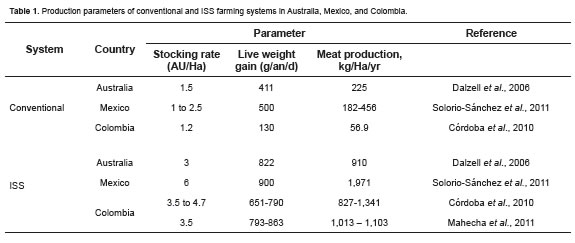
<body><![CDATA[<p>&nbsp;</p>     <p><font size="3">Animal productivity</font></p>     <p>In recent years, successful ISS experiences have   been documented in Australia, Mexico, and Colombia,   with significantly higher production than conventional   extensive systems and similar productivity than that   obtained in intensive systems that rely on the use of   high amounts of fertilizers, concentrates, medicines   and agrochemicals (Dalzell <i>et al.</i>, 2006; Gonz&aacute;lez, 2011; Murgueitio <i>et al.</i>, 2011).</p>     <p>The high productive response of animals in ISS is due   to higher and better distribution of biomass production   throughout the year (even in extremely dry conditions),   leading to increased stocking capacity (up to 4 times   higher than conventional systems) and increased (up to 10 times) meat production per hectare (<a href="#t1">Table 1</a>).</p>     <p align="center"><a name="t1"></a><img src="/img/revistas/rccp/v27n2/v27n2a3t1.jpg"></p>     <p>In addition to improved growth performance,   animals fattened in ISS produce competitive meat   for demanding markets. Meat quality produced in   ISS systems using leucaena can be equated to that   of animals fed in feedlots, in terms of slaughtering   weight and age, fat thickness and color, meat color,   and marbling score (Dalzell <i>et al.</i>, 2006; Shelton and   Dalzell, 2007). These characteristics are consistent with   organically produced meat certified or accredited under   the requirements of the European Union and/or Japan. In   addition, ISS animals score well in terms of welfare and   environmental impact compared with animals raised   in feedlots. In the near future this could be an added   value for the producer, as consumers are becoming   increasingly aware of the origin of the products (Shelton and Dalzell, 2007; Murgueitio <i>et al.</i>, 2011).</p>     <p>The results obtained by Corral <i>et al.</i> (2011) confirm   that the nutrients in in ISS-produced meat is perfectly comparable to that produced in other systems and provides the same amount of protein, and has the advantage of being low in fat.</p>     <p>Increased animal productivity has been also   reported in animals other than cattle. Recently,   Barros (2011) reported 106 g/sheep/d weight gains in   Michoac&aacute;n (Mexico) for an ISS with 35,000 plants of leucaena/Ha associated with<i> P. maximum</i> cv Tanzania.</p>     <p>&nbsp;</p>     <p><b><font size="3">Biomass production, quality, and forage intake</font></b></p>     ]]></body>
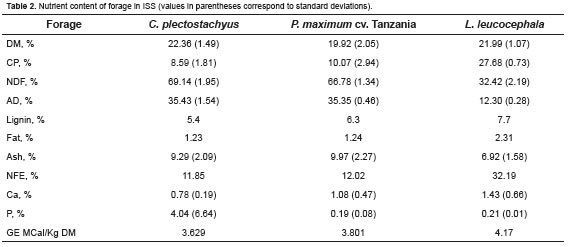
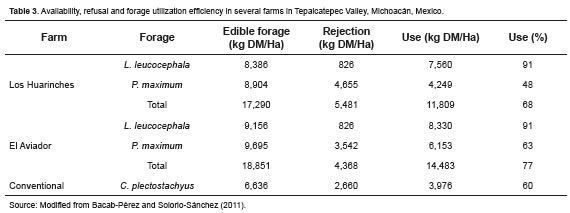
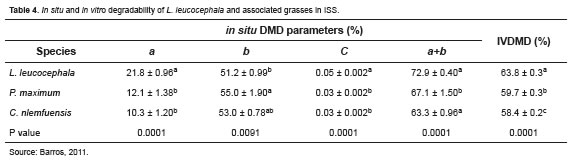
<body><![CDATA[<p>In general, tropical forage has low nutritional value   for ruminants due to low nitrogen (N) content and high   levels of fiber, limiting voluntary feed and nutrient   intake by animals (Leng, 1990). Furthermore, tropical   grasses are characterized by marked seasonal changes   in dry matter (DM) content so that in countries like   Colombia, during the dry season pastures only reach   30% of rainy season DM production (Cuesta, 2005;   V&aacute;squez <i>et al.</i>, 2005). In addition, their high cell   wall (NDF and ADF) contents are associated with   low digestibility and high-energy losses (Barahona   and S&aacute;nchez, 2005), resulting in increased methane   production per kg of meat and milk produced, thus leading to inefficient animal production.</p>     <p>In terms of climate change mitigation, emissions   should be differentiated between those that are   avoidable, reducible, and compensable. Methane   emissions (product of animal physiological processes)   are considered reducible emissions as they are directly   affected by diet quality. Therefore, understanding the   digestive dynamics of animals grazing on ISS will   contribute to the quantification of green house gas (GHG) emissions from these systems.</p>     <p>Diets provided by ISS have high protein levels (15   to 17.5%) with acceptable digestibility (approximately   60%), comparable to the nutritional value of alfalfa.   Improved animal production of ISS is partially   explained by tannin content in leucaena (Barahona   <i>et al.</i>, 2003), which protects protein from ruminal   degradation, increasing its bypass into the intestine   where it is digested (Barahona <i>et al.</i>, 2000) (<a href="#t2">Table 2</a>).   It is also explained by their low NDF content, which is   associated with greater packing ability in the rumen,   higher passage rate, intake, and animal performance (productivity) (Barahona and Sanchez, 2005).</p>     <p align="center"><a name="t2"></a><img src="/img/revistas/rccp/v27n2/v27n2a3t2.jpg"></p>     <p>Studies by Bacab-P&eacute;rez and Solorio-S&aacute;nchez   (2011) measuring forage intake of leucaena and P.   maximum in a ISS established in Tepalcatepec Valley,   Michoac&aacute;n, Mexico (<a href="#t3">Table 3</a>), show greater results   using ISS forage resources. The foraging efficiency   observed at Los Huarinches and El Aviador ranches   was 68 and 77%, respectively; whereas the traditional   system reached only 60% foraging efficiency.   Furthermore, the available forage in both ISS ranches   was at least 2.6 times higher than that in the traditional   ranch (17,290 and 18,851 versus 6,636 kg DM/yr).   <a href="#t3">Table 3</a> also shows the high selectivity of cattle   for leucaena, consuming around 91% of available biomass in both ISS farms.</p>     <p align="center"><a name="t3"></a><img src="/img/revistas/rccp/v27n2/v27n2a3t3.jpg"></p>     <p>The high nutrient contents in leucaena (<a href="#t2">Table 2</a>)   should be analyzed in light of its high degradability,   as reported by Barros (2011) (<a href="#t4">Table 4</a>), who   observed higher rates of potential <i>in situ</i> DM   degradability (a + b) of leucaena than in grasses   commonly used in monoculture. The high DM   degradability of leucaena is corroborated by its high <i>in vitro</i> DM digestibility.</p>     <p align="center"><a name="t4"></a><img src="/img/revistas/rccp/v27n2/v27n2a3t4.jpg"></p>     <p>&nbsp;</p>     <p><b><font size="3">Mitigation of environmental effects: reduction   of GHG and soil improvement</font></b></p>     ]]></body>
<body><![CDATA[<p>It is known that N availability is a limiting factor for   livestock production. ISS increase animal production   by virtue of higher dietary N, increased protein bypass   due to lower ruminal protein degradation, greater   N transfer to accompanying grasses, and higher   N recycling within the system, compared with the traditional system (Dalzell <i>et al.</i>, 2006).</p>     <p>Most N fixed by leucaena returns to the ground   and is used by the grass (as opposed to monoculture   pastures where N availability is very limited),   increasing the quantity and quality of forage (Dalzell   <i>et al.</i>, 2006). Biological nitrogen fixation (BNF) in   ISS ranges between 200 and 500 kg N/yr. (Dalzell <i>et al.</i>, 2006; Solorio-S&aacute;nchez <i>et al.</i>, 2009).</p>     <p>When meat production ranges from 827 to 1,341   kg/Ha/yr (<a href="#t1">Table 1</a>) the N output of the system would   be between 16.7 and 27.1 kg N/Ha/yr (assuming 55%   carcass yield and the entire carcass is lean tissue with   23% crude protein (CP) and 16% of CP is N). At low   BNF estimates, around 172 and 183 kg N/Ha would   return to the ground annually. With 500 kg/Ha BNF,   approximately 470 kg N/Ha would return to the system   annually, with much of this N being available for grass   growth. It should be noted that for 20 ton DM/Ha/yr   of biomass production, grasslands would have 320 kg N available (assuming 10% CP and 16% N in CP).</p>     <p>ISS fix CO<sub>2</sub> in woody stems, leucaena roots, and   pasture. The ''Integrated Silvopastoral Approaches to   Ecosystem Management'' project (World Bank, 2008)   reports annual C fixation equivalent to 1.5 ton/Ha.   Large-scale transition from input-intensive cattle   grazing on degraded pastures to environmentally   friendly silvopastures could improve soil resilience   to degradation and nutrient loss, and sequester large   amounts of carbon (4.4 to 22.4 ton CO<sub>2</sub> eq/Ha/yr)   (Calle <i>et al.</i>, 2012). According to Naranjo <i>et al.</i>   (2012), ISS remove GHG from the atmosphere in   amounts ranging between 8.8 and 26.6 ton CO<sub>2</sub>  eq/Ha/yr, alone or associated with timber trees, respectively.</p>     <p>The climate-change adaptation and mitigation mechanisms favoured by ISS are:</p>     <p>1. Capture of CO<sub>2</sub> in the various ISS strata.</p>     <p>   2. Soil fertility improvement through all ISS   processes.</p>     <p>   3. Promotion of good management practices   for cattle production by reducing and/or   eliminating the use of chemicals such as   pesticides, insecticides, and anthelmintics.</p>     <p>   4. Reduction of plant and animal production   seasonality, making animal production less   vulnerable to climate change.</p>     <p>   5. Contribution to the preservation of fragile   ecosystems and recovery of biodiversity.</p>     ]]></body>
<body><![CDATA[<p>   6. Reduction of production costs by increased   utilization of local resources.</p>     <p>   7. Reduction of ruminal methane production.</p>     <p>Overall, ISS implementation should lead to a   positive carbon-balance of the production chain   due to a more rational use of inputs, competitive   improvement, and positive global effects associated with GHG reduction (Ibrahim <i>et al.</i>, 2010).</p>     <p>Secondary compounds present in most tropical   legume forages (tannins, saponins, etc.) may   decrease nutrient availability to rumen microbes by   fermentation dynamics and inhibition or stimulation   of specific microbial populations. Recent research has   shown the active role of plant bioactive compounds as   rumen fermentation modulators (Hristov <i>et al.</i>, 2013).   For example, condensed tannins reduce methane   production by 13 to 16% on a DM basis (Waghorn   <i>et al.</i>, 2002; Woodward <i>et al.</i>, 2004; Grainger <i>et al.</i>,   2009; Eckard <i>et al.</i>, 2010), mainly through a direct toxic effect on methanogens.</p>     <p>Mao <i>et al.</i> (2010) recently demonstrated that the   saponins present in some plants could reduce ruminal   methane production by up to 27% when fed to sheep.   Saponins are present in a variety of tropical plants   with forage potential such as <i>Leucaena</i>, <i>Tithonia   diversifolia</i>, <i>Gliricidia sepium</i> and <i>Enterolobium   cyclocarpum</i> and are frequently used in SSP (Delgado   <i>et al.</i>, 2010). For example, feeding <i>E. cyclocarpum</i>  foliage reduces rumen protozoa (Koenig <i>et al.</i>, 2007)   and methanogen Archaea. According to Delgado   <i>et al.</i> (2010), inclusion of increasing levels of   <i>Leucaena</i> leaves to a single-grass diet reduces ruminal   methanogenic bacteria; thus, it is a viable alternative   to mitigate methane emissions. In turn, Tan <i>et al.</i>   (2011) showed effectiveness of leucaena condensed   tannin extracts for reducing ruminal methanogenic archaea and protozoa.</p>     <p><i>E. cyclocarpum</i> ground pods incorporated in the   diet (36% of the DM) of hair sheep have resulted   in 223 g daily weight gain per head (Moscoso <i>et al.</i>, 1995). Likewise, in Mexico, up to 50% DM   substitution with <i>E. cyclocarpum</i> ground pods for hair   sheep resulted in 240 g/head/d weight gain, similar   to that with grain-based diets (Esquivel-Mimenza <i>et al.</i>, 2010). To some extent, this productivity is due to   methane-production reduction and, thus, to increased   metabolizable energy absorption in the form of VFA<sup><a name="b2"></a><a href="#1">2</a></sup>,   as well as greater efficiency of ruminal microbial   protein synthesis and increased supply of microbial protein to the small intestine.</p>     <p>&nbsp;</p>     <p><b><font size="3">Milk and meat quality</font></b></p>     <p>Consumers are increasingly aware of the benefits of   products that contribute to their health and welfare, and   this could act as a driver to position food products in   the market, especially those deemed to improve human health, animal welfare and care of the ecosystem (Thornton, 2010). Existing low-carbon agriculture initiatives (Norce, 2012) include this perspective when they encourage the adoption of practices aimed at adapting and mitigating climate change.</p>     <p>It remains unclear if unsaturated fatty acid   concentration&#8212;including conjugated linoleic acid   isomers (CLA)&#8212;in milk and meat of ruminants may   be modified by grazing on ISS. Leucaena foliage has   significant amounts of condensed tannins (Barahona   <i>et al.</i>, 2003). Recently, Vasta <i>et al.</i> (2009) were able   to alter the concentration of rumenic acid (C18:2)   in grazing sheep that received <i>Schinopsis lorentzii</i>  (Quebracho) condensed tannins in their diet. The   mechanism of action is related with the ability of tannins   for reducing ruminal biohydrogenation of unsaturated   fatty acids (Shingfield <i>et al.</i>, 2010). Likewise, Vasta   <i>et al.</i> (2012) succeeded in modifying the pattern of   unsaturated fatty acids in sheep. It is also possible   to increase unsaturated fatty acids concentration in   cow's milk by feeding various types of oils (Hristov   <i>et al.</i>, 2011). In Colombia, Mahecha <i>et al.</i> (2008)   were able to modify milk fat secretion in cows. They   increased its content of polyunsaturated fatty acids   and conjugated linoleic acid (CLA), turning ISS milk   into a functional food. These nutritional principles   may give ISS the possibility of increasing the value   of animal products and eventually generate greater economic benefits for the farmer.</p>     ]]></body>
<body><![CDATA[<p>&nbsp;</p>     <p><b><font size="3">Promotion of ISS for the Colombian   livestock sector</font></b></p>     <p>Adoption of ISS in Colombia is currently   driven by FEDEGAN in partnership with other   institutions through the ''Mainstreaming Biodiversity   in Sustainable Cattle Ranching'' project, which   is present in five regions of the country and is   supported by GEF. The project promotes sustainable   intensification of production in response to climate   change, providing support for farmers in areas such   as public policies, incentives and technologies aimed   at promoting sustainable use of natural resources and improving productive efficiency (Char&aacute; <i>et al.</i>, 2011).</p>     <p>Additionally, the Colombian Ministry of Agriculture   and Rural Developments (MADR) and the Fund for   Agricultural Financing (FINAGRO) approved a Rural   Capitalization Incentive (RCI), which allows farmers   access to loans for establishing ISS. It includes a 40%   reduction in the cost of the loan by meeting specific treeplanting   densities (FINAGRO, 2011). The silvopastoral   RCI provides a 40% subsidy on total costs when farmers   establish up to 99 hectares, and 30% if they establish   more than 100 hectares of ISS associated to timber trees.   Currently, the incentive is $500 usd/Ha for ISS with   over 7,000 shrubs/Ha and about $800 usd for ISS   with at least 5,000 bushes and 500 timber trees/Ha   (i.e. 10 fodder trees per one timber tree) (Murgueitio <i>et al.</i>, 2011). Additionally, a Technical Assistance Incentive   (TAI) aimed to the development of productive projects   that include any farming activity is currently available.   The TAI covers up to 80% of the technical support costs   of for a period not exceeding three years. This is another important tool for promoting ISS.</p>     <p>Herd productivity and stocking rates (AU/Ha) can   be increased by implementing ISS, thereby generating   more income throughout the year and recovering   the investment in short periods of time. The main   difficulty of ISS is the high establishment costs when   compared monoculture pastures. For this reason,   analysis of ISS implementation costs is important in order to provide support to interested farmers.</p>     <p>&nbsp;</p>     <p><b><font size="3">Implementation costs</font></b></p>     <p>Recently, Solarte <i>et al.</i> (2011) compared implementation   costs of ISS associated with timber versus monoculture   pasture (star grass <i>Cynodon</i> sp.). They found that   implementing a hectare of each costs $3,251 usd and $2,336 usd, respectively.</p>     <p>Investment costs are higher for ISS ($915 usd/   hectare) compared to monoculture pastures, but ISS   economic returns are higher: $384 usd/Ha for beef   systems, and $409 usd/Ha for beef-dairy (dual-purpose)   farms compared to annual returns of monoculture ($289   usd and $328 usd for beef and dairy, respectively). In   addition, revenues projected for the twelfth year for timber sales reach $14,105 usd/Ha.</p>     <p>ISS provide good financial returns, regardless   of the system size. Return on Investment (ROI)   fluctuates between 13 to 28% for dairy farms. For beef ISS farms, ROI is 12 to 27% without timber tress, and over 22% for farms having 500 timber/Ha (FEDEGAN-CIPAV, 2010). Additionally, Murgueitio <i>et al.</i> (2009) found that ROI of ISS increases from 12 to 19.4% when ISS planting area increases from 5 to 15 hectares.</p>     ]]></body>
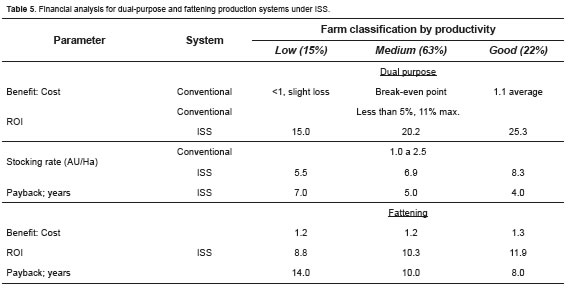
<body><![CDATA[<p><a href="#t5">Table 5</a> shows financial analysis for dual-purpose   and beef production systems under ISS. These values   were obtained from a profitability assessment carried   out in the Michoac&aacute;n tropics (annual precipitation:   600 to 1,000 mm, average temperature: 29 &deg;C,   altitude: 0 to 1,200 m.a.s.l) (Gonz&aacute;lez and Solorio, 2011).</p>     <p align="center"><a name="t5"></a><img src="/img/revistas/rccp/v27n2/v27n2a3t5.jpg"></p>     <p>Shelton and Dalzell (2007) reported that leucaenagrass   pastures are the most productive, profitable,   and sustainable beef production systems in northern   Australia. The benefits of using leucaena-pasture   systems include an increase in animal production/   Ha (up to 4 times) due to a combination of greater   weight gain, increased stocking rates and longevity   of pastures (up to 30 to 40 yr). Those researchers   reported that steers grazing on <i>Cenchrusciliaris</i>,   <i>Chlorisgayana</i> and <i>P. maximum</i> in central Queensland   pastures gained only 140 to 190 kg/yr; while grazing   on pastures with leucaena gained 250 to 300 kg/yr. Using   irrigation, leucaena can increase meat production 3   to 6 times, reaching up to 1,000 to 1,500 kg/Ha/yr (Petty <i>et al.</i>, 1994).</p>     <p>Reviewing results from 15 experiments, Jones and   Bunch (1995) found that 8 of them reported increases   of more than 70% in weight gain of animals with   access to leucaena pastures compared to animals consuming only pasture, either native or improved.</p>     <p>Diversification of production and associated   practices in ISS that can improve the economy of small farmers include the following.</p>     <p><i>Seed production</i></p>     <p>Leucaena seed production is highly variable   depending on climate, soil, seeding, and management   conditions. Leucaena seeds are currently sold in smallscale   stores in Colombia at $15 usd to $22 usd/kg. Taking   the average seed production, which amounts to 481 kg   seed/Ha/yr, and multiplying it by the lowest price in the   seed market (that of associative projects, or $10 usd/kg   of seed), generates an additional annual gross income of   $4,809 usd/Ha for the producer. It should be noted that   leucaena seed is harvested in the dry season, when cattle   price is low and such low income can generate financial crises, especially in farms located in dry regions.</p>     <p><i>Decreased cost of mineral supplementation</i></p>     <p>Mineral salt intake decreases in ISS farms located   in tropical dry forests due to better mineral balance   of fodder. In a study conducted at El Porvenir farm,   where mineral intake by cattle was measured and   results were used to formulate a specific salt, annual   savings of approximately $5,600 usd were obtained (herd size: 470 animals; savings: $12 usd/head/yr).</p>     <p><i>Lifetime of the system</i></p>     ]]></body>
<body><![CDATA[<p>SPS with more than 20 years in full production   and well-documented, thorough research have been   reported in several regions of Colombia and other   countries. According to Jones and Bunch (1995),   leucaena is one of the few types of tropical forage   that can survive and remain productive for periods of   more than 30 years under regular grazing in Australia.   The same authors investigated the mortality of   plants in a leucaena system after 40 years of grazing,   finding that 74% of the original plants still remained.   Commercial systems also show similar longevity and   high productivity, with 25 years of continuous grazing being a common report.</p>     <p><i>Fencing</i></p>     <p>Use of fixed and mobile electric fencing is a   standard recommendation for ISS, which reduces   the demand of wood for posts between 60 and 90%.   It must be remembered that wood posts in Colombia   are usually obtained from forest remnants that remain in relative conservation.</p>     <p><i>Efficient management of water resources</i></p>     <p>Another relevant aspect of ISS is the permanent   availability of fresh and good quality water for   livestock. According to Murgueitio <i>et al.</i> (2011), it is   essential to have a permanent supply of good quality   drinking water for the animals in any livestock system,   preventing them from entering water bodies like   rivers, streams, wetlands and springs. This encourages   farmers to improve the quality of water resources. It is   necessary to implement water conveyance networks   in grazing areas and install fixed or mobile drinkers   depending on the group size and rotation systems.   Drinkers should be strategically located to prevent   animals from walking long distances, which decreases   productivity due to increased energy expenditure, and increases pasture trampling.</p>     <p><i>Animal health</i></p>     <p>ISS help to reduce internal parasite load by 40%   due to disruption of parasite life cycles, which is   obtained by grazing rotations and the effects of   secondary metabolites present in leucaena. Presence   of external parasites such as horn flies is minimized   over time due to the fast degradation of cattle manure   where insects breed. Rapid degradation of excreta   in ISS obeys to increased presence of dung beetles,   earthworms and other organisms. This helps to   reduce production costs and lowers pesticide usage   that affects human health and ecosystems and can   compromise product safety. Additionally, ISS can help   to reduce tick populations by increasing the presence   of natural predators (birds and ants) and the biological control performed by some fungi.</p>     <p>&nbsp;</p>     <p><b><font size="3">Conclusion</font></b></p>     <p>ISS can increase animal productivity profitability.   ISS has been associated with four-fold increases in   meat production per hectare, compared to traditional   systems around the world. This is associated with   higher protein content (14.3 <i>vs</i>. 10.0%) and lower   content of neutral detergent fiber (58.4 <i>vs</i>. 66.8%)   compared to traditional grazing diets, respectively. In   turn, this leads to greater DM degradability compared to traditional grass-only pastures.</p>     ]]></body>
<body><![CDATA[<p>Finally, research suggests that ISS can contribute   to GHG mitigation. From the perspective of   mitigating climate change, efforts should be made to   determine differences between avoidable, reducible,   and compensable emissions within each farming   system. In addition, ISS can contribute naturally to   intensification of livestock production in a sustainable   manner as it increases land productivity and allow   conservation of forests and biological corridors of local and global importance.</p> <hr size="1" />     <p><a name="0"></a><a href="#b0">&curren;</a> To cite this article: Cuartas CA, Naranjo JF, Tarazona AM, Murgueitio E, Char&aacute; JD, Ku J, Solorio FJ, X Flores MX, Solorio B, Barahona R. Contribution of  intensive silvopastoral systems to animal performance and to adaptation and mitigation of climate change. Rev Colomb Cienc Pecu 2014; 27:76-94.</p>     <p><a name="1"></a><a href="#b1">1</a> Intergovernmental Panel on Climate Change.</p>     <p><a name="2"></a><a href="#b2">2</a> Volatile fatty acids.</p> <hr size="1" />     <p>&nbsp;</p>     <p><b><font size="3">Acknowledgements</font></b></p>     <p>   C&eacute;sar Cuartas, Juan Naranjo, and Ariel Tarazona   wish to acknowledge the Animal Sciences Graduate   School at the University of Antioquia and the Francisco   Jos&eacute; de Caldas (COLCIENCIAS) Bicentennial   Training program, which provided them fellowships   for pursuing Ph.D. studies. Thanks also to Francisco   Jose de Caldas National Fund For Science, Technology   and Innovation (COLCIENCIAS) for the institutional   support agreement #205 of 2010 signed with   CIPAV. Part of the data in this paper came from the   Sustainable Colombian Livestock (funded by GEF and   implemented by FEDEGAN, CIPAV, TNC, and the   Action Fund) and Comparative analysis of production   and meat quality in intensive silvopastoral systems in   confinement (financed by MADR and implemented   by Universidad Nacional de Colombia &#8211; UNAL,   Universidad de Antioquia &#8211; UDEA, CIPAV and   COLANTA) projects.</p>     <p>&nbsp;</p>     <p><b><font size="3">References</font></b></p>     <!-- ref --><p>   Bacab-P&eacute;rez HM, Solorio-S&aacute;nchez FJ. Oferta y consumo de   forraje y producci&oacute;n de leche en ganado de doble prop&oacute;sito   manejado en sistemas silvopastoriles en Tepalcatepec, Michoac&aacute;n.   Trop Subtrop Agroecosyst 2011; 13:271-278.    &nbsp;&nbsp;&nbsp;&nbsp;&nbsp;&nbsp;&nbsp;&nbsp;[&#160;<a href="javascript:void(0);" onclick="javascript: window.open('/scielo.php?script=sci_nlinks&ref=000172&pid=S0120-0690201400020000300001&lng=','','width=640,height=500,resizable=yes,scrollbars=1,menubar=yes,');">Links</a>&#160;]<!-- end-ref --></p>     <!-- ref --><p>   Barahona R, S&aacute;nchez M. Limitaciones f&iacute;sicas y qu&iacute;micas de la   digestibilidad de pastos tropicales y estrategias para aumentarla.   Rev Corpoica 2005; 6:69-82.    &nbsp;&nbsp;&nbsp;&nbsp;&nbsp;&nbsp;&nbsp;&nbsp;[&#160;<a href="javascript:void(0);" onclick="javascript: window.open('/scielo.php?script=sci_nlinks&ref=000174&pid=S0120-0690201400020000300002&lng=','','width=640,height=500,resizable=yes,scrollbars=1,menubar=yes,');">Links</a>&#160;]<!-- end-ref --></p>     <!-- ref --><p>   Barahona R, Owen E, Kingston-Smith A, Morris P, Theodorou   M, Sanchez M. New perspectives on the degradation of plant   biomass in the rumen in the absence and presence of condensed   tannins. In: Brooker JD, editor. Tannins in Livestock and Human   Nutrition 92. ACIAR Books Online; 2000. p.44-51.    &nbsp;&nbsp;&nbsp;&nbsp;&nbsp;&nbsp;&nbsp;&nbsp;[&#160;<a href="javascript:void(0);" onclick="javascript: window.open('/scielo.php?script=sci_nlinks&ref=000176&pid=S0120-0690201400020000300003&lng=','','width=640,height=500,resizable=yes,scrollbars=1,menubar=yes,');">Links</a>&#160;]<!-- end-ref --></p>     <!-- ref --><p>   Barahona R, Theodorou M, Lascano C, Owen E, Narvaez N. <i>In   vitro</i> degradability of mature and immature leaves of tropical   forage legumes differing in condensed tannin and non-starch   polysaccharide content and composition. J Sci Food Agr 2003;   83:1256-1266.    &nbsp;&nbsp;&nbsp;&nbsp;&nbsp;&nbsp;&nbsp;&nbsp;[&#160;<a href="javascript:void(0);" onclick="javascript: window.open('/scielo.php?script=sci_nlinks&ref=000178&pid=S0120-0690201400020000300004&lng=','','width=640,height=500,resizable=yes,scrollbars=1,menubar=yes,');">Links</a>&#160;]<!-- end-ref --></p>     <!-- ref --><p>   Barros MA. Comportamiento productivo y excreci&oacute;n urinaria de   los metabolitos derivados de mimosina en ovinos pastoreando en   altas de Leucaena leucocephala en un sistema silvopastoril. Tesis   de maestr&iacute;a, Universidad Aut&oacute;noma de Yucat&aacute;n; 2011.    &nbsp;&nbsp;&nbsp;&nbsp;&nbsp;&nbsp;&nbsp;&nbsp;[&#160;<a href="javascript:void(0);" onclick="javascript: window.open('/scielo.php?script=sci_nlinks&ref=000180&pid=S0120-0690201400020000300005&lng=','','width=640,height=500,resizable=yes,scrollbars=1,menubar=yes,');">Links</a>&#160;]<!-- end-ref --></p>     <!-- ref --><p>   Bazarusanga T, Geysen D, Vercruysse J, Madder M. An update   on the ecological distribution of Ixodid ticks infesting cattle in   Rwanda: countrywide cross-sectional survey in the wet and the   dry season. Exp Appl Acarol 2007; 43:279-291.    &nbsp;&nbsp;&nbsp;&nbsp;&nbsp;&nbsp;&nbsp;&nbsp;[&#160;<a href="javascript:void(0);" onclick="javascript: window.open('/scielo.php?script=sci_nlinks&ref=000182&pid=S0120-0690201400020000300006&lng=','','width=640,height=500,resizable=yes,scrollbars=1,menubar=yes,');">Links</a>&#160;]<!-- end-ref --></p>     <!-- ref --><p>   Benavides E, Ballesteros AM, Romero BY, Britto C, Gomez   J. Prevalence and risk factors for bovine anaplasmosis in the   high tropics: The case of Zipaquir&aacute;, Cundinamarca, Colombia.   International Symposia on Veterinary Epidemiology and   Economics (ISVEE) proceedings, ISVEE 10: Proceedings of   the 10th Symposium of the International Society for Veterinary   Epidemiology and Economics, Vi&ntilde;a del Mar, Chile, Arthropodborne   diseases session 2003; p.855.    &nbsp;&nbsp;&nbsp;&nbsp;&nbsp;&nbsp;&nbsp;&nbsp;[&#160;<a href="javascript:void(0);" onclick="javascript: window.open('/scielo.php?script=sci_nlinks&ref=000184&pid=S0120-0690201400020000300007&lng=','','width=640,height=500,resizable=yes,scrollbars=1,menubar=yes,');">Links</a>&#160;]<!-- end-ref --></p>     <!-- ref --><p>   Berrang-Ford L, Ford JD, Paterson J. Are we adapting to climate   change?. Global Environ Change 2010; 21:25-33.    &nbsp;&nbsp;&nbsp;&nbsp;&nbsp;&nbsp;&nbsp;&nbsp;[&#160;<a href="javascript:void(0);" onclick="javascript: window.open('/scielo.php?script=sci_nlinks&ref=000186&pid=S0120-0690201400020000300008&lng=','','width=640,height=500,resizable=yes,scrollbars=1,menubar=yes,');">Links</a>&#160;]<!-- end-ref --></p>     <!-- ref --><p>   Blackshaw JK, Blackshaw AW. Heat stress in cattle and the effect   of shade on production and behaviour: a review. Aust J Exp Agr   1994; 34:285-295.    &nbsp;&nbsp;&nbsp;&nbsp;&nbsp;&nbsp;&nbsp;&nbsp;[&#160;<a href="javascript:void(0);" onclick="javascript: window.open('/scielo.php?script=sci_nlinks&ref=000188&pid=S0120-0690201400020000300009&lng=','','width=640,height=500,resizable=yes,scrollbars=1,menubar=yes,');">Links</a>&#160;]<!-- end-ref --></p>     <!-- ref --><p>   Calle A, Montagnini F, Zuluaga AF. Farmers' perceptions of   silvopastoral system promotion in Quind&iacute;o, Colombia. Bois et   forets des tropiques 2009; 300:79-94.    &nbsp;&nbsp;&nbsp;&nbsp;&nbsp;&nbsp;&nbsp;&nbsp;[&#160;<a href="javascript:void(0);" onclick="javascript: window.open('/scielo.php?script=sci_nlinks&ref=000190&pid=S0120-0690201400020000300010&lng=','','width=640,height=500,resizable=yes,scrollbars=1,menubar=yes,');">Links</a>&#160;]<!-- end-ref --></p>     <!-- ref --><p>   Calle A. What makes an early adopter? Transforming landscapes   one farmer at a time. Trop Resour Bull 2008; 27:7-14.    &nbsp;&nbsp;&nbsp;&nbsp;&nbsp;&nbsp;&nbsp;&nbsp;[&#160;<a href="javascript:void(0);" onclick="javascript: window.open('/scielo.php?script=sci_nlinks&ref=000192&pid=S0120-0690201400020000300011&lng=','','width=640,height=500,resizable=yes,scrollbars=1,menubar=yes,');">Links</a>&#160;]<!-- end-ref --></p>     <!-- ref --><p>   Calle Z, Piedrahita L. &iquest;C&oacute;mo dise&ntilde;ar estrategias para el manejo   de plantas de inter&eacute;s para la conservaci&oacute;n en paisajes ganaderos?.   Agroforester&iacute;a en las Am&eacute;ricas 2007; 45:117-122.    &nbsp;&nbsp;&nbsp;&nbsp;&nbsp;&nbsp;&nbsp;&nbsp;[&#160;<a href="javascript:void(0);" onclick="javascript: window.open('/scielo.php?script=sci_nlinks&ref=000194&pid=S0120-0690201400020000300012&lng=','','width=640,height=500,resizable=yes,scrollbars=1,menubar=yes,');">Links</a>&#160;]<!-- end-ref --></p>     <!-- ref --><p>   Ca&ntilde;as R, Quiroz R, Leon-Velarde C, Posadas A, Osorio J.   Quantifying energy dissipation by grazing animals in harsh   environments. J TheorBiol 2003; 225:351-359.    &nbsp;&nbsp;&nbsp;&nbsp;&nbsp;&nbsp;&nbsp;&nbsp;[&#160;<a href="javascript:void(0);" onclick="javascript: window.open('/scielo.php?script=sci_nlinks&ref=000196&pid=S0120-0690201400020000300013&lng=','','width=640,height=500,resizable=yes,scrollbars=1,menubar=yes,');">Links</a>&#160;]<!-- end-ref --></p>     <!-- ref --><p>   CAWMA - Comprehensive Assessment of Water Management in   Agriculture. Water for Food, Water for Life: A Comprehensive   Assessment of Water Management in Agriculture. London:   Earthscan, and Colombo: International Water Management   Institute; 2007. p.645.    &nbsp;&nbsp;&nbsp;&nbsp;&nbsp;&nbsp;&nbsp;&nbsp;[&#160;<a href="javascript:void(0);" onclick="javascript: window.open('/scielo.php?script=sci_nlinks&ref=000198&pid=S0120-0690201400020000300014&lng=','','width=640,height=500,resizable=yes,scrollbars=1,menubar=yes,');">Links</a>&#160;]<!-- end-ref --></p>     <!-- ref --><p>   Ceballos MC, Cuartas CA, Naranjo JF, Rivera JE, Arenas F,   Murgueitio E, Tarazona AM. Efecto de la temperatura y la   humedad ambiental sobre el comportamiento de consumo en   sistemas silvopastoriles intensivos y posibles implicaciones en el   confort t&eacute;rmico. Rev Colomb Cienc Pecu 2011; 24:368.    &nbsp;&nbsp;&nbsp;&nbsp;&nbsp;&nbsp;&nbsp;&nbsp;[&#160;<a href="javascript:void(0);" onclick="javascript: window.open('/scielo.php?script=sci_nlinks&ref=000200&pid=S0120-0690201400020000300015&lng=','','width=640,height=500,resizable=yes,scrollbars=1,menubar=yes,');">Links</a>&#160;]<!-- end-ref --></p>     <!-- ref --><p>   Char&aacute; JD, Murgueitio E. The role of silvopastoral systems in the   rehabilitation of Andean stream habitats. Livest Res Rural Dev   2005; 17 (art. 20); [access date: May 15, 2012] URL: <a href="http://www.lrrd.org/lrrd17/2/char17020.htm" target="_blank">http://www.lrrd.org/lrrd17/2/char17020.htm</a>&nbsp;&nbsp;&nbsp;&nbsp;&nbsp;&nbsp;&nbsp;&nbsp;[&#160;<a href="javascript:void(0);" onclick="javascript: window.open('/scielo.php?script=sci_nlinks&ref=000202&pid=S0120-0690201400020000300016&lng=','','width=640,height=500,resizable=yes,scrollbars=1,menubar=yes,');">Links</a>&#160;]<!-- end-ref --><!-- ref --><p>   Char&aacute; JD, Pedraza GX, Giraldo LP, Hincapi&eacute; D. Efecto de   corredores ribere&ntilde;os sobre el estado de quebradas en la zona   ganadera del r&iacute;o La Vieja, Colombia. Agroforester&iacute;a en las   Am&eacute;ricas 2007; 45:72-78.    &nbsp;&nbsp;&nbsp;&nbsp;&nbsp;&nbsp;&nbsp;&nbsp;[&#160;<a href="javascript:void(0);" onclick="javascript: window.open('/scielo.php?script=sci_nlinks&ref=000203&pid=S0120-0690201400020000300017&lng=','','width=640,height=500,resizable=yes,scrollbars=1,menubar=yes,');">Links</a>&#160;]<!-- end-ref --></p>     <!-- ref --><p>   Char&aacute; JD, Murgueitio E, Zuluaga AF, Giraldo C. Ganader&iacute;a   Colombiana Sostenible. Mainstreaming Biodiversity in Sustainable   Cattle Ranching. Cali, Colombia: CIPAV Foundation; 2011.    &nbsp;&nbsp;&nbsp;&nbsp;&nbsp;&nbsp;&nbsp;&nbsp;[&#160;<a href="javascript:void(0);" onclick="javascript: window.open('/scielo.php?script=sci_nlinks&ref=000205&pid=S0120-0690201400020000300018&lng=','','width=640,height=500,resizable=yes,scrollbars=1,menubar=yes,');">Links</a>&#160;]<!-- end-ref -->  </p>     <!-- ref --><p>C&oacute;rdoba C, Murgueitio E, Uribe F, Naranjo J, Cuartas C.   Productividad vegetal y animal bajo sistemas de pastoreo   tradicional y sistemas silvopastoriles intensivos (SSPi) en   el Caribe seco colombiano. In: Ibrahim M, Murgueitio E,   editors. Proceedings of the Sixth International Congress of   Agroforestry for Sustainable Animal Production: Multiplication   and silvopastoral agroforestry systems for adaptation and   mitigation of climate change on livestock territories. Technical   Meeting/ CATIE; No.15.Turrialba, C.R: CATIE &#8211; CIPAV;   2010. p.160&nbsp;&nbsp;&nbsp;&nbsp;&nbsp;&nbsp;&nbsp;&nbsp;[&#160;<a href="javascript:void(0);" onclick="javascript: window.open('/scielo.php?script=sci_nlinks&ref=000207&pid=S0120-0690201400020000300019&lng=','','width=640,height=500,resizable=yes,scrollbars=1,menubar=yes,');">Links</a>&#160;]<!-- end-ref --><!-- ref --><p>Corral G, B Solorio, C Rodr&iacute;guez, J Ram&iacute;rez. La calidad de   la carne producida en el sistema silvopastoril intensivo y su   diferenciaci&oacute;n en el mercado. Memorias III Congreso sobre   Sistemas Silvopastoriles Intensivos, para la ganader&iacute;a sostenible   del siglo XXI. Morelia, M&eacute;xico: Fundaci&oacute;n Produce Michoac&aacute;n,   COFRUPO, SAGARPA, Universidad Aut&oacute;noma de Yucat&aacute;n &#8211; UADY; 2011. p.46-52.    &nbsp;&nbsp;&nbsp;&nbsp;&nbsp;&nbsp;&nbsp;&nbsp;[&#160;<a href="javascript:void(0);" onclick="javascript: window.open('/scielo.php?script=sci_nlinks&ref=000208&pid=S0120-0690201400020000300020&lng=','','width=640,height=500,resizable=yes,scrollbars=1,menubar=yes,');">Links</a>&#160;]<!-- end-ref --></p>     <!-- ref --><p>   Cuesta PA, editor and compiler. Producci&oacute;n y utilizaci&oacute;n   de recursos forrajeros en sistemas de producci&oacute;n bovina de   las regiones caribe y valles interandinos. Manual T&eacute;cnico.   Bogot&aacute;, Colombia: CORPOICA - Corporaci&oacute;n Colombiana de   Investigaci&oacute;n Agropecuaria, Subdirecci&oacute;n de Investigaci&oacute;n e   Innovaci&oacute;n-Red de Recursos Forrajeros; 2005. p.108.    &nbsp;&nbsp;&nbsp;&nbsp;&nbsp;&nbsp;&nbsp;&nbsp;[&#160;<a href="javascript:void(0);" onclick="javascript: window.open('/scielo.php?script=sci_nlinks&ref=000210&pid=S0120-0690201400020000300021&lng=','','width=640,height=500,resizable=yes,scrollbars=1,menubar=yes,');">Links</a>&#160;]<!-- end-ref --></p>     <!-- ref --><p>   Dalzell SA, Shelton HM, Mullen BF, Larsen PH, McLaughlin KG.   Leucaena: a guide to establishment and management. Sydney:   Meat &amp; Livestock Australia Ltd; 2006.    &nbsp;&nbsp;&nbsp;&nbsp;&nbsp;&nbsp;&nbsp;&nbsp;[&#160;<a href="javascript:void(0);" onclick="javascript: window.open('/scielo.php?script=sci_nlinks&ref=000212&pid=S0120-0690201400020000300022&lng=','','width=640,height=500,resizable=yes,scrollbars=1,menubar=yes,');">Links</a>&#160;]<!-- end-ref --></p>     <!-- ref --><p>   Delgado DC, Galindo J, Gonz&aacute;lez R, Sav&oacute;n L, Scull I, Gonz&aacute;lez   N, Marrero Y. Potential of Tropical Plants to Exert Defaunating   Effects on the Rumen and to Reduce Methane Production.   In: Odongo NE, Garcia M, Viljoen GJ, editors. Sustainable   Improvement of Animal Production and Health. Rome: FAO;   2010. p.49-54.    &nbsp;&nbsp;&nbsp;&nbsp;&nbsp;&nbsp;&nbsp;&nbsp;[&#160;<a href="javascript:void(0);" onclick="javascript: window.open('/scielo.php?script=sci_nlinks&ref=000214&pid=S0120-0690201400020000300023&lng=','','width=640,height=500,resizable=yes,scrollbars=1,menubar=yes,');">Links</a>&#160;]<!-- end-ref --></p>     <!-- ref --><p>   Dulal HD, Brodnig G, Shah KU. Capital assets and institutional   constraints to implementation of greenhouse gas mitigation   options in agriculture. Mitig Adapt Strat Glob Change 2011;   16:1-23.    &nbsp;&nbsp;&nbsp;&nbsp;&nbsp;&nbsp;&nbsp;&nbsp;[&#160;<a href="javascript:void(0);" onclick="javascript: window.open('/scielo.php?script=sci_nlinks&ref=000216&pid=S0120-0690201400020000300024&lng=','','width=640,height=500,resizable=yes,scrollbars=1,menubar=yes,');">Links</a>&#160;]<!-- end-ref --></p>     <!-- ref --><p>   Eckard RJ, Grainger C, de Klein CAM. Options for the abatement   of methane and nitrous oxide from ruminantproduction: A review.   Livestock Sci 2010; 130:47&#8211;56.    &nbsp;&nbsp;&nbsp;&nbsp;&nbsp;&nbsp;&nbsp;&nbsp;[&#160;<a href="javascript:void(0);" onclick="javascript: window.open('/scielo.php?script=sci_nlinks&ref=000218&pid=S0120-0690201400020000300025&lng=','','width=640,height=500,resizable=yes,scrollbars=1,menubar=yes,');">Links</a>&#160;]<!-- end-ref --></p>     <!-- ref --><p>   Emerson KJ, Bradshaw WE, Holzapfel CM. Complications of   complexity: integrating environmental, genetic and hormonal   control of insect diapause. Trends Genet 2009; 25:217-225.    &nbsp;&nbsp;&nbsp;&nbsp;&nbsp;&nbsp;&nbsp;&nbsp;[&#160;<a href="javascript:void(0);" onclick="javascript: window.open('/scielo.php?script=sci_nlinks&ref=000220&pid=S0120-0690201400020000300026&lng=','','width=640,height=500,resizable=yes,scrollbars=1,menubar=yes,');">Links</a>&#160;]<!-- end-ref --></p>     <!-- ref --><p>   Esquivel-Mimenza H, Pi&ntilde;eiro-V&aacute;zquez A, Baz&aacute;n-Godoy J,   Ayala-Burgos A, Espinoza-Hern&aacute;ndez J, Ku-Vera J. Integration   of <i>Enterolobium cyclocarpum</i> Jacq. Griseb tree with hair sheep   production in the dry tropics. Adv Anim Biosci 2010; 1:444-445.    &nbsp;&nbsp;&nbsp;&nbsp;&nbsp;&nbsp;&nbsp;&nbsp;[&#160;<a href="javascript:void(0);" onclick="javascript: window.open('/scielo.php?script=sci_nlinks&ref=000222&pid=S0120-0690201400020000300027&lng=','','width=640,height=500,resizable=yes,scrollbars=1,menubar=yes,');">Links</a>&#160;]<!-- end-ref --></p>     <!-- ref --><p>   FEDEGAN. Plan Estrat&eacute;gico de la Ganader&iacute;a Colombiana 2019.   Santaf&eacute; de Bogot&aacute; D.C. (Colombia): Federaci&oacute;n Colombiana de   Ganaderos &#8211; FEDEGAN &#8211; FNG; 2006.    &nbsp;&nbsp;&nbsp;&nbsp;&nbsp;&nbsp;&nbsp;&nbsp;[&#160;<a href="javascript:void(0);" onclick="javascript: window.open('/scielo.php?script=sci_nlinks&ref=000224&pid=S0120-0690201400020000300028&lng=','','width=640,height=500,resizable=yes,scrollbars=1,menubar=yes,');">Links</a>&#160;]<!-- end-ref --></p>     <!-- ref --><p>   FEDEGAN. Reporte de los Impactos de la Ola Invernal en el   Sector Ganadero Colombiano 2011; [access date: May 15, 2013]   URL: <a href="http://www.fedegan.org.co" target="_blank">http://www.fedegan.org.co</a>&nbsp;&nbsp;&nbsp;&nbsp;&nbsp;&nbsp;&nbsp;&nbsp;[&#160;<a href="javascript:void(0);" onclick="javascript: window.open('/scielo.php?script=sci_nlinks&ref=000226&pid=S0120-0690201400020000300029&lng=','','width=640,height=500,resizable=yes,scrollbars=1,menubar=yes,');">Links</a>&#160;]<!-- end-ref --><!-- ref --><p>   FEDEGAN - CIPAV. Informe del Proyecto: Evaluaci&oacute;n T&eacute;cnica,   Econ&oacute;mica-Financiera y Ambiental de Sistemas Silvopastoriles   Intensivos con <i>Leucaena leucocephala</i> y Pastos Mejorados, en   el Valle del R&iacute;o Cesar; 2010.    &nbsp;&nbsp;&nbsp;&nbsp;&nbsp;&nbsp;&nbsp;&nbsp;[&#160;<a href="javascript:void(0);" onclick="javascript: window.open('/scielo.php?script=sci_nlinks&ref=000227&pid=S0120-0690201400020000300030&lng=','','width=640,height=500,resizable=yes,scrollbars=1,menubar=yes,');">Links</a>&#160;]<!-- end-ref --></p>     <!-- ref --><p>   FINAGRO. Manual de productos y servicios, cap&iacute;tulo 1, 2011;   [access date: May 15, 2012] URL: <a href="http://www.finagro.com.co/html/i_portals/index.php?p_origin=plugin&p_name=manual&p_id=&p_options=" target="_blank">http://www.finagro.com.co/html/i_portals/index.php?p_origin=plugin&amp;p_name=manual&amp;p_id=&amp;p_options=</a>&nbsp;&nbsp;&nbsp;&nbsp;&nbsp;&nbsp;&nbsp;&nbsp;[&#160;<a href="javascript:void(0);" onclick="javascript: window.open('/scielo.php?script=sci_nlinks&ref=000229&pid=S0120-0690201400020000300031&lng=','','width=640,height=500,resizable=yes,scrollbars=1,menubar=yes,');">Links</a>&#160;]<!-- end-ref --><!-- ref --><p>   Flores MX, Solorio B. Proyecto estrat&eacute;gico de prioridad nacional   para el establecimiento de sistemas silvopastoriles intensivos   para la producci&oacute;n de leche y carne en 10 estados de la Republica   Mexicana. Memorias III Congreso sobre Sistemas Silvopastoriles   Intensivos, para la ganader&iacute;a sostenible del siglo XXI. Morelia   (M&eacute;xico): Fundaci&oacute;n Produce Michoac&aacute;n, COFRUPO, SAGARPA,   Universidad Aut&oacute;noma de Yucat&aacute;n - UADY; 2011.    &nbsp;&nbsp;&nbsp;&nbsp;&nbsp;&nbsp;&nbsp;&nbsp;[&#160;<a href="javascript:void(0);" onclick="javascript: window.open('/scielo.php?script=sci_nlinks&ref=000230&pid=S0120-0690201400020000300032&lng=','','width=640,height=500,resizable=yes,scrollbars=1,menubar=yes,');">Links</a>&#160;]<!-- end-ref --></p>     <!-- ref --><p>   Fregly MJ, Blatteis CM. Enviromental Physiology. New York:   Oxford University Press; 1996.    &nbsp;&nbsp;&nbsp;&nbsp;&nbsp;&nbsp;&nbsp;&nbsp;[&#160;<a href="javascript:void(0);" onclick="javascript: window.open('/scielo.php?script=sci_nlinks&ref=000232&pid=S0120-0690201400020000300033&lng=','','width=640,height=500,resizable=yes,scrollbars=1,menubar=yes,');">Links</a>&#160;]<!-- end-ref --></p>     <!-- ref --><p>   Fuquay JW. Heat Stress as it Affects Animal Production. J Anim   Sci 1981; 52:164-174.    &nbsp;&nbsp;&nbsp;&nbsp;&nbsp;&nbsp;&nbsp;&nbsp;[&#160;<a href="javascript:void(0);" onclick="javascript: window.open('/scielo.php?script=sci_nlinks&ref=000234&pid=S0120-0690201400020000300034&lng=','','width=640,height=500,resizable=yes,scrollbars=1,menubar=yes,');">Links</a>&#160;]<!-- end-ref --></p>     <!-- ref --><p>   Gaughan JN, Lacetera SE, Valtorta HH, Khalifa L, Hahn L,   Mader T. Response of Domestic Animals to Climate Challenges.   In: Ebi L, Burton I, McGregor GR, editors. Biometeorology   for adaptation to climate variability and change. New Zeland:   Springer; 2009; p.131-170.    &nbsp;&nbsp;&nbsp;&nbsp;&nbsp;&nbsp;&nbsp;&nbsp;[&#160;<a href="javascript:void(0);" onclick="javascript: window.open('/scielo.php?script=sci_nlinks&ref=000236&pid=S0120-0690201400020000300035&lng=','','width=640,height=500,resizable=yes,scrollbars=1,menubar=yes,');">Links</a>&#160;]<!-- end-ref --></p>     <!-- ref --><p>   Giraldo C, Escobar F, Char&aacute; J, Calle Z. The adoption of   silvopastoral systems promotes the recovery of ecological   processes regulated by dung beetles in the Colombian Andes.   Insect Conserv Divers 2011; 4:115-122.    &nbsp;&nbsp;&nbsp;&nbsp;&nbsp;&nbsp;&nbsp;&nbsp;[&#160;<a href="javascript:void(0);" onclick="javascript: window.open('/scielo.php?script=sci_nlinks&ref=000238&pid=S0120-0690201400020000300036&lng=','','width=640,height=500,resizable=yes,scrollbars=1,menubar=yes,');">Links</a>&#160;]<!-- end-ref --></p>     <!-- ref --><p>   Gonz&aacute;lez JM, Solorio B. An&aacute;lisis econ&oacute;mico y financiero de la   productividad de los sistemas silvopastoriles intensivos: estudio   de caso en el tr&oacute;pico michoacano. Memorias III Congreso   sobre Sistemas Silvopastoriles Intensivos, para la ganader&iacute;a   sostenible del siglo XXI. Morelia (M&eacute;xico): Fundaci&oacute;n Produce   Michoac&aacute;n, COFUPRO, SAGARPA, Universidad Aut&oacute;noma de   Yucat&aacute;n &#8211; UADY; 2011.    &nbsp;&nbsp;&nbsp;&nbsp;&nbsp;&nbsp;&nbsp;&nbsp;[&#160;<a href="javascript:void(0);" onclick="javascript: window.open('/scielo.php?script=sci_nlinks&ref=000240&pid=S0120-0690201400020000300037&lng=','','width=640,height=500,resizable=yes,scrollbars=1,menubar=yes,');">Links</a>&#160;]<!-- end-ref --></p>     <!-- ref --><p>   Gonz&aacute;lez JM. An&aacute;lisis econ&oacute;mico y financiero de la productividad   de los sistemas silvopastoriles intensivos. Estudio de caso en   el tr&oacute;pico michoacano. Memorias III Congreso sobre Sistemas   Silvopastoriles Intensivos, para la ganader&iacute;a sostenible del   siglo XXI. Morelia (M&eacute;xico): Fundaci&oacute;n Produce Michoac&aacute;n,   COFRUPO, SAGARPA, Universidad Aut&oacute;noma de Yucat&aacute;n &#8211;   UADY; 2011.    &nbsp;&nbsp;&nbsp;&nbsp;&nbsp;&nbsp;&nbsp;&nbsp;[&#160;<a href="javascript:void(0);" onclick="javascript: window.open('/scielo.php?script=sci_nlinks&ref=000242&pid=S0120-0690201400020000300038&lng=','','width=640,height=500,resizable=yes,scrollbars=1,menubar=yes,');">Links</a>&#160;]<!-- end-ref --></p>     <!-- ref --><p>   Grainger C, Clarke T, Auldist MJ, Beauchemin KA, McGinn   SM, Waghorn GC, Eckard RJ. Mitigation of greenhouse gas   emissionsfrom dairy cows fed pasture and grain through   supplementation with Acacia mearnsii tannins. Can J Anim Sci   2009; 89:241&#8211;251.    &nbsp;&nbsp;&nbsp;&nbsp;&nbsp;&nbsp;&nbsp;&nbsp;[&#160;<a href="javascript:void(0);" onclick="javascript: window.open('/scielo.php?script=sci_nlinks&ref=000244&pid=S0120-0690201400020000300039&lng=','','width=640,height=500,resizable=yes,scrollbars=1,menubar=yes,');">Links</a>&#160;]<!-- end-ref --></p>     <!-- ref --><p>   Harvey CA, Villanueva C, Ibrahim M, G&oacute;mez R, L&oacute;pez M, Stefan   K, Sinclair F. Productores, &aacute;rboles y producci&oacute;n ganadera en   paisajes en Am&eacute;rica Central: implicaciones para la conservaci&oacute;n   de la biodiversidad. In: Harvey C, S&aacute;enz J, editors. Evaluaci&oacute;n   y conservaci&oacute;n de biodiversidad en paisajes fragmentados de   Mesoam&eacute;rica Santo Domingo de Heredia. Costa Rica: INBio;   2008. p.197-224.    &nbsp;&nbsp;&nbsp;&nbsp;&nbsp;&nbsp;&nbsp;&nbsp;[&#160;<a href="javascript:void(0);" onclick="javascript: window.open('/scielo.php?script=sci_nlinks&ref=000246&pid=S0120-0690201400020000300040&lng=','','width=640,height=500,resizable=yes,scrollbars=1,menubar=yes,');">Links</a>&#160;]<!-- end-ref --></p>     <!-- ref --><p>   Herrero MPK, Thornton P, Gerber S, Reid RS. Livestock,   livelihoods and the environment: understanding the trade-offs.   Curr Opin Environ Sustain 2009; 1:111-120.    &nbsp;&nbsp;&nbsp;&nbsp;&nbsp;&nbsp;&nbsp;&nbsp;[&#160;<a href="javascript:void(0);" onclick="javascript: window.open('/scielo.php?script=sci_nlinks&ref=000248&pid=S0120-0690201400020000300041&lng=','','width=640,height=500,resizable=yes,scrollbars=1,menubar=yes,');">Links</a>&#160;]<!-- end-ref --></p>     <!-- ref --><p>   Hristov AN, Domitrovich C, Wachter A, Cassidy T, Lee C,   Shingfield KJ, Kairenius P, Davis J, Brown J. Effect of replacing   solvent-extracted canola meal with high-oil traditional canola,   high-oleic acid canola, or high erucic acid rapeseed meals on rumen   fermentation, digestibility, milk production, and milk fatty acid   composition in lactating dry cows. J Dairy Sci 2011; 94:4057-4074.    &nbsp;&nbsp;&nbsp;&nbsp;&nbsp;&nbsp;&nbsp;&nbsp;[&#160;<a href="javascript:void(0);" onclick="javascript: window.open('/scielo.php?script=sci_nlinks&ref=000250&pid=S0120-0690201400020000300042&lng=','','width=640,height=500,resizable=yes,scrollbars=1,menubar=yes,');">Links</a>&#160;]<!-- end-ref --></p>     <!-- ref --><p>Hristov AN, Oh J, Lee C, Meinen R, Montes F, Ott T, Firkins J,   Rotz A, Dell C, Adesogan A, Yang W, Tricarico J, Kebreab E,   Waghorn G, Dijkstra J, Oosting S. Mitigation of greenhouse gas   emissions in livestock production &#8211; A review of technical options   for non-CO<sub>2</sub> emissions. In: Gerber J, Henderson B, Makkar H.   editors. FAO Animal Production and Health Paper No. 177. Rome: FAO; 2013. p.206.    &nbsp;&nbsp;&nbsp;&nbsp;&nbsp;&nbsp;&nbsp;&nbsp;[&#160;<a href="javascript:void(0);" onclick="javascript: window.open('/scielo.php?script=sci_nlinks&ref=000252&pid=S0120-0690201400020000300043&lng=','','width=640,height=500,resizable=yes,scrollbars=1,menubar=yes,');">Links</a>&#160;]<!-- end-ref --></p>     <!-- ref --><p>   Ibrahim M, Guerra L, Casasola F, Neely C. Importance of   silvopastoral systems for mitigation of climate change and   harnessing of environmental benefits In: FAO. Grassland carbon   sequestration: management, policy and economics. Proceedings   of the Workshop on the role of grassland carbon sequestration in   the mitigation of climate change. FAO, Rome. Integrated Crop   Management 2010; 11:189-196&nbsp;&nbsp;&nbsp;&nbsp;&nbsp;&nbsp;&nbsp;&nbsp;[&#160;<a href="javascript:void(0);" onclick="javascript: window.open('/scielo.php?script=sci_nlinks&ref=000254&pid=S0120-0690201400020000300044&lng=','','width=640,height=500,resizable=yes,scrollbars=1,menubar=yes,');">Links</a>&#160;]<!-- end-ref --><!-- ref --><p>   IDEAM. Segunda Comunicaci&oacute;n Nacional ante la Convenci&oacute;n   Marco de las Naciones Unidas sobre Cambio Clim&aacute;tico. Bogot&aacute;,   Colombia: Instituto de Hidrolog&iacute;a, Meteorolog&iacute;a y Estudios   Ambientales &#8211;IDEAM; 2010.    &nbsp;&nbsp;&nbsp;&nbsp;&nbsp;&nbsp;&nbsp;&nbsp;[&#160;<a href="javascript:void(0);" onclick="javascript: window.open('/scielo.php?script=sci_nlinks&ref=000255&pid=S0120-0690201400020000300045&lng=','','width=640,height=500,resizable=yes,scrollbars=1,menubar=yes,');">Links</a>&#160;]<!-- end-ref --></p>     <!-- ref --><p>   Janzen HH. What place for livestock on a re-greening earth? Anim   Feed Sci Technol 2011; 166-167:783-796&nbsp;&nbsp;&nbsp;&nbsp;&nbsp;&nbsp;&nbsp;&nbsp;[&#160;<a href="javascript:void(0);" onclick="javascript: window.open('/scielo.php?script=sci_nlinks&ref=000257&pid=S0120-0690201400020000300046&lng=','','width=640,height=500,resizable=yes,scrollbars=1,menubar=yes,');">Links</a>&#160;]<!-- end-ref --><!-- ref --><p>   Jarvis A, Touval JL, Castro M, Sotomayor L, Graham G.   Assessment of threats to ecosystems in South America. J Nat   Conservat 2010; 18:180-188.    &nbsp;&nbsp;&nbsp;&nbsp;&nbsp;&nbsp;&nbsp;&nbsp;[&#160;<a href="javascript:void(0);" onclick="javascript: window.open('/scielo.php?script=sci_nlinks&ref=000258&pid=S0120-0690201400020000300047&lng=','','width=640,height=500,resizable=yes,scrollbars=1,menubar=yes,');">Links</a>&#160;]<!-- end-ref --></p>     <!-- ref --><p>   Jones R, Bunch GA. Long-term records of legume persistence and   animal production from pastures based on Safari Kenya clover   and leucaena in subtropical coastal Queensland. Trop Grasslands   1995; 29:74-80.    &nbsp;&nbsp;&nbsp;&nbsp;&nbsp;&nbsp;&nbsp;&nbsp;[&#160;<a href="javascript:void(0);" onclick="javascript: window.open('/scielo.php?script=sci_nlinks&ref=000260&pid=S0120-0690201400020000300048&lng=','','width=640,height=500,resizable=yes,scrollbars=1,menubar=yes,');">Links</a>&#160;]<!-- end-ref --></p>     <!-- ref --><p>   Jones P, Thornton P. Croppers to livestock keepers: livelihood   transitions to 2050 in Africa due to climate change. Environ Sci   Pol 2009; 12:427-437.    &nbsp;&nbsp;&nbsp;&nbsp;&nbsp;&nbsp;&nbsp;&nbsp;[&#160;<a href="javascript:void(0);" onclick="javascript: window.open('/scielo.php?script=sci_nlinks&ref=000262&pid=S0120-0690201400020000300049&lng=','','width=640,height=500,resizable=yes,scrollbars=1,menubar=yes,');">Links</a>&#160;]<!-- end-ref --></p>     <!-- ref --><p>   Kivaria FM. Climate change and the epidemiology of tick-borne   diseases of cattle in Africa. Vet J 2010; 184:7-8.    &nbsp;&nbsp;&nbsp;&nbsp;&nbsp;&nbsp;&nbsp;&nbsp;[&#160;<a href="javascript:void(0);" onclick="javascript: window.open('/scielo.php?script=sci_nlinks&ref=000264&pid=S0120-0690201400020000300050&lng=','','width=640,height=500,resizable=yes,scrollbars=1,menubar=yes,');">Links</a>&#160;]<!-- end-ref --></p>     <!-- ref --><p>   Koenig KM, Ivan M, Teferedegne BT, Morgav DP, Rode LM,   Ibrahim IM, Newbold CJ. Effect of dietary <i>Enterolobium   cyclocarpum</i> on microbial protein flow and nutrient digestibility   in sheep maintained fauna-free, with total mixed fauna or with   <i>Entodinium caudatum</i> monofauna. Br J Nutr 2007; 98:504-516.    &nbsp;&nbsp;&nbsp;&nbsp;&nbsp;&nbsp;&nbsp;&nbsp;[&#160;<a href="javascript:void(0);" onclick="javascript: window.open('/scielo.php?script=sci_nlinks&ref=000266&pid=S0120-0690201400020000300051&lng=','','width=640,height=500,resizable=yes,scrollbars=1,menubar=yes,');">Links</a>&#160;]<!-- end-ref --></p>     <!-- ref --><p>   Leng RA. Factors affecting the utilization of 'poor-quality' forages   by ruminants particularly under tropical conditions. Nutr Res Rev   1990; 3:277-303.    &nbsp;&nbsp;&nbsp;&nbsp;&nbsp;&nbsp;&nbsp;&nbsp;[&#160;<a href="javascript:void(0);" onclick="javascript: window.open('/scielo.php?script=sci_nlinks&ref=000268&pid=S0120-0690201400020000300052&lng=','','width=640,height=500,resizable=yes,scrollbars=1,menubar=yes,');">Links</a>&#160;]<!-- end-ref --></p>     <!-- ref --><p>   Leucaena Network. Leucaena Network News, August 2009   [access date: May 15, 2012] URL: <a href="http://www.leucaena.net/200908_news.pdf" target="_blank">http://www.leucaena.net/200908_news.pdf</a>&nbsp;&nbsp;&nbsp;&nbsp;&nbsp;&nbsp;&nbsp;&nbsp;[&#160;<a href="javascript:void(0);" onclick="javascript: window.open('/scielo.php?script=sci_nlinks&ref=000270&pid=S0120-0690201400020000300053&lng=','','width=640,height=500,resizable=yes,scrollbars=1,menubar=yes,');">Links</a>&#160;]<!-- end-ref --><!-- ref --><p>   MADR. Competir e innovar, la ruta de la industria bovina. Agenda   prospectiva de investigaci&oacute;n y desarrollo tecnol&oacute;gico para la   cadena bovina en Colombia. MADR/FEDEGAN/CORPOICA/   UN de Colombia; 2009.    &nbsp;&nbsp;&nbsp;&nbsp;&nbsp;&nbsp;&nbsp;&nbsp;[&#160;<a href="javascript:void(0);" onclick="javascript: window.open('/scielo.php?script=sci_nlinks&ref=000271&pid=S0120-0690201400020000300054&lng=','','width=640,height=500,resizable=yes,scrollbars=1,menubar=yes,');">Links</a>&#160;]<!-- end-ref --></p>     ]]></body>
<body><![CDATA[<!-- ref --><p>   MADR - Ministerio de Agricultura y Desarrollo Rural. Reporte de   los Impactos de la Ola Invernal en el Sector Agropecuario y Rural   Colombiano. Presentaci&oacute;n del Ministro de Agricultura y Desarrollo   Rural, Juan Camilo Restrepo; Diciembre 23, 2010; [access date:   May 15, 2012] URL: <a href="http://www.minagricultura.gov.co" target="_blank">http://www.minagricultura.gov.co</a>&nbsp;&nbsp;&nbsp;&nbsp;&nbsp;&nbsp;&nbsp;&nbsp;[&#160;<a href="javascript:void(0);" onclick="javascript: window.open('/scielo.php?script=sci_nlinks&ref=000273&pid=S0120-0690201400020000300055&lng=','','width=640,height=500,resizable=yes,scrollbars=1,menubar=yes,');">Links</a>&#160;]<!-- end-ref --><!-- ref --><p>   Mahecha L, Angulo J, Salazar B, Cer&oacute;n M, Gallo J, Molina CH,   Molina EJ, Su&aacute;rez JF, Lopera JJ, Olivera M. Supplementation   with bypass fat in silvopastoral systems diminishes the ratio of   milk saturated/unsaturated fatty acids. Trop Anim Health Prod   2008; 40:209-216.    &nbsp;&nbsp;&nbsp;&nbsp;&nbsp;&nbsp;&nbsp;&nbsp;[&#160;<a href="javascript:void(0);" onclick="javascript: window.open('/scielo.php?script=sci_nlinks&ref=000274&pid=S0120-0690201400020000300056&lng=','','width=640,height=500,resizable=yes,scrollbars=1,menubar=yes,');">Links</a>&#160;]<!-- end-ref --></p>     <!-- ref --><p>   Mao LH, Wang JK, Zhou YY, Liu XJ. Effects of addition of tea   saponins and soybean oil on methane production, fermentation   and microbial population in the rumen of growing lambs. Livest   Sci 2010; 129:56-62.    &nbsp;&nbsp;&nbsp;&nbsp;&nbsp;&nbsp;&nbsp;&nbsp;[&#160;<a href="javascript:void(0);" onclick="javascript: window.open('/scielo.php?script=sci_nlinks&ref=000276&pid=S0120-0690201400020000300057&lng=','','width=640,height=500,resizable=yes,scrollbars=1,menubar=yes,');">Links</a>&#160;]<!-- end-ref --></p>     <!-- ref --><p>   Mart&iacute;nez I, Lumaret JP. Las pr&aacute;cticas agropecuarias y sus   consecuencias en la entomofauna y el entorno ambiental. Folia   Entomol Mexic 2006; 45:57-68.    &nbsp;&nbsp;&nbsp;&nbsp;&nbsp;&nbsp;&nbsp;&nbsp;[&#160;<a href="javascript:void(0);" onclick="javascript: window.open('/scielo.php?script=sci_nlinks&ref=000278&pid=S0120-0690201400020000300058&lng=','','width=640,height=500,resizable=yes,scrollbars=1,menubar=yes,');">Links</a>&#160;]<!-- end-ref --></p>     <!-- ref --><p>   McDowell RW. Environmental impacts of pasture-based farming.   London (UK): CAB International; 2008.    &nbsp;&nbsp;&nbsp;&nbsp;&nbsp;&nbsp;&nbsp;&nbsp;[&#160;<a href="javascript:void(0);" onclick="javascript: window.open('/scielo.php?script=sci_nlinks&ref=000280&pid=S0120-0690201400020000300059&lng=','','width=640,height=500,resizable=yes,scrollbars=1,menubar=yes,');">Links</a>&#160;]<!-- end-ref --></p>     <!-- ref --><p>   Millennium Ecosystem Assessment. Ecosystems and Human   Well-being: Biodiversity Synthesis. Washington DC (USA):   World Resources Institute; 2005.    &nbsp;&nbsp;&nbsp;&nbsp;&nbsp;&nbsp;&nbsp;&nbsp;[&#160;<a href="javascript:void(0);" onclick="javascript: window.open('/scielo.php?script=sci_nlinks&ref=000282&pid=S0120-0690201400020000300060&lng=','','width=640,height=500,resizable=yes,scrollbars=1,menubar=yes,');">Links</a>&#160;]<!-- end-ref --></p>     <!-- ref --><p>   Moscoso C, Veles M, Flores A, Agudelo N. Effects of guanacaste   tree <i>Enterolobium cyclocarpum</i> (Jacq. Griseb). Fruit as   replacement for sorghum grain and cotton-seed meal in lambs   diets. Small Rumin Research 1995; 18:121-124.    &nbsp;&nbsp;&nbsp;&nbsp;&nbsp;&nbsp;&nbsp;&nbsp;[&#160;<a href="javascript:void(0);" onclick="javascript: window.open('/scielo.php?script=sci_nlinks&ref=000284&pid=S0120-0690201400020000300061&lng=','','width=640,height=500,resizable=yes,scrollbars=1,menubar=yes,');">Links</a>&#160;]<!-- end-ref --></p>     <!-- ref --><p>   Murgueitio E, Calle Z, Uribe F, Calle A, Solorio B. Native trees   and shrubs for the productive rehabilitation of tropical cattle   ranching lands. Forest Ecol Manag 2011, 261:1654-1663.    &nbsp;&nbsp;&nbsp;&nbsp;&nbsp;&nbsp;&nbsp;&nbsp;[&#160;<a href="javascript:void(0);" onclick="javascript: window.open('/scielo.php?script=sci_nlinks&ref=000286&pid=S0120-0690201400020000300062&lng=','','width=640,height=500,resizable=yes,scrollbars=1,menubar=yes,');">Links</a>&#160;]<!-- end-ref --></p>     <!-- ref --><p>   Murgueitio E, Naranjo JF, Cuartas CA, Molina CH, Lalinde F.   Los sistemas silvopastoriles intensivos (SSPi) una herramienta   de desarrollo rural sustentable con adaptaci&oacute;n al cambio   clim&aacute;tico en regiones tropicales de Am&eacute;rica. Memorias II   Congreso sobre Sistemas Silvopastoriles Intensivos, en camino   hacia n&uacute;cleos de ganader&iacute;a y bosques. Morelia (M&eacute;xico):   Fundaci&oacute;n Produce Michoac&aacute;n, Universidad Aut&oacute;noma de   Yucat&aacute;n &#8211; UADY; 2009.    &nbsp;&nbsp;&nbsp;&nbsp;&nbsp;&nbsp;&nbsp;&nbsp;[&#160;<a href="javascript:void(0);" onclick="javascript: window.open('/scielo.php?script=sci_nlinks&ref=000288&pid=S0120-0690201400020000300063&lng=','','width=640,height=500,resizable=yes,scrollbars=1,menubar=yes,');">Links</a>&#160;]<!-- end-ref --></p>     <!-- ref --><p>   Nakicenovic N, Alcamo J, Davis G, de Vries B, Fenhann J, Gaffin S,   Gregory K, Gr&uuml;bler A, Jung T, Kram T, Lebre la Rovere E, Michaelis   L, Mori S, Morita T, Pepper W, Pitcher H, Price L, Riahi K, Roehrl   A, Rogner H, Sankovski A, Schlesinger M, Shukla P, Smith S, Swart   R, van Rooijen S, Victor N, Dadi Z. Emissions Scenarios: A Special   Report. Cambridge (UK); Intergovernmental Panel on Climate   Change -IPCC. Cambridge University Press; 2000.    &nbsp;&nbsp;&nbsp;&nbsp;&nbsp;&nbsp;&nbsp;&nbsp;[&#160;<a href="javascript:void(0);" onclick="javascript: window.open('/scielo.php?script=sci_nlinks&ref=000290&pid=S0120-0690201400020000300064&lng=','','width=640,height=500,resizable=yes,scrollbars=1,menubar=yes,');">Links</a>&#160;]<!-- end-ref --></p>     <!-- ref --><p>   Naranjo JF, Cuartas CA, Murgueitio E, Char&aacute; J, Barahona R.   Balance de gases de efecto invernadero en sistemas silvopastoriles   intensivos con <i>Leucaena leucocephala</i> en Colombia. Livest Res   Rural Dev 2013; [access date: May 15, 2013] URL: <a href="http://www.lrrd.org/lrrd24/8/nara24150.htm" target="_blank">http://www.lrrd.org/lrrd24/8/nara24150.htm</a>&nbsp;&nbsp;&nbsp;&nbsp;&nbsp;&nbsp;&nbsp;&nbsp;[&#160;<a href="javascript:void(0);" onclick="javascript: window.open('/scielo.php?script=sci_nlinks&ref=000292&pid=S0120-0690201400020000300065&lng=','','width=640,height=500,resizable=yes,scrollbars=1,menubar=yes,');">Links</a>&#160;]<!-- end-ref --><!-- ref --><p>   Nardone A, Ronchi B, Lacetera N, Ranieri MS, Bernabucci U.   Effects of climate changes on animal production and sustainability   of livestock systems. Livest Sci 2010; 130:57-69.    &nbsp;&nbsp;&nbsp;&nbsp;&nbsp;&nbsp;&nbsp;&nbsp;[&#160;<a href="javascript:void(0);" onclick="javascript: window.open('/scielo.php?script=sci_nlinks&ref=000293&pid=S0120-0690201400020000300066&lng=','','width=640,height=500,resizable=yes,scrollbars=1,menubar=yes,');">Links</a>&#160;]<!-- end-ref --></p>     <!-- ref --><p>   Norse D. Low carbon agriculture: Objectives and policy pathways.   Environ Dev 2012; 1:25-39.    &nbsp;&nbsp;&nbsp;&nbsp;&nbsp;&nbsp;&nbsp;&nbsp;[&#160;<a href="javascript:void(0);" onclick="javascript: window.open('/scielo.php?script=sci_nlinks&ref=000295&pid=S0120-0690201400020000300067&lng=','','width=640,height=500,resizable=yes,scrollbars=1,menubar=yes,');">Links</a>&#160;]<!-- end-ref --></p>     <!-- ref --><p>   Petty S, Croot T, Triglone T. Leucaena production in the Ord   River Irrigation Area. Farmnote. No.106. Western Australian   Department of Agriculture, Perth, Western Australia; 1994.    &nbsp;&nbsp;&nbsp;&nbsp;&nbsp;&nbsp;&nbsp;&nbsp;[&#160;<a href="javascript:void(0);" onclick="javascript: window.open('/scielo.php?script=sci_nlinks&ref=000297&pid=S0120-0690201400020000300068&lng=','','width=640,height=500,resizable=yes,scrollbars=1,menubar=yes,');">Links</a>&#160;]<!-- end-ref --></p>     <!-- ref --><p>Preston TR, Leng RA. Adapting livestock production systems   to climate change - tropical zones. In: Rowlinson P, Steele   M, Nefzaoui A, editors. Proceedings International Conference   Livestock and Global Climate Change. Hammamet, Tunisia.   British Society of Animal Science. Cambridge: University Press, 2008. p.216.    &nbsp;&nbsp;&nbsp;&nbsp;&nbsp;&nbsp;&nbsp;&nbsp;[&#160;<a href="javascript:void(0);" onclick="javascript: window.open('/scielo.php?script=sci_nlinks&ref=000299&pid=S0120-0690201400020000300069&lng=','','width=640,height=500,resizable=yes,scrollbars=1,menubar=yes,');">Links</a>&#160;]<!-- end-ref --></p>     <!-- ref --><p>   Rosegrant M, Cai X, Cline S. Global Water Outlook to 2025,   Averting an Impending Crisis. A 2020 Vision for Food,   Agriculture, and the Environment Initiative. International Food   Policy Research Institute/International Water Management   Institute, Washington DC, USA/Colombo, Sri Lanka; 2002.    &nbsp;&nbsp;&nbsp;&nbsp;&nbsp;&nbsp;&nbsp;&nbsp;[&#160;<a href="javascript:void(0);" onclick="javascript: window.open('/scielo.php?script=sci_nlinks&ref=000301&pid=S0120-0690201400020000300070&lng=','','width=640,height=500,resizable=yes,scrollbars=1,menubar=yes,');">Links</a>&#160;]<!-- end-ref --></p>     ]]></body>
<body><![CDATA[<!-- ref --><p>   Rueda O, Cuartas C, Naranjo J, C&oacute;rdoba C, Murgueitio E, Anzola   H. Comportamiento de variables clim&aacute;ticas durante estaciones   secas y de lluvia, bajo influencia del ENSO 2009-2010 (El Ni&ntilde;o)   y 2010-2011 (La Ni&ntilde;a) dentro y fuera de sistemas silvopastoriles   intensivos en el Caribe seco de Colombia. Rev Colomb Cienc   Pecu 2011; 24:512.    &nbsp;&nbsp;&nbsp;&nbsp;&nbsp;&nbsp;&nbsp;&nbsp;[&#160;<a href="javascript:void(0);" onclick="javascript: window.open('/scielo.php?script=sci_nlinks&ref=000303&pid=S0120-0690201400020000300071&lng=','','width=640,height=500,resizable=yes,scrollbars=1,menubar=yes,');">Links</a>&#160;]<!-- end-ref --></p>     <!-- ref --><p>   S&aacute;enz J, Villatoro F, Ibrahim M, Fajardo D, P&eacute;rez M. Relaci&oacute;n   entre las comunidades de aves y la vegetaci&oacute;n en agropaisajes   dominados por la ganader&iacute;a en Costa Rica, Nicaragua y Colombia.   Agroforester&iacute;a en las Am&eacute;ricas 2007; 45:37-48&nbsp;&nbsp;&nbsp;&nbsp;&nbsp;&nbsp;&nbsp;&nbsp;[&#160;<a href="javascript:void(0);" onclick="javascript: window.open('/scielo.php?script=sci_nlinks&ref=000305&pid=S0120-0690201400020000300072&lng=','','width=640,height=500,resizable=yes,scrollbars=1,menubar=yes,');">Links</a>&#160;]<!-- end-ref --><!-- ref --><p>   SCAHAW. The welfare of cattle kept for beef production.   Scientific Committee on Animal Health and Animal Welfare.   European Commission. Health &amp; Consumer Protection   Dierectorate General. Directorate C - Scientific Health Opinions.   Unit C2 - Management of scientific committees; 2001.    &nbsp;&nbsp;&nbsp;&nbsp;&nbsp;&nbsp;&nbsp;&nbsp;[&#160;<a href="javascript:void(0);" onclick="javascript: window.open('/scielo.php?script=sci_nlinks&ref=000306&pid=S0120-0690201400020000300073&lng=','','width=640,height=500,resizable=yes,scrollbars=1,menubar=yes,');">Links</a>&#160;]<!-- end-ref --></p>     <!-- ref --><p>   Seo S, Bruce N, McCarl A, Mendelsohn R. From beef cattle   to sheep under global warming? An analysis of adaptation by   livestock species choice in South America. Ecol Econ 2010;   69:2486-2494.    &nbsp;&nbsp;&nbsp;&nbsp;&nbsp;&nbsp;&nbsp;&nbsp;[&#160;<a href="javascript:void(0);" onclick="javascript: window.open('/scielo.php?script=sci_nlinks&ref=000308&pid=S0120-0690201400020000300074&lng=','','width=640,height=500,resizable=yes,scrollbars=1,menubar=yes,');">Links</a>&#160;]<!-- end-ref --></p>     <!-- ref --><p>   Shelton M, Dalzell S. Production, economic and environmental   benefits of leucaena pasture. Trop Grasslands 2007; 41:174-190.    &nbsp;&nbsp;&nbsp;&nbsp;&nbsp;&nbsp;&nbsp;&nbsp;[&#160;<a href="javascript:void(0);" onclick="javascript: window.open('/scielo.php?script=sci_nlinks&ref=000310&pid=S0120-0690201400020000300075&lng=','','width=640,height=500,resizable=yes,scrollbars=1,menubar=yes,');">Links</a>&#160;]<!-- end-ref --></p>     <!-- ref --><p>   Shingfield KJ, Bernard L, Leroux C, Chilliard Y. Role of trans   fatty acids in the nutritional regulation of mammary lipogenesis   in ruminants. Anim 2010; 4-7:1140-1166.    &nbsp;&nbsp;&nbsp;&nbsp;&nbsp;&nbsp;&nbsp;&nbsp;[&#160;<a href="javascript:void(0);" onclick="javascript: window.open('/scielo.php?script=sci_nlinks&ref=000312&pid=S0120-0690201400020000300076&lng=','','width=640,height=500,resizable=yes,scrollbars=1,menubar=yes,');">Links</a>&#160;]<!-- end-ref --></p>     <!-- ref --><p>   Solarte L, Cuartas C, Naranjo J, Uribe F, Murgueitio E. Estimaci&oacute;n   de los costos de establecimiento para sistemas silvopastoriles   intensivos con <i>Leucaena leucocephala</i>, pasturas mejoradas y &aacute;rboles maderables en el Caribe seco Colombiano. Rev Colomb Cienc Pecu 2011; 24:518.    &nbsp;&nbsp;&nbsp;&nbsp;&nbsp;&nbsp;&nbsp;&nbsp;[&#160;<a href="javascript:void(0);" onclick="javascript: window.open('/scielo.php?script=sci_nlinks&ref=000314&pid=S0120-0690201400020000300077&lng=','','width=640,height=500,resizable=yes,scrollbars=1,menubar=yes,');">Links</a>&#160;]<!-- end-ref --></p>     <!-- ref --><p>   Solis G, F Solorio, J Ku, Barros M. Comportamiento ingestivo y   bienestar animal en sistemas silvopastoriles del tr&oacute;pico Michoacano.   Memorias III Congreso sobre Sistemas Silvopastoriles Intensivos,   para la ganader&iacute;a sostenible del siglo XXI. Morelia, M&eacute;xico:   Fundaci&oacute;n Produce Michoac&aacute;n, COFRUPO, SAGARPA,   Universidad Aut&oacute;noma de Yucat&aacute;n &#8211; UADY; 2011.    &nbsp;&nbsp;&nbsp;&nbsp;&nbsp;&nbsp;&nbsp;&nbsp;[&#160;<a href="javascript:void(0);" onclick="javascript: window.open('/scielo.php?script=sci_nlinks&ref=000316&pid=S0120-0690201400020000300078&lng=','','width=640,height=500,resizable=yes,scrollbars=1,menubar=yes,');">Links</a>&#160;]<!-- end-ref --></p>     <!-- ref --><p>   Solorio-S&aacute;nchez B. Estrategia regional del modelo de consenso   silvopastoril intensivo para la ganader&iacute;a sostenible del tr&oacute;pico   Michoacano: Bases de la red nacional y estatal de los n&uacute;cleos   SSPi. Memorias II Congreso sobre Sistemas Silvopastoriles   Intensivos, en camino hacia n&uacute;cleos de ganader&iacute;a y bosques.   Morelia, M&eacute;xico. Fundaci&oacute;n Produce Michoac&aacute;n, Universidad   Aut&oacute;noma de Yucat&aacute;n &#8211; UADY; 2009.    &nbsp;&nbsp;&nbsp;&nbsp;&nbsp;&nbsp;&nbsp;&nbsp;[&#160;<a href="javascript:void(0);" onclick="javascript: window.open('/scielo.php?script=sci_nlinks&ref=000318&pid=S0120-0690201400020000300079&lng=','','width=640,height=500,resizable=yes,scrollbars=1,menubar=yes,');">Links</a>&#160;]<!-- end-ref --></p>     <!-- ref --><p>   Solorio-S&aacute;nchez FJ, Bacab-P&eacute;rez HM, Ram&iacute;rez-Avil&eacute;s L. Los   Sistemas Silvopastoriles Intensivos: Avances de Investigaci&oacute;n   en el Valle de Tepalcatepec, Michoac&aacute;n. Memorias III Congreso   sobre Sistemas Silvopastoriles Intensivos, para la ganader&iacute;a   sostenible del siglo XXI. Morelia, M&eacute;xico: Fundaci&oacute;n Produce   Michoac&aacute;n, COFRUPO, SAGARPA, Universidad Aut&oacute;noma de   Yucat&aacute;n &#8211; UADY; 2011&nbsp;&nbsp;&nbsp;&nbsp;&nbsp;&nbsp;&nbsp;&nbsp;[&#160;<a href="javascript:void(0);" onclick="javascript: window.open('/scielo.php?script=sci_nlinks&ref=000320&pid=S0120-0690201400020000300080&lng=','','width=640,height=500,resizable=yes,scrollbars=1,menubar=yes,');">Links</a>&#160;]<!-- end-ref --><!-- ref --><p>   Solorio-S&aacute;nchez FJ, Bacab-P&eacute;rez H, Castillo-Caamal JB,   Ram&iacute;rez-Avil&eacute;s L, Casanova-Lugo F. Potencial de los sistemas   silvopastoriles en M&eacute;xico. Memorias II Congreso sobre Sistemas   Silvopastoriles Intensivos, en camino hacia n&uacute;cleos de ganader&iacute;a   y bosques. Morelia, M&eacute;xico: Fundaci&oacute;n Produce Michoac&aacute;n,   Universidad Aut&oacute;noma de Yucat&aacute;n &#8211; UADY; 2009.    &nbsp;&nbsp;&nbsp;&nbsp;&nbsp;&nbsp;&nbsp;&nbsp;[&#160;<a href="javascript:void(0);" onclick="javascript: window.open('/scielo.php?script=sci_nlinks&ref=000321&pid=S0120-0690201400020000300081&lng=','','width=640,height=500,resizable=yes,scrollbars=1,menubar=yes,');">Links</a>&#160;]<!-- end-ref --></p>     ]]></body>
<body><![CDATA[<!-- ref --><p>   Soussana JF, Tallec T, Blanfort V. Mitigating the greenhouse   gas balance of ruminant production systems through carbon   sequestration in grasslands. Anim 2010; 4:334-350.    &nbsp;&nbsp;&nbsp;&nbsp;&nbsp;&nbsp;&nbsp;&nbsp;[&#160;<a href="javascript:void(0);" onclick="javascript: window.open('/scielo.php?script=sci_nlinks&ref=000323&pid=S0120-0690201400020000300082&lng=','','width=640,height=500,resizable=yes,scrollbars=1,menubar=yes,');">Links</a>&#160;]<!-- end-ref --></p>     <!-- ref --><p>   Steinfeld H, Gerber P, Wassenaar T, Castel V, Rosales M, de   Haan C. La larga sombra del ganado. Problemas ambientales y   soluciones. Roma (Italia): LEAD &#8211; FAO; 2009.    &nbsp;&nbsp;&nbsp;&nbsp;&nbsp;&nbsp;&nbsp;&nbsp;[&#160;<a href="javascript:void(0);" onclick="javascript: window.open('/scielo.php?script=sci_nlinks&ref=000325&pid=S0120-0690201400020000300083&lng=','','width=640,height=500,resizable=yes,scrollbars=1,menubar=yes,');">Links</a>&#160;]<!-- end-ref --></p>     <!-- ref --><p>   Tan HY, Sieo CC, Abdullah N, Liang JB, Huang XD, Ho   YW. Effects of condensed tannins from Leucaena on methane   production, rumen fermentation and populations of methanogens   and protozoa <i>in vitro</i>. Anim Feed Sci Tech 2011; 169:185-193&nbsp;&nbsp;&nbsp;&nbsp;&nbsp;&nbsp;&nbsp;&nbsp;[&#160;<a href="javascript:void(0);" onclick="javascript: window.open('/scielo.php?script=sci_nlinks&ref=000327&pid=S0120-0690201400020000300084&lng=','','width=640,height=500,resizable=yes,scrollbars=1,menubar=yes,');">Links</a>&#160;]<!-- end-ref --><!-- ref --><p>   Thornton PK. Livestock production: recent trends, future   prospects. Phil Trans Roy Soc Lond B 2010; 365:2853-2867.    &nbsp;&nbsp;&nbsp;&nbsp;&nbsp;&nbsp;&nbsp;&nbsp;[&#160;<a href="javascript:void(0);" onclick="javascript: window.open('/scielo.php?script=sci_nlinks&ref=000328&pid=S0120-0690201400020000300085&lng=','','width=640,height=500,resizable=yes,scrollbars=1,menubar=yes,');">Links</a>&#160;]<!-- end-ref --></p>     <!-- ref --><p>   Thornton PK, van de Steeg J, Notenbaert AM, Herrero M. The   impacts of climate change on livestock and livestock systems in   developing countries: A review of what we know and what we   need to know. Agr Syst 2009; 101:113-127.    &nbsp;&nbsp;&nbsp;&nbsp;&nbsp;&nbsp;&nbsp;&nbsp;[&#160;<a href="javascript:void(0);" onclick="javascript: window.open('/scielo.php?script=sci_nlinks&ref=000330&pid=S0120-0690201400020000300086&lng=','','width=640,height=500,resizable=yes,scrollbars=1,menubar=yes,');">Links</a>&#160;]<!-- end-ref --></p>     <!-- ref --><p>   Vallejo V, Rold&aacute;n F, Dick R. Soil enzimatic activities and   microbial biomass in an integrated agroforestry cronosequence   compared to monoculture and a native forest in Colombia. Biol   Fertil Soils 2010; 46:577-587.    &nbsp;&nbsp;&nbsp;&nbsp;&nbsp;&nbsp;&nbsp;&nbsp;[&#160;<a href="javascript:void(0);" onclick="javascript: window.open('/scielo.php?script=sci_nlinks&ref=000332&pid=S0120-0690201400020000300087&lng=','','width=640,height=500,resizable=yes,scrollbars=1,menubar=yes,');">Links</a>&#160;]<!-- end-ref --></p>     <!-- ref --><p>   V&aacute;squez R, Pulido J, Abuabara Y, Onofre G, Mart&iacute;nez R, Abad&iacute;a   B, Arreaza C, Silva J, S&aacute;nchez L, Ballesteros H, Mu&ntilde;oz C, Rivero   T, Nivia A, Barrera G. Patrones tecnol&oacute;gicos y calidad de la   carne bovina en el caribe colombiano. Cundinamarca, Colombia:   Corporaci&oacute;n Colombiana de Investigaci&oacute;n Agropecuaria &#8211; Corpoica &#8211; Subdirecci&oacute;n de Investigaci&oacute;n e Innovaci&oacute;n Programa Nacional de Recursos Gen&eacute;ticos y Biotecnolog&iacute;a Animal CI Tibaitat&aacute; &#8211; Mosquera, 2005. p.94.    &nbsp;&nbsp;&nbsp;&nbsp;&nbsp;&nbsp;&nbsp;&nbsp;[&#160;<a href="javascript:void(0);" onclick="javascript: window.open('/scielo.php?script=sci_nlinks&ref=000334&pid=S0120-0690201400020000300088&lng=','','width=640,height=500,resizable=yes,scrollbars=1,menubar=yes,');">Links</a>&#160;]<!-- end-ref --></p>     <!-- ref --><p>   Vasta V, Mele M, Serra A, Scerra M, Luciano G, Lanza M,   Priolo A. Metabolic fate of fatty acids involved in ruminal   biohidrogenation in sheep fed concentrate or herbage with or   without tannins. J Anim Sci 2009; 87:2674-2684.    &nbsp;&nbsp;&nbsp;&nbsp;&nbsp;&nbsp;&nbsp;&nbsp;[&#160;<a href="javascript:void(0);" onclick="javascript: window.open('/scielo.php?script=sci_nlinks&ref=000336&pid=S0120-0690201400020000300089&lng=','','width=640,height=500,resizable=yes,scrollbars=1,menubar=yes,');">Links</a>&#160;]<!-- end-ref --></p>     <!-- ref --><p>   Vasta V, Pagano RI, Luciano G, Scerra M, Caparra P, Foti F,   Cilione C, Biondi L, Priolo A, Avondo M. Effect of morning vs.   afternoon grazing on intramuscular fatty acid composition in   lamb. Meat Sci 2012; 90:93-98.    &nbsp;&nbsp;&nbsp;&nbsp;&nbsp;&nbsp;&nbsp;&nbsp;[&#160;<a href="javascript:void(0);" onclick="javascript: window.open('/scielo.php?script=sci_nlinks&ref=000338&pid=S0120-0690201400020000300090&lng=','','width=640,height=500,resizable=yes,scrollbars=1,menubar=yes,');">Links</a>&#160;]<!-- end-ref --></p>     <!-- ref --><p>   Verchot LV, van Noordwijk M, Kandji S, Tomich T, Ong C,   Albrecht A, Mackensen J, Bantilan C, Anupama KV, Palm C.   Climate change: linking adaptation and mitigation through   agroforestry. Mitig Adapt Strat Glob Change 2007; 12:901-918.    &nbsp;&nbsp;&nbsp;&nbsp;&nbsp;&nbsp;&nbsp;&nbsp;[&#160;<a href="javascript:void(0);" onclick="javascript: window.open('/scielo.php?script=sci_nlinks&ref=000340&pid=S0120-0690201400020000300091&lng=','','width=640,height=500,resizable=yes,scrollbars=1,menubar=yes,');">Links</a>&#160;]<!-- end-ref --></p>     <!-- ref --><p>Vizca&iacute;no G. Anaplasmosis. In: ''Memorias primer curso de   producci&oacute;n de leche en condiciones tropicales''. Santaf&eacute; de Bogot&aacute;,   Colombia: Instituto Colombiano Agropecuario, ICA &#8211; FAO. Tomo III; 1972. p.83-90.    &nbsp;&nbsp;&nbsp;&nbsp;&nbsp;&nbsp;&nbsp;&nbsp;[&#160;<a href="javascript:void(0);" onclick="javascript: window.open('/scielo.php?script=sci_nlinks&ref=000342&pid=S0120-0690201400020000300092&lng=','','width=640,height=500,resizable=yes,scrollbars=1,menubar=yes,');">Links</a>&#160;]<!-- end-ref --></p>     <!-- ref --><p>   Waghorn GC, Tavendale MH, Woodfield DR. Methanogenesis   fromforages fed to sheep. Proc NZ Grassl Assoc 2002; 64:167&#8211;171.    &nbsp;&nbsp;&nbsp;&nbsp;&nbsp;&nbsp;&nbsp;&nbsp;[&#160;<a href="javascript:void(0);" onclick="javascript: window.open('/scielo.php?script=sci_nlinks&ref=000344&pid=S0120-0690201400020000300093&lng=','','width=640,height=500,resizable=yes,scrollbars=1,menubar=yes,');">Links</a>&#160;]<!-- end-ref --></p>     <!-- ref --><p>   Woodward SL, Waghorn GC, Laboyrie P. Condensed tannins in   birdsfoot trefoil (Lotus corniculatus) reduced methane emissions   from dairy cows. Proc NZ SocAnim Prod 2004; 64: 160&#8211;164.    &nbsp;&nbsp;&nbsp;&nbsp;&nbsp;&nbsp;&nbsp;&nbsp;[&#160;<a href="javascript:void(0);" onclick="javascript: window.open('/scielo.php?script=sci_nlinks&ref=000346&pid=S0120-0690201400020000300094&lng=','','width=640,height=500,resizable=yes,scrollbars=1,menubar=yes,');">Links</a>&#160;]<!-- end-ref --></p>     <!-- ref --><p>   World Bank. Colombia, Costa Rica and Nicaragua, Integrated   Silvopastoral Approaches to Ecosystem Management Project.   Implementation Completion and Results Report. Environmentally   and Socially Sustainable Development, Central American   Department Latin America and Caribbean Region; 2008.    &nbsp;&nbsp;&nbsp;&nbsp;&nbsp;&nbsp;&nbsp;&nbsp;[&#160;<a href="javascript:void(0);" onclick="javascript: window.open('/scielo.php?script=sci_nlinks&ref=000348&pid=S0120-0690201400020000300095&lng=','','width=640,height=500,resizable=yes,scrollbars=1,menubar=yes,');">Links</a>&#160;]<!-- end-ref --></p>     <p>&nbsp;</p>     <p>&nbsp;</p>     <p>&nbsp;</p> </font>    ]]></body>
<body><![CDATA[ ]]></body><back>
<ref-list>
<ref id="B1">
<nlm-citation citation-type="journal">
<person-group person-group-type="author">
<name>
<surname><![CDATA[Bacab-Pérez]]></surname>
<given-names><![CDATA[HM]]></given-names>
</name>
<name>
<surname><![CDATA[Solorio-Sánchez]]></surname>
<given-names><![CDATA[FJ]]></given-names>
</name>
</person-group>
<article-title xml:lang="es"><![CDATA[Oferta y consumo de forraje y producción de leche en ganado de doble propósito manejado en sistemas silvopastoriles en Tepalcatepec, Michoacán]]></article-title>
<source><![CDATA[Trop Subtrop Agroecosyst]]></source>
<year>2011</year>
<volume>13</volume>
<page-range>271-278</page-range></nlm-citation>
</ref>
<ref id="B2">
<nlm-citation citation-type="journal">
<person-group person-group-type="author">
<name>
<surname><![CDATA[Barahona]]></surname>
<given-names><![CDATA[R]]></given-names>
</name>
<name>
<surname><![CDATA[Sánchez]]></surname>
<given-names><![CDATA[M]]></given-names>
</name>
</person-group>
<article-title xml:lang="es"><![CDATA[Limitaciones físicas y químicas de la digestibilidad de pastos tropicales y estrategias para aumentarla]]></article-title>
<source><![CDATA[Rev Corpoica]]></source>
<year>2005</year>
<volume>6</volume>
<page-range>69-82</page-range></nlm-citation>
</ref>
<ref id="B3">
<nlm-citation citation-type="book">
<person-group person-group-type="author">
<name>
<surname><![CDATA[Barahona]]></surname>
<given-names><![CDATA[R]]></given-names>
</name>
<name>
<surname><![CDATA[Owen]]></surname>
<given-names><![CDATA[E]]></given-names>
</name>
<name>
<surname><![CDATA[Kingston-Smith]]></surname>
<given-names><![CDATA[A]]></given-names>
</name>
<name>
<surname><![CDATA[Morris]]></surname>
<given-names><![CDATA[P]]></given-names>
</name>
<name>
<surname><![CDATA[Theodorou]]></surname>
<given-names><![CDATA[M]]></given-names>
</name>
<name>
<surname><![CDATA[Sanchez]]></surname>
<given-names><![CDATA[M]]></given-names>
</name>
</person-group>
<article-title xml:lang="en"><![CDATA[New perspectives on the degradation of plant biomass in the rumen in the absence and presence of condensed tannins]]></article-title>
<person-group person-group-type="editor">
<name>
<surname><![CDATA[Brooker]]></surname>
<given-names><![CDATA[JD]]></given-names>
</name>
</person-group>
<source><![CDATA[Tannins in Livestock and Human Nutrition 92]]></source>
<year>2000</year>
<page-range>44-51</page-range><publisher-name><![CDATA[ACIAR Books Online]]></publisher-name>
</nlm-citation>
</ref>
<ref id="B4">
<nlm-citation citation-type="journal">
<person-group person-group-type="author">
<name>
<surname><![CDATA[Barahona]]></surname>
<given-names><![CDATA[R]]></given-names>
</name>
<name>
<surname><![CDATA[Theodorou]]></surname>
<given-names><![CDATA[M]]></given-names>
</name>
<name>
<surname><![CDATA[Lascano]]></surname>
<given-names><![CDATA[C]]></given-names>
</name>
<name>
<surname><![CDATA[Owen]]></surname>
<given-names><![CDATA[E]]></given-names>
</name>
<name>
<surname><![CDATA[Narvaez]]></surname>
<given-names><![CDATA[N]]></given-names>
</name>
</person-group>
<article-title xml:lang="en"><![CDATA[In vitro degradability of mature and immature leaves of tropical forage legumes differing in condensed tannin and non-starch polysaccharide content and composition]]></article-title>
<source><![CDATA[J Sci Food Agr]]></source>
<year>2003</year>
<volume>83</volume>
<page-range>1256-1266</page-range></nlm-citation>
</ref>
<ref id="B5">
<nlm-citation citation-type="">
<person-group person-group-type="author">
<name>
<surname><![CDATA[Barros]]></surname>
<given-names><![CDATA[MA]]></given-names>
</name>
</person-group>
<source><![CDATA[Comportamiento productivo y excreción urinaria de los metabolitos derivados de mimosina en ovinos pastoreando en altas de Leucaena leucocephala en un sistema silvopastoril]]></source>
<year></year>
</nlm-citation>
</ref>
<ref id="B6">
<nlm-citation citation-type="journal">
<person-group person-group-type="author">
<name>
<surname><![CDATA[Bazarusanga]]></surname>
<given-names><![CDATA[T]]></given-names>
</name>
<name>
<surname><![CDATA[Geysen]]></surname>
<given-names><![CDATA[D]]></given-names>
</name>
<name>
<surname><![CDATA[Vercruysse]]></surname>
<given-names><![CDATA[J]]></given-names>
</name>
<name>
<surname><![CDATA[Madder]]></surname>
<given-names><![CDATA[M]]></given-names>
</name>
</person-group>
<article-title xml:lang="en"><![CDATA[An update on the ecological distribution of Ixodid ticks infesting cattle in Rwanda: countrywide cross-sectional survey in the wet and the dry season]]></article-title>
<source><![CDATA[Exp Appl Acarol]]></source>
<year>2007</year>
<volume>43</volume>
<page-range>279-291</page-range></nlm-citation>
</ref>
<ref id="B7">
<nlm-citation citation-type="confpro">
<person-group person-group-type="author">
<name>
<surname><![CDATA[Benavides]]></surname>
<given-names><![CDATA[E]]></given-names>
</name>
<name>
<surname><![CDATA[Ballesteros]]></surname>
<given-names><![CDATA[AM]]></given-names>
</name>
<name>
<surname><![CDATA[Romero]]></surname>
<given-names><![CDATA[BY]]></given-names>
</name>
<name>
<surname><![CDATA[Britto]]></surname>
<given-names><![CDATA[C]]></given-names>
</name>
<name>
<surname><![CDATA[Gomez]]></surname>
<given-names><![CDATA[J]]></given-names>
</name>
</person-group>
<source><![CDATA[Prevalence and risk factors for bovine anaplasmosis in the high tropics: The case of Zipaquirá, Cundinamarca, Colombia. International Symposia on Veterinary Epidemiology and Economics (ISVEE)]]></source>
<year></year>
<conf-name><![CDATA[10th Symposium of the International Society for Veterinary Epidemiology and Economics]]></conf-name>
<conf-loc>Viña del Mar </conf-loc>
</nlm-citation>
</ref>
<ref id="B8">
<nlm-citation citation-type="journal">
<person-group person-group-type="author">
<name>
<surname><![CDATA[Berrang-Ford]]></surname>
<given-names><![CDATA[L]]></given-names>
</name>
<name>
<surname><![CDATA[Ford]]></surname>
<given-names><![CDATA[JD]]></given-names>
</name>
<name>
<surname><![CDATA[Paterson]]></surname>
<given-names><![CDATA[J]]></given-names>
</name>
</person-group>
<article-title xml:lang="en"><![CDATA[Are we adapting to climate change?]]></article-title>
<source><![CDATA[Global Environ Change]]></source>
<year>2010</year>
<volume>21</volume>
<page-range>25-33</page-range></nlm-citation>
</ref>
<ref id="B9">
<nlm-citation citation-type="journal">
<person-group person-group-type="author">
<name>
<surname><![CDATA[Blackshaw]]></surname>
<given-names><![CDATA[JK]]></given-names>
</name>
<name>
<surname><![CDATA[Blackshaw]]></surname>
<given-names><![CDATA[AW]]></given-names>
</name>
</person-group>
<article-title xml:lang="en"><![CDATA[Heat stress in cattle and the effect of shade on production and behaviour: a review]]></article-title>
<source><![CDATA[Aust J Exp Agr]]></source>
<year>1994</year>
<volume>34</volume>
<page-range>285-295</page-range></nlm-citation>
</ref>
<ref id="B10">
<nlm-citation citation-type="journal">
<person-group person-group-type="author">
<name>
<surname><![CDATA[Calle]]></surname>
<given-names><![CDATA[A]]></given-names>
</name>
<name>
<surname><![CDATA[Montagnini]]></surname>
<given-names><![CDATA[F]]></given-names>
</name>
<name>
<surname><![CDATA[Zuluaga]]></surname>
<given-names><![CDATA[AF]]></given-names>
</name>
</person-group>
<article-title xml:lang="en"><![CDATA[Farmers' perceptions of silvopastoral system promotion in Quindío, Colombia]]></article-title>
<source><![CDATA[Bois et forets des tropiques]]></source>
<year>2009</year>
<volume>300</volume>
<page-range>79-94</page-range></nlm-citation>
</ref>
<ref id="B11">
<nlm-citation citation-type="journal">
<person-group person-group-type="author">
<name>
<surname><![CDATA[Calle]]></surname>
<given-names><![CDATA[A]]></given-names>
</name>
</person-group>
<article-title xml:lang="en"><![CDATA[What makes an early adopter? Transforming landscapes one farmer at a time]]></article-title>
<source><![CDATA[Trop Resour Bull]]></source>
<year>2008</year>
<volume>27</volume>
<page-range>7-14</page-range></nlm-citation>
</ref>
<ref id="B12">
<nlm-citation citation-type="journal">
<person-group person-group-type="author">
<name>
<surname><![CDATA[Calle]]></surname>
<given-names><![CDATA[Z]]></given-names>
</name>
<name>
<surname><![CDATA[Piedrahita]]></surname>
<given-names><![CDATA[L]]></given-names>
</name>
</person-group>
<article-title xml:lang="es"><![CDATA[&iquest;Cómo diseñar estrategias para el manejo de plantas de interés para la conservación en paisajes ganaderos?]]></article-title>
<source><![CDATA[Agroforestería en las Américas]]></source>
<year>2007</year>
<volume>45</volume>
<page-range>117-122</page-range></nlm-citation>
</ref>
<ref id="B13">
<nlm-citation citation-type="journal">
<person-group person-group-type="author">
<name>
<surname><![CDATA[Cañas]]></surname>
<given-names><![CDATA[R]]></given-names>
</name>
<name>
<surname><![CDATA[Quiroz]]></surname>
<given-names><![CDATA[R]]></given-names>
</name>
<name>
<surname><![CDATA[Leon-Velarde]]></surname>
<given-names><![CDATA[C]]></given-names>
</name>
<name>
<surname><![CDATA[Posadas]]></surname>
<given-names><![CDATA[A]]></given-names>
</name>
<name>
<surname><![CDATA[Osorio]]></surname>
<given-names><![CDATA[J]]></given-names>
</name>
</person-group>
<article-title xml:lang="en"><![CDATA[Quantifying energy dissipation by grazing animals in harsh environments]]></article-title>
<source><![CDATA[J TheorBiol]]></source>
<year>2003</year>
<volume>225</volume>
<page-range>351-359</page-range></nlm-citation>
</ref>
<ref id="B14">
<nlm-citation citation-type="book">
<collab>CAWMA - Comprehensive Assessment of Water Management in Agriculture</collab>
<source><![CDATA[Water for Food, Water for Life: A Comprehensive Assessment of Water Management in Agriculture]]></source>
<year>2007</year>
<publisher-loc><![CDATA[London ]]></publisher-loc>
<publisher-name><![CDATA[Earthscan, and Colombo: International Water Management Institute]]></publisher-name>
</nlm-citation>
</ref>
<ref id="B15">
<nlm-citation citation-type="journal">
<person-group person-group-type="author">
<name>
<surname><![CDATA[Ceballos]]></surname>
<given-names><![CDATA[MC]]></given-names>
</name>
<name>
<surname><![CDATA[Cuartas]]></surname>
<given-names><![CDATA[CA]]></given-names>
</name>
<name>
<surname><![CDATA[Naranjo]]></surname>
<given-names><![CDATA[JF]]></given-names>
</name>
<name>
<surname><![CDATA[Rivera]]></surname>
<given-names><![CDATA[JE]]></given-names>
</name>
<name>
<surname><![CDATA[Arenas]]></surname>
<given-names><![CDATA[F]]></given-names>
</name>
<name>
<surname><![CDATA[Murgueitio]]></surname>
<given-names><![CDATA[E]]></given-names>
</name>
<name>
<surname><![CDATA[Tarazona]]></surname>
<given-names><![CDATA[AM]]></given-names>
</name>
</person-group>
<article-title xml:lang="es"><![CDATA[Efecto de la temperatura y la humedad ambiental sobre el comportamiento de consumo en sistemas silvopastoriles intensivos y posibles implicaciones en el confort térmico]]></article-title>
<source><![CDATA[Rev Colomb Cienc Pecu]]></source>
<year>2011</year>
<volume>24</volume>
<page-range>368</page-range></nlm-citation>
</ref>
<ref id="B16">
<nlm-citation citation-type="journal">
<person-group person-group-type="author">
<name>
<surname><![CDATA[Chará]]></surname>
<given-names><![CDATA[JD]]></given-names>
</name>
<name>
<surname><![CDATA[Murgueitio]]></surname>
<given-names><![CDATA[E]]></given-names>
</name>
</person-group>
<article-title xml:lang="en"><![CDATA[The role of silvopastoral systems in the rehabilitation of Andean stream habitats]]></article-title>
<source><![CDATA[Livest Res Rural Dev]]></source>
<year>2005</year>
<volume>17</volume>
</nlm-citation>
</ref>
<ref id="B17">
<nlm-citation citation-type="journal">
<person-group person-group-type="author">
<name>
<surname><![CDATA[Chará]]></surname>
<given-names><![CDATA[JD]]></given-names>
</name>
<name>
<surname><![CDATA[Pedraza]]></surname>
<given-names><![CDATA[GX]]></given-names>
</name>
<name>
<surname><![CDATA[Giraldo]]></surname>
<given-names><![CDATA[LP]]></given-names>
</name>
<name>
<surname><![CDATA[Hincapié]]></surname>
<given-names><![CDATA[D]]></given-names>
</name>
</person-group>
<article-title xml:lang="es"><![CDATA[Efecto de corredores ribereños sobre el estado de quebradas en la zona ganadera del río La Vieja, Colombia]]></article-title>
<source><![CDATA[Agroforestería en las Américas]]></source>
<year>2007</year>
<volume>45</volume>
<page-range>72-78</page-range></nlm-citation>
</ref>
<ref id="B18">
<nlm-citation citation-type="book">
<person-group person-group-type="author">
<name>
<surname><![CDATA[Chará]]></surname>
<given-names><![CDATA[JD]]></given-names>
</name>
<name>
<surname><![CDATA[Murgueitio]]></surname>
<given-names><![CDATA[E]]></given-names>
</name>
<name>
<surname><![CDATA[Zuluaga]]></surname>
<given-names><![CDATA[AF]]></given-names>
</name>
<name>
<surname><![CDATA[Giraldo]]></surname>
<given-names><![CDATA[C]]></given-names>
</name>
</person-group>
<source><![CDATA[Ganadería Colombiana Sostenible. Mainstreaming Biodiversity in Sustainable Cattle Ranching]]></source>
<year>2011</year>
<publisher-loc><![CDATA[Cali ]]></publisher-loc>
<publisher-name><![CDATA[CIPAV Foundation]]></publisher-name>
</nlm-citation>
</ref>
<ref id="B19">
<nlm-citation citation-type="confpro">
<person-group person-group-type="author">
<name>
<surname><![CDATA[Córdoba]]></surname>
<given-names><![CDATA[C]]></given-names>
</name>
<name>
<surname><![CDATA[Murgueitio]]></surname>
<given-names><![CDATA[E]]></given-names>
</name>
<name>
<surname><![CDATA[Uribe]]></surname>
<given-names><![CDATA[F]]></given-names>
</name>
<name>
<surname><![CDATA[Naranjo]]></surname>
<given-names><![CDATA[J]]></given-names>
</name>
<name>
<surname><![CDATA[Cuartas]]></surname>
<given-names><![CDATA[C]]></given-names>
</name>
</person-group>
<article-title xml:lang="es"><![CDATA[Productividad vegetal y animal bajo sistemas de pastoreo tradicional y sistemas silvopastoriles intensivos (SSPi) en el Caribe seco colombiano]]></article-title>
<person-group person-group-type="editor">
<name>
<surname><![CDATA[Ibrahim]]></surname>
<given-names><![CDATA[M]]></given-names>
</name>
<name>
<surname><![CDATA[Murgueitio]]></surname>
<given-names><![CDATA[E]]></given-names>
</name>
</person-group>
<source><![CDATA[]]></source>
<year>2010</year>
<conf-name><![CDATA[Sixth International Congress of Agroforestry for Sustainable Animal Production: Multiplication and silvopastoral agroforestry systems for adaptation and mitigation of climate change on livestock territories]]></conf-name>
<conf-loc> </conf-loc>
<publisher-name><![CDATA[Technical Meeting/ CATIE; No.15.Turrialba, C.R: CATIE - CIPAV]]></publisher-name>
</nlm-citation>
</ref>
<ref id="B20">
<nlm-citation citation-type="book">
<person-group person-group-type="author">
<name>
<surname><![CDATA[Corral]]></surname>
<given-names><![CDATA[G]]></given-names>
</name>
<name>
<surname><![CDATA[Solorio]]></surname>
<given-names><![CDATA[B]]></given-names>
</name>
<name>
<surname><![CDATA[Rodríguez]]></surname>
<given-names><![CDATA[C]]></given-names>
</name>
<name>
<surname><![CDATA[Ramírez]]></surname>
<given-names><![CDATA[J]]></given-names>
</name>
</person-group>
<source><![CDATA[La calidad de la carne producida en el sistema silvopastoril intensivo y su diferenciación en el mercado. Memorias III Congreso sobre Sistemas Silvopastoriles Intensivos, para la ganadería sostenible del siglo XXI]]></source>
<year>2011</year>
<page-range>46-52</page-range><publisher-loc><![CDATA[Morelia ]]></publisher-loc>
<publisher-name><![CDATA[Fundación Produce Michoacán, COFRUPO, SAGARPA, Universidad Autónoma de Yucatán - UADY]]></publisher-name>
</nlm-citation>
</ref>
<ref id="B21">
<nlm-citation citation-type="book">
<person-group person-group-type="author">
<name>
<surname><![CDATA[Cuesta]]></surname>
<given-names><![CDATA[PA]]></given-names>
</name>
</person-group>
<source><![CDATA[Producción y utilización de recursos forrajeros en sistemas de producción bovina de las regiones caribe y valles interandinos. Manual Técnico]]></source>
<year>2005</year>
<publisher-loc><![CDATA[Bogotá ]]></publisher-loc>
<publisher-name><![CDATA[CORPOICA - Corporación Colombiana de Investigación Agropecuaria, Subdirección de Investigación e Innovación-Red de Recursos Forrajeros]]></publisher-name>
</nlm-citation>
</ref>
<ref id="B22">
<nlm-citation citation-type="book">
<person-group person-group-type="author">
<name>
<surname><![CDATA[Dalzell]]></surname>
<given-names><![CDATA[SA]]></given-names>
</name>
<name>
<surname><![CDATA[Shelton]]></surname>
<given-names><![CDATA[HM]]></given-names>
</name>
<name>
<surname><![CDATA[Mullen]]></surname>
<given-names><![CDATA[BF]]></given-names>
</name>
<name>
<surname><![CDATA[Larsen]]></surname>
<given-names><![CDATA[PH]]></given-names>
</name>
<name>
<surname><![CDATA[McLaughlin]]></surname>
<given-names><![CDATA[KG]]></given-names>
</name>
</person-group>
<source><![CDATA[Leucaena: a guide to establishment and management]]></source>
<year>2006</year>
<publisher-loc><![CDATA[Sydney ]]></publisher-loc>
<publisher-name><![CDATA[Meat & Livestock Australia Ltd]]></publisher-name>
</nlm-citation>
</ref>
<ref id="B23">
<nlm-citation citation-type="book">
<person-group person-group-type="author">
<name>
<surname><![CDATA[Delgado]]></surname>
<given-names><![CDATA[DC]]></given-names>
</name>
<name>
<surname><![CDATA[Galindo]]></surname>
<given-names><![CDATA[J]]></given-names>
</name>
<name>
<surname><![CDATA[González]]></surname>
<given-names><![CDATA[R]]></given-names>
</name>
<name>
<surname><![CDATA[Savón]]></surname>
<given-names><![CDATA[L]]></given-names>
</name>
<name>
<surname><![CDATA[Scull]]></surname>
<given-names><![CDATA[I]]></given-names>
</name>
<name>
<surname><![CDATA[González]]></surname>
<given-names><![CDATA[N]]></given-names>
</name>
<name>
<surname><![CDATA[Marrero]]></surname>
<given-names><![CDATA[Y]]></given-names>
</name>
</person-group>
<article-title xml:lang="en"><![CDATA[Potential of Tropical Plants to Exert Defaunating Effects on the Rumen and to Reduce Methane Production]]></article-title>
<person-group person-group-type="editor">
<name>
<surname><![CDATA[Odongo]]></surname>
<given-names><![CDATA[NE]]></given-names>
</name>
<name>
<surname><![CDATA[Garcia]]></surname>
<given-names><![CDATA[M]]></given-names>
</name>
<name>
<surname><![CDATA[Viljoen]]></surname>
<given-names><![CDATA[GJ]]></given-names>
</name>
</person-group>
<source><![CDATA[Sustainable Improvement of Animal Production and Health]]></source>
<year>2010</year>
<page-range>49-54</page-range><publisher-loc><![CDATA[Rome ]]></publisher-loc>
<publisher-name><![CDATA[FAO]]></publisher-name>
</nlm-citation>
</ref>
<ref id="B24">
<nlm-citation citation-type="journal">
<person-group person-group-type="author">
<name>
<surname><![CDATA[Dulal]]></surname>
<given-names><![CDATA[HD]]></given-names>
</name>
<name>
<surname><![CDATA[Brodnig]]></surname>
<given-names><![CDATA[G]]></given-names>
</name>
<name>
<surname><![CDATA[Shah]]></surname>
<given-names><![CDATA[KU]]></given-names>
</name>
</person-group>
<article-title xml:lang="en"><![CDATA[Capital assets and institutional constraints to implementation of greenhouse gas mitigation options in agriculture]]></article-title>
<source><![CDATA[Mitig Adapt Strat Glob Change]]></source>
<year>2011</year>
<volume>16</volume>
<page-range>1-23</page-range></nlm-citation>
</ref>
<ref id="B25">
<nlm-citation citation-type="journal">
<person-group person-group-type="author">
<name>
<surname><![CDATA[Eckard]]></surname>
<given-names><![CDATA[RJ]]></given-names>
</name>
<name>
<surname><![CDATA[Grainger]]></surname>
<given-names><![CDATA[C]]></given-names>
</name>
<name>
<surname><![CDATA[de Klein]]></surname>
<given-names><![CDATA[CAM]]></given-names>
</name>
</person-group>
<article-title xml:lang="en"><![CDATA[Options for the abatement of methane and nitrous oxide from ruminantproduction: A review]]></article-title>
<source><![CDATA[Livestock Sci]]></source>
<year>2010</year>
<volume>130</volume>
<page-range>47-56</page-range></nlm-citation>
</ref>
<ref id="B26">
<nlm-citation citation-type="journal">
<person-group person-group-type="author">
<name>
<surname><![CDATA[Emerson]]></surname>
<given-names><![CDATA[KJ]]></given-names>
</name>
<name>
<surname><![CDATA[Bradshaw]]></surname>
<given-names><![CDATA[WE]]></given-names>
</name>
<name>
<surname><![CDATA[Holzapfel]]></surname>
<given-names><![CDATA[CM]]></given-names>
</name>
</person-group>
<article-title xml:lang="en"><![CDATA[Complications of complexity: integrating environmental, genetic and hormonal control of insect diapause]]></article-title>
<source><![CDATA[Trends Genet]]></source>
<year>2009</year>
<volume>25</volume>
<page-range>217-225</page-range></nlm-citation>
</ref>
<ref id="B27">
<nlm-citation citation-type="journal">
<person-group person-group-type="author">
<name>
<surname><![CDATA[Esquivel-Mimenza]]></surname>
<given-names><![CDATA[H]]></given-names>
</name>
<name>
<surname><![CDATA[Piñeiro-Vázquez]]></surname>
<given-names><![CDATA[A]]></given-names>
</name>
<name>
<surname><![CDATA[Bazán-Godoy]]></surname>
<given-names><![CDATA[J]]></given-names>
</name>
<name>
<surname><![CDATA[Ayala-Burgos]]></surname>
<given-names><![CDATA[A]]></given-names>
</name>
<name>
<surname><![CDATA[Espinoza-Hernández]]></surname>
<given-names><![CDATA[J]]></given-names>
</name>
<name>
<surname><![CDATA[Ku-Vera]]></surname>
<given-names><![CDATA[J]]></given-names>
</name>
</person-group>
<article-title xml:lang="en"><![CDATA[Integration of Enterolobium cyclocarpum Jacq]]></article-title>
<source><![CDATA[Griseb tree with hair sheep production in the dry tropics]]></source>
<year>Adv </year>
<month>An</month>
<day>im</day>
<volume>1</volume>
<page-range>444-445</page-range></nlm-citation>
</ref>
<ref id="B28">
<nlm-citation citation-type="book">
<collab>FEDEGAN</collab>
<source><![CDATA[Plan Estratégico de la Ganadería Colombiana 2019]]></source>
<year>2006</year>
<publisher-loc><![CDATA[Santafé de Bogotá D.C ]]></publisher-loc>
<publisher-name><![CDATA[Federación Colombiana de Ganaderos - FEDEGAN - FNG]]></publisher-name>
</nlm-citation>
</ref>
<ref id="B29">
<nlm-citation citation-type="">
<collab>FEDEGAN</collab>
<source><![CDATA[Reporte de los Impactos de la Ola Invernal en el Sector Ganadero Colombiano 2011]]></source>
<year></year>
</nlm-citation>
</ref>
<ref id="B30">
<nlm-citation citation-type="">
<collab>FEDEGAN - CIPAV</collab>
<source><![CDATA[Informe del Proyecto: Evaluación Técnica, Económica-Financiera y Ambiental de Sistemas Silvopastoriles Intensivos con Leucaena leucocephala y Pastos Mejorados, en el Valle del Río Cesar]]></source>
<year>2010</year>
</nlm-citation>
</ref>
<ref id="B31">
<nlm-citation citation-type="">
<collab>FINAGRO</collab>
<source><![CDATA[Manual de productos y servicios, capítulo 1, 2011]]></source>
<year></year>
</nlm-citation>
</ref>
<ref id="B32">
<nlm-citation citation-type="book">
<person-group person-group-type="author">
<name>
<surname><![CDATA[Flores]]></surname>
<given-names><![CDATA[MX]]></given-names>
</name>
<name>
<surname><![CDATA[Solorio]]></surname>
<given-names><![CDATA[B]]></given-names>
</name>
</person-group>
<source><![CDATA[Proyecto estratégico de prioridad nacional para el establecimiento de sistemas silvopastoriles intensivos para la producción de leche y carne en 10 estados de la Republica Mexicana. Memorias III Congreso sobre Sistemas Silvopastoriles Intensivos, para la ganadería sostenible del siglo XXI]]></source>
<year>2011</year>
<publisher-loc><![CDATA[Morelia ]]></publisher-loc>
<publisher-name><![CDATA[Fundación Produce Michoacán, COFRUPO, SAGARPA, Universidad Autónoma de Yucatán - UADY]]></publisher-name>
</nlm-citation>
</ref>
<ref id="B33">
<nlm-citation citation-type="book">
<person-group person-group-type="author">
<name>
<surname><![CDATA[Fregly]]></surname>
<given-names><![CDATA[MJ]]></given-names>
</name>
<name>
<surname><![CDATA[Blatteis]]></surname>
<given-names><![CDATA[CM]]></given-names>
</name>
</person-group>
<source><![CDATA[Enviromental Physiology]]></source>
<year>1996</year>
<publisher-loc><![CDATA[New York ]]></publisher-loc>
<publisher-name><![CDATA[Oxford University Press]]></publisher-name>
</nlm-citation>
</ref>
<ref id="B34">
<nlm-citation citation-type="journal">
<person-group person-group-type="author">
<name>
<surname><![CDATA[Fuquay]]></surname>
<given-names><![CDATA[JW]]></given-names>
</name>
</person-group>
<article-title xml:lang="en"><![CDATA[Heat Stress as it Affects Animal Production]]></article-title>
<source><![CDATA[J Anim Sci]]></source>
<year>1981</year>
<volume>52</volume>
<page-range>164-174</page-range></nlm-citation>
</ref>
<ref id="B35">
<nlm-citation citation-type="book">
<person-group person-group-type="author">
<name>
<surname><![CDATA[Gaughan]]></surname>
<given-names><![CDATA[JN]]></given-names>
</name>
<name>
<surname><![CDATA[Lacetera]]></surname>
<given-names><![CDATA[SE]]></given-names>
</name>
<name>
<surname><![CDATA[Valtorta]]></surname>
<given-names><![CDATA[HH]]></given-names>
</name>
<name>
<surname><![CDATA[Khalifa]]></surname>
<given-names><![CDATA[L]]></given-names>
</name>
<name>
<surname><![CDATA[Hahn]]></surname>
<given-names><![CDATA[L]]></given-names>
</name>
<name>
<surname><![CDATA[Mader]]></surname>
<given-names><![CDATA[T]]></given-names>
</name>
</person-group>
<article-title xml:lang="en"><![CDATA[Response of Domestic Animals to Climate Challenges]]></article-title>
<person-group person-group-type="editor">
<name>
<surname><![CDATA[Ebi]]></surname>
<given-names><![CDATA[L]]></given-names>
</name>
<name>
<surname><![CDATA[Burton]]></surname>
<given-names><![CDATA[I]]></given-names>
</name>
<name>
<surname><![CDATA[McGregor]]></surname>
<given-names><![CDATA[GR]]></given-names>
</name>
</person-group>
<source><![CDATA[Biometeorology for adaptation to climate variability and change]]></source>
<year>2009</year>
<page-range>131-170</page-range><publisher-loc><![CDATA[New Zeland ]]></publisher-loc>
<publisher-name><![CDATA[Springer]]></publisher-name>
</nlm-citation>
</ref>
<ref id="B36">
<nlm-citation citation-type="journal">
<person-group person-group-type="author">
<name>
<surname><![CDATA[Giraldo]]></surname>
<given-names><![CDATA[C]]></given-names>
</name>
<name>
<surname><![CDATA[Escobar]]></surname>
<given-names><![CDATA[F]]></given-names>
</name>
<name>
<surname><![CDATA[Chará]]></surname>
<given-names><![CDATA[J]]></given-names>
</name>
<name>
<surname><![CDATA[Calle]]></surname>
<given-names><![CDATA[Z]]></given-names>
</name>
</person-group>
<article-title xml:lang="en"><![CDATA[The adoption of silvopastoral systems promotes the recovery of ecological processes regulated by dung beetles in the Colombian Andes]]></article-title>
<source><![CDATA[Insect Conserv Divers]]></source>
<year>2011</year>
<volume>4</volume>
<page-range>115-122</page-range></nlm-citation>
</ref>
<ref id="B37">
<nlm-citation citation-type="book">
<person-group person-group-type="author">
<name>
<surname><![CDATA[González]]></surname>
<given-names><![CDATA[JM]]></given-names>
</name>
<name>
<surname><![CDATA[Solorio]]></surname>
<given-names><![CDATA[B]]></given-names>
</name>
</person-group>
<source><![CDATA[Análisis económico y financiero de la productividad de los sistemas silvopastoriles intensivos: estudio de caso en el trópico michoacano. Memorias III Congreso sobre Sistemas Silvopastoriles Intensivos, para la ganadería sostenible del siglo XXI]]></source>
<year>2011</year>
<publisher-loc><![CDATA[Morelia ]]></publisher-loc>
<publisher-name><![CDATA[Fundación Produce Michoacán, COFUPRO, SAGARPA, Universidad Autónoma de Yucatán - UADY]]></publisher-name>
</nlm-citation>
</ref>
<ref id="B38">
<nlm-citation citation-type="book">
<person-group person-group-type="author">
<name>
<surname><![CDATA[González]]></surname>
<given-names><![CDATA[JM]]></given-names>
</name>
</person-group>
<source><![CDATA[Análisis económico y financiero de la productividad de los sistemas silvopastoriles intensivos. Estudio de caso en el trópico michoacano. Memorias III Congreso sobre Sistemas Silvopastoriles Intensivos, para la ganadería sostenible del siglo XXI]]></source>
<year>2011</year>
<publisher-loc><![CDATA[Morelia ]]></publisher-loc>
<publisher-name><![CDATA[Fundación Produce Michoacán, COFRUPO, SAGARPA, Universidad Autónoma de Yucatán - UADY]]></publisher-name>
</nlm-citation>
</ref>
<ref id="B39">
<nlm-citation citation-type="journal">
<person-group person-group-type="author">
<name>
<surname><![CDATA[Grainger]]></surname>
<given-names><![CDATA[C]]></given-names>
</name>
<name>
<surname><![CDATA[Clarke]]></surname>
<given-names><![CDATA[T]]></given-names>
</name>
<name>
<surname><![CDATA[Auldist]]></surname>
<given-names><![CDATA[MJ]]></given-names>
</name>
<name>
<surname><![CDATA[Beauchemin]]></surname>
<given-names><![CDATA[KA]]></given-names>
</name>
<name>
<surname><![CDATA[McGinn]]></surname>
<given-names><![CDATA[SM]]></given-names>
</name>
<name>
<surname><![CDATA[Waghorn]]></surname>
<given-names><![CDATA[GC]]></given-names>
</name>
<name>
<surname><![CDATA[Eckard]]></surname>
<given-names><![CDATA[RJ]]></given-names>
</name>
</person-group>
<article-title xml:lang="en"><![CDATA[Mitigation of greenhouse gas emissionsfrom dairy cows fed pasture and grain through supplementation with Acacia mearnsii tannins]]></article-title>
<source><![CDATA[Can J Anim Sci]]></source>
<year>2009</year>
<volume>89</volume>
<page-range>241-251</page-range></nlm-citation>
</ref>
<ref id="B40">
<nlm-citation citation-type="book">
<person-group person-group-type="author">
<name>
<surname><![CDATA[Harvey]]></surname>
<given-names><![CDATA[CA]]></given-names>
</name>
<name>
<surname><![CDATA[Villanueva]]></surname>
<given-names><![CDATA[C]]></given-names>
</name>
<name>
<surname><![CDATA[Ibrahim]]></surname>
<given-names><![CDATA[M]]></given-names>
</name>
<name>
<surname><![CDATA[Gómez]]></surname>
<given-names><![CDATA[R]]></given-names>
</name>
<name>
<surname><![CDATA[López]]></surname>
<given-names><![CDATA[M]]></given-names>
</name>
<name>
<surname><![CDATA[Stefan]]></surname>
<given-names><![CDATA[K]]></given-names>
</name>
<name>
<surname><![CDATA[Sinclair]]></surname>
<given-names><![CDATA[F]]></given-names>
</name>
</person-group>
<article-title xml:lang="es"><![CDATA[Productores, árboles y producción ganadera en paisajes en América Central: implicaciones para la conservación de la biodiversidad]]></article-title>
<person-group person-group-type="editor">
<name>
<surname><![CDATA[Harvey]]></surname>
<given-names><![CDATA[C]]></given-names>
</name>
<name>
<surname><![CDATA[Sáenz]]></surname>
<given-names><![CDATA[J]]></given-names>
</name>
</person-group>
<source><![CDATA[Evaluación y conservación de biodiversidad en paisajes fragmentados de Mesoamérica Santo Domingo de Heredia]]></source>
<year>2008</year>
<page-range>197-224</page-range><publisher-name><![CDATA[INBio]]></publisher-name>
</nlm-citation>
</ref>
<ref id="B41">
<nlm-citation citation-type="journal">
<person-group person-group-type="author">
<name>
<surname><![CDATA[Herrero]]></surname>
<given-names><![CDATA[MPK]]></given-names>
</name>
<name>
<surname><![CDATA[Thornton]]></surname>
<given-names><![CDATA[P]]></given-names>
</name>
<name>
<surname><![CDATA[Gerber]]></surname>
<given-names><![CDATA[S]]></given-names>
</name>
<name>
<surname><![CDATA[Reid]]></surname>
<given-names><![CDATA[RS]]></given-names>
</name>
</person-group>
<article-title xml:lang="en"><![CDATA[Livestock, livelihoods and the environment: understanding the trade-offs]]></article-title>
<source><![CDATA[Curr Opin Environ Sustain]]></source>
<year>2009</year>
<volume>1</volume>
<page-range>111-120</page-range></nlm-citation>
</ref>
<ref id="B42">
<nlm-citation citation-type="journal">
<person-group person-group-type="author">
<name>
<surname><![CDATA[Hristov]]></surname>
<given-names><![CDATA[AN]]></given-names>
</name>
<name>
<surname><![CDATA[Domitrovich]]></surname>
<given-names><![CDATA[C]]></given-names>
</name>
<name>
<surname><![CDATA[Wachter]]></surname>
<given-names><![CDATA[A]]></given-names>
</name>
<name>
<surname><![CDATA[Cassidy]]></surname>
<given-names><![CDATA[T]]></given-names>
</name>
<name>
<surname><![CDATA[Lee]]></surname>
<given-names><![CDATA[C]]></given-names>
</name>
<name>
<surname><![CDATA[Shingfield]]></surname>
<given-names><![CDATA[KJ]]></given-names>
</name>
<name>
<surname><![CDATA[Kairenius]]></surname>
<given-names><![CDATA[P]]></given-names>
</name>
<name>
<surname><![CDATA[Davis]]></surname>
<given-names><![CDATA[J]]></given-names>
</name>
<name>
<surname><![CDATA[Brown]]></surname>
<given-names><![CDATA[J]]></given-names>
</name>
</person-group>
<article-title xml:lang="en"><![CDATA[Effect of replacing solvent-extracted canola meal with high-oil traditional canola, high-oleic acid canola, or high erucic acid rapeseed meals on rumen fermentation, digestibility, milk production, and milk fatty acid composition in lactating dry cows]]></article-title>
<source><![CDATA[J Dairy Sci]]></source>
<year>2011</year>
<volume>94</volume>
<page-range>4057-4074</page-range></nlm-citation>
</ref>
<ref id="B43">
<nlm-citation citation-type="book">
<person-group person-group-type="author">
<name>
<surname><![CDATA[Hristov]]></surname>
<given-names><![CDATA[AN]]></given-names>
</name>
<name>
<surname><![CDATA[Oh]]></surname>
<given-names><![CDATA[J]]></given-names>
</name>
<name>
<surname><![CDATA[Lee]]></surname>
<given-names><![CDATA[C]]></given-names>
</name>
<name>
<surname><![CDATA[Meinen]]></surname>
<given-names><![CDATA[R]]></given-names>
</name>
<name>
<surname><![CDATA[Montes]]></surname>
<given-names><![CDATA[F]]></given-names>
</name>
<name>
<surname><![CDATA[Ott]]></surname>
<given-names><![CDATA[T]]></given-names>
</name>
<name>
<surname><![CDATA[Firkins]]></surname>
<given-names><![CDATA[J]]></given-names>
</name>
<name>
<surname><![CDATA[Rotz]]></surname>
<given-names><![CDATA[A]]></given-names>
</name>
<name>
<surname><![CDATA[Dell]]></surname>
<given-names><![CDATA[C]]></given-names>
</name>
<name>
<surname><![CDATA[Adesogan]]></surname>
<given-names><![CDATA[A]]></given-names>
</name>
<name>
<surname><![CDATA[Yang]]></surname>
<given-names><![CDATA[W]]></given-names>
</name>
<name>
<surname><![CDATA[Tricarico]]></surname>
<given-names><![CDATA[J]]></given-names>
</name>
<name>
<surname><![CDATA[Kebreab]]></surname>
<given-names><![CDATA[E]]></given-names>
</name>
<name>
<surname><![CDATA[Waghorn]]></surname>
<given-names><![CDATA[G]]></given-names>
</name>
<name>
<surname><![CDATA[Dijkstra]]></surname>
<given-names><![CDATA[J]]></given-names>
</name>
<name>
<surname><![CDATA[Oosting]]></surname>
<given-names><![CDATA[S]]></given-names>
</name>
</person-group>
<article-title xml:lang="en"><![CDATA[Mitigation of greenhouse gas emissions in livestock production - A review of technical options for non-CO2 emissions]]></article-title>
<person-group person-group-type="editor">
<name>
<surname><![CDATA[Gerber]]></surname>
<given-names><![CDATA[J]]></given-names>
</name>
<name>
<surname><![CDATA[Henderson]]></surname>
<given-names><![CDATA[B]]></given-names>
</name>
<name>
<surname><![CDATA[Makkar]]></surname>
<given-names><![CDATA[H]]></given-names>
</name>
</person-group>
<source><![CDATA[FAO Animal Production and Health Paper]]></source>
<year>2013</year>
<volume>177</volume>
<page-range>206</page-range><publisher-loc><![CDATA[Rome ]]></publisher-loc>
<publisher-name><![CDATA[FAO]]></publisher-name>
</nlm-citation>
</ref>
<ref id="B44">
<nlm-citation citation-type="book">
<person-group person-group-type="author">
<name>
<surname><![CDATA[Ibrahim]]></surname>
<given-names><![CDATA[M]]></given-names>
</name>
<name>
<surname><![CDATA[Guerra]]></surname>
<given-names><![CDATA[L]]></given-names>
</name>
<name>
<surname><![CDATA[Casasola]]></surname>
<given-names><![CDATA[F]]></given-names>
</name>
<name>
<surname><![CDATA[Neely]]></surname>
<given-names><![CDATA[C]]></given-names>
</name>
</person-group>
<article-title xml:lang="en"><![CDATA[Importance of silvopastoral systems for mitigation of climate change and harnessing of environmental benefits]]></article-title>
<collab>FAO</collab>
<source><![CDATA[Grassland carbon sequestration: management, policy and economics. Proceedings of the Workshop on the role of grassland carbon sequestration in the mitigation of climate change]]></source>
<year>2010</year>
<volume>11</volume>
<publisher-name><![CDATA[FAORome. Integrated Crop Management]]></publisher-name>
</nlm-citation>
</ref>
<ref id="B45">
<nlm-citation citation-type="book">
<collab>IDEAM</collab>
<source><![CDATA[Segunda Comunicación Nacional ante la Convención Marco de las Naciones Unidas sobre Cambio Climático]]></source>
<year>2010</year>
<publisher-loc><![CDATA[Bogotá ]]></publisher-loc>
<publisher-name><![CDATA[Instituto de Hidrología, Meteorología y Estudios Ambientales -IDEAM]]></publisher-name>
</nlm-citation>
</ref>
<ref id="B46">
<nlm-citation citation-type="journal">
<person-group person-group-type="author">
<name>
<surname><![CDATA[Janzen]]></surname>
<given-names><![CDATA[HH]]></given-names>
</name>
</person-group>
<article-title xml:lang="en"><![CDATA[What place for livestock on a re-greening earth?]]></article-title>
<source><![CDATA[Anim Feed Sci Technol]]></source>
<year>2011</year>
<volume>166-167</volume>
<page-range>783-796</page-range></nlm-citation>
</ref>
<ref id="B47">
<nlm-citation citation-type="journal">
<person-group person-group-type="author">
<name>
<surname><![CDATA[Jarvis]]></surname>
<given-names><![CDATA[A]]></given-names>
</name>
<name>
<surname><![CDATA[Touval]]></surname>
<given-names><![CDATA[JL]]></given-names>
</name>
<name>
<surname><![CDATA[Castro]]></surname>
<given-names><![CDATA[M]]></given-names>
</name>
<name>
<surname><![CDATA[Sotomayor]]></surname>
<given-names><![CDATA[L]]></given-names>
</name>
<name>
<surname><![CDATA[Graham]]></surname>
<given-names><![CDATA[G]]></given-names>
</name>
</person-group>
<article-title xml:lang="en"><![CDATA[Assessment of threats to ecosystems in South America]]></article-title>
<source><![CDATA[J Nat Conservat]]></source>
<year>2010</year>
<volume>18</volume>
<page-range>180-188</page-range></nlm-citation>
</ref>
<ref id="B48">
<nlm-citation citation-type="journal">
<person-group person-group-type="author">
<name>
<surname><![CDATA[Jones]]></surname>
<given-names><![CDATA[R]]></given-names>
</name>
<name>
<surname><![CDATA[Bunch]]></surname>
<given-names><![CDATA[GA]]></given-names>
</name>
</person-group>
<article-title xml:lang="en"><![CDATA[Long-term records of legume persistence and animal production from pastures based on Safari Kenya clover and leucaena in subtropical coastal Queensland]]></article-title>
<source><![CDATA[Trop Grasslands]]></source>
<year>1995</year>
<volume>29</volume>
<page-range>74-80</page-range></nlm-citation>
</ref>
<ref id="B49">
<nlm-citation citation-type="journal">
<person-group person-group-type="author">
<name>
<surname><![CDATA[Jones]]></surname>
<given-names><![CDATA[P]]></given-names>
</name>
<name>
<surname><![CDATA[Thornton]]></surname>
<given-names><![CDATA[P]]></given-names>
</name>
</person-group>
<article-title xml:lang="en"><![CDATA[Croppers to livestock keepers: livelihood transitions to 2050 in Africa due to climate change]]></article-title>
<source><![CDATA[Environ Sci Pol]]></source>
<year>2009</year>
<volume>12</volume>
<page-range>427-437</page-range></nlm-citation>
</ref>
<ref id="B50">
<nlm-citation citation-type="journal">
<person-group person-group-type="author">
<name>
<surname><![CDATA[Kivaria]]></surname>
<given-names><![CDATA[FM]]></given-names>
</name>
</person-group>
<article-title xml:lang="en"><![CDATA[Climate change and the epidemiology of tick-borne diseases of cattle in Africa]]></article-title>
<source><![CDATA[Vet J]]></source>
<year>2010</year>
<volume>184</volume>
<page-range>7-8</page-range></nlm-citation>
</ref>
<ref id="B51">
<nlm-citation citation-type="journal">
<person-group person-group-type="author">
<name>
<surname><![CDATA[Koenig]]></surname>
<given-names><![CDATA[KM]]></given-names>
</name>
<name>
<surname><![CDATA[Ivan]]></surname>
<given-names><![CDATA[M]]></given-names>
</name>
<name>
<surname><![CDATA[Teferedegne]]></surname>
<given-names><![CDATA[BT]]></given-names>
</name>
<name>
<surname><![CDATA[Morgav]]></surname>
<given-names><![CDATA[DP]]></given-names>
</name>
<name>
<surname><![CDATA[Rode]]></surname>
<given-names><![CDATA[LM]]></given-names>
</name>
<name>
<surname><![CDATA[Ibrahim]]></surname>
<given-names><![CDATA[IM]]></given-names>
</name>
<name>
<surname><![CDATA[Newbold]]></surname>
<given-names><![CDATA[CJ]]></given-names>
</name>
</person-group>
<article-title xml:lang="en"><![CDATA[Effect of dietary Enterolobium cyclocarpum on microbial protein flow and nutrient digestibility in sheep maintained fauna-free, with total mixed fauna or with Entodinium caudatum monofauna]]></article-title>
<source><![CDATA[Br J Nutr]]></source>
<year>2007</year>
<volume>98</volume>
<page-range>504-516</page-range></nlm-citation>
</ref>
<ref id="B52">
<nlm-citation citation-type="journal">
<person-group person-group-type="author">
<name>
<surname><![CDATA[Leng]]></surname>
<given-names><![CDATA[RA]]></given-names>
</name>
</person-group>
<article-title xml:lang="en"><![CDATA[Factors affecting the utilization of 'poor-quality' forages by ruminants particularly under tropical conditions]]></article-title>
<source><![CDATA[Nutr Res Rev]]></source>
<year>1990</year>
<volume>3</volume>
<page-range>277-303</page-range></nlm-citation>
</ref>
<ref id="B53">
<nlm-citation citation-type="">
<collab>Leucaena Network</collab>
<source><![CDATA[Leucaena Network News, August 2009]]></source>
<year></year>
</nlm-citation>
</ref>
<ref id="B54">
<nlm-citation citation-type="book">
<collab>MADR</collab>
<source><![CDATA[Competir e innovar, la ruta de la industria bovina. Agenda prospectiva de investigación y desarrollo tecnológico para la cadena bovina en Colombia]]></source>
<year>2009</year>
<publisher-name><![CDATA[MADR/FEDEGAN/CORPOICA/ UN de Colombia]]></publisher-name>
</nlm-citation>
</ref>
<ref id="B55">
<nlm-citation citation-type="">
<collab>MADR - Ministerio de Agricultura y Desarrollo Rural</collab>
<source><![CDATA[Reporte de los Impactos de la Ola Invernal en el Sector Agropecuario y Rural Colombiano. Presentación del Ministro de Agricultura y Desarrollo Rural, Juan Camilo Restrepo; Diciembre 23, 2010]]></source>
<year></year>
</nlm-citation>
</ref>
<ref id="B56">
<nlm-citation citation-type="journal">
<person-group person-group-type="author">
<name>
<surname><![CDATA[Mahecha]]></surname>
<given-names><![CDATA[L]]></given-names>
</name>
<name>
<surname><![CDATA[Angulo]]></surname>
<given-names><![CDATA[J]]></given-names>
</name>
<name>
<surname><![CDATA[Salazar]]></surname>
<given-names><![CDATA[B]]></given-names>
</name>
<name>
<surname><![CDATA[Cerón]]></surname>
<given-names><![CDATA[M]]></given-names>
</name>
<name>
<surname><![CDATA[Gallo]]></surname>
<given-names><![CDATA[J]]></given-names>
</name>
<name>
<surname><![CDATA[Molina]]></surname>
<given-names><![CDATA[CH]]></given-names>
</name>
<name>
<surname><![CDATA[Molina]]></surname>
<given-names><![CDATA[EJ]]></given-names>
</name>
<name>
<surname><![CDATA[Suárez]]></surname>
<given-names><![CDATA[JF]]></given-names>
</name>
<name>
<surname><![CDATA[Lopera]]></surname>
<given-names><![CDATA[JJ]]></given-names>
</name>
<name>
<surname><![CDATA[Olivera]]></surname>
<given-names><![CDATA[M]]></given-names>
</name>
</person-group>
<article-title xml:lang="en"><![CDATA[Supplementation with bypass fat in silvopastoral systems diminishes the ratio of milk saturated/unsaturated fatty acids]]></article-title>
<source><![CDATA[Trop Anim Health Prod]]></source>
<year>2008</year>
<volume>40</volume>
<page-range>209-216</page-range></nlm-citation>
</ref>
<ref id="B57">
<nlm-citation citation-type="journal">
<person-group person-group-type="author">
<name>
<surname><![CDATA[Mao]]></surname>
<given-names><![CDATA[LH]]></given-names>
</name>
<name>
<surname><![CDATA[Wang]]></surname>
<given-names><![CDATA[JK]]></given-names>
</name>
<name>
<surname><![CDATA[Zhou]]></surname>
<given-names><![CDATA[YY]]></given-names>
</name>
<name>
<surname><![CDATA[Liu]]></surname>
<given-names><![CDATA[XJ]]></given-names>
</name>
</person-group>
<article-title xml:lang="en"><![CDATA[Effects of addition of tea saponins and soybean oil on methane production, fermentation and microbial population in the rumen of growing lambs]]></article-title>
<source><![CDATA[Livest Sci]]></source>
<year>2010</year>
<volume>129</volume>
<page-range>56-62</page-range></nlm-citation>
</ref>
<ref id="B58">
<nlm-citation citation-type="journal">
<person-group person-group-type="author">
<name>
<surname><![CDATA[Martínez]]></surname>
<given-names><![CDATA[I]]></given-names>
</name>
<name>
<surname><![CDATA[Lumaret]]></surname>
<given-names><![CDATA[JP]]></given-names>
</name>
</person-group>
<article-title xml:lang="es"><![CDATA[Las prácticas agropecuarias y sus consecuencias en la entomofauna y el entorno ambiental]]></article-title>
<source><![CDATA[Folia Entomol Mexic]]></source>
<year>2006</year>
<volume>45</volume>
<page-range>57-68</page-range></nlm-citation>
</ref>
<ref id="B59">
<nlm-citation citation-type="book">
<person-group person-group-type="author">
<name>
<surname><![CDATA[McDowell]]></surname>
<given-names><![CDATA[RW]]></given-names>
</name>
</person-group>
<source><![CDATA[Environmental impacts of pasture-based farming]]></source>
<year>2008</year>
<publisher-loc><![CDATA[London ]]></publisher-loc>
<publisher-name><![CDATA[CAB International]]></publisher-name>
</nlm-citation>
</ref>
<ref id="B60">
<nlm-citation citation-type="book">
<collab>Millennium Ecosystem Assessment</collab>
<source><![CDATA[Ecosystems and Human Well-being: Biodiversity Synthesis]]></source>
<year>2005</year>
<publisher-loc><![CDATA[Washington^eDC DC]]></publisher-loc>
<publisher-name><![CDATA[World Resources Institute]]></publisher-name>
</nlm-citation>
</ref>
<ref id="B61">
<nlm-citation citation-type="journal">
<person-group person-group-type="author">
<name>
<surname><![CDATA[Moscoso]]></surname>
<given-names><![CDATA[C]]></given-names>
</name>
<name>
<surname><![CDATA[Veles]]></surname>
<given-names><![CDATA[M]]></given-names>
</name>
<name>
<surname><![CDATA[Flores]]></surname>
<given-names><![CDATA[A]]></given-names>
</name>
<name>
<surname><![CDATA[Agudelo]]></surname>
<given-names><![CDATA[N]]></given-names>
</name>
</person-group>
<article-title xml:lang="en"><![CDATA[Effects of guanacaste tree Enterolobium cyclocarpum (Jacq. Griseb). Fruit as replacement for sorghum grain and cotton-seed meal in lambs diets]]></article-title>
<source><![CDATA[Small Rumin Research]]></source>
<year>1995</year>
<volume>18</volume>
<page-range>121-124</page-range></nlm-citation>
</ref>
<ref id="B62">
<nlm-citation citation-type="journal">
<person-group person-group-type="author">
<name>
<surname><![CDATA[Murgueitio]]></surname>
<given-names><![CDATA[E]]></given-names>
</name>
<name>
<surname><![CDATA[Calle]]></surname>
<given-names><![CDATA[Z]]></given-names>
</name>
<name>
<surname><![CDATA[Uribe]]></surname>
<given-names><![CDATA[F]]></given-names>
</name>
<name>
<surname><![CDATA[Calle]]></surname>
<given-names><![CDATA[A]]></given-names>
</name>
<name>
<surname><![CDATA[Solorio]]></surname>
<given-names><![CDATA[B]]></given-names>
</name>
</person-group>
<article-title xml:lang="en"><![CDATA[Native trees and shrubs for the productive rehabilitation of tropical cattle ranching lands]]></article-title>
<source><![CDATA[Forest Ecol Manag]]></source>
<year>2011</year>
<volume>261</volume>
<page-range>1654-1663</page-range></nlm-citation>
</ref>
<ref id="B63">
<nlm-citation citation-type="book">
<person-group person-group-type="author">
<name>
<surname><![CDATA[Murgueitio]]></surname>
<given-names><![CDATA[E]]></given-names>
</name>
<name>
<surname><![CDATA[Naranjo]]></surname>
<given-names><![CDATA[JF]]></given-names>
</name>
<name>
<surname><![CDATA[Cuartas]]></surname>
<given-names><![CDATA[CA]]></given-names>
</name>
<name>
<surname><![CDATA[Molina]]></surname>
<given-names><![CDATA[CH]]></given-names>
</name>
<name>
<surname><![CDATA[Lalinde]]></surname>
<given-names><![CDATA[F]]></given-names>
</name>
</person-group>
<source><![CDATA[Los sistemas silvopastoriles intensivos (SSPi) una herramienta de desarrollo rural sustentable con adaptación al cambio climático en regiones tropicales de América. Memorias II Congreso sobre Sistemas Silvopastoriles Intensivos, en camino hacia núcleos de ganadería y bosques]]></source>
<year>2009</year>
<publisher-loc><![CDATA[Morelia ]]></publisher-loc>
<publisher-name><![CDATA[Fundación Produce Michoacán, Universidad Autónoma de Yucatán - UADY]]></publisher-name>
</nlm-citation>
</ref>
<ref id="B64">
<nlm-citation citation-type="book">
<person-group person-group-type="author">
<name>
<surname><![CDATA[Nakicenovic]]></surname>
<given-names><![CDATA[N]]></given-names>
</name>
<name>
<surname><![CDATA[Alcamo]]></surname>
<given-names><![CDATA[J]]></given-names>
</name>
<name>
<surname><![CDATA[Davis]]></surname>
<given-names><![CDATA[G]]></given-names>
</name>
<name>
<surname><![CDATA[de Vries]]></surname>
<given-names><![CDATA[B]]></given-names>
</name>
<name>
<surname><![CDATA[Fenhann]]></surname>
<given-names><![CDATA[J]]></given-names>
</name>
<name>
<surname><![CDATA[Gaffin]]></surname>
<given-names><![CDATA[S]]></given-names>
</name>
<name>
<surname><![CDATA[Gregory]]></surname>
<given-names><![CDATA[K]]></given-names>
</name>
<name>
<surname><![CDATA[Grübler]]></surname>
<given-names><![CDATA[A]]></given-names>
</name>
<name>
<surname><![CDATA[Jung]]></surname>
<given-names><![CDATA[T]]></given-names>
</name>
<name>
<surname><![CDATA[Kram]]></surname>
<given-names><![CDATA[T]]></given-names>
</name>
<name>
<surname><![CDATA[Lebre la Rovere]]></surname>
<given-names><![CDATA[E]]></given-names>
</name>
<name>
<surname><![CDATA[Michaelis]]></surname>
<given-names><![CDATA[L]]></given-names>
</name>
<name>
<surname><![CDATA[Mori]]></surname>
<given-names><![CDATA[S]]></given-names>
</name>
<name>
<surname><![CDATA[Morita]]></surname>
<given-names><![CDATA[T]]></given-names>
</name>
<name>
<surname><![CDATA[Pepper]]></surname>
<given-names><![CDATA[W]]></given-names>
</name>
<name>
<surname><![CDATA[Pitcher]]></surname>
<given-names><![CDATA[H]]></given-names>
</name>
<name>
<surname><![CDATA[Price]]></surname>
<given-names><![CDATA[L]]></given-names>
</name>
<name>
<surname><![CDATA[Riahi]]></surname>
<given-names><![CDATA[K]]></given-names>
</name>
<name>
<surname><![CDATA[Roehrl]]></surname>
<given-names><![CDATA[A]]></given-names>
</name>
<name>
<surname><![CDATA[Rogner]]></surname>
<given-names><![CDATA[H]]></given-names>
</name>
<name>
<surname><![CDATA[Sankovski]]></surname>
<given-names><![CDATA[A]]></given-names>
</name>
<name>
<surname><![CDATA[Schlesinger]]></surname>
<given-names><![CDATA[M]]></given-names>
</name>
<name>
<surname><![CDATA[Shukla]]></surname>
<given-names><![CDATA[P]]></given-names>
</name>
<name>
<surname><![CDATA[Smith]]></surname>
<given-names><![CDATA[S]]></given-names>
</name>
<name>
<surname><![CDATA[Swart]]></surname>
<given-names><![CDATA[R]]></given-names>
</name>
<name>
<surname><![CDATA[van Rooijen]]></surname>
<given-names><![CDATA[S]]></given-names>
</name>
<name>
<surname><![CDATA[Victor]]></surname>
<given-names><![CDATA[N]]></given-names>
</name>
<name>
<surname><![CDATA[Dadi]]></surname>
<given-names><![CDATA[Z]]></given-names>
</name>
</person-group>
<source><![CDATA[Emissions Scenarios: A Special Report]]></source>
<year>2000</year>
<publisher-loc><![CDATA[Cambridge ]]></publisher-loc>
<publisher-name><![CDATA[Intergovernmental Panel on Climate Change -IPCC. Cambridge University Press]]></publisher-name>
</nlm-citation>
</ref>
<ref id="B65">
<nlm-citation citation-type="journal">
<person-group person-group-type="author">
<name>
<surname><![CDATA[Naranjo]]></surname>
<given-names><![CDATA[JF]]></given-names>
</name>
<name>
<surname><![CDATA[Cuartas]]></surname>
<given-names><![CDATA[CA]]></given-names>
</name>
<name>
<surname><![CDATA[Murgueitio]]></surname>
<given-names><![CDATA[E]]></given-names>
</name>
<name>
<surname><![CDATA[Chará]]></surname>
<given-names><![CDATA[J]]></given-names>
</name>
<name>
<surname><![CDATA[Barahona]]></surname>
<given-names><![CDATA[R]]></given-names>
</name>
</person-group>
<article-title xml:lang="es"><![CDATA[Balance de gases de efecto invernadero en sistemas silvopastoriles intensivos con Leucaena leucocephala en Colombia]]></article-title>
<source><![CDATA[Livest Res Rural Dev]]></source>
<year>2013</year>
</nlm-citation>
</ref>
<ref id="B66">
<nlm-citation citation-type="journal">
<person-group person-group-type="author">
<name>
<surname><![CDATA[Nardone]]></surname>
<given-names><![CDATA[A]]></given-names>
</name>
<name>
<surname><![CDATA[Ronchi]]></surname>
<given-names><![CDATA[B]]></given-names>
</name>
<name>
<surname><![CDATA[Lacetera]]></surname>
<given-names><![CDATA[N]]></given-names>
</name>
<name>
<surname><![CDATA[Ranieri]]></surname>
<given-names><![CDATA[MS]]></given-names>
</name>
<name>
<surname><![CDATA[Bernabucci]]></surname>
<given-names><![CDATA[U]]></given-names>
</name>
</person-group>
<article-title xml:lang="en"><![CDATA[Effects of climate changes on animal production and sustainability of livestock systems]]></article-title>
<source><![CDATA[Livest Sci]]></source>
<year>2010</year>
<volume>130</volume>
<page-range>57-69</page-range></nlm-citation>
</ref>
<ref id="B67">
<nlm-citation citation-type="journal">
<person-group person-group-type="author">
<name>
<surname><![CDATA[Norse]]></surname>
<given-names><![CDATA[D]]></given-names>
</name>
</person-group>
<article-title xml:lang="en"><![CDATA[Low carbon agriculture: Objectives and policy pathways]]></article-title>
<source><![CDATA[Environ Dev]]></source>
<year>2012</year>
<volume>1</volume>
<page-range>25-39</page-range></nlm-citation>
</ref>
<ref id="B68">
<nlm-citation citation-type="book">
<person-group person-group-type="author">
<name>
<surname><![CDATA[Petty]]></surname>
<given-names><![CDATA[S]]></given-names>
</name>
<name>
<surname><![CDATA[Croot]]></surname>
<given-names><![CDATA[T]]></given-names>
</name>
<name>
<surname><![CDATA[Triglone]]></surname>
<given-names><![CDATA[T]]></given-names>
</name>
</person-group>
<source><![CDATA[Leucaena production in the Ord River Irrigation Area. Farmnote]]></source>
<year>1994</year>
<volume>106</volume>
<publisher-loc><![CDATA[Perth ]]></publisher-loc>
<publisher-name><![CDATA[Western Australian Department of Agriculture]]></publisher-name>
</nlm-citation>
</ref>
<ref id="B69">
<nlm-citation citation-type="confpro">
<person-group person-group-type="author">
<name>
<surname><![CDATA[Preston]]></surname>
<given-names><![CDATA[TR]]></given-names>
</name>
<name>
<surname><![CDATA[Leng]]></surname>
<given-names><![CDATA[RA]]></given-names>
</name>
</person-group>
<article-title xml:lang="en"><![CDATA[Adapting livestock production systems to climate change - tropical zones]]></article-title>
<person-group person-group-type="editor">
<name>
<surname><![CDATA[Rowlinson]]></surname>
<given-names><![CDATA[P]]></given-names>
</name>
<name>
<surname><![CDATA[Steele]]></surname>
<given-names><![CDATA[M]]></given-names>
</name>
<name>
<surname><![CDATA[Nefzaoui]]></surname>
<given-names><![CDATA[A]]></given-names>
</name>
</person-group>
<source><![CDATA[]]></source>
<year>2008</year>
<conf-name><![CDATA[ Proceedings International Conference Livestock and Global Climate Change]]></conf-name>
<conf-loc> </conf-loc>
<publisher-loc><![CDATA[HammametTunisiaCambridge ]]></publisher-loc>
<publisher-name><![CDATA[British Society of Animal ScienceUniversity Press]]></publisher-name>
</nlm-citation>
</ref>
<ref id="B70">
<nlm-citation citation-type="book">
<person-group person-group-type="author">
<name>
<surname><![CDATA[Rosegrant]]></surname>
<given-names><![CDATA[M]]></given-names>
</name>
<name>
<surname><![CDATA[Cai]]></surname>
<given-names><![CDATA[X]]></given-names>
</name>
<name>
<surname><![CDATA[Cline]]></surname>
<given-names><![CDATA[S]]></given-names>
</name>
</person-group>
<source><![CDATA[Global Water Outlook to 2025, Averting an Impending Crisis. A 2020 Vision for Food, Agriculture, and the Environment Initiative]]></source>
<year>2002</year>
<publisher-loc><![CDATA[Washington DC ]]></publisher-loc>
<publisher-name><![CDATA[International Food Policy Research Institute/International Water Management Institute]]></publisher-name>
</nlm-citation>
</ref>
<ref id="B71">
<nlm-citation citation-type="journal">
<person-group person-group-type="author">
<name>
<surname><![CDATA[Rueda]]></surname>
<given-names><![CDATA[O]]></given-names>
</name>
<name>
<surname><![CDATA[Cuartas]]></surname>
<given-names><![CDATA[C]]></given-names>
</name>
<name>
<surname><![CDATA[Naranjo]]></surname>
<given-names><![CDATA[J]]></given-names>
</name>
<name>
<surname><![CDATA[Córdoba]]></surname>
<given-names><![CDATA[C]]></given-names>
</name>
<name>
<surname><![CDATA[Murgueitio]]></surname>
<given-names><![CDATA[E]]></given-names>
</name>
<name>
<surname><![CDATA[Anzola]]></surname>
<given-names><![CDATA[H]]></given-names>
</name>
</person-group>
<article-title xml:lang="es"><![CDATA[Comportamiento de variables climáticas durante estaciones secas y de lluvia, bajo influencia del ENSO 2009-2010 (El Niño) y 2010-2011 (La Niña) dentro y fuera de sistemas silvopastoriles intensivos en el Caribe seco de Colombia]]></article-title>
<source><![CDATA[Rev Colomb Cienc Pecu]]></source>
<year>2011</year>
<volume>24</volume>
<page-range>512</page-range></nlm-citation>
</ref>
<ref id="B72">
<nlm-citation citation-type="journal">
<person-group person-group-type="author">
<name>
<surname><![CDATA[Sáenz]]></surname>
<given-names><![CDATA[J]]></given-names>
</name>
<name>
<surname><![CDATA[Villatoro]]></surname>
<given-names><![CDATA[F]]></given-names>
</name>
<name>
<surname><![CDATA[Ibrahim]]></surname>
<given-names><![CDATA[M]]></given-names>
</name>
<name>
<surname><![CDATA[Fajardo]]></surname>
<given-names><![CDATA[D]]></given-names>
</name>
<name>
<surname><![CDATA[Pérez]]></surname>
<given-names><![CDATA[M]]></given-names>
</name>
</person-group>
<article-title xml:lang="es"><![CDATA[Relación entre las comunidades de aves y la vegetación en agropaisajes dominados por la ganadería en Costa Rica, Nicaragua y Colombia]]></article-title>
<source><![CDATA[Agroforestería en las Américas]]></source>
<year>2007</year>
<volume>45</volume>
<page-range>37-48</page-range></nlm-citation>
</ref>
<ref id="B73">
<nlm-citation citation-type="">
<collab>SCAHAW</collab>
<source><![CDATA[The welfare of cattle kept for beef production. Scientific Committee on Animal Health and Animal Welfare. European Commission. Health & Consumer Protection Dierectorate General. Directorate C - Scientific Health Opinions. Unit C2 - Management of scientific committees]]></source>
<year>2001</year>
</nlm-citation>
</ref>
<ref id="B74">
<nlm-citation citation-type="journal">
<person-group person-group-type="author">
<name>
<surname><![CDATA[Seo]]></surname>
<given-names><![CDATA[S]]></given-names>
</name>
<name>
<surname><![CDATA[Bruce]]></surname>
<given-names><![CDATA[N]]></given-names>
</name>
<name>
<surname><![CDATA[McCarl]]></surname>
<given-names><![CDATA[A]]></given-names>
</name>
<name>
<surname><![CDATA[Mendelsohn]]></surname>
<given-names><![CDATA[R]]></given-names>
</name>
</person-group>
<article-title xml:lang="en"><![CDATA[From beef cattle to sheep under global warming? An analysis of adaptation by livestock species choice in South America]]></article-title>
<source><![CDATA[Ecol Econ]]></source>
<year>2010</year>
<volume>69</volume>
<page-range>2486-2494</page-range></nlm-citation>
</ref>
<ref id="B75">
<nlm-citation citation-type="journal">
<person-group person-group-type="author">
<name>
<surname><![CDATA[Shelton]]></surname>
<given-names><![CDATA[M]]></given-names>
</name>
<name>
<surname><![CDATA[Dalzell]]></surname>
<given-names><![CDATA[S]]></given-names>
</name>
</person-group>
<article-title xml:lang="en"><![CDATA[Production, economic and environmental benefits of leucaena pasture]]></article-title>
<source><![CDATA[Trop Grasslands]]></source>
<year>2007</year>
<volume>41</volume>
<page-range>174-190</page-range></nlm-citation>
</ref>
<ref id="B76">
<nlm-citation citation-type="journal">
<person-group person-group-type="author">
<name>
<surname><![CDATA[Shingfield]]></surname>
<given-names><![CDATA[KJ]]></given-names>
</name>
<name>
<surname><![CDATA[Bernard]]></surname>
<given-names><![CDATA[L]]></given-names>
</name>
<name>
<surname><![CDATA[Leroux]]></surname>
<given-names><![CDATA[C]]></given-names>
</name>
<name>
<surname><![CDATA[Chilliard]]></surname>
<given-names><![CDATA[Y]]></given-names>
</name>
</person-group>
<article-title xml:lang="en"><![CDATA[Role of trans fatty acids in the nutritional regulation of mammary lipogenesis in ruminants]]></article-title>
<source><![CDATA[Anim]]></source>
<year>2010</year>
<volume>4-7</volume>
<page-range>1140-1166</page-range></nlm-citation>
</ref>
<ref id="B77">
<nlm-citation citation-type="journal">
<person-group person-group-type="author">
<name>
<surname><![CDATA[Solarte]]></surname>
<given-names><![CDATA[L]]></given-names>
</name>
<name>
<surname><![CDATA[Cuartas]]></surname>
<given-names><![CDATA[C]]></given-names>
</name>
<name>
<surname><![CDATA[Naranjo]]></surname>
<given-names><![CDATA[J]]></given-names>
</name>
<name>
<surname><![CDATA[Uribe]]></surname>
<given-names><![CDATA[F]]></given-names>
</name>
<name>
<surname><![CDATA[Murgueitio]]></surname>
<given-names><![CDATA[E]]></given-names>
</name>
</person-group>
<article-title xml:lang="es"><![CDATA[Estimación de los costos de establecimiento para sistemas silvopastoriles intensivos con Leucaena leucocephala, pasturas mejoradas y árboles maderables en el Caribe seco Colombiano]]></article-title>
<source><![CDATA[Rev Colomb Cienc Pecu]]></source>
<year>2011</year>
<volume>24</volume>
<page-range>518</page-range></nlm-citation>
</ref>
<ref id="B78">
<nlm-citation citation-type="book">
<person-group person-group-type="author">
<name>
<surname><![CDATA[Solis]]></surname>
<given-names><![CDATA[G]]></given-names>
</name>
<name>
<surname><![CDATA[Solorio]]></surname>
<given-names><![CDATA[F]]></given-names>
</name>
<name>
<surname><![CDATA[Ku]]></surname>
<given-names><![CDATA[J]]></given-names>
</name>
<name>
<surname><![CDATA[Barros]]></surname>
<given-names><![CDATA[M]]></given-names>
</name>
</person-group>
<source><![CDATA[Comportamiento ingestivo y bienestar animal en sistemas silvopastoriles del trópico Michoacano. Memorias III Congreso sobre Sistemas Silvopastoriles Intensivos, para la ganadería sostenible del siglo XXI]]></source>
<year>2011</year>
<publisher-loc><![CDATA[Morelia ]]></publisher-loc>
<publisher-name><![CDATA[Fundación Produce Michoacán, COFRUPO, SAGARPA, Universidad Autónoma de Yucatán - UADY]]></publisher-name>
</nlm-citation>
</ref>
<ref id="B79">
<nlm-citation citation-type="book">
<person-group person-group-type="author">
<name>
<surname><![CDATA[Solorio-Sánchez]]></surname>
<given-names><![CDATA[B]]></given-names>
</name>
</person-group>
<source><![CDATA[Estrategia regional del modelo de consenso silvopastoril intensivo para la ganadería sostenible del trópico Michoacano: Bases de la red nacional y estatal de los núcleos SSPi. Memorias II Congreso sobre Sistemas Silvopastoriles Intensivos, en camino hacia núcleos de ganadería y bosques]]></source>
<year>2009</year>
<publisher-loc><![CDATA[Morelia ]]></publisher-loc>
<publisher-name><![CDATA[Fundación Produce Michoacán, Universidad Autónoma de Yucatán - UADY]]></publisher-name>
</nlm-citation>
</ref>
<ref id="B80">
<nlm-citation citation-type="book">
<person-group person-group-type="author">
<name>
<surname><![CDATA[Solorio-Sánchez]]></surname>
<given-names><![CDATA[FJ]]></given-names>
</name>
<name>
<surname><![CDATA[Bacab-Pérez]]></surname>
<given-names><![CDATA[HM]]></given-names>
</name>
<name>
<surname><![CDATA[Ramírez-Avilés]]></surname>
<given-names><![CDATA[L]]></given-names>
</name>
</person-group>
<source><![CDATA[Los Sistemas Silvopastoriles Intensivos: Avances de Investigación en el Valle de Tepalcatepec, Michoacán. Memorias III Congreso sobre Sistemas Silvopastoriles Intensivos, para la ganadería sostenible del siglo XXI]]></source>
<year>2011</year>
<publisher-loc><![CDATA[Morelia ]]></publisher-loc>
<publisher-name><![CDATA[Fundación Produce Michoacán, COFRUPO, SAGARPA, Universidad Autónoma de Yucatán - UADY]]></publisher-name>
</nlm-citation>
</ref>
<ref id="B81">
<nlm-citation citation-type="book">
<person-group person-group-type="author">
<name>
<surname><![CDATA[Solorio-Sánchez]]></surname>
<given-names><![CDATA[FJ]]></given-names>
</name>
<name>
<surname><![CDATA[Bacab-Pérez]]></surname>
<given-names><![CDATA[H]]></given-names>
</name>
<name>
<surname><![CDATA[Castillo-Caamal]]></surname>
<given-names><![CDATA[JB]]></given-names>
</name>
<name>
<surname><![CDATA[Ramírez-Avilés]]></surname>
<given-names><![CDATA[L]]></given-names>
</name>
<name>
<surname><![CDATA[Casanova-Lugo]]></surname>
<given-names><![CDATA[F]]></given-names>
</name>
</person-group>
<source><![CDATA[Potencial de los sistemas silvopastoriles en México. Memorias II Congreso sobre Sistemas Silvopastoriles Intensivos, en camino hacia núcleos de ganadería y bosques]]></source>
<year></year>
<publisher-loc><![CDATA[Morelia ]]></publisher-loc>
<publisher-name><![CDATA[Fundación Produce Michoacán, Universidad Autónoma de Yucatán - UADY]]></publisher-name>
</nlm-citation>
</ref>
<ref id="B82">
<nlm-citation citation-type="journal">
<person-group person-group-type="author">
<name>
<surname><![CDATA[Soussana]]></surname>
<given-names><![CDATA[JF]]></given-names>
</name>
<name>
<surname><![CDATA[Tallec]]></surname>
<given-names><![CDATA[T]]></given-names>
</name>
<name>
<surname><![CDATA[Blanfort]]></surname>
<given-names><![CDATA[V]]></given-names>
</name>
</person-group>
<article-title xml:lang="en"><![CDATA[Mitigating the greenhouse gas balance of ruminant production systems through carbon sequestration in grasslands]]></article-title>
<source><![CDATA[Anim]]></source>
<year>2010</year>
<volume>4</volume>
<page-range>334-350</page-range></nlm-citation>
</ref>
<ref id="B83">
<nlm-citation citation-type="book">
<person-group person-group-type="author">
<name>
<surname><![CDATA[Steinfeld]]></surname>
<given-names><![CDATA[H]]></given-names>
</name>
<name>
<surname><![CDATA[Gerber]]></surname>
<given-names><![CDATA[P]]></given-names>
</name>
<name>
<surname><![CDATA[Wassenaar]]></surname>
<given-names><![CDATA[T]]></given-names>
</name>
<name>
<surname><![CDATA[Castel]]></surname>
<given-names><![CDATA[V]]></given-names>
</name>
<name>
<surname><![CDATA[Rosales]]></surname>
<given-names><![CDATA[M]]></given-names>
</name>
<name>
<surname><![CDATA[de Haan]]></surname>
<given-names><![CDATA[C]]></given-names>
</name>
</person-group>
<source><![CDATA[La larga sombra del ganado. Problemas ambientales y soluciones]]></source>
<year>2009</year>
<publisher-loc><![CDATA[Roma ]]></publisher-loc>
<publisher-name><![CDATA[LEAD - FAO]]></publisher-name>
</nlm-citation>
</ref>
<ref id="B84">
<nlm-citation citation-type="journal">
<person-group person-group-type="author">
<name>
<surname><![CDATA[Tan]]></surname>
<given-names><![CDATA[HY]]></given-names>
</name>
<name>
<surname><![CDATA[Sieo]]></surname>
<given-names><![CDATA[CC]]></given-names>
</name>
<name>
<surname><![CDATA[Abdullah]]></surname>
<given-names><![CDATA[N]]></given-names>
</name>
<name>
<surname><![CDATA[Liang]]></surname>
<given-names><![CDATA[JB]]></given-names>
</name>
<name>
<surname><![CDATA[Huang]]></surname>
<given-names><![CDATA[XD]]></given-names>
</name>
<name>
<surname><![CDATA[Ho]]></surname>
<given-names><![CDATA[YW]]></given-names>
</name>
</person-group>
<article-title xml:lang="en"><![CDATA[Effects of condensed tannins from Leucaena on methane production, rumen fermentation and populations of methanogens and protozoa in vitro]]></article-title>
<source><![CDATA[Anim Feed Sci Tech]]></source>
<year>2011</year>
<volume>169</volume>
<page-range>185-193</page-range></nlm-citation>
</ref>
<ref id="B85">
<nlm-citation citation-type="journal">
<person-group person-group-type="author">
<name>
<surname><![CDATA[Thornton]]></surname>
<given-names><![CDATA[PK]]></given-names>
</name>
</person-group>
<article-title xml:lang="en"><![CDATA[Livestock production: recent trends, future prospects]]></article-title>
<source><![CDATA[Phil Trans Roy Soc Lond B]]></source>
<year>2010</year>
<volume>365</volume>
<page-range>2853-2867</page-range></nlm-citation>
</ref>
<ref id="B86">
<nlm-citation citation-type="journal">
<person-group person-group-type="author">
<name>
<surname><![CDATA[Thornton]]></surname>
<given-names><![CDATA[PK]]></given-names>
</name>
<name>
<surname><![CDATA[van de Steeg]]></surname>
<given-names><![CDATA[J]]></given-names>
</name>
<name>
<surname><![CDATA[Notenbaert]]></surname>
<given-names><![CDATA[AM]]></given-names>
</name>
<name>
<surname><![CDATA[Herrero]]></surname>
<given-names><![CDATA[M]]></given-names>
</name>
</person-group>
<article-title xml:lang="en"><![CDATA[The impacts of climate change on livestock and livestock systems in developing countries: A review of what we know and what we need to know]]></article-title>
<source><![CDATA[Agr Syst]]></source>
<year>2009</year>
<volume>101</volume>
<page-range>113-127</page-range></nlm-citation>
</ref>
<ref id="B87">
<nlm-citation citation-type="journal">
<person-group person-group-type="author">
<name>
<surname><![CDATA[Vallejo]]></surname>
<given-names><![CDATA[V]]></given-names>
</name>
<name>
<surname><![CDATA[Roldán]]></surname>
<given-names><![CDATA[F]]></given-names>
</name>
<name>
<surname><![CDATA[Dick]]></surname>
<given-names><![CDATA[R]]></given-names>
</name>
</person-group>
<article-title xml:lang="en"><![CDATA[Soil enzimatic activities and microbial biomass in an integrated agroforestry cronosequence compared to monoculture and a native forest in Colombia]]></article-title>
<source><![CDATA[Biol Fertil Soils]]></source>
<year>2010</year>
<volume>46</volume>
<page-range>577-587</page-range></nlm-citation>
</ref>
<ref id="B88">
<nlm-citation citation-type="book">
<person-group person-group-type="author">
<name>
<surname><![CDATA[Vásquez]]></surname>
<given-names><![CDATA[R]]></given-names>
</name>
<name>
<surname><![CDATA[Pulido]]></surname>
<given-names><![CDATA[J]]></given-names>
</name>
<name>
<surname><![CDATA[Abuabara]]></surname>
<given-names><![CDATA[Y]]></given-names>
</name>
<name>
<surname><![CDATA[Onofre]]></surname>
<given-names><![CDATA[G]]></given-names>
</name>
<name>
<surname><![CDATA[Martínez]]></surname>
<given-names><![CDATA[R]]></given-names>
</name>
<name>
<surname><![CDATA[Abadía]]></surname>
<given-names><![CDATA[B]]></given-names>
</name>
<name>
<surname><![CDATA[Arreaza]]></surname>
<given-names><![CDATA[C]]></given-names>
</name>
<name>
<surname><![CDATA[Silva]]></surname>
<given-names><![CDATA[J]]></given-names>
</name>
<name>
<surname><![CDATA[Sánchez]]></surname>
<given-names><![CDATA[L]]></given-names>
</name>
<name>
<surname><![CDATA[Ballesteros]]></surname>
<given-names><![CDATA[H]]></given-names>
</name>
<name>
<surname><![CDATA[Muñoz]]></surname>
<given-names><![CDATA[C]]></given-names>
</name>
<name>
<surname><![CDATA[Rivero]]></surname>
<given-names><![CDATA[T]]></given-names>
</name>
<name>
<surname><![CDATA[Nivia]]></surname>
<given-names><![CDATA[A]]></given-names>
</name>
<name>
<surname><![CDATA[Barrera]]></surname>
<given-names><![CDATA[G]]></given-names>
</name>
</person-group>
<source><![CDATA[Patrones tecnológicos y calidad de la carne bovina en el caribe colombiano]]></source>
<year>2005</year>
<page-range>94</page-range><publisher-loc><![CDATA[Cundinamarca ]]></publisher-loc>
<publisher-name><![CDATA[Corporación Colombiana de Investigación Agropecuaria - Corpoica - Subdirección de Investigación e Innovación Programa Nacional de Recursos Genéticos y Biotecnología Animal CI Tibaitatá - Mosquera]]></publisher-name>
</nlm-citation>
</ref>
<ref id="B89">
<nlm-citation citation-type="journal">
<person-group person-group-type="author">
<name>
<surname><![CDATA[Vasta]]></surname>
<given-names><![CDATA[V]]></given-names>
</name>
<name>
<surname><![CDATA[Mele]]></surname>
<given-names><![CDATA[M]]></given-names>
</name>
<name>
<surname><![CDATA[Serra]]></surname>
<given-names><![CDATA[A]]></given-names>
</name>
<name>
<surname><![CDATA[Scerra]]></surname>
<given-names><![CDATA[M]]></given-names>
</name>
<name>
<surname><![CDATA[Luciano]]></surname>
<given-names><![CDATA[G]]></given-names>
</name>
<name>
<surname><![CDATA[Lanza]]></surname>
<given-names><![CDATA[M]]></given-names>
</name>
<name>
<surname><![CDATA[Priolo]]></surname>
<given-names><![CDATA[A]]></given-names>
</name>
</person-group>
<article-title xml:lang="en"><![CDATA[Metabolic fate of fatty acids involved in ruminal biohidrogenation in sheep fed concentrate or herbage with or without tannins]]></article-title>
<source><![CDATA[J Anim Sci]]></source>
<year>2009</year>
<volume>87</volume>
<page-range>2674-2684</page-range></nlm-citation>
</ref>
<ref id="B90">
<nlm-citation citation-type="journal">
<person-group person-group-type="author">
<name>
<surname><![CDATA[Vasta]]></surname>
<given-names><![CDATA[V]]></given-names>
</name>
<name>
<surname><![CDATA[Pagano]]></surname>
<given-names><![CDATA[RI]]></given-names>
</name>
<name>
<surname><![CDATA[Luciano]]></surname>
<given-names><![CDATA[G]]></given-names>
</name>
<name>
<surname><![CDATA[Scerra]]></surname>
<given-names><![CDATA[M]]></given-names>
</name>
<name>
<surname><![CDATA[Caparra]]></surname>
<given-names><![CDATA[P]]></given-names>
</name>
<name>
<surname><![CDATA[Foti]]></surname>
<given-names><![CDATA[F]]></given-names>
</name>
<name>
<surname><![CDATA[Cilione]]></surname>
<given-names><![CDATA[C]]></given-names>
</name>
<name>
<surname><![CDATA[Biondi]]></surname>
<given-names><![CDATA[L]]></given-names>
</name>
<name>
<surname><![CDATA[Priolo]]></surname>
<given-names><![CDATA[A]]></given-names>
</name>
<name>
<surname><![CDATA[Avondo]]></surname>
<given-names><![CDATA[M]]></given-names>
</name>
</person-group>
<article-title xml:lang="en"><![CDATA[Effect of morning vs. afternoon grazing on intramuscular fatty acid composition in lamb]]></article-title>
<source><![CDATA[Meat Sci]]></source>
<year>2012</year>
<volume>90</volume>
<page-range>93-98</page-range></nlm-citation>
</ref>
<ref id="B91">
<nlm-citation citation-type="journal">
<person-group person-group-type="author">
<name>
<surname><![CDATA[Verchot]]></surname>
<given-names><![CDATA[LV]]></given-names>
</name>
<name>
<surname><![CDATA[van Noordwijk]]></surname>
<given-names><![CDATA[M]]></given-names>
</name>
<name>
<surname><![CDATA[Kandji]]></surname>
<given-names><![CDATA[S]]></given-names>
</name>
<name>
<surname><![CDATA[Tomich]]></surname>
<given-names><![CDATA[T]]></given-names>
</name>
<name>
<surname><![CDATA[Ong]]></surname>
<given-names><![CDATA[C]]></given-names>
</name>
<name>
<surname><![CDATA[Albrecht]]></surname>
<given-names><![CDATA[A]]></given-names>
</name>
<name>
<surname><![CDATA[Mackensen]]></surname>
<given-names><![CDATA[J]]></given-names>
</name>
<name>
<surname><![CDATA[Bantilan]]></surname>
<given-names><![CDATA[C]]></given-names>
</name>
<name>
<surname><![CDATA[Anupama]]></surname>
<given-names><![CDATA[KV]]></given-names>
</name>
<name>
<surname><![CDATA[Palm]]></surname>
<given-names><![CDATA[C]]></given-names>
</name>
</person-group>
<article-title xml:lang="en"><![CDATA[Climate change: linking adaptation and mitigation through agroforestry]]></article-title>
<source><![CDATA[Mitig Adapt Strat Glob Change]]></source>
<year>2007</year>
<volume>12</volume>
<page-range>901-918</page-range></nlm-citation>
</ref>
<ref id="B92">
<nlm-citation citation-type="book">
<person-group person-group-type="author">
<name>
<surname><![CDATA[Vizcaíno]]></surname>
<given-names><![CDATA[G]]></given-names>
</name>
</person-group>
<article-title xml:lang="en"><![CDATA[Anaplasmosis]]></article-title>
<source><![CDATA[Memorias primer curso de producción de leche en condiciones tropicales]]></source>
<year>1972</year>
<volume>III</volume>
<page-range>83-90</page-range><publisher-loc><![CDATA[Santafé de Bogotá ]]></publisher-loc>
<publisher-name><![CDATA[Instituto Colombiano Agropecuario, ICA - FAO]]></publisher-name>
</nlm-citation>
</ref>
<ref id="B93">
<nlm-citation citation-type="journal">
<person-group person-group-type="author">
<name>
<surname><![CDATA[Waghorn]]></surname>
<given-names><![CDATA[GC]]></given-names>
</name>
<name>
<surname><![CDATA[Tavendale]]></surname>
<given-names><![CDATA[MH]]></given-names>
</name>
<name>
<surname><![CDATA[Woodfield]]></surname>
<given-names><![CDATA[DR]]></given-names>
</name>
</person-group>
<article-title xml:lang="en"><![CDATA[Methanogenesis fromforages fed to sheep]]></article-title>
<source><![CDATA[Proc NZ Grassl Assoc]]></source>
<year>2002</year>
<volume>64</volume>
<page-range>167-171</page-range></nlm-citation>
</ref>
<ref id="B94">
<nlm-citation citation-type="journal">
<person-group person-group-type="author">
<name>
<surname><![CDATA[Woodward]]></surname>
<given-names><![CDATA[SL]]></given-names>
</name>
<name>
<surname><![CDATA[Waghorn]]></surname>
<given-names><![CDATA[GC]]></given-names>
</name>
<name>
<surname><![CDATA[Laboyrie]]></surname>
<given-names><![CDATA[P]]></given-names>
</name>
</person-group>
<article-title xml:lang="en"><![CDATA[Condensed tannins in birdsfoot trefoil (Lotus corniculatus) reduced methane emissions from dairy cows]]></article-title>
<source><![CDATA[Proc NZ SocAnim Prod]]></source>
<year>2004</year>
<volume>64</volume>
<page-range>160-164</page-range></nlm-citation>
</ref>
<ref id="B95">
<nlm-citation citation-type="">
<collab>World Bank. Colombia, Costa Rica and Nicaragua, Integrated Silvopastoral Approaches to Ecosystem Management Project</collab>
<source><![CDATA[Implementation Completion and Results Report. Environmentally and Socially Sustainable Development, Central American Department Latin America and Caribbean Region]]></source>
<year>2008</year>
</nlm-citation>
</ref>
</ref-list>
</back>
</article>