<?xml version="1.0" encoding="ISO-8859-1"?><article xmlns:mml="http://www.w3.org/1998/Math/MathML" xmlns:xlink="http://www.w3.org/1999/xlink" xmlns:xsi="http://www.w3.org/2001/XMLSchema-instance">
<front>
<journal-meta>
<journal-id>0120-0690</journal-id>
<journal-title><![CDATA[Revista Colombiana de Ciencias Pecuarias]]></journal-title>
<abbrev-journal-title><![CDATA[Rev Colom Cienc Pecua]]></abbrev-journal-title>
<issn>0120-0690</issn>
<publisher>
<publisher-name><![CDATA[Facultad de Ciencias Agrarias, Universidad de Antioquia]]></publisher-name>
</publisher>
</journal-meta>
<article-meta>
<article-id>S0120-06902014000200004</article-id>
<title-group>
<article-title xml:lang="en"><![CDATA[Effect of floor space on the behavior of laying hens in commercial cages]]></article-title>
<article-title xml:lang="es"><![CDATA[Area de piso y su efecto sobre la conducta de gallinas alojadas en jaulas comerciales]]></article-title>
<article-title xml:lang="pt"><![CDATA[Área de piso e seu efeito sobre o comportamento de galinhas alojadas em gaiolas comerciais]]></article-title>
</title-group>
<contrib-group>
<contrib contrib-type="author">
<name>
<surname><![CDATA[Rhim]]></surname>
<given-names><![CDATA[Shin-Jae]]></given-names>
</name>
<xref ref-type="aff" rid="A01"/>
</contrib>
</contrib-group>
<aff id="A01">
<institution><![CDATA[,Chung-Ang University  ]]></institution>
<addr-line><![CDATA[ ]]></addr-line>
<country>Korea</country>
</aff>
<pub-date pub-type="pub">
<day>00</day>
<month>06</month>
<year>2014</year>
</pub-date>
<pub-date pub-type="epub">
<day>00</day>
<month>06</month>
<year>2014</year>
</pub-date>
<volume>27</volume>
<numero>2</numero>
<fpage>95</fpage>
<lpage>101</lpage>
<copyright-statement/>
<copyright-year/>
<self-uri xlink:href="http://www.scielo.org.co/scielo.php?script=sci_arttext&amp;pid=S0120-06902014000200004&amp;lng=en&amp;nrm=iso"></self-uri><self-uri xlink:href="http://www.scielo.org.co/scielo.php?script=sci_abstract&amp;pid=S0120-06902014000200004&amp;lng=en&amp;nrm=iso"></self-uri><self-uri xlink:href="http://www.scielo.org.co/scielo.php?script=sci_pdf&amp;pid=S0120-06902014000200004&amp;lng=en&amp;nrm=iso"></self-uri><abstract abstract-type="short" xml:lang="en"><p><![CDATA[Background: the size of commercial cages has been raised as the major component in the welfare of laying hens. Objectives: to describe the effect of floor space on the behavior of laying hens housed in commercial cages. Methods: one hundred and thirty-five Hy-Line Brown laying hens (aged 25 ~ 50 weeks) were housed in different sized commercial cages and monitored using video technology during 10 h per day at 2-week intervals. Results: total time spent standing, dozing, and sleeping were significantly higher in small cages than in medium and large cages. Total time spent walking was higher in large cages. Cage-pecking frequency was higher in small cages while stretching frequency was higher in large cages. Moreover, preening frequency was lower in small cages. Conspecific pecking was higher in small cages. Conclusions: cage size is a critical factor affecting the behavior of laying hens. This study can help managers to understand spatial relations in caged hens.]]></p></abstract>
<abstract abstract-type="short" xml:lang="es"><p><![CDATA[Antecedentes: el tamaño de la jaula para gallinas en explotaciones comerciales es el principal problema de bienestar animal en esa especie. Objetivo: describir el efecto del espacio de piso sobre el comportamiento de las gallinas ponedoras alojadas en jaulas comerciales. Métodos: ciento treinta y cinco ponedoras Hy - Line Brown (25 ~ 50 semanas de edad) fueron alojadas en jaulas comerciales de diferentes tamaños y se monitorearon utilizando tecnología de vídeo durante 10 horas diarias en intervalos de 2 semanas. Resultados: la duración total de permanencia en pie, yaciendo y durmiendo fue significativamente mayor en jaulas pequeñas que en las medianas y grandes. El tiempo gastado caminando fue mayor en las jaulas grandes. La frecuencia de picoteo a la jaula fue mayor en las jaulas pequeñas y la frecuencia del estiramiento de alas fue mayor en las grandes. Por otra parte, la frecuencia de acicalamiento fue menor en las jaulas pequeñas. El picoteo entre gallinas fue mayor en las jaulas pequeñas. Conclusiones: se encontró que el tamaño de la jaula es un factor crítico que afecta el comportamiento de las gallinas ponedoras. Este estudio podría ayudar en el manejo de la gallina ponedora enjaulada al mejorar la comprensión sobre las relaciones espaciales en dicha especie.]]></p></abstract>
<abstract abstract-type="short" xml:lang="pt"><p><![CDATA[Antecedentes: o tamanho da gaiola para galinhas de granjas comerciais é a principal questão do bem-estar animal nesta espécie. Objetivo: descrever o efeito do espaço sobre o comportamento de galinhas poedeiras alojadas em gaiolas comerciais. Métodos: 135 Hy-Line Brown (25-50 semanas de idade) foram alojadas em gaiolas comerciais de diferentes tamanhos e foram monitoradas utilizando a tecnologia de vídeo durante 10 horas por dia, em intervalos de duas semanas. Resultados: o tempo total gasto em pé, deitado e dormindo foi significativamente maior em gaiolas pequenas do que em gaiolas de porte mediano e grande. O tempo gasto caminhando foi maior em gaiolas grandes. A frequência de bicar a gaiola foi maior nas gaiolas pequenas e a frequência de alongamento das asas foi maior em gaiolas grandes. Além disso, a frequência de limpeza por elas mesmas foi menor em gaiolas pequenas. A bicagem entre as galinhas foi maior em gaiolas pequenas. Conclusões: Verificou-se que o tamanho da gaiola é um fator crítico que afeta o comportamento das galinhas poedeiras. Este estudo pode ajudar no manejo de galinhas poedeiras para melhorar a compreensão das relações espaciais nesta espécie]]></p></abstract>
<kwd-group>
<kwd lng="en"><![CDATA[animal welfare]]></kwd>
<kwd lng="en"><![CDATA[cage size]]></kwd>
<kwd lng="en"><![CDATA[conspecific pecking]]></kwd>
<kwd lng="en"><![CDATA[Hy-Line Brown]]></kwd>
<kwd lng="en"><![CDATA[spatial relations]]></kwd>
<kwd lng="es"><![CDATA[bienestar animal]]></kwd>
<kwd lng="es"><![CDATA[Hy-Line Brown]]></kwd>
<kwd lng="es"><![CDATA[picoteo conespecífico]]></kwd>
<kwd lng="es"><![CDATA[relaciones espaciales]]></kwd>
<kwd lng="es"><![CDATA[tamaño de la jaula]]></kwd>
<kwd lng="pt"><![CDATA[bem-estar animal]]></kwd>
<kwd lng="pt"><![CDATA[Hy-Line Brown]]></kwd>
<kwd lng="pt"><![CDATA[bicar conspecífico]]></kwd>
<kwd lng="pt"><![CDATA[relações espaciais]]></kwd>
<kwd lng="pt"><![CDATA[tamanho da gaiola]]></kwd>
</kwd-group>
</article-meta>
</front><body><![CDATA[  <font size="2" face="Verdana, Arial, Helvetica, sans-serif">     <p align="right"><b>ORIGINAL ARTICLES</b></p>     <p>&nbsp;</p>     <p align="center"><b><font size="4">Effect of floor space on the behavior of laying hens   in commercial cages<sup><a name="b0"></a><a href="#0">&curren;</a></sup></font></b></p>     <p>&nbsp;</p>     <p align="center"><b><font size="3">Area de piso y su efecto sobre la conducta de gallinas alojadas en jaulas comerciales</font></b></p>     <p>&nbsp;  </p>     <p align="center"><b><font size="3">&Aacute;rea de piso e seu efeito sobre o comportamento de galinhas alojadas em gaiolas comerciais</font></b></p>     <p>&nbsp;  </p>     <p><b>Shin-Jae Rhim*, PhD.</b></p>     ]]></body>
<body><![CDATA[<p>* Corresponding author: Shin-Jae Rhim: School of Bioresource and Bioscience, Chung-Ang University, Ansung, 456-756, Korea. Email: <a href="mailto:sjrhim@cau.ac.kr">sjrhim@cau.ac.kr</a></p>     <p>&nbsp;  </p>     <p>School of Bioresource and Bioscience, Chung-Ang University, Ansung, 456-756, Korea.</p>     <p>&nbsp;  </p>     <p>(Received: February 5, 2013; accepted: August 27, 2013) </p>     <p>&nbsp;</p> <hr size="1" />     <p>Summary</p>     <p>   <b>Background:</b> the size of commercial cages has been raised as the major component in the welfare of laying   hens. <b>Objectives:</b> to describe the effect of floor space on the behavior of laying hens housed in commercial   cages. <b>Methods:</b> one hundred and thirty-five Hy-Line Brown laying hens (aged 25 ~ 50 weeks) were housed   in different sized commercial cages and monitored using video technology during 10 h per day at 2-week   intervals. <b>Results:</b> total time spent standing, dozing, and sleeping were significantly higher in small cages   than in medium and large cages. Total time spent walking was higher in large cages. Cage-pecking frequency   was higher in small cages while stretching frequency was higher in large cages. Moreover, preening frequency   was lower in small cages. Conspecific pecking was higher in small cages. <b>Conclusions:</b> cage size is a critical factor   affecting the behavior of laying hens. This study can help managers to understand spatial relations in caged hens.</p>     <p>   <b>Key words:</b> animal welfare, cage size, conspecific pecking, Hy-Line Brown, spatial relations.</p> <hr size="1" />     <p><b>Resumen</b></p>     ]]></body>
<body><![CDATA[<p>   <b>Antecedentes:</b> el tama&ntilde;o de la jaula para gallinas en explotaciones comerciales es el principal problema de   bienestar animal en esa especie. <b>Objetivo:</b> describir el efecto del espacio de piso sobre el comportamiento   de las gallinas ponedoras alojadas en jaulas comerciales. <b>M&eacute;todos:</b> ciento treinta y cinco ponedoras Hy   - Line Brown (25 ~ 50 semanas de edad) fueron alojadas en jaulas comerciales de diferentes tama&ntilde;os y   se monitorearon utilizando tecnolog&iacute;a de v&iacute;deo durante 10 horas diarias en intervalos de 2 semanas.   <b>Resultados:</b> la duraci&oacute;n total de permanencia en pie, yaciendo y durmiendo fue significativamente mayor en   jaulas peque&ntilde;as que en las medianas y grandes. El tiempo gastado caminando fue mayor en las jaulas grandes.   La frecuencia de picoteo a la jaula fue mayor en las jaulas peque&ntilde;as y la frecuencia del estiramiento de alas fue   mayor en las grandes. Por otra parte, la frecuencia de acicalamiento fue menor en las jaulas peque&ntilde;as. El picoteo   entre gallinas fue mayor en las jaulas peque&ntilde;as. <b>Conclusiones:</b> se encontr&oacute; que el tama&ntilde;o de la jaula es un factor cr&iacute;tico que afecta el comportamiento de las gallinas ponedoras. Este estudio podr&iacute;a ayudar en el manejo   de la gallina ponedora enjaulada al mejorar la comprensi&oacute;n sobre las relaciones espaciales en dicha especie.</p>     <p>   <b>Palabras clave:</b> bienestar animal, Hy-Line Brown, picoteo conespec&iacute;fico, relaciones espaciales, tama&ntilde;o   de la jaula.</p> <hr size="1" />     <p><b>Resumo</b></p>     <p>   <b>Antecedentes:</b> o tamanho da gaiola para galinhas de granjas comerciais &eacute; a principal quest&atilde;o do bem-estar   animal nesta esp&eacute;cie. <b>Objetivo:</b> descrever o efeito do espa&ccedil;o sobre o comportamento de galinhas poedeiras   alojadas em gaiolas comerciais. <b>M&eacute;todos:</b> 135 Hy-Line Brown (25-50 semanas de idade) foram alojadas em   gaiolas comerciais de diferentes tamanhos e foram monitoradas utilizando a tecnologia de v&iacute;deo durante   10 horas por dia, em intervalos de duas semanas. <b>Resultados:</b> o tempo total gasto em p&eacute;, deitado e   dormindo foi significativamente maior em gaiolas pequenas do que em gaiolas de porte mediano e grande. O   tempo gasto caminhando foi maior em gaiolas grandes. A frequ&ecirc;ncia de bicar a gaiola foi maior nas gaiolas   pequenas e a frequ&ecirc;ncia de alongamento das asas foi maior em gaiolas grandes. Al&eacute;m disso, a frequ&ecirc;ncia de   limpeza por elas mesmas foi menor em gaiolas pequenas. A bicagem entre as galinhas foi maior em gaiolas   pequenas. <b>Conclus&otilde;es:</b> Verificou-se que o tamanho da gaiola &eacute; um fator cr&iacute;tico que afeta o comportamento das   galinhas poedeiras. Este estudo pode ajudar no manejo de galinhas poedeiras para melhorar a compreens&atilde;o   das rela&ccedil;&otilde;es espaciais nesta esp&eacute;cie.</p>     <p>   <b>Palavras chave:</b> bem-estar animal, Hy-Line Brown, bicar conspec&iacute;fico, rela&ccedil;&otilde;es espaciais, tamanho da   gaiola.</p> <hr size="1" />     <p>&nbsp;</p>     <p>&nbsp;</p>     <p><b><font size="3">Introduction</font></b></p>     <p>   Domestication implies that humans must support   animal survival and well-being (Budiansky, 1992).   However, domestication process has broken the   previous close link between fitness and welfare   (Keeling, 1995). Despite the major impact of density   variations on the health and welfare of farm animals,   it is still unclear how it affects social dynamics within   the population (Estevez <i>et al.</i>, 2007; Broom, 2011).</p>     <p>There has been considerable discussion regarding   care of animals housed in groups under intensive   production systems. Synchronization of feeding and   resting behavior is necessary to facilitate management   of animals living in groups (Rook and Penning,   1991). However, individuals compete for available   resources. Limited resources in a given space create a   competitive environment that may trigger aggression and social stress (Hughes <i>et al.</i>, 1997).</p>     ]]></body>
<body><![CDATA[<p>High stocking densities for poultry are generally   considered to restrict behavior and reduce welfare,   especially of caged laying hens (Adams and Craig,   1985; Carmichael <i>et al.</i>, 1999). Chicken welfare mostly   depends on physical health mediated by environmental   conditions (Newberry and Tarazona, 2011). An   inadequate physical and social environment can be a   source of discomfort and stress (Morgan and Tromborg,   2007). Cage and enclosure size is a critically important   factor in laying hens because they actively try to gain access to sufficient space (Faure, 1991).</p>     <p>Space availability can be limited not only by the   cage size <i>per se</i>, but also by the stocking density,   and individual size&#8212;as well as animal welfare&#8212;is   ultimately determined by the ongoing social interactions   among the birds and physical space limitations (Leone   and Est&eacute;vez, 2008). High group size and density are   expected to increase conflicts between birds, leading   to increased stress, which can also increase fearfulness,   higher glucocorticoid levels, and cause a decrease in bursa weight (Ravindran <i>et al.</i>, 2006).</p>     <p>One of the most controversial topics regarding   battery cage conditions is the minimum acceptable   space that should be provided to birds (Thogerson <i>et al.</i>, 2009). On the one hand, producers want to keep   large numbers of birds within a small space in order   to achieve greater economic benefits. On the other   hand, many researchers see crowding birds together as a major cause of reduced animal welfare (Appleby, 2004). While there is a point at which productivity is reduced due to poor conditions, there is also a responsibility towards welfare of animals kept under human care. In order to improve animal welfare, a greater knowledge of their behavior is necessary.</p>     <p>Most commercial laying hens are housed in battery   cages in South Korea. Behavior of laying hens in   conventional cages should be considered an aspect   of their welfare. In this study, the effect of space on   the behavior of laying hens housed in conventional   commercial cages is examined. The aim of the   study was to investigate the behavior of laying hens   according to the cage size in which they are kept. Our   hypothesis is that laying hens differ in active behavior   and social interactions according to the cage size in which they are kept.</p>     <p>&nbsp;</p>     <p><b><font size="3">Materials and methods</font></b></p>     <p>Protocols for this experiment followed the guidelines   by the National Research Council (1996). This   experiment was conducted at the Applied Poultry   Research Facility, Chung-Ang University in Ansung   (Gyeonggi Province, South Korea), from September   2008 through May 2009 using a total of 135 laying hens   (Hy-Line Brown, 25 ~ 50 weeks). Three commercial   battery cage sizes were evaluated in the study: small   (0.70 x 0.30 x 0.55 m, length x width x height), medium   (1.00 x 0.33 x 0.55 m), and large (1.30 x 0.36 x 0.55 m).   Cage floor densities were 0.042 m<sup>2</sup>/bird (small cage),   0.066 m<sup>2</sup>/bird (medium cage), and 0.094 m2/bird   (large cage). All sides of the cage including floor and   top were made of wire. The cage floor was horizontal.   There were no perches, laying nests, or any other   furnishings in the cages. Hens (2.28 &plusmn; 0.23 kg, mean   body weight &plusmn; SD) were housed at 25 weeks of age in groups of 5 birds/cage (<a href="#t1">Table 1</a>).</p>     <p align="center"><a name="t1"></a><img src="/img/revistas/rccp/v27n2/v27n2a4t1.jpg"></p>     <p>The smallest cage was the standard size certified   for antibiotic-free animal products by the Ministry   for Food, Agriculture, Forestry and Fisheries of South   Korea. Groups were housed in cages generating   three experimental treatments with nine replicates   per treatment. Birds were maintained in a 16:8 h   light:dark cycle. Light intensity at bird's eye   level was approximately 10 lux. Room temperature   was maintained at 20 &plusmn; 2 &deg;C following common   commercial practice using heaters. Axial fans were   used for ventilation. Fans and heaters did not generate   enough noise to influence bird behavior. Feed and water were available <i>ad libitum</i> in the cages.</p>     <p>One wide-angle video camera was installed in   front of each cage so that all birds could be observed.   10 hours series of video were recorded at 2 weekintervals   from weeks 26 through 50 of age. Behavior   was analyzed using a jog-shuttle function from   digitally recorded images from 08:00 to 18:00 h.   Video recordings were assessed by a trained observer   who was blinded to the treatment in order to eliminate   subjective bias and inter-individual discrepancy (Li   and Wang, 2011; Rhim, 2012). Occurrences of the   following behaviors were recorded: feeding, standing,   walking, sitting, dozing, sleeping, pecking, stretching,   and preening. Frequency and duration (in seconds)   of these behaviors were recorded. All agonistic   interactions were registered by recording the time of   occurrence as well as the dominant and defeated birds   involved in the interaction. Conspecific pecking was defined as body, head, and vent pecking.</p>     ]]></body>
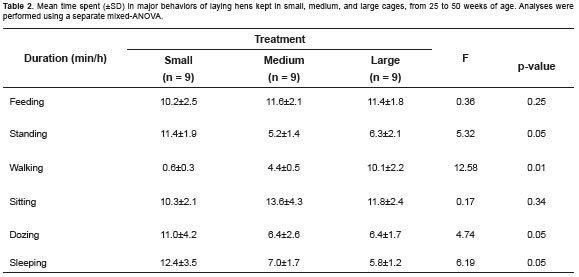
<body><![CDATA[<p>The experimental unit was the cage. Birds were   housed in different-size cages generating three   experimental treatments (<a href="#t1">Table 1</a>). Each treatment was   replicated nine times. Mean cage values were used   for statistical analyses. All analyses were conducted   using SAS software (SAS Institute, Cary, NY). The   effect of treatment was modeled for all parameters.   Separate mixed-model ANOVAs were performed for   each of the parameter analyses. All models included a covariance structure for repeated observations. Model assumptions of normality and homogeneity of residual variances were conducted. The model was checked for over/under dispersion using the scaled deviance, and corrected for this if either occurred. Tukey's post hoc tests were used to determine pair-wise differences between treatments (Zar, 1999). Significance was determined at p&lt;0.05.</p>     <p>&nbsp;</p>     <p><b><font size="3">Results</font></b></p>     <p>Duration of feeding and sitting behaviors did   not differ among treatments. Duration of standing   (ANOVA, F <sub>2,16</sub> = 5.32, p&lt;0.05), dozing (F <sub>2,16</sub> = 4.74,   p&lt;0.05), and sleeping (F <sub>2,16</sub> = 6.19, p&lt;0.05) were,   however, significantly different among treatments.   Duration of standing, dozing, and sleeping was higher   in small cages compared to medium and large cages   (Tukey's test, p&lt;0.01). Duration of walking was also   significantly different (F<sub>2,16</sub> = 12.58, p&lt;0.01), being   higher in large cages compared to small and medium cages (p = 0.001, <a href="#t2">Table 2</a>).</p>     <p align="center"><a name="t2"></a><img src="/img/revistas/rccp/v27n2/v27n2a4t2.jpg"></p>     <p>There were no significant differences in feedpecking   and water-pecking frequency among   treatments. However, cage-pecking (F <sub>2,16</sub> = 6.41,   p&lt;0.05), stretching (F <sub>2,16</sub> = 6.08, p&lt;0.05), and   preening frequencies (F <sub>2,16</sub> = 8.19, p&lt;0.05) were   different among treatments. Cage-pecking frequency   was higher in small cages compared to medium and   large cages (p&lt;0.05). Stretching frequency was higher   in large cages compared to small and medium cages   (p&lt;0.01). Moreover, preening frequency was higher   in medium and large cages compared to small cages (p&lt;0.05) (<a href="#t3">Table 3</a>).</p>     <p align="center"><a name="t3"></a><img src="/img/revistas/rccp/v27n2/v27n2a4t3.jpg"></p>     <p>Conspecific pecking was also significantly   affected by cage size (F <sub>2,18</sub> = 7.50, p&lt;0.05). Time   spent in agonistic interactions was not different   for pecking behavior in large cages. However, in   small (F <sub>2,18</sub> = 15.9, p&lt;0.01) and medium cages   (F <sub>2,18</sub> = 4.60, p&lt;0.05), conspecific pecking was   different among the different pecking behaviors.   Body-pecking frequency was higher in small cages   compared to medium and large cages (p&lt;0.05).   Head-pecking frequency was higher in small and   medium cages compared to large cages. However,   there was no difference in vent-pecking frequency among treatments (<a href="#f1">Figure 1</a>).</p>     <p align="center"><a name="f1"></a><img src="/img/revistas/rccp/v27n2/v27n2a4f1.jpg"></p>     <p>&nbsp;</p>     ]]></body>
<body><![CDATA[<p>&nbsp;</p>     <p><b><font size="3">Discussion</font></b></p>     <p>There is an inevitable interaction between social   requirement and space allowance (Keeling, 1995).   Behavior modeling shows that crowding increases   in small enclosures (Appleby, 2004). Moreover,   movement restriction caused by limited space is   related to social interaction (Febrer <i>et al.</i>, 2006). The impact of cage size may be especially relevant for small cages in this study. Space provided in the small cages used in this experiment does not fit the standard size commercially used for laying hens.</p>     <p>Eating totaled approximately 17% of the observation   period, and cage size had no effect on eating frequency   in this study. Activity-related behavior (standing and   walking) was affected by cage size. The number of   birds standing decreased and the number walking   increased in large cages (<a href="#t2">Table 2</a>). Stereotypic backand-   forth pacing and less walking were observed in   the small cages. Increased dozing and sleeping and   reduced walking of birds in the small cages indicate   passive responses that reduce the birds' frequency of social interactions.</p>     <p>Preening is necessary to keep feathers in good   condition, and is affected by available space   (Carmichael <i>et al.</i>, 1999). Preening behavior increased in medium and large cages (<a href="#t3">Table 3</a>), and thus, it seems likely that the decreased frequency in small cages was the result of limited space. It is also possible that preening bouts were shortened as a result of disturbance of this behavior by jostling (Fraser and Broom, 1997).</p>     <p>Pecking remains a major welfare and economic   problem in laying hens. In this study, body and head   peckings were higher in small cages compared to   medium and large cages. This seems most likely   because pecking behavior is performed at small interindividual   distance. Furthermore, increased pecking   could increase feather damage, feed consumption,   and mortality rate, as well as decrease egg production (Lampton <i>et al.</i>, 2010; Rodenburg <i>et al.</i>, 2010).</p>     <p>Physical characteristics of the cage environment   can have a major influence on movement and interindividual   distances (Leone and Estevez, 2008).   Increased sleeping, dozing, standing, and pecking at   the cage and at conspecifics are caused by reduced   space (Meddis, 1975). Hens seldom performed   activities such as wing flapping, stretching, body   shaking, and tail wagging because they were housed   in conventional cages (Nicol, 1987). Albentosa and   Cooper (2004) reported significant reduction in the   number of wing or leg stretches and tail wags in laying   hens housed in small cages compared with birds in large cages.</p>     <p>Despite the fact that the small cage used in this   study is the standard certified cage size for antibioticfree   laying hens in South Korea, welfare status of   hens in these cages was the poorest compared to the   medium and large cages. According to the results   observed in this study, the standard cage size should   be increased. Small cages could adversely affect   welfare of laying hens. The welfare impact for hens   not being able to walk, stretch, and preen should be assessed in future research.</p>     <p>Cage size is a critical factor affecting behavior of   laying hens in commercial battery cages. Sleeping,   dozing, standing, and pecking were increased in the   small cages compared to medium and large cages.   The increase of these behavioral bouts can be used   as indicators of spatial stress in conventional cages.   Knowing spatial relations in laying hens helps our   understanding of their social behavior and can be used to improve welfare status in animal husbandry.</p>     <p>&nbsp;</p> <hr size="1" />     ]]></body>
<body><![CDATA[<p><a name="0"></a><a href="#b0">&curren;</a> To cite this article: Rhim, Shin-Jae. Effect of floor space on the behavior of laying hens in commercial cages. Rev Colomb Cienc Pecu 2014; 27:95-101.</p> <hr size="1" />     <p>&nbsp;</p>     <p>&nbsp;</p>     <p>&nbsp;</p>     <p><b><font size="3">References</font></b></p>     <!-- ref --><p>   Adams AW, Craig JV. Effects of crowding and cage shape on   production and profitability of caged layers: a survey. Poultry   Sci 1985; 64:238-242.    &nbsp;&nbsp;&nbsp;&nbsp;&nbsp;&nbsp;&nbsp;&nbsp;[&#160;<a href="javascript:void(0);" onclick="javascript: window.open('/scielo.php?script=sci_nlinks&ref=000068&pid=S0120-0690201400020000400001&lng=','','width=640,height=500,resizable=yes,scrollbars=1,menubar=yes,');">Links</a>&#160;]<!-- end-ref --></p>     <!-- ref --><p>   Albentosa MJ, Cooper JJ. Effects of cage height and stocking   density on the frequency of comfort behaviors performed by   laying hens housed in furnished cages. Anim Welfare 2004;   13:419-429.    &nbsp;&nbsp;&nbsp;&nbsp;&nbsp;&nbsp;&nbsp;&nbsp;[&#160;<a href="javascript:void(0);" onclick="javascript: window.open('/scielo.php?script=sci_nlinks&ref=000070&pid=S0120-0690201400020000400002&lng=','','width=640,height=500,resizable=yes,scrollbars=1,menubar=yes,');">Links</a>&#160;]<!-- end-ref --></p>     <!-- ref --><p>   Appleby MC. What cause crowding? Effect of space, facilities   and group size on behavior, with particular reference to furnished   cages for hens. Anim Welfare 2004; 13:313-320.    &nbsp;&nbsp;&nbsp;&nbsp;&nbsp;&nbsp;&nbsp;&nbsp;[&#160;<a href="javascript:void(0);" onclick="javascript: window.open('/scielo.php?script=sci_nlinks&ref=000072&pid=S0120-0690201400020000400003&lng=','','width=640,height=500,resizable=yes,scrollbars=1,menubar=yes,');">Links</a>&#160;]<!-- end-ref --></p>     <!-- ref --><p>   Broom DM. Animal welfare: concepts, study methods and   indicators. Rev Colomb Cienc Pec 2011; 24:306-321.    &nbsp;&nbsp;&nbsp;&nbsp;&nbsp;&nbsp;&nbsp;&nbsp;[&#160;<a href="javascript:void(0);" onclick="javascript: window.open('/scielo.php?script=sci_nlinks&ref=000074&pid=S0120-0690201400020000400004&lng=','','width=640,height=500,resizable=yes,scrollbars=1,menubar=yes,');">Links</a>&#160;]<!-- end-ref --></p>     <!-- ref --><p>   Budiansky S. The covenant of the wild: why animal chose   domestication. New Haven: Yale University Press; 1992.    &nbsp;&nbsp;&nbsp;&nbsp;&nbsp;&nbsp;&nbsp;&nbsp;[&#160;<a href="javascript:void(0);" onclick="javascript: window.open('/scielo.php?script=sci_nlinks&ref=000076&pid=S0120-0690201400020000400005&lng=','','width=640,height=500,resizable=yes,scrollbars=1,menubar=yes,');">Links</a>&#160;]<!-- end-ref --></p>     <!-- ref --><p>   Carmichael NL, Walker AW, Hughes BO. Laying hens in large   flocks in a perchery system: influence of stocking density on   location, use of resources and behavior. Brit Poultry Sci 1999;   40:165-176.    &nbsp;&nbsp;&nbsp;&nbsp;&nbsp;&nbsp;&nbsp;&nbsp;[&#160;<a href="javascript:void(0);" onclick="javascript: window.open('/scielo.php?script=sci_nlinks&ref=000078&pid=S0120-0690201400020000400006&lng=','','width=640,height=500,resizable=yes,scrollbars=1,menubar=yes,');">Links</a>&#160;]<!-- end-ref --></p>     <!-- ref --><p>   Estevez I, Andersen IL, N&aelig;vdal E. Group size, density and   social dynamics in farm animals. Appl Anim Behav Sci 2007;   103:185-204.    &nbsp;&nbsp;&nbsp;&nbsp;&nbsp;&nbsp;&nbsp;&nbsp;[&#160;<a href="javascript:void(0);" onclick="javascript: window.open('/scielo.php?script=sci_nlinks&ref=000080&pid=S0120-0690201400020000400007&lng=','','width=640,height=500,resizable=yes,scrollbars=1,menubar=yes,');">Links</a>&#160;]<!-- end-ref --></p>     <!-- ref --><p>   Faure JM. Rearing conditions and needs for space and litter in   laying hens. Appl Anim Behav Sci 1991; 31:111-117.    &nbsp;&nbsp;&nbsp;&nbsp;&nbsp;&nbsp;&nbsp;&nbsp;[&#160;<a href="javascript:void(0);" onclick="javascript: window.open('/scielo.php?script=sci_nlinks&ref=000082&pid=S0120-0690201400020000400008&lng=','','width=640,height=500,resizable=yes,scrollbars=1,menubar=yes,');">Links</a>&#160;]<!-- end-ref --></p>     <!-- ref --><p>   Febrer K, Jones TA, Donnelly CA, Dawkins MS. Forced to   crowd or choosing to cluster? spatial distribution indicates   social attraction in broiler chickens. Anim Behav 2006;   72:1291-1300.    &nbsp;&nbsp;&nbsp;&nbsp;&nbsp;&nbsp;&nbsp;&nbsp;[&#160;<a href="javascript:void(0);" onclick="javascript: window.open('/scielo.php?script=sci_nlinks&ref=000084&pid=S0120-0690201400020000400009&lng=','','width=640,height=500,resizable=yes,scrollbars=1,menubar=yes,');">Links</a>&#160;]<!-- end-ref --></p>     <!-- ref --><p>   Fraser AF, Broom DM. Farm animal behavior and welfare. Oxon:   CABI Publishing; 1997.    &nbsp;&nbsp;&nbsp;&nbsp;&nbsp;&nbsp;&nbsp;&nbsp;[&#160;<a href="javascript:void(0);" onclick="javascript: window.open('/scielo.php?script=sci_nlinks&ref=000086&pid=S0120-0690201400020000400010&lng=','','width=640,height=500,resizable=yes,scrollbars=1,menubar=yes,');">Links</a>&#160;]<!-- end-ref --></p>     <!-- ref --><p>   Hughes BO, Carmichael NL, Walker AW, Grigor PN. Low   incidence of aggression in large flocks of laying hens. Appl Anim   Behav Sci 1997; 54:215-234.    &nbsp;&nbsp;&nbsp;&nbsp;&nbsp;&nbsp;&nbsp;&nbsp;[&#160;<a href="javascript:void(0);" onclick="javascript: window.open('/scielo.php?script=sci_nlinks&ref=000088&pid=S0120-0690201400020000400011&lng=','','width=640,height=500,resizable=yes,scrollbars=1,menubar=yes,');">Links</a>&#160;]<!-- end-ref --></p>     <!-- ref --><p>   Keeling L. Spacing behavior and an ethological approach to   assessing optimum space allocations for groups of laying hens.   Appl Anim Behav Sci 1995; 44:171-186.    &nbsp;&nbsp;&nbsp;&nbsp;&nbsp;&nbsp;&nbsp;&nbsp;[&#160;<a href="javascript:void(0);" onclick="javascript: window.open('/scielo.php?script=sci_nlinks&ref=000090&pid=S0120-0690201400020000400012&lng=','','width=640,height=500,resizable=yes,scrollbars=1,menubar=yes,');">Links</a>&#160;]<!-- end-ref --></p>     <!-- ref --><p>   Lampton SL, Knowles TG, Yorke C, Nicol CJ. The risk   factors affecting the development of gentle and severe feather   pecking in loose housed laying hens. Appl Anim Behav Sci   2010; 123:32-42.    &nbsp;&nbsp;&nbsp;&nbsp;&nbsp;&nbsp;&nbsp;&nbsp;[&#160;<a href="javascript:void(0);" onclick="javascript: window.open('/scielo.php?script=sci_nlinks&ref=000092&pid=S0120-0690201400020000400013&lng=','','width=640,height=500,resizable=yes,scrollbars=1,menubar=yes,');">Links</a>&#160;]<!-- end-ref --></p>     <!-- ref --><p>   Leone EH, Est&eacute;vez I. Space use according to the distribution of   resources and level of competition. Poultry Sci 2008; 87:3-13.    &nbsp;&nbsp;&nbsp;&nbsp;&nbsp;&nbsp;&nbsp;&nbsp;[&#160;<a href="javascript:void(0);" onclick="javascript: window.open('/scielo.php?script=sci_nlinks&ref=000094&pid=S0120-0690201400020000400014&lng=','','width=640,height=500,resizable=yes,scrollbars=1,menubar=yes,');">Links</a>&#160;]<!-- end-ref --></p>     <!-- ref --><p>   Leone EH, Estevez I. Use of space in the domestic fowl: separating   the effects of enclosure size, group size and density. Anim Behav   2008; 76:1673-1682.    &nbsp;&nbsp;&nbsp;&nbsp;&nbsp;&nbsp;&nbsp;&nbsp;[&#160;<a href="javascript:void(0);" onclick="javascript: window.open('/scielo.php?script=sci_nlinks&ref=000096&pid=S0120-0690201400020000400015&lng=','','width=640,height=500,resizable=yes,scrollbars=1,menubar=yes,');">Links</a>&#160;]<!-- end-ref --></p>     <!-- ref --><p>Li Y, Wang L. Effects of previous housing system on agonistic   behaviors of growing pigs at mixing. Appl Anim Behav Sci 2011; 132:20-26.    &nbsp;&nbsp;&nbsp;&nbsp;&nbsp;&nbsp;&nbsp;&nbsp;[&#160;<a href="javascript:void(0);" onclick="javascript: window.open('/scielo.php?script=sci_nlinks&ref=000098&pid=S0120-0690201400020000400016&lng=','','width=640,height=500,resizable=yes,scrollbars=1,menubar=yes,');">Links</a>&#160;]<!-- end-ref --></p>     <!-- ref --><p>   Meddis R. On the functions of sleep. Anim Behav 1975; 23:676-691.    &nbsp;&nbsp;&nbsp;&nbsp;&nbsp;&nbsp;&nbsp;&nbsp;[&#160;<a href="javascript:void(0);" onclick="javascript: window.open('/scielo.php?script=sci_nlinks&ref=000100&pid=S0120-0690201400020000400017&lng=','','width=640,height=500,resizable=yes,scrollbars=1,menubar=yes,');">Links</a>&#160;]<!-- end-ref --><!-- ref -->   Morgan KN, Tromborg CT. Sources of stress in captivity. Appl   Anim Behav Sci 2007; 102:262-302.    &nbsp;&nbsp;&nbsp;&nbsp;&nbsp;&nbsp;&nbsp;&nbsp;[&#160;<a href="javascript:void(0);" onclick="javascript: window.open('/scielo.php?script=sci_nlinks&ref=000101&pid=S0120-0690201400020000400018&lng=','','width=640,height=500,resizable=yes,scrollbars=1,menubar=yes,');">Links</a>&#160;]<!-- end-ref --></p>     ]]></body>
<body><![CDATA[<!-- ref --><p>   National Research Council. Guide for the care and use of laboratory   animals. Washington DC: National Academy Press; 1996.    &nbsp;&nbsp;&nbsp;&nbsp;&nbsp;&nbsp;&nbsp;&nbsp;[&#160;<a href="javascript:void(0);" onclick="javascript: window.open('/scielo.php?script=sci_nlinks&ref=000103&pid=S0120-0690201400020000400019&lng=','','width=640,height=500,resizable=yes,scrollbars=1,menubar=yes,');">Links</a>&#160;]<!-- end-ref --></p>     <!-- ref --><p>   Newberry R, Tarazona AM. Behavior and welfare of laying hens   and broiler chickens. Rev Colomb Cienc Pecu 2011; 24:301-302.    &nbsp;&nbsp;&nbsp;&nbsp;&nbsp;&nbsp;&nbsp;&nbsp;[&#160;<a href="javascript:void(0);" onclick="javascript: window.open('/scielo.php?script=sci_nlinks&ref=000105&pid=S0120-0690201400020000400020&lng=','','width=640,height=500,resizable=yes,scrollbars=1,menubar=yes,');">Links</a>&#160;]<!-- end-ref --></p>     <!-- ref --><p>   Nicol CJ. Behavioral responses of laying hens following a period   of spatial restriction. Anim Behav 1987; 35:1709-1719.    &nbsp;&nbsp;&nbsp;&nbsp;&nbsp;&nbsp;&nbsp;&nbsp;[&#160;<a href="javascript:void(0);" onclick="javascript: window.open('/scielo.php?script=sci_nlinks&ref=000107&pid=S0120-0690201400020000400021&lng=','','width=640,height=500,resizable=yes,scrollbars=1,menubar=yes,');">Links</a>&#160;]<!-- end-ref --></p>     <!-- ref --><p>   Ravindran V, Thomas DV, Morel PCH. Performance and welfare   of broilers as affected by stocking density and zinc bacitracin   supplementation. Anim Sci J 2006; 77:110-116.    &nbsp;&nbsp;&nbsp;&nbsp;&nbsp;&nbsp;&nbsp;&nbsp;[&#160;<a href="javascript:void(0);" onclick="javascript: window.open('/scielo.php?script=sci_nlinks&ref=000109&pid=S0120-0690201400020000400022&lng=','','width=640,height=500,resizable=yes,scrollbars=1,menubar=yes,');">Links</a>&#160;]<!-- end-ref --></p>     <!-- ref --><p>   Rhim SJ. Effects of group size on agonistic behaviors of   commercially housed growing pigs. Rev Colomb Cienc Pec   2012; 25:353-359.    &nbsp;&nbsp;&nbsp;&nbsp;&nbsp;&nbsp;&nbsp;&nbsp;[&#160;<a href="javascript:void(0);" onclick="javascript: window.open('/scielo.php?script=sci_nlinks&ref=000111&pid=S0120-0690201400020000400023&lng=','','width=640,height=500,resizable=yes,scrollbars=1,menubar=yes,');">Links</a>&#160;]<!-- end-ref --></p>     ]]></body>
<body><![CDATA[<!-- ref --><p>   Rodenburg TB, Haas EN, Nielsen BL, Buitenhuis AJ. Fearfulness   and feather damage in laying hens divergently selected for high   and low feather pecking. Appl Anim Behav Sci 2010; 128:91-96.    &nbsp;&nbsp;&nbsp;&nbsp;&nbsp;&nbsp;&nbsp;&nbsp;[&#160;<a href="javascript:void(0);" onclick="javascript: window.open('/scielo.php?script=sci_nlinks&ref=000113&pid=S0120-0690201400020000400024&lng=','','width=640,height=500,resizable=yes,scrollbars=1,menubar=yes,');">Links</a>&#160;]<!-- end-ref --></p>     <!-- ref --><p>   Rook AJ, Penning PD. Synchronization of eating, ruminating   and idling activity by grazing sheep. Appl Anim Behav Sci 1991;   32:157-166.    &nbsp;&nbsp;&nbsp;&nbsp;&nbsp;&nbsp;&nbsp;&nbsp;[&#160;<a href="javascript:void(0);" onclick="javascript: window.open('/scielo.php?script=sci_nlinks&ref=000115&pid=S0120-0690201400020000400025&lng=','','width=640,height=500,resizable=yes,scrollbars=1,menubar=yes,');">Links</a>&#160;]<!-- end-ref --></p>     <!-- ref --><p>   Thogerson CM, Hester PY, Mench JA, Newberry RC, Okura   CM, Pajor EA, Talaty PN, Garner JP. The effect of feeder space   allocation on productivity and physiology of Hy-Line W-36 hens   house in conventional cages. Poultry Sci 2009; 88:1793-1799.    &nbsp;&nbsp;&nbsp;&nbsp;&nbsp;&nbsp;&nbsp;&nbsp;[&#160;<a href="javascript:void(0);" onclick="javascript: window.open('/scielo.php?script=sci_nlinks&ref=000117&pid=S0120-0690201400020000400026&lng=','','width=640,height=500,resizable=yes,scrollbars=1,menubar=yes,');">Links</a>&#160;]<!-- end-ref --></p>     <!-- ref --><p>   Zar JH. Biostatistical analysis. 4th ed. Upper Saddle River:   Prentice-Hall Inc; 1999.    &nbsp;&nbsp;&nbsp;&nbsp;&nbsp;&nbsp;&nbsp;&nbsp;[&#160;<a href="javascript:void(0);" onclick="javascript: window.open('/scielo.php?script=sci_nlinks&ref=000119&pid=S0120-0690201400020000400027&lng=','','width=640,height=500,resizable=yes,scrollbars=1,menubar=yes,');">Links</a>&#160;]<!-- end-ref --></p>     <p>&nbsp;</p>     <p>&nbsp;</p>     ]]></body>
<body><![CDATA[<p>&nbsp;</p> </font>     ]]></body><back>
<ref-list>
<ref id="B1">
<nlm-citation citation-type="journal">
<person-group person-group-type="author">
<name>
<surname><![CDATA[Adams]]></surname>
<given-names><![CDATA[AW]]></given-names>
</name>
<name>
<surname><![CDATA[Craig]]></surname>
<given-names><![CDATA[JV]]></given-names>
</name>
</person-group>
<article-title xml:lang="en"><![CDATA[Effects of crowding and cage shape on production and profitability of caged layers: a survey]]></article-title>
<source><![CDATA[Poultry Sci]]></source>
<year>1985</year>
<volume>64</volume>
<page-range>238-242</page-range></nlm-citation>
</ref>
<ref id="B2">
<nlm-citation citation-type="journal">
<person-group person-group-type="author">
<name>
<surname><![CDATA[Albentosa]]></surname>
<given-names><![CDATA[MJ]]></given-names>
</name>
<name>
<surname><![CDATA[Cooper]]></surname>
<given-names><![CDATA[JJ]]></given-names>
</name>
</person-group>
<article-title xml:lang="en"><![CDATA[Effects of cage height and stocking density on the frequency of comfort behaviors performed by laying hens housed in furnished cages]]></article-title>
<source><![CDATA[Anim Welfare]]></source>
<year>2004</year>
<volume>13</volume>
<page-range>419-429</page-range></nlm-citation>
</ref>
<ref id="B3">
<nlm-citation citation-type="journal">
<person-group person-group-type="author">
<name>
<surname><![CDATA[Appleby]]></surname>
<given-names><![CDATA[MC]]></given-names>
</name>
</person-group>
<article-title xml:lang="en"><![CDATA[What cause crowding? Effect of space, facilities and group size on behavior, with particular reference to furnished cages for hens]]></article-title>
<source><![CDATA[Anim Welfare]]></source>
<year>2004</year>
<volume>13</volume>
<page-range>313-320</page-range></nlm-citation>
</ref>
<ref id="B4">
<nlm-citation citation-type="journal">
<person-group person-group-type="author">
<name>
<surname><![CDATA[Broom]]></surname>
<given-names><![CDATA[DM]]></given-names>
</name>
</person-group>
<article-title xml:lang="en"><![CDATA[Animal welfare: concepts, study methods and indicators]]></article-title>
<source><![CDATA[Rev Colomb Cienc Pec]]></source>
<year>2011</year>
<volume>24</volume>
<page-range>306-321</page-range></nlm-citation>
</ref>
<ref id="B5">
<nlm-citation citation-type="book">
<person-group person-group-type="author">
<name>
<surname><![CDATA[Budiansky]]></surname>
<given-names><![CDATA[S]]></given-names>
</name>
</person-group>
<source><![CDATA[The covenant of the wild: why animal chose domestication]]></source>
<year>1992</year>
<publisher-loc><![CDATA[New Haven ]]></publisher-loc>
<publisher-name><![CDATA[Yale University Press]]></publisher-name>
</nlm-citation>
</ref>
<ref id="B6">
<nlm-citation citation-type="journal">
<person-group person-group-type="author">
<name>
<surname><![CDATA[Carmichael]]></surname>
<given-names><![CDATA[NL]]></given-names>
</name>
<name>
<surname><![CDATA[Walker]]></surname>
<given-names><![CDATA[AW]]></given-names>
</name>
<name>
<surname><![CDATA[Hughes]]></surname>
<given-names><![CDATA[BO]]></given-names>
</name>
</person-group>
<article-title xml:lang="en"><![CDATA[Laying hens in large flocks in a perchery system: influence of stocking density on location, use of resources and behavior]]></article-title>
<source><![CDATA[Brit Poultry Sci]]></source>
<year>1999</year>
<volume>40</volume>
<page-range>165-176</page-range></nlm-citation>
</ref>
<ref id="B7">
<nlm-citation citation-type="journal">
<person-group person-group-type="author">
<name>
<surname><![CDATA[Estevez]]></surname>
<given-names><![CDATA[I]]></given-names>
</name>
<name>
<surname><![CDATA[Andersen]]></surname>
<given-names><![CDATA[IL]]></given-names>
</name>
<name>
<surname><![CDATA[Nævdal]]></surname>
<given-names><![CDATA[E]]></given-names>
</name>
</person-group>
<article-title xml:lang="en"><![CDATA[Group size, density and social dynamics in farm animals]]></article-title>
<source><![CDATA[Appl Anim Behav Sci]]></source>
<year>2007</year>
<volume>103</volume>
<page-range>185-204</page-range></nlm-citation>
</ref>
<ref id="B8">
<nlm-citation citation-type="journal">
<person-group person-group-type="author">
<name>
<surname><![CDATA[Faure]]></surname>
<given-names><![CDATA[JM]]></given-names>
</name>
</person-group>
<article-title xml:lang="en"><![CDATA[Rearing conditions and needs for space and litter in laying hens]]></article-title>
<source><![CDATA[Appl Anim Behav Sci]]></source>
<year>1991</year>
<volume>31</volume>
<page-range>111-117</page-range></nlm-citation>
</ref>
<ref id="B9">
<nlm-citation citation-type="journal">
<person-group person-group-type="author">
<name>
<surname><![CDATA[Febrer]]></surname>
<given-names><![CDATA[K]]></given-names>
</name>
<name>
<surname><![CDATA[Jones]]></surname>
<given-names><![CDATA[TA]]></given-names>
</name>
<name>
<surname><![CDATA[Donnelly]]></surname>
<given-names><![CDATA[CA]]></given-names>
</name>
<name>
<surname><![CDATA[Dawkins]]></surname>
<given-names><![CDATA[MS]]></given-names>
</name>
</person-group>
<article-title xml:lang="en"><![CDATA[Forced to crowd or choosing to cluster? spatial distribution indicates social attraction in broiler chickens]]></article-title>
<source><![CDATA[Anim Behav]]></source>
<year>2006</year>
<volume>72</volume>
<page-range>1291-1300</page-range></nlm-citation>
</ref>
<ref id="B10">
<nlm-citation citation-type="book">
<person-group person-group-type="author">
<name>
<surname><![CDATA[Fraser]]></surname>
<given-names><![CDATA[AF]]></given-names>
</name>
<name>
<surname><![CDATA[Broom]]></surname>
<given-names><![CDATA[DM]]></given-names>
</name>
</person-group>
<source><![CDATA[Farm animal behavior and welfare]]></source>
<year>1997</year>
<publisher-loc><![CDATA[Oxon ]]></publisher-loc>
<publisher-name><![CDATA[CABI Publishing]]></publisher-name>
</nlm-citation>
</ref>
<ref id="B11">
<nlm-citation citation-type="journal">
<person-group person-group-type="author">
<name>
<surname><![CDATA[Hughes]]></surname>
<given-names><![CDATA[BO]]></given-names>
</name>
<name>
<surname><![CDATA[Carmichael]]></surname>
<given-names><![CDATA[NL]]></given-names>
</name>
<name>
<surname><![CDATA[Walker]]></surname>
<given-names><![CDATA[AW]]></given-names>
</name>
<name>
<surname><![CDATA[Grigor]]></surname>
<given-names><![CDATA[PN]]></given-names>
</name>
</person-group>
<article-title xml:lang="en"><![CDATA[Low incidence of aggression in large flocks of laying hens]]></article-title>
<source><![CDATA[Appl Anim Behav Sci]]></source>
<year>1997</year>
<volume>54</volume>
<page-range>215-234</page-range></nlm-citation>
</ref>
<ref id="B12">
<nlm-citation citation-type="journal">
<person-group person-group-type="author">
<name>
<surname><![CDATA[Keeling]]></surname>
<given-names><![CDATA[L]]></given-names>
</name>
</person-group>
<article-title xml:lang="en"><![CDATA[Spacing behavior and an ethological approach to assessing optimum space allocations for groups of laying hens]]></article-title>
<source><![CDATA[Appl Anim Behav Sci]]></source>
<year>1995</year>
<volume>44</volume>
<page-range>171-186</page-range></nlm-citation>
</ref>
<ref id="B13">
<nlm-citation citation-type="journal">
<person-group person-group-type="author">
<name>
<surname><![CDATA[Lampton]]></surname>
<given-names><![CDATA[SL]]></given-names>
</name>
<name>
<surname><![CDATA[Knowles]]></surname>
<given-names><![CDATA[TG]]></given-names>
</name>
<name>
<surname><![CDATA[Yorke]]></surname>
<given-names><![CDATA[C]]></given-names>
</name>
<name>
<surname><![CDATA[Nicol]]></surname>
<given-names><![CDATA[CJ]]></given-names>
</name>
</person-group>
<article-title xml:lang="en"><![CDATA[The risk factors affecting the development of gentle and severe feather pecking in loose housed laying hens]]></article-title>
<source><![CDATA[Appl Anim Behav Sci]]></source>
<year>2010</year>
<volume>123</volume>
<page-range>32-42</page-range></nlm-citation>
</ref>
<ref id="B14">
<nlm-citation citation-type="journal">
<person-group person-group-type="author">
<name>
<surname><![CDATA[Leone]]></surname>
<given-names><![CDATA[EH]]></given-names>
</name>
<name>
<surname><![CDATA[Estévez]]></surname>
<given-names><![CDATA[I]]></given-names>
</name>
</person-group>
<article-title xml:lang="en"><![CDATA[Space use according to the distribution of resources and level of competition]]></article-title>
<source><![CDATA[Poultry Sci]]></source>
<year>2008</year>
<volume>87</volume>
<page-range>3-13</page-range></nlm-citation>
</ref>
<ref id="B15">
<nlm-citation citation-type="journal">
<person-group person-group-type="author">
<name>
<surname><![CDATA[Leone]]></surname>
<given-names><![CDATA[EH]]></given-names>
</name>
<name>
<surname><![CDATA[Estevez]]></surname>
<given-names><![CDATA[I]]></given-names>
</name>
</person-group>
<article-title xml:lang="en"><![CDATA[Use of space in the domestic fowl: separating the effects of enclosure size, group size and density]]></article-title>
<source><![CDATA[Anim Behav]]></source>
<year>2008</year>
<volume>76</volume>
<page-range>1673-1682</page-range></nlm-citation>
</ref>
<ref id="B16">
<nlm-citation citation-type="journal">
<person-group person-group-type="author">
<name>
<surname><![CDATA[Li]]></surname>
<given-names><![CDATA[Y]]></given-names>
</name>
<name>
<surname><![CDATA[Wang]]></surname>
<given-names><![CDATA[L]]></given-names>
</name>
</person-group>
<article-title xml:lang="en"><![CDATA[Effects of previous housing system on agonistic behaviors of growing pigs at mixing]]></article-title>
<source><![CDATA[Appl Anim Behav Sci]]></source>
<year>2011</year>
<volume>132</volume>
<page-range>20-26</page-range></nlm-citation>
</ref>
<ref id="B17">
<nlm-citation citation-type="journal">
<person-group person-group-type="author">
<name>
<surname><![CDATA[Meddis]]></surname>
<given-names><![CDATA[R]]></given-names>
</name>
</person-group>
<article-title xml:lang="en"><![CDATA[On the functions of sleep]]></article-title>
<source><![CDATA[Anim Behav]]></source>
<year>1975</year>
<volume>23</volume>
<page-range>676-691</page-range></nlm-citation>
</ref>
<ref id="B18">
<nlm-citation citation-type="journal">
<person-group person-group-type="author">
<name>
<surname><![CDATA[Morgan]]></surname>
<given-names><![CDATA[KN]]></given-names>
</name>
<name>
<surname><![CDATA[Tromborg]]></surname>
<given-names><![CDATA[CT]]></given-names>
</name>
</person-group>
<article-title xml:lang="en"><![CDATA[Sources of stress in captivity]]></article-title>
<source><![CDATA[Appl Anim Behav Sci]]></source>
<year>2007</year>
<volume>102</volume>
<page-range>262-302</page-range></nlm-citation>
</ref>
<ref id="B19">
<nlm-citation citation-type="book">
<collab>National Research Council</collab>
<source><![CDATA[Guide for the care and use of laboratory animals]]></source>
<year>1996</year>
<publisher-loc><![CDATA[Washington^eDC DC]]></publisher-loc>
<publisher-name><![CDATA[National Academy Press]]></publisher-name>
</nlm-citation>
</ref>
<ref id="B20">
<nlm-citation citation-type="journal">
<person-group person-group-type="author">
<name>
<surname><![CDATA[Newberry]]></surname>
<given-names><![CDATA[R]]></given-names>
</name>
<name>
<surname><![CDATA[Tarazona]]></surname>
<given-names><![CDATA[AM]]></given-names>
</name>
</person-group>
<article-title xml:lang="en"><![CDATA[Behavior and welfare of laying hens and broiler chickens]]></article-title>
<source><![CDATA[Rev Colomb Cienc Pecu]]></source>
<year>2011</year>
<volume>24</volume>
<page-range>301-302</page-range></nlm-citation>
</ref>
<ref id="B21">
<nlm-citation citation-type="journal">
<person-group person-group-type="author">
<name>
<surname><![CDATA[Nicol]]></surname>
<given-names><![CDATA[CJ]]></given-names>
</name>
</person-group>
<article-title xml:lang="en"><![CDATA[Behavioral responses of laying hens following a period of spatial restriction]]></article-title>
<source><![CDATA[Anim Behav]]></source>
<year>1987</year>
<volume>35</volume>
<page-range>1709-1719</page-range></nlm-citation>
</ref>
<ref id="B22">
<nlm-citation citation-type="journal">
<person-group person-group-type="author">
<name>
<surname><![CDATA[Ravindran]]></surname>
<given-names><![CDATA[V]]></given-names>
</name>
<name>
<surname><![CDATA[Thomas]]></surname>
<given-names><![CDATA[DV]]></given-names>
</name>
<name>
<surname><![CDATA[Morel]]></surname>
<given-names><![CDATA[PCH]]></given-names>
</name>
</person-group>
<article-title xml:lang="en"><![CDATA[Performance and welfare of broilers as affected by stocking density and zinc bacitracin supplementation]]></article-title>
<source><![CDATA[Anim Sci J]]></source>
<year>2006</year>
<volume>77</volume>
<page-range>110-116</page-range></nlm-citation>
</ref>
<ref id="B23">
<nlm-citation citation-type="journal">
<person-group person-group-type="author">
<name>
<surname><![CDATA[Rhim]]></surname>
<given-names><![CDATA[SJ]]></given-names>
</name>
</person-group>
<article-title xml:lang="en"><![CDATA[Effects of group size on agonistic behaviors of commercially housed growing pigs]]></article-title>
<source><![CDATA[Rev Colomb Cienc Pec]]></source>
<year>2012</year>
<volume>25</volume>
<page-range>353-359</page-range></nlm-citation>
</ref>
<ref id="B24">
<nlm-citation citation-type="journal">
<person-group person-group-type="author">
<name>
<surname><![CDATA[Rodenburg]]></surname>
<given-names><![CDATA[TB]]></given-names>
</name>
<name>
<surname><![CDATA[Haas]]></surname>
<given-names><![CDATA[EN]]></given-names>
</name>
<name>
<surname><![CDATA[Nielsen]]></surname>
<given-names><![CDATA[BL]]></given-names>
</name>
<name>
<surname><![CDATA[Buitenhuis]]></surname>
<given-names><![CDATA[AJ]]></given-names>
</name>
</person-group>
<article-title xml:lang="en"><![CDATA[Fearfulness and feather damage in laying hens divergently selected for high and low feather pecking]]></article-title>
<source><![CDATA[Appl Anim Behav Sci]]></source>
<year>2010</year>
<volume>128</volume>
<page-range>91-96</page-range></nlm-citation>
</ref>
<ref id="B25">
<nlm-citation citation-type="journal">
<person-group person-group-type="author">
<name>
<surname><![CDATA[Rook]]></surname>
<given-names><![CDATA[AJ]]></given-names>
</name>
<name>
<surname><![CDATA[Penning]]></surname>
<given-names><![CDATA[PD]]></given-names>
</name>
</person-group>
<article-title xml:lang="en"><![CDATA[Synchronization of eating, ruminating and idling activity by grazing sheep]]></article-title>
<source><![CDATA[Appl Anim Behav Sci]]></source>
<year>1991</year>
<volume>32</volume>
<page-range>157-166</page-range></nlm-citation>
</ref>
<ref id="B26">
<nlm-citation citation-type="journal">
<person-group person-group-type="author">
<name>
<surname><![CDATA[Thogerson]]></surname>
<given-names><![CDATA[CM]]></given-names>
</name>
<name>
<surname><![CDATA[Hester]]></surname>
<given-names><![CDATA[PY]]></given-names>
</name>
<name>
<surname><![CDATA[Mench]]></surname>
<given-names><![CDATA[JA]]></given-names>
</name>
<name>
<surname><![CDATA[Newberry]]></surname>
<given-names><![CDATA[RC]]></given-names>
</name>
<name>
<surname><![CDATA[Okura]]></surname>
<given-names><![CDATA[CM]]></given-names>
</name>
<name>
<surname><![CDATA[Pajor]]></surname>
<given-names><![CDATA[EA]]></given-names>
</name>
<name>
<surname><![CDATA[Talaty]]></surname>
<given-names><![CDATA[PN]]></given-names>
</name>
<name>
<surname><![CDATA[Garner]]></surname>
<given-names><![CDATA[JP]]></given-names>
</name>
</person-group>
<article-title xml:lang="en"><![CDATA[The effect of feeder space allocation on productivity and physiology of Hy-Line W-36 hens house in conventional cages]]></article-title>
<source><![CDATA[Poultry Sci]]></source>
<year>2009</year>
<volume>88</volume>
<page-range>1793-1799</page-range></nlm-citation>
</ref>
<ref id="B27">
<nlm-citation citation-type="book">
<person-group person-group-type="author">
<name>
<surname><![CDATA[Zar]]></surname>
<given-names><![CDATA[JH]]></given-names>
</name>
</person-group>
<source><![CDATA[Biostatistical analysis]]></source>
<year>1999</year>
<edition>4th</edition>
<publisher-loc><![CDATA[Upper Saddle River ]]></publisher-loc>
<publisher-name><![CDATA[Prentice-Hall Inc]]></publisher-name>
</nlm-citation>
</ref>
</ref-list>
</back>
</article>