<?xml version="1.0" encoding="ISO-8859-1"?><article xmlns:mml="http://www.w3.org/1998/Math/MathML" xmlns:xlink="http://www.w3.org/1999/xlink" xmlns:xsi="http://www.w3.org/2001/XMLSchema-instance">
<front>
<journal-meta>
<journal-id>0120-0690</journal-id>
<journal-title><![CDATA[Revista Colombiana de Ciencias Pecuarias]]></journal-title>
<abbrev-journal-title><![CDATA[Rev Colom Cienc Pecua]]></abbrev-journal-title>
<issn>0120-0690</issn>
<publisher>
<publisher-name><![CDATA[Facultad de Ciencias Agrarias, Universidad de Antioquia]]></publisher-name>
</publisher>
</journal-meta>
<article-meta>
<article-id>S0120-06902014000200005</article-id>
<title-group>
<article-title xml:lang="en"><![CDATA[Effects of dietary barley on growth performance, carcass traits and pork quality of finishing pigs]]></article-title>
<article-title xml:lang="es"><![CDATA[Efecto de la inclusión dietaria de cebada sobre el crecimiento, calidad de la canal y de la carne de cerdos en engorde]]></article-title>
<article-title xml:lang="pt"><![CDATA[Efeito da inclusão de cevada no crescimento, qualidade da carcaça e da carne de suínos em engorda]]></article-title>
</title-group>
<contrib-group>
<contrib contrib-type="author">
<name>
<surname><![CDATA[Kim]]></surname>
<given-names><![CDATA[Beob G]]></given-names>
</name>
<xref ref-type="aff" rid="A02"/>
<xref ref-type="aff" rid="A03"/>
</contrib>
<contrib contrib-type="author">
<name>
<surname><![CDATA[Wulf]]></surname>
<given-names><![CDATA[Duane M]]></given-names>
</name>
<xref ref-type="aff" rid="A03"/>
</contrib>
<contrib contrib-type="author">
<name>
<surname><![CDATA[Maddock]]></surname>
<given-names><![CDATA[Robert J]]></given-names>
</name>
<xref ref-type="aff" rid="A04"/>
</contrib>
<contrib contrib-type="author">
<name>
<surname><![CDATA[Peters]]></surname>
<given-names><![CDATA[Dean N]]></given-names>
</name>
<xref ref-type="aff" rid="A04"/>
</contrib>
<contrib contrib-type="author">
<name>
<surname><![CDATA[Pedersen]]></surname>
<given-names><![CDATA[Carsten]]></given-names>
</name>
<xref ref-type="aff" rid="A04"/>
</contrib>
<contrib contrib-type="author">
<name>
<surname><![CDATA[Liu]]></surname>
<given-names><![CDATA[Yanhong]]></given-names>
</name>
<xref ref-type="aff" rid="A03"/>
</contrib>
<contrib contrib-type="author">
<name>
<surname><![CDATA[Stein]]></surname>
<given-names><![CDATA[Hans H]]></given-names>
</name>
<xref ref-type="aff" rid="A01"/>
<xref ref-type="aff" rid="A03"/>
</contrib>
</contrib-group>
<aff id="A01">
<institution><![CDATA[,University of Illinois Department of Animal Sciences ]]></institution>
<addr-line><![CDATA[ ]]></addr-line>
<country>USA</country>
</aff>
<aff id="A02">
<institution><![CDATA[,Konkuk University Department of Animal Science and Technology ]]></institution>
<addr-line><![CDATA[Seoul ]]></addr-line>
</aff>
<aff id="A03">
<institution><![CDATA[,University of Illinois Department of Animal Science and Technology ]]></institution>
<addr-line><![CDATA[ ]]></addr-line>
<country>USA</country>
</aff>
<aff id="A04">
<institution><![CDATA[,South Dakota State University Department of Animal and Range Sciences ]]></institution>
<addr-line><![CDATA[ ]]></addr-line>
</aff>
<pub-date pub-type="pub">
<day>00</day>
<month>06</month>
<year>2014</year>
</pub-date>
<pub-date pub-type="epub">
<day>00</day>
<month>06</month>
<year>2014</year>
</pub-date>
<volume>27</volume>
<numero>2</numero>
<fpage>102</fpage>
<lpage>113</lpage>
<copyright-statement/>
<copyright-year/>
<self-uri xlink:href="http://www.scielo.org.co/scielo.php?script=sci_arttext&amp;pid=S0120-06902014000200005&amp;lng=en&amp;nrm=iso"></self-uri><self-uri xlink:href="http://www.scielo.org.co/scielo.php?script=sci_abstract&amp;pid=S0120-06902014000200005&amp;lng=en&amp;nrm=iso"></self-uri><self-uri xlink:href="http://www.scielo.org.co/scielo.php?script=sci_pdf&amp;pid=S0120-06902014000200005&amp;lng=en&amp;nrm=iso"></self-uri><abstract abstract-type="short" xml:lang="en"><p><![CDATA[Background: the relatively high concentration of polyunsaturated fatty acid in yellow corn may reduce the quality of pork fat, but feeding barley instead of yellow corn may increase pork quality. Objective: to determine the effects of feeding graded levels of barley on performance, carcass composition, and pork quality of finishing pigs. Methods: in experiment 1, diets containing 0, 20, 40, 60, or 80% barley were fed to pigs (initial BW: 67.9 kg) for 8 weeks. In experiment 2, a diet containing 60% barley was fed to pigs for 0, 2, 4, 6, or 8 weeks prior to slaughter. Results: feeding diets with increasing levels of barley resulted in a linear decrease in daily gain (p<0.01) and backfat thickness (p<0.01). Dressing percentage linearly decreased with length of barley feeding (p<0.05), but the concentration of saturated fatty acids in backfat increased (linear, p<0.05) the longer the barley diet was fed. Conclusion: there was no effect of barley on loin muscle quality and barley did not consistently change fat color or belly and bacon quality.]]></p></abstract>
<abstract abstract-type="short" xml:lang="es"><p><![CDATA[Antecedentes: la relativamente alta concentración de ácidos grasos poliinsaturados presente en el maíz amarillo puede reducir la calidad de la grasa del cerdo. Alimentar con cebada en lugar de maíz amarillo podría mejorar la calidad de dicha carne. Objetivo: determinar los efectos del suministro de niveles incrementales de cebada sobre el rendimiento, composición de la canal y calidad de la carne de cerdos en ceba. Métodos: en el experimento 1 se suministraron dietas que contenían 0, 20, 40, 60, o 80% de cebada a cerdos en ceba (PV inicial: 67,9 kg) durante 8 semanas. En el experimento 2 se suministró una dieta con 60% de cebada a cerdos durante 0, 2, 4, 6, u 8 semanas antes del sacrificio. Resultados: el introducir mayores niveles de cebada en la dieta resultó en una disminución lineal de la ganancia diaria (p<0,01) y del espesor de la grasa dorsal (p<0,01). El porcentaje de rendimiento disminuyó linealmente con la duración del suministro de cebada (p<0,05), pero la concentración de ácidos grasos saturados en la grasa dorsal aumentó (lineal, p<0,05) a medida que se incrementó la duración del suministro de cebada. Conclusión: no hubo efecto de la cebada en la calidad del músculo del lomo. La cebada no cambió el color de la grasa ni la calidad del vientre o del tocino.]]></p></abstract>
<abstract abstract-type="short" xml:lang="pt"><p><![CDATA[Antecedentes: a concentração relativamente elevada de ácidos gordurosos poli-insaturados presentes no milho amarelo pode reduzir a qualidade da gordura suína. Fornecendo cevada ao invés de milho amarelo poderia melhorar a qualidade da carne. Objetivo: determinar os efeitos de níveis crescentes de cevada sobre o desempenho, composição e qualidade da carne a da carcaça de suínos de engorda. Métodos: no primeiro experimento os suínos foram alimentados durante o período de engorda com dietas contendo 0, 20, 40, 60, ou 80% de cevada (PV inicial de 67,9 kg) durante oito semanas. No segundo experimento se subministrou uma dieta com 60% de cevada aos suínos durante 0, 2, 4, 6 ou 8 semanas antes do abate. Resultados: a introdução de maiores níveis de cevada na dieta resultou em uma redução linear do ganho de peso diário (p<0,01) e da espessura de toucinho (p<0,01). A porcentagem de rendimento no período de engorda diminuiu linearmente com a duração de fornecimento de cevada (p<0,05), mas a concentração de ácidos gordurosos saturados do bacon aumentou enquanto se incrementou a duração de fornecimento de cevada (linear, p<0,05). Conclusão: não houve efeito de cevada na qualidade do olho de lombo. A cevada não mudou a cor da gordura nem a qualidade da barriga e do bacon.]]></p></abstract>
<kwd-group>
<kwd lng="en"><![CDATA[belly traits]]></kwd>
<kwd lng="en"><![CDATA[fatty acid composition]]></kwd>
<kwd lng="en"><![CDATA[growth rate]]></kwd>
<kwd lng="en"><![CDATA[swine nutrition]]></kwd>
<kwd lng="es"><![CDATA[calidad del vientre]]></kwd>
<kwd lng="es"><![CDATA[composición de ácidos grasos]]></kwd>
<kwd lng="es"><![CDATA[nutrición porcina]]></kwd>
<kwd lng="es"><![CDATA[tasa de crecimiento]]></kwd>
<kwd lng="pt"><![CDATA[qualidade do ventre]]></kwd>
<kwd lng="pt"><![CDATA[composição de ácidos graxos]]></kwd>
<kwd lng="pt"><![CDATA[taxa de crescimento]]></kwd>
<kwd lng="pt"><![CDATA[nutrição de suínos]]></kwd>
</kwd-group>
</article-meta>
</front><body><![CDATA[  <font size="2" face="Verdana, Arial, Helvetica, sans-serif">     <p align="right"><b>ORIGINAL ARTICLES</b></p>     <p align="center">&nbsp;</p>     <p align="center"><b><font size="4">Effects of dietary barley on growth performance, carcass traits   and pork quality of finishing pigs<a name="b0"></a><a href="#0"><sup>&curren;</sup></a></font></b></p>     <p>&nbsp;  </p>     <p align="center"><b><font size="3">Efecto de la inclusi&oacute;n dietaria de cebada sobre el crecimiento, calidad de la canal   y de la carne de cerdos en engorde</font></b></p>     <p>&nbsp;  </p>     <p align="center"><b><font size="3">Efeito da inclus&atilde;o de cevada no crescimento, qualidade da carca&ccedil;a e da carne de su&iacute;nos em engorda </font></b></p>     <p>&nbsp;</p>     <p>&nbsp;</p>     ]]></body>
<body><![CDATA[<p><b>Beob G Kim1<sup>**</sup>, PhD; Duane M Wulf<sup>1</sup>, PhD; Robert J Maddock<sup>2</sup>, PhD; Dean N Peters<sup>2</sup>, MS; Carsten Pedersen<sup>2</sup>, PhD;   Yanhong Liu<sup>1</sup>, PhD; Hans H Stein1<sup>*</sup>, PhD.</b></p>     <p>* Corresponding author: Hans H Stein. Department of Animal Sciences, University of Illinois, Urbana 61801, IL, USA. Tel +1 2173336462. Email: <a href="mailto:hstein@illinois.edu">hstein@illinois.edu</a></p>     <p>   ** Current address: Department of Animal Science and Technology, Konkuk University, Seoul 143-701, Republic of Korea.</p>     <p>1Department of Animal Sciences, University of Illinois, Urbana, IL 61801, USA.</p>     <p>   2Department of Animal and Range Sciences, South Dakota State University, Brookings, SD57007, USA.</p>     <p>&nbsp;</p>     <p>(Received: April 11, 2013; accepted: October 2, 2013)</p>     <p>&nbsp;</p> <hr size="1" />     <p><b>Summary</b></p>     <p>   <b>Background:</b> the relatively high concentration of polyunsaturated fatty acid in yellow corn may reduce   the quality of pork fat, but feeding barley instead of yellow corn may increase pork quality. <b>Objective:</b> to   determine the effects of feeding graded levels of barley on performance, carcass composition, and pork quality   of finishing pigs. <b>Methods:</b> in experiment 1, diets containing 0, 20, 40, 60, or 80% barley were fed to pigs   (initial BW: 67.9 kg) for 8 weeks. In experiment 2, a diet containing 60% barley was fed to pigs for 0, 2, 4,   6, or 8 weeks prior to slaughter. <b>Results:</b> feeding diets with increasing levels of barley resulted in a linear   decrease in daily gain (p&lt;0.01) and backfat thickness (p&lt;0.01). Dressing percentage linearly decreased with   length of barley feeding (p&lt;0.05), but the concentration of saturated fatty acids in backfat increased (linear,   p&lt;0.05) the longer the barley diet was fed. <b>Conclusion:</b> there was no effect of barley on loin muscle quality   and barley did not consistently change fat color or belly and bacon quality.</p>     ]]></body>
<body><![CDATA[<p>   <b>Key words:</b> belly traits, fatty acid composition, growth rate, swine nutrition.</p> <hr size="1" />     <p><b>Resumen</b></p>     <p>   <b>Antecedentes:</b> la relativamente alta concentraci&oacute;n de &aacute;cidos grasos poliinsaturados presente en el ma&iacute;z   amarillo puede reducir la calidad de la grasa del cerdo. Alimentar con cebada en lugar de ma&iacute;z amarillo podr&iacute;a   mejorar la calidad de dicha carne. <b>Objetivo:</b> determinar los efectos del suministro de niveles incrementales de cebada sobre el rendimiento, composici&oacute;n de la canal y calidad de la carne de cerdos en ceba. <b>M&eacute;todos:</b> en   el experimento 1 se suministraron dietas que conten&iacute;an 0, 20, 40, 60, o 80% de cebada a cerdos en ceba (PV   inicial: 67,9 kg) durante 8 semanas. En el experimento 2 se suministr&oacute; una dieta con 60% de cebada a cerdos   durante 0, 2, 4, 6, u 8 semanas antes del sacrificio. <b>Resultados:</b> el introducir mayores niveles de cebada en la   dieta result&oacute; en una disminuci&oacute;n lineal de la ganancia diaria (p&lt;0,01) y del espesor de la grasa dorsal (p&lt;0,01).   El porcentaje de rendimiento disminuy&oacute; linealmente con la duraci&oacute;n del suministro de cebada (p&lt;0,05), pero   la concentraci&oacute;n de &aacute;cidos grasos saturados en la grasa dorsal aument&oacute; (lineal, p&lt;0,05) a medida que se   increment&oacute; la duraci&oacute;n del suministro de cebada. <b>Conclusi&oacute;n:</b> no hubo efecto de la cebada en la calidad del   m&uacute;sculo del lomo. La cebada no cambi&oacute; el color de la grasa ni la calidad del vientre o del tocino.</p>     <p>   <b>Palabras clave:</b> calidad del vientre, composici&oacute;n de &aacute;cidos grasos, nutrici&oacute;n porcina, tasa de crecimiento.</p> <hr size="1" />     <p><b>Resumo</b></p>     <p>   <b>Antecedentes:</b> a concentra&ccedil;&atilde;o relativamente elevada de &aacute;cidos gordurosos poli-insaturados presentes   no milho amarelo pode reduzir a qualidade da gordura su&iacute;na. Fornecendo cevada ao inv&eacute;s de milho amarelo   poderia melhorar a qualidade da carne. <b>Objetivo:</b> determinar os efeitos de n&iacute;veis crescentes de cevada sobre   o desempenho, composi&ccedil;&atilde;o e qualidade da carne a da carca&ccedil;a de su&iacute;nos de engorda. <b>M&eacute;todos:</b> no primeiro   experimento os su&iacute;nos foram alimentados durante o per&iacute;odo de engorda com dietas contendo 0, 20, 40, 60, ou   80% de cevada (PV inicial de 67,9 kg) durante oito semanas. No segundo experimento se subministrou uma   dieta com 60% de cevada aos su&iacute;nos durante 0, 2, 4, 6 ou 8 semanas antes do abate. <b>Resultados:</b> a introdu&ccedil;&atilde;o   de maiores n&iacute;veis de cevada na dieta resultou em uma redu&ccedil;&atilde;o linear do ganho de peso di&aacute;rio (p&lt;0,01) e da   espessura de toucinho (p&lt;0,01). A porcentagem de rendimento no per&iacute;odo de engorda diminuiu linearmente   com a dura&ccedil;&atilde;o de fornecimento de cevada (p&lt;0,05), mas a concentra&ccedil;&atilde;o de &aacute;cidos gordurosos saturados do   bacon aumentou enquanto se incrementou a dura&ccedil;&atilde;o de fornecimento de cevada (linear, p&lt;0,05). <b>Conclus&atilde;o:</b>  n&atilde;o houve efeito de cevada na qualidade do olho de lombo. A cevada n&atilde;o mudou a cor da gordura nem a   qualidade da barriga e do bacon.</p>     <p>   <b>Palavras chave:</b> qualidade do ventre, composi&ccedil;&atilde;o de &aacute;cidos graxos, taxa de crescimento, nutri&ccedil;&atilde;o de su&iacute;nos.</p> <hr size="1" />     <p>&nbsp;</p>     <p>&nbsp;</p>     <p><b><font size="3">Introduction</font></b></p>     ]]></body>
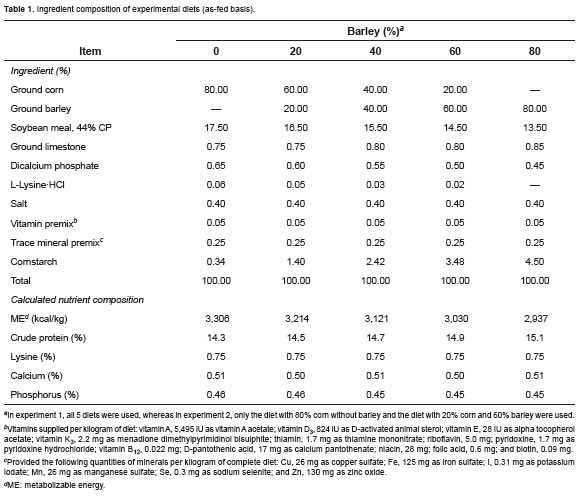
<body><![CDATA[<p>   Corn-based diets fed to finishing pigs may result   in soft fat due to the high levels of unsaturated   fatty acids in corn oil, and the carotenoids in corn   may result in deposition of yellow fat in pigs (Carr   <i>et al.</i>, 2005; Madsen <i>et al.</i>, 1992; NPPC, 2000).   Yellow fat is undesirable by some customers in Asia.   Feeding barley instead of yellow corn often results   in whiter and firmer pork fat with reduced iodine   values (Lampe <i>et al.</i>, 2006; Opapeju <i>et al.</i>, 2006;   Ringkob, 2003) because of the low concentration of   carotenoids and PUFA in barley. However, feeding   barley may reduce pig growth performance due to   the greater fiber and the lower energy concentration   compared with corn. Inclusion of barley in diets fed   to pigs is, therefore, a balance between obtaining   a desirable fat quality and color, and maintaining   the best possible growth performance. Thus, the   optimum level of barley in diets fed to finishing   pigs, and the length that this diet needs to be fed   to improve pork fat color and quality, need to be   determined.</p>     <p>Therefore, the hypothesis tested in the present   experiments was that feeding barley to finishing   pigs may improve pork quality but also negatively   affect pig growth performance. The objective was to   determine an optimum inclusion level of barley in   finishing diets for pigs and the period that is necessary   to feed barley to obtain a desired pork quality without impairing pig growth performance.</p>     <p>&nbsp;</p>     <p><b><font size="3">Materials and methods</font></b></p>     <p>   <i>General procedures</i></p>     <p>   Two experiments were conducted using crossbred   pigs (SP-1 sires &times; Line 13 dams; Ausgene, Gridley,   IL). Protocols for both experiments were reviewed   and approved by the Institutional Animal Care and   Use Committee at South Dakota State University where the experiments were conducted. Pigs were   housed in an environmentally controlled finishing   building with temperatures maintained at 18&deg; C. Each   pen (1.2 &times; 2.4 m) was equipped with a feeder and a   nipple drinker and had a fully slatted concrete floor.   Pigs had unlimited access to feed and water.</p>     <p><i>Experiment 1</i></p>     <p>In an 8-week growth assay, a total of 60 pigs with an   average initial body weight (BW) of 67.9 &plusmn; 5.52 kg were   used. Animals were grouped by BW into six blocks   and randomly assigned to five treatment groups with   two pigs (one barrow and one gilt) per pen and six   replicate pens per treatment group in a randomized   complete block design. The control diet contained   80% corn, 17.5% soybean meal, and 0.34% corn   starch (<a href="#t1">Table 1</a>). Four additional diets were formulated   by adding 20, 40, 60, or 80% barley to the control   diet by replacing equal amounts of corn in the diets.   The concentration of soybean meal was reduced and   the concentration of cornstarch was increased as the   concentration of barley in the diets was increased   because of the greater concentration of digestible   AA in barley than in corn (NRC, 1998). All diets   were formulated to contain similar concentrations   of crude protein and lysine. Vitamins and minerals   were added to meet or exceed requirement estimates   for finishing pigs (NRC, 1998). Response variables were pig performance and carcass traits.</p>     <p align="center"><a name="t1"></a><img src="/img/revistas/rccp/v27n2/v27n2a5t1.jpg"></p>     <p><i>Experiment 2</i></p>     ]]></body>
<body><![CDATA[<p>   This experiment also lasted 8-weeks and was   conducted to evaluate the effect of feeding diets   containing 60% barley to finishing pigs for 0, 2, 4,   6, or 8 weeks prior to slaughter. Sixty pigs with an   initial BW of 70.7 &plusmn; 2.86 kg were randomly allotted to   five treatment groups with two pigs (one barrow and   one gilt) per pen and six replicate pens per treatment   group in a randomized complete block design based   on initial BW. The control diet was based on corn   and soybean meal and was similar to the control diet   used in experiment 1. The barley diet was similar to   the 60% barley diet used in experiment 1. For the   first treatment group, the control diet was offered   for 8 weeks; for the second group, the control diet   was fed for 6 weeks followed by the barley diet for   2 weeks; for the third group, the control diet was   fed for 4 weeks followed by the barley diet for 4   weeks; for the fourth group, the control diet was fed   for 2 weeks followed by the barley diet for 6 weeks;   and for the last treatment group, the barley diet was   fed for the entire 8-week experimental period. Pigs   were humanely slaughtered at the conclusion of the   experiment. Response variables included growth   performance, carcass traits, pork fat quality and color,   and fatty acid composition of backfat.</p>     <p><i>Growth trials and carcass measurements</i></p>     <p>   In both experiments, animal BW and feed   disappearance were determined every other week.   Average daily gain (ADG), average daily feed intake   (ADFI), and gain:feed ratio (G:F) were calculated   at the conclusion of the experiment. All pigs were   slaughtered at the Meat Science Laboratory at South   Dakota State University following an overnight fast.   Pigs were electrically stunned and dressed using   standard operating procedures. After recording hot   carcass weights, carcasses were placed in a cooler   at 4 &deg;C. Dressing percentage was calculated by   dividing the hot carcass weight by the live BW. Loin   muscle depth and 10th rib fat depth were measured,   and carcass lean percentage was calculated (NPPC,   2000).</p>     <p><i>Pork quality and belly traits</i></p>     <p>   Subjective marbling and color scores of the loin   muscle were determined in pigs from experiment 2   based on the standards suggested by NPPC (2000).   Sampling procedures, pork quality measurements,   and backfat color determination were similar to the   procedures described by Stein <i>et al.</i> (2006). Hue angle   was calculated in degrees as tan<sup>-1</sup> (b*/a*), and saturation   index was calculated as [(a*)<sup>2</sup> + (b*)<sup>2</sup>]<sup>0.5</sup> (Little, 1975).</p>     <p>Bellies were removed from the right side of every   carcass at 24 h postmortem. Belly traits, belly fat   color, and bacon quality traits were measured using   the procedures described by Stein <i>et al.</i> (2006). Fatty   acid concentration in backfat samples was analyzed   according to the method described by Sukhija and Palmquist (1988).</p>     <p><i>Statistical analysis</i></p>     <p>Data were analyzed as a randomized complete   block design using the Generalized Linear Model   procedure of SAS (SAS Inst. Inc., Cary, NC), and   the pen was the experimental unit. Orthogonal   polynomials were used to determine linear and   quadratic effects of treatments. In experiment 2, belly   thickness was used as a covariate in the analysis for   backfat composition, belly angle, color, traits, and   sensory scores of belly fat. The alpha level used for determination of statistical significance was 0.05.</p>     <p>&nbsp;</p>     <p><font size="3"><b>Results</b></font></p>     ]]></body>
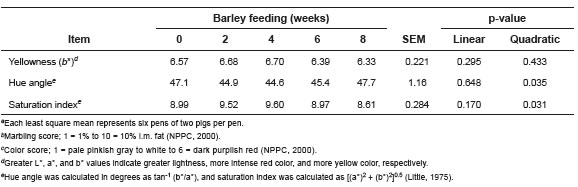
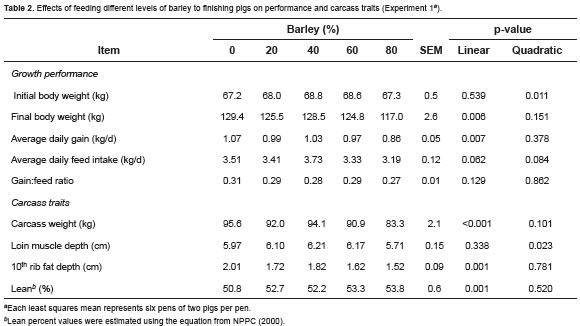
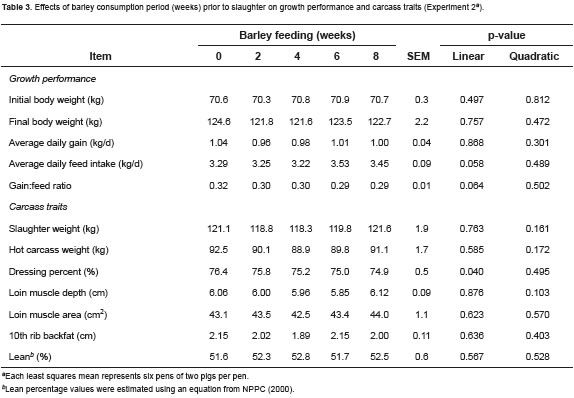
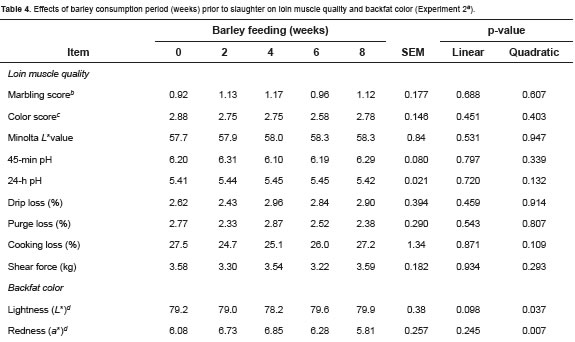
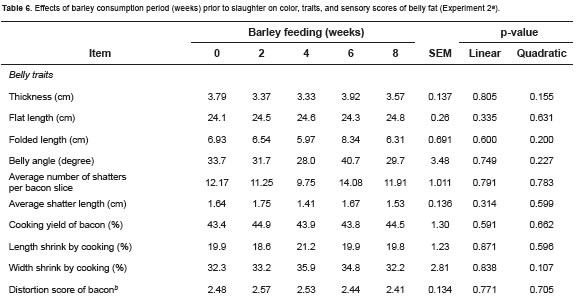
<body><![CDATA[<p>   <i>Experiment 1</i></p>     <p>  Substitution of corn with barley resulted in a linear   decrease (p&lt;0.01) in ADG (<a href="#t2">Table 2</a>). Feed intake also   tended to decrease (linear, p=0.06) with increasing levels   of dietary barley, but G:F was unaffected by the levels   of dietary barley. Carcass weights linearly decreased   (p&lt;0.001) and loin muscle depth was reduced (quadratic,   p&lt;0.05) with increasing levels of barley in the diets.   Increasing levels of barley in the diet also resulted in   thinner backfat (linear, p&lt;0.01) and greater carcass lean percentage (linear, p&lt;0.01) compared with pigs fed diets   containing more corn and less barley.</p>     <p align="center"><a name="t2"></a><img src="/img/revistas/rccp/v27n2/v27n2a5t2.jpg"></p>     <p><i>Experiment 2</i></p>     <p>   Pigs tended to consume more feed (linear, p=0.06)   and to have less G:F (linear, p=0.06) the longer the   barley diet was fed, but there was no effect of barley   on ADG (<a href="#t3">Table 3</a>). The dressing percentage linearly   decreased (p&lt;0.05) with increasing time of feeding   barley, but all other carcass traits were unaffected by   feeding the barley diet.</p>     <p align="center"><a name="t3"></a><img src="/img/revistas/rccp/v27n2/v27n2a5t3.jpg"></p>     <p>Loin muscle marbling, color, pH, drip loss, and   shear force were not affected by feeding the barley   diet (<a href="#t4">Table 4</a>). However, lightness of backfat increased   (quadratic, p&lt;0.05) and redness decreased (quadratic,   p&lt;0.01) with increasing time of feeding the barley   diet. Hue angle was the least and saturation index   was the greatest in pigs fed the barley diet for 4 weeks (quadratic, p&lt;0.05).</p>     <p align="center"><a name="t4"></a><img src="/img/revistas/rccp/v27n2/v27n2a5t4.jpg"></p>     <p align="center"><img src="/img/revistas/rccp/v27n2/v27n2a5t4a.jpg"></p>       <p>Total saturated fatty acids (SFA) tended to increase   (linear, p=0.09) whereas total polyunsaturated fatty acids   (PUFA) decreased (linear, p&lt;0.01) with increasing time   of feeding the barley diet (<a href="#t5">Table 5</a>). Longer periods of   feeding the barley diet prior to slaughter also resulted in   linear decreases (p&lt;0.01) in total n-6 fatty acids, n-6:n-3   ratio, PUFA:SFA ratio, and calculated iodine value.   Bacon quality criteria -including physical traits, color,   and sensory traits- were not influenced by feeding the barley diet (<a href="#t6">Table 6</a>).</p>     ]]></body>
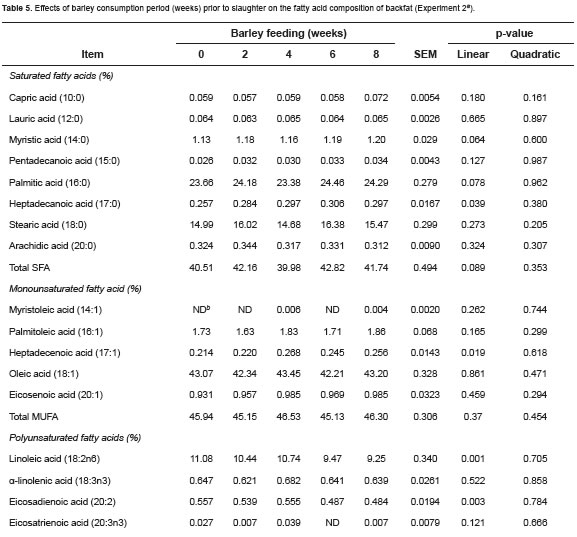
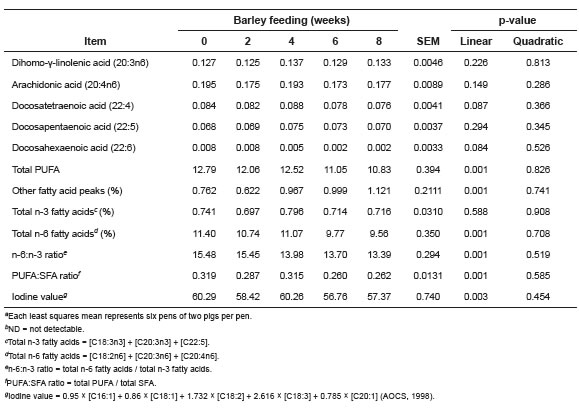
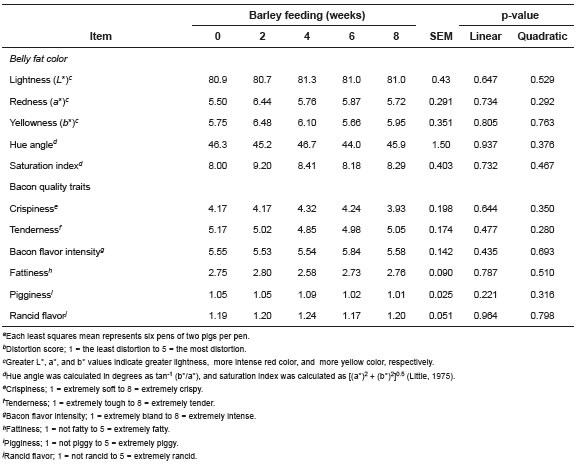
<body><![CDATA[<p align="center"><a name="t5"></a><img src="/img/revistas/rccp/v27n2/v27n2a5t5.jpg"></p>     <p align="center"><img src="/img/revistas/rccp/v27n2/v27n2a5t5a.jpg"></p>      <p align="center"><a name="t6"></a><img src="/img/revistas/rccp/v27n2/v27n2a5t6.jpg"></p>     <p align="center"><img src="/img/revistas/rccp/v27n2/v27n2a5t6a.jpg"></p>        <p>&nbsp;</p>     <p><b><font size="3">Discussion</font></b></p>     <p>   Pigs fed corn-based diets may produce darker   fat than pigs fed barley-based diets because of the   relatively high levels of carotenoids in corn. The   high levels of PUFA in corn may also result in pigs   depositing more soft fat if they are fed corn-based   diets than if they are fed barley-based diets (Carr   <i>et al.</i>, 2005; NPPC, 2000). Thus, feeding a barleybased   diet may solve these fat quality issues because   barley contains lower levels of carotenoids and less   PUFA than corn. However, feeding barley may reduce   growth performance because of the high fiber content.   It is, therefore, important to determine the inclusion   level of barley in diets fed to finishing pigs that is   needed to improve pork quality without negatively   impacting growth performance.</p>     <p>The reduction of growth performance observed   in experiment 1 as the inclusion level of barley   increased is in agreement with data from McConnell   <i>et al.</i> (1975) who reported that pigs fed barley-based   diets gained weight more slowly and less efficiently   than those fed corn-based diets. Chung <i>et al.</i> (1998)   reported decreased ADG during the early finishing   period (52 to 86 kg BW), but not during the late   finishing period (86 to 104 kg BW) if 36% of corn   was replaced with barley. However, more recent   experiments indicated that feeding barley instead   of corn resulted in only numerical reductions of   weight gain (Carr <i>et al.</i>, 2005; Opapeju <i>et al.</i>, 2006).   Inclusion levels of barley and consumption period   may influence growth performance. It is also possible that barley variety and its growing conditions influence the outcome because these factors may impact its nutritional composition, considering that relatively large variability in the nutritional value of barley has been reported (Castell and Bowren, 1980; Fairbairn <i>et al.</i>, 1999).</p>     <p>The reduced backfat depth in pigs fed barley-based   diets observed in experiment 1 agrees with data by   McConnell <i>et al.</i> (1975). The reason for this reduction   is most likely that pigs do not increase feed intake   sufficiently to compensate for the reduced energy   concentration in the barley-based diets, which results   in the barley-fed pigs consuming less energy than   the corn-fed pigs. The reduced energy intake in pigs   fed the barley-based diets resulted in less backfat deposited. However, results of previous experiments indicated that inclusion of barley in the diets instead of corn resulted in no change in backfat depth (Carr <i>et al.</i>, 2005; Lawrence, 1977; Opapeju <i>et al.</i>, 2006). The energy concentration also varies among varieties of barley (Fairbairn <i>et al.</i>, 1999), which may be the reason for the different responses to barley inclusion in the diets. However, the fact that no changes in muscle depth were observed for pigs fed diets containing 20, 40, or 60% barley indicate that dietary amino acids did not limit protein synthesis. The reduction in loin depth in pigs fed the diet containing 80% barley may be a result of pigs deaminating some of the dietary amino acids for ATP synthesis because of the reduced energy intake in these pigs compared with pigs fed the diet with no barley.</p>     <p>Based on the results of experiment 1, it was   concluded that 60% barley in the diets resulted in   acceptable pig performance and this level of barley   was, therefore, used in the barley diet that was   prepared for experiment 2. The fact that pig growth   performance was not impacted by the inclusion of   barley in the diets in experiment 2 confirmed that the   diet with 60% barley was adequate to support pig performance.</p>     ]]></body>
<body><![CDATA[<p>The reduction of dressing percentage that was   observed as pigs were fed barley is likely a result of   the greater fiber concentration in barley compared   with corn because increased concentrations of dietary   fiber usually results in a reduced dressing percentage   (Kass <i>et al.</i>, 1980). The observation that loin muscle   quality was not affected by inclusion of barley in   the diets is in agreement with previous data (Carr   <i>et al.</i>, 2005; Lampe <i>et al.</i>, 2006; McConnell <i>et al.</i>,   1975) and indicates that the quality of the loin is not   compromised if pigs are fed diets based on barley rather than corn.</p>     <p>It was, however, expected that the color of backfat   would be less yellow as barley was included in the diets   because of the low concentration of carotenoids in   barley compared with corn. Feeding a barley-based   diet has been reported to result in whiter and less   yellow backfat (Ringkob, 2003), but results of this   experiment did not support the result of Ringkob   (2003) because the yellowness of the backfat was   unaffected by inclusion of barley in the diet and only small changes in lightness and redness were observed. The results obtained in this experiment, therefore, support the data reported from other experiments in which pork fat color was also not changed as barley was introduced in the diets (Carr <i>et al.</i>, 2005; Lampe <i>et al.</i>, 2006). It is not clear why different results have been obtained in terms of the consequence for pork fat of feeding barley-based diets, but it is possible that there are differences among varieties of barley in their ability to influence pork fat color. Nevertheless, results of this experiment and of other recent experiments indicate that inclusion of barley in diets fed to finishing pigs is not an effective procedure to change the color of pork fat and thereby, produce pork with a whiter and more desirable color.</p>     <p>The fatty acid composition of pork fat is influenced   by the fatty acid composition of the lipids in the diet   (Apple <i>et al.</i>, 2007; Averette <i>et al.</i>, 2002; Weber <i>et al.</i>, 2006). The increased concentrations of SFA, the   reduced concentrations of PUFA, and the reduced   PUFA:SFA ratio that were observed in the present   experiment as barley was included in the diet were,   therefore, expected and likely reflect the differences in   fatty acid composition between fat in barley and fat in   corn. The depression in the concentration of total n-6   fatty acids, the n-6:n-3 ratio, and the calculated iodine   values as barley was included in the diets for longer   periods of time also reflect differences in fatty acid   composition between the fat in barley and the fat in   corn. The lowered iodine values in pigs fed the barley   diet indicate that more desirable and firmer fat is   deposited if pigs are fed barley instead of corn. These   observations are in agreement with data indicating   that feeding barley results in increased saturation of   backfat and reduced iodine values compared with   feeding corn (Lampe <i>et al.</i>, 2006; Opapeju <i>et al.</i>,   2006). Based on the data for PUFA and iodine values,   it is concluded that feeding a diet containing 60%   barley for 6 weeks prior to slaughter most efficiently   modifies PUFA and saturation of backfat compared with other feeding periods.</p>     <p>The PUFA concentrations in backfat (less than 13%)   for all treatments indicates that regardless of the dietary   treatment used in this experiment, the concentration of   PUFA was acceptable for salami production (Warnants   <i>et al.</i>, 1998). Although fatty acids of belly fat were not determined in the present study, the concentrations of linoleic acid and PUFA in belly fat were likely within the recommended ranges of 14 and 15%, respectively (NPPC, 2000), because concentrations of linoleic acid and PUFA are less in belly fat than in backfat (Opapeju <i>et al.</i>, 2006). The iodine values in the present experiment were also less than the upper limit (e.g. less than 70 to 73) for desirable fat (Lea <i>et al.</i>, 1970; Madsen <i>et al.</i>, 1992). Thus, although expanded periods of feeding barley improve backfat quality, the backfat from pigs fed no barley had adequate quality to meet current quality standards. However, if feed ingredients with greater concentrations of unsaturated fatty acids are used, backfat with iodine values greater than the desirable levels are often observed (Benz <i>et al.</i>, 2010; Xu <i>et al.</i>, 2010). Under such circumstances, inclusion of barley in the diets rather than corn may help ameliorate the negative impact of using ingredients with unsaturated fatty acids in the diets.</p>     <p>The fact that bacon quality was not influenced   by inclusion of barley in the diets indicates that   consumers would not be able to tell if bacon is   produced from pigs fed corn- or barley-based diets.   We are not aware of other experiments in which the   influence of feeding barley on the quality of bacon has been reported.</p>     <p>In conclusion, as the level of dietary barley   increased, weight gain was depressed, backfat   thickness was decreased, and lean percentage was   increased. However, pigs fed diets containing barley   did not have whiter backfat or bacon fat, which   indicates that inclusion of barley in the diet is not   an effective way of changing the color of pork fat.   Nevertheless, inclusion of 60% barely in the diets   at the expense of corn resulted in acceptable animal   performance and improved pork fat quality. The   improved pork fat quality can be obtained if the diet   containing 60% barley is provided for 6 weeks prior to slaughter.</p>     <p>&nbsp;</p> <hr size="1" />     <p><a name="0"></a><a href="#b0">&curren;</a> To cite this article: Kim BG,Wulf DM, Maddock RJ, Peters DN, Pedersen C, Liu Y, Stein HH. Effects of dietary barley on growth performance, carcass traits and pork quality of finishing pigs. Rev Colomb Cienc Pecu 2014; 27:102-113.</p> <hr size="1" />     <p>&nbsp;</p>     <p><b><font size="3">References</font></b></p>     ]]></body>
<body><![CDATA[<!-- ref --><p>   AOCS, American Oil Chemist's Society. Official methods and   recommended practices of the AOCS. 5<sup>th</sup> ed. Recommended   practice Cd 1c-85. Champaign, IL: American Oil Chemist's   Society; 1998.    &nbsp;&nbsp;&nbsp;&nbsp;&nbsp;&nbsp;&nbsp;&nbsp;[&#160;<a href="javascript:void(0);" onclick="javascript: window.open('/scielo.php?script=sci_nlinks&ref=000083&pid=S0120-0690201400020000500001&lng=','','width=640,height=500,resizable=yes,scrollbars=1,menubar=yes,');">Links</a>&#160;]<!-- end-ref --></p>     <!-- ref --><p>   Apple JK, Maxwell CV, Sawyer JT, Kutz BR, Rakes LK, Davis   ME, Armstrong TA. Interactive effect of ractopamine and dietary   fat source on quality characteristics of fresh pork bellies. J Anim   Sci 2007; 85:2682-2690.    &nbsp;&nbsp;&nbsp;&nbsp;&nbsp;&nbsp;&nbsp;&nbsp;[&#160;<a href="javascript:void(0);" onclick="javascript: window.open('/scielo.php?script=sci_nlinks&ref=000085&pid=S0120-0690201400020000500002&lng=','','width=640,height=500,resizable=yes,scrollbars=1,menubar=yes,');">Links</a>&#160;]<!-- end-ref --></p>     <!-- ref --><p>   Averette GL, See MT, Hansen JA, Sutton D, Odle J. The effects   of dietary fat sources, levels and feeding intervals on pork fatty   acid composition. J Anim Sci 2002; 80:1606-1615.    &nbsp;&nbsp;&nbsp;&nbsp;&nbsp;&nbsp;&nbsp;&nbsp;[&#160;<a href="javascript:void(0);" onclick="javascript: window.open('/scielo.php?script=sci_nlinks&ref=000087&pid=S0120-0690201400020000500003&lng=','','width=640,height=500,resizable=yes,scrollbars=1,menubar=yes,');">Links</a>&#160;]<!-- end-ref --></p>     <!-- ref --><p>   Benz JM, Linneen SK, Tokach MD, Dritz SS, Nelssen JL,   DeRouchey JM, Goodband RD, Sulabo RC, Prusa KJ. Effects   of dried distillers grains with solubles on carcass fat quality of   finishing pigs. J Anim Sci 2010; 88:3666-3682.    &nbsp;&nbsp;&nbsp;&nbsp;&nbsp;&nbsp;&nbsp;&nbsp;[&#160;<a href="javascript:void(0);" onclick="javascript: window.open('/scielo.php?script=sci_nlinks&ref=000089&pid=S0120-0690201400020000500004&lng=','','width=640,height=500,resizable=yes,scrollbars=1,menubar=yes,');">Links</a>&#160;]<!-- end-ref --></p>     <!-- ref --><p>   Carr SN, Rincker PJ, Killefer J, Baker DH, Ellis M, McKeith FK.   Effects of different cereal grains and ractopamine hydrochloride   on performance, carcass characteristics, and fat quality in latefinishing   pigs. J Anim Sci 2005; 83:223-230.    &nbsp;&nbsp;&nbsp;&nbsp;&nbsp;&nbsp;&nbsp;&nbsp;[&#160;<a href="javascript:void(0);" onclick="javascript: window.open('/scielo.php?script=sci_nlinks&ref=000091&pid=S0120-0690201400020000500005&lng=','','width=640,height=500,resizable=yes,scrollbars=1,menubar=yes,');">Links</a>&#160;]<!-- end-ref --></p>     ]]></body>
<body><![CDATA[<!-- ref --><p>   Castell AG, Bowren KE. Comparison of barley cultivars   in diets for growing-finishing pigs. Can J Anim Sci 1980;   60:159-167.    &nbsp;&nbsp;&nbsp;&nbsp;&nbsp;&nbsp;&nbsp;&nbsp;[&#160;<a href="javascript:void(0);" onclick="javascript: window.open('/scielo.php?script=sci_nlinks&ref=000093&pid=S0120-0690201400020000500006&lng=','','width=640,height=500,resizable=yes,scrollbars=1,menubar=yes,');">Links</a>&#160;]<!-- end-ref --></p>     <!-- ref --><p>   Chung YK, Chae BJ, KimJH, ChuKS, Han IK. An evaluation of   barley in finisher pig diet for high quality pork production. Korean   J Anim Nutr Feedstuff 1998; 22:15-20.    &nbsp;&nbsp;&nbsp;&nbsp;&nbsp;&nbsp;&nbsp;&nbsp;[&#160;<a href="javascript:void(0);" onclick="javascript: window.open('/scielo.php?script=sci_nlinks&ref=000095&pid=S0120-0690201400020000500007&lng=','','width=640,height=500,resizable=yes,scrollbars=1,menubar=yes,');">Links</a>&#160;]<!-- end-ref --></p>     <!-- ref --><p>   Fairbairn SL, Patience JF, Classen HL, Zijlstra RT. The energy   content of barley fed to growing pigs: Characterizing the nature   of its variability and developing prediction equations for its   estimation. J Anim Sci 1999; 77:1502-1512.    &nbsp;&nbsp;&nbsp;&nbsp;&nbsp;&nbsp;&nbsp;&nbsp;[&#160;<a href="javascript:void(0);" onclick="javascript: window.open('/scielo.php?script=sci_nlinks&ref=000097&pid=S0120-0690201400020000500008&lng=','','width=640,height=500,resizable=yes,scrollbars=1,menubar=yes,');">Links</a>&#160;]<!-- end-ref --></p>     <!-- ref --><p>   Kass ML, VanSoest PJ, Pond WG, Lewis B, McDowell RE.   Utilization of dietary fiber from alfalfa by growing swine. I.   apparent digestibility of diet components in specific segments of   the gastrointestinal tract. J Anim Sci 1980; 50:175-191.    &nbsp;&nbsp;&nbsp;&nbsp;&nbsp;&nbsp;&nbsp;&nbsp;[&#160;<a href="javascript:void(0);" onclick="javascript: window.open('/scielo.php?script=sci_nlinks&ref=000099&pid=S0120-0690201400020000500009&lng=','','width=640,height=500,resizable=yes,scrollbars=1,menubar=yes,');">Links</a>&#160;]<!-- end-ref --></p>     <!-- ref --><p>   Lampe JF, BaasTJ, Mabry JW. Comparison of grain sources for   swine diets and their effect on meat and fat quality traits. J Anim   Sci 2006; 84:1022-1029.    &nbsp;&nbsp;&nbsp;&nbsp;&nbsp;&nbsp;&nbsp;&nbsp;[&#160;<a href="javascript:void(0);" onclick="javascript: window.open('/scielo.php?script=sci_nlinks&ref=000101&pid=S0120-0690201400020000500010&lng=','','width=640,height=500,resizable=yes,scrollbars=1,menubar=yes,');">Links</a>&#160;]<!-- end-ref --></p>     ]]></body>
<body><![CDATA[<!-- ref --><p>   Lawrence TLJ. Some effects on the growth and composition of the   carcass of the bacon pig of feeding micronized or ground maize   or barley based diets to give three different digestible energy   intakes. Livest Prod Sci 1977; 4:343-353.    &nbsp;&nbsp;&nbsp;&nbsp;&nbsp;&nbsp;&nbsp;&nbsp;[&#160;<a href="javascript:void(0);" onclick="javascript: window.open('/scielo.php?script=sci_nlinks&ref=000103&pid=S0120-0690201400020000500011&lng=','','width=640,height=500,resizable=yes,scrollbars=1,menubar=yes,');">Links</a>&#160;]<!-- end-ref --></p>     <!-- ref --><p>   Lea CH, Swoboda PAT, Gatherum DP. A chemical study of soft   fat in cross-bred pigs. J Agric Sci 1970; 74:279-289.    &nbsp;&nbsp;&nbsp;&nbsp;&nbsp;&nbsp;&nbsp;&nbsp;[&#160;<a href="javascript:void(0);" onclick="javascript: window.open('/scielo.php?script=sci_nlinks&ref=000105&pid=S0120-0690201400020000500012&lng=','','width=640,height=500,resizable=yes,scrollbars=1,menubar=yes,');">Links</a>&#160;]<!-- end-ref --></p>     <!-- ref --><p>   Little AC. Off on a tangent-colorimetry in food science. J Food   Sci 1975; 40:410-411.    &nbsp;&nbsp;&nbsp;&nbsp;&nbsp;&nbsp;&nbsp;&nbsp;[&#160;<a href="javascript:void(0);" onclick="javascript: window.open('/scielo.php?script=sci_nlinks&ref=000107&pid=S0120-0690201400020000500013&lng=','','width=640,height=500,resizable=yes,scrollbars=1,menubar=yes,');">Links</a>&#160;]<!-- end-ref --></p>     <!-- ref --><p>   Madsen A, Jakobsen K, Mortensen HP. Influence of dietary fat   on carcass fat quality in pigs. A review. Acta Agric Scand 1992;   42:220-225.    &nbsp;&nbsp;&nbsp;&nbsp;&nbsp;&nbsp;&nbsp;&nbsp;[&#160;<a href="javascript:void(0);" onclick="javascript: window.open('/scielo.php?script=sci_nlinks&ref=000109&pid=S0120-0690201400020000500014&lng=','','width=640,height=500,resizable=yes,scrollbars=1,menubar=yes,');">Links</a>&#160;]<!-- end-ref --></p>     <!-- ref --><p>   McConnell JC, Skelley GC, Handlin DL, Johnston WE. Corn,   wheat, milo and barley with soybean meal or roasted soybeans   and their effect on feedlot performance, carcass traits and pork   acceptability. J Anim Sci 1975; 41:1021-1030.    &nbsp;&nbsp;&nbsp;&nbsp;&nbsp;&nbsp;&nbsp;&nbsp;[&#160;<a href="javascript:void(0);" onclick="javascript: window.open('/scielo.php?script=sci_nlinks&ref=000111&pid=S0120-0690201400020000500015&lng=','','width=640,height=500,resizable=yes,scrollbars=1,menubar=yes,');">Links</a>&#160;]<!-- end-ref --></p>     ]]></body>
<body><![CDATA[<!-- ref --><p>   NPPC, National Pork Producers Council. Pork composition and   quality assessment procedures. Des Moines, IA: National Pork   Producers Council; 2000.    &nbsp;&nbsp;&nbsp;&nbsp;&nbsp;&nbsp;&nbsp;&nbsp;[&#160;<a href="javascript:void(0);" onclick="javascript: window.open('/scielo.php?script=sci_nlinks&ref=000113&pid=S0120-0690201400020000500016&lng=','','width=640,height=500,resizable=yes,scrollbars=1,menubar=yes,');">Links</a>&#160;]<!-- end-ref --></p>     <!-- ref --><p>   NRC, National Research Council. Nutrient requirements of swine.   10th ed. Washington, D.C.: National Academy Press; 1998.    &nbsp;&nbsp;&nbsp;&nbsp;&nbsp;&nbsp;&nbsp;&nbsp;[&#160;<a href="javascript:void(0);" onclick="javascript: window.open('/scielo.php?script=sci_nlinks&ref=000115&pid=S0120-0690201400020000500017&lng=','','width=640,height=500,resizable=yes,scrollbars=1,menubar=yes,');">Links</a>&#160;]<!-- end-ref --></p>     <!-- ref --><p>Opapeju FO, Nyachoti CM, House JD, Weiler H, Sapirstein HD.   Growth performance and carcass characteristics of pigs fed shortseason corn hybrids. J Anim Sci 2006; 84:2779-2786.    &nbsp;&nbsp;&nbsp;&nbsp;&nbsp;&nbsp;&nbsp;&nbsp;[&#160;<a href="javascript:void(0);" onclick="javascript: window.open('/scielo.php?script=sci_nlinks&ref=000117&pid=S0120-0690201400020000500018&lng=','','width=640,height=500,resizable=yes,scrollbars=1,menubar=yes,');">Links</a>&#160;]<!-- end-ref --></p>     <!-- ref --><p>   Ringkob TP. Comparing pork fat color from barley and corn fed   pork using image analysis. In Proceedings of the 56th Reciprocal   Meat Conference, Columbia, MO. Savoy, IL: American Meat   Science Association; 2003.    &nbsp;&nbsp;&nbsp;&nbsp;&nbsp;&nbsp;&nbsp;&nbsp;[&#160;<a href="javascript:void(0);" onclick="javascript: window.open('/scielo.php?script=sci_nlinks&ref=000119&pid=S0120-0690201400020000500019&lng=','','width=640,height=500,resizable=yes,scrollbars=1,menubar=yes,');">Links</a>&#160;]<!-- end-ref --></p>     <!-- ref --><p>   Stein HH, Everts AKR, Sweeter KK, Peters DN, Maddock   RJ, Wulf DM, Pedersen C. The influence of dietary field peas   (<i>Pisum sativum L</i>.) on pig performance, carcass quality, and the   palatability of pork. J Anim Sci 2006; 84:3110-3117.    &nbsp;&nbsp;&nbsp;&nbsp;&nbsp;&nbsp;&nbsp;&nbsp;[&#160;<a href="javascript:void(0);" onclick="javascript: window.open('/scielo.php?script=sci_nlinks&ref=000121&pid=S0120-0690201400020000500020&lng=','','width=640,height=500,resizable=yes,scrollbars=1,menubar=yes,');">Links</a>&#160;]<!-- end-ref --></p>     ]]></body>
<body><![CDATA[<!-- ref --><p>   Sukhija PS, Palmquist DL. Rapid method for determination of   total fatty acid content and composition of feedstuffs and feces.   J Agric Food Chem 1988; 36:1202-1206.    &nbsp;&nbsp;&nbsp;&nbsp;&nbsp;&nbsp;&nbsp;&nbsp;[&#160;<a href="javascript:void(0);" onclick="javascript: window.open('/scielo.php?script=sci_nlinks&ref=000123&pid=S0120-0690201400020000500021&lng=','','width=640,height=500,resizable=yes,scrollbars=1,menubar=yes,');">Links</a>&#160;]<!-- end-ref --></p>     <!-- ref --><p>   Warnants N, Van Oeckel MJ, Boucqu&eacute; ChV. Effect of   incorporation of dietary polyunsaturated fatty acids in pork   backfat on the quality of salami. Meat Sci 1998; 49:435-445.    &nbsp;&nbsp;&nbsp;&nbsp;&nbsp;&nbsp;&nbsp;&nbsp;[&#160;<a href="javascript:void(0);" onclick="javascript: window.open('/scielo.php?script=sci_nlinks&ref=000125&pid=S0120-0690201400020000500022&lng=','','width=640,height=500,resizable=yes,scrollbars=1,menubar=yes,');">Links</a>&#160;]<!-- end-ref --></p>     <!-- ref --><p>   Weber TE, Richert BT, Belury MA, Gu Y, Enright K, Schinckel   AP. Evaluation of the effects of dietary fat, conjugated linoleic   acid, andractopamine on growth performance, pork quality, and   fatty acid profiles ingenetically lean gilts. J Anim Sci 2006;   84:720-732.    &nbsp;&nbsp;&nbsp;&nbsp;&nbsp;&nbsp;&nbsp;&nbsp;[&#160;<a href="javascript:void(0);" onclick="javascript: window.open('/scielo.php?script=sci_nlinks&ref=000127&pid=S0120-0690201400020000500023&lng=','','width=640,height=500,resizable=yes,scrollbars=1,menubar=yes,');">Links</a>&#160;]<!-- end-ref --></p>     <!-- ref --><p>   Xu G, Baidoo SK, Johnston LJ, Bibus D, Cannon JE, Shurson   GC. Effects of feeding diets containing increasing content of corn   distillers dried grains with solubles to grower-finisher pigs on   growth performance, carcass composition, and pork fat quality.   J Anim Sci 2010; 88:1398-1410.    &nbsp;&nbsp;&nbsp;&nbsp;&nbsp;&nbsp;&nbsp;&nbsp;[&#160;<a href="javascript:void(0);" onclick="javascript: window.open('/scielo.php?script=sci_nlinks&ref=000129&pid=S0120-0690201400020000500024&lng=','','width=640,height=500,resizable=yes,scrollbars=1,menubar=yes,');">Links</a>&#160;]<!-- end-ref --></p>     <p>&nbsp;</p> </font>     ]]></body><back>
<ref-list>
<ref id="B1">
<nlm-citation citation-type="book">
<collab>AOCS, American Oil Chemist's Society</collab>
<source><![CDATA[Official methods and recommended practices of the AOCS]]></source>
<year>1998</year>
<edition>5th</edition>
<publisher-loc><![CDATA[Champaign^eIL IL]]></publisher-loc>
<publisher-name><![CDATA[American Oil Chemist's Society]]></publisher-name>
</nlm-citation>
</ref>
<ref id="B2">
<nlm-citation citation-type="journal">
<person-group person-group-type="author">
<name>
<surname><![CDATA[Apple]]></surname>
<given-names><![CDATA[JK]]></given-names>
</name>
<name>
<surname><![CDATA[Maxwell]]></surname>
<given-names><![CDATA[CV]]></given-names>
</name>
<name>
<surname><![CDATA[Sawyer]]></surname>
<given-names><![CDATA[JT]]></given-names>
</name>
<name>
<surname><![CDATA[Kutz]]></surname>
<given-names><![CDATA[BR]]></given-names>
</name>
<name>
<surname><![CDATA[Rakes]]></surname>
<given-names><![CDATA[LK]]></given-names>
</name>
<name>
<surname><![CDATA[Davis]]></surname>
<given-names><![CDATA[ME]]></given-names>
</name>
<name>
<surname><![CDATA[Armstrong]]></surname>
<given-names><![CDATA[TA]]></given-names>
</name>
</person-group>
<article-title xml:lang="en"><![CDATA[Interactive effect of ractopamine and dietary fat source on quality characteristics of fresh pork bellies]]></article-title>
<source><![CDATA[J Anim Sci]]></source>
<year>2007</year>
<volume>85</volume>
<page-range>2682-2690</page-range></nlm-citation>
</ref>
<ref id="B3">
<nlm-citation citation-type="journal">
<person-group person-group-type="author">
<name>
<surname><![CDATA[Averette]]></surname>
<given-names><![CDATA[GL]]></given-names>
</name>
<name>
<surname><![CDATA[See]]></surname>
<given-names><![CDATA[MT]]></given-names>
</name>
<name>
<surname><![CDATA[Hansen]]></surname>
<given-names><![CDATA[JA]]></given-names>
</name>
<name>
<surname><![CDATA[Sutton]]></surname>
<given-names><![CDATA[D]]></given-names>
</name>
<name>
<surname><![CDATA[Odle]]></surname>
<given-names><![CDATA[J]]></given-names>
</name>
</person-group>
<article-title xml:lang="en"><![CDATA[The effects of dietary fat sources, levels and feeding intervals on pork fatty acid composition]]></article-title>
<source><![CDATA[J Anim Sci]]></source>
<year>2002</year>
<volume>80</volume>
<page-range>1606-1615</page-range></nlm-citation>
</ref>
<ref id="B4">
<nlm-citation citation-type="journal">
<person-group person-group-type="author">
<name>
<surname><![CDATA[Benz]]></surname>
<given-names><![CDATA[JM]]></given-names>
</name>
<name>
<surname><![CDATA[Linneen]]></surname>
<given-names><![CDATA[SK]]></given-names>
</name>
<name>
<surname><![CDATA[Tokach]]></surname>
<given-names><![CDATA[MD]]></given-names>
</name>
<name>
<surname><![CDATA[Dritz]]></surname>
<given-names><![CDATA[SS]]></given-names>
</name>
<name>
<surname><![CDATA[Nelssen]]></surname>
<given-names><![CDATA[JL]]></given-names>
</name>
<name>
<surname><![CDATA[DeRouchey]]></surname>
<given-names><![CDATA[JM]]></given-names>
</name>
<name>
<surname><![CDATA[Goodband]]></surname>
<given-names><![CDATA[RD]]></given-names>
</name>
<name>
<surname><![CDATA[Sulabo]]></surname>
<given-names><![CDATA[RC]]></given-names>
</name>
<name>
<surname><![CDATA[Prusa]]></surname>
<given-names><![CDATA[KJ]]></given-names>
</name>
</person-group>
<article-title xml:lang="en"><![CDATA[Effects of dried distillers grains with solubles on carcass fat quality of finishing pigs]]></article-title>
<source><![CDATA[J Anim Sci]]></source>
<year>2010</year>
<volume>88</volume>
<page-range>3666-3682</page-range></nlm-citation>
</ref>
<ref id="B5">
<nlm-citation citation-type="journal">
<person-group person-group-type="author">
<name>
<surname><![CDATA[Carr]]></surname>
<given-names><![CDATA[SN]]></given-names>
</name>
<name>
<surname><![CDATA[Rincker]]></surname>
<given-names><![CDATA[PJ]]></given-names>
</name>
<name>
<surname><![CDATA[Killefer]]></surname>
<given-names><![CDATA[J]]></given-names>
</name>
<name>
<surname><![CDATA[Baker]]></surname>
<given-names><![CDATA[DH]]></given-names>
</name>
<name>
<surname><![CDATA[Ellis]]></surname>
<given-names><![CDATA[M]]></given-names>
</name>
<name>
<surname><![CDATA[McKeith]]></surname>
<given-names><![CDATA[FK]]></given-names>
</name>
</person-group>
<article-title xml:lang="en"><![CDATA[Effects of different cereal grains and ractopamine hydrochloride on performance, carcass characteristics, and fat quality in latefinishing pigs]]></article-title>
<source><![CDATA[J Anim Sci]]></source>
<year>2005</year>
<volume>83</volume>
<page-range>223-230</page-range></nlm-citation>
</ref>
<ref id="B6">
<nlm-citation citation-type="journal">
<person-group person-group-type="author">
<name>
<surname><![CDATA[Castell]]></surname>
<given-names><![CDATA[AG]]></given-names>
</name>
<name>
<surname><![CDATA[Bowren]]></surname>
<given-names><![CDATA[KE]]></given-names>
</name>
</person-group>
<article-title xml:lang="en"><![CDATA[Comparison of barley cultivars in diets for growing-finishing pigs]]></article-title>
<source><![CDATA[Can J Anim Sci]]></source>
<year>1980</year>
<volume>60</volume>
<page-range>159-167</page-range></nlm-citation>
</ref>
<ref id="B7">
<nlm-citation citation-type="journal">
<person-group person-group-type="author">
<name>
<surname><![CDATA[Chung]]></surname>
<given-names><![CDATA[YK]]></given-names>
</name>
<name>
<surname><![CDATA[Chae]]></surname>
<given-names><![CDATA[BJ]]></given-names>
</name>
<name>
<surname><![CDATA[Kim]]></surname>
<given-names><![CDATA[JH]]></given-names>
</name>
<name>
<surname><![CDATA[ChuK]]></surname>
<given-names><![CDATA[S]]></given-names>
</name>
<name>
<surname><![CDATA[Han]]></surname>
<given-names><![CDATA[IK]]></given-names>
</name>
</person-group>
<article-title xml:lang="en"><![CDATA[An evaluation of barley in finisher pig diet for high quality pork production]]></article-title>
<source><![CDATA[Korean J Anim Nutr Feedstuff]]></source>
<year>1998</year>
<volume>22</volume>
<page-range>15-20</page-range></nlm-citation>
</ref>
<ref id="B8">
<nlm-citation citation-type="journal">
<person-group person-group-type="author">
<name>
<surname><![CDATA[Fairbairn]]></surname>
<given-names><![CDATA[SL]]></given-names>
</name>
<name>
<surname><![CDATA[Patience]]></surname>
<given-names><![CDATA[JF]]></given-names>
</name>
<name>
<surname><![CDATA[Classen]]></surname>
<given-names><![CDATA[HL]]></given-names>
</name>
<name>
<surname><![CDATA[Zijlstra]]></surname>
<given-names><![CDATA[RT]]></given-names>
</name>
</person-group>
<article-title xml:lang="en"><![CDATA[The energy content of barley fed to growing pigs: Characterizing the nature of its variability and developing prediction equations for its estimation]]></article-title>
<source><![CDATA[J Anim Sci]]></source>
<year>1999</year>
<volume>77</volume>
<page-range>1502-1512</page-range></nlm-citation>
</ref>
<ref id="B9">
<nlm-citation citation-type="journal">
<person-group person-group-type="author">
<name>
<surname><![CDATA[Kass]]></surname>
<given-names><![CDATA[ML]]></given-names>
</name>
<name>
<surname><![CDATA[VanSoest]]></surname>
<given-names><![CDATA[PJ]]></given-names>
</name>
<name>
<surname><![CDATA[Pond]]></surname>
<given-names><![CDATA[WG]]></given-names>
</name>
<name>
<surname><![CDATA[Lewis]]></surname>
<given-names><![CDATA[B]]></given-names>
</name>
<name>
<surname><![CDATA[McDowell]]></surname>
<given-names><![CDATA[RE]]></given-names>
</name>
</person-group>
<article-title xml:lang="en"><![CDATA[Utilization of dietary fiber from alfalfa by growing swine. I. apparent digestibility of diet components in specific segments of the gastrointestinal tract]]></article-title>
<source><![CDATA[J Anim Sci]]></source>
<year>1980</year>
<volume>50</volume>
<page-range>175-191</page-range></nlm-citation>
</ref>
<ref id="B10">
<nlm-citation citation-type="journal">
<person-group person-group-type="author">
<name>
<surname><![CDATA[Lampe]]></surname>
<given-names><![CDATA[JF]]></given-names>
</name>
<name>
<surname><![CDATA[Baas]]></surname>
<given-names><![CDATA[TJ]]></given-names>
</name>
<name>
<surname><![CDATA[Mabry]]></surname>
<given-names><![CDATA[JW]]></given-names>
</name>
</person-group>
<article-title xml:lang="en"><![CDATA[Comparison of grain sources for swine diets and their effect on meat and fat quality traits]]></article-title>
<source><![CDATA[J Anim Sci]]></source>
<year>2006</year>
<volume>84</volume>
<page-range>1022-1029</page-range></nlm-citation>
</ref>
<ref id="B11">
<nlm-citation citation-type="journal">
<person-group person-group-type="author">
<name>
<surname><![CDATA[Lawrence]]></surname>
<given-names><![CDATA[TLJ]]></given-names>
</name>
</person-group>
<article-title xml:lang="en"><![CDATA[Some effects on the growth and composition of the carcass of the bacon pig of feeding micronized or ground maize or barley based diets to give three different digestible energy intakes]]></article-title>
<source><![CDATA[Livest Prod Sci]]></source>
<year>1977</year>
<volume>4</volume>
<page-range>343-353</page-range></nlm-citation>
</ref>
<ref id="B12">
<nlm-citation citation-type="journal">
<person-group person-group-type="author">
<name>
<surname><![CDATA[Lea]]></surname>
<given-names><![CDATA[CH]]></given-names>
</name>
<name>
<surname><![CDATA[Swoboda]]></surname>
<given-names><![CDATA[PAT]]></given-names>
</name>
<name>
<surname><![CDATA[Gatherum]]></surname>
<given-names><![CDATA[DP]]></given-names>
</name>
</person-group>
<article-title xml:lang="en"><![CDATA[A chemical study of soft fat in cross-bred pigs]]></article-title>
<source><![CDATA[J Agric Sci]]></source>
<year>1970</year>
<volume>74</volume>
<page-range>279-289</page-range></nlm-citation>
</ref>
<ref id="B13">
<nlm-citation citation-type="journal">
<person-group person-group-type="author">
<name>
<surname><![CDATA[Little]]></surname>
<given-names><![CDATA[AC]]></given-names>
</name>
</person-group>
<article-title xml:lang="en"><![CDATA[Off on a tangent-colorimetry in food science]]></article-title>
<source><![CDATA[J Food Sci]]></source>
<year>1975</year>
<volume>40</volume>
<page-range>410-411</page-range></nlm-citation>
</ref>
<ref id="B14">
<nlm-citation citation-type="journal">
<person-group person-group-type="author">
<name>
<surname><![CDATA[Madsen]]></surname>
<given-names><![CDATA[A]]></given-names>
</name>
<name>
<surname><![CDATA[Jakobsen]]></surname>
<given-names><![CDATA[K]]></given-names>
</name>
<name>
<surname><![CDATA[Mortensen]]></surname>
<given-names><![CDATA[HP]]></given-names>
</name>
</person-group>
<article-title xml:lang="en"><![CDATA[Influence of dietary fat on carcass fat quality in pigs. A review]]></article-title>
<source><![CDATA[Acta Agric Scand]]></source>
<year>1992</year>
<volume>42</volume>
<page-range>220-225</page-range></nlm-citation>
</ref>
<ref id="B15">
<nlm-citation citation-type="journal">
<person-group person-group-type="author">
<name>
<surname><![CDATA[McConnell]]></surname>
<given-names><![CDATA[JC]]></given-names>
</name>
<name>
<surname><![CDATA[Skelley]]></surname>
<given-names><![CDATA[GC]]></given-names>
</name>
<name>
<surname><![CDATA[Handlin]]></surname>
<given-names><![CDATA[DL]]></given-names>
</name>
<name>
<surname><![CDATA[Johnston]]></surname>
<given-names><![CDATA[WE]]></given-names>
</name>
</person-group>
<article-title xml:lang="en"><![CDATA[Corn, wheat, milo and barley with soybean meal or roasted soybeans and their effect on feedlot performance, carcass traits and pork acceptability]]></article-title>
<source><![CDATA[J Anim Sci]]></source>
<year>1975</year>
<volume>41</volume>
<page-range>1021-1030</page-range></nlm-citation>
</ref>
<ref id="B16">
<nlm-citation citation-type="book">
<collab>NPPC, National Pork Producers Council</collab>
<source><![CDATA[Pork composition and quality assessment procedures]]></source>
<year>2000</year>
<publisher-loc><![CDATA[Des Moines^eIA IA]]></publisher-loc>
<publisher-name><![CDATA[National Pork Producers Council]]></publisher-name>
</nlm-citation>
</ref>
<ref id="B17">
<nlm-citation citation-type="book">
<collab>NRC, National Research Council</collab>
<source><![CDATA[Nutrient requirements of swine]]></source>
<year>1998</year>
<edition>10</edition>
<publisher-loc><![CDATA[Washington^eD.C D.C]]></publisher-loc>
<publisher-name><![CDATA[National Academy Press]]></publisher-name>
</nlm-citation>
</ref>
<ref id="B18">
<nlm-citation citation-type="journal">
<person-group person-group-type="author">
<name>
<surname><![CDATA[Opapeju]]></surname>
<given-names><![CDATA[FO]]></given-names>
</name>
<name>
<surname><![CDATA[Nyachoti]]></surname>
<given-names><![CDATA[CM]]></given-names>
</name>
<name>
<surname><![CDATA[House]]></surname>
<given-names><![CDATA[JD]]></given-names>
</name>
<name>
<surname><![CDATA[Weiler]]></surname>
<given-names><![CDATA[H]]></given-names>
</name>
<name>
<surname><![CDATA[Sapirstein]]></surname>
<given-names><![CDATA[HD]]></given-names>
</name>
</person-group>
<article-title xml:lang="en"><![CDATA[Growth performance and carcass characteristics of pigs fed shortseason corn hybrids]]></article-title>
<source><![CDATA[J Anim Sci]]></source>
<year>2006</year>
<volume>84</volume>
<page-range>2779-2786</page-range></nlm-citation>
</ref>
<ref id="B19">
<nlm-citation citation-type="confpro">
<person-group person-group-type="author">
<name>
<surname><![CDATA[Ringkob]]></surname>
<given-names><![CDATA[TP]]></given-names>
</name>
</person-group>
<source><![CDATA[Comparing pork fat color from barley and corn fed pork using image analysis]]></source>
<year>2003</year>
<conf-name><![CDATA[56th Reciprocal Meat Conference, Columbia, MO]]></conf-name>
<conf-loc> </conf-loc>
<publisher-loc><![CDATA[Savoy^eIL IL]]></publisher-loc>
<publisher-name><![CDATA[American Meat Science Association]]></publisher-name>
</nlm-citation>
</ref>
<ref id="B20">
<nlm-citation citation-type="journal">
<person-group person-group-type="author">
<name>
<surname><![CDATA[Stein]]></surname>
<given-names><![CDATA[HH]]></given-names>
</name>
<name>
<surname><![CDATA[Everts]]></surname>
<given-names><![CDATA[AKR]]></given-names>
</name>
<name>
<surname><![CDATA[Sweeter]]></surname>
<given-names><![CDATA[KK]]></given-names>
</name>
<name>
<surname><![CDATA[Peters]]></surname>
<given-names><![CDATA[DN]]></given-names>
</name>
<name>
<surname><![CDATA[Maddock]]></surname>
<given-names><![CDATA[RJ]]></given-names>
</name>
<name>
<surname><![CDATA[Wulf]]></surname>
<given-names><![CDATA[DM]]></given-names>
</name>
<name>
<surname><![CDATA[Pedersen]]></surname>
<given-names><![CDATA[C]]></given-names>
</name>
</person-group>
<article-title xml:lang="en"><![CDATA[The influence of dietary field peas (Pisum sativum L.) on pig performance, carcass quality, and the palatability of pork]]></article-title>
<source><![CDATA[J Anim Sci]]></source>
<year>2006</year>
<volume>84</volume>
<page-range>3110-3117</page-range></nlm-citation>
</ref>
<ref id="B21">
<nlm-citation citation-type="journal">
<person-group person-group-type="author">
<name>
<surname><![CDATA[Sukhija]]></surname>
<given-names><![CDATA[PS]]></given-names>
</name>
<name>
<surname><![CDATA[Palmquist]]></surname>
<given-names><![CDATA[DL]]></given-names>
</name>
</person-group>
<article-title xml:lang="en"><![CDATA[Rapid method for determination of total fatty acid content and composition of feedstuffs and feces]]></article-title>
<source><![CDATA[J Agric Food Chem]]></source>
<year>1988</year>
<volume>36</volume>
<page-range>1202-1206</page-range></nlm-citation>
</ref>
<ref id="B22">
<nlm-citation citation-type="journal">
<person-group person-group-type="author">
<name>
<surname><![CDATA[Warnants]]></surname>
<given-names><![CDATA[N]]></given-names>
</name>
<name>
<surname><![CDATA[Van]]></surname>
<given-names><![CDATA[Oeckel MJ]]></given-names>
</name>
<name>
<surname><![CDATA[Boucqué]]></surname>
<given-names><![CDATA[ChV]]></given-names>
</name>
</person-group>
<article-title xml:lang="en"><![CDATA[Effect of incorporation of dietary polyunsaturated fatty acids in pork backfat on the quality of salami]]></article-title>
<source><![CDATA[Meat Sci]]></source>
<year>1998</year>
<volume>49</volume>
<page-range>435-445</page-range></nlm-citation>
</ref>
<ref id="B23">
<nlm-citation citation-type="journal">
<person-group person-group-type="author">
<name>
<surname><![CDATA[Weber]]></surname>
<given-names><![CDATA[TE]]></given-names>
</name>
<name>
<surname><![CDATA[Richert]]></surname>
<given-names><![CDATA[BT]]></given-names>
</name>
<name>
<surname><![CDATA[Belury]]></surname>
<given-names><![CDATA[MA]]></given-names>
</name>
<name>
<surname><![CDATA[Gu]]></surname>
<given-names><![CDATA[Y]]></given-names>
</name>
<name>
<surname><![CDATA[Enright]]></surname>
<given-names><![CDATA[K]]></given-names>
</name>
<name>
<surname><![CDATA[Schinckel]]></surname>
<given-names><![CDATA[AP]]></given-names>
</name>
</person-group>
<article-title xml:lang="en"><![CDATA[Evaluation of the effects of dietary fat, conjugated linoleic acid, andractopamine on growth performance, pork quality, and fatty acid profiles ingenetically lean gilts]]></article-title>
<source><![CDATA[J Anim Sci]]></source>
<year>2006</year>
<volume>84</volume>
<page-range>720-732</page-range></nlm-citation>
</ref>
<ref id="B24">
<nlm-citation citation-type="journal">
<person-group person-group-type="author">
<name>
<surname><![CDATA[Xu]]></surname>
<given-names><![CDATA[G]]></given-names>
</name>
<name>
<surname><![CDATA[Baidoo]]></surname>
<given-names><![CDATA[SK]]></given-names>
</name>
<name>
<surname><![CDATA[Johnston]]></surname>
<given-names><![CDATA[LJ]]></given-names>
</name>
<name>
<surname><![CDATA[Bibus]]></surname>
<given-names><![CDATA[D]]></given-names>
</name>
<name>
<surname><![CDATA[Cannon]]></surname>
<given-names><![CDATA[JE]]></given-names>
</name>
<name>
<surname><![CDATA[Shurson]]></surname>
<given-names><![CDATA[GC]]></given-names>
</name>
</person-group>
<article-title xml:lang="en"><![CDATA[Effects of feeding diets containing increasing content of corn distillers dried grains with solubles to grower-finisher pigs on growth performance, carcass composition, and pork fat quality]]></article-title>
<source><![CDATA[J Anim Sci]]></source>
<year>2010</year>
<volume>88</volume>
<page-range>1398-1410</page-range></nlm-citation>
</ref>
</ref-list>
</back>
</article>