<?xml version="1.0" encoding="ISO-8859-1"?><article xmlns:mml="http://www.w3.org/1998/Math/MathML" xmlns:xlink="http://www.w3.org/1999/xlink" xmlns:xsi="http://www.w3.org/2001/XMLSchema-instance">
<front>
<journal-meta>
<journal-id>0120-0690</journal-id>
<journal-title><![CDATA[Revista Colombiana de Ciencias Pecuarias]]></journal-title>
<abbrev-journal-title><![CDATA[Rev Colom Cienc Pecua]]></abbrev-journal-title>
<issn>0120-0690</issn>
<publisher>
<publisher-name><![CDATA[Facultad de Ciencias Agrarias, Universidad de Antioquia]]></publisher-name>
</publisher>
</journal-meta>
<article-meta>
<article-id>S0120-06902014000300004</article-id>
<title-group>
<article-title xml:lang="en"><![CDATA[Effects of phytase supplementation on reproductive performance, apparent total tract digestibility of Ca and P and bone characteristics in gestating and lactating sows]]></article-title>
<article-title xml:lang="es"><![CDATA[Efectos de la suplementación con fitasa sobre el comportamiento reproductivo, la digestibilidad aparente en tracto total de Ca y P y las características óseas en cerdas gestantes y lactantes]]></article-title>
<article-title xml:lang="pt"><![CDATA[Efeitos da suplementação com fitasse sobre o desempenho reprodutivo, digestibilidade aparente no trato digestivo total de Ca e P e características ósseas em porcas gestantes e lactantes]]></article-title>
</title-group>
<contrib-group>
<contrib contrib-type="author">
<name>
<surname><![CDATA[Dal Jang]]></surname>
<given-names><![CDATA[Young]]></given-names>
</name>
<xref ref-type="aff" rid="A01"/>
</contrib>
<contrib contrib-type="author">
<name>
<surname><![CDATA[Lindemann]]></surname>
<given-names><![CDATA[Merlin D]]></given-names>
</name>
<xref ref-type="aff" rid="A01"/>
<xref ref-type="aff" rid="A06"/>
<xref ref-type="aff" rid="A07"/>
</contrib>
<contrib contrib-type="author">
<name>
<surname><![CDATA[van Heugten]]></surname>
<given-names><![CDATA[Eric]]></given-names>
</name>
<xref ref-type="aff" rid="A02"/>
<xref ref-type="aff" rid="A06"/>
</contrib>
<contrib contrib-type="author">
<name>
<surname><![CDATA[Jones]]></surname>
<given-names><![CDATA[Richard D]]></given-names>
</name>
<xref ref-type="aff" rid="A03"/>
</contrib>
<contrib contrib-type="author">
<name>
<surname><![CDATA[Gyun Kim]]></surname>
<given-names><![CDATA[Beob]]></given-names>
</name>
<xref ref-type="aff" rid="A01"/>
</contrib>
<contrib contrib-type="author">
<name>
<surname><![CDATA[Maxwell]]></surname>
<given-names><![CDATA[Charles V]]></given-names>
</name>
<xref ref-type="aff" rid="A04"/>
<xref ref-type="aff" rid="A06"/>
</contrib>
<contrib contrib-type="author">
<name>
<surname><![CDATA[Radcliffe]]></surname>
<given-names><![CDATA[J Scott]]></given-names>
</name>
<xref ref-type="aff" rid="A05"/>
<xref ref-type="aff" rid="A06"/>
</contrib>
</contrib-group>
<aff id="A01">
<institution><![CDATA[,University of Kentucky Department of Animal and Food Sciences ]]></institution>
<addr-line><![CDATA[ ]]></addr-line>
<country>USA</country>
</aff>
<aff id="A02">
<institution><![CDATA[,North Carolina State University  ]]></institution>
<addr-line><![CDATA[ ]]></addr-line>
<country>USA</country>
</aff>
<aff id="A03">
<institution><![CDATA[,University of Georgia Department of Animal Science ]]></institution>
<addr-line><![CDATA[Athens GA]]></addr-line>
<country>USA</country>
</aff>
<aff id="A04">
<institution><![CDATA[,University of Arkansas Department of Animal Science ]]></institution>
<addr-line><![CDATA[ ]]></addr-line>
<country>USA</country>
</aff>
<aff id="A05">
<institution><![CDATA[,Purdue University Department of Animal Sciences ]]></institution>
<addr-line><![CDATA[ ]]></addr-line>
<country>USA</country>
</aff>
<aff id="A06">
<institution><![CDATA[,Regional Research Committee on Nutrition and Management of Swine for Increased Reproduction Efficiency  ]]></institution>
<addr-line><![CDATA[ ]]></addr-line>
</aff>
<aff id="A07">
<institution><![CDATA[,University of Kentucky  ]]></institution>
<addr-line><![CDATA[ ]]></addr-line>
</aff>
<pub-date pub-type="pub">
<day>00</day>
<month>08</month>
<year>2014</year>
</pub-date>
<pub-date pub-type="epub">
<day>00</day>
<month>08</month>
<year>2014</year>
</pub-date>
<volume>27</volume>
<numero>3</numero>
<fpage>178</fpage>
<lpage>193</lpage>
<copyright-statement/>
<copyright-year/>
<self-uri xlink:href="http://www.scielo.org.co/scielo.php?script=sci_arttext&amp;pid=S0120-06902014000300004&amp;lng=en&amp;nrm=iso"></self-uri><self-uri xlink:href="http://www.scielo.org.co/scielo.php?script=sci_abstract&amp;pid=S0120-06902014000300004&amp;lng=en&amp;nrm=iso"></self-uri><self-uri xlink:href="http://www.scielo.org.co/scielo.php?script=sci_pdf&amp;pid=S0120-06902014000300004&amp;lng=en&amp;nrm=iso"></self-uri><abstract abstract-type="short" xml:lang="en"><p><![CDATA[Background: phytase supplementation to sow diets may improve digestibility of P and Ca and bone integrity of suckling piglets. Objective: two experiments were conducted to investigate the effect of phytase supplementation to gestation and lactation diets on reproductive performance, apparent total tract digestibility (ATTD) of P, Ca, and N in sows and bone characteristics in sows and piglets. Methods: in Experiment 1, a multistate study involving 204 sows was conducted at 3 cooperating research stations. Sows were assigned to 1 of 4 treatments at breeding: 1) negative control [low Ca and available P (aP) diet], 2) Treatment 1 plus 300 FTU of supplemental phytase/kg of diet, 3) Treatment 1 plus 600 FTU of supplemental phytase/kg of diet, and 4) positive control (normal Ca and aP diet). In Experiment 2, a total of 16 sows (Yorkshire &times; Landrace; average parity, 2.3) were randomly allotted to 1 of 3 treatments based on body weight (BW) and parity at d 34 to 52 of gestation. Treatments were: 1) low Ca and aP diet, 2) low Ca and aP diet with 500 FTU of supplemental phytase/kg of diet, and 3) normal Ca and aP diet. Results: in Experiment 1, the number of total born (p<0.05), live born (p=0.05), litter weight of live born (p<0.01) and weaning pigs (p<0.05) were increased in a quadratic manner by increasing phytase supplementation level up to 300 FTU/kg. There was a linear increase in piglet weaning weight (p<0.05) by increasing supplemental phytase levels. There were no differences in reproductive performance in Experiment 2 (p&gt;0.10). In gestation the ATTD of P was lower for the low Ca and aP without phytase group than the normal Ca and aP (p<0.01) and phytase-supplemented (p<0.05) groups. The ATTD of Ca in the normal Ca and aP group was higher than that in low Ca and aP without phytase group (p<0.05). In lactation, the phytase-supplemented group had higher ATTD of P compared with the other groups (p<0.05) whereas the ATTD of Ca in phytase-supplemented group was higher than that in low Ca and aP without phytase group (p<0.10). When the digestibility data was pooled for both gestation and lactation periods, the ATTD of P in the phytase-supplemented group was the highest among dietary treatments (p<0.05). There were no phytase effects on sow bone ash content at weaning, and piglet bone strength and ash content at birth. However, piglets from the phytase-supplemented sows had higher bone strength (p<0.10) and ash content (p<0.05) at weaning compared with those from non-phytase sows. There were positive correlations at birth between piglet BW and bone strength (p<0.01) and between bone strength and ash content (p<0.001). Additionally, at weaning positive correlations between piglet BW and bone ash content (p<0.05), between piglet BW and bone strength (p<0.001), and between bone strength and ash content (p<0.05) were observed. Conclusion: phytase supplementation from mid-gestation through lactation increased the ATTD of P and Ca both for gestating and lactating sows, improved bone integrity of their progeny, and had potential to increase litter size and performance but did not affect bone characteristics of sows and newborn pigs.]]></p></abstract>
<abstract abstract-type="short" xml:lang="es"><p><![CDATA[Antecedentes: la adición de fitasa a la dieta de cerdas puede mejorar la digestibilidad del P y Ca, así como la integridad ósea de los cerdos lactantes. Objetivo: se realizaron dos experimentos para investigar el efecto de la suplementación con fitasa en dietas de gestación y lactancia sobre el rendimiento reproductivo, la digestibilidad aparente de tracto total (ATTD) del P, Ca y N en cerdas, y las características óseas de cerdas y lechones. Métodos: el Experimento 1 involucró 204 cerdas evaluadas en 3 centros de investigación norteamericanos. Las cerdas fueron asignadas a 1 de 4 tratamientos al momento del servicio: 1) Control negativo [dieta baja en Ca y P disponible (aP)], 2) Tratamiento 1 más 300 unidades de fitasa (FTU)/kg de dieta, 3) Tratamiento 1 más 600 FTU/kg de dieta, y 4) Control positivo (dieta con contenido normal de Ca y aP). En el Experimento 2, un total de 16 cerdas (Landrace &times; Yorkshire, de 2,3 partos en promedio) se asignaron al azar a 1 de 3 tratamientos en el d 34 a 52 de gestación, con base en su peso corporal (BW) y número de partos. Los tratamientos fueron: 1) dieta baja en Ca y aP, 2) dieta baja Ca y aP con 500 FTU de fitasa/kg de dieta, y 3) dieta con normal contenido de Ca y aP. Resultados: en el Experimento 1, el número de nacidos totales (p<0,05), nacidos vivos (p=0,05), peso de la camada de los nacidos vivos (p<0,01), y cerdos destetados (p<0.05) se incrementó cuadráticamente con la adición creciente de fitasa hasta el nivel de 300 FTU/kg. Hubo un aumento lineal en el peso al destete de los lechones (p<0,05) al incrementar el nivel de fitasa. En el Experimento 2 no hubo diferencias en rendimiento reproductivo (p&gt;0,10). En gestación, la ATTD del P fue menor en el grupo de bajo Ca y aP sin fitasa que en el de normal Ca y aP (p<0,01) y que en los grupos suplementados con fitasa (p<0,05). La ATTD del Ca en el grupo de normal Ca y aP fue mayor que en el grupo de bajo Ca y aP sin fitasa (p<0,05). En lactancia, el grupo suplementado con fitasa tuvo una mayor ATTD del P en comparación con los otros grupos (p<0,05), mientras que la ATTD del Ca en el grupo suplementado con fitasa fue mayor que en el de bajo Ca y aP sin fitasa (p<0,10). Cuando los datos de digestibilidad se agruparon para los períodos de gestación y lactancia, la ATTD del P en el grupo con fitasa fue la más alta entre los tratamientos dietarios (p<0,05). No hubo efecto de la fitasa en el contenido de cenizas en hueso de las cerdas al destete ni en la resistencia ósea de los lechones o en las cenizas óseas al nacimiento. Sin embargo, los lechones de las cerdas suplementadas con fitasa tuvieron al destete mayor resistencia ósea (p<0,10) y contenido de cenizas (p<0,05) en comparación con los de las cerdas no suplementadas. Hubo correlaciones positivas al nacimiento entre el peso (BW) del lechón y su resistencia ósea (p<0,01), y entre la resistencia ósea y su contenido de cenizas (p<0,001). Además, se observaron correlaciones positivas al destete entre el BW del lechón y su contenido de ceniza en hueso (p<0,05), entre el BW del lechón y su resistencia ósea (p<0,001), y entre la resistencia y el contenido de cenizas óseas (p<0,05). Conclusión: la suplementación con fitasa desde la mitad de la gestación y durante la lactancia aumentó la ATTD del P y Ca, en cerdas tanto gestantes como lactantes, mejoró la integridad ósea de la progenie, y mostró potencial para aumentar el tamaño y rendimiento de la camada, pero no afectó las características óseas de las cerdas ni de los recién nacidos.]]></p></abstract>
<abstract abstract-type="short" xml:lang="pt"><p><![CDATA[Antecedentes: a adição de fitasse na dieta de porcas pode melhorar a digestibilidade do P e Ca, assim como a integridade óssea dos leitões. Objetivo: realizaram-se dois pesquisas para conferir o efeito da suplementação da fitasse em dietas para os períodos de gestação e lactação sobre o desempenho reprodutivo, a digestibilidade aparente no trato digestivo total (ATTD) de P, Ca e N em porcas, e as características ósseas de porcas e leitões. Métodos: o experimento 1 envolveu 204 porcas avaliadas em 3 centros de pesquisa dos Estados Unidos. As porcas foram designadas para um de quatro tratamentos no momento do serviço: 1) controle negativo [dieta baixa em Ca e P disponível (aP)], 2) Tratamento 1 mais de 300 unidades de fitasse (FTU) / kg de ração, 3) Tratamento 2, mais de 600 FTU / kg de ração, e 4) controle positivo (dieta com teor normal de Ca e aP). No Experimento 2, um total de 16 matrizes suínas (Landrace &times; Yorkshire, de 2,3 nascimentos em média) foram randomizados para 1 de 3 tratamentos nos dias 34-52 de gestação, com base no peso corporal (PC) e número de partos. Os tratamentos foram: 1) dieta pobre em Ca e Pd, 2) dieta pobre em Ca e aP com 500 FTU de fitasse / kg de ração, e 3) dieta com teor normal de Ca e aP. Resultados: no Experimento 1, o número de nascimentos totais (p<0,05), nascidos vivos (p=0,05), peso da leitegada de nascidos vivos (p<0,01) e leitões desmamados (p<0,05) aumentou quadraticamente com a adição crescente de fitasse no nível de 300 FTU / kg. Houve um aumento linear do peso ao desmame de leitões (p<0,05) com os níveis crescentes de fitasse. No experimento 2, não houve diferença no desempenho reprodutivo (p&gt;0,10). Na gravidez, o ATTD de P foi menor no grupo de baixo Ca e aP sem fitasse do que no grupo Ca normal e aP (p<0,01) e nos grupos de fitasse suplementado (p<0,05). O ATTD de Ca no grupo normal de Ca e aP foi maior do que no grupo de baixo Ca e aP sem fitasse (p<0,05). Na lactação, no grupo suplementado com fitasse apresentou um ATTD de P maior em relação aos outros grupos (p<0,05), enquanto o ATTD de Ca do grupo suplementado com fitasse foi maior do que no grupo baixo de Ca e Pd e sem fitasse (p<0,10). Quando os dados de digestibilidade foram agrupados para os períodos de gestação e lactação, a ATTD de P no grupo com fitasse foi maior entre os tratamentos dietéticos (p<0,05). Não houve efeito da fitasse no teor de cinzas de osso de porcas ao desmame ou a força dos ossos ou cinzas ósseas dos leitões ao nascimento. No entanto, os leitões de porcas suplementadas com fitasse tiveram uma maior resistência óssea ao desmame (p<0,10), e cinzas (p<0,05) em comparação com as porcas não suplementadas. Houve correlação positiva entre peso (BW) ao nascimento do leitão e a resistência óssea (p<0,01) e entre a força dos ossos e cinzas (p<0,001). Além disso, foi observada uma correlação positiva entre o desmame dos leitões BW e teor de cinzas ósseas (p<0,05), entre BW dos leitões e a resistência óssea (p<0,001), e entre a resistência óssea e os conteúdos e cinza nos ossos (p<0,05). Conclusão: a suplementação com fitasse na etapa media da gestação e durante a lactação aumentou a ATTD de P e Ca, tanto em porcas gestantes quanto lactantes, melhorou muito a integridade óssea da progênie, e mostrou potencial para aumentar o tamanho e desempenho da leitegada, mas não afetou as características ósseas das porcas nem dos leitões recém nascidos.]]></p></abstract>
<kwd-group>
<kwd lng="en"><![CDATA[bone traits]]></kwd>
<kwd lng="en"><![CDATA[exogenous enzyme]]></kwd>
<kwd lng="en"><![CDATA[nutrient availability]]></kwd>
<kwd lng="en"><![CDATA[phosphorus]]></kwd>
<kwd lng="en"><![CDATA[pig]]></kwd>
<kwd lng="es"><![CDATA[características óseas]]></kwd>
<kwd lng="es"><![CDATA[cerdos]]></kwd>
<kwd lng="es"><![CDATA[disponibilidad de nutrientes]]></kwd>
<kwd lng="es"><![CDATA[enzima exógena]]></kwd>
<kwd lng="es"><![CDATA[fósforo]]></kwd>
<kwd lng="pt"><![CDATA[características ósseas]]></kwd>
<kwd lng="pt"><![CDATA[porcos]]></kwd>
<kwd lng="pt"><![CDATA[disponibilidade de nutrientes]]></kwd>
<kwd lng="pt"><![CDATA[enzimas exógenas]]></kwd>
<kwd lng="pt"><![CDATA[fósforo]]></kwd>
</kwd-group>
</article-meta>
</front><body><![CDATA[  <font size="2" face="Verdana, Arial, Helvetica, sans-serif">     <P align="right"><b>ORIGINAL ARTICLES</b></P>     <P>&nbsp;</P>     <P align="center"><font size="4"><b>Effects of phytase supplementation on reproductive performance,   apparent total tract digestibility of Ca and P and bone characteristics in gestating and lactating sows<a href="#0" name="0b">&para; &curren; </a></b></font></P>     <P>&nbsp;</P>     <P align="center"><font size="3"><b>Efectos de la suplementaci&oacute;n con fitasa sobre el comportamiento reproductivo, la digestibilidad aparente en tracto total de Ca y P y las caracter&iacute;sticas &oacute;seas en cerdas gestantes y lactantes</b></font></P>     <P align="center">&nbsp;</P>     <P align="center"><font size="3"><b>Efeitos da suplementa&ccedil;&atilde;o com fitasse sobre o desempenho reprodutivo, digestibilidade aparente no trato digestivo total de Ca e P e caracter&iacute;sticas &oacute;sseas em porcas gestantes e lactantes</b></font></P>     <P>&nbsp;</P>     <P>&nbsp;</P>     ]]></body>
<body><![CDATA[<P><b>Young Dal Jang<sup>1</sup>, Anim Sci, PhD; Merlin D Lindemann<sup>1, 6</sup>*, Anim Sci, PhD; Eric van Heugten<sup>2, 6</sup>, Anim Sci, PhD; Richard D   Jones<sup>3</sup>, Anim Sci, PhD; Beob Gyun Kim<sup>1</sup>&dagger;, Anim Sci, PhD; Charles V Maxwell<sup>4,6</sup>, Anim Sci, PhD; J Scott Radcliffe<sup>5,6</sup>, Anim Sci, PhD.</b></P>     <P>&nbsp;</P>     <P>1 Department of Animal and Food Sciences, University of Kentucky, Lexington KY 40506, USA.</P>     <P> 2 North Carolina State University, Raleigh NC 27695, USA.</P>     <P> 3 Department of Animal Science, University of Georgia, Athens, GA 30602, USA.</P>     <P> 4 Department of Animal Science, University of Arkansas, Fayetteville AR 72701, USA.</P>     <P> 5 Department of Animal Sciences, Purdue University, West Lafayette, IN 47907, USA.</P>     <P> 6 S-145 Regional Research Committee on Nutrition and Management of Swine for Increased Reproduction Efficiency.</P>     <P>* Corresponding author: Merlin D. Lindemann, Department of Animal and Food Sciences, University of Kentucky, Lexington KY 40506. Tel: 859 257 7524; Fax, 859 323 1027; Email: <a href="mailto:merlin.lindemann@uky.edu">merlin.lindemann@uky.edu</a></P>     <P>&dagger; Current address: Department of Animal Science and Technology, Konkuk University, Seoul 143-701, South Korea.</P>     ]]></body>
<body><![CDATA[<P>&nbsp;</P>     <P>(Received: January 21, 2014; accepted: April 16, 2014) </P>     <P>&nbsp;</P> <hr size="1" noshade>     <P> <B>Summary</B></P>     <P><b>Background</b>: phytase supplementation to sow diets may improve digestibility of P and Ca and bone   integrity of suckling piglets. <b>Objective</b>: two experiments were conducted to investigate the effect of phytase   supplementation to gestation and lactation diets on reproductive performance, apparent total tract digestibility   (ATTD) of P, Ca, and N in sows and bone characteristics in sows and piglets. Methods: in Experiment 1, a   multistate study involving 204 sows was conducted at 3 cooperating research stations. Sows were assigned to   1 of 4 treatments at breeding: 1) negative control &#91;low Ca and available P (aP) diet&#93;, 2) Treatment 1 plus 300   FTU of supplemental phytase/kg of diet, 3) Treatment 1 plus 600 FTU of supplemental phytase/kg of diet,   and 4) positive control (normal Ca and aP diet). In Experiment 2, a total of 16 sows (Yorkshire &times; Landrace;   average parity, 2.3) were randomly allotted to 1 of 3 treatments based on body weight (BW) and parity at d 34   to 52 of gestation. Treatments were: 1) low Ca and aP diet, 2) low Ca and aP diet with 500 FTU of supplemental   phytase/kg of diet, and 3) normal Ca and aP diet. <b>Results</b>: in Experiment 1, the number of total born (p&lt;0.05),   live born (p=0.05), litter weight of live born (p&lt;0.01) and weaning pigs (p&lt;0.05) were increased in a quadratic   manner by increasing phytase supplementation level up to 300 FTU/kg. There was a linear increase in piglet   weaning weight (p&lt;0.05) by increasing supplemental phytase levels. There were no differences in reproductive   performance in Experiment 2 (p&gt;0.10). In gestation the ATTD of P was lower for the low Ca and aP without   phytase group than the normal Ca and aP (p&lt;0.01) and phytase-supplemented (p&lt;0.05) groups. The ATTD of   Ca in the normal Ca and aP group was higher than that in low Ca and aP without phytase group (p&lt;0.05). In   lactation, the phytase-supplemented group had higher ATTD of P compared with the other groups (p&lt;0.05)   whereas the ATTD of Ca in phytase-supplemented group was higher than that in low Ca and aP without   phytase group (p&lt;0.10). When the digestibility data was pooled for both gestation and lactation periods, the   ATTD of P in the phytase-supplemented group was the highest among dietary treatments (p&lt;0.05). There   were no phytase effects on sow bone ash content at weaning, and piglet bone strength and ash content at   birth. However, piglets from the phytase-supplemented sows had higher bone strength (p&lt;0.10) and ash   content (p&lt;0.05) at weaning compared with those from non-phytase sows. There were positive correlations   at birth between piglet BW and bone strength (p&lt;0.01) and between bone strength and ash content (p&lt;0.001).   Additionally, at weaning positive correlations between piglet BW and bone ash content (p&lt;0.05), between   piglet BW and bone strength (p&lt;0.001), and between bone strength and ash content (p&lt;0.05) were observed.   <b>Conclusion</b>: phytase supplementation from mid-gestation through lactation increased the ATTD of P and Ca   both for gestating and lactating sows, improved bone integrity of their progeny, and had potential to increase litter size and performance but did not affect bone characteristics of sows and newborn pigs.</P>     <P> <b>Key words:</b> <i>bone traits, exogenous enzyme, nutrient availability, phosphorus, pig</i>. </P> <hr size="1" noshade>     <P> <B>Resumen</B></P>     <P><b>Antecedentes</b>: la adici&oacute;n de fitasa a la dieta de cerdas puede mejorar la digestibilidad del P y Ca, as&iacute;   como la integridad &oacute;sea de los cerdos lactantes. <b>Objetivo</b>: se realizaron dos experimentos para investigar   el efecto de la suplementaci&oacute;n con fitasa en dietas de gestaci&oacute;n y lactancia sobre el rendimiento reproductivo,   la digestibilidad aparente de tracto total (ATTD) del P, Ca y N en cerdas, y las caracter&iacute;sticas &oacute;seas de   cerdas y lechones. <b>M&eacute;todos</b>: el Experimento 1 involucr&oacute; 204 cerdas evaluadas en 3 centros de investigaci&oacute;n   norteamericanos. Las cerdas fueron asignadas a 1 de 4 tratamientos al momento del servicio: 1) Control   negativo &#91;dieta baja en Ca y P disponible (aP)&#93;, 2) Tratamiento 1 m&aacute;s 300 unidades de fitasa (FTU)/kg   de dieta, 3) Tratamiento 1 m&aacute;s 600 FTU/kg de dieta, y 4) Control positivo (dieta con contenido normal de   Ca y aP). En el Experimento 2, un total de 16 cerdas (Landrace &times; Yorkshire, de 2,3 partos en promedio) se   asignaron al azar a 1 de 3 tratamientos en el d 34 a 52 de gestaci&oacute;n, con base en su peso corporal (BW) y   n&uacute;mero de partos. Los tratamientos fueron: 1) dieta baja en Ca y aP, 2) dieta baja Ca y aP con 500 FTU   de fitasa/kg de dieta, y 3) dieta con normal contenido de Ca y aP. <b>Resultados</b>: en el Experimento 1, el n&uacute;mero   de nacidos totales (p&lt;0,05), nacidos vivos (p=0,05), peso de la camada de los nacidos vivos (p&lt;0,01), y cerdos   destetados (p&lt;0.05) se increment&oacute; cuadr&aacute;ticamente con la adici&oacute;n creciente de fitasa hasta el nivel de 300   FTU/kg. Hubo un aumento lineal en el peso al destete de los lechones (p&lt;0,05) al incrementar el nivel de fitasa.   En el Experimento 2 no hubo diferencias en rendimiento reproductivo (p&gt;0,10). En gestaci&oacute;n, la ATTD del   P fue menor en el grupo de bajo Ca y aP sin fitasa que en el de normal Ca y aP (p&lt;0,01) y que en los grupos   suplementados con fitasa (p&lt;0,05). La ATTD del Ca en el grupo de normal Ca y aP fue mayor que en el grupo   de bajo Ca y aP sin fitasa (p&lt;0,05). En lactancia, el grupo suplementado con fitasa tuvo una mayor ATTD del   P en comparaci&oacute;n con los otros grupos (p&lt;0,05), mientras que la ATTD del Ca en el grupo suplementado con   fitasa fue mayor que en el de bajo Ca y aP sin fitasa (p&lt;0,10). Cuando los datos de digestibilidad se agruparon   para los per&iacute;odos de gestaci&oacute;n y lactancia, la ATTD del P en el grupo con fitasa fue la m&aacute;s alta entre los   tratamientos dietarios (p&lt;0,05). No hubo efecto de la fitasa en el contenido de cenizas en hueso de las cerdas   al destete ni en la resistencia &oacute;sea de los lechones o en las cenizas &oacute;seas al nacimiento. Sin embargo, los   lechones de las cerdas suplementadas con fitasa tuvieron al destete mayor resistencia &oacute;sea (p&lt;0,10) y contenido   de cenizas (p&lt;0,05) en comparaci&oacute;n con los de las cerdas no suplementadas. Hubo correlaciones positivas   al nacimiento entre el peso (BW) del lech&oacute;n y su resistencia &oacute;sea (p&lt;0,01), y entre la resistencia &oacute;sea y su   contenido de cenizas (p&lt;0,001). Adem&aacute;s, se observaron correlaciones positivas al destete entre el BW del   lech&oacute;n y su contenido de ceniza en hueso (p&lt;0,05), entre el BW del lech&oacute;n y su resistencia &oacute;sea (p&lt;0,001), y   entre la resistencia y el contenido de cenizas &oacute;seas (p&lt;0,05). <b>Conclusi&oacute;n</b>: la suplementaci&oacute;n con fitasa desde   la mitad de la gestaci&oacute;n y durante la lactancia aument&oacute; la ATTD del P y Ca, en cerdas tanto gestantes como   lactantes, mejor&oacute; la integridad &oacute;sea de la progenie, y mostr&oacute; potencial para aumentar el tama&ntilde;o y rendimiento de la camada, pero no afect&oacute; las caracter&iacute;sticas &oacute;seas de las cerdas ni de los reci&eacute;n nacidos.</P>     <P> <b>Palabras clave:</b> <i>caracter&iacute;sticas &oacute;seas, cerdos, disponibilidad de nutrientes, enzima ex&oacute;gena, f&oacute;sforo. </i></P> <hr size="1" noshade>     <P> <B>Resumo</B></P>     ]]></body>
<body><![CDATA[<P><b>Antecedentes</b>: a adi&ccedil;&atilde;o de fitasse na dieta de porcas pode melhorar a digestibilidade do P e Ca, assim como a   integridade &oacute;ssea dos leit&otilde;es. <b>Objetivo</b>: realizaram-se dois pesquisas para conferir o efeito da suplementa&ccedil;&atilde;o da   fitasse em dietas para os per&iacute;odos de gesta&ccedil;&atilde;o e lacta&ccedil;&atilde;o sobre o desempenho reprodutivo, a digestibilidade aparente   no trato digestivo total (ATTD) de P, Ca e N em porcas, e as caracter&iacute;sticas &oacute;sseas de porcas e leit&otilde;es. <b>M&eacute;todos</b>:   o experimento 1 envolveu 204 porcas avaliadas em 3 centros de pesquisa dos Estados Unidos. As porcas foram   designadas para um de quatro tratamentos no momento do servi&ccedil;o: 1) controle negativo &#91;dieta baixa em Ca e P   dispon&iacute;vel (aP)&#93;, 2) Tratamento 1 mais de 300 unidades de fitasse (FTU) / kg de ra&ccedil;&atilde;o, 3) Tratamento 2, mais de   600 FTU / kg de ra&ccedil;&atilde;o, e 4) controle positivo (dieta com teor normal de Ca e aP). No Experimento 2, um total de 16   matrizes su&iacute;nas (Landrace &times; Yorkshire, de 2,3 nascimentos em m&eacute;dia) foram randomizados para 1 de 3 tratamentos   nos dias 34-52 de gesta&ccedil;&atilde;o, com base no peso corporal (PC) e n&uacute;mero de partos. Os tratamentos foram: 1) dieta   pobre em Ca e Pd, 2) dieta pobre em Ca e aP com 500 FTU de fitasse / kg de ra&ccedil;&atilde;o, e 3) dieta com teor normal de   Ca e aP. <b>Resultados</b>: no Experimento 1, o n&uacute;mero de nascimentos totais (p&lt;0,05), nascidos vivos (p=0,05), peso   da leitegada de nascidos vivos (p&lt;0,01) e leit&otilde;es desmamados (p&lt;0,05) aumentou quadraticamente com a adi&ccedil;&atilde;o   crescente de fitasse no n&iacute;vel de 300 FTU / kg. Houve um aumento linear do peso ao desmame de leit&otilde;es (p&lt;0,05)   com os n&iacute;veis crescentes de fitasse. No experimento 2, n&atilde;o houve diferen&ccedil;a no desempenho reprodutivo (p&gt;0,10).   Na gravidez, o ATTD de P foi menor no grupo de baixo Ca e aP sem fitasse do que no grupo Ca normal e aP   (p&lt;0,01) e nos grupos de fitasse suplementado (p&lt;0,05). O ATTD de Ca no grupo normal de Ca e aP foi maior do   que no grupo de baixo Ca e aP sem fitasse (p&lt;0,05). Na lacta&ccedil;&atilde;o, no grupo suplementado com fitasse apresentou   um ATTD de P maior em rela&ccedil;&atilde;o aos outros grupos (p&lt;0,05), enquanto o ATTD de Ca do grupo suplementado   com fitasse foi maior do que no grupo baixo de Ca e Pd e sem fitasse (p&lt;0,10). Quando os dados de digestibilidade   foram agrupados para os per&iacute;odos de gesta&ccedil;&atilde;o e lacta&ccedil;&atilde;o, a ATTD de P no grupo com fitasse foi maior entre os   tratamentos diet&eacute;ticos (p&lt;0,05). N&atilde;o houve efeito da fitasse no teor de cinzas de osso de porcas ao desmame ou a   for&ccedil;a dos ossos ou cinzas &oacute;sseas dos leit&otilde;es ao nascimento. No entanto, os leit&otilde;es de porcas suplementadas com   fitasse tiveram uma maior resist&ecirc;ncia &oacute;ssea ao desmame (p&lt;0,10), e cinzas (p&lt;0,05) em compara&ccedil;&atilde;o com as porcas   n&atilde;o suplementadas. Houve correla&ccedil;&atilde;o positiva entre peso (BW) ao nascimento do leit&atilde;o e a resist&ecirc;ncia &oacute;ssea (p&lt;0,01)   e entre a for&ccedil;a dos ossos e cinzas (p&lt;0,001). Al&eacute;m disso, foi observada uma correla&ccedil;&atilde;o positiva entre o desmame   dos leit&otilde;es BW e teor de cinzas &oacute;sseas (p&lt;0,05), entre BW dos leit&otilde;es e a resist&ecirc;ncia &oacute;ssea (p&lt;0,001), e entre   a resist&ecirc;ncia &oacute;ssea e os conte&uacute;dos e cinza nos ossos (p&lt;0,05). <b>Conclus&atilde;o</b>: a suplementa&ccedil;&atilde;o com fitasse na etapa   media da gesta&ccedil;&atilde;o e durante a lacta&ccedil;&atilde;o aumentou a ATTD de P e Ca, tanto em porcas gestantes quanto lactantes,   melhorou muito a integridade &oacute;ssea da prog&ecirc;nie, e mostrou potencial para aumentar o tamanho e desempenho da leitegada, mas n&atilde;o afetou as caracter&iacute;sticas &oacute;sseas das porcas nem dos leit&otilde;es rec&eacute;m nascidos.</P>     <P> <b>Palavras chave:</b> <i>caracter&iacute;sticas &oacute;sseas, porcos, disponibilidade de nutrientes, enzimas ex&oacute;genas, f&oacute;sforo. </i></P> <hr size="1" noshade>           <P>&nbsp;</P>     <P>&nbsp;</P>     <P><font size="3"><B>Introduction</B></font></P>     <p>Phosphorus is one of the most important   nutrients, especially in gestation and lactation,   to maintain normal fetal development and bone   integrity and health for both sows and piglets   (Trottier and Johnston, 2001). The P requirement   of sows is lower in early gestation but increases in   late gestation (Mahan <i>et al.</i>, 2009), and then is raised   more in lactation to supply an adequate amount of   P for milk production (NRC, 2012). However, P   exists in the form of phytic acid, commonly called   phytate, in cereal grains and plant meals. Because   phytate P is poorly available for pigs due to the lack   of endogenous phytase activity, adding phytase to   swine diets is necessary to release P from phytate,   facilitate its absorption (Selle and Ravindran, 2008) and thereby make it available for metabolism.</p>     <p> Several phytase studies which have been conducted   for gestating and lactating sows reported phytase   supplementation clearly improved P availability   in the lactation diet with less consistent effects in   gestation (Kemme <i>et al.</i>, 1997b; Sulabo <i>et al.</i>, 2004;   Nyachoti <i>et al.</i>, 2006) and did not affect reproductive   performance (Nyachoti <i>et al.</i>, 2006). Additionally,   phytase supplementation may increase milk P content   in lactation (Grela <i>et al.</i>, 2010), and high P content and   phytase supplementation in the diet for nursery pigs   increased available P (aP), resulting in increased   bone ash content (Jones <i>et al.</i>, 2010; Br&atilde;na <i>et al.</i>,   2006). However, it has not been demonstrated yet that   phytase supplementation to sow diets has beneficial   effects on bone characteristics of their progeny.</p>     <p> Therefore, the objective of this study, conducted   at several research stations, was to evaluate the effect   of dietary phytase supplementation to gestation and   lactation diets on general reproductive performance,   apparent total tract digestibility (ATTD) of P and Ca   of sows, and bone characteristics of their progeny.</p>     <p>&nbsp;</p>     <p><font size="3"> <b>Materials and methods</b></font></p>     ]]></body>
<body><![CDATA[<p> <i>Experiment 1 and 2.</i> Research at individual   stations followed the guidelines stated in the Guide   for the Care and Use of Agricultural Animals in   Agricultural Research and Teaching (FASS, 1999)   and was conducted under protocols approved by   the respective Institutional Animal Care and Use   Committees.</p>     <p> Animals and housing condition</p>     <p> <i>Experiment 1.</i> A regional study involving 204   sows was conducted at 3 experiment stations   (University of Georgia, University of Arkansas, and   North Carolina State University) to evaluate phytase   effects on general reproductive performance. Sows   were allotted to 1 of 4 treatments at breeding. The   number of sows, genetics, and facility characteristics   of the stations participating in this study are presented   in <a href="/img/revistas/rccp/v27n3/v27n3a4t1.jpg" target="_blank">Table 1</a>.</p>     <p>  During gestation, sows were fed 1.82 kg/d during   the months of March to November, and 2.27 kg/d   during the months of December to February for   those stations that determined that sows needed   greater feed intake during that time of year. Feed   was provided on an <i>ad libitum</i> basis during lactation.   Animals were on standard deworming and vaccination   schedules particular to each station. Newborn pigs   were processed according to standard procedures at   each station.</p>     <p> <i>Experiment 2.</i> A total of 16 sows (Yorkshire &times;   Landrace; average parity, 2.31) were used and   randomly allotted within body weight (BW) and   parity groupings to the dietary treatments at d 34   to 52 of gestation after verification of pregnancy to   evaluate the effects of phytase on ATTD of P and Ca   as well as bone characteristics of the offspring. All   sows were in Parity 1 and 2 except for one advanced   parity sow on each dietary treatment (Parity 7, 7 and   8 in Treatment 1, 2 and 3, respectively). During   gestation, pregnant sows were housed individually   in gestation stalls (0.57 &times; 2.13 m<sup>2</sup>). At d 110 of   gestation, all sows were moved to farrowing crates   (1.52 &times; 2.13 m<sup>2</sup>) in an environmentally-controlled   farrowing room. The crates had a plastic coated woven   wire floor area with heat lamps for piglets and were   equipped with a drinking nipple and feed trough for   sows. Sows were fed 1.9 kg/d of a common gestation   diet before being assigned to dietary treatments.   Once allotted to treatments, the sows were fed   1.9 kg/d of the experimental diets for gestation until   farrowing. Farrowing sows were provided 3.2 kg of   the experimental diets for the first 3 days until all feed   was consumed in a day. The feed allowance was then   increased by 0.9 kg every 3rd day until daily feed intake   reached at least 6.4 kg.</p>     <p> <i>Experimental diets and treatments</i></p>     <p> <i>Experiment 1</i>. Corn-soybean meal (SBM) basal diets   were used in both gestation and lactation, and individual   stations could use either regular or dehulled SBM with   appropriate adjustments. The diets were formulated to   meet or exceed NRC (1998) daily requirement estimates   for all nutrients (<a href="/img/revistas/rccp/v27n3/v27n3a4t2.jpg" target="_blank">Table 2</a>). The same source of phytase   (Natuphos<sup>TM </sup>1200; BASF Corp., Mount Olive, NJ,   USA) was used at each participating station. Two   supplemental levels of phytase were evaluated (300 and   600 FTU/kg of diet) in comparison with negative and   positive control diets throughout gestation and lactation.   The four dietary treatments were: 1) negative control   (a low Ca and P diet with 0.1% less total Ca and P than   recommended by NRC, 1998), 2) Treatment 1 plus 300   FTU of supplemental phytase/kg of diet, 3) Treatment 1   plus 600 FTU of supplemental phytase/kg of diet, and   4) a positive control containing recommended Ca and P   levels by NRC (1998). Treatments 1, 2 and 3 contained   a minimum of 0.65% Ca and 0.24% aP in gestation   and 0.65% Ca and 0.22% aP in lactation. Treatment   4 contained a minimum of 0.75% Ca and 0.34% aP   in gestation and 0.75% Ca and 0.32% aP in lactation.   Limestone and dicalcium phosphate were adjusted to   meet the assigned Ca and P levels in each treatment diet.</p>     <p>  <i>Experiment 2.</i> A corn-SBM-based diet was   formulated to meet or exceed NRC (1998) nutrient   requirement estimates (<a href="/img/revistas/rccp/v27n3/v27n3a4t3.jpg" target="_blank">Table 3</a>). Treatments were:   1) low Ca and aP diet, 2) low Ca and aP diet with   phytase (500 FTU/kg diet), and 3) normal Ca and   aP diet. When phytase was used (Natuphos&reg; 600G;   BASF Corp), it was supplemented at the expense of   corn. The contents of Ca and aP were adjusted with   dicalcium phosphate and limestone, while maintaining   essentially equal lysine and ME with changes in corn,   SBM and choice white grease. The calculated levels   of Ca and aP in the diets were 0.64% and 0.24% for   the low Ca and aP groups, and 0.75% and 0.35%   for the normal Ca and aP group, both in gestation   and lactation. All diets contained 0.25% chromic   oxide (Cr<sub>2</sub>O<sub>3</sub>) as an indigestible marker that was   premixed with corn starch for determination of   ATTD of Ca, P and N.</p>     <p>  <i>Data and sample collection</i></p>     <p> <i>Experiment 1</i>. Data collected included sow   BW at d 110 of gestation, farrowing (within 24 h   postpartum), and weaning. The number of pigs at   birth (total and alive), and weaning were recorded as   well as BW at birth, and weaning. Overall lactation   daily feed intake was recorded. After weaning, days   to estrus postweaning was recorded.</p>     ]]></body>
<body><![CDATA[<p> <i>Experiment 2</i>. The objective of this experiment   was primarily to evaluate the effect of phytase   supplementation in the gestation and lactation diets on   the ATTD of Ca and P of sows and bone characteristics   of their progeny. All sows were weighed at d 110 of   gestation, farrowing and weaning, and piglet BW was   also recorded at birth and weaning. Overall lactation   daily feed intake and the numbers of pigs at birth (total   and alive), and weaning were recorded.</p>     <p> The fecal collection periods were scheduled in   gestation (d 60, 70, 80 and 90) and lactation (d 6 and 16).   Fecal collection was conducted in the morning at each   collection day and the collected samples were stored at   -20 &deg;C until processing. The fecal samples were thawed,   dried in a forced-air drying oven at 55 &deg;C for 1 week,   and ground through a 1 mm screen using a Wiley   Laboratory Mill (Model 3, Arthur H. Thomas Co.,   PA, USA) for laboratory analysis. All ground feces   were put in a single bag for each sow and collection   day, and then stored at 4 &deg;C until analysis.</p>     <p> To investigate bone characteristics, two piglets/   litter were sacrificed at birth before suckling and at   weaning. At weaning, all sows were moved to the   abattoir and killed to collect bone samples. The 3rd and   4th metacarpals of each foot of the sows were collected   to analyze bone ash contents and the femurs from   piglets were collected to measure bone strength and   ash content. Collected bone samples were autoclaved   at 120 &deg;C for 3 minutes and soft tissues were removed,   and then bones were stored frozen in plastic bags.</p>     <p> <i>Chemical analysis</i></p>     <p> In Experiment 2, P was assessed by a gravimetric   method (modification of method 968.08; AOAC, 1990).   Calcium was assessed by flame atomic absorption   spectrophotometry (AAS; Thermoelemental,   SOLAAR M5, Thermo Electron Corp., Verona, WI,   USA) according to a modification of the AOAC   (1995) procedure (method 927.02). Nitrogen was   measured using Dumas methodology in an automatic   N analyzer (model FP-2000, LECO Corp., Saint   Joseph, MI, USA). Chromium concentration was   assessed by a modification of the method described   by Williams <i>et al.</i> (1962) with flame AAS.</p>     <p> To assess bone strength, bones were thawed and   broken using an Instron machine (Model TM 1123;   Instron Corp., Canton, MA, USA). To assess bone   ash, after obtaining bone strength, bones were dried   overnight at 105 &deg;C. Bones were ashed at 600 &deg;C in   a muffle furnace overnight and total ash percentage   was measured.</p>     <p> <i>Calculations and statistical analysis</i></p>     <p> <i>Experiment 1.</i> Post-study evaluation revealed a   parity imbalance across treatments. Thus, results from   sows greater than actual Parity 6 at study initiation   were removed from the data analysis. This reduced the   data set from 411 litters from 204 sows to 365 litters   from 182 sows. The data were subjected to ANOVA   using the GLM procedure of SAS (SAS inst. Inc.,   Cary, NC, USA) as a completely randomized design,   with the sow or litter serving as the experimental unit.   The model included terms for station, treatment, parity   on study (or actual parity in a preliminary analysis),   and all possible interactions. Linear and quadratic   contrast coefficients were used to evaluate treatment   effects. Because of unbalanced data observation   by station and treatment, least squares means are   presented and are separated by using the PDIFF   option of SAS.</p>     <p> <i>Experiment 2.</i> The ATTD of P, Ca, and N were   calculated by the indicator method, using Cr contents   in the diets and fecal samples. The formula to calculate   ATTD was:</p>     <p> Apparent total tract digestibility (%) = &#91;1 &minus; (Cr<sub>diet</sub>/Cr<sub>digesta</sub>) &times; (Nutr<sub>digesta</sub>/Nutr<sub>diet</sub>)&#93; &times; 100</p>     ]]></body>
<body><![CDATA[<p> where, Cr<sub>diet</sub> is the Cr concentration in the diet,   Cr<sub>digesta</sub> is the Cr concentration in the feces, Nutr<sub>digesta</sub>   is a nutrient content in the feces, and Nutr<sub>diet</sub> is a   nutrient content in the diet.</p>     <p> The ATTD for each nutrient was calculated for each   collection day and was subsequently pooled for a   single gestation and lactation values per sow and   were also pooled to evaluate the overall treatment   effects.</p>     <p> Because of different weaning ages across litters,   the piglet BW at weaning was normalized by the   following equation:</p>     <p> Weaning weight = BW of born alive + &#91;(BW at   weaning &#8211; BW of born alive)/weaning age&#93; &times; 21</p>     <p> Statistical data-analyses were performed on   the reproductive performance, ATTD of P, Ca and   N, and bone characteristics. The experimental   data were analyzed by ANOVA as a completely   randomized design with the GLM procedure of   SAS. Nonorthogonal contrasts were conducted to   compare the 3 dietary treatments. The individual   sow or litter was considered as the experimental   unit for the reproductive performance, ATTD   values, and bone ash of sows, and the individual   piglet was considered as the experimental unit for   bone strength and bone ash content of the piglets.   For the ATTD values in gestation and lactation   the model included the collection day, diet, and   diet &times; collection day interaction. Following the   establishment of no diet &times; collection day interactions   (p&gt;0.10), the data were pooled within period   (gestation and lactation) and the model included   the period, diet, and diet &times; period interaction for   overall ATTD values. For reproductive performance   and bone characteristics, the diet effect was the   only term used in the statistical model. In the bone   measurements for piglets, BW for each sampling   time was considered as a covariate. Least squares   mean separations were accomplished by using   the PDIFF option of SAS. Correlation coefficient   analysis was performed with Proc Corr of SAS   to determine correlations among piglet BW, bone   strength and ash content at birth and weaning. An   alpha level of 0.05 was used in Experiment 1 for   declaration of significance but, because of limited   experimental units in Experiment 2, an alpha level   of 0.10 was used for declaration of significance.</p>     <p>&nbsp;</p>     <p><font size="3"> <b>Results</b></font></p>     <p> <i>Experiment 1</i></p>     <p> The results of sow and litter responses by station   in the cooperative research studies are presented in   <a href="/img/revistas/rccp/v27n3/v27n3a4t4.jpg" target="_blank">Table 4</a>. Not all stations were able to collect data for   all response measurements. As expected, there were   several individual station effects on litter size and   litter performance.</p>     <p> The results of phytase supplementation on sow   and litter performance are presented in <a href="/img/revistas/rccp/v27n3/v27n3a4t5.jpg" target="_blank">Table 5</a>. There   were many main effects of test parity (sows could   remain on the study for as many as 3 parities), but   these were normal responses in performance or BW   associated with advancing parity and, because there   were no parity &times; diet interactions, these results are   not reported.</p>     ]]></body>
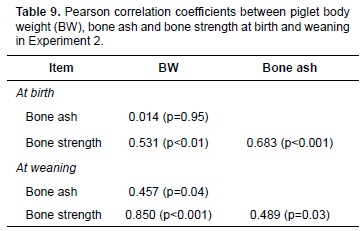
<body><![CDATA[<p> There were no significant dietary differences in   sow weight measures. However, quadratic responses   were detected in the number of total (p&lt;0.05) and live   born (p=0.05), and litter weight of live born (p&lt;0.01)   and weaning pigs (p&lt;0.05) with the highest values   in the 300 FTU/kg phytase supplementation group.   A linear increase was observed in piglet weaning   weight with increasing phytase supplementation   levels (p&lt;0.05).</p>     <p> <i>Experiment 2</i></p>     <p> All sows and piglets were in good health and   condition during the experimental period. Two sows   were removed from the gestation data set because   one sow was not pregnant and the other sow had   only 2 pigs at farrowing which was considered an   abnormal litter size. Additionally, a sow from each   of Treatment 2 and 3 was absent from the lactation   data set because of sudden death at d 100 and 112 of   gestation, respectively.</p>     <p> In the results of sow and litter performance, phytase   supplementation to gestation and lactation diets had   no influences on any response measures of litter size,   lactation daily feed intake, and BW of sows and piglets   during lactation (p&gt;0.10; <a href="/img/revistas/rccp/v27n3/v27n3a4t6.jpg" target="_blank">Table 6</a>). While, this was not   unexpected because there were limited observations and   piglets were slaughtered at birth and weaning, which   further hinders examination of those measures, the   means are provided for informational purposes when   examining results that are presented in <a href="/img/revistas/rccp/v27n3/v27n3a4t7.jpg" target="_blank">Tables 7</a> and <a href="/img/revistas/rccp/v27n3/v27n3a4t8.jpg" target="_blank">8</a>.</p>     <p> In gestation, the ATTD of P in the low Ca and   aP without phytase group was lower than that in the   normal Ca and aP (p&lt;0.01) and phytase-supplemented   (p&lt;0.05) groups while the phytase-supplemented   group had similar ATTD of P compared to the normal   Ca and aP group (p=0.37; <a href="/img/revistas/rccp/v27n3/v27n3a4t7.jpg" target="_blank">Table 7</a>). For the ATTD   of Ca, the value in the normal Ca and aP group was   similar to that in the phytase-supplemented group   (p=0.31) but higher than that in the low Ca and aP   without phytase group (p&lt;0.05). In lactation, sows   fed the low Ca and aP diet with phytase had higher   ATTD of P compared with those fed the normal Ca   and aP (p&lt;0.05) or the low Ca and aP without phytase   diet (p&lt;0.05) whereas the ATTD of Ca in the phytasesupplemented   group was only higher than that in the   low Ca and aP without phytase group (p&lt;0.10). There   were no differences for ATTD of N in gestation and   lactation among the dietary treatments (p&gt;0.19).</p>     <p>  When the digestibility data were averaged for   both gestation and lactation periods (the mean value),   the ATTD of P in the phytase-supplemented group   was the highest (p&lt;0.05) and that in the low Ca and   aP without phytase group was the lowest (p&lt;0.05)   among dietary treatments. For the ATTD of Ca, the   value in the low Ca and aP without phytase group was   lower than those in the normal Ca and aP (p&lt;0.05)   and phytase-supplemented (p&lt;0.05) groups, and the   phytase-supplemented group did not differ from the   ATTD of Ca for the normal Ca and aP group (p=0.71).   Evaluating the period effect of gestation and lactation,   the ATTD of all nutrients measured were enhanced in   lactation compared with those in gestation (p&lt;0.01).   An interaction between treatment and period was   observed for the ATTD of P (p&lt;0.05) wherein the   response to added phytase was greater in lactation   than in gestation.</p>     <p> There were no differences in sow bone ash content at   weaning, and piglet bone strength and ash content at birth   (p&gt;0.12; <a href="/img/revistas/rccp/v27n3/v27n3a4t8.jpg" target="_blank">Table 8</a>). Comparing piglet bone characteristics   at weaning between phytase-supplemented and nonphytase   groups, phytase supplementation of the sow   diet increased piglet bone ash content (47.6 vs. 45.1%,   p&lt;0.05) and bone strength (125.1 vs. 90.8 kg, p&lt;0.10).   Differences remained after piglet BW was considered as   a covariate (47.5 vs. 45.4%, p&lt;0.05 for bone ash content;   118.7 vs 98.5 kg, p&lt;0.10 for bone strength).</p>     <p>  In the results of the correlation analysis, there were   positive correlations at birth between piglet BW and bone   strength (r=0.53; p&lt;0.01) and between bone strength and   ash content (r=0.68; p&lt;0.001, <a href="#t9">Table 9</a>). Additionally,   at weaning there were positive correlations between   piglet BW and bone ash content (r=0.46; p&lt;0.05),   between piglet BW and bone strength (r=0.85; p&lt;0.001),   and between bone strength and ash content (r=0.49;   p&lt;0.05).</p>         <p align="center"><a name="t9"></a><img src="/img/revistas/rccp/v27n3/v27n3a4t9.jpg"></p>     <p>&nbsp;</p>     ]]></body>
<body><![CDATA[<p><font size="3">  <b>Discussion</b></font></p>     <p> Aaron and Hays (2001) stated that progress in   sow nutrition and management research is impeded   by large variation among sows in the economically   important reproductive traits. With normal variation,   the number of replications needed to detect a 10%   difference in litter size at birth with an 80% chance   of detecting that difference and a 10% probability   level is 112 sows per treatment. Although none of   the 3 participating stations could dedicate that many   sows to the experiment individually, about 90 litters   per treatment are collectively reported herein, and   those numbers were adequate to detect differences   in several responses.</p>     <p> The relative lack of differences in sow BW and   litter size among all dietary treatments in both studies   mean that the reduced Ca and P contents in gestation   and lactation diets had no detrimental effect on   reproductive performance, which agrees with Nyachoti   <i>et al.</i> (2006) who reported that low levels of Ca and P   in the gestation and lactation diets with phytase had   no negative effects on sow BW and piglet growth   during the nursing period. In Experiment 1 there was   a quadratic effect of phytase supplementation on litter   size. The lower level of phytase supplementation   inexplicably increased litter size and weight at birth,   and litter weight at weaning while those responses   were diminished when sows were fed the highest   level of phytase. Additionally, piglet weaning   weight was linearly increased by increasing level of   phytase supplementation. Grela <i>et al.</i> (2010) reported   higher numbers of live born and weaned pigs with   phytase supplementation (500 FTU/kg with low P   content) and higher litter weight at birth and weaning   in the high P or phytase supplementation groups in   comparison with a low P group. In agreement with   these recent data, the results of the present study   suggest that phytase supplementation to low P diets   could improve litter growth. However, there is limited   information to explain the reason why quadratic   responses appeared in litter size and performance by   phytase supplementation levels. Nevertheless, the   number of pigs at weaning did not differ from the   normal Ca and aP diet. Lyberg <i>et al.</i> (2007) reported   higher numbers of piglets born from sows fed low   P diets supplemented with phytase compared with   sows fed a high P diet but it was not maintained   until weaning because of a negative effect on piglet   mortality. In contrast, Nyachoti <i>et al.</i> (2006) reported   sow and litter performance was not affected by   phytase supplementation. Therefore, further study   is needed to clarify the phytase effect on litter size   and performance and possible modes of action (e.g.   increase of P content in colostrum and milk) in   addition to simply supplying additional P.</p>     <p> In Experiment 2, as with Experiment 1, there   were no significant differences on reproductive   performance including BW of sows and piglets and   litter size at birth and weaning. As stated, this was not   unexpected because there were limited observations   and piglets were slaughtered at birth and weaning.   But the primary objectives of Experiment 2 were not   normal production measures but ATTD of Ca and P   and offspring bone characteristics.</p>     <p> In Experiment 2 phytase supplementation   improved the ATTD of P both for gestating and   lactating sows. These results agree with many   previous studies that report phytase supplementation   increases P digestibility and availability in gestating   and lactating sows (Kemme <i>et al.</i>, 1997a, b; Baidoo   <i>et al.</i>, 2003; Jongbloed <i>et al.</i>, 2004; Nyachoti <i>et al.</i>,   2006; M&auml;nner and Simon, 2006; Hanczakowska <i>et  al.</i>, 2009; Grela <i>et al.</i>, 2011). The low Ca and aP diet   without phytase reduced the ATTD of Ca and P in   gestation and phytase supplementation to this diet   then improved ATTD to levels similar to that in the   normal Ca and aP group, which agrees with previous   studies (Jongbloed <i>et al.</i>, 2004; Hanczakowska <i>et al.</i>,   2009). Additionally, in lactation the ATTD of Ca was   increased by phytase supplementation compared with   the non-phytase group. The possible mode of action   whereby Ca digestibility improves by supplementing   phytase could be that when phytase hydrolyzes   phytates, there is limitation of Ca-phytate complex   formation in the small intestine that blocks intestinal   Ca absorption (Selle <i>et al.</i>, 2009). In addition, already   phytate-bound minerals may be liberated and become   available for absorption from the intestine (Kemme   <i>et al.</i>, 1999). Jongbloed <i>et al.</i> (2004) observed an   improvement of Ca digestibility in gestation and   lactation by phytase supplementation and Grela <i>et  al.</i> (2011) also demonstrated the same effect in lactating   sows. Nyachoti <i>et al.</i> (2006) reported Ca digestibility   in gestation was slightly improved when sows were fed   phytase-supplemented diets, but more so in lactation.   Therefore, supplementing phytase to sow diets appears   to improve the ATTD of Ca as well as that of P.</p>     <p> The interaction between treatment and period   observed for the ATTD of P was due to a difference   in magnitude of the improvements in P digestibility   of gestating and lactating sows by phytase   supplementation and not to a difference in the   direction of the response. In gestation, phytase   supplementation improved the ATTD of P to levels   similar to the normal Ca and P group whereas a   more pronounced effect of phytase was observed in   lactation. In the ATTD of Ca, the mean value was   improved by phytase supplementation similar to   that in the normal Ca and P group which, as with the   ATTD of P, was associated with a slight improvement   in gestation and greater improvement in lactation.   Across studies, the phytase effect on P digestibility   in gestation is conflicting. Several studies reported   that gestating sows had an increased P digestibility   when fed phytase in the low P diets (Jongbloed <i>et  al.</i>, 2004; M&auml;nner and Simon, 2006; Hanczakowska   <i>et al.</i>, 2009) whereas Nyachoti <i>et al.</i> (2006) reported   phytase supplementation with 500 FTU/kg in a   corn-SBM based diet with low P level showed a   positive effect on P digestibility in lactation but not   in gestation. Kemme <i>et al.</i> (1997b) also reported   that even though mean gestation P digestibility was   increased by supplementing phytase at 500 FTU/kg of   diet, no improvement in P digestibility from phytase   addition was observed in the mid-gestation period   (d 60 of gestation). While phytase supplementation   levels may have varied among the reported studies, it   should be noted that P levels of the low P diets used   in the studies which showed no effect of phytase on P   digestibility for gestating sows (0.48% total P; Kemme   <i>et al.</i>, 1997b, Nyachoti <i>et al.</i>, 2006) were relatively   higher than those in the other studies which reported   the improvement of P digestibility in gestating sows   from phytase supplementation (0.36 to 0.39% total   P; Jongbloed <i>et al.</i>, 2004; M&auml;nner and Simon, 2006;   Hanczakowska <i>et al.</i>, 2009). This indicates that the   inconsistent effect of dietary phytase supplementation   in gestating sows that is reported might be attributed to   different levels of aP for sows from the diet. Regarding   the reproductive period effect, higher digestibilities   of P, Ca, and N were detected in lactation compared   to gestation. This observation is in full agreement   with previous research (Kemme <i>et al.</i>, 1997b; Sulabo   <i>et al.</i>, 2004; Jongbloed <i>et al.</i>, 2004). Kemme <i>et al.</i>   (1997b) demonstrated lactating sows had higher   apparent digestibilities of Ca and P than gestating   sows. Similarly, Sulabo <i>et al.</i> (2004) reported that the   ATTD of P was higher in lactation than in gestation   by as much as 14.7%. Theoretically, P released from   the diet containing phytase could provide sufficient   amounts of aP for gestating sows close to or above   their P requirement (Kemme <i>et al.</i>, 1997b). However,   lactating sows demand more nutrients to produce   milk, resulting in increased Ca and P requirements   (NRC, 2012). In this study it could be assumed that   lactating sows consumed more aP and phytate P than   gestating sows because of ad libitum feed allowance   and approximately 2 times higher proportion of   SBM in the lactation diet than in the gestation diet.   Therefore, more pronounced effect of phytase in   lactating sows than gestating sows may be likely due   to both higher consumption of available nutrients (i.e.   P) as well as substrates for phytase in lactation than   in gestation.</p>     <p> In the results of bone characteristics, no phytase   effects on bone strength and ash content of piglets at   birth were observed, even though the ATTD of P was   increased in the gestation period. Mahan and Vallet   (1997) suggested that the contents of Ca and P in fetus   and milk were not affected by inadequate levels of   these elements in sow diets. Additionally, the bone ash   content of newborn pigs was not influenced by dietary   Ca and P levels under or above the requirements for   gestating sows when assessed by Mahan and Fetter   (1982). Therefore, in the current study the lack of an   improvement in bone integrity of newborn pigs in   spite of increased P absorption in gestating sows is   not surprising. At weaning, while no differences were   detected in sow bone ash content, piglet bone strength   and ash content showed clear improvements related   to phytase supplementation of the sows. Previous   research has reported that phytase supplementation   both in gestation and lactation increased P level in   milk as well as colostrum (Grela <i>et al.</i>, 2010; Czech   <i>et al.</i>, 2011). Even though the nutrient content of   milk was not evaluated in this experiment, it could be   hypothesized that the increased P digestibility from   phytase supplementation positively affected milk P   level and thereby bone integrity of the progeny was   improved.</p>     <p> There were several positive correlations among   piglet BW, bone strength and ash content at birth   and weaning. Piglet bone strength was correlated   with BW regardless of sampling times. In the case of   bone ash content, there were correlations with bone   strength both at birth and weaning and with piglet   BW at weaning. Crenshaw <i>et al.</i> (1981) reported   that an increase in bone mineralization led to an   increased maximum stress and bending moment of   bone. When the bone mineral density was high, not   only ash, Ca and P concentration of the bone were   increased, but also bone strength increased (Nielsen   <i>et al.</i>, 2007). These previous studies provide the   possible explanations for the correlations in this study   where higher bone ash contents led to increased bone   strength.</p>     <p> In conclusion, phytase supplementation increased   the ATTD of Ca and P both for gestating and lactating   sows, with more pronounced effects in lactation than   in gestation, and has the potential to improve litter   performance. Although there were no significant effects   on bone characteristics of piglets at birth, adding phytase   to sow diets in gestation and lactation improved the bone   integrity of their progeny at weaning, which could result   in subsequent improvement of pig bone status.</p>     <P>&nbsp;</P> <hr size="1" noshade>     ]]></body>
<body><![CDATA[<p><b><font size="3">Notes</font></b></p>     <P><a href="#0b" name="0">&curren;</a> To cite this article: Jang YD, Lindemann MD, van Heugten E, Jones RD, Kim BG, Maxwell CV, Radcliffe JS. Effects of phytase supplementation on   reproductive performance, apparent total tract digestibility of Ca and P and bone characteristics in gestating and lactating sows. Rev Colomb Cienc Pecu 2014; 27:178-193.</P>     <P><a href="#0b">&para;</a> This manuscript is published by the Kentucky Agricultural Experiment Station as paper number 13-07-055.</P> <hr size="1" noshade>     <P>&nbsp;</P>     <P><font size="3"><B>References</B></font></P>     <!-- ref --><p>Aaron DK, Hays VW. Statistical techniques for the design and   analysis of swine nutrition experiments. In: Lewis AJ, Southern   LL, editors. Swine Nutrition. 2nd ed. Washington D.C.: CRC Press; 2001. p. 605-622.    &nbsp;&nbsp;&nbsp;&nbsp;&nbsp;&nbsp;&nbsp;&nbsp;[&#160;<a href="javascript:void(0);" onclick="javascript: window.open('/scielo.php?script=sci_nlinks&ref=000098&pid=S0120-0690201400030000400001&lng=','','width=640,height=500,resizable=yes,scrollbars=1,menubar=yes,');">Links</a>&#160;]<!-- end-ref --></p>     <!-- ref --><p> AOAC, Association of Official Analytical Chemists. Official   Methods of Analysis. 15th ed. Arlington, VA; 1990.    &nbsp;&nbsp;&nbsp;&nbsp;&nbsp;&nbsp;&nbsp;&nbsp;[&#160;<a href="javascript:void(0);" onclick="javascript: window.open('/scielo.php?script=sci_nlinks&ref=000100&pid=S0120-0690201400030000400002&lng=','','width=640,height=500,resizable=yes,scrollbars=1,menubar=yes,');">Links</a>&#160;]<!-- end-ref --></p>     <!-- ref --><p> AOAC, Association of Official Analytical Chemists. Official   Methods of Analysis. 16th ed. Arlington, VA; 1995.    &nbsp;&nbsp;&nbsp;&nbsp;&nbsp;&nbsp;&nbsp;&nbsp;[&#160;<a href="javascript:void(0);" onclick="javascript: window.open('/scielo.php?script=sci_nlinks&ref=000102&pid=S0120-0690201400030000400003&lng=','','width=640,height=500,resizable=yes,scrollbars=1,menubar=yes,');">Links</a>&#160;]<!-- end-ref --></p>     <!-- ref --><p> Baidoo SK, Yang QM, Walker RD. Effects of phytase on apparent   digestibility of organic phosphorus and nutrients in maize-soya   bean meal based diets for sows. Anim Feed Sci Technol 2003;   104:133-141.    &nbsp;&nbsp;&nbsp;&nbsp;&nbsp;&nbsp;&nbsp;&nbsp;[&#160;<a href="javascript:void(0);" onclick="javascript: window.open('/scielo.php?script=sci_nlinks&ref=000104&pid=S0120-0690201400030000400004&lng=','','width=640,height=500,resizable=yes,scrollbars=1,menubar=yes,');">Links</a>&#160;]<!-- end-ref --></p>     <!-- ref --><p> Br&atilde;na DV, Ellis M, Casta&ntilde;eda EO, Sands JS, Baker DH. Effect   of a novel phytase on growth performance, bone ash, and mineral   digestibility in nursery and grower-finisher pigs. J Anim Sci 2006;   84:1839-1849.    &nbsp;&nbsp;&nbsp;&nbsp;&nbsp;&nbsp;&nbsp;&nbsp;[&#160;<a href="javascript:void(0);" onclick="javascript: window.open('/scielo.php?script=sci_nlinks&ref=000106&pid=S0120-0690201400030000400005&lng=','','width=640,height=500,resizable=yes,scrollbars=1,menubar=yes,');">Links</a>&#160;]<!-- end-ref --></p>     <!-- ref --><p> Crenshaw TD, Peo ER Jr, Lewis AJ, Moser BD. Bone strength as   a trait for assessing mineralization in swine: a critical review of   techniques involved. J Anim Sci 1981; 53:827-835.    &nbsp;&nbsp;&nbsp;&nbsp;&nbsp;&nbsp;&nbsp;&nbsp;[&#160;<a href="javascript:void(0);" onclick="javascript: window.open('/scielo.php?script=sci_nlinks&ref=000108&pid=S0120-0690201400030000400006&lng=','','width=640,height=500,resizable=yes,scrollbars=1,menubar=yes,');">Links</a>&#160;]<!-- end-ref --></p>     <!-- ref --><p> Czech A, Stachyra K, Woznica A. Influence of feed enzymes   on the content of mineral elements in sows milk and pigs blood   plasma. Ann UMCS, Zootechnica sec EE 2011; 29:22-32.    &nbsp;&nbsp;&nbsp;&nbsp;&nbsp;&nbsp;&nbsp;&nbsp;[&#160;<a href="javascript:void(0);" onclick="javascript: window.open('/scielo.php?script=sci_nlinks&ref=000110&pid=S0120-0690201400030000400007&lng=','','width=640,height=500,resizable=yes,scrollbars=1,menubar=yes,');">Links</a>&#160;]<!-- end-ref --></p>     <!-- ref --><p> FASS, Guide for the Care and Use of Agricultural Animals in   Research and Teaching. Federation of Animal Science Societies.   1st rev. ed. Champaign, IL; 1999.    &nbsp;&nbsp;&nbsp;&nbsp;&nbsp;&nbsp;&nbsp;&nbsp;[&#160;<a href="javascript:void(0);" onclick="javascript: window.open('/scielo.php?script=sci_nlinks&ref=000112&pid=S0120-0690201400030000400008&lng=','','width=640,height=500,resizable=yes,scrollbars=1,menubar=yes,');">Links</a>&#160;]<!-- end-ref --></p>     <!-- ref --><p> Grela ER, Matras J, Czech A, Krasucki W. The influence of   microbial phytase supplementation to diets with high or low native   phytase activity on sow reproductive traits and composition of   colostrum and milk. J Anim Feed Sci 2010; 19:418-429.    &nbsp;&nbsp;&nbsp;&nbsp;&nbsp;&nbsp;&nbsp;&nbsp;[&#160;<a href="javascript:void(0);" onclick="javascript: window.open('/scielo.php?script=sci_nlinks&ref=000114&pid=S0120-0690201400030000400009&lng=','','width=640,height=500,resizable=yes,scrollbars=1,menubar=yes,');">Links</a>&#160;]<!-- end-ref --></p>     <!-- ref --><p> Grela ER, Matras J, Czech A. Effects of supplemental phytase   on nutrient digestibility and performance of sows fed diets with   high or low native phytase activity. Czech J Anim Sci 2011;   56:443-450.    &nbsp;&nbsp;&nbsp;&nbsp;&nbsp;&nbsp;&nbsp;&nbsp;[&#160;<a href="javascript:void(0);" onclick="javascript: window.open('/scielo.php?script=sci_nlinks&ref=000116&pid=S0120-0690201400030000400010&lng=','','width=640,height=500,resizable=yes,scrollbars=1,menubar=yes,');">Links</a>&#160;]<!-- end-ref --></p>     <!-- ref --><p> Hanczakowska E, Swiatkiewicz M, K&uuml;hn I. Effect of microbial   phytase supplement to feed for sows on apparent digestibility   of P, Ca and crude protein and reproductive parameters in   two consecutive reproduction cycles. Medycyna Wet 2009;   65:250-254.    &nbsp;&nbsp;&nbsp;&nbsp;&nbsp;&nbsp;&nbsp;&nbsp;[&#160;<a href="javascript:void(0);" onclick="javascript: window.open('/scielo.php?script=sci_nlinks&ref=000118&pid=S0120-0690201400030000400011&lng=','','width=640,height=500,resizable=yes,scrollbars=1,menubar=yes,');">Links</a>&#160;]<!-- end-ref --></p>     <!-- ref --><p> Jones CK, Tokach MD, Dritz SS, Ratliff BW, Horn NL, Goodband   RD, DeRouchey JM, Sulabo RC, Nelssen JL. Efficacy of different   commercial phytase enzymes and development of an available   phosphorus release curve for Escherichia coli-derived phytases   in nursery pigs. J Anim Sci 2010; 88:3631-3644.    &nbsp;&nbsp;&nbsp;&nbsp;&nbsp;&nbsp;&nbsp;&nbsp;[&#160;<a href="javascript:void(0);" onclick="javascript: window.open('/scielo.php?script=sci_nlinks&ref=000120&pid=S0120-0690201400030000400012&lng=','','width=640,height=500,resizable=yes,scrollbars=1,menubar=yes,');">Links</a>&#160;]<!-- end-ref --></p>     <!-- ref --><p> Jongbloed AW, van Diepen JThM, Kemme PA, Broz J. Efficacy   of microbial phytase on mineral digestibility in diets for gestating   and lactating sows. Livest Prod Sci 2004; 91:143-155.    &nbsp;&nbsp;&nbsp;&nbsp;&nbsp;&nbsp;&nbsp;&nbsp;[&#160;<a href="javascript:void(0);" onclick="javascript: window.open('/scielo.php?script=sci_nlinks&ref=000122&pid=S0120-0690201400030000400013&lng=','','width=640,height=500,resizable=yes,scrollbars=1,menubar=yes,');">Links</a>&#160;]<!-- end-ref --></p>     <!-- ref --><p>  Kemme PA, Radcliffe JS, Jongbloed AW, Mroz Z. The effects of   sow parity on digestibility of proximate components and minerals   during lactation as influenced by diet and microbial phytase   supplementation. J Anim Sci 1997a; 75:2147-2153.    &nbsp;&nbsp;&nbsp;&nbsp;&nbsp;&nbsp;&nbsp;&nbsp;[&#160;<a href="javascript:void(0);" onclick="javascript: window.open('/scielo.php?script=sci_nlinks&ref=000124&pid=S0120-0690201400030000400014&lng=','','width=640,height=500,resizable=yes,scrollbars=1,menubar=yes,');">Links</a>&#160;]<!-- end-ref --></p>     <!-- ref --><p> Kemme PA, Jongbloed AW, Mroz Z, Beynen AC. The efficacy   of Aspergillus niger phytase in rendering phytate phosphorus   available for absorption in pigs is influenced by pig physiological   status. J Anim Sci 1997b; 75:2129-2138.    &nbsp;&nbsp;&nbsp;&nbsp;&nbsp;&nbsp;&nbsp;&nbsp;[&#160;<a href="javascript:void(0);" onclick="javascript: window.open('/scielo.php?script=sci_nlinks&ref=000126&pid=S0120-0690201400030000400015&lng=','','width=640,height=500,resizable=yes,scrollbars=1,menubar=yes,');">Links</a>&#160;]<!-- end-ref --></p>     <!-- ref --><p> Kemme PA, Jongbloed AW, Mroz Z, Kogut J, Beynen AC.   Digestibility of nutrients in growing&#8211;finishing pigs is affected   by Aspergillus niger phytase, phytate and lactic acid levels 2.   Apparent total tract digestibility of phosphorus, calcium and   magnesium and ileal degradation of phytic acid. Livest Prod Sci   1999; 58:119-127.    &nbsp;&nbsp;&nbsp;&nbsp;&nbsp;&nbsp;&nbsp;&nbsp;[&#160;<a href="javascript:void(0);" onclick="javascript: window.open('/scielo.php?script=sci_nlinks&ref=000128&pid=S0120-0690201400030000400016&lng=','','width=640,height=500,resizable=yes,scrollbars=1,menubar=yes,');">Links</a>&#160;]<!-- end-ref --></p>     <!-- ref --><p> Lyberg K, Andersson HK, Simonsson A, Lindberg JE. Influence   of different phosphorus levels and phytase supplementation in   gestation diets on sow performance. J Anim Physiol Anim Nutr   2007; 91:304-311.    &nbsp;&nbsp;&nbsp;&nbsp;&nbsp;&nbsp;&nbsp;&nbsp;[&#160;<a href="javascript:void(0);" onclick="javascript: window.open('/scielo.php?script=sci_nlinks&ref=000130&pid=S0120-0690201400030000400017&lng=','','width=640,height=500,resizable=yes,scrollbars=1,menubar=yes,');">Links</a>&#160;]<!-- end-ref --></p>     <!-- ref --><p> Mahan DC, Fetter AW. Dietary calcium and phosphorus levels   for reproducing sows. J Anim Sci 1982; 54:285-291.    &nbsp;&nbsp;&nbsp;&nbsp;&nbsp;&nbsp;&nbsp;&nbsp;[&#160;<a href="javascript:void(0);" onclick="javascript: window.open('/scielo.php?script=sci_nlinks&ref=000132&pid=S0120-0690201400030000400018&lng=','','width=640,height=500,resizable=yes,scrollbars=1,menubar=yes,');">Links</a>&#160;]<!-- end-ref --></p>     <!-- ref --><p> Mahan DC, Vallet JL. Vitamin and mineral transfer during fetal   development and the early postnatal period in pigs. J Anim Sci   1997; 75:2731-2738.    &nbsp;&nbsp;&nbsp;&nbsp;&nbsp;&nbsp;&nbsp;&nbsp;[&#160;<a href="javascript:void(0);" onclick="javascript: window.open('/scielo.php?script=sci_nlinks&ref=000134&pid=S0120-0690201400030000400019&lng=','','width=640,height=500,resizable=yes,scrollbars=1,menubar=yes,');">Links</a>&#160;]<!-- end-ref --></p>     <!-- ref --><p> Mahan DC, Watts MR, St-Pierre N. Macro- and micromineral   composition of fetal pigs and their accretion rates during fetal   development. J Anim Sci 2009; 87:2823-2832.    &nbsp;&nbsp;&nbsp;&nbsp;&nbsp;&nbsp;&nbsp;&nbsp;[&#160;<a href="javascript:void(0);" onclick="javascript: window.open('/scielo.php?script=sci_nlinks&ref=000136&pid=S0120-0690201400030000400020&lng=','','width=640,height=500,resizable=yes,scrollbars=1,menubar=yes,');">Links</a>&#160;]<!-- end-ref --></p>     <!-- ref --><p> M&auml;nner K, Simon O. Effectiveness of microbial phytases in diets   of sows during gestation and lactation. J Anim Feed Sci 2006;   15:199-211.    &nbsp;&nbsp;&nbsp;&nbsp;&nbsp;&nbsp;&nbsp;&nbsp;[&#160;<a href="javascript:void(0);" onclick="javascript: window.open('/scielo.php?script=sci_nlinks&ref=000138&pid=S0120-0690201400030000400021&lng=','','width=640,height=500,resizable=yes,scrollbars=1,menubar=yes,');">Links</a>&#160;]<!-- end-ref --></p>     <!-- ref --><p> Nielsen DH, McEvoy FJ, Madsen MT, Jensen JB, Svalastoga   E. Relationship between bone strength and dual-energy X-ray   absorptiometry measurements in pigs. J Anim Sci 2007;   85:667-672.    &nbsp;&nbsp;&nbsp;&nbsp;&nbsp;&nbsp;&nbsp;&nbsp;[&#160;<a href="javascript:void(0);" onclick="javascript: window.open('/scielo.php?script=sci_nlinks&ref=000140&pid=S0120-0690201400030000400022&lng=','','width=640,height=500,resizable=yes,scrollbars=1,menubar=yes,');">Links</a>&#160;]<!-- end-ref --></p>     <!-- ref --><p> NRC, National Research Council. Nutrient Requirements of   Swine. 10th rev. ed. Washington D.C.: National Academic   Press; 1998.    &nbsp;&nbsp;&nbsp;&nbsp;&nbsp;&nbsp;&nbsp;&nbsp;[&#160;<a href="javascript:void(0);" onclick="javascript: window.open('/scielo.php?script=sci_nlinks&ref=000142&pid=S0120-0690201400030000400023&lng=','','width=640,height=500,resizable=yes,scrollbars=1,menubar=yes,');">Links</a>&#160;]<!-- end-ref --></p>     <!-- ref --><p> NRC, National Research Council. Nutrient Requirements of   Swine. 11th rev. ed. Washington D.C.: National Academic   Press; 2012.    &nbsp;&nbsp;&nbsp;&nbsp;&nbsp;&nbsp;&nbsp;&nbsp;[&#160;<a href="javascript:void(0);" onclick="javascript: window.open('/scielo.php?script=sci_nlinks&ref=000144&pid=S0120-0690201400030000400024&lng=','','width=640,height=500,resizable=yes,scrollbars=1,menubar=yes,');">Links</a>&#160;]<!-- end-ref --></p>     <!-- ref --><p> Nyachoti CM, Sands JS, Connor ML, Adeola O. Effect of   supplementing phytase to corn- or wheat-based gestation   and lactation diets on nutrient digestibility and sow and litter   performance. Can J Anim Sci 2006; 86:501-510.    &nbsp;&nbsp;&nbsp;&nbsp;&nbsp;&nbsp;&nbsp;&nbsp;[&#160;<a href="javascript:void(0);" onclick="javascript: window.open('/scielo.php?script=sci_nlinks&ref=000146&pid=S0120-0690201400030000400025&lng=','','width=640,height=500,resizable=yes,scrollbars=1,menubar=yes,');">Links</a>&#160;]<!-- end-ref --></p>     <!-- ref --><p> Selle PH, Ravindran V. Phytate-degrading enzymes in pig   nutrition. Livest Sci 2008; 113:99-122.    &nbsp;&nbsp;&nbsp;&nbsp;&nbsp;&nbsp;&nbsp;&nbsp;[&#160;<a href="javascript:void(0);" onclick="javascript: window.open('/scielo.php?script=sci_nlinks&ref=000148&pid=S0120-0690201400030000400026&lng=','','width=640,height=500,resizable=yes,scrollbars=1,menubar=yes,');">Links</a>&#160;]<!-- end-ref --></p>     <!-- ref --><p> Selle PH, Cowieson AJ, Ravindran V. Consequences of calcium   interactions with phytate and phytase for poultry and pigs. Livest   Sci 2009; 124:126-141.    &nbsp;&nbsp;&nbsp;&nbsp;&nbsp;&nbsp;&nbsp;&nbsp;[&#160;<a href="javascript:void(0);" onclick="javascript: window.open('/scielo.php?script=sci_nlinks&ref=000150&pid=S0120-0690201400030000400027&lng=','','width=640,height=500,resizable=yes,scrollbars=1,menubar=yes,');">Links</a>&#160;]<!-- end-ref --></p>     <!-- ref --><p> Sulabo RC, Thaler RC, Stein HH. Effect of body weight and   reproductive status on phosphorus digestibility and efficacy of   phytase in pigs. J Anim Sci 2004; 82 Suppl 2: 215.    &nbsp;&nbsp;&nbsp;&nbsp;&nbsp;&nbsp;&nbsp;&nbsp;[&#160;<a href="javascript:void(0);" onclick="javascript: window.open('/scielo.php?script=sci_nlinks&ref=000152&pid=S0120-0690201400030000400028&lng=','','width=640,height=500,resizable=yes,scrollbars=1,menubar=yes,');">Links</a>&#160;]<!-- end-ref --></p>     <!-- ref --><p> Trottier NL, Johnston LJ. Feeding gilts during development and   sows during gestation and lactation. In: Lewis AJ, Southern LL,   editors. Swine Nutrition. 2nd ed. Washington D.C.: CRC Press;   2001. p. 725-769.    &nbsp;&nbsp;&nbsp;&nbsp;&nbsp;&nbsp;&nbsp;&nbsp;[&#160;<a href="javascript:void(0);" onclick="javascript: window.open('/scielo.php?script=sci_nlinks&ref=000154&pid=S0120-0690201400030000400029&lng=','','width=640,height=500,resizable=yes,scrollbars=1,menubar=yes,');">Links</a>&#160;]<!-- end-ref --></p>     <!-- ref --><p> Williams CH, David DJ, Iismaa O. The determination of chromic   oxide in faeces samples by atomic absorption spectrophotometry.   J Agric Sci 1962; 59:381-385.    &nbsp;&nbsp;&nbsp;&nbsp;&nbsp;&nbsp;&nbsp;&nbsp;[&#160;<a href="javascript:void(0);" onclick="javascript: window.open('/scielo.php?script=sci_nlinks&ref=000156&pid=S0120-0690201400030000400030&lng=','','width=640,height=500,resizable=yes,scrollbars=1,menubar=yes,');">Links</a>&#160;]<!-- end-ref --></p>     <P>&nbsp;</P> </font>      ]]></body><back>
<ref-list>
<ref id="B1">
<nlm-citation citation-type="book">
<person-group person-group-type="author">
<name>
<surname><![CDATA[Aaron]]></surname>
<given-names><![CDATA[DK]]></given-names>
</name>
<name>
<surname><![CDATA[Hays]]></surname>
<given-names><![CDATA[VW]]></given-names>
</name>
</person-group>
<article-title xml:lang="en"><![CDATA[Statistical techniques for the design and analysis of swine nutrition experiments]]></article-title>
<person-group person-group-type="editor">
<name>
<surname><![CDATA[Lewis]]></surname>
<given-names><![CDATA[AJ]]></given-names>
</name>
<name>
<surname><![CDATA[Southern]]></surname>
<given-names><![CDATA[LL]]></given-names>
</name>
</person-group>
<source><![CDATA[Swine Nutrition]]></source>
<year>2001</year>
<edition>2</edition>
<page-range>605-622</page-range><publisher-loc><![CDATA[Washington^eD.C D.C]]></publisher-loc>
<publisher-name><![CDATA[CRC Press]]></publisher-name>
</nlm-citation>
</ref>
<ref id="B2">
<nlm-citation citation-type="">
<collab>AOAC, Association of Official Analytical Chemists</collab>
<source><![CDATA[Official Methods of Analysis]]></source>
<year>1990</year>
<edition>15</edition>
<publisher-loc><![CDATA[Arlington^eVA VA]]></publisher-loc>
</nlm-citation>
</ref>
<ref id="B3">
<nlm-citation citation-type="">
<collab>AOAC, Association of Official Analytical Chemists</collab>
<source><![CDATA[Official Methods of Analysis]]></source>
<year>1995</year>
<edition>16</edition>
<publisher-loc><![CDATA[Arlington^eVA VA]]></publisher-loc>
</nlm-citation>
</ref>
<ref id="B4">
<nlm-citation citation-type="journal">
<person-group person-group-type="author">
<name>
<surname><![CDATA[Baidoo]]></surname>
<given-names><![CDATA[SK]]></given-names>
</name>
<name>
<surname><![CDATA[Yang]]></surname>
<given-names><![CDATA[QM]]></given-names>
</name>
<name>
<surname><![CDATA[Walker]]></surname>
<given-names><![CDATA[RD]]></given-names>
</name>
</person-group>
<article-title xml:lang="en"><![CDATA[Effects of phytase on apparent digestibility of organic phosphorus and nutrients in maize-soya bean meal based diets for sows]]></article-title>
<source><![CDATA[Anim Feed Sci Technol]]></source>
<year>2003</year>
<volume>104</volume>
<page-range>133-141</page-range></nlm-citation>
</ref>
<ref id="B5">
<nlm-citation citation-type="journal">
<person-group person-group-type="author">
<name>
<surname><![CDATA[Brãna]]></surname>
<given-names><![CDATA[DV]]></given-names>
</name>
<name>
<surname><![CDATA[Ellis]]></surname>
<given-names><![CDATA[M]]></given-names>
</name>
<name>
<surname><![CDATA[Castañeda]]></surname>
<given-names><![CDATA[EO]]></given-names>
</name>
<name>
<surname><![CDATA[Sands]]></surname>
<given-names><![CDATA[JS]]></given-names>
</name>
<name>
<surname><![CDATA[Baker]]></surname>
<given-names><![CDATA[DH]]></given-names>
</name>
</person-group>
<article-title xml:lang="en"><![CDATA[Effect of a novel phytase on growth performance, bone ash, and mineral digestibility in nursery and grower-finisher pigs]]></article-title>
<source><![CDATA[J Anim Sci]]></source>
<year>2006</year>
<volume>84</volume>
<page-range>1839-1849</page-range></nlm-citation>
</ref>
<ref id="B6">
<nlm-citation citation-type="journal">
<person-group person-group-type="author">
<name>
<surname><![CDATA[Crenshaw]]></surname>
<given-names><![CDATA[TD]]></given-names>
</name>
<name>
<surname><![CDATA[Peo]]></surname>
<given-names><![CDATA[ER Jr]]></given-names>
</name>
<name>
<surname><![CDATA[Lewis]]></surname>
<given-names><![CDATA[AJ]]></given-names>
</name>
<name>
<surname><![CDATA[Moser]]></surname>
<given-names><![CDATA[BD]]></given-names>
</name>
</person-group>
<article-title xml:lang="en"><![CDATA[Bone strength as a trait for assessing mineralization in swine: a critical review of techniques involved]]></article-title>
<source><![CDATA[J Anim Sci]]></source>
<year>1981</year>
<volume>53</volume>
<page-range>827-835</page-range></nlm-citation>
</ref>
<ref id="B7">
<nlm-citation citation-type="journal">
<person-group person-group-type="author">
<name>
<surname><![CDATA[Czech]]></surname>
<given-names><![CDATA[A]]></given-names>
</name>
<name>
<surname><![CDATA[Stachyra]]></surname>
<given-names><![CDATA[K]]></given-names>
</name>
<name>
<surname><![CDATA[Woznica]]></surname>
<given-names><![CDATA[A]]></given-names>
</name>
</person-group>
<article-title xml:lang="en"><![CDATA[Influence of feed enzymes on the content of mineral elements in sows milk and pigs blood plasma]]></article-title>
<source><![CDATA[Ann UMCS, Zootechnica sec EE]]></source>
<year>2011</year>
<volume>29</volume>
<page-range>22-32</page-range></nlm-citation>
</ref>
<ref id="B8">
<nlm-citation citation-type="book">
<collab>FASS</collab>
<source><![CDATA[Guide for the Care and Use of Agricultural Animals in Research and Teaching]]></source>
<year>1999</year>
<edition>1</edition>
<publisher-loc><![CDATA[Champaign^eIL IL]]></publisher-loc>
<publisher-name><![CDATA[Federation of Animal Science Societies]]></publisher-name>
</nlm-citation>
</ref>
<ref id="B9">
<nlm-citation citation-type="journal">
<person-group person-group-type="author">
<name>
<surname><![CDATA[Grela]]></surname>
<given-names><![CDATA[ER]]></given-names>
</name>
<name>
<surname><![CDATA[Matras]]></surname>
<given-names><![CDATA[J]]></given-names>
</name>
<name>
<surname><![CDATA[Czech]]></surname>
<given-names><![CDATA[A]]></given-names>
</name>
<name>
<surname><![CDATA[Krasucki]]></surname>
<given-names><![CDATA[W]]></given-names>
</name>
</person-group>
<article-title xml:lang="en"><![CDATA[The influence of microbial phytase supplementation to diets with high or low native phytase activity on sow reproductive traits and composition of colostrum and milk]]></article-title>
<source><![CDATA[J Anim Feed Sci]]></source>
<year>2010</year>
<volume>19</volume>
<page-range>418-429</page-range></nlm-citation>
</ref>
<ref id="B10">
<nlm-citation citation-type="journal">
<person-group person-group-type="author">
<name>
<surname><![CDATA[Grela]]></surname>
<given-names><![CDATA[ER]]></given-names>
</name>
<name>
<surname><![CDATA[Matras]]></surname>
<given-names><![CDATA[J]]></given-names>
</name>
<name>
<surname><![CDATA[Czech]]></surname>
<given-names><![CDATA[A]]></given-names>
</name>
</person-group>
<article-title xml:lang="en"><![CDATA[Effects of supplemental phytase on nutrient digestibility and performance of sows fed diets with high or low native phytase activity]]></article-title>
<source><![CDATA[Czech J Anim Sci]]></source>
<year>2011</year>
<volume>56</volume>
<page-range>443-450</page-range></nlm-citation>
</ref>
<ref id="B11">
<nlm-citation citation-type="journal">
<person-group person-group-type="author">
<name>
<surname><![CDATA[Hanczakowska]]></surname>
<given-names><![CDATA[E]]></given-names>
</name>
<name>
<surname><![CDATA[Swiatkiewicz]]></surname>
<given-names><![CDATA[M]]></given-names>
</name>
<name>
<surname><![CDATA[Kühn]]></surname>
<given-names><![CDATA[I]]></given-names>
</name>
</person-group>
<article-title xml:lang="en"><![CDATA[Effect of microbial phytase supplement to feed for sows on apparent digestibility of P, Ca and crude protein and reproductive parameters in two consecutive reproduction cycles]]></article-title>
<source><![CDATA[Medycyna Wet]]></source>
<year>2009</year>
<volume>65</volume>
<page-range>250-254</page-range></nlm-citation>
</ref>
<ref id="B12">
<nlm-citation citation-type="journal">
<person-group person-group-type="author">
<name>
<surname><![CDATA[Jones]]></surname>
<given-names><![CDATA[CK]]></given-names>
</name>
<name>
<surname><![CDATA[Tokach]]></surname>
<given-names><![CDATA[MD]]></given-names>
</name>
<name>
<surname><![CDATA[Dritz]]></surname>
<given-names><![CDATA[SS]]></given-names>
</name>
<name>
<surname><![CDATA[Ratliff]]></surname>
<given-names><![CDATA[BW]]></given-names>
</name>
<name>
<surname><![CDATA[Horn]]></surname>
<given-names><![CDATA[NL]]></given-names>
</name>
<name>
<surname><![CDATA[Goodband]]></surname>
<given-names><![CDATA[RD]]></given-names>
</name>
<name>
<surname><![CDATA[DeRouchey]]></surname>
<given-names><![CDATA[JM]]></given-names>
</name>
<name>
<surname><![CDATA[Sulabo]]></surname>
<given-names><![CDATA[RC]]></given-names>
</name>
<name>
<surname><![CDATA[Nelssen]]></surname>
<given-names><![CDATA[JL]]></given-names>
</name>
</person-group>
<article-title xml:lang="en"><![CDATA[Efficacy of different commercial phytase enzymes and development of an available phosphorus release curve for Escherichia coli-derived phytases in nursery pigs]]></article-title>
<source><![CDATA[J Anim Sci]]></source>
<year>2010</year>
<volume>88</volume>
<page-range>3631-3644</page-range></nlm-citation>
</ref>
<ref id="B13">
<nlm-citation citation-type="journal">
<person-group person-group-type="author">
<name>
<surname><![CDATA[Jongbloed]]></surname>
<given-names><![CDATA[AW]]></given-names>
</name>
<name>
<surname><![CDATA[van Diepen]]></surname>
<given-names><![CDATA[JThM]]></given-names>
</name>
<name>
<surname><![CDATA[Kemme]]></surname>
<given-names><![CDATA[PA]]></given-names>
</name>
<name>
<surname><![CDATA[Broz]]></surname>
<given-names><![CDATA[J]]></given-names>
</name>
</person-group>
<article-title xml:lang="en"><![CDATA[Efficacy of microbial phytase on mineral digestibility in diets for gestating and lactating sows]]></article-title>
<source><![CDATA[Livest Prod Sci]]></source>
<year>2004</year>
<volume>91</volume>
<page-range>143-155</page-range></nlm-citation>
</ref>
<ref id="B14">
<nlm-citation citation-type="journal">
<person-group person-group-type="author">
<name>
<surname><![CDATA[Kemme]]></surname>
<given-names><![CDATA[PA]]></given-names>
</name>
<name>
<surname><![CDATA[Radcliffe]]></surname>
<given-names><![CDATA[JS]]></given-names>
</name>
<name>
<surname><![CDATA[Jongbloed]]></surname>
<given-names><![CDATA[AW]]></given-names>
</name>
<name>
<surname><![CDATA[Mroz]]></surname>
<given-names><![CDATA[Z]]></given-names>
</name>
</person-group>
<article-title xml:lang="en"><![CDATA[The effects of sow parity on digestibility of proximate components and minerals during lactation as influenced by diet and microbial phytase supplementation]]></article-title>
<source><![CDATA[J Anim Sci]]></source>
<year>1997</year>
<month>a</month>
<volume>75</volume>
<page-range>2147-2153</page-range></nlm-citation>
</ref>
<ref id="B15">
<nlm-citation citation-type="journal">
<person-group person-group-type="author">
<name>
<surname><![CDATA[Kemme]]></surname>
<given-names><![CDATA[PA]]></given-names>
</name>
<name>
<surname><![CDATA[Jongbloed]]></surname>
<given-names><![CDATA[AW]]></given-names>
</name>
<name>
<surname><![CDATA[Mroz]]></surname>
<given-names><![CDATA[Z]]></given-names>
</name>
<name>
<surname><![CDATA[Beynen]]></surname>
<given-names><![CDATA[AC]]></given-names>
</name>
</person-group>
<article-title xml:lang="en"><![CDATA[The efficacy of Aspergillus niger phytase in rendering phytate phosphorus available for absorption in pigs is influenced by pig physiological status]]></article-title>
<source><![CDATA[J Anim Sci]]></source>
<year>1997</year>
<month>b</month>
<volume>75</volume>
<page-range>2129-2138</page-range></nlm-citation>
</ref>
<ref id="B16">
<nlm-citation citation-type="journal">
<person-group person-group-type="author">
<name>
<surname><![CDATA[Kemme]]></surname>
<given-names><![CDATA[PA]]></given-names>
</name>
<name>
<surname><![CDATA[Jongbloed]]></surname>
<given-names><![CDATA[AW]]></given-names>
</name>
<name>
<surname><![CDATA[Mroz]]></surname>
<given-names><![CDATA[Z]]></given-names>
</name>
<name>
<surname><![CDATA[Kogut]]></surname>
<given-names><![CDATA[J]]></given-names>
</name>
<name>
<surname><![CDATA[Beynen]]></surname>
<given-names><![CDATA[AC]]></given-names>
</name>
</person-group>
<article-title xml:lang="en"><![CDATA[Digestibility of nutrients in growing-finishing pigs is affected by Aspergillus niger phytase, phytate and lactic acid levels 2. Apparent total tract digestibility of phosphorus, calcium and magnesium and ileal degradation of phytic acid]]></article-title>
<source><![CDATA[Livest Prod Sci]]></source>
<year>1999</year>
<volume>58</volume>
<page-range>119-127</page-range></nlm-citation>
</ref>
<ref id="B17">
<nlm-citation citation-type="journal">
<person-group person-group-type="author">
<name>
<surname><![CDATA[Lyberg]]></surname>
<given-names><![CDATA[K]]></given-names>
</name>
<name>
<surname><![CDATA[Andersson]]></surname>
<given-names><![CDATA[HK]]></given-names>
</name>
<name>
<surname><![CDATA[Simonsson]]></surname>
<given-names><![CDATA[A]]></given-names>
</name>
<name>
<surname><![CDATA[Lindberg]]></surname>
<given-names><![CDATA[JE]]></given-names>
</name>
</person-group>
<article-title xml:lang="en"><![CDATA[Influence of different phosphorus levels and phytase supplementation in gestation diets on sow performance]]></article-title>
<source><![CDATA[J Anim Physiol Anim Nutr]]></source>
<year>2007</year>
<volume>91</volume>
<page-range>304-311</page-range></nlm-citation>
</ref>
<ref id="B18">
<nlm-citation citation-type="journal">
<person-group person-group-type="author">
<name>
<surname><![CDATA[Mahan]]></surname>
<given-names><![CDATA[DC]]></given-names>
</name>
<name>
<surname><![CDATA[Fetter]]></surname>
<given-names><![CDATA[AW]]></given-names>
</name>
</person-group>
<article-title xml:lang="en"><![CDATA[Dietary calcium and phosphorus levels for reproducing sows]]></article-title>
<source><![CDATA[J Anim Sci]]></source>
<year>1982</year>
<volume>54</volume>
<page-range>285-291</page-range></nlm-citation>
</ref>
<ref id="B19">
<nlm-citation citation-type="journal">
<person-group person-group-type="author">
<name>
<surname><![CDATA[Mahan]]></surname>
<given-names><![CDATA[DC]]></given-names>
</name>
<name>
<surname><![CDATA[Vallet]]></surname>
<given-names><![CDATA[JL]]></given-names>
</name>
</person-group>
<article-title xml:lang="en"><![CDATA[Vitamin and mineral transfer during fetal development and the early postnatal period in pigs]]></article-title>
<source><![CDATA[J Anim Sci]]></source>
<year>1997</year>
<volume>75</volume>
<page-range>2731-2738</page-range></nlm-citation>
</ref>
<ref id="B20">
<nlm-citation citation-type="journal">
<person-group person-group-type="author">
<name>
<surname><![CDATA[Mahan]]></surname>
<given-names><![CDATA[DC]]></given-names>
</name>
<name>
<surname><![CDATA[Watts]]></surname>
<given-names><![CDATA[MR]]></given-names>
</name>
<name>
<surname><![CDATA[St-Pierre]]></surname>
<given-names><![CDATA[N]]></given-names>
</name>
</person-group>
<article-title xml:lang="en"><![CDATA[Macro- and micromineral composition of fetal pigs and their accretion rates during fetal development]]></article-title>
<source><![CDATA[J Anim Sci]]></source>
<year>2009</year>
<volume>87</volume>
<page-range>2823-2832</page-range></nlm-citation>
</ref>
<ref id="B21">
<nlm-citation citation-type="journal">
<person-group person-group-type="author">
<name>
<surname><![CDATA[Männer]]></surname>
<given-names><![CDATA[K]]></given-names>
</name>
<name>
<surname><![CDATA[Simon]]></surname>
<given-names><![CDATA[O]]></given-names>
</name>
</person-group>
<article-title xml:lang="en"><![CDATA[Effectiveness of microbial phytases in diets of sows during gestation and lactation]]></article-title>
<source><![CDATA[J Anim Feed Sci]]></source>
<year>2006</year>
<volume>15</volume>
<page-range>199-211</page-range></nlm-citation>
</ref>
<ref id="B22">
<nlm-citation citation-type="journal">
<person-group person-group-type="author">
<name>
<surname><![CDATA[Nielsen]]></surname>
<given-names><![CDATA[DH]]></given-names>
</name>
<name>
<surname><![CDATA[McEvoy]]></surname>
<given-names><![CDATA[FJ]]></given-names>
</name>
<name>
<surname><![CDATA[Madsen]]></surname>
<given-names><![CDATA[MT]]></given-names>
</name>
<name>
<surname><![CDATA[Jensen]]></surname>
<given-names><![CDATA[JB]]></given-names>
</name>
<name>
<surname><![CDATA[Svalastoga]]></surname>
<given-names><![CDATA[E]]></given-names>
</name>
</person-group>
<article-title xml:lang="en"><![CDATA[Relationship between bone strength and dual-energy X-ray absorptiometry measurements in pigs]]></article-title>
<source><![CDATA[J Anim Sci]]></source>
<year>2007</year>
<volume>85</volume>
<page-range>667-672</page-range></nlm-citation>
</ref>
<ref id="B23">
<nlm-citation citation-type="book">
<collab>NRC</collab>
<source><![CDATA[National Research Council. Nutrient Requirements of Swine]]></source>
<year>1998</year>
<edition>10</edition>
<publisher-loc><![CDATA[Washington^eD.C. D.C.]]></publisher-loc>
<publisher-name><![CDATA[National Academic Press]]></publisher-name>
</nlm-citation>
</ref>
<ref id="B24">
<nlm-citation citation-type="book">
<collab>NRC</collab>
<source><![CDATA[National Research Council. Nutrient Requirements of Swine]]></source>
<year>2012</year>
<edition>11</edition>
<publisher-loc><![CDATA[Washington^eD.C. D.C.]]></publisher-loc>
<publisher-name><![CDATA[National Academic Press]]></publisher-name>
</nlm-citation>
</ref>
<ref id="B25">
<nlm-citation citation-type="journal">
<person-group person-group-type="author">
<name>
<surname><![CDATA[Nyachoti]]></surname>
<given-names><![CDATA[CM]]></given-names>
</name>
<name>
<surname><![CDATA[Sands]]></surname>
<given-names><![CDATA[JS]]></given-names>
</name>
<name>
<surname><![CDATA[Connor]]></surname>
<given-names><![CDATA[ML]]></given-names>
</name>
<name>
<surname><![CDATA[Adeola]]></surname>
<given-names><![CDATA[O]]></given-names>
</name>
</person-group>
<article-title xml:lang="en"><![CDATA[Effect of supplementing phytase to corn- or wheat-based gestation and lactation diets on nutrient digestibility and sow and litter performance]]></article-title>
<source><![CDATA[Can J Anim Sci]]></source>
<year>2006</year>
<volume>86</volume>
<page-range>501-510</page-range></nlm-citation>
</ref>
<ref id="B26">
<nlm-citation citation-type="journal">
<person-group person-group-type="author">
<name>
<surname><![CDATA[Selle]]></surname>
<given-names><![CDATA[PH]]></given-names>
</name>
<name>
<surname><![CDATA[Ravindran]]></surname>
<given-names><![CDATA[V]]></given-names>
</name>
</person-group>
<article-title xml:lang="en"><![CDATA[Phytate-degrading enzymes in pig nutrition]]></article-title>
<source><![CDATA[Livest Sci]]></source>
<year>2008</year>
<volume>113</volume>
<page-range>99-122</page-range></nlm-citation>
</ref>
<ref id="B27">
<nlm-citation citation-type="journal">
<person-group person-group-type="author">
<name>
<surname><![CDATA[Selle]]></surname>
<given-names><![CDATA[PH]]></given-names>
</name>
<name>
<surname><![CDATA[Cowieson]]></surname>
<given-names><![CDATA[AJ]]></given-names>
</name>
<name>
<surname><![CDATA[Ravindran]]></surname>
<given-names><![CDATA[V]]></given-names>
</name>
</person-group>
<article-title xml:lang="en"><![CDATA[Consequences of calcium interactions with phytate and phytase for poultry and pigs]]></article-title>
<source><![CDATA[Livest Sci]]></source>
<year>2009</year>
<volume>124</volume>
<page-range>126-141</page-range></nlm-citation>
</ref>
<ref id="B28">
<nlm-citation citation-type="journal">
<person-group person-group-type="author">
<name>
<surname><![CDATA[Sulabo]]></surname>
<given-names><![CDATA[RC]]></given-names>
</name>
<name>
<surname><![CDATA[Thaler]]></surname>
<given-names><![CDATA[RC]]></given-names>
</name>
<name>
<surname><![CDATA[Stein]]></surname>
<given-names><![CDATA[HH]]></given-names>
</name>
</person-group>
<article-title xml:lang="en"><![CDATA[Effect of body weight and reproductive status on phosphorus digestibility and efficacy of phytase in pigs]]></article-title>
<source><![CDATA[J Anim Sci]]></source>
<year>2004</year>
<volume>82 Suppl 2</volume>
<page-range>215</page-range></nlm-citation>
</ref>
<ref id="B29">
<nlm-citation citation-type="book">
<person-group person-group-type="author">
<name>
<surname><![CDATA[Trottier]]></surname>
<given-names><![CDATA[NL]]></given-names>
</name>
<name>
<surname><![CDATA[Johnston]]></surname>
<given-names><![CDATA[LJ]]></given-names>
</name>
</person-group>
<article-title xml:lang="en"><![CDATA[Feeding gilts during development and sows during gestation and lactation]]></article-title>
<person-group person-group-type="editor">
<name>
<surname><![CDATA[Lewis]]></surname>
<given-names><![CDATA[AJ]]></given-names>
</name>
<name>
<surname><![CDATA[Southern]]></surname>
<given-names><![CDATA[LL]]></given-names>
</name>
</person-group>
<source><![CDATA[Swine Nutrition]]></source>
<year>2001</year>
<edition>2</edition>
<page-range>725-769</page-range><publisher-loc><![CDATA[Washington^eD.C. D.C.]]></publisher-loc>
<publisher-name><![CDATA[CRC Press]]></publisher-name>
</nlm-citation>
</ref>
<ref id="B30">
<nlm-citation citation-type="journal">
<person-group person-group-type="author">
<name>
<surname><![CDATA[Williams]]></surname>
<given-names><![CDATA[CH]]></given-names>
</name>
<name>
<surname><![CDATA[David]]></surname>
<given-names><![CDATA[DJ]]></given-names>
</name>
<name>
<surname><![CDATA[Iismaa]]></surname>
<given-names><![CDATA[O]]></given-names>
</name>
</person-group>
<article-title xml:lang="en"><![CDATA[The determination of chromic oxide in faeces samples by atomic absorption spectrophotometry]]></article-title>
<source><![CDATA[J Agric Sci]]></source>
<year>1962</year>
<volume>59</volume>
<page-range>381-385</page-range></nlm-citation>
</ref>
</ref-list>
</back>
</article>
