<?xml version="1.0" encoding="ISO-8859-1"?><article xmlns:mml="http://www.w3.org/1998/Math/MathML" xmlns:xlink="http://www.w3.org/1999/xlink" xmlns:xsi="http://www.w3.org/2001/XMLSchema-instance">
<front>
<journal-meta>
<journal-id>0120-0690</journal-id>
<journal-title><![CDATA[Revista Colombiana de Ciencias Pecuarias]]></journal-title>
<abbrev-journal-title><![CDATA[Rev Colom Cienc Pecua]]></abbrev-journal-title>
<issn>0120-0690</issn>
<publisher>
<publisher-name><![CDATA[Facultad de Ciencias Agrarias, Universidad de Antioquia]]></publisher-name>
</publisher>
</journal-meta>
<article-meta>
<article-id>S0120-06902014000300006</article-id>
<title-group>
<article-title xml:lang="en"><![CDATA[Assessment of an artificial free-flow wetland system with water hyacinth (Eichhornia crassipes) for treating fish farming effluents]]></article-title>
<article-title xml:lang="es"><![CDATA[Evaluación de un humedal artificial con Jacinto de agua (Eichhornia crassipes) para el tratamiento de efluentes piscícolas]]></article-title>
<article-title xml:lang="pt"><![CDATA[Avaliação de uma zona húmida artificial com Jacinto de água (Eichhornia crassipes) no tratamento de efluentes piscícolas]]></article-title>
</title-group>
<contrib-group>
<contrib contrib-type="author">
<name>
<surname><![CDATA[Díaz C]]></surname>
<given-names><![CDATA[Alex]]></given-names>
</name>
<xref ref-type="aff" rid="A01"/>
</contrib>
<contrib contrib-type="author">
<name>
<surname><![CDATA[Atencio G]]></surname>
<given-names><![CDATA[Víctor]]></given-names>
</name>
<xref ref-type="aff" rid="A01"/>
</contrib>
<contrib contrib-type="author">
<name>
<surname><![CDATA[Pardo C]]></surname>
<given-names><![CDATA[Sandra]]></given-names>
</name>
<xref ref-type="aff" rid="A02"/>
<xref ref-type="aff" rid="A03"/>
</contrib>
</contrib-group>
<aff id="A01">
<institution><![CDATA[,Universidad de Córdoba Facultad de Medicina Veterinaria y Zootecnia ]]></institution>
<addr-line><![CDATA[ ]]></addr-line>
</aff>
<aff id="A02">
<institution><![CDATA[,Universidad Nacional de Colombia Sede Medellín Departamento de Producción Animal ]]></institution>
<addr-line><![CDATA[ ]]></addr-line>
<country>Colombia</country>
</aff>
<aff id="A03">
<institution><![CDATA[,Universidad Nacional de Colombia Sede Medellín Departamento de Producción Animal ]]></institution>
<addr-line><![CDATA[Medellín ]]></addr-line>
<country>Colombia</country>
</aff>
<pub-date pub-type="pub">
<day>00</day>
<month>08</month>
<year>2014</year>
</pub-date>
<pub-date pub-type="epub">
<day>00</day>
<month>08</month>
<year>2014</year>
</pub-date>
<volume>27</volume>
<numero>3</numero>
<fpage>202</fpage>
<lpage>210</lpage>
<copyright-statement/>
<copyright-year/>
<self-uri xlink:href="http://www.scielo.org.co/scielo.php?script=sci_arttext&amp;pid=S0120-06902014000300006&amp;lng=en&amp;nrm=iso"></self-uri><self-uri xlink:href="http://www.scielo.org.co/scielo.php?script=sci_abstract&amp;pid=S0120-06902014000300006&amp;lng=en&amp;nrm=iso"></self-uri><self-uri xlink:href="http://www.scielo.org.co/scielo.php?script=sci_pdf&amp;pid=S0120-06902014000300006&amp;lng=en&amp;nrm=iso"></self-uri><abstract abstract-type="short" xml:lang="en"><p><![CDATA[Background: fish farming effluents are mainly composed of organic matter and are considered a source of environmental pollution. Objective: to evaluate the efficiency of an artificial free-flow wetland system using water hyacinth (Eichhornia crassipes) to treat fish farming effluents under various hydraulic loadings. Methods: effluents generated from fingerling ponds of Oreochromis sp. and Piaractus brachypomus were passed through a constructed wetland system (40 m long and 7.7 m wide) to measure NO2-, NO3-, NH4+, total phosphorus (TP), and Biochemical Oxygen Demand (BOD5) removal efficiency. The hydraulic retention time was measured for six months in five assessment phases under real production conditions by using five hydraulic loadings (44.9, 45.3, 43.1, 41.6, 42.0 cm/day). Results: the hydraulic retention time of the constructed wetland system was 1.6 days, and its removal efficiency rates were: 67.9% for NH4+, 32.1% for BOD5, 27.1% for NO2-, 23.0% for TP, and 16.7% for NO3-. Removal rate was positively correlated with the loading rate of total inorganic nitrogen during the five phases of this study (r=0.956). Also, highest removal values and efficiency increase were reached in phase 5. Conclusions: the free-flow wetland with E. crassipes is efficient for removing nitrogen compounds, TP and BOD5.]]></p></abstract>
<abstract abstract-type="short" xml:lang="es"><p><![CDATA[Antecedentes: el efluente piscícola se compone principalmente de materia orgánica y es la principal fuente de impactos ambientales negativos. Objetivo: evaluar la eficiencia de un humedal artificial de flujo libre con Jacinto de agua (Eichhornia crassipes) en el tratamiento de efluentes piscícolas bajo diferentes cargas hidráulicas. Métodos: efluentes generados por estanques de alevinaje de Oreochromis sp. y Piaractus brachypomus se pasaron por el humedal artificial (40 m de largo y 7,7 m de ancho) y se determinó la eficiencia de eliminación de NO2-, NO3-, NH4+, fósforo total (TP) y BOD5 (Demanda Bioquímica de Oxigeno). Durante seis meses se determinó el tiempo de retención hidráulica en cinco fases de evaluación en condiciones reales de producción con cinco cargas hidráulicas (44,9, 45,3, 43,1, 41,6, 42,0 cm/día). Resultados: el tiempo de retención hidráulica del humedal artificial fue 1,6 días y registró eficiencias de eliminación de: NH4+ (67,9%), BOD5 (32,1%), NO2- (27,1%), TP (23,0%) y NO3- (16,7%). La velocidad de eliminación se correlacionó positivamente con la velocidad de carga del nitrógeno inorgánico total en las cinco fases de estudio (r=0,956); los mayores valores de eliminación y el incremento de su eficiencia se alcanzaron durante la fase 5. Conclusiones: el humedal artificial a flujo libre con E. crassipes es eficiente en la eliminación de compuestos nitrogenados, TP y BOD5.]]></p></abstract>
<abstract abstract-type="short" xml:lang="pt"><p><![CDATA[Antecedentes: o efluente piscícola se compõe principalmente de matéria orgânica e essa é a principal fonte de impactos ambientais negativos. Objetivo: avaliar a eficiência de uma zona húmida artificial de fluxo livre com Jacinto de água (Eichhornia crassipes) para o tratamento de efluentes piscícolas sob diferentes cargas hidráulicas. Métodos: efluentes gerados por viveiros de alevinagem de Oreochromis sp e Piaractus brachypomus se passaram pela zona húmida (40 m de comprimento e 7,7 m de largura) e foi determinada a eficiência da eliminação de NO2-, NO3-, NH4+, fósforo total (FT) e BOD5. Durante seis meses determinou-se o tempo de retenção hidráulica em cinco estágios de avaliação em condições reais de produção com cinco cargas hidráulicas (44,9; 45,3; 43,1; 41,6 e 42,0 cm/dia). Resultados: o tempo de retenção hidráulica da zona húmida artificial foi de 1,6 dias e registrou eficiências de eliminação: NH4+ (67,9%), BOD5 (32,1%), NO2- (27,1%), FT (23,0%) e NO3- (16,7%). A velocidade de eliminação correlacionou-se positivamente com a velocidade de carga do nitrogênio inorgânico total durante os cinco estágios de estudo (r=0,956); os valores de eliminação maiores e o incremento da sua eficiência se alcançaram durante o estágio 5. Conclusões: a zona húmida artificial a fluxo livre com E. crassipes é eficiente na eliminação de compostos nitrogenados, FT e BOD5.]]></p></abstract>
<kwd-group>
<kwd lng="en"><![CDATA[fish waste water]]></kwd>
<kwd lng="en"><![CDATA[macrophytes]]></kwd>
<kwd lng="en"><![CDATA[nitrogen compounds]]></kwd>
<kwd lng="en"><![CDATA[nutrient removal]]></kwd>
<kwd lng="es"><![CDATA[agua de residuo piscícola]]></kwd>
<kwd lng="es"><![CDATA[compuestos nitrogenados]]></kwd>
<kwd lng="es"><![CDATA[macrófitas]]></kwd>
<kwd lng="es"><![CDATA[remoción de nutriente]]></kwd>
<kwd lng="pt"><![CDATA[agua de resíduo piscícola]]></kwd>
<kwd lng="pt"><![CDATA[compostos nitrogenados]]></kwd>
<kwd lng="pt"><![CDATA[macrófitas]]></kwd>
<kwd lng="pt"><![CDATA[remoção de nutrientes]]></kwd>
</kwd-group>
</article-meta>
</front><body><![CDATA[  <font size="2" face="Verdana, Arial, Helvetica, sans-serif">     <P align="right"><b>ORIGINAL ARTICLES</b></P>     <P>&nbsp;</P>     <P align="center"><font size="4"><b>Assessment of an artificial free-flow wetland system with water hyacinth (<i>Eichhornia crassipes</i>) for treating fish farming effluents<a href="#0" name="0b">&curren;</a></b></font></P>     <P>&nbsp;</P>     <P align="center"><font size="3"><b>Evaluaci&oacute;n de un humedal artificial con Jacinto de agua (<u><i>Eichhornia crassipes</i></u>) para el tratamiento de efluentes pisc&iacute;colas</b></font></P>     <P align="center">&nbsp;</P>     <P align="center"><font size="3"><b>Avalia&ccedil;&atilde;o de uma zona h&uacute;mida artificial com Jacinto de &aacute;gua (<u><i>Eichhornia crassipes</i></u>) no tratamento de efluentes pisc&iacute;colas</b></font></P>     <P>&nbsp;</P>     <P>&nbsp;</P>     ]]></body>
<body><![CDATA[<P><b>Alex D&iacute;az C<sup>1</sup>, MSc; V&iacute;ctor Atencio G<sup>1</sup>, MSc; Sandra Pardo C<sup>2</sup>*, PhD.</b></P>     <P>&nbsp;</P>     <P>1 Centro de Investigaci&oacute;n Pisc&iacute;cola, Facultad de Medicina Veterinaria y Zootecnia, Universidad de C&oacute;rdoba.</P>     <P> 2 Facultad de Ciencias Agrarias, Departamento de Producci&oacute;n Animal, BIOGEM, Universidad Nacional de Colombia Sede Medell&iacute;n,   Colombia. </P>     <P>* Corresponding author: Sandra C Pardo-Carrasco. Facultad de Ciencias Agrarias, Departamento de Producci&oacute;n Animal, BIOGEM, Universidad Nacional de   Colombia, Sede Medell&iacute;n. Calle 59A # 63-20, Bloque 50 oficina 314, Medell&iacute;n, Colombia. E-mail: <a href="mailto:scpardoc@unal.edu.co">scpardoc@unal.edu.co</a>.</P>     <P>&nbsp;</P>     <P> (Received: May 30, 2013; accepted: November 16, 2013) </P>     <P>&nbsp;</P> <hr size="1" noshade>     <P> <B>Summary</B></P>     <P><b>Background</b>: fish farming effluents are mainly composed of organic matter and are considered a source   of environmental pollution. <b>Objective</b>: to evaluate the efficiency of an artificial free-flow wetland system   using water hyacinth (<i>Eichhornia crassipes</i>) to treat fish farming effluents under various hydraulic loadings.   <b>Methods</b>: effluents generated from fingerling ponds of <i>Oreochromis</i> sp. and <i>Piaractus brachypomus</i> were   passed through a constructed wetland system (40 m long and 7.7 m wide) to measure NO<sub>2</sub><sup>-</sup>, NO<sub>3</sub><sup>-</sup>, NH<sub>4</sub><sup>+</sup>, total   phosphorus (TP), and Biochemical Oxygen Demand (BOD<sub>5</sub>) removal efficiency. The hydraulic retention   time was measured for six months in five assessment phases under real production conditions by using five   hydraulic loadings (44.9, 45.3, 43.1, 41.6, 42.0 cm/day). <b>Results</b>: the hydraulic retention time of the constructed   wetland system was 1.6 days, and its removal efficiency rates were: 67.9% for NH<sub>4</sub><sup>+</sup>, 32.1% for BOD<sub>5</sub>, 27.1%   for NO<sub>2</sub><sup>-</sup>, 23.0% for TP, and 16.7% for NO<sub>3</sub><sup>-</sup>. Removal rate was positively correlated with the loading rate   of total inorganic nitrogen during the five phases of this study (r=0.956). Also, highest removal values and   efficiency increase were reached in phase 5. <b>Conclusions</b>: the free-flow wetland with <i>E. crassipes</i> is efficient for removing nitrogen compounds, TP and BOD<sub>5</sub>.</P>     ]]></body>
<body><![CDATA[<P> <b>Key words:</b> <i>fish waste water, macrophytes, nitrogen compounds, nutrient removal</i>. </P> <hr size="1" noshade>     <P> <B>Resumen</B></P>     <P><b>Antecedentes</b>: el efluente pisc&iacute;cola se compone principalmente de materia org&aacute;nica y es la principal   fuente de impactos ambientales negativos. <b>Objetivo</b>: evaluar la eficiencia de un humedal artificial de flujo   libre con Jacinto de agua (<i>Eichhornia crassipes</i>) en el tratamiento de efluentes pisc&iacute;colas bajo diferentes   cargas hidr&aacute;ulicas. <b>M&eacute;todos</b>: efluentes generados por estanques de alevinaje de <i>Oreochromis sp.</i> y <i>Piaractus   brachypomus</i> se pasaron por el humedal artificial (40 m de largo y 7,7 m de ancho) y se determin&oacute; la eficiencia   de eliminaci&oacute;n de NO<sub>2</sub><sup>-</sup>, NO<sub>3</sub><sup>-</sup>, NH<sub>4</sub><sup>+</sup>, f&oacute;sforo total (TP) y BOD<sub>5</sub> (Demanda Bioqu&iacute;mica de Oxigeno). Durante   seis meses se determin&oacute; el tiempo de retenci&oacute;n hidr&aacute;ulica en cinco fases de evaluaci&oacute;n en condiciones reales de   producci&oacute;n con cinco cargas hidr&aacute;ulicas (44,9, 45,3, 43,1, 41,6, 42,0 cm/d&iacute;a). <b>Resultados</b>: el tiempo de retenci&oacute;n   hidr&aacute;ulica del humedal artificial fue 1,6 d&iacute;as y registr&oacute; eficiencias de eliminaci&oacute;n de: NH<sub>4</sub><sup>+</sup> (67,9%), BOD<sub>5</sub>   (32,1%), NO<sub>2</sub><sup>-</sup> (27,1%), TP (23,0%) y NO<sub>3</sub><sup>-</sup> (16,7%). La velocidad de eliminaci&oacute;n se correlacion&oacute; positivamente   con la velocidad de carga del nitr&oacute;geno inorg&aacute;nico total en las cinco fases de estudio (r=0,956); los mayores   valores de eliminaci&oacute;n y el incremento de su eficiencia se alcanzaron durante la fase 5. <b>Conclusiones</b>: el humedal artificial a flujo libre con E. crassipes es eficiente en la eliminaci&oacute;n de compuestos nitrogenados, TP y BOD<sub>5</sub>.</P>     <P> <b>Palabras clave:</b> <i>agua de residuo pisc&iacute;cola, compuestos nitrogenados, macr&oacute;fitas, remoci&oacute;n de nutriente. </i></P> <hr size="1" noshade>     <P> <B>Resumo</B></P>     <P><b>Antecedentes</b>: o efluente pisc&iacute;cola se comp&otilde;e principalmente de mat&eacute;ria org&acirc;nica e essa &eacute; a principal   fonte de impactos ambientais negativos. <b>Objetivo</b>: avaliar a efici&ecirc;ncia de uma zona h&uacute;mida artificial de fluxo   livre com Jacinto de &aacute;gua (<i>Eichhornia crassipes</i>) para o tratamento de efluentes pisc&iacute;colas sob diferentes   cargas hidr&aacute;ulicas. <b>M&eacute;todos</b>: efluentes gerados por viveiros de alevinagem de <i>Oreochromis</i> sp e <i>Piaractus   brachypomus</i> se passaram pela zona h&uacute;mida (40 m de comprimento e 7,7 m de largura) e foi determinada a   efici&ecirc;ncia da elimina&ccedil;&atilde;o de NO<sub>2</sub><sup>-</sup>, NO<sub>3</sub><sup>-</sup>, NH<sub>4</sub><sup>+</sup>, f&oacute;sforo total (FT) e BOD<sub>5</sub>. Durante seis meses determinou-se o   tempo de reten&ccedil;&atilde;o hidr&aacute;ulica em cinco est&aacute;gios de avalia&ccedil;&atilde;o em condi&ccedil;&otilde;es reais de produ&ccedil;&atilde;o com cinco cargas   hidr&aacute;ulicas (44,9; 45,3; 43,1; 41,6 e 42,0 cm/dia). <b>Resultados</b>: o tempo de reten&ccedil;&atilde;o hidr&aacute;ulica da zona h&uacute;mida   artificial foi de 1,6 dias e registrou efici&ecirc;ncias de elimina&ccedil;&atilde;o: NH<sub>4</sub><sup>+</sup> (67,9%), BOD<sub>5</sub> (32,1%), NO<sub>2</sub><sup>-</sup> (27,1%),   FT (23,0%) e NO<sub>3</sub><sup>-</sup> (16,7%). A velocidade de elimina&ccedil;&atilde;o correlacionou-se positivamente com a velocidade de   carga do nitrog&ecirc;nio inorg&acirc;nico total durante os cinco est&aacute;gios de estudo (r=0,956); os valores de elimina&ccedil;&atilde;o   maiores e o incremento da sua efici&ecirc;ncia se alcan&ccedil;aram durante o est&aacute;gio 5. <b>Conclus&otilde;es</b>: a zona h&uacute;mida artificial a fluxo livre com E. crassipes &eacute; eficiente na elimina&ccedil;&atilde;o de compostos nitrogenados, FT e BOD<sub>5</sub>.</P>     <P> <b>Palavras chave:</b> <i>agua de res&iacute;duo pisc&iacute;cola, compostos nitrogenados, macr&oacute;fitas, remo&ccedil;&atilde;o de nutrientes. </i></P> <hr size="1" noshade>           <P>&nbsp;</P>     <P>&nbsp;</P>     <P><font size="3"><B>Introduction</B></font></P>     ]]></body>
<body><![CDATA[<p>Effluents produced by fish farming are usually   composed of organic matter (feces, urine, excreta,   food residues, dead organisms and pathogens)   and are the main cause of negative environmental   changes in aquatic ecosystems (Gentelini, 2007). To   solve this problem, aquacultural processes require   cleaner production technologies aimed at reducing   environmental pollution while maintaining economic   viability (Pardo-Carrasco <i>et al.</i>, 2005). Improved   production systems require alternatives to reduce the   risk of polluting water bodies. A possible solution is   treating aquaculture effluents in constructed wetland   systems (Spieles and Mitsch, 2000; Lee <i>et al.</i>,   2009), thus improving water quality with biological,   economic and practical processes (Yang <i>et al.</i>, 2001;   Schulz <i>et al.</i>, 2003; Vinatea, 2005). In addition, this   process should be capable of turning an unwanted   product into something useful and even profitable.   Such a process is called biotransformation (Troell <i>et al.</i>, 2005).</p>     <p> Constructed wetland systems have been used   for treating acid mine drainages, municipal surface   water, industrial water, and livestock effluents.   Constructed wetland systems have proven their   ability to remove significant amounts of suspended   solids, organic matter, nitrogen, phosphorus, trace   elements, and microorganisms present in wastewater   (Gentelini, 2007; Lee <i>et al.</i>, 2009; Jing <i>et al.</i>, 2001;   Luna and Ram&iacute;rez, 2004). The use of aquatic plants   is becoming increasingly important for removing   carbon compounds (measured as Biochemical Oxygen   Demand (BOD<sub>5</sub>)) form effluents and wastewater.   <i>Eichhornia crassipes </i>is one of the most studied   macrophytes used for the treatment of effluents.   It is an outstanding species among freshwater   hydrophyte communities from South America. This   plant is widely used for treating wastewater, as it can   assimilate and store pollutants, transport oxygen to   the root area and foster a perfect medium for bacterial   activity (Wedler, 1998). Moreover, it has high nutrient   absorption capacity, especially for ammonium, nitrate   and nitrite nitrogen (Wedler, 1998). Thus, constructed   wetland systems are becoming increasingly used   for the treatment of aquaculture effluents all over   the world (Jing <i>et al.</i>, 2001; Kadlec <i>et al.</i>, 2000;   Posadas, 2001; Lin <i>et al.</i>, 2002; Lin <i>et al.</i>, 2005).   They are also a cleaner, more sustainable production   alternative (Vinatea, 1999; New, 2003). Hence, this   study evaluated the capabilities of water hyacinth in   a constructed wetland system to treat fish farming   effluents in northern Colombia. The efficiency of   a free-flow constructed wetland system planted   with water hyacinth was assessed for removing   nitrogen compounds, total phosphorus, and BOD<sub>5</sub>   while operating under commercial fingerling culture   conditions.</p>     <p>&nbsp;</p>     <p><font size="3"> <b>Materials and methods</b></font></p>     <p> <i>Ethical considerations</i></p>     <p> This study was approved by the Animal   Experimentation Ethics Committee of the Fish   Research Center (CINPIC), Universidad de C&oacute;rdoba,   Colombia (CINPIC 002 - May 18, 2008).</p>     <p> <i>Layout</i></p>     <p> The wetland system was built in Aquacaribe farm   (C&oacute;rdoba, Colombia.), located at latitude 9&deg;13'54'' N   and longitude 75&deg;49'11'' W, at 7 m.a.s.l. The annual   mean temperature is 28 &deg;C. The wetland was built on   the ground (length: 40 m, width: 7.7 m; depth: 0.9 m).   The bottom and slopes were covered with a 20 mm   thick geomembrane (<a href="/img/revistas/rccp/v27n3/v27n3a6f1.jpg" target="_blank">Figure 1</a>) to isolate soil from   water. The wetland was planted with water hyacinth   (plants were the same size, age and color) collected   from a nearby area. Plants were cleaned before planted   in the wetland for further propagation. Water hyacinth   was planted at a density of 5 &plusmn; 2 plants/m<sup>2</sup>, and the   average weight of plants was 2.2 &plusmn; 0.9 kg. Thus, a   total of 1,500 macrophytes were planted during the   study, reaching a biomass of 3.4 ton.</p>     <p>  <i>Wetland system operation</i></p>     <p> The system was monitored for 24 weeks (6 months)   at two sampling locations (influent and effluent).   During this time the fish farm effluent was added   to the free flow wetland system (FWS) via gravity   flow ditches. These entry points were not constant   in the system, as they depended on the way in which   water was replaced in the fish farm. The average   flow rate of the wetland was estimated using weekly   gauging with Bos equation (Bos, 1986), which uses   the height and diameter of the stream to determine   flow:</p>     ]]></body>
<body><![CDATA[<p> Q = 5.47D<sup>1.25</sup> H<sup>1.35</sup></p>     <p> Where, D is stream diameter, H is stream height   (m), and Q is flow (m<sup>3</sup>/s).</p>     <p>  <i>Efficiency assessment</i></p>     <p> The processes of pollution removal of the wetland   were calculated using a first order kinetic model with   piston flow, as established by the International Water   Association (Kadlec <i>et al.</i>, 2000).</p>     <p> Co/Ci = exp<sup>(-K*t)</sup></p>     <p> Where Ci is pollutant concentration in the influent   (mg/L); Co is pollutant concentration in the effluent   (mg/L); t is nominal hydraulic retention time (days)   and K is the first order removal rate constant.</p>     <p> The loading rate of pollutants (LRP, g/m<sup>2</sup>/day) was   estimated using the following equation:</p>     <p> LRP = HLR*Ci</p>     <p> Where HLR is the hydraulic loading rate (mg/L)   and HRL was estimated using the following equation:</p>     <p> HRL = Qi*Aw</p>     ]]></body>
<body><![CDATA[<p> Where Qi is the influent and Aw is the wetland area.</p>     <p> The pollutant removal rate (PRT, g/m<sup>2</sup>/day) was   calculated using the following equation:</p>     <p> PRT = HLR*(Ci-Co)</p>     <p> The average rate of influent and effluent (Q) was   also determined, and the hydraulic loading (q)   was measured as the average flow rate (Q) divided   by the wetland area. Finally, the nominal hydraulic   retention time (t) was calculated by dividing the depth   of the wetland system by the average flow rate.</p>     <p> <i>Sample analysis</i></p>     <p> Physical and chemical parameters were measured   three times per week via<i> in situ</i> readings. Parameters   measured were pH, dissolved oxygen (DO), and   temperature (T) at the influent and effluent points of   the wetland. Measurements were taken once per day   from 8:00 am to 10:00 a.m. with a digital oximeter   (YSI, 550A, Yellow Springs, Ohio, USA) and a digital   potentiometer (YSI, pH100), calibrated in accordance   with the manufacturer's instructions. Measurements   were taken at an average depth of 25 cm at the influent   and effluent points of the system. Water was sampled at   two points to measure nutrients using 2-L amber bottles,   which were packed and sent to the Regional Water   Institute of the University of C&oacute;rdoba (IRAGUAS)   where concentration of BOD<sub>5</sub>, NO<sub>2</sub><sup>-</sup>, NO<sub>3</sub><sup>-</sup>, NH<sub>4</sub><sup>+</sup>, and   total phosphorus (TP) were determined using procedures   and techniques given by the 24 American Public Health   Association (APHA, 1980). Results on total ammonia   nitrogen (TAN) were determined as the sum of the values   for NO<sub>2</sub><sup>-</sup>, NO<sub>3</sub><sup>-</sup>, and NH<sub>4</sub><sup>+</sup>.</p>     <p> A regression analysis between removal rate and   loading rate of TAN was carried out to obtain the curve   and best-fit equation.</p>     <p>&nbsp;</p>     <p> <font size="3"><b>Results</b></font></p>     <p> <i>Wetland system setting</i></p>     ]]></body>
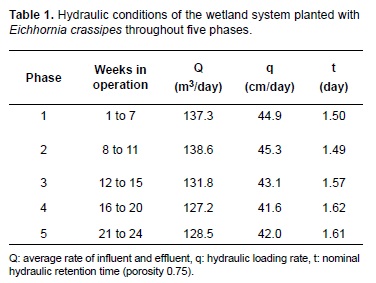
<body><![CDATA[<p> Hydraulic conditions in the wetland system   depended on the water replacement and removal   dynamics of the fish farm. The wetland started   operation at phase 1 with a hydraulic loading of   44.9 cm/day (<a href="#t1">Table 1</a>).</p>       <p align="center"><a name="t1"></a><img src="/img/revistas/rccp/v27n3/v27n3a6t1.jpg"></p>     <p>&nbsp;</p>     <p>  Vegetation grew rapidly. Its initial density was 5 &plusmn; 2   plants/m<sup>2</sup>, and its density in phase 3 was 13 &plusmn; 3 plants/   m<sup>2</sup>. In this phase, the differences between the values for   nitrogen compound concentration, total phosphorus and   BOD<sub>5</sub>, as well as the difference between the influent and   effluent were low. However, an increase in the removal   rate of nitrogen compounds was observed in phase 5.</p>     <p> Similarly, from phase 3 onward, the studied parameters    had a removal trend, with hydraulic loadings ranging   from 41.6 to 45.3 cm/day (<a href="/img/revistas/rccp/v27n3/v27n3a6t2.jpg" target="_blank">Table 2</a>). This removal rate   became observable after week 7 for inorganic nitrogen   and BOD<sub>5</sub>, and after week 10 for total phosphorus.</p>     <p>  <i>Nitrogen Removal</i></p>     <p> Pollutant concentration in the influent during the   study period ranged from 0.005 to 0.029 mg/L for   NO<sub>2</sub><sup>-</sup>; 0.8 to 1.8 mg/L for NO<sub>3</sub><sup>-</sup>; and 0.99 to 1.45 mg/L   for NH<sub>4</sub><sup>+</sup>.</p>     <p> The average value for NH<sub>4</sub><sup>+</sup> removal was 0.36 &plusmn;   0.38 g/m2/day, which represents 67.9% efficiency   throughout the entire study. Phase 1 had the highest   removal value for NH<sub>4</sub><sup>+</sup>: 0.88 g/m<sup>2</sup>/day, while the   lowest value, -0.03 g/m<sup>2</sup>/day, was observed during   phase 3 (data not shown).</p>     <p> The average rate of NO<sub>3</sub><sup>-</sup> removal was 0.08 &plusmn; 0.05   g/m<sup>2</sup>/day, which corresponds to 16.7% efficiency.   Additionally, a peak in this rate was observed in phase   4, with a value of 0.15 g/m<sup>2</sup>/day, which is equivalent   to 31% efficiency (values calculated using data from   <a href="/img/revistas/rccp/v27n3/v27n3a6t2.jpg" target="_blank">Table 2</a>). On the other hand, NO<sub>2</sub><sup>-</sup> had an average of   0.001 &plusmn; 0.002 g/m<sup>2</sup>/day, that is, 27.1% efficiency. Negative values were recorded during phases 2   (-0.001 g/m<sup>2</sup>/day) and 3 (-0.003 g/m<sup>2</sup>/day). However,   the highest removal value was reached in phase 5:   0.004 g/m<sup>2</sup>/day, corresponding to 37.9% efficiency.</p>     <p> The concentration of NO<sub>2</sub><sup>-</sup> and TAN in the   effluent was highly correlated with the loading rate   of the pollutant, their r-values being 0.697 and 0.546,   respectively, during the evaluation period. However,   nitrogen compounds maintained low values in the   effluent: less than 0.11 mg/L for NO<sub>2</sub><sup>-</sup>; less than 1.8   mg/L for NO<sub>3</sub><sup>-</sup>; and less than 2.9 mg/L for NH<sub>4</sub><sup>+</sup>.   The TAN loading rate for each study phase had a   high correlation with the TAN removal rate: r=0.956   (<a href="/img/revistas/rccp/v27n3/v27n3a6f2.jpg" target="_blank">Figure 2</a>).</p>      ]]></body>
<body><![CDATA[<p><i>Total phosphorus removal</i></p>      <p> TP concentration in the influent during the study    ranged from 0.29 to 0.48 mg/L. The average P removal    was 0.034 &plusmn; 0.038 g/m<sup>2</sup>/day, which represents 23%    efficiency. The removal data were negative in phases 1    (-0.002 g/m<sup>2</sup>/day) and 2 (-0.010 g/m<sup>2</sup>/day), and the last    phase had the highest TP removal rate: 0.077 g/m<sup>2</sup>/day,    corresponding to 33.9% efficiency. The efficiency values    of the system had a strong tendency to improve as the    pollutant rate of hydraulic loading decreased.</p>      <p> There was a low positive correlation (r=0.271)    between rate of hydraulic loading and TP    concentration in the effluent. A low linear correlation    (r=0.07) was observed during all phases of the study    when relationships between variations in rate of    loading and rate of TP removal in the wetland were    established. However, a high correlation (r=0.96)    was observed when the same correlation did not    include values from phases 1 and 2 or from the    stabilization period.</p>      <p> <i>BOD<sub>5</sub> removal</i></p>      <p> Pollutant concentration in the influent during the    study period ranged from 3.36 to 7.62 mg/L for BOD<sub>5</sub>.    The average BOD<sub>5</sub> removal during the period was    0.70 &plusmn; 0.44 g/m<sup>2</sup>/day, which corresponds to 32.1%    efficiency. Although this value was negative in phase 1    (-0.04 g/m<sup>2</sup>/day), it ranged from 0.67 to 0.91 g/m<sup>2</sup>/day    in the subsequent phases, and reached its maximum    in phase three (1.11 g/m<sup>2</sup>/day), which corresponds to    47.6% removal efficiency.</p>     <p> A positive linear correlation (r=0.494) was   observed when comparing the loading rate with BOD<sub>5</sub>   concentration in the effluent. The average removal rate   of BOD<sub>5</sub> was greater for higher hydraulic loadings,   with values approaching 3 mg/L.</p>     <p>&nbsp;</p>     <p><font size="3"> <b>Discussion</b></font></p>     <p> <i>Hydraulic conditions</i></p>     <p> Constructed wetland systems function better   with a constant water flow allowing for appropriate   removal of entering pollutants (Kadlec <i>et al.</i>,   2000; Lin <i>et al.</i>, 2002). Water inflow in the wetland   depended upon the actual production conditions of the   fish farm where the study took place. Thus, influent   and effluent were affected by emptying, drying and   replacement processes. In this study, the wetland flow   ranged from 127.2 m<sup>3</sup>/day to 136.8 m<sup>3</sup>/day, and the   estimated average value was 132.7 &plusmn; 5.1 m<sup>3</sup>/day. The   average flow decreased 6.08 m<sup>3</sup>/day in the section   between influent and effluent. The hydraulic retention   time (HRT), also known as hydraulic residence time or   t (tau), is a measure of the average time that a soluble   compound remains in a constructed wetland.</p>     ]]></body>
<body><![CDATA[<p> As hydraulic retention time increased so did the   removal rate of pollutants such as BOD<sub>5</sub> (Llagas   and Gomez, 2006), since pollutants had more   opportunities to interact with plants, bacteria, and   the wetland's substratum. The average hydraulic   loading rate (q) during this study was 43.4 &plusmn; 1.68 cm/   day, and the nominal hydraulic retention time (t) was   1.6 &plusmn; 0.06 days. Retention time started at 1.5 days   (with a flow of 137.3 m<sup>3</sup>/day), and ended at 1.6   days (with a flow of 128.5 m<sup>3</sup>/day). Lin <i>et al.</i> (2002)   conducted an experiment on an FWS under controlled   conditions in a laboratory. They reported an average   time of 4.5 days and a decreasing trend. This is not   consistent with our study, which had a lower time   and an increasing trend. However, Lin <i>et al.</i> (2005)   conducted another study under operating conditions   in a shrimp plant, and reported an average time of 2   days, which is consistent with our findings. Gentelini   (2007) assessed three hydraulic retention times (0.16,   0.33, and 0.5 days) by treating the effluents in 1.2 m<sup>3</sup>   tanks. The hydraulic retention times observed in our   study increased the probability of effluents to come   into contact with the bacteria in the macrophyte roots   present in the water column and bed of the wetland   system, thus favoring the removal processes.</p>     <p> <i>Wetland system stabilization</i></p>     <p> A constructed wetland system generally requires   an extended period of time to stabilize bacterial   communities and removal processes (Kadlec   <i>et al.</i>, 2000). The soil added to the wetland bed   provides ideal environments for the development   of microbial processes such as nutrient nitrification,   denitrification, and mineralization.</p>     <p> In this study, a maximum density of 13 &plusmn; 3   plants/m<sup>2</sup> was achieved at the end of phase 4, five   months after water hyacinth were planted. This   correlates with higher nutrient removal efficiency   rates. It was suggested that plants did not cover the   system completely at the beginning and the associated   bacterial communities did not have favorable   conditions for organic matter decomposition. Lin   <i>et al.</i> (2002) planted <i>Ipomoea aquatica</i> on the front   side of a FWS and <i>Paspalum vaginatum</i> on the other   side under controlled conditions. They obtained good   retention rates between the second and third months,   but the densities used were greater than 30 plants/   m<sup>2</sup>. Likewise, Lin <i>et al.</i> (2002) explained that their   wetland system required approximately seven months   to reach vegetation coverage approaching 80%,   whereas in our study the vegetation covered more than   80% within five months, given the characteristics of   the species used (<i>E. crassipes</i>) and the local weather   conditions. This suggests that performance level   established for pollutant removal may be achieved   without full vegetation coverage, confirming the   work by Lin <i>et al.</i> (2002). The results of this study   suggest that replacing the plants five months after   planting them would maintain the pollutant removal   tendency and create macrophyte-free zones followed   by plant-covered zones, thus allowing for high levels   of dissolved oxygen, thereby increasing nutrient   removal values.</p>     <p> Posadas (2001) stated that constructed wetland   systems with 25% of the total size of the production   ponds and 2-day retention time significantly improved   channel catfish (<i>Ictalurus punctatus</i>) production.   In this study, the size of the constructed wetland   system was only 0.9% of the total size of the farm's   reflecting pool, yet good removal rates were achieved   due to climatic conditions and effluents had the   largest loading of nitrogen compounds because   they originated from fish and fingerling feeding   processes. This is consistent with the results reported   by Schwartz and Boyd (1995), who estimated that the   area to treat aquaculture effluents should be 0.7 to 2.7   times the size of the pond.</p>     <p> <i>Removal of nitrogen compounds</i></p>     <p> NH<sub>4</sub><sup>+</sup> removal reached 67.9% efficiency throughout   the study, suggesting that the system attained a   certain balance due to macrophytes growth and their   interrelationship with the microbial biofilm associated   to the roots and the organic matter at the bottom of   the pond. Phase 4 showed a reduction of 99.1% of   NH<sub>4</sub><sup>+</sup>. These results are consistent with those reported   by Spieles <i>et al.</i> (2000), who suggested that NH<sub>4</sub><sup>+</sup>   removal of a wetland system can range from 25 to   85%. In the present study, it was necessary to wait for   two months after planting the water hyacinth in order   to obtain sufficient NH<sub>4</sub><sup>+</sup> removal rates. Moreover,   it is possible that at the observed temperature (27 to   30 &deg;C) macrophyte growth might have fostered the   development of aerobic nitrifying organisms that   could have performed the biological conversion from   ammonium to nitrate.</p>     <p>  Nitrite is an intermediate product of the nitrification   process, which turns ammonium into nitrate   (Fernandez <i>et al.</i>, 2005). It is removed from wetlands   mainly through oxidation by microorganisms of the   <i>Nitrobacter</i> genus. The mean value of NO<sub>2</sub><sup>-</sup> obtained   in the influent for the entire process was 0.012 &plusmn; 0.01   mg/L, while the value in the effluent was 0.009 &plusmn;   0.01 mg/L, which corresponds to 27.1% efficiency.   Phase 5 showed the best removal efficiency (37.9%).   Therefore, it can be assumed that at this stage the   wetland system became stable and bacteria developed,   which enabled removal of pollutants and water selfpurification.</p>     <p> Nitrate remains in the water column, where   it can be either assimilated by the macrophytic   bacteria/microorganisms, or reduced to nitrogen   gas by heterotrophic anaerobic bacteria. In this   study, an average of 1.2 &plusmn; 0.2 mg/L NO<sub>3</sub><sup>-</sup> was   observed in the influent. The effluent, in turn, had   a value of 1.0 &plusmn; 0.1 mg/L; hence, the removal rate   was 14.2%. However, nitrate removal rate ranged   from 26.7 to 30.8% in phases 4 and 5. Other authors   conducting experiments under similar conditions   reported similar values (Lin <i>et al.</i>, 2005; Schulz   <i>et al.</i>, 2004). This proves that this parameter may   have low removal efficiency under real production   conditions. Comparing these data with studies   conducted under similar conditions, we suggest   that anaerobic bacteria communities in the bed of   the system &#8211;responsible for the denitrification   process&#8211; had limited growth. On the other hand,   <i>Nitrosomonas</i> and <i>Nitrobacter</i>, responsible for   the nitrification process that ultimately produces   nitrate, experienced much better growth.</p>     <p> <i>Total phosphorus removal</i></p>     ]]></body>
<body><![CDATA[<p> Total Phosphorus removal took place mainly   through assimilation mechanisms of macrophytes   and precipitation and accumulation of phosphorus   on the substratum of the bed (Fernandez <i>et al.</i>, 2005).   The average performance observed in this study was   23.0%. However, phases 4 and 5 showed removal   rates ranging from 39.6 to 43.8%. These values are   similar to those reported by Gentelini (2007) and   Tilley <i>et al.</i> (2002), higher than those reported by   Lin <i>et al.</i> (2005), and lower than those by Schulz   <i>et al.</i> (2004) and Henry-Silva and Camargo (2006).   It is suggested that the constructed wetland system   started maturing during phase 6, since vegetation   covered more than 80% of the total area, which leads   to higher phosphorus assimilation rates. Moreover,   the hydraulic retention time made it possible for   the wetland system to precipitate phosphorus in   the effluent and accumulate it at the bottom of the   constructed wetland.</p>     <p> <i>BOD<sub>5</sub> removal</i></p>     <p> BOD<sub>5</sub> determines the availability of dissolved   oxygen in the influent and the type of microorganisms   participating in the organic matter degradation process   (Fernandez <i>et al.</i>, 2005). If such microorganisms are   aerobic, then the reactions will be quick and efficient.   Conversely, if the organisms are anaerobic, the   reactions will be slow and inefficient (Fernandez <i>et al.</i>,   2005). Therefore, oxygen availability is crucial for the   biodegradation of organic matter. The average BOD<sub>5</sub>   removal efficiency observed was 19.1% throughout   the study. These removal values are lower than   those reported by Ram&iacute;rez <i>et al.</i> (2005), but higher   than those reported by Lin <i>et al.</i> (2005), who used   <i>Phragmites australis </i>under controlled conditions to   obtain averages of 4.6 mg/L in the influent and 4.1 mg/L   in the effluent. This constitutes a removal of 10.9%   of the BOD<sub>5</sub>. Low BOD<sub>5</sub> removal rates could be due   to the fact that the transfer by diffusion of oxygen from   the submerged parts of the macrophytes (aerenchyma)   to the effluents was low. Likewise, the vegetation   reduced the rate of atmospheric air incorporation by   physical processes.</p>     <p> The results of this study allow us to conclude that   the constructed wetland system with water hyacinth (E.   crassipes) can remove BOD<sub>5</sub>, NH<sub>4</sub><sup>+</sup>, NO<sub>3</sub><sup>-</sup>, NO<sub>2</sub><sup>-</sup> and   TP when it is operated with an average flow of 132.7 &plusmn;   5.1 m<sup>3</sup>/day, a mean hydraulic retention time of 1.6 &plusmn; 0.1   days, and a mean hydraulic loading of 43.4 &plusmn; 1.7 cm/day.   This assumes assessed conditions for an area equivalent   to 0.9% of the fish production ponds.</p>     <p>&nbsp;</p>     <p><font size="3"> <b>Acknowledgements</b></font></p>     <p> This study was fully sponsored by the Universidad   de C&oacute;rdoba. The authors would like to thank   Aquacaribe Ltda. for participating in this study.</p>     <P>&nbsp;</P> <hr size="1" noshade>     <p><b><font size="3">Notes</font></b></p>     <P><a href="#0b" name="0">&curren;</a> To cite this article: D&iacute;az A, Atencio V, Pardo S. Assessment of an artificial free-flow wetland system with water hyacinth (<i>Eichhornia crassipes</i>) for treating fish farming effluents. <i>Rev Colomb Cienc Pecu</i> 2014; 27:202-210.</P> <hr size="1" noshade>     ]]></body>
<body><![CDATA[<P>&nbsp;</P>     <P><font size="3"><B>References</B></font></P>     <!-- ref --><p>American Public Health Association. APHA, AWWA, WPCF Standard Methods for the Examination of Water and Wastes. 1980.    &nbsp;&nbsp;&nbsp;&nbsp;&nbsp;&nbsp;&nbsp;&nbsp;[&#160;<a href="javascript:void(0);" onclick="javascript: window.open('/scielo.php?script=sci_nlinks&ref=000105&pid=S0120-0690201400030000600001&lng=','','width=640,height=500,resizable=yes,scrollbars=1,menubar=yes,');">Links</a>&#160;]<!-- end-ref --></p>     <!-- ref --><p> Bos M, Replogle J, Clemmens A. Aforadores de caudal para   canales abiertos. International Institute for Land Reclamation   and Improvement/ILRI. Wageningen: The Netherlands; 1986.    &nbsp;&nbsp;&nbsp;&nbsp;&nbsp;&nbsp;&nbsp;&nbsp;[&#160;<a href="javascript:void(0);" onclick="javascript: window.open('/scielo.php?script=sci_nlinks&ref=000107&pid=S0120-0690201400030000600002&lng=','','width=640,height=500,resizable=yes,scrollbars=1,menubar=yes,');">Links</a>&#160;]<!-- end-ref --></p>     <!-- ref --><p> Fern&aacute;ndez J, de Miguel E, de Miguel J, Curt M. Manual de   fitodepuraci&oacute;n. Filtros de macr&oacute;fitas en flotaci&oacute;n; 2005. p.61-77.    &nbsp;&nbsp;&nbsp;&nbsp;&nbsp;&nbsp;&nbsp;&nbsp;[&#160;<a href="javascript:void(0);" onclick="javascript: window.open('/scielo.php?script=sci_nlinks&ref=000109&pid=S0120-0690201400030000600003&lng=','','width=640,height=500,resizable=yes,scrollbars=1,menubar=yes,');">Links</a>&#160;]<!-- end-ref --></p>     <!-- ref --><p> Gentelini A. Tratamiento de Efluente de Piscicultura Org&acirc;nica   utilizando macr&oacute;fitas acu&aacute;ticas <i>Eichhornia crassipes </i>(Mart.   Solms) e <i>Eigeria densa</i> (Planchon) &#91;Maestr&iacute;a en Ingenier&iacute;a   Agr&iacute;cola&#93;. Cascavel: (Bra) Universidade Estadual do Oeste do   Paran&aacute;; 2007.    &nbsp;&nbsp;&nbsp;&nbsp;&nbsp;&nbsp;&nbsp;&nbsp;[&#160;<a href="javascript:void(0);" onclick="javascript: window.open('/scielo.php?script=sci_nlinks&ref=000111&pid=S0120-0690201400030000600004&lng=','','width=640,height=500,resizable=yes,scrollbars=1,menubar=yes,');">Links</a>&#160;]<!-- end-ref --></p>     ]]></body>
<body><![CDATA[<!-- ref --><p> Henry-Silva G, Camargo A. Efficiency of aquatic macrophytes to   treat Nile tilapia pond efluents. Scientia Agricola 2006; 63:433-438.    &nbsp;&nbsp;&nbsp;&nbsp;&nbsp;&nbsp;&nbsp;&nbsp;[&#160;<a href="javascript:void(0);" onclick="javascript: window.open('/scielo.php?script=sci_nlinks&ref=000113&pid=S0120-0690201400030000600005&lng=','','width=640,height=500,resizable=yes,scrollbars=1,menubar=yes,');">Links</a>&#160;]<!-- end-ref --></p>     <!-- ref --><p> Jing S, Lin Y, Lee D, Wang T. Nutrient removal from pullet river   water by using construted wetland. Bioresour Technol 2001;   76:131-135.    &nbsp;&nbsp;&nbsp;&nbsp;&nbsp;&nbsp;&nbsp;&nbsp;[&#160;<a href="javascript:void(0);" onclick="javascript: window.open('/scielo.php?script=sci_nlinks&ref=000115&pid=S0120-0690201400030000600006&lng=','','width=640,height=500,resizable=yes,scrollbars=1,menubar=yes,');">Links</a>&#160;]<!-- end-ref --></p>     <!-- ref --><p> Kadlec R, Knight R, Vymazal J, Brix H, Cooper P, Haberl   R. Constructed Wetlands for Pollution Control Processes,   Performance, Design and Operation. IWA publishing; 2000.    &nbsp;&nbsp;&nbsp;&nbsp;&nbsp;&nbsp;&nbsp;&nbsp;[&#160;<a href="javascript:void(0);" onclick="javascript: window.open('/scielo.php?script=sci_nlinks&ref=000117&pid=S0120-0690201400030000600007&lng=','','width=640,height=500,resizable=yes,scrollbars=1,menubar=yes,');">Links</a>&#160;]<!-- end-ref --></p>     <!-- ref --><p> Lee C, Fletcher T, Sun G. Nitrogen removal in constructed wetland   systems. Eng Life Sci 2009; 9:11-22.    &nbsp;&nbsp;&nbsp;&nbsp;&nbsp;&nbsp;&nbsp;&nbsp;[&#160;<a href="javascript:void(0);" onclick="javascript: window.open('/scielo.php?script=sci_nlinks&ref=000119&pid=S0120-0690201400030000600008&lng=','','width=640,height=500,resizable=yes,scrollbars=1,menubar=yes,');">Links</a>&#160;]<!-- end-ref --></p>     <!-- ref --><p> Lin Y, Jing R, Lee Y, Wang W. Nutrient Removal from   Aquaculture Waste Water Using a Constructed Wetland System.   Aquaculture 2002; 169:184.    &nbsp;&nbsp;&nbsp;&nbsp;&nbsp;&nbsp;&nbsp;&nbsp;[&#160;<a href="javascript:void(0);" onclick="javascript: window.open('/scielo.php?script=sci_nlinks&ref=000121&pid=S0120-0690201400030000600009&lng=','','width=640,height=500,resizable=yes,scrollbars=1,menubar=yes,');">Links</a>&#160;]<!-- end-ref --></p>     ]]></body>
<body><![CDATA[<!-- ref --><p> Lin Y, Jing S, Lee D, Chang Y, Chen V, Shih K. Performance   of a constructed wetland treating intensive shrimp aquaculture   wastewater under high hydraulic loading rate. Environ Pollut   2005; 134:411-425.    &nbsp;&nbsp;&nbsp;&nbsp;&nbsp;&nbsp;&nbsp;&nbsp;[&#160;<a href="javascript:void(0);" onclick="javascript: window.open('/scielo.php?script=sci_nlinks&ref=000123&pid=S0120-0690201400030000600010&lng=','','width=640,height=500,resizable=yes,scrollbars=1,menubar=yes,');">Links</a>&#160;]<!-- end-ref --></p>     <!-- ref --><p> Llagas A, G&oacute;mez E. Dise&ntilde;o de humedales artificiales para el   tratamiento de aguas residuales en la UNMSM. Rev Inst investig   Fac Minas Metal Cienc 2006; 9:17.    &nbsp;&nbsp;&nbsp;&nbsp;&nbsp;&nbsp;&nbsp;&nbsp;[&#160;<a href="javascript:void(0);" onclick="javascript: window.open('/scielo.php?script=sci_nlinks&ref=000125&pid=S0120-0690201400030000600011&lng=','','width=640,height=500,resizable=yes,scrollbars=1,menubar=yes,');">Links</a>&#160;]<!-- end-ref --></p>     <!-- ref --><p> Luna V, Ram&iacute;rez H. Medios de soporte alternativo para la   remoci&oacute;n de f&oacute;sforo en humedales artificiales. Rev Int Contam   Ambient 2004; 20:31-38.    &nbsp;&nbsp;&nbsp;&nbsp;&nbsp;&nbsp;&nbsp;&nbsp;[&#160;<a href="javascript:void(0);" onclick="javascript: window.open('/scielo.php?script=sci_nlinks&ref=000127&pid=S0120-0690201400030000600012&lng=','','width=640,height=500,resizable=yes,scrollbars=1,menubar=yes,');">Links</a>&#160;]<!-- end-ref --></p>     <!-- ref --><p> New M. Responsible aquaculture: is this a special challenge for   developing countries? World Aquac 2003; 34:49-52.    &nbsp;&nbsp;&nbsp;&nbsp;&nbsp;&nbsp;&nbsp;&nbsp;[&#160;<a href="javascript:void(0);" onclick="javascript: window.open('/scielo.php?script=sci_nlinks&ref=000129&pid=S0120-0690201400030000600013&lng=','','width=640,height=500,resizable=yes,scrollbars=1,menubar=yes,');">Links</a>&#160;]<!-- end-ref --></p>     <!-- ref --><p> Pardo-Carrasco S, Su&aacute;rez H, Jardim-Manso P, Soriano-Sierra   E. Dise&ntilde;o de una herramienta de evaluaci&oacute;n del desempe&ntilde;o   ambiental en las granjas pisc&iacute;colas. Rev MVZ-C&oacute;rdoba 2005;   10:602-613.    &nbsp;&nbsp;&nbsp;&nbsp;&nbsp;&nbsp;&nbsp;&nbsp;[&#160;<a href="javascript:void(0);" onclick="javascript: window.open('/scielo.php?script=sci_nlinks&ref=000131&pid=S0120-0690201400030000600014&lng=','','width=640,height=500,resizable=yes,scrollbars=1,menubar=yes,');">Links</a>&#160;]<!-- end-ref --></p>     ]]></body>
<body><![CDATA[<!-- ref --><p> Posadas B. Comparative economic analysis of using different sizes   of constructed wetlands in recirculating catfish pond production.   J Appl Aquac 2001; 11:1-19.    &nbsp;&nbsp;&nbsp;&nbsp;&nbsp;&nbsp;&nbsp;&nbsp;[&#160;<a href="javascript:void(0);" onclick="javascript: window.open('/scielo.php?script=sci_nlinks&ref=000133&pid=S0120-0690201400030000600015&lng=','','width=640,height=500,resizable=yes,scrollbars=1,menubar=yes,');">Links</a>&#160;]<!-- end-ref --></p>     <!-- ref --><p> Ramirez E, Robles E, Bonilla P, Sainz G, Lopez M, De La Cerda J,   Warren A. Occurrence of pathogenic free-living amoebae and the   indicators in a constructed wetland treating domestic wastewater.   Eng Life Sci 2005; 5:253-257.    &nbsp;&nbsp;&nbsp;&nbsp;&nbsp;&nbsp;&nbsp;&nbsp;[&#160;<a href="javascript:void(0);" onclick="javascript: window.open('/scielo.php?script=sci_nlinks&ref=000135&pid=S0120-0690201400030000600016&lng=','','width=640,height=500,resizable=yes,scrollbars=1,menubar=yes,');">Links</a>&#160;]<!-- end-ref --></p>     <!-- ref --><p> Schulz C, Gelbrecht J, Rennert B. Constructed wetlands with free   water surface for treatment of aquaculture effluents. Journal Appl   Ichthyiol 2004; 20:64-70.    &nbsp;&nbsp;&nbsp;&nbsp;&nbsp;&nbsp;&nbsp;&nbsp;[&#160;<a href="javascript:void(0);" onclick="javascript: window.open('/scielo.php?script=sci_nlinks&ref=000137&pid=S0120-0690201400030000600017&lng=','','width=640,height=500,resizable=yes,scrollbars=1,menubar=yes,');">Links</a>&#160;]<!-- end-ref --></p>     <!-- ref --><p> Schulz C, Gelbrecht J, Rennert B. Treatments of rainbow trout   farm effluents in contructed wetland with emergent plants and   subsurface horizontal water flow. Aquac 2003; 217:207-221.    &nbsp;&nbsp;&nbsp;&nbsp;&nbsp;&nbsp;&nbsp;&nbsp;[&#160;<a href="javascript:void(0);" onclick="javascript: window.open('/scielo.php?script=sci_nlinks&ref=000139&pid=S0120-0690201400030000600018&lng=','','width=640,height=500,resizable=yes,scrollbars=1,menubar=yes,');">Links</a>&#160;]<!-- end-ref --></p>     <!-- ref --><p> Schwartz M, Boyd C. Contructed wethlands for treatment of   channel catfish pond effluents. Prog Fish-Cult 1995; 57:255-267.    &nbsp;&nbsp;&nbsp;&nbsp;&nbsp;&nbsp;&nbsp;&nbsp;[&#160;<a href="javascript:void(0);" onclick="javascript: window.open('/scielo.php?script=sci_nlinks&ref=000141&pid=S0120-0690201400030000600019&lng=','','width=640,height=500,resizable=yes,scrollbars=1,menubar=yes,');">Links</a>&#160;]<!-- end-ref --></p>     ]]></body>
<body><![CDATA[<!-- ref --><p> Spieles D, Mitsch P. The effects of season and hydrologic and   chemical loading on nitrate retention in constructed wetlands: A   comparison of low and high nutrient riverine systems. Ecol Eng   2000; 14:77-91.    &nbsp;&nbsp;&nbsp;&nbsp;&nbsp;&nbsp;&nbsp;&nbsp;[&#160;<a href="javascript:void(0);" onclick="javascript: window.open('/scielo.php?script=sci_nlinks&ref=000143&pid=S0120-0690201400030000600020&lng=','','width=640,height=500,resizable=yes,scrollbars=1,menubar=yes,');">Links</a>&#160;]<!-- end-ref --></p>     <!-- ref --><p> Tilley D, Badrinarayan H, Rosati R, Son J. Contructed wetlands   as recircultation filters in large-scale shrimp aquaculture. Aquac   Eng 2002; 26:81-109.    &nbsp;&nbsp;&nbsp;&nbsp;&nbsp;&nbsp;&nbsp;&nbsp;[&#160;<a href="javascript:void(0);" onclick="javascript: window.open('/scielo.php?script=sci_nlinks&ref=000145&pid=S0120-0690201400030000600021&lng=','','width=640,height=500,resizable=yes,scrollbars=1,menubar=yes,');">Links</a>&#160;]<!-- end-ref --></p>     <!-- ref --><p> Troell M, Neori A, Chopin T, Buschmann AH. Biological   wastewater treatment in aquaculture more than just bacteria.   World Aquaculture 2005; 36:27-29.    &nbsp;&nbsp;&nbsp;&nbsp;&nbsp;&nbsp;&nbsp;&nbsp;[&#160;<a href="javascript:void(0);" onclick="javascript: window.open('/scielo.php?script=sci_nlinks&ref=000147&pid=S0120-0690201400030000600022&lng=','','width=640,height=500,resizable=yes,scrollbars=1,menubar=yes,');">Links</a>&#160;]<!-- end-ref --></p>     <!-- ref --><p> Vinatea L. Aq&uuml;icultura e desenvolvimento sustent&aacute;vel Brasil:   UFSC; 1999.    &nbsp;&nbsp;&nbsp;&nbsp;&nbsp;&nbsp;&nbsp;&nbsp;[&#160;<a href="javascript:void(0);" onclick="javascript: window.open('/scielo.php?script=sci_nlinks&ref=000149&pid=S0120-0690201400030000600023&lng=','','width=640,height=500,resizable=yes,scrollbars=1,menubar=yes,');">Links</a>&#160;]<!-- end-ref --></p>     <!-- ref --><p> Vinatea L. Sostenibilidad en acuicultura: Desaf&iacute;os. En: memorias   V seminario de Internacional de acuicultura, II congreso de   investigaciones acu&iacute;colas; Bogot&aacute; 2005. Universidad Nacional   de Colombia; 2005. p.1-4.    &nbsp;&nbsp;&nbsp;&nbsp;&nbsp;&nbsp;&nbsp;&nbsp;[&#160;<a href="javascript:void(0);" onclick="javascript: window.open('/scielo.php?script=sci_nlinks&ref=000151&pid=S0120-0690201400030000600024&lng=','','width=640,height=500,resizable=yes,scrollbars=1,menubar=yes,');">Links</a>&#160;]<!-- end-ref --></p>     ]]></body>
<body><![CDATA[<!-- ref --><p> Wedler E. Introducci&oacute;n en la acuicultura con &eacute;nfasis en los   neotr&oacute;picos. Barranquilla: Litoflash; 1998.    &nbsp;&nbsp;&nbsp;&nbsp;&nbsp;&nbsp;&nbsp;&nbsp;[&#160;<a href="javascript:void(0);" onclick="javascript: window.open('/scielo.php?script=sci_nlinks&ref=000153&pid=S0120-0690201400030000600025&lng=','','width=640,height=500,resizable=yes,scrollbars=1,menubar=yes,');">Links</a>&#160;]<!-- end-ref --></p>     <!-- ref --><p> Yang L, Chou L, Shieh W. Biolfiter treatment of aquaculture water   for reuse applications. Wat Res 2001; 35:3097-3108.    &nbsp;&nbsp;&nbsp;&nbsp;&nbsp;&nbsp;&nbsp;&nbsp;[&#160;<a href="javascript:void(0);" onclick="javascript: window.open('/scielo.php?script=sci_nlinks&ref=000155&pid=S0120-0690201400030000600026&lng=','','width=640,height=500,resizable=yes,scrollbars=1,menubar=yes,');">Links</a>&#160;]<!-- end-ref --></p>     <P>&nbsp;</P> </font>      ]]></body><back>
<ref-list>
<ref id="B1">
<nlm-citation citation-type="">
<collab>American Public Health Association</collab>
<source><![CDATA[APHA, AWWA, WPCF Standard Methods for the Examination of Water and Wastes]]></source>
<year>1980</year>
</nlm-citation>
</ref>
<ref id="B2">
<nlm-citation citation-type="book">
<person-group person-group-type="author">
<name>
<surname><![CDATA[Bos]]></surname>
<given-names><![CDATA[M]]></given-names>
</name>
<name>
<surname><![CDATA[Replogle]]></surname>
<given-names><![CDATA[J]]></given-names>
</name>
<name>
<surname><![CDATA[Clemmens]]></surname>
<given-names><![CDATA[A]]></given-names>
</name>
</person-group>
<source><![CDATA[Aforadores de caudal para canales abiertos]]></source>
<year>1986</year>
<publisher-loc><![CDATA[Wageningen ]]></publisher-loc>
<publisher-name><![CDATA[International Institute for Land Reclamation and Improvement/ILRI]]></publisher-name>
</nlm-citation>
</ref>
<ref id="B3">
<nlm-citation citation-type="">
<person-group person-group-type="author">
<name>
<surname><![CDATA[Fernández]]></surname>
<given-names><![CDATA[J]]></given-names>
</name>
<name>
<surname><![CDATA[de Miguel]]></surname>
<given-names><![CDATA[E]]></given-names>
</name>
<name>
<surname><![CDATA[de Miguel]]></surname>
<given-names><![CDATA[J]]></given-names>
</name>
<name>
<surname><![CDATA[Curt]]></surname>
<given-names><![CDATA[M]]></given-names>
</name>
</person-group>
<source><![CDATA[Manual de fitodepuración. Filtros de macrófitas en flotación]]></source>
<year>2005</year>
<page-range>61-77</page-range></nlm-citation>
</ref>
<ref id="B4">
<nlm-citation citation-type="book">
<person-group person-group-type="author">
<name>
<surname><![CDATA[Gentelini]]></surname>
<given-names><![CDATA[A]]></given-names>
</name>
</person-group>
<source><![CDATA[Tratamiento de Efluente de Piscicultura Orgânica utilizando macrófitas acuáticas Eichhornia crassipes (Mart. Solms) e Eigeria densa (Planchon)]]></source>
<year>2007</year>
<publisher-loc><![CDATA[Cascavel ]]></publisher-loc>
<publisher-name><![CDATA[Universidade Estadual do Oeste do Paraná]]></publisher-name>
</nlm-citation>
</ref>
<ref id="B5">
<nlm-citation citation-type="journal">
<person-group person-group-type="author">
<name>
<surname><![CDATA[Henry-Silva]]></surname>
<given-names><![CDATA[G]]></given-names>
</name>
<name>
<surname><![CDATA[Camargo]]></surname>
<given-names><![CDATA[A]]></given-names>
</name>
</person-group>
<article-title xml:lang="en"><![CDATA[Efficiency of aquatic macrophytes to treat Nile tilapia pond efluents]]></article-title>
<source><![CDATA[Scientia Agricola]]></source>
<year>2006</year>
<volume>63</volume>
<page-range>433-438</page-range></nlm-citation>
</ref>
<ref id="B6">
<nlm-citation citation-type="journal">
<person-group person-group-type="author">
<name>
<surname><![CDATA[Jing]]></surname>
<given-names><![CDATA[S]]></given-names>
</name>
<name>
<surname><![CDATA[Lin]]></surname>
<given-names><![CDATA[Y]]></given-names>
</name>
<name>
<surname><![CDATA[Lee]]></surname>
<given-names><![CDATA[D]]></given-names>
</name>
<name>
<surname><![CDATA[Wang]]></surname>
<given-names><![CDATA[T]]></given-names>
</name>
</person-group>
<article-title xml:lang="en"><![CDATA[Nutrient removal from pullet river water by using construted wetland]]></article-title>
<source><![CDATA[Bioresour Technol]]></source>
<year>2001</year>
<volume>76</volume>
<page-range>131-135</page-range></nlm-citation>
</ref>
<ref id="B7">
<nlm-citation citation-type="book">
<person-group person-group-type="author">
<name>
<surname><![CDATA[Kadlec]]></surname>
<given-names><![CDATA[R]]></given-names>
</name>
<name>
<surname><![CDATA[Knight]]></surname>
<given-names><![CDATA[R]]></given-names>
</name>
<name>
<surname><![CDATA[Vymazal]]></surname>
<given-names><![CDATA[J]]></given-names>
</name>
<name>
<surname><![CDATA[Brix]]></surname>
<given-names><![CDATA[H]]></given-names>
</name>
<name>
<surname><![CDATA[Cooper]]></surname>
<given-names><![CDATA[P]]></given-names>
</name>
<name>
<surname><![CDATA[Haberl]]></surname>
<given-names><![CDATA[R]]></given-names>
</name>
</person-group>
<source><![CDATA[Constructed Wetlands for Pollution Control Processes, Performance, Design and Operation]]></source>
<year>2000</year>
<publisher-name><![CDATA[IWA publishing]]></publisher-name>
</nlm-citation>
</ref>
<ref id="B8">
<nlm-citation citation-type="journal">
<person-group person-group-type="author">
<name>
<surname><![CDATA[Lee]]></surname>
<given-names><![CDATA[C]]></given-names>
</name>
<name>
<surname><![CDATA[Fletcher]]></surname>
<given-names><![CDATA[T]]></given-names>
</name>
<name>
<surname><![CDATA[Sun]]></surname>
<given-names><![CDATA[G]]></given-names>
</name>
</person-group>
<article-title xml:lang="en"><![CDATA[Nitrogen removal in constructed wetland systems]]></article-title>
<source><![CDATA[Eng Life Sci]]></source>
<year>2009</year>
<volume>9</volume>
<page-range>11-22</page-range></nlm-citation>
</ref>
<ref id="B9">
<nlm-citation citation-type="journal">
<person-group person-group-type="author">
<name>
<surname><![CDATA[Lin]]></surname>
<given-names><![CDATA[Y]]></given-names>
</name>
<name>
<surname><![CDATA[Jing]]></surname>
<given-names><![CDATA[R]]></given-names>
</name>
<name>
<surname><![CDATA[Lee]]></surname>
<given-names><![CDATA[Y]]></given-names>
</name>
<name>
<surname><![CDATA[Wang]]></surname>
<given-names><![CDATA[W]]></given-names>
</name>
</person-group>
<article-title xml:lang="en"><![CDATA[Nutrient Removal from Aquaculture Waste Water Using a Constructed Wetland System]]></article-title>
<source><![CDATA[Aquaculture]]></source>
<year>2002</year>
<volume>169</volume>
<page-range>184</page-range></nlm-citation>
</ref>
<ref id="B10">
<nlm-citation citation-type="journal">
<person-group person-group-type="author">
<name>
<surname><![CDATA[Lin]]></surname>
<given-names><![CDATA[Y]]></given-names>
</name>
<name>
<surname><![CDATA[Jing]]></surname>
<given-names><![CDATA[S]]></given-names>
</name>
<name>
<surname><![CDATA[Lee]]></surname>
<given-names><![CDATA[D]]></given-names>
</name>
<name>
<surname><![CDATA[Chang]]></surname>
<given-names><![CDATA[Y]]></given-names>
</name>
<name>
<surname><![CDATA[Chen]]></surname>
<given-names><![CDATA[V]]></given-names>
</name>
<name>
<surname><![CDATA[Shih]]></surname>
<given-names><![CDATA[K]]></given-names>
</name>
</person-group>
<article-title xml:lang="en"><![CDATA[Performance of a constructed wetland treating intensive shrimp aquaculture wastewater under high hydraulic loading rate]]></article-title>
<source><![CDATA[Environ Pollut]]></source>
<year>2005</year>
<volume>134</volume>
<page-range>411-425</page-range></nlm-citation>
</ref>
<ref id="B11">
<nlm-citation citation-type="journal">
<person-group person-group-type="author">
<name>
<surname><![CDATA[Llagas]]></surname>
<given-names><![CDATA[A]]></given-names>
</name>
<name>
<surname><![CDATA[Gómez]]></surname>
<given-names><![CDATA[E]]></given-names>
</name>
</person-group>
<article-title xml:lang="es"><![CDATA[Diseño de humedales artificiales para el tratamiento de aguas residuales en la UNMSM]]></article-title>
<source><![CDATA[Rev Inst investig Fac Minas Metal Cienc]]></source>
<year>2006</year>
<volume>9</volume>
<page-range>17</page-range></nlm-citation>
</ref>
<ref id="B12">
<nlm-citation citation-type="journal">
<person-group person-group-type="author">
<name>
<surname><![CDATA[Luna]]></surname>
<given-names><![CDATA[V]]></given-names>
</name>
<name>
<surname><![CDATA[Ramírez]]></surname>
<given-names><![CDATA[H]]></given-names>
</name>
</person-group>
<article-title xml:lang="es"><![CDATA[Medios de soporte alternativo para la remoción de fósforo en humedales artificiales]]></article-title>
<source><![CDATA[Rev Int Contam Ambient]]></source>
<year>2004</year>
<volume>20</volume>
<page-range>31-38</page-range></nlm-citation>
</ref>
<ref id="B13">
<nlm-citation citation-type="journal">
<person-group person-group-type="author">
<name>
<surname><![CDATA[New]]></surname>
<given-names><![CDATA[M]]></given-names>
</name>
</person-group>
<article-title xml:lang="en"><![CDATA[Responsible aquaculture: is this a special challenge for developing countries?]]></article-title>
<source><![CDATA[World Aquac]]></source>
<year>2003</year>
<volume>34</volume>
<page-range>49-52</page-range></nlm-citation>
</ref>
<ref id="B14">
<nlm-citation citation-type="journal">
<person-group person-group-type="author">
<name>
<surname><![CDATA[Pardo-Carrasco]]></surname>
<given-names><![CDATA[S]]></given-names>
</name>
<name>
<surname><![CDATA[Suárez]]></surname>
<given-names><![CDATA[H]]></given-names>
</name>
<name>
<surname><![CDATA[Jardim-Manso]]></surname>
<given-names><![CDATA[P]]></given-names>
</name>
<name>
<surname><![CDATA[Soriano-Sierra]]></surname>
<given-names><![CDATA[E]]></given-names>
</name>
</person-group>
<article-title xml:lang="es"><![CDATA[Diseño de una herramienta de evaluación del desempeño ambiental en las granjas piscícolas]]></article-title>
<source><![CDATA[Rev MVZ-Córdoba]]></source>
<year>2005</year>
<volume>10</volume>
<page-range>602-613</page-range></nlm-citation>
</ref>
<ref id="B15">
<nlm-citation citation-type="journal">
<person-group person-group-type="author">
<name>
<surname><![CDATA[Posadas]]></surname>
<given-names><![CDATA[B]]></given-names>
</name>
</person-group>
<article-title xml:lang="en"><![CDATA[Comparative economic analysis of using different sizes of constructed wetlands in recirculating catfish pond production]]></article-title>
<source><![CDATA[J Appl Aquac]]></source>
<year>2001</year>
<volume>11</volume>
<page-range>1-19</page-range></nlm-citation>
</ref>
<ref id="B16">
<nlm-citation citation-type="journal">
<person-group person-group-type="author">
<name>
<surname><![CDATA[Ramirez]]></surname>
<given-names><![CDATA[E]]></given-names>
</name>
<name>
<surname><![CDATA[Robles]]></surname>
<given-names><![CDATA[E]]></given-names>
</name>
<name>
<surname><![CDATA[Bonilla]]></surname>
<given-names><![CDATA[P]]></given-names>
</name>
<name>
<surname><![CDATA[Sainz]]></surname>
<given-names><![CDATA[G]]></given-names>
</name>
<name>
<surname><![CDATA[Lopez]]></surname>
<given-names><![CDATA[M]]></given-names>
</name>
<name>
<surname><![CDATA[De La Cerda]]></surname>
<given-names><![CDATA[J]]></given-names>
</name>
<name>
<surname><![CDATA[Warren]]></surname>
<given-names><![CDATA[A]]></given-names>
</name>
</person-group>
<article-title xml:lang="en"><![CDATA[Occurrence of pathogenic free-living amoebae and the indicators in a constructed wetland treating domestic wastewater]]></article-title>
<source><![CDATA[Eng Life Sci]]></source>
<year>2005</year>
<volume>5</volume>
<page-range>253-257</page-range></nlm-citation>
</ref>
<ref id="B17">
<nlm-citation citation-type="journal">
<person-group person-group-type="author">
<name>
<surname><![CDATA[Schulz]]></surname>
<given-names><![CDATA[C]]></given-names>
</name>
<name>
<surname><![CDATA[Gelbrecht]]></surname>
<given-names><![CDATA[J]]></given-names>
</name>
<name>
<surname><![CDATA[Rennert]]></surname>
<given-names><![CDATA[B]]></given-names>
</name>
</person-group>
<article-title xml:lang="en"><![CDATA[Constructed wetlands with free water surface for treatment of aquaculture effluents]]></article-title>
<source><![CDATA[Journal Appl Ichthyiol]]></source>
<year>2004</year>
<volume>20</volume>
<page-range>64-70</page-range></nlm-citation>
</ref>
<ref id="B18">
<nlm-citation citation-type="journal">
<person-group person-group-type="author">
<name>
<surname><![CDATA[Schulz]]></surname>
<given-names><![CDATA[C]]></given-names>
</name>
<name>
<surname><![CDATA[Gelbrecht]]></surname>
<given-names><![CDATA[J]]></given-names>
</name>
<name>
<surname><![CDATA[Rennert]]></surname>
<given-names><![CDATA[B]]></given-names>
</name>
</person-group>
<article-title xml:lang="en"><![CDATA[Treatments of rainbow trout farm effluents in contructed wetland with emergent plants and subsurface horizontal water flow]]></article-title>
<source><![CDATA[Aquac]]></source>
<year>2003</year>
<volume>217</volume>
<page-range>207-221</page-range></nlm-citation>
</ref>
<ref id="B19">
<nlm-citation citation-type="journal">
<person-group person-group-type="author">
<name>
<surname><![CDATA[Schwartz]]></surname>
<given-names><![CDATA[M]]></given-names>
</name>
<name>
<surname><![CDATA[Boyd]]></surname>
<given-names><![CDATA[C]]></given-names>
</name>
</person-group>
<article-title xml:lang="en"><![CDATA[Contructed wethlands for treatment of channel catfish pond effluents]]></article-title>
<source><![CDATA[Prog Fish-Cult]]></source>
<year>1995</year>
<volume>57</volume>
<page-range>255-267</page-range></nlm-citation>
</ref>
<ref id="B20">
<nlm-citation citation-type="journal">
<person-group person-group-type="author">
<name>
<surname><![CDATA[Spieles]]></surname>
<given-names><![CDATA[D]]></given-names>
</name>
<name>
<surname><![CDATA[Mitsch]]></surname>
<given-names><![CDATA[P]]></given-names>
</name>
</person-group>
<article-title xml:lang="en"><![CDATA[The effects of season and hydrologic and chemical loading on nitrate retention in constructed wetlands: A comparison of low and high nutrient riverine systems]]></article-title>
<source><![CDATA[Ecol Eng]]></source>
<year>2000</year>
<volume>14</volume>
<page-range>77-91</page-range></nlm-citation>
</ref>
<ref id="B21">
<nlm-citation citation-type="journal">
<person-group person-group-type="author">
<name>
<surname><![CDATA[Tilley]]></surname>
<given-names><![CDATA[D]]></given-names>
</name>
<name>
<surname><![CDATA[Badrinarayan]]></surname>
<given-names><![CDATA[H]]></given-names>
</name>
<name>
<surname><![CDATA[Rosati]]></surname>
<given-names><![CDATA[R]]></given-names>
</name>
<name>
<surname><![CDATA[Son]]></surname>
<given-names><![CDATA[J]]></given-names>
</name>
</person-group>
<article-title xml:lang="en"><![CDATA[Contructed wetlands as recircultation filters in large-scale shrimp aquaculture]]></article-title>
<source><![CDATA[Aquac Eng]]></source>
<year>2002</year>
<volume>26</volume>
<page-range>81-109</page-range></nlm-citation>
</ref>
<ref id="B22">
<nlm-citation citation-type="journal">
<person-group person-group-type="author">
<name>
<surname><![CDATA[Troell]]></surname>
<given-names><![CDATA[M]]></given-names>
</name>
<name>
<surname><![CDATA[Neori]]></surname>
<given-names><![CDATA[A]]></given-names>
</name>
<name>
<surname><![CDATA[Chopin]]></surname>
<given-names><![CDATA[T]]></given-names>
</name>
<name>
<surname><![CDATA[Buschmann]]></surname>
<given-names><![CDATA[AH]]></given-names>
</name>
</person-group>
<article-title xml:lang="en"><![CDATA[Biological wastewater treatment in aquaculture more than just bacteria]]></article-title>
<source><![CDATA[World Aquaculture]]></source>
<year>2005</year>
<volume>36</volume>
<page-range>27-29</page-range></nlm-citation>
</ref>
<ref id="B23">
<nlm-citation citation-type="book">
<person-group person-group-type="author">
<name>
<surname><![CDATA[Vinatea]]></surname>
<given-names><![CDATA[L]]></given-names>
</name>
</person-group>
<source><![CDATA[Aqüicultura e desenvolvimento sustentável]]></source>
<year>1999</year>
<publisher-name><![CDATA[UFSC]]></publisher-name>
</nlm-citation>
</ref>
<ref id="B24">
<nlm-citation citation-type="confpro">
<person-group person-group-type="author">
<name>
<surname><![CDATA[Vinatea]]></surname>
<given-names><![CDATA[L]]></given-names>
</name>
</person-group>
<source><![CDATA[Sostenibilidad en acuicultura: Desafíos]]></source>
<year>2005</year>
<conf-name><![CDATA[V seminario de Internacional de acuicultura, II congreso de investigaciones acuícolas]]></conf-name>
<conf-date>2005</conf-date>
<conf-loc>Bogotá </conf-loc>
<page-range>1-4</page-range><publisher-name><![CDATA[Universidad Nacional de Colombia]]></publisher-name>
</nlm-citation>
</ref>
<ref id="B25">
<nlm-citation citation-type="book">
<person-group person-group-type="author">
<name>
<surname><![CDATA[Wedler]]></surname>
<given-names><![CDATA[E]]></given-names>
</name>
</person-group>
<source><![CDATA[Introducción en la acuicultura con énfasis en los neotrópicos]]></source>
<year>1998</year>
<publisher-loc><![CDATA[Barranquilla ]]></publisher-loc>
<publisher-name><![CDATA[Litoflash]]></publisher-name>
</nlm-citation>
</ref>
<ref id="B26">
<nlm-citation citation-type="journal">
<person-group person-group-type="author">
<name>
<surname><![CDATA[Yang]]></surname>
<given-names><![CDATA[L]]></given-names>
</name>
<name>
<surname><![CDATA[Chou]]></surname>
<given-names><![CDATA[L]]></given-names>
</name>
<name>
<surname><![CDATA[Shieh]]></surname>
<given-names><![CDATA[W]]></given-names>
</name>
</person-group>
<article-title xml:lang="en"><![CDATA[Biolfiter treatment of aquaculture water for reuse applications]]></article-title>
<source><![CDATA[Wat Res]]></source>
<year>2001</year>
<volume>35</volume>
<page-range>3097-3108</page-range></nlm-citation>
</ref>
</ref-list>
</back>
</article>
