<?xml version="1.0" encoding="ISO-8859-1"?><article xmlns:mml="http://www.w3.org/1998/Math/MathML" xmlns:xlink="http://www.w3.org/1999/xlink" xmlns:xsi="http://www.w3.org/2001/XMLSchema-instance">
<front>
<journal-meta>
<journal-id>0120-0690</journal-id>
<journal-title><![CDATA[Revista Colombiana de Ciencias Pecuarias]]></journal-title>
<abbrev-journal-title><![CDATA[Rev Colom Cienc Pecua]]></abbrev-journal-title>
<issn>0120-0690</issn>
<publisher>
<publisher-name><![CDATA[Facultad de Ciencias Agrarias, Universidad de Antioquia]]></publisher-name>
</publisher>
</journal-meta>
<article-meta>
<article-id>S0120-06902014000300007</article-id>
<title-group>
<article-title xml:lang="en"><![CDATA[Ulcerative gastric lesions in Brasileiro de Hipismo horses]]></article-title>
<article-title xml:lang="es"><![CDATA[Presencia de lesiones ulcerativas gástricas en caballos Brasileiro de Hipismo]]></article-title>
<article-title xml:lang="pt"><![CDATA[Presença de lesões ulcerativas gástricas em cavalos Brasileiro de Hipismo]]></article-title>
</title-group>
<contrib-group>
<contrib contrib-type="author">
<name>
<surname><![CDATA[Martinez Aranzales]]></surname>
<given-names><![CDATA[José R]]></given-names>
</name>
<xref ref-type="aff" rid="A01"/>
<xref ref-type="aff" rid="A04"/>
</contrib>
<contrib contrib-type="author">
<name>
<surname><![CDATA[De Marval]]></surname>
<given-names><![CDATA[Cyril A]]></given-names>
</name>
<xref ref-type="aff" rid="A02"/>
</contrib>
<contrib contrib-type="author">
<name>
<surname><![CDATA[Silveira Alves]]></surname>
<given-names><![CDATA[Geraldo E]]></given-names>
</name>
<xref ref-type="aff" rid="A03"/>
</contrib>
</contrib-group>
<aff id="A01">
<institution><![CDATA[,Universidad de Antioquia UdeA Facultad de Ciencias Agrarias ]]></institution>
<addr-line><![CDATA[Medellín ]]></addr-line>
<country>Colombia</country>
</aff>
<aff id="A02">
<institution><![CDATA[,Regimento de Cavalaria Alferes Tiradentes  ]]></institution>
<addr-line><![CDATA[Belo Horizonte Minas Gerais]]></addr-line>
<country>Brasil</country>
</aff>
<aff id="A03">
<institution><![CDATA[,Universidade Federal de Minas Gerais (UFMG)  ]]></institution>
<addr-line><![CDATA[Belo Horizonte ]]></addr-line>
<country>Brasil</country>
</aff>
<aff id="A04">
<institution><![CDATA[,Universidad de Antioquia UdeA Facultad de Ciencias Agrarias ]]></institution>
<addr-line><![CDATA[Medellín ]]></addr-line>
<country>Colombia</country>
</aff>
<pub-date pub-type="pub">
<day>00</day>
<month>08</month>
<year>2014</year>
</pub-date>
<pub-date pub-type="epub">
<day>00</day>
<month>08</month>
<year>2014</year>
</pub-date>
<volume>27</volume>
<numero>3</numero>
<fpage>211</fpage>
<lpage>219</lpage>
<copyright-statement/>
<copyright-year/>
<self-uri xlink:href="http://www.scielo.org.co/scielo.php?script=sci_arttext&amp;pid=S0120-06902014000300007&amp;lng=en&amp;nrm=iso"></self-uri><self-uri xlink:href="http://www.scielo.org.co/scielo.php?script=sci_abstract&amp;pid=S0120-06902014000300007&amp;lng=en&amp;nrm=iso"></self-uri><self-uri xlink:href="http://www.scielo.org.co/scielo.php?script=sci_pdf&amp;pid=S0120-06902014000300007&amp;lng=en&amp;nrm=iso"></self-uri><abstract abstract-type="short" xml:lang="en"><p><![CDATA[Background: Background: equine gastric ulcer syndrome (EGUS) has a high and variable occurrence in horses of different ages and activity levels. Objective: the aim of this study was to determine the presence and severity of ulcers in Brasileiro de Hipismo (BH) horses owned by the military police. Methods: a group of 80 horses (38 males and 42 females, aged between 3.3 and 29.2 years) performing different activities underwent clinical and gastroscopic evaluation. Descriptive statistics for the presence of ulcers and chi-square (X²) analysis with Fisher exact test were conducted to determine a possible association between EGUS and type of activity, sex or age. Results: occurrence of at least one ulcer was detected in 45% of the horses, and most of them (40%) were located in the squamous mucosa of the Margo plicatus. No significant association (p>0.05) was observed between any of the factors evaluated and the presence of EGUS. Conclusion: the BH horses owned by cavalry's military have low incidence of EGUS despite being subjected to stress, which confirms a multifactorial nature of gastric lesions in this subpopulation.]]></p></abstract>
<abstract abstract-type="short" xml:lang="es"><p><![CDATA[Antecedentes: Antecedentes: el Síndrome de Úlcera Gástrica Equina (EGUS) presenta una alta y variable ocurrencia en equinos de diferentes edades y tipo según la actividad que desarrollan. Objetivo: determinar la presencia e intensidad de las lesiones ulcerativas gástricas en caballos de la raza Brasilero de Hipismo (BH) al servicio de la policía militar. Métodos: un grupo de 80 equinos (38 machos y 42 hembras) con edades entre 3,3 y 29,2 años, en actividades de adaptación, entrenamiento, patrullaje e inactivos fueron evaluados por examen físico y gastroscópico. Se realizaron análisis por estadística descriptiva para porcentaje de ocurrencia de úlceras y análisis de Chi-cuadrado (X²) con test exacto de Fisher para verificar posible asociación entre EGUS, actividad, género y edad. Resultados: se determinó una ocurrencia de úlcera del 45%, siendo la mucosa escamosa (40%) la más comprometida en todo el Margo plicatus, sin embargo, no hubo asociación significativa (p>0,05) entre los factores evaluados y la presencia de EGUS. Conclusión: los caballos estudiados presentaron baja incidencia de EGUS a pesar de estar sometidos a situaciones de estrés, confirmando la naturaleza multifactorial de las lesiones gástricas en esta subpoblación de equinos.]]></p></abstract>
<abstract abstract-type="short" xml:lang="pt"><p><![CDATA[Antecedentes: a Síndrome da Ulcera Gástrica Equina (EGUS) apresenta uma ocorrência alta e variável em equinos de diferentes faixas etárias e classes segundo a atividade que desenvolvem. Objetivo: determinar a presença e intensidade das lesões ulcerativas gástricas em cavalos da raça Brasileiro de Hipismo (BH) a serviço da polícia militar. Métodos: um grupo de 80 equinos (38 machos e 42 fêmeas), com idade entre os 3,3 e 29,2 anos, desenvolvendo atividades de adaptação, treinamento, patrulhamento e inativos foram avaliados por exame físico e gastroscópicos. Analise por estatística descritiva para taxas de ocorrências de ulceras e analise de Qui-quadrado (X²) com teste de exato Fisher foram realizados para verificar possível associação entre EGUS, atividade, sexo e idade. Resultados: foi determinada uma ocorrência de úlcera de 45%, sendo a mucosa escamosa (40%) mais comprometida ao longo do Margo plicatus. Entretanto, não houve associação significativa (p>0,05) entre os fatores avaliados e a presença de EGUS. Conclusão: os cavalos estudados da raça BH apresentaram incidência baixa da EGUS apesar de submetidos a situações de estresse, sinalizando para a natureza multifatorial das lesões gástricas nesta subpopulação de equinos.]]></p></abstract>
<kwd-group>
<kwd lng="en"><![CDATA[equine]]></kwd>
<kwd lng="en"><![CDATA[gastric mucosa]]></kwd>
<kwd lng="en"><![CDATA[gastroscopy]]></kwd>
<kwd lng="en"><![CDATA[ulcer]]></kwd>
<kwd lng="es"><![CDATA[equino]]></kwd>
<kwd lng="es"><![CDATA[gastroscopia]]></kwd>
<kwd lng="es"><![CDATA[mucosa gástrica]]></kwd>
<kwd lng="es"><![CDATA[úlcera]]></kwd>
<kwd lng="pt"><![CDATA[equinos]]></kwd>
<kwd lng="pt"><![CDATA[gastroscopia]]></kwd>
<kwd lng="pt"><![CDATA[mucosa gástrica]]></kwd>
<kwd lng="pt"><![CDATA[úlcera]]></kwd>
</kwd-group>
</article-meta>
</front><body><![CDATA[  <font size="2" face="Verdana, Arial, Helvetica, sans-serif">     <P align="right"><b>ORIGINAL ARTICLES</b></P>     <P>&nbsp;</P>     <P align="center"><font size="4"><b>Ulcerative gastric lesions in Brasileiro de Hipismo horses<a href="#0" name="0b">&curren;</a></b></font></P>     <P>&nbsp;</P>     <P align="center"><font size="3"><b>Presencia de lesiones ulcerativas g&aacute;stricas en caballos Brasileiro de Hipismo</b></font></P>     <P align="center">&nbsp;</P>     <P align="center"><font size="3"><b>Presen&ccedil;a de les&otilde;es ulcerativas g&aacute;stricas em cavalos Brasileiro de Hipismo</b></font></P>     <P>&nbsp;</P>     <P>&nbsp;</P>     ]]></body>
<body><![CDATA[<P><b>Jos&eacute; R Martinez Aranzales<sup>1</sup>*, MVZ, MS, PhD; Cyril A De Marval<sup>2</sup>, MV, MS; Geraldo E Silveira Alves<sup>3</sup>, MV, MS, PhD.</b></P>     <P>&nbsp;</P>     <P>1 Grupo Centauro, Escuela de Medicina Veterinaria, Facultad de Ciencias Agrarias, Universidad de Antioquia UdeA, Calle 70 No. 52-21, Medell&iacute;n, Colombia.</P>     <P> 2 RCAT-PMMG &#8211; Regimento de Cavalaria Alferes Tiradentes &#8211; Policia Militar, Belo Horizonte, Minas Gerais, Brasil.</P>     <P> 3 Universidade Federal de Minas Gerais (UFMG), Escola de veterin&aacute;ria, Departamento de Cl&iacute;nica e Cirurgia Veterin&aacute;rias, Av. Ant&ocirc;nio   Carlos 6627, Pampulha, MG 31270-901. Belo Horizonte, Brasil.</P>  * Corresponding author: Jos&eacute; R Mart&iacute;nez Aranzales. Grupo Centauro, Escuela de Medicina Veterinaria, Facultad de Ciencias Agrarias, Universidad de Antioquia   UdeA, Calle 70 No. 52-21, Medell&iacute;n, Colombia. E-mail: <a href="mailto:jrramonmvz@yahoo.com">jrramonmvz@yahoo.com</a>.     <P>&nbsp;</P>     <P> (Received: February 25, 2013; accepted: March 3, 2014) </P>     <P>&nbsp;</P> <hr size="1" noshade>     <P> <B>Summary</B></P>     <P><b>Background</b>: Background: equine gastric ulcer syndrome (EGUS) has a high and variable occurrence in horses of   different ages and activity levels. <b>Objective</b>: the aim of this study was to determine the presence and severity   of ulcers in Brasileiro de Hipismo (BH) horses owned by the military police. <b>Methods</b>: a group of 80 horses   (38 males and 42 females, aged between 3.3 and 29.2 years) performing different activities underwent clinical   and gastroscopic evaluation. Descriptive statistics for the presence of ulcers and chi-square (X<sup>2</sup>) analysis with   Fisher exact test were conducted to determine a possible association between EGUS and type of activity, sex   or age. <b>Results</b>: occurrence of at least one ulcer was detected in 45% of the horses, and most of them (40%)   were located in the squamous mucosa of the Margo plicatus. No significant association (p&gt;0.05) was observed   between any of the factors evaluated and the presence of EGUS. <b>Conclusion</b>: the BH horses owned by cavalry's   military have low incidence of EGUS despite being subjected to stress, which confirms a multifactorial nature   of gastric lesions in this subpopulation.</P>     ]]></body>
<body><![CDATA[<P> <b>Key words:</b> <i>equine, gastric mucosa, gastroscopy, ulcer</i>. </P> <hr size="1" noshade>     <P> <B>Resumen</B></P>     <P><b>Antecedentes</b>: Antecedentes: el S&iacute;ndrome de &Uacute;lcera G&aacute;strica Equina (EGUS) presenta una alta y variable ocurrencia   en equinos de diferentes edades y tipo seg&uacute;n la actividad que desarrollan. <b>Objetivo</b>: determinar la presencia   e intensidad de las lesiones ulcerativas g&aacute;stricas en caballos de la raza Brasilero de Hipismo (BH) al servicio   de la polic&iacute;a militar. <b>M&eacute;todos</b>: un grupo de 80 equinos (38 machos y 42 hembras) con edades entre 3,3 y 29,2   a&ntilde;os, en actividades de adaptaci&oacute;n, entrenamiento, patrullaje e inactivos fueron evaluados por examen f&iacute;sico   y gastrosc&oacute;pico. Se realizaron an&aacute;lisis por estad&iacute;stica descriptiva para porcentaje de ocurrencia de &uacute;lceras y   an&aacute;lisis de Chi-cuadrado (X<sup>2</sup>) con test exacto de Fisher para verificar posible asociaci&oacute;n entre EGUS, actividad,   g&eacute;nero y edad. <b>Resultados</b>: se determin&oacute; una ocurrencia de &uacute;lcera del 45%, siendo la mucosa escamosa (40%)   la m&aacute;s comprometida en todo el Margo plicatus, sin embargo, no hubo asociaci&oacute;n significativa (p&gt;0,05) entre   los factores evaluados y la presencia de EGUS. <b>Conclusi&oacute;n</b>: los caballos estudiados presentaron baja incidencia   de EGUS a pesar de estar sometidos a situaciones de estr&eacute;s, confirmando la naturaleza multifactorial de las lesiones g&aacute;stricas en esta subpoblaci&oacute;n de equinos.</P>     <P> <b>Palabras clave:</b> <i>equino, gastroscopia, mucosa g&aacute;strica, &uacute;lcera. </i></P> <hr size="1" noshade>     <P> <B>Resumo</B></P>     <P><b>Antecedentes</b>: a S&iacute;ndrome da Ulcera G&aacute;strica Equina (EGUS) apresenta uma ocorr&ecirc;ncia alta e vari&aacute;vel   em equinos de diferentes faixas et&aacute;rias e classes segundo a atividade que desenvolvem. <b>Objetivo</b>: determinar   a presen&ccedil;a e intensidade das les&otilde;es ulcerativas g&aacute;stricas em cavalos da ra&ccedil;a Brasileiro de Hipismo (BH) a   servi&ccedil;o da pol&iacute;cia militar. <b>M&eacute;todos</b>: um grupo de 80 equinos (38 machos e 42 f&ecirc;meas), com idade entre os 3,3   e 29,2 anos, desenvolvendo atividades de adapta&ccedil;&atilde;o, treinamento, patrulhamento e inativos foram avaliados   por exame f&iacute;sico e gastrosc&oacute;picos. Analise por estat&iacute;stica descritiva para taxas de ocorr&ecirc;ncias de ulceras e   analise de Qui-quadrado (X<sup>2</sup>) com teste de exato Fisher foram realizados para verificar poss&iacute;vel associa&ccedil;&atilde;o   entre EGUS, atividade, sexo e idade. <b>Resultados</b>: foi determinada uma ocorr&ecirc;ncia de &uacute;lcera de 45%, sendo a   mucosa escamosa (40%) mais comprometida ao longo do Margo plicatus. Entretanto, n&atilde;o houve associa&ccedil;&atilde;o   significativa (p&gt;0,05) entre os fatores avaliados e a presen&ccedil;a de EGUS. <b>Conclus&atilde;o</b>: os cavalos estudados da   ra&ccedil;a BH apresentaram incid&ecirc;ncia baixa da EGUS apesar de submetidos a situa&ccedil;&otilde;es de estresse, sinalizando para a natureza multifatorial das les&otilde;es g&aacute;stricas nesta subpopula&ccedil;&atilde;o de equinos.</P>     <P> <b>Palavras chave:</b> <i>equinos, gastroscopia, mucosa g&aacute;strica, &uacute;lcera. </i></P> <hr size="1" noshade>           <P>&nbsp;</P>     <P>&nbsp;</P>     <P><font size="3"><B>Introduction</B></font></P>     ]]></body>
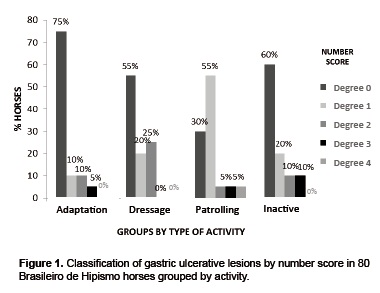
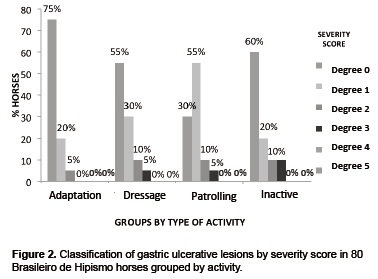
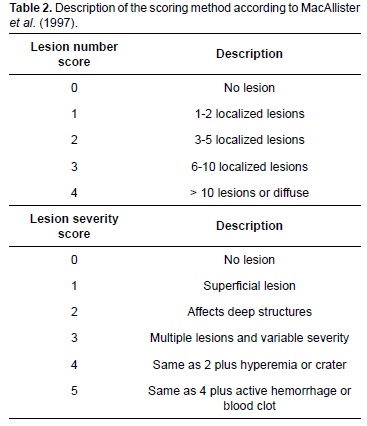
<body><![CDATA[<p>Equine gastric ulcer syndrome (EGUS) is a   common pathology in horses of different ages and   it is associated with multiple risk factors. EGUS   is considered a cause of reduced performance in   equine athletes and other equines assigned to a   variety of activities (Nieto <i>et al.</i>, 2009; Orsini <i>et  al.</i>, 2009). Inadequate environmental, nutritional,   and management factors may contribute to gastric   ulcerative processes, which typically define the   multifactorial origin of EGUS. In this respect, risk   factors inherent to the animal and the handling system,   such as strenuous exercise, inadequate feeding, stress,   confinement, use of non-steroidal anti-inflammatory   drugs (NSAIDs), and certain bacterial infections have   all been associated with the development of EGUS   (Lorenzo-Figueras <i>et al.</i>, 2002; Videla and Frank,   2009). The intensity or combination of these factors may determine the severity of the ulceration.</p>     <p> EGUS occurrence has been extensively studied   and its prevalence ranges between 51 and 90% for   competition breeds and high performance horses   (Murray <i>et al.</i>, 1996; Nieto <i>et al.</i>, 2004; Bezdekova <i>et  al.</i>, 2005; Jonsson and Egenvall, 2006; Tanzali <i>et al.</i>,   2011). Prevalence lower than 58% has been described   for leisure, bull catching and show horses, as well   as for brood mares (Murray <i>et al.</i>, 1989; Wiedner <i>et  al.</i>, 2008). However, other studies reported higher   incidences for similar activities. On the other hand,   prevalence above 50% has also been reported for   horses out of competition and in apparently normal   condition (Videla and Frank, 2009).</p>     <p> Brasileiro de Hipismo (BH) horses are   characterized by larger than average size, docile   temperament, and skills in saddling, jumping   and endurance riding. These horses are also used   in military police regiments. Horses used for   urban military patrolling are subjected to physical   activities depending on their training and age,   which generates various chronic stressors over the   years. These conditions may cause changes in their   gastric health.</p>     <p> Studies on EGUS occurrence in BH horses   performing activities typical of a military regiment   (such as adaptation, training and urban patrolling)   could not be found in the literature. The aim of this   study was to evaluate the presence and intensity of   ulcerative gastric lesions in BH horses serving in the   military police. In particular, we analyzed possible   associations between EGUS and factors such as type   of activity, sex and age of the animals.</p>     <p>&nbsp;</p>     <p><font size="3"> <b>Materials and methods</b></font></p>     <p> A sample of 80 BH horses (38 castrated males   and 42 mares, all aged between 3.3 and 29.2 years)   belonging to the Alferes Tiradentes Cavalry Regiment   (RCAT) of Minas Gerais Military Police (PMMG)   in Belo Horizonte, Brazil, was evaluated by physical   and gastroscopy examination. Equines were divided   into four groups of 20 animals, according to activity:   G1: animals in adaptation (pre-training); G2: animals   in dressage (horses in military training); G3: animals   in urban patrolling (horses in military exercise); and   G4: inactive and retired animals (because of disabling   medical conditions or age). The age, weight and body   scores are presented in <a href="/img/revistas/rccp/v27n3/v27n3a7t1.jpg" target="_blank">Table 1</a>.</p>     <p> Animal handling and environmental particularities   were characterized for each group. Animals   in adaptation, dressage and patrolling were kept in   confinement and fed Tifton hay (Cynodon dactylon) at   approximately 1.5% body weight (bw), a commercial   concentrate ration offered at 1% bw and split into   three daily meals, water and mineral salt was offered   <i>ad libitum</i>. Animals underwent physical activity on   alternate days, depending on the group. The activity per   working day lasted two hours for G1 horses, three hours   for G2, and six hours for G3. The G4 horses remained   on picket and were fed under the same scheme as   the other groups. All animals were vaccinated and   subjected to regular control for endo and ectoparasites.</p>     <p> All horses underwent a 12-14h fasting period for   solids and 4h for liquids before gastroscopy. After   sedation (detomidine, 10 &mu;g/kg/IV) and placement   of full-mouth speculum (type Haussmann) animals   were examined by systematic visualization of the   gastric mucosa through a flexible videoendoscope   (PortaScope&reg;, 1800PVS, Bradenton, FL, USA) (12   mm diameter, 300 cm length) introduced via the nasal   passage. The stomach was inflated with air to improve   visibility during endoscopy and water jets were   squirted to clean food remnants and improve visibility   of the gastric surface. The gastric lesions found were   video recorded and scored according to the number of   lesions (0-4) and intensity (0-5) as recommended by   MacAllister <i>et al.</i> (1997) (<a href="#t2">Table 2</a>). All examinations   were conducted by the same team and interpreted   using a single-blind method by an endoscopist.   This study was approved by the Comit&ecirc; de &Eacute;tica em   Experimenta&ccedil;&atilde;o Animal da Universidade Federal de   Minas Gerais under protocol number 234/09.</p>         <p align="center"><a name="t2"></a><img src="/img/revistas/rccp/v27n3/v27n3a7t2.jpg"></p>     ]]></body>
<body><![CDATA[<p>&nbsp;</p>     <p> <i>Statistical analysis</i></p>     <p> Descriptive analysis was used to determine   the occurrence rate of ulcers, which were scored   according to number (''number score'') and intensity   (''severity score''). Chi-square (X<sup>2</sup>) analysis and   Fisher exact test were used to determine significant   differences (p&lt;0.05) in the possible association   between presence of ulcers and potential risk factors:   age, sex and type of activities.</p>     <p>&nbsp;</p>     <p> <font size="3"> <b>Results</b></font></p>     <p> All animals were apparently healthy upon physical   exam. Gastroscopies were performed uneventfully. The   fasting period was appropriate for complete visualization   of the non-glandular and most of the glandular mucosa.   Although gastric content was found in a small area of   the antral region, it was not enough to compromise the   inspection. The entire length of the esophagus, <i>Margo   plicatus</i>, and pyloric region was visualized.</p>     <p> Gastroscopy findings are summarized in <a href="/img/revistas/rccp/v27n3/v27n3a7t3.jpg" target="_blank">Table 3</a>   and <a href="#f1">Figures 1</a> and <a href="#f3">2</a>. A total of 36/80 (45%) horses   had gastric ulcers, 32/80 (40%) of which in the   non-glandular mucosa. The score for number of   lesions ranged between one (1) and four (4), with   the latter having few animals affected (<a href="/img/revistas/rccp/v27n3/v27n3a7f3.jpg" target="_blank">Figure 3</a>).   The score for severity of ulcers ranged between one   (1) and three (3). Three out of 80 horses (3.7%) had   ulcerative lesions in the glandular mucosa with grades   one (1) and two (2) for score number and intensity,   respectively. Only one horse presented grade 1 lesions   in both types of mucosa and these were mainly located   in the lesser and greater curvature of both mucosal   regions adjacent to the Margo plicatus. No lesions   were found in the esophagus or pyloric area.</p>       <p align="center"><a name="f1"></a><img src="/img/revistas/rccp/v27n3/v27n3a7f1.jpg"></p>     <p>&nbsp;</p>     <p align="center"><a name="f2"></a><img src="/img/revistas/rccp/v27n3/v27n3a7f2.jpg"></p>     ]]></body>
<body><![CDATA[<p>&nbsp;</p>     <p> The endoscopy findings by groups showed a   greater number of horses (14/20) in G3 suffering   from ulcerative lesions, with number score from one   (1) to four (4) and severity score from one (1) to three   (3). G1 had the lowest number of animals affected   (5/20) with a number score equal or lower than   three (&le; 3). G1 and G4 had 9/20 and 8/20 animals   with ulcers, respectively. G4 had more animals with   severity scores 2 and 3. No significant associations   were found (p&gt;0.05) between gastric ulcers and type   of activity (p=0.086), sex (p=0.10), or age (p=0.07).</p>     <p>&nbsp;</p>     <p><font size="3"> <b>Discussion</b></font></p>     <p> Studies on the prevalence and incidence of gastric   ulcerative lesions in equines have highlighted some of   the limitations of gastroscopy to estimate the degree   of mucose damage in EGUS (Andrews <i>et al.</i>, 2002).   In spite of the fasting period, presence of remaining   food in few places of the glandular area did hamper   the evaluation of possible lesions in that area. Such   difficulty was not encountered in the non-glandular   mucosa. In this study we found low presence of   lesions in the mucose area, which is in agreement   with Buchanan and Andrews (2003), Videla and Frank   (2009), and Tamzali <i>et al.</i> (2011).</p>     <p> The interpretation of lesion number and intensity   in terms of clinical relevance is another source of   discrepancy in the statistics of EGUS prevalence and   incidence for some horse populations. Jeune <i>et al.</i> (2009)   and Luthersson <i>et al.</i> (2009a) consider grades 0 and 1   as normal, although ulcer intensity is not necessarily   correlated with clinical signs (Murray <i>et al.</i>, 1989).   Moreover, changes in the weather, breed, handling, and   activities performed by the horses have contributed to   those discrepancies (Jonsson and Egenvall, 2006).</p>     <p> The general incidence of EGUS in our study was   45%, a percentage that falls within the estimated   rates for horses considered not overly stressed or   in low physical demand, such as leisure, show, and   exhibition horses (Murray <i>et al.</i>, 1989; Bezdekova <i>et  al.</i>, 2005; McClure <i>et al.</i>, 2005; Wiedner <i>et al.</i>, 2008;   Luthersson <i>et al.</i>, 2009b). This incidence could fall   to 19% if we neglected the relevance of the injuries   classified as score 1; therefore, the incidence would   be even lower than expected for this category.</p>     <p> It has been suggested that military cavalry horses   are exposed to many stressors, as evidenced by Leal   <i>et al.</i> (2011), who found differences in plasma cortisol   concentration. This leads to behavioral changes   in animals in confinement or in military regiment   (Rezende <i>et al.</i>, 2006; Mu&ntilde;oz <i>et al.</i>, 2009), evidencing   a close relation between stereotypy and gastric health   (Moeller <i>et al.</i>, 2008; Wickens and Heleski, 2010;   Hemmann <i>et al.</i>, 2012). This is why the hypothesis   of high EGUS occurrence in the studied population   was suggested.</p>     <p> The low incidence of ulcerations in this study   suggests the predominance of gastric mucosa   protective factors over other harmful factors,   such as the stress derived from physical activities.   Possibly, the feed handling provided to these horses   counteracted the caustic action of gastric juice, as   shown by De Graaf-Roelfsema <i>et al.</i> (2010). They   concluded that stress from exercise is not important   in EGUS development compared to environmental   changes and feeding management since no increase in   EGUS incidence was observed for properly fed horses   under strenuous training. However, the multifactorial   nature of this syndrome may involve other factors that   were not considered.</p>     <p> Dietary management contributes positively   to practical prevention strategies, treatment,   and decreased recurrences of EGUS (Reese and   Andrews, 2009). In this study, dietary management   favored a relatively low incidence of ulceration,   despite the excess concentrate feed/body weight ratio   usually recommended (0.5 kg/100 kg; Nadeau <i>et al.</i>,   2000). This indicates that, in addition to the ratio   between fiber and concentrate, the frequency and   type of feeding has a strong influence in gastric health   (De Graaf-Roelfsema <i>et al.</i>, 2010), and three meals   per day was apparently adequate. Additionally, it is   important to take into consideration that dietary fiber   helps maintain a healthy gastric mucosa, therefore,   providing greater amounts of forage to horses with   EGUS or putting them out to pasture should be part   of any therapeutic strategy.</p>     ]]></body>
<body><![CDATA[<p> Studies with different breeds in Brazil have shown   a 47.6% prevalence in asymptomatic adult horses in   stalls and pasture (Fernandes <i>et al.</i>, 2003). Belli <i>et al.</i>   (2005) reported 75% prevalence in hospitalized horses   with presumptive diagnosis of EGUS. A preliminary   study on horses performing common activities   reported EGUS prevalence between 46.5 and 77.91%,   showing a significant association between presence   of gastric lesions and type of activity (Berger <i>et al.</i>,   2009). Regarding Brasileiro de Hipismo horses kept at   military regiments, prevalence studies identifying and   comparing factors that induce gastric lesions could not   be found. The EGUS incidence found in this study is   low compared with other horse breeds.</p>     <p> Regarding location of ulcerative lesions, we   found that the non-glandular mucosa was the most   compromised area, particularly in proximity of the   Margo plicatus, coinciding with existing literature   (Hammond <i>et al.</i>, 1986; Vatistas <i>et al.</i>, 1999; Murray   <i>et al.</i>, 1989; Luthersson <i>et al.</i>, 2009b; Tamzali <i>et al.</i>,   2011). On the other hand, the low presence of ulcers   in the glandular and both mucosae simultaneously   contrasts with a report by Luthersson <i>et al.</i> (2009a).   This suggests a difference in the efficiency of   mucosae's self-protection mechanisms, which are   more relevant than harmful mechanical factors, such   as type of physical activity, regarding the appearance   of gastric ulcers. Lesions in the glandular mucosa   may be related to the use of NSAIDs. The medical   records did not show any recent use of these drugs   in the studied animals, which might explain the low   presence of lesions in this gastric region.</p>     <p> The lack of association between lesion incidence   and the studied factors (i.e., type of activity, sex and   age) agrees with results from other studies (Bell <i>et  al.</i>, 2007; Tamzali <i>et al.</i>, 2011). Nevertheless, some   other studies have shown their involvement, thus   they are considered to be risk factors for the onset of   this syndrome (Lorenzo-Figueras and Merrit, 2002;   Orsini <i>et al.</i>, 2009). Geriatric and castrated male   horses have shown greater susceptibility to EGUS   (Rabuffo <i>et al.</i>, 2002). This was not evidenced in the   present study, in which all males were castrated and   did not show greater occurrence when compared to   females. Regarding age, specimens 3 to 29 years old   were evaluated, and our results are in disagreement   with other reports (Chameroy <i>et al.</i>, 2006; Jonsson   and Egenvall, 2006). There was a tendency for more   animals with number scores between grades 2 and 3   in the retired horses, in agreement with Luthersson <i>et  al.</i> (2009b). These findings demonstrate the influence   of factors related to management and the environment   in the incidence of the syndrome.</p>     <p> The majority of gastropathies in the patrolling   horses can be explained by the stress suffered during   transportation to patrol urban areas. In addition, these   horses were used to patrol a large urban area (330 km2)   three times a week, a factor that may also predispose   them to develop gastric ulcers (McClure <i>et al.</i>, 2005).   However, there was no statistical association between   the studied variables. In spite of the fact that the retired   horses remained unleashed, apparently it did not benefit   the gastric mucosa integrity in comparison with the   partially confined animals, which is contrary to the   results of other studies (Husted <i>et al.</i>, 2009; Jeune <i>et  al.</i>, 2009). This could be explained by the cumulative   effect of age and previous medical occurrences that   disabled these horses for regular activities.</p>     <p> The activities endured during adaptation, training   and working by cavalry military horses do not seem   to be related with the occurrence of gastropathies.   This also suggests a concomitant involvement of other   potentially ulcerogenic factors and the need to control   them (Luthersson <i>et al.</i>, 2009b; De Graaf-Roelfsema   <i>et al.</i>, 2010; Flores <i>et al.</i>, 2011). Because of the lack   of information on gastric changes in Brasileiro de   Hipismo horses, it is important to undertake further   research to elucidate the involvement of factors   inherent to the individual and the environment, as   well as the relationship between welfare and gastric   health in animals showing low EGUS prevalence   without clinical signs.</p>     <p>&nbsp;</p>     <p><font size="3"> <b>Acknowledgments</b></font></p>     <p> The authors acknowledge Mr. Walmir Santos Viana   for allowing us to conduct this study at RCAT-PMMG   in Belo Horizonte. Funding for this study was provided   by CNPq, CAPES / PEC-PG &#8211; Brazil, the University   of Antioquia (Colombia), and UFMG (Brazil).</p>     <P>&nbsp;</P> <hr size="1" noshade>     <p><b><font size="3">Notes</font></b></p>     ]]></body>
<body><![CDATA[<P><a href="#0b" name="0">&curren;</a> To cite this article: Martinez JR, De Marval CA, Silveira GE. Ulcerative gastric lesions in Brasileiro de Hipismo horses. <i>Rev Colomb Cienc Pecu</i> 2014; 27:211-219</P> <hr size="1" noshade>     <P>&nbsp;</P>     <P><font size="3"><B>References</B></font></P>     <!-- ref --><p>Andrews F, Reinemeyer CR, McCracken MD, Blackford   JT, Nadeau JA, Saabye L, S&ouml;tell M, Saxton. Comparison of   endoscopic, necropsy and histology scoring of equine gastric ulcers. Equine Vet J 2002; 34:475-478.    &nbsp;&nbsp;&nbsp;&nbsp;&nbsp;&nbsp;&nbsp;&nbsp;[&#160;<a href="javascript:void(0);" onclick="javascript: window.open('/scielo.php?script=sci_nlinks&ref=000076&pid=S0120-0690201400030000700001&lng=','','width=640,height=500,resizable=yes,scrollbars=1,menubar=yes,');">Links</a>&#160;]<!-- end-ref --></p>     <!-- ref --><p> Bell RJ, Mogg T, Kingston J. Equine gastric ulcer syndrome in   adult horses: A review. N Z Vet J 2007; 55:1-12.    &nbsp;&nbsp;&nbsp;&nbsp;&nbsp;&nbsp;&nbsp;&nbsp;[&#160;<a href="javascript:void(0);" onclick="javascript: window.open('/scielo.php?script=sci_nlinks&ref=000078&pid=S0120-0690201400030000700002&lng=','','width=640,height=500,resizable=yes,scrollbars=1,menubar=yes,');">Links</a>&#160;]<!-- end-ref --></p>     <!-- ref --><p> Belli CB, Fernandes WR, Silva LC. Estudo gastrosc&oacute;pico em   equinos adultos com suspeita de ulcera&ccedil;&atilde;o g&aacute;strica. Revta Bras   Ci&ecirc;nc Vet 2005; 12:92-98.    &nbsp;&nbsp;&nbsp;&nbsp;&nbsp;&nbsp;&nbsp;&nbsp;[&#160;<a href="javascript:void(0);" onclick="javascript: window.open('/scielo.php?script=sci_nlinks&ref=000080&pid=S0120-0690201400030000700003&lng=','','width=640,height=500,resizable=yes,scrollbars=1,menubar=yes,');">Links</a>&#160;]<!-- end-ref --></p>     <!-- ref --><p>  Berger H, Silva R, Klemm M, Orsolini A. Gastric Ulcers in   Brazilian performance horses. Proceedings of the 11<sup>th</sup> International   Congress of the World Equine Veterinary Association (WEVA)   2009; Guaruj&aacute;, SP, Brazil, (Abstract).    &nbsp;&nbsp;&nbsp;&nbsp;&nbsp;&nbsp;&nbsp;&nbsp;[&#160;<a href="javascript:void(0);" onclick="javascript: window.open('/scielo.php?script=sci_nlinks&ref=000082&pid=S0120-0690201400030000700004&lng=','','width=640,height=500,resizable=yes,scrollbars=1,menubar=yes,');">Links</a>&#160;]<!-- end-ref --></p>     <!-- ref --><p> Bezdekova B, Jahn P, Vyskocil M, Plachy J. Gastric ulceration and   exercise intensity in Standarbred Racehorses in Czech Republic.   Acta Vet Brno 2005; 74:67-71.    &nbsp;&nbsp;&nbsp;&nbsp;&nbsp;&nbsp;&nbsp;&nbsp;[&#160;<a href="javascript:void(0);" onclick="javascript: window.open('/scielo.php?script=sci_nlinks&ref=000084&pid=S0120-0690201400030000700005&lng=','','width=640,height=500,resizable=yes,scrollbars=1,menubar=yes,');">Links</a>&#160;]<!-- end-ref --></p>     <!-- ref --><p> Buchanan BR, Andrews FM. Treatment and prevention of equine   gastric ulcer syndrome. Vet Clin North Am Equine Pract 2003;   19:575-597.    &nbsp;&nbsp;&nbsp;&nbsp;&nbsp;&nbsp;&nbsp;&nbsp;[&#160;<a href="javascript:void(0);" onclick="javascript: window.open('/scielo.php?script=sci_nlinks&ref=000086&pid=S0120-0690201400030000700006&lng=','','width=640,height=500,resizable=yes,scrollbars=1,menubar=yes,');">Links</a>&#160;]<!-- end-ref --></p>     <!-- ref --><p> Chameroy KA, Nadeau JA, Bushmich SL, Dinger JE, Hoagland   TA, Saxton AM. Prevalence of non-glandular gastric ulcers in   horses involved in a university riding program. J Equine Vet Sci   2006; 26:207-211.    &nbsp;&nbsp;&nbsp;&nbsp;&nbsp;&nbsp;&nbsp;&nbsp;[&#160;<a href="javascript:void(0);" onclick="javascript: window.open('/scielo.php?script=sci_nlinks&ref=000088&pid=S0120-0690201400030000700007&lng=','','width=640,height=500,resizable=yes,scrollbars=1,menubar=yes,');">Links</a>&#160;]<!-- end-ref --></p>     <!-- ref --><p> De Graaf-Roelfsema E, Keizer HD, Wijnberg ID, Van Der Kolk   JH. The incidence and severity of gastric ulceration does not   increase in overtrained Standardbred horses. Equine Vet J 2010;   42:58-61.    &nbsp;&nbsp;&nbsp;&nbsp;&nbsp;&nbsp;&nbsp;&nbsp;[&#160;<a href="javascript:void(0);" onclick="javascript: window.open('/scielo.php?script=sci_nlinks&ref=000090&pid=S0120-0690201400030000700008&lng=','','width=640,height=500,resizable=yes,scrollbars=1,menubar=yes,');">Links</a>&#160;]<!-- end-ref --></p>     <!-- ref --><p> Fernandes WR, Belli CB, Silva LC. Achados gastrosc&oacute;picos em   equinos adultos assintom&aacute;ticos. Arq Bras Med Vet Zootec 2003;   55:405-410.    &nbsp;&nbsp;&nbsp;&nbsp;&nbsp;&nbsp;&nbsp;&nbsp;[&#160;<a href="javascript:void(0);" onclick="javascript: window.open('/scielo.php?script=sci_nlinks&ref=000092&pid=S0120-0690201400030000700009&lng=','','width=640,height=500,resizable=yes,scrollbars=1,menubar=yes,');">Links</a>&#160;]<!-- end-ref --></p>     <!-- ref --><p> Flores RS, Byron CR, Kline K. Effect of feed processing method   on average daily gain and gastric ulcer development in weanling   horses. J Equine Vet Sci 2011; 31:124-128.    &nbsp;&nbsp;&nbsp;&nbsp;&nbsp;&nbsp;&nbsp;&nbsp;[&#160;<a href="javascript:void(0);" onclick="javascript: window.open('/scielo.php?script=sci_nlinks&ref=000094&pid=S0120-0690201400030000700010&lng=','','width=640,height=500,resizable=yes,scrollbars=1,menubar=yes,');">Links</a>&#160;]<!-- end-ref --></p>     <!-- ref --><p> Hammond CJ, Mason DK, Watkins KL. Gastric ulceration in   mature Thoroughbred horses. Equine Vet J 1986; 18:284-287.    &nbsp;&nbsp;&nbsp;&nbsp;&nbsp;&nbsp;&nbsp;&nbsp;[&#160;<a href="javascript:void(0);" onclick="javascript: window.open('/scielo.php?script=sci_nlinks&ref=000096&pid=S0120-0690201400030000700011&lng=','','width=640,height=500,resizable=yes,scrollbars=1,menubar=yes,');">Links</a>&#160;]<!-- end-ref --></p>     <!-- ref --><p> Hemmann K, Raekallio M, Kanerva K, Hanninen L, Pastell M,   Palviainen M, Vainio O. Circadian variation in Ghrelin and certain   stress hormones in crib-biting horses. Vet J 2012; 193:97-102.    &nbsp;&nbsp;&nbsp;&nbsp;&nbsp;&nbsp;&nbsp;&nbsp;[&#160;<a href="javascript:void(0);" onclick="javascript: window.open('/scielo.php?script=sci_nlinks&ref=000098&pid=S0120-0690201400030000700012&lng=','','width=640,height=500,resizable=yes,scrollbars=1,menubar=yes,');">Links</a>&#160;]<!-- end-ref --></p>     <!-- ref --><p> Husted L, Sanchez L, Baptiste K, Olsen S. Effect of a feed/fast   protocol on pH in the proximal equine stomach. Equine Vet J   2009; 41:658-662.    &nbsp;&nbsp;&nbsp;&nbsp;&nbsp;&nbsp;&nbsp;&nbsp;[&#160;<a href="javascript:void(0);" onclick="javascript: window.open('/scielo.php?script=sci_nlinks&ref=000100&pid=S0120-0690201400030000700013&lng=','','width=640,height=500,resizable=yes,scrollbars=1,menubar=yes,');">Links</a>&#160;]<!-- end-ref --></p>     <!-- ref --><p> Jeune SS, Nieto JE, Dechant JE, Snyder JR. Prevalence of gastric   ulcers in Thoroughbred broodmares in pasture: A preliminary   report. Vet J 2009; 181:251-255.    &nbsp;&nbsp;&nbsp;&nbsp;&nbsp;&nbsp;&nbsp;&nbsp;[&#160;<a href="javascript:void(0);" onclick="javascript: window.open('/scielo.php?script=sci_nlinks&ref=000102&pid=S0120-0690201400030000700014&lng=','','width=640,height=500,resizable=yes,scrollbars=1,menubar=yes,');">Links</a>&#160;]<!-- end-ref --></p>     <!-- ref --><p> Jonsson HA, Egenvall A. Prevalence of gastric ulceration in Swedish   Standardbred in race-training. Equine Vet J 2006; 38:209-213.    &nbsp;&nbsp;&nbsp;&nbsp;&nbsp;&nbsp;&nbsp;&nbsp;[&#160;<a href="javascript:void(0);" onclick="javascript: window.open('/scielo.php?script=sci_nlinks&ref=000104&pid=S0120-0690201400030000700015&lng=','','width=640,height=500,resizable=yes,scrollbars=1,menubar=yes,');">Links</a>&#160;]<!-- end-ref --></p>     <!-- ref --><p> Leal BB, Alves GES, Douglas RH, Bringel B, Young RJ, Haddad   JP, Viana WS, Faleiros RR. Cortisol circadian rhythm ratio: A   simple method to detect stressed horse at higher risk of colic? J   Equine Vet Sci 2011; 31:188-190.    &nbsp;&nbsp;&nbsp;&nbsp;&nbsp;&nbsp;&nbsp;&nbsp;[&#160;<a href="javascript:void(0);" onclick="javascript: window.open('/scielo.php?script=sci_nlinks&ref=000106&pid=S0120-0690201400030000700016&lng=','','width=640,height=500,resizable=yes,scrollbars=1,menubar=yes,');">Links</a>&#160;]<!-- end-ref --></p>     <!-- ref --><p> Lorenzo-Figueras M, Merritt A. Effects of exercise on gastric   volume and pH in the proximal portion of the stomach of horses.   Am J Vet Res 2002; 63:481-1487.    &nbsp;&nbsp;&nbsp;&nbsp;&nbsp;&nbsp;&nbsp;&nbsp;[&#160;<a href="javascript:void(0);" onclick="javascript: window.open('/scielo.php?script=sci_nlinks&ref=000108&pid=S0120-0690201400030000700017&lng=','','width=640,height=500,resizable=yes,scrollbars=1,menubar=yes,');">Links</a>&#160;]<!-- end-ref --></p>     <!-- ref --><p> Luthersson N, Nielsen KH, Harris P, Parkin TDH. The prevalence   and anatomical distribution of equine gastric ulceration syndrome   (EGUS) in 201 horses in Denmark. Equine Vet J 2009a; 41:619-624.    &nbsp;&nbsp;&nbsp;&nbsp;&nbsp;&nbsp;&nbsp;&nbsp;[&#160;<a href="javascript:void(0);" onclick="javascript: window.open('/scielo.php?script=sci_nlinks&ref=000110&pid=S0120-0690201400030000700018&lng=','','width=640,height=500,resizable=yes,scrollbars=1,menubar=yes,');">Links</a>&#160;]<!-- end-ref --></p>     <!-- ref --><p> Luthersson N, Nielsen KH, Harris P, Parkin TDH. Risk factors   associated with equine gastric ulceration syndrome (EGUS) in   201 horses in Denmark. Equine Vet J 2009b; 41:625-630.    &nbsp;&nbsp;&nbsp;&nbsp;&nbsp;&nbsp;&nbsp;&nbsp;[&#160;<a href="javascript:void(0);" onclick="javascript: window.open('/scielo.php?script=sci_nlinks&ref=000112&pid=S0120-0690201400030000700019&lng=','','width=640,height=500,resizable=yes,scrollbars=1,menubar=yes,');">Links</a>&#160;]<!-- end-ref --></p>     <!-- ref --><p> MacAllister CG, Andrews FM, Deegan E, Ruoff W, Olovson   SG. A scoring system for gastric ulcers in the horse. Equine Vet   J 1997; 29:430-433.    &nbsp;&nbsp;&nbsp;&nbsp;&nbsp;&nbsp;&nbsp;&nbsp;[&#160;<a href="javascript:void(0);" onclick="javascript: window.open('/scielo.php?script=sci_nlinks&ref=000114&pid=S0120-0690201400030000700020&lng=','','width=640,height=500,resizable=yes,scrollbars=1,menubar=yes,');">Links</a>&#160;]<!-- end-ref --></p>     <!-- ref --><p> McClure SR, White G, Sifferman R, Bernard W, Doucet M,   Vrins A, Holste J, Fleishman C, Alva R, Cramer L. Efficacy of   omeprazole paste for prevention of gastric ulcers in horses in race   training. J Am Vet Med Assoc 2005; 226:1681-1684.    &nbsp;&nbsp;&nbsp;&nbsp;&nbsp;&nbsp;&nbsp;&nbsp;[&#160;<a href="javascript:void(0);" onclick="javascript: window.open('/scielo.php?script=sci_nlinks&ref=000116&pid=S0120-0690201400030000700021&lng=','','width=640,height=500,resizable=yes,scrollbars=1,menubar=yes,');">Links</a>&#160;]<!-- end-ref --></p>     <!-- ref --><p> Moeller B, McCall C, Silverman S, McElhenney W. Estimation   of saliva production in crib-biting and normal horses. J Equine   Vet Sci 2008; 28:85-90.    &nbsp;&nbsp;&nbsp;&nbsp;&nbsp;&nbsp;&nbsp;&nbsp;[&#160;<a href="javascript:void(0);" onclick="javascript: window.open('/scielo.php?script=sci_nlinks&ref=000118&pid=S0120-0690201400030000700022&lng=','','width=640,height=500,resizable=yes,scrollbars=1,menubar=yes,');">Links</a>&#160;]<!-- end-ref --></p>     <!-- ref --><p> Mu&ntilde;oz L, Torres J, Sepulveda O, Rehhof C, Ortiz R. Frecuencia de   comportamientos anormales estereotipados en caballos chilenos   estabulados. Arch Med Vet 2009; 41:73-76.    &nbsp;&nbsp;&nbsp;&nbsp;&nbsp;&nbsp;&nbsp;&nbsp;[&#160;<a href="javascript:void(0);" onclick="javascript: window.open('/scielo.php?script=sci_nlinks&ref=000120&pid=S0120-0690201400030000700023&lng=','','width=640,height=500,resizable=yes,scrollbars=1,menubar=yes,');">Links</a>&#160;]<!-- end-ref --></p>     <!-- ref --><p> Murray MJ, Schusser GF, Pipers FS, Gross SJ. Factors associated   with gastric lesions in Thoroughbred horses. Equine Vet J 1996;   28:368-374.    &nbsp;&nbsp;&nbsp;&nbsp;&nbsp;&nbsp;&nbsp;&nbsp;[&#160;<a href="javascript:void(0);" onclick="javascript: window.open('/scielo.php?script=sci_nlinks&ref=000122&pid=S0120-0690201400030000700024&lng=','','width=640,height=500,resizable=yes,scrollbars=1,menubar=yes,');">Links</a>&#160;]<!-- end-ref --></p>     <!-- ref --><p> Murray MJ, Grodinsky C, Anderson AC, Radue PF, Schmidt GR.   Gastric Ulcers in horses: a comparison of endoscopic findings in   horses with and without clinical signs. Equine Vet J 1989; 7:68-72.    &nbsp;&nbsp;&nbsp;&nbsp;&nbsp;&nbsp;&nbsp;&nbsp;[&#160;<a href="javascript:void(0);" onclick="javascript: window.open('/scielo.php?script=sci_nlinks&ref=000124&pid=S0120-0690201400030000700025&lng=','','width=640,height=500,resizable=yes,scrollbars=1,menubar=yes,');">Links</a>&#160;]<!-- end-ref --></p>     <!-- ref --><p> Nadeau JA, Andrews FM, Mathew AG, Argenzio AG, Blackford   JT, Sohtell M, and Saxton AM. Evaluation of diet as a cause of   gastric ulcers in horses. Am J Vet Res 2000; 617:84-90.    &nbsp;&nbsp;&nbsp;&nbsp;&nbsp;&nbsp;&nbsp;&nbsp;[&#160;<a href="javascript:void(0);" onclick="javascript: window.open('/scielo.php?script=sci_nlinks&ref=000126&pid=S0120-0690201400030000700026&lng=','','width=640,height=500,resizable=yes,scrollbars=1,menubar=yes,');">Links</a>&#160;]<!-- end-ref --></p>     <!-- ref --><p> Nieto JE, Snyder JR, Vatistas NJ, Jones JH. Effect of gastric   ulceration on physiologic responses to exercise in horses. Am J   Vet Res 2009; 70:787-795.    &nbsp;&nbsp;&nbsp;&nbsp;&nbsp;&nbsp;&nbsp;&nbsp;[&#160;<a href="javascript:void(0);" onclick="javascript: window.open('/scielo.php?script=sci_nlinks&ref=000128&pid=S0120-0690201400030000700027&lng=','','width=640,height=500,resizable=yes,scrollbars=1,menubar=yes,');">Links</a>&#160;]<!-- end-ref --></p>     <!-- ref --><p> Nieto JE, Snyder JR, Beldomenico P, Aleman M, Kerr JW, Spier   SJ. Prevalence of gastric ulcers in endurance horses: A preliminary   report. Vet. J 2004; 167:33-37.    &nbsp;&nbsp;&nbsp;&nbsp;&nbsp;&nbsp;&nbsp;&nbsp;[&#160;<a href="javascript:void(0);" onclick="javascript: window.open('/scielo.php?script=sci_nlinks&ref=000130&pid=S0120-0690201400030000700028&lng=','','width=640,height=500,resizable=yes,scrollbars=1,menubar=yes,');">Links</a>&#160;]<!-- end-ref --></p>     <!-- ref --><p> Orsini JA, Hackett ES, Grenager N. The effect of exercise   on Equine Gastric Ulcer Syndrome in the Thoroughbred and   Standardbred athlete. J Equine Vet Sci 2009; 29:167-171.    &nbsp;&nbsp;&nbsp;&nbsp;&nbsp;&nbsp;&nbsp;&nbsp;[&#160;<a href="javascript:void(0);" onclick="javascript: window.open('/scielo.php?script=sci_nlinks&ref=000132&pid=S0120-0690201400030000700029&lng=','','width=640,height=500,resizable=yes,scrollbars=1,menubar=yes,');">Links</a>&#160;]<!-- end-ref --></p>     <!-- ref --><p> Rabuffo TS, Orsini JA, Sullivan E, Engiles J, Norman T, Boston   R. Associations between age, sex and prevalence of gastric   ulceration in Standardbred racehorses in training. J Am Vet Med   Assoc 2002; 221:1156-1159.    &nbsp;&nbsp;&nbsp;&nbsp;&nbsp;&nbsp;&nbsp;&nbsp;[&#160;<a href="javascript:void(0);" onclick="javascript: window.open('/scielo.php?script=sci_nlinks&ref=000134&pid=S0120-0690201400030000700030&lng=','','width=640,height=500,resizable=yes,scrollbars=1,menubar=yes,');">Links</a>&#160;]<!-- end-ref --></p>     <!-- ref --><p> Reese RE, Andrews FM. Nutrition and Dietary Management of   Equine Gastric Ulcer Syndrome. Vet Clin North Am Equine Pract   2009; 25:79 &#8211; 92.    &nbsp;&nbsp;&nbsp;&nbsp;&nbsp;&nbsp;&nbsp;&nbsp;[&#160;<a href="javascript:void(0);" onclick="javascript: window.open('/scielo.php?script=sci_nlinks&ref=000136&pid=S0120-0690201400030000700031&lng=','','width=640,height=500,resizable=yes,scrollbars=1,menubar=yes,');">Links</a>&#160;]<!-- end-ref --></p>     <!-- ref --><p> Rezende MJ, McManus C, Martins R, Oliveira L, Garcia J,   Louvandini H. Comportamento de cavalos estabulados do ex&eacute;rcito   Brasileiro em Bras&iacute;lia. Ci&ecirc;nc Anim Bras 2006; 7:327-337.    &nbsp;&nbsp;&nbsp;&nbsp;&nbsp;&nbsp;&nbsp;&nbsp;[&#160;<a href="javascript:void(0);" onclick="javascript: window.open('/scielo.php?script=sci_nlinks&ref=000138&pid=S0120-0690201400030000700032&lng=','','width=640,height=500,resizable=yes,scrollbars=1,menubar=yes,');">Links</a>&#160;]<!-- end-ref --></p>     <!-- ref --><p> Spiers VC. The alimentary tract. In: Robinson NE, editors.   Clinical Examination of Horses. Philadelphia: WB Saunders;   1997. p.261-298.    &nbsp;&nbsp;&nbsp;&nbsp;&nbsp;&nbsp;&nbsp;&nbsp;[&#160;<a href="javascript:void(0);" onclick="javascript: window.open('/scielo.php?script=sci_nlinks&ref=000140&pid=S0120-0690201400030000700033&lng=','','width=640,height=500,resizable=yes,scrollbars=1,menubar=yes,');">Links</a>&#160;]<!-- end-ref --></p>     <!-- ref --><p> Tamzali Y, Marguet C, Priymenko N, Lyazrhi F. Prevalence of   gastric ulcer syndrome in high-level endurance horses. Equine   Vet J 2011; 42:1-4.    &nbsp;&nbsp;&nbsp;&nbsp;&nbsp;&nbsp;&nbsp;&nbsp;[&#160;<a href="javascript:void(0);" onclick="javascript: window.open('/scielo.php?script=sci_nlinks&ref=000142&pid=S0120-0690201400030000700034&lng=','','width=640,height=500,resizable=yes,scrollbars=1,menubar=yes,');">Links</a>&#160;]<!-- end-ref --></p>     <!-- ref --><p> Vatistas NJ, Snyder JR, Carlson G, Johnson B, Arthur RM. Cross   sectional study of gastric ulcers of the squamous mucosa in   Thoroughbred racehorses. Equine Vet J 1999; 29:34-39.    &nbsp;&nbsp;&nbsp;&nbsp;&nbsp;&nbsp;&nbsp;&nbsp;[&#160;<a href="javascript:void(0);" onclick="javascript: window.open('/scielo.php?script=sci_nlinks&ref=000144&pid=S0120-0690201400030000700035&lng=','','width=640,height=500,resizable=yes,scrollbars=1,menubar=yes,');">Links</a>&#160;]<!-- end-ref --></p>     <!-- ref --><p>  Videla R, Frank A. New perspectives in Equine Gastric Ulcer   Syndrome. Vet Clin North Am Equine Pract 2009; 25:283-301.    &nbsp;&nbsp;&nbsp;&nbsp;&nbsp;&nbsp;&nbsp;&nbsp;[&#160;<a href="javascript:void(0);" onclick="javascript: window.open('/scielo.php?script=sci_nlinks&ref=000146&pid=S0120-0690201400030000700036&lng=','','width=640,height=500,resizable=yes,scrollbars=1,menubar=yes,');">Links</a>&#160;]<!-- end-ref --></p>     <!-- ref --><p> Wickens CL, Heleski CR. Crib-biting behavior in horses: A   review. Appl Anim Behav Sci 2010; 128:1-9.    &nbsp;&nbsp;&nbsp;&nbsp;&nbsp;&nbsp;&nbsp;&nbsp;[&#160;<a href="javascript:void(0);" onclick="javascript: window.open('/scielo.php?script=sci_nlinks&ref=000148&pid=S0120-0690201400030000700037&lng=','','width=640,height=500,resizable=yes,scrollbars=1,menubar=yes,');">Links</a>&#160;]<!-- end-ref --></p>     <!-- ref --><p> Wiedner EB, Schmitt DL, Kiso W, Kinchen K, Lindsay WL.   Gastroscopy of 30 circus horses. Proc. 10<sup>th</sup> International Congress   of World Equine Veterinary Association (WEVA), Moscow,   2008; p.489.    &nbsp;&nbsp;&nbsp;&nbsp;&nbsp;&nbsp;&nbsp;&nbsp;[&#160;<a href="javascript:void(0);" onclick="javascript: window.open('/scielo.php?script=sci_nlinks&ref=000150&pid=S0120-0690201400030000700038&lng=','','width=640,height=500,resizable=yes,scrollbars=1,menubar=yes,');">Links</a>&#160;]<!-- end-ref --></p>     <P>&nbsp;</P> </font>     ]]></body>
<body><![CDATA[ ]]></body><back>
<ref-list>
<ref id="B1">
<nlm-citation citation-type="journal">
<person-group person-group-type="author">
<name>
<surname><![CDATA[Andrews]]></surname>
<given-names><![CDATA[F]]></given-names>
</name>
<name>
<surname><![CDATA[Reinemeyer]]></surname>
<given-names><![CDATA[CR]]></given-names>
</name>
<name>
<surname><![CDATA[McCracken]]></surname>
<given-names><![CDATA[MD]]></given-names>
</name>
<name>
<surname><![CDATA[Blackford]]></surname>
<given-names><![CDATA[JT]]></given-names>
</name>
<name>
<surname><![CDATA[Nadeau]]></surname>
<given-names><![CDATA[JA]]></given-names>
</name>
<name>
<surname><![CDATA[Saabye]]></surname>
<given-names><![CDATA[L]]></given-names>
</name>
<name>
<surname><![CDATA[Sötell]]></surname>
<given-names><![CDATA[M, Saxton]]></given-names>
</name>
</person-group>
<article-title xml:lang="en"><![CDATA[Comparison of endoscopic, necropsy and histology scoring of equine gastric ulcers]]></article-title>
<source><![CDATA[Equine Vet J]]></source>
<year>2002</year>
<volume>34</volume>
<page-range>475-478</page-range></nlm-citation>
</ref>
<ref id="B2">
<nlm-citation citation-type="journal">
<person-group person-group-type="author">
<name>
<surname><![CDATA[Bell]]></surname>
<given-names><![CDATA[RJ]]></given-names>
</name>
<name>
<surname><![CDATA[Mogg]]></surname>
<given-names><![CDATA[T]]></given-names>
</name>
<name>
<surname><![CDATA[Kingston]]></surname>
<given-names><![CDATA[J]]></given-names>
</name>
</person-group>
<article-title xml:lang="en"><![CDATA[Equine gastric ulcer syndrome in adult horses: A review]]></article-title>
<source><![CDATA[N Z Vet J]]></source>
<year>2007</year>
<volume>55</volume>
<page-range>1-12</page-range></nlm-citation>
</ref>
<ref id="B3">
<nlm-citation citation-type="journal">
<person-group person-group-type="author">
<name>
<surname><![CDATA[Belli]]></surname>
<given-names><![CDATA[CB]]></given-names>
</name>
<name>
<surname><![CDATA[Fernandes]]></surname>
<given-names><![CDATA[WR]]></given-names>
</name>
<name>
<surname><![CDATA[Silva]]></surname>
<given-names><![CDATA[LC]]></given-names>
</name>
</person-group>
<article-title xml:lang="pt"><![CDATA[Estudo gastroscópico em equinos adultos com suspeita de ulceração gástrica]]></article-title>
<source><![CDATA[Revta Bras Ciênc Vet]]></source>
<year>2005</year>
<volume>12</volume>
<page-range>92-98</page-range></nlm-citation>
</ref>
<ref id="B4">
<nlm-citation citation-type="confpro">
<person-group person-group-type="author">
<name>
<surname><![CDATA[Berger]]></surname>
<given-names><![CDATA[H]]></given-names>
</name>
<name>
<surname><![CDATA[Silva]]></surname>
<given-names><![CDATA[R]]></given-names>
</name>
<name>
<surname><![CDATA[Klemm]]></surname>
<given-names><![CDATA[M]]></given-names>
</name>
<name>
<surname><![CDATA[Orsolini]]></surname>
<given-names><![CDATA[A]]></given-names>
</name>
</person-group>
<source><![CDATA[Gastric Ulcers in Brazilian performance horses]]></source>
<year></year>
<conf-name><![CDATA[11th International Congress of the World Equine Veterinary Association (WEVA)]]></conf-name>
<conf-date>2009</conf-date>
<conf-loc> </conf-loc>
<publisher-loc><![CDATA[Guarujá^eSP SP]]></publisher-loc>
</nlm-citation>
</ref>
<ref id="B5">
<nlm-citation citation-type="journal">
<person-group person-group-type="author">
<name>
<surname><![CDATA[Bezdekova]]></surname>
<given-names><![CDATA[B]]></given-names>
</name>
<name>
<surname><![CDATA[Jahn]]></surname>
<given-names><![CDATA[P]]></given-names>
</name>
<name>
<surname><![CDATA[Vyskocil]]></surname>
<given-names><![CDATA[M]]></given-names>
</name>
<name>
<surname><![CDATA[Plachy]]></surname>
<given-names><![CDATA[J]]></given-names>
</name>
</person-group>
<article-title xml:lang="en"><![CDATA[Gastric ulceration and exercise intensity in Standarbred Racehorses in Czech Republic]]></article-title>
<source><![CDATA[Acta Vet Brno]]></source>
<year>2005</year>
<volume>74</volume>
<page-range>67-71</page-range></nlm-citation>
</ref>
<ref id="B6">
<nlm-citation citation-type="journal">
<person-group person-group-type="author">
<name>
<surname><![CDATA[Buchanan]]></surname>
<given-names><![CDATA[BR]]></given-names>
</name>
<name>
<surname><![CDATA[Andrews]]></surname>
<given-names><![CDATA[FM]]></given-names>
</name>
</person-group>
<article-title xml:lang="en"><![CDATA[Treatment and prevention of equine gastric ulcer syndrome]]></article-title>
<source><![CDATA[Vet Clin North Am Equine Pract]]></source>
<year>2003</year>
<volume>19</volume>
<page-range>575-597</page-range></nlm-citation>
</ref>
<ref id="B7">
<nlm-citation citation-type="journal">
<person-group person-group-type="author">
<name>
<surname><![CDATA[Chameroy]]></surname>
<given-names><![CDATA[KA]]></given-names>
</name>
<name>
<surname><![CDATA[Nadeau]]></surname>
<given-names><![CDATA[JA]]></given-names>
</name>
<name>
<surname><![CDATA[Bushmich]]></surname>
<given-names><![CDATA[SL]]></given-names>
</name>
<name>
<surname><![CDATA[Dinger]]></surname>
<given-names><![CDATA[JE]]></given-names>
</name>
<name>
<surname><![CDATA[Hoagland]]></surname>
<given-names><![CDATA[TA]]></given-names>
</name>
<name>
<surname><![CDATA[Saxton]]></surname>
<given-names><![CDATA[AM]]></given-names>
</name>
</person-group>
<article-title xml:lang="en"><![CDATA[Prevalence of non-glandular gastric ulcers in horses involved in a university riding program]]></article-title>
<source><![CDATA[J Equine Vet Sci]]></source>
<year>2006</year>
<volume>26</volume>
<page-range>207-211</page-range></nlm-citation>
</ref>
<ref id="B8">
<nlm-citation citation-type="journal">
<person-group person-group-type="author">
<name>
<surname><![CDATA[De Graaf-Roelfsema]]></surname>
<given-names><![CDATA[E]]></given-names>
</name>
<name>
<surname><![CDATA[Keizer]]></surname>
<given-names><![CDATA[HD]]></given-names>
</name>
<name>
<surname><![CDATA[Wijnberg]]></surname>
<given-names><![CDATA[ID]]></given-names>
</name>
<name>
<surname><![CDATA[Van Der Kolk]]></surname>
<given-names><![CDATA[JH]]></given-names>
</name>
</person-group>
<article-title xml:lang="en"><![CDATA[The incidence and severity of gastric ulceration does not increase in overtrained Standardbred horses]]></article-title>
<source><![CDATA[Equine Vet J]]></source>
<year>2010</year>
<volume>42</volume>
<page-range>58-61</page-range></nlm-citation>
</ref>
<ref id="B9">
<nlm-citation citation-type="journal">
<person-group person-group-type="author">
<name>
<surname><![CDATA[Fernandes]]></surname>
<given-names><![CDATA[WR]]></given-names>
</name>
<name>
<surname><![CDATA[Belli]]></surname>
<given-names><![CDATA[CB]]></given-names>
</name>
<name>
<surname><![CDATA[Silva]]></surname>
<given-names><![CDATA[LC]]></given-names>
</name>
</person-group>
<article-title xml:lang="pt"><![CDATA[Achados gastroscópicos em equinos adultos assintomáticos]]></article-title>
<source><![CDATA[Arq Bras Med Vet Zootec]]></source>
<year>2003</year>
<volume>55</volume>
<page-range>405-410</page-range></nlm-citation>
</ref>
<ref id="B10">
<nlm-citation citation-type="journal">
<person-group person-group-type="author">
<name>
<surname><![CDATA[Flores]]></surname>
<given-names><![CDATA[RS]]></given-names>
</name>
<name>
<surname><![CDATA[Byron]]></surname>
<given-names><![CDATA[CR]]></given-names>
</name>
<name>
<surname><![CDATA[Kline]]></surname>
<given-names><![CDATA[K]]></given-names>
</name>
</person-group>
<article-title xml:lang="en"><![CDATA[Effect of feed processing method on average daily gain and gastric ulcer development in weanling horses]]></article-title>
<source><![CDATA[J Equine Vet Sci]]></source>
<year>2011</year>
<volume>31</volume>
<page-range>124-128</page-range></nlm-citation>
</ref>
<ref id="B11">
<nlm-citation citation-type="journal">
<person-group person-group-type="author">
<name>
<surname><![CDATA[Hammond]]></surname>
<given-names><![CDATA[CJ]]></given-names>
</name>
<name>
<surname><![CDATA[Mason]]></surname>
<given-names><![CDATA[DK]]></given-names>
</name>
<name>
<surname><![CDATA[Watkins]]></surname>
<given-names><![CDATA[KL]]></given-names>
</name>
</person-group>
<article-title xml:lang="en"><![CDATA[Gastric ulceration in mature Thoroughbred horses]]></article-title>
<source><![CDATA[Equine Vet J]]></source>
<year>1986</year>
<volume>18</volume>
<page-range>284-287</page-range></nlm-citation>
</ref>
<ref id="B12">
<nlm-citation citation-type="journal">
<person-group person-group-type="author">
<name>
<surname><![CDATA[Hemmann]]></surname>
<given-names><![CDATA[K]]></given-names>
</name>
<name>
<surname><![CDATA[Raekallio]]></surname>
<given-names><![CDATA[M]]></given-names>
</name>
<name>
<surname><![CDATA[Kanerva]]></surname>
<given-names><![CDATA[K]]></given-names>
</name>
<name>
<surname><![CDATA[Hanninen]]></surname>
<given-names><![CDATA[L]]></given-names>
</name>
<name>
<surname><![CDATA[Pastell]]></surname>
<given-names><![CDATA[M]]></given-names>
</name>
<name>
<surname><![CDATA[Palviainen]]></surname>
<given-names><![CDATA[M]]></given-names>
</name>
<name>
<surname><![CDATA[Vainio]]></surname>
<given-names><![CDATA[O]]></given-names>
</name>
</person-group>
<article-title xml:lang="en"><![CDATA[Circadian variation in Ghrelin and certain stress hormones in crib-biting horses]]></article-title>
<source><![CDATA[Vet J]]></source>
<year>2012</year>
<volume>193</volume>
<page-range>97-102</page-range></nlm-citation>
</ref>
<ref id="B13">
<nlm-citation citation-type="journal">
<person-group person-group-type="author">
<name>
<surname><![CDATA[Husted]]></surname>
<given-names><![CDATA[L]]></given-names>
</name>
<name>
<surname><![CDATA[Sanchez]]></surname>
<given-names><![CDATA[L]]></given-names>
</name>
<name>
<surname><![CDATA[Baptiste]]></surname>
<given-names><![CDATA[K]]></given-names>
</name>
<name>
<surname><![CDATA[Olsen]]></surname>
<given-names><![CDATA[S]]></given-names>
</name>
</person-group>
<article-title xml:lang="en"><![CDATA[Effect of a feed/fast protocol on pH in the proximal equine stomach]]></article-title>
<source><![CDATA[Equine Vet J]]></source>
<year>2009</year>
<volume>41</volume>
<page-range>658-662</page-range></nlm-citation>
</ref>
<ref id="B14">
<nlm-citation citation-type="journal">
<person-group person-group-type="author">
<name>
<surname><![CDATA[Jeune]]></surname>
<given-names><![CDATA[SS]]></given-names>
</name>
<name>
<surname><![CDATA[Nieto]]></surname>
<given-names><![CDATA[JE]]></given-names>
</name>
<name>
<surname><![CDATA[Dechant]]></surname>
<given-names><![CDATA[JE]]></given-names>
</name>
<name>
<surname><![CDATA[Snyder]]></surname>
<given-names><![CDATA[JR]]></given-names>
</name>
</person-group>
<article-title xml:lang="en"><![CDATA[Prevalence of gastric ulcers in Thoroughbred broodmares in pasture: A preliminary report]]></article-title>
<source><![CDATA[Vet J]]></source>
<year>2009</year>
<volume>181</volume>
<page-range>251-255</page-range></nlm-citation>
</ref>
<ref id="B15">
<nlm-citation citation-type="journal">
<person-group person-group-type="author">
<name>
<surname><![CDATA[Jonsson]]></surname>
<given-names><![CDATA[HA]]></given-names>
</name>
<name>
<surname><![CDATA[Egenvall]]></surname>
<given-names><![CDATA[A]]></given-names>
</name>
</person-group>
<article-title xml:lang="en"><![CDATA[Prevalence of gastric ulceration in Swedish Standardbred in race-training]]></article-title>
<source><![CDATA[Equine Vet J]]></source>
<year>2006</year>
<volume>38</volume>
<page-range>209-213</page-range></nlm-citation>
</ref>
<ref id="B16">
<nlm-citation citation-type="journal">
<person-group person-group-type="author">
<name>
<surname><![CDATA[Leal]]></surname>
<given-names><![CDATA[BB]]></given-names>
</name>
<name>
<surname><![CDATA[Alves]]></surname>
<given-names><![CDATA[GES]]></given-names>
</name>
<name>
<surname><![CDATA[Douglas]]></surname>
<given-names><![CDATA[RH]]></given-names>
</name>
<name>
<surname><![CDATA[Bringel]]></surname>
<given-names><![CDATA[B]]></given-names>
</name>
<name>
<surname><![CDATA[Young]]></surname>
<given-names><![CDATA[RJ]]></given-names>
</name>
<name>
<surname><![CDATA[Haddad]]></surname>
<given-names><![CDATA[JP]]></given-names>
</name>
<name>
<surname><![CDATA[Viana]]></surname>
<given-names><![CDATA[WS]]></given-names>
</name>
<name>
<surname><![CDATA[Faleiros]]></surname>
<given-names><![CDATA[RR]]></given-names>
</name>
</person-group>
<article-title xml:lang="en"><![CDATA[Cortisol circadian rhythm ratio: A simple method to detect stressed horse at higher risk of colic?]]></article-title>
<source><![CDATA[J Equine Vet Sci]]></source>
<year>2011</year>
<volume>31</volume>
<page-range>188-190</page-range></nlm-citation>
</ref>
<ref id="B17">
<nlm-citation citation-type="journal">
<person-group person-group-type="author">
<name>
<surname><![CDATA[Lorenzo-Figueras]]></surname>
<given-names><![CDATA[M]]></given-names>
</name>
<name>
<surname><![CDATA[Merritt]]></surname>
<given-names><![CDATA[A]]></given-names>
</name>
</person-group>
<article-title xml:lang="en"><![CDATA[Effects of exercise on gastric volume and pH in the proximal portion of the stomach of horses]]></article-title>
<source><![CDATA[Am J Vet Res]]></source>
<year>2002</year>
<volume>63</volume>
<page-range>481-1487</page-range></nlm-citation>
</ref>
<ref id="B18">
<nlm-citation citation-type="journal">
<person-group person-group-type="author">
<name>
<surname><![CDATA[Luthersson]]></surname>
<given-names><![CDATA[N]]></given-names>
</name>
<name>
<surname><![CDATA[Nielsen]]></surname>
<given-names><![CDATA[KH]]></given-names>
</name>
<name>
<surname><![CDATA[Harris]]></surname>
<given-names><![CDATA[P]]></given-names>
</name>
<name>
<surname><![CDATA[Parkin]]></surname>
<given-names><![CDATA[TDH]]></given-names>
</name>
</person-group>
<article-title xml:lang="en"><![CDATA[The prevalence and anatomical distribution of equine gastric ulceration syndrome (EGUS) in 201 horses in Denmark]]></article-title>
<source><![CDATA[Equine Vet J]]></source>
<year>2009</year>
<month>a</month>
<volume>41</volume>
<page-range>619-624</page-range></nlm-citation>
</ref>
<ref id="B19">
<nlm-citation citation-type="journal">
<person-group person-group-type="author">
<name>
<surname><![CDATA[Luthersson]]></surname>
<given-names><![CDATA[N]]></given-names>
</name>
<name>
<surname><![CDATA[Nielsen]]></surname>
<given-names><![CDATA[KH]]></given-names>
</name>
<name>
<surname><![CDATA[Harris]]></surname>
<given-names><![CDATA[P]]></given-names>
</name>
<name>
<surname><![CDATA[Parkin]]></surname>
<given-names><![CDATA[TDH]]></given-names>
</name>
</person-group>
<article-title xml:lang="en"><![CDATA[Risk factors associated with equine gastric ulceration syndrome (EGUS) in 201 horses in Denmark]]></article-title>
<source><![CDATA[Equine Vet J]]></source>
<year>2009</year>
<month>b</month>
<volume>41</volume>
<page-range>625-630</page-range></nlm-citation>
</ref>
<ref id="B20">
<nlm-citation citation-type="journal">
<person-group person-group-type="author">
<name>
<surname><![CDATA[MacAllister]]></surname>
<given-names><![CDATA[CG]]></given-names>
</name>
<name>
<surname><![CDATA[Andrews]]></surname>
<given-names><![CDATA[FM]]></given-names>
</name>
<name>
<surname><![CDATA[Deegan]]></surname>
<given-names><![CDATA[E]]></given-names>
</name>
<name>
<surname><![CDATA[Ruoff]]></surname>
<given-names><![CDATA[W]]></given-names>
</name>
<name>
<surname><![CDATA[Olovson]]></surname>
<given-names><![CDATA[SG]]></given-names>
</name>
</person-group>
<article-title xml:lang="en"><![CDATA[A scoring system for gastric ulcers in the horse]]></article-title>
<source><![CDATA[Equine Vet J]]></source>
<year>1997</year>
<volume>29</volume>
<page-range>430-433</page-range></nlm-citation>
</ref>
<ref id="B21">
<nlm-citation citation-type="journal">
<person-group person-group-type="author">
<name>
<surname><![CDATA[McClure]]></surname>
<given-names><![CDATA[SR]]></given-names>
</name>
<name>
<surname><![CDATA[White]]></surname>
<given-names><![CDATA[G]]></given-names>
</name>
<name>
<surname><![CDATA[Sifferman]]></surname>
<given-names><![CDATA[R]]></given-names>
</name>
<name>
<surname><![CDATA[Bernard]]></surname>
<given-names><![CDATA[W]]></given-names>
</name>
<name>
<surname><![CDATA[Doucet]]></surname>
<given-names><![CDATA[M]]></given-names>
</name>
<name>
<surname><![CDATA[Vrins]]></surname>
<given-names><![CDATA[A]]></given-names>
</name>
<name>
<surname><![CDATA[Holste]]></surname>
<given-names><![CDATA[J]]></given-names>
</name>
<name>
<surname><![CDATA[Fleishman]]></surname>
<given-names><![CDATA[C]]></given-names>
</name>
<name>
<surname><![CDATA[Alva]]></surname>
<given-names><![CDATA[R]]></given-names>
</name>
<name>
<surname><![CDATA[Cramer]]></surname>
<given-names><![CDATA[L]]></given-names>
</name>
</person-group>
<article-title xml:lang="en"><![CDATA[Efficacy of omeprazole paste for prevention of gastric ulcers in horses in race training]]></article-title>
<source><![CDATA[J Am Vet Med Assoc]]></source>
<year>2005</year>
<volume>226</volume>
<page-range>1681-1684</page-range></nlm-citation>
</ref>
<ref id="B22">
<nlm-citation citation-type="journal">
<person-group person-group-type="author">
<name>
<surname><![CDATA[Moeller]]></surname>
<given-names><![CDATA[B]]></given-names>
</name>
<name>
<surname><![CDATA[McCall]]></surname>
<given-names><![CDATA[C]]></given-names>
</name>
<name>
<surname><![CDATA[Silverman]]></surname>
<given-names><![CDATA[S]]></given-names>
</name>
<name>
<surname><![CDATA[McElhenney]]></surname>
<given-names><![CDATA[W]]></given-names>
</name>
</person-group>
<article-title xml:lang="en"><![CDATA[Estimation of saliva production in crib-biting and normal horses]]></article-title>
<source><![CDATA[J Equine Vet Sci]]></source>
<year>2008</year>
<volume>28</volume>
<page-range>85-90</page-range></nlm-citation>
</ref>
<ref id="B23">
<nlm-citation citation-type="journal">
<person-group person-group-type="author">
<name>
<surname><![CDATA[Muñoz]]></surname>
<given-names><![CDATA[L]]></given-names>
</name>
<name>
<surname><![CDATA[Torres]]></surname>
<given-names><![CDATA[J]]></given-names>
</name>
<name>
<surname><![CDATA[Sepulveda]]></surname>
<given-names><![CDATA[O]]></given-names>
</name>
<name>
<surname><![CDATA[Rehhof]]></surname>
<given-names><![CDATA[C]]></given-names>
</name>
<name>
<surname><![CDATA[Ortiz]]></surname>
<given-names><![CDATA[R]]></given-names>
</name>
</person-group>
<article-title xml:lang="es"><![CDATA[Frecuencia de comportamientos anormales estereotipados en caballos chilenos estabulados]]></article-title>
<source><![CDATA[Arch Med Vet]]></source>
<year>2009</year>
<volume>41</volume>
<page-range>73-76</page-range></nlm-citation>
</ref>
<ref id="B24">
<nlm-citation citation-type="journal">
<person-group person-group-type="author">
<name>
<surname><![CDATA[Murray]]></surname>
<given-names><![CDATA[MJ]]></given-names>
</name>
<name>
<surname><![CDATA[Schusser]]></surname>
<given-names><![CDATA[GF]]></given-names>
</name>
<name>
<surname><![CDATA[Pipers]]></surname>
<given-names><![CDATA[FS]]></given-names>
</name>
<name>
<surname><![CDATA[Gross]]></surname>
<given-names><![CDATA[SJ]]></given-names>
</name>
</person-group>
<article-title xml:lang="en"><![CDATA[Factors associated with gastric lesions in Thoroughbred horses]]></article-title>
<source><![CDATA[Equine Vet J]]></source>
<year>1996</year>
<volume>28</volume>
<page-range>368-374</page-range></nlm-citation>
</ref>
<ref id="B25">
<nlm-citation citation-type="journal">
<person-group person-group-type="author">
<name>
<surname><![CDATA[Murray]]></surname>
<given-names><![CDATA[MJ]]></given-names>
</name>
<name>
<surname><![CDATA[Grodinsky]]></surname>
<given-names><![CDATA[C]]></given-names>
</name>
<name>
<surname><![CDATA[Anderson]]></surname>
<given-names><![CDATA[AC]]></given-names>
</name>
<name>
<surname><![CDATA[Radue]]></surname>
<given-names><![CDATA[PF]]></given-names>
</name>
<name>
<surname><![CDATA[Schmidt]]></surname>
<given-names><![CDATA[GR]]></given-names>
</name>
</person-group>
<article-title xml:lang="en"><![CDATA[Gastric Ulcers in horses: a comparison of endoscopic findings in horses with and without clinical signs]]></article-title>
<source><![CDATA[Equine Vet J]]></source>
<year>1989</year>
<volume>7</volume>
<page-range>68-72</page-range></nlm-citation>
</ref>
<ref id="B26">
<nlm-citation citation-type="journal">
<person-group person-group-type="author">
<name>
<surname><![CDATA[Nadeau]]></surname>
<given-names><![CDATA[JA]]></given-names>
</name>
<name>
<surname><![CDATA[Andrews]]></surname>
<given-names><![CDATA[FM]]></given-names>
</name>
<name>
<surname><![CDATA[Mathew]]></surname>
<given-names><![CDATA[AG]]></given-names>
</name>
<name>
<surname><![CDATA[Argenzio]]></surname>
<given-names><![CDATA[AG]]></given-names>
</name>
<name>
<surname><![CDATA[Blackford]]></surname>
<given-names><![CDATA[JT]]></given-names>
</name>
<name>
<surname><![CDATA[Sohtell]]></surname>
<given-names><![CDATA[M]]></given-names>
</name>
<name>
<surname><![CDATA[Saxton]]></surname>
<given-names><![CDATA[AM]]></given-names>
</name>
</person-group>
<article-title xml:lang="en"><![CDATA[Evaluation of diet as a cause of gastric ulcers in horses]]></article-title>
<source><![CDATA[Am J Vet Res]]></source>
<year>2000</year>
<volume>617</volume>
<page-range>84-90</page-range></nlm-citation>
</ref>
<ref id="B27">
<nlm-citation citation-type="journal">
<person-group person-group-type="author">
<name>
<surname><![CDATA[Nieto]]></surname>
<given-names><![CDATA[JE]]></given-names>
</name>
<name>
<surname><![CDATA[Snyder]]></surname>
<given-names><![CDATA[JR]]></given-names>
</name>
<name>
<surname><![CDATA[Vatistas]]></surname>
<given-names><![CDATA[NJ]]></given-names>
</name>
<name>
<surname><![CDATA[Jones]]></surname>
<given-names><![CDATA[JH]]></given-names>
</name>
</person-group>
<article-title xml:lang="en"><![CDATA[Effect of gastric ulceration on physiologic responses to exercise in horses]]></article-title>
<source><![CDATA[Am J Vet Res]]></source>
<year>2009</year>
<volume>70</volume>
<page-range>787-795</page-range></nlm-citation>
</ref>
<ref id="B28">
<nlm-citation citation-type="journal">
<person-group person-group-type="author">
<name>
<surname><![CDATA[Nieto]]></surname>
<given-names><![CDATA[JE]]></given-names>
</name>
<name>
<surname><![CDATA[Snyder]]></surname>
<given-names><![CDATA[JR]]></given-names>
</name>
<name>
<surname><![CDATA[Beldomenico]]></surname>
<given-names><![CDATA[P]]></given-names>
</name>
<name>
<surname><![CDATA[Aleman]]></surname>
<given-names><![CDATA[M]]></given-names>
</name>
<name>
<surname><![CDATA[Kerr]]></surname>
<given-names><![CDATA[JW]]></given-names>
</name>
<name>
<surname><![CDATA[Spier]]></surname>
<given-names><![CDATA[SJ]]></given-names>
</name>
</person-group>
<article-title xml:lang="en"><![CDATA[Prevalence of gastric ulcers in endurance horses: A preliminary report]]></article-title>
<source><![CDATA[Vet. J]]></source>
<year>2004</year>
<volume>167</volume>
<page-range>33-37</page-range></nlm-citation>
</ref>
<ref id="B29">
<nlm-citation citation-type="journal">
<person-group person-group-type="author">
<name>
<surname><![CDATA[Orsini]]></surname>
<given-names><![CDATA[JA]]></given-names>
</name>
<name>
<surname><![CDATA[Hackett]]></surname>
<given-names><![CDATA[ES]]></given-names>
</name>
<name>
<surname><![CDATA[Grenager]]></surname>
<given-names><![CDATA[N]]></given-names>
</name>
</person-group>
<article-title xml:lang="en"><![CDATA[The effect of exercise on Equine Gastric Ulcer Syndrome in the Thoroughbred and Standardbred athlete]]></article-title>
<source><![CDATA[J Equine Vet Sci]]></source>
<year>2009</year>
<volume>29</volume>
<page-range>167-171</page-range></nlm-citation>
</ref>
<ref id="B30">
<nlm-citation citation-type="journal">
<person-group person-group-type="author">
<name>
<surname><![CDATA[Rabuffo]]></surname>
<given-names><![CDATA[TS]]></given-names>
</name>
<name>
<surname><![CDATA[Orsini]]></surname>
<given-names><![CDATA[JA]]></given-names>
</name>
<name>
<surname><![CDATA[Sullivan]]></surname>
<given-names><![CDATA[E]]></given-names>
</name>
<name>
<surname><![CDATA[Engiles]]></surname>
<given-names><![CDATA[J]]></given-names>
</name>
<name>
<surname><![CDATA[Norman]]></surname>
<given-names><![CDATA[T]]></given-names>
</name>
<name>
<surname><![CDATA[Boston]]></surname>
<given-names><![CDATA[R]]></given-names>
</name>
</person-group>
<article-title xml:lang="en"><![CDATA[Associations between age, sex and prevalence of gastric ulceration in Standardbred racehorses in training]]></article-title>
<source><![CDATA[J Am Vet Med Assoc]]></source>
<year>2002</year>
<volume>221</volume>
<page-range>1156-1159</page-range></nlm-citation>
</ref>
<ref id="B31">
<nlm-citation citation-type="journal">
<person-group person-group-type="author">
<name>
<surname><![CDATA[Reese]]></surname>
<given-names><![CDATA[RE]]></given-names>
</name>
<name>
<surname><![CDATA[Andrews]]></surname>
<given-names><![CDATA[FM]]></given-names>
</name>
</person-group>
<article-title xml:lang="en"><![CDATA[Nutrition and Dietary Management of Equine Gastric Ulcer Syndrome]]></article-title>
<source><![CDATA[Vet Clin North Am Equine Pract]]></source>
<year>2009</year>
<volume>25</volume>
<page-range>79 - 92</page-range></nlm-citation>
</ref>
<ref id="B32">
<nlm-citation citation-type="journal">
<person-group person-group-type="author">
<name>
<surname><![CDATA[Rezende]]></surname>
<given-names><![CDATA[MJ]]></given-names>
</name>
<name>
<surname><![CDATA[McManus]]></surname>
<given-names><![CDATA[C]]></given-names>
</name>
<name>
<surname><![CDATA[Martins]]></surname>
<given-names><![CDATA[R]]></given-names>
</name>
<name>
<surname><![CDATA[Oliveira]]></surname>
<given-names><![CDATA[L]]></given-names>
</name>
<name>
<surname><![CDATA[Garcia]]></surname>
<given-names><![CDATA[J]]></given-names>
</name>
<name>
<surname><![CDATA[Louvandini]]></surname>
<given-names><![CDATA[H]]></given-names>
</name>
</person-group>
<article-title xml:lang="pt"><![CDATA[Comportamento de cavalos estabulados do exército Brasileiro em Brasília]]></article-title>
<source><![CDATA[Ciênc Anim Bras]]></source>
<year>2006</year>
<volume>7</volume>
<page-range>327-337</page-range></nlm-citation>
</ref>
<ref id="B33">
<nlm-citation citation-type="book">
<person-group person-group-type="author">
<name>
<surname><![CDATA[Spiers]]></surname>
<given-names><![CDATA[VC]]></given-names>
</name>
</person-group>
<article-title xml:lang="en"><![CDATA[The alimentary tract]]></article-title>
<person-group person-group-type="editor">
<name>
<surname><![CDATA[Robinson]]></surname>
<given-names><![CDATA[NE]]></given-names>
</name>
</person-group>
<source><![CDATA[Clinical Examination of Horses]]></source>
<year>1997</year>
<page-range>261-298</page-range><publisher-loc><![CDATA[Philadelphia ]]></publisher-loc>
<publisher-name><![CDATA[WB Saunders]]></publisher-name>
</nlm-citation>
</ref>
<ref id="B34">
<nlm-citation citation-type="journal">
<person-group person-group-type="author">
<name>
<surname><![CDATA[Tamzali]]></surname>
<given-names><![CDATA[Y]]></given-names>
</name>
<name>
<surname><![CDATA[Marguet]]></surname>
<given-names><![CDATA[C]]></given-names>
</name>
<name>
<surname><![CDATA[Priymenko]]></surname>
<given-names><![CDATA[N]]></given-names>
</name>
<name>
<surname><![CDATA[Lyazrhi]]></surname>
<given-names><![CDATA[F]]></given-names>
</name>
</person-group>
<article-title xml:lang="en"><![CDATA[Prevalence of gastric ulcer syndrome in high-level endurance horses]]></article-title>
<source><![CDATA[Equine Vet J]]></source>
<year>2011</year>
<volume>42</volume>
<page-range>1-4</page-range></nlm-citation>
</ref>
<ref id="B35">
<nlm-citation citation-type="journal">
<person-group person-group-type="author">
<name>
<surname><![CDATA[Vatistas]]></surname>
<given-names><![CDATA[NJ]]></given-names>
</name>
<name>
<surname><![CDATA[Snyder]]></surname>
<given-names><![CDATA[JR]]></given-names>
</name>
<name>
<surname><![CDATA[Carlson]]></surname>
<given-names><![CDATA[G]]></given-names>
</name>
<name>
<surname><![CDATA[Johnson]]></surname>
<given-names><![CDATA[B]]></given-names>
</name>
<name>
<surname><![CDATA[Arthur]]></surname>
<given-names><![CDATA[RM]]></given-names>
</name>
</person-group>
<article-title xml:lang="en"><![CDATA[Cross sectional study of gastric ulcers of the squamous mucosa in Thoroughbred racehorses]]></article-title>
<source><![CDATA[Equine Vet J]]></source>
<year>1999</year>
<volume>29</volume>
<page-range>34-39</page-range></nlm-citation>
</ref>
<ref id="B36">
<nlm-citation citation-type="journal">
<person-group person-group-type="author">
<name>
<surname><![CDATA[Videla]]></surname>
<given-names><![CDATA[R]]></given-names>
</name>
<name>
<surname><![CDATA[Frank]]></surname>
<given-names><![CDATA[A]]></given-names>
</name>
</person-group>
<article-title xml:lang="en"><![CDATA[New perspectives in Equine Gastric Ulcer Syndrome]]></article-title>
<source><![CDATA[Vet Clin North Am Equine Pract]]></source>
<year>2009</year>
<volume>25</volume>
<page-range>283-301</page-range></nlm-citation>
</ref>
<ref id="B37">
<nlm-citation citation-type="journal">
<person-group person-group-type="author">
<name>
<surname><![CDATA[Wickens]]></surname>
<given-names><![CDATA[CL]]></given-names>
</name>
<name>
<surname><![CDATA[Heleski]]></surname>
<given-names><![CDATA[CR]]></given-names>
</name>
</person-group>
<article-title xml:lang="en"><![CDATA[Crib-biting behavior in horses: A review]]></article-title>
<source><![CDATA[Appl Anim Behav Sci]]></source>
<year>2010</year>
<volume>128</volume>
<page-range>1-9</page-range></nlm-citation>
</ref>
<ref id="B38">
<nlm-citation citation-type="confpro">
<person-group person-group-type="author">
<name>
<surname><![CDATA[Wiedner]]></surname>
<given-names><![CDATA[EB]]></given-names>
</name>
<name>
<surname><![CDATA[Schmitt]]></surname>
<given-names><![CDATA[DL]]></given-names>
</name>
<name>
<surname><![CDATA[Kiso]]></surname>
<given-names><![CDATA[W]]></given-names>
</name>
<name>
<surname><![CDATA[Kinchen]]></surname>
<given-names><![CDATA[K]]></given-names>
</name>
<name>
<surname><![CDATA[Lindsay]]></surname>
<given-names><![CDATA[WL]]></given-names>
</name>
</person-group>
<source><![CDATA[Gastroscopy of 30 circus horses]]></source>
<year></year>
<conf-name><![CDATA[10th International Congress of World Equine Veterinary Association (WEVA)]]></conf-name>
<conf-date>2008</conf-date>
<conf-loc>Moscow </conf-loc>
<page-range>489</page-range></nlm-citation>
</ref>
</ref-list>
</back>
</article>