<?xml version="1.0" encoding="ISO-8859-1"?><article xmlns:mml="http://www.w3.org/1998/Math/MathML" xmlns:xlink="http://www.w3.org/1999/xlink" xmlns:xsi="http://www.w3.org/2001/XMLSchema-instance">
<front>
<journal-meta>
<journal-id>0120-0690</journal-id>
<journal-title><![CDATA[Revista Colombiana de Ciencias Pecuarias]]></journal-title>
<abbrev-journal-title><![CDATA[Rev Colom Cienc Pecua]]></abbrev-journal-title>
<issn>0120-0690</issn>
<publisher>
<publisher-name><![CDATA[Facultad de Ciencias Agrarias, Universidad de Antioquia]]></publisher-name>
</publisher>
</journal-meta>
<article-meta>
<article-id>S0120-06902014000300008</article-id>
<title-group>
<article-title xml:lang="en"><![CDATA[Possible tendency of polled cattle towards larger ears]]></article-title>
<article-title xml:lang="es"><![CDATA[Presumible tendencia del bovino aquerato hacia orejas de mayor tamaño]]></article-title>
<article-title xml:lang="pt"><![CDATA[Possível tendência do gado sem chifres a ter orelhas maiores]]></article-title>
</title-group>
<contrib-group>
<contrib contrib-type="author">
<name>
<surname><![CDATA[Parés-Casanova]]></surname>
<given-names><![CDATA[Pere M]]></given-names>
</name>
<xref ref-type="aff" rid="A01"/>
</contrib>
<contrib contrib-type="author">
<name>
<surname><![CDATA[Caballero]]></surname>
<given-names><![CDATA[Marta]]></given-names>
</name>
</contrib>
</contrib-group>
<aff id="A01">
<institution><![CDATA[,University of Lleida Department of Animal Production ]]></institution>
<addr-line><![CDATA[Lleida Catalunya]]></addr-line>
<country>Spain</country>
</aff>
<pub-date pub-type="pub">
<day>00</day>
<month>08</month>
<year>2014</year>
</pub-date>
<pub-date pub-type="epub">
<day>00</day>
<month>08</month>
<year>2014</year>
</pub-date>
<volume>27</volume>
<numero>3</numero>
<fpage>211</fpage>
<lpage>225</lpage>
<copyright-statement/>
<copyright-year/>
<self-uri xlink:href="http://www.scielo.org.co/scielo.php?script=sci_arttext&amp;pid=S0120-06902014000300008&amp;lng=en&amp;nrm=iso"></self-uri><self-uri xlink:href="http://www.scielo.org.co/scielo.php?script=sci_abstract&amp;pid=S0120-06902014000300008&amp;lng=en&amp;nrm=iso"></self-uri><self-uri xlink:href="http://www.scielo.org.co/scielo.php?script=sci_pdf&amp;pid=S0120-06902014000300008&amp;lng=en&amp;nrm=iso"></self-uri><abstract abstract-type="short" xml:lang="en"><p><![CDATA[Background: the anatomy and physiology of bovid horns are consistent with their thermoregulatory function. Objective: to evaluate a possible correlation between ear and horn size, as key factors for body thermoregulation. Methods: measurements of horns (length and perimeter) and ears (length and width) were obtained from forty-six Pyrenean Brown (Bruna dels Pirineus) beef calves. The sample was randomly distributed between horned (n=34) and polled (n=12) animals, aged 332 &plusmn; 56 days. Results: a negative correlation between ear and horn size was observed (p<0.05) and the multivariate clustering demonstrated a tendency of polled animals towards bigger ear size. Conclusions: according to these results, horns and ears contribute to thermoregulation; this function is not therefore solely a function of big or small horns, as has normally been stated to be the case. Although the sample is small, results would indicate an interesting hypothesis for future research.]]></p></abstract>
<abstract abstract-type="short" xml:lang="es"><p><![CDATA[Antecedentes: la anatomía y fisiología de los cuernos bovinos está relacionada con su posible función termoregulatoria. Objetivo: este estudio fue diseñado para evaluar la correlación entre el tamaño de los cuernos y de las orejas y su relación con la termorregulación. Métodos: se obtuvieron varias medidas de los cuernos (longitud y perímetro) y de las orejas (largo y ancho) en 46 terneros de la raza Parda de los Pirineos (Bruna dels Pirineus). La muestra se distribuyó aleatoriamente entre animales queratos (n=34) y aqueratos (n=12), con una edad promedio de 332 &plusmn; 56 días. Resultados: la correlación entre los tamaños auricular y cornual fue negativa (p<0,05), mostrándose a la vez, en el agrupamiento multivariado, una tendencia de los animales aqueratos a presentar orejas más grandes. Conclusión: a la vista de los resultados obtenidos en esta investigación, parecería que tanto los cuernos como las orejas contribuyen a la termorregulación, que no recaería entonces en tener solamente cuernos grandes o pequeños, como normalmente ha venido afirmándose. A pesar de que la muestra analizada es pequeña, los resultados obtenidos indicarían una hipótesis de trabajo interesante para investigaciones futuras.]]></p></abstract>
<abstract abstract-type="short" xml:lang="pt"><p><![CDATA[Antecedentes: a anatomia e fisiologia dos chifres no gado está relacionada à sua possível função de termorregulação. Objetivo: este estudo foi desenhado para avaliar a correlação entre o tamanho dos chifres e das orelhas e a sua relação com a termorregulação. Métodos: várias medidas dos chifres (perímetro e largura) e orelhas (comprimento e largura) em 46 bezerros da raça Brown nos Pirinéus (Bruna dels Pirineus) foram obtidas. A amostra foi aleatoriamente distribuida entre animais queratos (n=34) e aqueratos (n=12), com uma idade média de 332 &plusmn; 56 dias. Resultados: a correlação foi negativa entre tamanho da orelha e tamanhos cornuais (p<0,05), mostrando no agrupamento multivariado uma tendência de animais aqueratos para apresentar orelhas maiores. Conclusão: tendo em vista os resultados obtidos nesta investigação, parece que ambos os chifres e as orelhas contribuem para a termorregulação. Então, a termorregulação não só estaria em ter chifres grandes ou pequenos, como normalmente tem se afirmado. Apesar de a amostra analisada ser pequena, os resultados indicam uma hipótese interessante para futuras pesquisas.]]></p></abstract>
<kwd-group>
<kwd lng="en"><![CDATA[Bruna dels Pirineus]]></kwd>
<kwd lng="en"><![CDATA[heat stress]]></kwd>
<kwd lng="en"><![CDATA[horns]]></kwd>
<kwd lng="en"><![CDATA[Pyrenean Brown]]></kwd>
<kwd lng="en"><![CDATA[thermoregulation]]></kwd>
<kwd lng="es"><![CDATA[Bruna dels Pirineus]]></kwd>
<kwd lng="es"><![CDATA[cuernos]]></kwd>
<kwd lng="es"><![CDATA[estrés calórico]]></kwd>
<kwd lng="es"><![CDATA[Parda de los Pirineos]]></kwd>
<kwd lng="es"><![CDATA[termorregulación]]></kwd>
<kwd lng="pt"><![CDATA[Bruna dels Pirineus]]></kwd>
<kwd lng="pt"><![CDATA[chifres]]></kwd>
<kwd lng="pt"><![CDATA[estresse térmico]]></kwd>
<kwd lng="pt"><![CDATA[Parda Pirinéus]]></kwd>
<kwd lng="pt"><![CDATA[termorregulação]]></kwd>
</kwd-group>
</article-meta>
</front><body><![CDATA[  <font size="2" face="Verdana, Arial, Helvetica, sans-serif">     <P align="right"><b>SHORT COMMUNICATION</b></P>     <P>&nbsp;</P>     <P align="center"><font size="4"><b>Possible tendency of polled cattle towards larger ears<a href="#0" name="0b">&curren;</a></b></font></P>     <P>&nbsp;</P>     <P align="center"><font size="3"><b>Presumible tendencia del bovino aquerato hacia orejas de mayor tama&ntilde;o</b></font></P>     <P align="center">&nbsp;</P>     <P align="center"><font size="3"><b>Poss&iacute;vel tend&ecirc;ncia do gado sem chifres a ter orelhas maiores</b></font></P>     <P>&nbsp;</P>     <P>&nbsp;</P>     ]]></body>
<body><![CDATA[<P><b>Pere M Par&eacute;s-Casanova*, Vet, PhD; Marta Caballero, Lic.</b></P>     <P>&nbsp;</P>     <P>Department of Animal Production, University of Lleida, Lleida, Catalunya (Spain).</P>     <P>* Corresponding author: Pere M Par&eacute;s-Casanova, Department of Animal Production, University of Lleida, Av. Alcalde Rovira Roure, 191, 25198-Lleida (Catalunya, Spain). Tel: +34 973706460, fax: +34 973702874. Email: <A href="mailto:peremiquelp@prodan.udl.cat">peremiquelp@prodan.udl.cat</a>.</P>     <P>&nbsp;</P>     <P> (Received: November 16, 2012; accepted: December 5, 2013) </P>     <P>&nbsp;</P> <hr size="1" noshade>     <P> <B>Summary</B></P>     <P><b>Background</b>: the anatomy and physiology of bovid horns are consistent with their thermoregulatory   function. <b>Objective</b>: to evaluate a possible correlation between ear and horn size, as key factors for body   thermoregulation. <b>Methods</b>: measurements of horns (length and perimeter) and ears (length and width)   were obtained from forty-six Pyrenean Brown (Bruna dels Pirineus) beef calves. The sample was randomly   distributed between horned (n=34) and polled (n=12) animals, aged 332 &plusmn; 56 days. <b>Results</b>: a negative   correlation between ear and horn size was observed (p&lt;0.05) and the multivariate clustering demonstrated   a tendency of polled animals towards bigger ear size. <b>Conclusions</b>: according to these results, horns and   ears contribute to thermoregulation; this function is not therefore solely a function of big or small horns, as   has normally been stated to be the case. Although the sample is small, results would indicate an interesting hypothesis for future research.</P>     <P> <b>Key words: </b><i>Bruna dels Pirineus, heat stress, horns, Pyrenean Brown, thermoregulation. </i></P> <hr size="1" noshade>     ]]></body>
<body><![CDATA[<P> <B>Resumen</B></P>     <P><b>Antecedentes</b>: la anatom&iacute;a y fisiolog&iacute;a de los cuernos bovinos est&aacute; relacionada con su posible funci&oacute;n   termoregulatoria. <b>Objetivo</b>: este estudio fue dise&ntilde;ado para evaluar la correlaci&oacute;n entre el tama&ntilde;o de los cuernos   y de las orejas y su relaci&oacute;n con la termorregulaci&oacute;n. <b>M&eacute;todos</b>: se obtuvieron varias medidas de los   cuernos (longitud y per&iacute;metro) y de las orejas (largo y ancho) en 46 terneros de la raza Parda de los Pirineos   (Bruna dels Pirineus). La muestra se distribuy&oacute; aleatoriamente entre animales queratos (n=34) y aqueratos   (n=12), con una edad promedio de 332 &plusmn; 56 d&iacute;as. <b>Resultados</b>: la correlaci&oacute;n entre los tama&ntilde;os auricular y   cornual fue negativa (p&lt;0,05), mostr&aacute;ndose a la vez, en el agrupamiento multivariado, una tendencia de los   animales aqueratos a presentar orejas m&aacute;s grandes. <b>Conclusi&oacute;n</b>: a la vista de los resultados obtenidos en   esta investigaci&oacute;n, parecer&iacute;a que tanto los cuernos como las orejas contribuyen a la termorregulaci&oacute;n, que no recaer&iacute;a entonces en tener solamente cuernos grandes o peque&ntilde;os, como normalmente ha venido afirm&aacute;ndose. A pesar de que la muestra analizada es peque&ntilde;a, los resultados obtenidos indicar&iacute;an una hip&oacute;tesis de trabajo interesante para investigaciones futuras.</P>     <P> <b>Palabras clave:</b> <i>Bruna dels Pirineus, cuernos, estr&eacute;s cal&oacute;rico, Parda de los Pirineos, termorregulaci&oacute;n.</i> </P> <hr size="1" noshade>     <P> <B>Resumo</B></P>     <P><b>Antecedentes</b>: a anatomia e fisiologia dos chifres no gado est&aacute; relacionada &agrave; sua poss&iacute;vel fun&ccedil;&atilde;o de   termorregula&ccedil;&atilde;o. <b>Objetivo</b>: este estudo foi desenhado para avaliar a correla&ccedil;&atilde;o entre o tamanho dos chifres e   das orelhas e a sua rela&ccedil;&atilde;o com a termorregula&ccedil;&atilde;o. <b>M&eacute;todos</b>: v&aacute;rias medidas dos chifres (per&iacute;metro e largura) e   orelhas (comprimento e largura) em 46 bezerros da ra&ccedil;a Brown nos Pirin&eacute;us (Bruna dels Pirineus) foram obtidas.   A amostra foi aleatoriamente distribuida entre animais queratos (n=34) e aqueratos (n=12), com uma idade   m&eacute;dia de 332 &plusmn; 56 dias. <b>Resultados</b>: a correla&ccedil;&atilde;o foi negativa entre tamanho da orelha e tamanhos cornuais   (p&lt;0,05), mostrando no agrupamento multivariado uma tend&ecirc;ncia de animais aqueratos para apresentar orelhas   maiores. <b>Conclus&atilde;o</b>: tendo em vista os resultados obtidos nesta investiga&ccedil;&atilde;o, parece que ambos os chifres e   as orelhas contribuem para a termorregula&ccedil;&atilde;o. Ent&atilde;o, a termorregula&ccedil;&atilde;o n&atilde;o s&oacute; estaria em ter chifres grandes   ou pequenos, como normalmente tem se afirmado. Apesar de a amostra analisada ser pequena, os resultados indicam uma hip&oacute;tese interessante para futuras pesquisas.</P>     <P> <b>Palavras chave:</b> <i>Bruna dels Pirineus, chifres, estresse t&eacute;rmico, Parda Pirin&eacute;us, termorregula&ccedil;&atilde;o.</i> </P> <hr size="1" noshade>           <P>&nbsp;</P>     <P>&nbsp;</P>     <P><font size="3"><B>Introduction</B></font></P>     <p>Heat stress in feedlot cattle is associated with   reduced performance (Brown-Brandl <i>et al.</i>, 2005).   Homeostasis failure at high temperatures may lead   to reduced productivity or even death (Blackshaw   and Blackshaw, 1994; Brown-Brandl <i>et al.</i>, 2005).   Evaporative cooling is the principal mechanism for   heat dissipation in cattle submitted to high temperature   environments (Blackshaw and Blackshaw, 1994).   Picard <i>et al.</i> (1999) provided evidence for a   thermoregulatory function of bovid horns. Anatomy   and physiology of bovid horns are consistent with their thermoregulatory function.</p>     ]]></body>
<body><![CDATA[<p> Bovid horns consist of a bony core, which is   an extension of the frontal bone with an exterior   keratinous horn sheath. A double layer of fused tissues   covers the core: the periosteum adjacent to the core   and the corium adjacent to the sheath. These tissues   produce annual additions to the sheath as well as   to the core. They are highly vascularized (Taylor,   1960). In contrast with the core, the keratin sheath   is a non-living appendage, and appears to be a poor   insulator of the heat-radiating core surface (Taylor,   1966; Picard <i>et al.</i>, 1999). There is potential for   sheep, goats, cattle and bison to use their horns as part   of their thermoregulatory (temperature-regulating)   processes. In goats, it has been demonstrated that   horns vasodilate in response to heat stress, exercise   and blockage of local nerves, and vasoconstrict when   animals are placed in the cold (Hammel and Pierce,   1968). In cattle, the Ankole Watusi, an African-native   cattle breed, is a typical extreme case; this breed has   horns that can grow up to six feet long, honeycombed   with blood vessels. This is completely consistent with   expectations, as the Ankole Watusi breed lives in areas   where temperatures remain very high year round. The   Texas Longhorn is another cattle breed known for its   characteristic horns, which can extend up to 2.1 m wide   tip-to-tip for steers and cows, and 0.91 to 2.0 m tipto-   tip for bulls.</p>     <p> Research has shown that in temperate species the   surface area of the vascularized inner core is reduced   while thickness of the outer keratin sheath increases,   limiting heat loss through the horns, and improving   animal welfare in colder climates.</p>     <p>&nbsp;</p>     <p><font size="3"> <b>Material and methods</b></font></p>     <p> No ethical statement was considered necessary as   animals were slaughtered for commercial purposes   independently of the purpose of this research. The   study was designed to evaluate ear size differences   in Bruna dels Pirineus calves. This breed is a Catalan   (NE Spain) population of the Alpine trunk. Animals   are rustic, brown-coated and well adapted to mountain   pastures. Cows formerly had triple aptitude&#8211;milk,   meat, and work&#8211;but today this breed is essentially   used for meat production. The production system is   characterized by being extensive: cattle spend the   winter in valleys close to villages and the summer   in mountainous passes. This cycle is determined by the   rhythm of births and food availability throughout   the year. Their tractability is highly appreciated   by farmers. Certain strains are polled: that is, they   naturally do not have horns.</p>     <p> Forty-six freshly cut calf heads were measured.   Heads were obtained in an industrial abattoir. The sample   was randomly distributed between males (n=19) and   females (n=27), of which four males and eight females   were naturally polled. Studied animals were aged   332 &plusmn; 56 days (range 226-573 days). They were raised   in 24 different herds but were all managed under similar   conditions in the same habitat.</p>     <p> <i>Statistical analysis</i></p>     <p> Four measurements were taken of disarticulated   complete heads: ear length and width, horn length   and perimeter, for both sides. The Shapiro-Wilk test   was applied (Shapiro and Wilk, 1965) to test for   normality of distribution. Paired comparisons between   measurements (right and left sides) were conducted   using a Wilcoxon test. A one-way MANOVA   (Multivariate ANalysis Of VAriance) was used to   compare ear size between groups. If the MANOVA   showed a significant overall difference between   groups, the analysis proceeded to pairwise Hotelling's   tests. Finally, a Canonical Variates Analysis (CVA) was   performed. CVA produces a scatter plot of specimens   along the two first canonical axes, producing maximal   and second-to-maximal separation between all groups   (multigroup discriminant analysis). The axes are linear   combinations of the original variables. Probability   levels lower than 5% were considered significant for   all tests. All statistical procedures were performed   with the PAST package (Hammer <i>et al.</i>, 2001).</p>     <p>&nbsp;</p>     <p><font size="3"> <b>Results</b></font></p>     ]]></body>
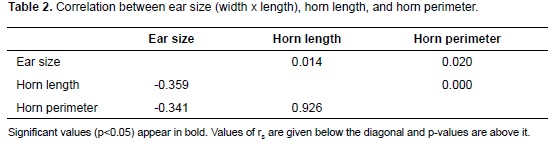
<body><![CDATA[<p> The linear measurements obtained showed   a normal distribution for all measurements. Ear   measurements did not appear to be correlated with   age. Paired comparisons showed no differences   between left and right ears or for horn parameters, so   average values were obtained for each parameter.   The average values for polled/horned and males/   females are shown in <a href="/img/revistas/rccp/v27n3/v27n3a8t1.jpg" target="_blank">Table 1</a>.</p>     <p> There appeared to be a significant negative   correlation between ear size (length x width), and horn   length and perimeter (<a href="#t2">Table 2</a>), and the CVA scatter   (<a href="/img/revistas/rccp/v27n3/v27n3a8f1.jpg" target="_blank">Figure 1</a>) showed a tendency for polled animals to   have bigger ears.</p>     <p align="center"><a name="t2"></a><img src="/img/revistas/rccp/v27n3/v27n3a8t2.jpg"></p>     <p>&nbsp;</p>     <p>The MANOVA test showed significant differences   for ear size (length and width) between horned females   and polled animals (Wilk's &lambda; = 0.494, F12, 103.5 = 2.628)   (<a href="/img/revistas/rccp/v27n3/v27n3a8t3.jpg" target="_blank">Table 3</a>).</p>     <p>&nbsp;</p>     <p> <font size="3"> <b>Discussion</b></font></p>     <p> As animal mass (body weight) can be considered   similar because the age range was minimal (332 &plusmn; 56   days), the index of thermoregulatory potential (which   takes into account the mass of the animal) (Hoefs,   2000) was also considered to be the same. It must be   highlighted that horn values are below those previously   published (28.2 &plusmn; 3.97 and 16.9 &plusmn; 1.91 cm for horn length   and perimeter respectively (Par&eacute;s, 2006), because in this   study only young animals were studied, whereas studies   from 2006 used animals aged more than 2.5 years.</p>     <p> The heat-exchange process works by pumping   blood around the 'core' of the horn &#8211;the part   containing the blood vessels&#8211; as this blood passes   close to the outside part of the horn, heat is lost to the   atmosphere and cool blood returns to the body. Ears are   also packed with capillary structures through which a   sizeable quantity of blood flows (Narasimhan, 2008).   So, ear vascularization would compensate for less horn   surface. In fact, it appears that horn and ear surfaces   of Pyrenean Brown cattle are adapted to regulate heat   loss. In any case, thermoregulation in this breed would   not be solely a function of having or not having horns.</p>     <p> This negative correlation between ear and horn   surface should be investigated for other cattle   breeds, especially those highly adapted to extreme   environments, on the basis that ear and horn   conformation are not solely ornamental structures or   simply secondary traits to morphologically characterize   a breed. It is now important to do research in adult   animals, in which most growth has been completed.   Although the sample is small, obtained results would   indicate an interesting hypothesis for future studies.</p>     ]]></body>
<body><![CDATA[<p>&nbsp;</p>     <p><font size="3"> <b>Acknowledgements</b></font></p>     <p> MAFRISEU SA kindly provided us with the fresh   heads and associated information.</p>     <P>&nbsp;</P> <hr size="1" noshade>     <p><b><font size="3">Notes</font></b></p>     <P><a href="#0b" name="0">&curren;</a> To cite this article: Par&eacute;s-Casanova PM, Caballero M. Possible tendency of polled cattle towards larger ears. Rev Colomb Cienc Pecu 2014; 27:221-225.</P> <hr size="1" noshade>     <P>&nbsp;</P>     <P><font size="3"><B>References</B></font></P>     <!-- ref --><P>Blackshaw JK, Blackshaw AW. Heat stress in cattle and the effect   of shade on production and behaviour: a review. Aust J Exp Agr 1994; 34:285-295.    &nbsp;&nbsp;&nbsp;&nbsp;&nbsp;&nbsp;&nbsp;&nbsp;[&#160;<a href="javascript:void(0);" onclick="javascript: window.open('/scielo.php?script=sci_nlinks&ref=000061&pid=S0120-0690201400030000800001&lng=','','width=640,height=500,resizable=yes,scrollbars=1,menubar=yes,');">Links</a>&#160;]<!-- end-ref --></P>     ]]></body>
<body><![CDATA[<!-- ref --><P> Brown-Brandl TM, Eigenberg RA, Hahn GL, Nienaber JA,   Mader TL. Analyses of thermoregulatory responses of feeder   cattle exposed to simulated heat waves. Int J Biometeorol 2005;   49:285-296.    &nbsp;&nbsp;&nbsp;&nbsp;&nbsp;&nbsp;&nbsp;&nbsp;[&#160;<a href="javascript:void(0);" onclick="javascript: window.open('/scielo.php?script=sci_nlinks&ref=000063&pid=S0120-0690201400030000800002&lng=','','width=640,height=500,resizable=yes,scrollbars=1,menubar=yes,');">Links</a>&#160;]<!-- end-ref --></P>     <!-- ref --><P> Hammel HT, Pierce JB. Regulation of Internal Body Temperature.   Annu Rev Physiol 1969; 30:641-710.    &nbsp;&nbsp;&nbsp;&nbsp;&nbsp;&nbsp;&nbsp;&nbsp;[&#160;<a href="javascript:void(0);" onclick="javascript: window.open('/scielo.php?script=sci_nlinks&ref=000065&pid=S0120-0690201400030000800003&lng=','','width=640,height=500,resizable=yes,scrollbars=1,menubar=yes,');">Links</a>&#160;]<!-- end-ref --></P>     <!-- ref --><P> Hammer &Oslash;, Harper DAT, Ryan PD. PAST: Paleontological   Statistics Software Package for Education and Data Analysis.   Palaeontol Electron 2001; &#91;access date: September 1, 2013&#93;.   URL: <a href="http://palaeo-electronica.org/2001_1/past/issue1_01.htm" target="_blank">http://palaeo-electronica.org/2001_1/past/issue1_01.htm</a>&nbsp;&nbsp;&nbsp;&nbsp;&nbsp;&nbsp;&nbsp;&nbsp;[&#160;<a href="javascript:void(0);" onclick="javascript: window.open('/scielo.php?script=sci_nlinks&ref=000067&pid=S0120-0690201400030000800004&lng=','','width=640,height=500,resizable=yes,scrollbars=1,menubar=yes,');">Links</a>&#160;]<!-- end-ref --><!-- ref --><P> Hoefs M. The thermoregulatory potential of Ovis horn cores. Can   J Zool 200; 78:1419-1426.    &nbsp;&nbsp;&nbsp;&nbsp;&nbsp;&nbsp;&nbsp;&nbsp;[&#160;<a href="javascript:void(0);" onclick="javascript: window.open('/scielo.php?script=sci_nlinks&ref=000068&pid=S0120-0690201400030000800005&lng=','','width=640,height=500,resizable=yes,scrollbars=1,menubar=yes,');">Links</a>&#160;]<!-- end-ref --></P>     <!-- ref --><P> Narasimhan A. Why do Elephants have Big Ear Flaps? Resonance   2008; July: 638-647.    &nbsp;&nbsp;&nbsp;&nbsp;&nbsp;&nbsp;&nbsp;&nbsp;[&#160;<a href="javascript:void(0);" onclick="javascript: window.open('/scielo.php?script=sci_nlinks&ref=000070&pid=S0120-0690201400030000800006&lng=','','width=640,height=500,resizable=yes,scrollbars=1,menubar=yes,');">Links</a>&#160;]<!-- end-ref --></P>     <!-- ref --><P> Par&eacute;s PM. Cephalic measurements and indexes in the bovine   breed ''Bruna dels Pirineus''. RedVet 2006; VII:1-9. &#91;access   date: March 31, 2014&#93;. URL: <a href="http://www.veterinaria.org/revistas/redvet/n090906.html#090624" target="_blank">http://www.veterinaria.org/revistas/redvet/n090906.html#090624</a>.    &nbsp;&nbsp;&nbsp;&nbsp;&nbsp;&nbsp;&nbsp;&nbsp;[&#160;<a href="javascript:void(0);" onclick="javascript: window.open('/scielo.php?script=sci_nlinks&ref=000072&pid=S0120-0690201400030000800007&lng=','','width=640,height=500,resizable=yes,scrollbars=1,menubar=yes,');">Links</a>&#160;]<!-- end-ref --></P>     <!-- ref --><P> Picard K, Thomas D, Festa-Bianchet M, Belleville F, Laneville A.   Differences in the thermal conductance of tropical and temperate   bovid horns. Ecoscience 1999; 6:148-158.    &nbsp;&nbsp;&nbsp;&nbsp;&nbsp;&nbsp;&nbsp;&nbsp;[&#160;<a href="javascript:void(0);" onclick="javascript: window.open('/scielo.php?script=sci_nlinks&ref=000074&pid=S0120-0690201400030000800008&lng=','','width=640,height=500,resizable=yes,scrollbars=1,menubar=yes,');">Links</a>&#160;]<!-- end-ref --></P>     <!-- ref --><P> Shapiro SS, Wilk MB. An analysis of variance test for normality   (complete samples). Biometrika 1965; 52:591-611.    &nbsp;&nbsp;&nbsp;&nbsp;&nbsp;&nbsp;&nbsp;&nbsp;[&#160;<a href="javascript:void(0);" onclick="javascript: window.open('/scielo.php?script=sci_nlinks&ref=000076&pid=S0120-0690201400030000800009&lng=','','width=640,height=500,resizable=yes,scrollbars=1,menubar=yes,');">Links</a>&#160;]<!-- end-ref --></P>     <!-- ref --><P> Taylor RA. Characteristics of horn growth in bighorn rams. (M.S.   thesis). Bozeman: Montana State University; 1960.    &nbsp;&nbsp;&nbsp;&nbsp;&nbsp;&nbsp;&nbsp;&nbsp;[&#160;<a href="javascript:void(0);" onclick="javascript: window.open('/scielo.php?script=sci_nlinks&ref=000078&pid=S0120-0690201400030000800010&lng=','','width=640,height=500,resizable=yes,scrollbars=1,menubar=yes,');">Links</a>&#160;]<!-- end-ref --></P>     <!-- ref --><P> Taylor CR. The vascularity and possible thermoregulatory   function of the horns in goats. Physiol Zool 1966; 39:127-139.    &nbsp;&nbsp;&nbsp;&nbsp;&nbsp;&nbsp;&nbsp;&nbsp;[&#160;<a href="javascript:void(0);" onclick="javascript: window.open('/scielo.php?script=sci_nlinks&ref=000080&pid=S0120-0690201400030000800011&lng=','','width=640,height=500,resizable=yes,scrollbars=1,menubar=yes,');">Links</a>&#160;]<!-- end-ref --></P>     <P>&nbsp;</P> </font>     ]]></body>
<body><![CDATA[ ]]></body><back>
<ref-list>
<ref id="B1">
<nlm-citation citation-type="journal">
<person-group person-group-type="author">
<name>
<surname><![CDATA[Blackshaw]]></surname>
<given-names><![CDATA[JK]]></given-names>
</name>
<name>
<surname><![CDATA[Blackshaw]]></surname>
<given-names><![CDATA[AW]]></given-names>
</name>
</person-group>
<article-title xml:lang="en"><![CDATA[Heat stress in cattle and the effect of shade on production and behaviour: a review]]></article-title>
<source><![CDATA[Aust J Exp Agr]]></source>
<year>1994</year>
<volume>34</volume>
<page-range>285-295</page-range></nlm-citation>
</ref>
<ref id="B2">
<nlm-citation citation-type="journal">
<person-group person-group-type="author">
<name>
<surname><![CDATA[Brown-Brandl]]></surname>
<given-names><![CDATA[TM]]></given-names>
</name>
<name>
<surname><![CDATA[Eigenberg]]></surname>
<given-names><![CDATA[RA]]></given-names>
</name>
<name>
<surname><![CDATA[Hahn]]></surname>
<given-names><![CDATA[GL]]></given-names>
</name>
<name>
<surname><![CDATA[Nienaber]]></surname>
<given-names><![CDATA[JA]]></given-names>
</name>
<name>
<surname><![CDATA[Mader]]></surname>
<given-names><![CDATA[TL]]></given-names>
</name>
</person-group>
<article-title xml:lang="en"><![CDATA[Analyses of thermoregulatory responses of feeder cattle exposed to simulated heat waves]]></article-title>
<source><![CDATA[Int J Biometeorol]]></source>
<year>2005</year>
<volume>49</volume>
<page-range>285-296</page-range></nlm-citation>
</ref>
<ref id="B3">
<nlm-citation citation-type="journal">
<person-group person-group-type="author">
<name>
<surname><![CDATA[Hammel]]></surname>
<given-names><![CDATA[HT]]></given-names>
</name>
<name>
<surname><![CDATA[Pierce]]></surname>
<given-names><![CDATA[JB]]></given-names>
</name>
</person-group>
<article-title xml:lang="en"><![CDATA[Regulation of Internal Body Temperature]]></article-title>
<source><![CDATA[Annu Rev Physiol]]></source>
<year>1969</year>
<volume>30</volume>
<page-range>641-710</page-range></nlm-citation>
</ref>
<ref id="B4">
<nlm-citation citation-type="journal">
<person-group person-group-type="author">
<name>
<surname><![CDATA[Hammer]]></surname>
<given-names><![CDATA[Ø]]></given-names>
</name>
<name>
<surname><![CDATA[Harper]]></surname>
<given-names><![CDATA[DAT]]></given-names>
</name>
<name>
<surname><![CDATA[Ryan]]></surname>
<given-names><![CDATA[PD]]></given-names>
</name>
</person-group>
<article-title xml:lang="en"><![CDATA[PAST: Paleontological Statistics Software Package for Education and Data Analysis]]></article-title>
<source><![CDATA[Palaeontol Electron]]></source>
<year>2001</year>
</nlm-citation>
</ref>
<ref id="B5">
<nlm-citation citation-type="journal">
<person-group person-group-type="author">
<name>
<surname><![CDATA[Hoefs]]></surname>
<given-names><![CDATA[M]]></given-names>
</name>
</person-group>
<article-title xml:lang="en"><![CDATA[The thermoregulatory potential of Ovis horn cores]]></article-title>
<source><![CDATA[Can J Zool]]></source>
<year>200</year>
<volume>78</volume>
<page-range>1419-1426</page-range></nlm-citation>
</ref>
<ref id="B6">
<nlm-citation citation-type="journal">
<person-group person-group-type="author">
<name>
<surname><![CDATA[Narasimhan]]></surname>
<given-names><![CDATA[A]]></given-names>
</name>
</person-group>
<article-title xml:lang="en"><![CDATA[Why do Elephants have Big Ear Flaps?]]></article-title>
<source><![CDATA[Resonance]]></source>
<year>2008</year>
<volume>July</volume>
<page-range>638-647</page-range></nlm-citation>
</ref>
<ref id="B7">
<nlm-citation citation-type="journal">
<person-group person-group-type="author">
<name>
<surname><![CDATA[Parés]]></surname>
<given-names><![CDATA[PM]]></given-names>
</name>
</person-group>
<article-title xml:lang="en"><![CDATA[Cephalic measurements and indexes in the bovine breed ''Bruna dels Pirineus'']]></article-title>
<source><![CDATA[RedVet]]></source>
<year>2006</year>
<volume>VII</volume>
<page-range>1-9</page-range></nlm-citation>
</ref>
<ref id="B8">
<nlm-citation citation-type="journal">
<person-group person-group-type="author">
<name>
<surname><![CDATA[Picard]]></surname>
<given-names><![CDATA[K]]></given-names>
</name>
<name>
<surname><![CDATA[Thomas]]></surname>
<given-names><![CDATA[D]]></given-names>
</name>
<name>
<surname><![CDATA[Festa-Bianchet]]></surname>
<given-names><![CDATA[M]]></given-names>
</name>
<name>
<surname><![CDATA[Belleville]]></surname>
<given-names><![CDATA[F]]></given-names>
</name>
<name>
<surname><![CDATA[Laneville]]></surname>
<given-names><![CDATA[A]]></given-names>
</name>
</person-group>
<article-title xml:lang="en"><![CDATA[Differences in the thermal conductance of tropical and temperate bovid horns]]></article-title>
<source><![CDATA[Ecoscience]]></source>
<year>1999</year>
<volume>6</volume>
<page-range>148-158</page-range></nlm-citation>
</ref>
<ref id="B9">
<nlm-citation citation-type="journal">
<person-group person-group-type="author">
<name>
<surname><![CDATA[Shapiro]]></surname>
<given-names><![CDATA[SS]]></given-names>
</name>
<name>
<surname><![CDATA[Wilk]]></surname>
<given-names><![CDATA[MB]]></given-names>
</name>
</person-group>
<article-title xml:lang="en"><![CDATA[An analysis of variance test for normality (complete samples)]]></article-title>
<source><![CDATA[Biometrika]]></source>
<year>1965</year>
<volume>52</volume>
<page-range>591-611</page-range></nlm-citation>
</ref>
<ref id="B10">
<nlm-citation citation-type="book">
<person-group person-group-type="author">
<name>
<surname><![CDATA[Taylor]]></surname>
<given-names><![CDATA[RA]]></given-names>
</name>
</person-group>
<source><![CDATA[Characteristics of horn growth in bighorn rams]]></source>
<year>1960</year>
<publisher-loc><![CDATA[Bozeman ]]></publisher-loc>
<publisher-name><![CDATA[Montana State University]]></publisher-name>
</nlm-citation>
</ref>
<ref id="B11">
<nlm-citation citation-type="journal">
<person-group person-group-type="author">
<name>
<surname><![CDATA[Taylor]]></surname>
<given-names><![CDATA[CR]]></given-names>
</name>
</person-group>
<article-title xml:lang="en"><![CDATA[The vascularity and possible thermoregulatory function of the horns in goats]]></article-title>
<source><![CDATA[Physiol Zool]]></source>
<year>1966</year>
<volume>39</volume>
<page-range>127-139</page-range></nlm-citation>
</ref>
</ref-list>
</back>
</article>
