<?xml version="1.0" encoding="ISO-8859-1"?><article xmlns:mml="http://www.w3.org/1998/Math/MathML" xmlns:xlink="http://www.w3.org/1999/xlink" xmlns:xsi="http://www.w3.org/2001/XMLSchema-instance">
<front>
<journal-meta>
<journal-id>0120-0690</journal-id>
<journal-title><![CDATA[Revista Colombiana de Ciencias Pecuarias]]></journal-title>
<abbrev-journal-title><![CDATA[Rev Colom Cienc Pecua]]></abbrev-journal-title>
<issn>0120-0690</issn>
<publisher>
<publisher-name><![CDATA[Facultad de Ciencias Agrarias, Universidad de Antioquia]]></publisher-name>
</publisher>
</journal-meta>
<article-meta>
<article-id>S0120-06902014000300009</article-id>
<title-group>
<article-title xml:lang="en"><![CDATA[Idiopathic stringhalt in a Colombian Creole horse]]></article-title>
<article-title xml:lang="es"><![CDATA[Arpeo idiopático en un caballo Criollo Colombiano]]></article-title>
<article-title xml:lang="pt"><![CDATA[Harpejamento idiopático em um cavalo Crioulo Colombiano]]></article-title>
</title-group>
<contrib-group>
<contrib contrib-type="author">
<name>
<surname><![CDATA[Duque]]></surname>
<given-names><![CDATA[Diego]]></given-names>
</name>
<xref ref-type="aff" rid="A01"/>
</contrib>
<contrib contrib-type="author">
<name>
<surname><![CDATA[Velasquez]]></surname>
<given-names><![CDATA[Valentina]]></given-names>
</name>
<xref ref-type="aff" rid="A02"/>
</contrib>
<contrib contrib-type="author">
<name>
<surname><![CDATA[Espinosa]]></surname>
<given-names><![CDATA[Laura]]></given-names>
</name>
<xref ref-type="aff" rid="A02"/>
</contrib>
<contrib contrib-type="author">
<name>
<surname><![CDATA[Arias]]></surname>
<given-names><![CDATA[Maria P]]></given-names>
</name>
<xref ref-type="aff" rid="A01"/>
<xref ref-type="aff" rid="A02"/>
<xref ref-type="aff" rid="A03"/>
</contrib>
</contrib-group>
<aff id="A01">
<institution><![CDATA[,Universidad CES  ]]></institution>
<addr-line><![CDATA[Medellín ]]></addr-line>
<country>Colombia</country>
</aff>
<aff id="A02">
<institution><![CDATA[,Universidad CES Facultad de Medicina Veterinaria y Zootecnia ]]></institution>
<addr-line><![CDATA[Medellín ]]></addr-line>
<country>Colombia</country>
</aff>
<aff id="A03">
<institution><![CDATA[,Universidad CES Facultad de Medicina Veterinaria y Zootecnia ]]></institution>
<addr-line><![CDATA[Medellín ]]></addr-line>
<country>Colombia</country>
</aff>
<pub-date pub-type="pub">
<day>00</day>
<month>08</month>
<year>2014</year>
</pub-date>
<pub-date pub-type="epub">
<day>00</day>
<month>08</month>
<year>2014</year>
</pub-date>
<volume>27</volume>
<numero>3</numero>
<fpage>227</fpage>
<lpage>233</lpage>
<copyright-statement/>
<copyright-year/>
<self-uri xlink:href="http://www.scielo.org.co/scielo.php?script=sci_arttext&amp;pid=S0120-06902014000300009&amp;lng=en&amp;nrm=iso"></self-uri><self-uri xlink:href="http://www.scielo.org.co/scielo.php?script=sci_abstract&amp;pid=S0120-06902014000300009&amp;lng=en&amp;nrm=iso"></self-uri><self-uri xlink:href="http://www.scielo.org.co/scielo.php?script=sci_pdf&amp;pid=S0120-06902014000300009&amp;lng=en&amp;nrm=iso"></self-uri><abstract abstract-type="short" xml:lang="en"><p><![CDATA[Anamnesis: an adult horse that showed hind limb hyperflexion was examined. Clinical and laboratory findings: at locomotion examination bilateral hyperflexion was observed; the right hind limb was more severely affected than the left. Electromyographic and histopathological examination revealed neural denervation and muscular atrophy supporting the idiopathic stringhalt diagnosis. Treatment approach: a lateral digital extensor tenectomy and partial myectomy was practiced in both hind limbs, accompanied by medical treatment and implementation of a mild exercise plan. The effectiveness of surgery is still controversial in these cases; however, this patient evidenced slow improvement after surgery and exercise seemed to be instrumental in the recovery of his normal locomotion. Conclusion: to our knowledge, this is the first report of a clinical case compatible with idiopathic stringhalt in Colombian Creole horses, but further studies are necessary to clarify the etiology and pathogenesis of stringhalt in Colombia.]]></p></abstract>
<abstract abstract-type="short" xml:lang="es"><p><![CDATA[Anamnesis: se examinó un caballo adulto que mostraba hiperflexión de ambos miembros posteriores. Hallazgos clínicos y de laboratorio: al examen locomotor se observó hiperflexión de ambos miembros posteriores pero el miembro posterior derecho parecía estar más afectado. El examen histopatológico y la electromiografía revelaron denervación neural y atrofia muscular soportando el diagnóstico de arpeo idiopático. Abordaje terapéutico: se practicó tenectomía y miectomía parcial del extensor digital lateral en ambos miembros posteriores, acompañada de tratamiento médico con la implementación de un plan de ejercicio ligero. La eficacia de la cirugía es controversial aún, sin embargo, en este caso, una lenta recuperación fue evidente y el ejercicio pareció ser un factor clave. Conclusión: el presente caso clínico es para nuestro conocimiento el primero compatible con arpeo idiopático en el Caballo Criollo Colombiano, pero se deben realizar más estudios para clarificar la etiología y patogenia del arpeo en Colombia.]]></p></abstract>
<abstract abstract-type="short" xml:lang="pt"><p><![CDATA[Anamnese: foi examinado um cavalo adulto que mostrava hiperflexão dos dois membros posteriores. Achados Clínicos e de laboratorio: o exame foi observado hiperflexão de ambos os membros posteriores, estando mais afectado o membro posterior direito. O exame histopatológico e eletromiografia revelou denervação neural e atrofia muscular levando ao diagnóstico de harpejamento idiopático. Abordagem terapêutica: foi realizada tenectomia e miectomia parcial do músculo extensor digital lateral em ambos os membros posteriores, acompanhada de tratamento médico com a implementação de um plano de exercícios leves. A eficácia da cirurgia é ainda controversa, no entanto, neste caso foi evidente uma recuperação lenta e o exercício pareceu ser um fator fundamental. Conclusão: este relato de caso é, a nosso conhecimento, o primeiro compatível com harpejamento idiopático, mas devem ser realizados mais estudos para esclarecer a etiologia e patogenia do harpejamento no Cavalo Crioulo Colombiano.]]></p></abstract>
<kwd-group>
<kwd lng="en"><![CDATA[axonopathy]]></kwd>
<kwd lng="en"><![CDATA[denervation]]></kwd>
<kwd lng="en"><![CDATA[electromyography]]></kwd>
<kwd lng="en"><![CDATA[hyperflexion]]></kwd>
<kwd lng="es"><![CDATA[axonopatía]]></kwd>
<kwd lng="es"><![CDATA[denervación]]></kwd>
<kwd lng="es"><![CDATA[electromiografía]]></kwd>
<kwd lng="es"><![CDATA[hiperflexión]]></kwd>
<kwd lng="pt"><![CDATA[axonopatia]]></kwd>
<kwd lng="pt"><![CDATA[denervação]]></kwd>
<kwd lng="pt"><![CDATA[eletromiografia]]></kwd>
<kwd lng="pt"><![CDATA[hiperflexão]]></kwd>
</kwd-group>
</article-meta>
</front><body><![CDATA[  <font size="2" face="Verdana, Arial, Helvetica, sans-serif">     <P align="right"><b>CLINICAL CASE</b></P>     <P>&nbsp;</P>     <P align="center"><font size="4"><b>Idiopathic stringhalt in a Colombian Creole horse<a href="#0" name="0b">*</a></b></font></P>     <P>&nbsp;</P>     <P align="center"><font size="3"><b>Arpeo idiop&aacute;tico en un caballo Criollo Colombiano</b></font></P>     <P align="center">&nbsp;</P>     <P align="center"><font size="3"><b>Harpejamento idiop&aacute;tico em um cavalo Crioulo Colombiano</b></font></P>     <P>&nbsp;</P>     <P>&nbsp;</P>     ]]></body>
<body><![CDATA[<P><b>Diego Duque<sup>1</sup>, MV; Valentina Velasquez<sup>2</sup>, MVZ (est.); Laura Espinosa<sup>2</sup>, MVZ (est.); Maria P Arias<sup>2,1&dagger;</sup>, MV, MS, PhD.</b></P>     <P>&nbsp;</P>     <P>1 Centro de Medicina Veterinaria y Zootecnia, Universidad CES, Medell&iacute;n, Colombia.</P>     <P> 2 Facultad de Medicina Veterinaria y Zootecnia, Universidad CES, Medell&iacute;n, Colombia. </P>     <P>&dagger; Corresponding author: Maria P Arias. Facultad de Medicina Veterinaria y Zootecnia. Universidad CES. Calle 10 A # 22 &#8211; 04. El Poblado, Medell&iacute;n, Colombia.   Email: <a href="mailto:marias@ces.edu.co">marias@ces.edu.co</a>.</P>     <P>&nbsp;</P>     <P> (Received:June 20, 2013; accepted:January 28, 2014) </P>     <P>&nbsp;</P> <hr size="1" noshade>     <P> <B>Summary</B></P>     <P><b>Anamnesis</b>: an adult horse that showed hind limb hyperflexion was examined. <b>Clinical and laboratory   findings:</b> at locomotion examination bilateral hyperflexion was observed; the right hind limb was more severely   affected than the left. Electromyographic and histopathological examination revealed neural denervation   and muscular atrophy supporting the idiopathic stringhalt diagnosis. <b>Treatment approach: </b>a lateral digital   extensor tenectomy and partial myectomy was practiced in both hind limbs, accompanied by medical treatment   and implementation of a mild exercise plan. The effectiveness of surgery is still controversial in these cases;   however, this patient evidenced slow improvement after surgery and exercise seemed to be instrumental in   the recovery of his normal locomotion. <b>Conclusion</b>: to our knowledge, this is the first report of a clinical case   compatible with idiopathic stringhalt in Colombian Creole horses, but further studies are necessary to clarify the etiology and pathogenesis of stringhalt in Colombia.</P>     ]]></body>
<body><![CDATA[<P> <b>Key words:</b> <i>axonopathy, denervation, electromyography, hyperflexion</i>. </P> <hr size="1" noshade>     <P> <B>Resumen</B></P>     <P><b>Anamnesis</b>: se examin&oacute; un caballo adulto que mostraba hiperflexi&oacute;n de ambos miembros posteriores.   <b>Hallazgos cl&iacute;nicos y de laboratorio</b>: al examen locomotor se observ&oacute; hiperflexi&oacute;n de ambos miembros   posteriores pero el miembro posterior derecho parec&iacute;a estar m&aacute;s afectado. El examen histopatol&oacute;gico y la   electromiograf&iacute;a revelaron denervaci&oacute;n neural y atrofia muscular soportando el diagn&oacute;stico de arpeo idiop&aacute;tico.   <b>Abordaje terap&eacute;utico</b>: se practic&oacute; tenectom&iacute;a y miectom&iacute;a parcial del extensor digital lateral en ambos   miembros posteriores, acompa&ntilde;ada de tratamiento m&eacute;dico con la implementaci&oacute;n de un plan de ejercicio ligero.   La eficacia de la cirug&iacute;a es controversial a&uacute;n, sin embargo, en este caso, una lenta recuperaci&oacute;n fue evidente   y el ejercicio pareci&oacute; ser un factor clave. <b>Conclusi&oacute;n</b>: el presente caso cl&iacute;nico es para nuestro conocimiento   el primero compatible con arpeo idiop&aacute;tico en el Caballo Criollo Colombiano, pero se deben realizar m&aacute;s estudios para clarificar la etiolog&iacute;a y patogenia del arpeo en Colombia.</P>     <P> <b>Palabras clave:</b> <i>axonopat&iacute;a, denervaci&oacute;n, electromiograf&iacute;a, hiperflexi&oacute;n.</i> </P> <hr size="1" noshade>     <P> <B>Resumo</B></P>     <P><b>Anamnese</b>: foi examinado um cavalo adulto que mostrava hiperflex&atilde;o dos dois membros posteriores.   <b>Achados Cl&iacute;nicos e de laboratorio</b>: o exame foi observado hiperflex&atilde;o de ambos os membros posteriores,   estando mais afectado o membro posterior direito. O exame histopatol&oacute;gico e eletromiografia revelou   denerva&ccedil;&atilde;o neural e atrofia muscular levando ao diagn&oacute;stico de harpejamento idiop&aacute;tico. <b>Abordagem   terap&ecirc;utica</b>: foi realizada tenectomia e miectomia parcial do m&uacute;sculo extensor digital lateral em ambos os   membros posteriores, acompanhada de tratamento m&eacute;dico com a implementa&ccedil;&atilde;o de um plano de exerc&iacute;cios   leves. A efic&aacute;cia da cirurgia &eacute; ainda controversa, no entanto, neste caso foi evidente uma recupera&ccedil;&atilde;o lenta   e o exerc&iacute;cio pareceu ser um fator fundamental. <b>Conclus&atilde;o</b>: este relato de caso &eacute;, a nosso conhecimento, o   primeiro compat&iacute;vel com harpejamento idiop&aacute;tico, mas devem ser realizados mais estudos para esclarecer a etiologia e patogenia do harpejamento no Cavalo Crioulo Colombiano.</P>     <P> <b>Palavras chave:</b> <i>axonopatia, denerva&ccedil;&atilde;o, eletromiografia, hiperflex&atilde;o.</i> </P> <hr size="1" noshade>           <P>&nbsp;</P>     <P>&nbsp;</P>     <P><font size="3"><B>Introduction</B></font></P>     ]]></body>
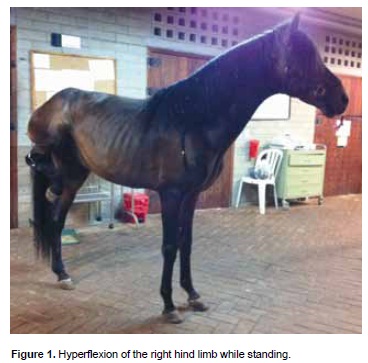
<body><![CDATA[<p>Stringhalt in horses&#8211;recently renamed Equine   reflex hypertonia&#8211;consists of an intermittent   hyperflexion of the tarsocrural joint, and may affect   one or both hind limbs (Furr <i>et al.</i>, 2011). It is   considered a form of spasticity due to upper motor   neuron dysfunction or hyperexcitability of motor   neurons (Crabill <i>et al.</i>, 1994). Stringhalt has long been   recognized in conventional (idiopathic stringhalt) and   epidemic (Australian stringhalt) forms (Slocombe   <i>et al.</i>, 1992) but it has not been determined which   stringhalt form affects Colombian Creole horses. The   aim of this report is to describe a case of the idiopathic stringhalt form in a Colombian Creole horse.</p>     <p>&nbsp;</p>     <p><font size="3"><b>Patient examination</b></font></p>     <p> <i>Anamnesis</i></p>     <p> A 5-year-old Colombian Creole horse was   presented to the Veterinary Clinic of CES University   in Medellin (Colombia) with a two-month history   of a sudden, progressive bilateral abnormal gait and   exaggerated hock flexion. The horse had lived for one   year in the same pasture with other horses that had   not developed clinical signs consistent with stringhalt.   There was no history of recent trauma or previous   medical problems.</p>     <p> <i>Clinical findings</i></p>     <p> The horse weighed 316 kg on arrival, the   patient was excited, very nervous and reluctant to   walk. Physical parameters were normal. Hind limb   hyperflexion was evident at clinical examination.   He showed an exaggerated flexion of both pelvic   limbs when he was obligated to walk. Hyperflexion   was bilateral but the right hind limb seemed to be   more affected than the left. He kept his hind limbs   hyperflexed while standing for several seconds until   he relaxed and was unable to move backwards more   than a few steps. Excitement triggered hyperflexion   (<a href="#f1">Figure 1</a>). The clinical diagnosis was bilateral   stringhalt grade V/V, according to the Huntington   scale (Huntington <i>et al.</i>, 1989).</p>       <p align="center"><a name="f1"></a><img src="/img/revistas/rccp/v27n3/v27n3a9f1.jpg"></p>     <p>&nbsp;</p>     <p><font size="3"> <b>Diagnostic aids used</b></font></p>     ]]></body>
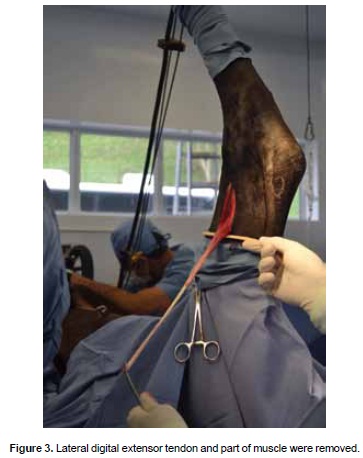
<body><![CDATA[<p> Chemistry and routine hematological values were   normal. Electromyographic (EMG) examination   of pelvic limb muscles with a concentric electrode   (Neurodiagnostics LBmII&reg;) inserted into the lateral   digital extensor and long digital extensor muscles   was recorded at a sampling rate of 10 milliseconds   and 100 &mu;V amplitude, following the Van Wessum   protocol (1999). The horse was sedated with Xylazine   IV., at a dose of 0.1 mg/Kg. Insertional activity, motor   neurons and muscle activity were evaluated at rest   and during reflex contraction. Insertional activity   was measured 3 times and then each muscle was   observed for spontaneous activity at rest (Wijnberg,   2003). EMG showed an exaggerated electrical   activity of the lateral digital extensor muscle and a   disorganized spontaneous electrical activity in both   hind limbs. Decreased voluntary activity compatible   with denervation of the hindquarters' lateral digital   extensor muscles was observed.</p>     <p> Biopsies of the lateral digital extensor muscle   and superficial peroneal nerve were collected during   a surgical approach, immersed in 10% phosphatebuffered   formalin solution for 24 h and shipped to the   Veterinary Pathology Laboratory of the Universidad   Nacional de Colombia. Tissues were dehydrated,   paraffin-embedded and 3 &mu;m sections were cut for   conventional paraffin-embedded light microscopy   examination. Samples of skeletal muscle and   peripheral nerve were stained with haematoxylineosin   and Masson's Trichrome (Raimondo, 2009).   Histopathological examination showed multifocal   irregularity in shape and size of some muscle   fascicules. The superficial peroneal nerve presented   vacuolization of some nerve fibers, and axonal   degeneration with evidence of regeneration. Different   levels of myelin degradation and connective tissue   fragmentation were also found. The pattern was   consistent with acute denervation (<a href="/img/revistas/rccp/v27n3/v27n3a9f2.jpg" target="_blank">Figure 2</a>).</p>     <p>&nbsp;</p>     <p> <font size="3"> <b>Treatment approach</b></font></p>     <p> <i>Medical therapy</i></p>     <p> The initial therapy focused on reducing any   secondary inflammatory damage and restoring motion   range. It included: Flunixin meglumine (1.1 mg/kg   IV, every 12 h during 5 days) and 100 mL DMSO   at 10% diluted in Hartman (IV, every 24 h during 3   days, followed by half of this dose for 3 additional   days). Ranitidine (8.8 mg/kg) was administered   for 7 days every 8 h to protect the gastric mucosa.   Phenytoin sodium was administered orally (15 mg/kg   body weight twice a day for three weeks) to decrease   hyperflexia, since it has been reported as effective in   some stringhalt cases (Huntington, 1991; Furr, 2011),   Vitamin E (6000 UI, each 24 h PO) and Thiamine   (10 mg/kg) were also prescribed throughout the   hospitalization period. This initial treatment failed to   provide any improvement of the condition.</p>     <p> <i>Surgical procedure</i></p>     <p> One month after admission, the patient had   lost body condition and no clinical improvement   was observed, therefore, the animal underwent a   lateral digital extensor myotenectomy. The patient   was premedicated with Xylazine (0.5 mg/kg IV),   Diazepam (0.05 mg/kg IV) and Ketamine (0.5   mg/kg IV) and put under general anesthesia using   isofluorane. The horse was on dorsal recumbence   with limb extension throughout the procedure. A 1 cm   incision was made over the lateral digital extensor   tendon, just proximal to its junction with the long   digital extensor tendon, which was exposed by blunt   dissection. Then, a 7 cm longitudinal incision was   done directly over the muscle, in the lateral aspect   of the limb, above the lateral malleolus of the tibia.   The muscle belly was exposed by blunt dissection. The   tendon was severed in the distal incision and through   the proximal incision by traction and the muscle   was also severed at the proximal aspect (<a href="#f3">Figure 3</a>).   Superficial peroneal nerve was localized by blunt   dissection and a 2 cm partial longitudinal section   was removed. Fascia and subcutaneous tissue were   closed with a simple continuous pattern using 2 - 0   absorbable suture. The skin of the proximal incision   was closed with simple-continuous pattern using   N.0 synthetic non-absorbable material. The distal   incision was closed with skin sutures. The procedure   was repeated in the contralateral limb. Finally, both   limbs were bandaged. Penicillin (15,000 IU/kg IM, a   single dose) and Phenilbutazone (4.4 mg/kg IV each   24 h during 8 days) were administered.</p>       <p align="center"><a name="f3"></a><img src="/img/revistas/rccp/v27n3/v27n3a9f3.jpg"></p>     <p>&nbsp;</p>     ]]></body>
<body><![CDATA[<p> Biopsies of superficial peroneal nerve and lateral   digital extensor muscle were taken, immersed in   10% buffered formalin and shipped to the Veterinary   Pathology Laboratory of the Universidad Nacional   de Colombia.</p>     <p> <i>Clinical management and evolution</i></p>     <p> One day after surgery the horse was alert, but   excitement or walking on hard floor triggered signs   of stringhalt again. A slow improvement was seen   when the horse was on pasture. However, hyperflexion   became apparent when he returned to the box,   although this behavior was not constant. The bandage   was changed every day after surgery.</p>     <p>  The patient remained hospitalized for three   months while treatment with Thiamine and Vitamin   E continued. As mild exercise is recommended, this   horse was exercised three times a day by walking   slowly on soft ground for 10 minutes and remaining   outside for 3 h daily as part of the therapeutic   management. The owner was instructed to hand-walk   the horse when discharged, following the same   postoperative exercise program for three additional   months, which resulted in notorious locomotion   improvement. A progressive recovery of the normal   gait was observed several months after the surgery.</p>     <p>&nbsp;</p>     <p><font size="3"> <b>Discussion</b></font></p>     <p> Australian stringhalt is caused by neurotoxins   produced by <i>Hypochoeris radicata</i> in response   to drought stress (MacKay, 2013). This condition   was described for the first time in Australia in 1848   (Domange, 2013), although several cases have been   reported in other countries (Araya, 1998; Araujo,   2008; Rodrigues, 2008). Idiopathic stringhalt is a   mechanical lameness condition for which different   possible causes have been proposed, such as articular   lesions of the hock, nervous lesions, spasmodic   contractions of the metatarsus flexor muscle due to   reflex irritation and degeneration of the sciatic or   peroneal nerves and affections of the spinal cord   (Aleman, 2011; Dixon, 1969). The stringhalt form   has not yet been defined in Colombian Creole horses,   although it is a frequent condition in this breed.</p>     <p> Stringhalt occurs in all breeds and ages of horses.   The affected horse displays hind limbs spasmodic   flexion and abnormal gait during progression   because of a distal axonopathy with a skeletal muscle   denervation and atrophy (Domange, 2010). In this   patient, the main manifestation was a spasmodic and   excessively rapid flexion of hind limbs, more marked   when the horse was required to move.</p>     <p> Histopathological changes associated with   stringhalt in muscle and nerve plays an essential   role in the diagnosis of neuromuscular disorders   by providing information on whether a disease   process affects muscle, nerve, or both (Aleman,   2008). Nonspecific histological alterations include   neurogenic muscle atrophy seen as anguloid myofiber   shape or marked size differences, axonal degeneration   and myelin splitting and degeneration (Summers,   1995). In this case, the histopathological alterations   found were axonal degeneration with evidence of   regeneration and vacuolization of some neural fibers   and neurogenic muscle atrophy evidenced by different   size and shape of myofibers.</p>     <p> EMG provides essential information (Wijnberg,   2004) and may support or refute the diagnosis   (Wijnberg, 2000), so it should always be considered in   the examination of a horse with signs of stringhalt   in order to make the best clinical decisions (Van   Wessum, 1999). Abundant denervation with decreased   voluntary activity in the lateral digital extensor muscle   was observed in this animal. Findings revealed the   presence of a peripheral neuropathy with axonal   damage, predominantly distal, and corroborate a   histopathological diagnosis of neural denervation.</p>     ]]></body>
<body><![CDATA[<p> Sometimes it is necessary to give a minimum   dose of sedatives to impatient horses during EMG   examination (Wijnberg, 2004). In this patient, we   used a low dose of Xylazine, just enough to put the   electrodes on the muscles.</p>     <p> Identification and classification of a specific   neuromuscular dysfunction require EMG and   histopathological analyses of muscle and nerve   (Stevens, 2009). In this patient, there was no history   of nervous episodes or traumatic events, and the   initial cause could not be clearly established. EMG   and histopathological findings were compatible with a   distal axonopathy, while epidemiological and clinical   evidence support the diagnosis of idiopathic stringhalt   since other horses living in the same conditions were   not affected; no toxic agents were found in the pasture.</p>     <p> The use of muscle relaxants such as phenytoin   in oral doses of 15-25 mg/kg from two (Furr, 2011)   to three weeks (Wijnberg, 2000) has shown to be   effective in horses suffering from Australian stringhalt.   Pharmacological effects involve neuronal stabilization   and control of the electrical activity of peripheral nerves   and skeletal muscle membrane (Huntington, 1991). In   this patient, medical treatment with phenytoin sodium   was not useful in reducing the clinical signs of stringhalt.</p>     <p> The effectiveness of the surgery remains controversial.   According to Torre (2005), symptoms do not always   disappear after surgery. Armengou (2010) reported that   rapid clinical improvement after surgery is unusual.   Hahn (2008) reported that surgical removal of a section   of the myotendinous region containing the Golgi tendon   organ of the lateral digital extensor muscle relieves the   clinical signs in many cases. In this case, one month   post-operation a slow improvement was evident, and   hyperflexion was only observed when the horse was   taken out of its stall or became stressed.</p>     <p> As mild exercise is recommended, this horse   was exercised three times a day by walking slowly   on soft ground for 10 minutes and remained outside   for 3 h daily as part of the therapeutic management.   Hyperflexion diminished markedly with time and the   exercise plan. A progressive recovery to normal gait   was observed. One year after the surgery, the condition   resolved almost completely, suggesting that exercise   and time were very useful for the full recovery of   this patient.</p>     <p>&nbsp;</p>     <p><font size="3"> <b>Conclusion</b></font></p>     <p> This case is to our knowledge the first compatible   with idiopathic stringhalt in a Colombian Creole   Horse but further studies are necessary to clarify   stringhalt etiology in Colombia.</p>     <p>&nbsp;</p>     <p> <font size="3"><b>Acknowledgments</b></font></p>     ]]></body>
<body><![CDATA[<p> Special thanks to Dr. Jorge Arias for his assistance.</p>     <P>&nbsp;</P> <hr size="1" noshade>     <p><b><font size="3">Notes</font></b></p>     <P><a href="#0b" name="0">*</a> To cite this article: Duque D, Velasquez V, Espinosa L, Arias MP. Idiopathic stringhalt in a Colombian Creole horse. <i>Rev Colomb Cienc Pecu </i>2014; 27:227-233.</P> <hr size="1" noshade>     <P>&nbsp;</P>     <P><font size="3"><B>References</B></font></P>     <!-- ref --><P>Aleman M. A review of equine muscle disorders. Neuromuscular Disorders 2008; 18:277-287.    &nbsp;&nbsp;&nbsp;&nbsp;&nbsp;&nbsp;&nbsp;&nbsp;[&#160;<a href="javascript:void(0);" onclick="javascript: window.open('/scielo.php?script=sci_nlinks&ref=000079&pid=S0120-0690201400030000900001&lng=','','width=640,height=500,resizable=yes,scrollbars=1,menubar=yes,');">Links</a>&#160;]<!-- end-ref --></P>     <!-- ref --><P> Armengou L, A&ntilde;or S, Climent F, Shelton GD, Monreal L.   Antemortem diagnosis of a distal axonopathy causing severe   stringhalt in a horse. J Vet Intern Med 2010; 24:220-223.    &nbsp;&nbsp;&nbsp;&nbsp;&nbsp;&nbsp;&nbsp;&nbsp;[&#160;<a href="javascript:void(0);" onclick="javascript: window.open('/scielo.php?script=sci_nlinks&ref=000081&pid=S0120-0690201400030000900002&lng=','','width=640,height=500,resizable=yes,scrollbars=1,menubar=yes,');">Links</a>&#160;]<!-- end-ref --></P>     ]]></body>
<body><![CDATA[<!-- ref --><P> Araujo JAS. Stringhalt in Brazilian horses caused by Hypochaeris   radicata. Toxicon 2008; 52:190-193.    &nbsp;&nbsp;&nbsp;&nbsp;&nbsp;&nbsp;&nbsp;&nbsp;[&#160;<a href="javascript:void(0);" onclick="javascript: window.open('/scielo.php?script=sci_nlinks&ref=000083&pid=S0120-0690201400030000900003&lng=','','width=640,height=500,resizable=yes,scrollbars=1,menubar=yes,');">Links</a>&#160;]<!-- end-ref --></P>     <!-- ref --><P> Araya O, Krause A, Solis de Ovando M. Outbreaks of stringhalt   in southern Chile. Vet Rec 1998; 142:462-3.    &nbsp;&nbsp;&nbsp;&nbsp;&nbsp;&nbsp;&nbsp;&nbsp;[&#160;<a href="javascript:void(0);" onclick="javascript: window.open('/scielo.php?script=sci_nlinks&ref=000085&pid=S0120-0690201400030000900004&lng=','','width=640,height=500,resizable=yes,scrollbars=1,menubar=yes,');">Links</a>&#160;]<!-- end-ref --></P>     <!-- ref --><P> Crabill JI, Goulden BE, Jolly DR. Stringhalt in horses: a distal   axonopathy. Neuropath Appl Neuro 1986; 12:459-475.    &nbsp;&nbsp;&nbsp;&nbsp;&nbsp;&nbsp;&nbsp;&nbsp;[&#160;<a href="javascript:void(0);" onclick="javascript: window.open('/scielo.php?script=sci_nlinks&ref=000087&pid=S0120-0690201400030000900005&lng=','','width=640,height=500,resizable=yes,scrollbars=1,menubar=yes,');">Links</a>&#160;]<!-- end-ref --></P>     <!-- ref --><P> Dixon RT, Stewart GA. Clinical and pharmacological observations   in a case of equine Strnghalt. Aust Vet J 1969; 45:127.    &nbsp;&nbsp;&nbsp;&nbsp;&nbsp;&nbsp;&nbsp;&nbsp;[&#160;<a href="javascript:void(0);" onclick="javascript: window.open('/scielo.php?script=sci_nlinks&ref=000089&pid=S0120-0690201400030000900006&lng=','','width=640,height=500,resizable=yes,scrollbars=1,menubar=yes,');">Links</a>&#160;]<!-- end-ref --></P>     <!-- ref --><P> Domange C, Casteignau A, Collignon G, Pumarola M, Priymenk   N. Longitudinal study of Australian stringhalt cases in France. J   Anim Physiol Anim Nutr 2010; 94:712-720.    &nbsp;&nbsp;&nbsp;&nbsp;&nbsp;&nbsp;&nbsp;&nbsp;[&#160;<a href="javascript:void(0);" onclick="javascript: window.open('/scielo.php?script=sci_nlinks&ref=000091&pid=S0120-0690201400030000900007&lng=','','width=640,height=500,resizable=yes,scrollbars=1,menubar=yes,');">Links</a>&#160;]<!-- end-ref --></P>     ]]></body>
<body><![CDATA[<!-- ref --><P> Domange C, Schroeder H, Violle N, Peiffer J, Canlet C, Paris   A, Priymenko N. Mining the brain metabolome to understand   behavioural disruptions induced in mouse fed <i>Hypochoeris   radicata</i> (L.), a neurotoxic plant for horse. NeuroToxicology   2013; 38:74-83.    &nbsp;&nbsp;&nbsp;&nbsp;&nbsp;&nbsp;&nbsp;&nbsp;[&#160;<a href="javascript:void(0);" onclick="javascript: window.open('/scielo.php?script=sci_nlinks&ref=000093&pid=S0120-0690201400030000900008&lng=','','width=640,height=500,resizable=yes,scrollbars=1,menubar=yes,');">Links</a>&#160;]<!-- end-ref --></P>     <!-- ref --><P> Furr M, Reed S, Hahn C. Miscellaneous Movement Disorders.   In: Equine Neurology. Iowa, U.S.A: Blackwell Publishing; 2011.   p.365-373.    &nbsp;&nbsp;&nbsp;&nbsp;&nbsp;&nbsp;&nbsp;&nbsp;[&#160;<a href="javascript:void(0);" onclick="javascript: window.open('/scielo.php?script=sci_nlinks&ref=000095&pid=S0120-0690201400030000900009&lng=','','width=640,height=500,resizable=yes,scrollbars=1,menubar=yes,');">Links</a>&#160;]<!-- end-ref --></P>     <!-- ref --><P> Hahn C. Common peripheral nerve disorders in the horse. In   Practice 2008; 30:322-329.    &nbsp;&nbsp;&nbsp;&nbsp;&nbsp;&nbsp;&nbsp;&nbsp;[&#160;<a href="javascript:void(0);" onclick="javascript: window.open('/scielo.php?script=sci_nlinks&ref=000097&pid=S0120-0690201400030000900010&lng=','','width=640,height=500,resizable=yes,scrollbars=1,menubar=yes,');">Links</a>&#160;]<!-- end-ref --></P>     <!-- ref --><P> Huntington PJ, Jeffcott LB, Friend SCE, Luff AR, Finkelstein   DI, Flynn RJ. Australian stringhalt &#8211; epidemiological, clinical   and neurological investigations. Equine Vet. J 1989; 21:266-273.    &nbsp;&nbsp;&nbsp;&nbsp;&nbsp;&nbsp;&nbsp;&nbsp;[&#160;<a href="javascript:void(0);" onclick="javascript: window.open('/scielo.php?script=sci_nlinks&ref=000099&pid=S0120-0690201400030000900011&lng=','','width=640,height=500,resizable=yes,scrollbars=1,menubar=yes,');">Links</a>&#160;]<!-- end-ref --></P>     <!-- ref --><P> Huntington PJ, Seneque S, Slocombe RF, Jeffcott LB, McLean   A, Luff AR. Use of phenytoin to treat horses with Australian   stringhalt. Aust Vet J 1991; 68:221-4.    &nbsp;&nbsp;&nbsp;&nbsp;&nbsp;&nbsp;&nbsp;&nbsp;[&#160;<a href="javascript:void(0);" onclick="javascript: window.open('/scielo.php?script=sci_nlinks&ref=000101&pid=S0120-0690201400030000900012&lng=','','width=640,height=500,resizable=yes,scrollbars=1,menubar=yes,');">Links</a>&#160;]<!-- end-ref --></P>     ]]></body>
<body><![CDATA[<!-- ref --><P> MacKay RJ, Wyera S, Gilmour A, Kongara K, Harding DR, Clark   S, Mayhewa IG, Thomson CE. Cytotoxic activity of extracts from   Hypochaeris radicata. Toxicon 2013; 70:194-203.    &nbsp;&nbsp;&nbsp;&nbsp;&nbsp;&nbsp;&nbsp;&nbsp;[&#160;<a href="javascript:void(0);" onclick="javascript: window.open('/scielo.php?script=sci_nlinks&ref=000103&pid=S0120-0690201400030000900013&lng=','','width=640,height=500,resizable=yes,scrollbars=1,menubar=yes,');">Links</a>&#160;]<!-- end-ref --></P>     <!-- ref --><P> Raimondo S, Fornaro M, Di Scipio F, Ronchi G, Giacobini   M, Geuna S. Chapter 5: Methods and protocols in peripheral   nerve regeneration experimental research: part II-morphological   techniques. Int Rev Neurobiol 2009;87:81-103.    &nbsp;&nbsp;&nbsp;&nbsp;&nbsp;&nbsp;&nbsp;&nbsp;[&#160;<a href="javascript:void(0);" onclick="javascript: window.open('/scielo.php?script=sci_nlinks&ref=000105&pid=S0120-0690201400030000900014&lng=','','width=640,height=500,resizable=yes,scrollbars=1,menubar=yes,');">Links</a>&#160;]<!-- end-ref --></P>     <!-- ref --><P> Rodrigues A, De La Corte FD, Gra&ccedil;a DL, Rissi RR, Schild AD,   Kommers CD, Barros C. Harpejamento em eq&uuml;inos no Rio   Grande do Sul. Pesq. Vet. 2008; 28:23-28.    &nbsp;&nbsp;&nbsp;&nbsp;&nbsp;&nbsp;&nbsp;&nbsp;[&#160;<a href="javascript:void(0);" onclick="javascript: window.open('/scielo.php?script=sci_nlinks&ref=000107&pid=S0120-0690201400030000900015&lng=','','width=640,height=500,resizable=yes,scrollbars=1,menubar=yes,');">Links</a>&#160;]<!-- end-ref --></P>     <!-- ref --><P> Slocombe RF, Huntington PJ, Friend SC, Jeffcott LB, Luff AR,   Finkelstein DK. Pathological aspects of Australian stringhalt.   Equine Vet J 1992; 24:174-183.    &nbsp;&nbsp;&nbsp;&nbsp;&nbsp;&nbsp;&nbsp;&nbsp;[&#160;<a href="javascript:void(0);" onclick="javascript: window.open('/scielo.php?script=sci_nlinks&ref=000109&pid=S0120-0690201400030000900016&lng=','','width=640,height=500,resizable=yes,scrollbars=1,menubar=yes,');">Links</a>&#160;]<!-- end-ref --></P>     <!-- ref --><P> Stevens RD, Marshall SA, Cornblath DR, Hoke A, Needham DM,   De Jonghe B, Ali NA, Sharshar T. A framework for diagnosing   and classifying intensive care unit-acquired weakness. Crit Care   Med 2009; 37:S309-15.    &nbsp;&nbsp;&nbsp;&nbsp;&nbsp;&nbsp;&nbsp;&nbsp;[&#160;<a href="javascript:void(0);" onclick="javascript: window.open('/scielo.php?script=sci_nlinks&ref=000111&pid=S0120-0690201400030000900017&lng=','','width=640,height=500,resizable=yes,scrollbars=1,menubar=yes,');">Links</a>&#160;]<!-- end-ref --></P>     ]]></body>
<body><![CDATA[<!-- ref --><P> Summers BA, Cummings JF, de Lahunta A. Disease of the   peripheral nervous system. In: Summers BA, Cummings JF, de   Lahunta A, editors. Veterinary Neuropathology. St Louis, MO:   Mosby; 1995. p.451-493.    &nbsp;&nbsp;&nbsp;&nbsp;&nbsp;&nbsp;&nbsp;&nbsp;[&#160;<a href="javascript:void(0);" onclick="javascript: window.open('/scielo.php?script=sci_nlinks&ref=000113&pid=S0120-0690201400030000900018&lng=','','width=640,height=500,resizable=yes,scrollbars=1,menubar=yes,');">Links</a>&#160;]<!-- end-ref --></P>     <!-- ref --><P> Torre F. Clinical diagnosis and results of surgical treatment of 13   cases of acquired bilateral stringhalt (1991&#8211;2003). Equine Vet J   2005; 37:181-183.    &nbsp;&nbsp;&nbsp;&nbsp;&nbsp;&nbsp;&nbsp;&nbsp;[&#160;<a href="javascript:void(0);" onclick="javascript: window.open('/scielo.php?script=sci_nlinks&ref=000115&pid=S0120-0690201400030000900019&lng=','','width=640,height=500,resizable=yes,scrollbars=1,menubar=yes,');">Links</a>&#160;]<!-- end-ref --></P>     <!-- ref --><P> Van Wessum R, Van Oldruitenborgh-Oosterbaan MM, Clayton   HM. Electromyography in the horse in veterinary medicine and   in veterinary research: a review. Vet Quart 1999; 21:3-7.    &nbsp;&nbsp;&nbsp;&nbsp;&nbsp;&nbsp;&nbsp;&nbsp;[&#160;<a href="javascript:void(0);" onclick="javascript: window.open('/scielo.php?script=sci_nlinks&ref=000117&pid=S0120-0690201400030000900020&lng=','','width=640,height=500,resizable=yes,scrollbars=1,menubar=yes,');">Links</a>&#160;]<!-- end-ref --></P>     <!-- ref --><P> Wijnberg ID, Back W, Van der Kolk JH. The use of   electromyographic examination as a diagnostic tool and phenytoin   sodium as treatment in a case of classic stringhalt in a Dutch   warmblood horse. Tijdschr Diergeneeskd 2000; 15:743-747.    &nbsp;&nbsp;&nbsp;&nbsp;&nbsp;&nbsp;&nbsp;&nbsp;[&#160;<a href="javascript:void(0);" onclick="javascript: window.open('/scielo.php?script=sci_nlinks&ref=000119&pid=S0120-0690201400030000900021&lng=','','width=640,height=500,resizable=yes,scrollbars=1,menubar=yes,');">Links</a>&#160;]<!-- end-ref --></P>     <!-- ref --><P>  Wijnberg ID, Van Der Kolk JH, Franssen H, Breukink HJ. Needle   electromyography in the horse compared with its principles in   man: a review. Equine vet. J 2003; 35:9-17.    &nbsp;&nbsp;&nbsp;&nbsp;&nbsp;&nbsp;&nbsp;&nbsp;[&#160;<a href="javascript:void(0);" onclick="javascript: window.open('/scielo.php?script=sci_nlinks&ref=000121&pid=S0120-0690201400030000900022&lng=','','width=640,height=500,resizable=yes,scrollbars=1,menubar=yes,');">Links</a>&#160;]<!-- end-ref --></P>     ]]></body>
<body><![CDATA[<!-- ref --><P> Wijnberg ID, Back W, De Jong M, Zuidhof MC, Van den Belt   AJ, Van der Kolk JH. The role of electromyography in clinical   diagnosis of neuromuscular locomotor problems in the horse.   Equine Vet J. 2004; 36:718-22.    &nbsp;&nbsp;&nbsp;&nbsp;&nbsp;&nbsp;&nbsp;&nbsp;[&#160;<a href="javascript:void(0);" onclick="javascript: window.open('/scielo.php?script=sci_nlinks&ref=000123&pid=S0120-0690201400030000900023&lng=','','width=640,height=500,resizable=yes,scrollbars=1,menubar=yes,');">Links</a>&#160;]<!-- end-ref --></P>     <P>&nbsp;</P> </font>      ]]></body><back>
<ref-list>
<ref id="B1">
<nlm-citation citation-type="journal">
<person-group person-group-type="author">
<name>
<surname><![CDATA[Aleman]]></surname>
<given-names><![CDATA[M]]></given-names>
</name>
</person-group>
<article-title xml:lang="en"><![CDATA[A review of equine muscle disorders]]></article-title>
<source><![CDATA[Neuromuscular Disorders]]></source>
<year>2008</year>
<volume>18</volume>
<page-range>277-287</page-range></nlm-citation>
</ref>
<ref id="B2">
<nlm-citation citation-type="journal">
<person-group person-group-type="author">
<name>
<surname><![CDATA[Armengou]]></surname>
<given-names><![CDATA[L]]></given-names>
</name>
<name>
<surname><![CDATA[Añor]]></surname>
<given-names><![CDATA[S]]></given-names>
</name>
<name>
<surname><![CDATA[Climent]]></surname>
<given-names><![CDATA[F]]></given-names>
</name>
<name>
<surname><![CDATA[Shelton]]></surname>
<given-names><![CDATA[GD]]></given-names>
</name>
<name>
<surname><![CDATA[Monreal]]></surname>
<given-names><![CDATA[L]]></given-names>
</name>
</person-group>
<article-title xml:lang="en"><![CDATA[Antemortem diagnosis of a distal axonopathy causing severe stringhalt in a horse]]></article-title>
<source><![CDATA[J Vet Intern Med]]></source>
<year>2010</year>
<volume>24</volume>
<page-range>220-223</page-range></nlm-citation>
</ref>
<ref id="B3">
<nlm-citation citation-type="journal">
<person-group person-group-type="author">
<name>
<surname><![CDATA[Araujo]]></surname>
<given-names><![CDATA[JAS]]></given-names>
</name>
</person-group>
<article-title xml:lang="en"><![CDATA[Stringhalt in Brazilian horses caused by Hypochaeris radicata]]></article-title>
<source><![CDATA[Toxicon]]></source>
<year>2008</year>
<volume>52</volume>
<page-range>190-193</page-range></nlm-citation>
</ref>
<ref id="B4">
<nlm-citation citation-type="journal">
<person-group person-group-type="author">
<name>
<surname><![CDATA[Araya]]></surname>
<given-names><![CDATA[O]]></given-names>
</name>
<name>
<surname><![CDATA[Krause]]></surname>
<given-names><![CDATA[A]]></given-names>
</name>
<name>
<surname><![CDATA[Solis]]></surname>
<given-names><![CDATA[de-Ovando-M]]></given-names>
</name>
</person-group>
<article-title xml:lang="en"><![CDATA[Outbreaks of stringhalt in southern Chile]]></article-title>
<source><![CDATA[Vet Rec]]></source>
<year>1998</year>
<volume>142</volume>
<page-range>462-3</page-range></nlm-citation>
</ref>
<ref id="B5">
<nlm-citation citation-type="journal">
<person-group person-group-type="author">
<name>
<surname><![CDATA[Crabill]]></surname>
<given-names><![CDATA[JI]]></given-names>
</name>
<name>
<surname><![CDATA[Goulden]]></surname>
<given-names><![CDATA[BE]]></given-names>
</name>
<name>
<surname><![CDATA[Jolly]]></surname>
<given-names><![CDATA[DR]]></given-names>
</name>
</person-group>
<article-title xml:lang="en"><![CDATA[Stringhalt in horses: a distal axonopathy]]></article-title>
<source><![CDATA[Neuropath Appl Neuro]]></source>
<year>1986</year>
<volume>12</volume>
<page-range>459-475</page-range></nlm-citation>
</ref>
<ref id="B6">
<nlm-citation citation-type="journal">
<person-group person-group-type="author">
<name>
<surname><![CDATA[Dixon]]></surname>
<given-names><![CDATA[RT]]></given-names>
</name>
<name>
<surname><![CDATA[Stewart]]></surname>
<given-names><![CDATA[GA]]></given-names>
</name>
</person-group>
<article-title xml:lang="en"><![CDATA[Clinical and pharmacological observations in a case of equine Strnghalt]]></article-title>
<source><![CDATA[Aust Vet J]]></source>
<year>1969</year>
<volume>45</volume>
<page-range>127</page-range></nlm-citation>
</ref>
<ref id="B7">
<nlm-citation citation-type="journal">
<person-group person-group-type="author">
<name>
<surname><![CDATA[Domange]]></surname>
<given-names><![CDATA[C]]></given-names>
</name>
<name>
<surname><![CDATA[Casteignau]]></surname>
<given-names><![CDATA[A]]></given-names>
</name>
<name>
<surname><![CDATA[Collignon]]></surname>
<given-names><![CDATA[G]]></given-names>
</name>
<name>
<surname><![CDATA[Pumarola]]></surname>
<given-names><![CDATA[M]]></given-names>
</name>
<name>
<surname><![CDATA[Priymenk]]></surname>
<given-names><![CDATA[N]]></given-names>
</name>
</person-group>
<article-title xml:lang="en"><![CDATA[Longitudinal study of Australian stringhalt cases in France]]></article-title>
<source><![CDATA[J Anim Physiol Anim Nutr]]></source>
<year>2010</year>
<volume>94</volume>
<page-range>712-720</page-range></nlm-citation>
</ref>
<ref id="B8">
<nlm-citation citation-type="journal">
<person-group person-group-type="author">
<name>
<surname><![CDATA[Domange]]></surname>
<given-names><![CDATA[C]]></given-names>
</name>
<name>
<surname><![CDATA[Schroeder]]></surname>
<given-names><![CDATA[H]]></given-names>
</name>
<name>
<surname><![CDATA[Violle]]></surname>
<given-names><![CDATA[N]]></given-names>
</name>
<name>
<surname><![CDATA[Peiffer]]></surname>
<given-names><![CDATA[J]]></given-names>
</name>
<name>
<surname><![CDATA[Canlet]]></surname>
<given-names><![CDATA[C]]></given-names>
</name>
<name>
<surname><![CDATA[Paris]]></surname>
<given-names><![CDATA[A]]></given-names>
</name>
<name>
<surname><![CDATA[Priymenko]]></surname>
<given-names><![CDATA[N]]></given-names>
</name>
</person-group>
<article-title xml:lang="en"><![CDATA[Mining the brain metabolome to understand behavioural disruptions induced in mouse fed Hypochoeris radicata (L.), a neurotoxic plant for horse]]></article-title>
<source><![CDATA[NeuroToxicology]]></source>
<year>2013</year>
<volume>38</volume>
<page-range>74-83</page-range></nlm-citation>
</ref>
<ref id="B9">
<nlm-citation citation-type="book">
<person-group person-group-type="author">
<name>
<surname><![CDATA[Furr]]></surname>
<given-names><![CDATA[M]]></given-names>
</name>
<name>
<surname><![CDATA[Reed]]></surname>
<given-names><![CDATA[S]]></given-names>
</name>
<name>
<surname><![CDATA[Hahn]]></surname>
<given-names><![CDATA[C]]></given-names>
</name>
</person-group>
<article-title xml:lang="en"><![CDATA[Miscellaneous Movement Disorders]]></article-title>
<source><![CDATA[Equine Neurology]]></source>
<year>2011</year>
<page-range>365-373</page-range><publisher-loc><![CDATA[Iowa ]]></publisher-loc>
<publisher-name><![CDATA[Blackwell Publishing]]></publisher-name>
</nlm-citation>
</ref>
<ref id="B10">
<nlm-citation citation-type="journal">
<person-group person-group-type="author">
<name>
<surname><![CDATA[Hahn]]></surname>
<given-names><![CDATA[C]]></given-names>
</name>
</person-group>
<article-title xml:lang="en"><![CDATA[Common peripheral nerve disorders in the horse]]></article-title>
<source><![CDATA[In Practice]]></source>
<year>2008</year>
<volume>30</volume>
<page-range>322-329</page-range></nlm-citation>
</ref>
<ref id="B11">
<nlm-citation citation-type="journal">
<person-group person-group-type="author">
<name>
<surname><![CDATA[Huntington]]></surname>
<given-names><![CDATA[PJ]]></given-names>
</name>
<name>
<surname><![CDATA[Jeffcott]]></surname>
<given-names><![CDATA[LB]]></given-names>
</name>
<name>
<surname><![CDATA[Friend]]></surname>
<given-names><![CDATA[SCE]]></given-names>
</name>
<name>
<surname><![CDATA[Luff]]></surname>
<given-names><![CDATA[AR]]></given-names>
</name>
<name>
<surname><![CDATA[Finkelstein]]></surname>
<given-names><![CDATA[DI]]></given-names>
</name>
<name>
<surname><![CDATA[Flynn]]></surname>
<given-names><![CDATA[RJ]]></given-names>
</name>
</person-group>
<article-title xml:lang="en"><![CDATA[Australian stringhalt - epidemiological, clinical and neurological investigations]]></article-title>
<source><![CDATA[Equine Vet. J]]></source>
<year>1989</year>
<volume>21</volume>
<page-range>266-273</page-range></nlm-citation>
</ref>
<ref id="B12">
<nlm-citation citation-type="journal">
<person-group person-group-type="author">
<name>
<surname><![CDATA[Huntington]]></surname>
<given-names><![CDATA[PJ]]></given-names>
</name>
<name>
<surname><![CDATA[Seneque]]></surname>
<given-names><![CDATA[S]]></given-names>
</name>
<name>
<surname><![CDATA[Slocombe]]></surname>
<given-names><![CDATA[RF]]></given-names>
</name>
<name>
<surname><![CDATA[Jeffcott]]></surname>
<given-names><![CDATA[LB]]></given-names>
</name>
<name>
<surname><![CDATA[McLean]]></surname>
<given-names><![CDATA[A]]></given-names>
</name>
<name>
<surname><![CDATA[Luff]]></surname>
<given-names><![CDATA[AR]]></given-names>
</name>
</person-group>
<article-title xml:lang="en"><![CDATA[Use of phenytoin to treat horses with Australian stringhalt]]></article-title>
<source><![CDATA[Aust Vet J]]></source>
<year>1991</year>
<volume>68</volume>
<page-range>221-4</page-range></nlm-citation>
</ref>
<ref id="B13">
<nlm-citation citation-type="journal">
<person-group person-group-type="author">
<name>
<surname><![CDATA[MacKay]]></surname>
<given-names><![CDATA[RJ]]></given-names>
</name>
<name>
<surname><![CDATA[Wyera]]></surname>
<given-names><![CDATA[S]]></given-names>
</name>
<name>
<surname><![CDATA[Gilmour]]></surname>
<given-names><![CDATA[A]]></given-names>
</name>
<name>
<surname><![CDATA[Kongara]]></surname>
<given-names><![CDATA[K]]></given-names>
</name>
<name>
<surname><![CDATA[Harding]]></surname>
<given-names><![CDATA[DR]]></given-names>
</name>
<name>
<surname><![CDATA[Clark]]></surname>
<given-names><![CDATA[S]]></given-names>
</name>
<name>
<surname><![CDATA[Mayhewa]]></surname>
<given-names><![CDATA[IG]]></given-names>
</name>
<name>
<surname><![CDATA[Thomson]]></surname>
<given-names><![CDATA[CE]]></given-names>
</name>
</person-group>
<article-title xml:lang="en"><![CDATA[Cytotoxic activity of extracts from Hypochaeris radicata]]></article-title>
<source><![CDATA[Toxicon]]></source>
<year>2013</year>
<volume>70</volume>
<page-range>194-203</page-range></nlm-citation>
</ref>
<ref id="B14">
<nlm-citation citation-type="journal">
<person-group person-group-type="author">
<name>
<surname><![CDATA[Raimondo]]></surname>
<given-names><![CDATA[S]]></given-names>
</name>
<name>
<surname><![CDATA[Fornaro]]></surname>
<given-names><![CDATA[M]]></given-names>
</name>
<name>
<surname><![CDATA[Di]]></surname>
<given-names><![CDATA[Scipio F]]></given-names>
</name>
<name>
<surname><![CDATA[Ronchi]]></surname>
<given-names><![CDATA[G]]></given-names>
</name>
<name>
<surname><![CDATA[Giacobini]]></surname>
<given-names><![CDATA[M]]></given-names>
</name>
<name>
<surname><![CDATA[Geuna]]></surname>
<given-names><![CDATA[S]]></given-names>
</name>
</person-group>
<article-title xml:lang="en"><![CDATA[Chapter 5: Methods and protocols in peripheral nerve regeneration experimental research: part II-morphological techniques]]></article-title>
<source><![CDATA[Int Rev Neurobiol]]></source>
<year>2009</year>
<volume>87</volume>
<page-range>81-103</page-range></nlm-citation>
</ref>
<ref id="B15">
<nlm-citation citation-type="journal">
<person-group person-group-type="author">
<name>
<surname><![CDATA[Rodrigues]]></surname>
<given-names><![CDATA[A]]></given-names>
</name>
<name>
<surname><![CDATA[De La Corte FD,]]></surname>
<given-names><![CDATA[Graça DL]]></given-names>
</name>
<name>
<surname><![CDATA[Rissi]]></surname>
<given-names><![CDATA[RR]]></given-names>
</name>
<name>
<surname><![CDATA[Schild]]></surname>
<given-names><![CDATA[AD]]></given-names>
</name>
<name>
<surname><![CDATA[Kommers]]></surname>
<given-names><![CDATA[CD]]></given-names>
</name>
<name>
<surname><![CDATA[Barros]]></surname>
<given-names><![CDATA[C]]></given-names>
</name>
</person-group>
<article-title xml:lang="en"><![CDATA[Harpejamento em eqüinos no Rio Grande do Sul]]></article-title>
<source><![CDATA[Pesq. Vet]]></source>
<year>2008</year>
<volume>28</volume>
<page-range>23-28</page-range></nlm-citation>
</ref>
<ref id="B16">
<nlm-citation citation-type="journal">
<person-group person-group-type="author">
<name>
<surname><![CDATA[Slocombe]]></surname>
<given-names><![CDATA[RF]]></given-names>
</name>
<name>
<surname><![CDATA[Huntington]]></surname>
<given-names><![CDATA[PJ]]></given-names>
</name>
<name>
<surname><![CDATA[Friend]]></surname>
<given-names><![CDATA[SC]]></given-names>
</name>
<name>
<surname><![CDATA[Jeffcott]]></surname>
<given-names><![CDATA[LB]]></given-names>
</name>
<name>
<surname><![CDATA[Luff]]></surname>
<given-names><![CDATA[AR]]></given-names>
</name>
<name>
<surname><![CDATA[Finkelstein]]></surname>
<given-names><![CDATA[DK]]></given-names>
</name>
</person-group>
<article-title xml:lang="en"><![CDATA[Pathological aspects of Australian stringhalt]]></article-title>
<source><![CDATA[Equine Vet J]]></source>
<year>1992</year>
<volume>24</volume>
<page-range>174-183</page-range></nlm-citation>
</ref>
<ref id="B17">
<nlm-citation citation-type="journal">
<person-group person-group-type="author">
<name>
<surname><![CDATA[Stevens]]></surname>
<given-names><![CDATA[RD]]></given-names>
</name>
<name>
<surname><![CDATA[Marshall]]></surname>
<given-names><![CDATA[SA]]></given-names>
</name>
<name>
<surname><![CDATA[Cornblath]]></surname>
<given-names><![CDATA[DR]]></given-names>
</name>
<name>
<surname><![CDATA[Hoke]]></surname>
<given-names><![CDATA[A]]></given-names>
</name>
<name>
<surname><![CDATA[Needham]]></surname>
<given-names><![CDATA[DM]]></given-names>
</name>
<name>
<surname><![CDATA[De Jonghe]]></surname>
<given-names><![CDATA[B]]></given-names>
</name>
<name>
<surname><![CDATA[Ali]]></surname>
<given-names><![CDATA[NA]]></given-names>
</name>
<name>
<surname><![CDATA[Sharshar]]></surname>
<given-names><![CDATA[T]]></given-names>
</name>
</person-group>
<article-title xml:lang="en"><![CDATA[A framework for diagnosing and classifying intensive care unit-acquired weakness]]></article-title>
<source><![CDATA[Crit Care Med]]></source>
<year>2009</year>
<volume>37</volume>
<page-range>S309-15</page-range></nlm-citation>
</ref>
<ref id="B18">
<nlm-citation citation-type="book">
<person-group person-group-type="author">
<name>
<surname><![CDATA[Summers]]></surname>
<given-names><![CDATA[BA]]></given-names>
</name>
<name>
<surname><![CDATA[Cummings]]></surname>
<given-names><![CDATA[JF]]></given-names>
</name>
<name>
<surname><![CDATA[de Lahunta]]></surname>
<given-names><![CDATA[A]]></given-names>
</name>
</person-group>
<article-title xml:lang="en"><![CDATA[Disease of the peripheral nervous system]]></article-title>
<person-group person-group-type="editor">
<name>
<surname><![CDATA[Summers]]></surname>
<given-names><![CDATA[BA]]></given-names>
</name>
<name>
<surname><![CDATA[Cummings]]></surname>
<given-names><![CDATA[JF]]></given-names>
</name>
<name>
<surname><![CDATA[de Lahunta]]></surname>
<given-names><![CDATA[A]]></given-names>
</name>
</person-group>
<source><![CDATA[Veterinary Neuropathology]]></source>
<year>1995</year>
<page-range>451-493</page-range><publisher-loc><![CDATA[St Louis^eMO MO]]></publisher-loc>
<publisher-name><![CDATA[Mosby]]></publisher-name>
</nlm-citation>
</ref>
<ref id="B19">
<nlm-citation citation-type="journal">
<person-group person-group-type="author">
<name>
<surname><![CDATA[Torre]]></surname>
<given-names><![CDATA[F]]></given-names>
</name>
</person-group>
<article-title xml:lang="en"><![CDATA[Clinical diagnosis and results of surgical treatment of 13 cases of acquired bilateral stringhalt (1991-2003)]]></article-title>
<source><![CDATA[Equine Vet J]]></source>
<year>2005</year>
<volume>37</volume>
<page-range>181-183</page-range></nlm-citation>
</ref>
<ref id="B20">
<nlm-citation citation-type="journal">
<person-group person-group-type="author">
<name>
<surname><![CDATA[Van Wessum]]></surname>
<given-names><![CDATA[R]]></given-names>
</name>
<name>
<surname><![CDATA[Van Oldruitenborgh-Oosterbaan]]></surname>
<given-names><![CDATA[MM]]></given-names>
</name>
<name>
<surname><![CDATA[Clayton]]></surname>
<given-names><![CDATA[HM]]></given-names>
</name>
</person-group>
<article-title xml:lang="en"><![CDATA[Electromyography in the horse in veterinary medicine and in veterinary research: a review]]></article-title>
<source><![CDATA[Vet Quart]]></source>
<year>1999</year>
<volume>21</volume>
<page-range>3-7</page-range></nlm-citation>
</ref>
<ref id="B21">
<nlm-citation citation-type="journal">
<person-group person-group-type="author">
<name>
<surname><![CDATA[Wijnberg]]></surname>
<given-names><![CDATA[ID]]></given-names>
</name>
<name>
<surname><![CDATA[Back]]></surname>
<given-names><![CDATA[W]]></given-names>
</name>
<name>
<surname><![CDATA[Van-der-Kolk]]></surname>
<given-names><![CDATA[JH]]></given-names>
</name>
</person-group>
<article-title xml:lang="en"><![CDATA[The use of electromyographic examination as a diagnostic tool and phenytoin sodium as treatment in a case of classic stringhalt in a Dutch warmblood horse]]></article-title>
<source><![CDATA[Tijdschr Diergeneeskd]]></source>
<year>2000</year>
<volume>15</volume>
<page-range>743-747</page-range></nlm-citation>
</ref>
<ref id="B22">
<nlm-citation citation-type="journal">
<person-group person-group-type="author">
<name>
<surname><![CDATA[Wijnberg]]></surname>
<given-names><![CDATA[ID]]></given-names>
</name>
<name>
<surname><![CDATA[Van]]></surname>
<given-names><![CDATA[Der Kolk JH]]></given-names>
</name>
<name>
<surname><![CDATA[Franssen]]></surname>
<given-names><![CDATA[H]]></given-names>
</name>
<name>
<surname><![CDATA[Breukink]]></surname>
<given-names><![CDATA[HJ]]></given-names>
</name>
</person-group>
<article-title xml:lang="en"><![CDATA[Needle electromyography in the horse compared with its principles in man: a review]]></article-title>
<source><![CDATA[Equine vet. J]]></source>
<year>2003</year>
<volume>35</volume>
<page-range>9-17</page-range></nlm-citation>
</ref>
<ref id="B23">
<nlm-citation citation-type="journal">
<person-group person-group-type="author">
<name>
<surname><![CDATA[Wijnberg]]></surname>
<given-names><![CDATA[ID]]></given-names>
</name>
<name>
<surname><![CDATA[Back]]></surname>
<given-names><![CDATA[W]]></given-names>
</name>
<name>
<surname><![CDATA[De Jong]]></surname>
<given-names><![CDATA[M]]></given-names>
</name>
<name>
<surname><![CDATA[Zuidhof]]></surname>
<given-names><![CDATA[MC]]></given-names>
</name>
<name>
<surname><![CDATA[Van den Belt]]></surname>
<given-names><![CDATA[AJ]]></given-names>
</name>
<name>
<surname><![CDATA[Van der Kolk]]></surname>
<given-names><![CDATA[JH]]></given-names>
</name>
</person-group>
<article-title xml:lang="en"><![CDATA[The role of electromyography in clinical diagnosis of neuromuscular locomotor problems in the horse]]></article-title>
<source><![CDATA[Equine Vet J]]></source>
<year>2004</year>
<volume>36</volume>
<page-range>718-22</page-range></nlm-citation>
</ref>
</ref-list>
</back>
</article>