<?xml version="1.0" encoding="ISO-8859-1"?><article xmlns:mml="http://www.w3.org/1998/Math/MathML" xmlns:xlink="http://www.w3.org/1999/xlink" xmlns:xsi="http://www.w3.org/2001/XMLSchema-instance">
<front>
<journal-meta>
<journal-id>0120-0690</journal-id>
<journal-title><![CDATA[Revista Colombiana de Ciencias Pecuarias]]></journal-title>
<abbrev-journal-title><![CDATA[Rev Colom Cienc Pecua]]></abbrev-journal-title>
<issn>0120-0690</issn>
<publisher>
<publisher-name><![CDATA[Facultad de Ciencias Agrarias, Universidad de Antioquia]]></publisher-name>
</publisher>
</journal-meta>
<article-meta>
<article-id>S0120-06902014000400006</article-id>
<title-group>
<article-title xml:lang="en"><![CDATA[Physiological profiles of Zebu steers during transport and pre-slaughter]]></article-title>
<article-title xml:lang="es"><![CDATA[Perfiles fisiológicos de novillos Cebú durante el transporte y pre-sacrificio]]></article-title>
<article-title xml:lang="pt"><![CDATA[Perfis fisiológicos de novilhos Zebu durante o transporte e pré-sacrifício]]></article-title>
</title-group>
<contrib-group>
<contrib contrib-type="author">
<name>
<surname><![CDATA[Romero]]></surname>
<given-names><![CDATA[Marlyn H]]></given-names>
</name>
<xref ref-type="aff" rid="A01"/>
<xref ref-type="aff" rid="A02"/>
</contrib>
<contrib contrib-type="author">
<name>
<surname><![CDATA[Uribe-Velásquez]]></surname>
<given-names><![CDATA[Luis F]]></given-names>
</name>
<xref ref-type="aff" rid="A01"/>
</contrib>
<contrib contrib-type="author">
<name>
<surname><![CDATA[Sánchez]]></surname>
<given-names><![CDATA[Jorge A]]></given-names>
</name>
<xref ref-type="aff" rid="A01"/>
</contrib>
</contrib-group>
<aff id="A01">
<institution><![CDATA[,Universidad de Caldas Facultad de Ciencias Agropecuarias ]]></institution>
<addr-line><![CDATA[Manizales ]]></addr-line>
<country>Colombia</country>
</aff>
<aff id="A02">
<institution><![CDATA[,Universidad de Caldas Facultad de Ciencias Agropecuarias ]]></institution>
<addr-line><![CDATA[Manizales ]]></addr-line>
<country>Colombia</country>
</aff>
<pub-date pub-type="pub">
<day>00</day>
<month>12</month>
<year>2014</year>
</pub-date>
<pub-date pub-type="epub">
<day>00</day>
<month>12</month>
<year>2014</year>
</pub-date>
<volume>27</volume>
<numero>4</numero>
<fpage>282</fpage>
<lpage>289</lpage>
<copyright-statement/>
<copyright-year/>
<self-uri xlink:href="http://www.scielo.org.co/scielo.php?script=sci_arttext&amp;pid=S0120-06902014000400006&amp;lng=en&amp;nrm=iso"></self-uri><self-uri xlink:href="http://www.scielo.org.co/scielo.php?script=sci_abstract&amp;pid=S0120-06902014000400006&amp;lng=en&amp;nrm=iso"></self-uri><self-uri xlink:href="http://www.scielo.org.co/scielo.php?script=sci_pdf&amp;pid=S0120-06902014000400006&amp;lng=en&amp;nrm=iso"></self-uri><abstract abstract-type="short" xml:lang="en"><p><![CDATA[Background: pre-slaughter handling causes stress in cattle that may alter numerous physiological variables. Objective: to determine whether in-farm handling of steers, road transport by truck, or slaughterhouse lairage affect blood stress indicators. Methods: a total of 65 castrated Zebu steers were randomly selected and transported during 4 h in the same truck, under similar handling conditions. Blood samples were taken by jugular or coccygeal venipuncture at the farm, at the slaughterhouse, and during exsanguination to measure plasma cortisol, glucose, lactate, creatine kinase (CK), ß-hydroxybutyrate (ßHB), creatinine, total protein, urea, packed cell volume (PCV) values, white blood cells (WBC) and neutrophil:lymphocytes ratio (N/L). Results: pre-slaughter handling did not have a negative influence on protein metabolism nor did it cause dehydration. ß-hydroxybutyrate and lactate values did not change (p&gt;0.05). Transportation increased cortisol, glucose, creatine kinase concentrations and N/L ratio (p<0.05). Conclusion: pre-slaughter was a stress-generating event that moderately affected animal welfare and increased physiological variables within a range considered normal for steers.]]></p></abstract>
<abstract abstract-type="short" xml:lang="es"><p><![CDATA[Antecedentes: el manejo presacrificio causa estrés en el ganado que puede alterar variables fisiológicas. Objetivo: determinar si el manejo en la granja, el transporte terrestre o la estadía en la planta de bovinos cebú sacrificados en una planta localizada en una zona productiva tienen efecto sobre los indicadores sanguíneos de estrés. Métodos: se seleccionaron aleatoriamente 65 novillos Cebú, los cuales fueron transportados durante 4 h, bajo las mismas condiciones de manejo. El ganado fue muestreado por venopunción de la vena yugular o coccígea en la granja, en la planta de sacrificio y durante el desangrado para medir los niveles de cortisol, glucosa, lactato, creatinquinasa (CK), betahidroxibutirato (ßHB), creatinina, proteína total, urea, volumen celular acumulado (PCV), conteo de células blancas (WBC) y la relación neutrófilos/linfocitos (N/L). Resultados: el manejo presacrificio no influyó negativamente sobre el metabolismo proteico, ni causó deshidratación. El ß-hidroxibutirato y el lactato no presentaron cambios (p&gt;0,05). El transporte incrementó las concentraciones de cortisol, glucosa, creatinquinasa y la relación N/L (p<0,05). Conclusiones: el presacrificio afectó moderadamente el bienestar animal e incrementó algunas variables fisiológicas, las cuales se encontraron dentro de los rangos considerados como normales para la especie bovina.]]></p></abstract>
<abstract abstract-type="short" xml:lang="pt"><p><![CDATA[Antecedentes: o manejo pré-abate causa estresse no gado, o que pode alterar numerosas variáveis fisiológicas. Objetivo: determinar se o manejo na fazenda, o transporte terrestre ou a permanência no frigorífico de bovinos zebuínos abatidos em um abatedouro instalado numa região produtiva, tem efeito nos indicadores sanguíneos do estresse. Métodos: foram selecionados aleatoriamente 65 novilhos zebu, os quais foram transportados durante 4 h, sob as mesmas condições de manejo. O gado foi monitorado por venopunção na fazenda, no frigorífico e durante a sangria para medir os níveis de cortisol, glucosa, lactato, creatinoquinase (CK), beta hidroxibutirato (ßHB), creatinina, proteína total, uréia, volume celular acumulado (PCV), contagem de células brancas (WBC) e a relação neutrófilos/linfócitos (N/L). Resultados: o manejo pré-abate não influenciou negativamente o metabolismo proteico, nem provocou desidratação. O ß-hidroxibutirato e o lactato não apresentaram mudanças (p&gt;0,05). O transporte elevou as concentrações de cortisol, glicose, creatina-quinase e a relação N/L (p<0,05). Conclusões: o pré-abate afetou moderadamente o bem-estar animal e incrementou algumas variáveis fisiológicas avaliadas, as quais encontraram-se dentro de intervalos considerados como normais para a espécie bovina.]]></p></abstract>
<kwd-group>
<kwd lng="en"><![CDATA[animal welfare]]></kwd>
<kwd lng="en"><![CDATA[cattle]]></kwd>
<kwd lng="en"><![CDATA[physiological variables]]></kwd>
<kwd lng="en"><![CDATA[stress]]></kwd>
<kwd lng="es"><![CDATA[bienestar animal]]></kwd>
<kwd lng="es"><![CDATA[estrés]]></kwd>
<kwd lng="es"><![CDATA[ganado]]></kwd>
<kwd lng="es"><![CDATA[variables fisiológicas]]></kwd>
<kwd lng="pt"><![CDATA[bem-estar animal]]></kwd>
<kwd lng="pt"><![CDATA[estresse]]></kwd>
<kwd lng="pt"><![CDATA[gado]]></kwd>
<kwd lng="pt"><![CDATA[variáveis fisiológicas]]></kwd>
</kwd-group>
</article-meta>
</front><body><![CDATA[     <font size="2"  face="Verdana, Arial, Helvetica, sans-serif">      <P align="right"><b>ARTICLE</b></P>      <P align="right">&nbsp;</P>      <P align="center"><b><font size="4">Physiological profiles of Zebu steers during transport and pre&#8211;slaughter<sup><a href="#0" name="0b">&curren;</a></sup></font></b></P>      <P align="center">&nbsp;</P>      <P align="center"><font size="3"><b><i>Perfiles fisiol&oacute;gicos de novillos Ceb&uacute; durante el transporte y pre&#8211;sacrificio</i></b></font></P>      <P align="center">&nbsp;</P>      <P align="center"><font size="3"><b><i>Perfis fisiol&oacute;gicos de novilhos Zebu durante o transporte e pr&eacute;&#8211;sacrif&iacute;cio</i></b></font></P>      <P>&nbsp;</P>      <P>&nbsp;</P>      ]]></body>
<body><![CDATA[<P><b>Marlyn H Romero<sup>*</sup>, MVZ, MSc, PhD; Luis F Uribe&#8211;Vel&aacute;squez, MVZ, MSc, PhD; Jorge A S&aacute;nchez, MVZ, MSc, cPhD.</b></P>                    <P>&nbsp; </P>                    <P>Grupo de Investigaci&oacute;n en Ciencias Veterinarias CIENVET, Departamento de Salud Animal, Facultad de Ciencias Agropecuarias, Universidad de Caldas, Calle 67 # 26 &#8211;10, Manizales, Colombia.</P>     <P><sup>*</sup> Corresponding author: Marlyn H Romero. Departamento de Salud Animal, Facultad de Ciencias Agropecuarias, Universidad de Caldas, Calle 67 # 26 &ndash; 10, Manizales, Colombia. Phone&#8211;Fax: +009 57 68 781516. Email address: <a href="mailto:marlyn.romero@ucaldas.edu.co">marlyn.romero@ucaldas.edu.co</a></P>     <P>&nbsp;</P>      <P>Received: September 6, 2013                Accepted: March 19, 2014</P>                    <P>&nbsp;</P>                <hr size="1" noshade>                    <P><B>Summary</B></P>                    <P><b>Background:</b> pre&#8211;slaughter handling causes stress in cattle that may alter numerous physiological variables.   <b>Objective:</b> to determine whether in&#8211;farm handling of steers, road transport by truck, or slaughterhouse lairage   affect blood stress indicators. <b>Methods:</b> a total of 65 castrated Zebu steers were randomly selected and   transported during 4 h in the same truck, under similar handling conditions. Blood samples were taken by   jugular or coccygeal venipuncture at the farm, at the slaughterhouse, and during exsanguination to measure   plasma cortisol, glucose, lactate, creatine kinase (CK), &szlig;&#8211;hydroxybutyrate (&szlig;HB), creatinine, total protein, urea,   packed cell volume (PCV) values, white blood cells (WBC) and neutrophil:lymphocytes ratio (N/L). <b>Results:</b> pre&#8211;slaughter handling did not have a negative influence on protein metabolism nor did it cause dehydration.   &szlig;&#8211;hydroxybutyrate and lactate values did not change (p&gt;0.05). Transportation increased cortisol, glucose,   creatine kinase concentrations and N/L ratio (p&lt;0.05). <b>Conclusion:</b> pre&#8211;slaughter was a stress&#8211;generating   event that moderately affected animal welfare and increased physiological variables within a range considered normal for steers.</P>                    <P><B>Keywords:</B> <i>animal welfare, cattle, physiological variables, stress.</i></P>                    ]]></body>
<body><![CDATA[<p>&nbsp;</p>                <hr size="1" noshade>                    <P><B>Resumen</B></P>                    <P><b>Antecedentes:</b> el manejo presacrificio causa estr&eacute;s en el ganado que puede alterar variables fisiol&oacute;gicas.   <b>Objetivo:</b> determinar si el manejo en la granja, el transporte terrestre o la estad&iacute;a en la planta de bovinos ceb&uacute;   sacrificados en una planta localizada en una zona productiva tienen efecto sobre los indicadores sangu&iacute;neos   de estr&eacute;s. <b>M&eacute;todos:</b> se seleccionaron aleatoriamente 65 novillos Ceb&uacute;, los cuales fueron transportados durante 4 h, bajo las mismas condiciones de manejo. El ganado fue muestreado por venopunci&oacute;n de la vena yugular o cocc&iacute;gea en la granja, en la planta de sacrificio y durante el desangrado para medir los niveles de cortisol, glucosa, lactato, creatinquinasa (CK), betahidroxibutirato (&szlig;HB), creatinina, prote&iacute;na total, urea, volumen celular acumulado (PCV), conteo de c&eacute;lulas blancas (WBC) y la relaci&oacute;n neutr&oacute;filos/linfocitos (N/L). <b>Resultados:</b> el manejo presacrificio no influy&oacute; negativamente sobre el metabolismo proteico, ni caus&oacute; deshidrataci&oacute;n. El &szlig;&#8211;hidroxibutirato y el lactato no presentaron cambios (p&gt;0,05). El transporte increment&oacute; las concentraciones de cortisol, glucosa, creatinquinasa y la relaci&oacute;n N/L (p&lt;0,05). <b>Conclusiones:</b> el presacrificio afect&oacute; moderadamente el bienestar animal e increment&oacute; algunas variables fisiol&oacute;gicas, las cuales se encontraron dentro de los rangos considerados como normales para la especie bovina.</P>      <P><B>Palabras clave:</B> <i>bienestar animal, estr&eacute;s, ganado, variables fisiol&oacute;gicas.</i></P>      <p>&nbsp;</p>    <hr size="1" noshade>        <P>  <B>Resumo</B></P>          <P><b>Antecedentes:</b> o manejo pr&eacute;&#8211;abate causa estresse no gado, o que pode alterar numerosas vari&aacute;veis   fisiol&oacute;gicas. <b>Objetivo:</b> determinar se o manejo na fazenda, o transporte terrestre ou a perman&ecirc;ncia no frigor&iacute;fico   de bovinos zebu&iacute;nos abatidos em um abatedouro instalado numa regi&atilde;o produtiva, tem efeito nos indicadores   sangu&iacute;neos do estresse. <b>M&eacute;todos:</b> foram selecionados aleatoriamente 65 novilhos zebu, os quais foram   transportados durante 4 h, sob as mesmas condi&ccedil;&otilde;es de manejo. O gado foi monitorado por venopun&ccedil;&atilde;o na   fazenda, no frigor&iacute;fico e durante a sangria para medir os n&iacute;veis de cortisol, glucosa, lactato, creatinoquinase   (CK), beta hidroxibutirato (&szlig;HB), creatinina, prote&iacute;na total, ur&eacute;ia, volume celular acumulado (PCV), contagem   de c&eacute;lulas brancas (WBC) e a rela&ccedil;&atilde;o neutr&oacute;filos/linf&oacute;citos (N/L). <b>Resultados:</b> o manejo pr&eacute;&#8211;abate n&atilde;o   influenciou negativamente o metabolismo proteico, nem provocou desidrata&ccedil;&atilde;o. O &szlig;&#8211;hidroxibutirato e o lactato   n&atilde;o apresentaram mudan&ccedil;as (p&gt;0,05). O transporte elevou as concentra&ccedil;&otilde;es de cortisol, glicose, creatina&#8211;quinase   e a rela&ccedil;&atilde;o N/L (p&lt;0,05). <b>Conclus&otilde;es:</b> o pr&eacute;&#8211;abate afetou moderadamente o bem&#8211;estar animal e incrementou   algumas vari&aacute;veis fisiol&oacute;gicas avaliadas, as quais encontraram&#8211;se dentro de intervalos considerados como normais para a esp&eacute;cie bovina.</P>      <P><B>Palavras chave:</B>                   bem&#8211;estar animal, estresse, gado, vari&aacute;veis fisiol&oacute;gicas.</P>      <P>&nbsp;</P>                <hr size="1" noshade>            <P>&nbsp;</P>      ]]></body>
<body><![CDATA[<P>&nbsp;  </P>      <P><font size="3"><b>Introduction</b></font></P>     <P>Most cattle in South America are transported by   truck from farms to slaughterhouses, which generally   requires extended periods of time because farms are   located far away from the places of consumption   (Paranhos da Costa <i><i>et al.</i></i>, 2012). Handling and   transportation are stress&#8211;generating events that affect   animal welfare (Ljungberg <i>et al.</i>, 2007; Paranhos   da Costa y Tarazona, 2011). In Colombia, cattle   farming presents a high geographic dispersion.   Approximately 70% of the livestock is slaughtered   in plants located in consumption centers with the   participation of a high number of intermediaries,   which involves longer transport times, loading   and unloading, multiple handling procedures, and   likely mixing with unfamiliar animals (Est&eacute;vez&#8211;   Moreno <i>et al.</i>, 2009; Romero y S&aacute;nchez, 2011a).   Transportation is conducted through mountainous   roads with precarious infrastructure and times   exceeding 10 h, aggravated by improper handling   combined with a lack of consideration for ruminant   welfare (Romero <i>et al.</i>, 2011b, 2012a). One strategy   proposed to strengthen the competitiveness of the   cattle meat production chain is the modernization   and regionalization of the slaughterhouses with the   intention of increasing the installed slaughter capacity,   decreasing the intermediaries, avoiding extra transport   time, and improving animal management, among others (Est&eacute;vez&#8211;Moreno <i>et al.</i>, 2009).</P>     <P>   Several blood variables, which are influenced   by pre&#8211;slaughter conditions, can be used as stress   indicators. They include the concentration of serum   cortisol, glucose, &szlig;&#8211;hydroxybutyrate (&szlig;HB), lactate,   creatine phospho&#8211;kinase (CK), urea, creatinine, and   total protein levels (Tadich <i>et al.</i>, 2009). Stress may   produce physical and neuroendocrine changes that   can be used to evaluate the pre&#8211;slaughter influence   on cattle welfare (Miranda&#8211;de la Lama <i>et al.</i>, 2012).   Nevertheless, in Colombia there is little information   available regarding the impact of the short&#8211;term   transportation and pre&#8211;slaughter operations on animal   welfare, especially for slaughterhouses located in   production areas. The information obtained can help to establish the biological benefits of having regional slaughterhouses located in the principal production areas. The objective of this study was to evaluate the pre&#8211;slaughter physiological response of Zebu steers transported and handled in Cordoba province (Northern Colombia) in accordance with the requirements of health and safety legislation of the country.</P>     <P>&nbsp;</P>     <P><font size="3"><b>Material and methods</b></font></P>     <P>  The animals were reared and slaughtered in   compliance with national regulations applied in research   and commercial slaughter, and the Ethics Committee   of the University of Caldas approved the study.   Slaughtering was conducted at the Monteria city   Slaughterhouse (8&ordm; 45'' 0'' N, 75&ordm; 53'' 0'' W; Cordoba) in   July, 2011. This slaughterhouse complies with Decree   1500 (Ministerio Colombiano de la Protecci&oacute;n   Social, 2007). Monteria city is located in a tropical   dry forest region with a mean annual rainfall of   1,156 mm and mean annual temperature of 28 &ordm;C.   It is situated at approximately 18 m above sea level   along the Sin&uacute; river valley.</P>     <P>   <i>Study description</i></P>     <P>   A total of 65 castrated steers (<i>Brahman</i> commercial crossbreeds) aged 18 to 24 mo, live   weight = 445.4 &plusmn; 0.7 kg, from the Ayapel area   (Cordoba) were evaluated. They were fattened by   a single farmer under similar conditions, mainly   on improved natural pasture (<i>Brachiaria plantaginea</i> and <i>Dichanthium aristatum</i>) and fed mineral salt   supplements. The steers were randomly selected   and arranged into groups of 14 (n = 5 journeys), and   individually transported under the same climate   and driving conditions. Before loading at the farm,   all steers were herded through a cattle race and bled   from the coccygeal vein. Two blood samples were   taken: one with sodium fluoride (NaF) (for glucose and   lactate measurements ) and the other with anticoagulant   (ethylenediaminetetraacetic acid, EDTA). The steers   were individually identi&#64257;ed with numbers on the skin   using a marker and were loaded into the truck without   the use of electric prods. They were transported for 4 h   using the same truck and driver. The average speed was   60 km/h. The distance covered was 140 km (30 km of   unpaved road and 110 km of paved road). Transport   of the animals occurred during different days and under   similar handling conditions. Animals did not receive any   food or water during transportation. The slaughterhouse   employees unloaded the animals with the help of palm   fronds and did not use any other persuasive elements.   Blood samples were taken from each steer via jugular   venipuncture in a clamping bracket immediately after   unloading. A third blood sample was collected during   exsanguination.</P>     <P>   <i>Transport conditions and slaughterhouse</i></P>     ]]></body>
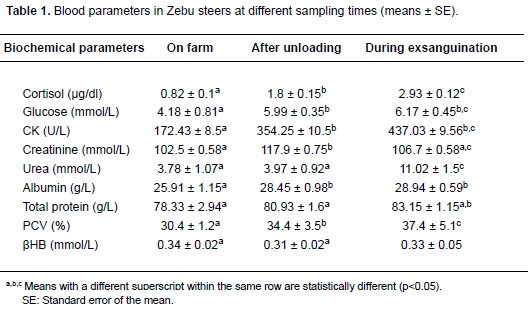
<body><![CDATA[<P>   The truck used during the study complied with   Colombian standards for cattle transport. This type of   truck is commonly used in Colombia for this purpose.   Its load capacity is 10&#8211;tons (14 to 15 animals), and it   has two axles, a rigid chassis (combined wood and   steel), passive ventilation and a canvas roof. The   slaughter plant assessed in our study operates from   Monday to Saturday (0600 to 1400 hours) and has a   slaughtering capacity of 500 to 600 animals/day at a   rate of 40 to 45 animals/hour. The concrete unloading   ramps have nonslip floors that are about as wide as the   livestock trailers. The ramps are connected by a series   of corridors leading to a lairage area that has 260 m<sup>2</sup> of   pens (3.65 m wide &times; 20 m long) with high&#8211;density   polyethylene screen and nonslip concrete floors. The   steers were individually weighed. Animals arriving   in different trucks are not mixed at the plant and each   group is housed in separate pens. Water is freely   available, but there is no access to food. A concrete   curved passageway leads from the lairage area to a   stunning box (1.80 m high &times; 0.90 m wide &times; 2.53 m   long) with a head fixation system. Access to the box   is through a guillotine door and a revolving iron exit   door. After being stunned by a non&#8211;penetrating captive   bolt, cattle are slaughtered, suspended by a hind leg,   bled, and transferred to the production line.</P>     <P>   <i>Blood analysis</i></P>     <P>   Packed cell volume (PCV) values were obtained   using the microhaematocrit technique. Leukocyte   profile (WBC) and neutrophil:lymphocytes ratio   (N/L) were performed during the microscopic   observation of blood sample slides stained with   Wright's stain. Serum cortisol concentrations (&mu;g/dl)   were determined by radioimmunoassay (RIA). The   inter&#8211;assay variation coefficient was 9.31%. The levels of glucose (mmol/L), urea (mmol/L), total protein   (g/L), creatinine (mmol/L), &beta;&#8211;hydroxybutyrate (&szlig;HB,   mmol/L), lactate (mmol/L), cortisol (&mu;g/dl), and   creatine kinase (CK, U/L) plasma concentrations   were determined.</P>     <P>   <i>Statistical analysis</i></P>     <P>   The data were analyzed using Stata 12.0 program   (College Station, Texas, USA). A normal distribution   of variable indicators of stress was established by   means of residual analysis. The activity of CK, lactate,   &beta;HB, urea, creatinine and glucose did not present   normal distributions, thus, values were transformed   to their natural logarithm and the PCV values to   their squared value&#8211;transformed values were used   in all subsequent analysis. Three observations were   used from each animal. Mixed linear models were   used to correct the correlation between the repeated   observations in each animal with several covariance   structures. In addition to the physiological variables,   the journey effect was also included in the model.   Correlations between physiological variables were   analyzed by Pearson's correlation coefficient. The   average (&plusmn;SE) of the stress indicators was reported,   and probability values of p&#706;0.05 were considered to   be statistically significant.</P>     <P>&nbsp;</P>     <P><font size="3"><b>Results</b></font></P>     <P>   In the present study a journey of less than 4 hours   did not affect protein metabolism as indicated by   normal values of creatinine, urea, total protein and   albumin plasma concentrations. In spite of being   increased when compared to basal values obtained   at the farm, these values were within reference   values. Nevertheless, there were significant changes   in the concentrations of cortisol, glucose, and CK   (<a href="#t1">Table 1</a>). No changes were evident in &beta;HB plasma   concentrations among the three stages of sampling.   During exsanguination, blood levels of cortisol, PCV,   lactate, and total protein increased, while creatinine   plasma concentration decreased compared to the   values obtained after unloading at the slaughterhouse.</P>       <p align="center"><a name="t1"></a><img src="/img/revistas/rccp/v27n4/v27n4a6t1.jpg"></p>     <p align="center">&nbsp;</p>     ]]></body>
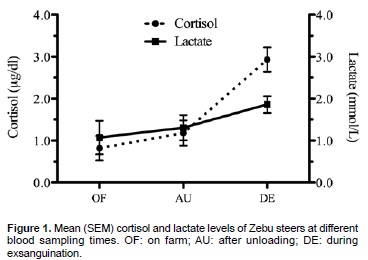
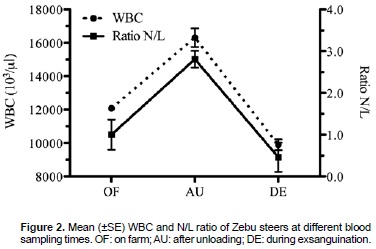
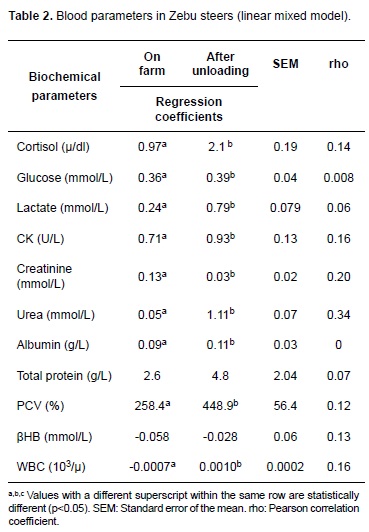
<body><![CDATA[<P>   The steers had significantly higher values (p&lt;0.05) of   cortisol after unloading and at exsanguination. The same   tendency was observed for lactate (<a href="#f1">Figure 1</a>). There were   significant differences in positive correlations between   cortisol and lactate levels (p&lt;0.05).</P>     <p align="center"><a name="f1"></a><img src="/img/revistas/rccp/v27n4/v27n4a6f1.jpg"></p>     <p align="center">&nbsp;</p>      <P> Leukocyte recounts did not show a consistent   pattern; results were high after unloading at the   slaughterhouse and then decreased at exsanguination   (p&lt;0.05). The same pattern was observed for the N/L   ratio (<a href="#f2">Figure 2</a>). The coefficient of correlation (rho)   indicates that a small correlation exists between blood   variables evaluated at the farm, upon arrival to the   slaughterhouse, and during exsanguination (<a href="#t2">Table 2</a>).</P>     <P>&nbsp;</P>     <p align="center"><a name="f2"></a><img src="/img/revistas/rccp/v27n4/v27n4a6f2.jpg"></p>     <p align="center">&nbsp;</p>     <p align="center"><a name="t2"></a><img src="/img/revistas/rccp/v27n4/v27n4a6t2.jpg"></p>     <p align="center">&nbsp;</p>        <P><font size="3">  <b>Discussion</b></font></P>     ]]></body>
<body><![CDATA[<P>   Increase in circulating levels of glucocorticoids,   such as cortisol, is a neuroendocrine indicator of   acute stress (Odore <i>et al.</i>, 2011; Miranda de&#8211;la Lama   <i>et al.</i>, 2011). The initial sampling of the animals in   the farm prior to loading showed that the cortisol   concentrations were within reference values   (0.61 &plusmn; 0.07 &mu;g/dl), which suggests that blood   sampling was not a stressor for the animals given   that it was done quickly and steers were sampled in   small groups (14 animals). Furthermore, the blood   cortisol increased even higher and was significantly   different immediately following unloading and during   exsanguination, surpassing the initial basal values of   the stressor. Studies by Tadich <i>et al.</i> (2003), Van de   Water <i>et al.</i> (2003) and Odore <i>et al.</i> (2011) suggest   that short transport time is a stress factor for cattle,   causing a wide range of physiological changes such as   increase of cortisol concentrations, especially during   herding, loading, and initial stages of this process.   Furthermore, the road connecting the farm with the   main roadways was unpaved. During transport on   unpaved roads, floor vibrations can be transmitted   to the animal and may create discomfort, displacing   the animal's center of gravity and may generate stress   (Miranda&#8211;de la Lama <i>et al.</i>, 2011). Nonetheless, other   existing factors related to transport could influence   the increase of cortisol serum concentrations, such as   unloading, handling, a new environment, and blood   sampling procedures that could disguise the true stress   agent in the study (Tadich <i>et al.</i>, 2005).</P>     <P>   Hyperglycemia, observed immediately after   unloading and exsanguination, could be a secondary   effect of cortisol production. It could also be   a result of increased liver glucose production   (gluconeogenesis) due to greater sympatho&#8211;adrenal   activity by adrenaline&#8211;mediated pre&#8211;slaughter   stress (Minka and Ayo, 2009; Ekis <i>et al.</i>, 2012).   Cortisol favors the synthesis of enzymes required   for converting amino acids, glycerol, and lactate into   glucose, thereby increasing amino acids mobility from   the muscle (Muchenje <i>et al.</i>, 2009). As previously   described, after short and long&#8211;term transport stress,   glucose level increases indicating metabolic depletion   associated with mobilization of energy reserves   (Miranda&#8211;de la Lama <i>et al.</i>, 2011). Hyperglycemia   during exsanguination could also be related to a peak in adrenaline and glucagon production at the moment   of stunning, both of which are regulators of hepatic   and muscular glycogenolysis (Tadich <i>et al.</i>, 2009).</P>     <P>   Plasma lactate is an indicator of acute stress related   to handling conditions, especially physical exercise,   agitation and muscular damage (Hambrecht <i>et al.</i>, 2005).   In this study, average lactate plasma levels were   different between animals and statistically different   at the three samplings, although they were all within   normal ranges for cattle (Kaneko, 2008). Additionally,   positive correlation between lactate and cortisol   levels after transport and during exsanguination were   observed. Cortisol secretion was related to anaerobic   activity, suggesting that lactate may stimulate cortisol   concentrations (Nogueira <i>et al.</i>, 2002).</P>     <P>   The CK activity is a sensible indicator of muscular   damage, increased physical activity, and muscular   fatigue, as reported in pigs (Hambrecht <i>et al.</i>, 2005),   cattle (Early <i>et al.</i>, 2012), lambs (Miranda&#8211;de la   Lama <i>et al.</i>, 2012), and goats (Ekiz <i>et al.</i>, 2012). In   our study, CK activity drastically increased during   the three blood samplings, surpassing the average   reference values (Kaneko, 2008). The high CK   values at the farm could have been related to cattle   handling during truck loading or transportation. These   activities may have increased membrane permeability   or harm muscle cells due to cattles' efforts to maintain   balance and avoid being thrown against the truck walls   during the trip (Romero <i>et al.</i>, 2013). Conversely,   besides absence of social structure ruptures at the   slaughterhouse, it is possible that the presence of   antagonistic meetings between steers (Strappini <i>et al.</i>, 2013) could have caused damage to the skeletal   muscles and subsequent enzymatic excretion   (Kannan <i>et al.</i>, 2003).</P>     <P>   The results obtained indicate that stress during   transport to a slaughterhouse located in the same   production area did not considerably affect metabolism,   in spite of the fact that changes in PCV, urea, creatinine   and albumin plasma concentrations were observed,   though they were within normal ranges (Buckham   Sporer <i>et al.</i>, 2008). Total protein values were slightly   greater than the normal values for steers (Kaneko,   2008). PCV allows evaluating electrolytes and fluids   alterations, indicating transport stress (Tadich <i>et al.</i>, 2003). Transport, fasting, and insufficient water   ingestion increase PCV (Tadich <i>et al.</i>, 2005). Significant   increases in PCV in each sampling were evident, yet   they remained within values considered normal for   cattle. This is possibly due to stressors exposure during   pre&#8211;slaughter, inducing a rapid and brief response   that causes neuronal hypothalamus activation and   adrenaline and noradrenaline excretion (Herskin <i>et al.</i>,   2004). Catecholamines place cattle in a state of alert,   producing tachycardia, peripheral vasoconstriction,   and hyperglycemia (Borell, 2001). PCV increase   observed during exsanguination could be due to   erythrocytes mobilization via splenic contraction in   response to catecholamines excreted during stunning   and exsanguination (M&ouml;stl and Palme, 2002; Ekis <i>et al.</i>, 2012). This generates great stress in animals as   evidenced in Colombian slaughterhouses where the   lack of stunning efficiency causes many of the animals   to regain consciousness during exsanguination, which   negatively impacts animal welfare (Romero <i>et al.</i>,   2012b; Romero <i>et al.</i>, 2012c). Dehydration was not   evident after an average lairage of 20.2 &plusmn; 0.21 h,   reinforcing the importance of adequate infrastructure   and optimal lairage conditions.</P>     <P>   Blood cell constituents maintain the physiological   balance in response to environmental conditions   by restoring normal homeostasis, and are sensitive   indicators of the physiological response to stress   (Miranda de&#8211;la Lama <i>et al.</i>, 2011). The N/L ratio   has been used as a complementary measurement   and is useful for evaluating transport stress (Gupta   <i>et al.</i>, 2007). Upon arrival to the slaughterhouse,   average leukocytes were greater than the normal   range (4 to 12.000 103/&mu;l). Neutrophilia was also   detected, suggesting an immune suppression, which   indicates a cumulative effect of factors associated with   transport handling, unloading, and blood sampling,   thus increasing cortisol levels, elapsing a leukocyte   and and N/L ratio increase (Blanco <i>et al.</i>, 2009).   Declines in leukocytes to basal values and N/L ratio   during exsanguination indicate that lairage had a   beneficial effect on welfare. At present, Colombian   legislation states a minimum of 12 h pre&#8211;slaughter   lairage for cattle (Romero <i>et al.</i>, 2011a). Colombian   researchers have recently found that cattle usually   remain 20 h or more in lairage, in agreement with our   results (Romero <i>et al.</i>, 2011b; Romero <i>et al.</i>, 2013).   Some researchers consider 12 h pre&#8211;slaughter lairage   for cattle being too long because stressful conditions (noise, fear, novelty, thirst, hunger, etc.) may increase   with time spent at the slaughterhouse, which may   lead to a decrease in meat quality. Hence, lairage   should be reduced to the minimum necessary to allow   antemortem inspection (Tadich <i>et al.</i>, 2005). The   differences found by several researches vary with the   factors studied, such as the effect of previous handling   (particularly if it has been relatively stress&#8211;free), the   physiological state of the steers upon arrival to the   slaughterhouse, environmental factors that encourage   cattle to rest, and the recommended holding times,   among others (Warriss, 2003). These aspects need to   be clarified and evaluated in further research.</P>     <P>   This study confirmed that &beta;HB is not a good   indicator of acute stress in cattle because it is used as   an energy source for external tissues when glucose   levels and glycogen reserves are reduced (McCue,   2010). Glucose, ketones and free fatty acids are   completely exhausted during exercise. Following   this process, muscle ketone oxidation decreases and   &beta;HB increases, indicating prolonged food deprivation   (Knowles and Warriss, 2006). The lack of differences   between &beta;HB at the farm, upon slaughterhouse   arrival, and during exsanguination indicate that food   deprivation for a short time period was counteracted   by &beta;HB provided by the rumen, where multiple days   are required for cattle to reach a physiological fasting   state (Tadich <i>et al.</i>, 2003).</P>     <P>   Our results showed that 4&#8211;hour transportation   caused an increase in plasma cortisol, CK, WBC and   N/L ratio, and it was a stress&#8211;generating event that   moderately affected animal welfare. Transport and   resting at the slaughterhouse did not alter protein   metabolism and dehydration was not present in the   steers. Changes in the studied variables indicate   that 20 h of lairage with adequate infrastructure and   optimal lairage conditions have a beneficial effect on   welfare of Zebu steers.</P>     <P>   These results highlight the importance of modernization   and regionalization of Colombian slaughterhouses,   allowing shorter transport periods and quick adaptation   to lairage conditions. Slaughterhouses should be modern   facilities to improve animal welfare. They must offer   fresh water, optimal lairage conditions, good handling   practices, and adequate transportation infrastructure,   among others. It is necessary to develop tools and   protocols to minimize cattle stress, considering that   sanitary legislation permits extensive holding times   and lairage.</P>     <P>&nbsp;</P>     ]]></body>
<body><![CDATA[<P><font size="3"><b>Acknowledgements</b></font></P>      <p>   This study was funded by the Colombian   Administrative Department of Science, Technology and   Innovation (COLCIENCIAS; project 1127&#8211;489&#8211;25244)   and Universidad de Caldas. The authors would like to   thank the people at the slaughterhouse owned by Red   C&aacute;rnica cooperative (Ci&eacute;naga de Oro, C&oacute;rdoba).</P>     <p>&nbsp;</P>     <P><font size="3"><b>Conflicts of interes</b></font></P>      <p>The authors declare they have no conflicts of interest   with regard to the work presented in this report. </P>      <p>&nbsp;</p>  <hr size="1" noshade>     <p><font size="3"><b>Notes</b></font></p>     <p>   <a href="#0b" name="0">&curren;</a> To cite this article: Romero MH, Uribe&#8211;Vel&aacute;squez LF, S&aacute;nchez JA. Physiological profiles of Zebu steers during transport and pre&#8211;slaughter. Rev Colomb   Cienc Pecu 2014; 27:282&#8211;289.</p> <hr size="1" noshade>     <P>&nbsp;</P>     <P><font size="3"><b>References</b></font></P>     ]]></body>
<body><![CDATA[<!-- ref --><P>Blanco M, Casas&uacute;s I, Palacio J. Effect of age at weaning on the   physiological stress response and temperament of two beef cattle breeds. Animal 2009; 3:108&#8211;117.    &nbsp;&nbsp;&nbsp;&nbsp;&nbsp;&nbsp;&nbsp;&nbsp;[&#160;<a href="javascript:void(0);" onclick="javascript: window.open('/scielo.php?script=sci_nlinks&ref=000083&pid=S0120-0690201400040000600001&lng=','','width=640,height=500,resizable=yes,scrollbars=1,menubar=yes,');">Links</a>&#160;]<!-- end-ref --></P>     <!-- ref --><P>   Borell EH. The biology of stress and its application to livestock   housing and transportation assessment. J Anim Sci 2001; 79:260&#8211;267.    &nbsp;&nbsp;&nbsp;&nbsp;&nbsp;&nbsp;&nbsp;&nbsp;[&#160;<a href="javascript:void(0);" onclick="javascript: window.open('/scielo.php?script=sci_nlinks&ref=000085&pid=S0120-0690201400040000600002&lng=','','width=640,height=500,resizable=yes,scrollbars=1,menubar=yes,');">Links</a>&#160;]<!-- end-ref --></P>     <!-- ref --><P>   Buckham Sporer KR, Weber PSD, Burton JL, Earley B, Crowe A.   Transportation of young beef bulls alters circulating physiological   parameters that may be effective biomarkers of stress. J Anim Sci 2008; 86:1325&#8211;1334.    &nbsp;&nbsp;&nbsp;&nbsp;&nbsp;&nbsp;&nbsp;&nbsp;[&#160;<a href="javascript:void(0);" onclick="javascript: window.open('/scielo.php?script=sci_nlinks&ref=000087&pid=S0120-0690201400040000600003&lng=','','width=640,height=500,resizable=yes,scrollbars=1,menubar=yes,');">Links</a>&#160;]<!-- end-ref --></P>     <!-- ref --><P>   Early E, Murray M, Prendiville DJ, Pintado B, Borque C, Canal E.   The effect of transport by road and sea on physiology, immunity and behavior of beef cattle. Res Vet Sci 2012; 92:531&#8211;541.    &nbsp;&nbsp;&nbsp;&nbsp;&nbsp;&nbsp;&nbsp;&nbsp;[&#160;<a href="javascript:void(0);" onclick="javascript: window.open('/scielo.php?script=sci_nlinks&ref=000089&pid=S0120-0690201400040000600004&lng=','','width=640,height=500,resizable=yes,scrollbars=1,menubar=yes,');">Links</a>&#160;]<!-- end-ref --></P>     <!-- ref --><P>   Ekiz B, Ekis EE, Kocak O, Yalcintan H, Yilmaz A. Effect of   pre&#8211;slaughter management regarding transportation and time in   lairage on certain stress parameters, carcass and meat quality characteristics in Kivircik lambs. Meat Sci 2012; 90:967&#8211;976.    &nbsp;&nbsp;&nbsp;&nbsp;&nbsp;&nbsp;&nbsp;&nbsp;[&#160;<a href="javascript:void(0);" onclick="javascript: window.open('/scielo.php?script=sci_nlinks&ref=000091&pid=S0120-0690201400040000600005&lng=','','width=640,height=500,resizable=yes,scrollbars=1,menubar=yes,');">Links</a>&#160;]<!-- end-ref --></P>     ]]></body>
<body><![CDATA[<!-- ref --><P>   Est&eacute;vez&#8211;Moreno LX, Santana AD, Camacho CG, Guti&eacute;rrez J,   G&oacute;mez MV, Garc&iacute;a G, Rozo MC, Ballesteros H. Competir e   innovar: la ruta de la industria bovina. Agenda prospectiva de   investigaci&oacute;n y desarrollo tecnol&oacute;gico para la cadena c&aacute;rnica   bovina en Colombia. 2009; [access date: Jun 12, 2013] URL:   <a href="http://es.scribd.com/doc/111157412/La–Ruta–de–La–Industria– Bovina–en–Colombia" target="_blank">http://es.scribd.com/doc/111157412/La&#8211;Ruta&#8211;de&#8211;La&#8211;Industria&#8211; Bovina&#8211;en&#8211;Colombia</a>.    &nbsp;&nbsp;&nbsp;&nbsp;&nbsp;&nbsp;&nbsp;&nbsp;[&#160;<a href="javascript:void(0);" onclick="javascript: window.open('/scielo.php?script=sci_nlinks&ref=000093&pid=S0120-0690201400040000600006&lng=','','width=640,height=500,resizable=yes,scrollbars=1,menubar=yes,');">Links</a>&#160;]<!-- end-ref --></P>     <!-- ref --><P>   Gupta S, Earley B, Crowe MA. Effect of 12&#8211;hour road   transportation on physiological, immunological and hematological   parameters in bulls housed at different space allowances. Vet J 2007; 173:605&#8211;616.    &nbsp;&nbsp;&nbsp;&nbsp;&nbsp;&nbsp;&nbsp;&nbsp;[&#160;<a href="javascript:void(0);" onclick="javascript: window.open('/scielo.php?script=sci_nlinks&ref=000095&pid=S0120-0690201400040000600007&lng=','','width=640,height=500,resizable=yes,scrollbars=1,menubar=yes,');">Links</a>&#160;]<!-- end-ref --></P>     <!-- ref --><P>   Hambrecht E, Eissen JJ, Newman DJ, Smits CHM, den Hartog LA, Verstegen MWA. Negative effects of stress immediately before slaughter on pork quality are aggravated by suboptimal transport and lairage conditions. J Anim Sci 2005; 83:440&#8211;448.    &nbsp;&nbsp;&nbsp;&nbsp;&nbsp;&nbsp;&nbsp;&nbsp;[&#160;<a href="javascript:void(0);" onclick="javascript: window.open('/scielo.php?script=sci_nlinks&ref=000097&pid=S0120-0690201400040000600008&lng=','','width=640,height=500,resizable=yes,scrollbars=1,menubar=yes,');">Links</a>&#160;]<!-- end-ref --></P>     <!-- ref --><P>   Kaneko J. Carbohydrate metabolism and its diseases. In: Jiro   Kaneko, John Harvey, Michael Bruss, editors. Clinical Biochemistry   of Domestic Animals. 6th ed. USA: Elsevier; 2008. p.458&#8211;75.    &nbsp;&nbsp;&nbsp;&nbsp;&nbsp;&nbsp;&nbsp;&nbsp;[&#160;<a href="javascript:void(0);" onclick="javascript: window.open('/scielo.php?script=sci_nlinks&ref=000099&pid=S0120-0690201400040000600009&lng=','','width=640,height=500,resizable=yes,scrollbars=1,menubar=yes,');">Links</a>&#160;]<!-- end-ref --></P>     <!-- ref --><P>   Kannan G, Kouakou B, Terril TH, Gelaye S. Endocrine, blood   metabolite, and meat quality changes in goats as influenced by   short&#8211;term, preslaughter stress. J Anim Sci 2003; 81:1499&#8211;1507.    &nbsp;&nbsp;&nbsp;&nbsp;&nbsp;&nbsp;&nbsp;&nbsp;[&#160;<a href="javascript:void(0);" onclick="javascript: window.open('/scielo.php?script=sci_nlinks&ref=000101&pid=S0120-0690201400040000600010&lng=','','width=640,height=500,resizable=yes,scrollbars=1,menubar=yes,');">Links</a>&#160;]<!-- end-ref --></P>     ]]></body>
<body><![CDATA[<!-- ref --><P>   Herskin MS, Munksgaard L, Ladewig J. Effects of acute stressors   on nociception, adrenocortical responses and behavior of dairy   cows. Physiol Behav 2004; 83:41&#8211;420.    &nbsp;&nbsp;&nbsp;&nbsp;&nbsp;&nbsp;&nbsp;&nbsp;[&#160;<a href="javascript:void(0);" onclick="javascript: window.open('/scielo.php?script=sci_nlinks&ref=000103&pid=S0120-0690201400040000600011&lng=','','width=640,height=500,resizable=yes,scrollbars=1,menubar=yes,');">Links</a>&#160;]<!-- end-ref --></P>     <!-- ref --><P>   Knowles T and Warriss P. Stress physiology of animals during   transport. In: T Grandin, editor. Livestock handling and transport.   3ed. Massachusetts: CAB International; 2006. p.312&#8211;28.    &nbsp;&nbsp;&nbsp;&nbsp;&nbsp;&nbsp;&nbsp;&nbsp;[&#160;<a href="javascript:void(0);" onclick="javascript: window.open('/scielo.php?script=sci_nlinks&ref=000105&pid=S0120-0690201400040000600012&lng=','','width=640,height=500,resizable=yes,scrollbars=1,menubar=yes,');">Links</a>&#160;]<!-- end-ref --></P>     <!-- ref --><P>   Ljungberg D, Gebresenbet G, Aradom S. Logistics chain of animal   transport and abattoir operations. Biosys Eng 2007; 96:267&#8211;277.    &nbsp;&nbsp;&nbsp;&nbsp;&nbsp;&nbsp;&nbsp;&nbsp;[&#160;<a href="javascript:void(0);" onclick="javascript: window.open('/scielo.php?script=sci_nlinks&ref=000107&pid=S0120-0690201400040000600013&lng=','','width=640,height=500,resizable=yes,scrollbars=1,menubar=yes,');">Links</a>&#160;]<!-- end-ref --></P>     <!-- ref --><P>   McCue MD. Starvation physiology: Reviewing the different   strategies animals use to survive a common challenge. Com   biochem Physiol, Part A 2010; 156:1&#8211;18.    &nbsp;&nbsp;&nbsp;&nbsp;&nbsp;&nbsp;&nbsp;&nbsp;[&#160;<a href="javascript:void(0);" onclick="javascript: window.open('/scielo.php?script=sci_nlinks&ref=000109&pid=S0120-0690201400040000600014&lng=','','width=640,height=500,resizable=yes,scrollbars=1,menubar=yes,');">Links</a>&#160;]<!-- end-ref --></P>     <!-- ref --><P>   Minka NS, Ayo JO. Physiological responses of food animals to   road transportation stress. African J Biotechnol 2009; 8:7415&#8211;7427.    &nbsp;&nbsp;&nbsp;&nbsp;&nbsp;&nbsp;&nbsp;&nbsp;[&#160;<a href="javascript:void(0);" onclick="javascript: window.open('/scielo.php?script=sci_nlinks&ref=000111&pid=S0120-0690201400040000600015&lng=','','width=640,height=500,resizable=yes,scrollbars=1,menubar=yes,');">Links</a>&#160;]<!-- end-ref --></P>     ]]></body>
<body><![CDATA[<!-- ref --><P>   Miranda&#8211;de la Lama GC, Monge P, Villarroel M, Olleta JL,   Garc&iacute;a&#8211;Belenguer S, Mar&iacute;a GA. Effects of road type during   transport on lamb welfare and meat quality in dry hot climates.   Trop Anim Health Prod 2011; 43:915&#8211;922.    &nbsp;&nbsp;&nbsp;&nbsp;&nbsp;&nbsp;&nbsp;&nbsp;[&#160;<a href="javascript:void(0);" onclick="javascript: window.open('/scielo.php?script=sci_nlinks&ref=000113&pid=S0120-0690201400040000600016&lng=','','width=640,height=500,resizable=yes,scrollbars=1,menubar=yes,');">Links</a>&#160;]<!-- end-ref --></P>     <!-- ref --><P>   Miranda&#8211;de la Lama GC, Salazar&#8211;Sotelo MI, P&eacute;rez&#8211;Linares C,   Figueroa&#8211;Saavedra F, Villarroel M, Sa&ntilde;udo C, Maria GA. Effects   of two transport system on lamb welfare and meat quality. Meat   Sci 2012; 92:554&#8211;561.    &nbsp;&nbsp;&nbsp;&nbsp;&nbsp;&nbsp;&nbsp;&nbsp;[&#160;<a href="javascript:void(0);" onclick="javascript: window.open('/scielo.php?script=sci_nlinks&ref=000115&pid=S0120-0690201400040000600017&lng=','','width=640,height=500,resizable=yes,scrollbars=1,menubar=yes,');">Links</a>&#160;]<!-- end-ref --></P>     <!-- ref --><P>   M&ouml;stl E, Palme R. Hormones as indicators of stress. Domest Anim   Endocrinol 2002; 23:67&#8211;74.    &nbsp;&nbsp;&nbsp;&nbsp;&nbsp;&nbsp;&nbsp;&nbsp;[&#160;<a href="javascript:void(0);" onclick="javascript: window.open('/scielo.php?script=sci_nlinks&ref=000117&pid=S0120-0690201400040000600018&lng=','','width=640,height=500,resizable=yes,scrollbars=1,menubar=yes,');">Links</a>&#160;]<!-- end-ref --></P>     <!-- ref --><P>   Ministerio de la Protecci&oacute;n Social. Colombia. Decreto No 1500 de   2007, mayo 4, por el cual se establece el reglamento t&eacute;cnico a trav&eacute;s   del cual se crea el Sistema Oficial de Inspecci&oacute;n, Vigilancia y Control   de la Carne, Productos C&aacute;rnicos Comestibles y Derivados C&aacute;rnicos   Destinados para el Consumo Humano y los requisitos sanitarios   y de inocuidad que se deben cumplir en su producci&oacute;n primaria,   beneficio, desposte, desprese, procesamiento, almacenamiento,   transporte, comercializaci&oacute;n, expendio, importaci&oacute;n o exportaci&oacute;n.   Bogota D. C.: el ministerio; 2007. URL: <a href="http://www.minambiente.gov.co/documentos/dec_1500_040507.pdf" target="_blank">http://www.minambiente.gov.co/documentos/dec_1500_040507.pdf</a>.    &nbsp;&nbsp;&nbsp;&nbsp;&nbsp;&nbsp;&nbsp;&nbsp;[&#160;<a href="javascript:void(0);" onclick="javascript: window.open('/scielo.php?script=sci_nlinks&ref=000119&pid=S0120-0690201400040000600019&lng=','','width=640,height=500,resizable=yes,scrollbars=1,menubar=yes,');">Links</a>&#160;]<!-- end-ref --></P>     <!-- ref --><P>   Muchenje V, Dzama K, Chimonyo M, Strydom PE, Raats JG.   Relationship between pre&#8211;slaughter stress responsiveness and   beef quality in three cattle breeds. Meat Sci 2009; 81:653&#8211;657.    &nbsp;&nbsp;&nbsp;&nbsp;&nbsp;&nbsp;&nbsp;&nbsp;[&#160;<a href="javascript:void(0);" onclick="javascript: window.open('/scielo.php?script=sci_nlinks&ref=000121&pid=S0120-0690201400040000600020&lng=','','width=640,height=500,resizable=yes,scrollbars=1,menubar=yes,');">Links</a>&#160;]<!-- end-ref --></P>     ]]></body>
<body><![CDATA[<!-- ref --><P>   Nogueira GP, Barnabe RC, Bedran&#8211;de Castro JC, Moreira AF,   Fernandes WR, Mirandola RMS, Howard DL. Serum cortisol, lactate   and creatinine concentrations in Thoroughbred fillies of different   ages and states of training. Braz J Vet Res Anim Sci 2002; 39:54&#8211;57.    &nbsp;&nbsp;&nbsp;&nbsp;&nbsp;&nbsp;&nbsp;&nbsp;[&#160;<a href="javascript:void(0);" onclick="javascript: window.open('/scielo.php?script=sci_nlinks&ref=000123&pid=S0120-0690201400040000600021&lng=','','width=640,height=500,resizable=yes,scrollbars=1,menubar=yes,');">Links</a>&#160;]<!-- end-ref --></P>     <!-- ref --><P>   Odore R, Bandino P, Re G, Barbero R, Cuniberti B, D'Angelo   A, Girardi C, Fraccaro E, Tarantola M. Effects of housing and   short&#8211;term transportation on hormone and lymphocyte receptor   concentrations in beef cattle. Res Vet Sci 2011; 90:341&#8211;354.    &nbsp;&nbsp;&nbsp;&nbsp;&nbsp;&nbsp;&nbsp;&nbsp;[&#160;<a href="javascript:void(0);" onclick="javascript: window.open('/scielo.php?script=sci_nlinks&ref=000125&pid=S0120-0690201400040000600022&lng=','','width=640,height=500,resizable=yes,scrollbars=1,menubar=yes,');">Links</a>&#160;]<!-- end-ref --></P>     <!-- ref --><P>   Paranhos da Costa MJR, Tarazona AM. Practical approach on   how to improve the welfare in cattle. Rev Colomb Cienc Pecu   2011; 24:347&#8211;359.    &nbsp;&nbsp;&nbsp;&nbsp;&nbsp;&nbsp;&nbsp;&nbsp;[&#160;<a href="javascript:void(0);" onclick="javascript: window.open('/scielo.php?script=sci_nlinks&ref=000127&pid=S0120-0690201400040000600023&lng=','','width=640,height=500,resizable=yes,scrollbars=1,menubar=yes,');">Links</a>&#160;]<!-- end-ref --></P>     <!-- ref --><P>   Paranhos da Costa MJR, Huertas SM, Gallo C, Dalla Costa O A.   Strategies to promote farm animal welfare in Latin America and   their effects on carcass and meat quality traits. Meat Sci 2012;   92: 221&#8211;226.    &nbsp;&nbsp;&nbsp;&nbsp;&nbsp;&nbsp;&nbsp;&nbsp;[&#160;<a href="javascript:void(0);" onclick="javascript: window.open('/scielo.php?script=sci_nlinks&ref=000129&pid=S0120-0690201400040000600024&lng=','','width=640,height=500,resizable=yes,scrollbars=1,menubar=yes,');">Links</a>&#160;]<!-- end-ref --></P>     <!-- ref --><P>   Romero MH, S&aacute;nchez JA. Implicaciones de la inclusi&oacute;n del   bienestar animal en la legislaci&oacute;n sanitaria colombiana. Rev   Colomb Cienc Pecu 2011a; 24:93&#8211;101.    &nbsp;&nbsp;&nbsp;&nbsp;&nbsp;&nbsp;&nbsp;&nbsp;[&#160;<a href="javascript:void(0);" onclick="javascript: window.open('/scielo.php?script=sci_nlinks&ref=000131&pid=S0120-0690201400040000600025&lng=','','width=640,height=500,resizable=yes,scrollbars=1,menubar=yes,');">Links</a>&#160;]<!-- end-ref --></P>     ]]></body>
<body><![CDATA[<!-- ref --><P>   Romero MH, S&aacute;nchez JA, Guti&eacute;rrez C. Evaluaci&oacute;n de pr&aacute;cticas de   bienestar animal durante el transporte de bovinos para sacrificio.   Rev Salud p&uacute;blica 2011b; 13:684&#8211;690.    &nbsp;&nbsp;&nbsp;&nbsp;&nbsp;&nbsp;&nbsp;&nbsp;[&#160;<a href="javascript:void(0);" onclick="javascript: window.open('/scielo.php?script=sci_nlinks&ref=000133&pid=S0120-0690201400040000600026&lng=','','width=640,height=500,resizable=yes,scrollbars=1,menubar=yes,');">Links</a>&#160;]<!-- end-ref --></P>     <!-- ref --><P>   Romero MH, S&aacute;nchez JA, Guti&eacute;rrez C. Evaluaci&oacute;n de contusiones   como un indicador de bienestar animal durante el pre&#8211;sacrificio de   bovinos. Rev Colomb Cienc Pecu 2012a; 25:267&#8211;275.    &nbsp;&nbsp;&nbsp;&nbsp;&nbsp;&nbsp;&nbsp;&nbsp;[&#160;<a href="javascript:void(0);" onclick="javascript: window.open('/scielo.php?script=sci_nlinks&ref=000135&pid=S0120-0690201400040000600027&lng=','','width=640,height=500,resizable=yes,scrollbars=1,menubar=yes,');">Links</a>&#160;]<!-- end-ref -->  </P>     <!-- ref --><P>Romero MH, Uribe&#8211;Vel&aacute;squez LF, S&aacute;nchez JA. Evaluaci&oacute;n de la   conducta y las pr&aacute;cticas de manejo durante el sacrificio bovino,   como indicadores de bienestar animal. Rev CES Med Zootec   2012b; 7:22&#8211;29.    &nbsp;&nbsp;&nbsp;&nbsp;&nbsp;&nbsp;&nbsp;&nbsp;[&#160;<a href="javascript:void(0);" onclick="javascript: window.open('/scielo.php?script=sci_nlinks&ref=000137&pid=S0120-0690201400040000600028&lng=','','width=640,height=500,resizable=yes,scrollbars=1,menubar=yes,');">Links</a>&#160;]<!-- end-ref --></P>     <!-- ref --><P>   Romero MH, Gonz&aacute;lez LM, Cobo CG. Evaluaci&oacute;n del bienestar   animal por medio de indicadores conductuales durante el sacrificio   de bovinos. Rev Luna Azul 2012c; 35:48&#8211;59.    &nbsp;&nbsp;&nbsp;&nbsp;&nbsp;&nbsp;&nbsp;&nbsp;[&#160;<a href="javascript:void(0);" onclick="javascript: window.open('/scielo.php?script=sci_nlinks&ref=000139&pid=S0120-0690201400040000600029&lng=','','width=640,height=500,resizable=yes,scrollbars=1,menubar=yes,');">Links</a>&#160;]<!-- end-ref --></P>     <!-- ref --><P>   Romero MH, Uribe&#8211;Vel&aacute;squez LF, S&aacute;nchez JA, Miranda de&#8211;la   Lama GC. Risk factors influencing bruising and high muscle pH   in Colombian cattle carcasses due to transport and pre&#8211;slaughter   operations. Meat Sci 2013; 95:256&#8211;263.    &nbsp;&nbsp;&nbsp;&nbsp;&nbsp;&nbsp;&nbsp;&nbsp;[&#160;<a href="javascript:void(0);" onclick="javascript: window.open('/scielo.php?script=sci_nlinks&ref=000141&pid=S0120-0690201400040000600030&lng=','','width=640,height=500,resizable=yes,scrollbars=1,menubar=yes,');">Links</a>&#160;]<!-- end-ref --></P>     ]]></body>
<body><![CDATA[<!-- ref --><P>   Strappini AC, Metz JHM, Gallo C, Frankena K, Vargas R, de   Freslon I, Kemp B. Bruises in culled cows: when, where and   how are they inflicted? Animal 2013; 7:485&#8211;491.    &nbsp;&nbsp;&nbsp;&nbsp;&nbsp;&nbsp;&nbsp;&nbsp;[&#160;<a href="javascript:void(0);" onclick="javascript: window.open('/scielo.php?script=sci_nlinks&ref=000143&pid=S0120-0690201400040000600031&lng=','','width=640,height=500,resizable=yes,scrollbars=1,menubar=yes,');">Links</a>&#160;]<!-- end-ref --></P>     <!-- ref --><P>   Tadich N, Gallo C, Echeverr&iacute;a R, van Schaik G. Efecto del ayuno   durante dos tiempos de confinamiento y de transporte terrestre   sobre algunas variables sangu&iacute;neas indicadoras de estr&eacute;s en   novillos. Arch Med Vet 2003; 2:171&#8211;185.    &nbsp;&nbsp;&nbsp;&nbsp;&nbsp;&nbsp;&nbsp;&nbsp;[&#160;<a href="javascript:void(0);" onclick="javascript: window.open('/scielo.php?script=sci_nlinks&ref=000145&pid=S0120-0690201400040000600032&lng=','','width=640,height=500,resizable=yes,scrollbars=1,menubar=yes,');">Links</a>&#160;]<!-- end-ref --></P>     <!-- ref --><P>   Tadich N, Gallo C, Bustamante H, Schwerter M, van Schaik   G. Effects of transport and lairage time on some blood   constituents of Friesian&#8211;cross steers in Chile. Livest Prod Sci   2005; 93:223&#8211;233.    &nbsp;&nbsp;&nbsp;&nbsp;&nbsp;&nbsp;&nbsp;&nbsp;[&#160;<a href="javascript:void(0);" onclick="javascript: window.open('/scielo.php?script=sci_nlinks&ref=000147&pid=S0120-0690201400040000600033&lng=','','width=640,height=500,resizable=yes,scrollbars=1,menubar=yes,');">Links</a>&#160;]<!-- end-ref --></P>     <!-- ref --><P>   Tadich N, Gallo C, Brito ML, Broom DM. Effects of weaning   and 48 h transport by road and ferry on some blood indicators of   welfare in lambs. Lives Sci 2009; 121:132&#8211;136.    &nbsp;&nbsp;&nbsp;&nbsp;&nbsp;&nbsp;&nbsp;&nbsp;[&#160;<a href="javascript:void(0);" onclick="javascript: window.open('/scielo.php?script=sci_nlinks&ref=000149&pid=S0120-0690201400040000600034&lng=','','width=640,height=500,resizable=yes,scrollbars=1,menubar=yes,');">Links</a>&#160;]<!-- end-ref --></P>     <!-- ref --><P>   Van de Water G, Verjans F, Geers R. The effect of short distance   transport under commercial conditions on the physiology of   slaughter calves; pH and colour profiles of veal. Lives Prod Sci   2003; 82:171&#8211;179.    &nbsp;&nbsp;&nbsp;&nbsp;&nbsp;&nbsp;&nbsp;&nbsp;[&#160;<a href="javascript:void(0);" onclick="javascript: window.open('/scielo.php?script=sci_nlinks&ref=000151&pid=S0120-0690201400040000600035&lng=','','width=640,height=500,resizable=yes,scrollbars=1,menubar=yes,');">Links</a>&#160;]<!-- end-ref --></P>     ]]></body>
<body><![CDATA[<!-- ref --><P>   Warriss PD. Optimal lairage times and conditions for slaughter   pigs: a review. Vet Rec 2003; 153;170&#8211;176&nbsp;&nbsp;&nbsp;&nbsp;&nbsp;&nbsp;&nbsp;&nbsp;[&#160;<a href="javascript:void(0);" onclick="javascript: window.open('/scielo.php?script=sci_nlinks&ref=000153&pid=S0120-0690201400040000600036&lng=','','width=640,height=500,resizable=yes,scrollbars=1,menubar=yes,');">Links</a>&#160;]<!-- end-ref --><P>&nbsp;</P> </font>         ]]></body><back>
<ref-list>
<ref id="B1">
<nlm-citation citation-type="journal">
<person-group person-group-type="author">
<name>
<surname><![CDATA[Blanco]]></surname>
<given-names><![CDATA[M]]></given-names>
</name>
<name>
<surname><![CDATA[Casasús]]></surname>
<given-names><![CDATA[I]]></given-names>
</name>
<name>
<surname><![CDATA[Palacio]]></surname>
<given-names><![CDATA[J]]></given-names>
</name>
</person-group>
<article-title xml:lang="en"><![CDATA[Effect of age at weaning on the physiological stress response and temperament of two beef cattle breeds]]></article-title>
<source><![CDATA[Animal]]></source>
<year>2009</year>
<volume>3</volume>
<page-range>108-117</page-range></nlm-citation>
</ref>
<ref id="B2">
<nlm-citation citation-type="journal">
<person-group person-group-type="author">
<name>
<surname><![CDATA[Borell]]></surname>
<given-names><![CDATA[EH]]></given-names>
</name>
</person-group>
<article-title xml:lang="en"><![CDATA[The biology of stress and its application to livestock housing and transportation assessment]]></article-title>
<source><![CDATA[J Anim Sci]]></source>
<year>2001</year>
<volume>79</volume>
<page-range>260-267</page-range></nlm-citation>
</ref>
<ref id="B3">
<nlm-citation citation-type="journal">
<person-group person-group-type="author">
<name>
<surname><![CDATA[Buckham]]></surname>
<given-names><![CDATA[Sporer KR]]></given-names>
</name>
<name>
<surname><![CDATA[Weber]]></surname>
<given-names><![CDATA[PSD]]></given-names>
</name>
<name>
<surname><![CDATA[Burton]]></surname>
<given-names><![CDATA[JL]]></given-names>
</name>
<name>
<surname><![CDATA[Earley]]></surname>
<given-names><![CDATA[B]]></given-names>
</name>
<name>
<surname><![CDATA[Crowe]]></surname>
<given-names><![CDATA[A]]></given-names>
</name>
</person-group>
<article-title xml:lang="en"><![CDATA[Transportation of young beef bulls alters circulating physiological parameters that may be effective biomarkers of stress]]></article-title>
<source><![CDATA[J Anim Sci]]></source>
<year>2008</year>
<volume>86</volume>
<page-range>1325-1334</page-range></nlm-citation>
</ref>
<ref id="B4">
<nlm-citation citation-type="journal">
<person-group person-group-type="author">
<name>
<surname><![CDATA[Early]]></surname>
<given-names><![CDATA[E]]></given-names>
</name>
<name>
<surname><![CDATA[Murray]]></surname>
<given-names><![CDATA[M]]></given-names>
</name>
<name>
<surname><![CDATA[Prendiville]]></surname>
<given-names><![CDATA[DJ]]></given-names>
</name>
<name>
<surname><![CDATA[Pintado]]></surname>
<given-names><![CDATA[B]]></given-names>
</name>
<name>
<surname><![CDATA[Borque]]></surname>
<given-names><![CDATA[C]]></given-names>
</name>
<name>
<surname><![CDATA[Canal]]></surname>
<given-names><![CDATA[E]]></given-names>
</name>
</person-group>
<article-title xml:lang="en"><![CDATA[The effect of transport by road and sea on physiology, immunity and behavior of beef cattle]]></article-title>
<source><![CDATA[Res Vet Sci]]></source>
<year>2012</year>
<volume>92</volume>
<page-range>531-541</page-range></nlm-citation>
</ref>
<ref id="B5">
<nlm-citation citation-type="journal">
<person-group person-group-type="author">
<name>
<surname><![CDATA[Ekiz]]></surname>
<given-names><![CDATA[B]]></given-names>
</name>
<name>
<surname><![CDATA[Ekis]]></surname>
<given-names><![CDATA[EE]]></given-names>
</name>
<name>
<surname><![CDATA[Kocak]]></surname>
<given-names><![CDATA[O]]></given-names>
</name>
<name>
<surname><![CDATA[Yalcintan]]></surname>
<given-names><![CDATA[H]]></given-names>
</name>
<name>
<surname><![CDATA[Yilmaz]]></surname>
<given-names><![CDATA[A]]></given-names>
</name>
</person-group>
<article-title xml:lang="en"><![CDATA[Effect of pre-slaughter management regarding transportation and time in lairage on certain stress parameters, carcass and meat quality characteristics in Kivircik lambs]]></article-title>
<source><![CDATA[Meat Sci]]></source>
<year>2012</year>
<volume>90</volume>
<page-range>967-976</page-range></nlm-citation>
</ref>
<ref id="B6">
<nlm-citation citation-type="">
<person-group person-group-type="author">
<name>
<surname><![CDATA[Estévez-Moreno]]></surname>
<given-names><![CDATA[LX]]></given-names>
</name>
<name>
<surname><![CDATA[Santana]]></surname>
<given-names><![CDATA[AD]]></given-names>
</name>
<name>
<surname><![CDATA[Camacho]]></surname>
<given-names><![CDATA[CG]]></given-names>
</name>
<name>
<surname><![CDATA[Gutiérrez]]></surname>
<given-names><![CDATA[J]]></given-names>
</name>
<name>
<surname><![CDATA[Gómez]]></surname>
<given-names><![CDATA[MV]]></given-names>
</name>
<name>
<surname><![CDATA[García]]></surname>
<given-names><![CDATA[G]]></given-names>
</name>
<name>
<surname><![CDATA[Rozo]]></surname>
<given-names><![CDATA[MC]]></given-names>
</name>
<name>
<surname><![CDATA[Ballesteros]]></surname>
<given-names><![CDATA[H]]></given-names>
</name>
</person-group>
<source><![CDATA[Competir e innovar: la ruta de la industria bovina. Agenda prospectiva de investigación y desarrollo tecnológico para la cadena cárnica bovina en Colombia. 2009]]></source>
<year></year>
</nlm-citation>
</ref>
<ref id="B7">
<nlm-citation citation-type="journal">
<person-group person-group-type="author">
<name>
<surname><![CDATA[Gupta]]></surname>
<given-names><![CDATA[S]]></given-names>
</name>
<name>
<surname><![CDATA[Earley]]></surname>
<given-names><![CDATA[B]]></given-names>
</name>
<name>
<surname><![CDATA[Crowe]]></surname>
<given-names><![CDATA[MA]]></given-names>
</name>
</person-group>
<article-title xml:lang="en"><![CDATA[Effect of 12-hour road transportation on physiological, immunological and hematological parameters in bulls housed at different space allowances]]></article-title>
<source><![CDATA[Vet J]]></source>
<year>2007</year>
<volume>173</volume>
<page-range>605-616</page-range></nlm-citation>
</ref>
<ref id="B8">
<nlm-citation citation-type="journal">
<person-group person-group-type="author">
<name>
<surname><![CDATA[Hambrecht]]></surname>
<given-names><![CDATA[E]]></given-names>
</name>
<name>
<surname><![CDATA[Eissen]]></surname>
<given-names><![CDATA[JJ]]></given-names>
</name>
<name>
<surname><![CDATA[Newman]]></surname>
<given-names><![CDATA[DJ]]></given-names>
</name>
<name>
<surname><![CDATA[Smits]]></surname>
<given-names><![CDATA[CHM]]></given-names>
</name>
<name>
<surname><![CDATA[den Hartog]]></surname>
<given-names><![CDATA[LA]]></given-names>
</name>
<name>
<surname><![CDATA[Verstegen]]></surname>
<given-names><![CDATA[MWA]]></given-names>
</name>
</person-group>
<article-title xml:lang="en"><![CDATA[Negative effects of stress immediately before slaughter on pork quality are aggravated by suboptimal transport and lairage conditions]]></article-title>
<source><![CDATA[J Anim Sci]]></source>
<year>2005</year>
<volume>83</volume>
<page-range>440-448</page-range></nlm-citation>
</ref>
<ref id="B9">
<nlm-citation citation-type="book">
<person-group person-group-type="author">
<name>
<surname><![CDATA[Kaneko]]></surname>
<given-names><![CDATA[J]]></given-names>
</name>
</person-group>
<article-title xml:lang="en"><![CDATA[Carbohydrate metabolism and its diseases]]></article-title>
<person-group person-group-type="editor">
<name>
<surname><![CDATA[Kaneko]]></surname>
<given-names><![CDATA[Jiro]]></given-names>
</name>
<name>
<surname><![CDATA[Harvey]]></surname>
<given-names><![CDATA[John]]></given-names>
</name>
<name>
<surname><![CDATA[Bruss]]></surname>
<given-names><![CDATA[Michael]]></given-names>
</name>
</person-group>
<source><![CDATA[Clinical Biochemistry of Domestic Animals]]></source>
<year>2008</year>
<edition>6th</edition>
<page-range>458-75</page-range><publisher-name><![CDATA[Elsevier]]></publisher-name>
</nlm-citation>
</ref>
<ref id="B10">
<nlm-citation citation-type="journal">
<person-group person-group-type="author">
<name>
<surname><![CDATA[Kannan]]></surname>
<given-names><![CDATA[G]]></given-names>
</name>
<name>
<surname><![CDATA[Kouakou]]></surname>
<given-names><![CDATA[B]]></given-names>
</name>
<name>
<surname><![CDATA[Terril]]></surname>
<given-names><![CDATA[TH]]></given-names>
</name>
<name>
<surname><![CDATA[Gelaye]]></surname>
<given-names><![CDATA[S]]></given-names>
</name>
</person-group>
<article-title xml:lang="en"><![CDATA[Endocrine, blood metabolite, and meat quality changes in goats as influenced by short-term, preslaughter stress]]></article-title>
<source><![CDATA[J Anim Sci]]></source>
<year>2003</year>
<volume>81</volume>
<page-range>1499-1507</page-range></nlm-citation>
</ref>
<ref id="B11">
<nlm-citation citation-type="journal">
<person-group person-group-type="author">
<name>
<surname><![CDATA[Herskin]]></surname>
<given-names><![CDATA[MS]]></given-names>
</name>
<name>
<surname><![CDATA[Munksgaard]]></surname>
<given-names><![CDATA[L]]></given-names>
</name>
<name>
<surname><![CDATA[Ladewig]]></surname>
<given-names><![CDATA[J]]></given-names>
</name>
</person-group>
<article-title xml:lang="en"><![CDATA[Effects of acute stressors on nociception, adrenocortical responses and behavior of dairy cows]]></article-title>
<source><![CDATA[Physiol Behav]]></source>
<year>2004</year>
<volume>83</volume>
<page-range>41-420</page-range></nlm-citation>
</ref>
<ref id="B12">
<nlm-citation citation-type="book">
<person-group person-group-type="author">
<name>
<surname><![CDATA[Knowles]]></surname>
<given-names><![CDATA[T]]></given-names>
</name>
<name>
<surname><![CDATA[Warriss]]></surname>
<given-names><![CDATA[P]]></given-names>
</name>
</person-group>
<article-title xml:lang="en"><![CDATA[Stress physiology of animals during transport]]></article-title>
<person-group person-group-type="editor">
<name>
<surname><![CDATA[Grandin]]></surname>
<given-names><![CDATA[T]]></given-names>
</name>
</person-group>
<source><![CDATA[Livestock handling and transport]]></source>
<year>2006</year>
<edition>3</edition>
<page-range>312-28</page-range><publisher-loc><![CDATA[Massachusetts ]]></publisher-loc>
<publisher-name><![CDATA[CAB International]]></publisher-name>
</nlm-citation>
</ref>
<ref id="B13">
<nlm-citation citation-type="journal">
<person-group person-group-type="author">
<name>
<surname><![CDATA[Ljungberg]]></surname>
<given-names><![CDATA[D]]></given-names>
</name>
<name>
<surname><![CDATA[Gebresenbet]]></surname>
<given-names><![CDATA[G]]></given-names>
</name>
<name>
<surname><![CDATA[Aradom]]></surname>
<given-names><![CDATA[S]]></given-names>
</name>
</person-group>
<article-title xml:lang="en"><![CDATA[Logistics chain of animal transport and abattoir operations]]></article-title>
<source><![CDATA[Biosys Eng]]></source>
<year>2007</year>
<volume>96</volume>
<page-range>267-277</page-range></nlm-citation>
</ref>
<ref id="B14">
<nlm-citation citation-type="journal">
<person-group person-group-type="author">
<name>
<surname><![CDATA[McCue]]></surname>
<given-names><![CDATA[MD]]></given-names>
</name>
</person-group>
<article-title xml:lang="en"><![CDATA[Starvation physiology: Reviewing the different strategies animals use to survive a common challenge]]></article-title>
<source><![CDATA[Com biochem Physiol, Part A]]></source>
<year>2010</year>
<volume>156</volume>
<page-range>1-18</page-range></nlm-citation>
</ref>
<ref id="B15">
<nlm-citation citation-type="journal">
<person-group person-group-type="author">
<name>
<surname><![CDATA[Minka]]></surname>
<given-names><![CDATA[NS]]></given-names>
</name>
<name>
<surname><![CDATA[Ayo]]></surname>
<given-names><![CDATA[JO]]></given-names>
</name>
</person-group>
<article-title xml:lang="en"><![CDATA[Physiological responses of food animals to road transportation stress]]></article-title>
<source><![CDATA[African J Biotechnol]]></source>
<year>2009</year>
<volume>8</volume>
<page-range>7415-7427</page-range></nlm-citation>
</ref>
<ref id="B16">
<nlm-citation citation-type="journal">
<person-group person-group-type="author">
<name>
<surname><![CDATA[Miranda-de]]></surname>
<given-names><![CDATA[la Lama GC]]></given-names>
</name>
<name>
<surname><![CDATA[Monge]]></surname>
<given-names><![CDATA[P]]></given-names>
</name>
<name>
<surname><![CDATA[Villarroel]]></surname>
<given-names><![CDATA[M]]></given-names>
</name>
<name>
<surname><![CDATA[Olleta]]></surname>
<given-names><![CDATA[JL]]></given-names>
</name>
<name>
<surname><![CDATA[García-Belenguer]]></surname>
<given-names><![CDATA[S]]></given-names>
</name>
<name>
<surname><![CDATA[María]]></surname>
<given-names><![CDATA[GA]]></given-names>
</name>
</person-group>
<article-title xml:lang="en"><![CDATA[Effects of road type during transport on lamb welfare and meat quality in dry hot climates]]></article-title>
<source><![CDATA[Trop Anim Health Prod]]></source>
<year>2011</year>
<volume>43</volume>
<page-range>915-922</page-range></nlm-citation>
</ref>
<ref id="B17">
<nlm-citation citation-type="journal">
<person-group person-group-type="author">
<name>
<surname><![CDATA[Miranda-de]]></surname>
<given-names><![CDATA[la Lama GC]]></given-names>
</name>
<name>
<surname><![CDATA[Salazar-Sotelo]]></surname>
<given-names><![CDATA[MI]]></given-names>
</name>
<name>
<surname><![CDATA[Pérez-Linares]]></surname>
<given-names><![CDATA[C]]></given-names>
</name>
<name>
<surname><![CDATA[Figueroa-Saavedra]]></surname>
<given-names><![CDATA[F]]></given-names>
</name>
<name>
<surname><![CDATA[Villarroel]]></surname>
<given-names><![CDATA[M]]></given-names>
</name>
<name>
<surname><![CDATA[Sañudo]]></surname>
<given-names><![CDATA[C]]></given-names>
</name>
<name>
<surname><![CDATA[Maria]]></surname>
<given-names><![CDATA[GA]]></given-names>
</name>
</person-group>
<article-title xml:lang="en"><![CDATA[Effects of two transport system on lamb welfare and meat quality]]></article-title>
<source><![CDATA[Meat Sci]]></source>
<year>2012</year>
<volume>92</volume>
<page-range>554-561</page-range></nlm-citation>
</ref>
<ref id="B18">
<nlm-citation citation-type="journal">
<person-group person-group-type="author">
<name>
<surname><![CDATA[Möstl]]></surname>
<given-names><![CDATA[E]]></given-names>
</name>
<name>
<surname><![CDATA[Palme]]></surname>
<given-names><![CDATA[R]]></given-names>
</name>
</person-group>
<article-title xml:lang="en"><![CDATA[Hormones as indicators of stress]]></article-title>
<source><![CDATA[Domest Anim Endocrinol]]></source>
<year>2002</year>
<volume>23</volume>
<page-range>67-74</page-range></nlm-citation>
</ref>
<ref id="B19">
<nlm-citation citation-type="book">
<collab>Ministerio de la Protección Social. Colombia</collab>
<source><![CDATA[Decreto No 1500 de 2007, mayo 4, por el cual se establece el reglamento técnico a través del cual se crea el Sistema Oficial de Inspección, Vigilancia y Control de la Carne, Productos Cárnicos Comestibles y Derivados Cárnicos Destinados para el Consumo Humano y los requisitos sanitarios y de inocuidad que se deben cumplir en su producción primaria, beneficio, desposte, desprese, procesamiento, almacenamiento, transporte, comercialización, expendio, importación o exportación]]></source>
<year>2007</year>
<publisher-loc><![CDATA[Bogota D. C ]]></publisher-loc>
<publisher-name><![CDATA[el ministerio]]></publisher-name>
</nlm-citation>
</ref>
<ref id="B20">
<nlm-citation citation-type="journal">
<person-group person-group-type="author">
<name>
<surname><![CDATA[Muchenje]]></surname>
<given-names><![CDATA[V]]></given-names>
</name>
<name>
<surname><![CDATA[Dzama]]></surname>
<given-names><![CDATA[K]]></given-names>
</name>
<name>
<surname><![CDATA[Chimonyo]]></surname>
<given-names><![CDATA[M]]></given-names>
</name>
<name>
<surname><![CDATA[Strydom]]></surname>
<given-names><![CDATA[PE]]></given-names>
</name>
<name>
<surname><![CDATA[Raats]]></surname>
<given-names><![CDATA[JG]]></given-names>
</name>
</person-group>
<article-title xml:lang="en"><![CDATA[Relationship between pre-slaughter stress responsiveness and beef quality in three cattle breeds]]></article-title>
<source><![CDATA[Meat Sci]]></source>
<year>2009</year>
<volume>81</volume>
<page-range>653-657</page-range></nlm-citation>
</ref>
<ref id="B21">
<nlm-citation citation-type="journal">
<person-group person-group-type="author">
<name>
<surname><![CDATA[Nogueira]]></surname>
<given-names><![CDATA[GP]]></given-names>
</name>
<name>
<surname><![CDATA[Barnabe]]></surname>
<given-names><![CDATA[RC]]></given-names>
</name>
<name>
<surname><![CDATA[Bedran-de]]></surname>
<given-names><![CDATA[Castro JC]]></given-names>
</name>
<name>
<surname><![CDATA[Moreira]]></surname>
<given-names><![CDATA[AF]]></given-names>
</name>
<name>
<surname><![CDATA[Fernandes]]></surname>
<given-names><![CDATA[WR]]></given-names>
</name>
<name>
<surname><![CDATA[Mirandola]]></surname>
<given-names><![CDATA[RMS]]></given-names>
</name>
<name>
<surname><![CDATA[Howard]]></surname>
<given-names><![CDATA[DL]]></given-names>
</name>
</person-group>
<article-title xml:lang="en"><![CDATA[Serum cortisol, lactate and creatinine concentrations in Thoroughbred fillies of different ages and states of training]]></article-title>
<source><![CDATA[Braz J Vet Res Anim Sci]]></source>
<year>2002</year>
<volume>39</volume>
<page-range>54-57</page-range></nlm-citation>
</ref>
<ref id="B22">
<nlm-citation citation-type="journal">
<person-group person-group-type="author">
<name>
<surname><![CDATA[Odore]]></surname>
<given-names><![CDATA[R]]></given-names>
</name>
<name>
<surname><![CDATA[Bandino]]></surname>
<given-names><![CDATA[P]]></given-names>
</name>
<name>
<surname><![CDATA[Re]]></surname>
<given-names><![CDATA[G]]></given-names>
</name>
<name>
<surname><![CDATA[Barbero]]></surname>
<given-names><![CDATA[R]]></given-names>
</name>
<name>
<surname><![CDATA[Cuniberti]]></surname>
<given-names><![CDATA[B]]></given-names>
</name>
<name>
<surname><![CDATA[D'Angelo]]></surname>
<given-names><![CDATA[A]]></given-names>
</name>
<name>
<surname><![CDATA[Girardi]]></surname>
<given-names><![CDATA[C]]></given-names>
</name>
<name>
<surname><![CDATA[Fraccaro]]></surname>
<given-names><![CDATA[E]]></given-names>
</name>
<name>
<surname><![CDATA[Tarantola]]></surname>
<given-names><![CDATA[M]]></given-names>
</name>
</person-group>
<article-title xml:lang="en"><![CDATA[Effects of housing and short-term transportation on hormone and lymphocyte receptor concentrations in beef cattle]]></article-title>
<source><![CDATA[Res Vet Sci]]></source>
<year>2011</year>
<volume>90</volume>
<page-range>341-354</page-range></nlm-citation>
</ref>
<ref id="B23">
<nlm-citation citation-type="journal">
<person-group person-group-type="author">
<name>
<surname><![CDATA[Paranhos]]></surname>
<given-names><![CDATA[da Costa MJR]]></given-names>
</name>
<name>
<surname><![CDATA[Tarazona]]></surname>
<given-names><![CDATA[AM]]></given-names>
</name>
</person-group>
<article-title xml:lang="en"><![CDATA[Practical approach on how to improve the welfare in cattle]]></article-title>
<source><![CDATA[Rev Colomb Cienc Pecu]]></source>
<year>2011</year>
<volume>24</volume>
<page-range>347-359</page-range></nlm-citation>
</ref>
<ref id="B24">
<nlm-citation citation-type="journal">
<person-group person-group-type="author">
<name>
<surname><![CDATA[Paranhos]]></surname>
<given-names><![CDATA[da Costa MJR]]></given-names>
</name>
<name>
<surname><![CDATA[Huertas]]></surname>
<given-names><![CDATA[SM]]></given-names>
</name>
<name>
<surname><![CDATA[Gallo]]></surname>
<given-names><![CDATA[C]]></given-names>
</name>
<name>
<surname><![CDATA[Dalla Costa]]></surname>
<given-names><![CDATA[O A]]></given-names>
</name>
</person-group>
<article-title xml:lang="en"><![CDATA[Strategies to promote farm animal welfare in Latin America and their effects on carcass and meat quality traits]]></article-title>
<source><![CDATA[Meat Sci]]></source>
<year>2012</year>
<volume>92</volume>
<page-range>221-226</page-range></nlm-citation>
</ref>
<ref id="B25">
<nlm-citation citation-type="journal">
<person-group person-group-type="author">
<name>
<surname><![CDATA[Romero]]></surname>
<given-names><![CDATA[MH]]></given-names>
</name>
<name>
<surname><![CDATA[Sánchez]]></surname>
<given-names><![CDATA[JA]]></given-names>
</name>
</person-group>
<article-title xml:lang="es"><![CDATA[Implicaciones de la inclusión del bienestar animal en la legislación sanitaria colombiana]]></article-title>
<source><![CDATA[Rev Colomb Cienc Pecu]]></source>
<year>2011</year>
<month>a</month>
<volume>24</volume>
<page-range>93-101</page-range></nlm-citation>
</ref>
<ref id="B26">
<nlm-citation citation-type="journal">
<person-group person-group-type="author">
<name>
<surname><![CDATA[Romero]]></surname>
<given-names><![CDATA[MH]]></given-names>
</name>
<name>
<surname><![CDATA[Sánchez]]></surname>
<given-names><![CDATA[JA]]></given-names>
</name>
<name>
<surname><![CDATA[Gutiérrez]]></surname>
<given-names><![CDATA[C]]></given-names>
</name>
</person-group>
<article-title xml:lang="es"><![CDATA[Evaluación de prácticas de bienestar animal durante el transporte de bovinos para sacrificio]]></article-title>
<source><![CDATA[Rev Salud pública]]></source>
<year>2011</year>
<month>b</month>
<volume>13</volume>
<page-range>684-690</page-range></nlm-citation>
</ref>
<ref id="B27">
<nlm-citation citation-type="journal">
<person-group person-group-type="author">
<name>
<surname><![CDATA[Romero]]></surname>
<given-names><![CDATA[MH]]></given-names>
</name>
<name>
<surname><![CDATA[Sánchez]]></surname>
<given-names><![CDATA[JA]]></given-names>
</name>
<name>
<surname><![CDATA[Gutiérrez]]></surname>
<given-names><![CDATA[C]]></given-names>
</name>
</person-group>
<article-title xml:lang="es"><![CDATA[Evaluación de contusiones como un indicador de bienestar animal durante el pre-sacrificio de bovinos]]></article-title>
<source><![CDATA[Rev Colomb Cienc Pecu]]></source>
<year>2012</year>
<month>a</month>
<volume>25</volume>
<page-range>267-275</page-range></nlm-citation>
</ref>
<ref id="B28">
<nlm-citation citation-type="journal">
<person-group person-group-type="author">
<name>
<surname><![CDATA[Romero]]></surname>
<given-names><![CDATA[MH]]></given-names>
</name>
<name>
<surname><![CDATA[Uribe-Velásquez]]></surname>
<given-names><![CDATA[LF]]></given-names>
</name>
<name>
<surname><![CDATA[Sánchez]]></surname>
<given-names><![CDATA[JA]]></given-names>
</name>
</person-group>
<article-title xml:lang="es"><![CDATA[Evaluación de la conducta y las prácticas de manejo durante el sacrificio bovino, como indicadores de bienestar animal]]></article-title>
<source><![CDATA[Rev CES Med Zootec]]></source>
<year>2012</year>
<month>b</month>
<volume>7</volume>
<page-range>22-29</page-range></nlm-citation>
</ref>
<ref id="B29">
<nlm-citation citation-type="journal">
<person-group person-group-type="author">
<name>
<surname><![CDATA[Romero]]></surname>
<given-names><![CDATA[MH]]></given-names>
</name>
<name>
<surname><![CDATA[González]]></surname>
<given-names><![CDATA[LM]]></given-names>
</name>
<name>
<surname><![CDATA[Cobo]]></surname>
<given-names><![CDATA[CG]]></given-names>
</name>
</person-group>
<article-title xml:lang="es"><![CDATA[Evaluación del bienestar animal por medio de indicadores conductuales durante el sacrificio de bovinos]]></article-title>
<source><![CDATA[Rev Luna Azul]]></source>
<year>2012</year>
<month>c</month>
<volume>35</volume>
<page-range>48-59</page-range></nlm-citation>
</ref>
<ref id="B30">
<nlm-citation citation-type="journal">
<person-group person-group-type="author">
<name>
<surname><![CDATA[Romero]]></surname>
<given-names><![CDATA[MH]]></given-names>
</name>
<name>
<surname><![CDATA[Uribe-Velásquez]]></surname>
<given-names><![CDATA[LF]]></given-names>
</name>
<name>
<surname><![CDATA[Sánchez]]></surname>
<given-names><![CDATA[JA]]></given-names>
</name>
<name>
<surname><![CDATA[Miranda]]></surname>
<given-names><![CDATA[de-la Lama GC]]></given-names>
</name>
</person-group>
<article-title xml:lang="en"><![CDATA[Risk factors influencing bruising and high muscle pH in Colombian cattle carcasses due to transport and pre-slaughter operations]]></article-title>
<source><![CDATA[Meat Sci]]></source>
<year>2013</year>
<volume>95</volume>
<page-range>256-263</page-range></nlm-citation>
</ref>
<ref id="B31">
<nlm-citation citation-type="journal">
<person-group person-group-type="author">
<name>
<surname><![CDATA[Strappini]]></surname>
<given-names><![CDATA[AC]]></given-names>
</name>
<name>
<surname><![CDATA[Metz]]></surname>
<given-names><![CDATA[JHM]]></given-names>
</name>
<name>
<surname><![CDATA[Gallo]]></surname>
<given-names><![CDATA[C]]></given-names>
</name>
<name>
<surname><![CDATA[Frankena]]></surname>
<given-names><![CDATA[K]]></given-names>
</name>
<name>
<surname><![CDATA[Vargas]]></surname>
<given-names><![CDATA[R]]></given-names>
</name>
<name>
<surname><![CDATA[de Freslon]]></surname>
<given-names><![CDATA[I]]></given-names>
</name>
<name>
<surname><![CDATA[Kemp]]></surname>
<given-names><![CDATA[B]]></given-names>
</name>
</person-group>
<article-title xml:lang="en"><![CDATA[Bruises in culled cows: when, where and how are they inflicted?]]></article-title>
<source><![CDATA[Animal]]></source>
<year>2013</year>
<volume>7</volume>
<page-range>485-491</page-range></nlm-citation>
</ref>
<ref id="B32">
<nlm-citation citation-type="journal">
<person-group person-group-type="author">
<name>
<surname><![CDATA[Tadich]]></surname>
<given-names><![CDATA[N]]></given-names>
</name>
<name>
<surname><![CDATA[Gallo]]></surname>
<given-names><![CDATA[C]]></given-names>
</name>
<name>
<surname><![CDATA[Echeverría]]></surname>
<given-names><![CDATA[R]]></given-names>
</name>
<name>
<surname><![CDATA[van Schaik]]></surname>
<given-names><![CDATA[G]]></given-names>
</name>
</person-group>
<article-title xml:lang="es"><![CDATA[Efecto del ayuno durante dos tiempos de confinamiento y de transporte terrestre sobre algunas variables sanguíneas indicadoras de estrés en novillos]]></article-title>
<source><![CDATA[Arch Med Vet]]></source>
<year>2003</year>
<volume>2</volume>
<page-range>171-185</page-range></nlm-citation>
</ref>
<ref id="B33">
<nlm-citation citation-type="journal">
<person-group person-group-type="author">
<name>
<surname><![CDATA[Tadich]]></surname>
<given-names><![CDATA[N]]></given-names>
</name>
<name>
<surname><![CDATA[Gallo]]></surname>
<given-names><![CDATA[C]]></given-names>
</name>
<name>
<surname><![CDATA[Bustamante]]></surname>
<given-names><![CDATA[H]]></given-names>
</name>
<name>
<surname><![CDATA[Schwerter]]></surname>
<given-names><![CDATA[M]]></given-names>
</name>
<name>
<surname><![CDATA[van Schaik]]></surname>
<given-names><![CDATA[G]]></given-names>
</name>
</person-group>
<article-title xml:lang="en"><![CDATA[Effects of transport and lairage time on some blood constituents of Friesian-cross steers in Chile]]></article-title>
<source><![CDATA[Livest Prod Sci]]></source>
<year>2005</year>
<volume>93</volume>
<page-range>223-233</page-range></nlm-citation>
</ref>
<ref id="B34">
<nlm-citation citation-type="journal">
<person-group person-group-type="author">
<name>
<surname><![CDATA[Tadich]]></surname>
<given-names><![CDATA[N]]></given-names>
</name>
<name>
<surname><![CDATA[Gallo]]></surname>
<given-names><![CDATA[C]]></given-names>
</name>
<name>
<surname><![CDATA[Brito]]></surname>
<given-names><![CDATA[ML]]></given-names>
</name>
<name>
<surname><![CDATA[Broom]]></surname>
<given-names><![CDATA[DM]]></given-names>
</name>
</person-group>
<article-title xml:lang="en"><![CDATA[Effects of weaning and 48 h transport by road and ferry on some blood indicators of welfare in lambs]]></article-title>
<source><![CDATA[Lives Sci]]></source>
<year>2009</year>
<volume>121</volume>
<page-range>132-136</page-range></nlm-citation>
</ref>
<ref id="B35">
<nlm-citation citation-type="journal">
<person-group person-group-type="author">
<name>
<surname><![CDATA[Van de Water]]></surname>
<given-names><![CDATA[G]]></given-names>
</name>
<name>
<surname><![CDATA[Verjans]]></surname>
<given-names><![CDATA[F]]></given-names>
</name>
<name>
<surname><![CDATA[Geers]]></surname>
<given-names><![CDATA[R]]></given-names>
</name>
</person-group>
<article-title xml:lang="en"><![CDATA[The effect of short distance transport under commercial conditions on the physiology of slaughter calves; pH and colour profiles of veal]]></article-title>
<source><![CDATA[Lives Prod Sci]]></source>
<year>2003</year>
<volume>82</volume>
<page-range>171-179</page-range></nlm-citation>
</ref>
<ref id="B36">
<nlm-citation citation-type="journal">
<person-group person-group-type="author">
<name>
<surname><![CDATA[Warriss]]></surname>
<given-names><![CDATA[PD]]></given-names>
</name>
</person-group>
<article-title xml:lang="en"><![CDATA[Optimal lairage times and conditions for slaughter pigs: a review]]></article-title>
<source><![CDATA[Vet Rec]]></source>
<year>2003</year>
<volume>153</volume>
<page-range>170-176</page-range></nlm-citation>
</ref>
</ref-list>
</back>
</article>