<?xml version="1.0" encoding="ISO-8859-1"?><article xmlns:mml="http://www.w3.org/1998/Math/MathML" xmlns:xlink="http://www.w3.org/1999/xlink" xmlns:xsi="http://www.w3.org/2001/XMLSchema-instance">
<front>
<journal-meta>
<journal-id>0120-0690</journal-id>
<journal-title><![CDATA[Revista Colombiana de Ciencias Pecuarias]]></journal-title>
<abbrev-journal-title><![CDATA[Rev Colom Cienc Pecua]]></abbrev-journal-title>
<issn>0120-0690</issn>
<publisher>
<publisher-name><![CDATA[Facultad de Ciencias Agrarias, Universidad de Antioquia]]></publisher-name>
</publisher>
</journal-meta>
<article-meta>
<article-id>S0120-06902014000400007</article-id>
<title-group>
<article-title xml:lang="en"><![CDATA[Cytotoxicity and in vitro activity of chard (Beta vulgaris L. var Cicla) extracts on porcine pancreatic islets]]></article-title>
<article-title xml:lang="es"><![CDATA[Citotoxicidad y actividad in vitro de extractos de acelga (Beta vulgaris L. var Cicla) en islotes pacreáticos porcinosa]]></article-title>
<article-title xml:lang="pt"><![CDATA[Citotocidae e atividade in vitro de extratos de acelga (Beta vulgaris L. var Cicla) em ilhotas pancreáticas porcinas]]></article-title>
</title-group>
<contrib-group>
<contrib contrib-type="author">
<name>
<surname><![CDATA[Forero]]></surname>
<given-names><![CDATA[Jorge E]]></given-names>
</name>
<xref ref-type="aff" rid="A01"/>
</contrib>
<contrib contrib-type="author">
<name>
<surname><![CDATA[Posada]]></surname>
<given-names><![CDATA[Viviana M]]></given-names>
</name>
<xref ref-type="aff" rid="A02"/>
</contrib>
<contrib contrib-type="author">
<name>
<surname><![CDATA[Herrera]]></surname>
<given-names><![CDATA[Victor H]]></given-names>
</name>
<xref ref-type="aff" rid="A01"/>
</contrib>
<contrib contrib-type="author">
<name>
<surname><![CDATA[del Rio]]></surname>
<given-names><![CDATA[Paola]]></given-names>
</name>
<xref ref-type="aff" rid="A02"/>
</contrib>
<contrib contrib-type="author">
<name>
<surname><![CDATA[Galeano]]></surname>
<given-names><![CDATA[Natalia]]></given-names>
</name>
<xref ref-type="aff" rid="A02"/>
</contrib>
<contrib contrib-type="author">
<name>
<surname><![CDATA[López Herrera]]></surname>
<given-names><![CDATA[Albeiro]]></given-names>
</name>
<xref ref-type="aff" rid="A01"/>
</contrib>
<contrib contrib-type="author">
<name>
<surname><![CDATA[Bedoya]]></surname>
<given-names><![CDATA[Victoria I]]></given-names>
</name>
<xref ref-type="aff" rid="A02"/>
<xref ref-type="aff" rid="A03"/>
</contrib>
</contrib-group>
<aff id="A01">
<institution><![CDATA[,Universidad Nacional de Colombia Facultad de Ciencias Agrarias ]]></institution>
<addr-line><![CDATA[Medellín ]]></addr-line>
<country>Colombia</country>
</aff>
<aff id="A02">
<institution><![CDATA[,Hospital Universitario de San Vicente Fundación  ]]></institution>
<addr-line><![CDATA[Medellín ]]></addr-line>
<country>Colombia</country>
</aff>
<aff id="A03">
<institution><![CDATA[,Hospital Universitario de San Vicente Fundación  ]]></institution>
<addr-line><![CDATA[Medellín ]]></addr-line>
<country>Colombia</country>
</aff>
<pub-date pub-type="pub">
<day>00</day>
<month>12</month>
<year>2014</year>
</pub-date>
<pub-date pub-type="epub">
<day>00</day>
<month>12</month>
<year>2014</year>
</pub-date>
<volume>27</volume>
<numero>4</numero>
<fpage>290</fpage>
<lpage>298</lpage>
<copyright-statement/>
<copyright-year/>
<self-uri xlink:href="http://www.scielo.org.co/scielo.php?script=sci_arttext&amp;pid=S0120-06902014000400007&amp;lng=en&amp;nrm=iso"></self-uri><self-uri xlink:href="http://www.scielo.org.co/scielo.php?script=sci_abstract&amp;pid=S0120-06902014000400007&amp;lng=en&amp;nrm=iso"></self-uri><self-uri xlink:href="http://www.scielo.org.co/scielo.php?script=sci_pdf&amp;pid=S0120-06902014000400007&amp;lng=en&amp;nrm=iso"></self-uri><abstract abstract-type="short" xml:lang="en"><p><![CDATA[Background: reports from traditional medicine suggest that chard (Beta vulgaris L. var Cicla) can have remarkable effects in diabetes therapy. Objective: to evaluate the cytotoxic activity of chard extracts in cell lines and determine the viability of cultured porcine pancreatic islets added with or without chard extracts. Methods: cytotoxic activity of chard extracts was assessed in non-tumor and tumor cell lines using the MTT [3-(4,5-dimethylthiazol-2-yl)-2,5-diphenyltetrazolium bromide] technique, and the ability of extracts to maintain porcine pancreatic islets viability and regeneration in vitro was tested. Results: the 50% cytotoxic concentration (CC50) of extracts for non-tumor cell lines was above 1,000 &mu;g/mL, while it was 825 &mu;g/mL, 283 &mu;g/mL, 136 &mu;g/mL and 380 &mu;g/mL, for hexane, ethyl acetate, ethanol and water extracts in the tumor cell line, respectively. The CC50 ratio between cell lines indicates that ethanol extract is 7.5 times more toxic to tumor than non-tumor cell lines. There was an increase in viability of porcine pancreatic islets cultured with aqueous, ethyl acetate, and ethanol extracts compared with standard media (CMRL1066) and Cyclosporine A (CsA) control groups. Furthermore, a greater than one regeneration index of islets cultured with ethanol extract at 1,000 &mu;g/mL and 500 &mu;g/mL concentrations during 15 days was observed, which remained constant and was significantly higher than CsA group. Conclusions: these results suggest that chard metabolites should be researched to develop antitumor therapies and human pancreatic islets recovery in diabetes treatment.]]></p></abstract>
<abstract abstract-type="short" xml:lang="es"><p><![CDATA[Antecedentes: reportes de medicina tradicional sugieren que la planta acelga (Beta vulgaris L. var Cicla) es importante en el tratamiento de enfermedades como la diabetes. Objetivo: evaluar la citotoxicidad de concentraciones de extractos de acelga en líneas celulares y determinar la viabilidad de islotes pancreáticos porcinos cultivados con y sin extracto de acelga. Método: se evaluó la actividad citotóxica en líneas celulares tumorales y no tumorales, con la técnica del MTT [3-(4,5-dimethylthiazol-2-yl)-2,5-diphenyltetrazolium bromide]. Específicamente se hicieron ensayos para comprobar si los extractos de acelga tienen la capacidad de mantener la viabilidad de islotes pancreáticos porcinos aislados e influir en su regeneración in vitro. Resultados: la concentración citotóxica al 50% (CC50) de los extractos en líneas no tumorales fue mayor de 1.000 &mu;g/mL, mientras que para los extractos en hexano, acetato de etilo, etanol y agua fue de 825 &mu;g/mL, 283 &mu;g/mL, 136 &mu;g/mL y 380 &mu;g/mL, respectivamente, en líneas tumorales. La proporción CC50 encontrada indica que el extracto en etanol es 7,5 veces más tóxico para las líneas celulares tumorales que para las no tumorales. Igualmente encontramos un aumento en la viabilidad de los islotes pancreáticos porcinos cultivados con extracto acuoso, de acetato en etilo y etanol en comparación con el medio de cultivo estándar (CMRL1066) y un control inhibidor que contenía medio con Ciclosporina A (CsA). Además, se encontró que el índice de regeneración era mayor de uno en los islotes cultivados con el extracto en etanol a concentraciones de 1.000 &mu;g/mL y 500 &mu;g/mL durante 15 días, que se mantuvo constante y fue significativamente mayor en comparación con el grupo de CsA. Conclusión: estos resultados sugieren que los metabolitos de la acelga podrían ser utilizados en la investigación de nuevos fármacos para el desarrollo de terapias antitumorales y recuperación de islotes pancreáticos en el tratamiento de la diabetes.]]></p></abstract>
<abstract abstract-type="short" xml:lang="pt"><p><![CDATA[Antecedentes: relatos encontrados em medicina sugerem que a planta acelga (Beta vulgaris L. var Cicla) tem un papel importante no tratamento das doenças como a diabetes. Objetivo: avaliar a citotoxicidade de concentrações de extratos em linhagens celulares e determinar a viabilidade de ilhotas pancreáticas de porcos cultivadas com e sem extrato de acelga. Métodos: neste trabalho foi avaliada a atividade citotóxica dos extratos da acelga em linhagens celulares tumorais e não tumorais, usando a técnica do MTT [3-(4,5-dimethylthiazol-2-yl)- 2,5-diphenyltetrazolium bromide]; além disso, foram feitos ensaios para verificar a capacidade que têm os extratos para manter a viabilidade das ilhotas pancreáticas isoladas de porcos e a influência em sua regeneração in vitro. Resultados: a concentração citotóxica ao 50% (CC50) dos extratos em linhagens não tumorais está acima de 1000 &mu;g/mL, enquanto para os extratos de hexano, acetato de etilo, etanol y água é de 825 &mu;g/mL, 283 &mu;g/mL, 136 &mu;g/mL y 380 &mu;g/mL, respectivamente, em linhagens tumorais. A proporção CC50 entre a célula indica que o extrato de etanol é 7,5 vezes mais tóxico para as linhas celulares tumorais que para as linhas não tumorais. Houve um aumento na viabilidade dos isolados pancreáticos de porcos cultivados com extrato aquoso, de acetato de etilo y etanol, em comparação com o meio de cultura padrão (CMRL 1066) e um controle inibitório contendo meio com Ciclosporina A (CsA). Encontrou-se também uma taxa de regeneração maior do que um em ilhotas cultivadas com concentrações de 1000 &mu;g/mL e 500 &mu;g/mL durante 15 días, que se manteve constante e foi significativamente mais elevada em comparação com a CsA. Conclusões: estes resultados sugerem que os metabolitos da acelga poderiam ser usados para a pesquisa de novas drogas para o desenvolvimento de terapias antitumorais e recuperação de ilhotas pancreáticas para o tratamento da diabetes.]]></p></abstract>
<kwd-group>
<kwd lng="en"><![CDATA[beta cells]]></kwd>
<kwd lng="en"><![CDATA[chard]]></kwd>
<kwd lng="en"><![CDATA[diabetes mellitus]]></kwd>
<kwd lng="en"><![CDATA[insulin]]></kwd>
<kwd lng="es"><![CDATA[acelga]]></kwd>
<kwd lng="es"><![CDATA[células beta]]></kwd>
<kwd lng="es"><![CDATA[diabetes mellitus]]></kwd>
<kwd lng="es"><![CDATA[insulina]]></kwd>
<kwd lng="pt"><![CDATA[acelga]]></kwd>
<kwd lng="pt"><![CDATA[células beta]]></kwd>
<kwd lng="pt"><![CDATA[diabetes mellitus]]></kwd>
<kwd lng="pt"><![CDATA[insulina]]></kwd>
</kwd-group>
</article-meta>
</front><body><![CDATA[     <font size="2"  face="Verdana, Arial, Helvetica, sans-serif">      <P align="right"><b>ARTICLE</b></P>      <P align="right">&nbsp;</P>      <P align="center"><b><font size="4">Cytotoxicity and in vitro activity of chard </font></b><font size="4"><i>(<i>Beta vulgaris</i> L. var <i>Cicla</i>)</i><b> extracts on porcine pancreatic islets<a href="#0" name="0b"><sup>&curren;</sup></a></b></font></P>      <P align="center">&nbsp;</P>      <P align="center"><font size="3"><b><i>Citotoxicidad y actividad in vitro de extractos de acelga </i></b><i>(<i>Beta vulgaris</i> L. var <i>Cicla</i>)<b> en islotes pacre&aacute;ticos porcinosa</b></i></font></P>      <P align="center">&nbsp;</P>      <P align="center"><font size="3"><b><i>Citotocidae e atividade in vitro de extratos de acelga </i></b><i>(<i>Beta vulgaris</i> L. var <i>Cicla</i>)<b> em ilhotas pancre&aacute;ticas porcinas</b></i></font></P>      <P>&nbsp;</P>      <P>&nbsp;</P>      ]]></body>
<body><![CDATA[<P><b>Jorge E Forero<sup>1</sup>, Bact, MSc; Viviana M Posada<sup>2</sup>, Ing, Biom; Victor H Herrera1, Zoot; Paola del Rio<sup>2</sup>, Bioing; Natalia Galeano<sup>2</sup>, Bioing; Albeiro L&oacute;pez Herrera1, Zoot, MV, MSc, DrSci; Victoria I Bedoya<sup>2*</sup>, MD, Esp, DrSci.</b></P>                    <P>&nbsp; </P>                    <P><sup>1</sup><i>Grupo BIOGEM, Facultad de Ciencias Agrarias, Universidad Nacional de Colombia, Medell&iacute;n, Colombia.</i></P>     <P> <sup>2</sup><i>Banco de Tejidos y Terapia Celular, Hospital Universitario de San Vicente Fundaci&oacute;n, Medell&iacute;n, Colombia.</i></P>     <P> <sup>*</sup> Corresponding author: Victoria I Bedoya. Banco de Tejidos y Terapia Celular, Hospital Universitario de San Vicente Fundaci&oacute;n. Medell&iacute;n, Colombia. Email:   <a href="mailto:vibe@sanvicentefundacion.com">vibe@sanvicentefundacion.com</a></P>     <P>&nbsp;</P>      <P>Received: May 9, 2013                Accepted: April 7, 2014 </P>                    <P>&nbsp;</P>                <hr size="1" noshade>                    <P><B>Summary</B></P>                    <P><b>Background:</b> reports from traditional medicine suggest that chard (<i><i>Beta vulgaris</i></i> L. var <i><i>Cicla</i></i>) can have   remarkable effects in diabetes therapy. <b>Objective:</b> to evaluate the cytotoxic activity of chard extracts in cell   lines and determine the viability of cultured porcine pancreatic islets added with or without chard extracts.   <b>Methods:</b> cytotoxic activity of chard extracts was assessed in non&#8211;tumor and tumor cell lines using the MTT   &#91;3&#8211;(4,5&#8211;dimethylthiazol&#8211;2&#8211;yl)&#8211;2,5&#8211;diphenyltetrazolium bromide&#93; technique, and the ability of extracts to   maintain porcine pancreatic islets viability and regeneration <i>in vitro</i> was tested. <b>Results:</b> the 50% cytotoxic   concentration (CC<sub>50</sub>) of extracts for non&#8211;tumor cell lines was above 1,000 &mu;g/mL, while it was 825 &mu;g/mL,   283 &mu;g/mL, 136 &mu;g/mL and 380 &mu;g/mL, for hexane, ethyl acetate, ethanol and water extracts in the tumor cell   line, respectively. The CC<sub>50</sub> ratio between cell lines indicates that ethanol extract is 7.5 times more toxic to   tumor than non&#8211;tumor cell lines. There was an increase in viability of porcine pancreatic islets cultured with   aqueous, ethyl acetate, and ethanol extracts compared with standard media (CMRL1066) and Cyclosporine A   (CsA) control groups. Furthermore, a greater than one regeneration index of islets cultured with ethanol extract   at 1,000 &mu;g/mL and 500 &mu;g/mL concentrations during 15 days was observed, which remained constant and   was significantly higher than CsA group. <b>Conclusions:</b> these results suggest that chard metabolites should be researched to develop antitumor therapies and human pancreatic islets recovery in diabetes treatment.</P>                    ]]></body>
<body><![CDATA[<P><B>Keywords</B>: <i>beta cells, chard, diabetes mellitus, insulin.</i></P>                                <hr size="1" noshade>                    <P><B>Resumen</B></P>                    <P><b>Antecedentes:</b> reportes de medicina tradicional sugieren que la planta acelga (<i><i>Beta vulgaris</i></i> L. var <i><i>Cicla</i></i>)   es importante en el tratamiento de enfermedades como la diabetes. <b>Objetivo:</b> evaluar la citotoxicidad de   concentraciones de extractos de acelga en l&iacute;neas celulares y determinar la viabilidad de islotes pancre&aacute;ticos   porcinos cultivados con y sin extracto de acelga. <b>M&eacute;todo:</b> se evalu&oacute; la actividad citot&oacute;xica en l&iacute;neas celulares   tumorales y no tumorales, con la t&eacute;cnica del MTT &#91;3&#8211;(4,5&#8211;dimethylthiazol&#8211;2&#8211;yl)&#8211;2,5&#8211;diphenyltetrazolium   bromide&#93;. Espec&iacute;ficamente se hicieron ensayos para comprobar si los extractos de acelga tienen la capacidad   de mantener la viabilidad de islotes pancre&aacute;ticos porcinos aislados e influir en su regeneraci&oacute;n <i>in vitro</i>. <b>Resultados:</b> la concentraci&oacute;n citot&oacute;xica al 50% (CC<sub>50</sub>) de los extractos en l&iacute;neas no tumorales fue mayor de   1.000 &mu;g/mL, mientras que para los extractos en hexano, acetato de etilo, etanol y agua fue de 825 &mu;g/mL,   283 &mu;g/mL, 136 &mu;g/mL y 380 &mu;g/mL, respectivamente, en l&iacute;neas tumorales. La proporci&oacute;n CC<sub>50</sub> encontrada   indica que el extracto en etanol es 7,5 veces m&aacute;s t&oacute;xico para las l&iacute;neas celulares tumorales que para las no   tumorales. Igualmente encontramos un aumento en la viabilidad de los islotes pancre&aacute;ticos porcinos cultivados   con extracto acuoso, de acetato en etilo y etanol en comparaci&oacute;n con el medio de cultivo est&aacute;ndar (CMRL1066)   y un control inhibidor que conten&iacute;a medio con Ciclosporina A (CsA). Adem&aacute;s, se encontr&oacute; que el &iacute;ndice de   regeneraci&oacute;n era mayor de uno en los islotes cultivados con el extracto en etanol a concentraciones de 1.000 &mu;g/mL   y 500 &mu;g/mL durante 15 d&iacute;as, que se mantuvo constante y fue significativamente mayor en comparaci&oacute;n con   el grupo de CsA. <b>Conclusi&oacute;n:</b> estos resultados sugieren que los metabolitos de la acelga podr&iacute;an ser utilizados   en la investigaci&oacute;n de nuevos f&aacute;rmacos para el desarrollo de terapias antitumorales y recuperaci&oacute;n de islotes pancre&aacute;ticos en el tratamiento de la diabetes.</P>      <P><B>Palabras clave</B>: <i>acelga, c&eacute;lulas beta, diabetes mellitus, insulina.</i></P>      <hr size="1" noshade>        <P>  <B>Resumo</B></P>          <P><b>Antecedentes:</b> relatos encontrados em medicina sugerem que a planta acelga (<i><i>Beta vulgaris</i></i> L. var <i><i>Cicla</i></i>)   tem un papel importante no tratamento das doen&ccedil;as como a diabetes. <b>Objetivo:</b> avaliar a citotoxicidade de   concentra&ccedil;&otilde;es de extratos em linhagens celulares e determinar a viabilidade de ilhotas pancre&aacute;ticas de porcos   cultivadas com e sem extrato de acelga. <b>M&eacute;todos:</b> neste trabalho foi avaliada a atividade citot&oacute;xica dos extratos   da acelga em linhagens celulares tumorais e n&atilde;o tumorais, usando a t&eacute;cnica do MTT &#91;3&#8211;(4,5&#8211;dimethylthiazol&#8211;2&#8211;yl)&#8211;   2,5&#8211;diphenyltetrazolium bromide&#93;; al&eacute;m disso, foram feitos ensaios para verificar a capacidade que t&ecirc;m os   extratos para manter a viabilidade das ilhotas pancre&aacute;ticas isoladas de porcos e a influ&ecirc;ncia em sua regenera&ccedil;&atilde;o   <i>in vitro</i>. <b>Resultados:</b> a concentra&ccedil;&atilde;o citot&oacute;xica ao 50% (CC50) dos extratos em linhagens n&atilde;o tumorais est&aacute;   acima de 1000 &mu;g/mL, enquanto para os extratos de hexano, acetato de etilo, etanol y &aacute;gua &eacute; de 825 &mu;g/mL,   283 &mu;g/mL, 136 &mu;g/mL y 380 &mu;g/mL, respectivamente, em linhagens tumorais. A propor&ccedil;&atilde;o CC50 entre a   c&eacute;lula indica que o extrato de etanol &eacute; 7,5 vezes mais t&oacute;xico para as linhas celulares tumorais que para as   linhas n&atilde;o tumorais. Houve um aumento na viabilidade dos isolados pancre&aacute;ticos de porcos cultivados com   extrato aquoso, de acetato de etilo y etanol, em compara&ccedil;&atilde;o com o meio de cultura padr&atilde;o (CMRL 1066) e um   controle inibit&oacute;rio contendo meio com Ciclosporina A (CsA). Encontrou&#8211;se tamb&eacute;m uma taxa de regenera&ccedil;&atilde;o   maior do que um em ilhotas cultivadas com concentra&ccedil;&otilde;es de 1000 &mu;g/mL e 500 &mu;g/mL durante 15 d&iacute;as, que   se manteve constante e foi significativamente mais elevada em compara&ccedil;&atilde;o com a CsA. <b>Conclus&otilde;es:</b> estes   resultados sugerem que os metabolitos da acelga poderiam ser usados para a pesquisa de novas drogas para o desenvolvimento de terapias antitumorais e recupera&ccedil;&atilde;o de ilhotas pancre&aacute;ticas para o tratamento da diabetes.</P>      <P><B>Palavras chave</B>                   <i>acelga, c&eacute;lulas beta, diabetes mellitus, insulina.</i></P>                 <hr size="1" noshade>            <P>&nbsp;</P>      <P>&nbsp;  </P>      <P><font size="3"><b>Introduction</b></font></P>              ]]></body>
<body><![CDATA[<P>Allogeneic transplant of pancreatic islets has   become an attractive treatment alternative for diabetes   due to islets ability to restore insulin independence and   the possibility of successive transplants in the same   patient. However, islet transplantation is limited by   the low donation of organs, difficulties with the islet   isolation technique and decreased cell viability and   low regeneration of beta cells (Sakuma <i>et al.</i>, 2008;   Emamaullee <i>et al.</i>, 2007). A solution could be to use   plant extracts to increase cell viability and number of islets.</P>     <P>   Chard is a plant with many traditional medicinal applications. It has been used for treatment of organ and tissue inflammation, ulcers, and haemorroids (Youssef, 2013; Rodr&iacute;guez, 2011; Parekh and Chanda, 2008). Because of its emollient properties and magnesium content, it has been used on skin diseases and burns, as a laxative in constipation, and as a diuretic for kidney cleansing (Menale <i>et al.</i>, 2006). It has also been used in cardiac, blood, metabolism, vision disorders, cramps in calves, cancer, body weakness, depression, fetal development, headaches, bone formation, influenza, injuries, pregnancy or lactation, migraine, obesity, osteoporosis, colds, and to increase immunity (Sener <i>et al.</i>, 2002; Ceuterick <i>et al.</i>, 2011; Rao et al., 2010).</P>     <P>   <i>In vivo</i> and <i>in vitro</i> studies have been conducted   with this plant due to its antidiabetic use in   traditional medicine. Reports have shown that chard   extracts administered in rats decrease symptoms and   alterations of compromised organs and tissues due   to diabetes, and improve the function of pancreatic   beta cells (Bolkent, 2000; Sener <i>et al.</i>, 2002;   Yanardag <i>et al.</i>, 2002; Ozsoy&#8211;Sacan <i>et al.</i>, 2004).   Chard extracts could help regenerating pancreatic islets <i>in vitro</i>.</P>     <P>   In this study, cytotoxicity of chard was evaluated   using the MTT technique to determine a possible   selective effect on growth inhibition of tumor cell lines.   Cytotoxicity assays are the starting point to evaluate   the effects on diverse tumor cells by finding non&#8211;toxic   extracts that can be later used for bioassays in insulin producing cells.</P>     <P>&nbsp;</P>     <P><font size="3"><b>Material and methods</b></font></P> <i>Collection of plant material </P> </i>     <P>   Vegetable material was obtained from a single   supplier in Medellin (Colombia). Chard is commonly   sold on the market without any sexual taxonomic   structure that could facilitate its identification.   Accordingly, an expert professional from the Gabriel   Gutierrez Villegas herbarium (Universidad Nacional   de Colombia, Medell&iacute;n campus) identified the plant   material. According to the seller, the plants came from   seeds known in Colombia as white chard stalk, which corresponds to <i>Beta vulgaris</i> L. var <i><i>Cicla</i></i>.</P>     <P> <i>Preparation of plant extracts</i></P>     <P>   5,000 g of chard were washed with distilled water   and dried at 45 &deg;C for 8 h. Then the plant material   was pulverized using a blade mill and percolated for   24 h with 1,000 mL of hexane, ethyl acetate, ethanol   (JT Baker, Xalostoc, Mexico) or water. Extracts were   evaporated to dryness and stored at &#8211;20 oC until used. To   test biological activity, dried raw extracts were dissolved   in dimethyl sulfoxide (DMSO; Sigma&#8211;Aldrich, St.   Louis, MO, USA) to 40 mg/mL. Two&#8211;fold dilutions   were prepared starting from 1,000 &mu;g/ml extract concentration until 32.5 &mu;g/mL.</P>     <P> <i>Cell cultures</i></P>     ]]></body>
<body><![CDATA[<P>   Tumor cell line HeLa and non&#8211;tumor cell line CHO   were obtained from the Cell Repository of Grupo de   Inmunovirolog&iacute;a (Immunovirology Research Group)   at the Universidad de Antioquia (Medell&iacute;n, Colombia).   The cell lines were grown and maintained in the   Roswell Park Memorial Institute (RPMI) medium,   supplemented with 10% FBS (Fetal Bovine Serum),   1% penicillin/streptomycin (Sigma&#8211;Aldrich, St. Louis, MO, USA), and incubated at 37 &deg;C in 5% CO<sub>2</sub>.</P>     <P> <i>Colorimetric MTT assay for cell toxicity</i></P>     <P>   The cytotoxic effect at different chard concentrations   was evaluated by quantifying cell viability   using the MTT technique (Betancur&#8211;Galvis <i>et al.</i>,   2002). Briefly, HeLa and CHO cell lines were seeded   in 96 well plates. After 24 h incubation and 90%   confluence, extract dilutions were doubled (from   1,000 &mu;g/mL to 31.24 &mu;g/ml), then added to each   cell line and incubated 48 h at 37 &deg;C in 5% CO<sub>2</sub>.   After this time, the supernatant was discarded and 28 &mu;l   of MTT solution 2 mg/mL in Phosphate Buffered   Saline (PBS, Sigma&#8211;Aldrich, St&#8211;Louis, MO, USA)   were added. The plates were incubated two hours at   37 &deg;C and 130 &mu;l of DMSO were added to dissolve   the MTT crystals. The plates were shaken for 15   minutes and the optical density was measured in a   spectrophotometer at 550 nm (DO<sub>550</sub>) wavelength.   Untreated and treated cells with the fractions solvent   (1:80 dilution of DMSO) were used as control. The   extract's cytotoxicity was calculated as a percentage   with the obtained values of optical density (OD), as follows:</P>     <P> Cytotoxicity percentage= &#91;(A&minus;B)/A&#93;*100</P>     <P>   Where A and B are the OD<sub>550</sub> of untreated and   treated cells, respectively. The CC50 of each extract   (concentration which reduces viability of treated cells   by 50% compared with control cells) was extrapolated   from dose&#8211;response curves of concentration vs cytotoxicity percentage.</P>     <P> <i>Selection criteria for active extracts</i></P>     <P>   The selection criteria used to define active extracts   was the Selectivity Index (SI) adapted from Lindholm   <i>et al.</i> (2002), and Cos <i>et al.</i> (2006), based on notumor   and tumor cytotoxicity ratio CHO (CC<sub>50</sub>)/ HeLa (CC<sub>50</sub>).</P>     <P> <i>Isolation of porcine pancreatic islets</i></P>     <P>   The protocol was approved by Hospital Universitario   de San Vicente Fundaci&oacute;n research ethics committee on   June 25th of 2009, minute 13. Pig pancreases for islet   isolation were obtained from slaughtered animals at La   Central Ganadera S.A abattoir (Medell&iacute;n, Colombia).   The islet isolation included: 1) pancreas cleaning to   remove connective tissue, lymphoid tissue, fat and   nearby organs, 2) pancreas cannulation through the   pancreatic duct with FR6 Nelaton probe (SHERLEG   Laboratories, Bogot&aacute;, Colombia), 3) pancreas manual   distention with cold enzyme solution, 4) pancreas   digestion with an enzyme combination (collagenase,   thermolysin and neutral protease), 5) digest dilution   and collection, 6) assessment of size, structure,   integrity and presence of islets embedded in acinar   tissue and free islets, and 7) initial islet culture in   standard culture medium (CMRL1066; Cellgro,   Mediatech Inc., Manasas, VA, USA) (Ricordi <i>et al.</i>,   1988). Yield was defined as islet equivalents per   gram (IEQ/g) of processed pancreas. Islet equivalent   is the number of islets in a dilution multiplied by a conversion factor given by islet size.</P>     <P>   <i>Evaluation of non&#8211;toxic concentrations of four chard extracts in a cell line and porcine pancreatic islets</i></P>     ]]></body>
<body><![CDATA[<P>   Porcine pancreatic islets were cultured in three   different groups: I) in 24&#8211;well plates by triplicate with   four smaller than CC<sub>50</sub> decreasing concentrations (1,000 &mu;g/mL to 125 &mu;g/mL) for each chard extract; II) with supplemented standard culture medium,   CMRL1066, and III) with concentrations of 100, 50,   25 and 12.5 mM of CsA, diluted in CMRL1066 as an islet regeneration inhibitory substance.</P>     <P> <i>Viability of pancreatic islets and regeneration index</i></P>     <P>   Islets were cultured with different extract   concentrations. Viability assays were carried out   on days 1, 3, 5, 8, 13 and 15 in culture to evaluate   the regeneration ability of extracts according to   culture conditions (Groups I, II and III). Viability   was determined using the inclusion and exclusion   fluorochrome combination of fluorescein diacetate   (FDA) (Sigma&#8211;Aldrich, St&#8211;Louis, MO, USA) and   propidium iodide (PI) (Sigma&#8211;Aldrich, St&#8211;Louis,   MO,USA) to differentiate membrane integrity of   viable and nonviable cells (Barnett <i>et al.</i>, 2004).   Viable (green) and non&#8211;viable (red/orange) islets were   counted under a fluorescence microscope (Swanson   <i>et al.</i>, 2001). Each sample's viability percentage was   determined according to the following equation:   With the viability values, islets regeneration was   determined by calculating the ''regeneration index'' with the equation:</P>     <p align="center"><a name="e1"></a><img src="/img/revistas/rccp/v27n4/v27n4a7e1.jpg"></p>     <p align="center">&nbsp;</p>     <P>With the viability values, islets regeneration was   determined by calculating the ''regeneration index'' with the equation:</P>     <p align="center"><a name="e2"></a><img src="/img/revistas/rccp/v27n4/v27n4a7e2.jpg"></p>     <p align="center">&nbsp;</p>     <P>   IR means Regeneration Index, V<sub>n</sub> means n period viability, and V<sub>n +1</sub> is the viability of 1 plus period n.</P>     <P> <i>Statistical analysis</i></P>     ]]></body>
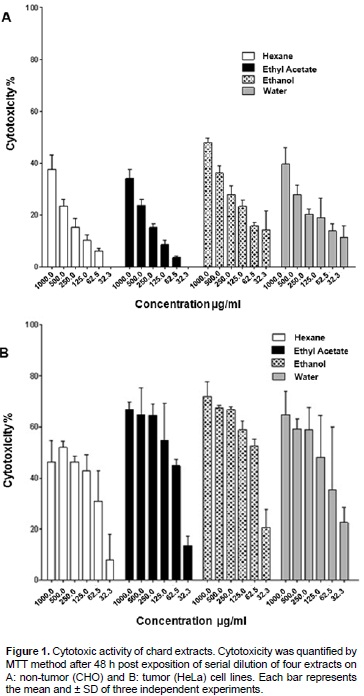
<body><![CDATA[<P>   The linear regression analysis for extract   concentrations which produce a cell culture's CC50   viability reduction in doses&#8211;response curves, were   performed using GraphPad Prism version 5.0 for   Windows (San Diego, CA, USA). Each experiment   was repeated three times and all data are presented as mean &plusmn; standard deviation (SD).</P>     <P>   Evaluation and comparison of optimal concentration   at which pancreatic islets are regenerated were   calculated using descriptive statistical analysis.   Absolute and relative frequency distributions of each extract between the different study groups   are presented with scatter plots graphics. One&#8211;way   analysis of variance (ANOVA) was conducted to find   significant differences in viability and regeneration   index, with p&lt;0.05. Analysis was performed using the STATGRAPHICS Centurion 16 statistical package.</P>     <P>&nbsp;</P>      <P><font size="3"><b>Results</b></font></P>     <P> <i>Cytotoxicity assays</i></P>     <P>   A dose&#8211;response effect between extract concentrations   and cytotoxicity on CHO (<a href="#f1">Figure 1A</a>) and   HeLa cells (<a href="#f1">Figure 1B</a>) was observed. Direct proportionality   between cytotoxic action of the extracts   and their concentrations is evident as cytotoxic percentage   increases with higher extract concentration.   Results show that chard extracts have more than 60%   cytotoxicity against tumor cells, with higher doses of   water, ethanol and ethyl acetate extracts (<a href="#f1">Figures 1A</a> and <a href="#f1">1B</a>). The ethanol extract has the highest selectivity   index of all the extracts tested; the CHO CC<sub>50</sub> and   HeLa CC<sub>50</sub> ratio is 7.3, indicating that this extract is   seven times more toxic to tumor cells compared to non&#8211;tumor cells (<a href="/img/revistas/rccp/v27n4/v27n4a7t1.jpg" target="_blank">Table 1</a>).</P>     <p align="center"><a name="f1"></a><img src="/img/revistas/rccp/v27n4/v27n4a7f1.jpg"></p>     <p align="center">&nbsp;</p>     <P>   <i>Effect of B. vulgaris extracts in viability and regeneration of porcine islets</i></P>     <P>   The yield of isolated porcine islets was 419.5 IEQ/g   of pancreas, and a mean of 3284 IEQ isolated were   cultured with different extract concentrations. Porcine   islets cultured with different concentration of aqueous,   ethyl acetate and ethanol extracts had the highest viability   percent when compared with the hexane extracts and   control groups; however, only porcine islets cultured   with 500 and 250 &mu;g/mL showed significant difference with a 95% confidence interval (p&lt;0.05)&#8211; with respect to the control groups II and III (<a href="/img/revistas/rccp/v27n4/v27n4a7f2.jpg" target="_blank">Figure 2</a>).</P>      ]]></body>
<body><![CDATA[<P> Viability of islets cultured with standard medium   and CsA decreased by 50% in the first 5 days while   it increased in islets cultured with low concentrations   of extracts. Viability percentage was kept stable from   incubation days 5 through 13, with a slight increase   from days 13 through 15 in culture at all extract   concentrations, except those of hexane and CsA (<a href="#f3">Figure 3</a>).</P>     <p align="center"><a name="f3"></a><img src="/img/revistas/rccp/v27n4/v27n4a7f3.jpg"></p>     <p align="center">&nbsp;</p>      <P> Islet regeneration occurs when the regeneration   index (IR) is greater than 1. Ethanol extract at 250 &mu;g/   mL or higher concentration had the most significant   differences in islets regeneration compared to CsA.   Islets cultured with hexane had a good IR but viability   was lower compared with other extracts according   to the multiple range test (p&lt;0.05) (<a href="/img/revistas/rccp/v27n4/v27n4a7f4.jpg" target="_blank">Figure 4</a>). The   aqueous extract had the highest viabilities, but only a   significant IR at 250 &mu;g/mL, with an 85% CI (p&lt;0.15; data not shown).</P>     <P>   Islets initially cultured within the control group   conditions of CsA at 12.5 to 25 mM concentrations   had viability and regeneration indices similar to   hexane and ethyl acetate extracts in 125 &mu;g/mL and   250 &mu;g/mL concentrations respectively. For that   reason, data shown in this article were obtained with   experiments conducted with 100 mM CsA as the control group III.</P>     <P>&nbsp;</P>      <P><font size="3">  <b>Discussion</b></font></P>     <P>   The evaluated chard extracts showed cytotoxic   activity in tumor cells while being less toxic to nontumor   lines, similar to a report in which ethyl acetate   extracts of chard seeds inhibited proliferation of   lung cancer cells (Gennari <i>et al.</i>, 2011). This plant is   commonly consumed in Latin American countries and   could be ingested as a dietary supplement by patients undergoing cancer therapy.</P>     <P>   Diabetes mellitus Type 1 occurs when there is a   beta cell massive loss, insulin activity deficiency, and/   or pancreas destruction (ACE/ADA, 2006). Pancreatic   islet transplantation is a treatment option for select   patients with this disease, but the limited islets supply   from human donors and poor islet yield and quality   impede progress in human islet transplantation.   Although, islets can be regenerated <i>in vivo</i> in response to tissue damage or metabolic demands (Banerjee <i>et al.</i>, 2005; Trucco <i>et al.</i>, 2005; Martin&#8211;Pagola et   al., 2008), the number of beta cells that carry out   division is only 0.5 to 2% (Banerjee <i>et al.</i>, 2005;   Swenne., 1984; Narang <i>et al.</i>, 2006; Battie <i>et al.</i>,   2002). Therefore, we looked for islet regeneration by biomolecules and natural agents such plant extracts.</P>     <P>   Turkish researchers have used chard extracts   to proof their beneficial effects on pancreatic beta   cells (Tunali <i>et al.</i>, 1988; Sener <i>et al.</i>, 2002; Ozsoy&#8211;   Sacan <i>et al.</i>, 2004). The present study evaluated the   regenerative potential of chard extract in cultured   porcine pancreatic islets. Results show that greater   than 50% viability of islets cultured with different   concentrations of the extracts is maintained after 15   days in culture. Taking into account that significant   cytotoxic activity of plant extracts refers to CC<sub>50</sub>   values below 100 &mu;g/mL, the results show that chard   extracts require higher concentrations to kill 50% of   the cell population, indicating that their cytotoxic   effect is very low. However, it is important to test   the viability and regeneration index with extract   concentrations lower than 125 &mu;g/mL due to the   similar viability and regeneration found for all the   concentrations used during the experiments, in order   to look for the minimal extract concentration required to maintain islet viability.</P>     ]]></body>
<body><![CDATA[<P>   CsA is an immunosuppressant drug that induces   glucose intolerance by toxic effect on pancreatic   endocrine tissue. Toxic CsA doses cause morphological   and functional changes by decreasing islet diameter   and reducing insulin production (Ajabnoor <i>et al.</i>,   2007). Islets were initially cultured with different CsA   concentrations, and the ones cultured with low doses   behaved similar to some of the extracts. The highest   CsA concentration (100 mM) was used as an inhibitory substance in the control group.</P>     <P>   The use of porcine islets holds great promise   for large&#8211;scale application of islet transplantation.   The long&#8211;term diabetes reversal after porcine islet   xenotransplantation in an animal model demonstrated   its potential for islet xenotransplantation in humans   (Hering <i>et al.</i>, 2006; Cardona <i><i>et al.</i></i>, 2006). In our   study, we found that porcine islets cultured with   chard extracts have similar behavior to some reported   human islets. Human islets viability between 21.63   and 59.87% was reported on day 1 in culture (Nikolic   <i>et al.</i>, 2010). The porcine islet viability observed in our   study was between 31 and 66%. Similar to report by   Nikolic <i>et al.</i> (2010), the greatest viability percentage   was obtained on the third day of cultivation. Those   results show that it is possible to obtain porcine islets   and maintain them morphologically intact and viable   during culture with chard extracts (Nikolic <i>et al.</i>,   2010). This aspect makes the option of using pigs   as xenogeneic organ donors a possibility. The use   of complete pancreas from adult pigs increases the   possibility of extracting about 1 million IEQ from a   single pig, an essential requirement for xenotransplant   from pigs to humans with Type 1 diabetes (Brandhorst   <i>et al.</i>, 1999). However, in this study one of the major   problems in porcine islet isolation was the marked   fragility of the islets and their rapid dissociation into single cells during the isolation procedure.</P>     <P>&nbsp;</P>      <P><font size="3"><b>Conflicts of interest</b></font></P>   The authors declare they have no conflicts of interest   with regard to the work presented in this report.   </P>      <p>&nbsp;</p>      <P><font size="3"><b>Acknowledgments</b></font></P>      <p>   Authors wish to thank Central Ganadera S.A at   Medell&iacute;n (Colombia) for their kindness in procuring   the porcine pancreases needed for islet isolation.   Thanks also to Grupo de Immunovirolog&iacute;a at the   Universidad de Antioquia for their cell lines donation,   and to endocrinologist Diva Cristina Castro for   her helpful insights. This study was funded by   grants from the Departamento Administrativo de   Ciencia, Tecnolog&iacute;a e Innovaci&oacute;n, COLCIENCIAS   (Colombia).</p>     <p>&nbsp;</p> <hr size="1" noshade>     <p><font size="3"><b>Notes</b></font></p>     <p>   <a href="#0b" name="0">&curren;</a> To cite this article: Forero JE, Posada VM, Herrera VH, del Rio P, Galeano N, L&oacute;pez&#8211;Herrera A, Bedoya VI. Cytotoxicity and in vitro activity of chard (<i>Beta vulgaris</i> L. var <i>Cicla</i>) extracts on porcine pancreatic islets. Rev Colomb Cienc Pecu 2014; 27:290&#8211;298.</p>                                                                                                 <hr size="1" noshade>                    ]]></body>
<body><![CDATA[<P>&nbsp;</P>                <P><font size="3"><b>References</b></font></P>          <!-- ref --><P>Ajabnoor MA, El&#8211;Naggar MM, Elayat AA, Abdulrafee A.   Functional and morphological study of cultured pancreatic islets treated with cyclosporine. Life Sci 2007; 80:345&#8211;355.    &nbsp;&nbsp;&nbsp;&nbsp;&nbsp;&nbsp;&nbsp;&nbsp;[&#160;<a href="javascript:void(0);" onclick="javascript: window.open('/scielo.php?script=sci_nlinks&ref=000095&pid=S0120-0690201400040000700001&lng=','','width=640,height=500,resizable=yes,scrollbars=1,menubar=yes,');">Links</a>&#160;]<!-- end-ref --></P>     <!-- ref --><P>   American college of endocrinology and America Diabetes   Association. Consensus statement on inpatient diabetes and glycemic control. ACE/ADA. Diabetes Care 2006; 29:1955&#8211;62.    &nbsp;&nbsp;&nbsp;&nbsp;&nbsp;&nbsp;&nbsp;&nbsp;[&#160;<a href="javascript:void(0);" onclick="javascript: window.open('/scielo.php?script=sci_nlinks&ref=000097&pid=S0120-0690201400040000700002&lng=','','width=640,height=500,resizable=yes,scrollbars=1,menubar=yes,');">Links</a>&#160;]<!-- end-ref --></P>     <!-- ref --><P>   Banerjee M, Kanitkar M, Bhonde RR. Approaches towards   endogenous pancreatic regeneration. Rev Diabet Stud 2005; 2:165&#8211;176.    &nbsp;&nbsp;&nbsp;&nbsp;&nbsp;&nbsp;&nbsp;&nbsp;[&#160;<a href="javascript:void(0);" onclick="javascript: window.open('/scielo.php?script=sci_nlinks&ref=000099&pid=S0120-0690201400040000700003&lng=','','width=640,height=500,resizable=yes,scrollbars=1,menubar=yes,');">Links</a>&#160;]<!-- end-ref --></P>     <!-- ref --><P> Barnett MJ, McGhee&#8211;Wilson D, Shapiro AM, Lakey JR. Variation   in human islet viability based on different membrane integrity   stains. Cell Transplant 2004; 13:481&#8211;488.    &nbsp;&nbsp;&nbsp;&nbsp;&nbsp;&nbsp;&nbsp;&nbsp;[&#160;<a href="javascript:void(0);" onclick="javascript: window.open('/scielo.php?script=sci_nlinks&ref=000101&pid=S0120-0690201400040000700004&lng=','','width=640,height=500,resizable=yes,scrollbars=1,menubar=yes,');">Links</a>&#160;]<!-- end-ref --></P>     ]]></body>
<body><![CDATA[<!-- ref --><P>   Beattie GM, Montgomery AM, Lopez AD, Hao E, Perez B, Just   ML, Lakey JR, Hart ME, Hayek A. A novel approach to increase   human islet cell mass while preserving beta&#8211;cell function. Diabetes   2002; 51:3435&#8211;3439.    &nbsp;&nbsp;&nbsp;&nbsp;&nbsp;&nbsp;&nbsp;&nbsp;[&#160;<a href="javascript:void(0);" onclick="javascript: window.open('/scielo.php?script=sci_nlinks&ref=000103&pid=S0120-0690201400040000700005&lng=','','width=640,height=500,resizable=yes,scrollbars=1,menubar=yes,');">Links</a>&#160;]<!-- end-ref --></P>     <!-- ref --><P>   Betancur LA, Morales GE, Forero JE, Roldan J. Cytotoxic and   antiviral activities of Colombian medicinal plant extracts of the   Euphorbia genus. Mem Inst Oswaldo Cruz 2002; 97:541&#8211;546.    &nbsp;&nbsp;&nbsp;&nbsp;&nbsp;&nbsp;&nbsp;&nbsp;[&#160;<a href="javascript:void(0);" onclick="javascript: window.open('/scielo.php?script=sci_nlinks&ref=000105&pid=S0120-0690201400040000700006&lng=','','width=640,height=500,resizable=yes,scrollbars=1,menubar=yes,');">Links</a>&#160;]<!-- end-ref --></P>     <!-- ref --><P>   Bolkent S, Yanardag R, Tabakoglu&#8211;Oguz A, Ozsoy&#8211;Sacan O.   Effects of chard (<i>Beta vulgaris</i> L. var <i>Cicla</i>) extract on pancreatic   B cells in streptozotocin&#8211;diabetic rats: a morphological and   biochemical study. J of Ethnopharmacol 2000; 73:251&#8211;259.    &nbsp;&nbsp;&nbsp;&nbsp;&nbsp;&nbsp;&nbsp;&nbsp;[&#160;<a href="javascript:void(0);" onclick="javascript: window.open('/scielo.php?script=sci_nlinks&ref=000107&pid=S0120-0690201400040000700007&lng=','','width=640,height=500,resizable=yes,scrollbars=1,menubar=yes,');">Links</a>&#160;]<!-- end-ref --></P>     <!-- ref --><P>   Brandhorst H, Brandhorst D, Hering BJ, Bretzel RG. Significant   progress in porcine islet mass isolation utilizing liberase HI   for enzymatic low&#8211;temperature pancreas digestion. Source   Third Medical Department, Justus&#8211;Liebig&#8211;University, Giessen,   Germany. Transplantation 1999; 68:355&#8211;361.    &nbsp;&nbsp;&nbsp;&nbsp;&nbsp;&nbsp;&nbsp;&nbsp;[&#160;<a href="javascript:void(0);" onclick="javascript: window.open('/scielo.php?script=sci_nlinks&ref=000109&pid=S0120-0690201400040000700008&lng=','','width=640,height=500,resizable=yes,scrollbars=1,menubar=yes,');">Links</a>&#160;]<!-- end-ref --></P>     <!-- ref --><P>   Cardona K, Korbutt GS, Milas Z, Lyon J, Cano J, Jiang W, Bello&#8211;   Laborn H, Hacquoil B, Strobert E, Gangappa S, Weber CJ, Pearson   TC, Rajotte RV, Larsen CP. Long&#8211;term survival of neonatal   porcine islets in nonhuman primates by targeting costimulation   pathways. Nat Med 2006; 12:304&#8211;306.    &nbsp;&nbsp;&nbsp;&nbsp;&nbsp;&nbsp;&nbsp;&nbsp;[&#160;<a href="javascript:void(0);" onclick="javascript: window.open('/scielo.php?script=sci_nlinks&ref=000111&pid=S0120-0690201400040000700009&lng=','','width=640,height=500,resizable=yes,scrollbars=1,menubar=yes,');">Links</a>&#160;]<!-- end-ref --></P>     ]]></body>
<body><![CDATA[<!-- ref --><P>   Ceuterick M, Vandebroek I, Pieroni. Resilience of Andean urban   ethnobotanies: A comparison of medicinal plant use among   Bolivian and Peruvian migrants in the United Kingdom and in   their countries of origin. J Ethnopharmacol 2011; 136:27&#8211;54.    &nbsp;&nbsp;&nbsp;&nbsp;&nbsp;&nbsp;&nbsp;&nbsp;[&#160;<a href="javascript:void(0);" onclick="javascript: window.open('/scielo.php?script=sci_nlinks&ref=000113&pid=S0120-0690201400040000700010&lng=','','width=640,height=500,resizable=yes,scrollbars=1,menubar=yes,');">Links</a>&#160;]<!-- end-ref --></P>     <!-- ref --><P>   Cos P, Vlietinck AJ, Berghe DV, Maes L. Anti&#8211;infective potential   of natural products: How to develop a stronger in vitro 'proof of   concept'. J Ethnopharmacol 2006; 106:290&#8211;302.    &nbsp;&nbsp;&nbsp;&nbsp;&nbsp;&nbsp;&nbsp;&nbsp;[&#160;<a href="javascript:void(0);" onclick="javascript: window.open('/scielo.php?script=sci_nlinks&ref=000115&pid=S0120-0690201400040000700011&lng=','','width=640,height=500,resizable=yes,scrollbars=1,menubar=yes,');">Links</a>&#160;]<!-- end-ref --></P>     <!-- ref --><P>   Emamaullee JA, Shapiro AM. Factors influencing the loss of betacell   mass in islet transplantation. Cell Transplant 2007; 16:1&#8211;8.    &nbsp;&nbsp;&nbsp;&nbsp;&nbsp;&nbsp;&nbsp;&nbsp;[&#160;<a href="javascript:void(0);" onclick="javascript: window.open('/scielo.php?script=sci_nlinks&ref=000117&pid=S0120-0690201400040000700012&lng=','','width=640,height=500,resizable=yes,scrollbars=1,menubar=yes,');">Links</a>&#160;]<!-- end-ref --></P>     <!-- ref --><P>   Gennari L, Felletti M, Blasa M, Angelino D, Celeghini C, Corallini   A, Ninfali P. Total extract of <i>Beta vulgaris</i> L. var <i>Cicla</i> seeds   versus its purified phenolic components: antioxidant activities   and antiproliferative effects against colon cancer cells. Phytochem   Anal 2011; 22:272&#8211;279.    &nbsp;&nbsp;&nbsp;&nbsp;&nbsp;&nbsp;&nbsp;&nbsp;[&#160;<a href="javascript:void(0);" onclick="javascript: window.open('/scielo.php?script=sci_nlinks&ref=000119&pid=S0120-0690201400040000700013&lng=','','width=640,height=500,resizable=yes,scrollbars=1,menubar=yes,');">Links</a>&#160;]<!-- end-ref --></P>     <!-- ref --><P>   Lindholm P, Gullbo J, Claeson P, G&ouml;ransson U, Johansson   S, Backlund A, Larsson R, Bohlin L. Selective cytotoxicity   evaluation in anticancer drug screening of fractionated plant   extracts. J Biomol Screen 2002; 7:333&#8211;340.    &nbsp;&nbsp;&nbsp;&nbsp;&nbsp;&nbsp;&nbsp;&nbsp;[&#160;<a href="javascript:void(0);" onclick="javascript: window.open('/scielo.php?script=sci_nlinks&ref=000121&pid=S0120-0690201400040000700014&lng=','','width=640,height=500,resizable=yes,scrollbars=1,menubar=yes,');">Links</a>&#160;]<!-- end-ref --></P>     ]]></body>
<body><![CDATA[<!-- ref --><P>   Martin&#8211;Pagola A, Sisino G, Allende G, Dominguez&#8211;Bendala   J, Gianani R, Reijonen H, Nepom GT, Ricordi C, Ruiz P,   Sageshima J, Ciancio G, Burke GW, Pugliese A. Insulin protein   and proliferation in ductal cells in the transplanted pancreas of   patients with type 1 diabetes and recurrence of autoimmunity.   Diabetologia 2008; 10:1803&#8211;1813.    &nbsp;&nbsp;&nbsp;&nbsp;&nbsp;&nbsp;&nbsp;&nbsp;[&#160;<a href="javascript:void(0);" onclick="javascript: window.open('/scielo.php?script=sci_nlinks&ref=000123&pid=S0120-0690201400040000700015&lng=','','width=640,height=500,resizable=yes,scrollbars=1,menubar=yes,');">Links</a>&#160;]<!-- end-ref --></P>     <!-- ref --><P>   Menale B, Amato G, Di Priso C, Muoio R. Traditional uses of plants   in North&#8211;Western Molise (Central Italy). Delpinoa 2006; 48:29&#8211;36.    &nbsp;&nbsp;&nbsp;&nbsp;&nbsp;&nbsp;&nbsp;&nbsp;[&#160;<a href="javascript:void(0);" onclick="javascript: window.open('/scielo.php?script=sci_nlinks&ref=000125&pid=S0120-0690201400040000700016&lng=','','width=640,height=500,resizable=yes,scrollbars=1,menubar=yes,');">Links</a>&#160;]<!-- end-ref --></P>     <!-- ref --><P>   Narang AS, Mahato RI. Biological and biomaterial approaches   for improved islet transplantation. Pharmacol 2006; 58:194&#8211;243.    &nbsp;&nbsp;&nbsp;&nbsp;&nbsp;&nbsp;&nbsp;&nbsp;[&#160;<a href="javascript:void(0);" onclick="javascript: window.open('/scielo.php?script=sci_nlinks&ref=000127&pid=S0120-0690201400040000700017&lng=','','width=640,height=500,resizable=yes,scrollbars=1,menubar=yes,');">Links</a>&#160;]<!-- end-ref --></P> </font>    <!-- ref --><P><font size="2" face="Verdana, Arial, Helvetica, sans-serif">   Nikolic D, Dordevic PB, Sreckovic VD, Paunovic I, Kalezic N,   Popovic S, Stefanovic D. Dzingalasevic M. The effect of different   concentrations of liberase HI used in a non automated method   for human adult pancreatic islet isolation. Arch Biol Sci 2010;   62:833&#8211;840.    &nbsp;&nbsp;&nbsp;&nbsp;&nbsp;&nbsp;&nbsp;&nbsp;[&#160;<a href="javascript:void(0);" onclick="javascript: window.open('/scielo.php?script=sci_nlinks&ref=000129&pid=S0120-0690201400040000700018&lng=','','width=640,height=500,resizable=yes,scrollbars=1,menubar=yes,');">Links</a>&#160;]<!-- end-ref --></font></P> <font size="2"  face="Verdana, Arial, Helvetica, sans-serif">    <!-- ref --><P>   Ozsoy&#8211;Sacan O, Karabulut&#8211;Bulan O, Bolkent S, Yanardag R,   Ozgey Y. Effects of chard (<i>Beta vulgaris</i> L. var <i>Cicla</i>) on the Liver   of the Diabetic Rats: A Morphological and Biochemical Study.   Biosci Biotechnol Biochem 2004; 68:1640&#8211;1648.    &nbsp;&nbsp;&nbsp;&nbsp;&nbsp;&nbsp;&nbsp;&nbsp;[&#160;<a href="javascript:void(0);" onclick="javascript: window.open('/scielo.php?script=sci_nlinks&ref=000131&pid=S0120-0690201400040000700019&lng=','','width=640,height=500,resizable=yes,scrollbars=1,menubar=yes,');">Links</a>&#160;]<!-- end-ref --></P>     ]]></body>
<body><![CDATA[<!-- ref --><P>   Parekh J, Chanda SV. Antibacterial activity of aqueous and   alcoholic extracts of 34 Indian medicinal plants against some   Staphylococcus species. Turk J Biol 2008; 32:63&#8211;71.    &nbsp;&nbsp;&nbsp;&nbsp;&nbsp;&nbsp;&nbsp;&nbsp;[&#160;<a href="javascript:void(0);" onclick="javascript: window.open('/scielo.php?script=sci_nlinks&ref=000133&pid=S0120-0690201400040000700020&lng=','','width=640,height=500,resizable=yes,scrollbars=1,menubar=yes,');">Links</a>&#160;]<!-- end-ref --></P>     <!-- ref --><P>   Ricordi C, Lacy PE, Finke EH, Olack BJ, Scharp DW. Automated   method for isolation of human pancreatic islets. Diabetes 1988;   37:413&#8211;420.    &nbsp;&nbsp;&nbsp;&nbsp;&nbsp;&nbsp;&nbsp;&nbsp;[&#160;<a href="javascript:void(0);" onclick="javascript: window.open('/scielo.php?script=sci_nlinks&ref=000135&pid=S0120-0690201400040000700021&lng=','','width=640,height=500,resizable=yes,scrollbars=1,menubar=yes,');">Links</a>&#160;]<!-- end-ref --></P>     <!-- ref --><P>   Rodr&iacute;guez MP. Manejo de plantas medicinales en el nororiente   amaz&oacute;nico peruano. Revista ECIPER&Uacute; 2011; 8:150&#8211;158.    &nbsp;&nbsp;&nbsp;&nbsp;&nbsp;&nbsp;&nbsp;&nbsp;[&#160;<a href="javascript:void(0);" onclick="javascript: window.open('/scielo.php?script=sci_nlinks&ref=000137&pid=S0120-0690201400040000700022&lng=','','width=640,height=500,resizable=yes,scrollbars=1,menubar=yes,');">Links</a>&#160;]<!-- end-ref --></P>     <!-- ref --><P>   Sakuma Y, Ricordi C, Miki A, Yamamoto T, Pileggi A, Khan A,   Alejandro R, Inverardi L, Ichii H. Factors that affect human islet   isolation. Transplant Proc 2008; 40:343&#8211;345.    &nbsp;&nbsp;&nbsp;&nbsp;&nbsp;&nbsp;&nbsp;&nbsp;[&#160;<a href="javascript:void(0);" onclick="javascript: window.open('/scielo.php?script=sci_nlinks&ref=000139&pid=S0120-0690201400040000700023&lng=','','width=640,height=500,resizable=yes,scrollbars=1,menubar=yes,');">Links</a>&#160;]<!-- end-ref --></P>     <!-- ref --><P>   Sener G, Sa&ccedil;an O, Yanardag R, Ayanoglu&#8211;D&uuml;lger G. Effects of   chard (<i>Beta vulgaris</i> L. var. <i>Cicla</i>) extract on oxidative injury in   the aorta and heart of streptozotocin&#8211;diabetic rats. J Med Food   2002; 5:37&#8211;42.    &nbsp;&nbsp;&nbsp;&nbsp;&nbsp;&nbsp;&nbsp;&nbsp;[&#160;<a href="javascript:void(0);" onclick="javascript: window.open('/scielo.php?script=sci_nlinks&ref=000141&pid=S0120-0690201400040000700024&lng=','','width=640,height=500,resizable=yes,scrollbars=1,menubar=yes,');">Links</a>&#160;]<!-- end-ref --></P>     ]]></body>
<body><![CDATA[<!-- ref --><P>   Swanson CJ, Olack BJ, Goodnight D, Zhang L. Mohanakumar T.   Improved Methods for the Isolation and Purification of Porcine   Islets. Hum Immunol 2001; 62:739&#8211;749.    &nbsp;&nbsp;&nbsp;&nbsp;&nbsp;&nbsp;&nbsp;&nbsp;[&#160;<a href="javascript:void(0);" onclick="javascript: window.open('/scielo.php?script=sci_nlinks&ref=000143&pid=S0120-0690201400040000700025&lng=','','width=640,height=500,resizable=yes,scrollbars=1,menubar=yes,');">Links</a>&#160;]<!-- end-ref --></P>     <!-- ref --><P>   Swenne I, Andersson A. Effect of genetic background on the   capacity for islet cell replication in mice. Diabetologia 1984;   27:464&#8211;467.    &nbsp;&nbsp;&nbsp;&nbsp;&nbsp;&nbsp;&nbsp;&nbsp;[&#160;<a href="javascript:void(0);" onclick="javascript: window.open('/scielo.php?script=sci_nlinks&ref=000145&pid=S0120-0690201400040000700026&lng=','','width=640,height=500,resizable=yes,scrollbars=1,menubar=yes,');">Links</a>&#160;]<!-- end-ref --></P>     <!-- ref --><P>   Tunali T, Yarat A, Yanardag R, Oz&ccedil;el&iacute;k F, Ozsoy O, Ergenekon   G, Emekl&iacute; N. The effect of chard (<i>Beta vulgaris</i> L. var <i>Cicla</i>) on   the skin of the streptozotocin induced diabetic rats. Pharmazie   1988; 53:638&#8211;640.    &nbsp;&nbsp;&nbsp;&nbsp;&nbsp;&nbsp;&nbsp;&nbsp;[&#160;<a href="javascript:void(0);" onclick="javascript: window.open('/scielo.php?script=sci_nlinks&ref=000147&pid=S0120-0690201400040000700027&lng=','','width=640,height=500,resizable=yes,scrollbars=1,menubar=yes,');">Links</a>&#160;]<!-- end-ref --></P>     <!-- ref --><P>   Trucco M. Regeneration of the pancreatic beta cell. J Clin Invest   2005; 115:5&#8211;12.    &nbsp;&nbsp;&nbsp;&nbsp;&nbsp;&nbsp;&nbsp;&nbsp;[&#160;<a href="javascript:void(0);" onclick="javascript: window.open('/scielo.php?script=sci_nlinks&ref=000149&pid=S0120-0690201400040000700028&lng=','','width=640,height=500,resizable=yes,scrollbars=1,menubar=yes,');">Links</a>&#160;]<!-- end-ref --></P>     <!-- ref --><P>   Rao MU, Sreenivasulu M, Chengaiah B, Reddy KJ, Chetty   CM. Herbal Medicines for Diabetes Mellitus: A Review. Int.J.   PharmTech Res 2010; 2:1883&#8211;1892.    &nbsp;&nbsp;&nbsp;&nbsp;&nbsp;&nbsp;&nbsp;&nbsp;[&#160;<a href="javascript:void(0);" onclick="javascript: window.open('/scielo.php?script=sci_nlinks&ref=000151&pid=S0120-0690201400040000700029&lng=','','width=640,height=500,resizable=yes,scrollbars=1,menubar=yes,');">Links</a>&#160;]<!-- end-ref --></P>     ]]></body>
<body><![CDATA[<!-- ref --><P>   Yanardag R, Bolkent S, &Ouml;zsoy&#8211;Sa&ccedil;an &Ouml;, Karabulut&#8211;Bulan &Ouml;. The   Effects of chard (<i>Beta vulgaris</i> L. var <i>Cicla</i>) extract on the kidney   tissue, serum urea and creatine level of diabetic rats. Phytother   Res 2002; 16:758&#8211;761.    &nbsp;&nbsp;&nbsp;&nbsp;&nbsp;&nbsp;&nbsp;&nbsp;[&#160;<a href="javascript:void(0);" onclick="javascript: window.open('/scielo.php?script=sci_nlinks&ref=000153&pid=S0120-0690201400040000700030&lng=','','width=640,height=500,resizable=yes,scrollbars=1,menubar=yes,');">Links</a>&#160;]<!-- end-ref --></P>     <!-- ref --><P>   Youssef RSA. Medicinal and non&#8211;medicinal uses of some plants   found in the middle region of Saudi Arabia. Journal of Medicinal   Plants Research 2013; 7:2501&#8211;2513.    &nbsp;&nbsp;&nbsp;&nbsp;&nbsp;&nbsp;&nbsp;&nbsp;[&#160;<a href="javascript:void(0);" onclick="javascript: window.open('/scielo.php?script=sci_nlinks&ref=000155&pid=S0120-0690201400040000700031&lng=','','width=640,height=500,resizable=yes,scrollbars=1,menubar=yes,');">Links</a>&#160;]<!-- end-ref --></P>      <P>&nbsp;</P>  </font>         ]]></body><back>
<ref-list>
<ref id="B1">
<nlm-citation citation-type="journal">
<person-group person-group-type="author">
<name>
<surname><![CDATA[Ajabnoor]]></surname>
<given-names><![CDATA[MA]]></given-names>
</name>
<name>
<surname><![CDATA[El-Naggar]]></surname>
<given-names><![CDATA[MM]]></given-names>
</name>
<name>
<surname><![CDATA[Elayat]]></surname>
<given-names><![CDATA[AA]]></given-names>
</name>
<name>
<surname><![CDATA[Abdulrafee]]></surname>
<given-names><![CDATA[A]]></given-names>
</name>
</person-group>
<article-title xml:lang="en"><![CDATA[Functional and morphological study of cultured pancreatic islets treated with cyclosporine]]></article-title>
<source><![CDATA[Life Sci]]></source>
<year>2007</year>
<volume>80</volume>
<page-range>345-355</page-range></nlm-citation>
</ref>
<ref id="B2">
<nlm-citation citation-type="journal">
<person-group person-group-type="author">
<name>
<surname><![CDATA[American]]></surname>
<given-names><![CDATA[college of endocrinology and America Diabetes Association]]></given-names>
</name>
</person-group>
<article-title xml:lang="en"><![CDATA[Consensus statement on inpatient diabetes and glycemic control]]></article-title>
<source><![CDATA[ACE/ADA. Diabetes Care]]></source>
<year>2006</year>
<volume>29</volume>
<page-range>1955-62</page-range></nlm-citation>
</ref>
<ref id="B3">
<nlm-citation citation-type="journal">
<person-group person-group-type="author">
<name>
<surname><![CDATA[Banerjee]]></surname>
<given-names><![CDATA[M]]></given-names>
</name>
<name>
<surname><![CDATA[Kanitkar]]></surname>
<given-names><![CDATA[M]]></given-names>
</name>
<name>
<surname><![CDATA[Bhonde]]></surname>
<given-names><![CDATA[RR]]></given-names>
</name>
</person-group>
<article-title xml:lang="en"><![CDATA[Approaches towards endogenous pancreatic regeneration]]></article-title>
<source><![CDATA[Rev Diabet Stud]]></source>
<year>2005</year>
<volume>2</volume>
<page-range>165-176</page-range></nlm-citation>
</ref>
<ref id="B4">
<nlm-citation citation-type="journal">
<person-group person-group-type="author">
<name>
<surname><![CDATA[Barnett]]></surname>
<given-names><![CDATA[MJ]]></given-names>
</name>
<name>
<surname><![CDATA[McGhee-Wilson]]></surname>
<given-names><![CDATA[D]]></given-names>
</name>
<name>
<surname><![CDATA[Shapiro]]></surname>
<given-names><![CDATA[AM]]></given-names>
</name>
<name>
<surname><![CDATA[Lakey]]></surname>
<given-names><![CDATA[JR]]></given-names>
</name>
</person-group>
<article-title xml:lang="en"><![CDATA[Variation in human islet viability based on different membrane integrity stains]]></article-title>
<source><![CDATA[Cell Transplant]]></source>
<year>2004</year>
<volume>13</volume>
<page-range>481-488</page-range></nlm-citation>
</ref>
<ref id="B5">
<nlm-citation citation-type="journal">
<person-group person-group-type="author">
<name>
<surname><![CDATA[Beattie]]></surname>
<given-names><![CDATA[GM]]></given-names>
</name>
<name>
<surname><![CDATA[Montgomery]]></surname>
<given-names><![CDATA[AM]]></given-names>
</name>
<name>
<surname><![CDATA[Lopez]]></surname>
<given-names><![CDATA[AD]]></given-names>
</name>
<name>
<surname><![CDATA[Hao]]></surname>
<given-names><![CDATA[E]]></given-names>
</name>
<name>
<surname><![CDATA[Perez]]></surname>
<given-names><![CDATA[B]]></given-names>
</name>
<name>
<surname><![CDATA[Just]]></surname>
<given-names><![CDATA[ML]]></given-names>
</name>
<name>
<surname><![CDATA[Lakey]]></surname>
<given-names><![CDATA[JR]]></given-names>
</name>
<name>
<surname><![CDATA[Hart]]></surname>
<given-names><![CDATA[ME]]></given-names>
</name>
<name>
<surname><![CDATA[Hayek]]></surname>
<given-names><![CDATA[A]]></given-names>
</name>
</person-group>
<article-title xml:lang="en"><![CDATA[A novel approach to increase human islet cell mass while preserving beta-cell function]]></article-title>
<source><![CDATA[Diabetes]]></source>
<year>2002</year>
<volume>51</volume>
<page-range>3435-3439</page-range></nlm-citation>
</ref>
<ref id="B6">
<nlm-citation citation-type="journal">
<person-group person-group-type="author">
<name>
<surname><![CDATA[Betancur]]></surname>
<given-names><![CDATA[LA]]></given-names>
</name>
<name>
<surname><![CDATA[Morales]]></surname>
<given-names><![CDATA[GE]]></given-names>
</name>
<name>
<surname><![CDATA[Forero]]></surname>
<given-names><![CDATA[JE]]></given-names>
</name>
<name>
<surname><![CDATA[Roldan]]></surname>
<given-names><![CDATA[J]]></given-names>
</name>
</person-group>
<article-title xml:lang="en"><![CDATA[Cytotoxic and antiviral activities of Colombian medicinal plant extracts of the Euphorbia genus]]></article-title>
<source><![CDATA[Mem Inst Oswaldo Cruz]]></source>
<year>2002</year>
<volume>97</volume>
<page-range>541-546</page-range></nlm-citation>
</ref>
<ref id="B7">
<nlm-citation citation-type="journal">
<person-group person-group-type="author">
<name>
<surname><![CDATA[Bolkent]]></surname>
<given-names><![CDATA[S]]></given-names>
</name>
<name>
<surname><![CDATA[Yanardag]]></surname>
<given-names><![CDATA[R]]></given-names>
</name>
<name>
<surname><![CDATA[Tabakoglu-Oguz]]></surname>
<given-names><![CDATA[A]]></given-names>
</name>
<name>
<surname><![CDATA[Ozsoy-Sacan]]></surname>
<given-names><![CDATA[O]]></given-names>
</name>
</person-group>
<article-title xml:lang="en"><![CDATA[Effects of chard (Beta vulgaris L. var Cicla) extract on pancreatic B cells in streptozotocin-diabetic rats: a morphological and biochemical study]]></article-title>
<source><![CDATA[J of Ethnopharmacol]]></source>
<year>2000</year>
<volume>73</volume>
<page-range>251-259</page-range></nlm-citation>
</ref>
<ref id="B8">
<nlm-citation citation-type="journal">
<person-group person-group-type="author">
<name>
<surname><![CDATA[Brandhorst]]></surname>
<given-names><![CDATA[H]]></given-names>
</name>
<name>
<surname><![CDATA[Brandhorst]]></surname>
<given-names><![CDATA[D]]></given-names>
</name>
<name>
<surname><![CDATA[Hering]]></surname>
<given-names><![CDATA[BJ]]></given-names>
</name>
<name>
<surname><![CDATA[Bretzel]]></surname>
<given-names><![CDATA[RG]]></given-names>
</name>
</person-group>
<article-title xml:lang="en"><![CDATA[Significant progress in porcine islet mass isolation utilizing liberase HI for enzymatic low-temperature pancreas digestion. Source Third Medical Department, Justus-Liebig-University, Giessen, Germany]]></article-title>
<source><![CDATA[Transplantation]]></source>
<year>1999</year>
<volume>68</volume>
<page-range>355-361</page-range></nlm-citation>
</ref>
<ref id="B9">
<nlm-citation citation-type="journal">
<person-group person-group-type="author">
<name>
<surname><![CDATA[Cardona]]></surname>
<given-names><![CDATA[K]]></given-names>
</name>
<name>
<surname><![CDATA[Korbutt]]></surname>
<given-names><![CDATA[GS]]></given-names>
</name>
<name>
<surname><![CDATA[Milas]]></surname>
<given-names><![CDATA[Z]]></given-names>
</name>
<name>
<surname><![CDATA[Lyon]]></surname>
<given-names><![CDATA[J]]></given-names>
</name>
<name>
<surname><![CDATA[Cano]]></surname>
<given-names><![CDATA[J]]></given-names>
</name>
<name>
<surname><![CDATA[Jiang]]></surname>
<given-names><![CDATA[W]]></given-names>
</name>
<name>
<surname><![CDATA[Bello-]]></surname>
<given-names><![CDATA[Laborn H]]></given-names>
</name>
<name>
<surname><![CDATA[Hacquoil]]></surname>
<given-names><![CDATA[B]]></given-names>
</name>
<name>
<surname><![CDATA[Strobert]]></surname>
<given-names><![CDATA[E]]></given-names>
</name>
<name>
<surname><![CDATA[Gangappa]]></surname>
<given-names><![CDATA[S]]></given-names>
</name>
<name>
<surname><![CDATA[Weber]]></surname>
<given-names><![CDATA[CJ]]></given-names>
</name>
<name>
<surname><![CDATA[Pearson]]></surname>
<given-names><![CDATA[TC]]></given-names>
</name>
<name>
<surname><![CDATA[Rajotte]]></surname>
<given-names><![CDATA[RV]]></given-names>
</name>
<name>
<surname><![CDATA[Larsen]]></surname>
<given-names><![CDATA[CP]]></given-names>
</name>
</person-group>
<article-title xml:lang="en"><![CDATA[Long-term survival of neonatal porcine islets in nonhuman primates by targeting costimulation pathways]]></article-title>
<source><![CDATA[Nat Med]]></source>
<year>2006</year>
<volume>12</volume>
<page-range>304-306</page-range></nlm-citation>
</ref>
<ref id="B10">
<nlm-citation citation-type="journal">
<person-group person-group-type="author">
<name>
<surname><![CDATA[Ceuterick]]></surname>
<given-names><![CDATA[M]]></given-names>
</name>
<name>
<surname><![CDATA[Vandebroek I]]></surname>
<given-names><![CDATA[Pieroni]]></given-names>
</name>
</person-group>
<article-title xml:lang="en"><![CDATA[Resilience of Andean urban ethnobotanies: A comparison of medicinal plant use among Bolivian and Peruvian migrants in the United Kingdom and in their countries of origin]]></article-title>
<source><![CDATA[J Ethnopharmacol]]></source>
<year>2011</year>
<volume>136</volume>
<page-range>27-54</page-range></nlm-citation>
</ref>
<ref id="B11">
<nlm-citation citation-type="journal">
<person-group person-group-type="author">
<name>
<surname><![CDATA[Cos]]></surname>
<given-names><![CDATA[P]]></given-names>
</name>
<name>
<surname><![CDATA[Vlietinck]]></surname>
<given-names><![CDATA[AJ]]></given-names>
</name>
<name>
<surname><![CDATA[Berghe]]></surname>
<given-names><![CDATA[DV]]></given-names>
</name>
<name>
<surname><![CDATA[Maes]]></surname>
<given-names><![CDATA[L]]></given-names>
</name>
</person-group>
<article-title xml:lang="en"><![CDATA[Anti-infective potential of natural products: How to develop a stronger in vitro 'proof of concept']]></article-title>
<source><![CDATA[J Ethnopharmacol]]></source>
<year>2006</year>
<volume>106</volume>
<page-range>290-302</page-range></nlm-citation>
</ref>
<ref id="B12">
<nlm-citation citation-type="journal">
<person-group person-group-type="author">
<name>
<surname><![CDATA[Emamaullee]]></surname>
<given-names><![CDATA[JA]]></given-names>
</name>
<name>
<surname><![CDATA[Shapiro]]></surname>
<given-names><![CDATA[AM]]></given-names>
</name>
</person-group>
<article-title xml:lang="en"><![CDATA[Factors influencing the loss of betacell mass in islet transplantation]]></article-title>
<source><![CDATA[Cell Transplant]]></source>
<year>2007</year>
<volume>16</volume>
<page-range>1-8</page-range></nlm-citation>
</ref>
<ref id="B13">
<nlm-citation citation-type="journal">
<person-group person-group-type="author">
<name>
<surname><![CDATA[Gennari]]></surname>
<given-names><![CDATA[L]]></given-names>
</name>
<name>
<surname><![CDATA[Felletti]]></surname>
<given-names><![CDATA[M]]></given-names>
</name>
<name>
<surname><![CDATA[Blasa]]></surname>
<given-names><![CDATA[M]]></given-names>
</name>
<name>
<surname><![CDATA[Angelino]]></surname>
<given-names><![CDATA[D]]></given-names>
</name>
<name>
<surname><![CDATA[Celeghini]]></surname>
<given-names><![CDATA[C]]></given-names>
</name>
<name>
<surname><![CDATA[Corallini]]></surname>
<given-names><![CDATA[A]]></given-names>
</name>
<name>
<surname><![CDATA[Ninfali]]></surname>
<given-names><![CDATA[P]]></given-names>
</name>
</person-group>
<article-title xml:lang="en"><![CDATA[Total extract of Beta vulgaris L. var Cicla seeds versus its purified phenolic components: antioxidant activities and antiproliferative effects against colon cancer cells]]></article-title>
<source><![CDATA[Phytochem Anal]]></source>
<year>2011</year>
<volume>22</volume>
<page-range>272-279</page-range></nlm-citation>
</ref>
<ref id="B14">
<nlm-citation citation-type="journal">
<person-group person-group-type="author">
<name>
<surname><![CDATA[Lindholm]]></surname>
<given-names><![CDATA[P]]></given-names>
</name>
<name>
<surname><![CDATA[Gullbo]]></surname>
<given-names><![CDATA[J]]></given-names>
</name>
<name>
<surname><![CDATA[Claeson]]></surname>
<given-names><![CDATA[P]]></given-names>
</name>
<name>
<surname><![CDATA[Göransson]]></surname>
<given-names><![CDATA[U]]></given-names>
</name>
<name>
<surname><![CDATA[Johansson]]></surname>
<given-names><![CDATA[S]]></given-names>
</name>
<name>
<surname><![CDATA[Backlund]]></surname>
<given-names><![CDATA[A]]></given-names>
</name>
<name>
<surname><![CDATA[Larsson]]></surname>
<given-names><![CDATA[R]]></given-names>
</name>
<name>
<surname><![CDATA[Bohlin]]></surname>
<given-names><![CDATA[L]]></given-names>
</name>
</person-group>
<article-title xml:lang="en"><![CDATA[Selective cytotoxicity evaluation in anticancer drug screening of fractionated plant extracts]]></article-title>
<source><![CDATA[J Biomol Screen]]></source>
<year>2002</year>
<volume>7</volume>
<page-range>333-340</page-range></nlm-citation>
</ref>
<ref id="B15">
<nlm-citation citation-type="journal">
<person-group person-group-type="author">
<name>
<surname><![CDATA[Martin-Pagola]]></surname>
<given-names><![CDATA[A]]></given-names>
</name>
<name>
<surname><![CDATA[Sisino]]></surname>
<given-names><![CDATA[G]]></given-names>
</name>
<name>
<surname><![CDATA[Allende]]></surname>
<given-names><![CDATA[G]]></given-names>
</name>
<name>
<surname><![CDATA[Dominguez-Bendala]]></surname>
<given-names><![CDATA[J]]></given-names>
</name>
<name>
<surname><![CDATA[Gianani]]></surname>
<given-names><![CDATA[R]]></given-names>
</name>
<name>
<surname><![CDATA[Reijonen]]></surname>
<given-names><![CDATA[H]]></given-names>
</name>
<name>
<surname><![CDATA[Nepom]]></surname>
<given-names><![CDATA[GT]]></given-names>
</name>
<name>
<surname><![CDATA[Ricordi]]></surname>
<given-names><![CDATA[C]]></given-names>
</name>
<name>
<surname><![CDATA[Ruiz]]></surname>
<given-names><![CDATA[P]]></given-names>
</name>
<name>
<surname><![CDATA[Sageshima]]></surname>
<given-names><![CDATA[J]]></given-names>
</name>
<name>
<surname><![CDATA[Ciancio]]></surname>
<given-names><![CDATA[G]]></given-names>
</name>
<name>
<surname><![CDATA[Burke]]></surname>
<given-names><![CDATA[GW]]></given-names>
</name>
<name>
<surname><![CDATA[Pugliese]]></surname>
<given-names><![CDATA[A]]></given-names>
</name>
</person-group>
<article-title xml:lang="en"><![CDATA[Insulin protein and proliferation in ductal cells in the transplanted pancreas of patients with type 1 diabetes and recurrence of autoimmunity]]></article-title>
<source><![CDATA[Diabetologia]]></source>
<year>2008</year>
<volume>10</volume>
<page-range>1803-1813</page-range></nlm-citation>
</ref>
<ref id="B16">
<nlm-citation citation-type="journal">
<person-group person-group-type="author">
<name>
<surname><![CDATA[Menale]]></surname>
<given-names><![CDATA[B]]></given-names>
</name>
<name>
<surname><![CDATA[Amato]]></surname>
<given-names><![CDATA[G]]></given-names>
</name>
<name>
<surname><![CDATA[Di Priso]]></surname>
<given-names><![CDATA[C]]></given-names>
</name>
<name>
<surname><![CDATA[Muoio]]></surname>
<given-names><![CDATA[R]]></given-names>
</name>
</person-group>
<article-title xml:lang="en"><![CDATA[Traditional uses of plants in North-Western Molise (Central Italy)]]></article-title>
<source><![CDATA[Delpinoa]]></source>
<year>2006</year>
<volume>48</volume>
<page-range>29-36</page-range></nlm-citation>
</ref>
<ref id="B17">
<nlm-citation citation-type="journal">
<person-group person-group-type="author">
<name>
<surname><![CDATA[Narang]]></surname>
<given-names><![CDATA[AS]]></given-names>
</name>
<name>
<surname><![CDATA[Mahato]]></surname>
<given-names><![CDATA[RI]]></given-names>
</name>
</person-group>
<article-title xml:lang="en"><![CDATA[Biological and biomaterial approaches for improved islet transplantation]]></article-title>
<source><![CDATA[Pharmacol]]></source>
<year>2006</year>
<volume>58</volume>
<page-range>194-243</page-range></nlm-citation>
</ref>
<ref id="B18">
<nlm-citation citation-type="journal">
<person-group person-group-type="author">
<name>
<surname><![CDATA[Nikolic]]></surname>
<given-names><![CDATA[D]]></given-names>
</name>
<name>
<surname><![CDATA[Dordevic]]></surname>
<given-names><![CDATA[PB]]></given-names>
</name>
<name>
<surname><![CDATA[Sreckovic]]></surname>
<given-names><![CDATA[VD]]></given-names>
</name>
<name>
<surname><![CDATA[Paunovic]]></surname>
<given-names><![CDATA[I]]></given-names>
</name>
<name>
<surname><![CDATA[Kalezic]]></surname>
<given-names><![CDATA[N]]></given-names>
</name>
<name>
<surname><![CDATA[Popovic]]></surname>
<given-names><![CDATA[S]]></given-names>
</name>
<name>
<surname><![CDATA[Stefanovic]]></surname>
<given-names><![CDATA[D]]></given-names>
</name>
<name>
<surname><![CDATA[Dzingalasevic]]></surname>
<given-names><![CDATA[M]]></given-names>
</name>
</person-group>
<article-title xml:lang="en"><![CDATA[The effect of different concentrations of liberase HI used in a non automated method for human adult pancreatic islet isolation]]></article-title>
<source><![CDATA[Arch Biol Sci]]></source>
<year>2010</year>
<volume>62</volume>
<page-range>833-840</page-range></nlm-citation>
</ref>
<ref id="B19">
<nlm-citation citation-type="journal">
<person-group person-group-type="author">
<name>
<surname><![CDATA[Ozsoy-Sacan]]></surname>
<given-names><![CDATA[O]]></given-names>
</name>
<name>
<surname><![CDATA[Karabulut-Bulan]]></surname>
<given-names><![CDATA[O]]></given-names>
</name>
<name>
<surname><![CDATA[Bolkent]]></surname>
<given-names><![CDATA[S]]></given-names>
</name>
<name>
<surname><![CDATA[Yanardag]]></surname>
<given-names><![CDATA[R]]></given-names>
</name>
<name>
<surname><![CDATA[Ozgey]]></surname>
<given-names><![CDATA[Y]]></given-names>
</name>
</person-group>
<article-title xml:lang="en"><![CDATA[Effects of chard (Beta vulgaris L. var Cicla) on the Liver of the Diabetic Rats: A Morphological and Biochemical Study]]></article-title>
<source><![CDATA[Biosci Biotechnol Biochem]]></source>
<year>2004</year>
<volume>68</volume>
<page-range>1640-1648</page-range></nlm-citation>
</ref>
<ref id="B20">
<nlm-citation citation-type="journal">
<person-group person-group-type="author">
<name>
<surname><![CDATA[Parekh]]></surname>
<given-names><![CDATA[J]]></given-names>
</name>
<name>
<surname><![CDATA[Chanda]]></surname>
<given-names><![CDATA[SV]]></given-names>
</name>
</person-group>
<article-title xml:lang="en"><![CDATA[Antibacterial activity of aqueous and alcoholic extracts of 34 Indian medicinal plants against some Staphylococcus species]]></article-title>
<source><![CDATA[Turk J Biol]]></source>
<year>2008</year>
<volume>32</volume>
<page-range>63-71</page-range></nlm-citation>
</ref>
<ref id="B21">
<nlm-citation citation-type="journal">
<person-group person-group-type="author">
<name>
<surname><![CDATA[Ricordi]]></surname>
<given-names><![CDATA[C]]></given-names>
</name>
<name>
<surname><![CDATA[Lacy]]></surname>
<given-names><![CDATA[PE]]></given-names>
</name>
<name>
<surname><![CDATA[Finke]]></surname>
<given-names><![CDATA[EH]]></given-names>
</name>
<name>
<surname><![CDATA[Olack]]></surname>
<given-names><![CDATA[BJ]]></given-names>
</name>
<name>
<surname><![CDATA[Scharp]]></surname>
<given-names><![CDATA[DW]]></given-names>
</name>
</person-group>
<article-title xml:lang="en"><![CDATA[Automated method for isolation of human pancreatic islets]]></article-title>
<source><![CDATA[Diabetes]]></source>
<year>1988</year>
<volume>37</volume>
<page-range>413-420</page-range></nlm-citation>
</ref>
<ref id="B22">
<nlm-citation citation-type="journal">
<person-group person-group-type="author">
<name>
<surname><![CDATA[Rodríguez]]></surname>
<given-names><![CDATA[MP]]></given-names>
</name>
</person-group>
<article-title xml:lang="es"><![CDATA[Manejo de plantas medicinales en el nororiente amazónico peruano]]></article-title>
<source><![CDATA[Revista ECIPERÚ]]></source>
<year>2011</year>
<volume>8</volume>
<page-range>150-158</page-range></nlm-citation>
</ref>
<ref id="B23">
<nlm-citation citation-type="journal">
<person-group person-group-type="author">
<name>
<surname><![CDATA[Sakuma]]></surname>
<given-names><![CDATA[Y]]></given-names>
</name>
<name>
<surname><![CDATA[Ricordi]]></surname>
<given-names><![CDATA[C]]></given-names>
</name>
<name>
<surname><![CDATA[Miki]]></surname>
<given-names><![CDATA[A]]></given-names>
</name>
<name>
<surname><![CDATA[Yamamoto]]></surname>
<given-names><![CDATA[T]]></given-names>
</name>
<name>
<surname><![CDATA[Pileggi]]></surname>
<given-names><![CDATA[A]]></given-names>
</name>
<name>
<surname><![CDATA[Khan]]></surname>
<given-names><![CDATA[A]]></given-names>
</name>
<name>
<surname><![CDATA[Alejandro]]></surname>
<given-names><![CDATA[R]]></given-names>
</name>
<name>
<surname><![CDATA[Inverardi]]></surname>
<given-names><![CDATA[L]]></given-names>
</name>
<name>
<surname><![CDATA[Ichii]]></surname>
<given-names><![CDATA[H]]></given-names>
</name>
</person-group>
<article-title xml:lang="en"><![CDATA[Factors that affect human islet isolation]]></article-title>
<source><![CDATA[Transplant Proc]]></source>
<year>2008</year>
<volume>40</volume>
<page-range>343-345</page-range></nlm-citation>
</ref>
<ref id="B24">
<nlm-citation citation-type="journal">
<person-group person-group-type="author">
<name>
<surname><![CDATA[Sener]]></surname>
<given-names><![CDATA[G]]></given-names>
</name>
<name>
<surname><![CDATA[Saçan]]></surname>
<given-names><![CDATA[O]]></given-names>
</name>
<name>
<surname><![CDATA[Yanardag]]></surname>
<given-names><![CDATA[R]]></given-names>
</name>
<name>
<surname><![CDATA[Ayanoglu-Dülger]]></surname>
<given-names><![CDATA[G]]></given-names>
</name>
</person-group>
<article-title xml:lang="en"><![CDATA[Effects of chard (Beta vulgaris L. var. Cicla) extract on oxidative injury in the aorta and heart of streptozotocin-diabetic rats]]></article-title>
<source><![CDATA[J Med Food]]></source>
<year>2002</year>
<volume>5</volume>
<page-range>37-42</page-range></nlm-citation>
</ref>
<ref id="B25">
<nlm-citation citation-type="journal">
<person-group person-group-type="author">
<name>
<surname><![CDATA[Swanson]]></surname>
<given-names><![CDATA[CJ]]></given-names>
</name>
<name>
<surname><![CDATA[Olack]]></surname>
<given-names><![CDATA[BJ]]></given-names>
</name>
<name>
<surname><![CDATA[Goodnight]]></surname>
<given-names><![CDATA[D]]></given-names>
</name>
<name>
<surname><![CDATA[Zhang]]></surname>
<given-names><![CDATA[L]]></given-names>
</name>
<name>
<surname><![CDATA[Mohanakumar]]></surname>
<given-names><![CDATA[T]]></given-names>
</name>
</person-group>
<article-title xml:lang="en"><![CDATA[Improved Methods for the Isolation and Purification of Porcine Islets]]></article-title>
<source><![CDATA[Hum Immunol]]></source>
<year>2001</year>
<volume>62</volume>
<page-range>739-749</page-range></nlm-citation>
</ref>
<ref id="B26">
<nlm-citation citation-type="journal">
<person-group person-group-type="author">
<name>
<surname><![CDATA[Swenne]]></surname>
<given-names><![CDATA[I]]></given-names>
</name>
<name>
<surname><![CDATA[Andersson]]></surname>
<given-names><![CDATA[A]]></given-names>
</name>
</person-group>
<article-title xml:lang="en"><![CDATA[Effect of genetic background on the capacity for islet cell replication in mice]]></article-title>
<source><![CDATA[Diabetologia]]></source>
<year>1984</year>
<volume>27</volume>
<page-range>464-467</page-range></nlm-citation>
</ref>
<ref id="B27">
<nlm-citation citation-type="journal">
<person-group person-group-type="author">
<name>
<surname><![CDATA[Tunali]]></surname>
<given-names><![CDATA[T]]></given-names>
</name>
<name>
<surname><![CDATA[Yarat]]></surname>
<given-names><![CDATA[A]]></given-names>
</name>
<name>
<surname><![CDATA[Yanardag]]></surname>
<given-names><![CDATA[R]]></given-names>
</name>
<name>
<surname><![CDATA[Ozçelík]]></surname>
<given-names><![CDATA[F]]></given-names>
</name>
<name>
<surname><![CDATA[Ozsoy]]></surname>
<given-names><![CDATA[O]]></given-names>
</name>
<name>
<surname><![CDATA[Ergenekon]]></surname>
<given-names><![CDATA[G]]></given-names>
</name>
<name>
<surname><![CDATA[Emeklí]]></surname>
<given-names><![CDATA[N]]></given-names>
</name>
</person-group>
<article-title xml:lang="en"><![CDATA[The effect of chard (Beta vulgaris L. var Cicla) on the skin of the streptozotocin induced diabetic rats]]></article-title>
<source><![CDATA[Pharmazie]]></source>
<year>1988</year>
<volume>53</volume>
<page-range>638-640</page-range></nlm-citation>
</ref>
<ref id="B28">
<nlm-citation citation-type="journal">
<person-group person-group-type="author">
<name>
<surname><![CDATA[Trucco]]></surname>
<given-names><![CDATA[M]]></given-names>
</name>
</person-group>
<article-title xml:lang="en"><![CDATA[Regeneration of the pancreatic beta cell]]></article-title>
<source><![CDATA[J Clin Invest]]></source>
<year>2005</year>
<volume>115</volume>
<page-range>5-12</page-range></nlm-citation>
</ref>
<ref id="B29">
<nlm-citation citation-type="journal">
<person-group person-group-type="author">
<name>
<surname><![CDATA[Rao]]></surname>
<given-names><![CDATA[MU]]></given-names>
</name>
<name>
<surname><![CDATA[Sreenivasulu]]></surname>
<given-names><![CDATA[M]]></given-names>
</name>
<name>
<surname><![CDATA[Chengaiah]]></surname>
<given-names><![CDATA[B]]></given-names>
</name>
<name>
<surname><![CDATA[Reddy]]></surname>
<given-names><![CDATA[KJ]]></given-names>
</name>
<name>
<surname><![CDATA[Chetty]]></surname>
<given-names><![CDATA[CM]]></given-names>
</name>
</person-group>
<article-title xml:lang="en"><![CDATA[Herbal Medicines for Diabetes Mellitus: A Review]]></article-title>
<source><![CDATA[Int.J. PharmTech Res]]></source>
<year>2010</year>
<volume>2</volume>
<page-range>1883-1892</page-range></nlm-citation>
</ref>
<ref id="B30">
<nlm-citation citation-type="journal">
<person-group person-group-type="author">
<name>
<surname><![CDATA[Yanardag]]></surname>
<given-names><![CDATA[R]]></given-names>
</name>
<name>
<surname><![CDATA[Bolkent]]></surname>
<given-names><![CDATA[S]]></given-names>
</name>
<name>
<surname><![CDATA[Özsoy-Saçan]]></surname>
<given-names><![CDATA[Ö]]></given-names>
</name>
<name>
<surname><![CDATA[Karabulut-Bulan]]></surname>
<given-names><![CDATA[Ö]]></given-names>
</name>
</person-group>
<article-title xml:lang="en"><![CDATA[The Effects of chard (Beta vulgaris L. var Cicla) extract on the kidney tissue, serum urea and creatine level of diabetic rats]]></article-title>
<source><![CDATA[Phytother Res]]></source>
<year>2002</year>
<volume>16</volume>
<page-range>758-761</page-range></nlm-citation>
</ref>
<ref id="B31">
<nlm-citation citation-type="journal">
<person-group person-group-type="author">
<name>
<surname><![CDATA[Youssef]]></surname>
<given-names><![CDATA[RSA]]></given-names>
</name>
</person-group>
<article-title xml:lang="en"><![CDATA[Medicinal and non-medicinal uses of some plants found in the middle region of Saudi Arabia]]></article-title>
<source><![CDATA[Journal of Medicinal Plants Research]]></source>
<year>2013</year>
<volume>7</volume>
<page-range>2501-2513</page-range></nlm-citation>
</ref>
</ref-list>
</back>
</article>