<?xml version="1.0" encoding="ISO-8859-1"?><article xmlns:mml="http://www.w3.org/1998/Math/MathML" xmlns:xlink="http://www.w3.org/1999/xlink" xmlns:xsi="http://www.w3.org/2001/XMLSchema-instance">
<front>
<journal-meta>
<journal-id>0120-0690</journal-id>
<journal-title><![CDATA[Revista Colombiana de Ciencias Pecuarias]]></journal-title>
<abbrev-journal-title><![CDATA[Rev Colom Cienc Pecua]]></abbrev-journal-title>
<issn>0120-0690</issn>
<publisher>
<publisher-name><![CDATA[Facultad de Ciencias Agrarias, Universidad de Antioquia]]></publisher-name>
</publisher>
</journal-meta>
<article-meta>
<article-id>S0120-06902015000200004</article-id>
<article-id pub-id-type="doi">10.17533/udea.rccp.v28n2a03</article-id>
<title-group>
<article-title xml:lang="en"><![CDATA[Gastroesophageal reflux in anesthetized dogs: a review]]></article-title>
<article-title xml:lang="es"><![CDATA[Reflujo gastroesofágico en perros anestesiados: revisión de literatura]]></article-title>
<article-title xml:lang="pt"><![CDATA[Refluxo gastroesofágico em cães anestesiados: revisão de literatura]]></article-title>
</title-group>
<contrib-group>
<contrib contrib-type="author">
<name>
<surname><![CDATA[Rodríguez-Alarcón]]></surname>
<given-names><![CDATA[Carlos A]]></given-names>
</name>
<xref ref-type="aff" rid="A01"/>
</contrib>
<contrib contrib-type="author">
<name>
<surname><![CDATA[Beristain-Ruiz]]></surname>
<given-names><![CDATA[Diana M]]></given-names>
</name>
<xref ref-type="aff" rid="A01"/>
<xref ref-type="aff" rid="A05"/>
</contrib>
<contrib contrib-type="author">
<name>
<surname><![CDATA[Rivera-Barreno]]></surname>
<given-names><![CDATA[Ramón]]></given-names>
</name>
<xref ref-type="aff" rid="A01"/>
</contrib>
<contrib contrib-type="author">
<name>
<surname><![CDATA[Díaz]]></surname>
<given-names><![CDATA[Guadalupe]]></given-names>
</name>
<xref ref-type="aff" rid="A02"/>
</contrib>
<contrib contrib-type="author">
<name>
<surname><![CDATA[Usón-Casaús]]></surname>
<given-names><![CDATA[Jesús M]]></given-names>
</name>
<xref ref-type="aff" rid="A03"/>
</contrib>
<contrib contrib-type="author">
<name>
<surname><![CDATA[García-Herrera]]></surname>
<given-names><![CDATA[Ricardo]]></given-names>
</name>
<xref ref-type="aff" rid="A04"/>
</contrib>
<contrib contrib-type="author">
<name>
<surname><![CDATA[Pérez-Merino]]></surname>
<given-names><![CDATA[Eva M]]></given-names>
</name>
<xref ref-type="aff" rid="A03"/>
</contrib>
</contrib-group>
<aff id="A01">
<institution><![CDATA[,Universidad Autónoma de Ciudad Juárez  ]]></institution>
<addr-line><![CDATA[Chihuahua ]]></addr-line>
<country>México</country>
</aff>
<aff id="A02">
<institution><![CDATA[,Universidad Autónoma de Ciudad Juárez  ]]></institution>
<addr-line><![CDATA[Chihuahua ]]></addr-line>
<country>México</country>
</aff>
<aff id="A03">
<institution><![CDATA[,Universidad de Extremadura Facultad de Veterinaria ]]></institution>
<addr-line><![CDATA[Cáceres ]]></addr-line>
<country>España</country>
</aff>
<aff id="A04">
<institution><![CDATA[,Universidad Juárez Autónoma de Tabasco  ]]></institution>
<addr-line><![CDATA[Villahermosa Tabasco]]></addr-line>
<country>México</country>
</aff>
<aff id="A05">
<institution><![CDATA[,Universidad Autónoma de Ciudad Juárez  ]]></institution>
<addr-line><![CDATA[ Chihuahua]]></addr-line>
<country>México</country>
</aff>
<pub-date pub-type="pub">
<day>00</day>
<month>06</month>
<year>2015</year>
</pub-date>
<pub-date pub-type="epub">
<day>00</day>
<month>06</month>
<year>2015</year>
</pub-date>
<volume>28</volume>
<numero>2</numero>
<fpage>144</fpage>
<lpage>155</lpage>
<copyright-statement/>
<copyright-year/>
<self-uri xlink:href="http://www.scielo.org.co/scielo.php?script=sci_arttext&amp;pid=S0120-06902015000200004&amp;lng=en&amp;nrm=iso"></self-uri><self-uri xlink:href="http://www.scielo.org.co/scielo.php?script=sci_abstract&amp;pid=S0120-06902015000200004&amp;lng=en&amp;nrm=iso"></self-uri><self-uri xlink:href="http://www.scielo.org.co/scielo.php?script=sci_pdf&amp;pid=S0120-06902015000200004&amp;lng=en&amp;nrm=iso"></self-uri><abstract abstract-type="short" xml:lang="en"><p><![CDATA[Gastroesophageal reflux can be a catastrophic illness in small animals during anesthesia since its complications can cause serious pathologies, such as esophagitis, esophageal stenosis and aspiration pneumonia. With an incidence from 12 to 78.5% in anesthetized dogs, gastroesophageal reflux is normally silent during anesthesia and will be notices only if regurgitation occurs and stomach acid is present in the nasal or oral cavities. In humans, gastroesophageal reflux disease (GERD) is a well-defined pathology where the lower esophageal sphincter has a sustained weakness. However, in dogs, gastroesophageal reflux disease as such is not well established, if at all; it has only been described as gastroesophagic reflux, occurring principally in anesthetized animals. There are several factors influencing the presentation of reflux in anesthetized dogs, which may be inherent to the patient (e.g. age, sex, breed, weight, or body condition), medications used prior to and during anesthesia, type of surgery or position of the animal during surgery. The objective of this review is to discuss a series of conditions that could predispose dogs to gastroesophageal reflux during anesthesia and to assist in the prevention and diagnosis of this condition.]]></p></abstract>
<abstract abstract-type="short" xml:lang="es"><p><![CDATA[El reflujo gastroesofágico durante la anestesia puede ser una entidad catastrófica en la clínica de pequeñas especies, ya que sus complicaciones derivan en entidades realmente graves como esofagitis, estenosis esofágica y neumonía por aspiración. Con una incidencia del 12 al 78.5% en perros anestesiados, el reflujo gastroesofágico durante la anestesia es generalmente silencioso y sólo se observa cuando existe regurgitación y el reflujo pasa a cavidad oral o nasal. En el humano, la enfermedad por reflujo gastroesofágico (ERGE) es una patología bien definida, donde el esfínter esofágico inferior presenta una debilidad sostenida. Sin embargo, en el perro esta enfermedad como tal no está bien establecida, si acaso se describe el reflujo gastroesofágico, que ocurre principalmente en animales anestesiados. Existen diversos factores que influyen en la presentación del reflujo en los perros anestesiados. Estos pueden ser inherentes al paciente (por ejemplo: edad, sexo, raza, peso o condición corporal), a medicamentos utilizados previamente y durante la anestesia, al tipo de cirugía o a la posición del animal durante la cirugía. El objetivo de esta revisión es discutir una guía de las condiciones que predisponen a la aparición de reflujo gastroesofágico durante la anestesia en perros con el fin de facilitar el diagnóstico y la prevención de esta condición.]]></p></abstract>
<abstract abstract-type="short" xml:lang="pt"><p><![CDATA[O refluxo gastroesofágico durante a anestesia pode ser uma entidade catastrófica na clínica de pequenas espécies, já que suas complicações resultam em entidades realmente graves, como esofagite, estenose esofágica e pneumonia por aspiração. O refluxo gastroesofágico em cães anestesiados é geralmente silencioso, com uma incidência de 12 até 78.5% e só é observada quando há regurgitação e o refluxo passa até a cavidade oral ou nasal. Nos humanos, a doença pelo refluxo gastroesofágico (ERGE) é uma patologia bem definida, onde o esfíncter esofágico inferior apresenta uma debilidade continua. Porém, esta doença em cães não está bem estabelecida, pelo qual só se descreve o refluxo gastroesofágico, que ocorre principalmente em animais anestesiados. Existem diversos fatores que influenciam na apresentação do refluxo em cães anestesiados. Estes podem ser inerentes ao paciente (por exemplo: idade, sexo, raça, peso ou condição corporal), a medicamentos utilizados previamente e durante a anestesia, ao tipo de cirurgia ou a posição do animal durante a cirurgia. O objetivo da revisão foi discutir uma guia das condições que predispõem à aparição de refluxo gastroesofágico durante a anestesia em cães com o fim de facilitar o diagnóstico e a prevenção dessa condição.]]></p></abstract>
<kwd-group>
<kwd lng="en"><![CDATA[anesthesia]]></kwd>
<kwd lng="en"><![CDATA[aspiration pneumonia]]></kwd>
<kwd lng="en"><![CDATA[canine]]></kwd>
<kwd lng="en"><![CDATA[esophagitis]]></kwd>
<kwd lng="es"><![CDATA[anestesia]]></kwd>
<kwd lng="es"><![CDATA[canino]]></kwd>
<kwd lng="es"><![CDATA[esofagitis]]></kwd>
<kwd lng="es"><![CDATA[neumonía por aspiración]]></kwd>
<kwd lng="pt"><![CDATA[anestesia]]></kwd>
<kwd lng="pt"><![CDATA[cão]]></kwd>
<kwd lng="pt"><![CDATA[esofagite]]></kwd>
<kwd lng="pt"><![CDATA[pneumonia por aspiração]]></kwd>
</kwd-group>
</article-meta>
</front><body><![CDATA[  <font face="Verdana, Arial, Helvetica, sans-serif" size="2">     <p align="right"><b><font size="3">LITERATURE REVIEW</font></b> </p>     <p>&nbsp;</p>     <p align="right">doi: <a href="http://dx.doi.org/10.17533/udea.rccp.v28n2a03" target="_blank">10.17533/udea.rccp.v28n2a03</a></p>      <p align="center"><font size="4"><b>Gastroesophageal reflux in anesthetized dogs: a review<a name="a1" id="a1"><a href="#a0"><sup>&curren;</sup></a></a></b></font> </p>     <p align="center">&nbsp;</p>     <p align="center"><font size="3"><i><b>Reflujo gastroesof&aacute;gico en perros anestesiados: revisi&oacute;n de literatura</b></i></font></p>     <p align="center">&nbsp;</p> <font size="3">     <p align="center"><i> <b>Refluxo gastroesof&aacute;gico em c&atilde;es anestesiados: revis&atilde;o de literatura</b></i></p> </font>     <p align="center">&nbsp;</p>     ]]></body>
<body><![CDATA[<p align="center">&nbsp;</p>      <p align="left"><b>Carlos A Rodr&iacute;guez-Alarc&oacute;n<sup>1</sup>, DVM, PhD; Diana M Beristain-Ruiz<sup>1</sup></b><b><sup><a name="b0" a href="#b1">*</a></sup>, DVM, PhD; Ram&oacute;n Rivera-Barreno<sup>1</sup>, DVM, MSc, PhD; Guadalupe D&iacute;az<sup>2</sup>, DVM; Jes&uacute;s M Us&oacute;n-Casa&uacute;s<sup>3</sup>, DVM, PhD; Ricardo Garc&iacute;a-Herrera<sup>4</sup>, DVM, PhD; Eva M P&eacute;rez-Merino<sup>3</sup>, DVM, PhD.</b></p>     <p align="left">&nbsp;</p>     <p><sup><i>1</i></sup><i> Cuerpo Acad&eacute;mico de Medicina y Cirug&iacute;a Veterinaria, Departamento de Ciencias Veterinarias, Universidad Aut&oacute;noma de Ciudad Ju&aacute;rez, Anillo Envolvente del PRONAF y Estocolmo S/N. Ciudad Ju&aacute;rez, Chihuahua, M&eacute;xico.</i></p>      <p><sup>2</sup><i>Hospital Veterinario Universitario, Universidad Aut&oacute;noma de Ciudad Ju&aacute;rez, Anillo Envolvente del PRONAF y Estocolmo S/N. Ciudad Ju&aacute;rez, Chihuahua, M&eacute;xico</i></p>      <p><sup>3</sup><i>Hospital Cl&iacute;nico Veterinario, Facultad de Veterinaria, Universidad de Extremadura, Av. Universidad S/N. C&aacute;ceres, Espa&ntilde;a.</i></p>      <p><sup>4</sup><i>Divisi&oacute;n Acad&eacute;mica de Ciencias Agropecuarias, Universidad Ju&aacute;rez Aut&oacute;noma de Tabasco. Zona de la Cultura S/N, Villahermosa, Tabasco, M&eacute;xico.</i></p>     <p>&nbsp;</p>     <p align="left"><a name="b1" id="b1"><a href="#b0">*</a></a>Corresponding Author: Diana M Beristain Ruiz. Departamento de Ciencias Veterinarias, Universidad Aut&oacute;noma de Ciudad Ju&aacute;rez, Chihuahua, M&eacute;xico. Email: <a href="diana.beristain@uacj.mx" target="_blank">diana.beristain@uacj.mx</a></p>     <p align="left">&nbsp;</p>     ]]></body>
<body><![CDATA[<p align="left">Received: March 21, 2013; accepted: July 22, 2014 </p>     <p align="left">&nbsp;</p> <hr size="1" />     <p><b>Summary</b></p>     <p>Gastroesophageal reflux can be a catastrophic illness in small animals during anesthesia since its   complications can cause serious pathologies, such as esophagitis, esophageal stenosis and aspiration pneumonia.   With an incidence from 12 to 78.5% in anesthetized dogs, gastroesophageal reflux is normally silent during   anesthesia and will be notices only if regurgitation occurs and stomach acid is present in the nasal or oral   cavities. In humans, gastroesophageal reflux disease (GERD) is a well-defined pathology where the lower   esophageal sphincter has a sustained weakness. However, in dogs, gastroesophageal reflux disease as such   is not well established, if at all; it has only been described as gastroesophagic reflux, occurring principally   in anesthetized animals. There are several factors influencing the presentation of reflux in anesthetized dogs,   which may be inherent to the patient (e.g. age, sex, breed, weight, or body condition), medications used prior   to and during anesthesia, type of surgery or position of the animal during surgery. The objective of this review   is to discuss a series of conditions that could predispose dogs to gastroesophageal reflux during anesthesia and to assist in the prevention and diagnosis of this condition.</p>     <p><b>Keywords:</b> <i>anesthesia, aspiration pneumonia, canine, esophagitis.</i> </p> <hr size="1" />     <p><b>Resumen</b></p>     <p>El reflujo gastroesof&aacute;gico durante la anestesia puede ser una entidad catastr&oacute;fica en la cl&iacute;nica de peque&ntilde;as   especies, ya que sus complicaciones derivan en entidades realmente graves como esofagitis, estenosis esof&aacute;gica   y neumon&iacute;a por aspiraci&oacute;n. Con una incidencia del 12 al 78.5% en perros anestesiados, el reflujo gastroesof&aacute;gico   durante la anestesia es generalmente silencioso y s&oacute;lo se observa cuando existe regurgitaci&oacute;n y el reflujo pasa   a cavidad oral o nasal. En el humano, la enfermedad por reflujo gastroesof&aacute;gico (ERGE) es una patolog&iacute;a   bien definida, donde el esf&iacute;nter esof&aacute;gico inferior presenta una debilidad sostenida. Sin embargo, en el perro   esta enfermedad como tal no est&aacute; bien establecida, si acaso se describe el reflujo gastroesof&aacute;gico, que ocurre   principalmente en animales anestesiados. Existen diversos factores que influyen en la presentaci&oacute;n del reflujo   en los perros anestesiados. Estos pueden ser inherentes al paciente (por ejemplo: edad, sexo, raza, peso o   condici&oacute;n corporal), a medicamentos utilizados previamente y durante la anestesia, al tipo de cirug&iacute;a o a la   posici&oacute;n del animal durante la cirug&iacute;a. El objetivo de esta revisi&oacute;n es discutir una gu&iacute;a de las condiciones que   predisponen a la aparici&oacute;n de reflujo gastroesof&aacute;gico durante la anestesia en perros con el fin de facilitar el diagn&oacute;stico y la prevenci&oacute;n de esta condici&oacute;n.</p>     <p><b>Palabras clave:</b> <i>anestesia, canino, esofagitis, neumon&iacute;a por aspiraci&oacute;n.</i></p> <hr size="1" />     <p><b>Resumo</b></p>     <p>O refluxo gastroesof&aacute;gico durante a anestesia pode ser uma entidade catastr&oacute;fica na cl&iacute;nica de pequenas   esp&eacute;cies, j&aacute; que suas complica&ccedil;&otilde;es resultam em entidades realmente graves, como esofagite, estenose esof&aacute;gica   e pneumonia por aspira&ccedil;&atilde;o. O refluxo gastroesof&aacute;gico em c&atilde;es anestesiados &eacute; geralmente silencioso, com   uma incid&ecirc;ncia de 12 at&eacute; 78.5% e s&oacute; &eacute; observada quando h&aacute; regurgita&ccedil;&atilde;o e o refluxo passa at&eacute; a cavidade   oral ou nasal. Nos humanos, a doen&ccedil;a pelo refluxo gastroesof&aacute;gico (ERGE) &eacute; uma patologia bem definida,   onde o esf&iacute;ncter esof&aacute;gico inferior apresenta uma debilidade continua. Por&eacute;m, esta doen&ccedil;a em c&atilde;es n&atilde;o est&aacute;   bem estabelecida, pelo qual s&oacute; se descreve o refluxo gastroesof&aacute;gico, que ocorre principalmente em animais   anestesiados. Existem diversos fatores que influenciam na apresenta&ccedil;&atilde;o do refluxo em c&atilde;es anestesiados. Estes   podem ser inerentes ao paciente (por exemplo: idade, sexo, ra&ccedil;a, peso ou condi&ccedil;&atilde;o corporal), a medicamentos   utilizados previamente e durante a anestesia, ao tipo de cirurgia ou a posi&ccedil;&atilde;o do animal durante a cirurgia. O   objetivo da revis&atilde;o foi discutir uma guia das condi&ccedil;&otilde;es que predisp&otilde;em &agrave; apari&ccedil;&atilde;o de refluxo gastroesof&aacute;gico durante a anestesia em c&atilde;es com o fim de facilitar o diagn&oacute;stico e a preven&ccedil;&atilde;o dessa condi&ccedil;&atilde;o.</p>     ]]></body>
<body><![CDATA[<p><b>Palavras chave: </b><i>anestesia, c&atilde;o, esofagite, pneumonia por aspira&ccedil;&atilde;o.</i></p> <hr size="1" />     <p>&nbsp;</p>     <p>&nbsp;</p>     <p><b><font size="3">Gastroesophageal reflux in dogs</font></b></p>     <p>In dogs, esophagitis can be caused by a variety   of reasons, such as ingestion of caustic substances   (including prescribed medications), chronic   vomiting, muscular diseases, improper placement   of feeding tubes, tumors, or gastroesophagic reflux   (GER; Willard, 2004). Hiatal hernias cause GER in   some breeds, such the Shar-Pei, however, anesthesia   is the most common, worrisome and probably   thoroughly studied cause of GER in dogs (Willard,   2004; Glazer and Walter, 2008). Most of the drugs   used during anesthesia, such as pre-anesthetics   (sedatives or tranquilizers) or anesthetics have the   ability to relax the lower esophageal sphincter (LES),   allowing the passage of gastric contents into the   esophagus (Wilson <i><i>et al.</i>,</i> 2005; Wilson <i><i>et al.</i>,</i> 2006; Wilson <i><i>et al.</i>,</i> 2007).</p>     <p>In animals, primary gastroesophageal reflux disease   (GERD) has been reported in cats (Han <i><i>et al.</i>,</i> 2003);   however, it is not well established in dogs. Some of   the characteristics of the etiology, pathophysiology,   and treatments of GERD in humans can be applied to   GER during anesthesia in dogs. The anatomy, defense   mechanisms and relaxation factors of the LES serve as   a basis to the understanding of GER during anesthesia,   which is why we will discuss some aspects of human GERD in this review (Jergens, 2004; Vlasin <i><i>et al.</i>,</i> 2004).</p>     <p>The LES plays an important role in the anatomy   of the digestive tract, preventing gastroesophageal   reflux. There are various correlated factors that allow   the LES to work efficiently as an anti-reflux barrier   (Miller <i><i>et al.</i>,</i> 2009; Hyun and Bak, 2011); a) muscle   layers around the esophagus and diaphragmatic crura; b) the acute angle formed at the union between the esophagus and the cardia of the stomach (a flap valve); c) the closure produced by the esophageal mucosal folds when the esophagus is collapsed; and d) the intra-abdominal portion of the esophagus.</p>     <p>Any alteration in these mechanisms will cause   reflux in dogs, subsequently producing damage in   the esophageal mucosa and causing esophagitis. The   damage to the esophageal mucosa can be attributed   to the prolonged contact with gastric acid, pepsin,   bile salts, and trypsin. Chronic esophagitis can cause   esophageal stenosis due to damage of the submucosa   and muscular layers, which form an intraluminal   fibrosis that causes scarring (Gualtieri, 2005). In   general, it is assumed that GER precedes esophagitis,   though other factors must be considered since not all   dogs with GER will necessarily develop esophagitis   (Wilson and Walshaw, 2004). The factors that   determine the development of esophagitis after an   episode of GER in small animals are similar to those   found in humans: a) incompetence of the antireflux   system; b) acidity and type of enzymes present in the   gastric content in contact with the mucosa; c) self   cleaning ability of the esophagus; and d) resistance   of the esophageal mucosa. However, such factors   studied in humans are not well defined in domestic   animals (Pratschke <i><i>et al.</i>,</i> 1998). The pH of the gastric   content, along with the length of time that it was in   contact with the mucosa can be a triggering factor for   esophagitis. In dogs, it has been demonstrated that a   pH of less than 2.5 sustained for 20 minutes or more is   capable of producing severe damage to the esophageal mucosa (Wilson and Walshaw, 2004).</p>     <p>&nbsp;</p>     <p><b><font size="3">Gastroesophageal reflux during anesthesia</font></b></p>     ]]></body>
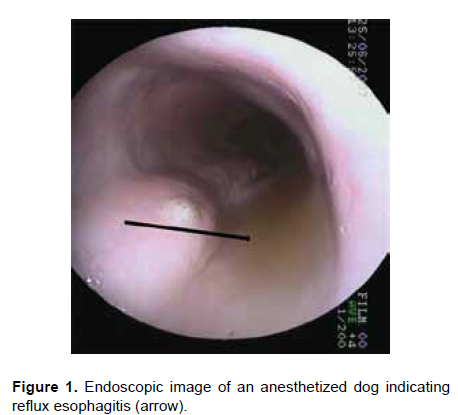
<body><![CDATA[<p>During anesthesia, GER (<a href="#f1">Figure 1</a>) occurs when   the reflux pH falls below 4.0 (gastric acid reflux)   or increases above 7.5 (bile reflux) for 30 seconds or   more (Wilson <i><i>et al.</i>,</i> 2005). GER during anesthesia has   been correlated with various factors, including the type   of surgery, patient position and the pre-anesthetic and   anesthetic drugs administered. There have also been   studies regarding how to prevent GER during anesthesia   in small animals (Strombeck and Harrold, 1985;   Roush <i><i>et al.</i>,</i> 1990; Galatos and Raptopoulos, 1995a,   1995b; Raptopoulus and Galatos, 1997; Chacon, 1998; Raptopoulus and Savvas, 2004; Rodr&iacute;guez, 2010). Also, during anesthesia there is a reduction of peristalsis and a lack of saliva that neutralizes acid pH, contributing to the development of esophagitis (Jergens, 2004).</p>      <p align="center"><a name="f1"></a><img src="/img/revistas/rccp/v28n2/v28n2a04f1.jpg">     <p align="left">It is possible that animals presenting GER during   anesthesia had an existing problem of the cardia,   predisposing them to reflux, especially with the use of   medications that relax the LES (Vlasin <i><i>et al.</i>,</i> 2004).   In order for GER to occur in dogs, three defense   components must fail: a) an external mechanism   formed by the diaphragmatic crura that wraps like   a sling around the abdominal esophagus augments   sphincteric pressure during inspiration; b) an internal   mechanism constituted by the intrinsic muscle of   the distal portion of the esophageal wall; and c) the   circular muscle fibers of the stomach. The internal   component of the esophagus is considered the first line   of defense against gastric reflux. When intragastric   pressure exceeds the internal components of the LES,   the external components take over, providing the next   level of protection (Brasseur <i><i>et al.</i>,</i> 2007).</p>      <p>&nbsp;</p>     <p><b><font size="3">Influence of the type of surgery on GER in anesthetized dogs</font></b></p>     <p>It is difficult to establish which type of surgery   causes more reflux during anesthesia. It has been   found that abdominal surgeries predispose to a   higher incidence of reflux because of an increase in the intra-abdominal pressure. Uterine surgery, on the other hand, is described as the most common cause of GER in dogs (Galatos and Raptopoulos, 1995b). Recent findings showed that gastrointestinal surgery, diagnostic imaging procedures, or a combination of both during the same anesthetic procedure increase the risk of regurgitation. It is possible that a change in the depth of the anesthesia, patient handling, and changes in body position may cause GER (Garc&iacute;a <i><i>et al.</i>,</i> 2013). However, another study has shown that GER occurred in 13% of anesthetized dogs, none of which had undergone abdominal surgery (Rodr&iacute;guez, 2010). It is also described that placing the dog in the Trendelenburg position (head down) predisposes to reflux. This position is used when the viscera requires cranial movement. Patients that have undergone previous surgery also show a higher incidence of GER (Galatos and Raptopoulos, 1995a,b). Other studies have reported that dogs that undergo orthopedic surgery have a higher risk of presenting GER during anesthesia (Rodr&iacute;guez, 2010, Lamata <i><i>et al.</i>,</i> 2012).</p>     <p>&nbsp;</p>     <p><b><font size="3">Influence of sex on GER in anesthetized dogs</font></b></p>     <p>It could be possible that the high number of   females with GER during surgery of the reproductive   system is due to the high number of interventions   performed in small animal clinics, but other factors   must be considered. For example, in humans, it is   the elevation of progesterone and not the pressure   of the fetus that causes reflux in pregnant women. In   the same way it has been described that in female dogs   progesterone and estrogen cause the LES to relax,   which predisposes to reflux (Nilsson <i><i>et al.</i>,</i> 2003).   Another study showed that postoperative benign   esophageal stricture developed in hysterectomized   dogs should probably not be attributed to the effects   of increased concentrations of female sex steroid   hormones. In that study, animals were evaluated under   the influence of different concentrations of endogenous   progesterone and estradiol-concentrations, and were   premedicated with acepromazine and thiopental   and maintained with halothane. Lower esophageal   pH was monitored continuously for 1 hour after   induction, and GER was detected in only one animal   (Anagnostou <i><i>et al.</i>,</i> 2009). In another recent study   on anesthetized dogs, none of the dogs with GER   had undergone an ovariohysterectomy, concluding that neither gender, nor hormones, was an important factor in the predisposition to GER during anesthesia (Rodr&iacute;guez, 2010).</p>     <p>&nbsp;</p><font size="3"><b>Influence of breed, body condition, and age on GER during anesthesia</b></font></p>      ]]></body>
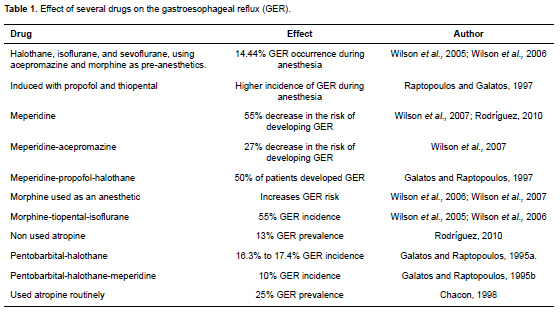
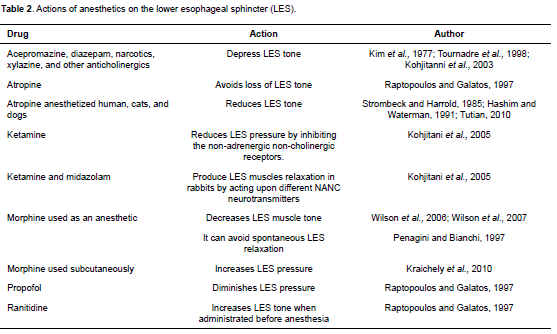
<body><![CDATA[<p>Among all dog breeds, it has been found that   Poodles commonly present this problem (Wilson <i><i>et al.</i>,</i> 2004, Rodr&iacute;guez, 2010). Another study reported   that Labrador Retrievers and German Shepherds   presented more reflux during anesthesia than controls (Lamata <i><i>et al.</i>,</i> 2012).</p>     <p>A relationship between chronic obstructive   respiratory syndrome and GER has been observed   in dogs (Lecoindre and Richard, 2004; Poncet <i><i>et al.</i>,</i> 2005). This is possibly because an anomalous   inspiratory effort might induce an abnormally low   negative intrathoracic pressure that could worsen   or even induce GER. Endoscopic examination of   the upper digestive tract in 30 dogs with chronic   obstructive respiratory syndrome showed that   25 of these dogs presented reflux esophagitis in   different stages (Lecoindre and Richard, 2004).   However, brachycephalic dogs predisposed to chronic   obstructive respiratory syndrome are not predisposed to GER during anesthesia.</p>     <p>A study showed that the abdominal esophagus has   different lengths depending on the breed (Pratschke,   2004). In that study, the esophagus in most of the   Greyhounds and Beagles was contained entirely   within the thoracic cavity such that no portion   of the esophagus could be subject to abdominal   pressure, which is likely associated with GERD   (Pratschke <i><i>et al.</i>,</i> 2004). If this is true, then it could   be possible that Poodles, Labrador Retrievers and   German Shepherds also have a short abdominal   esophagus, predisposing them to reflux, though this   has not been proven. The position and segment of the   terminal esophagus within the abdominal cavity in   dogs are very important. This portion of abdominal   esophagus acts as a reflux barrier according to the   law of LaPlace. This law stipulates that the pressure   inside a hollow viscus is inversely proportional to its   radius. The esophageal radius is consistently shorter   than the gastric radius. Consequently, when both are exposed simultaneously to the positive intra abdominal pressure, the pressure within the segment of abdominal esophagus always exceeds the internal gastric pressure, which helps prevent GER (Pratschke <i><i>et al.</i>,</i> 2004). It has been documented that dogs regurgitate as a normal physiological event (Patrikios <i><i>et al.</i>,</i> 1986). Interestingly, in this species a consistent and identifiable abdominal esophagus has not been documented. In contrast, the rat, a species with a separation of the high pressure anti-reflux barrier in two distinct regions with a clear abdominal esophagus (Soto <i><i>et al.</i>,</i> 1997), does not have the ability to vomit and the phenomenon of GER has not been observed in this species (Pratschke <i><i>et al.</i>,</i> 2004). To elucidate this higher predisposition to GER during anesthesia, additional studies similar to that of Pratschke's should be conducted to address the conformation of LES in other breeds.</p>     <p>One study showed that there was no significant   association between GER and body weight (Wilson   <i><i>et al.</i>,</i> 2005). In addition, other research showed that   76.92% of the patients that presented GER during   anesthesia had a normal body condition, while   23.08% were underweight and 0% were obese; there   was an increase of GER in large breed dogs (33 kg   to 49 kg; Rodr&iacute;guez, 2010). Similarly, another study   shows that dogs weighting more than 40 kg are more   likely to present passive regurgitation (Lamata <i><i>et al.</i>,</i>   2012). There is very little veterinary literature on this   issue; however, there have been studies regarding   the role of obesity and the risk of GER in humans   during anesthesia (Zacchi <i><i>et al.</i>,</i> 1991; Esquide <i><i>et al.</i>,</i>   2004; Freid, 2005; de Leon <i><i>et al.</i>,</i> 2010). In human   anesthesia, it has been proven that the combination of a   high intra-abdominal pressure, a high volume of gastric   content with a low pH, delayed gastric emptying and   a high incidence of hiatal hernias would put an obese   patient at higher risk of GER (Zacchi <i><i>et al.</i>,</i> 1991). In   addition, anesthetized obese patients are more likely   to present Mendelson's syndrome. This is a chemical   pneumonitis characterized by a bronchopulmonary   reaction after aspiration of gastric contents during general anesthesia (Kamalipour <i><i>et al.</i>,</i> 2012).</p>     <p>A mechanism called barrier pressure (BrP) assists   in avoiding aspiration during anesthesia. The BrP   is the difference between LES pressure and gastric   pressure. This gradient should always be positive and works as a barrier between the stomach and esophagus (de Le&oacute;n <i><i>et al.</i>,</i> 2010). In a study that compared the pressures of the LES and BrP with high-resolution solid-state manometry in obese and non-obese patients, both pressures decreased in both types of patients during induction of anesthesia with remifentanil. In obese patients, the BrP was significantly lower, but it still remained positive in all patients (de Le&oacute;n <i><i>et al.</i>,</i> 2010). However, other studies state that the pressure gradient between the stomach and the LES is similar between obese and non-obese patients in different surgical positions (Esquide <i><i>et al.</i>,</i> 2004; Freid, 2005). The low relationship between humans with GER and obesity was proven in a study (n = 44) in which seven obese patients were anesthetized and only one developed GER. GER did, however, develop in five out of 37 non-obese patients (Illing <i><i>et al.</i>,</i> 1992). Even though obesity itself has no influence in the presentation of GER, it does create an intra-abdominal condition that favors reflux when the gastroesophageal barrier is weakened (Zacchi, 1991). A human study of 256 fasted surgical patients found that in comparison to obese patients, lean patients that underwent anesthesia had a larger amount of gastric content with a lower pH (Harter <i><i>et al.</i>,</i> 1998). It has been described that a higher acid stomach content will predispose the patient to reflux and aspiration pneumonitis during anesthesia (Schreiner, 1998; Ng and Smith, 2001). In dogs, Rodr&iacute;guez (2010) described a high incidence of GER in thinner animals that were anesthetized. Unfortunately, the results of different studies addressing the relation of GER and body condition of dogs are not conclusive. This condition is presented in both lean and obese dogs; however, it seems to be more common in large dogs, regardless of their corporal condition. Therefore, it would be important for future research to establish a correlation between dogs' body condition, pressure of the LES, development of GER during anesthesia, and GER.</p>     <p>Few studies have correlated the age of anaesthetized   patients and the development of GER or aspiration   pneumonia in veterinary medicine. In some studies, no   correlation was found between an increase in patient   age and the risk of GER (Wilson <i><i>et al.</i>,</i> 2005; Lamata   <i><i>et al.</i>,</i> 2012; Garc&iacute;a <i><i>et al.</i>,</i> 2013). Nevertheless, in a   study performed in 270 dogs divided randomly in   groups according to age (2 to 5 months, 6 months to 9 years, and 10 to 15 years) geriatric canine patients had a higher risk of developing GER during anesthesia and their stomach content was more acidic in the case of reflux (Galatos and Raptopoulos, 1995b). Similarly, Rodr&iacute;guez (2010) found that the majority of reflux during anesthesia occurred in older dogs. At present, there is no explanation for low gastric pH in dogs or humans; also, previous studies in humans failed to establish significant changes in acid secretion (Pilotto <i><i>et al.</i>,</i> 1994; Franceschi <i><i>et al.</i>,</i> 2009). On the other hand, evidence shows that elderly human patients have an increased pH in the stomach content, but their stomach shows a delay in gastric emptying, which could possibly increase the potential of GER during anesthesia (Livingstone, 2003). However, in human anesthesia, children are considered to have a higher risk of developing GER and aspiration pneumonia during anesthesia (Alvarez y Reyes, 2009). This is because most of them have a liquid stomach content of more than 4 mL/kg at the time of anesthesia, with a pH of less than two, regardless of the fasting interval (Maekawa <i><i>et al.</i>,</i> 1998). In relation to this, a metaanalysis concluded that children who preoperatively fluid fasted for more than six hours benefit in terms of intraoperative gastric volume and pH when compared to children permitted unlimited fluids up to two hours preoperatively (Brady <i><i>et al.</i>,</i> 2009). In veterinary anesthesia, the presence of liquid in the stomach of puppies has not been described. It would be of interest to take measurements of the quantity and pH of liquid stomach content during anesthesia to establish if puppies are more likely to present GER and pneumonia aspiration during anesthesia.</p>     <p>&nbsp;</p>     <p><b><font size="3">Influence of different drugs on GER in anesthetized dogs</font></b></p>     <p>Several pre-anesthetic and anesthetic drugs, such   as atropine, diazepam, acepromazine, diazepam,   xylazine, morphine, halothane, and isoflurane can   lead to GER by decreasing the tone of the LES (Kim   <i><i>et al.</i>,</i> 1977; Strombeck and Harrold, 1985; Cox <i><i>et al.</i>,</i>   1988; Hashim and Waterman, 1993; Tournadre <i><i>et al.</i>,</i> 1998; Kohjitani <i><i>et al.</i>,</i> 2003; Epstein and Swirsky, 2009; <a href="#t1">Tables 1</a> and <a href="#t2">2</a>).</p>      <p align="center"><a name="t1"><img src="/img/revistas/rccp/v28n2/v28n2a04t1.jpg"></a></p>     ]]></body>
<body><![CDATA[<p align="center"><a name="t2"><img src="/img/revistas/rccp/v28n2/v28n2a04t2.jpg"></a></p>     <p align="left">It has been shown that atropine is one of the   drugs that reduce the tone of the LES in anesthetized   humans, cats and dogs, thereby predisposing them to   reflux (Strombeck and Harrold, 1985; Tutian, 2010).   In spite of this, atropine&#8212;as well as glycopyrrolate&#8212;   does not lower the pH of the esophagus or the stomach   when used as a pre-anesthetic in dogs (Roush <i><i>et al.</i>,</i>   1990). The increase in the possibility of producing   GER with atropine during anesthesia was confirmed in   two different studies completed in the same veterinary   hospital with comparable groups of anesthetized   animals, and by similar anesthetic protocol. When   atropine was used routinely, GER prevalence was   25% (Chacon, 1998) versus 13% when atropine was not used (Rodr&iacute;guez, 2010).     <p align="left">In humans, diazepam has the ability to significantly   lower LES pressure. In the human LES, diazepam   could act as a smooth muscle relaxant since myogenic   influences have been implicated in the control of   LES pressure (Rushnak and Leevy, 1980). However,   although dogs have striated muscle fibers in the   muscle layer, Hall <i>et al.</i> (1987) reported that diazepam decreased LES pressure in this species.     <p align="left">Reports on acepromazine and its effect on GER   in anesthetized dogs are inconsistent. For example,   Lamata <i>et al.</i> (2012) found no association between the   administration of acepromazine and the probability   of a GER episode occurring. However, Garc&iacute;a <i>et al.</i>   (2013) mentioned that the risk of GER was significantly   lower in dogs premedicated with acepromazine in   combination with an opioid in comparison to patients   administered medetomidine alone. This reduction   of GER in anesthetized dogs may occur because   acepromazine causes a decrease in BrP compared to other drugs (Hashim and Waterman, 1993).     <p align="left">At present, controversy exists as to whether   morphine may relax or increase LES tone. Morphine   produces emesis when used as a pre-anesthetic.   Vomit alone does not determine the possibility of   GER during anesthesia, but it is well documented that   morphine, when used as pre-anesthetic, increases the   risk of GER (Wilson <i><i>et al.</i>,</i> 2005) since it decreases   muscle tone in the LES (Mittal and McCallum, 1986).   However, Penagini, and Bianchi (1997) stated that   morphine might inhibit the spontaneous relaxation of LES. Another study claims that morphine increases LES pressure when used subcutaneously (Kraichely <i><i>et al.</i>,</i> 2010). A recent study found no association between the use of opioid drugs and GER incidence in anesthetized dogs, although opioids were not individually analyzed (Garc&iacute;a <i><i>et al.</i>,</i> 2013). Therefore, it is difficult to establish whether this drug predisposes to GER during anesthesia.     <p align="left">In dogs, pre-anesthetic meperidine has been   associated with a reduction in the absolute risk of   developing GER. Galatos and Raptopoulos (1995ab)   anesthetized dogs with pentobarbital-halothane or   with a combination of pentobarbital-halothanemeperidine.   The group that received meperidine   had lower GER incidence (10%) in comparison to   the group that did not receive meperidine (16.3%   to 17.4%). Wilson <i>et al.</i> (2008) demonstrated that   administration of pre-anesthetic meperidine was   associated with a 29% reduction in the absolute risk of GER in comparison to morphine.     <p align="left">Contractility of the LES is one of the factors that   prevent regurgitation during anesthesia. Various   hormones and neurotransmitters regulate this   contractibility. It is known that non-adrenergic and noncholinergic   (NANC) nerves regulate gastrointestinal   peristalsis and relaxation mechanisms of the LES.   NANC inhibitory nerves are responsible for most   nerve induced relaxations of the gastrointestinal   sphincteric muscle. Ketamine and midazolam produce   a relaxation of LES muscles in rabbits by acting upon   different NANC neurotransmitters (Kohjitani <i><i>et al.</i>,</i>   2005). N-methyl D-aspartate (NMDA) antagonists   like ketamine can act differently depending on the   region of the gastrointestinal tract where they are   exerting its function or where they are located, and   the species. It has been well established that ketamine   reduces LES pressure by inhibiting non-adrenergic non-cholinergic receptors (Kohjitani <i><i>et al.</i>,</i> 2005).     <p align="left">Several induction agents are used in small animal   anesthesia; two of the most common inducers are   propofol and thiopental. Raptopoulos and Galatos   (1997) showed that dogs induced with propofol had   higher GER incidence during anesthesia than those   induced with thiopental. It is believed that this is   because propofol diminishes LES pressure. Although   further research is needed to elucidate all the potential   effects of anesthesia inductors on GER, thiopental should be used as an induction agent in patients with   high risk of GER in anesthesia, considering aspects   such as breed, body weight (&gt; 40 kg), patient position   and orthopedic surgery.</p>     <p align="left">Other researchers reported 55% GER incidence using   a morphine-thiopental-isoflurane protocol (Wilson <i><i>et al.</i>,</i> 2005; Wilson <i><i>et al.</i>,</i> 2006a). Wilson <i>et al.</i> (2007)   compared the number of dogs that presented GER   when using only meperidine, morphine, or meperidineacepromazine.   They found that the dogs that received   meperidine alone had a 55% decrease in the risk   of developing GER and the group with meperdineacepromazine   had a 27% decrease. Similar results   were obtained in recent studies, where meperidine   proved to be the drug less likely to induce GER in these   patients (Rodr&iacute;guez, 2010). Meperidine may reduce   the possibility of GER in dogs. However, according to   Wilson <i>et al.</i> (2005), it does not produce high quality   sedation. Therefore, it is not useful to include it in   the anesthetic protocol when GER prevention during anesthesia is desired (Wilson <i><i>et al.</i>,</i> 2005).</p>     <p align="left">It must also be taken into consideration that   halothane, nitric oxide, and sodium pentothal inhibit   the transient relaxation of the esophageal sphincter   (Cox <i><i>et al.</i>,</i> 1988). 14.44% of dogs anesthetized with   halothane, isoflurane, and sevoflurane, and using   acepromazine and morphine as pre-anesthetics,   presented GER during anesthesia. This was attributed   to acepromazine, since it decreases muscle tone of   the LES and does not avoid morphine-induced vomit.   Maintaining anesthesia with halothane, isoflurane,   and sevoflurane did not have an influence on GER   development during surgery (Wilson <i><i>et al.</i>,</i> 2005;   Wilson <i><i>et al.</i>,</i> 2006; Lamata <i><i>et al.</i>,</i> 2012; Garc&iacute;a <i><i>et al.</i>,</i> 2013).</p>     ]]></body>
<body><![CDATA[<p align="left">&nbsp;</p>     <p align="left"><b><font size="3">Influence of patient position on GER during anesthesia</font></b></p>     <p align="left">There have been several studies in both human   and veterinary surgery about the effect of patient   position during surgery and the development of GER.   For example, when dogs are positioned in ventral   recumbency they present a reduction of barrier   pressure in the LES during anesthesia (Pratschke <i><i>et al.</i>,</i> 2001). However, Galatos and Raptopoulos (1995b) mentioned that only the heavier patients placed in this position presented high incidence of reflux during anesthesia, and that patient weight showed no influence on reflux development when using other surgical positions. Furthermore, according to Favarato <i>et al.</i> (2011), decubitus position is not a predisposing factor of GER in anesthetized dogs.</p>     <p align="left">A reduction of pressure of the LES in patients   in ventral recumbency has been demonstrated by   Pratschke <i>et al.</i> (2001) by placing deep-chested   dogs on a flat, hard surface, and observing that   thorax anatomy becomes distorted, particularly the   diaphragm. This occurs as a result of the pressure   placed on the sternum when the weight of the   animal is in a vertical position, since body weight is   normally supported by all four limbs (Pratschke <i><i>et al.</i>,</i> 2001). Similarly, this diaphragmatic distortion   occurs in heavy dogs (Lamata <i><i>et al.</i>,</i> 2012). Since   the diaphragm is vital in maintaining the pressure   of the LES, the distortion created by the weight of   the dog on the surgical table is an important part of   the reduced protection by tone loss (Pratschke <i><i>et al.</i>,</i>   2001). However, Rodr&iacute;guez (2010) reported that   most patients that developed GER during anesthesia   had been placed in right lateral recumbency. This   is most likely because the right crus is larger and   longer than the left; then, if the dog is placed in right   lateral recumbency on top of a hard and flat surface,   its weight will prevent the right crus from working adequately, favoring the appearance of reflux.</p>     <p align="left">&nbsp;</p>     <p align="left"><b><font size="3">Preventing GER during anesthesia</font></b></p>     <p align="left">The consequences of GER are not only dangerous,   but also difficult to treat. It is better to prevent GER   from occurring during anesthesia, and in the event that   it does develop, the damage must be minimized (Ng   and Smith, 2001). In humans, the methods utilized to   decrease GER incidence and severity of the injuries   consists of managing the amount of gastric content   via fasting, decreasing its pH, and taking measures to   maintain an adequate tone of the LES (Ng and Smith,   2001). In a review about physiological aspects of   GER and aspiration in anesthetized patients, it was   determined that total fasting (nil per os/NPO) is not   the most suitable recommendation to decrease GER incidence. This is because patients with 24 hours of fasting produce more HCl with a more acidic pH. Adult patients can drink clear liquids up to three hours before anesthesia since this does not increase the risk of reflux. A minimum of five hours is required to evacuate a light meal, but more than nine hours are needed for a heavy meal (Ng and Smith, 2001).</p>     <p align="left">In children, the minimum fasting time required   of clear liquids (water, fruit juice without pulp,   carbonated drinks, tea, and dextrose) to have an   adequate gastric emptying without any digestive   problems was two to six hours (L&oacute;pez-Mu&ntilde;oz <i><i>et al.</i>,</i> 2002; Maharaj, 2009).</p>     <p align="left">Prolonged fasting, generally starting the night before   surgery, was traditionally recommended in veterinary   medicine, though this practice has changed. Now it is   recommended that adult dogs solid-food fast for five   to ten hours and they may have access to water up to   two to three hours before anesthesia (Raptopoulos and   Galatos, 1997; Raptopoulos and Savas, 2004; Muir <i><i>et al.</i>,</i> 2007; Savas and Raptopoulos, 2009; Epstein and   Swirsky, 2009). It has been proven that a fasting period   of more than 18 hours decreases LES tone in anesthetized   dogs, therefore favoring GER development (Galatos and Raptopoulos, 1995a).</p>     <p align="left">Although oral antacids in gel form have proven   effective for increasing the pH of gastric content, it is not   advisable to use them before anesthesia since they can   have fatal consequences if aspiration occurs. In humans,   water-soluble antacids, such as sodium bicarbonate, can   also lower the stomach pH without presenting this danger   (S&aacute;nchez, 2002); however, safety and potential damage   to respiratory system&#8212;in case of bronchoaspiration&#8212; have not been established in dogs.</p>     ]]></body>
<body><![CDATA[<p align="left">Studies evaluating GER in anesthetized humans   and dogs have focused on the use of prokinetics   and medications to reduce gastric acidity to   prevent reflux (Wilson <i><i>et al.</i>,</i> 2006b; Panti <i><i>et al.</i>,</i>   2009; Favarato <i><i>et al.</i>,</i> 2012). In humans, it is also   known that drugs that decrease hydrochloric acid   production in the stomach, such as ranitidine and   omeprazole increase pH and gastric fluids during   surgery and therefore decrease the risk of developing   Mendelson's syndrome (Gr&uuml;mberg, 2003; Moro,   2004). However, Tamhankar <i>et al.</i> (2004) reported that oral administration of omeprazole every 12 h for 7 days did not decrease GER. Esomeprazole is the proton pump inhibitor studied in dogs; dogs that received IV esomeprazole (1 mg/kg) alone in a prospective randomized placebo-controlled study presented significant increase in gastric and esophageal pH, but the drug did not significantly decrease GER frequency; however, combination of esomeprazole (1 mg/kg) and cisapride (1 mg/kg) IV was associated with significant decrease of reflux in anaesthetized dogs (Zacuto <i><i>et al.</i>,</i> 2012). Ranitidine has been used in dogs to reduce GER during anesthesia, but results vary. According to some reports, ranitidine increased LES tone when administered before anesthesia; and it prevented tone loss of the LES when used before atropine (Raptopoulos and Galatos, 1997; Harter <i><i>et al.</i>,</i> 1998; Burrows, 2006). It is important to consider that ranitidine has no effect on LES tone when it is administered after atropine (Harter <i><i>et al.</i>,</i> 1998); however, according to recent findings ranitidine does not reduce GER when administered to dogs as an intravenous bolus at a dose of 2 mg/kg 6 h before anesthesia (Favarato <i><i>et al.</i>,</i> 2012).</p>     <p align="left">In regard to prokinetics used in human anesthesiology   to prevent GER during anesthesia, it has been proven that   administration of 200 mg erythromycin before surgery   increases the stomach pH. This is due to the stimulation   of motilin receptors that reduce gastrin levels (Anderson,   2010). Wilson <i>et al.</i> (2006b) showed that a low dose of   metoclopramide did not have a significant effect on GER   incidence in dogs; however, a high dose (bolus loading   dose of 1 mg/kg, IV, followed by continuous infusion at   a rate of 1 mg/kg/h) reduced the relative risk to develop GER in 54%.</p>     <p>&nbsp;</p>     <p><b><font size="3">Conclusion</font></b></p>     <p>Occurrence of GER during anesthesia is a   relatively frequent problem and a risk factor for   further complications, such as aspiration pneumonia,   esophagitis and esophageal strictures. The main   factors involved include: Poodle patients, position   (Trendelenburg or right lateral recumbence),   orthopedic surgeries utilizing atropine and morphine   as preanesthetics, and the use of propofol as an   induction agent. A complete pre-surgery clinical   history will also help to identify any existing digestive and/or esophageal disease, which may increase the risk of developing GER. Proper monitoring, along with the administration of certain drugs, such as prokinetics and proton pump inhibitors, can diminish GER occurrence. Further studies are needed to establish preventive protocols during anesthetic procedures. Studies in humans have rendered a guide for pathophysiologic and epidemiologic considerations, symptom evaluation, diagnostic workup, medical therapy and surgical therapy for GERD. Studies on other triggering factors, in addition to their management and prevention, are also needed.</p>     <p>&nbsp;</p>     <p><b><font size="3">Conflicts of interest</font></b></p>     <p>The authors declare they have no conflicts of interest with regard to the work presented in this report.</p>     <p>&nbsp;</p> <hr size="1" />     <p><b><font size="3">Notes</font></b></p> </font>     ]]></body>
<body><![CDATA[<p><font size="4"><b><a name="a0" id="a0"><a href="#a1"><font size="2" face="Verdana, Arial, Helvetica, sans-serif">&curren;</font></a></a></b></font><font size="2" face="Verdana, Arial, Helvetica, sans-serif">To cite this article: Rodr&iacute;guez-Alarc&oacute;n CA, Berinstain-Ruiz DM, Riveira-Barreno R, D&iacute;az G, Us&oacute;n-Casa&uacute;s JM, Garc&iacute;a-Herrera R, P&eacute;rez-Merino EM. Gastroesophageal reflux in anesthetized dogs: a review. Rev Colomb Cienc Pecu 2015; 28:144-155.</font></p> <font face="Verdana, Arial, Helvetica, sans-serif" size="2"><hr size="1" />     <p>&nbsp;</p>     <p><b><font size="3">References</font></b></p>     <!-- ref --><p>Alvarez L, Reyes RD. Ayuno preoperatorio en ni&ntilde;os sanos de 2, 4 y 6 horas. Rev Colomb Anestesiol 2009; 37:63-70.    &nbsp;&nbsp;&nbsp;&nbsp;&nbsp;&nbsp;&nbsp;&nbsp;[&#160;<a href="javascript:void(0);" onclick="javascript: window.open('/scielo.php?script=sci_nlinks&ref=000096&pid=S0120-0690201500020000400001&lng=','','width=640,height=500,resizable=yes,scrollbars=1,menubar=yes,');">Links</a>&#160;]<!-- end-ref --></p>     <!-- ref --><p>   Anagnostou TL, Savvas I, Kazakos GM, Ververidis HN, Haritopoulou   MR, Rallis TS, Raptopoulos D. Effect of endogenous progesterone   and oestradiol-17beta on the incidence of gastro-oesophageal   reflux and on the barrier pressure during general anaesthesia   in the female dog. Vet Anaesth Analg 2009; 36:308-318.    &nbsp;&nbsp;&nbsp;&nbsp;&nbsp;&nbsp;&nbsp;&nbsp;[&#160;<a href="javascript:void(0);" onclick="javascript: window.open('/scielo.php?script=sci_nlinks&ref=000098&pid=S0120-0690201500020000400002&lng=','','width=640,height=500,resizable=yes,scrollbars=1,menubar=yes,');">Links</a>&#160;]<!-- end-ref --><!-- ref -->   Anderson K. Gastroesophageal reflux disease. Radiol Technol   2010; 81:251-268.    &nbsp;&nbsp;&nbsp;&nbsp;&nbsp;&nbsp;&nbsp;&nbsp;[&#160;<a href="javascript:void(0);" onclick="javascript: window.open('/scielo.php?script=sci_nlinks&ref=000099&pid=S0120-0690201500020000400003&lng=','','width=640,height=500,resizable=yes,scrollbars=1,menubar=yes,');">Links</a>&#160;]<!-- end-ref --></p>     <!-- ref --><p>   Brady M, Kinn S, Ness V, O'Rourke K, Randhawa N, Stuart P.   Preoperative fasting for preventing perioperative complications   in children. Cochrane Database Syst Rev 2009; 4: DOI:   10.1002/14651858.CD005285.pub2&nbsp;&nbsp;&nbsp;&nbsp;&nbsp;&nbsp;&nbsp;&nbsp;[&#160;<a href="javascript:void(0);" onclick="javascript: window.open('/scielo.php?script=sci_nlinks&ref=000101&pid=S0120-0690201500020000400004&lng=','','width=640,height=500,resizable=yes,scrollbars=1,menubar=yes,');">Links</a>&#160;]<!-- end-ref --><!-- ref --><p>   Brasseur JG, Ulerich R, Dai Q, Patel DK, Soliman A, Miller LS.   Pharmacological dissection of the human gastro-oesophageal   segment into three sphincteric components. J Physiol 2007;   580:961-975.    &nbsp;&nbsp;&nbsp;&nbsp;&nbsp;&nbsp;&nbsp;&nbsp;[&#160;<a href="javascript:void(0);" onclick="javascript: window.open('/scielo.php?script=sci_nlinks&ref=000102&pid=S0120-0690201500020000400005&lng=','','width=640,height=500,resizable=yes,scrollbars=1,menubar=yes,');">Links</a>&#160;]<!-- end-ref --></p>     <!-- ref --><p>   Burrows C. Trastornos digestivos. In: Schaer M, editor. Medicina   cl&iacute;nica del perro y el gato. Barcelona, Espa&ntilde;a: Elsevier-Masson;   2006. p.270-281.    &nbsp;&nbsp;&nbsp;&nbsp;&nbsp;&nbsp;&nbsp;&nbsp;[&#160;<a href="javascript:void(0);" onclick="javascript: window.open('/scielo.php?script=sci_nlinks&ref=000104&pid=S0120-0690201500020000400006&lng=','','width=640,height=500,resizable=yes,scrollbars=1,menubar=yes,');">Links</a>&#160;]<!-- end-ref --></p>     <!-- ref --><p>   Chac&oacute;n MB. Estudio prospectivo y retrospectivo endosc&oacute;pico   esofagog&aacute;stricos en perros de la cl&iacute;nica con patolog&iacute;a digestiva y   sin ella. [Tesis de Grado]. Universidad de Extremadura. Facultad   de Veterinaria; 1998.    &nbsp;&nbsp;&nbsp;&nbsp;&nbsp;&nbsp;&nbsp;&nbsp;[&#160;<a href="javascript:void(0);" onclick="javascript: window.open('/scielo.php?script=sci_nlinks&ref=000106&pid=S0120-0690201500020000400007&lng=','','width=640,height=500,resizable=yes,scrollbars=1,menubar=yes,');">Links</a>&#160;]<!-- end-ref --></p>     <!-- ref --><p>   Cox MR, Martin CJ, Dent J, Westmore M. Effect of general   anaesthesia on transient lower oesophageal sphincter relaxations   in the dog. Aust N Z J Surg 1988; 58:825-830.    &nbsp;&nbsp;&nbsp;&nbsp;&nbsp;&nbsp;&nbsp;&nbsp;[&#160;<a href="javascript:void(0);" onclick="javascript: window.open('/scielo.php?script=sci_nlinks&ref=000108&pid=S0120-0690201500020000400008&lng=','','width=640,height=500,resizable=yes,scrollbars=1,menubar=yes,');">Links</a>&#160;]<!-- end-ref --></p>     <!-- ref --><p>   de Leon A, Th&ouml;rn S-E, Wattwil M. High-Resolution solid-state   manometry of the upper and lower esophageal sphincters during   anesthesia induction: a comparison between obese and non-obese   patients. Anaesth Analg 2010; 111:149-153.    &nbsp;&nbsp;&nbsp;&nbsp;&nbsp;&nbsp;&nbsp;&nbsp;[&#160;<a href="javascript:void(0);" onclick="javascript: window.open('/scielo.php?script=sci_nlinks&ref=000110&pid=S0120-0690201500020000400009&lng=','','width=640,height=500,resizable=yes,scrollbars=1,menubar=yes,');">Links</a>&#160;]<!-- end-ref --></p>     <!-- ref --><p>   Epstein A, Swirsky N. Post-anesthetic esophageal dysfunction in   a dog. Isr J Vet Med 2009; 64:12-13.    &nbsp;&nbsp;&nbsp;&nbsp;&nbsp;&nbsp;&nbsp;&nbsp;[&#160;<a href="javascript:void(0);" onclick="javascript: window.open('/scielo.php?script=sci_nlinks&ref=000112&pid=S0120-0690201500020000400010&lng=','','width=640,height=500,resizable=yes,scrollbars=1,menubar=yes,');">Links</a>&#160;]<!-- end-ref --></p>     <!-- ref --><p>   Esquide J, de Luis R, Valero C. Anestesia en la cirug&iacute;a bari&aacute;trica.   Cir Esp 2004; 75:273-279.    &nbsp;&nbsp;&nbsp;&nbsp;&nbsp;&nbsp;&nbsp;&nbsp;[&#160;<a href="javascript:void(0);" onclick="javascript: window.open('/scielo.php?script=sci_nlinks&ref=000114&pid=S0120-0690201500020000400011&lng=','','width=640,height=500,resizable=yes,scrollbars=1,menubar=yes,');">Links</a>&#160;]<!-- end-ref --></p>     <!-- ref --><p>   Favarato E, Souza M, Costa P, Favarato L, Nehme R, Monteiro   B. Evaluation of metoclopramide and ranitidine on the prevention of gastroesophageal reflux episodes in anesthetized dogs. Res Vet   Sci 2012; 93:466-467.    &nbsp;&nbsp;&nbsp;&nbsp;&nbsp;&nbsp;&nbsp;&nbsp;[&#160;<a href="javascript:void(0);" onclick="javascript: window.open('/scielo.php?script=sci_nlinks&ref=000116&pid=S0120-0690201500020000400012&lng=','','width=640,height=500,resizable=yes,scrollbars=1,menubar=yes,');">Links</a>&#160;]<!-- end-ref --></p>     <!-- ref --><p>   Favarato ES, de Souza MV, dos Santos Costa PR, Pompermayer   LG, Favarato LSC, J&uacute;nior JIR. Ambulatory esophageal pHmetry   in healthy dogs with and without the influence of general   anesthesia. Vet Res Commun 2011; 35:271-282.    &nbsp;&nbsp;&nbsp;&nbsp;&nbsp;&nbsp;&nbsp;&nbsp;[&#160;<a href="javascript:void(0);" onclick="javascript: window.open('/scielo.php?script=sci_nlinks&ref=000118&pid=S0120-0690201500020000400013&lng=','','width=640,height=500,resizable=yes,scrollbars=1,menubar=yes,');">Links</a>&#160;]<!-- end-ref --></p>     <!-- ref --><p>   Franceschi M, Di Mario F, Leandro G, Maggi S, Pilotto A. Acidrelated   disorders in the elderly. Best Pract Res Clin Gastroenterol   2009; 23:839-848.    &nbsp;&nbsp;&nbsp;&nbsp;&nbsp;&nbsp;&nbsp;&nbsp;[&#160;<a href="javascript:void(0);" onclick="javascript: window.open('/scielo.php?script=sci_nlinks&ref=000120&pid=S0120-0690201500020000400014&lng=','','width=640,height=500,resizable=yes,scrollbars=1,menubar=yes,');">Links</a>&#160;]<!-- end-ref --></p>     <!-- ref --><p>   Freid EB. The rapid sequence induction revisited: obesity and sleep   apnea syndrome. Anesthesiol Clin North America 2005; 23:551-564.    &nbsp;&nbsp;&nbsp;&nbsp;&nbsp;&nbsp;&nbsp;&nbsp;[&#160;<a href="javascript:void(0);" onclick="javascript: window.open('/scielo.php?script=sci_nlinks&ref=000122&pid=S0120-0690201500020000400015&lng=','','width=640,height=500,resizable=yes,scrollbars=1,menubar=yes,');">Links</a>&#160;]<!-- end-ref --></p>     <!-- ref --><p>   Galatos AD, Raptopoulos D. Gastro-oesophageal reflux during   anaesthesia in the dog: the effect of preoperative fasting and   premedication. Vet Rec 1995a; 137(19):479-483.    &nbsp;&nbsp;&nbsp;&nbsp;&nbsp;&nbsp;&nbsp;&nbsp;[&#160;<a href="javascript:void(0);" onclick="javascript: window.open('/scielo.php?script=sci_nlinks&ref=000124&pid=S0120-0690201500020000400016&lng=','','width=640,height=500,resizable=yes,scrollbars=1,menubar=yes,');">Links</a>&#160;]<!-- end-ref --></p>     <!-- ref --><p>   Galatos AD, Raptopoulos D. Gastro-oesophageal reflux during   anaesthesia in the dog: the effect of age, positioning and type of   surgical procedure. Vet Rec 1995b; 137(20):513-516.    &nbsp;&nbsp;&nbsp;&nbsp;&nbsp;&nbsp;&nbsp;&nbsp;[&#160;<a href="javascript:void(0);" onclick="javascript: window.open('/scielo.php?script=sci_nlinks&ref=000126&pid=S0120-0690201500020000400017&lng=','','width=640,height=500,resizable=yes,scrollbars=1,menubar=yes,');">Links</a>&#160;]<!-- end-ref --></p>     <!-- ref --><p>   Garc&iacute;a CDM, Pinchbeck G, Dugdale A, Senior J. Retrospective   study of the risk factors and prevalence of regurgitation in dogs   undergoing general anaesthesia. Open Vet Sci J 2013; 7:6-11.    &nbsp;&nbsp;&nbsp;&nbsp;&nbsp;&nbsp;&nbsp;&nbsp;[&#160;<a href="javascript:void(0);" onclick="javascript: window.open('/scielo.php?script=sci_nlinks&ref=000128&pid=S0120-0690201500020000400018&lng=','','width=640,height=500,resizable=yes,scrollbars=1,menubar=yes,');">Links</a>&#160;]<!-- end-ref --></p>     <!-- ref --><p>   Glazer A, Walters P. Esophagitis and esophageal strictures.   Compend Contin Educ Vet 2008; 5:281-292.    &nbsp;&nbsp;&nbsp;&nbsp;&nbsp;&nbsp;&nbsp;&nbsp;[&#160;<a href="javascript:void(0);" onclick="javascript: window.open('/scielo.php?script=sci_nlinks&ref=000130&pid=S0120-0690201500020000400019&lng=','','width=640,height=500,resizable=yes,scrollbars=1,menubar=yes,');">Links</a>&#160;]<!-- end-ref --></p>     <!-- ref --><p>   Gr&uuml;nberg G. Omeprazol para la reducci&oacute;n del riesgo de desarrollo   de s&iacute;ndrome de Mendelson en pacientes coordinados para cirug&iacute;a   abdominal. Anest Analg Reanim 2003; 18.    &nbsp;&nbsp;&nbsp;&nbsp;&nbsp;&nbsp;&nbsp;&nbsp;[&#160;<a href="javascript:void(0);" onclick="javascript: window.open('/scielo.php?script=sci_nlinks&ref=000132&pid=S0120-0690201500020000400020&lng=','','width=640,height=500,resizable=yes,scrollbars=1,menubar=yes,');">Links</a>&#160;]<!-- end-ref --></p>     <!-- ref --><p>   Gualtieri M. Esophageal structures of the dog and cat: diagnosis   and treatment. Proceedings of the 30th Congress of the World   Small Animal Veterinary Association, 2005 May 11-14; Mexico   City, Mexico. WSAVA; 2005.    &nbsp;&nbsp;&nbsp;&nbsp;&nbsp;&nbsp;&nbsp;&nbsp;[&#160;<a href="javascript:void(0);" onclick="javascript: window.open('/scielo.php?script=sci_nlinks&ref=000134&pid=S0120-0690201500020000400021&lng=','','width=640,height=500,resizable=yes,scrollbars=1,menubar=yes,');">Links</a>&#160;]<!-- end-ref --></p>     <!-- ref --><p>   Hall J, Magne M, Twedt D. Effect of acepromazine, diazepam,   fentanyl-droperidol, and oxymorphone on gastroesophageal   sphincter pressure in healthy dogs. Am J Vet Res 1987; 48:556-557.    &nbsp;&nbsp;&nbsp;&nbsp;&nbsp;&nbsp;&nbsp;&nbsp;[&#160;<a href="javascript:void(0);" onclick="javascript: window.open('/scielo.php?script=sci_nlinks&ref=000136&pid=S0120-0690201500020000400022&lng=','','width=640,height=500,resizable=yes,scrollbars=1,menubar=yes,');">Links</a>&#160;]<!-- end-ref --></p>     <!-- ref --><p>   Han E, Broussard J, Baer KE. Feline esophagitis secondary to   gastroesophageal reflux disease: clinical signs and radiographic,   endoscopic, and histopathologic findings. J Am Anim Hosp Assoc   2003; 39:161-167.    &nbsp;&nbsp;&nbsp;&nbsp;&nbsp;&nbsp;&nbsp;&nbsp;[&#160;<a href="javascript:void(0);" onclick="javascript: window.open('/scielo.php?script=sci_nlinks&ref=000138&pid=S0120-0690201500020000400023&lng=','','width=640,height=500,resizable=yes,scrollbars=1,menubar=yes,');">Links</a>&#160;]<!-- end-ref --></p>     <!-- ref --><p>   Harter RL, Kelly WB, Kramer MG, Perez CE, Dzwonczyk RR.   A comparison of the volume and ph of gastric contents of obese   and lean surgical patients. Anesth Analg 1998; 86:147-152.    &nbsp;&nbsp;&nbsp;&nbsp;&nbsp;&nbsp;&nbsp;&nbsp;[&#160;<a href="javascript:void(0);" onclick="javascript: window.open('/scielo.php?script=sci_nlinks&ref=000140&pid=S0120-0690201500020000400024&lng=','','width=640,height=500,resizable=yes,scrollbars=1,menubar=yes,');">Links</a>&#160;]<!-- end-ref --></p>     <!-- ref --><p>   Hashim MA, Waterman AE. Effects of thiopentone, propofol,   alphaxalone-alphadolone, ketamine, and xylazine-ketamine on   lower oesophageal sphincter pressure and barrier pressure in cats.   Vet Rec 1991; 129:137-139.    &nbsp;&nbsp;&nbsp;&nbsp;&nbsp;&nbsp;&nbsp;&nbsp;[&#160;<a href="javascript:void(0);" onclick="javascript: window.open('/scielo.php?script=sci_nlinks&ref=000142&pid=S0120-0690201500020000400025&lng=','','width=640,height=500,resizable=yes,scrollbars=1,menubar=yes,');">Links</a>&#160;]<!-- end-ref --></p>     <!-- ref --><p>   Hyun JJ, Bak YT. Clinical significance of hiatal hernia. Gut liver   2011; 5:267-277.    &nbsp;&nbsp;&nbsp;&nbsp;&nbsp;&nbsp;&nbsp;&nbsp;[&#160;<a href="javascript:void(0);" onclick="javascript: window.open('/scielo.php?script=sci_nlinks&ref=000144&pid=S0120-0690201500020000400026&lng=','','width=640,height=500,resizable=yes,scrollbars=1,menubar=yes,');">Links</a>&#160;]<!-- end-ref --></p>     <!-- ref --><p>   Illing L, Duncan PG, Yip R. Gastroesophageal reflux during   anaesthesia. Can J Anaesth 1992; 39:466-470.    &nbsp;&nbsp;&nbsp;&nbsp;&nbsp;&nbsp;&nbsp;&nbsp;[&#160;<a href="javascript:void(0);" onclick="javascript: window.open('/scielo.php?script=sci_nlinks&ref=000146&pid=S0120-0690201500020000400027&lng=','','width=640,height=500,resizable=yes,scrollbars=1,menubar=yes,');">Links</a>&#160;]<!-- end-ref --></p>     <!-- ref --><p>   Jergens AE. Enfermedades del es&oacute;fago. In: Ettinger SJ, Editor.   Tratado de medicina interna veterinaria. Filadelfia: Elsevier   Saunders; 2004. p.1298-1310.    &nbsp;&nbsp;&nbsp;&nbsp;&nbsp;&nbsp;&nbsp;&nbsp;[&#160;<a href="javascript:void(0);" onclick="javascript: window.open('/scielo.php?script=sci_nlinks&ref=000148&pid=S0120-0690201500020000400028&lng=','','width=640,height=500,resizable=yes,scrollbars=1,menubar=yes,');">Links</a>&#160;]<!-- end-ref --></p>     <!-- ref --><p>Kamalipour H, Lahsaee M, Foroutan HR, Ghoreishi M, Kamali   K. Comparison of different non-pharmacological preoperative   preparations on gastric fluid volume and acidity: a randomized controlled trial. Anaesth Intens Care 2012; 16:165-168.    &nbsp;&nbsp;&nbsp;&nbsp;&nbsp;&nbsp;&nbsp;&nbsp;[&#160;<a href="javascript:void(0);" onclick="javascript: window.open('/scielo.php?script=sci_nlinks&ref=000150&pid=S0120-0690201500020000400029&lng=','','width=640,height=500,resizable=yes,scrollbars=1,menubar=yes,');">Links</a>&#160;]<!-- end-ref --></p>     <!-- ref --><p> Kim KC, Patdu R, Kim HW. The relationship between   intrag&aacute;strica and lower esophageal sphincter pressures during general anesthesia. Anesthesiology 1977; 46:424-426.    &nbsp;&nbsp;&nbsp;&nbsp;&nbsp;&nbsp;&nbsp;&nbsp;[&#160;<a href="javascript:void(0);" onclick="javascript: window.open('/scielo.php?script=sci_nlinks&ref=000152&pid=S0120-0690201500020000400030&lng=','','width=640,height=500,resizable=yes,scrollbars=1,menubar=yes,');">Links</a>&#160;]<!-- end-ref --></p>     <!-- ref --><p> Kohjitani A, Funahashi M, Miyawaki T, Hanazaki M, Matsuo R,   Shimada M. Peripheral N-methyl-D-aspartate receptors modulate   nonadrenergic noncholinergic lower esophageal sphincter   relaxation in rabbits. Anesth Analg 2005; 101:1681-1688.    &nbsp;&nbsp;&nbsp;&nbsp;&nbsp;&nbsp;&nbsp;&nbsp;[&#160;<a href="javascript:void(0);" onclick="javascript: window.open('/scielo.php?script=sci_nlinks&ref=000154&pid=S0120-0690201500020000400031&lng=','','width=640,height=500,resizable=yes,scrollbars=1,menubar=yes,');">Links</a>&#160;]<!-- end-ref --></p>     <!-- ref --><p>Kohjitani A, Miyawaki T, Funahashi M, Higuchi H, Matsuo   R, Shimada M. Ketamine and midazolam differentially inhibit   nonadrenergic noncholinergic lower esophageal sphincter   relaxation in rabbits: role of superoxide anion and nitric oxide   synthase. Anesthesiology 2003; 98:449-458.    &nbsp;&nbsp;&nbsp;&nbsp;&nbsp;&nbsp;&nbsp;&nbsp;[&#160;<a href="javascript:void(0);" onclick="javascript: window.open('/scielo.php?script=sci_nlinks&ref=000156&pid=S0120-0690201500020000400032&lng=','','width=640,height=500,resizable=yes,scrollbars=1,menubar=yes,');">Links</a>&#160;]<!-- end-ref --></p>     <!-- ref --><p>Kraichely RE, Arora AS, Murray JA. Opiate-induced oesophageal   dysmotility. Aliment Pharmacol Ther 2010; 31:601-606.    &nbsp;&nbsp;&nbsp;&nbsp;&nbsp;&nbsp;&nbsp;&nbsp;[&#160;<a href="javascript:void(0);" onclick="javascript: window.open('/scielo.php?script=sci_nlinks&ref=000158&pid=S0120-0690201500020000400033&lng=','','width=640,height=500,resizable=yes,scrollbars=1,menubar=yes,');">Links</a>&#160;]<!-- end-ref --></p>     <!-- ref --><p>Lamata C, Loughton V, Jones M, Alibhai H, Armitage, Chan E,   Walsh K, Brodbelt D. The risk of passive regurgitation during   general anaesthesia in a population of referred dogs in the UK.   Vet Anaesth Analg 2012; 39:266-274.    &nbsp;&nbsp;&nbsp;&nbsp;&nbsp;&nbsp;&nbsp;&nbsp;[&#160;<a href="javascript:void(0);" onclick="javascript: window.open('/scielo.php?script=sci_nlinks&ref=000160&pid=S0120-0690201500020000400034&lng=','','width=640,height=500,resizable=yes,scrollbars=1,menubar=yes,');">Links</a>&#160;]<!-- end-ref --></p>     <!-- ref --><p>Lecoindre P, Richard S. Digestive disorders associated with   the chronic obstructive respiratory syndrome of brachycephalic   dogs: 30 cases (1999-2001). Rev Med Vet-Toulouse 2004; 155:141-146.    &nbsp;&nbsp;&nbsp;&nbsp;&nbsp;&nbsp;&nbsp;&nbsp;[&#160;<a href="javascript:void(0);" onclick="javascript: window.open('/scielo.php?script=sci_nlinks&ref=000162&pid=S0120-0690201500020000400035&lng=','','width=640,height=500,resizable=yes,scrollbars=1,menubar=yes,');">Links</a>&#160;]<!-- end-ref --></p>     <!-- ref --><p> Livingstone S. The older patient. Pharm J 2003; 270:862-863.    &nbsp;&nbsp;&nbsp;&nbsp;&nbsp;&nbsp;&nbsp;&nbsp;[&#160;<a href="javascript:void(0);" onclick="javascript: window.open('/scielo.php?script=sci_nlinks&ref=000164&pid=S0120-0690201500020000400036&lng=','','width=640,height=500,resizable=yes,scrollbars=1,menubar=yes,');">Links</a>&#160;]<!-- end-ref --><!-- ref -->   L&oacute;pez-Mu&ntilde;oz AC, Tom&aacute;s BJ, Montero BR. [Guidelines for   preoperative fasting and premedication to reduce the risk of   pulmonary aspiration]. Rev Esp Anestesiol Reanim 2002;   49:314-323.    &nbsp;&nbsp;&nbsp;&nbsp;&nbsp;&nbsp;&nbsp;&nbsp;[&#160;<a href="javascript:void(0);" onclick="javascript: window.open('/scielo.php?script=sci_nlinks&ref=000165&pid=S0120-0690201500020000400037&lng=','','width=640,height=500,resizable=yes,scrollbars=1,menubar=yes,');">Links</a>&#160;]<!-- end-ref --></p>     <!-- ref --><p>Maekawa N, Nishina K, Mikawa K, Shiga M, Obara H.   Comparison of pirenzepine, ranitidine, and pirenzepine-ranitidine   combination for reducing preoperative gastric fluid acidity and   volume in children. Br J Anaesth 1998; 80:53-57.    &nbsp;&nbsp;&nbsp;&nbsp;&nbsp;&nbsp;&nbsp;&nbsp;[&#160;<a href="javascript:void(0);" onclick="javascript: window.open('/scielo.php?script=sci_nlinks&ref=000167&pid=S0120-0690201500020000400038&lng=','','width=640,height=500,resizable=yes,scrollbars=1,menubar=yes,');">Links</a>&#160;]<!-- end-ref --></p>     <!-- ref --><p>Maharaj D. Eating and drinking in labor: Should it be allowed?   Eur J Obstet Gynecol Reprod Biol 2009; 146:3-7.    &nbsp;&nbsp;&nbsp;&nbsp;&nbsp;&nbsp;&nbsp;&nbsp;[&#160;<a href="javascript:void(0);" onclick="javascript: window.open('/scielo.php?script=sci_nlinks&ref=000169&pid=S0120-0690201500020000400039&lng=','','width=640,height=500,resizable=yes,scrollbars=1,menubar=yes,');">Links</a>&#160;]<!-- end-ref --></p>     <!-- ref --><p>Miller L, Dai Q, Vegesna A, Korimilli A, Ulerich R, Schiffner   B, Brassuer J. A missing sphincteric component of the gastrooesophageal   junction in patients with GERD. Neurogastroenterol   Motil 2009; 21:813-e52.    &nbsp;&nbsp;&nbsp;&nbsp;&nbsp;&nbsp;&nbsp;&nbsp;[&#160;<a href="javascript:void(0);" onclick="javascript: window.open('/scielo.php?script=sci_nlinks&ref=000171&pid=S0120-0690201500020000400040&lng=','','width=640,height=500,resizable=yes,scrollbars=1,menubar=yes,');">Links</a>&#160;]<!-- end-ref --></p>     ]]></body>
<body><![CDATA[<!-- ref --><p>Mittal RK, McCallum RW. Effects of morphine and naloxone   on esophageal motility and gastric emptying in man. Dig Dis   Sci 1986; 31:936-42.    &nbsp;&nbsp;&nbsp;&nbsp;&nbsp;&nbsp;&nbsp;&nbsp;[&#160;<a href="javascript:void(0);" onclick="javascript: window.open('/scielo.php?script=sci_nlinks&ref=000173&pid=S0120-0690201500020000400041&lng=','','width=640,height=500,resizable=yes,scrollbars=1,menubar=yes,');">Links</a>&#160;]<!-- end-ref --></p>     <!-- ref --><p>Moro ET. Prevention of pulmonary gastric contents aspiration.   Rev Bras Anestesiol 2004; 54:261-275.    &nbsp;&nbsp;&nbsp;&nbsp;&nbsp;&nbsp;&nbsp;&nbsp;[&#160;<a href="javascript:void(0);" onclick="javascript: window.open('/scielo.php?script=sci_nlinks&ref=000175&pid=S0120-0690201500020000400042&lng=','','width=640,height=500,resizable=yes,scrollbars=1,menubar=yes,');">Links</a>&#160;]<!-- end-ref --></p>     <!-- ref --><p>Muir WW, Hubbell JAE, Skarda RT, Bednarski RM. Handbook   of Veterinary Anesthesia. 4th ed. St. Louis (MO): Mosby; 2007.    &nbsp;&nbsp;&nbsp;&nbsp;&nbsp;&nbsp;&nbsp;&nbsp;[&#160;<a href="javascript:void(0);" onclick="javascript: window.open('/scielo.php?script=sci_nlinks&ref=000177&pid=S0120-0690201500020000400043&lng=','','width=640,height=500,resizable=yes,scrollbars=1,menubar=yes,');">Links</a>&#160;]<!-- end-ref --><!-- ref -->   Ng A, Smith G. Gastroesophageal reflux and aspiration of gastric   contents in anesthetic practice. Anesth Analg 2001; 93:494-513.    &nbsp;&nbsp;&nbsp;&nbsp;&nbsp;&nbsp;&nbsp;&nbsp;[&#160;<a href="javascript:void(0);" onclick="javascript: window.open('/scielo.php?script=sci_nlinks&ref=000178&pid=S0120-0690201500020000400044&lng=','','width=640,height=500,resizable=yes,scrollbars=1,menubar=yes,');">Links</a>&#160;]<!-- end-ref --></p>     <!-- ref --><p>Nilsson M, Johnsen R, Ye W, Hveem K, Lagergren J. Obesity and   estrogen as risk factors for gastroesophageal reflux symptoms. JAMA 2003; 290:66-72.    &nbsp;&nbsp;&nbsp;&nbsp;&nbsp;&nbsp;&nbsp;&nbsp;[&#160;<a href="javascript:void(0);" onclick="javascript: window.open('/scielo.php?script=sci_nlinks&ref=000180&pid=S0120-0690201500020000400045&lng=','','width=640,height=500,resizable=yes,scrollbars=1,menubar=yes,');">Links</a>&#160;]<!-- end-ref --></p>     <!-- ref --><p>   Panti A, Bennett R, Corletto F, Brearley J, Jeffrey N, Mellanby   R. The effect of omeprazole on oesophageal pH in dogs during   anaesthesia. J Small Anim Pract 2009; 50:540-544.    &nbsp;&nbsp;&nbsp;&nbsp;&nbsp;&nbsp;&nbsp;&nbsp;[&#160;<a href="javascript:void(0);" onclick="javascript: window.open('/scielo.php?script=sci_nlinks&ref=000182&pid=S0120-0690201500020000400046&lng=','','width=640,height=500,resizable=yes,scrollbars=1,menubar=yes,');">Links</a>&#160;]<!-- end-ref --></p>     <!-- ref --><p>   Patrikios J, Martin CJ, Dent J. Relationship of transient lower   esophageal sphincter relaxation to postprandial gastroesophageal   reflux and belching in dogs. Gastroenterology 1986; 90:545-551.    &nbsp;&nbsp;&nbsp;&nbsp;&nbsp;&nbsp;&nbsp;&nbsp;[&#160;<a href="javascript:void(0);" onclick="javascript: window.open('/scielo.php?script=sci_nlinks&ref=000184&pid=S0120-0690201500020000400047&lng=','','width=640,height=500,resizable=yes,scrollbars=1,menubar=yes,');">Links</a>&#160;]<!-- end-ref --></p>     <!-- ref --><p>   Penagini R, Bianchi PA. Effect of morphine on gastroesophageal   reflux and transient lower esophageal sphincter relaxation.   Gastroenterology 1997; 113:409-414.    &nbsp;&nbsp;&nbsp;&nbsp;&nbsp;&nbsp;&nbsp;&nbsp;[&#160;<a href="javascript:void(0);" onclick="javascript: window.open('/scielo.php?script=sci_nlinks&ref=000186&pid=S0120-0690201500020000400048&lng=','','width=640,height=500,resizable=yes,scrollbars=1,menubar=yes,');">Links</a>&#160;]<!-- end-ref --></p>     <!-- ref --><p>   Pilotto A, Vianello F, Di Mario F, Plebani M, Farinati F, Azzini F.   Effect of age on gastric acid, pepsin, pepsinogen group A, and gastrin   secretion in peptic ulcer patients. Gerontology 1994; 40:253-259.    &nbsp;&nbsp;&nbsp;&nbsp;&nbsp;&nbsp;&nbsp;&nbsp;[&#160;<a href="javascript:void(0);" onclick="javascript: window.open('/scielo.php?script=sci_nlinks&ref=000188&pid=S0120-0690201500020000400049&lng=','','width=640,height=500,resizable=yes,scrollbars=1,menubar=yes,');">Links</a>&#160;]<!-- end-ref --></p>     <!-- ref --><p>   Poncet C, Dupre G, Freiche V, Bouvy B. Long-term results of   upper respiratory syndrome surgery and gastrointestinal tract   medical treatment in 51 brachycephalic dogs. J Small Anim Pract   2006; 47:137-42.    &nbsp;&nbsp;&nbsp;&nbsp;&nbsp;&nbsp;&nbsp;&nbsp;[&#160;<a href="javascript:void(0);" onclick="javascript: window.open('/scielo.php?script=sci_nlinks&ref=000190&pid=S0120-0690201500020000400050&lng=','','width=640,height=500,resizable=yes,scrollbars=1,menubar=yes,');">Links</a>&#160;]<!-- end-ref --></p>     <!-- ref --><p>   Pratschke KM, Bellenger CR, McAllister H, Campion D. Barrier   pressure at the gastroesophageal junction in anesthetized dogs.   Am J Vet Res 2001; 62:1068-1072.    &nbsp;&nbsp;&nbsp;&nbsp;&nbsp;&nbsp;&nbsp;&nbsp;[&#160;<a href="javascript:void(0);" onclick="javascript: window.open('/scielo.php?script=sci_nlinks&ref=000192&pid=S0120-0690201500020000400051&lng=','','width=640,height=500,resizable=yes,scrollbars=1,menubar=yes,');">Links</a>&#160;]<!-- end-ref --></p>     <!-- ref --><p>   Pratschke KM, Fitzpatrick E, Campion D, McAllister H,   Bellenger CR. Topography of the gastro-oesophageal junction   in the dog revisited: possible clinical implications. Res Vet Sci   2004; 76:171-177.    &nbsp;&nbsp;&nbsp;&nbsp;&nbsp;&nbsp;&nbsp;&nbsp;[&#160;<a href="javascript:void(0);" onclick="javascript: window.open('/scielo.php?script=sci_nlinks&ref=000194&pid=S0120-0690201500020000400052&lng=','','width=640,height=500,resizable=yes,scrollbars=1,menubar=yes,');">Links</a>&#160;]<!-- end-ref --></p>     <!-- ref --><p>   Pratschke KM, Hughes JM, Skelly C, Bellenger CR. Hiatal   herniation as a complication of chronic diaphragmatic herniation.   J Small Anim Pract 1998; 39:33-38.    &nbsp;&nbsp;&nbsp;&nbsp;&nbsp;&nbsp;&nbsp;&nbsp;[&#160;<a href="javascript:void(0);" onclick="javascript: window.open('/scielo.php?script=sci_nlinks&ref=000196&pid=S0120-0690201500020000400053&lng=','','width=640,height=500,resizable=yes,scrollbars=1,menubar=yes,');">Links</a>&#160;]<!-- end-ref --></p>     <!-- ref --><p>   Raptopoulos D, Galatos AD. Gastro-oesophageal reflux during   anaesthesia induced with either thiopentone or propofol in the   dog. Vet Anaesth Analg 1997; 24:20-22.    &nbsp;&nbsp;&nbsp;&nbsp;&nbsp;&nbsp;&nbsp;&nbsp;[&#160;<a href="javascript:void(0);" onclick="javascript: window.open('/scielo.php?script=sci_nlinks&ref=000198&pid=S0120-0690201500020000400054&lng=','','width=640,height=500,resizable=yes,scrollbars=1,menubar=yes,');">Links</a>&#160;]<!-- end-ref --></p>     <!-- ref --><p>   Raptopoulos D, Savvas I. Pre-operative fasting: ''nil per os after   midnight''- Time to change? Proceedings of the 29th Congress of   the World Small Animal Veterinary Association, 2004 Oct 6-11;   Rhodes, Greece. ,WSAVA, 2004.    &nbsp;&nbsp;&nbsp;&nbsp;&nbsp;&nbsp;&nbsp;&nbsp;[&#160;<a href="javascript:void(0);" onclick="javascript: window.open('/scielo.php?script=sci_nlinks&ref=000200&pid=S0120-0690201500020000400055&lng=','','width=640,height=500,resizable=yes,scrollbars=1,menubar=yes,');">Links</a>&#160;]<!-- end-ref --></p>     <!-- ref --><p>   Rodr&iacute;guez-Alarc&oacute;n CA. Estudio retrospectivo y prospectivo   de las endoscopias del tracto digestivo en peque&ntilde;os animales.   [Tesis de Doctorado]. Universidad de Extremadura. Facultad de   Veterinaria; 2010.    &nbsp;&nbsp;&nbsp;&nbsp;&nbsp;&nbsp;&nbsp;&nbsp;[&#160;<a href="javascript:void(0);" onclick="javascript: window.open('/scielo.php?script=sci_nlinks&ref=000202&pid=S0120-0690201500020000400056&lng=','','width=640,height=500,resizable=yes,scrollbars=1,menubar=yes,');">Links</a>&#160;]<!-- end-ref --></p>     <!-- ref --><p>   Roush JK, Keene BW, Eicker SW, Bjorling DE. Effects of atropine   and glycopyrrolate on esophageal, gastric, and tracheal pH in   anesthetized dogs. Vet Surg 1990; 19:88-92.    &nbsp;&nbsp;&nbsp;&nbsp;&nbsp;&nbsp;&nbsp;&nbsp;[&#160;<a href="javascript:void(0);" onclick="javascript: window.open('/scielo.php?script=sci_nlinks&ref=000204&pid=S0120-0690201500020000400057&lng=','','width=640,height=500,resizable=yes,scrollbars=1,menubar=yes,');">Links</a>&#160;]<!-- end-ref --></p>     <!-- ref --><p>   Rushnak M, Leevy C. Effect of diazepam on the lower esophageal   sphincter. A double-blind controlled study. Am J Gastroenterol   1980; 73:127-130.    &nbsp;&nbsp;&nbsp;&nbsp;&nbsp;&nbsp;&nbsp;&nbsp;[&#160;<a href="javascript:void(0);" onclick="javascript: window.open('/scielo.php?script=sci_nlinks&ref=000206&pid=S0120-0690201500020000400058&lng=','','width=640,height=500,resizable=yes,scrollbars=1,menubar=yes,');">Links</a>&#160;]<!-- end-ref --></p>     <!-- ref --><p>   S&aacute;nchez D. Aspiraci&oacute;n pulmonar del contenido g&aacute;strico. Rev   Venez Anestesiol 2002; 7:253-259.    &nbsp;&nbsp;&nbsp;&nbsp;&nbsp;&nbsp;&nbsp;&nbsp;[&#160;<a href="javascript:void(0);" onclick="javascript: window.open('/scielo.php?script=sci_nlinks&ref=000208&pid=S0120-0690201500020000400059&lng=','','width=640,height=500,resizable=yes,scrollbars=1,menubar=yes,');">Links</a>&#160;]<!-- end-ref --></p>     <!-- ref --><p>   Savas I, Raptopoulos D. Incidence of gastro-oesophageal reflux   during anaesthesia, following two different fasting times in dogs.   Vet Anaesth Analg 2009; 27:54-62.    &nbsp;&nbsp;&nbsp;&nbsp;&nbsp;&nbsp;&nbsp;&nbsp;[&#160;<a href="javascript:void(0);" onclick="javascript: window.open('/scielo.php?script=sci_nlinks&ref=000210&pid=S0120-0690201500020000400060&lng=','','width=640,height=500,resizable=yes,scrollbars=1,menubar=yes,');">Links</a>&#160;]<!-- end-ref --></p>     <!-- ref --><p>Schreiner MS. Gastric fluid volume: is it really a risk factor for pulmonary aspiration? Anaesth Analg 1998; 87(4):754-756.    &nbsp;&nbsp;&nbsp;&nbsp;&nbsp;&nbsp;&nbsp;&nbsp;[&#160;<a href="javascript:void(0);" onclick="javascript: window.open('/scielo.php?script=sci_nlinks&ref=000212&pid=S0120-0690201500020000400061&lng=','','width=640,height=500,resizable=yes,scrollbars=1,menubar=yes,');">Links</a>&#160;]<!-- end-ref --></p>     <!-- ref --><p>   Soto C, Qi B, Diez-Pardo JA, Tovar JA. Identification of   diaphragmatic crural component of gastroesophageal barrier in   the rat. Dig Dis Sci 1997; 42:2420-2425.    &nbsp;&nbsp;&nbsp;&nbsp;&nbsp;&nbsp;&nbsp;&nbsp;[&#160;<a href="javascript:void(0);" onclick="javascript: window.open('/scielo.php?script=sci_nlinks&ref=000214&pid=S0120-0690201500020000400062&lng=','','width=640,height=500,resizable=yes,scrollbars=1,menubar=yes,');">Links</a>&#160;]<!-- end-ref --></p>     <!-- ref --><p>   Strombeck DR, Harrold D. Effects of atropine, acepromazine,   meperidine, and xylazine on gastroesophageal sphincter pressure   in the dog. Am J Vet Res 1985; 46:963-965.    &nbsp;&nbsp;&nbsp;&nbsp;&nbsp;&nbsp;&nbsp;&nbsp;[&#160;<a href="javascript:void(0);" onclick="javascript: window.open('/scielo.php?script=sci_nlinks&ref=000216&pid=S0120-0690201500020000400063&lng=','','width=640,height=500,resizable=yes,scrollbars=1,menubar=yes,');">Links</a>&#160;]<!-- end-ref --></p>     <!-- ref --><p>   Tamhankar AP, Peters JH, Portale G, Hsieh CC, Hagen JA, Bremner   CG, DeMeester TR. Omeprazole does not reduce gastroesophageal   reflux: New insights using multichannel intraluminal impedance   technology. J Gastrointest Surg 2004; 8:890-897.    &nbsp;&nbsp;&nbsp;&nbsp;&nbsp;&nbsp;&nbsp;&nbsp;[&#160;<a href="javascript:void(0);" onclick="javascript: window.open('/scielo.php?script=sci_nlinks&ref=000218&pid=S0120-0690201500020000400064&lng=','','width=640,height=500,resizable=yes,scrollbars=1,menubar=yes,');">Links</a>&#160;]<!-- end-ref --></p>     <!-- ref --><p>   Tournadre JP, Barclay M, Bouletreau P, Chassard D. Lower   oesophageal sphincter tone increases after induction of anaesthesia   in pigs with full stomach. Can J Anaesth 1998; 45:479-482.    &nbsp;&nbsp;&nbsp;&nbsp;&nbsp;&nbsp;&nbsp;&nbsp;[&#160;<a href="javascript:void(0);" onclick="javascript: window.open('/scielo.php?script=sci_nlinks&ref=000220&pid=S0120-0690201500020000400065&lng=','','width=640,height=500,resizable=yes,scrollbars=1,menubar=yes,');">Links</a>&#160;]<!-- end-ref --></p>     <!-- ref --><p>   Tutian R. Adverse effects of drugs on the esophagus. Best Pract   Res Clin Gastroenterol 2010; 24:91-97.    &nbsp;&nbsp;&nbsp;&nbsp;&nbsp;&nbsp;&nbsp;&nbsp;[&#160;<a href="javascript:void(0);" onclick="javascript: window.open('/scielo.php?script=sci_nlinks&ref=000222&pid=S0120-0690201500020000400066&lng=','','width=640,height=500,resizable=yes,scrollbars=1,menubar=yes,');">Links</a>&#160;]<!-- end-ref --></p>     <!-- ref --><p>   Vlasin M, Husnik R, Fichtel T, Rauserov&aacute; L. Acquired esophageal   stricture in the dog: a case report. Vet Med - Czech 2004; 49:143-147.    &nbsp;&nbsp;&nbsp;&nbsp;&nbsp;&nbsp;&nbsp;&nbsp;[&#160;<a href="javascript:void(0);" onclick="javascript: window.open('/scielo.php?script=sci_nlinks&ref=000224&pid=S0120-0690201500020000400067&lng=','','width=640,height=500,resizable=yes,scrollbars=1,menubar=yes,');">Links</a>&#160;]<!-- end-ref --></p>     <!-- ref --><p>   Washabau R. Efficacy of gastrointestinal drugs: what works in   the dog?-SOTAL. Proceedings of the 26th Congress of the World   Small Animal Veterinary Association, 2001 Vancouver. Canada.   Aug 8-11; WSAVA; 2001.    &nbsp;&nbsp;&nbsp;&nbsp;&nbsp;&nbsp;&nbsp;&nbsp;[&#160;<a href="javascript:void(0);" onclick="javascript: window.open('/scielo.php?script=sci_nlinks&ref=000226&pid=S0120-0690201500020000400068&lng=','','width=640,height=500,resizable=yes,scrollbars=1,menubar=yes,');">Links</a>&#160;]<!-- end-ref --></p>     <!-- ref --><p>   Willard MD. Recognizing and treating esophageal disorders in   dogs and cats. Vet Med 2004; 99:448-454.    &nbsp;&nbsp;&nbsp;&nbsp;&nbsp;&nbsp;&nbsp;&nbsp;[&#160;<a href="javascript:void(0);" onclick="javascript: window.open('/scielo.php?script=sci_nlinks&ref=000228&pid=S0120-0690201500020000400069&lng=','','width=640,height=500,resizable=yes,scrollbars=1,menubar=yes,');">Links</a>&#160;]<!-- end-ref --></p>     <!-- ref --><p>   Wilson DV, Boruta DT, Evans AT. Influence of halothane,   isoflurane, and sevoflurane on gastroesophageal reflux during   anesthesia in dogs. Am J Vet Res 2006; 67:1821-1825.    &nbsp;&nbsp;&nbsp;&nbsp;&nbsp;&nbsp;&nbsp;&nbsp;[&#160;<a href="javascript:void(0);" onclick="javascript: window.open('/scielo.php?script=sci_nlinks&ref=000230&pid=S0120-0690201500020000400070&lng=','','width=640,height=500,resizable=yes,scrollbars=1,menubar=yes,');">Links</a>&#160;]<!-- end-ref --></p>     <!-- ref --><p>   Wilson DV, Evans AT, Mauer WA. Influence of metoclopramide   on gastroesophageal reflux in anesthetized dogs. Am J Vet Res   2006; 67:26-31.    &nbsp;&nbsp;&nbsp;&nbsp;&nbsp;&nbsp;&nbsp;&nbsp;[&#160;<a href="javascript:void(0);" onclick="javascript: window.open('/scielo.php?script=sci_nlinks&ref=000232&pid=S0120-0690201500020000400071&lng=','','width=640,height=500,resizable=yes,scrollbars=1,menubar=yes,');">Links</a>&#160;]<!-- end-ref --></p>     <!-- ref --><p>   Wilson DV, Evans AT, Miller R. Effects of preanesthetic   administration of morphine on gastroesophageal reflux and   regurgitation during anesthesia in dogs. Am J Vet Res 2005;   66:386-390.    &nbsp;&nbsp;&nbsp;&nbsp;&nbsp;&nbsp;&nbsp;&nbsp;[&#160;<a href="javascript:void(0);" onclick="javascript: window.open('/scielo.php?script=sci_nlinks&ref=000234&pid=S0120-0690201500020000400072&lng=','','width=640,height=500,resizable=yes,scrollbars=1,menubar=yes,');">Links</a>&#160;]<!-- end-ref --></p>     <!-- ref --><p>   Wilson DV, Evans TA, Mauer WA. Pre-anesthetic meperidine:   associated vomiting and gastroesophageal reflux during the   subsequent anesthetic in dogs. Vet Anaesth Analg 2007; 34:15-22.    &nbsp;&nbsp;&nbsp;&nbsp;&nbsp;&nbsp;&nbsp;&nbsp;[&#160;<a href="javascript:void(0);" onclick="javascript: window.open('/scielo.php?script=sci_nlinks&ref=000236&pid=S0120-0690201500020000400073&lng=','','width=640,height=500,resizable=yes,scrollbars=1,menubar=yes,');">Links</a>&#160;]<!-- end-ref --></p>     <!-- ref --><p>   Wilson DV, Walshaw R. Postanesthetic esophageal dysfunction   in 13 dogs. J Am Anim Hosp Assoc 2004; 40:455-460.    &nbsp;&nbsp;&nbsp;&nbsp;&nbsp;&nbsp;&nbsp;&nbsp;[&#160;<a href="javascript:void(0);" onclick="javascript: window.open('/scielo.php?script=sci_nlinks&ref=000238&pid=S0120-0690201500020000400074&lng=','','width=640,height=500,resizable=yes,scrollbars=1,menubar=yes,');">Links</a>&#160;]<!-- end-ref --></p>     <!-- ref --><p>   Zacchi P, Mearin F, Humber P, Formiguera X. Effect of obesity   on gastroesophageal resistance to flow in man. Dig Dis Sci 1991;   36:1473-1480.    &nbsp;&nbsp;&nbsp;&nbsp;&nbsp;&nbsp;&nbsp;&nbsp;[&#160;<a href="javascript:void(0);" onclick="javascript: window.open('/scielo.php?script=sci_nlinks&ref=000240&pid=S0120-0690201500020000400075&lng=','','width=640,height=500,resizable=yes,scrollbars=1,menubar=yes,');">Links</a>&#160;]<!-- end-ref --></p>     <!-- ref --><p>   Zacuto AC, Marks SL, Osborn J, Douthitt KL, Hollingshead KL,   Hayashi K, Kapatkin AS, Pypendop BH, Belafsky PC. The influence   of esomeprazole and cisapride on gastroesophageal reflux during   anesthesia in dogs. J Vet Intern Med 2012; 26:518-525.    &nbsp;&nbsp;&nbsp;&nbsp;&nbsp;&nbsp;&nbsp;&nbsp;[&#160;<a href="javascript:void(0);" onclick="javascript: window.open('/scielo.php?script=sci_nlinks&ref=000242&pid=S0120-0690201500020000400076&lng=','','width=640,height=500,resizable=yes,scrollbars=1,menubar=yes,');">Links</a>&#160;]<!-- end-ref --></p>     <p>&nbsp;</p> </font>      ]]></body><back>
<ref-list>
<ref id="B1">
<nlm-citation citation-type="journal">
<person-group person-group-type="author">
<name>
<surname><![CDATA[Alvarez]]></surname>
<given-names><![CDATA[L]]></given-names>
</name>
<name>
<surname><![CDATA[Reyes]]></surname>
<given-names><![CDATA[RD]]></given-names>
</name>
</person-group>
<article-title xml:lang="es"><![CDATA[Ayuno preoperatorio en niños sanos de 2, 4 y 6 horas]]></article-title>
<source><![CDATA[Rev Colomb Anestesiol]]></source>
<year>2009</year>
<volume>37</volume>
<page-range>63-70</page-range></nlm-citation>
</ref>
<ref id="B2">
<nlm-citation citation-type="journal">
<person-group person-group-type="author">
<name>
<surname><![CDATA[Anagnostou]]></surname>
<given-names><![CDATA[TL]]></given-names>
</name>
<name>
<surname><![CDATA[Savvas]]></surname>
<given-names><![CDATA[I]]></given-names>
</name>
<name>
<surname><![CDATA[Kazakos]]></surname>
<given-names><![CDATA[GM]]></given-names>
</name>
<name>
<surname><![CDATA[Ververidis]]></surname>
<given-names><![CDATA[HN]]></given-names>
</name>
<name>
<surname><![CDATA[Haritopoulou]]></surname>
<given-names><![CDATA[MR]]></given-names>
</name>
<name>
<surname><![CDATA[Rallis]]></surname>
<given-names><![CDATA[TS]]></given-names>
</name>
<name>
<surname><![CDATA[Raptopoulos]]></surname>
<given-names><![CDATA[D]]></given-names>
</name>
</person-group>
<article-title xml:lang="en"><![CDATA[Effect of endogenous progesterone and oestradiol-17beta on the incidence of gastro-oesophageal reflux and on the barrier pressure during general anaesthesia in the female dog]]></article-title>
<source><![CDATA[Vet Anaesth Analg]]></source>
<year>2009</year>
<volume>36</volume>
<page-range>308-318</page-range></nlm-citation>
</ref>
<ref id="B3">
<nlm-citation citation-type="journal">
<person-group person-group-type="author">
<name>
<surname><![CDATA[Anderson]]></surname>
<given-names><![CDATA[K]]></given-names>
</name>
</person-group>
<article-title xml:lang="es"><![CDATA[Gastroesophageal reflux disease]]></article-title>
<source><![CDATA[Radiol Technol]]></source>
<year>2010</year>
<volume>81</volume>
<page-range>251-268</page-range></nlm-citation>
</ref>
<ref id="B4">
<nlm-citation citation-type="journal">
<person-group person-group-type="author">
<name>
<surname><![CDATA[Brady]]></surname>
<given-names><![CDATA[M]]></given-names>
</name>
<name>
<surname><![CDATA[Kinn]]></surname>
<given-names><![CDATA[S]]></given-names>
</name>
<name>
<surname><![CDATA[Ness]]></surname>
<given-names><![CDATA[V]]></given-names>
</name>
<name>
<surname><![CDATA[O'Rourke]]></surname>
<given-names><![CDATA[K]]></given-names>
</name>
<name>
<surname><![CDATA[Randhawa]]></surname>
<given-names><![CDATA[N]]></given-names>
</name>
<name>
<surname><![CDATA[Stuart]]></surname>
<given-names><![CDATA[P]]></given-names>
</name>
</person-group>
<article-title xml:lang="en"><![CDATA[Preoperative fasting for preventing perioperative complications in children]]></article-title>
<source><![CDATA[Cochrane Database Syst Rev]]></source>
<year>2009</year>
<volume>4</volume>
</nlm-citation>
</ref>
<ref id="B5">
<nlm-citation citation-type="journal">
<person-group person-group-type="author">
<name>
<surname><![CDATA[Brasseur]]></surname>
<given-names><![CDATA[JG]]></given-names>
</name>
<name>
<surname><![CDATA[Ulerich]]></surname>
<given-names><![CDATA[R]]></given-names>
</name>
<name>
<surname><![CDATA[Dai]]></surname>
<given-names><![CDATA[Q]]></given-names>
</name>
<name>
<surname><![CDATA[Patel]]></surname>
<given-names><![CDATA[DK]]></given-names>
</name>
<name>
<surname><![CDATA[Soliman]]></surname>
<given-names><![CDATA[A]]></given-names>
</name>
<name>
<surname><![CDATA[Miller]]></surname>
<given-names><![CDATA[LS]]></given-names>
</name>
</person-group>
<article-title xml:lang="en"><![CDATA[Pharmacological dissection of the human gastro-oesophageal segment into three sphincteric components]]></article-title>
<source><![CDATA[J Physiol]]></source>
<year>2007</year>
<volume>580</volume>
<page-range>961-975</page-range></nlm-citation>
</ref>
<ref id="B6">
<nlm-citation citation-type="book">
<person-group person-group-type="author">
<name>
<surname><![CDATA[Burrows]]></surname>
<given-names><![CDATA[C]]></given-names>
</name>
</person-group>
<article-title xml:lang="es"><![CDATA[Trastornos digestivos]]></article-title>
<person-group person-group-type="editor">
<name>
<surname><![CDATA[Schaer]]></surname>
<given-names><![CDATA[M]]></given-names>
</name>
</person-group>
<source><![CDATA[Medicina clínica del perro y el gato]]></source>
<year>2006</year>
<publisher-loc><![CDATA[Barcelona ]]></publisher-loc>
<publisher-name><![CDATA[Elsevier-Masson]]></publisher-name>
</nlm-citation>
</ref>
<ref id="B7">
<nlm-citation citation-type="book">
<person-group person-group-type="author">
<name>
<surname><![CDATA[Chacón]]></surname>
<given-names><![CDATA[MB]]></given-names>
</name>
</person-group>
<source><![CDATA[Estudio prospectivo y retrospectivo endoscópico esofagogástricos en perros de la clínica con patología digestiva y sin ella]]></source>
<year>1998</year>
<publisher-name><![CDATA[Universidad de Extremadura. Facultad de Veterinaria]]></publisher-name>
</nlm-citation>
</ref>
<ref id="B8">
<nlm-citation citation-type="journal">
<person-group person-group-type="author">
<name>
<surname><![CDATA[Cox]]></surname>
<given-names><![CDATA[MR]]></given-names>
</name>
<name>
<surname><![CDATA[Martin]]></surname>
<given-names><![CDATA[CJ]]></given-names>
</name>
<name>
<surname><![CDATA[Dent]]></surname>
<given-names><![CDATA[J]]></given-names>
</name>
<name>
<surname><![CDATA[Westmore]]></surname>
<given-names><![CDATA[M]]></given-names>
</name>
</person-group>
<article-title xml:lang="en"><![CDATA[Effect of general anaesthesia on transient lower oesophageal sphincter relaxations in the dog]]></article-title>
<source><![CDATA[Aust N Z J Surg]]></source>
<year>1988</year>
<volume>58</volume>
<page-range>825-830</page-range></nlm-citation>
</ref>
<ref id="B9">
<nlm-citation citation-type="journal">
<person-group person-group-type="author">
<name>
<surname><![CDATA[de Leon]]></surname>
<given-names><![CDATA[A]]></given-names>
</name>
<name>
<surname><![CDATA[Thörn]]></surname>
<given-names><![CDATA[S-E]]></given-names>
</name>
<name>
<surname><![CDATA[Wattwil]]></surname>
<given-names><![CDATA[M]]></given-names>
</name>
</person-group>
<article-title xml:lang="en"><![CDATA[High-Resolution solid-state manometry of the upper and lower esophageal sphincters during anesthesia induction: a comparison between obese and non-obese patients]]></article-title>
<source><![CDATA[Anaesth Analg]]></source>
<year>2010</year>
<volume>111</volume>
<page-range>149-153</page-range></nlm-citation>
</ref>
<ref id="B10">
<nlm-citation citation-type="journal">
<person-group person-group-type="author">
<name>
<surname><![CDATA[Epstein]]></surname>
<given-names><![CDATA[A]]></given-names>
</name>
<name>
<surname><![CDATA[Swirsky]]></surname>
<given-names><![CDATA[N]]></given-names>
</name>
</person-group>
<article-title xml:lang="en"><![CDATA[Post-anesthetic esophageal dysfunction in a dog]]></article-title>
<source><![CDATA[Isr J Vet Med]]></source>
<year>2009</year>
<volume>64</volume>
<page-range>12-13</page-range></nlm-citation>
</ref>
<ref id="B11">
<nlm-citation citation-type="journal">
<person-group person-group-type="author">
<name>
<surname><![CDATA[Esquide]]></surname>
<given-names><![CDATA[J]]></given-names>
</name>
<name>
<surname><![CDATA[de Luis]]></surname>
<given-names><![CDATA[R]]></given-names>
</name>
<name>
<surname><![CDATA[Valero]]></surname>
<given-names><![CDATA[C]]></given-names>
</name>
</person-group>
<article-title xml:lang="es"><![CDATA[Anestesia en la cirugía bariátrica]]></article-title>
<source><![CDATA[Cir Esp]]></source>
<year>2004</year>
<volume>75</volume>
<page-range>273-279</page-range></nlm-citation>
</ref>
<ref id="B12">
<nlm-citation citation-type="journal">
<person-group person-group-type="author">
<name>
<surname><![CDATA[Favarato]]></surname>
<given-names><![CDATA[E]]></given-names>
</name>
<name>
<surname><![CDATA[Souza]]></surname>
<given-names><![CDATA[M]]></given-names>
</name>
<name>
<surname><![CDATA[Costa]]></surname>
<given-names><![CDATA[P]]></given-names>
</name>
<name>
<surname><![CDATA[Favarato]]></surname>
<given-names><![CDATA[L]]></given-names>
</name>
<name>
<surname><![CDATA[Nehme]]></surname>
<given-names><![CDATA[R]]></given-names>
</name>
<name>
<surname><![CDATA[Monteiro]]></surname>
<given-names><![CDATA[B]]></given-names>
</name>
</person-group>
<article-title xml:lang="en"><![CDATA[Evaluation of metoclopramide and ranitidine on the prevention of gastroesophageal reflux episodes in anesthetized dogs]]></article-title>
<source><![CDATA[Res Vet Sci]]></source>
<year>2012</year>
<volume>93</volume>
<page-range>466-467</page-range></nlm-citation>
</ref>
<ref id="B13">
<nlm-citation citation-type="journal">
<person-group person-group-type="author">
<name>
<surname><![CDATA[Favarato]]></surname>
<given-names><![CDATA[ES]]></given-names>
</name>
<name>
<surname><![CDATA[de Souza]]></surname>
<given-names><![CDATA[MV]]></given-names>
</name>
<name>
<surname><![CDATA[dos Santos Costa]]></surname>
<given-names><![CDATA[PR]]></given-names>
</name>
<name>
<surname><![CDATA[Pompermayer]]></surname>
<given-names><![CDATA[LG]]></given-names>
</name>
<name>
<surname><![CDATA[Favarato]]></surname>
<given-names><![CDATA[LSC]]></given-names>
</name>
<name>
<surname><![CDATA[Júnior]]></surname>
<given-names><![CDATA[JIR]]></given-names>
</name>
</person-group>
<article-title xml:lang="en"><![CDATA[Ambulatory esophageal pHmetry in healthy dogs with and without the influence of general anesthesia]]></article-title>
<source><![CDATA[Vet Res Commun]]></source>
<year>2011</year>
<volume>35</volume>
<page-range>271-282</page-range></nlm-citation>
</ref>
<ref id="B14">
<nlm-citation citation-type="journal">
<person-group person-group-type="author">
<name>
<surname><![CDATA[Franceschi]]></surname>
<given-names><![CDATA[M]]></given-names>
</name>
<name>
<surname><![CDATA[Di]]></surname>
<given-names><![CDATA[Mario F]]></given-names>
</name>
<name>
<surname><![CDATA[Leandro]]></surname>
<given-names><![CDATA[G]]></given-names>
</name>
<name>
<surname><![CDATA[Maggi]]></surname>
<given-names><![CDATA[S]]></given-names>
</name>
<name>
<surname><![CDATA[Pilotto]]></surname>
<given-names><![CDATA[A]]></given-names>
</name>
</person-group>
<article-title xml:lang="en"><![CDATA[Acidrelated disorders in the elderly]]></article-title>
<source><![CDATA[Best Pract Res Clin Gastroenterol]]></source>
<year>2009</year>
<volume>23</volume>
<page-range>839-848</page-range></nlm-citation>
</ref>
<ref id="B15">
<nlm-citation citation-type="journal">
<person-group person-group-type="author">
<name>
<surname><![CDATA[Freid]]></surname>
<given-names><![CDATA[EB]]></given-names>
</name>
</person-group>
<article-title xml:lang="en"><![CDATA[The rapid sequence induction revisited: obesity and sleep apnea syndrome]]></article-title>
<source><![CDATA[Anesthesiol Clin North America]]></source>
<year>2005</year>
<volume>23</volume>
<page-range>551-564</page-range></nlm-citation>
</ref>
<ref id="B16">
<nlm-citation citation-type="journal">
<person-group person-group-type="author">
<name>
<surname><![CDATA[Galatos]]></surname>
<given-names><![CDATA[AD]]></given-names>
</name>
<name>
<surname><![CDATA[Raptopoulos]]></surname>
<given-names><![CDATA[D]]></given-names>
</name>
</person-group>
<article-title xml:lang="en"><![CDATA[Gastro-oesophageal reflux during anaesthesia in the dog: the effect of preoperative fasting and premedication]]></article-title>
<source><![CDATA[Vet Rec]]></source>
<year>1995</year>
<month>a</month>
<volume>137(19)</volume>
<page-range>479-483</page-range></nlm-citation>
</ref>
<ref id="B17">
<nlm-citation citation-type="journal">
<person-group person-group-type="author">
<name>
<surname><![CDATA[Galatos]]></surname>
<given-names><![CDATA[AD]]></given-names>
</name>
<name>
<surname><![CDATA[Raptopoulos]]></surname>
<given-names><![CDATA[D]]></given-names>
</name>
</person-group>
<article-title xml:lang="en"><![CDATA[Gastro-oesophageal reflux during anaesthesia in the dog: the effect of age, positioning and type of surgical procedure]]></article-title>
<source><![CDATA[Vet Rec]]></source>
<year>1995</year>
<month>b</month>
<volume>137(20)</volume>
<page-range>513-516</page-range></nlm-citation>
</ref>
<ref id="B18">
<nlm-citation citation-type="journal">
<person-group person-group-type="author">
<name>
<surname><![CDATA[García]]></surname>
<given-names><![CDATA[CDM]]></given-names>
</name>
<name>
<surname><![CDATA[Pinchbeck]]></surname>
<given-names><![CDATA[G]]></given-names>
</name>
<name>
<surname><![CDATA[Dugdale]]></surname>
<given-names><![CDATA[A]]></given-names>
</name>
<name>
<surname><![CDATA[Senior]]></surname>
<given-names><![CDATA[J]]></given-names>
</name>
</person-group>
<article-title xml:lang="en"><![CDATA[Retrospective study of the risk factors and prevalence of regurgitation in dogs undergoing general anaesthesia]]></article-title>
<source><![CDATA[Open Vet Sci J]]></source>
<year>2013</year>
<volume>7</volume>
<page-range>6-11</page-range></nlm-citation>
</ref>
<ref id="B19">
<nlm-citation citation-type="journal">
<person-group person-group-type="author">
<name>
<surname><![CDATA[Glazer]]></surname>
<given-names><![CDATA[A]]></given-names>
</name>
<name>
<surname><![CDATA[Walters]]></surname>
<given-names><![CDATA[P]]></given-names>
</name>
</person-group>
<article-title xml:lang="en"><![CDATA[Esophagitis and esophageal strictures]]></article-title>
<source><![CDATA[Compend Contin Educ Vet]]></source>
<year>2008</year>
<volume>5</volume>
<page-range>281-292</page-range></nlm-citation>
</ref>
<ref id="B20">
<nlm-citation citation-type="journal">
<person-group person-group-type="author">
<name>
<surname><![CDATA[Grünberg]]></surname>
<given-names><![CDATA[G]]></given-names>
</name>
</person-group>
<article-title xml:lang="en"><![CDATA[Omeprazol para la reducción del riesgo de desarrollo de síndrome de Mendelson en pacientes coordinados para cirugía abdominal]]></article-title>
<source><![CDATA[Anest Analg Reanim]]></source>
<year>2003</year>
<page-range>18</page-range></nlm-citation>
</ref>
<ref id="B21">
<nlm-citation citation-type="book">
<person-group person-group-type="author">
<name>
<surname><![CDATA[Gualtieri]]></surname>
<given-names><![CDATA[M]]></given-names>
</name>
</person-group>
<source><![CDATA[Esophageal structures of the dog and cat: diagnosis and treatment]]></source>
<year></year>
<publisher-loc><![CDATA[Mexico City ]]></publisher-loc>
<publisher-name><![CDATA[WSAVA]]></publisher-name>
</nlm-citation>
</ref>
<ref id="B22">
<nlm-citation citation-type="journal">
<person-group person-group-type="author">
<name>
<surname><![CDATA[Hall]]></surname>
<given-names><![CDATA[J]]></given-names>
</name>
<name>
<surname><![CDATA[Magne]]></surname>
<given-names><![CDATA[M]]></given-names>
</name>
<name>
<surname><![CDATA[Twedt]]></surname>
<given-names><![CDATA[D]]></given-names>
</name>
</person-group>
<article-title xml:lang="en"><![CDATA[Effect of acepromazine, diazepam, fentanyl-droperidol, and oxymorphone on gastroesophageal sphincter pressure in healthy dogs]]></article-title>
<source><![CDATA[Am J Vet Res]]></source>
<year>1987</year>
<volume>48</volume>
<page-range>556-557</page-range></nlm-citation>
</ref>
<ref id="B23">
<nlm-citation citation-type="journal">
<person-group person-group-type="author">
<name>
<surname><![CDATA[Han]]></surname>
<given-names><![CDATA[E]]></given-names>
</name>
<name>
<surname><![CDATA[Broussard]]></surname>
<given-names><![CDATA[J]]></given-names>
</name>
<name>
<surname><![CDATA[Baer]]></surname>
<given-names><![CDATA[KE]]></given-names>
</name>
</person-group>
<article-title xml:lang="en"><![CDATA[Feline esophagitis secondary to gastroesophageal reflux disease: clinical signs and radiographic, endoscopic, and histopathologic findings]]></article-title>
<source><![CDATA[J Am Anim Hosp Assoc]]></source>
<year>2003</year>
<volume>39</volume>
<page-range>161-167</page-range></nlm-citation>
</ref>
<ref id="B24">
<nlm-citation citation-type="journal">
<person-group person-group-type="author">
<name>
<surname><![CDATA[Harter]]></surname>
<given-names><![CDATA[RL]]></given-names>
</name>
<name>
<surname><![CDATA[Kelly]]></surname>
<given-names><![CDATA[WB]]></given-names>
</name>
<name>
<surname><![CDATA[Kramer]]></surname>
<given-names><![CDATA[MG]]></given-names>
</name>
<name>
<surname><![CDATA[Perez]]></surname>
<given-names><![CDATA[CE]]></given-names>
</name>
<name>
<surname><![CDATA[Dzwonczyk]]></surname>
<given-names><![CDATA[RR]]></given-names>
</name>
</person-group>
<article-title xml:lang="en"><![CDATA[A comparison of the volume and ph of gastric contents of obese and lean surgical patients]]></article-title>
<source><![CDATA[Anesth Analg]]></source>
<year>1998</year>
<volume>86</volume>
<page-range>147-152</page-range></nlm-citation>
</ref>
<ref id="B25">
<nlm-citation citation-type="journal">
<person-group person-group-type="author">
<name>
<surname><![CDATA[Hashim]]></surname>
<given-names><![CDATA[MA]]></given-names>
</name>
<name>
<surname><![CDATA[Waterman]]></surname>
<given-names><![CDATA[AE]]></given-names>
</name>
</person-group>
<article-title xml:lang="en"><![CDATA[Effects of thiopentone, propofol, alphaxalone-alphadolone, ketamine, and xylazine-ketamine on lower oesophageal sphincter pressure and barrier pressure in cats]]></article-title>
<source><![CDATA[Vet Rec]]></source>
<year>1991</year>
<volume>129</volume>
<page-range>137-139</page-range></nlm-citation>
</ref>
<ref id="B26">
<nlm-citation citation-type="journal">
<person-group person-group-type="author">
<name>
<surname><![CDATA[Hyun]]></surname>
<given-names><![CDATA[JJ]]></given-names>
</name>
<name>
<surname><![CDATA[Bak]]></surname>
<given-names><![CDATA[YT]]></given-names>
</name>
</person-group>
<article-title xml:lang="en"><![CDATA[Clinical significance of hiatal hernia]]></article-title>
<source><![CDATA[Gut liver]]></source>
<year>2011</year>
<volume>5</volume>
<page-range>267-277</page-range></nlm-citation>
</ref>
<ref id="B27">
<nlm-citation citation-type="journal">
<person-group person-group-type="author">
<name>
<surname><![CDATA[Illing]]></surname>
<given-names><![CDATA[L]]></given-names>
</name>
<name>
<surname><![CDATA[Duncan]]></surname>
<given-names><![CDATA[PG]]></given-names>
</name>
<name>
<surname><![CDATA[Yip]]></surname>
<given-names><![CDATA[R]]></given-names>
</name>
</person-group>
<article-title xml:lang="en"><![CDATA[Gastroesophageal reflux during anaesthesia]]></article-title>
<source><![CDATA[Can J Anaesth]]></source>
<year>1992</year>
<volume>39</volume>
<page-range>466-470</page-range></nlm-citation>
</ref>
<ref id="B28">
<nlm-citation citation-type="book">
<person-group person-group-type="author">
<name>
<surname><![CDATA[Jergens]]></surname>
<given-names><![CDATA[AE]]></given-names>
</name>
</person-group>
<article-title xml:lang="es"><![CDATA[Enfermedades del esófago]]></article-title>
<person-group person-group-type="editor">
<name>
<surname><![CDATA[Ettinger]]></surname>
<given-names><![CDATA[SJ]]></given-names>
</name>
</person-group>
<source><![CDATA[Tratado de medicina interna veterinaria]]></source>
<year>2004</year>
<page-range>1298-1310</page-range><publisher-loc><![CDATA[Filadelfia ]]></publisher-loc>
<publisher-name><![CDATA[Elsevier Saunders]]></publisher-name>
</nlm-citation>
</ref>
<ref id="B29">
<nlm-citation citation-type="journal">
<person-group person-group-type="author">
<name>
<surname><![CDATA[Kamalipour]]></surname>
<given-names><![CDATA[H]]></given-names>
</name>
<name>
<surname><![CDATA[Lahsaee]]></surname>
<given-names><![CDATA[M]]></given-names>
</name>
<name>
<surname><![CDATA[Foroutan]]></surname>
<given-names><![CDATA[HR]]></given-names>
</name>
<name>
<surname><![CDATA[Ghoreishi]]></surname>
<given-names><![CDATA[M]]></given-names>
</name>
<name>
<surname><![CDATA[Kamali]]></surname>
<given-names><![CDATA[K]]></given-names>
</name>
</person-group>
<article-title xml:lang="en"><![CDATA[Comparison of different non-pharmacological preoperative preparations on gastric fluid volume and acidity: a randomized controlled trial]]></article-title>
<source><![CDATA[Anaesth Intens Care]]></source>
<year>2012</year>
<volume>16</volume>
<page-range>165-168</page-range></nlm-citation>
</ref>
<ref id="B30">
<nlm-citation citation-type="journal">
<person-group person-group-type="author">
<name>
<surname><![CDATA[Kim]]></surname>
<given-names><![CDATA[KC]]></given-names>
</name>
<name>
<surname><![CDATA[Patdu]]></surname>
<given-names><![CDATA[R]]></given-names>
</name>
<name>
<surname><![CDATA[Kim]]></surname>
<given-names><![CDATA[HW]]></given-names>
</name>
</person-group>
<article-title xml:lang="en"><![CDATA[The relationship between intragástrica and lower esophageal sphincter pressures during general anesthesia]]></article-title>
<source><![CDATA[Anesthesiology]]></source>
<year>1977</year>
<volume>46</volume>
<page-range>424-426</page-range></nlm-citation>
</ref>
<ref id="B31">
<nlm-citation citation-type="journal">
<person-group person-group-type="author">
<name>
<surname><![CDATA[Kohjitani]]></surname>
<given-names><![CDATA[A]]></given-names>
</name>
<name>
<surname><![CDATA[Funahashi]]></surname>
<given-names><![CDATA[M]]></given-names>
</name>
<name>
<surname><![CDATA[Miyawaki]]></surname>
<given-names><![CDATA[T]]></given-names>
</name>
<name>
<surname><![CDATA[Hanazaki]]></surname>
<given-names><![CDATA[M]]></given-names>
</name>
<name>
<surname><![CDATA[Matsuo]]></surname>
<given-names><![CDATA[R]]></given-names>
</name>
<name>
<surname><![CDATA[Shimada]]></surname>
<given-names><![CDATA[M]]></given-names>
</name>
</person-group>
<article-title xml:lang="en"><![CDATA[Peripheral N-methyl-D-aspartate receptors modulate nonadrenergic noncholinergic lower esophageal sphincter relaxation in rabbits]]></article-title>
<source><![CDATA[Anesth Analg]]></source>
<year>2005</year>
<volume>101</volume>
<page-range>1681-1688</page-range></nlm-citation>
</ref>
<ref id="B32">
<nlm-citation citation-type="journal">
<person-group person-group-type="author">
<name>
<surname><![CDATA[Kohjitani]]></surname>
<given-names><![CDATA[A]]></given-names>
</name>
<name>
<surname><![CDATA[Miyawaki]]></surname>
<given-names><![CDATA[T]]></given-names>
</name>
<name>
<surname><![CDATA[Funahashi]]></surname>
<given-names><![CDATA[M]]></given-names>
</name>
<name>
<surname><![CDATA[Higuchi]]></surname>
<given-names><![CDATA[H]]></given-names>
</name>
<name>
<surname><![CDATA[Matsuo]]></surname>
<given-names><![CDATA[R]]></given-names>
</name>
<name>
<surname><![CDATA[Shimada]]></surname>
<given-names><![CDATA[M]]></given-names>
</name>
</person-group>
<article-title xml:lang="en"><![CDATA[Ketamine and midazolam differentially inhibit nonadrenergic noncholinergic lower esophageal sphincter relaxation in rabbits: role of superoxide anion and nitric oxide synthase]]></article-title>
<source><![CDATA[Anesthesiology]]></source>
<year>2003</year>
<volume>98</volume>
<page-range>449-458</page-range></nlm-citation>
</ref>
<ref id="B33">
<nlm-citation citation-type="journal">
<person-group person-group-type="author">
<name>
<surname><![CDATA[Kraichely]]></surname>
<given-names><![CDATA[RE]]></given-names>
</name>
<name>
<surname><![CDATA[Arora]]></surname>
<given-names><![CDATA[AS]]></given-names>
</name>
<name>
<surname><![CDATA[Murray]]></surname>
<given-names><![CDATA[JA]]></given-names>
</name>
</person-group>
<article-title xml:lang="en"><![CDATA[Opiate-induced oesophageal dysmotility]]></article-title>
<source><![CDATA[Aliment Pharmacol Ther]]></source>
<year>2010</year>
<volume>31</volume>
<page-range>601-606</page-range></nlm-citation>
</ref>
<ref id="B34">
<nlm-citation citation-type="journal">
<person-group person-group-type="author">
<name>
<surname><![CDATA[Lamata]]></surname>
<given-names><![CDATA[C]]></given-names>
</name>
<name>
<surname><![CDATA[Loughton]]></surname>
<given-names><![CDATA[V]]></given-names>
</name>
<name>
<surname><![CDATA[Jones]]></surname>
<given-names><![CDATA[M]]></given-names>
</name>
<name>
<surname><![CDATA[Alibhai]]></surname>
<given-names><![CDATA[H]]></given-names>
</name>
<name>
<surname><![CDATA[Armitage,]]></surname>
<given-names><![CDATA[Chan E]]></given-names>
</name>
<name>
<surname><![CDATA[Walsh]]></surname>
<given-names><![CDATA[K]]></given-names>
</name>
<name>
<surname><![CDATA[Brodbelt]]></surname>
<given-names><![CDATA[D]]></given-names>
</name>
</person-group>
<article-title xml:lang="en"><![CDATA[The risk of passive regurgitation during general anaesthesia in a population of referred dogs in the UK]]></article-title>
<source><![CDATA[Vet Anaesth Analg]]></source>
<year>2012</year>
<volume>39</volume>
<page-range>266-274</page-range></nlm-citation>
</ref>
<ref id="B35">
<nlm-citation citation-type="journal">
<person-group person-group-type="author">
<name>
<surname><![CDATA[Lecoindre]]></surname>
<given-names><![CDATA[P]]></given-names>
</name>
<name>
<surname><![CDATA[Richard]]></surname>
<given-names><![CDATA[S]]></given-names>
</name>
</person-group>
<article-title xml:lang="en"><![CDATA[Digestive disorders associated with the chronic obstructive respiratory syndrome of brachycephalic dogs: 30 cases (1999-2001)]]></article-title>
<source><![CDATA[Rev Med Vet-Toulouse]]></source>
<year>2004</year>
<volume>155</volume>
<page-range>141-146</page-range></nlm-citation>
</ref>
<ref id="B36">
<nlm-citation citation-type="journal">
<person-group person-group-type="author">
<name>
<surname><![CDATA[Livingstone]]></surname>
<given-names><![CDATA[S]]></given-names>
</name>
</person-group>
<article-title xml:lang="en"><![CDATA[The older patient]]></article-title>
<source><![CDATA[Pharm J]]></source>
<year>2003</year>
<volume>270</volume>
<page-range>862-863</page-range></nlm-citation>
</ref>
<ref id="B37">
<nlm-citation citation-type="journal">
<person-group person-group-type="author">
<name>
<surname><![CDATA[López-Muñoz]]></surname>
<given-names><![CDATA[AC]]></given-names>
</name>
<name>
<surname><![CDATA[Tomás]]></surname>
<given-names><![CDATA[BJ]]></given-names>
</name>
<name>
<surname><![CDATA[Montero]]></surname>
<given-names><![CDATA[BR]]></given-names>
</name>
</person-group>
<article-title xml:lang="en"><![CDATA[[Guidelines for preoperative fasting and premedication to reduce the risk of pulmonary aspiration]]]></article-title>
<source><![CDATA[Rev Esp Anestesiol Reanim]]></source>
<year>2002</year>
<volume>49</volume>
<page-range>314-323</page-range></nlm-citation>
</ref>
<ref id="B38">
<nlm-citation citation-type="journal">
<person-group person-group-type="author">
<name>
<surname><![CDATA[Maekawa]]></surname>
<given-names><![CDATA[N]]></given-names>
</name>
<name>
<surname><![CDATA[Nishina]]></surname>
<given-names><![CDATA[K]]></given-names>
</name>
<name>
<surname><![CDATA[Mikawa]]></surname>
<given-names><![CDATA[K]]></given-names>
</name>
<name>
<surname><![CDATA[Shiga]]></surname>
<given-names><![CDATA[M]]></given-names>
</name>
<name>
<surname><![CDATA[Obara]]></surname>
<given-names><![CDATA[H]]></given-names>
</name>
</person-group>
<article-title xml:lang="en"><![CDATA[Comparison of pirenzepine, ranitidine, and pirenzepine-ranitidine combination for reducing preoperative gastric fluid acidity and volume in children]]></article-title>
<source><![CDATA[Br J Anaesth]]></source>
<year>1998</year>
<volume>80</volume>
<page-range>53-57</page-range></nlm-citation>
</ref>
<ref id="B39">
<nlm-citation citation-type="journal">
<person-group person-group-type="author">
<name>
<surname><![CDATA[Maharaj]]></surname>
<given-names><![CDATA[D]]></given-names>
</name>
</person-group>
<article-title xml:lang="en"><![CDATA[Eating and drinking in labor: Should it be allowed?]]></article-title>
<source><![CDATA[Eur J Obstet Gynecol Reprod Biol]]></source>
<year>2009</year>
<volume>146</volume>
<page-range>3-7</page-range></nlm-citation>
</ref>
<ref id="B40">
<nlm-citation citation-type="journal">
<person-group person-group-type="author">
<name>
<surname><![CDATA[Miller]]></surname>
<given-names><![CDATA[L]]></given-names>
</name>
<name>
<surname><![CDATA[Dai]]></surname>
<given-names><![CDATA[Q]]></given-names>
</name>
<name>
<surname><![CDATA[Vegesna]]></surname>
<given-names><![CDATA[A]]></given-names>
</name>
<name>
<surname><![CDATA[Korimilli]]></surname>
<given-names><![CDATA[A]]></given-names>
</name>
<name>
<surname><![CDATA[Ulerich]]></surname>
<given-names><![CDATA[R]]></given-names>
</name>
<name>
<surname><![CDATA[Schiffner]]></surname>
<given-names><![CDATA[B]]></given-names>
</name>
<name>
<surname><![CDATA[Brassuer]]></surname>
<given-names><![CDATA[J]]></given-names>
</name>
</person-group>
<article-title xml:lang="en"><![CDATA[A missing sphincteric component of the gastrooesophageal junction in patients with GERD]]></article-title>
<source><![CDATA[Neurogastroenterol Motil]]></source>
<year>2009</year>
<volume>21</volume>
<page-range>813-e52</page-range></nlm-citation>
</ref>
<ref id="B41">
<nlm-citation citation-type="journal">
<person-group person-group-type="author">
<name>
<surname><![CDATA[Mittal]]></surname>
<given-names><![CDATA[RK]]></given-names>
</name>
<name>
<surname><![CDATA[McCallum]]></surname>
<given-names><![CDATA[RW]]></given-names>
</name>
</person-group>
<article-title xml:lang="en"><![CDATA[Effects of morphine and naloxone on esophageal motility and gastric emptying in man]]></article-title>
<source><![CDATA[Dig Dis Sci]]></source>
<year>1986</year>
<volume>31</volume>
<page-range>936-42</page-range></nlm-citation>
</ref>
<ref id="B42">
<nlm-citation citation-type="journal">
<person-group person-group-type="author">
<name>
<surname><![CDATA[Moro]]></surname>
<given-names><![CDATA[ET]]></given-names>
</name>
</person-group>
<article-title xml:lang="en"><![CDATA[Prevention of pulmonary gastric contents aspiration]]></article-title>
<source><![CDATA[Rev Bras Anestesiol]]></source>
<year>2004</year>
<volume>54</volume>
<page-range>261-275</page-range></nlm-citation>
</ref>
<ref id="B43">
<nlm-citation citation-type="book">
<person-group person-group-type="author">
<name>
<surname><![CDATA[Muir]]></surname>
<given-names><![CDATA[WW]]></given-names>
</name>
<name>
<surname><![CDATA[Hubbell]]></surname>
<given-names><![CDATA[JAE]]></given-names>
</name>
<name>
<surname><![CDATA[Skarda]]></surname>
<given-names><![CDATA[RT]]></given-names>
</name>
<name>
<surname><![CDATA[Bednarski]]></surname>
<given-names><![CDATA[RM]]></given-names>
</name>
</person-group>
<source><![CDATA[Handbook of Veterinary Anesthesia]]></source>
<year>2007</year>
<publisher-loc><![CDATA[St. Louis^eMO MO]]></publisher-loc>
<publisher-name><![CDATA[Mosby]]></publisher-name>
</nlm-citation>
</ref>
<ref id="B44">
<nlm-citation citation-type="journal">
<person-group person-group-type="author">
<name>
<surname><![CDATA[Ng]]></surname>
<given-names><![CDATA[A]]></given-names>
</name>
<name>
<surname><![CDATA[Smith]]></surname>
<given-names><![CDATA[G]]></given-names>
</name>
</person-group>
<article-title xml:lang="en"><![CDATA[Gastroesophageal reflux and aspiration of gastric contents in anesthetic practice]]></article-title>
<source><![CDATA[Anesth Analg]]></source>
<year>2001</year>
<volume>93</volume>
<page-range>494-513</page-range></nlm-citation>
</ref>
<ref id="B45">
<nlm-citation citation-type="journal">
<person-group person-group-type="author">
<name>
<surname><![CDATA[Nilsson]]></surname>
<given-names><![CDATA[M]]></given-names>
</name>
<name>
<surname><![CDATA[Johnsen]]></surname>
<given-names><![CDATA[R]]></given-names>
</name>
<name>
<surname><![CDATA[Ye]]></surname>
<given-names><![CDATA[W]]></given-names>
</name>
<name>
<surname><![CDATA[Hveem]]></surname>
<given-names><![CDATA[K]]></given-names>
</name>
<name>
<surname><![CDATA[Lagergren]]></surname>
<given-names><![CDATA[J]]></given-names>
</name>
</person-group>
<article-title xml:lang="en"><![CDATA[Obesity and estrogen as risk factors for gastroesophageal reflux symptoms]]></article-title>
<source><![CDATA[JAMA]]></source>
<year>2003</year>
<volume>290</volume>
<page-range>66-72</page-range></nlm-citation>
</ref>
<ref id="B46">
<nlm-citation citation-type="journal">
<person-group person-group-type="author">
<name>
<surname><![CDATA[Panti]]></surname>
<given-names><![CDATA[A]]></given-names>
</name>
<name>
<surname><![CDATA[Bennett]]></surname>
<given-names><![CDATA[R]]></given-names>
</name>
<name>
<surname><![CDATA[Corletto]]></surname>
<given-names><![CDATA[F]]></given-names>
</name>
<name>
<surname><![CDATA[Brearley]]></surname>
<given-names><![CDATA[J]]></given-names>
</name>
<name>
<surname><![CDATA[Jeffrey]]></surname>
<given-names><![CDATA[N]]></given-names>
</name>
<name>
<surname><![CDATA[Mellanby]]></surname>
<given-names><![CDATA[R]]></given-names>
</name>
</person-group>
<article-title xml:lang="en"><![CDATA[The effect of omeprazole on oesophageal pH in dogs during anaesthesia]]></article-title>
<source><![CDATA[J Small Anim Pract]]></source>
<year>2009</year>
<volume>50</volume>
<page-range>540-544</page-range></nlm-citation>
</ref>
<ref id="B47">
<nlm-citation citation-type="journal">
<person-group person-group-type="author">
<name>
<surname><![CDATA[Patrikios]]></surname>
<given-names><![CDATA[J]]></given-names>
</name>
<name>
<surname><![CDATA[Martin]]></surname>
<given-names><![CDATA[CJ]]></given-names>
</name>
<name>
<surname><![CDATA[Dent]]></surname>
<given-names><![CDATA[J]]></given-names>
</name>
</person-group>
<article-title xml:lang="en"><![CDATA[Relationship of transient lower esophageal sphincter relaxation to postprandial gastroesophageal reflux and belching in dogs]]></article-title>
<source><![CDATA[Gastroenterology]]></source>
<year>1986</year>
<volume>90</volume>
<page-range>545-551</page-range></nlm-citation>
</ref>
<ref id="B48">
<nlm-citation citation-type="journal">
<person-group person-group-type="author">
<name>
<surname><![CDATA[Penagini]]></surname>
<given-names><![CDATA[R]]></given-names>
</name>
<name>
<surname><![CDATA[Bianchi]]></surname>
<given-names><![CDATA[PA]]></given-names>
</name>
</person-group>
<article-title xml:lang="en"><![CDATA[Effect of morphine on gastroesophageal reflux and transient lower esophageal sphincter relaxation]]></article-title>
<source><![CDATA[Gastroenterology]]></source>
<year>1997</year>
<volume>113</volume>
<page-range>409-414</page-range></nlm-citation>
</ref>
<ref id="B49">
<nlm-citation citation-type="journal">
<person-group person-group-type="author">
<name>
<surname><![CDATA[Pilotto]]></surname>
<given-names><![CDATA[A]]></given-names>
</name>
<name>
<surname><![CDATA[Vianello]]></surname>
<given-names><![CDATA[F]]></given-names>
</name>
<name>
<surname><![CDATA[Di]]></surname>
<given-names><![CDATA[Mario F]]></given-names>
</name>
<name>
<surname><![CDATA[Plebani]]></surname>
<given-names><![CDATA[M]]></given-names>
</name>
<name>
<surname><![CDATA[Farinati]]></surname>
<given-names><![CDATA[F]]></given-names>
</name>
<name>
<surname><![CDATA[Azzini]]></surname>
<given-names><![CDATA[F]]></given-names>
</name>
</person-group>
<article-title xml:lang="en"><![CDATA[Effect of age on gastric acid, pepsin, pepsinogen group A, and gastrin secretion in peptic ulcer patients]]></article-title>
<source><![CDATA[Gerontology]]></source>
<year>1994</year>
<volume>40</volume>
<page-range>253-259</page-range></nlm-citation>
</ref>
<ref id="B50">
<nlm-citation citation-type="journal">
<person-group person-group-type="author">
<name>
<surname><![CDATA[Poncet]]></surname>
<given-names><![CDATA[C]]></given-names>
</name>
<name>
<surname><![CDATA[Dupre]]></surname>
<given-names><![CDATA[G]]></given-names>
</name>
<name>
<surname><![CDATA[Freiche]]></surname>
<given-names><![CDATA[V]]></given-names>
</name>
<name>
<surname><![CDATA[Bouvy]]></surname>
<given-names><![CDATA[B]]></given-names>
</name>
</person-group>
<article-title xml:lang="en"><![CDATA[Long-term results of upper respiratory syndrome surgery and gastrointestinal tract medical treatment in 51 brachycephalic dogs]]></article-title>
<source><![CDATA[J Small Anim Pract]]></source>
<year>2006</year>
<volume>47</volume>
<page-range>137-42</page-range></nlm-citation>
</ref>
<ref id="B51">
<nlm-citation citation-type="journal">
<person-group person-group-type="author">
<name>
<surname><![CDATA[Pratschke]]></surname>
<given-names><![CDATA[KM]]></given-names>
</name>
<name>
<surname><![CDATA[Bellenger]]></surname>
<given-names><![CDATA[CR]]></given-names>
</name>
<name>
<surname><![CDATA[McAllister]]></surname>
<given-names><![CDATA[H]]></given-names>
</name>
<name>
<surname><![CDATA[Campion]]></surname>
<given-names><![CDATA[D]]></given-names>
</name>
</person-group>
<article-title xml:lang="en"><![CDATA[Barrier pressure at the gastroesophageal junction in anesthetized dogs]]></article-title>
<source><![CDATA[Am J Vet Res]]></source>
<year>2001</year>
<volume>62</volume>
<page-range>1068-1072</page-range></nlm-citation>
</ref>
<ref id="B52">
<nlm-citation citation-type="journal">
<person-group person-group-type="author">
<name>
<surname><![CDATA[Pratschke]]></surname>
<given-names><![CDATA[KM]]></given-names>
</name>
<name>
<surname><![CDATA[Fitzpatrick]]></surname>
<given-names><![CDATA[E]]></given-names>
</name>
<name>
<surname><![CDATA[Campion]]></surname>
<given-names><![CDATA[D]]></given-names>
</name>
<name>
<surname><![CDATA[McAllister]]></surname>
<given-names><![CDATA[H]]></given-names>
</name>
<name>
<surname><![CDATA[Bellenger]]></surname>
<given-names><![CDATA[CR]]></given-names>
</name>
</person-group>
<article-title xml:lang="en"><![CDATA[Topography of the gastro-oesophageal junction in the dog revisited: possible clinical implications]]></article-title>
<source><![CDATA[Res Vet Sci]]></source>
<year>2004</year>
<volume>76</volume>
<page-range>171-177</page-range></nlm-citation>
</ref>
<ref id="B53">
<nlm-citation citation-type="journal">
<person-group person-group-type="author">
<name>
<surname><![CDATA[Pratschke]]></surname>
<given-names><![CDATA[KM]]></given-names>
</name>
<name>
<surname><![CDATA[Hughes]]></surname>
<given-names><![CDATA[JM]]></given-names>
</name>
<name>
<surname><![CDATA[Skelly]]></surname>
<given-names><![CDATA[C]]></given-names>
</name>
<name>
<surname><![CDATA[Bellenger]]></surname>
<given-names><![CDATA[CR]]></given-names>
</name>
</person-group>
<article-title xml:lang="en"><![CDATA[Hiatal herniation as a complication of chronic diaphragmatic herniation]]></article-title>
<source><![CDATA[J Small Anim Pract]]></source>
<year>1998</year>
<volume>39</volume>
<page-range>33-38</page-range></nlm-citation>
</ref>
<ref id="B54">
<nlm-citation citation-type="journal">
<person-group person-group-type="author">
<name>
<surname><![CDATA[Raptopoulos]]></surname>
<given-names><![CDATA[D]]></given-names>
</name>
<name>
<surname><![CDATA[Galatos]]></surname>
<given-names><![CDATA[AD]]></given-names>
</name>
</person-group>
<article-title xml:lang="en"><![CDATA[Gastro-oesophageal reflux during anaesthesia induced with either thiopentone or propofol in the dog]]></article-title>
<source><![CDATA[Vet Anaesth Analg]]></source>
<year>1997</year>
<volume>24</volume>
<page-range>20-22</page-range></nlm-citation>
</ref>
<ref id="B55">
<nlm-citation citation-type="book">
<person-group person-group-type="author">
<name>
<surname><![CDATA[Raptopoulos]]></surname>
<given-names><![CDATA[D]]></given-names>
</name>
<name>
<surname><![CDATA[Savvas]]></surname>
<given-names><![CDATA[I]]></given-names>
</name>
</person-group>
<source><![CDATA[Pre-operative fasting: ''nil per os after midnight''- Time to change?]]></source>
<year></year>
<publisher-name><![CDATA[WSAVA]]></publisher-name>
</nlm-citation>
</ref>
<ref id="B56">
<nlm-citation citation-type="book">
<person-group person-group-type="author">
<name>
<surname><![CDATA[Rodríguez-Alarcón]]></surname>
<given-names><![CDATA[CA]]></given-names>
</name>
</person-group>
<source><![CDATA[Estudio retrospectivo y prospectivo de las endoscopias del tracto digestivo en pequeños animales]]></source>
<year>2010</year>
<publisher-name><![CDATA[Universidad de Extremadura. Facultad de Veterinaria]]></publisher-name>
</nlm-citation>
</ref>
<ref id="B57">
<nlm-citation citation-type="journal">
<person-group person-group-type="author">
<name>
<surname><![CDATA[Roush]]></surname>
<given-names><![CDATA[JK]]></given-names>
</name>
<name>
<surname><![CDATA[Keene]]></surname>
<given-names><![CDATA[BW]]></given-names>
</name>
<name>
<surname><![CDATA[Eicker]]></surname>
<given-names><![CDATA[SW]]></given-names>
</name>
<name>
<surname><![CDATA[Bjorling]]></surname>
<given-names><![CDATA[DE]]></given-names>
</name>
</person-group>
<article-title xml:lang="en"><![CDATA[Effects of atropine and glycopyrrolate on esophageal, gastric, and tracheal pH in anesthetized dogs]]></article-title>
<source><![CDATA[Vet Surg]]></source>
<year>1990</year>
<volume>19</volume>
<page-range>88-92</page-range></nlm-citation>
</ref>
<ref id="B58">
<nlm-citation citation-type="journal">
<person-group person-group-type="author">
<name>
<surname><![CDATA[Rushnak]]></surname>
<given-names><![CDATA[M]]></given-names>
</name>
<name>
<surname><![CDATA[Leevy]]></surname>
<given-names><![CDATA[C]]></given-names>
</name>
</person-group>
<article-title xml:lang="en"><![CDATA[Effect of diazepam on the lower esophageal sphincter. A double-blind controlled study]]></article-title>
<source><![CDATA[Am J Gastroenterol]]></source>
<year>1980</year>
<volume>73</volume>
<page-range>127-130</page-range></nlm-citation>
</ref>
<ref id="B59">
<nlm-citation citation-type="journal">
<person-group person-group-type="author">
<name>
<surname><![CDATA[Sánchez]]></surname>
<given-names><![CDATA[D]]></given-names>
</name>
</person-group>
<article-title xml:lang="es"><![CDATA[Aspiración pulmonar del contenido gástrico]]></article-title>
<source><![CDATA[Rev Venez Anestesiol]]></source>
<year>2002</year>
<volume>7</volume>
<page-range>253-259</page-range></nlm-citation>
</ref>
<ref id="B60">
<nlm-citation citation-type="journal">
<person-group person-group-type="author">
<name>
<surname><![CDATA[Savas]]></surname>
<given-names><![CDATA[I]]></given-names>
</name>
<name>
<surname><![CDATA[Raptopoulos]]></surname>
<given-names><![CDATA[D]]></given-names>
</name>
</person-group>
<article-title xml:lang="en"><![CDATA[Incidence of gastro-oesophageal reflux during anaesthesia, following two different fasting times in dogs]]></article-title>
<source><![CDATA[Vet Anaesth Analg]]></source>
<year>2009</year>
<volume>27</volume>
<page-range>54-62</page-range></nlm-citation>
</ref>
<ref id="B61">
<nlm-citation citation-type="journal">
<person-group person-group-type="author">
<name>
<surname><![CDATA[Schreiner]]></surname>
<given-names><![CDATA[MS]]></given-names>
</name>
</person-group>
<article-title xml:lang="en"><![CDATA[Gastric fluid volume: is it really a risk factor for pulmonary aspiration?]]></article-title>
<source><![CDATA[Anaesth Analg]]></source>
<year>1998</year>
<volume>87(4)</volume>
<page-range>754-756</page-range></nlm-citation>
</ref>
<ref id="B62">
<nlm-citation citation-type="journal">
<person-group person-group-type="author">
<name>
<surname><![CDATA[Soto]]></surname>
<given-names><![CDATA[C]]></given-names>
</name>
<name>
<surname><![CDATA[Qi]]></surname>
<given-names><![CDATA[B]]></given-names>
</name>
<name>
<surname><![CDATA[Diez-Pardo]]></surname>
<given-names><![CDATA[JA]]></given-names>
</name>
<name>
<surname><![CDATA[Tovar]]></surname>
<given-names><![CDATA[JA]]></given-names>
</name>
</person-group>
<article-title xml:lang="en"><![CDATA[Identification of diaphragmatic crural component of gastroesophageal barrier in the rat]]></article-title>
<source><![CDATA[Dig Dis Sci]]></source>
<year>1997</year>
<volume>42</volume>
<page-range>2420-2425</page-range></nlm-citation>
</ref>
<ref id="B63">
<nlm-citation citation-type="journal">
<person-group person-group-type="author">
<name>
<surname><![CDATA[Strombeck]]></surname>
<given-names><![CDATA[DR]]></given-names>
</name>
<name>
<surname><![CDATA[Harrold]]></surname>
<given-names><![CDATA[D]]></given-names>
</name>
</person-group>
<article-title xml:lang="en"><![CDATA[Effects of atropine, acepromazine, meperidine, and xylazine on gastroesophageal sphincter pressure in the dog]]></article-title>
<source><![CDATA[Am J Vet Res]]></source>
<year>1985</year>
<volume>46</volume>
<page-range>963-965</page-range></nlm-citation>
</ref>
<ref id="B64">
<nlm-citation citation-type="journal">
<person-group person-group-type="author">
<name>
<surname><![CDATA[Tamhankar]]></surname>
<given-names><![CDATA[AP]]></given-names>
</name>
<name>
<surname><![CDATA[Peters]]></surname>
<given-names><![CDATA[JH]]></given-names>
</name>
<name>
<surname><![CDATA[Portale]]></surname>
<given-names><![CDATA[G]]></given-names>
</name>
<name>
<surname><![CDATA[Hsieh]]></surname>
<given-names><![CDATA[CC]]></given-names>
</name>
<name>
<surname><![CDATA[Hagen]]></surname>
<given-names><![CDATA[JA]]></given-names>
</name>
<name>
<surname><![CDATA[Bremner]]></surname>
<given-names><![CDATA[CG]]></given-names>
</name>
<name>
<surname><![CDATA[DeMeester]]></surname>
<given-names><![CDATA[TR]]></given-names>
</name>
</person-group>
<article-title xml:lang="en"><![CDATA[Omeprazole does not reduce gastroesophageal reflux: New insights using multichannel intraluminal impedance technology]]></article-title>
<source><![CDATA[J Gastrointest Surg]]></source>
<year>2004</year>
<volume>8</volume>
<page-range>890-897</page-range></nlm-citation>
</ref>
<ref id="B65">
<nlm-citation citation-type="journal">
<person-group person-group-type="author">
<name>
<surname><![CDATA[Tournadre]]></surname>
<given-names><![CDATA[JP]]></given-names>
</name>
<name>
<surname><![CDATA[Barclay]]></surname>
<given-names><![CDATA[M]]></given-names>
</name>
<name>
<surname><![CDATA[Bouletreau]]></surname>
<given-names><![CDATA[P]]></given-names>
</name>
<name>
<surname><![CDATA[Chassard]]></surname>
<given-names><![CDATA[D]]></given-names>
</name>
</person-group>
<article-title xml:lang="en"><![CDATA[Lower oesophageal sphincter tone increases after induction of anaesthesia in pigs with full stomach]]></article-title>
<source><![CDATA[Can J Anaesth]]></source>
<year>1998</year>
<volume>45</volume>
<page-range>479-482</page-range></nlm-citation>
</ref>
<ref id="B66">
<nlm-citation citation-type="journal">
<person-group person-group-type="author">
<name>
<surname><![CDATA[Tutian]]></surname>
<given-names><![CDATA[R]]></given-names>
</name>
</person-group>
<article-title xml:lang="en"><![CDATA[Adverse effects of drugs on the esophagus]]></article-title>
<source><![CDATA[Best Pract Res Clin Gastroenterol]]></source>
<year>2010</year>
<volume>24</volume>
<page-range>91-97</page-range></nlm-citation>
</ref>
<ref id="B67">
<nlm-citation citation-type="journal">
<person-group person-group-type="author">
<name>
<surname><![CDATA[Vlasin]]></surname>
<given-names><![CDATA[M]]></given-names>
</name>
<name>
<surname><![CDATA[Husnik]]></surname>
<given-names><![CDATA[R]]></given-names>
</name>
<name>
<surname><![CDATA[Fichtel]]></surname>
<given-names><![CDATA[T]]></given-names>
</name>
<name>
<surname><![CDATA[Rauserová]]></surname>
<given-names><![CDATA[L]]></given-names>
</name>
</person-group>
<article-title xml:lang="en"><![CDATA[Acquired esophageal stricture in the dog: a case report]]></article-title>
<source><![CDATA[Vet Med - Czech]]></source>
<year>2004</year>
<volume>49</volume>
<page-range>143-147</page-range></nlm-citation>
</ref>
<ref id="B68">
<nlm-citation citation-type="book">
<person-group person-group-type="author">
<name>
<surname><![CDATA[Washabau]]></surname>
</name>
</person-group>
<source><![CDATA[Efficacy of gastrointestinal drugs: what works in the dog?-SOTAL]]></source>
<year>2001</year>
<publisher-name><![CDATA[WSAVA]]></publisher-name>
</nlm-citation>
</ref>
<ref id="B69">
<nlm-citation citation-type="journal">
<person-group person-group-type="author">
<name>
<surname><![CDATA[Willard]]></surname>
<given-names><![CDATA[MD]]></given-names>
</name>
</person-group>
<article-title xml:lang="en"><![CDATA[Recognizing and treating esophageal disorders in dogs and cats]]></article-title>
<source><![CDATA[Vet Med]]></source>
<year>2004</year>
<volume>99</volume>
<page-range>448-454</page-range></nlm-citation>
</ref>
<ref id="B70">
<nlm-citation citation-type="journal">
<person-group person-group-type="author">
<name>
<surname><![CDATA[Wilson]]></surname>
<given-names><![CDATA[DV]]></given-names>
</name>
<name>
<surname><![CDATA[Boruta]]></surname>
<given-names><![CDATA[DT]]></given-names>
</name>
<name>
<surname><![CDATA[Evans]]></surname>
<given-names><![CDATA[AT]]></given-names>
</name>
</person-group>
<article-title xml:lang="en"><![CDATA[Influence of halothane, isoflurane, and sevoflurane on gastroesophageal reflux during anesthesia in dogs]]></article-title>
<source><![CDATA[Am J Vet Res]]></source>
<year>2006</year>
<volume>67</volume>
<page-range>1821-1825</page-range></nlm-citation>
</ref>
<ref id="B71">
<nlm-citation citation-type="journal">
<person-group person-group-type="author">
<name>
<surname><![CDATA[Wilson]]></surname>
<given-names><![CDATA[DV]]></given-names>
</name>
<name>
<surname><![CDATA[Evans]]></surname>
<given-names><![CDATA[AT]]></given-names>
</name>
<name>
<surname><![CDATA[Mauer]]></surname>
<given-names><![CDATA[WA]]></given-names>
</name>
</person-group>
<article-title xml:lang="en"><![CDATA[Influence of metoclopramide on gastroesophageal reflux in anesthetized dogs]]></article-title>
<source><![CDATA[Am J Vet Res]]></source>
<year>2006</year>
<volume>67</volume>
<page-range>26-31</page-range></nlm-citation>
</ref>
<ref id="B72">
<nlm-citation citation-type="journal">
<person-group person-group-type="author">
<name>
<surname><![CDATA[Wilson]]></surname>
<given-names><![CDATA[DV]]></given-names>
</name>
<name>
<surname><![CDATA[Evans]]></surname>
<given-names><![CDATA[AT]]></given-names>
</name>
<name>
<surname><![CDATA[Miller]]></surname>
<given-names><![CDATA[R]]></given-names>
</name>
</person-group>
<article-title xml:lang="en"><![CDATA[Effects of preanesthetic administration of morphine on gastroesophageal reflux and regurgitation during anesthesia in dogs]]></article-title>
<source><![CDATA[Am J Vet Res]]></source>
<year>2005</year>
<volume>66</volume>
<page-range>386-390</page-range></nlm-citation>
</ref>
<ref id="B73">
<nlm-citation citation-type="journal">
<person-group person-group-type="author">
<name>
<surname><![CDATA[Wilson]]></surname>
<given-names><![CDATA[DV]]></given-names>
</name>
<name>
<surname><![CDATA[Evans]]></surname>
<given-names><![CDATA[TA]]></given-names>
</name>
<name>
<surname><![CDATA[Mauer]]></surname>
<given-names><![CDATA[WA]]></given-names>
</name>
</person-group>
<article-title xml:lang="en"><![CDATA[Pre-anesthetic meperidine: associated vomiting and gastroesophageal reflux during the subsequent anesthetic in dogs]]></article-title>
<source><![CDATA[Vet Anaesth Analg]]></source>
<year>2007</year>
<volume>34</volume>
<page-range>15-22</page-range></nlm-citation>
</ref>
<ref id="B74">
<nlm-citation citation-type="journal">
<person-group person-group-type="author">
<name>
<surname><![CDATA[Wilson]]></surname>
<given-names><![CDATA[DV]]></given-names>
</name>
<name>
<surname><![CDATA[Walshaw]]></surname>
<given-names><![CDATA[R]]></given-names>
</name>
</person-group>
<article-title xml:lang="en"><![CDATA[Postanesthetic esophageal dysfunction in 13 dogs]]></article-title>
<source><![CDATA[J Am Anim Hosp Assoc]]></source>
<year>2004</year>
<volume>40</volume>
<page-range>455-460</page-range></nlm-citation>
</ref>
<ref id="B75">
<nlm-citation citation-type="journal">
<person-group person-group-type="author">
<name>
<surname><![CDATA[Zacchi]]></surname>
<given-names><![CDATA[P]]></given-names>
</name>
<name>
<surname><![CDATA[Mearin]]></surname>
<given-names><![CDATA[F]]></given-names>
</name>
<name>
<surname><![CDATA[Humber]]></surname>
<given-names><![CDATA[P]]></given-names>
</name>
<name>
<surname><![CDATA[Formiguera]]></surname>
<given-names><![CDATA[X]]></given-names>
</name>
</person-group>
<article-title xml:lang="en"><![CDATA[Effect of obesity on gastroesophageal resistance to flow in man]]></article-title>
<source><![CDATA[Dig Dis Sci]]></source>
<year>1991</year>
<volume>36</volume>
<page-range>1473-1480</page-range></nlm-citation>
</ref>
<ref id="B76">
<nlm-citation citation-type="journal">
<person-group person-group-type="author">
<name>
<surname><![CDATA[Zacuto]]></surname>
<given-names><![CDATA[AC]]></given-names>
</name>
<name>
<surname><![CDATA[Marks]]></surname>
<given-names><![CDATA[SL]]></given-names>
</name>
<name>
<surname><![CDATA[Osborn]]></surname>
<given-names><![CDATA[J]]></given-names>
</name>
<name>
<surname><![CDATA[Douthitt]]></surname>
<given-names><![CDATA[KL]]></given-names>
</name>
<name>
<surname><![CDATA[Hollingshead]]></surname>
<given-names><![CDATA[KL]]></given-names>
</name>
<name>
<surname><![CDATA[Hayashi]]></surname>
<given-names><![CDATA[K]]></given-names>
</name>
<name>
<surname><![CDATA[Kapatkin]]></surname>
<given-names><![CDATA[AS]]></given-names>
</name>
<name>
<surname><![CDATA[Pypendop]]></surname>
<given-names><![CDATA[BH]]></given-names>
</name>
<name>
<surname><![CDATA[Belafsky]]></surname>
<given-names><![CDATA[PC]]></given-names>
</name>
</person-group>
<article-title xml:lang="en"><![CDATA[The influence of esomeprazole and cisapride on gastroesophageal reflux during anesthesia in dogs]]></article-title>
<source><![CDATA[J Vet Intern Med]]></source>
<year>2012</year>
<volume>26</volume>
<page-range>518-525</page-range></nlm-citation>
</ref>
</ref-list>
</back>
</article>