<?xml version="1.0" encoding="ISO-8859-1"?><article xmlns:mml="http://www.w3.org/1998/Math/MathML" xmlns:xlink="http://www.w3.org/1999/xlink" xmlns:xsi="http://www.w3.org/2001/XMLSchema-instance">
<front>
<journal-meta>
<journal-id>0120-0690</journal-id>
<journal-title><![CDATA[Revista Colombiana de Ciencias Pecuarias]]></journal-title>
<abbrev-journal-title><![CDATA[Rev Colom Cienc Pecua]]></abbrev-journal-title>
<issn>0120-0690</issn>
<publisher>
<publisher-name><![CDATA[Facultad de Ciencias Agrarias, Universidad de Antioquia]]></publisher-name>
</publisher>
</journal-meta>
<article-meta>
<article-id>S0120-06902015000300002</article-id>
<article-id pub-id-type="doi">10.17533/udea.rccp.v28n3a01</article-id>
<title-group>
<article-title xml:lang="en"><![CDATA[Escherichia coli lipopolysaccharide affects intestinal mucin secretion in weaned pigs]]></article-title>
<article-title xml:lang="es"><![CDATA[El lipopolisacárido de Escherichia coli afecta la secreción de mucinas intestinales en cerdos destetados]]></article-title>
<article-title xml:lang="pt"><![CDATA[O lipopolissacárido de Escherichia coli afecta a secreção de mucina intestinal em porcos desmamados]]></article-title>
</title-group>
<contrib-group>
<contrib contrib-type="author">
<name>
<surname><![CDATA[Zapata]]></surname>
<given-names><![CDATA[Deny J]]></given-names>
</name>
<xref ref-type="aff" rid="A01"/>
<xref ref-type="aff" rid="A04"/>
</contrib>
<contrib contrib-type="author">
<name>
<surname><![CDATA[Rodríguez]]></surname>
<given-names><![CDATA[Berardo de J]]></given-names>
</name>
<xref ref-type="aff" rid="A01"/>
</contrib>
<contrib contrib-type="author">
<name>
<surname><![CDATA[Ramírez]]></surname>
<given-names><![CDATA[María C]]></given-names>
</name>
<xref ref-type="aff" rid="A02"/>
</contrib>
<contrib contrib-type="author">
<name>
<surname><![CDATA[López]]></surname>
<given-names><![CDATA[Albeiro]]></given-names>
</name>
<xref ref-type="aff" rid="A03"/>
</contrib>
<contrib contrib-type="author">
<name>
<surname><![CDATA[Parra]]></surname>
<given-names><![CDATA[Jaime]]></given-names>
</name>
<xref ref-type="aff" rid="A03"/>
</contrib>
</contrib-group>
<aff id="A01">
<institution><![CDATA[,Universidad de Antioquia Facultad de Ciencias Agrarias ]]></institution>
<addr-line><![CDATA[Medellín ]]></addr-line>
<country>Colombia</country>
</aff>
<aff id="A02">
<institution><![CDATA[,Universidad de Antioquia Facultad de Ciencias Agrarias ]]></institution>
<addr-line><![CDATA[Medellín ]]></addr-line>
<country>Colombia</country>
</aff>
<aff id="A03">
<institution><![CDATA[,Universidad Nacional de Colombia  ]]></institution>
<addr-line><![CDATA[ ]]></addr-line>
<country>Colombia</country>
</aff>
<aff id="A04">
<institution><![CDATA[,Universidad de Antioquia Facultad de Ciencias Agrarias ]]></institution>
<addr-line><![CDATA[Medellín ]]></addr-line>
<country>Colombia</country>
</aff>
<pub-date pub-type="pub">
<day>00</day>
<month>08</month>
<year>2015</year>
</pub-date>
<pub-date pub-type="epub">
<day>00</day>
<month>08</month>
<year>2015</year>
</pub-date>
<volume>28</volume>
<numero>3</numero>
<fpage>209</fpage>
<lpage>217</lpage>
<copyright-statement/>
<copyright-year/>
<self-uri xlink:href="http://www.scielo.org.co/scielo.php?script=sci_arttext&amp;pid=S0120-06902015000300002&amp;lng=en&amp;nrm=iso"></self-uri><self-uri xlink:href="http://www.scielo.org.co/scielo.php?script=sci_abstract&amp;pid=S0120-06902015000300002&amp;lng=en&amp;nrm=iso"></self-uri><self-uri xlink:href="http://www.scielo.org.co/scielo.php?script=sci_pdf&amp;pid=S0120-06902015000300002&amp;lng=en&amp;nrm=iso"></self-uri><abstract abstract-type="short" xml:lang="en"><p><![CDATA[Background: to the best of our knowledge, the effects of lipopolysaccharide (LPS) from Escherichia coli on goblet cells and intestinal mucin secretion of weaned pigs has not been reported, and it is unknown whether these effects could trigger enteritis. Objective: to determine the effect of E. coli LPS on intestinal mucin secretion in weaning piglets. Methods: fifty-two piglets weaned at 21 days of age were fed a basal diet supplemented with four LPS levels (0.0, 0.3, 0.5, and 1.0 &mu;g/mg) during 10 days. Piglets were slaughtered on days 1, 5, 7, and 10 post-weaning and samples of small and large intestine were taken for histochemical staining to determine goblet cell population and type of mucins produced (acidic, sulphated, non-sulphated, or neutral). Results: acidic mucin was reduced on day 5 post-weaning independently of the dietary LPS level supplied to piglets. Recovery of acidic mucins was observed during days 7 and 10 post-weaning. Neutral mucins increased on day 5 and decreased on days 7 and 10 post-weaning. High LPS levels decreased goblet cells population and secretion of all types of mucins. This effect was remarkably high for diet two (D2: 0.5 mg LPS/mg food). Conclusions: early weaning (21 d) and LPS addition to the diet affect mucin secretion and intestinal epithelium integrity by modifying goblet cell populations and their balance between acidic and neutral mucin secretion. These findings explain some abnormalities related with post-weaning diarrhea syndrome and help to explain its pathophysiology.]]></p></abstract>
<abstract abstract-type="short" xml:lang="es"><p><![CDATA[Antecedentes: actualmente se desconoce el efecto del lipopolisacárido (LPS) de Escherichia coli sobre la cantidad de células caliciformes y la secreción de mucinas en diferentes regiones del intestino en cerdos durante el período pos-destete. Tampoco se ha descrito si cambios en la distribución de las mucinas en el intestino están relacionados con el desarrollo de enteritis. Objetivo: determinar el efecto del LPS de E. coli sobre la secreción de mucinas en el intestino de lechones recién destetados. Métodos: cincuenta y dos lechones destetados a los 21 días fueron alimentados con una dieta basal adicionada con cuatro niveles de LPS (0,0, 0,3, 0,5 y 1,0 &mu;g/mg) durante 10 días. Los cerdos se sacrificaron los días 1, 5, 7 y 10 pos-destete y se tomaron muestras de intestino delgado y colon para realizar coloraciones histoquímicas, que permitieran calcular la cantidad de células caliciformes y el tipo de mucinas ácidas sulfatadas, no sulfatadas o neutras por ellas producidas. Resultados: la producción de mucinas ácidas en las células caliciformes se redujo el día 5 del período pos-destete, con posterior restauración de los parámetros a los días 7 y 10 e independientemente de la dosis de LPS suministrada en la dieta. En contraste, la producción de mucinas neutras aumentó en el día 5 y disminuyó en los días 7 y 10 del período pos-destete. Al comparar las dietas experimentales, se observó que dosis mayores de LPS, disminuyen el número de células caliciformes y la secreción de los diferentes tipos de mucinas. Este efecto fue más marcado con la dieta dos (D2: 0,5 mg de LPS/mg de alimento). Conclusiones: el destete a los 21 días y la adición LPS de E. coli a la dieta generan cambios en la secreción de mucinas, afectan la integridad del epitelio y el balance entre la secreción de mucinas ácidas y neutras por las células caliciformes. Estos hallazgos sugieren explicaciones de algunas alteraciones que se producen en el síndrome de diarrea pos-destete y contribuyen a explicar su fisiopatología.]]></p></abstract>
<abstract abstract-type="short" xml:lang="pt"><p><![CDATA[Antecedentes: actualmente é desconhecido o efeito do lipopolissacarídeo (LPS) de Escherichia coli sobre a quantidade de células caliciformes, sobre a secreção de mucinas em diferentes regiões do intestino em porcos durante o período de pós-desmame e se o padrão de distribuição das mucinas está relacionado com o desenvolvimento de enterite. Objetivo: determinar o efeito da LPS de E. coli sobre a secreção de mucinas no intestino de leitões recém desmamados. Métodos: foi realizado um estudo experimental com 52 leitões desmamados aos 21 dias, que foram alimentados com uma dieta basal adicionada com quatro níveis de LPS (0,0, 0,3, 0,5 y 1,0 &mu;g/mg) durante 10 dias. Os porcos foram sacrificados os dias 1, 5, 7 e 10 pós-desmame para tirar amostras de intestino delgado e grosso, realizar colorações histoquímicas, calcular a quantidade de células caliciformes e o tipo de mucinas ácidas sulfatadas, não sulfatadas e neutras por elas produzidas. Resultados: observou-se que ao número de células caliciformes que expressaram mucinas ácidas nos diferentes tempos do período pós-desmame, apresentaram uma diminuição da secreção de mucinas ácidas no quinto dia, com posterior recuperação dos parâmetros os dias 7 e 10 Independentemente da dose de LPS disso. Ao contrário, as mucinas neutras incrementaram o dia 5 com uma posterior diminuição os dias 7 e 10 pós-desmame. Ao comparar as dietas experimentais, observou-se uma diminuição do número de células caliciformes secretando os diferentes tipos de mucinas a doses maiores de LPS, principalmente com a dieta dois (D2: 0,5 mg LPS/mg comida). Conclusões: o desmame aos 21 dias e a adição de LPS de E. coli na dieta, gera mudanças na secreção de mucinas, afetam a integridade do epitélio e o balanço entre a secreção de mucinas ácidas e neutras pelas células caliciformes; isto modela algumas alterações que se produzem no síndrome de diarreia pós-desmame e contribui a explicar a sua fisiopatologia.]]></p></abstract>
<kwd-group>
<kwd lng="en"><![CDATA[goblet cells]]></kwd>
<kwd lng="en"><![CDATA[histochemistry]]></kwd>
<kwd lng="en"><![CDATA[histopathology]]></kwd>
<kwd lng="en"><![CDATA[intestine]]></kwd>
<kwd lng="en"><![CDATA[pigs]]></kwd>
<kwd lng="es"><![CDATA[células caliciformes]]></kwd>
<kwd lng="es"><![CDATA[histopatología]]></kwd>
<kwd lng="es"><![CDATA[histoquímica]]></kwd>
<kwd lng="es"><![CDATA[intestino]]></kwd>
<kwd lng="es"><![CDATA[porcinos]]></kwd>
<kwd lng="pt"><![CDATA[células caliciformes]]></kwd>
<kwd lng="pt"><![CDATA[histopatología]]></kwd>
<kwd lng="pt"><![CDATA[histoquímica]]></kwd>
<kwd lng="pt"><![CDATA[intestino]]></kwd>
<kwd lng="pt"><![CDATA[porcinos]]></kwd>
</kwd-group>
</article-meta>
</front><body><![CDATA[  <font face="Verdana, Arial, Helvetica, sans-serif" size="2">      <p align="right"><b><font size="3">ORIGINAL ARTICLE</font></b></p>     <p align="right">&nbsp;</p>     <p align="right"><font face="Verdana, Arial, Helvetica, sans-serif" size="2">doi: <a href="http://dx.doi.org/10.17533/udea.rccp.v28n3a01"  target="_blank">10.17533/udea.rccp.v28n3a01</a></font></p>     <p align="right">&nbsp;</p>     <p align="center"><font size="4"><i><i>Escherichia coli</i></i><b> lipopolysaccharide affects intestinal mucin secretion in weaned pigs<a name="a1" id="a1"><a href="#a0"><sup>&curren;</sup></a></a></b></font></p>     <p align="center">&nbsp;</p>     <p align="center"><font size="3"><i>El lipopolisac&aacute;rido de <u>Escherichia</u> <u>coli</u> afecta la secreci&oacute;n de mucinas intestinales en cerdos destetados</i></font></p>     <p align="center">&nbsp;</p> <font size="3">    <p align="center"><i>O lipopolissac&aacute;rido de <u>Escherichia</u> <u>coli</u> afecta a secre&ccedil;&atilde;o de mucina intestinal em porcos desmamados</i></p>      ]]></body>
<body><![CDATA[<p align="center">&nbsp;</p>     <p align="center">&nbsp;</p>     <p align="center"><font size="2" face="Verdana, Arial, Helvetica, sans-serif"><b>       <p align="left">Deny J Zapata<sup>1<a href="#b1" name="b0" id="b0" a="a">*</a></sup>, MV, MSc; Berardo de J Rodr&iacute;guez<sup>1</sup>, MV, Esp Patol, PhD; Mar&iacute;a C Ram&iacute;rez<sup>2</sup> MV, MSc; Albeiro L&oacute;pez<sup>3</sup>,     Zoot MV, MSc, DrSci; Jaime Parra<sup>3</sup>, Zoot MSc, PhD.</p> </b></font></p> <font face="Verdana, Arial, Helvetica, sans-serif" size="2">    <p align="left">&nbsp;</p>     <p><sup><i>1</i></sup><i>CENTAURO research group, Facultad de Ciencias Agrarias, Universidad de Antioquia, Calle 70 No. 52-21, Medell&iacute;n, Colombia.</i></p>     <p><i><sup>2</sup>QUIRON pathobiology research group, Facultad de Ciencias Agrarias, Universidad de Antioquia, Calle 70 No. 52-21, Medell&iacute;n, Colombia.</i></p>     <p><sup><i>3</i></sup><i>BIOGEM research group, Universidad Nacional de Colombia, AA 1779, Colombia.</i></p>     <p>&nbsp;</p>     <p align="left"><a name="b1" id="b1"><a href="#b0">*</a></a>Corresponding author: Deny J Zapata, MV, MSc. Grupo de Investigaci&oacute;n CENTAURO, Facultad de Ciencias Agrarias, Universidad de Antioquia, Calle 70 No. 52-21, Medell&iacute;n, Colombia. Email: <a href="mailto:deny.zapata@udea.edu.co" target="_blank">deny.zapata@udea.edu.co</a>; <a href="mailto:juli2341@yahoo.es" target="_blank">juli2341@yahoo.es</a></p>     ]]></body>
<body><![CDATA[<p align="left">&nbsp;</p>     <p align="left">Received: December 3, 2013; accepted: July 21, 2014</p>     <p align="left">&nbsp;</p>     <p align="left">&nbsp;</p> <hr size="1" />     <p><b>Summary</b></p>     <p><b>Background:</b> to the best of our knowledge, the effects of lipopolysaccharide (LPS) from <i>Escherichia coli</i> on   goblet cells and intestinal mucin secretion of weaned pigs has not been reported, and it is unknown whether these   effects could trigger enteritis. <b>Objective:</b> to determine the effect of <i>E. coli</i> LPS on intestinal mucin secretion in   weaning piglets. <b>Methods:</b> fifty-two piglets weaned at 21 days of age were fed a basal diet supplemented with   four LPS levels (0.0, 0.3, 0.5, and 1.0 &mu;g/mg) during 10 days. Piglets were slaughtered on days 1, 5, 7, and 10   post-weaning and samples of small and large intestine were taken for histochemical staining to determine goblet   cell population and type of mucins produced (acidic, sulphated, non-sulphated, or neutral). <b>Results:</b> acidic mucin   was reduced on day 5 post-weaning independently of the dietary LPS level supplied to piglets. Recovery of acidic   mucins was observed during days 7 and 10 post-weaning. Neutral mucins increased on day 5 and decreased on days   7 and 10 post-weaning. High LPS levels decreased goblet cells population and secretion of all types of mucins. This   effect was remarkably high for diet two (D2: 0.5 mg LPS/mg food). <b>Conclusions:</b> early weaning (21 d) and LPS   addition to the diet affect mucin secretion and intestinal epithelium integrity by modifying goblet cell populations   and their balance between acidic and neutral mucin secretion. These findings explain some abnormalities related with post-weaning diarrhea syndrome and help to explain its pathophysiology.</p>     <p><b>Keywords:</b> <i>goblet cells, histochemistry, histopathology, intestine, pigs.</i></p> <hr size="1" />     <p><b>Resumen</b></p>     <p><b>Antecedentes:</b> actualmente se desconoce el efecto del lipopolisac&aacute;rido (LPS) de <i>Escherichia coli</i> sobre   la cantidad de c&eacute;lulas caliciformes y la secreci&oacute;n de mucinas en diferentes regiones del intestino en cerdos   durante el per&iacute;odo pos-destete. Tampoco se ha descrito si cambios en la distribuci&oacute;n de las mucinas en el   intestino est&aacute;n relacionados con el desarrollo de enteritis. <b>Objetivo:</b> determinar el efecto del LPS de <i>E. coli</i>   sobre la secreci&oacute;n de mucinas en el intestino de lechones reci&eacute;n destetados. <b>M&eacute;todos:</b> cincuenta y dos lechones   destetados a los 21 d&iacute;as fueron alimentados con una dieta basal adicionada con cuatro niveles de LPS (0,0,   0,3, 0,5 y 1,0 &mu;g/mg) durante 10 d&iacute;as. Los cerdos se sacrificaron los d&iacute;as 1, 5, 7 y 10 pos-destete y se tomaron   muestras de intestino delgado y colon para realizar coloraciones histoqu&iacute;micas, que permitieran calcular   la cantidad de c&eacute;lulas caliciformes y el tipo de mucinas &aacute;cidas sulfatadas, no sulfatadas o neutras por ellas   producidas. <b>Resultados:</b> la producci&oacute;n de mucinas &aacute;cidas en las c&eacute;lulas caliciformes se redujo el d&iacute;a 5 del   per&iacute;odo pos-destete, con posterior restauraci&oacute;n de los par&aacute;metros a los d&iacute;as 7 y 10 e independientemente   de la dosis de LPS suministrada en la dieta. En contraste, la producci&oacute;n de mucinas neutras aument&oacute; en el d&iacute;a   5 y disminuy&oacute; en los d&iacute;as 7 y 10 del per&iacute;odo pos-destete. Al comparar las dietas experimentales, se observ&oacute; que   dosis mayores de LPS, disminuyen el n&uacute;mero de c&eacute;lulas caliciformes y la secreci&oacute;n de los diferentes tipos de   mucinas. Este efecto fue m&aacute;s marcado con la dieta dos (D2: 0,5 mg de LPS/mg de alimento). <b>Conclusiones:</b>  el destete a los 21 d&iacute;as y la adici&oacute;n LPS de <i>E. coli</i> a la dieta generan cambios en la secreci&oacute;n de mucinas,   afectan la integridad del epitelio y el balance entre la secreci&oacute;n de mucinas &aacute;cidas y neutras por las c&eacute;lulas   caliciformes. Estos hallazgos sugieren explicaciones de algunas alteraciones que se producen en el s&iacute;ndrome   de diarrea pos-destete y contribuyen a explicar su fisiopatolog&iacute;a.</p>     <p><b>Palabras clave:</b> <i>c&eacute;lulas caliciformes, histopatolog&iacute;a, histoqu&iacute;mica, intestino, porcinos.</i></p> <hr size="1" />     ]]></body>
<body><![CDATA[<p><b>Resumo</b></p>     <p><b>Antecedentes:</b> actualmente &eacute; desconhecido o efeito do lipopolissacar&iacute;deo (LPS) de <i>Escherichia coli</i> sobre a   quantidade de c&eacute;lulas caliciformes, sobre a secre&ccedil;&atilde;o de mucinas em diferentes regi&otilde;es do intestino em porcos durante   o per&iacute;odo de p&oacute;s-desmame e se o padr&atilde;o de distribui&ccedil;&atilde;o das mucinas est&aacute; relacionado com o desenvolvimento de   enterite. <b>Objetivo:</b> determinar o efeito da LPS de <i>E. coli</i> sobre a secre&ccedil;&atilde;o de mucinas no intestino de leit&otilde;es rec&eacute;m   desmamados. <b>M&eacute;todos:</b> foi realizado um estudo experimental com 52 leit&otilde;es desmamados aos 21 dias, que foram   alimentados com uma dieta basal adicionada com quatro n&iacute;veis de LPS (0,0, 0,3, 0,5 y 1,0 &mu;g/mg) durante 10 dias.   Os porcos foram sacrificados os dias 1, 5, 7 e 10 p&oacute;s-desmame para tirar amostras de intestino delgado e grosso,   realizar colora&ccedil;&otilde;es histoqu&iacute;micas, calcular a quantidade de c&eacute;lulas caliciformes e o tipo de mucinas &aacute;cidas sulfatadas,   n&atilde;o sulfatadas e neutras por elas produzidas. <b>Resultados:</b> observou-se que ao n&uacute;mero de c&eacute;lulas caliciformes que   expressaram mucinas &aacute;cidas nos diferentes tempos do per&iacute;odo p&oacute;s-desmame, apresentaram uma diminui&ccedil;&atilde;o da   secre&ccedil;&atilde;o de mucinas &aacute;cidas no quinto dia, com posterior recupera&ccedil;&atilde;o dos par&acirc;metros os dias 7 e 10 Independentemente   da dose de LPS disso. Ao contr&aacute;rio, as mucinas neutras incrementaram o dia 5 com uma posterior diminui&ccedil;&atilde;o os   dias 7 e 10 p&oacute;s-desmame. Ao comparar as dietas experimentais, observou-se uma diminui&ccedil;&atilde;o do n&uacute;mero de c&eacute;lulas   caliciformes secretando os diferentes tipos de mucinas a doses maiores de LPS, principalmente com a dieta dois (D2:   0,5 mg LPS/mg comida). <b>Conclus&otilde;es:</b> o desmame aos 21 dias e a adi&ccedil;&atilde;o de LPS de <i>E. coli</i> na dieta, gera mudan&ccedil;as   na secre&ccedil;&atilde;o de mucinas, afetam a integridade do epit&eacute;lio e o balan&ccedil;o entre a secre&ccedil;&atilde;o de mucinas &aacute;cidas e neutras   pelas c&eacute;lulas caliciformes; isto modela algumas altera&ccedil;&otilde;es que se produzem no s&iacute;ndrome de diarreia p&oacute;s-desmame   e contribui a explicar a sua fisiopatologia.</p>     <p><b>Palavras chave: </b><i>c&eacute;lulas caliciformes, histopatolog&iacute;a, histoqu&iacute;mica, intestino, porcinos.</i></p> <hr size="1" />     <p>&nbsp;</p>     <p>&nbsp;</p>     <p><b><font size="3">Introduction</font></b></p>     <p>Alterations of intestinal epithelium of piglets have   been reported, including changes in absorptive activity   and predisposition to enteritis, with subsequent weight   loss and mortality during post-weaning (Reis de souza   <i><i>et al.</i>,</i> 2012).</p>     <p>Early weaning causes bacterial imbalances in   the intestinal populations, favoring <i>Escherichia coli</i>   growth and subsequent release of lipopolysaccharide   (LPS) from the cell wall of these bacteria (Amador   <i><i>et al.</i>,</i> 2007). The LPS is considered an important   pathogenic agent and a potent stimulator of innate   immunity and inflammation (Zhenfeng <i><i>et al.</i>,</i> 2008).</p>     <p>Recent studies show that <i>E. coli</i> LPS induces   morphological and histological changes in the   intestine of weaned piglets, such as: atrophy of villi,   increase in crypt depth, and injury to the epithelial barrier (Ospina <i><i>et al.</i>,</i> 2011; Parra <i><i>et al.</i>,</i> 2011;   Montoya <i><i>et al.</i>,</i> 2012; McLamb <i><i>et al.</i>,</i> 2013). LPS   also induces morphological changes in goblet cells,   which cause variations in their proliferative activity   in different organs (Shimizu <i><i>et al.</i>,</i> 2011).</p>     <p>Goblet cells synthesize glycoproteins called mucins.   A protective mucus gel composed predominantly of   these proteins covers the gastrointestinal epithelium.   Mucins constitute an important element of natural   immunity and its secretion is associated with different   physiological and pathological conditions (Voynow <i><i>et al.</i>,</i> 2009; Nakamura <i><i>et al.</i>,</i> 2012). Mucins are classified   as neutral, acidic, sulphated, and non-sulphated.</p>     ]]></body>
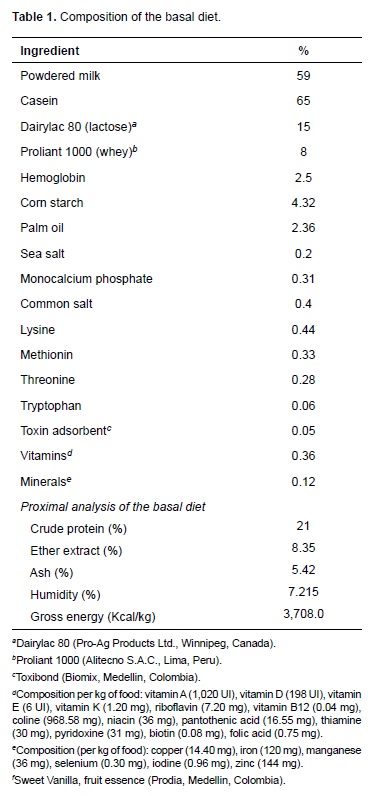
<body><![CDATA[<p>In this study we evaluated the effect of <i>E. coli</i>   LPS on goblet cells and the type of mucins secreted   during post-weaning.</p>     <p>&nbsp;</p>     <p><b><font size="3">Material and methods</font></b></p>     <p><i>Ethical considerations</i></p>     <p>All experimental procedures followed guidelines   set forth in the International Guiding Principles for   Biomedical Research Involving Animals (CIOMS,   1985) approved by the Ethics Committee for Animal   Experimentation of Universidad Nacional de   Colombia, Medellin (CEMED 001, January 26, 2009).</p>     <p><i>Location</i></p>     <p>The animal work was conducted at the San Pablo   Experimental Center of the Universidad Nacional   de Colombia. The farm is located in Rionegro   municipality, at 2,100 m.a.s.l. with an average   environmental temperature between 12 to 18 &ordm;C.</p>     <p><i>Experimental design</i></p>     <p>Durocs x Landrace pigs weaned at 21 days of   age with 6.5 &plusmn; 0.5 kg body weight were used. The   experiment followed a randomized block design (two   blocks) in a 4 x 4 factorial arrangement (Steel and   Torrie, 1985) with four diets and four sampling days   for histochemical analyses. The experimental diets   contained LPS from <i>E. coli</i>, serotype 0111: B4 (Sigma-   Aldrich, St. Louis, MO, USA), as follows: a control basal diet (BD) without LPS addition, Diet 1 (D1): BD   plus 0.3 mg LPS/mg food, Diet 2 (D2): BD plus   0.5 mg LPS/mg food, and Diet 3 (D3): BD plus 1 mg   LPS/mg food. A total of 52 piglets were slaughtered.   Four piglets (n = 1 per diet) were slaughtered for   samplings on day 1 post weaning and were used as the   reference group for each diet. Then, four piglets per   treatment were slaughtered on days 5, 7, and 10 post   weaning (n = 16 on each slaughtering day). Only one   piglet per diet instead of 4 was slaughtered on day 1   following recommendations by the Ethics Committee.</p>     <p>Pigs were housed at a density of eight pigs per pen   (64 pigs total) in environmentally controlled rooms   (26 &plusmn; 3 &deg;C) with <i>ad libitum</i> water. The basal diet   included milk and milk derivatives, vitamins, minerals   and lysine-HCl. Diets were formulated according to   minimal nutritional requirements proposed by the   National Research Council (NRC, 2012; <a href="#t1">Table 1</a>).   The amount of food offered per animal was 3,000 g/day.   Experimental diets were offered from days 1 to 10 post   weaning. No solid food was offered to piglets during   lactation.</p>      ]]></body>
<body><![CDATA[<p align="center"><a name="t1"><img src="/img/revistas/rccp/v28n3/v28n3a02t1.jpg"></a>     <p>&nbsp;</p>     <p><i>Intestinal sampling</i></p>     <p>The animals were sedated by inhalation of carbon   dioxide during 3 minutes, and then slaughtered by   ex-sanguination through section of the jugular vein.   Afterwards, they were put in supine position and the   intestine was extracted trough abdominal incision.   The intestine was aligned on a table, measured   without any tension, divided into three sections of   equal size (corresponding to the duodenum, jejunum,   and ileum), and 20 cm sections were taken from   the center of each segment. Once the portions were   cut, intestinal content was washed with cold saline   solution as described by Reis de souza <i>et al.</i> (2005).   Then, 1 cm long sub-samples were obtained from   each segment. All samples were kept in 10% neutral   buffered formalin solution until analysis.</p>     <p><i>Histochemical analysis</i></p>     <p>The tissues were embedded in paraffin and   sliced in 4 &mu;m thick cuts according to conventional   techniques. Histochemical staining was done in   three intestinal samples to identify mucin types   (AFIP, 1992). Alcian blue stain pH 1.0 was used for identifying significantly sulphated acid mucins, alcian   blue pH 2.5 for non-sulphated acid mucins, and periodic   acid schiff (PAS) for neutral mucins.</p>     <p><i>Microscopic evaluation and morphometric   analysis of images</i></p>     <p>Quantitative evaluation of tissue slides was carried   out according to the following procedure: tissue identification was performed with a Leica DMLB   optical microscope (Meyer Instruments, Houston, TX,   USA). Subsequently, images from the tunica epithelial   were captured using a Leica EC3 microscope camera   (Leica microsystems, Heerbrugg, Switzerland) and   magnified 200X. Images were analyzed with ZEN   software (blue edition, Carl Zeiss, 2011).</p>     <p>Assessment of dietary effects on mucin secretion   was conducted as follows: a circular fold of mucosa was   selected and ten circular sections (diameter of 200 &mu;m)   of villi and intestinal glands were drawn, for a total   evaluated area of 0.3 mm<sup>2</sup> per tissue slide. Afterwards,   a semiautomatic count of goblet cells positive to   each stain was conducted. Each villi region was   equally represented in the assessment. This process   was repeated on each section of the small intestine   (duodenum, jejunum, and ileum). Statistical data   analysis was conducted using a multivariable lineal   GLM model with SPSS software (version 19, 2010,   IBM). Duncan test was used to compare treatment means (p&lt;0.05).</p>     <p>&nbsp;</p>     ]]></body>
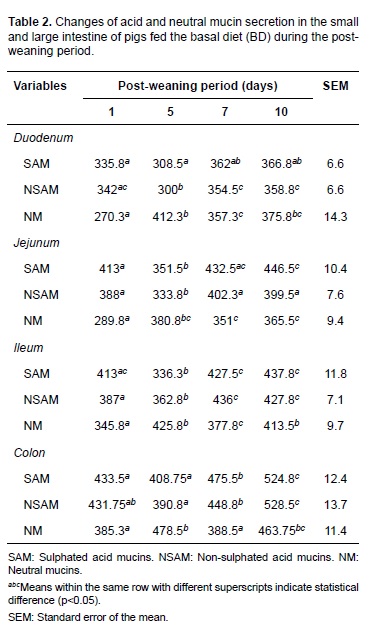
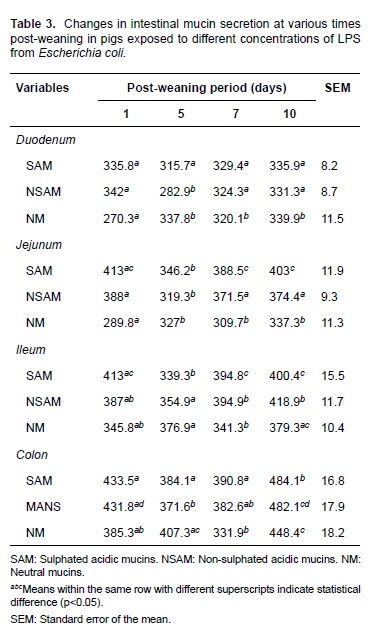
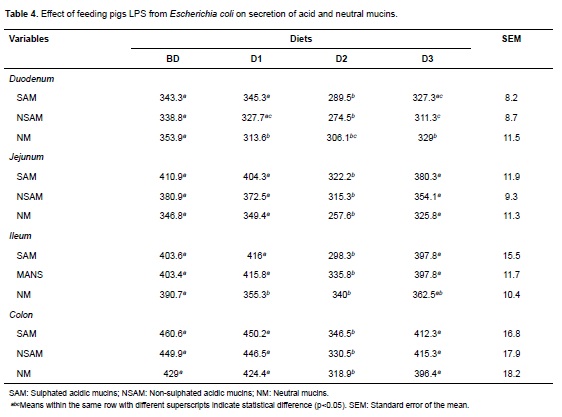
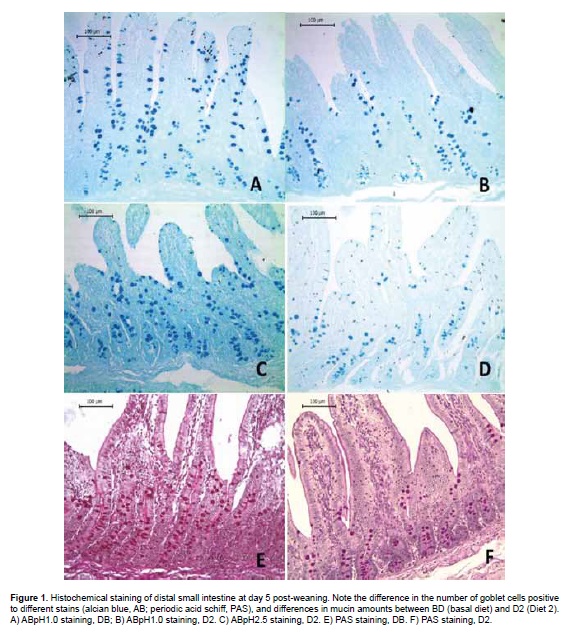
<body><![CDATA[<p><b><font size="3">Results</font></b></p>     <p>Piglets fed the basal diet were in good health   whereas those receiving LPS showed a sporadic   increase in rectal temperature (above 38 &ordm;C). However,   none of the animals had symptoms of illness, therefore   isolation or sacrifice was not required.</p>     <p>Initially, the effect of early weaning on goblet cells   population and mucin secretion was determined by   comparing data of the piglets fed the basal diet (control   diet) at different days post-weaning. The levels of   acid mucins decreased on day 5 post-weaning and   increased later on days 7 and 10 (<a href="#t2">Table 2</a>). The goblet   cells that secrete neutral mucins increased on day 5   and decreased at days 7 and 10 post-weaning, showing   significant differences in the evaluated days (p&lt;0.05).</p>      <p align="center"><a name="t2"><img src="/img/revistas/rccp/v28n3/v28n3a02t2.jpg"></a>     <p>Piglets fed different LPS levels exhibited a similar   trend to that described for the basal diet on days   1, 5, 7, and 10 post-weaning. This is, acid mucins   decreased on day 5 and increased at days 7 and 10.   On the contrary, neutral mucins increased on day 5   and subsequently decreased (<a href="#t3">Table 3</a>). No statistical   interaction was observed between LPS concentrations and post-weaning periods for any of the variables   studied. Therefore, it was not necessary to analyze   or break down factors independently.</p>      <p align="center"><a name="t3"><img src="/img/revistas/rccp/v28n3/v28n3a02t3.jpg"></a>     <p>Analyzing the effect of different LPS doses   (experimental diets) on the population of goblet   cells and their mucins secretion, a deleterious effect   was observed, especially on acid mucins over all the   intestinal regions. This effect was dependent on the LPS   concentration and was associated to the highest doses   (<a href="#t4">Table 4</a>). In this way, significant differences (p&lt;0.05)   were observed in all the intestinal regions for diet D2   and in duodenum for diet D3 with respect to diets BD and diet D1 (<a href="#f1">Figure 1</a>).</p>      <p align="center"><a name="t4"><img src="/img/revistas/rccp/v28n3/v28n3a02t4.jpg"></a>     <p align="center"><a name="f1"><img src="/img/revistas/rccp/v28n3/v28n3a02f1.jpg"></a>     <p>&nbsp;</p>     ]]></body>
<body><![CDATA[<p><font size="3"><b>Discussion</b></font></p>     <p>In this study, <i>E. coli</i> LPS caused a dose-dependent   decrease in acid and neutral mucin secretion in all   intestinal regions. This effect was more evident on   day 5 post-weaning for acid mucins. Additionally, an   inverse relationship was observed between the number   of goblet cells secreting acid and neutral mucins on   day 5 post-weaning.</p>     <p>Quantification of the type of mucin secreted   by goblet cells in piglets fed the BD showed that   sulphated and non-sulphated acid mucins decrease   on day 5 post-weaning with a subsequent increase on days 7 and 10; these results show the base effect   of early weaning, and are similar to what has been   described in pigs and other species (Hedemann <i><i>et al.</i>,</i>   2003; Vente-Spreeuwenberg <i><i>et al.</i>,</i> 2004; Brown <i><i>et al.</i>,</i>   2006). These authors found that goblet cell population   in the intestinal mucous decreases at the beginning   of the weaning period followed by a recovery of   these cells during days 6 and 8. Finally, goblet cell   population reaches normal levels at days 9 and 14.</p>     <p>The decrease in goblet cell secretion of acid   mucins observed at the beginning of weaning&#8212; not   only in piglets fed BD, but also in those fed with diets   containing LPS (D1, D2, D3)&#8212;is due to changes in   cell architecture during post-weaning, as has been   reported by Parra <i>et al.</i> (2011). These intestinal   changes are associated with a reduction of villi height   and area (Parra <i><i>et al.</i>,</i> 2011) and epithelial injury,   necrosis principally, which causes loss of goblet cells   secreting acid mucins (Liu <i><i>et al.</i>,</i> 2013).</p>     <p>It has been suggested that sulphated and nonsulphated   acid mucins protect against enteric illness   in piglets (Strous <i><i>et al.</i>,</i> 1992; Betscher <i><i>et al.</i>,</i>   2010); therefore, a detriment in intestinal mucous   and decrease in goblet cells secreting acid mucins   could increase susceptibility to enteric disturbances   (Looft, 2013). Nevertheless, the intestine can react   to a harmful environment by increasing the rate of   epithelium regeneration (Moeser <i><i>et al.</i>,</i> 2012). This is   in agreement with results of this study, since recovery in   the number of goblet cells secreting acid mucins was   evidenced at days 7 and 10 post-weaning.</p>     <p>Neutral mucins increased on day 5, as opposite to   acid mucins. This could be related with less maturity   since this mucin type is mostly found in the fetal   stage, and are widely distributed in stomach and   intestine after birth. Besides, it is also known that   neutral mucin population is lower than acid mucins   under normal conditions (Deplancke <i><i>et al.</i>,</i> 2012).</p>     <p>Goblet cells differentiate from endoderm stem cells   in that they are found deeply in the crypts, and when   mature they migrate to the villous surface (Dunsford <i><i>et al.</i>,</i> 1991). Therefore, it can be suggested that increase   in neutral mucins during post-weaning is related to   variation in villi and crypt depth, affecting goblet   cell differentiation and normal maturation (Ghaleb   <i><i>et al.</i>,</i> 2011).</p>     <p><i>E. coli</i> LPS caused a deleterious effect in goblet   cells and secretion of acid and neutral mucins that   was dependent on LPS concentration, and it was more evident for D2 diet (0.5 &mu;m LPS/mg of food). This   shows that LPS addition potentiates the effect of early   weaning on goblet cell population.</p>     <p>The highest LPS level did not have the strongest   effect on goblet cells and mucin secretion, as   evidenced in the results of diet D3. This could be due   to a reduction of food consumption caused by higher   secretion of pro-inflammatory cytokines (Bauer <i><i>et al.</i>,</i>   2011; Parra <i><i>et al.</i>,</i> 2013). It may also suggest that D3   results are related to a saturation of the recognition   receptors that mediate cellular signaling induced by   LPS (Gomes <i><i>et al.</i>,</i> 2010).</p>     <p>It can be concluded that dietary LPS addition   increase the negative effect of early weaning on pig   intestine. LPS generates morphological alterations   reflected in changes of goblet cell population and   distribution in the intestine. Dietary addition of LPS   also causes alterations of the intestinal physiology   of piglets, evidenced in secretion changes of mucins   during post-weaning (McGuckin <i><i>et al.</i>,</i> 2011). LPS   effects can occur during natural infections after   weaning, causing post-weaning diarrhea (Blanco <i>et al.</i> 2011). It is known that there is a strong interaction   between epithelium and intestinal microbiota.   Changes associated with mucin secretion can lead   to variations in the protecting function of intestinal   mucous and bacteria-host interactions (Deplancke <i><i>et al.</i>,</i> 2012) facilitating the occurrence of enteritis and   septicemia during post-weaning.</p>     ]]></body>
<body><![CDATA[<p>The results of this study help to understand the   role of mucins in keeping intestinal integrity during   post-weaning. These findings underline the need of   further studies to understand the mechanisms involved   in the regulation of intestinal mucin secretion. That   knowledge would help to design strategies for   preventing and controlling diseases associated with   this critical phase of swine production.</p>     <p>&nbsp;</p>     <p><b><font size="3">Acknowledgements</font></b></p> The authors acknowledge the support from   bacteriologist Maria Idalba Morales and staff at   the animal pathology laboratory, Universidad de   Antioquia. This study obtained financial support from   Colciencias, ''Convocatoria J&oacute;venes Investigadores 2011'' and ''Estrategia de Sostenibilidad 2013-2014   of Universidad de Antioquia''.</p>       <p align="left"><b><font size="3">Conflicts of interest</font></b></p>     <p align="left">The authors declare they have no conflicts of interest with regard to the work presented in this report.</p>     <p align="left">&nbsp;</p> <hr size="1" />     <p><b><font size="3">Notes</font></b></p>     <p><b><a name="a0" id="a0"><a href="#a1">&curren;</a></a></b>To cite this article: Zapata DJ, Rodr&iacute;guez BJ, Ram&iacute;rez MC, L&oacute;pez A, Parra J. <i>Escherichia coli</i> lipopolysaccharide affects intestinal mucin secretion in weaned   pigs. Rev Colomb Cienc Pecu 2015; 28:209-217.</p> <hr size="1" />     <p>&nbsp;</p>     <p><b><font size="3">References</font></b></p> </font>    ]]></body>
<body><![CDATA[<!-- ref --><p><font size="2" face="Verdana, Arial, Helvetica, sans-serif">Amador P, Garc&iacute;a-Herrera J, Marca MC, de la Osada J, Acin S,   Navarro MA, Salvador MT, Lostao MP, Rodr&iacute;guez-Yoldi MJ. Intestinal D-galactose transport in an endotoxemia model in the   rabbit. J Membr Biol 2007; 2153:125-133.    &nbsp;&nbsp;&nbsp;&nbsp;&nbsp;&nbsp;&nbsp;&nbsp;[&#160;<a href="javascript:void(0);" onclick="javascript: window.open('/scielo.php?script=sci_nlinks&ref=000093&pid=S0120-0690201500030000200001&lng=','','width=640,height=500,resizable=yes,scrollbars=1,menubar=yes,');">Links</a>&#160;]<!-- end-ref --> </font></p> <font face="Verdana, Arial, Helvetica, sans-serif" size="2">    <!-- ref --><p>Bauer E, Metzler-Zebeli BU, Verstegen, MW, Mosenthin R.   Intestinal gene expression in pigs: effects of reduced feed intake   during weaning and potential impact of dietary components. Nutr   Res Rev 2011; 24.2:155-175.    &nbsp;&nbsp;&nbsp;&nbsp;&nbsp;&nbsp;&nbsp;&nbsp;[&#160;<a href="javascript:void(0);" onclick="javascript: window.open('/scielo.php?script=sci_nlinks&ref=000095&pid=S0120-0690201500030000200002&lng=','','width=640,height=500,resizable=yes,scrollbars=1,menubar=yes,');">Links</a>&#160;]<!-- end-ref --> </p>     <!-- ref --><p>Betschera S, Beinekeb A, Sch&ouml;nfelda L, Kamphues J. Effects   of diet's physical form (grinding intensity; meal/pellets) on   morphological and histological parameters (e.g. ratio of neutral   to acid mucins) of the gastrointestinal tract in weaned piglets.   Livest Sci 2010; 134:149-151.    &nbsp;&nbsp;&nbsp;&nbsp;&nbsp;&nbsp;&nbsp;&nbsp;[&#160;<a href="javascript:void(0);" onclick="javascript: window.open('/scielo.php?script=sci_nlinks&ref=000097&pid=S0120-0690201500030000200003&lng=','','width=640,height=500,resizable=yes,scrollbars=1,menubar=yes,');">Links</a>&#160;]<!-- end-ref --> </p>     <!-- ref --><p>Blanco M, Lazo L, Blanco JE, Dahbi G, Mora A, L&oacute;pez C,   Blanco J. Serotypes, virulence genes, and PFGE patterns of   enteropathogenic <i>Escherichia coli</i> isolated from Cuban pigs with   diarrhea. Int Microbiol 2010; 9:53-60.    &nbsp;&nbsp;&nbsp;&nbsp;&nbsp;&nbsp;&nbsp;&nbsp;[&#160;<a href="javascript:void(0);" onclick="javascript: window.open('/scielo.php?script=sci_nlinks&ref=000099&pid=S0120-0690201500030000200004&lng=','','width=640,height=500,resizable=yes,scrollbars=1,menubar=yes,');">Links</a>&#160;]<!-- end-ref --> </p>     <!-- ref --><p>Brown DC, Maxwell CV, Erf GF, Davis ME, Singh S, Johnson   ZB. The influence of different management systems and age   on intestinal morphology, immune cell numbers and mucin   production from goblet cells in post-weaning pigs. Vet Immunol   Immunopathol 2006; 111:187-198.    &nbsp;&nbsp;&nbsp;&nbsp;&nbsp;&nbsp;&nbsp;&nbsp;[&#160;<a href="javascript:void(0);" onclick="javascript: window.open('/scielo.php?script=sci_nlinks&ref=000101&pid=S0120-0690201500030000200005&lng=','','width=640,height=500,resizable=yes,scrollbars=1,menubar=yes,');">Links</a>&#160;]<!-- end-ref --> </p>     ]]></body>
<body><![CDATA[<!-- ref --><p>Deplancke B, Gaskins, HR. Microbial modulation of innate   defense: goblet cells and the intestinal mucus layer. Am J Clin   Nutr 2012; 73(6):1131S-1141S.    &nbsp;&nbsp;&nbsp;&nbsp;&nbsp;&nbsp;&nbsp;&nbsp;[&#160;<a href="javascript:void(0);" onclick="javascript: window.open('/scielo.php?script=sci_nlinks&ref=000103&pid=S0120-0690201500030000200006&lng=','','width=640,height=500,resizable=yes,scrollbars=1,menubar=yes,');">Links</a>&#160;]<!-- end-ref --> </p>     <!-- ref --><p>Dunsford B, Haensly W, Knabe D. Effects of diet on acidic and   neutral goblet cell populations in the small intestine of early   weaned pigs. Am J Vet Res 1991; 52:1743-1746.    &nbsp;&nbsp;&nbsp;&nbsp;&nbsp;&nbsp;&nbsp;&nbsp;[&#160;<a href="javascript:void(0);" onclick="javascript: window.open('/scielo.php?script=sci_nlinks&ref=000105&pid=S0120-0690201500030000200007&lng=','','width=640,height=500,resizable=yes,scrollbars=1,menubar=yes,');">Links</a>&#160;]<!-- end-ref --> </p>     <!-- ref --><p>Ghaleb AM, McConnell BB, Kaestner KH, Yang VW. Altered   intestinal epithelial homeostasis in mice with intestine-specific   deletion of the Kr&uuml;ppel-like factor 4 gene. Dev Biol 2011; 349:   310-320.    &nbsp;&nbsp;&nbsp;&nbsp;&nbsp;&nbsp;&nbsp;&nbsp;[&#160;<a href="javascript:void(0);" onclick="javascript: window.open('/scielo.php?script=sci_nlinks&ref=000107&pid=S0120-0690201500030000200008&lng=','','width=640,height=500,resizable=yes,scrollbars=1,menubar=yes,');">Links</a>&#160;]<!-- end-ref --> </p>     <!-- ref --><p>Gomes N, Brunialti M, Mendes M, Freudenberg M, Galanos   C, Salom&atilde;o R. Lipopolysaccharide-induced expression of cell   surface receptors and cell activation of neutrophils and monocytes   in whole human blood. Braz J Med Biol Res 2010; 43:853-858.    &nbsp;&nbsp;&nbsp;&nbsp;&nbsp;&nbsp;&nbsp;&nbsp;[&#160;<a href="javascript:void(0);" onclick="javascript: window.open('/scielo.php?script=sci_nlinks&ref=000109&pid=S0120-0690201500030000200009&lng=','','width=640,height=500,resizable=yes,scrollbars=1,menubar=yes,');">Links</a>&#160;]<!-- end-ref --> </p>     <!-- ref --><p>Hedemann MS, Hojsgaard S, Jensen BB. Small intestinal   morphology and activity of intestinal peptidases in piglets around weaning. J Anim Physiol Anim Nutr 2003; 87:32-41.    &nbsp;&nbsp;&nbsp;&nbsp;&nbsp;&nbsp;&nbsp;&nbsp;[&#160;<a href="javascript:void(0);" onclick="javascript: window.open('/scielo.php?script=sci_nlinks&ref=000111&pid=S0120-0690201500030000200010&lng=','','width=640,height=500,resizable=yes,scrollbars=1,menubar=yes,');">Links</a>&#160;]<!-- end-ref --></p>     ]]></body>
<body><![CDATA[<!-- ref --><p>Liu Y, Ipharraguerre IR, Pettigrew JE. Digestive physiology of   the pig symposium: Potential applications of knowledge of gut   chemosensing in pig production. J Anim Sci 2013; 91:1982-1990.    &nbsp;&nbsp;&nbsp;&nbsp;&nbsp;&nbsp;&nbsp;&nbsp;[&#160;<a href="javascript:void(0);" onclick="javascript: window.open('/scielo.php?script=sci_nlinks&ref=000113&pid=S0120-0690201500030000200011&lng=','','width=640,height=500,resizable=yes,scrollbars=1,menubar=yes,');">Links</a>&#160;]<!-- end-ref --> </p>     <!-- ref --><p>Looft TP. The swine intestinal microbiota: localized adaptations   and responses to in-feed antibiotics. Graduate Theses and   Dissertations 2012; [Access date: September 13, 2014] URL: <a href="http://lib.dr.iastate.edu/etd/12390" target="_blank">http://lib.dr.iastate.edu/etd/12390</a>&nbsp;&nbsp;&nbsp;&nbsp;&nbsp;&nbsp;&nbsp;&nbsp;[&#160;<a href="javascript:void(0);" onclick="javascript: window.open('/scielo.php?script=sci_nlinks&ref=000115&pid=S0120-0690201500030000200012&lng=','','width=640,height=500,resizable=yes,scrollbars=1,menubar=yes,');">Links</a>&#160;]<!-- end-ref --><!-- ref --><p>McGuckin MA, Lind&eacute;n SK, Sutton P, Florin TH. Mucin dynamics   and enteric pathogens. Nat Rev Microbiol 2011; 9:265-27.    &nbsp;&nbsp;&nbsp;&nbsp;&nbsp;&nbsp;&nbsp;&nbsp;[&#160;<a href="javascript:void(0);" onclick="javascript: window.open('/scielo.php?script=sci_nlinks&ref=000116&pid=S0120-0690201500030000200013&lng=','','width=640,height=500,resizable=yes,scrollbars=1,menubar=yes,');">Links</a>&#160;]<!-- end-ref --> </p>     <!-- ref --><p>McLamb BL, Gibson AJ, Overman EL, Stahl C, Moeser AJ.   Early weaning stress in pigs impairs innate mucosal immune   responses to enterotoxigenic <i>E. coli</i> challenge and exacerbates   intestinal injury and clinical disease. Plos One 2013; 8(4):e59838. doi:<a href="http://dx.doi.org/10.1371/journal.pone.0059838" target="_blank">10.1371/journal.pone.0059838</a> &nbsp;&nbsp;&nbsp;&nbsp;&nbsp;&nbsp;&nbsp;&nbsp;[&#160;<a href="javascript:void(0);" onclick="javascript: window.open('/scielo.php?script=sci_nlinks&ref=000118&pid=S0120-0690201500030000200014&lng=','','width=640,height=500,resizable=yes,scrollbars=1,menubar=yes,');">Links</a>&#160;]<!-- end-ref --><!-- ref --><p>Moeser AJ, Borst LB, Overman BL, Pittman JS. Defects in small   intestinal epithelial barrier function and morphology associated   with peri-weaning failure to thrive syndrome (PFTS) in swine.   Res Vet Sci 2012; 93:975-982.    &nbsp;&nbsp;&nbsp;&nbsp;&nbsp;&nbsp;&nbsp;&nbsp;[&#160;<a href="javascript:void(0);" onclick="javascript: window.open('/scielo.php?script=sci_nlinks&ref=000119&pid=S0120-0690201500030000200015&lng=','','width=640,height=500,resizable=yes,scrollbars=1,menubar=yes,');">Links</a>&#160;]<!-- end-ref --> </p>     <!-- ref --><p>Montoya R, Carolina M, L&oacute;pez A, Parra S. Alteraciones en la   producci&oacute;n mRNA de enzimas intestinales de cerdos durante   varios per&iacute;odos pos-destete. Rev Bio Agro 2012; 10:126-134.    &nbsp;&nbsp;&nbsp;&nbsp;&nbsp;&nbsp;&nbsp;&nbsp;[&#160;<a href="javascript:void(0);" onclick="javascript: window.open('/scielo.php?script=sci_nlinks&ref=000121&pid=S0120-0690201500030000200016&lng=','','width=640,height=500,resizable=yes,scrollbars=1,menubar=yes,');">Links</a>&#160;]<!-- end-ref --> </p>     ]]></body>
<body><![CDATA[<!-- ref --><p>Nakamura Y, Hamajima Y, Komori M. The role of Atoh1 in mucous   cell metaplasia. International Journal of Otolaryngology 2012;   [Access date: September 13, 2014] URL: doi: <a href="http://dx.doi.org/10.1155/2012/438609" target="_blank">10.1155/2012/438609</a>&nbsp;&nbsp;&nbsp;&nbsp;&nbsp;&nbsp;&nbsp;&nbsp;[&#160;<a href="javascript:void(0);" onclick="javascript: window.open('/scielo.php?script=sci_nlinks&ref=000123&pid=S0120-0690201500030000200017&lng=','','width=640,height=500,resizable=yes,scrollbars=1,menubar=yes,');">Links</a>&#160;]<!-- end-ref --><!-- ref --><p>Ospina D, Ciro J, Rom&aacute;n Y, Pel&aacute;ez C, L&oacute;pez A, Parra J. Cambios   en la actividad enzim&aacute;tica en duodeno y yeyuno de cerdos durante   varios periodos posdestete. Rev Med Vet Zoot 2011; 58:156-165.    &nbsp;&nbsp;&nbsp;&nbsp;&nbsp;&nbsp;&nbsp;&nbsp;[&#160;<a href="javascript:void(0);" onclick="javascript: window.open('/scielo.php?script=sci_nlinks&ref=000124&pid=S0120-0690201500030000200018&lng=','','width=640,height=500,resizable=yes,scrollbars=1,menubar=yes,');">Links</a>&#160;]<!-- end-ref --> </p>     <!-- ref --><p>Parra J, Agudelo J, Ortiz L, Ram&iacute;rez MC, Rodr&iacute;guez B, L&oacute;pez A.   Lipopolysaccharide (LPS) from <i>Escherichia coli</i> has detrimental   effects on the intestinal morphology of weaned pigs. Rev Colomb Cienc Pecu 2011; 24:598-608.    &nbsp;&nbsp;&nbsp;&nbsp;&nbsp;&nbsp;&nbsp;&nbsp;[&#160;<a href="javascript:void(0);" onclick="javascript: window.open('/scielo.php?script=sci_nlinks&ref=000126&pid=S0120-0690201500030000200019&lng=','','width=640,height=500,resizable=yes,scrollbars=1,menubar=yes,');">Links</a>&#160;]<!-- end-ref --></p>     <!-- ref --><p>Parra J, Agudelo J, San&iacute;n P, Forero J, Muskus C, L&oacute;pez A.   Intestinal expression of pro-infammatory cytokines induced by   oral intake of lipopolysaccharide (LPS) from <i>Escherichia coli</i> in   weaned pigs. Rev Colomb Cienc Pecu 2013; 26:108-118.    &nbsp;&nbsp;&nbsp;&nbsp;&nbsp;&nbsp;&nbsp;&nbsp;[&#160;<a href="javascript:void(0);" onclick="javascript: window.open('/scielo.php?script=sci_nlinks&ref=000128&pid=S0120-0690201500030000200020&lng=','','width=640,height=500,resizable=yes,scrollbars=1,menubar=yes,');">Links</a>&#160;]<!-- end-ref --> </p>     <!-- ref --><p>Reis de souza T, Guerrero C, Aguilera B, Mariscal L. Efecto de   diferentes cereales sobre la morfolog&iacute;a intestinal de lechones   reci&eacute;n destetados. T&eacute;c Pecu M&eacute;x 2005; 43:309-321.    &nbsp;&nbsp;&nbsp;&nbsp;&nbsp;&nbsp;&nbsp;&nbsp;[&#160;<a href="javascript:void(0);" onclick="javascript: window.open('/scielo.php?script=sci_nlinks&ref=000130&pid=S0120-0690201500030000200021&lng=','','width=640,height=500,resizable=yes,scrollbars=1,menubar=yes,');">Links</a>&#160;]<!-- end-ref --> </p>     <!-- ref --><p>Reis de souza T, Guerrero C, Aguilera B, Mariscal L. Cambios   nutrimentales en el lech&oacute;n y desarrollo morfofisiol&oacute;gico de su   aparato digestivo. Vet M&eacute;x 2012; 43:155-173.    &nbsp;&nbsp;&nbsp;&nbsp;&nbsp;&nbsp;&nbsp;&nbsp;[&#160;<a href="javascript:void(0);" onclick="javascript: window.open('/scielo.php?script=sci_nlinks&ref=000132&pid=S0120-0690201500030000200022&lng=','','width=640,height=500,resizable=yes,scrollbars=1,menubar=yes,');">Links</a>&#160;]<!-- end-ref --> </p>     <!-- ref --><p>Shimizu T, Shimizu S. Differential properties of mucous   glycoproteins produced by allergic inflammation and   lipopolysaccharide stimulation in rat nasal epithelium. Adv   Otorhinolaryngol 2011; 72:107-109.    &nbsp;&nbsp;&nbsp;&nbsp;&nbsp;&nbsp;&nbsp;&nbsp;[&#160;<a href="javascript:void(0);" onclick="javascript: window.open('/scielo.php?script=sci_nlinks&ref=000134&pid=S0120-0690201500030000200023&lng=','','width=640,height=500,resizable=yes,scrollbars=1,menubar=yes,');">Links</a>&#160;]<!-- end-ref --> </p>     <!-- ref --><p>Steel RG, Torrie JH. Principles and procedures of statistics: a   biometrical approach. 2nd ed. New York: McGraw-Hill; 1985.    &nbsp;&nbsp;&nbsp;&nbsp;&nbsp;&nbsp;&nbsp;&nbsp;[&#160;<a href="javascript:void(0);" onclick="javascript: window.open('/scielo.php?script=sci_nlinks&ref=000136&pid=S0120-0690201500030000200024&lng=','','width=640,height=500,resizable=yes,scrollbars=1,menubar=yes,');">Links</a>&#160;]<!-- end-ref --><!-- ref -->   Strous GJ, Dekker J. Mucin-type glycoproteins. Crit Rev Biochem   Mol Biol 1992; 27:57-92.    &nbsp;&nbsp;&nbsp;&nbsp;&nbsp;&nbsp;&nbsp;&nbsp;[&#160;<a href="javascript:void(0);" onclick="javascript: window.open('/scielo.php?script=sci_nlinks&ref=000137&pid=S0120-0690201500030000200025&lng=','','width=640,height=500,resizable=yes,scrollbars=1,menubar=yes,');">Links</a>&#160;]<!-- end-ref --> </p>     <!-- ref --><p>Vente-Spreeuwenberg MA, Verdonk JM, Bakker GC, Beynen AC,   Verstegen MW. Effect of dietary protein source on feed intake   and small intestine morphology in newly weaned piglets. Livest   Prod Sci 2004; 86:169-177.    &nbsp;&nbsp;&nbsp;&nbsp;&nbsp;&nbsp;&nbsp;&nbsp;[&#160;<a href="javascript:void(0);" onclick="javascript: window.open('/scielo.php?script=sci_nlinks&ref=000139&pid=S0120-0690201500030000200026&lng=','','width=640,height=500,resizable=yes,scrollbars=1,menubar=yes,');">Links</a>&#160;]<!-- end-ref --> </p>     <!-- ref --><p>Voynow JA, Bruce KR. Mucins, mucus and sputum. Chest 2009;   135:505-512.    &nbsp;&nbsp;&nbsp;&nbsp;&nbsp;&nbsp;&nbsp;&nbsp;[&#160;<a href="javascript:void(0);" onclick="javascript: window.open('/scielo.php?script=sci_nlinks&ref=000141&pid=S0120-0690201500030000200027&lng=','','width=640,height=500,resizable=yes,scrollbars=1,menubar=yes,');">Links</a>&#160;]<!-- end-ref --> </p>     ]]></body>
<body><![CDATA[<!-- ref --><p>Zhenfeng Z, Deyuan O, Xiangshu P, Sung WK, Yanhong L,   Junjun W. Dietary arginine supplementation affects microvascular   development in the small intestine of early-weaned pigs. J Nutr 2008; 138:1304-1309.    &nbsp;&nbsp;&nbsp;&nbsp;&nbsp;&nbsp;&nbsp;&nbsp;[&#160;<a href="javascript:void(0);" onclick="javascript: window.open('/scielo.php?script=sci_nlinks&ref=000143&pid=S0120-0690201500030000200028&lng=','','width=640,height=500,resizable=yes,scrollbars=1,menubar=yes,');">Links</a>&#160;]<!-- end-ref --></p>     <p>&nbsp;</p>     <p>&nbsp;</p>  </font>      ]]></body><back>
<ref-list>
<ref id="B1">
<nlm-citation citation-type="journal">
<person-group person-group-type="author">
<name>
<surname><![CDATA[Amador]]></surname>
<given-names><![CDATA[P]]></given-names>
</name>
<name>
<surname><![CDATA[García-Herrera]]></surname>
<given-names><![CDATA[J]]></given-names>
</name>
<name>
<surname><![CDATA[Marca]]></surname>
<given-names><![CDATA[MC]]></given-names>
</name>
<name>
<surname><![CDATA[de la Osada]]></surname>
<given-names><![CDATA[J]]></given-names>
</name>
<name>
<surname><![CDATA[Acin]]></surname>
<given-names><![CDATA[S]]></given-names>
</name>
<name>
<surname><![CDATA[Navarro]]></surname>
<given-names><![CDATA[MA]]></given-names>
</name>
<name>
<surname><![CDATA[Salvador]]></surname>
<given-names><![CDATA[MT]]></given-names>
</name>
<name>
<surname><![CDATA[Lostao]]></surname>
<given-names><![CDATA[MP]]></given-names>
</name>
<name>
<surname><![CDATA[Rodríguez-Yoldi]]></surname>
<given-names><![CDATA[MJ]]></given-names>
</name>
</person-group>
<article-title xml:lang="en"><![CDATA[Intestinal D-galactose transport in an endotoxemia model in the rabbit]]></article-title>
<source><![CDATA[J Membr Biol]]></source>
<year>2007</year>
<volume>2153</volume>
<page-range>125-133</page-range></nlm-citation>
</ref>
<ref id="B2">
<nlm-citation citation-type="journal">
<person-group person-group-type="author">
<name>
<surname><![CDATA[Bauer]]></surname>
<given-names><![CDATA[E]]></given-names>
</name>
<name>
<surname><![CDATA[Metzler-Zebeli]]></surname>
<given-names><![CDATA[BU]]></given-names>
</name>
<name>
<surname><![CDATA[Verstegen,]]></surname>
<given-names><![CDATA[MW]]></given-names>
</name>
<name>
<surname><![CDATA[Mosenthin]]></surname>
<given-names><![CDATA[R]]></given-names>
</name>
</person-group>
<article-title xml:lang="en"><![CDATA[Intestinal gene expression in pigs: effects of reduced feed intake during weaning and potential impact of dietary components]]></article-title>
<source><![CDATA[Nutr Res Rev]]></source>
<year>2011</year>
<volume>24.2</volume>
<page-range>155-175</page-range></nlm-citation>
</ref>
<ref id="B3">
<nlm-citation citation-type="journal">
<person-group person-group-type="author">
<name>
<surname><![CDATA[Betschera]]></surname>
<given-names><![CDATA[S]]></given-names>
</name>
<name>
<surname><![CDATA[Beinekeb]]></surname>
<given-names><![CDATA[A]]></given-names>
</name>
<name>
<surname><![CDATA[Schönfelda]]></surname>
<given-names><![CDATA[L]]></given-names>
</name>
<name>
<surname><![CDATA[Kamphues]]></surname>
<given-names><![CDATA[J]]></given-names>
</name>
</person-group>
<article-title xml:lang="en"><![CDATA[Effects of diet's physical form (grinding intensity; meal/pellets) on morphological and histological parameters (e.g. ratio of neutral to acid mucins) of the gastrointestinal tract in weaned piglets]]></article-title>
<source><![CDATA[Livest Sci]]></source>
<year>2010</year>
<volume>134</volume>
<page-range>149-151</page-range></nlm-citation>
</ref>
<ref id="B4">
<nlm-citation citation-type="journal">
<person-group person-group-type="author">
<name>
<surname><![CDATA[Blanco]]></surname>
<given-names><![CDATA[M]]></given-names>
</name>
<name>
<surname><![CDATA[Lazo]]></surname>
<given-names><![CDATA[L]]></given-names>
</name>
<name>
<surname><![CDATA[Blanco]]></surname>
<given-names><![CDATA[JE]]></given-names>
</name>
<name>
<surname><![CDATA[Dahbi]]></surname>
<given-names><![CDATA[G]]></given-names>
</name>
<name>
<surname><![CDATA[Mora]]></surname>
<given-names><![CDATA[A]]></given-names>
</name>
<name>
<surname><![CDATA[López]]></surname>
<given-names><![CDATA[C]]></given-names>
</name>
<name>
<surname><![CDATA[Blanco]]></surname>
<given-names><![CDATA[J]]></given-names>
</name>
</person-group>
<article-title xml:lang="en"><![CDATA[Serotypes, virulence genes, and PFGE patterns of enteropathogenic Escherichia coli isolated from Cuban pigs with diarrhea]]></article-title>
<source><![CDATA[Int Microbiol]]></source>
<year>2010</year>
<volume>9</volume>
<page-range>53-60</page-range></nlm-citation>
</ref>
<ref id="B5">
<nlm-citation citation-type="journal">
<person-group person-group-type="author">
<name>
<surname><![CDATA[Brown]]></surname>
<given-names><![CDATA[DC]]></given-names>
</name>
<name>
<surname><![CDATA[Maxwell]]></surname>
<given-names><![CDATA[CV]]></given-names>
</name>
<name>
<surname><![CDATA[Erf]]></surname>
<given-names><![CDATA[GF]]></given-names>
</name>
<name>
<surname><![CDATA[Davis]]></surname>
<given-names><![CDATA[ME]]></given-names>
</name>
<name>
<surname><![CDATA[Singh]]></surname>
<given-names><![CDATA[S]]></given-names>
</name>
<name>
<surname><![CDATA[Johnson]]></surname>
<given-names><![CDATA[ZB]]></given-names>
</name>
</person-group>
<article-title xml:lang="en"><![CDATA[The influence of different management systems and age on intestinal morphology, immune cell numbers and mucin production from goblet cells in post-weaning pigs]]></article-title>
<source><![CDATA[Vet Immunol Immunopathol]]></source>
<year>2006</year>
<volume>111</volume>
<page-range>187-198</page-range></nlm-citation>
</ref>
<ref id="B6">
<nlm-citation citation-type="journal">
<person-group person-group-type="author">
<name>
<surname><![CDATA[Deplancke]]></surname>
<given-names><![CDATA[B]]></given-names>
</name>
<name>
<surname><![CDATA[Gaskins]]></surname>
<given-names><![CDATA[HR]]></given-names>
</name>
</person-group>
<article-title xml:lang="en"><![CDATA[Microbial modulation of innate defense: goblet cells and the intestinal mucus layer]]></article-title>
<source><![CDATA[Am J Clin Nutr]]></source>
<year>2012</year>
<volume>73(6)</volume>
<page-range>1131S-1141S</page-range></nlm-citation>
</ref>
<ref id="B7">
<nlm-citation citation-type="journal">
<person-group person-group-type="author">
<name>
<surname><![CDATA[Dunsford]]></surname>
<given-names><![CDATA[B]]></given-names>
</name>
<name>
<surname><![CDATA[Haensly]]></surname>
<given-names><![CDATA[W]]></given-names>
</name>
<name>
<surname><![CDATA[Knabe]]></surname>
<given-names><![CDATA[D]]></given-names>
</name>
</person-group>
<article-title xml:lang="en"><![CDATA[Effects of diet on acidic and neutral goblet cell populations in the small intestine of early weaned pigs]]></article-title>
<source><![CDATA[Am J Vet Res]]></source>
<year>1991</year>
<volume>52</volume>
<page-range>1743-1746</page-range></nlm-citation>
</ref>
<ref id="B8">
<nlm-citation citation-type="journal">
<person-group person-group-type="author">
<name>
<surname><![CDATA[Ghaleb]]></surname>
<given-names><![CDATA[AM]]></given-names>
</name>
<name>
<surname><![CDATA[McConnell]]></surname>
<given-names><![CDATA[BB]]></given-names>
</name>
<name>
<surname><![CDATA[Kaestner]]></surname>
<given-names><![CDATA[KH]]></given-names>
</name>
<name>
<surname><![CDATA[Yang]]></surname>
<given-names><![CDATA[VW]]></given-names>
</name>
</person-group>
<article-title xml:lang="en"><![CDATA[Altered intestinal epithelial homeostasis in mice with intestine-specific deletion of the Krüppel-like factor 4 gene]]></article-title>
<source><![CDATA[Dev Biol]]></source>
<year>2011</year>
<volume>349</volume>
<page-range>310-320</page-range></nlm-citation>
</ref>
<ref id="B9">
<nlm-citation citation-type="journal">
<person-group person-group-type="author">
<name>
<surname><![CDATA[Gomes]]></surname>
<given-names><![CDATA[N]]></given-names>
</name>
<name>
<surname><![CDATA[Brunialti]]></surname>
<given-names><![CDATA[M]]></given-names>
</name>
<name>
<surname><![CDATA[Mendes]]></surname>
<given-names><![CDATA[M]]></given-names>
</name>
<name>
<surname><![CDATA[Freudenberg]]></surname>
<given-names><![CDATA[M]]></given-names>
</name>
<name>
<surname><![CDATA[Galanos]]></surname>
<given-names><![CDATA[C]]></given-names>
</name>
<name>
<surname><![CDATA[Salomão]]></surname>
<given-names><![CDATA[R]]></given-names>
</name>
</person-group>
<article-title xml:lang="en"><![CDATA[Lipopolysaccharide-induced expression of cell surface receptors and cell activation of neutrophils and monocytes in whole human blood]]></article-title>
<source><![CDATA[Braz J Med Biol Res]]></source>
<year>2010</year>
<volume>43</volume>
<page-range>853-858</page-range></nlm-citation>
</ref>
<ref id="B10">
<nlm-citation citation-type="journal">
<person-group person-group-type="author">
<name>
<surname><![CDATA[Hedemann]]></surname>
<given-names><![CDATA[MS]]></given-names>
</name>
<name>
<surname><![CDATA[Hojsgaard]]></surname>
<given-names><![CDATA[S]]></given-names>
</name>
<name>
<surname><![CDATA[Jensen]]></surname>
<given-names><![CDATA[BB]]></given-names>
</name>
</person-group>
<article-title xml:lang="en"><![CDATA[Small intestinal morphology and activity of intestinal peptidases in piglets around weaning]]></article-title>
<source><![CDATA[J Anim Physiol Anim Nutr]]></source>
<year>2003</year>
<volume>87</volume>
<page-range>32-41</page-range></nlm-citation>
</ref>
<ref id="B11">
<nlm-citation citation-type="journal">
<person-group person-group-type="author">
<name>
<surname><![CDATA[Liu]]></surname>
<given-names><![CDATA[Y]]></given-names>
</name>
<name>
<surname><![CDATA[Ipharraguerre]]></surname>
<given-names><![CDATA[IR]]></given-names>
</name>
<name>
<surname><![CDATA[Pettigrew]]></surname>
<given-names><![CDATA[JE]]></given-names>
</name>
</person-group>
<article-title xml:lang="en"><![CDATA[Digestive physiology of the pig symposium: Potential applications of knowledge of gut chemosensing in pig production]]></article-title>
<source><![CDATA[J Anim Sci]]></source>
<year>2013</year>
<volume>91</volume>
<page-range>1982-1990</page-range></nlm-citation>
</ref>
<ref id="B12">
<nlm-citation citation-type="">
<person-group person-group-type="author">
<name>
<surname><![CDATA[Looft]]></surname>
<given-names><![CDATA[TP]]></given-names>
</name>
</person-group>
<source><![CDATA[The swine intestinal microbiota: localized adaptations and responses to in-feed antibiotics]]></source>
<year></year>
</nlm-citation>
</ref>
<ref id="B13">
<nlm-citation citation-type="journal">
<person-group person-group-type="author">
<name>
<surname><![CDATA[McGuckin]]></surname>
<given-names><![CDATA[MA]]></given-names>
</name>
<name>
<surname><![CDATA[Lindén]]></surname>
<given-names><![CDATA[SK]]></given-names>
</name>
<name>
<surname><![CDATA[Sutton]]></surname>
<given-names><![CDATA[P]]></given-names>
</name>
<name>
<surname><![CDATA[Florin]]></surname>
<given-names><![CDATA[TH]]></given-names>
</name>
</person-group>
<article-title xml:lang="en"><![CDATA[Mucin dynamics and enteric pathogens]]></article-title>
<source><![CDATA[Nat Rev Microbiol]]></source>
<year>2011</year>
<volume>9</volume>
<page-range>265-27</page-range></nlm-citation>
</ref>
<ref id="B14">
<nlm-citation citation-type="journal">
<person-group person-group-type="author">
<name>
<surname><![CDATA[McLamb]]></surname>
<given-names><![CDATA[BL]]></given-names>
</name>
<name>
<surname><![CDATA[Gibson]]></surname>
<given-names><![CDATA[AJ]]></given-names>
</name>
<name>
<surname><![CDATA[Overman]]></surname>
<given-names><![CDATA[EL]]></given-names>
</name>
<name>
<surname><![CDATA[Stahl]]></surname>
<given-names><![CDATA[C]]></given-names>
</name>
<name>
<surname><![CDATA[Moeser]]></surname>
<given-names><![CDATA[AJ]]></given-names>
</name>
</person-group>
<article-title xml:lang="en"><![CDATA[Early weaning stress in pigs impairs innate mucosal immune responses to enterotoxigenic E. coli challenge and exacerbates intestinal injury and clinical disease]]></article-title>
<source><![CDATA[Plos One]]></source>
<year>2013</year>
<volume>8(4)</volume>
<page-range>e59838</page-range></nlm-citation>
</ref>
<ref id="B15">
<nlm-citation citation-type="journal">
<person-group person-group-type="author">
<name>
<surname><![CDATA[Moeser]]></surname>
<given-names><![CDATA[AJ]]></given-names>
</name>
<name>
<surname><![CDATA[Borst]]></surname>
<given-names><![CDATA[LB]]></given-names>
</name>
<name>
<surname><![CDATA[Overman]]></surname>
<given-names><![CDATA[BL]]></given-names>
</name>
<name>
<surname><![CDATA[Pittman]]></surname>
<given-names><![CDATA[JS]]></given-names>
</name>
</person-group>
<article-title xml:lang="en"><![CDATA[Defects in small intestinal epithelial barrier function and morphology associated with peri-weaning failure to thrive syndrome (PFTS) in swine]]></article-title>
<source><![CDATA[Res Vet Sci]]></source>
<year>2012</year>
<volume>93</volume>
<page-range>975-982</page-range></nlm-citation>
</ref>
<ref id="B16">
<nlm-citation citation-type="journal">
<person-group person-group-type="author">
<name>
<surname><![CDATA[Montoya]]></surname>
<given-names><![CDATA[R]]></given-names>
</name>
<name>
<surname><![CDATA[Carolina]]></surname>
<given-names><![CDATA[M]]></given-names>
</name>
<name>
<surname><![CDATA[López]]></surname>
<given-names><![CDATA[A]]></given-names>
</name>
<name>
<surname><![CDATA[Parra]]></surname>
<given-names><![CDATA[S]]></given-names>
</name>
</person-group>
<article-title xml:lang="es"><![CDATA[Alteraciones en la producción mRNA de enzimas intestinales de cerdos durante varios períodos pos-destete]]></article-title>
<source><![CDATA[Rev Bio Agro]]></source>
<year>2012</year>
<volume>10</volume>
<page-range>126-134</page-range></nlm-citation>
</ref>
<ref id="B17">
<nlm-citation citation-type="journal">
<person-group person-group-type="author">
<name>
<surname><![CDATA[Nakamura]]></surname>
<given-names><![CDATA[Y]]></given-names>
</name>
<name>
<surname><![CDATA[Hamajima]]></surname>
<given-names><![CDATA[Y]]></given-names>
</name>
<name>
<surname><![CDATA[Komori]]></surname>
<given-names><![CDATA[M]]></given-names>
</name>
</person-group>
<article-title xml:lang="en"><![CDATA[The role of Atoh1 in mucous cell metaplasia]]></article-title>
<source><![CDATA[International Journal of Otolaryngology]]></source>
<year>2012</year>
</nlm-citation>
</ref>
<ref id="B18">
<nlm-citation citation-type="journal">
<person-group person-group-type="author">
<name>
<surname><![CDATA[Ospina]]></surname>
<given-names><![CDATA[D]]></given-names>
</name>
<name>
<surname><![CDATA[Ciro]]></surname>
<given-names><![CDATA[J]]></given-names>
</name>
<name>
<surname><![CDATA[Román]]></surname>
<given-names><![CDATA[Y]]></given-names>
</name>
<name>
<surname><![CDATA[Peláez]]></surname>
<given-names><![CDATA[C]]></given-names>
</name>
<name>
<surname><![CDATA[López]]></surname>
<given-names><![CDATA[A]]></given-names>
</name>
<name>
<surname><![CDATA[Parra]]></surname>
<given-names><![CDATA[J]]></given-names>
</name>
</person-group>
<article-title xml:lang="es"><![CDATA[Cambios en la actividad enzimática en duodeno y yeyuno de cerdos durante varios periodos posdestete]]></article-title>
<source><![CDATA[Rev Med Vet Zoot]]></source>
<year>2011</year>
<volume>58</volume>
<page-range>156-165</page-range></nlm-citation>
</ref>
<ref id="B19">
<nlm-citation citation-type="journal">
<person-group person-group-type="author">
<name>
<surname><![CDATA[Parra]]></surname>
<given-names><![CDATA[J]]></given-names>
</name>
<name>
<surname><![CDATA[Agudelo]]></surname>
<given-names><![CDATA[J]]></given-names>
</name>
<name>
<surname><![CDATA[Ortiz]]></surname>
<given-names><![CDATA[L]]></given-names>
</name>
<name>
<surname><![CDATA[Ramírez]]></surname>
<given-names><![CDATA[MC]]></given-names>
</name>
<name>
<surname><![CDATA[Rodríguez]]></surname>
<given-names><![CDATA[B]]></given-names>
</name>
<name>
<surname><![CDATA[López]]></surname>
<given-names><![CDATA[A]]></given-names>
</name>
</person-group>
<article-title xml:lang="en"><![CDATA[Lipopolysaccharide (LPS) from Escherichia coli has detrimental effects on the intestinal morphology of weaned pigs]]></article-title>
<source><![CDATA[Rev Colomb Cienc Pecu]]></source>
<year>2011</year>
<volume>24</volume>
<page-range>598-608</page-range></nlm-citation>
</ref>
<ref id="B20">
<nlm-citation citation-type="journal">
<person-group person-group-type="author">
<name>
<surname><![CDATA[Parra]]></surname>
<given-names><![CDATA[J]]></given-names>
</name>
<name>
<surname><![CDATA[Agudelo]]></surname>
<given-names><![CDATA[J]]></given-names>
</name>
<name>
<surname><![CDATA[Sanín]]></surname>
<given-names><![CDATA[P]]></given-names>
</name>
<name>
<surname><![CDATA[Forero]]></surname>
<given-names><![CDATA[J]]></given-names>
</name>
<name>
<surname><![CDATA[Muskus]]></surname>
<given-names><![CDATA[C]]></given-names>
</name>
<name>
<surname><![CDATA[López]]></surname>
<given-names><![CDATA[A]]></given-names>
</name>
</person-group>
<article-title xml:lang="en"><![CDATA[Intestinal expression of pro-infammatory cytokines induced by oral intake of lipopolysaccharide (LPS) from Escherichia coli in weaned pigs]]></article-title>
<source><![CDATA[Rev Colomb Cienc Pecu]]></source>
<year>2013</year>
<volume>26</volume>
<page-range>108-118</page-range></nlm-citation>
</ref>
<ref id="B21">
<nlm-citation citation-type="journal">
<person-group person-group-type="author">
<name>
<surname><![CDATA[Reis de souza]]></surname>
<given-names><![CDATA[T]]></given-names>
</name>
<name>
<surname><![CDATA[Guerrero]]></surname>
<given-names><![CDATA[C]]></given-names>
</name>
<name>
<surname><![CDATA[Aguilera]]></surname>
<given-names><![CDATA[B]]></given-names>
</name>
<name>
<surname><![CDATA[Mariscal]]></surname>
<given-names><![CDATA[L]]></given-names>
</name>
</person-group>
<article-title xml:lang="es"><![CDATA[Efecto de diferentes cereales sobre la morfología intestinal de lechones recién destetados]]></article-title>
<source><![CDATA[Téc Pecu Méx]]></source>
<year>2005</year>
<volume>43</volume>
<page-range>309-321</page-range></nlm-citation>
</ref>
<ref id="B22">
<nlm-citation citation-type="journal">
<person-group person-group-type="author">
<name>
<surname><![CDATA[Reis-de-souza]]></surname>
<given-names><![CDATA[T]]></given-names>
</name>
<name>
<surname><![CDATA[Guerrero]]></surname>
<given-names><![CDATA[C]]></given-names>
</name>
<name>
<surname><![CDATA[Aguilera]]></surname>
<given-names><![CDATA[B]]></given-names>
</name>
<name>
<surname><![CDATA[Mariscal]]></surname>
<given-names><![CDATA[L]]></given-names>
</name>
</person-group>
<article-title xml:lang="es"><![CDATA[Cambios nutrimentales en el lechón y desarrollo morfofisiológico de su aparato digestivo]]></article-title>
<source><![CDATA[Vet Méx]]></source>
<year>2012</year>
<volume>43</volume>
<page-range>155-173</page-range></nlm-citation>
</ref>
<ref id="B23">
<nlm-citation citation-type="journal">
<person-group person-group-type="author">
<name>
<surname><![CDATA[Shimizu]]></surname>
<given-names><![CDATA[T]]></given-names>
</name>
<name>
<surname><![CDATA[Shimizu]]></surname>
<given-names><![CDATA[S]]></given-names>
</name>
</person-group>
<article-title xml:lang="en"><![CDATA[Differential properties of mucous glycoproteins produced by allergic inflammation and lipopolysaccharide stimulation in rat nasal epithelium]]></article-title>
<source><![CDATA[Adv Otorhinolaryngol]]></source>
<year>2011</year>
<volume>72</volume>
<page-range>107-109</page-range></nlm-citation>
</ref>
<ref id="B24">
<nlm-citation citation-type="book">
<person-group person-group-type="author">
<name>
<surname><![CDATA[Steel]]></surname>
<given-names><![CDATA[RG]]></given-names>
</name>
<name>
<surname><![CDATA[Torrie]]></surname>
<given-names><![CDATA[JH]]></given-names>
</name>
</person-group>
<source><![CDATA[Principles and procedures of statistics: a biometrical approach]]></source>
<year>1985</year>
<publisher-loc><![CDATA[New York ]]></publisher-loc>
<publisher-name><![CDATA[McGraw-Hill]]></publisher-name>
</nlm-citation>
</ref>
<ref id="B25">
<nlm-citation citation-type="journal">
<person-group person-group-type="author">
<name>
<surname><![CDATA[Strous]]></surname>
<given-names><![CDATA[GJ]]></given-names>
</name>
<name>
<surname><![CDATA[Dekker]]></surname>
<given-names><![CDATA[J]]></given-names>
</name>
</person-group>
<article-title xml:lang="en"><![CDATA[Mucin-type glycoproteins]]></article-title>
<source><![CDATA[Crit Rev Biochem Mol Biol]]></source>
<year>1992</year>
<volume>27</volume>
<page-range>57-92</page-range></nlm-citation>
</ref>
<ref id="B26">
<nlm-citation citation-type="journal">
<person-group person-group-type="author">
<name>
<surname><![CDATA[Vente-Spreeuwenberg]]></surname>
<given-names><![CDATA[MA]]></given-names>
</name>
<name>
<surname><![CDATA[Verdonk]]></surname>
<given-names><![CDATA[JM]]></given-names>
</name>
<name>
<surname><![CDATA[Bakker]]></surname>
<given-names><![CDATA[GC]]></given-names>
</name>
<name>
<surname><![CDATA[Beynen]]></surname>
<given-names><![CDATA[AC]]></given-names>
</name>
<name>
<surname><![CDATA[Verstegen]]></surname>
<given-names><![CDATA[MW]]></given-names>
</name>
</person-group>
<article-title xml:lang="en"><![CDATA[Effect of dietary protein source on feed intake and small intestine morphology in newly weaned piglets]]></article-title>
<source><![CDATA[Livest Prod Sci]]></source>
<year>2004</year>
<volume>86</volume>
<page-range>169-177</page-range></nlm-citation>
</ref>
<ref id="B27">
<nlm-citation citation-type="journal">
<person-group person-group-type="author">
<name>
<surname><![CDATA[Voynow]]></surname>
<given-names><![CDATA[JA]]></given-names>
</name>
<name>
<surname><![CDATA[Bruce]]></surname>
<given-names><![CDATA[KR]]></given-names>
</name>
</person-group>
<article-title xml:lang="en"><![CDATA[Mucins, mucus and sputum]]></article-title>
<source><![CDATA[Chest]]></source>
<year>2009</year>
<volume>135</volume>
<page-range>505-512</page-range></nlm-citation>
</ref>
<ref id="B28">
<nlm-citation citation-type="journal">
<person-group person-group-type="author">
<name>
<surname><![CDATA[Zhenfeng]]></surname>
<given-names><![CDATA[Z]]></given-names>
</name>
<name>
<surname><![CDATA[Deyuan]]></surname>
<given-names><![CDATA[O]]></given-names>
</name>
<name>
<surname><![CDATA[Xiangshu]]></surname>
<given-names><![CDATA[P]]></given-names>
</name>
<name>
<surname><![CDATA[Sung]]></surname>
<given-names><![CDATA[WK]]></given-names>
</name>
<name>
<surname><![CDATA[Yanhong]]></surname>
<given-names><![CDATA[L]]></given-names>
</name>
<name>
<surname><![CDATA[Junjun]]></surname>
<given-names><![CDATA[W]]></given-names>
</name>
</person-group>
<article-title xml:lang="en"><![CDATA[Dietary arginine supplementation affects microvascular development in the small intestine of early-weaned pigs]]></article-title>
<source><![CDATA[J Nutr]]></source>
<year>2008</year>
<volume>138</volume>
<page-range>1304-1309</page-range></nlm-citation>
</ref>
</ref-list>
</back>
</article>