<?xml version="1.0" encoding="ISO-8859-1"?><article xmlns:mml="http://www.w3.org/1998/Math/MathML" xmlns:xlink="http://www.w3.org/1999/xlink" xmlns:xsi="http://www.w3.org/2001/XMLSchema-instance">
<front>
<journal-meta>
<journal-id>0120-0690</journal-id>
<journal-title><![CDATA[Revista Colombiana de Ciencias Pecuarias]]></journal-title>
<abbrev-journal-title><![CDATA[Rev Colom Cienc Pecua]]></abbrev-journal-title>
<issn>0120-0690</issn>
<publisher>
<publisher-name><![CDATA[Facultad de Ciencias Agrarias, Universidad de Antioquia]]></publisher-name>
</publisher>
</journal-meta>
<article-meta>
<article-id>S0120-06902015000300005</article-id>
<article-id pub-id-type="doi">10.17533/udea.rccp.v28n3a4</article-id>
<title-group>
<article-title xml:lang="en"><![CDATA[Poultry litter of wood shavings and/or sugarcane bagasse: animal performance and bed quality]]></article-title>
<article-title xml:lang="es"><![CDATA[Cama de viruta de madera y/o bagazo de caña de azúcar para pollo: desempeño animal y calidad de la cama]]></article-title>
<article-title xml:lang="pt"><![CDATA[Cama composta por maravalha e/ou bagaço de cana de açúcar para frangos: desempenho animal e qualidade da cama]]></article-title>
</title-group>
<contrib-group>
<contrib contrib-type="author">
<name>
<surname><![CDATA[Teixeira]]></surname>
<given-names><![CDATA[Adriely S]]></given-names>
</name>
<xref ref-type="aff" rid="A01"/>
</contrib>
<contrib contrib-type="author">
<name>
<surname><![CDATA[de Oliveira]]></surname>
<given-names><![CDATA[Maria C]]></given-names>
</name>
<xref ref-type="aff" rid="A02"/>
<xref ref-type="aff" rid="A05"/>
</contrib>
<contrib contrib-type="author">
<name>
<surname><![CDATA[Menezes]]></surname>
<given-names><![CDATA[June F]]></given-names>
</name>
<xref ref-type="aff" rid="A03"/>
</contrib>
<contrib contrib-type="author">
<name>
<surname><![CDATA[Gouvea]]></surname>
<given-names><![CDATA[Bruno M]]></given-names>
</name>
<xref ref-type="aff" rid="A02"/>
</contrib>
<contrib contrib-type="author">
<name>
<surname><![CDATA[Teixeira]]></surname>
<given-names><![CDATA[Sonia R]]></given-names>
</name>
<xref ref-type="aff" rid="A01"/>
</contrib>
<contrib contrib-type="author">
<name>
<surname><![CDATA[Gomes]]></surname>
<given-names><![CDATA[Alex R]]></given-names>
</name>
<xref ref-type="aff" rid="A04"/>
</contrib>
</contrib-group>
<aff id="A01">
<institution><![CDATA[,Instituto Federal Goiano  ]]></institution>
<addr-line><![CDATA[Rio Verde GO]]></addr-line>
<country>Brasil</country>
</aff>
<aff id="A02">
<institution><![CDATA[,Universidade de Rio Verde e IF Goiano Faculdade de Medicina Veterinária ]]></institution>
<addr-line><![CDATA[Rio Verde GO]]></addr-line>
<country>Brasil</country>
</aff>
<aff id="A03">
<institution><![CDATA[,Universidade de Rio Verde Faculdade de Medicina Veterinária ]]></institution>
<addr-line><![CDATA[Rio Verde GO]]></addr-line>
<country>Brasil</country>
</aff>
<aff id="A04">
<institution><![CDATA[,Universidade de Rio Verde Faculdade de Biologia ]]></institution>
<addr-line><![CDATA[Rio Verde GO]]></addr-line>
<country>Brasil</country>
</aff>
<aff id="A05">
<institution><![CDATA[,Universidade de Rio Verde Faculty of Veterinary Medicine ]]></institution>
<addr-line><![CDATA[ ]]></addr-line>
</aff>
<pub-date pub-type="pub">
<day>00</day>
<month>08</month>
<year>2015</year>
</pub-date>
<pub-date pub-type="epub">
<day>00</day>
<month>08</month>
<year>2015</year>
</pub-date>
<volume>28</volume>
<numero>3</numero>
<fpage>238</fpage>
<lpage>246</lpage>
<copyright-statement/>
<copyright-year/>
<self-uri xlink:href="http://www.scielo.org.co/scielo.php?script=sci_arttext&amp;pid=S0120-06902015000300005&amp;lng=en&amp;nrm=iso"></self-uri><self-uri xlink:href="http://www.scielo.org.co/scielo.php?script=sci_abstract&amp;pid=S0120-06902015000300005&amp;lng=en&amp;nrm=iso"></self-uri><self-uri xlink:href="http://www.scielo.org.co/scielo.php?script=sci_pdf&amp;pid=S0120-06902015000300005&amp;lng=en&amp;nrm=iso"></self-uri><abstract abstract-type="short" xml:lang="en"><p><![CDATA[Background: litter provides comfort to animals while improving productive performance and carcass quality. Objective: this study evaluated broiler performance, incidence of contact dermatitis, and quality of poultry litter of wood shavings and/or sugarcane bagasse (SB) after five consecutive flocks. Methods: two thousand birds were raised in five consecutive flocks composed of 400 chicks each. The experiment was set in a completely randomized design with five treatments and four repetitions. The treatments consisted of substituting wood shavings with different levels of SB (0, 25, 50, 75, and 100%). Results: litter density, pH, dry matter content, total nitrogen, and phosphorus did not vary between treatments. However, substituting wood shavings with SB increased moisture retention capacity of the litter and ammonia production. Neither carcass lesions nor productive performance, with the exception of weight gain and feed conversion ratio in the fifth flock, differed between treatments. Conclusions: substituting 75% of wood shavings with SB maintained litter quality and improved poultry performance.]]></p></abstract>
<abstract abstract-type="short" xml:lang="es"><p><![CDATA[Antecedentes: la cama propicia el confort y mejora el desempeño productivo y la calidad de la canal de los pollos de engorde. Objetivo: el objetivo del presente estudio fue evaluar el desempeño productivo de pollos de engorde, la incidencia de dermatitis de contacto en la canal y la calidad de la cama de pollo compuesta de viruta de madera y/o bagazo de caña de azúcar (SB), usada en cinco lotes consecutivos. Métodos: dos mil aves fueron criadas en cinco lotes consecutivos, cada uno constituido por 400 pollitos, en un diseño completamente aleatorizado con cinco tratamientos y cuatro repeticiones. Los tratamientos consistieron en diferentes niveles de sustitución de viruta de madera con SB (0, 25, 50, 75 y 100%). Resultados: la densidad, pH y contenidos de materia seca, nitrógeno total y fósforo no variaron entre los tratamientos. Sin embargo, sustituir viruta de madera con SB aumentó la capacidad de retención de humedad y la cantidad de amoníaco volatilizado en el galpón. Ni las lesiones en la canal y ni el desempeño productivo, con excepción de la ganancia de peso y conversión alimentaria en el quinto lote, difirieron entre los tratamientos. Conclusiones: sustituir 75% de la viruta de madera con SB mantuvo la calidad de la cama y mejoró el desempeño productivo de las aves.]]></p></abstract>
<abstract abstract-type="short" xml:lang="pt"><p><![CDATA[Antecedentes: cama de frango propicia conforto e melhora o desempenho produtivo e a qualidade da carcaça das aves. Objetivo: este estudo avaliou o desempenho produtivo de frangos de corte, a incidência de dermatite de contato na carcaça e a qualidade da cama de frango composta de maravalha e/ou bagaço de cana (SB), usada em cinco lotes consecutivos. Métodos: duas mil aves foram criadas em cinco lotes consecutivos, compostos de 400 pintinhos cada, em delineamento inteiramente casualizado com cinco tratamentos e quatro repetições. Os tratamentos consistiram de diferentes níveis de substituição de maravalha com BC (0, 25, 50, 75 e 100%). Resultados: densidade, pH e teores de matéria seca, nitrogênio total e fósforo não variaram entre os tratamentos. Entretanto, substituir maravalha com SB aumentou a capacidade de retenção de umidade e a quantidade de amônia volatilizada no galpão. Nem as lesões na carcaça e nem o desempenho produtivo, com exceção do ganho de peso e conversão alimentar no quinto lote, diferiram entre os tratamentos. Conclusões: substituir 75% da maravalha com SB manteve a qualidade da cama e melhorou o desempenho produtivo das aves.]]></p></abstract>
<kwd-group>
<kwd lng="en"><![CDATA[ammonia volatilization]]></kwd>
<kwd lng="en"><![CDATA[carcass grading]]></kwd>
<kwd lng="en"><![CDATA[carcass quality]]></kwd>
<kwd lng="en"><![CDATA[poultry carcass]]></kwd>
<kwd lng="en"><![CDATA[poultry manure]]></kwd>
<kwd lng="en"><![CDATA[sugarcane byproducts]]></kwd>
<kwd lng="es"><![CDATA[calidad de canales]]></kwd>
<kwd lng="es"><![CDATA[canales de aves de corral]]></kwd>
<kwd lng="es"><![CDATA[clasificación de la carcasa]]></kwd>
<kwd lng="es"><![CDATA[estiércol de las aves de corral]]></kwd>
<kwd lng="es"><![CDATA[subproductos de la caña de azúcar]]></kwd>
<kwd lng="es"><![CDATA[volatilización de amoníaco]]></kwd>
<kwd lng="pt"><![CDATA[cama de frango]]></kwd>
<kwd lng="pt"><![CDATA[classificação de carcaça]]></kwd>
<kwd lng="pt"><![CDATA[qualidade de carcaça]]></kwd>
<kwd lng="pt"><![CDATA[carcaça de frangos]]></kwd>
<kwd lng="pt"><![CDATA[subprodutos da cana de açúcar]]></kwd>
<kwd lng="pt"><![CDATA[volatilização de amônia]]></kwd>
</kwd-group>
</article-meta>
</front><body><![CDATA[  <font face="Verdana, Arial, Helvetica, sans-serif" size="2">      <p align="right"><b><font size="3">ORIGINAL ARTICLE</font></b></p>     <p align="right">&nbsp;</p>     <p align="right">doi: <a href="http://dx.doi.org/10.17533/udea.rccp.v28n3a4" target="_blank">10.17533/udea.rccp.v28n3a4</a></p>     <p align="right">&nbsp;</p>     <p align="center"><font size="4"><b>Poultry litter of wood shavings and/or sugarcane bagasse: animal performance and bed quality<a name="a1" id="a1"><a href="#a0"><sup>&curren;</sup></a></a></b></font></p>     <p align="center">&nbsp;</p>     <p align="center"><i><font size="3">Cama de viruta de madera y/o bagazo de ca&ntilde;a de az&uacute;car para pollo: desempe&ntilde;o animal y calidad de la cama</font></i></p>     <p align="center">&nbsp;</p> <font size="3">    <p align="center"><i>Cama composta por maravalha e/ou baga&ccedil;o de cana de a&ccedil;&uacute;car para frangos:   desempenho animal e qualidade da cama</i></p> </font>     ]]></body>
<body><![CDATA[<p align="center">&nbsp;</p>     <p align="center">&nbsp;</p>     <p align="left"><b>Adriely S Teixeira<sup>1</sup>, MV, MSc; Maria C de Oliveira<sup>2</sup><sup></sup></b><b><sup><a href="#b1" name="b0" id="b0" a="a">*</a></sup>, MV, PhD; June F Menezes<sup>3</sup>, Agr, PhD; Bruno M Gouvea<sup>2</sup>, Grad; Sonia R Teixeira<sup>1</sup>, MV, MSc; Alex R Gomes<sup>4</sup>, Bio.</b></p>     <p align="left">&nbsp;</p>     <p><sup><i>1</i></sup><i>Instituto Federal Goiano, Rio Verde, GO, Brasil.</i></p>     <p><i><sup>2</sup>Faculdade de Medicina Veterin&aacute;ria, Universidade de Rio Verde e IF Goiano, Rio Verde, GO, Brasil.</i></p>     <p><sup><i>3</i></sup><i>Faculdade de Agronomia, Universidade de Rio Verde, Rio Verde, GO, Brasil.</i></p> <sup><i>4</i></sup><i>Faculdade de Biologia, Universidade de Rio Verde, Rio Verde, GO, Brasil.</i>     <p>&nbsp;</p>     <p>&nbsp;</p>     <p align="left"><a name="b1" id="b1"><a href="#b0">*</a></a>Corresponding author: Maria Cristina de Oliveira. Faculty of Veterinary Medicine, University of Rio Verde, Rio Verde, 75901-910, Brazil. Tel: 55-64-3611- 2217. Fax: 55-64-3620-2201. Email: <a href="mailto:mcorv@ig.com.br" target="_blank">mcorv@ig.com.br</a></p>     ]]></body>
<body><![CDATA[<p align="left">&nbsp;</p>     <p align="left">Received: July 16, 2014; accepted: November 12, 2014</p>      <p align="left">&nbsp;</p> <hr size="1" />     <p><b>Summary</b></p>     <p><b>Background:</b> litter provides comfort to animals while improving productive performance and carcass   quality. <b>Objective:</b> this study evaluated broiler performance, incidence of contact dermatitis, and quality of   poultry litter of wood shavings and/or sugarcane bagasse (SB) after five consecutive flocks. <b>Methods:</b> two   thousand birds were raised in five consecutive flocks composed of 400 chicks each. The experiment was set   in a completely randomized design with five treatments and four repetitions. The treatments consisted of   substituting wood shavings with different levels of SB (0, 25, 50, 75, and 100%). <b>Results:</b> litter density, pH,   dry matter content, total nitrogen, and phosphorus did not vary between treatments. However, substituting   wood shavings with SB increased moisture retention capacity of the litter and ammonia production. Neither carcass lesions nor productive performance, with the exception of weight gain and feed conversion ratio in the fifth flock, differed between treatments. <b>Conclusions:</b> substituting 75% of wood shavings with SB maintained litter quality and improved poultry performance.</p>     <p><b>Keywords: </b><i>ammonia volatilization, carcass grading, carcass quality, poultry carcass, poultry manure, sugarcane byproducts.</i></p> <hr size="1" />     <p><b>Resumen</b></p>     <p><b>Antecedentes:</b> la cama propicia el confort y mejora el desempe&ntilde;o productivo y la calidad de la canal de los   pollos de engorde. <b>Objetivo:</b> el objetivo del presente estudio fue evaluar el desempe&ntilde;o productivo de pollos   de engorde, la incidencia de dermatitis de contacto en la canal y la calidad de la cama de pollo compuesta de   viruta de madera y/o bagazo de ca&ntilde;a de az&uacute;car (SB), usada en cinco lotes consecutivos. <b>M&eacute;todos:</b> dos mil aves   fueron criadas en cinco lotes consecutivos, cada uno constituido por 400 pollitos, en un dise&ntilde;o completamente   aleatorizado con cinco tratamientos y cuatro repeticiones. Los tratamientos consistieron en diferentes niveles   de sustituci&oacute;n de viruta de madera con SB (0, 25, 50, 75 y 100%). <b>Resultados:</b> la densidad, pH y contenidos de   materia seca, nitr&oacute;geno total y f&oacute;sforo no variaron entre los tratamientos. Sin embargo, sustituir viruta de   madera con SB aument&oacute; la capacidad de retenci&oacute;n de humedad y la cantidad de amon&iacute;aco volatilizado en   el galp&oacute;n. Ni las lesiones en la canal y ni el desempe&ntilde;o productivo, con excepci&oacute;n de la ganancia de peso y   conversi&oacute;n alimentaria en el quinto lote, difirieron entre los tratamientos. <b>Conclusiones:</b> sustituir 75% de la viruta de madera con SB mantuvo la calidad de la cama y mejor&oacute; el desempe&ntilde;o productivo de las aves.</p>     <p><b>Palabras clave:</b> <i>calidad de canales, canales de aves de corral, clasificaci&oacute;n de la carcasa, esti&eacute;rcol de las aves de corral, subproductos de la ca&ntilde;a de az&uacute;car, volatilizaci&oacute;n de amon&iacute;aco.</i></p> <hr size="1" />     <p><b>Resumo</b></p>     ]]></body>
<body><![CDATA[<p><b>Antecedentes:</b> cama de frango propicia conforto e melhora o desempenho produtivo e a qualidade da carca&ccedil;a   das aves. <b>Objetivo:</b> este estudo avaliou o desempenho produtivo de frangos de corte, a incid&ecirc;ncia de   dermatite de contato na carca&ccedil;a e a qualidade da cama de frango composta de maravalha e/ou baga&ccedil;o de cana   (SB), usada em cinco lotes consecutivos. <b>M&eacute;todos:</b> duas mil aves foram criadas em cinco lotes consecutivos,   compostos de 400 pintinhos cada, em delineamento inteiramente casualizado com cinco tratamentos e quatro   repeti&ccedil;&otilde;es. Os tratamentos consistiram de diferentes n&iacute;veis de substitui&ccedil;&atilde;o de maravalha com BC (0, 25, 50,   75 e 100%). <b>Resultados:</b> densidade, pH e teores de mat&eacute;ria seca, nitrog&ecirc;nio total e f&oacute;sforo n&atilde;o variaram entre   os tratamentos. Entretanto, substituir maravalha com SB aumentou a capacidade de reten&ccedil;&atilde;o de umidade e a   quantidade de am&ocirc;nia volatilizada no galp&atilde;o. Nem as les&otilde;es na carca&ccedil;a e nem o desempenho produtivo, com   exce&ccedil;&atilde;o do ganho de peso e convers&atilde;o alimentar no quinto lote, diferiram entre os tratamentos. <b>Conclus&otilde;es:</b> substituir 75% da maravalha com SB manteve a qualidade da cama e melhorou o desempenho produtivo das aves.</p>     <p><b>Palavras chave: </b><i>cama de frango, classifica&ccedil;&atilde;o de carca&ccedil;a, qualidade de carca&ccedil;a, carca&ccedil;a de frangos, subprodutos da cana de a&ccedil;&uacute;car, volatiliza&ccedil;&atilde;o de am&ocirc;nia.</i></p> <hr size="1" />     <p>&nbsp;</p>     <p>&nbsp;</p>     <p><b><font size="3">Introduction</font></b></p>     <p>Poultry bedding provides comfort and decreases   the incidence of dermatitis on the breast, knee, and   footpad, while increasing performance and carcass   quality of broilers. Bedding can be made of a variety   of materials; wood shavings are the most commonly   used substrate. However, wood shavings are not   always readily available and can be more costly,   as they are usually transported from other regions   (Ara&uacute;jo <i><i>et al.</i>,</i> 2007). In some regions of Brazil,   sugarcane bagasse (SB), a byproduct of alcohol   production, is more readily available and costs less than wood shavings.</p>     <p>It is essential to control the litter humidity;   otherwise it may become caked, slippery, and sticky   if it is too moist. According to Butcher and Miles   (2012), if the litter is not maintained with low   moisture, bacterial growth, odors (including that of   ammonia), fly proliferation, dirty feathers, and lesions on the footpad and breast will develop.</p>     <p>Litter pH is also important, as high pH levels   result in greater concentrations of ammonia. The   release of ammonia from the litter is higher with   increasing pH, moisture content, and temperature   (Miragliotta <i><i>et al.</i>,</i> 2002). The type of litter material and litter handling can also influence ammonia release (Sampaio <i><i>et al.</i>,</i> 1999). While poultry litter is a valuable fertilizer for several crops, its usefulness can be reduced if significant nitrogen loss from ammonia volatilization occurs (Lovanh <i><i>et al.</i>,</i> 2007).</p>     <p>Contact dermatitis can affect breast, knees, and   footpads of broilers. Footpad dermatitis (FD) is a   critical problem that can compromise exports of   chicken feet and legs (Hashimoto <i><i>et al.</i>,</i> 2013). This condition can also affect breast and knees.</p>     <p>This study was conducted in five consecutive   flocks to evaluate the effect of poultry litter made   of wood shavings and/or SB on litter quality, broiler   performance, incidence of contact dermatitis on the   carcass, and economic viability of these bedding materials.</p>     ]]></body>
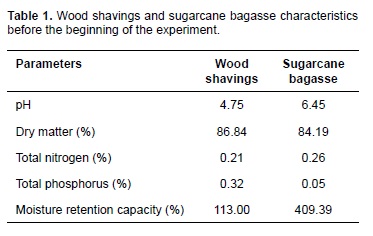
<body><![CDATA[<p>&nbsp;</p>     <p><b><font size="3">Material and methods</font></b></p>     <p>This study was approved by the Animal Ethics   Committee of Rio Verde University (number 02/11, April 19, 2012).</p>     <p>Two thousand birds were raised in five consecutive   flocks, each composed of 400 one-day-old male Cobb   chicks. Masonry boxes measuring 1.52 m2 housed   twenty birds each. The mean initial weight of birds   was 49.63 &plusmn; 0.89 g, 52.50 &plusmn; 0.7 g, 54.63 &plusmn; 0.89 g,   48.00 &plusmn; 0.9 1g, and 49.60 &plusmn; 0.20 g for the first, second,   third, fourth, and fifth flock, respectively. The mean   temperature and relative humidity (RH) of the air   during the trial in the first, second, third, fourth, and   fifth flocks were 24.3 &deg;C and 68%, 23.7 &deg;C and 80%,   25.0 &deg;C and 71%, 22.3 &ordm;C and 70.8%, and 21.5 &deg;C and 55%, respectively.</p>     <p>The experiment was carried out using a completely   randomized design, with five treatments and four   repetitions. The treatments were composed of different   levels of substitution of wood shavings with SB: T1)   0% SB and 100% wood shavings; T2) 25% SB and   75% wood shavings; T3) 50% SB and 50% wood   shavings; T4) 75% SB and 25% wood shavings; T5)   100% SB and 0% wood shavings. Bedding materials   were placed to a depth of 15 cm in each box before   the first flock started. Initial characteristics of each material are shown in <a href="#t1">Table 1</a>, and were determined as described by Silva and Queiroz (2002) and Oliveira <i>et al.</i> (2002).</p>      <p align="center"><a name="t1"><img src="/img/revistas/rccp/v28n3/v28n3a05t1.jpg"></a>     <p>The flocks were established 15 days apart. After   each flock was cleared, feathers were burned with   a blowtorch and the litter was upturned to reduce   moisture content. During this period, the shed curtains   were kept open during the day to provide better air   circulation. Heat was provided by electric lamps with 60 W light bulbs during the first 14 days.</p>     <p>A 24-h light program that incorporated natural   and artificial lighting was used. Feed and water were   offered <i>ad libitum</i> for the entire trial. Animals were   fed commercial feed, divided into five categories: prestarter   (1-9 days), starter (10-18 days), grower I (19-25   days), grower II (26-34 days), and finisher (35-42 days).   The feed and the birds were weighed at the beginning   of the trial, and at 21 and 42 days to evaluate body   weight, weight gain, feed intake, and feed conversion   ratio. Survival rate of the birds was also calculated by recording bird mortality at 21 and 42 days.</p>     <p>At the end of each flock, two birds from each box   were slaughtered after 12 h of fasting. After the birds   were plucked, lesions on their breasts, knees, and   footpads were examined. Two evaluators performed   subjective assessment of these lesions. Scores   described by McWard and Taylor (2000) for knee and footpad lesions were used for dermatitis analysis.</p>     <p>Litter samples were collected on the 42<sup>nd</sup> day   of the experiment from six different sites per box   (avoiding areas close to the feeders and drinking   fountains) from each flock. After collection, samples   were homogenized, placed in labeled plastic bags,   and taken to the laboratory for analysis of pH, dry matter (DM) content, total nitrogen (N) content, phosphorus (P) content (Silva and Queiroz, 2002), moisture retention capacity (MRC) (Oliveira <i><i>et al.</i>,</i> 2002), and amount of volatilized ammonia (Oliveira <i><i>et al.</i>,</i> 2004).</p>     ]]></body>
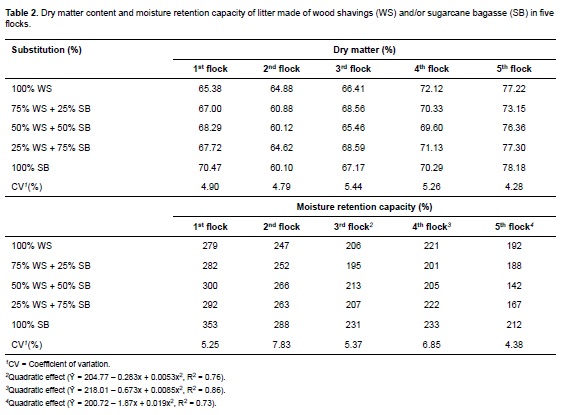
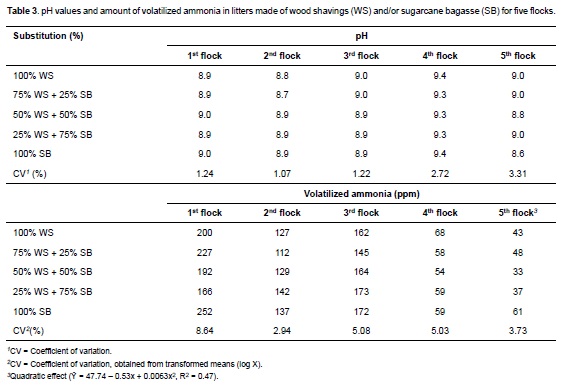
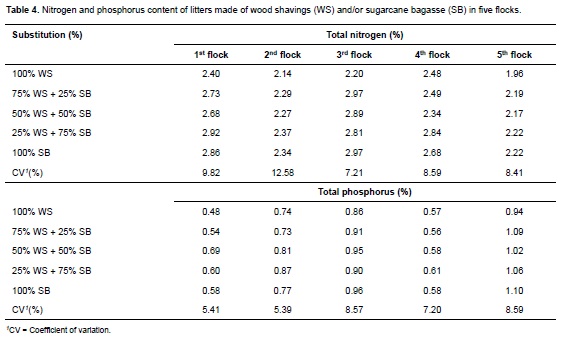
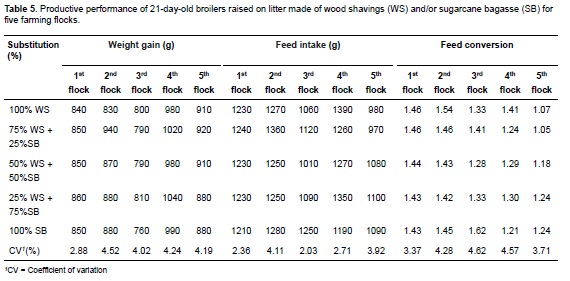
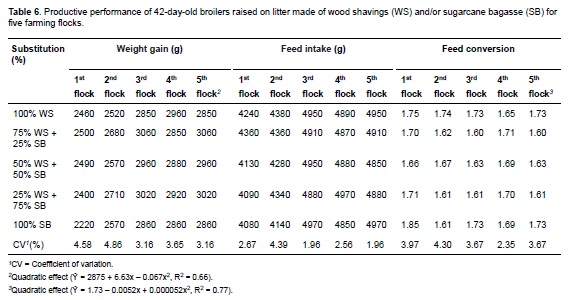
<body><![CDATA[<p>Statistical analyses of performance, litter quality,   and economic viability were performed using SAEG   software (version 9.0). Parameters with significant   differences by flock according to the F-test were   subjected to polynomial regression analysis at   5% probability. Dermatitis results were evaluated   using the Kruskal-Wallis test at 5% probability for comparison of means.</p>     <p>&nbsp;</p>     <p><b><font size="3">Results</font></b></p>     <p>The DM content of the litters did not differ   between treatments. However, MCR increased when wood shavings were completely replaced by SB in the third (p&lt;0.05), fourth (p&lt;0.02), and fifth (p&lt;0.003) flocks (<a href="#t2">Table 2</a>).</p>      <p align="center"><a name="t2"><img src="/img/revistas/rccp/v28n3/v28n3a05t2.jpg"></a>     <p>Substitution of wood shavings with SB did not   influence (p&gt;0.05) the pH values in any of the   five flocks. Substitution of wood shavings was   not significantly related (p&gt;0.05) to volatilized   ammonia, until the fourth flock. In the fifth   flock, the amount of volatilized ammonia varied   quadratically (p&lt;0.004), and the lowest amount   was volatilized when 50% of the wood shavings was substituted with SB (<a href="#t3">Table 3</a>).</p>      <p align="center"><a name="t3"><img src="/img/revistas/rccp/v28n3/v28n3a05t3.jpg"></a>     <p>The loss of ammonia N in the fifth flock was   not sufficient to interfere with N levels in the litter,   as total N and P content did not show significant   differences (p&gt;0.05) between treatments (<a href="#t4">Table 4</a>).   This finding suggests that all litters could be used for fertilizer.</p>      <p align="center"><a name="t4"><img src="/img/revistas/rccp/v28n3/v28n3a05t4.jpg"></a>     <p>There was no significant effect (p&gt;0.05) of   treatments on poultry performance (<a href="#t5">Table 5</a>) in the   first, second, third, and fourth flocks. However, weight   gain (p&lt;0.021) and feed conversion ratio (p&lt;0.004)   in the fifth flock at 42 days were quadratically   affected, and the best values were obtained when   the liter consisted of 75% wood shavings and 25% SB (<a href="#t6">Table 6</a>).</p>      ]]></body>
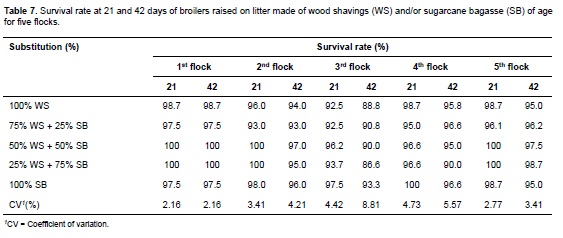
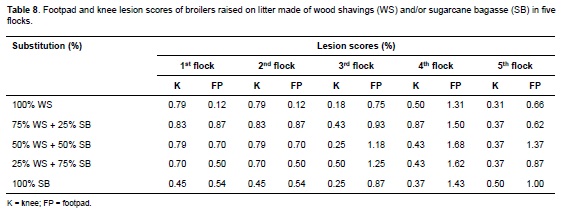
<body><![CDATA[<p align="center"><a name="t5"><img src="/img/revistas/rccp/v28n3/v28n3a05t5.jpg"></a>     <p align="center"><a name="t6"><img src="/img/revistas/rccp/v28n3/v28n3a05t6.jpg"></a>     <p>Survival rate of birds was not influenced (p&gt;0.05)   by the type of bedding used (<a href="#t7">Table 7</a>). The scores   for knee and footpad lesions did not vary (p&gt;0.05) between treatments (<a href="#t8">Table 8</a>).</p>      <p align="center"><a name="t7"><img src="/img/revistas/rccp/v28n3/v28n3a05t7.jpg"></a>     <p align="center"><a name="t8"><img src="/img/revistas/rccp/v28n3/v28n3a05t8.jpg"></a>     <p>&nbsp;</p>     <p><font size="3"><b>Discussion</b></font></p>     <p>Replacing 100% of wood shavings with SB   resulted in a higher MRC in the third, fourth, and fifth   flocks. According to Hafeez <i>et al.</i> (2009), increased   MRC in litter increases the carcass quality score and   decreases the incidence of breast blisters. During this trial no there was no evidence of breast blistering.</p>     <p>Monira <i>et al.</i> (2003) reported that SB litter had 70%   DM content, while wood shavings litter had 74% DM   content; both values are higher than those observed in   this study. Oliveira <i>et al.</i> (2002) observed that wood   shavings litter had higher DM content and lower   MRC than sawdust litter. These authors concluded   that the ideal litter material is capable of releasing   (not retaining) moisture so that it can be eliminated by ventilation.</p>     <p>In the present study pH values were within the   expected range for untreated litter, with pH values   varying from 7.01 (El-Deek <i><i>et al.</i>,</i> 2011) to 8.58 (&Aacute;vila <i><i>et al.</i>,</i> 2008) in the sixth week for wood shavings litter.</p>     ]]></body>
<body><![CDATA[<p>Substitution of wood shavings did not affect   volatilized ammonia until the fourth flock, when the   lowest amount was volatilized at 50% substitution   of wood shavings with SB. Coincidentally, this   flock and this substitution level also had the lowest   moisture retention capacity of all litters, indicating   a positive correlation between MRC and ammonia volatilization rate.</p>     <p>Ammonia loss in the fifth flock did not interfere   with the levels of N in the litter. This finding suggests   that all the litters could be used as fertilizers. As reported by Bolan <i>et al.</i> (2010), most poultry litters are used in agriculture. When correctly handled, their use is suitable to recycle nutrients such as N, P, and K. According to the same authors, N and P contents of poultry litter are generally 2.57 and 0.67%, respectively. Monira <i>et al.</i> (2003) evaluated poultry litter of different materials and reported that total N and P contents of SB-based litter were 2.52 and 1.02%, respectively. &Aacute;vila <i>et al.</i> (2008) also evaluated N and P contents of litters of different materials (including wood shavings) and found contents of 2.44% for N and 0.84% for P. In both cases, N and P contents were similar to those observed in the present study.</p>     <p>Bedding material positively influenced weight   gain and feed conversion ratio at 42 days, particularly   when litter was composed of 75% wood shavings   and 25% SB. It is possible that the lower moisture   retention capacity of wood shavings and SB litters   in the fifth flock produced lower temperature and   relative humidity, thus increasing bird comfort   and performance. Studies investigating the use   of alternatives to wood shavings in bedding have   reported that use of SB (Monira <i><i>et al.</i>,</i> 2003; Ara&uacute;jo   <i><i>et al.</i>,</i> 2007) and other materials (At&ecirc;ncio <i><i>et al.</i>,</i>   2010; Mendes <i><i>et al.</i>,</i> 2011) produced no differences   in productive performance of birds. Survival rate of   birds was also not influenced. Similar findings were   reported by At&ecirc;ncio <i>et al.</i> (2010), Mendes <i>et al.</i> (2011), and Toghyani <i>et al.</i> (2010).</p>     <p>Substituting wood shavings with SB did not   influence the scores for knee and footpad lesions.   These lesions, also known as ''ammonia burns'', are   caused by the combination of moisture and high   ammonia content of the litter (Kjaer <i><i>et al.</i>,</i> 2006).   Knee dermatitis has been positively correlated with   footpad dermatitis (Meluzzi <i><i>et al.</i>,</i> 2008). Footpad and   knee dermatitis are associated with high moisture and   ammonia content. In this study, there were no differences   in moisture content between litters, and differences in   ammonia content only appeared in the fifth flock.   However, the values obtained in this flock were too low to cause lesions.</p>     <p>Garcia <i>et al.</i> (2012) observed that birds raised on   litter made of 50% SB and 50% rice husk or 50% SB   and 50% wood shavings exhibited higher incidence   of footpad lesions than birds raised on 100% wood shaving or 100% rice husk litters. The authors associated this effect with an increase in moisture content of litters containing SB.</p>     <p>In conclusion, substituting up to 75% of wood   shavings with SB maintained the quality of the litter,   increased the productive performance of birds, and   did not influence knee and footpad lesion scores in five consecutive flocks.</p>     <p>&nbsp;</p>     <p><b><font size="3">Acknowledgements</font></b></p>     <p>This study was funded by a grant provided by   Funda&ccedil;&atilde;o de Amparo &agrave; Pesquisa do Estado de Goi&aacute;s, Brazil.</p>     <p align="left">&nbsp;</p>     ]]></body>
<body><![CDATA[<p align="left"><b><font size="3">Conflicts of interest</font></b></p>     <p align="left">The authors declare they have no conflicts of interest with regard to the work presented in this report.</p>     <p align="left">&nbsp;</p> <hr size="1" />     <p><b><font size="3">Notes</font></b></p>     <p><b><a name="a0" id="a0"><a href="#a1">&curren;</a></a></b>To cite this article: Teixeira AS, Oliveira MC, Menezes JF, Gouvea BM, Teixeira SR, Gomes AR. Poultry litter of wood shavings and/or sugarcane bagasse: animal performance and bed quality. Rev Colomb Cienc Pecu 2015; 28:238-246.</p> <hr size="1" />     <p>&nbsp;</p>     <p><b><font size="3">References</font></b></p>     <!-- ref --><p>Ara&uacute;jo JS, Oliveira V, Braga GC. Desempenho de frangos de   corte criados em diferentes tipos de cama e taxa de lota&ccedil;&atilde;o. Cienc   Anim Bras 2007; 8:59-64.    &nbsp;&nbsp;&nbsp;&nbsp;&nbsp;&nbsp;&nbsp;&nbsp;[&#160;<a href="javascript:void(0);" onclick="javascript: window.open('/scielo.php?script=sci_nlinks&ref=000090&pid=S0120-0690201500030000500001&lng=','','width=640,height=500,resizable=yes,scrollbars=1,menubar=yes,');">Links</a>&#160;]<!-- end-ref --></p>     <!-- ref --><p>Atencio JL, Fern&aacute;ndez JA, Gernat AG, Murillo JG. Effect of pine   wood shavings, rice hulls and river bed sand on broiler productivity   when used as a litter sources. Int J Poult Sci 2010; 9:240-243.    &nbsp;&nbsp;&nbsp;&nbsp;&nbsp;&nbsp;&nbsp;&nbsp;[&#160;<a href="javascript:void(0);" onclick="javascript: window.open('/scielo.php?script=sci_nlinks&ref=000092&pid=S0120-0690201500030000500002&lng=','','width=640,height=500,resizable=yes,scrollbars=1,menubar=yes,');">Links</a>&#160;]<!-- end-ref --></p>     <!-- ref --><p>&Aacute;vila VS, Oliveira U, Figueiredo EAP, Costa CAF, Abreu VMN,   Rosa PS. Avalia&ccedil;&atilde;o de materiais alternativos em substitui&ccedil;&atilde;o &agrave;   maravalha como cama de avi&aacute;rio. R Bras Zootec 2008; 37:273-277.    &nbsp;&nbsp;&nbsp;&nbsp;&nbsp;&nbsp;&nbsp;&nbsp;[&#160;<a href="javascript:void(0);" onclick="javascript: window.open('/scielo.php?script=sci_nlinks&ref=000094&pid=S0120-0690201500030000500003&lng=','','width=640,height=500,resizable=yes,scrollbars=1,menubar=yes,');">Links</a>&#160;]<!-- end-ref --></p>     <!-- ref --><p>Bolan NS, Szogi AA, Chuasavathi T, Seshadri B, Rothrock Jr. MJ,   Panneerselvam P. Uses and management of poultry litter. World   Poultry Sci J 2010; 46:673-698.    &nbsp;&nbsp;&nbsp;&nbsp;&nbsp;&nbsp;&nbsp;&nbsp;[&#160;<a href="javascript:void(0);" onclick="javascript: window.open('/scielo.php?script=sci_nlinks&ref=000096&pid=S0120-0690201500030000500004&lng=','','width=640,height=500,resizable=yes,scrollbars=1,menubar=yes,');">Links</a>&#160;]<!-- end-ref --></p>     <!-- ref --><p>Butcher GD, Miles RD. Causes and prevention of wet litter in   broiler houses. Florida Cooperative Extension Service, VM99   2012; [Access date: June 10, 2013]. URL: <a href="http://edis.ifas.ufl.edu/pdffiles/VM/VM02000.pdf" target="_blank">http://edis.ifas.ufl.edu/pdffiles/VM/VM02000.pdf </a>&nbsp;&nbsp;&nbsp;&nbsp;&nbsp;&nbsp;&nbsp;&nbsp;[&#160;<a href="javascript:void(0);" onclick="javascript: window.open('/scielo.php?script=sci_nlinks&ref=000098&pid=S0120-0690201500030000500005&lng=','','width=640,height=500,resizable=yes,scrollbars=1,menubar=yes,');">Links</a>&#160;]<!-- end-ref --><!-- ref --><p>El-Deek AA, Al-Harthi MA, Khalifah MM, Elbanoby MM,   Alharby T. Impact of newspaper as bedding material in arid land   on broiler performance. Egypt Poult Sci 2011; 31:715-725.    &nbsp;&nbsp;&nbsp;&nbsp;&nbsp;&nbsp;&nbsp;&nbsp;[&#160;<a href="javascript:void(0);" onclick="javascript: window.open('/scielo.php?script=sci_nlinks&ref=000099&pid=S0120-0690201500030000500006&lng=','','width=640,height=500,resizable=yes,scrollbars=1,menubar=yes,');">Links</a>&#160;]<!-- end-ref --></p>     <!-- ref --><p>Garc&iacute;a RG, Almeida Paz ICL, Caldara FR, N&auml;&auml;s IA, Pereira DF,   Ferreira VMOS. Selecting the most adequate bedding material for   broiler production in Brazil. Rev Bras Cienc Avic 2012; 14:71-158.    &nbsp;&nbsp;&nbsp;&nbsp;&nbsp;&nbsp;&nbsp;&nbsp;[&#160;<a href="javascript:void(0);" onclick="javascript: window.open('/scielo.php?script=sci_nlinks&ref=000101&pid=S0120-0690201500030000500007&lng=','','width=640,height=500,resizable=yes,scrollbars=1,menubar=yes,');">Links</a>&#160;]<!-- end-ref --></p>     ]]></body>
<body><![CDATA[<!-- ref --><p>Hafeez A, Suhail SM, Durrani FR, Jan D, Ahmad I, Chand N,   Rehman A Effect of different types of locally available litter   materials on the performance of broiler chicks. Sarhad J Agric 2009; 4:581-586.    &nbsp;&nbsp;&nbsp;&nbsp;&nbsp;&nbsp;&nbsp;&nbsp;[&#160;<a href="javascript:void(0);" onclick="javascript: window.open('/scielo.php?script=sci_nlinks&ref=000103&pid=S0120-0690201500030000500008&lng=','','width=640,height=500,resizable=yes,scrollbars=1,menubar=yes,');">Links</a>&#160;]<!-- end-ref --></p>     <!-- ref --><p>Hashimoto S, Yamazaki K, Obi T, Takase K Relationship between   severity of footpad dermatitis and carcass performance in broiler   chickens. J Vet Med Sci 2013; 75:1547-1549.    &nbsp;&nbsp;&nbsp;&nbsp;&nbsp;&nbsp;&nbsp;&nbsp;[&#160;<a href="javascript:void(0);" onclick="javascript: window.open('/scielo.php?script=sci_nlinks&ref=000105&pid=S0120-0690201500030000500009&lng=','','width=640,height=500,resizable=yes,scrollbars=1,menubar=yes,');">Links</a>&#160;]<!-- end-ref --></p>     <!-- ref --><p>Kjaer JB, Su G, Nielsen BL, Sorensen P. Food pad dermatitis and   hock burn in broiler chickens and degree of inheritance. Poultry   Sci 2006; 85:1342-1348.    &nbsp;&nbsp;&nbsp;&nbsp;&nbsp;&nbsp;&nbsp;&nbsp;[&#160;<a href="javascript:void(0);" onclick="javascript: window.open('/scielo.php?script=sci_nlinks&ref=000107&pid=S0120-0690201500030000500010&lng=','','width=640,height=500,resizable=yes,scrollbars=1,menubar=yes,');">Links</a>&#160;]<!-- end-ref --></p>     <!-- ref --><p>Lovanh N, Cook KL, Rothrock MJ, Miles DM, Sistani K. Spatial   shifts in microbial population structure within poultry litter   associated with physicochemical properties. Poultry Sci 2007;   86:1840-1849.    &nbsp;&nbsp;&nbsp;&nbsp;&nbsp;&nbsp;&nbsp;&nbsp;[&#160;<a href="javascript:void(0);" onclick="javascript: window.open('/scielo.php?script=sci_nlinks&ref=000109&pid=S0120-0690201500030000500011&lng=','','width=640,height=500,resizable=yes,scrollbars=1,menubar=yes,');">Links</a>&#160;]<!-- end-ref --></p>     <!-- ref --><p>McWard GW, Taylor DR. Acidified clay litter amendment. J Appl   Poultry Res 2000; 9:518-529.    &nbsp;&nbsp;&nbsp;&nbsp;&nbsp;&nbsp;&nbsp;&nbsp;[&#160;<a href="javascript:void(0);" onclick="javascript: window.open('/scielo.php?script=sci_nlinks&ref=000111&pid=S0120-0690201500030000500012&lng=','','width=640,height=500,resizable=yes,scrollbars=1,menubar=yes,');">Links</a>&#160;]<!-- end-ref --></p>     ]]></body>
<body><![CDATA[<!-- ref --><p>Meluzzi A, Sirri F, Folegatti E, Fabbri C. Effect of less intensive   rearing conditions on litter characteristics, growth performance,   carcass injuries and meat quality of broilers. Brit Poultry Sci   2008; 49:509-515.    &nbsp;&nbsp;&nbsp;&nbsp;&nbsp;&nbsp;&nbsp;&nbsp;[&#160;<a href="javascript:void(0);" onclick="javascript: window.open('/scielo.php?script=sci_nlinks&ref=000113&pid=S0120-0690201500030000500013&lng=','','width=640,height=500,resizable=yes,scrollbars=1,menubar=yes,');">Links</a>&#160;]<!-- end-ref --></p>     <!-- ref --><p>Mendes AS, Paix&atilde;o SJ, Restelatto R, Reffatti R, Possenti JC,   Moura DJ, Morello GMZ, Carvalho TMR. Effects of initial body   weight and litter material on broiler production. Rev Bras Cienc   Avic 2011; 13:165-170.    &nbsp;&nbsp;&nbsp;&nbsp;&nbsp;&nbsp;&nbsp;&nbsp;[&#160;<a href="javascript:void(0);" onclick="javascript: window.open('/scielo.php?script=sci_nlinks&ref=000115&pid=S0120-0690201500030000500014&lng=','','width=640,height=500,resizable=yes,scrollbars=1,menubar=yes,');">Links</a>&#160;]<!-- end-ref --></p>     <!-- ref --><p>Miragliotta MY, Naas IA, Baracho MS, Aradas MEC. Qualidade   do ar de dois sistemas produtivos de frangos de corte com   ventila&ccedil;&atilde;o e densidade diferenciadas &#8212; estudo de caso. Eng Agric 2002; 22:1-10.    &nbsp;&nbsp;&nbsp;&nbsp;&nbsp;&nbsp;&nbsp;&nbsp;[&#160;<a href="javascript:void(0);" onclick="javascript: window.open('/scielo.php?script=sci_nlinks&ref=000117&pid=S0120-0690201500030000500015&lng=','','width=640,height=500,resizable=yes,scrollbars=1,menubar=yes,');">Links</a>&#160;]<!-- end-ref --></p>     <!-- ref --><p>Monira KN, Islam MA, Alam MJ, Wahid MA. Effect of litter   materials on broiler performance and evaluation of manureal   value of used litter in late autumn. Asian Australas J Anim 2003;   16:555-557.    &nbsp;&nbsp;&nbsp;&nbsp;&nbsp;&nbsp;&nbsp;&nbsp;[&#160;<a href="javascript:void(0);" onclick="javascript: window.open('/scielo.php?script=sci_nlinks&ref=000119&pid=S0120-0690201500030000500016&lng=','','width=640,height=500,resizable=yes,scrollbars=1,menubar=yes,');">Links</a>&#160;]<!-- end-ref --></p>     <!-- ref --><p>Oliveira MC, Carvalho ID. Rendimento e les&otilde;es em carca&ccedil;a   de frangos de corte criados em diferentes camas e densidades   populacionais. Cienc Agrotec 2002; 26:1076-1081.    &nbsp;&nbsp;&nbsp;&nbsp;&nbsp;&nbsp;&nbsp;&nbsp;[&#160;<a href="javascript:void(0);" onclick="javascript: window.open('/scielo.php?script=sci_nlinks&ref=000121&pid=S0120-0690201500030000500017&lng=','','width=640,height=500,resizable=yes,scrollbars=1,menubar=yes,');">Links</a>&#160;]<!-- end-ref --></p>     ]]></body>
<body><![CDATA[<!-- ref --><p>Oliveira MC, Ferreira HA, Cancherini LC. Efeito de condicionadores   qu&iacute;micos sobre a qualidade da cama de frango. Arq Bras Med Vet   Zoo 2004; 56:536-541.    &nbsp;&nbsp;&nbsp;&nbsp;&nbsp;&nbsp;&nbsp;&nbsp;[&#160;<a href="javascript:void(0);" onclick="javascript: window.open('/scielo.php?script=sci_nlinks&ref=000123&pid=S0120-0690201500030000500018&lng=','','width=640,height=500,resizable=yes,scrollbars=1,menubar=yes,');">Links</a>&#160;]<!-- end-ref --></p>     <!-- ref --><p>Sampaio MAPM, Schocken-Iturrino RP, Sampaio AAM,   Berchielli SCP, Biondi A. Estudo da popula&ccedil;&atilde;o microbiana e   da libera&ccedil;&atilde;o de am&ocirc;nia da cama de frangos tratada com gesso   agr&iacute;cola. Arq Bras Med Vet Zoo 1999; 51:559-564.    &nbsp;&nbsp;&nbsp;&nbsp;&nbsp;&nbsp;&nbsp;&nbsp;[&#160;<a href="javascript:void(0);" onclick="javascript: window.open('/scielo.php?script=sci_nlinks&ref=000125&pid=S0120-0690201500030000500019&lng=','','width=640,height=500,resizable=yes,scrollbars=1,menubar=yes,');">Links</a>&#160;]<!-- end-ref --></p>     <!-- ref --><p>Silva DJ, Queiroz AC. An&aacute;lise de alimentos: m&eacute;todos qu&iacute;micos e   biol&oacute;gicos. 3rd ed. Vi&ccedil;osa (MG): UFV Publisher; 2002.    &nbsp;&nbsp;&nbsp;&nbsp;&nbsp;&nbsp;&nbsp;&nbsp;[&#160;<a href="javascript:void(0);" onclick="javascript: window.open('/scielo.php?script=sci_nlinks&ref=000127&pid=S0120-0690201500030000500020&lng=','','width=640,height=500,resizable=yes,scrollbars=1,menubar=yes,');">Links</a>&#160;]<!-- end-ref --></p>     <!-- ref --><p>Toghyani M, Gheisari A, Modaresi M, Tabeidian SA, Toghyani M.   Effect of different litter material on performance and behavior of broiler chickens. Appl Anim Behav Sci 2010; 122:48-52.    &nbsp;&nbsp;&nbsp;&nbsp;&nbsp;&nbsp;&nbsp;&nbsp;[&#160;<a href="javascript:void(0);" onclick="javascript: window.open('/scielo.php?script=sci_nlinks&ref=000129&pid=S0120-0690201500030000500021&lng=','','width=640,height=500,resizable=yes,scrollbars=1,menubar=yes,');">Links</a>&#160;]<!-- end-ref --></p>     <p>&nbsp;</p>     <p>&nbsp;</p> </font>     ]]></body>
<body><![CDATA[ ]]></body><back>
<ref-list>
<ref id="B1">
<nlm-citation citation-type="journal">
<person-group person-group-type="author">
<name>
<surname><![CDATA[Araújo]]></surname>
<given-names><![CDATA[JS]]></given-names>
</name>
<name>
<surname><![CDATA[Oliveira]]></surname>
<given-names><![CDATA[V]]></given-names>
</name>
<name>
<surname><![CDATA[Braga]]></surname>
<given-names><![CDATA[GC]]></given-names>
</name>
</person-group>
<article-title xml:lang="pt"><![CDATA[Desempenho de frangos de corte criados em diferentes tipos de cama e taxa de lotação]]></article-title>
<source><![CDATA[Cienc Anim Bras]]></source>
<year>2007</year>
<volume>8</volume>
<page-range>59-64</page-range></nlm-citation>
</ref>
<ref id="B2">
<nlm-citation citation-type="journal">
<person-group person-group-type="author">
<name>
<surname><![CDATA[Atencio]]></surname>
<given-names><![CDATA[JL]]></given-names>
</name>
<name>
<surname><![CDATA[Fernández]]></surname>
<given-names><![CDATA[JA]]></given-names>
</name>
<name>
<surname><![CDATA[Gernat]]></surname>
<given-names><![CDATA[AG]]></given-names>
</name>
<name>
<surname><![CDATA[Murillo]]></surname>
<given-names><![CDATA[JG]]></given-names>
</name>
</person-group>
<article-title xml:lang="en"><![CDATA[Effect of pine wood shavings, rice hulls and river bed sand on broiler productivity when used as a litter sources]]></article-title>
<source><![CDATA[Int J Poult Sci]]></source>
<year>2010</year>
<volume>9</volume>
<page-range>240-243</page-range></nlm-citation>
</ref>
<ref id="B3">
<nlm-citation citation-type="journal">
<person-group person-group-type="author">
<name>
<surname><![CDATA[Ávila]]></surname>
<given-names><![CDATA[VS]]></given-names>
</name>
<name>
<surname><![CDATA[Oliveira]]></surname>
<given-names><![CDATA[U]]></given-names>
</name>
<name>
<surname><![CDATA[Figueiredo]]></surname>
<given-names><![CDATA[EAP]]></given-names>
</name>
<name>
<surname><![CDATA[Costa]]></surname>
<given-names><![CDATA[CAF]]></given-names>
</name>
<name>
<surname><![CDATA[Abreu]]></surname>
<given-names><![CDATA[VMN]]></given-names>
</name>
<name>
<surname><![CDATA[Rosa]]></surname>
<given-names><![CDATA[PS]]></given-names>
</name>
</person-group>
<article-title xml:lang="pt"><![CDATA[Avaliação de materiais alternativos em substituição à maravalha como cama de aviário]]></article-title>
<source><![CDATA[R Bras Zootec]]></source>
<year>2008</year>
<volume>37</volume>
<page-range>273-277</page-range></nlm-citation>
</ref>
<ref id="B4">
<nlm-citation citation-type="journal">
<person-group person-group-type="author">
<name>
<surname><![CDATA[Bolan]]></surname>
<given-names><![CDATA[NS]]></given-names>
</name>
<name>
<surname><![CDATA[Szogi]]></surname>
<given-names><![CDATA[AA]]></given-names>
</name>
<name>
<surname><![CDATA[Chuasavathi]]></surname>
<given-names><![CDATA[T]]></given-names>
</name>
<name>
<surname><![CDATA[Seshadri]]></surname>
<given-names><![CDATA[B]]></given-names>
</name>
<name>
<surname><![CDATA[Rothrock]]></surname>
<given-names><![CDATA[Jr. MJ]]></given-names>
</name>
<name>
<surname><![CDATA[Panneerselvam]]></surname>
<given-names><![CDATA[P]]></given-names>
</name>
</person-group>
<article-title xml:lang="en"><![CDATA[Uses and management of poultry litter]]></article-title>
<source><![CDATA[World Poultry Sci J]]></source>
<year>2010</year>
<volume>46</volume>
<page-range>673-698</page-range></nlm-citation>
</ref>
<ref id="B5">
<nlm-citation citation-type="">
<person-group person-group-type="author">
<name>
<surname><![CDATA[Butcher]]></surname>
<given-names><![CDATA[GD]]></given-names>
</name>
<name>
<surname><![CDATA[Miles]]></surname>
<given-names><![CDATA[RD]]></given-names>
</name>
</person-group>
<source><![CDATA[Causes and prevention of wet litter in broiler houses]]></source>
<year></year>
</nlm-citation>
</ref>
<ref id="B6">
<nlm-citation citation-type="journal">
<person-group person-group-type="author">
<name>
<surname><![CDATA[El-Deek]]></surname>
<given-names><![CDATA[AA]]></given-names>
</name>
<name>
<surname><![CDATA[Al-Harthi]]></surname>
<given-names><![CDATA[MA]]></given-names>
</name>
<name>
<surname><![CDATA[Khalifah]]></surname>
<given-names><![CDATA[MM]]></given-names>
</name>
<name>
<surname><![CDATA[Elbanoby]]></surname>
<given-names><![CDATA[MM]]></given-names>
</name>
<name>
<surname><![CDATA[Alharby]]></surname>
<given-names><![CDATA[T]]></given-names>
</name>
</person-group>
<article-title xml:lang="en"><![CDATA[Impact of newspaper as bedding material in arid land on broiler performance]]></article-title>
<source><![CDATA[Egypt Poult Sci]]></source>
<year>2011</year>
<volume>31</volume>
<page-range>715-725</page-range></nlm-citation>
</ref>
<ref id="B7">
<nlm-citation citation-type="journal">
<person-group person-group-type="author">
<name>
<surname><![CDATA[García]]></surname>
<given-names><![CDATA[RG]]></given-names>
</name>
<name>
<surname><![CDATA[Almeida]]></surname>
<given-names><![CDATA[Paz ICL]]></given-names>
</name>
<name>
<surname><![CDATA[Caldara]]></surname>
<given-names><![CDATA[FR]]></given-names>
</name>
<name>
<surname><![CDATA[Nääs]]></surname>
<given-names><![CDATA[IA]]></given-names>
</name>
<name>
<surname><![CDATA[Pereira]]></surname>
<given-names><![CDATA[DF]]></given-names>
</name>
<name>
<surname><![CDATA[Ferreira]]></surname>
<given-names><![CDATA[VMOS]]></given-names>
</name>
</person-group>
<article-title xml:lang="en"><![CDATA[Selecting the most adequate bedding material for broiler production in Brazil]]></article-title>
<source><![CDATA[Rev Bras Cienc Avic]]></source>
<year>2012</year>
<volume>14</volume>
<page-range>71-158</page-range></nlm-citation>
</ref>
<ref id="B8">
<nlm-citation citation-type="journal">
<person-group person-group-type="author">
<name>
<surname><![CDATA[Hafeez]]></surname>
<given-names><![CDATA[A]]></given-names>
</name>
<name>
<surname><![CDATA[Suhail]]></surname>
<given-names><![CDATA[SM]]></given-names>
</name>
<name>
<surname><![CDATA[Durrani]]></surname>
<given-names><![CDATA[FR]]></given-names>
</name>
<name>
<surname><![CDATA[Jan]]></surname>
<given-names><![CDATA[D]]></given-names>
</name>
<name>
<surname><![CDATA[Ahmad]]></surname>
<given-names><![CDATA[I]]></given-names>
</name>
<name>
<surname><![CDATA[Chand]]></surname>
<given-names><![CDATA[N]]></given-names>
</name>
<name>
<surname><![CDATA[Rehman]]></surname>
<given-names><![CDATA[A]]></given-names>
</name>
</person-group>
<article-title xml:lang="en"><![CDATA[Effect of different types of locally available litter materials on the performance of broiler chicks]]></article-title>
<source><![CDATA[Sarhad J Agric]]></source>
<year>2009</year>
<volume>4</volume>
<page-range>581-586</page-range></nlm-citation>
</ref>
<ref id="B9">
<nlm-citation citation-type="journal">
<person-group person-group-type="author">
<name>
<surname><![CDATA[Hashimoto]]></surname>
<given-names><![CDATA[S]]></given-names>
</name>
<name>
<surname><![CDATA[Yamazaki]]></surname>
<given-names><![CDATA[K]]></given-names>
</name>
<name>
<surname><![CDATA[Obi]]></surname>
<given-names><![CDATA[T]]></given-names>
</name>
<name>
<surname><![CDATA[Takase]]></surname>
<given-names><![CDATA[K]]></given-names>
</name>
</person-group>
<article-title xml:lang="en"><![CDATA[Relationship between severity of footpad dermatitis and carcass performance in broiler chickens]]></article-title>
<source><![CDATA[J Vet Med Sci]]></source>
<year>2013</year>
<volume>75</volume>
<page-range>1547-1549</page-range></nlm-citation>
</ref>
<ref id="B10">
<nlm-citation citation-type="journal">
<person-group person-group-type="author">
<name>
<surname><![CDATA[Kjaer]]></surname>
<given-names><![CDATA[JB]]></given-names>
</name>
<name>
<surname><![CDATA[Su]]></surname>
<given-names><![CDATA[G]]></given-names>
</name>
<name>
<surname><![CDATA[Nielsen]]></surname>
<given-names><![CDATA[BL]]></given-names>
</name>
<name>
<surname><![CDATA[Sorensen]]></surname>
<given-names><![CDATA[P]]></given-names>
</name>
</person-group>
<article-title xml:lang="en"><![CDATA[Food pad dermatitis and hock burn in broiler chickens and degree of inheritance]]></article-title>
<source><![CDATA[Poultry Sci]]></source>
<year>2006</year>
<volume>85</volume>
<page-range>1342-1348</page-range></nlm-citation>
</ref>
<ref id="B11">
<nlm-citation citation-type="journal">
<person-group person-group-type="author">
<name>
<surname><![CDATA[Lovanh]]></surname>
<given-names><![CDATA[N]]></given-names>
</name>
<name>
<surname><![CDATA[Cook]]></surname>
<given-names><![CDATA[KL]]></given-names>
</name>
<name>
<surname><![CDATA[Rothrock]]></surname>
<given-names><![CDATA[MJ]]></given-names>
</name>
<name>
<surname><![CDATA[Miles]]></surname>
<given-names><![CDATA[DM]]></given-names>
</name>
<name>
<surname><![CDATA[Sistani]]></surname>
<given-names><![CDATA[K]]></given-names>
</name>
</person-group>
<article-title xml:lang="en"><![CDATA[Spatial shifts in microbial population structure within poultry litter associated with physicochemical properties]]></article-title>
<source><![CDATA[Poultry Sci]]></source>
<year>2007</year>
<volume>86</volume>
<page-range>1840-1849</page-range></nlm-citation>
</ref>
<ref id="B12">
<nlm-citation citation-type="journal">
<person-group person-group-type="author">
<name>
<surname><![CDATA[McWard]]></surname>
<given-names><![CDATA[GW]]></given-names>
</name>
<name>
<surname><![CDATA[Taylor]]></surname>
<given-names><![CDATA[DR]]></given-names>
</name>
</person-group>
<article-title xml:lang="en"><![CDATA[Acidified clay litter amendment]]></article-title>
<source><![CDATA[J Appl Poultry Res]]></source>
<year>2000</year>
<volume>9</volume>
<page-range>518-529</page-range></nlm-citation>
</ref>
<ref id="B13">
<nlm-citation citation-type="journal">
<person-group person-group-type="author">
<name>
<surname><![CDATA[Meluzzi]]></surname>
<given-names><![CDATA[A]]></given-names>
</name>
<name>
<surname><![CDATA[Sirri]]></surname>
<given-names><![CDATA[F]]></given-names>
</name>
<name>
<surname><![CDATA[Folegatti]]></surname>
<given-names><![CDATA[E]]></given-names>
</name>
<name>
<surname><![CDATA[Fabbri]]></surname>
<given-names><![CDATA[C]]></given-names>
</name>
</person-group>
<article-title xml:lang="en"><![CDATA[Effect of less intensive rearing conditions on litter characteristics, growth performance, carcass injuries and meat quality of broilers]]></article-title>
<source><![CDATA[Brit Poultry Sci]]></source>
<year>2008</year>
<volume>49</volume>
<page-range>509-515</page-range></nlm-citation>
</ref>
<ref id="B14">
<nlm-citation citation-type="journal">
<person-group person-group-type="author">
<name>
<surname><![CDATA[Mendes]]></surname>
<given-names><![CDATA[AS]]></given-names>
</name>
<name>
<surname><![CDATA[Paixão]]></surname>
<given-names><![CDATA[SJ]]></given-names>
</name>
<name>
<surname><![CDATA[Restelatto]]></surname>
<given-names><![CDATA[R]]></given-names>
</name>
<name>
<surname><![CDATA[Reffatti]]></surname>
<given-names><![CDATA[R]]></given-names>
</name>
<name>
<surname><![CDATA[Possenti]]></surname>
<given-names><![CDATA[JC]]></given-names>
</name>
<name>
<surname><![CDATA[Moura]]></surname>
<given-names><![CDATA[DJ]]></given-names>
</name>
<name>
<surname><![CDATA[Morello]]></surname>
<given-names><![CDATA[GMZ]]></given-names>
</name>
<name>
<surname><![CDATA[Carvalho]]></surname>
<given-names><![CDATA[TMR]]></given-names>
</name>
</person-group>
<article-title xml:lang="en"><![CDATA[Effects of initial body weight and litter material on broiler production]]></article-title>
<source><![CDATA[Rev Bras Cienc Avic]]></source>
<year>2011</year>
<volume>13</volume>
<page-range>165-170</page-range></nlm-citation>
</ref>
<ref id="B15">
<nlm-citation citation-type="journal">
<person-group person-group-type="author">
<name>
<surname><![CDATA[Miragliotta]]></surname>
<given-names><![CDATA[MY]]></given-names>
</name>
<name>
<surname><![CDATA[Naas]]></surname>
<given-names><![CDATA[IA]]></given-names>
</name>
<name>
<surname><![CDATA[Baracho]]></surname>
<given-names><![CDATA[MS]]></given-names>
</name>
<name>
<surname><![CDATA[Aradas]]></surname>
<given-names><![CDATA[MEC]]></given-names>
</name>
</person-group>
<article-title xml:lang="pt"><![CDATA[Qualidade do ar de dois sistemas produtivos de frangos de corte com ventilação e densidade diferenciadas - estudo de caso]]></article-title>
<source><![CDATA[Eng Agric]]></source>
<year>2002</year>
<volume>22</volume>
<page-range>1-10</page-range></nlm-citation>
</ref>
<ref id="B16">
<nlm-citation citation-type="journal">
<person-group person-group-type="author">
<name>
<surname><![CDATA[Monira]]></surname>
<given-names><![CDATA[KN]]></given-names>
</name>
<name>
<surname><![CDATA[Islam]]></surname>
<given-names><![CDATA[MA]]></given-names>
</name>
<name>
<surname><![CDATA[Alam]]></surname>
<given-names><![CDATA[MJ]]></given-names>
</name>
<name>
<surname><![CDATA[Wahid]]></surname>
<given-names><![CDATA[MA]]></given-names>
</name>
</person-group>
<article-title xml:lang="en"><![CDATA[Effect of litter materials on broiler performance and evaluation of manureal value of used litter in late autumn]]></article-title>
<source><![CDATA[Asian Australas J Anim]]></source>
<year>2003</year>
<volume>16</volume>
<page-range>555-557</page-range></nlm-citation>
</ref>
<ref id="B17">
<nlm-citation citation-type="journal">
<person-group person-group-type="author">
<name>
<surname><![CDATA[Oliveira]]></surname>
<given-names><![CDATA[MC]]></given-names>
</name>
<name>
<surname><![CDATA[Carvalho]]></surname>
<given-names><![CDATA[ID]]></given-names>
</name>
</person-group>
<article-title xml:lang="pt"><![CDATA[Rendimento e lesões em carcaça de frangos de corte criados em diferentes camas e densidades populacionais]]></article-title>
<source><![CDATA[Cienc Agrotec]]></source>
<year>2002</year>
<volume>26</volume>
<page-range>1076-1081</page-range></nlm-citation>
</ref>
<ref id="B18">
<nlm-citation citation-type="journal">
<person-group person-group-type="author">
<name>
<surname><![CDATA[Oliveira]]></surname>
<given-names><![CDATA[MC]]></given-names>
</name>
<name>
<surname><![CDATA[Ferreira]]></surname>
<given-names><![CDATA[HA]]></given-names>
</name>
<name>
<surname><![CDATA[Cancherini]]></surname>
<given-names><![CDATA[LC]]></given-names>
</name>
</person-group>
<article-title xml:lang="pt"><![CDATA[Efeito de condicionadores químicos sobre a qualidade da cama de frango]]></article-title>
<source><![CDATA[Arq Bras Med Vet Zoo]]></source>
<year>2004</year>
<volume>56</volume>
<page-range>536-541</page-range></nlm-citation>
</ref>
<ref id="B19">
<nlm-citation citation-type="journal">
<person-group person-group-type="author">
<name>
<surname><![CDATA[Sampaio]]></surname>
<given-names><![CDATA[MAPM]]></given-names>
</name>
<name>
<surname><![CDATA[Schocken-Iturrino]]></surname>
<given-names><![CDATA[RP]]></given-names>
</name>
<name>
<surname><![CDATA[Sampaio]]></surname>
<given-names><![CDATA[AAM]]></given-names>
</name>
<name>
<surname><![CDATA[Berchielli]]></surname>
<given-names><![CDATA[SCP]]></given-names>
</name>
<name>
<surname><![CDATA[Biondi]]></surname>
<given-names><![CDATA[A]]></given-names>
</name>
</person-group>
<article-title xml:lang="pt"><![CDATA[Estudo da população microbiana e da liberação de amônia da cama de frangos tratada com gesso agrícola]]></article-title>
<source><![CDATA[Arq Bras Med Vet Zoo]]></source>
<year>1999</year>
<volume>51</volume>
<page-range>559-564</page-range></nlm-citation>
</ref>
<ref id="B20">
<nlm-citation citation-type="">
<person-group person-group-type="author">
<name>
<surname><![CDATA[Silva]]></surname>
<given-names><![CDATA[DJ]]></given-names>
</name>
</person-group>
<source><![CDATA[]]></source>
<year></year>
</nlm-citation>
</ref>
<ref id="B21">
<nlm-citation citation-type="journal">
<person-group person-group-type="author">
<name>
<surname><![CDATA[Toghyani]]></surname>
<given-names><![CDATA[M]]></given-names>
</name>
<name>
<surname><![CDATA[Gheisari]]></surname>
<given-names><![CDATA[A]]></given-names>
</name>
<name>
<surname><![CDATA[Modaresi]]></surname>
<given-names><![CDATA[M]]></given-names>
</name>
<name>
<surname><![CDATA[Tabeidian]]></surname>
<given-names><![CDATA[SA]]></given-names>
</name>
<name>
<surname><![CDATA[Toghyani]]></surname>
<given-names><![CDATA[M]]></given-names>
</name>
</person-group>
<article-title xml:lang="en"><![CDATA[Effect of different litter material on performance and behavior of broiler chickens]]></article-title>
<source><![CDATA[Appl Anim Behav Sci]]></source>
<year>2010</year>
<volume>122</volume>
<page-range>48-52</page-range></nlm-citation>
</ref>
</ref-list>
</back>
</article>