<?xml version="1.0" encoding="ISO-8859-1"?><article xmlns:mml="http://www.w3.org/1998/Math/MathML" xmlns:xlink="http://www.w3.org/1999/xlink" xmlns:xsi="http://www.w3.org/2001/XMLSchema-instance">
<front>
<journal-meta>
<journal-id>0120-0690</journal-id>
<journal-title><![CDATA[Revista Colombiana de Ciencias Pecuarias]]></journal-title>
<abbrev-journal-title><![CDATA[Rev Colom Cienc Pecua]]></abbrev-journal-title>
<issn>0120-0690</issn>
<publisher>
<publisher-name><![CDATA[Facultad de Ciencias Agrarias, Universidad de Antioquia]]></publisher-name>
</publisher>
</journal-meta>
<article-meta>
<article-id>S0120-06902015000300006</article-id>
<article-id pub-id-type="doi">10.17533/udea.rccp.v28n3a5</article-id>
<title-group>
<article-title xml:lang="en"><![CDATA[Productive performance and carcass traits of Nellore x Aberdeen Angus and Nellore x Red Angus heifers under tropical conditions]]></article-title>
<article-title xml:lang="es"><![CDATA[Rendimiento productivo y características de la canal de Novillas Nelore x Aberdeen Angus y Nelore x Angus Colorado en condiciones tropicales]]></article-title>
<article-title xml:lang="pt"><![CDATA[Desempenho produtivo e características de carcaça de Novilhas Nelore x Aberdeen Angus e Nelore x Red Angus sob condições tropicais]]></article-title>
</title-group>
<contrib-group>
<contrib contrib-type="author">
<name>
<surname><![CDATA[Andrade Moreira]]></surname>
<given-names><![CDATA[Paulo Sérgio]]></given-names>
</name>
<xref ref-type="aff" rid="A01"/>
</contrib>
<contrib contrib-type="author">
<name>
<surname><![CDATA[Lourenço]]></surname>
<given-names><![CDATA[Fabio José]]></given-names>
</name>
<xref ref-type="aff" rid="A02"/>
</contrib>
<contrib contrib-type="author">
<name>
<surname><![CDATA[Polizel Neto]]></surname>
<given-names><![CDATA[Angelo]]></given-names>
</name>
<xref ref-type="aff" rid="A01"/>
</contrib>
<contrib contrib-type="author">
<name>
<surname><![CDATA[Rigatto Martins]]></surname>
<given-names><![CDATA[Lilian]]></given-names>
</name>
<xref ref-type="aff" rid="A01"/>
</contrib>
<contrib contrib-type="author">
<name>
<surname><![CDATA[Mendes Jorge]]></surname>
<given-names><![CDATA[André]]></given-names>
</name>
<xref ref-type="aff" rid="A02"/>
</contrib>
<contrib contrib-type="author">
<name>
<surname><![CDATA[Rodrigues Machado Neto]]></surname>
<given-names><![CDATA[Otávio]]></given-names>
</name>
<xref ref-type="aff" rid="A02"/>
</contrib>
</contrib-group>
<aff id="A01">
<institution><![CDATA[,Universidade Federal de Mato Grosso  ]]></institution>
<addr-line><![CDATA[ ]]></addr-line>
<country>Brazil</country>
</aff>
<aff id="A02">
<institution><![CDATA[,Universidade Estadual Paulista Faculdade de Medicina Veterinária e Zootecnia ]]></institution>
<addr-line><![CDATA[ ]]></addr-line>
</aff>
<aff id="A03">
<institution><![CDATA[,Universidade Federal de Mato Grosso  ]]></institution>
<addr-line><![CDATA[ ]]></addr-line>
<country>Brazil</country>
</aff>
<pub-date pub-type="pub">
<day>00</day>
<month>08</month>
<year>2015</year>
</pub-date>
<pub-date pub-type="epub">
<day>00</day>
<month>08</month>
<year>2015</year>
</pub-date>
<volume>28</volume>
<numero>3</numero>
<fpage>247</fpage>
<lpage>254</lpage>
<copyright-statement/>
<copyright-year/>
<self-uri xlink:href="http://www.scielo.org.co/scielo.php?script=sci_arttext&amp;pid=S0120-06902015000300006&amp;lng=en&amp;nrm=iso"></self-uri><self-uri xlink:href="http://www.scielo.org.co/scielo.php?script=sci_abstract&amp;pid=S0120-06902015000300006&amp;lng=en&amp;nrm=iso"></self-uri><self-uri xlink:href="http://www.scielo.org.co/scielo.php?script=sci_pdf&amp;pid=S0120-06902015000300006&amp;lng=en&amp;nrm=iso"></self-uri><abstract abstract-type="short" xml:lang="en"><p><![CDATA[Background: Angus breed strains (Black and Red) perform differently under tropical conditions. Objective: to evaluate differences among F1 Nellore x Aberdeen Angus and F1 Nellore x Red Angus regarding productive performance and carcass traits under tropical conditions. Methods: forty-one heifers were used to assess the effect of both genetic groups on productive performance and carcass traits. The performance parameters evaluated were final live body weight and average daily gain. The carcass traits were: 1) hot and cold carcass weight and cold carcass dressing percentage, 2) carcass conformation and fatting (both ranging from 1 to 5), 3) back fat thickness, 4) rib eye area, 5) cutability, and 6) total usable meat, and commercial cut yield. Animals were divided in two groups and fed Megathyrsus maximum grass in three pens for 28 days. After this period, animals were relocated in a feedlot system for 84 days, and weighed at the beginning and at the end. All data were subjected to analysis of variance with initial live weight as a covariate. Results: differences were found between groups for productive performance and carcass traits such as back fat, and rib eye area. However, no difference was observed for conformation, fatting, ease of cutability, total usable meat, and Brazilian commercial cuts. Conclusion: F1 Nellore x Aberdeen Angus heifers had increased growth performance and carcass traits under tropical conditions.]]></p></abstract>
<abstract abstract-type="short" xml:lang="es"><p><![CDATA[Antecedentes: las variedades de la raza Angus (Negro o Rojo) pueden exhibir un rendimiento diferente en condiciones tropicales. Objetivo: el objetivo fue evaluar las diferencias entre los grupos genéticos de bovinos Nelore x Angus F1 y F1 Nelore x Angus Colorado en cuanto al rendimiento de la canal y las características productivas en condiciones tropicales. Métodos: se utilizaron 41 novillas para evaluar los grupos genéticos con respecto al crecimiento y características de la canal. Como parámetros de rendimiento productivo se evaluó el peso vivo final y la ganancia diaria, y para características de la canal: 1) peso en canal caliente, fría y rendimiento, 2) conformación de la canal, 3) el espesor de grasa, 4) área del ojo del lomo, 5) cortabilidad y 6) carne total utilizable y cortes comerciales brasileños. Los animales fueron divididos en dos grupos y alimentados con pasto Megathyrsus maximum bajo pastoreo rotacional en tres corrales durante 28 días. Luego fueron trasladados 84 dias a un sistema de confinamiento, siendo pesados al inicio y al final del tratamiento. Todos los datos fueron sometidos a análisis de varianza con el peso vivo inicial como covariable. Resultados: hubo diferencias en el rendimiento productivo y características de la canal, en espesor de grasa dorsal y área del ojo del lomo. Sin embargo, no hubo diferencia en la conformación, el acabado, cortabilidad, la carne utilizable total y de los cortes brasileños. Conclusión: novillas F1 Nellore x Aberdeen Angus presentaron mayor rendimiento y características de la canal de crecimiento en condiciones tropicales.]]></p></abstract>
<abstract abstract-type="short" xml:lang="pt"><p><![CDATA[Antecedentes: animais da raça Angus podem apresentar desempenho diferente de acordó com a linha (Red Angus ou Black Angus). Objetivo: objetivou avaliar os grupos genéticos bovinos F1 Nelore x Angus Aberdeen e Nelore x Red Angus quanto ao desempenho produtivo e características de carcaça em condições tropicais. Métodos: foram utilizadas quarenta e uma novilhas para avaliar o grupo genético em relação ao desempenho de crescimento e características de carcaça. Como parâmetros de desempenho produtivo foram avaliados o peso vivo final e ganho diário e para características de carcaça: 1) peso de carcaça quente, fria e rendimento, 2) conformação da carcaça e de acabamento, 3) espessura de gordura, 4) área de olho de lombo, 5) retalhabilidade e 6) porção comestível total e rendimento de cortes comerciais brasileiros. Os animais foram divididos em dois grupos e alimentados em pastagem de Megathyrsus maximum sob pastejo rotacionado em três piquetes por 28 dias e posteriomente confinados por 84 dias, onde foram pesados no início e no final do tratamento. Todos os dados foram submetidos à análise de variância com o peso vivo inicial como covariável. Resultados: houve diferenças em desempenho produtivo e características de carcaça, a espessura de gordura subcutânea e a área de olho de lombo. No entanto, não houve diferença para conformação, acabamento, cutabilidade e rendimento dos cortes brasileiros. Conclusão: novilhas Nelore x Angus Aberdeen apresentaram melhores caracterististicas de carcaça e desempenho.]]></p></abstract>
<kwd-group>
<kwd lng="en"><![CDATA[growth]]></kwd>
<kwd lng="en"><![CDATA[hair coat]]></kwd>
<kwd lng="en"><![CDATA[precocity]]></kwd>
<kwd lng="en"><![CDATA[tropic]]></kwd>
<kwd lng="en"><![CDATA[ultraviolet radiation]]></kwd>
<kwd lng="en"><![CDATA[weight gain]]></kwd>
<kwd lng="es"><![CDATA[aumento de peso]]></kwd>
<kwd lng="es"><![CDATA[crecimiento]]></kwd>
<kwd lng="es"><![CDATA[pelaje]]></kwd>
<kwd lng="es"><![CDATA[precocidad]]></kwd>
<kwd lng="es"><![CDATA[radiación ultravioleta]]></kwd>
<kwd lng="es"><![CDATA[trópico]]></kwd>
<kwd lng="pt"><![CDATA[cor do pelame]]></kwd>
<kwd lng="pt"><![CDATA[crescimento]]></kwd>
<kwd lng="pt"><![CDATA[ganho de peso]]></kwd>
<kwd lng="pt"><![CDATA[precocidade]]></kwd>
<kwd lng="pt"><![CDATA[radiação ultravioleta]]></kwd>
<kwd lng="pt"><![CDATA[trópico]]></kwd>
</kwd-group>
</article-meta>
</front><body><![CDATA[  <font face="Verdana, Arial, Helvetica, sans-serif" size="2">      <p align="right"><b><font size="3">ORIGINAL ARTICLE</font></b></p>     <p align="right">&nbsp;</p>     <p align="right">doi: <a href="http://dx.doi.org/10.17533/udea.rccp.v28n3a5" target="_blank">10.17533/udea.rccp.v28n3a5</a></p>     <p align="right">&nbsp;</p>     <p align="center"><font size="4"><b>Productive performance and carcass traits of Nellore x Aberdeen Angus and Nellore x Red Angus heifers under tropical conditions<a name="a1" id="a1"><a href="#a0"><sup>&curren;</sup></a></a></b></font></p>     <p align="center">&nbsp;</p>     <p align="center"><i><font size="3">Rendimiento productivo y caracter&iacute;sticas de la canal de Novillas Nelore x Aberdeen Angus y Nelore x Angus Colorado en condiciones tropicales</font></i></p>     <p align="center">&nbsp;</p> <font size="3">    <p align="center"><i>Desempenho produtivo e caracter&iacute;sticas de carca&ccedil;a de Novilhas Nelore x Aberdeen Angus   e Nelore x Red Angus sob condi&ccedil;&otilde;es tropicais</i></p> </font>     ]]></body>
<body><![CDATA[<p align="center">&nbsp;</p>     <p align="center">&nbsp;</p>     <p align="left"><b>Paulo S&eacute;rgio Andrade Moreira<sup>1</sup></b><b><sup><a href="#b1" name="b0" id="b0" a="a">*</a></sup>, MV, PhD; Fabio Jos&eacute; Louren&ccedil;o<sup>1</sup>, MV, PhD; Angelo Polizel Neto<sup>1</sup>, MV, PhD; Lilian Rigatto   Martins<sup>1</sup>, MV, PhD; Andr&eacute; Mendes Jorge<sup>2</sup>, AS, PhD; Ot&aacute;vio Rodrigues Machado Neto<sup>2</sup>, AS, PhD.</b></p>     <p align="left">&nbsp;</p>     <p><sup><i>1</i></sup><i>Programa de P&oacute;s Gradua&ccedil;&atilde;o em Zootecnia, Universidade Federal de Mato Grosso, Campus Sinop, 78557-267, Brazil.</i></p>     <p><i><sup>2</sup>Departamento de Produ&ccedil;&atilde;o Animal, Faculdade de Medicina Veterin&aacute;ria e Zootecnia, Universidade Estadual Paulista, Botucatu, 18618-970, Brazil.</i></p>     <p>&nbsp;</p>     <p align="left"><a name="b1" id="b1"><a href="#b0">*</a></a>Corresponding author: Paulo Sergio Andrade Moreira. Tel.: +55-66-35311663, Fax: +55-66-35319796, Universidade Federal de Mato Grosso, Campus Sinop, Programa de P&oacute;s Gradua&ccedil;&atilde;o em Zootecnia, 78557-267, Brazil. Email: <a href="mailto:paulomoreira@ufmt.br" target="_blank">paulomoreira@ufmt.br</a></p>     <p align="left">Received: July 16, 2014; accepted: November 25, 2014</p>      <p align="left">&nbsp;</p> <hr size="1" />     ]]></body>
<body><![CDATA[<p><b>Summary</b></p>     <p><b>Background:</b> Angus breed strains (Black and Red) perform differently under tropical conditions. <b>Objective:</b>   to evaluate differences among F1 Nellore x Aberdeen Angus and F1 Nellore x Red Angus regarding productive   performance and carcass traits under tropical conditions. <b>Methods:</b> forty-one heifers were used to assess   the effect of both genetic groups on productive performance and carcass traits. The performance parameters   evaluated were final live body weight and average daily gain. The carcass traits were: 1) hot and cold carcass   weight and cold carcass dressing percentage, 2) carcass conformation and fatting (both ranging from 1 to 5),   3) back fat thickness, 4) rib eye area, 5) cutability, and 6) total usable meat, and commercial cut yield. Animals   were divided in two groups and fed <i>Megathyrsus maximum</i> grass in three pens for 28 days. After this period,   animals were relocated in a feedlot system for 84 days, and weighed at the beginning and at the end. All data   were subjected to analysis of variance with initial live weight as a covariate. <b>Results:</b> differences were found   between groups for productive performance and carcass traits such as back fat, and rib eye area. However, no difference was observed for conformation, fatting, ease of cutability, total usable meat, and Brazilian commercial cuts. <b>Conclusion:</b> F1 Nellore x Aberdeen Angus heifers had increased growth performance and carcass traits under tropical conditions.</p>     <p><b>Keywords:</b> <i>growth, hair coat, precocity, tropic, ultraviolet radiation, weight gain.</i></p> <hr size="1" />     <p><b>Resumen</b></p>     <p><b>Antecedentes:</b> las variedades de la raza Angus (Negro o Rojo) pueden exhibir un rendimiento diferente en   condiciones tropicales. <b>Objetivo:</b> el objetivo fue evaluar las diferencias entre los grupos gen&eacute;ticos de bovinos   Nelore x Angus F1 y F1 Nelore x Angus Colorado en cuanto al rendimiento de la canal y las caracter&iacute;sticas   productivas en condiciones tropicales. <b>M&eacute;todos:</b> se utilizaron 41 novillas para evaluar los grupos gen&eacute;ticos   con respecto al crecimiento y caracter&iacute;sticas de la canal. Como par&aacute;metros de rendimiento productivo se   evalu&oacute; el peso vivo final y la ganancia diaria, y para caracter&iacute;sticas de la canal: 1) peso en canal caliente, fr&iacute;a y   rendimiento, 2) conformaci&oacute;n de la canal, 3) el espesor de grasa, 4) &aacute;rea del ojo del lomo, 5) cortabilidad y 6) carne   total utilizable y cortes comerciales brasile&ntilde;os. Los animales fueron divididos en dos grupos y alimentados   con pasto <i>Megathyrsus maximum</i> bajo pastoreo rotacional en tres corrales durante 28 d&iacute;as. Luego fueron   trasladados 84 dias a un sistema de confinamiento, siendo pesados al inicio y al final del tratamiento. Todos   los datos fueron sometidos a an&aacute;lisis de varianza con el peso vivo inicial como covariable. <b>Resultados:</b> hubo   diferencias en el rendimiento productivo y caracter&iacute;sticas de la canal, en espesor de grasa dorsal y &aacute;rea del ojo   del lomo. Sin embargo, no hubo diferencia en la conformaci&oacute;n, el acabado, cortabilidad, la carne utilizable   total y de los cortes brasile&ntilde;os. <b>Conclusi&oacute;n:</b> novillas F1 Nellore x Aberdeen Angus presentaron mayor rendimiento y caracter&iacute;sticas de la canal de crecimiento en condiciones tropicales.</p>     <p><b>Palabras clave:</b> <i>aumento de peso, crecimiento, pelaje, precocidad, radiaci&oacute;n ultravioleta, tr&oacute;pico.</i></p> <hr size="1" />     <p><b>Resumo</b></p>     <p><b>Antecedentes:</b> animais da ra&ccedil;a Angus podem apresentar desempenho diferente de acord&oacute; com a linha   (Red Angus ou Black Angus). <b>Objetivo:</b> objetivou avaliar os grupos gen&eacute;ticos bovinos F1 Nelore x Angus   Aberdeen e Nelore x Red Angus quanto ao desempenho produtivo e caracter&iacute;sticas de carca&ccedil;a em condi&ccedil;&otilde;es   tropicais. <b>M&eacute;todos:</b> foram utilizadas quarenta e uma novilhas para avaliar o grupo gen&eacute;tico em rela&ccedil;&atilde;o ao   desempenho de crescimento e caracter&iacute;sticas de carca&ccedil;a. Como par&acirc;metros de desempenho produtivo foram   avaliados o peso vivo final e ganho di&aacute;rio e para caracter&iacute;sticas de carca&ccedil;a: 1) peso de carca&ccedil;a quente, fria e   rendimento, 2) conforma&ccedil;&atilde;o da carca&ccedil;a e de acabamento, 3) espessura de gordura, 4) &aacute;rea de olho de lombo,   5) retalhabilidade e 6) por&ccedil;&atilde;o comest&iacute;vel total e rendimento de cortes comerciais brasileiros. Os animais foram   divididos em dois grupos e alimentados em pastagem de <i>Megathyrsus maximum</i> sob pastejo rotacionado em   tr&ecirc;s piquetes por 28 dias e posteriomente confinados por 84 dias, onde foram pesados no in&iacute;cio e no final do   tratamento. Todos os dados foram submetidos &agrave; an&aacute;lise de vari&acirc;ncia com o peso vivo inicial como covari&aacute;vel.   <b>Resultados:</b> houve diferen&ccedil;as em desempenho produtivo e caracter&iacute;sticas de carca&ccedil;a, a espessura de gordura   subcut&acirc;nea e a &aacute;rea de olho de lombo. No entanto, n&atilde;o houve diferen&ccedil;a para conforma&ccedil;&atilde;o, acabamento,   cutabilidade e rendimento dos cortes brasileiros. <b>Conclus&atilde;o:</b> novilhas Nelore x Angus Aberdeen apresentaram melhores caracterististicas de carca&ccedil;a e desempenho.</p>     <p><b>Palavras chave: </b><i>cor do pelame, crescimento, ganho de peso, precocidade, radia&ccedil;&atilde;o ultravioleta, tr&oacute;pico.</i></p> <hr size="1" />     <p>&nbsp;</p>     ]]></body>
<body><![CDATA[<p>&nbsp;</p>     <p><b><font size="3">Introduction</font></b></p>     <p>Brazil has the largest commercial cattle herd   in the world, with more than 203 million heads. It   ranks second in beef production in the world, with   9.5 million tons per year and is a major exporter in   spite of its high domestic consumption. In 2013, the   domestic market consumed 83.78% of Brazil's cattle production (USDA-FAS, 2013).</p>     <p>Crossbred cattle (<i>Bos taurus indicus</i> x <i>Bos taurus taurus</i>) are an important component of beef   production systems in several parts of the world,   including tropical and sub-tropical regions (Chizzotti <i>et al.,</i> 2007).</p>     <p>Precocity is valuable to increase cattle productivity   in terms of performance and carcass traits (Siqueira <i>et al.,</i> 2012). Crossbreeding between <i>B. taurus taurus</i> and <i>B. taurus indicus</i> has been a common practice in the beef cattle industry for a long time, and is increasing considerably in Brazil, notwithstanding the negative impact of <i>B. taurus indicus</i> on meat quality (Machado <i>et al.,</i> 2011).</p>     <p>Aberden Angus and Red Angus semen was   used more than Nellore during 2013 in Brazil.   Approximately 3.3 million semen doses of these <i>B. taurus taurus</i> breeds were commercialized in the   country, versus 2.7 million doses of Nellore semen   (ASBIA, 2013). Angus cattle comprise two different   breeds: Aberdeen Angus and Red Angus, with black   and red hair, respectively. Hair coat and skin color   influence ultraviolet (UV) rays absorption, especially   short frequency UV waves. Consequently, it may   influence productive performance, because it is   primarily through the skin that animals dissipate heat   by radiation, conduction, convection and evaporation.   Thus, dark skin and dark hair coat offer an effective   protection against UV rays compared to light color or non-pigmented skins (Silva <i>et al.,</i> 2001).</p>     <p>This study evaluated productive performance and   carcass traits of F1 Nellore x Aberdeen Angus (NAA)   and F1 Nellore x Red Angus (NRA) heifers raised under the tropical conditions of Brazil.</p>     <p>&nbsp;</p>     <p><b><font size="3">Material and methods</font></b></p>     <p><i>Ethical considerations</i></p>     ]]></body>
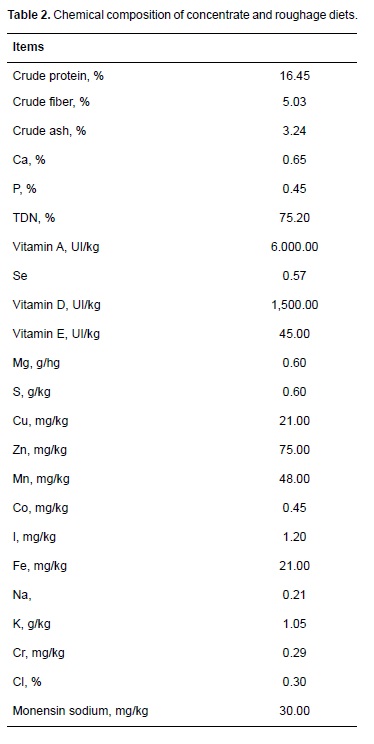
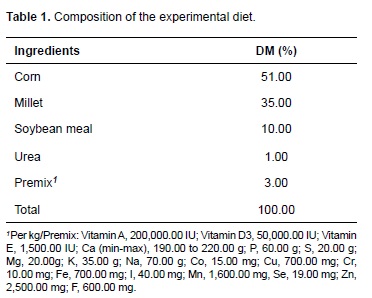
<body><![CDATA[<p>All procedures in this trial were approved by the   ethics committee for animal research (CEPA) of   Universidade Federal de Mato Grosso, Brazil (code number 308/2012).</p>     <p><i>Experimental design and management of heifers</i></p>     <p>The experiment was conducted in a feedlot located   in the north region of Mato Grosso State (11&deg;51'51&rdquo;S   and 55&deg;30'09&rdquo;W) and animals were slaughtered   in Frigobom Slaughterhouse in the same region,   accredited by the state sanitary inspection service (SISE).</p>     <p>Criteria for selecting the Red Angus and Aberdeen Angus bulls used in this experiment were the positive expected progeny differences for final weight, conformation, and fatting traits. Forty-one crossbred heifers (20 F1 NAA and 21 F1 NRA) were used. The animals were twelve months old and the average initial body weight (BW) was 289.5 &plusmn; 26.1 kg. Animals were fed on Megathyrsus maximum cv. Momba&ccedil;a pasture under rotational grazing in three paddocks. The heifers remained in each paddock for 9 days and received 3 kg of feedlot diet per head/day during 28 days. After this period, the animals were relocated in feedlots and during 84-day were fed <i>ad libitum</i> a diet containing 16.4% crude protein (CP) and 75.2% TDN.</p>     <p>The diet formulation and chemical composition   are summarized in <a href="#t1">Tables 1</a> and <a href="#t2">2</a>, respectively. All   animals were weighed at the beginning (D0), at the   end (D84) of the experiment, and at 28-day intervals.   The diet was balanced to meet the NRC (1996)   requirements and was supplied freely at 7 a.m and   4 p.m in the form of complete diet. Leftovers were   collected the following morning and feed allowance   was adjusted daily to allow 5% leftovers. Concentrate   and silage samples were collected every 14 days,   forming a compound sample. The samples were   dryed in a forced-air oven at 65&deg;C for 72 hours and   ground using a 1 mm mesh. Dry matter (DM), organic   matter (OM), crude protein (CP), ether extract (EE),   neutral detergent fiber (NDF) and acid detergent   fiber (ADF) were determined according to Silva and Queiroz (2002).</p>      <p align="center"><a name="t1"><img src="/img/revistas/rccp/v28n3/v28n3a06t1.jpg"></a>     <p align="center"><a name="t2"><img src="/img/revistas/rccp/v28n3/v28n3a06t2.jpg"></a>     <p><i>Traits measured</i></p>     <p>Prior to slaughter, animals were weighed for final live   body weight (FLBW) and average daily gain (ADG).   Slaughter was done in a commercial slaughterhouse   facility by cerebral concussion and sectioning of   the jugular vein, followed by removal of hides and   evisceration without electrical stimulus. Carcasses were   chilled for 24 h in refrigeration chambers at 2 to 3 &deg;C and   re-weighed for cold carcass weight (CCW) and carcass dressing percentage (CDP) determination.</p>     <p>Carcasses were divided in halves, and a subjective   evaluation was made for conformation. The carcass   conformation scores evaluated were: concave (1),   sub-rectilinear (2), rectilinear (3), sub-convex (4),   and convex (5). The fatting carcass score evaluated:   total absence of fat or lean (1), little fat with 1 to 3 mm   (2) average fat with 3 to 6 mm (3) uniform fat with   6 to 10 mm (4), and excessive fat with more than 10 mm (5).</p>     ]]></body>
<body><![CDATA[<p>Rib eye area (REA) and back fat thickness (BFT)   were evaluated after cooling on the cross section of   muscle longissimus thoracis, between the 12<sup>th</sup> and 13<sup>th</sup>   ribs (Muller and Primo, 1987). The BFT was measured   using calipers. The REA was drawn on tracing paper for subsequent calculation of surface area (cm<sup>2</sup>).</p>     <p>Cutability (CUT), total usable meat (TUM),   and Brazilian commercial cuts yield (BCC) were   measured using REA, BFT and hot carcass weight   (HCW), with regression equations developed by Fel&iacute;cio and Allen (1982):</p>     <p>CUT % = 52.06 - 0,019 x HCW - 0.365 x BFT + 0.094 x REA</p>     <p>TUM % = 72.92 - 0.020 x HCW - 0.489 x BFT + 0.119 x REA</p>     <p>BCC % = 60.33 - 0.015 x HCW - 0.462 x BFT + 0.110 x REA</p>     <p><i>Statistical analysis</i></p>     <p>Data (final weight, ADG, HCW, CCP, BFT, REA,   fatting conformation, CUT, TUM, and BCC) were   subjected to analysis of variance (ANOVA) using   R Software (R Development Core Team, Version   2.14.02, 2011). Live weight (LW) was used as a covariate, and the significance level was set at 5%.</p>     <p>The statistical model used was:</p>     <p>Y<sub>ij</sub> = &mu; + T<sub>i</sub> + b (X<sub>ij</sub> - X) + e<sub>ij</sub></p>     <p>Where:</p>     ]]></body>
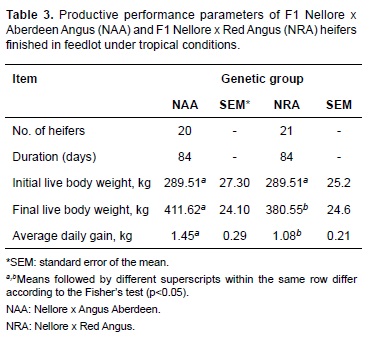
<body><![CDATA[<p>Y<sub>ij</sub>: value observed in animal <i>j</i>, in treatment <i>i</i>, adjusted to LW initial.</p>     <p>&mu;: overall average.</p>     <p>T<sub>i</sub>: <i>i</i> treatment, where <i>i</i> = 1 (NAA) and 2 (NRA).</p>     <p>b: linear regression coefficient of the trait against LW initial.</p>     <p>X<sub>ij</sub>: initial weight of the <i>j</i> animal in the <i>i</i> treatment.</p>     <p>X: average initial weight.</p>     <p>e<sub>ij</sub>: error associated with the <i>ij</i> observation.</p>     <p>&nbsp;</p>     <p><b><font size="3">Results</font></b></p>     <p>Productive performance results such as corrected   initial live body weight, FLBW, ADG, and feed intake   are summarized in <a href="#t3">Table 3</a>. Initial live body weights   of NAA and NRA were adjusted so as not to affect the   other parameters. Final live weight was higher for NAA   (411.62 kg) in comparison to NRA animals (380.55 kg;   p&lt;0.05). Such values influenced other NAA parameters,   such as ADG where NAA animals obtained 1.45 kg whereas the NRA animals obtained 1.08 kg (p&lt;0.05).</p>      ]]></body>
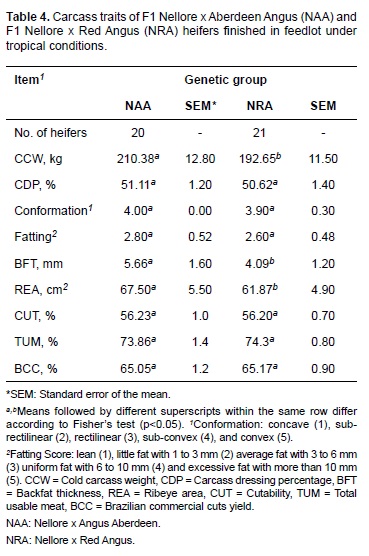
<body><![CDATA[<p align="center"><a name="t3"><img src="/img/revistas/rccp/v28n3/v28n3a06t3.jpg"></a>     <p>The CCW was greater (p&lt;0.05) for NAA compared   to NRA heifers (210.38 kg and 192.65 kg,   respectively; the BFT was also greater (p&lt;0.05) for   NAA compared to NRA heifers (5.66 mm and 4.09 mm,   respectively). The REA was 67.5 cm2 for NAA and 61.87 cm<sup>2</sup> for NRA (p&lt;0.05; <a href="#t4">Table 4</a>).</p>      <p align="center"><a name="t4"><img src="/img/revistas/rccp/v28n3/v28n3a06t4.jpg" width="369" height="556"></a>     <p>According to <a href="#t4">Table 4</a>, CDP did not differ (p&gt;0.05)   among genetic groups; it was 51.11% for NAA   and 50.62% for NRA, and no statistical difference   (p&gt;0.05) was found between genetic groups for   conformation and fatting criteria. Conformation was subconvex in all NAA animals.</p>     <p>The CUT, TUM, and BCC values did not differ   (p&gt;0.05) for NAA and NRA; values were 56.23 and   56.2% for CUT, 73.86 and 74.3% for TUM, and 65.05 and 65.17% for BBC, respectively.</p>     <p>&nbsp;</p>     <p><font size="3"><b>Discussion</b></font></p>     <p><i>Productive performance</i></p>     <p>Ferreira <i>et al.</i> (2009) conducted an experiment to   evaluate technical and economic parameters of steers   among three genetic groups: Charolais x Nellore,   NRA, and NAA. They observed 1.33 kg ADG for NAA, and 1.31 kg for NRA; higher than found in the present study. Furthermore, they found no difference between the two genetic groups for this trait in animals raised in a tropical environment similar to this study. Most literature reports were conducted in temperate environments (Laborde <i>et al.,</i> 2001) or compared sires from <i>Bos taurus taurus</i> x <i>Bos taurus indicus</i> breeds, thus making it difficult to establish comparable baselines or to discern causes.</p>     <p>The CDP did not differ (p&lt;0.05), although it has   been previously established that CDP increases with   increasing slaughter weight (Kempster <i>et al.,</i> 1988;   More and Keane, 1990). The present study found no difference between the two genetic groups in this regard.</p>     ]]></body>
<body><![CDATA[<p>Restle <i>et al.</i> (2001), working with Charolais and   F1 &frac34; Charolais + &frac14; Nellore cows found similar   values (51.1% and 51.6%) for dressing percentage,   respectively. This data agree with Marques <i>et al.</i>   (2000), who studied crossbred heifers in feedlots   with different energy sources and obtained 50.1%   average carcass yield. Higher carcass yield values   were observed by Costa <i>et al.</i> (2002), who found an   average yield of 54.0% for castrated Red Angus bulls.   In general, these comparisons show that cows have a lower carcass yield compared to bulls.</p>     <p><i>Carcass quality</i></p>     <p>According to <a href="#t4">Table 4</a>, no statistical difference   (p&gt;0.05) was found among genetic groups for   conformation and fatting criteria. All NAA animals   presented subconvex conformation. This data is   in agreement with the experiment by Igarasi <i>et al.</i>   (2008), who found that subconvex conformation   was the most frequent in young NRA steers and the majority of carcasses had uniform fat cover.</p>     <p>According to <a href="#t4">Table 4</a>, BFT in NAA was higher   (p&lt;0.05) compared to NRA animals, and most   carcasses complied with the minimum Brazilian meat   industry standards (3 millimeters) required to avoid cooling problems (i.e.: cold shortening; Fel&iacute;cio, 1997).</p>     <p>The REA was statistically higher (p&lt;0.05) in NAA   compared to NRA animals. This difference could   be attributed to CCW of NAA animals due to the   positive correlation between REA and muscularity (Luchiari, 2006).</p>     <p>The BFT in the present study was higher than   results reported by Vaz and Restle (2003), who   found 2.55 mm BFT for two year old F1 Nellore   x Charolais cattle at 247.7 kg CCW. BFT results   were higher because these animals are smaller   than Charolais and therefore accumulate fat at a   young age (early maturity). Similar BFT results   (4.85 mm) were reported by Igarasi <i>et al.</i> (2008)   in NRA bulls. However, REA was higher (73.78   cm<sup>2</sup>) in the experiment by Igarasi <i>et al.</i> (2008).   This can be explained by the fact that bulls reach   maturity later than cows, causing them to gain more muscle than fat.</p>     <p>MacNeil and Northcutt (2008) reported a   similar trend in Angus, with heifers having greater   intramuscular fat (4.46%) than their male counterparts   (3.73%). The present 3.79% intramuscular fat is   similar to the 3.26% estimate reported by Speidel <i>et al.</i> (2007). There is evidence that fat percentage may   have potential as a pregnancy rate indicator in heifers (Evans <i>et al.</i> 2004).</p>     <p>However, REA and BFT results do not agree   with Pizzuti <i>et al.</i> (2007) who found no difference   on carcass physical composition between Aberdeen   Angus and Red Angus steers. Pizzuti <i>et al.</i>   (2007) conducted their research in South Brazil   during winter, where climate could be considered subtropical.</p>     <p>The genetic groups did not differ (p&gt;0.05)   regarding CUT, TUM, and BCC values. The CUT was   the same (56.2%) for NAA and NRA. These values   are higher than those reported by Polizel (2011), who   obtained 51.8% cut yield in Nellore animals using the   equation proposed by Cross <i>et al.</i> (1973). However,   this difference may be related to the formulas used to calculate CUT.</p>     <p>The CUT values were also higher than those found   by Mattos <i>et al.</i> (1977) in a study with Nellore cattle   under extensive pasture conditions and slaughtered   at 26 (52.13%) and 32 months (51.83%) of age. The   same authors, in another work with castrated Nellore   bulls and crossbred bulls (Mattos <i>et al.,</i> 1978), found   52.29% CUT average for Nellore and 52.42% for   crossbred animals slaughtered at 33 months of age. The CUT values found in this study (<a href="#t4">Table 4</a>) are higher than those by Mattos <i>et al.</i> (1977) and Mattos <i>et al.</i> (1978), showing that crossbred cows have higher percentage of cuts from the back, loin, rib, and shoulder. The TUM values are very similar to those by Brito and Sampaio (2001), who evaluated carcasses of &frac34;Canchim x &frac14;Nellore bulls with different protein sources after 168 days in the feedlot using the same equation proposed by Fel&iacute;cio and Allen (1982).</p>     ]]></body>
<body><![CDATA[<p>Junqueira <i>et al.</i> (1998) results agree with TUM in this   study. They found 75.33% TUM for F1 Marchigiana   x Nellore bulls, 73.72% for F1 Marchigiana x Nellore   cows, and 72.85% for &frac34;Marchigiana x &frac14;Nellore cows.   Of these fractions, the amount of edible meat is   the most interesting for the consumer. Estimation   of this parameter is required to select animals   intended for different market segments with high   gradient preferences or consumption needs (Brito and Sampaio, 2001).</p>     <p>It is concluded that F1 Nellore x Aberdeen Angus   were better than F1 Nellore x Red Angus animals with   regard to performance and carcass traits when finished in feedlot under tropical conditions.</p>     <p>&nbsp;</p>     <p align="left"><b><font size="3">Conflicts of interest</font></b></p>     <p align="left">The authors declare they have no conflicts of interest with regard to the work presented in this report.</p>     <p align="left">&nbsp;</p> <hr size="1" />     <p><b><font size="3">Notes</font></b></p>     <p><b><a name="a0" id="a0"><a href="#a1">&curren;</a></a></b>To cite this article: Moreira PSA, Louren&ccedil;o FJ, Neto AP, Martins LR, Jorge AM, Machado OR. Productive performance and carcass traits of Nellore x Aberdeen Angus and Nellore x Red Angus heifers under tropical conditions. Rev Colomb Cienc Pecu 2015; 28:247-254.</p> <hr size="1" />     <p>&nbsp;</p>     <p><b><font size="3">References</font></b></p>     ]]></body>
<body><![CDATA[<!-- ref --><p>Associa&ccedil;&atilde;o Brasileira de Insemina&ccedil;&atilde;o Artificial - ASBIA.   Relat&oacute;rios 2013; [Access date: July 20, 2013] URL: <a href="http://www.asbia.org.br/novo/upload/mercado/relatorio2012.pdf" target="_blank">http://www.asbia.org.br/novo/upload/mercado/relatorio2012.pdf</a>&nbsp;&nbsp;&nbsp;&nbsp;&nbsp;&nbsp;&nbsp;&nbsp;[&#160;<a href="javascript:void(0);" onclick="javascript: window.open('/scielo.php?script=sci_nlinks&ref=000103&pid=S0120-0690201500030000600001&lng=','','width=640,height=500,resizable=yes,scrollbars=1,menubar=yes,');">Links</a>&#160;]<!-- end-ref --><!-- ref --><p>Brito RM, Sampaio AAM. Efeito de fontes de prote&iacute;na nas   caracter&iacute;sticas da carca&ccedil;a e avalia&ccedil;&atilde;o do rendimento de carne   aproveit&aacute;vel estimada por meio de equa&ccedil;&otilde;es de regress&atilde;o linear   m&uacute;ltipla em touros &frac34; Canchim &frac14; Nelore. Ars Veterinaria 2001;   17:64-70.    &nbsp;&nbsp;&nbsp;&nbsp;&nbsp;&nbsp;&nbsp;&nbsp;[&#160;<a href="javascript:void(0);" onclick="javascript: window.open('/scielo.php?script=sci_nlinks&ref=000104&pid=S0120-0690201500030000600002&lng=','','width=640,height=500,resizable=yes,scrollbars=1,menubar=yes,');">Links</a>&#160;]<!-- end-ref --></p>     <!-- ref --><p>Chizzotti ML, Valadares Filho SC, Tedeschi LO, Chizzotti FHM,   Carstens GE. Energy and protein requirements for growth and   maintenance of F1 Nellore x Red Angus bulls, steers, and heifers.   J Anim Sci 2007; 85 suppl 8:1971-1981.    &nbsp;&nbsp;&nbsp;&nbsp;&nbsp;&nbsp;&nbsp;&nbsp;[&#160;<a href="javascript:void(0);" onclick="javascript: window.open('/scielo.php?script=sci_nlinks&ref=000106&pid=S0120-0690201500030000600003&lng=','','width=640,height=500,resizable=yes,scrollbars=1,menubar=yes,');">Links</a>&#160;]<!-- end-ref --></p>     <!-- ref --><p>Costa EC, Restle J, Vaz FN, Alves Filho DC, Bernardes RALC,   Kuss F. Caracter&iacute;sticas da carca&ccedil;a de novilhos Red Angus   superprecoces abatidos com diferentes pesos. Rev Bras Zootec 2002; 31:119-128.    &nbsp;&nbsp;&nbsp;&nbsp;&nbsp;&nbsp;&nbsp;&nbsp;[&#160;<a href="javascript:void(0);" onclick="javascript: window.open('/scielo.php?script=sci_nlinks&ref=000108&pid=S0120-0690201500030000600004&lng=','','width=640,height=500,resizable=yes,scrollbars=1,menubar=yes,');">Links</a>&#160;]<!-- end-ref --></p>     <!-- ref --><p>Cross HR, Carpenter ZR, Smith GC. Equations for estimating   boneless retail cut yields from beef carcasses. J Anim Sci 1973;   37:1267-1272.    &nbsp;&nbsp;&nbsp;&nbsp;&nbsp;&nbsp;&nbsp;&nbsp;[&#160;<a href="javascript:void(0);" onclick="javascript: window.open('/scielo.php?script=sci_nlinks&ref=000110&pid=S0120-0690201500030000600005&lng=','','width=640,height=500,resizable=yes,scrollbars=1,menubar=yes,');">Links</a>&#160;]<!-- end-ref --></p>     <!-- ref --><p>Evans HL, Willard ST, King R, Vann RC. Case study:   relationship among live animal carcass traits, the estrous   cycle, and synchronization of estrus in beef heifers. PAS 2004;   20:453- 459.    &nbsp;&nbsp;&nbsp;&nbsp;&nbsp;&nbsp;&nbsp;&nbsp;[&#160;<a href="javascript:void(0);" onclick="javascript: window.open('/scielo.php?script=sci_nlinks&ref=000112&pid=S0120-0690201500030000600006&lng=','','width=640,height=500,resizable=yes,scrollbars=1,menubar=yes,');">Links</a>&#160;]<!-- end-ref --></p>     <!-- ref --><p>Fel&iacute;cio PE. Fatores que influenciam na qualidade da carne bovina.   In: Produ&ccedil;&atilde;o de Novilho de Corte. FEALQ, S&atilde;o Paulo, Brazil;   1997. p.79-97.    &nbsp;&nbsp;&nbsp;&nbsp;&nbsp;&nbsp;&nbsp;&nbsp;[&#160;<a href="javascript:void(0);" onclick="javascript: window.open('/scielo.php?script=sci_nlinks&ref=000114&pid=S0120-0690201500030000600007&lng=','','width=640,height=500,resizable=yes,scrollbars=1,menubar=yes,');">Links</a>&#160;]<!-- end-ref --></p>     <!-- ref --><p>Fel&iacute;cio PE, Allen DM. Regression equations for predicting retail   yields of zebu steer carcasses. Col Ital 1982; 12:203-217.    &nbsp;&nbsp;&nbsp;&nbsp;&nbsp;&nbsp;&nbsp;&nbsp;[&#160;<a href="javascript:void(0);" onclick="javascript: window.open('/scielo.php?script=sci_nlinks&ref=000116&pid=S0120-0690201500030000600008&lng=','','width=640,height=500,resizable=yes,scrollbars=1,menubar=yes,');">Links</a>&#160;]<!-- end-ref --></p>     <!-- ref --><p>Ferreira IC, Silva MA, Barbosa FA, Carvalho ADF, Correa   GSS, Fridrich AB, Souza JER. Avalia&ccedil;&atilde;o t&eacute;cnica e econ&ocirc;mica   de diferentes grupos gen&eacute;ticos de bovinos de corte machos   superprecoces e do sistema de produ&ccedil;&atilde;o em confinamento. Arq   Bras Med Vet Zootec 2009; 61:243-250&nbsp;&nbsp;&nbsp;&nbsp;&nbsp;&nbsp;&nbsp;&nbsp;[&#160;<a href="javascript:void(0);" onclick="javascript: window.open('/scielo.php?script=sci_nlinks&ref=000118&pid=S0120-0690201500030000600009&lng=','','width=640,height=500,resizable=yes,scrollbars=1,menubar=yes,');">Links</a>&#160;]<!-- end-ref --><!-- ref --><p>Igarasi MS, Arrigoni MB, Hadlich JC, Silveira AC, Martins CL,   Oliveira HN. Caracter&iacute;sticas de carca&ccedil;a e par&acirc;metros de qualidade   de carne de bovinos jovens alimentados com gr&atilde;os &uacute;midos de   milho ou sorgo. R Bras Zootec 2008; 37:520-528.    &nbsp;&nbsp;&nbsp;&nbsp;&nbsp;&nbsp;&nbsp;&nbsp;[&#160;<a href="javascript:void(0);" onclick="javascript: window.open('/scielo.php?script=sci_nlinks&ref=000119&pid=S0120-0690201500030000600010&lng=','','width=640,height=500,resizable=yes,scrollbars=1,menubar=yes,');">Links</a>&#160;]<!-- end-ref --></p>     <!-- ref --><p>Junqueira JOB, Velloso L, Fel&iacute;cio PE. Desempenho, rendimentos   de carca&ccedil;a e cortes de animais, machos e f&ecirc;meas, mesti&ccedil;os   Marchigiana x Nelore, terminados em confinamento. R Bras   Zootec 1998; 27:1199-1205.    &nbsp;&nbsp;&nbsp;&nbsp;&nbsp;&nbsp;&nbsp;&nbsp;[&#160;<a href="javascript:void(0);" onclick="javascript: window.open('/scielo.php?script=sci_nlinks&ref=000121&pid=S0120-0690201500030000600011&lng=','','width=640,height=500,resizable=yes,scrollbars=1,menubar=yes,');">Links</a>&#160;]<!-- end-ref --></p>     ]]></body>
<body><![CDATA[<!-- ref --><p>Kempster AJ, Cook GL, Southgate JR. Evaluation of British   Friesian, Canadian Holstein and beef breed x British Friesian   steers slaughtered over a commercial range of fatness from   16-month and 24-month beef production systems. 2. Carcass   characteristic, and rate and effciency of lean gain. Anim Prod   1988; 46:365-378.    &nbsp;&nbsp;&nbsp;&nbsp;&nbsp;&nbsp;&nbsp;&nbsp;[&#160;<a href="javascript:void(0);" onclick="javascript: window.open('/scielo.php?script=sci_nlinks&ref=000123&pid=S0120-0690201500030000600012&lng=','','width=640,height=500,resizable=yes,scrollbars=1,menubar=yes,');">Links</a>&#160;]<!-- end-ref --></p>     <!-- ref --><p>Laborde FL, Mandell IB, Tosh JJ, Wilton JW, Buchanan JG. Breed   effects on growth performance, carcass characteristics, fatty acid   composition, and palatability attributes in finishing steers. J Anim   Sci 2001; 79:355-365.    &nbsp;&nbsp;&nbsp;&nbsp;&nbsp;&nbsp;&nbsp;&nbsp;[&#160;<a href="javascript:void(0);" onclick="javascript: window.open('/scielo.php?script=sci_nlinks&ref=000125&pid=S0120-0690201500030000600013&lng=','','width=640,height=500,resizable=yes,scrollbars=1,menubar=yes,');">Links</a>&#160;]<!-- end-ref --></p>     <!-- ref --><p>Luchiari F. A produ&ccedil;&atilde;o de carne bovina no Brasil: qualidade,   quantidade ou ambas? In: II Simp&oacute;sio sobre Desafios e Novas   Tecnologias na Bovinocultura de Corte 2006, Bras&iacute;lia, Distrito   Federal, 1-10.    &nbsp;&nbsp;&nbsp;&nbsp;&nbsp;&nbsp;&nbsp;&nbsp;[&#160;<a href="javascript:void(0);" onclick="javascript: window.open('/scielo.php?script=sci_nlinks&ref=000127&pid=S0120-0690201500030000600014&lng=','','width=640,height=500,resizable=yes,scrollbars=1,menubar=yes,');">Links</a>&#160;]<!-- end-ref --></p>     <!-- ref --><p>Machado Neto OR, Ladeira MM, Gon&ccedil;alves TM, Lopes LS,   Oliveira DM, Lima RR. Performance and carcass traits of Nellore   and Red Norte steers finished in feedlot. R Bras Zootec 2011;   40:1080-1087.    &nbsp;&nbsp;&nbsp;&nbsp;&nbsp;&nbsp;&nbsp;&nbsp;[&#160;<a href="javascript:void(0);" onclick="javascript: window.open('/scielo.php?script=sci_nlinks&ref=000129&pid=S0120-0690201500030000600015&lng=','','width=640,height=500,resizable=yes,scrollbars=1,menubar=yes,');">Links</a>&#160;]<!-- end-ref --></p>     <!-- ref --><p>MacNeil MD, Northcutt SL. National cattle evaluation system   for combined analysis of carcass characteristics and indicator   traits recorded by using ultrasound in Angus cattle. J Anim Sci   2008; 86:2518-2524.    &nbsp;&nbsp;&nbsp;&nbsp;&nbsp;&nbsp;&nbsp;&nbsp;[&#160;<a href="javascript:void(0);" onclick="javascript: window.open('/scielo.php?script=sci_nlinks&ref=000131&pid=S0120-0690201500030000600016&lng=','','width=640,height=500,resizable=yes,scrollbars=1,menubar=yes,');">Links</a>&#160;]<!-- end-ref --></p>     ]]></body>
<body><![CDATA[<!-- ref --><p>Marques JA, Prado IN, Zeoula LM, Alcalde CR, Nascimento WG.   Avalia&ccedil;&atilde;o da mandioca e seus res&iacute;duos industriais em substitui&ccedil;&atilde;o   ao milho no desempenho de novilhas confinadas. R Bras Zootec 2000; 29:1528-1536.    &nbsp;&nbsp;&nbsp;&nbsp;&nbsp;&nbsp;&nbsp;&nbsp;[&#160;<a href="javascript:void(0);" onclick="javascript: window.open('/scielo.php?script=sci_nlinks&ref=000133&pid=S0120-0690201500030000600017&lng=','','width=640,height=500,resizable=yes,scrollbars=1,menubar=yes,');">Links</a>&#160;]<!-- end-ref --></p>     <!-- ref --><p>Mattos JCA, Pacola LJ, Drudi A, Ribeiro MCR, Campos BES. Estudo da carca&ccedil;a de novilhos Nelore. Bol Ind Anim 1977; 34:209-216.    &nbsp;&nbsp;&nbsp;&nbsp;&nbsp;&nbsp;&nbsp;&nbsp;[&#160;<a href="javascript:void(0);" onclick="javascript: window.open('/scielo.php?script=sci_nlinks&ref=000135&pid=S0120-0690201500030000600018&lng=','','width=640,height=500,resizable=yes,scrollbars=1,menubar=yes,');">Links</a>&#160;]<!-- end-ref --></p>     <!-- ref --><p>Mattos JCA, Pacola LJ, Lima P, Drudi A. Estudo comparativo   entre carca&ccedil;as de novilhos da ra&ccedil;a Nelore e de novilhos mesti&ccedil;os. Bol Ind Anim 1978; 35:25-31.    &nbsp;&nbsp;&nbsp;&nbsp;&nbsp;&nbsp;&nbsp;&nbsp;[&#160;<a href="javascript:void(0);" onclick="javascript: window.open('/scielo.php?script=sci_nlinks&ref=000137&pid=S0120-0690201500030000600019&lng=','','width=640,height=500,resizable=yes,scrollbars=1,menubar=yes,');">Links</a>&#160;]<!-- end-ref --></p>     <!-- ref --><p>More GJ, Keane MG. A comparison for live weight and carcass   production of Charolais, Hereford a Friesian steer progeny   from Friesians cows &#64257;nished on two energy levels and serially slaughtered. Anim Prod 1990; 50:19-28.    &nbsp;&nbsp;&nbsp;&nbsp;&nbsp;&nbsp;&nbsp;&nbsp;[&#160;<a href="javascript:void(0);" onclick="javascript: window.open('/scielo.php?script=sci_nlinks&ref=000139&pid=S0120-0690201500030000600020&lng=','','width=640,height=500,resizable=yes,scrollbars=1,menubar=yes,');">Links</a>&#160;]<!-- end-ref --></p>     <!-- ref --><p>Muller L, Primo AT. Influ&ecirc;ncia do regime alimentar no   crescimento e termina&ccedil;&atilde;o de bovinos e qualidade da carne. Pesq Agropec Bras 1987; 21:445-452.    &nbsp;&nbsp;&nbsp;&nbsp;&nbsp;&nbsp;&nbsp;&nbsp;[&#160;<a href="javascript:void(0);" onclick="javascript: window.open('/scielo.php?script=sci_nlinks&ref=000141&pid=S0120-0690201500030000600021&lng=','','width=640,height=500,resizable=yes,scrollbars=1,menubar=yes,');">Links</a>&#160;]<!-- end-ref --></p>     ]]></body>
<body><![CDATA[<!-- ref --><p>NRC, National Research Council. Nutrient Requirements of Beef   Cattle. 7th ed. Washington, D.C: National Academy Press; 1996.    &nbsp;&nbsp;&nbsp;&nbsp;&nbsp;&nbsp;&nbsp;&nbsp;[&#160;<a href="javascript:void(0);" onclick="javascript: window.open('/scielo.php?script=sci_nlinks&ref=000143&pid=S0120-0690201500030000600022&lng=','','width=640,height=500,resizable=yes,scrollbars=1,menubar=yes,');">Links</a>&#160;]<!-- end-ref --></p>     <!-- ref --><p>Pizzuti LAD, Brondani IL, Restle J, Arboitte MZ, Freitas LS,   Metz PAM. Carcass physical composition of Aberdeen Angus   and Red Angus steers, feedlot finished. In: Proceedings Zootec,   Londrina, Paran&aacute; June 2007.    &nbsp;&nbsp;&nbsp;&nbsp;&nbsp;&nbsp;&nbsp;&nbsp;[&#160;<a href="javascript:void(0);" onclick="javascript: window.open('/scielo.php?script=sci_nlinks&ref=000145&pid=S0120-0690201500030000600023&lng=','','width=640,height=500,resizable=yes,scrollbars=1,menubar=yes,');">Links</a>&#160;]<!-- end-ref --></p>     <!-- ref --><p>Polizel A. Uso de coproduto da produ&ccedil;&atilde;o de biodiesel como   alimento para bovinos confinados. [PhD Thesis]. Universidade   Estadual Paulista, Botucatu, S&atilde;o Paulo, 2011.    &nbsp;&nbsp;&nbsp;&nbsp;&nbsp;&nbsp;&nbsp;&nbsp;[&#160;<a href="javascript:void(0);" onclick="javascript: window.open('/scielo.php?script=sci_nlinks&ref=000147&pid=S0120-0690201500030000600024&lng=','','width=640,height=500,resizable=yes,scrollbars=1,menubar=yes,');">Links</a>&#160;]<!-- end-ref --></p>     <!-- ref --><p>R Development Core Team, R: A Language and environment   for statistical computing. Vienna, Austria, the R Foundation for Statistical Computing. ISBN: 3-900051-07-0. URL: <a href="http://www.R-project.org/2011" target="_blank">http://www.R-project.org/2011</a>&nbsp;&nbsp;&nbsp;&nbsp;&nbsp;&nbsp;&nbsp;&nbsp;[&#160;<a href="javascript:void(0);" onclick="javascript: window.open('/scielo.php?script=sci_nlinks&ref=000149&pid=S0120-0690201500030000600025&lng=','','width=640,height=500,resizable=yes,scrollbars=1,menubar=yes,');">Links</a>&#160;]<!-- end-ref --><!-- ref --><p>Restle J, Neumann M, Alves Filho DC, Pascoal LL, Rosa JRP,   Menezes LFG, Pellegrini LG. Termina&ccedil;&atilde;o em confinamento de   vacas e novilhas sob dietas com ou sem monensina s&oacute;dica. R Bras   Zootec 2001; 30:1801-1812.    &nbsp;&nbsp;&nbsp;&nbsp;&nbsp;&nbsp;&nbsp;&nbsp;[&#160;<a href="javascript:void(0);" onclick="javascript: window.open('/scielo.php?script=sci_nlinks&ref=000150&pid=S0120-0690201500030000600026&lng=','','width=640,height=500,resizable=yes,scrollbars=1,menubar=yes,');">Links</a>&#160;]<!-- end-ref --></p>     <!-- ref --><p>Silva RG, Scala J&uacute;nior NL, Pocay PLB. Transmiss&atilde;o de radia&ccedil;&atilde;o   ultravioleta atrav&eacute;s do pelame e da epiderme de bovinos. R Bras   Zootec 2001; 30:1939-1947.    &nbsp;&nbsp;&nbsp;&nbsp;&nbsp;&nbsp;&nbsp;&nbsp;[&#160;<a href="javascript:void(0);" onclick="javascript: window.open('/scielo.php?script=sci_nlinks&ref=000152&pid=S0120-0690201500030000600027&lng=','','width=640,height=500,resizable=yes,scrollbars=1,menubar=yes,');">Links</a>&#160;]<!-- end-ref --></p>     <!-- ref --><p>Silva DJ, Queiroz AC. An&aacute;lises de alimentos (m&eacute;todos qu&iacute;micos   e biol&oacute;gicos). 3th ed. Vi&ccedil;osa MG, Editora UFV, 2002.    &nbsp;&nbsp;&nbsp;&nbsp;&nbsp;&nbsp;&nbsp;&nbsp;[&#160;<a href="javascript:void(0);" onclick="javascript: window.open('/scielo.php?script=sci_nlinks&ref=000154&pid=S0120-0690201500030000600028&lng=','','width=640,height=500,resizable=yes,scrollbars=1,menubar=yes,');">Links</a>&#160;]<!-- end-ref --></p>     <!-- ref --><p>Siqueira JB, Oba E, Pinho RO, Quintino HP, Eler JP, Miranda   Neto T, Guimar&atilde;es SEF, Guimar&atilde;es JD. Heritability estimate   and genetic correlations of reproductive features in Nellore   bulls, offspring of super precocious, precocious, and normal   cows under extensive farming conditions. Reprod Domest Anim   2012; 47:313-318.    &nbsp;&nbsp;&nbsp;&nbsp;&nbsp;&nbsp;&nbsp;&nbsp;[&#160;<a href="javascript:void(0);" onclick="javascript: window.open('/scielo.php?script=sci_nlinks&ref=000156&pid=S0120-0690201500030000600029&lng=','','width=640,height=500,resizable=yes,scrollbars=1,menubar=yes,');">Links</a>&#160;]<!-- end-ref --></p>     <!-- ref --><p>Speidel SE, Enns RM, Brigham BW, Keenan LD. Genetic   parameter estimates for ultrasound indicators of carcass. Proc   West Sect Am Soc Anim Sci 2007; 58:39-42.    &nbsp;&nbsp;&nbsp;&nbsp;&nbsp;&nbsp;&nbsp;&nbsp;[&#160;<a href="javascript:void(0);" onclick="javascript: window.open('/scielo.php?script=sci_nlinks&ref=000158&pid=S0120-0690201500030000600030&lng=','','width=640,height=500,resizable=yes,scrollbars=1,menubar=yes,');">Links</a>&#160;]<!-- end-ref --></p>     <!-- ref --><p>USDA-FAS. 2013. Beef and Veal: 2013 revised form October.   Livestock and Poultry: World Markets and Trade Circular. 1-25.   <a href="http://www.fas.usda.gov/dlp/livestock_poultry.asp" target="_blank">http://www.fas.usda.gov/dlp/livestock_poultry.asp</a>&nbsp;&nbsp;&nbsp;&nbsp;&nbsp;&nbsp;&nbsp;&nbsp;[&#160;<a href="javascript:void(0);" onclick="javascript: window.open('/scielo.php?script=sci_nlinks&ref=000160&pid=S0120-0690201500030000600031&lng=','','width=640,height=500,resizable=yes,scrollbars=1,menubar=yes,');">Links</a>&#160;]<!-- end-ref --><!-- ref --><p>Vaz FN, Restle J. Ganho de peso antes e ap&oacute;s os sete meses   no desenvolvimento e nas caracter&iacute;sticas de carca&ccedil;a e carne de   novilhos Charol&ecirc;s abatidos aos dois anos. R Bras Zootec 2003; 32:699-708.    &nbsp;&nbsp;&nbsp;&nbsp;&nbsp;&nbsp;&nbsp;&nbsp;[&#160;<a href="javascript:void(0);" onclick="javascript: window.open('/scielo.php?script=sci_nlinks&ref=000161&pid=S0120-0690201500030000600032&lng=','','width=640,height=500,resizable=yes,scrollbars=1,menubar=yes,');">Links</a>&#160;]<!-- end-ref --></p>     ]]></body>
<body><![CDATA[<p>&nbsp;</p> </p> </font>      ]]></body><back>
<ref-list>
<ref id="B1">
<nlm-citation citation-type="">
<collab>Associação Brasileira de Inseminação Artificial - ASBIA</collab>
<source><![CDATA[Relatórios 2013]]></source>
<year></year>
</nlm-citation>
</ref>
<ref id="B2">
<nlm-citation citation-type="journal">
<person-group person-group-type="author">
<name>
<surname><![CDATA[Brito]]></surname>
<given-names><![CDATA[RM]]></given-names>
</name>
<name>
<surname><![CDATA[Sampaio]]></surname>
<given-names><![CDATA[AAM]]></given-names>
</name>
</person-group>
<article-title xml:lang="pt"><![CDATA[Efeito de fontes de proteína nas características da carcaça e avaliação do rendimento de carne aproveitável estimada por meio de equações de regressão linear múltipla em touros ¾ Canchim ¼ Nelore]]></article-title>
<source><![CDATA[Ars Veterinaria]]></source>
<year>2001</year>
<volume>17</volume>
<page-range>64-70</page-range></nlm-citation>
</ref>
<ref id="B3">
<nlm-citation citation-type="journal">
<person-group person-group-type="author">
<name>
<surname><![CDATA[Chizzotti]]></surname>
<given-names><![CDATA[ML]]></given-names>
</name>
<name>
<surname><![CDATA[Valadares]]></surname>
<given-names><![CDATA[Filho SC]]></given-names>
</name>
<name>
<surname><![CDATA[Tedeschi]]></surname>
<given-names><![CDATA[LO]]></given-names>
</name>
<name>
<surname><![CDATA[Chizzotti]]></surname>
<given-names><![CDATA[FHM]]></given-names>
</name>
<name>
<surname><![CDATA[Carstens]]></surname>
<given-names><![CDATA[GE]]></given-names>
</name>
</person-group>
<article-title xml:lang="en"><![CDATA[Energy and protein requirements for growth and maintenance of F1 Nellore x Red Angus bulls, steers, and heifers]]></article-title>
<source><![CDATA[J Anim Sci]]></source>
<year>2007</year>
<volume>85 suppl 8</volume>
<page-range>1971-1981</page-range></nlm-citation>
</ref>
<ref id="B4">
<nlm-citation citation-type="journal">
<person-group person-group-type="author">
<name>
<surname><![CDATA[Costa]]></surname>
<given-names><![CDATA[EC]]></given-names>
</name>
<name>
<surname><![CDATA[Restle]]></surname>
<given-names><![CDATA[J]]></given-names>
</name>
<name>
<surname><![CDATA[Vaz]]></surname>
<given-names><![CDATA[FN]]></given-names>
</name>
<name>
<surname><![CDATA[Alves]]></surname>
<given-names><![CDATA[Filho DC]]></given-names>
</name>
<name>
<surname><![CDATA[Bernardes]]></surname>
<given-names><![CDATA[RALC]]></given-names>
</name>
<name>
<surname><![CDATA[Kuss]]></surname>
<given-names><![CDATA[F]]></given-names>
</name>
</person-group>
<article-title xml:lang="es"><![CDATA[Características da carcaça de novilhos Red Angus superprecoces abatidos com diferentes pesos]]></article-title>
<source><![CDATA[Rev Bras Zootec]]></source>
<year>2002</year>
<volume>31</volume>
<page-range>119-128</page-range></nlm-citation>
</ref>
<ref id="B5">
<nlm-citation citation-type="journal">
<person-group person-group-type="author">
<name>
<surname><![CDATA[Cross]]></surname>
<given-names><![CDATA[HR]]></given-names>
</name>
<name>
<surname><![CDATA[Carpenter]]></surname>
<given-names><![CDATA[ZR]]></given-names>
</name>
<name>
<surname><![CDATA[Smith]]></surname>
<given-names><![CDATA[GC]]></given-names>
</name>
</person-group>
<article-title xml:lang="en"><![CDATA[Equations for estimating boneless retail cut yields from beef carcasses]]></article-title>
<source><![CDATA[J Anim Sci]]></source>
<year>1973</year>
<volume>37</volume>
<page-range>1267-1272</page-range></nlm-citation>
</ref>
<ref id="B6">
<nlm-citation citation-type="journal">
<person-group person-group-type="author">
<name>
<surname><![CDATA[Evans]]></surname>
<given-names><![CDATA[HL]]></given-names>
</name>
<name>
<surname><![CDATA[Willard]]></surname>
<given-names><![CDATA[ST]]></given-names>
</name>
<name>
<surname><![CDATA[King]]></surname>
<given-names><![CDATA[R]]></given-names>
</name>
<name>
<surname><![CDATA[Vann]]></surname>
<given-names><![CDATA[RC]]></given-names>
</name>
</person-group>
<article-title xml:lang="en"><![CDATA[Case study: relationship among live animal carcass traits, the estrous cycle, and synchronization of estrus in beef heifers]]></article-title>
<source><![CDATA[PAS]]></source>
<year>2004</year>
<volume>20</volume>
<page-range>453- 459</page-range></nlm-citation>
</ref>
<ref id="B7">
<nlm-citation citation-type="">
<person-group person-group-type="author">
<name>
<surname><![CDATA[Felício]]></surname>
<given-names><![CDATA[PE]]></given-names>
</name>
</person-group>
<article-title xml:lang="pt"><![CDATA[Fatores que influenciam na qualidade da carne bovina]]></article-title>
<source><![CDATA[Produção de Novilho de Corte]]></source>
<year>1997</year>
<publisher-loc><![CDATA[São Paulo ]]></publisher-loc>
</nlm-citation>
</ref>
<ref id="B8">
<nlm-citation citation-type="journal">
<person-group person-group-type="author">
<name>
<surname><![CDATA[Felício]]></surname>
<given-names><![CDATA[PE]]></given-names>
</name>
<name>
<surname><![CDATA[Allen]]></surname>
<given-names><![CDATA[DM]]></given-names>
</name>
</person-group>
<article-title xml:lang="en"><![CDATA[Regression equations for predicting retail yields of zebu steer carcasses]]></article-title>
<source><![CDATA[Col Ital]]></source>
<year>1982</year>
<volume>12</volume>
<page-range>203-217</page-range></nlm-citation>
</ref>
<ref id="B9">
<nlm-citation citation-type="journal">
<person-group person-group-type="author">
<name>
<surname><![CDATA[Ferreira]]></surname>
<given-names><![CDATA[IC]]></given-names>
</name>
<name>
<surname><![CDATA[Silva]]></surname>
<given-names><![CDATA[MA]]></given-names>
</name>
<name>
<surname><![CDATA[Barbosa]]></surname>
<given-names><![CDATA[FA]]></given-names>
</name>
<name>
<surname><![CDATA[Carvalho]]></surname>
<given-names><![CDATA[ADF]]></given-names>
</name>
<name>
<surname><![CDATA[Correa]]></surname>
<given-names><![CDATA[GSS]]></given-names>
</name>
<name>
<surname><![CDATA[Fridrich]]></surname>
<given-names><![CDATA[AB]]></given-names>
</name>
<name>
<surname><![CDATA[Souza]]></surname>
<given-names><![CDATA[JER]]></given-names>
</name>
</person-group>
<article-title xml:lang="pt"><![CDATA[Avaliação técnica e econômica de diferentes grupos genéticos de bovinos de corte machos superprecoces e do sistema de produção em confinamento]]></article-title>
<source><![CDATA[Arq Bras Med Vet Zootec]]></source>
<year>2009</year>
<volume>61</volume>
<page-range>243-250</page-range></nlm-citation>
</ref>
<ref id="B10">
<nlm-citation citation-type="journal">
<person-group person-group-type="author">
<name>
<surname><![CDATA[Igarasi]]></surname>
<given-names><![CDATA[MS]]></given-names>
</name>
<name>
<surname><![CDATA[Arrigoni]]></surname>
<given-names><![CDATA[MB]]></given-names>
</name>
<name>
<surname><![CDATA[Hadlich]]></surname>
<given-names><![CDATA[JC]]></given-names>
</name>
<name>
<surname><![CDATA[Silveira]]></surname>
<given-names><![CDATA[AC]]></given-names>
</name>
<name>
<surname><![CDATA[Martins]]></surname>
<given-names><![CDATA[CL]]></given-names>
</name>
<name>
<surname><![CDATA[Oliveira]]></surname>
<given-names><![CDATA[HN]]></given-names>
</name>
</person-group>
<article-title xml:lang="pt"><![CDATA[Características de carcaça e parâmetros de qualidade de carne de bovinos jovens alimentados com grãos úmidos de milho ou sorgo]]></article-title>
<source><![CDATA[R Bras Zootec]]></source>
<year>2008</year>
<volume>37</volume>
<page-range>520-528</page-range></nlm-citation>
</ref>
<ref id="B11">
<nlm-citation citation-type="journal">
<person-group person-group-type="author">
<name>
<surname><![CDATA[Junqueira]]></surname>
<given-names><![CDATA[JOB]]></given-names>
</name>
<name>
<surname><![CDATA[Velloso]]></surname>
<given-names><![CDATA[L]]></given-names>
</name>
<name>
<surname><![CDATA[Felício]]></surname>
<given-names><![CDATA[PE]]></given-names>
</name>
</person-group>
<article-title xml:lang="pt"><![CDATA[Desempenho, rendimentos de carcaça e cortes de animais, machos e fêmeas, mestiços Marchigiana x Nelore, terminados em confinamento]]></article-title>
<source><![CDATA[R Bras Zootec]]></source>
<year>1998</year>
<volume>27</volume>
<page-range>1199-1205</page-range></nlm-citation>
</ref>
<ref id="B12">
<nlm-citation citation-type="journal">
<person-group person-group-type="author">
<name>
<surname><![CDATA[Kempster]]></surname>
<given-names><![CDATA[AJ]]></given-names>
</name>
<name>
<surname><![CDATA[Cook]]></surname>
<given-names><![CDATA[GL]]></given-names>
</name>
<name>
<surname><![CDATA[Southgate]]></surname>
<given-names><![CDATA[JR]]></given-names>
</name>
</person-group>
<article-title xml:lang="en"><![CDATA[Evaluation of British Friesian, Canadian Holstein and beef breed x British Friesian steers slaughtered over a commercial range of fatness from 16-month and 24-month beef production systems. 2. Carcass characteristic, and rate and effciency of lean gain]]></article-title>
<source><![CDATA[Anim Prod]]></source>
<year>1988</year>
<volume>46</volume>
<page-range>365-378</page-range></nlm-citation>
</ref>
<ref id="B13">
<nlm-citation citation-type="journal">
<person-group person-group-type="author">
<name>
<surname><![CDATA[Laborde]]></surname>
<given-names><![CDATA[FL]]></given-names>
</name>
<name>
<surname><![CDATA[Mandell]]></surname>
<given-names><![CDATA[IB]]></given-names>
</name>
<name>
<surname><![CDATA[Tosh]]></surname>
<given-names><![CDATA[JJ]]></given-names>
</name>
<name>
<surname><![CDATA[Wilton]]></surname>
<given-names><![CDATA[JW]]></given-names>
</name>
<name>
<surname><![CDATA[Buchanan]]></surname>
<given-names><![CDATA[JG]]></given-names>
</name>
</person-group>
<article-title xml:lang="en"><![CDATA[Breed effects on growth performance, carcass characteristics, fatty acid composition, and palatability attributes in finishing steers]]></article-title>
<source><![CDATA[J Anim Sci]]></source>
<year>2001</year>
<volume>79</volume>
<page-range>355-365</page-range></nlm-citation>
</ref>
<ref id="B14">
<nlm-citation citation-type="confpro">
<person-group person-group-type="author">
<name>
<surname><![CDATA[Luchiari]]></surname>
<given-names><![CDATA[F]]></given-names>
</name>
</person-group>
<source><![CDATA[A produção de carne bovina no Brasil: qualidade, quantidade ou ambas?]]></source>
<year></year>
<conf-name><![CDATA[II Simpósio sobre Desafios e Novas Tecnologias na Bovinocultura de Corte 2006]]></conf-name>
<conf-loc>Brasília </conf-loc>
<page-range>1-10</page-range></nlm-citation>
</ref>
<ref id="B15">
<nlm-citation citation-type="journal">
<person-group person-group-type="author">
<name>
<surname><![CDATA[Machado]]></surname>
<given-names><![CDATA[Neto OR]]></given-names>
</name>
<name>
<surname><![CDATA[Ladeira]]></surname>
<given-names><![CDATA[MM]]></given-names>
</name>
<name>
<surname><![CDATA[Gonçalves]]></surname>
<given-names><![CDATA[TM]]></given-names>
</name>
<name>
<surname><![CDATA[Lopes]]></surname>
<given-names><![CDATA[LS]]></given-names>
</name>
<name>
<surname><![CDATA[Oliveira]]></surname>
<given-names><![CDATA[DM]]></given-names>
</name>
<name>
<surname><![CDATA[Lima]]></surname>
<given-names><![CDATA[RR]]></given-names>
</name>
</person-group>
<article-title xml:lang="en"><![CDATA[Performance and carcass traits of Nellore and Red Norte steers finished in feedlot]]></article-title>
<source><![CDATA[R Bras Zootec]]></source>
<year>2011</year>
<volume>40</volume>
<page-range>1080-1087</page-range></nlm-citation>
</ref>
<ref id="B16">
<nlm-citation citation-type="journal">
<person-group person-group-type="author">
<name>
<surname><![CDATA[MacNeil]]></surname>
<given-names><![CDATA[MD]]></given-names>
</name>
<name>
<surname><![CDATA[Northcutt]]></surname>
<given-names><![CDATA[SL]]></given-names>
</name>
</person-group>
<article-title xml:lang="en"><![CDATA[National cattle evaluation system for combined analysis of carcass characteristics and indicator traits recorded by using ultrasound in Angus cattle]]></article-title>
<source><![CDATA[J Anim Sci]]></source>
<year>2008</year>
<volume>86</volume>
<page-range>2518-2524</page-range></nlm-citation>
</ref>
<ref id="B17">
<nlm-citation citation-type="journal">
<person-group person-group-type="author">
<name>
<surname><![CDATA[Marques]]></surname>
<given-names><![CDATA[JA]]></given-names>
</name>
<name>
<surname><![CDATA[Prado]]></surname>
<given-names><![CDATA[IN]]></given-names>
</name>
<name>
<surname><![CDATA[Zeoula]]></surname>
<given-names><![CDATA[LM]]></given-names>
</name>
<name>
<surname><![CDATA[Alcalde]]></surname>
<given-names><![CDATA[CR]]></given-names>
</name>
<name>
<surname><![CDATA[Nascimento]]></surname>
<given-names><![CDATA[WG]]></given-names>
</name>
</person-group>
<article-title xml:lang="pt"><![CDATA[Avaliação da mandioca e seus resíduos industriais em substituição ao milho no desempenho de novilhas confinadas]]></article-title>
<source><![CDATA[R Bras Zootec]]></source>
<year>2000</year>
<volume>29</volume>
<page-range>1528-1536</page-range></nlm-citation>
</ref>
<ref id="B18">
<nlm-citation citation-type="journal">
<person-group person-group-type="author">
<name>
<surname><![CDATA[Mattos]]></surname>
<given-names><![CDATA[JCA]]></given-names>
</name>
<name>
<surname><![CDATA[Pacola]]></surname>
<given-names><![CDATA[LJ]]></given-names>
</name>
<name>
<surname><![CDATA[Drudi]]></surname>
<given-names><![CDATA[A]]></given-names>
</name>
<name>
<surname><![CDATA[Ribeiro]]></surname>
<given-names><![CDATA[MCR]]></given-names>
</name>
<name>
<surname><![CDATA[Campos]]></surname>
<given-names><![CDATA[BES]]></given-names>
</name>
</person-group>
<article-title xml:lang="pt"><![CDATA[Estudo da carcaça de novilhos Nelore]]></article-title>
<source><![CDATA[Bol Ind Anim]]></source>
<year>1977</year>
<volume>34</volume>
<page-range>209-216</page-range></nlm-citation>
</ref>
<ref id="B19">
<nlm-citation citation-type="journal">
<person-group person-group-type="author">
<name>
<surname><![CDATA[Mattos]]></surname>
<given-names><![CDATA[JCA]]></given-names>
</name>
<name>
<surname><![CDATA[Pacola]]></surname>
<given-names><![CDATA[LJ]]></given-names>
</name>
<name>
<surname><![CDATA[Lima]]></surname>
<given-names><![CDATA[P]]></given-names>
</name>
<name>
<surname><![CDATA[Drudi]]></surname>
<given-names><![CDATA[A]]></given-names>
</name>
</person-group>
<article-title xml:lang="pt"><![CDATA[Estudo comparativo entre carcaças de novilhos da raça Nelore e de novilhos mestiços]]></article-title>
<source><![CDATA[Bol Ind Anim]]></source>
<year>1978</year>
<volume>35</volume>
<page-range>25-31</page-range></nlm-citation>
</ref>
<ref id="B20">
<nlm-citation citation-type="journal">
<person-group person-group-type="author">
<name>
<surname><![CDATA[More]]></surname>
<given-names><![CDATA[GJ]]></given-names>
</name>
<name>
<surname><![CDATA[Keane]]></surname>
<given-names><![CDATA[MG]]></given-names>
</name>
</person-group>
<article-title xml:lang="en"><![CDATA[A comparison for live weight and carcass production of Charolais, Hereford a Friesian steer progeny from Friesians cows &#64257;nished on two energy levels and serially slaughtered]]></article-title>
<source><![CDATA[Anim Prod]]></source>
<year>1990</year>
<volume>50</volume>
<page-range>19-28</page-range></nlm-citation>
</ref>
<ref id="B21">
<nlm-citation citation-type="journal">
<person-group person-group-type="author">
<name>
<surname><![CDATA[Muller]]></surname>
<given-names><![CDATA[L]]></given-names>
</name>
<name>
<surname><![CDATA[Primo]]></surname>
<given-names><![CDATA[AT]]></given-names>
</name>
</person-group>
<article-title xml:lang="pt"><![CDATA[Influência do regime alimentar no crescimento e terminação de bovinos e qualidade da carne]]></article-title>
<source><![CDATA[Pesq Agropec Bras]]></source>
<year>1987</year>
<volume>21</volume>
<page-range>445-452</page-range></nlm-citation>
</ref>
<ref id="B22">
<nlm-citation citation-type="book">
<collab>NRC, National Research Council</collab>
<source><![CDATA[Nutrient Requirements of Beef Cattle]]></source>
<year>1996</year>
<publisher-loc><![CDATA[Washington^eD.C D.C]]></publisher-loc>
<publisher-name><![CDATA[National Academy Press]]></publisher-name>
</nlm-citation>
</ref>
<ref id="B23">
<nlm-citation citation-type="confpro">
<person-group person-group-type="author">
<name>
<surname><![CDATA[Pizzuti]]></surname>
<given-names><![CDATA[LAD]]></given-names>
</name>
<name>
<surname><![CDATA[Brondani]]></surname>
<given-names><![CDATA[IL]]></given-names>
</name>
<name>
<surname><![CDATA[Restle]]></surname>
<given-names><![CDATA[J]]></given-names>
</name>
<name>
<surname><![CDATA[Arboitte]]></surname>
<given-names><![CDATA[MZ]]></given-names>
</name>
<name>
<surname><![CDATA[Freitas]]></surname>
<given-names><![CDATA[LS]]></given-names>
</name>
<name>
<surname><![CDATA[Metz]]></surname>
<given-names><![CDATA[PAM]]></given-names>
</name>
</person-group>
<source><![CDATA[Carcass physical composition of Aberdeen Angus and Red Angus steers, feedlot finished]]></source>
<year></year>
<conf-name><![CDATA[ Proceedings Zootec]]></conf-name>
<conf-date>June 2007</conf-date>
<conf-loc>Londrina </conf-loc>
</nlm-citation>
</ref>
<ref id="B24">
<nlm-citation citation-type="book">
<person-group person-group-type="author">
<name>
<surname><![CDATA[Polizel]]></surname>
<given-names><![CDATA[A]]></given-names>
</name>
</person-group>
<source><![CDATA[Uso de coproduto da produção de biodiesel como alimento para bovinos confinados]]></source>
<year>2011</year>
<publisher-loc><![CDATA[Botucatu^eSão Paulo São Paulo]]></publisher-loc>
<publisher-name><![CDATA[Universidade Estadual Paulista]]></publisher-name>
</nlm-citation>
</ref>
<ref id="B25">
<nlm-citation citation-type="">
<collab>R Development Core Team</collab>
<source><![CDATA[R: A Language and environment for statistical computing. Vienna, Austria, the R Foundation for Statistical Computing]]></source>
<year></year>
</nlm-citation>
</ref>
<ref id="B26">
<nlm-citation citation-type="journal">
<person-group person-group-type="author">
<name>
<surname><![CDATA[Restle]]></surname>
<given-names><![CDATA[J]]></given-names>
</name>
<name>
<surname><![CDATA[Neumann]]></surname>
<given-names><![CDATA[M]]></given-names>
</name>
<name>
<surname><![CDATA[Alves]]></surname>
<given-names><![CDATA[Filho DC]]></given-names>
</name>
<name>
<surname><![CDATA[Pascoal]]></surname>
<given-names><![CDATA[LL]]></given-names>
</name>
<name>
<surname><![CDATA[Rosa]]></surname>
<given-names><![CDATA[JRP]]></given-names>
</name>
<name>
<surname><![CDATA[Menezes]]></surname>
<given-names><![CDATA[LFG]]></given-names>
</name>
<name>
<surname><![CDATA[Pellegrini]]></surname>
<given-names><![CDATA[LG]]></given-names>
</name>
</person-group>
<article-title xml:lang="pt"><![CDATA[Terminação em confinamento de vacas e novilhas sob dietas com ou sem monensina sódica]]></article-title>
<source><![CDATA[R Bras Zootec]]></source>
<year>2001</year>
<volume>30</volume>
<page-range>1801-1812</page-range></nlm-citation>
</ref>
<ref id="B27">
<nlm-citation citation-type="journal">
<person-group person-group-type="author">
<name>
<surname><![CDATA[Silva]]></surname>
<given-names><![CDATA[RG]]></given-names>
</name>
<name>
<surname><![CDATA[Scala]]></surname>
<given-names><![CDATA[Júnior NL]]></given-names>
</name>
<name>
<surname><![CDATA[Pocay]]></surname>
<given-names><![CDATA[PLB]]></given-names>
</name>
</person-group>
<article-title xml:lang="pt"><![CDATA[Transmissão de radiação ultravioleta através do pelame e da epiderme de bovinos]]></article-title>
<source><![CDATA[R Bras Zootec]]></source>
<year>2001</year>
<volume>30</volume>
<page-range>1939-1947</page-range></nlm-citation>
</ref>
<ref id="B28">
<nlm-citation citation-type="book">
<person-group person-group-type="author">
<name>
<surname><![CDATA[Silva]]></surname>
<given-names><![CDATA[DJ]]></given-names>
</name>
<name>
<surname><![CDATA[Queiroz]]></surname>
<given-names><![CDATA[AC]]></given-names>
</name>
</person-group>
<source><![CDATA[Análises de alimentos (métodos químicos e biológicos)]]></source>
<year>2002</year>
<publisher-loc><![CDATA[Viçosa^eMG MG]]></publisher-loc>
<publisher-name><![CDATA[Editora UFV]]></publisher-name>
</nlm-citation>
</ref>
<ref id="B29">
<nlm-citation citation-type="journal">
<person-group person-group-type="author">
<name>
<surname><![CDATA[Siqueira]]></surname>
<given-names><![CDATA[JB]]></given-names>
</name>
<name>
<surname><![CDATA[Oba]]></surname>
<given-names><![CDATA[E]]></given-names>
</name>
<name>
<surname><![CDATA[Pinho]]></surname>
<given-names><![CDATA[RO]]></given-names>
</name>
<name>
<surname><![CDATA[Quintino]]></surname>
<given-names><![CDATA[HP]]></given-names>
</name>
<name>
<surname><![CDATA[Eler]]></surname>
<given-names><![CDATA[JP]]></given-names>
</name>
<name>
<surname><![CDATA[Miranda]]></surname>
<given-names><![CDATA[Neto T]]></given-names>
</name>
<name>
<surname><![CDATA[Guimarães]]></surname>
<given-names><![CDATA[SEF]]></given-names>
</name>
<name>
<surname><![CDATA[Guimarães]]></surname>
<given-names><![CDATA[JD]]></given-names>
</name>
</person-group>
<article-title xml:lang="en"><![CDATA[Heritability estimate and genetic correlations of reproductive features in Nellore bulls, offspring of super precocious, precocious, and normal cows under extensive farming conditions]]></article-title>
<source><![CDATA[Reprod Domest Anim]]></source>
<year>2012</year>
<volume>47</volume>
<page-range>313-318</page-range></nlm-citation>
</ref>
<ref id="B30">
<nlm-citation citation-type="journal">
<person-group person-group-type="author">
<name>
<surname><![CDATA[Speidel]]></surname>
<given-names><![CDATA[SE]]></given-names>
</name>
<name>
<surname><![CDATA[Enns]]></surname>
<given-names><![CDATA[RM]]></given-names>
</name>
<name>
<surname><![CDATA[Brigham]]></surname>
<given-names><![CDATA[BW]]></given-names>
</name>
<name>
<surname><![CDATA[Keenan]]></surname>
<given-names><![CDATA[LD]]></given-names>
</name>
</person-group>
<article-title xml:lang="en"><![CDATA[Genetic parameter estimates for ultrasound indicators of carcass]]></article-title>
<source><![CDATA[Proc West Sect Am Soc Anim Sci]]></source>
<year>2007</year>
<volume>58</volume>
<page-range>39-42</page-range></nlm-citation>
</ref>
<ref id="B31">
<nlm-citation citation-type="">
<collab>USDA-FAS</collab>
<source><![CDATA[2013. Beef and Veal: 2013 revised form October. Livestock and Poultry: World Markets and Trade Circular. 1-25]]></source>
<year></year>
</nlm-citation>
</ref>
<ref id="B32">
<nlm-citation citation-type="journal">
<person-group person-group-type="author">
<name>
<surname><![CDATA[Vaz]]></surname>
<given-names><![CDATA[FN]]></given-names>
</name>
<name>
<surname><![CDATA[Restle]]></surname>
<given-names><![CDATA[J]]></given-names>
</name>
</person-group>
<article-title xml:lang="pt"><![CDATA[Ganho de peso antes e após os sete meses no desenvolvimento e nas características de carcaça e carne de novilhos Charolês abatidos aos dois anos]]></article-title>
<source><![CDATA[R Bras Zootec]]></source>
<year>2003</year>
<volume>32</volume>
<page-range>699-708</page-range></nlm-citation>
</ref>
</ref-list>
</back>
</article>