<?xml version="1.0" encoding="ISO-8859-1"?><article xmlns:mml="http://www.w3.org/1998/Math/MathML" xmlns:xlink="http://www.w3.org/1999/xlink" xmlns:xsi="http://www.w3.org/2001/XMLSchema-instance">
<front>
<journal-meta>
<journal-id>0120-0690</journal-id>
<journal-title><![CDATA[Revista Colombiana de Ciencias Pecuarias]]></journal-title>
<abbrev-journal-title><![CDATA[Rev Colom Cienc Pecua]]></abbrev-journal-title>
<issn>0120-0690</issn>
<publisher>
<publisher-name><![CDATA[Facultad de Ciencias Agrarias, Universidad de Antioquia]]></publisher-name>
</publisher>
</journal-meta>
<article-meta>
<article-id>S0120-06902015000400002</article-id>
<article-id pub-id-type="doi">10.17533/udea.rccp.v28n4a01</article-id>
<title-group>
<article-title xml:lang="en"><![CDATA[Edible mushroom powder (Agaricus bisporus) and flavophospholipol improve performance and blood parameters of broilers]]></article-title>
<article-title xml:lang="es"><![CDATA[Champiñón en polvo (Agaricus bisporus) y flavofosfolipol mejoran el desarrollo y parámetros sanguíneos en pollos de engorde]]></article-title>
<article-title xml:lang="pt"><![CDATA[O uso de champignon em pó (Agaricus bisporus) e flavofosfolipol melhoram o desenvolvimento e parâmetros sanguíneos em frangos de corte]]></article-title>
</title-group>
<contrib-group>
<contrib contrib-type="author">
<name>
<surname><![CDATA[Shamsi]]></surname>
<given-names><![CDATA[Sepideh]]></given-names>
</name>
<xref ref-type="aff" rid="A01"/>
</contrib>
<contrib contrib-type="author">
<name>
<surname><![CDATA[Seidavi]]></surname>
<given-names><![CDATA[Alireza]]></given-names>
</name>
<xref ref-type="aff" rid="A01"/>
<xref ref-type="aff" rid="A03"/>
</contrib>
<contrib contrib-type="author">
<name>
<surname><![CDATA[Rahati]]></surname>
<given-names><![CDATA[Maliheh]]></given-names>
</name>
<xref ref-type="aff" rid="A01"/>
</contrib>
<contrib contrib-type="author">
<name>
<surname><![CDATA[G Nieto]]></surname>
<given-names><![CDATA[José Ángel]]></given-names>
</name>
<xref ref-type="aff" rid="A02"/>
</contrib>
</contrib-group>
<aff id="A01">
<institution><![CDATA[,Islamic Azad University Department of Animal Science ]]></institution>
<addr-line><![CDATA[Rasht ]]></addr-line>
<country>Iran</country>
</aff>
<aff id="A02">
<institution><![CDATA[,Consejería Agricultura Castilla  ]]></institution>
<addr-line><![CDATA[Albacete ]]></addr-line>
<country>Spain</country>
</aff>
<aff id="A03">
<institution><![CDATA[,Islamic Azad University  ]]></institution>
<addr-line><![CDATA[ ]]></addr-line>
</aff>
<pub-date pub-type="pub">
<day>00</day>
<month>12</month>
<year>2015</year>
</pub-date>
<pub-date pub-type="epub">
<day>00</day>
<month>12</month>
<year>2015</year>
</pub-date>
<volume>28</volume>
<numero>4</numero>
<fpage>291</fpage>
<lpage>302</lpage>
<copyright-statement/>
<copyright-year/>
<self-uri xlink:href="http://www.scielo.org.co/scielo.php?script=sci_arttext&amp;pid=S0120-06902015000400002&amp;lng=en&amp;nrm=iso"></self-uri><self-uri xlink:href="http://www.scielo.org.co/scielo.php?script=sci_abstract&amp;pid=S0120-06902015000400002&amp;lng=en&amp;nrm=iso"></self-uri><self-uri xlink:href="http://www.scielo.org.co/scielo.php?script=sci_pdf&amp;pid=S0120-06902015000400002&amp;lng=en&amp;nrm=iso"></self-uri><abstract abstract-type="short" xml:lang="en"><p><![CDATA[Background: flavophospholipol is an antibiotic growth promoter (AGP). The current ban of AGP in some countries is controversial because their benefits on the environment and economy by saving feed and reducing nitrogen excretion have been overlooked. White button mushrooms have important nutritional properties and the industry discards large quantities of waste that could be fed to animals. Objective: to evaluate the effect of dietary inclusion of five levels of edible mushroom powder (EMP) and flavophospholipol on the performance and blood serum metabolites of broilers. Methods: a total of 300 one-day-old male broiler chicks were randomly distributed into 10 treatments with three replicates of 10 chicks per pen. The experiment consisted of a factorial arrangement (2x5 treatments) with five inclusion levels of EMP supplementation (0, 0.5, 1.0, 1.5, and 2.0 g/kg of diet) and the addition of 0 or 5 mg/kg of flavophospholipol. Results: supplementation with EMP and flavophospholipol, as individual factors, had a negative effect on feed intake, but positively affected broiler weight gains and feed conversion ratio. Antibiotic supplementation increased uric acid concentration and, as an interaction with mushroom powder, reduced serum triglycerides, and very low density lipoprotein cholesterol (VLDL). The EMP also affected serum concentration of total cholesterol. Conclusion: the two substances studied, but not their combination, had a positive effect on growth performance of chickens that could be translated into economic benefits.]]></p></abstract>
<abstract abstract-type="short" xml:lang="es"><p><![CDATA[Antecedentes: el flavofosfolipol es un antibiótico promotor del crecimiento (AGP). La actual prohibición de los AGP en muchos países es polémica porque sus beneficios económicos y medioambientales a través del ahorro en pienso y la disminución en la producción de heces y nitrógeno son pasados por alto. El champiñón común tiene importantes propiedades nutricionales y la industria desecha grandes cantidades de subproducto que podrían ser aprovechables en la alimentación de animales. Objetivo: evaluar el efecto de cinco niveles de champiñón en polvo (EMP) y flavofosfolipol sobre el desarrollo y metabolitos sanguíneos en suero de pollos de engorde. Métodos: trescientos pollos de engorde machos de un día de vida fueron distribuidos aleatoriamente en 10 grupos en función del tratamiento con tres réplicas de 10 animales. El diseño experimental consistió en un arreglo factorial (2x5 tratamientos), incluyendo cinco concentraciones de champiñón en polvo (0, 0,5, 1,0, 1,5 2,0 g/kg de alimento) y la adición de 0 o 5 mg/kg de flavofosfolipol. Resultados: la suplementación con EMP y flavofosfolipol, individualmente, tiene un efecto negativo en la ingestión diaria de alimento, pero positivo sobre la ganancia de peso vivo y el índice de conversión. La suplementación con antibióticos aumenta la concentración de ácido úrico en sangre e, interaccionando con el champiñón en polvo, disminuye la concentración sérica de triglicéridos y de colesterol de muy baja densidad (VLDL). El EMP también afectó la concentración sérica de colesterol total. Conclusiones: las dos sustancias estudiadas, pero no su combinación, tuvieron un efecto positivo sobre el desarrollo de los pollos de engorde que se puede traducir en un beneficio económico.]]></p></abstract>
<abstract abstract-type="short" xml:lang="pt"><p><![CDATA[Antecedentes: o flavofosfolipol é um antibiótico promotor de crescimento (AGP). A proibição de AGP em muitos países é controversa pois os seus benefícios económicos e ambientais a través da poupança de subministro de alimento e diminuição da produção de fezes e nitrogênio tendem a ser esquecidos. A respeito disso, o cogumelo tem propriedades nutricionais interessantes e a indústria alimentícia rejeita grandes quantidades deste produto que poderiam ser de utilidade para ser aproveitadas na alimentação animal. Objetivo: avaliar o efeito de cinco níveis diferentes do cogumelo em pó (EMP) e da presença ou não de flavofosfolipol sobre o desenvolvimento e a concentração sérica de vários metabolitos em frangos de corte. Métodos: trezentos frangos de um dia foram aleatoriamente divididos em dez grupos de acordo com o tratamento, com três repetições de dez animais. Usou-se um delineamento experimental fatorial (2x5 tratamentos), em que os tratamentos realizados incluíram cinco concentrações de champignon em pó (0, 0,5, 1,0, 1,5 e 2,0 g/kg de ração) e da adição da 0 ou 5 mg/kg flavofosfolipol. Resultados: adicionar flavofosfolipol e cogumelo em pó às dietas exerce, independentemente, uma diminuição sobre a ingestão diária da ração, mas com resultados positivos no ganho de peso e na taxa de conversão alimentar. O antibiótico aumenta a concentração de ácido úrico no sangue; quando está associado com o pó de cogumelo, diminui a concentração sérica de triglicerídeos e colesterol de baixa densidade (VLDL). O consumo do pó de cogumelo afetou a concentração sérica do colesterol total. Conclusões: as duas substâncias estudadas, mas consumidas independentemente, têm um efeito positivo sobre o desenvolvimento com o intuito de ter além, um benefício econômico na produção de frangos de corte.]]></p></abstract>
<kwd-group>
<kwd lng="en"><![CDATA[antibiotic]]></kwd>
<kwd lng="en"><![CDATA[blood chemical analysis]]></kwd>
<kwd lng="en"><![CDATA[fungi]]></kwd>
<kwd lng="en"><![CDATA[poultry]]></kwd>
<kwd lng="es"><![CDATA[análisis químico sanguíneo]]></kwd>
<kwd lng="es"><![CDATA[antibiótico]]></kwd>
<kwd lng="es"><![CDATA[aves de corral]]></kwd>
<kwd lng="es"><![CDATA[hongo]]></kwd>
<kwd lng="pt"><![CDATA[antibiótico]]></kwd>
<kwd lng="pt"><![CDATA[composição química sanguínea]]></kwd>
<kwd lng="pt"><![CDATA[frangos de corte]]></kwd>
<kwd lng="pt"><![CDATA[fungo]]></kwd>
</kwd-group>
</article-meta>
</front><body><![CDATA[  <font size="2" face="Verdana, Arial, Helvetica, sans-serif">      <p align="right"><b><font size="3">ORIGINAL ARTICLE</font></b></p>     <p align="right">&nbsp;</p>     <p align="right">doi: <a href="http://dx.doi.org/10.17533/udea.rccp.v28n4a01" target="_blank">10.17533/udea.rccp.v28n4a01</a></p>     <p align="right">&nbsp;</p>     <p align="center"><font size="4"><b>Edible mushroom powder </b><i>(<i>Agaricus bisporus</i>)</i><b>   and flavophospholipol improve performance and blood parameters of broilers<a name="a1" id="a1"><a href="#a0"><sup>&curren;</sup></a></a></b></font></p>     <p align="center">&nbsp;</p>     <p align="center"><font size="3"><i>Champi&ntilde;&oacute;n en polvo (<u>Agaricus</u> <u>bisporus</u>) y flavofosfolipol mejoran el desarrollo y par&aacute;metros sangu&iacute;neos en pollos de engorde</i></font></p>     <p align="center">&nbsp;</p> <font size="3">    <p align="center"><i>O uso de champignon em p&oacute; (<u>Agaricus</u> <u>bisporus</u>) e flavofosfolipol melhoram o desenvolvimento   e par&acirc;metros sangu&iacute;neos em frangos de corte</i></p> </font>     ]]></body>
<body><![CDATA[<p align="center">&nbsp;</p>     <p align="center">&nbsp;</p>     <p align="left"><b>Sepideh Shamsi<sup>1</sup>, BSc (Ag), MSc; Alireza Seidavi<sup>1</sup><sup></sup></b><b><sup><a href="#b1" name="b0" id="b0" a="a">*</a></sup>, BSc (Ag), PhD; Maliheh Rahati<sup>1</sup>, BSc (Ag), PhD; Jos&eacute; &Aacute;ngel G Nieto<sup>2</sup>, MV, PhD.</b></p>     <p align="left">&nbsp;</p>     <p><sup><i>1</i></sup><i>Department of Animal Science, Rasht Branch, Islamic Azad University, Rasht, Iran.</i></p>     <p><i><sup>2</sup>Consejer&iacute;a Agricultura Castilla-La Mancha. OCA La Roda, 02630, Albacete, Spain.</i></p>     <p>&nbsp;</p>     <p align="left"><a name="b1" id="b1"><a href="#b0">*</a></a>Corresponding author: Alireza Seidavi. Department of Animal Science, Rasht Branch, Islamic Azad University, Rasht, Iran. Tel: +989113313073. Email:   <a href="mailto:alirezaseidavi@iaurasht.ac.ir" target="_blank">alirezaseidavi@iaurasht.ac.ir</a></p>     <p align="left">&nbsp;</p>     <p align="left">Received: January 13, 2015; accepted: June 12, 2015</p>     ]]></body>
<body><![CDATA[<p align="left">&nbsp;</p> <hr size="1" />     <p><b>Summary</b></p>     <p><b>Background:</b> flavophospholipol is an antibiotic growth promoter (AGP). The current ban of AGP in some   countries is controversial because their benefits on the environment and economy by saving feed and reducing   nitrogen excretion have been overlooked. White button mushrooms have important nutritional properties and the   industry discards large quantities of waste that could be fed to animals. <b>Objective:</b> to evaluate the effect of dietary   inclusion of five levels of edible mushroom powder (EMP) and flavophospholipol on the performance and blood   serum metabolites of broilers. <b>Methods:</b> a total of 300 one-day-old male broiler chicks were randomly distributed   into 10 treatments with three replicates of 10 chicks per pen. The experiment consisted of a factorial arrangement   (2x5 treatments) with five inclusion levels of EMP supplementation (0, 0.5, 1.0, 1.5, and 2.0 g/kg of diet) and the   addition of 0 or 5 mg/kg of flavophospholipol. <b>Results:</b> supplementation with EMP and flavophospholipol, as   individual factors, had a negative effect on feed intake, but positively affected broiler weight gains and feed conversion   ratio. Antibiotic supplementation increased uric acid concentration and, as an interaction with mushroom powder,   reduced serum triglycerides, and very low density lipoprotein cholesterol (VLDL). The EMP also affected serum   concentration of total cholesterol. <b>Conclusion:</b> the two substances studied, but not their combination, had a positive effect on growth performance of chickens that could be translated into economic benefits.</p>     <p><b>Keywords:</b> <i>antibiotic, blood chemical analysis, fungi, poultry.</i></p> <hr size="1" />     <p><b>Resumen</b></p>     <p><b>Antecedentes:</b> el flavofosfolipol es un antibi&oacute;tico promotor del crecimiento (AGP). La actual prohibici&oacute;n   de los AGP en muchos pa&iacute;ses es pol&eacute;mica porque sus beneficios econ&oacute;micos y medioambientales a trav&eacute;s del   ahorro en pienso y la disminuci&oacute;n en la producci&oacute;n de heces y nitr&oacute;geno son pasados por alto. El champi&ntilde;&oacute;n   com&uacute;n tiene importantes propiedades nutricionales y la industria desecha grandes cantidades de subproducto   que podr&iacute;an ser aprovechables en la alimentaci&oacute;n de animales. <b>Objetivo:</b> evaluar el efecto de cinco niveles de   champi&ntilde;&oacute;n en polvo (EMP) y flavofosfolipol sobre el desarrollo y metabolitos sangu&iacute;neos en suero de pollos de   engorde. <b>M&eacute;todos:</b> trescientos pollos de engorde machos de un d&iacute;a de vida fueron distribuidos aleatoriamente   en 10 grupos en funci&oacute;n del tratamiento con tres r&eacute;plicas de 10 animales. El dise&ntilde;o experimental consisti&oacute; en un   arreglo factorial (2x5 tratamientos), incluyendo cinco concentraciones de champi&ntilde;&oacute;n en polvo (0, 0,5, 1,0, 1,5   2,0 g/kg de alimento) y la adici&oacute;n de 0 o 5 mg/kg de flavofosfolipol. <b>Resultados:</b> la suplementaci&oacute;n con EMP y   flavofosfolipol, individualmente, tiene un efecto negativo en la ingesti&oacute;n diaria de alimento, pero positivo sobre   la ganancia de peso vivo y el &iacute;ndice de conversi&oacute;n. La suplementaci&oacute;n con antibi&oacute;ticos aumenta la concentraci&oacute;n   de &aacute;cido &uacute;rico en sangre e, interaccionando con el champi&ntilde;&oacute;n en polvo, disminuye la concentraci&oacute;n s&eacute;rica de   triglic&eacute;ridos y de colesterol de muy baja densidad (VLDL). El EMP tambi&eacute;n afect&oacute; la concentraci&oacute;n s&eacute;rica de   colesterol total. <b>Conclusiones:</b> las dos sustancias estudiadas, pero no su combinaci&oacute;n, tuvieron un efecto positivo sobre el desarrollo de los pollos de engorde que se puede traducir en un beneficio econ&oacute;mico.</p>     <p><b>Palabras clave:</b> <i>an&aacute;lisis qu&iacute;mico sangu&iacute;neo, antibi&oacute;tico, aves de corral, hongo.</i></p> <hr size="1" />     <p><b>Resumo</b></p>     <p><b>Antecedentes:</b> o flavofosfolipol &eacute; um antibi&oacute;tico promotor de crescimento (AGP). A proibi&ccedil;&atilde;o de AGP em   muitos pa&iacute;ses &eacute; controversa pois os seus benef&iacute;cios econ&oacute;micos e ambientais a trav&eacute;s da poupan&ccedil;a de subministro   de alimento e diminui&ccedil;&atilde;o da produ&ccedil;&atilde;o de fezes e nitrog&ecirc;nio tendem a ser esquecidos. A respeito disso, o   cogumelo tem propriedades nutricionais interessantes e a ind&uacute;stria aliment&iacute;cia rejeita grandes quantidades   deste produto que poderiam ser de utilidade para ser aproveitadas na alimenta&ccedil;&atilde;o animal. <b>Objetivo:</b> avaliar   o efeito de cinco n&iacute;veis diferentes do cogumelo em p&oacute; (EMP) e da presen&ccedil;a ou n&atilde;o de flavofosfolipol sobre o   desenvolvimento e a concentra&ccedil;&atilde;o s&eacute;rica de v&aacute;rios metabolitos em frangos de corte. <b>M&eacute;todos:</b> trezentos frangos   de um dia foram aleatoriamente divididos em dez grupos de acordo com o tratamento, com tr&ecirc;s repeti&ccedil;&otilde;es   de dez animais. Usou-se um delineamento experimental fatorial (2x5 tratamentos), em que os tratamentos   realizados inclu&iacute;ram cinco concentra&ccedil;&otilde;es de champignon em p&oacute; (0, 0,5, 1,0, 1,5 e 2,0 g/kg de ra&ccedil;&atilde;o) e da adi&ccedil;&atilde;o   da 0 ou 5 mg/kg flavofosfolipol. <b>Resultados:</b> adicionar flavofosfolipol e cogumelo em p&oacute; &agrave;s dietas exerce,   independentemente, uma diminui&ccedil;&atilde;o sobre a ingest&atilde;o di&aacute;ria da ra&ccedil;&atilde;o, mas com resultados positivos no ganho   de peso e na taxa de convers&atilde;o alimentar. O antibi&oacute;tico aumenta a concentra&ccedil;&atilde;o de &aacute;cido &uacute;rico no sangue;   quando est&aacute; associado com o p&oacute; de cogumelo, diminui a concentra&ccedil;&atilde;o s&eacute;rica de triglicer&iacute;deos e colesterol   de baixa densidade (VLDL). O consumo do p&oacute; de cogumelo afetou a concentra&ccedil;&atilde;o s&eacute;rica do colesterol total.   <b>Conclus&otilde;es:</b> as duas subst&acirc;ncias estudadas, mas consumidas independentemente, t&ecirc;m um efeito positivo sobre o desenvolvimento com o intuito de ter al&eacute;m, um benef&iacute;cio econ&ocirc;mico na produ&ccedil;&atilde;o de frangos de corte.</p>     <p><b>Palavras chave: </b><i>antibi&oacute;tico, composi&ccedil;&atilde;o qu&iacute;mica sangu&iacute;nea, frangos de corte, fungo.</i></p> <hr size="1" />     ]]></body>
<body><![CDATA[<p>&nbsp;</p>     <p>&nbsp;</p>     <p><b><font size="3">Introduction</font></b></p>     <p>The increase in bacterial antibiotic resistance   could be directly linked to the abuse of antibiotic   growth promoters (AGP) in livestock production   (De Barros <i>et al.</i>, 2012). This has resulted in banning   their use in many countries, mainly within the   European Union. Others, including Iran, following   the recommendations of the international office of   epizootics (OIE) have relied on prudent use guidelines   and programs that reduce total microbial loads, rather   than banning AGP. According to the available data,   the use of antibiotics for livestock and poultry in   Iran is higher than that in developed countries with the exception of South Korea (Aalipour <i>et al.</i>, 2014).</p>     <p>Until today, a direct and clear link between AGP   use and increased antibiotic resistance has not been   established (Bywater, 2005). Moreover, for some   researches, the strategy of banning or restricting the   use of antibiotics in animals has had limited success:   it has been followed in many cases by deterioration   of animal health and increase in human illnesses and resistance rates (Cox Jr and Ricci, 2008). Therefore, the use of antimicrobial feed additives of different class from the antibiotics used in humans, and hence not putatively cause of resistance, seems reasonable. Flavophospholipol is a phosphoglycolipid antimicrobial produced by various strains of <i>Streptomyces</i> (Pfaller, 2006), has no therapeutic use in human or veterinary medicine, and can still be legally added to poultry diets in many countries (Butaye <i>et al.</i>, 2003).</p>     <p>Additionally, several medicinal mushrooms have   demonstrated potent antioxidant activities and, as a   consequence, have potential application as natural   antioxidants (Barros <i>et al.</i>, 2006; Minareci <i>et al.</i>, 2011;   Liu <i>et al.</i>, 2013). <i>Agaricus bisporus</i>, commonly known   as white button mushroom or champignon, is one of the   most commonly and widely consumed mushrooms in   the world. It is considered a valuable healthy food with   high content of polyphenols, ergothioneine, vitamins,   minerals, and polysaccharides (Tian <i>et al.</i>, 2012).   Moreover, <i>A. bisporus</i> has demonstrated various   valuable biological properties including antitumor,   anti-aromatase, antimicrobial, immune-modulatory,   anti-inflammatory, and antioxidant activities (Chen <i>et al.</i>, 2006; Tsai <i>et al.</i>, 2009; Moro <i>et al.</i>, 2012; Liu <i>et al.</i>,   2013). During the mushroom production process, high   quantities of this mushroom are wasted, which could be recycled as a feed additive for broiler production.</p>     <p>Therefore, the aim of this study was to determine   the effects of edible mushroom powder (EMP) on   performance and haematology parameters of broiler   chickens. Simultaneously, the use of flavophospholipol   as an antimicrobial feed additive and its interaction with EMP was also evaluated.</p>     <p>&nbsp;</p>     <p><b><font size="3">Material and methods</font></b></p>     <p><i>Ethical considerations</i></p>     ]]></body>
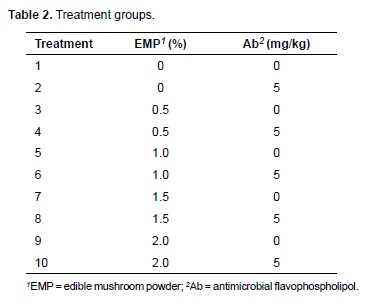
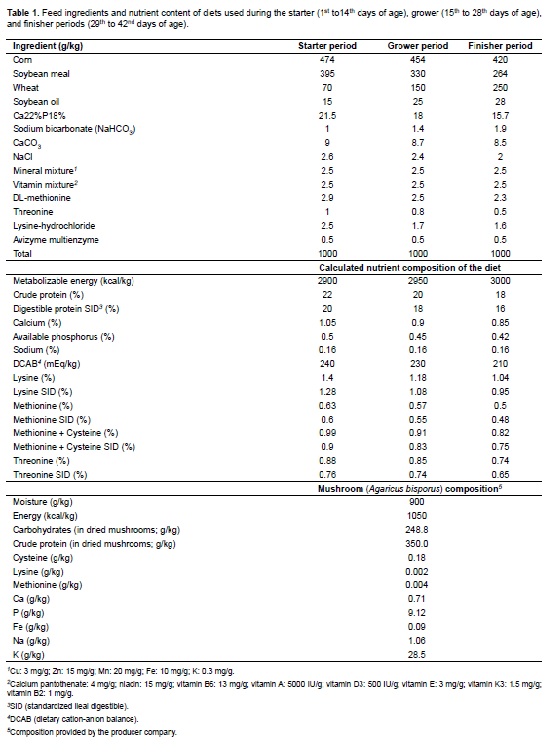
<body><![CDATA[<p>The experiments were approved by the Scientific   Board of the Islamic Azad University and were   conducted according to the International Guidelines for research involving animals (Directive 2010/63/EU).</p>     <p><i>Location</i></p>     <p>This study was conducted at the Poultry Farm Facilities in the city of Ramsar (latitude 50&deg;40' N and longitude 36&deg;54' E) and the Agriculture Faculty of the Islamic Azad University, Rasht Branch, Iran, between July-September, 2013 (summer, warm season), during a total of 42 days.</p>     <p><i>Animals and housing</i></p>     <p>Three hundred one-day-old male Ross 308   broilers (Aviagen, 2007) were randomly assigned   to 10 treatments with three replicates per treatment.   Each replicate consisted of 10 chicks housed in pens   of 1.2 m<sup>2</sup>. The pens were equipped with electrical   heaters. The room temperature was adjusted to   approximately 33 &ordm;C on day 1, and was then gradually   reduced to 24 &ordm;C. Lighting was provided with a   23L:1D (from 19:00 to 20:00) program. Humidity was   maintained between 55 and 65% in the early growing   period by spraying water on the floor. The chicks   were vaccinated against Newcastle and Gumboro.   Within 24 h after vaccination, a multiple-vitamin and   electrolyte solution (1:1000) was offered via drinking water to reduce stress.</p>     <p><i>Diets and experimental design</i></p>     <p>Feed and water were supplied <i>ad libitum</i> during   the entire experimental period. The nutritional   requirements were met according with the Ross   rearing catalogue (Aviagen, 2007). Feeds were   formulated to be iso-proteic and iso-energetic for all   treatments. The composition of diets and their nutrient   content are presented in Table 1. The feed remaining   in the feeders (orts) was weighed and weekly   recorded. Mushrooms (A. bispours) were obtained   from a national mushroom producer (Pars Company,   Ramsar, Iran). Mushroom composition was provided   by the same company and is presented in <a href="#t1">Table 1</a>.   Whole mushrooms were dried at 60 &ordm;C and added to   the experimental diets after grinding. The treatments   consisted of five levels of EMP (0, 0.5, 1.0, 1.5,   and 2.0 g/kg) and 0 or 5.0 mg/kg flavophospholipol   (Teif Azmoon Pars, Co., Tehran, Iran). According   to De Barros <i>et al.</i> (2012), the best performance is   obtained with 10 mg/kg flavophospholipol. Regarding   mushroom powder, Giannenas <i>et al.</i> (2011) reported   positive results on turkey poults when it was added up   to 20 g/kg feed. Dietary treatments used in the present study are detailed in <a href="#t2">Table 2</a>.</p>      <p align="center"><a name="t1"><img src="/img/revistas/rccp/v28n4/v28n4a02t1.jpg"></a>     <p align="center"><a name="t2"><img src="/img/revistas/rccp/v28n4/v28n4a02t2.jpg"></a>     <p align="left">     ]]></body>
<body><![CDATA[<p align="left">Body weight at birth was 43.5 &plusmn; 1.2 g. Weight   gain was weekly recorded by pen. At the end of the   study (42 days of age) the mean body weight of birds   (commercial weight) was 2,715.3 &plusmn; 31.7 g. At this day   one bird per group, totalling three birds per treatment,   were selected for blood collection. Care was taken to   choose the most representative birds with respect   to body weight compared to the mean body weight of   the group. Blood samples (1 mL/bird) were collected   into EDTA tubes from the wing veins. Samples were   transferred to the laboratory for analysis within 2 hours   of collection. After centrifugation (3,000 g x 10 min   at room temperature) serum was harvested and stored in Eppendorf tubes at -20 &ordm;C until analysis.</p>     <p align="left"><i>Chemical analysis</i></p>     <p align="left">Serum cholesterol and triglyceride levels were   determined using enzymatic methods (Teif Azmoon   Pars Co., Tehran, Iran). High-density lipoprotein   (HDL) and low-density lipoprotein (LDL) cholesterol   were measured directly with HDL-C and LDL-C   diagnostic kits (Teif Azmoon Pars Co., Tehran,   Iran). Colorimetric determination of cholesterol in   blood serum samples was done by the cholesterol   oxidase procedure by Barham and Trinder (1972),   which is based on the formation of a red-purple   quinoneimine produced by oxidative condensation   of a phenolic compound with 4-aminoantipyrine in   the presence of hydrogen peroxide. Quinoneimine   absorbance, measured spectrophotometrically, has a   direct relationship with the amount of cholesterol in the sample.</p>     <p align="left">Serum triglycerides were measured using a   series of coupled reactions in which triglycerides   are hydrolyzed to produce glycerol. Glycerol is then   converted to pyruvate and then to lactate. Decreased   absorbance, measured spectrophotometrically, is   proportional to the triglyceride concentration in the sample (Schmid and von Forstner, 1986).</p>     <p align="left">A glucose oxidase kit (Teif Azmoon Pars Co.,   Tehran, Iran), based on an oxidase-peroxidase   procedure, was used to measure serum glucose.   In this assay, glucose is oxidized in the presence   of the glucose oxidase catalyst into H<sub>2</sub>O<sub>2</sub> and   gluconic acid. The reactions involving gluconic   acid, hydrogen peroxide, a phenolic compound and   4-aminoantipyrine form a red-violet quinoneimine,   and the absorbance of the quinoneimine chromagen,   measured by spectrophotometry, is directly related to the amount of glucose in the sample.</p>     <p align="left">A uric acid-uricase enzyme kit (Teif Azmoon Pars   Co., Tehran, Iran), based on an oxidase-peroxidase   procedure (Trinder, 1969), was used to measure   serum uric acid. In this procedure uric acid is oxidized   with uricase and, in the presence of the generated   hydrogen peroxide, a phenolic compound and   4-aminoantipyrine forms a red-colored quinoneimine.   The absorbance of quinoneimine chromagen, measured   by spectrophotometry, is directly associated with the amount of uric acid in the sample (Thomas, 1998).</p>     <p align="left">Serum alkaline phosphatase (ALP) was determined   enzymatically using a commercial kit (Teif Azmoon   Pars Co., Tehran, Iran). In this procedure, ALP activity   was determined colorimetrically by a modification of   the Bessey <i>et al.</i> (1964) method, using p-nitrophenol   phosphate as the enzyme substrate, which is converted   to phosphate and p-nitrophenol by the ALP. The   released p-nitrophenol is proportional to the ALP activity.</p>     <p align="left">Albumin (Alb) was determined based on the   bromocresol green method (Doumas <i>et al.</i>, 1971)   using a commercial kit (Teif Azmoon Pars Co.,   Tehran, Iran), while total protein (TP) was assayed by   the Biuret method (Gornall <i>et al.</i>, 1949; Teif Azmoon   Pars Co., Tehran, Iran). Total protein determination   was based on the principle that protein forms an   intense violet-blue complex with copper salts in alkaline media. Iodine was included as an antioxidant,   the intensively color formed is proportional to the   total protein concentration in the sample. The globulin   values were calculated by subtracting albumin values from the corresponding total protein.</p>     <p align="left"><i>Statistical analysis</i></p>     <p align="left">General lineal models (GLM, SPSS 15.0, Chicago,   IL, USA) were used to analyse the effects of EMP   and flavophospholipol on feed intake (FI), weight   gain (WG), feed conversion ratio (FCR), body weight   at 42 d, and blood metabolites in a 2x5 factorial   arrangement. Tukey's test was used to determine disparities among the groups.</p>     ]]></body>
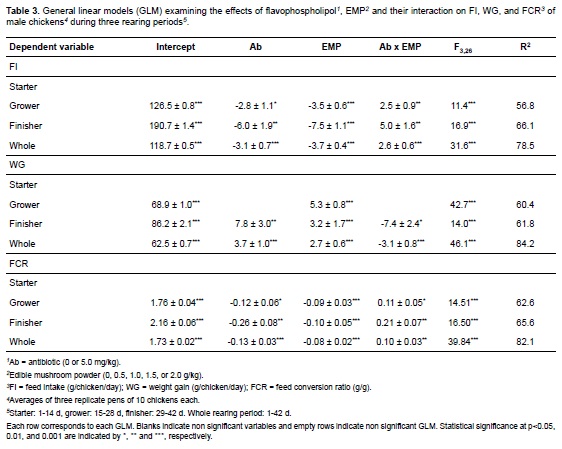
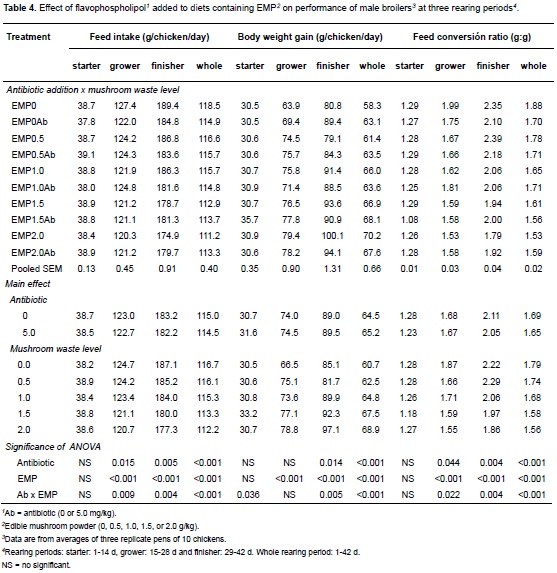
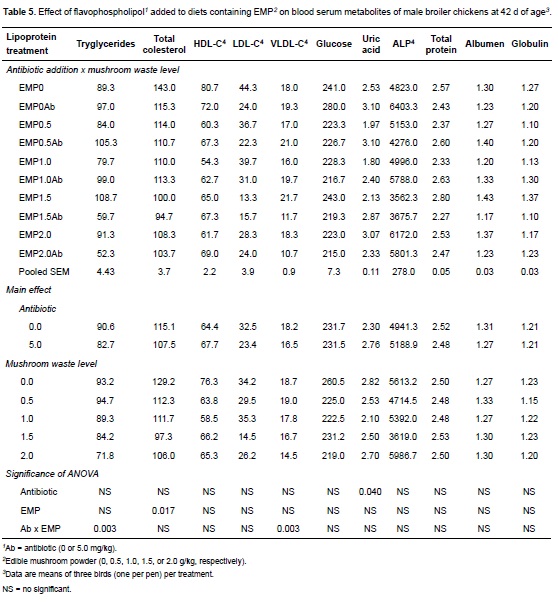
<body><![CDATA[<p>&nbsp;</p>     <p><b><font size="3">Results</font></b></p>     <p><i>Growth performance</i></p>     <p>The effects of dietary EMP and antibiotic   supplementation on bird performance are detailed in   <a href="#t3">Tables 3</a> and <a href="#t4">4</a>, respectively. Results from the current   work show that dietary EMP as well as the addition   of flavophospholipol had a negative effect on FI.   These effects were absente in the starter period, but   during the grower period both variables reached   significance (see GLM on <a href="#t3">Table 3</a>). Similarly, both   EMP and flavophospholipol affected FI during the   finisher period. Finally, the GLM showed a negative   effect of these variables on FI for the whole growth   period (from birth to 42 days; <a href="#t3">Table 3</a>). Regarding   WG, results showed a positive effect of EMP and   antibiotic supplementation, but showed a negative   effect when combined. This effect was not found in   the starter period, while only EMP effects reached   significance during the grower period. In the finisher   period, as well as in the GLM analysing the whole   rearing period, both variables were significant. Results   similar to those for FI were observed for FCR, i.e.,   EMP and antibiotic supplementation decreased FCR   for all rearing periods except for the first one. Finally,   results showed that both flavophospholipol and EMP   addition positively affected final body weight (model   F<sub>3,26</sub> = 23.1, p&lt;0.001, R<sup>2</sup>= 72.7%), coefficients were:   EMP = 99.3 &plusmn; 34.9, p&lt;0.001; antibiotic = 185.7 &plusmn; 60.5, p&lt;0.01; interaction = -173.6 &plusmn; 49.4, p&lt;0.01.</p>      <p align="center"><a name="t3"><img src="/img/revistas/rccp/v28n4/v28n4a02t3.jpg"></a>     <p align="center"><a name="t4"><img src="/img/revistas/rccp/v28n4/v28n4a02t4.jpg"></a>     <p align="left">     <p align="left"><i>Blood serum metabolites</i>     <p align="left">Values for selected serum metabolites in birds   fed the 10 experimental diets are given in <a href="#t4">Table 4</a>.   The antibiotic supplementation did not affect serum   concentration of total cholesterol, HDL, LDL, glucose,   or ALP. However, dietary flavophospholipol linearly   increased uric acid concentration (p = 0.040) and,   as an interaction with EMP, decreased triglycerides   serum concentration (F<sub>1,28</sub> = 5.04, p&lt;0.01, R<sup>2</sup> = 27.2%)   and VLDL (F<sub>1,28</sub> = 5.29, p&lt;0.05, R<sup>2</sup> = 28.2%). EMP   affected, individually or combined with antibiotic, the   serum concentration of triglycerides, total cholesterol   (F<sub>1,28</sub> = 6.38, p&lt;0.05, R<sup>2</sup> = 18.6%; coefficient = -12.27   &plusmn; 4.86, p&lt;0.05), and VLDL.</p>     <p align="left">No statistically significant differences were found   for total protein concentration at day 42 between   treatment groups and control (<a href="#t5">Table 5</a>). Similarly, no   significant differences were observed for total albumin   or globulin concentrations in treatment groups in comparison to controls.</p>      ]]></body>
<body><![CDATA[<p align="center"><a name="t5"><img src="/img/revistas/rccp/v28n4/v28n4a02t5.jpg"></a>     <p align="left">     <p><font size="3"><b>Discussion</b></font></p>     <p>In general, adding flavophospholipol and EMP to   diets caused positive effects on broiler performance.   The results for flavophospholipol addition are similar   to those reported by De Barros <i>et al.</i> (2012), who   also found improvements in body weight gains and   feed conversion ratio. However, there are two main   differences between their study and ours. First, they   found these benefits throughout the whole rearing   period while we found improvements only from   the third week of rearing onward. This difference   can be explained by the different doses of antibiotic   employed in both studies; in our work we used   5 mg/kg of the antibiotic while De Barros <i>et al.</i> (2012) used 10 mg/kg of flavophospholipol.</p>     <p>The second difference is that they did not find a   decrease in feed intake like the one found in the present   study. A possible explanation for this negative effect   of flavophospholipol and EMP on feed intake could   be that supplementation of both products reduces feed   palatability. To our knowledge, there are no studies   concluding that EMP or flavophospholipol addition could affect feed intake by changing its palatability.</p>     <p>However, it has been demonstrated that mushrooms   have a quite intense taste (Tsai <i>et al.</i>, 2009) so it can   affect feed flavour (Perdok <i>et al.</i>, 2003; Isabel and Santos, 2009).</p>     <p>The positive impact of growth promoting antibiotics   is well known in the poultry industry. Antibiotics   suppress harmful microorganisms and the intestinal   bacterial population comes into balance as a more   beneficial microbiota. In this sense, a well-balanced   gut microbe population is considered an effective   barrier against pathogenic bacteria, which positively   influences animal growth through increased nutrient   absorption (Pfaller, 2006). Inhibition of inflammatory   effects has also been proposed as a means of action for this type of compound (Niewold, 2007).</p>     <p>It is not surprising that mushroom powder   had a positive effect on broiler performance; it is   acknowledged that mushrooms have a good effect   on human and animal health. Giannenas <i>et al.</i> (2010)   reported that <i>A. bisporus</i> has a prebiotic-like effect on   turkeys since fermentable polysaccharide content in   mushrooms may improve growth of <i>Lactobacilli</i> and   <i>Bifidobacteria</i> populations and inhibit <i>E. coli</i> leading to   a more balanced biota population in the gastrointestinal   tract of poultry, as a consequence, to a greater efficiency   in digestibility and feed utilization. Furthermore, <i>Lactobacilli</i> may produce organic acids such as lactic acid (Rehman <i>et al.</i>, 2007) and bactericidal substances (Neal-McKinney <i>et al.</i>, 2012) that may improve gastrointestinal function and feed digestibility, resulting in enhanced growth and improved FCR (Ferket, 2004).</p>     <p>An important result of the present work is the   combined negative effect of the antibiotic and EMP   on weight gain, FCR and body weight at 42-d. Since   flavophospholipol promotes proliferation of a bacterial   population capable of profiting in a more effective   way the mushroom nutritional properties, including   sugar composition as polysaccharide fractions, we   expected to find the opposite results. In contrast,   the present study showed that the combination of   the antibiotic and EMP decreases the positive effect   on growth produced by the two substances added separately.</p>     <p>Limited information is available on changes in   blood metabolites associated with the addition of   flavophospholipol or EMP. In the present study,   the addition of EMP showed an overall decrease   on blood lipid metabolite profiles. In this sense,   results show that EMP added individually or with   flavophospholipol decreases serum triglycerides,   total cholesterol and VLDL concentration but   no LDL or HDL. So, the decrease in serum total   cholesterol may be a consequence of the decrease in VLDL.</p>     ]]></body>
<body><![CDATA[<p>Abdel-Fatah <i>et al.</i> (2008) showed that total blood   lipids and cholesterol decreased significantly with   dietary acidifiers. Panda <i>et al.</i> (2006) discovered   that the addition of probiotics in diets reduced total   serum cholesterol and triglycerides. They attributed   this to a reduced absorption and/or synthesis of   cholesterol in the gastro-intestinal tract of probioticsupplemented   chickens (Mohan <i>et al.</i>, 1995; Mohan   <i>et al.</i>, 1996). Similarly, <i>Lactobacillus acidophilus</i>  and other acidophilic bacteria lower the pH of the   environment it occupies. Bile acids are less soluble   at low pH, are absorbed less in the intestine, and are   more likely to be excreted in the faeces (Klaver and van der Meer, 1993).</p>     <p>Since fermentable polysaccharides in mushrooms   may improve <i>Lactobacilli</i> growth, this could explain   part of the results in the present study. Furthermore,   flavophospholipol inhibits transglycosylase, an   enzyme necessary for the formation of bacterial   cell wall, and its consequent intestinal microbiota   modulation promotes the development of <i>Lactobacilli</i>   and <i>Bifidobacteria</i>, which are generally considered   beneficial bacteria (Bolder <i>et al.</i>, 1999). Another   possible explanation, or at least partially, is that the   observed lower feed consumption and consequently   lower fat intake may also contribute to reducing   blood lipid content. This increment in beneficial   bacterial populations would lead to a more efficient   assimilation of the feed throughout a better intestinal   absorption that could explain the observed reduction in FI and FCR increment.</p>     <p>Flavophospholipol treatment showed an   increment in serum concentration of uric acid.   Uric acid is the major end product of protein   metabolism in poultry (Griminger and Scames,   1986) so increased serum concentration of uric   acid could indicate increased growth potential in   broilers treated with the antibiotic, which would be   reflected in the increased weight gain observed in   our results. Supporting this idea, Darsi <i>et al.</i> (2012)   observed that uric acid plasma levels were reduced   in parallel with dietary crude protein. On the other   hand, increased plasma uric acid has anti-oxidant   activity in chickens (Klandorf <i>et al.</i>, 2001; Carro <i>et al.</i>, 2010), which suggest an anti-oxidative effect of flavophospholipol.</p>     <p>Finally, treatments failed to induce any significant   effect on total protein, albumin or globulin serum   concentrations. Higher serum globulin is an   indicator of better immune response and source of   antibody production, and low albumin to globulin   ratio signifies better disease resistance and immune   response (Griminger, 1986), so the good health   status of birds in the present study can explain why   there was no evident influence of mushrooms on   these blood compounds. Similarly, Guo <i>et al.</i> (2003)   suggested that the mushrooms effect was more   pronounced under infectious conditions than under normal ones.</p>     <p>In conclusion, the use of flavophospholipol and   EMP has a positive effect on growth performance and   these benefits can be translated into important amounts   of feed saved in animal production. Moreover, results   showed an overall decrease in blood lipid metabolite profiles and uric acid content of chicks.</p>     <p>&nbsp;</p>     <p><b><font size="3">Acknowledgements</font></b></p>     <p>This manuscript has been prepared from the MSc   thesis of the first author at Islamic Azad University,   Rasht Branch, Rasht, Iran. The authors wish to thank   the Islamic Azad University for their support and the two anonymous referees for their comments.</p>     <p align="left">&nbsp;</p>     <p align="left"><b><font size="3">Conflicts of interest</font></b></p>     ]]></body>
<body><![CDATA[<p align="left">The authors declare they have no conflicts of interest with regard to the work presented in this report.</p>     <p align="left">&nbsp;</p> <hr size="1" />     <p><b><font size="3">Notes</font></b></p>     <p><b><a name="a0" id="a0"><a href="#a1">&curren;</a></a></b>To cite this article: Shamsi S, Seidavi A, Rahati M, Nieto JAG. Edible mushroom powder (<i><i>Agaricus bisporus</i></i>) and flavophospholipol improve performance and blood parameters of broilers. Rev Colomb Cienc Pecu 2015; 28:291-302.</p> <hr size="1" />     <p>&nbsp;</p>     <p><b><font size="3">References</font></b></p>     <!-- ref --><p>Aalipour F, Mirlohi M, Jalali M. Determination of antibiotic   consumption index for animal originated foods produced in animal husbandry in Iran, 2010. J Environ Health Sci Eng 2014; 12:42-48.    &nbsp;&nbsp;&nbsp;&nbsp;&nbsp;&nbsp;&nbsp;&nbsp;[&#160;<a href="javascript:void(0);" onclick="javascript: window.open('/scielo.php?script=sci_nlinks&ref=000099&pid=S0120-0690201500040000200001&lng=','','width=640,height=500,resizable=yes,scrollbars=1,menubar=yes,');">Links</a>&#160;]<!-- end-ref --></p>     <!-- ref --><p>   Abdel-Fattah SA, El-Sanhoury MH, El-Mednay NM, Abdel-   Azeem F. Thyroid activity, some blood constituents, organs   morphology and performance of broiler chicks feed supplemental   organic acids. Int J Poult Sci 2008; 7(3):215-222.    &nbsp;&nbsp;&nbsp;&nbsp;&nbsp;&nbsp;&nbsp;&nbsp;[&#160;<a href="javascript:void(0);" onclick="javascript: window.open('/scielo.php?script=sci_nlinks&ref=000101&pid=S0120-0690201500040000200002&lng=','','width=640,height=500,resizable=yes,scrollbars=1,menubar=yes,');">Links</a>&#160;]<!-- end-ref --></p>     ]]></body>
<body><![CDATA[<!-- ref --><p>   Aviagen. Ross 308 broiler: Nutrition Specification 2007; &#91;Access   date; November 24, 2014&#93;. URL: <a href="http://www.natchix.co.za/pdf/nutrition_specifications.pdf" target="_blank">http://www.natchix.co.za/pdf/nutrition_specifications.pdf</a>&nbsp;&nbsp;&nbsp;&nbsp;&nbsp;&nbsp;&nbsp;&nbsp;[&#160;<a href="javascript:void(0);" onclick="javascript: window.open('/scielo.php?script=sci_nlinks&ref=000103&pid=S0120-0690201500040000200003&lng=','','width=640,height=500,resizable=yes,scrollbars=1,menubar=yes,');">Links</a>&#160;]<!-- end-ref --><!-- ref --><p>Barham D, Trinder P. An improved colour reagent for the   determination of blood glucose by the oxidase system. Analyst (Lond) 1972; 97:142-145.    &nbsp;&nbsp;&nbsp;&nbsp;&nbsp;&nbsp;&nbsp;&nbsp;[&#160;<a href="javascript:void(0);" onclick="javascript: window.open('/scielo.php?script=sci_nlinks&ref=000104&pid=S0120-0690201500040000200004&lng=','','width=640,height=500,resizable=yes,scrollbars=1,menubar=yes,');">Links</a>&#160;]<!-- end-ref --></p>     <!-- ref --><p>   Barros L, Ferreira MJ, Queir&oacute;s B, Ferreira ICFR, Baptista P. Total   phenols, ascorbic acid, &szlig;-carotene, and lycopene in Portuguese   wild edible mushrooms and their antioxidant activities. Food   Chem 2006; 103:413-419.    &nbsp;&nbsp;&nbsp;&nbsp;&nbsp;&nbsp;&nbsp;&nbsp;[&#160;<a href="javascript:void(0);" onclick="javascript: window.open('/scielo.php?script=sci_nlinks&ref=000106&pid=S0120-0690201500040000200005&lng=','','width=640,height=500,resizable=yes,scrollbars=1,menubar=yes,');">Links</a>&#160;]<!-- end-ref --></p>     <!-- ref --><p>   Bessey OA, Lowry OH, Brock MJ. A method for the rapid   determination of alkaline phosphatase with five cubic millimeters   of serum J Biol Chem 1964; 164:321-329.    &nbsp;&nbsp;&nbsp;&nbsp;&nbsp;&nbsp;&nbsp;&nbsp;[&#160;<a href="javascript:void(0);" onclick="javascript: window.open('/scielo.php?script=sci_nlinks&ref=000108&pid=S0120-0690201500040000200006&lng=','','width=640,height=500,resizable=yes,scrollbars=1,menubar=yes,');">Links</a>&#160;]<!-- end-ref --></p>     <!-- ref --><p>   Bolder NM, Wagenaar JA, Putirulan FF, Veldman KT, Sommer   M. The effect of flavophospholipol (Flavomycin<sup>&reg;</sup>) and   salinomycin sodium (Sacox<sup>&reg;</sup>) on the secretion of <i>Clostridium   perfringens</i>, <i>Salmonella enteritidis</i>, and <i>Campylobacter jejuni</i>   in broilers after experimental infection. Poult Sci 1999;   78:1681-1689.    &nbsp;&nbsp;&nbsp;&nbsp;&nbsp;&nbsp;&nbsp;&nbsp;[&#160;<a href="javascript:void(0);" onclick="javascript: window.open('/scielo.php?script=sci_nlinks&ref=000110&pid=S0120-0690201500040000200007&lng=','','width=640,height=500,resizable=yes,scrollbars=1,menubar=yes,');">Links</a>&#160;]<!-- end-ref --></p>     <!-- ref --><p>   Butaye P, Devriese LA, Haesebrouck F. Antimicrobial growth   promoters used in animal feed: effects of less well known   antibiotics on gram-positive bacteria. Clin Microbiol Rev 2003;   16(2):175-188.    &nbsp;&nbsp;&nbsp;&nbsp;&nbsp;&nbsp;&nbsp;&nbsp;[&#160;<a href="javascript:void(0);" onclick="javascript: window.open('/scielo.php?script=sci_nlinks&ref=000112&pid=S0120-0690201500040000200008&lng=','','width=640,height=500,resizable=yes,scrollbars=1,menubar=yes,');">Links</a>&#160;]<!-- end-ref --></p>     <!-- ref --><p>   Bywater RJ. Identification and surveillance of antimicrobial   resistance dissemination in animal production. Poult Sci 2005;   84:644-648.    &nbsp;&nbsp;&nbsp;&nbsp;&nbsp;&nbsp;&nbsp;&nbsp;[&#160;<a href="javascript:void(0);" onclick="javascript: window.open('/scielo.php?script=sci_nlinks&ref=000114&pid=S0120-0690201500040000200009&lng=','','width=640,height=500,resizable=yes,scrollbars=1,menubar=yes,');">Links</a>&#160;]<!-- end-ref --></p>     <!-- ref --><p>   Carro MD, Falkenstein E, Radke WJ, Klandorf H. Effects of   allopurinol on uric acid concentrations, xanthine oxidoreductase   activity, and oxidative stress in broiler chickens. Comp Biochem   Physiol C 2010; 151:12-17.    &nbsp;&nbsp;&nbsp;&nbsp;&nbsp;&nbsp;&nbsp;&nbsp;[&#160;<a href="javascript:void(0);" onclick="javascript: window.open('/scielo.php?script=sci_nlinks&ref=000116&pid=S0120-0690201500040000200010&lng=','','width=640,height=500,resizable=yes,scrollbars=1,menubar=yes,');">Links</a>&#160;]<!-- end-ref --></p>     <!-- ref --><p>   Chen S, Oh SR, Phung S, Hur G, Ye JJ, Kwok SL, Shrode GE,   Belury M, Adams LS, Williams D. Anti-aromatase activity of   phytochemicals in white button mushrooms (<i>Agaricus bisporus</i>).   Cancer Res 2006; 66(24):12026-12034.    &nbsp;&nbsp;&nbsp;&nbsp;&nbsp;&nbsp;&nbsp;&nbsp;[&#160;<a href="javascript:void(0);" onclick="javascript: window.open('/scielo.php?script=sci_nlinks&ref=000118&pid=S0120-0690201500040000200011&lng=','','width=640,height=500,resizable=yes,scrollbars=1,menubar=yes,');">Links</a>&#160;]<!-- end-ref --></p>     <!-- ref --><p>   Cox Jr LA, Ricci PF. Casual regulations vs. <i>political will</i>: Why   human zoonotic infections increase despite precautionary bans on   animal antibiocics. Environ Int 2008; 34(8):459-475.    &nbsp;&nbsp;&nbsp;&nbsp;&nbsp;&nbsp;&nbsp;&nbsp;[&#160;<a href="javascript:void(0);" onclick="javascript: window.open('/scielo.php?script=sci_nlinks&ref=000120&pid=S0120-0690201500040000200012&lng=','','width=640,height=500,resizable=yes,scrollbars=1,menubar=yes,');">Links</a>&#160;]<!-- end-ref --></p>     <!-- ref --><p>   Darsi E, Shivazad M, Zaghari M, Namroud NF, Mohammadi   R. Effect of reduced dietary crude protein levels on growth   performance, plasma uric acid and electrolyte concentration of   male broiler chicks. J Agric Sci Technol 2012; 14:789-797.    &nbsp;&nbsp;&nbsp;&nbsp;&nbsp;&nbsp;&nbsp;&nbsp;[&#160;<a href="javascript:void(0);" onclick="javascript: window.open('/scielo.php?script=sci_nlinks&ref=000122&pid=S0120-0690201500040000200013&lng=','','width=640,height=500,resizable=yes,scrollbars=1,menubar=yes,');">Links</a>&#160;]<!-- end-ref --></p>     <!-- ref --><p>   De Barros RD, Vieira SL, Favero A, Taschetto D, Mascarello   NC, Cemin HS. Reassessing flavophospholipol effects on broiler   performance. Rev Bras Zootec 2012; 41(12):2458-2462.    &nbsp;&nbsp;&nbsp;&nbsp;&nbsp;&nbsp;&nbsp;&nbsp;[&#160;<a href="javascript:void(0);" onclick="javascript: window.open('/scielo.php?script=sci_nlinks&ref=000124&pid=S0120-0690201500040000200014&lng=','','width=640,height=500,resizable=yes,scrollbars=1,menubar=yes,');">Links</a>&#160;]<!-- end-ref --></p>     <!-- ref --><p>   Directive 2010/63/EU of the European Parliament and of the   Council of 22 September 2010 of the protection of animals used   for scientific purposes. Official Journal of the European Union   of 20<sup>th</sup> October 2010. L276/33.    &nbsp;&nbsp;&nbsp;&nbsp;&nbsp;&nbsp;&nbsp;&nbsp;[&#160;<a href="javascript:void(0);" onclick="javascript: window.open('/scielo.php?script=sci_nlinks&ref=000126&pid=S0120-0690201500040000200015&lng=','','width=640,height=500,resizable=yes,scrollbars=1,menubar=yes,');">Links</a>&#160;]<!-- end-ref --></p>     <!-- ref --><p>   Doumas BT, Watson WA, Biggs HG. Albumin standards and the   measurement of serum albumin with bromcresol green. Clin Chim   Acta 1971; 31:87-96.    &nbsp;&nbsp;&nbsp;&nbsp;&nbsp;&nbsp;&nbsp;&nbsp;[&#160;<a href="javascript:void(0);" onclick="javascript: window.open('/scielo.php?script=sci_nlinks&ref=000128&pid=S0120-0690201500040000200016&lng=','','width=640,height=500,resizable=yes,scrollbars=1,menubar=yes,');">Links</a>&#160;]<!-- end-ref --></p>     <!-- ref --><p>   Ferket PR. Alternatives to antibiotics in poultry production. In:   Lyons TP, Jacques KA, editors. Nutritional Biotechnology in the   Feed and Food Industries. Nottingham: E-publishing Inc; 2004.   p.57-67.    &nbsp;&nbsp;&nbsp;&nbsp;&nbsp;&nbsp;&nbsp;&nbsp;[&#160;<a href="javascript:void(0);" onclick="javascript: window.open('/scielo.php?script=sci_nlinks&ref=000130&pid=S0120-0690201500040000200017&lng=','','width=640,height=500,resizable=yes,scrollbars=1,menubar=yes,');">Links</a>&#160;]<!-- end-ref --></p>     <!-- ref --><p>Giannenas I, Pappas IS, Mavridis S, Kontopidis G, Skoufos   J, Kyriazakis I. Performance and antioxidant status of broiler chickens supplemented with dried mushrooms (<i>Agaricus bisporus</i>) in their diet. Poult Sci 2010; 89:303-311.    &nbsp;&nbsp;&nbsp;&nbsp;&nbsp;&nbsp;&nbsp;&nbsp;[&#160;<a href="javascript:void(0);" onclick="javascript: window.open('/scielo.php?script=sci_nlinks&ref=000132&pid=S0120-0690201500040000200018&lng=','','width=640,height=500,resizable=yes,scrollbars=1,menubar=yes,');">Links</a>&#160;]<!-- end-ref --></p>     <!-- ref --><p>   Giannenas I, Tsalie E, Chronis EF, Mavridis S, Tontis D,   Kyriazakis I. Consumption of <i>Agaricus bisporus</i> mushroom   affects the performance, intestinal microbiota composition, and   morphology, and antioxidant status of turkey poults. Anim Feed   Sci Techol 2011; 165:218-229.    &nbsp;&nbsp;&nbsp;&nbsp;&nbsp;&nbsp;&nbsp;&nbsp;[&#160;<a href="javascript:void(0);" onclick="javascript: window.open('/scielo.php?script=sci_nlinks&ref=000134&pid=S0120-0690201500040000200019&lng=','','width=640,height=500,resizable=yes,scrollbars=1,menubar=yes,');">Links</a>&#160;]<!-- end-ref --></p>     <!-- ref --><p>   Gornall AG, Bardawill CJ, David MM. Determination of serum   proteins by means of the biuret reaction. J Biol Chem 1949;   177:751-766.    &nbsp;&nbsp;&nbsp;&nbsp;&nbsp;&nbsp;&nbsp;&nbsp;[&#160;<a href="javascript:void(0);" onclick="javascript: window.open('/scielo.php?script=sci_nlinks&ref=000136&pid=S0120-0690201500040000200020&lng=','','width=640,height=500,resizable=yes,scrollbars=1,menubar=yes,');">Links</a>&#160;]<!-- end-ref --></p>     <!-- ref --><p>   Griminger P. Lipid metabolism. In: Sturkie PD, editor. Avian   Physiology 4<sup>th</sup> ed. New York: Springer; 1986. p.345-358.    &nbsp;&nbsp;&nbsp;&nbsp;&nbsp;&nbsp;&nbsp;&nbsp;[&#160;<a href="javascript:void(0);" onclick="javascript: window.open('/scielo.php?script=sci_nlinks&ref=000138&pid=S0120-0690201500040000200021&lng=','','width=640,height=500,resizable=yes,scrollbars=1,menubar=yes,');">Links</a>&#160;]<!-- end-ref --></p>     <!-- ref --><p>   Griminger P, Scames CG. Protein metabolism. In: Sturkie PD, editor.   Avian Physiology 4<sup>th</sup> ed. New York: Springer; 1986. p.326-344.    &nbsp;&nbsp;&nbsp;&nbsp;&nbsp;&nbsp;&nbsp;&nbsp;[&#160;<a href="javascript:void(0);" onclick="javascript: window.open('/scielo.php?script=sci_nlinks&ref=000140&pid=S0120-0690201500040000200022&lng=','','width=640,height=500,resizable=yes,scrollbars=1,menubar=yes,');">Links</a>&#160;]<!-- end-ref --></p>     <!-- ref --><p>   Guo FC, Savelkoul HFJ, Kwakkel RP, Williams BA, Verstegena   MWA. Immunoactive, medicinal properties of mushroom and   herb polysaccharides and their potential use in chicken diets.   World's Poult Sci J 2003; 59(4):427-440.    &nbsp;&nbsp;&nbsp;&nbsp;&nbsp;&nbsp;&nbsp;&nbsp;[&#160;<a href="javascript:void(0);" onclick="javascript: window.open('/scielo.php?script=sci_nlinks&ref=000142&pid=S0120-0690201500040000200023&lng=','','width=640,height=500,resizable=yes,scrollbars=1,menubar=yes,');">Links</a>&#160;]<!-- end-ref --></p>     <!-- ref --><p>   Isabel B, Santos Y. Effects of dietary organic acids and essential   oils on growth performance and carcass characteristics of broiler   chickens. J App Poult Res 2009; 18:472-476.    &nbsp;&nbsp;&nbsp;&nbsp;&nbsp;&nbsp;&nbsp;&nbsp;[&#160;<a href="javascript:void(0);" onclick="javascript: window.open('/scielo.php?script=sci_nlinks&ref=000144&pid=S0120-0690201500040000200024&lng=','','width=640,height=500,resizable=yes,scrollbars=1,menubar=yes,');">Links</a>&#160;]<!-- end-ref --></p>     <!-- ref --><p>   Klandorf H, Rathore D, Iqbal M, Shi X, Simoyi M, Van Dyke   KV. Accelerated tissue aging and increased oxidative stress in   broiler chickens fed allopurinol. Comp Biochem Physiol C 2001;   129:93-104.    &nbsp;&nbsp;&nbsp;&nbsp;&nbsp;&nbsp;&nbsp;&nbsp;[&#160;<a href="javascript:void(0);" onclick="javascript: window.open('/scielo.php?script=sci_nlinks&ref=000146&pid=S0120-0690201500040000200025&lng=','','width=640,height=500,resizable=yes,scrollbars=1,menubar=yes,');">Links</a>&#160;]<!-- end-ref --></p>     <!-- ref --><p>   Klaver FAM, van der Meer R. The assumed assimilation of   cholesterol by Lactobacilli and <i>Bifidobacterium bifidum</i> is due   to their bile salt deconjugating activity. App Environ Microbiol   1993; 59:1120-1124.    &nbsp;&nbsp;&nbsp;&nbsp;&nbsp;&nbsp;&nbsp;&nbsp;[&#160;<a href="javascript:void(0);" onclick="javascript: window.open('/scielo.php?script=sci_nlinks&ref=000148&pid=S0120-0690201500040000200026&lng=','','width=640,height=500,resizable=yes,scrollbars=1,menubar=yes,');">Links</a>&#160;]<!-- end-ref --></p>     <!-- ref --><p>   Liu J, Jia L, Kan J, Jin CH. <i>In vitro</i> and <i>in vivo</i> antioxidant   activity of ethanolic extract of white button mushroom (<i>Agaricus bisporus</i>). Food Chem Toxicol 2013; 51:310-316.    &nbsp;&nbsp;&nbsp;&nbsp;&nbsp;&nbsp;&nbsp;&nbsp;[&#160;<a href="javascript:void(0);" onclick="javascript: window.open('/scielo.php?script=sci_nlinks&ref=000150&pid=S0120-0690201500040000200027&lng=','','width=640,height=500,resizable=yes,scrollbars=1,menubar=yes,');">Links</a>&#160;]<!-- end-ref --></p>     <!-- ref --><p>   Minareci E, Ergonul B, Kayalar H, Kalyoncu F. Chemical   mompositions and antioxidant activities of five endemic asperula   TAXA. Arch Biol Sci Belgrade 2011; 63(3):537-543.    &nbsp;&nbsp;&nbsp;&nbsp;&nbsp;&nbsp;&nbsp;&nbsp;[&#160;<a href="javascript:void(0);" onclick="javascript: window.open('/scielo.php?script=sci_nlinks&ref=000152&pid=S0120-0690201500040000200028&lng=','','width=640,height=500,resizable=yes,scrollbars=1,menubar=yes,');">Links</a>&#160;]<!-- end-ref --></p>     <!-- ref --><p>   Mohan B, Kadirvel R, Bhaskaran M, Natarajan M. Effect of   probiotic supplementation on serum/yolk cholesterol and on egg   shell thickness in layers. Br Poult Sci 1995; 36:799-803.    &nbsp;&nbsp;&nbsp;&nbsp;&nbsp;&nbsp;&nbsp;&nbsp;[&#160;<a href="javascript:void(0);" onclick="javascript: window.open('/scielo.php?script=sci_nlinks&ref=000154&pid=S0120-0690201500040000200029&lng=','','width=640,height=500,resizable=yes,scrollbars=1,menubar=yes,');">Links</a>&#160;]<!-- end-ref --></p>     <!-- ref --><p>   Mohan B, Kadirvel R, Natarajan M, Bhaskaran M. Effect of   probiotic supplementation on growth, nitrogen utilization and   serum cholesterol in broilers. Br Poult Sci 1996; 37:395-401.    &nbsp;&nbsp;&nbsp;&nbsp;&nbsp;&nbsp;&nbsp;&nbsp;[&#160;<a href="javascript:void(0);" onclick="javascript: window.open('/scielo.php?script=sci_nlinks&ref=000156&pid=S0120-0690201500040000200030&lng=','','width=640,height=500,resizable=yes,scrollbars=1,menubar=yes,');">Links</a>&#160;]<!-- end-ref --></p>     <!-- ref --><p>   Moro C, Palacios I, Lozano M, D'Arrigo M, Guillam&oacute;n E, Villares   A, Garc&iacute;a-Lafuente A. Anti-inflammatory activity of methanolic   extracts from edible mushrooms in LPS activated RAW 264.7   macrophages. Food Chem 2012; 130(2):350-355.    &nbsp;&nbsp;&nbsp;&nbsp;&nbsp;&nbsp;&nbsp;&nbsp;[&#160;<a href="javascript:void(0);" onclick="javascript: window.open('/scielo.php?script=sci_nlinks&ref=000158&pid=S0120-0690201500040000200031&lng=','','width=640,height=500,resizable=yes,scrollbars=1,menubar=yes,');">Links</a>&#160;]<!-- end-ref --></p>     <!-- ref --><p>   Neal-McKinney JM, Lu X, Duong T, Larson CL, Call DR,   Shah DH, Konkel ME. Production of organic acids by Probiotic     <i>Lactobacilli</i> can be used to reduce pathogen load in poultry. PLoS   ONE 2012; 7:1-11.    &nbsp;&nbsp;&nbsp;&nbsp;&nbsp;&nbsp;&nbsp;&nbsp;[&#160;<a href="javascript:void(0);" onclick="javascript: window.open('/scielo.php?script=sci_nlinks&ref=000160&pid=S0120-0690201500040000200032&lng=','','width=640,height=500,resizable=yes,scrollbars=1,menubar=yes,');">Links</a>&#160;]<!-- end-ref --></p>     <!-- ref --><p>Niewold TA. The nonantibiotic anti-inflammatory effect of   antimicrobial growth promoters, the real mode of action? A hypothesis. Poult Sci 2007; 86:605-609.    &nbsp;&nbsp;&nbsp;&nbsp;&nbsp;&nbsp;&nbsp;&nbsp;[&#160;<a href="javascript:void(0);" onclick="javascript: window.open('/scielo.php?script=sci_nlinks&ref=000162&pid=S0120-0690201500040000200033&lng=','','width=640,height=500,resizable=yes,scrollbars=1,menubar=yes,');">Links</a>&#160;]<!-- end-ref --></p>     <!-- ref --><p>   Panda AK, Rama Rao SV, Raju MVLN, Sharma SR. Dietary   supplementation of Lactobacillus Sporogenes on performance   and serum biochemico-lipid profile of broiler chickens. J Poult   Sci 2006; 43:235-240.    &nbsp;&nbsp;&nbsp;&nbsp;&nbsp;&nbsp;&nbsp;&nbsp;[&#160;<a href="javascript:void(0);" onclick="javascript: window.open('/scielo.php?script=sci_nlinks&ref=000164&pid=S0120-0690201500040000200034&lng=','','width=640,height=500,resizable=yes,scrollbars=1,menubar=yes,');">Links</a>&#160;]<!-- end-ref --></p>     <!-- ref --><p>   Perdok H, Langhout P, Van Vugt P. Stimulating appetite. Feed   Mix 2003; 11:10-13.    &nbsp;&nbsp;&nbsp;&nbsp;&nbsp;&nbsp;&nbsp;&nbsp;[&#160;<a href="javascript:void(0);" onclick="javascript: window.open('/scielo.php?script=sci_nlinks&ref=000166&pid=S0120-0690201500040000200035&lng=','','width=640,height=500,resizable=yes,scrollbars=1,menubar=yes,');">Links</a>&#160;]<!-- end-ref --></p>     <!-- ref --><p>   Pfaller MA. Flavophospholipol use in animals: Positive   implications for antimicrobial resistance based on its microbiologic   properties. Diagn Microbiol Infec Dis 2006; 56(2):115-121.    &nbsp;&nbsp;&nbsp;&nbsp;&nbsp;&nbsp;&nbsp;&nbsp;[&#160;<a href="javascript:void(0);" onclick="javascript: window.open('/scielo.php?script=sci_nlinks&ref=000168&pid=S0120-0690201500040000200036&lng=','','width=640,height=500,resizable=yes,scrollbars=1,menubar=yes,');">Links</a>&#160;]<!-- end-ref --></p>     <!-- ref --><p>   Rehman H, Vahjen W, Awad WA, Zentek J. Indigenous bacteria   and bacterial metabolic products in the gastrointestinal tract of   broilers. Arch Anim Nutr 2007; 61:319-335.    &nbsp;&nbsp;&nbsp;&nbsp;&nbsp;&nbsp;&nbsp;&nbsp;[&#160;<a href="javascript:void(0);" onclick="javascript: window.open('/scielo.php?script=sci_nlinks&ref=000170&pid=S0120-0690201500040000200037&lng=','','width=640,height=500,resizable=yes,scrollbars=1,menubar=yes,');">Links</a>&#160;]<!-- end-ref --></p>     <!-- ref --><p>Schmid M, von Forstner D. Laboratory testing in veterinary   medicine diagnosis and clinical monitoring. Mannheim: Boehringer Mannheim GmbH; 1986.    &nbsp;&nbsp;&nbsp;&nbsp;&nbsp;&nbsp;&nbsp;&nbsp;[&#160;<a href="javascript:void(0);" onclick="javascript: window.open('/scielo.php?script=sci_nlinks&ref=000172&pid=S0120-0690201500040000200038&lng=','','width=640,height=500,resizable=yes,scrollbars=1,menubar=yes,');">Links</a>&#160;]<!-- end-ref --></p>     <!-- ref --><p>   Thomas L. Clinical laboratory diagnostics: Use and assessment of   clinical laboratory results. Verlagsgeselschaft: TH-Books; 1998.    &nbsp;&nbsp;&nbsp;&nbsp;&nbsp;&nbsp;&nbsp;&nbsp;[&#160;<a href="javascript:void(0);" onclick="javascript: window.open('/scielo.php?script=sci_nlinks&ref=000174&pid=S0120-0690201500040000200039&lng=','','width=640,height=500,resizable=yes,scrollbars=1,menubar=yes,');">Links</a>&#160;]<!-- end-ref --></p>     <!-- ref --><p>   Tian Y, Zeng H, Xu Z, Zheng B, Lin Y, Gan C, Lo YM. Ultrasonicassisted   extraction and antioxidant activity of polysaccharides   recovered from white button mushroom (<i>Agaricus bisporus</i>).   Carbohydr Polym 2012; 88(2):522-529.    &nbsp;&nbsp;&nbsp;&nbsp;&nbsp;&nbsp;&nbsp;&nbsp;[&#160;<a href="javascript:void(0);" onclick="javascript: window.open('/scielo.php?script=sci_nlinks&ref=000176&pid=S0120-0690201500040000200040&lng=','','width=640,height=500,resizable=yes,scrollbars=1,menubar=yes,');">Links</a>&#160;]<!-- end-ref --></p>     <!-- ref --><p>   Tsai SY, Huang SJ, Lo SH, Wu TP, Lian PY, Mau JL. Flavour   components and antioxidant properties of several cultivated   mushrooms. Food Chem 2009; 113(2): 578-584.    &nbsp;&nbsp;&nbsp;&nbsp;&nbsp;&nbsp;&nbsp;&nbsp;[&#160;<a href="javascript:void(0);" onclick="javascript: window.open('/scielo.php?script=sci_nlinks&ref=000178&pid=S0120-0690201500040000200041&lng=','','width=640,height=500,resizable=yes,scrollbars=1,menubar=yes,');">Links</a>&#160;]<!-- end-ref --></p>     <!-- ref --><p>   Trinder P. Determination of blood glucose using an oxidaseperoxidase   system with a non-carcinogenic chromogen. J Clin   Pathol 1969; 22:158-16.    &nbsp;&nbsp;&nbsp;&nbsp;&nbsp;&nbsp;&nbsp;&nbsp;[&#160;<a href="javascript:void(0);" onclick="javascript: window.open('/scielo.php?script=sci_nlinks&ref=000180&pid=S0120-0690201500040000200042&lng=','','width=640,height=500,resizable=yes,scrollbars=1,menubar=yes,');">Links</a>&#160;]<!-- end-ref --></p>     <p>&nbsp;</p>  </font>     ]]></body>
<body><![CDATA[ ]]></body><back>
<ref-list>
<ref id="B1">
<nlm-citation citation-type="journal">
<person-group person-group-type="author">
<name>
<surname><![CDATA[Aalipour]]></surname>
<given-names><![CDATA[F]]></given-names>
</name>
<name>
<surname><![CDATA[Mirlohi]]></surname>
<given-names><![CDATA[M]]></given-names>
</name>
<name>
<surname><![CDATA[Jalali]]></surname>
<given-names><![CDATA[M]]></given-names>
</name>
</person-group>
<article-title xml:lang="en"><![CDATA[Determination of antibiotic consumption index for animal originated foods produced in animal husbandry in Iran, 2010]]></article-title>
<source><![CDATA[J Environ Health Sci Eng]]></source>
<year>2014</year>
<volume>12</volume>
<page-range>42-48</page-range></nlm-citation>
</ref>
<ref id="B2">
<nlm-citation citation-type="journal">
<person-group person-group-type="author">
<name>
<surname><![CDATA[Abdel-Fattah]]></surname>
<given-names><![CDATA[SA]]></given-names>
</name>
<name>
<surname><![CDATA[El-Sanhoury]]></surname>
<given-names><![CDATA[MH]]></given-names>
</name>
<name>
<surname><![CDATA[El-Mednay]]></surname>
<given-names><![CDATA[NM]]></given-names>
</name>
<name>
<surname><![CDATA[Abdel-]]></surname>
<given-names><![CDATA[Azeem F]]></given-names>
</name>
</person-group>
<article-title xml:lang="en"><![CDATA[Thyroid activity, some blood constituents, organs morphology and performance of broiler chicks feed supplemental organic acids]]></article-title>
<source><![CDATA[Int J Poult Sci]]></source>
<year>2008</year>
<volume>7(3)</volume>
<page-range>215-222</page-range></nlm-citation>
</ref>
<ref id="B3">
<nlm-citation citation-type="">
<source><![CDATA[Aviagen. Ross 308 broiler: Nutrition Specification 2007]]></source>
<year></year>
</nlm-citation>
</ref>
<ref id="B4">
<nlm-citation citation-type="journal">
<person-group person-group-type="author">
<name>
<surname><![CDATA[Barham]]></surname>
<given-names><![CDATA[D]]></given-names>
</name>
<name>
<surname><![CDATA[Trinder]]></surname>
<given-names><![CDATA[P]]></given-names>
</name>
</person-group>
<article-title xml:lang="en"><![CDATA[An improved colour reagent for the determination of blood glucose by the oxidase system]]></article-title>
<source><![CDATA[Analyst (Lond)]]></source>
<year>1972</year>
<volume>97</volume>
<page-range>142-145</page-range></nlm-citation>
</ref>
<ref id="B5">
<nlm-citation citation-type="journal">
<person-group person-group-type="author">
<name>
<surname><![CDATA[Barros]]></surname>
<given-names><![CDATA[L]]></given-names>
</name>
<name>
<surname><![CDATA[Ferreira]]></surname>
<given-names><![CDATA[MJ]]></given-names>
</name>
<name>
<surname><![CDATA[Queirós]]></surname>
<given-names><![CDATA[B]]></given-names>
</name>
<name>
<surname><![CDATA[Ferreira]]></surname>
<given-names><![CDATA[ICFR]]></given-names>
</name>
<name>
<surname><![CDATA[Baptista]]></surname>
<given-names><![CDATA[P]]></given-names>
</name>
</person-group>
<article-title xml:lang="en"><![CDATA[Total phenols, ascorbic acid, ß-carotene, and lycopene in Portuguese wild edible mushrooms and their antioxidant activities]]></article-title>
<source><![CDATA[Food Chem]]></source>
<year>2006</year>
<volume>103</volume>
<page-range>413-419</page-range></nlm-citation>
</ref>
<ref id="B6">
<nlm-citation citation-type="journal">
<person-group person-group-type="author">
<name>
<surname><![CDATA[Bessey]]></surname>
<given-names><![CDATA[OA]]></given-names>
</name>
<name>
<surname><![CDATA[Lowry]]></surname>
<given-names><![CDATA[OH]]></given-names>
</name>
<name>
<surname><![CDATA[Brock]]></surname>
<given-names><![CDATA[MJ]]></given-names>
</name>
</person-group>
<article-title xml:lang="en"><![CDATA[A method for the rapid determination of alkaline phosphatase with five cubic millimeters of serum]]></article-title>
<source><![CDATA[J Biol Chem]]></source>
<year>1964</year>
<volume>164</volume>
<page-range>321-329</page-range></nlm-citation>
</ref>
<ref id="B7">
<nlm-citation citation-type="journal">
<person-group person-group-type="author">
<name>
<surname><![CDATA[Bolder]]></surname>
<given-names><![CDATA[NM]]></given-names>
</name>
<name>
<surname><![CDATA[Wagenaar]]></surname>
<given-names><![CDATA[JA]]></given-names>
</name>
<name>
<surname><![CDATA[Putirulan]]></surname>
<given-names><![CDATA[FF]]></given-names>
</name>
<name>
<surname><![CDATA[Veldman]]></surname>
<given-names><![CDATA[KT]]></given-names>
</name>
<name>
<surname><![CDATA[Sommer]]></surname>
<given-names><![CDATA[M]]></given-names>
</name>
</person-group>
<article-title xml:lang="en"><![CDATA[The effect of flavophospholipol (Flavomycin®) and salinomycin sodium (Sacox®) on the secretion of Clostridium perfringens, Salmonella enteritidis, and Campylobacter jejuni in broilers after experimental infection]]></article-title>
<source><![CDATA[Poult Sci]]></source>
<year>1999</year>
<volume>78</volume>
<page-range>1681-1689</page-range></nlm-citation>
</ref>
<ref id="B8">
<nlm-citation citation-type="journal">
<person-group person-group-type="author">
<name>
<surname><![CDATA[Butaye]]></surname>
<given-names><![CDATA[P]]></given-names>
</name>
<name>
<surname><![CDATA[Devriese]]></surname>
<given-names><![CDATA[LA]]></given-names>
</name>
<name>
<surname><![CDATA[Haesebrouck]]></surname>
<given-names><![CDATA[F]]></given-names>
</name>
</person-group>
<article-title xml:lang="en"><![CDATA[Antimicrobial growth promoters used in animal feed: effects of less well known antibiotics on gram-positive bacteria]]></article-title>
<source><![CDATA[Clin Microbiol Rev]]></source>
<year>2003</year>
<volume>16(2)</volume>
<page-range>175-188</page-range></nlm-citation>
</ref>
<ref id="B9">
<nlm-citation citation-type="journal">
<person-group person-group-type="author">
<name>
<surname><![CDATA[Bywater]]></surname>
<given-names><![CDATA[RJ]]></given-names>
</name>
</person-group>
<article-title xml:lang="en"><![CDATA[Identification and surveillance of antimicrobial resistance dissemination in animal production]]></article-title>
<source><![CDATA[Poult Sci]]></source>
<year>2005</year>
<volume>84</volume>
<page-range>644-648</page-range></nlm-citation>
</ref>
<ref id="B10">
<nlm-citation citation-type="journal">
<person-group person-group-type="author">
<name>
<surname><![CDATA[Carro]]></surname>
<given-names><![CDATA[MD]]></given-names>
</name>
<name>
<surname><![CDATA[Falkenstein]]></surname>
<given-names><![CDATA[E]]></given-names>
</name>
<name>
<surname><![CDATA[Radke]]></surname>
<given-names><![CDATA[WJ]]></given-names>
</name>
<name>
<surname><![CDATA[Klandorf]]></surname>
<given-names><![CDATA[H]]></given-names>
</name>
</person-group>
<article-title xml:lang="en"><![CDATA[Effects of allopurinol on uric acid concentrations, xanthine oxidoreductase activity, and oxidative stress in broiler chickens]]></article-title>
<source><![CDATA[Comp Biochem Physiol C]]></source>
<year>2010</year>
<volume>151</volume>
<page-range>12-17</page-range></nlm-citation>
</ref>
<ref id="B11">
<nlm-citation citation-type="journal">
<person-group person-group-type="author">
<name>
<surname><![CDATA[Chen]]></surname>
<given-names><![CDATA[S]]></given-names>
</name>
<name>
<surname><![CDATA[Oh]]></surname>
<given-names><![CDATA[SR]]></given-names>
</name>
<name>
<surname><![CDATA[Phung]]></surname>
<given-names><![CDATA[S]]></given-names>
</name>
<name>
<surname><![CDATA[Hur]]></surname>
<given-names><![CDATA[G]]></given-names>
</name>
<name>
<surname><![CDATA[Ye]]></surname>
<given-names><![CDATA[JJ]]></given-names>
</name>
<name>
<surname><![CDATA[Kwok]]></surname>
<given-names><![CDATA[SL]]></given-names>
</name>
<name>
<surname><![CDATA[Shrode]]></surname>
<given-names><![CDATA[GE]]></given-names>
</name>
<name>
<surname><![CDATA[Belury]]></surname>
<given-names><![CDATA[M]]></given-names>
</name>
<name>
<surname><![CDATA[Adams]]></surname>
<given-names><![CDATA[LS]]></given-names>
</name>
<name>
<surname><![CDATA[Williams]]></surname>
<given-names><![CDATA[D]]></given-names>
</name>
</person-group>
<article-title xml:lang="en"><![CDATA[Anti-aromatase activity of phytochemicals in white button mushrooms (Agaricus bisporus)]]></article-title>
<source><![CDATA[Cancer Res]]></source>
<year>2006</year>
<volume>66(24)</volume>
<page-range>12026-12034</page-range></nlm-citation>
</ref>
<ref id="B12">
<nlm-citation citation-type="journal">
<person-group person-group-type="author">
<name>
<surname><![CDATA[Cox]]></surname>
<given-names><![CDATA[Jr LA]]></given-names>
</name>
<name>
<surname><![CDATA[Ricci]]></surname>
<given-names><![CDATA[PF]]></given-names>
</name>
</person-group>
<article-title xml:lang="en"><![CDATA[Casual regulations vs. political will: Why human zoonotic infections increase despite precautionary bans on animal antibiocics]]></article-title>
<source><![CDATA[Environ Int]]></source>
<year>2008</year>
<volume>34(8)</volume>
<page-range>459-475</page-range></nlm-citation>
</ref>
<ref id="B13">
<nlm-citation citation-type="journal">
<person-group person-group-type="author">
<name>
<surname><![CDATA[Darsi]]></surname>
<given-names><![CDATA[E]]></given-names>
</name>
<name>
<surname><![CDATA[Shivazad]]></surname>
<given-names><![CDATA[M]]></given-names>
</name>
<name>
<surname><![CDATA[Zaghari]]></surname>
<given-names><![CDATA[M]]></given-names>
</name>
<name>
<surname><![CDATA[Namroud]]></surname>
<given-names><![CDATA[NF]]></given-names>
</name>
<name>
<surname><![CDATA[Mohammadi]]></surname>
<given-names><![CDATA[R]]></given-names>
</name>
</person-group>
<article-title xml:lang="en"><![CDATA[Effect of reduced dietary crude protein levels on growth performance, plasma uric acid and electrolyte concentration of male broiler chicks]]></article-title>
<source><![CDATA[J Agric Sci Technol]]></source>
<year>2012</year>
<volume>14</volume>
<page-range>789-797</page-range></nlm-citation>
</ref>
<ref id="B14">
<nlm-citation citation-type="journal">
<person-group person-group-type="author">
<name>
<surname><![CDATA[De-Barros]]></surname>
<given-names><![CDATA[RD]]></given-names>
</name>
<name>
<surname><![CDATA[Vieira]]></surname>
<given-names><![CDATA[SL]]></given-names>
</name>
<name>
<surname><![CDATA[Favero]]></surname>
<given-names><![CDATA[A]]></given-names>
</name>
<name>
<surname><![CDATA[Taschetto]]></surname>
<given-names><![CDATA[D]]></given-names>
</name>
<name>
<surname><![CDATA[Mascarello]]></surname>
<given-names><![CDATA[NC]]></given-names>
</name>
<name>
<surname><![CDATA[Cemin]]></surname>
<given-names><![CDATA[HS]]></given-names>
</name>
</person-group>
<article-title xml:lang="en"><![CDATA[Reassessing flavophospholipol effects on broiler performance]]></article-title>
<source><![CDATA[Rev Bras Zootec]]></source>
<year>2012</year>
<volume>41(12)</volume>
<page-range>2458-2462</page-range></nlm-citation>
</ref>
<ref id="B15">
<nlm-citation citation-type="">
<source><![CDATA[Directive 2010/63/EU of the European Parliament and of the Council of 22 September 2010 of the protection of animals used for scientific purposes]]></source>
<year></year>
</nlm-citation>
</ref>
<ref id="B16">
<nlm-citation citation-type="journal">
<person-group person-group-type="author">
<name>
<surname><![CDATA[Doumas]]></surname>
<given-names><![CDATA[BT]]></given-names>
</name>
<name>
<surname><![CDATA[Watson]]></surname>
<given-names><![CDATA[WA]]></given-names>
</name>
<name>
<surname><![CDATA[Biggs]]></surname>
<given-names><![CDATA[HG]]></given-names>
</name>
</person-group>
<article-title xml:lang="en"><![CDATA[Albumin standards and the measurement of serum albumin with bromcresol green]]></article-title>
<source><![CDATA[Clin Chim Acta]]></source>
<year>1971</year>
<volume>31</volume>
<page-range>87-96</page-range></nlm-citation>
</ref>
<ref id="B17">
<nlm-citation citation-type="book">
<person-group person-group-type="author">
<name>
<surname><![CDATA[Ferket]]></surname>
</name>
</person-group>
<article-title xml:lang="en"><![CDATA[Alternatives to antibiotics in poultry production]]></article-title>
<person-group person-group-type="editor">
<name>
<surname><![CDATA[Lyons]]></surname>
<given-names><![CDATA[TP]]></given-names>
</name>
<name>
<surname><![CDATA[Jacques]]></surname>
<given-names><![CDATA[KA]]></given-names>
</name>
</person-group>
<source><![CDATA[Nutritional Biotechnology in the Feed and Food Industries]]></source>
<year>2004</year>
<publisher-loc><![CDATA[Nottingham ]]></publisher-loc>
<publisher-name><![CDATA[E-publishing Inc]]></publisher-name>
</nlm-citation>
</ref>
<ref id="B18">
<nlm-citation citation-type="journal">
<person-group person-group-type="author">
<name>
<surname><![CDATA[Giannenas]]></surname>
<given-names><![CDATA[I]]></given-names>
</name>
<name>
<surname><![CDATA[Pappas]]></surname>
<given-names><![CDATA[IS]]></given-names>
</name>
<name>
<surname><![CDATA[Mavridis]]></surname>
<given-names><![CDATA[S]]></given-names>
</name>
<name>
<surname><![CDATA[Kontopidis]]></surname>
<given-names><![CDATA[G]]></given-names>
</name>
<name>
<surname><![CDATA[Skoufos]]></surname>
<given-names><![CDATA[J]]></given-names>
</name>
<name>
<surname><![CDATA[Kyriazakis]]></surname>
<given-names><![CDATA[I]]></given-names>
</name>
</person-group>
<article-title xml:lang="en"><![CDATA[Performance and antioxidant status of broiler chickens supplemented with dried mushrooms (Agaricus bisporus) in their diet]]></article-title>
<source><![CDATA[Poult Sci]]></source>
<year>2010</year>
<volume>89</volume>
<page-range>303-311</page-range></nlm-citation>
</ref>
<ref id="B19">
<nlm-citation citation-type="journal">
<person-group person-group-type="author">
<name>
<surname><![CDATA[Giannenas]]></surname>
<given-names><![CDATA[I]]></given-names>
</name>
<name>
<surname><![CDATA[Tsalie]]></surname>
<given-names><![CDATA[E]]></given-names>
</name>
<name>
<surname><![CDATA[Chronis]]></surname>
<given-names><![CDATA[EF]]></given-names>
</name>
<name>
<surname><![CDATA[Mavridis]]></surname>
<given-names><![CDATA[S]]></given-names>
</name>
<name>
<surname><![CDATA[Tontis]]></surname>
<given-names><![CDATA[D]]></given-names>
</name>
<name>
<surname><![CDATA[Kyriazakis]]></surname>
<given-names><![CDATA[I]]></given-names>
</name>
</person-group>
<article-title xml:lang="en"><![CDATA[Consumption of Agaricus bisporus mushroom affects the performance, intestinal microbiota composition, and morphology, and antioxidant status of turkey poults]]></article-title>
<source><![CDATA[Anim Feed Sci Techol]]></source>
<year>2011</year>
<volume>165</volume>
<page-range>218-229</page-range></nlm-citation>
</ref>
<ref id="B20">
<nlm-citation citation-type="journal">
<person-group person-group-type="author">
<name>
<surname><![CDATA[Gornall]]></surname>
<given-names><![CDATA[AG]]></given-names>
</name>
<name>
<surname><![CDATA[Bardawill]]></surname>
<given-names><![CDATA[CJ]]></given-names>
</name>
<name>
<surname><![CDATA[David]]></surname>
<given-names><![CDATA[MM]]></given-names>
</name>
</person-group>
<article-title xml:lang="en"><![CDATA[Determination of serum proteins by means of the biuret reaction]]></article-title>
<source><![CDATA[J Biol Chem]]></source>
<year>1949</year>
<volume>177</volume>
<page-range>751-766</page-range></nlm-citation>
</ref>
<ref id="B21">
<nlm-citation citation-type="book">
<person-group person-group-type="author">
<name>
<surname><![CDATA[Griminger]]></surname>
<given-names><![CDATA[P]]></given-names>
</name>
</person-group>
<article-title xml:lang="en"><![CDATA[Lipid metabolism]]></article-title>
<person-group person-group-type="editor">
<name>
<surname><![CDATA[Sturkie]]></surname>
<given-names><![CDATA[PD]]></given-names>
</name>
</person-group>
<source><![CDATA[Avian Physiology]]></source>
<year>1986</year>
<page-range>345-358</page-range><publisher-loc><![CDATA[New York ]]></publisher-loc>
<publisher-name><![CDATA[Springer]]></publisher-name>
</nlm-citation>
</ref>
<ref id="B22">
<nlm-citation citation-type="book">
<person-group person-group-type="author">
<name>
<surname><![CDATA[Griminger]]></surname>
<given-names><![CDATA[P]]></given-names>
</name>
<name>
<surname><![CDATA[Scames]]></surname>
<given-names><![CDATA[CG]]></given-names>
</name>
</person-group>
<article-title xml:lang="en"><![CDATA[Protein metabolism]]></article-title>
<person-group person-group-type="editor">
<name>
<surname><![CDATA[Sturkie]]></surname>
<given-names><![CDATA[PD]]></given-names>
</name>
</person-group>
<source><![CDATA[Avian Physiology]]></source>
<year>1986</year>
<publisher-loc><![CDATA[New York ]]></publisher-loc>
<publisher-name><![CDATA[Springer]]></publisher-name>
</nlm-citation>
</ref>
<ref id="B23">
<nlm-citation citation-type="journal">
<person-group person-group-type="author">
<name>
<surname><![CDATA[Guo]]></surname>
<given-names><![CDATA[FC]]></given-names>
</name>
<name>
<surname><![CDATA[Savelkoul]]></surname>
<given-names><![CDATA[HFJ]]></given-names>
</name>
<name>
<surname><![CDATA[Kwakkel]]></surname>
<given-names><![CDATA[RP]]></given-names>
</name>
<name>
<surname><![CDATA[Williams]]></surname>
<given-names><![CDATA[BA]]></given-names>
</name>
<name>
<surname><![CDATA[Verstegena]]></surname>
<given-names><![CDATA[MWA]]></given-names>
</name>
</person-group>
<article-title xml:lang="en"><![CDATA[Immunoactive, medicinal properties of mushroom and herb polysaccharides and their potential use in chicken diets]]></article-title>
<source><![CDATA[World's Poult Sci J]]></source>
<year>2003</year>
<volume>59(4)</volume>
<page-range>427-440</page-range></nlm-citation>
</ref>
<ref id="B24">
<nlm-citation citation-type="journal">
<person-group person-group-type="author">
<name>
<surname><![CDATA[Isabel]]></surname>
<given-names><![CDATA[B]]></given-names>
</name>
<name>
<surname><![CDATA[Santos]]></surname>
<given-names><![CDATA[Y]]></given-names>
</name>
</person-group>
<article-title xml:lang="en"><![CDATA[Effects of dietary organic acids and essential oils on growth performance and carcass characteristics of broiler chickens]]></article-title>
<source><![CDATA[J App Poult Res]]></source>
<year>2009</year>
<volume>18</volume>
<page-range>472-476</page-range></nlm-citation>
</ref>
<ref id="B25">
<nlm-citation citation-type="journal">
<person-group person-group-type="author">
<name>
<surname><![CDATA[Klandorf]]></surname>
<given-names><![CDATA[H]]></given-names>
</name>
<name>
<surname><![CDATA[Rathore]]></surname>
<given-names><![CDATA[D]]></given-names>
</name>
<name>
<surname><![CDATA[Iqbal]]></surname>
<given-names><![CDATA[M]]></given-names>
</name>
<name>
<surname><![CDATA[Shi]]></surname>
<given-names><![CDATA[X]]></given-names>
</name>
<name>
<surname><![CDATA[Simoyi]]></surname>
<given-names><![CDATA[M]]></given-names>
</name>
<name>
<surname><![CDATA[Van Dyke]]></surname>
<given-names><![CDATA[KV]]></given-names>
</name>
</person-group>
<article-title xml:lang="en"><![CDATA[Accelerated tissue aging and increased oxidative stress in broiler chickens fed allopurinol]]></article-title>
<source><![CDATA[Comp Biochem Physiol C]]></source>
<year>2001</year>
<volume>129</volume>
<page-range>93-104</page-range></nlm-citation>
</ref>
<ref id="B26">
<nlm-citation citation-type="journal">
<person-group person-group-type="author">
<name>
<surname><![CDATA[Klaver]]></surname>
<given-names><![CDATA[FAM]]></given-names>
</name>
<name>
<surname><![CDATA[van der Meer]]></surname>
<given-names><![CDATA[R]]></given-names>
</name>
</person-group>
<article-title xml:lang="en"><![CDATA[The assumed assimilation of cholesterol by Lactobacilli and Bifidobacterium bifidum is due to their bile salt deconjugating activity]]></article-title>
<source><![CDATA[App Environ Microbiol]]></source>
<year>1993</year>
<volume>59</volume>
<page-range>1120-1124</page-range></nlm-citation>
</ref>
<ref id="B27">
<nlm-citation citation-type="journal">
<person-group person-group-type="author">
<name>
<surname><![CDATA[Liu]]></surname>
<given-names><![CDATA[J]]></given-names>
</name>
<name>
<surname><![CDATA[Jia]]></surname>
<given-names><![CDATA[L]]></given-names>
</name>
<name>
<surname><![CDATA[Kan]]></surname>
<given-names><![CDATA[J]]></given-names>
</name>
<name>
<surname><![CDATA[Jin]]></surname>
<given-names><![CDATA[CH]]></given-names>
</name>
</person-group>
<article-title xml:lang="en"><![CDATA[In vitro and in vivo antioxidant activity of ethanolic extract of white button mushroom (Agaricus bisporus)]]></article-title>
<source><![CDATA[Food Chem Toxicol]]></source>
<year>2013</year>
<volume>51</volume>
<page-range>310-316</page-range></nlm-citation>
</ref>
<ref id="B28">
<nlm-citation citation-type="journal">
<person-group person-group-type="author">
<name>
<surname><![CDATA[Minareci]]></surname>
<given-names><![CDATA[E]]></given-names>
</name>
<name>
<surname><![CDATA[Ergonul]]></surname>
<given-names><![CDATA[B]]></given-names>
</name>
<name>
<surname><![CDATA[Kayalar]]></surname>
<given-names><![CDATA[H]]></given-names>
</name>
<name>
<surname><![CDATA[Kalyoncu]]></surname>
<given-names><![CDATA[F]]></given-names>
</name>
</person-group>
<article-title xml:lang="en"><![CDATA[Chemical mompositions and antioxidant activities of five endemic asperula TAXA]]></article-title>
<source><![CDATA[Arch Biol Sci Belgrade]]></source>
<year>2011</year>
<volume>63(3)</volume>
<page-range>537-543</page-range></nlm-citation>
</ref>
<ref id="B29">
<nlm-citation citation-type="journal">
<person-group person-group-type="author">
<name>
<surname><![CDATA[Mohan]]></surname>
<given-names><![CDATA[B]]></given-names>
</name>
<name>
<surname><![CDATA[Kadirvel]]></surname>
<given-names><![CDATA[R]]></given-names>
</name>
<name>
<surname><![CDATA[Bhaskaran]]></surname>
<given-names><![CDATA[M]]></given-names>
</name>
<name>
<surname><![CDATA[Natarajan]]></surname>
<given-names><![CDATA[M]]></given-names>
</name>
</person-group>
<article-title xml:lang="en"><![CDATA[Effect of probiotic supplementation on serum/yolk cholesterol and on egg shell thickness in layers]]></article-title>
<source><![CDATA[Br Poult Sci]]></source>
<year>1995</year>
<volume>36</volume>
<page-range>799-803</page-range></nlm-citation>
</ref>
<ref id="B30">
<nlm-citation citation-type="journal">
<person-group person-group-type="author">
<name>
<surname><![CDATA[Mohan]]></surname>
<given-names><![CDATA[B]]></given-names>
</name>
<name>
<surname><![CDATA[Kadirvel]]></surname>
<given-names><![CDATA[R]]></given-names>
</name>
<name>
<surname><![CDATA[Natarajan]]></surname>
<given-names><![CDATA[M]]></given-names>
</name>
<name>
<surname><![CDATA[Bhaskaran]]></surname>
<given-names><![CDATA[M]]></given-names>
</name>
</person-group>
<article-title xml:lang="en"><![CDATA[Effect of probiotic supplementation on growth, nitrogen utilization and serum cholesterol in broilers]]></article-title>
<source><![CDATA[Br Poult Sci]]></source>
<year>1996</year>
<volume>37</volume>
<page-range>395-401</page-range></nlm-citation>
</ref>
<ref id="B31">
<nlm-citation citation-type="journal">
<person-group person-group-type="author">
<name>
<surname><![CDATA[Moro]]></surname>
<given-names><![CDATA[C]]></given-names>
</name>
<name>
<surname><![CDATA[Palacios]]></surname>
<given-names><![CDATA[I]]></given-names>
</name>
<name>
<surname><![CDATA[Lozano]]></surname>
<given-names><![CDATA[M]]></given-names>
</name>
<name>
<surname><![CDATA[D'Arrigo]]></surname>
<given-names><![CDATA[M]]></given-names>
</name>
<name>
<surname><![CDATA[Guillamón]]></surname>
<given-names><![CDATA[E]]></given-names>
</name>
<name>
<surname><![CDATA[Villares]]></surname>
<given-names><![CDATA[A]]></given-names>
</name>
<name>
<surname><![CDATA[García-Lafuente]]></surname>
<given-names><![CDATA[A]]></given-names>
</name>
</person-group>
<article-title xml:lang="en"><![CDATA[Anti-inflammatory activity of methanolic extracts from edible mushrooms in LPS activated RAW 264.7 macrophages]]></article-title>
<source><![CDATA[Food Chem]]></source>
<year>2012</year>
<volume>130(2)</volume>
<page-range>350-355</page-range></nlm-citation>
</ref>
<ref id="B32">
<nlm-citation citation-type="journal">
<person-group person-group-type="author">
<name>
<surname><![CDATA[Neal-McKinney]]></surname>
<given-names><![CDATA[JM]]></given-names>
</name>
<name>
<surname><![CDATA[Lu]]></surname>
<given-names><![CDATA[X]]></given-names>
</name>
<name>
<surname><![CDATA[Duong]]></surname>
<given-names><![CDATA[T]]></given-names>
</name>
<name>
<surname><![CDATA[Larson]]></surname>
<given-names><![CDATA[CL]]></given-names>
</name>
<name>
<surname><![CDATA[Call]]></surname>
<given-names><![CDATA[DR]]></given-names>
</name>
<name>
<surname><![CDATA[Shah]]></surname>
<given-names><![CDATA[DH]]></given-names>
</name>
<name>
<surname><![CDATA[Konkel]]></surname>
<given-names><![CDATA[ME]]></given-names>
</name>
</person-group>
<article-title xml:lang="en"><![CDATA[Production of organic acids by Probiotic Lactobacilli can be used to reduce pathogen load in poultry]]></article-title>
<source><![CDATA[PLoS ONE]]></source>
<year>2012</year>
<volume>7</volume>
<page-range>1-11</page-range></nlm-citation>
</ref>
<ref id="B33">
<nlm-citation citation-type="journal">
<person-group person-group-type="author">
<name>
<surname><![CDATA[Niewold]]></surname>
<given-names><![CDATA[TA]]></given-names>
</name>
</person-group>
<article-title xml:lang="en"><![CDATA[The nonantibiotic anti-inflammatory effect of antimicrobial growth promoters, the real mode of action? A hypothesis]]></article-title>
<source><![CDATA[Poult Sci]]></source>
<year>2007</year>
<volume>86</volume>
<page-range>605-609</page-range></nlm-citation>
</ref>
<ref id="B34">
<nlm-citation citation-type="journal">
<person-group person-group-type="author">
<name>
<surname><![CDATA[Panda]]></surname>
<given-names><![CDATA[AK]]></given-names>
</name>
<name>
<surname><![CDATA[Rama Rao]]></surname>
<given-names><![CDATA[SV]]></given-names>
</name>
<name>
<surname><![CDATA[Raju]]></surname>
<given-names><![CDATA[MVLN]]></given-names>
</name>
<name>
<surname><![CDATA[Sharma]]></surname>
<given-names><![CDATA[SR]]></given-names>
</name>
</person-group>
<article-title xml:lang="en"><![CDATA[Dietary supplementation of Lactobacillus Sporogenes on performance and serum biochemico-lipid profile of broiler chickens]]></article-title>
<source><![CDATA[J Poult Sci]]></source>
<year>2006</year>
<volume>43</volume>
<page-range>235-240</page-range></nlm-citation>
</ref>
<ref id="B35">
<nlm-citation citation-type="journal">
<person-group person-group-type="author">
<name>
<surname><![CDATA[Perdok]]></surname>
<given-names><![CDATA[H]]></given-names>
</name>
<name>
<surname><![CDATA[Langhout]]></surname>
<given-names><![CDATA[P]]></given-names>
</name>
<name>
<surname><![CDATA[Van Vugt]]></surname>
<given-names><![CDATA[P]]></given-names>
</name>
</person-group>
<article-title xml:lang="en"><![CDATA[Stimulating appetite]]></article-title>
<source><![CDATA[Feed Mix]]></source>
<year>2003</year>
<volume>11</volume>
<page-range>10-13</page-range></nlm-citation>
</ref>
<ref id="B36">
<nlm-citation citation-type="journal">
<person-group person-group-type="author">
<name>
<surname><![CDATA[Pfaller]]></surname>
<given-names><![CDATA[MA]]></given-names>
</name>
</person-group>
<article-title xml:lang="en"><![CDATA[Flavophospholipol use in animals: Positive implications for antimicrobial resistance based on its microbiologic properties]]></article-title>
<source><![CDATA[Diagn Microbiol Infec Dis]]></source>
<year>2006</year>
<volume>56(2)</volume>
<page-range>115-121</page-range></nlm-citation>
</ref>
<ref id="B37">
<nlm-citation citation-type="journal">
<person-group person-group-type="author">
<name>
<surname><![CDATA[Rehman]]></surname>
<given-names><![CDATA[H]]></given-names>
</name>
<name>
<surname><![CDATA[Vahjen]]></surname>
<given-names><![CDATA[W]]></given-names>
</name>
<name>
<surname><![CDATA[Awad]]></surname>
<given-names><![CDATA[WA]]></given-names>
</name>
<name>
<surname><![CDATA[Zentek]]></surname>
<given-names><![CDATA[J]]></given-names>
</name>
</person-group>
<article-title xml:lang="en"><![CDATA[Indigenous bacteria and bacterial metabolic products in the gastrointestinal tract of broilers]]></article-title>
<source><![CDATA[Arch Anim Nutr]]></source>
<year>2007</year>
<volume>61</volume>
<page-range>319-335</page-range></nlm-citation>
</ref>
<ref id="B38">
<nlm-citation citation-type="book">
<person-group person-group-type="author">
<name>
<surname><![CDATA[Schmid]]></surname>
<given-names><![CDATA[M]]></given-names>
</name>
<name>
<surname><![CDATA[von Forstner]]></surname>
<given-names><![CDATA[D]]></given-names>
</name>
</person-group>
<source><![CDATA[Laboratory testing in veterinary medicine diagnosis and clinical monitoring]]></source>
<year>1986</year>
<publisher-loc><![CDATA[Mannheim ]]></publisher-loc>
<publisher-name><![CDATA[Boehringer Mannheim GmbH]]></publisher-name>
</nlm-citation>
</ref>
<ref id="B39">
<nlm-citation citation-type="book">
<person-group person-group-type="author">
<name>
<surname><![CDATA[Thomas]]></surname>
<given-names><![CDATA[L]]></given-names>
</name>
</person-group>
<source><![CDATA[Clinical laboratory diagnostics: Use and assessment of clinical laboratory results]]></source>
<year>1998</year>
<publisher-loc><![CDATA[Verlagsgeselschaft ]]></publisher-loc>
<publisher-name><![CDATA[TH-Books]]></publisher-name>
</nlm-citation>
</ref>
<ref id="B40">
<nlm-citation citation-type="journal">
<person-group person-group-type="author">
<name>
<surname><![CDATA[Tian]]></surname>
<given-names><![CDATA[Y]]></given-names>
</name>
<name>
<surname><![CDATA[Zeng]]></surname>
<given-names><![CDATA[H]]></given-names>
</name>
<name>
<surname><![CDATA[Xu]]></surname>
<given-names><![CDATA[Z]]></given-names>
</name>
<name>
<surname><![CDATA[Zheng]]></surname>
<given-names><![CDATA[B]]></given-names>
</name>
<name>
<surname><![CDATA[Lin]]></surname>
<given-names><![CDATA[Y]]></given-names>
</name>
<name>
<surname><![CDATA[Gan]]></surname>
<given-names><![CDATA[C]]></given-names>
</name>
<name>
<surname><![CDATA[Lo]]></surname>
<given-names><![CDATA[YM]]></given-names>
</name>
</person-group>
<article-title xml:lang="en"><![CDATA[Ultrasonicassisted extraction and antioxidant activity of polysaccharides recovered from white button mushroom (Agaricus bisporus)]]></article-title>
<source><![CDATA[Carbohydr Polym]]></source>
<year>2012</year>
<volume>88(2)</volume>
<page-range>522-529</page-range></nlm-citation>
</ref>
<ref id="B41">
<nlm-citation citation-type="journal">
<person-group person-group-type="author">
<name>
<surname><![CDATA[Tsai]]></surname>
<given-names><![CDATA[SY]]></given-names>
</name>
<name>
<surname><![CDATA[Huang]]></surname>
<given-names><![CDATA[SJ]]></given-names>
</name>
<name>
<surname><![CDATA[Lo]]></surname>
<given-names><![CDATA[SH]]></given-names>
</name>
<name>
<surname><![CDATA[Wu]]></surname>
<given-names><![CDATA[TP]]></given-names>
</name>
<name>
<surname><![CDATA[Lian]]></surname>
<given-names><![CDATA[PY]]></given-names>
</name>
<name>
<surname><![CDATA[Mau]]></surname>
<given-names><![CDATA[JL]]></given-names>
</name>
</person-group>
<article-title xml:lang="en"><![CDATA[Flavour components and antioxidant properties of several cultivated mushrooms]]></article-title>
<source><![CDATA[Food Chem]]></source>
<year>2009</year>
<volume>113(2)</volume>
<page-range>578-584</page-range></nlm-citation>
</ref>
<ref id="B42">
<nlm-citation citation-type="journal">
<person-group person-group-type="author">
<name>
<surname><![CDATA[Trinder]]></surname>
<given-names><![CDATA[P]]></given-names>
</name>
</person-group>
<article-title xml:lang="en"><![CDATA[Determination of blood glucose using an oxidaseperoxidase system with a non-carcinogenic chromogen]]></article-title>
<source><![CDATA[J Clin Pathol]]></source>
<year>1969</year>
<volume>22</volume>
<page-range>158-16</page-range></nlm-citation>
</ref>
</ref-list>
</back>
</article>