<?xml version="1.0" encoding="ISO-8859-1"?><article xmlns:mml="http://www.w3.org/1998/Math/MathML" xmlns:xlink="http://www.w3.org/1999/xlink" xmlns:xsi="http://www.w3.org/2001/XMLSchema-instance">
<front>
<journal-meta>
<journal-id>0120-0690</journal-id>
<journal-title><![CDATA[Revista Colombiana de Ciencias Pecuarias]]></journal-title>
<abbrev-journal-title><![CDATA[Rev Colom Cienc Pecua]]></abbrev-journal-title>
<issn>0120-0690</issn>
<publisher>
<publisher-name><![CDATA[Facultad de Ciencias Agrarias, Universidad de Antioquia]]></publisher-name>
</publisher>
</journal-meta>
<article-meta>
<article-id>S0120-06902015000400004</article-id>
<article-id pub-id-type="doi">10.17533/udea.rccp.v28n4a03</article-id>
<title-group>
<article-title xml:lang="en"><![CDATA[Ideal ratio of digestible methionine plus cystine to digestible lysine for growing Japanese quails]]></article-title>
<article-title xml:lang="es"><![CDATA[Proporción ideal de metionina más cistina digestibles a lisina digestible para codornices japonesas en crecimiento]]></article-title>
<article-title xml:lang="pt"><![CDATA[Relação ideal de metionina mais cistina digestível e lisina digestível na dieta de codornas japonesas na fase de crescimento]]></article-title>
</title-group>
<contrib-group>
<contrib contrib-type="author">
<name>
<surname><![CDATA[D’Avila Lima]]></surname>
<given-names><![CDATA[Heder J]]></given-names>
</name>
<xref ref-type="aff" rid="A01"/>
<xref ref-type="aff" rid="A03"/>
</contrib>
<contrib contrib-type="author">
<name>
<surname><![CDATA[Bareto]]></surname>
<given-names><![CDATA[Sergio LT]]></given-names>
</name>
<xref ref-type="aff" rid="A02"/>
</contrib>
<contrib contrib-type="author">
<name>
<surname><![CDATA[Donzele]]></surname>
<given-names><![CDATA[Juarez L]]></given-names>
</name>
<xref ref-type="aff" rid="A02"/>
</contrib>
<contrib contrib-type="author">
<name>
<surname><![CDATA[Tinoco]]></surname>
<given-names><![CDATA[Ilda FF]]></given-names>
</name>
<xref ref-type="aff" rid="A02"/>
</contrib>
<contrib contrib-type="author">
<name>
<surname><![CDATA[Ribas]]></surname>
<given-names><![CDATA[Natália S]]></given-names>
</name>
<xref ref-type="aff" rid="A02"/>
</contrib>
</contrib-group>
<aff id="A01">
<institution><![CDATA[,Universidade Federal de Mato Grosso Departamento de Zootecnia e Extensão Rural ]]></institution>
<addr-line><![CDATA[Mato Grosso ]]></addr-line>
<country>Brasil</country>
</aff>
<aff id="A02">
<institution><![CDATA[,Universidade Federal de Viçosa Departamento de Zootecnia ]]></institution>
<addr-line><![CDATA[Minas Gerais ]]></addr-line>
<country>Brasil</country>
</aff>
<aff id="A03">
<institution><![CDATA[,Universidade Federal de Mato Grosso  ]]></institution>
<addr-line><![CDATA[ ]]></addr-line>
</aff>
<pub-date pub-type="pub">
<day>00</day>
<month>12</month>
<year>2015</year>
</pub-date>
<pub-date pub-type="epub">
<day>00</day>
<month>12</month>
<year>2015</year>
</pub-date>
<volume>28</volume>
<numero>4</numero>
<fpage>313</fpage>
<lpage>322</lpage>
<copyright-statement/>
<copyright-year/>
<self-uri xlink:href="http://www.scielo.org.co/scielo.php?script=sci_arttext&amp;pid=S0120-06902015000400004&amp;lng=en&amp;nrm=iso"></self-uri><self-uri xlink:href="http://www.scielo.org.co/scielo.php?script=sci_abstract&amp;pid=S0120-06902015000400004&amp;lng=en&amp;nrm=iso"></self-uri><self-uri xlink:href="http://www.scielo.org.co/scielo.php?script=sci_pdf&amp;pid=S0120-06902015000400004&amp;lng=en&amp;nrm=iso"></self-uri><abstract abstract-type="short" xml:lang="en"><p><![CDATA[Background: methionine is considered essential for maintenance, growth, and feather development. Methionine supply during the growth phase can influence the weight at sexual maturity and egg size. Objective: to evaluate the effects of several digestible methionine + cystine/digestible lysine ratios for growing Japanese quails (1 to 40 days of age) with repercussions on the early stage of production (41 to 110 days of age). Methods: a total of 1,000 one-day-old Japanese quails were randomly distributed to five digestible (methionine + cystine)/digestible lysine ratios, with 10 replicates and 20 birds per experimental unit. A basal diet formulated to meet all nutrient requirements was added with graded levels of DL-methionine replacing glutamic acid. Results: weight of the birds at 40 days, weight gain until 40 days, feed intake, carcass weight, fat, and body protein deposition, methionine + cystine intake and birds viability in the growing phase presented a linear trend. A quadratic effect was observed for feed conversion and uniformity at 40 days of age, and percentage of feathers did not vary. A linear increase occurred in the laying phase for feed intake and weight gain of the birds. No effects of the assessed ratios were observed on the other variables. Conclusion: a 0.73 ratio of digestible (methionine + cystine) to digestible lysine in the growing phase provided uniform growth and satisfying performance of Japanese quails during the laying phase.]]></p></abstract>
<abstract abstract-type="short" xml:lang="es"><p><![CDATA[Antecedentes: la metionina es esencial para el mantenimiento, crecimiento y desarrollo de las plumas. El suministro de metionina durante la fase de crecimiento puede influir en factores tales como el peso corporal a la madurez sexual y el tamaño del huevo. Objetivo: evaluar los efectos de varias proporciones de metionina + cistina digestibles y lisina digestible en la dieta de codornices japonesas en fase de crecimiento (1 a 40 días de edad) y su efecto en la producción inicial de huevos (41 a 110 días de edad). Métodos: se utilizaron 1.000 codornices japonesas de un día de edad, en un diseño aleatorizado con cinco proporciones de (metionina + cistina) digestible/lisina digestible, con 10 replicaciones y 20 aves por unidad experimental. La dieta basal formulada se complementó con cinco niveles de DL-metionina en sustitución del ácido glutámico. Resultados: el peso de los animales al día 40, la ganancia de peso hasta el día 40, la ingesta de alimento, el peso de la carcasa, la deposición de grasa y proteína corporal, la ingesta de metionina + cistina y la viabilidad de las aves en la fase de crecimiento apresentaram uma tendência linear. Se observó un efecto cuadrático para conversión de alimento y uniformidad a los 40 días de edad y el porcentaje de plumas no varió. Durante el período de producción de huevos hubo un aumento lineal para consumo de alimento y ganancia de peso de las aves. Não foram observados outros efeitos proporções em relação a outras variáveis. Conclusión: una proporción de 0,73 entre metionina + cistina digestible/lisina digestible en la fase de crecimiento provee un desarrollo uniforme y un rendimiento satisfactorio en la producción de huevos de la codorniz japonesa.]]></p></abstract>
<abstract abstract-type="short" xml:lang="pt"><p><![CDATA[Antecedentes: a metionina é considerada essencial para manutenção, crescimento e desenvolvimento das penas nas codornas. O fornecimento nutricional de metionina durante a fase de crescimento pode influenciar fatores como peso corporal para maturidade sexual e tamanho do ovo. Objetivo: avaliar os efeitos entre metionina + cistina digestível e lisina digestível na dieta para codornas japonesas na fase de crescimento (1 a 40 dias de idade) com repercussão na fase inicial de postura (41 a 110 dias de idade). Métodos: foram utilizadas 1.000 codornas japonesas com 1 dia de idade, distribuídas em delineamento inteiramente casualizado com 5 relações entre (metionina mais cistina) digestível/lisina digestível, 10 repetições e 20 aves por unidade experimental. Foi formulada uma ração basal suplementada com cinco níveis de DL-metionina em substituição ao ácido glutâmico. Resultados: o peso corporal das aves até os 40 dias, ganho de peso até os 40 dias, consumo de ração, peso de carcaça, deposição de gordura e de proteína corporal, consumo de metionina + cistina e viabilidade das aves na fase de crescimento houve aumento linear para. Efeito quadrático foi observado para conversão alimentar e uniformidade aos 40 dias e a porcentagem de penas não variou. Na fase de postura, ocorreu aumento linear para consumo de ração e ganho de peso das aves. Conclusão: a relação metionina + cistina e lisina digestível de 0,73 na dieta de recria proporcionou crescimento uniforme e desempenho satisfatório de codornas japonesas na fase de postura.]]></p></abstract>
<kwd-group>
<kwd lng="en"><![CDATA[Coturnix japonica]]></kwd>
<kwd lng="en"><![CDATA[ideal protein]]></kwd>
<kwd lng="en"><![CDATA[productive performance]]></kwd>
<kwd lng="en"><![CDATA[sulfur amino acids]]></kwd>
<kwd lng="es"><![CDATA[aminoácidos azufrados]]></kwd>
<kwd lng="es"><![CDATA[Coturnix japonica]]></kwd>
<kwd lng="es"><![CDATA[proteína ideal]]></kwd>
<kwd lng="es"><![CDATA[rendimento productivo]]></kwd>
<kwd lng="pt"><![CDATA[aminoácidos sulfurosos]]></kwd>
<kwd lng="pt"><![CDATA[Coturnix japonica]]></kwd>
<kwd lng="pt"><![CDATA[proteína ideal]]></kwd>
<kwd lng="pt"><![CDATA[rendimento produtivo]]></kwd>
</kwd-group>
</article-meta>
</front><body><![CDATA[  <font size="2" face="Verdana, Arial, Helvetica, sans-serif">      <p align="right"><b><font size="3">ORIGINAL ARTICLE</font></b></p>     <p align="right">&nbsp;</p>     <p align="right">doi: <a href="http://dx.doi.org/10.17533/udea.rccp.v28n4a03" target="_blank">10.17533/udea.rccp.v28n4a03</a></p>     <p align="center">&nbsp;</p>     <p align="center"><font size="4"><b>Ideal ratio of digestible methionine plus cystine to digestible lysine for growing Japanese quails<a name="a1" id="a1"><a href="#a0"><sup>&curren;</sup></a></a></b></font></p>     <p align="center">&nbsp;</p>     <p align="center"><i><font size="3">Proporci&oacute;n ideal de metionina m&aacute;s cistina digestibles a lisina digestible para codornices japonesas en crecimiento</font></i></p>     <p align="center">&nbsp;</p> <font size="3">    <p align="center"><i>Rela&ccedil;&atilde;o ideal de metionina mais cistina digest&iacute;vel e lisina digest&iacute;vel na dieta de codornas japonesas   na fase de crescimento</i></p> </font>     ]]></body>
<body><![CDATA[<p align="center">&nbsp;</p>     <p align="center">&nbsp;</p>     <p align="left"><b>Heder J D'Avila Lima<sup>1<a href="#b1" name="b0" id="b0" a="a">*</a></sup>, DSc; Sergio LT Bareto<sup>2</sup>, DSc; Juarez L Donzele<sup>2</sup>, DSc; Ilda FF Tinoco<sup>2</sup>, DSc; Nat&aacute;lia S Ribas<sup>2</sup>, DSc.</b></p>     <p align="left">&nbsp;</p>     <p><sup><i>1</i></sup><i>Departamento de Zootecnia e Extens&atilde;o Rural, Universidade Federal de Mato Grosso, Cuiab&aacute;, Mato Grosso, Brasil.</i></p>     <p><i><sup>2</sup>Departamento de Zootecnia, Universidade Federal de Vi&ccedil;osa, Vi&ccedil;osa, Minas Gerais, Brasil.</i></p>     <p>&nbsp;</p>     <p align="left"><a name="b1" id="b1"><a href="#b0">*</a></a>Corresponding author: Heder J D'Avila Lima. Universidade Federal de Mato Grosso, Faculdade de Agronomia, Medicina Veterin&aacute;ria e Zootecnia. Departamento de Zootecnia e Extens&atilde;o Rural. Avenida Fernando Corr&ecirc;a da Costa, n&ordm; 2367, Bairro Boa Esperan&ccedil;a. CEP.: 78060900. Cuiab&aacute; -MT. Email: <a href="mailto:hederdavila@yahoo.com.br" target="_blank">hederdavila@yahoo.com.br</a></p>     <p align="left">&nbsp;</p>     <p align="left">Received: July 18, 2014; accepted: June 12, 2015</p>     ]]></body>
<body><![CDATA[<p align="left">&nbsp;</p> <hr size="1" />     <p><b>Summary</b></p>     <p><b>Background:</b> methionine is considered essential for maintenance, growth, and feather development.   Methionine supply during the growth phase can influence the weight at sexual maturity and egg size. <b>Objective:</b>   to evaluate the effects of several digestible methionine &#43; cystine/digestible lysine ratios for growing Japanese   quails (1 to 40 days of age) with repercussions on the early stage of production (41 to 110 days of age).   <b>Methods:</b> a total of 1,000 one-day-old Japanese quails were randomly distributed to five digestible (methionine   &#43; cystine)/digestible lysine ratios, with 10 replicates and 20 birds per experimental unit. A basal diet formulated   to meet all nutrient requirements was added with graded levels of DL-methionine replacing glutamic acid.   <b>Results:</b> weight of the birds at 40 days, weight gain until 40 days, feed intake, carcass weight, fat, and body   protein deposition, methionine &#43; cystine intake and birds viability in the growing phase presented a linear   trend. A quadratic effect was observed for feed conversion and uniformity at 40 days of age, and percentage   of feathers did not vary. A linear increase occurred in the laying phase for feed intake and weight gain of   the birds. No effects of the assessed ratios were observed on the other variables. <b>Conclusion:</b> a 0.73 ratio   of digestible (methionine &#43; cystine) to digestible lysine in the growing phase provided uniform growth and satisfying performance of Japanese quails during the laying phase.</p>     <p><b>Keywords: </b><i><u>Coturnix</u> <u>japonica</u>, ideal protein, productive performance, sulfur amino acids.</i></p> <hr size="1" />     <p><b>Resumen</b></p> </font>    <p><font size="2" face="Verdana, Arial, Helvetica, sans-serif"><b>Antecedentes:</b> la metionina es esencial para el mantenimiento, crecimiento y desarrollo de las plumas.   El suministro de metionina durante la fase de crecimiento puede influir en factores tales como el peso   corporal a la madurez sexual y el tama&ntilde;o del huevo. <b>Objetivo:</b> evaluar los efectos de varias proporciones de   metionina &#43; cistina digestibles y lisina digestible en la dieta de codornices japonesas en fase de crecimiento   (1 a 40 d&iacute;as de edad) y su efecto en la producci&oacute;n inicial de huevos (41 a 110 d&iacute;as de edad). <b>M&eacute;todos:</b> se   utilizaron 1.000 codornices japonesas de un d&iacute;a de edad, en un dise&ntilde;o aleatorizado con cinco proporciones de   (metionina &#43; cistina) digestible/lisina digestible, con 10 replicaciones y 20 aves por unidad experimental. La   dieta basal formulada se complement&oacute; con cinco niveles de DL-metionina en sustituci&oacute;n del &aacute;cido glut&aacute;mico.   <b>Resultados:</b> el peso de los animales al d&iacute;a 40, la ganancia de peso hasta el d&iacute;a 40, la ingesta de alimento, el   peso de la carcasa, la deposici&oacute;n de grasa y prote&iacute;na corporal, la ingesta de metionina &#43; cistina y la viabilidad   de las aves en la fase de crecimiento apresentaram uma tend&ecirc;ncia linear. Se observ&oacute; un efecto cuadr&aacute;tico para   conversi&oacute;n de alimento y uniformidad a los 40 d&iacute;as de edad y el porcentaje de plumas no vari&oacute;. Durante el   per&iacute;odo de producci&oacute;n de huevos hubo un aumento lineal para consumo de alimento y ganancia de peso de   las aves. N&atilde;o foram observados outros efeitos propor&ccedil;&otilde;es em rela&ccedil;&atilde;o a outras vari&aacute;veis. <b>Conclusi&oacute;n:</b> una   proporci&oacute;n de 0,73 entre metionina &#43; cistina digestible/lisina digestible en la fase de crecimiento provee un desarrollo uniforme y un rendimiento satisfactorio en la producci&oacute;n de huevos de la codorniz japonesa.</font></p> <font face="Verdana, Arial, Helvetica, sans-serif" size="2">    <p><b>Palabras clave:</b> <i>amino&aacute;cidos azufrados, <u>Coturnix</u> <u>japonica</u>, prote&iacute;na ideal, rendimento productivo.</i></p> <hr size="1" />     <p><b>Resumo</b></p>     <p><b>Antecedentes:</b> a metionina &eacute; considerada essencial para manuten&ccedil;&atilde;o, crescimento e desenvolvimento das   penas nas codornas. O fornecimento nutricional de metionina durante a fase de crescimento pode influenciar   fatores como peso corporal para maturidade sexual e tamanho do ovo. <b>Objetivo:</b> avaliar os efeitos entre   metionina &#43; cistina digest&iacute;vel e lisina digest&iacute;vel na dieta para codornas japonesas na fase de crescimento   (1 a 40 dias de idade) com repercuss&atilde;o na fase inicial de postura (41 a 110 dias de idade). <b>M&eacute;todos:</b> foram   utilizadas 1.000 codornas japonesas com 1 dia de idade, distribu&iacute;das em delineamento inteiramente casualizado   com 5 rela&ccedil;&otilde;es entre (metionina mais cistina) digest&iacute;vel/lisina digest&iacute;vel, 10 repeti&ccedil;&otilde;es e 20 aves por unidade   experimental. Foi formulada uma ra&ccedil;&atilde;o basal suplementada com cinco n&iacute;veis de DL-metionina em substitui&ccedil;&atilde;o   ao &aacute;cido glut&acirc;mico. <b>Resultados:</b> o peso corporal das aves at&eacute; os 40 dias, ganho de peso at&eacute; os 40 dias, consumo   de ra&ccedil;&atilde;o, peso de carca&ccedil;a, deposi&ccedil;&atilde;o de gordura e de prote&iacute;na corporal, consumo de metionina &#43; cistina e   viabilidade das aves na fase de crescimento houve aumento linear para. Efeito quadr&aacute;tico foi observado para   convers&atilde;o alimentar e uniformidade aos 40 dias e a porcentagem de penas n&atilde;o variou. Na fase de postura,   ocorreu aumento linear para consumo de ra&ccedil;&atilde;o e ganho de peso das aves. <b>Conclus&atilde;o</b>: a rela&ccedil;&atilde;o metionina   &#43; cistina e lisina digest&iacute;vel de 0,73 na dieta de recria proporcionou crescimento uniforme e desempenho satisfat&oacute;rio de codornas japonesas na fase de postura.</p>     <p><b>Palavras chave: </b><i>amino&aacute;cidos sulfurosos, <u>Coturnix</u> <u>japonica</u>, prote&iacute;na ideal, rendimento produtivo.</i></p> <hr size="1" />     ]]></body>
<body><![CDATA[<p>&nbsp;</p>     <p>&nbsp;</p>     <p><b><font size="3">Introduction</font></b></p>     <p>Quail farming is very important for providing   jobs and producing high quality protein at a low cost.   Nutrition during the growing phase of the birds can   influence their performance during the production   phase. Most research has focused on the nutritional   requirements of quails during the laying phase and   there is little information about requirements during the   growing phase. Quails are characterized by early sexual   maturity (40 days), demanding feeding programs that   maximize growth by combining body development   with sexual maturity, thus allowing uniformity of breeding stock and productivity (Pinto <i><i>et al.</i>,</i> 2003).</p>     <p>The ideal protein concept implies feeding the best   ratios between lysine and other amino acids, thus   reducing the crude protein content of the diet. This   is possible due to the availability of industrial amino   acids in the market. Methionine, the first limiting   amino acid for quails (Mandal <i><i>et al.</i>,</i> 2005) is essential   for maintenance, growth and feather development.   High protein ingredients (e.g. soybean) are commonly   used to meet the methionine &#43; cystine requirements   of quails during the initial phase. Nevertheless, this   practice increases production costs, deviate amino acids for functions not related to growth, worsens environmental conditions, and increases pollution. The use of synthetic amino acids is an interesting alternative to minimize those problems (Silva and Costa, 2009). Therefore, the objective of this study was to evaluate the ratio between digestible methionine &#43; cystine to digestible lysine &#91;d(Met &#43; Cys)/dLys&#93; in the diet for growing Japanese quails.</p>     <p>&nbsp;</p>     <p><b><font size="3">Material and methods</font></b></p>     <p><i>Ethical considerations</i></p>     <p>This study was aproved by the Ethics Commitee   for the Use of Animals of the Departament of Animal   Science, Universidade Federal de Vi&ccedil;osa (Brazil), in September 13<sup>th</sup>, 2011 (process number 13/2011).</p>     <p><i>Growing phase (from 1 to 40 days of age)</i></p>     ]]></body>
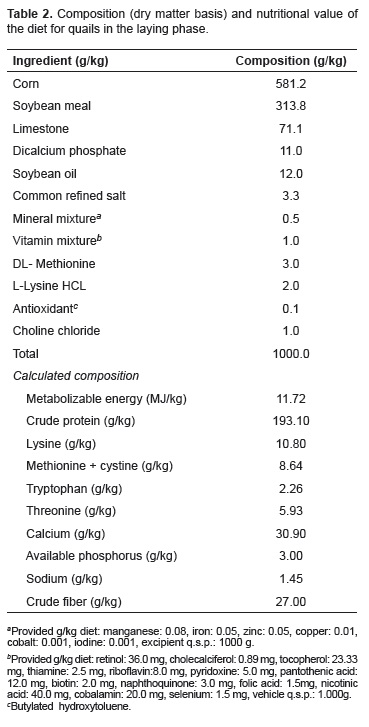
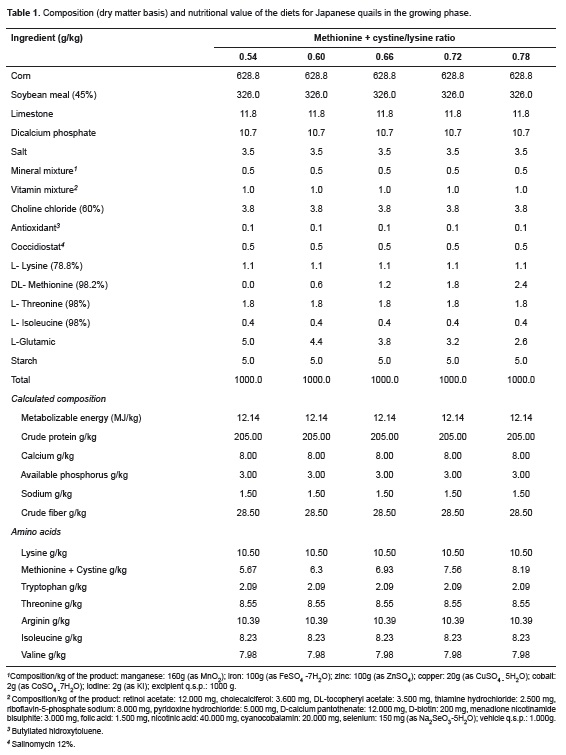
<body><![CDATA[<p>The experiment was conducted in the Poultry   Faculty of the Department of Animal Science   (Departamento de Zootecnia) at the Federal   University of Vi&ccedil;osa (Universidade Federal de   Vi&ccedil;osa). A total of 1000 one-day-old female   Japanese quails (<i>Coturnix japonica</i>) were used (body   weight 7.59 &plusmn; 0.15 g). The animals were randomly   distributed into five diets with increasing d(Met &#43;   Cys)/dLys ratios. The experimental unit consisted   of 20 birds per cage, with 10 replicates. Each cage   measured 50 cm<sup>2</sup> (width and length) and had a   wooden floor covered by 4 cm of shavings, providing   125 cm<sup>2</sup>/bird of floor space. One sixty-watt light bulb   was placed in each cage to warm the birds until they reached 15 days of age.</p>     <p>The cages were set inside a shed. They were made   of galvanized wire and covered and managed under   a raffia curtain for the first 15 days of the birds' life   to keep the place warm. This was also achieved by   hanging curtains on the laterals of the shed. One glass   pressure drinker was installed per cage. Quails were   guided to the water right after being housed. The glass   pressure drinkers were replaced by nipple drinkers at   12 days of age. One tray feeder (diameter: 18 cm) was   used per cage until birds were 12 days of age and   was then replaced by a gutter feeder placed in the front of the experimental units.</p>     <p>The units had 24 hours a day of artificial light (with   the same light bulbs used for warmth) until birds were   15 days old. Then, only natural light was provided   until birds were 40 days old to avoid premature   sexual maturity. Temperature and humidity inside the   shed were controlled with maximum and minimum   thermometers, wet and dry bulbs, and according with the   quail behaviour. Temperature was recorded at 4:00 p.m. and humidity at 9:00 a.m. and 3:00 p.m.</p>     <p>Birds were fed a corn-soybean meal basal diet   deficient in methionine &#43; cystine, with 205 g CP/kg,   12.14 MJ/kg, 10.5 g of digestible lysine/kg (suboptimal   level) and 5.67 g digestible methionine &#43;   cystine/kg, corresponding to a d(Met &#43; Cys)/dLys ratio of 0.54 (<a href="#t1">Table 1</a>).</p>      <p align="center"><a name="t1"><img src="/img/revistas/rccp/v28n4/v28n4a04t1.jpg"></a>     <p>&nbsp;</p>     <p>This basal diet was supplemented with five graded   levels of DL-methionine (99%), replacing glutamic   acid by a protein equivalent corresponding to the   d(Met &#43; Cys)/dLys ratio of 0.54 (5.67 g digestible   methionine &#43; cystine/kg, with no supplementation);   0.60 (6.3 g digestible methionine &#43; cystine/kg); 0.66   (6.93 g digestible methionine &#43; cystine/kg); 0.72   (7.56 g digestible methionine &#43; cystine/kg); and 0.78   (8.19 g digestible methionine &#43; cystine/kg). The diets   were iso-caloric and iso-nitrogen. The ratios between   amino acids and lysine proposed by NRC (1994)   were maintained, except for methionine &#43; cystine to   lysine, which varied according to the recommendation   by Pinto <i>et al.</i> (2003). To make sure the diet was not   deficient in any amino acid, 3% was added for each   amino acid requirement, except for methionine &#43; cystine and digestible lysine.</p>     <p>When quails reached 40 days they had their   beaks trimmed before moving them to egg laying   cages. This was to prevent cannibalism and was   in accordance with the guidelines of the Conselho   Nacional de Controle de Experimenta&ccedil;&atilde;o Animal -   CONCEA and was approved by the Ethics Committee   of the Department of Animal Science at the Federal University of Vi&ccedil;osa.</p>     <p><i>Laying phase (from 41 to 100 days of age)</i></p>     <p>Birds were moved to laying cages at 41 days of age keeping the same birds from each experimental unit together to evaluate growth and development during the laying phase. The experimental units were 50 x 34 cm galvanized wire cages in a ladder arrangement, equipped with gutter feeders in the front section and corresponding nipple drinkers. The stocking density per experimental unit was 106.2 cm<sup>2</sup>/bird. Light was provided 16 hours a day during the experimental period. Light supply was controlled with a timer, allowing the lights to be turned on and off at night and early morning, in accordance with common procedures in commercial poultry farms.</p>     ]]></body>
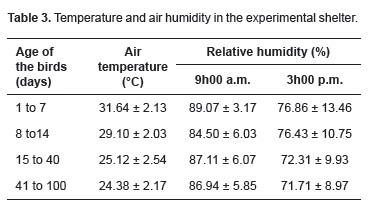
<body><![CDATA[<p>Temperature and humidity inside the shed were   daily recorded. The quails were fed a single diet   based on corn and soybean (<a href="#t2">Table 2</a>) in the laying   phase. This diet was formulated to meet the nutritional requirements proposed by Rostagno <i>et al.</i> (2011).</p>      <p align="center"><a name="t2"><img src="/img/revistas/rccp/v28n4/v28n4a04t2.jpg" width="369" height="727"></a>     <p>&nbsp;</p>     <p><i>Evaluated parameters</i></p>     <p>Feed intake was weekly measured and the average   intake of died birds was subtracted to calculate the real   consumption per experimental unit. Feed conversion   in the growing phase was calculated by dividing   feed intake by the body weight gain accumulated   in the period (kg of diet/kg weight gain). All birds   were weighed at the beginning and at the end of the   growing phase and at the laying phase to determine   weight at 40 and 110 days, and weight gain in each   phase. Mortality was daily recorded to determine   bird viability in the growing and laying phases.   All birds were weighed to determine uniformity of   experimental units and these weights were expressed   as a percentage of the individual weights, which were within 10% of the mean.</p>     <p>On reaching 40 days, two birds that were within   the average weight of each experimental unit were   slaughtered. Birds were slaughtered according to the   protocol for animal use in the Department of Animal   Science at the Federal University of Vi&ccedil;osa. Birds were   dry-plucked and feathers were weighed for feathering   calculations. Next, birds were eviscerated, cooled, frozen,   and ground to determine the contents of dry matter,   ether extract and crude protein according to the AOAC   (2000). Body fat and protein deposits were calculated by   slaughtering an additional group of 50 one-day-old quail.   They were compared to body fat and protein deposits of the quail slaughtered at the end of the growing phase.</p>     <p>For the calculation of body fat and protein deposits,   the value found in the sample was compared with the   average weight of the live animal in each experimental unit, according to Pinto <i>et al.</i> (2003).</p>     <p>To obtain the average egg production in the period,   the number of eggs produced, including cracked,   broken and abnormal eggs, were expressed over the   number of birds in the period (egg produced/bird/day)   and over the number of birds housed at the beginning   of the experiment (egg produced/housed bird). Feed conversion per dozen eggs was calculated as total feed intake in kilograms divided by a dozen eggs produced (kg/dz). Conversion per egg mass was calculated by dividing feed intake into kilograms by egg mass produced in kilograms (kg/kg). All the intact eggs produced per replicate in the last three days of each week were weighed and total weight was divided by the number of eggs weighed. The average weight of eggs was multiplied by the total number of eggs produced in the period. This total mass was divided by the total number of birds and also by the number of days in the period and expressed in grams of egg per bird, per day (g egg/bird/day).</p>     <p><i>Statistical analysis</i></p>     <p>The treatment effects were estimated by an analysis of   variables (p&lt;0.05) using linear and quadratic regression   models and including the linear response plateau (LRP),   in accordance with the best fit obtained for each variable   and considering the biological response of birds. The   SAS software (SAS Inst. Inc, Cary, NC, USA, 2014) was used for statistical analysis.</p>     ]]></body>
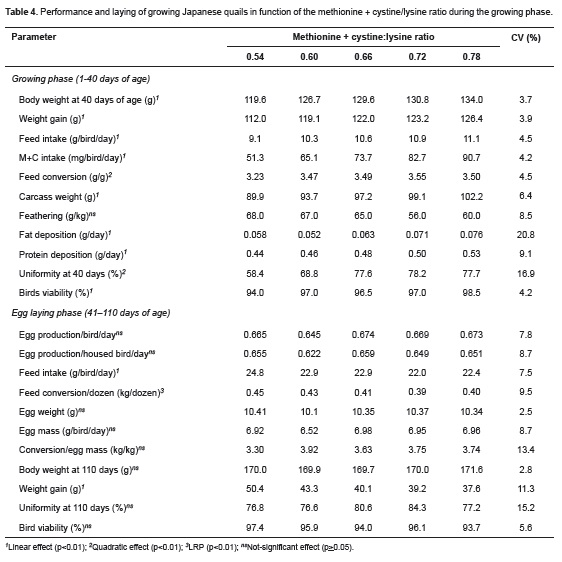
<body><![CDATA[<p>&nbsp;</p>     <p><b><font size="3">Results</font></b></p>     <p>Quails need a thermohygrometric environment of   35-37 &deg;C with 65% relative humidity in the first week   of life, and 32 &deg;C with 60% relative humidity in the   second week (15 days). Thereafter, birds no longer   require artificial heating because they present good   feathering at the optimum maximum and minimum   temperatures of 31 &deg;C and 19 &deg;C, respectively, with   60 to 65% relative humidity (Vohra, 1971; Reis, 1980;   Singh and Narayam, 2002; Pinto <i><i>et al.</i>,</i> 2003; Oliveira,   2004). In the adult phase (data from 41 to 100 days   of age) the thermal comfort zone of quails is within   18 and 22 &deg;C and air relative humidity is between 65 and 70% (Oliveira, 2004).</p>     <p>In general, the birds were provided appropriate   temperature and humidity in the experimental units   according with the literature, records of maximum and   minimum temperature and relative humidity (<a href="#t3">Table 3</a>)   as well as the behavior of the animals. Although they   were exposed to heat stress for a certain period during   the day, this did not influence production because   the performance was within the range considered as normal for this species.</p>      <p align="center"><a name="t3"><img src="/img/revistas/rccp/v28n4/v28n4a04t3.jpg"></a>     <p>&nbsp;</p>     <p>The upper limit of the thermoneutrality zone is   27 &deg;C (Vercese, 2010). This limit was not exceeded in   the experimental units after birds presented complete   feathering, thus preventing them from any potential negative environmental influence on performance.</p>     <p>During the growing phase, increasing levels   of inclusion of methionine in the diet resulted in a   linear increase (p&lt;0.01) in body weight at 40 days   (&#374;= 91.8470 &#43; 54.9833 X; R<sup>2</sup> = 0.91), in weight gain   at 40 days (&#374; = 84.3500 &#43; 54.8333 X; R<sup>2</sup> = 0.91),   feed intake (&#374; = 5.34000 &#43; 7.66667 X; R<sup>2</sup> = 0.85),   methionine &#43; cystine intake (&#374; = - 33.3400 &#43; 160.667 X;   R<sup>2</sup> = 0.99), carcass weight (&#374; = 63.4220 &#43; 50.0333 X;   R<sup>2</sup> = 0.99), fat deposition (&#374; = 0.0350000 &#43; 0.916667   X; R<sup>2</sup> = 0.80), protein deposition in the carcass   (&#374; = 0.240000 &#43; 0.366667 X; R<sup>2</sup> = 0.99), and viability (&#374; = 86.7000 &#43; 15.0000 X; R<sup>2</sup> = 0.76; <a href="#t4">Table 4</a>).</p>      <p align="center"><a name="t4"><img src="/img/revistas/rccp/v28n4/v28n4a04t4.jpg"></a>     <p>&nbsp;</p>     ]]></body>
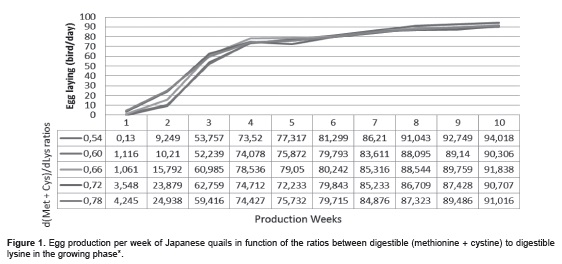
<body><![CDATA[<p>However, feed conversion and uniformity of birds   at 40 days were quadratically influenced (p&lt;0.01) and   feed conversion (&#374; = 1.82400 &#43; 15.1762 X - 10.7143   X<sup>2</sup>; R<sup>2</sup> = 0.94) worsened up to the estimated ratio of 0.71   and uniformity at 40 days (&#374;= -235.784 &#43; 866.171 X -   595.635 X<sup>2</sup>; R<sup>2</sup> = 0.99) was improved by a 0.73 d(Met   &#43; Cys)/dLys. The ratios between d(Met &#43; Cys)/dLys did not influence (p&gt;0.05) feathering percentage.</p>     <p>In the laying phase, only feed intake, weight gain   and feed conversion per dozen eggs were influenced   (p&lt;0.01) by the d(Met &#43; Cys)/dLys ratios in the diets   fed in the growing phase. A linear effect (p&lt;0.01)   occurred for feed intake (&#374; = 29.0620 &#43; 9.1666   X; R<sup>2</sup> = 0.70) and weight gain at 110 days of age   (&#374; = 74.7900 &#43; 49.5000 X; R<sup>2</sup> = 0.86). Although feed   conversion per dozen eggs had linearly improved,   LRP had the best fit (p&lt;0.01), estimating in 0.69 (&#374; = 0.6300 &#43; 0.3333 X, R<sup>2</sup> = 0.99; y = 0.400) the best d(Met &#43; Cys)/dLys ratio during the growing phase.</p>     <p>Daily egg production per bird linearly increased   (p&lt;0.01) in function of amino acid ratios in the first   two weeks of production according to the equations for   the first week: &#374; = -10.9184 &#43; 20.1133 X; R<sup>2</sup> = 0.91;   and 2<sup>nd</sup> week: &#374; = -37.1919 &#43; 83.0017 X; R<sup>2</sup> = 0.96.   Egg production/bird/day only presented differences   (p&gt;0.05) from the third week (<a href="#f1">Figure 1</a>). No effect   was observed (p&gt;0.05) for feathering in the growing   phase or in the laying phase for egg production/bird/   day or per housed bird, egg weight, egg mass, feed   conversion/egg mass, viability, weight, or uniformity of birds at 110 days.</p>      <p align="center"><a name="f1"><img src="/img/revistas/rccp/v28n4/v28n4a04f1.jpg"></a>     <p>&nbsp;</p>     <p>&nbsp;</p>     <p><font size="3"><b>Discussion</b></font></p>     <p>Because temperature and humidity in the   experimental units did not have extreme variations   and because there were no other factors that could   make experimental units heterogeneous, it can be   inferred that the results found were due to the different amino acid ratios.</p>     <p>High methionine &#43; cystine to lysine ratios provided   greater growth of birds. Low ratios were related to   low weight of the animals, increased feed ingestion,   and greater weight gain during the production phase.   Therefore, at the end of the growing period, lighter birds   had greater diet intake during the laying stage, resulting   in a compensatory gain with greater feed intake so all   birds reached a similar weight at 110 days of age. Quails   fed diets with the lowest d(Met &#43; Cys)/dLys ratios (0.54   and 0.60) did not have a proper weight at 40 days due to   greater egg production in the early phase of egg laying,   extending the growing phase to the age when birds usually would be in the laying phase.</p>     <p>Similarly, Pinto <i>et al.</i> (2003) found a linear effect   for body weight and weight gain in function of the   methionine &#43; cystine/lysine ratios in the diet of   growing quails. According to these authors, a ratio   lower than 0.68 between those amino acids may compromise weight gain in the growing phase.</p>     ]]></body>
<body><![CDATA[<p>Since there was no difference (p&gt;0.05) for   feathering, birds might have used energy and protein   mostly for maintenance instead of growth. Total dietary   protein and amino acids such as cystine, methionine,   arginine, isoleucine, leucine, valine, lysine, serine,   threonine, histidine, phenylalanine, tyrosine, and tryptophan are associated to feather formation.</p>     <p>A deficiency in crude protein could result in   deficient feathering of birds. This allows us to infer   that the protein reduction in this study with amino   acids supplementation in isonitrogenic diets did   not affect maintenance and feathering. However,   regarding performance, a greater d(Met &#43; Cys)/dLys ratio is required by quails.</p>     <p>A quadratic effect in the methionine &#43; cystine to   lysine ratio was observed by Pinto <i>et al.</i> (2003) on   bird feathering, which was increased to a ratio of 0.61.   Because the ratios which have provided the highest   feathering were lower than the best responses for   weight gain and feed conversion, those authors stated   that this parameter is not proper to set the requirements   of methionine &#43; cystine/lysine ratio for growing   quails. Although a similar response was noted in this   study, the best result for feathering was obtained using   a lower ratio than that required for weight gain and feed conversion. Consequenty, the ratio observed for feather percentage differs from the one determined by Pinto <i>et al.</i> (2003).</p>     <p>Considering the feathering results, quails had   privileged maintenance. Because of a large interaction   between methionine and maintenance requirement,   a deficiency of this amino acid might have occurred   to other functions in birds fed lower ratios between   methionine &#43; cystine/lysine. Since methionine is   an important sulfur amino acid in the translation   of messenger RNA, being the first amino acid   incorporated in the N-terminal position of all proteins,   methionine requirement for maintenance and synthesis   of feather proteins is as important as the need for body   protein synthesis. Therefore, diets that did not meet the   needs of sulfur amino acids of birds or did not meet   the appropriate methionine &#43; cystine/lysine ratio did   not provide the best development conditions, reducing viability and uniformity in the growing phase.</p>     <p>The increase in amino acid ratios provided bird's   greater feed intake and a methionine &#43; cystine/   lysine ratio in the growing phase. Quails fed greater   ratios presented better development and weight gain,   resulting in greater carcass weight and carcass protein   deposition, which was also followed by greater fat   deposition. Results different from the methionine   &#43; cystine/lysine ratios on the parameters of body   composition were observed by Pinto <i>et al.</i> (2003) who   found a quadratic variation with a maximum protein   deposition rate at 0.746% methionine &#43; cystine, corresponding to a 0.65 ratio.</p>     <p>In this study, the best d(Met &#43; Cys)/dLys ratio for   feed conversion was 0.71, although it was greater   for the best weight gain. Pinto <i>et al.</i> (2003) reported   0.66 d(Met &#43; Cys)/dLys ratio as the best response   for feed conversion. The d(Met &#43; Cys)/dLys ratios   recommended for growing quails by Rostagno <i>et al.</i>   (2011) and the total amino acids by the NRC (1994;   0.68 and 0.58, respectively), as well as the 0.54   recommended by Svacha <i>et al.</i> (1970), would not meet   the requirements for maximum final weight, weight   gain, and feed conversion estimated by recent studies   and the present work. Nevertheless, heavier quails did   not achieve greater egg production/bird/day or per   housed bird, which does not justify the adoption of the ratio by weight gains of birds at 40 and 110 days.</p>     <p>Production parameters such as egg weight and   egg mass as well as feed conversion/egg mass were   not influenced by d(Met &#43; Cys)/dLys ratios during   the growing phase, but lighter birds achieved lower   production in the first two initial weeks because of the   deviation of dietary nutrients for weight gain. The 0.54   and 0.60 d(Met &#43; Cys)/dLys ratios provided lower bird   weight until six weeks than that reported by Leeson   and Summers (2005), and Lima <i>et al.</i> (2011). Thus,   quails fed diets with the lowest ratios delayed to start   the egg-laying phase, presenting a production equal   to the others only from the third production week.   Feed conversion per dozen eggs was worst for quails   fed the lowest ratios (0.54 and 0.60) in the growing   phase due to a higher feed intake in the laying phase   directed to weight gain. No reports on methionine   &#43; cystine/lysine ratios on the growing phase with   repercussion on the laying phase of quails were found in the literature.</p>     <p>The best ratio for uniformity of quails was 0.73 at   40 days, so these birds maintained a uniform growth   and would not need higher feed intake in the laying   phase. This ratio is higher than 0.58, recommended   by NRC (1994), than 0.66, estimated by Pinto <i>et al.</i> (2003) and higher than 0.68, recommended by   Rostagno <i>et al.</i> (2011), although lower than 0.85,   determined by Leeson and Summers (2005), and closer to 0.70, determined by Silva and Costa (2009).</p>     <p>In conclusion, the 0.73 d(Met &#43; Cys)/dLys ratio   (7.66 g of methionine &#43; cystine/kg and 10.5 g of   lysine/kg) in the growing diet, corresponding to   83.85 mg intake of methionine &#43; cystine/bird/day   provides uniform growth and better productive   performance for Japanese quails during the early egg-laying phase.</p>     <p>&nbsp;</p>     ]]></body>
<body><![CDATA[<p><b><font size="3">Acknowledgements</font></b></p>     <p>To Funda&ccedil;&atilde;o de Amparo &agrave; Pesquisa do Estado de   Minas Gerais (Research Support Foundation of the State of Minas Gerais).</p>     <p align="left">&nbsp;</p>     <p align="left"><b><font size="3">Conflicts of interest</font></b></p>     <p align="left">The authors declare they have no conflicts of interest with regard to the work presented in this report.</p>     <p align="left">&nbsp;</p> <hr size="1" />     <p><b><font size="3">Notes</font></b></p>     <p><b><a name="a0" id="a0"><a href="#a1">&curren;</a></a></b>To cite this article: D'Avila Lima HJ, Bareto SLT, Donzele JL, Tinoco IFF, Ribas NS. Ideal ratio of digestible methionine plus cystine to digestible lysine for growing Japanese quails. Rev Colomb Cienc Pecu 2015; 28:313-322.</p> <hr size="1" />     <p>&nbsp;</p>     <p><b><font size="3">References</font></b></p>     ]]></body>
<body><![CDATA[<!-- ref --><p>AOAC (Association of Official Analytical Chemists). Official   methods of analysis, 17nd ed., Gaithersburg (MD): AOAC International Publishers; 2000.    &nbsp;&nbsp;&nbsp;&nbsp;&nbsp;&nbsp;&nbsp;&nbsp;[&#160;<a href="javascript:void(0);" onclick="javascript: window.open('/scielo.php?script=sci_nlinks&ref=000103&pid=S0120-0690201500040000400001&lng=','','width=640,height=500,resizable=yes,scrollbars=1,menubar=yes,');">Links</a>&#160;]<!-- end-ref --></p>     <!-- ref --><p>   Leeson S, Summers JD. Commercial poultry nutrition. 3nd ed.   Guelph (Ontario): University Books Publishers; 2005.    &nbsp;&nbsp;&nbsp;&nbsp;&nbsp;&nbsp;&nbsp;&nbsp;[&#160;<a href="javascript:void(0);" onclick="javascript: window.open('/scielo.php?script=sci_nlinks&ref=000105&pid=S0120-0690201500040000400002&lng=','','width=640,height=500,resizable=yes,scrollbars=1,menubar=yes,');">Links</a>&#160;]<!-- end-ref --></p>     <!-- ref --><p>   Lima HJD, Barreto SLT, Melo DS. Diferentes pesos corporais ao   final da fase de recria sobre o desempenho produtivo de codornas   japonesas. Encicl Biosf 2011; 7:404-409.    &nbsp;&nbsp;&nbsp;&nbsp;&nbsp;&nbsp;&nbsp;&nbsp;[&#160;<a href="javascript:void(0);" onclick="javascript: window.open('/scielo.php?script=sci_nlinks&ref=000107&pid=S0120-0690201500040000400003&lng=','','width=640,height=500,resizable=yes,scrollbars=1,menubar=yes,');">Links</a>&#160;]<!-- end-ref --></p>     <!-- ref --><p>   Mandal AB, Elangovan AV, Tyagi PK. Effect of enzyme   supplementation on the metabolizable energy contento of solventextracted   rapeseed and sunflower seed meals for chicken, guinea   fowl and quail. Br Poult Sci 2005; 46:75-79.    &nbsp;&nbsp;&nbsp;&nbsp;&nbsp;&nbsp;&nbsp;&nbsp;[&#160;<a href="javascript:void(0);" onclick="javascript: window.open('/scielo.php?script=sci_nlinks&ref=000109&pid=S0120-0690201500040000400004&lng=','','width=640,height=500,resizable=yes,scrollbars=1,menubar=yes,');">Links</a>&#160;]<!-- end-ref --></p>     <!-- ref --><p>   NRC (National Research Council). Nutrient requirements of   poultry. Washington (DC): National Academy Press; 1994.    &nbsp;&nbsp;&nbsp;&nbsp;&nbsp;&nbsp;&nbsp;&nbsp;[&#160;<a href="javascript:void(0);" onclick="javascript: window.open('/scielo.php?script=sci_nlinks&ref=000111&pid=S0120-0690201500040000400005&lng=','','width=640,height=500,resizable=yes,scrollbars=1,menubar=yes,');">Links</a>&#160;]<!-- end-ref --></p>     ]]></body>
<body><![CDATA[<!-- ref --><p>   Oliveira BL. Import&acirc;ncia do manejo na produ&ccedil;&atilde;o de ovos de   codornas. Proceedings of the 2th Simp&oacute;sio internacional de   coturnicultura; 2004; Lavras, Brasil. Lavras: UFLA; 2004.    &nbsp;&nbsp;&nbsp;&nbsp;&nbsp;&nbsp;&nbsp;&nbsp;[&#160;<a href="javascript:void(0);" onclick="javascript: window.open('/scielo.php?script=sci_nlinks&ref=000113&pid=S0120-0690201500040000400006&lng=','','width=640,height=500,resizable=yes,scrollbars=1,menubar=yes,');">Links</a>&#160;]<!-- end-ref --></p>     <!-- ref --><p>   Pinto R, Ferreira AS, Donzele JL, Albino LFT. Exig&ecirc;ncia de   metionina mais cistina para codornas japonesas em crescimento.   Rev Bras de Zoot 2003; 32:1174-1181.    &nbsp;&nbsp;&nbsp;&nbsp;&nbsp;&nbsp;&nbsp;&nbsp;[&#160;<a href="javascript:void(0);" onclick="javascript: window.open('/scielo.php?script=sci_nlinks&ref=000115&pid=S0120-0690201500040000400007&lng=','','width=640,height=500,resizable=yes,scrollbars=1,menubar=yes,');">Links</a>&#160;]<!-- end-ref --></p>     <!-- ref --><p>   Reis LFSD. Codornizes, cria&ccedil;&atilde;o e explora&ccedil;&atilde;o. Lisboa: Agros   Publishers; 1980.    &nbsp;&nbsp;&nbsp;&nbsp;&nbsp;&nbsp;&nbsp;&nbsp;[&#160;<a href="javascript:void(0);" onclick="javascript: window.open('/scielo.php?script=sci_nlinks&ref=000117&pid=S0120-0690201500040000400008&lng=','','width=640,height=500,resizable=yes,scrollbars=1,menubar=yes,');">Links</a>&#160;]<!-- end-ref --></p>     <!-- ref --><p>   Rostagno HS, Albino LFT, Donzele JL, Gomes PC, Oliveira   RF, Lopes DC, Ferreira AS, Barreto SLT, Euclides RF. Tabelas   Brasileiras para Aves e Suinos: Composi&ccedil;&atilde;o de Alimentos e   Exig&ecirc;ncias Nutricionais. Vi&ccedil;osa Publishers; 2011.    &nbsp;&nbsp;&nbsp;&nbsp;&nbsp;&nbsp;&nbsp;&nbsp;[&#160;<a href="javascript:void(0);" onclick="javascript: window.open('/scielo.php?script=sci_nlinks&ref=000119&pid=S0120-0690201500040000400009&lng=','','width=640,height=500,resizable=yes,scrollbars=1,menubar=yes,');">Links</a>&#160;]<!-- end-ref --></p>     <!-- ref --><p>   SAS INSTITUTE. SAS/STAT: user's guide. Version 9.4. Cary:   SAS Institute, 2014.    &nbsp;&nbsp;&nbsp;&nbsp;&nbsp;&nbsp;&nbsp;&nbsp;[&#160;<a href="javascript:void(0);" onclick="javascript: window.open('/scielo.php?script=sci_nlinks&ref=000121&pid=S0120-0690201500040000400010&lng=','','width=640,height=500,resizable=yes,scrollbars=1,menubar=yes,');">Links</a>&#160;]<!-- end-ref --></p>     ]]></body>
<body><![CDATA[<!-- ref --><p>   Silva JHV, Costa FGP. Tabelas para codornas japonesas e   europeias. 3nd ed. S&atilde;o Paulo: Funep Publishers, 2009.    &nbsp;&nbsp;&nbsp;&nbsp;&nbsp;&nbsp;&nbsp;&nbsp;[&#160;<a href="javascript:void(0);" onclick="javascript: window.open('/scielo.php?script=sci_nlinks&ref=000123&pid=S0120-0690201500040000400011&lng=','','width=640,height=500,resizable=yes,scrollbars=1,menubar=yes,');">Links</a>&#160;]<!-- end-ref --></p>     <!-- ref --><p>   Singh RV, Narayan R. Produ&ccedil;&atilde;o de codornas nos tr&oacute;picos.   Proceedings of the 1th Simp&oacute;sio internacional de coturnicultura;   2002; Lavras, Brasil. Lavras: UFLA; 2002.    &nbsp;&nbsp;&nbsp;&nbsp;&nbsp;&nbsp;&nbsp;&nbsp;[&#160;<a href="javascript:void(0);" onclick="javascript: window.open('/scielo.php?script=sci_nlinks&ref=000125&pid=S0120-0690201500040000400012&lng=','','width=640,height=500,resizable=yes,scrollbars=1,menubar=yes,');">Links</a>&#160;]<!-- end-ref --></p>     <!-- ref --><p>   Svacha A, Weber CW, Reid BL. Lysine, methionine and glycine   requirements of Japanese quail to five weeks of age. Poult Sci   1970; 49:54-59.    &nbsp;&nbsp;&nbsp;&nbsp;&nbsp;&nbsp;&nbsp;&nbsp;[&#160;<a href="javascript:void(0);" onclick="javascript: window.open('/scielo.php?script=sci_nlinks&ref=000127&pid=S0120-0690201500040000400013&lng=','','width=640,height=500,resizable=yes,scrollbars=1,menubar=yes,');">Links</a>&#160;]<!-- end-ref --></p>     <!-- ref --><p>   Vercese F. Efeito da temperatura sobre o desempenho e a   qualidade dos ovos de codornas japonesas. &#91;Msc Thesis&#93;. S&atilde;o   Paulo: Universidade Estadual Paulista; 2010.    &nbsp;&nbsp;&nbsp;&nbsp;&nbsp;&nbsp;&nbsp;&nbsp;[&#160;<a href="javascript:void(0);" onclick="javascript: window.open('/scielo.php?script=sci_nlinks&ref=000129&pid=S0120-0690201500040000400014&lng=','','width=640,height=500,resizable=yes,scrollbars=1,menubar=yes,');">Links</a>&#160;]<!-- end-ref --></p>     <!-- ref --><p>   Vohra PA. Review of the nutrition of Japanese Quail. World Poult   Sci J 1971; 27:26-33.    &nbsp;&nbsp;&nbsp;&nbsp;&nbsp;&nbsp;&nbsp;&nbsp;[&#160;<a href="javascript:void(0);" onclick="javascript: window.open('/scielo.php?script=sci_nlinks&ref=000131&pid=S0120-0690201500040000400015&lng=','','width=640,height=500,resizable=yes,scrollbars=1,menubar=yes,');">Links</a>&#160;]<!-- end-ref --></p>     ]]></body>
<body><![CDATA[<p>&nbsp;</p>     <p>&nbsp;</p> </font>      ]]></body><back>
<ref-list>
<ref id="B1">
<nlm-citation citation-type="book">
<collab>AOAC (Association of Official Analytical Chemists)</collab>
<source><![CDATA[Official methods of analysis]]></source>
<year>2000</year>
<edition>17nd</edition>
<publisher-loc><![CDATA[Gaithersburg ]]></publisher-loc>
<publisher-name><![CDATA[AOAC International Publishers]]></publisher-name>
</nlm-citation>
</ref>
<ref id="B2">
<nlm-citation citation-type="">
<person-group person-group-type="author">
<name>
<surname><![CDATA[Leeson]]></surname>
<given-names><![CDATA[S]]></given-names>
</name>
<name>
<surname><![CDATA[Summers]]></surname>
</name>
</person-group>
<source><![CDATA[]]></source>
<year></year>
</nlm-citation>
</ref>
<ref id="B3">
<nlm-citation citation-type="journal">
<person-group person-group-type="author">
<name>
<surname><![CDATA[Lima]]></surname>
<given-names><![CDATA[HJD]]></given-names>
</name>
<name>
<surname><![CDATA[Barreto]]></surname>
<given-names><![CDATA[SLT]]></given-names>
</name>
<name>
<surname><![CDATA[Melo]]></surname>
<given-names><![CDATA[DS]]></given-names>
</name>
</person-group>
<article-title xml:lang="es"><![CDATA[Diferentes pesos corporais ao final da fase de recria sobre o desempenho produtivo de codornas japonesas]]></article-title>
<source><![CDATA[Encicl Biosf]]></source>
<year>2011</year>
<volume>7</volume>
<page-range>404-409</page-range></nlm-citation>
</ref>
<ref id="B4">
<nlm-citation citation-type="journal">
<person-group person-group-type="author">
<name>
<surname><![CDATA[Mandal]]></surname>
<given-names><![CDATA[AB]]></given-names>
</name>
<name>
<surname><![CDATA[Elangovan]]></surname>
<given-names><![CDATA[AV]]></given-names>
</name>
<name>
<surname><![CDATA[Tyagi]]></surname>
<given-names><![CDATA[PK]]></given-names>
</name>
</person-group>
<article-title xml:lang="en"><![CDATA[Effect of enzyme supplementation on the metabolizable energy contento of solventextracted rapeseed and sunflower seed meals for chicken, guinea fowl and quail]]></article-title>
<source><![CDATA[Br Poult Sci]]></source>
<year>2005</year>
<volume>46</volume>
<page-range>75-79</page-range></nlm-citation>
</ref>
<ref id="B5">
<nlm-citation citation-type="book">
<collab>NRC (National Research Council)</collab>
<source><![CDATA[Nutrient requirements of poultry]]></source>
<year>1994</year>
<publisher-loc><![CDATA[Washington^eDC DC]]></publisher-loc>
<publisher-name><![CDATA[National Academy Press]]></publisher-name>
</nlm-citation>
</ref>
<ref id="B6">
<nlm-citation citation-type="book">
<person-group person-group-type="author">
<name>
<surname><![CDATA[Oliveira]]></surname>
<given-names><![CDATA[BL]]></given-names>
</name>
</person-group>
<source><![CDATA[Importância do manejo na produção de ovos de codornas]]></source>
<year>2004</year>
<publisher-loc><![CDATA[Lavras ]]></publisher-loc>
<publisher-name><![CDATA[UFLA]]></publisher-name>
</nlm-citation>
</ref>
<ref id="B7">
<nlm-citation citation-type="journal">
<person-group person-group-type="author">
<name>
<surname><![CDATA[Pinto]]></surname>
<given-names><![CDATA[R]]></given-names>
</name>
<name>
<surname><![CDATA[Ferreira]]></surname>
<given-names><![CDATA[AS]]></given-names>
</name>
<name>
<surname><![CDATA[Donzele]]></surname>
<given-names><![CDATA[JL]]></given-names>
</name>
<name>
<surname><![CDATA[Albino]]></surname>
<given-names><![CDATA[LFT]]></given-names>
</name>
</person-group>
<article-title xml:lang="pt"><![CDATA[Exigência de metionina mais cistina para codornas japonesas em crescimento]]></article-title>
<source><![CDATA[Rev Bras de Zoot]]></source>
<year>2003</year>
<volume>32</volume>
<page-range>1174-1181</page-range></nlm-citation>
</ref>
<ref id="B8">
<nlm-citation citation-type="book">
<person-group person-group-type="author">
<name>
<surname><![CDATA[Reis]]></surname>
<given-names><![CDATA[LFSD]]></given-names>
</name>
</person-group>
<source><![CDATA[Codornizes, criação e exploração]]></source>
<year>1980</year>
<publisher-loc><![CDATA[Lisboa ]]></publisher-loc>
<publisher-name><![CDATA[Agros Publishers]]></publisher-name>
</nlm-citation>
</ref>
<ref id="B9">
<nlm-citation citation-type="book">
<person-group person-group-type="author">
<name>
<surname><![CDATA[Rostagno]]></surname>
<given-names><![CDATA[HS]]></given-names>
</name>
<name>
<surname><![CDATA[Albino]]></surname>
<given-names><![CDATA[LFT]]></given-names>
</name>
<name>
<surname><![CDATA[Donzele]]></surname>
<given-names><![CDATA[JL]]></given-names>
</name>
<name>
<surname><![CDATA[Gomes]]></surname>
<given-names><![CDATA[PC]]></given-names>
</name>
<name>
<surname><![CDATA[Oliveira]]></surname>
<given-names><![CDATA[RF]]></given-names>
</name>
<name>
<surname><![CDATA[Lopes]]></surname>
<given-names><![CDATA[DC]]></given-names>
</name>
<name>
<surname><![CDATA[Ferreira]]></surname>
<given-names><![CDATA[AS]]></given-names>
</name>
<name>
<surname><![CDATA[Barreto]]></surname>
<given-names><![CDATA[SLT]]></given-names>
</name>
<name>
<surname><![CDATA[Euclides]]></surname>
<given-names><![CDATA[RF]]></given-names>
</name>
</person-group>
<source><![CDATA[Tabelas Brasileiras para Aves e Suinos: Composição de Alimentos e Exigências Nutricionais]]></source>
<year>2011</year>
<publisher-name><![CDATA[Viçosa Publishers]]></publisher-name>
</nlm-citation>
</ref>
<ref id="B10">
<nlm-citation citation-type="book">
<collab>SAS INSTITUTE</collab>
<source><![CDATA[SAS/STAT: user's guide. Version 9.4]]></source>
<year>2014</year>
<publisher-loc><![CDATA[Cary ]]></publisher-loc>
<publisher-name><![CDATA[SAS Institute]]></publisher-name>
</nlm-citation>
</ref>
<ref id="B11">
<nlm-citation citation-type="book">
<person-group person-group-type="author">
<name>
<surname><![CDATA[Silva]]></surname>
<given-names><![CDATA[JHV]]></given-names>
</name>
<name>
<surname><![CDATA[Costa]]></surname>
<given-names><![CDATA[FGP]]></given-names>
</name>
</person-group>
<source><![CDATA[Tabelas para codornas japonesas e europeias]]></source>
<year>2009</year>
<publisher-loc><![CDATA[São Paulo ]]></publisher-loc>
<publisher-name><![CDATA[Funep Publishers]]></publisher-name>
</nlm-citation>
</ref>
<ref id="B12">
<nlm-citation citation-type="confpro">
<person-group person-group-type="author">
<name>
<surname><![CDATA[Singh]]></surname>
<given-names><![CDATA[RV]]></given-names>
</name>
<name>
<surname><![CDATA[Narayan]]></surname>
<given-names><![CDATA[R]]></given-names>
</name>
</person-group>
<source><![CDATA[Produção de codornas nos trópicos]]></source>
<year>2002</year>
<conf-name><![CDATA[1th Simpósio internacional de coturnicultura]]></conf-name>
<conf-loc> </conf-loc>
<publisher-loc><![CDATA[Lavras ]]></publisher-loc>
<publisher-name><![CDATA[UFLA]]></publisher-name>
</nlm-citation>
</ref>
<ref id="B13">
<nlm-citation citation-type="journal">
<person-group person-group-type="author">
<name>
<surname><![CDATA[Svacha]]></surname>
<given-names><![CDATA[A]]></given-names>
</name>
<name>
<surname><![CDATA[Weber]]></surname>
<given-names><![CDATA[CW]]></given-names>
</name>
<name>
<surname><![CDATA[Reid]]></surname>
<given-names><![CDATA[BL]]></given-names>
</name>
</person-group>
<article-title xml:lang="en"><![CDATA[Lysine, methionine and glycine requirements of Japanese quail to five weeks of age]]></article-title>
<source><![CDATA[Poult Sci]]></source>
<year>1970</year>
<volume>49</volume>
<page-range>54-59</page-range></nlm-citation>
</ref>
<ref id="B14">
<nlm-citation citation-type="book">
<person-group person-group-type="author">
<name>
<surname><![CDATA[Vercese]]></surname>
<given-names><![CDATA[F]]></given-names>
</name>
</person-group>
<source><![CDATA[Efeito da temperatura sobre o desempenho e a qualidade dos ovos de codornas japonesas]]></source>
<year>2010</year>
<publisher-loc><![CDATA[São Paulo ]]></publisher-loc>
<publisher-name><![CDATA[Universidade Estadual Paulista]]></publisher-name>
</nlm-citation>
</ref>
<ref id="B15">
<nlm-citation citation-type="journal">
<person-group person-group-type="author">
<name>
<surname><![CDATA[Vohra]]></surname>
<given-names><![CDATA[PA]]></given-names>
</name>
</person-group>
<article-title xml:lang="en"><![CDATA[Review of the nutrition of Japanese Quail]]></article-title>
<source><![CDATA[World Poult Sci J]]></source>
<year>1971</year>
<volume>27</volume>
<page-range>26-33</page-range></nlm-citation>
</ref>
</ref-list>
</back>
</article>