<?xml version="1.0" encoding="ISO-8859-1"?><article xmlns:mml="http://www.w3.org/1998/Math/MathML" xmlns:xlink="http://www.w3.org/1999/xlink" xmlns:xsi="http://www.w3.org/2001/XMLSchema-instance">
<front>
<journal-meta>
<journal-id>0120-0690</journal-id>
<journal-title><![CDATA[Revista Colombiana de Ciencias Pecuarias]]></journal-title>
<abbrev-journal-title><![CDATA[Rev Colom Cienc Pecua]]></abbrev-journal-title>
<issn>0120-0690</issn>
<publisher>
<publisher-name><![CDATA[Facultad de Ciencias Agrarias, Universidad de Antioquia]]></publisher-name>
</publisher>
</journal-meta>
<article-meta>
<article-id>S0120-06902015000400005</article-id>
<article-id pub-id-type="doi">10.17533/udea.rccp.v28n4a04</article-id>
<title-group>
<article-title xml:lang="en"><![CDATA[Presence of IgG antibodies against reproductive infections in breeding bulls of Magdalena Medio, Colombia]]></article-title>
<article-title xml:lang="es"><![CDATA[Presencia de anticuerpos tipo IgG contra infecciones reproductivas en toros reproductores de la región del Magdalena Medio, Colombia]]></article-title>
<article-title xml:lang="pt"><![CDATA[Presença de anticorpos IgG contra infecções reprodutivas de touros reprodutores do Magdalena Médio, Colômbia]]></article-title>
</title-group>
<contrib-group>
<contrib contrib-type="author">
<name>
<surname><![CDATA[Camacho M]]></surname>
<given-names><![CDATA[Rodolfo]]></given-names>
</name>
<xref ref-type="aff" rid="A01"/>
</contrib>
<contrib contrib-type="author">
<name>
<surname><![CDATA[Carvajal]]></surname>
<given-names><![CDATA[Lenny Y]]></given-names>
</name>
<xref ref-type="aff" rid="A01"/>
</contrib>
<contrib contrib-type="author">
<name>
<surname><![CDATA[Castellanos-Dominguez]]></surname>
<given-names><![CDATA[Yeny Z]]></given-names>
</name>
<xref ref-type="aff" rid="A01"/>
</contrib>
<contrib contrib-type="author">
<name>
<surname><![CDATA[Díaz]]></surname>
<given-names><![CDATA[Wilson F]]></given-names>
</name>
<xref ref-type="aff" rid="A02"/>
</contrib>
<contrib contrib-type="author">
<name>
<surname><![CDATA[Vásquez]]></surname>
<given-names><![CDATA[María C]]></given-names>
</name>
<xref ref-type="aff" rid="A02"/>
<xref ref-type="aff" rid="A03"/>
</contrib>
</contrib-group>
<aff id="A01">
<institution><![CDATA[,Universidad de Santander (UDES)  ]]></institution>
<addr-line><![CDATA[Bucaramanga ]]></addr-line>
<country>Colombia</country>
</aff>
<aff id="A02">
<institution><![CDATA[,Universidad de Santander (UDES)  ]]></institution>
<addr-line><![CDATA[Bucaramanga ]]></addr-line>
<country>Colombia</country>
</aff>
<aff id="A03">
<institution><![CDATA[,Universidad de Santander (UDES)  ]]></institution>
<addr-line><![CDATA[Santander ]]></addr-line>
<country>Colombia</country>
</aff>
<pub-date pub-type="pub">
<day>00</day>
<month>12</month>
<year>2015</year>
</pub-date>
<pub-date pub-type="epub">
<day>00</day>
<month>12</month>
<year>2015</year>
</pub-date>
<volume>28</volume>
<numero>4</numero>
<fpage>323</fpage>
<lpage>330</lpage>
<copyright-statement/>
<copyright-year/>
<self-uri xlink:href="http://www.scielo.org.co/scielo.php?script=sci_arttext&amp;pid=S0120-06902015000400005&amp;lng=en&amp;nrm=iso"></self-uri><self-uri xlink:href="http://www.scielo.org.co/scielo.php?script=sci_abstract&amp;pid=S0120-06902015000400005&amp;lng=en&amp;nrm=iso"></self-uri><self-uri xlink:href="http://www.scielo.org.co/scielo.php?script=sci_pdf&amp;pid=S0120-06902015000400005&amp;lng=en&amp;nrm=iso"></self-uri><abstract abstract-type="short" xml:lang="en"><p><![CDATA[Background: cattle farming is an important economic activity in several regions of Colombia. However, farmers are unaware of their cattle health status, and particularly of bacterial, parasitic, and viral diseases, which affect reproduction and profitability. Objective: to assess the presence of IgG antibodies against infectious bovine rhinotracheitis (IBR), bovine viral diarrhea (BVD), bovine leukosis, leptospirosis, brucellosis, and Neospora caninum in breeding bulls in the Magdalena Medio of Colombia, according to age, breed, and origin. Methods: a descriptive, cross-sectional study was conducted with 174 male breeding cattle from several subspecies. Animals were above 18 months of age and belonged to dual-purpose farms in the Magdalena Medio region. Presence of IgG anti-IBR, BVD, brucellosis, neosporosis, and leukosis antibodies were determined with an enzyme-linked immunosorbent assay (ELISA). A sample of 156 males was assessed for leptospirosis using a microscopic agglutination test (MAT) in a dark field. Results: IgG anti-IBR antibodies were found in 92.5% of the animals, anti-BVD in 62.6%, anti-Neospora caninum in 79.3%, anti-Brucella abortus in 4.02%, anti-Leptospira pomona in 8.33%, and anti-L. hardjo in 15.38%, with >1:100 titres. Besides, 64.94% prevalence was observed for bovine leukosis. Conclusions: a high prevalence of IgG anti-IBR, IgG anti-BVD, IgG anti- Neospora caninum, IgG anti-leukosis, and IgG anti-lepstospirosis antibodies were observed in Magdalena Medio bulls. With respect to B. abortus, confirmatory and competitive ELISA test should be performed and sanitary standards need to be established. Detection of IgG antibodies among bulls reveals poor sanitary conditions, absent of protective-vaccination antibodies and an urgent need for health control measurements.]]></p></abstract>
<abstract abstract-type="short" xml:lang="es"><p><![CDATA[Antecedentes: la ganadería bovina es una importante actividad económica desarrollada en varias regiones del país, sin embargo, los ganaderos desconocen el estado sanitario de los bovinos con respecto a enfermedades bacterianas, parasitarias y virales, lo que afecta la reproducción y la rentabilidad. Objetivo: evidenciar la presencia de anticuerpos tipo IgG anti-rinotraqueitis infecciosa bovina (IBR), diarrea viral bovina (BVD), leucosis bovina, leptospirosis, brucelosis y Neospora caninum en los toros reproductores del Magdalena Medio colombiano, en asociación con variables de edad, raza y procedencia. Métodos: se realizó un estudio descriptivo de corte transversal en un grupo poblacional de 174 machos reproductores bovinos de diferentes subespecies. Los animales eran mayores de 18 meses en fincas destinadas a ganadería doble propósito ubicadas en la región del Magdalena Medio. Mediante un ensayo de inmunoabsorción enzimática (ELISA) se determinó la presencia de anticuerpos tipo IgG anti-IBR, BVD, brucelosis, neosporosis y leucosis. Para el caso de la leptospirosis, a 156 de los machos se les realizó la prueba de microaglutinación en campo oscuro (MAT). Resultados: se hallaron anticuerpos tipo IgG anti-IBR en un 92,5%, anti-BVD en el 62,6%, anti-Neospora caninum 79,3%, anti-Brucella abortus 4,02%, anti-Leptospira pomona 8,33% y anti-L. hardjo 15,38%, con títulos >1:100. Además, para leucosis bovina se obtuvo una prevalencia del 64,94%. Conclusión: se observaron altos porcentajes de casos con presencia de anticuerpos IgG anti-IBR, BVD, N. caninum, leucosis y lepstospirosis en el ganado bovino del Magdalena Medio colombiano. Para B. abortus debe realizarse la prueba confirmativa ELISA competitiva y aplicar la norma sanitaria. La determinación de anticuerpos tipo IgG permitió conocer el delicado estado sanitario de los reproductores bovinos, teniendo en cuenta que no han recibido ningún esquema de vacunación y se hace necesario un adecuado control sanitario.]]></p></abstract>
<abstract abstract-type="short" xml:lang="pt"><p><![CDATA[Antecedentes: a pecuária é uma atividade econômica importante em várias regiões do país, no entanto, os agricultores não têm conhecimento do estado de saúde do gado em relação adoenças bacterianas, parasitárias e virais. É por esta razão que as perdas econômicas aumentam e diminuem a qualidade de reprodução. Objetivo: demonstrar a presença de anticorpos IgG para rinotraqueíte-viral bovina (IBR), diarréia viral bovina (BVD), leucose bovina, leptospirose, brucelose e Neospora caninum. Nos machos reprodutores do Magdalena Medio tendo em conta as variáveis idade, raça e origens. Métodos: i foi realizada estudo descritivo transversal em duas populações de 174 machos reprodutores de diferentes subespécies de gado com mais de 18 meses de edad procedentes de fazendas utilizadas para a pecuária de duplo propósito, localizadas na região do Madalena Médio. Para detectar a presença de anticorpos IgG anti-IBR, BVD, brucelose, e enzoótica, neosporose foi determinada pela técnica de ensaio imunoenzimático (ELISA). Para o caso de leptospirose foi realizado teste de microaglutinação em campo escuro (MAT). Resultados: anticorpos IgG anti-IBR foram encontrados em 92,5%, anti-BVD num 62,6%, anti-Neospora caninum num 79,3%, anti-Brucella abortus 4,02%, anti-Leptospira pomona num 8,33% e anti-L. hardjo 15,38% com títulos > 1:100. Para leucose bovina, uma percentagem de 64,94%, foi obtido. Conclusão: foram observados altos percentagens de casos na presença de anticorpos IgG anti-IBR, BVD, N. caninum, lepstospirosis e leucose nos bovinos do Madalena Médio colombiano, o teste confirmatorio ELISA competitivo. Para a determinação de B. abortus deve ser realizado e dar cumplimento a normatividade sanitaria. A determinação de anticorpos IgG tem permitido conhecer o delicado estado sanitario dos reprodutores bovinos, considerando que eles não receberam qualquer vacinação é necessário um adequado controle de saúde.]]></p></abstract>
<kwd-group>
<kwd lng="en"><![CDATA[bovine viral diarrhea]]></kwd>
<kwd lng="en"><![CDATA[brucellosis]]></kwd>
<kwd lng="en"><![CDATA[enzyme-linked immunosorbent assay]]></kwd>
<kwd lng="en"><![CDATA[infectious bovine rhinotracheitis]]></kwd>
<kwd lng="en"><![CDATA[leptospirosis]]></kwd>
<kwd lng="en"><![CDATA[Neospora caninum]]></kwd>
<kwd lng="es"><![CDATA[brucelosis]]></kwd>
<kwd lng="es"><![CDATA[diarrea viral bovina]]></kwd>
<kwd lng="es"><![CDATA[ensayo de inmunoabsorción enzimática]]></kwd>
<kwd lng="es"><![CDATA[leptospirosis]]></kwd>
<kwd lng="es"><![CDATA[Neospora caninum]]></kwd>
<kwd lng="es"><![CDATA[rinotraqueitis infecciosa bovina]]></kwd>
<kwd lng="pt"><![CDATA[brucelose]]></kwd>
<kwd lng="pt"><![CDATA[diarréia viral bovina]]></kwd>
<kwd lng="pt"><![CDATA[ensaio imunoenzimático]]></kwd>
<kwd lng="pt"><![CDATA[leptospirose]]></kwd>
<kwd lng="pt"><![CDATA[Neospora caninum]]></kwd>
<kwd lng="pt"><![CDATA[rinotraqueíte infecciosa bovina]]></kwd>
</kwd-group>
</article-meta>
</front><body><![CDATA[  <font size="2" face="Verdana, Arial, Helvetica, sans-serif">      <p align="right"><b><font size="3">ORIGINAL ARTICLE</font></b></p>     <p align="right">&nbsp;</p>     <p align="right">doi: <a href="http://dx.doi.org/10.17533/udea.rccp.v28n4a04" target="_blank">10.17533/udea.rccp.v28n4a04</a></p>     <p align="right">&nbsp;</p>     <p align="center"><font size="4"><b>Presence of IgG antibodies against reproductive infections in breeding bulls of Magdalena Medio, Colombia<a name="a1" id="a1"><a href="#a0"><sup>&curren;</sup></a></a></b></font></p>     <p align="center">&nbsp;</p>     <p align="center"><i><font size="3">Presencia de anticuerpos tipo IgG contra infecciones reproductivas en toros reproductores de la regi&oacute;n del Magdalena Medio, Colombia</font></i></p>     <p align="center">&nbsp;</p> <font size="3">    <p align="center"><i>Presen&ccedil;a de anticorpos IgG contra infec&ccedil;&otilde;es reprodutivas de touros reprodutores do Magdalena   M&eacute;dio, Col&ocirc;mbia</i></p> </font>     ]]></body>
<body><![CDATA[<p align="center">&nbsp;</p>     <p align="center">&nbsp;</p>     <p align="left"><b>Rodolfo Camacho M<sup>1</sup>, Bact, Lab Clin; Lenny Y Carvajal<sup>1</sup>, Bact, Lab Clin; Yeny Z Castellanos-Dominguez<sup>1</sup>, MSc;   Wilson F D&iacute;az<sup>2</sup>, MV, MBA; Mar&iacute;a C V&aacute;squez<sup>2</sup><sup></sup></b><b><sup><a href="#b1" name="b0" id="b0" a="a">*</a></sup>, MSc.</b></p>     <p align="left">&nbsp;</p>     <p><sup><i>1</i></sup><i>Programa de Bacteriolog&iacute;a y Laboratorio Cl&iacute;nico, Universidad de Santander (UDES), Bucaramanga, Colombia.</i></p>     <p><i><sup>2</sup>Programa de Medicina Veterinaria, Universidad de Santander (UDES), Bucaramanga, Colombia.</i></p>     <p>&nbsp;</p>     <p align="left"><a name="b1" id="b1"><a href="#b0">*</a></a>Corresponding author: Mar&iacute;a Cristina V&aacute;squez. Programa Bacteriolog&iacute;a y Laboratorio Cl&iacute;nico, Universidad de Santander - UDES. Bucaramanga, Santander, Colombia. Email: <a href="mailto:mariacristinavr@gmail.com" target="_blank">mariacristinavr@gmail.com</a></p>     <p align="left">&nbsp;</p>     <p align="left">Received: July 13, 2014; accepted: August 14, 2014</p>     ]]></body>
<body><![CDATA[<p align="left">&nbsp;</p> <hr size="1" />     <p><b>Summary</b></p>     <p><b>Background:</b> cattle farming is an important economic activity in several regions of Colombia. However,   farmers are unaware of their cattle health status, and particularly of bacterial, parasitic, and viral diseases, which   affect reproduction and profitability. <b>Objective:</b> to assess the presence of IgG antibodies against infectious   bovine rhinotracheitis (IBR), bovine viral diarrhea (BVD), bovine leukosis, leptospirosis, brucellosis, and   <i>Neospora caninum</i> in breeding bulls in the Magdalena Medio of Colombia, according to age, breed, and origin.   <b>Methods:</b> a descriptive, cross-sectional study was conducted with 174 male breeding cattle from several   subspecies. Animals were above 18 months of age and belonged to dual-purpose farms in the Magdalena Medio   region. Presence of IgG anti-IBR, BVD, brucellosis, neosporosis, and leukosis antibodies were determined   with an enzyme-linked immunosorbent assay (ELISA). A sample of 156 males was assessed for leptospirosis   using a microscopic agglutination test (MAT) in a dark field. <b>Results:</b> IgG anti-IBR antibodies were found in   92.5% of the animals, anti-BVD in 62.6%, anti-<i>Neospora caninum</i> in 79.3%, anti-<i><i>Brucella</i> abortus</i> in 4.02%,   anti-<i><i>Leptospira</i> <i>pomona</i></i> in 8.33%, and anti-<i>L. <i>hardjo</i></i> in 15.38%, with &gt;1:100 titres. Besides, 64.94% prevalence   was observed for bovine leukosis. <b>Conclusions:</b> a high prevalence of IgG anti-IBR, IgG anti-BVD, IgG anti-   <i>Neospora caninum</i>, IgG anti-leukosis, and IgG anti-lepstospirosis antibodies were observed in Magdalena Medio bulls. With respect to <i>B. abortus</i>, confirmatory and competitive ELISA test should be performed and sanitary standards need to be established. Detection of IgG antibodies among bulls reveals poor sanitary conditions, absent of protective-vaccination antibodies and an urgent need for health control measurements.</p>     <p><b>Keywords: </b><i>bovine viral diarrhea, brucellosis, enzyme-linked immunosorbent assay, infectious bovine rhinotracheitis, leptospirosis, <u>Neospora</u> <u>caninum</u>.</i></p> <hr size="1" />     <p><b>Resumen</b></p>     <p><b>Antecedentes:</b> la ganader&iacute;a bovina es una importante actividad econ&oacute;mica desarrollada en varias regiones   del pa&iacute;s, sin embargo, los ganaderos desconocen el estado sanitario de los bovinos con respecto a enfermedades   bacterianas, parasitarias y virales, lo que afecta la reproducci&oacute;n y la rentabilidad. <b>Objetivo:</b> evidenciar la   presencia de anticuerpos tipo IgG anti-rinotraqueitis infecciosa bovina (IBR), diarrea viral bovina (BVD),   leucosis bovina, leptospirosis, brucelosis y <i>Neospora caninum</i> en los toros reproductores del Magdalena Medio   colombiano, en asociaci&oacute;n con variables de edad, raza y procedencia. <b>M&eacute;todos:</b> se realiz&oacute; un estudio descriptivo   de corte transversal en un grupo poblacional de 174 machos reproductores bovinos de diferentes subespecies.   Los animales eran mayores de 18 meses en fincas destinadas a ganader&iacute;a doble prop&oacute;sito ubicadas en la regi&oacute;n   del Magdalena Medio. Mediante un ensayo de inmunoabsorci&oacute;n enzim&aacute;tica (ELISA) se determin&oacute; la presencia de   anticuerpos tipo IgG anti-IBR, BVD, brucelosis, neosporosis y leucosis. Para el caso de la leptospirosis, a 156   de los machos se les realiz&oacute; la prueba de microaglutinaci&oacute;n en campo oscuro (MAT). <b>Resultados:</b> se hallaron   anticuerpos tipo IgG anti-IBR en un 92,5%, anti-BVD en el 62,6%, anti-<i>Neospora caninum</i> 79,3%, anti-<i><i>Brucella</i> abortus</i> 4,02%, anti-<i><i>Leptospira</i> <i>pomona</i></i> 8,33% y anti-<i>L. <i>hardjo</i></i> 15,38%, con t&iacute;tulos &gt;1:100. Adem&aacute;s, para   leucosis bovina se obtuvo una prevalencia del 64,94%. <b>Conclusi&oacute;n:</b> se observaron altos porcentajes de casos   con presencia de anticuerpos IgG anti-IBR, BVD, <i>N. caninum</i>, leucosis y lepstospirosis en el ganado bovino   del Magdalena Medio colombiano. Para <i>B. abortus</i> debe realizarse la prueba confirmativa ELISA competitiva   y aplicar la norma sanitaria. La determinaci&oacute;n de anticuerpos tipo IgG permiti&oacute; conocer el delicado estado   sanitario de los reproductores bovinos, teniendo en cuenta que no han recibido ning&uacute;n esquema de vacunaci&oacute;n y se hace necesario un adecuado control sanitario.</p>     <p><b>Palabras clave: </b><i>brucelosis, diarrea viral bovina, ensayo de inmunoabsorci&oacute;n enzim&aacute;tica, leptospirosis,     <u>Neospora</u> <u>caninum</u>, rinotraqueitis infecciosa bovina.</i></p> <hr size="1" />     <p><b>Resumo</b></p>     <p><b>Antecedentes:</b> a pecu&aacute;ria &eacute; uma atividade econ&ocirc;mica importante em v&aacute;rias regi&otilde;es do pa&iacute;s, no entanto, os   agricultores n&atilde;o t&ecirc;m conhecimento do estado de sa&uacute;de do gado em rela&ccedil;&atilde;o adoen&ccedil;as bacterianas, parasit&aacute;rias e   virais. &Eacute; por esta raz&atilde;o que as perdas econ&ocirc;micas aumentam e diminuem a qualidade de reprodu&ccedil;&atilde;o. <b>Objetivo:</b>   demonstrar a presen&ccedil;a de anticorpos IgG para rinotraque&iacute;te-viral bovina (IBR), diarr&eacute;ia viral bovina (BVD),   leucose bovina, leptospirose, brucelose e <i>Neospora caninum</i>. Nos machos reprodutores do Magdalena Medio   tendo em conta as vari&aacute;veis idade, ra&ccedil;a e origens. <b>M&eacute;todos:</b> i foi realizada estudo descritivo transversal em   duas popula&ccedil;&otilde;es de 174 machos reprodutores de diferentes subesp&eacute;cies de gado com mais de 18 meses de   edad procedentes de fazendas utilizadas para a pecu&aacute;ria de duplo prop&oacute;sito, localizadas na regi&atilde;o do Madalena   M&eacute;dio. Para detectar a presen&ccedil;a de anticorpos IgG anti-IBR, BVD, brucelose, e enzo&oacute;tica, neosporose foi   determinada pela t&eacute;cnica de ensaio imunoenzim&aacute;tico (ELISA). Para o caso de leptospirose foi realizado teste   de microaglutina&ccedil;&atilde;o em campo escuro (MAT). <b>Resultados:</b> anticorpos IgG anti-IBR foram encontrados em   92,5%, anti-BVD num 62,6%, anti-<i>Neospora caninum</i> num 79,3%, anti-<i><i>Brucella</i> abortus</i> 4,02%, anti-<i><i>Leptospira</i> <i>pomona</i></i> num 8,33% e anti-<i>L. <i>hardjo</i></i> 15,38% com t&iacute;tulos &gt; 1:100. Para leucose bovina, uma percentagem de   64,94%, foi obtido. <b>Conclus&atilde;o:</b> foram observados altos percentagens de casos na presen&ccedil;a de anticorpos IgG   anti-IBR, BVD, <i>N. caninum</i>, lepstospirosis e leucose nos bovinos do Madalena M&eacute;dio colombiano, o teste   confirmatorio ELISA competitivo. Para a determina&ccedil;&atilde;o de <i>B. abortus</i> deve ser realizado e dar cumplimento a   normatividade sanitaria. A determina&ccedil;&atilde;o de anticorpos IgG tem permitido conhecer o delicado estado sanitario   dos reprodutores bovinos, considerando que eles n&atilde;o receberam qualquer vacina&ccedil;&atilde;o &eacute; necess&aacute;rio um adequado controle de sa&uacute;de.</p>     <p><b>Palavras chave: </b><i>brucelose, diarr&eacute;ia viral bovina, ensaio imunoenzim&aacute;tico, leptospirose, <u>Neospora</u> <u>caninum</u>, rinotraque&iacute;te infecciosa bovina.</i></p> <hr size="1" />     ]]></body>
<body><![CDATA[<p>&nbsp;</p>     <p>&nbsp;</p>     <p><b><font size="3">Introduction</font></b></p>     <p>There is limited epidemiological data establishing   a relationship between infected cattle and variables   such as age, subspecies and origin. Colombian's   livestock industry plays an important role in the   national economy. It represents 27 and 64% of the   agricultural and livestock gross domestic product   (GDP) of the country, respectively (Gomez <i>et al.</i>, 2011).</p>     <p>Viral infectious diseases have a negative impact on   livestock due to frequent stillbirths and birth defects   that cause large economic losses. Parasitic and bacterial   infections, including neosporosis, leptospirosis and   brucellosis also affect cattle productivity and are   associated with male infertility. The objective of this   study was to evaluate the presence of IgG antibodies,   IgG anti-infectious bovine rhinotracheitis (IBR), bovine   viral diarrhea (BVD), bovine leukosis, leptospirosis,   brucellosis, and IgG anti-<i>Neospora caninum</i> in breeding cattle in the Magdalena Medio.</p>     <p>&nbsp;</p>     <p><b><font size="3">Material and methods</font></b></p>     <p>A descriptive, cross-sectional study was conducted   in 22 dual-purpose cattle farms located in the   Magdalena Medio region of Colombia, spanning   from the provinces of Bol&iacute;var and Cesar to Norte de Santander and Santander.</p>     <p><i>Animals</i></p>     <p>Healthy breeding cattle over 18 months of age   were used to evaluate leukosis, brucellosis, IBR,   neosporosis, and BVD infections. From this group, 156 males were evaluated for leptospirosis.</p>     ]]></body>
<body><![CDATA[<p><i>Sample size calculation</i></p>     <p>Calculation of the sample size was performed   with EPIDAT 3.0 program. A population of 10,300   breeding bulls was used, with an expected 65%   prevalence (Carrizales, 2002), 95% confidence, and   7% precision. Sample size was estimated in 174   animals. After considering that sample size was   insufficient, a second population of 156 animals was   examined for determination of <i><i>Leptospira</i> <i>hardjo</i></i> and <i>L. <i>pomona</i></i>.</p>     <p><i>Survey</i></p>     <p>Each farm owner was surveyed to obtain basic data   of the animals including age, breed, and origin of each   individual, and vaccine status. Breed was recorded   as <i>Bos taurus</i> (BT), <i>Bos indicus</i> (BI), or crossbreed cattle (BT x BI).</p>     <p><i>Sampling</i></p>     <p>Five ml of blood were collected by venipuncture   of the coccygeal vein in tubes without anticoagulant   by using Vacutainer<sup>&reg;</sup> vacuum system. Each sample   was properly labeled with designated label codes and   transported to the laboratory in ice containers. Blood   samples were centrifuged at 1500 x g and aliquoted   in 1.5 ml vials. Samples were stored at -20 &deg;C for further processing.</p>     <p><i>Enzyme-linked immunosorbent assay (ELISA)</i></p>     <p>ELISA tests were carried out with SVANOVIR&reg;   (Svanova Biotech, Uppsala, Sweden) commercial   kits. For each assay, 96-well microplaques were   sensitized with BVD, IBR, <i>Brucella</i> spp, N.caninum,   and leukosis antigen, following the manufacturer's   recommendations. Positive and negative controls were included with each assay.</p>     <p><i>Microscopic agglutination test (MAT) in dark field</i></p>     <p>For each sample, 40 &mu;l of serum was added to   1960 &mu;l Phosphate buffered Saline (SAF) and incubated   20 minutes at room temperature. Serum dilution was   mixed 1:1 in microplates with each antigen serovar   in a total volume of 100 &mu;l and incubated for 2 hours   at 28 - 30 &deg;C or 18 hours at 4 - 8 &deg;C. Then, 50 &mu;l   of mixture was place in a filter paper and read with   a dark-field microscopy using 10X magnification.   Titers &ge; 1100 and 50% <i>Leptospira</i> agglutination was considered as a positive result (OIE, 2008).</p>     ]]></body>
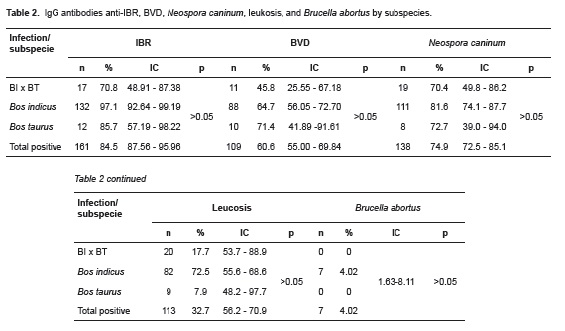
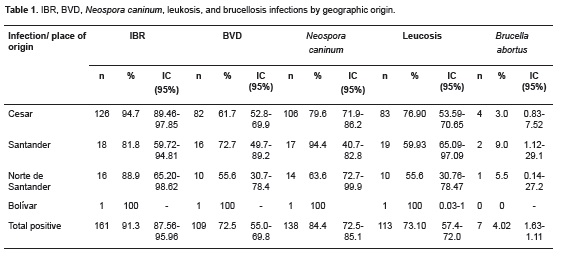
<body><![CDATA[<p><i>Data analysis</i></p>     <p>For the data analysis, variable factors such as age,   breed and origin were included. Also, measurements   such as frequency, percentage and confidence interval   (95%) were established for each of the evaluated infectious event. To establish possible association between positivity of serological tests and the animal characteristics, the chi-square test or the Fisher's exact test was applied as appropriate. No vaccination against IBR, BVD, <i>L. <i>pomona</i></i>, and <i>L. <i>hardjo</i></i> were applied to the bovines in the present study.</p>     <p>&nbsp;</p>     <p><b><font size="3">Results</font></b></p>     <p>A total of 174 dual-purpose male cattle made part   of the present study. Of the 174 assessed, 92.5%   was positive for IBR, 62.6% for BVD, and 79.3%   for <i>N. caninum</i>. Furthermore, 4.02 and 64.94% of   the cattle were found positive for <i><i>Brucella</i> abortus</i>   and bovine leucosis, respectively. Among the   156 males assessed for <i>L. <i>pomona</i></i> and <i>L. <i>hardjo</i></i>,   the percentages of positive results were 8.33 and 15.38%, respectively.</p>     <p><a href="#t1">Table 1</a> shows the province location of the livestock   farms (n = 22) in the study: Bol&iacute;var, Cesar, Santander,   and Norte de Santander. With the Fisher's exact test, it   was evidenced that there is no statistically significant   differences between infection and geographic origin (p = 0.17).</p>      <p align="center"><a name="t1"><img src="/img/revistas/rccp/v28n4/v28n4a05t1.jpg"></a>     <p>&nbsp;</p>     <p>Subspecies and infection by IBR showed   statistically significant differences (p&lt;0.05),   specifically among <i>Bos indicus</i> subspecies. IgG   positive antibodies against BDV, <i>N. caninum</i>, leucosis, and <i>B. abortus</i> were present in three breed categories. However, there were no differences among groups (p = 0.166), as seen in <a href="#t2">Table 2</a>.</p>      <p align="center"><a name="t2"><img src="/img/revistas/rccp/v28n4/v28n4a05t2.jpg"></a></p>     ]]></body>
<body><![CDATA[<p>&nbsp;</p>     <p><font size="3"><b>Discussion</b></font></p>     <p>The present study determined IgG antibodies   anti-IBR, BVD, <i>N. caninum</i>, <i>B. abortus</i>, and IgG antileukosis   in breeding bulls from dual-purpose livestock   farms from the Magdalena Medio region. In this   region, viral diseases such as BVD, IBR, and leukosis   represent major infection, threatening the livestock   sector with significant economic losses. Moreover,   lack of prevention measures, epidemiological data   and unavailability of vaccines allow successful   proliferation of these diseases (OIE, 2005). Several   studies have focused on the diagnosis of female cattle   without giving attention to males. The results obtained   were significantly higher than those conducted in   Monter&iacute;a (Colombia) with 21% seroprevalence for   BLV (S&aacute;nchez <i>et al.</i>, 2003; Betancur and Rodas, 2008; Peralta, 2009).</p>     <p>We determined IgG type antibodies of viral   diseases (BVD and IBR) by indirect ELISA technique,   where 62.6% positivity for BVD and 92.5% for IBR   were obtained. These results are similar to a study in   Peru, where 48.7% IgG anti BVD and 92.5% anti IBR   of a total of 347 samples of males and females were   reported as positive, respectively (Quispe <i>et al.</i>, 2002). C&aacute;rdenas <i>et al.</i> (2011) in Peru showed that 56.2% had antibodies against BVD in 406 samples including bovines older than 6 months. In Chile, Peralta (2009) screened 156 animals and found that 54.0% had antibodies for BVD, whereas in Colombia, only 29.4% was observed as positive for BVD (Betancur <i>et al.</i>, 2006). The presence of anti-BVD antibodies in animals without vaccination history indicates a clear exposure to the virus (Peralta, 2009). Accordingly, it is possible to infer that seropositivity of bovine animals for BVD, IBR, and bovine leukosis is due to their contact with these pathogens. It may result in infected carriers that spread the pathogens to other animals (Betancur <i>et al.</i>, 2006).</p>     <p>Furthermore, in order to determine neosporosis   prevalence, detection of IgG type anti-<i>N. caninum</i>   antibodies was conducted and a prevalence of   79.3% was observed. This result provides insight to   understand the current status of the infection and the   impact that generates the disease, since it can cause   economic losses. These findings did not demonstrate   the existence of the disease in animals that were   positive, however, it suggests that the animals   were exposed to <i>N. caninum</i>, causing the detection   of antibodies (Cede&ntilde;o, 2010). Our results correlate with a recent report by FEDEGAN (Zambrano, 2012), where seroprevalence of <i>N. caninum</i> for both sexes was documented to be 54% in Colombia. In general, the presence of the parasite was observed in more than half of the population of cattle. Our results are also in agreement with previous reports in Pasto, Colombia, where prevalence of 76.9% was obtained in dairy cattle (Cede&ntilde;o <i>et al.</i>, 2010). This allowed establishing the relationship between seropositivity and prior contact of males with the parasite due to a spreading factor, like dogs living in the livestock farms, which would have important consequences in terms of economic losses (Dubey and Lindsay, 1996).</p>     <p>The BLV is a retrovirus associated with enzootic   bovine leukosis, which is presented as a globally   distributed disease. It is commonly found in adult   cattle and characterized by a long incubation   period. This study analyzed 174 animals and found   64.94% positive; a higher value when compared to   21% prevalence observed in C&oacute;rdoba (Colombia)   among 137 cattle from 28 dual-purpose livestock   farms. Furthermore, in the same province, 15%   seroprevalence with an ELISA technique was reported   (Betancur <i>et al.</i>, 2008). The higher prevalence of   leukosis in our study is an alert for establishing control interventions and biosafety measurements in livestock farms. It also suggests verification of sanitary condition of animals entering the venue. It has been found that maneuvers such as removal of blood, vaccinations and a digital rectal examination, in which work is done with a large number of animals using the same instrumentation, may spread the virus. In the same way, virus transmission has been associated to places where arthropods burden is high, since they can contribute to the spread of illness (Johnson and Kaneene, 1992; Delgado <i>et al.</i>, 2009).</p>     <p>In Colombia, sanitary policies for the prevention,   control and eradication lack true rigor, and in some   cases, the required reports do not reach the responsible   entities. Besides, the economic impact of leukosis   infection includes negative effects on milk production,   fall in semen value, and low productivity. However,   the greatest impact is observed in the international   cattle trade restrictions (Delgado <i>et al.</i>, 2009; Benavides and Laverde, 2012).</p>     <p>A cross-sectional study with 331 sera of females   and 29 males, 201 (60.73%) and 18 (62.07%),   respectively, had antibodies against BLV indicating   no statistically significant differences between sex and   the occurrence of infection with the BLV. This result   coincides with the reported by Marin <i>et al.</i> (1978),   St&ouml;ber (1981), and Clerc (2008), where association   between sex and BLV infection was not found. On   the other hand, Betancur and Rodas (2008) reported   differences between seropositivity to the BLV in   females and males, 68.6% and 31.4%, respectively   (p&lt;0.05), due to a greater male contact with infected females, through the natural mating process.</p>     <p>Regarding age, it was included an age group of   &le; 3.5 years, where there were found 21.83% positive,   whereas the group of 4-6.5 years was 36.20%, and   for the group of 7 - 10 years, 6.89% of prevalence   (p&gt;0.05). According to another study where the age   group was 1 - 4 years and 21.56% were seropositive,   while group &ge; 5 years, 65.65% were positive for   the serological test, showing significant differences   (p = 0.0030). This result indicates an association   between the age of cattle and positivity to the infection,   thus the greater the age the higher is the probability that   the animals are seropositive. This could be due to the   fact that animals have had more exposure to the virus, as it has been suggested in the literature (Hungerford, 1990; Johnson and Kaneene, 1992; Chamizo, 2005; Betancur and Rodas, 2008; Clerc, 2008).</p>     <p>In cattle, leptospirosis causes economic losses by its   effects on reproduction, such as abortions, stillbirths,   birth of weak animals and infertility (Coromoto <i>et al.</i>, 2004). In studies conducted in Venezuela, 38.2%   bovine animals were positive to one or more <i>Leptospira</i>   serovars and 61.8% were found to be suspicious or   negative. In the group of animals positive to one or   more serovars, the most frequently observed was   <i>icterohaemorragiae</i> observed 49.2%, followed   by <i>hardjo</i> (45.0%). In the present study, a higher   percentage of seropositivity was observed for <i>hardjo</i>   (14.74%), while <i>pomona</i> was 8.33%. The crossbreed   cattle with positive antibodies were 2.56%. Moreover,   those who were positive for <i>pomona</i> and negative for   <i>hardjo</i> showed 5.76% prevalence. It is possible that   an animal reacts and/or be positive for more than one   serovar because there is a probability of cross-reactivity   with others. Therefore, the serovar that presents a   greater positivity than the other will be identified as the cause of the infection (Van Balen <i>et al.</i>, 2009).</p>     ]]></body>
<body><![CDATA[<p>For <i>B. abortus</i>, the positivity proportion was   4.02%, a value that is lower compared with a study   conducted in Mexico (39.6%). However, competitive   ELISA was not performed as a confirmatory test   (S&aacute;nchez-Castilleja <i>et al.</i>, 2012). It is recommended   to initiate a control program against this disease. <i>B. abortus</i>, was included in the 2014 list in force by   the OIE, which proposes a greater awareness by   livestock farmers and implementation of the required   procedures to control the infection (Seleem <i>et al.,</i> 2010; OIE, 2014).</p>     <p>In conclusion, the high percentage of positivity   of IgG antibodies indicates that cattle have been   exposed to the pathogen responsible for the disease.   However, the prevalence does not confirm recent or   chronic infection. For this reason, it is proposed that   the next step should be the validation of seropositivity   with confirmatory tests. Likewise, it is suggested to   design control policies and eradication plans for IBR,   BVD, <i>N. caninum</i>, <i>L. <i>hardjo</i></i>, <i>L. <i>pomona</i></i>, <i>B. abortus</i>,   and leucosis in the Magdalena Medio region. It is also   important to mention that this study had limitations   by not considering paired samples that could allow an approach to the diagnosis.</p>     <p>Infections by BVD, <i>B. abortus</i>, <i>N. caninum</i>,   leptospirosis, and bovine leukosis did not show any   pattern or affinity with respect to the variables like   age, breed and origin, and the detection of antibodies.   However, IgG anti-IBR was associated with variable   subspecies (<i>Bos indicus</i>), which may indicate the   existence of a susceptibility of cattle to infection by   this virus. Still, a paired sample study is necessary   to determine the exact values of IgG antibodies and compare them with the studied subspecies.</p>     <p>&nbsp;</p>     <p><b><font size="3">Acknowledgements</font></b></p>     <p>We thank to faculty members and students of the   program Medicina Veterinaria y Bacteriolog&iacute;a and   Laboratorio at Universidad de Santander (UDES), and   to Dr. Diego Vega, Dr. Diego S&aacute;nchez, and Dr. Sergio   G&oacute;mez for assistance in sampling, data collection and   processing. This study was supported by grants from   Vicerrector&iacute;a de Investigaciones of Universidad de Santander, Colombia (Project Number 036-11).</p>     <p align="left">&nbsp;</p>     <p align="left"><b><font size="3">Conflicts of interest</font></b></p>     <p align="left">The authors declare they have no conflicts of interest with regard to the work presented in this report.</p>     <p align="left">&nbsp;</p> <hr size="1" />     ]]></body>
<body><![CDATA[<p><b><font size="3">Notes</font></b></p>     <p><b><a name="a0" id="a0"><a href="#a1">&curren;</a></a></b>To cite this article: Camacho R, Carvajal LY, Castellanos-Dominguez YZ, D&iacute;az WF, V&aacute;squez MC. Presence of IgG antibodies against reproductive infections in breeding bulls of Magdalena Medio, Colombia. Rev Colomb Cienc Pecu 2015; 28:323-330.</p> <hr size="1" />     <p>&nbsp;</p>     <p><b><font size="3">References</font></b></p>     <!-- ref --><p>Benavides BB, Laverde LMT. Virus de leucosis bovina: un enemigo silencioso. J Agric Anim Sci 2012; 1:52-61.    &nbsp;&nbsp;&nbsp;&nbsp;&nbsp;&nbsp;&nbsp;&nbsp;[&#160;<a href="javascript:void(0);" onclick="javascript: window.open('/scielo.php?script=sci_nlinks&ref=000087&pid=S0120-0690201500040000500001&lng=','','width=640,height=500,resizable=yes,scrollbars=1,menubar=yes,');">Links</a>&#160;]<!-- end-ref --></p>     <!-- ref --><p>   Betancur C, Gonz&aacute;lez M, Reza L. Seroepidemiolog&iacute;a de la   rinotraqueitis infecciosa bovina en el Municipio de Monter&iacute;a,   Colombia. MVZ C&oacute;rdoba 2006; 11(2):0122-0268.    &nbsp;&nbsp;&nbsp;&nbsp;&nbsp;&nbsp;&nbsp;&nbsp;[&#160;<a href="javascript:void(0);" onclick="javascript: window.open('/scielo.php?script=sci_nlinks&ref=000089&pid=S0120-0690201500040000500002&lng=','','width=640,height=500,resizable=yes,scrollbars=1,menubar=yes,');">Links</a>&#160;]<!-- end-ref --></p>     <!-- ref --><p>   Betancur CH, Rodas GJ. Seroprevalencia del virus de la leucosis   viral bovina en animales con trastornos reproductivos de Monter&iacute;a.   MVZ C&oacute;rdoba 2008; 13(1):1197-1204.    &nbsp;&nbsp;&nbsp;&nbsp;&nbsp;&nbsp;&nbsp;&nbsp;[&#160;<a href="javascript:void(0);" onclick="javascript: window.open('/scielo.php?script=sci_nlinks&ref=000091&pid=S0120-0690201500040000500003&lng=','','width=640,height=500,resizable=yes,scrollbars=1,menubar=yes,');">Links</a>&#160;]<!-- end-ref --></p>     ]]></body>
<body><![CDATA[<!-- ref --><p>   C&aacute;rdenas C, Rivera HG, Ara&iacute;nga MR, Ram&iacute;rez MV, De Paz JM.   Prevalencia del virus de la diarrea viral bovina y de animales   portadores del virus en bovinos en la provincia de Espinar, Cusco.   Rev Inv Vet Per&uacute; 2011; 22(3):261-267.    &nbsp;&nbsp;&nbsp;&nbsp;&nbsp;&nbsp;&nbsp;&nbsp;[&#160;<a href="javascript:void(0);" onclick="javascript: window.open('/scielo.php?script=sci_nlinks&ref=000093&pid=S0120-0690201500040000500004&lng=','','width=640,height=500,resizable=yes,scrollbars=1,menubar=yes,');">Links</a>&#160;]<!-- end-ref --></p>     <!-- ref --><p>   Carrizales BH. Seroprevalencia de la rinotraqueitis infecciosa   bovina. Universidad Aut&oacute;noma ''Gabriel Rene Moreno'', Facultad   de Medicina Veterinaria y Zoot&eacute;cnia. Santa Cruz de la sierra-   Bolivia. 2002.    &nbsp;&nbsp;&nbsp;&nbsp;&nbsp;&nbsp;&nbsp;&nbsp;[&#160;<a href="javascript:void(0);" onclick="javascript: window.open('/scielo.php?script=sci_nlinks&ref=000095&pid=S0120-0690201500040000500005&lng=','','width=640,height=500,resizable=yes,scrollbars=1,menubar=yes,');">Links</a>&#160;]<!-- end-ref --></p>     <!-- ref --><p>   Chamizo E. Enzootic bovine leukosis: a review. Revista   electr&oacute;nica Veterinaria, REDVET. VI. 2005. &#91;Access date:   November, 2006&#93; URL: <a href="http://www.veterinaria.org/revistas/redvet/n070505.html" target="_blank">http://www.veterinaria.org/revistas/redvet/n070505.html</a>&nbsp;&nbsp;&nbsp;&nbsp;&nbsp;&nbsp;&nbsp;&nbsp;[&#160;<a href="javascript:void(0);" onclick="javascript: window.open('/scielo.php?script=sci_nlinks&ref=000097&pid=S0120-0690201500040000500006&lng=','','width=640,height=500,resizable=yes,scrollbars=1,menubar=yes,');">Links</a>&#160;]<!-- end-ref --><!-- ref --><p>Cede&ntilde;o D, Benavides B, Castro J, Tulc&aacute;n J. Factores de riesgo   asociados con la seroprevalencia de <i>Neospora caninum</i> en 2010   en el municipio de Pasto, Nari&ntilde;o. Rev Colomb Cienc Pecu 2010; 24:406-419.    &nbsp;&nbsp;&nbsp;&nbsp;&nbsp;&nbsp;&nbsp;&nbsp;[&#160;<a href="javascript:void(0);" onclick="javascript: window.open('/scielo.php?script=sci_nlinks&ref=000098&pid=S0120-0690201500040000500007&lng=','','width=640,height=500,resizable=yes,scrollbars=1,menubar=yes,');">Links</a>&#160;]<!-- end-ref --></p>     <!-- ref --><p>   Clerc K. Estudio Retrospectivo de la leucosis bovina en la   Estaci&oacute;n Experimental ''Santa Mar&iacute;a'', FCV-UCV. Trabajo de   ascenso para optar a la categor&iacute;a de profesor agregado, Facultad   de Ciencias Veterinarias, Universidad Central de Venezuela,   Maracay, Aragua, Venezuela: 2008. p. 75.    &nbsp;&nbsp;&nbsp;&nbsp;&nbsp;&nbsp;&nbsp;&nbsp;[&#160;<a href="javascript:void(0);" onclick="javascript: window.open('/scielo.php?script=sci_nlinks&ref=000100&pid=S0120-0690201500040000500008&lng=','','width=640,height=500,resizable=yes,scrollbars=1,menubar=yes,');">Links</a>&#160;]<!-- end-ref --></p>     <!-- ref --><p>   Coromoto A, Aranguren Y, Clavijo A, D&iacute;az C. Prevalencia   serol&oacute;gica de leptospirosis en ganado doble prop&oacute;sito del noreste   de Monagas, Venezuela. Zoot Trop 2004; 22(2):117-124.    &nbsp;&nbsp;&nbsp;&nbsp;&nbsp;&nbsp;&nbsp;&nbsp;[&#160;<a href="javascript:void(0);" onclick="javascript: window.open('/scielo.php?script=sci_nlinks&ref=000102&pid=S0120-0690201500040000500009&lng=','','width=640,height=500,resizable=yes,scrollbars=1,menubar=yes,');">Links</a>&#160;]<!-- end-ref --></p>     <!-- ref --><p>   Delgado I, Alfonso A, Mart&iacute;nez N, Abeledo MA, Rodr&iacute;guez M,   Barrera M. Presencia de Anticuerpos al virus de la leucosis bovina   en reba&ntilde;os pertenecientes a las provincias occidentales y centrales   de cuba. Rev Salud Anim 2009; 31(1): 24-28.    &nbsp;&nbsp;&nbsp;&nbsp;&nbsp;&nbsp;&nbsp;&nbsp;[&#160;<a href="javascript:void(0);" onclick="javascript: window.open('/scielo.php?script=sci_nlinks&ref=000104&pid=S0120-0690201500040000500010&lng=','','width=640,height=500,resizable=yes,scrollbars=1,menubar=yes,');">Links</a>&#160;]<!-- end-ref --></p>     <!-- ref --><p>   Dubey J, Lindsay D. A review of <i>Neospora caninum</i> and   neosporosis, Vet Parasitol 1996; 67:1-59.    &nbsp;&nbsp;&nbsp;&nbsp;&nbsp;&nbsp;&nbsp;&nbsp;[&#160;<a href="javascript:void(0);" onclick="javascript: window.open('/scielo.php?script=sci_nlinks&ref=000106&pid=S0120-0690201500040000500011&lng=','','width=640,height=500,resizable=yes,scrollbars=1,menubar=yes,');">Links</a>&#160;]<!-- end-ref --></p>     <!-- ref --><p>   G&oacute;mez J, Rueda R. Productividad del sector ganadero bovino   en Colombia durante los a&ntilde;os 2000 a 2009, Trabajo de Grado,   Colegio Mayor Nuestra Se&ntilde;ora del Rosario, Bogot&aacute; DC, 2011.    &nbsp;&nbsp;&nbsp;&nbsp;&nbsp;&nbsp;&nbsp;&nbsp;[&#160;<a href="javascript:void(0);" onclick="javascript: window.open('/scielo.php?script=sci_nlinks&ref=000108&pid=S0120-0690201500040000500012&lng=','','width=640,height=500,resizable=yes,scrollbars=1,menubar=yes,');">Links</a>&#160;]<!-- end-ref --></p>     <!-- ref --><p>   Hungerford TG. Enzootic bovine leucosis (EBL). In: Diseases   of livestock. Editorial Mc Graw Hill, USA: 1990. p. 474-484.    &nbsp;&nbsp;&nbsp;&nbsp;&nbsp;&nbsp;&nbsp;&nbsp;[&#160;<a href="javascript:void(0);" onclick="javascript: window.open('/scielo.php?script=sci_nlinks&ref=000110&pid=S0120-0690201500040000500013&lng=','','width=640,height=500,resizable=yes,scrollbars=1,menubar=yes,');">Links</a>&#160;]<!-- end-ref --></p>     <!-- ref --><p>   Johnson R, Kaneene JB. Bovine leukemia virus and enzootic   bovine leukosis. Vet Bulletin 1992; 62:287-312.    &nbsp;&nbsp;&nbsp;&nbsp;&nbsp;&nbsp;&nbsp;&nbsp;[&#160;<a href="javascript:void(0);" onclick="javascript: window.open('/scielo.php?script=sci_nlinks&ref=000112&pid=S0120-0690201500040000500014&lng=','','width=640,height=500,resizable=yes,scrollbars=1,menubar=yes,');">Links</a>&#160;]<!-- end-ref --></p>     <!-- ref --><p>   Mar&iacute;n C, De L&oacute;pez N, Lozano O, Palencia L, Espa&ntilde;a W, Casta&ntilde;os   H, Le&oacute;n A. Epidemiology of bovine leukemia in Venezuela. Ann   Rech Vet 1978; 9:743-746.    &nbsp;&nbsp;&nbsp;&nbsp;&nbsp;&nbsp;&nbsp;&nbsp;[&#160;<a href="javascript:void(0);" onclick="javascript: window.open('/scielo.php?script=sci_nlinks&ref=000114&pid=S0120-0690201500040000500015&lng=','','width=640,height=500,resizable=yes,scrollbars=1,menubar=yes,');">Links</a>&#160;]<!-- end-ref --></p>     <!-- ref --><p>   Organizaci&oacute;n mundial de sanidad animal (OIE). Manual de   la OIE sobre animales terrestres 2004. Secci&oacute;n1.1, Cap&iacute;tulos   introductorios, M&eacute;todos de muestreo. Cap&iacute;tulo actualizado.   2005. &#91;Access date: November, 2014&#93; URL: <a href="http://www.oie.int/doc/ged/d6508.pdf" target="_blank">http://www.oie.int/doc/ged/d6508.pdf</a>&nbsp;&nbsp;&nbsp;&nbsp;&nbsp;&nbsp;&nbsp;&nbsp;[&#160;<a href="javascript:void(0);" onclick="javascript: window.open('/scielo.php?script=sci_nlinks&ref=000116&pid=S0120-0690201500040000500016&lng=','','width=640,height=500,resizable=yes,scrollbars=1,menubar=yes,');">Links</a>&#160;]<!-- end-ref --><!-- ref --><p>   Organizaci&oacute;n Mundial de Sanidad Animal (OIE). Manual de   la OIE sobre animales terrestres. Capitulo 2.1.9, Leptospirosis.   2008. &#91;Access date: November, 2014&#93; URL: <a href="http://www.oie.int/doc/ged/d6515.pdf" target="_blank">http://www.oie.int/doc/ged/d6515.pdf</a>&nbsp;&nbsp;&nbsp;&nbsp;&nbsp;&nbsp;&nbsp;&nbsp;[&#160;<a href="javascript:void(0);" onclick="javascript: window.open('/scielo.php?script=sci_nlinks&ref=000117&pid=S0120-0690201500040000500017&lng=','','width=640,height=500,resizable=yes,scrollbars=1,menubar=yes,');">Links</a>&#160;]<!-- end-ref --><!-- ref --><p>   Organizaci&oacute;n Mundial De Sanidad Animal (OIE). Enfermedades, infecciones e infestaciones de la lista de la OIE en vigor en 2014. &#91;Access date: November, 2014&#93; URL: <a href="http://www.oie.int/es/sanidad-animal-en-el-mundo/enfermedades-de-la-lista-de-laoie-2014/" target="_blank">http://www.oie.int/es/sanidad-animal-en-el-mundo/enfermedades-de-la-lista-de-laoie-2014/</a>&nbsp;&nbsp;&nbsp;&nbsp;&nbsp;&nbsp;&nbsp;&nbsp;[&#160;<a href="javascript:void(0);" onclick="javascript: window.open('/scielo.php?script=sci_nlinks&ref=000118&pid=S0120-0690201500040000500018&lng=','','width=640,height=500,resizable=yes,scrollbars=1,menubar=yes,');">Links</a>&#160;]<!-- end-ref --><!-- ref --><p>Peralta DP. Determinaci&oacute;n de la prevalencia e incidencia de la   Diarrea Viral Bovina en individuos entre 6-24 meses de cinco   predios lecheros de la provincia de &Ntilde;uble, mediante la pesquisa   de anticuerpos s&eacute;ricos utilizando la t&eacute;cnica de ELISA. Chill&aacute;n-   Chile. 2009.    &nbsp;&nbsp;&nbsp;&nbsp;&nbsp;&nbsp;&nbsp;&nbsp;[&#160;<a href="javascript:void(0);" onclick="javascript: window.open('/scielo.php?script=sci_nlinks&ref=000119&pid=S0120-0690201500040000500019&lng=','','width=640,height=500,resizable=yes,scrollbars=1,menubar=yes,');">Links</a>&#160;]<!-- end-ref --></p>     <!-- ref --><p>   Quispe QR, Cama SA, Rivera GH, Ara&iacute;nga RM. El virus de la   diarrea viral en bovinos criollos de la provincia de Melgar, Puno.   RIVEP2008; 19(2):176-182.    &nbsp;&nbsp;&nbsp;&nbsp;&nbsp;&nbsp;&nbsp;&nbsp;[&#160;<a href="javascript:void(0);" onclick="javascript: window.open('/scielo.php?script=sci_nlinks&ref=000121&pid=S0120-0690201500040000500020&lng=','','width=640,height=500,resizable=yes,scrollbars=1,menubar=yes,');">Links</a>&#160;]<!-- end-ref --></p>     ]]></body>
<body><![CDATA[<!-- ref --><p>S&aacute;nchez-Castilleja YM, Rodr&iacute;guez JG, Pedroso M, Cuello S.   Simultaneidad serol&oacute;gica de <i>Neospora caninum</i> con <i><i>Brucella</i> abortus</i> y los virus de la rinotraqueitis infecciosa bovina y diarrea   viral bovina en bovinos pertenecientes al Estado de Hidalgo, M&eacute;xico. Rev Salud Anim 2012; 34(2):95-100.    &nbsp;&nbsp;&nbsp;&nbsp;&nbsp;&nbsp;&nbsp;&nbsp;[&#160;<a href="javascript:void(0);" onclick="javascript: window.open('/scielo.php?script=sci_nlinks&ref=000123&pid=S0120-0690201500040000500021&lng=','','width=640,height=500,resizable=yes,scrollbars=1,menubar=yes,');">Links</a>&#160;]<!-- end-ref --></p>     <!-- ref --><p>   S&aacute;nchez F, Morales E, Mart&iacute;nez J, Trigo J. Determination and   correlation of anti-<i>Neospora caninum</i> antibodies in dogs and cattle   from Mexico. Can J Vet Res 2003; 67:142-145.    &nbsp;&nbsp;&nbsp;&nbsp;&nbsp;&nbsp;&nbsp;&nbsp;[&#160;<a href="javascript:void(0);" onclick="javascript: window.open('/scielo.php?script=sci_nlinks&ref=000125&pid=S0120-0690201500040000500022&lng=','','width=640,height=500,resizable=yes,scrollbars=1,menubar=yes,');">Links</a>&#160;]<!-- end-ref --></p>     <!-- ref --><p>   Seleem MN, Boyle SM, Sriranganathan N. Brucellosis: a   reemerging zoonosis. Vet Microbiol 2010; 140:392-398.    &nbsp;&nbsp;&nbsp;&nbsp;&nbsp;&nbsp;&nbsp;&nbsp;[&#160;<a href="javascript:void(0);" onclick="javascript: window.open('/scielo.php?script=sci_nlinks&ref=000127&pid=S0120-0690201500040000500023&lng=','','width=640,height=500,resizable=yes,scrollbars=1,menubar=yes,');">Links</a>&#160;]<!-- end-ref --></p>     <!-- ref --><p>   St&ouml;ber M. The clinical picture of the enzootic and sporadic forms   of bovine leukosis. Bovine Pr 1981; 16:119-129.    &nbsp;&nbsp;&nbsp;&nbsp;&nbsp;&nbsp;&nbsp;&nbsp;[&#160;<a href="javascript:void(0);" onclick="javascript: window.open('/scielo.php?script=sci_nlinks&ref=000129&pid=S0120-0690201500040000500024&lng=','','width=640,height=500,resizable=yes,scrollbars=1,menubar=yes,');">Links</a>&#160;]<!-- end-ref --></p>     <!-- ref --><p>   Van Balen J, Hoet A, Dpool G, Gil M, Escalona F, D&iacute;az D.   An&aacute;lisis retrospectivo de las pruebas diagn&oacute;sticas de Leptospirosis   bovina procesadas en la Unidad de Investigaci&oacute;n y Diagn&oacute;stico   de Leptospirosis de la Universidad del Zulia, 1998-2001. Rev.   Cient&iacute;fica, FCV-LUZ/Vol.XIX, N&ordm;6, 598-606, 2009.    &nbsp;&nbsp;&nbsp;&nbsp;&nbsp;&nbsp;&nbsp;&nbsp;[&#160;<a href="javascript:void(0);" onclick="javascript: window.open('/scielo.php?script=sci_nlinks&ref=000131&pid=S0120-0690201500040000500025&lng=','','width=640,height=500,resizable=yes,scrollbars=1,menubar=yes,');">Links</a>&#160;]<!-- end-ref --></p>     ]]></body>
<body><![CDATA[<!-- ref --><p>   Zambrano J. Conozca la neosporosis y prev&eacute;ngala, Federaci&oacute;n   Colombiana de Ganaderos (FEDEGAN), salud animal, carta   FEDEGAN N&deg; 122, 2012.    &nbsp;&nbsp;&nbsp;&nbsp;&nbsp;&nbsp;&nbsp;&nbsp;[&#160;<a href="javascript:void(0);" onclick="javascript: window.open('/scielo.php?script=sci_nlinks&ref=000133&pid=S0120-0690201500040000500026&lng=','','width=640,height=500,resizable=yes,scrollbars=1,menubar=yes,');">Links</a>&#160;]<!-- end-ref --></p>     <p>&nbsp;</p>     <p>&nbsp;</p>  </font>      ]]></body><back>
<ref-list>
<ref id="B1">
<nlm-citation citation-type="journal">
<person-group person-group-type="author">
<name>
<surname><![CDATA[Benavides]]></surname>
<given-names><![CDATA[BB]]></given-names>
</name>
<name>
<surname><![CDATA[Laverde]]></surname>
<given-names><![CDATA[LMT]]></given-names>
</name>
</person-group>
<article-title xml:lang="en"><![CDATA[Virus de leucosis bovina: un enemigo silencioso]]></article-title>
<source><![CDATA[J Agric Anim Sci]]></source>
<year>2012</year>
<volume>1</volume>
<page-range>52-61</page-range></nlm-citation>
</ref>
<ref id="B2">
<nlm-citation citation-type="journal">
<person-group person-group-type="author">
<name>
<surname><![CDATA[Betancur]]></surname>
<given-names><![CDATA[C]]></given-names>
</name>
<name>
<surname><![CDATA[González]]></surname>
<given-names><![CDATA[M]]></given-names>
</name>
<name>
<surname><![CDATA[Reza]]></surname>
<given-names><![CDATA[L]]></given-names>
</name>
</person-group>
<article-title xml:lang="es"><![CDATA[Seroepidemiología de la rinotraqueitis infecciosa bovina en el Municipio de Montería, Colombia]]></article-title>
<source><![CDATA[MVZ Córdoba]]></source>
<year>2006</year>
<volume>11(2)</volume>
<page-range>0122-0268</page-range></nlm-citation>
</ref>
<ref id="B3">
<nlm-citation citation-type="journal">
<person-group person-group-type="author">
<name>
<surname><![CDATA[Betancur]]></surname>
<given-names><![CDATA[CH]]></given-names>
</name>
<name>
<surname><![CDATA[Rodas]]></surname>
<given-names><![CDATA[GJ]]></given-names>
</name>
</person-group>
<article-title xml:lang="es"><![CDATA[Seroprevalencia del virus de la leucosis viral bovina en animales con trastornos reproductivos de Montería]]></article-title>
<source><![CDATA[MVZ Córdoba]]></source>
<year>2008</year>
<volume>13(1)</volume>
<page-range>1197-1204</page-range></nlm-citation>
</ref>
<ref id="B4">
<nlm-citation citation-type="journal">
<person-group person-group-type="author">
<name>
<surname><![CDATA[Cárdenas]]></surname>
<given-names><![CDATA[C]]></given-names>
</name>
<name>
<surname><![CDATA[Rivera]]></surname>
<given-names><![CDATA[HG]]></given-names>
</name>
<name>
<surname><![CDATA[Araínga]]></surname>
<given-names><![CDATA[MR]]></given-names>
</name>
<name>
<surname><![CDATA[Ramírez]]></surname>
<given-names><![CDATA[MV]]></given-names>
</name>
<name>
<surname><![CDATA[De]]></surname>
<given-names><![CDATA[Paz JM]]></given-names>
</name>
</person-group>
<article-title xml:lang="es"><![CDATA[Prevalencia del virus de la diarrea viral bovina y de animales portadores del virus en bovinos en la provincia de Espinar, Cusco]]></article-title>
<source><![CDATA[Rev Inv Vet Perú]]></source>
<year>2011</year>
<volume>22(3)</volume>
<page-range>261-267</page-range></nlm-citation>
</ref>
<ref id="B5">
<nlm-citation citation-type="book">
<person-group person-group-type="author">
<name>
<surname><![CDATA[Carrizales]]></surname>
<given-names><![CDATA[BH]]></given-names>
</name>
</person-group>
<source><![CDATA[Seroprevalencia de la rinotraqueitis infecciosa bovina]]></source>
<year>2002</year>
<publisher-loc><![CDATA[Santa Cruz de la sierra ]]></publisher-loc>
<publisher-name><![CDATA[Universidad Autónoma ''Gabriel Rene Moreno'', Facultad de Medicina Veterinaria y Zootécnia]]></publisher-name>
</nlm-citation>
</ref>
<ref id="B6">
<nlm-citation citation-type="journal">
<person-group person-group-type="author">
<name>
<surname><![CDATA[Chamizo]]></surname>
<given-names><![CDATA[E]]></given-names>
</name>
</person-group>
<article-title xml:lang="en"><![CDATA[Enzootic bovine leukosis: a review]]></article-title>
<source><![CDATA[Revista electrónica Veterinaria, REDVET]]></source>
<year>2005</year>
<volume>VI</volume>
</nlm-citation>
</ref>
<ref id="B7">
<nlm-citation citation-type="journal">
<person-group person-group-type="author">
<name>
<surname><![CDATA[Cedeño]]></surname>
<given-names><![CDATA[D]]></given-names>
</name>
<name>
<surname><![CDATA[Benavides]]></surname>
<given-names><![CDATA[B]]></given-names>
</name>
<name>
<surname><![CDATA[Castro]]></surname>
<given-names><![CDATA[J]]></given-names>
</name>
<name>
<surname><![CDATA[Tulcán]]></surname>
<given-names><![CDATA[J]]></given-names>
</name>
</person-group>
<article-title xml:lang="es"><![CDATA[Factores de riesgo asociados con la seroprevalencia de Neospora caninum en 2010 en el municipio de Pasto, Nariño]]></article-title>
<source><![CDATA[Rev Colomb Cienc Pecu]]></source>
<year>2010</year>
<volume>24</volume>
<page-range>406-419</page-range></nlm-citation>
</ref>
<ref id="B8">
<nlm-citation citation-type="book">
<person-group person-group-type="author">
<name>
<surname><![CDATA[Clerc]]></surname>
<given-names><![CDATA[K]]></given-names>
</name>
</person-group>
<source><![CDATA[Estudio Retrospectivo de la leucosis bovina en la Estación Experimental ''Santa María'', FCV-UCV]]></source>
<year>2008</year>
<publisher-loc><![CDATA[Maracay^eAragua Aragua]]></publisher-loc>
<publisher-name><![CDATA[Facultad de Ciencias Veterinarias, Universidad Central de Venezuela]]></publisher-name>
</nlm-citation>
</ref>
<ref id="B9">
<nlm-citation citation-type="journal">
<person-group person-group-type="author">
<name>
<surname><![CDATA[Coromoto]]></surname>
<given-names><![CDATA[A]]></given-names>
</name>
<name>
<surname><![CDATA[Aranguren]]></surname>
<given-names><![CDATA[Y]]></given-names>
</name>
<name>
<surname><![CDATA[Clavijo]]></surname>
<given-names><![CDATA[A]]></given-names>
</name>
<name>
<surname><![CDATA[Díaz]]></surname>
<given-names><![CDATA[C]]></given-names>
</name>
</person-group>
<article-title xml:lang="es"><![CDATA[Prevalencia serológica de leptospirosis en ganado doble propósito del noreste de Monagas, Venezuela]]></article-title>
<source><![CDATA[Zoot Trop]]></source>
<year>2004</year>
<volume>22(2)</volume>
<page-range>117-124</page-range></nlm-citation>
</ref>
<ref id="B10">
<nlm-citation citation-type="journal">
<person-group person-group-type="author">
<name>
<surname><![CDATA[Delgado]]></surname>
<given-names><![CDATA[I]]></given-names>
</name>
<name>
<surname><![CDATA[Alfonso]]></surname>
<given-names><![CDATA[A]]></given-names>
</name>
<name>
<surname><![CDATA[Martínez]]></surname>
<given-names><![CDATA[N]]></given-names>
</name>
<name>
<surname><![CDATA[Abeledo]]></surname>
<given-names><![CDATA[MA]]></given-names>
</name>
<name>
<surname><![CDATA[Rodríguez]]></surname>
<given-names><![CDATA[M]]></given-names>
</name>
<name>
<surname><![CDATA[Barrera]]></surname>
<given-names><![CDATA[M]]></given-names>
</name>
</person-group>
<article-title xml:lang="es"><![CDATA[Presencia de Anticuerpos al virus de la leucosis bovina en rebaños pertenecientes a las provincias occidentales y centrales de cuba]]></article-title>
<source><![CDATA[Rev Salud Anim]]></source>
<year>2009</year>
<volume>31(1)</volume>
<page-range>24-28</page-range></nlm-citation>
</ref>
<ref id="B11">
<nlm-citation citation-type="journal">
<person-group person-group-type="author">
<name>
<surname><![CDATA[Dubey]]></surname>
<given-names><![CDATA[J]]></given-names>
</name>
<name>
<surname><![CDATA[Lindsay]]></surname>
<given-names><![CDATA[D]]></given-names>
</name>
</person-group>
<article-title xml:lang="en"><![CDATA[A review of Neospora caninum and neosporosis]]></article-title>
<source><![CDATA[Vet Parasitol]]></source>
<year>1996</year>
<volume>67</volume>
<page-range>1-59</page-range></nlm-citation>
</ref>
<ref id="B12">
<nlm-citation citation-type="book">
<person-group person-group-type="author">
<name>
<surname><![CDATA[Gómez]]></surname>
<given-names><![CDATA[J]]></given-names>
</name>
<name>
<surname><![CDATA[Rueda]]></surname>
<given-names><![CDATA[R]]></given-names>
</name>
</person-group>
<source><![CDATA[Productividad del sector ganadero bovino en Colombia durante los años 2000 a 2009]]></source>
<year>2011</year>
<publisher-loc><![CDATA[Bogotá DC ]]></publisher-loc>
<publisher-name><![CDATA[Colegio Mayor Nuestra Señora del Rosario]]></publisher-name>
</nlm-citation>
</ref>
<ref id="B13">
<nlm-citation citation-type="book">
<person-group person-group-type="author">
<name>
<surname><![CDATA[Hungerford]]></surname>
<given-names><![CDATA[TG]]></given-names>
</name>
</person-group>
<article-title xml:lang="en"><![CDATA[Enzootic bovine leucosis (EBL)]]></article-title>
<source><![CDATA[Diseases of livestock]]></source>
<year>1990</year>
<page-range>474-484</page-range><publisher-name><![CDATA[Editorial Mc Graw Hill]]></publisher-name>
</nlm-citation>
</ref>
<ref id="B14">
<nlm-citation citation-type="journal">
<person-group person-group-type="author">
<name>
<surname><![CDATA[Johnson]]></surname>
<given-names><![CDATA[R]]></given-names>
</name>
<name>
<surname><![CDATA[Kaneene]]></surname>
<given-names><![CDATA[JB]]></given-names>
</name>
</person-group>
<article-title xml:lang="en"><![CDATA[Bovine leukemia virus and enzootic bovine leukosis]]></article-title>
<source><![CDATA[Vet Bulletin]]></source>
<year>1992</year>
<volume>62</volume>
<page-range>287-312</page-range></nlm-citation>
</ref>
<ref id="B15">
<nlm-citation citation-type="journal">
<person-group person-group-type="author">
<name>
<surname><![CDATA[Marín]]></surname>
<given-names><![CDATA[C]]></given-names>
</name>
<name>
<surname><![CDATA[De]]></surname>
<given-names><![CDATA[López N]]></given-names>
</name>
<name>
<surname><![CDATA[Lozano]]></surname>
<given-names><![CDATA[O]]></given-names>
</name>
<name>
<surname><![CDATA[Palencia]]></surname>
<given-names><![CDATA[L]]></given-names>
</name>
<name>
<surname><![CDATA[España]]></surname>
<given-names><![CDATA[W]]></given-names>
</name>
<name>
<surname><![CDATA[Castaños]]></surname>
<given-names><![CDATA[H]]></given-names>
</name>
<name>
<surname><![CDATA[León]]></surname>
<given-names><![CDATA[A]]></given-names>
</name>
</person-group>
<article-title xml:lang="en"><![CDATA[Epidemiology of bovine leukemia in Venezuela]]></article-title>
<source><![CDATA[Ann Rech Vet]]></source>
<year>1978</year>
<volume>9</volume>
<page-range>743-746</page-range></nlm-citation>
</ref>
<ref id="B16">
<nlm-citation citation-type="">
<collab>Organización mundial de sanidad animal (OIE)</collab>
<source><![CDATA[Manual de la OIE sobre animales terrestres 2004. Sección1.1, Capítulos introductorios, Métodos de muestreo. Capítulo actualizado]]></source>
<year></year>
</nlm-citation>
</ref>
<ref id="B17">
<nlm-citation citation-type="">
<collab>Organización Mundial de Sanidad Animal (OIE)</collab>
<source><![CDATA[Manual de la OIE sobre animales terrestres. Capitulo 2.1.9]]></source>
<year>2008</year>
</nlm-citation>
</ref>
<ref id="B18">
<nlm-citation citation-type="">
<collab>Organización Mundial De Sanidad Animal (OIE)</collab>
<source><![CDATA[Enfermedades, infecciones e infestaciones de la lista de la OIE en vigor en 2014]]></source>
<year></year>
</nlm-citation>
</ref>
<ref id="B19">
<nlm-citation citation-type="">
<person-group person-group-type="author">
<name>
<surname><![CDATA[Peralta]]></surname>
<given-names><![CDATA[DP]]></given-names>
</name>
</person-group>
<source><![CDATA[Determinación de la prevalencia e incidencia de la Diarrea Viral Bovina en individuos entre 6-24 meses de cinco predios lecheros de la provincia de Ñuble, mediante la pesquisa de anticuerpos séricos utilizando la técnica de ELISA]]></source>
<year>2009</year>
<publisher-loc><![CDATA[Chillán ]]></publisher-loc>
</nlm-citation>
</ref>
<ref id="B20">
<nlm-citation citation-type="journal">
<person-group person-group-type="author">
<name>
<surname><![CDATA[Quispe]]></surname>
<given-names><![CDATA[QR]]></given-names>
</name>
<name>
<surname><![CDATA[Cama]]></surname>
<given-names><![CDATA[SA]]></given-names>
</name>
<name>
<surname><![CDATA[Rivera]]></surname>
<given-names><![CDATA[GH]]></given-names>
</name>
<name>
<surname><![CDATA[Araínga]]></surname>
<given-names><![CDATA[RM]]></given-names>
</name>
</person-group>
<article-title xml:lang="es"><![CDATA[El virus de la diarrea viral en bovinos criollos de la provincia de Melgar, Puno]]></article-title>
<source><![CDATA[RIVEP2008]]></source>
<year></year>
<volume>19</volume>
<numero>2</numero>
<issue>2</issue>
<page-range>176-182</page-range></nlm-citation>
</ref>
<ref id="B21">
<nlm-citation citation-type="journal">
<person-group person-group-type="author">
<name>
<surname><![CDATA[Sánchez-Castilleja]]></surname>
<given-names><![CDATA[YM]]></given-names>
</name>
<name>
<surname><![CDATA[Rodríguez]]></surname>
<given-names><![CDATA[JG]]></given-names>
</name>
<name>
<surname><![CDATA[Pedroso]]></surname>
<given-names><![CDATA[M]]></given-names>
</name>
<name>
<surname><![CDATA[Cuello]]></surname>
<given-names><![CDATA[S]]></given-names>
</name>
</person-group>
<article-title xml:lang="es"><![CDATA[Simultaneidad serológica de Neospora caninum con Brucella abortus y los virus de la rinotraqueitis infecciosa bovina y diarrea viral bovina en bovinos pertenecientes al Estado de Hidalgo, México]]></article-title>
<source><![CDATA[Rev Salud Anim]]></source>
<year>2012</year>
<volume>34(2)</volume>
<page-range>95-100</page-range></nlm-citation>
</ref>
<ref id="B22">
<nlm-citation citation-type="journal">
<person-group person-group-type="author">
<name>
<surname><![CDATA[Sánchez]]></surname>
<given-names><![CDATA[F]]></given-names>
</name>
<name>
<surname><![CDATA[Morales]]></surname>
<given-names><![CDATA[E]]></given-names>
</name>
<name>
<surname><![CDATA[Martínez]]></surname>
<given-names><![CDATA[J]]></given-names>
</name>
<name>
<surname><![CDATA[Trigo]]></surname>
<given-names><![CDATA[J]]></given-names>
</name>
</person-group>
<article-title xml:lang="en"><![CDATA[Determination and correlation of anti-Neospora caninum antibodies in dogs and cattle from Mexico]]></article-title>
<source><![CDATA[Can J Vet Res]]></source>
<year>2003</year>
<volume>67</volume>
<page-range>142-145</page-range></nlm-citation>
</ref>
<ref id="B23">
<nlm-citation citation-type="journal">
<person-group person-group-type="author">
<name>
<surname><![CDATA[Seleem]]></surname>
<given-names><![CDATA[MN]]></given-names>
</name>
<name>
<surname><![CDATA[Boyle]]></surname>
<given-names><![CDATA[SM]]></given-names>
</name>
<name>
<surname><![CDATA[Sriranganathan]]></surname>
<given-names><![CDATA[N]]></given-names>
</name>
</person-group>
<article-title xml:lang="en"><![CDATA[Brucellosis: a reemerging zoonosis]]></article-title>
<source><![CDATA[Vet Microbiol]]></source>
<year>2010</year>
<volume>140</volume>
<page-range>392-398</page-range></nlm-citation>
</ref>
<ref id="B24">
<nlm-citation citation-type="journal">
<person-group person-group-type="author">
<name>
<surname><![CDATA[Stöber]]></surname>
<given-names><![CDATA[M]]></given-names>
</name>
</person-group>
<article-title xml:lang="en"><![CDATA[The clinical picture of the enzootic and sporadic forms of bovine leukosis]]></article-title>
<source><![CDATA[Bovine Pr]]></source>
<year>1981</year>
<volume>16</volume>
<page-range>119-129</page-range></nlm-citation>
</ref>
<ref id="B25">
<nlm-citation citation-type="journal">
<person-group person-group-type="author">
<name>
<surname><![CDATA[Van Balen]]></surname>
<given-names><![CDATA[J]]></given-names>
</name>
<name>
<surname><![CDATA[Hoet]]></surname>
<given-names><![CDATA[A]]></given-names>
</name>
<name>
<surname><![CDATA[Dpool]]></surname>
<given-names><![CDATA[G]]></given-names>
</name>
<name>
<surname><![CDATA[Gil]]></surname>
<given-names><![CDATA[M]]></given-names>
</name>
<name>
<surname><![CDATA[Escalona]]></surname>
<given-names><![CDATA[F]]></given-names>
</name>
<name>
<surname><![CDATA[Díaz]]></surname>
<given-names><![CDATA[D]]></given-names>
</name>
</person-group>
<article-title xml:lang="es"><![CDATA[Análisis retrospectivo de las pruebas diagnósticas de Leptospirosis bovina procesadas en la Unidad de Investigación y Diagnóstico de Leptospirosis de la Universidad del Zulia, 1998-2001]]></article-title>
<source><![CDATA[Rev. Científica, FCV-LUZ]]></source>
<year>2009</year>
<volume>XIX</volume>
<numero>6</numero>
<issue>6</issue>
<page-range>598-606</page-range></nlm-citation>
</ref>
<ref id="B26">
<nlm-citation citation-type="">
<person-group person-group-type="author">
<name>
<surname><![CDATA[Zambrano]]></surname>
<given-names><![CDATA[J]]></given-names>
</name>
</person-group>
<source><![CDATA[Conozca la neosporosis y prevéngala, Federación Colombiana de Ganaderos (FEDEGAN), salud animal, carta FEDEGAN]]></source>
<year>2012</year>
<volume>122</volume>
</nlm-citation>
</ref>
</ref-list>
</back>
</article>