<?xml version="1.0" encoding="ISO-8859-1"?><article xmlns:mml="http://www.w3.org/1998/Math/MathML" xmlns:xlink="http://www.w3.org/1999/xlink" xmlns:xsi="http://www.w3.org/2001/XMLSchema-instance">
<front>
<journal-meta>
<journal-id>0120-0690</journal-id>
<journal-title><![CDATA[Revista Colombiana de Ciencias Pecuarias]]></journal-title>
<abbrev-journal-title><![CDATA[Rev Colom Cienc Pecua]]></abbrev-journal-title>
<issn>0120-0690</issn>
<publisher>
<publisher-name><![CDATA[Facultad de Ciencias Agrarias, Universidad de Antioquia]]></publisher-name>
</publisher>
</journal-meta>
<article-meta>
<article-id>S0120-06902015000400006</article-id>
<article-id pub-id-type="doi">10.17533/udea.rccp.v28n4a05</article-id>
<title-group>
<article-title xml:lang="en"><![CDATA[Treatment of poultry litter does not improve performance or carcass lesions in broilers]]></article-title>
<article-title xml:lang="es"><![CDATA[El tratamiento de la cama no afecta el desempeño ni las lesiones en la canal del pollo de engorde]]></article-title>
<article-title xml:lang="pt"><![CDATA[Desempenho produtivo e lesões na carcaça de frangos de corte não são afetados pelo tratamento da cama de frango]]></article-title>
</title-group>
<contrib-group>
<contrib contrib-type="author">
<name>
<surname><![CDATA[de Oliveira]]></surname>
<given-names><![CDATA[Maria C]]></given-names>
</name>
<xref ref-type="aff" rid="A01"/>
</contrib>
<contrib contrib-type="author">
<name>
<surname><![CDATA[Gonçalves]]></surname>
<given-names><![CDATA[Bruno N]]></given-names>
</name>
<xref ref-type="aff" rid="A01"/>
</contrib>
<contrib contrib-type="author">
<name>
<surname><![CDATA[Pádua]]></surname>
<given-names><![CDATA[Gracielle T]]></given-names>
</name>
<xref ref-type="aff" rid="A01"/>
</contrib>
<contrib contrib-type="author">
<name>
<surname><![CDATA[da Silva]]></surname>
<given-names><![CDATA[Virgínia G]]></given-names>
</name>
<xref ref-type="aff" rid="A01"/>
</contrib>
<contrib contrib-type="author">
<name>
<surname><![CDATA[da Silva]]></surname>
<given-names><![CDATA[Denis V]]></given-names>
</name>
<xref ref-type="aff" rid="A02"/>
</contrib>
<contrib contrib-type="author">
<name>
<surname><![CDATA[Freitas]]></surname>
<given-names><![CDATA[Arthur IM]]></given-names>
</name>
<xref ref-type="aff" rid="A02"/>
</contrib>
</contrib-group>
<aff id="A01">
<institution><![CDATA[,Universidade de Rio Verde Faculdade de Medicina Veterinária ]]></institution>
<addr-line><![CDATA[Rio Verde GO]]></addr-line>
<country>Brasil</country>
</aff>
<aff id="A02">
<institution><![CDATA[,Instituto Federal Goiano Departamento de Zootecnia ]]></institution>
<addr-line><![CDATA[Rio Verde GO]]></addr-line>
<country>Brasil</country>
</aff>
<aff id="A03">
<institution><![CDATA[,Universidade de Rio Verde Faculdade de Medicina Veterinária ]]></institution>
<addr-line><![CDATA[Rio Verde GO]]></addr-line>
<country>Brasil</country>
</aff>
<pub-date pub-type="pub">
<day>00</day>
<month>12</month>
<year>2015</year>
</pub-date>
<pub-date pub-type="epub">
<day>00</day>
<month>12</month>
<year>2015</year>
</pub-date>
<volume>28</volume>
<numero>4</numero>
<fpage>331</fpage>
<lpage>338</lpage>
<copyright-statement/>
<copyright-year/>
<self-uri xlink:href="http://www.scielo.org.co/scielo.php?script=sci_arttext&amp;pid=S0120-06902015000400006&amp;lng=en&amp;nrm=iso"></self-uri><self-uri xlink:href="http://www.scielo.org.co/scielo.php?script=sci_abstract&amp;pid=S0120-06902015000400006&amp;lng=en&amp;nrm=iso"></self-uri><self-uri xlink:href="http://www.scielo.org.co/scielo.php?script=sci_pdf&amp;pid=S0120-06902015000400006&amp;lng=en&amp;nrm=iso"></self-uri><abstract abstract-type="short" xml:lang="en"><p><![CDATA[Background: broilers spend most of their lives in contact with litter; litter quality can affect their health and performance. Objective: the effects of litter treatment on performance and carcass lesions were evaluated in five consecutive flocks with 640 male broilers each. Methods: a completely randomized model was used comprising eight treatments and four replicates. The treatments included (1) untreated litter, (2) litter subjected to in-house composting, (3) litter treated (LT) with aluminum sulfate, (4) LT with gypsum, (5) LT with quicklime, (6) LT with dolomitic limestone, (7) LT with zeolite, and (8) LT with charcoal. Chopped elephant-grass hay was used as poultry litter in all flocks. Results: none of the litter treatments were found to influence the performance and carcass lesions of the male broilers in all five flocks. Furthermore, poultry litter treatments were not economically viable. Conclusion: poultry litter treatments did not affect the performance and scores of carcass lesions of male broilers, but increased the cost of poultry production.]]></p></abstract>
<abstract abstract-type="short" xml:lang="es"><p><![CDATA[Antecedentes: los pollos de engorde pasan la mayoría de su vida en contacto con la cama; la calidad de la cama puede afectar la salud y desempeño del ave. Objetivo: fueron evaluados los efectos de diferentes tratamientos de la cama sobre el desempeño y lesiones en la canal de pollos de engorde durante cinco lotes consecutivos con 640 aves cada uno. Métodos: se empleó un modelo completamente aleatorizado con ocho tratamientos y cuatro repeticiones. Los tratamientos incluyeron (1) cama no tratada, (2) cama sometida a compostaje en el galpón, (3) cama tratada (CT) con sulfato de aluminio, (4) CT con yeso agrícola, (5) CT con cal, (6) CT con calcáreo dolomítico, (7) CT con zeolita y (8) CT con carbón vegetal. Heno de pasto elefante picado fue usado como cama en todos los lotes. Resultado: los tratamientos no influenciaron el desempeño ni las lesiones en la canal de los pollos en ningún lote. Además, ninguno de los tratamientos de las camas fue económicamente viables. Conclusión: el tratamiento de la cama de pollo no solo no afecta el desempeño ni las lesiones en la canal de los pollos sino que eleva los costos de producción de las aves.]]></p></abstract>
<abstract abstract-type="short" xml:lang="pt"><p><![CDATA[Antecedentes: os frangos de corte passam a maioria de suas vidas em contato com a cama e a qualidade desta pode afetar a saúde e o desempenho produtivo da ave. Objetivo: Avaliou-se os efeitos dos tratamentos da cama de frango sobre o desempenho no crescimento e lesões na carcaça de frangos de corte. Métodos: avaliaram-se 640 aves por lote, durante cinco lotes consecutivos, analisaram-se empregando um modelo completamente casualizado com oito tratamentos e quatro repetições. Os tratamentos consistiram de (1) cama não tratada, (2) cama submetida a compostagem no galpão, (3) cama tratada (CT) com sulfato de alumínio, (4) CT com gesso agrícola, (5) CT com cal virgem, (6) CT com calcário dolomítico, (7) CT com zeolita e (8) CT com carvão vegetal. Feno de capim elefante picado foi usado como cama em todos os lotes. Resultado: os diferentes tratamentos não influenciaram o desempenho na produção e as lesões na carcaça dos frangos em nenhum lote, entretanto, os tratamentos da cama foram economicamente inviáveis. Conclusão: o tratamento da cama de frango não afeta o desempenho produtivo e os escores de lesões na carcaça dos frangos de corte, além, eleva os custos da produção avícola.]]></p></abstract>
<kwd-group>
<kwd lng="en"><![CDATA[broiler carcass scratches]]></kwd>
<kwd lng="en"><![CDATA[broiler production]]></kwd>
<kwd lng="en"><![CDATA[poultry litter conditioners]]></kwd>
<kwd lng="en"><![CDATA[poultry litter quality]]></kwd>
<kwd lng="es"><![CDATA[acondicionador de cama de pollo]]></kwd>
<kwd lng="es"><![CDATA[calidad de la cama de pollo]]></kwd>
<kwd lng="es"><![CDATA[producción de pollos de engorde]]></kwd>
<kwd lng="es"><![CDATA[rasguños en la canal de pollos]]></kwd>
<kwd lng="pt"><![CDATA[arranhões na carcaça de frangos]]></kwd>
<kwd lng="pt"><![CDATA[condicionador de cama de frango]]></kwd>
<kwd lng="pt"><![CDATA[produção de frangos de corte]]></kwd>
<kwd lng="pt"><![CDATA[qualidade da cama de frango]]></kwd>
</kwd-group>
</article-meta>
</front><body><![CDATA[  <font size="2" face="Verdana, Arial, Helvetica, sans-serif">      <p align="right"><b><font size="3">ORIGINAL ARTICLE</font></b></p>     <p align="right">&nbsp;</p>     <p align="right">doi: <a href="http://dx.doi.org/10.17533/udea.rccp.v28n4a05" target="_blank">10.17533/udea.rccp.v28n4a05</a></p>     <p align="right">&nbsp;</p>     <p align="center"><font size="4"><b>Treatment of poultry litter does not improve performance or carcass lesions in broilers<a name="a1" id="a1"><a href="#a0"><sup>&curren;</sup></a></a></b></font></p>     <p align="center">&nbsp;</p>     <p align="center"><font size="3"><i>El tratamiento de la cama no afecta el desempe&ntilde;o ni las lesiones en la canal del pollo de engorde</i></font></p>     <p align="center">&nbsp;</p> <font size="3">    <p align="center"><i>Desempenho produtivo e les&otilde;es na carca&ccedil;a de frangos de corte n&atilde;o s&atilde;o afetados pelo tratamento da   cama de frango</i></p> </font>     ]]></body>
<body><![CDATA[<p align="center">&nbsp;</p>     <p align="center">&nbsp;</p>     <p align="left"><b>Maria C de Oliveira<sup>1</sup><sup></sup></b><b><sup><a href="#b1" name="b0" id="b0" a="a">*</a></sup>, MV, PhD; Bruno N Gon&ccedil;alves<sup>1</sup>, MV; Gracielle T P&aacute;dua<sup>1</sup>, MV; Virg&iacute;nia G da Silva<sup>1</sup>, MV; Denis V da Silva<sup>2</sup>, Zoot; Arthur IM Freitas<sup>2</sup>, Zoot.</b></p>     <p align="left">&nbsp;</p>     <p><sup><i>1</i></sup><i>Faculdade de Medicina Veterin&aacute;ria, Universidade de Rio Verde, Rio Verde, GO, Brasil.</i></p>     <p><i><sup>2</sup>Instituto Federal Goiano, Departamento de Zootecnia, Rio Verde, GO, Brasil.</i></p>     <p>&nbsp;</p>     <p align="left"><a name="b1" id="b1"><a href="#b0">*</a></a>Corresponding author: Maria C de Oliveira. Faculdade de Medicina Veterin&aacute;ria, Universidade de Rio Verde, Rio Verde, GO, Brasil. Tel: &#43;55 6436112217. Email: <a href="mailto:mcorv@ig.com.br" target="_blank">mcorv@ig.com.br</a></p>     <p align="left">&nbsp;</p>     <p align="left">Received: August 14, 2014; accepted: June 16, 2015</p>     ]]></body>
<body><![CDATA[<p align="left">&nbsp;</p> <hr size="1" />     <p><b>Summary</b></p>     <p><b>Background:</b> broilers spend most of their lives in contact with litter; litter quality can affect their health and   performance. <b>Objective:</b> the effects of litter treatment on performance and carcass lesions were evaluated in five   consecutive flocks with 640 male broilers each. <b>Methods:</b> a completely randomized model was used comprising   eight treatments and four replicates. The treatments included (1) untreated litter, (2) litter subjected to in-house   composting, (3) litter treated (LT) with aluminum sulfate, (4) LT with gypsum, (5) LT with quicklime, (6) LT   with dolomitic limestone, (7) LT with zeolite, and (8) LT with charcoal. Chopped elephant-grass hay was used   as poultry litter in all flocks. <b>Results:</b> none of the litter treatments were found to influence the performance   and carcass lesions of the male broilers in all five flocks. Furthermore, poultry litter treatments were not   economically viable. <b>Conclusion:</b> poultry litter treatments did not affect the performance and scores of carcass lesions of male broilers, but increased the cost of poultry production.</p>     <p><b>Keywords:</b> <i>broiler carcass scratches, broiler production, poultry litter conditioners, poultry litter quality.</i></p> <hr size="1" />     <p><b>Resumen</b></p>     <p><b>Antecedentes:</b> los pollos de engorde pasan la mayor&iacute;a de su vida en contacto con la cama; la calidad de la cama puede afectar la salud y desempe&ntilde;o del ave. <b>Objetivo:</b> fueron evaluados los efectos de diferentes tratamientos de la cama sobre el desempe&ntilde;o y lesiones en la canal de pollos de engorde durante cinco lotes consecutivos con 640 aves cada uno. <b>M&eacute;todos:</b> se emple&oacute; un modelo completamente aleatorizado con ocho tratamientos y cuatro repeticiones. Los tratamientos incluyeron (1) cama no tratada, (2) cama sometida a compostaje en el galp&oacute;n, (3) cama tratada (CT) con sulfato de aluminio, (4) CT con yeso agr&iacute;cola, (5) CT con cal, (6) CT con calc&aacute;reo dolom&iacute;tico, (7) CT con zeolita y (8) CT con carb&oacute;n vegetal. Heno de pasto elefante picado fue usado como cama en todos los lotes. <b>Resultado:</b> los tratamientos no influenciaron el desempe&ntilde;o ni las lesiones en la canal de los pollos en ning&uacute;n lote. Adem&aacute;s, ninguno de los tratamientos de las camas fue econ&oacute;micamente viables. <b>Conclusi&oacute;n:</b> el tratamiento de la cama de pollo no solo no afecta el desempe&ntilde;o ni las lesiones en la canal de los pollos sino que eleva los costos de producci&oacute;n de las aves.</p>     <p><b>Palabras clave:</b> <i>acondicionador de cama de pollo, calidad de la cama de pollo, producci&oacute;n de pollos de engorde, rasgu&ntilde;os en la canal de pollos.</i></p> <hr size="1" />     <p><b>Resumo</b></p>     <p><b>Antecedentes:</b> os frangos de corte passam a maioria de suas vidas em contato com a cama e a qualidade   desta pode afetar a sa&uacute;de e o desempenho produtivo da ave. <b>Objetivo:</b> Avaliou-se os efeitos dos tratamentos   da cama de frango sobre o desempenho no crescimento e les&otilde;es na carca&ccedil;a de frangos de corte. <b>M&eacute;todos:</b>   avaliaram-se 640 aves por lote, durante cinco lotes consecutivos, analisaram-se empregando um modelo   completamente casualizado com oito tratamentos e quatro repeti&ccedil;&otilde;es. Os tratamentos consistiram de (1) cama   n&atilde;o tratada, (2) cama submetida a compostagem no galp&atilde;o, (3) cama tratada (CT) com sulfato de alum&iacute;nio,   (4) CT com gesso agr&iacute;cola, (5) CT com cal virgem, (6) CT com calc&aacute;rio dolom&iacute;tico, (7) CT com zeolita e (8)   CT com carv&atilde;o vegetal. Feno de capim elefante picado foi usado como cama em todos os lotes. <b>Resultado:</b>   os diferentes tratamentos n&atilde;o influenciaram o desempenho na produ&ccedil;&atilde;o e as les&otilde;es na carca&ccedil;a dos frangos em   nenhum lote, entretanto, os tratamentos da cama foram economicamente invi&aacute;veis. <b>Conclus&atilde;o:</b> o tratamento   da cama de frango n&atilde;o afeta o desempenho produtivo e os escores de les&otilde;es na carca&ccedil;a dos frangos de corte, al&eacute;m, eleva os custos da produ&ccedil;&atilde;o av&iacute;cola.</p>     <p><b>Palavras chave: </b><i>arranh&otilde;es na carca&ccedil;a de frangos, condicionador de cama de frango, produ&ccedil;&atilde;o de frangos de corte, qualidade da cama de frango.</i></p> <hr size="1" />     ]]></body>
<body><![CDATA[<p>&nbsp;</p>     <p>&nbsp;</p>     <p><b><font size="3">Introduction</font></b></p>     <p>Broilers spend most of their lives in contact   with litter; litter quality can affect their health and   performance. It is common to raise several flocks on   reused litter. However, litter that is wet, sticky, with high   pH, and produces excessive ammonia can negatively affect broiler performance (Nagaraj <i><i>et al.</i>,</i> 2007).</p>     <p>Several litter treatments can reduce litter moisture,   bacterial activity, and can chemically link to ammonia   preventing its volatilization. Low moisture in litter   reduces bacterial populations and decrease ammonia   volatilization creating a more suitable environment for birds and better productive performance.</p>     <p>Aluminum sulfate, a proton donor, converts   volatile ammonia (NH<sub>3</sub>) produced in litter to nonvolatile   ammonium ions (NH<sub>4</sub><sup>&#43;</sup>). Gypsum can also   react with ammonia by binding to it as ammonium   sulfate (Oliveira <i><i>et al.</i>,</i> 2004). Quicklime, dolomitic   limestone, and charcoal can retain moisture and   reduce ammonia production in litter. Zeolite has the   ability to absorb and bind ammonia, reducing its volatilization (Li <i><i>et al.</i>,</i> 2008).</p>     <p>Substances such as sodium bisulfate (Nagaraj <i><i>et al.</i>,</i>   2007), propionic acid (Garrido <i><i>et al.</i>,</i> 2004), aluminum   sulfate (Loch <i><i>et al.</i>,</i> 2011), and aluminum chloride   (Choi and Moore, 2008) reduce litter pH and ammoniaproducing   bacterial populations. In-house composting   among flocks reduces and inactivates viruses in the   litter through formation of heat and products that control   virus (Macklin <i><i>et al.</i>,</i> 2006; Wilkinson, 2007). However,   this does not always lead to improvements in broiler   performance compared to the improvement shown in   broilers using conditioners such as aluminum sulfate   (Miles <i><i>et al.</i>,</i> 2003), simple superphosphate (Ferreira   <i><i>et al.</i>,</i> 2004), ferrous sulfate, aluminum chloride (Do <i><i>et al.</i>,</i> 2005), and sodium bisulfate (Nagaraj <i><i>et al.</i>,</i> 2007).</p>     <p>Litter moisture is a predisposing factor for contact   dermatitis. When litter moisture exceeds 46% its surface becomes wet and friable and can cause footpad dermatitis and hock burns in broilers. Excreta adherence also causes prolonged contact with corrosive substances in the litter (Eichner <i><i>et al.</i>,</i> 2007). Thus, litter treatment with substances that reduce ammonia formation helps to improve broiler carcass quality along with lesion scores in breasts, hocks, and footpads (McWard and Taylor, 2000). This study evaluated performance and carcass lesions in broilers reared on litter subjected to different treatments over five consecutive flocks.</p>     <p>&nbsp;</p>     <p><b><font size="3">Material and methods</font></b></p>     ]]></body>
<body><![CDATA[<p>The experiment was conducted from January   2009 to November 2009 in the poultry facilities of   Instituto Federal Goiano de Rio Verde, GO, Brasil.   Five consecutive flocks of broiler chickens were   raised: first from January to March, second from April   to May, third from June to July, fourth from August   to September, and fifth from October to November.   Each flock comprised 640 one-day-old male chicks,   with 41.77 &plusmn; 4.04 g average initial weight. Birds were   housed in a conventional poultry house divided into   32 experimental boxes with an area of 2 m<sup>2</sup> each, yielding a stocking density of 10 birds/m<sup>2</sup>.</p>     <p>Birds received a pre-starter commercial diet   from the first to the seventh day of age, a starter   diet from the eighth to the 21<sup>st</sup> day of age, a growth   diet from the 22<sup>nd</sup> to the 34<sup>th</sup> day of age, and a final diet from the 35<sup>th</sup> to the 42<sup>nd</sup> day of age.</p>     <p>The study used a completely randomized design with   eight treatments and four replicates. Treatments were   as follows: 1) untreated litter (control treatment); 2) inhouse   composting of litter using a plastic tarpaulin;   3) litter treated (LT) with aluminum sulfate (Al<sub>2</sub>   &#91;SO<sub>4</sub>&#93;)<sub>3</sub>&#8729;14H<sub>2</sub>O (0.56 kg/m<sup>2</sup>); 4) LT with gypsum   (CaSO<sub>4</sub>&#8729;0.5H<sub>2</sub>O&#91;40% of the total weight&#93;); 5) LT with   quicklime (CaO&#91;0.5 kg/m<sup>2</sup>&#93;); 6) LT with dolomitic   limestone (CaMg(CO<sub>3</sub>)<sub>2</sub>&#91;1.5 kg/m<sup>2</sup>&#93;); 7) LT with   zeolite ((Na<sub>4</sub>K<sub>4</sub>)(Al<sub>8</sub>Si<sub>4</sub><sub>0</sub>O<sub>96</sub>)&#8729;24H<sub>2</sub>O&#91;5% of the total   weight&#93;); and 8) LT with charcoal (20% of the total   weight). Several of these substances have been used   in studies elsewhere (Moore <i><i>et al.</i>,</i> 2000; Oliveira <i><i>et al.</i>,</i> 2004; Turan, 2008).</p>     <p>Chopped elephant grass hay was used as litter in all treatments and flocks (11 kg/box; particle size about 5 cm), except for treatments using gypsum, zeolite, and charcoal, which corresponded to 40, 5, and 10% of the total litter weight, respectively, added only before the first flock started. The other conditioners were added to the litter in each flock and thoroughly mixed into the litter on the day before the arrival of the chicks.</p>     <p>After the withdrawal of each flock, the poultry   house remained open for 14 days. During this period,   clods were removed from the surface of the litter and   the litter was revolved every two days for 14 days.   Litter submitted to in-house fermentation remained   under a plastic tarpaulin for 12 days and uncovered for   two days and was revolved for drying. Chicks were   placed on the litter on the following day. Chicks were   weighed when they reached 21 and 42 days of age to   determine weight gain. Ration was also weighed to   determine the ration consumption and the feed: gain ratio. The survivability rate was also determined.</p>     <p>Hock and footpad lesions were analyzed in two   slaughtered birds per replicate using the following   scores (McWard and Taylor, 2000): 0, normal (with no   burns, crusts, or lesions); 1, footpad or hock burns (only   the dermis) in one or both feet; 2, footpad or hock with   crusts (healed lesions) in one or both feet; and 3, footpad   or hock with lesions (open wounds) in one or both feet.   Breast lesions were measured using the following scores   (Angelo <i><i>et al.</i>,</i> 1997): 0, no lesions; 1, lesions but no inflammation; and 2, lesions and inflammation.</p>     <p>To determine economic efficiency (EE) of litter   treatments, a 1600 m<sup>2</sup> chicken farm with 20,000 birds   per flock in five consecutive flocks was considered;   600 kg of bedding material were used for every 1000   birds and placed before the first flock was installed. A   selling price (SP; Brazilian Real) of R$ 2.20/kg was   assumed for the chickens (IEA, 2013), taking into   account the mortality rate in each flock. The cost of   the litter substrate and treatments were: elephant-grass   hay, R$ 850.00/ton; plastic canvas, R$ 300.00 for   4 rolls each with an area of 400 m<sup>2</sup>; aluminum sulfate,   R$ 0.56/m<sup>2</sup>; gypsum, R$ 90.00/ton; quick lime,   R$ 135.00/ton; dolomitic limestone, R$ 20.00/ton;   zeolite, R$ 28.00/kg; and charcoal, R$ 500.00/ton. The   cost of the feed offered (FO) was R$ 0.70/kg, and the   gross margin (GM) was calculated by subtracting the   costs of bedding and FO from the SP. The methodology was based on a study by Attia <i>et al.</i> (2014), as follow: EE = {Net revenue &#91;market price of chicken (per kg) &times; body weight gain&#93; - total costs &#91;chick price &#43; total cost of feeds &#43; litter cost &#43; litter treatment cost&#93;}/ total costs &times; 100.</p>     <p><i>Data analysis</i></p>     <p>A statistical analysis of performance, score lesions,   and economic viability was conducted with SAEG   software (version 9.0, Funarbe, Vi&ccedil;osa, MG, Brasil).   Means were compared using Tukey's test, except for   carcass lesion scores, which were compared by the   Kruskal-Wallis test, both with 5% significance. The model used was:</p>     <p>y<sub>i</sub> = &mu; &#43; A<sub>i</sub> &#43; e<sub>i</sub></p>     ]]></body>
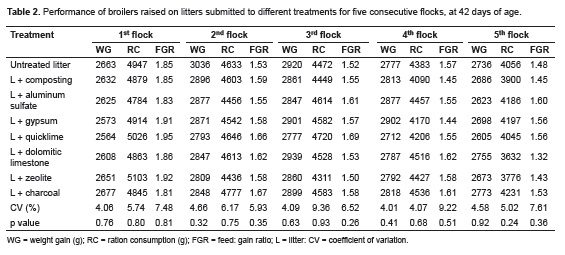
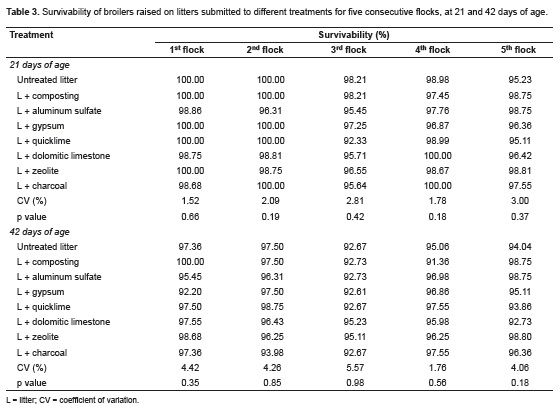
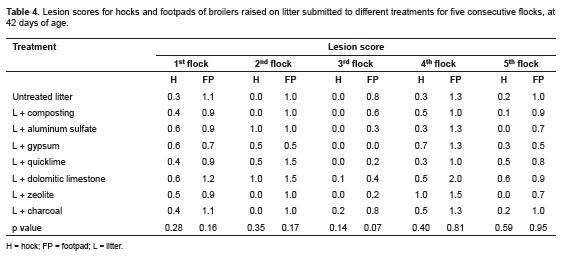
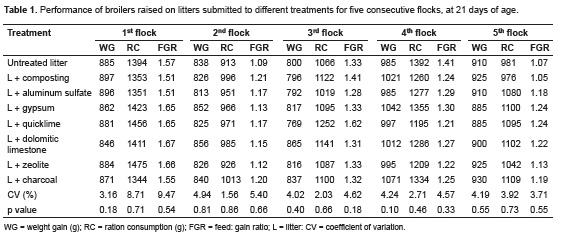
<body><![CDATA[<p>Where:</p>     <p>&mu;: general mean.</p>     <p>A<sub>i</sub>: effect of the litter treatment.  </p>     <p>e<sub></sub><sub>i</sub>: random error.</p>     <p>&nbsp;</p>     <p><b><font size="3">Results</font></b></p>     <p>Treatments did not influence broiler performance   (p&gt;0.05) at 21 and 42 days of age (<a href="#t1">Tables 1</a> and <a href="#t2">2</a>) or survivability (<a href="#t3">Table 3</a>).</p>      <p align="center"><a name="t1"><img src="/img/revistas/rccp/v28n4/v28n4a06t1.jpg"></a>     <p align="center"><a name="t2"><img src="/img/revistas/rccp/v28n4/v28n4a06t2.jpg"></a>     <p align="center"><a name="T3"><img src="/img/revistas/rccp/v28n4/v28n4a06t3.jpg"></a>     ]]></body>
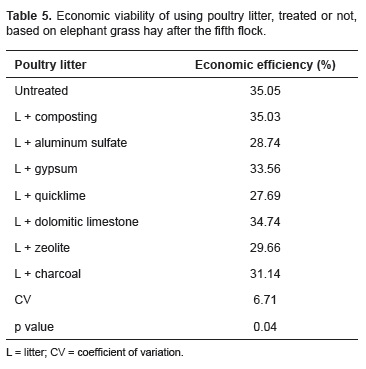
<body><![CDATA[<p>&nbsp;</p>     <p>No difference was observed (p&gt;0.05) in lesion scores for hocks, footpads (<a href="#t4">Table 4</a>), and breasts (data not shown because no breast lesions were observed on the evaluated birds).</p>      <p align="center"><a name="t4"><img src="/img/revistas/rccp/v28n4/v28n4a06t4.jpg"></a>     <p>&nbsp;</p>     <p>Treatments affected the economic viability of the   farm (p&lt;0.04). The use of LT with aluminum sulfate   and quicklime for five consecutive flocks resulted in the lowest economic efficiency (<a href="#t5">Table 5</a>).</p>      <p align="center"><a name="t5"><img src="/img/revistas/rccp/v28n4/v28n4a06t5.jpg"></a>     <p>&nbsp;</p>     <p>&nbsp;</p>     <p><font size="3"><b>Discussion</b></font></p>     <p>Treatments did not influence broiler performance   and survivability. Poultry litter, including untreated   litter, was in good condition at the end of each flock   (Loch <i><i>et al.</i>,</i> 2011). This finding is in agreement with   studies suggesting that excessively wet litter, with high   ammonia production, presence of microorganisms   and, consequently, poor quality could negatively   affect productive performance of broilers (Ritz <i><i>et al.</i>,</i> 2009). The negative effect was not verified in this experiment.</p>     ]]></body>
<body><![CDATA[<p>Maurice <i>et al.</i> (1998) studied the addition of zeolite   (10% of litter weight) to poultry litter and Ferreira <i>et al.</i> (2004) evaluated the addition of gypsum (40%   of the litter weight) and hydrated lime (0.5 kg/m<sup>2</sup>)   to the poultry litter and neither found differences in   productive performance of birds because of the treated   litter used. Ruiz <i>et al.</i> (2008) treated broiler litter with   quick lime (10 and 15%) and found no effects on body weight and feed: gain ratio of the birds.</p>     <p>However, different results were reported by McWard and Taylor (2000) who found that broilers raised on LT with sodium bisulfate, an acidic substance, had higher body weight (2.74 kg) than those raised on untreated litter (2.60 kg), probably because acidic substances reduce litter pH and ammonia volatilization, resulting in better environmental conditions for the birds. Similarly, Bennett <i>et al.</i> (2005), supplemented 0.2% hydrated lime in the poultry litter and observed that birds raised on the treated litter had higher body weight (1465 g, compared to 1406 g in untreated litter) at 35 days of age, and attributed this to lower bacterial concentrations in the treated litter.</p>     <p>Using zeolite at doses of 0, 25, 50, and 75% of   the litter weight, Eleroglu and Yal&ccedil;in (2005) showed   that body weight of broilers raised on treated litter   increased linearly with zeolite inclusion. As feed   consumption was not affected, it resulted in better   feed: gain ratio for LT with zeolite, despite the level   of inclusion in the litter. Karamanlis <i>et al.</i> (2008) also   noted that body weight at 42 days of age was higher   for birds raised on LT with zeolite at 2 kg/m<sup>2</sup> (2468 g,   compared to 2317 g in untreated litter). It is possible   that the improved results obtained with zeolite were   associated with its ability to absorb and bind ammonia (McCrory and Hobbs, 2001).</p>     <p>Survivability was similar, indicating that even   untreated litter had good physical, chemical, and   microbiological conditions. This could be due to the   good housing conditions, low microbial challenge, and low stocking density used.</p>     <p>Eleroglu and Yal&ccedil;in (2005) also reported that   survival rate did not change (93.1% on average for   all treatments) when zeolite was included in the litter.   Similarly, Nagaraj <i>et al.</i> (2007) studied sodium bisulfate   (0.22 and 0.44 kg/m<sup>2</sup>) and Ruiz <i>et al.</i> (2008) evaluated   quicklime use in litter; both reported that treatments did not influence the survival rate of the birds.</p>     <p>However, Ferreira <i>et al.</i> (2004) noted that   survival rate decreased in birds raised on LT with   acidic substances (aluminum sulfate and simple   superphosphate) at the end of the 2<sup>nd</sup> and 3<sup>rd</sup> flocks.   The authors attributed this to the ingestion of acid litter   because, according to Malone <i>et al.</i> (1983), birds can   consume up to 4% of their litter. However, a reduction in survival rate was not observed in this work.</p>     <p>Carcass lesion scores were not affected by   the treatments. This is important because footpad   dermatitis in broilers has great importance owing to   increasing exports of broiler feet. The most prevalent   form of footpad dermatitis in turkeys and broilers   is dermatitis associated with moisture and crust   formation on the litter, resulting in the combined   action of moisture and chemical irritants. This   condition, usually known as contact dermatitis, can   also affect breast and hocks. According to Nagaraj <i>et al.</i> (2007), litter moisture is considered a predisposing   factor for contact dermatitis. Ammonia released   from the litter can also irritate bird skin, causing   footpad dermatitis and hock and breast burns. Thus,   the extension of dermatitis prevalence is used as a   welfare indicator and can also be used as an indicator of litter quality.</p>     <p>Maurice <i>et al.</i> (1998) evaluated zeolite (10% of   the litter weight) finding no effects on hock scores in   broilers at 42 days of age. Nagaraj <i>et al.</i> (2007) did   not note differences in lesion scores in the footpads   of broilers at 42 and 49 days of age raised on litters   treated with sodium bisulfate, an acidic substance.   Different results were observed by McWard and   Taylor (2000) who treated litter with acidified clay,   sodium bisulfate, and aluminum sulfate. They reported   a slight reduction of lesion scores in breasts and   footpads as compared with birds raised on untreated   litter. No reports were found in the literature regarding   performance and carcass lesions using dolomitic   limestone or charcoal in the litter. Both substances   have the ability to absorb moisture (Souza <i><i>et al.</i>,</i>   2009), which could improve productive performance   of birds; however, this was not observed in the present   study. In conclusion, treatment of poultry litter did not   influence productive performance or carcass lesions in   broilers, and the use of aluminum sulfate or quicklime raised production costs.</p>     <p>&nbsp;</p>     <p><b><font size="3">Acknowledgements</font></b></p>     ]]></body>
<body><![CDATA[<p>The authors thank to Funda&ccedil;&atilde;o de Amparo &agrave;   Pesquisa do Estado de Goi&aacute;s (FAPEG) for funding   this research and to Brasil Foods SA for supplying the birds and rations used in this experiment.</p>     <p align="left">&nbsp;</p>     <p align="left"><b><font size="3">Conflicts of interest</font></b></p>     <p align="left">The authors declare they have no conflicts of interest with regard to the work presented in this report.</p>     <p align="left">&nbsp;</p> <hr size="1" />     <p><b><font size="3">Notes</font></b></p>     <p><b><a name="a0" id="a0"><a href="#a1">&curren;</a></a></b>To cite this article: de Oliveira MC, Gon&ccedil;alves BN, P&aacute;dua GT, da Silva VG, da Silva DV, Freitas AIM. Treatment of poultry litter does not improve performance or carcass lesions in broilers. Rev Colomb Cienc Pecu 2015; 28:331-338.</p> <hr size="1" />     <p>&nbsp;</p>     <p><b><font size="3">References</font></b></p>     <!-- ref --><p>Angelo JC, Gonzales E, Kondo N, Anzai NH, Cabral MM. Material   de cama: qualidade, quantidade e efeito sobre o desempenho de frangos de corte. Rev Bras Zoot 1997; 26(1):121-130.    &nbsp;&nbsp;&nbsp;&nbsp;&nbsp;&nbsp;&nbsp;&nbsp;[&#160;<a href="javascript:void(0);" onclick="javascript: window.open('/scielo.php?script=sci_nlinks&ref=000092&pid=S0120-0690201500040000600001&lng=','','width=640,height=500,resizable=yes,scrollbars=1,menubar=yes,');">Links</a>&#160;]<!-- end-ref --></p>     <!-- ref --><p>   Attia YA, Hamed RS, Abd El-Hamid AE, Shahba H&Aacute;, Bovera   F. Effect of inulin and mannan-oligosaccharides compared with   zinc-bacitracin on growing performance, nutriente digestibility   and hematological profiles of growing rabbits. Anim Prod Sci   2014; 55(1):80-86.    &nbsp;&nbsp;&nbsp;&nbsp;&nbsp;&nbsp;&nbsp;&nbsp;[&#160;<a href="javascript:void(0);" onclick="javascript: window.open('/scielo.php?script=sci_nlinks&ref=000094&pid=S0120-0690201500040000600002&lng=','','width=640,height=500,resizable=yes,scrollbars=1,menubar=yes,');">Links</a>&#160;]<!-- end-ref --></p>     <!-- ref --><p>   Bennett DS, Higgins SE, Moore R, Bird II JA, Beltran R, Corsiglia   C, Caldwell D, Hargis BM. Effect of addition of hydrated lime to   litter on recovery of selected bacteria and poultry performance. J   Appl Poult Res 2005; 14(4):721-727.    &nbsp;&nbsp;&nbsp;&nbsp;&nbsp;&nbsp;&nbsp;&nbsp;[&#160;<a href="javascript:void(0);" onclick="javascript: window.open('/scielo.php?script=sci_nlinks&ref=000096&pid=S0120-0690201500040000600003&lng=','','width=640,height=500,resizable=yes,scrollbars=1,menubar=yes,');">Links</a>&#160;]<!-- end-ref --></p>     <!-- ref --><p>   Choi IH, Moore Jr PA. Effects of liquid aluminum chloride   additions to poultry litter on broiler performance, ammonia   emissions, soluble phosphorus, total volatile fatty acids, and   nitrogen content of litter. Poult Sci 2008; 87(10):1955-1963.    &nbsp;&nbsp;&nbsp;&nbsp;&nbsp;&nbsp;&nbsp;&nbsp;[&#160;<a href="javascript:void(0);" onclick="javascript: window.open('/scielo.php?script=sci_nlinks&ref=000098&pid=S0120-0690201500040000600004&lng=','','width=640,height=500,resizable=yes,scrollbars=1,menubar=yes,');">Links</a>&#160;]<!-- end-ref --></p>     <!-- ref --><p>   Do JC, Choi IH, Nahm KH. Effects of chemically amended litter   on broiler performances, atmospheric ammonia concentration,   and phosphorus solubility in litter. Poult Sci 2005; 84(5):679-686.    &nbsp;&nbsp;&nbsp;&nbsp;&nbsp;&nbsp;&nbsp;&nbsp;[&#160;<a href="javascript:void(0);" onclick="javascript: window.open('/scielo.php?script=sci_nlinks&ref=000100&pid=S0120-0690201500040000600005&lng=','','width=640,height=500,resizable=yes,scrollbars=1,menubar=yes,');">Links</a>&#160;]<!-- end-ref --></p>     <!-- ref --><p>   Eichner G, Vieira SL, Torres CA, Coneglian JLB, Freitas   DM, Oyarzabal OA. Litter moisture and footpad dermatitis as   affected by diets formulated on an all-vegetable basis or having   the inclusion of poultry by-product. J Appl Poult Res 2007;   16(3):344-350.    &nbsp;&nbsp;&nbsp;&nbsp;&nbsp;&nbsp;&nbsp;&nbsp;[&#160;<a href="javascript:void(0);" onclick="javascript: window.open('/scielo.php?script=sci_nlinks&ref=000102&pid=S0120-0690201500040000600006&lng=','','width=640,height=500,resizable=yes,scrollbars=1,menubar=yes,');">Links</a>&#160;]<!-- end-ref --></p>     <!-- ref --><p>   Eleroglu H, Yal&ccedil;in H. Use of natural zeolite-supplemented   litter increased broiler production. South Afr J Anim Sci 2005;   35(2):90-97.    &nbsp;&nbsp;&nbsp;&nbsp;&nbsp;&nbsp;&nbsp;&nbsp;[&#160;<a href="javascript:void(0);" onclick="javascript: window.open('/scielo.php?script=sci_nlinks&ref=000104&pid=S0120-0690201500040000600007&lng=','','width=640,height=500,resizable=yes,scrollbars=1,menubar=yes,');">Links</a>&#160;]<!-- end-ref --></p>     <!-- ref --><p>   Ferreira HA, Oliveira MC, Traldi AB. Efeito de condicionadores   qu&iacute;micos na cama de frango sobre o desempenho de frangos de   corte. Arq Bras Med Vet Zoot 2004; 56(4):542-546.    &nbsp;&nbsp;&nbsp;&nbsp;&nbsp;&nbsp;&nbsp;&nbsp;[&#160;<a href="javascript:void(0);" onclick="javascript: window.open('/scielo.php?script=sci_nlinks&ref=000106&pid=S0120-0690201500040000600008&lng=','','width=640,height=500,resizable=yes,scrollbars=1,menubar=yes,');">Links</a>&#160;]<!-- end-ref --></p>     <!-- ref --><p>   Garrido NM, Skjervhein M, Oppegaard H, Sorum H. Acidified   litter benefits the intestinal flora balance of broiler chickens. Appl   Environm Microb 2004; 70(9):5208-5213.    &nbsp;&nbsp;&nbsp;&nbsp;&nbsp;&nbsp;&nbsp;&nbsp;[&#160;<a href="javascript:void(0);" onclick="javascript: window.open('/scielo.php?script=sci_nlinks&ref=000108&pid=S0120-0690201500040000600009&lng=','','width=640,height=500,resizable=yes,scrollbars=1,menubar=yes,');">Links</a>&#160;]<!-- end-ref --></p>     <!-- ref --><p>   IEA - Instituto de Economia Agr&iacute;cola. Pre&ccedil;os m&eacute;dios di&aacute;rios   recebidos pelos produtores no estado de S&atilde;o Paulo nos principais   escrit&oacute;rios de desenvolvimento rural. 2013; &#91;Access date: July 2,   2013&#93; URL: <a href="http://ciagri.iea.sp.gov.br/precosdiarios/" target="_blank">http://ciagri.iea.sp.gov.br/precosdiarios/</a>&nbsp;&nbsp;&nbsp;&nbsp;&nbsp;&nbsp;&nbsp;&nbsp;[&#160;<a href="javascript:void(0);" onclick="javascript: window.open('/scielo.php?script=sci_nlinks&ref=000110&pid=S0120-0690201500040000600010&lng=','','width=640,height=500,resizable=yes,scrollbars=1,menubar=yes,');">Links</a>&#160;]<!-- end-ref --><!-- ref --><p>   Karamanlis X, Fortomaris P, Arsenos G, Dosis I, Papaioannou   D, Batzios C, Kamarianos A. The effect of a natural zeolite   (clinoptilolite) on the performance of broiler chickens and the quality   of their litter. Asian-Austr J Anim Sci 2008; 21(11):1642-1650.    &nbsp;&nbsp;&nbsp;&nbsp;&nbsp;&nbsp;&nbsp;&nbsp;[&#160;<a href="javascript:void(0);" onclick="javascript: window.open('/scielo.php?script=sci_nlinks&ref=000111&pid=S0120-0690201500040000600011&lng=','','width=640,height=500,resizable=yes,scrollbars=1,menubar=yes,');">Links</a>&#160;]<!-- end-ref --></p>     ]]></body>
<body><![CDATA[<!-- ref --><p>Li H, Xin H, Liang Y, Burns RT. Reduction of ammonia emissions   from stored laying hen manure through topical application of   zeolite, Al&#43;Clear, Ferix-3, or poultry litter treatments. J. Appl. Poult Res 2008; 17(4):421-431.    &nbsp;&nbsp;&nbsp;&nbsp;&nbsp;&nbsp;&nbsp;&nbsp;[&#160;<a href="javascript:void(0);" onclick="javascript: window.open('/scielo.php?script=sci_nlinks&ref=000113&pid=S0120-0690201500040000600012&lng=','','width=640,height=500,resizable=yes,scrollbars=1,menubar=yes,');">Links</a>&#160;]<!-- end-ref --></p>     <!-- ref --><p>   Loch FC, Oliveira MC, Silva D, Gon&ccedil;alves BN, Faria BF,   Menezes JFS. Quality of poultry litter submitted to different   treatments in five consecutive flocks. Rev Bras Zoot 2011;   40(5):1025-1030.    &nbsp;&nbsp;&nbsp;&nbsp;&nbsp;&nbsp;&nbsp;&nbsp;[&#160;<a href="javascript:void(0);" onclick="javascript: window.open('/scielo.php?script=sci_nlinks&ref=000115&pid=S0120-0690201500040000600013&lng=','','width=640,height=500,resizable=yes,scrollbars=1,menubar=yes,');">Links</a>&#160;]<!-- end-ref --></p>     <!-- ref --><p>   Macklin KS, Hess JB, Bilgili SF, Norton RA. Effects of in-house   composting of litter on bacterial levels. J Appl Poult Res 2006;   15(4):531-537.    &nbsp;&nbsp;&nbsp;&nbsp;&nbsp;&nbsp;&nbsp;&nbsp;[&#160;<a href="javascript:void(0);" onclick="javascript: window.open('/scielo.php?script=sci_nlinks&ref=000117&pid=S0120-0690201500040000600014&lng=','','width=640,height=500,resizable=yes,scrollbars=1,menubar=yes,');">Links</a>&#160;]<!-- end-ref --></p>     <!-- ref --><p>   Malone GW, Chaloupka GW, Saylor WW. Influence of litter   type and size on broiler performance. 1. Factors affecting litter   consumption. Poult Sci 1983; 62(9):1741-1746.    &nbsp;&nbsp;&nbsp;&nbsp;&nbsp;&nbsp;&nbsp;&nbsp;[&#160;<a href="javascript:void(0);" onclick="javascript: window.open('/scielo.php?script=sci_nlinks&ref=000119&pid=S0120-0690201500040000600015&lng=','','width=640,height=500,resizable=yes,scrollbars=1,menubar=yes,');">Links</a>&#160;]<!-- end-ref --></p>     <!-- ref --><p>   Maurice DV, Lightsey SF, Hamrick E, Cox J. Alum sludge and   zeolite as components of broiler litter. J Appl Poult Res 1998;   7(3):263-267.    &nbsp;&nbsp;&nbsp;&nbsp;&nbsp;&nbsp;&nbsp;&nbsp;[&#160;<a href="javascript:void(0);" onclick="javascript: window.open('/scielo.php?script=sci_nlinks&ref=000121&pid=S0120-0690201500040000600016&lng=','','width=640,height=500,resizable=yes,scrollbars=1,menubar=yes,');">Links</a>&#160;]<!-- end-ref --></p>     ]]></body>
<body><![CDATA[<!-- ref --><p>   McCrory DF, Hobbs PJ. Additives to reduce ammonia and   odor emissions from livestock wastes. J Environm Qual 2001;   30(2):345-355.    &nbsp;&nbsp;&nbsp;&nbsp;&nbsp;&nbsp;&nbsp;&nbsp;[&#160;<a href="javascript:void(0);" onclick="javascript: window.open('/scielo.php?script=sci_nlinks&ref=000123&pid=S0120-0690201500040000600017&lng=','','width=640,height=500,resizable=yes,scrollbars=1,menubar=yes,');">Links</a>&#160;]<!-- end-ref --></p>     <!-- ref --><p>   McWard GW, Taylor DR. Acidified clay litter amendment. J Appl   Poult Res 2000; 9(4):518-529.    &nbsp;&nbsp;&nbsp;&nbsp;&nbsp;&nbsp;&nbsp;&nbsp;[&#160;<a href="javascript:void(0);" onclick="javascript: window.open('/scielo.php?script=sci_nlinks&ref=000125&pid=S0120-0690201500040000600018&lng=','','width=640,height=500,resizable=yes,scrollbars=1,menubar=yes,');">Links</a>&#160;]<!-- end-ref --></p>     <!-- ref --><p>   Miles DM, Moore Jr PA, Smith DR, Rice DW, Stillborn HL, Rowe   DR, Lott BD, Branton SL, Simmons JD. Total and water-soluble   phosphorus in broiler litter over three flocks with alum litter   treatment and dietary inclusion of high available phosphorus corn   and phytase supplementation. Poult Sci 2003; 82(10):1544-1549.    &nbsp;&nbsp;&nbsp;&nbsp;&nbsp;&nbsp;&nbsp;&nbsp;[&#160;<a href="javascript:void(0);" onclick="javascript: window.open('/scielo.php?script=sci_nlinks&ref=000127&pid=S0120-0690201500040000600019&lng=','','width=640,height=500,resizable=yes,scrollbars=1,menubar=yes,');">Links</a>&#160;]<!-- end-ref --></p>     <!-- ref --><p>   Moore Jr PA, Daniel TC, Edwards DR. Reducing phosphorus   runoff and inhibiting ammonia loss from poultry manure with   aluminum sulfate. J Environ Qual 2000; 29(1):29-37.    &nbsp;&nbsp;&nbsp;&nbsp;&nbsp;&nbsp;&nbsp;&nbsp;[&#160;<a href="javascript:void(0);" onclick="javascript: window.open('/scielo.php?script=sci_nlinks&ref=000129&pid=S0120-0690201500040000600020&lng=','','width=640,height=500,resizable=yes,scrollbars=1,menubar=yes,');">Links</a>&#160;]<!-- end-ref --></p>     <!-- ref --><p>   Nagaraj M, Wilson CAP, Saenmahayak B, Hess JB, Bilgili SF.   Efficacy of a litter amendment to reduce pododermatitis in broiler   chickens. J Appl Poult Res 2007; 16(2):255-261.    &nbsp;&nbsp;&nbsp;&nbsp;&nbsp;&nbsp;&nbsp;&nbsp;[&#160;<a href="javascript:void(0);" onclick="javascript: window.open('/scielo.php?script=sci_nlinks&ref=000131&pid=S0120-0690201500040000600021&lng=','','width=640,height=500,resizable=yes,scrollbars=1,menubar=yes,');">Links</a>&#160;]<!-- end-ref --></p>     ]]></body>
<body><![CDATA[<!-- ref --><p>   Oliveira MC, Ferreira HA, Cancherini LC. Efeito de   condicionadores qu&iacute;micos sobre a qualidade da cama de frango.   Arq Bras Med Vet Zoot 2004; 56(4):536-541.    &nbsp;&nbsp;&nbsp;&nbsp;&nbsp;&nbsp;&nbsp;&nbsp;[&#160;<a href="javascript:void(0);" onclick="javascript: window.open('/scielo.php?script=sci_nlinks&ref=000133&pid=S0120-0690201500040000600022&lng=','','width=640,height=500,resizable=yes,scrollbars=1,menubar=yes,');">Links</a>&#160;]<!-- end-ref --></p>     <!-- ref --><p>   Ritz CW, Fairchild BD, Lacy MP. Litter quality and broiler   performance. Cooperative Extension, University of Georgia   (Bulletin 1267) 2009; &#91;Access date: March 8, 2010&#93; URL: <a href="http://pubs.caes.uga.edu/caespubs/pubs/PDF/B1267.pdf" target="_blank">http://pubs.caes.uga.edu/caespubs/pubs/PDF/B1267.pdf</a>&nbsp;&nbsp;&nbsp;&nbsp;&nbsp;&nbsp;&nbsp;&nbsp;[&#160;<a href="javascript:void(0);" onclick="javascript: window.open('/scielo.php?script=sci_nlinks&ref=000135&pid=S0120-0690201500040000600023&lng=','','width=640,height=500,resizable=yes,scrollbars=1,menubar=yes,');">Links</a>&#160;]<!-- end-ref --><!-- ref --><p>   Ruiz V, Ruiz D, Gernat AG, Grimes JL, Murillo JG, Wineland   MJ, Anderson KE, Maguire RO. The effect of quicklime (CaO)   on litter condition and broiler performance. Poult Sci 2008;   87(5):823-827.    &nbsp;&nbsp;&nbsp;&nbsp;&nbsp;&nbsp;&nbsp;&nbsp;[&#160;<a href="javascript:void(0);" onclick="javascript: window.open('/scielo.php?script=sci_nlinks&ref=000136&pid=S0120-0690201500040000600024&lng=','','width=640,height=500,resizable=yes,scrollbars=1,menubar=yes,');">Links</a>&#160;]<!-- end-ref --></p>     <!-- ref --><p>   SAEG. Sistema para an&aacute;lises estat&iacute;sticas e gen&eacute;ticas, Vers&atilde;o 9.0.   Funda&ccedil;&atilde;o Arthur Bernardes, UFV, Vi&ccedil;osa, MG, Brasil. 2007.   (Manual do usu&aacute;rio).    &nbsp;&nbsp;&nbsp;&nbsp;&nbsp;&nbsp;&nbsp;&nbsp;[&#160;<a href="javascript:void(0);" onclick="javascript: window.open('/scielo.php?script=sci_nlinks&ref=000138&pid=S0120-0690201500040000600025&lng=','','width=640,height=500,resizable=yes,scrollbars=1,menubar=yes,');">Links</a>&#160;]<!-- end-ref --></p>     <!-- ref --><p>   Souza MAS, Castro N, &Aacute;villa FL. Constru&ccedil;&atilde;o de um secador   solar de madeira em escala experimental. 2&ordf; Mostra Institucional   UFAM/UEA 2009; &#91;Access date: March 9, 2010&#93; URL: <a href="http://www.icet.ufam.edu.br/semanact2009/resumos/Resumo%20Marcos%20Antonio.pdf" target="_blank">http://www.icet.ufam.edu.br/semanact2009/resumos/Resumo%20Marcos%20Antonio.pdf</a>&nbsp;&nbsp;&nbsp;&nbsp;&nbsp;&nbsp;&nbsp;&nbsp;[&#160;<a href="javascript:void(0);" onclick="javascript: window.open('/scielo.php?script=sci_nlinks&ref=000140&pid=S0120-0690201500040000600026&lng=','','width=640,height=500,resizable=yes,scrollbars=1,menubar=yes,');">Links</a>&#160;]<!-- end-ref --><!-- ref --><p>   Turan NG. The effects of natural zeolite on salinity level of poultry   litter compost. Bioresource Tecnol 2008; 99(7):2097-2101.    &nbsp;&nbsp;&nbsp;&nbsp;&nbsp;&nbsp;&nbsp;&nbsp;[&#160;<a href="javascript:void(0);" onclick="javascript: window.open('/scielo.php?script=sci_nlinks&ref=000141&pid=S0120-0690201500040000600027&lng=','','width=640,height=500,resizable=yes,scrollbars=1,menubar=yes,');">Links</a>&#160;]<!-- end-ref --></p>     ]]></body>
<body><![CDATA[<!-- ref --><p>   Wilkinson KG. The biosecurity of on-farm mortality composting.   J Appl Microb 2007; 102(3):609-618.    &nbsp;&nbsp;&nbsp;&nbsp;&nbsp;&nbsp;&nbsp;&nbsp;[&#160;<a href="javascript:void(0);" onclick="javascript: window.open('/scielo.php?script=sci_nlinks&ref=000143&pid=S0120-0690201500040000600028&lng=','','width=640,height=500,resizable=yes,scrollbars=1,menubar=yes,');">Links</a>&#160;]<!-- end-ref --></p>     <p>&nbsp;</p>     <p>&nbsp;</p>     <p>&nbsp;</p> </font>      ]]></body><back>
<ref-list>
<ref id="B1">
<nlm-citation citation-type="journal">
<person-group person-group-type="author">
<name>
<surname><![CDATA[Angelo]]></surname>
<given-names><![CDATA[JC]]></given-names>
</name>
<name>
<surname><![CDATA[Gonzales]]></surname>
<given-names><![CDATA[E]]></given-names>
</name>
<name>
<surname><![CDATA[Kondo]]></surname>
<given-names><![CDATA[N]]></given-names>
</name>
<name>
<surname><![CDATA[Anzai]]></surname>
<given-names><![CDATA[NH]]></given-names>
</name>
<name>
<surname><![CDATA[Cabral]]></surname>
<given-names><![CDATA[MM]]></given-names>
</name>
</person-group>
<article-title xml:lang="pt"><![CDATA[Material de cama: qualidade, quantidade e efeito sobre o desempenho de frangos de corte]]></article-title>
<source><![CDATA[Rev Bras Zoot]]></source>
<year>1997</year>
<volume>26(1)</volume>
<page-range>121-130</page-range></nlm-citation>
</ref>
<ref id="B2">
<nlm-citation citation-type="journal">
<person-group person-group-type="author">
<name>
<surname><![CDATA[Attia]]></surname>
<given-names><![CDATA[YA]]></given-names>
</name>
<name>
<surname><![CDATA[Hamed]]></surname>
<given-names><![CDATA[RS]]></given-names>
</name>
<name>
<surname><![CDATA[Abd]]></surname>
<given-names><![CDATA[El-Hamid AE]]></given-names>
</name>
<name>
<surname><![CDATA[Shahba]]></surname>
<given-names><![CDATA[HÁ]]></given-names>
</name>
<name>
<surname><![CDATA[Bovera]]></surname>
<given-names><![CDATA[F]]></given-names>
</name>
</person-group>
<article-title xml:lang="en"><![CDATA[Effect of inulin and mannan-oligosaccharides compared with zinc-bacitracin on growing performance, nutriente digestibility and hematological profiles of growing rabbits]]></article-title>
<source><![CDATA[Anim Prod Sci]]></source>
<year>2014</year>
<volume>55(1)</volume>
<page-range>80-86</page-range></nlm-citation>
</ref>
<ref id="B3">
<nlm-citation citation-type="journal">
<person-group person-group-type="author">
<name>
<surname><![CDATA[Bennett]]></surname>
<given-names><![CDATA[DS]]></given-names>
</name>
<name>
<surname><![CDATA[Higgins]]></surname>
<given-names><![CDATA[SE]]></given-names>
</name>
<name>
<surname><![CDATA[Moore]]></surname>
<given-names><![CDATA[R]]></given-names>
</name>
<name>
<surname><![CDATA[Bird]]></surname>
<given-names><![CDATA[II JA]]></given-names>
</name>
<name>
<surname><![CDATA[Beltran]]></surname>
<given-names><![CDATA[R]]></given-names>
</name>
<name>
<surname><![CDATA[Corsiglia]]></surname>
<given-names><![CDATA[C]]></given-names>
</name>
<name>
<surname><![CDATA[Caldwell]]></surname>
<given-names><![CDATA[D]]></given-names>
</name>
<name>
<surname><![CDATA[Hargis]]></surname>
<given-names><![CDATA[BM]]></given-names>
</name>
</person-group>
<article-title xml:lang="en"><![CDATA[Effect of addition of hydrated lime to litter on recovery of selected bacteria and poultry performance]]></article-title>
<source><![CDATA[J Appl Poult Res]]></source>
<year>2005</year>
<volume>14(4)</volume>
<page-range>721-727</page-range></nlm-citation>
</ref>
<ref id="B4">
<nlm-citation citation-type="journal">
<person-group person-group-type="author">
<name>
<surname><![CDATA[Choi]]></surname>
<given-names><![CDATA[IH]]></given-names>
</name>
<name>
<surname><![CDATA[Moore]]></surname>
<given-names><![CDATA[Jr PA]]></given-names>
</name>
</person-group>
<article-title xml:lang="en"><![CDATA[Effects of liquid aluminum chloride additions to poultry litter on broiler performance, ammonia emissions, soluble phosphorus, total volatile fatty acids, and nitrogen content of litter]]></article-title>
<source><![CDATA[Poult Sci]]></source>
<year>2008</year>
<volume>87(10)</volume>
<page-range>1955-1963</page-range></nlm-citation>
</ref>
<ref id="B5">
<nlm-citation citation-type="journal">
<person-group person-group-type="author">
<name>
<surname><![CDATA[Do]]></surname>
<given-names><![CDATA[JC]]></given-names>
</name>
<name>
<surname><![CDATA[Choi]]></surname>
<given-names><![CDATA[IH]]></given-names>
</name>
<name>
<surname><![CDATA[Nahm]]></surname>
<given-names><![CDATA[KH]]></given-names>
</name>
</person-group>
<article-title xml:lang="en"><![CDATA[Effects of chemically amended litter on broiler performances, atmospheric ammonia concentration, and phosphorus solubility in litter]]></article-title>
<source><![CDATA[Poult Sci]]></source>
<year>2005</year>
<volume>84(5)</volume>
<page-range>679-686</page-range></nlm-citation>
</ref>
<ref id="B6">
<nlm-citation citation-type="journal">
<person-group person-group-type="author">
<name>
<surname><![CDATA[Eichner]]></surname>
<given-names><![CDATA[G]]></given-names>
</name>
<name>
<surname><![CDATA[Vieira]]></surname>
<given-names><![CDATA[SL]]></given-names>
</name>
<name>
<surname><![CDATA[Torres]]></surname>
<given-names><![CDATA[CA]]></given-names>
</name>
<name>
<surname><![CDATA[Coneglian]]></surname>
<given-names><![CDATA[JLB]]></given-names>
</name>
<name>
<surname><![CDATA[Freitas]]></surname>
<given-names><![CDATA[DM]]></given-names>
</name>
<name>
<surname><![CDATA[Oyarzabal]]></surname>
<given-names><![CDATA[OA]]></given-names>
</name>
</person-group>
<article-title xml:lang="en"><![CDATA[Litter moisture and footpad dermatitis as affected by diets formulated on an all-vegetable basis or having the inclusion of poultry by-product]]></article-title>
<source><![CDATA[J Appl Poult Res]]></source>
<year>2007</year>
<volume>16(3)</volume>
<page-range>344-350</page-range></nlm-citation>
</ref>
<ref id="B7">
<nlm-citation citation-type="journal">
<person-group person-group-type="author">
<name>
<surname><![CDATA[Eleroglu]]></surname>
<given-names><![CDATA[H]]></given-names>
</name>
<name>
<surname><![CDATA[Yalçin]]></surname>
<given-names><![CDATA[H]]></given-names>
</name>
</person-group>
<article-title xml:lang="en"><![CDATA[Use of natural zeolite-supplemented litter increased broiler production]]></article-title>
<source><![CDATA[South Afr J Anim Sci]]></source>
<year>2005</year>
<volume>35(2)</volume>
<page-range>90-97</page-range></nlm-citation>
</ref>
<ref id="B8">
<nlm-citation citation-type="journal">
<person-group person-group-type="author">
<name>
<surname><![CDATA[Ferreira]]></surname>
<given-names><![CDATA[HA]]></given-names>
</name>
<name>
<surname><![CDATA[Oliveira]]></surname>
<given-names><![CDATA[MC]]></given-names>
</name>
<name>
<surname><![CDATA[Traldi]]></surname>
<given-names><![CDATA[AB]]></given-names>
</name>
</person-group>
<article-title xml:lang="pt"><![CDATA[Efeito de condicionadores químicos na cama de frango sobre o desempenho de frangos de corte]]></article-title>
<source><![CDATA[Arq Bras Med Vet Zoot]]></source>
<year>2004</year>
<volume>56(4)</volume>
<page-range>542-546</page-range></nlm-citation>
</ref>
<ref id="B9">
<nlm-citation citation-type="journal">
<person-group person-group-type="author">
<name>
<surname><![CDATA[Garrido]]></surname>
<given-names><![CDATA[NM]]></given-names>
</name>
<name>
<surname><![CDATA[Skjervhein]]></surname>
<given-names><![CDATA[M]]></given-names>
</name>
<name>
<surname><![CDATA[Oppegaard]]></surname>
<given-names><![CDATA[H]]></given-names>
</name>
<name>
<surname><![CDATA[Sorum]]></surname>
<given-names><![CDATA[H]]></given-names>
</name>
</person-group>
<article-title xml:lang="en"><![CDATA[Acidified litter benefits the intestinal flora balance of broiler chickens]]></article-title>
<source><![CDATA[Appl Environm Microb]]></source>
<year>2004</year>
<volume>70(9)</volume>
<page-range>5208-5213</page-range></nlm-citation>
</ref>
<ref id="B10">
<nlm-citation citation-type="">
<collab>IEA - Instituto de Economia Agrícola</collab>
<source><![CDATA[Preços médios diários recebidos pelos produtores no estado de São Paulo nos principais escritórios de desenvolvimento rural]]></source>
<year>2013</year>
</nlm-citation>
</ref>
<ref id="B11">
<nlm-citation citation-type="journal">
<person-group person-group-type="author">
<name>
<surname><![CDATA[Karamanlis]]></surname>
<given-names><![CDATA[X]]></given-names>
</name>
<name>
<surname><![CDATA[Fortomaris]]></surname>
<given-names><![CDATA[P]]></given-names>
</name>
<name>
<surname><![CDATA[Arsenos]]></surname>
<given-names><![CDATA[G]]></given-names>
</name>
<name>
<surname><![CDATA[Dosis]]></surname>
<given-names><![CDATA[I]]></given-names>
</name>
<name>
<surname><![CDATA[Papaioannou]]></surname>
<given-names><![CDATA[D]]></given-names>
</name>
<name>
<surname><![CDATA[Batzios]]></surname>
<given-names><![CDATA[C]]></given-names>
</name>
<name>
<surname><![CDATA[Kamarianos]]></surname>
<given-names><![CDATA[A]]></given-names>
</name>
</person-group>
<article-title xml:lang="en"><![CDATA[The effect of a natural zeolite (clinoptilolite) on the performance of broiler chickens and the quality of their litter]]></article-title>
<source><![CDATA[Asian-Austr J Anim Sci]]></source>
<year>2008</year>
<volume>21(11)</volume>
<page-range>1642-1650</page-range></nlm-citation>
</ref>
<ref id="B12">
<nlm-citation citation-type="journal">
<person-group person-group-type="author">
<name>
<surname><![CDATA[Li]]></surname>
<given-names><![CDATA[H]]></given-names>
</name>
<name>
<surname><![CDATA[Xin]]></surname>
<given-names><![CDATA[H]]></given-names>
</name>
<name>
<surname><![CDATA[Liang]]></surname>
<given-names><![CDATA[Y]]></given-names>
</name>
<name>
<surname><![CDATA[Burns]]></surname>
<given-names><![CDATA[RT]]></given-names>
</name>
</person-group>
<article-title xml:lang="en"><![CDATA[Reduction of ammonia emissions from stored laying hen manure through topical application of zeolite, Al+Clear, Ferix-3, or poultry litter treatments]]></article-title>
<source><![CDATA[J. Appl. Poult Res]]></source>
<year>2008</year>
<volume>17(4)</volume>
<page-range>421-431</page-range></nlm-citation>
</ref>
<ref id="B13">
<nlm-citation citation-type="journal">
<person-group person-group-type="author">
<name>
<surname><![CDATA[Loch]]></surname>
<given-names><![CDATA[FC]]></given-names>
</name>
<name>
<surname><![CDATA[Oliveira]]></surname>
<given-names><![CDATA[MC]]></given-names>
</name>
<name>
<surname><![CDATA[Silva]]></surname>
<given-names><![CDATA[D]]></given-names>
</name>
<name>
<surname><![CDATA[Gonçalves]]></surname>
<given-names><![CDATA[BN]]></given-names>
</name>
<name>
<surname><![CDATA[Faria]]></surname>
<given-names><![CDATA[BF]]></given-names>
</name>
<name>
<surname><![CDATA[Menezes]]></surname>
<given-names><![CDATA[JFS]]></given-names>
</name>
</person-group>
<article-title xml:lang="en"><![CDATA[Quality of poultry litter submitted to different treatments in five consecutive flocks]]></article-title>
<source><![CDATA[Rev Bras Zoot]]></source>
<year>2011</year>
<volume>40(5)</volume>
<page-range>1025-1030</page-range></nlm-citation>
</ref>
<ref id="B14">
<nlm-citation citation-type="journal">
<person-group person-group-type="author">
<name>
<surname><![CDATA[Macklin]]></surname>
<given-names><![CDATA[KS]]></given-names>
</name>
<name>
<surname><![CDATA[Hess]]></surname>
<given-names><![CDATA[JB]]></given-names>
</name>
<name>
<surname><![CDATA[Bilgili]]></surname>
<given-names><![CDATA[SF]]></given-names>
</name>
<name>
<surname><![CDATA[Norton]]></surname>
<given-names><![CDATA[RA]]></given-names>
</name>
</person-group>
<article-title xml:lang="en"><![CDATA[Effects of in-house composting of litter on bacterial levels]]></article-title>
<source><![CDATA[J Appl Poult Res]]></source>
<year>2006</year>
<volume>15(4)</volume>
<page-range>531-537</page-range></nlm-citation>
</ref>
<ref id="B15">
<nlm-citation citation-type="journal">
<person-group person-group-type="author">
<name>
<surname><![CDATA[Malone]]></surname>
<given-names><![CDATA[GW]]></given-names>
</name>
<name>
<surname><![CDATA[Chaloupka]]></surname>
<given-names><![CDATA[GW]]></given-names>
</name>
<name>
<surname><![CDATA[Saylor]]></surname>
<given-names><![CDATA[WW]]></given-names>
</name>
</person-group>
<article-title xml:lang="en"><![CDATA[Influence of litter type and size on broiler performance 1 Factors affecting litter consumption]]></article-title>
<source><![CDATA[Poult Sci]]></source>
<year>1983</year>
<volume>62(9)</volume>
<page-range>1741-1746</page-range></nlm-citation>
</ref>
<ref id="B16">
<nlm-citation citation-type="journal">
<person-group person-group-type="author">
<name>
<surname><![CDATA[Maurice]]></surname>
<given-names><![CDATA[DV]]></given-names>
</name>
<name>
<surname><![CDATA[Lightsey]]></surname>
<given-names><![CDATA[SF]]></given-names>
</name>
<name>
<surname><![CDATA[Hamrick]]></surname>
<given-names><![CDATA[E]]></given-names>
</name>
<name>
<surname><![CDATA[Cox]]></surname>
<given-names><![CDATA[J]]></given-names>
</name>
</person-group>
<article-title xml:lang="en"><![CDATA[Alum sludge and zeolite as components of broiler litter]]></article-title>
<source><![CDATA[J Appl Poult Res]]></source>
<year>1998</year>
<volume>7(3)</volume>
<page-range>263-267</page-range></nlm-citation>
</ref>
<ref id="B17">
<nlm-citation citation-type="journal">
<person-group person-group-type="author">
<name>
<surname><![CDATA[McCrory]]></surname>
<given-names><![CDATA[DF]]></given-names>
</name>
<name>
<surname><![CDATA[Hobbs]]></surname>
<given-names><![CDATA[PJ]]></given-names>
</name>
</person-group>
<article-title xml:lang="en"><![CDATA[Additives to reduce ammonia and odor emissions from livestock wastes]]></article-title>
<source><![CDATA[J Environm Qual]]></source>
<year>2001</year>
<volume>30(2)</volume>
<page-range>345-355</page-range></nlm-citation>
</ref>
<ref id="B18">
<nlm-citation citation-type="journal">
<person-group person-group-type="author">
<name>
<surname><![CDATA[McWard]]></surname>
<given-names><![CDATA[GW]]></given-names>
</name>
<name>
<surname><![CDATA[Taylor]]></surname>
<given-names><![CDATA[DR]]></given-names>
</name>
</person-group>
<article-title xml:lang="en"><![CDATA[Acidified clay litter amendment]]></article-title>
<source><![CDATA[J Appl Poult Res]]></source>
<year>2000</year>
<volume>9(4)</volume>
<page-range>518-529</page-range></nlm-citation>
</ref>
<ref id="B19">
<nlm-citation citation-type="journal">
<person-group person-group-type="author">
<name>
<surname><![CDATA[Miles]]></surname>
<given-names><![CDATA[DM]]></given-names>
</name>
<name>
<surname><![CDATA[Moore]]></surname>
<given-names><![CDATA[Jr PA]]></given-names>
</name>
<name>
<surname><![CDATA[Smith]]></surname>
<given-names><![CDATA[DR]]></given-names>
</name>
<name>
<surname><![CDATA[Rice]]></surname>
<given-names><![CDATA[DW]]></given-names>
</name>
<name>
<surname><![CDATA[Stillborn]]></surname>
<given-names><![CDATA[HL]]></given-names>
</name>
<name>
<surname><![CDATA[Rowe]]></surname>
<given-names><![CDATA[DR]]></given-names>
</name>
<name>
<surname><![CDATA[Lott]]></surname>
<given-names><![CDATA[BD]]></given-names>
</name>
<name>
<surname><![CDATA[Branton]]></surname>
<given-names><![CDATA[SL]]></given-names>
</name>
<name>
<surname><![CDATA[Simmons]]></surname>
<given-names><![CDATA[JD]]></given-names>
</name>
</person-group>
<article-title xml:lang="en"><![CDATA[Total and water-soluble phosphorus in broiler litter over three flocks with alum litter treatment and dietary inclusion of high available phosphorus corn and phytase supplementation]]></article-title>
<source><![CDATA[Poult Sci]]></source>
<year>2003</year>
<volume>82(10)</volume>
<page-range>1544-1549</page-range></nlm-citation>
</ref>
<ref id="B20">
<nlm-citation citation-type="journal">
<person-group person-group-type="author">
<name>
<surname><![CDATA[Moore]]></surname>
<given-names><![CDATA[Jr PA]]></given-names>
</name>
<name>
<surname><![CDATA[Daniel]]></surname>
<given-names><![CDATA[TC]]></given-names>
</name>
<name>
<surname><![CDATA[Edwards]]></surname>
<given-names><![CDATA[DR]]></given-names>
</name>
</person-group>
<article-title xml:lang="en"><![CDATA[Reducing phosphorus runoff and inhibiting ammonia loss from poultry manure with aluminum sulfate]]></article-title>
<source><![CDATA[J Environ Qual]]></source>
<year>2000</year>
<volume>29(1)</volume>
<page-range>29-37</page-range></nlm-citation>
</ref>
<ref id="B21">
<nlm-citation citation-type="journal">
<person-group person-group-type="author">
<name>
<surname><![CDATA[Nagaraj]]></surname>
<given-names><![CDATA[M]]></given-names>
</name>
<name>
<surname><![CDATA[Wilson]]></surname>
<given-names><![CDATA[CAP]]></given-names>
</name>
<name>
<surname><![CDATA[Saenmahayak]]></surname>
<given-names><![CDATA[B]]></given-names>
</name>
<name>
<surname><![CDATA[Hess]]></surname>
<given-names><![CDATA[JB]]></given-names>
</name>
<name>
<surname><![CDATA[Bilgili]]></surname>
<given-names><![CDATA[SF]]></given-names>
</name>
</person-group>
<article-title xml:lang="en"><![CDATA[Efficacy of a litter amendment to reduce pododermatitis in broiler chickens]]></article-title>
<source><![CDATA[J Appl Poult Res]]></source>
<year>2007</year>
<volume>16(2)</volume>
<page-range>255-261</page-range></nlm-citation>
</ref>
<ref id="B22">
<nlm-citation citation-type="journal">
<person-group person-group-type="author">
<name>
<surname><![CDATA[Oliveira]]></surname>
<given-names><![CDATA[MC]]></given-names>
</name>
<name>
<surname><![CDATA[Ferreira]]></surname>
<given-names><![CDATA[HA]]></given-names>
</name>
<name>
<surname><![CDATA[Cancherini]]></surname>
<given-names><![CDATA[LC]]></given-names>
</name>
</person-group>
<article-title xml:lang="pt"><![CDATA[Efeito de condicionadores químicos sobre a qualidade da cama de frango]]></article-title>
<source><![CDATA[Arq Bras Med Vet Zoot]]></source>
<year>2004</year>
<volume>56(4)</volume>
<page-range>536-541</page-range></nlm-citation>
</ref>
<ref id="B23">
<nlm-citation citation-type="book">
<person-group person-group-type="author">
<name>
<surname><![CDATA[Ritz]]></surname>
<given-names><![CDATA[CW]]></given-names>
</name>
<name>
<surname><![CDATA[Fairchild]]></surname>
<given-names><![CDATA[BD]]></given-names>
</name>
<name>
<surname><![CDATA[Lacy]]></surname>
<given-names><![CDATA[MP]]></given-names>
</name>
</person-group>
<source><![CDATA[Litter quality and broiler performance]]></source>
<year></year>
<publisher-name><![CDATA[Cooperative Extension, University of Georgia]]></publisher-name>
</nlm-citation>
</ref>
<ref id="B24">
<nlm-citation citation-type="journal">
<person-group person-group-type="author">
<name>
<surname><![CDATA[Ruiz]]></surname>
<given-names><![CDATA[V]]></given-names>
</name>
<name>
<surname><![CDATA[Ruiz]]></surname>
<given-names><![CDATA[D]]></given-names>
</name>
<name>
<surname><![CDATA[Gernat]]></surname>
<given-names><![CDATA[AG]]></given-names>
</name>
<name>
<surname><![CDATA[Grimes]]></surname>
<given-names><![CDATA[JL]]></given-names>
</name>
<name>
<surname><![CDATA[Murillo]]></surname>
<given-names><![CDATA[JG]]></given-names>
</name>
<name>
<surname><![CDATA[Wineland]]></surname>
<given-names><![CDATA[MJ]]></given-names>
</name>
<name>
<surname><![CDATA[Anderson]]></surname>
<given-names><![CDATA[KE]]></given-names>
</name>
<name>
<surname><![CDATA[Maguire]]></surname>
<given-names><![CDATA[RO]]></given-names>
</name>
</person-group>
<article-title xml:lang="en"><![CDATA[The effect of quicklime (CaO) on litter condition and broiler performance]]></article-title>
<source><![CDATA[Poult Sci]]></source>
<year>2008</year>
<volume>87(5)</volume>
<page-range>823-827</page-range></nlm-citation>
</ref>
<ref id="B25">
<nlm-citation citation-type="book">
<collab>SAEG</collab>
<source><![CDATA[Sistema para análises estatísticas e genéticas, Versão 9.0]]></source>
<year>2007</year>
<publisher-loc><![CDATA[Viçosa^eMG MG]]></publisher-loc>
<publisher-name><![CDATA[Fundação Arthur Bernardes, UFV]]></publisher-name>
</nlm-citation>
</ref>
<ref id="B26">
<nlm-citation citation-type="book">
<person-group person-group-type="author">
<name>
<surname><![CDATA[Souza]]></surname>
<given-names><![CDATA[MAS]]></given-names>
</name>
<name>
<surname><![CDATA[Castro]]></surname>
<given-names><![CDATA[N]]></given-names>
</name>
<name>
<surname><![CDATA[Ávilla]]></surname>
<given-names><![CDATA[FL]]></given-names>
</name>
</person-group>
<source><![CDATA[Construção de um secador solar de madeira em escala experimental]]></source>
<year>2009</year>
<publisher-name><![CDATA[Mostra Institucional UFAM/UEA]]></publisher-name>
</nlm-citation>
</ref>
<ref id="B27">
<nlm-citation citation-type="journal">
<person-group person-group-type="author">
<name>
<surname><![CDATA[Turan]]></surname>
<given-names><![CDATA[NG]]></given-names>
</name>
</person-group>
<article-title xml:lang="en"><![CDATA[The effects of natural zeolite on salinity level of poultry litter compost]]></article-title>
<source><![CDATA[Bioresource Tecnol]]></source>
<year>2008</year>
<volume>99(7)</volume>
<page-range>2097-2101</page-range></nlm-citation>
</ref>
<ref id="B28">
<nlm-citation citation-type="journal">
<person-group person-group-type="author">
<name>
<surname><![CDATA[Wilkinson]]></surname>
<given-names><![CDATA[KG]]></given-names>
</name>
</person-group>
<article-title xml:lang="en"><![CDATA[The biosecurity of on-farm mortality composting]]></article-title>
<source><![CDATA[J Appl Microb]]></source>
<year>2007</year>
<volume>102(3)</volume>
<page-range>609-618</page-range></nlm-citation>
</ref>
</ref-list>
</back>
</article>