<?xml version="1.0" encoding="ISO-8859-1"?><article xmlns:mml="http://www.w3.org/1998/Math/MathML" xmlns:xlink="http://www.w3.org/1999/xlink" xmlns:xsi="http://www.w3.org/2001/XMLSchema-instance">
<front>
<journal-meta>
<journal-id>0120-0690</journal-id>
<journal-title><![CDATA[Revista Colombiana de Ciencias Pecuarias]]></journal-title>
<abbrev-journal-title><![CDATA[Rev Colom Cienc Pecua]]></abbrev-journal-title>
<issn>0120-0690</issn>
<publisher>
<publisher-name><![CDATA[Facultad de Ciencias Agrarias, Universidad de Antioquia]]></publisher-name>
</publisher>
</journal-meta>
<article-meta>
<article-id>S0120-06902015000400007</article-id>
<article-id pub-id-type="doi">10.17533/udea.rccp.v28n4a06</article-id>
<title-group>
<article-title xml:lang="en"><![CDATA[Superovulatory response and embryo quality of Holstein heifers treated with one or two injections of somatotropin]]></article-title>
<article-title xml:lang="es"><![CDATA[Respuesta superovulatoria y calidad de embriones de novillas Holstein tratadas con una o dos inyecciones de somatotropina]]></article-title>
<article-title xml:lang="pt"><![CDATA[Resposta superovulatória e qualidade dos embriões de novilhas Holandesas tratadas com uma ou duas injeções de somatotropina]]></article-title>
</title-group>
<contrib-group>
<contrib contrib-type="author">
<name>
<surname><![CDATA[González-Maldonado]]></surname>
<given-names><![CDATA[Juan]]></given-names>
</name>
<xref ref-type="aff" rid="A01"/>
<xref ref-type="aff" rid="A02"/>
</contrib>
<contrib contrib-type="author">
<name>
<surname><![CDATA[Rangel-Santos]]></surname>
<given-names><![CDATA[Raymundo]]></given-names>
</name>
<xref ref-type="aff" rid="A01"/>
</contrib>
<contrib contrib-type="author">
<name>
<surname><![CDATA[Rodríguez-de Lara]]></surname>
<given-names><![CDATA[Raymundo]]></given-names>
</name>
<xref ref-type="aff" rid="A01"/>
</contrib>
</contrib-group>
<aff id="A01">
<institution><![CDATA[,Universidad Autónoma Chapingo Departamento de Zootecnia ]]></institution>
<addr-line><![CDATA[Chapingo ]]></addr-line>
<country>Estado de México</country>
</aff>
<aff id="A02">
<institution><![CDATA[,Universidad Autónoma Chapingo Departamento de Zootecnia ]]></institution>
<addr-line><![CDATA[ Chapingo]]></addr-line>
<country>Estado de México</country>
</aff>
<pub-date pub-type="pub">
<day>00</day>
<month>12</month>
<year>2015</year>
</pub-date>
<pub-date pub-type="epub">
<day>00</day>
<month>12</month>
<year>2015</year>
</pub-date>
<volume>28</volume>
<numero>4</numero>
<fpage>339</fpage>
<lpage>346</lpage>
<copyright-statement/>
<copyright-year/>
<self-uri xlink:href="http://www.scielo.org.co/scielo.php?script=sci_arttext&amp;pid=S0120-06902015000400007&amp;lng=en&amp;nrm=iso"></self-uri><self-uri xlink:href="http://www.scielo.org.co/scielo.php?script=sci_abstract&amp;pid=S0120-06902015000400007&amp;lng=en&amp;nrm=iso"></self-uri><self-uri xlink:href="http://www.scielo.org.co/scielo.php?script=sci_pdf&amp;pid=S0120-06902015000400007&amp;lng=en&amp;nrm=iso"></self-uri><abstract abstract-type="short" xml:lang="en"><p><![CDATA[Background: recombinant bovine somatotropin (rbST) is used in bovine embryo donors to improve superovulatory response and embryo quality. Objective: this study evaluated the effect of applying one versus two injections of 500 mg of rbST to donor Holstein heifers on estrus incidence (IE), diameter of the largest preovulatory follicle (dLPF), superovulation response (SR), embryo yield, and pregnancy rate in recipient Holstein cows (PRR). Methods: two superstimulation programs were conducted. Heifers were assigned to one of two treatments: 1) rbST-I, n = 5: heifers received one injection of rbST on day 0 (day of CIDR (controlled internal drug release) removal); 2) rbST-II, n = 5: heifers received the first rbST injection on day -8 and the second one on day 0. Thirty-eight cows were used as recipients and were assigned to receive one embryo from one of the two treatments. Results: there was no effect of treatment (p&#707;0.05) on PRR, dLPF, IE, and SR. The number of oocytes increased (p&#706;0.05) in the rbST-I treatment (1.3 ± 0.4 vs 0.2 ± 0.2), but there was no difference in the number (p&#707;0.05) of degenerated (1.0 ± 0.5 vs 4.5 ± 3.0) or transferable (1.0 ± 0.5 vs 1.4 ± 0.7) embryos between heifers in the rbST-I and rbST-II treatments, respectively. Moreover, no oocytes or embryos were recovered from 36.8% of donor heifers in either treatment. Conclusion: the application of 500 mg of rbST on days -8 and 0 of the follicular wave synchronization program did not increase the superovulatory response but significantly reduced the number of oocytes recovered from superovulated Holstein heifers.]]></p></abstract>
<abstract abstract-type="short" xml:lang="es"><p><![CDATA[Antecedentes: la somatotropina bovina recombinante (rbST) ha sido aplicada en vacas donadoras de embriones con el objetivo de mejorar la respuesta superovulatoria y la calidad embrionaria. Objetivo: este trabajo de investigación evaluó el efecto de aplicar una versus dos inyecciones de 500 mg de rbST a novillas Holstein donadoras de embriones sobre la incidencia de celo (IE), diámetro del folículo preovulatorio de mayor tamaño (dLFP), respuesta superovulatoria (SR), producción de embriones y tasa de concepción en vacas Holstein receptoras de embriones (PRR). Métodos: se llevaron a cabo dos programas de superestimulación. En cada programa las novillas fueron asignadas a uno de dos tratamientos: 1) rbST-I, n = 5: las novillas recibieron una inyección de rbST el día cero (día de remoción del CIDR (dispositivo intravaginal liberador de progesterona); 2) rbST-II, n = 5: las novillas recibieron la primera inyección de rbST el día -8 y la segunda el día cero. Treinta y ocho vacas fueron utilizadas como receptoras. Cada receptora recibió un embrión proveniente de una donadora de uno de los dos tratamientos. Resultados: la aplicación de una o dos inyecciones de rbST no afectó (p&#707;0,05) la PRR, dLFP, IE ni la SR. El número de ovocitos fue mayor (p&#706;0,05) en el tratamiento rbST-I (1,3 ± 0,4 vs 0,2 ± 0,2), el número de embriones degenerados (1,0 ± 0,5 vs 4,5 ± 3,0) o transferibles (1.0 ± 0,5 vs 1,4 ± 0,7) no fue diferente (p&#707;0,05) entre las vaquillas del tratamiento rbST-I y rbST-II. Además, del 36,8% de donadoras de ambos tratamientos no se colectó ningún ovocito o embrión. Conclusión: la aplicación de 500 mg de rbST los días -8 y cero del protocolo de sincronización de la onda folicular no incrementó la respuesta superovulatoria pero redujo significativamente el número de ovocitos recolectados de vaquillas Holstein superovuladas.]]></p></abstract>
<abstract abstract-type="short" xml:lang="pt"><p><![CDATA[Antecedentes: a somatotropina bovina recombinante (rbST) tem sido aplicada em vacas doadoras de embriões com o objetivo de melhorar a resposta superovulatória e a qualidade embrionária. Objetivo: o presente trabalho avaliou o efeito da aplicação de uma contra duas injeções de 500 mg de rbST em novilhas de raça Holandesa doadoras de embriões na incidência do cio (IE), diâmetro do maior folículo pré-ovulatorio (dLFP), resposta superovulatória (SR), produção de embriões e taxa de gestação em vacas receptoras de raça Holandesa (PRR). Métodos: foram feitos dois programas de superestimulação, em cada superstimulação as novilhas foram distribuídas em um de dois tratamentos: 1) rbST-I, n = 5: as novilhas receberam uma injeção de rbST no dia zero (dia de remoção do CIDR -dispositivo intravaginal de liberação controlada de progesterona). 2) rbST-II, n = 5: as novilhas receberam a primeira injeção de rbST no dia -8 e a segunda injeção no dia zero. Trinta e oito vacas foram utilizadas como receptoras e receberam um embrião proveniente de uma doadora de um dos dois tratamentos. Resultados: a aplicação de uma ou duas injeções de rbST não afetou (p&#707;0,05) a PRR, dLFP, IE nem a SR. O número de oócitos foi maior (p&#706;0,05) no tratamento rbST-I (1,3 ± 0,4 vs 0,2 ± 0,2), o número de embriões não-viáveis (1,0 ± 0,5 vs 4,5 ± 3,0) ou viáveis (1,0 ± 0,5 vs 1,4 ± 0,7) não foram diferentes (p&#707;0,05) entre as novilhas do tratamento rbST-I e rbST-II. Além disso, do 36.8% das doadoras de ambos os tratamentos não foi possível coletar nenhum oócito ou embrião. Conclusões: A aplicação de 500 mg de rbST o dia -8 e zero do protocolo de sincronização da onda folicular não aumentou a resposta superovulatória, mas diminuiu significativamente o número de oócitos coletados de novilhas de raça Holandesa superovuladas.]]></p></abstract>
<kwd-group>
<kwd lng="en"><![CDATA[conception rate]]></kwd>
<kwd lng="en"><![CDATA[donor heifers]]></kwd>
<kwd lng="en"><![CDATA[incidence of estrus]]></kwd>
<kwd lng="en"><![CDATA[preovulatory follicle]]></kwd>
<kwd lng="es"><![CDATA[folículo preovulatorio]]></kwd>
<kwd lng="es"><![CDATA[incidencia de celo]]></kwd>
<kwd lng="es"><![CDATA[novillas donadoras]]></kwd>
<kwd lng="es"><![CDATA[tasa de concepción]]></kwd>
<kwd lng="pt"><![CDATA[folículo pré-ovulatorio]]></kwd>
<kwd lng="pt"><![CDATA[incidência do cio]]></kwd>
<kwd lng="pt"><![CDATA[novilhas doadoras]]></kwd>
<kwd lng="pt"><![CDATA[taxa de gestação]]></kwd>
</kwd-group>
</article-meta>
</front><body><![CDATA[  <font size="2" face="Verdana, Arial, Helvetica, sans-serif">      <p align="right"><b><font size="3">ORIGINAL ARTICLE</font></b></p>     <p align="right">&nbsp;</p>     <p align="right">doi: <a href="http://dx.doi.org/10.17533/udea.rccp.v28n4a06" target="_blank">10.17533/udea.rccp.v28n4a06</a></p>     <p align="right">&nbsp;</p>     <p align="center"><font size="4"><b>Superovulatory response and embryo quality of Holstein heifers treated with one or two injections of somatotropin<a name="a1" id="a1"><a href="#a0"><sup>&curren;</sup></a></a></b></font></p>     <p align="center">&nbsp;</p>     <p align="center"><i><font size="3">Respuesta superovulatoria y calidad de embriones de novillas Holstein tratadas con una o dos inyecciones de somatotropina</font></i></p>     <p align="center">&nbsp;</p> <font size="3">    <p align="center"><i>Resposta superovulat&oacute;ria e qualidade dos embri&otilde;es de novilhas Holandesas tratadas com uma ou duas   inje&ccedil;&otilde;es de somatotropina</i></p> </font>     ]]></body>
<body><![CDATA[<p align="center">&nbsp;</p>     <p align="center">&nbsp;</p>     <p align="left"><b>Juan Gonz&aacute;lez-Maldonado<sup></sup></b><b><sup><a href="#b1" name="b0" id="b0" a="a">*</a></sup>, IAESPZA, MSc; Raymundo Rangel-Santos, IAZ, MSc, PhD; Raymundo Rodr&iacute;guez-de Lara, IAZ, MSc, PhD.</b></p>     <p align="left">&nbsp;</p>     <p><i>Posgrado en Producci&oacute;n Animal, Departamento de Zootecnia, Universidad Aut&oacute;noma Chapingo, km 38.5 carretera M&eacute;xico-Texcoco, Chapingo, Estado de M&eacute;xico, C.P. 56230.</i></p>     <p>&nbsp;</p>     <p align="left"><a name="b1" id="b1"><a href="#b0">*</a></a>Corresponding author: Juan Gonz&aacute;lez Maldonado, Posgrado en Producci&oacute;n Animal, Departamento de Zootecnia, Universidad Aut&oacute;noma Chapingo, Chapingo, Estado de M&eacute;xico, Telephone: +52-595-95-21621, Fax: +52-595-95-21621. Email: <a href="mailto:gomajuan22@hotmail.com" target="_blank">gomajuan22@hotmail.com</a></p>     <p align="left">&nbsp;</p>     <p align="left">Received: October 17, 2014; accepted: April 6, 2015</p>     <p align="left">&nbsp;</p> <hr size="1" />     ]]></body>
<body><![CDATA[<p><b>Summary</b></p>     <p><b>Background:</b> recombinant bovine somatotropin (rbST) is used in bovine embryo donors to improve   superovulatory response and embryo quality. <b>Objective:</b> this study evaluated the effect of applying one versus   two injections of 500 mg of rbST to donor Holstein heifers on estrus incidence (IE), diameter of the largest   preovulatory follicle (dLPF), superovulation response (SR), embryo yield, and pregnancy rate in recipient   Holstein cows (PRR). <b>Methods:</b> two superstimulation programs were conducted. Heifers were assigned to one   of two treatments: 1) rbST-I, n = 5: heifers received one injection of rbST on day 0 (day of CIDR (controlled   internal drug release) removal); 2) rbST-II, n = 5: heifers received the first rbST injection on day -8 and the   second one on day 0. Thirty-eight cows were used as recipients and were assigned to receive one embryo   from one of the two treatments. <b>Results:</b> there was no effect of treatment (p&#707;0.05) on PRR, dLPF, IE, and   SR. The number of oocytes increased (p&#706;0.05) in the rbST-I treatment (1.3 &plusmn; 0.4 vs 0.2 &plusmn; 0.2), but there was   no difference in the number (p&#707;0.05) of degenerated (1.0 &plusmn; 0.5 vs 4.5 &plusmn; 3.0) or transferable (1.0 &plusmn; 0.5 vs 1.4   &plusmn; 0.7) embryos between heifers in the rbST-I and rbST-II treatments, respectively. Moreover, no oocytes or   embryos were recovered from 36.8% of donor heifers in either treatment. <b>Conclusion:</b> the application of   500 mg of rbST on days -8 and 0 of the follicular wave synchronization program did not increase the   superovulatory response but significantly reduced the number of oocytes recovered from superovulated Holstein heifers.</p>     <p><b>Keywords:</b> <i>conception rate, donor heifers, incidence of estrus, preovulatory follicle.</i></p> <hr size="1" />     <p><b>Resumen</b></p>     <p><b>Antecedentes:</b> la somatotropina bovina recombinante (rbST) ha sido aplicada en vacas donadoras de   embriones con el objetivo de mejorar la respuesta superovulatoria y la calidad embrionaria. <b>Objetivo:</b> este   trabajo de investigaci&oacute;n evalu&oacute; el efecto de aplicar una versus dos inyecciones de 500 mg de rbST a novillas   Holstein donadoras de embriones sobre la incidencia de celo (IE), di&aacute;metro del fol&iacute;culo preovulatorio de mayor   tama&ntilde;o (dLFP), respuesta superovulatoria (SR), producci&oacute;n de embriones y tasa de concepci&oacute;n en vacas Holstein   receptoras de embriones (PRR). <b>M&eacute;todos:</b> se llevaron a cabo dos programas de superestimulaci&oacute;n. En cada   programa las novillas fueron asignadas a uno de dos tratamientos: 1) rbST-I, n = 5: las novillas recibieron una   inyecci&oacute;n de rbST el d&iacute;a cero (d&iacute;a de remoci&oacute;n del CIDR (dispositivo intravaginal liberador de progesterona);   2) rbST-II, n = 5: las novillas recibieron la primera inyecci&oacute;n de rbST el d&iacute;a -8 y la segunda el d&iacute;a cero. Treinta y   ocho vacas fueron utilizadas como receptoras. Cada receptora recibi&oacute; un embri&oacute;n proveniente de una donadora   de uno de los dos tratamientos. <b>Resultados:</b> la aplicaci&oacute;n de una o dos inyecciones de rbST no afect&oacute; (p&#707;0,05)   la PRR, dLFP, IE ni la SR. El n&uacute;mero de ovocitos fue mayor (p&#706;0,05) en el tratamiento rbST-I (1,3 &plusmn; 0,4 vs 0,2   &plusmn; 0,2), el n&uacute;mero de embriones degenerados (1,0 &plusmn; 0,5 vs 4,5 &plusmn; 3,0) o transferibles (1.0 &plusmn; 0,5 vs 1,4 &plusmn; 0,7) no   fue diferente (p&#707;0,05) entre las vaquillas del tratamiento rbST-I y rbST-II. Adem&aacute;s, del 36,8% de donadoras de   ambos tratamientos no se colect&oacute; ning&uacute;n ovocito o embri&oacute;n. <b>Conclusi&oacute;n:</b> la aplicaci&oacute;n de 500 mg de rbST los   d&iacute;as -8 y cero del protocolo de sincronizaci&oacute;n de la onda folicular no increment&oacute; la respuesta superovulatoria pero redujo significativamente el n&uacute;mero de ovocitos recolectados de vaquillas Holstein superovuladas.</p>     <p><b>Palabras clave:</b> <i>fol&iacute;culo preovulatorio, incidencia de celo, novillas donadoras, tasa de concepci&oacute;n.</i></p> <hr size="1" />     <p><b>Resumo</b></p>     <p><b>Antecedentes:</b> a somatotropina bovina recombinante (rbST) tem sido aplicada em vacas doadoras de   embri&otilde;es com o objetivo de melhorar a resposta superovulat&oacute;ria e a qualidade embrion&aacute;ria. <b>Objetivo:</b> o   presente trabalho avaliou o efeito da aplica&ccedil;&atilde;o de uma contra duas inje&ccedil;&otilde;es de 500 mg de rbST em novilhas   de ra&ccedil;a Holandesa doadoras de embri&otilde;es na incid&ecirc;ncia do cio (IE), di&acirc;metro do maior fol&iacute;culo pr&eacute;-ovulatorio   (dLFP), resposta superovulat&oacute;ria (SR), produ&ccedil;&atilde;o de embri&otilde;es e taxa de gesta&ccedil;&atilde;o em vacas receptoras de ra&ccedil;a   Holandesa (PRR). <b>M&eacute;todos:</b> foram feitos dois programas de superestimula&ccedil;&atilde;o, em cada superstimula&ccedil;&atilde;o as   novilhas foram distribu&iacute;das em um de dois tratamentos: 1) rbST-I, n = 5: as novilhas receberam uma inje&ccedil;&atilde;o de   rbST no dia zero (dia de remo&ccedil;&atilde;o do CIDR -dispositivo intravaginal de libera&ccedil;&atilde;o controlada de progesterona).   2) rbST-II, n = 5: as novilhas receberam a primeira inje&ccedil;&atilde;o de rbST no dia -8 e a segunda inje&ccedil;&atilde;o no dia zero.   Trinta e oito vacas foram utilizadas como receptoras e receberam um embri&atilde;o proveniente de uma doadora   de um dos dois tratamentos. <b>Resultados:</b> a aplica&ccedil;&atilde;o de uma ou duas inje&ccedil;&otilde;es de rbST n&atilde;o afetou (p&#707;0,05) a   PRR, dLFP, IE nem a SR. O n&uacute;mero de o&oacute;citos foi maior (p&#706;0,05) no tratamento rbST-I (1,3 &plusmn; 0,4 vs 0,2 &plusmn;   0,2), o n&uacute;mero de embri&otilde;es n&atilde;o-vi&aacute;veis (1,0 &plusmn; 0,5 vs 4,5 &plusmn; 3,0) ou vi&aacute;veis (1,0 &plusmn; 0,5 vs 1,4 &plusmn; 0,7) n&atilde;o foram   diferentes (p&#707;0,05) entre as novilhas do tratamento rbST-I e rbST-II. Al&eacute;m disso, do 36.8% das doadoras de   ambos os tratamentos n&atilde;o foi poss&iacute;vel coletar nenhum o&oacute;cito ou embri&atilde;o. <b>Conclus&otilde;es:</b> A aplica&ccedil;&atilde;o de 500 mg   de rbST o dia -8 e zero do protocolo de sincroniza&ccedil;&atilde;o da onda folicular n&atilde;o aumentou a resposta superovulat&oacute;ria, mas diminuiu significativamente o n&uacute;mero de o&oacute;citos coletados de novilhas de ra&ccedil;a Holandesa superovuladas.</p>     <p><b>Palavras chave: </b><i>fol&iacute;culo pr&eacute;-ovulatorio, incid&ecirc;ncia do cio, novilhas doadoras, taxa de gesta&ccedil;&atilde;o.</i></p> <hr size="1" />     <p>&nbsp;</p>     ]]></body>
<body><![CDATA[<p>&nbsp;</p>     <p><b><font size="3">Introduction</font></b></p>     <p>Variability in the superovulatory response (number   of ovulations) and number of good quality embryos   among donors is an inconvenience in bovine embryo   transfer programs. This variability has been associated   with differences in size of the follicular populations   at the beginning of the superstimulation treatment   (Chupin and Saumande 1979). According to Ireland et   al. (2007), the number of transferable embryos flushed   per animal is larger in donors with high follicular   populations than those with low populations. Thus,   to increase yield of transferable embryos, selection   of donors with high follicular populations must be   considered. On the other hand, size of the follicular   population can be manipulated by using recombinant   bovine somatotropin (rbST), which produces an   increase in the number of recruited small follicles   (Gong <i><i>et al.</i>,</i> 1993a) and follicular growth after   recruitment (De la Sota <i><i>et al.</i>,</i> 1993; Lucy <i><i>et al.</i>,</i> 1994).   Pretreatment of the donor with rbST appears to reduce donor superovulatory variability (Gong <i><i>et al.</i>,</i> 1993b).</p>     <p>Therefore, the use of rbST may be a feasible way to   reduce the superovulatory variability among donors   by increasing follicular populations and production of embryos.</p>     <p>The effect of rbST on superovulatory response and   embryo quality in bovines seems to be time-dependent.   After administering a single injection seven (Kuehner   <i><i>et al.</i>,</i> 1993) or four (Neves <i><i>et al.</i>,</i> 2005) days before   and three days after (M&aacute;rquez-Hern&aacute;ndez, 2011) the   beginning of the superstimulatory treatment, rbST   improved embryo quality. However, donors given   rbST five days before commencing (Gong <i><i>et al.</i>,</i>   1993b) or at the beginning (Kuehner <i><i>et al.</i>,</i> 1993) of the   superstimulatory treatment showed an increase in the   superovulatory response but not in embryo quality. We   hypothesized that superovulatory response as well as   the number of good quality embryos can be increased   by the administration of two injections of rbST: the first   to increase superovulatory response and, consequently,   have a larger number of small follicles recruited before   initiating the superstimulatory treatment, and the second   to further support growth of the recruited follicles   and improve embryo quality. Thus, the objective of   the study was to determine whether superstimulated   heifers receiving two injections of rbST before estrus   would have higher superovulation response and more transferable embryos than those receiving one injection.</p>     <p>&nbsp;</p>     <p><b><font size="3">Material and methods</font></b></p>     <p><i>Location</i></p>     <p>The experiment was conducted at ''18 de julio''   dairy farm of Universidad Aut&oacute;noma Chapingo. The   farm is near Tlahualilo, Durango, M&eacute;xico, located at   25&ordm; 54&acute; N and 103&deg; 35&acute; W, 1,137 m above sea level.   The climate of the region is semiarid, with a mean   annual temperature of 21.1 &deg;C and 239 mm of rainfall   per year (Garc&iacute;a 1988). The experiment complies   with the current laws of Mexico and it was conducted   following the guidelines set by the Canadian Council on Animal Care (2009).</p>     <p><i>Treatment and experimental design</i></p>     ]]></body>
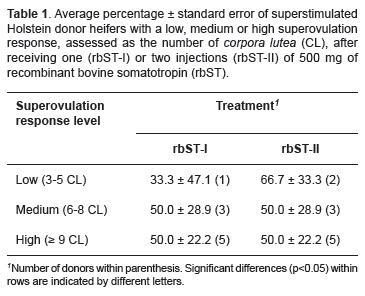
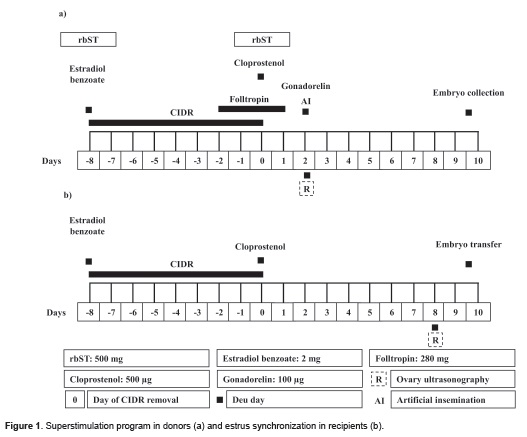
<body><![CDATA[<p>The study was conducted, according to availability of donors and receptors, during the months of June and September, with average daily temperature and relative humidity of 28.3 &deg;C and 40.5%, 25.2 &deg;C and 41.3%, respectively. During each of these months, a superstimulation and embryo transfer program was conducted. In each month, twelve to fifteen month-old healthy cyclic Holstein heifers (June, n = 10, 382.4 &plusmn; 29.16 kg live weight and 3.2 &plusmn; 0.06 body condition score; September, n = 10, 342.7 &plusmn; 29.68 kg live weight and 3.1 &plusmn; 0.05 body condition score) and mature Holstein cows with &ge; 3 lactations (June, n = 19, 684.0 &plusmn; 5.34 kg live weight and 3.3 &plusmn; 0.05 body condition score; September, n = 19, 680.2 &plusmn; 5.34 kg live weight and 3.2 &plusmn; 0.05 body condition score) were used as donors and recipients, respectively. Donor heifers were randomly assigned to one of two treatments: T1, rbST-I (n = 5) and T2, rbST-II (n = 5). The donor heifers in T1 received a subcutaneous injection of 500 mg of rbST (Boosting-S<sup>&reg;</sup>, MSD Animal Health, Mexico) in the tail depression on day 0 (day of CIDR removal). Donor heifers in T2 received a first injection of rbST on day -8 and a second injection on day 0 (Figure 1). Due to the limited number donors, there was no control group, and in an attempt to reduce variability in the results, only two experimental groups were formed. The recipient cows were randomly assigned to receive one embryo from one of the two treatments. Nineteen cows were used each month.</p>     <p><i>Estrus synchronization and breeding</i></p>     <p>The estrous cycle of donor heifers was synchronized   with a progesterone release device containing 1.9 g   of progesterone (CIDR 1900 CATTLE INSERT<sup>&reg;</sup>,   Zoetis, Mexico), inserted intravaginally for eight   days and an intramuscular injection of 2 mg estradiol   benzoate (Benzoato de estradiol<sup>&reg;</sup>, International   Prode, Jalisco, Mexico). Estrus behavior of donor   heifers was induced by two intramuscular injections   (am and pm) of 500 &mu;g cloprostenol (Celosil<sup>&reg;</sup>,   MSD Animal Health, Mexico). The recipient cows   were synchronized using the same protocol as the   donor heifers, but they received only one injection   of cloprostenol in the morning. After the CIDRs   were withdrawn, the synchronized donor heifers and   recipient cows were permanently monitored by direct   observation for signs of standing estrus. The donor   heifers were artificially inseminated three times at   12, 18, and 24 h after standing estrus with a single dose of sexed semen each time from a single bull of proven fertility. To induce ovulation, an injection of 100 &mu;g of a GnRH analogue (Cystorelin<sup>&reg;</sup>, Merial, Queretaro, Mexico) was given to each donor heifer after the first AI (<a href="#f1">Figure 1</a>).</p>      <p align="center"><a name="f1"><img src="/img/revistas/rccp/v28n4/v28n4a07f1.jpg"></a>     <p>&nbsp;</p>     <p><i>Superstimulation program and embryo recovery</i></p>     <p>The superstimulation treatment of donor heifers   was initiated on day -2 (<a href="#f1">Figure 1</a>). A total of 280 mg of   FSH (Folltropin<sup>&reg;</sup>-V, Bioniche Animal Health, Ontario,   Canada) was given twice daily as intramuscular   injections in decreasing doses over four days (50, 50,   40, 40, 30, 30, 20, 20 mg). Embryo collection was   performed 7.5 days after the onset standing estrus   by standard non-surgical procedures. The retrieved   embryos were morphologically evaluated and graded   according to their stage of development, following   guidelines by Wright (2009). Embryos graded quality   1 and 2 were considered transferable and the rest   were discarded. One day before embryo collection,   recipient cows were scanned (Medison SonoVet 2000,   with 7.5 MHz, linear-array transducer; Universal   Medical Systems Inc. Bedford Hills, NY, USA) and   the ipsilateral uterine horn to the corpus luteum (CL)   was established. The embryos were transferred to the ipsilateral uterine horn to the CL in the recipient cows.</p>     <p><i>Assessment of the effect of double rbST administration</i></p>     <p>To evaluate the effect of the two injections   of rbST on Holstein heifer donors, the variables   incidence of estrus (IE), diameter of the largest   preovulatory follicle (dLPF), superovulation   response (SR), number of oocytes, and number of degenerated and transferable embryos was determined. Likewise, in recipient cows, the effect of the double rbST administration on pregnancy rate in recipient (PRR) was evaluated. The ovaries of the donor heifers were examined by transrectal ultrasonography (Medison SonoVet 2000, with 7.5 MHz, linear-array transducer; Universal Medical Systems Inc. Bedford Hills, NY, USA) at the beginning of standing estrus, and dLPF was calculated by the average of horizontal and vertical measurements. The SR of donor heifers was measured as the number of corpora lutea present in both ovaries. The number of corpora lutea was measured by transrectal palpation at the time of embryo collection and then categorized into three levels of superovulation response: 1) low (3-5 CL), 2) medium (6-8 CL) and 3) high (&ge; 9 CL). Any donor heifer that did not show estrus or had a response of &le; 2 CL was regarded as not responsive to the ST.</p>     <p>All recipient cows carrying an embryo were   subjected to pregnancy diagnosis by rectal palpation 38 days after embryo transfer and PRR was determined.</p>     ]]></body>
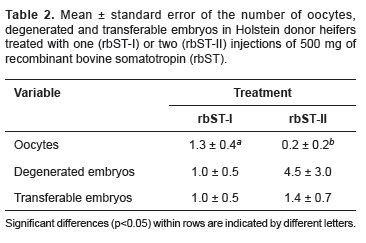
<body><![CDATA[<p><i>Statistical analysis</i></p>     <p>All the response variables were analyzed using   the SAS (2004) statistical software (SAS Inst. Inc,   Cary, NC, USA) The effect of treatment on the   dLPF was analyzed by the Student t-test using the   TTEST procedure. The IE, SR, and PRR variables   were evaluated by Chi-square test using the FREQ   procedure. The number of oocytes as well as the   number of degenerated and transferable embryos   were compared among groups using the Wilcoxon   rank-sum test with the NPAR1WAY procedure. Data   are presented as &Chi; &plusmn; SE and were considered to be   significant at p&#706;0.05. The effect of month was not   significant (p&#707;0.05), therefore the data were analyzed disregarding this effect.</p>     <p>&nbsp;</p>     <p><b><font size="3">Results</font></b></p>     <p>The dLPF was not different (p&#707;0.05) between   both groups of donors (12.8 &plusmn; 0.8 vs 12.9 &plusmn;   0.9 mm for rbST-I and rbST-II, respectively). Administration of two rbST injections to donor heifers had no affect (p&#707;0.05) on IE and SR; nineteen of the donor heifers exhibiting standing estrus produced &ge; 3 CL (47.37 &plusmn; 16.6 vs 52.63 &plusmn; 15.8% for rbST-I and rbST-II, respectively). The effect of treatment on percentage of superstimulated donor heifers relative to the level of superovulation response is shown in <a href="#t1">Table 1</a>. There were no differences (p&#707;0.05) in levels of superovulation between treatments.</p>      <p align="center"><a name="t1"><img src="/img/revistas/rccp/v28n4/v28n4a07t1.jpg"></a>     <p>&nbsp;</p>     <p>The results regarding embryo production are shown   in <a href="#t2">Table 2</a>. The number of oocytes collected was higher   (p&#706;0.05) for the rbST-I treatment; 36.8% of the donors   (six in the rbST-I and one in the rbST-II) produced   at least one oocyte. The number of degenerated   embryos was higher, but no significant (p&#707;0.05), in   rbST-II than in rbST-I treated heifers. On average,   36.8% of the donor heifers produced degenerated   embryos (three from the rbST-I and four from the   rbST-II). The number of transferable embryos was   not different (p&#707;0.05) between treatments; this result   was obtained from 42.1% of the donor heifers (four   from each group). Moreover, 63% of all transferable embryos recovered came from three donors.</p>      <p align="center"><a name="t2"><img src="/img/revistas/rccp/v28n4/v28n4a07t2.jpg"></a>     <p>On the other hand, no structures (oocytes or   embryos) were recovered from 36.8% of the donor   heifers (two from rbST-I and five from rbST-II)   despite their positive SR. With regard to PRR, after   embryos were transferred to recipients, a pregnancy rate of 20% (p&#707;0.05) was obtained in both groups.</p>     ]]></body>
<body><![CDATA[<p>&nbsp;</p>     <p><font size="3"><b>Discussion</b></font></p>     <p><i>Diameter of the largest preovulatory follicle in donors and pregnancy rate in recipients</i></p>     <p>The size of the ovulatory follicle has a direct effect   on oocyte quality and, therefore, on the likelihood   of the female becoming pregnant. According to   Machatkova <i>et al.</i> (2004), this could be due to the   level of oocyte competence, which is higher in   follicles measuring between 11 to 15 mm in diameter.   In agreement with these authors, the probability of a   cow becoming pregnant increases when the ovulated   oocyte comes from 15.6 to 16.1 mm follicles, and   is lower when the follicles are 14 to 15 mm (Lopes   <i><i>et al.</i>,</i> 2007), while in heifers the same occurs when   the follicles are &ge; 12.8 mm and &#706;10.7 or &#707;15.7 mm, respectively (Perry <i><i>et al.</i>,</i> 2007).</p>     <p>The diameter of the largest preovulatory follicle in   both groups of donor heifers coincides with the size   (&ge; 12.8 mm) at which there is a high probability of   conception. However, PRR was low in both groups   of recipients. It is likely that the low PRR resulted   from the negative effect of factors that indirectly   harmed the quality of the oocyte in the donor heifers.   These factors may include the simultaneous growth of   multiple follicles and the use of GnRH analogues to   induce ovulation in donor heifers. Superstimulation   implies the growth of multiple follicles, but we   measured the size of only the largest preovulatory   follicle. The rest of the follicles, which were smaller,   may have been able to ovulate in response to GnRH   administration, but the oocytes did not end in   pregnancy. According to Perry <i>et al.</i> (2005), GnRHinduced ovulation of follicles &le; 11 mm in diameter resulted in decreased pregnancy rates and increased late embryonic mortality. Therefore, the low PRR may have been the outcome of transferring low quality embryos resulting from fertilization of oocytes ovulated from small follicles and having reduced competence levels.</p>     <p><i>Effect of rbST on superovulation response in donors</i></p>     <p>The proportion of donors that responded positively   to the superstimulation treatment (95%) was higher   than that reported by Borges <i>et al.</i> (2001), Moraes-   J&uacute;nior <i>et al.</i> (2008) and Sales <i>et al.</i> (2008). However,   the mean number of CL (9.3 &plusmn; 1.1 vs 9.5 &plusmn; 1.5 for   rbST-I and rbST-II, respectively) was lower than   that reported by Gong <i>et al.</i> (1993b) and Kuehner   <i>et al.</i> (1993) in heifers, and by Herrier <i>et al.</i> (1994)   in cows when rbST (320 to 640 mg/animal) was   administered five days before or at the beginning of   the superstimulation. These findings led us to assume   that the superstimulation protocol used in our study is reliable for inducing positive SR in donor heifers.</p>     <p><i>Embryo yield of donors treated with rbST</i></p>     <p>The number of oocytes recovered from the donor   heifers on the rbST-I treatment was 6.5 times larger   than that from donors on the rbST-II treatment.   However, since no structures were recovered from   50% of the donor heifers on the rbST-II treatment,   it would not be appropriate to make any statement about this variable.</p>     <p>The production of degenerated embryos in the   rbST-II treatment was 3.5 times larger than that in   the rbST-I treatment. In contrast with the number   of oocytes recovered, we speculated that if we had   retrieved embryos from the donors that did not produce   any structure, more degenerated embryos would have   been collected. Consequently, a deleterious effect of   the dose (62.5 mg/day) used in the rbST-II treatment on embryo viability may be suggested.</p>     ]]></body>
<body><![CDATA[<p>The high dose of rbST might have jeopardized   oocyte quality and embryo development.   Administration of rbST in cattle has shown to increase   serum concentrations of IGF-I and insulin (Bilby <i><i>et al.</i>,</i> 2004; Rivera <i><i>et al.</i>,</i> 2010). Hence, the administration of a higher dose of rbST led us to suggest that higher serum concentration of IGF-I and insulin may have occurred, but a final conclusion from our study cannot be drawn because analyses of these metabolites were not performed. However, if high concentrations of IGF-I and insulin in the rbST-II treatment did occur, they might have endangered oocyte quality (Adamiak <i><i>et al.</i>,</i> 2005; Thomas <i><i>et al.</i>,</i> 2007). Furthermore, high concentrations of IGF-I can cause early embryo death (Katagiri <i><i>et al.</i>,</i> 1996) by reducing the energy supply to the cell (Chi <i><i>et al.</i>,</i> 2000).</p>     <p>The administration of two injections of rbST   in superstimulated Holstein donor heifers did not   increase the production of transferable embryos. In   fact, the number of transferable embryos in rbST-I   and -II treatments was lower than those reported by   Kuehner <i>et al.</i> (1993) and Herrier <i>et al.</i> (1994) in   which only one injection of rbST was administered.   The number of transferable embryos produced by   donor heifers in our study was far from what we   expected from the superstimulation treatment and   much lower than that found in other studies without   rbST administration and using sexed semen (Sartori   <i><i>et al.</i>,</i> 2004; Hayakawa <i><i>et al.</i>,</i> 2009; Peippo <i><i>et al.</i>,</i>   2009). The lack of recovery of structures from a large   proportion of donor heifers receiving two injections   of rbST might have contributed to the low values for   production of transferable embryos. This response   was observed in the present study and therefore a   final conclusion on the practicality of applying two   injections of rbST in donor heifers for the production   of high quality embryos cannot be drawn. Further   studies using larger number of donor heifers are necessary.</p>     <p>In embryo recovery studies, it is common that no   oocytes or embryos are recovered from donors. Sartori   <i>et al.</i> (2004) and Peippo <i>et al.</i> (2009) published that in   13 to 25% of the donors only one or none structures   was collected. Nonetheless, these earlier results are lower than those obtained in our study.</p>     <p>The reason that oocytes or embryos are not   recovered from donors still remains to be elucidated.   It is plausible that the transport of viable embryos is   different from the transport of oocytes or degenerated   embryos (Sartori <i><i>et al.</i>,</i> 2004). In cases of women with inexplicable infertility, Ahmad-Thabet (2000) and Roy <i>et al.</i> (2005) reported that abnormally short fimbriae that cannot reach the site of ovulation to catch the oocytes might be responsible for this condition. In addition, it is also possible that the increase in ovary size due to the superstimulation treatment makes it impossible for the fimbriae to cover all the ovulation sites and, as a consequence, the loose oocytes exited the reproductive tract. Some of these mechanisms could be involved in the high proportion of donor heifers from which no structures were recovered in our study.</p>     <p>It is concluded that the application of two   injections of 500 mg of rbST, one on day -8 and the   other on day 0 of the follicular wave synchronization   protocol did not increase the superovulatory response,   but significantly reduced the number of oocytes recovered from superovulated Holstein donor heifers.</p>     <p>&nbsp;</p>     <p align="left"><b><font size="3">Conflicts of interest</font></b></p>     <p align="left">The authors declare they have no conflicts of interest with regard to the work presented in this report.</p>     <p align="left">&nbsp;</p> <hr size="1" />     <p><b><font size="3">Notes</font></b></p>     ]]></body>
<body><![CDATA[<p><b><a name="a0" id="a0"><a href="#a1">&curren;</a></a></b>To cite this article: Gonz&aacute;lez-Maldonado J, Rangel-Santos R, Rodr&iacute;guez-de Lara R. Superovulatory response and embryo quality of Holstein heifers treated with one or two injections of somatotropin. Rev Colomb Cienc Pecu 2015; 28:339-346.</p> <hr size="1" />     <p>&nbsp;</p>     <p><b><font size="3">References</font></b></p>     <!-- ref --><p>Adamiak SJ, Mackie K, Watt RG, Webb R, Sinclair KD. Impact   of nutrition on oocyte quality: cumulative effects of body   composition and diet leading to hyperinsulinemia in cattle. Biol of Reprod 2005; 73:918-926.    &nbsp;&nbsp;&nbsp;&nbsp;&nbsp;&nbsp;&nbsp;&nbsp;[&#160;<a href="javascript:void(0);" onclick="javascript: window.open('/scielo.php?script=sci_nlinks&ref=000086&pid=S0120-0690201500040000700001&lng=','','width=640,height=500,resizable=yes,scrollbars=1,menubar=yes,');">Links</a>&#160;]<!-- end-ref --></p>     <!-- ref --><p>   Ahmad-Thabet SM. The fimbrio-ovarian relation and its role   on ovum picking in unexplained infertility: the fimbrio-ovarian   accessibility tests. J Obst Gynaecol Res 2000; 26:65-70.    &nbsp;&nbsp;&nbsp;&nbsp;&nbsp;&nbsp;&nbsp;&nbsp;[&#160;<a href="javascript:void(0);" onclick="javascript: window.open('/scielo.php?script=sci_nlinks&ref=000088&pid=S0120-0690201500040000700002&lng=','','width=640,height=500,resizable=yes,scrollbars=1,menubar=yes,');">Links</a>&#160;]<!-- end-ref --></p>     <!-- ref --><p>   Bilby TR, Guzeloglu A. Kamimura S, Pancarci SM, Michel F,   Head HH, Thatcher WW. Pregnancy and bovine somatotropin in   nonlactating dairy cows: I. Ovarian, conceptus, and insulin-like   growth factor system responses. J Dairy Sci 2004; 87:3256-3267.    &nbsp;&nbsp;&nbsp;&nbsp;&nbsp;&nbsp;&nbsp;&nbsp;[&#160;<a href="javascript:void(0);" onclick="javascript: window.open('/scielo.php?script=sci_nlinks&ref=000090&pid=S0120-0690201500040000700003&lng=','','width=640,height=500,resizable=yes,scrollbars=1,menubar=yes,');">Links</a>&#160;]<!-- end-ref --></p>     <!-- ref --><p>   Borges AM, Torres CAA, Ruas JRM, Rocha-J&uacute;nior VR, Carvalho   GR. Resposta superovulat&oacute;ria de novilhas mesti&ccedil;as holand&ecirc;s-zebu   tratadas com somatotropina bovina recombinante (rbST). Rev   Bras Zootec 2001; 30:1439-1444.    &nbsp;&nbsp;&nbsp;&nbsp;&nbsp;&nbsp;&nbsp;&nbsp;[&#160;<a href="javascript:void(0);" onclick="javascript: window.open('/scielo.php?script=sci_nlinks&ref=000092&pid=S0120-0690201500040000700004&lng=','','width=640,height=500,resizable=yes,scrollbars=1,menubar=yes,');">Links</a>&#160;]<!-- end-ref --></p>     <!-- ref --><p>   Canadian council on animal care. CCAC guidelines on: the   care and use of farm animals in research, teaching and testing.   Canadian council on animal care, Ottawa, Canada. 2009.    &nbsp;&nbsp;&nbsp;&nbsp;&nbsp;&nbsp;&nbsp;&nbsp;[&#160;<a href="javascript:void(0);" onclick="javascript: window.open('/scielo.php?script=sci_nlinks&ref=000094&pid=S0120-0690201500040000700005&lng=','','width=640,height=500,resizable=yes,scrollbars=1,menubar=yes,');">Links</a>&#160;]<!-- end-ref --></p>     <!-- ref --><p>   Chi MM, Schlein AL, Moley KH. High insulin-like growth   factor 1 (IGF-1) and insulin concentrations trigger apoptosis in   the mouse blastocyst via down-regulation of the IGF-I receptor.   Endocrinology 2000; 141:4784-4792.    &nbsp;&nbsp;&nbsp;&nbsp;&nbsp;&nbsp;&nbsp;&nbsp;[&#160;<a href="javascript:void(0);" onclick="javascript: window.open('/scielo.php?script=sci_nlinks&ref=000096&pid=S0120-0690201500040000700006&lng=','','width=640,height=500,resizable=yes,scrollbars=1,menubar=yes,');">Links</a>&#160;]<!-- end-ref --></p>     <!-- ref --><p>Chupin D, Saumande J. New attempts to decrease the variability   of ovarian response to PMSG in cattle. Ann Biol Anim Biochm Biophys 1979; 19:1489-1498.    &nbsp;&nbsp;&nbsp;&nbsp;&nbsp;&nbsp;&nbsp;&nbsp;[&#160;<a href="javascript:void(0);" onclick="javascript: window.open('/scielo.php?script=sci_nlinks&ref=000098&pid=S0120-0690201500040000700007&lng=','','width=640,height=500,resizable=yes,scrollbars=1,menubar=yes,');">Links</a>&#160;]<!-- end-ref --></p>     <!-- ref --><p>   De la Sota RL, Lucy MC, Staples CR, Thatcher WW. Effects   of recombinant bovine somatotropin (Sometribove) on ovarian   function in lactating and nonlactating dairy cows. J Dairy Sci   1993; 76:1002-1013.    &nbsp;&nbsp;&nbsp;&nbsp;&nbsp;&nbsp;&nbsp;&nbsp;[&#160;<a href="javascript:void(0);" onclick="javascript: window.open('/scielo.php?script=sci_nlinks&ref=000100&pid=S0120-0690201500040000700008&lng=','','width=640,height=500,resizable=yes,scrollbars=1,menubar=yes,');">Links</a>&#160;]<!-- end-ref --></p>     <!-- ref --><p>   Garc&iacute;a E. Modificaciones del Sistema de Clasificaci&oacute;n Clim&aacute;tica   de K&ouml;ppen. Instituto de Geograf&iacute;a, Universidad Nacional   Aut&oacute;noma de M&eacute;xico, M&eacute;xico; 1988.    &nbsp;&nbsp;&nbsp;&nbsp;&nbsp;&nbsp;&nbsp;&nbsp;[&#160;<a href="javascript:void(0);" onclick="javascript: window.open('/scielo.php?script=sci_nlinks&ref=000102&pid=S0120-0690201500040000700009&lng=','','width=640,height=500,resizable=yes,scrollbars=1,menubar=yes,');">Links</a>&#160;]<!-- end-ref --></p>     <!-- ref --><p>   Gong JG, Bramley TA, Webb R. The effect of recombinant bovine   somatotrophin on ovarian follicular growth and development in   heifers. J Reprod and Fertil 1993a; 97:247-254.    &nbsp;&nbsp;&nbsp;&nbsp;&nbsp;&nbsp;&nbsp;&nbsp;[&#160;<a href="javascript:void(0);" onclick="javascript: window.open('/scielo.php?script=sci_nlinks&ref=000104&pid=S0120-0690201500040000700010&lng=','','width=640,height=500,resizable=yes,scrollbars=1,menubar=yes,');">Links</a>&#160;]<!-- end-ref --></p>     <!-- ref --><p>   Gong JG, Bramley TA, Wilmut I, Webb R. Effect of recombinant   bovine somatotropin on the superovulatory response to pregnant mare   serum gonadotropin in heifers. Biol Reprod 1993b; 48:1141-1149.    &nbsp;&nbsp;&nbsp;&nbsp;&nbsp;&nbsp;&nbsp;&nbsp;[&#160;<a href="javascript:void(0);" onclick="javascript: window.open('/scielo.php?script=sci_nlinks&ref=000106&pid=S0120-0690201500040000700011&lng=','','width=640,height=500,resizable=yes,scrollbars=1,menubar=yes,');">Links</a>&#160;]<!-- end-ref --></p>     <!-- ref --><p>   Hayakawa H, Hirai T, Takimoto A, Ideta A, Aoyagi Y.   Superovulation and embryo transfer in Holstein cattle using sexed   sperm. Theriogenology 2009; 71:68-73.    &nbsp;&nbsp;&nbsp;&nbsp;&nbsp;&nbsp;&nbsp;&nbsp;[&#160;<a href="javascript:void(0);" onclick="javascript: window.open('/scielo.php?script=sci_nlinks&ref=000108&pid=S0120-0690201500040000700012&lng=','','width=640,height=500,resizable=yes,scrollbars=1,menubar=yes,');">Links</a>&#160;]<!-- end-ref --></p>     <!-- ref --><p>   Herrier A, Einspanier R, Schams D, Niemann H. Effect of   recombinant bovine somatotropin (rBST) on follicular IGF-I   contents and the ovarian response following superovulatory   treatment in dairy cows: a preliminary study. Theriogenology   1994; 41:601-611.    &nbsp;&nbsp;&nbsp;&nbsp;&nbsp;&nbsp;&nbsp;&nbsp;[&#160;<a href="javascript:void(0);" onclick="javascript: window.open('/scielo.php?script=sci_nlinks&ref=000110&pid=S0120-0690201500040000700013&lng=','','width=640,height=500,resizable=yes,scrollbars=1,menubar=yes,');">Links</a>&#160;]<!-- end-ref --></p>     <!-- ref --><p>   Ireland JJ, Ward F, Jimenez-Krassel F, Ireland JL, Smith GW,   Lonergan P, Evans AC. Follicle numbers are highly repeatable   within individual animals but are inversely correlated with FSH   concentrations and the proportion of good-quality embryos after   ovarian stimulation in cattle. Hum Reprod 2007; 22:1687-1695.    &nbsp;&nbsp;&nbsp;&nbsp;&nbsp;&nbsp;&nbsp;&nbsp;[&#160;<a href="javascript:void(0);" onclick="javascript: window.open('/scielo.php?script=sci_nlinks&ref=000112&pid=S0120-0690201500040000700014&lng=','','width=640,height=500,resizable=yes,scrollbars=1,menubar=yes,');">Links</a>&#160;]<!-- end-ref --></p>     <!-- ref --><p>   Katagiri S, Moon YS, Yuen BH. The role for the uterine insulinlike   growth factor I in early embryonic loss after superovulation   in the rat. Fertil Steril 1996; 65:426-436.    &nbsp;&nbsp;&nbsp;&nbsp;&nbsp;&nbsp;&nbsp;&nbsp;[&#160;<a href="javascript:void(0);" onclick="javascript: window.open('/scielo.php?script=sci_nlinks&ref=000114&pid=S0120-0690201500040000700015&lng=','','width=640,height=500,resizable=yes,scrollbars=1,menubar=yes,');">Links</a>&#160;]<!-- end-ref --></p>     <!-- ref --><p>   Kuehner LF, Rieger D, Walton JS, Zhao X, Johnson WH. The   effect of a depot injection of recombinant bovine somatotropin   on follicular development and embryo yield in superovulated   Holstein heifers. Theriogenology 1993; 40:1003-1013.    &nbsp;&nbsp;&nbsp;&nbsp;&nbsp;&nbsp;&nbsp;&nbsp;[&#160;<a href="javascript:void(0);" onclick="javascript: window.open('/scielo.php?script=sci_nlinks&ref=000116&pid=S0120-0690201500040000700016&lng=','','width=640,height=500,resizable=yes,scrollbars=1,menubar=yes,');">Links</a>&#160;]<!-- end-ref --></p>     <!-- ref --><p>   Lopes AS, Butler ST, Gilbert RO, Butler WR. Relationship of   pre-ovulatory follicle size, estradiol concentrations and season to   pregnancy outcome in dairy cows. Anim Reprod Sci 2007; 99:34-43.    &nbsp;&nbsp;&nbsp;&nbsp;&nbsp;&nbsp;&nbsp;&nbsp;[&#160;<a href="javascript:void(0);" onclick="javascript: window.open('/scielo.php?script=sci_nlinks&ref=000118&pid=S0120-0690201500040000700017&lng=','','width=640,height=500,resizable=yes,scrollbars=1,menubar=yes,');">Links</a>&#160;]<!-- end-ref --></p>     <!-- ref --><p>   Lucy MC, Byatt JC, Curran TL, Curran DF, Collier RJ. Placental   lactogen and somatotropin: hormone binding to the corpus luteum   and effects on the growth and functions of the ovary in heifers.   Biol Reprod. 1994; 50:1136-1144.    &nbsp;&nbsp;&nbsp;&nbsp;&nbsp;&nbsp;&nbsp;&nbsp;[&#160;<a href="javascript:void(0);" onclick="javascript: window.open('/scielo.php?script=sci_nlinks&ref=000120&pid=S0120-0690201500040000700018&lng=','','width=640,height=500,resizable=yes,scrollbars=1,menubar=yes,');">Links</a>&#160;]<!-- end-ref --></p>     <!-- ref --><p>   Machatkova M, Krausova K, Jokesova E, Tomanek M.   Developmental competence of bovine oocytes: effects of   follicle size and the phase of follicular wave on <i>in vitro</i> embryo   production. Theriogenology 2004; 61:329-335.    &nbsp;&nbsp;&nbsp;&nbsp;&nbsp;&nbsp;&nbsp;&nbsp;[&#160;<a href="javascript:void(0);" onclick="javascript: window.open('/scielo.php?script=sci_nlinks&ref=000122&pid=S0120-0690201500040000700019&lng=','','width=640,height=500,resizable=yes,scrollbars=1,menubar=yes,');">Links</a>&#160;]<!-- end-ref --></p>     <!-- ref --><p>   M&aacute;rquez-Hern&aacute;ndez CI. Somatotropina bovina recombinante y   viabilidad de embriones bovinos divididos. Unpublished MSc   Thesis, Universidad Aut&oacute;noma Chapingo; 2011.    &nbsp;&nbsp;&nbsp;&nbsp;&nbsp;&nbsp;&nbsp;&nbsp;[&#160;<a href="javascript:void(0);" onclick="javascript: window.open('/scielo.php?script=sci_nlinks&ref=000124&pid=S0120-0690201500040000700020&lng=','','width=640,height=500,resizable=yes,scrollbars=1,menubar=yes,');">Links</a>&#160;]<!-- end-ref --></p>     <!-- ref --><p>Moraes-J&uacute;nior FJ, Torres-J&uacute;nior JR, Nascimento IM, Sousa-   Junior A, Correia HS, Silva AB, Vieira RJ, Souza JAT. Efeito da   somatotropina recombinante bovina (rbST) na resposta ovulat&oacute;ria   e na qualidade dos embri&otilde;es de vacas Nelore. Rev Cient Prod Anim 2008; 10:162-173.    &nbsp;&nbsp;&nbsp;&nbsp;&nbsp;&nbsp;&nbsp;&nbsp;[&#160;<a href="javascript:void(0);" onclick="javascript: window.open('/scielo.php?script=sci_nlinks&ref=000126&pid=S0120-0690201500040000700021&lng=','','width=640,height=500,resizable=yes,scrollbars=1,menubar=yes,');">Links</a>&#160;]<!-- end-ref --></p>     <!-- ref --><p>   Neves EF, Ramos AF, Marques-J&uacute;nior AP. Pr&eacute;-tratamento com   somatotropina bovina (rbST) na superovula&ccedil;&atilde;o de doadoras da   ra&ccedil;a Holandesa. Arq Bras Med Vet Zootec 2005; 57:205-209.    &nbsp;&nbsp;&nbsp;&nbsp;&nbsp;&nbsp;&nbsp;&nbsp;[&#160;<a href="javascript:void(0);" onclick="javascript: window.open('/scielo.php?script=sci_nlinks&ref=000128&pid=S0120-0690201500040000700022&lng=','','width=640,height=500,resizable=yes,scrollbars=1,menubar=yes,');">Links</a>&#160;]<!-- end-ref --></p>     <!-- ref --><p>   Peippo J, Vartia K, Kananen-Anttila K, R&auml;ty M, Korhonen K, Hurme   T, Myllym&auml;ki H, Sairanen A, M&auml;ki-Tanila A. Embryo production   from superovulated Holstein-Friesian dairy heifers and cows after   insemination with frozen-thawed sex-sorted X spermatozoa or   unsorted semen. Anim Reprod Sci 2009; 111:80-92.    &nbsp;&nbsp;&nbsp;&nbsp;&nbsp;&nbsp;&nbsp;&nbsp;[&#160;<a href="javascript:void(0);" onclick="javascript: window.open('/scielo.php?script=sci_nlinks&ref=000130&pid=S0120-0690201500040000700023&lng=','','width=640,height=500,resizable=yes,scrollbars=1,menubar=yes,');">Links</a>&#160;]<!-- end-ref --></p>     <!-- ref --><p>   Perry GA, Smith MF, Lucy MC, Green JA, Parks TE, MacNeil   MD, Roberts AJ, Geary TW. Relationship between follicle size   at insemination and pregnancy success. Proc Natl Acad Sci USA   2005; 102:5268-5273.    &nbsp;&nbsp;&nbsp;&nbsp;&nbsp;&nbsp;&nbsp;&nbsp;[&#160;<a href="javascript:void(0);" onclick="javascript: window.open('/scielo.php?script=sci_nlinks&ref=000132&pid=S0120-0690201500040000700024&lng=','','width=640,height=500,resizable=yes,scrollbars=1,menubar=yes,');">Links</a>&#160;]<!-- end-ref --></p>     <!-- ref --><p>   Perry GA, Smith MF, Roberts AJ, MacNeil MD, Geary TW.   Relationship between size of the ovulatory follicle and pregnancy   success in beef heifers. J Anim Sci 2007; 85:684-689.    &nbsp;&nbsp;&nbsp;&nbsp;&nbsp;&nbsp;&nbsp;&nbsp;[&#160;<a href="javascript:void(0);" onclick="javascript: window.open('/scielo.php?script=sci_nlinks&ref=000134&pid=S0120-0690201500040000700025&lng=','','width=640,height=500,resizable=yes,scrollbars=1,menubar=yes,');">Links</a>&#160;]<!-- end-ref --></p>     <!-- ref --><p>   Rivera F, Narciso C, Olivera R, Cerri RL, Correa-Calderon   A, Chebel RC, Santos JE. Effect of bovine somatotropin (500   mg) administered at ten-day intervals on ovulatory responses,   expression of estrus, and fertility in dairy cows. J Dairy Sci 2010;   93:1500-1510.    &nbsp;&nbsp;&nbsp;&nbsp;&nbsp;&nbsp;&nbsp;&nbsp;[&#160;<a href="javascript:void(0);" onclick="javascript: window.open('/scielo.php?script=sci_nlinks&ref=000136&pid=S0120-0690201500040000700026&lng=','','width=640,height=500,resizable=yes,scrollbars=1,menubar=yes,');">Links</a>&#160;]<!-- end-ref --></p>     <!-- ref --><p>   Roy KK, Hegde P, Banerjee K, Malhotra N, Nayyar B, Deka D,   Kumar S. Fimbrio-ovarian relationship in unexplained infertility.   Gynecol Obstet Invest 2005; 60:128-132.    &nbsp;&nbsp;&nbsp;&nbsp;&nbsp;&nbsp;&nbsp;&nbsp;[&#160;<a href="javascript:void(0);" onclick="javascript: window.open('/scielo.php?script=sci_nlinks&ref=000138&pid=S0120-0690201500040000700027&lng=','','width=640,height=500,resizable=yes,scrollbars=1,menubar=yes,');">Links</a>&#160;]<!-- end-ref --></p>     <!-- ref --><p>   Sales JNS, Dias LMK, Viveiros ATM, Pereira MN, Souza JC.   Embryo production and quality of Holstein heifers and cows   supplemented with &#946;-carotene and tocopherol. Anim Reprod Sci   2008; 106:77-89.    &nbsp;&nbsp;&nbsp;&nbsp;&nbsp;&nbsp;&nbsp;&nbsp;[&#160;<a href="javascript:void(0);" onclick="javascript: window.open('/scielo.php?script=sci_nlinks&ref=000140&pid=S0120-0690201500040000700028&lng=','','width=640,height=500,resizable=yes,scrollbars=1,menubar=yes,');">Links</a>&#160;]<!-- end-ref --></p>     <!-- ref --><p>   Sartori R, Souza AH, Guenther JN, Caraviello DZ, Geiger LN,   Schenk JL, Wiltbank MC. Fertilization rate and embryo quality   in superovulated Holstein heifers artificially inseminated with   X-sorted or unsorted sperm. Anim Reprod 2004; 1:86-90.    &nbsp;&nbsp;&nbsp;&nbsp;&nbsp;&nbsp;&nbsp;&nbsp;[&#160;<a href="javascript:void(0);" onclick="javascript: window.open('/scielo.php?script=sci_nlinks&ref=000142&pid=S0120-0690201500040000700029&lng=','','width=640,height=500,resizable=yes,scrollbars=1,menubar=yes,');">Links</a>&#160;]<!-- end-ref --></p>     <!-- ref --><p>   SAS. SAS user's guide: Statistics (Version 9.1 Ed.). SAS Inst Inc   Cary NC USA 2004.    &nbsp;&nbsp;&nbsp;&nbsp;&nbsp;&nbsp;&nbsp;&nbsp;[&#160;<a href="javascript:void(0);" onclick="javascript: window.open('/scielo.php?script=sci_nlinks&ref=000144&pid=S0120-0690201500040000700030&lng=','','width=640,height=500,resizable=yes,scrollbars=1,menubar=yes,');">Links</a>&#160;]<!-- end-ref --></p>     <!-- ref --><p>   Thomas FH, Campbell BK, Armstrong DG, Telfer EE. Effects of   IGF-I bioavailability on bovine preantral follicular development   <i>in vitro</i>. Reproduction 2007; 133:1121-1128.    &nbsp;&nbsp;&nbsp;&nbsp;&nbsp;&nbsp;&nbsp;&nbsp;[&#160;<a href="javascript:void(0);" onclick="javascript: window.open('/scielo.php?script=sci_nlinks&ref=000146&pid=S0120-0690201500040000700031&lng=','','width=640,height=500,resizable=yes,scrollbars=1,menubar=yes,');">Links</a>&#160;]<!-- end-ref --></p>     <!-- ref --><p>   Wright JM. Photographic illustrations of embryo developmental stage   and quality codes. In: Manual of the International Embryo Transfer   Society. A procedural guide and general information for the use of   embryo transfer technology emphasizing sanitary procedures. 4th   Edition. IETS Publish Savoy USA; 2009.p. 141-144.    &nbsp;&nbsp;&nbsp;&nbsp;&nbsp;&nbsp;&nbsp;&nbsp;[&#160;<a href="javascript:void(0);" onclick="javascript: window.open('/scielo.php?script=sci_nlinks&ref=000148&pid=S0120-0690201500040000700032&lng=','','width=640,height=500,resizable=yes,scrollbars=1,menubar=yes,');">Links</a>&#160;]<!-- end-ref --></p>     <p>&nbsp;</p>     <p>&nbsp;</p> </font>      ]]></body><back>
<ref-list>
<ref id="B1">
<nlm-citation citation-type="journal">
<person-group person-group-type="author">
<name>
<surname><![CDATA[Adamiak]]></surname>
<given-names><![CDATA[SJ]]></given-names>
</name>
<name>
<surname><![CDATA[Mackie]]></surname>
<given-names><![CDATA[K]]></given-names>
</name>
<name>
<surname><![CDATA[Watt]]></surname>
<given-names><![CDATA[RG]]></given-names>
</name>
<name>
<surname><![CDATA[Webb]]></surname>
<given-names><![CDATA[R]]></given-names>
</name>
<name>
<surname><![CDATA[Sinclair]]></surname>
<given-names><![CDATA[KD]]></given-names>
</name>
</person-group>
<article-title xml:lang="en"><![CDATA[Impact of nutrition on oocyte quality: cumulative effects of body composition and diet leading to hyperinsulinemia in cattle]]></article-title>
<source><![CDATA[Biol of Reprod]]></source>
<year>2005</year>
<volume>73</volume>
<page-range>918-926</page-range></nlm-citation>
</ref>
<ref id="B2">
<nlm-citation citation-type="journal">
<person-group person-group-type="author">
<name>
<surname><![CDATA[Ahmad-Thabet]]></surname>
<given-names><![CDATA[SM]]></given-names>
</name>
</person-group>
<article-title xml:lang="en"><![CDATA[The fimbrio-ovarian relation and its role on ovum picking in unexplained infertility: the fimbrio-ovarian accessibility tests]]></article-title>
<source><![CDATA[J Obst Gynaecol Res]]></source>
<year>2000</year>
<volume>26</volume>
<page-range>65-70</page-range></nlm-citation>
</ref>
<ref id="B3">
<nlm-citation citation-type="journal">
<person-group person-group-type="author">
<name>
<surname><![CDATA[Bilby]]></surname>
<given-names><![CDATA[TR]]></given-names>
</name>
<name>
<surname><![CDATA[Guzeloglu]]></surname>
<given-names><![CDATA[A. Kamimura S]]></given-names>
</name>
<name>
<surname><![CDATA[Pancarci]]></surname>
<given-names><![CDATA[SM]]></given-names>
</name>
<name>
<surname><![CDATA[Michel]]></surname>
<given-names><![CDATA[F]]></given-names>
</name>
<name>
<surname><![CDATA[Head]]></surname>
<given-names><![CDATA[HH]]></given-names>
</name>
<name>
<surname><![CDATA[Thatcher]]></surname>
<given-names><![CDATA[WW]]></given-names>
</name>
</person-group>
<article-title xml:lang="en"><![CDATA[Pregnancy and bovine somatotropin in nonlactating dairy cows: I. Ovarian, conceptus, and insulin-like growth factor system responses]]></article-title>
<source><![CDATA[J Dairy Sci]]></source>
<year>2004</year>
<volume>87</volume>
<page-range>3256-3267</page-range></nlm-citation>
</ref>
<ref id="B4">
<nlm-citation citation-type="journal">
<person-group person-group-type="author">
<name>
<surname><![CDATA[Borges]]></surname>
<given-names><![CDATA[AM]]></given-names>
</name>
<name>
<surname><![CDATA[Torres]]></surname>
<given-names><![CDATA[CAA]]></given-names>
</name>
<name>
<surname><![CDATA[Ruas]]></surname>
<given-names><![CDATA[JRM]]></given-names>
</name>
<name>
<surname><![CDATA[Rocha-Júnior]]></surname>
<given-names><![CDATA[VR]]></given-names>
</name>
<name>
<surname><![CDATA[Carvalho]]></surname>
<given-names><![CDATA[GR]]></given-names>
</name>
</person-group>
<article-title xml:lang="pt"><![CDATA[Resposta superovulatória de novilhas mestiças holandês-zebu tratadas com somatotropina bovina recombinante (rbST)]]></article-title>
<source><![CDATA[Rev Bras Zootec]]></source>
<year>2001</year>
<volume>30</volume>
<page-range>1439-1444</page-range></nlm-citation>
</ref>
<ref id="B5">
<nlm-citation citation-type="">
<collab>Canadian council on animal care</collab>
<source><![CDATA[CCAC guidelines on: the care and use of farm animals in research, teaching and testing. Canadian council on animal care]]></source>
<year>2009</year>
<publisher-loc><![CDATA[Ottawa ]]></publisher-loc>
</nlm-citation>
</ref>
<ref id="B6">
<nlm-citation citation-type="journal">
<person-group person-group-type="author">
<name>
<surname><![CDATA[Chi]]></surname>
<given-names><![CDATA[MM]]></given-names>
</name>
<name>
<surname><![CDATA[Schlein]]></surname>
<given-names><![CDATA[AL]]></given-names>
</name>
<name>
<surname><![CDATA[Moley]]></surname>
<given-names><![CDATA[KH]]></given-names>
</name>
</person-group>
<article-title xml:lang="en"><![CDATA[High insulin-like growth factor 1 (IGF-1) and insulin concentrations trigger apoptosis in the mouse blastocyst via down-regulation of the IGF-I receptor]]></article-title>
<source><![CDATA[Endocrinology]]></source>
<year>2000</year>
<volume>141</volume>
<page-range>4784-4792</page-range></nlm-citation>
</ref>
<ref id="B7">
<nlm-citation citation-type="journal">
<person-group person-group-type="author">
<name>
<surname><![CDATA[Chupin]]></surname>
<given-names><![CDATA[D]]></given-names>
</name>
<name>
<surname><![CDATA[Saumande]]></surname>
<given-names><![CDATA[J]]></given-names>
</name>
</person-group>
<article-title xml:lang="en"><![CDATA[New attempts to decrease the variability of ovarian response to PMSG in cattle]]></article-title>
<source><![CDATA[Ann Biol Anim Biochm Biophys]]></source>
<year>1979</year>
<volume>19</volume>
<page-range>1489-1498</page-range></nlm-citation>
</ref>
<ref id="B8">
<nlm-citation citation-type="journal">
<person-group person-group-type="author">
<name>
<surname><![CDATA[De la Sota]]></surname>
<given-names><![CDATA[RL]]></given-names>
</name>
<name>
<surname><![CDATA[Lucy]]></surname>
<given-names><![CDATA[MC]]></given-names>
</name>
<name>
<surname><![CDATA[Staples]]></surname>
<given-names><![CDATA[CR]]></given-names>
</name>
<name>
<surname><![CDATA[Thatcher]]></surname>
<given-names><![CDATA[WW]]></given-names>
</name>
</person-group>
<article-title xml:lang="en"><![CDATA[Effects of recombinant bovine somatotropin (Sometribove) on ovarian function in lactating and nonlactating dairy cows]]></article-title>
<source><![CDATA[J Dairy Sci]]></source>
<year>1993</year>
<volume>76</volume>
<page-range>1002-1013</page-range></nlm-citation>
</ref>
<ref id="B9">
<nlm-citation citation-type="book">
<person-group person-group-type="author">
<name>
<surname><![CDATA[García]]></surname>
<given-names><![CDATA[E]]></given-names>
</name>
</person-group>
<source><![CDATA[Modificaciones del Sistema de Clasificación Climática de Köppen]]></source>
<year>1988</year>
<publisher-name><![CDATA[Instituto de Geografía, Universidad Nacional Autónoma de México]]></publisher-name>
</nlm-citation>
</ref>
<ref id="B10">
<nlm-citation citation-type="journal">
<person-group person-group-type="author">
<name>
<surname><![CDATA[Gong]]></surname>
<given-names><![CDATA[JG]]></given-names>
</name>
<name>
<surname><![CDATA[Bramley]]></surname>
<given-names><![CDATA[TA]]></given-names>
</name>
<name>
<surname><![CDATA[Webb]]></surname>
<given-names><![CDATA[R]]></given-names>
</name>
</person-group>
<article-title xml:lang="en"><![CDATA[The effect of recombinant bovine somatotrophin on ovarian follicular growth and development in heifers]]></article-title>
<source><![CDATA[J Reprod and Fertil]]></source>
<year>1993</year>
<month>a</month>
<volume>97</volume>
<page-range>247-254</page-range></nlm-citation>
</ref>
<ref id="B11">
<nlm-citation citation-type="journal">
<person-group person-group-type="author">
<name>
<surname><![CDATA[Gong]]></surname>
<given-names><![CDATA[JG]]></given-names>
</name>
<name>
<surname><![CDATA[Bramley]]></surname>
<given-names><![CDATA[TA]]></given-names>
</name>
<name>
<surname><![CDATA[Wilmut]]></surname>
<given-names><![CDATA[I]]></given-names>
</name>
<name>
<surname><![CDATA[Webb]]></surname>
<given-names><![CDATA[R]]></given-names>
</name>
</person-group>
<article-title xml:lang="en"><![CDATA[Effect of recombinant bovine somatotropin on the superovulatory response to pregnant mare serum gonadotropin in heifers]]></article-title>
<source><![CDATA[Biol Reprod]]></source>
<year>1993</year>
<month>b</month>
<volume>48</volume>
<page-range>1141-1149</page-range></nlm-citation>
</ref>
<ref id="B12">
<nlm-citation citation-type="journal">
<person-group person-group-type="author">
<name>
<surname><![CDATA[Hayakawa]]></surname>
<given-names><![CDATA[H]]></given-names>
</name>
<name>
<surname><![CDATA[Hirai]]></surname>
<given-names><![CDATA[T]]></given-names>
</name>
<name>
<surname><![CDATA[Takimoto]]></surname>
<given-names><![CDATA[A]]></given-names>
</name>
<name>
<surname><![CDATA[Ideta]]></surname>
<given-names><![CDATA[A]]></given-names>
</name>
<name>
<surname><![CDATA[Aoyagi]]></surname>
<given-names><![CDATA[Y]]></given-names>
</name>
</person-group>
<article-title xml:lang="en"><![CDATA[Superovulation and embryo transfer in Holstein cattle using sexed sperm]]></article-title>
<source><![CDATA[Theriogenology]]></source>
<year>2009</year>
<volume>71</volume>
<page-range>68-73</page-range></nlm-citation>
</ref>
<ref id="B13">
<nlm-citation citation-type="journal">
<person-group person-group-type="author">
<name>
<surname><![CDATA[Herrier]]></surname>
<given-names><![CDATA[A]]></given-names>
</name>
<name>
<surname><![CDATA[Einspanier]]></surname>
<given-names><![CDATA[R]]></given-names>
</name>
<name>
<surname><![CDATA[Schams]]></surname>
<given-names><![CDATA[D]]></given-names>
</name>
<name>
<surname><![CDATA[Niemann]]></surname>
<given-names><![CDATA[H]]></given-names>
</name>
</person-group>
<article-title xml:lang="en"><![CDATA[Effect of recombinant bovine somatotropin (rBST) on follicular IGF-I contents and the ovarian response following superovulatory treatment in dairy cows: a preliminary study]]></article-title>
<source><![CDATA[Theriogenology]]></source>
<year>1994</year>
<volume>41</volume>
<page-range>601-611</page-range></nlm-citation>
</ref>
<ref id="B14">
<nlm-citation citation-type="journal">
<person-group person-group-type="author">
<name>
<surname><![CDATA[Ireland]]></surname>
<given-names><![CDATA[JJ]]></given-names>
</name>
<name>
<surname><![CDATA[Ward]]></surname>
<given-names><![CDATA[F]]></given-names>
</name>
<name>
<surname><![CDATA[Jimenez-Krassel]]></surname>
<given-names><![CDATA[F]]></given-names>
</name>
<name>
<surname><![CDATA[Ireland]]></surname>
<given-names><![CDATA[JL]]></given-names>
</name>
<name>
<surname><![CDATA[Smith]]></surname>
<given-names><![CDATA[GW]]></given-names>
</name>
<name>
<surname><![CDATA[Lonergan]]></surname>
<given-names><![CDATA[P]]></given-names>
</name>
<name>
<surname><![CDATA[Evans]]></surname>
<given-names><![CDATA[AC]]></given-names>
</name>
</person-group>
<article-title xml:lang="en"><![CDATA[Follicle numbers are highly repeatable within individual animals but are inversely correlated with FSH concentrations and the proportion of good-quality embryos after ovarian stimulation in cattle]]></article-title>
<source><![CDATA[Hum Reprod]]></source>
<year>2007</year>
<volume>22</volume>
<page-range>1687-1695</page-range></nlm-citation>
</ref>
<ref id="B15">
<nlm-citation citation-type="journal">
<person-group person-group-type="author">
<name>
<surname><![CDATA[Katagiri]]></surname>
<given-names><![CDATA[S]]></given-names>
</name>
<name>
<surname><![CDATA[Moon]]></surname>
<given-names><![CDATA[YS]]></given-names>
</name>
<name>
<surname><![CDATA[Yuen]]></surname>
<given-names><![CDATA[BH]]></given-names>
</name>
</person-group>
<article-title xml:lang="en"><![CDATA[The role for the uterine insulinlike growth factor I in early embryonic loss after superovulation in the rat]]></article-title>
<source><![CDATA[Fertil Steril]]></source>
<year>1996</year>
<volume>65</volume>
<page-range>426-436</page-range></nlm-citation>
</ref>
<ref id="B16">
<nlm-citation citation-type="journal">
<person-group person-group-type="author">
<name>
<surname><![CDATA[Kuehner]]></surname>
<given-names><![CDATA[LF]]></given-names>
</name>
<name>
<surname><![CDATA[Rieger]]></surname>
<given-names><![CDATA[D]]></given-names>
</name>
<name>
<surname><![CDATA[Walton]]></surname>
<given-names><![CDATA[JS]]></given-names>
</name>
<name>
<surname><![CDATA[Zhao]]></surname>
<given-names><![CDATA[X]]></given-names>
</name>
<name>
<surname><![CDATA[Johnson]]></surname>
<given-names><![CDATA[WH]]></given-names>
</name>
</person-group>
<article-title xml:lang="en"><![CDATA[The effect of a depot injection of recombinant bovine somatotropin on follicular development and embryo yield in superovulated Holstein heifers]]></article-title>
<source><![CDATA[Theriogenology]]></source>
<year>1993</year>
<volume>40</volume>
<page-range>1003-1013</page-range></nlm-citation>
</ref>
<ref id="B17">
<nlm-citation citation-type="journal">
<person-group person-group-type="author">
<name>
<surname><![CDATA[Lopes]]></surname>
<given-names><![CDATA[AS]]></given-names>
</name>
<name>
<surname><![CDATA[Butler]]></surname>
<given-names><![CDATA[ST]]></given-names>
</name>
<name>
<surname><![CDATA[Gilbert]]></surname>
<given-names><![CDATA[RO]]></given-names>
</name>
<name>
<surname><![CDATA[Butler]]></surname>
<given-names><![CDATA[WR]]></given-names>
</name>
</person-group>
<article-title xml:lang="en"><![CDATA[Relationship of pre-ovulatory follicle size, estradiol concentrations and season to pregnancy outcome in dairy cows]]></article-title>
<source><![CDATA[Anim Reprod Sci]]></source>
<year>2007</year>
<volume>99</volume>
<page-range>34-43</page-range></nlm-citation>
</ref>
<ref id="B18">
<nlm-citation citation-type="journal">
<person-group person-group-type="author">
<name>
<surname><![CDATA[Lucy]]></surname>
<given-names><![CDATA[MC]]></given-names>
</name>
<name>
<surname><![CDATA[Byatt]]></surname>
<given-names><![CDATA[JC]]></given-names>
</name>
<name>
<surname><![CDATA[Curran]]></surname>
<given-names><![CDATA[TL]]></given-names>
</name>
<name>
<surname><![CDATA[Curran]]></surname>
<given-names><![CDATA[DF]]></given-names>
</name>
<name>
<surname><![CDATA[Collier]]></surname>
<given-names><![CDATA[RJ]]></given-names>
</name>
</person-group>
<article-title xml:lang="en"><![CDATA[Placental lactogen and somatotropin: hormone binding to the corpus luteum and effects on the growth and functions of the ovary in heifers]]></article-title>
<source><![CDATA[Biol Reprod]]></source>
<year>1994</year>
<volume>50</volume>
<page-range>1136-1144</page-range></nlm-citation>
</ref>
<ref id="B19">
<nlm-citation citation-type="journal">
<person-group person-group-type="author">
<name>
<surname><![CDATA[Machatkova]]></surname>
<given-names><![CDATA[M]]></given-names>
</name>
<name>
<surname><![CDATA[Krausova]]></surname>
<given-names><![CDATA[K]]></given-names>
</name>
<name>
<surname><![CDATA[Jokesova]]></surname>
<given-names><![CDATA[E]]></given-names>
</name>
<name>
<surname><![CDATA[Tomanek]]></surname>
<given-names><![CDATA[M]]></given-names>
</name>
</person-group>
<article-title xml:lang="en"><![CDATA[Developmental competence of bovine oocytes: effects of follicle size and the phase of follicular wave on in vitro embryo production]]></article-title>
<source><![CDATA[Theriogenology]]></source>
<year>2004</year>
<volume>61</volume>
<page-range>329-335</page-range></nlm-citation>
</ref>
<ref id="B20">
<nlm-citation citation-type="book">
<person-group person-group-type="author">
<name>
<surname><![CDATA[Márquez-Hernández]]></surname>
<given-names><![CDATA[CI]]></given-names>
</name>
</person-group>
<source><![CDATA[Somatotropina bovina recombinante y viabilidad de embriones bovinos divididos]]></source>
<year>2011</year>
<publisher-loc><![CDATA[Chapingo ]]></publisher-loc>
<publisher-name><![CDATA[Universidad Autónoma]]></publisher-name>
</nlm-citation>
</ref>
<ref id="B21">
<nlm-citation citation-type="journal">
<person-group person-group-type="author">
<name>
<surname><![CDATA[Moraes-Júnior]]></surname>
<given-names><![CDATA[FJ]]></given-names>
</name>
<name>
<surname><![CDATA[Torres-Júnior]]></surname>
<given-names><![CDATA[JR]]></given-names>
</name>
<name>
<surname><![CDATA[Nascimento]]></surname>
<given-names><![CDATA[IM]]></given-names>
</name>
<name>
<surname><![CDATA[Sousa-]]></surname>
<given-names><![CDATA[Junior A]]></given-names>
</name>
<name>
<surname><![CDATA[Correia]]></surname>
<given-names><![CDATA[HS]]></given-names>
</name>
<name>
<surname><![CDATA[Silva]]></surname>
<given-names><![CDATA[AB]]></given-names>
</name>
<name>
<surname><![CDATA[Vieira]]></surname>
<given-names><![CDATA[RJ]]></given-names>
</name>
<name>
<surname><![CDATA[Souza]]></surname>
<given-names><![CDATA[JAT]]></given-names>
</name>
</person-group>
<article-title xml:lang="pt"><![CDATA[Efeito da somatotropina recombinante bovina (rbST) na resposta ovulatória e na qualidade dos embriões de vacas Nelore]]></article-title>
<source><![CDATA[Rev Cient Prod Anim]]></source>
<year>2008</year>
<volume>10</volume>
<page-range>162-173</page-range></nlm-citation>
</ref>
<ref id="B22">
<nlm-citation citation-type="journal">
<person-group person-group-type="author">
<name>
<surname><![CDATA[Neves]]></surname>
<given-names><![CDATA[EF]]></given-names>
</name>
<name>
<surname><![CDATA[Ramos]]></surname>
<given-names><![CDATA[AF]]></given-names>
</name>
<name>
<surname><![CDATA[Marques-Júnior]]></surname>
<given-names><![CDATA[AP]]></given-names>
</name>
</person-group>
<article-title xml:lang="pt"><![CDATA[Pré-tratamento com somatotropina bovina (rbST) na superovulação de doadoras da raça Holandesa]]></article-title>
<source><![CDATA[Arq Bras Med Vet Zootec]]></source>
<year>2005</year>
<volume>57</volume>
<page-range>205-209</page-range></nlm-citation>
</ref>
<ref id="B23">
<nlm-citation citation-type="journal">
<person-group person-group-type="author">
<name>
<surname><![CDATA[Peippo]]></surname>
<given-names><![CDATA[J]]></given-names>
</name>
<name>
<surname><![CDATA[Vartia]]></surname>
<given-names><![CDATA[K]]></given-names>
</name>
<name>
<surname><![CDATA[Kananen-Anttila]]></surname>
<given-names><![CDATA[K]]></given-names>
</name>
<name>
<surname><![CDATA[Räty]]></surname>
<given-names><![CDATA[M]]></given-names>
</name>
<name>
<surname><![CDATA[Korhonen]]></surname>
<given-names><![CDATA[K]]></given-names>
</name>
<name>
<surname><![CDATA[Hurme]]></surname>
<given-names><![CDATA[T]]></given-names>
</name>
<name>
<surname><![CDATA[Myllymäki]]></surname>
<given-names><![CDATA[H]]></given-names>
</name>
<name>
<surname><![CDATA[Sairanen]]></surname>
<given-names><![CDATA[A]]></given-names>
</name>
<name>
<surname><![CDATA[Mäki-Tanila]]></surname>
<given-names><![CDATA[A]]></given-names>
</name>
</person-group>
<article-title xml:lang="en"><![CDATA[Embryo production from superovulated Holstein-Friesian dairy heifers and cows after insemination with frozen-thawed sex-sorted X spermatozoa or unsorted semen]]></article-title>
<source><![CDATA[Anim Reprod Sci]]></source>
<year>2009</year>
<volume>111</volume>
<page-range>80-92</page-range></nlm-citation>
</ref>
<ref id="B24">
<nlm-citation citation-type="journal">
<person-group person-group-type="author">
<name>
<surname><![CDATA[Perry]]></surname>
<given-names><![CDATA[GA]]></given-names>
</name>
<name>
<surname><![CDATA[Smith]]></surname>
<given-names><![CDATA[MF]]></given-names>
</name>
<name>
<surname><![CDATA[Lucy]]></surname>
<given-names><![CDATA[MC]]></given-names>
</name>
<name>
<surname><![CDATA[Green]]></surname>
<given-names><![CDATA[JA]]></given-names>
</name>
<name>
<surname><![CDATA[Parks]]></surname>
<given-names><![CDATA[TE]]></given-names>
</name>
<name>
<surname><![CDATA[MacNeil]]></surname>
<given-names><![CDATA[MD]]></given-names>
</name>
<name>
<surname><![CDATA[Roberts]]></surname>
<given-names><![CDATA[AJ]]></given-names>
</name>
<name>
<surname><![CDATA[Geary]]></surname>
<given-names><![CDATA[TW]]></given-names>
</name>
</person-group>
<article-title xml:lang="en"><![CDATA[Relationship between follicle size at insemination and pregnancy success]]></article-title>
<source><![CDATA[Proc Natl Acad Sci USA]]></source>
<year>2005</year>
<volume>102</volume>
<page-range>5268-5273</page-range></nlm-citation>
</ref>
<ref id="B25">
<nlm-citation citation-type="journal">
<person-group person-group-type="author">
<name>
<surname><![CDATA[Perry]]></surname>
<given-names><![CDATA[GA]]></given-names>
</name>
<name>
<surname><![CDATA[Smith]]></surname>
<given-names><![CDATA[MF]]></given-names>
</name>
<name>
<surname><![CDATA[Roberts]]></surname>
<given-names><![CDATA[AJ]]></given-names>
</name>
<name>
<surname><![CDATA[MacNeil]]></surname>
<given-names><![CDATA[MD]]></given-names>
</name>
<name>
<surname><![CDATA[Geary]]></surname>
<given-names><![CDATA[TW]]></given-names>
</name>
</person-group>
<article-title xml:lang="en"><![CDATA[Relationship between size of the ovulatory follicle and pregnancy success in beef heifers]]></article-title>
<source><![CDATA[J Anim Sci]]></source>
<year>2007</year>
<volume>85</volume>
<page-range>684-689</page-range></nlm-citation>
</ref>
<ref id="B26">
<nlm-citation citation-type="journal">
<person-group person-group-type="author">
<name>
<surname><![CDATA[Rivera]]></surname>
<given-names><![CDATA[F]]></given-names>
</name>
<name>
<surname><![CDATA[Narciso]]></surname>
<given-names><![CDATA[C]]></given-names>
</name>
<name>
<surname><![CDATA[Olivera]]></surname>
<given-names><![CDATA[R]]></given-names>
</name>
<name>
<surname><![CDATA[Cerri]]></surname>
<given-names><![CDATA[RL]]></given-names>
</name>
<name>
<surname><![CDATA[Correa-Calderon]]></surname>
<given-names><![CDATA[A]]></given-names>
</name>
<name>
<surname><![CDATA[Chebel]]></surname>
<given-names><![CDATA[RC]]></given-names>
</name>
<name>
<surname><![CDATA[Santos]]></surname>
<given-names><![CDATA[JE]]></given-names>
</name>
</person-group>
<article-title xml:lang="en"><![CDATA[Effect of bovine somatotropin (500 mg) administered at ten-day intervals on ovulatory responses, expression of estrus, and fertility in dairy cows]]></article-title>
<source><![CDATA[J Dairy Sci]]></source>
<year>2010</year>
<volume>93</volume>
<page-range>1500-1510</page-range></nlm-citation>
</ref>
<ref id="B27">
<nlm-citation citation-type="journal">
<person-group person-group-type="author">
<name>
<surname><![CDATA[Roy]]></surname>
<given-names><![CDATA[KK]]></given-names>
</name>
<name>
<surname><![CDATA[Hegde]]></surname>
<given-names><![CDATA[P]]></given-names>
</name>
<name>
<surname><![CDATA[Banerjee]]></surname>
<given-names><![CDATA[K]]></given-names>
</name>
<name>
<surname><![CDATA[Malhotra]]></surname>
<given-names><![CDATA[N]]></given-names>
</name>
<name>
<surname><![CDATA[Nayyar]]></surname>
<given-names><![CDATA[B]]></given-names>
</name>
<name>
<surname><![CDATA[Deka]]></surname>
<given-names><![CDATA[D]]></given-names>
</name>
<name>
<surname><![CDATA[Kumar]]></surname>
<given-names><![CDATA[S]]></given-names>
</name>
</person-group>
<article-title xml:lang="en"><![CDATA[Fimbrio-ovarian relationship in unexplained infertility]]></article-title>
<source><![CDATA[Gynecol Obstet Invest]]></source>
<year>2005</year>
<volume>60</volume>
<page-range>128-132</page-range></nlm-citation>
</ref>
<ref id="B28">
<nlm-citation citation-type="journal">
<person-group person-group-type="author">
<name>
<surname><![CDATA[Sales]]></surname>
<given-names><![CDATA[JNS]]></given-names>
</name>
<name>
<surname><![CDATA[Dias]]></surname>
<given-names><![CDATA[LMK]]></given-names>
</name>
<name>
<surname><![CDATA[Viveiros]]></surname>
<given-names><![CDATA[ATM]]></given-names>
</name>
<name>
<surname><![CDATA[Pereira]]></surname>
<given-names><![CDATA[MN]]></given-names>
</name>
<name>
<surname><![CDATA[Souza]]></surname>
<given-names><![CDATA[JC]]></given-names>
</name>
</person-group>
<article-title xml:lang="en"><![CDATA[Embryo production and quality of Holstein heifers and cows supplemented with &#946;-carotene and tocopherol]]></article-title>
<source><![CDATA[Anim Reprod Sci]]></source>
<year>2008</year>
<volume>106</volume>
<page-range>77-89</page-range></nlm-citation>
</ref>
<ref id="B29">
<nlm-citation citation-type="journal">
<person-group person-group-type="author">
<name>
<surname><![CDATA[Sartori]]></surname>
<given-names><![CDATA[R]]></given-names>
</name>
<name>
<surname><![CDATA[Souza]]></surname>
<given-names><![CDATA[AH]]></given-names>
</name>
<name>
<surname><![CDATA[Guenther]]></surname>
<given-names><![CDATA[JN]]></given-names>
</name>
<name>
<surname><![CDATA[Caraviello]]></surname>
<given-names><![CDATA[DZ]]></given-names>
</name>
<name>
<surname><![CDATA[Geiger]]></surname>
<given-names><![CDATA[LN]]></given-names>
</name>
<name>
<surname><![CDATA[Schenk]]></surname>
<given-names><![CDATA[JL]]></given-names>
</name>
<name>
<surname><![CDATA[Wiltbank]]></surname>
<given-names><![CDATA[MC]]></given-names>
</name>
</person-group>
<article-title xml:lang="en"><![CDATA[Fertilization rate and embryo quality in superovulated Holstein heifers artificially inseminated with X-sorted or unsorted sperm]]></article-title>
<source><![CDATA[Anim Reprod]]></source>
<year>2004</year>
<volume>1</volume>
<page-range>86-90</page-range></nlm-citation>
</ref>
<ref id="B30">
<nlm-citation citation-type="book">
<collab>SAS</collab>
<source><![CDATA[SAS user's guide: Statistics (Version 9.1 Ed.)]]></source>
<year>2004</year>
<publisher-loc><![CDATA[Cary^eNC NC]]></publisher-loc>
<publisher-name><![CDATA[SAS Inst Inc]]></publisher-name>
</nlm-citation>
</ref>
<ref id="B31">
<nlm-citation citation-type="journal">
<person-group person-group-type="author">
<name>
<surname><![CDATA[Thomas]]></surname>
<given-names><![CDATA[FH]]></given-names>
</name>
<name>
<surname><![CDATA[Campbell]]></surname>
<given-names><![CDATA[BK]]></given-names>
</name>
<name>
<surname><![CDATA[Armstrong]]></surname>
<given-names><![CDATA[DG]]></given-names>
</name>
<name>
<surname><![CDATA[Telfer]]></surname>
<given-names><![CDATA[EE]]></given-names>
</name>
</person-group>
<article-title xml:lang="en"><![CDATA[Effects of IGF-I bioavailability on bovine preantral follicular development in vitro]]></article-title>
<source><![CDATA[Reproduction]]></source>
<year>2007</year>
<volume>133</volume>
<page-range>1121-1128</page-range></nlm-citation>
</ref>
<ref id="B32">
<nlm-citation citation-type="book">
<person-group person-group-type="author">
<name>
<surname><![CDATA[Wright]]></surname>
<given-names><![CDATA[JM]]></given-names>
</name>
</person-group>
<article-title xml:lang="en"><![CDATA[Photographic illustrations of embryo developmental stage and quality codes]]></article-title>
<source><![CDATA[Manual of the International Embryo Transfer Society. A procedural guide and general information for the use of embryo transfer technology emphasizing sanitary procedures]]></source>
<year>2009</year>
<edition>4th</edition>
<page-range>141-144</page-range><publisher-name><![CDATA[IETS Publish Savoy]]></publisher-name>
</nlm-citation>
</ref>
</ref-list>
</back>
</article>