<?xml version="1.0" encoding="ISO-8859-1"?><article xmlns:mml="http://www.w3.org/1998/Math/MathML" xmlns:xlink="http://www.w3.org/1999/xlink" xmlns:xsi="http://www.w3.org/2001/XMLSchema-instance">
<front>
<journal-meta>
<journal-id>0120-0690</journal-id>
<journal-title><![CDATA[Revista Colombiana de Ciencias Pecuarias]]></journal-title>
<abbrev-journal-title><![CDATA[Rev Colom Cienc Pecua]]></abbrev-journal-title>
<issn>0120-0690</issn>
<publisher>
<publisher-name><![CDATA[Facultad de Ciencias Agrarias, Universidad de Antioquia]]></publisher-name>
</publisher>
</journal-meta>
<article-meta>
<article-id>S0120-06902015000400008</article-id>
<article-id pub-id-type="doi">10.17533/udea.rccp.v28n4a07</article-id>
<title-group>
<article-title xml:lang="en"><![CDATA[Insemination of bocachico fish (Prochilodus magdalenae) with fresh or cryopreserved semen: effect of spermatozoa/oocyte ratio]]></article-title>
<article-title xml:lang="es"><![CDATA[Inseminacion de bocachico (Prochilodus magdalenae) con semen fresco o crioconservado: efecto de la proporción espermatozoide/oocito]]></article-title>
<article-title xml:lang="pt"><![CDATA[Inseminação do bocachico (Prochilodus magdalenae) usando sêmen fresco o criopreservado: efeito da razão espermatozoide/oócito]]></article-title>
</title-group>
<contrib-group>
<contrib contrib-type="author">
<name>
<surname><![CDATA[Atencio García]]></surname>
<given-names><![CDATA[Víctor J]]></given-names>
</name>
<xref ref-type="aff" rid="A01"/>
<xref ref-type="aff" rid="A04"/>
</contrib>
<contrib contrib-type="author">
<name>
<surname><![CDATA[Espinosa]]></surname>
<given-names><![CDATA[José A]]></given-names>
</name>
<xref ref-type="aff" rid="A01"/>
</contrib>
<contrib contrib-type="author">
<name>
<surname><![CDATA[Martínez]]></surname>
<given-names><![CDATA[José G]]></given-names>
</name>
<xref ref-type="aff" rid="A02"/>
</contrib>
<contrib contrib-type="author">
<name>
<surname><![CDATA[Pardo Carrasco]]></surname>
<given-names><![CDATA[Sandra C]]></given-names>
</name>
<xref ref-type="aff" rid="A03"/>
</contrib>
</contrib-group>
<aff id="A01">
<institution><![CDATA[,Universidad de Córdoba Facultad de Medicina Veterinaria y Zootecnia ]]></institution>
<addr-line><![CDATA[ ]]></addr-line>
</aff>
<aff id="A02">
<institution><![CDATA[,Federal University of Amazonas Institute of Biological Sciences ]]></institution>
<addr-line><![CDATA[Manaus ]]></addr-line>
<country>Brasil</country>
</aff>
<aff id="A03">
<institution><![CDATA[,Universidad Nacional de Colombia Sede Medellín Departamento de Producción Animal ]]></institution>
<addr-line><![CDATA[ ]]></addr-line>
<country>Colombia</country>
</aff>
<aff id="A04">
<institution><![CDATA[,Universidad de Córdoba  ]]></institution>
<addr-line><![CDATA[ ]]></addr-line>
</aff>
<pub-date pub-type="pub">
<day>00</day>
<month>12</month>
<year>2015</year>
</pub-date>
<pub-date pub-type="epub">
<day>00</day>
<month>12</month>
<year>2015</year>
</pub-date>
<volume>28</volume>
<numero>4</numero>
<fpage>347</fpage>
<lpage>355</lpage>
<copyright-statement/>
<copyright-year/>
<self-uri xlink:href="http://www.scielo.org.co/scielo.php?script=sci_arttext&amp;pid=S0120-06902015000400008&amp;lng=en&amp;nrm=iso"></self-uri><self-uri xlink:href="http://www.scielo.org.co/scielo.php?script=sci_abstract&amp;pid=S0120-06902015000400008&amp;lng=en&amp;nrm=iso"></self-uri><self-uri xlink:href="http://www.scielo.org.co/scielo.php?script=sci_pdf&amp;pid=S0120-06902015000400008&amp;lng=en&amp;nrm=iso"></self-uri><abstract abstract-type="short" xml:lang="en"><p><![CDATA[Background: cryopreservation is an important biotechnological tool in the conservation of biodiversity, particularly for endangered species. Objective: to evaluate six different spermatozoa/oocyte ratios using fresh and cryopreserved semen in bocachico fish (Prochilodus magdalenae). Methods: fresh semen was collected and its quality determined to verify cryopreservation feasibility. The semen was put in 5 mL straws and mixed with a solution (5.5% glucose, 12% egg yolk, and 10% dimethyl sulfoxide -DMSO-) in a 1:4 dilution (semen:solution). The semen was frozen in nitrogen vapor dry shipper for 30 min, rapidly transferred to storage thermos, and submerged directly into liquid nitrogen (LN; -196 °C). Straws were thawed at 60 ºC for 45 seconds. Motility, velocity, and sperm progressivity of fresh and cryopreserved semen were assessed using Sperm Class Analyzer (SCA®) software. Each proportion of spermatozoa/oocyte was assessed with 2 g of eggs (1,630 ± 87 eggs/g) to evaluate fertility (F), hatching (H), and larval survival (LS) rates. Results: the best reproductive performance for fresh semen was obtained inseminating with 160,000 spermatozoa/oocyte (F = 75.0%, H = 67.7%, LS = 32.7%). Similarly, the best reproductive performance for cryopreserved semen was achieved with 320,000 spermatozoa/oocyte (F = 70.0%, H = 48.6%, LS = 19.5%). Conclusion: it is possible to achieve adequate reproductive performance in bocachico fish using cryopreserved sperm (10% DMSO, 5.5% glucose, and 12% egg yolk) at twice the spermatozoa/oocyte ratio used with fresh semen.]]></p></abstract>
<abstract abstract-type="short" xml:lang="es"><p><![CDATA[Antecedentes: la crioconservación es una herramienta biotecnológica importante para la conservación de la biodiversidad, particularmente de especies en peligro. Objetivo: evaluar seis proporciones diferentes entre espermatozoides/ovocito en la fertilización de bocachico (Prochilodus magdalenae), usando semen fresco o crioconservado. Métodos: se colectó semen y se determinó su calidad para verificar su viabilidad de crioconservación. El semen fue colocado en pajillas de 5 mL y mezclado con una solución crioconservante (5,5% glucosa, 12% yema de huevo y 10% dimethyl sulfoxido -DMSO-) en una dilución 1:4 (semen:solución). El semen fue congelado en un termo de vapores de nitrógeno por 30 min y rápidamente se transfirió a termos de almacenamiento sumergiéndolo directamente en nitrógeno líquido (LN; -196 °C). Las pajillas fueron descongeladas a 60 ºC por 45 segundos. La motilidad, velocidad y progresividad de los espermatozoides, tanto de semen fresco como del congelado, fueron evaluadas usando el software Sperm Class Analyzer (SCA®). Cada proporción de espermatozoides/ovocito fue evaluada en 2 g de huevos (1.630 ± 87 huevos/g) para evaluar fertilidad (F), eclosión (H) y sobrevivencia larval (LS). Resultados: el mejor desempeño reproductivo con semen fresco fue obtenido inseminando con la proporción de 160.000 espermatozoides/ovocito (F = 75,0%, H = 67,7%, LS = 32,7%). De manera similar, el mejor desempeño reproductivo con semen crioconservado fue logrado con la proporción de 320.000 espermatozoide/ovocito (F = 70,0%, H = 48,6%, LS = 19,5%). Conclusión: es posible lograr un adecuado desempeño reproductivo en bocachico usando semen crioconservado (10% DMSO, 5,5% glucosa y 12% yema de huevo) cuando la relación espermatozoide/ovocito usada es del doble de la proporción aplicada para semen fresco.]]></p></abstract>
<abstract abstract-type="short" xml:lang="pt"><p><![CDATA[Antecedentes: a criopreservação é uma ferramenta biotecnológica importante na conservação da biodiversidade, particularmente de espécies ameaçadas. Objetivo: foram avaliadas seis proporções de espermatozoides/ovócito na fertilização usando sêmen fresco e crioconservado em fertilização de bocachico (Prochilodus magdalenae), Métodos: o sêmen fresco foi coletado e determinada sua qualidade para verificar a viabilidade de crioconservação. O sêmen foi colocado em palhetas de 5 mL e misturado com a solução crioconservante (5,5% glicose, 12% gema de ovo e 10% dimetilsulfóxido -DMSO-) em numa diluição 1:4 (sêmen:solução). O sêmen foi congelado em botijão de vapores de nitrogênio por 30 min e rapidamente transferido a botijão de armazenagem submergindo-os diretamente em nitrogênio líquido (LN; -196 °C). As palhetas foram descongeladas a 60 ºC por 45 segundos. A motilidade, velocidade e progressividade dos espermatozoides, tanto de sêmen fresco quanto de congelado, foram avaliadas usando o software Sperm Class Analyzer (SCA®). Para avaliar fertilidade (F), eclosão (H) e sobrevivência larval (LS), cada relação de espermatozóide/oócito foi avaliada em 2 g de oócitos (1.630 ± 87 ovos/g). Resultados: o melhor desempenho reprodutivo com sêmen fresco foi obtido inseminando com proporção 160.000 espermatozoides/oócito (F = 75,0%, H = 67,7%, LS = 32,7%). O melhor desempenho reprodutivo com sêmen crioconservado foi verificado na proporção de 320.000 espermatozoides/oócito (F = 70,0%, H = 48,6%, LS = 19,5%). Conclusão: é possível alcançar um adequado desempenho reprodutivo em bocachico usando sêmen crioconservado (10% DMSO, 5,5% glicose e 12% gema de ovo) quando a proporção espermatozoide/oócito usada é o dobro da utilizada para sêmen fresco.]]></p></abstract>
<kwd-group>
<kwd lng="en"><![CDATA[artificial reproduction]]></kwd>
<kwd lng="en"><![CDATA[cryobiology]]></kwd>
<kwd lng="en"><![CDATA[fertility]]></kwd>
<kwd lng="en"><![CDATA[Prochilontidae]]></kwd>
<kwd lng="es"><![CDATA[criobiología]]></kwd>
<kwd lng="es"><![CDATA[fertilidad]]></kwd>
<kwd lng="es"><![CDATA[Prochilontidae]]></kwd>
<kwd lng="es"><![CDATA[reproducción artificial]]></kwd>
<kwd lng="pt"><![CDATA[criobiología]]></kwd>
<kwd lng="pt"><![CDATA[fertilização]]></kwd>
<kwd lng="pt"><![CDATA[Prochilontidae]]></kwd>
<kwd lng="pt"><![CDATA[reprodução artificial]]></kwd>
</kwd-group>
</article-meta>
</front><body><![CDATA[  <font size="2" face="Verdana, Arial, Helvetica, sans-serif">      <p align="right"><b><font size="3">ORIGINAL ARTICLE</font></b></p>     <p align="right">&nbsp;</p>     <p align="right">doi: <a href="http://dx.doi.org/10.17533/udea.rccp.v28n4a07" target="_blank">10.17533/udea.rccp.v28n4a07</a></p>     <p align="right">&nbsp;</p>     <p align="center"><font size="4"><b>Insemination of bocachico fish </b><i>(<i>Prochilodus magdalenae</i>)</i><b> with fresh or cryopreserved semen: effect of spermatozoa/oocyte ratio<a name="a1" id="a1"><a href="#a0"><sup>&curren;</sup></a></a></b></font></p>     <p align="center">&nbsp;</p>     <p align="center"><i><font size="3">Inseminacion de bocachico (<u>Prochilodus</u> <u>magdalenae</u>) con semen fresco o crioconservado: efecto de la proporci&oacute;n espermatozoide/oocito</font></i></p>     <p align="center">&nbsp;</p> <font size="3">    <p align="center"><i>Insemina&ccedil;&atilde;o do bocachico (<u>Prochilodus</u> <u>magdalenae</u>) usando s&ecirc;men fresco o criopreservado:   efeito da raz&atilde;o espermatozoide/o&oacute;cito</i></p> </font>     ]]></body>
<body><![CDATA[<p align="center">&nbsp;</p>     <p align="center">&nbsp;</p>     <p align="left"><b>V&iacute;ctor J Atencio Garc&iacute;a<sup>1</sup><sup></sup></b><b><sup><a href="#b1" name="b0" id="b0" a="a">*</a></sup>, MSc; Jos&eacute; A Espinosa<sup>1</sup>, MSc; Jos&eacute; G Mart&iacute;nez<sup>2</sup>, MSc; Sandra C Pardo Carrasco<sup>3</sup>, PhD.</b></p>     <p align="left">&nbsp;</p>     <p><sup><i>1</i></sup><i>Centro de Investigaci&oacute;n Pisc&iacute;cola, Facultad de Medicina Veterinaria y Zootecnia, Universidad de C&oacute;rdoba.</i></p>     <p><i><sup>2</sup>Laboratory of Animal Genetics and Evolution - LEGAL, Institute of Biological Sciences, Federal University of Amazonas, Manaus, Brasil.</i></p> <i><sup>3</sup>Facultad de Ciencias Agrarias, Departamento de Producci&oacute;n Animal, BIOGEM, Universidad Nacional de Colombia Sede Medell&iacute;n, Colombia.</i>     <p>&nbsp;</p>     <p align="left"><a name="b1" id="b1"><a href="#b0">*</a></a>Corresponding author: V&iacute;ctor J Atencio Garc&iacute;a. Universidad de C&oacute;rdoba. Carrera 6 N&deg; 76-103. Phone: (57)4 7860151. Email: <a href="mailto:vatencio@hotmail.com" target="_blank">vatencio@hotmail.com</a></p>     <p align="left">&nbsp;</p>     <p align="left">Received: September 4, 2014; accepted: January 11, 2015</p>     ]]></body>
<body><![CDATA[<p align="left">&nbsp;</p> <hr size="1" />     <p><b>Summary</b></p>     <p><b>Background:</b> cryopreservation is an important biotechnological tool in the conservation of biodiversity,   particularly for endangered species. <b>Objective:</b> to evaluate six different spermatozoa/oocyte ratios using fresh   and cryopreserved semen in bocachico fish (<i>Prochilodus magdalenae</i>). <b>Methods:</b> fresh semen was collected   and its quality determined to verify cryopreservation feasibility. The semen was put in 5 mL straws and   mixed with a solution (5.5% glucose, 12% egg yolk, and 10% dimethyl sulfoxide -DMSO-) in a 1:4 dilution   (semen:solution). The semen was frozen in nitrogen vapor dry shipper for 30 min, rapidly transferred to   storage thermos, and submerged directly into liquid nitrogen (LN; -196 &deg;C). Straws were thawed at 60 &ordm;C for   45 seconds. Motility, velocity, and sperm progressivity of fresh and cryopreserved semen were assessed using   Sperm Class Analyzer (SCA<sup>&reg;</sup>) software. Each proportion of spermatozoa/oocyte was assessed with 2 g of   eggs (1,630 &plusmn; 87 eggs/g) to evaluate fertility (F), hatching (H), and larval survival (LS) rates. <b>Results:</b> the   best reproductive performance for fresh semen was obtained inseminating with 160,000 spermatozoa/oocyte   (F = 75.0%, H = 67.7%, LS = 32.7%). Similarly, the best reproductive performance for cryopreserved semen   was achieved with 320,000 spermatozoa/oocyte (F = 70.0%, H = 48.6%, LS = 19.5%). <b>Conclusion:</b> it is   possible to achieve adequate reproductive performance in bocachico fish using cryopreserved sperm (10% DMSO, 5.5% glucose, and 12% egg yolk) at twice the spermatozoa/oocyte ratio used with fresh semen.</p>     <p><b>Keywords:</b> <i>artificial reproduction, cryobiology, fertility, <u>Prochilontidae</u>.</i></p> <hr size="1" />     <p><b>Resumen</b></p>     <p><b>Antecedentes:</b> la crioconservaci&oacute;n es una herramienta biotecnol&oacute;gica importante para la conservaci&oacute;n   de la biodiversidad, particularmente de especies en peligro. <b>Objetivo:</b> evaluar seis proporciones diferentes   entre espermatozoides/ovocito en la fertilizaci&oacute;n de bocachico (<i>Prochilodus magdalenae</i>), usando semen   fresco o crioconservado. <b>M&eacute;todos:</b> se colect&oacute; semen y se determin&oacute; su calidad para verificar su viabilidad de   crioconservaci&oacute;n. El semen fue colocado en pajillas de 5 mL y mezclado con una soluci&oacute;n crioconservante   (5,5% glucosa, 12% yema de huevo y 10% dimethyl sulfoxido -DMSO-) en una diluci&oacute;n 1:4 (semen:soluci&oacute;n).   El semen fue congelado en un termo de vapores de nitr&oacute;geno por 30 min y r&aacute;pidamente se transfiri&oacute; a termos   de almacenamiento sumergi&eacute;ndolo directamente en nitr&oacute;geno l&iacute;quido (LN; -196 &deg;C). Las pajillas fueron   descongeladas a 60 &ordm;C por 45 segundos. La motilidad, velocidad y progresividad de los espermatozoides, tanto   de semen fresco como del congelado, fueron evaluadas usando el software Sperm Class Analyzer (SCA<sup>&reg;</sup>).   Cada proporci&oacute;n de espermatozoides/ovocito fue evaluada en 2 g de huevos (1.630 &plusmn; 87 huevos/g) para evaluar   fertilidad (F), eclosi&oacute;n (H) y sobrevivencia larval (LS). <b>Resultados:</b> el mejor desempe&ntilde;o reproductivo con   semen fresco fue obtenido inseminando con la proporci&oacute;n de 160.000 espermatozoides/ovocito (F = 75,0%,   H = 67,7%, LS = 32,7%). De manera similar, el mejor desempe&ntilde;o reproductivo con semen crioconservado   fue logrado con la proporci&oacute;n de 320.000 espermatozoide/ovocito (F = 70,0%, H = 48,6%, LS = 19,5%).   <b>Conclusi&oacute;n:</b> es posible lograr un adecuado desempe&ntilde;o reproductivo en bocachico usando semen crioconservado   (10% DMSO, 5,5% glucosa y 12% yema de huevo) cuando la relaci&oacute;n espermatozoide/ovocito usada es del doble de la proporci&oacute;n aplicada para semen fresco.</p>     <p><b>Palabras clave:</b> <i>criobiolog&iacute;a, fertilidad, <u>Prochilontidae</u>, reproducci&oacute;n artificial.</i></p> <hr size="1" />     <p><b>Resumo</b></p>     <p><b>Antecedentes:</b> a criopreserva&ccedil;&atilde;o &eacute; uma ferramenta biotecnol&oacute;gica importante na conserva&ccedil;&atilde;o da   biodiversidade, particularmente de esp&eacute;cies amea&ccedil;adas. <b>Objetivo:</b> foram avaliadas seis propor&ccedil;&otilde;es de   espermatozoides/ov&oacute;cito na fertiliza&ccedil;&atilde;o usando s&ecirc;men fresco e crioconservado em fertiliza&ccedil;&atilde;o de bocachico   (<i>Prochilodus magdalenae</i>), <b>M&eacute;todos:</b> o s&ecirc;men fresco foi coletado e determinada sua qualidade para verificar a   viabilidade de crioconserva&ccedil;&atilde;o. O s&ecirc;men foi colocado em palhetas de 5 mL e misturado com a solu&ccedil;&atilde;o crioconservante   (5,5% glicose, 12% gema de ovo e 10% dimetilsulf&oacute;xido -DMSO-) em numa dilui&ccedil;&atilde;o 1:4 (s&ecirc;men:solu&ccedil;&atilde;o).   O s&ecirc;men foi congelado em botij&atilde;o de vapores de nitrog&ecirc;nio por 30 min e rapidamente transferido a botij&atilde;o de   armazenagem submergindo-os diretamente em nitrog&ecirc;nio l&iacute;quido (LN; -196 &deg;C). As palhetas foram descongeladas   a 60 &ordm;C por 45 segundos. A motilidade, velocidade e progressividade dos espermatozoides, tanto de s&ecirc;men fresco   quanto de congelado, foram avaliadas usando o software Sperm Class Analyzer (SCA<sup>&reg;</sup>). Para avaliar fertilidade   (F), eclos&atilde;o (H) e sobreviv&ecirc;ncia larval (LS), cada rela&ccedil;&atilde;o de espermatoz&oacute;ide/o&oacute;cito foi avaliada em 2 g de o&oacute;citos   (1.630 &plusmn; 87 ovos/g). <b>Resultados:</b> o melhor desempenho reprodutivo com s&ecirc;men fresco foi obtido inseminando com   propor&ccedil;&atilde;o 160.000 espermatozoides/o&oacute;cito (F = 75,0%, H = 67,7%, LS = 32,7%). O melhor desempenho reprodutivo   com s&ecirc;men crioconservado foi verificado na propor&ccedil;&atilde;o de 320.000 espermatozoides/o&oacute;cito (F = 70,0%, H = 48,6%,   LS = 19,5%). <b>Conclus&atilde;o:</b> &eacute; poss&iacute;vel alcan&ccedil;ar um adequado desempenho reprodutivo em bocachico usando s&ecirc;men   crioconservado (10% DMSO, 5,5% glicose e 12% gema de ovo) quando a propor&ccedil;&atilde;o espermatozoide/o&oacute;cito usada &eacute; o dobro da utilizada para s&ecirc;men fresco.</p>     <p><b>Palavras chave: </b><i>criobiolog&iacute;a, fertiliza&ccedil;&atilde;o, <u>Prochilontidae</u>, reprodu&ccedil;&atilde;o artificial.</i></p> <hr size="1" />     ]]></body>
<body><![CDATA[<p>&nbsp;</p>     <p>&nbsp;</p>     <p><b><font size="3">Introduction</font></b></p>     <p>Cryopreservation is an important biotechnological   tool for the conservation of biodiversity (Wildt and   Wemmer, 1999). Additional advantages include   broadening artificial fertilization processes in   aquaculture (Watson and Holt, 2001) as well as   increasing the availability of semen during periods   of low sperm production observed in captive fish.   Reports on advances in the development of protocols   for bocachico semen cryopreservation include: a   study on the effect of glucose concentration on   sperm motility (Mart&iacute;nez <i><i>et al.</i>,</i> 2011), another study   on the use of dimethylacetamide as cryoprotectant   (Atencio-Garc&iacute;a <i><i>et al.</i>,</i> 2013), a further study into   the use of different concentrations of dimethyl   sulfoxide (DMSO 5, 10, 15%) and glucose (5.5, 6.0,   6.5%) as cryoprotectants (Mart&iacute;nez <i><i>et al.</i>,</i> 2012a),   an assessment of membrane damage and DNA fragmentation of bocachico spermatozoa caused by cryopreservation with DMSO and glucose (Mart&iacute;nez <i><i>et al.</i>,</i> 2012b), and a report on the effects of freezing and thawing rates on sperm motility (Mart&iacute;nez <i><i>et al.</i>,</i> 2013). In spite of this, there is little information concerning effective spermatozoa/oocyte ratios for bocachico using fresh and cryopreserved semen to improve the efficiency of semen usage in artificial reproduction processes.</p>     <p>For bocachico, Mart&iacute;nez <i>et al.</i> (2013) used a   ratio of 100,000 spermatozoa/oocyte and performed   the insemination using cryopreserved semen (5%   and 10% DMSO, and 5.5 and 6% glucose) and   fresh semen. The fertility rates obtained with   cryopreserved semen (between 23.4% and 27.6%)   were lower than those using fresh semen (69.3%).   This was attributed to the low spermatozoa/oocyte   ratio used in the study. According to Mart&iacute;nez and   Pardo-Carrasco, (2010), the cellular membrane is   damaged during the cryopreservation process, ATP   degradation takes place, nuclear and mitochondrial   DNA is fragmented, and enzymes, kinases and   cytosolic proteins are degraded. This reduces the   fertilizing capacity and motility of fish spermatozoa,   suggesting that increased spermatozoa/oocyte ratios   when using cryopreserved semen could compensate   the effects of cryopreservation on fertility rates.   Lahnsteiner <i>et al.</i> (2004) found that despite the   acceptable motility and velocity observed after sperm   cryopreservation of Starlet (<i>Acipenser ruthenus</i> L.)   fertility rates were low for cryopreserved (10%   DMSO + NaCl) compared to fresh semen (6.9% and   33.9%, respectively). They attributed this to ignorance   of the correct sperm:egg proportion, which they, in   suitable amounts, compensated for the low motility observed with cryopreservation.</p>     <p>The present study aimed to determine the   spermatozoa/oocyte ratio, for both fresh and   cryopreserved semen, that improves the efficiency of semen used in artificial reproduction.</p>     <p>&nbsp;</p>     <p><b><font size="3">Material and methods</font></b></p>     <p>This study was approved by the Animal   Experimentation Ethics Committee of the Fish   Research Center (CINPIC), Universidad de C&oacute;rdoba, Colombia (CINPIC 005 - June 23, 2012).</p>     <p><i>Layout</i></p>     ]]></body>
<body><![CDATA[<p>This study was conducted at the Fish Research   Center of Universidad de C&oacute;rdoba (CINPIC;   Monter&iacute;a, Colombia), located at latitude 8&ordm; 48&acute; N and   longitude 75&ordm; 52&acute; W. Two-year-old bocachico males   and females were kept in earthen ponds (density:   0.5 kg/m2). Weight and total length (TL) of males   was 178 &plusmn; 20.1 g and 26.2 &plusmn; 2.0 cm, respectively.   Males were selected during the spermiation phase,   i.e. when gentle abdominal pressure in cephalocaudal   direction causes releasing of seminal fluid. Weight   and TL of females (n = 7) was 238.8 &plusmn; 51.8 g and 30.7   &plusmn; 1.5 cm, respectively. Females were selected during   the final maturity phase, determined by the germinal   vesicle position of the oocyte in an ovarian biopsy   sample. Ovulation was induced by administering 5 mg   carp pituitary extract (CPE)/kg body weight in two   doses: 20% of the extract was first administered and   the remaining 80% twelve hours later. Males were   subsequently treated with a single dose of 4 mg CPE/   Kg. This dose was administered two hours before that   for females, facilitating to extract and analyze the   semen before female ovulation. Semen was obtained   after drying and cleaning the genital papilla region   with a lab wipe and expulsion of urine and fecal   matter. Milt was expressed with gentle abdominal pressure and collected in 2 mL Eppendorf vials.</p>     <p><i>Evaluation of sperm quality</i></p>     <p>Color was recorded and the samples contaminated   with feces, blood, or urine, were discarded. Total   motility, curvilinear velocity (CLV), straight line   velocity (SLV), spermatozoa rate with rapid motility   (type a, greater than 100 &mu;m/s), medium motility   (type b, 46 to 100 &mu;m/s), slow motility (type c, 10 to   45 &mu;m/s), and static spermatozoa (type d) were assessed.   A 0.25 &mu;L semen aliquot was taken from each male   (n = 7), put in a Makler counting chamber (Sefi,   Medical Instruments Ltd, Haifa, Israel) and activated   with 75 &mu;L bi-distilled water (1:300 dilution). Semen   was analyzed with a contrast optical phase microscope   (Nikon, Tokio, Japan) adapted to the Sperm Class   Analyzer SCA<sup>&reg;</sup> (Microptic SL, Barcelona, Spain)   computer assisted system for seminal analysis. This   allowed to obtain the average data (from two analyses,   approximately 450 spermatozoa per field) for each sample analyzed. Semen was considered suitable for cryopreservation only when total motility was above 90%. The activation time elapsed from the moment in which the activating solution (bi-distilled water) was added to the sample until the moment when approximately 90% spermatozoa ceased to move. It was measured with a contrast optical phase microscope (Japan) adapted with a Basler camera (A100 FireWire, 50 frame/s; Germany). A mixture of 1 &mu;L of semen and 699 &mu;L 6% glucose in a 2 mL Eppendorf vial (1:699 dilution) was used to estimate sperm concentration. This mixture was then homogenized for five seconds in a vortex mixer at 1200 rpm (Usmate, Milano, Italy). Subsequently, 10 &mu;L was placed in the Makler chamber and concentration was estimated through an SCA<sup>&reg;</sup>.</p>     <p><i>Experimental design</i></p>     <p>Six spermatozoa/oocyte ratios were evaluated   for both fresh and cryopreserved semen: 20.000,   40.000, 80.000, 160.000, and 320.000 spermatozoa/   oocyte, with three replicates per treatment. Semen   was cryopreserved in a 6% glucose solution (weight/   volume), 12% chicken egg yolk (volume/volume), and   10% DMSO (volume/volume; Panreac, Barcelona,   Spain). Semen was diluted at 1:3 ratio, packed in   5 mL straws (Minit&uuml;b, Tiefenbach, Germany) and   placed into a 4 L nitrogen vapor dry shipper (MVE,   Braunfels, Germany) for 30 minutes. This provided a   27.3 &ordm;C/min freezing rate from 28 to -20 &ordm;C, 29.9 &ordm;C/min   from -20 to -100 &ordm;C, 5.5 &ordm;C/min from -100 to -196 &ordm;C,   as described by Cruz-Casallas <i>et al.</i> (2006). Straws   were quickly transferred to storage thermos (MVE,   USA) and plunged directly into liquid nitrogen. After   two weeks, straws were thawed by submersion into   a 60 &ordm;C water bath for 45 s using a programmable serological bath (Memmert, Schabach, Germany).</p>     <p><i>Assessment of fertility, hatching and larval survival rates</i></p>     <p>Fertility and hatching rates were assessed   using two g of oocytes (analytical balance:   Ohaus, Parsippany, Denmark) treated with several   spermatozoa/oocyte ratios. The number of oocytes   per gram (1.630 &plusmn; 87 oocytes/g) was previously   determined. A micropipette (Transferpette<sup>&reg;</sup>,   Wertheim, Germany) was used to inseminate the   two g of oocytes with spermatozoa. Activation was performed with 20 mL bi-distilled water in 50 mL containers. Incubation was performed in 2.5 L experimental conical incubators with 120 mL/min flow rate. Fertility rate was assessed five hours after fertilization (HAF) by collecting a sample of 50 embryos in final gastrula stage (90% epiboly). Embryos were randomly selected using a glass pipette with 0.5 cm diameter. Fertility rate was estimated by dividing viable embryos by the total number of analyzed embryos. Viable embryos were translucent, while non-viable embryos were opaque and off-white under a light stereoscope (Leica, Wetzlar, Germany). Hatching was evaluated 12 hours after fertilization (HAF) using the procedure previously described. Live larvae were counted 48 hours after hatching when bocachico began to feed exogenously (Atencio-Garc&iacute;a <i><i>et al.</i>,</i> 2013), in order to determine larval survival at that moment over the total number of hatched eggs.</p>     <p><i>Statistical analysis</i></p>     <p>A completely randomized design was used.   Normality of variables and homogeneity of variances   were verified with the Kolmogorov-Smirnov test and   Levene's test, respectively. After such verifications,   analysis of variance (ANOVA) was conducted and   the Tukey multiple range test was used whenever   statistical differences were noted. Additionally,   regression analysis was performed between fertility   percentage and sperm/oocyte ratio. All statistical   analyses were conducted using SAS software version   9.0 (SAS Inst. Inc, Cary, NC, USA). A 5% significance   level was considered. All data are expressed as mean &plusmn; standard deviation (SD).</p>     <p>&nbsp;</p>     ]]></body>
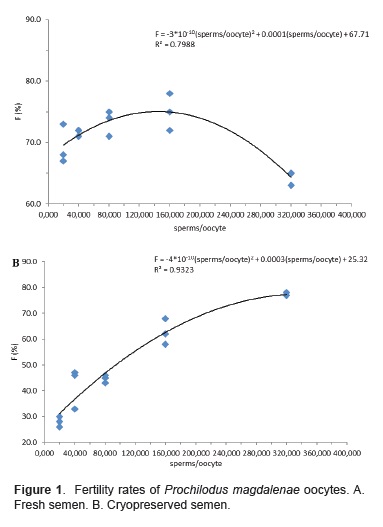
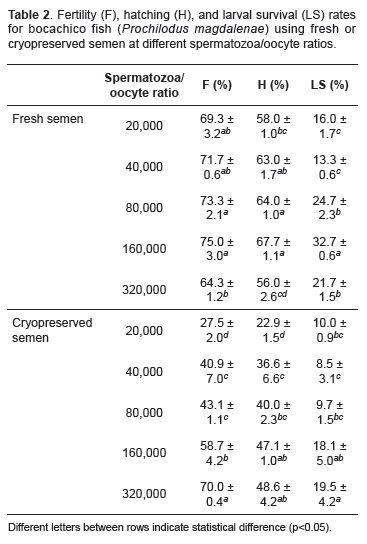
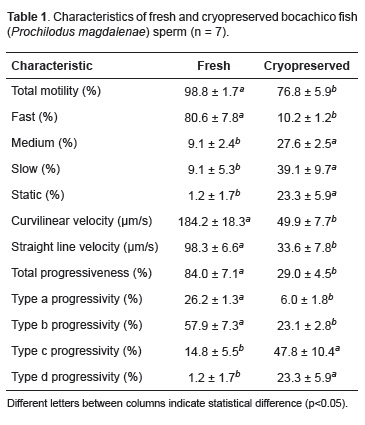
<body><![CDATA[<p><b><font size="3">Results</font></b></p>     <p>Cryopreservation promoted reduction (p&lt;0.05) of sperm quality in all traits (<a href="#t1">Table 1</a>).</p>      <p align="center"><a name="t1"><img src="/img/revistas/rccp/v28n4/v28n4a08t1.jpg"></a>     <p>&nbsp;</p>     <p>The best fit curve for fresh semen was polynomial   (<a href="#f1">Figure 1A</a>). By deriving regression equation between   fresh semen and fertility 166,667 sperm/oocyte was   the best theoretical ratio for the highest fertility using fresh semen (81.6%).</p>      <p align="center"><a name="f1"><img src="/img/revistas/rccp/v28n4/v28n4a08f1.jpg"></a>     <p>&nbsp;</p>     <p>The highest fertility (F) rate was obtained with   320,000 spermatozoa/oocyte (70.0 &plusmn; 0.4%) ratios while the lowest rate was obtained with 20,000 spermatozoa/oocyte (27.5 &plusmn; 2.0%). A significant difference was observed between these values (p&lt;0.05; <a href="#t2">Table 2</a>). The highest hatching (H) rate for cryopreserved semen was obtained with 320,000 spermatozoa/oocyte (48.6 &plusmn; 4.2%) ratio and was no different compared with 160,000 (47.1 &plusmn; 1.0%) spermatozoa/oocyte ratio (p&gt;0.05; Table 2). Conversely, the lowest hatching rate was obtained with 20,000 spermatozoa/oocyte (22.9 &plusmn; 1.5%) ratio and was different to the other treatments (p&lt;0.05). The highest larval survival (LS) for cryopreserved semen was observed with 320,000 (19.5 &plusmn; 4.2%) and 160,000 spermatozoa/oocyte (18.1 &plusmn; 5.0%) ratios, and no difference was found between these values (p&gt;0.05). The lowest LS rate was for 40,000 spermatozoa/oocyte (8.5 &plusmn; 3.1%) ratio and was not different (p&gt;0.05) to 80,000 spermatozoa/ oocyte (9.7 &plusmn; 1.5%) or 20,000 spermatozoa/oocyte (10.0 &plusmn; 0.9%) ratios.</p>      <p align="center"><a name="t2"><img src="/img/revistas/rccp/v28n4/v28n4a08t2.jpg"></a>     <p>&nbsp;</p>     ]]></body>
<body><![CDATA[<p>The best-fit curve for cryopreserved semen was   also polynomial (<a href="#f1">Figure 1B</a>). Deriving the regression equation between fresh semen and fertility, 375,000 sperm/oocyte gave the best theoretical ratio for the highest fertility rate with fresh semen (76.0%).</p>     <p>&nbsp;</p>     <p><font size="3"><b>Discussion</b></font></p>     <p>Cryopreserved sperm presented low motility,   velocity and sperm progressivity, which explains its   low fertility, hatching and larval survival. Low quality   of cryopreserved semen is suggested as the cause   for its reduced fertility, hatching and larval survival.   Cryopreservation damages the sperm deteriorating its   quality (Lahnsteiner <i><i>et al.</i>,</i> 1992; Morisawa, 1994).   Cruz-Casallas <i>et al.</i> (2006) reported 92% total motility   for fresh semen and 76% for cryopreserved semen of   <i>Brycon amazonicus</i>. Ram&iacute;rez <i>et al.</i> (2005) reported   84% total motility for fresh semen and 33.3% for   cryopreserved semen of <i>Piaractus brachypomus</i>.   Cryopreservation generally decreases motility and   stimulates increased circular motion (Lahnsteiner <i><i>et al.</i>,</i> 2000; Wamecke and Pluta, 2003).</p>     <p>In this study, motility of fresh semen had the   highest percentage of fast spermatozoa, whereas   cryopreserved semen had the highest percentage of   slow spermatozoa. This proves that fast, medium,   and slow spermatozoa in cryopreserved semen   had fertilizing capacity. Similarly, straight line and   curvilinear velocities observed in fresh semen were   higher compared to cryopreserved semen because   spermatozoa were damaged by cryopreservation   and thawing. Ogier de Baulny <i>et al.</i> (1997) reported   losses in seminal properties during cryopreservation,   with only a small amount of viable sperm cells, thus   reducing the fertilizing capacity of cryopreserved   semen. Martinez and Pardo (2010) stated that,   even when effectiveness is known for a given   cryoprotectant in a fish species, the variation in its   concentration could have toxic effects that can affect velocity.</p>     <p>Insemination with fresh semen resulted in the   highest fertility rates for ratios ranging from 80,000   to 160,000 spermatozoa/oocyte. The regression   equation (fertility vs ratio, R<sup>2</sup> = 0.7988) with fresh   semen suggests that 166,667 sperm/oocyte ratio   would yield the best fertility. The highest fertility   rate for cryopreserved semen was obtained with 320,000 spermatozoa/oocyte ratio. The regression equation (fertility vs ratio, R<sup>2</sup> = 0.9323) for cryopreserved semen suggests that a 375,000 sperm/ oocyte ratio would yield the best fertility rate. Results also suggest that doubling the best ratio for fresh semen, i.e. increasing it from 160,000 to 320,000 spermatozoa/oocyte, would reduce fertility rate. Velasco-Santamar&iacute;a <i>et al.</i> (2006) observed the same change in fertility for fresh and cryopreserved semen of <i>B. amazonicus</i>. One possible cause for fertility decrease upon doubling the best spermatozoa/ oocyte ratio using fresh semen could be the limit that gamete-quality impose on fertility. It is thus conceivable that an increase beyond the best ratio does not imply an increase in fertility. Another possible cause for the decrease could be that spermatozoa/ oocyte ratios above the best ratio could cause obstructions and thus hinder spermatozoa movement due to excessive concentration in the activation volume used. In this study, the same volume of activation (20 mL) was used for the various ratios of spermatozoa/oocyte (two g of oocytes are equivalent to 1.5 mL).</p>     <p>De Souza <i>et al.</i> (2007) found that the volume   required to activate two mL of <i>Prochilodus lineatus</i>   oocytes ranged from 60 to 100 mL. Sanches <i>et al.</i>   (2009) reported that appropriate water volume for   sperm activation guarantees significant increase in   fertility rates. According to Chereguini <i>et al.</i> (1999),   the dilution volume of the fertilizing material has   two important implications on fertility. Using small   water volumes for activation tends to compromise   sperm activation itself and results in an inadequate   medium for gathering the gametes. On the other   hand, excessive amounts of water in the fertilization   process may excessively dilute the medium, thus   preventing spermatozoa from reaching the micropyle   during the short time in which sperm activation takes   place. It has also been observed that regardless of   dilution volume for activation, high and low sperm/   egg ratios negatively affect oocyte fertilization (Rurangwa <i><i>et al.</i>,</i> 1998).</p>     <p>On analyzing the hatching results obtained for   fresh semen, a trend similar to that obtained for fertility   was noted. The highest rates were obtained with ratios   between 80,000 and 160,000 spermatozoa/oocyte. For   cryopreserved semen, the highest hatching rate was achieved with 320,000 spermatozoa/oocyte. However, the ratio at which the best fertility rate was obtained was not the same observed during the hatching rate evaluation. This may be explained by the fact that hatching rate is evaluated after a longer time and, therefore, the longer time between insemination and variable measurement (i.e. fertility, hatching, larval survival), it is likely that the result is affected by other variables. Such variables include handling, incubation conditions, and embryo and larva handling (incubation flows, water quality, etc). These could affect the results and prevent them from indicating the quality of the semen. For that reason, fertility is considered closely related to seminal quality, and therefore it is thought to best measure the effects of cryopreservation. For this reason, few authors report cryopreservation results based on hatching rate, and even fewer based on spermatozoa/oocyte. Despite this, there are studies which used hatching rate as a criterion for assessing the quality of cryopreserved semen. Ram&iacute;rez <i>et al.</i> (2005) reported 36.6% hatching rate using cryopreserved <i>P. brachypomus</i> semen and 85.3% for fresh semen.</p>     <p>In a similar manner, studies evaluating   cryopreserved semen based on larval survival are   also uncommon for the reasons stated above. In this   study, larval survival using fresh semen yielded the   highest rates with 160,000 spermatozoa/oocyte ratio.   For cryopreserved semen, the highest rates were   obtained with 320,000 spermatozoa/oocyte ratio. Few   studies have assessed the effects of cryopreservation   on larval survival. The work by Ramirez <i>et al.</i> (2005)   is worth mentioning. That study, conducted on   <i>P. brachypomus</i>, reported 72% larval survival rates   for fresh semen and 62% for cryopreserved semen. It   is worth mentioning that, in these studies, calculation   for determining larval survival rate was based on   the amount of hatched larvae, whereas the present   study estimated it based on the number of incubated oocytes.</p>     <p>Based on the results presented here, it may   be suggested that 20,000 to 40,000 spermatozoa/   oocyte ratio could be considered as the minimum for   inseminating bocachico with fresh semen. Likewise,   between 80,000 and 160,000 spermatozoa/oocyte   ratio might be considered as the maximum proportion   to achieve efficient reproductive performance. Furthermore, the minimum ratio for cryopreserved semen could be 160,000 spermatozoa/oocyte and the maximum 320,000 spermatozoa/oocyte. The study by Rogamosa <i>et al.</i> (2010) on <i>P. lineatus</i>, a conspecific of bocachico, suggested a very wide range of spermatozoa/oocyte ratio for fresh semen -between 320,000 and 3,200,000- to obtain good fertility rates. This study, however, achieved 75% fertility rate with 160,000 spermatozoa/oocyte ratio. Optimal reported ratios for other species include 314,428 spermatozoa/ oocyte for <i>Brycon insignis</i> (Shimoda <i><i>et al.</i>,</i> 2007). Recently, Viveiros <i>et al.</i> (2009) studied <i>P. lineatus</i>, conspecific with bocachico, suggesting 500,000 spermatozoa/oocyte ratio for cryopreserved semen to ensure proper fertility rates (47 to 82%). For the present study, 70% fertility rate could be obtained with only 320,000 spermatozoa/oocyte ratio.</p>     ]]></body>
<body><![CDATA[<p>The fact that spermatozoa/oocyte ratio doubled   for cryopreserved semen, when compared with   fresh semen, is associated with spermatozoa damage   during cryopreservation, affecting the insemination   capacity (Mar&iacute;a <i><i>et al.</i>,</i> 2006). Mart&iacute;nez <i>et al.</i> (2009)   considered that sperm cryopreservation in fish   causes damage that reduces motility and velocity   after thawing. According to them, this has negative   effects on the inseminating capacity of <i>Prochilodus magdalenae</i>. Additionally, this damage may be   linked to several stages of the cryopreservation   process, the period of time in which sperms are   exposed to the cryoprotectant, and to the freezing   and thawing curves. Recently Morris <i>et al.</i> (2012)   indicated that the damage in sperm cells is related   to the osmotic imbalance resulting from the thawing   process, and not to the formation of intracellular ice.   Damage compromises the cell at the morphological   level (membrane), affecting mitochondria, which   are critical for energy production and post-thawing   cell movement. Additionally, damage also occurs at   the DNA level, causing the alteration of the genetic   material despite the fact that cells can still move (Mart&iacute;nez and Pardo, 2013).</p>     <p>The results of this study allow concluding that it   is possible to obtain adequate bocachico reproductive   performance with cryopreserved semen (10% DMSO,   5.5% glucose, and 12% egg yolk) when using   320,000 spermatozoa/oocyte ratio. This is twice the   best ratio used for insemination with fresh semen (160,000 spermatozoa/oocyte).</p>     <p>&nbsp;</p>     <p><b><font size="3">Acknowledgements</font></b></p>     <p>The authors would like to thank the Colombian   Ministry of Agriculture and Rural Development for   sponsoring this study, which is part of the project   entitled Establishment of an Experimental Semen   Bank of Native Fish with Farming Potential in the   Colombian Humid Caribbean Zone (Code: MADR 2007U7723-401).</p>     <p align="left">&nbsp;</p>     <p align="left"><b><font size="3">Conflicts of interest</font></b></p>     <p align="left">The authors declare they have no conflicts of interest with regard to the work presented in this report.</p>     <p align="left">&nbsp;</p> <hr size="1" />     <p><b><font size="3">Notes</font></b></p>     ]]></body>
<body><![CDATA[<p><b><a name="a0" id="a0"><a href="#a1">&curren;</a></a></b>To cite this article: Atencio VJ, Espinosa JA, Mart&iacute;nez JG, Pardo SC. Insemination of bocachico fish <i>(<i>Prochilodus magdalenae</i>)</i> with fresh or cryopreserved semen: effect of spermatozoa/oocyte ratio. Rev Colomb Cienc Pecu 2015; 28:347-355.</p> <hr size="1" />     <p>&nbsp;</p>     <p><b><font size="3">References</font></b></p>     <!-- ref --><p>Atencio Garc&iacute;a VJ, P&eacute;rez EJ, Espinosa JA, Pardo SC. Evaluaci&oacute;n   de dimetilacetamida como crioprotector para la crioconservaci&oacute;n   de semen de bocachico <i>Prochilodus magdalenae</i>. Arch Med Vet 2013; 45(2):151-158.    &nbsp;&nbsp;&nbsp;&nbsp;&nbsp;&nbsp;&nbsp;&nbsp;[&#160;<a href="javascript:void(0);" onclick="javascript: window.open('/scielo.php?script=sci_nlinks&ref=000086&pid=S0120-0690201500040000800001&lng=','','width=640,height=500,resizable=yes,scrollbars=1,menubar=yes,');">Links</a>&#160;]<!-- end-ref --></p>     <!-- ref --><p>   Chereguini O, De la Banda IG, Rasines I, Fern&aacute;ndez A. Artificial   fertilization in turbot, (<i>Scopothalmus maximus</i> L.): different   methods and determination of the optimal sperm-egg ratio. Aquac   Res 1999; 30:319-324.    &nbsp;&nbsp;&nbsp;&nbsp;&nbsp;&nbsp;&nbsp;&nbsp;[&#160;<a href="javascript:void(0);" onclick="javascript: window.open('/scielo.php?script=sci_nlinks&ref=000088&pid=S0120-0690201500040000800002&lng=','','width=640,height=500,resizable=yes,scrollbars=1,menubar=yes,');">Links</a>&#160;]<!-- end-ref --></p>     <!-- ref --><p>   Cruz Casallas P, Medina Robles V, Velasco Santamar&iacute;a Y.   Protocolo para la crioconservaci&oacute;n de semen de yam&uacute; (<i>Brycon amazonicus</i> Spix &amp; Agassiz 1829). Rev Colomb Cienc Pecu   2006; 19(2):146-151.    &nbsp;&nbsp;&nbsp;&nbsp;&nbsp;&nbsp;&nbsp;&nbsp;[&#160;<a href="javascript:void(0);" onclick="javascript: window.open('/scielo.php?script=sci_nlinks&ref=000090&pid=S0120-0690201500040000800003&lng=','','width=640,height=500,resizable=yes,scrollbars=1,menubar=yes,');">Links</a>&#160;]<!-- end-ref --></p>     <!-- ref --><p>   De Souza BES, Sanches EA, Baggio DM. Intera&ccedil;&atilde;o entre a rela&ccedil;&atilde;o   de espermatozoide/ov&oacute;cito e o volume de &aacute;gua empregados   na fertiliza&ccedil;&atilde;o artificial de ov&oacute;citos de curimbat&aacute; <i>Prochilodus lineatus</i>. In: Proceeding 1&deg; Congresso Brasileiro de Produ&ccedil;&atilde;o   de Peixes Nativos de &Aacute;gua Doce, Dourados 2007, Embrapa   &#91;CD-ROM&#93;    &nbsp;&nbsp;&nbsp;&nbsp;&nbsp;&nbsp;&nbsp;&nbsp;[&#160;<a href="javascript:void(0);" onclick="javascript: window.open('/scielo.php?script=sci_nlinks&ref=000092&pid=S0120-0690201500040000800004&lng=','','width=640,height=500,resizable=yes,scrollbars=1,menubar=yes,');">Links</a>&#160;]<!-- end-ref -->.</p>     <!-- ref --><p>   Lahnsteiner F, Weismann T, Patzner R. Fine structure changes in   spermatozoa of the grayling, <i>Thymallus thymallus</i> (Pisces: Teleostei),   during routine cryopreservation. Aquaculture 1992; 103: 73-84.    &nbsp;&nbsp;&nbsp;&nbsp;&nbsp;&nbsp;&nbsp;&nbsp;[&#160;<a href="javascript:void(0);" onclick="javascript: window.open('/scielo.php?script=sci_nlinks&ref=000094&pid=S0120-0690201500040000800005&lng=','','width=640,height=500,resizable=yes,scrollbars=1,menubar=yes,');">Links</a>&#160;]<!-- end-ref --></p>     <!-- ref --><p>   Lahnsteiner F, Berger B, Horvath A, Urb&aacute;nyi B, Weismann   T. Cryopresevation of spermatozoa in cyprindid fishes.   Theriogenology 2000; 54: 1477-1496.    &nbsp;&nbsp;&nbsp;&nbsp;&nbsp;&nbsp;&nbsp;&nbsp;[&#160;<a href="javascript:void(0);" onclick="javascript: window.open('/scielo.php?script=sci_nlinks&ref=000096&pid=S0120-0690201500040000800006&lng=','','width=640,height=500,resizable=yes,scrollbars=1,menubar=yes,');">Links</a>&#160;]<!-- end-ref --></p>     <!-- ref --><p>   Lahnsteiner F, Berger B, Horv&aacute;th A, Urb&aacute;nyi B. Studies on   the semen biology and sperm cryopreservation in the sterlet,   (<i>Acipenser ruthenus</i> L.) Aquac Res 2004; 35:519-528.    &nbsp;&nbsp;&nbsp;&nbsp;&nbsp;&nbsp;&nbsp;&nbsp;[&#160;<a href="javascript:void(0);" onclick="javascript: window.open('/scielo.php?script=sci_nlinks&ref=000098&pid=S0120-0690201500040000800007&lng=','','width=640,height=500,resizable=yes,scrollbars=1,menubar=yes,');">Links</a>&#160;]<!-- end-ref --></p>     <!-- ref --><p>   Maria AN, Viveiros ATM, Orf&atilde;o LH, Oliveira AV, Mor&atilde;es   GF. Effects of cooling and freezing on sperm motility of the   endangered &#64257;sh piracanjuba <i>Brycon orbignyanus</i> (Characiformes,   Characidae). Anim Reprod 2006; 3:55-60.    &nbsp;&nbsp;&nbsp;&nbsp;&nbsp;&nbsp;&nbsp;&nbsp;[&#160;<a href="javascript:void(0);" onclick="javascript: window.open('/scielo.php?script=sci_nlinks&ref=000100&pid=S0120-0690201500040000800008&lng=','','width=640,height=500,resizable=yes,scrollbars=1,menubar=yes,');">Links</a>&#160;]<!-- end-ref --></p>     <!-- ref --><p>Mart&iacute;nez JG, Atencio Garc&iacute;a VJ, Tarazona AM, Pardo Carrasco SC.   Estandarizaci&oacute;n de protocolos para la crioconservaci&oacute;n de semen de   bocachico y el an&aacute;lisis de la movilidad mediante el software sperm class analyzer. Rev Fac Nal Agr Medell&iacute;n 2009; 62 suppl 3-19.    &nbsp;&nbsp;&nbsp;&nbsp;&nbsp;&nbsp;&nbsp;&nbsp;[&#160;<a href="javascript:void(0);" onclick="javascript: window.open('/scielo.php?script=sci_nlinks&ref=000102&pid=S0120-0690201500040000800009&lng=','','width=640,height=500,resizable=yes,scrollbars=1,menubar=yes,');">Links</a>&#160;]<!-- end-ref --></p>     <!-- ref --><p>   Mart&iacute;nez JG, Pardo Carrasco SC. Crioconservaci&oacute;n de semen en   peces: efectos sobre la movilidad esperm&aacute;tica y la fertilidad. Acta   Biol Colomb 2010; 15(2):3-24.    &nbsp;&nbsp;&nbsp;&nbsp;&nbsp;&nbsp;&nbsp;&nbsp;[&#160;<a href="javascript:void(0);" onclick="javascript: window.open('/scielo.php?script=sci_nlinks&ref=000104&pid=S0120-0690201500040000800010&lng=','','width=640,height=500,resizable=yes,scrollbars=1,menubar=yes,');">Links</a>&#160;]<!-- end-ref --></p>     <!-- ref --><p>   Mart&iacute;nez JG, Atencio Garcia VJ, Pardo Carrasco SC. Efectos de   la concentraci&oacute;n de glucosa sobre la activaci&oacute;n de la movilidad   esperm&aacute;tica en bocachico <i>Prochilodus magdalenae</i> (Pisces,   Characiformes). Rev Mvz Cordoba 2011; 16:2554-2563.    &nbsp;&nbsp;&nbsp;&nbsp;&nbsp;&nbsp;&nbsp;&nbsp;[&#160;<a href="javascript:void(0);" onclick="javascript: window.open('/scielo.php?script=sci_nlinks&ref=000106&pid=S0120-0690201500040000800011&lng=','','width=640,height=500,resizable=yes,scrollbars=1,menubar=yes,');">Links</a>&#160;]<!-- end-ref --></p>     <!-- ref --><p>   Mart&iacute;nez JG, Tarazona Morales AM, Pardo Carrasco SC. Sperm   cryopreservation of freshwater fish bocachico <i>Prochilodus magdalenae</i> in DMSO and glucose and its effects on fertilization   and hatching efficiency. Anim Reprod 2012a; 9(1):19-26.    &nbsp;&nbsp;&nbsp;&nbsp;&nbsp;&nbsp;&nbsp;&nbsp;[&#160;<a href="javascript:void(0);" onclick="javascript: window.open('/scielo.php?script=sci_nlinks&ref=000108&pid=S0120-0690201500040000800012&lng=','','width=640,height=500,resizable=yes,scrollbars=1,menubar=yes,');">Links</a>&#160;]<!-- end-ref --></p>     <!-- ref --><p>   Mart&iacute;nez JG, Atencio Garc&iacute;a VJ, Pardo Carrasco SC. DNA   fragmentation and membrane damage of bocachico <i>Prochilodus magdalenae</i> (Ostariophysi, Prochilodontidae) sperm following   cryopreservation with dimethylsulfoxide and glucose. Neotrop   Ichthyol 2012b; 10(3):577-586.    &nbsp;&nbsp;&nbsp;&nbsp;&nbsp;&nbsp;&nbsp;&nbsp;[&#160;<a href="javascript:void(0);" onclick="javascript: window.open('/scielo.php?script=sci_nlinks&ref=000110&pid=S0120-0690201500040000800013&lng=','','width=640,height=500,resizable=yes,scrollbars=1,menubar=yes,');">Links</a>&#160;]<!-- end-ref --></p>     <!-- ref --><p>   Mart&iacute;nez JG, Pardo Carrasco SC. Effect of freezing and thawing rates   on sperm motility in Bocachico <i>Prochilodus magdalenae</i> (Pisces,   Characiformes). Rev Mvz Cordoba 2013; 18(1):3295-3303.    &nbsp;&nbsp;&nbsp;&nbsp;&nbsp;&nbsp;&nbsp;&nbsp;[&#160;<a href="javascript:void(0);" onclick="javascript: window.open('/scielo.php?script=sci_nlinks&ref=000112&pid=S0120-0690201500040000800014&lng=','','width=640,height=500,resizable=yes,scrollbars=1,menubar=yes,');">Links</a>&#160;]<!-- end-ref --></p>     <!-- ref --><p>   Morris GJ, Acton E, Murray JB, Fonseca F. Freezing injury:   The special case of the sperm cell. Cryobiology 2012; 64:71-80.    &nbsp;&nbsp;&nbsp;&nbsp;&nbsp;&nbsp;&nbsp;&nbsp;[&#160;<a href="javascript:void(0);" onclick="javascript: window.open('/scielo.php?script=sci_nlinks&ref=000114&pid=S0120-0690201500040000800015&lng=','','width=640,height=500,resizable=yes,scrollbars=1,menubar=yes,');">Links</a>&#160;]<!-- end-ref --></p>     <!-- ref --><p>   Morisawa M. Cell signaling mechanism for sperm motility. Zoo   Sci 1994; 11: 647-662p.    &nbsp;&nbsp;&nbsp;&nbsp;&nbsp;&nbsp;&nbsp;&nbsp;[&#160;<a href="javascript:void(0);" onclick="javascript: window.open('/scielo.php?script=sci_nlinks&ref=000116&pid=S0120-0690201500040000800016&lng=','','width=640,height=500,resizable=yes,scrollbars=1,menubar=yes,');">Links</a>&#160;]<!-- end-ref --></p>     <!-- ref --><p>   Ogier de Baulny B, Le Vern Y, Kerboeuf D, Maisse G. Flow   cytometric evaluation of mitochondrial activity and membrane   integrity in fresh and Cryopreserved Rainbow trout (<i>Oncorhynchus   mykiss</i>) spermatozoa. Cryobiology 1997; 34:141-149.    &nbsp;&nbsp;&nbsp;&nbsp;&nbsp;&nbsp;&nbsp;&nbsp;[&#160;<a href="javascript:void(0);" onclick="javascript: window.open('/scielo.php?script=sci_nlinks&ref=000118&pid=S0120-0690201500040000800017&lng=','','width=640,height=500,resizable=yes,scrollbars=1,menubar=yes,');">Links</a>&#160;]<!-- end-ref --></p>     <!-- ref --><p>   Ram&iacute;rez MJA, Velasco Santamar&iacute;a YM, Medina Robles VM,   Cruz Casallas PE. Crioconservaci&oacute;n de semen de Cachama blanca   (<i>Piaractus brachypomus</i> Cuvier, 1818): efectos del volumen de   empaque y de la sustancia crioprotectora sobre la calidad seminal.   Rev Colomb Cienc Pec 2005; 18:331.    &nbsp;&nbsp;&nbsp;&nbsp;&nbsp;&nbsp;&nbsp;&nbsp;[&#160;<a href="javascript:void(0);" onclick="javascript: window.open('/scielo.php?script=sci_nlinks&ref=000120&pid=S0120-0690201500040000800018&lng=','','width=640,height=500,resizable=yes,scrollbars=1,menubar=yes,');">Links</a>&#160;]<!-- end-ref --></p>     <!-- ref --><p>   Romagosa E, Souza BE, Sanches EA, Baggio M, Bombardelli   RA. Sperm motility of <i>Prochilodus lineatus</i> in relation to dilution   rate and temperature of the activating medium. J Appl Ichthyol   2010; 26:678-681.    &nbsp;&nbsp;&nbsp;&nbsp;&nbsp;&nbsp;&nbsp;&nbsp;[&#160;<a href="javascript:void(0);" onclick="javascript: window.open('/scielo.php?script=sci_nlinks&ref=000122&pid=S0120-0690201500040000800019&lng=','','width=640,height=500,resizable=yes,scrollbars=1,menubar=yes,');">Links</a>&#160;]<!-- end-ref --></p>     <!-- ref --><p>   Rurangwa E, Roclants I, Huyskens G, Ebrahimi M, Kime DM,   Ollevier F. The minimum effective spermatozoa:egg ratio for   artificial insemination and the effects of mercury on sperm   motility and fertilization ability in (<i>Clarias gariepinus</i>). J Fish   Biol 1998; 53:402-413.    &nbsp;&nbsp;&nbsp;&nbsp;&nbsp;&nbsp;&nbsp;&nbsp;[&#160;<a href="javascript:void(0);" onclick="javascript: window.open('/scielo.php?script=sci_nlinks&ref=000124&pid=S0120-0690201500040000800020&lng=','','width=640,height=500,resizable=yes,scrollbars=1,menubar=yes,');">Links</a>&#160;]<!-- end-ref --></p>     <!-- ref --><p>   SAS Institute Inc. 2004. SAS/STAT<sup>&reg;</sup> 9.1 User's Guide. Cary, NC,   USA: SAS Institute Inc.    &nbsp;&nbsp;&nbsp;&nbsp;&nbsp;&nbsp;&nbsp;&nbsp;[&#160;<a href="javascript:void(0);" onclick="javascript: window.open('/scielo.php?script=sci_nlinks&ref=000126&pid=S0120-0690201500040000800021&lng=','','width=640,height=500,resizable=yes,scrollbars=1,menubar=yes,');">Links</a>&#160;]<!-- end-ref --></p>     <!-- ref --><p>   Sanches EA, Bombardelli RA, Baggio DM, Souza BE. Dose   inseminante para fertiliza&ccedil;&atilde;o artificial de ov&oacute;citos de dourado.   R Bras Zootec 2009; 38:2091-2098.    &nbsp;&nbsp;&nbsp;&nbsp;&nbsp;&nbsp;&nbsp;&nbsp;[&#160;<a href="javascript:void(0);" onclick="javascript: window.open('/scielo.php?script=sci_nlinks&ref=000128&pid=S0120-0690201500040000800022&lng=','','width=640,height=500,resizable=yes,scrollbars=1,menubar=yes,');">Links</a>&#160;]<!-- end-ref --></p>     <!-- ref --><p>Shimoda E, Andrade DR, Vidal J&uacute;nior MV, Godinho HP, Yasui   GY. Determina&ccedil;&atilde;o da raz&atilde;o &oacute;tima de espermatoz&oacute;ides por   ov&oacute;citos de piabanha <i>Brycon insignis</i> (Pisces-Characidae). Arq Bras Med Vet Zootec 2007; 59:877-882.    &nbsp;&nbsp;&nbsp;&nbsp;&nbsp;&nbsp;&nbsp;&nbsp;[&#160;<a href="javascript:void(0);" onclick="javascript: window.open('/scielo.php?script=sci_nlinks&ref=000130&pid=S0120-0690201500040000800023&lng=','','width=640,height=500,resizable=yes,scrollbars=1,menubar=yes,');">Links</a>&#160;]<!-- end-ref --></p>     <!-- ref --><p>   Velasco Santamar&iacute;a YM, Medina Robles VM, Cruz Casallas PE.   Cryopreservation of yam&uacute; (<i>Brycon amazonicus</i>) sperm for large   scale fertilization. Aquaculture 2006; 256(1-4):264-271.    &nbsp;&nbsp;&nbsp;&nbsp;&nbsp;&nbsp;&nbsp;&nbsp;[&#160;<a href="javascript:void(0);" onclick="javascript: window.open('/scielo.php?script=sci_nlinks&ref=000132&pid=S0120-0690201500040000800024&lng=','','width=640,height=500,resizable=yes,scrollbars=1,menubar=yes,');">Links</a>&#160;]<!-- end-ref --></p>     <!-- ref --><p>   Viveiros ATM, Orf&atilde;o LH, Maria AN, Allaman IB. A simple,   inexpensive and successful freezing method for curimba   <i>Prochilodus lineatus</i> (Characiformes) semen. Anim Reprod Sci   2009; 112:293-300.    &nbsp;&nbsp;&nbsp;&nbsp;&nbsp;&nbsp;&nbsp;&nbsp;[&#160;<a href="javascript:void(0);" onclick="javascript: window.open('/scielo.php?script=sci_nlinks&ref=000134&pid=S0120-0690201500040000800025&lng=','','width=640,height=500,resizable=yes,scrollbars=1,menubar=yes,');">Links</a>&#160;]<!-- end-ref --></p>     <!-- ref --><p>   Wamecke D, Pluta H. Motility and fertilizing capacity of frezen/   thawed common carp (<i>Cyprinus carpio</i> L.) sperm using dimetilacetamida   as the mam cryoprotectant. Aquaculture 2003; 187:   361-375.    &nbsp;&nbsp;&nbsp;&nbsp;&nbsp;&nbsp;&nbsp;&nbsp;[&#160;<a href="javascript:void(0);" onclick="javascript: window.open('/scielo.php?script=sci_nlinks&ref=000136&pid=S0120-0690201500040000800026&lng=','','width=640,height=500,resizable=yes,scrollbars=1,menubar=yes,');">Links</a>&#160;]<!-- end-ref --></p>     <!-- ref --><p>   Watson PF, Holt WV. Cryobanking the genetic resource: Wildlife   conservation for the future. London, UK: Taylor &amp; Francis; 2001.    &nbsp;&nbsp;&nbsp;&nbsp;&nbsp;&nbsp;&nbsp;&nbsp;[&#160;<a href="javascript:void(0);" onclick="javascript: window.open('/scielo.php?script=sci_nlinks&ref=000138&pid=S0120-0690201500040000800027&lng=','','width=640,height=500,resizable=yes,scrollbars=1,menubar=yes,');">Links</a>&#160;]<!-- end-ref --></p>     <!-- ref --><p>   Wildt DE, Wemmer C. Sex and wildlife: the role of reproductive   science in conservation. Biodivers Conserv 1999; 8:965-976.    &nbsp;&nbsp;&nbsp;&nbsp;&nbsp;&nbsp;&nbsp;&nbsp;[&#160;<a href="javascript:void(0);" onclick="javascript: window.open('/scielo.php?script=sci_nlinks&ref=000140&pid=S0120-0690201500040000800028&lng=','','width=640,height=500,resizable=yes,scrollbars=1,menubar=yes,');">Links</a>&#160;]<!-- end-ref --></p>     <p>&nbsp;</p>     ]]></body>
<body><![CDATA[<p>&nbsp;</p> </font>      ]]></body><back>
<ref-list>
<ref id="B1">
<nlm-citation citation-type="journal">
<person-group person-group-type="author">
<name>
<surname><![CDATA[Atencio]]></surname>
<given-names><![CDATA[García VJ]]></given-names>
</name>
<name>
<surname><![CDATA[Pérez]]></surname>
<given-names><![CDATA[EJ]]></given-names>
</name>
<name>
<surname><![CDATA[Espinosa]]></surname>
<given-names><![CDATA[JA]]></given-names>
</name>
<name>
<surname><![CDATA[Pardo]]></surname>
<given-names><![CDATA[SC]]></given-names>
</name>
</person-group>
<article-title xml:lang="es"><![CDATA[Evaluación de dimetilacetamida como crioprotector para la crioconservación de semen de bocachico Prochilodus magdalenae]]></article-title>
<source><![CDATA[Arch Med Vet]]></source>
<year>2013</year>
<volume>45(2)</volume>
<page-range>151-158</page-range></nlm-citation>
</ref>
<ref id="B2">
<nlm-citation citation-type="journal">
<person-group person-group-type="author">
<name>
<surname><![CDATA[Chereguini]]></surname>
<given-names><![CDATA[O]]></given-names>
</name>
<name>
<surname><![CDATA[De la Banda]]></surname>
<given-names><![CDATA[IG]]></given-names>
</name>
<name>
<surname><![CDATA[Rasines]]></surname>
<given-names><![CDATA[I]]></given-names>
</name>
<name>
<surname><![CDATA[Fernández]]></surname>
<given-names><![CDATA[A]]></given-names>
</name>
</person-group>
<article-title xml:lang="es"><![CDATA[Artificial fertilization in turbot, (Scopothalmus maximus L.): different methods and determination of the optimal sperm-egg ratio]]></article-title>
<source><![CDATA[Aquac Res]]></source>
<year>1999</year>
<volume>30</volume>
<page-range>319-324</page-range></nlm-citation>
</ref>
<ref id="B3">
<nlm-citation citation-type="journal">
<person-group person-group-type="author">
<name>
<surname><![CDATA[Cruz Casallas]]></surname>
<given-names><![CDATA[P]]></given-names>
</name>
<name>
<surname><![CDATA[Medina Robles]]></surname>
<given-names><![CDATA[V]]></given-names>
</name>
<name>
<surname><![CDATA[Velasco Santamaría]]></surname>
<given-names><![CDATA[Y]]></given-names>
</name>
</person-group>
<article-title xml:lang="es"><![CDATA[Protocolo para la crioconservación de semen de yamú (Brycon amazonicus Spix & Agassiz 1829)]]></article-title>
<source><![CDATA[Rev Colomb Cienc Pecu]]></source>
<year>2006</year>
<volume>19(2)</volume>
<page-range>146-151</page-range></nlm-citation>
</ref>
<ref id="B4">
<nlm-citation citation-type="confpro">
<person-group person-group-type="author">
<name>
<surname><![CDATA[De Souza]]></surname>
<given-names><![CDATA[BES]]></given-names>
</name>
<name>
<surname><![CDATA[Sanches]]></surname>
<given-names><![CDATA[EA]]></given-names>
</name>
<name>
<surname><![CDATA[Baggio]]></surname>
<given-names><![CDATA[DM]]></given-names>
</name>
</person-group>
<source><![CDATA[Interação entre a relação de espermatozoide/ovócito e o volume de água empregados na fertilização artificial de ovócitos de curimbatá Prochilodus lineatus]]></source>
<year></year>
<conf-name><![CDATA[1 Congresso Brasileiro de Produção de Peixes Nativos de Água Doce]]></conf-name>
<conf-date>2007</conf-date>
<conf-loc> </conf-loc>
</nlm-citation>
</ref>
<ref id="B5">
<nlm-citation citation-type="journal">
<person-group person-group-type="author">
<name>
<surname><![CDATA[Lahnsteiner]]></surname>
<given-names><![CDATA[F]]></given-names>
</name>
<name>
<surname><![CDATA[Weismann]]></surname>
<given-names><![CDATA[T]]></given-names>
</name>
<name>
<surname><![CDATA[Patzner]]></surname>
<given-names><![CDATA[R]]></given-names>
</name>
</person-group>
<article-title xml:lang="en"><![CDATA[Fine structure changes in spermatozoa of the grayling, Thymallus thymallus (Pisces: Teleostei), during routine cryopreservation]]></article-title>
<source><![CDATA[Aquaculture]]></source>
<year>1992</year>
<volume>103</volume>
<page-range>73-84</page-range></nlm-citation>
</ref>
<ref id="B6">
<nlm-citation citation-type="journal">
<person-group person-group-type="author">
<name>
<surname><![CDATA[Lahnsteiner]]></surname>
<given-names><![CDATA[F]]></given-names>
</name>
<name>
<surname><![CDATA[Berger]]></surname>
<given-names><![CDATA[B]]></given-names>
</name>
<name>
<surname><![CDATA[Horvath]]></surname>
<given-names><![CDATA[A]]></given-names>
</name>
<name>
<surname><![CDATA[Urbányi]]></surname>
<given-names><![CDATA[B]]></given-names>
</name>
<name>
<surname><![CDATA[Weismann]]></surname>
<given-names><![CDATA[T]]></given-names>
</name>
</person-group>
<article-title xml:lang="en"><![CDATA[Cryopresevation of spermatozoa in cyprindid fishes]]></article-title>
<source><![CDATA[Theriogenology]]></source>
<year>2000</year>
<volume>54</volume>
<page-range>1477-1496</page-range></nlm-citation>
</ref>
<ref id="B7">
<nlm-citation citation-type="journal">
<person-group person-group-type="author">
<name>
<surname><![CDATA[Lahnsteiner]]></surname>
<given-names><![CDATA[F]]></given-names>
</name>
<name>
<surname><![CDATA[Berger]]></surname>
<given-names><![CDATA[B]]></given-names>
</name>
<name>
<surname><![CDATA[Horváth]]></surname>
<given-names><![CDATA[A]]></given-names>
</name>
<name>
<surname><![CDATA[Urbányi]]></surname>
<given-names><![CDATA[B]]></given-names>
</name>
</person-group>
<article-title xml:lang="en"><![CDATA[Studies on the semen biology and sperm cryopreservation in the sterlet, (Acipenser ruthenus L.)]]></article-title>
<source><![CDATA[Aquac Res]]></source>
<year>2004</year>
<volume>35</volume>
<page-range>519-528</page-range></nlm-citation>
</ref>
<ref id="B8">
<nlm-citation citation-type="journal">
<person-group person-group-type="author">
<name>
<surname><![CDATA[Maria]]></surname>
<given-names><![CDATA[AN]]></given-names>
</name>
<name>
<surname><![CDATA[Viveiros]]></surname>
<given-names><![CDATA[ATM]]></given-names>
</name>
<name>
<surname><![CDATA[Orfão]]></surname>
<given-names><![CDATA[LH]]></given-names>
</name>
<name>
<surname><![CDATA[Oliveira]]></surname>
<given-names><![CDATA[AV]]></given-names>
</name>
<name>
<surname><![CDATA[Morães]]></surname>
<given-names><![CDATA[GF]]></given-names>
</name>
</person-group>
<article-title xml:lang="en"><![CDATA[Effects of cooling and freezing on sperm motility of the endangered &#64257;sh piracanjuba Brycon orbignyanus (Characiformes, Characidae)]]></article-title>
<source><![CDATA[Anim Reprod]]></source>
<year>2006</year>
<volume>3</volume>
<page-range>55-60</page-range></nlm-citation>
</ref>
<ref id="B9">
<nlm-citation citation-type="journal">
<person-group person-group-type="author">
<name>
<surname><![CDATA[Martínez]]></surname>
<given-names><![CDATA[JG]]></given-names>
</name>
<name>
<surname><![CDATA[Atencio García]]></surname>
<given-names><![CDATA[VJ]]></given-names>
</name>
<name>
<surname><![CDATA[Tarazona]]></surname>
<given-names><![CDATA[AM]]></given-names>
</name>
<name>
<surname><![CDATA[Pardo Carrasco]]></surname>
<given-names><![CDATA[SC]]></given-names>
</name>
</person-group>
<article-title xml:lang="en"><![CDATA[Estandarización de protocolos para la crioconservación de semen de bocachico y el análisis de la movilidad mediante el software sperm class analyzer]]></article-title>
<source><![CDATA[Rev Fac Nal Agr]]></source>
<year>2009</year>
<volume>62 suppl</volume>
<page-range>3-19</page-range></nlm-citation>
</ref>
<ref id="B10">
<nlm-citation citation-type="journal">
<person-group person-group-type="author">
<name>
<surname><![CDATA[Martínez]]></surname>
<given-names><![CDATA[JG]]></given-names>
</name>
<name>
<surname><![CDATA[Pardo Carrasco]]></surname>
<given-names><![CDATA[SC]]></given-names>
</name>
</person-group>
<article-title xml:lang="es"><![CDATA[Crioconservación de semen en peces: efectos sobre la movilidad espermática y la fertilidad]]></article-title>
<source><![CDATA[Acta Biol Colomb]]></source>
<year>2010</year>
<volume>15(2)</volume>
<page-range>3-24</page-range></nlm-citation>
</ref>
<ref id="B11">
<nlm-citation citation-type="journal">
<person-group person-group-type="author">
<name>
<surname><![CDATA[Martínez]]></surname>
<given-names><![CDATA[JG]]></given-names>
</name>
<name>
<surname><![CDATA[Atencio Garcia]]></surname>
<given-names><![CDATA[VJ]]></given-names>
</name>
<name>
<surname><![CDATA[Pardo Carrasco]]></surname>
<given-names><![CDATA[SC]]></given-names>
</name>
</person-group>
<article-title xml:lang="es"><![CDATA[Efectos de la concentración de glucosa sobre la activación de la movilidad espermática en bocachico Prochilodus magdalenae (Pisces, Characiformes)]]></article-title>
<source><![CDATA[Rev Mvz Cordoba]]></source>
<year>2011</year>
<volume>16</volume>
<page-range>2554-2563</page-range></nlm-citation>
</ref>
<ref id="B12">
<nlm-citation citation-type="journal">
<person-group person-group-type="author">
<name>
<surname><![CDATA[Martínez]]></surname>
<given-names><![CDATA[JG]]></given-names>
</name>
<name>
<surname><![CDATA[Tarazona Morales]]></surname>
<given-names><![CDATA[AM]]></given-names>
</name>
<name>
<surname><![CDATA[Pardo Carrasco]]></surname>
<given-names><![CDATA[SC]]></given-names>
</name>
</person-group>
<article-title xml:lang="en"><![CDATA[Sperm cryopreservation of freshwater fish bocachico Prochilodus magdalenae in DMSO and glucose and its effects on fertilization and hatching efficiency]]></article-title>
<source><![CDATA[Anim Reprod]]></source>
<year>2012</year>
<month>a</month>
<volume>9(1)</volume>
<page-range>19-26</page-range></nlm-citation>
</ref>
<ref id="B13">
<nlm-citation citation-type="journal">
<person-group person-group-type="author">
<name>
<surname><![CDATA[Martínez]]></surname>
<given-names><![CDATA[JG]]></given-names>
</name>
<name>
<surname><![CDATA[Atencio-García]]></surname>
<given-names><![CDATA[VJ]]></given-names>
</name>
<name>
<surname><![CDATA[Pardo-Carrasco]]></surname>
<given-names><![CDATA[SC]]></given-names>
</name>
</person-group>
<article-title xml:lang="en"><![CDATA[DNA fragmentation and membrane damage of bocachico Prochilodus magdalenae (Ostariophysi, Prochilodontidae) sperm following cryopreservation with dimethylsulfoxide and glucose]]></article-title>
<source><![CDATA[Neotrop Ichthyol]]></source>
<year>2012</year>
<month>b</month>
<volume>10(3)</volume>
<page-range>577-586</page-range></nlm-citation>
</ref>
<ref id="B14">
<nlm-citation citation-type="journal">
<person-group person-group-type="author">
<name>
<surname><![CDATA[Martínez]]></surname>
<given-names><![CDATA[JG]]></given-names>
</name>
<name>
<surname><![CDATA[Pardo]]></surname>
<given-names><![CDATA[Carrasco SC]]></given-names>
</name>
</person-group>
<article-title xml:lang="en"><![CDATA[Effect of freezing and thawing rates on sperm motility in Bocachico Prochilodus magdalenae (Pisces, Characiformes)]]></article-title>
<source><![CDATA[Rev Mvz Cordoba]]></source>
<year>2013</year>
<volume>18(1)</volume>
<page-range>3295-3303</page-range></nlm-citation>
</ref>
<ref id="B15">
<nlm-citation citation-type="journal">
<person-group person-group-type="author">
<name>
<surname><![CDATA[Morris]]></surname>
<given-names><![CDATA[GJ]]></given-names>
</name>
<name>
<surname><![CDATA[Acton]]></surname>
<given-names><![CDATA[E]]></given-names>
</name>
<name>
<surname><![CDATA[Murray]]></surname>
<given-names><![CDATA[JB]]></given-names>
</name>
<name>
<surname><![CDATA[Fonseca]]></surname>
<given-names><![CDATA[F]]></given-names>
</name>
</person-group>
<article-title xml:lang="en"><![CDATA[Freezing injury: The special case of the sperm cell]]></article-title>
<source><![CDATA[Cryobiology]]></source>
<year>2012</year>
<volume>64</volume>
<page-range>71-80</page-range></nlm-citation>
</ref>
<ref id="B16">
<nlm-citation citation-type="journal">
<person-group person-group-type="author">
<name>
<surname><![CDATA[Morisawa]]></surname>
<given-names><![CDATA[M]]></given-names>
</name>
</person-group>
<article-title xml:lang="en"><![CDATA[Cell signaling mechanism for sperm motility]]></article-title>
<source><![CDATA[Zoo Sci]]></source>
<year>1994</year>
<volume>11</volume>
<page-range>647-662p</page-range></nlm-citation>
</ref>
<ref id="B17">
<nlm-citation citation-type="journal">
<person-group person-group-type="author">
<name>
<surname><![CDATA[Ogier-de]]></surname>
<given-names><![CDATA[Baulny B]]></given-names>
</name>
<name>
<surname><![CDATA[Le-Vern]]></surname>
<given-names><![CDATA[Y]]></given-names>
</name>
<name>
<surname><![CDATA[Kerboeuf]]></surname>
<given-names><![CDATA[D]]></given-names>
</name>
<name>
<surname><![CDATA[Maisse]]></surname>
<given-names><![CDATA[G]]></given-names>
</name>
</person-group>
<article-title xml:lang="en"><![CDATA[Flow cytometric evaluation of mitochondrial activity and membrane integrity in fresh and Cryopreserved Rainbow trout (Oncorhynchus mykiss) spermatozoa]]></article-title>
<source><![CDATA[Cryobiology]]></source>
<year>1997</year>
<volume>34</volume>
<page-range>141-149</page-range></nlm-citation>
</ref>
<ref id="B18">
<nlm-citation citation-type="journal">
<person-group person-group-type="author">
<name>
<surname><![CDATA[Ramírez]]></surname>
<given-names><![CDATA[MJA]]></given-names>
</name>
<name>
<surname><![CDATA[Velasco-Santamaría]]></surname>
<given-names><![CDATA[YM]]></given-names>
</name>
<name>
<surname><![CDATA[Medina-Robles]]></surname>
<given-names><![CDATA[VM]]></given-names>
</name>
<name>
<surname><![CDATA[Cruz-Casallas]]></surname>
<given-names><![CDATA[PE]]></given-names>
</name>
</person-group>
<article-title xml:lang="es"><![CDATA[Crioconservación de semen de Cachama blanca (Piaractus brachypomus Cuvier, 1818): efectos del volumen de empaque y de la sustancia crioprotectora sobre la calidad seminal]]></article-title>
<source><![CDATA[Rev Colomb Cienc Pec]]></source>
<year>2005</year>
<volume>18</volume>
<page-range>331</page-range></nlm-citation>
</ref>
<ref id="B19">
<nlm-citation citation-type="journal">
<person-group person-group-type="author">
<name>
<surname><![CDATA[Romagosa]]></surname>
<given-names><![CDATA[E]]></given-names>
</name>
<name>
<surname><![CDATA[Souza]]></surname>
<given-names><![CDATA[BE]]></given-names>
</name>
<name>
<surname><![CDATA[Sanches]]></surname>
<given-names><![CDATA[EA]]></given-names>
</name>
<name>
<surname><![CDATA[Baggio]]></surname>
<given-names><![CDATA[M]]></given-names>
</name>
<name>
<surname><![CDATA[Bombardelli]]></surname>
<given-names><![CDATA[RA]]></given-names>
</name>
</person-group>
<article-title xml:lang="es"><![CDATA[Sperm motility of Prochilodus lineatus in relation to dilution rate and temperature of the activating medium]]></article-title>
<source><![CDATA[J Appl Ichthyol]]></source>
<year>2010</year>
<volume>26</volume>
<page-range>678-681</page-range></nlm-citation>
</ref>
<ref id="B20">
<nlm-citation citation-type="journal">
<person-group person-group-type="author">
<name>
<surname><![CDATA[Rurangwa]]></surname>
<given-names><![CDATA[E]]></given-names>
</name>
<name>
<surname><![CDATA[Roclants]]></surname>
<given-names><![CDATA[I]]></given-names>
</name>
<name>
<surname><![CDATA[Huyskens]]></surname>
<given-names><![CDATA[G]]></given-names>
</name>
<name>
<surname><![CDATA[Ebrahimi]]></surname>
<given-names><![CDATA[M]]></given-names>
</name>
<name>
<surname><![CDATA[Kime]]></surname>
<given-names><![CDATA[DM]]></given-names>
</name>
<name>
<surname><![CDATA[Ollevier]]></surname>
<given-names><![CDATA[F]]></given-names>
</name>
</person-group>
<article-title xml:lang="en"><![CDATA[The minimum effective spermatozoa:egg ratio for artificial insemination and the effects of mercury on sperm motility and fertilization ability in (Clarias gariepinus)]]></article-title>
<source><![CDATA[J Fish Biol]]></source>
<year>1998</year>
<volume>53</volume>
<page-range>402-413</page-range></nlm-citation>
</ref>
<ref id="B21">
<nlm-citation citation-type="book">
<collab>SAS Institute Inc</collab>
<source><![CDATA[2004. SAS/STAT® 9.1 User's Guide]]></source>
<year></year>
<publisher-loc><![CDATA[Cary^eNC NC]]></publisher-loc>
<publisher-name><![CDATA[SAS Institute Inc]]></publisher-name>
</nlm-citation>
</ref>
<ref id="B22">
<nlm-citation citation-type="journal">
<person-group person-group-type="author">
<name>
<surname><![CDATA[Sanches]]></surname>
<given-names><![CDATA[EA]]></given-names>
</name>
<name>
<surname><![CDATA[Bombardelli]]></surname>
<given-names><![CDATA[RA]]></given-names>
</name>
<name>
<surname><![CDATA[Baggio]]></surname>
<given-names><![CDATA[DM]]></given-names>
</name>
<name>
<surname><![CDATA[Souza]]></surname>
<given-names><![CDATA[BE]]></given-names>
</name>
</person-group>
<article-title xml:lang="pt"><![CDATA[Dose inseminante para fertilização artificial de ovócitos de dourado]]></article-title>
<source><![CDATA[R Bras Zootec]]></source>
<year>2009</year>
<volume>38</volume>
<page-range>2091-2098</page-range></nlm-citation>
</ref>
<ref id="B23">
<nlm-citation citation-type="journal">
<person-group person-group-type="author">
<name>
<surname><![CDATA[Shimoda]]></surname>
<given-names><![CDATA[E]]></given-names>
</name>
<name>
<surname><![CDATA[Andrade]]></surname>
<given-names><![CDATA[DR]]></given-names>
</name>
<name>
<surname><![CDATA[Vidal]]></surname>
<given-names><![CDATA[Júnior MV]]></given-names>
</name>
<name>
<surname><![CDATA[Godinho]]></surname>
<given-names><![CDATA[HP]]></given-names>
</name>
<name>
<surname><![CDATA[Yasui]]></surname>
<given-names><![CDATA[GY]]></given-names>
</name>
</person-group>
<article-title xml:lang="pt"><![CDATA[Determinação da razão ótima de espermatozóides por ovócitos de piabanha Brycon insignis (Pisces-Characidae)]]></article-title>
<source><![CDATA[Arq Bras Med Vet Zootec]]></source>
<year>2007</year>
<volume>59</volume>
<page-range>877-882</page-range></nlm-citation>
</ref>
<ref id="B24">
<nlm-citation citation-type="journal">
<person-group person-group-type="author">
<name>
<surname><![CDATA[Velasco-Santamaría]]></surname>
<given-names><![CDATA[YM]]></given-names>
</name>
<name>
<surname><![CDATA[Medina-Robles]]></surname>
<given-names><![CDATA[VM]]></given-names>
</name>
<name>
<surname><![CDATA[Cruz-Casallas]]></surname>
<given-names><![CDATA[PE]]></given-names>
</name>
</person-group>
<article-title xml:lang="en"><![CDATA[Cryopreservation of yamú (Brycon amazonicus) sperm for large scale fertilization]]></article-title>
<source><![CDATA[Aquaculture]]></source>
<year>2006</year>
<volume>256(1-4)</volume>
<page-range>264-271</page-range></nlm-citation>
</ref>
<ref id="B25">
<nlm-citation citation-type="journal">
<person-group person-group-type="author">
<name>
<surname><![CDATA[Viveiros]]></surname>
<given-names><![CDATA[ATM]]></given-names>
</name>
<name>
<surname><![CDATA[Orfão]]></surname>
<given-names><![CDATA[LH]]></given-names>
</name>
<name>
<surname><![CDATA[Maria]]></surname>
<given-names><![CDATA[AN]]></given-names>
</name>
<name>
<surname><![CDATA[Allaman]]></surname>
<given-names><![CDATA[IB]]></given-names>
</name>
</person-group>
<article-title xml:lang="en"><![CDATA[A simple, inexpensive and successful freezing method for curimba Prochilodus lineatus (Characiformes) semen]]></article-title>
<source><![CDATA[Anim Reprod Sci]]></source>
<year>2009</year>
<volume>112</volume>
<page-range>293-300</page-range></nlm-citation>
</ref>
<ref id="B26">
<nlm-citation citation-type="journal">
<person-group person-group-type="author">
<name>
<surname><![CDATA[Wamecke]]></surname>
<given-names><![CDATA[D]]></given-names>
</name>
<name>
<surname><![CDATA[Pluta]]></surname>
<given-names><![CDATA[H]]></given-names>
</name>
</person-group>
<article-title xml:lang="en"><![CDATA[Motility and fertilizing capacity of frezen/ thawed common carp (Cyprinus carpio L.) sperm using dimetilacetamida as the mam cryoprotectant]]></article-title>
<source><![CDATA[Aquaculture]]></source>
<year>2003</year>
<volume>187</volume>
<page-range>361-375</page-range></nlm-citation>
</ref>
<ref id="B27">
<nlm-citation citation-type="book">
<person-group person-group-type="author">
<name>
<surname><![CDATA[Watson]]></surname>
<given-names><![CDATA[PF]]></given-names>
</name>
<name>
<surname><![CDATA[Holt]]></surname>
<given-names><![CDATA[WV]]></given-names>
</name>
</person-group>
<source><![CDATA[Cryobanking the genetic resource: Wildlife conservation for the future]]></source>
<year>2001</year>
<publisher-loc><![CDATA[London ]]></publisher-loc>
<publisher-name><![CDATA[Taylor & Francis]]></publisher-name>
</nlm-citation>
</ref>
<ref id="B28">
<nlm-citation citation-type="journal">
<person-group person-group-type="author">
<name>
<surname><![CDATA[Wildt]]></surname>
<given-names><![CDATA[DE]]></given-names>
</name>
<name>
<surname><![CDATA[Wemmer]]></surname>
<given-names><![CDATA[C]]></given-names>
</name>
</person-group>
<article-title xml:lang="en"><![CDATA[Sex and wildlife: the role of reproductive science in conservation]]></article-title>
<source><![CDATA[Biodivers Conserv]]></source>
<year>1999</year>
<volume>8</volume>
<page-range>965-976</page-range></nlm-citation>
</ref>
</ref-list>
</back>
</article>