<?xml version="1.0" encoding="ISO-8859-1"?><article xmlns:mml="http://www.w3.org/1998/Math/MathML" xmlns:xlink="http://www.w3.org/1999/xlink" xmlns:xsi="http://www.w3.org/2001/XMLSchema-instance">
<front>
<journal-meta>
<journal-id>0120-0690</journal-id>
<journal-title><![CDATA[Revista Colombiana de Ciencias Pecuarias]]></journal-title>
<abbrev-journal-title><![CDATA[Rev Colom Cienc Pecua]]></abbrev-journal-title>
<issn>0120-0690</issn>
<publisher>
<publisher-name><![CDATA[Facultad de Ciencias Agrarias, Universidad de Antioquia]]></publisher-name>
</publisher>
</journal-meta>
<article-meta>
<article-id>S0120-06902016000100002</article-id>
<article-id pub-id-type="doi">10.17533/udea.rccp.v29n1a01</article-id>
<title-group>
<article-title xml:lang="en"><![CDATA[Intrinsic factors affecting sheep meat quality: a review]]></article-title>
<article-title xml:lang="es"><![CDATA[Factores intrínsecos que afectan la calidad de la carne ovina: revisión de literatura]]></article-title>
<article-title xml:lang="pt"><![CDATA[Fatores intrínsecos que interferem na qualidade da carne ovina: revisão de literatura]]></article-title>
</title-group>
<contrib-group>
<contrib contrib-type="author">
<name>
<surname><![CDATA[de Lima Júnior]]></surname>
<given-names><![CDATA[Dorgival M]]></given-names>
</name>
<xref ref-type="aff" rid="A01"/>
<xref ref-type="aff" rid="A04"/>
</contrib>
<contrib contrib-type="author">
<name>
<surname><![CDATA[de Carvalho]]></surname>
<given-names><![CDATA[Francisco F R]]></given-names>
</name>
<xref ref-type="aff" rid="A02"/>
</contrib>
<contrib contrib-type="author">
<name>
<surname><![CDATA[da Silva]]></surname>
<given-names><![CDATA[Felipe J S]]></given-names>
</name>
<xref ref-type="aff" rid="A01"/>
</contrib>
<contrib contrib-type="author">
<name>
<surname><![CDATA[Rangel]]></surname>
<given-names><![CDATA[Adriano H do N]]></given-names>
</name>
<xref ref-type="aff" rid="A03"/>
</contrib>
<contrib contrib-type="author">
<name>
<surname><![CDATA[Novaes]]></surname>
<given-names><![CDATA[Luciano P]]></given-names>
</name>
<xref ref-type="aff" rid="A03"/>
</contrib>
<contrib contrib-type="author">
<name>
<surname><![CDATA[Difante]]></surname>
<given-names><![CDATA[Gelson dos S]]></given-names>
</name>
<xref ref-type="aff" rid="A03"/>
</contrib>
</contrib-group>
<aff id="A01">
<institution><![CDATA[,Universidade Federal de Alagoas  ]]></institution>
<addr-line><![CDATA[Alagoas ]]></addr-line>
<country>Brazil</country>
</aff>
<aff id="A02">
<institution><![CDATA[,Universidade Federal Rural de Pernambuco Departamento de Zootecnia ]]></institution>
<addr-line><![CDATA[Pernambuco ]]></addr-line>
<country>Brazil</country>
</aff>
<aff id="A03">
<institution><![CDATA[,Universidade Federal do Rio Grande do Norte  ]]></institution>
<addr-line><![CDATA[ ]]></addr-line>
<country>Brazil</country>
</aff>
<aff id="A04">
<institution><![CDATA[,Universidade Federal de Alagoas  ]]></institution>
<addr-line><![CDATA[ ]]></addr-line>
</aff>
<pub-date pub-type="pub">
<day>00</day>
<month>03</month>
<year>2016</year>
</pub-date>
<pub-date pub-type="epub">
<day>00</day>
<month>03</month>
<year>2016</year>
</pub-date>
<volume>29</volume>
<numero>1</numero>
<fpage>03</fpage>
<lpage>15</lpage>
<copyright-statement/>
<copyright-year/>
<self-uri xlink:href="http://www.scielo.org.co/scielo.php?script=sci_arttext&amp;pid=S0120-06902016000100002&amp;lng=en&amp;nrm=iso"></self-uri><self-uri xlink:href="http://www.scielo.org.co/scielo.php?script=sci_abstract&amp;pid=S0120-06902016000100002&amp;lng=en&amp;nrm=iso"></self-uri><self-uri xlink:href="http://www.scielo.org.co/scielo.php?script=sci_pdf&amp;pid=S0120-06902016000100002&amp;lng=en&amp;nrm=iso"></self-uri><abstract abstract-type="short" xml:lang="en"><p><![CDATA[The quality of meat is a multifactorial parameter dependent on the perspective and goals of the link in the production chain. Generally, a variety of factors directly or indirectly affect the quality characteristics of meat and, therefore, the value of meat products. Often, the literature divides the interfering factors into intrinsic and extrinsic. Intrinsic factors are related to animals; therefore, intrinsic factors are less variable. These factors include breed, sex, age, weight, genes, and type of muscle fiber. Some of these factors are not well studied, others have variable influence or are controversial and only a few are known and sometimes controlled. Thus, this study aimed to review some intrinsic factors that influence the quality of lamb meat.]]></p></abstract>
<abstract abstract-type="short" xml:lang="es"><p><![CDATA[La calidad de la carne es un parámetro multifactorial que depende de la perspectiva y los objetivos del eslabón de la cadena de producción. En general, una amplia variedad de factores afectan directa o indirectamente la calidad de la carne y, en consecuencia, los valores de los productos cárnicos. A menudo, la literatura divide los factores que interfieren intrínseca y extrínsecamente. Los factores intrínsecos están relacionados con los animales, por lo tanto, son menos variable. Estos factores incluyen la raza, el género, la edad, el peso, los genes y el tipo de fibra muscular. Algunos de estos factores no están bien estudiados, otros tienen influencia variable o son polémicos, y sólo unos pocos son conocidos y a veces controlados. Por lo tanto, este trabajo pretende revisar algunos factores intrínsecos que influyen en la calidad de la carne de ovino.]]></p></abstract>
<abstract abstract-type="short" xml:lang="pt"><p><![CDATA[A qualidade da carne é um parâmetro multifatorial, dependente da perspectiva e objetivos do elo da cadeia produtiva. Geralmente, uma grande variedade de fatores afetam direta ou indiretamente as características de qualidade da carne e, consequentemente, os valores dos produtos cárneos. Frequentemente, a literatura divide os fatores interferentes em intrínsecos e extrínsecos. Os fatores intrínsecos são referentes ao animal e, portanto, menos variáveis. Esses fatores incluem raça, sexo, idade, peso, genes e tipo de fibras musculares. Alguns desses fatores não estão bem estudados, outros têm influência variável ou controvertida e somente alguns são conhecidos e, às vezes, controlados. Dessa forma, objetivou-se revisar alguns fatores intrínsecos que influenciam na qualidade da carne ovina.]]></p></abstract>
<kwd-group>
<kwd lng="en"><![CDATA[cooking losses]]></kwd>
<kwd lng="en"><![CDATA[meat color]]></kwd>
<kwd lng="en"><![CDATA[tenderness]]></kwd>
<kwd lng="en"><![CDATA[water holding capacity]]></kwd>
<kwd lng="es"><![CDATA[capacidad de retención de agua]]></kwd>
<kwd lng="es"><![CDATA[color de la carne]]></kwd>
<kwd lng="es"><![CDATA[perdidas por cocción]]></kwd>
<kwd lng="es"><![CDATA[terneza]]></kwd>
<kwd lng="pt"><![CDATA[capacidade de retenção de água]]></kwd>
<kwd lng="pt"><![CDATA[cor da carne]]></kwd>
<kwd lng="pt"><![CDATA[maciez da carne]]></kwd>
<kwd lng="pt"><![CDATA[perdas por cocção]]></kwd>
</kwd-group>
</article-meta>
</front><body><![CDATA[  <font face="Verdana, Arial, Helvetica, sans-serif" size="2">     <p align="right"><b><font size="3">LITERATURE REVIEW</font></b> </p>     <p align="right">&nbsp;</p>     <p align="right">doi: <a href="htp://dx.doi.org/10.17533/udea.rccp.v29n1a01" target="_blank">10.17533/udea.rccp.v29n1a01</a></p>     <p>&nbsp;</p>     <p align="center"><font size="4"><b>Intrinsic factors affecting sheep meat quality: a review<a name="a1" id="a1"><a href="#a0"><sup>&curren;</sup></a></a></b></font> </p>     <p align="center">&nbsp;</p>     <p align="center"><font size="3"><i><b>Factores intr&iacute;nsecos que afectan la calidad de la carne ovina: revisi&oacute;n de literatura</b></i></font></p>     <p align="center">&nbsp;</p> <font size="3">     <p align="center"><i> <b>Fatores intr&iacute;nsecos que interferem na qualidade da carne ovina: revis&atilde;o de literatura</b></i></p> </font>     ]]></body>
<body><![CDATA[<p align="center">&nbsp;</p>     <p align="center">&nbsp;</p>     <p align="left"><b>Dorgival M de Lima J&uacute;nior<sup>1</sup></b><b><sup><a href="#b1" name="b0" id="b0" a="a">*</a></sup>, Zoot, DSc; Francisco F R de Carvalho<sup>2</sup>, Zoot, DSc; Felipe J S da Silva<sup>1</sup>, Zoot; Adriano H do N Rangel<sup>3</sup>, Eng Agron, DSc; Luciano P Novaes<sup>3</sup>, Eng Agron, PhD; Gelson dos S Difante<sup>3</sup>, Zoot, DSc.</b></p>     <p align="left">&nbsp;</p>     <p><sup><i>1</i></sup><i> Campus Arapiraca, Universidade Federal de Alagoas, Alagoas, Brazil.</i></p>     <p><sup>2</sup><i> Departamento de Zootecnia, Universidade Federal Rural de Pernambuco, Pernambuco, Brazil.</i></p>  <sup>3</sup><i> Unidade Acad&ecirc;mica Especializada em Ci&ecirc;ncias Agr&aacute;rias, Universidade Federal do Rio Grande do Norte, Rio Grande do Norte, Brazil.</i></p>      <p>&nbsp;</p>     <p align="left"><a name="b1" id="b1"><a href="#b0">*</a></a>Corresponding author: Dorgival Morais de Lima J&uacute;nior. Campus Arapiraca, Universidade Federal de Alagoas, 57309-005. Tel: +55-82-34821829. Email:   <a href="mailto:juniorzootec@yahoo.com.br" target="_blank">juniorzootec@yahoo.com.br</a></p>     <p align="left">&nbsp;</p>     <p align="left">Received: November 27, 2014; accepted: September 15, 2015</p>     ]]></body>
<body><![CDATA[<p align="left">&nbsp;</p> <hr size="1" />     <p><b>Summary</b></p>     <p>The quality of meat is a multifactorial parameter dependent on the perspective and goals of the link in the   production chain. Generally, a variety of factors directly or indirectly affect the quality characteristics of meat   and, therefore, the value of meat products. Often, the literature divides the interfering factors into intrinsic and   extrinsic. Intrinsic factors are related to animals; therefore, intrinsic factors are less variable. These factors   include breed, sex, age, weight, genes, and type of muscle fiber. Some of these factors are not well studied,   others have variable influence or are controversial and only a few are known and sometimes controlled. Thus, this study aimed to review some intrinsic factors that influence the quality of lamb meat.</p>     <p><b>Keywords:</b> <i>cooking losses, meat color, tenderness, water holding capacity.</i> </p> <hr size="1" />     <p><b>Resumen</b></p>     <p>La calidad de la carne es un par&aacute;metro multifactorial que depende de la perspectiva y los objetivos del   eslab&oacute;n de la cadena de producci&oacute;n. En general, una amplia variedad de factores afectan directa o indirectamente   la calidad de la carne y, en consecuencia, los valores de los productos c&aacute;rnicos. A menudo, la literatura divide   los factores que interfieren intr&iacute;nseca y extr&iacute;nsecamente. Los factores intr&iacute;nsecos est&aacute;n relacionados con los animales, por lo tanto, son menos variable. Estos factores incluyen la raza, el g&eacute;nero, la edad, el peso, los genes y el tipo de fibra muscular. Algunos de estos factores no est&aacute;n bien estudiados, otros tienen influencia variable o son pol&eacute;micos, y s&oacute;lo unos pocos son conocidos y a veces controlados. Por lo tanto, este trabajo pretende revisar algunos factores intr&iacute;nsecos que influyen en la calidad de la carne de ovino.</p>     <p><b>Palabras clave:</b> <i>capacidad de retenci&oacute;n de agua, color de la carne, perdidas por cocci&oacute;n, terneza.</i></p> <hr size="1" />     <p><b>Resumo</b></p>     <p>A qualidade da carne &eacute; um par&acirc;metro multifatorial, dependente da perspectiva e objetivos do elo da cadeia   produtiva. Geralmente, uma grande variedade de fatores afetam direta ou indiretamente as caracter&iacute;sticas   de qualidade da carne e, consequentemente, os valores dos produtos c&aacute;rneos. Frequentemente, a literatura   divide os fatores interferentes em intr&iacute;nsecos e extr&iacute;nsecos. Os fatores intr&iacute;nsecos s&atilde;o referentes ao animal e,   portanto, menos vari&aacute;veis. Esses fatores incluem ra&ccedil;a, sexo, idade, peso, genes e tipo de fibras musculares.   Alguns desses fatores n&atilde;o est&atilde;o bem estudados, outros t&ecirc;m influ&ecirc;ncia vari&aacute;vel ou controvertida e somente   alguns s&atilde;o conhecidos e, &agrave;s vezes, controlados. Dessa forma, objetivou-se revisar alguns fatores intr&iacute;nsecos que influenciam na qualidade da carne ovina.</p>     <p><b>Palavras chave: </b><i>capacidade de reten&ccedil;&atilde;o de &aacute;gua, cor da carne, maciez da carne, perdas por coc&ccedil;&atilde;o.</i></p> <hr size="1" />     ]]></body>
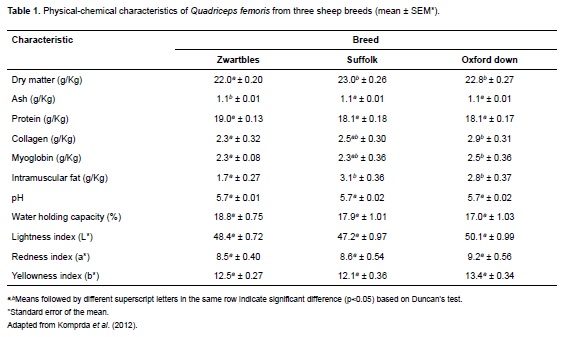
<body><![CDATA[<p>&nbsp;</p>     <p>&nbsp;</p>     <p><b><font size="3">Introduction</font></b></p>     <p>Currently, the global sheep population is more than   1 billion heads (FAO, 2015). On a global scale, sheep   meat production is small, with less than 8.6 million   tonnes. The largest producers of sheep meat are China,   India, Sudan, Nigeria and Pakistan. The three largest   destinations for sheep meat worldwide are China, EU,   and US, accounting for about 60% of global exports (FAO, 2015).</p>     <p>Meat is the most important source of animal   protein for the human diet (Lawrie, 2005; McAfee   <i>et al.</i>, 2010). However, the parameters that define its   degree of acceptance and quality vary with the point   of view and interest of the producer, trade, industry, and consumers.</p>     <p>From an industrial perspective, quality is defined   and determined by objective factors relating not only   to the quality demanded by the consumer, but also to   industrial meat characteristics (Os&oacute;rio <i>et al.</i>, 2009). In   the context of the supply chain and meat science, the   analysis of color, pH, water holding capacity, cooking   losses, tenderness, chemical composition, fatty acid   composition, among many others, are all important   in the concept of integrated quality and the search for more homogeneous products.</p>     <p>Besides being interconnected, quality parameters   defined by the final consumer and industry depend on a long list of other intrinsic (inherent to the animal) and extrinsic (inherent to management, environment, etc.) factors. Therefore, meat quality is defined by animal age, sex, and physiological state, and the post-mortem biochemistry of muscle and fat, carcass composition, feed contribution to flavour, protein and fat levels, as well as the effect of genetics on tissues and metabolism, pre and post slaughter handling, and storage, among others (Webb <i>et al.</i>, 2005).</p>     <p>In the case of lamb, an increase in consumption   accompanied by a demand for increased quality has   been observed. This situation forces the supply chain   to better understand the factors affecting meat quality;   we need to consider the number of factors that affect   the quality of lamb meat. The main intrinsic factors   interfering with the quality of lamb meat are breed, sex,   age, genetic characteristics and type of muscle fibres.   The aim of this work is to describe how these intrinsic factors cause changes in the quality of sheep meat.</p>     <p>&nbsp;</p>     <p><b><font size="3">Intrinsic factors affecting sheep meat</font></b></p>     ]]></body>
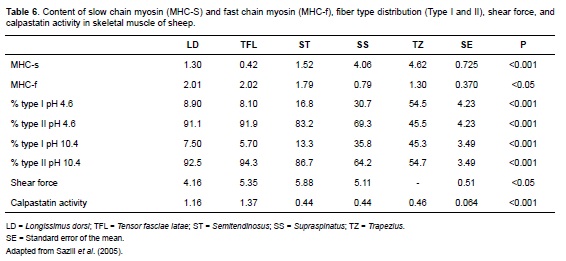
<body><![CDATA[<p>&nbsp;</p>     <p><i>Breed</i></p>     <p>Breed has a large effect on carcass morphology.   It is a complex factor and difficult to assess when   only its effects on the amount of fat or meat quality   are considered. The problem lies at the basis of   comparison, as results vary according to the chosen   criterion: same carcass weight, same age, same degree of maturity, etc. (Hopkins <i>et al.</i>, 2011). Furthermore, racial comparison is complicated due to differences in the adopted selection programs between countries (Sa&ntilde;udo <i>et al.</i>, 2008).</p>     <p>It is true that there is genetic variation of meat   quality between populations, especially between   improved breeds and native breeds. Lambe <i>et al.</i>   (2008; 2009) showed variation (p&lt;0.05) in final pH   and tenderness between the Texel and Scottish Black   Face breeds. Changes in tenderness between these   genotypes can be partly explained by the difference   in the number of muscle fibers (B&uuml;nger <i>et al.</i>, 2009).   Breed also influences other parameters such as the chemical composition (<a href="#t1">Table 1</a>).</p>      <p align="center"><a name="t1"><img src="/img/revistas/rccp/v29n1/v29n1a02t1.jpg"/></a></p>     <p align="center">&nbsp;</p> </p>     <p>Breed may also influence other nitrogen fractions   of meat, besides true protein. Esenbuga <i>et al.</i> (2009)   observed that Awassi sheep show lower values   (p&lt;0.05) of non-protein nitrogen (2.44 &plusmn; 0.07%   versus 2.91 &plusmn; 0.09%) and smaller amounts (p&lt;0.05)   of nitrogen soluble in water (5.18 &plusmn; 0.13 vs. 6.30% &plusmn; 0.16%) when compared to Morkaraman sheep.</p>     <p>Regarding chemical composition at the same carcass weight, animals of breeds with smaller frame size will be older and have more fat than those with larger frame size (Os&oacute;rio <i>et al.</i>, 2008). Breeds such as Dorper and their crosses have greater amount of intramuscular fat at the same age than breeds not specialized for meat production such as Rambouillet breed (Arvizu <i>et al.</i>, 2011). Barkawi <i>et al.</i> (2009) examined two Egyptian fat-tailed sheep breeds observing that Ossimi breed showed higher (p&lt;0.05) fat content (4.2%) than Rahmani breed (3.3%). The authors noted that Rahmani breed had higher frame size and later maturity with higher levels of circulating insulin growth factor (IGF-I) at different ages.</p>     <p>Typically, selected breeds for meat production have   greater number of muscle fibers and smaller amount   of intramuscular fat per unit area of muscle (B&uuml;nger   <i>et al.</i>, 2009; Hopkins <i>et al.</i>, 2011). Furthermore,   Vacca <i>et al.</i> (2008) inferred that differences between   genotypes alter the activity of lipogenic enzymes in   sheep muscle, such as &Delta;-desaturase, and can influence the amount and composition of deposited fatty acid.</p>     <p>Cholesterol levels are often associated with heart   disease and red meat is the primary source of this lipid. Faria <i>et al.</i> (2012) showed differences (p&lt;0.05) in the order of 5.72 mg/g cholesterol lower for Texel x Polwarth lamb meat compared to Texel x Corriedale.</p>     ]]></body>
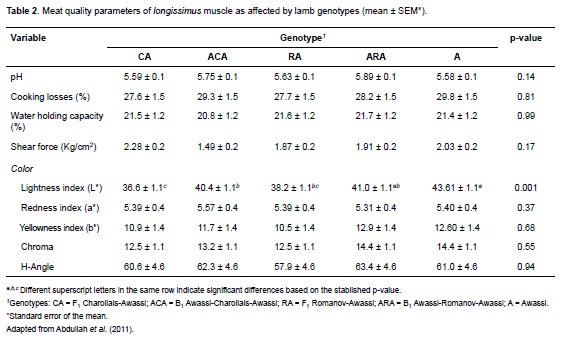
<body><![CDATA[<p>The marbling degree can influence various   sensory impressions of sheep meat, especially its   juiciness. In a study evaluating breeds with different   aptitudes, Cloete <i>et al.</i> (2012) observed that the   lower amount of intramuscular fat in meat from   Merino sheep was associated with lower scores for   sensory characteristics of initial juiciness and lasting   succulence (after-taste succulence) when compared   to sheep of double quality genotypes or cut. In an   extensive review, Hopkins <i>et al.</i> (2011) had already noted lower juiciness in the Merino genotype.</p>     <p>There are few studies comparing breed and   <i>post-mortem</i> pH evolution. Hoffman <i>et al.</i> (2003)   observed that sheep crosses between meat breeds and   wool breeds differed (p&lt;0.05) in pH 48 hours <i>post-mortem</i>,   with values of 5.71 and 5.79 for Merino x   Dormer and Merino x Suffolk crosses, respectively.   Merino breed has a high final pH, which can be   derived from the predominant muscle fiber in the   breed. Due to selection for production under grazing   conditions, oxidative fibers (1 and 2A) may be   prevalent in the muscle of these animals. These fibers   are characterized by low levels of glycogen, which is   closely related to high final pH values in the muscle (P&ouml;s&ouml; and Puolanne, 2005).</p>     <p>Associated with juiciness, meat tenderness is   another attribute influenced by genotype (Mart&iacute;nez-   Cerezo <i>et al.</i>, 2005). The differences in the degree   of muscularity, age and physiological action of the   calpain&#8211;calpastatin enzyme complex are mainly   responsible for the variation in tenderness of lamb meat (Thompson <i>et al.</i>, 2006).</p>     <p>Teixeira <i>et al.</i> (2005) showed objective differences   (p&lt;0.01) in meat tenderness between Bragan&ccedil;ano   (7.8 Kg/cm<sup>2</sup>) and Mirandesa (6.8 Kg/cm<sup>2</sup>) sheep   breeds. According to the authors, the sensory panel   also identified differences (p&lt;0.05) in hardness,   assigning scores of 4.1 to Bragan&ccedil;ano and just 2.8   for Mirandesa. In the latest study, Ekiz <i>et al.</i> (2009)   evaluated the quality of sheep meat of five genotypes   (Turkish Merino, Ramlic, Kivircik, Chios and Imroz )   and observed difference (p&lt;0.01) in shear force (kgf) between genotypes.</p>     <p>Physical aspects such as color, water holding   capacity and cooking losses are dependent to a greater   or lesser extent on the final pH of meat (<a href="#t2">Table 2</a>).   The literature describes variations in color scores,   juiciness and water holding capacity between breeds (Hern&aacute;ndez-Cruz <i>et al.</i>, 2009; Costa <i>et al.</i>, 2011).</p>     <p align="center"><a name="t2"><img src="/img/revistas/rccp/v29n1/v29n1a02t2.jpg"/></a>     <p>&nbsp;</p>     <p>Os&oacute;rio <i>et al.</i> (2008) argued that the most noticeable   changes are related with physical aspects of meat,   mainly the color because it has a direct impact on   appearance and consumer acceptability. Meat color   is influenced by the muscle myoglobin content and   the electrical state of muscle proteins (Ramos and   Gomide, 2007; Khliji <i>et al.</i>, 2010). Breed influences   the amount of myoglobin present in muscle, as Ju&aacute;rez   <i>et al.</i> (2009) showed for the Grazalema Merino breed:   3.09 mg/g myoglobin in lactation and 4.01 mg/g   myoglobin in the growing phase, while Lebrijana   Churra breed showed values of 1.61 mg/g and 2.79 mg/g for the same productive stages, respectively.</p>     <p>Genetics can also influence fatty acids composition   of muscle. According to Muchenje <i>et al.</i> (2009),   differences among breeds reflect underlying   differences in gene expression or activity of enzymes   involved in fatty acid synthesis, desaturation or chain elongation, and thus deserve more attention.</p>     <p>Demirel <i>et al.</i> (2006), Madruga <i>et al.</i> (2006),   and Marino <i>et al.</i> (2008) observed differences in the   levels of mono and polyunsaturated fatty acids for   different sheep breeds and attributed it to different   deposition rates of intramuscular triacylglycerols   in adipocytes associated with a dilutive effect of membrane phospholipids.</p>     ]]></body>
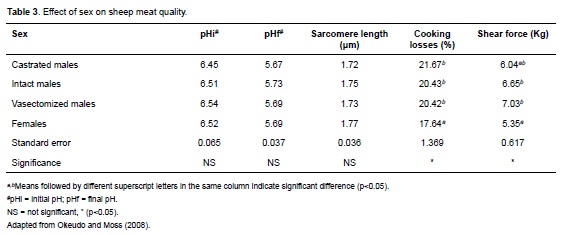
<body><![CDATA[<p>&nbsp;</p>     <p><i>Sex</i></p>     <p>Proximate composition of meat is affected by sex,   especially fat content (Pe&ntilde;a <i>et al.</i>, 2005; Gerrard and   Grant, 2006; P&eacute;rez <i>et al.</i>, 2007). Meat from females   is often richer in lipids. Santos <i>et al.</i> (2007) observed   that native animals from Spain had higher (p&lt;0.05)   lipids levels in the meat of female (2.3%) compared   with male lambs (1.9%) of the same age. Rodr&iacute;guez   <i>et al.</i> (2008) also found differences (p&lt;0.05) in the   fat content of meat from males and females (1.6 vs.   2.9%, respectively) in Assaf sheep, attributing these differences (p&lt;0.05) to the amount of carcass fat, being higher in females (10.9%) than in males (8.6%). When intact and castrated males are compared, meat from castrated animals has higher (p&lt;0.01) fat content (Haddad <i>et al.</i>, 2006; Warren <i>et al.</i>, 2008).</p>     <p>Physical parameters of meat quality are influenced   by sex. Johnson <i>et al.</i> (2005) evaluated muscle and   meat deposition of Texel male and female lambs,   observing increased (p&lt;0.01) deposition of muscle   and less fat in males for variables adjusted to the   same carcass weight. In the same study, meat quality   reflected differences (p&lt;0.01) for gender in tenderness   (74.5 N for females and 82.4 N for males) and final pH (5.60 for females and 5.74 for males).</p>     <p>Decreasing pH is influenced by many factors,   among which glycogen, ATP, and creatine phosphate   reserves are the most determinant. McGeehin <i>et al.</i>   (2001) observed that pH drop is faster (p&lt;0.05) in   females than in males, with constant differences of   0.18 pH units. It can be inferred that glycogen content   in females is higher due to less sexual activity. Another   possible hypothesis is that the higher reactivity of males is promoted by testosterone and depletes muscle glycogen faster via catecholamines. Adrenaline recruits glucose to the bloodstream and stimulates muscle glycolysis (P&ouml;s&ouml; and Puolanne, 2005).</p>     <p>Okeudo and Moss (2008) evaluated the influence of   sex (intact males, castrated males, vasectomized males, and females) on meat quality of sheep (<a href="#t3">Table 3</a>).</p>     <p align="center"><a name="t3"><img src="/img/revistas/rccp/v29n1/v29n1a02t3.jpg"/></a>     <p>&nbsp;</p>     <p>The differences in cooking losses and shear force   between males and females can be partly explained by   higher intramuscular fat content of females (Okeudo   and Moss, 2008). In reviewing aspects of meat quality,   Koohmaraie and Geesink (2006) claimed that fat has   lower water content than muscle; therefore, muscles   richer in adipose tissue have reduced water loss.   Moreover, authors point out that a greater amount of   adipocytes implies that the amount of muscle fibers   per area is reduced, thereby favouring smaller shear force values.</p>     <p>Frequent differences in meat tenderness are found   for most species between intact and castrated males.   Lage <i>et al.</i> (2009) observed higher shear strength and smaller values for the myofibrillar fragmentation index in <i>Longissimus dorsi</i> of castrated compared to non-castrated animals. The authors also observed no difference in m-calpain and &mu;-calpain activity 24 hours <i>post-mortem</i> in relation to sex. Calpastatin was 81% higher in intact animals compared with castrated males. Besides high calpastatin activity, another explanation for the low meat tenderness of non-castrated animals would be their higher zinc concentration, which is a potent inhibitor of calpain (Koohmaraie and Geesink, 2006). Furthermore, G&ouml;kdal <i>et al.</i> (2010) found higher (p&lt;0.05) collagen content in meat from intact males (4.03 &plusmn; 0.44 mg/g) compared to immunologically castrated males (2.52 &plusmn; 0.28 mg/g).</p>     ]]></body>
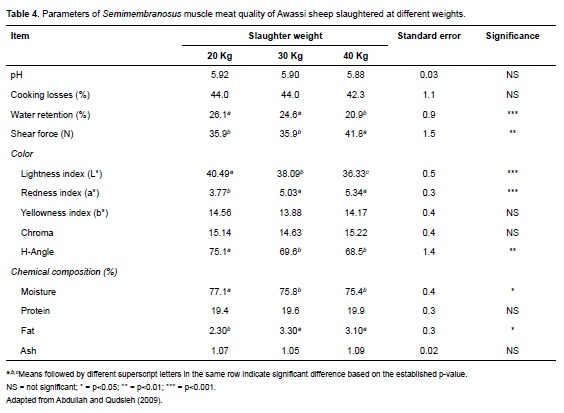
<body><![CDATA[<p>Sex differences for fatty acid content are documented   in the literature. Tejeda <i>et al.</i> (2008) showed   differences (p&lt;0.01) in fatty acid composition of   <i>Longissimus lumborum</i> of Merino males and females.   They associated it to higher levels of polyunsaturated   fatty acids in intact males. Intramuscular fat is more   saturated than membrane phospholipids for example,   and females have higher deposition of intramuscular   fat. Therefore, it is common in the literature to refer to female sheep meat as being more saturated.</p>     <p>In addition to fatty acid composition, castration   affects cholesterol levels of meat from males.   According to Madruga <i>et al.</i> (2001), castration   increased (p&lt;0.05) cholesterol in meat from castrated   goats (62.5 mg/g) compared to that of intact animals   (58.0 mg/g). It can be inferred that cholesterol mobilization by intact animals is higher because steroid hormones are derived from this lipid, which contributes to less deposition of this metabolite into the meat. The sensory panel rated by Navajas <i>et al.</i> (2008) and Tejeda <i>et al.</i> (2008) classified the meat of intact males with higher scores for ''bad taste''.</p>     <p>&nbsp;</p>     <p><i>Age and body weight</i></p>     <p>These factors are analyzed together because if no   manipulation of food occurs or the animal does not   suffer severe food restriction, a greater weight in the   same genetic background implies greater age. The   slaughter weight affects consumer acceptability in   many countries (Mart&iacute;nez-Cerezo <i>et al.</i>, 2005; Font i   Furnols <i>et al.</i>, 2006; Muela <i>et al.</i>, 2010) and therefore deserves special attention in the study of meat quality.</p>     <p>The growth curve of sheep is sigmoid, with a   period of accelerated lean tissue deposition that   coincides with puberty and a stabilization period   of protein deposition and increased fat deposition   known as maturity. The increase in protein deposition   is mediated by growth hormones (GH), which   increase muscle fibers hypertrophy and reduce fat   hormones deposition. The increase in fat deposition   amounts to the extent that sex hormones increase   their concentration in the bloodstream (Gerrard and Grant, 2006).</p>     <p>Differences in sheep meat quality at different ages   necessarily correspond to changes in the amount   of carcass fat and its relationship to physical and chemical aspects of meat (<a href="#t4">Table 4</a>). Barkawi <i>et al.</i> (2009) evaluated the chemical composition of meat from native lambs at two ages (270 and 360 days) and observed a reduction (p&lt;0.01) of moisture (75.8 to 75.1%) and an increase (p&lt;0.01) in fat (3.3 to 4.2 %) with increasing slaughter age.</p>      <p align="center"><a name="t4"><img src="/img/revistas/rccp/v29n1/v29n1a02t4.jpg"/></a></p>      <p>&nbsp;</p>     <p>Regarding color, the increased weight and age at   slaughter tend to increase the amount of pigments, red   content (a<sup>*</sup>) and reduced luminosity (L<sup>*</sup>). Ju&aacute;rez <i>et al.</i>   (2009) observed an increase (p&lt;0.01) in myoglobin   (3.09 to 4.01 mg/g), low (p&lt;0.01) luminosity (45.10   to 40.19 L<sup>*</sup>) and increased (p&lt;0.01) redness (7.35 to   9.79 a<sup>*</sup>) with increasing (p&lt;0.01) slaughter weight   of Grazalema Merino sheep breed. In another study,   Teixeira <i>et al.</i> (2005) identified a reduction (p&lt;0.05)   in L<sup>*</sup> of 40.0 &plusmn; 0.55 to 39.0 &plusmn; 0.54 when slaughter weight increased from 9-14 to 19-24 Kg.</p>     ]]></body>
<body><![CDATA[<p>Silva Sobrinho <i>et al.</i> (2005) evaluated meat   quality from lambs of different exotic genotypes slaughtered at two ages. They found that Warnen- Bratzler measurement was higher in meat from animals slaughtered at 300 days compared to 150 days at slaughter, indicating that larger shear forces were required to cut the samples from older animals. Tejeda <i>et al.</i> (2008) studied the texture composition of sheep meat at different slaughter weights (24 or 29 Kg) observing higher meat fibrosity at 29 Kg body weight. This parameter was related to increased thermal and mechanical stability of collagen (Purslow, 2005).</p>     <p>Regarding juiciness, meat from young animals   should be moister at the first bite and have a drier aftertaste,   while heavier and older animals have a tendency   toward greater juiciness due to fat content. Corroborating   this assertion, Ju&aacute;rez <i>et al.</i> (2009) reported higher end juiciness with increasing age at slaughter.</p>     <p>Russo <i>et al.</i> (2003) evaluated the quality of beef   carcasses, observing higher water holding capacity   (0.33 for light, 0.36 medium and 0.39 for heavy carcasses); however, the increase in slaughter weight also increased cooking losses. It can be inferred that sheep meat takes longer to reach the degree of doneness (70 &deg;C in the center of beef) as age increases, resulting in higher losses. Nevertheless, Pinheiro <i>et al.</i> (2009) observed contrary results, reporting higher cooking losses in lambs (46.44%) compared to adult sheep (39.33%).</p>     <p>The influence of weight and slaughter age on fatty   acid composition in sheep meat is quite controversial.   Some results indicate no influence of slaughter   weight on the fatty acid composition of meat (D&iacute;az   <i>et al.</i>, 2003). However, Wood <i>et al.</i> (2008) reviewed   the influence of age on fatty acids concentrations in   adipose tissue of ruminants and reported an increase   in the proportion of monounsaturated fatty acids.   According to the authors, the proportion of saturated   fatty acids falls while linolenic acid levels remain   constant. This study also showed that the proportion   of conjugated linolenic acid (CLA) in the fat increased with the age of the animal.</p>     <p>Warren <i>et al.</i> (2008) analyzed fatty acids content,   triglycerides levels, and phospholipids in Aberdeen   Angus cattle at three different ages (14, 19, and   24 months). The authors observed the extent to which   fattening progresses increase muscle triglycerides;   however, phospholipids remain reasonably constant.   The phospholipids to total lipids ratio fell by 30% at   14 months and 12% at 24 months, and these decreases   were accompanied by an increase in the proportion   of monounsaturated fatty acids and a decrease of &omega;-6   polyunsaturated in the total lipids. This seems to be   similar in sheep, as Marino <i>et al.</i> (2008) observed   increasing saturated lipids and decreasing unsaturated   lipids in intramuscular (<i>Longissimus dorsi</i>) fat of sheep native to Italy.</p>     <p>&nbsp;</p>     <p><i>Genes</i></p>     <p>The study of gene influence on meat quality is   recent and its implications are still poorly understood   (Thompson <i>et al.</i>, 2006). In sheep, the main set of   genes (loci of quantitative traits) affecting carcass   characteristics and meat are: Callipyge, Carwell or   rib eye muscling (REM), Double muscling (Cockett <i>et al.</i>, 2005).</p>     <p>Recently, the existence of a gene that causes muscle   hypertrophy in sheep was identified. Preliminary   evidence suggests an autosomal dominant gene   may be responsible for this effect in muscle and   carcass composition. Compared with normal lambs,   ''Callipyge'' lambs have 32.30% superior muscularity,   with no change in birth weight. An advantage of the   ''Callipyge'' phenotype is that unlike double muscling   in cattle, the condition in sheep does not occur until   a few weeks after birth. So dystocia at birth is not a   problem for carrier animals (Sosnicki and Newman,   2010; Masri <i>et al.</i>, 2011a). Despite the advantages   in weight and carcass yield, the meat is considered   extremely tough and somewhat bland due to low   marbling (Goodson <i>et al.</i>, 2001). Meat toughness   can be attributed to high levels of calpastatin, which   inhibit the calpain system - enzymes responsible for   proteolysis of muscle post-mortem (Koohmaraie and   Geesink, 2006; Kemp <i>et al.</i>, 2010). ''Callipyge'' sheep   meat presents significant decrease of myofibrillar   fragmentation, indicative of a decrease in protein   degradation (Hopkins <i>et al.</i>, 2011). Kuber <i>et al.</i> (2003)   observed that calpastatin activity in ''Callipyge''   phenotype was 58% higher than the normal genotype,   while Abdulkhaliq <i>et al.</i> (2007) reported 2.9 shear   force (kgF) for ''Callipyge'' sheep and 5.4 for the normal genotype.</p>     <p>Besides the increased hypertrophy of ''Callipyge''   sheep, changes in muscle fiber type occur. This   mutation increases the amount of glycolytic fibers,   which reduce oxidative metabolism. Thus, it can be   inferred that the muscles of ''Callipyge'' are more   sensitive to a sudden drop in pH (Warner <i>et al.</i>,   2010). Changes in pH may be responsible for higher   cooking losses (31% for mutant and 29.6% for normal genotype; Abdulkhaliq <i>et al.</i>, 2007).</p>     ]]></body>
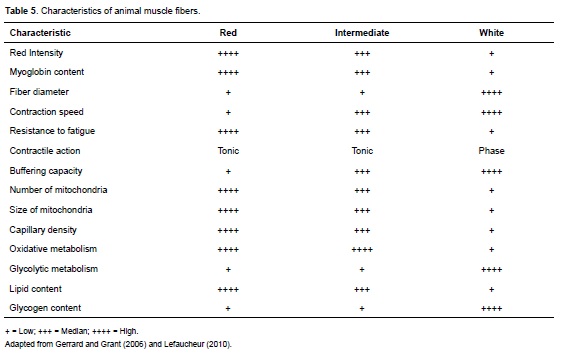
<body><![CDATA[<p>Another mutation in sheep genome influencing   carcass and meat quality was documented in Poll   Dorset sheep in Australia. The ''Carwell'' phenotype   has 8-10% rib eye area increments at similar carcass   weights (Warner <i>et al.</i>, 2010). Significant effects   on muscularity, an increase in protein deposition   and up to 35% meat toughness increase have been   documented in ''Carwell'' sheep (Warner <i>et al.</i>, 2010). However, Hopkins <i>et al.</i> (2007) reported no increase (p&gt;0.05) in sheer force of <i>Longissimus</i> or <i>semimembranosus</i>, or any other effects on pH or meat color. It can be inferred from the current literature that the effects of the ''Carwell'' phenotype are far less impacting on meat quality than those documented by the ''Callipyge'' phenotype (Hopkins <i>et al.</i>, 2011).</p>     <p>According to McFarlane <i>et al.</i> (2005), myostatin   controls muscle fiber proliferation through transcription   of gene groups responsible for myoblasts and fibroblasts   differentiation and their subsequent aggregation in the   myotube. A mutation in the myostatin (GDF8) gene   resulting in inhibited transcription has been shown to   increase muscularity in Texel sheep and other breeds   (Clop <i>et al.</i>, 2006). Other studies have reported that   myostatin mutations influence muscle and fat (Kijas <i>et al.</i>, 2007; Lambe <i>et al.</i>, 2011).</p>     <p>The g + 6723GNA mutation increased the   percentage of glycolytic fibers, but did not affect   shear force. However, a reduction of intramuscular   fat and sensory scores on overall meat quality,   including juiciness, was observed (Kijas <i>et al.</i>, 2007;   Hopkins <i>et al.</i>, 2011). Masri <i>et al.</i> (2011b) observed   that myostatin mutations in Texel and Poll Dorset   breeds reduce <i>Longissimus</i> intramuscular fat. The   authors recommend paying attention to meat quality, especially juiciness, of mutant animals.</p>     <p>In another study evaluating meat quality of mutant   myostatin Texel sheep observed that <i>Longissimus</i>   and <i>Semimembranosus</i> shear force was not affected   by the mutation (Johnson <i>et al.</i>, 2005; Lambe <i>et al.</i>,   2011). According to Warner <i>et al.</i> (2010), myostatin   mutations in sheep do not seem to have any influence   on shearing force, despite a reduction in the perception   of juiciness by consumers, perhaps due to a reduction in the amount of intramuscular fat.</p>     <p>Besides amount of fat, fatty acid composition of   mutant beef and sheep deserves attention. Raes <i>et al.</i>   (2003) showed that the double-muscling genotype in   cattle has lower proportion of monounsaturated and   higher of polyunsaturated fatty acids compared with   the non-mutant genotype. The authors attributed this   to a low concentration of total lipids in muscle and a   higher proportion of phospholipids in the total lipids, increased by the mutation. Thus, studies on the impact of double-muscling on fatty acid composition in beef and sheep are required.</p>     <p>&nbsp;</p>     <p><i>Muscle fibers</i></p>     <p>Differences in muscle fibers correspond to   variations in the type of myosin chain (light or   heavy) responsible for myofibril contraction. This   polymorphism affects the enzymatic composition   of the fiber, its buffering capacity and its biology   (Gerrard and Grant, 2006; B&uuml;nger <i>et al.</i>, 2009).   Despite several nomenclatures in meat science, three   types of muscle fibers with different characteristics are described (<a href="#t5">Table 5</a>).</p>      <p align="center"><a name="t5"><img src="/img/revistas/rccp/v29n1/v29n1a02t5.jpg"/></a></p>      <p>&nbsp;</p>     ]]></body>
<body><![CDATA[<p>The number and type of muscle fibers of the   species affect meat color. In sheep, the proportion of   red, intermediate and white fibers is approximately   15, 31 and 54%, respectively (Gerrard and Grant,   2006). For the same species, Gallo <i>et al.</i> (2009)   reported frequencies of 9.77, 35.01, and 55.21% for   red, intermediate and white fibers, respectively. The   proportions of these fibers vary between muscles and   alter physical-chemical characteristics such as color (Tschirhart-Hoelscher <i>et al.</i>, 2006).</p>     <p>In sheep, higher final pH value corresponds to   slow-contracting muscles while lower final pH is   related to the more rapidly-contracting muscles   (Thompson <i>et al.</i>, 2006; Tschirhart-Hoelscher <i>et al.</i>, 2006). Ryu <i>et al.</i> (2006) reported a negative   correlation between the amount of white fibers and the final pH of the muscle.</p>     <p>In addition to pH, fiber type and their interaction   with calpastatin activity affect muscle softness   (<a href="#t6">Table 6</a>). However, the effect of fiber type is still controversial regarding softness (Lee <i>et al.</i>, 2010).</p>      <p align="center"><a name="t6"><img src="/img/revistas/rccp/v29n1/v29n1a02t6.jpg"/></a></p>      <p>&nbsp;</p>     <p>The water content in muscle greatly varies with   increasing speed of muscle contraction. Muscles   rich in white fibers are larger and have more   water compared to proteins (Tschirhart-Hoelscher   <i>et al.</i>, 2006). According to Lee <i>et al.</i> (2010), the   water/protein relation affects the ability to retain   water, which decreases by increasing this ratio. Thus,   less water holding capacity and higher cooking losses are expected in rapidly contracting muscles.</p>     <p>&nbsp;</p>     <p><i>Perspectives</i></p>     <p>Many factors influence sheep quality, and knowledge   of their relevance requires more study accompanied by   constant research on consumer and industry demands.   Intrinsic factors such as breed, sex, age and weight   at slaughter, genes, muscle fiber plasticity and meat   quality referring to these factors must be considered in   management practices. Due to the influence of intrinsic   factors on meat characteristics, quality standards must   be known by lamb producers in order to define the type of animal required to meet these demands.</p>     <p>&nbsp;</p>     ]]></body>
<body><![CDATA[<p><b><font size="3">Conflicts of interest</font></b></p>     <p>The authors declare they have no conflicts of interest with regard to the work presented in this report.</p>     <p>&nbsp;</p> <hr size="1" />     <p><b><font size="3">Notes</font></b></p>     <p><font size="4"><b><a name="a0" id="a0"><a href="#a1">&curren;</a></a></b></font>To cite this article: de Lima DM, de Carvalho FFR, da Silva FJS, Rangel AHN, Novaes LP, Difante GDS. Intrinsic factors affecting sheep meat quality: a   review. Rev Colomb Cienc Pecu 2016; 29:3-15.</p> <hr size="1" />     <p>&nbsp;</p>     <p><b><font size="3">References</font></b></p>     <!-- ref --><p>Abdulkhaliq AM, Meyer HH, Busboom JR, Thompson JM.   Growth, carcass and cooked meat characteristics of lambs sired   by Dorset rams heterozygous for the Callipyge gene and Suffolk   and Texel rams. Small Ruminant Res 2007; 71:92-7.    &nbsp;&nbsp;&nbsp;&nbsp;&nbsp;&nbsp;&nbsp;&nbsp;[&#160;<a href="javascript:void(0);" onclick="javascript: window.open('/scielo.php?script=sci_nlinks&ref=2508426&pid=S0120-0690201600010000200001&lng=','','width=640,height=500,resizable=yes,scrollbars=1,menubar=yes,');">Links</a>&#160;]<!-- end-ref --> </p>     <!-- ref --><p>Abdullah AY, Qudsieh RI. Effect of slaughter weight and aging   time on the quality of meat from Awassi ram lambs. Meat Sci   2009; 82:309-16.    &nbsp;&nbsp;&nbsp;&nbsp;&nbsp;&nbsp;&nbsp;&nbsp;[&#160;<a href="javascript:void(0);" onclick="javascript: window.open('/scielo.php?script=sci_nlinks&ref=2508428&pid=S0120-0690201600010000200002&lng=','','width=640,height=500,resizable=yes,scrollbars=1,menubar=yes,');">Links</a>&#160;]<!-- end-ref --> </p>     <!-- ref --><p>Abdullah AY, Qudsieh RI, Nusairat BM. Effect of crossbreeding   with exotic breeds on meat quality of Awassi lambs. Livest Sci   2011; 142:121-7.    &nbsp;&nbsp;&nbsp;&nbsp;&nbsp;&nbsp;&nbsp;&nbsp;[&#160;<a href="javascript:void(0);" onclick="javascript: window.open('/scielo.php?script=sci_nlinks&ref=2508430&pid=S0120-0690201600010000200003&lng=','','width=640,height=500,resizable=yes,scrollbars=1,menubar=yes,');">Links</a>&#160;]<!-- end-ref --> </p>     <!-- ref --><p>Arvizu RR, Dom&iacute;nguez IA, Rubio MS, B&oacute;rquez JL, Pinos-   Rodr&iacute;guez JM, Gonz&aacute;lez M, Jaramillo G. Effects of genotype,   level of supplementation, and organic chromium on growth   performance, carcass, and meat traits grazing lambs. Meat Sci   2011; 88:404-8.    &nbsp;&nbsp;&nbsp;&nbsp;&nbsp;&nbsp;&nbsp;&nbsp;[&#160;<a href="javascript:void(0);" onclick="javascript: window.open('/scielo.php?script=sci_nlinks&ref=2508432&pid=S0120-0690201600010000200004&lng=','','width=640,height=500,resizable=yes,scrollbars=1,menubar=yes,');">Links</a>&#160;]<!-- end-ref --> </p>     <!-- ref --><p>Barkawi AH, El-Asheeri AK, Hafez YM, Ibrahim MA, Ali MM.   Growth and carcass characteristics of lambs in relation to plasma   IGF-I and some histological traits of <i>Longissimus lumbarum</i> and   <i>Biceps femoris</i> as affected by breed and age at slaughter. Livest   Sci 2009; 124:9-14.    &nbsp;&nbsp;&nbsp;&nbsp;&nbsp;&nbsp;&nbsp;&nbsp;[&#160;<a href="javascript:void(0);" onclick="javascript: window.open('/scielo.php?script=sci_nlinks&ref=2508434&pid=S0120-0690201600010000200005&lng=','','width=640,height=500,resizable=yes,scrollbars=1,menubar=yes,');">Links</a>&#160;]<!-- end-ref --></p>     <!-- ref --><p>B&uuml;nger L, Navajas EA, Stevenson L, Lambe NR, Maltin CA,   Simm G, Fisher AV, Chang KC. Muscle fiber characteristics of   two contrasting sheep breeds: Scottish Blackface and Texel. Meat   Sci 2009; 81:372-81.    &nbsp;&nbsp;&nbsp;&nbsp;&nbsp;&nbsp;&nbsp;&nbsp;[&#160;<a href="javascript:void(0);" onclick="javascript: window.open('/scielo.php?script=sci_nlinks&ref=2508436&pid=S0120-0690201600010000200006&lng=','','width=640,height=500,resizable=yes,scrollbars=1,menubar=yes,');">Links</a>&#160;]<!-- end-ref --> </p>     <!-- ref --><p>Cloete JJE, Hoffman LC, Cloete SWP. A comparison between   slaughter traits and meat quality of various sheep breeds: Wool,   dual-purpose and mutton. Meat Sci 2012; 91:318-24.    &nbsp;&nbsp;&nbsp;&nbsp;&nbsp;&nbsp;&nbsp;&nbsp;[&#160;<a href="javascript:void(0);" onclick="javascript: window.open('/scielo.php?script=sci_nlinks&ref=2508438&pid=S0120-0690201600010000200007&lng=','','width=640,height=500,resizable=yes,scrollbars=1,menubar=yes,');">Links</a>&#160;]<!-- end-ref --> </p>     <!-- ref --><p>Clop A, Marcq F, Takeda H, Pirrottin D, Toroir X, Bibe B. A   mutation creating a potential illegitimate microRNA target site   in the myostatin gene affects muscularity in sheep. Nat Genet   2006; 38:813-8.    &nbsp;&nbsp;&nbsp;&nbsp;&nbsp;&nbsp;&nbsp;&nbsp;[&#160;<a href="javascript:void(0);" onclick="javascript: window.open('/scielo.php?script=sci_nlinks&ref=2508440&pid=S0120-0690201600010000200008&lng=','','width=640,height=500,resizable=yes,scrollbars=1,menubar=yes,');">Links</a>&#160;]<!-- end-ref --> </p>     <!-- ref --><p>Cockett NE, Smit MA, Bidwell CA, Segers K, Hadfield TL,   Snowder GD, Georges M, Charlier C. The callipyge mutation   and other genes that affect muscle hypertrophy in sheep. Genet   Sel Evol 2005; 37:65-81.    &nbsp;&nbsp;&nbsp;&nbsp;&nbsp;&nbsp;&nbsp;&nbsp;[&#160;<a href="javascript:void(0);" onclick="javascript: window.open('/scielo.php?script=sci_nlinks&ref=2508442&pid=S0120-0690201600010000200009&lng=','','width=640,height=500,resizable=yes,scrollbars=1,menubar=yes,');">Links</a>&#160;]<!-- end-ref --> </p>     <!-- ref --><p>Costa RG, Santos NM, Sousa WH, Queiroga RCRE, Azevedo OS,   Cartaxo FQ. Qualidade f&iacute;sica e sensorial da carne de cordeiros   de tr&ecirc;s gen&oacute;tipos alimentados com ra&ccedil;&otilde;es formuladas com   duas rela&ccedil;&otilde;es volumoso:concentrado. Rev Bras Zootec 2011;   40:1781-7.    &nbsp;&nbsp;&nbsp;&nbsp;&nbsp;&nbsp;&nbsp;&nbsp;[&#160;<a href="javascript:void(0);" onclick="javascript: window.open('/scielo.php?script=sci_nlinks&ref=2508444&pid=S0120-0690201600010000200010&lng=','','width=640,height=500,resizable=yes,scrollbars=1,menubar=yes,');">Links</a>&#160;]<!-- end-ref --> </p>     <!-- ref --><p>Demirel G, Ozpinar H, Nazli B, Keser O. Fatty acids of lamb meat   from two breeds fed different forage: concentrate ratio. Meat Sci 2006; 72:229-35.    &nbsp;&nbsp;&nbsp;&nbsp;&nbsp;&nbsp;&nbsp;&nbsp;[&#160;<a href="javascript:void(0);" onclick="javascript: window.open('/scielo.php?script=sci_nlinks&ref=2508446&pid=S0120-0690201600010000200011&lng=','','width=640,height=500,resizable=yes,scrollbars=1,menubar=yes,');">Links</a>&#160;]<!-- end-ref --></p>     <!-- ref --><p>D&iacute;az MT, Velasco S, P&eacute;rez C, Lauzurica S, Huidobro F, Ca&ntilde;eque   V. Physico-chemical characteristics of carcass and meat   Manchego-breed suckling lambs slaughtered at different weights.   Meat Sci 2003; 65:1247-55.    &nbsp;&nbsp;&nbsp;&nbsp;&nbsp;&nbsp;&nbsp;&nbsp;[&#160;<a href="javascript:void(0);" onclick="javascript: window.open('/scielo.php?script=sci_nlinks&ref=2508448&pid=S0120-0690201600010000200012&lng=','','width=640,height=500,resizable=yes,scrollbars=1,menubar=yes,');">Links</a>&#160;]<!-- end-ref --> </p>     <!-- ref --><p>Ekiz B, Yilmaz A, Ozcan M, KaptanC, Hanoglu H, Erdogan I,   Yalcintan H. Carcass measurements and meat quality of Turkish   Merino, Ramlic, Kivircik, Chios and Imroz lambs raised under an   intensive production system. Meat Sci 2009; 82:64-70.    &nbsp;&nbsp;&nbsp;&nbsp;&nbsp;&nbsp;&nbsp;&nbsp;[&#160;<a href="javascript:void(0);" onclick="javascript: window.open('/scielo.php?script=sci_nlinks&ref=2508450&pid=S0120-0690201600010000200013&lng=','','width=640,height=500,resizable=yes,scrollbars=1,menubar=yes,');">Links</a>&#160;]<!-- end-ref --> </p>     <!-- ref --><p>Esenbuga N, Macit M, Karaoglu M, Aksakal V, Aksu MI, Yoruk   MA, Gul M. Effect of breed on fattening performance, slaughter   and meat quality characteristics of Awassi and Morkaraman lambs.   Livest Sci 2009; 123:255-60.    &nbsp;&nbsp;&nbsp;&nbsp;&nbsp;&nbsp;&nbsp;&nbsp;[&#160;<a href="javascript:void(0);" onclick="javascript: window.open('/scielo.php?script=sci_nlinks&ref=2508452&pid=S0120-0690201600010000200014&lng=','','width=640,height=500,resizable=yes,scrollbars=1,menubar=yes,');">Links</a>&#160;]<!-- end-ref --> </p>     <!-- ref --><p>FAO. FAOSTAT. [Access date: August 19, 2015]. URL: <a href="http://faostat3.fao.org/home/E" target="_blank">http:// faostat3.fao.org/home/E</a>&nbsp;&nbsp;&nbsp;&nbsp;&nbsp;&nbsp;&nbsp;&nbsp;[&#160;<a href="javascript:void(0);" onclick="javascript: window.open('/scielo.php?script=sci_nlinks&ref=2508454&pid=S0120-0690201600010000200015&lng=','','width=640,height=500,resizable=yes,scrollbars=1,menubar=yes,');">Links</a>&#160;]<!-- end-ref --><!-- ref --><p>Faria PB, Bressan MC, Vieira JO, Vicente-Neto J, Ferr&atilde;o SPB,   Rosa FC, Monteiro, M, Cardoso MG, Gama LT. Meat quality and   lipid profiles in crossbred lambs finished on clover-rich pastures.   Meat Sci 2012; 90:733-8.    &nbsp;&nbsp;&nbsp;&nbsp;&nbsp;&nbsp;&nbsp;&nbsp;[&#160;<a href="javascript:void(0);" onclick="javascript: window.open('/scielo.php?script=sci_nlinks&ref=2508455&pid=S0120-0690201600010000200016&lng=','','width=640,height=500,resizable=yes,scrollbars=1,menubar=yes,');">Links</a>&#160;]<!-- end-ref --> </p>     <!-- ref --><p>Font i Furnols M, San Juli&aacute;n R, Guerrero L, Sa&ntilde;do C, Campo MM,   Olleta JL, Oliver MA, Ca&ntilde;eque V, &Aacute;lvarez I, D&iacute;az MT, Branscheid   W, Wicke M, Nute GR, Montossi F. Acceptability of lamb meat   from different producing systems and ageing time to German,   Spanish and British consumers. Meat Sci 2006; 72:545-54.    &nbsp;&nbsp;&nbsp;&nbsp;&nbsp;&nbsp;&nbsp;&nbsp;[&#160;<a href="javascript:void(0);" onclick="javascript: window.open('/scielo.php?script=sci_nlinks&ref=2508457&pid=S0120-0690201600010000200017&lng=','','width=640,height=500,resizable=yes,scrollbars=1,menubar=yes,');">Links</a>&#160;]<!-- end-ref --> </p>     ]]></body>
<body><![CDATA[<!-- ref --><p>Gallo SB, Siqueira ER, Delgado EF, Silva MDP, Rosa GT.   Influence of feeding regime and finishing system on lamb muscle   fiber and meat quality. Rev Bras Zootec 2009; 38:2204-10.    &nbsp;&nbsp;&nbsp;&nbsp;&nbsp;&nbsp;&nbsp;&nbsp;[&#160;<a href="javascript:void(0);" onclick="javascript: window.open('/scielo.php?script=sci_nlinks&ref=2508459&pid=S0120-0690201600010000200018&lng=','','width=640,height=500,resizable=yes,scrollbars=1,menubar=yes,');">Links</a>&#160;]<!-- end-ref --> </p>     <!-- ref --><p>Gerrard DE, Grant AL. Principles of animal growth and   development. 1st ed. Kendall/Hunt Publishing Company. 2006.    &nbsp;&nbsp;&nbsp;&nbsp;&nbsp;&nbsp;&nbsp;&nbsp;[&#160;<a href="javascript:void(0);" onclick="javascript: window.open('/scielo.php?script=sci_nlinks&ref=2508461&pid=S0120-0690201600010000200019&lng=','','width=640,height=500,resizable=yes,scrollbars=1,menubar=yes,');">Links</a>&#160;]<!-- end-ref --> </p>     <!-- ref --><p>G&ouml;kdal O, Atay O, &Uuml;lker H, Kayaardi S, Kanter M, De Avila   MD, Reeves JJ. The effects of immunological castration against   GnRH with recombinant OL protein (Ovalbumin-LHRH-7) on   carcass and meat quality characteristics, histological appearance   of testes and pituitary gland in Kivircik male lambs. Meat Sci   2010; 86:692-8.    &nbsp;&nbsp;&nbsp;&nbsp;&nbsp;&nbsp;&nbsp;&nbsp;[&#160;<a href="javascript:void(0);" onclick="javascript: window.open('/scielo.php?script=sci_nlinks&ref=2508463&pid=S0120-0690201600010000200020&lng=','','width=640,height=500,resizable=yes,scrollbars=1,menubar=yes,');">Links</a>&#160;]<!-- end-ref --> </p>     <!-- ref --><p>Goodson KJ, Miller RK, Savell JW. Carcass traits, muscle   characteristics, and palatability attributes of lambs expressing   the callipyge phenotype. Meat Sci 2001; 58:381-7.    &nbsp;&nbsp;&nbsp;&nbsp;&nbsp;&nbsp;&nbsp;&nbsp;[&#160;<a href="javascript:void(0);" onclick="javascript: window.open('/scielo.php?script=sci_nlinks&ref=2508465&pid=S0120-0690201600010000200021&lng=','','width=640,height=500,resizable=yes,scrollbars=1,menubar=yes,');">Links</a>&#160;]<!-- end-ref --> </p>     <!-- ref --><p>Haddad SG, Husein MQ, Sweidan RW. Effects of castration on   growth performance and carcass characteristics of Awassi lambs   fed high concentrate diet. Texel&times;Welsh Mountain lambs using   ultrasound and video image analyses. Small Ruminant Res 2006;   99:99-109.    &nbsp;&nbsp;&nbsp;&nbsp;&nbsp;&nbsp;&nbsp;&nbsp;[&#160;<a href="javascript:void(0);" onclick="javascript: window.open('/scielo.php?script=sci_nlinks&ref=2508467&pid=S0120-0690201600010000200022&lng=','','width=640,height=500,resizable=yes,scrollbars=1,menubar=yes,');">Links</a>&#160;]<!-- end-ref --> </p>     ]]></body>
<body><![CDATA[<!-- ref --><p>Hern&aacute;ndez Cruz L, Ram&iacute;rez Bribiesca1 JE, Guerrero Legarreta   MI, Hern&aacute;ndez Mendo O, Crosby Galvan MM, Hern&aacute;ndez Calva   LM. Effects of crossbreeding on carcass and meat quality of   Mexican lambs. Arq Bras Med Vet Zoo 2009; 61:475-83.    &nbsp;&nbsp;&nbsp;&nbsp;&nbsp;&nbsp;&nbsp;&nbsp;[&#160;<a href="javascript:void(0);" onclick="javascript: window.open('/scielo.php?script=sci_nlinks&ref=2508469&pid=S0120-0690201600010000200023&lng=','','width=640,height=500,resizable=yes,scrollbars=1,menubar=yes,');">Links</a>&#160;]<!-- end-ref --> </p>     <!-- ref --><p>Hoffman LC, Muller M, Cloete SWP, Schmidt D. Comparison of   six crossbred lamb types: sensory, physical and nutritional meat   quality characteristics. Meat Sci 2003; 65:1265-74.    &nbsp;&nbsp;&nbsp;&nbsp;&nbsp;&nbsp;&nbsp;&nbsp;[&#160;<a href="javascript:void(0);" onclick="javascript: window.open('/scielo.php?script=sci_nlinks&ref=2508471&pid=S0120-0690201600010000200024&lng=','','width=640,height=500,resizable=yes,scrollbars=1,menubar=yes,');">Links</a>&#160;]<!-- end-ref --> </p>     <!-- ref --><p>Hopkins DL, Fogarty NM, Mortimer SI. Genetic related effects   on sheep meat quality. Small Ruminant Res 2011; 101:160-72.    &nbsp;&nbsp;&nbsp;&nbsp;&nbsp;&nbsp;&nbsp;&nbsp;[&#160;<a href="javascript:void(0);" onclick="javascript: window.open('/scielo.php?script=sci_nlinks&ref=2508473&pid=S0120-0690201600010000200025&lng=','','width=640,height=500,resizable=yes,scrollbars=1,menubar=yes,');">Links</a>&#160;]<!-- end-ref --></p>     <!-- ref --><p>Hopkins DL, Stanley DF, Martin LC, Toohey ES, Gilmour AR.   Genotype and age effects on sheep meat production. 3. Meat   quality. Aust J Exp Agr 2007; 47:1155-64.    &nbsp;&nbsp;&nbsp;&nbsp;&nbsp;&nbsp;&nbsp;&nbsp;[&#160;<a href="javascript:void(0);" onclick="javascript: window.open('/scielo.php?script=sci_nlinks&ref=2508475&pid=S0120-0690201600010000200026&lng=','','width=640,height=500,resizable=yes,scrollbars=1,menubar=yes,');">Links</a>&#160;]<!-- end-ref --> </p>     <!-- ref --><p>Johnson PL, McEwan JC, Dodds KG, Purchas RW, Blair HT.   Meat quality traits were unaffected by a quantitative trait locus   affecting leg composition traits in Texel sheep. J Anim Sci 2005;   83:2729-35.    &nbsp;&nbsp;&nbsp;&nbsp;&nbsp;&nbsp;&nbsp;&nbsp;[&#160;<a href="javascript:void(0);" onclick="javascript: window.open('/scielo.php?script=sci_nlinks&ref=2508477&pid=S0120-0690201600010000200027&lng=','','width=640,height=500,resizable=yes,scrollbars=1,menubar=yes,');">Links</a>&#160;]<!-- end-ref --> </p>     ]]></body>
<body><![CDATA[<!-- ref --><p>Ju&aacute;rez M, Horcada A, Alcalde MJ, Valera M, Polvillo O, Molina   A. Meat and fat quality of unweaned lambs as affected by   slaughter weight and breed. Meat Sci 2009; 83:308-13.    &nbsp;&nbsp;&nbsp;&nbsp;&nbsp;&nbsp;&nbsp;&nbsp;[&#160;<a href="javascript:void(0);" onclick="javascript: window.open('/scielo.php?script=sci_nlinks&ref=2508479&pid=S0120-0690201600010000200028&lng=','','width=640,height=500,resizable=yes,scrollbars=1,menubar=yes,');">Links</a>&#160;]<!-- end-ref --> </p>     <!-- ref --><p>Kemp CM, Sensky PL, Bardsley RG, Buttery PJ, Parr T.   Tenderness an enzymatic view. Meat Sci 2010; 84:248-56.    &nbsp;&nbsp;&nbsp;&nbsp;&nbsp;&nbsp;&nbsp;&nbsp;[&#160;<a href="javascript:void(0);" onclick="javascript: window.open('/scielo.php?script=sci_nlinks&ref=2508481&pid=S0120-0690201600010000200029&lng=','','width=640,height=500,resizable=yes,scrollbars=1,menubar=yes,');">Links</a>&#160;]<!-- end-ref --> </p>     <!-- ref --><p>Khliji S, Van de Ven R, Lamb TA, Lanza M, Hopkins DL.   Relationship between consumer ranking of lamb colour and   objective measures of colour. Meat Sci 2010; 85:224-9.    &nbsp;&nbsp;&nbsp;&nbsp;&nbsp;&nbsp;&nbsp;&nbsp;[&#160;<a href="javascript:void(0);" onclick="javascript: window.open('/scielo.php?script=sci_nlinks&ref=2508483&pid=S0120-0690201600010000200030&lng=','','width=640,height=500,resizable=yes,scrollbars=1,menubar=yes,');">Links</a>&#160;]<!-- end-ref --> </p>     <!-- ref --><p>Kijas JW, McCulloch R, Hocking Edwards JE, Oddy VH, Lee SH,   Van der Werf J. Evidence for multiple alleles effecting muscling   and fatness in the Ovine GDF8 locus. BMC Genet 2007; 8:80-9.    &nbsp;&nbsp;&nbsp;&nbsp;&nbsp;&nbsp;&nbsp;&nbsp;[&#160;<a href="javascript:void(0);" onclick="javascript: window.open('/scielo.php?script=sci_nlinks&ref=2508485&pid=S0120-0690201600010000200031&lng=','','width=640,height=500,resizable=yes,scrollbars=1,menubar=yes,');">Links</a>&#160;]<!-- end-ref --> </p> </font>    <!-- ref --><p><font size="2" face="Verdana, Arial, Helvetica, sans-serif">Komprda T, Kucht&iacute;k J, Jarosov&aacute; A, Drackov&aacute; E, Zem&aacute;nek   L, Filipc&iacute;k B. Meat quality characteristics of lambs of three   organically raised breeds. Meat Sci 2012; 91:499-505.    &nbsp;&nbsp;&nbsp;&nbsp;&nbsp;&nbsp;&nbsp;&nbsp;[&#160;<a href="javascript:void(0);" onclick="javascript: window.open('/scielo.php?script=sci_nlinks&ref=2508487&pid=S0120-0690201600010000200032&lng=','','width=640,height=500,resizable=yes,scrollbars=1,menubar=yes,');">Links</a>&#160;]<!-- end-ref --> </font></p> <font face="Verdana, Arial, Helvetica, sans-serif" size="2">    ]]></body>
<body><![CDATA[<!-- ref --><p>Koohmaraie M, Geesink GH. Contribution of postmortem muscle   biochemistry to the delivery of consistent meat quality with   particular focus on the calpain system. Meat Sci 2006; 74:34-43.    &nbsp;&nbsp;&nbsp;&nbsp;&nbsp;&nbsp;&nbsp;&nbsp;[&#160;<a href="javascript:void(0);" onclick="javascript: window.open('/scielo.php?script=sci_nlinks&ref=2508489&pid=S0120-0690201600010000200033&lng=','','width=640,height=500,resizable=yes,scrollbars=1,menubar=yes,');">Links</a>&#160;]<!-- end-ref --> </p>     <!-- ref --><p>Kuber PS, Duckett SK, Busboom JR, Snowder GD, Dodson   MV, Vierck JL, Bailey JF. Measuring the effects of phenotype   and mechanical restraint on proteolytic degradation and rigor   shortening in callipyge lamb longissimus dorsi muscle during   extended aging. Meat Sci 2003; 63:325-31.    &nbsp;&nbsp;&nbsp;&nbsp;&nbsp;&nbsp;&nbsp;&nbsp;[&#160;<a href="javascript:void(0);" onclick="javascript: window.open('/scielo.php?script=sci_nlinks&ref=2508491&pid=S0120-0690201600010000200034&lng=','','width=640,height=500,resizable=yes,scrollbars=1,menubar=yes,');">Links</a>&#160;]<!-- end-ref --> </p>     <!-- ref --><p>Lage JF, Oliveira IM, Paulino PVR. Papel do sistema calpa&iacute;na   calpastatina sobre a prote&oacute;lise muscular e sua rela&ccedil;&atilde;o com a maciez   da carne em bovinos de corte. Rev Eletron Vet 2009; 10:1-19.    &nbsp;&nbsp;&nbsp;&nbsp;&nbsp;&nbsp;&nbsp;&nbsp;[&#160;<a href="javascript:void(0);" onclick="javascript: window.open('/scielo.php?script=sci_nlinks&ref=2508493&pid=S0120-0690201600010000200035&lng=','','width=640,height=500,resizable=yes,scrollbars=1,menubar=yes,');">Links</a>&#160;]<!-- end-ref --> </p>     <!-- ref --><p>Lambe NR, Navajas EA, Fisher AV, Simm G, Roehe R, B&uuml;nger   L. Prediction of lamb meat eating quality in two divergent breeds   using various live animal and carcass measurements. Meat Sci   2009; 83:366-75.    &nbsp;&nbsp;&nbsp;&nbsp;&nbsp;&nbsp;&nbsp;&nbsp;[&#160;<a href="javascript:void(0);" onclick="javascript: window.open('/scielo.php?script=sci_nlinks&ref=2508495&pid=S0120-0690201600010000200036&lng=','','width=640,height=500,resizable=yes,scrollbars=1,menubar=yes,');">Links</a>&#160;]<!-- end-ref --> </p>     <!-- ref --><p>Lambe NR, Navajas EA, Schofield CP, Fisher AV, Simm G, Roehe   R, B&uuml;nger L. The use of various live animal measurements to   predict carcass and meat quality in two divergent lamb breeds.   Meat Sci 2008; 80:1138-49.    &nbsp;&nbsp;&nbsp;&nbsp;&nbsp;&nbsp;&nbsp;&nbsp;[&#160;<a href="javascript:void(0);" onclick="javascript: window.open('/scielo.php?script=sci_nlinks&ref=2508497&pid=S0120-0690201600010000200037&lng=','','width=640,height=500,resizable=yes,scrollbars=1,menubar=yes,');">Links</a>&#160;]<!-- end-ref --> </p>     ]]></body>
<body><![CDATA[<!-- ref --><p>Lambe NR, Richardson RI, Macfarlane JM, Nevison I, Haresign   W, Matika O, B&uuml;nger L. Genotypic effects of the Texel Muscling   QTL (TM-QTL) on meat quality in purebred Texel lambs. Meat   Sci 2011; 89:125-32.    &nbsp;&nbsp;&nbsp;&nbsp;&nbsp;&nbsp;&nbsp;&nbsp;[&#160;<a href="javascript:void(0);" onclick="javascript: window.open('/scielo.php?script=sci_nlinks&ref=2508499&pid=S0120-0690201600010000200038&lng=','','width=640,height=500,resizable=yes,scrollbars=1,menubar=yes,');">Links</a>&#160;]<!-- end-ref --> </p>     <!-- ref --><p>Lawrie RA. Ci&ecirc;ncia da carne. 6th ed. Artimed Editora:S&atilde;o Paulo,   2005.    &nbsp;&nbsp;&nbsp;&nbsp;&nbsp;&nbsp;&nbsp;&nbsp;[&#160;<a href="javascript:void(0);" onclick="javascript: window.open('/scielo.php?script=sci_nlinks&ref=2508501&pid=S0120-0690201600010000200039&lng=','','width=640,height=500,resizable=yes,scrollbars=1,menubar=yes,');">Links</a>&#160;]<!-- end-ref --> </p>     <p>Lee SH, Joo ST, Ryu YC. Skeletal muscle fiber type and   myofibrillar proteins in relation to meat quality. Meat Sci 2010;   86, 166-70. </p>     <!-- ref --><p>Lefaucheur L. A second look into fibre typing &#8211; Relation to meat   quality. Meat Sci 2010; 84:257-70.    &nbsp;&nbsp;&nbsp;&nbsp;&nbsp;&nbsp;&nbsp;&nbsp;[&#160;<a href="javascript:void(0);" onclick="javascript: window.open('/scielo.php?script=sci_nlinks&ref=2508504&pid=S0120-0690201600010000200040&lng=','','width=640,height=500,resizable=yes,scrollbars=1,menubar=yes,');">Links</a>&#160;]<!-- end-ref --></p>     <!-- ref --><p>Madruga MS, Ara&uacute;jo WO, Sousa WH, C&eacute;zar MF, Galv&atilde;o MS,   Cunha MGG. Efeito do gen&oacute;tipo e do sexo sobre a composi&ccedil;&atilde;o   qu&iacute;mica e o perfil de &aacute;cidos graxos da carne de cordeiros. Rev   Bras Zootec 2006; 35:1838-44.    &nbsp;&nbsp;&nbsp;&nbsp;&nbsp;&nbsp;&nbsp;&nbsp;[&#160;<a href="javascript:void(0);" onclick="javascript: window.open('/scielo.php?script=sci_nlinks&ref=2508506&pid=S0120-0690201600010000200041&lng=','','width=640,height=500,resizable=yes,scrollbars=1,menubar=yes,');">Links</a>&#160;]<!-- end-ref --> </p>     <!-- ref --><p>Madruga MS, Narain N, Souza JG, Costa RG. Castration and   Slaughter age effects on fat components of ''Mesti&ccedil;o'' goat meat.   Small Ruminant Res 2001; 42:77-82.    &nbsp;&nbsp;&nbsp;&nbsp;&nbsp;&nbsp;&nbsp;&nbsp;[&#160;<a href="javascript:void(0);" onclick="javascript: window.open('/scielo.php?script=sci_nlinks&ref=2508508&pid=S0120-0690201600010000200042&lng=','','width=640,height=500,resizable=yes,scrollbars=1,menubar=yes,');">Links</a>&#160;]<!-- end-ref --> </p>     <!-- ref --><p>Marino R, Albenzio M, Annicchiarico G, Caroprese M, Muscio   A, Santillo A, Sevi, A. Influence of genotype and slaughtering age   on meat from Altamurana and Trimeticcio lambs. Small Ruminant   Res 2008; 78:144-51.    &nbsp;&nbsp;&nbsp;&nbsp;&nbsp;&nbsp;&nbsp;&nbsp;[&#160;<a href="javascript:void(0);" onclick="javascript: window.open('/scielo.php?script=sci_nlinks&ref=2508510&pid=S0120-0690201600010000200043&lng=','','width=640,height=500,resizable=yes,scrollbars=1,menubar=yes,');">Links</a>&#160;]<!-- end-ref --> </p>     <!-- ref --><p>Mart&iacute;nez-Cerezo S, Sanuudo C, Panea B, Medel I, Delfa R, Sierra   I, Beltrasn JA, Cepero R, Olleta JL. Breed, slaughter weight and   ageing time effects on physico-chemical characteristics of lamb   meat. Meat Sci 2005; 69:325-33.    &nbsp;&nbsp;&nbsp;&nbsp;&nbsp;&nbsp;&nbsp;&nbsp;[&#160;<a href="javascript:void(0);" onclick="javascript: window.open('/scielo.php?script=sci_nlinks&ref=2508512&pid=S0120-0690201600010000200044&lng=','','width=640,height=500,resizable=yes,scrollbars=1,menubar=yes,');">Links</a>&#160;]<!-- end-ref --> </p>     <!-- ref --><p>Masri AY, Lambe NR, Macfarlane JM, Brotherstone S, Haresign   W, B&uuml;nger L. Evaluating the effects of a single copy of a mutation   in the myostatin gene (c.*1232 GNA) on carcass traits in crossbred   lambs. Meat Sci 2011b; 87:412-8.    &nbsp;&nbsp;&nbsp;&nbsp;&nbsp;&nbsp;&nbsp;&nbsp;[&#160;<a href="javascript:void(0);" onclick="javascript: window.open('/scielo.php?script=sci_nlinks&ref=2508514&pid=S0120-0690201600010000200045&lng=','','width=640,height=500,resizable=yes,scrollbars=1,menubar=yes,');">Links</a>&#160;]<!-- end-ref --> </p>     <!-- ref --><p>Masri AY, Lambe NR, Macfarlane JM, Brotherstone S, Haresign   W, B&uuml;nger L. Evaluating the effects of the c.*1232G &gt; A mutation   and TM-QTL. Small Ruminant Res 2011a; 81:29-34.    &nbsp;&nbsp;&nbsp;&nbsp;&nbsp;&nbsp;&nbsp;&nbsp;[&#160;<a href="javascript:void(0);" onclick="javascript: window.open('/scielo.php?script=sci_nlinks&ref=2508516&pid=S0120-0690201600010000200046&lng=','','width=640,height=500,resizable=yes,scrollbars=1,menubar=yes,');">Links</a>&#160;]<!-- end-ref --> </p>     <!-- ref --><p>McAfee AJ, McSorley EM, Cuskelly GJ, Moss BW, Wallace   JMW, Bonham MP, Fearon AM. Red meat consumption: An   overview of the risks and benefits. Meat Sci. 2010; 84:1-13.    &nbsp;&nbsp;&nbsp;&nbsp;&nbsp;&nbsp;&nbsp;&nbsp;[&#160;<a href="javascript:void(0);" onclick="javascript: window.open('/scielo.php?script=sci_nlinks&ref=2508518&pid=S0120-0690201600010000200047&lng=','','width=640,height=500,resizable=yes,scrollbars=1,menubar=yes,');">Links</a>&#160;]<!-- end-ref --> </p>     <!-- ref --><p>McFarlane C, Langley B, Thomas M, Hennebry A, Plummer E,   Nicholas G, McMahon C, Sharma M, Kambadur R. Proteolytic   processing of myostatin is auto-regulated during myogenesis.   Dev Biol 2005; 283:58-69.    &nbsp;&nbsp;&nbsp;&nbsp;&nbsp;&nbsp;&nbsp;&nbsp;[&#160;<a href="javascript:void(0);" onclick="javascript: window.open('/scielo.php?script=sci_nlinks&ref=2508520&pid=S0120-0690201600010000200048&lng=','','width=640,height=500,resizable=yes,scrollbars=1,menubar=yes,');">Links</a>&#160;]<!-- end-ref --> </p>     <!-- ref --><p>McGeehin B, Sheridan JJ, Butler F. Factors affecting the pH   decline in lamb after slaughter. Meat Sci 2001; 58:79-84.    &nbsp;&nbsp;&nbsp;&nbsp;&nbsp;&nbsp;&nbsp;&nbsp;[&#160;<a href="javascript:void(0);" onclick="javascript: window.open('/scielo.php?script=sci_nlinks&ref=2508522&pid=S0120-0690201600010000200049&lng=','','width=640,height=500,resizable=yes,scrollbars=1,menubar=yes,');">Links</a>&#160;]<!-- end-ref --> </p>     <!-- ref --><p>Muchenje V, Dzama K, Chimonyo M, Strydom PE, Hugo A, Raats   JG. Some biochemical aspects pertaining to beef eating quality   and consumer health: A review. Food Chem 2009; 112:279-89.    &nbsp;&nbsp;&nbsp;&nbsp;&nbsp;&nbsp;&nbsp;&nbsp;[&#160;<a href="javascript:void(0);" onclick="javascript: window.open('/scielo.php?script=sci_nlinks&ref=2508524&pid=S0120-0690201600010000200050&lng=','','width=640,height=500,resizable=yes,scrollbars=1,menubar=yes,');">Links</a>&#160;]<!-- end-ref --> </p>     <!-- ref --><p>Muela E, Sa&ntilde;udo C, Campo MM, Medel I, Beltr&aacute;n JA. Effects   of cooling temperature and hot carcass weight on the quality of   lamb. Meat Sci 2010; 84:101-7.    &nbsp;&nbsp;&nbsp;&nbsp;&nbsp;&nbsp;&nbsp;&nbsp;[&#160;<a href="javascript:void(0);" onclick="javascript: window.open('/scielo.php?script=sci_nlinks&ref=2508526&pid=S0120-0690201600010000200051&lng=','','width=640,height=500,resizable=yes,scrollbars=1,menubar=yes,');">Links</a>&#160;]<!-- end-ref --> </p>     <!-- ref --><p>Navajas EA, Lambe NR, Fisher AV, Nute GR, B&uuml;nger L, Simm G.   Muscularity and eating quality of lambs: Effects of breed, sex and   selection of sires using muscularity measurements by computed   tomography. Meat Sci 2008; 79:105-12.    &nbsp;&nbsp;&nbsp;&nbsp;&nbsp;&nbsp;&nbsp;&nbsp;[&#160;<a href="javascript:void(0);" onclick="javascript: window.open('/scielo.php?script=sci_nlinks&ref=2508528&pid=S0120-0690201600010000200052&lng=','','width=640,height=500,resizable=yes,scrollbars=1,menubar=yes,');">Links</a>&#160;]<!-- end-ref --> </p>     <!-- ref --><p>Okeudo NJ, Moss BW. Production performance and meat quality   characteristics of sheep comprising four sex-types over a range   of slaughter weights produced following commercial practice.   Meat Sci 2008; 80:522-8.    &nbsp;&nbsp;&nbsp;&nbsp;&nbsp;&nbsp;&nbsp;&nbsp;[&#160;<a href="javascript:void(0);" onclick="javascript: window.open('/scielo.php?script=sci_nlinks&ref=2508530&pid=S0120-0690201600010000200053&lng=','','width=640,height=500,resizable=yes,scrollbars=1,menubar=yes,');">Links</a>&#160;]<!-- end-ref --> </p>     <!-- ref --><p>Os&oacute;rio JCS, Os&oacute;rio MTM, Silva Sobrinho AG. Avalia&ccedil;&atilde;o   instrumental da carne ovina. In: Silva Sobrinho AG, Sanudo C, Os&oacute;rio JCS, Arribas MMC, Os&oacute;rio MTM. Produ&ccedil;&atilde;o de carne   ovina. Jaboticabal: Funep 2008, p.129-76.    &nbsp;&nbsp;&nbsp;&nbsp;&nbsp;&nbsp;&nbsp;&nbsp;[&#160;<a href="javascript:void(0);" onclick="javascript: window.open('/scielo.php?script=sci_nlinks&ref=2508532&pid=S0120-0690201600010000200054&lng=','','width=640,height=500,resizable=yes,scrollbars=1,menubar=yes,');">Links</a>&#160;]<!-- end-ref --> </p>     <!-- ref --><p>Os&oacute;rio JCS, Os&oacute;rio MTM, Sa&ntilde;udo C. Caracter&iacute;sticas sensoriais   da carne ovina. R Bras Zootec 2009; 38:292-300.    &nbsp;&nbsp;&nbsp;&nbsp;&nbsp;&nbsp;&nbsp;&nbsp;[&#160;<a href="javascript:void(0);" onclick="javascript: window.open('/scielo.php?script=sci_nlinks&ref=2508534&pid=S0120-0690201600010000200055&lng=','','width=640,height=500,resizable=yes,scrollbars=1,menubar=yes,');">Links</a>&#160;]<!-- end-ref --></p>      <!-- ref --><p>Pe&ntilde;a F, Cano T, Domenech V, Alcalde M, Martos J, Garc&iacute;a-   Martinez A, Herrera, Rodero ME. Influence of sex, slaughter   weight and carcass weight on ''non-carcass'' and carcass quality   in segure&ntilde;a lambs. Small Ruminant Res 2005; 60:247-54.    &nbsp;&nbsp;&nbsp;&nbsp;&nbsp;&nbsp;&nbsp;&nbsp;[&#160;<a href="javascript:void(0);" onclick="javascript: window.open('/scielo.php?script=sci_nlinks&ref=2508536&pid=S0120-0690201600010000200056&lng=','','width=640,height=500,resizable=yes,scrollbars=1,menubar=yes,');">Links</a>&#160;]<!-- end-ref --> </p>     <!-- ref --><p>P&eacute;rez P, Maino M, Morales MS, K&ouml;brich C, Bardon C, Pokniak   J. Gender and slaughter weight effects on carcass quality traits of   suckling lambs from four different genotypes. Small Ruminant   Res 2007; 70:124-30.    &nbsp;&nbsp;&nbsp;&nbsp;&nbsp;&nbsp;&nbsp;&nbsp;[&#160;<a href="javascript:void(0);" onclick="javascript: window.open('/scielo.php?script=sci_nlinks&ref=2508538&pid=S0120-0690201600010000200057&lng=','','width=640,height=500,resizable=yes,scrollbars=1,menubar=yes,');">Links</a>&#160;]<!-- end-ref --> </p>     <!-- ref --><p>Pinheiro RSB, Silva Sobrinho AG, Souza HBA, Yamamoto   SM. Qualidade de carnes provenientes de cortes da carca&ccedil;a de   cordeiros e de ovinos adultos. Rev Bras Zootec 2009; 38:1790-6.    &nbsp;&nbsp;&nbsp;&nbsp;&nbsp;&nbsp;&nbsp;&nbsp;[&#160;<a href="javascript:void(0);" onclick="javascript: window.open('/scielo.php?script=sci_nlinks&ref=2508540&pid=S0120-0690201600010000200058&lng=','','width=640,height=500,resizable=yes,scrollbars=1,menubar=yes,');">Links</a>&#160;]<!-- end-ref --> </p>     <!-- ref --><p>P&ouml;s&ouml; AR, Puolanne, E. Carbohydrate metabolism in meat animals.   Meat Sci 2005; 70:423-34.    &nbsp;&nbsp;&nbsp;&nbsp;&nbsp;&nbsp;&nbsp;&nbsp;[&#160;<a href="javascript:void(0);" onclick="javascript: window.open('/scielo.php?script=sci_nlinks&ref=2508542&pid=S0120-0690201600010000200059&lng=','','width=640,height=500,resizable=yes,scrollbars=1,menubar=yes,');">Links</a>&#160;]<!-- end-ref --> </p>     <!-- ref --><p>Purslow PP. Intramuscular connective tissue and its role in meat   quality. Meat Sci 2005; 70:435-47.    &nbsp;&nbsp;&nbsp;&nbsp;&nbsp;&nbsp;&nbsp;&nbsp;[&#160;<a href="javascript:void(0);" onclick="javascript: window.open('/scielo.php?script=sci_nlinks&ref=2508544&pid=S0120-0690201600010000200060&lng=','','width=640,height=500,resizable=yes,scrollbars=1,menubar=yes,');">Links</a>&#160;]<!-- end-ref --> </p>     <!-- ref --><p>Raes K, Balcean A, Dirink P, Winne AD, Clayes E, Demeyer D,   Smet SD. Meat quality, fatty acid composition and flavour analysis   in Belgian retail beef. Meat Sci 2003; 65:1237-46.    &nbsp;&nbsp;&nbsp;&nbsp;&nbsp;&nbsp;&nbsp;&nbsp;[&#160;<a href="javascript:void(0);" onclick="javascript: window.open('/scielo.php?script=sci_nlinks&ref=2508546&pid=S0120-0690201600010000200061&lng=','','width=640,height=500,resizable=yes,scrollbars=1,menubar=yes,');">Links</a>&#160;]<!-- end-ref --> </p>     <!-- ref --><p>Ramos EM, Gomide LAM. Avalia&ccedil;&atilde;o da qualidade de carne:   fundamentos e metodologias. 1st ed. Vi&ccedil;osa-MG:Editora UFV, 2007.    &nbsp;&nbsp;&nbsp;&nbsp;&nbsp;&nbsp;&nbsp;&nbsp;[&#160;<a href="javascript:void(0);" onclick="javascript: window.open('/scielo.php?script=sci_nlinks&ref=2508548&pid=S0120-0690201600010000200062&lng=','','width=640,height=500,resizable=yes,scrollbars=1,menubar=yes,');">Links</a>&#160;]<!-- end-ref --> </p>     <!-- ref --><p>Rodr&iacute;guez AB, Landa R, Bodas R, Prieto N, Mantec&oacute;n AR,   Gir&aacute;ldez FJ. Carcass and meat quality of Assaf milk fed lambs:   Effect of rearing system and sex. Meat Sci 2008; 80:225-30.    &nbsp;&nbsp;&nbsp;&nbsp;&nbsp;&nbsp;&nbsp;&nbsp;[&#160;<a href="javascript:void(0);" onclick="javascript: window.open('/scielo.php?script=sci_nlinks&ref=2508550&pid=S0120-0690201600010000200063&lng=','','width=640,height=500,resizable=yes,scrollbars=1,menubar=yes,');">Links</a>&#160;]<!-- end-ref --> </p>     <!-- ref --><p>Russo C, Preziuso G, Verita P. EU carcass classification system:   carcass and meat quality in light lambs. Meat Sci 2003; 64:411-6.    &nbsp;&nbsp;&nbsp;&nbsp;&nbsp;&nbsp;&nbsp;&nbsp;[&#160;<a href="javascript:void(0);" onclick="javascript: window.open('/scielo.php?script=sci_nlinks&ref=2508552&pid=S0120-0690201600010000200064&lng=','','width=640,height=500,resizable=yes,scrollbars=1,menubar=yes,');">Links</a>&#160;]<!-- end-ref --> </p>     <!-- ref --><p>Ryu YC, Lee MH, Lee SK, Kim BC. Effect of muscle mass and   fiber type composition of longissimus dorsi muscle on postmortem   metabolic rate and meat quality in pigs. J Muscle Foods 2006;   17:343-53.    &nbsp;&nbsp;&nbsp;&nbsp;&nbsp;&nbsp;&nbsp;&nbsp;[&#160;<a href="javascript:void(0);" onclick="javascript: window.open('/scielo.php?script=sci_nlinks&ref=2508554&pid=S0120-0690201600010000200065&lng=','','width=640,height=500,resizable=yes,scrollbars=1,menubar=yes,');">Links</a>&#160;]<!-- end-ref --> </p>     <!-- ref --><p>Santos VAC, Silva SR, Mena EG, Azevedo JMT. Live weight and   sex effects on carcass and meat quality of ''Borrego terrincho&#8211;   PDO'' suckling lambs. Meat Sci 2007; 77:654-61.    &nbsp;&nbsp;&nbsp;&nbsp;&nbsp;&nbsp;&nbsp;&nbsp;[&#160;<a href="javascript:void(0);" onclick="javascript: window.open('/scielo.php?script=sci_nlinks&ref=2508556&pid=S0120-0690201600010000200066&lng=','','width=640,height=500,resizable=yes,scrollbars=1,menubar=yes,');">Links</a>&#160;]<!-- end-ref --> </p>     <!-- ref --><p>Sa&ntilde;udo C, Arribas MMC, Silva Sobrinho AG. Qualidade da   carca&ccedil;a e da carne ovina e seus fatores determinantes. In: Silva   Sobrinho, A. G., Sanudo, C., Os&oacute;rio, J. C. S., Arribas, M. M. C.,   Os&oacute;rio, M. T. M. Produ&ccedil;&atilde;o de carne ovina. Jaboticabal: Funep,   2008, p.171-228.    &nbsp;&nbsp;&nbsp;&nbsp;&nbsp;&nbsp;&nbsp;&nbsp;[&#160;<a href="javascript:void(0);" onclick="javascript: window.open('/scielo.php?script=sci_nlinks&ref=2508558&pid=S0120-0690201600010000200067&lng=','','width=640,height=500,resizable=yes,scrollbars=1,menubar=yes,');">Links</a>&#160;]<!-- end-ref --></p>     <!-- ref --><p>Sazili AQ, Parr T, Sensky PL, Jones SW, Bardsley RG, Buttery   PJ. The relationship between slow and fast myosin heavy chain   content, calpastatin, and meat tenderness in different ovine   skeletal muscles. Meat Sci 2005; 69:17-25.    &nbsp;&nbsp;&nbsp;&nbsp;&nbsp;&nbsp;&nbsp;&nbsp;[&#160;<a href="javascript:void(0);" onclick="javascript: window.open('/scielo.php?script=sci_nlinks&ref=2508560&pid=S0120-0690201600010000200068&lng=','','width=640,height=500,resizable=yes,scrollbars=1,menubar=yes,');">Links</a>&#160;]<!-- end-ref --> </p>     <!-- ref --><p>Silva Sobrinho AG, Purchas RW, Kadim IT. Caracter&iacute;sticas de   qualidade da carne de ovinos de diferentes gen&oacute;tipos e idades ao   abate. Rev Bras Zootec 2005; 34:1070-8.    &nbsp;&nbsp;&nbsp;&nbsp;&nbsp;&nbsp;&nbsp;&nbsp;[&#160;<a href="javascript:void(0);" onclick="javascript: window.open('/scielo.php?script=sci_nlinks&ref=2508562&pid=S0120-0690201600010000200069&lng=','','width=640,height=500,resizable=yes,scrollbars=1,menubar=yes,');">Links</a>&#160;]<!-- end-ref --> </p>     <!-- ref --><p>Sosnicki AA, Newma S. The support of meat value chains by   genetic technologies. Meat Sci 2010; 86:129-37.    &nbsp;&nbsp;&nbsp;&nbsp;&nbsp;&nbsp;&nbsp;&nbsp;[&#160;<a href="javascript:void(0);" onclick="javascript: window.open('/scielo.php?script=sci_nlinks&ref=2508564&pid=S0120-0690201600010000200070&lng=','','width=640,height=500,resizable=yes,scrollbars=1,menubar=yes,');">Links</a>&#160;]<!-- end-ref --> </p>     <!-- ref --><p>Teixeira A, Batista S, Delfa R. Lamb meat quality of two breeds   with protected origin designation. Influence of breed, sex and live   weight. Meat Sci 2005; 71:530-6.    &nbsp;&nbsp;&nbsp;&nbsp;&nbsp;&nbsp;&nbsp;&nbsp;[&#160;<a href="javascript:void(0);" onclick="javascript: window.open('/scielo.php?script=sci_nlinks&ref=2508566&pid=S0120-0690201600010000200071&lng=','','width=640,height=500,resizable=yes,scrollbars=1,menubar=yes,');">Links</a>&#160;]<!-- end-ref --> </p>     <!-- ref --><p>Tejeda JF, Pe&ntilde;a RE, Andr&eacute;s AI. Effect of live weight and sex on   physico-chemical and sensorial characteristics of Merino lamb   meat. Meat Sci 2008; 80:1061-7.    &nbsp;&nbsp;&nbsp;&nbsp;&nbsp;&nbsp;&nbsp;&nbsp;[&#160;<a href="javascript:void(0);" onclick="javascript: window.open('/scielo.php?script=sci_nlinks&ref=2508568&pid=S0120-0690201600010000200072&lng=','','width=640,height=500,resizable=yes,scrollbars=1,menubar=yes,');">Links</a>&#160;]<!-- end-ref --> </p>     <!-- ref --><p>Thompson JM, Perry D, Daly B, Gardner GE, Johnston DJ,   Pethick DW. Genetic and environmental effects on the muscle   structure response post-mortem. Meat Sci 2006; 74:59-65.    &nbsp;&nbsp;&nbsp;&nbsp;&nbsp;&nbsp;&nbsp;&nbsp;[&#160;<a href="javascript:void(0);" onclick="javascript: window.open('/scielo.php?script=sci_nlinks&ref=2508570&pid=S0120-0690201600010000200073&lng=','','width=640,height=500,resizable=yes,scrollbars=1,menubar=yes,');">Links</a>&#160;]<!-- end-ref --> </p>     <!-- ref --><p>Tschirhart Hoelscher TE, Baird BE, King DA, McKenna DR,   Savell JW. Physical, chemical, and histological characteristics   of 18 lamb muscles. Meat Sci 2006; 73:48-54.    &nbsp;&nbsp;&nbsp;&nbsp;&nbsp;&nbsp;&nbsp;&nbsp;[&#160;<a href="javascript:void(0);" onclick="javascript: window.open('/scielo.php?script=sci_nlinks&ref=2508572&pid=S0120-0690201600010000200074&lng=','','width=640,height=500,resizable=yes,scrollbars=1,menubar=yes,');">Links</a>&#160;]<!-- end-ref --> </p>     <!-- ref --><p>Vacca GM, Carcangiu V, Dettori ML, Pazzola M, Mura MC,   Luridiana S, Tilloca G. Productive performance and meat quality   of Mouflon x Sarda and Sarda x Sarda suckling lambs. Meat Sci   2008; 80:326-34.    &nbsp;&nbsp;&nbsp;&nbsp;&nbsp;&nbsp;&nbsp;&nbsp;[&#160;<a href="javascript:void(0);" onclick="javascript: window.open('/scielo.php?script=sci_nlinks&ref=2508574&pid=S0120-0690201600010000200075&lng=','','width=640,height=500,resizable=yes,scrollbars=1,menubar=yes,');">Links</a>&#160;]<!-- end-ref --> </p>     <!-- ref --><p>Warner RD, Greenwood PL, Pethick DW, Ferguson DM. Genetic and   environmental effects on meat quality. Meat Sci 2010; 86:171-83.    &nbsp;&nbsp;&nbsp;&nbsp;&nbsp;&nbsp;&nbsp;&nbsp;[&#160;<a href="javascript:void(0);" onclick="javascript: window.open('/scielo.php?script=sci_nlinks&ref=2508576&pid=S0120-0690201600010000200076&lng=','','width=640,height=500,resizable=yes,scrollbars=1,menubar=yes,');">Links</a>&#160;]<!-- end-ref --></p> </font>    <!-- ref --><p><font size="2" face="Verdana, Arial, Helvetica, sans-serif">Warren HE, Scollan ND, Nute GR, Hughes SI, Wood JD, Richardson RI. Effects of breed and a concentrate or grass silage   diet on beef quality in cattle of 3 ages. II: Meat stability and   flavour. Meat Sci 2008; 78:270-8.    &nbsp;&nbsp;&nbsp;&nbsp;&nbsp;&nbsp;&nbsp;&nbsp;[&#160;<a href="javascript:void(0);" onclick="javascript: window.open('/scielo.php?script=sci_nlinks&ref=2508578&pid=S0120-0690201600010000200077&lng=','','width=640,height=500,resizable=yes,scrollbars=1,menubar=yes,');">Links</a>&#160;]<!-- end-ref --></font></p> <font face="Verdana, Arial, Helvetica, sans-serif" size="2">    <!-- ref --><p>Webb EC, Casey NH, Simela L. Goat meat quality. Small   Ruminant Res 2005; 60:153-66.    &nbsp;&nbsp;&nbsp;&nbsp;&nbsp;&nbsp;&nbsp;&nbsp;[&#160;<a href="javascript:void(0);" onclick="javascript: window.open('/scielo.php?script=sci_nlinks&ref=2508580&pid=S0120-0690201600010000200078&lng=','','width=640,height=500,resizable=yes,scrollbars=1,menubar=yes,');">Links</a>&#160;]<!-- end-ref --> </p>     <!-- ref --><p>Wood JD, Enser M, Fisher AV, Nute GR, Sheard PR, Richardson   RI, Hughes SI, Whittington FM. Fat deposition, fatty acid composition and meat quality: a review. Meat Sci 2008; 78, 343-58.    &nbsp;&nbsp;&nbsp;&nbsp;&nbsp;&nbsp;&nbsp;&nbsp;[&#160;<a href="javascript:void(0);" onclick="javascript: window.open('/scielo.php?script=sci_nlinks&ref=2508582&pid=S0120-0690201600010000200079&lng=','','width=640,height=500,resizable=yes,scrollbars=1,menubar=yes,');">Links</a>&#160;]<!-- end-ref --></p>     <p>&nbsp;</p>     <p>&nbsp;</p>  </font>        ]]></body><back>
<ref-list>
<ref id="B1">
<nlm-citation citation-type="journal">
<person-group person-group-type="author">
<name>
<surname><![CDATA[Abdulkhaliq]]></surname>
<given-names><![CDATA[AM]]></given-names>
</name>
<name>
<surname><![CDATA[Meyer]]></surname>
<given-names><![CDATA[HH]]></given-names>
</name>
<name>
<surname><![CDATA[Busboom]]></surname>
<given-names><![CDATA[JR]]></given-names>
</name>
<name>
<surname><![CDATA[Thompson]]></surname>
<given-names><![CDATA[JM]]></given-names>
</name>
</person-group>
<article-title xml:lang="en"><![CDATA[Growth, carcass and cooked meat characteristics of lambs sired by Dorset rams heterozygous for the Callipyge gene and Suffolk and Texel rams]]></article-title>
<source><![CDATA[Small Ruminant Res]]></source>
<year>2007</year>
<volume>71</volume>
<page-range>92-7</page-range></nlm-citation>
</ref>
<ref id="B2">
<nlm-citation citation-type="journal">
<person-group person-group-type="author">
<name>
<surname><![CDATA[Abdullah]]></surname>
<given-names><![CDATA[AY]]></given-names>
</name>
<name>
<surname><![CDATA[Qudsieh]]></surname>
<given-names><![CDATA[RI]]></given-names>
</name>
</person-group>
<article-title xml:lang="en"><![CDATA[Effect of slaughter weight and aging time on the quality of meat from Awassi ram lambs]]></article-title>
<source><![CDATA[Meat Sci]]></source>
<year>2009</year>
<volume>82</volume>
<page-range>309-16</page-range></nlm-citation>
</ref>
<ref id="B3">
<nlm-citation citation-type="journal">
<person-group person-group-type="author">
<name>
<surname><![CDATA[Abdullah]]></surname>
<given-names><![CDATA[AY]]></given-names>
</name>
<name>
<surname><![CDATA[Qudsieh]]></surname>
<given-names><![CDATA[RI]]></given-names>
</name>
<name>
<surname><![CDATA[Nusairat]]></surname>
<given-names><![CDATA[BM]]></given-names>
</name>
</person-group>
<article-title xml:lang="en"><![CDATA[Effect of crossbreeding with exotic breeds on meat quality of Awassi lambs]]></article-title>
<source><![CDATA[Livest Sci]]></source>
<year>2011</year>
<volume>142</volume>
<page-range>121-7</page-range></nlm-citation>
</ref>
<ref id="B4">
<nlm-citation citation-type="journal">
<person-group person-group-type="author">
<name>
<surname><![CDATA[Arvizu]]></surname>
<given-names><![CDATA[RR]]></given-names>
</name>
<name>
<surname><![CDATA[Domínguez]]></surname>
<given-names><![CDATA[IA]]></given-names>
</name>
<name>
<surname><![CDATA[Rubio]]></surname>
<given-names><![CDATA[MS]]></given-names>
</name>
<name>
<surname><![CDATA[Bórquez]]></surname>
<given-names><![CDATA[JL]]></given-names>
</name>
<name>
<surname><![CDATA[Pinos-]]></surname>
<given-names><![CDATA[Rodríguez JM]]></given-names>
</name>
<name>
<surname><![CDATA[González]]></surname>
<given-names><![CDATA[M]]></given-names>
</name>
<name>
<surname><![CDATA[Jaramillo]]></surname>
<given-names><![CDATA[G]]></given-names>
</name>
</person-group>
<article-title xml:lang="en"><![CDATA[Effects of genotype, level of supplementation, and organic chromium on growth performance, carcass, and meat traits grazing lambs]]></article-title>
<source><![CDATA[Meat Sci]]></source>
<year>2011</year>
<volume>88</volume>
<page-range>404-8</page-range></nlm-citation>
</ref>
<ref id="B5">
<nlm-citation citation-type="journal">
<person-group person-group-type="author">
<name>
<surname><![CDATA[Barkawi]]></surname>
<given-names><![CDATA[AH]]></given-names>
</name>
<name>
<surname><![CDATA[El-Asheeri]]></surname>
<given-names><![CDATA[AK]]></given-names>
</name>
<name>
<surname><![CDATA[Hafez]]></surname>
<given-names><![CDATA[YM]]></given-names>
</name>
<name>
<surname><![CDATA[Ibrahim]]></surname>
<given-names><![CDATA[MA]]></given-names>
</name>
<name>
<surname><![CDATA[Ali]]></surname>
<given-names><![CDATA[MM]]></given-names>
</name>
</person-group>
<article-title xml:lang="en"><![CDATA[Growth and carcass characteristics of lambs in relation to plasma IGF-I and some histological traits of Longissimus lumbarum and Biceps femoris as affected by breed and age at slaughter]]></article-title>
<source><![CDATA[Livest Sci]]></source>
<year>2009</year>
<volume>124</volume>
<page-range>9-14</page-range></nlm-citation>
</ref>
<ref id="B6">
<nlm-citation citation-type="journal">
<person-group person-group-type="author">
<name>
<surname><![CDATA[Bünger]]></surname>
<given-names><![CDATA[L]]></given-names>
</name>
<name>
<surname><![CDATA[Navajas]]></surname>
<given-names><![CDATA[EA]]></given-names>
</name>
<name>
<surname><![CDATA[Stevenson]]></surname>
<given-names><![CDATA[L]]></given-names>
</name>
<name>
<surname><![CDATA[Lambe]]></surname>
<given-names><![CDATA[NR]]></given-names>
</name>
<name>
<surname><![CDATA[Maltin]]></surname>
<given-names><![CDATA[CA]]></given-names>
</name>
<name>
<surname><![CDATA[Simm]]></surname>
<given-names><![CDATA[G]]></given-names>
</name>
<name>
<surname><![CDATA[Fisher]]></surname>
<given-names><![CDATA[AV]]></given-names>
</name>
<name>
<surname><![CDATA[Chang]]></surname>
<given-names><![CDATA[KC]]></given-names>
</name>
</person-group>
<article-title xml:lang="en"><![CDATA[Muscle fiber characteristics of two contrasting sheep breeds: Scottish Blackface and Texel]]></article-title>
<source><![CDATA[Meat Sci]]></source>
<year>2009</year>
<volume>81</volume>
<page-range>372-81</page-range></nlm-citation>
</ref>
<ref id="B7">
<nlm-citation citation-type="journal">
<person-group person-group-type="author">
<name>
<surname><![CDATA[Cloete]]></surname>
<given-names><![CDATA[JJE]]></given-names>
</name>
<name>
<surname><![CDATA[Hoffman]]></surname>
<given-names><![CDATA[LC]]></given-names>
</name>
<name>
<surname><![CDATA[Cloete]]></surname>
<given-names><![CDATA[SWP]]></given-names>
</name>
</person-group>
<article-title xml:lang="en"><![CDATA[A comparison between slaughter traits and meat quality of various sheep breeds: Wool, dual-purpose and mutton]]></article-title>
<source><![CDATA[Meat Sci]]></source>
<year>2012</year>
<volume>91</volume>
<page-range>318-24</page-range></nlm-citation>
</ref>
<ref id="B8">
<nlm-citation citation-type="journal">
<person-group person-group-type="author">
<name>
<surname><![CDATA[Clop]]></surname>
<given-names><![CDATA[A]]></given-names>
</name>
<name>
<surname><![CDATA[Marcq]]></surname>
<given-names><![CDATA[F]]></given-names>
</name>
<name>
<surname><![CDATA[Takeda]]></surname>
<given-names><![CDATA[H]]></given-names>
</name>
<name>
<surname><![CDATA[Pirrottin]]></surname>
<given-names><![CDATA[D]]></given-names>
</name>
<name>
<surname><![CDATA[Toroir]]></surname>
<given-names><![CDATA[X]]></given-names>
</name>
<name>
<surname><![CDATA[Bibe]]></surname>
<given-names><![CDATA[B]]></given-names>
</name>
</person-group>
<article-title xml:lang="en"><![CDATA[A mutation creating a potential illegitimate microRNA target site in the myostatin gene affects muscularity in sheep]]></article-title>
<source><![CDATA[Nat Genet]]></source>
<year>2006</year>
<volume>38</volume>
<page-range>813-8</page-range></nlm-citation>
</ref>
<ref id="B9">
<nlm-citation citation-type="journal">
<person-group person-group-type="author">
<name>
<surname><![CDATA[Cockett]]></surname>
<given-names><![CDATA[NE]]></given-names>
</name>
<name>
<surname><![CDATA[Smit]]></surname>
<given-names><![CDATA[MA]]></given-names>
</name>
<name>
<surname><![CDATA[Bidwell]]></surname>
<given-names><![CDATA[CA]]></given-names>
</name>
<name>
<surname><![CDATA[Segers]]></surname>
<given-names><![CDATA[K]]></given-names>
</name>
<name>
<surname><![CDATA[Hadfield]]></surname>
<given-names><![CDATA[TL]]></given-names>
</name>
<name>
<surname><![CDATA[Snowder]]></surname>
<given-names><![CDATA[GD]]></given-names>
</name>
<name>
<surname><![CDATA[Georges]]></surname>
<given-names><![CDATA[M]]></given-names>
</name>
<name>
<surname><![CDATA[Charlier]]></surname>
<given-names><![CDATA[C]]></given-names>
</name>
</person-group>
<article-title xml:lang="en"><![CDATA[The callipyge mutation and other genes that affect muscle hypertrophy in sheep]]></article-title>
<source><![CDATA[Genet Sel Evol]]></source>
<year>2005</year>
<volume>37</volume>
<page-range>65-81</page-range></nlm-citation>
</ref>
<ref id="B10">
<nlm-citation citation-type="journal">
<person-group person-group-type="author">
<name>
<surname><![CDATA[Costa]]></surname>
<given-names><![CDATA[RG]]></given-names>
</name>
<name>
<surname><![CDATA[Santos]]></surname>
<given-names><![CDATA[NM]]></given-names>
</name>
<name>
<surname><![CDATA[Sousa]]></surname>
<given-names><![CDATA[WH]]></given-names>
</name>
<name>
<surname><![CDATA[Queiroga]]></surname>
<given-names><![CDATA[RCRE]]></given-names>
</name>
<name>
<surname><![CDATA[Azevedo]]></surname>
<given-names><![CDATA[OS]]></given-names>
</name>
<name>
<surname><![CDATA[Cartaxo]]></surname>
<given-names><![CDATA[FQ]]></given-names>
</name>
</person-group>
<article-title xml:lang="es"><![CDATA[Qualidade física e sensorial da carne de cordeiros de três genótipos alimentados com rações formuladas com duas relações volumoso:concentrado]]></article-title>
<source><![CDATA[Rev Bras Zootec]]></source>
<year>2011</year>
<volume>40</volume>
<page-range>1781-7</page-range></nlm-citation>
</ref>
<ref id="B11">
<nlm-citation citation-type="journal">
<person-group person-group-type="author">
<name>
<surname><![CDATA[Demirel]]></surname>
<given-names><![CDATA[G]]></given-names>
</name>
<name>
<surname><![CDATA[Ozpinar]]></surname>
<given-names><![CDATA[H]]></given-names>
</name>
<name>
<surname><![CDATA[Nazli]]></surname>
<given-names><![CDATA[B]]></given-names>
</name>
<name>
<surname><![CDATA[Keser]]></surname>
<given-names><![CDATA[O]]></given-names>
</name>
</person-group>
<article-title xml:lang="en"><![CDATA[Fatty acids of lamb meat from two breeds fed different forage: concentrate ratio]]></article-title>
<source><![CDATA[Meat Sci]]></source>
<year>2006</year>
<volume>72</volume>
<page-range>229-35</page-range></nlm-citation>
</ref>
<ref id="B12">
<nlm-citation citation-type="journal">
<person-group person-group-type="author">
<name>
<surname><![CDATA[Díaz]]></surname>
<given-names><![CDATA[MT]]></given-names>
</name>
<name>
<surname><![CDATA[Velasco]]></surname>
<given-names><![CDATA[S]]></given-names>
</name>
<name>
<surname><![CDATA[Pérez]]></surname>
<given-names><![CDATA[C]]></given-names>
</name>
<name>
<surname><![CDATA[Lauzurica]]></surname>
<given-names><![CDATA[S]]></given-names>
</name>
<name>
<surname><![CDATA[Huidobro]]></surname>
<given-names><![CDATA[F]]></given-names>
</name>
<name>
<surname><![CDATA[Cañeque]]></surname>
<given-names><![CDATA[V]]></given-names>
</name>
</person-group>
<article-title xml:lang="en"><![CDATA[Physico-chemical characteristics of carcass and meat Manchego-breed suckling lambs slaughtered at different weights]]></article-title>
<source><![CDATA[Meat Sci]]></source>
<year>2003</year>
<volume>65</volume>
<page-range>1247-55</page-range></nlm-citation>
</ref>
<ref id="B13">
<nlm-citation citation-type="journal">
<person-group person-group-type="author">
<name>
<surname><![CDATA[Ekiz]]></surname>
<given-names><![CDATA[B]]></given-names>
</name>
<name>
<surname><![CDATA[Yilmaz]]></surname>
<given-names><![CDATA[A]]></given-names>
</name>
<name>
<surname><![CDATA[Ozcan]]></surname>
<given-names><![CDATA[M]]></given-names>
</name>
<name>
<surname><![CDATA[KaptanC,]]></surname>
<given-names><![CDATA[Hanoglu H]]></given-names>
</name>
<name>
<surname><![CDATA[Erdogan]]></surname>
<given-names><![CDATA[I]]></given-names>
</name>
<name>
<surname><![CDATA[Yalcintan]]></surname>
<given-names><![CDATA[H]]></given-names>
</name>
</person-group>
<article-title xml:lang="en"><![CDATA[Carcass measurements and meat quality of Turkish Merino, Ramlic, Kivircik, Chios and Imroz lambs raised under an intensive production system]]></article-title>
<source><![CDATA[Meat Sci]]></source>
<year>2009</year>
<volume>82</volume>
<page-range>64-70</page-range></nlm-citation>
</ref>
<ref id="B14">
<nlm-citation citation-type="journal">
<person-group person-group-type="author">
<name>
<surname><![CDATA[Esenbuga]]></surname>
<given-names><![CDATA[N]]></given-names>
</name>
<name>
<surname><![CDATA[Macit]]></surname>
<given-names><![CDATA[M]]></given-names>
</name>
<name>
<surname><![CDATA[Karaoglu]]></surname>
<given-names><![CDATA[M]]></given-names>
</name>
<name>
<surname><![CDATA[Aksakal]]></surname>
<given-names><![CDATA[V]]></given-names>
</name>
<name>
<surname><![CDATA[Aksu]]></surname>
<given-names><![CDATA[MI]]></given-names>
</name>
<name>
<surname><![CDATA[Yoruk]]></surname>
<given-names><![CDATA[MA]]></given-names>
</name>
<name>
<surname><![CDATA[Gul]]></surname>
<given-names><![CDATA[M]]></given-names>
</name>
</person-group>
<article-title xml:lang="en"><![CDATA[Effect of breed on fattening performance, slaughter and meat quality characteristics of Awassi and Morkaraman lambs]]></article-title>
<source><![CDATA[Livest Sci]]></source>
<year>2009</year>
<volume>123</volume>
<page-range>255-60</page-range></nlm-citation>
</ref>
<ref id="B15">
<nlm-citation citation-type="">
<collab>FAO</collab>
<source><![CDATA[FAOSTAT]]></source>
<year></year>
</nlm-citation>
</ref>
<ref id="B16">
<nlm-citation citation-type="journal">
<person-group person-group-type="author">
<name>
<surname><![CDATA[Faria]]></surname>
<given-names><![CDATA[PB]]></given-names>
</name>
<name>
<surname><![CDATA[Bressan]]></surname>
<given-names><![CDATA[MC]]></given-names>
</name>
<name>
<surname><![CDATA[Vieira]]></surname>
<given-names><![CDATA[JO]]></given-names>
</name>
<name>
<surname><![CDATA[Vicente-Neto]]></surname>
<given-names><![CDATA[J]]></given-names>
</name>
<name>
<surname><![CDATA[Ferrão]]></surname>
<given-names><![CDATA[SPB]]></given-names>
</name>
<name>
<surname><![CDATA[Rosa]]></surname>
<given-names><![CDATA[FC]]></given-names>
</name>
<name>
<surname><![CDATA[Monteiro,]]></surname>
<given-names><![CDATA[M]]></given-names>
</name>
<name>
<surname><![CDATA[Cardoso]]></surname>
<given-names><![CDATA[MG]]></given-names>
</name>
<name>
<surname><![CDATA[Gama]]></surname>
<given-names><![CDATA[LT]]></given-names>
</name>
</person-group>
<article-title xml:lang="en"><![CDATA[Meat quality and lipid profiles in crossbred lambs finished on clover-rich pastures]]></article-title>
<source><![CDATA[Meat Sci]]></source>
<year>2012</year>
<volume>90</volume>
<page-range>733-8</page-range></nlm-citation>
</ref>
<ref id="B17">
<nlm-citation citation-type="journal">
<person-group person-group-type="author">
<name>
<surname><![CDATA[Font]]></surname>
<given-names><![CDATA[i Furnols M]]></given-names>
</name>
<name>
<surname><![CDATA[San]]></surname>
<given-names><![CDATA[Julián R]]></given-names>
</name>
<name>
<surname><![CDATA[Guerrero]]></surname>
<given-names><![CDATA[L]]></given-names>
</name>
<name>
<surname><![CDATA[Sañdo]]></surname>
<given-names><![CDATA[C]]></given-names>
</name>
<name>
<surname><![CDATA[Campo]]></surname>
<given-names><![CDATA[MM]]></given-names>
</name>
<name>
<surname><![CDATA[Olleta]]></surname>
<given-names><![CDATA[JL]]></given-names>
</name>
<name>
<surname><![CDATA[Oliver]]></surname>
<given-names><![CDATA[MA]]></given-names>
</name>
<name>
<surname><![CDATA[Cañeque]]></surname>
<given-names><![CDATA[V]]></given-names>
</name>
<name>
<surname><![CDATA[Álvarez]]></surname>
<given-names><![CDATA[I]]></given-names>
</name>
<name>
<surname><![CDATA[Díaz]]></surname>
<given-names><![CDATA[MT]]></given-names>
</name>
<name>
<surname><![CDATA[Branscheid]]></surname>
<given-names><![CDATA[W]]></given-names>
</name>
<name>
<surname><![CDATA[Wicke]]></surname>
<given-names><![CDATA[M]]></given-names>
</name>
<name>
<surname><![CDATA[Nute]]></surname>
<given-names><![CDATA[GR]]></given-names>
</name>
<name>
<surname><![CDATA[Montossi]]></surname>
<given-names><![CDATA[F]]></given-names>
</name>
</person-group>
<article-title xml:lang="en"><![CDATA[Acceptability of lamb meat from different producing systems and ageing time to German, Spanish and British consumers]]></article-title>
<source><![CDATA[Meat Sci]]></source>
<year>2006</year>
<volume>72</volume>
<page-range>545-54</page-range></nlm-citation>
</ref>
<ref id="B18">
<nlm-citation citation-type="journal">
<person-group person-group-type="author">
<name>
<surname><![CDATA[Gallo]]></surname>
<given-names><![CDATA[SB]]></given-names>
</name>
<name>
<surname><![CDATA[Siqueira]]></surname>
<given-names><![CDATA[ER]]></given-names>
</name>
<name>
<surname><![CDATA[Delgado]]></surname>
<given-names><![CDATA[EF]]></given-names>
</name>
<name>
<surname><![CDATA[Silva]]></surname>
<given-names><![CDATA[MDP]]></given-names>
</name>
<name>
<surname><![CDATA[Rosa]]></surname>
<given-names><![CDATA[GT]]></given-names>
</name>
</person-group>
<article-title xml:lang="en"><![CDATA[Influence of feeding regime and finishing system on lamb muscle fiber and meat quality]]></article-title>
<source><![CDATA[Rev Bras Zootec]]></source>
<year>2009</year>
<volume>38</volume>
<page-range>2204-10</page-range></nlm-citation>
</ref>
<ref id="B19">
<nlm-citation citation-type="book">
<person-group person-group-type="author">
<name>
<surname><![CDATA[Gerrard]]></surname>
<given-names><![CDATA[DE]]></given-names>
</name>
<name>
<surname><![CDATA[Grant]]></surname>
<given-names><![CDATA[AL]]></given-names>
</name>
</person-group>
<source><![CDATA[Principles of animal growth and development]]></source>
<year>2006</year>
<publisher-loc><![CDATA[Kendall ]]></publisher-loc>
<publisher-name><![CDATA[Hunt Publishing Company]]></publisher-name>
</nlm-citation>
</ref>
<ref id="B20">
<nlm-citation citation-type="journal">
<person-group person-group-type="author">
<name>
<surname><![CDATA[Gökdal]]></surname>
<given-names><![CDATA[O]]></given-names>
</name>
<name>
<surname><![CDATA[Atay]]></surname>
<given-names><![CDATA[O]]></given-names>
</name>
<name>
<surname><![CDATA[Ülker]]></surname>
<given-names><![CDATA[H]]></given-names>
</name>
<name>
<surname><![CDATA[Kayaardi]]></surname>
<given-names><![CDATA[S]]></given-names>
</name>
<name>
<surname><![CDATA[Kanter]]></surname>
<given-names><![CDATA[M]]></given-names>
</name>
<name>
<surname><![CDATA[De Avila]]></surname>
<given-names><![CDATA[MD]]></given-names>
</name>
<name>
<surname><![CDATA[Reeves]]></surname>
<given-names><![CDATA[JJ]]></given-names>
</name>
</person-group>
<article-title xml:lang="en"><![CDATA[The effects of immunological castration against GnRH with recombinant OL protein (Ovalbumin-LHRH-7) on carcass and meat quality characteristics, histological appearance of testes and pituitary gland in Kivircik male lambs]]></article-title>
<source><![CDATA[Meat Sci]]></source>
<year>2010</year>
<volume>86</volume>
<page-range>692-8</page-range></nlm-citation>
</ref>
<ref id="B21">
<nlm-citation citation-type="journal">
<person-group person-group-type="author">
<name>
<surname><![CDATA[Goodson]]></surname>
<given-names><![CDATA[KJ]]></given-names>
</name>
<name>
<surname><![CDATA[Miller]]></surname>
<given-names><![CDATA[RK]]></given-names>
</name>
<name>
<surname><![CDATA[Savell]]></surname>
<given-names><![CDATA[JW]]></given-names>
</name>
</person-group>
<article-title xml:lang="en"><![CDATA[Carcass traits, muscle characteristics, and palatability attributes of lambs expressing the callipyge phenotype]]></article-title>
<source><![CDATA[Meat Sci]]></source>
<year>2001</year>
<volume>58</volume>
<page-range>381-7</page-range></nlm-citation>
</ref>
<ref id="B22">
<nlm-citation citation-type="journal">
<person-group person-group-type="author">
<name>
<surname><![CDATA[Haddad]]></surname>
<given-names><![CDATA[SG]]></given-names>
</name>
<name>
<surname><![CDATA[Husein]]></surname>
<given-names><![CDATA[MQ]]></given-names>
</name>
<name>
<surname><![CDATA[Sweidan]]></surname>
<given-names><![CDATA[RW]]></given-names>
</name>
</person-group>
<article-title xml:lang="en"><![CDATA[Effects of castration on growth performance and carcass characteristics of Awassi lambs fed high concentrate diet. Texel×Welsh Mountain lambs using ultrasound and video image analyses]]></article-title>
<source><![CDATA[Small Ruminant Res]]></source>
<year>2006</year>
<volume>99</volume>
<page-range>99-109</page-range></nlm-citation>
</ref>
<ref id="B23">
<nlm-citation citation-type="journal">
<person-group person-group-type="author">
<name>
<surname><![CDATA[Hernández]]></surname>
<given-names><![CDATA[Cruz L]]></given-names>
</name>
<name>
<surname><![CDATA[Ramírez]]></surname>
<given-names><![CDATA[Bribiesca1 JE]]></given-names>
</name>
<name>
<surname><![CDATA[Guerrero]]></surname>
<given-names><![CDATA[Legarreta MI]]></given-names>
</name>
<name>
<surname><![CDATA[Hernández]]></surname>
<given-names><![CDATA[Mendo O]]></given-names>
</name>
<name>
<surname><![CDATA[Crosby]]></surname>
<given-names><![CDATA[Galvan MM]]></given-names>
</name>
<name>
<surname><![CDATA[Hernández]]></surname>
<given-names><![CDATA[Calva LM]]></given-names>
</name>
</person-group>
<article-title xml:lang="en"><![CDATA[Effects of crossbreeding on carcass and meat quality of Mexican lambs]]></article-title>
<source><![CDATA[Arq Bras Med Vet Zoo]]></source>
<year>2009</year>
<volume>61</volume>
<page-range>475-83</page-range></nlm-citation>
</ref>
<ref id="B24">
<nlm-citation citation-type="journal">
<person-group person-group-type="author">
<name>
<surname><![CDATA[Hoffman]]></surname>
<given-names><![CDATA[LC]]></given-names>
</name>
<name>
<surname><![CDATA[Muller]]></surname>
<given-names><![CDATA[M]]></given-names>
</name>
<name>
<surname><![CDATA[Cloete]]></surname>
<given-names><![CDATA[SWP]]></given-names>
</name>
<name>
<surname><![CDATA[Schmidt]]></surname>
<given-names><![CDATA[D]]></given-names>
</name>
</person-group>
<article-title xml:lang="en"><![CDATA[Comparison of six crossbred lamb types: sensory, physical and nutritional meat quality characteristics]]></article-title>
<source><![CDATA[Meat Sci]]></source>
<year>2003</year>
<volume>65</volume>
<page-range>1265-74</page-range></nlm-citation>
</ref>
<ref id="B25">
<nlm-citation citation-type="journal">
<person-group person-group-type="author">
<name>
<surname><![CDATA[Hopkins]]></surname>
<given-names><![CDATA[DL]]></given-names>
</name>
<name>
<surname><![CDATA[Fogarty]]></surname>
<given-names><![CDATA[NM]]></given-names>
</name>
<name>
<surname><![CDATA[Mortimer]]></surname>
<given-names><![CDATA[SI]]></given-names>
</name>
</person-group>
<article-title xml:lang="en"><![CDATA[Genetic related effects on sheep meat quality]]></article-title>
<source><![CDATA[Small Ruminant Res]]></source>
<year>2011</year>
<volume>101</volume>
<page-range>160-72</page-range></nlm-citation>
</ref>
<ref id="B26">
<nlm-citation citation-type="journal">
<person-group person-group-type="author">
<name>
<surname><![CDATA[Hopkins]]></surname>
<given-names><![CDATA[DL]]></given-names>
</name>
<name>
<surname><![CDATA[Stanley]]></surname>
<given-names><![CDATA[DF]]></given-names>
</name>
<name>
<surname><![CDATA[Martin]]></surname>
<given-names><![CDATA[LC]]></given-names>
</name>
<name>
<surname><![CDATA[Toohey]]></surname>
<given-names><![CDATA[ES]]></given-names>
</name>
<name>
<surname><![CDATA[Gilmour]]></surname>
<given-names><![CDATA[AR]]></given-names>
</name>
</person-group>
<article-title xml:lang="en"><![CDATA[Genotype and age effects on sheep meat production. 3. Meat quality]]></article-title>
<source><![CDATA[Aust J Exp Agr]]></source>
<year>2007</year>
<volume>47</volume>
<page-range>1155-64</page-range></nlm-citation>
</ref>
<ref id="B27">
<nlm-citation citation-type="journal">
<person-group person-group-type="author">
<name>
<surname><![CDATA[Johnson]]></surname>
<given-names><![CDATA[PL]]></given-names>
</name>
<name>
<surname><![CDATA[McEwan]]></surname>
<given-names><![CDATA[JC]]></given-names>
</name>
<name>
<surname><![CDATA[Dodds]]></surname>
<given-names><![CDATA[KG]]></given-names>
</name>
<name>
<surname><![CDATA[Purchas]]></surname>
<given-names><![CDATA[RW]]></given-names>
</name>
<name>
<surname><![CDATA[Blair]]></surname>
<given-names><![CDATA[HT]]></given-names>
</name>
</person-group>
<article-title xml:lang="en"><![CDATA[Meat quality traits were unaffected by a quantitative trait locus affecting leg composition traits in Texel sheep]]></article-title>
<source><![CDATA[J Anim Sci]]></source>
<year>2005</year>
<volume>83</volume>
<page-range>2729-35</page-range></nlm-citation>
</ref>
<ref id="B28">
<nlm-citation citation-type="journal">
<person-group person-group-type="author">
<name>
<surname><![CDATA[Juárez]]></surname>
<given-names><![CDATA[M]]></given-names>
</name>
<name>
<surname><![CDATA[Horcada]]></surname>
<given-names><![CDATA[A]]></given-names>
</name>
<name>
<surname><![CDATA[Alcalde]]></surname>
<given-names><![CDATA[MJ]]></given-names>
</name>
<name>
<surname><![CDATA[Valera]]></surname>
<given-names><![CDATA[M]]></given-names>
</name>
<name>
<surname><![CDATA[Polvillo]]></surname>
<given-names><![CDATA[O]]></given-names>
</name>
<name>
<surname><![CDATA[Molina]]></surname>
<given-names><![CDATA[A]]></given-names>
</name>
</person-group>
<article-title xml:lang="en"><![CDATA[Meat and fat quality of unweaned lambs as affected by slaughter weight and breed]]></article-title>
<source><![CDATA[Meat Sci]]></source>
<year>2009</year>
<volume>83</volume>
<page-range>308-13</page-range></nlm-citation>
</ref>
<ref id="B29">
<nlm-citation citation-type="journal">
<person-group person-group-type="author">
<name>
<surname><![CDATA[Kemp]]></surname>
<given-names><![CDATA[CM]]></given-names>
</name>
<name>
<surname><![CDATA[Sensky]]></surname>
<given-names><![CDATA[PL]]></given-names>
</name>
<name>
<surname><![CDATA[Bardsley]]></surname>
<given-names><![CDATA[RG]]></given-names>
</name>
<name>
<surname><![CDATA[Buttery]]></surname>
<given-names><![CDATA[PJ]]></given-names>
</name>
<name>
<surname><![CDATA[Parr]]></surname>
<given-names><![CDATA[T]]></given-names>
</name>
</person-group>
<article-title xml:lang="en"><![CDATA[Tenderness an enzymatic view]]></article-title>
<source><![CDATA[Meat Sci]]></source>
<year>2010</year>
<volume>84</volume>
<page-range>248-56</page-range></nlm-citation>
</ref>
<ref id="B30">
<nlm-citation citation-type="journal">
<person-group person-group-type="author">
<name>
<surname><![CDATA[Khliji]]></surname>
<given-names><![CDATA[S]]></given-names>
</name>
<name>
<surname><![CDATA[Van de Ven]]></surname>
<given-names><![CDATA[R]]></given-names>
</name>
<name>
<surname><![CDATA[Lamb]]></surname>
<given-names><![CDATA[TA]]></given-names>
</name>
<name>
<surname><![CDATA[Lanza]]></surname>
<given-names><![CDATA[M]]></given-names>
</name>
<name>
<surname><![CDATA[Hopkins]]></surname>
<given-names><![CDATA[DL]]></given-names>
</name>
</person-group>
<article-title xml:lang="en"><![CDATA[Relationship between consumer ranking of lamb colour and objective measures of colour]]></article-title>
<source><![CDATA[Meat Sci]]></source>
<year>2010</year>
<volume>85</volume>
<page-range>224-9</page-range></nlm-citation>
</ref>
<ref id="B31">
<nlm-citation citation-type="journal">
<person-group person-group-type="author">
<name>
<surname><![CDATA[Kijas]]></surname>
<given-names><![CDATA[JW]]></given-names>
</name>
<name>
<surname><![CDATA[McCulloch]]></surname>
<given-names><![CDATA[R]]></given-names>
</name>
<name>
<surname><![CDATA[Hocking-Edwards]]></surname>
<given-names><![CDATA[JE]]></given-names>
</name>
<name>
<surname><![CDATA[Oddy]]></surname>
<given-names><![CDATA[VH]]></given-names>
</name>
<name>
<surname><![CDATA[Lee]]></surname>
<given-names><![CDATA[SH]]></given-names>
</name>
<name>
<surname><![CDATA[Van der Werf]]></surname>
<given-names><![CDATA[J]]></given-names>
</name>
</person-group>
<article-title xml:lang="en"><![CDATA[Evidence for multiple alleles effecting muscling and fatness in the Ovine GDF8 locus]]></article-title>
<source><![CDATA[BMC Genet]]></source>
<year>2007</year>
<volume>8</volume>
<page-range>80-9</page-range></nlm-citation>
</ref>
<ref id="B32">
<nlm-citation citation-type="journal">
<person-group person-group-type="author">
<name>
<surname><![CDATA[Komprda]]></surname>
<given-names><![CDATA[T]]></given-names>
</name>
<name>
<surname><![CDATA[Kuchtík]]></surname>
<given-names><![CDATA[J]]></given-names>
</name>
<name>
<surname><![CDATA[Jarosová]]></surname>
<given-names><![CDATA[A]]></given-names>
</name>
<name>
<surname><![CDATA[Dracková]]></surname>
<given-names><![CDATA[E]]></given-names>
</name>
<name>
<surname><![CDATA[Zemánek]]></surname>
<given-names><![CDATA[L]]></given-names>
</name>
<name>
<surname><![CDATA[Filipcík]]></surname>
<given-names><![CDATA[B]]></given-names>
</name>
</person-group>
<article-title xml:lang="en"><![CDATA[Meat quality characteristics of lambs of three organically raised breeds]]></article-title>
<source><![CDATA[Meat Sci]]></source>
<year>2012</year>
<volume>91</volume>
<page-range>499-505</page-range></nlm-citation>
</ref>
<ref id="B33">
<nlm-citation citation-type="journal">
<person-group person-group-type="author">
<name>
<surname><![CDATA[Koohmaraie]]></surname>
<given-names><![CDATA[M]]></given-names>
</name>
<name>
<surname><![CDATA[Geesink]]></surname>
<given-names><![CDATA[GH]]></given-names>
</name>
</person-group>
<article-title xml:lang="en"><![CDATA[Contribution of postmortem muscle biochemistry to the delivery of consistent meat quality with particular focus on the calpain system]]></article-title>
<source><![CDATA[Meat Sci]]></source>
<year>2006</year>
<volume>74</volume>
<page-range>34-43</page-range></nlm-citation>
</ref>
<ref id="B34">
<nlm-citation citation-type="journal">
<person-group person-group-type="author">
<name>
<surname><![CDATA[Kuber]]></surname>
<given-names><![CDATA[PS]]></given-names>
</name>
<name>
<surname><![CDATA[Duckett]]></surname>
<given-names><![CDATA[SK]]></given-names>
</name>
<name>
<surname><![CDATA[Busboom]]></surname>
<given-names><![CDATA[JR]]></given-names>
</name>
<name>
<surname><![CDATA[Snowder]]></surname>
<given-names><![CDATA[GD]]></given-names>
</name>
<name>
<surname><![CDATA[Dodson]]></surname>
<given-names><![CDATA[MV]]></given-names>
</name>
<name>
<surname><![CDATA[Vierck]]></surname>
<given-names><![CDATA[JL]]></given-names>
</name>
<name>
<surname><![CDATA[Bailey]]></surname>
<given-names><![CDATA[JF]]></given-names>
</name>
</person-group>
<article-title xml:lang="en"><![CDATA[Measuring the effects of phenotype and mechanical restraint on proteolytic degradation and rigor shortening in callipyge lamb longissimus dorsi muscle during extended aging]]></article-title>
<source><![CDATA[Meat Sci]]></source>
<year>2003</year>
<volume>63</volume>
<page-range>325-31</page-range></nlm-citation>
</ref>
<ref id="B35">
<nlm-citation citation-type="journal">
<person-group person-group-type="author">
<name>
<surname><![CDATA[Lage]]></surname>
<given-names><![CDATA[JF]]></given-names>
</name>
<name>
<surname><![CDATA[Oliveira]]></surname>
<given-names><![CDATA[IM]]></given-names>
</name>
<name>
<surname><![CDATA[Paulino]]></surname>
<given-names><![CDATA[PVR]]></given-names>
</name>
</person-group>
<article-title xml:lang="pt"><![CDATA[Papel do sistema calpaína calpastatina sobre a proteólise muscular e sua relação com a maciez da carne em bovinos de corte]]></article-title>
<source><![CDATA[Rev Eletron Vet]]></source>
<year>2009</year>
<volume>10</volume>
<page-range>1-19</page-range></nlm-citation>
</ref>
<ref id="B36">
<nlm-citation citation-type="journal">
<person-group person-group-type="author">
<name>
<surname><![CDATA[Lambe]]></surname>
<given-names><![CDATA[NR]]></given-names>
</name>
<name>
<surname><![CDATA[Navajas]]></surname>
<given-names><![CDATA[EA]]></given-names>
</name>
<name>
<surname><![CDATA[Fisher]]></surname>
<given-names><![CDATA[AV]]></given-names>
</name>
<name>
<surname><![CDATA[Simm]]></surname>
<given-names><![CDATA[G]]></given-names>
</name>
<name>
<surname><![CDATA[Roehe]]></surname>
<given-names><![CDATA[R]]></given-names>
</name>
<name>
<surname><![CDATA[Bünger]]></surname>
<given-names><![CDATA[L]]></given-names>
</name>
</person-group>
<article-title xml:lang="en"><![CDATA[Prediction of lamb meat eating quality in two divergent breeds using various live animal and carcass measurements]]></article-title>
<source><![CDATA[Meat Sci]]></source>
<year>2009</year>
<volume>83</volume>
<page-range>366-75</page-range></nlm-citation>
</ref>
<ref id="B37">
<nlm-citation citation-type="journal">
<person-group person-group-type="author">
<name>
<surname><![CDATA[Lambe]]></surname>
<given-names><![CDATA[NR]]></given-names>
</name>
<name>
<surname><![CDATA[Navajas]]></surname>
<given-names><![CDATA[EA]]></given-names>
</name>
<name>
<surname><![CDATA[Schofield]]></surname>
<given-names><![CDATA[CP]]></given-names>
</name>
<name>
<surname><![CDATA[Fisher]]></surname>
<given-names><![CDATA[AV]]></given-names>
</name>
<name>
<surname><![CDATA[Simm]]></surname>
<given-names><![CDATA[G]]></given-names>
</name>
<name>
<surname><![CDATA[Roehe]]></surname>
<given-names><![CDATA[R]]></given-names>
</name>
<name>
<surname><![CDATA[Bünger]]></surname>
<given-names><![CDATA[L]]></given-names>
</name>
</person-group>
<article-title xml:lang="en"><![CDATA[The use of various live animal measurements to predict carcass and meat quality in two divergent lamb breeds]]></article-title>
<source><![CDATA[Meat Sci]]></source>
<year>2008</year>
<volume>80</volume>
<page-range>1138-49</page-range></nlm-citation>
</ref>
<ref id="B38">
<nlm-citation citation-type="journal">
<person-group person-group-type="author">
<name>
<surname><![CDATA[Lambe]]></surname>
<given-names><![CDATA[NR]]></given-names>
</name>
<name>
<surname><![CDATA[Richardson]]></surname>
<given-names><![CDATA[RI]]></given-names>
</name>
<name>
<surname><![CDATA[Macfarlane]]></surname>
<given-names><![CDATA[JM]]></given-names>
</name>
<name>
<surname><![CDATA[Nevison]]></surname>
<given-names><![CDATA[I]]></given-names>
</name>
<name>
<surname><![CDATA[Haresign]]></surname>
<given-names><![CDATA[W]]></given-names>
</name>
<name>
<surname><![CDATA[Matika]]></surname>
<given-names><![CDATA[O]]></given-names>
</name>
<name>
<surname><![CDATA[Bünger]]></surname>
<given-names><![CDATA[L]]></given-names>
</name>
</person-group>
<article-title xml:lang="en"><![CDATA[Genotypic effects of the Texel Muscling QTL (TM-QTL) on meat quality in purebred Texel lambs]]></article-title>
<source><![CDATA[Meat Sci]]></source>
<year>2011</year>
<volume>89</volume>
<page-range>125-32</page-range></nlm-citation>
</ref>
<ref id="B39">
<nlm-citation citation-type="book">
<person-group person-group-type="author">
<name>
<surname><![CDATA[Lawrie]]></surname>
<given-names><![CDATA[RA]]></given-names>
</name>
</person-group>
<source><![CDATA[Ciência da carne]]></source>
<year>2005</year>
<edition>6th</edition>
<publisher-loc><![CDATA[São Paulo ]]></publisher-loc>
<publisher-name><![CDATA[Artimed Editora]]></publisher-name>
</nlm-citation>
</ref>
<ref id="B40">
<nlm-citation citation-type="journal">
<person-group person-group-type="author">
<name>
<surname><![CDATA[Lefaucheur]]></surname>
<given-names><![CDATA[L]]></given-names>
</name>
</person-group>
<article-title xml:lang="en"><![CDATA[A second look into fibre typing - Relation to meat quality]]></article-title>
<source><![CDATA[Meat Sci]]></source>
<year>2010</year>
<volume>84</volume>
<page-range>257-70</page-range></nlm-citation>
</ref>
<ref id="B41">
<nlm-citation citation-type="journal">
<person-group person-group-type="author">
<name>
<surname><![CDATA[Madruga]]></surname>
<given-names><![CDATA[MS]]></given-names>
</name>
<name>
<surname><![CDATA[Araújo]]></surname>
<given-names><![CDATA[WO]]></given-names>
</name>
<name>
<surname><![CDATA[Sousa]]></surname>
<given-names><![CDATA[WH]]></given-names>
</name>
<name>
<surname><![CDATA[Cézar]]></surname>
<given-names><![CDATA[MF]]></given-names>
</name>
<name>
<surname><![CDATA[Galvão]]></surname>
<given-names><![CDATA[MS]]></given-names>
</name>
<name>
<surname><![CDATA[Cunha]]></surname>
<given-names><![CDATA[MGG]]></given-names>
</name>
</person-group>
<article-title xml:lang="pt"><![CDATA[Efeito do genótipo e do sexo sobre a composição química e o perfil de ácidos graxos da carne de cordeiros]]></article-title>
<source><![CDATA[Rev Bras Zootec]]></source>
<year>2006</year>
<volume>35</volume>
<page-range>1838-44</page-range></nlm-citation>
</ref>
<ref id="B42">
<nlm-citation citation-type="journal">
<person-group person-group-type="author">
<name>
<surname><![CDATA[Madruga]]></surname>
<given-names><![CDATA[MS]]></given-names>
</name>
<name>
<surname><![CDATA[Narain]]></surname>
<given-names><![CDATA[N]]></given-names>
</name>
<name>
<surname><![CDATA[Souza]]></surname>
<given-names><![CDATA[JG]]></given-names>
</name>
<name>
<surname><![CDATA[Costa]]></surname>
<given-names><![CDATA[RG]]></given-names>
</name>
</person-group>
<article-title xml:lang="pt"><![CDATA[Castration and Slaughter age effects on fat components of ''Mestiço'' goat meat]]></article-title>
<source><![CDATA[Small Ruminant Res]]></source>
<year>2001</year>
<volume>42</volume>
<page-range>77-82</page-range></nlm-citation>
</ref>
<ref id="B43">
<nlm-citation citation-type="journal">
<person-group person-group-type="author">
<name>
<surname><![CDATA[Marino]]></surname>
<given-names><![CDATA[R]]></given-names>
</name>
<name>
<surname><![CDATA[Albenzio]]></surname>
<given-names><![CDATA[M]]></given-names>
</name>
<name>
<surname><![CDATA[Annicchiarico]]></surname>
<given-names><![CDATA[G]]></given-names>
</name>
<name>
<surname><![CDATA[Caroprese]]></surname>
<given-names><![CDATA[M]]></given-names>
</name>
<name>
<surname><![CDATA[Muscio]]></surname>
<given-names><![CDATA[A]]></given-names>
</name>
<name>
<surname><![CDATA[Santillo]]></surname>
<given-names><![CDATA[A]]></given-names>
</name>
<name>
<surname><![CDATA[Sevi,]]></surname>
<given-names><![CDATA[A]]></given-names>
</name>
</person-group>
<article-title xml:lang="en"><![CDATA[Influence of genotype and slaughtering age on meat from Altamurana and Trimeticcio lambs]]></article-title>
<source><![CDATA[Small Ruminant Res]]></source>
<year>2008</year>
<volume>78</volume>
<page-range>144-51</page-range></nlm-citation>
</ref>
<ref id="B44">
<nlm-citation citation-type="journal">
<person-group person-group-type="author">
<name>
<surname><![CDATA[Martínez-Cerezo]]></surname>
<given-names><![CDATA[S]]></given-names>
</name>
<name>
<surname><![CDATA[Sanuudo]]></surname>
<given-names><![CDATA[C]]></given-names>
</name>
<name>
<surname><![CDATA[Panea]]></surname>
<given-names><![CDATA[B]]></given-names>
</name>
<name>
<surname><![CDATA[Medel]]></surname>
<given-names><![CDATA[I]]></given-names>
</name>
<name>
<surname><![CDATA[Delfa]]></surname>
<given-names><![CDATA[R]]></given-names>
</name>
<name>
<surname><![CDATA[Sierra]]></surname>
<given-names><![CDATA[I]]></given-names>
</name>
<name>
<surname><![CDATA[Beltrasn]]></surname>
<given-names><![CDATA[JA]]></given-names>
</name>
<name>
<surname><![CDATA[Cepero]]></surname>
<given-names><![CDATA[R]]></given-names>
</name>
<name>
<surname><![CDATA[Olleta]]></surname>
<given-names><![CDATA[JL]]></given-names>
</name>
</person-group>
<article-title xml:lang="en"><![CDATA[Breed, slaughter weight and ageing time effects on physico-chemical characteristics of lamb meat]]></article-title>
<source><![CDATA[Meat Sci]]></source>
<year>2005</year>
<volume>69</volume>
<page-range>325-33</page-range></nlm-citation>
</ref>
<ref id="B45">
<nlm-citation citation-type="journal">
<person-group person-group-type="author">
<name>
<surname><![CDATA[Masri]]></surname>
<given-names><![CDATA[AY]]></given-names>
</name>
<name>
<surname><![CDATA[Lambe]]></surname>
<given-names><![CDATA[NR]]></given-names>
</name>
<name>
<surname><![CDATA[Macfarlane]]></surname>
<given-names><![CDATA[JM]]></given-names>
</name>
<name>
<surname><![CDATA[Brotherstone]]></surname>
<given-names><![CDATA[S]]></given-names>
</name>
<name>
<surname><![CDATA[Haresign]]></surname>
<given-names><![CDATA[W]]></given-names>
</name>
<name>
<surname><![CDATA[Bünger]]></surname>
<given-names><![CDATA[L]]></given-names>
</name>
</person-group>
<article-title xml:lang="en"><![CDATA[Evaluating the effects of a single copy of a mutation in the myostatin gene (c.*1232 GNA) on carcass traits in crossbred lambs]]></article-title>
<source><![CDATA[Meat Sci]]></source>
<year>2011</year>
<month>b</month>
<volume>87</volume>
<page-range>412-8</page-range></nlm-citation>
</ref>
<ref id="B46">
<nlm-citation citation-type="journal">
<person-group person-group-type="author">
<name>
<surname><![CDATA[Masri]]></surname>
<given-names><![CDATA[AY]]></given-names>
</name>
<name>
<surname><![CDATA[Lambe]]></surname>
<given-names><![CDATA[NR]]></given-names>
</name>
<name>
<surname><![CDATA[Macfarlane]]></surname>
<given-names><![CDATA[JM]]></given-names>
</name>
<name>
<surname><![CDATA[Brotherstone]]></surname>
<given-names><![CDATA[S]]></given-names>
</name>
<name>
<surname><![CDATA[Haresign]]></surname>
<given-names><![CDATA[W]]></given-names>
</name>
<name>
<surname><![CDATA[Bünger]]></surname>
<given-names><![CDATA[L]]></given-names>
</name>
</person-group>
<article-title xml:lang="en"><![CDATA[Evaluating the effects of the c.*1232G > A mutation and TM-QTL]]></article-title>
<source><![CDATA[Small Ruminant Res]]></source>
<year>2011</year>
<month>a</month>
<volume>81</volume>
<page-range>29-34</page-range></nlm-citation>
</ref>
<ref id="B47">
<nlm-citation citation-type="journal">
<person-group person-group-type="author">
<name>
<surname><![CDATA[McAfee]]></surname>
<given-names><![CDATA[AJ]]></given-names>
</name>
<name>
<surname><![CDATA[McSorley]]></surname>
<given-names><![CDATA[EM]]></given-names>
</name>
<name>
<surname><![CDATA[Cuskelly]]></surname>
<given-names><![CDATA[GJ]]></given-names>
</name>
<name>
<surname><![CDATA[Moss]]></surname>
<given-names><![CDATA[BW]]></given-names>
</name>
<name>
<surname><![CDATA[Wallace]]></surname>
<given-names><![CDATA[JMW]]></given-names>
</name>
<name>
<surname><![CDATA[Bonham]]></surname>
<given-names><![CDATA[MP]]></given-names>
</name>
<name>
<surname><![CDATA[Fearon]]></surname>
<given-names><![CDATA[AM]]></given-names>
</name>
</person-group>
<article-title xml:lang="en"><![CDATA[Red meat consumption: An overview of the risks and benefits]]></article-title>
<source><![CDATA[Meat Sci]]></source>
<year>2010</year>
<volume>84</volume>
<page-range>1-13</page-range></nlm-citation>
</ref>
<ref id="B48">
<nlm-citation citation-type="journal">
<person-group person-group-type="author">
<name>
<surname><![CDATA[McFarlane]]></surname>
<given-names><![CDATA[C]]></given-names>
</name>
<name>
<surname><![CDATA[Langley]]></surname>
<given-names><![CDATA[B]]></given-names>
</name>
<name>
<surname><![CDATA[Thomas]]></surname>
<given-names><![CDATA[M]]></given-names>
</name>
<name>
<surname><![CDATA[Hennebry]]></surname>
<given-names><![CDATA[A]]></given-names>
</name>
<name>
<surname><![CDATA[Plummer]]></surname>
<given-names><![CDATA[E]]></given-names>
</name>
<name>
<surname><![CDATA[Nicholas]]></surname>
<given-names><![CDATA[G]]></given-names>
</name>
<name>
<surname><![CDATA[McMahon]]></surname>
<given-names><![CDATA[C]]></given-names>
</name>
<name>
<surname><![CDATA[Sharma]]></surname>
<given-names><![CDATA[M]]></given-names>
</name>
<name>
<surname><![CDATA[Kambadur]]></surname>
<given-names><![CDATA[R]]></given-names>
</name>
</person-group>
<article-title xml:lang="en"><![CDATA[Proteolytic processing of myostatin is auto-regulated during myogenesis]]></article-title>
<source><![CDATA[Dev Biol]]></source>
<year>2005</year>
<volume>283</volume>
<page-range>58-69</page-range></nlm-citation>
</ref>
<ref id="B49">
<nlm-citation citation-type="journal">
<person-group person-group-type="author">
<name>
<surname><![CDATA[McGeehin]]></surname>
<given-names><![CDATA[B]]></given-names>
</name>
<name>
<surname><![CDATA[Sheridan]]></surname>
<given-names><![CDATA[JJ]]></given-names>
</name>
<name>
<surname><![CDATA[Butler]]></surname>
<given-names><![CDATA[F]]></given-names>
</name>
</person-group>
<article-title xml:lang="en"><![CDATA[Factors affecting the pH decline in lamb after slaughter]]></article-title>
<source><![CDATA[Meat Sci]]></source>
<year>2001</year>
<volume>58</volume>
<page-range>79-84</page-range></nlm-citation>
</ref>
<ref id="B50">
<nlm-citation citation-type="journal">
<person-group person-group-type="author">
<name>
<surname><![CDATA[Muchenje]]></surname>
<given-names><![CDATA[V]]></given-names>
</name>
<name>
<surname><![CDATA[Dzama]]></surname>
<given-names><![CDATA[K]]></given-names>
</name>
<name>
<surname><![CDATA[Chimonyo]]></surname>
<given-names><![CDATA[M]]></given-names>
</name>
<name>
<surname><![CDATA[Strydom]]></surname>
<given-names><![CDATA[PE]]></given-names>
</name>
<name>
<surname><![CDATA[Hugo]]></surname>
<given-names><![CDATA[A]]></given-names>
</name>
<name>
<surname><![CDATA[Raats]]></surname>
<given-names><![CDATA[JG]]></given-names>
</name>
</person-group>
<article-title xml:lang="en"><![CDATA[Some biochemical aspects pertaining to beef eating quality and consumer health: A review]]></article-title>
<source><![CDATA[Food Chem]]></source>
<year>2009</year>
<volume>112</volume>
<page-range>279-89</page-range></nlm-citation>
</ref>
<ref id="B51">
<nlm-citation citation-type="journal">
<person-group person-group-type="author">
<name>
<surname><![CDATA[Muela]]></surname>
<given-names><![CDATA[E]]></given-names>
</name>
<name>
<surname><![CDATA[Sañudo]]></surname>
<given-names><![CDATA[C]]></given-names>
</name>
<name>
<surname><![CDATA[Campo]]></surname>
<given-names><![CDATA[MM]]></given-names>
</name>
<name>
<surname><![CDATA[Medel]]></surname>
<given-names><![CDATA[I]]></given-names>
</name>
<name>
<surname><![CDATA[Beltrán]]></surname>
<given-names><![CDATA[JA]]></given-names>
</name>
</person-group>
<article-title xml:lang="en"><![CDATA[Effects of cooling temperature and hot carcass weight on the quality of lamb]]></article-title>
<source><![CDATA[Meat Sci]]></source>
<year>2010</year>
<volume>84</volume>
<page-range>101-7</page-range></nlm-citation>
</ref>
<ref id="B52">
<nlm-citation citation-type="journal">
<person-group person-group-type="author">
<name>
<surname><![CDATA[Navajas]]></surname>
<given-names><![CDATA[EA]]></given-names>
</name>
<name>
<surname><![CDATA[Lambe]]></surname>
<given-names><![CDATA[NR]]></given-names>
</name>
<name>
<surname><![CDATA[Fisher]]></surname>
<given-names><![CDATA[AV]]></given-names>
</name>
<name>
<surname><![CDATA[Nute]]></surname>
<given-names><![CDATA[GR]]></given-names>
</name>
<name>
<surname><![CDATA[Bünger]]></surname>
<given-names><![CDATA[L]]></given-names>
</name>
<name>
<surname><![CDATA[Simm]]></surname>
<given-names><![CDATA[G]]></given-names>
</name>
</person-group>
<article-title xml:lang="en"><![CDATA[Muscularity and eating quality of lambs: Effects of breed, sex and selection of sires using muscularity measurements by computed tomography]]></article-title>
<source><![CDATA[Meat Sci]]></source>
<year>2008</year>
<volume>79</volume>
<page-range>105-12</page-range></nlm-citation>
</ref>
<ref id="B53">
<nlm-citation citation-type="journal">
<person-group person-group-type="author">
<name>
<surname><![CDATA[Okeudo]]></surname>
<given-names><![CDATA[NJ]]></given-names>
</name>
<name>
<surname><![CDATA[Moss]]></surname>
<given-names><![CDATA[BW]]></given-names>
</name>
</person-group>
<article-title xml:lang="en"><![CDATA[Production performance and meat quality characteristics of sheep comprising four sex-types over a range of slaughter weights produced following commercial practice]]></article-title>
<source><![CDATA[Meat Sci]]></source>
<year>2008</year>
<volume>80</volume>
<page-range>522-8</page-range></nlm-citation>
</ref>
<ref id="B54">
<nlm-citation citation-type="book">
<person-group person-group-type="author">
<name>
<surname><![CDATA[Osório]]></surname>
<given-names><![CDATA[JCS]]></given-names>
</name>
<name>
<surname><![CDATA[Osório]]></surname>
<given-names><![CDATA[MTM]]></given-names>
</name>
<name>
<surname><![CDATA[Silva Sobrinho]]></surname>
<given-names><![CDATA[AG]]></given-names>
</name>
</person-group>
<article-title xml:lang="pt"><![CDATA[Avaliação instrumental da carne ovina]]></article-title>
<person-group person-group-type="editor">
<name>
<surname><![CDATA[Silva Sobrinho]]></surname>
<given-names><![CDATA[AG]]></given-names>
</name>
<name>
<surname><![CDATA[Sanudo]]></surname>
<given-names><![CDATA[C]]></given-names>
</name>
<name>
<surname><![CDATA[Osório]]></surname>
<given-names><![CDATA[JCS]]></given-names>
</name>
<name>
<surname><![CDATA[Arribas]]></surname>
<given-names><![CDATA[MMC]]></given-names>
</name>
<name>
<surname><![CDATA[Osório]]></surname>
<given-names><![CDATA[MTM]]></given-names>
</name>
</person-group>
<source><![CDATA[Produção de carne ovina]]></source>
<year>2008</year>
<page-range>129-76</page-range><publisher-loc><![CDATA[Jaboticabal ]]></publisher-loc>
<publisher-name><![CDATA[Funep]]></publisher-name>
</nlm-citation>
</ref>
<ref id="B55">
<nlm-citation citation-type="journal">
<person-group person-group-type="author">
<name>
<surname><![CDATA[Osório]]></surname>
<given-names><![CDATA[JCS]]></given-names>
</name>
<name>
<surname><![CDATA[Osório]]></surname>
<given-names><![CDATA[MTM]]></given-names>
</name>
<name>
<surname><![CDATA[Sañudo]]></surname>
<given-names><![CDATA[C]]></given-names>
</name>
</person-group>
<article-title xml:lang="es"><![CDATA[Características sensoriais da carne ovina]]></article-title>
<source><![CDATA[R Bras Zootec]]></source>
<year>2009</year>
<volume>38</volume>
<page-range>292-300</page-range></nlm-citation>
</ref>
<ref id="B56">
<nlm-citation citation-type="journal">
<person-group person-group-type="author">
<name>
<surname><![CDATA[Peña]]></surname>
<given-names><![CDATA[F]]></given-names>
</name>
<name>
<surname><![CDATA[Cano]]></surname>
<given-names><![CDATA[T]]></given-names>
</name>
<name>
<surname><![CDATA[Domenech]]></surname>
<given-names><![CDATA[V]]></given-names>
</name>
<name>
<surname><![CDATA[Alcalde]]></surname>
<given-names><![CDATA[M]]></given-names>
</name>
<name>
<surname><![CDATA[Martos]]></surname>
<given-names><![CDATA[J]]></given-names>
</name>
<name>
<surname><![CDATA[García-Martinez]]></surname>
<given-names><![CDATA[A]]></given-names>
</name>
<name>
<surname><![CDATA[Herrera, Rodero]]></surname>
<given-names><![CDATA[ME]]></given-names>
</name>
</person-group>
<article-title xml:lang="es"><![CDATA[Influence of sex, slaughter weight and carcass weight on ''non-carcass'' and carcass quality in segureña lambs]]></article-title>
<source><![CDATA[Small Ruminant Res]]></source>
<year>2005</year>
<volume>60</volume>
<page-range>247-54</page-range></nlm-citation>
</ref>
<ref id="B57">
<nlm-citation citation-type="journal">
<person-group person-group-type="author">
<name>
<surname><![CDATA[Pérez]]></surname>
<given-names><![CDATA[P]]></given-names>
</name>
<name>
<surname><![CDATA[Maino]]></surname>
<given-names><![CDATA[M]]></given-names>
</name>
<name>
<surname><![CDATA[Morales]]></surname>
<given-names><![CDATA[MS]]></given-names>
</name>
<name>
<surname><![CDATA[Köbrich]]></surname>
<given-names><![CDATA[C]]></given-names>
</name>
<name>
<surname><![CDATA[Bardon]]></surname>
<given-names><![CDATA[C]]></given-names>
</name>
<name>
<surname><![CDATA[Pokniak]]></surname>
<given-names><![CDATA[J]]></given-names>
</name>
</person-group>
<article-title xml:lang="en"><![CDATA[Gender and slaughter weight effects on carcass quality traits of suckling lambs from four different genotypes]]></article-title>
<source><![CDATA[Small Ruminant Res]]></source>
<year>2007</year>
<volume>70</volume>
<page-range>124-30</page-range></nlm-citation>
</ref>
<ref id="B58">
<nlm-citation citation-type="journal">
<person-group person-group-type="author">
<name>
<surname><![CDATA[Pinheiro]]></surname>
<given-names><![CDATA[RSB]]></given-names>
</name>
<name>
<surname><![CDATA[Silva Sobrinho]]></surname>
<given-names><![CDATA[AG]]></given-names>
</name>
<name>
<surname><![CDATA[Souza]]></surname>
<given-names><![CDATA[HBA]]></given-names>
</name>
<name>
<surname><![CDATA[Yamamoto]]></surname>
<given-names><![CDATA[SM]]></given-names>
</name>
</person-group>
<article-title xml:lang="pt"><![CDATA[Qualidade de carnes provenientes de cortes da carcaça de cordeiros e de ovinos adultos]]></article-title>
<source><![CDATA[Rev Bras Zootec]]></source>
<year>2009</year>
<volume>38</volume>
<page-range>1790-6</page-range></nlm-citation>
</ref>
<ref id="B59">
<nlm-citation citation-type="journal">
<person-group person-group-type="author">
<name>
<surname><![CDATA[Pösö]]></surname>
<given-names><![CDATA[AR]]></given-names>
</name>
<name>
<surname><![CDATA[Puolanne,]]></surname>
<given-names><![CDATA[E]]></given-names>
</name>
</person-group>
<article-title xml:lang="en"><![CDATA[Carbohydrate metabolism in meat animals]]></article-title>
<source><![CDATA[Meat Sci]]></source>
<year>2005</year>
<volume>70</volume>
<page-range>423-34</page-range></nlm-citation>
</ref>
<ref id="B60">
<nlm-citation citation-type="journal">
<person-group person-group-type="author">
<name>
<surname><![CDATA[Purslow]]></surname>
<given-names><![CDATA[PP]]></given-names>
</name>
</person-group>
<article-title xml:lang="en"><![CDATA[Intramuscular connective tissue and its role in meat quality]]></article-title>
<source><![CDATA[Meat Sci]]></source>
<year>2005</year>
<volume>70</volume>
<page-range>435-47</page-range></nlm-citation>
</ref>
<ref id="B61">
<nlm-citation citation-type="journal">
<person-group person-group-type="author">
<name>
<surname><![CDATA[Raes]]></surname>
<given-names><![CDATA[K]]></given-names>
</name>
<name>
<surname><![CDATA[Balcean]]></surname>
<given-names><![CDATA[A]]></given-names>
</name>
<name>
<surname><![CDATA[Dirink]]></surname>
<given-names><![CDATA[P]]></given-names>
</name>
<name>
<surname><![CDATA[Winne]]></surname>
<given-names><![CDATA[AD]]></given-names>
</name>
<name>
<surname><![CDATA[Clayes]]></surname>
<given-names><![CDATA[E]]></given-names>
</name>
<name>
<surname><![CDATA[Demeyer]]></surname>
<given-names><![CDATA[D]]></given-names>
</name>
<name>
<surname><![CDATA[Smet]]></surname>
<given-names><![CDATA[SD]]></given-names>
</name>
</person-group>
<article-title xml:lang="en"><![CDATA[Meat quality, fatty acid composition and flavour analysis in Belgian retail beef]]></article-title>
<source><![CDATA[Meat Sci]]></source>
<year>2003</year>
<volume>65</volume>
<page-range>1237-46</page-range></nlm-citation>
</ref>
<ref id="B62">
<nlm-citation citation-type="book">
<person-group person-group-type="author">
<name>
<surname><![CDATA[Ramos]]></surname>
<given-names><![CDATA[EM]]></given-names>
</name>
<name>
<surname><![CDATA[Gomide]]></surname>
<given-names><![CDATA[LAM]]></given-names>
</name>
</person-group>
<source><![CDATA[Avaliação da qualidade de carne: fundamentos e metodologias]]></source>
<year>2007</year>
<publisher-loc><![CDATA[Viçosa^eMG MG]]></publisher-loc>
<publisher-name><![CDATA[Editora UFV]]></publisher-name>
</nlm-citation>
</ref>
<ref id="B63">
<nlm-citation citation-type="journal">
<person-group person-group-type="author">
<name>
<surname><![CDATA[Rodríguez]]></surname>
<given-names><![CDATA[AB]]></given-names>
</name>
<name>
<surname><![CDATA[Landa]]></surname>
<given-names><![CDATA[R]]></given-names>
</name>
<name>
<surname><![CDATA[Bodas]]></surname>
<given-names><![CDATA[R]]></given-names>
</name>
<name>
<surname><![CDATA[Prieto]]></surname>
<given-names><![CDATA[N]]></given-names>
</name>
<name>
<surname><![CDATA[Mantecón]]></surname>
<given-names><![CDATA[AR]]></given-names>
</name>
<name>
<surname><![CDATA[Giráldez]]></surname>
<given-names><![CDATA[FJ]]></given-names>
</name>
</person-group>
<article-title xml:lang="en"><![CDATA[Carcass and meat quality of Assaf milk fed lambs: Effect of rearing system and sex]]></article-title>
<source><![CDATA[Meat Sci]]></source>
<year>2008</year>
<volume>80</volume>
<page-range>225-30</page-range></nlm-citation>
</ref>
<ref id="B64">
<nlm-citation citation-type="journal">
<person-group person-group-type="author">
<name>
<surname><![CDATA[Russo]]></surname>
<given-names><![CDATA[C]]></given-names>
</name>
<name>
<surname><![CDATA[Preziuso]]></surname>
<given-names><![CDATA[G]]></given-names>
</name>
<name>
<surname><![CDATA[Verita]]></surname>
<given-names><![CDATA[P]]></given-names>
</name>
</person-group>
<article-title xml:lang="en"><![CDATA[EU carcass classification system: carcass and meat quality in light lambs]]></article-title>
<source><![CDATA[Meat Sci]]></source>
<year>2003</year>
<volume>64</volume>
<page-range>411-6</page-range></nlm-citation>
</ref>
<ref id="B65">
<nlm-citation citation-type="journal">
<person-group person-group-type="author">
<name>
<surname><![CDATA[Ryu]]></surname>
<given-names><![CDATA[YC]]></given-names>
</name>
<name>
<surname><![CDATA[Lee]]></surname>
<given-names><![CDATA[MH]]></given-names>
</name>
<name>
<surname><![CDATA[Lee]]></surname>
<given-names><![CDATA[SK]]></given-names>
</name>
<name>
<surname><![CDATA[Kim]]></surname>
<given-names><![CDATA[BC]]></given-names>
</name>
</person-group>
<article-title xml:lang="en"><![CDATA[Effect of muscle mass and fiber type composition of longissimus dorsi muscle on postmortem metabolic rate and meat quality in pigs]]></article-title>
<source><![CDATA[J Muscle Foods]]></source>
<year>2006</year>
<volume>17</volume>
<page-range>343-53</page-range></nlm-citation>
</ref>
<ref id="B66">
<nlm-citation citation-type="journal">
<person-group person-group-type="author">
<name>
<surname><![CDATA[Santos]]></surname>
<given-names><![CDATA[VAC]]></given-names>
</name>
<name>
<surname><![CDATA[Silva]]></surname>
<given-names><![CDATA[SR]]></given-names>
</name>
<name>
<surname><![CDATA[Mena]]></surname>
<given-names><![CDATA[EG]]></given-names>
</name>
<name>
<surname><![CDATA[Azevedo]]></surname>
<given-names><![CDATA[JMT]]></given-names>
</name>
</person-group>
<article-title xml:lang="en"><![CDATA[Live weight and sex effects on carcass and meat quality of ''Borrego terrincho- PDO'' suckling lambs]]></article-title>
<source><![CDATA[Meat Sci]]></source>
<year>2007</year>
<volume>77</volume>
<page-range>654-61</page-range></nlm-citation>
</ref>
<ref id="B67">
<nlm-citation citation-type="book">
<person-group person-group-type="author">
<name>
<surname><![CDATA[Sañudo]]></surname>
<given-names><![CDATA[C]]></given-names>
</name>
<name>
<surname><![CDATA[Arribas]]></surname>
<given-names><![CDATA[MMC]]></given-names>
</name>
<name>
<surname><![CDATA[Silva Sobrinho]]></surname>
<given-names><![CDATA[AG]]></given-names>
</name>
</person-group>
<article-title xml:lang="pt"><![CDATA[Qualidade da carcaça e da carne ovina e seus fatores determinantes]]></article-title>
<person-group person-group-type="editor">
<name>
<surname><![CDATA[Silva Sobrinho]]></surname>
<given-names><![CDATA[A. G]]></given-names>
</name>
<name>
<surname><![CDATA[Sanudo]]></surname>
<given-names><![CDATA[C]]></given-names>
</name>
<name>
<surname><![CDATA[Osório]]></surname>
<given-names><![CDATA[J. C. S]]></given-names>
</name>
<name>
<surname><![CDATA[Arribas]]></surname>
<given-names><![CDATA[M. M. C]]></given-names>
</name>
<name>
<surname><![CDATA[Osório]]></surname>
<given-names><![CDATA[M. T. M]]></given-names>
</name>
</person-group>
<source><![CDATA[Produção de carne ovina]]></source>
<year>2008</year>
<page-range>171-228</page-range><publisher-loc><![CDATA[Jaboticabal ]]></publisher-loc>
<publisher-name><![CDATA[Funep]]></publisher-name>
</nlm-citation>
</ref>
<ref id="B68">
<nlm-citation citation-type="journal">
<person-group person-group-type="author">
<name>
<surname><![CDATA[Sazili]]></surname>
<given-names><![CDATA[AQ]]></given-names>
</name>
<name>
<surname><![CDATA[Parr]]></surname>
<given-names><![CDATA[T]]></given-names>
</name>
<name>
<surname><![CDATA[Sensky]]></surname>
<given-names><![CDATA[PL]]></given-names>
</name>
<name>
<surname><![CDATA[Jones]]></surname>
<given-names><![CDATA[SW]]></given-names>
</name>
<name>
<surname><![CDATA[Bardsley]]></surname>
<given-names><![CDATA[RG]]></given-names>
</name>
<name>
<surname><![CDATA[Buttery]]></surname>
<given-names><![CDATA[PJ]]></given-names>
</name>
</person-group>
<article-title xml:lang="en"><![CDATA[The relationship between slow and fast myosin heavy chain content, calpastatin, and meat tenderness in different ovine skeletal muscles]]></article-title>
<source><![CDATA[Meat Sci]]></source>
<year>2005</year>
<volume>69</volume>
<page-range>17-25</page-range></nlm-citation>
</ref>
<ref id="B69">
<nlm-citation citation-type="journal">
<person-group person-group-type="author">
<name>
<surname><![CDATA[Silva-Sobrinho]]></surname>
<given-names><![CDATA[AG]]></given-names>
</name>
<name>
<surname><![CDATA[Purchas]]></surname>
<given-names><![CDATA[RW]]></given-names>
</name>
<name>
<surname><![CDATA[Kadim]]></surname>
<given-names><![CDATA[IT]]></given-names>
</name>
</person-group>
<article-title xml:lang="pt"><![CDATA[Características de qualidade da carne de ovinos de diferentes genótipos e idades ao abate]]></article-title>
<source><![CDATA[Rev Bras Zootec]]></source>
<year>2005</year>
<volume>34</volume>
<page-range>1070-8</page-range></nlm-citation>
</ref>
<ref id="B70">
<nlm-citation citation-type="journal">
<person-group person-group-type="author">
<name>
<surname><![CDATA[Sosnicki]]></surname>
<given-names><![CDATA[AA]]></given-names>
</name>
<name>
<surname><![CDATA[Newma]]></surname>
<given-names><![CDATA[S]]></given-names>
</name>
</person-group>
<article-title xml:lang="en"><![CDATA[The support of meat value chains by genetic technologies]]></article-title>
<source><![CDATA[Meat Sci]]></source>
<year>2010</year>
<volume>86</volume>
<page-range>129-37</page-range></nlm-citation>
</ref>
<ref id="B71">
<nlm-citation citation-type="journal">
<person-group person-group-type="author">
<name>
<surname><![CDATA[Teixeira]]></surname>
<given-names><![CDATA[A]]></given-names>
</name>
<name>
<surname><![CDATA[Batista]]></surname>
<given-names><![CDATA[S]]></given-names>
</name>
<name>
<surname><![CDATA[Delfa]]></surname>
<given-names><![CDATA[R]]></given-names>
</name>
</person-group>
<article-title xml:lang="en"><![CDATA[Lamb meat quality of two breeds with protected origin designation. Influence of breed, sex and live weight]]></article-title>
<source><![CDATA[Meat Sci]]></source>
<year>2005</year>
<volume>71</volume>
<page-range>530-6</page-range></nlm-citation>
</ref>
<ref id="B72">
<nlm-citation citation-type="journal">
<person-group person-group-type="author">
<name>
<surname><![CDATA[Tejeda]]></surname>
<given-names><![CDATA[JF]]></given-names>
</name>
<name>
<surname><![CDATA[Peña]]></surname>
<given-names><![CDATA[RE]]></given-names>
</name>
<name>
<surname><![CDATA[Andrés]]></surname>
<given-names><![CDATA[AI]]></given-names>
</name>
</person-group>
<article-title xml:lang="en"><![CDATA[Effect of live weight and sex on physico-chemical and sensorial characteristics of Merino lamb meat]]></article-title>
<source><![CDATA[Meat Sci]]></source>
<year>2008</year>
<volume>80</volume>
<page-range>1061-7</page-range></nlm-citation>
</ref>
<ref id="B73">
<nlm-citation citation-type="journal">
<person-group person-group-type="author">
<name>
<surname><![CDATA[Thompson]]></surname>
<given-names><![CDATA[JM]]></given-names>
</name>
<name>
<surname><![CDATA[Perry]]></surname>
<given-names><![CDATA[D]]></given-names>
</name>
<name>
<surname><![CDATA[Daly]]></surname>
<given-names><![CDATA[B]]></given-names>
</name>
<name>
<surname><![CDATA[Gardner]]></surname>
<given-names><![CDATA[GE]]></given-names>
</name>
<name>
<surname><![CDATA[Johnston]]></surname>
<given-names><![CDATA[DJ]]></given-names>
</name>
<name>
<surname><![CDATA[Pethick]]></surname>
<given-names><![CDATA[DW]]></given-names>
</name>
</person-group>
<article-title xml:lang="en"><![CDATA[Genetic and environmental effects on the muscle structure response post-mortem]]></article-title>
<source><![CDATA[Meat Sci]]></source>
<year>2006</year>
<volume>74</volume>
<page-range>59-65</page-range></nlm-citation>
</ref>
<ref id="B74">
<nlm-citation citation-type="journal">
<person-group person-group-type="author">
<name>
<surname><![CDATA[Tschirhart]]></surname>
<given-names><![CDATA[Hoelscher TE]]></given-names>
</name>
<name>
<surname><![CDATA[Baird]]></surname>
<given-names><![CDATA[BE]]></given-names>
</name>
<name>
<surname><![CDATA[King]]></surname>
<given-names><![CDATA[DA]]></given-names>
</name>
<name>
<surname><![CDATA[McKenna]]></surname>
<given-names><![CDATA[DR]]></given-names>
</name>
<name>
<surname><![CDATA[Savell]]></surname>
<given-names><![CDATA[JW]]></given-names>
</name>
</person-group>
<article-title xml:lang="en"><![CDATA[Physical, chemical, and histological characteristics of 18 lamb muscles]]></article-title>
<source><![CDATA[Meat Sci]]></source>
<year>2006</year>
<volume>73</volume>
<page-range>48-54</page-range></nlm-citation>
</ref>
<ref id="B75">
<nlm-citation citation-type="journal">
<person-group person-group-type="author">
<name>
<surname><![CDATA[Vacca]]></surname>
<given-names><![CDATA[GM]]></given-names>
</name>
<name>
<surname><![CDATA[Carcangiu]]></surname>
<given-names><![CDATA[V]]></given-names>
</name>
<name>
<surname><![CDATA[Dettori]]></surname>
<given-names><![CDATA[ML]]></given-names>
</name>
<name>
<surname><![CDATA[Pazzola]]></surname>
<given-names><![CDATA[M]]></given-names>
</name>
<name>
<surname><![CDATA[Mura]]></surname>
<given-names><![CDATA[MC]]></given-names>
</name>
<name>
<surname><![CDATA[Luridiana]]></surname>
<given-names><![CDATA[S]]></given-names>
</name>
<name>
<surname><![CDATA[Tilloca]]></surname>
<given-names><![CDATA[G]]></given-names>
</name>
</person-group>
<article-title xml:lang="en"><![CDATA[Productive performance and meat quality of Mouflon x Sarda and Sarda x Sarda suckling lambs]]></article-title>
<source><![CDATA[Meat Sci]]></source>
<year>2008</year>
<volume>80</volume>
<page-range>326-34</page-range></nlm-citation>
</ref>
<ref id="B76">
<nlm-citation citation-type="journal">
<person-group person-group-type="author">
<name>
<surname><![CDATA[Warner]]></surname>
<given-names><![CDATA[RD]]></given-names>
</name>
<name>
<surname><![CDATA[Greenwood]]></surname>
<given-names><![CDATA[PL]]></given-names>
</name>
<name>
<surname><![CDATA[Pethick]]></surname>
<given-names><![CDATA[DW]]></given-names>
</name>
<name>
<surname><![CDATA[Ferguson]]></surname>
<given-names><![CDATA[DM]]></given-names>
</name>
</person-group>
<article-title xml:lang="en"><![CDATA[Genetic and environmental effects on meat quality]]></article-title>
<source><![CDATA[Meat Sci]]></source>
<year>2010</year>
<volume>86</volume>
<page-range>171-83</page-range></nlm-citation>
</ref>
<ref id="B77">
<nlm-citation citation-type="journal">
<person-group person-group-type="author">
<name>
<surname><![CDATA[Warren]]></surname>
<given-names><![CDATA[HE]]></given-names>
</name>
<name>
<surname><![CDATA[Scollan]]></surname>
<given-names><![CDATA[ND]]></given-names>
</name>
<name>
<surname><![CDATA[Nute]]></surname>
<given-names><![CDATA[GR]]></given-names>
</name>
<name>
<surname><![CDATA[Hughes]]></surname>
<given-names><![CDATA[SI]]></given-names>
</name>
<name>
<surname><![CDATA[Wood]]></surname>
<given-names><![CDATA[JD]]></given-names>
</name>
<name>
<surname><![CDATA[Richardson]]></surname>
<given-names><![CDATA[RI]]></given-names>
</name>
</person-group>
<article-title xml:lang="en"><![CDATA[Effects of breed and a concentrate or grass silage diet on beef quality in cattle of 3 ages. II: Meat stability and flavour]]></article-title>
<source><![CDATA[Meat Sci]]></source>
<year>2008</year>
<volume>78</volume>
<page-range>270-8</page-range></nlm-citation>
</ref>
<ref id="B78">
<nlm-citation citation-type="journal">
<person-group person-group-type="author">
<name>
<surname><![CDATA[Webb]]></surname>
<given-names><![CDATA[EC]]></given-names>
</name>
<name>
<surname><![CDATA[Casey]]></surname>
<given-names><![CDATA[NH]]></given-names>
</name>
<name>
<surname><![CDATA[Simela]]></surname>
<given-names><![CDATA[L]]></given-names>
</name>
</person-group>
<article-title xml:lang="en"><![CDATA[Goat meat quality]]></article-title>
<source><![CDATA[Small Ruminant Res]]></source>
<year>2005</year>
<volume>60</volume>
<page-range>153-66</page-range></nlm-citation>
</ref>
<ref id="B79">
<nlm-citation citation-type="journal">
<person-group person-group-type="author">
<name>
<surname><![CDATA[Wood]]></surname>
<given-names><![CDATA[JD]]></given-names>
</name>
<name>
<surname><![CDATA[Enser]]></surname>
<given-names><![CDATA[M]]></given-names>
</name>
<name>
<surname><![CDATA[Fisher]]></surname>
<given-names><![CDATA[AV]]></given-names>
</name>
<name>
<surname><![CDATA[Nute]]></surname>
<given-names><![CDATA[GR]]></given-names>
</name>
<name>
<surname><![CDATA[Sheard]]></surname>
<given-names><![CDATA[PR]]></given-names>
</name>
<name>
<surname><![CDATA[Richardson]]></surname>
<given-names><![CDATA[RI]]></given-names>
</name>
<name>
<surname><![CDATA[Hughes]]></surname>
<given-names><![CDATA[SI]]></given-names>
</name>
<name>
<surname><![CDATA[Whittington]]></surname>
<given-names><![CDATA[FM]]></given-names>
</name>
</person-group>
<article-title xml:lang="en"><![CDATA[Fat deposition, fatty acid composition and meat quality: a review]]></article-title>
<source><![CDATA[Meat Sci]]></source>
<year>2008</year>
<volume>78</volume>
<page-range>343-58</page-range></nlm-citation>
</ref>
</ref-list>
</back>
</article>