<?xml version="1.0" encoding="ISO-8859-1"?><article xmlns:mml="http://www.w3.org/1998/Math/MathML" xmlns:xlink="http://www.w3.org/1999/xlink" xmlns:xsi="http://www.w3.org/2001/XMLSchema-instance">
<front>
<journal-meta>
<journal-id>0120-0690</journal-id>
<journal-title><![CDATA[Revista Colombiana de Ciencias Pecuarias]]></journal-title>
<abbrev-journal-title><![CDATA[Rev Colom Cienc Pecua]]></abbrev-journal-title>
<issn>0120-0690</issn>
<publisher>
<publisher-name><![CDATA[Facultad de Ciencias Agrarias, Universidad de Antioquia]]></publisher-name>
</publisher>
</journal-meta>
<article-meta>
<article-id>S0120-06902016000100005</article-id>
<article-id pub-id-type="doi">10.17533/udea.rccp.v29n1a04</article-id>
<title-group>
<article-title xml:lang="en"><![CDATA[Feeding propolis or essential oils (cashew and castor) to bulls: performance, digestibility, and blood cell counts]]></article-title>
<article-title xml:lang="es"><![CDATA[Alimentación de toros con propóleos o aceites esenciales (anacardo y ricino): desempeño, digestibilidad y conteo de células sanguíneas]]></article-title>
<article-title xml:lang="pt"><![CDATA[Alimentação de touros com própolis ou óleos essenciais (caju e mamona): desempenho, digestibilidade e contagem de células sanguíneas]]></article-title>
</title-group>
<contrib-group>
<contrib contrib-type="author">
<name>
<surname><![CDATA[Valero]]></surname>
<given-names><![CDATA[Maribel V]]></given-names>
</name>
<xref ref-type="aff" rid="A01"/>
</contrib>
<contrib contrib-type="author">
<name>
<surname><![CDATA[Farias]]></surname>
<given-names><![CDATA[Mariana S]]></given-names>
</name>
<xref ref-type="aff" rid="A01"/>
</contrib>
<contrib contrib-type="author">
<name>
<surname><![CDATA[Zawadzki]]></surname>
<given-names><![CDATA[Fernando]]></given-names>
</name>
<xref ref-type="aff" rid="A02"/>
</contrib>
<contrib contrib-type="author">
<name>
<surname><![CDATA[Prado]]></surname>
<given-names><![CDATA[Rodolpho M]]></given-names>
</name>
<xref ref-type="aff" rid="A01"/>
</contrib>
<contrib contrib-type="author">
<name>
<surname><![CDATA[Fugita]]></surname>
<given-names><![CDATA[Carlos A]]></given-names>
</name>
<xref ref-type="aff" rid="A01"/>
</contrib>
<contrib contrib-type="author">
<name>
<surname><![CDATA[Rivaroli]]></surname>
<given-names><![CDATA[Dayane C]]></given-names>
</name>
<xref ref-type="aff" rid="A01"/>
</contrib>
<contrib contrib-type="author">
<name>
<surname><![CDATA[Ornaghi]]></surname>
<given-names><![CDATA[Mariana G]]></given-names>
</name>
<xref ref-type="aff" rid="A01"/>
</contrib>
<contrib contrib-type="author">
<name>
<surname><![CDATA[Prado]]></surname>
<given-names><![CDATA[Ivanor N]]></given-names>
</name>
<xref ref-type="aff" rid="A03"/>
<xref ref-type="aff" rid="A04"/>
</contrib>
</contrib-group>
<aff id="A01">
<institution><![CDATA[,Universidade Estadual de Maringá Department of Animal Science ]]></institution>
<addr-line><![CDATA[ ]]></addr-line>
<country>Brazil</country>
</aff>
<aff id="A02">
<institution><![CDATA[,Universidade Estadual de Maringá Department of Animal Science ]]></institution>
<addr-line><![CDATA[ ]]></addr-line>
<country>Brazil</country>
</aff>
<aff id="A03">
<institution><![CDATA[,Universidade Estadual de Maringá Department of Animal Science ]]></institution>
<addr-line><![CDATA[ ]]></addr-line>
<country>Brazil</country>
</aff>
<aff id="A04">
<institution><![CDATA[,Universidade Estadual de Maringá Department of Animal Science ]]></institution>
<addr-line><![CDATA[Maringá Paraná]]></addr-line>
<country>Brazil</country>
</aff>
<pub-date pub-type="pub">
<day>00</day>
<month>03</month>
<year>2016</year>
</pub-date>
<pub-date pub-type="epub">
<day>00</day>
<month>03</month>
<year>2016</year>
</pub-date>
<volume>29</volume>
<numero>1</numero>
<fpage>33</fpage>
<lpage>42</lpage>
<copyright-statement/>
<copyright-year/>
<self-uri xlink:href="http://www.scielo.org.co/scielo.php?script=sci_arttext&amp;pid=S0120-06902016000100005&amp;lng=en&amp;nrm=iso"></self-uri><self-uri xlink:href="http://www.scielo.org.co/scielo.php?script=sci_abstract&amp;pid=S0120-06902016000100005&amp;lng=en&amp;nrm=iso"></self-uri><self-uri xlink:href="http://www.scielo.org.co/scielo.php?script=sci_pdf&amp;pid=S0120-06902016000100005&amp;lng=en&amp;nrm=iso"></self-uri><abstract abstract-type="short" xml:lang="en"><p><![CDATA[Background: in cattle production systems, antibiotics are commonly fed to cattle to prevent diseases, metabolic disorders, and to improve feed efficiency. Considerable effort has been devoted towards developing alternatives to the use of antibiotics. Objective: to evaluate the effect of propolis or cashew and castor oils on animal performance, feed intake, digestibility, and blood cell counts of young bulls. Methods: bulls were kept in a feedlot for 49 days. Starting on the 40th day, feces were sampled for five days to estimate digestibility using indigestible dry matter (DM) as a marker. Bulls were fed a control diet (CON) with sorghum silage (41% DM) and cracked corn, soybean meal, glycerine, limestone, and mineral salt. The propolis-supplemented group (PRO) received 3 g/animal/d in the concentrate. The essential oils-supplemented group (OIL) received 3 g/animal/d (1.5 g cashew oil + 1.5 g castor oil) added to the concentrate. Results: final body weight, average daily gain and feed efficiency were better for bulls fed the OIL diet. Propolis or essential oils had no effect on feed intake and digestibility. There was no effect of propolis or essential oils on blood cell counts. Red blood cell concentration was greater in the last day of the experiment, while the number of white blood cells was lower. Conclusions: dietary addition of propolis did not affect bull performance or feed efficiency. The addition of essential oils improved performance. Feed intake, digestibility, and blood cell counts were similar in all treatments.]]></p></abstract>
<abstract abstract-type="short" xml:lang="en"><p><![CDATA[Antecedentes: en los sistemas de producción ganaderos, los antibióticos son añadidos a los bovinos para prevenir enfermedades y perturbaciones metabólicas y mejorar la eficacia alimenticia. Se han realizado considerables esfuerzos para desarrollar aditivos alternativos a los antibióticos. Objetivo: evaluar el efecto de los propóleos o aceites de anacardo y ricino sobre los índices productivos, ingestión de alimentos, digestibilidad y células sanguíneas de toros jóvenes. Métodos: los toros fueron mantenidos en un sistema de cebo intensivo durante 49 días. A partir del día 40, se tomaron muestras de heces durante cinco días para estimar la digestibilidad (utilizando como marcador la materia seca indigerible). Los toros fueron alimentados con una dieta de control (CON) con ensilaje de sorgo (41% de DM) y maíz triturado, harina de soja, glicerina, piedra caliza y sal mineral. El grupo suplementado con propóleos (PRO) recibió 3 g/animal/d en el concentrado. El grupo suplementado con los aceites esenciales (OIL) recibió 3 g/animal/d (1,5 g de anacardo + 1,5 g de aceite de ricino) añadido al concentrado. Resultados: el peso corporal final, promedio de ganancia diaria y eficacia alimenticia fueron mejores para los toros jóvenes alimentados con la dieta OIL. Los propóleos o aceites esenciales no tuvieron efecto sobre el consumo de alimento y digestibilidad. No hubo efecto de propóleos o la adición de aceites esenciales en las dietas con respecto a los valores medios de las células sanguíneas. El número de células rojas sanguíneas fue mayor en el último día de experimento, mientras que el número de células blancas sanguíneas fue menor. Conclusiones: la adición de propóleos en la dieta de los toros jóvenes no tuvo efecto ni en el desempeño ni la eficiencia alimenticia. La adición de aceites esenciales mejoró el desempeño animal. La ingestión de alimentos, digestibilidad y las células sanguíneas fueron similares en todos los tratamientos.]]></p></abstract>
<abstract abstract-type="short" xml:lang="pt"><p><![CDATA[Antecedentes: no sistema de produção de bovinos, os antibióticos são fornecidos aos bovinos para prevenir doenças e perturbações metabólicas e melhorar a eficiência alimentar. Consideráveis esforços têm sido realizados para desenvolver produtos alternativos aos antibióticos. Objetivo: avaliar o efeito de produtos alternativos: própolis, óleos de caju e mamona no desempenho animal, ingestão de alimentos, digestibilidade e células sanguíneas de toros jovens. Métodos: os animais foram confinados durante 49 dias. No quadragésimo dia de confinamento, as fezes foram amostradas por cinco dias para determinar a digestibilidade (matéria seca indigestível foi usada como indicador). Os animais foram alimentados com uma dieta controle (CON) com silagem de sorgo (41% da matéria seca) e milho moído, farelo de soja, glicerina, calcário e sal mineral. O grupo própolis (PRO) recebeu 3 g/animal/d dieta. O grupo com óleos essenciais (OIL) receberam 3 g/animal/d (1,5 g de óleo de mamona + 1,5 g de óleo de caju) na dieta. Resultados: o peso final, o ganho médio diário e a eficiência alimentar foram melhores para os animais alimentados com a dieta OIL. Própolis ou óleos essenciais não tiveram efeito na ingestão de alimentos e digestibilidade aparente. Não houve efeito de própolis ou dos óleos essenciais na dieta nos valores de células sanguíneas. A concentração de células vermelhas foi maior no último dia do experimento, enquanto que a concentração de células brancas foi menor. Conclusões: a adição de própolis na dieta dos animais em sistema intensivo de produção não teve efeito sobre o desempenho animal e eficiência alimentar. A adição de óleos essenciais melhorou o desempenho animal. A ingestão de alimentos, digestibilidade e células sanguíneas foram similares em todos os tratamentos.]]></p></abstract>
<kwd-group>
<kwd lng="en"><![CDATA[antioxidants]]></kwd>
<kwd lng="en"><![CDATA[biodiesel]]></kwd>
<kwd lng="en"><![CDATA[cattle]]></kwd>
<kwd lng="en"><![CDATA[co-products]]></kwd>
<kwd lng="en"><![CDATA[feedlot]]></kwd>
<kwd lng="en"><![CDATA[plant oils]]></kwd>
<kwd lng="en"><![CDATA[aceites de plantas]]></kwd>
<kwd lng="en"><![CDATA[antioxidante]]></kwd>
<kwd lng="en"><![CDATA[biodiesel]]></kwd>
<kwd lng="en"><![CDATA[bovino]]></kwd>
<kwd lng="en"><![CDATA[cebadero]]></kwd>
<kwd lng="en"><![CDATA[co-productos]]></kwd>
<kwd lng="pt"><![CDATA[antioxidante]]></kwd>
<kwd lng="pt"><![CDATA[biodiesel]]></kwd>
<kwd lng="pt"><![CDATA[bovino]]></kwd>
<kwd lng="pt"><![CDATA[confinamento]]></kwd>
<kwd lng="pt"><![CDATA[coprodutos]]></kwd>
<kwd lng="pt"><![CDATA[óleos de plantas]]></kwd>
</kwd-group>
</article-meta>
</front><body><![CDATA[  <font face="Verdana, Arial, Helvetica, sans-serif" size="2">      <p align="right"><b><font size="3">ORIGINAL ARTICLE</font></b></p>     <p align="right">&nbsp;</p>     <p align="right">doi: <a href="http://dx.doi.org/10.17533/udea.rccp.v29n1a04" target="_blank">10.17533/udea.rccp.v29n1a04</a></p>     <p align="center">&nbsp;</p>     <p align="center"><font size="4"><b>Feeding propolis or essential oils (cashew and castor) to bulls: performance, digestibility, and blood cell counts<a name="a1" id="a1"><a href="#a0"><sup>&curren;</sup></a></a></b></font></p>     <p align="center">&nbsp;</p>     <p align="center"><font size="3"><i><b>Alimentaci&oacute;n de toros con prop&oacute;leos o aceites esenciales (anacardo y ricino): desempe&ntilde;o, digestibilidad y conteo de c&eacute;lulas sangu&iacute;neas</b></i></font></p>     <p align="center">&nbsp;</p> <font size="3">    <p align="center"><i><b>Alimenta&ccedil;&atilde;o de touros com pr&oacute;polis ou &oacute;leos essenciais (caju e mamona): desempenho, digestibilidade   e contagem de c&eacute;lulas sangu&iacute;neas</b></i></p> </font>     ]]></body>
<body><![CDATA[<p align="center">&nbsp;</p>     <p align="center">&nbsp;</p>     <p align="left"><b>Maribel V Valero<sup>1</sup>, MV, Zoot, PhD; Mariana S Farias<sup>1</sup>, Zoot; Fernando Zawadzki<sup>2</sup>, MV, PhD; Rodolpho M Prado<sup>1</sup>, Zoot;   Carlos A Fugita<sup>1</sup>, Zoot, PhD; Dayane C Rivaroli<sup>1</sup>, Zoot; Mariana G Ornaghi<sup>1</sup>, Zoot; Ivanor N Prado<sup>3</sup><sup></sup></b><b><sup><a href="#b1" name="b0" id="b0" a="a">*</a></sup>, Zoot, PhD.</b></p>     <p align="left">&nbsp;</p>     <p><sup><i>1</i></sup><i>Department of Animal Science, Universidade Estadual de Maring&aacute;, Science grant, CNPq fellowship, Brazil.</i></p>     <p><i><sup>2</sup>Department of Animal Science, Universidade Estadual de Maring&aacute;, CAPES fellowship, Brazil.</i></p>     <p><i><sup>3</sup>Department of Animal Science, Universidade Estadual de Maring&aacute;, CNPq IA fellowship, Brazil.</i></p>     <p>&nbsp;</p>     <p align="left"><a name="b1" id="b1"><a href="#b0">*</a></a>Corresponding author: Ivanor N Prado. Universidade Estadual de Maring&aacute;, Department of Animal Science, Avenida Colombo, 5790, CEP: 87.020-900. Maring&aacute;, Paran&aacute;, Brazil. E-mail: <a href="mailto:inprado@uem.br" target="_blank">inprado@uem.br</a></p>     <p align="left">&nbsp;</p>     ]]></body>
<body><![CDATA[<p align="left">Received: October 2, 2014; accepted: September 29, 2015</p>     <p align="left">&nbsp;</p> <hr size="1" />     <p><b>Summary</b></p> </font>    <p><font size="2" face="Verdana, Arial, Helvetica, sans-serif"><b>Background:</b> in cattle production systems, antibiotics are commonly fed to cattle to prevent diseases,   metabolic disorders, and to improve feed efficiency. Considerable effort has been devoted towards developing   alternatives to the use of antibiotics. <b>Objective:</b> to evaluate the effect of propolis or cashew and castor oils   on animal performance, feed intake, digestibility, and blood cell counts of young bulls. <b>Methods:</b> bulls were   kept in a feedlot for 49 days. Starting on the 40<sup>th</sup> day, feces were sampled for five days to estimate digestibility   using indigestible dry matter (DM) as a marker. Bulls were fed a control diet (CON) with sorghum silage   (41% DM) and cracked corn, soybean meal, glycerine, limestone, and mineral salt. The propolis-supplemented   group (PRO) received 3 g/animal/d in the concentrate. The essential oils-supplemented group (OIL) received 3   g/animal/d (1.5 g cashew oil + 1.5 g castor oil) added to the concentrate. <b>Results:</b> final body weight, average   daily gain and feed efficiency were better for bulls fed the OIL diet. Propolis or essential oils had no effect   on feed intake and digestibility. There was no effect of propolis or essential oils on blood cell counts. Red   blood cell concentration was greater in the last day of the experiment, while the number of white blood cells was lower. <b>Conclusions:</b> dietary addition of propolis did not affect bull performance or feed efficiency. The addition of essential oils improved performance. Feed intake, digestibility, and blood cell counts were similar in all treatments.</font></p> <font face="Verdana, Arial, Helvetica, sans-serif" size="2">    <p><b>Keywords:</b> <i>antioxidants, biodiesel, cattle, co-products, feedlot, plant oils.</i></p> <hr size="1" />     <p><b>Resumen</b></p>     <p><b>Antecedentes:</b> en los sistemas de producci&oacute;n ganaderos, los antibi&oacute;ticos son a&ntilde;adidos a los bovinos   para prevenir enfermedades y perturbaciones metab&oacute;licas y mejorar la eficacia alimenticia. Se han realizado   considerables esfuerzos para desarrollar aditivos alternativos a los antibi&oacute;ticos. <b>Objetivo:</b> evaluar el efecto de   los prop&oacute;leos o aceites de anacardo y ricino sobre los &iacute;ndices productivos, ingesti&oacute;n de alimentos, digestibilidad   y c&eacute;lulas sangu&iacute;neas de toros j&oacute;venes. <b>M&eacute;todos:</b> los toros fueron mantenidos en un sistema de cebo intensivo   durante 49 d&iacute;as. A partir del d&iacute;a 40, se tomaron muestras de heces durante cinco d&iacute;as para estimar la digestibilidad   (utilizando como marcador la materia seca indigerible). Los toros fueron alimentados con una dieta de control   (CON) con ensilaje de sorgo (41% de DM) y ma&iacute;z triturado, harina de soja, glicerina, piedra caliza y sal mineral.   El grupo suplementado con prop&oacute;leos (PRO) recibi&oacute; 3 g/animal/d en el concentrado. El grupo suplementado   con los aceites esenciales (OIL) recibi&oacute; 3 g/animal/d (1,5 g de anacardo + 1,5 g de aceite de ricino) a&ntilde;adido   al concentrado. <b>Resultados:</b> el peso corporal final, promedio de ganancia diaria y eficacia alimenticia fueron   mejores para los toros j&oacute;venes alimentados con la dieta OIL. Los prop&oacute;leos o aceites esenciales no tuvieron   efecto sobre el consumo de alimento y digestibilidad. No hubo efecto de prop&oacute;leos o la adici&oacute;n de aceites   esenciales en las dietas con respecto a los valores medios de las c&eacute;lulas sangu&iacute;neas. El n&uacute;mero de c&eacute;lulas   rojas sangu&iacute;neas fue mayor en el &uacute;ltimo d&iacute;a de experimento, mientras que el n&uacute;mero de c&eacute;lulas blancas   sangu&iacute;neas fue menor. <b>Conclusiones:</b> la adici&oacute;n de prop&oacute;leos en la dieta de los toros j&oacute;venes no tuvo efecto   ni en el desempe&ntilde;o ni la eficiencia alimenticia. La adici&oacute;n de aceites esenciales mejor&oacute; el desempe&ntilde;o animal. La ingesti&oacute;n de alimentos, digestibilidad y las c&eacute;lulas sangu&iacute;neas fueron similares en todos los tratamientos.</p>     <p><b>Palabras clave:</b> <i>aceites de plantas, antioxidante, biodiesel, bovino, cebadero, co-productos.</i></p> <hr size="1" />     <p><b>Resumo</b></p>     <p><b>Antecedentes:</b> no sistema de produ&ccedil;&atilde;o de bovinos, os antibi&oacute;ticos s&atilde;o fornecidos aos bovinos para   prevenir doen&ccedil;as e perturba&ccedil;&otilde;es metab&oacute;licas e melhorar a efici&ecirc;ncia alimentar. Consider&aacute;veis esfor&ccedil;os t&ecirc;m   sido realizados para desenvolver produtos alternativos aos antibi&oacute;ticos. <b>Objetivo:</b> avaliar o efeito de produtos   alternativos: pr&oacute;polis, &oacute;leos de caju e mamona no desempenho animal, ingest&atilde;o de alimentos, digestibilidade e   c&eacute;lulas sangu&iacute;neas de toros jovens. <b>M&eacute;todos:</b> os animais foram confinados durante 49 dias. No quadrag&eacute;simo   dia de confinamento, as fezes foram amostradas por cinco dias para determinar a digestibilidade (mat&eacute;ria   seca indigest&iacute;vel foi usada como indicador). Os animais foram alimentados com uma dieta controle (CON)   com silagem de sorgo (41% da mat&eacute;ria seca) e milho mo&iacute;do, farelo de soja, glicerina, calc&aacute;rio e sal mineral.   O grupo pr&oacute;polis (PRO) recebeu 3 g/animal/d dieta. O grupo com &oacute;leos essenciais (OIL) receberam 3 g/animal/d   (1,5 g de &oacute;leo de mamona + 1,5 g de &oacute;leo de caju) na dieta. <b>Resultados:</b> o peso final, o ganho m&eacute;dio di&aacute;rio e a   efici&ecirc;ncia alimentar foram melhores para os animais alimentados com a dieta OIL. Pr&oacute;polis ou &oacute;leos essenciais   n&atilde;o tiveram efeito na ingest&atilde;o de alimentos e digestibilidade aparente. N&atilde;o houve efeito de pr&oacute;polis ou dos   &oacute;leos essenciais na dieta nos valores de c&eacute;lulas sangu&iacute;neas. A concentra&ccedil;&atilde;o de c&eacute;lulas vermelhas foi maior no   &uacute;ltimo dia do experimento, enquanto que a concentra&ccedil;&atilde;o de c&eacute;lulas brancas foi menor. <b>Conclus&otilde;es:</b> a adi&ccedil;&atilde;o   de pr&oacute;polis na dieta dos animais em sistema intensivo de produ&ccedil;&atilde;o n&atilde;o teve efeito sobre o desempenho animal   e efici&ecirc;ncia alimentar. A adi&ccedil;&atilde;o de &oacute;leos essenciais melhorou o desempenho animal. A ingest&atilde;o de alimentos, digestibilidade e c&eacute;lulas sangu&iacute;neas foram similares em todos os tratamentos.</p>     ]]></body>
<body><![CDATA[<p><b>Palavras chave: </b><i>antioxidante, biodiesel, bovino, confinamento, coprodutos, &oacute;leos de plantas.</i></p> <hr size="1" />     <p>&nbsp;</p>     <p>&nbsp;</p>     <p><b><font size="3">Introduction</font></b></p>     <p>In Brazil, grazing is the system used for raising beef   cattle (Ferraz and Fel&iacute;cio, 2010). It, therefore, becomes   crucial to evaluate technological alternatives capable of   increasing efficiency of the industry and, consequently,   restructuring the beef production chain. Thus, due to   increases in the consumption of beef and the demand   for quality products by consumers in Brazil, finishing   cattle in feedlots may be a tool to maximize production   and improve meat quality (Prado <i>et al.</i>, 2008; 2012; Rotta <i>et al.</i>, 2009). In Brazil, bulls are finished in feedlots when they reach 380 Kg body weight (BW) at about 24 months of age (Maggioni <i>et al.</i>, 2009; Rotta <i>et al.</i>, 2009). There has been an increase in using feedlot systems for finishing young bulls at 18 months (Dian <i>et al.</i>, 2010; Ito <i>et al.</i>, 2010) and bulls after weaning at 10 and 12 months of age (Ito <i>et al.</i>, 2012). However, to maximize production efficiency of bulls finished in feedlots it is necessary to use diets with high energy density (NRC, 2000). To increase the energy density of the diet, it is necessary to use carbohydrate-rich cereals and co-products from the agri-food system (Marques <i>et al.</i>, 2000). Carbohydrates degrade rapidly, which can disturb ruminal fermentation (Giger-Reverdin <i>et al.</i>, 2002; Martins <i>et al.</i>, 1999). Therefore, some substances have been used to control ruminal fermentation, including antibiotics and other compounds (Zawadzki <i>et al.</i>, 2011). However, in recent years, public concern over routinary use of antibiotics in livestock nutrition has increased due to the emergence of antibiotic-resistant bacteria that may represent a risk to human health (Russell and Houlihan, 2003). Consequently, considerable effort has been devoted towards developing alternatives to antibiotics (Benchaar <i>et al.</i>, 2008; Valero <i>et al.</i>, 2011). Propolis and plant extracts offer an interesting opportunity in this regard ( Zhang <i>et al.</i>, 2010; Zawadzki <i>et al.</i>, 2011).</p>     <p>Natural plant extracts contain a wide variety of   compounds with different functions and mechanisms   of action (Benchaar <i>et al.</i>, 2008; Zhang <i>et al.</i>, 2010).   Phenolic compounds, terpenoids, essential oils, and   polyacetylenes are among the plant compounds that   have antimicrobial characteristics, all of which have   particular mechanisms of action (Zhang <i>et al.</i>, 2010).   Many plants produce secondary metabolites, which   have properties to modulate ruminal fermentation   (Benchaar <i>et al.</i>, 2008). Natural plant extracts   and propolis have compounds &#8211;e.g. phenol- with   bioactive properties such as anti-inflammatory,   antioxidant, antiviral, and antiparasitic (Fischer <i>et al.</i>,   2008). Data on the effects of essential oils and their   compounds on beef cattle performance are almost non-existent.</p>     <p>The aim of this study was to evaluate the effect of   adding propolis or plant oils to the diets of growing   bulls reared in an intensive system with corn and   glycerine as energy sources on their performance, apparent digestibility and blood cell counts.</p>     <p>&nbsp;</p>     <p><b><font size="3">Material and methods</font></b></p>     <p><i>Ethical considerations</i></p>     ]]></body>
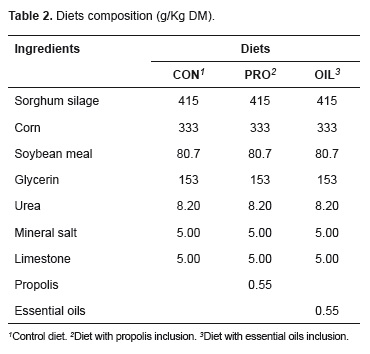
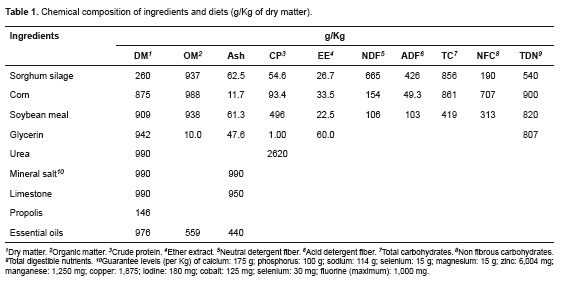
<body><![CDATA[<p>This experiment was approved by the Department   of Animal Production of Universidade Estadual de   Maring&aacute;, Brazil (CIOMS/OMS, 1985) and conducted   at the Rosa &amp; Pedro Sector of Iguatemi Experimental Station Farm of the same university.</p>     <p>Thirty crossbred bulls (&frac12; Aberdeen Angus, &frac12;   Nellore) were used in a completely randomized   design. Bulls were weighed and distributed into three   diet groups with ten replications per group. Initial BW   was 321 &plusmn; 27 Kg, with initial age of 18 &plusmn; 2 months   old. Bulls were housed in individual pens on concrete   floors with 10 m&sup2;/bull, equipped with feeders (60 cm   deep and 2 m in length) and drinkers with a capacity   of 250 L of water. The chemical composition of the feed is presented in <a href="#t1">Table 1</a>.</p>      <p align="center"><a name="t1"><img src="/img/revistas/rccp/v29n1/v29n1a05t1.jpg"></a></p>     <p>&nbsp;</p>     <p>The composition of diets is shown in <a href="#t2">Table 2</a>. The   intake of concentrate and sorghum silage was recorded   daily until day 49 of the experimental period when bulls reached 387 &plusmn; 10.7 Kg BW.</p>     <p align="center"><a name="t2"><img src="/img/revistas/rccp/v29n1/v29n1a05t2.jpg"></a></p>     <p>&nbsp;</p>     <p>Glycerine was produced in a soy-diesel facility   (BIOPAR, Rol&acirc;ndia, Paran&aacute;, South of Brazil). The   propolis product contains 0.054 mg/g total flavonoids   in chrysin. The essential oils contain ricinoleic acid,   anacardic acid, cardanol, and cardol. Ricinoleic acid   was obtained from castor oil (extracted from castor   seeds). Anacardic acid, cardanol, and cardol were   obtained from cashew nut shell liquid (from the processing of cashew nuts).</p>     <p>Bulls were randomly assigned to one of three diets:   CON &#8211; Control, PRO &#8211; propolis addition, and OIL &#8211;   essential oils addition. Bulls were fed twice a day at   08:00 and 16:00 h. The diet formulation was designed   to provide 1.4 Kg/d body weight gain, according to the NRC (2000) recommendations.</p>     <p>Daily feed intake was estimated as the difference   between supplied feed and orts. Feed and orts samples   were collected during the collection period and a   representative composite sample was drafted per   animal in each treatment. Bulls were weighed at the beginning of the experiment and every 14 days (after fasting from solid feed for 16 hours) for the duration of the experiment to determine performance (49 days).</p>     ]]></body>
<body><![CDATA[<p>Fecal collections were performed over the course of   five days, starting on the 40<sup>th</sup> day of the feedlot period,   to estimate apparent total digestibility of DM and other   nutrients. Fecal samples (approximately 200 g wet   weight) were collected from each bull from the pen   floor (minimum 3 h intervals between samples) over   five consecutive days and were pooled per bull for each   5-day sampling period (Zeoula <i>et al.</i>, 2002). Samples   were ground in a feed mill and passed through a 1-mm sieve after drying at 55 &deg;C for 24 h (Nocek, 1985).</p>     <p>Indigestible dry matter (iDM) was used as an   internal marker to estimate fecal DM (Zeoula <i>et al.</i>,   2002). Samples were milled through a 2 mm sieve,   packed (5 mg DM/cm<sup>2</sup>) in a 4 x 5 cm Ankom (filter   bags F57 - ANKOM Technology, Macedon, NY,   USA) that had been previously weighed, and then   incubated for 240 h in the rumen of a Holstein bull   (Casali <i>et al.</i>, 2008) that was fed a mixed diet of equal   parts forage (sorghum silage) and concentrate (the   same concentrate that was used in the treatments).   After incubation, bags were removed, washed with   water until clean, and dried in a forced-air oven at   55 &deg;C for 72 h, after which they were removed and   oven-dried again at 105 &ordm;C. The iDM was estimated   using the difference in sample weight before and after   ruminal incubation. Fecal excretion was calculated with the following equations:</p>          <p>&nbsp;	</p>          <p>FE = iDMI / iDMCF</p>     <p>Where:</p>     <p>FE = fecal excretion (Kg/d).</p>     <p>iDMI = iDM intake (Kg/d).</p>     <p>iDMCF = iDM concentration in feces (Kg/d).</p>     <p>&nbsp;</p>     <p>Apparent digestibility coefficients (ADC) for   DM and nutrients were estimated according to the following formula:</p>     ]]></body>
<body><![CDATA[<p>&nbsp;</p>     <p>DC = [(Intake &#8211; Excreted) / Intake] x 100</p>     <p>&nbsp;</p>     <p>The DM content of the ingredients (silage and   concentrate), orts, and feces was determined after   drying the mat at 105 &deg;C for 16 h according to AOAC   (1998; method 930.15). Organic matter (OM) content   was calculated as the difference between DM and   ash, with the ash content determined by combustion   at 550 &deg;C for 5 h according to AOAC (1998; method   930.15). Nitrogen (N) content was determined by   the Kjeldahl method (AOAC, 1998; method 976.05).   Neutral detergent fiber (NDF) content was determined   using the methods described by Van Soest <i>et al.</i>   (1991) and acid detergent fiber (ADF; AOAC, 1998;   method 973.18). Total carbohydrates (TC) were   estimated using the following equation (Sniffen <i>et al.</i>, 1992): TC = 100 &#8211; (% CP + % EE + % Ash).   Non-fibrous carbohydrates (NFC) were determined as   the difference between TC and NDF. Total digestible   nutrient (TDN) content of diets was obtained with the methodology described by Kearl (1982).</p>     <p>Blood was collected twice: at the beginning (d0)   and the last day of the experimental period (49 days).   Blood samples were collected in Vacutainers<sup>&reg;</sup> (BD,   Franklin Lakes, NJ, USA) to measure blood cells.   Bulls were fasted for 14 h before blood collection.   Blood samples were obtained from the jugular vein. A   total of 5 mL of blood was collected and mixed with   anticoagulant (EDTA: diaminotetracticetilen acid and   disodium salt). Hemogram (erythrocytes, hemoglobin,   hematocrit, MCV - mean corpuscular volume,   MHC - mean corpuscular hemoglobin, MCHC -   mean corpuscular hemoglobin concentration) and   leukogram (eosinophils, segmented neutrophils,   lymphocytes, and monocytes) measurements were   performed according to Jain and Jain (1993). Samples   were frozen until the analyses, during which they were   centrifuged at 1,500 rpm for 15 minutes to collect the plasma.</p>     <p>All variables were tested for normality. Variables   showing a normal distribution were analysed using the   PROC GLM from SAS (Version 9.1.2.; SAS Institute Inc, Cary, NC, USA, 2004).</p>     <p>Data were compared using analysis of variance   and the differences were tested by the Tukey test   (5% probability). The following model was used for   animal performance, feed efficiency, and total tract apparent digestibility:</p>     <p>&nbsp;</p>     <p>Y<sub>ij</sub> = &mu; + D<sub>i</sub> + e<sub>ij</sub></p>     <p>Where:</p>     ]]></body>
<body><![CDATA[<p>Y<sub>ij</sub> = dependent variables.</p>     <p>&mu; = population average.</p>     <p>D<sub>i</sub> = treatment (diet) effect.  </p>     <p>e<sub>ij</sub> = residual error.</p>     <p>&nbsp;</p>     <p>For blood cell analyses, the effects of treatment   and period (initial or final) were assessed with the following model:</p>     <p>&nbsp;</p>     <p>Y<sub>ij</sub> = &mu; + D<sub>i</sub> + P<sub>j</sub> + D<sub>i</sub><sup>*</sup>P<sub>j</sub>+ e<sub>ij</sub></p>     <p>Where:</p>     <p>Y<sub>ij</sub> = dependent variable.</p>     ]]></body>
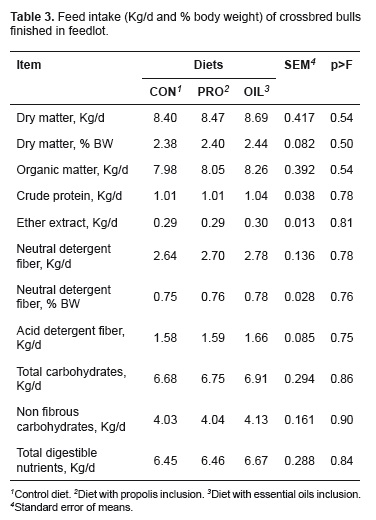
<body><![CDATA[<p>&mu; = population average.</p>     <p>D<sub>i</sub> = treatment (diet) effect.  </p>     <p>P<sub>j</sub> = collection period.  </p>     <p>D<sub>i</sub>  <sup>*</sup>P<sub>j</sub> = interaction between treatment and period.  </p>     <p>e<sub>ij</sub> = error.</p>     <p>&nbsp;</p>     <p>When the effect was significant, differences   between mean values were obtained by Tukey (5% probability).</p>     <p>&nbsp;</p>     <p><b><font size="3">Results</font></b></p>     <p>Propolis or essential oils did not affect (p&gt;0.05)   intake of DM (Kg/d or % of BW) and other nutrients (<a href="#t3">Table 3</a>).</p>      ]]></body>
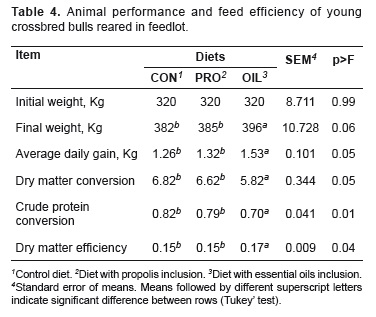
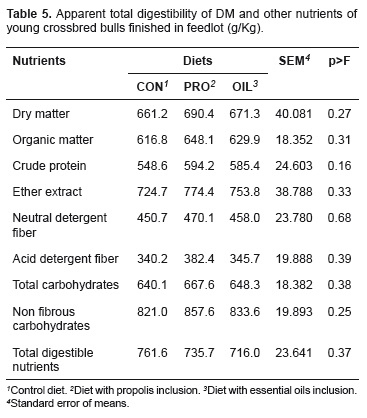
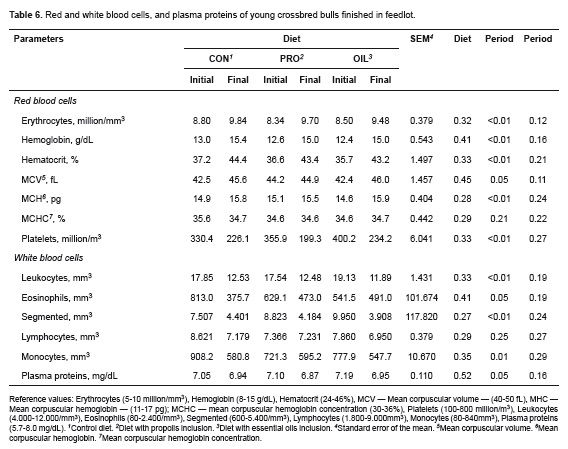
<body><![CDATA[<p align="center"><a name="t3"><img src="/img/revistas/rccp/v29n1/v29n1a05t3.jpg"></a></p>     <p>&nbsp;</p>     <p>Final body weight (BW) and average daily gain   (ADG) were greater (p&lt;0.05) for bulls fed the OILbased   diet compared with bulls fed CON and PRObased   diets (<a href="#t4">Table 4</a>). The DM conversion was 1.0 Kg   greater (p&lt;0.05) for bulls fed the OIL-based diet than the CON-based diet and 0.80 Kg greater for bulls fed the PRO-based diet. Likewise, crude protein conversion and DM efficiency were greater in the OIL diet (p&lt;0.01 and p&lt;0.04, respectively) compared to the other diets (CON or PRO).</p>     <p align="center"><a name="t4"><img src="/img/revistas/rccp/v29n1/v29n1a05t4.jpg"></a></p>     <p>&nbsp;</p>     <p>The addition of propolis and essential oils did not affect (p&gt;0.05) the apparent digestibility of DM, organic matter, crude protein, ether extract, neutral detergent fiber, total carbohydrates, non-fibrous carbohydrates, and total digestible nutrients (<a href="#t5">Table 5</a>).</p>     <p align="center"><a name="t5"><img src="/img/revistas/rccp/v29n1/v29n1a05t5.jpg"></a></p>     <p>&nbsp;</p>     <p>No interaction was observed (p&gt;0.05) between   diets vs. period for red and white blood cells. Thus,   results are presented and discussed as principal effects.</p>     <p>Addition of propolis or essential oils did not   affect (p&gt;0.05) red blood cell means (erythrocytes,   hemoglobin, hematocrit, mean corpuscular volume,   mean corpuscular hemoglobin, mean corpuscular   hemoglobin concentrations), platelets, white blood   cell means (leukocytes, eosinophils, segmented   neutrophils, lymphocytes, and monocytes), and plasma protein (<a href="#t6">Table 6</a>) at initial and final collection.</p>     ]]></body>
<body><![CDATA[<p align="center"><a name="t6"><img src="/img/revistas/rccp/v29n1/v29n1a05t6.jpg"></a></p>     <p>&nbsp;</p>     <p>Red blood cell concentrations in all treatments   were higher (p&lt;0.05) when comparing initial   values and final ones, except for MCHC cells,   which were similar (<a href="#t6">Table 6</a>). However, white   blood cell concentrations were lower at the 49<sup>th</sup>   day of the experiment, except for lymphocyte   cell concentrations, which were similar (<a href="#t6">Table 6</a>).   Likewise, plasma protein concentration decreased at the 49<sup>th</sup> day of the experiment (<a href="#t6">Table 6</a>).</p>     <p>&nbsp;</p>     <p><font size="3"><b>Discussion</b></font></p>     <p>As observed by Stelzer <i>et al.</i> (2009), the addition   of propolis in the diet of dairy cows had no effect on   feed intake. The feed intake observed in this study   is similar to the values reported by Zawadzki <i>et al.</i>   (2011) using growing and finishing cattle completed in   feedlots on a diet with a forage-to-concentrate ratio of   48:52%. Likewise, Cruz <i>et al.</i> (2014) did not observe   an effect of the addition of essential oils on feed intake   of bulls finished in feedlots under similar conditions   as in this experiment. DM feed intake for this animal   category is between 2.2 and 2.5% BW (Maggioni <i>et al.</i>, 2009; Zawadzki <i>et al.</i>, 2011; Cruz <i>et al.</i>, 2014).</p>     <p>Mean crude protein intake for bulls on the   three diets was 1.02 Kg/animal/d. Bulls with body   weights between 320 and 360 Kg, depending on their   genotype, feed, and environmental conditions, have a   crude protein requirement of around 1.0 Kg/animal/d   (NRC, 2000). The low intake of NDF and ADF was   due to the low NDF and ADF content in glycerine.   The mean TDN intake was 6.52 Kg/animal/d, which is the requirement of this category (NRC, 2000).</p>     <p>The mean final weight of bulls was 387 &plusmn; 10.7 Kg,   and would be the ideal weight to initiate the final   stage of finishing. Bulls that are on feedlots during   the finishing phase reach body weights between 380   and 400 Kg (Dian <i>et al.</i>, 2009; Valero <i>et al.</i>, 2011; Zawadzki <i>et al.</i>, 2011).</p>     <p>Propolis has been used as a ruminal fermentation   modulator (Prado <i>et al.</i>, 2010). Zawadzki <i>et al.</i> (2011)   observed greater slaughter weights and average daily   gains for Nellore bulls fed a diet containing alcoholic   propolis extract. They attributed the improved performance observed to the antimicrobial properties of propolis. Furthermore, dietary inclusion of flavonoids can improve animal production, according to Benchaar <i>et al.</i> (2008).</p>     <p>Feed efficiency was better for bulls fed the OILbased   diet. Zawadzki <i>et al.</i> (2011) observed better   DM efficiency for Nellore bulls fed a propolis extractbased   diet using 52% roughage and 48% concentrate.   According to the authors, the better DM efficiency   may be due to the bioactive compounds in propolis,   particularly the antibacterial action associated with   presence of flavonoids in propolis extract. However,   Albert&iacute; <i>et al.</i> (2005) and Devant <i>et al.</i> (2007) found   no positive effect on feed efficiency of feedlot cattle by the addition of plant extracts.</p>     ]]></body>
<body><![CDATA[<p>Prado <i>et al.</i> (2010) observed lower DM digestibility   when two different propolis extracts were included in   the diets of cattle fed 72.5% roughage (sorghum silage   and grass hay) and 27.5% concentrate. As observed   in the present experiment, &Iacute;tavo <i>et al.</i> (2011) reported   apparent DM digestibility close to 63% in sheep fed   a 50% roughage (<i>Brachiaria brizhanta</i> grass hay)   and 50% concentrate mix with four different levels of   propolis extracts. The apparent total tract digestibility   of crude protein was low (close to 576 g/Kg) compared   with other studies. Previous studies reported that the   addition of propolis extracts to the diet reduced the   apparent digestibility of crude protein from 65.4 to   58.0% in cattle fed a mixture of 72.5% roughage and   27.5% concentrate (Prado <i>et al.</i>, 2010). &Iacute;tavo <i>et al.</i>   (2011) observed apparent total tract digestibility of   crude protein of about 75% in diets containing four   levels of crude propolis extract. Thus, the method of   preparation of propolis extract (crude residue, crude   extract with alcohol extraction, and purified propolis   extract with alcohol extraction) has a different effect   on the apparent total tract digestibility of crude   protein in several animal species, such as bovine and   ovine. Prado <i>et al.</i> (2010) observed a reduction in   the apparent total tract digestibility of ether extract   in diets added with different propolis extracts fed to   cattle. According to the authors, the likely reduction   in apparent digestibility of ether extract was due to   substances present in these products, which may have   hindered the action of lipolytic bacteria. In contrast,   &Iacute;tavo <i>et al.</i> (2011) observed no effect on the apparent   digestibility of ether extract (65.0%) due to the addition of propolis in the diet sheep fed 50% forage and 50% concentrate; thus, the action of propolis varies according to its chemical composition, which varies with the flora of the region and the method for obtaining the propolis extract as well as with the bee species. The apparent digestibility of neutral detergent fiber (459 g/Kg) and acid detergent fiber (356 g/Kg) was lower than the digestibility of diets with different levels of forage and concentrate ( Prado <i>et al.</i>, 2010; &Iacute;tavo <i>et al.</i>, 2011). Glycerine inclusion may have altered fiber digestibility of the diet. Ramos and Kerley (2012) observed a significant reduction in digestibility of diet components in beef cattle with the addition of 20% glycerine. No influence was observed in the composition of total digestible nutrients due to the additives. The value of total digestible nutrients obtained from the control diet was close to the present values for growing cattle (NRC, 2000), and the addition of propolis and essential oils did not reduce the levels of total digestible nutrients in the diet.</p>     <p>Hematological evaluation in cattle is used to   assess disease in an animal, to evaluate groups of   animals within a herd, to detect hidden diseases,   and to guide clinical decisions. The red blood cell   series are a reflection of the health and nutrition of   animals (Jones and Allison, 2007). The values of the   variables observed in this study for red blood cells are   in accordance with the reference values described by   Biondo <i>et al.</i> (1998). Furthermore, according to the   values reported by Biondo <i>et al.</i> (1998) and Jones   and Allison (2007), MCV, MCH, and MCHC values in our study are within the normal ranges for cattle.</p>     <p>Measuring of white blood cells in this study was   aimed to monitor the health of bulls and observe   the behaviour of these cells upon supplementation   with propolis and essential oils, due to its recent   introduction into ruminant nutrition. The results found   in all groups are in accordance with the reference   values for cattle during this phase of growth (Jones and Allison, 2007).</p>     <p>Plasma proteins increase or decrease in the   plasma as a result of injury or inflammation. Plasma   proteins in blood are investigated as a mean of   detecting and monitoring inflammatory processes in   ruminants (Jones and Allison, 2007). In summary,   plasma proteins can provide valuable information to the clinician. Evaluation of plasma proteins is an essential adjunct to detect significant abnormalities in cattle (Gonz&aacute;lez <i>et al.</i>, 2000). We did not observe any inflammatory processes in the bulls during the experimental period. The results of this experiment are probably due to improved nutrition throughout the experimental period. At the beginning of the experimental (feedlot) period, all animals were treated for endo- and ecto-parasites that are common in the region. Moreover, these animals had no further contact with other animals during the experimental period and were kept on concrete floor stalls that were washed three times a week. The correct management and nutrition during the feedlot period could explain the low levels of white blood cells and plasma proteins in our experiment.</p>     <p>In conclusion, the addition of propolis to the   diet of bulls finished in feedlots did not change the   average daily weight gain, feed efficiency or apparent   digestibility. Therefore, the addition of propolis to the   diet of cattle in feedlots is not justified. However, the   addition of essential oils to the diet of bulls improved   both the average daily weight gain and feed efficiency.   Thus, essential oils can be added to the diets of cattle   to improve performance and feed efficiency, while   acting as a replacement for other products such as antibiotics and ionophores.</p>     <p>&nbsp;</p>     <p><b><font size="3">Acknowledgements</font></b></p>     <p>The current project was supported by Araucaria   Foundation, a fund of the Paran&aacute; State and the   Brazilian Council for Research and Technological   Development (CNPq). The authors would like to   thank Processing Inc. (Biopar Bioenergia do Paran&aacute;,   Rol&acirc;ndia, Paran&aacute;, Brazil) for providing the glycerine,   and Oligo Basics Agroindustrial Ltda. (Cascavel,   Paran&aacute;, Brazil) for providing financial resources and   the castor oil and cashew nut shell liquids used in this research.</p>     <p align="left">&nbsp;</p>     <p align="left"><b><font size="3">Conflicts of interest</font></b></p>     ]]></body>
<body><![CDATA[<p align="left">The authors declare they have no conflicts of interest with regard to the work presented in this report.</p>     <p align="left">&nbsp;</p> <hr size="1" />     <p><b><font size="3">Notes</font></b></p>     <p><b><a name="a0" id="a0"><a href="#a1">&curren;</a></a></b>To cite this article: Valero MV, Farias MS, Zawadzki F, Prado RM, Fugita CA, Rivaroli DC, Ornaghi MG, Prado IN. Feeding propolis or essential oils (cashew and castor) to bulls: performance, digestibility, and blood cell counts. Rev Colomb Cienc Pecu 2016; 29:33-42.</p> <hr size="1" />     <p>&nbsp;</p>     <p><b><font size="3">References</font></b></p>     <!-- ref --><p>Albert&iacute; P, RipollG, Casas&uacute;s I, Blanco M, Chapull&eacute; JLG,   Santamar&iacute;a J. Efecto de la inclusi&oacute;n de antioxidantes en dietas   de acabado sobre la calidad de la carne de terneros. ITEA-Inf Tec   Econ Ag 2005; 101:91-100.    &nbsp;&nbsp;&nbsp;&nbsp;&nbsp;&nbsp;&nbsp;&nbsp;[&#160;<a href="javascript:void(0);" onclick="javascript: window.open('/scielo.php?script=sci_nlinks&ref=2479005&pid=S0120-0690201600010000500001&lng=','','width=640,height=500,resizable=yes,scrollbars=1,menubar=yes,');">Links</a>&#160;]<!-- end-ref --> </p>     <!-- ref --><p>AOAC. 1998. Association of Official Analytical Chemists.   Benchaar C, Calsamiglia S, Chaves AV, Fraser GR, Colombatto D,   McAllister TA. A review of plant-derived essential oils in ruminant   nutrition and production. Anim Feed Sci Tech 2008; 145:209-28.    &nbsp;&nbsp;&nbsp;&nbsp;&nbsp;&nbsp;&nbsp;&nbsp;[&#160;<a href="javascript:void(0);" onclick="javascript: window.open('/scielo.php?script=sci_nlinks&ref=2479007&pid=S0120-0690201600010000500002&lng=','','width=640,height=500,resizable=yes,scrollbars=1,menubar=yes,');">Links</a>&#160;]<!-- end-ref --> </p>     ]]></body>
<body><![CDATA[<!-- ref --><p>Biondo AW,Lopes STA, Kohayagawa A, Takahira RK, Alencar   NX. Hemograma de bovinos (<i>Bos indicus</i>) sadios da ra&ccedil;a nelore   no primeiro m&ecirc;s de vida, criados no estado de S&atilde;o Paulo. Cienc   Rural 1998; 28:251-6.    &nbsp;&nbsp;&nbsp;&nbsp;&nbsp;&nbsp;&nbsp;&nbsp;[&#160;<a href="javascript:void(0);" onclick="javascript: window.open('/scielo.php?script=sci_nlinks&ref=2479009&pid=S0120-0690201600010000500003&lng=','','width=640,height=500,resizable=yes,scrollbars=1,menubar=yes,');">Links</a>&#160;]<!-- end-ref --> </p>     <!-- ref --><p>Casali AO, Detmann E, Valadares Filho SC, Pereira JC, Henriques   LT, Freitas SG. Influ&ecirc;ncia do tempo de incuba&ccedil;&atilde;o e do tamanho   de part&iacute;culas sobre os teores de compostos indigest&iacute;veis em   alimentos e fezes bovinas obtidos por procedimentos <i>in situ</i>. Rev   Bras Zootec 2008; 37: 335-42.    &nbsp;&nbsp;&nbsp;&nbsp;&nbsp;&nbsp;&nbsp;&nbsp;[&#160;<a href="javascript:void(0);" onclick="javascript: window.open('/scielo.php?script=sci_nlinks&ref=2479011&pid=S0120-0690201600010000500004&lng=','','width=640,height=500,resizable=yes,scrollbars=1,menubar=yes,');">Links</a>&#160;]<!-- end-ref --> </p>     <!-- ref --><p>CIOMS/OMS. Council for International Organizations of Medical   Services - International Guiding Principles for Biomedical   Research Involving Animals. 1st ed. ERIC Clearinghouse,   Geneva, Switzerland, 1985.    &nbsp;&nbsp;&nbsp;&nbsp;&nbsp;&nbsp;&nbsp;&nbsp;[&#160;<a href="javascript:void(0);" onclick="javascript: window.open('/scielo.php?script=sci_nlinks&ref=2479013&pid=S0120-0690201600010000500005&lng=','','width=640,height=500,resizable=yes,scrollbars=1,menubar=yes,');">Links</a>&#160;]<!-- end-ref --> </p>     <!-- ref --><p>Cruz OTB, Valero, MV, Zawazki, F., Rivaroli, DC, Prado, RM,   Lima, BS, Prado, IN. Effect of glycerine and essential oils   (<i>Annacardium occidentale</i> and <i>ricinus communis</i>) on animal   performance, feed efficiency and carcass characteristics of   crossbred bulls finished in a feedlot system. Ital J Anim Sci   2014; 13:790-7.    &nbsp;&nbsp;&nbsp;&nbsp;&nbsp;&nbsp;&nbsp;&nbsp;[&#160;<a href="javascript:void(0);" onclick="javascript: window.open('/scielo.php?script=sci_nlinks&ref=2479015&pid=S0120-0690201600010000500006&lng=','','width=640,height=500,resizable=yes,scrollbars=1,menubar=yes,');">Links</a>&#160;]<!-- end-ref --> </p>     <!-- ref --><p>Devant MA, Anglada A, Bach A. Effects of plant extract   supplementation on rumen fermentation and metabolism in young   Holstein bulls consuming high levels of concentrate. Anim Feed   Sci Tech 2007; 137:46-57.    &nbsp;&nbsp;&nbsp;&nbsp;&nbsp;&nbsp;&nbsp;&nbsp;[&#160;<a href="javascript:void(0);" onclick="javascript: window.open('/scielo.php?script=sci_nlinks&ref=2479017&pid=S0120-0690201600010000500007&lng=','','width=640,height=500,resizable=yes,scrollbars=1,menubar=yes,');">Links</a>&#160;]<!-- end-ref --> </p>     ]]></body>
<body><![CDATA[<!-- ref --><p>Dian PHM, Prado IN, Fugita CA, Prado RM, Valero MV,   Bertipaglia LMA. Replacing corn with cassava starch by-products   on the performance, digestibility and carcass characteristics of   bulls in confinement. A Scient Anim Sci 2009; 31:381-7.    &nbsp;&nbsp;&nbsp;&nbsp;&nbsp;&nbsp;&nbsp;&nbsp;[&#160;<a href="javascript:void(0);" onclick="javascript: window.open('/scielo.php?script=sci_nlinks&ref=2479019&pid=S0120-0690201600010000500008&lng=','','width=640,height=500,resizable=yes,scrollbars=1,menubar=yes,');">Links</a>&#160;]<!-- end-ref --> </p>     <!-- ref --><p>Dian PHM, Prado IN, Valero MV, Rotta PP, Prado RM, Silva RR.   Levels of replacing corn by cassava starch on performance and   carcass characteristics of bulls finished in feedlot. Semin-Cienc   Agrar 2010; 31:497-506.    &nbsp;&nbsp;&nbsp;&nbsp;&nbsp;&nbsp;&nbsp;&nbsp;[&#160;<a href="javascript:void(0);" onclick="javascript: window.open('/scielo.php?script=sci_nlinks&ref=2479021&pid=S0120-0690201600010000500009&lng=','','width=640,height=500,resizable=yes,scrollbars=1,menubar=yes,');">Links</a>&#160;]<!-- end-ref --> </p>     <!-- ref --><p>Ferraz JBS, Fel&iacute;cio PG. Production systems - An example from   Brazil. Meat Sci 2010; 84:238-43.    &nbsp;&nbsp;&nbsp;&nbsp;&nbsp;&nbsp;&nbsp;&nbsp;[&#160;<a href="javascript:void(0);" onclick="javascript: window.open('/scielo.php?script=sci_nlinks&ref=2479023&pid=S0120-0690201600010000500010&lng=','','width=640,height=500,resizable=yes,scrollbars=1,menubar=yes,');">Links</a>&#160;]<!-- end-ref --> </p>     <!-- ref --><p>Fischer G, Hubner SO, Vargas GD, Vidor T. Imunomodula&ccedil;&atilde;o   pela pr&oacute;polis. Arq Inst Biol 2008;75(2):247-53.    &nbsp;&nbsp;&nbsp;&nbsp;&nbsp;&nbsp;&nbsp;&nbsp;[&#160;<a href="javascript:void(0);" onclick="javascript: window.open('/scielo.php?script=sci_nlinks&ref=2479025&pid=S0120-0690201600010000500011&lng=','','width=640,height=500,resizable=yes,scrollbars=1,menubar=yes,');">Links</a>&#160;]<!-- end-ref --> </p>     <!-- ref --><p>Giger Reverdin S, Duvaux Ponter C, Sauvant D, Martin O, Prado   IN, M&uuml;ller R. Intrinsic buffering capacity of feedstuffs. Anim Feed   Sci Tech 2002; 96:83-102.    &nbsp;&nbsp;&nbsp;&nbsp;&nbsp;&nbsp;&nbsp;&nbsp;[&#160;<a href="javascript:void(0);" onclick="javascript: window.open('/scielo.php?script=sci_nlinks&ref=2479027&pid=S0120-0690201600010000500012&lng=','','width=640,height=500,resizable=yes,scrollbars=1,menubar=yes,');">Links</a>&#160;]<!-- end-ref --> </p>     ]]></body>
<body><![CDATA[<!-- ref --><p>Gonz&aacute;lez FHD, Concei&ccedil;&atilde;o TR, Siqueira, AJS, Rosa VL. Varia&ccedil;&otilde;es   sang&uuml;&iacute;neas de ur&eacute;ia, creatinina, albumina e f&oacute;sforo em bovinos de corte no Rio Grande do Sul. A Hora Vet 2000; 20:59-62.    &nbsp;&nbsp;&nbsp;&nbsp;&nbsp;&nbsp;&nbsp;&nbsp;[&#160;<a href="javascript:void(0);" onclick="javascript: window.open('/scielo.php?script=sci_nlinks&ref=2479029&pid=S0120-0690201600010000500013&lng=','','width=640,height=500,resizable=yes,scrollbars=1,menubar=yes,');">Links</a>&#160;]<!-- end-ref --></p>     <!-- ref --><p>&Iacute;tavo C, Morais MG, Costa C, &Iacute;tavo LCV, Franco GL, Silva,   JA. Addition of propolis or monensin in the diet: behavior and   productivity of lambs in feedlot. Anim Feed Sci Tech 2011;   165:161-6.    &nbsp;&nbsp;&nbsp;&nbsp;&nbsp;&nbsp;&nbsp;&nbsp;[&#160;<a href="javascript:void(0);" onclick="javascript: window.open('/scielo.php?script=sci_nlinks&ref=2479031&pid=S0120-0690201600010000500014&lng=','','width=640,height=500,resizable=yes,scrollbars=1,menubar=yes,');">Links</a>&#160;]<!-- end-ref --> </p>     <!-- ref --><p>Ito RH, Ducatti T., Prado JM, Prado IM, Rotta PP, Valero MV.   Soybean oil and linseed grains on performance and carcass   characteristics of crossbred bulls finished in feedlot. Semin-Cienc   Agrar 2010; 31:259-68.    &nbsp;&nbsp;&nbsp;&nbsp;&nbsp;&nbsp;&nbsp;&nbsp;[&#160;<a href="javascript:void(0);" onclick="javascript: window.open('/scielo.php?script=sci_nlinks&ref=2479033&pid=S0120-0690201600010000500015&lng=','','width=640,height=500,resizable=yes,scrollbars=1,menubar=yes,');">Links</a>&#160;]<!-- end-ref --> </p>     <!-- ref --><p>Ito RH, Valero MV, Prado RM, Rivaroli DC, Perotto D, Prado   IN. Meat quality from four genetic groups of bulls slaughtered at   14 months old. Acta Sci Ani Sci 2012; 34:425-32.    &nbsp;&nbsp;&nbsp;&nbsp;&nbsp;&nbsp;&nbsp;&nbsp;[&#160;<a href="javascript:void(0);" onclick="javascript: window.open('/scielo.php?script=sci_nlinks&ref=2479035&pid=S0120-0690201600010000500016&lng=','','width=640,height=500,resizable=yes,scrollbars=1,menubar=yes,');">Links</a>&#160;]<!-- end-ref --> </p>     <!-- ref --><p>Jain NC, Jain AH. Essentials of Veterinary Hematology. 1st ed.   Wiley-Blackwell, Davis, CA, USA, 1993.    &nbsp;&nbsp;&nbsp;&nbsp;&nbsp;&nbsp;&nbsp;&nbsp;[&#160;<a href="javascript:void(0);" onclick="javascript: window.open('/scielo.php?script=sci_nlinks&ref=2479037&pid=S0120-0690201600010000500017&lng=','','width=640,height=500,resizable=yes,scrollbars=1,menubar=yes,');">Links</a>&#160;]<!-- end-ref --> </p>     ]]></body>
<body><![CDATA[<!-- ref --><p>Jones ML, Allison RW. Evaluation of the ruminant complete   blood cell count. Veterinary Clinics of North America: Vet Clin   N Am-Food A 2007; 23:377-402.    &nbsp;&nbsp;&nbsp;&nbsp;&nbsp;&nbsp;&nbsp;&nbsp;[&#160;<a href="javascript:void(0);" onclick="javascript: window.open('/scielo.php?script=sci_nlinks&ref=2479039&pid=S0120-0690201600010000500018&lng=','','width=640,height=500,resizable=yes,scrollbars=1,menubar=yes,');">Links</a>&#160;]<!-- end-ref --> </p>     <!-- ref --><p>Kearl LC. Nutrient Requirements of Ruminants in Developing   Countries. 1st ed. International Feedstuffs Institute, Utah   Agricultural Experiment Station, Utah State University, Utah,   UT, USA, 1982.    &nbsp;&nbsp;&nbsp;&nbsp;&nbsp;&nbsp;&nbsp;&nbsp;[&#160;<a href="javascript:void(0);" onclick="javascript: window.open('/scielo.php?script=sci_nlinks&ref=2479041&pid=S0120-0690201600010000500019&lng=','','width=640,height=500,resizable=yes,scrollbars=1,menubar=yes,');">Links</a>&#160;]<!-- end-ref --> </p>     <!-- ref --><p>Maggioni D, Marques JA, Perotto D, Rotta PP, Ducatti T,   Matsushita M. Bermuda grass hay or sorghum silage with or   without yeast addition on performance and carcass characteristics   of crossbred young bulls finished in feedlot. Asian Austral J Anim   2009; 22:206-15.    &nbsp;&nbsp;&nbsp;&nbsp;&nbsp;&nbsp;&nbsp;&nbsp;[&#160;<a href="javascript:void(0);" onclick="javascript: window.open('/scielo.php?script=sci_nlinks&ref=2479043&pid=S0120-0690201600010000500020&lng=','','width=640,height=500,resizable=yes,scrollbars=1,menubar=yes,');">Links</a>&#160;]<!-- end-ref --> </p>     <!-- ref --><p>Marques JA, Prado IN, Zeoula LM, Alcalde CR, Nascimento WG.   Avalia&ccedil;&atilde;o da mandioca e seus res&iacute;duos industriais em substitui&ccedil;&atilde;o   ao milho no desempenho de novilhas confinadas. Rev Bras Zootec   2000; 29:1528-36.    &nbsp;&nbsp;&nbsp;&nbsp;&nbsp;&nbsp;&nbsp;&nbsp;[&#160;<a href="javascript:void(0);" onclick="javascript: window.open('/scielo.php?script=sci_nlinks&ref=2479045&pid=S0120-0690201600010000500021&lng=','','width=640,height=500,resizable=yes,scrollbars=1,menubar=yes,');">Links</a>&#160;]<!-- end-ref --> </p>     <!-- ref --><p>Martins AS, Zeoula LM, Prado IN, Martins EN, Loyola VR.   Ruminal <i>in situ</i> degradability of dry matter and crude protein of   corn and sorghum silages and some concentrate feeds. Rev Bras   Zootec 1999; 28:1109-1117.    &nbsp;&nbsp;&nbsp;&nbsp;&nbsp;&nbsp;&nbsp;&nbsp;[&#160;<a href="javascript:void(0);" onclick="javascript: window.open('/scielo.php?script=sci_nlinks&ref=2479047&pid=S0120-0690201600010000500022&lng=','','width=640,height=500,resizable=yes,scrollbars=1,menubar=yes,');">Links</a>&#160;]<!-- end-ref --> </p>     ]]></body>
<body><![CDATA[<!-- ref --><p>Nocek JE. Evaluation of especific variables affecting in situ   estimates of ruminal dry matter and protein digestion. J Anim   Sci 1985; 60:1347-58.    &nbsp;&nbsp;&nbsp;&nbsp;&nbsp;&nbsp;&nbsp;&nbsp;[&#160;<a href="javascript:void(0);" onclick="javascript: window.open('/scielo.php?script=sci_nlinks&ref=2479049&pid=S0120-0690201600010000500023&lng=','','width=640,height=500,resizable=yes,scrollbars=1,menubar=yes,');">Links</a>&#160;]<!-- end-ref --> </p>     <!-- ref --><p>NRC. Nutrient Requirements of Beef Cattle. 7<sup>th</sup> ed. Natl. Acad.   Press, Washington, DC. 2000.    &nbsp;&nbsp;&nbsp;&nbsp;&nbsp;&nbsp;&nbsp;&nbsp;[&#160;<a href="javascript:void(0);" onclick="javascript: window.open('/scielo.php?script=sci_nlinks&ref=2479051&pid=S0120-0690201600010000500024&lng=','','width=640,height=500,resizable=yes,scrollbars=1,menubar=yes,');">Links</a>&#160;]<!-- end-ref --> </p>     <!-- ref --><p>Prado IN, Maggioni D, Abrah&atilde;o JJS, Valero MV, Prado RM, Souza   NE. Meat quality of crossbred bulls fed with sorghum silage or   sugar cane and slaughtered at two levels of fat thickness. A Sci   Technol 2012; 34:337-44.    &nbsp;&nbsp;&nbsp;&nbsp;&nbsp;&nbsp;&nbsp;&nbsp;[&#160;<a href="javascript:void(0);" onclick="javascript: window.open('/scielo.php?script=sci_nlinks&ref=2479053&pid=S0120-0690201600010000500025&lng=','','width=640,height=500,resizable=yes,scrollbars=1,menubar=yes,');">Links</a>&#160;]<!-- end-ref --> </p>     <!-- ref --><p>Prado IN, Rotta PP, Prado RM, Visantainer JV, Moletta JL,   Perotto D. Carcass characteristics and chemical composition   of the <i>Longissimus</i> muscle of Purun&atilde; and 1/2 Purun&atilde; vs. 1/2   Canchin bulls meat quality of bulls. Asian Austral J Anim 2008; 21:1296-1302.    &nbsp;&nbsp;&nbsp;&nbsp;&nbsp;&nbsp;&nbsp;&nbsp;[&#160;<a href="javascript:void(0);" onclick="javascript: window.open('/scielo.php?script=sci_nlinks&ref=2479055&pid=S0120-0690201600010000500026&lng=','','width=640,height=500,resizable=yes,scrollbars=1,menubar=yes,');">Links</a>&#160;]<!-- end-ref --></p>     <!-- ref --><p>Prado OPP, Zeoula LM, Moura LPP, Franco SL, Prado IN, Gomes   HCC. Digestibilidade e par&acirc;metros ruminais de dietas &agrave; base   de forragem com adi&ccedil;&atilde;o de pr&oacute;polis e monensina s&oacute;dica para   bovinos. Rev Bras Zootec 2010; 39: 1336-45.    &nbsp;&nbsp;&nbsp;&nbsp;&nbsp;&nbsp;&nbsp;&nbsp;[&#160;<a href="javascript:void(0);" onclick="javascript: window.open('/scielo.php?script=sci_nlinks&ref=2479057&pid=S0120-0690201600010000500027&lng=','','width=640,height=500,resizable=yes,scrollbars=1,menubar=yes,');">Links</a>&#160;]<!-- end-ref --> </p>     ]]></body>
<body><![CDATA[<!-- ref --><p>Ramos MH, Karley MS. Effect of dietary crude glycerol level   on ruminal fermentation in continuous culture and growth   performance of beef calves. J Anim Sci 2010; 90:892-899.    &nbsp;&nbsp;&nbsp;&nbsp;&nbsp;&nbsp;&nbsp;&nbsp;[&#160;<a href="javascript:void(0);" onclick="javascript: window.open('/scielo.php?script=sci_nlinks&ref=2479059&pid=S0120-0690201600010000500028&lng=','','width=640,height=500,resizable=yes,scrollbars=1,menubar=yes,');">Links</a>&#160;]<!-- end-ref --> </p>     <!-- ref --><p>Rotta PP, Prado RM, Prado IN, Valero MV, Visentainer JV, Silva   RR. The effects of genetic groups, nutrition, finishing systems   and gender of Brazilian cattle on carcass characteristics and beef   composition and appearance: a review. Asian Austral J Anim   2009; 22:1718-34.    &nbsp;&nbsp;&nbsp;&nbsp;&nbsp;&nbsp;&nbsp;&nbsp;[&#160;<a href="javascript:void(0);" onclick="javascript: window.open('/scielo.php?script=sci_nlinks&ref=2479061&pid=S0120-0690201600010000500029&lng=','','width=640,height=500,resizable=yes,scrollbars=1,menubar=yes,');">Links</a>&#160;]<!-- end-ref --> </p>     <!-- ref --><p>Russell JB, Houlihan AJ. Ionophore resistance of ruminal bacteria   and its potential impact on human health. FEMS Microbiol Rev   2003; 27:65-74.    &nbsp;&nbsp;&nbsp;&nbsp;&nbsp;&nbsp;&nbsp;&nbsp;[&#160;<a href="javascript:void(0);" onclick="javascript: window.open('/scielo.php?script=sci_nlinks&ref=2479063&pid=S0120-0690201600010000500030&lng=','','width=640,height=500,resizable=yes,scrollbars=1,menubar=yes,');">Links</a>&#160;]<!-- end-ref --> </p>     <!-- ref --><p>SAS. SAS/STAT User guide, Version 9.1.2. SAS Institute Inc,   Cary, NC, USA, 2004.    &nbsp;&nbsp;&nbsp;&nbsp;&nbsp;&nbsp;&nbsp;&nbsp;[&#160;<a href="javascript:void(0);" onclick="javascript: window.open('/scielo.php?script=sci_nlinks&ref=2479065&pid=S0120-0690201600010000500031&lng=','','width=640,height=500,resizable=yes,scrollbars=1,menubar=yes,');">Links</a>&#160;]<!-- end-ref --> </p>     <!-- ref --><p>Sniffen CJ, O'Connor JD, Van Soest PJ, Fox DG, Russell JB. A   net carbohydrate and protein system for evaluating cattle diets:   II. Carbohydrate and protein availability. J Anim Sci 1992;   70:3562-77.    &nbsp;&nbsp;&nbsp;&nbsp;&nbsp;&nbsp;&nbsp;&nbsp;[&#160;<a href="javascript:void(0);" onclick="javascript: window.open('/scielo.php?script=sci_nlinks&ref=2479067&pid=S0120-0690201600010000500032&lng=','','width=640,height=500,resizable=yes,scrollbars=1,menubar=yes,');">Links</a>&#160;]<!-- end-ref --> </p>     ]]></body>
<body><![CDATA[<!-- ref --><p>Stelzer FS, Lana RP, Campos JMS. Desempenho de vacas leiteiras   recebendo concentrado em diferentes n&iacute;veis, associado ou n&atilde;o &agrave;   pr&oacute;polis. Rev Bras Zootec 2009; 38:1381-9.    &nbsp;&nbsp;&nbsp;&nbsp;&nbsp;&nbsp;&nbsp;&nbsp;[&#160;<a href="javascript:void(0);" onclick="javascript: window.open('/scielo.php?script=sci_nlinks&ref=2479069&pid=S0120-0690201600010000500033&lng=','','width=640,height=500,resizable=yes,scrollbars=1,menubar=yes,');">Links</a>&#160;]<!-- end-ref --> </p>     <!-- ref --><p>Valero MV, Zawadzki F, Fran&ccedil;ozo MC, Farias MS, Rotta PP,   Prado IN. Sodium monensin or propolis extract in the diet of   crossbred (&frac12; Red Angus vs. &frac12; Nellore) bulls finished in feedlot:   chemical composition and fatty acid profile of the <i>Longissimus</i>   muscle. Semin-Cienc Agrar 2001; 32:1617-26.    &nbsp;&nbsp;&nbsp;&nbsp;&nbsp;&nbsp;&nbsp;&nbsp;[&#160;<a href="javascript:void(0);" onclick="javascript: window.open('/scielo.php?script=sci_nlinks&ref=2479071&pid=S0120-0690201600010000500034&lng=','','width=640,height=500,resizable=yes,scrollbars=1,menubar=yes,');">Links</a>&#160;]<!-- end-ref --> </p>     <!-- ref --><p>Van Soest PJ, Robertson JB, Lewis BA. Methods for dietary fiber,   neutral detergent fiber, and nonstarch polysaccharides in relation   to animal nutrition. J Dairy Sci 1991; 74:3583-97.    &nbsp;&nbsp;&nbsp;&nbsp;&nbsp;&nbsp;&nbsp;&nbsp;[&#160;<a href="javascript:void(0);" onclick="javascript: window.open('/scielo.php?script=sci_nlinks&ref=2479073&pid=S0120-0690201600010000500035&lng=','','width=640,height=500,resizable=yes,scrollbars=1,menubar=yes,');">Links</a>&#160;]<!-- end-ref --> </p>     <!-- ref --><p>Zawadzki F, Prado IN, Marques JA, Zeoula LM, Rotta PP,   Sestari BB. Sodium monensin or propolis extract in the diets of   feedlot-finished bulls: effects on animal performance and carcass   characteristics. J Anim Feed Sci 2011; 20:16-25.    &nbsp;&nbsp;&nbsp;&nbsp;&nbsp;&nbsp;&nbsp;&nbsp;[&#160;<a href="javascript:void(0);" onclick="javascript: window.open('/scielo.php?script=sci_nlinks&ref=2479075&pid=S0120-0690201600010000500036&lng=','','width=640,height=500,resizable=yes,scrollbars=1,menubar=yes,');">Links</a>&#160;]<!-- end-ref --> </p>     <!-- ref --><p>Zeoula LM, Prado IN, Dian PHM, Geron LJV, Caldas Neto SF,   Maeda EM. Recupera&ccedil;&atilde;o fecal de indicadores internos avaliados   em ruminantes. Rev Bras Zootec 2002; 31:1865-74.    &nbsp;&nbsp;&nbsp;&nbsp;&nbsp;&nbsp;&nbsp;&nbsp;[&#160;<a href="javascript:void(0);" onclick="javascript: window.open('/scielo.php?script=sci_nlinks&ref=2479077&pid=S0120-0690201600010000500037&lng=','','width=640,height=500,resizable=yes,scrollbars=1,menubar=yes,');">Links</a>&#160;]<!-- end-ref --> </p>     ]]></body>
<body><![CDATA[<!-- ref --><p>Zhang W, Xiao S, Samaraweera H, Lee EJ, Ahn DU. Improving   functional value of meat products. Meat Sci 2010; 86:15-31.    &nbsp;&nbsp;&nbsp;&nbsp;&nbsp;&nbsp;&nbsp;&nbsp;[&#160;<a href="javascript:void(0);" onclick="javascript: window.open('/scielo.php?script=sci_nlinks&ref=2479079&pid=S0120-0690201600010000500038&lng=','','width=640,height=500,resizable=yes,scrollbars=1,menubar=yes,');">Links</a>&#160;]<!-- end-ref --></p>     <p>&nbsp;</p> </font>      ]]></body><back>
<ref-list>
<ref id="B1">
<nlm-citation citation-type="journal">
<person-group person-group-type="author">
<name>
<surname><![CDATA[Albertí]]></surname>
<given-names><![CDATA[P]]></given-names>
</name>
<name>
<surname><![CDATA[RipollG,]]></surname>
<given-names><![CDATA[Casasús I]]></given-names>
</name>
<name>
<surname><![CDATA[Blanco]]></surname>
<given-names><![CDATA[M]]></given-names>
</name>
<name>
<surname><![CDATA[Chapullé]]></surname>
<given-names><![CDATA[JLG]]></given-names>
</name>
<name>
<surname><![CDATA[Santamaría]]></surname>
<given-names><![CDATA[J]]></given-names>
</name>
</person-group>
<article-title xml:lang="es"><![CDATA[Efecto de la inclusión de antioxidantes en dietas de acabado sobre la calidad de la carne de terneros]]></article-title>
<source><![CDATA[ITEA-Inf Tec Econ Ag]]></source>
<year>2005</year>
<volume>101</volume>
<page-range>91-100</page-range></nlm-citation>
</ref>
<ref id="B2">
<nlm-citation citation-type="journal">
<collab>AOAC</collab>
<article-title xml:lang="en"><![CDATA[A review of plant-derived essential oils in ruminant nutrition and production]]></article-title>
<source><![CDATA[Anim Feed Sci Tech]]></source>
<year>1998</year>
<month>20</month>
<day>08</day>
<volume>145</volume>
<page-range>209-28</page-range></nlm-citation>
</ref>
<ref id="B3">
<nlm-citation citation-type="journal">
<person-group person-group-type="author">
<name>
<surname><![CDATA[Biondo]]></surname>
<given-names><![CDATA[AW]]></given-names>
</name>
<name>
<surname><![CDATA[Lopes]]></surname>
<given-names><![CDATA[STA]]></given-names>
</name>
<name>
<surname><![CDATA[Kohayagawa]]></surname>
<given-names><![CDATA[A]]></given-names>
</name>
<name>
<surname><![CDATA[Takahira]]></surname>
<given-names><![CDATA[RK]]></given-names>
</name>
<name>
<surname><![CDATA[Alencar]]></surname>
<given-names><![CDATA[NX]]></given-names>
</name>
</person-group>
<article-title xml:lang="pt"><![CDATA[Hemograma de bovinos (Bos indicus) sadios da raça nelore no primeiro mês de vida, criados no estado de São Paulo]]></article-title>
<source><![CDATA[Cienc Rural]]></source>
<year>1998</year>
<volume>28</volume>
<page-range>251-6</page-range></nlm-citation>
</ref>
<ref id="B4">
<nlm-citation citation-type="journal">
<person-group person-group-type="author">
<name>
<surname><![CDATA[Casali]]></surname>
<given-names><![CDATA[AO]]></given-names>
</name>
<name>
<surname><![CDATA[Detmann]]></surname>
<given-names><![CDATA[E]]></given-names>
</name>
<name>
<surname><![CDATA[Valadares]]></surname>
<given-names><![CDATA[Filho SC]]></given-names>
</name>
<name>
<surname><![CDATA[Pereira]]></surname>
<given-names><![CDATA[JC]]></given-names>
</name>
<name>
<surname><![CDATA[Henriques]]></surname>
<given-names><![CDATA[LT]]></given-names>
</name>
<name>
<surname><![CDATA[Freitas]]></surname>
<given-names><![CDATA[SG]]></given-names>
</name>
</person-group>
<article-title xml:lang="pt"><![CDATA[Influência do tempo de incubação e do tamanho de partículas sobre os teores de compostos indigestíveis em alimentos e fezes bovinas obtidos por procedimentos in situ]]></article-title>
<source><![CDATA[Rev Bras Zootec]]></source>
<year>2008</year>
<volume>37</volume>
<page-range>335-42</page-range></nlm-citation>
</ref>
<ref id="B5">
<nlm-citation citation-type="book">
<collab>CIOMS/OMS</collab>
<source><![CDATA[Council for International Organizations of Medical Services - International Guiding Principles for Biomedical Research Involving Animals]]></source>
<year>1985</year>
<publisher-loc><![CDATA[Geneva ]]></publisher-loc>
<publisher-name><![CDATA[ERIC Clearinghouse]]></publisher-name>
</nlm-citation>
</ref>
<ref id="B6">
<nlm-citation citation-type="journal">
<person-group person-group-type="author">
<name>
<surname><![CDATA[Cruz]]></surname>
<given-names><![CDATA[OTB]]></given-names>
</name>
<name>
<surname><![CDATA[Valero,]]></surname>
<given-names><![CDATA[MV]]></given-names>
</name>
<name>
<surname><![CDATA[Zawazki]]></surname>
<given-names><![CDATA[F.]]></given-names>
</name>
<name>
<surname><![CDATA[Rivaroli]]></surname>
<given-names><![CDATA[DC]]></given-names>
</name>
<name>
<surname><![CDATA[Prado]]></surname>
<given-names><![CDATA[RM]]></given-names>
</name>
<name>
<surname><![CDATA[Lima]]></surname>
<given-names><![CDATA[BS]]></given-names>
</name>
<name>
<surname><![CDATA[Prado]]></surname>
<given-names><![CDATA[IN]]></given-names>
</name>
</person-group>
<article-title xml:lang="en"><![CDATA[Effect of glycerine and essential oils (Annacardium occidentale and ricinus communis) on animal performance, feed efficiency and carcass characteristics of crossbred bulls finished in a feedlot system]]></article-title>
<source><![CDATA[Ital J Anim Sci]]></source>
<year>2014</year>
<volume>13</volume>
<page-range>790-7</page-range></nlm-citation>
</ref>
<ref id="B7">
<nlm-citation citation-type="journal">
<person-group person-group-type="author">
<name>
<surname><![CDATA[Devant]]></surname>
<given-names><![CDATA[MA]]></given-names>
</name>
<name>
<surname><![CDATA[Anglada]]></surname>
<given-names><![CDATA[A]]></given-names>
</name>
<name>
<surname><![CDATA[Bach]]></surname>
<given-names><![CDATA[A]]></given-names>
</name>
</person-group>
<article-title xml:lang="en"><![CDATA[Effects of plant extract supplementation on rumen fermentation and metabolism in young Holstein bulls consuming high levels of concentrate]]></article-title>
<source><![CDATA[Anim Feed Sci Tech]]></source>
<year>2007</year>
<volume>137</volume>
<page-range>46-57</page-range></nlm-citation>
</ref>
<ref id="B8">
<nlm-citation citation-type="journal">
<person-group person-group-type="author">
<name>
<surname><![CDATA[Dian]]></surname>
<given-names><![CDATA[PHM]]></given-names>
</name>
<name>
<surname><![CDATA[Prado]]></surname>
<given-names><![CDATA[IN]]></given-names>
</name>
<name>
<surname><![CDATA[Fugita]]></surname>
<given-names><![CDATA[CA]]></given-names>
</name>
<name>
<surname><![CDATA[Prado]]></surname>
<given-names><![CDATA[RM]]></given-names>
</name>
<name>
<surname><![CDATA[Valero]]></surname>
<given-names><![CDATA[MV]]></given-names>
</name>
<name>
<surname><![CDATA[Bertipaglia]]></surname>
<given-names><![CDATA[LMA]]></given-names>
</name>
</person-group>
<article-title xml:lang="en"><![CDATA[Replacing corn with cassava starch by-products on the performance, digestibility and carcass characteristics of bulls in confinement]]></article-title>
<source><![CDATA[A Scient Anim Sci]]></source>
<year>2009</year>
<volume>31</volume>
<page-range>381-7</page-range></nlm-citation>
</ref>
<ref id="B9">
<nlm-citation citation-type="journal">
<person-group person-group-type="author">
<name>
<surname><![CDATA[Dian]]></surname>
<given-names><![CDATA[PHM]]></given-names>
</name>
<name>
<surname><![CDATA[Prado]]></surname>
<given-names><![CDATA[IN]]></given-names>
</name>
<name>
<surname><![CDATA[Valero]]></surname>
<given-names><![CDATA[MV]]></given-names>
</name>
<name>
<surname><![CDATA[Rotta]]></surname>
<given-names><![CDATA[PP]]></given-names>
</name>
<name>
<surname><![CDATA[Prado]]></surname>
<given-names><![CDATA[RM]]></given-names>
</name>
<name>
<surname><![CDATA[Silva]]></surname>
<given-names><![CDATA[RR]]></given-names>
</name>
</person-group>
<article-title xml:lang="en"><![CDATA[Levels of replacing corn by cassava starch on performance and carcass characteristics of bulls finished in feedlot]]></article-title>
<source><![CDATA[Semin-Cienc Agrar]]></source>
<year>2010</year>
<volume>31</volume>
<page-range>497-506</page-range></nlm-citation>
</ref>
<ref id="B10">
<nlm-citation citation-type="journal">
<person-group person-group-type="author">
<name>
<surname><![CDATA[Ferraz]]></surname>
<given-names><![CDATA[JBS]]></given-names>
</name>
<name>
<surname><![CDATA[Felício]]></surname>
<given-names><![CDATA[PG]]></given-names>
</name>
</person-group>
<article-title xml:lang="en"><![CDATA[Production systems - An example from Brazil]]></article-title>
<source><![CDATA[Meat Sci]]></source>
<year>2010</year>
<volume>84</volume>
<page-range>238-43</page-range></nlm-citation>
</ref>
<ref id="B11">
<nlm-citation citation-type="journal">
<person-group person-group-type="author">
<name>
<surname><![CDATA[Fischer]]></surname>
<given-names><![CDATA[G]]></given-names>
</name>
<name>
<surname><![CDATA[Hubner]]></surname>
<given-names><![CDATA[SO]]></given-names>
</name>
<name>
<surname><![CDATA[Vargas]]></surname>
<given-names><![CDATA[GD]]></given-names>
</name>
<name>
<surname><![CDATA[Vidor]]></surname>
<given-names><![CDATA[T]]></given-names>
</name>
</person-group>
<article-title xml:lang="pt"><![CDATA[Imunomodulação pela própolis]]></article-title>
<source><![CDATA[Arq Inst Biol]]></source>
<year>2008</year>
<volume>75(2)</volume>
<page-range>247-53</page-range></nlm-citation>
</ref>
<ref id="B12">
<nlm-citation citation-type="journal">
<person-group person-group-type="author">
<name>
<surname><![CDATA[Giger-Reverdin]]></surname>
<given-names><![CDATA[S]]></given-names>
</name>
<name>
<surname><![CDATA[Duvaux-Ponter]]></surname>
<given-names><![CDATA[C]]></given-names>
</name>
<name>
<surname><![CDATA[Sauvant]]></surname>
<given-names><![CDATA[D]]></given-names>
</name>
<name>
<surname><![CDATA[Martin]]></surname>
<given-names><![CDATA[O]]></given-names>
</name>
<name>
<surname><![CDATA[Prado]]></surname>
<given-names><![CDATA[IN]]></given-names>
</name>
<name>
<surname><![CDATA[Müller]]></surname>
<given-names><![CDATA[R]]></given-names>
</name>
</person-group>
<article-title xml:lang="en"><![CDATA[Intrinsic buffering capacity of feedstuffs]]></article-title>
<source><![CDATA[Anim Feed Sci Tech]]></source>
<year>2002</year>
<volume>96</volume>
<page-range>83-102</page-range></nlm-citation>
</ref>
<ref id="B13">
<nlm-citation citation-type="journal">
<person-group person-group-type="author">
<name>
<surname><![CDATA[González]]></surname>
<given-names><![CDATA[FHD]]></given-names>
</name>
<name>
<surname><![CDATA[Conceição]]></surname>
<given-names><![CDATA[TR]]></given-names>
</name>
<name>
<surname><![CDATA[Siqueira]]></surname>
<given-names><![CDATA[AJS]]></given-names>
</name>
<name>
<surname><![CDATA[Rosa]]></surname>
<given-names><![CDATA[VL]]></given-names>
</name>
</person-group>
<article-title xml:lang="pt"><![CDATA[Variações sangüíneas de uréia, creatinina, albumina e fósforo em bovinos de corte no Rio Grande do Sul]]></article-title>
<source><![CDATA[A Hora Vet]]></source>
<year>2000</year>
<volume>20</volume>
<page-range>59-62</page-range></nlm-citation>
</ref>
<ref id="B14">
<nlm-citation citation-type="journal">
<person-group person-group-type="author">
<name>
<surname><![CDATA[Ítavo]]></surname>
<given-names><![CDATA[C]]></given-names>
</name>
<name>
<surname><![CDATA[Morais]]></surname>
<given-names><![CDATA[MG]]></given-names>
</name>
<name>
<surname><![CDATA[Costa]]></surname>
<given-names><![CDATA[C]]></given-names>
</name>
<name>
<surname><![CDATA[Ítavo]]></surname>
<given-names><![CDATA[LCV]]></given-names>
</name>
<name>
<surname><![CDATA[Franco]]></surname>
<given-names><![CDATA[GL]]></given-names>
</name>
<name>
<surname><![CDATA[Silva]]></surname>
<given-names><![CDATA[JA]]></given-names>
</name>
</person-group>
<article-title xml:lang="pt"><![CDATA[Addition of propolis or monensin in the diet: behavior and productivity of lambs in feedlot]]></article-title>
<source><![CDATA[Anim Feed Sci Tech]]></source>
<year>2011</year>
<volume>165</volume>
<page-range>161-6</page-range></nlm-citation>
</ref>
<ref id="B15">
<nlm-citation citation-type="journal">
<person-group person-group-type="author">
<name>
<surname><![CDATA[Ito]]></surname>
<given-names><![CDATA[RH]]></given-names>
</name>
<name>
<surname><![CDATA[Ducatti]]></surname>
<given-names><![CDATA[T.]]></given-names>
</name>
<name>
<surname><![CDATA[Prado]]></surname>
<given-names><![CDATA[JM]]></given-names>
</name>
<name>
<surname><![CDATA[Prado]]></surname>
<given-names><![CDATA[IM]]></given-names>
</name>
<name>
<surname><![CDATA[Rotta]]></surname>
<given-names><![CDATA[PP]]></given-names>
</name>
<name>
<surname><![CDATA[Valero]]></surname>
<given-names><![CDATA[MV]]></given-names>
</name>
</person-group>
<article-title xml:lang="pt"><![CDATA[Soybean oil and linseed grains on performance and carcass characteristics of crossbred bulls finished in feedlot]]></article-title>
<source><![CDATA[Semin-Cienc Agrar]]></source>
<year>2010</year>
<volume>31</volume>
<page-range>259-68</page-range></nlm-citation>
</ref>
<ref id="B16">
<nlm-citation citation-type="journal">
<person-group person-group-type="author">
<name>
<surname><![CDATA[Ito]]></surname>
<given-names><![CDATA[RH]]></given-names>
</name>
<name>
<surname><![CDATA[Valero]]></surname>
<given-names><![CDATA[MV]]></given-names>
</name>
<name>
<surname><![CDATA[Prado]]></surname>
<given-names><![CDATA[RM]]></given-names>
</name>
<name>
<surname><![CDATA[Rivaroli]]></surname>
<given-names><![CDATA[DC]]></given-names>
</name>
<name>
<surname><![CDATA[Perotto]]></surname>
<given-names><![CDATA[D]]></given-names>
</name>
<name>
<surname><![CDATA[Prado]]></surname>
<given-names><![CDATA[IN]]></given-names>
</name>
</person-group>
<article-title xml:lang="pt"><![CDATA[Meat quality from four genetic groups of bulls slaughtered at 14 months old]]></article-title>
<source><![CDATA[Acta Sci Ani Sci]]></source>
<year>2012</year>
<volume>34</volume>
<page-range>425-32</page-range></nlm-citation>
</ref>
<ref id="B17">
<nlm-citation citation-type="book">
<person-group person-group-type="author">
<name>
<surname><![CDATA[Jain]]></surname>
<given-names><![CDATA[NC]]></given-names>
</name>
<name>
<surname><![CDATA[Jain]]></surname>
<given-names><![CDATA[AH]]></given-names>
</name>
</person-group>
<source><![CDATA[Essentials of Veterinary Hematology]]></source>
<year>1993</year>
<publisher-loc><![CDATA[Davis^eCA CA]]></publisher-loc>
<publisher-name><![CDATA[Wiley-Blackwell]]></publisher-name>
</nlm-citation>
</ref>
<ref id="B18">
<nlm-citation citation-type="journal">
<person-group person-group-type="author">
<name>
<surname><![CDATA[Jones]]></surname>
<given-names><![CDATA[ML]]></given-names>
</name>
<name>
<surname><![CDATA[Allison]]></surname>
<given-names><![CDATA[RW]]></given-names>
</name>
</person-group>
<article-title xml:lang="en"><![CDATA[Evaluation of the ruminant complete blood cell count]]></article-title>
<source><![CDATA[Veterinary Clinics of North America: Vet Clin N Am-Food A]]></source>
<year>2007</year>
<volume>23</volume>
<page-range>377-402</page-range></nlm-citation>
</ref>
<ref id="B19">
<nlm-citation citation-type="book">
<person-group person-group-type="author">
<name>
<surname><![CDATA[Kearl]]></surname>
<given-names><![CDATA[LC]]></given-names>
</name>
</person-group>
<source><![CDATA[Nutrient Requirements of Ruminants in Developing Countries]]></source>
<year>1982</year>
<publisher-loc><![CDATA[Utah^eUT UT]]></publisher-loc>
<publisher-name><![CDATA[International Feedstuffs Institute, Utah Agricultural Experiment Station, Utah State University]]></publisher-name>
</nlm-citation>
</ref>
<ref id="B20">
<nlm-citation citation-type="journal">
<person-group person-group-type="author">
<name>
<surname><![CDATA[Maggioni]]></surname>
<given-names><![CDATA[D]]></given-names>
</name>
<name>
<surname><![CDATA[Marques]]></surname>
<given-names><![CDATA[JA]]></given-names>
</name>
<name>
<surname><![CDATA[Perotto]]></surname>
<given-names><![CDATA[D]]></given-names>
</name>
<name>
<surname><![CDATA[Rotta]]></surname>
<given-names><![CDATA[PP]]></given-names>
</name>
<name>
<surname><![CDATA[Ducatti]]></surname>
<given-names><![CDATA[T]]></given-names>
</name>
<name>
<surname><![CDATA[Matsushita]]></surname>
<given-names><![CDATA[M]]></given-names>
</name>
</person-group>
<article-title xml:lang="en"><![CDATA[Bermuda grass hay or sorghum silage with or without yeast addition on performance and carcass characteristics of crossbred young bulls finished in feedlot]]></article-title>
<source><![CDATA[Asian Austral J Anim]]></source>
<year>2009</year>
<volume>22</volume>
<page-range>206-15</page-range></nlm-citation>
</ref>
<ref id="B21">
<nlm-citation citation-type="journal">
<person-group person-group-type="author">
<name>
<surname><![CDATA[Marques]]></surname>
<given-names><![CDATA[JA]]></given-names>
</name>
<name>
<surname><![CDATA[Prado]]></surname>
<given-names><![CDATA[IN]]></given-names>
</name>
<name>
<surname><![CDATA[Zeoula]]></surname>
<given-names><![CDATA[LM]]></given-names>
</name>
<name>
<surname><![CDATA[Alcalde]]></surname>
<given-names><![CDATA[CR]]></given-names>
</name>
<name>
<surname><![CDATA[Nascimento]]></surname>
<given-names><![CDATA[WG]]></given-names>
</name>
</person-group>
<article-title xml:lang="pt"><![CDATA[Avaliação da mandioca e seus resíduos industriais em substituição ao milho no desempenho de novilhas confinadas]]></article-title>
<source><![CDATA[Rev Bras Zootec]]></source>
<year>2000</year>
<volume>29</volume>
<page-range>1528-36</page-range></nlm-citation>
</ref>
<ref id="B22">
<nlm-citation citation-type="journal">
<person-group person-group-type="author">
<name>
<surname><![CDATA[Martins]]></surname>
<given-names><![CDATA[AS]]></given-names>
</name>
<name>
<surname><![CDATA[Zeoula]]></surname>
<given-names><![CDATA[LM]]></given-names>
</name>
<name>
<surname><![CDATA[Prado]]></surname>
<given-names><![CDATA[IN]]></given-names>
</name>
<name>
<surname><![CDATA[Martins]]></surname>
<given-names><![CDATA[EN]]></given-names>
</name>
<name>
<surname><![CDATA[Loyola]]></surname>
<given-names><![CDATA[VR]]></given-names>
</name>
</person-group>
<article-title xml:lang="en"><![CDATA[Ruminal in situ degradability of dry matter and crude protein of corn and sorghum silages and some concentrate feeds]]></article-title>
<source><![CDATA[Rev Bras Zootec]]></source>
<year>1999</year>
<volume>28</volume>
<page-range>1109-1117</page-range></nlm-citation>
</ref>
<ref id="B23">
<nlm-citation citation-type="journal">
<person-group person-group-type="author">
<name>
<surname><![CDATA[Nocek]]></surname>
<given-names><![CDATA[JE]]></given-names>
</name>
</person-group>
<article-title xml:lang="en"><![CDATA[Evaluation of especific variables affecting in situ estimates of ruminal dry matter and protein digestion]]></article-title>
<source><![CDATA[J Anim Sci]]></source>
<year>1985</year>
<volume>60</volume>
<page-range>1347-58</page-range></nlm-citation>
</ref>
<ref id="B24">
<nlm-citation citation-type="">
<collab>NRC</collab>
<source><![CDATA[Nutrient Requirements of Beef Cattle]]></source>
<year>2000</year>
<publisher-loc><![CDATA[Washington ]]></publisher-loc>
</nlm-citation>
</ref>
<ref id="B25">
<nlm-citation citation-type="journal">
<person-group person-group-type="author">
<name>
<surname><![CDATA[Prado]]></surname>
<given-names><![CDATA[IN]]></given-names>
</name>
<name>
<surname><![CDATA[Maggioni]]></surname>
<given-names><![CDATA[D]]></given-names>
</name>
<name>
<surname><![CDATA[Abrahão]]></surname>
<given-names><![CDATA[JJS]]></given-names>
</name>
<name>
<surname><![CDATA[Valero]]></surname>
<given-names><![CDATA[MV]]></given-names>
</name>
<name>
<surname><![CDATA[Prado]]></surname>
<given-names><![CDATA[RM]]></given-names>
</name>
<name>
<surname><![CDATA[Souza]]></surname>
<given-names><![CDATA[NE]]></given-names>
</name>
</person-group>
<article-title xml:lang="en"><![CDATA[Meat quality of crossbred bulls fed with sorghum silage or sugar cane and slaughtered at two levels of fat thickness]]></article-title>
<source><![CDATA[A Sci Technol]]></source>
<year>2012</year>
<volume>34</volume>
<page-range>337-44</page-range></nlm-citation>
</ref>
<ref id="B26">
<nlm-citation citation-type="journal">
<person-group person-group-type="author">
<name>
<surname><![CDATA[Prado]]></surname>
<given-names><![CDATA[IN]]></given-names>
</name>
<name>
<surname><![CDATA[Rotta]]></surname>
<given-names><![CDATA[PP]]></given-names>
</name>
<name>
<surname><![CDATA[Prado]]></surname>
<given-names><![CDATA[RM]]></given-names>
</name>
<name>
<surname><![CDATA[Visantainer]]></surname>
<given-names><![CDATA[JV]]></given-names>
</name>
<name>
<surname><![CDATA[Moletta]]></surname>
<given-names><![CDATA[JL]]></given-names>
</name>
<name>
<surname><![CDATA[Perotto]]></surname>
<given-names><![CDATA[D]]></given-names>
</name>
</person-group>
<article-title xml:lang="en"><![CDATA[Carcass characteristics and chemical composition of the Longissimus muscle of Purunã and 1/2 Purunã vs. 1/2 Canchin bulls meat quality of bulls]]></article-title>
<source><![CDATA[Asian Austral J Anim]]></source>
<year>2008</year>
<volume>21</volume>
<page-range>1296-1302</page-range></nlm-citation>
</ref>
<ref id="B27">
<nlm-citation citation-type="journal">
<person-group person-group-type="author">
<name>
<surname><![CDATA[Prado]]></surname>
<given-names><![CDATA[OPP]]></given-names>
</name>
<name>
<surname><![CDATA[Zeoula]]></surname>
<given-names><![CDATA[LM]]></given-names>
</name>
<name>
<surname><![CDATA[Moura]]></surname>
<given-names><![CDATA[LPP]]></given-names>
</name>
<name>
<surname><![CDATA[Franco]]></surname>
<given-names><![CDATA[SL]]></given-names>
</name>
<name>
<surname><![CDATA[Prado]]></surname>
<given-names><![CDATA[IN]]></given-names>
</name>
<name>
<surname><![CDATA[Gomes]]></surname>
<given-names><![CDATA[HCC]]></given-names>
</name>
</person-group>
<article-title xml:lang="pt"><![CDATA[Digestibilidade e parâmetros ruminais de dietas à base de forragem com adição de própolis e monensina sódica para bovinos]]></article-title>
<source><![CDATA[Rev Bras Zootec]]></source>
<year>2010</year>
<volume>39</volume>
<page-range>1336-45</page-range></nlm-citation>
</ref>
<ref id="B28">
<nlm-citation citation-type="journal">
<person-group person-group-type="author">
<name>
<surname><![CDATA[Ramos]]></surname>
<given-names><![CDATA[MH]]></given-names>
</name>
<name>
<surname><![CDATA[Karley]]></surname>
<given-names><![CDATA[MS]]></given-names>
</name>
</person-group>
<article-title xml:lang="en"><![CDATA[Effect of dietary crude glycerol level on ruminal fermentation in continuous culture and growth performance of beef calves]]></article-title>
<source><![CDATA[J Anim Sci]]></source>
<year>2010</year>
<volume>90</volume>
<page-range>892-899</page-range></nlm-citation>
</ref>
<ref id="B29">
<nlm-citation citation-type="journal">
<person-group person-group-type="author">
<name>
<surname><![CDATA[Rotta]]></surname>
<given-names><![CDATA[PP]]></given-names>
</name>
<name>
<surname><![CDATA[Prado]]></surname>
<given-names><![CDATA[RM]]></given-names>
</name>
<name>
<surname><![CDATA[Prado]]></surname>
<given-names><![CDATA[IN]]></given-names>
</name>
<name>
<surname><![CDATA[Valero]]></surname>
<given-names><![CDATA[MV]]></given-names>
</name>
<name>
<surname><![CDATA[Visentainer]]></surname>
<given-names><![CDATA[JV]]></given-names>
</name>
<name>
<surname><![CDATA[Silva]]></surname>
<given-names><![CDATA[RR]]></given-names>
</name>
</person-group>
<article-title xml:lang="en"><![CDATA[The effects of genetic groups, nutrition, finishing systems and gender of Brazilian cattle on carcass characteristics and beef composition and appearance: a review]]></article-title>
<source><![CDATA[Asian Austral J Anim]]></source>
<year>2009</year>
<volume>22</volume>
<page-range>1718-34</page-range></nlm-citation>
</ref>
<ref id="B30">
<nlm-citation citation-type="journal">
<person-group person-group-type="author">
<name>
<surname><![CDATA[Russell]]></surname>
<given-names><![CDATA[JB]]></given-names>
</name>
<name>
<surname><![CDATA[Houlihan]]></surname>
<given-names><![CDATA[AJ]]></given-names>
</name>
</person-group>
<article-title xml:lang="en"><![CDATA[Ionophore resistance of ruminal bacteria and its potential impact on human health]]></article-title>
<source><![CDATA[FEMS Microbiol Rev]]></source>
<year>2003</year>
<volume>27</volume>
<page-range>65-74</page-range></nlm-citation>
</ref>
<ref id="B31">
<nlm-citation citation-type="book">
<collab>SAS</collab>
<source><![CDATA[SAS/STAT User guide, Version 9.1.2]]></source>
<year>2004</year>
<publisher-loc><![CDATA[Cary^eNC NC]]></publisher-loc>
<publisher-name><![CDATA[SAS Institute Inc]]></publisher-name>
</nlm-citation>
</ref>
<ref id="B32">
<nlm-citation citation-type="journal">
<person-group person-group-type="author">
<name>
<surname><![CDATA[Sniffen]]></surname>
<given-names><![CDATA[CJ]]></given-names>
</name>
<name>
<surname><![CDATA[O'Connor]]></surname>
<given-names><![CDATA[JD]]></given-names>
</name>
<name>
<surname><![CDATA[Van Soest]]></surname>
<given-names><![CDATA[PJ]]></given-names>
</name>
<name>
<surname><![CDATA[Fox]]></surname>
<given-names><![CDATA[DG]]></given-names>
</name>
<name>
<surname><![CDATA[Russell]]></surname>
<given-names><![CDATA[JB]]></given-names>
</name>
</person-group>
<article-title xml:lang="en"><![CDATA[A net carbohydrate and protein system for evaluating cattle diets: II Carbohydrate and protein availability]]></article-title>
<source><![CDATA[J Anim Sci]]></source>
<year>1992</year>
<volume>70</volume>
<page-range>3562-77</page-range></nlm-citation>
</ref>
<ref id="B33">
<nlm-citation citation-type="journal">
<person-group person-group-type="author">
<name>
<surname><![CDATA[Stelzer]]></surname>
<given-names><![CDATA[FS]]></given-names>
</name>
<name>
<surname><![CDATA[Lana]]></surname>
<given-names><![CDATA[RP]]></given-names>
</name>
<name>
<surname><![CDATA[Campos]]></surname>
<given-names><![CDATA[JMS]]></given-names>
</name>
</person-group>
<article-title xml:lang="pt"><![CDATA[Desempenho de vacas leiteiras recebendo concentrado em diferentes níveis, associado ou não à própolis]]></article-title>
<source><![CDATA[Rev Bras Zootec]]></source>
<year>2009</year>
<volume>38</volume>
<page-range>1381-9</page-range></nlm-citation>
</ref>
<ref id="B34">
<nlm-citation citation-type="journal">
<person-group person-group-type="author">
<name>
<surname><![CDATA[Valero]]></surname>
<given-names><![CDATA[MV]]></given-names>
</name>
<name>
<surname><![CDATA[Zawadzki]]></surname>
<given-names><![CDATA[F]]></given-names>
</name>
<name>
<surname><![CDATA[Françozo]]></surname>
<given-names><![CDATA[MC]]></given-names>
</name>
<name>
<surname><![CDATA[Farias]]></surname>
<given-names><![CDATA[MS]]></given-names>
</name>
<name>
<surname><![CDATA[Rotta]]></surname>
<given-names><![CDATA[PP]]></given-names>
</name>
<name>
<surname><![CDATA[Prado]]></surname>
<given-names><![CDATA[IN]]></given-names>
</name>
</person-group>
<article-title xml:lang="en"><![CDATA[Sodium monensin or propolis extract in the diet of crossbred (½ Red Angus vs ½ Nellore) bulls finished in feedlot: chemical composition and fatty acid profile of the Longissimus muscle]]></article-title>
<source><![CDATA[Semin-Cienc Agrar]]></source>
<year>2001</year>
<volume>32</volume>
<page-range>1617-26</page-range></nlm-citation>
</ref>
<ref id="B35">
<nlm-citation citation-type="journal">
<person-group person-group-type="author">
<name>
<surname><![CDATA[Van Soest]]></surname>
<given-names><![CDATA[PJ]]></given-names>
</name>
<name>
<surname><![CDATA[Robertson]]></surname>
<given-names><![CDATA[JB]]></given-names>
</name>
<name>
<surname><![CDATA[Lewis]]></surname>
<given-names><![CDATA[BA]]></given-names>
</name>
</person-group>
<article-title xml:lang="en"><![CDATA[Methods for dietary fiber, neutral detergent fiber, and nonstarch polysaccharides in relation to animal nutrition]]></article-title>
<source><![CDATA[J Dairy Sci]]></source>
<year>1991</year>
<volume>74</volume>
<page-range>3583-97</page-range></nlm-citation>
</ref>
<ref id="B36">
<nlm-citation citation-type="journal">
<person-group person-group-type="author">
<name>
<surname><![CDATA[Zawadzki]]></surname>
<given-names><![CDATA[F]]></given-names>
</name>
<name>
<surname><![CDATA[Prado]]></surname>
<given-names><![CDATA[IN]]></given-names>
</name>
<name>
<surname><![CDATA[Marques]]></surname>
<given-names><![CDATA[JA]]></given-names>
</name>
<name>
<surname><![CDATA[Zeoula]]></surname>
<given-names><![CDATA[LM]]></given-names>
</name>
<name>
<surname><![CDATA[Rotta]]></surname>
<given-names><![CDATA[PP]]></given-names>
</name>
<name>
<surname><![CDATA[Sestari]]></surname>
<given-names><![CDATA[BB]]></given-names>
</name>
</person-group>
<article-title xml:lang="en"><![CDATA[Sodium monensin or propolis extract in the diets of feedlot-finished bulls: effects on animal performance and carcass characteristics]]></article-title>
<source><![CDATA[J Anim Feed Sci]]></source>
<year>2011</year>
<volume>20</volume>
<page-range>16-25</page-range></nlm-citation>
</ref>
<ref id="B37">
<nlm-citation citation-type="journal">
<person-group person-group-type="author">
<name>
<surname><![CDATA[Zeoula]]></surname>
<given-names><![CDATA[LM]]></given-names>
</name>
<name>
<surname><![CDATA[Prado]]></surname>
<given-names><![CDATA[IN]]></given-names>
</name>
<name>
<surname><![CDATA[Dian]]></surname>
<given-names><![CDATA[PHM]]></given-names>
</name>
<name>
<surname><![CDATA[Geron]]></surname>
<given-names><![CDATA[LJV]]></given-names>
</name>
<name>
<surname><![CDATA[Caldas]]></surname>
<given-names><![CDATA[Neto SF]]></given-names>
</name>
<name>
<surname><![CDATA[Maeda]]></surname>
<given-names><![CDATA[EM]]></given-names>
</name>
</person-group>
<article-title xml:lang="pt"><![CDATA[Recuperação fecal de indicadores internos avaliados em ruminantes]]></article-title>
<source><![CDATA[Rev Bras Zootec]]></source>
<year>2002</year>
<volume>31</volume>
<page-range>1865-74</page-range></nlm-citation>
</ref>
<ref id="B38">
<nlm-citation citation-type="journal">
<person-group person-group-type="author">
<name>
<surname><![CDATA[Zhang]]></surname>
<given-names><![CDATA[W]]></given-names>
</name>
<name>
<surname><![CDATA[Xiao]]></surname>
<given-names><![CDATA[S]]></given-names>
</name>
<name>
<surname><![CDATA[Samaraweera]]></surname>
<given-names><![CDATA[H]]></given-names>
</name>
<name>
<surname><![CDATA[Lee]]></surname>
<given-names><![CDATA[EJ]]></given-names>
</name>
<name>
<surname><![CDATA[Ahn]]></surname>
<given-names><![CDATA[DU]]></given-names>
</name>
</person-group>
<article-title xml:lang="en"><![CDATA[Improving functional value of meat products]]></article-title>
<source><![CDATA[Meat Sci]]></source>
<year>2010</year>
<volume>86</volume>
<page-range>15-31</page-range></nlm-citation>
</ref>
</ref-list>
</back>
</article>