<?xml version="1.0" encoding="ISO-8859-1"?><article xmlns:mml="http://www.w3.org/1998/Math/MathML" xmlns:xlink="http://www.w3.org/1999/xlink" xmlns:xsi="http://www.w3.org/2001/XMLSchema-instance">
<front>
<journal-meta>
<journal-id>0120-0690</journal-id>
<journal-title><![CDATA[Revista Colombiana de Ciencias Pecuarias]]></journal-title>
<abbrev-journal-title><![CDATA[Rev Colom Cienc Pecua]]></abbrev-journal-title>
<issn>0120-0690</issn>
<publisher>
<publisher-name><![CDATA[Facultad de Ciencias Agrarias, Universidad de Antioquia]]></publisher-name>
</publisher>
</journal-meta>
<article-meta>
<article-id>S0120-06902016000100007</article-id>
<article-id pub-id-type="doi">10.17533/udea.rccp.v29n1a06</article-id>
<title-group>
<article-title xml:lang="en"><![CDATA[Ivermectin resistance of three Rhipicephalus microplus populations using the larval immersion test]]></article-title>
<article-title xml:lang="es"><![CDATA[Resistencia de tres poblaciones de Rhipicephalus microplus a la ivermectina por el ensayo de inmersión de larvas]]></article-title>
<article-title xml:lang="pt"><![CDATA[Resistência de três populações de Rhipicephalus microplus à ivermectina pelo teste de imersão de larvas]]></article-title>
</title-group>
<contrib-group>
<contrib contrib-type="author">
<name>
<surname><![CDATA[Villar]]></surname>
<given-names><![CDATA[David]]></given-names>
</name>
<xref ref-type="aff" rid="A01"/>
</contrib>
<contrib contrib-type="author">
<name>
<surname><![CDATA[Puerta]]></surname>
<given-names><![CDATA[Jonathan]]></given-names>
</name>
<xref ref-type="aff" rid="A01"/>
</contrib>
<contrib contrib-type="author">
<name>
<surname><![CDATA[López]]></surname>
<given-names><![CDATA[Anderson]]></given-names>
</name>
<xref ref-type="aff" rid="A01"/>
</contrib>
<contrib contrib-type="author">
<name>
<surname><![CDATA[Chaparro]]></surname>
<given-names><![CDATA[Jenny J]]></given-names>
</name>
<xref ref-type="aff" rid="A01"/>
</contrib>
</contrib-group>
<aff id="A01">
<institution><![CDATA[,Universidad de Antioquia Facultad de Ciencias Agrarias ]]></institution>
<addr-line><![CDATA[Medellín ]]></addr-line>
<country>Colombia</country>
</aff>
<aff id="A02">
<institution><![CDATA[,Universidad de Antioquia Facultad de Ciencias Agrarias ]]></institution>
<addr-line><![CDATA[Medellín ]]></addr-line>
<country>Colombia</country>
</aff>
<pub-date pub-type="pub">
<day>00</day>
<month>03</month>
<year>2016</year>
</pub-date>
<pub-date pub-type="epub">
<day>00</day>
<month>03</month>
<year>2016</year>
</pub-date>
<volume>29</volume>
<numero>1</numero>
<fpage>51</fpage>
<lpage>57</lpage>
<copyright-statement/>
<copyright-year/>
<self-uri xlink:href="http://www.scielo.org.co/scielo.php?script=sci_arttext&amp;pid=S0120-06902016000100007&amp;lng=en&amp;nrm=iso"></self-uri><self-uri xlink:href="http://www.scielo.org.co/scielo.php?script=sci_abstract&amp;pid=S0120-06902016000100007&amp;lng=en&amp;nrm=iso"></self-uri><self-uri xlink:href="http://www.scielo.org.co/scielo.php?script=sci_pdf&amp;pid=S0120-06902016000100007&amp;lng=en&amp;nrm=iso"></self-uri><abstract abstract-type="short" xml:lang="en"><p><![CDATA[Background: in Colombia, the control of tick infestation in cattle is almost exclusively performed with chemical acaricides. It is important to determine the degree of resistance of Riphicephalus microplus field populations to ivermectins (IVM) as the first step to design strategies to increase the useful life of acaricides and decrease the reliance on chemical controls. Objective: to test the degree of resistance to IVM. Methods: three cattle farms in Antioquia (Colombia) where IVM had previously failed to control infestations of R. microplus ticks were studied. Ticks were collected several months apart in 2013, and the larval immersion test (LIT) was performed on the progeny of the adult females. Concentration-mortality data were subjected to probit analysis. Results: the three populations showed lethal concentrations (LC) 50 and 99 of &ge; 30 ppm and &ge; 400 ppm, respectively. There was no difference observed in the LC at different times of collection for each population studied. Such high values for LC, together with very low regression slopes (&le; 2), indicated a very heterogeneous response to increasing concentrations of IVM, which is common for resistant populations. At two farms, subcutaneous injection with a long-acting formulation of IVM at a dosage of 630 &mu;g/Kg was ineffective at eliminating existing infestations and protecting against reinfestations, confirming farmer suspicions of lost efficacy. Conclusion: epidemiological studies are necessary to assess the current status of resistance to IVM in this region of Colombia, and it is likely that the intensive use of IVM will aggravate this situation in the future.]]></p></abstract>
<abstract abstract-type="short" xml:lang="es"><p><![CDATA[Antecedentes: en Colombia, el control de la infestación de garrapatas en el ganado se ha realizado casi exclusivamente con acaricidas químicos y es importante determinar el grado de resistencia de las poblaciones de campo de Riphicephalus microplus a ivermectinas (IVM) como el primer paso para diseñar tácticas que aumenten su vida útil y disminuyan la dependencia de los controles químicos. Objetivo: probar el grado de resistencia a IVM. Métodos: se evaluó la resistencia de R. microplus a IVM en tres fincas ganaderas en Antioquia (Colombia) donde se sospechaba que productos con IVM estaban fracasando para controlar infestaciones por garrapatas. Se recolectaron garrapatas con varios meses de diferencia durante el año 2013 y se empleó la prueba de inmersión de larvas (LIT) con la descendencia de las hembras adultas. Los datos de concentraciónmortalidad fueron sometidos a análisis probit. Resultados: los resultados para las tres poblaciones estudiadas mostraron concentraciones letales (LC) 50 y 99 de &ge; 30 ppm y &ge; 400 ppm, respectivamente. No se observó diferencia en las LC obtenidas en diferentes momentos de recogida para cada población estudiada. Los altos valores de LC, junto con pendientes muy bajas en las rectas de regresión (&le; 2), indicaron una respuesta muy heterogénea a concentraciones crecientes de IVM, propio de poblaciones resistentes. En dos de las granjas, la administración de inyecciones subcutáneas con una formulación de acción prolongada de la IVM a dosis de 630 &mu;g/Kg fue incapaz de eliminar las infestaciones y proteger frente a reinfestaciones, confirmando las sospechas de los ganaderos de pérdida de eficacia. Conclusión: estudios epidemiológicos son necesarios para evaluar el estado actual de la resistencia a IVM en esta región de Colombia, y es probable que el uso intensivo de IVM agrave esta situación en el futuro]]></p></abstract>
<abstract abstract-type="short" xml:lang="pt"><p><![CDATA[Antecedentes: na Colômbia, o controle de infestação com carrapatos em bovinos tem sido realizado quase exclusivamente com acaricidas químicos pelo qual se faz importante para determinar o grau de resistência de populações de campo de Rhipicephalus microplus a uma das drogas antiparasitárias de maior uso no manejo de gado, a ivermectina (IVM), como o primeiro passo para projetar táticas para aumentar a sua vida útil e diminuir a dependência de controles químicos. Objetivo: testar o grau de resistência à ivermectina. Método: foi avaliada a resistência de R. microplus à ivermectina em três fazendas de gado leiteiro localizadas no departamento de Antioquia (Colômbia) com suspeita de que o controle dos carrapatos com a utilização deste produto não estava sendo efetivo. Coletaram-se carrapatos em diferentes meses durante o ano 2013, e foi utilizado o teste de imersão de larvas (LIT) na descendência das fêmeas adultas, como método para detecção da resistência. Os dados de concentração-mortalidade foram submetidos à análise Probit. Resultados: todas as três populações avaliadas mostraram concentrações letais (LC) 50 de &ge; 30 ppm, e LC 99 de &ge; 400 ppm. Não foram observadas diferenças na LC entre as coletas feitas nos diferentes meses, em cada população amostrada. Os altos valores de LC encontrados junto com uma baixa regressão linear (&le; 2), indicam uma resposta muito heterogênea as concentrações crescentes de ivermectina, próprio de populações resistentes. Em duas das fazendas, a administração de injeções subcutâneas de ivermectina com uma formulação de longa ação, em doses de 630 &mu;g/Kg, não foram capazes de eliminar as infestações e proteger contra a reinfestação, confirmando as reclamações dos fazendeiros para a perda de eficácia da droga antiparasitária. Conclusões: os estudos epidemiológicos são necessários para avaliar o estado atual da resistência à ivermectina nesta região da Colômbia, e é provável que o uso intensivo da ivermectina agrave ainda mais esta situação no futuro.]]></p></abstract>
<kwd-group>
<kwd lng="en"><![CDATA[low efficacy]]></kwd>
<kwd lng="en"><![CDATA[macrocyclic lactones]]></kwd>
<kwd lng="en"><![CDATA[ticks]]></kwd>
<kwd lng="es"><![CDATA[garrapatas]]></kwd>
<kwd lng="es"><![CDATA[lactonas macrocíclicas]]></kwd>
<kwd lng="es"><![CDATA[pérdida de eficacia]]></kwd>
<kwd lng="pt"><![CDATA[carrapatos]]></kwd>
<kwd lng="pt"><![CDATA[lactonas macrocíclicas]]></kwd>
<kwd lng="pt"><![CDATA[perda de eficácia]]></kwd>
</kwd-group>
</article-meta>
</front><body><![CDATA[  <font face="Verdana, Arial, Helvetica, sans-serif" size="2">      <p align="right"><b><font size="3">ORIGINAL ARTICLE</font></b></p>     <p align="right">&nbsp;</p>     <p align="right">doi: <a href="http://dx.doi.org/10.17533/udea.rccp.v29n1a06" target="_blank">10.17533/udea.rccp.v29n1a06</a></p>     <p align="center">&nbsp;</p>     <p align="center"><font size="4"><b>Ivermectin resistance of three </b><i>Rhipicephalus microplus</i><b> populations using the larval immersion test<a name="a1" id="a1"><a href="#a0"><sup>&curren;</sup></a></a></b></font></p>     <p align="center">&nbsp;</p>     <p align="center"><i><font size="3"><b>Resistencia de tres poblaciones de <u>Rhipicephalus</u> </b></font></i><b><font size="3"><i><u>microplus</u> a la ivermectina por el ensayo de inmersi&oacute;n de larvas</i></font></b></p>     <p align="center">&nbsp;</p> <font size="3">    <p align="center"><i><b>Resist&ecirc;ncia de tr&ecirc;s popula&ccedil;&otilde;es de <u>Rhipicephalus</u> <u>microplus</u> &agrave; ivermectina pelo teste de imers&atilde;o de larvas</b></i></p> </font>     ]]></body>
<body><![CDATA[<p align="center">&nbsp;</p>     <p align="center">&nbsp;</p>     <p align="left"><b>David Villar<sup>1</sup><sup></sup></b><b><sup><a href="#b1" name="b0" id="b0" a="a">*</a></sup>, MV, MSc, PhD; Jonathan Puerta<sup>1</sup>, Est MV; Anderson L&oacute;pez<sup>1</sup>, MV; Jenny J Chaparro<sup>1</sup>, MV, MSc, DrSc.</b></p>     <p align="left">&nbsp;</p>     <p><sup><i>1</i></sup><i>Grupo de Investigaci&oacute;n VERICEL, Laboratorio de Parasitolog&iacute;a, Escuela de Medicina Veterinaria, Facultad de Ciencias Agrarias, Universidad de Antioquia (UdeA), Medell&iacute;n, Colombia.</i></p>     <p>&nbsp;</p>     <p>&nbsp;</p>     <p align="left"><a name="b1" id="b1"><a href="#b0">*</a></a>Corresponding author: David Villar. Facultad de Ciencias Agrarias, Universidad de Antioquia, Calle 70 No. 52-21, Medell&iacute;n, Colombia. E-mail: <a href="mailto:davidvillar2003@yahoo.com" target="_blank">davidvillar2003@yahoo.com</a></p>     <p align="left">&nbsp;</p>     <p align="left">Received: March 19, 2015; accepted: July 07, 2015</p>     ]]></body>
<body><![CDATA[<p align="left">&nbsp;</p> <hr size="1" />     <p><b>Summary</b></p>     <p><b>Background:</b> in Colombia, the control of tick infestation in cattle is almost exclusively performed with   chemical acaricides. It is important to determine the degree of resistance of <i>Riphicephalus microplus</i> field   populations to ivermectins (IVM) as the first step to design strategies to increase the useful life of acaricides   and decrease the reliance on chemical controls. <b>Objective:</b> to test the degree of resistance to IVM. <b>Methods:</b>   three cattle farms in Antioquia (Colombia) where IVM had previously failed to control infestations of <i>R.   microplus</i> ticks were studied. Ticks were collected several months apart in 2013, and the larval immersion   test (LIT) was performed on the progeny of the adult females. Concentration-mortality data were subjected to   probit analysis. <b>Results:</b> the three populations showed lethal concentrations (LC) 50 and 99 of &ge; 30 ppm and   &ge; 400 ppm, respectively. There was no difference observed in the LC at different times of collection for each   population studied. Such high values for LC, together with very low regression slopes (&le; 2), indicated a very   heterogeneous response to increasing concentrations of IVM, which is common for resistant populations. At two   farms, subcutaneous injection with a long-acting formulation of IVM at a dosage of 630 &mu;g/Kg was ineffective   at eliminating existing infestations and protecting against reinfestations, confirming farmer suspicions of lost   efficacy. <b>Conclusion:</b> epidemiological studies are necessary to assess the current status of resistance to IVM in this region of Colombia, and it is likely that the intensive use of IVM will aggravate this situation in the future.</p>     <p><b>Keywords:</b> <i>low efficacy, macrocyclic lactones, ticks.</i></p> <hr size="1" />     <p><b>Resumen</b></p>     <p><b>Antecedentes:</b> en Colombia, el control de la infestaci&oacute;n de garrapatas en el ganado se ha realizado casi   exclusivamente con acaricidas qu&iacute;micos y es importante determinar el grado de resistencia de las poblaciones   de campo de <i>Riphicephalus microplus</i> a ivermectinas (IVM) como el primer paso para dise&ntilde;ar t&aacute;cticas que   aumenten su vida &uacute;til y disminuyan la dependencia de los controles qu&iacute;micos. <b>Objetivo:</b> probar el grado de   resistencia a IVM. <b>M&eacute;todos:</b> se evalu&oacute; la resistencia de <i>R. microplus</i> a IVM en tres fincas ganaderas en Antioquia   (Colombia) donde se sospechaba que productos con IVM estaban fracasando para controlar infestaciones   por garrapatas. Se recolectaron garrapatas con varios meses de diferencia durante el a&ntilde;o 2013 y se emple&oacute; la   prueba de inmersi&oacute;n de larvas (LIT) con la descendencia de las hembras adultas. Los datos de concentraci&oacute;nmortalidad   fueron sometidos a an&aacute;lisis probit. <b>Resultados:</b> los resultados para las tres poblaciones estudiadas   mostraron concentraciones letales (LC) 50 y 99 de &ge; 30 ppm y &ge; 400 ppm, respectivamente. No se observ&oacute;   diferencia en las LC obtenidas en diferentes momentos de recogida para cada poblaci&oacute;n estudiada. Los altos   valores de LC, junto con pendientes muy bajas en las rectas de regresi&oacute;n (&le; 2), indicaron una respuesta muy   heterog&eacute;nea a concentraciones crecientes de IVM, propio de poblaciones resistentes. En dos de las granjas,   la administraci&oacute;n de inyecciones subcut&aacute;neas con una formulaci&oacute;n de acci&oacute;n prolongada de la IVM a dosis   de 630 &mu;g/Kg fue incapaz de eliminar las infestaciones y proteger frente a reinfestaciones, confirmando las   sospechas de los ganaderos de p&eacute;rdida de eficacia. <b>Conclusi&oacute;n:</b> estudios epidemiol&oacute;gicos son necesarios para   evaluar el estado actual de la resistencia a IVM en esta regi&oacute;n de Colombia, y es probable que el uso intensivo de IVM agrave esta situaci&oacute;n en el futuro.</p>     <p><b>Palabras clave:</b> <i>garrapatas, lactonas macroc&iacute;clicas, p&eacute;rdida de eficacia.</i></p> <hr size="1" />     <p><b>Resumo</b></p>     <p><b>Antecedentes:</b> na Col&ocirc;mbia, o controle de infesta&ccedil;&atilde;o com carrapatos em bovinos tem sido realizado quase   exclusivamente com acaricidas qu&iacute;micos pelo qual se faz importante para determinar o grau de resist&ecirc;ncia de   popula&ccedil;&otilde;es de campo de <i>Rhipicephalus microplus</i> a uma das drogas antiparasit&aacute;rias de maior uso no manejo   de gado, a ivermectina (IVM), como o primeiro passo para projetar t&aacute;ticas para aumentar a sua vida &uacute;til e   diminuir a depend&ecirc;ncia de controles qu&iacute;micos. <b>Objetivo:</b> testar o grau de resist&ecirc;ncia &agrave; ivermectina. <b>M&eacute;todo:</b>   foi avaliada a resist&ecirc;ncia de <i>R. microplus</i> &agrave; ivermectina em tr&ecirc;s fazendas de gado leiteiro localizadas no   departamento de Antioquia (Col&ocirc;mbia) com suspeita de que o controle dos carrapatos com a utiliza&ccedil;&atilde;o deste   produto n&atilde;o estava sendo efetivo. Coletaram-se carrapatos em diferentes meses durante o ano 2013, e foi   utilizado o teste de imers&atilde;o de larvas (LIT) na descend&ecirc;ncia das f&ecirc;meas adultas, como m&eacute;todo para detec&ccedil;&atilde;o   da resist&ecirc;ncia. Os dados de concentra&ccedil;&atilde;o-mortalidade foram submetidos &agrave; an&aacute;lise Probit. <b>Resultados:</b> todas   as tr&ecirc;s popula&ccedil;&otilde;es avaliadas mostraram concentra&ccedil;&otilde;es letais (LC) 50 de &ge; 30 ppm, e LC 99 de &ge; 400 ppm.   N&atilde;o foram observadas diferen&ccedil;as na LC entre as coletas feitas nos diferentes meses, em cada popula&ccedil;&atilde;o   amostrada. Os altos valores de LC encontrados junto com uma baixa regress&atilde;o linear (&le; 2), indicam uma   resposta muito heterog&ecirc;nea as concentra&ccedil;&otilde;es crescentes de ivermectina, pr&oacute;prio de popula&ccedil;&otilde;es resistentes.   Em duas das fazendas, a administra&ccedil;&atilde;o de inje&ccedil;&otilde;es subcut&acirc;neas de ivermectina com uma formula&ccedil;&atilde;o de longa   a&ccedil;&atilde;o, em doses de 630 &mu;g/Kg, n&atilde;o foram capazes de eliminar as infesta&ccedil;&otilde;es e proteger contra a reinfesta&ccedil;&atilde;o,   confirmando as reclama&ccedil;&otilde;es dos fazendeiros para a perda de efic&aacute;cia da droga antiparasit&aacute;ria. <b>Conclus&otilde;es:</b> os   estudos epidemiol&oacute;gicos s&atilde;o necess&aacute;rios para avaliar o estado atual da resist&ecirc;ncia &agrave; ivermectina nesta regi&atilde;o da Col&ocirc;mbia, e &eacute; prov&aacute;vel que o uso intensivo da ivermectina agrave ainda mais esta situa&ccedil;&atilde;o no futuro.</p>     <p><b>Palavras chave: </b><i>carrapatos, lactonas macroc&iacute;clicas, perda de efic&aacute;cia.</i></p> <hr size="1" />     ]]></body>
<body><![CDATA[<p>&nbsp;</p>     <p>&nbsp;</p>     <p><b><font size="3">Introduction</font></b></p>     <p>The cattle tick <i>Rhipicephalus</i> (<i>Boophilus</i>)   <i>microplus</i> is considered the main external parasite   affecting cattle productivity in the tropical countries   of America (Grise <i><i>et al.</i>,</i> 2014). In Colombia,   control of this parasite is almost exclusively   performed with chemical acaricides (Garc&iacute;a, 2011).   However, resistance to most acaricides is a growing   phenomenon worldwide; therefore, it is necessary   to identify strategies to increase their useful life and   to decrease reliance on chemical controls. The first   cases of ivermectin resistance were reported in Brazil   14 years ago (Martins and Furlong, 2001), but, as   the compound was introduced in most countries in the early 1980s, it is likely that resistance developed earlier. There are many types of generic ivermectin (IVM) in the Colombian market, with at least 29 different names registered. The farms analyzed here use IVM routinely, regardless of real or perceived needs.</p>     <p>Confirmation of resistance is routinely determined   using dose-response bioassays and/or assessment of   the field efficacy of acaricides according to methods   approved by the FAO (FAO, 2004) or the World   Association for the Advancement of Veterinary   Parasitology (WAAVP; Holdsworth <i><i>et al.</i>,</i> 2006).   The standard <i>in vitro</i> bioassays recommended in the   FAO guidelines are the larval packet test (LPT) and   the adult immersion test (AIT). Although it remains   difficult to predict field acaricide efficacy based on these   resistance bioassays, they can diagnose resistance before   control failures are obvious. The LPT is laborious and   modifications such as the larval immersion test (LIT),   initially developed in Brazil (Klafke <i><i>et al.</i>,</i> 2006) is   more sensitive in discriminating between resistant and   susceptible strains against macrocyclic lactones (Sabatini   <i><i>et al.</i>,</i> 2001; Klafke <i><i>et al.</i>,</i> 2012). Numerous reports using   the LIT in the last decade show <i>R. microplus</i> resistance   to ivermectin in Latin American countries, including   Mexico (Perez-Cogollo <i><i>et al.</i>,</i> 2010a; 2010), Uruguay   (Castro-Janer <i><i>et al.</i>,</i> 2011), and Brazil (Klafke <i><i>et al.</i>,</i>   2010; 2012). To complement the above <i>in vitro</i> assays,   field studies using the WAAVP guidelines should be used   simultaneously to confirm a reduction in therapeutic efficacy and protective period (Holdsworth <i><i>et al.</i>,</i> 2006).</p>     <p>The objective of this study was to determine the   degree of resistance of <i>R. microplus</i> field populations   to IVM at three cattle farms in the province of   Antioquia (Colombia). This study complements a   field study conducted at two farms in Antioquia and reported elsewhere (L&oacute;pez <i><i>et al.</i>,</i> 2015).</p>     <p>&nbsp;</p>     <p><b><font size="3">Material and methods</font></b></p>     <p>The authors considered that this study did not   require approval of an Ethics Committee for Animal Experimentation.</p>     <p><i>Type of study</i></p>     ]]></body>
<body><![CDATA[<p>A descriptive study was performed.</p>     <p><i>Selection of farms</i></p>     <p>Three Antioquian farms with failures to control   tick infestation, that previously claimed a lack of   satisfactory control despite of the use of one or more   commercial trade versions of IVM, were visited on   three separate occasions for the collection of ticks at   approximately two-month intervals between March   and October of 2013. On each occasion, the samples   were taxonomically identified as <i>R. microplus</i>.   Except for the Tarso farm, herds were typical of the   predominant production system and management   practices of their area. The tick from San Jer&oacute;nimo   was obtained at a family-run mixed dairy farm with   approximately 30 Simmental, Normandy and Holstein   crosses. The Yarumal ticks originated from a small   dairy farm of approximately 32 cattle of Jersey and   Holstein crosses. The Tarso ticks were collected from   a beef farm of highly selected Brangus imported from   Texas, and comprising approximately 250 cattle. IVM   was used for an uncertain number of years at the three   locations, and producers had failed to clear the initial   invasion of engorging ticks after use of one or several trade versions of IVM.</p>     <p><i>Larval immersion test (LIT)</i></p>     <p>A control solution containing 1% ethanol and   0.02% Triton X-100 in distilled water was used to   prepare all IVM immersion dilutions and to test   control larvae. A commercial 1% IVM (Ivomec   &#8211; Merial Sa&uacute;de Animal, Brazil. Batch number   BE314/11, expiration date 11/2016) was used to   prepare all serial dilutions with the control solution.   The analysis of this particular product reported a   concentration of 0.85% ivermectin (L&oacute;pez <i><i>et al.</i>,</i>   2015). For the LIT, ten different concentrations of   IVM dilutions were prepared, ranging from 10 to   300 ppm, in a final immersion volume of 4 mL;   larvae arising from eggs of at least 25 ticks were first   mixed in distilled water to avoid exposing only those   originating from a few ticks. Approximately 300 - 400   larvae were then immersed in different concentration   solutions for 10 minutes under gentle agitation. They   were immediately placed in Petri dishes and were   transferred with a paintbrush to filter papers (850 x   750 mm) that were folded and sealed with sticky tape, forming a packet.</p>     <p>Three packets containing approximately 100   larvae each were used for each IVM dilution. The   packets were placed in the incubator for 24 h, after   which they were opened under a desk lamp and the   larvae were gently transferred with a paintbrush to   a white sheet of paper. Mortality was immediately   determined using a magnifying lens because the larvae   are incapable of locomotion. To assist with counting,   those that moved spontaneously were removed with   sticky tape and considered alive. Bioassays for each farm were replicated at least three times.</p>     <p><i>Data analysis</i></p>     <p>The number of dead versus exposed larvae was   introduced into IBM SPSS Statistics 21 software   (version 2003) and submitted to probit analysis to   calculate the LC50 and LC99% with their respective   confidence intervals (CI95%), chi-square tests for homogeneity, and slopes of the regression line.</p>     <p>&nbsp;</p>     <p><b><font size="3">Results</font></b></p>     ]]></body>
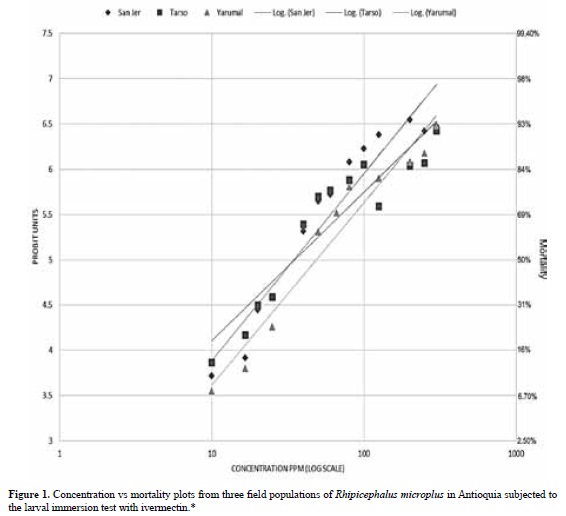
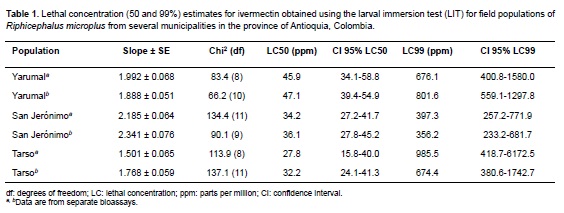
<body><![CDATA[<p>Concentration-mortality regressions, lethal   concentrations LC50 and LC99, their 95% confidence   intervals and slopes for each population are shown   in <a href="#t1">Table 1</a>. There was no difference in the LC50 and   LC99 estimates for each of the three populations   studied when bioassays were performed at different   times of collection. Mortality in the control groups   exposed to the ethanol-Triton X solution was zero;   therefore, no correction was necessary for the ivermectin-exposed groups. <a href="#f1">Figure 1</a> represents the probit mortality plots with the regression lines for each of the populations studied. The small slopes of the regression (&le; 2.5) and the distant values for the LC50 and LC99 are indicative of a very heterogeneous response to increasing concentrations of IVM in all three populations.</p>      <p align="center"><a name="t1"><img src="/img/revistas/rccp/v29n1/v29n1a07t1.jpg"></a></p>     <p align="center"><a name="f1"><img src="/img/revistas/rccp/v29n1/v29n1a07f1.jpg"></a></p>     <p>&nbsp;</p>     <p><font size="3"><b>Discussion</b></font></p>     <p>The objective of this study was to investigate farmer   reports of failure to control tick infestation at three   farms in Antioquia; in each case IVM formulations   were no longer able to eliminate tick infestations   from cattle. The evaluation of <i>R. microplus</i> resistance   to IVM was performed using the LIT bioassay with   larvae arising from ticks collected at the sampled   farms, and further tested using <i>in vivo</i> studies that are   reported elsewhere (L&oacute;pez <i><i>et al.</i>,</i> 2015). Although the   LIT has been used as a successful method to detect   resistance (Sabatini <i><i>et al.</i>,</i> 2001; Klafke <i><i>et al.</i>,</i> 2006),   ideally, it should be run in parallel to a susceptible   strain to calculate resistance ratios and determine   discriminating doses. Despite the limitation of not   having a susceptible strain in this study, the results   showed LC and concentration-mortality slopes   similar to those reported for the most resistant tick   populations from Veracruz (Fern&aacute;ndez-Salas <i><i>et al.</i>,</i>   2012), Yucat&aacute;n (P&eacute;rez-Cogollo <i><i>et al.</i>,</i> 2010a; 2010b)   and Sao Paulo (Klafke <i><i>et al.</i>,</i> 2012). For example,   comparison of LC50 values to those of a study that   determined the status of resistance to IVM in 53   randomly selected field populations of <i>R. microplus</i> in   Mexico (Fern&aacute;ndez-Salas <i><i>et al.</i>,</i> 2012) demonstrates that the level of resistance was equal to that of the four most resistant populations, with LC50s in the 30-50 ppm range. In general, low slope values (1.2-1.9) are related to high LC<sub>50</sub> (&gt;35 ppm) and high LC<sub>99</sub> (&gt;600 ppm) values, as reported here, and are hallmarks of very high resistance compared to values for susceptible <i>R. microplus</i> strains (slopes &asymp; 5, LC50s &asymp; 5 ppm for the Deutch strain). Low -slopes for the concentrationmortality lines could be interpreted as a result of a large heterogeneity with different levels of resistance in the field populations studied. To our knowledge, no studies of a highly resistant IVM strain have been described with high-slopes that would indicate complete loss of heterogeneity and consequently of the remaining susceptible genes in a population.</p>     <p>To relate the results of the LIT bioassay to the   field situation, a long-acting formulation of IVM   was used on two of the sampled farms. That clearly   showed that the efficacy of IVM in terms of clearing   the initial infestation load and protecting against   reinfestation was markedly reduced from target   expectations (L&oacute;pez <i><i>et al.</i>,</i> 2015). At 10 days postinjection,   a reduction in the number of adult standard ticks was only 40 and 75% at the San Jeronimo and Tarso farms, respectively (L&oacute;pez <i><i>et al.</i>,</i> 2015). These results are worrisome compared to field studies showing that 3.15% ivermectin formulations had a therapeutic and persistent efficacy of 95% at 56 days post-treatment (Arieta-Rom&aacute;n <i><i>et al.</i>,</i> 2010). In a study conducted at an USDA-ARS quarantine facility, the therapeutic efficacy of a similar longacting ivermectin formulation was 99.9% against all stages of a susceptible strain of <i>R. microplus</i> at the time of treatment (Davey <i><i>et al.</i>,</i> 2010). Furthermore, the protective period against larval re-infestation was 14 d if a level of control &ge; 99% was desired, and dropped to 70.4% for animals exposed artificially to larvae at 28 d post-treatment. Because ticks are unable to complete development in &lt;18 d, the study concluded that cattle could be treated with this longacting IVM at 31 d intervals without the risk of viable ticks detaching from the infested animals. In the present study, the high degree of resistance based on the LIT was clearly demonstrated by the ineffective elimination of existing infestations and the loss of protection against reinfestations.</p>     <p>In conclusion, the present study confirmed   the presence of <i>R. microplus</i> ticks that are highly   resistant to IVM to the point of having lost efficacy   for eliminating existing tick infestations. The   sampled farms completely relied on chemical control   to fight tick infestations. Therefore, it is imperative   to apply integrated approaches for parasite control   in farms that now have multiresistant strains of <i>R. microplus.</i></p>     <p>&nbsp;</p>     <p><b><font size="3">Acknowledgements</font></b></p>     ]]></body>
<body><![CDATA[<p>The authors thank the Biog&eacute;nesis Research group   Sustainability Project 2014-2015 (Estrategia de Sostenibilidad CODI 2014-2015).</p>     <p align="left">&nbsp;</p>     <p align="left"><b><font size="3">Conflicts of interest</font></b></p>     <p align="left">The authors declare they have no conflicts of interest with regard to the work presented in this report.</p>     <p align="left">&nbsp;</p> <hr size="1" />     <p><b><font size="3">Notes</font></b></p>     <p><b><a name="a0" id="a0"><a href="#a1">&curren;</a></a></b>To cite this article: Villar D, Puerta J, L&oacute;pez A, Chaparro JJ. Ivermectin resistance of three Rhipicephalus microplus populations using the larval immersion test. Rev Colomb Cienc Pecu 2016; 29:51-57.</p> <hr size="1" />     <p>&nbsp;</p>     <p><b><font size="3">References</font></b></p>     <!-- ref --><p>Arieta Rom&aacute;n RJ, Rodriguez Vivas RI, Rosado Aguilar JA,   Ramirez Cruz GT, Basto Estrella G. Persistent efficacy of two   macrocyclic lactones against natural <i>Rhipiceplalus</i> (<i>Boophilus</i>)   <i>microplus</i> infestations in cattle in the Mexican tropics. Rev Mex   Cienc Pecu 2010; 1: 59-67.    &nbsp;&nbsp;&nbsp;&nbsp;&nbsp;&nbsp;&nbsp;&nbsp;[&#160;<a href="javascript:void(0);" onclick="javascript: window.open('/scielo.php?script=sci_nlinks&ref=2508691&pid=S0120-0690201600010000700001&lng=','','width=640,height=500,resizable=yes,scrollbars=1,menubar=yes,');">Links</a>&#160;]<!-- end-ref --> </p>     <!-- ref --><p>Castro Janer E, Rifran L, Gonzalez P, Niell C, Piaggio J, Gil   A, Schumaker TTS. Determination of the susceptibility of   <i>Rhipicephalus</i> (<i>Boophilus</i>) <i>microplus</i> (Acari: Ixodidae) to   ivermectin and fipronil by larval immersion test (LIT) in Uruguay.   Vet Parasitol 2011; 178:148-55.    &nbsp;&nbsp;&nbsp;&nbsp;&nbsp;&nbsp;&nbsp;&nbsp;[&#160;<a href="javascript:void(0);" onclick="javascript: window.open('/scielo.php?script=sci_nlinks&ref=2508693&pid=S0120-0690201600010000700002&lng=','','width=640,height=500,resizable=yes,scrollbars=1,menubar=yes,');">Links</a>&#160;]<!-- end-ref --> </p>     <!-- ref --><p>Davey RB, Pound JM, Miller JA, Klavons JA. Therapeutic and   persistent efficacy of a long-acting (LA) formulation of ivermectin   against <i>Rhipicephalus</i> (<i>Boophilus</i>) <i>microplus</i> (Acari: Ixodidae)   and ser&aacute; concentration through time in treated cattle. Vet Parasitol   2010; 169:149-56.    &nbsp;&nbsp;&nbsp;&nbsp;&nbsp;&nbsp;&nbsp;&nbsp;[&#160;<a href="javascript:void(0);" onclick="javascript: window.open('/scielo.php?script=sci_nlinks&ref=2508695&pid=S0120-0690201600010000700003&lng=','','width=640,height=500,resizable=yes,scrollbars=1,menubar=yes,');">Links</a>&#160;]<!-- end-ref --> </p>     <!-- ref --><p>FAO. Working Group on Parasite Resistance. ''Acaricide   resistance: diagnosis, management and prevention'', in Guidelines   Resistance Management and Integrated Parasite Control in   Ruminants 2004, pp. 25-77.    &nbsp;&nbsp;&nbsp;&nbsp;&nbsp;&nbsp;&nbsp;&nbsp;[&#160;<a href="javascript:void(0);" onclick="javascript: window.open('/scielo.php?script=sci_nlinks&ref=2508697&pid=S0120-0690201600010000700004&lng=','','width=640,height=500,resizable=yes,scrollbars=1,menubar=yes,');">Links</a>&#160;]<!-- end-ref --> </p>     <!-- ref --><p>Fern&aacute;ndez Salas A, Rodr&iacute;guez Vivas RI, Alonso Diaz MA, Basurto   Camberos H. Ivermectin resistance status and factors associated   in <i>Rhipicephalus microplus</i> (Acari:Ixodidae) populations from   Veracruz, Mexico. Vet Parasitol 2012; 190:210-5.    &nbsp;&nbsp;&nbsp;&nbsp;&nbsp;&nbsp;&nbsp;&nbsp;[&#160;<a href="javascript:void(0);" onclick="javascript: window.open('/scielo.php?script=sci_nlinks&ref=2508699&pid=S0120-0690201600010000700005&lng=','','width=640,height=500,resizable=yes,scrollbars=1,menubar=yes,');">Links</a>&#160;]<!-- end-ref --> </p>     <!-- ref --><p>Garc&iacute;a Paz JL. Evaluaci&oacute;n de las propiedades acaricidas de   Piper crassinervium Kunth. Piper aequale Vahl. (<i>Piperaceae</i>)   sobre larvas de <i>Rhipicephalus</i> (<i>Boophilus</i>) <i>microplus</i>. Trabajo   de grado para optar a t&iacute;tulo de maestr&iacute;a. Universidad Nacional.   Colombia. 2011 &nbsp;&nbsp;&nbsp;&nbsp;&nbsp;&nbsp;&nbsp;&nbsp;[&#160;<a href="javascript:void(0);" onclick="javascript: window.open('/scielo.php?script=sci_nlinks&ref=2508701&pid=S0120-0690201600010000700006&lng=','','width=640,height=500,resizable=yes,scrollbars=1,menubar=yes,');">Links</a>&#160;]<!-- end-ref --><!-- ref --><p>Grise L, Leite RC, Martins JR, Barros AT, Andreotti R, Perez   de Leon AA, Pereira JC, Silva H. Reassessment of the potential   economic impact of cattle parasites in Brazil. Braz J Vet Parasitol   Jaboticabal 2014; 23(2):150-6.    &nbsp;&nbsp;&nbsp;&nbsp;&nbsp;&nbsp;&nbsp;&nbsp;[&#160;<a href="javascript:void(0);" onclick="javascript: window.open('/scielo.php?script=sci_nlinks&ref=2508702&pid=S0120-0690201600010000700007&lng=','','width=640,height=500,resizable=yes,scrollbars=1,menubar=yes,');">Links</a>&#160;]<!-- end-ref --> </p>     <!-- ref --><p>Holdsworth PA, Kemp D, Green P, Peter RJ, De Bruin C, Jonsson   NN, Letonja T, Rehbein S, Vercruysse J. World Association for the   Advancement of Veterinary Parasitology (W.A.A.V.P.) guidelines   for evaluating the efficacy of acaricides against ticks (Ixodidae)   on ruminants. Vet Parasitol 2006; 136:29-43.    &nbsp;&nbsp;&nbsp;&nbsp;&nbsp;&nbsp;&nbsp;&nbsp;[&#160;<a href="javascript:void(0);" onclick="javascript: window.open('/scielo.php?script=sci_nlinks&ref=2508704&pid=S0120-0690201600010000700008&lng=','','width=640,height=500,resizable=yes,scrollbars=1,menubar=yes,');">Links</a>&#160;]<!-- end-ref --> </p>     <!-- ref --><p>Klafke GM, Sabatini GA, Albuquerque TA, Martins JR, Kemp   DH, Miller RJ, Schumaker TTS. Larval immersion tests with   ivermectin in populations of the cattle tick <i>Rhipicephalus</i>   (<i>Boophilus</i>) <i>microplus</i> (Acari: Ixodidae) from State of Sao Paulo,   Brazil. Vet Parasitol 2006; 142:386-90.    &nbsp;&nbsp;&nbsp;&nbsp;&nbsp;&nbsp;&nbsp;&nbsp;[&#160;<a href="javascript:void(0);" onclick="javascript: window.open('/scielo.php?script=sci_nlinks&ref=2508706&pid=S0120-0690201600010000700009&lng=','','width=640,height=500,resizable=yes,scrollbars=1,menubar=yes,');">Links</a>&#160;]<!-- end-ref --> </p>     <!-- ref --><p>Klafke GM, Albuquerque TA, Miller RJ, Schumaker TTS. Selection   of an ivermectin-resistant strain of <i>Rhipicephalus microplus</i> (Acari: Ixodidae) in Brazil. Vet Parasitol 2010; 168:97-104.    &nbsp;&nbsp;&nbsp;&nbsp;&nbsp;&nbsp;&nbsp;&nbsp;[&#160;<a href="javascript:void(0);" onclick="javascript: window.open('/scielo.php?script=sci_nlinks&ref=2508708&pid=S0120-0690201600010000700010&lng=','','width=640,height=500,resizable=yes,scrollbars=1,menubar=yes,');">Links</a>&#160;]<!-- end-ref --></p>     <!-- ref --><p>Klafke GM, Castro Janer E, Mendes MC, Namindome A,   Schumaker TTS. Applicability of <i>in vitro</i> bioassays for the   diagnosis of ivermectin resistance in <i>Rhipicephalus microplus</i>   (Acari: Ixodidae). Vet Parasitol 2012; 184:121-220.    &nbsp;&nbsp;&nbsp;&nbsp;&nbsp;&nbsp;&nbsp;&nbsp;[&#160;<a href="javascript:void(0);" onclick="javascript: window.open('/scielo.php?script=sci_nlinks&ref=2508710&pid=S0120-0690201600010000700011&lng=','','width=640,height=500,resizable=yes,scrollbars=1,menubar=yes,');">Links</a>&#160;]<!-- end-ref --> </p>     ]]></body>
<body><![CDATA[<!-- ref --><p>L&oacute;pez Arias A, Villar D, Miller R, Chaparro J, P&eacute;rez de le&oacute;n, A.   Reduced efficacy of commercial acaricides against populations   of resistant cattle tick <i>Rhipicephalus microplus</i> from two   municipalities of Antioquia, Colombia. Libertas Acad&eacute;mica,   2015 (in press).    &nbsp;&nbsp;&nbsp;&nbsp;&nbsp;&nbsp;&nbsp;&nbsp;[&#160;<a href="javascript:void(0);" onclick="javascript: window.open('/scielo.php?script=sci_nlinks&ref=2508712&pid=S0120-0690201600010000700012&lng=','','width=640,height=500,resizable=yes,scrollbars=1,menubar=yes,');">Links</a>&#160;]<!-- end-ref --> </p>     <!-- ref --><p>Martins JR, Furlong J. Ivermectin resistance of the cattle tick   <i>Boophilus microplus</i> in Brazil. Vet Rec 2001; 149:64.    &nbsp;&nbsp;&nbsp;&nbsp;&nbsp;&nbsp;&nbsp;&nbsp;[&#160;<a href="javascript:void(0);" onclick="javascript: window.open('/scielo.php?script=sci_nlinks&ref=2508714&pid=S0120-0690201600010000700013&lng=','','width=640,height=500,resizable=yes,scrollbars=1,menubar=yes,');">Links</a>&#160;]<!-- end-ref --> </p>     <!-- ref --><p>P&eacute;rez Cogollo LC, Rodr&iacute;guez Vivas RI, Ram&iacute;rez Cruz GT,   Rosado-Aguilar JA. Survey of <i>Rhipicephalus microplus</i> resistance   to ivermectin at cattle farms with history of macrocyclic lactones   use in Yucatan, Mexico. Vet Parasitol 2010a; 172:109-113.    &nbsp;&nbsp;&nbsp;&nbsp;&nbsp;&nbsp;&nbsp;&nbsp;[&#160;<a href="javascript:void(0);" onclick="javascript: window.open('/scielo.php?script=sci_nlinks&ref=2508716&pid=S0120-0690201600010000700014&lng=','','width=640,height=500,resizable=yes,scrollbars=1,menubar=yes,');">Links</a>&#160;]<!-- end-ref --> </p>     <!-- ref --><p>P&eacute;rez Cogollo LC, Rodr&iacute;guez Vivas RI, Ram&iacute;rez Cruz GT, Miller   RJ. First report of the cattle tick <i>Rhipicephalus microplus</i> resistant   to ivermectin in Mexico. Vet Parasitol 2010b; 168:165-9.    &nbsp;&nbsp;&nbsp;&nbsp;&nbsp;&nbsp;&nbsp;&nbsp;[&#160;<a href="javascript:void(0);" onclick="javascript: window.open('/scielo.php?script=sci_nlinks&ref=2508718&pid=S0120-0690201600010000700015&lng=','','width=640,height=500,resizable=yes,scrollbars=1,menubar=yes,');">Links</a>&#160;]<!-- end-ref --> </p>     <!-- ref --><p>Sabatini GA, Kemp DH, Hughes S, Nari A, Hansen J. Tests   to determine LC50 and discriminating doses for macrocyclic   lactones against the cattle tick, <i>Boophilus microplus</i>. Vet Parasitol 2001; 95(1):53-62.    &nbsp;&nbsp;&nbsp;&nbsp;&nbsp;&nbsp;&nbsp;&nbsp;[&#160;<a href="javascript:void(0);" onclick="javascript: window.open('/scielo.php?script=sci_nlinks&ref=2508720&pid=S0120-0690201600010000700016&lng=','','width=640,height=500,resizable=yes,scrollbars=1,menubar=yes,');">Links</a>&#160;]<!-- end-ref --></p>     ]]></body>
<body><![CDATA[<p>&nbsp;</p>     <p>&nbsp;</p> </font>      ]]></body><back>
<ref-list>
<ref id="B1">
<nlm-citation citation-type="journal">
<person-group person-group-type="author">
<name>
<surname><![CDATA[Arieta-Román]]></surname>
<given-names><![CDATA[RJ]]></given-names>
</name>
<name>
<surname><![CDATA[Rodriguez-Vivas]]></surname>
<given-names><![CDATA[RI]]></given-names>
</name>
<name>
<surname><![CDATA[Rosado-Aguilar]]></surname>
<given-names><![CDATA[JA]]></given-names>
</name>
<name>
<surname><![CDATA[Ramirez-Cruz]]></surname>
<given-names><![CDATA[GT]]></given-names>
</name>
<name>
<surname><![CDATA[Basto-Estrella]]></surname>
<given-names><![CDATA[G]]></given-names>
</name>
</person-group>
<article-title xml:lang="en"><![CDATA[Persistent efficacy of two macrocyclic lactones against natural Rhipiceplalus (Boophilus) microplus infestations in cattle in the Mexican tropics]]></article-title>
<source><![CDATA[Rev Mex Cienc Pecu]]></source>
<year>2010</year>
<volume>1</volume>
<page-range>59-67</page-range></nlm-citation>
</ref>
<ref id="B2">
<nlm-citation citation-type="journal">
<person-group person-group-type="author">
<name>
<surname><![CDATA[Castro-Janer]]></surname>
<given-names><![CDATA[E]]></given-names>
</name>
<name>
<surname><![CDATA[Rifran]]></surname>
<given-names><![CDATA[L]]></given-names>
</name>
<name>
<surname><![CDATA[Gonzalez]]></surname>
<given-names><![CDATA[P]]></given-names>
</name>
<name>
<surname><![CDATA[Niell]]></surname>
<given-names><![CDATA[C]]></given-names>
</name>
<name>
<surname><![CDATA[Piaggio]]></surname>
<given-names><![CDATA[J]]></given-names>
</name>
<name>
<surname><![CDATA[Gil]]></surname>
<given-names><![CDATA[A]]></given-names>
</name>
<name>
<surname><![CDATA[Schumaker]]></surname>
<given-names><![CDATA[TTS]]></given-names>
</name>
</person-group>
<article-title xml:lang="en"><![CDATA[Determination of the susceptibility of Rhipicephalus (Boophilus) microplus (Acari: Ixodidae) to ivermectin and fipronil by larval immersion test (LIT) in Uruguay]]></article-title>
<source><![CDATA[Vet Parasitol]]></source>
<year>2011</year>
<volume>178</volume>
<page-range>148-55</page-range></nlm-citation>
</ref>
<ref id="B3">
<nlm-citation citation-type="journal">
<person-group person-group-type="author">
<name>
<surname><![CDATA[Davey]]></surname>
<given-names><![CDATA[RB]]></given-names>
</name>
<name>
<surname><![CDATA[Pound]]></surname>
<given-names><![CDATA[JM]]></given-names>
</name>
<name>
<surname><![CDATA[Miller]]></surname>
<given-names><![CDATA[JA]]></given-names>
</name>
<name>
<surname><![CDATA[Klavons]]></surname>
<given-names><![CDATA[JA]]></given-names>
</name>
</person-group>
<article-title xml:lang="en"><![CDATA[Therapeutic and persistent efficacy of a long-acting (LA) formulation of ivermectin against Rhipicephalus (Boophilus) microplus (Acari: Ixodidae) and será concentration through time in treated cattle]]></article-title>
<source><![CDATA[Vet Parasitol]]></source>
<year>2010</year>
<volume>169</volume>
<page-range>149-56</page-range></nlm-citation>
</ref>
<ref id="B4">
<nlm-citation citation-type="">
<collab>FAO. Working Group on Parasite Resistance</collab>
<article-title xml:lang="en"><![CDATA[Acaricide resistance: diagnosis, management and prevention]]></article-title>
<source><![CDATA[Guidelines Resistance Management and Integrated Parasite Control in Ruminants 2004]]></source>
<year></year>
<page-range>25-77</page-range></nlm-citation>
</ref>
<ref id="B5">
<nlm-citation citation-type="journal">
<person-group person-group-type="author">
<name>
<surname><![CDATA[Fernández-Salas]]></surname>
<given-names><![CDATA[A]]></given-names>
</name>
<name>
<surname><![CDATA[Rodríguez-Vivas]]></surname>
<given-names><![CDATA[RI]]></given-names>
</name>
<name>
<surname><![CDATA[Alonso-Diaz]]></surname>
<given-names><![CDATA[MA]]></given-names>
</name>
<name>
<surname><![CDATA[Basurto-Camberos]]></surname>
<given-names><![CDATA[H]]></given-names>
</name>
</person-group>
<article-title xml:lang="en"><![CDATA[Ivermectin resistance status and factors associated in Rhipicephalus microplus (Acari:Ixodidae) populations from Veracruz, Mexico]]></article-title>
<source><![CDATA[Vet Parasitol]]></source>
<year>2012</year>
<volume>190</volume>
<page-range>210-5</page-range></nlm-citation>
</ref>
<ref id="B6">
<nlm-citation citation-type="book">
<person-group person-group-type="author">
<name>
<surname><![CDATA[García Paz]]></surname>
<given-names><![CDATA[JL]]></given-names>
</name>
</person-group>
<source><![CDATA[Evaluación de las propiedades acaricidas de Piper crassinervium Kunth. Piper aequale Vahl. (Piperaceae) sobre larvas de Rhipicephalus (Boophilus) microplus]]></source>
<year>2011</year>
<publisher-name><![CDATA[Universidad Nacional]]></publisher-name>
</nlm-citation>
</ref>
<ref id="B7">
<nlm-citation citation-type="journal">
<person-group person-group-type="author">
<name>
<surname><![CDATA[Grise]]></surname>
<given-names><![CDATA[L]]></given-names>
</name>
<name>
<surname><![CDATA[Leite]]></surname>
<given-names><![CDATA[RC]]></given-names>
</name>
<name>
<surname><![CDATA[Martins]]></surname>
<given-names><![CDATA[JR]]></given-names>
</name>
<name>
<surname><![CDATA[Barros]]></surname>
<given-names><![CDATA[AT]]></given-names>
</name>
<name>
<surname><![CDATA[Andreotti]]></surname>
<given-names><![CDATA[R]]></given-names>
</name>
<name>
<surname><![CDATA[Perez-de-Leon]]></surname>
<given-names><![CDATA[AA]]></given-names>
</name>
<name>
<surname><![CDATA[Pereira]]></surname>
<given-names><![CDATA[JC]]></given-names>
</name>
<name>
<surname><![CDATA[Silva]]></surname>
<given-names><![CDATA[H]]></given-names>
</name>
</person-group>
<article-title xml:lang="en"><![CDATA[Reassessment of the potential economic impact of cattle parasites in Brazil]]></article-title>
<source><![CDATA[Braz J Vet Parasitol Jaboticabal]]></source>
<year>2014</year>
<volume>23(2)</volume>
<page-range>150-6</page-range></nlm-citation>
</ref>
<ref id="B8">
<nlm-citation citation-type="journal">
<person-group person-group-type="author">
<name>
<surname><![CDATA[Holdsworth]]></surname>
<given-names><![CDATA[PA]]></given-names>
</name>
<name>
<surname><![CDATA[Kemp]]></surname>
<given-names><![CDATA[D]]></given-names>
</name>
<name>
<surname><![CDATA[Green]]></surname>
<given-names><![CDATA[P]]></given-names>
</name>
<name>
<surname><![CDATA[Peter]]></surname>
<given-names><![CDATA[RJ]]></given-names>
</name>
<name>
<surname><![CDATA[De]]></surname>
<given-names><![CDATA[Bruin C]]></given-names>
</name>
<name>
<surname><![CDATA[Jonsson]]></surname>
<given-names><![CDATA[NN]]></given-names>
</name>
<name>
<surname><![CDATA[Letonja]]></surname>
<given-names><![CDATA[T]]></given-names>
</name>
<name>
<surname><![CDATA[Rehbein]]></surname>
<given-names><![CDATA[S]]></given-names>
</name>
<name>
<surname><![CDATA[Vercruysse]]></surname>
<given-names><![CDATA[J]]></given-names>
</name>
</person-group>
<article-title xml:lang="en"><![CDATA[World Association for the Advancement of Veterinary Parasitology (W.A.A.V.P.) guidelines for evaluating the efficacy of acaricides against ticks (Ixodidae) on ruminants]]></article-title>
<source><![CDATA[Vet Parasitol]]></source>
<year>2006</year>
<volume>136</volume>
<page-range>29-43</page-range></nlm-citation>
</ref>
<ref id="B9">
<nlm-citation citation-type="journal">
<person-group person-group-type="author">
<name>
<surname><![CDATA[Klafke]]></surname>
<given-names><![CDATA[GM]]></given-names>
</name>
<name>
<surname><![CDATA[Sabatini]]></surname>
<given-names><![CDATA[GA]]></given-names>
</name>
<name>
<surname><![CDATA[Albuquerque]]></surname>
<given-names><![CDATA[TA]]></given-names>
</name>
<name>
<surname><![CDATA[Martins]]></surname>
<given-names><![CDATA[JR]]></given-names>
</name>
<name>
<surname><![CDATA[Kemp]]></surname>
<given-names><![CDATA[DH]]></given-names>
</name>
<name>
<surname><![CDATA[Miller]]></surname>
<given-names><![CDATA[RJ]]></given-names>
</name>
<name>
<surname><![CDATA[Schumaker]]></surname>
<given-names><![CDATA[TTS]]></given-names>
</name>
</person-group>
<article-title xml:lang="en"><![CDATA[Larval immersion tests with ivermectin in populations of the cattle tick Rhipicephalus (Boophilus) microplus (Acari: Ixodidae) from State of Sao Paulo, Brazil]]></article-title>
<source><![CDATA[Vet Parasitol]]></source>
<year>2006</year>
<volume>142</volume>
<page-range>386-90</page-range></nlm-citation>
</ref>
<ref id="B10">
<nlm-citation citation-type="journal">
<person-group person-group-type="author">
<name>
<surname><![CDATA[Klafke]]></surname>
<given-names><![CDATA[GM]]></given-names>
</name>
<name>
<surname><![CDATA[Albuquerque]]></surname>
<given-names><![CDATA[TA]]></given-names>
</name>
<name>
<surname><![CDATA[Miller]]></surname>
<given-names><![CDATA[RJ]]></given-names>
</name>
<name>
<surname><![CDATA[Schumaker]]></surname>
<given-names><![CDATA[TTS]]></given-names>
</name>
</person-group>
<article-title xml:lang="en"><![CDATA[Selection of an ivermectin-resistant strain of Rhipicephalus microplus (Acari: Ixodidae) in Brazil]]></article-title>
<source><![CDATA[Vet Parasitol]]></source>
<year>2010</year>
<volume>168</volume>
<page-range>97-104</page-range></nlm-citation>
</ref>
<ref id="B11">
<nlm-citation citation-type="journal">
<person-group person-group-type="author">
<name>
<surname><![CDATA[Klafke]]></surname>
<given-names><![CDATA[GM]]></given-names>
</name>
<name>
<surname><![CDATA[Castro]]></surname>
<given-names><![CDATA[Janer E]]></given-names>
</name>
<name>
<surname><![CDATA[Mendes]]></surname>
<given-names><![CDATA[MC]]></given-names>
</name>
<name>
<surname><![CDATA[Namindome]]></surname>
<given-names><![CDATA[A]]></given-names>
</name>
<name>
<surname><![CDATA[Schumaker]]></surname>
<given-names><![CDATA[TTS]]></given-names>
</name>
</person-group>
<article-title xml:lang="en"><![CDATA[Applicability of in vitro bioassays for the diagnosis of ivermectin resistance in Rhipicephalus microplus (Acari: Ixodidae)]]></article-title>
<source><![CDATA[Vet Parasitol]]></source>
<year>2012</year>
<volume>184</volume>
<page-range>121-220</page-range></nlm-citation>
</ref>
<ref id="B12">
<nlm-citation citation-type="">
<person-group person-group-type="author">
<name>
<surname><![CDATA[López Arias]]></surname>
<given-names><![CDATA[A]]></given-names>
</name>
<name>
<surname><![CDATA[Villar]]></surname>
<given-names><![CDATA[D]]></given-names>
</name>
<name>
<surname><![CDATA[Miller]]></surname>
<given-names><![CDATA[R]]></given-names>
</name>
<name>
<surname><![CDATA[Chaparro]]></surname>
<given-names><![CDATA[J]]></given-names>
</name>
<name>
<surname><![CDATA[Pérez de león]]></surname>
<given-names><![CDATA[A]]></given-names>
</name>
</person-group>
<source><![CDATA[Reduced efficacy of commercial acaricides against populations of resistant cattle tick Rhipicephalus microplus from two municipalities of Antioquia, Colombia]]></source>
<year></year>
</nlm-citation>
</ref>
<ref id="B13">
<nlm-citation citation-type="journal">
<person-group person-group-type="author">
<name>
<surname><![CDATA[Martins]]></surname>
<given-names><![CDATA[JR]]></given-names>
</name>
<name>
<surname><![CDATA[Furlong]]></surname>
<given-names><![CDATA[J]]></given-names>
</name>
</person-group>
<article-title xml:lang="en"><![CDATA[Ivermectin resistance of the cattle tick Boophilus microplus in Brazil]]></article-title>
<source><![CDATA[Vet Rec]]></source>
<year>2001</year>
<volume>149</volume>
<page-range>64</page-range></nlm-citation>
</ref>
<ref id="B14">
<nlm-citation citation-type="journal">
<person-group person-group-type="author">
<name>
<surname><![CDATA[Pérez-Cogollo]]></surname>
<given-names><![CDATA[LC]]></given-names>
</name>
<name>
<surname><![CDATA[Rodríguez-Vivas]]></surname>
<given-names><![CDATA[RI]]></given-names>
</name>
<name>
<surname><![CDATA[Ramírez-Cruz]]></surname>
<given-names><![CDATA[GT]]></given-names>
</name>
<name>
<surname><![CDATA[Rosado-Aguilar]]></surname>
<given-names><![CDATA[JA]]></given-names>
</name>
</person-group>
<article-title xml:lang="en"><![CDATA[Survey of Rhipicephalus microplus resistance to ivermectin at cattle farms with history of macrocyclic lactones use in Yucatan, Mexico]]></article-title>
<source><![CDATA[Vet Parasitol]]></source>
<year>2010</year>
<month>a</month>
<volume>172</volume>
<page-range>109-113</page-range></nlm-citation>
</ref>
<ref id="B15">
<nlm-citation citation-type="journal">
<person-group person-group-type="author">
<name>
<surname><![CDATA[Pérez-Cogollo]]></surname>
<given-names><![CDATA[LC]]></given-names>
</name>
<name>
<surname><![CDATA[Rodríguez-Vivas]]></surname>
<given-names><![CDATA[RI]]></given-names>
</name>
<name>
<surname><![CDATA[Ramírez-Cruz]]></surname>
<given-names><![CDATA[GT]]></given-names>
</name>
<name>
<surname><![CDATA[Miller]]></surname>
<given-names><![CDATA[RJ]]></given-names>
</name>
</person-group>
<article-title xml:lang="en"><![CDATA[First report of the cattle tick Rhipicephalus microplus resistant to ivermectin in Mexico]]></article-title>
<source><![CDATA[Vet Parasitol]]></source>
<year>2010</year>
<month>b</month>
<volume>168</volume>
<page-range>165-9</page-range></nlm-citation>
</ref>
<ref id="B16">
<nlm-citation citation-type="journal">
<person-group person-group-type="author">
<name>
<surname><![CDATA[Sabatini]]></surname>
<given-names><![CDATA[GA]]></given-names>
</name>
<name>
<surname><![CDATA[Kemp]]></surname>
<given-names><![CDATA[DH]]></given-names>
</name>
<name>
<surname><![CDATA[Hughes]]></surname>
<given-names><![CDATA[S]]></given-names>
</name>
<name>
<surname><![CDATA[Nari]]></surname>
<given-names><![CDATA[A]]></given-names>
</name>
<name>
<surname><![CDATA[Hansen]]></surname>
<given-names><![CDATA[J]]></given-names>
</name>
</person-group>
<article-title xml:lang="en"><![CDATA[Tests to determine LC50 and discriminating doses for macrocyclic lactones against the cattle tick, Boophilus microplus]]></article-title>
<source><![CDATA[Vet Parasitol]]></source>
<year>2001</year>
<volume>95(1)</volume>
<page-range>53-62</page-range></nlm-citation>
</ref>
</ref-list>
</back>
</article>