<?xml version="1.0" encoding="ISO-8859-1"?><article xmlns:mml="http://www.w3.org/1998/Math/MathML" xmlns:xlink="http://www.w3.org/1999/xlink" xmlns:xsi="http://www.w3.org/2001/XMLSchema-instance">
<front>
<journal-meta>
<journal-id>0120-0690</journal-id>
<journal-title><![CDATA[Revista Colombiana de Ciencias Pecuarias]]></journal-title>
<abbrev-journal-title><![CDATA[Rev Colom Cienc Pecua]]></abbrev-journal-title>
<issn>0120-0690</issn>
<publisher>
<publisher-name><![CDATA[Facultad de Ciencias Agrarias, Universidad de Antioquia]]></publisher-name>
</publisher>
</journal-meta>
<article-meta>
<article-id>S0120-06902016000100008</article-id>
<article-id pub-id-type="doi">10.17533/udea.rccp.v29n1a07</article-id>
<title-group>
<article-title xml:lang="en"><![CDATA[Effects of dietary carbohydrate/lipid ratios on growth, body composition, and nutrient utilization of hybrid catfish (Pseudoplatystoma reticulatum x Leiarius marmoratus)]]></article-title>
<article-title xml:lang="es"><![CDATA[Efectos de la relación carbohidratos/lípidos en el crecimiento, composición corporal y utilización de nutrientes del bagre hibrido (Pseudoplatystoma reticulatum x Leiarius marmoratus)]]></article-title>
<article-title xml:lang="pt"><![CDATA[Efeitos da relação carboidratos/lipídios sobre o crescimento, composição corporal e utilização de nutrientes do bagre híbrido (Pseudoplatystoma reticulatum x Leiarius marmoratus)]]></article-title>
</title-group>
<contrib-group>
<contrib contrib-type="author">
<name>
<surname><![CDATA[Bernardes]]></surname>
<given-names><![CDATA[Célio L]]></given-names>
</name>
<xref ref-type="aff" rid="A01"/>
</contrib>
<contrib contrib-type="author">
<name>
<surname><![CDATA[Navarro]]></surname>
<given-names><![CDATA[Rodrigo D]]></given-names>
</name>
<xref ref-type="aff" rid="A02"/>
</contrib>
<contrib contrib-type="author">
<name>
<surname><![CDATA[Guerra-Santos]]></surname>
<given-names><![CDATA[Bartira]]></given-names>
</name>
<xref ref-type="aff" rid="A03"/>
</contrib>
<contrib contrib-type="author">
<name>
<surname><![CDATA[Fortes-Silva]]></surname>
<given-names><![CDATA[Rodrigo]]></given-names>
</name>
<xref ref-type="aff" rid="A04"/>
<xref ref-type="aff" rid="A05"/>
</contrib>
</contrib-group>
<aff id="A01">
<institution><![CDATA[,Universidade Unifenas Faculdade de Ciências Agrárias ]]></institution>
<addr-line><![CDATA[ Minas Gerais]]></addr-line>
<country>Brasil</country>
</aff>
<aff id="A02">
<institution><![CDATA[,Universidade de Brasília  ]]></institution>
<addr-line><![CDATA[Brasília DF]]></addr-line>
<country>Brasil</country>
</aff>
<aff id="A03">
<institution><![CDATA[,Universidade da Bahia  ]]></institution>
<addr-line><![CDATA[ Bahia]]></addr-line>
<country>Brasil</country>
</aff>
<aff id="A04">
<institution><![CDATA[,Universidade do Recôncavo da Bahia  ]]></institution>
<addr-line><![CDATA[Cruz das Almas Bahia]]></addr-line>
<country>Brasil</country>
</aff>
<aff id="A05">
<institution><![CDATA[,University of Bahia Recôncavo  ]]></institution>
<addr-line><![CDATA[Cruz das Almas Bahia]]></addr-line>
<country>Brazil</country>
</aff>
<pub-date pub-type="pub">
<day>00</day>
<month>03</month>
<year>2016</year>
</pub-date>
<pub-date pub-type="epub">
<day>00</day>
<month>03</month>
<year>2016</year>
</pub-date>
<volume>29</volume>
<numero>1</numero>
<fpage>58</fpage>
<lpage>65</lpage>
<copyright-statement/>
<copyright-year/>
<self-uri xlink:href="http://www.scielo.org.co/scielo.php?script=sci_arttext&amp;pid=S0120-06902016000100008&amp;lng=en&amp;nrm=iso"></self-uri><self-uri xlink:href="http://www.scielo.org.co/scielo.php?script=sci_abstract&amp;pid=S0120-06902016000100008&amp;lng=en&amp;nrm=iso"></self-uri><self-uri xlink:href="http://www.scielo.org.co/scielo.php?script=sci_pdf&amp;pid=S0120-06902016000100008&amp;lng=en&amp;nrm=iso"></self-uri><abstract abstract-type="short" xml:lang="en"><p><![CDATA[Background: farming of hybrid catfish is relatively recent in Brazil; consequently, it is necessary to develop practical diet formulations for this fish. Objective: to evaluate the influence of different carbohydrate/lipid ratios (CHO:L) on growth performance, body composition and nutrient utilization of hybrid catfish (Pseudoplatystoma reticulatum x Leiarius marmoratus). Methods: four isonitrogenous diets were formulated with increasing lipid levels, using the following CHO:L ratios: 1.3:1 (diet 1); 1.1:1 (diet 2); 0.9:1 (diet 3), and 0.8:1 (diet 4). Fish were fed 5% of BW/day (dry-weight basis) in triplicate groups of 6 fish each (18 ± 1.5 g) for 2 months. Results: though final weight and absolute weight gain decreased with increasing dietary lipid (p<0.05), there was no significant difference in daily feed consumption among treatments (p&gt;0.05). Moreover, viscerosomatic index and hepatosomatic index showed no statistical difference among dietary treatments. Body lipid increase for fish fed diet 4. Lipid and energy efficiency retentions were higher at 0.8:1 CHO:L group. Conclusion: CHO:L ratios around 1.3:1 produced large benefit by best growth performance in the studied hybrid model.]]></p></abstract>
<abstract abstract-type="short" xml:lang="es"><p><![CDATA[Antecedentes: el cultivo del bagre híbrido es relativamente reciente en Brasil, con lo cual se hace necesario desarrollar dietas prácticas para este pez. Objetivo: evaluar la influencia de la relación carbohidratos/ lípidos (CHO:L) en el crecimiento, composición corporal, y utilización de nutrientes por el bagre híbrido (Pseudoplatystoma reticulatum x Leiarius marmoratus). Métodos: cuatro dietas isonitrogenadas fueron formuladas con niveles incrementales de lípidos, utilizando la siguiente relación CHO/L: 1,3:1 (dieta 1); 1,1:1 (dieta 2); 0,9:1 (dieta 3), y 0,8:1 (dieta 4). Los peces fueron alimentados con 5% de BW/día (en base a peso seco), en triplicado con 6 peces/grupo (18 ± 1,5 g) por grupo, por un tiempo de 2 meses. Resultados: aunque el peso final y la ganancia de peso absoluto disminuyó con el aumento de lípidos en la dieta (p<0,05), no hubo diferencia significativa en el consumo diario de alimento entre los tratamientos (p&gt;0,05). Por otra parte, para el índice viscerosomático e índice hepatosomático no hubo diferencias estadísticas entre los tratamientos. Se ha observado el aumento de los lípidos corporales de peces alimentados con la dieta 4. La eficiencia de retención de lípidos y energética fueron mayores en el grupo 0,8:1 CHO:L. Conclusión: la relación CHO:L alrededor de 1,3:1 produce un gran beneficio al mejorar el crecimiento del modelo del pez híbrido estudiado.]]></p></abstract>
<abstract abstract-type="short" xml:lang="pt"><p><![CDATA[Antecedentes: o cultivo de bagre híbrido com características favoráveis ao crescimento é relativamente recente no Brasil, consequentemente é necessária a formulação de dietas práticas para essa espécie. Objetivo: se avaliou a influência da relação carboidrato/lipídio (CHO:L) no crescimento, composição corporal e utilização de nutrientes pelo bagre híbrido (Pseudoplatystoma reticulatum x Leiarius marmoratus). Métodos: quatro dietas isonitrogenadas foram formuladas com o aumento dos níveis de lipídios na dieta, utilizando a seguinte relação CHO/L: 1,3:1 (dieta 1); 1,1:1 (dieta 2); 0,9:1 (dieta 3), y 0,8:1 (dieta 4). Os peixes foram alimentados a 5% de BW/dia (base de peso seco), sendo triplicatas de 6 peixes (18 ± 1,5 g) por grupo por um período de 2 meses. Resultados: apesar do peso final e do ganho de peso absoluto decrescerem com o aumento da dieta lipídica (p<0,05), não houve diferença significativa no consumo diário de alimento entre os tratamentos (p&gt;0,05). Contudo, os índices viscerossomático e hepatossomático não demonstraram diferença estatística entre os tratamentos. Foi registrado aumento dos lipidios corporais para os peixes alimentados com a dieta 4. A eficiência de retenção de lipídios e a eficiência de retenção energética foram maiores para o grupo 0,8 CHO:L. Conclusão: a relação ao redor de 1,3 produziu grandes benefícios por melhorar o crescimento do modelo de peixe híbrido estudado.]]></p></abstract>
<kwd-group>
<kwd lng="en"><![CDATA[feed intake]]></kwd>
<kwd lng="en"><![CDATA[feed utilization]]></kwd>
<kwd lng="en"><![CDATA[performance]]></kwd>
<kwd lng="es"><![CDATA[consumo alimenticio]]></kwd>
<kwd lng="es"><![CDATA[performance]]></kwd>
<kwd lng="es"><![CDATA[utilización de alimento]]></kwd>
<kwd lng="pt"><![CDATA[consumo alimentar]]></kwd>
<kwd lng="pt"><![CDATA[desempenho]]></kwd>
<kwd lng="pt"><![CDATA[utilização alimento]]></kwd>
</kwd-group>
</article-meta>
</front><body><![CDATA[  <font face="Verdana, Arial, Helvetica, sans-serif" size="2">      <p align="right"><b><font size="3">ORIGINAL ARTICLE</font></b></p>     <p align="right">&nbsp;</p>     <p align="right">doi: <a href="http://dx.doi.org/10.17533/udea.rccp.v29n1a07" target="_blank">10.17533/udea.rccp.v29n1a07</a></p>     <p align="center">&nbsp;</p>     <p align="center"><font size="4"><b>Effects of dietary carbohydrate/lipid ratios on growth,   body composition, and nutrient utilization of hybrid catfish (</b><i>Pseudoplatystoma reticulatum</i><b> x </b><i>Leiarius marmoratus</i><b>)<a name="a1" id="a1"><a href="#a0"><sup>&curren;</sup></a></a></b></font></p>     <p align="center">&nbsp;</p>     <p align="center"><i><font size="3"><b>Efectos de la relaci&oacute;n carbohidratos/l&iacute;pidos en el crecimiento, composici&oacute;n corporal y utilizaci&oacute;n de nutrientes del bagre hibrido (<u>Pseudoplatystoma</u> <u>reticulatum</u> x <u>Leiarius</u> <u>marmoratus</u>)</b></font></i></p>     <p align="center">&nbsp;</p> <font size="3">    <p align="center"><i><b>Efeitos da rela&ccedil;&atilde;o carboidratos/lip&iacute;dios sobre o crescimento, composi&ccedil;&atilde;o corporal e utiliza&ccedil;&atilde;o de   nutrientes do bagre h&iacute;brido (<u>Pseudoplatystoma</u> <u>reticulatum</u> x <u>Leiarius</u> <u>marmoratus</u>)</b></i></p> </font>     ]]></body>
<body><![CDATA[<p align="center">&nbsp;</p>     <p align="center">&nbsp;</p>     <p align="left"><b>C&eacute;lio L Bernardes<sup>1</sup>, IA, MSc; Rodrigo D Navarro<sup>2</sup>, Z, PhD; Bartira Guerra-Santos<sup>3</sup>, MV, MSc; Rodrigo Fortes-Silva<sup>4</sup><sup></sup></b><b><sup><a href="#b1" name="b0" id="b0" a="a">*</a></sup>, Z, PhD.</b></p>     <p><sup><i>1</i></sup><i>Departamento de Agronomia, Faculdade de Ci&ecirc;ncias Agr&aacute;rias, Universidade Unifenas, CEP 37130-000 Alfenas, Minas Gerais, Brasil.</i></p>     <p><i><sup>2</sup>Laboratorio de Aquicultura, Universidade de Bras&iacute;lia, Darcy Ribeiro Campus - Asa Norte ICC Ala Sul - PO Box 45084. 508 CEP 70910 - 970, Bras&iacute;lia, DF, Brasil.</i></p>     <p><i><sup>3</sup>Escola de Medicina Veterin&aacute;ria e Zootecnia, Universidade da Bahia, Av. Adhemar de Barros, 500 CEP 40170 - 110 Salvador, Bahia, Brasil.</i></p>     <p><i><sup>4</sup>Centro de Ci&ecirc;ncias Agr&aacute;rias Ambientais e Biol&oacute;gicas, Faculdade de Engenharia de Pesca, Universidade do Rec&ocirc;ncavo da Bahia, CEP 44380-000. Cruz das Almas, Bahia, Brasil.</i></p>     <p>&nbsp;</p>     <p align="left"><a name="b1" id="b1"><a href="#b0">*</a></a>Corresponding author: Rodrigo Fortes Silva. Center for Agricultural, Environmental and Biological Sciences, Faculty of Fishing Engineering, University of Bahia Rec&ocirc;ncavo, CEP 44380-000. Cruz das Almas, Bahia, Brazil. E-mail: <a href="mailto:fortes@ufrb.edu.br" target="_blank">fortes@ufrb.edu.br</a></p>     <p align="left">&nbsp;</p>     ]]></body>
<body><![CDATA[<p align="left">Received: October 15, 2014; accepted: March 13, 2015</p>     <p align="left">&nbsp;</p> <hr size="1" />     <p><b>Summary</b></p>     <p><b>Background:</b> farming of hybrid catfish is relatively recent in Brazil; consequently, it is necessary to develop   practical diet formulations for this fish. <b>Objective:</b> to evaluate the influence of different carbohydrate/lipid ratios   (CHO:L) on growth performance, body composition and nutrient utilization of hybrid catfish (<i>Pseudoplatystoma   reticulatum </i>x<i> Leiarius marmoratus</i>). <b>Methods:</b> four isonitrogenous diets were formulated with increasing   lipid levels, using the following CHO:L ratios: 1.3:1 (diet 1); 1.1:1 (diet 2); 0.9:1 (diet 3), and 0.8:1 (diet 4). Fish were fed 5% of BW/day (dry-weight basis) in triplicate groups of 6 fish each (18 &plusmn; 1.5 g) for 2 months. <b>Results:</b> though final weight and absolute weight gain decreased with increasing dietary lipid (p&lt;0.05), there was no significant difference in daily feed consumption among treatments (p&gt;0.05). Moreover, viscerosomatic index and hepatosomatic index showed no statistical difference among dietary treatments. Body lipid increase for fish fed diet 4. Lipid and energy efficiency retentions were higher at 0.8:1 CHO:L group. <b>Conclusion:</b> CHO:L ratios around 1.3:1 produced large benefit by best growth performance in the studied hybrid model.</p>     <p><b>Keywords:</b> <i>feed intake, feed utilization, performance.</i></p> <hr size="1" />     <p><b>Resumen</b></p>     <p><b>Antecedentes:</b> el cultivo del bagre h&iacute;brido es relativamente reciente en Brasil, con lo cual se hace   necesario desarrollar dietas pr&aacute;cticas para este pez. <b>Objetivo:</b> evaluar la influencia de la relaci&oacute;n carbohidratos/   l&iacute;pidos (CHO:L) en el crecimiento, composici&oacute;n corporal, y utilizaci&oacute;n de nutrientes por el bagre h&iacute;brido   (<i>Pseudoplatystoma reticulatum </i>x<i> Leiarius marmoratus</i>). <b>M&eacute;todos:</b> cuatro dietas isonitrogenadas fueron   formuladas con niveles incrementales de l&iacute;pidos, utilizando la siguiente relaci&oacute;n CHO/L: 1,3:1 (dieta 1); 1,1:1   (dieta 2); 0,9:1 (dieta 3), y 0,8:1 (dieta 4). Los peces fueron alimentados con 5% de BW/d&iacute;a (en base a peso   seco), en triplicado con 6 peces/grupo (18 &plusmn; 1,5 g) por grupo, por un tiempo de 2 meses. <b>Resultados:</b> aunque   el peso final y la ganancia de peso absoluto disminuy&oacute; con el aumento de l&iacute;pidos en la dieta (p&lt;0,05), no hubo   diferencia significativa en el consumo diario de alimento entre los tratamientos (p&gt;0,05). Por otra parte, para   el &iacute;ndice viscerosom&aacute;tico e &iacute;ndice hepatosom&aacute;tico no hubo diferencias estad&iacute;sticas entre los tratamientos.   Se ha observado el aumento de los l&iacute;pidos corporales de peces alimentados con la dieta 4. La eficiencia de   retenci&oacute;n de l&iacute;pidos y energ&eacute;tica fueron mayores en el grupo 0,8:1 CHO:L. <b>Conclusi&oacute;n:</b> la relaci&oacute;n CHO:L alrededor de 1,3:1 produce un gran beneficio al mejorar el crecimiento del modelo del pez h&iacute;brido estudiado.</p>     <p><b>Palabras clave:</b> <i>consumo alimenticio, performance, utilizaci&oacute;n de alimento.</i></p> <hr size="1" />     <p><b>Resumo</b></p>     <p><b>Antecedentes:</b> o cultivo de bagre h&iacute;brido com caracter&iacute;sticas favor&aacute;veis ao crescimento &eacute; relativamente   recente no Brasil, consequentemente &eacute; necess&aacute;ria a formula&ccedil;&atilde;o de dietas pr&aacute;ticas para essa esp&eacute;cie. <b>Objetivo:</b>   se avaliou a influ&ecirc;ncia da rela&ccedil;&atilde;o carboidrato/lip&iacute;dio (CHO:L) no crescimento, composi&ccedil;&atilde;o corporal e utiliza&ccedil;&atilde;o   de nutrientes pelo bagre h&iacute;brido (<i>Pseudoplatystoma reticulatum </i>x<i> Leiarius marmoratus</i>). <b>M&eacute;todos:</b> quatro   dietas isonitrogenadas foram formuladas com o aumento dos n&iacute;veis de lip&iacute;dios na dieta, utilizando a seguinte   rela&ccedil;&atilde;o CHO/L: 1,3:1 (dieta 1); 1,1:1 (dieta 2); 0,9:1 (dieta 3), y 0,8:1 (dieta 4). Os peixes foram alimentados   a 5% de BW/dia (base de peso seco), sendo triplicatas de 6 peixes (18 &plusmn; 1,5 g) por grupo por um per&iacute;odo de 2   meses. <b>Resultados:</b> apesar do peso final e do ganho de peso absoluto decrescerem com o aumento da dieta   lip&iacute;dica (p&lt;0,05), n&atilde;o houve diferen&ccedil;a significativa no consumo di&aacute;rio de alimento entre os tratamentos   (p&gt;0,05). Contudo, os &iacute;ndices viscerossom&aacute;tico e hepatossom&aacute;tico n&atilde;o demonstraram diferen&ccedil;a estat&iacute;stica   entre os tratamentos. Foi registrado aumento dos lipidios corporais para os peixes alimentados com a dieta   4. A efici&ecirc;ncia de reten&ccedil;&atilde;o de lip&iacute;dios e a efici&ecirc;ncia de reten&ccedil;&atilde;o energ&eacute;tica foram maiores para o grupo 0,8   CHO:L. <b>Conclus&atilde;o:</b> a rela&ccedil;&atilde;o ao redor de 1,3 produziu grandes benef&iacute;cios por melhorar o crescimento do modelo de peixe h&iacute;brido estudado.</p>     ]]></body>
<body><![CDATA[<p><b>Palavras chave: </b><i>consumo alimentar, desempenho, utiliza&ccedil;&atilde;o alimento.</i></p> <hr size="1" />     <p>&nbsp;</p>     <p>&nbsp;</p>     <p><b><font size="3">Introduction</font></b></p>     <p>Omnivorous or herbivorous warm-water fish   generally tolerate high carbohydrate levels, using them   as a source of energy more effectively than carnivorous   species. Dietary excess of carbohydrates or lipids can be   stored in the form of body lipids (Abimorad <i><i>et al.</i>,</i> 2007).   Both carbohydrates and lipids are important non-protein   energy sources for fish, and are commonly incorporated   in fish diets to maximize the use of dietary protein for   growth. To optimize the formation of muscle tissue   in fish, proteins and amino acids must not be diverted   to oxidative energy metabolism and, concurrently,   the levels of non-protein energy sources (lipids and   carbohydrates) must be at concentrations that do not overload the liver and pancreas (Abimorad <i><i>et al.</i>,</i> 2007).</p>     <p>Breeding hybrids with selected or favored   characteristics of each parent is one of the goals of   animal sciences. Interspecific hybrids (e.g between   channel catfish, <i>Ictalurus punctatus</i> females and   blue catfish, <i>I. furcatus</i> males) have been described   as the most suitable for culture conditions compared   to channel catfish due to better growth, increased   resistance to low oxygen levels and diseases, ease   of harvest, and higher carcass yield (Dunham <i><i>et al.</i>,</i>   1990). The farming of hybrid catfish (e.g pintado,   <i>Pseudoplatystoma coruscans</i> x cachara, <i>P. fasciatum</i>)   started recently in Brazil; consequently, practical diet   formulation for this fish is based on the existing diets   for other fish species (Martino <i><i>et al.</i>,</i> 2005). Therefore,   in order to develop profitable aquaculture systems,   the protein-sparing effect of nutrients as lipids and   carbohydrates may be effective for improving growth and reducing feed costs.</p>     <p>The omnivorous <i>Leiarius marmoratus</i>,   popularly known as ''Jandi&aacute;'' and the carnivorous   <i>Pseudoplatystoma reticulatum</i>, known as ''cachara''   or ''barred sorubim'', are among the largest fishes in   the main South American hydrographic basins. The   aim of this study was to evaluate the effect of four   dietary inclusion levels of crude starch and lipids on   growth performance, body composition and nutrient   utilization of hybrid catfish (&#9792; <i>P. reticulatum</i> x &#9794; <i>L. marmoratus</i>).</p>     <p>&nbsp;</p>     <p><b><font size="3">Material and methods</font></b></p>     <p><i>Ethical considerations</i></p>     ]]></body>
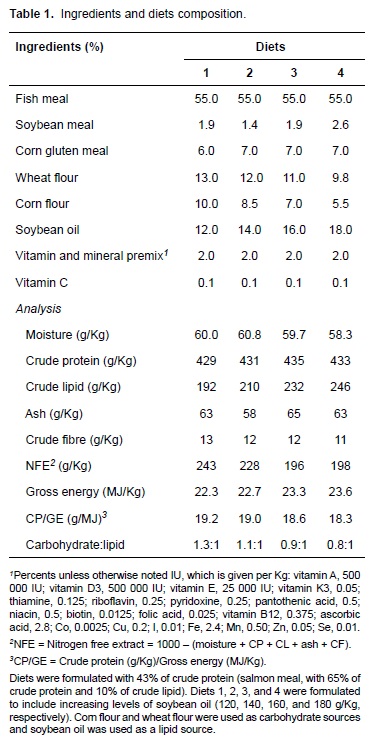
<body><![CDATA[<p>This study is in agreement with the ethics   principles in animal experimentation, adopted by   the Animal Experimentation Ethics Committee of   Universidade Federal de Lavras, Brasil (Protocol 028/12 of September 6, 2012).</p>     <p><i>Experimental diets</i></p>     <p>Four test diets were formulated with approximately   43% crude protein (salmon meal, with 65% crude   protein and 10% crude lipid). Diets (1, 2, 3 and 4)   were formulated to include four different soybean   oil levels, respectively (120, 140, 160 and 180 g/Kg) as described in <a href="#t1">Table 1</a>. Corn flour and wheat flour were used as carbohydrate sources and soybean oil was used as the source of lipids. The dry ingredients were mixed and distilled water was added until adequate consistency was obtained. The dry ingredients were thoroughly mixed and the oil was added later and mixed until a homogenous mixture was obtained. Then, half of the mixture was cold-pelleted to appropriate sizes. Prepared pellets, through a 2 mm dice were air-dried for 24 h and then oven-dried at 58 &deg;C for other 48 h. All diets were then stored at -5 &deg;C.</p>      <p align="center"><a name="t1"><img src="/img/revistas/rccp/v29n1/v29n1a08t1.jpg"></a></p>     <p>&nbsp;</p>     <p><i>Fish and feeding trial</i></p>     <p>Seventy-two fish (mean weight 18 &plusmn; 1.5 g,   and 30 days old) were used. Fish were randomly   distributed in 12 tanks (150 L) at a stocking density   of 6 fish per tank (triplicate groups of 6 fish). At the   start of the trial 15 fish from the stock population were   sampled, pooled and frozen for subsequent wholebody composition analysis (see analytical methods).</p>     <p>The fish were previously adapted to be fed   during the light period. Fish in each tank were   weighed every 15 days, the average weight gain   per aquarium was calculated and food availability   was recalculated at a fixed rate of 5% body weight   of dry feed per day. The trial lasted 60 days and   during that period fish were fed twice a day (08:00   and 17:00 h). Protein intake (%) was calculated   during the trial. Fish were sampled every 15 days   for weight gain during the trial. The presence of   uneaten food pellets was checked every day and real   feed intake was calculated by difference. Protein   intake was also calculated. The water temperature   was maintained between 25 and 26 &deg;C. The oxygen   level was above 6.5 mg/L, pH: 7.3, the water exchange rate 100% per hour in closed circuit.</p>     <p>At the end of the experiment the fish were starved   for 24 h. Then, fish were anaesthetized with clove oil   (100 mg/L), individually weighed and frozen until   analysis. Viscera was removed from each fish and   weighed. Fish whole-body and liver was stored in a freezer at -5 &deg;C for subsequent analysis.</p>     <p>Body composition as moisture, protein, lipid, ash,   and body weight was measured to compare growth   performance. The measured traits were final weight   (g), viscera somatic index (VSI, %), hepatosomatic   index (HSI, %), daily feed consumption (DFC,   g/Kg), absolute weight gain (AWG, g per fish), lipid   efficiency retention (LER %), protein efficiency   retention (PER%), energy efficiency retention   (EER %), and protein gain (PG). These parameters were calculated as described by Martino <i>et al.</i> 2005.</p>      ]]></body>
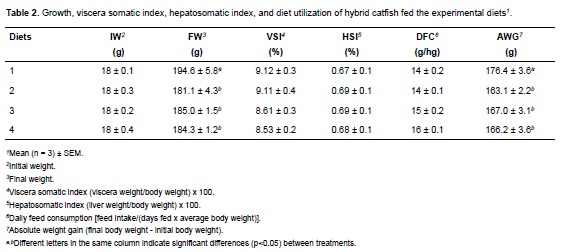
<body><![CDATA[<p>&nbsp;</p>     <p>&nbsp;</p>     <p><i>Analytical methods</i></p>     <p>Moisture, crude protein, lipid, and ash of raw   ingredients, experimental diet, and fish composition were determined by standard methods of the   Association of Official Analytical Chemists (AOAC,   1990). Gross energy was determined by adiabatic calorimetry (NRC, 2011).</p>     <p><i>Data Analysis</i></p>     <p>Data on proximate analysis and body indices were   analyzed using the Statistical Package for the Social   Sciences SPSS software (version 11.5, USA). Data   were expressed as mean &plusmn; SEM. One-way ANOVA   was used, followed by a Duncan Test for <i>post hoc</i> analysis. P-value was fixed at 0.05.</p>     <p>&nbsp;</p>     <p><b><font size="3">Results</font></b></p>     <p>Final weight (FW) and absolute weight gain   (AWG) were increased in fish fed diet 1 (ratio 1.3:1   CHO:L, p&lt;0.05) (<a href="#t2">Table 2</a>). No differences (p&gt;0.05)   were observed in HSI or VSI among groups. No   significant difference for DFC was found during   the 8 weeks of experimentation, but there existed   a tendency of reduced feed intake with increasing dietary lipid levels. Survival was 100% in all groups.</p>     <p align="center"><a name="t2"><img src="/img/revistas/rccp/v29n1/v29n1a08t2.jpg"></a></p>     ]]></body>
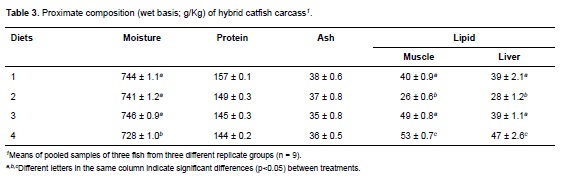
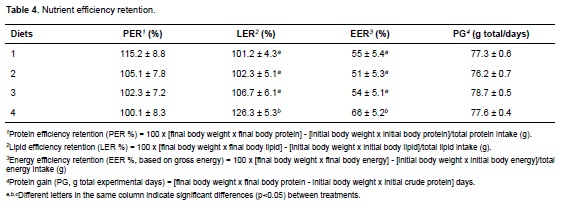
<body><![CDATA[<p>&nbsp;</p>     <p>No differences were observed in the protein   content of fish fed the different CHO:L ratios (<a href="#t3">Table   3</a>). However, lipid contents of muscle and liver were   significantly increased and moisture decreased only   for fish fed 0.8:1 (CHO:L) ratio (p&lt;0.05). Moreover,   fish fed the 1.1:1 (CHO:L) diet had the least lipid   content in muscle and liver (p&lt;0.05). Whole-body ash content was unaffected by treatments (p&gt;0.05).</p>     <p align="center"><a name="t3"><img src="/img/revistas/rccp/v29n1/v29n1a08t3.jpg"></a></p>     <p>&nbsp;</p>     <p>No significant differences for PER and PG were   found (<a href="#t4">Table 4</a>). On the other hand, fish fed the 0.8:1   (CHO:L) diet had the highest LER (126.3 &plusmn; 5.3%,   p&lt;0.05), and the highest EER (66 &plusmn; 5.2%, p&lt;0.05) compared to fish fed the other diets.</p>     <p align="center"><a name="t4"><img src="/img/revistas/rccp/v29n1/v29n1a08t4.jpg"></a></p>     <p>&nbsp;</p>     <p><font size="3"><b>Discussion</b></font></p>     <p>Hybrid catfish (<i>P. reticulatum </i>x<i> L. marmoratus</i>)   has a tendency to omnivory and it is capable to   readily utilize carbohydrate-rich diets. This study   demonstrates that carbohydrates could replace lipids   as an energy source in the diet of hybrid catfish improving growth performance. Overall, the best results were obtained with the CHO:L ratio of 1.3:1, corresponding to a CP/GE ratio of 19.2 g/MJ.</p>     <p>It is well known by Brazil fish farmers that hybrid   catfish (<i>P. reticulatum </i>x<i> L. marmoratus</i>) can be fed   on high carbohydrate-containing feeds in intensive   culture. The overall growth performance (FW and   AWG) of juvenile hybrids fed diets containing 230 g   carbohydrate/Kg diet was higher compared with other Brazilian catfish species (<i>Pseudoplatystoma coruscans</i>; Martino <i><i>et al.</i>,</i> 2005). The maximum growth at 230 g carbohydrate/Kg diet are in agreement with the 23% requirement for other catfish species such as the Chinese longsnout (<i>Leiocassis longirostris</i>; Tan <i><i>et al.</i>,</i> 2007). Other researchers found that Chinese longsnout catfish achieves the best growth with 1.63:1 CHO:L ratio (Pei <i><i>et al.</i>,</i> 2004), close to the results of the present study. Diets higher to 12% lipid inclusion for common sole (<i>Selea solea</i>) juveniles not only led to a substantial decline in performance but also affected gut health (Bonvini <i><i>et al.</i>,</i> 2015). In omnivorous warm-water fish such as channel catfish (<i>Ictalurus punctatus</i>), common carp (<i>Cyprinus carpio</i>) and tilapia (<i>Oreochromis niloticus</i>), dietary carbohydrates, mainly starch, constitute the main non-protein energy source (Wilson, 1994; V&aacute;squez-Torres and Arias- Castellanos, 2012). Since the diet of parental catfish (<i>Leiarius marmoratus</i>) in its natural environment consists mostly of low-energy plants (Marciales-Caro <i><i>et al.</i>,</i> 2011), the relative low capacity to utilize dietary lipids in the studied hybrid model is conceivable.</p>     ]]></body>
<body><![CDATA[<p>As with other animals, fish control feed intake to   meet their energy requirements (Fortes-Silva <i><i>et al.</i>,</i>   2011; Fortes-Silva and S&aacute;nchez-V&aacute;zquez, 2012).   According to Santinha <i>et al.</i> (1999) an increase in   dietary lipid content leads to a significant decrease   in feed intake. However, in the present study no   significant difference (p&gt;0.05) in food intake was   observed. As mentioned above, there existed a   tendency of reduced feed intake with decreasing   CHO:L ratios. Because of that, DFC was the same   for all treatments. According to Peres and Oliva-Teles   (1999), feed intake for a 24% lipid diet seemed to be   regulated by protein rather than by energy intake in the European sea bass (<i>Dicentrarchus labrax</i>).</p>     <p>Some studies have demonstrated that liver   enlargement occurs with carbohydrate increase in the   diet as a consequence of glycogen accumulation (Kim   and Kaushik, 1992; Hemre <i><i>et al.</i>,</i> 2002). Wang <i>et al.</i>   (2014) studied the effects of dietary CHO:L ratios on   liver histology of juvenile yellow catfish. Results of   this study demonstrate that high dietary lipid levels   can significantly impair liver function and high dietary   carbohydrates can induce hypertrophy of the hepatic   cells. In our study, both VSI and HSI and lipid liver   content were not affected by the CHO:L ratio. Similar results were reported in ''cachara'' catfish for VSI and HSI (Martino <i><i>et al.</i>,</i> 2005) and piracanjuba (<i>Brycon orbignyanus</i>) (Borba <i><i>et al.</i>,</i> 2006). Senegalese sole (<i>Solea senegalensis</i>) fed diets with 4 and 17% lipids did not affect HSI levels (Borges <i><i>et al.</i>,</i> 2013). Borges <i>et al.</i> (2009) reported increased VSI in Senegalese sole fed diets with lipid content above 16%. In the present study, fish fed 1.1:1 CHO:L ratio significantly decreased lipid content in liver and body.</p>     <p>The significant decrease in body water and lipid   content of fish fed 0.8:1 CHO:L ratio in the present   study suggests that excessive dietary lipids are stored   as body lipids. Similar results have also been reported   in hybrid striped bass (Nematipour <i><i>et al.</i>,</i> 1992).   Moreover, protein efficiency retention (PER) and   protein gain (PG) were not correlated with dietary   carbohydrate/lipid ratio. However, the highest lipid   efficiency ratio (LER) and energy efficiency retention   (EER) were observed for 0.8:1 CHO:L ratio, or   246 g/Kg of lipid, indicating that high levels of this   nutrient increased lipid deposition in carcass. On   the other hand, previous research in southern catfish   (<i>Silurus meridionalis</i>) showed the best PER when carbohydrate was increased (Fu, 2005).</p>     <p>According to this author, dietary starch has a   protein-sparing effect in carnivorous southern catfish.   According to Li <i>et al.</i> (2013), fingerling blunt snout   bream (<i>Megalobrama amblycephala</i>) has a better   ability to utilize dietary lipids than carbohydrates and   also shows a protein-sparing effect of dietary lipid.   However, excessive dietary lipids may cause lipid   deposition both in muscle and visceral adipose tissue,   but not in the liver. Apparently, the carbohydrate/lipid   ratios used in this study were not enough to induce   differences in body protein deposition. However,   considering LER and EER, these results are consistent   with hybrid tilapia fed diets with lipid levels similar   to those used in this work (Fitzsimmons <i><i>et al.</i>,</i> 1998)   and gilthead seabream m (<i>Sparus aurata</i>) fed levels   between 150 and 209 g/Kg (Santinha <i><i>et al.</i>,</i> 1999).   Usually, when diets contain high levels of these   compounds, a fraction of them is deposited as fat   in the abdominal cavity and carcass (Hemre and   Sandnes, 1999). This fact has been demonstrated by   studies employing isocaloric diets, where increasing   carbohydrate concentrations in detriment of lipids   resulted in lower fat deposition in hybrid tilapia (<i>Oreochromis niloticus </i>x<i> Oreochromis aureus</i>; Chou and Shiau, 1996) and other species (Erfanullah, 1998; Nankervis <i><i>et al.</i>,</i> 2000).</p>     <p>According to Gao <i>et al.</i> (2010), utilization of   dietary lipids and carbohydrates was comparatively   moderate in grass carp (<i>Ctenorpharyngodon idella</i>),   but the fish were a little more capable of utilizing lipids compared with high carbohydrate intake.</p>     <p>In conclusion, growth, body composition and   nutrient utilization by this hybrid are greatly affected   by dietary non-protein energy sources. This hybrid has   a great capacity to utilize dietary carbohydrates. The   best growth performance and the best use of nutrients corresponded to fish fed 1.3:1 CHO:L ratio.</p>     <p>&nbsp;</p>     <p><b><font size="3">Acknowledgements</font></b></p>     <p>Thanks to the Grupo &Aacute;guas Claras-Colpani<sup>&reg;</sup> for kindly providing the animals used in this study.</p>     <p align="left">&nbsp;</p>     ]]></body>
<body><![CDATA[<p align="left"><b><font size="3">Conflicts of interest</font></b></p>     <p align="left">The authors declare they have no conflicts of interest with regard to the work presented in this report.</p>     <p align="left">&nbsp;</p> <hr size="1" />     <p><b><font size="3">Notes</font></b></p>     <p><b><a name="a0" id="a0"><a href="#a1">&curren;</a></a></b>To cite this article: Bernardes CL, Navarro RD, Guerra-Santos B, Fortes-Silva R. Effects of dietary carbohydrate/lipid ratios on growth, body composition and nutrient utilization of hybrid catfish (<i>Pseudoplatystoma reticulatum</i> x <i>Leiarius marmoratus</i>). Rev Colomb Cienc Pecu 2016; 29:58-65.</p> <hr size="1" />     <p>&nbsp;</p>     <p><b><font size="3">References</font></b></p>     <!-- ref --><p>Abimorad AG, Carneiro DJ, Urbinati EC. Growth and metabolism   of pacu (<i>Piaractus mesopotamicus</i> Holmberg 1887) juveniles fed   diets containing different protein, lipid and carbohydrate levels.   Aquac Res 2007; 38:36-44.    &nbsp;&nbsp;&nbsp;&nbsp;&nbsp;&nbsp;&nbsp;&nbsp;[&#160;<a href="javascript:void(0);" onclick="javascript: window.open('/scielo.php?script=sci_nlinks&ref=2497639&pid=S0120-0690201600010000800001&lng=','','width=640,height=500,resizable=yes,scrollbars=1,menubar=yes,');">Links</a>&#160;]<!-- end-ref --> </p>     <!-- ref --><p>AOAC, Association of Official Analytical Chemists. Official   Methods of Analysis. Washington DC: USA. 1990.    &nbsp;&nbsp;&nbsp;&nbsp;&nbsp;&nbsp;&nbsp;&nbsp;[&#160;<a href="javascript:void(0);" onclick="javascript: window.open('/scielo.php?script=sci_nlinks&ref=2497641&pid=S0120-0690201600010000800002&lng=','','width=640,height=500,resizable=yes,scrollbars=1,menubar=yes,');">Links</a>&#160;]<!-- end-ref --> </p>     <!-- ref --><p>Bonvini E, Parma L, Mandrioli L, Sirri, Brachelente C, Mongile   F, Gatta PP, Bonaldo A. Feeding common sole (<i>Solea solea</i>)   juveniles with increasing dietary lipid levels affects growth,   feed utilization and gut health. Aquaculture 2015; [Access   date: March 10, 2015] URL: <a href="http://www.dx.doi.org/10.1016/j.aquaculture.2015.01.013 " target="_blank">http://www.dx.doi.org/10.1016/j.   aquaculture.2015.01.013   </a>&nbsp;&nbsp;&nbsp;&nbsp;&nbsp;&nbsp;&nbsp;&nbsp;[&#160;<a href="javascript:void(0);" onclick="javascript: window.open('/scielo.php?script=sci_nlinks&ref=2497643&pid=S0120-0690201600010000800003&lng=','','width=640,height=500,resizable=yes,scrollbars=1,menubar=yes,');">Links</a>&#160;]<!-- end-ref --><!-- ref --><p>Borba MR, Fracalossi DM, Pezzato LE. Dietary energy   requirement of piracanjuba fingerlings, <i>Brycon orbignyanus</i>,   and relative utilization of dietary carbohydrate and lipid. Aquac   Nutr 2006; 12:183-91.    &nbsp;&nbsp;&nbsp;&nbsp;&nbsp;&nbsp;&nbsp;&nbsp;[&#160;<a href="javascript:void(0);" onclick="javascript: window.open('/scielo.php?script=sci_nlinks&ref=2497644&pid=S0120-0690201600010000800004&lng=','','width=640,height=500,resizable=yes,scrollbars=1,menubar=yes,');">Links</a>&#160;]<!-- end-ref --> </p>     <!-- ref --><p>Borges P, Medale F, Dias J, Valente LMP. Protein utilization and   intermediary metabolism of Senegalese sole (<i>Solea senegalensis</i>) as a function of protein:lipid ratio. Br J Nutr 2013; 109:1373-81.    &nbsp;&nbsp;&nbsp;&nbsp;&nbsp;&nbsp;&nbsp;&nbsp;[&#160;<a href="javascript:void(0);" onclick="javascript: window.open('/scielo.php?script=sci_nlinks&ref=2497646&pid=S0120-0690201600010000800005&lng=','','width=640,height=500,resizable=yes,scrollbars=1,menubar=yes,');">Links</a>&#160;]<!-- end-ref --></p>     <!-- ref --><p>Borges P, Oliveira B, Casal S, Dias J, Concei&ccedil;&atilde;o L, Valente   LMP. Dietary lipid level affects growth performance and nutrient   utilization of Senegalese sole (<i>Solea senegalensis</i>) juveniles. Br   J Nutr 2009; 102:1007-14 &nbsp;&nbsp;&nbsp;&nbsp;&nbsp;&nbsp;&nbsp;&nbsp;[&#160;<a href="javascript:void(0);" onclick="javascript: window.open('/scielo.php?script=sci_nlinks&ref=2497648&pid=S0120-0690201600010000800006&lng=','','width=640,height=500,resizable=yes,scrollbars=1,menubar=yes,');">Links</a>&#160;]<!-- end-ref --><!-- ref --><p>Chou BS, Shiau SY. Optimal dietary lipid level for growth of   juvenile hybrid tilapia, <i>Oreochromis niloticus </i>x<i> Oreochromis   aureus</i>. Aquaculture 1996; 143:185-95.    &nbsp;&nbsp;&nbsp;&nbsp;&nbsp;&nbsp;&nbsp;&nbsp;[&#160;<a href="javascript:void(0);" onclick="javascript: window.open('/scielo.php?script=sci_nlinks&ref=2497649&pid=S0120-0690201600010000800007&lng=','','width=640,height=500,resizable=yes,scrollbars=1,menubar=yes,');">Links</a>&#160;]<!-- end-ref --> </p>     <!-- ref --><p>Dunham RA, Brummett RE, Ella MO, Smitherman RO.   Genotype-environment interactions for growth of blue, channel   and hybrid catfish in ponds and cages at varying &nbsp;&nbsp;&nbsp;&nbsp;&nbsp;&nbsp;&nbsp;&nbsp;[&#160;<a href="javascript:void(0);" onclick="javascript: window.open('/scielo.php?script=sci_nlinks&ref=2497651&pid=S0120-0690201600010000800008&lng=','','width=640,height=500,resizable=yes,scrollbars=1,menubar=yes,');">Links</a>&#160;]<!-- end-ref --><!-- ref --><p>Erfanullah AKJ. Effect of dietary carbohydrate-to-lipid ratio   on growth and body composition of walking catfish (<i>Clarias   batrachus</i>). Aquaculture 1998; 161:159-68.    &nbsp;&nbsp;&nbsp;&nbsp;&nbsp;&nbsp;&nbsp;&nbsp;[&#160;<a href="javascript:void(0);" onclick="javascript: window.open('/scielo.php?script=sci_nlinks&ref=2497652&pid=S0120-0690201600010000800009&lng=','','width=640,height=500,resizable=yes,scrollbars=1,menubar=yes,');">Links</a>&#160;]<!-- end-ref --> </p>     <!-- ref --><p>Fitzsimmons K, Dickenson G, Brand C. Effects of reducing   dietary lipid levels on growth and body composition of hybrid   Tilapia in an intensive recirculating-water system. Prog Fish Cult   1998; 59:393-16.    &nbsp;&nbsp;&nbsp;&nbsp;&nbsp;&nbsp;&nbsp;&nbsp;[&#160;<a href="javascript:void(0);" onclick="javascript: window.open('/scielo.php?script=sci_nlinks&ref=2497654&pid=S0120-0690201600010000800010&lng=','','width=640,height=500,resizable=yes,scrollbars=1,menubar=yes,');">Links</a>&#160;]<!-- end-ref --> </p>     <!-- ref --><p>Fortes Silva R, Mart&iacute;nez FJ, S&aacute;nchez V&aacute;zquez FJ. Macronutrient   selection in Nile tilapia fed gelatin capsules and challenged with   protein dilution/restriction. Physiol Behav 2011; 102:356-60.    &nbsp;&nbsp;&nbsp;&nbsp;&nbsp;&nbsp;&nbsp;&nbsp;[&#160;<a href="javascript:void(0);" onclick="javascript: window.open('/scielo.php?script=sci_nlinks&ref=2497656&pid=S0120-0690201600010000800011&lng=','','width=640,height=500,resizable=yes,scrollbars=1,menubar=yes,');">Links</a>&#160;]<!-- end-ref --> </p>     <!-- ref --><p>Fortes Silva R, S&aacute;nchez V&aacute;zquez FJ. Use of self-feeders to   evaluate macronutrient self-selection and energy intake regulation   in Nile til&aacute;pia. Aquaculture 2012; 326:168-72.    &nbsp;&nbsp;&nbsp;&nbsp;&nbsp;&nbsp;&nbsp;&nbsp;[&#160;<a href="javascript:void(0);" onclick="javascript: window.open('/scielo.php?script=sci_nlinks&ref=2497658&pid=S0120-0690201600010000800012&lng=','','width=640,height=500,resizable=yes,scrollbars=1,menubar=yes,');">Links</a>&#160;]<!-- end-ref --> </p>     <!-- ref --><p>Fu SJ. The growth performance of southern catfish fed diets with   raw, precooked cornstarch and glucose at two levels. Aquac Nutr   2005; 11:257-61.    &nbsp;&nbsp;&nbsp;&nbsp;&nbsp;&nbsp;&nbsp;&nbsp;[&#160;<a href="javascript:void(0);" onclick="javascript: window.open('/scielo.php?script=sci_nlinks&ref=2497660&pid=S0120-0690201600010000800013&lng=','','width=640,height=500,resizable=yes,scrollbars=1,menubar=yes,');">Links</a>&#160;]<!-- end-ref --> </p>     ]]></body>
<body><![CDATA[<!-- ref --><p>Gao W, Liu JY, Tian LX, Mai KS, Liang GY, Yang HJ, Huai   MH. Effect of dietary carbohydrate &#8211; to - lipid rations on growth   performance, body composition nutrient utilization and hepatic   enzymes activities of herbivorous grass carp (<i>Ctenorpharyngodon   idella</i>). Aquac Nutr 2010; 16:327-33.    &nbsp;&nbsp;&nbsp;&nbsp;&nbsp;&nbsp;&nbsp;&nbsp;[&#160;<a href="javascript:void(0);" onclick="javascript: window.open('/scielo.php?script=sci_nlinks&ref=2497662&pid=S0120-0690201600010000800014&lng=','','width=640,height=500,resizable=yes,scrollbars=1,menubar=yes,');">Links</a>&#160;]<!-- end-ref --> </p>     <!-- ref --><p>Hemre G, Mommsen TP, Krogdahl A. Carbohydrate in fish   nutrition: effects on growth, glucose metabolism and hepatic   enzymes. Aquac Nutr 2002; 8:175-94.    &nbsp;&nbsp;&nbsp;&nbsp;&nbsp;&nbsp;&nbsp;&nbsp;[&#160;<a href="javascript:void(0);" onclick="javascript: window.open('/scielo.php?script=sci_nlinks&ref=2497664&pid=S0120-0690201600010000800015&lng=','','width=640,height=500,resizable=yes,scrollbars=1,menubar=yes,');">Links</a>&#160;]<!-- end-ref --> </p>     <!-- ref --><p>Hemre GI, Sandnes K. Effect of dietary lipid level on muscle   composition in Atlantic salmon <i>Salmo salar</i>. Aquac Nutr 1999;   5:9-16.    &nbsp;&nbsp;&nbsp;&nbsp;&nbsp;&nbsp;&nbsp;&nbsp;[&#160;<a href="javascript:void(0);" onclick="javascript: window.open('/scielo.php?script=sci_nlinks&ref=2497666&pid=S0120-0690201600010000800016&lng=','','width=640,height=500,resizable=yes,scrollbars=1,menubar=yes,');">Links</a>&#160;]<!-- end-ref --> </p>     <!-- ref --><p>Kim JD, Kaushik SJ. Contribution of digestible energy from   carbohydrates and estimation of protein/energy requirements for   growth of rainbow trout (<i>Oncorhynchus mykiss</i>). Aquaculture   1992; 106:161-9.    &nbsp;&nbsp;&nbsp;&nbsp;&nbsp;&nbsp;&nbsp;&nbsp;[&#160;<a href="javascript:void(0);" onclick="javascript: window.open('/scielo.php?script=sci_nlinks&ref=2497668&pid=S0120-0690201600010000800017&lng=','','width=640,height=500,resizable=yes,scrollbars=1,menubar=yes,');">Links</a>&#160;]<!-- end-ref --> </p>     <!-- ref --><p>Li XF, Wang WB, Liu GZ, Jiang YY, Zhu J. Effects of dietary   carbohydrate/lipid rations on growth performance, body   composition and glucose metabolism of fingering blut snout   bream <i>Megalobrama amblycephala</i>. Aquac Nutr 2013; 19:701-8.    &nbsp;&nbsp;&nbsp;&nbsp;&nbsp;&nbsp;&nbsp;&nbsp;[&#160;<a href="javascript:void(0);" onclick="javascript: window.open('/scielo.php?script=sci_nlinks&ref=2497670&pid=S0120-0690201600010000800018&lng=','','width=640,height=500,resizable=yes,scrollbars=1,menubar=yes,');">Links</a>&#160;]<!-- end-ref --> </p>     ]]></body>
<body><![CDATA[<!-- ref --><p>Marciales Caro LJ, Cruz Casallas NE, D&iacute;az Olarte JJ, Medina   Robles VM, Cruz Casallas PE. Adaptation to a commercial diet   alters post-larvae growth and development of striped catfish   (<i>Pseudoplatystoma sp</i>) and yaque (<i>Leiarius marmoratus</i>). Rev Colomb Cienc Pecu 2011; 24:179-90.    &nbsp;&nbsp;&nbsp;&nbsp;&nbsp;&nbsp;&nbsp;&nbsp;[&#160;<a href="javascript:void(0);" onclick="javascript: window.open('/scielo.php?script=sci_nlinks&ref=2497672&pid=S0120-0690201600010000800019&lng=','','width=640,height=500,resizable=yes,scrollbars=1,menubar=yes,');">Links</a>&#160;]<!-- end-ref --></p>     <!-- ref --><p>Martino RC, Cyrino JEP, Portz L, Trugo LC. Performance, carcass   composition and nutrient utilization of surubim <i>Pseudoplatystoma   coruscans</i> (Agassiz) fed diets with varying carbohydrate and lipid   levels. Aquac Nutr 2005; 11:131-7.    &nbsp;&nbsp;&nbsp;&nbsp;&nbsp;&nbsp;&nbsp;&nbsp;[&#160;<a href="javascript:void(0);" onclick="javascript: window.open('/scielo.php?script=sci_nlinks&ref=2497674&pid=S0120-0690201600010000800020&lng=','','width=640,height=500,resizable=yes,scrollbars=1,menubar=yes,');">Links</a>&#160;]<!-- end-ref --> </p>     <!-- ref --><p>Nankervis L, Matthews SJ, Appleford P. Effect of dietary nonprotein   energy source on growth, nutrient retention and circulating   insulin-like growth factor I and triiodothyronine levels in juvenile   barramundi, <i>Lates calcarifer</i>. Aquaculture 2000; 191:323-35.    &nbsp;&nbsp;&nbsp;&nbsp;&nbsp;&nbsp;&nbsp;&nbsp;[&#160;<a href="javascript:void(0);" onclick="javascript: window.open('/scielo.php?script=sci_nlinks&ref=2497676&pid=S0120-0690201600010000800021&lng=','','width=640,height=500,resizable=yes,scrollbars=1,menubar=yes,');">Links</a>&#160;]<!-- end-ref --> </p>     <!-- ref --><p>Nematipour GR, Brown ML, Gatlin DM. Effect of dietary   carbohydrate:lipid ratio on growth and body composition of   hybrid striped bass. J World Aquac Soc 1992; 23: 128-32.    &nbsp;&nbsp;&nbsp;&nbsp;&nbsp;&nbsp;&nbsp;&nbsp;[&#160;<a href="javascript:void(0);" onclick="javascript: window.open('/scielo.php?script=sci_nlinks&ref=2497678&pid=S0120-0690201600010000800022&lng=','','width=640,height=500,resizable=yes,scrollbars=1,menubar=yes,');">Links</a>&#160;]<!-- end-ref --> </p>     <!-- ref --><p>NRC, National Research Council. Nutrients Requirements of   Fish. Washington, DC. 2011.    &nbsp;&nbsp;&nbsp;&nbsp;&nbsp;&nbsp;&nbsp;&nbsp;[&#160;<a href="javascript:void(0);" onclick="javascript: window.open('/scielo.php?script=sci_nlinks&ref=2497680&pid=S0120-0690201600010000800023&lng=','','width=640,height=500,resizable=yes,scrollbars=1,menubar=yes,');">Links</a>&#160;]<!-- end-ref --> </p>     ]]></body>
<body><![CDATA[<!-- ref --><p>Pei Z, Xie S, Lei W, Zhu X, Yang Y. Comparative study on the   effect of dietary lipid level on growth and feed utilization for gibel   carp (<i>Carassius auratus</i> gibelio) and Chinese longsnout catfish   (<i>Leiocassis longirostris</i> Gunther). Aquac Nutr 2004; 10:209-16.    &nbsp;&nbsp;&nbsp;&nbsp;&nbsp;&nbsp;&nbsp;&nbsp;[&#160;<a href="javascript:void(0);" onclick="javascript: window.open('/scielo.php?script=sci_nlinks&ref=2497682&pid=S0120-0690201600010000800024&lng=','','width=640,height=500,resizable=yes,scrollbars=1,menubar=yes,');">Links</a>&#160;]<!-- end-ref --> </p>     <!-- ref --><p>Peres H, Oliva-Teles A. Effect of dietary lipid level on growth   performance and feed utilization by European sea bass juveniles (<i>Dicentrarchus labrax</i>). Aquaculture 1999; 179: 325-34.    &nbsp;&nbsp;&nbsp;&nbsp;&nbsp;&nbsp;&nbsp;&nbsp;[&#160;<a href="javascript:void(0);" onclick="javascript: window.open('/scielo.php?script=sci_nlinks&ref=2497684&pid=S0120-0690201600010000800025&lng=','','width=640,height=500,resizable=yes,scrollbars=1,menubar=yes,');">Links</a>&#160;]<!-- end-ref --></p>     <!-- ref --><p>Santinha PJM, Medale F, Corraze G, Gomes EFS. Effects of the   dietary protein:lipid ratio on growth and nutrient utilization in   gilthead seabream (<i>Sparus aurata</i> L.). Aquac Nutr 1999; 5:147-56.    &nbsp;&nbsp;&nbsp;&nbsp;&nbsp;&nbsp;&nbsp;&nbsp;[&#160;<a href="javascript:void(0);" onclick="javascript: window.open('/scielo.php?script=sci_nlinks&ref=2497686&pid=S0120-0690201600010000800026&lng=','','width=640,height=500,resizable=yes,scrollbars=1,menubar=yes,');">Links</a>&#160;]<!-- end-ref --> </p>     <!-- ref --><p>SPSS (Statistical Package for the Social Sciences) for Windows   [software]. Release 11.5. Chicago; 2002.    &nbsp;&nbsp;&nbsp;&nbsp;&nbsp;&nbsp;&nbsp;&nbsp;[&#160;<a href="javascript:void(0);" onclick="javascript: window.open('/scielo.php?script=sci_nlinks&ref=2497688&pid=S0120-0690201600010000800027&lng=','','width=640,height=500,resizable=yes,scrollbars=1,menubar=yes,');">Links</a>&#160;]<!-- end-ref --> </p>     <!-- ref --><p>Tan Q, Xie S, Zhu X, Lei W, Yang Y. Effect of dietary   carbohydrate-to-lipid ratios on growth and feed utilization in   Chinese longsnout catfish (<i>Leiocassis longirostris</i> Gunther). J   Appl Ichthyol 2007; 23:605-10.    &nbsp;&nbsp;&nbsp;&nbsp;&nbsp;&nbsp;&nbsp;&nbsp;[&#160;<a href="javascript:void(0);" onclick="javascript: window.open('/scielo.php?script=sci_nlinks&ref=2497690&pid=S0120-0690201600010000800028&lng=','','width=640,height=500,resizable=yes,scrollbars=1,menubar=yes,');">Links</a>&#160;]<!-- end-ref --> </p>     ]]></body>
<body><![CDATA[<!-- ref --><p>V&aacute;squez Torres W, Arias Castellanos JA. Effect of dietary   carbohydrates and lipids on growth in cachama (<i>Piaractus   brachypomus</i>). Aquac Res 2012; 1-9.    &nbsp;&nbsp;&nbsp;&nbsp;&nbsp;&nbsp;&nbsp;&nbsp;[&#160;<a href="javascript:void(0);" onclick="javascript: window.open('/scielo.php?script=sci_nlinks&ref=2497692&pid=S0120-0690201600010000800029&lng=','','width=640,height=500,resizable=yes,scrollbars=1,menubar=yes,');">Links</a>&#160;]<!-- end-ref --> </p>     <!-- ref --><p>Wang LN, Liu WB, Lu KL, Xu WN, Cai DS, Zhang CN, Qian   Y. Effects of dietary carbohydrate/lipid ratios on non-specific   immune responses, oxidative status and liver histology of   juvenile yellow catfish <i>Pelteobagrus fulvidraco</i>. Aquaculture   2014; 426:41-8.    &nbsp;&nbsp;&nbsp;&nbsp;&nbsp;&nbsp;&nbsp;&nbsp;[&#160;<a href="javascript:void(0);" onclick="javascript: window.open('/scielo.php?script=sci_nlinks&ref=2497694&pid=S0120-0690201600010000800030&lng=','','width=640,height=500,resizable=yes,scrollbars=1,menubar=yes,');">Links</a>&#160;]<!-- end-ref --> </p>     <!-- ref --><p>Wilson RP. Utilization of dietary carbohydrate by fish.   Aquaculture 1994; 124:67-80.    &nbsp;&nbsp;&nbsp;&nbsp;&nbsp;&nbsp;&nbsp;&nbsp;[&#160;<a href="javascript:void(0);" onclick="javascript: window.open('/scielo.php?script=sci_nlinks&ref=2497696&pid=S0120-0690201600010000800031&lng=','','width=640,height=500,resizable=yes,scrollbars=1,menubar=yes,');">Links</a>&#160;]<!-- end-ref --></p>     <p>&nbsp;</p>     <p>&nbsp;</p> </font>      ]]></body><back>
<ref-list>
<ref id="B1">
<nlm-citation citation-type="journal">
<person-group person-group-type="author">
<name>
<surname><![CDATA[Abimorad]]></surname>
<given-names><![CDATA[AG]]></given-names>
</name>
<name>
<surname><![CDATA[Carneiro]]></surname>
<given-names><![CDATA[DJ]]></given-names>
</name>
<name>
<surname><![CDATA[Urbinati]]></surname>
<given-names><![CDATA[EC]]></given-names>
</name>
</person-group>
<article-title xml:lang="en"><![CDATA[Growth and metabolism of pacu (Piaractus mesopotamicus Holmberg 1887) juveniles fed diets containing different protein, lipid and carbohydrate levels]]></article-title>
<source><![CDATA[Aquac Res]]></source>
<year>2007</year>
<volume>38</volume>
<page-range>36-44</page-range></nlm-citation>
</ref>
<ref id="B2">
<nlm-citation citation-type="">
<collab>AOAC, Association of Official Analytical Chemists</collab>
<source><![CDATA[Official Methods of Analysis]]></source>
<year>1990</year>
<publisher-loc><![CDATA[Washington DC ]]></publisher-loc>
</nlm-citation>
</ref>
<ref id="B3">
<nlm-citation citation-type="journal">
<person-group person-group-type="author">
<name>
<surname><![CDATA[Bonvini]]></surname>
<given-names><![CDATA[E]]></given-names>
</name>
<name>
<surname><![CDATA[Parma]]></surname>
<given-names><![CDATA[L]]></given-names>
</name>
<name>
<surname><![CDATA[Mandrioli]]></surname>
<given-names><![CDATA[L]]></given-names>
</name>
<name>
<surname><![CDATA[Sirri, Brachelente]]></surname>
<given-names><![CDATA[C]]></given-names>
</name>
<name>
<surname><![CDATA[Mongile]]></surname>
<given-names><![CDATA[F]]></given-names>
</name>
<name>
<surname><![CDATA[Gatta]]></surname>
<given-names><![CDATA[PP]]></given-names>
</name>
<name>
<surname><![CDATA[Bonaldo]]></surname>
<given-names><![CDATA[A]]></given-names>
</name>
</person-group>
<article-title xml:lang="en"><![CDATA[Feeding common sole (Solea solea) juveniles with increasing dietary lipid levels affects growth, feed utilization and gut health]]></article-title>
<source><![CDATA[Aquaculture]]></source>
<year>2015</year>
</nlm-citation>
</ref>
<ref id="B4">
<nlm-citation citation-type="journal">
<person-group person-group-type="author">
<name>
<surname><![CDATA[Borba]]></surname>
<given-names><![CDATA[MR]]></given-names>
</name>
<name>
<surname><![CDATA[Fracalossi]]></surname>
<given-names><![CDATA[DM]]></given-names>
</name>
<name>
<surname><![CDATA[Pezzato]]></surname>
<given-names><![CDATA[LE]]></given-names>
</name>
</person-group>
<source><![CDATA[Aquac Nutr]]></source>
<year>2006</year>
<volume>12</volume>
<page-range>183-91</page-range></nlm-citation>
</ref>
<ref id="B5">
<nlm-citation citation-type="journal">
<person-group person-group-type="author">
<name>
<surname><![CDATA[Borges]]></surname>
<given-names><![CDATA[P]]></given-names>
</name>
<name>
<surname><![CDATA[Medale]]></surname>
<given-names><![CDATA[F]]></given-names>
</name>
<name>
<surname><![CDATA[Dias]]></surname>
<given-names><![CDATA[J]]></given-names>
</name>
<name>
<surname><![CDATA[Valente]]></surname>
<given-names><![CDATA[LMP]]></given-names>
</name>
</person-group>
<article-title xml:lang="en"><![CDATA[Protein utilization and intermediary metabolism of Senegalese sole (Solea senegalensis) as a function of protein:lipid ratio]]></article-title>
<source><![CDATA[Br J Nutr]]></source>
<year>2013</year>
<volume>109</volume>
<page-range>1373-81</page-range></nlm-citation>
</ref>
<ref id="B6">
<nlm-citation citation-type="journal">
<person-group person-group-type="author">
<name>
<surname><![CDATA[Borges]]></surname>
<given-names><![CDATA[P]]></given-names>
</name>
<name>
<surname><![CDATA[Oliveira]]></surname>
<given-names><![CDATA[B]]></given-names>
</name>
<name>
<surname><![CDATA[Casal]]></surname>
<given-names><![CDATA[S]]></given-names>
</name>
<name>
<surname><![CDATA[Dias]]></surname>
<given-names><![CDATA[J]]></given-names>
</name>
<name>
<surname><![CDATA[Conceição]]></surname>
<given-names><![CDATA[L]]></given-names>
</name>
<name>
<surname><![CDATA[Valente]]></surname>
<given-names><![CDATA[LMP]]></given-names>
</name>
</person-group>
<article-title xml:lang="en"><![CDATA[Dietary lipid level affects growth performance and nutrient utilization of Senegalese sole (Solea senegalensis) juveniles]]></article-title>
<source><![CDATA[Br J Nutr]]></source>
<year>2009</year>
<volume>102</volume>
<page-range>1007-14</page-range></nlm-citation>
</ref>
<ref id="B7">
<nlm-citation citation-type="journal">
<person-group person-group-type="author">
<name>
<surname><![CDATA[Chou]]></surname>
<given-names><![CDATA[BS]]></given-names>
</name>
<name>
<surname><![CDATA[Shiau]]></surname>
<given-names><![CDATA[SY]]></given-names>
</name>
</person-group>
<article-title xml:lang="en"><![CDATA[Optimal dietary lipid level for growth of juvenile hybrid tilapia, Oreochromis niloticus x Oreochromis aureus]]></article-title>
<source><![CDATA[Aquaculture]]></source>
<year>1996</year>
<volume>143</volume>
<page-range>185-95</page-range></nlm-citation>
</ref>
<ref id="B8">
<nlm-citation citation-type="">
<person-group person-group-type="author">
<name>
<surname><![CDATA[Dunham]]></surname>
<given-names><![CDATA[RA]]></given-names>
</name>
<name>
<surname><![CDATA[Brummett]]></surname>
<given-names><![CDATA[RE]]></given-names>
</name>
<name>
<surname><![CDATA[Ella]]></surname>
<given-names><![CDATA[MO]]></given-names>
</name>
<name>
<surname><![CDATA[Smitherman]]></surname>
<given-names><![CDATA[RO]]></given-names>
</name>
</person-group>
<source><![CDATA[Genotype-environment interactions for growth of blue, channel and hybrid catfish in ponds and cages at varying]]></source>
<year></year>
</nlm-citation>
</ref>
<ref id="B9">
<nlm-citation citation-type="journal">
<person-group person-group-type="author">
<name>
<surname><![CDATA[Erfanullah]]></surname>
<given-names><![CDATA[AKJ]]></given-names>
</name>
</person-group>
<article-title xml:lang="en"><![CDATA[Effect of dietary carbohydrate-to-lipid ratio on growth and body composition of walking catfish (Clarias batrachus)]]></article-title>
<source><![CDATA[Aquaculture]]></source>
<year>1998</year>
<volume>161</volume>
<page-range>159-68</page-range></nlm-citation>
</ref>
<ref id="B10">
<nlm-citation citation-type="journal">
<person-group person-group-type="author">
<name>
<surname><![CDATA[Fitzsimmons]]></surname>
<given-names><![CDATA[K]]></given-names>
</name>
<name>
<surname><![CDATA[Dickenson]]></surname>
<given-names><![CDATA[G]]></given-names>
</name>
<name>
<surname><![CDATA[Brand]]></surname>
<given-names><![CDATA[C]]></given-names>
</name>
</person-group>
<article-title xml:lang="en"><![CDATA[Effects of reducing dietary lipid levels on growth and body composition of hybrid Tilapia in an intensive recirculating-water system]]></article-title>
<source><![CDATA[Prog Fish Cult]]></source>
<year>1998</year>
<volume>59</volume>
<page-range>393-16</page-range></nlm-citation>
</ref>
<ref id="B11">
<nlm-citation citation-type="journal">
<person-group person-group-type="author">
<name>
<surname><![CDATA[Fortes-Silva]]></surname>
<given-names><![CDATA[R]]></given-names>
</name>
<name>
<surname><![CDATA[Martínez]]></surname>
<given-names><![CDATA[FJ]]></given-names>
</name>
<name>
<surname><![CDATA[Sánchez-Vázquez]]></surname>
<given-names><![CDATA[FJ]]></given-names>
</name>
</person-group>
<article-title xml:lang="en"><![CDATA[Macronutrient selection in Nile tilapia fed gelatin capsules and challenged with protein dilution/restriction]]></article-title>
<source><![CDATA[Physiol Behav]]></source>
<year>2011</year>
<volume>102</volume>
<page-range>356-60</page-range></nlm-citation>
</ref>
<ref id="B12">
<nlm-citation citation-type="journal">
<person-group person-group-type="author">
<name>
<surname><![CDATA[Fortes-Silva]]></surname>
<given-names><![CDATA[R]]></given-names>
</name>
<name>
<surname><![CDATA[Sánchez-Vázquez]]></surname>
<given-names><![CDATA[FJ]]></given-names>
</name>
</person-group>
<article-title xml:lang="en"><![CDATA[Use of self-feeders to evaluate macronutrient self-selection and energy intake regulation in Nile tilápia]]></article-title>
<source><![CDATA[Aquaculture]]></source>
<year>2012</year>
<volume>326</volume>
<page-range>168-72</page-range></nlm-citation>
</ref>
<ref id="B13">
<nlm-citation citation-type="journal">
<person-group person-group-type="author">
<name>
<surname><![CDATA[Fu]]></surname>
<given-names><![CDATA[SJ]]></given-names>
</name>
</person-group>
<article-title xml:lang="en"><![CDATA[The growth performance of southern catfish fed diets with raw, precooked cornstarch and glucose at two levels]]></article-title>
<source><![CDATA[Aquac Nutr]]></source>
<year>2005</year>
<volume>11</volume>
<page-range>257-61</page-range></nlm-citation>
</ref>
<ref id="B14">
<nlm-citation citation-type="journal">
<person-group person-group-type="author">
<name>
<surname><![CDATA[Gao]]></surname>
<given-names><![CDATA[W]]></given-names>
</name>
<name>
<surname><![CDATA[Liu]]></surname>
<given-names><![CDATA[JY]]></given-names>
</name>
<name>
<surname><![CDATA[Tian]]></surname>
<given-names><![CDATA[LX]]></given-names>
</name>
<name>
<surname><![CDATA[Mai]]></surname>
<given-names><![CDATA[KS]]></given-names>
</name>
<name>
<surname><![CDATA[Liang]]></surname>
<given-names><![CDATA[GY]]></given-names>
</name>
<name>
<surname><![CDATA[Yang]]></surname>
<given-names><![CDATA[HJ]]></given-names>
</name>
<name>
<surname><![CDATA[Huai]]></surname>
<given-names><![CDATA[MH]]></given-names>
</name>
</person-group>
<article-title xml:lang="en"><![CDATA[Effect of dietary carbohydrate - to - lipid rations on growth performance, body composition nutrient utilization and hepatic enzymes activities of herbivorous grass carp (Ctenorpharyngodon idella)]]></article-title>
<source><![CDATA[Aquac Nutr]]></source>
<year>2010</year>
<volume>16</volume>
<page-range>327-33</page-range></nlm-citation>
</ref>
<ref id="B15">
<nlm-citation citation-type="journal">
<person-group person-group-type="author">
<name>
<surname><![CDATA[Hemre]]></surname>
<given-names><![CDATA[G]]></given-names>
</name>
<name>
<surname><![CDATA[Mommsen]]></surname>
<given-names><![CDATA[TP]]></given-names>
</name>
<name>
<surname><![CDATA[Krogdahl]]></surname>
<given-names><![CDATA[A]]></given-names>
</name>
</person-group>
<article-title xml:lang="en"><![CDATA[Carbohydrate in fish nutrition: effects on growth, glucose metabolism and hepatic enzymes]]></article-title>
<source><![CDATA[Aquac Nutr]]></source>
<year>2002</year>
<volume>8</volume>
<page-range>175-94</page-range></nlm-citation>
</ref>
<ref id="B16">
<nlm-citation citation-type="journal">
<person-group person-group-type="author">
<name>
<surname><![CDATA[Hemre]]></surname>
<given-names><![CDATA[GI]]></given-names>
</name>
<name>
<surname><![CDATA[Sandnes]]></surname>
<given-names><![CDATA[K]]></given-names>
</name>
</person-group>
<article-title xml:lang="en"><![CDATA[Effect of dietary lipid level on muscle composition in Atlantic salmon Salmo salar]]></article-title>
<source><![CDATA[Aquac Nutr]]></source>
<year>1999</year>
<volume>5</volume>
<page-range>9-16</page-range></nlm-citation>
</ref>
<ref id="B17">
<nlm-citation citation-type="journal">
<person-group person-group-type="author">
<name>
<surname><![CDATA[Kim]]></surname>
<given-names><![CDATA[JD]]></given-names>
</name>
<name>
<surname><![CDATA[Kaushik]]></surname>
<given-names><![CDATA[SJ]]></given-names>
</name>
</person-group>
<article-title xml:lang="en"><![CDATA[Contribution of digestible energy from carbohydrates and estimation of protein/energy requirements for growth of rainbow trout (Oncorhynchus mykiss)]]></article-title>
<source><![CDATA[Aquaculture]]></source>
<year>1992</year>
<volume>106</volume>
<page-range>161-9</page-range></nlm-citation>
</ref>
<ref id="B18">
<nlm-citation citation-type="journal">
<person-group person-group-type="author">
<name>
<surname><![CDATA[Li]]></surname>
<given-names><![CDATA[XF]]></given-names>
</name>
<name>
<surname><![CDATA[Wang]]></surname>
<given-names><![CDATA[WB]]></given-names>
</name>
<name>
<surname><![CDATA[Liu]]></surname>
<given-names><![CDATA[GZ]]></given-names>
</name>
<name>
<surname><![CDATA[Jiang]]></surname>
<given-names><![CDATA[YY]]></given-names>
</name>
<name>
<surname><![CDATA[Zhu]]></surname>
<given-names><![CDATA[J]]></given-names>
</name>
</person-group>
<article-title xml:lang="en"><![CDATA[Effects of dietary carbohydrate/lipid rations on growth performance, body composition and glucose metabolism of fingering blut snout bream Megalobrama amblycephala]]></article-title>
<source><![CDATA[Aquac Nutr]]></source>
<year>2013</year>
<volume>19</volume>
<page-range>701-8</page-range></nlm-citation>
</ref>
<ref id="B19">
<nlm-citation citation-type="journal">
<person-group person-group-type="author">
<name>
<surname><![CDATA[Marciales]]></surname>
<given-names><![CDATA[Caro LJ]]></given-names>
</name>
<name>
<surname><![CDATA[Cruz]]></surname>
<given-names><![CDATA[Casallas NE]]></given-names>
</name>
<name>
<surname><![CDATA[Díaz]]></surname>
<given-names><![CDATA[Olarte JJ]]></given-names>
</name>
<name>
<surname><![CDATA[Medina]]></surname>
<given-names><![CDATA[Robles VM]]></given-names>
</name>
<name>
<surname><![CDATA[Cruz]]></surname>
<given-names><![CDATA[Casallas PE]]></given-names>
</name>
</person-group>
<article-title xml:lang="en"><![CDATA[Adaptation to a commercial diet alters post-larvae growth and development of striped catfish (Pseudoplatystoma sp) and yaque (Leiarius marmoratus)]]></article-title>
<source><![CDATA[Rev Colomb Cienc Pecu]]></source>
<year>2011</year>
<volume>24</volume>
<page-range>179-90</page-range></nlm-citation>
</ref>
<ref id="B20">
<nlm-citation citation-type="journal">
<person-group person-group-type="author">
<name>
<surname><![CDATA[Martino]]></surname>
<given-names><![CDATA[RC]]></given-names>
</name>
<name>
<surname><![CDATA[Cyrino]]></surname>
<given-names><![CDATA[JEP]]></given-names>
</name>
<name>
<surname><![CDATA[Portz]]></surname>
<given-names><![CDATA[L]]></given-names>
</name>
<name>
<surname><![CDATA[Trugo]]></surname>
<given-names><![CDATA[LC]]></given-names>
</name>
</person-group>
<article-title xml:lang="en"><![CDATA[Performance, carcass composition and nutrient utilization of surubim Pseudoplatystoma coruscans (Agassiz) fed diets with varying carbohydrate and lipid levels]]></article-title>
<source><![CDATA[Aquac Nutr]]></source>
<year>2005</year>
<volume>11</volume>
<page-range>131-7</page-range></nlm-citation>
</ref>
<ref id="B21">
<nlm-citation citation-type="journal">
<person-group person-group-type="author">
<name>
<surname><![CDATA[Nankervis]]></surname>
<given-names><![CDATA[L]]></given-names>
</name>
<name>
<surname><![CDATA[Matthews]]></surname>
<given-names><![CDATA[SJ]]></given-names>
</name>
<name>
<surname><![CDATA[Appleford]]></surname>
<given-names><![CDATA[P]]></given-names>
</name>
</person-group>
<article-title xml:lang="en"><![CDATA[Effect of dietary nonprotein energy source on growth, nutrient retention and circulating insulin-like growth factor I and triiodothyronine levels in juvenile barramundi, Lates calcarifer]]></article-title>
<source><![CDATA[Aquaculture]]></source>
<year>2000</year>
<volume>191</volume>
<page-range>323-35</page-range></nlm-citation>
</ref>
<ref id="B22">
<nlm-citation citation-type="journal">
<person-group person-group-type="author">
<name>
<surname><![CDATA[Nematipour]]></surname>
<given-names><![CDATA[GR]]></given-names>
</name>
<name>
<surname><![CDATA[Brown]]></surname>
<given-names><![CDATA[ML]]></given-names>
</name>
<name>
<surname><![CDATA[Gatlin]]></surname>
<given-names><![CDATA[DM]]></given-names>
</name>
</person-group>
<article-title xml:lang="en"><![CDATA[Effect of dietary carbohydrate:lipid ratio on growth and body composition of hybrid striped bass]]></article-title>
<source><![CDATA[J World Aquac Soc]]></source>
<year>1992</year>
<volume>23</volume>
<page-range>128-32</page-range></nlm-citation>
</ref>
<ref id="B23">
<nlm-citation citation-type="">
<collab>NRC, National Research Council</collab>
<source><![CDATA[Nutrients Requirements of Fish]]></source>
<year>2011</year>
<publisher-loc><![CDATA[Washington^eDC DC]]></publisher-loc>
</nlm-citation>
</ref>
<ref id="B24">
<nlm-citation citation-type="journal">
<person-group person-group-type="author">
<name>
<surname><![CDATA[Pei]]></surname>
<given-names><![CDATA[Z]]></given-names>
</name>
<name>
<surname><![CDATA[Xie]]></surname>
<given-names><![CDATA[S]]></given-names>
</name>
<name>
<surname><![CDATA[Lei]]></surname>
<given-names><![CDATA[W]]></given-names>
</name>
<name>
<surname><![CDATA[Zhu]]></surname>
<given-names><![CDATA[X]]></given-names>
</name>
<name>
<surname><![CDATA[Yang]]></surname>
<given-names><![CDATA[Y]]></given-names>
</name>
</person-group>
<article-title xml:lang="en"><![CDATA[Comparative study on the effect of dietary lipid level on growth and feed utilization for gibel carp (Carassius auratus gibelio) and Chinese longsnout catfish (Leiocassis longirostris Gunther)]]></article-title>
<source><![CDATA[Aquac Nutr]]></source>
<year>2004</year>
<volume>10</volume>
<page-range>209-16</page-range></nlm-citation>
</ref>
<ref id="B25">
<nlm-citation citation-type="journal">
<person-group person-group-type="author">
<name>
<surname><![CDATA[Peres]]></surname>
<given-names><![CDATA[H]]></given-names>
</name>
<name>
<surname><![CDATA[Oliva-Teles]]></surname>
<given-names><![CDATA[A]]></given-names>
</name>
</person-group>
<article-title xml:lang="en"><![CDATA[Effect of dietary lipid level on growth performance and feed utilization by European sea bass juveniles (Dicentrarchus labrax)]]></article-title>
<source><![CDATA[Aquaculture]]></source>
<year>1999</year>
<volume>179</volume>
<page-range>325-34</page-range></nlm-citation>
</ref>
<ref id="B26">
<nlm-citation citation-type="journal">
<person-group person-group-type="author">
<name>
<surname><![CDATA[Santinha]]></surname>
<given-names><![CDATA[PJM]]></given-names>
</name>
<name>
<surname><![CDATA[Medale]]></surname>
<given-names><![CDATA[F]]></given-names>
</name>
<name>
<surname><![CDATA[Corraze]]></surname>
<given-names><![CDATA[G]]></given-names>
</name>
<name>
<surname><![CDATA[Gomes]]></surname>
<given-names><![CDATA[EFS]]></given-names>
</name>
</person-group>
<article-title xml:lang="en"><![CDATA[Effects of the dietary protein:lipid ratio on growth and nutrient utilization in gilthead seabream (Sparus aurata L.)]]></article-title>
<source><![CDATA[Aquac Nutr]]></source>
<year>1999</year>
<volume>5</volume>
<page-range>147-56</page-range></nlm-citation>
</ref>
<ref id="B27">
<nlm-citation citation-type="">
<source><![CDATA[SPSS (Statistical Package for the Social Sciences) for Windows]]></source>
<year>2002</year>
<publisher-loc><![CDATA[Chicago ]]></publisher-loc>
</nlm-citation>
</ref>
<ref id="B28">
<nlm-citation citation-type="journal">
<person-group person-group-type="author">
<name>
<surname><![CDATA[Tan]]></surname>
<given-names><![CDATA[Q]]></given-names>
</name>
<name>
<surname><![CDATA[Xie]]></surname>
<given-names><![CDATA[S]]></given-names>
</name>
<name>
<surname><![CDATA[Zhu]]></surname>
<given-names><![CDATA[X]]></given-names>
</name>
<name>
<surname><![CDATA[Lei]]></surname>
<given-names><![CDATA[W]]></given-names>
</name>
<name>
<surname><![CDATA[Yang]]></surname>
<given-names><![CDATA[Y]]></given-names>
</name>
</person-group>
<article-title xml:lang="en"><![CDATA[Effect of dietary carbohydrate-to-lipid ratios on growth and feed utilization in Chinese longsnout catfish (Leiocassis longirostris Gunther)]]></article-title>
<source><![CDATA[J Appl Ichthyol]]></source>
<year>2007</year>
<volume>23</volume>
<page-range>605-10</page-range></nlm-citation>
</ref>
<ref id="B29">
<nlm-citation citation-type="journal">
<person-group person-group-type="author">
<name>
<surname><![CDATA[Vásquez Torres]]></surname>
<given-names><![CDATA[W]]></given-names>
</name>
<name>
<surname><![CDATA[Arias Castellanos]]></surname>
<given-names><![CDATA[JA]]></given-names>
</name>
</person-group>
<article-title xml:lang="en"><![CDATA[Effect of dietary carbohydrates and lipids on growth in cachama (Piaractus brachypomus)]]></article-title>
<source><![CDATA[Aquac Res]]></source>
<year>2012</year>
<page-range>1-9</page-range></nlm-citation>
</ref>
<ref id="B30">
<nlm-citation citation-type="journal">
<person-group person-group-type="author">
<name>
<surname><![CDATA[Wang]]></surname>
<given-names><![CDATA[LN]]></given-names>
</name>
<name>
<surname><![CDATA[Liu]]></surname>
<given-names><![CDATA[WB]]></given-names>
</name>
<name>
<surname><![CDATA[Lu]]></surname>
<given-names><![CDATA[KL]]></given-names>
</name>
<name>
<surname><![CDATA[Xu]]></surname>
<given-names><![CDATA[WN]]></given-names>
</name>
<name>
<surname><![CDATA[Cai]]></surname>
<given-names><![CDATA[DS]]></given-names>
</name>
<name>
<surname><![CDATA[Zhang]]></surname>
<given-names><![CDATA[CN]]></given-names>
</name>
<name>
<surname><![CDATA[Qian]]></surname>
<given-names><![CDATA[Y]]></given-names>
</name>
</person-group>
<article-title xml:lang="en"><![CDATA[Effects of dietary carbohydrate/lipid ratios on non-specific immune responses, oxidative status and liver histology of juvenile yellow catfish Pelteobagrus fulvidraco]]></article-title>
<source><![CDATA[Aquaculture]]></source>
<year>2014</year>
<volume>426</volume>
<page-range>41-8</page-range></nlm-citation>
</ref>
<ref id="B31">
<nlm-citation citation-type="journal">
<person-group person-group-type="author">
<name>
<surname><![CDATA[Wilson]]></surname>
<given-names><![CDATA[RP]]></given-names>
</name>
</person-group>
<article-title xml:lang="en"><![CDATA[Utilization of dietary carbohydrate by fish]]></article-title>
<source><![CDATA[Aquaculture]]></source>
<year>1994</year>
<volume>124</volume>
<page-range>67-80</page-range></nlm-citation>
</ref>
</ref-list>
</back>
</article>