<?xml version="1.0" encoding="ISO-8859-1"?><article xmlns:mml="http://www.w3.org/1998/Math/MathML" xmlns:xlink="http://www.w3.org/1999/xlink" xmlns:xsi="http://www.w3.org/2001/XMLSchema-instance">
<front>
<journal-meta>
<journal-id>0120-2448</journal-id>
<journal-title><![CDATA[Acta Medica Colombiana]]></journal-title>
<abbrev-journal-title><![CDATA[Acta Med Colomb]]></abbrev-journal-title>
<issn>0120-2448</issn>
<publisher>
<publisher-name><![CDATA[Asociacion Colombiana de Medicina Interna]]></publisher-name>
</publisher>
</journal-meta>
<article-meta>
<article-id>S0120-24482005000300014</article-id>
<title-group>
<article-title xml:lang="es"><![CDATA[Síndrome metabólico y riesgo de enfermedad cardiovascular]]></article-title>
<article-title xml:lang="en"><![CDATA[Metabolic syndrome, diabetes and heart failure]]></article-title>
</title-group>
<contrib-group>
<contrib contrib-type="author">
<name>
<surname><![CDATA[Merchán V]]></surname>
<given-names><![CDATA[Alonso]]></given-names>
</name>
</contrib>
</contrib-group>
<aff id="A">
<institution><![CDATA[,  ]]></institution>
<addr-line><![CDATA[ ]]></addr-line>
</aff>
<pub-date pub-type="pub">
<day>00</day>
<month>09</month>
<year>2005</year>
</pub-date>
<pub-date pub-type="epub">
<day>00</day>
<month>09</month>
<year>2005</year>
</pub-date>
<volume>30</volume>
<numero>3</numero>
<fpage>150</fpage>
<lpage>154</lpage>
<copyright-statement/>
<copyright-year/>
<self-uri xlink:href="http://www.scielo.org.co/scielo.php?script=sci_arttext&amp;pid=S0120-24482005000300014&amp;lng=en&amp;nrm=iso"></self-uri><self-uri xlink:href="http://www.scielo.org.co/scielo.php?script=sci_abstract&amp;pid=S0120-24482005000300014&amp;lng=en&amp;nrm=iso"></self-uri><self-uri xlink:href="http://www.scielo.org.co/scielo.php?script=sci_pdf&amp;pid=S0120-24482005000300014&amp;lng=en&amp;nrm=iso"></self-uri><abstract abstract-type="short" xml:lang="es"><p><![CDATA[El síndrome metabólico (SM) es un conglomerardo de factores de riesgo, todos ellos asociados con un componente principal causante que es la adiposidad visceral y que identifica a quien lo posee con un riesgo de desarrollar enfermedad cardiovascular (ECV) o diabetes mellitus tipo 2 (DM-2). En los últimos años se ha enfatizado en este síndrome por la alta prevalencia progresiva de obesidad y DM-2 a nivel mundial. Múltiples clasificaciones se han propuesto, que dificultan homologar los estudios y resultados sobre el riesgo de enfermedad cardiovascular. Recientemente la Federación Internacional de Diabetes ha propuesto una clasificación que se espera sea la aplicada a partir de la fecha en el mundo. Esta revisión enfatizará en el riesgo de ECV asociado al SM.]]></p></abstract>
<abstract abstract-type="short" xml:lang="en"><p><![CDATA[Metabolic syndrome (MS) consists of a series of risk factors, all of them associated with visceral fat leading to a high risk of developing cardiovascular disease or type II diabetes mellitus. Emphasis has been made on this syndrome in recent years due to the increasingly high prevalence of obesity and type-II diabetes world wide. Multiple classifications have been proposed, making it difficult to standardize studies and outcomes regarding the risk of cardiovascular disease. The International Diabetes Federation has proposed recently a new classification which is expected to be implemented throughout the world. The purpose of this paper is to emphasize the risk of cardiovascular disease associated with metabolic syndrome.]]></p></abstract>
<kwd-group>
<kwd lng="es"><![CDATA[síndrome metabólico]]></kwd>
<kwd lng="es"><![CDATA[enfermedad cardiovascular]]></kwd>
<kwd lng="es"><![CDATA[diabetes mellitus]]></kwd>
<kwd lng="es"><![CDATA[glicemia anormal en ayunas]]></kwd>
<kwd lng="es"><![CDATA[intolerancia a la glucosa]]></kwd>
<kwd lng="es"><![CDATA[obesidad visceral]]></kwd>
<kwd lng="es"><![CDATA[perímetro abdominal]]></kwd>
<kwd lng="es"><![CDATA[hipertrigliceridemia]]></kwd>
<kwd lng="es"><![CDATA[colesterol de alta densidad]]></kwd>
<kwd lng="en"><![CDATA[metabolic syndrome]]></kwd>
<kwd lng="en"><![CDATA[cardiovascular disease]]></kwd>
<kwd lng="en"><![CDATA[diabetes mellitus]]></kwd>
<kwd lng="en"><![CDATA[abnormal fasting glycemia]]></kwd>
<kwd lng="en"><![CDATA[glucose intolerance]]></kwd>
<kwd lng="en"><![CDATA[visceral obesity]]></kwd>
<kwd lng="en"><![CDATA[waist circumference]]></kwd>
<kwd lng="en"><![CDATA[hypertriglyceridemia]]></kwd>
<kwd lng="en"><![CDATA[high-density cholesterol]]></kwd>
</kwd-group>
</article-meta>
</front><body><![CDATA[  <font size="2" face="Verdana">      <p>       <center>     <font size="4"><b>S&iacute;ndrome metab&oacute;lico y riesgo de enfermedad      cardiovascular</b></font>    </center> </p>     <p>        <center>     <font size="3"><b>Metabolic syndrome, diabetes and heart failure </b> </font>    </center> </p>     <p>        <center>     Alonso Merch&aacute;n V    </center> </p>     <p>Recibido: 15/08/05 Aprobado: 01/09/05</p> <hr size=1>     <p><font size="3"><b>Resumen</b></font></p>     <p>El s&iacute;ndrome metab&oacute;lico (SM) es un conglomerardo de factores de    riesgo, todos ellos asociados con un componente principal causante que es la    adiposidad visceral y que identifica a quien lo posee con un riesgo de desarrollar    enfermedad cardiovascular (ECV) o diabetes mellitus tipo 2 (DM-2). En los &uacute;ltimos    a&ntilde;os se ha enfatizado en este s&iacute;ndrome por la alta prevalencia    progresiva de obesidad y DM-2 a nivel mundial. M&uacute;ltiples clasificaciones    se han propuesto, que dificultan homologar los estudios y resultados sobre el    riesgo de enfermedad cardiovascular. Recientemente la Federaci&oacute;n Internacional    de Diabetes ha propuesto una clasificaci&oacute;n que se espera sea la aplicada    a partir de la fecha en el mundo. Esta revisi&oacute;n enfatizar&aacute; en    el riesgo de ECV asociado al SM.</p>     ]]></body>
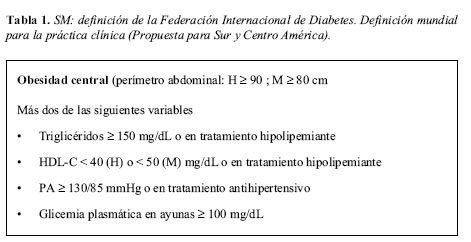
<body><![CDATA[<p>Palabras claves: s&iacute;ndrome metab&oacute;lico, enfermedad cardiovascular,    diabetes mellitus, glicemia anormal en ayunas, intolerancia a la glucosa, obesidad    visceral, per&iacute;metro abdominal, hipertrigliceridemia, colesterol de alta    densidad.</p> <hr size=1>     <p><font size="3"><b>Summary</b></font></p>     <p>Metabolic syndrome (MS) consists of a series of risk factors, all of them associated    with visceral fat leading to a high risk of developing cardiovascular disease    or type II diabetes mellitus. Emphasis has been made on this syndrome in recent    years due to the increasingly high prevalence of obesity and type-II diabetes    world wide. Multiple classifications have been proposed, making it difficult    to standardize studies and outcomes regarding the risk of cardiovascular disease.    The International Diabetes Federation has proposed recently a new classification    which is expected to be implemented throughout the world. The purpose of this    paper is to emphasize the risk of cardiovascular disease associated with metabolic    syndrome.</p>     <p>Key words: metabolic syndrome, cardiovascular disease, diabetes mellitus, abnormal    fasting glycemia, glucose intolerance, visceral obesity, waist circumference,    hypertriglyceridemia, high-density cholesterol</p> <hr size=1>     <p><font size="3"><b>Introducci&oacute;n</b></font></p>     <p>El Dr. Reaven en 1988 enfatiz&oacute; con sus publicaciones, en el concepto    de riesgo de ECV y diabetes en pacientes con el llamado, hoy d&iacute;a, SM    (1). Desde entonces, m&uacute;ltiples clasificaciones han propuesto diferentes    variables y valores para los factores de riesgo que lo componen (2-4). La clasificaci&oacute;n    m&aacute;s usada en nuestro medio, por lo pr&aacute;ctica, es la del Programa    Nacional de los Estados Unidos sobre Educaci&oacute;n en Colesterol, III Panel    de Tratamiento para Adultos (NCEP-ATPIII) (4). En los pa&iacute;ses europeos    predomina la clasificaci&oacute;n EGIR (3) que es una modificaci&oacute;n de    la propuesta por la Organizaci&oacute;n Mundial de la Salud (OMS) (2). La falta    de unificaci&oacute;n en la clasificaci&oacute;n dificulta homogenizar los resultados    sobre riesgo cardiovascular. Con las nuevas investigaciones sobre SM, principalmente    en lo concerniente a adiposidad visceral y valores normales de glicemia, la    Federaci&oacute;n Internacional de Diabetes ha propuesto una definici&oacute;n,    como propuesta para aplicar en la pr&aacute;ctica cl&iacute;nica en forma universal    y as&iacute; facilitar las investigaciones (documento a&uacute;n no publicado    en revistas) (<a href="#tabla1">Tabla 1</a>).</p>     <p>        <center>     <a name="tabla1"></a><img src="/img/revistas/amc/v30n3/a14t1.jpg">    </center> </p>     <p>Importante observar que el per&iacute;metro abdominal propuesto para Sur y    Centro Am&eacute;rica son los anotados en la <a href="#tabla1">Tabla 1</a>.    En el 2003, en Colombia, se public&oacute; como 88 cm. el per&iacute;metro abdominal    que identifica riesgo cardiovascular (5).</p>     <p><font size="3"><b>S&iacute;ndrome metab&oacute;lico, riesgo de diabetes y enfermedad    cardiovascular</b></font></p>     ]]></body>
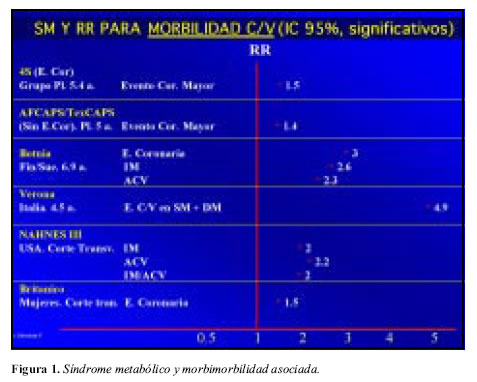
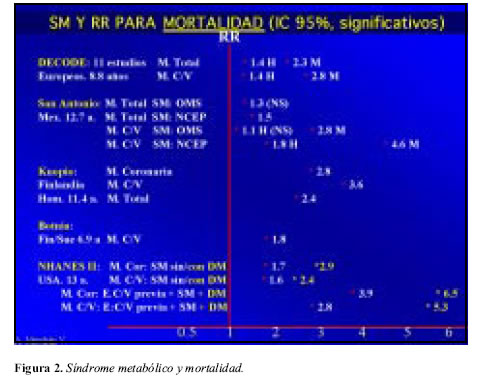
<body><![CDATA[<p>El SM est&aacute; asociado con un incremento del riesgo tanto para DM-2 (6,7),    como para ECV (8-21), entendi&eacute;ndose con este t&eacute;rmino, al conjunto    de patolog&iacute;as como el infarto de miocardio (IM), angina, evento cerebrovascular    (ECV), enfermedad arterial perif&eacute;rica, revascularizaci&oacute;n y mortalidad    por estas causas. Es dif&iacute;cil precisar el riesgo de ECV, secundaria al    SM en forma universal, por la falta de unificaci&oacute;n en la definici&oacute;n    escogida en el estudio, las variables utilizadas, la variabilidad en el riesgo    ajustado, la poblaci&oacute;n analizada, el tipo de estudio (prospectivo, corte    transversal, subestudio, etc.). La mayor&iacute;a de resultados pertenecen a    los tres &uacute;ltimos a&ntilde;os. De manera resumida se analizar&aacute;n    los resultados de los siguientes estudios:</p>     <p>A. Se ha demostrado mayor porcentaje de obstrucci&oacute;n en las arterias    coronarias en pacientes con SM (8) y este compromiso es directamente proporcional    al n&uacute;mero de componentes del SM (9).</p>     <p>B. Cuando se analiza morbilidad hay cinco estudios que analizan el riesgo relativo    (RR) para eventos coronarios mayores (IM, angina, muerte s&uacute;bita), ECV,    enfermedad coronaria (IM, angina, revascularizaci&oacute;n, isquemia). La <a href="#figura1">Figura    1</a> esquematiza los RR. En un subestudio del 4S y del AFCAPS/TexCAPS, de los    pacientes con s&iacute;ndrome metab&oacute;lico, a cinco a&ntilde;os y utilizando    la clasificaci&oacute;n del NCEP-ATPIII, el RR en general fue de 1.5 para eventos    coronarios mayores, IM fatal y no fatal o ECV, con intervalos de confianza que    hacen significativos sus resultados (10).</p>     <p>        <center>     <a name="figura1" id="figura1"></a><img src="/img/revistas/amc/v30n3/a14f1.jpg">    </center> </p>     <p> Resultados similares utilizando la clasificaci&oacute;n de la OMS, muestra    el estudio Botnia en poblaci&oacute;n filandesa y Suiza (11). El RR para enfermedad    coronaria (EC), IM, ECV encontrado fue de 3, 2.6 y 2.3 respectivamente en un    seguimiento a siete a&ntilde;os y todos con valor de p significativo. El RR    para mortalidad cardiovascular fue de 1.8, igualmente significativo. En el estudio    Nhanes III (12), el RR para IM o ECV aislados o para la asociaci&oacute;n IM/ECV,    es de aproximadamente dos, con IC95% significativos, utilizando la definici&oacute;n    del NCEP. El alto riesgo de ECV en el diab&eacute;tico que adem&aacute;s presenta    SM, lo muestra el estudio <i>Verona Diabetes Complications </i>(13), que encuentra    un RR significativo de 4.9 (p=0.03) con la asociaci&oacute;n SM + DM. En mujeres,    el Estudio Brit&aacute;nico del Coraz&oacute;n y la Salud (14), demostr&oacute;    un RR (IC95%) de 1.53 (1.3-1.9) para enfermedad coronaria (IM, angina). Este    riesgo fue similar utilizando la clasificaci&oacute;n de la NCEP u OMS y para    la glicemia &gt; 100 mg/dL, HDL&lt; 40 mg/dL, triglic&eacute;ridos (TG) &gt;    150 mg/dL o cintura &gt; 88 cm (<a href="#figura1">Figura 1</a>).</p>     <p>C. Cuando se analiza el RR para <b>mortalidad </b>de origen coronario<b>, </b>cardiovascular    o total, secundaria al SM, hay cinco estudios que se resumen en la <a href="#figura2">Figura    2</a>. El estudio Decode (15) es un importante metaan&aacute;lisis de 11 estudios    de cohortes, prospectivos, de Europa (posiblemente el &uacute;nico metaan&aacute;lisis    a la fecha sobre SM), que aplicaron la clasificaci&oacute;n modificada de la    OMS (EGIR), con seguimiento a 8.8 a&ntilde;os, y que incluy&oacute; 6.156 hombres    y 5.356 mujeres. El grupo con SM, mostr&oacute; un RR (IC95%) para mortalidad    total de 1.4 (1.2-1.8) para hombres y de 2.3 (1.6-3.2) para mujeres. Similar    comportamiento se observ&oacute; para mortalidad cardiovascular. Demuestra este    estudio que el SM en mujeres tiene un riesgo mayor de mortalidad que en hombres.    Datos similares del comportamiento del SM en mujeres lo aporta el Estudio del    Coraz&oacute;n de San Antonio (Texas) (16), que incluy&oacute; un alto porcentaje    de mexicanos. En este an&aacute;lisis el RR (IC95%) para mortalidad cardiovascular    en mujeres con SM fue de 4.6 (2.4-9.2) y de 1.8 (1.1-2.9) para hombres, cuando    se aplic&oacute; la clasificaci&oacute;n del NCEP-ATPIII y menor el RR cuando    se aplic&oacute; la clasificaci&oacute;n de la OMS. Se dedujo de este an&aacute;lisis    que la clasificaci&oacute;n del NCEP-ATPIII es m&aacute;s predictiva y aplicable    (16). El estudio prospectivo a 11 a&ntilde;os de la Dra. Lakka HM, realizado    en 1.209 hombres finlandeses (17), demostr&oacute; en el grupo con SM un RR    (IC 95%), del 3.8 (1.7-8.2) para mortalidad por enfermedad coronaria, un RR    de 3.6 (1.2-6.4) para mortalidad por ECV y un RR de 2.43 (1.6-3.6) para mortalidad    por todas las causas. En el estudio Botnia (11), el RR para mortalidad cardiovascular    fue de 1.8, igualmente significativo. El estudio Nhanes II (18), analiza mortalidad    y encuentra un RR (IC 95%) para mortalidad coronaria, cardiovascular y total    de 1.7 (1.1-2.5), 1.6 (1.2-2.1), 1.2 (NS) respectivamente, en el grupo con SM    y sin DM-2; pero al asociarse el SM a la DM-2, este RR es superior en todas    las causas de mortalidad y si se asocia SM, DM-2 y ECV previa, el RR aumenta    a&uacute;n m&aacute;s y significativamente hasta seis para mortalidad por enfermedad    coronaria y 5.3 para mortalidad cardiovascular. Este hallazgo ense&ntilde;a    que el SM asociado a DM-2 o previa ECV es de peor pron&oacute;stico y que por    lo tanto se debe ser m&aacute;s agresivo con las metas, por ejemplo LDL-c&lt;70mg/dL    (<a href="#figura2">Figura 2</a>).</p>     <p>        <center>     <a name="figura2"></a><img src="/img/revistas/amc/v30n3/a14f2.jpg">    </center> </p>     <p>D. Aunque el riesgo de eventos cardiovasculares se ha asociado con la presencia    del SM, tambi&eacute;n se ha demostrado que la glicemia anormal o la intolerancia    a la glucosa, tambi&eacute;n tienen riesgo para ECV. Este riesgo lo demuestra    un metaan&aacute;lisis de 38 estudios prospectivos (19). Con niveles de glicemia    en ayunas entre 97 y 130 mg/dL comparado con el nivel m&aacute;s bajo entre    66 y 90 mg/dL, el RR (IC 95%) para ECV es de 1.27 (1.13-1.43). Con valores de    glicemia despu&eacute;s de una prueba de tolerancia a la glucosa oral (poscarga)    entre 150 y 194 comparado con 69 a 107 mg/dL, el RR (IC95%) para ECV fue de    1.27 (1.1-1.48) (19).</p>     ]]></body>
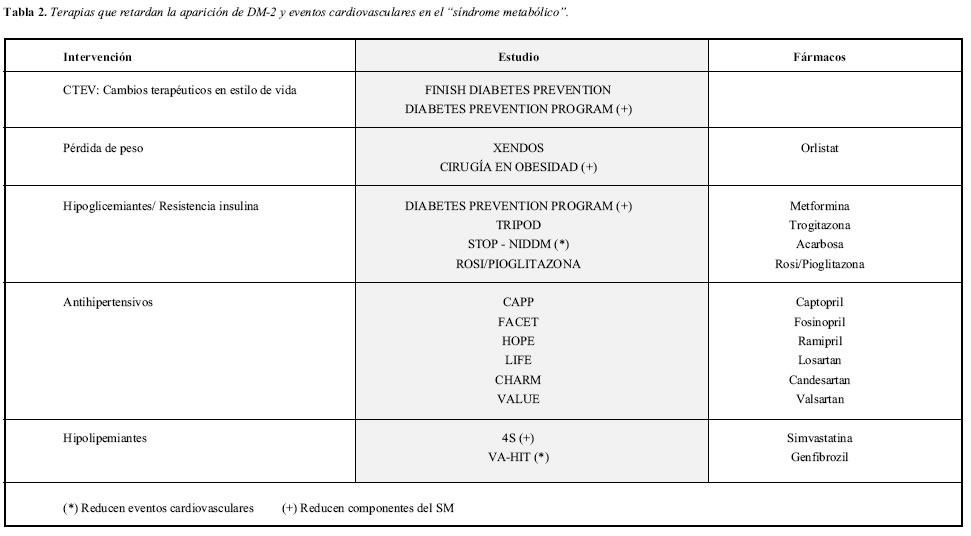
<body><![CDATA[<p>E. El engrosamiento &iacute;ntima-media de las arterias car&oacute;tidas ha    sido mostrado indirectamente como predictor de enfermedad coronaria como lo    demuestra el estudio ARIC en personas con SM (20). Igualmente la obesidad abdominal    se ha asociado con el di&aacute;metro de la luz coronaria (21).</p>     <p><font size="3"><b>C&aacute;lculo del riesgo de evento coronario a 10 a&ntilde;os    para el s&iacute;ndrome metab&oacute;lico, de acuerdo con las tablas de Framingham</b></font></p>     <p>En forma pr&aacute;ctica y aplicable, se puede extractar de los estudios sobre    riesgo cardiovascular en el SM, las siguientes conclusiones:      <p>A. El RR de eventos coronarios (IM, angina, revascularizaci&oacute;n) es significativo    entre 1.5 y 2 cuando se encuentra el SM en forma aislada, en personas mayores    de 50 a&ntilde;os y a 8-11 a&ntilde;os.</p>     <p>B. El RR para mortalidad por enfermedad coronaria se encuentra entre dos y    tres ante la presencia de SM en forma aislada; sin embargo, el RR para mortalidad    cardiovascular o coronaria puede estar entre cinco y seis respectivamente, cuando    se asocia al SM, la diabetes mellitus o la enfermedad cardiovascular previa.</p>     <p>Hablar de riesgo relativo es &uacute;til, pero es m&aacute;s predecible y entendible    para el m&eacute;dico o el paciente, referirse al riesgo de eventos coronarios    (infarto del miocardio o muerte de origen coronario) a 10 a&ntilde;os y expresar    este riesgo con valores menores a 10%, entre 10 y 20% o mayor a 20%. Si se utilizaran    las tablas de Framingham para un paciente con SM aislado, es decir, que no se    asocie el SM a DM o ECV previa (casos que por definici&oacute;n tienen un riesgo    a 10 a&ntilde;os mayor a 20%), es posible que el riesgo calculado sea menor    a 10%. Esto se explica por no estar dentro de las variables para Framingham    el per&iacute;metro abdominal o la obesidad, los triglic&eacute;ridos y las    alteraciones de la glicemia en rangos no diab&eacute;ticos. De otra parte el    riesgo de eventos coronarios en las tablas de Framingham van a la par con la    edad del paciente y s&oacute;lo con edades mayores de 50 a&ntilde;os en hombres    y 60 a&ntilde;os en mujeres el riesgo de eventos coronarios empiezan a ser mayores    a 10% (22). Por ello en hombres menores a 50 a&ntilde;os y mujeres menores a    60 a&ntilde;os, no fumadores y sin hipercolesterolemia severa, que tengan SM    aislado, el riesgo a 10 a&ntilde;os propuesto debe estar entre 10 y 20%, sin    necesidad de aplicar las tablas, pues si se utilizaran, el riesgo ser&iacute;a    menor a 10%. Recientemente se le ha dado importancia a la PCR-hs, para valorar    riesgo cardiovascular en el SM (23-26).</p>     <p><font size="3"><b>Posibles explicaciones a la asociaci&oacute;n SM y enfermedad    cardiovascular</b></font></p>     <p>Son m&uacute;ltiples las teor&iacute;as propuestas para explicar la ECV y DM-2    asociadas con el SM. Se sabe que cada uno de los componentes del SM es un factor    de riesgo para ECV. Se ha implicado al adipocito visceral y a la resistencia    a la insulina como los causantes, aunque para algunos es una manera simplista    de explicar la situaci&oacute;n. El adipocito visceral al liberar factor de    necrosis tumoral alfa, IL-6 (manifestando PCR-hs), PAI-1, resistina, adiponectina    baja y altos niveles de &aacute;cidos grasos libres, predispone a la dislipidemia    aterog&eacute;nica, hipertensi&oacute;n arterial, &quot;ateroscleritis&quot;,    disfunci&oacute;n endotelial, resistencia a la insulina (disglicemia e hipertrigliceridemia)    y estado protromb&oacute;tico. Algunas de las revisiones sobre el tema se anexan    en la bibliograf&iacute;a (27-31).</p>     <p><font size="3"><b>Tratamiento del s&iacute;ndrome metab&oacute;lico</b></font></p>     <p>El tratamiento actual &oacute;ptimo para disminuir las complicaciones del SM    (ECV y DM-2), es con la intervenci&oacute;n <b>multifactorial, simult&aacute;nea    y buscando metas, </b>de cada uno de los componentes del SM. La <a href="/img/revistas/amc/v30n3/a14t2.jpg">Tabla    2</a> resume las diferentes intervenciones que han mostrado primordialmente    retardo en la aparici&oacute;n de DM-2 de novo (32-37). La regresi&oacute;n    de casi todos los componentes del SM se ha logrado con cambios terap&eacute;uticos    en estilo de vida (CTEV) (38) y con cirug&iacute;a para obesidad (39). La disminuci&oacute;n    del riesgo de ECV en SM se ha demostrado con estatinas (40), fibratos (41) y    con acarbosa (42), aunque la evidencia es derivada de estudios cl&iacute;nicos    posteriores. Con acarbosa se ha demostrado reducci&oacute;n del riesgo de IM    e hipertensi&oacute;n en obesos con intolerancia a la glucosa (ITG) (42). La    recomendaci&oacute;n fundamental es insistir en los CTEV (32, 33). Al momento    no hay suficiente evidencia para recomendar universalmente tiazoledinedionas    (35, 36), metformina (33, 38), acarbosa (34, 42) u orlistat (37) para retardar    la DM-2 o para disminuir el riesgo de ECV, aunque su uso podr&iacute;a estar    indicado en algunos casos y dependiente del criterio m&eacute;dico, principalmente    en personas que no se adhieren a los CTEV. La aspirina debe estar en todos los    pacientes, si no hay contraindicaci&oacute;n. El clopidogrel es otra alternativa.    Se esperan resultados cl&iacute;nicos con el uso de bloqueadores de receptores    de canabinoides CB1 (rimonabant), los cuales regulan los factores de riesgo    asociados con el exceso de grasa visceral.</p>     ]]></body>
<body><![CDATA[<p><font size="3"><b>Conclusiones</b></font></p>     <p>El SM ha demostrado ser un riesgo para DM-2 y ECV. El riesgo para ECV es a&uacute;n    m&aacute;s alto cuando se asocia el SM a DM-2 y/o a ECV previa.</p>     <p>Con SM, al utilizar las tablas de Framingham, el riesgo de eventos coronarios    a 10 a&ntilde;os en personas mayores de 50 a&ntilde;os no fumadoras, suele ser    de 10-20%. Cuando se tiene m&aacute;s de 50 a&ntilde;os, fumador e hipercolesterol&eacute;mico    severo es posible que este riesgo sea mayor a 20%. Por el contrario en menores    de 50 a&ntilde;os no fumadores pero con SM, el riesgo a 10 a&ntilde;os calculado    con las tablas, puede ser menor a 10%, caso en el cual se debe ignorar las tablas    y predecir el riesgo entre 10 y 20%. Se debe insistir en la prevenci&oacute;n    de la aparici&oacute;n del SM mediante CTEV. En personas con SM, los CTEV son    el pilar del tratamiento. Los f&aacute;rmacos como la metformia, tiazoledinedionas,    acarbosa y el orlistat, podr&iacute;an ser &uacute;tiles en algunas situaciones    para prevenir o retardar la aparici&oacute;n de DM-2 o ECV, aunque su evidencia    no est&aacute; completamente aceptada. Las estatinas y los fibratos han demostrado    beneficio en SM y posiblemente el &aacute;cido nicot&iacute;nico o estos hipolipemiantes    asociados, son ben&eacute;ficos pero de acuerdo con el perfil lip&iacute;dico    en particular.</p>     <p><font size="3"><b>Bibliograf&iacute;a</b></font></p>     <!-- ref --><p>1. Reaven GM. Role of insulin resistance in human disease. Diabetes 1988;37:1595-1607.&nbsp;&nbsp;&nbsp;&nbsp;&nbsp;&nbsp;&nbsp;&nbsp;[&#160;<a href="javascript:void(0);" onclick="javascript: window.open('/scielo.php?script=sci_nlinks&ref=000047&pid=S0120-2448200500030001400001&lng=','','width=640,height=500,resizable=yes,scrollbars=1,menubar=yes,');">Links</a>&#160;]<!-- end-ref --><!-- ref --><p>2. Alberti KG, Zimmet PZ, for the WHO Consultation. Definition, diagnosis and    classification of Diabetes Mellitus and its complications. Part 1: Diagnosis    and classification of diabetes mellitus. Report of a WHO consultation. Diabet    Med 1998;15:539-553.&nbsp;&nbsp;&nbsp;&nbsp;&nbsp;&nbsp;&nbsp;&nbsp;[&#160;<a href="javascript:void(0);" onclick="javascript: window.open('/scielo.php?script=sci_nlinks&ref=000048&pid=S0120-2448200500030001400002&lng=','','width=640,height=500,resizable=yes,scrollbars=1,menubar=yes,');">Links</a>&#160;]<!-- end-ref --><!-- ref --><p>3. EGIR. European Group for Insulin Resistance. Diabet Med 1999;16:442.&nbsp;&nbsp;&nbsp;&nbsp;&nbsp;&nbsp;&nbsp;&nbsp;[&#160;<a href="javascript:void(0);" onclick="javascript: window.open('/scielo.php?script=sci_nlinks&ref=000049&pid=S0120-2448200500030001400003&lng=','','width=640,height=500,resizable=yes,scrollbars=1,menubar=yes,');">Links</a>&#160;]<!-- end-ref --><!-- ref --><p>4. Executive Summary of The Third Report of the National Cholesterol Program    (NCEP) Expert Panel on Detection, Evaluation, And Treatment of High Blood Cholesterol    in Adults (Adult Treatment Panel III). JAMA 2001;285:2486-2497.&nbsp;&nbsp;&nbsp;&nbsp;&nbsp;&nbsp;&nbsp;&nbsp;[&#160;<a href="javascript:void(0);" onclick="javascript: window.open('/scielo.php?script=sci_nlinks&ref=000050&pid=S0120-2448200500030001400004&lng=','','width=640,height=500,resizable=yes,scrollbars=1,menubar=yes,');">Links</a>&#160;]<!-- end-ref --><!-- ref --><p>5. Perez M, Casas JP, Cubillos LA, Serrano NC, Morillo C, Lopez-Jaramillo P.    Utility of the waist circunference as screening tool to identify Colombian subjects    at cardiovascular risk. Eur J Cardiovasc Prev Rehabil 2003;10:328-335.&nbsp;&nbsp;&nbsp;&nbsp;&nbsp;&nbsp;&nbsp;&nbsp;[&#160;<a href="javascript:void(0);" onclick="javascript: window.open('/scielo.php?script=sci_nlinks&ref=000051&pid=S0120-2448200500030001400005&lng=','','width=640,height=500,resizable=yes,scrollbars=1,menubar=yes,');">Links</a>&#160;]<!-- end-ref --><!-- ref --><p>6. Hanson RL, Imperatore G, et al. Components of the metabolic syndrome and    incidence of type 2 diabetes. Diabetes 2002;51:3120-3127.&nbsp;&nbsp;&nbsp;&nbsp;&nbsp;&nbsp;&nbsp;&nbsp;[&#160;<a href="javascript:void(0);" onclick="javascript: window.open('/scielo.php?script=sci_nlinks&ref=000052&pid=S0120-2448200500030001400006&lng=','','width=640,height=500,resizable=yes,scrollbars=1,menubar=yes,');">Links</a>&#160;]<!-- end-ref --><!-- ref --><p>7. Laaksonen DE, Lakka H-M, Niskanen LK, Kaplan GA, Salonen JT, Lakka TA. Metabolic    Syndrome and development of diabetes mellitus: Application and validation of    recently suggested definitions of the metabolic syndrome in a prospective cohort.    Am J Epidemiol 2002;156:1070-1077.&nbsp;&nbsp;&nbsp;&nbsp;&nbsp;&nbsp;&nbsp;&nbsp;[&#160;<a href="javascript:void(0);" onclick="javascript: window.open('/scielo.php?script=sci_nlinks&ref=000053&pid=S0120-2448200500030001400007&lng=','','width=640,height=500,resizable=yes,scrollbars=1,menubar=yes,');">Links</a>&#160;]<!-- end-ref --><!-- ref --><p>8. Solymoss BC, Bourassa MG, Lesperance J, et al. Incidence and clinical characteristics    of the metabolic syndrome in patients with coronary artery disease. Coronary    Artery Disease 2003;14:207-212.&nbsp;&nbsp;&nbsp;&nbsp;&nbsp;&nbsp;&nbsp;&nbsp;[&#160;<a href="javascript:void(0);" onclick="javascript: window.open('/scielo.php?script=sci_nlinks&ref=000054&pid=S0120-2448200500030001400008&lng=','','width=640,height=500,resizable=yes,scrollbars=1,menubar=yes,');">Links</a>&#160;]<!-- end-ref --><!-- ref --><p>9. Solymoss BC, Bourassa MG, Campeau L, et al. Effect of increasing metabolic    syndrome score on atherosclerotic risk profile and coronary artery disease angiographic    severity. Am J Cardiol 2004;93:159-164.&nbsp;&nbsp;&nbsp;&nbsp;&nbsp;&nbsp;&nbsp;&nbsp;[&#160;<a href="javascript:void(0);" onclick="javascript: window.open('/scielo.php?script=sci_nlinks&ref=000055&pid=S0120-2448200500030001400009&lng=','','width=640,height=500,resizable=yes,scrollbars=1,menubar=yes,');">Links</a>&#160;]<!-- end-ref --><!-- ref --><p>10. Girman CJ, Rhodes T, Mercuri M, et al. The metabolic syndrome and risk    of major coronary events in the Scandinavian simvastatin survival study (4S)    and the Air Force/Texas coronary atherosclerosis prevention study (AFCAPS/TexCAPS.    Am J Cardiol 2004;93:136-141.&nbsp;&nbsp;&nbsp;&nbsp;&nbsp;&nbsp;&nbsp;&nbsp;[&#160;<a href="javascript:void(0);" onclick="javascript: window.open('/scielo.php?script=sci_nlinks&ref=000056&pid=S0120-2448200500030001400010&lng=','','width=640,height=500,resizable=yes,scrollbars=1,menubar=yes,');">Links</a>&#160;]<!-- end-ref --><!-- ref --><p>11. Isomaa B, Almgren P, Tuomi T, Fors&eacute;n,B, Lahti K, Niss&eacute;n M,    Taskinen M-R, Groop L. Cardiovascular morbidity and mortality associated with    the metabolic syndrome. Diabetes Care 2001;24:683-689.&nbsp;&nbsp;&nbsp;&nbsp;&nbsp;&nbsp;&nbsp;&nbsp;[&#160;<a href="javascript:void(0);" onclick="javascript: window.open('/scielo.php?script=sci_nlinks&ref=000057&pid=S0120-2448200500030001400011&lng=','','width=640,height=500,resizable=yes,scrollbars=1,menubar=yes,');">Links</a>&#160;]<!-- end-ref --><!-- ref --><p>12. Ninomiya JK, L'Italien G, Criqui MH, et al. Association of the metabolic    s&iacute;ndrome with story of myocardial infarction and stroke in the III National    Health and Nutrition Examination Survey. Circulation 2004;109:42-46.&nbsp;&nbsp;&nbsp;&nbsp;&nbsp;&nbsp;&nbsp;&nbsp;[&#160;<a href="javascript:void(0);" onclick="javascript: window.open('/scielo.php?script=sci_nlinks&ref=000058&pid=S0120-2448200500030001400012&lng=','','width=640,height=500,resizable=yes,scrollbars=1,menubar=yes,');">Links</a>&#160;]<!-- end-ref --><!-- ref --><p>13. Bonora E, Targher G, Formentini G, et al. The metabolic syndrome is an    independent predictor of cardiovascular disease in type 2 diabetetic subjects.    Prospective data from the Verona diabetes complications study. Diabet Med 2004;21:52-58.&nbsp;&nbsp;&nbsp;&nbsp;&nbsp;&nbsp;&nbsp;&nbsp;[&#160;<a href="javascript:void(0);" onclick="javascript: window.open('/scielo.php?script=sci_nlinks&ref=000059&pid=S0120-2448200500030001400013&lng=','','width=640,height=500,resizable=yes,scrollbars=1,menubar=yes,');">Links</a>&#160;]<!-- end-ref --><!-- ref --><p>14. Lawlor S, Ebrahim, Smith GD. The metabolic syndrome and coronary heart    disease in older women: findings from the British Womens Heart and Health study.    Diabet Med 2004;21:906-913.&nbsp;&nbsp;&nbsp;&nbsp;&nbsp;&nbsp;&nbsp;&nbsp;[&#160;<a href="javascript:void(0);" onclick="javascript: window.open('/scielo.php?script=sci_nlinks&ref=000060&pid=S0120-2448200500030001400014&lng=','','width=640,height=500,resizable=yes,scrollbars=1,menubar=yes,');">Links</a>&#160;]<!-- end-ref --><!-- ref --><p>15. Hu G, Qiao Q, Tuomilehto J, et al. Prevalence of the metabolic syndrome    and its relation to all cause and cardiovascular mortality in nondiabetic European    men and women. Arch Intern Med 2004;164:1066-1076.&nbsp;&nbsp;&nbsp;&nbsp;&nbsp;&nbsp;&nbsp;&nbsp;[&#160;<a href="javascript:void(0);" onclick="javascript: window.open('/scielo.php?script=sci_nlinks&ref=000061&pid=S0120-2448200500030001400015&lng=','','width=640,height=500,resizable=yes,scrollbars=1,menubar=yes,');">Links</a>&#160;]<!-- end-ref --><!-- ref --><p>16. Hunt KJ, Resendez RG,Williams K, Haffner SM, Stern MP. National Cholesterol    Education Program versus World Health Organization metabolic syndrome in relation    to all cause and cardiovascular mortality in the San Antonio Heart Study. Circulation    2004;110:1251-1257.&nbsp;&nbsp;&nbsp;&nbsp;&nbsp;&nbsp;&nbsp;&nbsp;[&#160;<a href="javascript:void(0);" onclick="javascript: window.open('/scielo.php?script=sci_nlinks&ref=000062&pid=S0120-2448200500030001400016&lng=','','width=640,height=500,resizable=yes,scrollbars=1,menubar=yes,');">Links</a>&#160;]<!-- end-ref --><!-- ref --><p>17. Lakka HM, Laaksonen DE, Lakka TA, Niskanen LK, Kumpusalo E, Tuomilehto    J, Salonen JT. The metabolic syndrome and total and cardiovascular disease mortality    in middle-aged men. JAMA. 2002;288:2709-2716.&nbsp;&nbsp;&nbsp;&nbsp;&nbsp;&nbsp;&nbsp;&nbsp;[&#160;<a href="javascript:void(0);" onclick="javascript: window.open('/scielo.php?script=sci_nlinks&ref=000063&pid=S0120-2448200500030001400017&lng=','','width=640,height=500,resizable=yes,scrollbars=1,menubar=yes,');">Links</a>&#160;]<!-- end-ref --><!-- ref --><p>18. Malik S, Wong ND, Franklin SS, et al. Impact of the metabolic syndrome    on mortality from coronary heart disease, cardiovascular disease, and all causes    in USA adults. Circulation 2004;110:1245-1250.&nbsp;&nbsp;&nbsp;&nbsp;&nbsp;&nbsp;&nbsp;&nbsp;[&#160;<a href="javascript:void(0);" onclick="javascript: window.open('/scielo.php?script=sci_nlinks&ref=000064&pid=S0120-2448200500030001400018&lng=','','width=640,height=500,resizable=yes,scrollbars=1,menubar=yes,');">Links</a>&#160;]<!-- end-ref --><!-- ref --><p>19. Levitan EB, Song Yiqing, Ford ES, et al. Is nondiabetic hyperglycemia a    risk factor for cardiovascular disease? Arch Intern Med 2004;164:2147-2155.&nbsp;&nbsp;&nbsp;&nbsp;&nbsp;&nbsp;&nbsp;&nbsp;[&#160;<a href="javascript:void(0);" onclick="javascript: window.open('/scielo.php?script=sci_nlinks&ref=000065&pid=S0120-2448200500030001400019&lng=','','width=640,height=500,resizable=yes,scrollbars=1,menubar=yes,');">Links</a>&#160;]<!-- end-ref --><!-- ref --><p>20. McNeil AM, Rosamond WD, Girman CJ, et al. Prevalence of coronary heart    disease and carotid arterial thickening in patients with the metabolic syndrome    (The Aric Study). Am J Cardiol 2004;94:1249-1254.&nbsp;&nbsp;&nbsp;&nbsp;&nbsp;&nbsp;&nbsp;&nbsp;[&#160;<a href="javascript:void(0);" onclick="javascript: window.open('/scielo.php?script=sci_nlinks&ref=000066&pid=S0120-2448200500030001400020&lng=','','width=640,height=500,resizable=yes,scrollbars=1,menubar=yes,');">Links</a>&#160;]<!-- end-ref --><!-- ref --><p>21. Silva FA, Lopez-Jaramillo P, Casas JP, et al. Abdominal obesity is associated    with coronary luminar diameter in patients with chest pain. Diabetes and Metabolism    2002;29:4sO.&nbsp;&nbsp;&nbsp;&nbsp;&nbsp;&nbsp;&nbsp;&nbsp;[&#160;<a href="javascript:void(0);" onclick="javascript: window.open('/scielo.php?script=sci_nlinks&ref=000067&pid=S0120-2448200500030001400021&lng=','','width=640,height=500,resizable=yes,scrollbars=1,menubar=yes,');">Links</a>&#160;]<!-- end-ref --><!-- ref --><p>22. Pasternak RC, Abrams J, Greenland P, et al. Identification of coronary    heart disease risk. Is there a detection gap? J Am Coll Cardiol 2003;41:1863-1874.&nbsp;&nbsp;&nbsp;&nbsp;&nbsp;&nbsp;&nbsp;&nbsp;[&#160;<a href="javascript:void(0);" onclick="javascript: window.open('/scielo.php?script=sci_nlinks&ref=000068&pid=S0120-2448200500030001400022&lng=','','width=640,height=500,resizable=yes,scrollbars=1,menubar=yes,');">Links</a>&#160;]<!-- end-ref --><!-- ref --><p>23. Ridker PM, Wilson PWF, Grundy SM. Should PCR be added to metabolic syndrome    and to assessment of global cardiovascular risk? Circulation 2004;109:2818-2825.&nbsp;&nbsp;&nbsp;&nbsp;&nbsp;&nbsp;&nbsp;&nbsp;[&#160;<a href="javascript:void(0);" onclick="javascript: window.open('/scielo.php?script=sci_nlinks&ref=000069&pid=S0120-2448200500030001400023&lng=','','width=640,height=500,resizable=yes,scrollbars=1,menubar=yes,');">Links</a>&#160;]<!-- end-ref --><!-- ref --><p>24. Ridker PM, Buring JE, Cook NR, et al. PCR, the metabolic syndrome, and    risk of incident cardiovascular events. Circulation 2003;107:391-397.&nbsp;&nbsp;&nbsp;&nbsp;&nbsp;&nbsp;&nbsp;&nbsp;[&#160;<a href="javascript:void(0);" onclick="javascript: window.open('/scielo.php?script=sci_nlinks&ref=000070&pid=S0120-2448200500030001400024&lng=','','width=640,height=500,resizable=yes,scrollbars=1,menubar=yes,');">Links</a>&#160;]<!-- end-ref --><!-- ref --><p>25. Rutter MK, Meigs JB, Sullivan LM, et al. PCR, the metabolic syndrome and    prediction of cardiovascular events in the Framingham offspring study. Circulation    2004;110:380-385.&nbsp;&nbsp;&nbsp;&nbsp;&nbsp;&nbsp;&nbsp;&nbsp;[&#160;<a href="javascript:void(0);" onclick="javascript: window.open('/scielo.php?script=sci_nlinks&ref=000071&pid=S0120-2448200500030001400025&lng=','','width=640,height=500,resizable=yes,scrollbars=1,menubar=yes,');">Links</a>&#160;]<!-- end-ref --><!-- ref --><p>26. Malik S, Wong ND, Franklin S, et al. Cardiovascular disease in US patients    with metabolic syndrome, diabetes and elevated PCR. Diab Care 2005;28:690-93     &nbsp;&nbsp;&nbsp;&nbsp;&nbsp;&nbsp;&nbsp;&nbsp;[&#160;<a href="javascript:void(0);" onclick="javascript: window.open('/scielo.php?script=sci_nlinks&ref=000072&pid=S0120-2448200500030001400026&lng=','','width=640,height=500,resizable=yes,scrollbars=1,menubar=yes,');">Links</a>&#160;]<!-- end-ref --><!-- ref --><p>27. L&oacute;pez-Jaramillo P, Siva S, Ram&iacute;rez F, et al. Sindrome metab&oacute;lico:diagn&oacute;stico    y tratamiento. Acta Med Colomb 2004;29:137-144.&nbsp;&nbsp;&nbsp;&nbsp;&nbsp;&nbsp;&nbsp;&nbsp;[&#160;<a href="javascript:void(0);" onclick="javascript: window.open('/scielo.php?script=sci_nlinks&ref=000073&pid=S0120-2448200500030001400027&lng=','','width=640,height=500,resizable=yes,scrollbars=1,menubar=yes,');">Links</a>&#160;]<!-- end-ref --><!-- ref --><p>28. Marquez-Salom G. Obesidad e impacto cardiovascular. Acta Med Colomb 2004;29:144-149.&nbsp;&nbsp;&nbsp;&nbsp;&nbsp;&nbsp;&nbsp;&nbsp;[&#160;<a href="javascript:void(0);" onclick="javascript: window.open('/scielo.php?script=sci_nlinks&ref=000074&pid=S0120-2448200500030001400028&lng=','','width=640,height=500,resizable=yes,scrollbars=1,menubar=yes,');">Links</a>&#160;]<!-- end-ref --><!-- ref --><p>29. Miranda PJ, DeFronzo RA, Califf RM, et al. Metabolic s&iacute;ndrome:definition,    pathophysiology and mecanisms. Am Heart J 2005;149:33-45.&nbsp;&nbsp;&nbsp;&nbsp;&nbsp;&nbsp;&nbsp;&nbsp;[&#160;<a href="javascript:void(0);" onclick="javascript: window.open('/scielo.php?script=sci_nlinks&ref=000075&pid=S0120-2448200500030001400029&lng=','','width=640,height=500,resizable=yes,scrollbars=1,menubar=yes,');">Links</a>&#160;]<!-- end-ref --><!-- ref --><p>30. Rosenson RS. New approaches in the intensive management of cardiovascular    risk in the metabolic syndrome. Curr Probl Cardiol 2005;30:241-280.&nbsp;&nbsp;&nbsp;&nbsp;&nbsp;&nbsp;&nbsp;&nbsp;[&#160;<a href="javascript:void(0);" onclick="javascript: window.open('/scielo.php?script=sci_nlinks&ref=000076&pid=S0120-2448200500030001400030&lng=','','width=640,height=500,resizable=yes,scrollbars=1,menubar=yes,');">Links</a>&#160;]<!-- end-ref --><!-- ref --><p>31. Carr DB, Utzschneider KM, Hull RI, et al. Intra-abdominal fat is a major    determinant of the NCEP-ATPIII criteria for the metabolic syndrome. Diabetes    2004;53:2087-2094.&nbsp;&nbsp;&nbsp;&nbsp;&nbsp;&nbsp;&nbsp;&nbsp;[&#160;<a href="javascript:void(0);" onclick="javascript: window.open('/scielo.php?script=sci_nlinks&ref=000077&pid=S0120-2448200500030001400031&lng=','','width=640,height=500,resizable=yes,scrollbars=1,menubar=yes,');">Links</a>&#160;]<!-- end-ref --><!-- ref --><p>32. Tuomilehto J, Lindstrom J, Eriksson JG, et al. Prevention of type 2 diabetes    mellitus by changes in lifestyle among subjects with impaired glucose tolerance.    New Engl J Med 2001;344:1343-1350.&nbsp;&nbsp;&nbsp;&nbsp;&nbsp;&nbsp;&nbsp;&nbsp;[&#160;<a href="javascript:void(0);" onclick="javascript: window.open('/scielo.php?script=sci_nlinks&ref=000078&pid=S0120-2448200500030001400032&lng=','','width=640,height=500,resizable=yes,scrollbars=1,menubar=yes,');">Links</a>&#160;]<!-- end-ref --><!-- ref --><p>33. Diabetes Prevention Program Research Group. Reduction in the incidence    of type 2 diabetes with lifestyle intervention or metformin. N Engl J Med 2002;346:393-403.&nbsp;&nbsp;&nbsp;&nbsp;&nbsp;&nbsp;&nbsp;&nbsp;[&#160;<a href="javascript:void(0);" onclick="javascript: window.open('/scielo.php?script=sci_nlinks&ref=000079&pid=S0120-2448200500030001400033&lng=','','width=640,height=500,resizable=yes,scrollbars=1,menubar=yes,');">Links</a>&#160;]<!-- end-ref --><!-- ref --><p>34. Chiason JL, Josse RG, Gomis R, et al. The STOP-NIDDM Trial Research Group.    Acarbose for prevention of type 2 diabetes mellitus. Lancet 2002;359:2072-2077.&nbsp;&nbsp;&nbsp;&nbsp;&nbsp;&nbsp;&nbsp;&nbsp;[&#160;<a href="javascript:void(0);" onclick="javascript: window.open('/scielo.php?script=sci_nlinks&ref=000080&pid=S0120-2448200500030001400034&lng=','','width=640,height=500,resizable=yes,scrollbars=1,menubar=yes,');">Links</a>&#160;]<!-- end-ref --><!-- ref --><p>35. Buchanan TA, Xiang AH, Peters RK, et al. Preservation of pancreatic beta-cell    function and prevention of type 2 diabetes by pharmacological treatment of insulin    resistance in high risk Hispanic-women. Diabetes 2002;51:2796-2803.&nbsp;&nbsp;&nbsp;&nbsp;&nbsp;&nbsp;&nbsp;&nbsp;[&#160;<a href="javascript:void(0);" onclick="javascript: window.open('/scielo.php?script=sci_nlinks&ref=000081&pid=S0120-2448200500030001400035&lng=','','width=640,height=500,resizable=yes,scrollbars=1,menubar=yes,');">Links</a>&#160;]<!-- end-ref --><!-- ref --><p>36. Durbin RJ. Thiazoledinedione therapy in the prevention/delay of type 2    diabetes in patients with impaired glucose tolerance and insulin resistance.    Diabetes, Obesity and Metabolism 2004;6:280-285.&nbsp;&nbsp;&nbsp;&nbsp;&nbsp;&nbsp;&nbsp;&nbsp;[&#160;<a href="javascript:void(0);" onclick="javascript: window.open('/scielo.php?script=sci_nlinks&ref=000082&pid=S0120-2448200500030001400036&lng=','','width=640,height=500,resizable=yes,scrollbars=1,menubar=yes,');">Links</a>&#160;]<!-- end-ref --><!-- ref --><p>37. Torgerson JS, Hauptman J, Boldrin MN, et al. Xenical in the prevention    of diabetes in obese subjects (XENDOS) study. A randomized study of orlistat    as an adjunct to lifestyle changes for the prevention of type 2 diabetes in    obese patients. Diabetes Care 2004;27:155-161.&nbsp;&nbsp;&nbsp;&nbsp;&nbsp;&nbsp;&nbsp;&nbsp;[&#160;<a href="javascript:void(0);" onclick="javascript: window.open('/scielo.php?script=sci_nlinks&ref=000083&pid=S0120-2448200500030001400037&lng=','','width=640,height=500,resizable=yes,scrollbars=1,menubar=yes,');">Links</a>&#160;]<!-- end-ref --><!-- ref --><p>38. The diabetes Prevention Program Research Group. Impact of intensive lifestyle    and metformin therapy on cardiovascular disease risk factors in the diabetes    Prevention Program. Diabetes Care 2005;28:888-894.&nbsp;&nbsp;&nbsp;&nbsp;&nbsp;&nbsp;&nbsp;&nbsp;[&#160;<a href="javascript:void(0);" onclick="javascript: window.open('/scielo.php?script=sci_nlinks&ref=000084&pid=S0120-2448200500030001400038&lng=','','width=640,height=500,resizable=yes,scrollbars=1,menubar=yes,');">Links</a>&#160;]<!-- end-ref --><!-- ref --><p>39. Lee W, Huang MT, Wang W, et al. Effects of obesity surgery on the metabolic    syndrome. Arch Surg 2004;139:1088-1092.&nbsp;&nbsp;&nbsp;&nbsp;&nbsp;&nbsp;&nbsp;&nbsp;[&#160;<a href="javascript:void(0);" onclick="javascript: window.open('/scielo.php?script=sci_nlinks&ref=000085&pid=S0120-2448200500030001400039&lng=','','width=640,height=500,resizable=yes,scrollbars=1,menubar=yes,');">Links</a>&#160;]<!-- end-ref --><!-- ref --><p>40. Pyorala K, Ballantyne C, Gumbiner B, Lee MW, Shah A, Davies MJ, Mitchel    YB, Pedersen TR, Kjekshus J for the Scandinavian Simvastatin Survival Study    Group. Reduction of cardiovascular events by simvastatin in nondiabetic coronary    heart disease patients with and without the metabolic syndrome. Diabetes Care    2004; 27:1735-1740.&nbsp;&nbsp;&nbsp;&nbsp;&nbsp;&nbsp;&nbsp;&nbsp;[&#160;<a href="javascript:void(0);" onclick="javascript: window.open('/scielo.php?script=sci_nlinks&ref=000086&pid=S0120-2448200500030001400040&lng=','','width=640,height=500,resizable=yes,scrollbars=1,menubar=yes,');">Links</a>&#160;]<!-- end-ref --><!-- ref --><p>41. Robins SJ, Rubins HB, Faas FH. (VA-HIT). Insulin resistance and cardiovascular    events with low HDL cholesterol. Diabetes Care 2003;26:1513-1517.&nbsp;&nbsp;&nbsp;&nbsp;&nbsp;&nbsp;&nbsp;&nbsp;[&#160;<a href="javascript:void(0);" onclick="javascript: window.open('/scielo.php?script=sci_nlinks&ref=000087&pid=S0120-2448200500030001400041&lng=','','width=640,height=500,resizable=yes,scrollbars=1,menubar=yes,');">Links</a>&#160;]<!-- end-ref --><!-- ref --><p>42. Chiasson JL, Josse RG, Gomis R, et al. Acarbose treatment and the risk    of cardiovascular disease and hypertension in patients with impaired glucose    tolerance. The STOP-NIDDDM trial. JAMA 2003;290:486-494.&nbsp;&nbsp;&nbsp;&nbsp;&nbsp;&nbsp;&nbsp;&nbsp;[&#160;<a href="javascript:void(0);" onclick="javascript: window.open('/scielo.php?script=sci_nlinks&ref=000088&pid=S0120-2448200500030001400042&lng=','','width=640,height=500,resizable=yes,scrollbars=1,menubar=yes,');">Links</a>&#160;]<!-- end-ref --> ]]></body><back>
<ref-list>
<ref id="B1">
<label>1</label><nlm-citation citation-type="journal">
<person-group person-group-type="author">
<name>
<surname><![CDATA[Reaven]]></surname>
<given-names><![CDATA[GM]]></given-names>
</name>
</person-group>
<article-title xml:lang="en"><![CDATA[Role of insulin resistance in human disease]]></article-title>
<source><![CDATA[Diabetes]]></source>
<year>1988</year>
<volume>37</volume>
<page-range>1595-1607</page-range></nlm-citation>
</ref>
<ref id="B2">
<label>2</label><nlm-citation citation-type="journal">
<person-group person-group-type="author">
<name>
<surname><![CDATA[Alberti]]></surname>
<given-names><![CDATA[KG]]></given-names>
</name>
<name>
<surname><![CDATA[Zimmet]]></surname>
<given-names><![CDATA[PZ]]></given-names>
</name>
</person-group>
<collab>WHO^dConsultation</collab>
<article-title xml:lang="en"><![CDATA[Definition, diagnosis and classification of Diabetes Mellitus and its complications.: Part 1: Diagnosis and classification of diabetes mellitus. Report of a WHO consultation]]></article-title>
<source><![CDATA[Diabet Med]]></source>
<year>1998</year>
<volume>15</volume>
<page-range>539-553</page-range></nlm-citation>
</ref>
<ref id="B3">
<label>3</label><nlm-citation citation-type="journal">
<collab>European Group for Insulin Resistance</collab>
<source><![CDATA[Diabet Med]]></source>
<year>1999</year>
<volume>16</volume>
<page-range>442</page-range></nlm-citation>
</ref>
<ref id="B4">
<label>4</label><nlm-citation citation-type="journal">
<article-title xml:lang="en"><![CDATA[Executive Summary of The Third Report of the National Cholesterol Program (NCEP) Expert Panel on Detection, Evaluation, And Treatment of High Blood Cholesterol in Adults (Adult Treatment Panel III)]]></article-title>
<source><![CDATA[JAMA]]></source>
<year>2001</year>
<volume>285</volume>
<page-range>2486-2497</page-range></nlm-citation>
</ref>
<ref id="B5">
<label>5</label><nlm-citation citation-type="journal">
<person-group person-group-type="author">
<name>
<surname><![CDATA[Perez]]></surname>
<given-names><![CDATA[M]]></given-names>
</name>
<name>
<surname><![CDATA[Casas]]></surname>
<given-names><![CDATA[JP]]></given-names>
</name>
<name>
<surname><![CDATA[Cubillos]]></surname>
<given-names><![CDATA[LA]]></given-names>
</name>
<name>
<surname><![CDATA[Serrano]]></surname>
<given-names><![CDATA[NC]]></given-names>
</name>
<name>
<surname><![CDATA[Morillo]]></surname>
<given-names><![CDATA[C]]></given-names>
</name>
<name>
<surname><![CDATA[Lopez-Jaramillo]]></surname>
<given-names><![CDATA[P]]></given-names>
</name>
</person-group>
<article-title xml:lang="en"><![CDATA[Utility of the waist circunference as screening tool to identify Colombian subjects at cardiovascular risk]]></article-title>
<source><![CDATA[Eur J Cardiovasc Prev Rehabil]]></source>
<year>2003</year>
<volume>10</volume>
<page-range>328-335</page-range></nlm-citation>
</ref>
<ref id="B6">
<label>6</label><nlm-citation citation-type="journal">
<person-group person-group-type="author">
<name>
<surname><![CDATA[Hanson]]></surname>
<given-names><![CDATA[RL]]></given-names>
</name>
<name>
<surname><![CDATA[Imperatore]]></surname>
<given-names><![CDATA[G]]></given-names>
</name>
</person-group>
<article-title xml:lang="en"><![CDATA[Components of the metabolic syndrome and incidence of type 2 diabetes]]></article-title>
<source><![CDATA[Diabetes]]></source>
<year>2002</year>
<volume>51</volume>
<page-range>3120-3127</page-range></nlm-citation>
</ref>
<ref id="B7">
<label>7</label><nlm-citation citation-type="journal">
<person-group person-group-type="author">
<name>
<surname><![CDATA[Laaksonen]]></surname>
<given-names><![CDATA[DE]]></given-names>
</name>
<name>
<surname><![CDATA[Lakka]]></surname>
<given-names><![CDATA[H-M]]></given-names>
</name>
<name>
<surname><![CDATA[Niskanen]]></surname>
<given-names><![CDATA[LK]]></given-names>
</name>
<name>
<surname><![CDATA[Kaplan]]></surname>
<given-names><![CDATA[GA]]></given-names>
</name>
<name>
<surname><![CDATA[Salonen]]></surname>
<given-names><![CDATA[JT]]></given-names>
</name>
<name>
<surname><![CDATA[Lakka]]></surname>
<given-names><![CDATA[TA]]></given-names>
</name>
</person-group>
<article-title xml:lang="en"><![CDATA[Metabolic Syndrome and development of diabetes mellitus: Application and validation of recently suggested definitions of the metabolic syndrome in a prospective cohort]]></article-title>
<source><![CDATA[Am J Epidemiol]]></source>
<year>2002</year>
<volume>156</volume>
<page-range>1070-1077</page-range></nlm-citation>
</ref>
<ref id="B8">
<label>8</label><nlm-citation citation-type="journal">
<person-group person-group-type="author">
<name>
<surname><![CDATA[Solymoss]]></surname>
<given-names><![CDATA[BC]]></given-names>
</name>
<name>
<surname><![CDATA[Bourassa]]></surname>
<given-names><![CDATA[MG]]></given-names>
</name>
<name>
<surname><![CDATA[Lesperance]]></surname>
<given-names><![CDATA[J]]></given-names>
</name>
</person-group>
<article-title xml:lang="en"><![CDATA[Incidence and clinical characteristics of the metabolic syndrome in patients with coronary artery disease]]></article-title>
<source><![CDATA[Coronary Artery Disease]]></source>
<year>2003</year>
<volume>14</volume>
<page-range>207-212</page-range></nlm-citation>
</ref>
<ref id="B9">
<label>9</label><nlm-citation citation-type="journal">
<person-group person-group-type="author">
<name>
<surname><![CDATA[Solymoss]]></surname>
<given-names><![CDATA[BC]]></given-names>
</name>
<name>
<surname><![CDATA[Bourassa]]></surname>
<given-names><![CDATA[MG]]></given-names>
</name>
<name>
<surname><![CDATA[Campeau]]></surname>
<given-names><![CDATA[L]]></given-names>
</name>
</person-group>
<article-title xml:lang="en"><![CDATA[Effect of increasing metabolic syndrome score on atherosclerotic risk profile and coronary artery disease angiographic severity]]></article-title>
<source><![CDATA[Am J Cardiol]]></source>
<year>2004</year>
<volume>93</volume>
<page-range>159-164</page-range></nlm-citation>
</ref>
<ref id="B10">
<label>10</label><nlm-citation citation-type="journal">
<person-group person-group-type="author">
<name>
<surname><![CDATA[Girman]]></surname>
<given-names><![CDATA[CJ]]></given-names>
</name>
<name>
<surname><![CDATA[Rhodes]]></surname>
<given-names><![CDATA[T]]></given-names>
</name>
<name>
<surname><![CDATA[Mercuri]]></surname>
<given-names><![CDATA[M]]></given-names>
</name>
</person-group>
<article-title xml:lang="en"><![CDATA[The metabolic syndrome and risk of major coronary events in the Scandinavian simvastatin survival study (4S) and the Air Force/Texas coronary atherosclerosis prevention study (AFCAPS/TexCAPS]]></article-title>
<source><![CDATA[Am J Cardiol]]></source>
<year>2004</year>
<volume>93</volume>
<page-range>136-141</page-range></nlm-citation>
</ref>
<ref id="B11">
<label>11</label><nlm-citation citation-type="journal">
<person-group person-group-type="author">
<name>
<surname><![CDATA[Isomaa]]></surname>
<given-names><![CDATA[B]]></given-names>
</name>
<name>
<surname><![CDATA[Almgren]]></surname>
<given-names><![CDATA[P]]></given-names>
</name>
<name>
<surname><![CDATA[Tuomi]]></surname>
<given-names><![CDATA[T]]></given-names>
</name>
<name>
<surname><![CDATA[Forsén,B,]]></surname>
<given-names><![CDATA[Lahti K]]></given-names>
</name>
<name>
<surname><![CDATA[Nissén]]></surname>
<given-names><![CDATA[M]]></given-names>
</name>
<name>
<surname><![CDATA[Taskinen]]></surname>
<given-names><![CDATA[M-R]]></given-names>
</name>
<name>
<surname><![CDATA[Groop]]></surname>
<given-names><![CDATA[L]]></given-names>
</name>
</person-group>
<article-title xml:lang="en"><![CDATA[Cardiovascular morbidity and mortality associated with the metabolic syndrome]]></article-title>
<source><![CDATA[Diabetes Care]]></source>
<year>2001</year>
<volume>24</volume>
<page-range>683-689</page-range></nlm-citation>
</ref>
<ref id="B12">
<label>12</label><nlm-citation citation-type="journal">
<person-group person-group-type="author">
<name>
<surname><![CDATA[Ninomiya]]></surname>
<given-names><![CDATA[JK]]></given-names>
</name>
<name>
<surname><![CDATA[L'Italien]]></surname>
<given-names><![CDATA[G]]></given-names>
</name>
<name>
<surname><![CDATA[Criqui]]></surname>
<given-names><![CDATA[MH]]></given-names>
</name>
</person-group>
<article-title xml:lang="en"><![CDATA[Association of the metabolic síndrome with story of myocardial infarction and stroke in the III National Health and Nutrition Examination Survey]]></article-title>
<source><![CDATA[Circulation]]></source>
<year>2004</year>
<volume>109</volume>
<page-range>42-46</page-range></nlm-citation>
</ref>
<ref id="B13">
<label>13</label><nlm-citation citation-type="journal">
<person-group person-group-type="author">
<name>
<surname><![CDATA[Bonora]]></surname>
<given-names><![CDATA[E]]></given-names>
</name>
<name>
<surname><![CDATA[Targher]]></surname>
<given-names><![CDATA[G]]></given-names>
</name>
<name>
<surname><![CDATA[Formentini]]></surname>
<given-names><![CDATA[G]]></given-names>
</name>
</person-group>
<article-title xml:lang="en"><![CDATA[The metabolic syndrome is an independent predictor of cardiovascular disease in type 2 diabetetic subjects: Prospective data from the Verona diabetes complications study]]></article-title>
<source><![CDATA[Diabet Med]]></source>
<year>2004</year>
<volume>21</volume>
<page-range>52-58</page-range></nlm-citation>
</ref>
<ref id="B14">
<label>14</label><nlm-citation citation-type="journal">
<person-group person-group-type="author">
<name>
<surname><![CDATA[Lawlor]]></surname>
<given-names><![CDATA[S]]></given-names>
</name>
<name>
<surname><![CDATA[Smith]]></surname>
<given-names><![CDATA[GD]]></given-names>
</name>
</person-group>
<article-title xml:lang="en"><![CDATA[The metabolic syndrome and coronary heart disease in older women: findings from the British Womens Heart and Health study]]></article-title>
<source><![CDATA[Diabet Med]]></source>
<year>2004</year>
<volume>21</volume>
<page-range>906-913</page-range></nlm-citation>
</ref>
<ref id="B15">
<label>15</label><nlm-citation citation-type="journal">
<person-group person-group-type="author">
<name>
<surname><![CDATA[Hu]]></surname>
<given-names><![CDATA[G]]></given-names>
</name>
<name>
<surname><![CDATA[Qiao]]></surname>
<given-names><![CDATA[Q]]></given-names>
</name>
<name>
<surname><![CDATA[Tuomilehto]]></surname>
<given-names><![CDATA[J]]></given-names>
</name>
</person-group>
<article-title xml:lang="en"><![CDATA[Prevalence of the metabolic syndrome and its relation to all cause and cardiovascular mortality in nondiabetic European men and women]]></article-title>
<source><![CDATA[Arch Intern Med]]></source>
<year>2004</year>
<volume>164</volume>
<page-range>1066-1076</page-range></nlm-citation>
</ref>
<ref id="B16">
<label>16</label><nlm-citation citation-type="journal">
<person-group person-group-type="author">
<name>
<surname><![CDATA[Hunt]]></surname>
<given-names><![CDATA[KJ]]></given-names>
</name>
<name>
<surname><![CDATA[Resendez]]></surname>
<given-names><![CDATA[RG]]></given-names>
</name>
<name>
<surname><![CDATA[Williams]]></surname>
<given-names><![CDATA[K]]></given-names>
</name>
<name>
<surname><![CDATA[Haffner]]></surname>
<given-names><![CDATA[SM]]></given-names>
</name>
<name>
<surname><![CDATA[Stern]]></surname>
<given-names><![CDATA[MP]]></given-names>
</name>
</person-group>
<article-title xml:lang="en"><![CDATA[National Cholesterol Education Program versus World Health Organization metabolic syndrome in relation to all cause and cardiovascular mortality in the San Antonio Heart Study]]></article-title>
<source><![CDATA[Circulation]]></source>
<year>2004</year>
<volume>110</volume>
<page-range>1251-1257</page-range></nlm-citation>
</ref>
<ref id="B17">
<label>17</label><nlm-citation citation-type="journal">
<person-group person-group-type="author">
<name>
<surname><![CDATA[Lakka]]></surname>
<given-names><![CDATA[HM]]></given-names>
</name>
<name>
<surname><![CDATA[Laaksonen]]></surname>
<given-names><![CDATA[DE]]></given-names>
</name>
<name>
<surname><![CDATA[Lakka]]></surname>
<given-names><![CDATA[TA]]></given-names>
</name>
<name>
<surname><![CDATA[Niskanen]]></surname>
<given-names><![CDATA[LK]]></given-names>
</name>
<name>
<surname><![CDATA[Kumpusalo]]></surname>
<given-names><![CDATA[E]]></given-names>
</name>
<name>
<surname><![CDATA[Tuomilehto]]></surname>
<given-names><![CDATA[J]]></given-names>
</name>
<name>
<surname><![CDATA[Salonen]]></surname>
<given-names><![CDATA[JT]]></given-names>
</name>
</person-group>
<article-title xml:lang="en"><![CDATA[The metabolic syndrome and total and cardiovascular disease mortality in middle-aged men]]></article-title>
<source><![CDATA[JAMA]]></source>
<year>2002</year>
<volume>288</volume>
<page-range>2709-2716</page-range></nlm-citation>
</ref>
<ref id="B18">
<label>18</label><nlm-citation citation-type="journal">
<person-group person-group-type="author">
<name>
<surname><![CDATA[Malik]]></surname>
<given-names><![CDATA[S]]></given-names>
</name>
<name>
<surname><![CDATA[Wong]]></surname>
<given-names><![CDATA[ND]]></given-names>
</name>
<name>
<surname><![CDATA[Franklin]]></surname>
<given-names><![CDATA[SS]]></given-names>
</name>
</person-group>
<article-title xml:lang="en"><![CDATA[Impact of the metabolic syndrome on mortality from coronary heart disease, cardiovascular disease, and all causes in USA adults]]></article-title>
<source><![CDATA[Circulation]]></source>
<year>2004</year>
<volume>110</volume>
<page-range>1245-1250</page-range></nlm-citation>
</ref>
<ref id="B19">
<label>19</label><nlm-citation citation-type="journal">
<person-group person-group-type="author">
<name>
<surname><![CDATA[Levitan]]></surname>
<given-names><![CDATA[EB]]></given-names>
</name>
<name>
<surname><![CDATA[Song]]></surname>
<given-names><![CDATA[Yiqing]]></given-names>
</name>
<name>
<surname><![CDATA[Ford]]></surname>
<given-names><![CDATA[ES]]></given-names>
</name>
</person-group>
<article-title xml:lang="en"><![CDATA[Is nondiabetic hyperglycemia a risk factor for cardiovascular disease?]]></article-title>
<source><![CDATA[Arch Intern Med]]></source>
<year>2004</year>
<volume>164</volume>
<page-range>2147-2155</page-range></nlm-citation>
</ref>
<ref id="B20">
<label>20</label><nlm-citation citation-type="journal">
<person-group person-group-type="author">
<name>
<surname><![CDATA[McNeil]]></surname>
<given-names><![CDATA[AM]]></given-names>
</name>
<name>
<surname><![CDATA[Rosamond]]></surname>
<given-names><![CDATA[WD]]></given-names>
</name>
<name>
<surname><![CDATA[Girman]]></surname>
<given-names><![CDATA[CJ]]></given-names>
</name>
</person-group>
<article-title xml:lang="en"><![CDATA[Prevalence of coronary heart disease and carotid arterial thickening in patients with the metabolic syndrome (The Aric Study)]]></article-title>
<source><![CDATA[Am J Cardiol]]></source>
<year>2004</year>
<volume>94</volume>
<page-range>1249-1254</page-range></nlm-citation>
</ref>
<ref id="B21">
<label>21</label><nlm-citation citation-type="journal">
<person-group person-group-type="author">
<name>
<surname><![CDATA[Silva]]></surname>
<given-names><![CDATA[FA]]></given-names>
</name>
<name>
<surname><![CDATA[Lopez-Jaramillo]]></surname>
<given-names><![CDATA[P]]></given-names>
</name>
<name>
<surname><![CDATA[Casas]]></surname>
<given-names><![CDATA[JP]]></given-names>
</name>
</person-group>
<article-title xml:lang="en"><![CDATA[Abdominal obesity is associated with coronary luminar diameter in patients with chest pain]]></article-title>
<source><![CDATA[Diabetes and Metabolism]]></source>
<year>2002</year>
<volume>29</volume>
<page-range>4sO</page-range></nlm-citation>
</ref>
<ref id="B22">
<label>22</label><nlm-citation citation-type="journal">
<person-group person-group-type="author">
<name>
<surname><![CDATA[Pasternak]]></surname>
<given-names><![CDATA[RC]]></given-names>
</name>
<name>
<surname><![CDATA[Abrams]]></surname>
<given-names><![CDATA[J]]></given-names>
</name>
<name>
<surname><![CDATA[Greenland]]></surname>
<given-names><![CDATA[P]]></given-names>
</name>
</person-group>
<article-title xml:lang="en"><![CDATA[Identification of coronary heart disease risk. Is there a detection gap?]]></article-title>
<source><![CDATA[J Am Coll Cardiol]]></source>
<year>2003</year>
<volume>41</volume>
<page-range>1863-1874</page-range></nlm-citation>
</ref>
<ref id="B23">
<label>23</label><nlm-citation citation-type="journal">
<person-group person-group-type="author">
<name>
<surname><![CDATA[Ridker]]></surname>
<given-names><![CDATA[PM]]></given-names>
</name>
<name>
<surname><![CDATA[Wilson]]></surname>
<given-names><![CDATA[PWF]]></given-names>
</name>
<name>
<surname><![CDATA[Grundy]]></surname>
<given-names><![CDATA[SM]]></given-names>
</name>
</person-group>
<article-title xml:lang="en"><![CDATA[Should PCR be added to metabolic syndrome and to assessment of global cardiovascular risk?]]></article-title>
<source><![CDATA[Circulation]]></source>
<year>2004</year>
<volume>109</volume>
<page-range>2818-2825</page-range></nlm-citation>
</ref>
<ref id="B24">
<label>24</label><nlm-citation citation-type="journal">
<person-group person-group-type="author">
<name>
<surname><![CDATA[Ridker]]></surname>
<given-names><![CDATA[PM]]></given-names>
</name>
<name>
<surname><![CDATA[Buring]]></surname>
<given-names><![CDATA[JE]]></given-names>
</name>
<name>
<surname><![CDATA[Cook]]></surname>
<given-names><![CDATA[NR]]></given-names>
</name>
</person-group>
<article-title xml:lang="en"><![CDATA[PCR, the metabolic syndrome, and risk of incident cardiovascular events]]></article-title>
<source><![CDATA[Circulation]]></source>
<year>2003</year>
<volume>107</volume>
<page-range>391-397</page-range></nlm-citation>
</ref>
<ref id="B25">
<label>25</label><nlm-citation citation-type="journal">
<person-group person-group-type="author">
<name>
<surname><![CDATA[Rutter]]></surname>
<given-names><![CDATA[MK]]></given-names>
</name>
<name>
<surname><![CDATA[Meigs]]></surname>
<given-names><![CDATA[JB]]></given-names>
</name>
<name>
<surname><![CDATA[Sullivan]]></surname>
<given-names><![CDATA[LM]]></given-names>
</name>
</person-group>
<article-title xml:lang="en"><![CDATA[PCR, the metabolic syndrome and prediction of cardiovascular events in the Framingham offspring study]]></article-title>
<source><![CDATA[Circulation]]></source>
<year>2004</year>
<volume>110</volume>
<page-range>380-385</page-range></nlm-citation>
</ref>
<ref id="B26">
<label>26</label><nlm-citation citation-type="journal">
<person-group person-group-type="author">
<name>
<surname><![CDATA[Malik]]></surname>
<given-names><![CDATA[S]]></given-names>
</name>
<name>
<surname><![CDATA[Wong]]></surname>
<given-names><![CDATA[ND]]></given-names>
</name>
<name>
<surname><![CDATA[Franklin]]></surname>
<given-names><![CDATA[S]]></given-names>
</name>
</person-group>
<article-title xml:lang="en"><![CDATA[Cardiovascular disease in US patients with metabolic syndrome, diabetes and elevated PCR]]></article-title>
<source><![CDATA[Diab Care]]></source>
<year>2005</year>
<volume>28</volume>
<page-range>690-93</page-range></nlm-citation>
</ref>
<ref id="B27">
<label>27</label><nlm-citation citation-type="journal">
<person-group person-group-type="author">
<name>
<surname><![CDATA[López-Jaramillo]]></surname>
<given-names><![CDATA[P]]></given-names>
</name>
<name>
<surname><![CDATA[Siva]]></surname>
<given-names><![CDATA[S]]></given-names>
</name>
<name>
<surname><![CDATA[Ramírez]]></surname>
<given-names><![CDATA[F]]></given-names>
</name>
</person-group>
<article-title xml:lang="en"><![CDATA[Sindrome metabólico: diagnóstico y tratamiento]]></article-title>
<source><![CDATA[Acta Med Colomb]]></source>
<year>2004</year>
<volume>29</volume>
<page-range>137-144</page-range></nlm-citation>
</ref>
<ref id="B28">
<label>28</label><nlm-citation citation-type="journal">
<person-group person-group-type="author">
<name>
<surname><![CDATA[Marquez-Salom]]></surname>
<given-names><![CDATA[G]]></given-names>
</name>
</person-group>
<article-title xml:lang="en"><![CDATA[Obesidad e impacto cardiovascular]]></article-title>
<source><![CDATA[Acta Med Colomb]]></source>
<year>2004</year>
<volume>29</volume>
<page-range>144-149</page-range></nlm-citation>
</ref>
<ref id="B29">
<label>29</label><nlm-citation citation-type="journal">
<person-group person-group-type="author">
<name>
<surname><![CDATA[Miranda]]></surname>
<given-names><![CDATA[PJ]]></given-names>
</name>
<name>
<surname><![CDATA[DeFronzo]]></surname>
<given-names><![CDATA[RA]]></given-names>
</name>
<name>
<surname><![CDATA[Califf]]></surname>
<given-names><![CDATA[RM]]></given-names>
</name>
</person-group>
<article-title xml:lang="en"><![CDATA[Metabolic síndrome: definition, pathophysiology and mecanisms]]></article-title>
<source><![CDATA[Am Heart J]]></source>
<year>2005</year>
<volume>149</volume>
<page-range>33-45</page-range></nlm-citation>
</ref>
<ref id="B30">
<label>30</label><nlm-citation citation-type="journal">
<person-group person-group-type="author">
<name>
<surname><![CDATA[Rosenson]]></surname>
<given-names><![CDATA[RS]]></given-names>
</name>
</person-group>
<article-title xml:lang="en"><![CDATA[New approaches in the intensive management of cardiovascular risk in the metabolic syndrome]]></article-title>
<source><![CDATA[Curr Probl Cardiol]]></source>
<year>2005</year>
<volume>30</volume>
<page-range>241-280</page-range></nlm-citation>
</ref>
<ref id="B31">
<label>31</label><nlm-citation citation-type="journal">
<person-group person-group-type="author">
<name>
<surname><![CDATA[Carr]]></surname>
<given-names><![CDATA[DB]]></given-names>
</name>
<name>
<surname><![CDATA[Utzschneider]]></surname>
<given-names><![CDATA[KM]]></given-names>
</name>
<name>
<surname><![CDATA[Hull]]></surname>
<given-names><![CDATA[RI]]></given-names>
</name>
</person-group>
<article-title xml:lang="en"><![CDATA[Intra-abdominal fat is a major determinant of the NCEP-ATPIII criteria for the metabolic syndrome]]></article-title>
<source><![CDATA[Diabetes]]></source>
<year>2004</year>
<volume>53</volume>
<page-range>2087-2094</page-range></nlm-citation>
</ref>
<ref id="B32">
<label>32</label><nlm-citation citation-type="journal">
<person-group person-group-type="author">
<name>
<surname><![CDATA[Tuomilehto]]></surname>
<given-names><![CDATA[J]]></given-names>
</name>
<name>
<surname><![CDATA[Lindstrom]]></surname>
<given-names><![CDATA[J]]></given-names>
</name>
<name>
<surname><![CDATA[Eriksson]]></surname>
<given-names><![CDATA[JG]]></given-names>
</name>
</person-group>
<article-title xml:lang="en"><![CDATA[Prevention of type 2 diabetes mellitus by changes in lifestyle among subjects with impaired glucose tolerance]]></article-title>
<source><![CDATA[New Engl J Med]]></source>
<year>2001</year>
<volume>344</volume>
<page-range>1343-1350</page-range></nlm-citation>
</ref>
<ref id="B33">
<label>33</label><nlm-citation citation-type="journal">
<collab>Diabetes Prevention Program Research Group</collab>
<article-title xml:lang="en"><![CDATA[Reduction in the incidence of type 2 diabetes with lifestyle intervention or metformin]]></article-title>
<source><![CDATA[N Engl J Med]]></source>
<year>2002</year>
<volume>346</volume>
<page-range>393-403</page-range></nlm-citation>
</ref>
<ref id="B34">
<label>34</label><nlm-citation citation-type="journal">
<person-group person-group-type="author">
<name>
<surname><![CDATA[Chiason]]></surname>
<given-names><![CDATA[JL]]></given-names>
</name>
<name>
<surname><![CDATA[Josse]]></surname>
<given-names><![CDATA[RG]]></given-names>
</name>
<name>
<surname><![CDATA[Gomis]]></surname>
<given-names><![CDATA[R]]></given-names>
</name>
</person-group>
<article-title xml:lang="en"><![CDATA[Acarbose for prevention of type 2 diabetes mellitus.]]></article-title>
<source><![CDATA[Lancet]]></source>
<year>2002</year>
<volume>359</volume>
<page-range>2072-2077</page-range></nlm-citation>
</ref>
<ref id="B35">
<label>35</label><nlm-citation citation-type="journal">
<person-group person-group-type="author">
<name>
<surname><![CDATA[Buchanan]]></surname>
<given-names><![CDATA[TA]]></given-names>
</name>
<name>
<surname><![CDATA[Xiang]]></surname>
<given-names><![CDATA[AH]]></given-names>
</name>
<name>
<surname><![CDATA[Peters]]></surname>
<given-names><![CDATA[RK]]></given-names>
</name>
</person-group>
<article-title xml:lang="en"><![CDATA[Preservation of pancreatic beta-cell function and prevention of type 2 diabetes by pharmacological treatment of insulin resistance in high risk Hispanic-women]]></article-title>
<source><![CDATA[Diabetes]]></source>
<year>2002</year>
<volume>51</volume>
<page-range>2796-2803</page-range></nlm-citation>
</ref>
<ref id="B36">
<label>36</label><nlm-citation citation-type="journal">
<person-group person-group-type="author">
<name>
<surname><![CDATA[Durbin]]></surname>
<given-names><![CDATA[RJ]]></given-names>
</name>
</person-group>
<article-title xml:lang="en"><![CDATA[Thiazoledinedione therapy in the prevention/delay of type 2 diabetes in patients with impaired glucose tolerance and insulin resistance]]></article-title>
<source><![CDATA[Diabetes, Obesity and Metabolism]]></source>
<year>2004</year>
<volume>6</volume>
<page-range>280-285</page-range></nlm-citation>
</ref>
<ref id="B37">
<label>37</label><nlm-citation citation-type="journal">
<person-group person-group-type="author">
<name>
<surname><![CDATA[Torgerson]]></surname>
<given-names><![CDATA[JS]]></given-names>
</name>
<name>
<surname><![CDATA[Hauptman]]></surname>
<given-names><![CDATA[J]]></given-names>
</name>
<name>
<surname><![CDATA[Boldrin]]></surname>
<given-names><![CDATA[MN]]></given-names>
</name>
</person-group>
<article-title xml:lang="en"><![CDATA[Xenical in the prevention of diabetes in obese subjects (XENDOS) study: A randomized study of orlistat as an adjunct to lifestyle changes for the prevention of type 2 diabetes in obese patients]]></article-title>
<source><![CDATA[Diabetes Care]]></source>
<year>2004</year>
<volume>27</volume>
<page-range>155-161</page-range></nlm-citation>
</ref>
<ref id="B38">
<label>38</label><nlm-citation citation-type="journal">
<collab>The diabetes Prevention Program Research Group</collab>
<article-title xml:lang="en"><![CDATA[Impact of intensive lifestyle and metformin therapy on cardiovascular disease risk factors in the diabetes Prevention Program]]></article-title>
<source><![CDATA[Diabetes Care]]></source>
<year>2005</year>
<volume>28</volume>
<page-range>888-894</page-range></nlm-citation>
</ref>
<ref id="B39">
<label>39</label><nlm-citation citation-type="journal">
<person-group person-group-type="author">
<name>
<surname><![CDATA[Lee]]></surname>
<given-names><![CDATA[W]]></given-names>
</name>
<name>
<surname><![CDATA[Huang]]></surname>
<given-names><![CDATA[MT]]></given-names>
</name>
<name>
<surname><![CDATA[Wang]]></surname>
<given-names><![CDATA[W]]></given-names>
</name>
</person-group>
<article-title xml:lang="en"><![CDATA[Effects of obesity surgery on the metabolic syndrome]]></article-title>
<source><![CDATA[Arch Surg]]></source>
<year>2004</year>
<volume>139</volume>
<page-range>1088-1092</page-range></nlm-citation>
</ref>
<ref id="B40">
<label>40</label><nlm-citation citation-type="journal">
<person-group person-group-type="author">
<name>
<surname><![CDATA[Pyorala]]></surname>
<given-names><![CDATA[K]]></given-names>
</name>
<name>
<surname><![CDATA[Ballantyne]]></surname>
<given-names><![CDATA[C]]></given-names>
</name>
<name>
<surname><![CDATA[Gumbiner]]></surname>
<given-names><![CDATA[B]]></given-names>
</name>
<name>
<surname><![CDATA[Lee]]></surname>
<given-names><![CDATA[MW]]></given-names>
</name>
<name>
<surname><![CDATA[Shah]]></surname>
<given-names><![CDATA[A]]></given-names>
</name>
<name>
<surname><![CDATA[Davies]]></surname>
<given-names><![CDATA[MJ]]></given-names>
</name>
<name>
<surname><![CDATA[Mitchel]]></surname>
<given-names><![CDATA[YB]]></given-names>
</name>
<name>
<surname><![CDATA[Pedersen]]></surname>
<given-names><![CDATA[TR]]></given-names>
</name>
<name>
<surname><![CDATA[Kjekshus]]></surname>
<given-names><![CDATA[J]]></given-names>
</name>
</person-group>
<collab>Scandinavian Simvastatin Survival Study Group</collab>
<article-title xml:lang="en"><![CDATA[Reduction of cardiovascular events by simvastatin in nondiabetic coronary heart disease patients with and without the metabolic syndrome]]></article-title>
<source><![CDATA[Diabetes Care]]></source>
<year>2004</year>
<volume>27</volume>
<page-range>1735-1740</page-range></nlm-citation>
</ref>
<ref id="B41">
<label>41</label><nlm-citation citation-type="journal">
<person-group person-group-type="author">
<name>
<surname><![CDATA[Robins]]></surname>
<given-names><![CDATA[SJ]]></given-names>
</name>
<name>
<surname><![CDATA[Rubins]]></surname>
<given-names><![CDATA[HB]]></given-names>
</name>
<name>
<surname><![CDATA[Faas]]></surname>
<given-names><![CDATA[FH]]></given-names>
</name>
</person-group>
<article-title xml:lang="en"><![CDATA[(VA-HIT). Insulin resistance and cardiovascular events with low HDL cholesterol]]></article-title>
<source><![CDATA[Diabetes Care]]></source>
<year>2003</year>
<volume>26</volume>
<page-range>1513-1517</page-range></nlm-citation>
</ref>
<ref id="B42">
<label>42</label><nlm-citation citation-type="journal">
<person-group person-group-type="author">
<name>
<surname><![CDATA[Chiasson]]></surname>
<given-names><![CDATA[JL]]></given-names>
</name>
<name>
<surname><![CDATA[Josse]]></surname>
<given-names><![CDATA[RG]]></given-names>
</name>
<name>
<surname><![CDATA[Gomis]]></surname>
<given-names><![CDATA[R]]></given-names>
</name>
</person-group>
<article-title xml:lang="en"><![CDATA[Acarbose treatment and the risk of cardiovascular disease and hypertension in patients with impaired glucose tolerance: The STOP-NIDDDM trial]]></article-title>
<source><![CDATA[JAMA]]></source>
<year>2003</year>
<volume>290</volume>
<page-range>486-494</page-range></nlm-citation>
</ref>
</ref-list>
</back>
</article>