<?xml version="1.0" encoding="ISO-8859-1"?><article xmlns:mml="http://www.w3.org/1998/Math/MathML" xmlns:xlink="http://www.w3.org/1999/xlink" xmlns:xsi="http://www.w3.org/2001/XMLSchema-instance">
<front>
<journal-meta>
<journal-id>0120-2596</journal-id>
<journal-title><![CDATA[Lecturas de Economía]]></journal-title>
<abbrev-journal-title><![CDATA[Lect. Econ.]]></abbrev-journal-title>
<issn>0120-2596</issn>
<publisher>
<publisher-name><![CDATA[Universidad de Antioquia]]></publisher-name>
</publisher>
</journal-meta>
<article-meta>
<article-id>S0120-25962016000100002</article-id>
<article-id pub-id-type="doi">10.17533/udea.le.n84a02</article-id>
<title-group>
<article-title xml:lang="en"><![CDATA[Assessing the loss due to working in the informal sector in Venezuela]]></article-title>
<article-title xml:lang="es"><![CDATA[Evaluación de las pérdidas asociadas al trabajo informal en Venezuela]]></article-title>
<article-title xml:lang="fr"><![CDATA[L'évaluation des pertes liées à l'emploi informel au Venezuela]]></article-title>
</title-group>
<contrib-group>
<contrib contrib-type="author">
<name>
<surname><![CDATA[Ramoni]]></surname>
<given-names><![CDATA[Josefa]]></given-names>
</name>
</contrib>
<contrib contrib-type="author">
<name>
<surname><![CDATA[Orlandoni]]></surname>
<given-names><![CDATA[Giampaolo]]></given-names>
</name>
</contrib>
</contrib-group>
<aff id="A01">
<institution><![CDATA[,Universidad de Santander  ]]></institution>
<addr-line><![CDATA[Bucaramanga ]]></addr-line>
<country>Colombia</country>
</aff>
<aff id="A02">
<institution><![CDATA[,Universidad de Santander  ]]></institution>
<addr-line><![CDATA[Bucaramanga ]]></addr-line>
<country>Colombia</country>
</aff>
<pub-date pub-type="pub">
<day>00</day>
<month>06</month>
<year>2016</year>
</pub-date>
<pub-date pub-type="epub">
<day>00</day>
<month>06</month>
<year>2016</year>
</pub-date>
<numero>84</numero>
<fpage>33</fpage>
<lpage>58</lpage>
<copyright-statement/>
<copyright-year/>
<self-uri xlink:href="http://www.scielo.org.co/scielo.php?script=sci_arttext&amp;pid=S0120-25962016000100002&amp;lng=en&amp;nrm=iso"></self-uri><self-uri xlink:href="http://www.scielo.org.co/scielo.php?script=sci_abstract&amp;pid=S0120-25962016000100002&amp;lng=en&amp;nrm=iso"></self-uri><self-uri xlink:href="http://www.scielo.org.co/scielo.php?script=sci_pdf&amp;pid=S0120-25962016000100002&amp;lng=en&amp;nrm=iso"></self-uri><abstract abstract-type="short" xml:lang="en"><p><![CDATA[In Venezuela, 40% of the workers are employed in the informal sector. This sector is known for being underproductive, meaning that the income received by its workers is less than what they could earn working in formal sector jobs. This paper uses data from the Household Sample Survey (2012-2013) to estimate differencein- differences linear and quantile regression models, controlling for some demographic characteristics, to quantify the loss associated with working in this market, as an indirect way to quantify the size of the informal sector. The parallel trend assumption is satisfied through propensity score matching, exception made for the highest quartile. The results suggest that informal sector workers lose about 34% of their potential income, loss that is larger for women and with an ambiguous behavior across levels of education. The study also indicates that the average difference in wages between the two sectors tends to narrow over time.]]></p></abstract>
<abstract abstract-type="short" xml:lang="es"><p><![CDATA[En Venezuela, el 40% de los trabajadores está empleado en el sector informal. Este sector se caracteriza por baja productividad, lo que implica que el ingreso de los trabajadores que en él se emplean es inferior al que podrían obtener en empleos formales. Este trabajo utiliza datos de la Encuesta de Hogares por Muestreo (2012-2013) para estimar modelos de regresión lineal y por cuantil de diferencia en diferencias, utilizando algunas características demográficas como covariables. Se busca con ello cuantificar la pérdida asociada al trabajo en el sector informal, como una manera indirecta de estimar el tamaño del sector. Para satisfacer el supuesto de igual tendencia en los grupos se recurre a procesos de emparejamiento basados en el propensity score; este supuesto no se cumple para el cuantil superior de salarios. Los resultados sugieren que el trabajador del sector informal pierde, en promedio, cerca del 34% de su ingreso potencial, pérdida que es superior en las mujeres que en los hombres, pero sin un claro comportamiento con respecto al nivel educativo. El estudio indica que la diferencia promedio en los sueldos de ambos sectores tiende a reducirse.]]></p></abstract>
<abstract abstract-type="short" xml:lang="fr"><p><![CDATA[Au Venezuela, 40% des travailleurs sont employés dans le secteur informel. Ce secteur est caractérisé par une faible productivité, ce qui signifie que le revenu des travailleurs qui y sont occupés est plus petit par rapport à celui qu'ils pouvaient recevoir dans le secteur formel. Notre étude utilise les données de l'Enquête des Ménages (2012- 2013) à fin d'estimer à la fois des modèles de régression linéaire que des modèles par quantile en différences, en utilisant certaines caractéristiques démographiques en tant que covariables. Nous voulons quantifier la perte associée aux emplois dans le secteur informel en tant que moyen indirect d'estimer la taille du secteur. Pour répondre à l'hypothèse de groupes d'égale tendance, nous utilisons un processus de matching, lequel est dérivé de la méthode propensity score. Nous montrons que cette hypothèse ne se tient pas pour le quintile supérieur des salaires. Les résultats suggèrent que les travailleurs du secteur informel perdent, en moyenne, 34% de leur revenu potentiel, une perte qui est plus grande chez les femmes que chez les hommes. Ce résultat n'est pas clair lorsqu'on tient en compte le niveau éducatif des travailleurs. L'étude montre que la différence des salaires, en moyenne, tend à diminuer dans les deux secteurs.]]></p></abstract>
<kwd-group>
<kwd lng="en"><![CDATA[employment in the informal sector]]></kwd>
<kwd lng="en"><![CDATA[Venezuelan labor market]]></kwd>
<kwd lng="en"><![CDATA[DID regression models]]></kwd>
<kwd lng="en"><![CDATA[quantile regression]]></kwd>
<kwd lng="en"><![CDATA[propensity score matching]]></kwd>
<kwd lng="es"><![CDATA[empleo en el sector informal]]></kwd>
<kwd lng="es"><![CDATA[mercado laboral venezolano]]></kwd>
<kwd lng="es"><![CDATA[modelos de regresión DID]]></kwd>
<kwd lng="es"><![CDATA[regresión cuantílica]]></kwd>
<kwd lng="es"><![CDATA[emparejamiento basado en propensity score]]></kwd>
<kwd lng="fr"><![CDATA[emploi dans le secteur informel]]></kwd>
<kwd lng="fr"><![CDATA[marché du travail au Venezuela]]></kwd>
<kwd lng="fr"><![CDATA[modèles DID de régression]]></kwd>
<kwd lng="fr"><![CDATA[régression par quantile]]></kwd>
<kwd lng="fr"><![CDATA[matching basé sur le propensity score]]></kwd>
</kwd-group>
</article-meta>
</front><body><![CDATA[  <font face="Verdana, Arial, Helvetica, sans-serif" size="2">     <p align="right"> <b>ART&Iacute;CULOS</b></p>     <p align="right">doi: <a href="http://dx.doi.org/10.17533/udea.le.n84a02" target="_blank">10.17533/udea.le.n84a02</a></p>     <p>&nbsp;</p>     <p align="center"><b><font size="4">Assessing the loss due to working in the informal sector in Venezuela</font></b></p>     <p>&nbsp;</p>     <p align="center"><b><font size="3">Evaluaci&oacute;n de las p&eacute;rdidas asociadas al trabajo informal en Venezuela</font></b></p>     <p align="center">&nbsp;</p>     <p align="center"><b><font size="3">L'&eacute;valuation des pertes li&eacute;es &agrave; l'emploi informel au Venezuela</font></b></p>     <p>&nbsp;</p>     ]]></body>
<body><![CDATA[<p>&nbsp;</p>     <p><b>Josefa Ramoni<sup>*</sup>; Giampaolo Orlandoni<sup>**</sup></b></p>     <p>*  Full professor, Universidad de Santander. Address: Calle 70 &#35;55-210. Bucaramanga, Colombia. Email: <a href="mailto:j.ramoni@udes.edu.co">j.ramoni@udes.edu.co</a></p>     <p>**  Full professor, Universidad de Santander. Address: Calle 70, &#35;55- 210. Bucaramanga, Colombia. Email: <a href="mailto:gi.orlandoni@mail.udes.edu.co">gi.orlandoni@mail.udes.edu.co</a>.</p>     <p>The authors would like to thank anonymous reviewers for the insightful and very constructive comments on the original manuscript. This work could not have being done without the cooperation of the University of Los Andes (M&eacute;rida, Venezuela).</p>     <p>&nbsp;</p>     <p align="center"><b>-Introduction. -I. Background. -II. Literature review. -III. Methodology. -IV. Results. -Conclusions. -References.</b></p>     <p align="center">&nbsp;</p>     <p align="center"><i>Primera versi&oacute;n recibida el 7 de mayo de 2015; versi&oacute;n final aceptada el 20 de agosto de 2015</i></p>     <p>&nbsp;</p> <hr noshade size="1">     ]]></body>
<body><![CDATA[<p><b>ABSTRACT</b></p>     <p><i>In Venezuela, 40% of the workers are employed in the informal sector. This sector is known for being underproductive, meaning that the income received by its workers is less than what they could earn working in formal sector jobs. This paper uses data from the Household Sample Survey (2012-2013) to estimate differencein- differences linear and quantile regression models, controlling for some demographic characteristics, to quantify the loss associated with working in this market, as an indirect way to quantify the size of the informal sector. The parallel trend assumption is satisfied through propensity score matching, exception made for the highest quartile. The results suggest that informal sector workers lose about 34% of their potential income, loss that is larger for women and with an ambiguous behavior across levels of education. The study also indicates that the average difference in wages between the two sectors tends to narrow over time.</i></p>     <p><b>Key words:</b> <i>employment in the informal sector, Venezuelan labor market, DID regression models, quantile regression, propensity score matching</i></p>     <p><b>JEL classification:</b> <i>J46, J31, J24</i></p> <hr noshade size="1">     <p><b>RESUMEN</b></p>     <p><i>En Venezuela, el 40% de los trabajadores est&aacute; empleado en el sector informal. Este sector se caracteriza por baja productividad, lo que implica que el ingreso de los trabajadores que en &eacute;l se emplean es inferior al que podr&iacute;an obtener en empleos formales. Este trabajo utiliza datos de la Encuesta de Hogares por Muestreo (2012-2013) para estimar modelos de regresi&oacute;n lineal y por cuantil de diferencia en diferencias, utilizando algunas caracter&iacute;sticas demogr&aacute;ficas como covariables. Se busca con ello cuantificar la p&eacute;rdida asociada al trabajo en el sector informal, como una manera indirecta de estimar el tamaÃ±o del sector. Para satisfacer el supuesto de igual tendencia en los grupos se recurre a procesos de emparejamiento basados en el propensity score; este supuesto no se cumple para el cuantil superior de salarios. Los resultados sugieren que el trabajador del sector informal pierde, en promedio, cerca del 34% de su ingreso potencial, p&eacute;rdida que es superior en las mujeres que en los hombres, pero sin un claro comportamiento con respecto al nivel educativo. El estudio indica que la diferencia promedio en los sueldos de ambos sectores tiende a reducirse.</i></p>     <p><b>Palabras clave:</b> <i>empleo en el sector informal, mercado laboral venezolano, modelos de regresi&oacute;n DID, regresi&oacute;n cuant&iacute;lica, emparejamiento basado en propensity score</i></p>     <p><b>Clasificaci&oacute;n JEL:</b> <i>J46, J31, J24</i></p> <hr noshade size="1">     <p><b>R&Eacute;SUM&Eacute;</b></p>     <p><i>Au Venezuela, 40% des travailleurs sont employ&eacute;s dans le secteur informel. Ce secteur est caract&eacute;ris&eacute; par une faible productivit&eacute;, ce qui signifie que le revenu des travailleurs qui y sont occup&eacute;s est plus petit par rapport &agrave; celui qu'ils pouvaient recevoir dans le secteur formel. Notre &eacute;tude utilise les donn&eacute;es de l'Enqu&ecirc;te des M&eacute;nages (2012- 2013) &agrave; fin d'estimer &agrave; la fois des mod&egrave;les de r&eacute;gression lin&eacute;aire que des mod&egrave;les par quantile en diff&eacute;rences, en utilisant certaines caract&eacute;ristiques d&eacute;mographiques en tant que covariables. Nous voulons quantifier la perte associ&eacute;e aux emplois dans le secteur informel en tant que moyen indirect d'estimer la taille du secteur. Pour r&eacute;pondre &agrave; l'hypoth&egrave;se de groupes d'&eacute;gale tendance, nous utilisons un processus de matching, lequel est d&eacute;riv&eacute; de la m&eacute;thode propensity score. Nous montrons que cette hypoth&egrave;se ne se tient pas pour le quintile sup&eacute;rieur des salaires. Les r&eacute;sultats sugg&egrave;rent que les travailleurs du secteur informel perdent, en moyenne, 34% de leur revenu potentiel, une perte qui est plus grande chez les femmes que chez les hommes. Ce r&eacute;sultat n'est pas clair lorsqu'on tient en compte le niveau &eacute;ducatif des travailleurs. L'&eacute;tude montre que la diff&eacute;rence des salaires, en moyenne, tend &agrave; diminuer dans les deux secteurs.</i></p>     ]]></body>
<body><![CDATA[<p> <b>Mots-cl&eacute;s:</b> <i>emploi dans le secteur informel, march&eacute; du travail au Venezuela, mod&egrave;les DID de r&eacute;gression, r&eacute;gression par quantile, matching bas&eacute; sur le propensity score.</i></p>     <p><b>Classification JEL :</b> <i>J46, J31, J24.</i></p> <hr noshade size="1">     <p>&nbsp;</p>     <p>&nbsp;</p>     <p><font size="3"><b>INTRODUCTION</b></font></p>     <p>Informality is a common problem in Latin American countries and has been related to poverty and to inefficient allocation of resources. A high incidence of employment in the informal sector not only points out the lack of capacity of the labor market to absorb the increasing labor force, usually as the result of economic recession, but also underestimates the unemployment problem and, therefore, limits the effect of policies designed in this regard. Cimoli, Primi and Pugno (2006) describe the persistence of informality in the region as a structural barrier to sustained growth and poverty reduction resulting from export-led policies that prevent the informal sector from participating in the economic dynamics, in spite of employing half of the urban labor force, with a productivity of just 33%. A report conducted by the Inter- American Development Bank refers to poverty, informality and inequality as the three main structural problems in Latin America, where low-productivity jobs, such as those in the informal sector, lead to low incomes and poverty (IDB, 2008). Particularly, in Venezuela, the informal sector employs more than 40% of the workers, in a scenario of about 30% of households living under poverty, according to the Economic Commission for Latin America and the Caribbean (ECLAC, 2014).</p>     <p> The concern for the loss undergone by economies whose individuals are   forced by the circumstances to work in the informal sector has generated a   great deal of information about how to estimate the magnitude of this sector,   without reaching any agreement. A direct approach of the problem surveys   workers in this sector, collecting information on income, without controlling   for their productivity-related characteristics. Indirect methods, including the   monetary and global indicator approaches,<a href="#1" name="1b"><sup>1</sup></a> have proven to be difficult to be   implemented due to the lack of the required information or the difficulties   in satisfying some of their assumptions (Chapa, Flores and Valero, 2007).   This paper estimates difference-in-differences linear and quantile regression   models in an attempt to quantify the impact of having part of the working   labor force employed in the informal sector in Venezuela, by measuring the   earnings lost due to working in this sector.  </p>     <p>Difference-in-differences (DID) methods have become very common to   evaluate programs or estimate the impact of policies. In its simplest representation,   the method compares the change in the outcome of sample units   exposed to a given treatment (policy, medical treatment, training program,   social or environmental issues), before and after it is introduced, to the change   in the outcome of sample units not exposed to the treatment. By doing   so, it is possible to generate a robust estimation of the effect of the treatment   and remove possible biases due to trend and between-group differences over time. In this case, we are assuming that the decision about working in the   informal sector results from a combination of social, political and economic   factors that do not evenly affect all individuals, but just the most vulnerable   ones in terms of their particular circumstances.  </p>     <p>The paper uses information from the Households Sample Survey (HSS)   provided by Venezuela's National Institute of Statistics (INE) for 2012:1-   2013:2.<a href="#2" name="2b"><sup>2</sup></a> This period was selected mostly based on the availability of and   access to the most recent information by the time the study was conducted.   In addition, this was a critical period of time in Venezuela when the   country faced two presidential elections, both of them won by the official   candidate, after very expensive campaigns in which government was accused   of distributing money through cash and in kind, especially among the most   vulnerable population. Unlike previous elections, the ruling party did not use   wage adjustments as political strategy. This information is complemented   with official reports about informality and poverty in the country over time.   By doing so, we can measure the impact of working in the informal sector   and show the trend followed by these two variables in the last thirty years.  </p>     <p>The original data set suggest some distortions in the behavior of earnings,   with average wages in the informal and formal sector apparently following   different trends: average nominal wages seem to increase over time   in the informal sector, but tend to fall in the formal one, in spite of the high   inflation. To overcome the potential violation of the parallel trend assumption,   the DID regression models are estimated based on a propensity score   matched subsample. The results indicate that workers employed in this sector   earn, on average, 66% of what they would earn in the formal sector. This loss   of about 34% of their income varies based on educational level and, especially,   on gender. The loss is larger at the lowest quartile. No estimation was   obtained for the third quartile, which suggests the convenience of exploring   other approaches such as density-based methods.</p>     ]]></body>
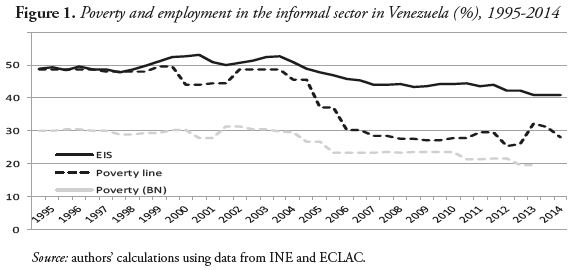
<body><![CDATA[<p>&nbsp;</p>       <p><font size="3"><b>I. Background</b></font></p>     <p>The concept of informality has changed many times since its introduction   by Keith Hart in 1972 to refer to individuals subsisting by working in   marginal activities in an unstructured market. Over time, the definition has   included terms such as poverty, underemployment and even illegal, undeclared   or unregistered activities not included in National Accounting (Mincer,   1976; Feige, 1990; Blunch, Canagarajah and Raju, 2001). In the 1990s, the   International Labor Organization (ILO) linked informality to the number of   employees in a firm and used the term to refer to all unregistered enterprises   with employees below a given number, generally micro-enterprises. Eventually,   the concept expanded to include employers in informal enterprises,   own-account workers in informal enterprises, unpaid family workers, and   members of informal producers' cooperatives. Following the official concept   of informality established in Venezuela, the data provided by the INE define   informal sector workers as individuals working for money on household   chores, non-professional self-employees, employers and employees at firms   with less than five workers and family workers, approach that is used in this   study. Generally, the sector is characterized by having small production units   where the owner is directly involved in the activity; low human and physical   capital investments; low levels of productivity, associated with low wages and   poverty, and partial or absolute lack of control by the government.  </p>     <p><b><i>A. Informality in Latin America</i></b></p>     <p>Employment in the informal sector (EIS) seems to be present in most   third-world economies. Even though recent information is not often available,   statistics from the ILO indicate that the highest numbers for Asia are in   Nepal (73.3% in 1999), Thailand (72.9% in 2002) and Indonesia (68.2% in   1999). In Africa, the magnitude of the problem and the lack of information   are even worse: 80.7% and 72.4% in Zambia and Gambia in 1993, respectively.  </p>     <p>As for Latin America, the information provided by the ILO is relatively   more abundant and updated. In the region as a whole, EIS averaged 46.8% in 2013, with the highest incidence being observed in Guatemala (73.6%),   Honduras (72.8%) and Bolivia (70%), followed by Peru and Paraguay with   64% each and Colombia (54.1%). However, it must be said that comparisons   across countries may be misleading since the definition of EIS differ among   them. For example, Argentina (46.1%) considers as informal any enterprise   with up to five workers; Bolivia limits this number to four, six in Brazil   (36.5%), and ten in Colombia. According to the Program to Promote Formalization   in Latin America and the Caribbean (FORLAC-ILO, 2014) most of   these countries exhibit a substantial reduction in EIS since 2003, especially   Uruguay (15.1 percentage points-pp), Argentina (14.5 pp) and Brazil (10.8   pp).  </p>     <p><b><i>B. Informality in Venezuela</i></b></p>     <p>In Venezuela, the informal sector employs almost half of the workers   although, according to the INE, this rate has been declining in the past decades,   moving from 49.5% in 1995, to 40.8% in 2014 (see <a href="#f1">figure 1</a>).<a href="#3" name="3b"><sup>3</sup></a> The highest   rate is observed in 2003, year in which, due to the 2002-2003 general strike,   the government fired 40% of the state-owned oil company's workforce,   raising the employment in the informal sector up to 53%. Since then, many   companies have been forced to shut down operations and fire their workers,   due to the increasing economic restrictions imposed on the private sector.  </p>     <p align="center"><a name="f1"></a><img src="/img/revistas/le/n84/n84a2f1.jpg"></p>     <p>&nbsp;</p>       ]]></body>
<body><![CDATA[<p>As said before, several studies relate informality and poverty (Tokman,   1994; Cimoli et al., 2006; IDB, 2008, and Devicienti, Groisman and Poggi,   2009). The direction of the causal effect can go either way, since informality   generates poverty mainly through low wages, and poverty pushes workers   into the informal sector as a result of the many constraints it poses, including   malnourishment and lack of formal education. Based on the data shown in <a href="#f1">Figure 1</a>, poverty in Venezuela as measured by either poverty line or basic needs   moves along with informality, with an estimated correlation of 0.88 and   0.90, respectively.<a href="#4" name="4b"><sup>4</sup></a> Particularly, in the period 2012-2013, the proportion of   households under poverty increased from 25.4% to 32.1% or decreased from   21.6% to 19.6% depending on whether the measure is based on the poverty   line or the basic needs approach, respectively. These two measures correspond   to two different methods, generated by two different institutions, which   may explain the observed discrepancies. However, the increase in poverty as   measured by the poverty line is more consistent with the decline in oil prices   that forced the government to put some social programs aside. </p>     <p>Because of the aforementioned relationship between poverty and informality,   any policy intended to generate economic growth and poverty reduction   must consider not only the reduction of the unemployment rate, but also   the formalization of the EIS. However, such formalization is a necessary but   not sufficient condition as long as other forms of social exclusion persist,   denying some groups access to opportunities to live productive lives. </p>     <p>As employment in this sector represents an inefficient allocation of resources,   usually caused by rigidities in the labor market, we propose that the   magnitude of the economic loss due to such an inefficient allocation can be   approached by the difference between the income received by workers in   the informal sector and the wages they would receive in the formal sector.   Estimating such a difference is the purpose of this paper. To do that, we run   difference-in-differences regression models on a matched subsample using   data obtained from the HSS during the first semester of 2012 and the second   semester of 2013.  </p>     <p>&nbsp;</p>       <p><font size="3"><b>II. Literature review</b></font></p>     <p>Several studies have been devoted to identify the causes of the high incidence   of informality in Venezuela. A recent study conducted by Ramoni,   et al. (2014) for Venezuela's Central Bank identifies the increasing incidence   of EIS, as well as the movement out of the labor force by the unemployed,   as the main reasons why the unemployment rate in that country has been declining   in the middle of an economic recession. In a previous work Ramoni   (2012) points out that, in the last decades, the Venezuelan labor market has   moved from low-educated salaried employees working in the agricultural and   manufacturing sectors to highly-educated informal and self-employed workers   involved in commercial activities.  </p>     <p>Marquez and Portela (1991) attribute this problem to lack of adequacy of   the Venezuelan economic system, while Vivancos (1988) blames insufficient   economic activity. Unemployment resulting from this lack of activity pushes   workers into the informal sector (Garnica, 1991; Boza, 2004; Osta, 2007;   D&iacute;az and Corredor, 2008) trying to escape from poverty (Marquez and Portela,   1991; Orlando, 2000; Kolev and Morales, 2006; Guerra, 2006). Prieto,   Zerpa and Martinez (2008) propose the promotion of small- and mediumsize   firms, based on franchises, as a way to solve it.  </p>     <p>As said before, EIS is characterized by being highly unproductive. Ramoni,   Orlandoni and Castillo (2010) compare different methods for quantifying   the size of the informal economy in Venezuela and conclude that this sector employs almost half of the total working population to produce one fourth   of the non-oil real GDP.  </p>     <p>With some exceptions, in general these studies are based on descriptive   statistical analysis. In contrast, DID regression models have been widely   used to evaluate programs and policies. Examples of their application in   the labor market field include quantification of the impact of minimum   wage policies on the unemployment rate in the USA (Card and Krueger,   1994), the effect of unemployment insurance payroll taxes on wages and   the unemployment rate in that same country (Anderson and Meyer, 2000),   and even the effect of the Mariel boatlift migration on the labor market in   Miami (Card, 1990).  </p>     <p>&nbsp;</p>       ]]></body>
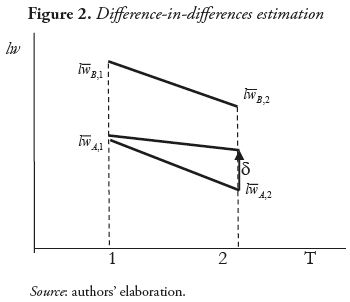
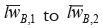
<body><![CDATA[<p><font size="3"><b>III. Methodology</b></font></p>     <p>How much more could an informal sector worker make in a formal   sector job, according to his capabilities? Clearly, trying to answer this question   by calculating the average wage earned by workers in both sectors is   not enough, since we may be comparing non-comparable units. A possible   answer could be comparing wages of workers who switched sectors. However,   this difference would be influenced by the experience earned by the   worker while waiting for a formal job. Another problem we face in these   cases is that the data might exhibit selection bias, since the assignment to   sectors is not at random, so that some systematic factors may affect the   outcomes of an individual's decision. Given the fact that workers cannot   be observed under both situations simultaneously, one simple way to overcome   these problems and estimate the average treatment effect of working   in the informal sector is to compare similar workers in both groups at different   points in time.  </p>     <p>DID regression models are an improved version of fixed effects regression   models in which the possible bias resulting from the correlation between   the decision variable and the error term is corrected by differencing twice,   in an attempt to replicate an experimental research design using observational data.<a href="#5" name="5b"><sup>5</sup></a> They can be used to compare the outcome of individuals in two   different regimes over time. Let A denote the treatment group formed by   workers employed in the informal sector, and B the control group (formal   sector workers), so that a variable named <i>sector</i> takes value 1 if individual is in   the treatment group A, and 0 otherwise. The outcome of interest, in this case   the logarithm of hourly nominal wages (lw), can be observed for individuals   in both sectors at two different periods of time T, so that the movement   froml  <img src="/img/revistas/le/n84/n84a2i1.jpg"> in <a href="#f2">Figure 2</a> illustrates the trend followed by wages in the   formal sector, which is assumed to be the same trend followed by wages in the informal one. </p>     <p align="center"><a name="f2"></a><img src="/img/revistas/le/n84/n84a2f2.jpg"></p>     <p>&nbsp;</p>     <p>The vector &delta; represents the average treatment effect whose estimator is   given by </p>     <p align="center"><img src="/img/revistas/le/n84/n84a2e1.jpg"></p>     <p>&nbsp;</p>       <p>known as the DID estimator. This can be easily obtained from the regression   model given by </p>     <p align="center"><img src="/img/revistas/le/n84/n84a2e2.jpg"></p>     ]]></body>


<body><![CDATA[<p>&nbsp;</p>       <p>That is, the difference in output between the two groups in period 1 is   subtracted from the difference in output in period 2, thus removing biases   that could be due to both permanent differences between groups and the   trend shown over time by the treatment group.<a href="#6" name="6b"><sup>6</sup></a></p>     <p>All the ordinary least squares (OLS) assumptions apply to DID; in   addition, as said in previous lines, the parallel trend assumption must be   satisfied. According to Becker and Hvide (2013), matching methods may   be used to prevent or correct violations of the latter assumption. Particularly,   propensity score (PS) matching methods limit the comparison to   paired individuals, so that it is a potent way to overcome the violation of   the common trend assumption and correct selection bias (Rubin, 1973; Rosenbaum   and Rubin, 1983). The PS represents the probability of assignment   to treatment (informal) conditional on pre-treatment characteristics   X, which can be expressed as</p>     <p align="center"><img src="/img/revistas/le/n84/n84a2e3.jpg"></p>     <p>&nbsp;</p>       <p> Originally, PS matching methods were proposed to reduce bias generated   by unobservable confounding factors in studies with observational data   where the assignment to treatment is not at random, by limiting the comparison   to similar units.<a href="#7" name="7b"><sup>7</sup></a> As Becker and Ichino (2002) indicate, the magnitude at which the bias is reduced depends on the quality of the variables used to   estimate the PS and the matching method applied. Particularly, we opt for a   straightforward matching approach, the nearest neighbor, which compares   individuals in both groups with the closest PS. Being aware of the limitations   of this method, we allow for replacement to improve the bias reduction even   though at the cost of higher variance (Smith and Todd, 2005). As Caliendo   and Kopeinig (2005) indicate, bad matches can be avoided by allowing replacement,   which is equivalent to imposing a tolerance level of the PS matching   as done in radius or caliper methods.<a href="#8" name="8b"><sup>8</sup></a></p>     <p>The PS is usually estimated from logit or probit models on the basis of a   set of conditioning variables that affect the decision to be modeled, satisfying   the balancing assumption &#91;sector &perp; X | PS(X)&#93; in order for the PS to provide   all the necessary information regarding the determinants of the treatment.   The idea behind PS matching is that for each worker in the informal sector,   we use the PS to identify a similar one in the formal sector at the starting   point.<a href="#9" name="9b"><sup>9</sup></a> Then, we run DID regression models comparing the wages of treated   and matched control workers.  </p>     <p>The DID estimator (1) has proven to be more efficient than the betweensubjects   estimate of the treatment effect  <img src="/img/revistas/le/n84/n84a2i2.jpg">, or the within-subjects estimate <img src="/img/revistas/le/n84/n84a2i3.jpg">. In the case that other covariates are added to the model,  <img src="/img/revistas/le/n84/n84a2i4.jpg"> is no longer represented as before, but its interpretation remains the same. Still,   the DID estimator based on OLS limits the analysis to one single point of   the wage distribution, providing an estimate of the conditional average effect   of switching sectors. That is why we also run a DID conditional quantile regression model (QR), which aims at estimating the conditional median and   other quantiles of the wage distribution. Unlike OLS, which bases the estimation   on minimizing the sum of squared residuals, QR minimizes the sum of   absolute deviations. This method has some advantages over OLS: it provides   a more complete statistical analysis of how covariates affect the outcome at   different points of the distribution, so that new and more accurate relationships   can be estimated. Additionally, QR generates robust estimates in the presence of heteroskedasticity (Koenker and Hallock, 2001).  </p>     <p>A complete different alternative to the methods discussed above allows   data to shape the functional form of the outcome. These are non-parametric   techniques, which include both artificial neuronal network models and kernel   estimations. While the former rely on flexible functional forms, the latter   ones use none. In kernel estimations, the density of each point of the outcome   ( <i>y<sub>i</sub></i> ) for a given value of a covariate (<i>x<sub>i</sub></i> ), ( <i>y<sub>i</sub></i> , <i>x<sub>i</sub></i> ), is estimated based on the   proportion of observations that are close to it. These nearby observations   are weighted by a kernel function. Once the joint distribution is estimated,   the height of the conditional density of y given x can be obtained. </p>     <p>Dinardo, Fortin and Lemieux (1996) implement a semi-parametric kernel   procedure (DFL) to analyze the wage distribution in the USA in two different   periods of time. The DFL approach works like an Oaxaca decomposition   extended to the whole wage distribution. By doing so, they were able to measure   the impact of some specific factors on wages. To generate counterfactual   density functions of wages to compare with, DFL weights the original   density function by the probabilities obtained from probit models. Later on,   Huesca and Camberos (2008) adapt the DFL method to compare wages between   formal and informal workers in Mexico. In this case, the weights are   generated from a PS estimated based on a multinomial logit model. Then,   the whole density function of wages in the formal sector is compared to the   density wages that would be obtained if a worker in the informal sector were   paid as a formal one. In spite of the evident goodness of kernel estimations,   this first approach of wages in the informal sector in Venezuela relies on the   aforementioned parametric techniques. </p>     ]]></body>
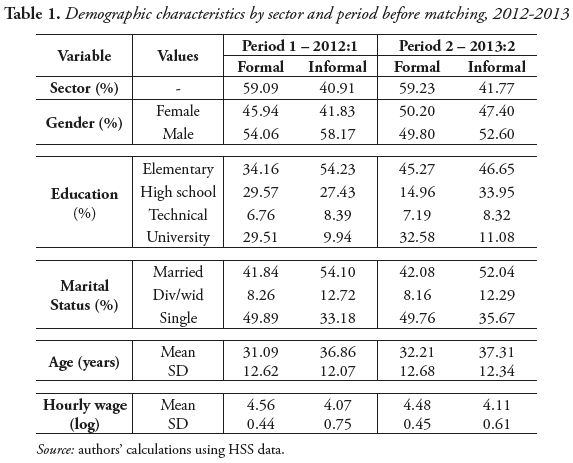
<body><![CDATA[<p>In this study, the information is obtained from the HSS for two different   periods of time. The HSS is a biannual nationwide sample survey of   45,000 urban households, conducted by the INE to characterize the labor   force in Venezuela. From one period to another, 70% of the sample is replaced;   among the remaining 30%, each sample unit might be included for   no longer than 6 periods, so that cohorts exhibit high attrition bias with   not enough workers moving between sectors for any pattern of behavior   to be observed. The sample is further reduced by the absence of data on   some key variables. Because of that, the data were treated as cross-sectional   random samples. The data set used in this study contains a total of 27,735   individuals aged 15 to 65 from two different periods (2012:1 and 2013:2).   The data provide information about hourly wages, sector of employment,   sex, age, educational level, marital status and geographical region. Estimates   are obtained through both a linear regression model and a quantile regression   model.</p>     <p>&nbsp;</p>       <p><font size="3"><b>V. Results</b></font></p>     <p><b><i>A. Description of the original sample</i></b></p>     <p>The data indicate an increasing incidence of workers in the informal   sector, regardless their demographic characteristics (see <a href="#t1">Table 1</a>). Among   them, participation of women as well as workers with a high-school or   college diploma is higher in the second period compared to the first one.   The average worker in the informal sector is about five years older. Nonsingle   workers are more likely to work in this sector, probably because   they have to shorten the job-search due to family obligations; however,   the incidence of single workers in the informal sector tends to increase.   Ramoni et al. (2014) find that, on average, Venezuelan workers wait   almost a year for a job, search that is about two weeks longer for single   workers.</p>     <p align="center"><a name="t1"></a><img src="/img/revistas/le/n84/n84a2t1.jpg"></p>     <p>&nbsp;</p>       <p>As for wages, workers in the formal sector show relatively higher average   wages, but the wage gap between the two sectors shrinks as wages in the formal   sector decline and informal sector workers earn more. This behavior may   be explained by rigidities in a formal wage setting system that is highly competed.   This fact points out that wages in Venezuela are not only not being   adjusted according to the inflation rate, which was 27.1% in 2011, 20.1% in   2012 and 56.2% in 2013 according to Venezuela's Central Bank (BCV), but   even pushed down since the data shown correspond to nominal wages (in   logarithms). We use nominal rather than real wages to highlight the impoverishment   of workers in either sector, since all wage variations are much lower   than the inflation rate. This behavior is not common in an election period in   Venezuela, when working conditions usually improve and wages are adjusted   by the government, with a spillover effect to all of the economy. As for the methodology, this behavior also implies a violation of the assumption of   equal trend in the outcome of treatment and control group in the absence of   treatment that, if ignored, yields biased estimates. All further analysis proceeds   from this matched, more homogeneous subsample.  </p>     <p><b><i>B. Propensity score estimates</i></b></p>     <p>Not all individuals are likely to work in the informal sector. We limit   the analysis to those individuals in the formal sector that are comparable to   workers in the informal sector, in terms of their probability of working in   informal sector jobs. These individuals are selected based on PS matching   using the nearest neighbor approach. The final sample includes 12,559 informal   sector workers and 15,776 formal sector workers, matched at period 1.  </p>     ]]></body>
<body><![CDATA[<p>To estimate the PS, we run a probit model of sector of employment on   some demographic characteristics at the base line. The results are: </p>     <p align="center"><img src="/img/revistas/le/n84/n84a2e4.jpg"></p>     <p>&nbsp;</p>       <p>Based on these results, the probability of working in the informal sector   increases with age; workers with education at college or university level (educ)   are less likely to work in this sector. Also, since job opportunities are not   equally spread around the country, workers living at west (reg2) or east (reg3)   states are more likely to work in this sector compared to north-central workers,   where more job opportunities are available (reg4, rest of the country, is   not statistically significant).  </p>     <p>A simple indicator of differences between informal and formal sector   wages before matching is the median absolute standardized variance (MSV),   as used by Becker and Hvide (2013) based on Rosenbaum and Rubin (1985),   which compares standardized means of the two groups at period 1: </p>     <p align="center"><img src="/img/revistas/le/n84/n84a2e5.jpg"></p>     <p>&nbsp;</p>       <p>where S2   lw measures the variance of wages in sectors A and B. The comparison   of the MSV indicator before and after matching shows a substantial   reduction of the median standardized absolute bias from 66.28 to 14.15.  </p>     <p><b><i>C. DID estimates</i></b></p>     <p>The estimates are based on the model given by <i>lw</i>=<i>&beta;1</i>&#43;<i>&beta;2T</i>&#43;<i>&beta;3sector</i>&#43;   <i>&delta;</i>(sector)(T)&#43;<i>&gamma;&Chi;</i>&#43;<i>&epsilon;</i>, where lw is the logarithm of hourly nominal wages<a href="#10" name="10b"><sup>10</sup></a> and   X includes a set of traditional demographic variables such as gender, level of   education, marital condition and region. The error term &epsilon; is assumed to be   normally distributed (0, &sigma;2).  </p>     ]]></body>


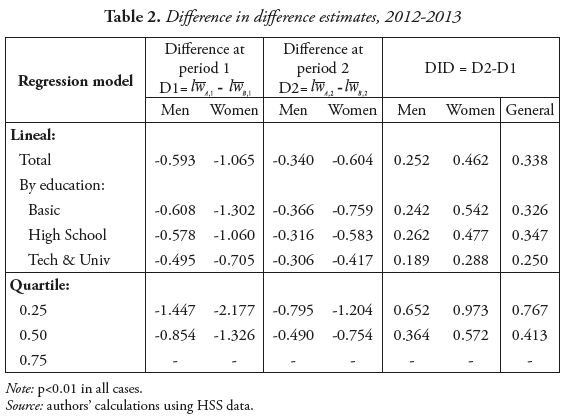
<body><![CDATA[<p>The results of the DID estimates are shown in <a href="#t2">Table 2</a>. As expected, the   differences in wages are negative in both periods in all the cases considered,   since wages in the formal sector are higher; however, this gap tends to get   shorter in the second period as wages in the formal sector deteriorate. The   difference is larger for women, especially at low levels of education and at   lower quartiles. Notice that these differences do not get larger with the educational   level and are substantially higher at the inferior quartile.</p>     <p align="center"><a name="t2"></a><img src="/img/revistas/le/n84/n84a2t2.jpg"></p>     <p>&nbsp;</p>       <p>The values shown in the last three columns of <a href="#t2">Table 2</a> can be interpreted   as the gain from formalizing jobs. This gain averages 46% for women   and 25% for men and are statistically significant in all the cases considered.   If wages increase with the level of education, the fact that low-skilled and   low-wage workers gain relatively more (76.6%) when moving to the formal   sector could indicate low and diminishing returns to human capital in the   Venezuelan formal labor market. No estimation was possible for the third   quartile due to the persistent violation of the same trend assumption and the   impossibility to find enough appropriate matches. This fact speaks in favor   of using the DFL technique in a future study. </p>     <p>Conversely, the results may be interpreted as the extension of the   loss suffered by individuals forced by the market to work in informal   sector activities due to the inability of the economy to provide jobs   and, therefore, it may be seen as an indicator of the magnitude of the   loss suffered by an economy with a high incidence of informality. That   magnitude can be assessed by multiplying the proportion of workers in   the informal sector times their average loss. In our particular case for   Venezuela, the fact that 42% of the workers lose 33.8% of their income   due to working at the informal sector represents a loss of 14.2% of the   national income.  </p>     <p>To our knowledge, the literature comparing earnings between formal and   informal sectors in Latin America based on counterfactuals is quite scarce.   Azevedo (2004) analyzes labor market segmentation for workers living in   slum areas in Rio de Janeiro (Brazil) by testing for structural market segmentation,   considering formal and informal wage earners and entrepreneurs in 1998 and 2000. The author compares the estimates obtained from OLS   applied to Mincerian earnings equations for each category of workers to those   from wage equations corrected for selection bias based on a multinomial   logit. In addition, the paper uses the DFL semi-parametric approach to generate   counterfactuals. His results indicate relatively higher returns to education   for women, with entrepreneurs earning more than salaried workers in the   formal sector but less in the informal one.</p>     <p>Huesca and Camberos (2008) analyze the Mexican labor market in   1992 and 2002 considering four categories of employment given by wage   earners and self-employed in both formal and informal sectors. To generate   counterfactuals, the study relies on the DFL technique, so that the   non-parametric kernel density distribution of wages in the informal sector   is compared to the density of wages these workers would have been   paid in the formal sector. According to their results, there exist substantial   benefits from formalization at least in the last year considered, especially   among wage earners. As in the case of Venezuela, women gain the most   if formalized. Also for Mexico, Moreno (2007) compares self-employed   and formal and informal salaried workers considering panel data for the   period 2000-2003. No counterfactuals are generated in this study; instead,   the gains from formalization are estimated based on the coefficients   of Average Treatment, Treatment on the Treated and Treatment on the   Untreated Effects, corrected from sample selection. This paper indicates   that workers are better off when formalized, no matter their gender, as   long as they have high levels of education; switching sectors has a negative   impact among workers with low educational levels, a result that   contradicts the findings for Venezuela.  </p>     <p>All in all, even though most of the evidence speaks in favor of   formalizing jobs, the gains from switching sectors, as well as the effect   of gender and level of education, may vary between groups and across   countries. The reader must keep in mind that these studies assume different   definitions of informality and different methodological approaches. </p>     <p>&nbsp;</p>       <p><font size="3"><b>Conclusions</b></font></p>     ]]></body>
<body><![CDATA[<p> In Venezuela, in 2013 the informal labor market accounted for more than   40% of the workforce, situation that could partly explain the high incidence   of poverty (32%). This sector is known for its relatively low productivity,   which represents an inefficient use of human capital resources.  </p>     <p>This study measures the economic loss due to working in the informal sector   by estimating difference-in-differences regression models based on a propensity   score matched subsample, in an attempt to reduce biases and ensure the   equal-trend assumption. The study uses data from the HSS in 2012 and 2013.</p>     <p> Several results are important to point out. First, during the period analyzed,   nominal wages increased at rates below the inflation rate, especially in   the formal sector, thus indicating a generalized purchasing power loss. Such a   loss takes place in the midst of two presidential elections, processes traditionally   characterized by wage adjustments used as a political tool.</p>     <p> Second, workers in the informal sector receive on average 66% of the   income they would receive in the formal sector, which represents an economic   loss of more than 14% of national income. This last result is obtained by   multiplying the forgone earnings times the size of the EIS. Women gain the   most from formalization. The difference in wages between the two sectors   seems to decrease with the educational level, signaling low returns to education,   but this behavior is ambiguous. The gains from switching to formal jobs   are larger at the lower the quartile; however, density-based methodologies   should be used to observe the behavior of this gain at the upper tail of the   wage distribution.  </p>     <p>The fact that the difference in average wages between the two sectors   in the original data gets shorter in the second year, compared to the first,   points out an unhealthy labor market in which wages in formal jobs tend to   go down, while those in the informal sector tend to improve. This finding, by   itself, should be a big concern for the government, who must introduce the   necessary correctives to prevent the 'informalization' of the labor market and   to encourage investment in human capital, a necessary condition for poverty reduction.</p>     <p>&nbsp;</p> <hr noshade size="1">     <p><font size="3"> <b>NOTES </b></font></p>     <p><a href="#1b" name="1">1</a> The monetary methods (cash-deposit ratio or cash demand) assume that all transactions in the informal sector are made in cash, while the global indicator methods (physical input consumption or commodity flows) attribute to informal activity the unexplained consumption of a given input, especially electricity.</p>     <p><a href="#2b" name="2">2</a> The HSS is not an open access data set and can only be bought after special request from an institution. The authors thank the University of The Andes in Venezuela for helping them to obtain the information.</p>     <p><a href="#3b" name="3">3</a> It is important to highlight that several studies on the topic conducted by the ILO in the past years do not include recent information for Venezuela or do not consider this country at all. For example, the <i>Statistical Update on Employment in the Informal Economy</i> (ILO, 2012) shows information for 2009 only, while neither FORLAC-ILO (2014) nor <i>Panorama Tem&aacute;tico Laboral: Transici&oacute;n a la Formalidad en Am&eacute;rica Latina y el Caribe</i> (ILO, 2014) include Venezuela among the countries analyzed.</p>     ]]></body>
<body><![CDATA[<p><a href="#4b" name="4">4</a> The sources of this information for each variable are: poverty line (ECLAC), basic-needs (INE), and EIS (INE).</p>     <p><a href="#5b" name="5">5</a> Panel data regression models are used to control for unobservable variables that might affect wages, such as intelligence, capabilities and creativity. Among them, fixed effects regression models work with variables in deviations from the mean. That is why DID regression models are sometimes compared to fixed effects, since they both work with differences although applied in different ways. In addition, as explained in the following, this study attempts to control for unobservables by using propensity score matching methods.</p>     <p><a href="#6b" name="6">6</a> Similarly, the average loss (gain) in the control group in period 2 with respect to period 1 is subtracted from the average loss (gain) in the treatment group between the two periods.</p>     <p><a href="#7b" name="7">7</a> Even though Heckman, Ichimura and Todd (1998) show that the PS matching methods do   not necessarily yield more consistent estimators compared to other matching methods, they   are commonly used following two-step procedures to estimate treatment effects because of   their simplicity. In fact, one of the main advantages of the PS matching is that it reduces the   dimension of the process to one single variable.</p>     <p><a href="#8b" name="8">8</a> Other methods such as interval matching did not fit our data. We limited our study to parametric   techniques, so that non-parametric matching methods were not considered in this   case. The PS matching process followed the algorithm proposed by Becker and Ichino   (2002), available in Stata version 12.0.  </p>     <p><a href="#9b" name="9">9</a> As stated by Heckman (1979), selection bias may arise when considering only observed   wages. Like ours, many studies comparing wages between groups (formal-informal, publicprivate,   unionized-nonunionized) control for selection bias by either using Heckman's Mills   ratio or PS matching, thus limiting the comparison to the market segments considered (see   Azevedo, 2004; Ramoni, 2008, and Huesca and Camberos, 2009).</p>     <p><a href="#10b" name="10">10</a> The reason for using a logarithmic transformation is to facilitate interpretation of the results,   as well as to reduce the variability of the data, which helps to overcome heteroskedasticity   heteroskedasticity problems. Wages are considered on an hourly basis since that is their natural   unit of measure. Also, by doing so, we expect to account for the effect of part-time and full-time jobs.</p> <hr noshade size="1">     <p>&nbsp;</p>     <p><font size="3"> <b>REFERENCES </b></font></p>     <!-- ref --><p>Anderson, Patricia &amp; Meyer, Bruce (2000). "The Effects of the Unemployment Insurance Payroll Tax on Wages, Employment, Claims, and Denials", <i>Journal of Public Economics</i>, Vol. 78, No. 1, pp. 81-106.    &nbsp;&nbsp;&nbsp;&nbsp;&nbsp;&nbsp;&nbsp;&nbsp;[&#160;<a href="javascript:void(0);" onclick="javascript: window.open('/scielo.php?script=sci_nlinks&ref=2078142&pid=S0120-2596201600010000200001&lng=','','width=640,height=500,resizable=yes,scrollbars=1,menubar=yes,');">Links</a>&#160;]<!-- end-ref --></p>     <!-- ref --><p>Azevedo, Joao (2004, september). "An investigation of the labour market   earnings in deprived areas: evaluating the sources of wage inequality in the   slums", In: <i>EGDI</i> and <i>UNU-WIDER</i> Conference, Helsinki, Finlandia.    &nbsp;&nbsp;&nbsp;&nbsp;&nbsp;&nbsp;&nbsp;&nbsp;[&#160;<a href="javascript:void(0);" onclick="javascript: window.open('/scielo.php?script=sci_nlinks&ref=2078144&pid=S0120-2596201600010000200002&lng=','','width=640,height=500,resizable=yes,scrollbars=1,menubar=yes,');">Links</a>&#160;]<!-- end-ref --> </p>     <!-- ref --><p>Becker, Sascha &amp; Ichino, Andrea (2002). "Estimation of average treatment   effects based on propensity scores", <i>The Stata Journal</i>, Vol. 2, No. 4, pp.   358-377.    &nbsp;&nbsp;&nbsp;&nbsp;&nbsp;&nbsp;&nbsp;&nbsp;[&#160;<a href="javascript:void(0);" onclick="javascript: window.open('/scielo.php?script=sci_nlinks&ref=2078146&pid=S0120-2596201600010000200003&lng=','','width=640,height=500,resizable=yes,scrollbars=1,menubar=yes,');">Links</a>&#160;]<!-- end-ref -->  </p>     <!-- ref --><p>Becker, Sascha &amp; Hvide, Hans (2013). "Do entrepreneurs matter?", <i>IZA   Discussion Paper</i>, No. 9295. Institute for the Study of Labor, IZA.    &nbsp;&nbsp;&nbsp;&nbsp;&nbsp;&nbsp;&nbsp;&nbsp;[&#160;<a href="javascript:void(0);" onclick="javascript: window.open('/scielo.php?script=sci_nlinks&ref=2078148&pid=S0120-2596201600010000200004&lng=','','width=640,height=500,resizable=yes,scrollbars=1,menubar=yes,');">Links</a>&#160;]<!-- end-ref --></p>     <!-- ref --><p> Blunch, Niels; Canagarajah, Sudharshan &amp; Raju, Dhushyanth (2001).   "The Informal Sector Revisited: A Synthesis Across Space and Time", <i>Social   Protection Discussion Paper Series</i>, No. 0119. Social Protection Unit,   The World Bank.    &nbsp;&nbsp;&nbsp;&nbsp;&nbsp;&nbsp;&nbsp;&nbsp;[&#160;<a href="javascript:void(0);" onclick="javascript: window.open('/scielo.php?script=sci_nlinks&ref=2078150&pid=S0120-2596201600010000200005&lng=','','width=640,height=500,resizable=yes,scrollbars=1,menubar=yes,');">Links</a>&#160;]<!-- end-ref --> </p>     <!-- ref --><p>Boza, Mar&iacute;a (2004). "&iquest;C&oacute;mo es el Mercado venezolano?", <i>Debates IESA</i>, Vol.   9, No. 3, pp. 30-37.    &nbsp;&nbsp;&nbsp;&nbsp;&nbsp;&nbsp;&nbsp;&nbsp;[&#160;<a href="javascript:void(0);" onclick="javascript: window.open('/scielo.php?script=sci_nlinks&ref=2078152&pid=S0120-2596201600010000200006&lng=','','width=640,height=500,resizable=yes,scrollbars=1,menubar=yes,');">Links</a>&#160;]<!-- end-ref -->  </p>     <!-- ref --><p>Caliendo, Marco &amp; Kopeinig, Sabine (2005). "Some particular guidance   for the implementation of propensity score matching", <i>Discussion Paper   Series</i>, No. 1588. Institute for the Study of Labor, IZA.    &nbsp;&nbsp;&nbsp;&nbsp;&nbsp;&nbsp;&nbsp;&nbsp;[&#160;<a href="javascript:void(0);" onclick="javascript: window.open('/scielo.php?script=sci_nlinks&ref=2078154&pid=S0120-2596201600010000200007&lng=','','width=640,height=500,resizable=yes,scrollbars=1,menubar=yes,');">Links</a>&#160;]<!-- end-ref --> </p>     <!-- ref --><p>Card, David (1990). "The Impact of the Mariel Boatlift on the Miami Labor   Market", <i>Industrial and Labor Relations Review</i>, Vol. 23, No. 2, pp. 245-257.    &nbsp;&nbsp;&nbsp;&nbsp;&nbsp;&nbsp;&nbsp;&nbsp;[&#160;<a href="javascript:void(0);" onclick="javascript: window.open('/scielo.php?script=sci_nlinks&ref=2078156&pid=S0120-2596201600010000200008&lng=','','width=640,height=500,resizable=yes,scrollbars=1,menubar=yes,');">Links</a>&#160;]<!-- end-ref -->  </p>     <!-- ref --><p>Card, David &amp; Krueger, Alan (1994). "Minimum wages and unemployment:   a case study of the fast food industry in New Jersey and Pennsylvania",   <i>The American Economic Review</i>, Vol. 84, pp. 316-361.    &nbsp;&nbsp;&nbsp;&nbsp;&nbsp;&nbsp;&nbsp;&nbsp;[&#160;<a href="javascript:void(0);" onclick="javascript: window.open('/scielo.php?script=sci_nlinks&ref=2078158&pid=S0120-2596201600010000200009&lng=','','width=640,height=500,resizable=yes,scrollbars=1,menubar=yes,');">Links</a>&#160;]<!-- end-ref -->  </p>     <!-- ref --><p>Chapa, Joana; Flores, Daniel &amp; Valero, Jorge (2007). <i>La econom&iacute;a informal.   Estimaciones, comportamiento y potencial recaudatorio</i>. M&eacute;xico: Trillas.    &nbsp;&nbsp;&nbsp;&nbsp;&nbsp;&nbsp;&nbsp;&nbsp;[&#160;<a href="javascript:void(0);" onclick="javascript: window.open('/scielo.php?script=sci_nlinks&ref=2078160&pid=S0120-2596201600010000200010&lng=','','width=640,height=500,resizable=yes,scrollbars=1,menubar=yes,');">Links</a>&#160;]<!-- end-ref --> </p>     <!-- ref --><p>Cimoli, Mario; Primi, Annalisa &amp; Pugno, Maurizio (2006). "A low-growth   model: informality as a structural constraint", <i>Cepal Review</i>, No. 88, pp.   85-102.    &nbsp;&nbsp;&nbsp;&nbsp;&nbsp;&nbsp;&nbsp;&nbsp;[&#160;<a href="javascript:void(0);" onclick="javascript: window.open('/scielo.php?script=sci_nlinks&ref=2078162&pid=S0120-2596201600010000200011&lng=','','width=640,height=500,resizable=yes,scrollbars=1,menubar=yes,');">Links</a>&#160;]<!-- end-ref -->  </p>     <!-- ref --><p>Devicienti, Francesco; Groisman, Fernando &amp; Poggi, Ambra (2009). "Informality   and poverty: Are these processes dynamically interrelated? Evidence   from Argentina", <i>Working Paper</i>, No. 146. Society for the Study of   Economic Inequality.    &nbsp;&nbsp;&nbsp;&nbsp;&nbsp;&nbsp;&nbsp;&nbsp;[&#160;<a href="javascript:void(0);" onclick="javascript: window.open('/scielo.php?script=sci_nlinks&ref=2078164&pid=S0120-2596201600010000200012&lng=','','width=640,height=500,resizable=yes,scrollbars=1,menubar=yes,');">Links</a>&#160;]<!-- end-ref --></p>     <!-- ref --><p> D&iacute;az, William &amp; Corredor, Melvy (2008). "Evoluci&oacute;n de la econom&iacute;a informal   en Venezuela", <i>Observatorio de la Econom&iacute;a Latinoamericana</i>, No.   105. pp. 1-5.    &nbsp;&nbsp;&nbsp;&nbsp;&nbsp;&nbsp;&nbsp;&nbsp;[&#160;<a href="javascript:void(0);" onclick="javascript: window.open('/scielo.php?script=sci_nlinks&ref=2078166&pid=S0120-2596201600010000200013&lng=','','width=640,height=500,resizable=yes,scrollbars=1,menubar=yes,');">Links</a>&#160;]<!-- end-ref --></p>     <!-- ref --><p>Dinardo, John; Fortin, Nicole &amp; Lemieux, Thomas (1996). "Labor market   institutions and the distribution of wages, 1973-1992: A semi-parametric   approach", <i>Econometrica</i>, Vol. 64, No. 5, pp. 1001-1044.    &nbsp;&nbsp;&nbsp;&nbsp;&nbsp;&nbsp;&nbsp;&nbsp;[&#160;<a href="javascript:void(0);" onclick="javascript: window.open('/scielo.php?script=sci_nlinks&ref=2078168&pid=S0120-2596201600010000200014&lng=','','width=640,height=500,resizable=yes,scrollbars=1,menubar=yes,');">Links</a>&#160;]<!-- end-ref -->  </p>     <!-- ref --><p>Economic Commission for Latin America and the Caribbean (ECLAC)   (2014). <i>Panorama social de Am&eacute;rica Latina, 2014</i>. Santiago de Chile:   Author.    &nbsp;&nbsp;&nbsp;&nbsp;&nbsp;&nbsp;&nbsp;&nbsp;[&#160;<a href="javascript:void(0);" onclick="javascript: window.open('/scielo.php?script=sci_nlinks&ref=2078170&pid=S0120-2596201600010000200015&lng=','','width=640,height=500,resizable=yes,scrollbars=1,menubar=yes,');">Links</a>&#160;]<!-- end-ref --> </p>     <!-- ref --><p>Feige, Edgar (1990). "Defining and estimating underground and informal   economies: The new institutional economics approach", <i>World Development</i>,   Vol. 18, No. 7, pp. 989-1002.    &nbsp;&nbsp;&nbsp;&nbsp;&nbsp;&nbsp;&nbsp;&nbsp;[&#160;<a href="javascript:void(0);" onclick="javascript: window.open('/scielo.php?script=sci_nlinks&ref=2078172&pid=S0120-2596201600010000200016&lng=','','width=640,height=500,resizable=yes,scrollbars=1,menubar=yes,');">Links</a>&#160;]<!-- end-ref -->  </p>     <!-- ref --><p>Forlac-Ilo (2014). "Recent experiences of formalization in Latin America   and the Caribbean". <i>Notes on Formalization</i>. Available at: <a href="http://www.ilo.org/wcmsp5/groups/public/â€“â€“â€“americas/â€“â€“â€“roâ€“lima/documents/publication/wcms_245882.pdf" target="_blank">http://www.ilo.org/wcmsp5/groups/public/---americas/---ro-lima/documents/publication/wcms_245882.pdf</a>&nbsp;&nbsp;&nbsp;&nbsp;&nbsp;&nbsp;&nbsp;&nbsp;[&#160;<a href="javascript:void(0);" onclick="javascript: window.open('/scielo.php?script=sci_nlinks&ref=2078174&pid=S0120-2596201600010000200017&lng=','','width=640,height=500,resizable=yes,scrollbars=1,menubar=yes,');">Links</a>&#160;]<!-- end-ref --><!-- ref --><p>Garnica, Elizabeth (1991). <i>La fuerza de trabajo en la agricultura venezolana</i> Caracas: Fundaci&oacute;n Polar-Universidad de Los Andes.    &nbsp;&nbsp;&nbsp;&nbsp;&nbsp;&nbsp;&nbsp;&nbsp;[&#160;<a href="javascript:void(0);" onclick="javascript: window.open('/scielo.php?script=sci_nlinks&ref=2078175&pid=S0120-2596201600010000200018&lng=','','width=640,height=500,resizable=yes,scrollbars=1,menubar=yes,');">Links</a>&#160;]<!-- end-ref --></p>     <!-- ref --><p> Guerra, Alexei (2006). "Ciudadan&iacute;a, informalidad y Estado en Venezuela:   una aproximaci&oacute;n a trav&eacute;s de las redes", <i>Espacio Abierto</i>, Vol. 15, No. 4,   pp. 759-786.    &nbsp;&nbsp;&nbsp;&nbsp;&nbsp;&nbsp;&nbsp;&nbsp;[&#160;<a href="javascript:void(0);" onclick="javascript: window.open('/scielo.php?script=sci_nlinks&ref=2078177&pid=S0120-2596201600010000200019&lng=','','width=640,height=500,resizable=yes,scrollbars=1,menubar=yes,');">Links</a>&#160;]<!-- end-ref --></p>     <!-- ref --><p>Heckman, James (1979). "Sample selection bias as a specification error", <i>Econometrica</i>,   Vol. 47, No. 1, pp. 153-162.    &nbsp;&nbsp;&nbsp;&nbsp;&nbsp;&nbsp;&nbsp;&nbsp;[&#160;<a href="javascript:void(0);" onclick="javascript: window.open('/scielo.php?script=sci_nlinks&ref=2078179&pid=S0120-2596201600010000200020&lng=','','width=640,height=500,resizable=yes,scrollbars=1,menubar=yes,');">Links</a>&#160;]<!-- end-ref --></p>     <!-- ref --><p> Heckman, James; Ichimura, Hideiko &amp; Todd, Petra (1998). "Matching as   an econometric evaluation estimator", <i>Review of Economic Studies</i>, Vol.   65, pp. 261-294.    &nbsp;&nbsp;&nbsp;&nbsp;&nbsp;&nbsp;&nbsp;&nbsp;[&#160;<a href="javascript:void(0);" onclick="javascript: window.open('/scielo.php?script=sci_nlinks&ref=2078181&pid=S0120-2596201600010000200021&lng=','','width=640,height=500,resizable=yes,scrollbars=1,menubar=yes,');">Links</a>&#160;]<!-- end-ref --></p>     ]]></body>
<body><![CDATA[<!-- ref --><p> Huesca, Luis &amp; Camberos, Mario (2009). "El mercado laboral mexicano   1992 y 2002: Un an&aacute;lisis contrafactual de los cambios en la informalidad",   <i>Econom&iacute;a Mexicana Nueva Ã‰poca</i>, Vol. 18, No. 1, pp. 5-43.    &nbsp;&nbsp;&nbsp;&nbsp;&nbsp;&nbsp;&nbsp;&nbsp;[&#160;<a href="javascript:void(0);" onclick="javascript: window.open('/scielo.php?script=sci_nlinks&ref=2078183&pid=S0120-2596201600010000200022&lng=','','width=640,height=500,resizable=yes,scrollbars=1,menubar=yes,');">Links</a>&#160;]<!-- end-ref -->  </p>     <!-- ref --><p>ILO(1972). "Employment, incomes and equality: A strategy for increasing   productive employment in Kenya". Available at: <a href="http://www.ilo.org/public/libdoc/ilo/1972/72B09_608_engl.pdf" target="_blank">http://www.ilo.org/public/libdoc/ilo/1972/72B09_608_engl.pdf</a>&nbsp;&nbsp;&nbsp;&nbsp;&nbsp;&nbsp;&nbsp;&nbsp;[&#160;<a href="javascript:void(0);" onclick="javascript: window.open('/scielo.php?script=sci_nlinks&ref=2078185&pid=S0120-2596201600010000200023&lng=','','width=640,height=500,resizable=yes,scrollbars=1,menubar=yes,');">Links</a>&#160;]<!-- end-ref --><!-- ref --><p> ILO (2012). The Statistical Update on Employment in the Informal Economy.   Available at: <a href="http://laborsta.ilo.org/informal_economy_E.html" target="_blank">http://laborsta.ilo.org/informal_economy_E.html</a>&nbsp;&nbsp;&nbsp;&nbsp;&nbsp;&nbsp;&nbsp;&nbsp;[&#160;<a href="javascript:void(0);" onclick="javascript: window.open('/scielo.php?script=sci_nlinks&ref=2078186&pid=S0120-2596201600010000200024&lng=','','width=640,height=500,resizable=yes,scrollbars=1,menubar=yes,');">Links</a>&#160;]<!-- end-ref --><!-- ref --><p> ILO (2014). Panorama Tem&aacute;tico Laboral: Transici&oacute;n a la Formalidad en Am&eacute;rica   Latina y el Caribe. Available at: <a href="http://ilo.org/wcmsp5/groups/public/â€“â€“â€“americas/â€“â€“â€“roâ€“lima/documents/publication/wcms_315054.pdf" target="_blank">http://ilo.org/wcmsp5/groups/public/---americas/---ro-lima/documents/publication/wcms_315054.pdf</a>&nbsp;&nbsp;&nbsp;&nbsp;&nbsp;&nbsp;&nbsp;&nbsp;[&#160;<a href="javascript:void(0);" onclick="javascript: window.open('/scielo.php?script=sci_nlinks&ref=2078187&pid=S0120-2596201600010000200025&lng=','','width=640,height=500,resizable=yes,scrollbars=1,menubar=yes,');">Links</a>&#160;]<!-- end-ref --><!-- ref --><p>Inter-American Development Bank (2008). <i>Outsiders? The changing   pattern of exclusi&oacute;n in Latin America and The Caribbean</i>. Washington.   Available at: <a href="http://www.iadb.org/en/researchâ€“andâ€“data/publicationâ€“details,3169.html?pub_id=Bâ€“2008" target="_blank">http://www.iadb.org/en/research-and-data/publication-details,3169.html?pub_id=B-2008</a>.    &nbsp;&nbsp;&nbsp;&nbsp;&nbsp;&nbsp;&nbsp;&nbsp;[&#160;<a href="javascript:void(0);" onclick="javascript: window.open('/scielo.php?script=sci_nlinks&ref=2078188&pid=S0120-2596201600010000200026&lng=','','width=640,height=500,resizable=yes,scrollbars=1,menubar=yes,');">Links</a>&#160;]<!-- end-ref --> </p>     <!-- ref --><p>Koenker, Roger &amp; Hallock, Kevin (2001). "Quantile Regression", <i>Journal   of Economic Perspectives</i>, Vol. 15, No. 4: pp.143-156.    &nbsp;&nbsp;&nbsp;&nbsp;&nbsp;&nbsp;&nbsp;&nbsp;[&#160;<a href="javascript:void(0);" onclick="javascript: window.open('/scielo.php?script=sci_nlinks&ref=2078190&pid=S0120-2596201600010000200027&lng=','','width=640,height=500,resizable=yes,scrollbars=1,menubar=yes,');">Links</a>&#160;]<!-- end-ref --></p>     <!-- ref --><p> Kolev, Atanas &amp; Morales, Jesus (2006). "La pol&iacute;tica monetaria y el sector   informal", <i>Serie Documentos de Trabajo</i>, N&deg; 75. Banco Central de   Venezuela.    &nbsp;&nbsp;&nbsp;&nbsp;&nbsp;&nbsp;&nbsp;&nbsp;[&#160;<a href="javascript:void(0);" onclick="javascript: window.open('/scielo.php?script=sci_nlinks&ref=2078192&pid=S0120-2596201600010000200028&lng=','','width=640,height=500,resizable=yes,scrollbars=1,menubar=yes,');">Links</a>&#160;]<!-- end-ref -->  </p>     <!-- ref --><p>M&aacute;rquez, Gustavo &amp; Portela, Carmen (compiladores) (1991). <i>Econom&iacute;a   informal</i>. Caracas: Ediciones IESA.    &nbsp;&nbsp;&nbsp;&nbsp;&nbsp;&nbsp;&nbsp;&nbsp;[&#160;<a href="javascript:void(0);" onclick="javascript: window.open('/scielo.php?script=sci_nlinks&ref=2078194&pid=S0120-2596201600010000200029&lng=','','width=640,height=500,resizable=yes,scrollbars=1,menubar=yes,');">Links</a>&#160;]<!-- end-ref --></p>     <!-- ref --><p>Mincer, Jacob (1976). "Unemployment Effects of Minimum Wages", <i>Journal   of Political Economy</i>, Vol. 84, No.4, pp. 87-104.    &nbsp;&nbsp;&nbsp;&nbsp;&nbsp;&nbsp;&nbsp;&nbsp;[&#160;<a href="javascript:void(0);" onclick="javascript: window.open('/scielo.php?script=sci_nlinks&ref=2078196&pid=S0120-2596201600010000200030&lng=','','width=640,height=500,resizable=yes,scrollbars=1,menubar=yes,');">Links</a>&#160;]<!-- end-ref --></p>     <!-- ref --><p> Moreno, Jorge (2007). "Los salarios del sector formal e informal en M&eacute;xico:   An&aacute;lisis de ganancias y p&eacute;rdidas por formalizaci&oacute;n", <i>Ensayos</i>, Vol. 26,   No.1, pp. 1-44.    &nbsp;&nbsp;&nbsp;&nbsp;&nbsp;&nbsp;&nbsp;&nbsp;[&#160;<a href="javascript:void(0);" onclick="javascript: window.open('/scielo.php?script=sci_nlinks&ref=2078198&pid=S0120-2596201600010000200031&lng=','','width=640,height=500,resizable=yes,scrollbars=1,menubar=yes,');">Links</a>&#160;]<!-- end-ref -->  </p>     <!-- ref --><p>Prieto, Ana; Zerpa, Leiniz &amp; Mart&iacute;nez, Marle (2008). "La actividad econ&oacute;mica   informal y el negocio de franquicia en Venezuela", <i>Revista de   Ciencias Sociales</i>, Vol. 14, No. 2, pp. 333-345.    &nbsp;&nbsp;&nbsp;&nbsp;&nbsp;&nbsp;&nbsp;&nbsp;[&#160;<a href="javascript:void(0);" onclick="javascript: window.open('/scielo.php?script=sci_nlinks&ref=2078200&pid=S0120-2596201600010000200032&lng=','','width=640,height=500,resizable=yes,scrollbars=1,menubar=yes,');">Links</a>&#160;]<!-- end-ref -->  </p>     <!-- ref --><p>Orlando, Mar&iacute;a (2000). "El sector informal en Venezuela &iquest;Plataforma o barrera   para la reducci&oacute;n de la pobreza?", <i>Borradores de Trabajo</i>, No. 15,   Universidad Cat&oacute;lica Andr&eacute;s Bello.    &nbsp;&nbsp;&nbsp;&nbsp;&nbsp;&nbsp;&nbsp;&nbsp;[&#160;<a href="javascript:void(0);" onclick="javascript: window.open('/scielo.php?script=sci_nlinks&ref=2078202&pid=S0120-2596201600010000200033&lng=','','width=640,height=500,resizable=yes,scrollbars=1,menubar=yes,');">Links</a>&#160;]<!-- end-ref --></p>     <!-- ref --><p>Osta, Karelys (2007). "Desempleo e informalidad en Am&eacute;rica Latina: Definiendo   pol&iacute;ticas p&uacute;blicas para Venezuela", <i>Revista Venezolana de Gerencia</i>,   Vol. 12, No. 38, pp. 262-278.    &nbsp;&nbsp;&nbsp;&nbsp;&nbsp;&nbsp;&nbsp;&nbsp;[&#160;<a href="javascript:void(0);" onclick="javascript: window.open('/scielo.php?script=sci_nlinks&ref=2078204&pid=S0120-2596201600010000200034&lng=','','width=640,height=500,resizable=yes,scrollbars=1,menubar=yes,');">Links</a>&#160;]<!-- end-ref --></p>     <!-- ref --><p> Ramoni, Josefa (2004). <i>Compensation Comparisons Between the Public and   Private Sectors in the United States: A Propensity Score Matching Approach</i>.   A dissertation submitted for the degree of Doctor of Philosophy, Department   of Economics, College of Business Administration, University   of South Florida.    &nbsp;&nbsp;&nbsp;&nbsp;&nbsp;&nbsp;&nbsp;&nbsp;[&#160;<a href="javascript:void(0);" onclick="javascript: window.open('/scielo.php?script=sci_nlinks&ref=2078206&pid=S0120-2596201600010000200035&lng=','','width=640,height=500,resizable=yes,scrollbars=1,menubar=yes,');">Links</a>&#160;]<!-- end-ref --> </p>     <!-- ref --><p>Ramoni Josefa (2012). <i>Descripci&oacute;n y An&aacute;lisis de los principales indicadores laborales</i>.   M&eacute;rida: Consejo de Publicaciones ULA y Banco Central de Venezuela.    &nbsp;&nbsp;&nbsp;&nbsp;&nbsp;&nbsp;&nbsp;&nbsp;[&#160;<a href="javascript:void(0);" onclick="javascript: window.open('/scielo.php?script=sci_nlinks&ref=2078208&pid=S0120-2596201600010000200036&lng=','','width=640,height=500,resizable=yes,scrollbars=1,menubar=yes,');">Links</a>&#160;]<!-- end-ref -->  </p>     <!-- ref --><p>Ramoni Josefa; Orlandoni, Giampaolo &amp; Castillo, Laura (2010). "The   Size of the Informal Economy in Venezuela", <i>El Norte-Finnish Journal of   Latin American Studies</i>, No. 5, pp. 1-12.    &nbsp;&nbsp;&nbsp;&nbsp;&nbsp;&nbsp;&nbsp;&nbsp;[&#160;<a href="javascript:void(0);" onclick="javascript: window.open('/scielo.php?script=sci_nlinks&ref=2078210&pid=S0120-2596201600010000200037&lng=','','width=640,height=500,resizable=yes,scrollbars=1,menubar=yes,');">Links</a>&#160;]<!-- end-ref -->  </p>     <!-- ref --><p>Ramoni Josefa; Orlandoni, Giampaolo; Sinha, Surendra; Torres, Elizabeth   &amp; Zambrano, &Aacute;ngel (2014). "An&aacute;lisis de la duraci&oacute;n del desempleo en   Venezuela", <i>Serie Documentos de Trabajo</i> S/N. Banco Central de Venezuela.    &nbsp;&nbsp;&nbsp;&nbsp;&nbsp;&nbsp;&nbsp;&nbsp;[&#160;<a href="javascript:void(0);" onclick="javascript: window.open('/scielo.php?script=sci_nlinks&ref=2078212&pid=S0120-2596201600010000200038&lng=','','width=640,height=500,resizable=yes,scrollbars=1,menubar=yes,');">Links</a>&#160;]<!-- end-ref --></p>     <!-- ref --><p>Rosenbaum, Paul &amp; Rubin, Donald (1983). "The central role of the propensity   score in observational studies for causal effects", <i>Biometrika</i>, Vol. 70,   pp. 41-55.    &nbsp;&nbsp;&nbsp;&nbsp;&nbsp;&nbsp;&nbsp;&nbsp;[&#160;<a href="javascript:void(0);" onclick="javascript: window.open('/scielo.php?script=sci_nlinks&ref=2078214&pid=S0120-2596201600010000200039&lng=','','width=640,height=500,resizable=yes,scrollbars=1,menubar=yes,');">Links</a>&#160;]<!-- end-ref -->  </p>     <!-- ref --><p>Rosenbaum, Paul &amp; Rubin, Donald (1985). "Constructing a control group   using multivariate matched sampling methods that incorporate the propensity   score", <i>The American Statistician</i>, Vol. 39, No. 1, pp. 33-38.    &nbsp;&nbsp;&nbsp;&nbsp;&nbsp;&nbsp;&nbsp;&nbsp;[&#160;<a href="javascript:void(0);" onclick="javascript: window.open('/scielo.php?script=sci_nlinks&ref=2078216&pid=S0120-2596201600010000200040&lng=','','width=640,height=500,resizable=yes,scrollbars=1,menubar=yes,');">Links</a>&#160;]<!-- end-ref -->  </p>     <!-- ref --><p>Rubin, Donald (1973). "Matching to Remove Bias in Observational Studies",   <i>Biometrics</i>, No. 29, pp. 159-183.    &nbsp;&nbsp;&nbsp;&nbsp;&nbsp;&nbsp;&nbsp;&nbsp;[&#160;<a href="javascript:void(0);" onclick="javascript: window.open('/scielo.php?script=sci_nlinks&ref=2078218&pid=S0120-2596201600010000200041&lng=','','width=640,height=500,resizable=yes,scrollbars=1,menubar=yes,');">Links</a>&#160;]<!-- end-ref -->  </p>     <!-- ref --><p>Smith, Jeffrey &amp; Todd, Petra (2005). "Does matching overcome LaLonde's   critique on nonexperimental estimators?", <i>Journal of Econometrics</i>, Vol.   125, No. 1-2, pp. 305-353.    &nbsp;&nbsp;&nbsp;&nbsp;&nbsp;&nbsp;&nbsp;&nbsp;[&#160;<a href="javascript:void(0);" onclick="javascript: window.open('/scielo.php?script=sci_nlinks&ref=2078220&pid=S0120-2596201600010000200042&lng=','','width=640,height=500,resizable=yes,scrollbars=1,menubar=yes,');">Links</a>&#160;]<!-- end-ref -->  </p>     <!-- ref --><p>Tokman, Victor (1994). "Informalidad y pobreza: progreso social y modernizaci&oacute;n   productiva", <i>El trimestre econ&oacute;mico</i>, Vol. 61, No.1241, pp. 16-31.    &nbsp;&nbsp;&nbsp;&nbsp;&nbsp;&nbsp;&nbsp;&nbsp;[&#160;<a href="javascript:void(0);" onclick="javascript: window.open('/scielo.php?script=sci_nlinks&ref=2078222&pid=S0120-2596201600010000200043&lng=','','width=640,height=500,resizable=yes,scrollbars=1,menubar=yes,');">Links</a>&#160;]<!-- end-ref -->  </p>     <!-- ref --><p>Vivancos, Francisco (1988). La econom&iacute;a informal en Venezuela: Una aproximaci&oacute;n econom&eacute;trica. Caracas: IIES-UCAB.    &nbsp;&nbsp;&nbsp;&nbsp;&nbsp;&nbsp;&nbsp;&nbsp;[&#160;<a href="javascript:void(0);" onclick="javascript: window.open('/scielo.php?script=sci_nlinks&ref=2078224&pid=S0120-2596201600010000200044&lng=','','width=640,height=500,resizable=yes,scrollbars=1,menubar=yes,');">Links</a>&#160;]<!-- end-ref --></p>     <p>&nbsp;</p> </font>      ]]></body><back>
<ref-list>
<ref id="B1">
<nlm-citation citation-type="journal">
<person-group person-group-type="author">
<name>
<surname><![CDATA[Anderson]]></surname>
<given-names><![CDATA[Patricia]]></given-names>
</name>
<name>
<surname><![CDATA[Meyer]]></surname>
<given-names><![CDATA[Bruce]]></given-names>
</name>
</person-group>
<article-title xml:lang="en"><![CDATA[The Effects of the Unemployment Insurance Payroll Tax on Wages, Employment, Claims, and Denials]]></article-title>
<source><![CDATA[Journal of Public Economics]]></source>
<year>2000</year>
<volume>78</volume>
<numero>1</numero>
<issue>1</issue>
<page-range>81-106</page-range></nlm-citation>
</ref>
<ref id="B2">
<nlm-citation citation-type="">
<person-group person-group-type="author">
<name>
<surname><![CDATA[Azevedo]]></surname>
<given-names><![CDATA[Joao]]></given-names>
</name>
</person-group>
<article-title xml:lang="en"><![CDATA[An investigation of the labour market earnings in deprived areas: evaluating the sources of wage inequality in the slums]]></article-title>
<source><![CDATA[EGDI and UNU-WIDER]]></source>
<year>2004</year>
<month>, </month>
<day>se</day>
<publisher-loc><![CDATA[Helsinki ]]></publisher-loc>
</nlm-citation>
</ref>
<ref id="B3">
<nlm-citation citation-type="journal">
<person-group person-group-type="author">
<name>
<surname><![CDATA[Becker]]></surname>
<given-names><![CDATA[Sascha]]></given-names>
</name>
<name>
<surname><![CDATA[Ichino]]></surname>
<given-names><![CDATA[Andrea]]></given-names>
</name>
</person-group>
<article-title xml:lang="en"><![CDATA[Estimation of average treatment effects based on propensity scores]]></article-title>
<source><![CDATA[The Stata Journal]]></source>
<year>2002</year>
<volume>2</volume>
<numero>4</numero>
<issue>4</issue>
<page-range>358-377</page-range></nlm-citation>
</ref>
<ref id="B4">
<nlm-citation citation-type="journal">
<person-group person-group-type="author">
<name>
<surname><![CDATA[Becker]]></surname>
<given-names><![CDATA[Sascha]]></given-names>
</name>
<name>
<surname><![CDATA[Hvide]]></surname>
<given-names><![CDATA[Hans]]></given-names>
</name>
</person-group>
<article-title xml:lang="en"><![CDATA[Do entrepreneurs matter]]></article-title>
<source><![CDATA[IZA Discussion Paper]]></source>
<year>2013</year>
<volume>9295</volume>
<publisher-name><![CDATA[Institute for the Study of Labor, IZA]]></publisher-name>
</nlm-citation>
</ref>
<ref id="B5">
<nlm-citation citation-type="journal">
<person-group person-group-type="author">
<name>
<surname><![CDATA[Blunch]]></surname>
<given-names><![CDATA[Niels]]></given-names>
</name>
<name>
<surname><![CDATA[Canagarajah]]></surname>
<given-names><![CDATA[Sudharshan]]></given-names>
</name>
<name>
<surname><![CDATA[Raju]]></surname>
<given-names><![CDATA[Dhushyanth]]></given-names>
</name>
</person-group>
<article-title xml:lang="en"><![CDATA[The Informal Sector Revisited: A Synthesis Across Space and Time']]></article-title>
<source><![CDATA[Social Protection Discussion Paper Series]]></source>
<year>2001</year>
<volume>0119</volume>
<publisher-name><![CDATA[Social Protection Unit, The World Ba]]></publisher-name>
</nlm-citation>
</ref>
<ref id="B6">
<nlm-citation citation-type="journal">
<person-group person-group-type="author">
<name>
<surname><![CDATA[Boza]]></surname>
<given-names><![CDATA[María]]></given-names>
</name>
</person-group>
<article-title xml:lang="es"><![CDATA[Cómo es el Mercado venezolano?]]></article-title>
<source><![CDATA[Debates IESA]]></source>
<year>2004</year>
<volume>9</volume><volume>3</volume>
<page-range>30-37</page-range></nlm-citation>
</ref>
<ref id="B7">
<nlm-citation citation-type="journal">
<person-group person-group-type="author">
<name>
<surname><![CDATA[Caliendo]]></surname>
<given-names><![CDATA[Marco]]></given-names>
</name>
<name>
<surname><![CDATA[Kopeinig]]></surname>
<given-names><![CDATA[Sabine]]></given-names>
</name>
</person-group>
<article-title xml:lang="en"><![CDATA[Some particular guidance for the implementation of propensity score matching]]></article-title>
<source><![CDATA[Discussion Paper Series]]></source>
<year>2005</year>
<volume>1588</volume>
<publisher-name><![CDATA[Institute for the Study of Labor, IZA]]></publisher-name>
</nlm-citation>
</ref>
<ref id="B8">
<nlm-citation citation-type="journal">
<person-group person-group-type="author">
<name>
<surname><![CDATA[Card]]></surname>
<given-names><![CDATA[David]]></given-names>
</name>
</person-group>
<article-title xml:lang="en"><![CDATA[The Impact of the Mariel Boatlift on the Miami Labor Market]]></article-title>
<source><![CDATA[Industrial and Labor Relations Review]]></source>
<year>1990</year>
<volume>23</volume>
<numero>2</numero>
<issue>2</issue>
<page-range>245-257</page-range></nlm-citation>
</ref>
<ref id="B9">
<nlm-citation citation-type="journal">
<person-group person-group-type="author">
<name>
<surname><![CDATA[Card]]></surname>
<given-names><![CDATA[David]]></given-names>
</name>
<name>
<surname><![CDATA[Krueger]]></surname>
<given-names><![CDATA[Alan]]></given-names>
</name>
</person-group>
<article-title xml:lang="en"><![CDATA[Minimum wages and unemployment: a case study of the fast food industry in New Jersey and Pennsylvania]]></article-title>
<source><![CDATA[The American Economic Review]]></source>
<year>1994</year>
<volume>84</volume>
<page-range>316-361</page-range></nlm-citation>
</ref>
<ref id="B10">
<nlm-citation citation-type="book">
<person-group person-group-type="author">
<name>
<surname><![CDATA[Chapa]]></surname>
<given-names><![CDATA[Joana]]></given-names>
</name>
<name>
<surname><![CDATA[Flores]]></surname>
<given-names><![CDATA[Daniel]]></given-names>
</name>
<name>
<surname><![CDATA[Valero]]></surname>
<given-names><![CDATA[Jorge]]></given-names>
</name>
</person-group>
<source><![CDATA[La economía informal. Estimaciones, comportamiento y potencial recaudatorio]]></source>
<year>2007</year>
<publisher-loc><![CDATA[México ]]></publisher-loc>
<publisher-name><![CDATA[Trillas]]></publisher-name>
</nlm-citation>
</ref>
<ref id="B11">
<nlm-citation citation-type="journal">
<person-group person-group-type="author">
<name>
<surname><![CDATA[Cimoli]]></surname>
<given-names><![CDATA[Mario]]></given-names>
</name>
<name>
<surname><![CDATA[Primi]]></surname>
<given-names><![CDATA[Annalisa]]></given-names>
</name>
<name>
<surname><![CDATA[Pugno]]></surname>
<given-names><![CDATA[Maurizio]]></given-names>
</name>
</person-group>
<article-title xml:lang="en"><![CDATA[A low-growth model: informality as a structural constraint]]></article-title>
<source><![CDATA[Cepal Review]]></source>
<year>2006</year>
<volume>88</volume>
<page-range>85-102</page-range></nlm-citation>
</ref>
<ref id="B12">
<nlm-citation citation-type="book">
<person-group person-group-type="author">
<name>
<surname><![CDATA[Devicienti]]></surname>
<given-names><![CDATA[Francesco]]></given-names>
</name>
<name>
<surname><![CDATA[Groisman]]></surname>
<given-names><![CDATA[Fernando]]></given-names>
</name>
<name>
<surname><![CDATA[Poggi]]></surname>
<given-names><![CDATA[Ambra]]></given-names>
</name>
</person-group>
<article-title xml:lang="en"><![CDATA[Informality and poverty: Are these processes dynamically interrelated? Evidence from Argentina]]></article-title>
<source><![CDATA[Working Paper]]></source>
<year>2009</year>
<volume>146</volume>
<publisher-name><![CDATA[Society for the Study of Economic Inequality]]></publisher-name>
</nlm-citation>
</ref>
<ref id="B13">
<nlm-citation citation-type="journal">
<person-group person-group-type="author">
<name>
<surname><![CDATA[Díaz]]></surname>
<given-names><![CDATA[William]]></given-names>
</name>
<name>
<surname><![CDATA[Corredor]]></surname>
<given-names><![CDATA[Melvy]]></given-names>
</name>
</person-group>
<article-title xml:lang="es"><![CDATA[''Evolución de la economía informal en Venezuela]]></article-title>
<source><![CDATA[Observatorio de la Economía Latinoamericana]]></source>
<year>2008</year>
<volume>105</volume>
<page-range>1-5</page-range></nlm-citation>
</ref>
<ref id="B14">
<nlm-citation citation-type="journal">
<person-group person-group-type="author">
<name>
<surname><![CDATA[Dinardo]]></surname>
<given-names><![CDATA[John]]></given-names>
</name>
<name>
<surname><![CDATA[Fortin]]></surname>
<given-names><![CDATA[Nicole]]></given-names>
</name>
<name>
<surname><![CDATA[Lemieux]]></surname>
<given-names><![CDATA[Thomas]]></given-names>
</name>
</person-group>
<article-title xml:lang="en"><![CDATA[Labor market institutions and the distribution of wages, 1973-1992: A semi-parametric approach]]></article-title>
<source><![CDATA[Econometrica]]></source>
<year>1996</year>
<volume>64</volume>
<numero>5</numero>
<issue>5</issue>
<page-range>1001-1044</page-range></nlm-citation>
</ref>
<ref id="B15">
<nlm-citation citation-type="">
<collab>Economic Commission for Latin America and the Caribbean (ECLAC)</collab>
<source><![CDATA[Panorama social de América Latina, 2014]]></source>
<year>2014</year>
<publisher-loc><![CDATA[Santiago de Chile ]]></publisher-loc>
</nlm-citation>
</ref>
<ref id="B16">
<nlm-citation citation-type="journal">
<person-group person-group-type="author">
<name>
<surname><![CDATA[Feige]]></surname>
<given-names><![CDATA[Edgar]]></given-names>
</name>
</person-group>
<article-title xml:lang="en"><![CDATA[Defining and estimating underground and informal economies: The new institutional economics approach]]></article-title>
<source><![CDATA[World Development]]></source>
<year>1990</year>
<volume>18</volume>
<numero>7</numero>
<issue>7</issue>
<page-range>989-1002</page-range></nlm-citation>
</ref>
<ref id="B17">
<nlm-citation citation-type="journal">
<collab>Forlac-Ilo</collab>
<article-title xml:lang="en"><![CDATA[Recent experiences of formalization in Latin America and the Caribbean]]></article-title>
<source><![CDATA[Notes on Formalization]]></source>
<year>2014</year>
</nlm-citation>
</ref>
<ref id="B18">
<nlm-citation citation-type="book">
<person-group person-group-type="author">
<name>
<surname><![CDATA[Garnica]]></surname>
<given-names><![CDATA[Elizabeth]]></given-names>
</name>
</person-group>
<source><![CDATA[La fuerza de trabajo en la agricultura venezolana]]></source>
<year>1991</year>
<publisher-loc><![CDATA[Caracas ]]></publisher-loc>
<publisher-name><![CDATA[Fundación Polar-Universidad de Los Andes]]></publisher-name>
</nlm-citation>
</ref>
<ref id="B19">
<nlm-citation citation-type="journal">
<person-group person-group-type="author">
<name>
<surname><![CDATA[Guerra]]></surname>
<given-names><![CDATA[Alexei]]></given-names>
</name>
</person-group>
<article-title xml:lang="es"><![CDATA[Ciudadanía, informalidad y Estado en Venezuela: una aproximación a través de las redes]]></article-title>
<source><![CDATA[Espacio Abierto]]></source>
<year>2006</year>
<volume>15</volume>
<numero>4</numero>
<issue>4</issue>
<page-range>759-786</page-range></nlm-citation>
</ref>
<ref id="B20">
<nlm-citation citation-type="journal">
<person-group person-group-type="author">
<name>
<surname><![CDATA[Heckman]]></surname>
<given-names><![CDATA[James]]></given-names>
</name>
</person-group>
<article-title xml:lang="en"><![CDATA[Sample selection bias as a specification error]]></article-title>
<source><![CDATA[Econometrica]]></source>
<year>1979</year>
<volume>47</volume>
<numero>1</numero>
<issue>1</issue>
<page-range>153-162</page-range></nlm-citation>
</ref>
<ref id="B21">
<nlm-citation citation-type="journal">
<person-group person-group-type="author">
<name>
<surname><![CDATA[Heckman]]></surname>
<given-names><![CDATA[James]]></given-names>
</name>
<name>
<surname><![CDATA[Ichimura]]></surname>
<given-names><![CDATA[Hideiko]]></given-names>
</name>
<name>
<surname><![CDATA[Todd]]></surname>
<given-names><![CDATA[Petra]]></given-names>
</name>
</person-group>
<article-title xml:lang="en"><![CDATA[Matching as an econometric evaluation estimator]]></article-title>
<source><![CDATA[Review of Economic Studies]]></source>
<year>1998</year>
<volume>65</volume>
<page-range>261-294</page-range></nlm-citation>
</ref>
<ref id="B22">
<nlm-citation citation-type="journal">
<person-group person-group-type="author">
<name>
<surname><![CDATA[Huesca]]></surname>
<given-names><![CDATA[Luis]]></given-names>
</name>
<name>
<surname><![CDATA[Camberos]]></surname>
<given-names><![CDATA[Mario]]></given-names>
</name>
</person-group>
<article-title xml:lang="es"><![CDATA[El mercado laboral mexicano 1992 y 2002: Un análisis contrafactual de los cambios en la informalidad]]></article-title>
<source><![CDATA[Economía Mexicana Nueva Época]]></source>
<year>2009</year>
<volume>18</volume>
<numero>1</numero>
<issue>1</issue>
<page-range>5-43</page-range></nlm-citation>
</ref>
<ref id="B23">
<nlm-citation citation-type="">
<collab>ILO</collab>
<source><![CDATA[Employment, incomes and equality: A strategy for increasing productive employment in Kenya]]></source>
<year>1972</year>
</nlm-citation>
</ref>
<ref id="B24">
<nlm-citation citation-type="">
<collab>ILO</collab>
<source><![CDATA[The Statistical Update on Employment in the Informal Economy]]></source>
<year>2012</year>
</nlm-citation>
</ref>
<ref id="B25">
<nlm-citation citation-type="">
<collab>ILO</collab>
<source><![CDATA[Panorama Temático Laboral: Transición a la Formalidad en América Latina y el Caribe]]></source>
<year>2014</year>
</nlm-citation>
</ref>
<ref id="B26">
<nlm-citation citation-type="">
<collab>Inter-American Development Bank</collab>
<source><![CDATA[Outsiders? The changing pattern of exclusión in Latin America and The Caribbean]]></source>
<year>2008</year>
<publisher-loc><![CDATA[Washington ]]></publisher-loc>
</nlm-citation>
</ref>
<ref id="B27">
<nlm-citation citation-type="journal">
<person-group person-group-type="author">
<name>
<surname><![CDATA[Koenker]]></surname>
<given-names><![CDATA[Roger]]></given-names>
</name>
<name>
<surname><![CDATA[Hallock]]></surname>
<given-names><![CDATA[Kevin]]></given-names>
</name>
</person-group>
<article-title xml:lang="en"><![CDATA[Quantile Regression]]></article-title>
<source><![CDATA[Journal of Economic Perspectives]]></source>
<year>2001</year>
<volume>15</volume>
<numero>4</numero>
<issue>4</issue>
<page-range>143-156</page-range></nlm-citation>
</ref>
<ref id="B28">
<nlm-citation citation-type="journal">
<person-group person-group-type="author">
<name>
<surname><![CDATA[Kolev]]></surname>
<given-names><![CDATA[Atanas]]></given-names>
</name>
<name>
<surname><![CDATA[Morales]]></surname>
<given-names><![CDATA[Jesus]]></given-names>
</name>
</person-group>
<article-title xml:lang="es"><![CDATA[La política monetaria y el sector informal]]></article-title>
<source><![CDATA[Serie Documentos de Trabajo]]></source>
<year>2006</year>
<volume>75</volume>
<publisher-name><![CDATA[Banco Central de Venezuela]]></publisher-name>
</nlm-citation>
</ref>
<ref id="B29">
<nlm-citation citation-type="book">
<person-group person-group-type="author">
<name>
<surname><![CDATA[Márquez]]></surname>
<given-names><![CDATA[Gustavo]]></given-names>
</name>
<name>
<surname><![CDATA[Portela]]></surname>
<given-names><![CDATA[Carmen]]></given-names>
</name>
</person-group>
<source><![CDATA[Economía informal]]></source>
<year>1991</year>
<publisher-loc><![CDATA[Caracas ]]></publisher-loc>
<publisher-name><![CDATA[Ediciones IESA]]></publisher-name>
</nlm-citation>
</ref>
<ref id="B30">
<nlm-citation citation-type="journal">
<person-group person-group-type="author">
<name>
<surname><![CDATA[Mincer]]></surname>
<given-names><![CDATA[Jacob]]></given-names>
</name>
</person-group>
<article-title xml:lang="en"><![CDATA[Unemployment Effects of Minimum Wages]]></article-title>
<source><![CDATA[Journal of Political Economy]]></source>
<year>1976</year>
<volume>84</volume>
<numero>4</numero>
<issue>4</issue>
<page-range>87-104</page-range></nlm-citation>
</ref>
<ref id="B31">
<nlm-citation citation-type="journal">
<person-group person-group-type="author">
<name>
<surname><![CDATA[Moreno]]></surname>
<given-names><![CDATA[Jorge]]></given-names>
</name>
</person-group>
<article-title xml:lang="es"><![CDATA[Los salarios del sector formal e informal en México: Análisis de ganancias y pérdidas por formalización]]></article-title>
<source><![CDATA[Ensayos]]></source>
<year>2007</year>
<volume>26</volume><volume>1</volume>
<page-range>1-44</page-range></nlm-citation>
</ref>
<ref id="B32">
<nlm-citation citation-type="journal">
<person-group person-group-type="author">
<name>
<surname><![CDATA[Prieto]]></surname>
<given-names><![CDATA[Ana]]></given-names>
</name>
<name>
<surname><![CDATA[Zerpa]]></surname>
<given-names><![CDATA[Leiniz]]></given-names>
</name>
<name>
<surname><![CDATA[Martínez]]></surname>
<given-names><![CDATA[Marle]]></given-names>
</name>
</person-group>
<article-title xml:lang="es"><![CDATA[La actividad económica informal y el negocio de franquicia en Venezuela]]></article-title>
<source><![CDATA[Revista de Ciencias Sociales]]></source>
<year>2008</year>
<volume>14</volume>
<numero>2</numero>
<issue>2</issue>
<page-range>333-345</page-range></nlm-citation>
</ref>
<ref id="B33">
<nlm-citation citation-type="journal">
<person-group person-group-type="author">
<name>
<surname><![CDATA[Orlando]]></surname>
<given-names><![CDATA[María]]></given-names>
</name>
</person-group>
<article-title xml:lang="es"><![CDATA[El sector informal en Venezuela: Plataforma o barrera para la reducción de la pobreza?]]></article-title>
<source><![CDATA[Borradores de Trabajo]]></source>
<year>2000</year>
<volume>15</volume>
<publisher-name><![CDATA[Universidad Católica Andrés Bello]]></publisher-name>
</nlm-citation>
</ref>
<ref id="B34">
<nlm-citation citation-type="journal">
<person-group person-group-type="author">
<name>
<surname><![CDATA[Osta]]></surname>
<given-names><![CDATA[Karelys]]></given-names>
</name>
</person-group>
<article-title xml:lang="es"><![CDATA[Desempleo e informalidad en América Latina: Definiendo políticas públicas para Venezuela]]></article-title>
<source><![CDATA[Revista Venezolana de Gerencia]]></source>
<year>2007</year>
<volume>12</volume>
<numero>38</numero>
<issue>38</issue>
<page-range>262-278</page-range></nlm-citation>
</ref>
<ref id="B35">
<nlm-citation citation-type="book">
<person-group person-group-type="author">
<name>
<surname><![CDATA[Ramoni]]></surname>
<given-names><![CDATA[Josefa]]></given-names>
</name>
</person-group>
<source><![CDATA[Compensation Comparisons Between the Public and Private Sectors in the United States: A Propensity Score Matching Approach]]></source>
<year>2004</year>
<publisher-name><![CDATA[Department of Economics, College of Business Administration, University of South Florida]]></publisher-name>
</nlm-citation>
</ref>
<ref id="B36">
<nlm-citation citation-type="book">
<person-group person-group-type="author">
<name>
<surname><![CDATA[Ramoni]]></surname>
<given-names><![CDATA[Josefa]]></given-names>
</name>
</person-group>
<source><![CDATA[Descripción y Análisis de los principales indicadores laborales]]></source>
<year>2012</year>
<publisher-loc><![CDATA[Mérida ]]></publisher-loc>
<publisher-name><![CDATA[Consejo de Publicaciones ULA y Banco Central de Venezuela]]></publisher-name>
</nlm-citation>
</ref>
<ref id="B37">
<nlm-citation citation-type="journal">
<person-group person-group-type="author">
<name>
<surname><![CDATA[Ramoni Josefa]]></surname>
<given-names><![CDATA[Orlandoni]]></given-names>
</name>
<name>
<surname><![CDATA[Giampaolo & Castillo]]></surname>
<given-names><![CDATA[Laura]]></given-names>
</name>
</person-group>
<article-title xml:lang="en"><![CDATA[The Size of the Informal Economy in Venezuela]]></article-title>
<source><![CDATA[El Norte-Finnish Journal of Latin American Studies]]></source>
<year>2010</year>
<volume>5</volume>
<page-range>1-12</page-range></nlm-citation>
</ref>
<ref id="B38">
<nlm-citation citation-type="journal">
<person-group person-group-type="author">
<name>
<surname><![CDATA[Ramoni]]></surname>
<given-names><![CDATA[Josefa]]></given-names>
</name>
<name>
<surname><![CDATA[Orlandoni]]></surname>
<given-names><![CDATA[Giampaolo]]></given-names>
</name>
<name>
<surname><![CDATA[Sinha]]></surname>
<given-names><![CDATA[Surendra]]></given-names>
</name>
<name>
<surname><![CDATA[Torres]]></surname>
<given-names><![CDATA[Elizabeth]]></given-names>
</name>
<name>
<surname><![CDATA[Zambrano]]></surname>
<given-names><![CDATA[Ángel]]></given-names>
</name>
</person-group>
<article-title xml:lang="es"><![CDATA[Análisis de la duración del desempleo en Venezuela]]></article-title>
<source><![CDATA[Serie Documentos de Trabajo S/N]]></source>
<year>2014</year>
<publisher-name><![CDATA[Banco Central de Venezuela]]></publisher-name>
</nlm-citation>
</ref>
<ref id="B39">
<nlm-citation citation-type="journal">
<person-group person-group-type="author">
<name>
<surname><![CDATA[Rosenbaum]]></surname>
<given-names><![CDATA[Paul]]></given-names>
</name>
<name>
<surname><![CDATA[Rubin]]></surname>
<given-names><![CDATA[Donald]]></given-names>
</name>
</person-group>
<article-title xml:lang="en"><![CDATA[The central role of the propensity score in observational studies for causal effects]]></article-title>
<source><![CDATA[Biometrika]]></source>
<year>1983</year>
<volume>70</volume>
<page-range>41-55</page-range></nlm-citation>
</ref>
<ref id="B40">
<nlm-citation citation-type="journal">
<person-group person-group-type="author">
<name>
<surname><![CDATA[Rosenbaum]]></surname>
<given-names><![CDATA[Paul]]></given-names>
</name>
<name>
<surname><![CDATA[Rubin]]></surname>
<given-names><![CDATA[Donald]]></given-names>
</name>
</person-group>
<article-title xml:lang="en"><![CDATA[Constructing a control group using multivariate matched sampling methods that incorporate the propensity score]]></article-title>
<source><![CDATA[The American Statistician]]></source>
<year>1985</year>
<volume>39</volume>
<numero>1</numero>
<issue>1</issue>
<page-range>33-38</page-range></nlm-citation>
</ref>
<ref id="B41">
<nlm-citation citation-type="journal">
<person-group person-group-type="author">
<name>
<surname><![CDATA[Rubin]]></surname>
<given-names><![CDATA[Donald]]></given-names>
</name>
</person-group>
<article-title xml:lang="en"><![CDATA[Matching to Remove Bias in Observational Studies]]></article-title>
<source><![CDATA[Biometrics]]></source>
<year>1973</year>
<volume>29</volume>
<page-range>159-183</page-range></nlm-citation>
</ref>
<ref id="B42">
<nlm-citation citation-type="journal">
<person-group person-group-type="author">
<name>
<surname><![CDATA[Smith]]></surname>
<given-names><![CDATA[Jeffrey]]></given-names>
</name>
<name>
<surname><![CDATA[Todd]]></surname>
<given-names><![CDATA[Petra]]></given-names>
</name>
</person-group>
<article-title xml:lang="en"><![CDATA[Does matching overcome LaLonde's critique on nonexperimental estimators?]]></article-title>
<source><![CDATA[Journal of Econometrics]]></source>
<year>2005</year>
<volume>125</volume>
<numero>1-2</numero>
<issue>1-2</issue>
<page-range>305-353</page-range></nlm-citation>
</ref>
<ref id="B43">
<nlm-citation citation-type="journal">
<person-group person-group-type="author">
<name>
<surname><![CDATA[Tokman]]></surname>
<given-names><![CDATA[Victor]]></given-names>
</name>
</person-group>
<article-title xml:lang="es"><![CDATA[Informalidad y pobreza: progreso social y modernización productiva]]></article-title>
<source><![CDATA[El trimestre económico]]></source>
<year>1994</year>
<volume>61</volume>
<numero>1241</numero>
<issue>1241</issue>
<page-range>16-31</page-range></nlm-citation>
</ref>
<ref id="B44">
<nlm-citation citation-type="book">
<person-group person-group-type="author">
<name>
<surname><![CDATA[Vivancos]]></surname>
<given-names><![CDATA[Francisco]]></given-names>
</name>
</person-group>
<source><![CDATA[La economía informal en Venezuela: Una aproximación econométrica]]></source>
<year>1988</year>
<publisher-loc><![CDATA[Caracas ]]></publisher-loc>
<publisher-name><![CDATA[IIES-UCAB]]></publisher-name>
</nlm-citation>
</ref>
</ref-list>
</back>
</article>