<?xml version="1.0" encoding="ISO-8859-1"?><article xmlns:mml="http://www.w3.org/1998/Math/MathML" xmlns:xlink="http://www.w3.org/1999/xlink" xmlns:xsi="http://www.w3.org/2001/XMLSchema-instance">
<front>
<journal-meta>
<journal-id>0120-4157</journal-id>
<journal-title><![CDATA[Biomédica]]></journal-title>
<abbrev-journal-title><![CDATA[Biomédica]]></abbrev-journal-title>
<issn>0120-4157</issn>
<publisher>
<publisher-name><![CDATA[Instituto Nacional de Salud]]></publisher-name>
</publisher>
</journal-meta>
<article-meta>
<article-id>S0120-41572004000100007</article-id>
<title-group>
<article-title xml:lang="es"><![CDATA[Análisis de polimorfismos APO-E en mujeres colombianas con osteoporosis y correlación con variables clínicas y sociales de riesgo]]></article-title>
<article-title xml:lang="en"><![CDATA[Polymorphismsof APO-E in Colombian women with osteoporosis: correlation among clinical and s9ocial risk variables]]></article-title>
</title-group>
<contrib-group>
<contrib contrib-type="author">
<name>
<surname><![CDATA[Villarreal]]></surname>
<given-names><![CDATA[Elsa]]></given-names>
</name>
<xref ref-type="aff" rid="A01"/>
</contrib>
<contrib contrib-type="author">
<name>
<surname><![CDATA[Bermúdez]]></surname>
<given-names><![CDATA[Antonio]]></given-names>
</name>
<xref ref-type="aff" rid="A02"/>
</contrib>
</contrib-group>
<aff id="A01">
<institution><![CDATA[,Instituto Nacional de Salud, Bogotá Grupo de Nutrición ]]></institution>
<addr-line><![CDATA[ ]]></addr-line>
</aff>
<aff id="A02">
<institution><![CDATA[,Instituto Nacional de Salud, Bogotá Grupo de Genética ]]></institution>
<addr-line><![CDATA[ ]]></addr-line>
</aff>
<pub-date pub-type="pub">
<day>00</day>
<month>03</month>
<year>2004</year>
</pub-date>
<pub-date pub-type="epub">
<day>00</day>
<month>03</month>
<year>2004</year>
</pub-date>
<volume>24</volume>
<numero>1</numero>
<fpage>50</fpage>
<lpage>55</lpage>
<copyright-statement/>
<copyright-year/>
<self-uri xlink:href="http://www.scielo.org.co/scielo.php?script=sci_arttext&amp;pid=S0120-41572004000100007&amp;lng=en&amp;nrm=iso"></self-uri><self-uri xlink:href="http://www.scielo.org.co/scielo.php?script=sci_abstract&amp;pid=S0120-41572004000100007&amp;lng=en&amp;nrm=iso"></self-uri><self-uri xlink:href="http://www.scielo.org.co/scielo.php?script=sci_pdf&amp;pid=S0120-41572004000100007&amp;lng=en&amp;nrm=iso"></self-uri><abstract abstract-type="short" xml:lang="es"><p><![CDATA[Varios estudios han demostrado la asociación de los polimorfismos de la apolipoproteína E (APO-E) con la osteoporosis, especialmente, la APO-E 4. Para analizar los polimorfismos APOE e identificar la asociación con variables clínicas y sociales, se realizó un estudio descriptivo de 32 mujeres con osteoporosis, provenientes de diferentes regiones de Colombia, mediante metodologías PCR y RFLP. Se observaron en osteoporosis, osteopenia y osteoporosis combinada con osteopenia frecuencias para el genotipo épsilon3/épsilon3 en el 84,3% (n=27), y en el 15,6% para los genotipos con el alelo épsilon4 (épsilon3/épsilon4=12,5%, n=4; épsilon4/épsilon4=3,1%, n=1); la misma tendencia se observó en la distribución por edad de la menopausia, épsilon3/épsilon3 en el 83,3% (n=25), y genotipos con el alelo épsilon4 en el 16,6% (n=5) (épsilon3/épsilon4=13,3%, n=4; épsilon4/épsilon4=3,3%, n=1). No hubo asociación de APO-E4 con estrato socioeconómico, fracturas, enfermedades o consumo de lácteos. Aunque no hubo efecto del alelo épsilon4 en la densidad mineral ósea (DMO) de la columna lumbar: épsilon4+/-(épsilon3/épsilon4 0,960±0,144 g/cm2); épsilon4+/+ (épsilon4/épsilon4 0,873±0,00 g/cm2); épsilon4-/- (épsilon3/épsilon3 0,858±0,160 g/cm2); p=0,49, ni en cuello femoral: épsilon4+/-(épsilon3/épsilon4 0,841±0,026 g/cm2); épsilon4+/+ (épsilon4/épsilon4 0,842±0,00 g/cm2); épsilon4- /- (épsilon3/épsilon3 0,735±0,013 g/cm2), p=0,14, al explorar las diferencias de medias de DMO en el cuello femoral, se observó una diferencia significativa, t=4,17 p=0,05. Estos datos confirman una frecuencia del alelo épsilon4 similar a lo reportado en poblaciones caucásicas y japonesas; se sugiere realizar estudios a gran escala para esclarecer el impacto de la APO-E sobre la DMO y su relación dosis-efecto.]]></p></abstract>
<abstract abstract-type="short" xml:lang="en"><p><![CDATA[Several studies have reported an association between apolipoprotein E polymorphisms and osteoporosis, specially the genotype APO-E4. In order to analyze the APO-E polymorphisms and to identify their association with clinical and social variables, a descriptive study was undertaken that included 32 women with osteoporosis, from different regions of Colombia. The polymorphisms were detected by PCR and RFLP methods. In osteopenia and osteoporosis combined with osteopenia were observed the genotype epsilon3/epsilon3 in the 84% (n=27), and 16% (epsilon3/epsilon4=12,5%, n=4; epsilon4/epsilon4=3,1%, n=1) for the genotypes bearing the epsilon4 allele. The same tendency was observed by age of the menopause,epsilon3/epsilon3 in the 83% (n=25), and the genotypes bearing the epsilon4 allele in the 17% (n=5)(epsilon3/epsilon4=13,3%, n=4; epsilon4/epsilon4=3,3%, n=1). No association of APO-E4 was detected with socioeconomic stratum, fracture, illness, surgeries, and milk consumption. No significant differences were observed in the bone mineral density (BMD) of the lumbar column between the genotypes with or without the epsilon4 allele epsilon4+/- (epsilon3/epsilon4 0.96±0.14 g/cm2); epsilon4+/+ (epsilon4/epsilon4 0.87±0.0 g/cm2); epsilon4-/- (epsilon3/epsilon3 0.86±0.16 g/cm2); p=0.49, and femoral bone mineral density epsilon4+/- (epsilon3/epsilon4 0.84±0.03 g/cm2); epsilon4+/+ (epsilon4/epsilon4 0.84±0.0 g/cm2); epsilon4-/- (epsilon3/epsilon3 0.74±0.01 g/cm2); p=0.014. However, when exploring the differences of BMD in the femoral neck, a significant difference was observed (t=4.17, p=0.05). These results confirm epsilon4 allele frequencies similar to those reported for caucasian and Japanese, subjects. Larger studies are necessary to elucidate the effect of APO-E in bone marrow and the dose-effect relation.]]></p></abstract>
<kwd-group>
<kwd lng="es"><![CDATA[apolipoproteína E]]></kwd>
<kwd lng="es"><![CDATA[polimorfismos]]></kwd>
<kwd lng="es"><![CDATA[genotipos]]></kwd>
<kwd lng="es"><![CDATA[osteoporosis]]></kwd>
<kwd lng="es"><![CDATA[DMO]]></kwd>
<kwd lng="es"><![CDATA[alel]]></kwd>
<kwd lng="en"><![CDATA[apolipoprotein E]]></kwd>
<kwd lng="en"><![CDATA[polymorphisms]]></kwd>
<kwd lng="en"><![CDATA[genotype]]></kwd>
<kwd lng="en"><![CDATA[osteoporosis]]></kwd>
<kwd lng="en"><![CDATA[allele]]></kwd>
<kwd lng="en"><![CDATA[BMD]]></kwd>
</kwd-group>
</article-meta>
</front><body><![CDATA[   <B><FONT FACE="Arial" SIZE=4>    <P ALIGN="CENTER">An&aacute;lisis de polimorfismos APO-E en mujeres colombianas con osteoporosis y correlaci&oacute;n con variables cl&iacute;nicas y sociales de riesgo</P> </B></FONT><FONT FACE="Arial,Arial">    <P ALIGN="CENTER">Elsa Villarreal <SUP>1</SUP> , Antonio Berm&uacute;dez <SUP>2</P>     <P>1</SUP> Grupo de Nutrici&oacute;n, Instituto Nacional de Salud, Bogot&aacute;, D.C., Colombia.</P> <SUP>    <P>2</SUP> Grupo de Gen&eacute;tica, Instituto Nacional de Salud, Bogot&aacute;, D.C., Colombia.</P>     <P>Varios estudios han demostrado la asociaci&oacute;n de los polimorfismos de la apolipoprote&iacute;na E (APO-E) con la osteoporosis, especialmente, la APO-E 4. Para analizar los polimorfismos APOE e identificar la asociaci&oacute;n con variables cl&iacute;nicas y sociales, se realiz&oacute; un estudio descriptivo de 32 mujeres con osteoporosis, provenientes de diferentes regiones de Colombia, mediante metodolog&iacute;as PCR y RFLP.</P>     <P>Se observaron en osteoporosis, osteopenia y osteoporosis combinada con osteopenia frecuencias para el genotipo </FONT><FONT FACE=Symbol>e</FONT><FONT FACE="Arial"> 3/</FONT><FONT FACE=Symbol>e</FONT><FONT FACE="Arial">3 en el 84,3% (n=27), y en el 15,6% para los genotipos con el alelo </FONT><FONT FACE=Symbol>e</FONT><FONT FACE="Arial">4 (</FONT><FONT FACE=Symbol>e</FONT><FONT FACE="Arial">3/</FONT><FONT FACE=Symbol>e</FONT><FONT FACE="Arial">4=12,5%, n=4; </FONT><FONT FACE=Symbol>e</FONT><FONT FACE="Arial">4/</FONT><FONT FACE=Symbol>e</FONT><FONT FACE="Arial">4=3,1%, n=1); la misma tendencia se observ&oacute; en la distribuci&oacute;n por edad de la menopausia, </FONT><FONT FACE=Symbol>e</FONT><FONT FACE="Arial">3/</FONT><FONT FACE=Symbol>e3</FONT><FONT FACE="Arial"> en el 83,3% (n=25), y genotipos con el alelo </FONT><FONT FACE=Symbol>e</FONT><FONT FACE="Arial">4 en el 16,6% (n=5) (</FONT><FONT FACE=Symbol>e</FONT><FONT FACE="Arial">3/</FONT><FONT FACE=Symbol>e</FONT><FONT FACE="Arial,Arial">4=13,3%, n=4; </FONT><FONT FACE=Symbol>e</FONT><FONT FACE="Arial">4/</FONT><FONT FACE=Symbol>e</FONT><FONT FACE="Arial">4=3,3%, n=1). No hubo asociaci&oacute;n de APO-E4 con estrato socioecon&oacute;mico, fracturas, enfermedades o consumo de l&aacute;cteos.</P>     <P>Aunque no hubo efecto del alelo </FONT><FONT FACE=Symbol>e</FONT><FONT FACE="Arial">4 en la densidad mineral &oacute;sea (DMO) de la columna lumbar: </FONT><FONT FACE=Symbol>e</FONT><FONT FACE="Arial">4+/-(</FONT><FONT FACE=Symbol>e</FONT><FONT FACE="Arial,Arial">3/</FONT><FONT FACE=Symbol>e</FONT><FONT FACE="Arial,Arial">4 0,960±0,144 g/cm<SUP>2</SUP>); </FONT><FONT FACE=Symbol>e</FONT><FONT FACE="Arial">4+/+ (</FONT><FONT FACE=Symbol>e</FONT><FONT FACE="Arial">4/</FONT><FONT FACE=Symbol>e</FONT><FONT FACE="Arial">4 0,873±0,00 g/cm<SUP>2</SUP>); </FONT><FONT FACE=Symbol>e</FONT><FONT FACE="Arial">4-/- (</FONT><FONT FACE=Symbol>e</FONT><FONT FACE="Arial">3/</FONT><FONT FACE=Symbol>e</FONT><FONT FACE="Arial">3 0,858±0,160 g/cm<SUP>2</SUP>); p=0,49, ni en cuello femoral: </FONT><FONT FACE=Symbol>e</FONT><FONT FACE="Arial">4+/-(</FONT><FONT FACE=Symbol>e</FONT><FONT FACE="Arial,Arial">3/</FONT><FONT FACE=Symbol>e</FONT><FONT FACE="Arial,Arial">4 0,841±0,026 g/cm<SUP>2</SUP>); </FONT><FONT FACE=Symbol>e</FONT><FONT FACE="Arial">4+/+ (</FONT><FONT FACE=Symbol>e</FONT><FONT FACE="Arial">4/</FONT><FONT FACE=Symbol>e</FONT><FONT FACE="Arial">4 0,842±0,00 g/cm<SUP>2</SUP>); </FONT><FONT FACE=Symbol>e</FONT><FONT FACE="Arial">4- /- (</FONT><FONT FACE=Symbol>e</FONT><FONT FACE="Arial">3/</FONT><FONT FACE=Symbol>e</FONT><FONT FACE="Arial">3 0,735±0,013 g/cm<SUP>2</SUP>), p=0,14, al explorar las diferencias de medias de DMO en el cuello femoral, se observ&oacute; una diferencia significativa, t=4,17 p=0,05.</P>     <P>Estos datos confirman una frecuencia del alelo e4 similar a lo reportado en poblaciones cauc&aacute;sicas y japonesas; se sugiere realizar estudios a gran escala para esclarecer el impacto de la APO-E sobre la DMO y su relaci&oacute;n dosis-efecto.</P> <B>    <P>Palabras claves: </B>apolipoprote&iacute;na E, polimorfismos, genotipos, osteoporosis, DMO, alelo.</P> <B>    ]]></body>
<body><![CDATA[<P>Polymorphismsof APO-E in Colombian women with osteoporosis: correlation among clinical and s9ocial risk variables</P> </B>    <P>Several studies have reported an association between apolipoprotein E polymorphisms and osteoporosis, specially the genotype APO-E4.</P>     <P>In order to analyze the APO-E polymorphisms and to identify their association with clinical and social variables, a descriptive study was undertaken that included 32 women with osteoporosis, from different regions of Colombia. The polymorphisms were detected by PCR and RFLP methods.</P>     <P>In osteopenia and osteoporosis combined with osteopenia were observed the genotype </FONT><FONT FACE=Symbol>e</FONT><FONT FACE="Arial">3/</FONT><FONT FACE=Symbol>e</FONT><FONT FACE="Arial">3 in the 84% (n=27), and 16% (</FONT><FONT FACE=Symbol>e</FONT><FONT FACE="Arial,Arial">3/</FONT><FONT FACE=Symbol>e</FONT><FONT FACE="Arial,Arial">4=12,5%, n=4; </FONT><FONT FACE=Symbol>e</FONT><FONT FACE="Arial">4/</FONT><FONT FACE=Symbol>e</FONT><FONT FACE="Arial">4=3,1%, n=1) for the genotypes bearing the e4 allele. The same tendency was observed by age of the menopause, </FONT><FONT FACE=Symbol>e</FONT><FONT FACE="Arial">3/</FONT><FONT FACE=Symbol>e</FONT><FONT FACE="Arial">3 in the 83% (n=25), and the genotypes bearing the </FONT><FONT FACE=Symbol>e</FONT><FONT FACE="Arial,Arial">4 allele in the 17% (n=5)(</FONT><FONT FACE=Symbol>e</FONT><FONT FACE="Arial">3/</FONT><FONT FACE=Symbol>e</FONT><FONT FACE="Arial">4=13,3%, n=4; </FONT><FONT FACE=Symbol>e</FONT><FONT FACE="Arial">4/</FONT><FONT FACE=Symbol>e</FONT><FONT FACE="Arial">4=3,3%, n=1). No association of APO-E4 was detected with socioeconomic stratum, fracture, illness, surgeries, and milk consumption.</P>     <P>No significant differences were observed in the bone mineral density (BMD) of the lumbar column between the genotypes with or without the </FONT><FONT FACE=Symbol>e</FONT><FONT FACE="Arial">4 allele </FONT><FONT FACE=Symbol>e</FONT><FONT FACE="Arial">4+/- (</FONT><FONT FACE=Symbol>e</FONT><FONT FACE="Arial">3/(</FONT><FONT FACE=Symbol>e</FONT><FONT FACE="Arial"> 4 0.96±0.14 g/cm<SUP>2</SUP>); (</FONT><FONT FACE=Symbol>e</FONT><FONT FACE="Arial"> 4+/+ ((</FONT><FONT FACE=Symbol>e</FONT><FONT FACE="Arial"> 4/(</FONT><FONT FACE=Symbol>e</FONT><FONT FACE="Arial"> 4 0.87±0.0 g/cm<SUP>2</SUP>); (</FONT><FONT FACE=Symbol>e</FONT><FONT FACE="Arial"> 4-/- ((</FONT><FONT FACE=Symbol>e</FONT><FONT FACE="Arial"> 3/(</FONT><FONT FACE=Symbol>e</FONT><FONT FACE="Arial"> 3 0.86±0.16 g/cm<SUP>2</SUP>); p=0.49, and femoral bone mineral density (</FONT><FONT FACE=Symbol>e</FONT><FONT FACE="Arial"> 4+/- ((</FONT><FONT FACE=Symbol>e</FONT><FONT FACE="Arial"> 3/(</FONT><FONT FACE=Symbol>e</FONT><FONT FACE="Arial"> 4 0.84±0.03 g/cm<SUP>2</SUP>); (</FONT><FONT FACE=Symbol>e</FONT><FONT FACE="Arial,Arial"> 4+/+ ((</FONT><FONT FACE=Symbol>e</FONT><FONT FACE="Arial,Arial"> 4/(</FONT><FONT FACE=Symbol>e</FONT><FONT FACE="Arial,Arial"> 4 0.84±0.0 g/cm<SUP>2</SUP>); (</FONT><FONT FACE=Symbol>e</FONT><FONT FACE="Arial,Arial"> 4-/- ((</FONT><FONT FACE=Symbol>e</FONT><FONT FACE="Arial,Arial"> 3/(</FONT><FONT FACE=Symbol>e</FONT><FONT FACE="Arial,Arial"> 3 0.74±0.01 g/cm<SUP>2</SUP>); p=0.014.</P>     <P>However, when exploring the differences of BMD in the femoral neck, a significant difference was observed (t=4.17, p=0.05).</P>     <P>These results confirm e4 allele frequencies similar to those reported for caucasian and Japanese, subjects. Larger studies are necessary to elucidate the effect of APO-E in bone marrow and the dose-effect relation.</P> <B>    <P>Key words: </B>apolipoprotein E, polymorphisms, genotype, osteoporosis, allele, BMD.</P>     <P>La osteoporosis es una enfermedad metab&oacute;lica con un fuerte componente gen&eacute;tico (1); la asociaci&oacute;n de polimorfismos de varios genes con la p&eacute;rdida de masa &oacute;sea y el riesgo de sufrir fracturas han contribuido a predecir la condici&oacute;n del hueso y a esclarecer los mecanismos de la p&eacute;rdida de masa &oacute;sea en esta enfermedad (2-5); la modulaci&oacute;n gen&eacute;tica unida a factores hormonales, dieta y estilo de vida podr&iacute;an tener alguna influencia en la regulaci&oacute;n y arquitectura del hueso.</P>     <P>La asociaci&oacute;n de los polimorfismos de la apolipoprote&iacute;na E (APO-E) con el metabolismo mineral &oacute;seo, particularmente la isoforma APO-E 4, ha sido demostrada por el excesivo catabolismo de la vitamina K que act&uacute;a como cofactor en la formaci&oacute;n de residuos g carboxiglutamato de la osteocalcina, prote&iacute;na de la matriz del hueso que se une al calcio (4,6,7). La vitamina K parece ejercer una inhibici&oacute;n parcial de la absorci&oacute;n del calcio en los osteoblastos al reducir la apoptosis innecesaria en estas c&eacute;lulas (8,9).</P>     ]]></body>
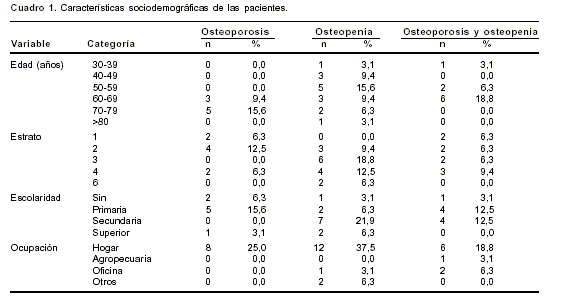
<body><![CDATA[<P>El efecto del estado nutricional y metab&oacute;lico es determinante en la biodisponibilidad y en el equilibrio del calcio en el organismo; los productos l&aacute;cteos como la lactosa, la case&iacute;na y el citrato de calcio, entre otros, contribuyen a incrementar la retenci&oacute;n de calcio; otras sustancias como los glucocorticoides, el alcohol y el cigarrillo disminuyen su absorci&oacute;n y ejercen un efecto negativo en el sostenimiento de la masa &oacute;sea.</P>     <P>En Colombia se han realizado estudios desde la perspectiva de descripci&oacute;n de casos, frecuencias institucionales, ensayos cl&iacute;nicos de medicamentos, evaluaci&oacute;n de m&eacute;todos diagn&oacute;sticos como densitometr&iacute;a &oacute;sea y estudios de prevalencia, de los cuales el mejor documentado es el de la Prevalencia de la osteoporosis en Santaf&eacute; de Bogot&aacute;; de acuerdo con este estudio, la osteoporosis es un problema de salud p&uacute;blica por cuanto la prevalencia promedio es del 57% en poblaci&oacute;n mayor de 40 a&ntilde;os (10); este hallazgo llev&oacute; a la organizaci&oacute;n de un Programa de Vigilancia Centinela de la Osteoporosis seg&uacute;n criterios de la Organizaci&oacute;n Mundial de Salud (OMS) (11), y a la b&uacute;squeda de la susceptibilidad gen&eacute;tica que facilite la ejecuci&oacute;n de programas de promoci&oacute;n y prevenci&oacute;n de la enfermedad. Los marcadores gen&eacute;ticos como el gen APO-E, que se correlaciona con la densidad mineral &oacute;sea, podr&iacute;an ser de ayuda para predecir y esclarecer los mecanismos de p&eacute;rdida de hueso en la osteoporosis; su importancia radica en que permitir&iacute;a diagnosticar a tiempo la enfermedad para tomar medidas preventivas.</P>     <P>El objetivo de este estudio fue analizar los polimorfismos APO-E en mujeres con osteoporosis y relacionarlos con variables cl&iacute;nicas y sociales para identificar su importancia en la frecuencia de la enfermedad.</P> <B>    <P>Materiales y m&eacute;todos</P> </B>    <P>De la muestra de 50 individuos detectados en el programa de vigilancia centinela de la osteoporosis seg&uacute;n criterios de la Organizaci&oacute;n Mundial de la Salud (11), 48 eran mujeres y s&oacute;lo 32 ten&iacute;an la informaci&oacute;n completa del cuestionario sobre costumbres, factores de riesgo, estrato socioecon&oacute;mico, educaci&oacute;n, edad de inicio de la menopausia, antecedentes de fracturas, cirug&iacute;a, enfermedades y consumo de l&aacute;cteos (leche, queso duro y blando); adem&aacute;s, cumpl&iacute;an con los criterios de inclusi&oacute;n: densidad mineral &oacute;sea inferior a una desviaci&oacute;n est&aacute;ndar, definida como diagn&oacute;stico por el m&eacute;todo de absorciometr&iacute;a de fot&oacute;n dual.</P>     <P>Las 32 mujeres estaban en un rango de edad de 30 a 82 a&ntilde;os y proven&iacute;an de diferentes regiones del pa&iacute;s. La mayor&iacute;a hab&iacute;a realizado estudios de primaria y secundaria y pertenec&iacute;a a los estratos 2 y 4 (</FONT><A HREF="#cuadro1"><FONT FACE="Arial">cuadro 1</FONT></A><FONT FACE="Arial,Arial">); algunas manifestaron haber sufrido fracturas, problemas de tensi&oacute;n, de tiroides y diabetes.</P>     <P><A NAME="cuadro1"></A></P> </FONT>    <P ALIGN="CENTER"><IMG SRC="/img/revistas/bio/v24n1/1a07t1.gif"></P> <FONT FACE="Arial,Arial">    <P>Se obtuvieron muestras de sangre con EDTA de cada paciente para la extracci&oacute;n del AND gen&oacute;mico por el m&eacute;todo salino (12). La tipificaci&oacute;n del gen APO-E se realiz&oacute; seg&uacute;n la modificaci&oacute;n del protocolo de Crock (13) y se utilizaron los iniciadores del protocolo de Wenham (14).</P>     <P>Para la amplificaci&oacute;n del gen, se utilizaron 200 ng de ADN en un volumen total de 25 ml con las siguientes condiciones: iniciadores APO-A y APOB 0, 2 mM, DMSO 100%, MgCl<SUB>2</SUB> 2,5 mM, dNTP 0,2 mM y Taq polimerasa 0,1 U/ml.</P>     ]]></body>
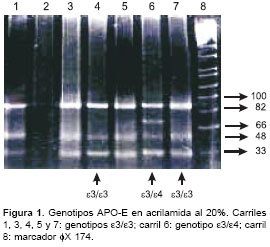
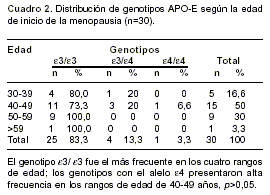
<body><![CDATA[<P>Las condiciones de la amplificaci&oacute;n fueron: predesnaturaci&oacute;n a 94°C, 10 min; desnaturaci&oacute;n a 94°C, 30 s, cuarenta ciclos; apareamiento a 65°C, 30 s, cuarenta ciclos; polimerizaci&oacute;n a 72°C, 30 s, cuarenta ciclos; pospolimerizaci&oacute;n a 70°C, 10 min, cuarenta ciclos.</P>     <P>El producto amplificado se visualiz&oacute; por electroforesis en agarosa al 2% y se digiri&oacute; con HhaI 1 U/ml, durante 18 horas a 37°C en ba&ntilde;o Mar&iacute;a; los fragmentos obtenidos se visualizaron por electroforesis en gel de poliacrilamida al 20%; se compararon los tama&ntilde;os con un marcador de peso molecular conocido </FONT><FONT FACE=Symbol>f</FONT><FONT FACE="Arial,Arial">X 174 con enzima Hinf III y controles de pacientes ( </FONT><A HREF="#figura1"><FONT FACE="Arial,Arial">figura 1</FONT></A><FONT FACE="Arial,Arial">).</P> <B>    <P><A NAME="figura1"></A>&nbsp;</P> </B></FONT>    <P ALIGN="CENTER"><IMG SRC="/img/revistas/bio/v24n1/1a07i1.jpg"></P> <FONT FACE="Arial,Arial">    <P>An&aacute;lisis estad&iacute;sticos</P>     <P>Se realiz&oacute; el an&aacute;lisis de las frecuencias de alelos y genotipos por conteo de los alelos. Para correlacionar los polimorfismos con las variables cl&iacute;nicas, se utiliz&oacute; la base de datos Epi-Info 6.04, aplicando la prueba de la ji al cuadrado. La diferencia entre la densidad mineral &oacute;sea en la columna lumbar y en el cuello femoral con cada genotipo se realiz&oacute; por Anova, por medio de la prueba de Fisher y se obtuvo el valor Z al normalizar cada dato para observar diferencias entre la densidad mineral &oacute;sea de los genotipos con el alelo </FONT><FONT FACE=Symbol>e</FONT><FONT FACE="Arial,Arial">4 y sin &eacute;l y se aplic&oacute; la prueba de ji al cuadrado. Se aplic&oacute; la prueba t de Student para las diferencias de medias en densidad mineral &oacute;sea de columna lumbar y cuello femoral; un valor de p&lt; 0,05 se consider&oacute; estad&iacute;sticamente significativo.</P> <B>    <P>Resultados</P> </B>    <P>Las 32 mujeres estaban en un rango de edad de 30 a 82 a&ntilde;os; el decil de 60 a 69 a&ntilde;os (37,5%) fue el m&aacute;s frecuente; el 78% (n=25) proven&iacute;a de diferentes regiones del pa&iacute;s y el 22% (n=7) de Bogot&aacute;. La mayor&iacute;a pertenec&iacute;a a los estratos 2 (28,2%) y 4 (28,2%); realizaron estudios de primaria y secundaria el 34,4%; para el 81,3% (n=26), su ocupaci&oacute;n era el hogar.</P>     <P>La distribuci&oacute;n de los genotipos seg&uacute;n la edad de inicio de la menopausia se hizo con 30 mujeres que ten&iacute;an esta informaci&oacute;n; el genotipo e3/e3 mostr&oacute; una frecuencia del 83,3% (n=25) superior a los genotipos con el alelo e4 (</FONT><FONT FACE=Symbol>e</FONT><FONT FACE="Arial,Arial">3/</FONT><FONT FACE=Symbol>e</FONT><FONT FACE="Arial,Arial">4, 13,3%, n=4; </FONT><FONT FACE=Symbol>e</FONT><FONT FACE="Arial,Arial">4/</FONT><FONT FACE=Symbol>e</FONT><FONT FACE="Arial,Arial">4, 3,3%, n=1) en todos los rangos de edad; no se observ&oacute; diferencia estad&iacute;sticamente significativa al comparar los grupos de edad con los diferentes genotipos (</FONT><A HREF="#cuadro2"><FONT FACE="Arial,Arial">cuadro 2</FONT></A><FONT FACE="Arial,Arial">).</P>     <P><A NAME="cuadro2"></A></P> </FONT>    ]]></body>
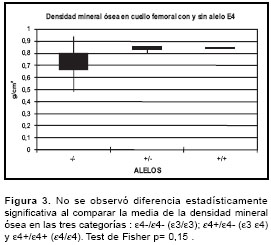
<body><![CDATA[<P ALIGN="CENTER"><IMG SRC="/img/revistas/bio/v24n1/1a07t2.gif"></P> <FONT FACE="Arial,Arial">    <P>De las ocho pacientes que presentaron fractura, seis ten&iacute;an el genotipo e3/e3 (75%) y dos pacientes (25%) presentaron genotipos con el alelo </FONT><FONT FACE=Symbol>e</FONT><FONT FACE="Arial,Arial">4 (</FONT><FONT FACE=Symbol>e</FONT><FONT FACE="Arial,Arial">3/ e4=1; </FONT><FONT FACE=Symbol>e</FONT><FONT FACE="Arial,Arial">4/</FONT><FONT FACE=Symbol>e</FONT><FONT FACE="Arial,Arial">4=1).</P>     <P>De las pacientes que reportaron antecedentes de enfermedades, ocho presentaron hiperglicemia, siete con el genotipo </FONT><FONT FACE=Symbol>e</FONT><FONT FACE="Arial,Arial"> 3/</FONT><FONT FACE=Symbol> e</FONT><FONT FACE="Arial,Arial"> 3 (85%) y una (15%) con el alelo </FONT><FONT FACE=Symbol>e</FONT><FONT FACE="Arial,Arial"> 4 (</FONT><FONT FACE=Symbol>e</FONT><FONT FACE="Arial,Arial"> 3/</FONT><FONT FACE=Symbol> e</FONT><FONT FACE="Arial,Arial"> 4=1); la misma tendencia se observ&oacute; en las que ten&iacute;an antecedentes de hipertensi&oacute;n.</P>     <P>Seg&uacute;n la condici&oacute;n &oacute;sea (osteoporosis: DMSO &lt;–2,5 desviaci&oacute;n est&aacute;ndar; osteopenia: DMSO entre –1 y –2,5 desviaciones est&aacute;ndar; se observ&oacute; que el genotipo </FONT><FONT FACE=Symbol>e</FONT><FONT FACE="Arial,Arial"> 3/</FONT><FONT FACE=Symbol> e</FONT><FONT FACE="Arial,Arial"> 3 (83,3%, n=25) fue el m&aacute;s frecuente en las tres condiciones &oacute;seas; los genotipos con el alelo e4 fueron menos frecuentes en el 16,6% (</FONT><FONT FACE=Symbol>e</FONT><FONT FACE="Arial,Arial"> 3/</FONT><FONT FACE=Symbol> e</FONT><FONT FACE="Arial,Arial"> 4, 13,3%,n=4; </FONT><FONT FACE=Symbol>e</FONT><FONT FACE="Arial,Arial"> 4/</FONT><FONT FACE=Symbol> e</FONT><FONT FACE="Arial,Arial"> 4, 3,3%,n=1), p&gt;0,05, aunque no hubo diferencias significativas en las frecuencias de los genotipos con el alelo e4 y sin &eacute;l, es importante la presencia de homocigocidad para este alelo en una paciente con osteoporosis combinada con osteopenia. </P>     <P>No se observ&oacute; ning&uacute;n efecto del alelo e4 sobre la densidad mineral &oacute;sea en la columna lumbar (prueba de Fisher, p=0,49) ,ni en el cuello femoral ( p=0,15) (</FONT><A HREF="#figura2"><FONT FACE="Arial,Arial">figura 2</FONT></A><FONT FACE="Arial,Arial"> y </FONT><A HREF="#figura3"><FONT FACE="Arial,Arial">figura 3</FONT></A><FONT FACE="Arial,Arial">); se observ&oacute; la misma tendencia al comparar la media de la densidad mineral &oacute;sea en los genotipos con el alelo </FONT><FONT FACE=Symbol>e</FONT><FONT FACE="Arial,Arial"> 4 y sin &eacute;l en columna lumbar </FONT><FONT FACE=Symbol>e</FONT><FONT FACE="Arial,Arial"> 4+/- (</FONT><FONT FACE=Symbol>e</FONT><FONT FACE="Arial,Arial"> 3/</FONT><FONT FACE=Symbol> e</FONT><FONT FACE="Arial,Arial"> 4 0,960±0,144 g/cm<SUP>2</SUP> ); </FONT><FONT FACE=Symbol>e</FONT><FONT FACE="Arial,Arial"> 4+/+ (</FONT><FONT FACE=Symbol>e</FONT><FONT FACE="Arial,Arial"> 4/</FONT><FONT FACE=Symbol> e</FONT><FONT FACE="Arial,Arial"> 4 0,873±0,00 g/cm<SUP>2</SUP>); </FONT><FONT FACE=Symbol>e</FONT><FONT FACE="Arial,Arial"> 4-/- (</FONT><FONT FACE=Symbol>e</FONT><FONT FACE="Arial,Arial"> 3/ </FONT><FONT FACE=Symbol>e</FONT><FONT FACE="Arial,Arial"> 3 0,858±0,160 g/cm<SUP>2</SUP>), p=0,49, y en cuello femoral </FONT><FONT FACE=Symbol>e</FONT><FONT FACE="Arial,Arial"> 4+/- (</FONT><FONT FACE=Symbol>e</FONT><FONT FACE="Arial,Arial"> 3/</FONT><FONT FACE=Symbol> e</FONT><FONT FACE="Arial,Arial"> 4 0,841±0,026 g/cm<SUP>2</SUP>); </FONT><FONT FACE=Symbol>e</FONT><FONT FACE="Arial,Arial"> 4+/+ (</FONT><FONT FACE=Symbol>e</FONT><FONT FACE="Arial,Arial"> 4/</FONT><FONT FACE=Symbol> e</FONT><FONT FACE="Arial,Arial"> 4 0,842±0,00 g/cm<SUP>2</SUP>); </FONT><FONT FACE=Symbol>e</FONT><FONT FACE="Arial,Arial"> 4-/- (</FONT><FONT FACE=Symbol>e</FONT><FONT FACE="Arial,Arial"> 3/</FONT><FONT FACE=Symbol> e</FONT><FONT FACE="Arial,Arial"> 3 0,735±0,013 g/ cm<SUP>2</SUP>), p=0,14. Sin embargo, al aplicar la prueba t de Student para diferencias de medias de densidad mineral &oacute;sea en cuello femoral en los genotipos con el alelo e4 y sin &eacute;l, se observ&oacute; una diferencia significativa, t= 4,17, p=0,05.</P>     <P><A NAME="figura2"></A></P> </FONT>    <P ALIGN="CENTER"><IMG SRC="/img/revistas/bio/v24n1/1a07g1.jpg"></P> <FONT FACE="Arial,Arial">    <P>&nbsp;</P>     <P><A NAME="figura3"></A></P> </FONT>    <P ALIGN="CENTER"><IMG SRC="/img/revistas/bio/v24n1/1a07g2.jpg"></P> <FONT FACE="Arial,Arial">    ]]></body>
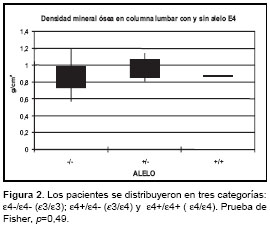
<body><![CDATA[<P>&nbsp;Al explorar el efecto del alelo e4 en el consumo de queso duro o blando como fuente de calcio en la dieta en las diferentes condiciones &oacute;seas no se observaron diferencias estad&iacute;sticamente significativas (datos no mostrados); la misma tendencia se observ&oacute; en las mujeres entre 15 y 25 a&ntilde;os y 26 y 50 a&ntilde;os que consum&iacute;an leche; tampoco hubo una asociaci&oacute;n significativa en el consumo de bebidas alcoh&oacute;licas y cigarrillo con los genotipos que ten&iacute;an el alelo e4. Aunque en la diabetes y en algunas enfermedades de riesgo cardiovascular existen mecanismos que pueden afectar la vida media de algunas prote&iacute;nas, como las apolipoprote&iacute;nas, no se observaron diferencias en la distribuci&oacute;n de los polimorfismos por antecedentes de hipertensi&oacute;n o hiperglicemia.</P> <B>    <P>Discusi&oacute;n</P> </B>    <P>En este estudio preliminar se confirma una frecuencia del alelo </FONT><FONT FACE=Symbol>e</FONT><FONT FACE="Arial,Arial"> 4 similar a lo reportado en otros estudios realizados con poblaci&oacute;n cauc&aacute;sica y japonesa con osteoporosis (2-5,15); la alta frecuencia del alelo </FONT><FONT FACE=Symbol>e</FONT><FONT FACE="Arial,Arial"> 4 en el 15,6%, comparada con el 11,6% de otros trabajos realizados con poblaci&oacute;n colombiana normal (16,17) y la diferencia significativa ( p=0,05) en el an&aacute;lisis de las diferencias de medias en cuello femoral entre genotipos con el alelo </FONT><FONT FACE=Symbol>e</FONT><FONT FACE="Arial,Arial"> 4, sugiere la necesidad de otros estudios a gran escala para determinar las implicaciones de la apolipoprote&iacute;na E en la salud del hueso y el riesgo de fractura. Algunos estudios revelan que las personas homocigotas para el alelo </FONT><FONT FACE=Symbol>e</FONT><FONT FACE="Arial,Arial"> 4 presentan niveles altos de osteocalcina en suero (4,18); en nuestro estudio se observ&oacute; un caso con doble dosis para el alelo </FONT><FONT FACE=Symbol>e</FONT><FONT FACE="Arial,Arial"> 4 en osteoporosis combinada con osteopenia; ser&iacute;a importante esclarecer si el genotipo </FONT><FONT FACE=Symbol>e</FONT><FONT FACE="Arial,Arial">4/</FONT><FONT FACE=Symbol> e</FONT><FONT FACE="Arial,Arial"> 4 tiene asociaci&oacute;n con la presencia de una alta reabsorci&oacute;n &oacute;sea o si no la tiene.</P>     <P>Aunque no se observ&oacute; ning&uacute;n efecto del alelo e4 en el consumo de queso y l&aacute;cteos como fuente de calcio y los h&aacute;bitos de consumo de bebidas alcoh&oacute;licas y cigarrillo, ser&iacute;a importante esclarecer el efecto de estas variables y la relaci&oacute;n dosis efecto del genotipo APO-E en la osteoporosis aumentando el tama&ntilde;o de la muestra; algunos estudios realizados con modificaci&oacute;n de la ingesti&oacute;n de calcio en la dieta para ver el efecto de algunos genes sobre el metabolismo mineral, apoyan la posibilidad de que factores como el tama&ntilde;o y los criterios de selecci&oacute;n de la muestra, el estilo de vida o los factores gen&eacute;ticos incidan sobre los resultados de la asociaci&oacute;n de los polimorfismos con relaci&oacute;n a la densidad mineral &oacute;sea y fractura (19-21).</P>     <P>Los resultados de este estudio son el primer paso en la b&uacute;squeda de la susceptibilidad gen&eacute;tica en la osteoporosis en la poblaci&oacute;n colombiana.</P> <B>    <P>Agradecimientos</P> </B>    <P>Al Programa Nacional de Ciencia y Tecnolog&iacute;a de Colciencias por su patrocinio en la realizaci&oacute;n de este trabajo, c&oacute;digo 2104-04-11816.</P>     <P>A Hern&aacute;n Yupanqui, Antonio Iglesias, Albenia Lur&aacute;n y Aura Benavides por la oportunidad y ayuda que nos brindaron.</P>     <P>A Mauricio J. Vera , Franklin Prieto y Diana Giraldo por su ayuda cordial y oportuna en la realizaci&oacute;n de los an&aacute;lisis de resultados.</P>     <P>Correspondencia:</P>     ]]></body>
<body><![CDATA[<P>Elsa Villarreal, Grupo de Nutrici&oacute;n, Instituto Nacional de Salud, Avenida calle 26 No. 51-60, Bogot&aacute;, D.C., Colombia</P> </FONT>    <P><A HREF="mailto:mvillarreal@ins.gov.co">mvillarreal@ins.gov.co</A></P> <FONT FACE="Arial,Arial">    <P>Recibido: 15/09/03; aceptado: 18/02/04</P> <B>     <P>Referencias</P> </B>    <!-- ref --><P>1. <B>Ralston SH. </B>Genetic control of susceptibility to Osteoporosis J Clin Endocrinol 2002;87:2460-6.&nbsp;&nbsp;&nbsp;&nbsp;&nbsp;&nbsp;&nbsp;&nbsp;[&#160;<a href="javascript:void(0);" onclick="javascript: window.open('/scielo.php?script=sci_nlinks&ref=000067&pid=S0120-4157200400010000700001&lng=','','width=640,height=500,resizable=yes,scrollbars=1,menubar=yes,');">Links</a>&#160;]<!-- end-ref --><!-- ref --><P>2. <B>Stewart TL, Ralston SH. </B>Role of genetic factors in the pathogenesis of osteoporosis. J Endocrinol 2000;166: 235-45.&nbsp;&nbsp;&nbsp;&nbsp;&nbsp;&nbsp;&nbsp;&nbsp;[&#160;<a href="javascript:void(0);" onclick="javascript: window.open('/scielo.php?script=sci_nlinks&ref=000068&pid=S0120-4157200400010000700002&lng=','','width=640,height=500,resizable=yes,scrollbars=1,menubar=yes,');">Links</a>&#160;]<!-- end-ref --><!-- ref --><P>3. <B>Ferrari SL, Garnero P, Emond S, Montgomery H, Humphries SE, Greenspan SL. </B>A functional polymorphic variant in the interleukin-6-gene promoter associated with low bone resorption in portmenopausal women. Arthritis Rheum 2002;44:196-201.&nbsp;&nbsp;&nbsp;&nbsp;&nbsp;&nbsp;&nbsp;&nbsp;[&#160;<a href="javascript:void(0);" onclick="javascript: window.open('/scielo.php?script=sci_nlinks&ref=000069&pid=S0120-4157200400010000700003&lng=','','width=640,height=500,resizable=yes,scrollbars=1,menubar=yes,');">Links</a>&#160;]<!-- end-ref --><!-- ref --><P>4. <B>Shiraki M, Shiraki Y, Aoki C, Hosoi T, Inoue S, Kaneki M. </B>Association of bone mineral density with apolipoprotein E phenotype. J Bone Miner Res 1997; 12:1438-45.&nbsp;&nbsp;&nbsp;&nbsp;&nbsp;&nbsp;&nbsp;&nbsp;[&#160;<a href="javascript:void(0);" onclick="javascript: window.open('/scielo.php?script=sci_nlinks&ref=000070&pid=S0120-4157200400010000700004&lng=','','width=640,height=500,resizable=yes,scrollbars=1,menubar=yes,');">Links</a>&#160;]<!-- end-ref --><!-- ref --><P>5. <B>Cauley JA, Zmuda JM, Jaffe K, Kuller LH, Ferrel RE, Wisniewski SR, Cummings SR. </B>Apolipoprotein E polymorphism: a new genetic marker of hip fracture risk. Bone Miner Res 1999;14:1175-81. &nbsp;&nbsp;&nbsp;&nbsp;&nbsp;&nbsp;&nbsp;&nbsp;[&#160;<a href="javascript:void(0);" onclick="javascript: window.open('/scielo.php?script=sci_nlinks&ref=000071&pid=S0120-4157200400010000700005&lng=','','width=640,height=500,resizable=yes,scrollbars=1,menubar=yes,');">Links</a>&#160;]<!-- end-ref --><!-- ref --><P>6. <B>Sadowski JA, Hood SJ, Dallal GE, Garry PJ. </B>Phylloquinone in plasma from elderly and young adults:factors influencing its concentration. Am J Clin Nutr 1989;50:100-8.&nbsp;&nbsp;&nbsp;&nbsp;&nbsp;&nbsp;&nbsp;&nbsp;[&#160;<a href="javascript:void(0);" onclick="javascript: window.open('/scielo.php?script=sci_nlinks&ref=000072&pid=S0120-4157200400010000700006&lng=','','width=640,height=500,resizable=yes,scrollbars=1,menubar=yes,');">Links</a>&#160;]<!-- end-ref --><!-- ref --><P>7. <B>Beavan SR, Prentice A, Stirling DM. </B>Apolipoprotein E (APO-E) genotype and osteocalcin carboxylation postmenopause. J Bone Miner Res 1998;13:523.&nbsp;&nbsp;&nbsp;&nbsp;&nbsp;&nbsp;&nbsp;&nbsp;[&#160;<a href="javascript:void(0);" onclick="javascript: window.open('/scielo.php?script=sci_nlinks&ref=000073&pid=S0120-4157200400010000700007&lng=','','width=640,height=500,resizable=yes,scrollbars=1,menubar=yes,');">Links</a>&#160;]<!-- end-ref --><!-- ref --><P>8. <B>Urayama S. </B>Effect of vitamin K2 on osteoblast apoptosis: vitamin K2 inhibits apoptotic cell death of human osteoblasts induced by Fas, proteasome inhibitor, etoposide and staurosporine. J Lab Clin Med 2000;136: 181-93.&nbsp;&nbsp;&nbsp;&nbsp;&nbsp;&nbsp;&nbsp;&nbsp;[&#160;<a href="javascript:void(0);" onclick="javascript: window.open('/scielo.php?script=sci_nlinks&ref=000074&pid=S0120-4157200400010000700008&lng=','','width=640,height=500,resizable=yes,scrollbars=1,menubar=yes,');">Links</a>&#160;]<!-- end-ref --><!-- ref --><P>9. <B>Sakami H. </B>Apoptosis inducing activity of vitamin C and vitamin K. Cell Mol Biol 2000;46:129-43.&nbsp;&nbsp;&nbsp;&nbsp;&nbsp;&nbsp;&nbsp;&nbsp;[&#160;<a href="javascript:void(0);" onclick="javascript: window.open('/scielo.php?script=sci_nlinks&ref=000075&pid=S0120-4157200400010000700009&lng=','','width=640,height=500,resizable=yes,scrollbars=1,menubar=yes,');">Links</a>&#160;]<!-- end-ref --><!-- ref --><P>10. <B>Carmona F. </B>Osteoporosis en Santa Fe de Bogot&aacute;. Bogot&aacute;: Instituto Nacional de Salud; 1999.&nbsp;&nbsp;&nbsp;&nbsp;&nbsp;&nbsp;&nbsp;&nbsp;[&#160;<a href="javascript:void(0);" onclick="javascript: window.open('/scielo.php?script=sci_nlinks&ref=000076&pid=S0120-4157200400010000700010&lng=','','width=640,height=500,resizable=yes,scrollbars=1,menubar=yes,');">Links</a>&#160;]<!-- end-ref --><!-- ref --><P>11. <B>World Health Organization. </B>Assesment of fracture risk and its application to screening for post-menopausal osteoporosis. World technical report 845. Geneva: WHO; 1994.&nbsp;&nbsp;&nbsp;&nbsp;&nbsp;&nbsp;&nbsp;&nbsp;[&#160;<a href="javascript:void(0);" onclick="javascript: window.open('/scielo.php?script=sci_nlinks&ref=000077&pid=S0120-4157200400010000700011&lng=','','width=640,height=500,resizable=yes,scrollbars=1,menubar=yes,');">Links</a>&#160;]<!-- end-ref --><!-- ref --><P>12. <B>Dykes D, Fondell J, Watkins P, Polesky H. </B>A simple salting out procedure for extracting DNA from human nucleated cell. Nucleic Acids 1988;3:121.&nbsp;&nbsp;&nbsp;&nbsp;&nbsp;&nbsp;&nbsp;&nbsp;[&#160;<a href="javascript:void(0);" onclick="javascript: window.open('/scielo.php?script=sci_nlinks&ref=000078&pid=S0120-4157200400010000700012&lng=','','width=640,height=500,resizable=yes,scrollbars=1,menubar=yes,');">Links</a>&#160;]<!-- end-ref --><!-- ref --><P>13. <B>Crock R. </B>Single day apolipoprotein E genotyping. J Neurosci Methods 1994;2:125-7.&nbsp;&nbsp;&nbsp;&nbsp;&nbsp;&nbsp;&nbsp;&nbsp;[&#160;<a href="javascript:void(0);" onclick="javascript: window.open('/scielo.php?script=sci_nlinks&ref=000079&pid=S0120-4157200400010000700013&lng=','','width=640,height=500,resizable=yes,scrollbars=1,menubar=yes,');">Links</a>&#160;]<!-- end-ref --><!-- ref --><P>14. <B>Wenham PR. </B>Apolipoprotein E genotyping by one-stage PCR. Lancet 1991;337:1158-9.&nbsp;&nbsp;&nbsp;&nbsp;&nbsp;&nbsp;&nbsp;&nbsp;[&#160;<a href="javascript:void(0);" onclick="javascript: window.open('/scielo.php?script=sci_nlinks&ref=000080&pid=S0120-4157200400010000700014&lng=','','width=640,height=500,resizable=yes,scrollbars=1,menubar=yes,');">Links</a>&#160;]<!-- end-ref --><!-- ref --><P>15. <B>Salamone LM, Dauley JA, Zmuda J, Pasagian- Macaulay A, Kuller LH. </B>Apolipoprotein E gene polymorphism and bone loss: estrogen the influence of apolipoprotein E on bone loss. J Bone Miner Res 2000; 2:308-14.&nbsp;&nbsp;&nbsp;&nbsp;&nbsp;&nbsp;&nbsp;&nbsp;[&#160;<a href="javascript:void(0);" onclick="javascript: window.open('/scielo.php?script=sci_nlinks&ref=000081&pid=S0120-4157200400010000700015&lng=','','width=640,height=500,resizable=yes,scrollbars=1,menubar=yes,');">Links</a>&#160;]<!-- end-ref --><!-- ref --><P>16. <B>Jaramillo-Correa JP, Keyeux G, Ruiz-Garc&iacute;a M, Rodas C, Bernal J. </B>Population genetic analysis of the genes APO-E,APO-B (3¨VNTR) and ACE in some black and amerindian commnunities from Colombia. Hum Hered 2001;52:14-33.&nbsp;&nbsp;&nbsp;&nbsp;&nbsp;&nbsp;&nbsp;&nbsp;[&#160;<a href="javascript:void(0);" onclick="javascript: window.open('/scielo.php?script=sci_nlinks&ref=000082&pid=S0120-4157200400010000700016&lng=','','width=640,height=500,resizable=yes,scrollbars=1,menubar=yes,');">Links</a>&#160;]<!-- end-ref --><!-- ref --><P>17. <B>Jacquier M, Arango D, Villarreal E, Torres O, Cruts M, Monta&ntilde;es P,Cano C, Rodriguez MN, Van Broeckhoven C. </B>APOE epsilon 4 and Alzheimer´s disease: positive association in a Colombia clinical series and review of the Latin American studies. Arq Neuropsiquiatr 2001;59:11-7.&nbsp;&nbsp;&nbsp;&nbsp;&nbsp;&nbsp;&nbsp;&nbsp;[&#160;<a href="javascript:void(0);" onclick="javascript: window.open('/scielo.php?script=sci_nlinks&ref=000083&pid=S0120-4157200400010000700017&lng=','','width=640,height=500,resizable=yes,scrollbars=1,menubar=yes,');">Links</a>&#160;]<!-- end-ref --><!-- ref --><P>18. <B>Kobayashi S, Inoue S, Hosoi T, Ouchi Y, Shiraki M, Orimo H. </B>Association of bone mineral density with polymorphism of the estrogen receptor gene.J Bone Miner Res 1996;11:306-11.&nbsp;&nbsp;&nbsp;&nbsp;&nbsp;&nbsp;&nbsp;&nbsp;[&#160;<a href="javascript:void(0);" onclick="javascript: window.open('/scielo.php?script=sci_nlinks&ref=000084&pid=S0120-4157200400010000700018&lng=','','width=640,height=500,resizable=yes,scrollbars=1,menubar=yes,');">Links</a>&#160;]<!-- end-ref --><!-- ref --><P>19. <B>Kiel DP, Myers RH, Cupples LA, Kong XF, Zhu XHl. </B>The Bsm I vita min D receptor restriction fragment length polymorphism (bb) influences the effect of calcium intake on bone mineral density. J Bone Miner Res 1997;12:1049-57.&nbsp;&nbsp;&nbsp;&nbsp;&nbsp;&nbsp;&nbsp;&nbsp;[&#160;<a href="javascript:void(0);" onclick="javascript: window.open('/scielo.php?script=sci_nlinks&ref=000085&pid=S0120-4157200400010000700019&lng=','','width=640,height=500,resizable=yes,scrollbars=1,menubar=yes,');">Links</a>&#160;]<!-- end-ref --><!-- ref --><P>20. <B>Salamone LM, Glyn NW, Black DM, Ferrel RE, Palermo L. </B>Determinants of premenopausal bone mineral density: the interplay of genetic and life style factors. J Bone Miner Res 1996;11:1557-65.&nbsp;&nbsp;&nbsp;&nbsp;&nbsp;&nbsp;&nbsp;&nbsp;[&#160;<a href="javascript:void(0);" onclick="javascript: window.open('/scielo.php?script=sci_nlinks&ref=000086&pid=S0120-4157200400010000700020&lng=','','width=640,height=500,resizable=yes,scrollbars=1,menubar=yes,');">Links</a>&#160;]<!-- end-ref --><!-- ref --><P>21. <B>Cooper GS, Umbach DM. </B>Are vitamin D receptor polymorphism associated with bone mineral density: a meta-analysis. J Bone Miner Res 1996;11:1841-9.&nbsp;&nbsp;&nbsp;&nbsp;&nbsp;&nbsp;&nbsp;&nbsp;[&#160;<a href="javascript:void(0);" onclick="javascript: window.open('/scielo.php?script=sci_nlinks&ref=000087&pid=S0120-4157200400010000700021&lng=','','width=640,height=500,resizable=yes,scrollbars=1,menubar=yes,');">Links</a>&#160;]<!-- end-ref --> ]]></body><back>
<ref-list>
<ref id="B1">
<label>1</label><nlm-citation citation-type="journal">
<person-group person-group-type="author">
<name>
<surname><![CDATA[Ralston]]></surname>
<given-names><![CDATA[SH]]></given-names>
</name>
</person-group>
<article-title xml:lang="en"><![CDATA[Genetic control of susceptibility to Osteoporosis]]></article-title>
<source><![CDATA[J Clin Endocrinol]]></source>
<year>2002</year>
<volume>87</volume>
<page-range>2460-6</page-range></nlm-citation>
</ref>
<ref id="B2">
<label>2</label><nlm-citation citation-type="journal">
<person-group person-group-type="author">
<name>
<surname><![CDATA[Stewart]]></surname>
<given-names><![CDATA[TL]]></given-names>
</name>
<name>
<surname><![CDATA[Ralston]]></surname>
<given-names><![CDATA[SH]]></given-names>
</name>
</person-group>
<article-title xml:lang="en"><![CDATA[Role of genetic factors in the pathogenesis of osteoporosis.]]></article-title>
<source><![CDATA[J Endocrinol]]></source>
<year>2000</year>
<volume>166</volume>
<page-range>235-45</page-range></nlm-citation>
</ref>
<ref id="B3">
<label>3</label><nlm-citation citation-type="journal">
<person-group person-group-type="author">
<name>
<surname><![CDATA[Ferrari]]></surname>
<given-names><![CDATA[SL]]></given-names>
</name>
<name>
<surname><![CDATA[Garnero]]></surname>
<given-names><![CDATA[P]]></given-names>
</name>
<name>
<surname><![CDATA[Emond]]></surname>
<given-names><![CDATA[S]]></given-names>
</name>
<name>
<surname><![CDATA[Montgomery]]></surname>
<given-names><![CDATA[H]]></given-names>
</name>
<name>
<surname><![CDATA[Humphries]]></surname>
<given-names><![CDATA[SE]]></given-names>
</name>
<name>
<surname><![CDATA[Greenspan]]></surname>
<given-names><![CDATA[SL]]></given-names>
</name>
</person-group>
<article-title xml:lang="en"><![CDATA[A functional polymorphic variant in the interleukin-6-gene promoter associated with low bone resorption in portmenopausal women]]></article-title>
<source><![CDATA[Arthritis Rheum]]></source>
<year>2002</year>
<volume>44</volume>
<page-range>196-201</page-range></nlm-citation>
</ref>
<ref id="B4">
<label>4</label><nlm-citation citation-type="journal">
<person-group person-group-type="author">
<name>
<surname><![CDATA[Shiraki]]></surname>
<given-names><![CDATA[M]]></given-names>
</name>
<name>
<surname><![CDATA[Shiraki]]></surname>
<given-names><![CDATA[Y]]></given-names>
</name>
<name>
<surname><![CDATA[Aoki]]></surname>
<given-names><![CDATA[C]]></given-names>
</name>
<name>
<surname><![CDATA[Hosoi]]></surname>
<given-names><![CDATA[T]]></given-names>
</name>
<name>
<surname><![CDATA[Inoue]]></surname>
<given-names><![CDATA[S]]></given-names>
</name>
<name>
<surname><![CDATA[Kaneki]]></surname>
<given-names><![CDATA[M]]></given-names>
</name>
</person-group>
<article-title xml:lang="en"><![CDATA[Association of bone mineral density with apolipoprotein E phenotype]]></article-title>
<source><![CDATA[J Bone Miner Res]]></source>
<year>1997</year>
<volume>12</volume>
<page-range>1438-45</page-range></nlm-citation>
</ref>
<ref id="B5">
<label>5</label><nlm-citation citation-type="journal">
<person-group person-group-type="author">
<name>
<surname><![CDATA[Cauley]]></surname>
<given-names><![CDATA[JA]]></given-names>
</name>
<name>
<surname><![CDATA[Zmuda]]></surname>
<given-names><![CDATA[JM]]></given-names>
</name>
<name>
<surname><![CDATA[Jaffe]]></surname>
<given-names><![CDATA[K]]></given-names>
</name>
<name>
<surname><![CDATA[Kuller]]></surname>
<given-names><![CDATA[LH]]></given-names>
</name>
<name>
<surname><![CDATA[Ferrel]]></surname>
<given-names><![CDATA[RE]]></given-names>
</name>
<name>
<surname><![CDATA[Wisniewski]]></surname>
<given-names><![CDATA[SR]]></given-names>
</name>
<name>
<surname><![CDATA[Cummings]]></surname>
<given-names><![CDATA[SR]]></given-names>
</name>
</person-group>
<article-title xml:lang="en"><![CDATA[Apolipoprotein E polymorphism: a new genetic marker of hip fracture risk]]></article-title>
<source><![CDATA[Bone Miner Res]]></source>
<year>1999</year>
<volume>14</volume>
<page-range>1175-81</page-range></nlm-citation>
</ref>
<ref id="B6">
<label>6</label><nlm-citation citation-type="journal">
<person-group person-group-type="author">
<name>
<surname><![CDATA[Sadowski]]></surname>
<given-names><![CDATA[JA]]></given-names>
</name>
<name>
<surname><![CDATA[Hood]]></surname>
<given-names><![CDATA[SJ]]></given-names>
</name>
<name>
<surname><![CDATA[Dallal]]></surname>
<given-names><![CDATA[GE]]></given-names>
</name>
<name>
<surname><![CDATA[Garry]]></surname>
<given-names><![CDATA[PJ]]></given-names>
</name>
</person-group>
<article-title xml:lang="en"><![CDATA[Phylloquinone in plasma from elderly and young adults:factors influencing its concentration]]></article-title>
<source><![CDATA[Am J Clin Nutr]]></source>
<year>1989</year>
<volume>50</volume>
<page-range>100-8</page-range></nlm-citation>
</ref>
<ref id="B7">
<label>7</label><nlm-citation citation-type="journal">
<person-group person-group-type="author">
<name>
<surname><![CDATA[Beavan]]></surname>
<given-names><![CDATA[SR]]></given-names>
</name>
<name>
<surname><![CDATA[Prentice]]></surname>
<given-names><![CDATA[A]]></given-names>
</name>
<name>
<surname><![CDATA[Stirling]]></surname>
<given-names><![CDATA[DM]]></given-names>
</name>
</person-group>
<article-title xml:lang="en"><![CDATA[Apolipoprotein E (APO-E) genotype and osteocalcin carboxylation postmenopause]]></article-title>
<source><![CDATA[J Bone Miner Res]]></source>
<year>1998</year>
<volume>13</volume>
<page-range>523</page-range></nlm-citation>
</ref>
<ref id="B8">
<label>8</label><nlm-citation citation-type="journal">
<person-group person-group-type="author">
<name>
<surname><![CDATA[Urayama]]></surname>
<given-names><![CDATA[S]]></given-names>
</name>
</person-group>
<article-title xml:lang="en"><![CDATA[Effect of vitamin K2 on osteoblast apoptosis: vitamin K2 inhibits apoptotic cell death of human osteoblasts induced by Fas, proteasome inhibitor, etoposide and staurosporine]]></article-title>
<source><![CDATA[J Lab Clin Med]]></source>
<year>2000</year>
<volume>136</volume>
<page-range>181-93</page-range></nlm-citation>
</ref>
<ref id="B9">
<label>9</label><nlm-citation citation-type="journal">
<person-group person-group-type="author">
<name>
<surname><![CDATA[Sakami]]></surname>
<given-names><![CDATA[H]]></given-names>
</name>
</person-group>
<article-title xml:lang="en"><![CDATA[Apoptosis inducing activity of vitamin C and vitamin K]]></article-title>
<source><![CDATA[Cell Mol Biol]]></source>
<year>2000</year>
<volume>46</volume>
<page-range>129-43</page-range></nlm-citation>
</ref>
<ref id="B10">
<label>10</label><nlm-citation citation-type="book">
<person-group person-group-type="author">
<name>
<surname><![CDATA[Carmona]]></surname>
<given-names><![CDATA[F]]></given-names>
</name>
</person-group>
<source><![CDATA[Osteoporosis en Santa Fe de Bogotá]]></source>
<year>1999</year>
<publisher-loc><![CDATA[Bogotá ]]></publisher-loc>
<publisher-name><![CDATA[Instituto Nacional de Salud]]></publisher-name>
</nlm-citation>
</ref>
<ref id="B11">
<label>11</label><nlm-citation citation-type="book">
<collab>World Health Organization</collab>
<source><![CDATA[Assesment of fracture risk and its application to screening for post-menopausal osteoporosis.: World technical report 845.]]></source>
<year>1994</year>
<publisher-loc><![CDATA[Geneva ]]></publisher-loc>
<publisher-name><![CDATA[WHO]]></publisher-name>
</nlm-citation>
</ref>
<ref id="B12">
<label>12</label><nlm-citation citation-type="journal">
<person-group person-group-type="author">
<name>
<surname><![CDATA[Dykes]]></surname>
<given-names><![CDATA[D]]></given-names>
</name>
<name>
<surname><![CDATA[Fondell]]></surname>
<given-names><![CDATA[J]]></given-names>
</name>
<name>
<surname><![CDATA[Watkins]]></surname>
<given-names><![CDATA[P]]></given-names>
</name>
<name>
<surname><![CDATA[Polesky]]></surname>
<given-names><![CDATA[H]]></given-names>
</name>
</person-group>
<article-title xml:lang="en"><![CDATA[A simple salting out procedure for extracting DNA from human nucleated cell]]></article-title>
<source><![CDATA[Nucleic Acids]]></source>
<year>1988</year>
<volume>3</volume>
<page-range>121</page-range></nlm-citation>
</ref>
<ref id="B13">
<label>13</label><nlm-citation citation-type="journal">
<person-group person-group-type="author">
<name>
<surname><![CDATA[Crock]]></surname>
<given-names><![CDATA[R]]></given-names>
</name>
</person-group>
<article-title xml:lang="en"><![CDATA[Single day apolipoprotein E genotyping.]]></article-title>
<source><![CDATA[J Neurosci Methods]]></source>
<year>1994</year>
<volume>2</volume><volume>125-7</volume>
</nlm-citation>
</ref>
<ref id="B14">
<label>14</label><nlm-citation citation-type="journal">
<person-group person-group-type="author">
<name>
<surname><![CDATA[Wenham]]></surname>
<given-names><![CDATA[PR]]></given-names>
</name>
</person-group>
<article-title xml:lang="en"><![CDATA[Apolipoprotein E genotyping by one-stage PCR.]]></article-title>
<source><![CDATA[Lancet]]></source>
<year>1991</year>
<volume>337</volume>
<page-range>1158-9</page-range></nlm-citation>
</ref>
<ref id="B15">
<label>15</label><nlm-citation citation-type="journal">
<person-group person-group-type="author">
<name>
<surname><![CDATA[Salamone]]></surname>
<given-names><![CDATA[LM]]></given-names>
</name>
<name>
<surname><![CDATA[Dauley]]></surname>
<given-names><![CDATA[JA]]></given-names>
</name>
<name>
<surname><![CDATA[Zmuda]]></surname>
<given-names><![CDATA[J]]></given-names>
</name>
<name>
<surname><![CDATA[Pasagian- Macaulay]]></surname>
<given-names><![CDATA[A]]></given-names>
</name>
<name>
<surname><![CDATA[Kuller]]></surname>
<given-names><![CDATA[LH]]></given-names>
</name>
</person-group>
<article-title xml:lang="en"><![CDATA[Apolipoprotein E gene polymorphism and bone loss: estrogen the influence of apolipoprotein E on bone loss.]]></article-title>
<source><![CDATA[J Bone Miner Res]]></source>
<year>2000</year>
<volume>2</volume>
<page-range>308-14</page-range></nlm-citation>
</ref>
<ref id="B16">
<label>16</label><nlm-citation citation-type="journal">
<person-group person-group-type="author">
<name>
<surname><![CDATA[Jaramillo-Correa]]></surname>
<given-names><![CDATA[JP]]></given-names>
</name>
<name>
<surname><![CDATA[Keyeux]]></surname>
<given-names><![CDATA[G]]></given-names>
</name>
<name>
<surname><![CDATA[Ruiz-García]]></surname>
<given-names><![CDATA[M]]></given-names>
</name>
<name>
<surname><![CDATA[Rodas]]></surname>
<given-names><![CDATA[C]]></given-names>
</name>
<name>
<surname><![CDATA[Bernal]]></surname>
<given-names><![CDATA[J]]></given-names>
</name>
</person-group>
<article-title xml:lang="en"><![CDATA[Population genetic analysis of the genes APO-E,APO-B (3¨VNTR) and ACE in some black and amerindian commnunities from Colombia]]></article-title>
<source><![CDATA[Hum Hered]]></source>
<year>2001</year>
<volume>52</volume>
<page-range>14-33</page-range></nlm-citation>
</ref>
<ref id="B17">
<label>17</label><nlm-citation citation-type="journal">
<person-group person-group-type="author">
<name>
<surname><![CDATA[Jacquier]]></surname>
<given-names><![CDATA[M]]></given-names>
</name>
<name>
<surname><![CDATA[Arango]]></surname>
<given-names><![CDATA[D]]></given-names>
</name>
<name>
<surname><![CDATA[Villarreal]]></surname>
<given-names><![CDATA[E]]></given-names>
</name>
<name>
<surname><![CDATA[Torres]]></surname>
<given-names><![CDATA[O]]></given-names>
</name>
<name>
<surname><![CDATA[Cruts]]></surname>
<given-names><![CDATA[M]]></given-names>
</name>
<name>
<surname><![CDATA[Montañes]]></surname>
<given-names><![CDATA[P]]></given-names>
</name>
<name>
<surname><![CDATA[Cano]]></surname>
<given-names><![CDATA[C]]></given-names>
</name>
<name>
<surname><![CDATA[Rodriguez]]></surname>
<given-names><![CDATA[MN]]></given-names>
</name>
<name>
<surname><![CDATA[Van Broeckhoven]]></surname>
<given-names><![CDATA[C]]></given-names>
</name>
</person-group>
<article-title xml:lang="en"><![CDATA[APOE epsilon 4 and Alzheimer´s disease: positive association in a Colombia clinical series and review of the Latin American studies]]></article-title>
<source><![CDATA[Arq Neuropsiquiatr]]></source>
<year>2001</year>
<volume>59</volume>
<page-range>11-7</page-range></nlm-citation>
</ref>
<ref id="B18">
<label>18</label><nlm-citation citation-type="journal">
<person-group person-group-type="author">
<name>
<surname><![CDATA[Kobayashi]]></surname>
<given-names><![CDATA[S]]></given-names>
</name>
<name>
<surname><![CDATA[Inoue]]></surname>
<given-names><![CDATA[S]]></given-names>
</name>
<name>
<surname><![CDATA[Hosoi]]></surname>
<given-names><![CDATA[T]]></given-names>
</name>
<name>
<surname><![CDATA[Ouchi]]></surname>
<given-names><![CDATA[Y]]></given-names>
</name>
<name>
<surname><![CDATA[Shiraki]]></surname>
<given-names><![CDATA[M]]></given-names>
</name>
<name>
<surname><![CDATA[Orimo]]></surname>
<given-names><![CDATA[H]]></given-names>
</name>
</person-group>
<article-title xml:lang="en"><![CDATA[Association of bone mineral density with polymorphism of the estrogen receptor gene]]></article-title>
<source><![CDATA[J Bone Miner Res]]></source>
<year>1996</year>
<volume>11</volume>
<page-range>306-11</page-range></nlm-citation>
</ref>
<ref id="B19">
<label>19</label><nlm-citation citation-type="journal">
<person-group person-group-type="author">
<name>
<surname><![CDATA[Kiel]]></surname>
<given-names><![CDATA[DP]]></given-names>
</name>
<name>
<surname><![CDATA[Myers]]></surname>
<given-names><![CDATA[RH]]></given-names>
</name>
<name>
<surname><![CDATA[Cupples]]></surname>
<given-names><![CDATA[LA]]></given-names>
</name>
<name>
<surname><![CDATA[Kong]]></surname>
<given-names><![CDATA[XF]]></given-names>
</name>
<name>
<surname><![CDATA[Zhu]]></surname>
<given-names><![CDATA[XHl]]></given-names>
</name>
</person-group>
<article-title xml:lang="en"><![CDATA[The Bsm I vita min D receptor restriction fragment length polymorphism (bb) influences the effect of calcium intake on bone mineral density]]></article-title>
<source><![CDATA[J Bone Miner Res]]></source>
<year>1997</year>
<volume>12</volume>
<page-range>1049-57</page-range></nlm-citation>
</ref>
<ref id="B20">
<label>20</label><nlm-citation citation-type="journal">
<person-group person-group-type="author">
<name>
<surname><![CDATA[Salamone]]></surname>
<given-names><![CDATA[LM]]></given-names>
</name>
<name>
<surname><![CDATA[Glyn]]></surname>
<given-names><![CDATA[NW]]></given-names>
</name>
<name>
<surname><![CDATA[Black]]></surname>
<given-names><![CDATA[DM]]></given-names>
</name>
<name>
<surname><![CDATA[Ferrel]]></surname>
<given-names><![CDATA[RE]]></given-names>
</name>
<name>
<surname><![CDATA[Palermo]]></surname>
<given-names><![CDATA[L]]></given-names>
</name>
</person-group>
<article-title xml:lang="en"><![CDATA[Determinants of premenopausal bone mineral density: the interplay of genetic and life style factors]]></article-title>
<source><![CDATA[J Bone Miner Res]]></source>
<year>1996</year>
<volume>11</volume>
<page-range>1557-65</page-range></nlm-citation>
</ref>
<ref id="B21">
<label>21</label><nlm-citation citation-type="journal">
<person-group person-group-type="author">
<name>
<surname><![CDATA[Cooper]]></surname>
<given-names><![CDATA[GS]]></given-names>
</name>
<name>
<surname><![CDATA[Umbach]]></surname>
<given-names><![CDATA[DM]]></given-names>
</name>
</person-group>
<article-title xml:lang="en"><![CDATA[Are vitamin D receptor polymorphism associated with bone mineral density: a meta-analysis]]></article-title>
<source><![CDATA[J Bone Miner Res]]></source>
<year>1996</year>
<volume>11</volume>
<page-range>1841-9</page-range></nlm-citation>
</ref>
</ref-list>
</back>
</article>