<?xml version="1.0" encoding="ISO-8859-1"?><article xmlns:mml="http://www.w3.org/1998/Math/MathML" xmlns:xlink="http://www.w3.org/1999/xlink" xmlns:xsi="http://www.w3.org/2001/XMLSchema-instance">
<front>
<journal-meta>
<journal-id>0120-4157</journal-id>
<journal-title><![CDATA[Biomédica]]></journal-title>
<abbrev-journal-title><![CDATA[Biomédica]]></abbrev-journal-title>
<issn>0120-4157</issn>
<publisher>
<publisher-name><![CDATA[Instituto Nacional de Salud]]></publisher-name>
</publisher>
</journal-meta>
<article-meta>
<article-id>S0120-41572006000200009</article-id>
<title-group>
<article-title xml:lang="en"><![CDATA[Serum levels of insulin-like growth factor-I and -II and insulinlike growth factor binding protein 3 in women with squamous intraepithelial lesions and cervical cancer]]></article-title>
<article-title xml:lang="es"><![CDATA[Niveles séricos de los factores de crecimiento similares a la insulina I y II y su proteína 3 de enlace en mujeres con lesiones escamosas intraepiteliales y cáncer de cuello uterino]]></article-title>
</title-group>
<contrib-group>
<contrib contrib-type="author">
<name>
<surname><![CDATA[Serrano]]></surname>
<given-names><![CDATA[Martha Lucía]]></given-names>
</name>
<xref ref-type="aff" rid="A01"/>
</contrib>
<contrib contrib-type="author">
<name>
<surname><![CDATA[Romero]]></surname>
<given-names><![CDATA[Alfredo]]></given-names>
</name>
<xref ref-type="aff" rid="A03"/>
</contrib>
<contrib contrib-type="author">
<name>
<surname><![CDATA[Cendales]]></surname>
<given-names><![CDATA[Ricardo]]></given-names>
</name>
<xref ref-type="aff" rid="A04"/>
</contrib>
<contrib contrib-type="author">
<name>
<surname><![CDATA[Sánchez-Gómez]]></surname>
<given-names><![CDATA[Myriam]]></given-names>
</name>
<xref ref-type="aff" rid="A02"/>
</contrib>
<contrib contrib-type="author">
<name>
<surname><![CDATA[Bravo]]></surname>
<given-names><![CDATA[María Mercedes]]></given-names>
</name>
<xref ref-type="aff" rid="A01"/>
</contrib>
</contrib-group>
<aff id="A01">
<institution><![CDATA[,Instituto Nacional de Cancerología Grupo de Investigación en Biología del Cáncer ]]></institution>
<addr-line><![CDATA[Bogotá D.C ]]></addr-line>
<country>Colombia</country>
</aff>
<aff id="A02">
<institution><![CDATA[,Universidad Nacional de Colombia Departamento de Química Laboratorio de Hormonas]]></institution>
<addr-line><![CDATA[Bogotá, D.C ]]></addr-line>
<country>Colombia</country>
</aff>
<aff id="A03">
<institution><![CDATA[,Instituto Nacional de Cancerología  ]]></institution>
<addr-line><![CDATA[Bogotá D.C ]]></addr-line>
<country>Colombia</country>
</aff>
<aff id="A04">
<institution><![CDATA[,Instituto Nacional de Cancerología Subdirección de Investigaciones ]]></institution>
<addr-line><![CDATA[Bogotá D.C ]]></addr-line>
<country>Colombia</country>
</aff>
<pub-date pub-type="pub">
<day>00</day>
<month>06</month>
<year>2006</year>
</pub-date>
<pub-date pub-type="epub">
<day>00</day>
<month>06</month>
<year>2006</year>
</pub-date>
<volume>26</volume>
<numero>2</numero>
<fpage>258</fpage>
<lpage>268</lpage>
<copyright-statement/>
<copyright-year/>
<self-uri xlink:href="http://www.scielo.org.co/scielo.php?script=sci_arttext&amp;pid=S0120-41572006000200009&amp;lng=en&amp;nrm=iso"></self-uri><self-uri xlink:href="http://www.scielo.org.co/scielo.php?script=sci_abstract&amp;pid=S0120-41572006000200009&amp;lng=en&amp;nrm=iso"></self-uri><self-uri xlink:href="http://www.scielo.org.co/scielo.php?script=sci_pdf&amp;pid=S0120-41572006000200009&amp;lng=en&amp;nrm=iso"></self-uri><abstract abstract-type="short" xml:lang="en"><p><![CDATA[Introduction. Pap smear has limitations as a screening test for cervical cancer. A marker that allows the identification of women who are at risk of developing cervical cancer would be useful for its prevention. A growing number of studies have demonstrated an association between insulin-like growth factors (IGF) serum levels and increased risk for various cancers. Objective. To assess whether circulating IGF-I, IGF-II, or IGF binding protein 3 (IGFBP-3) were associated with cervical cancer and low-grade and high-grade squamous intraepithelial lesions (LSIL and HSIL). Materials and methods. Serum levels of IGF-I, IGF-II and IGFBP-3 were measured by ELISA. Three groups of cases were analyzed: LSIL (n = 37), HSIL (n = 57), and cervical cancer (n = 41). For each case, two controls, matched by age, were included. Control subjects were women with normal, HPV-DNA-negative Pap smear. Results. Significantly lower values of IGF-I (83.9 ng/ml versus 126.6 ng/ml, p < 0.001) and IGFI: IGFBP-3 molar ratio (0.094 versus 0.137, p < 0.001) were observed among cancer cases, as compared to their control group. Women in the highest quartile of IGF-I and IGF-I:IGFBP-3 molar ratio were at an 80% (OR = 0.2, 95% CI [0.06-0.61]) and a 77% (OR = 0.23, 95% CI [0.07- 0.73]) lower risk of cervical cancer, respectively, compared with women in the corresponding reference category. Conclusions. These data suggest that low values of IGF-I and IGF-I:IGFBP-3 molar ratio may be associated with cervical cancer.]]></p></abstract>
<abstract abstract-type="short" xml:lang="es"><p><![CDATA[Introducción. La citología cervico-uterina como prueba de tamizaje del cáncer cervical tiene limitaciones. Un marcador que permita identificar mujeres en riesgo de desarrollar este cáncer sería de utilidad para prevenir el desarrollo de esta enfermedad. Múltiples estudios demuestran asociación entre los factores de crecimiento similares a la insulina (IGF) y varios tipos de cáncer. Objetivos. Evaluar si los niveles circulantes de IGF-I, IGF-II, y la proteína 3 de enlace a IGF (IGFBP-3) se asocian con cáncer cervical y lesiones escamosas intraepiteliales de bajo y alto grado (LEIBG y LEIAG). Materiales y métodos. Los niveles séricos de IGF-I, IGF-II e IGFBP-3 se determinaron por ELISA. Se analizaron tres grupos de casos: LEIBG (n=37), LEIAG (n=57) y cáncer cervical (n=41), apareados por edad con controles, con citología normal, negativa para ADN de VPH. Resultados. Se observaron valores de IGF-I (83,9 ng/ml versus 126,6 ng/ml, p < 0,001) y de la relación molar IGF-I:IGFBP-3 (0,094 versus 0,137, p < 0,001) menores en los casos de cáncer, comparados con sus controles. Las mujeres en el cuartil superior de IGF-I y de la relación molar IGF-I:IGFBP-3 tuvieron un riesgo de cáncer de cérvix 80% (OR = 0.2, IC 95% [0,06-0,61]) y 77% (OR = 0,23, IC 95% [0,07-0,73]) menor, respectivamente, en comparación con las mujeres en la categoría de referencia. Conclusiones. Estos datos sugieren que valores bajos de IGF-I y de la relación molar IGFI: IGFBP-3 se asocian con cáncer cervical.]]></p></abstract>
<kwd-group>
<kwd lng="en"><![CDATA[insulin-like growth factor I]]></kwd>
<kwd lng="en"><![CDATA[insulin-like growth factor II]]></kwd>
<kwd lng="en"><![CDATA[insulin-like growth factor binding protein 3]]></kwd>
<kwd lng="en"><![CDATA[cervical neoplasms]]></kwd>
<kwd lng="en"><![CDATA[cervical dysplasia]]></kwd>
<kwd lng="es"><![CDATA[factor I del crecimiento similar a la insulina]]></kwd>
<kwd lng="es"><![CDATA[factor II del crecimiento similar a la insulina]]></kwd>
<kwd lng="es"><![CDATA[proteína 3 de enlace a factor de crecimiento similar a la insulina]]></kwd>
<kwd lng="es"><![CDATA[neoplasmas del cuello uterino]]></kwd>
<kwd lng="es"><![CDATA[displasia del cuello uterino]]></kwd>
</kwd-group>
</article-meta>
</front><body><![CDATA[   <B><FONT FACE="Arial" SIZE=4>    <P ALIGN="CENTER">Serum levels of insulin-like growth factor-I and -II and insulinlike growth factor binding protein 3 in women with squamous intraepithelial lesions and cervical cancer</P> </B></FONT><FONT FACE="Arial">    <P ALIGN="CENTER">Martha Luc&iacute;a Serrano <SUP>1,2</SUP>, Alfredo Romero <SUP>3</SUP>, Ricardo Cendales <SUP>4</SUP>, Myriam S&aacute;nchez-G&oacute;mez <SUP>2</SUP>, Mar&iacute;a Mercedes Bravo<SUP>1</P>     <P>1</SUP> Grupo de Investigaci&oacute;n en Biolog&iacute;a del C&aacute;ncer, Instituto Nacional de Cancerolog&iacute;a, Bogot&aacute; D.C., Colombia.</P> <SUP>    <P>2</SUP> Laboratorio de Hormonas, Departamento de Qu&iacute;mica, Universidad Nacional de Colombia, Bogot&aacute;</P>     <P>D.C., Colombia.</P> <SUP>    <P>3 </SUP>Grupo de Patolog&iacute;a, Instituto Nacional de Cancerolog&iacute;a, Bogot&aacute; D.C., Colombia.</P> <SUP>    <P>4</SUP> Subdirecci&oacute;n de Investigaciones, Instituto Nacional de Cancerolog&iacute;a, Bogot&aacute; D.C., Colombia.</P> <B>    <P>Introduction. </B>Pap smear has limitations as a screening test for cervical cancer. A marker that allows the identification of women who are at risk of developing cervical cancer would be useful for its prevention. A growing number of studies have demonstrated an association between insulin-like growth factors (IGF) serum levels and increased risk for various cancers.</P> <B>    <P>Objective. </B>To assess whether circulating IGF-I, IGF-II, or IGF binding protein 3 (IGFBP-3) were associated with cervical cancer and low-grade and high-grade squamous intraepithelial lesions (LSIL and HSIL).</P> <B>    ]]></body>
<body><![CDATA[<P>Materials and methods. </B>Serum levels of IGF-I, IGF-II and IGFBP-3 were measured by ELISA. Three groups of cases were analyzed: LSIL (n = 37), HSIL (n = 57), and cervical cancer (n = 41). For each case, two controls, matched by age, were included. Control subjects were women with normal, HPV-DNA-negative Pap smear.</P> <B>    <P>Results. </B>Significantly lower values of IGF-I (83.9 ng/ml versus 126.6 ng/ml, p &lt; 0.001) and IGFI: IGFBP-3 molar ratio (0.094 versus 0.137, p &lt; 0.001) were observed among cancer cases, as compared to their control group. Women in the highest quartile of IGF-I and IGF-I:IGFBP-3 molar ratio were at an 80% (OR = 0.2, 95% CI [0.06-0.61]) and a 77% (OR = 0.23, 95% CI [0.07- 0.73]) lower risk of cervical cancer, respectively, compared with women in the corresponding reference category.</P> <B>    <P>Conclusions. </B>These data suggest that low values of IGF-I and IGF-I:IGFBP-3 molar ratio may be associated with cervical cancer.</P> <B>    <P>Keywords: </B>insulin-like growth factor I, insulin-like growth factor II, insulin-like growth factor binding protein 3, cervical neoplasms, cervical dysplasia .</P> <B>    <P>Niveles s&eacute;ricos de los factores de crecimiento similares a la insulina I y II y su prote&iacute;na 3 de enlace en mujeres con lesiones escamosas intraepiteliales y c&aacute;ncer de cuello uterino</P>     <P>Introducci&oacute;n. </B>La citolog&iacute;a cervico-uterina como prueba de tamizaje del c&aacute;ncer cervical tiene limitaciones. Un marcador que permita identificar mujeres en riesgo de desarrollar este c&aacute;ncer ser&iacute;a de utilidad para prevenir el desarrollo de esta enfermedad. M&uacute;ltiples estudios demuestran asociaci&oacute;n entre los factores de crecimiento similares a la insulina (IGF) y varios tipos de c&aacute;ncer.</P> <B>    <P>Objetivos. </B>Evaluar si los niveles circulantes de IGF-I, IGF-II, y la prote&iacute;na 3 de enlace a IGF (IGFBP-3) se asocian con c&aacute;ncer cervical y lesiones escamosas intraepiteliales de bajo y alto grado (LEIBG y LEIAG).</P> <B>    <P>Materiales y m&eacute;todos. </B>Los niveles s&eacute;ricos de IGF-I, IGF-II e IGFBP-3 se determinaron por ELISA. Se analizaron tres grupos de casos: LEIBG (n=37), LEIAG (n=57) y c&aacute;ncer cervical (n=41), apareados por edad con controles, con citolog&iacute;a normal, negativa para ADN de VPH.</P> <B>    <P>Resultados. </B>Se observaron valores de IGF-I (83,9 ng/ml versus 126,6 ng/ml, p &lt; 0,001) y de la relaci&oacute;n molar IGF-I:IGFBP-3 (0,094 versus 0,137, p &lt; 0,001) menores en los casos de c&aacute;ncer, comparados con sus controles. Las mujeres en el cuartil superior de IGF-I y de la relaci&oacute;n molar IGF-I:IGFBP-3 tuvieron un riesgo de c&aacute;ncer de c&eacute;rvix 80% (OR = 0.2, IC 95% [0,06-0,61]) y 77% (OR = 0,23, IC 95% [0,07-0,73]) menor, respectivamente, en comparaci&oacute;n con las mujeres en la categor&iacute;a de referencia.</P> <B>    <P>Conclusiones. </B>Estos datos sugieren que valores bajos de IGF-I y de la relaci&oacute;n molar IGFI: IGFBP-3 se asocian con c&aacute;ncer cervical.</P> <B>    ]]></body>
<body><![CDATA[<P>Palabras clave: </B>factor I del crecimiento similar a la insulina, factor II del crecimiento similar a la insulina, prote&iacute;na 3 de enlace a factor de crecimiento similar a la insulina, neoplasmas del cuello uterino, displasia del cuello uterino.</P>     <P>Cervical cancer is a public health problem in developing countries (1). In Colombia, it is the most common cause of cancer mortality among women (2). Persistent infection with high-risk types of HPV (HR HPV), mainly types 16 and 18, has been identified as the main risk factor for the development of cervical cancer and its precursor lesions, squamous intraepithelial lesions (SILs) (3). SILs precede the development of cervical cancer. SILs have been classified into two groups: low-grade SIL (LSIL) and high-grade SIL (HSIL) (4). Although HPV infections are among the most frequent sexually transmitted diseases, infections are usually self-limited and revert spontaneously, with only a small group of women developing cervical cancer (5). The evolution of infection from LSIL, to HSIL and cancer depends on several factors, many of which are still unknown. Pap smear is the most used screening tool for cervical cancer and SIL. In spite of its wide use, cytology has limitations in sensitivity, specificity and reproducibility (6). HPV detection in cervical scrapings has been proposed as a complementary or alternative test to Pap smear (7), but, due to the high prevalence of HPV infections that do not progress to cancer, HPV testing has a low specificity (5). A marker that allows us to identify those women who are at risk of developing cervical cancer will be a valuable diagnostic tool.</P>     <P>Insulin-like growth factors (IGF-I and IGF-II) are peptides that play a pivotal role in promoting cell proliferation and inhibiting apoptosis in many cell types (8,9). IGF-I and IGF-II actions are mediated through their binding to the IGF-I receptor (IGFIR) (10). In addition, there are six proteins that bind the IGFs with high affinity (IGFBPs) and are the major determinants of its bioavailability. Among these, IGFBP-3 is the best studied and the most abundant in serum. IGFBP-3 plays a role modulating the interaction between IGFs and IGF-IR and can induce apoptosis and inhibit cell growth independent of IGF-I (11).</P>     <P>Prospective and retrospective studies have demonstrated an association between IGF-I, IGFII and IGFBP-3 serum levels and increased risk for various cancers (12-15). It has been shown in animal models that circulating IGF-I levels may play a significant role in carcinogenesis (16,17). Some studies have suggested that serum levels of IGF-I, IGF-II or IGFBP-3 may be useful biomarkers for assessing risk of SIL or cervical cancer development (18-21).</P>     <P>In the present study we investigated if circulating levels of IGF-I, IGF-II, and IGFBP-3 are associated with cervical cancer and precancerous lesions (LSIL and HSIL).</P> <B>    <P>Materials and methods</P> </B>    <P>Study Subjects</P>     <P>After receiving IRB approval, women were recruited at five outpatient’s gynecological clinics in Bogot&aacute; (Liga Colombiana de Lucha contra el C&aacute;ncer, Hospital de La Samaritana, Hospital de La Granja, and Instituto Nacional de Cancerolog&iacute;a) from April 2002 through April 2003. The inclusion criteria for the study were: women younger than 65 years, not pregnant, no previous history of hysterectomy or cancer, and not under treatment. All subjects signed written informed consents and completed an in-person interview, which elicited information on demographic features, reproductive and sexual history, and tobacco use. Clinical and pathological information for both the case and the control groups were obtained by a retrospective chart review. Blood samples and cervical scrapings were obtained; serum was separated from each blood sample by centrifugation and stored at -70°C. Case subjects were patients with confirmed histological diagnostic of SIL or cervical cancer. Control subjects were women with normal, HPV-DNA-negative Pap smear. The sample size was not estimated in this study because there are no reported values of IGF-I, IGF-II and IGFBP- 3 serum levels in Colombian women and these levels show important variations and wide distributions among different populations worldwide. Three groups of cases were conformed:</P>     <P>LSIL (n = 37), HSIL (n = 57), and cervical cancer (n = 41). For each case, two controls were selected. Controls were age-matched because age is the main determinant of IGF serum levels (22). </P>     <P>IGF-I, IGF-II, and IGFBP-3 levels</P>     ]]></body>
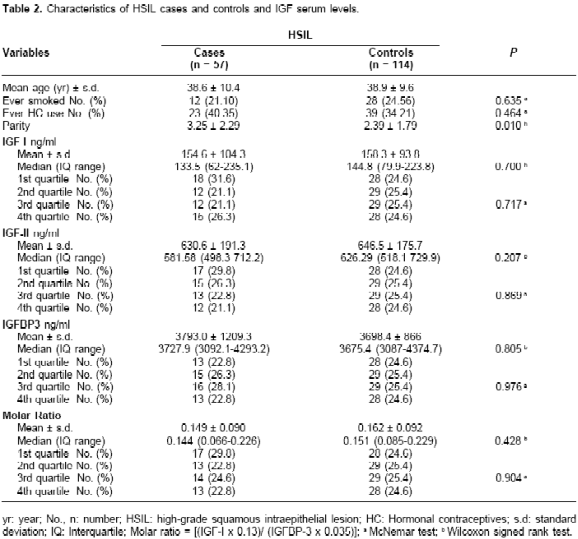
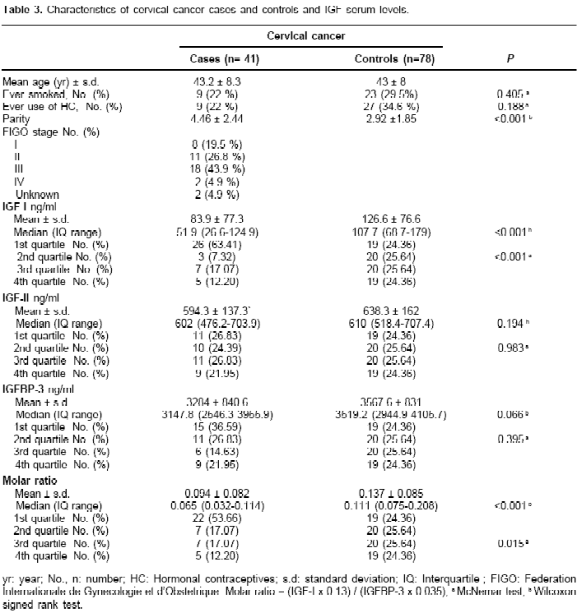
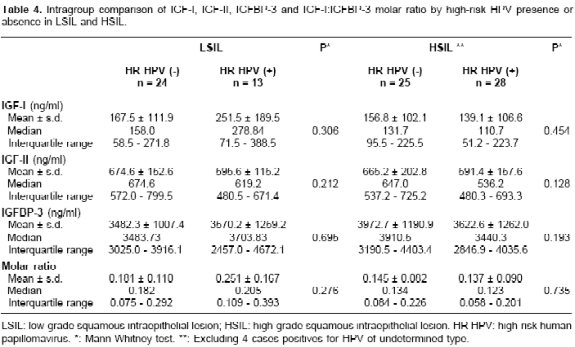
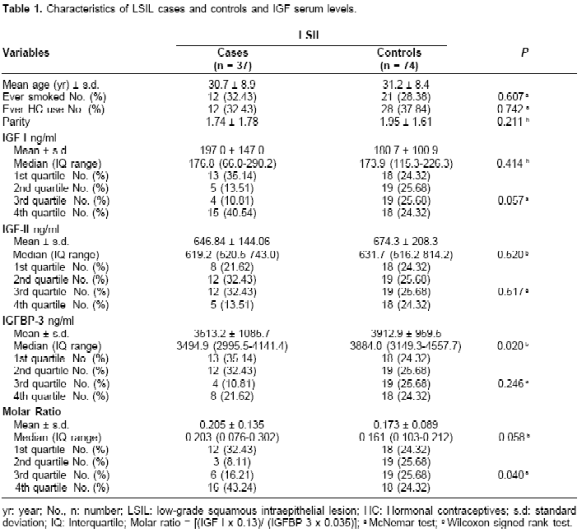
<body><![CDATA[<P>Commercially available ELISA kits (DSL, Webster, TX) were used to determine the serum levels of IGF-I (DSL-10-5600), IGF-II (DSL-10-2600), and IGFBP-3 (DSL-10-6600). The mean intra- and inter-assay variation coefficients for the controls were, respectively, 4.1% and 8.6% for IGF-I, 9.8% and 13.8% for IGF-II and 4.2% and 11.9% for IGFBP-3. ELISA was performed according to the manufacturer’s instructions. Standards, controls, and samples were tested in duplicate. The IGF-I, IGF-II, and IGFBP-3 serum concentrations were determined from the standard curve by matching the absorbance readings with the corresponding IGF-I, IGF-II, and IGFBP-3 concentrations.</P>     <P>HPV analysis</P>     <P>Cervical cells from the transformation zone of the cervix were collected with a cytobrush; harvested cells were suspended in a saline solution and subsequently centrifuged at 3,000 x g, 10 min. Cellular pellet was suspended in 0.75 ml of Trizol (Gibco) for DNA extraction. Quality of DNA was tested by amplifying the &szlig;-globin gene using the primers PCO3/PCO5, as described by Saiki <I>et al</I>. (23). HPV detection was performed according to the techniques described by Roda-Husman <I>et al</I>. (24). Each sample was tested with a generic primer-mediated PCR with GP5+/GP6+ consensus primers. PCR-amplified products were further tested in a non-isotopic single-strand conformational polymorphism (SSCP) for HPV16 and HPV18, as described by Zehbe et al. (25). PCR-amplified products, excluding positive ones for HPV16 or HPV18 were typed by direct DNA sequencing by using the Termo Sequenase Cy5.5 dye terminator cycle sequencing kit and the SEQ 4x4 automated sequencer (Amersham Pharmacia, Biotech).</P>     <P>Statistical Analysis</P>     <P>Statistical analysis was conducted using SPSS for Windows, version 11.5 (SPSS Inc., 2002). Distributions of age, use of hormonal contraceptives, parity, smoking status and cancer stage were described, as means and standard deviations or percentages. Distributions of IGF-I, IGF-II, and IGFBP3 serum levels, and IGFI: IGFBP-3 molar ratio ([IGF-I x 0.13] / [IGFBP-3 x 0.035]) were described, as means, standard deviations, medians, and interquartile ranges. Differences in the distributions of these variables between cases and controls were tested by using the McNemar test for categorical variables and the Wilcoxon signed rank test for continuous variables. Circulating levels of IGF-I, IGF-II, IGFBP-3, and IGF-I:IGFBP-3 molar ratio were categorized into quartiles, according to the distribution of values in their respective control groups for analysis by univariate and multivariate conditional logistic models. Distributions of serum levels into quartiles were described by number and percentages. Univariate and multivariate logistic regression models were used to assess the association between cervical cancer, LSIL, and HSIL and circulating levels of IGFs. The lowest quartile of each analyzed variable was taken as the reference category, and crude and adjusted odds ratios (ORs) and 95% confidence intervals (CIs) were calculated for the other three quartile levels. First, crude OR and 95% CI were calculated in each one of the three groups (LSIL, HSIL, and cancer) for each variable of interest (IGF-I, IGFII, and IGFBP3 plasma levels and IGF-I:IGFBP-3 molar ratio). Then multivariate models were used to assess the association between each IGF marker and LSIL, HSIL, and cancer while adjusting for variables associated with cervical cancer risk (use of hormonal contraceptives, smoking status, and parity). IGF-I and IGF-II were adjusted for IGFBP-3, and IGFBP-3 was as well for IGF-I and IGF-II, because IGFBP-3 has an effect on IGF-I and IGF-II activities. Intra-group differences in IGF levels in LSIL and HSIL related to HR HPV presence and intra-group differences in IGF levels in cervical cancer related to stage of disease (I-II versus III-IV) were tested by using the Mann- Whitney test. All p values were two-sided and considered significant at p &lt; 0.05.</P> <B>    <P>Results</P> </B></FONT>    <P><A HREF="#table1">Tables 1</A><FONT FACE="Arial">, </FONT><A HREF="#table2">table 2</A><FONT FACE="Arial"> and </FONT><A HREF="#table3">table 3</A><FONT FACE="Arial"> summarize the distributions of LSIL, HSIL, and cervical cancer cases and their respective controls by age, tobacco use, reproductive factors, and FIGO stage; and the distributions of IGF-I, IGF-II, and IGFBP-3 levels and IGF-I:IGFBP-3 molar ratio for each group. We observed differences in mean age between groups; in HSIL and cervical cancer, the mean age was higher than in LSIL, which can be related to the progression in time from LSIL to HSIL to cervical cancer. There were no differences in the distribution of tobacco and hormonal contraceptives use. In contrast, parity was significantly higher in HSIL cases and in cervical cancer cases than in their corresponding controls (p = 0.01 and p &lt; 0.001, respectively).</P>     <P><A NAME="table1"></A></P> </FONT>    <P ALIGN="CENTER"><IMG SRC="/img/revistas/bio/v26n2/2a09t1.gif"></P>     <P><A NAME="table2"></A></P>     ]]></body>
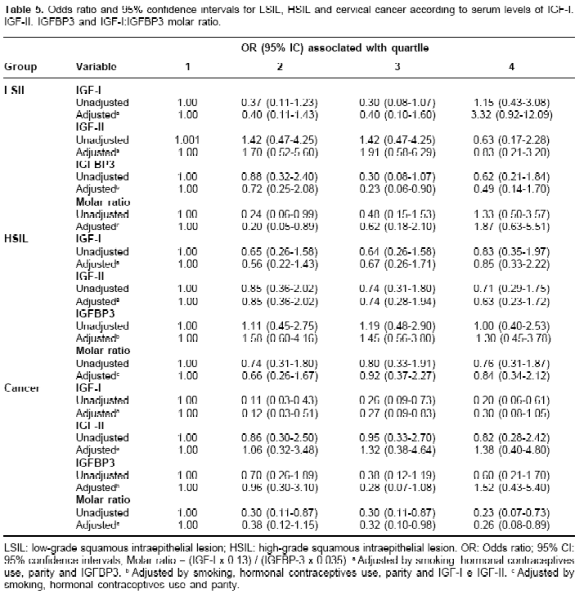
<body><![CDATA[<P ALIGN="CENTER"><IMG SRC="/img/revistas/bio/v26n2/2a09t2.gif"></P>     <P><A NAME="table3"></A></P>     <P ALIGN="CENTER"><IMG SRC="/img/revistas/bio/v26n2/2a09t3.gif"></P> <FONT FACE="Arial">    <P>A statistically significant lower mean circulating level of IGFBP-3 was observed among LSIL cases than among controls (3,513.2 ng/ml vs 3,912.9 ng/ml, p = 0.02). In contrast, the mean values of IGF-I and IGF-I:IGFBP-3 molar ratio were significantly lower among cancer cases than among controls. Mean levels of IGF-I were 83.9 ng/ml and 126.6 ng/ml (p &lt; 0.001), and IGFI: IGFBP-3 molar ratios were, respectively, 0.094 and 0.137 (p &lt; 0.001) for cervical cancer cases and the corresponding controls. We did not find any significant differences in IGF-I, IGF-II, and IGFBP-3 levels in LSIL or HSIL according to HR HPV (</FONT><A HREF="#table4">Table 4</A><FONT FACE="Arial">).</P>     <P><A NAME="table4"></A></P> </FONT>    <P ALIGN="CENTER"><IMG SRC="/img/revistas/bio/v26n2/2a09t4.gif"6></P> <FONT FACE="Arial">    <P>Crude and adjusted estimates of the association (OR and 95% CI) between IGF markers and cervical cancer and precancerous lesions (LSIL and HSIL) are presented in </FONT><A HREF="#table5">Table 5</A><FONT FACE="Arial">.</P>     <P><A NAME="table5"></A></P> </FONT>    <P ALIGN="CENTER"><IMG SRC="/img/revistas/bio/v26n2/2a09t5.gif"></P> <FONT FACE="Arial">    <P>In LSIL and HSIL groups we did not find any statistically significant association with serum levels analyzed in the univariate or multivariate logistic regression analysis. In the univariate logistic regression analysis IGF-I levels and IGFI: IGFBP-3 molar ratio were found to be inversely associated with cervical cancer. Women in the highest quartile of IGF-I and IGF-I:IGFBP-3 molar ratio were at 80% (OR = 0.2) and 77% (OR = 0.23) lower risk of cervical cancer, respectively, as compared with women in the reference category. After adjusting for variables associated with cervical cancer risk and with IGFBP-3, this inverse association remained statistically significant only for women in the second and third quartiles of IGF-I (OR = 0.12, 95% IC [0.03-0.51] and OR = 0.27, 95% IC [0.09-0.83], respectively). On the other hand, after adjusting for variables associated with cervical cancer risk, the inverse association between IGF-I:IGFBP-3 molar ratio and risk of cervical cancer remained statistically significant for women in the third and fourth quartiles (OR = 0.32, 95% IC [0.1-0.98] and OR = 0.26, 95% IC [0.08-0.89], respectively). For IGFII and IGFBP-3 serum levels in cervical cancer the differences between cases and controls were not statistically significant (</FONT><A HREF="#table5">Table 5</A><FONT FACE="Arial">).</P>     ]]></body>
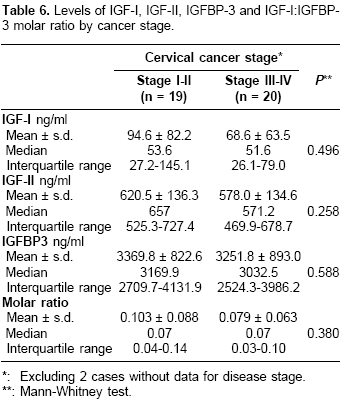
<body><![CDATA[<P>In order to investigate whether the observed inverse association between IGF-I and cervical cancer risk could be related to alterations in catabolism and nutrition associated to advanced stages of cancer, we compared serum levels of IGF-I, IGF-II, and IGFBP-3 and IGF-I:IGFBP-3 molar ratio between stages I-II vs III-IV. We did not find any significant differences (</FONT><A HREF="#table6">Table 6).</A></P> <B><FONT FACE="Arial">    <P><A NAME="table6"></A></P> </B></FONT>    <P ALIGN="CENTER"><IMG SRC="/img/revistas/bio/v26n2/2a09t6.gif"></P> <B><FONT FACE="Arial">    <P>Discussion</P> </B>    <P>Many studies have suggested that high circulating IGF-I levels are associated with increased risk of prostate, premenopausal breast, and colon cancer (26); however, an inverse association has also been reported for gastric (27), endometrial (28,29), liver (30), and lung cancer (31). In this study we found an inverse association between cervical cancer risk and IGF-I circulating levels. In concordance with this result, IGF-I:IGFBP-3 molar ratio was also inversely associated with cervical carcinoma. These inverse associations were also observed in HSIL but did not reach statistical significance, maybe due to small sample size.</P>     <P>Since IGF-I circulating levels can be affected by the malignant disease itself, the observed lower levels of IGF-I in cancer might be more a consequence of the malignant disease than an associated risk factor.</P>     <P>Over 75% of IGF-I in the circulation is produced in the liver. The main physiological stimuli for hepatic IGF-I synthesis are growth hormone (32) and nutrition (33). It is plausible that the reduced circulating IGF-I levels in cancer patients may be a consequence of alterations in catabolism and nutrition, conditions commonly present in advanced stages of this disease. However, we did not find significant differences in IGF levels according to FIGO stage (I-II versus III-IV).</P>     <P>In this case-control study we cannot establish whether this inverse association is a risk factor or marker for disease. To solve this question we would need a prospective study, like the reported ones in other cancers like prostate (34), breast (12) and lung (15) cancer. However this kind of study is difficult to carry out for cervical cancer, because Pap smears detect preneoplastic lesions, which ethically forces intervention.</P>     <P>There is one previous report about circulating IGFI level in cervical cancer. Ayabe et al. (35), in a small study of 11 cervical cancer patients and 27 controls, found not significant association between serum levels of IGF-I and cervical cancer risk. The difference between their results and ours can be mainly related to sample size.</P>     <P>We did not find significant association between precancerous lesions (LSIL and HSIL) and IGF-I serum levels. Conversely, Wu et al. (20), in a study of 267 SIL (HSIL and LSIL) cases and 238 controls, reported an association between elevated serum levels of IGF-I and risk of SIL. This discrepancy cannot be explained by differences in the analytical methods, because the same commercially available assay systems and a similar statistical approach were used in both studies, and other factors inherent to the sample, as ethnicity, lifestyle, and diet can affect the result.</P>     ]]></body>
<body><![CDATA[<P>For IGF-II and IGFBP-3 serum levels, we did not find any significant differences in SIL or cancer. Mathur et al. (18,19,21) report significantly increased IGF-II and decreased IGFBP-3 serum levels in women with SIL and cervical cancer. In this study we used the same commercial assays, but our statistical approach was quite different and the small sample subdivided into many different groups used by Mathur et al. can explain these discrepancies. In contrast, Wu et al. found higher serum levels of IGFBP-3 in SIL cases than in controls (20). In other cancer types, as breast, prostate, colon and lung, that have been studied in greater extent in relation to IGF serum levels, there are also contradictory results (26). The complexity of the IGF system and its regulation makes it difficult to perform direct comparisons of results, and this hinders the use of serum levels of IGF-I, IGF-II and IGFBP-3 as biomarkers in cervical cancer.</P>     <P>It has been well established that HPVs are involved in the genesis of cervical cancer. Our findings in intra-group comparisons between presence and absence of HPV and serum levels of IGF-I, IGFII, and IGFBP-3 do not support an association between HPV infection and IGFs. </P>     <P>In summary, our findings suggest an association between lower serum levels of IGF-I and a lower IGF-I:IGFBP-3 molar ratio and cervical cancer.</P>     <P>The case-control design of the study did not allow us to determine whether lower IGF-I levels are cause (risk) or consequence (tumor marker) of the malignant disease.</P> <B>    <P>Acknowledgments</P> </B>    <P>We thank Jairo Amaya (Hospital de La Granja – CAMI Las Ferias), Edwin Hoyos (Liga de Lucha contra el C&aacute;ncer, Seccional Bogot&aacute;), Miguel Arag&oacute;n and Hernando Gait&aacute;n (Hospital Materno- Infantil), Jaime Naranjo and Nicola Ambrossi (Hospital de La Samaritana), and Mauricio Gonz&aacute;lez (Instituto Nacional de Cancerolog&iacute;a) for their help in collecting the samples.</P> <B>    <P>Grant support</P> </B>    <P>Terry Fox Run - Embassy of Canada. Colciencias (c&oacute;digo: 2101-04-13023). Ministerio de la</P>     <P>Protecci&oacute;n Social (Colombia).</P> <B>    <P>Conflict of interest</P> </B>    ]]></body>
<body><![CDATA[<P>None declared.</P>     <P>Correspondence:</P>     <P>Martha-Luc&iacute;a Serrano, Laboratorio de Inmunolog&iacute;a, Instituto</P>     <P>Nacional de Cancerolog&iacute;a,</P>     <P>Avenida 1ª # 9-85, Bogot&aacute; D.C., Colombia.</P>     <P>Fax: 57-1-3165000 ext. 14466</P> </FONT>    <P><A HREF="mailto:mserrano@incancerologia.gov.co">mserrano@incancerologia.gov.co</A></P> <FONT FACE="Arial">    <P>Recibido: 28/10/05; aceptado: 28/04/06</P> <B>    <P>&nbsp;</P>     <P>References</P> </B>    ]]></body>
<body><![CDATA[<!-- ref --><P>1. <B>Parkin DM, Bray F, Ferlay J, Pisani P. </B>Estimating the world cancer burden: Globocan 2000. Int J Cancer 2001;94:153-6.&nbsp;&nbsp;&nbsp;&nbsp;&nbsp;&nbsp;&nbsp;&nbsp;[&#160;<a href="javascript:void(0);" onclick="javascript: window.open('/scielo.php?script=sci_nlinks&ref=000083&pid=S0120-4157200600020000900001&lng=','','width=640,height=500,resizable=yes,scrollbars=1,menubar=yes,');">Links</a>&#160;]<!-- end-ref --><!-- ref --><P>2. <B>International Agency for Research on cancer (IARC). </B>Globocan. Cancer incidence and mortality worldwide. Lyon, France: IARC;1998.&nbsp;&nbsp;&nbsp;&nbsp;&nbsp;&nbsp;&nbsp;&nbsp;[&#160;<a href="javascript:void(0);" onclick="javascript: window.open('/scielo.php?script=sci_nlinks&ref=000084&pid=S0120-4157200600020000900002&lng=','','width=640,height=500,resizable=yes,scrollbars=1,menubar=yes,');">Links</a>&#160;]<!-- end-ref --><!-- ref --><P>3. <B>Walboomers JM, Jacobs MV, Manos MM, Bosch FX, Kummer JA, Shah KV <I>et al</I>. </B>Human papillomavirus is a necessary cause of invasive cervical cancer worldwide. J Pathol 1999;189:12-9.&nbsp;&nbsp;&nbsp;&nbsp;&nbsp;&nbsp;&nbsp;&nbsp;[&#160;<a href="javascript:void(0);" onclick="javascript: window.open('/scielo.php?script=sci_nlinks&ref=000085&pid=S0120-4157200600020000900003&lng=','','width=640,height=500,resizable=yes,scrollbars=1,menubar=yes,');">Links</a>&#160;]<!-- end-ref --><!-- ref --><P>4. <B>Solomon D, Davey D, Kurman R, Moriarty A, O’Connor D, Prey M <I>et al</I>. </B>The 2001 Bethesda System: terminology for reporting results of cervical cytology. JAMA 2002;287:2114-9.&nbsp;&nbsp;&nbsp;&nbsp;&nbsp;&nbsp;&nbsp;&nbsp;[&#160;<a href="javascript:void(0);" onclick="javascript: window.open('/scielo.php?script=sci_nlinks&ref=000086&pid=S0120-4157200600020000900004&lng=','','width=640,height=500,resizable=yes,scrollbars=1,menubar=yes,');">Links</a>&#160;]<!-- end-ref --><!-- ref --><P>5. <B>Woodman CB, Collins S, Winter H, Bailey A, Ellis J, Prior P et al. </B>Natural history of cervical human papillomavirus infection in young women: a longitudinal cohort study. Lancet 2001;357:1831-6.&nbsp;&nbsp;&nbsp;&nbsp;&nbsp;&nbsp;&nbsp;&nbsp;[&#160;<a href="javascript:void(0);" onclick="javascript: window.open('/scielo.php?script=sci_nlinks&ref=000087&pid=S0120-4157200600020000900005&lng=','','width=640,height=500,resizable=yes,scrollbars=1,menubar=yes,');">Links</a>&#160;]<!-- end-ref --><!-- ref --><P>6. <B>Cuzick J, Meijer CJ, Walboomers JM. </B>Screening for cervical cancer. Lancet 1998;351:1439-40.&nbsp;&nbsp;&nbsp;&nbsp;&nbsp;&nbsp;&nbsp;&nbsp;[&#160;<a href="javascript:void(0);" onclick="javascript: window.open('/scielo.php?script=sci_nlinks&ref=000088&pid=S0120-4157200600020000900006&lng=','','width=640,height=500,resizable=yes,scrollbars=1,menubar=yes,');">Links</a>&#160;]<!-- end-ref --><!-- ref --><P>7. <B>Goldie SJ. </B>Health economics and cervical cancer prevention: a global perspective. Virus Res 2002;89:301-9.&nbsp;&nbsp;&nbsp;&nbsp;&nbsp;&nbsp;&nbsp;&nbsp;[&#160;<a href="javascript:void(0);" onclick="javascript: window.open('/scielo.php?script=sci_nlinks&ref=000089&pid=S0120-4157200600020000900007&lng=','','width=640,height=500,resizable=yes,scrollbars=1,menubar=yes,');">Links</a>&#160;]<!-- end-ref --><!-- ref --><P>8. <B>Baserga R, Sell C, Porcu P, Rubini M. </B>The role of the IGF-I receptor in the growth and transformation of mammalian cells. Cell Prolif 1994;27:63-71.&nbsp;&nbsp;&nbsp;&nbsp;&nbsp;&nbsp;&nbsp;&nbsp;[&#160;<a href="javascript:void(0);" onclick="javascript: window.open('/scielo.php?script=sci_nlinks&ref=000090&pid=S0120-4157200600020000900008&lng=','','width=640,height=500,resizable=yes,scrollbars=1,menubar=yes,');">Links</a>&#160;]<!-- end-ref --><!-- ref --><P>9. <B>Werner H, LeRoith D. </B>The role of the insulin-like growth factor system in human cancer. Adv Cancer Res 1996;68:183-223.&nbsp;&nbsp;&nbsp;&nbsp;&nbsp;&nbsp;&nbsp;&nbsp;[&#160;<a href="javascript:void(0);" onclick="javascript: window.open('/scielo.php?script=sci_nlinks&ref=000091&pid=S0120-4157200600020000900009&lng=','','width=640,height=500,resizable=yes,scrollbars=1,menubar=yes,');">Links</a>&#160;]<!-- end-ref --><!-- ref --><P>10. <B>LeRoith D, Werner H, Beitner-Johnson D, Roberts CT Jr. </B>Molecular and cellular aspects of the insulin-like growth factor I receptor. Endocr Rev 1995;16:143-63.&nbsp;&nbsp;&nbsp;&nbsp;&nbsp;&nbsp;&nbsp;&nbsp;[&#160;<a href="javascript:void(0);" onclick="javascript: window.open('/scielo.php?script=sci_nlinks&ref=000092&pid=S0120-4157200600020000900010&lng=','','width=640,height=500,resizable=yes,scrollbars=1,menubar=yes,');">Links</a>&#160;]<!-- end-ref --><!-- ref --><P>11. <B>Ricort JM, Binoux M. </B>Insulin-like growth factor (IGF) binding protein-3 inhibits type 1 IGF receptor activation independently of its IGF binding affinity. Endocrinology 2001;142:108-13.&nbsp;&nbsp;&nbsp;&nbsp;&nbsp;&nbsp;&nbsp;&nbsp;[&#160;<a href="javascript:void(0);" onclick="javascript: window.open('/scielo.php?script=sci_nlinks&ref=000093&pid=S0120-4157200600020000900011&lng=','','width=640,height=500,resizable=yes,scrollbars=1,menubar=yes,');">Links</a>&#160;]<!-- end-ref --><!-- ref --><P>12. <B>Hankinson SE, Willett WC, Colditz GA, Hunter DJ, Michaud DS, Deroo B et al. </B>Circulating concentrations of insulin-like growth factor-I and risk of breast cancer. Lancet 1998;351:1393-6.&nbsp;&nbsp;&nbsp;&nbsp;&nbsp;&nbsp;&nbsp;&nbsp;[&#160;<a href="javascript:void(0);" onclick="javascript: window.open('/scielo.php?script=sci_nlinks&ref=000094&pid=S0120-4157200600020000900012&lng=','','width=640,height=500,resizable=yes,scrollbars=1,menubar=yes,');">Links</a>&#160;]<!-- end-ref --><!-- ref --><P>13. <B>Chan JM, Stampfer MJ, Giovannucci E, Gann PH, Ma J, Wilkinson P et al. </B>Plasma insulin-like growth factor-I and prostate cancer risk: a prospective study. Science 1998;279:563-6.&nbsp;&nbsp;&nbsp;&nbsp;&nbsp;&nbsp;&nbsp;&nbsp;[&#160;<a href="javascript:void(0);" onclick="javascript: window.open('/scielo.php?script=sci_nlinks&ref=000095&pid=S0120-4157200600020000900013&lng=','','width=640,height=500,resizable=yes,scrollbars=1,menubar=yes,');">Links</a>&#160;]<!-- end-ref --><!-- ref --><P>14. <B>Giovannucci E, Pollak M, Platz EA, Willett WC, Stampfer MJ, Majeed N et al. </B>Insulin-like growth factor I (IGF-I), IGF-binding protein-3 and the risk of colorectal adenoma and cancer in the Nurses’ Health Study. Growth Horm IGF Res 2000;10 (Suppl. A):S30-1.&nbsp;&nbsp;&nbsp;&nbsp;&nbsp;&nbsp;&nbsp;&nbsp;[&#160;<a href="javascript:void(0);" onclick="javascript: window.open('/scielo.php?script=sci_nlinks&ref=000096&pid=S0120-4157200600020000900014&lng=','','width=640,height=500,resizable=yes,scrollbars=1,menubar=yes,');">Links</a>&#160;]<!-- end-ref --><!-- ref --><P>15. <B>London SJ, Yuan JM, Travlos GS, Gao YT, Wilson RE, Ross RK et al. </B>Insulin-like growth factor I, IGFbinding protein 3, and lung cancer risk in a prospective study of men in China. J Natl Cancer Inst 2002; 94:749-54.&nbsp;&nbsp;&nbsp;&nbsp;&nbsp;&nbsp;&nbsp;&nbsp;[&#160;<a href="javascript:void(0);" onclick="javascript: window.open('/scielo.php?script=sci_nlinks&ref=000097&pid=S0120-4157200600020000900015&lng=','','width=640,height=500,resizable=yes,scrollbars=1,menubar=yes,');">Links</a>&#160;]<!-- end-ref --><!-- ref --><P>16. <B>Wu Y, Cui K, Miyoshi K, Hennighausen L, Green JE, Setser J et al. </B>Reduced circulating insulin-like growth factor I levels delay the onset of chemically and genetically induced mammary tumors. Cancer Res 2003;63:4384-8.&nbsp;&nbsp;&nbsp;&nbsp;&nbsp;&nbsp;&nbsp;&nbsp;[&#160;<a href="javascript:void(0);" onclick="javascript: window.open('/scielo.php?script=sci_nlinks&ref=000098&pid=S0120-4157200600020000900016&lng=','','width=640,height=500,resizable=yes,scrollbars=1,menubar=yes,');">Links</a>&#160;]<!-- end-ref --><!-- ref --><P>17. <B>Wu Y, Yakar S, Zhao L, Hennighausen L, LeRoith D. </B>Circulating insulin-like growth factor-I levels regulate colon cancer growth and metastasis. Cancer Res 2002;62:1030-5.&nbsp;&nbsp;&nbsp;&nbsp;&nbsp;&nbsp;&nbsp;&nbsp;[&#160;<a href="javascript:void(0);" onclick="javascript: window.open('/scielo.php?script=sci_nlinks&ref=000099&pid=S0120-4157200600020000900017&lng=','','width=640,height=500,resizable=yes,scrollbars=1,menubar=yes,');">Links</a>&#160;]<!-- end-ref --><!-- ref --><P>18. <B>Mathur SP, Mathur RS, Young RC. </B>Cervical epidermal growth factor-receptor (EGF-R) and serum insulin-like growth factor II (IGF-II) levels are potential markers for cervical cancer. Am J Reprod Immunol 2000;44:222-30.&nbsp;&nbsp;&nbsp;&nbsp;&nbsp;&nbsp;&nbsp;&nbsp;[&#160;<a href="javascript:void(0);" onclick="javascript: window.open('/scielo.php?script=sci_nlinks&ref=000100&pid=S0120-4157200600020000900018&lng=','','width=640,height=500,resizable=yes,scrollbars=1,menubar=yes,');">Links</a>&#160;]<!-- end-ref --><!-- ref --><P>19. <B>Mathur SP, Mathur RS, Underwood PB, Kohler MF, Creasman WT. </B>Circulating levels of insulin-like growth factor-II and IGF-binding protein 3 in cervical cancer. Gynecol Oncol 2003;91:486-93.&nbsp;&nbsp;&nbsp;&nbsp;&nbsp;&nbsp;&nbsp;&nbsp;[&#160;<a href="javascript:void(0);" onclick="javascript: window.open('/scielo.php?script=sci_nlinks&ref=000101&pid=S0120-4157200600020000900019&lng=','','width=640,height=500,resizable=yes,scrollbars=1,menubar=yes,');">Links</a>&#160;]<!-- end-ref --><!-- ref --><P>20. <B>Wu X, Tortolero-Luna G, Zhao H, Phatak D, Spitz MR, Follen M. </B>Serum levels of insulin-like growth factor I and risk of squamous intraepithelial lesions of the cervix. Clin Cancer Res 2003;9:3356-61.&nbsp;&nbsp;&nbsp;&nbsp;&nbsp;&nbsp;&nbsp;&nbsp;[&#160;<a href="javascript:void(0);" onclick="javascript: window.open('/scielo.php?script=sci_nlinks&ref=000102&pid=S0120-4157200600020000900020&lng=','','width=640,height=500,resizable=yes,scrollbars=1,menubar=yes,');">Links</a>&#160;]<!-- end-ref --><!-- ref --><P>21. <B>Mathur SP, Mathur RS, Gray EA, Lane D, Underwood PG, Kohler M et al. </B>Serum vascular endothelial growth factor C (VEGF-C) as a specific biomarker for advanced cervical cancer: Relationship to insulin-like growth factor II (IGF-II), IGF binding protein 3 (IGF-BP3) and VEGF-B. Gynecol Oncol 2005;98:467-83.&nbsp;&nbsp;&nbsp;&nbsp;&nbsp;&nbsp;&nbsp;&nbsp;[&#160;<a href="javascript:void(0);" onclick="javascript: window.open('/scielo.php?script=sci_nlinks&ref=000103&pid=S0120-4157200600020000900021&lng=','','width=640,height=500,resizable=yes,scrollbars=1,menubar=yes,');">Links</a>&#160;]<!-- end-ref --><!-- ref --><P>22. <B>Daughaday WH, Rotwein P. </B>Insulin-like growth factors I and II. Peptide, messenger ribonucleic acid and gene structures, serum, and tissue concentrations. Endocr Rev 1989;10:68-91.&nbsp;&nbsp;&nbsp;&nbsp;&nbsp;&nbsp;&nbsp;&nbsp;[&#160;<a href="javascript:void(0);" onclick="javascript: window.open('/scielo.php?script=sci_nlinks&ref=000104&pid=S0120-4157200600020000900022&lng=','','width=640,height=500,resizable=yes,scrollbars=1,menubar=yes,');">Links</a>&#160;]<!-- end-ref --><!-- ref --><P>23. <B>Saiki RK, Scharf S, Faloona F, Mullis KB, Horn GT, Erlich HA et al. </B>Enzymatic amplification of beta-globin genomic sequences and restriction site analysis for diagnosis of sickle cell anemia. Science 1985;230:1350-4.&nbsp;&nbsp;&nbsp;&nbsp;&nbsp;&nbsp;&nbsp;&nbsp;[&#160;<a href="javascript:void(0);" onclick="javascript: window.open('/scielo.php?script=sci_nlinks&ref=000105&pid=S0120-4157200600020000900023&lng=','','width=640,height=500,resizable=yes,scrollbars=1,menubar=yes,');">Links</a>&#160;]<!-- end-ref --><!-- ref --><P>24. <B>Roda Husman AM, Walboomers JM, van den Brule AJ, Meijer CJ, Snijders PJ. </B>The use of general primers GP5 and GP6 elongated at their 3' ends with adjacent highly conserved sequences improves human papillomavirus detection by PCR. J Gen Virol 1995;76:1057-62.&nbsp;&nbsp;&nbsp;&nbsp;&nbsp;&nbsp;&nbsp;&nbsp;[&#160;<a href="javascript:void(0);" onclick="javascript: window.open('/scielo.php?script=sci_nlinks&ref=000106&pid=S0120-4157200600020000900024&lng=','','width=640,height=500,resizable=yes,scrollbars=1,menubar=yes,');">Links</a>&#160;]<!-- end-ref --><!-- ref --><P>25. <B>Zehbe I, Sallstrom JF, Evander M, Edlund K, Rylander E, Wadell G et al. </B>Nonradioisotopic detection and typing of human papillomaviruses by use of polymerase chain reaction and single-strand conformation polymorphism. Diagn Mol Pathol 1996;5:206-13.&nbsp;&nbsp;&nbsp;&nbsp;&nbsp;&nbsp;&nbsp;&nbsp;[&#160;<a href="javascript:void(0);" onclick="javascript: window.open('/scielo.php?script=sci_nlinks&ref=000107&pid=S0120-4157200600020000900025&lng=','','width=640,height=500,resizable=yes,scrollbars=1,menubar=yes,');">Links</a>&#160;]<!-- end-ref --><!-- ref --><P>26. <B>Renehan AG, Zwahlen M, Minder C, O’Dwyer ST, Shalet SM, Egger M. </B>Insulin-like growth factor (IGF)- I, IGF binding protein-3, and cancer risk: systematic review and meta-regression analysis. Lancet 2004;363:1346-53.&nbsp;&nbsp;&nbsp;&nbsp;&nbsp;&nbsp;&nbsp;&nbsp;[&#160;<a href="javascript:void(0);" onclick="javascript: window.open('/scielo.php?script=sci_nlinks&ref=000108&pid=S0120-4157200600020000900026&lng=','','width=640,height=500,resizable=yes,scrollbars=1,menubar=yes,');">Links</a>&#160;]<!-- end-ref --><!-- ref --><P>27. <B>Lee DY, Yang DH, Kang CW, Kim SJ, Joo CU, Cho SC et al. </B>Serum insulin-like growth factors (IGFs) and IGF binding protein (IGFBP)-3 in patients with gastric cancer: IGFBP-3 protease activity induced by surgery. J Korean Med Sci 1997;12:32-9.&nbsp;&nbsp;&nbsp;&nbsp;&nbsp;&nbsp;&nbsp;&nbsp;[&#160;<a href="javascript:void(0);" onclick="javascript: window.open('/scielo.php?script=sci_nlinks&ref=000109&pid=S0120-4157200600020000900027&lng=','','width=640,height=500,resizable=yes,scrollbars=1,menubar=yes,');">Links</a>&#160;]<!-- end-ref --><!-- ref --><P>28. <B>Rutanen EM, Stenman S, Blum W, Karkkainen T, Lehtovirta P, Stenman UH. </B>Relationship between carbohydrate metabolism and serum insulin-like growth factor system in postmenopausal women: comparison of endometrial cancer patients with healthy controls. J Clin Endocrinol Metab 1993;77:199-204.&nbsp;&nbsp;&nbsp;&nbsp;&nbsp;&nbsp;&nbsp;&nbsp;[&#160;<a href="javascript:void(0);" onclick="javascript: window.open('/scielo.php?script=sci_nlinks&ref=000110&pid=S0120-4157200600020000900028&lng=','','width=640,height=500,resizable=yes,scrollbars=1,menubar=yes,');">Links</a>&#160;]<!-- end-ref --><!-- ref --><P>29. <B>Lacey JV, Jr., Potischman N, Madigan MP, Berman ML, Mortel R, Twiggs LB et al. </B>Insulin-like growth factors, insulin-like growth factor-binding proteins, and endometrial cancer in postmenopausal women: results from a U.S. case-control study. Cancer Epidemiol Biomarkers Prev 2004;13:607-12.&nbsp;&nbsp;&nbsp;&nbsp;&nbsp;&nbsp;&nbsp;&nbsp;[&#160;<a href="javascript:void(0);" onclick="javascript: window.open('/scielo.php?script=sci_nlinks&ref=000111&pid=S0120-4157200600020000900029&lng=','','width=640,height=500,resizable=yes,scrollbars=1,menubar=yes,');">Links</a>&#160;]<!-- end-ref --><!-- ref --><P>30. <B>Stuver SO, Kuper H, Tzonou A, Lagiou P, Spanos E, Hsieh CC et al. </B>Insulin-like growth factor 1 in hepatocellular carcinoma and metastatic liver cancer in men. Int J Cancer 2000;87:118-21.&nbsp;&nbsp;&nbsp;&nbsp;&nbsp;&nbsp;&nbsp;&nbsp;[&#160;<a href="javascript:void(0);" onclick="javascript: window.open('/scielo.php?script=sci_nlinks&ref=000112&pid=S0120-4157200600020000900030&lng=','','width=640,height=500,resizable=yes,scrollbars=1,menubar=yes,');">Links</a>&#160;]<!-- end-ref --><!-- ref --><P>31. <B>Mazzoccoli G, Giuliani A, Bianco G, De Cata A, Balzanelli M, Carella AM et al. </B>Decreased serum levels of insulin-like growth factor (IGF)-I in patients with lung cancer: temporal relationship with growth hormone (GH) levels. Anticancer Res 1999;19:1397-9.&nbsp;&nbsp;&nbsp;&nbsp;&nbsp;&nbsp;&nbsp;&nbsp;[&#160;<a href="javascript:void(0);" onclick="javascript: window.open('/scielo.php?script=sci_nlinks&ref=000113&pid=S0120-4157200600020000900031&lng=','','width=640,height=500,resizable=yes,scrollbars=1,menubar=yes,');">Links</a>&#160;]<!-- end-ref --><!-- ref --><P>32. <B>Copeland KC, Underwood LE, Van Wyk JJ. </B>Induction of immunoreactive somatomedin C human serum by growth hormone: dose-response relationships and effect on chromatographic profiles. J Clin Endocrinol Metab 1980;50:690-7.&nbsp;&nbsp;&nbsp;&nbsp;&nbsp;&nbsp;&nbsp;&nbsp;[&#160;<a href="javascript:void(0);" onclick="javascript: window.open('/scielo.php?script=sci_nlinks&ref=000114&pid=S0120-4157200600020000900032&lng=','','width=640,height=500,resizable=yes,scrollbars=1,menubar=yes,');">Links</a>&#160;]<!-- end-ref --><!-- ref --><P>33. <B>Thissen JP, Ketelslegers JM, Underwood LE. </B>Nutritional regulation of the insulin-like growth factors. Endocr Rev 1994;15:80-101.&nbsp;&nbsp;&nbsp;&nbsp;&nbsp;&nbsp;&nbsp;&nbsp;[&#160;<a href="javascript:void(0);" onclick="javascript: window.open('/scielo.php?script=sci_nlinks&ref=000115&pid=S0120-4157200600020000900033&lng=','','width=640,height=500,resizable=yes,scrollbars=1,menubar=yes,');">Links</a>&#160;]<!-- end-ref --><!-- ref --><P>34. <B>Woodson K, Tangrea JA, Pollak M, Copeland TD, Taylor PR, Virtamo J et al. </B>Serum insulin-like growth factor I: tumor marker or etiologic factor? A prospective study of prostate cancer among Finnish men. Cancer Res 2003;63:3991-4.&nbsp;&nbsp;&nbsp;&nbsp;&nbsp;&nbsp;&nbsp;&nbsp;[&#160;<a href="javascript:void(0);" onclick="javascript: window.open('/scielo.php?script=sci_nlinks&ref=000116&pid=S0120-4157200600020000900034&lng=','','width=640,height=500,resizable=yes,scrollbars=1,menubar=yes,');">Links</a>&#160;]<!-- end-ref --><!-- ref --><P>35. <B>Ayabe T, Tsutsumi O, Sakai H, Yoshikawa H, Yano T, Kurimoto F et al. </B>Increased circulating levels of insulin-like growth factor-I and decreased circulating levels of insulin-like growth factor binding protein-1 in postmenopausal women with endometrial cancer. Endocr J 1997;44:419-24.&nbsp;&nbsp;&nbsp;&nbsp;&nbsp;&nbsp;&nbsp;&nbsp;[&#160;<a href="javascript:void(0);" onclick="javascript: window.open('/scielo.php?script=sci_nlinks&ref=000117&pid=S0120-4157200600020000900035&lng=','','width=640,height=500,resizable=yes,scrollbars=1,menubar=yes,');">Links</a>&#160;]<!-- end-ref --> ]]></body><back>
<ref-list>
<ref id="B1">
<label>1</label><nlm-citation citation-type="journal">
<person-group person-group-type="author">
<name>
<surname><![CDATA[Parkin]]></surname>
<given-names><![CDATA[DM]]></given-names>
</name>
<name>
<surname><![CDATA[Bray]]></surname>
<given-names><![CDATA[F]]></given-names>
</name>
<name>
<surname><![CDATA[Ferlay]]></surname>
<given-names><![CDATA[J]]></given-names>
</name>
<name>
<surname><![CDATA[Pisani]]></surname>
<given-names><![CDATA[P]]></given-names>
</name>
</person-group>
<article-title xml:lang="en"><![CDATA[Estimating the world cancer burden: Globocan 2000]]></article-title>
<source><![CDATA[Int J Cancer]]></source>
<year>2001</year>
<volume>94</volume>
<page-range>153-6</page-range></nlm-citation>
</ref>
<ref id="B2">
<label>2</label><nlm-citation citation-type="book">
<collab>International Agency for Research on cancer (IARC)</collab>
<source><![CDATA[Globocan: Cancer incidence and mortality worldwide]]></source>
<year>1998</year>
<publisher-loc><![CDATA[Lyon, France ]]></publisher-loc>
<publisher-name><![CDATA[IARC]]></publisher-name>
</nlm-citation>
</ref>
<ref id="B3">
<label>3</label><nlm-citation citation-type="journal">
<person-group person-group-type="author">
<name>
<surname><![CDATA[Walboomers]]></surname>
<given-names><![CDATA[JM]]></given-names>
</name>
<name>
<surname><![CDATA[Jacobs]]></surname>
<given-names><![CDATA[MV]]></given-names>
</name>
<name>
<surname><![CDATA[Manos]]></surname>
<given-names><![CDATA[MM]]></given-names>
</name>
<name>
<surname><![CDATA[Bosch]]></surname>
<given-names><![CDATA[FX]]></given-names>
</name>
<name>
<surname><![CDATA[Kummer]]></surname>
<given-names><![CDATA[JA]]></given-names>
</name>
<name>
<surname><![CDATA[Shah]]></surname>
<given-names><![CDATA[KV]]></given-names>
</name>
</person-group>
<article-title xml:lang="en"><![CDATA[Human papillomavirus is a necessary cause of invasive cervical cancer worldwide]]></article-title>
<source><![CDATA[J Pathol]]></source>
<year>1999</year>
<volume>189</volume>
<page-range>12-9</page-range></nlm-citation>
</ref>
<ref id="B4">
<label>4</label><nlm-citation citation-type="journal">
<person-group person-group-type="author">
<name>
<surname><![CDATA[Solomon]]></surname>
<given-names><![CDATA[D]]></given-names>
</name>
<name>
<surname><![CDATA[Davey]]></surname>
<given-names><![CDATA[D]]></given-names>
</name>
<name>
<surname><![CDATA[Kurman]]></surname>
<given-names><![CDATA[R]]></given-names>
</name>
<name>
<surname><![CDATA[Moriarty]]></surname>
<given-names><![CDATA[A]]></given-names>
</name>
<name>
<surname><![CDATA[O’Connor]]></surname>
<given-names><![CDATA[D]]></given-names>
</name>
<name>
<surname><![CDATA[Prey]]></surname>
<given-names><![CDATA[M]]></given-names>
</name>
</person-group>
<article-title xml:lang="en"><![CDATA[The 2001 Bethesda System: terminology for reporting results of cervical cytology]]></article-title>
<source><![CDATA[JAM]]></source>
<year>2002</year>
<volume>287</volume>
<page-range>2114-9</page-range></nlm-citation>
</ref>
<ref id="B5">
<label>5</label><nlm-citation citation-type="journal">
<person-group person-group-type="author">
<name>
<surname><![CDATA[Woodman]]></surname>
<given-names><![CDATA[CB]]></given-names>
</name>
<name>
<surname><![CDATA[Collins]]></surname>
<given-names><![CDATA[S]]></given-names>
</name>
<name>
<surname><![CDATA[Winter]]></surname>
<given-names><![CDATA[H]]></given-names>
</name>
<name>
<surname><![CDATA[Bailey]]></surname>
<given-names><![CDATA[A]]></given-names>
</name>
<name>
<surname><![CDATA[Ellis]]></surname>
<given-names><![CDATA[J]]></given-names>
</name>
<name>
<surname><![CDATA[Prior]]></surname>
<given-names><![CDATA[P]]></given-names>
</name>
</person-group>
<article-title xml:lang="en"><![CDATA[Natural history of cervical human papillomavirus infection in young women: a longitudinal cohort study]]></article-title>
<source><![CDATA[Lancet]]></source>
<year>2001</year>
<volume>357</volume>
<page-range>1831-6</page-range></nlm-citation>
</ref>
<ref id="B6">
<label>6</label><nlm-citation citation-type="journal">
<person-group person-group-type="author">
<name>
<surname><![CDATA[Cuzick]]></surname>
<given-names><![CDATA[J]]></given-names>
</name>
<name>
<surname><![CDATA[Meijer]]></surname>
<given-names><![CDATA[CJ]]></given-names>
</name>
<name>
<surname><![CDATA[Walboomers]]></surname>
<given-names><![CDATA[JM]]></given-names>
</name>
</person-group>
<article-title xml:lang="en"><![CDATA[Screening for cervical cancer]]></article-title>
<source><![CDATA[Lancet]]></source>
<year>1998</year>
<volume>351</volume>
<page-range>1439-40</page-range></nlm-citation>
</ref>
<ref id="B7">
<label>7</label><nlm-citation citation-type="journal">
<person-group person-group-type="author">
<name>
<surname><![CDATA[Goldie]]></surname>
<given-names><![CDATA[SJ]]></given-names>
</name>
</person-group>
<article-title xml:lang="en"><![CDATA[Health economics and cervical cancer prevention: a global perspective]]></article-title>
<source><![CDATA[Virus Res]]></source>
<year>2002</year>
<volume>89</volume>
<page-range>301-9</page-range></nlm-citation>
</ref>
<ref id="B8">
<label>8</label><nlm-citation citation-type="journal">
<person-group person-group-type="author">
<name>
<surname><![CDATA[Baserga]]></surname>
<given-names><![CDATA[R]]></given-names>
</name>
<name>
<surname><![CDATA[Sell]]></surname>
<given-names><![CDATA[C]]></given-names>
</name>
<name>
<surname><![CDATA[Porcu]]></surname>
<given-names><![CDATA[P]]></given-names>
</name>
<name>
<surname><![CDATA[Rubini]]></surname>
<given-names><![CDATA[M]]></given-names>
</name>
</person-group>
<article-title xml:lang="en"><![CDATA[The role of the IGF-I receptor in the growth and transformation of mammalian cells]]></article-title>
<source><![CDATA[Cell Prolif]]></source>
<year>1994</year>
<volume>27</volume>
<page-range>63-71</page-range></nlm-citation>
</ref>
<ref id="B9">
<label>9</label><nlm-citation citation-type="journal">
<person-group person-group-type="author">
<name>
<surname><![CDATA[Werner]]></surname>
<given-names><![CDATA[H]]></given-names>
</name>
<name>
<surname><![CDATA[LeRoith]]></surname>
<given-names><![CDATA[D]]></given-names>
</name>
</person-group>
<article-title xml:lang="en"><![CDATA[The role of the insulin-like growth factor system in human cancer]]></article-title>
<source><![CDATA[Adv Cancer Res]]></source>
<year>1996</year>
<volume>68</volume>
<page-range>183-223</page-range></nlm-citation>
</ref>
<ref id="B10">
<label>10</label><nlm-citation citation-type="journal">
<person-group person-group-type="author">
<name>
<surname><![CDATA[LeRoith]]></surname>
<given-names><![CDATA[D]]></given-names>
</name>
<name>
<surname><![CDATA[Werner]]></surname>
<given-names><![CDATA[H]]></given-names>
</name>
<name>
<surname><![CDATA[Beitner-Johnson]]></surname>
<given-names><![CDATA[D]]></given-names>
</name>
<name>
<surname><![CDATA[Roberts]]></surname>
<given-names><![CDATA[CT Jr]]></given-names>
</name>
</person-group>
<article-title xml:lang="en"><![CDATA[Molecular and cellular aspects of the insulin-like growth factor I receptor]]></article-title>
<source><![CDATA[Endocr Rev]]></source>
<year>1995</year>
<volume>16</volume>
<page-range>143-63</page-range></nlm-citation>
</ref>
<ref id="B11">
<label>11</label><nlm-citation citation-type="journal">
<person-group person-group-type="author">
<name>
<surname><![CDATA[Ricort]]></surname>
<given-names><![CDATA[JM]]></given-names>
</name>
<name>
<surname><![CDATA[Binoux]]></surname>
<given-names><![CDATA[M]]></given-names>
</name>
</person-group>
<article-title xml:lang="en"><![CDATA[Insulin-like growth factor (IGF) binding protein-3 inhibits type 1 IGF receptor activation independently of its IGF binding affinity]]></article-title>
<source><![CDATA[Endocrinology]]></source>
<year>2001</year>
<volume>142</volume>
<page-range>108-13</page-range></nlm-citation>
</ref>
<ref id="B12">
<label>12</label><nlm-citation citation-type="journal">
<person-group person-group-type="author">
<name>
<surname><![CDATA[Hankinson]]></surname>
<given-names><![CDATA[SE]]></given-names>
</name>
<name>
<surname><![CDATA[Willett]]></surname>
<given-names><![CDATA[WC]]></given-names>
</name>
<name>
<surname><![CDATA[Colditz]]></surname>
<given-names><![CDATA[GA]]></given-names>
</name>
<name>
<surname><![CDATA[Hunter]]></surname>
<given-names><![CDATA[DJ]]></given-names>
</name>
<name>
<surname><![CDATA[Michaud]]></surname>
<given-names><![CDATA[DS]]></given-names>
</name>
<name>
<surname><![CDATA[Deroo]]></surname>
<given-names><![CDATA[B]]></given-names>
</name>
</person-group>
<article-title xml:lang="en"><![CDATA[Circulating concentrations of insulin-like growth factor-I and risk of breast cancer]]></article-title>
<source><![CDATA[Lancet]]></source>
<year>1998</year>
<volume>351</volume>
<page-range>1393-6</page-range></nlm-citation>
</ref>
<ref id="B13">
<label>13</label><nlm-citation citation-type="journal">
<person-group person-group-type="author">
<name>
<surname><![CDATA[Chan]]></surname>
<given-names><![CDATA[JM]]></given-names>
</name>
<name>
<surname><![CDATA[Stampfer]]></surname>
<given-names><![CDATA[MJ]]></given-names>
</name>
<name>
<surname><![CDATA[Giovannucci]]></surname>
<given-names><![CDATA[E]]></given-names>
</name>
<name>
<surname><![CDATA[Gann]]></surname>
<given-names><![CDATA[PH]]></given-names>
</name>
<name>
<surname><![CDATA[Ma]]></surname>
<given-names><![CDATA[J]]></given-names>
</name>
<name>
<surname><![CDATA[Wilkinson]]></surname>
<given-names><![CDATA[P]]></given-names>
</name>
</person-group>
<article-title xml:lang="en"><![CDATA[Plasma insulin-like growth factor-I and prostate cancer risk: a prospective study]]></article-title>
<source><![CDATA[Science]]></source>
<year>1998</year>
<volume>279</volume>
<page-range>563-6</page-range></nlm-citation>
</ref>
<ref id="B14">
<label>14</label><nlm-citation citation-type="journal">
<person-group person-group-type="author">
<name>
<surname><![CDATA[Giovannucci]]></surname>
<given-names><![CDATA[E]]></given-names>
</name>
<name>
<surname><![CDATA[Pollak]]></surname>
<given-names><![CDATA[M]]></given-names>
</name>
<name>
<surname><![CDATA[Platz]]></surname>
<given-names><![CDATA[EA]]></given-names>
</name>
<name>
<surname><![CDATA[Willett]]></surname>
<given-names><![CDATA[WC]]></given-names>
</name>
<name>
<surname><![CDATA[Stampfer]]></surname>
<given-names><![CDATA[MJ]]></given-names>
</name>
<name>
<surname><![CDATA[Majeed]]></surname>
<given-names><![CDATA[N]]></given-names>
</name>
</person-group>
<article-title xml:lang="en"><![CDATA[Insulin-like growth factor I (IGF-I), IGF-binding protein-3 and the risk of colorectal adenoma and cancer in the Nurses’ Health Study]]></article-title>
<source><![CDATA[Growth Horm IGF Res]]></source>
<year>2000</year>
<volume>10</volume>
<numero>^sSuppl. A</numero>
<issue>^sSuppl. A</issue>
<supplement>Suppl. A</supplement>
<page-range>S30-1</page-range></nlm-citation>
</ref>
<ref id="B15">
<label>15</label><nlm-citation citation-type="journal">
<person-group person-group-type="author">
<name>
<surname><![CDATA[London]]></surname>
<given-names><![CDATA[SJ]]></given-names>
</name>
<name>
<surname><![CDATA[Yuan]]></surname>
<given-names><![CDATA[JM]]></given-names>
</name>
<name>
<surname><![CDATA[Travlos]]></surname>
<given-names><![CDATA[GS]]></given-names>
</name>
<name>
<surname><![CDATA[Gao]]></surname>
<given-names><![CDATA[YT]]></given-names>
</name>
<name>
<surname><![CDATA[Wilson]]></surname>
<given-names><![CDATA[RE]]></given-names>
</name>
<name>
<surname><![CDATA[Ross]]></surname>
<given-names><![CDATA[RK]]></given-names>
</name>
</person-group>
<article-title xml:lang="en"><![CDATA[Insulin-like growth factor I, IGFbinding protein 3, and lung cancer risk in a prospective study of men in China]]></article-title>
<source><![CDATA[J Natl Cancer Inst]]></source>
<year>2002</year>
<volume>94</volume>
<page-range>749-54</page-range></nlm-citation>
</ref>
<ref id="B16">
<label>16</label><nlm-citation citation-type="journal">
<person-group person-group-type="author">
<name>
<surname><![CDATA[Wu]]></surname>
<given-names><![CDATA[Y]]></given-names>
</name>
<name>
<surname><![CDATA[Cui]]></surname>
<given-names><![CDATA[K]]></given-names>
</name>
<name>
<surname><![CDATA[Miyoshi]]></surname>
<given-names><![CDATA[K]]></given-names>
</name>
<name>
<surname><![CDATA[Hennighausen]]></surname>
<given-names><![CDATA[L]]></given-names>
</name>
<name>
<surname><![CDATA[Green]]></surname>
<given-names><![CDATA[JE]]></given-names>
</name>
<name>
<surname><![CDATA[Setser]]></surname>
<given-names><![CDATA[J]]></given-names>
</name>
</person-group>
<article-title xml:lang="en"><![CDATA[Reduced circulating insulin-like growth factor I levels delay the onset of chemically and genetically induced mammary tumors]]></article-title>
<source><![CDATA[Cancer Res]]></source>
<year>2003</year>
<volume>63</volume>
<page-range>4384-8</page-range></nlm-citation>
</ref>
<ref id="B17">
<label>17</label><nlm-citation citation-type="journal">
<person-group person-group-type="author">
<name>
<surname><![CDATA[Wu]]></surname>
<given-names><![CDATA[Y]]></given-names>
</name>
<name>
<surname><![CDATA[Yakar]]></surname>
<given-names><![CDATA[S]]></given-names>
</name>
<name>
<surname><![CDATA[Zhao]]></surname>
<given-names><![CDATA[L]]></given-names>
</name>
<name>
<surname><![CDATA[Hennighausen]]></surname>
</name>
<name>
<surname><![CDATA[LeRoith]]></surname>
<given-names><![CDATA[D]]></given-names>
</name>
</person-group>
<article-title xml:lang="en"><![CDATA[Circulating insulin-like growth factor-I levels regulate colon cancer growth and metastasis]]></article-title>
<source><![CDATA[Cancer Res]]></source>
<year>2002</year>
<volume>62</volume>
<page-range>1030-5</page-range></nlm-citation>
</ref>
<ref id="B18">
<label>18</label><nlm-citation citation-type="journal">
<person-group person-group-type="author">
<name>
<surname><![CDATA[Mathur]]></surname>
<given-names><![CDATA[SP]]></given-names>
</name>
<name>
<surname><![CDATA[Mathur]]></surname>
<given-names><![CDATA[RS]]></given-names>
</name>
<name>
<surname><![CDATA[Young]]></surname>
<given-names><![CDATA[RC]]></given-names>
</name>
</person-group>
<article-title xml:lang="en"><![CDATA[Cervical epidermal growth factor-receptor (EGF-R) and serum insulin-like growth factor II (IGF-II) levels are potential markers for cervical cancer]]></article-title>
<source><![CDATA[Am J Reprod Immunol]]></source>
<year>2000</year>
<volume>44</volume>
<page-range>222-30</page-range></nlm-citation>
</ref>
<ref id="B19">
<label>19</label><nlm-citation citation-type="journal">
<person-group person-group-type="author">
<name>
<surname><![CDATA[Mathur]]></surname>
<given-names><![CDATA[SP]]></given-names>
</name>
<name>
<surname><![CDATA[Mathur]]></surname>
<given-names><![CDATA[RS]]></given-names>
</name>
<name>
<surname><![CDATA[Underwood]]></surname>
<given-names><![CDATA[PB]]></given-names>
</name>
<name>
<surname><![CDATA[Kohler]]></surname>
<given-names><![CDATA[MF]]></given-names>
</name>
<name>
<surname><![CDATA[Creasman]]></surname>
<given-names><![CDATA[WT]]></given-names>
</name>
</person-group>
<article-title xml:lang="en"><![CDATA[Circulating levels of insulin-like growth factor-II and IGF-binding protein 3 in cervical cancer]]></article-title>
<source><![CDATA[Gynecol Oncol]]></source>
<year>2003</year>
<volume>91</volume>
<page-range>486-93</page-range></nlm-citation>
</ref>
<ref id="B20">
<label>20</label><nlm-citation citation-type="journal">
<person-group person-group-type="author">
<name>
<surname><![CDATA[Wu]]></surname>
<given-names><![CDATA[X]]></given-names>
</name>
<name>
<surname><![CDATA[Tortolero-Luna]]></surname>
<given-names><![CDATA[G]]></given-names>
</name>
<name>
<surname><![CDATA[Zhao]]></surname>
<given-names><![CDATA[H]]></given-names>
</name>
<name>
<surname><![CDATA[Phatak]]></surname>
<given-names><![CDATA[D]]></given-names>
</name>
<name>
<surname><![CDATA[Spitz]]></surname>
<given-names><![CDATA[MR]]></given-names>
</name>
<name>
<surname><![CDATA[Follen]]></surname>
<given-names><![CDATA[M]]></given-names>
</name>
</person-group>
<article-title xml:lang="en"><![CDATA[Serum levels of insulin-like growth factor I and risk of squamous intraepithelial lesions of the cervix]]></article-title>
<source><![CDATA[Clin Cancer Res]]></source>
<year>2003</year>
<volume>9</volume>
<page-range>3356-61</page-range></nlm-citation>
</ref>
<ref id="B21">
<label>21</label><nlm-citation citation-type="journal">
<person-group person-group-type="author">
<name>
<surname><![CDATA[Mathur]]></surname>
<given-names><![CDATA[SP]]></given-names>
</name>
<name>
<surname><![CDATA[Mathur]]></surname>
<given-names><![CDATA[RS]]></given-names>
</name>
<name>
<surname><![CDATA[Gray]]></surname>
<given-names><![CDATA[EA]]></given-names>
</name>
<name>
<surname><![CDATA[Lane]]></surname>
<given-names><![CDATA[D]]></given-names>
</name>
<name>
<surname><![CDATA[Underwood]]></surname>
<given-names><![CDATA[PG]]></given-names>
</name>
<name>
<surname><![CDATA[Kohler]]></surname>
<given-names><![CDATA[M]]></given-names>
</name>
</person-group>
<article-title xml:lang="en"><![CDATA[Serum vascular endothelial growth factor C (VEGF-C) as a specific biomarker for advanced cervical cancer: Relationship to insulin-like growth factor II (IGF-II), IGF binding protein 3 (IGF-BP3) and VEGF-B]]></article-title>
<source><![CDATA[Gynecol Oncol]]></source>
<year>2005</year>
<volume>98</volume>
<page-range>467-83</page-range></nlm-citation>
</ref>
<ref id="B22">
<label>22</label><nlm-citation citation-type="journal">
<person-group person-group-type="author">
<name>
<surname><![CDATA[Daughaday]]></surname>
<given-names><![CDATA[WH]]></given-names>
</name>
<name>
<surname><![CDATA[Rotwein]]></surname>
<given-names><![CDATA[P]]></given-names>
</name>
</person-group>
<article-title xml:lang="en"><![CDATA[Insulin-like growth factors I and II. Peptide, messenger ribonucleic acid and gene structures, serum, and tissue concentrations]]></article-title>
<source><![CDATA[Endocr Rev]]></source>
<year>1989</year>
<volume>10</volume>
<page-range>68-91</page-range></nlm-citation>
</ref>
<ref id="B23">
<label>23</label><nlm-citation citation-type="journal">
<person-group person-group-type="author">
<name>
<surname><![CDATA[Saiki]]></surname>
<given-names><![CDATA[RK]]></given-names>
</name>
<name>
<surname><![CDATA[Scharf]]></surname>
<given-names><![CDATA[S]]></given-names>
</name>
<name>
<surname><![CDATA[Faloona]]></surname>
<given-names><![CDATA[F]]></given-names>
</name>
<name>
<surname><![CDATA[Mullis]]></surname>
<given-names><![CDATA[KB]]></given-names>
</name>
<name>
<surname><![CDATA[Horn]]></surname>
<given-names><![CDATA[GT]]></given-names>
</name>
<name>
<surname><![CDATA[Erlich]]></surname>
<given-names><![CDATA[HA]]></given-names>
</name>
</person-group>
<article-title xml:lang="en"><![CDATA[Enzymatic amplification of beta-globin genomic sequences and restriction site analysis for diagnosis of sickle cell anemia]]></article-title>
<source><![CDATA[Science]]></source>
<year>1985</year>
<volume>230</volume>
<page-range>1350-4</page-range></nlm-citation>
</ref>
<ref id="B24">
<label>24</label><nlm-citation citation-type="journal">
<person-group person-group-type="author">
<name>
<surname><![CDATA[Roda Husman]]></surname>
<given-names><![CDATA[AM]]></given-names>
</name>
<name>
<surname><![CDATA[Walboomers]]></surname>
<given-names><![CDATA[JM]]></given-names>
</name>
<name>
<surname><![CDATA[van den Brule]]></surname>
<given-names><![CDATA[AJ]]></given-names>
</name>
<name>
<surname><![CDATA[Meijer]]></surname>
<given-names><![CDATA[CJ]]></given-names>
</name>
<name>
<surname><![CDATA[Snijders]]></surname>
<given-names><![CDATA[PJ]]></given-names>
</name>
</person-group>
<article-title xml:lang="en"><![CDATA[The use of general primers GP5 and GP6 elongated at their 3' ends with adjacent highly conserved sequences improves human papillomavirus detection by PCR]]></article-title>
<source><![CDATA[J Gen Virol]]></source>
<year>1995</year>
<volume>76</volume>
<page-range>1057-62</page-range></nlm-citation>
</ref>
<ref id="B25">
<label>25</label><nlm-citation citation-type="journal">
<person-group person-group-type="author">
<name>
<surname><![CDATA[Zehbe]]></surname>
<given-names><![CDATA[I]]></given-names>
</name>
<name>
<surname><![CDATA[Sallstrom]]></surname>
<given-names><![CDATA[JF]]></given-names>
</name>
<name>
<surname><![CDATA[Evander]]></surname>
<given-names><![CDATA[M]]></given-names>
</name>
<name>
<surname><![CDATA[Edlund]]></surname>
<given-names><![CDATA[K]]></given-names>
</name>
<name>
<surname><![CDATA[Rylander]]></surname>
<given-names><![CDATA[E]]></given-names>
</name>
<name>
<surname><![CDATA[Wadell]]></surname>
<given-names><![CDATA[G]]></given-names>
</name>
</person-group>
<article-title xml:lang="en"><![CDATA[Nonradioisotopic detection and typing of human papillomaviruses by use of polymerase chain reaction and single-strand conformation polymorphism]]></article-title>
<source><![CDATA[Diagn Mol Pathol]]></source>
<year>1996</year>
<volume>5</volume>
<page-range>206-13</page-range></nlm-citation>
</ref>
<ref id="B26">
<label>26</label><nlm-citation citation-type="journal">
<person-group person-group-type="author">
<name>
<surname><![CDATA[Renehan]]></surname>
<given-names><![CDATA[AG]]></given-names>
</name>
<name>
<surname><![CDATA[Zwahlen]]></surname>
<given-names><![CDATA[M]]></given-names>
</name>
<name>
<surname><![CDATA[Minder]]></surname>
<given-names><![CDATA[C]]></given-names>
</name>
<name>
<surname><![CDATA[O’Dwyer]]></surname>
<given-names><![CDATA[ST]]></given-names>
</name>
<name>
<surname><![CDATA[Shalet]]></surname>
<given-names><![CDATA[SM]]></given-names>
</name>
<name>
<surname><![CDATA[Egger]]></surname>
<given-names><![CDATA[M]]></given-names>
</name>
</person-group>
<article-title xml:lang="en"><![CDATA[Insulin-like growth factor (IGF)- I, IGF binding protein-3, and cancer risk: systematic review and meta-regression analysis]]></article-title>
<source><![CDATA[Lancet]]></source>
<year>2004</year>
<volume>363</volume>
<page-range>1346-53</page-range></nlm-citation>
</ref>
<ref id="B27">
<label>27</label><nlm-citation citation-type="journal">
<person-group person-group-type="author">
<name>
<surname><![CDATA[Lee]]></surname>
<given-names><![CDATA[DY]]></given-names>
</name>
<name>
<surname><![CDATA[Yang]]></surname>
<given-names><![CDATA[DH]]></given-names>
</name>
<name>
<surname><![CDATA[Kang]]></surname>
<given-names><![CDATA[CW]]></given-names>
</name>
<name>
<surname><![CDATA[Kim]]></surname>
<given-names><![CDATA[SJ]]></given-names>
</name>
<name>
<surname><![CDATA[Joo]]></surname>
<given-names><![CDATA[CU]]></given-names>
</name>
<name>
<surname><![CDATA[Cho]]></surname>
<given-names><![CDATA[SC]]></given-names>
</name>
</person-group>
<article-title xml:lang="en"><![CDATA[Serum insulin-like growth factors (IGFs) and IGF binding protein (IGFBP)-3 in patients with gastric cancer: IGFBP-3 protease activity induced by surgery]]></article-title>
<source><![CDATA[J Korean Med Sci]]></source>
<year>1997</year>
<volume>12</volume>
<page-range>32-9</page-range></nlm-citation>
</ref>
<ref id="B28">
<label>28</label><nlm-citation citation-type="journal">
<person-group person-group-type="author">
<name>
<surname><![CDATA[Rutanen]]></surname>
<given-names><![CDATA[EM]]></given-names>
</name>
<name>
<surname><![CDATA[Stenman]]></surname>
<given-names><![CDATA[S]]></given-names>
</name>
<name>
<surname><![CDATA[Blum]]></surname>
<given-names><![CDATA[W]]></given-names>
</name>
<name>
<surname><![CDATA[Karkkainen]]></surname>
<given-names><![CDATA[T]]></given-names>
</name>
<name>
<surname><![CDATA[Lehtovirta]]></surname>
<given-names><![CDATA[P]]></given-names>
</name>
<name>
<surname><![CDATA[Stenman]]></surname>
<given-names><![CDATA[UH]]></given-names>
</name>
</person-group>
<article-title xml:lang="en"><![CDATA[Relationship between carbohydrate metabolism and serum insulin-like growth factor system in postmenopausal women: comparison of endometrial cancer patients with healthy controls]]></article-title>
<source><![CDATA[J Clin Endocrinol Metab]]></source>
<year>1993</year>
<volume>77</volume>
<page-range>199-204</page-range></nlm-citation>
</ref>
<ref id="B29">
<label>29</label><nlm-citation citation-type="journal">
<person-group person-group-type="author">
<name>
<surname><![CDATA[Lacey]]></surname>
<given-names><![CDATA[JV, Jr]]></given-names>
</name>
<name>
<surname><![CDATA[Potischman]]></surname>
<given-names><![CDATA[N]]></given-names>
</name>
<name>
<surname><![CDATA[Madigan]]></surname>
<given-names><![CDATA[MP]]></given-names>
</name>
<name>
<surname><![CDATA[Berman]]></surname>
<given-names><![CDATA[ML]]></given-names>
</name>
<name>
<surname><![CDATA[Mortel]]></surname>
<given-names><![CDATA[R]]></given-names>
</name>
<name>
<surname><![CDATA[Twiggs]]></surname>
<given-names><![CDATA[LB]]></given-names>
</name>
</person-group>
<article-title xml:lang="en"><![CDATA[Insulin-like growth factors, insulin-like growth factor-binding proteins, and endometrial cancer in postmenopausal women: results from a U.S. case-control study]]></article-title>
<source><![CDATA[Cancer Epidemiol Biomarkers Prev]]></source>
<year>2004</year>
<volume>13</volume>
<page-range>607-12</page-range></nlm-citation>
</ref>
<ref id="B30">
<label>30</label><nlm-citation citation-type="journal">
<person-group person-group-type="author">
<name>
<surname><![CDATA[Stuver]]></surname>
<given-names><![CDATA[SO]]></given-names>
</name>
<name>
<surname><![CDATA[Kuper]]></surname>
<given-names><![CDATA[H]]></given-names>
</name>
<name>
<surname><![CDATA[Tzonou]]></surname>
<given-names><![CDATA[A]]></given-names>
</name>
<name>
<surname><![CDATA[Lagiou]]></surname>
<given-names><![CDATA[P]]></given-names>
</name>
<name>
<surname><![CDATA[Spanos]]></surname>
<given-names><![CDATA[E]]></given-names>
</name>
<name>
<surname><![CDATA[Hsieh]]></surname>
<given-names><![CDATA[CC]]></given-names>
</name>
</person-group>
<article-title xml:lang="en"><![CDATA[Insulin-like growth factor 1 in hepatocellular carcinoma and metastatic liver cancer in men]]></article-title>
<source><![CDATA[Int J Cancer]]></source>
<year>2000</year>
<volume>87</volume>
<page-range>118-21</page-range></nlm-citation>
</ref>
<ref id="B31">
<label>31</label><nlm-citation citation-type="journal">
<person-group person-group-type="author">
<name>
<surname><![CDATA[Mazzoccoli]]></surname>
<given-names><![CDATA[G]]></given-names>
</name>
<name>
<surname><![CDATA[Giuliani]]></surname>
<given-names><![CDATA[A]]></given-names>
</name>
<name>
<surname><![CDATA[Bianco]]></surname>
<given-names><![CDATA[G]]></given-names>
</name>
<name>
<surname><![CDATA[De Cata]]></surname>
<given-names><![CDATA[A]]></given-names>
</name>
<name>
<surname><![CDATA[Balzanelli]]></surname>
<given-names><![CDATA[M]]></given-names>
</name>
<name>
<surname><![CDATA[Carella]]></surname>
<given-names><![CDATA[AM]]></given-names>
</name>
</person-group>
<article-title xml:lang="en"><![CDATA[Decreased serum levels of insulin-like growth factor (IGF)-I in patients with lung cancer: temporal relationship with growth hormone (GH) levels]]></article-title>
<source><![CDATA[Anticancer Res]]></source>
<year>1999</year>
<volume>19</volume>
<page-range>1397-9</page-range></nlm-citation>
</ref>
<ref id="B32">
<label>32</label><nlm-citation citation-type="journal">
<person-group person-group-type="author">
<name>
<surname><![CDATA[Copeland]]></surname>
<given-names><![CDATA[KC]]></given-names>
</name>
<name>
<surname><![CDATA[Underwood]]></surname>
<given-names><![CDATA[LE]]></given-names>
</name>
<name>
<surname><![CDATA[Van Wyk]]></surname>
<given-names><![CDATA[JJ]]></given-names>
</name>
</person-group>
<article-title xml:lang="en"><![CDATA[Induction of immunoreactive somatomedin C human serum by growth hormone: dose-response relationships and effect on chromatographic profiles]]></article-title>
<source><![CDATA[J Clin Endocrinol Metab]]></source>
<year>1980</year>
<volume>50</volume>
<page-range>690-7</page-range></nlm-citation>
</ref>
<ref id="B33">
<label>33</label><nlm-citation citation-type="journal">
<person-group person-group-type="author">
<name>
<surname><![CDATA[Thissen]]></surname>
<given-names><![CDATA[JP]]></given-names>
</name>
<name>
<surname><![CDATA[Ketelslegers]]></surname>
<given-names><![CDATA[JM]]></given-names>
</name>
<name>
<surname><![CDATA[Underwood]]></surname>
<given-names><![CDATA[LE]]></given-names>
</name>
</person-group>
<article-title xml:lang="en"><![CDATA[Nutritional regulation of the insulin-like growth factors]]></article-title>
<source><![CDATA[Endocr Rev]]></source>
<year>1994</year>
<volume>15</volume>
<page-range>80-101</page-range></nlm-citation>
</ref>
<ref id="B34">
<label>34</label><nlm-citation citation-type="journal">
<person-group person-group-type="author">
<name>
<surname><![CDATA[Woodson]]></surname>
<given-names><![CDATA[K]]></given-names>
</name>
<name>
<surname><![CDATA[Tangrea]]></surname>
<given-names><![CDATA[JA]]></given-names>
</name>
<name>
<surname><![CDATA[Pollak]]></surname>
<given-names><![CDATA[M]]></given-names>
</name>
<name>
<surname><![CDATA[Copeland]]></surname>
<given-names><![CDATA[TD]]></given-names>
</name>
<name>
<surname><![CDATA[Taylor]]></surname>
<given-names><![CDATA[PR]]></given-names>
</name>
<name>
<surname><![CDATA[Virtamo]]></surname>
<given-names><![CDATA[J]]></given-names>
</name>
</person-group>
<article-title xml:lang="en"><![CDATA[Serum insulin-like growth factor I: tumor marker or etiologic factor? A prospective study of prostate cancer among Finnish men]]></article-title>
<source><![CDATA[Cancer Res]]></source>
<year>2003</year>
<volume>63</volume>
<page-range>3991-4</page-range></nlm-citation>
</ref>
<ref id="B35">
<label>35</label><nlm-citation citation-type="journal">
<person-group person-group-type="author">
<name>
<surname><![CDATA[Ayabe]]></surname>
<given-names><![CDATA[T]]></given-names>
</name>
<name>
<surname><![CDATA[Tsutsumi]]></surname>
<given-names><![CDATA[O]]></given-names>
</name>
<name>
<surname><![CDATA[Sakai]]></surname>
<given-names><![CDATA[H]]></given-names>
</name>
<name>
<surname><![CDATA[Yoshikawa]]></surname>
<given-names><![CDATA[H]]></given-names>
</name>
<name>
<surname><![CDATA[Yano]]></surname>
<given-names><![CDATA[T]]></given-names>
</name>
<name>
<surname><![CDATA[Kurimoto]]></surname>
<given-names><![CDATA[F]]></given-names>
</name>
</person-group>
<article-title xml:lang="en"><![CDATA[Increased circulating levels of insulin-like growth factor-I and decreased circulating levels of insulin-like growth factor binding protein-1 in postmenopausal women with endometrial cancer]]></article-title>
<source><![CDATA[Endocr J]]></source>
<year>1997</year>
<volume>44</volume>
<page-range>419-24</page-range></nlm-citation>
</ref>
</ref-list>
</back>
</article>