<?xml version="1.0" encoding="ISO-8859-1"?><article xmlns:mml="http://www.w3.org/1998/Math/MathML" xmlns:xlink="http://www.w3.org/1999/xlink" xmlns:xsi="http://www.w3.org/2001/XMLSchema-instance">
<front>
<journal-meta>
<journal-id>0120-5307</journal-id>
<journal-title><![CDATA[Investigación y Educación en Enfermería]]></journal-title>
<abbrev-journal-title><![CDATA[Invest. educ. enferm]]></abbrev-journal-title>
<issn>0120-5307</issn>
<publisher>
<publisher-name><![CDATA[Imprenta Universidad de Antioquia]]></publisher-name>
</publisher>
</journal-meta>
<article-meta>
<article-id>S0120-53072005000100003</article-id>
<title-group>
<article-title xml:lang="en"><![CDATA[Quality of life in patients with diabetic nephropathy]]></article-title>
<article-title xml:lang="es"><![CDATA[Calidad de vida en pacientes con nefropatía diabética]]></article-title>
</title-group>
<contrib-group>
<contrib contrib-type="author">
<name>
<surname><![CDATA[De los Ríos Castillo]]></surname>
<given-names><![CDATA[José Lauro]]></given-names>
</name>
<xref ref-type="aff" rid="A01"/>
</contrib>
<contrib contrib-type="author">
<name>
<surname><![CDATA[Sánchez Sosa]]></surname>
<given-names><![CDATA[Juan José]]></given-names>
</name>
<xref ref-type="aff" rid="A02"/>
</contrib>
<contrib contrib-type="author">
<name>
<surname><![CDATA[Barrios Santiago]]></surname>
<given-names><![CDATA[Pedro]]></given-names>
</name>
<xref ref-type="aff" rid="A03"/>
</contrib>
<contrib contrib-type="author">
<name>
<surname><![CDATA[Avila Rojas]]></surname>
<given-names><![CDATA[Teresa Luzeldy]]></given-names>
</name>
<xref ref-type="aff" rid="A04"/>
</contrib>
</contrib-group>
<aff id="A01">
<institution><![CDATA[,University Autónoma San Luis Potosí Faculty of Infirmary ]]></institution>
<addr-line><![CDATA[ ]]></addr-line>
<country>México</country>
</aff>
<aff id="A02">
<institution><![CDATA[,University Nacional Autónoma of México Preventive Psychology Faculty ]]></institution>
<addr-line><![CDATA[México ]]></addr-line>
</aff>
<aff id="A03">
<institution><![CDATA[,IMSS UASLP ]]></institution>
<addr-line><![CDATA[México ]]></addr-line>
</aff>
<aff id="A04">
<institution><![CDATA[,University Autónoma San Luis Potosí Faculty of Infirmary ]]></institution>
<addr-line><![CDATA[México ]]></addr-line>
</aff>
<pub-date pub-type="pub">
<day>00</day>
<month>03</month>
<year>2005</year>
</pub-date>
<pub-date pub-type="epub">
<day>00</day>
<month>03</month>
<year>2005</year>
</pub-date>
<volume>23</volume>
<numero>1</numero>
<fpage>30</fpage>
<lpage>61</lpage>
<copyright-statement/>
<copyright-year/>
<self-uri xlink:href="http://www.scielo.org.co/scielo.php?script=sci_arttext&amp;pid=S0120-53072005000100003&amp;lng=en&amp;nrm=iso"></self-uri><self-uri xlink:href="http://www.scielo.org.co/scielo.php?script=sci_abstract&amp;pid=S0120-53072005000100003&amp;lng=en&amp;nrm=iso"></self-uri><self-uri xlink:href="http://www.scielo.org.co/scielo.php?script=sci_pdf&amp;pid=S0120-53072005000100003&amp;lng=en&amp;nrm=iso"></self-uri><abstract abstract-type="short" xml:lang="en"><p><![CDATA[Chronic renal insufficiency (CRI) due to diabetic nephropathy (DN), represents in Mexico a matter of concern in public health. This illness has an impact so much physical as emotional along the process of the chronicity, this process deteriorates the quality of people’s life that suffer it. For such reason, the purpose of the present investigation is to determine the impact of the deterioration of the quality of life in a sample of patients with diabetic nephropathy. It was carried out an expo-facto, of traverse type study, in this study we try to identify and typify their possible functional peculiarities. The fellows that participated in the study were 100 patients that attend to the continuos peritoneal dialysis program, in a hospital of the IMSS, of the capital of San Luis’ State Potosí, diagnosed by their own doctors with DN. The deterioration of the quality of life was measured with the scale of quality of life related with the health (QOLRH), in its validated version and standardized to spanish. The dependent variable to consider was the evaluation of the index of deterioration of the quality of life estimated through the QOLRH scale. The independent variable understood the evolution time of the chronic-degenerative condition of the DN of the selected patients, as well as some socio-demographic aspects. The results revealed that 100% of the studied sample deals with some grade of deterioration in its quality of life in the valued areas that included the scale. The areas of interaction stand out with the team of health, the sexual dysfunction, the emotional and physical aspects, among others. Having more risk in the deterioration, those patients with more than ten years of evolution of the suffering with DM-2, the educational level, over 50 years age. We conclude that the grade of deterioration of the quality of life in this type of patient with DN is progressive and associated to the degenerative evolution of the illness.]]></p></abstract>
<abstract abstract-type="short" xml:lang="es"><p><![CDATA[La insuficiencia renal crónica (IRC) por nefropatía diabética (ND), representa en México un asunto de preocupación en salud pública. La enfermedad tiene un mpacto tanto físico como emocional a lo largo del proceso de la cronicidad, que deteriora la calidad de vida de las personas que la padecen. Por tal motivo, el ropósito de la presente investigación fue el de determinar el impacto del deterioro de la calidad de vida en una muestra de pacientes con nefropatía diabética. Se ealizó un estudio expo-facto, de tipo transversal, en el cual se busca identificar y tipificar sus posibles peculiaridades funcionales. Los sujetos que participaron en elestudio fueron 100 pacientes que acuden al servicio de diálisis peritoneal de un Hospital General del IMSS, de la capital del Estado de San Luis Potosí, diagnosticados por sus médicos tratantes con ND. El deterioro de la calidad de vida se midió con la Escala de Calidad de Vida Relacionada con la Salud ESCAVIRS), en su versión validada y estandarizada al español. La variable dependiente considerada fue la evaluación del índice de deterioro de la calidad de vida estimado a través de la escala ESCAVIRS. La variable independiente comprendió el tiempo de evolución de la condición crónico-degenerativa de la diabetes mellitus tipo 2 con secuela de nefropatía diabética de los pacientes seleccionados, así como algunos aspectos sociodemográficos. Los resultados revelaron que un 70% de la muestra estudiada cursa con algún grado de deterioro en su calidad de vida en las áreas evaluadas por la escala. Sobresalen las áreas de interacción on el equipo de salud, la disfunción sexual, los aspectos emocionales y físicos. Tienen más riesgo de deterioro aquellos pacientes con más de 10 años de evolución el padecimiento con DM-2, nivel educativo bajo y edad mayor de 50 años. Se concluye que el grado de deterioro de la calidad de vida en este tipo de pacientes con ND es progresivo y asociado a la evolución degenerativa de la enfermedad.]]></p></abstract>
<kwd-group>
<kwd lng="en"><![CDATA[Quality of life]]></kwd>
<kwd lng="en"><![CDATA[type 2 diabetes mellitus]]></kwd>
<kwd lng="en"><![CDATA[chronic disease]]></kwd>
<kwd lng="en"><![CDATA[chronic renal insufficiency]]></kwd>
<kwd lng="es"><![CDATA[Calidad de vida]]></kwd>
<kwd lng="es"><![CDATA[diabetes mellitus tipo 2]]></kwd>
<kwd lng="es"><![CDATA[enfermedad crónica]]></kwd>
<kwd lng="es"><![CDATA[insuficiencia renal crónica]]></kwd>
<kwd lng="es"><![CDATA[salud pública]]></kwd>
</kwd-group>
</article-meta>
</front><body><![CDATA[ <p><b>Quality of life in patients   with diabetic nephropathy<sup>a</sup>   </b> </p>     <p>Jos&eacute; Lauro De los R&iacute;os Castillo<sup>b</sup>,   Juan Jos&eacute; S&aacute;nchez Sosa<sup>c</sup>,   Pedro Barrios Santiago<sup>d</sup>, Teresa Luzeldy Avila Rojas<sup>e</sup></p>     <p>a We are thankful to doctor Juan   Javier Ill&aacute;n Torres, Head of the   IMSS Zone 2 Familiar Medicine   General Hospital, San Luis Potos&iacute;,   and to doctor Sa&uacute;l Rivera guilar,   Head of teaching and research in   the same Hospital for the facilities   offered for the realization of the first   phase of this research. We thank   also the patients who collaborated   in our study. The first phase was   possible thanks to the subsidy   granted by the Fondo a la   Generaci&oacute;n y Aplicaci&oacute;n del   Conocimineto ROMER-ASLPEXB-   28, and to the support provided   to the first author by the Fondo de   Apoyo a la Investigaci&oacute;n (FAI), UASLP-CO1-FAI-51-42.</p>     <p> b Nurse and doctor in psychology of   health. Professor and researcher,   Faculty of Infirmary, University   Aut&oacute;noma San Luis Potos&iacute;  (UASLP), M&eacute;xico. E-mail: <a href="mailto:lauroser@hotmail.com">lauroser@hotmail.com</a>.</p>     <p> c Researcher and head of the Preventive   Psychology Faculty, University   Nacional Aut&oacute;noma of M&eacute;xico   (UNAM), M&eacute;xico. E-mail:   <a href="mailto:johannes@servidor.unam.mx">johannes@servidor.unam.mx</a></p>     <p>d Diabetologist and head of the   legation of medical education, IMSS,   San Luis Potos&iacute; (UASLP), M&eacute;xico.   E-mail: <a href="mailto:drbarrios@yahoo.com.mx">drbarrios@yahoo.com.mx</a>.  </p>     <p>e Professor and esearcher of   Posgrade and Research Unit,   Faculty of Infirmary, University   Aut&oacute;noma San Luis Potos&iacute; (UASLP),   M&eacute;xico. E-mail: <a href="mailto:luzeldy@uaslp.mx">luzeldy@uaslp.mx</a></p>     <p><b>C&oacute;mo citar este art&iacute;culo</b>: De los R&iacute;os     JL., S&aacute;nchez JJ., Barrios P., Avila TL. Quality of life in patients     with diabetic nephropathy. Invest Educ Enferm 2005; 3(1):30-43</p>     <p><b>Recibido</b>: Diciembre de 2003. <b>Aceptado</b>: 23 de febrero de 2005.</p> <hr>     <p><b>ABSTRACT</b></p>     ]]></body>
<body><![CDATA[<p>Chronic renal insufficiency (CRI) due to diabetic nephropathy (DN),   represents in Mexico a matter of concern in public health. This illness   has an impact so much physical as emotional along the process of   the chronicity, this process deteriorates the quality of people&#8217;s life   that   suffer it. For such reason, the purpose of the present investigation is to   determine the impact of the deterioration of the quality of life in a sample   of patients with diabetic nephropathy. It was carried out an expo-facto,   of traverse type study, in this study we try to identify and typify their   possible functional peculiarities. The fellows that participated in the   study were 100 patients that attend to the continuos peritoneal dialysis   program, in a hospital of the IMSS, of the capital of San Luis&#8217; State   Potos&iacute;, diagnosed by their own doctors with DN. The deterioration of   the quality of life was measured with the scale of quality of life related   with the health (QOLRH), in its validated version and standardized to   spanish. The dependent variable to consider was the evaluation of the   index of deterioration of the quality of life estimated through the QOLRH   scale. The independent variable understood the evolution time of the   chronic-degenerative condition of the DN of the selected patients, as   well as some socio-demographic aspects. The results revealed that   100% of the studied sample deals with some grade of deterioration in   its quality of life in the valued areas that included the scale. The areas   of interaction stand out with the team of health, the sexual dysfunction,   the emotional and physical aspects, among others. Having more risk   in the deterioration, those patients with more than ten years of evolution   of the suffering with DM-2, the educational level, over 50 years age. We   conclude that the grade of deterioration of the quality of life in this type   of patient with DN is progressive and associated to the degenerative evolution of the illness.</p>     <p><b>Key words:</b> Quality of life, type 2 diabetes mellitus, chronic disease, chronic renal insufficiency.</p>     <p><b>Calidad de vida en pacientes con nefropat&iacute;a diab&eacute;tica</b></p>     <p><b>RESUMEN</b></p>     <p>La insuficiencia renal cr&oacute;nica (IRC) por nefropat&iacute;a diab&eacute;tica   (ND), representa en M&eacute;xico un asunto de preocupaci&oacute;n en salud   p&uacute;blica. La enfermedad tiene un mpacto tanto f&iacute;sico como emocional   a lo largo del proceso de la cronicidad, que deteriora la calidad de vida de   las personas que la padecen. Por tal motivo, el rop&oacute;sito de la presente   investigaci&oacute;n fue el de determinar el impacto del deterioro de la calidad   de vida en una muestra de pacientes con nefropat&iacute;a diab&eacute;tica.   Se ealiz&oacute; un estudio expo-facto, de tipo transversal, en el cual se   busca identificar y tipificar sus posibles peculiaridades funcionales. Los   sujetos que participaron en elestudio fueron 100 pacientes que acuden al servicio   de di&aacute;lisis peritoneal de un Hospital General del IMSS, de la capital   del Estado de San Luis Potos&iacute;, diagnosticados por sus m&eacute;dicos   tratantes con ND. El deterioro de la calidad de vida se midi&oacute; con la   Escala de Calidad de Vida Relacionada con la Salud ESCAVIRS), en su versi&oacute;n   validada y estandarizada al espa&ntilde;ol. La variable dependiente considerada   fue la evaluaci&oacute;n del &iacute;ndice de deterioro de la calidad de vida   estimado a trav&eacute;s de la escala ESCAVIRS. La variable independiente comprendi&oacute; el   tiempo de evoluci&oacute;n de la condici&oacute;n cr&oacute;nico-degenerativa   de la diabetes mellitus tipo 2 con secuela de nefropat&iacute;a diab&eacute;tica   de los pacientes seleccionados, as&iacute; como algunos aspectos sociodemogr&aacute;ficos.   Los resultados revelaron que un 70% de la muestra estudiada cursa con alg&uacute;n   grado de deterioro en su calidad de vida en las &aacute;reas evaluadas por   la escala. Sobresalen las &aacute;reas de interacci&oacute;n on el equipo de   salud, la disfunci&oacute;n sexual, los aspectos emocionales y f&iacute;sicos.   Tienen m&aacute;s riesgo de deterioro aquellos pacientes con m&aacute;s de   10 a&ntilde;os de evoluci&oacute;n el padecimiento con DM-2, nivel educativo   bajo y edad mayor de 50 a&ntilde;os. Se concluye que el grado de deterioro   de la calidad de vida en este tipo de pacientes con ND es progresivo y asociado   a la evoluci&oacute;n degenerativa de la enfermedad.</p>     <p><b>Palabras clave:</b> Calidad de vida, diabetes mellitus tipo 2, enfermedad   cr&oacute;nica, insuficiencia renal cr&oacute;nica, salud p&uacute;blica.</p>     <p><b>INTRODUCTION</b></p>     <p> The gradual change of the epidemic profile that   has been given in Mexico starting from the   decade of the fifty, in the sense of a slow   decrease of the infectious sufferings but a quick   growth of chronic-degenerative sufferings, it has   come generating new investigation priorities and   intervention the all professionals of health<sup>1</sup>.</p>      <p>This type of sufferings requires special       attention, since in its development and evolution, it       stands out the contribution of psychological and       biomedical factors, because the range of professional       interventions oscillates from the primary prevention       and the community promotion of the health until       supporting the near terminal patient to have a death calm end in peace<sup>2</sup>.</p>      <p>As much the chronicity as the wide character     invasive, represented by many symptoms of these     sufferings, they bear to a notorious deterioration     and sometimes end of the well-being and the quality    of life of who the suffering<sup>3</sup>.</p>      ]]></body>
<body><![CDATA[<p> With a lot of frequency they commit aspects       so key of the human operation as the labor capacity,       the life in family or the adaptation to new demands       imposed by the atmosphere and the society.       Although the eterioration of the quality of life has       increased in the case of some sufferings like the       cancer, the leukemia, the syndromes degenerative       dementias as the Alzheimer, the hepatic cirrhosis on       one hand, for other, they are had evidences on its       alterations in the quality of life patients, hat they       suffer these diseases<sup>4-9</sup>. The studies demonstrated       that many survivors continued under the negative       effects of the suffering or of their treatments.</p>      <p> Regarding the patients with renal failure         chronicle (RFC) diabetic nephropathy, classified         inside the denominated chronic disease degenerative.         It is observed in Mexico, a dear incidence of 4 thousand to 5 thousand    cases per year, highlighting as the main cause the         one caused by diabetic nephropathy in the mature people<sup>10</sup>. Up to now,         the         efforts of the hospitals institutions of the sector health of our country,         they         have been directed toward the substitute therapy by means of peritoneal         dialysis and hemodialysis. However, the therapeutic treatment in its         different         stages has a high cost, absorbing 40% of the total budget of a hospital         unit of         second level approximately. Increasing the necessities considerably budgets         them, due to the progressive rate in their prevalence.        </p>      <p>Diverse investigations<sup>11-26</sup>, they have demonstrated that inside the         adjustment to the treatment, the patients spend for diverse periods of         emotional         tension the same as the patients that undergo exclusively lingering treatments.         Being forced to assume physical, emotional and social restrictions that         have         important psychological effects.        </p>      <p>Additionally, this type of studies manifests that the patients with RFC         and with sequel of diabetic nephropathy, not alone they are affected         physically,         but rather a great number of problems of emotional type exists as the         illness         advances to a chronicity state when requiring periodic dialysis.        </p>      <p>This type of patient, they usually present light or sharp signs of physical         and psychological importance, affecting their quality of life notably.         Their         confrontation form to the beginning of the illness and their ability         to face         tense situations, they are very important factors in the adjustment process         to         the beginning of the treatment, by means of ambulatory peritoneal dialysis,         hemodialysis and renal transplant.</p>      <p> Depending on a machine or of the replacements from the liquid dialyze         to which they are subjected during one day or one night two or three         times a         week, they can create fears and resentments that are translated by the         anguish         that generates them this situation, in the measure that interferes with         their         capacity to carry out their daily activities that before carried out         without         problem.        </p>      <p>From the social point of view, possibly the patient with diabetic         nephropathy yield to dialysis and hemodialysis, they cannot conserve         the         rhythm of life that they had before their illness. Their relatives and         friends         probably begin to consider it a person unable to work to consider it         weak and         I make sick.</p>      <p> The loss of the self-esteem frequently is presented, when the patient         begins to they turns likewise in the same way that he thinks that the         other         ones come it. It feels that people of her surroundings consider it useless         and         you/he/she is possible that she begins to feel as such.        </p>      <p>It is so much the sadness and the misery that sink in the deepest in         the         depressions and they end up thinking that it is preferable the death         to the life         that they are condemned to take. The suicide risk in this type of patients         is         very big that goes from refusing to dialyze, to ignore the therapeutic         r&eacute;gime,         until ingesting high dose of barbiturates to take off the life<sup>27</sup>. The         abovementioned,         rebounds undoubtedly in the quality of the patients&#8217; life with         nephropathy diabetic.</p>      <p> The importance it is the generation of the investigation on the components         of the impairment of the quality of these patients&#8217; life, to design         viable and effective         interventions for their incidence on the part of the team of health.</p>      ]]></body>
<body><![CDATA[<p>The quality of life related with the health, is a measure made up of    physical, mental and social well-being, just as it perceives it each patient      and    each group on diverse components of the health<sup>28</sup>. It has been also    conceptualized as a construction subjective multidimensional, according to    the    valuation that the patient emits in relation to different aspects of her life<sup>29-32</sup>.    Additionally, the quality of life related with the health (QOLRH), it has    a    growing importance like valuation of the result of the programs and    interventions in the sanitary environment. Their use has been denominated    as a measure centered in the patient, which measures the opinion of these,    with regard to its own health in the dimensions physical, psychological and    social on one hand, for other, it has taken as one of the final variables    to    analyze the effectiveness of the personnel&#8217;s of health medical performances    and therefore of the programs of the sanitarium-assistance institutions.    Therefore, its measuring incorporates factors like the values, beliefs, previous    vital experiences, etc., until the presence of limitations for the development    of    the activities of their daily life. It is, therefore, of a complex variable    with a    great weight in the state of the patients&#8217; health. With base to the    abovementioned,    the quality of life centered in the health, it has allowed to develop    two fundamental investigation lines: The first one, centered in the evaluation    of the impact of the programs of health; the second, on the impact of the    therapeutic interventions and their relationship cost-benefit. With that which,    data are obtained from a wide perspective when measuring physical,    psychological and social dimensions, and not from perspectives dichotomy, as traditionally it is observed in the research literature<sup>33</sup>.</p>      <p> For the previously exposed thing, the chronic-degenerative    dysfunctions and in specific the diabetic nephropathy, they reveal the high    economic and social cost their treatment and control, mainly the one caused    by their complications, what implies a loss of the health. For such a reason,    presently study, the operational definition of quality of life related with    the    health was Valuation that the patient carries out with DN, in accordance with    her own approaches, of the physical, emotional and social state in the one    that is in a given moment.&#8221; Like it can be observed, when knowing the    level of    deterioration of the quality of the patients&#8217; life with DN, it will    allow us the    power to plan the necessary interventions in the face of the necessities    detected on one hand, for other, to be under conditions of evaluating the    impact of the taken actions.</p>      <p>In Mexico, few instruments exist to measure the quality of life related      with the health, and inside those that exist, it is ignored their reliable      and      validity, main properties that characterize an appropriate instrument. These      instruments when they complete the previous characteristics, they are used    in epidemic studies to determine the impairment of the quality of life in      different      sufferings (patient with cancer, diabetes mellitus, high blood pressure,      etc.),    in connection with the carried out doctor-assistance interventions. Therefore,      the present study supposes an important contribution to this field.  </p>      <p>Of mentioned the above-mentioned, taking into account that in our        country they have not been carried out studies on this problem, it thinks        about the necessity to have worth instruments and reliable that can measure        the deterioration of the quality of life in the patients with diabetic    nephropathy, using for such an effect the scale of quality of life related    with the health     (QOLRH), in their validated version, reliable and standardized to the spanish<sup>34</sup>.</p>      <p>Next, a study is described whose fundamental purpose was the one of    determining the impact of the impairment of the quality of life patients with    diabetic nephropathy that go to the program of peritoneal dialysis of the    General Hospital of the IMSS of the capital of San Luis Potos&iacute; State. </p>      <p>The knowledge of the degree of deterioration of the quality of life in      this type of patients, will allow us the generation and evaluation of applicable      recommendations to preventive and therapeutic interventions on the part    of the professionals of the area of the health, inside the attention and care      that    provide.</p>      <p> <b>METHOD</b></p>      <p> It was a study expo-facto of traverse type, in which a condition was present    ahead of time. Presently study is looked for to identify and typing its possible  functional peculiarities regarding the values corresponding scales.</p>      <p> <b>Participants</b></p>      <p> The subjects that participated in the study were 100 patients with suffering    of    diabetic nephropathy. The sample was obtained statistically through the    following formula N = n/1+ n/N, where n=S2/V2, N = 348, n = 102.83 and adjusted    n = 100, taking in consideration to the population that goes to the program    of    peritoneal dialysis and under the following inclusion-exclusion criteria:  Inclusion Criteria:</p>      ]]></body>
<body><![CDATA[<p>&middot;     Patient with confirmed diagnosis of diabetic nephropathy, for the medical  dealer.</p>      <p>&middot;   Patient with a time of evolution of but of six months with DN.</p>      <p>&middot;   Patient that resides in the area of the capital of San Luis Potosi&#8217; State.</p>      <p>&middot;     Patients between 18 and 80 years of age, and that they have signed the letter      of spoilt participation. </p>      <p>Exclusion criteria:</p>      <p>&middot; Patient with CRI for other causes unaware to the DN.</p>      <p>&middot;     Patient that doesn&#8217;t live in the area of the capital of San Luis Potosi&#8217; State.</p>      <p>&middot; That they are not claimants of the Clinic-hospital.</p>      <p>&middot; Patient with diagnosis of psychosis or mental delay.</p>      <p>&middot;     Patient that don&#8217;t want to participate and that they have not signed            the    letter of spoilt participation.</p>      ]]></body>
<body><![CDATA[<p>&middot; Patient in terminal phase.</p>      <p> <b>Scenario</b></p>      <p> The present study, was carried in the Clinic-hospital of Mexican Institute            of    Social Security &#8220;Dr. Francisco Padron Puyou&#8221;, of the Capital of            San Luis    Potosi&#8217; State, in the service of peritoneal dialysis.</p>      <p> <b>Variables</b></p>      <p> It was considered as dependent variable to the evaluation of the index                of    impairment of the measures of quality of life, dear through the                five areas thatit understands the scale QOLRH, in their validated    version, reliable and                standardized to spanish. The independent variable understood the                time of                evolution of the chronic-degenerative condition of the type 2                diabetes mellitus                with sequel of the selected patients&#8217; diabetic nephropathy,                as well as some                aspects socio-demographics like the age, sex, education degree,                occupation                and civil state.</p>      <p><b>Instruments</b></p>      <p> The impairment of the quality of life was evaluated by means of                the scale of                quality of life related with the health &#8220;QOLRH&#8221;, in                its validated version, reliable                and standardized to spanish. The validity of the construction                of the instrument,                was obtained through the statistical test student t, with rotation                varimax,                staying a power significant discriminatory at the .05 in 140 reagents                that                group in 31 factors and they evaluate the quality of life in the                following areas:                Physics, Medical Interaction, Psycho-social, Sexual, of Relationships                Couple/                Significant. With relationship to the dependability, the internal                consistency                of the instrument was obtained through the Alpha of Cronbach,                as much for                the total scale as for each one of its dimensions. The opposing                values were:                Climbs total: .9592; Physical Area: 9149; Area of Medical Interaction:                .7713;                Area Psycho-social: .9470; Sexual Area: .8248: Area of Significant    Relationships: .9608.</p>      <p> This instrument, allowed us to know the index of deterioration                of the                quality of the patients&#8217; life with ND in each one of these                areas. The profile of                the quality of life, shows the aspects that are being affected                in each area of                the suffering. The index of deterioration is estimated in four                upward levels                from the 1 to the 4, being the four the point of more deterioration                in the quality                of life (1 = Normal, 2 = Light, 3 = Moderate, 4 = Severe). On                the other hand, for                the variable time of evolution of the chronic-degenerative condition                of the                DM-2 with sequel of DN, as well as some variable socio-demographics,                an    instrument type questionnaire was used for such an effect.</p>      <p><b>Statistical treatment</b></p>      <p> Descriptive statistic was used according to the level of measure of the    variables.    The results of this application were determined through a variance    analysis (ANOVA) to evaluate the possible differences in the index of    deterioration of the quality of the patients&#8217; life with ND in connection    with    the progressive advance of the illness. Additionally, the association of variables    was evaluated by means of the test of chi-square and the exact test of    Fisher. The level of statistical significance for both tests noticed in 0.05.</p>      ]]></body>
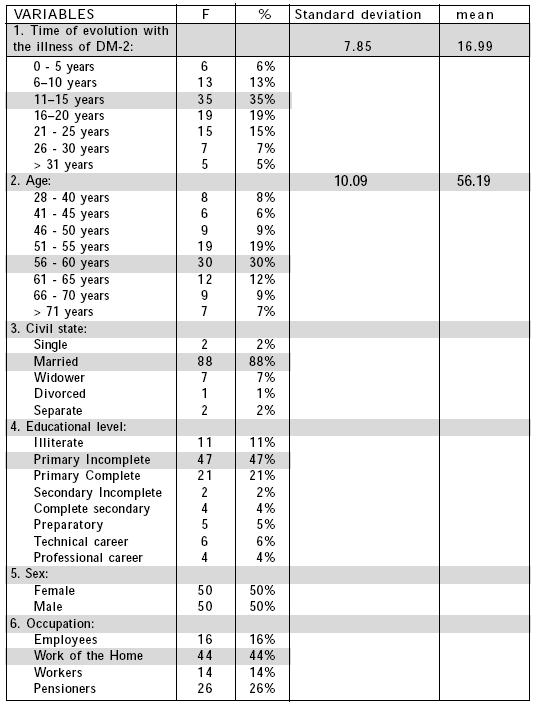
<body><![CDATA[<p> <b>Procedure</b></p>      <p> In this study, the scale of quality of life related with the health was    applied&#8220;    QOLRH&#8221; in its version validated to spanish, to a sample of 100 patients    diagnosed with ND in the service of peritoneal dialysis. Once located and    recruited, to each patient of the sample in question, it was mentioned to      a first    informative interview. In this they were informed the general purposes of      the    study and their signature of informed consent was gathered, with the guarantee    of two witness. Inside the lapse of the interview, respecting the readiness      and    the patients&#8217; well-being, they were applied the scale QOLRH. The indications    given to the patient were:</p>      <p><b>&#8220; Dear patient:</b></p>      <p> Next you will be presented a list of having enunciated that they describe    situations and people&#8217;s experiences that have a very similar illness      to his.    Read each enunciated and mark the number that better it describes    their situation, having in all from last month until today&#8217;s day.    Some sections won&#8217;t apply in their case. Please jump those sections    and continue with the following one.&#8221;</p>      <p> <b>RESULTS</b></p>      <p> In relation to the independent variable that they understand some indicative    socio-demographics, as well as the time of evolution of the chronicity of          the    patients with the suffering of DM-2. In the <a href="#tabla1">Table 1</a>, it is observed          that 50% of    the fellows was women, with the same percentage it was for that of men.          Of    which 30% had age between 56 and 60 years, other 19% between 51 and          55    years, among others.   </p>      <p>The civil state of the patients was the one of married with 88%. The      occupation of those subject of the studied sample, the biggest percentage      (44%) they are devoted to the works of the home, 26% is pensioned, among      other, like it is shown in the<a href="#tabla1"> Table 1</a>.</p>      <p> Additionally, it is shown that most of the patients have primary    incomplete with 47%, other 21% with primary complete, among others.</p>      <p>As for the time of evolution of the illness of the patients with type              2      diabetes mellitus, it is observed in the square 1 that the biggest              percentage      (35%) it was for the 11-15 year-old range with the diabetes mellitus,              following   19% with a 16-20 year-old range, 15 21-25 %, among the most excellent.</p>      <p> As for the data obtained in the variable dependent estimate of the                index of        deterioration of the quality of life in the patients with DM-2, they                were carried out        the profiles of each one of the areas that conform the scale QOLRH                (physics,        medical interaction, psycho-social, sexual and of relationships of     couple).</p>      ]]></body>
<body><![CDATA[<p align="center"><a name="tabla1"></a><img src="/img/revistas/iee/v23n1/v23n1a03i01.JPG"></p>      <p align="center"><b>Table 1. </b></p>      <p align="center">Socio-demographics variables and time of evolution    of the DM-2 in the patients with DN.</p>      <p align="left">In what concerns to the physical area that they understand indicative    reagents of the state of the patients&#8217; health, the presence of certain    symptoms,    the secondary reactions before the medications used for the clinical square    of the DN and the degree of inability to carry out daily, labor activities    and of    enjoying recreational activities. The data show that the patients maintain    a    continuous advance of the physical deterioration in relation to the chronicity    of the illness that you/they go from light (12%), moderate (11%) and severe    with 40%, in connection with 37% in normal, like it can be observed in the    <a href="#figura1">Figure 1</a>. Affecting a considerable percentage (63%), some of their capacities    and physical functions in the deterioration of the quality of life of those    subject of the studied sample. When comparing the differences by means of  ANOVA, it was statistical significance of p &lt; 0.000.</p>      <p align="center"><a name="figura1"></a><img src="/img/revistas/iee/v23n1/v23n1a03i02.jpg" ></p>      <p align="center"><b>Figure 1</b>.</p>      <p align="center"> Level of impairment of the quality of life patients      with DN, in the areas Physics,    Medical Interaction, Psychosocial, Sexual and of Significant Relationships.</p>      <p align="left">In relation to the measures obtained in the Area of Medical    Interaction,    where relating aspects are explored to the doctor-patient, nurse-patient    relationship, and, as this relationship contributes or it blocks the effectiveness    of the treatment as well as to the satisfaction of the patients in relation    to the    treatment and attention that are offered on the part of these professionals    of    the health. As it is shown in the <a href="#figura1">Figure 1</a>, 43% with appropriate interaction,    other 11% with light deterioration in the interaction, 7% with moderate and    the rest 39% with severe deterioration in the medical interaction (p &lt; 0.000). </p>      <p align="left">In the Area Psycho-social, where they are integrated reagents    that they evaluate emotional aspects, such as anxiety, depression, fears,    concerns,    self-concept and some aspects of social interaction. As it is observed in    the    <a href="#figura1">Figure 1</a>, 47% of the fellows in study without any degree of deterioration,    12%    with light deterioration, 9% with moderate and the rest 32% with severe  deterioration in the aspects before mentioned (p &lt; 0.000).</p>      <p align="left"> Inside the Sexual Area, where relating aspects are evaluated    to the    sexual interest of the patients in study, the presence or absence of sexual    malfunction, as well as the abilities to establish new couple relationships.    The    data show that 30% didn&#8217;t present some level of deterioration, 6% with    light    deterioration, other 5% with moderate and 59% with severe deterioration    (p &lt; 0.004), standing out in this last item the sexual malfunction (<a href="#figura1">Figure    1</a>). </p>      ]]></body>
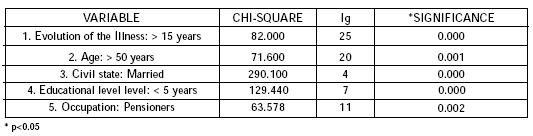
<body><![CDATA[<p align="left">As for the area significant relationships that evaluates relating    aspects to the communication with the couple of the patients, affective expressions    and couple interaction. As it is observed in the <a href="#figura1">Figure    1</a>, a 58% of those    subject of the sample in study, it didn&#8217;t present some degree of deterioration    in this area, other 8% for light deterioration, 7% for light and lastly 27%    for  severe deterioration (p &lt; 0.000).</p>      <p align="left"> Lastly, regarding the application of the statistical analysis,    where the    differences were analyzed in the index of deterioration of the quality of    the    patients&#8217; life with DN through a variance analysis (ANOVA), the data  showedthat differences exist statistically significant in the areas that it    evaluates the  deterioration of the quality of the patients&#8217; life in connection with  the  progressive advance of the illness, like one observes in the <a href="#tabla2">Table  2</a>.  Additionally, in the association of variables independent-clerk, like it is  shown  in the <a href="#tabla3">Table 3</a>, it was found that this differences went statistically significant  at the 0.000, when relating the index of deterioration of the quality of life  with  the time of evolution of the degenerative chronic condition of the DM-2 of  more than ten years, the educational level under, the age bigger than 50 years,  among others.</p>      <p align="center"><a name="tabla2"></a><img src="img/revistas/iee/v23n1/v23n1a03i03.JPG" ></p>      <p align="center"><b>Table 2</b>. </p>      <p align="center">ANOVA. Patients with DN</p>      <p align="center"><a name="tabla3"></a><img src="/img/revistas/iee/v23n1/v23n1a03i04.JPG" ></p>      <p align="center"><b>Table 3.</b> </p>      <p align="center">Association among the index of impairment of the    quality of life patients&#8217; with DN,    in connection with the time of evolution of the illness and some variable  socio-demographics</p>      <p align="left"><b>DISCUSSION</b></p>      <p align="left"> The purpose of this study was to measure the level of deterioration    of    the quality of the patients&#8217; life with diabetic nephropathy by means    of the    scale QOLRH. The data presented previously show in the participant fellows    of the investigation, a considered percentage (70%) with deterioration in    their    quality of life in the evaluated areas that they understand the scale (physics,    medical interaction, psycho-social, sexual and of relationships of couple).</p>      ]]></body>
<body><![CDATA[<p align="left">The profiles of the quality of life in the different areas,    show a gradual    and progressive process in connection with the gradual advance of the    chronicity of the illness. Inside the affected areas, they stand out the Sexual    area where the malfunction as well as the sexual interest rebounds in its    normal    operation. Mentioned the above-mentioned, one of the complications of    the autonomic neuropathy evidences as consequence from the metabolic nocontrol    to which the patients are studying mainly those of the masculine sex.    Concomitantly, this sequel impacts in the deterioration of couple&#8217;s    relationship    on one hand, for other, in the emotional state, when not having knowledge    of    what is passing him in its sexual operation. Factors that contribute to diminish    the self-esteem and to increase the depression risk. These discoveries, agree    with some studies like those of: De los R&iacute;os<sup>35</sup>; Macdougall I.C.<sup>36</sup>;    Baum N.<sup>37</sup>;    Dunning P.<sup>38</sup>; Guirguis W.<sup>39</sup>; Morrison H.<sup>40</sup>; Lawrence I.G.<sup>41</sup>. An aspect that    supports mentioned the above-mentioned, is the comments of the patients  that you/they went in relation to:</p>      <p align="left"> &#8220;    For years I don&#8217;t have erection and I sit down not well emotionally;    I    cannot have relationships for the erection lack; I have not had relationships    with my wife as For five years and this affected our relationship; we no longer    sleep together since I don&#8217;t have erection; I give me pain to comment    it with    the doctor; one doesn&#8217;t eat to tell to the doctor on the erection problem;    since    I am in dialysis, I cannot have intimacy with my husband&#8221;, among others. </p>      <p align="left">Regarding the area of medical interaction, where the deterioration    of the doctor-patient, nurse-patient relationship, continues being an obstacle    for the effectiveness of the treatment, joined to the faulty attention and    treatment that are offered to the patients on the part of the team of health.    With repercussions in the failure in the adherence to the treatment on one    hand, for other, in the satisfaction of the patients. </p>      <p align="left">Additionally to the gathering of the data in this area, the    comments of the patients went in relation to: &#8220;The doctor has list the recipe before    to    wonder and to revise me; When I go entering to the clinic he already has list    the recipe; they don&#8217;t revise us appropriately; they don&#8217;t turn    us to see; they    don&#8217;t care; in less than five minutes they take out us; they don&#8217;t    have time    neither interest for us; That treat us with kindness and that they explain    to us    the medicine; they are not lent to make them you ask; The attitude of the    doctors toward us is of desperation and lack of interest&#8221;, among others. </p>      <p align="left">In what concerns to the physical area, where the deterioration    is translated in the presence of certain symptoms like cramps, numbness of    the    feet, pain, nausea, vomit, increase of weight mainly for the retention of    liquid    for the dialyses, edema in the face and inferior members, loss of dental pieces,    diarrheas, among others. These particularities seem to indicate that, the    physical deterioration maintains a continuous and progressive advance that    one manifests in the decrease of the functional capacity to carry out their    labor, recreational, family activities or its adaptation to the imposed demands    of its immediate environment. </p>      <p>With regard to the area psycho-social, the deterioration in    the quality of the patients&#8217; life is translated in the emotional aspects,    such as anxiety,    depression, fears and concerns, when presenting light or sharp signs of    physical or psychological importance. It is important to highlight that, most    of the patients manifest a great anxiety and stress before the advance of    the  illness, caused by the presence of physical nuisances, loss of weight, </p>    secondary reactions for the medications, infections, recurrent hospitalizations. Concomitantly, the situations that refer him adverse information, for example knowing the high figures of sugar in the blood y/o the presence of new signs and symptoms make him think that their treatment is not working appropriately, being a source of constant concern for the patients. Joined to depend on the members of the family (wife, bigger children) and of the members of the team of health. The weight that represents their personal care, transporting it, the periodic dialyses, the dietary handling, joined to the physical restrictions, they rebound in their social operation.</p>      <p> Finally, in the area of significant relationships, the deterioration of    the quality of the patients&#8217; life, it is translated in the you lack of communication   with their couple. Being known in the condition of &#8220;diabetic and nephropathy&#8221;,   without a doubt it bears to an emotional impact in their relationship.   Concomitantly, the due physical, emotional and sexual changes to the   malfunction and loss of the sexual interest. They become factors of risk that   influence in the state of the quality of life.</p>      <p> Of mentioned the above-mentioned, these particularities seem to   indicate on one hand that the patients with diabetic nephropathy present   signs light sharp or in the deterioration of their quality of life, for other,   the   characteristic socio-demographics like the educational level under, the age   bigger than 50 years and the time of evolution of the illness of but of ten   years, they are factors of risk associated to the deterioration of the quality   of   these patients&#8217; life. The data demonstrate systematically in the diverse   evaluated areas that the degree of deterioration of the quality of life this   related with the evolution of the chronicity of the diabetes, mainly the one   referred by disease, product of the metabolic no-control and the lack of   therapeutic adherence.  </p>      <p>The results of this study, agree with those of De los Rios &amp; Guerrero<sup>42</sup>;   Goldstein &amp; Reznikoff<sup>43</sup>; Szabo<sup>44</sup>; Kimell<sup>45-48</sup>; Singer<sup>49</sup>; Merkus<sup>50</sup>;   Korevar<sup>51</sup>; Mingardi<sup>52</sup>; Gokal<sup>53</sup>; Kennedy<sup>54</sup>; Kutner<sup>55</sup>; Lavenson<sup>56</sup>; Shidler<sup>57</sup>;   Lawrence<sup>58</sup>;   Macdougall<sup>59</sup>; Phillips<sup>60</sup>; Theodora<sup>61</sup>, in the sense that the patients with   inadequacy renal chronicle for diabetic nephropathy, show a gradual process   in the deterioration of their quality of life with relatively uniform tendencies   as   the illness advances in connection with the chronicity of the suffering.  </p>      <p>On the other hand, the results of this study, had procedures of     dependability and validity in the handling of the instruments that they allow     to confirm that the measures of the impairment of the quality of life in    this type     of patients can serve as base for future investigations.    </p>      ]]></body>
<body><![CDATA[<p>Additionally, to the gathering of data, a considerable number of patient       in the phase of the application of the instrument QOLRH, was a means to       manifest its feelings repressed in relation to the perceived treatment    and received by the team of health, its fears and concerns and the problems    with      its couple       related with the deterioration of the sexual functionality, among others.      </p>      <p>We concludes that this study has allowed to show a bigger         understanding of the elements that they underlie in the impairment of    the quality of life the patients with Diabetic Nephropathy, recognizing that        the results of this type of investigations reveal the importance of the      factors psycho-social in the handling and control of the illness. Considering      the    convenience of integrating the attention in an interdisciplinary way on         the part of the nurses, doctors and psychologists of the health. To orchestrate    preventive programs that impact in the deterioration of         the quality of life in this type of patient. Additionally, the         instrument QOLRH-DN, allows an integral approach to         the patients with DN from a holistic perspective in relation         to its symptomatology and complications. It is a         questionnaire designed explicitly in the consultation, their         time of application is short, easy to manage and to         interpret, and its development process and validation has         been rigorous and I complete. With that which can help         the personnel of health in the taking of decisions about         possible changes in the treatment; passing to prioritize         and to value in more measure the well-being and the         patient&#8217;s perception on their state of health.</p>      <p><b>REFERRED BIBLIOGRAPHY</b></p>      <!-- ref --><p> 1. Rodr&iacute;guez OG, Rojas RM. La psicolog&iacute;a de la salud en Am&eacute;rica    Latina. M&eacute;xico: Porr&uacute;a; 1998. pp. 13-32.&nbsp;&nbsp;&nbsp;&nbsp;&nbsp;&nbsp;&nbsp;&nbsp;[&#160;<a href="javascript:void(0);" onclick="javascript: window.open('/scielo.php?script=sci_nlinks&ref=000106&pid=S0120-5307200500010000300001&lng=','','width=640,height=500,resizable=yes,scrollbars=1,menubar=yes,');">Links</a>&#160;]<!-- end-ref --><!-- ref --><p> 2. S&aacute;nchez Sosa JJ. Desde la prevenci&oacute;n primaria hasta ayudar    a    bien morir: La interfaz intervenci&oacute;n-investigaci&oacute;n en psicolog&iacute;a    de la salud. En: Rodr&iacute;guez G y Rojas M (Comps). La    psicolog&iacute;a de la salud en Am&eacute;rica Latina. M&eacute;xico: Porr&uacute;a;    1998.    pp. 33-44.&nbsp;&nbsp;&nbsp;&nbsp;&nbsp;&nbsp;&nbsp;&nbsp;[&#160;<a href="javascript:void(0);" onclick="javascript: window.open('/scielo.php?script=sci_nlinks&ref=000107&pid=S0120-5307200500010000300002&lng=','','width=640,height=500,resizable=yes,scrollbars=1,menubar=yes,');">Links</a>&#160;]<!-- end-ref --><!-- ref --><p> 3. M&eacute;xico Secretar&iacute;a de Salud. Encuesta nacional de enfermedades    cr&oacute;nicas. M&eacute;xico: Secretar&iacute;a de salud; 2002. pp. 89-126.&nbsp;&nbsp;&nbsp;&nbsp;&nbsp;&nbsp;&nbsp;&nbsp;[&#160;<a href="javascript:void(0);" onclick="javascript: window.open('/scielo.php?script=sci_nlinks&ref=000108&pid=S0120-5307200500010000300003&lng=','','width=640,height=500,resizable=yes,scrollbars=1,menubar=yes,');">Links</a>&#160;]<!-- end-ref --><!-- ref --><p> 4. Fauwzy FI, Fauzy NW. Group Therapy in the Cancer Setting.      Psychotherapy Res 1998; 45(3): 191-200.&nbsp;&nbsp;&nbsp;&nbsp;&nbsp;&nbsp;&nbsp;&nbsp;[&#160;<a href="javascript:void(0);" onclick="javascript: window.open('/scielo.php?script=sci_nlinks&ref=000109&pid=S0120-5307200500010000300004&lng=','','width=640,height=500,resizable=yes,scrollbars=1,menubar=yes,');">Links</a>&#160;]<!-- end-ref --><!-- ref --><p>5. Heinrich RL, Schag CC, Ganz PA.      Living with cancer: The cancer inventory of problem situations. J Clin Psychol      1984;      40(6): 972-980.&nbsp;&nbsp;&nbsp;&nbsp;&nbsp;&nbsp;&nbsp;&nbsp;[&#160;<a href="javascript:void(0);" onclick="javascript: window.open('/scielo.php?script=sci_nlinks&ref=000110&pid=S0120-5307200500010000300005&lng=','','width=640,height=500,resizable=yes,scrollbars=1,menubar=yes,');">Links</a>&#160;]<!-- end-ref --><!-- ref --><p>6. Korczyn AD, Davidson M. Quality of life Europe. J Gynecol    Oncology 1999; 17(1): 5-6.   &nbsp;&nbsp;&nbsp;&nbsp;&nbsp;&nbsp;&nbsp;&nbsp;[&#160;<a href="javascript:void(0);" onclick="javascript: window.open('/scielo.php?script=sci_nlinks&ref=000111&pid=S0120-5307200500010000300006&lng=','','width=640,height=500,resizable=yes,scrollbars=1,menubar=yes,');">Links</a>&#160;]<!-- end-ref --><!-- ref --><p>7. Kuopio AM, Marttila RJ, Helenius H, Toivonen M, Rinne    UK. The Quality of Life in Parkinson&#8217;s disease. Movement    Disorder 2000; 15(2): 216-223.&nbsp;&nbsp;&nbsp;&nbsp;&nbsp;&nbsp;&nbsp;&nbsp;[&#160;<a href="javascript:void(0);" onclick="javascript: window.open('/scielo.php?script=sci_nlinks&ref=000112&pid=S0120-5307200500010000300007&lng=','','width=640,height=500,resizable=yes,scrollbars=1,menubar=yes,');">Links</a>&#160;]<!-- end-ref --><!-- ref --><p>8. Lara MC, Ponce S., De La Fuente JR. Conceptualizaci&oacute;n y    medici&oacute;n de la calidad de vida en pacientes con c&aacute;ncer. Rev    de    Invest Cl&iacute;n 1995; 47(4): 315-327.&nbsp;&nbsp;&nbsp;&nbsp;&nbsp;&nbsp;&nbsp;&nbsp;[&#160;<a href="javascript:void(0);" onclick="javascript: window.open('/scielo.php?script=sci_nlinks&ref=000113&pid=S0120-5307200500010000300008&lng=','','width=640,height=500,resizable=yes,scrollbars=1,menubar=yes,');">Links</a>&#160;]<!-- end-ref --><!-- ref --><p> 9. Mcgrath EN. Actualizaci&oacute;n en la investigaci&oacute;n psicosocial    en    leucemia para practicantes de Trabajo Social. M&eacute;xico: UNAM;    1999. pp. 76-98.&nbsp;&nbsp;&nbsp;&nbsp;&nbsp;&nbsp;&nbsp;&nbsp;[&#160;<a href="javascript:void(0);" onclick="javascript: window.open('/scielo.php?script=sci_nlinks&ref=000114&pid=S0120-5307200500010000300009&lng=','','width=640,height=500,resizable=yes,scrollbars=1,menubar=yes,');">Links</a>&#160;]<!-- end-ref --><!-- ref --><p>10. Instituto Mexicano del Seguro Social. Programa para la    detecci&oacute;n    y tratamiento de los pacientes con insuficiencia renal cr&oacute;nica.    M&eacute;xico: IMSS; 1998. pp. 23-69.&nbsp;&nbsp;&nbsp;&nbsp;&nbsp;&nbsp;&nbsp;&nbsp;[&#160;<a href="javascript:void(0);" onclick="javascript: window.open('/scielo.php?script=sci_nlinks&ref=000115&pid=S0120-5307200500010000300010&lng=','','width=640,height=500,resizable=yes,scrollbars=1,menubar=yes,');">Links</a>&#160;]<!-- end-ref --><!-- ref --><p> 11. De los R&iacute;os JL, Guerrero V. Depression in patients with    DM-2 and diabetic nephropaty. Rev Desarr Cient de Enfer    2003; 5(3): 136-140.&nbsp;&nbsp;&nbsp;&nbsp;&nbsp;&nbsp;&nbsp;&nbsp;[&#160;<a href="javascript:void(0);" onclick="javascript: window.open('/scielo.php?script=sci_nlinks&ref=000116&pid=S0120-5307200500010000300011&lng=','','width=640,height=500,resizable=yes,scrollbars=1,menubar=yes,');">Links</a>&#160;]<!-- end-ref --><!-- ref --><p> 12. Gokal R, Figueras M, Olle A, Rovira J, Badia X. Outcomes in      peritoneal dialysis and hemodialysis: a comparative assessment      of survival and quality of life. Nephrology, Dialysis,      Transplantation 1999; 14 (6): 24-30.&nbsp;&nbsp;&nbsp;&nbsp;&nbsp;&nbsp;&nbsp;&nbsp;[&#160;<a href="javascript:void(0);" onclick="javascript: window.open('/scielo.php?script=sci_nlinks&ref=000117&pid=S0120-5307200500010000300012&lng=','','width=640,height=500,resizable=yes,scrollbars=1,menubar=yes,');">Links</a>&#160;]<!-- end-ref --><!-- ref --><p>13. Kimmel P L. Aspects of quality of life in hemodialysis patients.  J Am Soc Nephrol 1995; 6(11): 1418-1426.&nbsp;&nbsp;&nbsp;&nbsp;&nbsp;&nbsp;&nbsp;&nbsp;[&#160;<a href="javascript:void(0);" onclick="javascript: window.open('/scielo.php?script=sci_nlinks&ref=000118&pid=S0120-5307200500010000300013&lng=','','width=640,height=500,resizable=yes,scrollbars=1,menubar=yes,');">Links</a>&#160;]<!-- end-ref --><!-- ref --><p> 14. Kimmel PL, Peterson RA, Weihs KL, Simmens SJ, Alleyne S,    Cruz I, Veis JH. Psychosocial factors, behavioral compliance    and survival in urban hemodialysis patients. Kidney Int 1998;    54(5): 245-254.&nbsp;&nbsp;&nbsp;&nbsp;&nbsp;&nbsp;&nbsp;&nbsp;[&#160;<a href="javascript:void(0);" onclick="javascript: window.open('/scielo.php?script=sci_nlinks&ref=000119&pid=S0120-5307200500010000300014&lng=','','width=640,height=500,resizable=yes,scrollbars=1,menubar=yes,');">Links</a>&#160;]<!-- end-ref --><!-- ref --><p> 15. Kimmel PL. Psychosocial factors in adult end-estage renal    disease patients treated with hemodialysis: correlates and    outcomes. Am J Kidney Dis 2000; 35(4): 132-140.&nbsp;&nbsp;&nbsp;&nbsp;&nbsp;&nbsp;&nbsp;&nbsp;[&#160;<a href="javascript:void(0);" onclick="javascript: window.open('/scielo.php?script=sci_nlinks&ref=000120&pid=S0120-5307200500010000300015&lng=','','width=640,height=500,resizable=yes,scrollbars=1,menubar=yes,');">Links</a>&#160;]<!-- end-ref --><!-- ref --><p> 16. Kimmel PL, Thamer M, Richard CM, Ray NF. Psychiatric    illness in patients with end-stage renal disease. Am J Med    1998; 105(4): 214-221.&nbsp;&nbsp;&nbsp;&nbsp;&nbsp;&nbsp;&nbsp;&nbsp;[&#160;<a href="javascript:void(0);" onclick="javascript: window.open('/scielo.php?script=sci_nlinks&ref=000121&pid=S0120-5307200500010000300016&lng=','','width=640,height=500,resizable=yes,scrollbars=1,menubar=yes,');">Links</a>&#160;]<!-- end-ref --><!-- ref --><p> 17. Kutner NG, Brogan D, Hall WD, Haber M, Daniels DS.    Functional impairment, depression, and life satisfaction    among older hemodialysis patients and age-matched controls:    a prospective study. Arch Phys Med Rehabil 2000; 81(3):    453-459.&nbsp;&nbsp;&nbsp;&nbsp;&nbsp;&nbsp;&nbsp;&nbsp;[&#160;<a href="javascript:void(0);" onclick="javascript: window.open('/scielo.php?script=sci_nlinks&ref=000122&pid=S0120-5307200500010000300017&lng=','','width=640,height=500,resizable=yes,scrollbars=1,menubar=yes,');">Links</a>&#160;]<!-- end-ref --><!-- ref --><p> 18. Kennedy SH, Craven JL, Rodin GM, Roin GM. Major    Depression in renal dialysis patients: an open trial of    antidepressant therapy. J Clin Psychiatry 1989; 50(1): 60-63.&nbsp;&nbsp;&nbsp;&nbsp;&nbsp;&nbsp;&nbsp;&nbsp;[&#160;<a href="javascript:void(0);" onclick="javascript: window.open('/scielo.php?script=sci_nlinks&ref=000123&pid=S0120-5307200500010000300018&lng=','','width=640,height=500,resizable=yes,scrollbars=1,menubar=yes,');">Links</a>&#160;]<!-- end-ref --><!-- ref --><p> 19. Korevaar JC, Jansen M A, Merkus MP, Dekker FW,    Boeschoten EW, Krediet RT. Quality of life in predialysis    end-stage renal disease patients at the initiation of dialysis    therapy. Perit Dial Int 2000; 20(1): 69-75.&nbsp;&nbsp;&nbsp;&nbsp;&nbsp;&nbsp;&nbsp;&nbsp;[&#160;<a href="javascript:void(0);" onclick="javascript: window.open('/scielo.php?script=sci_nlinks&ref=000124&pid=S0120-5307200500010000300019&lng=','','width=640,height=500,resizable=yes,scrollbars=1,menubar=yes,');">Links</a>&#160;]<!-- end-ref --><!-- ref --><p> 20. Merkus M P, Jager K J, Dekker FW, De Haan RJ, Boeschoten    EW, Krediet RT. Quality of life over time in dialysis: The    Netherlands Cooperative Study on the adequancy of dialysis.    Kidney Int 1999; 56(2): 720-728.&nbsp;&nbsp;&nbsp;&nbsp;&nbsp;&nbsp;&nbsp;&nbsp;[&#160;<a href="javascript:void(0);" onclick="javascript: window.open('/scielo.php?script=sci_nlinks&ref=000125&pid=S0120-5307200500010000300020&lng=','','width=640,height=500,resizable=yes,scrollbars=1,menubar=yes,');">Links</a>&#160;]<!-- end-ref --><!-- ref --><p> 21. Mingardi G, Cornalba L, Cortinovis E, Ruggiata R, Mosconi    P, Apolone G. Health-realted quality of life in dialysis patients.    A report from an Italian study using the SF-36. Health Survey.    Nephrology, Dialysis, Transplantation 1999; 14(6): 1503-1510.&nbsp;&nbsp;&nbsp;&nbsp;&nbsp;&nbsp;&nbsp;&nbsp;[&#160;<a href="javascript:void(0);" onclick="javascript: window.open('/scielo.php?script=sci_nlinks&ref=000126&pid=S0120-5307200500010000300021&lng=','','width=640,height=500,resizable=yes,scrollbars=1,menubar=yes,');">Links</a>&#160;]<!-- end-ref --><!-- ref --><p> 22. Rush LL. Affective rations to multiple social stigmas. J Soc    Psychol 1998; 138(4): 421-430.&nbsp;&nbsp;&nbsp;&nbsp;&nbsp;&nbsp;&nbsp;&nbsp;[&#160;<a href="javascript:void(0);" onclick="javascript: window.open('/scielo.php?script=sci_nlinks&ref=000127&pid=S0120-5307200500010000300022&lng=','','width=640,height=500,resizable=yes,scrollbars=1,menubar=yes,');">Links</a>&#160;]<!-- end-ref --><!-- ref --><p> 23. Phillips L, Davies SJ, Russell GI. Functional status of CAPD    patients and their mood state, dialysis dose, comorbidity and    quality of life. Edtna-Erca J 1996; 22(3): 15-18.&nbsp;&nbsp;&nbsp;&nbsp;&nbsp;&nbsp;&nbsp;&nbsp;[&#160;<a href="javascript:void(0);" onclick="javascript: window.open('/scielo.php?script=sci_nlinks&ref=000128&pid=S0120-5307200500010000300023&lng=','','width=640,height=500,resizable=yes,scrollbars=1,menubar=yes,');">Links</a>&#160;]<!-- end-ref --><!-- ref --><p> 24. Singer PA, Martin DK, Kelner M. Quality end-of-life care:    Patients perspectives. JAMA 1999; 28(2): 163-168.&nbsp;&nbsp;&nbsp;&nbsp;&nbsp;&nbsp;&nbsp;&nbsp;[&#160;<a href="javascript:void(0);" onclick="javascript: window.open('/scielo.php?script=sci_nlinks&ref=000129&pid=S0120-5307200500010000300024&lng=','','width=640,height=500,resizable=yes,scrollbars=1,menubar=yes,');">Links</a>&#160;]<!-- end-ref --><!-- ref --><p> 25. Shidler N R, Peterson RA, Kimmel PL. Quality of life and    psychosocial relationships in patients with chronic renal    insufficiency. Am J Kidney Dis 1998; 32(6): 557-566.&nbsp;&nbsp;&nbsp;&nbsp;&nbsp;&nbsp;&nbsp;&nbsp;[&#160;<a href="javascript:void(0);" onclick="javascript: window.open('/scielo.php?script=sci_nlinks&ref=000130&pid=S0120-5307200500010000300025&lng=','','width=640,height=500,resizable=yes,scrollbars=1,menubar=yes,');">Links</a>&#160;]<!-- end-ref --><!-- ref --><p> 26. Szabo E, Moody H, Hamilton T, Ang C, Kovithavongs C,    Kjellstrand C. Choice of treatment improves quality of life: A    study on patients undergoing dialysis. Archives Int Med 1997;    157(12): 1352-1356.&nbsp;&nbsp;&nbsp;&nbsp;&nbsp;&nbsp;&nbsp;&nbsp;[&#160;<a href="javascript:void(0);" onclick="javascript: window.open('/scielo.php?script=sci_nlinks&ref=000131&pid=S0120-5307200500010000300026&lng=','','width=640,height=500,resizable=yes,scrollbars=1,menubar=yes,');">Links</a>&#160;]<!-- end-ref --><!-- ref --><p>27. Kimmel P L, Peterson RA, Weihs KL, Simmens SJ, Alleyne      S, Cruz I, Veis JH. Psychosocial factors, behavioral compliance      and survival in urban hemodialysis patients. Kidney Int 1998;      54(2): 245-254&nbsp;&nbsp;&nbsp;&nbsp;&nbsp;&nbsp;&nbsp;&nbsp;[&#160;<a href="javascript:void(0);" onclick="javascript: window.open('/scielo.php?script=sci_nlinks&ref=000132&pid=S0120-5307200500010000300027&lng=','','width=640,height=500,resizable=yes,scrollbars=1,menubar=yes,');">Links</a>&#160;]<!-- end-ref --><!-- ref --><p> 28. Levil L, Anderson L. Psychosocial stress: Population,    environment and quality of life. New York: S.P. Books division    of spectrum publications. Inc. USA. Para practicantes de trabajo    social. M&eacute;xico: UNAM; 1975. pp. 157-189.&nbsp;&nbsp;&nbsp;&nbsp;&nbsp;&nbsp;&nbsp;&nbsp;[&#160;<a href="javascript:void(0);" onclick="javascript: window.open('/scielo.php?script=sci_nlinks&ref=000133&pid=S0120-5307200500010000300028&lng=','','width=640,height=500,resizable=yes,scrollbars=1,menubar=yes,');">Links</a>&#160;]<!-- end-ref --><!-- ref --><p>29. Andersen RM, Davidson PL, Ganz PA. Symbiotic    relationships of quality of life, health services and others  health research. Qual Life Res 1994; 3(3): 365-371.&nbsp;&nbsp;&nbsp;&nbsp;&nbsp;&nbsp;&nbsp;&nbsp;[&#160;<a href="javascript:void(0);" onclick="javascript: window.open('/scielo.php?script=sci_nlinks&ref=000134&pid=S0120-5307200500010000300029&lng=','','width=640,height=500,resizable=yes,scrollbars=1,menubar=yes,');">Links</a>&#160;]<!-- end-ref --><!-- ref --><p> 30. Bowling A. Measuring Health: A review of quality of life    measurement scales. En: Graw JA. Calidad de vida: Problemas    en su investigaci&oacute;n, Cuba; 1992. pp. 121-127.&nbsp;&nbsp;&nbsp;&nbsp;&nbsp;&nbsp;&nbsp;&nbsp;[&#160;<a href="javascript:void(0);" onclick="javascript: window.open('/scielo.php?script=sci_nlinks&ref=000135&pid=S0120-5307200500010000300030&lng=','','width=640,height=500,resizable=yes,scrollbars=1,menubar=yes,');">Links</a>&#160;]<!-- end-ref --><!-- ref --><p> 31. Bowling A. Measuring Health: A review of quality of life    measurement scales. En: Graw JA. Calidad de vida: Problemas    en su investigaci&oacute;n, Cuba; 1992. pp. 105-107.&nbsp;&nbsp;&nbsp;&nbsp;&nbsp;&nbsp;&nbsp;&nbsp;[&#160;<a href="javascript:void(0);" onclick="javascript: window.open('/scielo.php?script=sci_nlinks&ref=000136&pid=S0120-5307200500010000300031&lng=','','width=640,height=500,resizable=yes,scrollbars=1,menubar=yes,');">Links</a>&#160;]<!-- end-ref --><!-- ref --><p> 32. Ringdal GI, Ringdal K, Kavinnsland S, Gostestam KG. Quality    of life of cancer patients with different prognoses. Quality of    Life Research 1994; 3(2): 143-154.&nbsp;&nbsp;&nbsp;&nbsp;&nbsp;&nbsp;&nbsp;&nbsp;[&#160;<a href="javascript:void(0);" onclick="javascript: window.open('/scielo.php?script=sci_nlinks&ref=000137&pid=S0120-5307200500010000300032&lng=','','width=640,height=500,resizable=yes,scrollbars=1,menubar=yes,');">Links</a>&#160;]<!-- end-ref --><!-- ref --><p> 33. Wilson IB, Cleary PD. Linking clinical variables with health    related quality of life: a conceptual model of patients outcome.    MA 1995; 273(1): 59-65&nbsp;&nbsp;&nbsp;&nbsp;&nbsp;&nbsp;&nbsp;&nbsp;[&#160;<a href="javascript:void(0);" onclick="javascript: window.open('/scielo.php?script=sci_nlinks&ref=000138&pid=S0120-5307200500010000300033&lng=','','width=640,height=500,resizable=yes,scrollbars=1,menubar=yes,');">Links</a>&#160;]<!-- end-ref --><!-- ref --><p> 34. Gonzalez JA, S&aacute;nchez JJ. Systematic assesssment of quality    of life in chronic health patients. Int J Clin Health Psychol    2001; 1(3): 519-528.&nbsp;&nbsp;&nbsp;&nbsp;&nbsp;&nbsp;&nbsp;&nbsp;[&#160;<a href="javascript:void(0);" onclick="javascript: window.open('/scielo.php?script=sci_nlinks&ref=000139&pid=S0120-5307200500010000300034&lng=','','width=640,height=500,resizable=yes,scrollbars=1,menubar=yes,');">Links</a>&#160;]<!-- end-ref --><!-- ref --><p> 35. De los R&iacute;os JL, Guerrero V. Depression in patients with DM-    2 and diabetic nephropaty. Revista Desarrollo Cient&iacute;fico de    Enfermer&iacute;a 2003; 5(3): 136-140.&nbsp;&nbsp;&nbsp;&nbsp;&nbsp;&nbsp;&nbsp;&nbsp;[&#160;<a href="javascript:void(0);" onclick="javascript: window.open('/scielo.php?script=sci_nlinks&ref=000140&pid=S0120-5307200500010000300035&lng=','','width=640,height=500,resizable=yes,scrollbars=1,menubar=yes,');">Links</a>&#160;]<!-- end-ref --><!-- ref --><p> 36. Macdougall IC, et al. Randomized placebo-controlled study    of sildenafil (Viagra) in peritoneal dialysis patients with erectile    dysfunction. J Am Soc Nephrology 1999; 10(2): 318a (Abstr.)&nbsp;&nbsp;&nbsp;&nbsp;&nbsp;&nbsp;&nbsp;&nbsp;[&#160;<a href="javascript:void(0);" onclick="javascript: window.open('/scielo.php?script=sci_nlinks&ref=000141&pid=S0120-5307200500010000300036&lng=','','width=640,height=500,resizable=yes,scrollbars=1,menubar=yes,');">Links</a>&#160;]<!-- end-ref --><!-- ref --><p> 37. Baum N. Evaluation and treatment of organic impotence in the    male diabetes mellitus. Diabetes Educ 1998; 14(2): 123-129.&nbsp;&nbsp;&nbsp;&nbsp;&nbsp;&nbsp;&nbsp;&nbsp;[&#160;<a href="javascript:void(0);" onclick="javascript: window.open('/scielo.php?script=sci_nlinks&ref=000142&pid=S0120-5307200500010000300037&lng=','','width=640,height=500,resizable=yes,scrollbars=1,menubar=yes,');">Links</a>&#160;]<!-- end-ref --><!-- ref --><p> 38. Dunning P. Sexuality and woman with diabetes mellitus. Patient    Educ Couns 1993; 21(1-2): 5-14.&nbsp;&nbsp;&nbsp;&nbsp;&nbsp;&nbsp;&nbsp;&nbsp;[&#160;<a href="javascript:void(0);" onclick="javascript: window.open('/scielo.php?script=sci_nlinks&ref=000143&pid=S0120-5307200500010000300038&lng=','','width=640,height=500,resizable=yes,scrollbars=1,menubar=yes,');">Links</a>&#160;]<!-- end-ref --><!-- ref --><p> 39. Guirquis W. Impotence in Diabetes: Facts and Fictions.    Diabetic Med 1992; 9(3): 286-296.&nbsp;&nbsp;&nbsp;&nbsp;&nbsp;&nbsp;&nbsp;&nbsp;[&#160;<a href="javascript:void(0);" onclick="javascript: window.open('/scielo.php?script=sci_nlinks&ref=000144&pid=S0120-5307200500010000300039&lng=','','width=640,height=500,resizable=yes,scrollbars=1,menubar=yes,');">Links</a>&#160;]<!-- end-ref --><!-- ref --><p> 40. Morrison H. Diabetic impotence. Nurs Times 1998; 84(1):    35-37.&nbsp;&nbsp;&nbsp;&nbsp;&nbsp;&nbsp;&nbsp;&nbsp;[&#160;<a href="javascript:void(0);" onclick="javascript: window.open('/scielo.php?script=sci_nlinks&ref=000145&pid=S0120-5307200500010000300040&lng=','','width=640,height=500,resizable=yes,scrollbars=1,menubar=yes,');">Links</a>&#160;]<!-- end-ref --><!-- ref --><p> 41. Lawrence IG, Price DE, Howlett TA, Harris KP, Feehally J,    Walls J. Correcting impotence in male dialysis patients:    experience with testosterone replacement and vacuum    tumescence therapy. Am J Kidney Dis 1998; 31(3): 313-319.&nbsp;&nbsp;&nbsp;&nbsp;&nbsp;&nbsp;&nbsp;&nbsp;[&#160;<a href="javascript:void(0);" onclick="javascript: window.open('/scielo.php?script=sci_nlinks&ref=000146&pid=S0120-5307200500010000300041&lng=','','width=640,height=500,resizable=yes,scrollbars=1,menubar=yes,');">Links</a>&#160;]<!-- end-ref --><!-- ref --><p> 42. De los R&iacute;os JL, Guerrero V. Depression in patients with    DM-2 and diabetic nephropaty. Revista Desarrollo Cient&iacute;fico    de Enfermer&iacute;a 2003; 5(3): 136-140.&nbsp;&nbsp;&nbsp;&nbsp;&nbsp;&nbsp;&nbsp;&nbsp;[&#160;<a href="javascript:void(0);" onclick="javascript: window.open('/scielo.php?script=sci_nlinks&ref=000147&pid=S0120-5307200500010000300042&lng=','','width=640,height=500,resizable=yes,scrollbars=1,menubar=yes,');">Links</a>&#160;]<!-- end-ref --><!-- ref --><p> 43. Goldstein AM, Reznokoff M. Suicide in chronic hemodialysis    patients, from and external locus of control framework. Am J    Psychiatric 1971; 127(2): 124-127.&nbsp;&nbsp;&nbsp;&nbsp;&nbsp;&nbsp;&nbsp;&nbsp;[&#160;<a href="javascript:void(0);" onclick="javascript: window.open('/scielo.php?script=sci_nlinks&ref=000148&pid=S0120-5307200500010000300043&lng=','','width=640,height=500,resizable=yes,scrollbars=1,menubar=yes,');">Links</a>&#160;]<!-- end-ref --><!-- ref --><p> 44. Szabo E, Moody H, Hamilton T, Ang C, Kovithavongs C,    Kjellstrand C. Choice of treatment improves quality of life: A    study on patients undergoing dialysis. Arch Int Med 1997;    157(12):1352-1356.&nbsp;&nbsp;&nbsp;&nbsp;&nbsp;&nbsp;&nbsp;&nbsp;[&#160;<a href="javascript:void(0);" onclick="javascript: window.open('/scielo.php?script=sci_nlinks&ref=000149&pid=S0120-5307200500010000300044&lng=','','width=640,height=500,resizable=yes,scrollbars=1,menubar=yes,');">Links</a>&#160;]<!-- end-ref --><!-- ref --><p> 45. Kimmel PL. Aspects of quality of life in hemodialysis patients.    J Am Soc Nephrol 1995; 6(11): 1418-1426.&nbsp;&nbsp;&nbsp;&nbsp;&nbsp;&nbsp;&nbsp;&nbsp;[&#160;<a href="javascript:void(0);" onclick="javascript: window.open('/scielo.php?script=sci_nlinks&ref=000150&pid=S0120-5307200500010000300045&lng=','','width=640,height=500,resizable=yes,scrollbars=1,menubar=yes,');">Links</a>&#160;]<!-- end-ref --><!-- ref --><p> 46. Kimmel PL, Peterson RA, Weihs KL, Simmens SJ, Alleyne S,    Cruz I, Veis JH. Psychosocial factors, behavioral compliance    and survival in urban hemodialysis patients. Kidney Int 1998;    54(5): 245-254.&nbsp;&nbsp;&nbsp;&nbsp;&nbsp;&nbsp;&nbsp;&nbsp;[&#160;<a href="javascript:void(0);" onclick="javascript: window.open('/scielo.php?script=sci_nlinks&ref=000151&pid=S0120-5307200500010000300046&lng=','','width=640,height=500,resizable=yes,scrollbars=1,menubar=yes,');">Links</a>&#160;]<!-- end-ref --><!-- ref --><p>47. Kimmel PL. Psychosocial factors in adult end-stage renal    disease patients treated with hemodialysis: correlates and  outcomes. Am J Kidney Dis 2000; 35(4): 132-140.&nbsp;&nbsp;&nbsp;&nbsp;&nbsp;&nbsp;&nbsp;&nbsp;[&#160;<a href="javascript:void(0);" onclick="javascript: window.open('/scielo.php?script=sci_nlinks&ref=000152&pid=S0120-5307200500010000300047&lng=','','width=640,height=500,resizable=yes,scrollbars=1,menubar=yes,');">Links</a>&#160;]<!-- end-ref --><!-- ref --><p> 48. Kimmel PL, Thamer M, Richard CM, Ray NF. Psychiatric    illness in patients with end-stage renal disease. Am J Med    1998; 105(4): 214-221&nbsp;&nbsp;&nbsp;&nbsp;&nbsp;&nbsp;&nbsp;&nbsp;[&#160;<a href="javascript:void(0);" onclick="javascript: window.open('/scielo.php?script=sci_nlinks&ref=000153&pid=S0120-5307200500010000300048&lng=','','width=640,height=500,resizable=yes,scrollbars=1,menubar=yes,');">Links</a>&#160;]<!-- end-ref --><!-- ref --><p> 49. Singer PA, Martin DK, Kelner M. Quality end-of-life care:    Patients perspectives. JAMA 1999; 28(2): 163-168&nbsp;&nbsp;&nbsp;&nbsp;&nbsp;&nbsp;&nbsp;&nbsp;[&#160;<a href="javascript:void(0);" onclick="javascript: window.open('/scielo.php?script=sci_nlinks&ref=000154&pid=S0120-5307200500010000300049&lng=','','width=640,height=500,resizable=yes,scrollbars=1,menubar=yes,');">Links</a>&#160;]<!-- end-ref --><!-- ref --><p> 50. Merkus MP, Jager KJ, Dekker FW, De Haan RJ, Boeschoten    EW, Krediet RT. Quality of life over time in dialysis: The    Netherlands Cooperative Study on the adequacy of dialysis.    Kidney Int 1999; 56(2): 720-728.&nbsp;&nbsp;&nbsp;&nbsp;&nbsp;&nbsp;&nbsp;&nbsp;[&#160;<a href="javascript:void(0);" onclick="javascript: window.open('/scielo.php?script=sci_nlinks&ref=000155&pid=S0120-5307200500010000300050&lng=','','width=640,height=500,resizable=yes,scrollbars=1,menubar=yes,');">Links</a>&#160;]<!-- end-ref --><!-- ref --><p> 51. Korevaar JC, Jansen MA, Merkus MP, Dekker FW,    Boeschoten EW, Krediet RT. Quality of life in predialysis    end-stage renal disease patients at the initiation of dialysis    therapy. Perit Dial Int 2000; 20(1): 69-75.&nbsp;&nbsp;&nbsp;&nbsp;&nbsp;&nbsp;&nbsp;&nbsp;[&#160;<a href="javascript:void(0);" onclick="javascript: window.open('/scielo.php?script=sci_nlinks&ref=000156&pid=S0120-5307200500010000300051&lng=','','width=640,height=500,resizable=yes,scrollbars=1,menubar=yes,');">Links</a>&#160;]<!-- end-ref --><!-- ref --><p> 52. Mingardi G, Cornalba L, Cortinovis E, Ruggiata R, Mosconi    P, Apolone G. Health-realted quality of life in dialysis    patients. A report from an Italian study using the SF-36    Health Survey. Nephrology, Dialysis, Transplantation 1999;    14(6): 1503-1510.&nbsp;&nbsp;&nbsp;&nbsp;&nbsp;&nbsp;&nbsp;&nbsp;[&#160;<a href="javascript:void(0);" onclick="javascript: window.open('/scielo.php?script=sci_nlinks&ref=000157&pid=S0120-5307200500010000300052&lng=','','width=640,height=500,resizable=yes,scrollbars=1,menubar=yes,');">Links</a>&#160;]<!-- end-ref --><!-- ref --><p> 53. Gokal R, Figueras M, Olle A, Rovira J, Badia X. Outcomes in    peritoneal dialysis and hemodialysis a comparative assessment    of survival and quality of life. Nephrology, Dialysis,    Transplantation 1999; 14 (6): 24-30.&nbsp;&nbsp;&nbsp;&nbsp;&nbsp;&nbsp;&nbsp;&nbsp;[&#160;<a href="javascript:void(0);" onclick="javascript: window.open('/scielo.php?script=sci_nlinks&ref=000158&pid=S0120-5307200500010000300053&lng=','','width=640,height=500,resizable=yes,scrollbars=1,menubar=yes,');">Links</a>&#160;]<!-- end-ref --><!-- ref --><p> 54. Kennedy SH, Craven JL, Rodin GM, Roin GM. Major    Depression in renal dialysis patients: an open trial of    antidepressant therapy. Journal Clinic Psychiatric 1989; 50(1):    60-63.&nbsp;&nbsp;&nbsp;&nbsp;&nbsp;&nbsp;&nbsp;&nbsp;[&#160;<a href="javascript:void(0);" onclick="javascript: window.open('/scielo.php?script=sci_nlinks&ref=000159&pid=S0120-5307200500010000300054&lng=','','width=640,height=500,resizable=yes,scrollbars=1,menubar=yes,');">Links</a>&#160;]<!-- end-ref --><!-- ref --><p> 55. Kutner NG, Ory MG, Baker DI, Schechtman KB, Hornbrook    MC, Mulrow CD. Functional impairment, depression, and    life satisfaction among older hemodialysis patients and agematched    controls: a prospective study. Arch Phys Med Rehabil 2000; 81(3): 453-459.&nbsp;&nbsp;&nbsp;&nbsp;&nbsp;&nbsp;&nbsp;&nbsp;[&#160;<a href="javascript:void(0);" onclick="javascript: window.open('/scielo.php?script=sci_nlinks&ref=000160&pid=S0120-5307200500010000300055&lng=','','width=640,height=500,resizable=yes,scrollbars=1,menubar=yes,');">Links</a>&#160;]<!-- end-ref --><!-- ref --><p> 56. Levenson JL, Glochesky S. Psychological factors affecting    end-stage renal disease. Psychosomatics 1991; 32(3): 382-389.&nbsp;&nbsp;&nbsp;&nbsp;&nbsp;&nbsp;&nbsp;&nbsp;[&#160;<a href="javascript:void(0);" onclick="javascript: window.open('/scielo.php?script=sci_nlinks&ref=000161&pid=S0120-5307200500010000300056&lng=','','width=640,height=500,resizable=yes,scrollbars=1,menubar=yes,');">Links</a>&#160;]<!-- end-ref --><!-- ref --><p> 57. Shidler NR, Peterson RA, Kimmel PL. Quality of life and    psychosocial relationships in patients with chronic renal    insufficiency. Am J Kidney Dis 1998; 32(4): 557-566.&nbsp;&nbsp;&nbsp;&nbsp;&nbsp;&nbsp;&nbsp;&nbsp;[&#160;<a href="javascript:void(0);" onclick="javascript: window.open('/scielo.php?script=sci_nlinks&ref=000162&pid=S0120-5307200500010000300057&lng=','','width=640,height=500,resizable=yes,scrollbars=1,menubar=yes,');">Links</a>&#160;]<!-- end-ref --><!-- ref --><p> 58. Lawrence IG, Price DE, Howlett TA, Harris KP, Feehally J,    Walls J. Correcting impotence in male dialysis patients:    experience with testosterone replacement and vacuum    tumescence therapy. Am J Kidney Dis 1998; 31(3): 313-319.&nbsp;&nbsp;&nbsp;&nbsp;&nbsp;&nbsp;&nbsp;&nbsp;[&#160;<a href="javascript:void(0);" onclick="javascript: window.open('/scielo.php?script=sci_nlinks&ref=000163&pid=S0120-5307200500010000300058&lng=','','width=640,height=500,resizable=yes,scrollbars=1,menubar=yes,');">Links</a>&#160;]<!-- end-ref --><!-- ref --><p> 59. Macdougall IC. Randomized placebo-controlled study of    sildenafil (Viagra) in peritoneal dialysis patients with erectile    dysfunction. J Am Soc Nephrol 1999; 10(2): 318a (Abstr.).&nbsp;&nbsp;&nbsp;&nbsp;&nbsp;&nbsp;&nbsp;&nbsp;[&#160;<a href="javascript:void(0);" onclick="javascript: window.open('/scielo.php?script=sci_nlinks&ref=000164&pid=S0120-5307200500010000300059&lng=','','width=640,height=500,resizable=yes,scrollbars=1,menubar=yes,');">Links</a>&#160;]<!-- end-ref --><!-- ref --><p> 60. Phillips L, Davies SJ, Russell GI. Functional status of CAPD    patients and their mood state, dialysis dose, comorbidity and    quality of life. Edtna-Erca J 1996; 22(3): 15-18.&nbsp;&nbsp;&nbsp;&nbsp;&nbsp;&nbsp;&nbsp;&nbsp;[&#160;<a href="javascript:void(0);" onclick="javascript: window.open('/scielo.php?script=sci_nlinks&ref=000165&pid=S0120-5307200500010000300060&lng=','','width=640,height=500,resizable=yes,scrollbars=1,menubar=yes,');">Links</a>&#160;]<!-- end-ref --><!-- ref --><p> 61. Theodora K, Christina D, Tania F, Anna P, Georgios V. Looking    into the factors affecting renal patients&#8217; quality of life. Edtna-  Erca J 1996; 22(3): 19-21.&nbsp;&nbsp;&nbsp;&nbsp;&nbsp;&nbsp;&nbsp;&nbsp;[&#160;<a href="javascript:void(0);" onclick="javascript: window.open('/scielo.php?script=sci_nlinks&ref=000166&pid=S0120-5307200500010000300061&lng=','','width=640,height=500,resizable=yes,scrollbars=1,menubar=yes,');">Links</a>&#160;]<!-- end-ref --> ]]></body><back>
<ref-list>
<ref id="B1">
<label>1</label><nlm-citation citation-type="book">
<person-group person-group-type="author">
<name>
<surname><![CDATA[Rodríguez]]></surname>
<given-names><![CDATA[OG]]></given-names>
</name>
<name>
<surname><![CDATA[Rojas]]></surname>
<given-names><![CDATA[RM]]></given-names>
</name>
</person-group>
<source><![CDATA[La psicología de la salud en América Latina]]></source>
<year>1998</year>
<page-range>13-32</page-range><publisher-loc><![CDATA[México ]]></publisher-loc>
<publisher-name><![CDATA[Porrúa]]></publisher-name>
</nlm-citation>
</ref>
<ref id="B2">
<label>2</label><nlm-citation citation-type="book">
<person-group person-group-type="author">
<name>
<surname><![CDATA[Sánchez Sosa]]></surname>
<given-names><![CDATA[JJ]]></given-names>
</name>
</person-group>
<article-title xml:lang="es"><![CDATA[Desde la prevención primaria hasta ayudar a bien morir: La interfaz intervención-investigación en psicología de la salud]]></article-title>
<person-group person-group-type="editor">
<name>
<surname><![CDATA[Rodríguez]]></surname>
<given-names><![CDATA[G]]></given-names>
</name>
<name>
<surname><![CDATA[Rojas]]></surname>
<given-names><![CDATA[M]]></given-names>
</name>
</person-group>
<source><![CDATA[La psicología de la salud en América Latina]]></source>
<year>1998</year>
<page-range>33-44</page-range><publisher-loc><![CDATA[México ]]></publisher-loc>
<publisher-name><![CDATA[Porrúa]]></publisher-name>
</nlm-citation>
</ref>
<ref id="B3">
<label>3</label><nlm-citation citation-type="book">
<collab>México^dSecretaría de Salud</collab>
<source><![CDATA[Encuesta nacional de enfermedades crónicas]]></source>
<year>2002</year>
<page-range>89-126</page-range><publisher-loc><![CDATA[México ]]></publisher-loc>
<publisher-name><![CDATA[Secretaría de salud]]></publisher-name>
</nlm-citation>
</ref>
<ref id="B4">
<label>4</label><nlm-citation citation-type="journal">
<person-group person-group-type="author">
<name>
<surname><![CDATA[Fauwzy]]></surname>
<given-names><![CDATA[FI]]></given-names>
</name>
<name>
<surname><![CDATA[Fauzy]]></surname>
<given-names><![CDATA[NW]]></given-names>
</name>
</person-group>
<article-title xml:lang="en"><![CDATA[Group Therapy in the Cancer Setting]]></article-title>
<source><![CDATA[Psychotherapy Res]]></source>
<year>1998</year>
<volume>45</volume>
<numero>3</numero>
<issue>3</issue>
<page-range>191-200</page-range></nlm-citation>
</ref>
<ref id="B5">
<label>5</label><nlm-citation citation-type="journal">
<person-group person-group-type="author">
<name>
<surname><![CDATA[Heinrich]]></surname>
<given-names><![CDATA[RL]]></given-names>
</name>
<name>
<surname><![CDATA[Schag]]></surname>
<given-names><![CDATA[CC]]></given-names>
</name>
<name>
<surname><![CDATA[Ganz]]></surname>
<given-names><![CDATA[PA]]></given-names>
</name>
</person-group>
<article-title xml:lang="en"><![CDATA[Living with cancer: The cancer inventory of problem situations]]></article-title>
<source><![CDATA[J Clin Psychol]]></source>
<year>1984</year>
<volume>40</volume>
<numero>6</numero>
<issue>6</issue>
<page-range>972-980</page-range></nlm-citation>
</ref>
<ref id="B6">
<label>6</label><nlm-citation citation-type="journal">
<person-group person-group-type="author">
<name>
<surname><![CDATA[Korczyn]]></surname>
<given-names><![CDATA[AD]]></given-names>
</name>
<name>
<surname><![CDATA[Davidson]]></surname>
<given-names><![CDATA[M]]></given-names>
</name>
</person-group>
<article-title xml:lang="en"><![CDATA[Quality of life Europe]]></article-title>
<source><![CDATA[J Gynecol Oncology]]></source>
<year>1999</year>
<volume>17</volume>
<numero>1</numero>
<issue>1</issue>
<page-range>5-6</page-range></nlm-citation>
</ref>
<ref id="B7">
<label>7</label><nlm-citation citation-type="journal">
<person-group person-group-type="author">
<name>
<surname><![CDATA[Kuopio]]></surname>
<given-names><![CDATA[AM]]></given-names>
</name>
<name>
<surname><![CDATA[Marttila]]></surname>
<given-names><![CDATA[RJ]]></given-names>
</name>
<name>
<surname><![CDATA[Helenius]]></surname>
<given-names><![CDATA[H]]></given-names>
</name>
<name>
<surname><![CDATA[Toivonen]]></surname>
<given-names><![CDATA[M]]></given-names>
</name>
<name>
<surname><![CDATA[Rinne]]></surname>
<given-names><![CDATA[UK]]></given-names>
</name>
</person-group>
<article-title xml:lang="en"><![CDATA[The Quality of Life in Parkinson’s disease]]></article-title>
<source><![CDATA[Movement Disorder]]></source>
<year>2000</year>
<volume>15</volume>
<numero>2</numero>
<issue>2</issue>
<page-range>216-223</page-range></nlm-citation>
</ref>
<ref id="B8">
<label>8</label><nlm-citation citation-type="journal">
<person-group person-group-type="author">
<name>
<surname><![CDATA[Lara]]></surname>
<given-names><![CDATA[MC]]></given-names>
</name>
<name>
<surname><![CDATA[Ponce]]></surname>
<given-names><![CDATA[S]]></given-names>
</name>
<name>
<surname><![CDATA[De La Fuente]]></surname>
<given-names><![CDATA[JR]]></given-names>
</name>
</person-group>
<article-title xml:lang="es"><![CDATA[Conceptualización y medición de la calidad de vida en pacientes con cáncer]]></article-title>
<source><![CDATA[Rev de Invest Clín]]></source>
<year>1995</year>
<volume>47</volume>
<numero>4</numero>
<issue>4</issue>
<page-range>315-327</page-range></nlm-citation>
</ref>
<ref id="B9">
<label>9</label><nlm-citation citation-type="book">
<person-group person-group-type="author">
<name>
<surname><![CDATA[Mcgrath]]></surname>
<given-names><![CDATA[EN]]></given-names>
</name>
</person-group>
<source><![CDATA[Actualización en la investigación psicosocial en leucemia para practicantes de Trabajo Social]]></source>
<year>1999</year>
<page-range>76-98</page-range><publisher-loc><![CDATA[México ]]></publisher-loc>
<publisher-name><![CDATA[UNAM]]></publisher-name>
</nlm-citation>
</ref>
<ref id="B10">
<label>10</label><nlm-citation citation-type="book">
<collab>Instituto Mexicano del Seguro Social</collab>
<source><![CDATA[Programa para la detección y tratamiento de los pacientes con insuficiencia renal crónica]]></source>
<year>1998</year>
<page-range>23-69</page-range><publisher-loc><![CDATA[México ]]></publisher-loc>
<publisher-name><![CDATA[IMSS]]></publisher-name>
</nlm-citation>
</ref>
<ref id="B11">
<label>11</label><nlm-citation citation-type="journal">
<person-group person-group-type="author">
<name>
<surname><![CDATA[De los Ríos]]></surname>
<given-names><![CDATA[JL]]></given-names>
</name>
<name>
<surname><![CDATA[Guerrero]]></surname>
<given-names><![CDATA[V]]></given-names>
</name>
</person-group>
<article-title xml:lang="en"><![CDATA[Depression in patients with DM-2 and diabetic nephropaty]]></article-title>
<source><![CDATA[Rev Desarr Cient de Enfer]]></source>
<year>2003</year>
<volume>5</volume>
<numero>3</numero>
<issue>3</issue>
<page-range>136-140</page-range></nlm-citation>
</ref>
<ref id="B12">
<label>12</label><nlm-citation citation-type="journal">
<person-group person-group-type="author">
<name>
<surname><![CDATA[Gokal]]></surname>
<given-names><![CDATA[R]]></given-names>
</name>
<name>
<surname><![CDATA[Figueras]]></surname>
<given-names><![CDATA[M]]></given-names>
</name>
<name>
<surname><![CDATA[Olle]]></surname>
<given-names><![CDATA[A]]></given-names>
</name>
<name>
<surname><![CDATA[Rovira]]></surname>
<given-names><![CDATA[J]]></given-names>
</name>
<name>
<surname><![CDATA[Badia]]></surname>
<given-names><![CDATA[X]]></given-names>
</name>
</person-group>
<article-title xml:lang="en"><![CDATA[Outcomes in peritoneal dialysis and hemodialysis: a comparative assessment of survival and quality of life]]></article-title>
<source><![CDATA[Nephrology, Dialysis, Transplantation]]></source>
<year>1999</year>
<volume>14</volume>
<numero>6</numero>
<issue>6</issue>
<page-range>24-30</page-range></nlm-citation>
</ref>
<ref id="B13">
<label>13</label><nlm-citation citation-type="journal">
<person-group person-group-type="author">
<name>
<surname><![CDATA[Kimmel]]></surname>
<given-names><![CDATA[PL]]></given-names>
</name>
</person-group>
<article-title xml:lang="en"><![CDATA[Aspects of quality of life in hemodialysis patients]]></article-title>
<source><![CDATA[J Am Soc Nephrol]]></source>
<year>1995</year>
<volume>6</volume>
<numero>11</numero>
<issue>11</issue>
<page-range>1418-1426</page-range></nlm-citation>
</ref>
<ref id="B14">
<label>14</label><nlm-citation citation-type="journal">
<person-group person-group-type="author">
<name>
<surname><![CDATA[Kimmel]]></surname>
<given-names><![CDATA[PL]]></given-names>
</name>
<name>
<surname><![CDATA[Peterson]]></surname>
<given-names><![CDATA[RA]]></given-names>
</name>
<name>
<surname><![CDATA[Weihs]]></surname>
<given-names><![CDATA[KL]]></given-names>
</name>
<name>
<surname><![CDATA[Simmens]]></surname>
<given-names><![CDATA[SJ]]></given-names>
</name>
<name>
<surname><![CDATA[Alleyne]]></surname>
<given-names><![CDATA[S]]></given-names>
</name>
<name>
<surname><![CDATA[Cruz]]></surname>
<given-names><![CDATA[I]]></given-names>
</name>
<name>
<surname><![CDATA[Veis]]></surname>
<given-names><![CDATA[JH]]></given-names>
</name>
</person-group>
<article-title xml:lang="en"><![CDATA[Psychosocial factors, behavioral compliance and survival in urban hemodialysis patients]]></article-title>
<source><![CDATA[Kidney Int]]></source>
<year>1998</year>
<volume>54</volume>
<numero>5</numero>
<issue>5</issue>
<page-range>245-254</page-range></nlm-citation>
</ref>
<ref id="B15">
<label>15</label><nlm-citation citation-type="journal">
<person-group person-group-type="author">
<name>
<surname><![CDATA[Kimmel]]></surname>
<given-names><![CDATA[PL]]></given-names>
</name>
</person-group>
<article-title xml:lang="en"><![CDATA[Psychosocial factors in adult end-estage renal disease patients treated with hemodialysis: correlates and outcomes]]></article-title>
<source><![CDATA[Am J Kidney Dis]]></source>
<year>2000</year>
<volume>35</volume>
<numero>4</numero>
<issue>4</issue>
<page-range>132-140</page-range></nlm-citation>
</ref>
<ref id="B16">
<label>16</label><nlm-citation citation-type="journal">
<person-group person-group-type="author">
<name>
<surname><![CDATA[Kimmel]]></surname>
<given-names><![CDATA[PL]]></given-names>
</name>
<name>
<surname><![CDATA[Thamer]]></surname>
<given-names><![CDATA[M]]></given-names>
</name>
<name>
<surname><![CDATA[Richard]]></surname>
<given-names><![CDATA[CM]]></given-names>
</name>
<name>
<surname><![CDATA[Ray]]></surname>
<given-names><![CDATA[NF]]></given-names>
</name>
</person-group>
<article-title xml:lang="en"><![CDATA[Psychiatric illness in patients with end-stage renal disease]]></article-title>
<source><![CDATA[Am J Med]]></source>
<year>1998</year>
<volume>105</volume>
<numero>4</numero>
<issue>4</issue>
<page-range>214-221</page-range></nlm-citation>
</ref>
<ref id="B17">
<label>17</label><nlm-citation citation-type="journal">
<person-group person-group-type="author">
<name>
<surname><![CDATA[Kutner]]></surname>
<given-names><![CDATA[NG]]></given-names>
</name>
<name>
<surname><![CDATA[Brogan]]></surname>
<given-names><![CDATA[D]]></given-names>
</name>
<name>
<surname><![CDATA[Hall]]></surname>
<given-names><![CDATA[WD]]></given-names>
</name>
<name>
<surname><![CDATA[Haber]]></surname>
<given-names><![CDATA[M]]></given-names>
</name>
<name>
<surname><![CDATA[Daniels]]></surname>
<given-names><![CDATA[DS]]></given-names>
</name>
</person-group>
<article-title xml:lang="en"><![CDATA[Functional impairment, depression, and life satisfaction among older hemodialysis patients and age-matched controls: a prospective study]]></article-title>
<source><![CDATA[Arch Phys Med Rehabil]]></source>
<year>2000</year>
<volume>81</volume>
<numero>3</numero>
<issue>3</issue>
<page-range>453-459</page-range></nlm-citation>
</ref>
<ref id="B18">
<label>18</label><nlm-citation citation-type="journal">
<person-group person-group-type="author">
<name>
<surname><![CDATA[Kennedy]]></surname>
<given-names><![CDATA[SH]]></given-names>
</name>
<name>
<surname><![CDATA[Craven]]></surname>
<given-names><![CDATA[JL]]></given-names>
</name>
<name>
<surname><![CDATA[Rodin]]></surname>
<given-names><![CDATA[GM]]></given-names>
</name>
<name>
<surname><![CDATA[Roin]]></surname>
<given-names><![CDATA[GM]]></given-names>
</name>
</person-group>
<article-title xml:lang="en"><![CDATA[Major Depression in renal dialysis patients: an open trial of antidepressant therapy]]></article-title>
<source><![CDATA[J Clin Psychiatry]]></source>
<year>1989</year>
<volume>50</volume>
<numero>1</numero>
<issue>1</issue>
<page-range>60-63</page-range></nlm-citation>
</ref>
<ref id="B19">
<label>19</label><nlm-citation citation-type="journal">
<person-group person-group-type="author">
<name>
<surname><![CDATA[Korevaar]]></surname>
<given-names><![CDATA[JC]]></given-names>
</name>
<name>
<surname><![CDATA[Jansen]]></surname>
<given-names><![CDATA[MA]]></given-names>
</name>
<name>
<surname><![CDATA[Merkus]]></surname>
<given-names><![CDATA[MP]]></given-names>
</name>
<name>
<surname><![CDATA[Dekker]]></surname>
<given-names><![CDATA[FW]]></given-names>
</name>
<name>
<surname><![CDATA[Boeschoten]]></surname>
<given-names><![CDATA[EW]]></given-names>
</name>
<name>
<surname><![CDATA[Krediet]]></surname>
<given-names><![CDATA[RT]]></given-names>
</name>
</person-group>
<article-title xml:lang="en"><![CDATA[Quality of life in predialysis end-stage renal disease patients at the initiation of dialysis therapy]]></article-title>
<source><![CDATA[Perit Dial Int]]></source>
<year>2000</year>
<volume>20</volume>
<numero>1</numero>
<issue>1</issue>
<page-range>69-75</page-range></nlm-citation>
</ref>
<ref id="B20">
<label>20</label><nlm-citation citation-type="journal">
<person-group person-group-type="author">
<name>
<surname><![CDATA[Merkus]]></surname>
<given-names><![CDATA[MP]]></given-names>
</name>
<name>
<surname><![CDATA[Jager]]></surname>
<given-names><![CDATA[K J]]></given-names>
</name>
<name>
<surname><![CDATA[Dekker]]></surname>
<given-names><![CDATA[FW]]></given-names>
</name>
<name>
<surname><![CDATA[De Haan]]></surname>
<given-names><![CDATA[RJ]]></given-names>
</name>
<name>
<surname><![CDATA[Boeschoten]]></surname>
<given-names><![CDATA[EW]]></given-names>
</name>
<name>
<surname><![CDATA[Krediet]]></surname>
<given-names><![CDATA[RT]]></given-names>
</name>
</person-group>
<article-title xml:lang="en"><![CDATA[Quality of life over time in dialysis: The Netherlands Cooperative Study on the adequancy of dialysis]]></article-title>
<source><![CDATA[Kidney Int]]></source>
<year>1999</year>
<volume>56</volume>
<numero>2</numero>
<issue>2</issue>
<page-range>720-728</page-range></nlm-citation>
</ref>
<ref id="B21">
<label>21</label><nlm-citation citation-type="journal">
<person-group person-group-type="author">
<name>
<surname><![CDATA[Mingardi]]></surname>
<given-names><![CDATA[G]]></given-names>
</name>
<name>
<surname><![CDATA[Cornalba]]></surname>
<given-names><![CDATA[L]]></given-names>
</name>
<name>
<surname><![CDATA[Cortinovis]]></surname>
<given-names><![CDATA[E]]></given-names>
</name>
<name>
<surname><![CDATA[Ruggiata]]></surname>
<given-names><![CDATA[R]]></given-names>
</name>
<name>
<surname><![CDATA[Mosconi]]></surname>
<given-names><![CDATA[P]]></given-names>
</name>
<name>
<surname><![CDATA[Apolone]]></surname>
<given-names><![CDATA[G]]></given-names>
</name>
</person-group>
<article-title xml:lang="en"><![CDATA[Health-realted quality of life in dialysis patients: A report from an Italian study using the SF-36]]></article-title>
<source><![CDATA[Health Survey. Nephrology, Dialysis, Transplantation]]></source>
<year>1999</year>
<volume>14</volume>
<numero>6</numero>
<issue>6</issue>
<page-range>1503-1510</page-range></nlm-citation>
</ref>
<ref id="B22">
<label>22</label><nlm-citation citation-type="journal">
<person-group person-group-type="author">
<name>
<surname><![CDATA[Rush]]></surname>
<given-names><![CDATA[LL]]></given-names>
</name>
</person-group>
<article-title xml:lang="en"><![CDATA[Affective rations to multiple social stigmas]]></article-title>
<source><![CDATA[J Soc Psychol]]></source>
<year>1998</year>
<volume>138</volume>
<numero>4</numero>
<issue>4</issue>
<page-range>421-430</page-range></nlm-citation>
</ref>
<ref id="B23">
<label>23</label><nlm-citation citation-type="journal">
<person-group person-group-type="author">
<name>
<surname><![CDATA[Phillips]]></surname>
<given-names><![CDATA[L]]></given-names>
</name>
<name>
<surname><![CDATA[Davies]]></surname>
<given-names><![CDATA[SJ]]></given-names>
</name>
<name>
<surname><![CDATA[Russell]]></surname>
<given-names><![CDATA[GI]]></given-names>
</name>
</person-group>
<article-title xml:lang="en"><![CDATA[Functional status of CAPD patients and their mood state, dialysis dose, comorbidity and quality of life]]></article-title>
<source><![CDATA[Edtna-Erca J]]></source>
<year>1996</year>
<volume>22</volume>
<numero>3</numero>
<issue>3</issue>
<page-range>15-18</page-range></nlm-citation>
</ref>
<ref id="B24">
<label>24</label><nlm-citation citation-type="journal">
<person-group person-group-type="author">
<name>
<surname><![CDATA[Singer]]></surname>
<given-names><![CDATA[PA]]></given-names>
</name>
<name>
<surname><![CDATA[Martin]]></surname>
<given-names><![CDATA[DK]]></given-names>
</name>
<name>
<surname><![CDATA[Kelner]]></surname>
<given-names><![CDATA[M]]></given-names>
</name>
</person-group>
<article-title xml:lang="en"><![CDATA[Quality end-of-life care: Patients perspectives]]></article-title>
<source><![CDATA[JAMA]]></source>
<year>1999</year>
<volume>28</volume>
<numero>2</numero>
<issue>2</issue>
<page-range>163-168</page-range></nlm-citation>
</ref>
<ref id="B25">
<label>25</label><nlm-citation citation-type="journal">
<person-group person-group-type="author">
<name>
<surname><![CDATA[Shidler]]></surname>
<given-names><![CDATA[NR]]></given-names>
</name>
<name>
<surname><![CDATA[Peterson]]></surname>
<given-names><![CDATA[RA]]></given-names>
</name>
<name>
<surname><![CDATA[Kimmel]]></surname>
<given-names><![CDATA[PL]]></given-names>
</name>
</person-group>
<article-title xml:lang="en"><![CDATA[Quality of life and psychosocial relationships in patients with chronic renal insufficiency]]></article-title>
<source><![CDATA[Am J Kidney Dis]]></source>
<year>1998</year>
<volume>32</volume>
<numero>6</numero>
<issue>6</issue>
<page-range>557-566</page-range></nlm-citation>
</ref>
<ref id="B26">
<label>26</label><nlm-citation citation-type="journal">
<person-group person-group-type="author">
<name>
<surname><![CDATA[Szabo]]></surname>
<given-names><![CDATA[E]]></given-names>
</name>
<name>
<surname><![CDATA[Moody]]></surname>
<given-names><![CDATA[H]]></given-names>
</name>
<name>
<surname><![CDATA[Hamilton]]></surname>
<given-names><![CDATA[T]]></given-names>
</name>
<name>
<surname><![CDATA[Ang]]></surname>
<given-names><![CDATA[C]]></given-names>
</name>
<name>
<surname><![CDATA[Kovithavongs]]></surname>
<given-names><![CDATA[C]]></given-names>
</name>
<name>
<surname><![CDATA[Kjellstrand]]></surname>
<given-names><![CDATA[C]]></given-names>
</name>
</person-group>
<article-title xml:lang="en"><![CDATA[Choice of treatment improves quality of life: A study on patients undergoing dialysis]]></article-title>
<source><![CDATA[Archives Int Med]]></source>
<year>1997</year>
<volume>157</volume>
<numero>12</numero>
<issue>12</issue>
<page-range>1352-1356</page-range></nlm-citation>
</ref>
<ref id="B27">
<label>27</label><nlm-citation citation-type="journal">
<person-group person-group-type="author">
<name>
<surname><![CDATA[Kimmel]]></surname>
<given-names><![CDATA[PL]]></given-names>
</name>
<name>
<surname><![CDATA[Peterson]]></surname>
<given-names><![CDATA[RA]]></given-names>
</name>
<name>
<surname><![CDATA[Weihs]]></surname>
<given-names><![CDATA[KL]]></given-names>
</name>
<name>
<surname><![CDATA[Simmens]]></surname>
<given-names><![CDATA[SJ]]></given-names>
</name>
<name>
<surname><![CDATA[Alleyne]]></surname>
<given-names><![CDATA[S]]></given-names>
</name>
<name>
<surname><![CDATA[Cruz]]></surname>
<given-names><![CDATA[I]]></given-names>
</name>
<name>
<surname><![CDATA[Veis]]></surname>
<given-names><![CDATA[JH]]></given-names>
</name>
</person-group>
<article-title xml:lang="en"><![CDATA[Psychosocial factors, behavioral compliance and survival in urban hemodialysis patients]]></article-title>
<source><![CDATA[Kidney Int]]></source>
<year>1998</year>
<volume>54</volume>
<numero>2</numero>
<issue>2</issue>
<page-range>245-254</page-range></nlm-citation>
</ref>
<ref id="B28">
<label>28</label><nlm-citation citation-type="book">
<person-group person-group-type="author">
<name>
<surname><![CDATA[Levil]]></surname>
<given-names><![CDATA[L]]></given-names>
</name>
<name>
<surname><![CDATA[Anderson]]></surname>
<given-names><![CDATA[L]]></given-names>
</name>
</person-group>
<source><![CDATA[Psychosocial stress: Population, environment and quality of life]]></source>
<year>1975</year>
<page-range>157-189</page-range><publisher-loc><![CDATA[New YorkMéxico ]]></publisher-loc>
<publisher-name><![CDATA[S.P. Books division of spectrum publications. Inc. USAUNAM]]></publisher-name>
</nlm-citation>
</ref>
<ref id="B29">
<label>29</label><nlm-citation citation-type="journal">
<person-group person-group-type="author">
<name>
<surname><![CDATA[Andersen]]></surname>
<given-names><![CDATA[RM]]></given-names>
</name>
<name>
<surname><![CDATA[Davidson]]></surname>
<given-names><![CDATA[PL]]></given-names>
</name>
<name>
<surname><![CDATA[Ganz]]></surname>
<given-names><![CDATA[PA]]></given-names>
</name>
</person-group>
<article-title xml:lang="en"><![CDATA[Symbiotic relationships of quality of life, health services and others health research]]></article-title>
<source><![CDATA[Qual Life Res]]></source>
<year>1994</year>
<volume>3</volume>
<numero>3</numero>
<issue>3</issue>
<page-range>365-371</page-range></nlm-citation>
</ref>
<ref id="B30">
<label>30</label><nlm-citation citation-type="">
<person-group person-group-type="author">
<name>
<surname><![CDATA[Bowling]]></surname>
<given-names><![CDATA[A]]></given-names>
</name>
</person-group>
<article-title xml:lang="en"><![CDATA[Measuring Health: A review of quality of life measurement scales]]></article-title>
<person-group person-group-type="editor">
<name>
<surname><![CDATA[Graw]]></surname>
<given-names><![CDATA[JA]]></given-names>
</name>
</person-group>
<source><![CDATA[Calidad de vida: Problemas en su investigación]]></source>
<year>1992</year>
<page-range>121-127</page-range></nlm-citation>
</ref>
<ref id="B31">
<label>31</label><nlm-citation citation-type="">
<person-group person-group-type="author">
<name>
<surname><![CDATA[Bowling]]></surname>
<given-names><![CDATA[A]]></given-names>
</name>
</person-group>
<article-title xml:lang="en"><![CDATA[Measuring Health: A review of quality of life measurement scales]]></article-title>
<person-group person-group-type="editor">
<name>
<surname><![CDATA[Graw]]></surname>
<given-names><![CDATA[JA]]></given-names>
</name>
</person-group>
<source><![CDATA[Calidad de vida: Problemas en su investigación]]></source>
<year>1992</year>
<page-range>105-107</page-range></nlm-citation>
</ref>
<ref id="B32">
<label>32</label><nlm-citation citation-type="journal">
<person-group person-group-type="author">
<name>
<surname><![CDATA[Ringdal]]></surname>
<given-names><![CDATA[GI]]></given-names>
</name>
<name>
<surname><![CDATA[Ringdal]]></surname>
<given-names><![CDATA[K]]></given-names>
</name>
<name>
<surname><![CDATA[Kavinnsland]]></surname>
<given-names><![CDATA[S]]></given-names>
</name>
<name>
<surname><![CDATA[Gostestam]]></surname>
<given-names><![CDATA[KG]]></given-names>
</name>
</person-group>
<article-title xml:lang="en"><![CDATA[Quality of life of cancer patients with different prognoses]]></article-title>
<source><![CDATA[Quality of Life Research]]></source>
<year>1994</year>
<volume>3</volume>
<numero>2</numero>
<issue>2</issue>
<page-range>143-154</page-range></nlm-citation>
</ref>
<ref id="B33">
<label>33</label><nlm-citation citation-type="journal">
<person-group person-group-type="author">
<name>
<surname><![CDATA[Wilson]]></surname>
<given-names><![CDATA[IB]]></given-names>
</name>
<name>
<surname><![CDATA[Cleary]]></surname>
<given-names><![CDATA[PD]]></given-names>
</name>
</person-group>
<article-title xml:lang="en"><![CDATA[Linking clinical variables with health related quality of life: a conceptual model of patients outcome]]></article-title>
<source><![CDATA[MA]]></source>
<year>1995</year>
<volume>273</volume>
<numero>1</numero>
<issue>1</issue>
<page-range>59-65</page-range></nlm-citation>
</ref>
<ref id="B34">
<label>34</label><nlm-citation citation-type="journal">
<person-group person-group-type="author">
<name>
<surname><![CDATA[Gonzalez]]></surname>
<given-names><![CDATA[JA]]></given-names>
</name>
<name>
<surname><![CDATA[Sánchez]]></surname>
<given-names><![CDATA[JJ]]></given-names>
</name>
</person-group>
<article-title xml:lang="en"><![CDATA[Systematic assesssment of quality of life in chronic health patients]]></article-title>
<source><![CDATA[Int J Clin Health Psychol]]></source>
<year>2001</year>
<volume>1</volume>
<numero>3</numero>
<issue>3</issue>
<page-range>519-528</page-range></nlm-citation>
</ref>
<ref id="B35">
<label>35</label><nlm-citation citation-type="journal">
<person-group person-group-type="author">
<name>
<surname><![CDATA[De los Ríos]]></surname>
<given-names><![CDATA[JL]]></given-names>
</name>
<name>
<surname><![CDATA[Guerrero]]></surname>
<given-names><![CDATA[V]]></given-names>
</name>
</person-group>
<article-title xml:lang="en"><![CDATA[Depression in patients with DM- 2 and diabetic nephropaty]]></article-title>
<source><![CDATA[Revista Desarrollo Científico de Enfermería]]></source>
<year>2003</year>
<volume>5</volume>
<numero>3</numero>
<issue>3</issue>
<page-range>136-140</page-range></nlm-citation>
</ref>
<ref id="B36">
<label>36</label><nlm-citation citation-type="journal">
<person-group person-group-type="author">
<name>
<surname><![CDATA[Macdougall]]></surname>
<given-names><![CDATA[IC]]></given-names>
</name>
</person-group>
<article-title xml:lang="en"><![CDATA[Randomized placebo-controlled study of sildenafil (Viagra) in peritoneal dialysis patients with erectile dysfunction]]></article-title>
<source><![CDATA[J Am Soc Nephrology]]></source>
<year>1999</year>
<volume>10</volume>
<numero>2</numero>
<issue>2</issue>
<page-range>318</page-range></nlm-citation>
</ref>
<ref id="B37">
<label>37</label><nlm-citation citation-type="journal">
<person-group person-group-type="author">
<name>
<surname><![CDATA[Baum]]></surname>
<given-names><![CDATA[N]]></given-names>
</name>
</person-group>
<article-title xml:lang="en"><![CDATA[Evaluation and treatment of organic impotence in the male diabetes mellitus]]></article-title>
<source><![CDATA[Diabetes Educ]]></source>
<year>1998</year>
<volume>14</volume>
<numero>2</numero>
<issue>2</issue>
<page-range>123-129</page-range></nlm-citation>
</ref>
<ref id="B38">
<label>38</label><nlm-citation citation-type="journal">
<person-group person-group-type="author">
<name>
<surname><![CDATA[Dunning]]></surname>
<given-names><![CDATA[P]]></given-names>
</name>
</person-group>
<article-title xml:lang="en"><![CDATA[Sexuality and woman with diabetes mellitus]]></article-title>
<source><![CDATA[Patient Educ Couns]]></source>
<year>1993</year>
<volume>21</volume>
<numero>1-2</numero>
<issue>1-2</issue>
<page-range>5-14</page-range></nlm-citation>
</ref>
<ref id="B39">
<label>39</label><nlm-citation citation-type="journal">
<person-group person-group-type="author">
<name>
<surname><![CDATA[Guirquis]]></surname>
<given-names><![CDATA[W]]></given-names>
</name>
</person-group>
<article-title xml:lang="en"><![CDATA[Impotence in Diabetes: Facts and Fictions]]></article-title>
<source><![CDATA[Diabetic Med]]></source>
<year>1992</year>
<volume>9</volume>
<numero>3</numero>
<issue>3</issue>
<page-range>286-296</page-range></nlm-citation>
</ref>
<ref id="B40">
<label>40</label><nlm-citation citation-type="journal">
<person-group person-group-type="author">
<name>
<surname><![CDATA[Morrison]]></surname>
<given-names><![CDATA[H]]></given-names>
</name>
</person-group>
<article-title xml:lang="en"><![CDATA[Diabetic impotence]]></article-title>
<source><![CDATA[Nurs Times]]></source>
<year>1998</year>
<volume>84</volume>
<numero>1</numero>
<issue>1</issue>
<page-range>35-37</page-range></nlm-citation>
</ref>
<ref id="B41">
<label>41</label><nlm-citation citation-type="journal">
<person-group person-group-type="author">
<name>
<surname><![CDATA[Lawrence]]></surname>
<given-names><![CDATA[IG]]></given-names>
</name>
<name>
<surname><![CDATA[Price]]></surname>
<given-names><![CDATA[DE]]></given-names>
</name>
<name>
<surname><![CDATA[Howlett]]></surname>
<given-names><![CDATA[TA]]></given-names>
</name>
<name>
<surname><![CDATA[Harris]]></surname>
<given-names><![CDATA[KP]]></given-names>
</name>
<name>
<surname><![CDATA[Feehally]]></surname>
<given-names><![CDATA[J]]></given-names>
</name>
<name>
<surname><![CDATA[Walls]]></surname>
<given-names><![CDATA[J]]></given-names>
</name>
</person-group>
<article-title xml:lang="en"><![CDATA[Correcting impotence in male dialysis patients: experience with testosterone replacement and vacuum tumescence therapy]]></article-title>
<source><![CDATA[Am J Kidney Dis]]></source>
<year>1998</year>
<volume>31</volume>
<numero>3</numero>
<issue>3</issue>
<page-range>313-319</page-range></nlm-citation>
</ref>
<ref id="B42">
<label>42</label><nlm-citation citation-type="journal">
<person-group person-group-type="author">
<name>
<surname><![CDATA[De los Ríos]]></surname>
<given-names><![CDATA[JL]]></given-names>
</name>
<name>
<surname><![CDATA[Guerrero]]></surname>
<given-names><![CDATA[V]]></given-names>
</name>
</person-group>
<article-title xml:lang="en"><![CDATA[Depression in patients with DM-2 and diabetic nephropaty]]></article-title>
<source><![CDATA[Revista Desarrollo Científico de Enfermería]]></source>
<year>2003</year>
<volume>5</volume>
<numero>3</numero>
<issue>3</issue>
<page-range>136-140</page-range></nlm-citation>
</ref>
<ref id="B43">
<label>43</label><nlm-citation citation-type="journal">
<person-group person-group-type="author">
<name>
<surname><![CDATA[Goldstein]]></surname>
<given-names><![CDATA[AM]]></given-names>
</name>
<name>
<surname><![CDATA[Reznokoff]]></surname>
<given-names><![CDATA[M]]></given-names>
</name>
</person-group>
<article-title xml:lang="en"><![CDATA[Suicide in chronic hemodialysis patients, from and external locus of control framework]]></article-title>
<source><![CDATA[Am J Psychiatric]]></source>
<year>1971</year>
<volume>127</volume>
<numero>2</numero>
<issue>2</issue>
<page-range>124-127</page-range></nlm-citation>
</ref>
<ref id="B44">
<label>44</label><nlm-citation citation-type="journal">
<person-group person-group-type="author">
<name>
<surname><![CDATA[Szabo]]></surname>
<given-names><![CDATA[E]]></given-names>
</name>
<name>
<surname><![CDATA[Moody]]></surname>
<given-names><![CDATA[H]]></given-names>
</name>
<name>
<surname><![CDATA[Hamilton]]></surname>
<given-names><![CDATA[T]]></given-names>
</name>
<name>
<surname><![CDATA[Ang]]></surname>
<given-names><![CDATA[C]]></given-names>
</name>
<name>
<surname><![CDATA[Kovithavongs]]></surname>
<given-names><![CDATA[C]]></given-names>
</name>
<name>
<surname><![CDATA[Kjellstrand]]></surname>
<given-names><![CDATA[C]]></given-names>
</name>
</person-group>
<article-title xml:lang="en"><![CDATA[Choice of treatment improves quality of life: A study on patients undergoing dialysis]]></article-title>
<source><![CDATA[Arch Int Med]]></source>
<year>1997</year>
<volume>157</volume>
<numero>12</numero>
<issue>12</issue>
<page-range>1352-1356</page-range></nlm-citation>
</ref>
<ref id="B45">
<label>45</label><nlm-citation citation-type="journal">
<person-group person-group-type="author">
<name>
<surname><![CDATA[Kimmel]]></surname>
<given-names><![CDATA[PL]]></given-names>
</name>
</person-group>
<article-title xml:lang="en"><![CDATA[Aspects of quality of life in hemodialysis patients]]></article-title>
<source><![CDATA[J Am Soc Nephrol]]></source>
<year>1995</year>
<volume>6</volume>
<numero>11</numero>
<issue>11</issue>
<page-range>1418-1426</page-range></nlm-citation>
</ref>
<ref id="B46">
<label>46</label><nlm-citation citation-type="journal">
<person-group person-group-type="author">
<name>
<surname><![CDATA[Kimmel]]></surname>
<given-names><![CDATA[PL]]></given-names>
</name>
<name>
<surname><![CDATA[Peterson]]></surname>
<given-names><![CDATA[RA]]></given-names>
</name>
<name>
<surname><![CDATA[Weihs]]></surname>
<given-names><![CDATA[KL]]></given-names>
</name>
<name>
<surname><![CDATA[Simmens]]></surname>
<given-names><![CDATA[SJ]]></given-names>
</name>
<name>
<surname><![CDATA[Alleyne]]></surname>
<given-names><![CDATA[S]]></given-names>
</name>
<name>
<surname><![CDATA[Cruz]]></surname>
<given-names><![CDATA[I]]></given-names>
</name>
<name>
<surname><![CDATA[Veis]]></surname>
<given-names><![CDATA[JH]]></given-names>
</name>
</person-group>
<article-title xml:lang="en"><![CDATA[Psychosocial factors, behavioral compliance and survival in urban hemodialysis patients]]></article-title>
<source><![CDATA[Kidney Int]]></source>
<year>1998</year>
<volume>54</volume>
<numero>5</numero>
<issue>5</issue>
<page-range>245-254</page-range></nlm-citation>
</ref>
<ref id="B47">
<label>47</label><nlm-citation citation-type="journal">
<person-group person-group-type="author">
<name>
<surname><![CDATA[Kimmel]]></surname>
<given-names><![CDATA[PL]]></given-names>
</name>
</person-group>
<article-title xml:lang="en"><![CDATA[Psychosocial factors in adult end-stage renal disease patients treated with hemodialysis: correlates and outcomes]]></article-title>
<source><![CDATA[Am J Kidney Dis]]></source>
<year>2000</year>
<volume>35</volume>
<numero>4</numero>
<issue>4</issue>
<page-range>132-140</page-range></nlm-citation>
</ref>
<ref id="B48">
<label>48</label><nlm-citation citation-type="journal">
<person-group person-group-type="author">
<name>
<surname><![CDATA[Kimmel]]></surname>
<given-names><![CDATA[PL]]></given-names>
</name>
<name>
<surname><![CDATA[Thamer]]></surname>
<given-names><![CDATA[M]]></given-names>
</name>
<name>
<surname><![CDATA[Richard]]></surname>
<given-names><![CDATA[CM]]></given-names>
</name>
<name>
<surname><![CDATA[Ray]]></surname>
<given-names><![CDATA[NF]]></given-names>
</name>
</person-group>
<article-title xml:lang="en"><![CDATA[Psychiatric illness in patients with end-stage renal disease]]></article-title>
<source><![CDATA[Am J Med]]></source>
<year>1998</year>
<volume>105</volume>
<numero>4</numero>
<issue>4</issue>
<page-range>214-221</page-range></nlm-citation>
</ref>
<ref id="B49">
<label>49</label><nlm-citation citation-type="journal">
<person-group person-group-type="author">
<name>
<surname><![CDATA[Singer]]></surname>
<given-names><![CDATA[PA]]></given-names>
</name>
<name>
<surname><![CDATA[Martin]]></surname>
<given-names><![CDATA[DK]]></given-names>
</name>
<name>
<surname><![CDATA[Kelner]]></surname>
<given-names><![CDATA[M]]></given-names>
</name>
</person-group>
<article-title xml:lang="en"><![CDATA[Quality end-of-life care: Patients perspectives]]></article-title>
<source><![CDATA[JAMA]]></source>
<year>1999</year>
<volume>28</volume>
<numero>2</numero>
<issue>2</issue>
<page-range>163-168</page-range></nlm-citation>
</ref>
<ref id="B50">
<label>50</label><nlm-citation citation-type="journal">
<person-group person-group-type="author">
<name>
<surname><![CDATA[Merkus]]></surname>
<given-names><![CDATA[MP]]></given-names>
</name>
<name>
<surname><![CDATA[Jager]]></surname>
<given-names><![CDATA[KJ]]></given-names>
</name>
<name>
<surname><![CDATA[Dekker]]></surname>
<given-names><![CDATA[FW]]></given-names>
</name>
<name>
<surname><![CDATA[De Haan]]></surname>
<given-names><![CDATA[RJ]]></given-names>
</name>
</person-group>
<source><![CDATA[Kidney Int]]></source>
<year>1999</year>
<volume>56</volume>
<numero>2</numero>
<issue>2</issue>
<page-range>720-728</page-range></nlm-citation>
</ref>
<ref id="B51">
<label>51</label><nlm-citation citation-type="journal">
<person-group person-group-type="author">
<name>
<surname><![CDATA[Korevaar]]></surname>
<given-names><![CDATA[JC]]></given-names>
</name>
<name>
<surname><![CDATA[Jansen]]></surname>
<given-names><![CDATA[MA]]></given-names>
</name>
<name>
<surname><![CDATA[Merkus]]></surname>
<given-names><![CDATA[MP]]></given-names>
</name>
<name>
<surname><![CDATA[Dekker]]></surname>
<given-names><![CDATA[FW]]></given-names>
</name>
<name>
<surname><![CDATA[Boeschoten]]></surname>
<given-names><![CDATA[EW]]></given-names>
</name>
<name>
<surname><![CDATA[Krediet]]></surname>
<given-names><![CDATA[RT]]></given-names>
</name>
</person-group>
<article-title xml:lang="en"><![CDATA[Quality of life in predialysis end-stage renal disease patients at the initiation of dialysis therapy]]></article-title>
<source><![CDATA[Perit Dial Int]]></source>
<year>2000</year>
<volume>20</volume>
<numero>1</numero>
<issue>1</issue>
<page-range>69-75</page-range></nlm-citation>
</ref>
<ref id="B52">
<label>52</label><nlm-citation citation-type="journal">
<person-group person-group-type="author">
<name>
<surname><![CDATA[Mingardi]]></surname>
<given-names><![CDATA[G]]></given-names>
</name>
<name>
<surname><![CDATA[Cornalba]]></surname>
<given-names><![CDATA[L]]></given-names>
</name>
<name>
<surname><![CDATA[Cortinovis]]></surname>
<given-names><![CDATA[E]]></given-names>
</name>
<name>
<surname><![CDATA[Ruggiata]]></surname>
<given-names><![CDATA[R]]></given-names>
</name>
<name>
<surname><![CDATA[Mosconi]]></surname>
<given-names><![CDATA[P]]></given-names>
</name>
<name>
<surname><![CDATA[Apolone]]></surname>
<given-names><![CDATA[G]]></given-names>
</name>
</person-group>
<article-title xml:lang="en"><![CDATA[Health-realted quality of life in dialysis patients: A report from an Italian study using the SF-36 Health Survey]]></article-title>
<source><![CDATA[Nephrology, Dialysis, Transplantation]]></source>
<year>1999</year>
<volume>14</volume>
<numero>6</numero>
<issue>6</issue>
<page-range>1503-1510</page-range></nlm-citation>
</ref>
<ref id="B53">
<label>53</label><nlm-citation citation-type="journal">
<person-group person-group-type="author">
<name>
<surname><![CDATA[Gokal]]></surname>
<given-names><![CDATA[R]]></given-names>
</name>
<name>
<surname><![CDATA[Figueras]]></surname>
<given-names><![CDATA[M]]></given-names>
</name>
<name>
<surname><![CDATA[Olle]]></surname>
<given-names><![CDATA[A]]></given-names>
</name>
<name>
<surname><![CDATA[Rovira]]></surname>
<given-names><![CDATA[J]]></given-names>
</name>
<name>
<surname><![CDATA[Badia]]></surname>
<given-names><![CDATA[X]]></given-names>
</name>
</person-group>
<article-title xml:lang="en"><![CDATA[Outcomes in peritoneal dialysis and hemodialysis a comparative assessment of survival and quality of life]]></article-title>
<source><![CDATA[Nephrology, Dialysis, Transplantation]]></source>
<year>1999</year>
<volume>14</volume>
<numero>6</numero>
<issue>6</issue>
<page-range>24-30</page-range></nlm-citation>
</ref>
<ref id="B54">
<label>54</label><nlm-citation citation-type="journal">
<person-group person-group-type="author">
<name>
<surname><![CDATA[Kennedy]]></surname>
<given-names><![CDATA[SH]]></given-names>
</name>
<name>
<surname><![CDATA[Craven]]></surname>
<given-names><![CDATA[JL]]></given-names>
</name>
<name>
<surname><![CDATA[Rodin]]></surname>
<given-names><![CDATA[GM]]></given-names>
</name>
<name>
<surname><![CDATA[Roin]]></surname>
<given-names><![CDATA[GM]]></given-names>
</name>
</person-group>
<article-title xml:lang="en"><![CDATA[Major Depression in renal dialysis patients: an open trial of antidepressant therapy]]></article-title>
<source><![CDATA[Journal Clinic Psychiatric]]></source>
<year>1989</year>
<volume>50</volume>
<numero>1</numero>
<issue>1</issue>
<page-range>60-63</page-range></nlm-citation>
</ref>
<ref id="B55">
<label>55</label><nlm-citation citation-type="journal">
<person-group person-group-type="author">
<name>
<surname><![CDATA[Kutner]]></surname>
<given-names><![CDATA[NG]]></given-names>
</name>
<name>
<surname><![CDATA[Ory]]></surname>
<given-names><![CDATA[MG]]></given-names>
</name>
<name>
<surname><![CDATA[Baker]]></surname>
<given-names><![CDATA[DI]]></given-names>
</name>
<name>
<surname><![CDATA[Schechtman]]></surname>
<given-names><![CDATA[KB]]></given-names>
</name>
<name>
<surname><![CDATA[Hornbrook]]></surname>
<given-names><![CDATA[MC]]></given-names>
</name>
<name>
<surname><![CDATA[Mulrow]]></surname>
<given-names><![CDATA[CD]]></given-names>
</name>
</person-group>
<article-title xml:lang="en"><![CDATA[Functional impairment, depression, and life satisfaction among older hemodialysis patients and agematched controls: a prospective study]]></article-title>
<source><![CDATA[Arch Phys Med Rehabil]]></source>
<year>2000</year>
<volume>81</volume>
<numero>3</numero>
<issue>3</issue>
<page-range>453-459</page-range></nlm-citation>
</ref>
<ref id="B56">
<label>56</label><nlm-citation citation-type="journal">
<person-group person-group-type="author">
<name>
<surname><![CDATA[Levenson]]></surname>
<given-names><![CDATA[JL]]></given-names>
</name>
<name>
<surname><![CDATA[Glochesky]]></surname>
<given-names><![CDATA[S]]></given-names>
</name>
</person-group>
<article-title xml:lang="en"><![CDATA[Psychological factors affecting end-stage renal disease]]></article-title>
<source><![CDATA[Psychosomatics]]></source>
<year>1991</year>
<volume>32</volume>
<numero>3</numero>
<issue>3</issue>
<page-range>382-389</page-range></nlm-citation>
</ref>
<ref id="B57">
<label>57</label><nlm-citation citation-type="journal">
<person-group person-group-type="author">
<name>
<surname><![CDATA[Shidler]]></surname>
<given-names><![CDATA[NR]]></given-names>
</name>
<name>
<surname><![CDATA[Peterson]]></surname>
<given-names><![CDATA[RA]]></given-names>
</name>
<name>
<surname><![CDATA[Kimmel]]></surname>
<given-names><![CDATA[PL]]></given-names>
</name>
</person-group>
<article-title xml:lang="en"><![CDATA[Quality of life and psychosocial relationships in patients with chronic renal insufficiency]]></article-title>
<source><![CDATA[Am J Kidney Dis]]></source>
<year>1998</year>
<volume>32</volume>
<numero>4</numero>
<issue>4</issue>
<page-range>557-566</page-range></nlm-citation>
</ref>
<ref id="B58">
<label>58</label><nlm-citation citation-type="journal">
<person-group person-group-type="author">
<name>
<surname><![CDATA[Lawrence]]></surname>
<given-names><![CDATA[IG]]></given-names>
</name>
<name>
<surname><![CDATA[Price]]></surname>
<given-names><![CDATA[DE]]></given-names>
</name>
<name>
<surname><![CDATA[Howlett]]></surname>
<given-names><![CDATA[TA]]></given-names>
</name>
<name>
<surname><![CDATA[Harris]]></surname>
<given-names><![CDATA[KP]]></given-names>
</name>
<name>
<surname><![CDATA[Feehally]]></surname>
<given-names><![CDATA[J]]></given-names>
</name>
<name>
<surname><![CDATA[Walls]]></surname>
<given-names><![CDATA[J]]></given-names>
</name>
</person-group>
<article-title xml:lang="en"><![CDATA[Correcting impotence in male dialysis patients: experience with testosterone replacement and vacuum tumescence therapy]]></article-title>
<source><![CDATA[Am J Kidney Dis]]></source>
<year>1998</year>
<volume>31</volume>
<numero>3</numero>
<issue>3</issue>
<page-range>313-319</page-range></nlm-citation>
</ref>
<ref id="B59">
<label>59</label><nlm-citation citation-type="journal">
<person-group person-group-type="author">
<name>
<surname><![CDATA[Macdougall]]></surname>
<given-names><![CDATA[IC]]></given-names>
</name>
</person-group>
<article-title xml:lang="en"><![CDATA[Randomized placebo-controlled study of sildenafil (Viagra) in peritoneal dialysis patients with erectile dysfunction]]></article-title>
<source><![CDATA[J Am Soc Nephrol]]></source>
<year>1999</year>
<volume>10</volume>
<numero>2</numero>
<issue>2</issue>
<page-range>318</page-range></nlm-citation>
</ref>
<ref id="B60">
<label>60</label><nlm-citation citation-type="journal">
<person-group person-group-type="author">
<name>
<surname><![CDATA[Phillips]]></surname>
<given-names><![CDATA[L]]></given-names>
</name>
<name>
<surname><![CDATA[Davies]]></surname>
<given-names><![CDATA[SJ]]></given-names>
</name>
<name>
<surname><![CDATA[Russell]]></surname>
<given-names><![CDATA[GI]]></given-names>
</name>
</person-group>
<article-title xml:lang="en"><![CDATA[Functional status of CAPD patients and their mood state, dialysis dose, comorbidity and quality of life]]></article-title>
<source><![CDATA[Edtna-Erca J]]></source>
<year>1996</year>
<volume>22</volume>
<numero>3</numero>
<issue>3</issue>
<page-range>15-18</page-range></nlm-citation>
</ref>
<ref id="B61">
<label>61</label><nlm-citation citation-type="journal">
<person-group person-group-type="author">
<name>
<surname><![CDATA[Theodora]]></surname>
<given-names><![CDATA[K]]></given-names>
</name>
<name>
<surname><![CDATA[Christina]]></surname>
<given-names><![CDATA[D]]></given-names>
</name>
<name>
<surname><![CDATA[Tania]]></surname>
<given-names><![CDATA[F]]></given-names>
</name>
<name>
<surname><![CDATA[Anna]]></surname>
<given-names><![CDATA[P]]></given-names>
</name>
<name>
<surname><![CDATA[Georgios]]></surname>
<given-names><![CDATA[V]]></given-names>
</name>
</person-group>
<article-title xml:lang="en"><![CDATA[Looking into the factors affecting renal patients’ quality of life]]></article-title>
<source><![CDATA[Edtna- Erca J]]></source>
<year>1996</year>
<volume>22</volume>
<numero>3</numero>
<issue>3</issue>
<page-range>19-21</page-range></nlm-citation>
</ref>
</ref-list>
</back>
</article>