<?xml version="1.0" encoding="ISO-8859-1"?><article xmlns:mml="http://www.w3.org/1998/Math/MathML" xmlns:xlink="http://www.w3.org/1999/xlink" xmlns:xsi="http://www.w3.org/2001/XMLSchema-instance">
<front>
<journal-meta>
<journal-id>0120-5307</journal-id>
<journal-title><![CDATA[Investigación y Educación en Enfermería]]></journal-title>
<abbrev-journal-title><![CDATA[Invest. educ. enferm]]></abbrev-journal-title>
<issn>0120-5307</issn>
<publisher>
<publisher-name><![CDATA[Imprenta Universidad de Antioquia]]></publisher-name>
</publisher>
</journal-meta>
<article-meta>
<article-id>S0120-53072011000300011</article-id>
<title-group>
<article-title xml:lang="en"><![CDATA[Burnout syndrome in professors from an academic unit of a Colombian university]]></article-title>
<article-title xml:lang="es"><![CDATA[Síndrome de burnout en profesores de una unidad académica de una universidad de Colom]]></article-title>
<article-title xml:lang="pt"><![CDATA[Síndrome de burnout em professores de uma unidade acadêmica de uma universidade de Colômbia]]></article-title>
</title-group>
<contrib-group>
<contrib contrib-type="author">
<name>
<surname><![CDATA[Rojas Botero]]></surname>
<given-names><![CDATA[Maylen Liseth]]></given-names>
</name>
<xref ref-type="aff" rid="A01"/>
</contrib>
<contrib contrib-type="author">
<name>
<surname><![CDATA[Grisales Romero]]></surname>
<given-names><![CDATA[Hugo]]></given-names>
</name>
<xref ref-type="aff" rid="A02"/>
</contrib>
</contrib-group>
<aff id="A01">
<institution><![CDATA[,Facultad de Comunicaciones Universidad de Antioquia ]]></institution>
<addr-line><![CDATA[ ]]></addr-line>
<country>Colombia</country>
</aff>
<aff id="A02">
<institution><![CDATA[,Facultad Nacional de Salud Pública Universidad de Antioquia ]]></institution>
<addr-line><![CDATA[ ]]></addr-line>
<country>Colombia</country>
</aff>
<pub-date pub-type="pub">
<day>00</day>
<month>11</month>
<year>2011</year>
</pub-date>
<pub-date pub-type="epub">
<day>00</day>
<month>11</month>
<year>2011</year>
</pub-date>
<volume>29</volume>
<numero>3</numero>
<fpage>427</fpage>
<lpage>434</lpage>
<copyright-statement/>
<copyright-year/>
<self-uri xlink:href="http://www.scielo.org.co/scielo.php?script=sci_arttext&amp;pid=S0120-53072011000300011&amp;lng=en&amp;nrm=iso"></self-uri><self-uri xlink:href="http://www.scielo.org.co/scielo.php?script=sci_abstract&amp;pid=S0120-53072011000300011&amp;lng=en&amp;nrm=iso"></self-uri><self-uri xlink:href="http://www.scielo.org.co/scielo.php?script=sci_pdf&amp;pid=S0120-53072011000300011&amp;lng=en&amp;nrm=iso"></self-uri><abstract abstract-type="short" xml:lang="en"><p><![CDATA[Objective. To determine the prevalence of burnout syndrome, and the relationship with the type of contract under which professors work for the university, in professors of an academic unit of a public university of the city of Medellin (Colombia) in 2008. Methodology. A cross sectional descriptive study was carried out in three independent, randomized, representative samples according to the type of contract (31 full timers, 21 part timers and 43 per hours). A total of 89 professors were interviewed. To measure burnout prevalence the Maslach Burnout Inventory was used. Results. The prevalence of burnout probable cases was 19.1%, an additional 49.4% was at risk of having suffered it. According to the type of contract, full time professors had the highest prevalence (25.0%). In general, professors reported high levels of emotional tiredness and depersonalization (32.6% and 30.6% respectively), and a low level of personal accomplishment (38.2%). Conclusion. Burnout syndrome presented different type of behaviors according to the type of contract, being full time professors the ones who had the highest prevalence of the syndrome; it was expressed with higher degrees of emotional tiredness and a lower personal accomplishment.]]></p></abstract>
<abstract abstract-type="short" xml:lang="es"><p><![CDATA[Objetivo. Determinar la prevalencia del síndrome de burnout y su relación con el tipo de vinculación laboral, en los profesores de una unidad académica de una universidad pública de la ciudad de Medellín (Colombia), en 2008. Metodología. Estudio descriptivo de corte transversal, en tres muestras independientes, aleatorias y representativas según tipo de vinculación laboral (31 de planta, 21 ocasionales y 43 por horas). En total, se encuestaron 89 profesores. Para medir la prevalencia del burnout se utilizó el Maslach Burnout Inventory. Resultados. La prevalencia de los casos probables de burnout fue del 19.1%; otro 49.4% adicional estaba en posible riesgo de sufrirlo. Según el tipo de vinculación, los profesores con mayor exposición al ambiente laboral presentaron la prevalencia más alta (25.0%). En general, los profesores reportaron altos niveles de cansancio emocional y despersonalización (32.6% y 30.6%) y bajo nivel de realización personal (38.2%). Conclusión. El síndrome de burnout presentó un comportamiento diferente según tipo de vinculación. Los profesores con mayor exposición al ambiente laboral obtuvieron mayor prevalencia del síndrome, el cual se manifestó con un mayor cansancio emocional y una menor realización personal.]]></p></abstract>
<abstract abstract-type="short" xml:lang="pt"><p><![CDATA[Objetivo. Determinar a prevalência da síndrome de burnout e sua relação com o tipo de vinculação trabalhista, nos professores de uma unidade acadêmica de uma universidade pública da cidade de Medellín (Colômbia), em 2008. Metodologia. Estudo descritivo de corte transversal, em três mostras independentes, aleatórias e representativas segundo os tipos de vinculação trabalhista (31 de planta, 21 ocasionais e 43 por horas), ao todo foram interrogados 89 professores. Para medir a prevalência do burnout se utilizou o Maslach Burnout Inventory. Resultados. A prevalência dos casos prováveis de burnout foi de 19.1%, outro 49.4% adicional estava em possível risco de tê-lo sofrê-lo. Segundo o tipo de vinculação, os professores com maior exposição ao ambiente trabalhista apresentaram a prevalência mais alta (25.0%). Em geral, os professores reportaram altos níveis de cansaço emocional e despersonalização (32.6% e 30.6%) e sob nível de realização pessoal (38.2%). Conclusão. A síndrome de burnout apresentou um comportamento diferente segundo tipo de vinculação, sendo os professores com maior exposição ao ambiente trabalhista quem obtiveram maior prevalência da síndrome, que se manifestou com um maior cansaço emocional e uma menor realização pessoal.]]></p></abstract>
<kwd-group>
<kwd lng="en"><![CDATA[burnout]]></kwd>
<kwd lng="en"><![CDATA[professional]]></kwd>
<kwd lng="en"><![CDATA[faculty]]></kwd>
<kwd lng="en"><![CDATA[occupational health]]></kwd>
<kwd lng="es"><![CDATA[agotamiento profesional]]></kwd>
<kwd lng="es"><![CDATA[docentes]]></kwd>
<kwd lng="es"><![CDATA[salud laboral]]></kwd>
<kwd lng="pt"><![CDATA[esgotamento profissional]]></kwd>
<kwd lng="pt"><![CDATA[docentes]]></kwd>
<kwd lng="pt"><![CDATA[saúde do trabalhador]]></kwd>
</kwd-group>
</article-meta>
</front><body><![CDATA[ <p align="right"><font size="2" face="Verdana"><b>ART&Iacute;CULO ORIGINAL / ORIGINAL       ARTICLE/ ARTIGO ORIGINAL</b></font></p>     <p>&nbsp;</p>     <p><font size="4" face="Verdana"><b>Burnout syndrome in professors from an academic unit of a Colombian university</b></font></p>     <p><font size="3" face="Verdana"><b>S&iacute;ndrome de burnout en profesores de una unidad acad&eacute;mica de una universidad de Colombia</b></font></p>      <p><font size="3" face="Verdana"><b>S&iacute;ndrome de burnout em professores de uma unidade acad&ecirc;mica de uma universidade de Colômbia</b></font></p>     <p>&nbsp;</p>     <p>&nbsp;</p>     <p><font size="2" face="Verdana">Maylen Liseth Rojas Botero<sup>1</sup>, Hugo Grisales Romero<sup>2</sup></font></p>      <p>&nbsp;</p>     <p><font size="2" face="Verdana"><sup>1</sup>Gerente de Sistemas de Informaci&oacute;n en Salud, candidata a mag&iacute;ster en Epidemiolog&iacute;a. Responsable de Sistemas de Informaci&oacute;n del proceso de Atenci&oacute;n Primaria en Salud "En Familia" de la Facultad de Comunicaciones de la Universidad de Antioquia, Colombia. email: <a href="mailto:maylenliseth@gmail.com">maylenliseth@gmail.com</a>.</font></p>     ]]></body>
<body><![CDATA[<p><font size="2" face="Verdana"><sup>2</sup>Matem&aacute;tico, Doctor en Epidemiolog&iacute;a. Profesor titular de la Facultad Nacional de Salud P&uacute;blica de la Universidad de Antioquia, Colombia. email: <a href="mailto:hgrisales@guajiros.udea.edu.co">hgrisales@guajiros.udea.edu.co</a>.</font></p>     <p>&nbsp;</p>     <p><font size="2" face="Verdana"><b>Subvenciones y ayudas:</b> art&iacute;culo producto de investigaci&oacute;n adscrita al grupo de investigaci&oacute;n Demograf&iacute;a y Salud, financiada por el Fondo de Apoyo Docente de la Facultad Nacional de Salud P&uacute;blica de la Universidad de Antioquia.</font></p>     <p><font size="2" face="Verdana"><b>Conflicto de intereses:</b> ninguno a declarar.</font></p>     <p><font size="2" face="Verdana"><b>C&oacute;mo citar este art&iacute;culo:</b> Rojas ML, Grisales H. Burnout syndrome in professors from an academic unit of a Colombian university. Invest Educ Enferm. 2011;29(3): 427-434.</font></p>     <p>&nbsp;</p> <hr noshade>     <p>&nbsp;</p>     <p><font size="2" face="Verdana"><b>ABSTRACT</b></font></p>     <p><font size="2" face="Verdana"><b>Objective.</b> To determine the prevalence of burnout syndrome, and the relationship with the type of contract under which professors work for the university, in professors of an academic unit of a public university of the city of Medellin (Colombia) in 2008. <b>Methodology.</b> A cross sectional descriptive study was carried out in three independent, randomized, representative samples according to the type of contract (31 full timers, 21 part timers and 43 per hours). A total of 89 professors were interviewed. To measure burnout prevalence the Maslach Burnout Inventory was used. <b>Results.</b> The prevalence of burnout probable cases was 19.1%, an additional 49.4% was at risk of having suffered it. According to the type of contract, full time professors had the highest prevalence (25.0%). In general, professors reported high levels of emotional tiredness and depersonalization (32.6% and 30.6% respectively), and a low level of personal accomplishment (38.2%). <b>Conclusion.</b> Burnout syndrome presented different type of behaviors according to the type of contract, being full time professors the ones who had the highest prevalence of the syndrome; it was expressed with higher degrees of emotional tiredness and a lower personal accomplishment.</font></p>     <p><font size="2" face="Verdana"><b>Key words: </b><i>burnout, professional; faculty; occupational health.</i></font></p>     ]]></body>
<body><![CDATA[<p>&nbsp;</p> <hr noshade>     <p>&nbsp;</p>     <p><font size="2" face="Verdana"><b>RESUMEN</b></font></p>     <p><font size="2" face="Verdana"><b>Objetivo.</b> Determinar la prevalencia del s&iacute;ndrome de burnout y su relaci&oacute;n con el tipo de vinculaci&oacute;n laboral, en los profesores de una unidad acad&eacute;mica de una universidad p&uacute;blica de la ciudad de Medell&iacute;n (Colombia), en 2008. <b>Metodolog&iacute;a.</b> Estudio descriptivo de corte transversal, en tres muestras independientes, aleatorias y representativas seg&uacute;n tipo de vinculaci&oacute;n laboral (31 de planta, 21 ocasionales y 43 por horas). En total, se encuestaron 89 profesores. Para medir la prevalencia del burnout se utiliz&oacute; el Maslach Burnout Inventory. <b>Resultados.</b> La prevalencia de los casos probables de burnout fue del 19.1%; otro 49.4% adicional estaba en posible riesgo de sufrirlo. Seg&uacute;n el tipo de vinculaci&oacute;n, los profesores con mayor exposici&oacute;n al ambiente laboral presentaron la prevalencia m&aacute;s alta (25.0%). En general, los profesores reportaron altos niveles de cansancio emocional y despersonalizaci&oacute;n (32.6% y 30.6%) y bajo nivel de realizaci&oacute;n personal (38.2%). <b>Conclusi&oacute;n.</b> El s&iacute;ndrome de burnout present&oacute; un comportamiento diferente seg&uacute;n tipo de vinculaci&oacute;n. Los profesores con mayor exposici&oacute;n al ambiente laboral obtuvieron mayor prevalencia del s&iacute;ndrome, el cual se manifest&oacute; con un mayor cansancio emocional y una menor realizaci&oacute;n personal.</font></p>     <p><font size="2" face="Verdana"><b>Palabras clave:</b> <i> agotamiento profesional; docentes; salud laboral.</i></font></p>     <p>&nbsp;</p> <hr noshade>     <p>&nbsp;</p>     <p><font size="2" face="Verdana"><b>RESUMO</b></font></p>     <p><font size="2" face="Verdana"><b>Objetivo.</b> Determinar a preval&ecirc;ncia da s&iacute;ndrome de burnout e sua rela&ccedil;&atilde;o com o tipo de vincula&ccedil;&atilde;o trabalhista, nos professores de uma unidade acad&ecirc;mica de uma universidade p&uacute;blica da cidade de Medell&iacute;n (Colômbia), em 2008. <b>Metodologia.</b> Estudo descritivo de corte transversal, em tr&ecirc;s mostras independentes, aleat&oacute;rias e representativas segundo os tipos de vincula&ccedil;&atilde;o trabalhista (31 de planta, 21 ocasionais e 43 por horas), ao todo foram interrogados 89 professores. Para medir a preval&ecirc;ncia do burnout se utilizou o Maslach Burnout Inventory. <b>Resultados.</b> A preval&ecirc;ncia dos casos prov&aacute;veis de burnout foi de 19.1%, outro 49.4% adicional estava em poss&iacute;vel risco de t&ecirc;-lo sofr&ecirc;-lo. Segundo o tipo de vincula&ccedil;&atilde;o, os professores com maior exposi&ccedil;&atilde;o ao ambiente trabalhista apresentaram a preval&ecirc;ncia mais alta (25.0%). Em geral, os professores reportaram altos n&iacute;veis de cansa&ccedil;o emocional e despersonaliza&ccedil;&atilde;o (32.6% e 30.6%) e sob n&iacute;vel de realiza&ccedil;&atilde;o pessoal (38.2%). <b>Conclus&atilde;o.</b> A s&iacute;ndrome de burnout apresentou um comportamento diferente segundo tipo de vincula&ccedil;&atilde;o, sendo os professores com maior exposi&ccedil;&atilde;o ao ambiente trabalhista quem obtiveram maior preval&ecirc;ncia da s&iacute;ndrome, que se manifestou com um maior cansa&ccedil;o emocional e uma menor realiza&ccedil;&atilde;o pessoal.</font></p>     <p><font size="2" face="Verdana"><b>Palavras chaves: </b><i>esgotamento profissional; docentes; sa&uacute;de do trabalhador.</i></font></p>     ]]></body>
<body><![CDATA[<p>&nbsp;</p> <hr noshade>     <p>&nbsp;</p>     <p><font size="3" face="Verdana"><b>INTRODUCTION</b></font></p>     <p><font size="2" face="Verdana">The burnout term appeared in the scientific literature in the decade of 1970, when it was used for the first time by the psychoanalyst Freudenberg,<sup>1</sup> who worked as a voluntary psychiatrist in the New York Free Clinic for drug addicts in 1974; he observed that after a year of working in the clinic, most of them underwent a gradual loss of energy, exhaustion, lack of job motivation and some anxiety and depression symptoms. He suggested burnout as a status characterized by a group of medical-biological and psychosocial unspecific symptoms, exhaustion, deception, and loss of interest, as a consequence of daily work, developed by professionals dedicated to service and help, who didn’t reach the expectations deposited in their job. He defined burnout syndrome as a "feeling of failure and exhausted or tired existence resulting from energy demands overload, personal sources or employee’s spiritual strength".<sup>2</sup> Despite the psychoanalyst contribution, the term has been delimitated and accepted by the scientific community, almost all, from Maslach’s and Jackson’s conceptualization,<sup>3</sup> who defined the syndrome as an answer to chronic stress consisting of three main factors: Emotional exhaustion, depersonalization and low personal accomplishment.</font></p>     <p><font size="2" face="Verdana">Burnout was considered, at first, as an exclusive syndrome of social service professions, in which people work with direct contact with the customer, however, Maslach and others, expressed it could be developed in individuals whose job do not imply such contact, to the point of considering it can happen in any profession, but it is a specially important problem in jobs that require giving emotional help, among which are nursing, teaching, social work and children care.<sup>4-6</sup></font></p>     <p><font size="2" face="Verdana">The necessity to explain the burnout episode, as well as the usefulness of integrating it in wider theoretical frames, to allow a satisfactory explanation of its etiology, has given place to the creation of diverse theoretical models that group a series of variables, considered as precedents and consequents of the syndrome. The models created from psychosocial considerations can be classified according to Gil Monte and Peir&oacute;<sup>7</sup> in three groups to know:</font></p>     <p><font size="2" face="Verdana">1) Models developed from the social cognitive theory, in which individuals cognitions influence in what they perceive and do; 2) Models developed from social exchange theories, which propose that the syndrome is originated from perceptions of lack of equity, where the employee expectations play an important role; and 3) Models created from the organizational theory which include role dysfunctions, lack of organizational health, structure, culture and organizational climate as the syndrome precedents. They are models characterized by emphasizing the importance of the organization’s context stressors and the coping strategies used towards the "burning" experience.<sup>7</sup></font></p>     <p><font size="2" face="Verdana">Burnout syndrome can decrease the quality of the education given by professors, what goes against the academic excellence, ethical and social responsibility criteria every university set in their institutional mission.<sup>8</sup> It is how it was determined to look for the burnout syndrome prevalence, and its relationship with the type of contract in professors of an academic unit in a University of the city of Medellin, aiming to provide information for designing strategies directed to improve the professional’s wellbeing.</font></p>     <p>&nbsp;</p>     <p><font size="3" face="Verdana"><b>METHODOLOGY</b></font></p>     ]]></body>
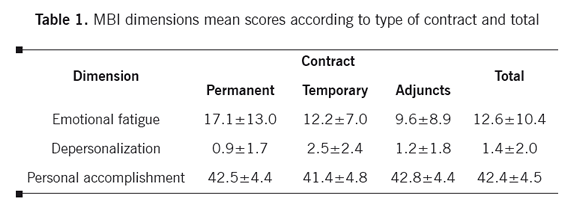
<body><![CDATA[<p><font size="2" face="Verdana">Cross-sectional study carried out using information collected from a self-administered survey to professors, with the supervision of researchers, from an academic unit of a public university of Medellin (Colombia), in the second semester of 2008.</font></p>     <p><font size="2" face="Verdana">Cox, Kuk and Lieter’s<sup>9</sup> burnout definition was used in our research; answer to work stress developed when the employee’s strategies for coping with stress are not effective to manage it. Maslach, Schaufeli and Leiter´s Maslach Burnout Inventory (MBI),<sup>10</sup> validated for Colombia in 2004,<sup>11</sup> was the instrument used. This questionnaire has 22 items that evaluate burnout through three factors: emotional fatigue, depersonalization, and low personal accomplishment (with 9, 5 and 8 questions, respectively). Each item has seven answer categories which go from 0 (never) to 6 (Every day).</font></p>     <p><font size="2" face="Verdana">Burnout degrees were established according to the MBI’s manual,<sup>12</sup> in which a triple classification of the variability of the results in the instrument was used. Establishing three possible values: high, medium and low, according to their location in the upper third, medium or bottom third of the possible values. With this purpose, the values segment is divided in three areas: upper, medium, bottom, taking as cut points percentiles 33 and 66.</font></p>     <p><font size="2" face="Verdana">Manassero’s et al.<sup>13</sup> and Guerrero<sup>14</sup> procedure was replicated to value burnout levels, establishing five different levels from the possible combinations in percentiles 33 and 66, already calculated, and used as cut point. Burnout levels were classified as: none, little, medium, much, and extreme. For prevalence calculus, burnout levels were classified as: a) without burnout: for the "none" level; b) at burnout risk: "little", "medium", "much" levels; and c) With "extreme" burnout level. For the variable professor’s type of contract, three categories were established: a) Permanent professor: Academic hired by public contest of merits, and is hired indefinitely; b) Occasional: Hired by merit selection, he is hired for less than a year; c) Adjuncts: Work for a determined number of hours by academic period.</font></p>     <p><font size="2" face="Verdana">The studied population consisted of 139 professors, 47 associated professors, 24 occasional and 68 adjuncts, according to the academic department’s official registries. The overall sample size was calculated using the usual expression, when the study aims to estimate a proportion according to the burnout syndrome prevalence reported by Yepez and Soraca.<sup>15</sup> Out of 14.3%, a maximum error of 5% and 95% reliability, for a total sample of 95 professors, who were proportionately assigned according to the type of contract: 31 permanent professors, 21 occasional, and 23 adjuncts. Professor who did not have subjects assigned, were in a sabbatical year, in work commission or exclusively dedicated to research projects were not included.</font></p>     <p><font size="2" face="Verdana">The instrument was applied once it was accepted by the bioethical committee of the academic unit, and each professor accepted participating signing informed consent. Information was systematized using Access 2007, SPSS 15 (SPSS®, Chicago). Tabular, pictorial and textual presentation was made through the Word’s text processor in Windows Vista. Additionally, steps established in Rubio’s research<sup>1</sup>, where three possible ways of interpreting the syndrome are studied for each MBI dimension, through averages, degrees and levels were followed.</font></p>     <p>&nbsp;</p>     <p><font size="3" face="Verdana"><b>RESULTS</b></font></p>     <p><font size="2" face="Verdana"><b>MBI dimensions score description according to professor’s type of contract.</b> <a href="#t1">Table 1</a> shows MBI dimensions mean scores according to professor’s type of contract. It can be appreciated that in the emotional fatigue dimension, the range went from 0 to 43 points out of 54 possible points, with a total average of 12.6±10.4 points. By type of contract, a statistically significant difference was found between the average scores of this dimension, being higher among permanent professors (p=0.023, Kruskal Wallis H test). Regarding depersonalization dimension, the range varied between 0 and 7 out of 30 possible points, for a total average of 1.4±2.0 points. For this dimension, temporary professors were the ones who got a higher score, statistically significant difference (p=0.014 Kruskal Wallis test). Different from the personal realization dimension where the general sample got an average score of 42.4±4.5 out of 48 possible points, without statistically significant differences in the average scores (p=0.348, one- way parametric ANOVA).</font></p>     <p><font size="2" face="Verdana"><b>Burnout degrees.</b> For this research, cut points were calculated for the general sample and for each type of contract; they can be seen in <a href="#t2">Table 2</a>.</font></p>     ]]></body>
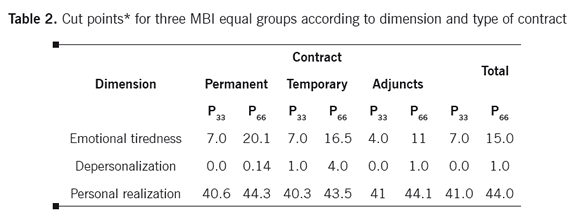
<body><![CDATA[<p><font size="2" face="Verdana">This classification is shown in <a href="#t3">Table 3</a>. It is highlighted that professors reported low levels of emotional fatigue, depersonalization and personal accomplishment, taking into account that the first two correspond to negative indicators, and the last one to a positive indicator. According to type of contract, permanent professors got the lowest personal accomplishment (42.9%) and the highest emotional fatigue (32.1%), while temporary professors showed higher scores for depersonalization (33.3%).</font></p>     <p><font size="2" face="Verdana"><b>Burnout levels.</b> It was observed that 45% of the professors were located among the "none" and "little" levels (31.5% and 13.5% respectively), 13.5% were in the "medium" level, 22.5% were in the "much" one, and the remaining 19.1% in the "extreme" level.</font></p>     <p><font size="2" face="Verdana"><b>Burnout prevalence.</b> In <a href="#t4">Table 4</a> it can be appreciated that the total prevalence of probable burnout cases for this research was 19.1% (CI95%=10.4%-27.8%), however it should be highlighted that the additionally 49.4% was at risk of having it (CI95%=38.5%-60.4%). Permanent professors were the ones with higher burnout prevalence (25.0%), followed by temporary professors (19.0%) and adjuncts (17.5%).</font></p>     <p><font size="2" face="Verdana"><img src="/img/revistas/iee/v29n3/v29n3a11t01.png"><a name="t1"></a></font></p>     <p><font size="2" face="Verdana"><img src="/img/revistas/iee/v29n3/v29n3a11t02.png"><a name="t2"></a></font></p>     <p><font size="2" face="Verdana"><img src="/img/revistas/iee/v29n3/v29n3a11t03.png"><a name="t3"></a></font></p>     <p><font size="2" face="Verdana"><img src="/img/revistas/iee/v29n3/v29n3a11t04.png"><a name="t4"></a></font></p>     <p>&nbsp;</p>     <p><font size="3" face="Verdana"><b>DISCUSSION</b></font></p>     <p><font size="2" face="Verdana">This study shows burnout syndrome experienced by professors of an academic unit of a public university of the city of Medellin. In general, professors reported low levels of emotional fatigue, depersonalization and personal accomplishment, taking into account the first two correspond to positive indicators, while the last one is a negative indicator. Permanent professors were the ones who got a higher rate of emotional fatigue, while occasional professors got higher depersonalization scores. Some studies have found higher prevalence of depersonalization and lower personal accomplishment levels in professors, in high school teachers the opposite has been found. However, these results should be carefully analyzed because they do not discriminate by teacher’s type of contract.<sup>16-18</sup></font></p>     ]]></body>
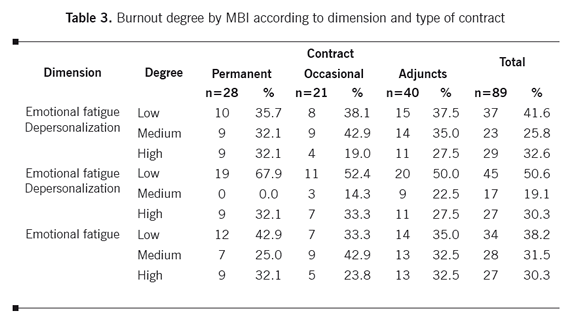
<body><![CDATA[<p><font size="2" face="Verdana">Burnout syndrome prevalence for this research was 19.1%, being higher for permanent professors than occasional and adjuncts, what could be explained by the chosen model to achieve the goals of this research, framed from organizational theory that emphasizes in the importance of organizational context stressors, and wearing out coping strategies, as an answer to job stress. From this point of view, and knowing permanent professors indefinite term contractual relationship with the university, It is possible that the presence of the syndrome could be explained because wearing out coping strategies used by the professor, are not effective to manage the syndrome and its effects, or because there could be any kind of deterioration of the organizational environment, due to fissures in the relationship between professors and, leaderships that do not bring the team together, or administrative situations. Reason why, the ones who spend more time in the faculty, permanent professors, would be the ones with higher risk of having the syndrome.</font></p>     <p><font size="2" face="Verdana">It is necessary to mention that burnout prevalence rates could have change according to professor’s type of contract, if instead of using Cox Kuk y Leiter,<sup>9</sup> organizational model, a model that emphasizes in professor’s work load framed from the social exchange theory was used. In everyday life it is perceived that adjunct professor’s are the ones who should more easily develop burnout syndrome, due to simultaneous jobs in different institutions and job instability; such picture would justify a study where work load domains would be taken as models.</font></p>     <p><font size="2" face="Verdana">The organizational model was chosen for this research, knowing the difficulty of having a reliable measure for the variables related with work load, especially with adjunct professors, because tendency reflects that this professors assume school responsibilities in other institutions and so, even though they have the syndrome, it could be detected that it could be caused by cumulative wearing out, but not by a specific institution. It is highlighted the importance of knowing the characteristics of this population, because 49.3% of the faculty professors where the study was carried out are adjuncts. 49.4% of the professors were at risk of developing burnout, being higher in adjunct professors and similar among permanent and temporary professors. In a study carried out in San Andres de Sotavento (2006), a14.3% prevalence was found;15 and in Medellin (2005) a 23.4% prevalence was found with an additional 23.4% at risk of developing it. Other studies showed 12.5%,<sup>19</sup> 23%,<sup>20</sup> 25.9%,<sup>21</sup> 40%<sup>22</sup> and 43%<sup>23</sup> prevalence. According to Restrepo and Colorado,<sup>11</sup> the differences among the syndrome magnitudes could be hypothetically due to the model, and burnout case definition used by each of the authors, despite which prevalence found are of great importance.</font></p>     <p><font size="2" face="Verdana">The necessity of implementing an epidemiological surveillance system that include, both MBI variables as well as psychosocial risk factors distinguished by type of contract, to promote the implementation of promotion, prevention and intervention activities in the system, directed to lower burnout risk magnitude and improving work environment, urges. This surveillance system requires structuring a training program with qualified personnel. To let the professors know what the syndrome is, what triggers it, manifestations and coping strategies, which allow care and self-evaluation.</font></p>     <p><font size="2" face="Verdana">It is important to continue estimating burnout syndrome risk magnitude, and establish its association with other psychological variables from a clinical perspective, to establish comorbidity associated to the syndrome, such as depression, modal event in professors.</font></p>     <p><font size="2" face="Verdana">Due to burnout risk and prevalence magnitude according to professor’s type of contract, it would be important to make similar studies in other faculties of the university in which the study was performed, including, as mentioned before, variables that take into account professor’s work load, which would allow a better approach to the problem. Finally, it is pointed out that the main limitation of this study is the lack of consensus to define a burnout case, what make comparisons among different researches differ, even though to date, it is still the most recommended instrument to measure such syndrome.<sup>23-28</sup></font></p>     <p><font size="2" face="Verdana"><b>Acknowledgments:</b> the authors wish to thank Centro de investigaciones de la Facultad Nacional de Salud P&uacute;blica and Mg. Nadia Catalina Restrepo.</font></p>     <p>&nbsp;</p>     <p><font size="3" face="Verdana"><b>REFERENCIAS</b> </font>     <!-- ref --><p><font size="2" face="Verdana">1. Guerrero E, Rubio JC. Estrategias de prevenci&oacute;n e intervenci&oacute;n del "Burnout" en el &aacute;mbito educativo. Salud Ment. 2005:28(5):27-33.</font>&nbsp;&nbsp;&nbsp;&nbsp;&nbsp;&nbsp;&nbsp;&nbsp;[&#160;<a href="javascript:void(0);" onclick="javascript: window.open('/scielo.php?script=sci_nlinks&ref=000072&pid=S0120-5307201100030001100001&lng=','','width=640,height=500,resizable=yes,scrollbars=1,menubar=yes,');">Links</a>&#160;]<!-- end-ref --><!-- ref --><p><font size="2" face="Verdana">2. Freudenberger M. Staff Burn-out. J Soc Issues. 1972;30(1):159-65.</font>&nbsp;&nbsp;&nbsp;&nbsp;&nbsp;&nbsp;&nbsp;&nbsp;[&#160;<a href="javascript:void(0);" onclick="javascript: window.open('/scielo.php?script=sci_nlinks&ref=000073&pid=S0120-5307201100030001100002&lng=','','width=640,height=500,resizable=yes,scrollbars=1,menubar=yes,');">Links</a>&#160;]<!-- end-ref --><!-- ref --><p><font size="2" face="Verdana">3. Moriana J, Herruzo J. Estr&eacute;s y Burnout en profesores. Int J Clin Health Psychol. 2004;4(3):597-621.</font>&nbsp;&nbsp;&nbsp;&nbsp;&nbsp;&nbsp;&nbsp;&nbsp;[&#160;<a href="javascript:void(0);" onclick="javascript: window.open('/scielo.php?script=sci_nlinks&ref=000074&pid=S0120-5307201100030001100003&lng=','','width=640,height=500,resizable=yes,scrollbars=1,menubar=yes,');">Links</a>&#160;]<!-- end-ref --><!-- ref --><p><font size="2" face="Verdana">4. Hermosa A. Satisfacci&oacute;n laboral y s&iacute;ndrome de Burnout en profesores de educaci&oacute;n primaria y secundaria. Rev Col Psicol. 2006;(15):81-9.</font>&nbsp;&nbsp;&nbsp;&nbsp;&nbsp;&nbsp;&nbsp;&nbsp;[&#160;<a href="javascript:void(0);" onclick="javascript: window.open('/scielo.php?script=sci_nlinks&ref=000075&pid=S0120-5307201100030001100004&lng=','','width=640,height=500,resizable=yes,scrollbars=1,menubar=yes,');">Links</a>&#160;]<!-- end-ref --><!-- ref --><p><font size="2" face="Verdana">5. Coon D. Fundamentos de psicolog&iacute;a. 10<sup>a</sup> ed. M&eacute;xico: Thomson; 2005.</font>&nbsp;&nbsp;&nbsp;&nbsp;&nbsp;&nbsp;&nbsp;&nbsp;[&#160;<a href="javascript:void(0);" onclick="javascript: window.open('/scielo.php?script=sci_nlinks&ref=000076&pid=S0120-5307201100030001100005&lng=','','width=640,height=500,resizable=yes,scrollbars=1,menubar=yes,');">Links</a>&#160;]<!-- end-ref --><!-- ref --><p><font size="2" face="Verdana">6. Aranda C, Pando M, Torres T, Salazar G, Aldrete M. S&iacute;ndrome de Burnout y manifestaciones cl&iacute;nicas en los m&eacute;dicos familiares que laboran en una instituci&oacute;n de salud para los trabajadores del Estado. Psicol Salud. 2006;16(1):15–21.</font>&nbsp;&nbsp;&nbsp;&nbsp;&nbsp;&nbsp;&nbsp;&nbsp;[&#160;<a href="javascript:void(0);" onclick="javascript: window.open('/scielo.php?script=sci_nlinks&ref=000077&pid=S0120-5307201100030001100006&lng=','','width=640,height=500,resizable=yes,scrollbars=1,menubar=yes,');">Links</a>&#160;]<!-- end-ref --><!-- ref --><p><font size="2" face="Verdana">7. Gil Monte P. Peir&oacute; J. Perspectivas te&oacute;ricas y modelos interpretativos para el estudio del s&iacute;ndrome de quemarse por el trabajo. An psicol. 1999;15(2):261-8.</font>&nbsp;&nbsp;&nbsp;&nbsp;&nbsp;&nbsp;&nbsp;&nbsp;[&#160;<a href="javascript:void(0);" onclick="javascript: window.open('/scielo.php?script=sci_nlinks&ref=000078&pid=S0120-5307201100030001100007&lng=','','width=640,height=500,resizable=yes,scrollbars=1,menubar=yes,');">Links</a>&#160;]<!-- end-ref --><!-- ref --><p><font size="2" face="Verdana">8. Universidad de Antioquia. Plan de desarrollo. Cap&iacute;tulo segundo [Internet]. Medell&iacute;n: Universidad de Antioquia; 2007 [acceso 2008 ago 26]. Disponible en: <a href="http://www.udea.edu.co/plan/cap_2/mision_udea.html">http://www.udea.edu.co/plan/cap_2/mision_udea.html</a></font>&nbsp;&nbsp;&nbsp;&nbsp;&nbsp;&nbsp;&nbsp;&nbsp;[&#160;<a href="javascript:void(0);" onclick="javascript: window.open('/scielo.php?script=sci_nlinks&ref=000079&pid=S0120-5307201100030001100008&lng=','','width=640,height=500,resizable=yes,scrollbars=1,menubar=yes,');">Links</a>&#160;]<!-- end-ref --><!-- ref --><p><font size="2" face="Verdana">9. Cox T, Kuk G, Leiter MP. Burnout, health, work stress and organizational healthiness. En: Schaufeli WB, Maslach C, Marek T, Editors. Professional burnout: recent developments in theory and research. UK: Taylor &amp; Francis; 1993. p. 261-9.</font>&nbsp;&nbsp;&nbsp;&nbsp;&nbsp;&nbsp;&nbsp;&nbsp;[&#160;<a href="javascript:void(0);" onclick="javascript: window.open('/scielo.php?script=sci_nlinks&ref=000080&pid=S0120-5307201100030001100009&lng=','','width=640,height=500,resizable=yes,scrollbars=1,menubar=yes,');">Links</a>&#160;]<!-- end-ref --><!-- ref --><p><font size="2" face="Verdana">10. Maslach C, Schaufeli WB, Leiter MP. Job burnout. Annu Rev Clin Psychol. 2001;52:397-422.</font>&nbsp;&nbsp;&nbsp;&nbsp;&nbsp;&nbsp;&nbsp;&nbsp;[&#160;<a href="javascript:void(0);" onclick="javascript: window.open('/scielo.php?script=sci_nlinks&ref=000081&pid=S0120-5307201100030001100010&lng=','','width=640,height=500,resizable=yes,scrollbars=1,menubar=yes,');">Links</a>&#160;]<!-- end-ref --><!-- ref --><p><font size="2" face="Verdana">11. Restrepo N, Colorado G. Desgaste profesional (Burnout) y su asociaci&oacute;n con factores de riesgo psicosocial en docentes oficiales de Medell&iacute;n, Colombia, 2005 [CD-ROM]. Medell&iacute;n: Facultad Nacional de Salud P&uacute;blica, Universidad de Antioquia; 2005.</font>&nbsp;&nbsp;&nbsp;&nbsp;&nbsp;&nbsp;&nbsp;&nbsp;[&#160;<a href="javascript:void(0);" onclick="javascript: window.open('/scielo.php?script=sci_nlinks&ref=000082&pid=S0120-5307201100030001100011&lng=','','width=640,height=500,resizable=yes,scrollbars=1,menubar=yes,');">Links</a>&#160;]<!-- end-ref --><!-- ref --><p><font size="2" face="Verdana">12. Maslach C. Jackson SE. Maslach Burnout Inventory. 2<sup>a</sup> ed. Palo Alto CA: Consulting Psychologist Press; 1981.</font>&nbsp;&nbsp;&nbsp;&nbsp;&nbsp;&nbsp;&nbsp;&nbsp;[&#160;<a href="javascript:void(0);" onclick="javascript: window.open('/scielo.php?script=sci_nlinks&ref=000083&pid=S0120-5307201100030001100012&lng=','','width=640,height=500,resizable=yes,scrollbars=1,menubar=yes,');">Links</a>&#160;]<!-- end-ref --><!-- ref --><p><font size="2" face="Verdana">13. Manassero M, V&aacute;zquez A, Ferrer M, Forn&eacute;s J, Fern&aacute;ndez MY, Queimaledos J. Burnout en profesores: impacto sobre la calidad de la educaci&oacute;n, la salud y consecuencias para el desarrollo profesional. Madrid: MEC-CIDE; 1994.</font>&nbsp;&nbsp;&nbsp;&nbsp;&nbsp;&nbsp;&nbsp;&nbsp;[&#160;<a href="javascript:void(0);" onclick="javascript: window.open('/scielo.php?script=sci_nlinks&ref=000084&pid=S0120-5307201100030001100013&lng=','','width=640,height=500,resizable=yes,scrollbars=1,menubar=yes,');">Links</a>&#160;]<!-- end-ref --><!-- ref --><p><font size="2" face="Verdana">14. Guerrero E, Rubio J. Fuentes de estr&eacute;s y s&iacute;ndrome de «Burnout» en orientadores de institutos de ense&ntilde;anza secundaria. Rev Educ. 2008;347:229-54.</font>&nbsp;&nbsp;&nbsp;&nbsp;&nbsp;&nbsp;&nbsp;&nbsp;[&#160;<a href="javascript:void(0);" onclick="javascript: window.open('/scielo.php?script=sci_nlinks&ref=000085&pid=S0120-5307201100030001100014&lng=','','width=640,height=500,resizable=yes,scrollbars=1,menubar=yes,');">Links</a>&#160;]<!-- end-ref --><!-- ref --><p><font size="2" face="Verdana">15. Y&eacute;pez M, Sorac&aacute; A. S&iacute;ndrome de Burnout asociado con factores de riesgos psicosociales en docentes oficiales del municipio de San Andr&eacute;s de Sotavento (C&oacute;rdoba), 2006 [Tesis de la Especializaci&oacute;n en Salud Ocupacional]. Medell&iacute;n: Facultad Nacional de Salud P&uacute;blica, Universidad de Antioquia; 2006.</font>&nbsp;&nbsp;&nbsp;&nbsp;&nbsp;&nbsp;&nbsp;&nbsp;[&#160;<a href="javascript:void(0);" onclick="javascript: window.open('/scielo.php?script=sci_nlinks&ref=000086&pid=S0120-5307201100030001100015&lng=','','width=640,height=500,resizable=yes,scrollbars=1,menubar=yes,');">Links</a>&#160;]<!-- end-ref --><!-- ref --><p><font size="2" face="Verdana">16. Rubio J. Fuentes de estr&eacute;s, s&iacute;ndrome de Burnout y actitudes disfuncionales en orientadores de Instituto de Ense&ntilde;anza Secundaria [Tesis doctoral]. Badajoz: Universidad de Extremadura; 2003.</font>&nbsp;&nbsp;&nbsp;&nbsp;&nbsp;&nbsp;&nbsp;&nbsp;[&#160;<a href="javascript:void(0);" onclick="javascript: window.open('/scielo.php?script=sci_nlinks&ref=000087&pid=S0120-5307201100030001100016&lng=','','width=640,height=500,resizable=yes,scrollbars=1,menubar=yes,');">Links</a>&#160;]<!-- end-ref --><!-- ref --><p><font size="2" face="Verdana">17. Daniel E. Estudio del s&iacute;ndrome del desgaste profesional entre los m&eacute;dicos de un hospital general [Tesis doctoral]. Salamanca: Universidad de Salamanca; 1995.</font>&nbsp;&nbsp;&nbsp;&nbsp;&nbsp;&nbsp;&nbsp;&nbsp;[&#160;<a href="javascript:void(0);" onclick="javascript: window.open('/scielo.php?script=sci_nlinks&ref=000088&pid=S0120-5307201100030001100017&lng=','','width=640,height=500,resizable=yes,scrollbars=1,menubar=yes,');">Links</a>&#160;]<!-- end-ref --><!-- ref --><p><font size="2" face="Verdana">18. Roca&ntilde;&iacute;n, J, Mart&iacute;nez O, Cantizano J, Rico R, Mart&iacute;nez A, Iglesias M. Aproximaci&oacute;n al estr&eacute;s profesional (Burnout) en funcionarios p&uacute;blicos de sanidad, guardia civil, justicia y ej&eacute;rcito. An psiquiatr. 1996;12:15-22.</font>&nbsp;&nbsp;&nbsp;&nbsp;&nbsp;&nbsp;&nbsp;&nbsp;[&#160;<a href="javascript:void(0);" onclick="javascript: window.open('/scielo.php?script=sci_nlinks&ref=000089&pid=S0120-5307201100030001100018&lng=','','width=640,height=500,resizable=yes,scrollbars=1,menubar=yes,');">Links</a>&#160;]<!-- end-ref --><!-- ref --><p><font size="2" face="Verdana">19. Mart&iacute;nez A. El malestar docente explicado a trav&eacute;s del modelo reformado de desamparo aprendido [Tesis doctoral]. Palma: Universitat illes Balears; 1991.</font>&nbsp;&nbsp;&nbsp;&nbsp;&nbsp;&nbsp;&nbsp;&nbsp;[&#160;<a href="javascript:void(0);" onclick="javascript: window.open('/scielo.php?script=sci_nlinks&ref=000090&pid=S0120-5307201100030001100019&lng=','','width=640,height=500,resizable=yes,scrollbars=1,menubar=yes,');">Links</a>&#160;]<!-- end-ref --><!-- ref --><p><font size="2" face="Verdana">20. Paredes M. Caracterizaci&oacute;n multivariante del s&iacute;ndrome de burnout en la plantilla de docentes de la Universidad de Salamanca. [Doctor en psicolog&iacute;a] Salamanca: Ediciones Universidad de Salamanca, 2002.</font>&nbsp;&nbsp;&nbsp;&nbsp;&nbsp;&nbsp;&nbsp;&nbsp;[&#160;<a href="javascript:void(0);" onclick="javascript: window.open('/scielo.php?script=sci_nlinks&ref=000091&pid=S0120-5307201100030001100020&lng=','','width=640,height=500,resizable=yes,scrollbars=1,menubar=yes,');">Links</a>&#160;]<!-- end-ref --><!-- ref --><p><font size="2" face="Verdana">21. Guerrero E. An&aacute;lisis pormenorizado de los grados de Burnout y t&eacute;cnicas de afrontamiento del estr&eacute;s docente en profesorado universitario. A Psicol. 2003;19(1):145-58.</font>&nbsp;&nbsp;&nbsp;&nbsp;&nbsp;&nbsp;&nbsp;&nbsp;[&#160;<a href="javascript:void(0);" onclick="javascript: window.open('/scielo.php?script=sci_nlinks&ref=000092&pid=S0120-5307201100030001100021&lng=','','width=640,height=500,resizable=yes,scrollbars=1,menubar=yes,');">Links</a>&#160;]<!-- end-ref --><!-- ref --><p><font size="2" face="Verdana">22. Aldrete M, Pando M, Aranda C, Balc&aacute;zar N. S&iacute;ndrome de burnout en maestros educaci&oacute;n primaria de Guadalajara. Invest salud [Internet]. 2003 [acceso 2009 feb 07]; 5(1). Disponible en: <a href="http://redalyc.uaemex.mx/redalyc/pdf/142/14200103.pdf">http://redalyc.uaemex.mx/redalyc/pdf/142/14200103.pdf</a></font>&nbsp;&nbsp;&nbsp;&nbsp;&nbsp;&nbsp;&nbsp;&nbsp;[&#160;<a href="javascript:void(0);" onclick="javascript: window.open('/scielo.php?script=sci_nlinks&ref=000093&pid=S0120-5307201100030001100022&lng=','','width=640,height=500,resizable=yes,scrollbars=1,menubar=yes,');">Links</a>&#160;]<!-- end-ref --><!-- ref --><p><font size="2" face="Verdana">23. Cordeiro J, Guell&eacute;n C, Gala F. Educaci&oacute;n primaria y s&iacute;ndrome de burnout: situaci&oacute;n de riesgo en los y las docentes de la zona de Bah&iacute;a de C&aacute;diz [internet]. C&aacute;diz: Universidad de C&aacute;diz; 2009 [acceso 2011 Feb 04]. Disponible en: <a href="http://www.stes.es/salud/Libro_Riesgos_laborales/c05a1.pdf">http://www.stes.es/salud/Libro_Riesgos_laborales/c05a1.pdf</a></font>&nbsp;&nbsp;&nbsp;&nbsp;&nbsp;&nbsp;&nbsp;&nbsp;[&#160;<a href="javascript:void(0);" onclick="javascript: window.open('/scielo.php?script=sci_nlinks&ref=000094&pid=S0120-5307201100030001100023&lng=','','width=640,height=500,resizable=yes,scrollbars=1,menubar=yes,');">Links</a>&#160;]<!-- end-ref --><!-- ref --><p><font size="2" face="Verdana">24. Fern&aacute;ndez M. Desgaste ps&iacute;quico (Burnout) en profesores de educaci&oacute;n primaria de Lima Metropolitana [Internet]. Lima: Universidad de Lima; [acceso 2009 feb 04]. Disponible en: <a href="http://dialnet.unirioja.es/servlet/fichero_articulo?codigo=2881042&orden=0">http://dialnet.unirioja.es/servlet/fichero_articulo?codigo=2881042&orden=0</a></font>&nbsp;&nbsp;&nbsp;&nbsp;&nbsp;&nbsp;&nbsp;&nbsp;[&#160;<a href="javascript:void(0);" onclick="javascript: window.open('/scielo.php?script=sci_nlinks&ref=000095&pid=S0120-5307201100030001100024&lng=','','width=640,height=500,resizable=yes,scrollbars=1,menubar=yes,');">Links</a>&#160;]<!-- end-ref --><!-- ref --><p><font size="2" face="Verdana">25. Gomero R, Palomino J, Ruiz F, Llap C. El s&iacute;ndrome de burnout en el personal sanitario de los hospitales de la empresa minera de Southern Per&uacute; Copper Corporation: estudio piloto. Rev Med Hered. 2005;16(4):233-8.</font>&nbsp;&nbsp;&nbsp;&nbsp;&nbsp;&nbsp;&nbsp;&nbsp;[&#160;<a href="javascript:void(0);" onclick="javascript: window.open('/scielo.php?script=sci_nlinks&ref=000096&pid=S0120-5307201100030001100025&lng=','','width=640,height=500,resizable=yes,scrollbars=1,menubar=yes,');">Links</a>&#160;]<!-- end-ref --><!-- ref --><p><font size="2" face="Verdana">26. Llaneza J. Ergonom&iacute;a y psicosociolog&iacute;a aplicada. Manual para la formaci&oacute;n del especialista. 13ª ed. Madrid: Lex Nova; 2009.</font>&nbsp;&nbsp;&nbsp;&nbsp;&nbsp;&nbsp;&nbsp;&nbsp;[&#160;<a href="javascript:void(0);" onclick="javascript: window.open('/scielo.php?script=sci_nlinks&ref=000097&pid=S0120-5307201100030001100026&lng=','','width=640,height=500,resizable=yes,scrollbars=1,menubar=yes,');">Links</a>&#160;]<!-- end-ref --><!-- ref --><p><font size="2" face="Verdana">27. Grajales T. Estudio de validaci&oacute;n factorial del Maslach Burnout Inventory versi&oacute;n espa&ntilde;ola en una poblaci&oacute;n de profesionales mexicanos [Internet]. M&eacute;xico: Universidad de Montemorelos; 2002 [acceso 2009 ago 04]. Disponible en: <a href="http://tgrajales.net/mbivalidez.pdf">http://tgrajales.net/mbivalidez.pdf</a></font>&nbsp;&nbsp;&nbsp;&nbsp;&nbsp;&nbsp;&nbsp;&nbsp;[&#160;<a href="javascript:void(0);" onclick="javascript: window.open('/scielo.php?script=sci_nlinks&ref=000098&pid=S0120-5307201100030001100027&lng=','','width=640,height=500,resizable=yes,scrollbars=1,menubar=yes,');">Links</a>&#160;]<!-- end-ref --><!-- ref --><p><font size="2" face="Verdana">28. Brenninkmeijer V, Van Yperen N. How to conduct research on burnout: advantages and disadvantages of a unidimensional approach in burnout research. Occup Environ Med. 2003;60(Suppl 1):S16–S20.</font>&nbsp;&nbsp;&nbsp;&nbsp;&nbsp;&nbsp;&nbsp;&nbsp;[&#160;<a href="javascript:void(0);" onclick="javascript: window.open('/scielo.php?script=sci_nlinks&ref=000099&pid=S0120-5307201100030001100028&lng=','','width=640,height=500,resizable=yes,scrollbars=1,menubar=yes,');">Links</a>&#160;]<!-- end-ref --><p>&nbsp;</p> <hr noshade>     <p><font size="2" face="Verdana"><b>Fecha de Recibido</b>: 23 de junio de 2010. <b>   Fecha       de Aprobado</b>: 16 de mayo de 2011.</font></p>       ]]></body><back>
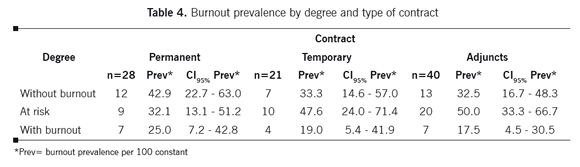
<ref-list>
<ref id="B1">
<label>1</label><nlm-citation citation-type="journal">
<person-group person-group-type="author">
<name>
<surname><![CDATA[Guerrero]]></surname>
<given-names><![CDATA[E]]></given-names>
</name>
<name>
<surname><![CDATA[Rubio]]></surname>
<given-names><![CDATA[JC]]></given-names>
</name>
</person-group>
<article-title xml:lang="es"><![CDATA[Estrategias de prevención e intervención del "Burnout" en el ámbito educativo]]></article-title>
<source><![CDATA[Salud Ment]]></source>
<year>2005</year>
<volume>28</volume>
<numero>5</numero>
<issue>5</issue>
<page-range>27-33</page-range></nlm-citation>
</ref>
<ref id="B2">
<label>2</label><nlm-citation citation-type="journal">
<person-group person-group-type="author">
<name>
<surname><![CDATA[Freudenberger]]></surname>
<given-names><![CDATA[M]]></given-names>
</name>
</person-group>
<article-title xml:lang="en"><![CDATA[Staff Burn-out]]></article-title>
<source><![CDATA[J Soc Issues]]></source>
<year>1972</year>
<volume>30</volume>
<numero>1</numero>
<issue>1</issue>
<page-range>159-65</page-range></nlm-citation>
</ref>
<ref id="B3">
<label>3</label><nlm-citation citation-type="journal">
<person-group person-group-type="author">
<name>
<surname><![CDATA[Moriana]]></surname>
<given-names><![CDATA[J]]></given-names>
</name>
<name>
<surname><![CDATA[Herruzo]]></surname>
<given-names><![CDATA[J]]></given-names>
</name>
</person-group>
<article-title xml:lang="es"><![CDATA[Estrés y Burnout en profesores]]></article-title>
<source><![CDATA[Int J Clin Health Psychol]]></source>
<year>2004</year>
<volume>4</volume>
<numero>3</numero>
<issue>3</issue>
<page-range>597-621</page-range></nlm-citation>
</ref>
<ref id="B4">
<label>4</label><nlm-citation citation-type="journal">
<person-group person-group-type="author">
<name>
<surname><![CDATA[Hermosa]]></surname>
<given-names><![CDATA[A]]></given-names>
</name>
</person-group>
<article-title xml:lang="es"><![CDATA[Satisfacción laboral y síndrome de Burnout en profesores de educación primaria y secundaria]]></article-title>
<source><![CDATA[Rev Col Psicol]]></source>
<year>2006</year>
<numero>15</numero>
<issue>15</issue>
<page-range>81-9</page-range></nlm-citation>
</ref>
<ref id="B5">
<label>5</label><nlm-citation citation-type="book">
<person-group person-group-type="author">
<name>
<surname><![CDATA[Coon]]></surname>
<given-names><![CDATA[D]]></given-names>
</name>
</person-group>
<source><![CDATA[Fundamentos de psicología]]></source>
<year>2005</year>
<edition>10ª</edition>
<publisher-loc><![CDATA[México ]]></publisher-loc>
<publisher-name><![CDATA[Thomson]]></publisher-name>
</nlm-citation>
</ref>
<ref id="B6">
<label>6</label><nlm-citation citation-type="journal">
<person-group person-group-type="author">
<name>
<surname><![CDATA[Aranda]]></surname>
<given-names><![CDATA[C]]></given-names>
</name>
<name>
<surname><![CDATA[Pando]]></surname>
<given-names><![CDATA[M]]></given-names>
</name>
<name>
<surname><![CDATA[Torres]]></surname>
<given-names><![CDATA[T]]></given-names>
</name>
<name>
<surname><![CDATA[Salazar]]></surname>
<given-names><![CDATA[G]]></given-names>
</name>
<name>
<surname><![CDATA[Aldrete]]></surname>
<given-names><![CDATA[M]]></given-names>
</name>
</person-group>
<article-title xml:lang="es"><![CDATA[Síndrome de Burnout y manifestaciones clínicas en los médicos familiares que laboran en una institución de salud para los trabajadores del Estado]]></article-title>
<source><![CDATA[Psicol Salud]]></source>
<year>2006</year>
<volume>16</volume>
<numero>1</numero>
<issue>1</issue>
<page-range>15-21</page-range></nlm-citation>
</ref>
<ref id="B7">
<label>7</label><nlm-citation citation-type="journal">
<person-group person-group-type="author">
<name>
<surname><![CDATA[Gil]]></surname>
<given-names><![CDATA[Monte P]]></given-names>
</name>
<name>
<surname><![CDATA[Peiró]]></surname>
<given-names><![CDATA[J]]></given-names>
</name>
</person-group>
<article-title xml:lang="es"><![CDATA[Perspectivas teóricas y modelos interpretativos para el estudio del síndrome de quemarse por el trabajo]]></article-title>
<source><![CDATA[An psicol]]></source>
<year>1999</year>
<volume>15</volume>
<numero>2</numero>
<issue>2</issue>
<page-range>261-8</page-range></nlm-citation>
</ref>
<ref id="B8">
<label>8</label><nlm-citation citation-type="book">
<collab>Universidad de Antioquia</collab>
<source><![CDATA[Plan de desarrollo. Capítulo segundo]]></source>
<year>2007</year>
<publisher-loc><![CDATA[Medellín ]]></publisher-loc>
<publisher-name><![CDATA[Universidad de Antioquia]]></publisher-name>
</nlm-citation>
</ref>
<ref id="B9">
<label>9</label><nlm-citation citation-type="book">
<person-group person-group-type="author">
<name>
<surname><![CDATA[Cox]]></surname>
<given-names><![CDATA[T]]></given-names>
</name>
<name>
<surname><![CDATA[Kuk]]></surname>
<given-names><![CDATA[G]]></given-names>
</name>
<name>
<surname><![CDATA[Leiter]]></surname>
<given-names><![CDATA[MP]]></given-names>
</name>
</person-group>
<article-title xml:lang="en"><![CDATA[Burnout, health, work stress and organizational healthiness]]></article-title>
<person-group person-group-type="editor">
<name>
<surname><![CDATA[Schaufeli]]></surname>
<given-names><![CDATA[WB]]></given-names>
</name>
<name>
<surname><![CDATA[Maslach]]></surname>
<given-names><![CDATA[C]]></given-names>
</name>
<name>
<surname><![CDATA[Marek]]></surname>
<given-names><![CDATA[T]]></given-names>
</name>
</person-group>
<source><![CDATA[Professional burnout: recent developments in theory and research]]></source>
<year>1993</year>
<page-range>261-9</page-range><publisher-name><![CDATA[Taylor & Francis]]></publisher-name>
</nlm-citation>
</ref>
<ref id="B10">
<label>10</label><nlm-citation citation-type="journal">
<person-group person-group-type="author">
<name>
<surname><![CDATA[Maslach]]></surname>
<given-names><![CDATA[C]]></given-names>
</name>
<name>
<surname><![CDATA[Schaufeli]]></surname>
<given-names><![CDATA[WB]]></given-names>
</name>
<name>
<surname><![CDATA[Leiter]]></surname>
<given-names><![CDATA[MP]]></given-names>
</name>
</person-group>
<article-title xml:lang="en"><![CDATA[Job burnout]]></article-title>
<source><![CDATA[Annu Rev Clin Psychol]]></source>
<year>2001</year>
<volume>52</volume>
<page-range>397-422</page-range></nlm-citation>
</ref>
<ref id="B11">
<label>11</label><nlm-citation citation-type="book">
<person-group person-group-type="author">
<name>
<surname><![CDATA[Restrepo]]></surname>
<given-names><![CDATA[N]]></given-names>
</name>
<name>
<surname><![CDATA[Colorado]]></surname>
<given-names><![CDATA[G]]></given-names>
</name>
</person-group>
<source><![CDATA[Desgaste profesional (Burnout) y su asociación con factores de riesgo psicosocial en docentes oficiales de Medellín, Colombia, 2005]]></source>
<year>2005</year>
<publisher-loc><![CDATA[Medellín ]]></publisher-loc>
<publisher-name><![CDATA[Facultad Nacional de Salud Pública, Universidad de Antioquia]]></publisher-name>
</nlm-citation>
</ref>
<ref id="B12">
<label>12</label><nlm-citation citation-type="book">
<person-group person-group-type="author">
<name>
<surname><![CDATA[Maslach]]></surname>
<given-names><![CDATA[C]]></given-names>
</name>
<name>
<surname><![CDATA[Jackson]]></surname>
<given-names><![CDATA[SE]]></given-names>
</name>
</person-group>
<source><![CDATA[Maslach Burnout Inventory]]></source>
<year>1981</year>
<edition>2ª</edition>
<publisher-loc><![CDATA[Palo Alto CA ]]></publisher-loc>
<publisher-name><![CDATA[Consulting Psychologist Press]]></publisher-name>
</nlm-citation>
</ref>
<ref id="B13">
<label>13</label><nlm-citation citation-type="book">
<person-group person-group-type="author">
<name>
<surname><![CDATA[Manassero]]></surname>
<given-names><![CDATA[M]]></given-names>
</name>
<name>
<surname><![CDATA[Vázquez]]></surname>
<given-names><![CDATA[A]]></given-names>
</name>
<name>
<surname><![CDATA[Ferrer]]></surname>
<given-names><![CDATA[M]]></given-names>
</name>
<name>
<surname><![CDATA[Fornés]]></surname>
<given-names><![CDATA[J]]></given-names>
</name>
<name>
<surname><![CDATA[Fernández]]></surname>
<given-names><![CDATA[MY]]></given-names>
</name>
<name>
<surname><![CDATA[Queimaledos]]></surname>
<given-names><![CDATA[J]]></given-names>
</name>
</person-group>
<source><![CDATA[Burnout en profesores: impacto sobre la calidad de la educación, la salud y consecuencias para el desarrollo profesional]]></source>
<year>1994</year>
<publisher-loc><![CDATA[Madrid ]]></publisher-loc>
<publisher-name><![CDATA[MEC-CIDE]]></publisher-name>
</nlm-citation>
</ref>
<ref id="B14">
<label>14</label><nlm-citation citation-type="journal">
<person-group person-group-type="author">
<name>
<surname><![CDATA[Guerrero]]></surname>
<given-names><![CDATA[E]]></given-names>
</name>
<name>
<surname><![CDATA[Rubio]]></surname>
<given-names><![CDATA[J]]></given-names>
</name>
</person-group>
<article-title xml:lang="es"><![CDATA[Fuentes de estrés y síndrome de «Burnout» en orientadores de institutos de enseñanza secundaria]]></article-title>
<source><![CDATA[Rev Educ]]></source>
<year>2008</year>
<volume>347</volume>
<page-range>229-54</page-range></nlm-citation>
</ref>
<ref id="B15">
<label>15</label><nlm-citation citation-type="">
<person-group person-group-type="author">
<name>
<surname><![CDATA[Yépez]]></surname>
<given-names><![CDATA[M]]></given-names>
</name>
<name>
<surname><![CDATA[Soracá]]></surname>
<given-names><![CDATA[A]]></given-names>
</name>
</person-group>
<source><![CDATA[Síndrome de Burnout asociado con factores de riesgos psicosociales en docentes oficiales del municipio de San Andrés de Sotavento (Córdoba), 2006]]></source>
<year></year>
</nlm-citation>
</ref>
<ref id="B16">
<label>16</label><nlm-citation citation-type="">
<person-group person-group-type="author">
<name>
<surname><![CDATA[Rubio]]></surname>
<given-names><![CDATA[J]]></given-names>
</name>
</person-group>
<source><![CDATA[Fuentes de estrés, síndrome de Burnout y actitudes disfuncionales en orientadores de Instituto de Enseñanza Secundaria]]></source>
<year></year>
</nlm-citation>
</ref>
<ref id="B17">
<label>17</label><nlm-citation citation-type="">
<person-group person-group-type="author">
<name>
<surname><![CDATA[Daniel]]></surname>
<given-names><![CDATA[E]]></given-names>
</name>
</person-group>
<source><![CDATA[Estudio del síndrome del desgaste profesional entre los médicos de un hospital general]]></source>
<year></year>
</nlm-citation>
</ref>
<ref id="B18">
<label>18</label><nlm-citation citation-type="journal">
<person-group person-group-type="author">
<name>
<surname><![CDATA[Rocañín,]]></surname>
<given-names><![CDATA[J]]></given-names>
</name>
<name>
<surname><![CDATA[Martínez]]></surname>
<given-names><![CDATA[O]]></given-names>
</name>
<name>
<surname><![CDATA[Cantizano]]></surname>
<given-names><![CDATA[J]]></given-names>
</name>
<name>
<surname><![CDATA[Rico]]></surname>
<given-names><![CDATA[R]]></given-names>
</name>
<name>
<surname><![CDATA[Martínez]]></surname>
<given-names><![CDATA[A]]></given-names>
</name>
<name>
<surname><![CDATA[Iglesias]]></surname>
<given-names><![CDATA[M]]></given-names>
</name>
</person-group>
<article-title xml:lang="es"><![CDATA[Aproximación al estrés profesional (Burnout) en funcionarios públicos de sanidad, guardia civil, justicia y ejército]]></article-title>
<source><![CDATA[An psiquiatr]]></source>
<year>1996</year>
<volume>12</volume>
<page-range>15-22</page-range></nlm-citation>
</ref>
<ref id="B19">
<label>19</label><nlm-citation citation-type="">
<person-group person-group-type="author">
<name>
<surname><![CDATA[Martínez]]></surname>
<given-names><![CDATA[A]]></given-names>
</name>
</person-group>
<source><![CDATA[El malestar docente explicado a través del modelo reformado de desamparo aprendido]]></source>
<year></year>
</nlm-citation>
</ref>
<ref id="B20">
<label>20</label><nlm-citation citation-type="">
<person-group person-group-type="author">
<name>
<surname><![CDATA[Paredes]]></surname>
<given-names><![CDATA[M]]></given-names>
</name>
</person-group>
<source><![CDATA[Caracterización multivariante del síndrome de burnout en la plantilla de docentes de la Universidad de Salamanca]]></source>
<year></year>
</nlm-citation>
</ref>
<ref id="B21">
<label>21</label><nlm-citation citation-type="journal">
<person-group person-group-type="author">
<name>
<surname><![CDATA[Guerrero]]></surname>
<given-names><![CDATA[E]]></given-names>
</name>
</person-group>
<article-title xml:lang="es"><![CDATA[Análisis pormenorizado de los grados de Burnout y técnicas de afrontamiento del estrés docente en profesorado universitario]]></article-title>
<source><![CDATA[A Psicol]]></source>
<year>2003</year>
<volume>19</volume>
<numero>1</numero>
<issue>1</issue>
<page-range>145-58</page-range></nlm-citation>
</ref>
<ref id="B22">
<label>22</label><nlm-citation citation-type="journal">
<person-group person-group-type="author">
<name>
<surname><![CDATA[Aldrete]]></surname>
<given-names><![CDATA[M]]></given-names>
</name>
<name>
<surname><![CDATA[Pando]]></surname>
<given-names><![CDATA[M]]></given-names>
</name>
<name>
<surname><![CDATA[Aranda]]></surname>
<given-names><![CDATA[C]]></given-names>
</name>
<name>
<surname><![CDATA[Balcázar]]></surname>
<given-names><![CDATA[N]]></given-names>
</name>
</person-group>
<article-title xml:lang="es"><![CDATA[Síndrome de burnout en maestros educación primaria de Guadalajara]]></article-title>
<source><![CDATA[Invest salud]]></source>
<year>2003</year>
<volume>5</volume>
<numero>1</numero>
<issue>1</issue>
</nlm-citation>
</ref>
<ref id="B23">
<label>23</label><nlm-citation citation-type="book">
<person-group person-group-type="author">
<name>
<surname><![CDATA[Cordeiro]]></surname>
<given-names><![CDATA[J]]></given-names>
</name>
<name>
<surname><![CDATA[Guellén]]></surname>
<given-names><![CDATA[C]]></given-names>
</name>
<name>
<surname><![CDATA[Gala]]></surname>
<given-names><![CDATA[F]]></given-names>
</name>
</person-group>
<source><![CDATA[Educación primaria y síndrome de burnout: situación de riesgo en los y las docentes de la zona de Bahía de Cádiz]]></source>
<year></year>
<publisher-loc><![CDATA[Cádiz ]]></publisher-loc>
<publisher-name><![CDATA[Universidad de Cádiz]]></publisher-name>
</nlm-citation>
</ref>
<ref id="B24">
<label>24</label><nlm-citation citation-type="book">
<person-group person-group-type="author">
<name>
<surname><![CDATA[Fernández]]></surname>
<given-names><![CDATA[M]]></given-names>
</name>
</person-group>
<source><![CDATA[Desgaste psíquico (Burnout) en profesores de educación primaria de Lima Metropolitana]]></source>
<year></year>
<publisher-loc><![CDATA[Lima ]]></publisher-loc>
<publisher-name><![CDATA[Universidad de Lima]]></publisher-name>
</nlm-citation>
</ref>
<ref id="B25">
<label>25</label><nlm-citation citation-type="journal">
<person-group person-group-type="author">
<name>
<surname><![CDATA[Gomero]]></surname>
<given-names><![CDATA[R]]></given-names>
</name>
<name>
<surname><![CDATA[Palomino]]></surname>
<given-names><![CDATA[J]]></given-names>
</name>
<name>
<surname><![CDATA[Ruiz]]></surname>
<given-names><![CDATA[F]]></given-names>
</name>
<name>
<surname><![CDATA[Llap]]></surname>
<given-names><![CDATA[C]]></given-names>
</name>
</person-group>
<article-title xml:lang="es"><![CDATA[El síndrome de burnout en el personal sanitario de los hospitales de la empresa minera de Southern Perú Copper Corporation: estudio piloto]]></article-title>
<source><![CDATA[Rev Med Hered]]></source>
<year>2005</year>
<volume>16</volume>
<numero>4</numero>
<issue>4</issue>
<page-range>233-8</page-range></nlm-citation>
</ref>
<ref id="B26">
<label>26</label><nlm-citation citation-type="book">
<person-group person-group-type="author">
<name>
<surname><![CDATA[Llaneza]]></surname>
<given-names><![CDATA[J]]></given-names>
</name>
</person-group>
<source><![CDATA[Ergonomía y psicosociología aplicada Manual para la formación del especialista]]></source>
<year>2009</year>
<edition>13ª</edition>
<publisher-loc><![CDATA[Madrid ]]></publisher-loc>
<publisher-name><![CDATA[Lex Nova]]></publisher-name>
</nlm-citation>
</ref>
<ref id="B27">
<label>27</label><nlm-citation citation-type="book">
<person-group person-group-type="author">
<name>
<surname><![CDATA[Grajales]]></surname>
<given-names><![CDATA[T]]></given-names>
</name>
</person-group>
<source><![CDATA[Estudio de validación factorial del Maslach Burnout Inventory versión española en una población de profesionales mexicanos]]></source>
<year>2002</year>
<publisher-loc><![CDATA[México ]]></publisher-loc>
<publisher-name><![CDATA[Universidad de Montemorelos]]></publisher-name>
</nlm-citation>
</ref>
<ref id="B28">
<label>28</label><nlm-citation citation-type="journal">
<person-group person-group-type="author">
<name>
<surname><![CDATA[Brenninkmeijer]]></surname>
<given-names><![CDATA[V]]></given-names>
</name>
<name>
<surname><![CDATA[Van]]></surname>
<given-names><![CDATA[Yperen N]]></given-names>
</name>
</person-group>
<article-title xml:lang="en"><![CDATA[How to conduct research on burnout: advantages and disadvantages of a unidimensional approach in burnout research]]></article-title>
<source><![CDATA[Occup Environ Med]]></source>
<year>2003</year>
<volume>60</volume>
<numero>^s1</numero>
<issue>^s1</issue>
<supplement>1</supplement>
<page-range>S16-S20</page-range></nlm-citation>
</ref>
</ref-list>
</back>
</article>