<?xml version="1.0" encoding="ISO-8859-1"?><article xmlns:mml="http://www.w3.org/1998/Math/MathML" xmlns:xlink="http://www.w3.org/1999/xlink" xmlns:xsi="http://www.w3.org/2001/XMLSchema-instance">
<front>
<journal-meta>
<journal-id>0120-5307</journal-id>
<journal-title><![CDATA[Investigación y Educación en Enfermería]]></journal-title>
<abbrev-journal-title><![CDATA[Invest. educ. enferm]]></abbrev-journal-title>
<issn>0120-5307</issn>
<publisher>
<publisher-name><![CDATA[Imprenta Universidad de Antioquia]]></publisher-name>
</publisher>
</journal-meta>
<article-meta>
<article-id>S0120-53072011000300013</article-id>
<title-group>
<article-title xml:lang="en"><![CDATA[Depression and psychoactive substances consumption in Mexican college undergraduates]]></article-title>
<article-title xml:lang="es"><![CDATA[Depresión y consumo de sustancias psicoactivas en universitarios mexicanos]]></article-title>
<article-title xml:lang="pt"><![CDATA[Risco de depressão e consumo de substâncias psicoactivas em universitários mexicanos]]></article-title>
</title-group>
<contrib-group>
<contrib contrib-type="author">
<name>
<surname><![CDATA[Guzmán Facundo]]></surname>
<given-names><![CDATA[Francisco Rafael]]></given-names>
</name>
<xref ref-type="aff" rid="A01"/>
</contrib>
<contrib contrib-type="author">
<name>
<surname><![CDATA[Ramos Luna]]></surname>
<given-names><![CDATA[Sanjuana De Jesús]]></given-names>
</name>
<xref ref-type="aff" rid="A02"/>
</contrib>
<contrib contrib-type="author">
<name>
<surname><![CDATA[Alonso Castillo]]></surname>
<given-names><![CDATA[María Magdalena]]></given-names>
</name>
<xref ref-type="aff" rid="A03"/>
</contrib>
<contrib contrib-type="author">
<name>
<surname><![CDATA[Esparza Almanza]]></surname>
<given-names><![CDATA[Santiaga Enriqueta]]></given-names>
</name>
<xref ref-type="aff" rid="A04"/>
</contrib>
<contrib contrib-type="author">
<name>
<surname><![CDATA[López García]]></surname>
<given-names><![CDATA[Karla Selene]]></given-names>
</name>
<xref ref-type="aff" rid="A05"/>
</contrib>
<contrib contrib-type="author">
<name>
<surname><![CDATA[Ibarra González]]></surname>
<given-names><![CDATA[Cinthya Patricia]]></given-names>
</name>
<xref ref-type="aff" rid="A06"/>
</contrib>
</contrib-group>
<aff id="A01">
<institution><![CDATA[,Facultad de Enfermería Universidad Autónoma de Nuevo León ]]></institution>
<addr-line><![CDATA[ ]]></addr-line>
<country>México</country>
</aff>
<aff id="A02">
<institution><![CDATA[,Facultad de Enfermería Universidad Autónoma de Nuevo León ]]></institution>
<addr-line><![CDATA[ ]]></addr-line>
<country>México</country>
</aff>
<aff id="A03">
<institution><![CDATA[,Facultad de Enfermería Universidad Autónoma de Nuevo León ]]></institution>
<addr-line><![CDATA[ ]]></addr-line>
<country>México</country>
</aff>
<aff id="A04">
<institution><![CDATA[,Profesor-Investigador de FAEN-UANL  ]]></institution>
<addr-line><![CDATA[ ]]></addr-line>
</aff>
<aff id="A05">
<institution><![CDATA[,Facultad de Enfermería Universidad Autónoma de Nuevo León ]]></institution>
<addr-line><![CDATA[ ]]></addr-line>
<country>México</country>
</aff>
<aff id="A06">
<institution><![CDATA[,Facultad de Enfermería Universidad Autónoma de Nuevo León ]]></institution>
<addr-line><![CDATA[ ]]></addr-line>
<country>México</country>
</aff>
<pub-date pub-type="pub">
<day>00</day>
<month>11</month>
<year>2011</year>
</pub-date>
<pub-date pub-type="epub">
<day>00</day>
<month>11</month>
<year>2011</year>
</pub-date>
<volume>29</volume>
<numero>3</numero>
<fpage>442</fpage>
<lpage>450</lpage>
<copyright-statement/>
<copyright-year/>
<self-uri xlink:href="http://www.scielo.org.co/scielo.php?script=sci_arttext&amp;pid=S0120-53072011000300013&amp;lng=en&amp;nrm=iso"></self-uri><self-uri xlink:href="http://www.scielo.org.co/scielo.php?script=sci_abstract&amp;pid=S0120-53072011000300013&amp;lng=en&amp;nrm=iso"></self-uri><self-uri xlink:href="http://www.scielo.org.co/scielo.php?script=sci_pdf&amp;pid=S0120-53072011000300013&amp;lng=en&amp;nrm=iso"></self-uri><abstract abstract-type="short" xml:lang="en"><p><![CDATA[Objective. To explore the relationship between risk of depression and psychoactive substances consumption in college undergraduates. Methodology. Cross sectional descriptive study in which an instrument that included a) sociodemographic variables, b) Beck depression inventory II (BDI-II) and c) questions about psychoactive substances consumption in life, in the last year and in the last month, was applied to 32 college undergraduates. Results. 52.9% of the students had drunk alcohol and other 33.6% had smoked in the last month. For illicit substances: 3.7% used cocaine, 3.4% marihuana and 0.5% amphetamines. The risk of depression for the sample was: 6.6% had low risk, 3.4% moderate and 1.8% severe risk. Significant differences were found between consumers and non consumers DBI-II means in regards to: alcohol, tobacco, marihuana, and any illicit drug. Conclusion. College undergraduates who have consumed alcohol or marihuana at least once in their life have a higher risk of depression compared to non consumers.]]></p></abstract>
<abstract abstract-type="short" xml:lang="es"><p><![CDATA[Objetivo. Explorar la relación entre el riesgo de depresión y el consumo de sustancias psicoactivas en universitarios. Metodología. Estudio descriptivo de corte transversal en el que se aplicó a una muestra representativa de 432 universitarios un instrumento que incluía: a) variables sociodemográficas, b) Inventario de Depresión de Beck II (DBI-II) y c) preguntas sobre el consumo de sustancias psicoactivas en la vida, en el último año y en el último mes. Resultados. En el último mes el 52.9% de los estudiantes ha bebido alcohol y otro 33.6% ha consumido tabaco; en cuanto a las sustancias ilícitas: 3.7% cocaína, 3.4% marihuana y 0.5% anfetaminas. El riesgo de depresión para la muestra fue: 6.6% leve; 3.4% moderada y 1.8% grave. Se encontraron diferencias significativas entre las medianas del DBI-II de consumidores y no consumidores en: alcohol, tabaco, marihuana y alguna droga ilícita. Conclusión. Los universitarios que han consumido alguna vez en la vida alcohol, tabaco o marihuana presentan riesgo de depresión más alto comparado con no consumidores.]]></p></abstract>
<abstract abstract-type="short" xml:lang="pt"><p><![CDATA[Objetivo. Explorar a relação entre o risco de depressão e o consumo de substâncias psicoativas nos universitários. Metodologia. Estudo descritivo de corte transversal, realizado numa mostra representativa de 432 universitários aos que se lhes aplicou um instrumento que incluía: a) variáveis sócio-demográficas, b) Inventário de Depressão de Beck II (DBI-II) e c) perguntas sobre o consumo de substâncias psicoativas na vida, no último ano e no último mês. Resultados. No último mês o 52.9% dos estudantes bebeu álcool e um 33.6% consumiu fumo; para substâncias ilícitas o consumo mensal foi: 3.7% cocaína, 3.4% maconha e 0.5% anfetaminas. O risco de depressão para a mostra se classificou em: 6.6% leve, 3.4% moderada e 1.8% grave. Encontraram-se diferencias significantes entre as médias do DBI-II de consumidores e não consumidores para as substâncias: álcool, fumo, maconha e drogas ilícitas. Conclusão. Os universitários que consumiram fumo ou maconha apresentam risco de depressão mais alto comparado com não consumidores.]]></p></abstract>
<kwd-group>
<kwd lng="en"><![CDATA[students]]></kwd>
<kwd lng="en"><![CDATA[education]]></kwd>
<kwd lng="en"><![CDATA[higher]]></kwd>
<kwd lng="en"><![CDATA[depression]]></kwd>
<kwd lng="en"><![CDATA[drug users]]></kwd>
<kwd lng="en"><![CDATA[prevalence]]></kwd>
<kwd lng="en"><![CDATA[alcohol]]></kwd>
<kwd lng="en"><![CDATA[smoking]]></kwd>
<kwd lng="en"><![CDATA[street drugs]]></kwd>
<kwd lng="es"><![CDATA[estudiantes]]></kwd>
<kwd lng="es"><![CDATA[educación superior]]></kwd>
<kwd lng="es"><![CDATA[depresión]]></kwd>
<kwd lng="es"><![CDATA[consumidores de sustancia psicoactivas]]></kwd>
<kwd lng="es"><![CDATA[prevalencia]]></kwd>
<kwd lng="es"><![CDATA[alcohol]]></kwd>
<kwd lng="es"><![CDATA[tabaquismo]]></kwd>
<kwd lng="es"><![CDATA[sustancia psicoactivas ilícitas]]></kwd>
<kwd lng="pt"><![CDATA[estudantes]]></kwd>
<kwd lng="pt"><![CDATA[educação superior]]></kwd>
<kwd lng="pt"><![CDATA[depressão]]></kwd>
<kwd lng="pt"><![CDATA[usuários de sustancia psicoactivas]]></kwd>
<kwd lng="pt"><![CDATA[prevalência; álcool]]></kwd>
<kwd lng="pt"><![CDATA[tabagismo sustancia psicoactivas ilícitas]]></kwd>
</kwd-group>
</article-meta>
</front><body><![CDATA[ <p align="right"><font size="2" face="Verdana"><b>ART&Iacute;CULO ORIGINAL / ORIGINAL       ARTICLE/ ARTIGO ORIGINAL</b></font></p>     <p>&nbsp;</p>     <p><font size="4" face="Verdana"><b>Depression and psychoactive substances consumption in Mexican college undergraduates</b></font></p>     <p><font size="3" face="Verdana"><b>Depresi&oacute;n y consumo de sustancias psicoactivas en universitarios mexicanos</b></font></p>      <p><font size="3" face="Verdana"><b>Risco de depress&atilde;o e consumo de subst&acirc;ncias psicoactivas em universit&aacute;rios mexicanos</b></font></p>     <p>&nbsp;</p>     <p>&nbsp;</p>     <p><font size="2" face="Verdana">Francisco Rafael Guzm&aacute;n Facundo<sup>1</sup>, Sanjuana De Jes&uacute;s Ramos Luna<sup>2</sup>, Mar&iacute;a Magdalena Alonso Castillo<sup>3</sup>, Santiaga Enriqueta Esparza Almanza<sup>4</sup>, Karla Selene L&oacute;pez Garc&iacute;a<sup>5</sup>, Cinthya Patricia Ibarra Gonz&aacute;lez<sup>6</sup></font></p>      <p>&nbsp;</p>     <p><font size="2" face="Verdana"><sup>1</sup> Licenciado en Enfermer&iacute;a, Maestro y Doctor en Ciencias de la Enfermer&iacute;a. Profesor de la Facultad de Enfermer&iacute;a de la Universidad Aut&oacute;noma de Nuevo Le&oacute;n, M&eacute;xico. email: <a href="mailto:pako2001@hotmail.com">pako2001@hotmail.com</a>.</font></p>     ]]></body>
<body><![CDATA[<p><font size="2" face="Verdana"><sup>2</sup> Licenciada en Enfermer&iacute;a, Maestra en Ciencias de la Enfermer&iacute;a. Profesora de la Facultad de Enfermer&iacute;a de de la Universidad Aut&oacute;noma de Tamaulipas, M&eacute;xico. email: <a href="mailto:juanyrl@live.com.mx">juanyrl@live.com.mx</a>.</font></p>     <p><font size="2" face="Verdana"><sup>3</sup> Maestra en Salud P&uacute;blica y Doctora en Filosof&iacute;a. Profesora de la Facultad de Enfermer&iacute;a de la Universidad Aut&oacute;noma de Nuevo Le&oacute;n, M&eacute;xico. email: <a href="mailto:magdalena_alonso@hotmail.com">magdalena_alonso@hotmail.com</a>.</font></p>     <p><font size="2" face="Verdana"><sup>4</sup> Licenciada en Enfermer&iacute;a, Maestra en Ciencias de Enfermer&iacute;a, Profesor-Investigador de FAEN-UANL. e-mail: <a href="mailto:sesparza54@yahoo.com.mx">sesparza54@yahoo.com.mx</a>.</font></p>     <p><font size="2" face="Verdana"><sup>5</sup> Licenciada en Enfermer&iacute;a, Maestra y Doctora en Ciencias de la Enfermer&iacute;a. Profesora de la Facultad de Enfermer&iacute;a de la Universidad Aut&oacute;noma de Nuevo Le&oacute;n, M&eacute;xico. email: <a href="mailto:kslg2001@hotmail.com">kslg2001@hotmail.com</a>.</font></p>     <p><font size="2" face="Verdana"><sup>6</sup> Licenciada en Enfermer&iacute;a, Mag&iacute;ster en Ciencias de la Salud. Directora de la Facultad de Enfermer&iacute;a de la Universidad Aut&oacute;noma de Tamaulipas, M&eacute;xico. email: <a href="mailto:cibarra@uat.edu.mx">cibarra@uat.edu.mx</a>.</font></p>     <p>&nbsp;</p>     <p><font size="2" face="Verdana"><b>Subvenciones y ayudas:</b> art&iacute;culo derivado de la investigaci&oacute;n "S&iacute;ntomas depresivos y el consumo de drogas en j&oacute;venes universitarios de ciudad Victoria", realizada entre mayo de 2008 y diciembre de 2009 y financiada por las Universidades, Aut&oacute;noma de Nuevo Le&oacute;n y Aut&oacute;noma de Tamaulipas de M&eacute;xico.</font></p>     <p><font size="2" face="Verdana"><b>Conflicto de intereses:</b> ninguna a declarar.</font></p>     <p><font size="2" face="Verdana"><b>C&oacute;mo citar este art&iacute;culo:</b> Guzm&aacute;n-Facundo FR, Ramos-Luna S, Alonso-Castillo MM, Esparza-Almanza SE, L&oacute;pez-Garc&iacute;a KS, Ibarra-Gonz&aacute;lez C. Depression and psychoactive substances consumption in Mexican college undergraduates. Invest Educ Enferm. 2011;29(3): 442-450.</font></p>     <p>&nbsp;</p> <hr noshade>     ]]></body>
<body><![CDATA[<p>&nbsp;</p>     <p><font size="2" face="Verdana"><b>ABSTRACT</b></font></p>     <p><font size="2" face="Verdana"><b>Objective.</b> To explore the relationship between risk of depression and psychoactive substances consumption in college undergraduates. <b>Methodology.</b> Cross sectional descriptive study in which an instrument that included a) sociodemographic variables, b) Beck depression inventory II (BDI-II) and c) questions about psychoactive substances consumption in life, in the last year and in the last month, was applied to 32 college undergraduates. <b>Results.</b> 52.9% of the students had drunk alcohol and other 33.6% had smoked in the last month. For illicit substances: 3.7% used cocaine, 3.4% marihuana and 0.5% amphetamines. The risk of depression for the sample was: 6.6% had low risk, 3.4% moderate and 1.8% severe risk. Significant differences were found between consumers and non consumers DBI-II means in regards to: alcohol, tobacco, marihuana, and any illicit drug. <b>Conclusion.</b> College undergraduates who have consumed alcohol or marihuana at least once in their life have a higher risk of depression compared to non consumers.</font></p>      <p><font size="2" face="Verdana"><b>Key words: </b><i>students; education, higher; depression; drug users; prevalence; alcohol; smoking; street drugs.</i></font></p>     <p>&nbsp;</p> <hr noshade>     <p>&nbsp;</p>     <p><font size="2" face="Verdana"><b>RESUMEN</b></font></p>     <p><font size="2" face="Verdana"><b>Objetivo.</b> Explorar la relaci&oacute;n entre el riesgo de depresi&oacute;n y el consumo de sustancias psicoactivas en universitarios. <b>Metodolog&iacute;a.</b> Estudio descriptivo de corte transversal en el que se aplic&oacute; a una muestra representativa de 432 universitarios un instrumento que inclu&iacute;a: a) variables sociodemogr&aacute;ficas, b) Inventario de Depresi&oacute;n de Beck II (DBI-II) y c) preguntas sobre el consumo de sustancias psicoactivas en la vida, en el &uacute;ltimo a&ntilde;o y en el &uacute;ltimo mes. <b>Resultados.</b> En el &uacute;ltimo mes el 52.9% de los estudiantes ha bebido alcohol y otro 33.6% ha consumido tabaco; en cuanto a las sustancias il&iacute;citas: 3.7% coca&iacute;na, 3.4% marihuana y 0.5% anfetaminas. El riesgo de depresi&oacute;n para la muestra fue: 6.6% leve; 3.4% moderada y 1.8% grave. Se encontraron diferencias significativas entre las medianas del DBI-II de consumidores y no consumidores en: alcohol, tabaco, marihuana y alguna droga il&iacute;cita. <b>Conclusi&oacute;n.</b> Los universitarios que han consumido alguna vez en la vida alcohol, tabaco o marihuana presentan riesgo de depresi&oacute;n m&aacute;s alto comparado con no consumidores.</font></p>     <p><font size="2" face="Verdana"><b>Palabras clave:</b> <i> estudiantes; educaci&oacute;n superior; depresi&oacute;n; consumidores de sustancia psicoactivas; prevalencia; alcohol; tabaquismo; sustancia psicoactivas il&iacute;citas.</i></font></p>      <p>&nbsp;</p> <hr noshade>     ]]></body>
<body><![CDATA[<p>&nbsp;</p>     <p><font size="2" face="Verdana"><b>RESUMO</b></font></p>     <p><font size="2" face="Verdana"><b>Objetivo.</b> Explorar a rela&ccedil;&atilde;o entre o risco de depress&atilde;o e o consumo de subst&acirc;ncias psicoativas nos universit&aacute;rios. <b>Metodologia.</b> Estudo descritivo de corte transversal, realizado numa mostra representativa de 432 universit&aacute;rios aos que se lhes aplicou um instrumento que inclu&iacute;a: a) vari&aacute;veis s&oacute;cio-demogr&aacute;ficas, b) Invent&aacute;rio de Depress&atilde;o de Beck II (DBI-II) e c) perguntas sobre o consumo de subst&acirc;ncias psicoativas na vida, no &uacute;ltimo ano e no &uacute;ltimo m&ecirc;s. <b>Resultados.</b> No &uacute;ltimo m&ecirc;s o 52.9% dos estudantes bebeu &aacute;lcool e um 33.6% consumiu fumo; para subst&acirc;ncias il&iacute;citas o consumo mensal foi: 3.7% coca&iacute;na, 3.4% maconha e 0.5% anfetaminas. O risco de depress&atilde;o para a mostra se classificou em: 6.6% leve, 3.4% moderada e 1.8% grave. Encontraram-se diferencias significantes entre as m&eacute;dias do DBI-II de consumidores e n&atilde;o consumidores para as subst&acirc;ncias: &aacute;lcool, fumo, maconha e drogas il&iacute;citas. <b>Conclus&atilde;o.</b> Os universit&aacute;rios que consumiram fumo ou maconha apresentam risco de depress&atilde;o mais alto comparado com n&atilde;o consumidores.</font></p>      <p><font size="2" face="Verdana"><b>Palavras chaves: </b><i>estudantes; educa&ccedil;&atilde;o superior; depress&atilde;o; usu&aacute;rios de sustancia psicoactivas; preval&ecirc;ncia; &aacute;lcool; tabagismo sustancia psicoactivas il&iacute;citas.</i></font></p>     <p>&nbsp;</p> <hr noshade>     <p>&nbsp;</p>     <p><font size="3" face="Verdana"><b>INTRODUCTION</b></font></p>     <p><font size="2" face="Verdana">Psychoactive substances consumption among young people has expanded lately, to the point that literature considers it a public health problem.<sup>1,2</sup> Regardless of the consequences psychoactive substances cause, the results of the 2008 Addictions National Survey in Mexico<sup>3</sup>, reveal that the number of Mexicans who have tried psychoactive substances anytime in their life, went from 5% in 2002 to 5.7% in 2008. Regarding alcohol consumption, the typical pattern is of great amounts consumed per occasion. In total, almost 27 million of Mexicans, between 12 and 65 years of age, drink great amounts per occasion and have consumption frequencies between less than once a month to daily.</font></p>     <p><font size="2" face="Verdana">Another phenomenon that has increased in the general population is depressive symptoms which have been associated to psychoactive substances consumption. It is estimated that depression is currently located among the five causes of disability worldwide and it is projected that it will be the first or second in the following ten years.<sup>4</sup> In Mexico, data from the health secretary indicate that 8.8% of the population have had at least one episode of depression in their life.2 The diagnostic and statistical manual of mental disorders (DMS-IV) indicates that depressive symptoms are characterized by deep sadness and loss of interest or pleasure that lasts for at least two weeks and are present for most of the day.<sup>5</sup> There is another dimension of depressive symptoms experienced by a great number of people who express anxiety, irritability, agitation and worry.<sup>6</sup></font></p>     <p><font size="2" face="Verdana">During youth, mood ups and downs can be seen as depressive symptoms, as a result of existential and personality structure transformations, and challenges of their environment. Depressive symptoms that lots of young people can have, are characterized by fluctuating mood, sometimes sadness or unhappiness, depressed mood, hopelessness, guilt, psychomotor retardation, fatigue, lack of appetite and sleeping disorders. These symptoms cause low performance in the activities, both school and leisure activities, at home and work, affecting interpersonal relationships directly and their future perspectives in life.<sup>7</sup></font></p>     ]]></body>
<body><![CDATA[<p><font size="2" face="Verdana">Sanitary authorities in Mexico report that both psychoactive substances consumption and depression are among the ten first causes of healthy years lost in men.<sup>2</sup> Studies document a relationship between depressive symptoms and psychoactive substances consumption in the young population, it is seen that while depressive symptoms increase, psychoactive substances consumption is higher.<sup>8-10</sup> These substances can be a mechanism for coping dysphoric mood, such as sadness, anxiety and irritability among young people.<sup>11</sup></font></p>     <p><font size="2" face="Verdana">However, studies haven’t been concluding in the young population, due to holes in knowledge about if depressive symptoms report significant differences regarding psychoactive substances consumption or not, also, if by gender there are differences reported in both variables, reason why it is considered that there is a necessity of continuing boarding this relationship specifically in university youth. The natural social environment and self psychobiological development of university youth can influence the acquisition of risk conducts as psychoactive substance consumption due to the inability of healthily coping situations that can be seen as threatening or challenging in daily life.<sup>12</sup> It is really important for the nursing and health staff to have information regarding the relationship between depressive symptoms and psychoactive substances consumption in the young population, with the possibility of characterizing populations at risk and prioritizing interventions.</font></p>     <p><font size="2" face="Verdana">The results of this study contribute to the nursing scientific knowledge in the line of prevention of psychoactive substances consumption and can be the foundation for the creation of controlled interventions guided to the prevention of psychoactive substances consumption in the university youth. The objective of this study was to explore the relationship between the prevalence of depressive symptoms and psychoactive substances consumption in undergraduates.</font></p>     <p>&nbsp;</p>     <p><font size="3" face="Verdana"><b>METHODOLOGY</b></font></p>     <p><font size="2" face="Verdana">Cross sectional descriptive study.<sup>13</sup> The studied population consisted of 6313 college undergraduates from a multidisciplinary campus of a public university of Victoria, Tamaulipas. To determine the size of the sample representativeness in this context the n’Query Advisor Vr. 4.0 was used considering the following criteria: Probability of occurrence of the phenomenon of 0.50, with a maximum error of estimate of 0.04 and confidence level of 95%, considering a population of 6313 people. A final sample of 437 students was extracted through a simple stratified randomized sampling by academic unit: 60 from agronomy (13.7%), 45 from veterinary (10.2%), 90 from psychology and social (20.5%), 65 youths from the health fields (14.8%) and 177 from law (40.5%).</font></p>     <p><font size="2" face="Verdana">Two instruments and a personal ID were used to look for the sociodemographic data. The first instrument was the psychoactive substances consumption history, asks about the use of illicit psychoactive substances (alcohol and cigarette) and illicit (Marihuana, cocaine, heroin, inhaled and others) sometime in their life, in the last year, in the last month, as well as the number of days of consumption in the last thirty days, this instrument corresponds to the Official Mexican Rule for prevention, treatment and Control of addictions.<sup>14</sup></font></p>     <p><font size="2" face="Verdana">The second instrument was the Beck Depression Inventory II (BDI-II),<sup>6</sup> that allow identifying depressive symptoms. It is a self report instrument compound by 21 items whose goal is to measure depressive symptoms in adults and teenagers from 13 years of age. BDI-II score is determined by adding the score of the chosen answers for the 21 items. Each item was evaluated using a scale from cero to three for a maximum score of 63. The BDI-II objective is to quantify the symptoms and depression intensity/severity, it can be adjusted as follows: 0-13=minimum or no depression, 14-19=low, 20-28= moderate and 29 or more= severe. In this study the BDI-II showed a high inner consistency with a Cronbach alpha of 0.90.</font></p>     <p><font size="2" face="Verdana">The participants were randomized from the lists given by each of the academic institutions. To collect the data the selected students were located, asking them for voluntary and informed participation, afterwards they were invited to go to a place in each academic unit that allowed enough privacy to answer the instruments. Before beginning the study, permission to the corresponding authorities of each of the academic units was requested, aiming to apply the instruments in class schedules.</font></p>     <p><font size="2" face="Verdana">The study was approved by the ethical research committee of the nursing faculty of the Autonoma University of Nuevo Leon. Before starting the data collection from the participants, the objectives of the study were explained, informed consent was carefully read, letting them decide to participate or not in the study, and the people who voluntarily accepted to participate, signed the informed consent. There was a team of three nursing professionals who worked as interviewers; they were trained to solve any doubt students could have.</font></p>     ]]></body>
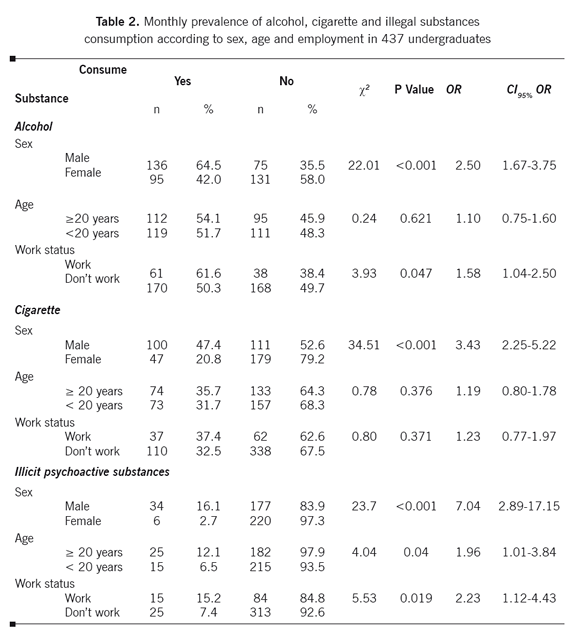
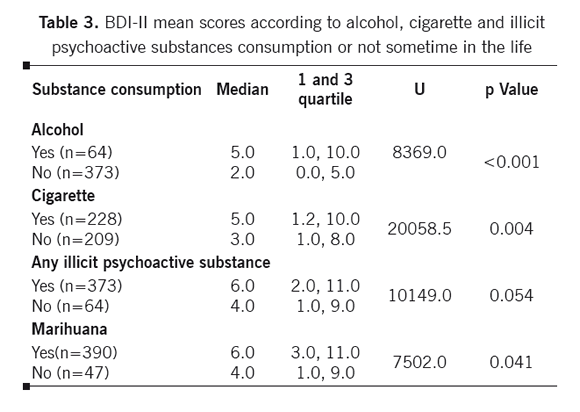
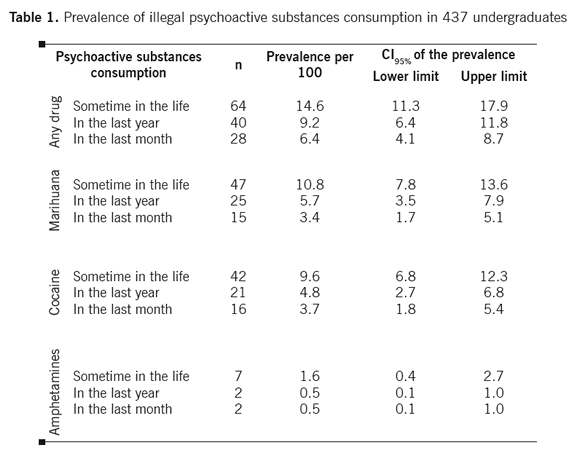
<body><![CDATA[<p><font size="2" face="Verdana">For the statistical analysis data were analyzed trough the SPSS Vr. 17. statistical package. BDI-II sums were obtained. The inner consistency of the instrument was determined through the Cronbach’s alpha. Kolmogorov–Smirov test was obtained to know the distribution of the variables where most of the variables didn’t keep a normal distribution, reason why it was decided to use non parametric statistics. To describe the prevalence of depressive symptoms and psychoactive substances consumption, descriptive statistics were obtained through frequencies and proportions, likewise punctual estimations were calculated to the 95% reliability.</font></p>     <p><font size="2" face="Verdana">To describe the relationship between psychoactive substances consumption with age, gender and employment, the Square Chi test was applied and the strength of association was evaluated with the Odds Ratio. Finally to verify the research hypothesis, university youths who had consumed drugs show higher depressive symptoms compared to the ones that had never consumed drugs, the U of Mann-Whitney non-parametric test was applied.</font></p>     <p>&nbsp;</p>     <p><font size="3" face="Verdana"><b>RESULTS</b></font></p>     <p><font size="2" face="Verdana">437 college undergraduates participated in the study. Some of the sociodemographic characteristics of the studied sample were: 51.7% were females, most of them single (98.6%), close to a quarter (22.7%) of the surveyed ones, refer to have a remunerated job. The average age of the participants was 20.22±3.6 years of age (minimum=18, maximum=22).</font></p>     <p><font size="2" face="Verdana">Depressive symptoms with higher prevalence in undergraduates were changes in their sleeping habit (55.4%), self criticism (40.7%), loss of appetite (37.8%), concentration difficulties (31.7%), loss of energy and tiredness or fatigue (31.1%). According to the BDI-II the risk of depression in the surveyed students was low in 6.6% ( CI<sub>95%</sub>:4.2%-9.1%), moderate in 3.4% (IC<sub>95%</sub>: 1.7%-5.1%) and severe in 1.8% (IC<sub>95%</sub>: 0.5%-3.1%).</font></p>     <p><font size="2" face="Verdana">In this study, 52.9% (CI<sub>95%</sub>: 48.1%-57.5%) of the students referred having consumed alcohol in the last month, followed by cigarette with 33.6% (CI<sub>95%</sub>: 29.1%-38.0%). <a href="#t1">Table 1</a> shows the prevalence of illegal psychoactive substances consumption sometime in the life, in the last year and in the last month, showing that 14.6% of the participants have consumed any psychoactive substance sometime in their life, 9.2% mentioned having consumed in the last year, and 6.4% in the last month. It is important to highlight that the preferred illegal substance among undergraduates is marihuana, followed by cocaine and amphetamines, with a life prevalence of 10.8%, 9.6% and 1.6% respectively.</font></p>     <p><font size="2" face="Verdana"><img src="/img/revistas/iee/v29n3/v29n3a13t01.png"><a name="t1"></a></font></p>     <p><font size="2" face="Verdana"><a href="#t2">Table 2</a> shows the monthly prevalence of alcohol consumption, cigarette and illicit substances. Showing that for the three substances, consumption was higher in male, in the group age of more than 20 years of age and in the group of people who were employed. These differences were statically significant in the variables: a) gender, where for each female consumer for each of the substances, there were 2.5 men alcohol consumers, 3.4 cigarette, and 7.0 illicit substances. And b) Employment: for alcohol, even though there was statistical significance, the OR CI<sub>95%</sub> crosses the unit, reason why this finding is not reliable, and in the case of illegal substances, 15.2% of the ones who are employed, versus 7.4% of the ones who are not employed, had consumed them in the last month for a 2.23 OR, which implies that per each undergraduate consumer who is not employed, there are 2.23 consumers who are employed.</font></p>     <p><font size="2" face="Verdana"><a href="#t3">Table 3</a> results show that students who have consumed alcohol, cigarette, marihuana or any other illegal substance sometime in their life had a BDI-II mean score higher than non-consumers, and this difference was statistically significant, even though any of the scores went over the minimum level or no depression.</font></p>     ]]></body>
<body><![CDATA[<p><font size="2" face="Verdana">Spearman correlation coefficient results showed that there is a positive and significant relationship between BDI-II score, the number of alcohol cups consumed in a typical day (r<sub>s</sub>=0.168, p&lt;0.001) and the number of cigarettes consumed in one day (r<sub>s</sub>=0.120, p=0.012).</font></p>     <p><font size="2" face="Verdana"><img src="/img/revistas/iee/v29n3/v29n3a13t02.png"><a name="t2"></a></font></p>     <p><font size="2" face="Verdana"><img src="/img/revistas/iee/v29n3/v29n3a13t03.png"><a name="t3"></a></font></p>     <p>&nbsp;</p>     <p><font size="3" face="Verdana"><b>DISCUSSION</b></font></p>     <p><font size="2" face="Verdana">Regarding depressive symptoms in this study, it was observed that the more frequent symptoms were: sleeping disorders, self criticism, loss of appetite, concentration difficulties and loss of energy, highlighting that 12% of the participants had a risk of depression, being the low level the more prevalent. This results are lower to what is reported in two Colombian studies where depressive symptoms were quantified using the Zung scale for depression,<sup>10,15</sup> and a Mexican one,<sup>16</sup> which showed a depressive symptoms prevalence from 28% to 50%. However they agree to mention that low depressive symptoms is the most frequent one among youth. It is important to highlight that the rates shown by our participants are higher than the reported ones in the general Mexican population in the Psychiatric Epidemiology National Survey of 2005,<sup>2</sup> where 8% of the population had had depressive symptoms. Undergraduate’s depressive symptoms in this study can be explained by the relationshi with risk factors of their environment such as love deceptions, failing school, school performance pressures, their professional future uncertainty, in a every time more competitive environment, for the current socio economic situations, and who possibly look for an exit through psychoactive substances and alcohol consumption.<sup>7,17</sup></font></p>     <p><font size="2" face="Verdana">This study showed that 52.9% of the youth refer having consumed alcohol in the last month, these results agree with studies carried out in the young population that have reported an alcohol consumption that goes from 50% in Mexican students<sup>8</sup> to 75% found in Colombian students.<sup>10</sup> These findings show that alcohol consumption is a highly accepted behavior among young undergraduates, and it is a socializing vehicle present in diverse behaviors in the social and student life.</font></p>     <p><font size="2" face="Verdana">Also in our study 14.6% of the undergraduates have consumed any illicit psychoactive drug in their life, the preferred psychoactive substance among undergraduates in marihuana, followed by cocaine and amphetamines. Psychoactive substances consumption sometime in the life is similar to what is reported in studies carried out in the city of Guadalajara Mexico,<sup>18</sup> and other countries such as Colombia,<sup>10</sup> what shows that it is possible that psychoactive substances consumption in the undergraduate population is probably increasing due to its easy access. It is important to highlight that different from other populations, amphetamines are the third drug preferred by the studied population, it has been recently declared that young people have created new low perception social representations of risk, specially "extasis" its presentation as pills or candies with smiley faces or childish shapes can influence in its magical character, fun and harmless additional effects.<sup>19</sup></font></p>     <p><font size="2" face="Verdana">Alcohol consumption, cigarette and illicit psychoactive substances prevalence were higher in men than in women. These data are similar not only in young undergraduate groups,<sup>18</sup> but also in the general population,<sup>3</sup> and populations considered more vulnerable as young gangsters.<sup>20,21</sup> These results are explained because among men, there are some social rules that favor alcohol a and psychoactive drugs consumption, and women have socially more restrictions to perform this type of risk behaviors.<sup>22</sup></font></p>     <p><font size="2" face="Verdana">Alcohol, cigarette and psychoactive substances consumption prevalence was different according to age, highlighting that young men over 20 years of age have a higher consumption prevalence of this substances, confirming the findings in studies carried out in Mexico<sup>18</sup> and Colombia.<sup>23</sup> The latter take us to consider the importance of implementing preventive programs starting the first years of school. The results also reveal that psychoactive substances consumption have an important social component. Substances use is linked with spare time activities, fun and social events in which other people have participated in the provocation of the consumption, It is explained that while age increases, young people are more exposed to other social networks where psychoactive substances consumption can be perceived as socially accepted.<sup>24</sup></font></p>     ]]></body>
<body><![CDATA[<p><font size="2" face="Verdana">Alcohol, cigarette and illicit psychoactive drugs consumption in our study, was higher in the participants who are employed, compared to the ones who are not employed. These results agree with what is reported in the reviewed literature<sup>3,16,20</sup> it is possible that while they increase their economic independency this becomes a facilitating factor for the acquisition of substances among young undergraduates. Also consumption can be associated with the wrong perception that cocaine consumption can favor a higher performance and is probable that young people who work look for illicit psychoactive substances to get a greater job performance, as well as perceiving a higher tolerance of alcohol consumption.<sup>25</sup></font></p>     <p><font size="2" face="Verdana">Finally, in relation to the suggested hypothesis it was shown that the sum of depressive symptoms was positive and significantly related with the number of cups and cigarettes consumed per day. Young people who have consumed alcohol, cigarette and marihuana sometime in their life, show a depressive symptom score significantly higher than young people who have not. These results agree with the reviewed literature, where a relationship between some affective and psychological disorders, among which are depressive symptoms, and psychoactive substances in the young population has been found.<sup>8,10,15,22,26</sup> The latter can be explained in the way in which young people cope with emotional problems, wanting to forget problems, being one of the main reasons for psychoactive substances consumption in young people.<sup>26</sup></font></p>     <p><font size="2" face="Verdana">However it is also explained that the relationship between depression and psychoactive substances consumption can be comorbidity indicators in both conditions.<sup>2</sup></font></p>     <p><font size="2" face="Verdana">Between the limitations of the current research, it has been pointed that, as it is a cross sectional descriptive study, its results just allow to explore the relationship between depressive symptoms and psychoactive substances consumption, which confirmation as risk factor would require of longitudinal and prospective studies.</font></p>     <p><font size="2" face="Verdana">The conclusion of this study is that undergraduates who have consumed alcohol, cigarette, or marihuana sometime in their life, have a higher risk of depression compared to non consumers.</font></p>     <p>&nbsp;</p>     <p><font size="3" face="Verdana"><b>REFERENCES</b> </font>     <!-- ref --><p><font size="2" face="Verdana">1. Brugal MT, Rodr&iacute;guez AM, Villalbi JR. Nuevas y viejas adicciones implicaciones para la salud p&uacute;blica. Gac Sanit. 2006;20(Suppl 1):S55-6.</font>&nbsp;&nbsp;&nbsp;&nbsp;&nbsp;&nbsp;&nbsp;&nbsp;[&#160;<a href="javascript:void(0);" onclick="javascript: window.open('/scielo.php?script=sci_nlinks&ref=000080&pid=S0120-5307201100030001300001&lng=','','width=640,height=500,resizable=yes,scrollbars=1,menubar=yes,');">Links</a>&#160;]<!-- end-ref --><!-- ref --><p><font size="2" face="Verdana">2. M&eacute;xico. Secretar&iacute;a de Salud. Necesidades de salud: da&ntilde;os y riesgos. En: Plan Nacional de Salud 2007-2012. Por un M&eacute;xico sano: construyendo alianzas para una mejor salud. M&eacute;xico D.F: Secretaria de Salud; 2007.</font>&nbsp;&nbsp;&nbsp;&nbsp;&nbsp;&nbsp;&nbsp;&nbsp;[&#160;<a href="javascript:void(0);" onclick="javascript: window.open('/scielo.php?script=sci_nlinks&ref=000081&pid=S0120-5307201100030001300002&lng=','','width=640,height=500,resizable=yes,scrollbars=1,menubar=yes,');">Links</a>&#160;]<!-- end-ref --><!-- ref --><p><font size="2" face="Verdana">3. M&eacute;xico. Consejo Nacional Contra las Adicciones – Secretaria de Salud. Encuesta Nacional de Adicciones. 2008. Cuernavaca: Instituto Nacional de salud P&uacute;blica; 2008.</font>&nbsp;&nbsp;&nbsp;&nbsp;&nbsp;&nbsp;&nbsp;&nbsp;[&#160;<a href="javascript:void(0);" onclick="javascript: window.open('/scielo.php?script=sci_nlinks&ref=000082&pid=S0120-5307201100030001300003&lng=','','width=640,height=500,resizable=yes,scrollbars=1,menubar=yes,');">Links</a>&#160;]<!-- end-ref --><!-- ref --><p><font size="2" face="Verdana">4. Chinchilla AM. La Depresi&oacute;n y sus mascaras aspectos terap&eacute;uticos. Cuernavaca: Editorial M&eacute;dica Panamericana; 2008.</font>&nbsp;&nbsp;&nbsp;&nbsp;&nbsp;&nbsp;&nbsp;&nbsp;[&#160;<a href="javascript:void(0);" onclick="javascript: window.open('/scielo.php?script=sci_nlinks&ref=000083&pid=S0120-5307201100030001300004&lng=','','width=640,height=500,resizable=yes,scrollbars=1,menubar=yes,');">Links</a>&#160;]<!-- end-ref --><!-- ref --><p><font size="2" face="Verdana">5. American Psychiatric Association. DSM-IV: Diagnostic and statistical manual of mental disorders. Washington: American Psychiatric Association; 2002.</font>&nbsp;&nbsp;&nbsp;&nbsp;&nbsp;&nbsp;&nbsp;&nbsp;[&#160;<a href="javascript:void(0);" onclick="javascript: window.open('/scielo.php?script=sci_nlinks&ref=000084&pid=S0120-5307201100030001300005&lng=','','width=640,height=500,resizable=yes,scrollbars=1,menubar=yes,');">Links</a>&#160;]<!-- end-ref --><!-- ref --><p><font size="2" face="Verdana">6. Beck A, Rush AJ, Shaw BF, Emery G. Cognitive therapy of depression. New York: The Guilford Press; 1979.</font>&nbsp;&nbsp;&nbsp;&nbsp;&nbsp;&nbsp;&nbsp;&nbsp;[&#160;<a href="javascript:void(0);" onclick="javascript: window.open('/scielo.php?script=sci_nlinks&ref=000085&pid=S0120-5307201100030001300006&lng=','','width=640,height=500,resizable=yes,scrollbars=1,menubar=yes,');">Links</a>&#160;]<!-- end-ref --><!-- ref --><p><font size="2" face="Verdana">7. Stuart GW, Laraia MT. Enfermer&iacute;a psiqui&aacute;trica: principios y pr&aacute;ctica. 8a ed. Madrid: Elsevier Espa&ntilde;a S.A; 2006.</font>&nbsp;&nbsp;&nbsp;&nbsp;&nbsp;&nbsp;&nbsp;&nbsp;[&#160;<a href="javascript:void(0);" onclick="javascript: window.open('/scielo.php?script=sci_nlinks&ref=000086&pid=S0120-5307201100030001300007&lng=','','width=640,height=500,resizable=yes,scrollbars=1,menubar=yes,');">Links</a>&#160;]<!-- end-ref --><!-- ref --><p><font size="2" face="Verdana">8. Arrellanes JL, D&iacute;az B, Wagner F, P&eacute;rez V. Factores psicosociales asociados con el abuso y la dependencia de sustancia psicoactivas entre adolescentes: an&aacute;lisis bivariados de un estudio de casos y controles. Salud Ment. 2004;27(3):54-64.</font>&nbsp;&nbsp;&nbsp;&nbsp;&nbsp;&nbsp;&nbsp;&nbsp;[&#160;<a href="javascript:void(0);" onclick="javascript: window.open('/scielo.php?script=sci_nlinks&ref=000087&pid=S0120-5307201100030001300008&lng=','','width=640,height=500,resizable=yes,scrollbars=1,menubar=yes,');">Links</a>&#160;]<!-- end-ref --><!-- ref --><p><font size="2" face="Verdana">9. Rodr&iacute;guez R. Des&oacute;rdenes de la personalidad y abuso de substancias. Metro Ciencia. 1996;5(3):17-21.</font>&nbsp;&nbsp;&nbsp;&nbsp;&nbsp;&nbsp;&nbsp;&nbsp;[&#160;<a href="javascript:void(0);" onclick="javascript: window.open('/scielo.php?script=sci_nlinks&ref=000088&pid=S0120-5307201100030001300009&lng=','','width=640,height=500,resizable=yes,scrollbars=1,menubar=yes,');">Links</a>&#160;]<!-- end-ref --><!-- ref --><p><font size="2" face="Verdana">10. Rodr&iacute;guez DC, Dallos CM, Gonz&aacute;lez SJ, S&aacute;nchez ZM, D&iacute;az LA, Rueda GE et al. Asociaci&oacute;n entre s&iacute;ntomas depresivos y consumo abusivo de alcohol en estudiantes de Bucaramanga, Colombia. Cad. Saude P&uacute;blica. 2008;21(5):1402-7.</font>&nbsp;&nbsp;&nbsp;&nbsp;&nbsp;&nbsp;&nbsp;&nbsp;[&#160;<a href="javascript:void(0);" onclick="javascript: window.open('/scielo.php?script=sci_nlinks&ref=000089&pid=S0120-5307201100030001300010&lng=','','width=640,height=500,resizable=yes,scrollbars=1,menubar=yes,');">Links</a>&#160;]<!-- end-ref --><!-- ref --><p><font size="2" face="Verdana">11. De la Garza F. Depresi&oacute;n en la infancia y adolescencia. M&eacute;xico, D.F.: Trillas; 2007.</font>&nbsp;&nbsp;&nbsp;&nbsp;&nbsp;&nbsp;&nbsp;&nbsp;[&#160;<a href="javascript:void(0);" onclick="javascript: window.open('/scielo.php?script=sci_nlinks&ref=000090&pid=S0120-5307201100030001300011&lng=','','width=640,height=500,resizable=yes,scrollbars=1,menubar=yes,');">Links</a>&#160;]<!-- end-ref --><!-- ref --><p><font size="2" face="Verdana">12. Hern&aacute;n M, Fern&aacute;ndez A, Ramos M. Salud de los j&oacute;venes. Gac Sanit. 2004;18(Suppl 1):S47-55.</font>&nbsp;&nbsp;&nbsp;&nbsp;&nbsp;&nbsp;&nbsp;&nbsp;[&#160;<a href="javascript:void(0);" onclick="javascript: window.open('/scielo.php?script=sci_nlinks&ref=000091&pid=S0120-5307201100030001300012&lng=','','width=640,height=500,resizable=yes,scrollbars=1,menubar=yes,');">Links</a>&#160;]<!-- end-ref --><!-- ref --><p><font size="2" face="Verdana">13. Polit DF, Hungler BP. Investigaci&oacute;n cient&iacute;fica en ciencias de la salud. 6<sup>a</sup> ed. M&eacute;xico, D.F.: McGraw Hill Interamericana; 2000.</font>&nbsp;&nbsp;&nbsp;&nbsp;&nbsp;&nbsp;&nbsp;&nbsp;[&#160;<a href="javascript:void(0);" onclick="javascript: window.open('/scielo.php?script=sci_nlinks&ref=000092&pid=S0120-5307201100030001300013&lng=','','width=640,height=500,resizable=yes,scrollbars=1,menubar=yes,');">Links</a>&#160;]<!-- end-ref --><!-- ref --><p><font size="2" face="Verdana">14. M&eacute;xico. Secretar&iacute;a de Salud. Norma Oficial Mexicana NOM-028-SSA2-1999, para la prevenci&oacute;n, tratamiento y control de las adicciones. M&eacute;xico: Secretar&iacute;a de Salud; 1999.</font>&nbsp;&nbsp;&nbsp;&nbsp;&nbsp;&nbsp;&nbsp;&nbsp;[&#160;<a href="javascript:void(0);" onclick="javascript: window.open('/scielo.php?script=sci_nlinks&ref=000093&pid=S0120-5307201100030001300014&lng=','','width=640,height=500,resizable=yes,scrollbars=1,menubar=yes,');">Links</a>&#160;]<!-- end-ref --><!-- ref --><p><font size="2" face="Verdana">15. Campos-Arias A, D&iacute;az CE, Cogollo Z. Factores asociados a s&iacute;ntomas depresivos con importancia cl&iacute;nica en estudiantes de Cartagena, Colombia: un an&aacute;lisis diferencial por sexo. Rev Colomb Psiquiatr. 2006; 35(2):167-83.</font>&nbsp;&nbsp;&nbsp;&nbsp;&nbsp;&nbsp;&nbsp;&nbsp;[&#160;<a href="javascript:void(0);" onclick="javascript: window.open('/scielo.php?script=sci_nlinks&ref=000094&pid=S0120-5307201100030001300015&lng=','','width=640,height=500,resizable=yes,scrollbars=1,menubar=yes,');">Links</a>&#160;]<!-- end-ref --><!-- ref --><p><font size="2" face="Verdana">16. Ceballos JJ, Ochoa J, Cortez PE. Depresi&oacute;n en la adolescencia, su relaci&oacute;n con actividad deportiva y consumo de sustancia psicoactivas. Rev Med IMSS. 2000;38(5):371-9.</font>&nbsp;&nbsp;&nbsp;&nbsp;&nbsp;&nbsp;&nbsp;&nbsp;[&#160;<a href="javascript:void(0);" onclick="javascript: window.open('/scielo.php?script=sci_nlinks&ref=000095&pid=S0120-5307201100030001300016&lng=','','width=640,height=500,resizable=yes,scrollbars=1,menubar=yes,');">Links</a>&#160;]<!-- end-ref --><!-- ref --><p><font size="2" face="Verdana">17. Gonz&aacute;lez –Llera F. Ps&iacute;quico-conductales. En: Chinchilla AM. La depresi&oacute;n y sus mascaras aspectos terap&eacute;uticos. Cuernavaca: Editorial M&eacute;dica Panamericana; 2008. p.153-64.</font>&nbsp;&nbsp;&nbsp;&nbsp;&nbsp;&nbsp;&nbsp;&nbsp;[&#160;<a href="javascript:void(0);" onclick="javascript: window.open('/scielo.php?script=sci_nlinks&ref=000096&pid=S0120-5307201100030001300017&lng=','','width=640,height=500,resizable=yes,scrollbars=1,menubar=yes,');">Links</a>&#160;]<!-- end-ref --><!-- ref --><p><font size="2" face="Verdana">18. Ch&aacute;vez-Hern&aacute;ndez AM, Mac&iacute;as-Garc&iacute;a LF, P&aacute;ramo-Castillo D, Mart&iacute;nez C, Ojeda D. Consumo de Sustancia psicoactivas en estudiantes del Nivel Medio Superior de la Universidad de Guanajuato. Acta Univ. 2005;15(1):13-21.</font>&nbsp;&nbsp;&nbsp;&nbsp;&nbsp;&nbsp;&nbsp;&nbsp;[&#160;<a href="javascript:void(0);" onclick="javascript: window.open('/scielo.php?script=sci_nlinks&ref=000097&pid=S0120-5307201100030001300018&lng=','','width=640,height=500,resizable=yes,scrollbars=1,menubar=yes,');">Links</a>&#160;]<!-- end-ref --><!-- ref --><p><font size="2" face="Verdana">19. Centros de Integraci&oacute;n Juvenil. Metanfetaminas: lo que los padres deben saber. M&eacute;xico D.F.: CIJ; 2009.</font>&nbsp;&nbsp;&nbsp;&nbsp;&nbsp;&nbsp;&nbsp;&nbsp;[&#160;<a href="javascript:void(0);" onclick="javascript: window.open('/scielo.php?script=sci_nlinks&ref=000098&pid=S0120-5307201100030001300019&lng=','','width=640,height=500,resizable=yes,scrollbars=1,menubar=yes,');">Links</a>&#160;]<!-- end-ref --><!-- ref --><p><font size="2" face="Verdana">20. Guzm&aacute;n-Facundo FR, Pedrao JL. Personal and interpersonal risk factors in the consumption of illicit drugs by marginal adolescents and young people from juvenile gangs. Rev Latino-Am Enfermagem. 2008;16(3):368-74.</font>&nbsp;&nbsp;&nbsp;&nbsp;&nbsp;&nbsp;&nbsp;&nbsp;[&#160;<a href="javascript:void(0);" onclick="javascript: window.open('/scielo.php?script=sci_nlinks&ref=000099&pid=S0120-5307201100030001300020&lng=','','width=640,height=500,resizable=yes,scrollbars=1,menubar=yes,');">Links</a>&#160;]<!-- end-ref --><!-- ref --><p><font size="2" face="Verdana">21. Guzm&aacute;n-Facundo FR, L&oacute;pez-Garc&iacute;a K, Alonso-Castillo MM, Arevalo CA, Corral AO. Depresi&oacute;n y Consumo de sustancia psicoactivas ilegales en poblaci&oacute;n juvenil marginal; comparaci&oacute;n entre consumidores y no consumidores. Rev Cient Electron Psicol. 2009;7:97-111.</font>&nbsp;&nbsp;&nbsp;&nbsp;&nbsp;&nbsp;&nbsp;&nbsp;[&#160;<a href="javascript:void(0);" onclick="javascript: window.open('/scielo.php?script=sci_nlinks&ref=000100&pid=S0120-5307201100030001300021&lng=','','width=640,height=500,resizable=yes,scrollbars=1,menubar=yes,');">Links</a>&#160;]<!-- end-ref --><!-- ref --><p><font size="2" face="Verdana">22. Hanson G, Venturelli PJ. Drugs and society. 6<sup>a</sup> ed. United States of America: Jones and Barlett Publishers Inc; 2001.</font>&nbsp;&nbsp;&nbsp;&nbsp;&nbsp;&nbsp;&nbsp;&nbsp;[&#160;<a href="javascript:void(0);" onclick="javascript: window.open('/scielo.php?script=sci_nlinks&ref=000101&pid=S0120-5307201100030001300022&lng=','','width=640,height=500,resizable=yes,scrollbars=1,menubar=yes,');">Links</a>&#160;]<!-- end-ref --><!-- ref --><p><font size="2" face="Verdana">23. C&aacute;ceres D, Salazar I, Varela M, Tovar J. Consumo de drogas en j&oacute;venes universitarios y su relaci&oacute;n de riesgo y protecci&oacute;n con factores psicosociales. Univ Psychol. 2006;5(3):521-34.</font>&nbsp;&nbsp;&nbsp;&nbsp;&nbsp;&nbsp;&nbsp;&nbsp;[&#160;<a href="javascript:void(0);" onclick="javascript: window.open('/scielo.php?script=sci_nlinks&ref=000102&pid=S0120-5307201100030001300023&lng=','','width=640,height=500,resizable=yes,scrollbars=1,menubar=yes,');">Links</a>&#160;]<!-- end-ref --><!-- ref --><p><font size="2" face="Verdana">24. Rodr&iacute;guez KS, D&iacute;az ND, Gracia GS, Guerrero HJ, G&oacute;mez ME. Capacidad predictiva de la teor&iacute;a de la conducta planificada en la intenci&oacute;n y uso de drogas il&iacute;citas entre estudiantes mexicanos. Salud Ment. 2007;30(1):68-81.</font>&nbsp;&nbsp;&nbsp;&nbsp;&nbsp;&nbsp;&nbsp;&nbsp;[&#160;<a href="javascript:void(0);" onclick="javascript: window.open('/scielo.php?script=sci_nlinks&ref=000103&pid=S0120-5307201100030001300024&lng=','','width=640,height=500,resizable=yes,scrollbars=1,menubar=yes,');">Links</a>&#160;]<!-- end-ref --><!-- ref --><p><font size="2" face="Verdana">25. Guzm&aacute;n-Facundo FR, Pedro LJ, L&oacute;pez-Garc&iacute;a KS, Alonso-Castillo MM, Esparza-Almanza SE. El consumo de drogas como una pr&aacute;ctica cultural. Rev Latino-Am Enfermagem. 2011;19(Supp1):S839-47.</font>&nbsp;&nbsp;&nbsp;&nbsp;&nbsp;&nbsp;&nbsp;&nbsp;[&#160;<a href="javascript:void(0);" onclick="javascript: window.open('/scielo.php?script=sci_nlinks&ref=000104&pid=S0120-5307201100030001300025&lng=','','width=640,height=500,resizable=yes,scrollbars=1,menubar=yes,');">Links</a>&#160;]<!-- end-ref --><!-- ref --><p><font size="2" face="Verdana">26. Rey JM, Sawyer MG, Raphael B, Patton GC, Lynskey M. Mental health of teenagers who use cannabis. Results of an Australian surve. Br J Psychiatr. 2002;180:216-21.</font>&nbsp;&nbsp;&nbsp;&nbsp;&nbsp;&nbsp;&nbsp;&nbsp;[&#160;<a href="javascript:void(0);" onclick="javascript: window.open('/scielo.php?script=sci_nlinks&ref=000105&pid=S0120-5307201100030001300026&lng=','','width=640,height=500,resizable=yes,scrollbars=1,menubar=yes,');">Links</a>&#160;]<!-- end-ref --><p>&nbsp;</p> <hr noshade>     <p><font size="2" face="Verdana"><b>Fecha de Recibido</b>: 24 de junio de 2010. <b>   Fecha       de Aprobado</b>: 16 de agosto de 2011.</font></p>       ]]></body><back>
<ref-list>
<ref id="B1">
<label>1</label><nlm-citation citation-type="journal">
<person-group person-group-type="author">
<name>
<surname><![CDATA[Brugal]]></surname>
<given-names><![CDATA[MT]]></given-names>
</name>
<name>
<surname><![CDATA[Rodríguez]]></surname>
<given-names><![CDATA[AM]]></given-names>
</name>
<name>
<surname><![CDATA[Villalbi]]></surname>
<given-names><![CDATA[JR]]></given-names>
</name>
</person-group>
<article-title xml:lang="es"><![CDATA[Nuevas y viejas adicciones implicaciones para la salud pública]]></article-title>
<source><![CDATA[Gac Sanit]]></source>
<year>2006</year>
<volume>20</volume>
<numero>^s1</numero>
<issue>^s1</issue>
<supplement>1</supplement>
<page-range>S55-6</page-range></nlm-citation>
</ref>
<ref id="B2">
<label>2</label><nlm-citation citation-type="book">
<collab>México^dSecretaría de Salud</collab>
<article-title xml:lang="es"><![CDATA[Necesidades de salud: daños y riesgos]]></article-title>
<collab>Plan Nacional de Salud 2007-2012</collab>
<source><![CDATA[Por un México sano: construyendo alianzas para una mejor salud]]></source>
<year>2007</year>
<publisher-loc><![CDATA[México D.F ]]></publisher-loc>
<publisher-name><![CDATA[Secretaria de Salud]]></publisher-name>
</nlm-citation>
</ref>
<ref id="B3">
<label>3</label><nlm-citation citation-type="book">
<collab>México^dConsejo Nacional Contra las Adicciones - Secretaria de Salud</collab>
<source><![CDATA[Encuesta Nacional de Adicciones]]></source>
<year>2008</year>
<publisher-loc><![CDATA[2008. Cuernavaca ]]></publisher-loc>
<publisher-name><![CDATA[Instituto Nacional de salud Pública]]></publisher-name>
</nlm-citation>
</ref>
<ref id="B4">
<label>4</label><nlm-citation citation-type="book">
<person-group person-group-type="author">
<name>
<surname><![CDATA[Chinchilla]]></surname>
<given-names><![CDATA[AM]]></given-names>
</name>
</person-group>
<source><![CDATA[La Depresión y sus mascaras aspectos terapéuticos]]></source>
<year>2008</year>
<publisher-loc><![CDATA[Cuernavaca ]]></publisher-loc>
<publisher-name><![CDATA[Editorial Médica Panamericana]]></publisher-name>
</nlm-citation>
</ref>
<ref id="B5">
<label>5</label><nlm-citation citation-type="book">
<collab>American Psychiatric Association</collab>
<source><![CDATA[DSM-IV: Diagnostic and statistical manual of mental disorders]]></source>
<year>2002</year>
<publisher-loc><![CDATA[Washington ]]></publisher-loc>
<publisher-name><![CDATA[American Psychiatric Association]]></publisher-name>
</nlm-citation>
</ref>
<ref id="B6">
<label>6</label><nlm-citation citation-type="book">
<person-group person-group-type="author">
<name>
<surname><![CDATA[Beck]]></surname>
<given-names><![CDATA[A]]></given-names>
</name>
<name>
<surname><![CDATA[Rush]]></surname>
<given-names><![CDATA[AJ]]></given-names>
</name>
<name>
<surname><![CDATA[Shaw]]></surname>
<given-names><![CDATA[BF]]></given-names>
</name>
<name>
<surname><![CDATA[Emery]]></surname>
<given-names><![CDATA[G]]></given-names>
</name>
</person-group>
<source><![CDATA[Cognitive therapy of depression]]></source>
<year>1979</year>
<publisher-loc><![CDATA[New York ]]></publisher-loc>
<publisher-name><![CDATA[The Guilford Press]]></publisher-name>
</nlm-citation>
</ref>
<ref id="B7">
<label>7</label><nlm-citation citation-type="book">
<person-group person-group-type="author">
<name>
<surname><![CDATA[Stuart]]></surname>
<given-names><![CDATA[GW]]></given-names>
</name>
<name>
<surname><![CDATA[Laraia]]></surname>
<given-names><![CDATA[MT]]></given-names>
</name>
</person-group>
<source><![CDATA[Enfermería psiquiátrica: principios y práctica]]></source>
<year>2006</year>
<edition>8a</edition>
<publisher-loc><![CDATA[Madrid ]]></publisher-loc>
<publisher-name><![CDATA[Elsevier España S.A]]></publisher-name>
</nlm-citation>
</ref>
<ref id="B8">
<label>8</label><nlm-citation citation-type="journal">
<person-group person-group-type="author">
<name>
<surname><![CDATA[Arrellanes]]></surname>
<given-names><![CDATA[JL]]></given-names>
</name>
<name>
<surname><![CDATA[Díaz]]></surname>
<given-names><![CDATA[B]]></given-names>
</name>
<name>
<surname><![CDATA[Wagner]]></surname>
<given-names><![CDATA[F]]></given-names>
</name>
<name>
<surname><![CDATA[Pérez]]></surname>
<given-names><![CDATA[V]]></given-names>
</name>
</person-group>
<article-title xml:lang="es"><![CDATA[Factores psicosociales asociados con el abuso y la dependencia de sustancia psicoactivas entre adolescentes: análisis bivariados de un estudio de casos y controles]]></article-title>
<source><![CDATA[Salud Ment]]></source>
<year>2004</year>
<volume>27</volume>
<numero>3</numero>
<issue>3</issue>
<page-range>54-64</page-range></nlm-citation>
</ref>
<ref id="B9">
<label>9</label><nlm-citation citation-type="journal">
<person-group person-group-type="author">
<name>
<surname><![CDATA[Rodríguez]]></surname>
<given-names><![CDATA[R]]></given-names>
</name>
</person-group>
<article-title xml:lang="es"><![CDATA[Desórdenes de la personalidad y abuso de substancias]]></article-title>
<source><![CDATA[Metro Ciencia]]></source>
<year>1996</year>
<volume>5</volume>
<numero>3</numero>
<issue>3</issue>
<page-range>17-21</page-range></nlm-citation>
</ref>
<ref id="B10">
<label>10</label><nlm-citation citation-type="journal">
<person-group person-group-type="author">
<name>
<surname><![CDATA[Rodríguez]]></surname>
<given-names><![CDATA[DC]]></given-names>
</name>
<name>
<surname><![CDATA[Dallos]]></surname>
<given-names><![CDATA[CM]]></given-names>
</name>
<name>
<surname><![CDATA[González]]></surname>
<given-names><![CDATA[SJ]]></given-names>
</name>
<name>
<surname><![CDATA[Sánchez]]></surname>
<given-names><![CDATA[ZM]]></given-names>
</name>
<name>
<surname><![CDATA[Díaz]]></surname>
<given-names><![CDATA[LA]]></given-names>
</name>
<name>
<surname><![CDATA[Rueda]]></surname>
<given-names><![CDATA[GE]]></given-names>
</name>
</person-group>
<article-title xml:lang="es"><![CDATA[Asociación entre síntomas depresivos y consumo abusivo de alcohol en estudiantes de Bucaramanga, Colombia]]></article-title>
<source><![CDATA[Cad Saude Pública]]></source>
<year>2008</year>
<volume>21</volume>
<numero>5</numero>
<issue>5</issue>
<page-range>1402-7</page-range></nlm-citation>
</ref>
<ref id="B11">
<label>11</label><nlm-citation citation-type="book">
<person-group person-group-type="author">
<name>
<surname><![CDATA[De]]></surname>
<given-names><![CDATA[la Garza F]]></given-names>
</name>
</person-group>
<source><![CDATA[Depresión en la infancia y adolescencia]]></source>
<year>2007</year>
<publisher-loc><![CDATA[México, D.F. ]]></publisher-loc>
<publisher-name><![CDATA[Trillas]]></publisher-name>
</nlm-citation>
</ref>
<ref id="B12">
<label>12</label><nlm-citation citation-type="journal">
<person-group person-group-type="author">
<name>
<surname><![CDATA[Hernán]]></surname>
<given-names><![CDATA[M]]></given-names>
</name>
<name>
<surname><![CDATA[Fernández]]></surname>
<given-names><![CDATA[A]]></given-names>
</name>
<name>
<surname><![CDATA[Ramos]]></surname>
<given-names><![CDATA[M]]></given-names>
</name>
</person-group>
<article-title xml:lang="es"><![CDATA[Salud de los jóvenes]]></article-title>
<source><![CDATA[Gac Sanit]]></source>
<year>2004</year>
<volume>18</volume>
<numero>Suppl 1</numero>
<issue>Suppl 1</issue>
<page-range>S47-55</page-range></nlm-citation>
</ref>
<ref id="B13">
<label>13</label><nlm-citation citation-type="book">
<person-group person-group-type="author">
<name>
<surname><![CDATA[Polit]]></surname>
<given-names><![CDATA[DF]]></given-names>
</name>
<name>
<surname><![CDATA[Hungler]]></surname>
<given-names><![CDATA[BP]]></given-names>
</name>
</person-group>
<source><![CDATA[Investigación científica en ciencias de la salud]]></source>
<year>2000</year>
<edition>6ª</edition>
<publisher-loc><![CDATA[México, D.F. ]]></publisher-loc>
<publisher-name><![CDATA[McGraw Hill Interamericana]]></publisher-name>
</nlm-citation>
</ref>
<ref id="B14">
<label>14</label><nlm-citation citation-type="book">
<collab>México^dSecretaría de Salud</collab>
<source><![CDATA[Norma Oficial Mexicana NOM-028-SSA2-1999, para la prevención, tratamiento y control de las adicciones]]></source>
<year>1999</year>
<publisher-loc><![CDATA[México ]]></publisher-loc>
<publisher-name><![CDATA[Secretaría de Salud]]></publisher-name>
</nlm-citation>
</ref>
<ref id="B15">
<label>15</label><nlm-citation citation-type="journal">
<person-group person-group-type="author">
<name>
<surname><![CDATA[Campos-Arias]]></surname>
<given-names><![CDATA[A]]></given-names>
</name>
<name>
<surname><![CDATA[Díaz]]></surname>
<given-names><![CDATA[CE]]></given-names>
</name>
<name>
<surname><![CDATA[Cogollo]]></surname>
<given-names><![CDATA[Z]]></given-names>
</name>
</person-group>
<article-title xml:lang="es"><![CDATA[Factores asociados a síntomas depresivos con importancia clínica en estudiantes de Cartagena, Colombia: un análisis diferencial por sexo]]></article-title>
<source><![CDATA[Rev Colomb Psiquiatr]]></source>
<year>2006</year>
<volume>35</volume>
<numero>2</numero>
<issue>2</issue>
<page-range>167-83</page-range></nlm-citation>
</ref>
<ref id="B16">
<label>16</label><nlm-citation citation-type="journal">
<person-group person-group-type="author">
<name>
<surname><![CDATA[Ceballos]]></surname>
<given-names><![CDATA[JJ]]></given-names>
</name>
<name>
<surname><![CDATA[Ochoa]]></surname>
<given-names><![CDATA[J]]></given-names>
</name>
<name>
<surname><![CDATA[Cortez]]></surname>
<given-names><![CDATA[PE]]></given-names>
</name>
</person-group>
<article-title xml:lang="es"><![CDATA[Depresión en la adolescencia, su relación con actividad deportiva y consumo de sustancia psicoactivas]]></article-title>
<source><![CDATA[Rev Med IMSS]]></source>
<year>2000</year>
<volume>38</volume>
<numero>5</numero>
<issue>5</issue>
<page-range>371-9</page-range></nlm-citation>
</ref>
<ref id="B17">
<label>17</label><nlm-citation citation-type="book">
<person-group person-group-type="author">
<name>
<surname><![CDATA[González -Llera]]></surname>
<given-names><![CDATA[F]]></given-names>
</name>
</person-group>
<article-title xml:lang="es"><![CDATA[Psíquico-conductales]]></article-title>
<person-group person-group-type="editor">
<name>
<surname><![CDATA[Chinchilla]]></surname>
<given-names><![CDATA[AM]]></given-names>
</name>
</person-group>
<source><![CDATA[La depresión y sus mascaras aspectos terapéuticos]]></source>
<year>2008</year>
<page-range>153-64</page-range><publisher-loc><![CDATA[Cuernavaca ]]></publisher-loc>
<publisher-name><![CDATA[Editorial Médica Panamericana]]></publisher-name>
</nlm-citation>
</ref>
<ref id="B18">
<label>18</label><nlm-citation citation-type="journal">
<person-group person-group-type="author">
<name>
<surname><![CDATA[Chávez-Hernández]]></surname>
<given-names><![CDATA[AM]]></given-names>
</name>
<name>
<surname><![CDATA[Macías-García]]></surname>
<given-names><![CDATA[LF]]></given-names>
</name>
<name>
<surname><![CDATA[Páramo-Castillo]]></surname>
<given-names><![CDATA[D]]></given-names>
</name>
<name>
<surname><![CDATA[Martínez]]></surname>
<given-names><![CDATA[C]]></given-names>
</name>
<name>
<surname><![CDATA[Ojeda]]></surname>
<given-names><![CDATA[D]]></given-names>
</name>
</person-group>
<article-title xml:lang="es"><![CDATA[Consumo de Sustancia psicoactivas en estudiantes del Nivel Medio Superior de la Universidad de Guanajuato]]></article-title>
<source><![CDATA[Acta Univ]]></source>
<year>2005</year>
<volume>15</volume>
<numero>1</numero>
<issue>1</issue>
<page-range>13-21</page-range></nlm-citation>
</ref>
<ref id="B19">
<label>19</label><nlm-citation citation-type="book">
<collab>Centros de Integración Juvenil</collab>
<source><![CDATA[Metanfetaminas: lo que los padres deben saber]]></source>
<year>2009</year>
<publisher-loc><![CDATA[México D.F ]]></publisher-loc>
<publisher-name><![CDATA[CIJ]]></publisher-name>
</nlm-citation>
</ref>
<ref id="B20">
<label>20</label><nlm-citation citation-type="journal">
<person-group person-group-type="author">
<name>
<surname><![CDATA[Guzmán-Facundo]]></surname>
<given-names><![CDATA[FR]]></given-names>
</name>
<name>
<surname><![CDATA[Pedrao]]></surname>
<given-names><![CDATA[JL]]></given-names>
</name>
</person-group>
<article-title xml:lang="en"><![CDATA[Personal and interpersonal risk factors in the consumption of illicit drugs by marginal adolescents and young people from juvenile gangs]]></article-title>
<source><![CDATA[Rev Latino-Am Enfermagem]]></source>
<year>2008</year>
<volume>16</volume>
<numero>3</numero>
<issue>3</issue>
<page-range>368-74</page-range></nlm-citation>
</ref>
<ref id="B21">
<label>21</label><nlm-citation citation-type="journal">
<person-group person-group-type="author">
<name>
<surname><![CDATA[Guzmán-Facundo]]></surname>
<given-names><![CDATA[FR]]></given-names>
</name>
<name>
<surname><![CDATA[López-García]]></surname>
<given-names><![CDATA[K]]></given-names>
</name>
<name>
<surname><![CDATA[Alonso-Castillo]]></surname>
<given-names><![CDATA[MM]]></given-names>
</name>
<name>
<surname><![CDATA[Arevalo]]></surname>
<given-names><![CDATA[CA]]></given-names>
</name>
<name>
<surname><![CDATA[Corral]]></surname>
<given-names><![CDATA[AO]]></given-names>
</name>
</person-group>
<article-title xml:lang="es"><![CDATA[Depresión y Consumo de sustancia psicoactivas ilegales en población juvenil marginal; comparación entre consumidores y no consumidores]]></article-title>
<source><![CDATA[Rev Cient Electron Psicol]]></source>
<year>2009</year>
<volume>7</volume>
<page-range>97-111</page-range></nlm-citation>
</ref>
<ref id="B22">
<label>22</label><nlm-citation citation-type="book">
<person-group person-group-type="author">
<name>
<surname><![CDATA[Hanson]]></surname>
<given-names><![CDATA[G]]></given-names>
</name>
<name>
<surname><![CDATA[Venturelli]]></surname>
<given-names><![CDATA[PJ]]></given-names>
</name>
</person-group>
<source><![CDATA[Drugs and society]]></source>
<year>2001</year>
<edition>6ª</edition>
<publisher-loc><![CDATA[United States of America ]]></publisher-loc>
<publisher-name><![CDATA[Jones and Barlett Publishers Inc]]></publisher-name>
</nlm-citation>
</ref>
<ref id="B23">
<label>23</label><nlm-citation citation-type="journal">
<person-group person-group-type="author">
<name>
<surname><![CDATA[Cáceres]]></surname>
<given-names><![CDATA[D]]></given-names>
</name>
<name>
<surname><![CDATA[Salazar]]></surname>
<given-names><![CDATA[I]]></given-names>
</name>
<name>
<surname><![CDATA[Varela]]></surname>
<given-names><![CDATA[M]]></given-names>
</name>
<name>
<surname><![CDATA[Tovar]]></surname>
<given-names><![CDATA[J]]></given-names>
</name>
</person-group>
<article-title xml:lang="es"><![CDATA[Consumo de drogas en jóvenes universitarios y su relación de riesgo y protección con factores psicosociales]]></article-title>
<source><![CDATA[Univ Psychol]]></source>
<year>2006</year>
<volume>5</volume>
<numero>3</numero>
<issue>3</issue>
<page-range>521-34</page-range></nlm-citation>
</ref>
<ref id="B24">
<label>24</label><nlm-citation citation-type="journal">
<person-group person-group-type="author">
<name>
<surname><![CDATA[Rodríguez]]></surname>
<given-names><![CDATA[KS]]></given-names>
</name>
<name>
<surname><![CDATA[Díaz]]></surname>
<given-names><![CDATA[ND]]></given-names>
</name>
<name>
<surname><![CDATA[Gracia]]></surname>
<given-names><![CDATA[GS]]></given-names>
</name>
<name>
<surname><![CDATA[Guerrero]]></surname>
<given-names><![CDATA[HJ]]></given-names>
</name>
<name>
<surname><![CDATA[Gómez]]></surname>
<given-names><![CDATA[ME]]></given-names>
</name>
</person-group>
<article-title xml:lang="es"><![CDATA[Capacidad predictiva de la teoría de la conducta planificada en la intención y uso de drogas ilícitas entre estudiantes mexicanos]]></article-title>
<source><![CDATA[Salud Ment]]></source>
<year>2007</year>
<volume>30</volume>
<numero>1</numero>
<issue>1</issue>
<page-range>68-81</page-range></nlm-citation>
</ref>
<ref id="B25">
<label>25</label><nlm-citation citation-type="journal">
<person-group person-group-type="author">
<name>
<surname><![CDATA[Guzmán-Facundo]]></surname>
<given-names><![CDATA[FR]]></given-names>
</name>
<name>
<surname><![CDATA[Pedro]]></surname>
<given-names><![CDATA[LJ]]></given-names>
</name>
<name>
<surname><![CDATA[López-García]]></surname>
<given-names><![CDATA[KS]]></given-names>
</name>
<name>
<surname><![CDATA[Alonso-Castillo]]></surname>
<given-names><![CDATA[MM]]></given-names>
</name>
<name>
<surname><![CDATA[Esparza-Almanza]]></surname>
<given-names><![CDATA[SE]]></given-names>
</name>
</person-group>
<article-title xml:lang="es"><![CDATA[El consumo de drogas como una práctica cultural]]></article-title>
<source><![CDATA[Rev Latino-Am Enfermagem]]></source>
<year>2011</year>
<volume>19</volume>
<numero>Supp1</numero>
<issue>Supp1</issue>
<page-range>S839-47</page-range></nlm-citation>
</ref>
<ref id="B26">
<label>26</label><nlm-citation citation-type="journal">
<person-group person-group-type="author">
<name>
<surname><![CDATA[Rey]]></surname>
<given-names><![CDATA[JM]]></given-names>
</name>
<name>
<surname><![CDATA[Sawyer]]></surname>
<given-names><![CDATA[MG]]></given-names>
</name>
<name>
<surname><![CDATA[Raphael]]></surname>
<given-names><![CDATA[B]]></given-names>
</name>
<name>
<surname><![CDATA[Patton]]></surname>
<given-names><![CDATA[GC]]></given-names>
</name>
<name>
<surname><![CDATA[Lynskey]]></surname>
<given-names><![CDATA[M]]></given-names>
</name>
</person-group>
<article-title xml:lang="en"><![CDATA[Mental health of teenagers who use cannabis Results of an Australian surve]]></article-title>
<source><![CDATA[Br J Psychiatr]]></source>
<year>2002</year>
<volume>180</volume>
<page-range>216-21</page-range></nlm-citation>
</ref>
</ref-list>
</back>
</article>