<?xml version="1.0" encoding="ISO-8859-1"?><article xmlns:mml="http://www.w3.org/1998/Math/MathML" xmlns:xlink="http://www.w3.org/1999/xlink" xmlns:xsi="http://www.w3.org/2001/XMLSchema-instance">
<front>
<journal-meta>
<journal-id>0120-5307</journal-id>
<journal-title><![CDATA[Investigación y Educación en Enfermería]]></journal-title>
<abbrev-journal-title><![CDATA[Invest. educ. enferm]]></abbrev-journal-title>
<issn>0120-5307</issn>
<publisher>
<publisher-name><![CDATA[Imprenta Universidad de Antioquia]]></publisher-name>
</publisher>
</journal-meta>
<article-meta>
<article-id>S0120-53072012000200009</article-id>
<title-group>
<article-title xml:lang="en"><![CDATA[Bacteria on the hands of school-age children at a Pediatric Hospitalization Unit]]></article-title>
<article-title xml:lang="es"><![CDATA[Bacterias presentes en las manos de los niños en edad escolar en la Unidad de Internación Pediátrica]]></article-title>
<article-title xml:lang="pt"><![CDATA[Bactérias presentes nas mãos dos meninos em idade escolar na unidade de internação pediátrica]]></article-title>
</title-group>
<contrib-group>
<contrib contrib-type="author">
<name>
<surname><![CDATA[Candido De Almeida]]></surname>
<given-names><![CDATA[Marcela Cristina]]></given-names>
</name>
<xref ref-type="aff" rid="A01"/>
</contrib>
<contrib contrib-type="author">
<name>
<surname><![CDATA[Corrêa]]></surname>
<given-names><![CDATA[Ione]]></given-names>
</name>
<xref ref-type="aff" rid="A02"/>
</contrib>
</contrib-group>
<aff id="A01">
<institution><![CDATA[,Universidad Estadual Paulista Nursing Department ]]></institution>
<addr-line><![CDATA[ ]]></addr-line>
<country>Brazil</country>
</aff>
<aff id="A02">
<institution><![CDATA[,Nursing Department Nursing Department ]]></institution>
<addr-line><![CDATA[ ]]></addr-line>
<country>Brazil</country>
</aff>
<pub-date pub-type="pub">
<day>00</day>
<month>07</month>
<year>2012</year>
</pub-date>
<pub-date pub-type="epub">
<day>00</day>
<month>07</month>
<year>2012</year>
</pub-date>
<volume>30</volume>
<numero>2</numero>
<fpage>241</fpage>
<lpage>244</lpage>
<copyright-statement/>
<copyright-year/>
<self-uri xlink:href="http://www.scielo.org.co/scielo.php?script=sci_arttext&amp;pid=S0120-53072012000200009&amp;lng=en&amp;nrm=iso"></self-uri><self-uri xlink:href="http://www.scielo.org.co/scielo.php?script=sci_abstract&amp;pid=S0120-53072012000200009&amp;lng=en&amp;nrm=iso"></self-uri><self-uri xlink:href="http://www.scielo.org.co/scielo.php?script=sci_pdf&amp;pid=S0120-53072012000200009&amp;lng=en&amp;nrm=iso"></self-uri><abstract abstract-type="short" xml:lang="en"><p><![CDATA[Objective. To estimate the prevalence of bacteria isolated in samples from the hands of school-age children at a hospitalization unit. Methodology. In 2009, strains were cultured from the hands of 90 school-age children at the pediatric hospitalization unit of Hospital Estadual Bauru (São Paulo, Brazil). After culture of the samples, the isolated bacteria were identified. Results. In 98% of the samples taken from the children, bacteria were isolated. Coagulase-negative Staphilococcus was isolated in 64% of the samples, followed by Staphilococcus aureus (5%) and Pseudomonas aeruginosa (1%). Conclusion. In most of the samples from the children's hands, bacteria were isolated. Therefore, educative actions about hygiene habits in- and outside the hospital environment should be reinforced, aimed at children and their companions.]]></p></abstract>
<abstract abstract-type="short" xml:lang="es"><p><![CDATA[Objetivo. Estimar la prevalencia de bacterias aisladas en las manos de los niños en edad escolar en una unidad de internación. Metodología. En 2009 se hicieron cultivos de las manos de 90 niños en edad escolar de la unidad de internación pediátrica del Hospital Estadual Bauru (São Paulo, Brasil). Se hizo cultivo de las muestras y posteriormente se realizó identificación de las bacterias aisladas. Resultados. En el 98% de las muestras tomadas a los niños se hicieron aislamientos de bacterias. Stafilococcus coagulasa negativa se aisló en el 64% de las muestras; Staphilococcus aureus, en un 5%, y Pseudomonas aeruginosa, en un 1%. Conclusión. En la mayor parte de las muestras de las manos de los niños internados se aislaron bacterias, por lo que se deben reforzar las acciones educativas a los niños y a sus acompañantes en relación con los hábitos de higiene en el ambiente hospitalario y fuera de él.]]></p></abstract>
<abstract abstract-type="short" xml:lang="pt"><p><![CDATA[Estimar a prevalência de bactérias isoladas em mostras das mãos dos meninos em idade escolar numa unidade de internação. Metodologia. Em 2009 se fizeram cultivos das mãos de 90 meninos em idade escolar da unidade de internação pediátrica do Hospital Estadual Bauru (São Paulo, Brasil). Fez-se cultivo das mostras e posteriormente se fez identificação das bactérias isoladas. Resultados. No 98% das mostras tomadas aos meninos se fizeram isolamentos de bactérias. Stafilococcus coagulasa negativa se isolou no 64% das mostras, seguiram-lhe Staphilococcus aureus (5%) e Pseudomonas aeruginosa (1%). Conclusão. Na maior parte das mostras das mãos dos meninos internados se isolaram bactérias, pelo que se devem reforçar as ações educativas aos meninos e a seus acompanhantes em relação com os hábitos de higiene no ambiente hospitalar e fora dele.]]></p></abstract>
<kwd-group>
<kwd lng="en"><![CDATA[handwashing]]></kwd>
<kwd lng="en"><![CDATA[cross infection]]></kwd>
<kwd lng="en"><![CDATA[hygiene]]></kwd>
<kwd lng="en"><![CDATA[pediatrics]]></kwd>
<kwd lng="es"><![CDATA[lavado de manos]]></kwd>
<kwd lng="es"><![CDATA[infección hospitalaria]]></kwd>
<kwd lng="es"><![CDATA[higiene]]></kwd>
<kwd lng="es"><![CDATA[pediatría]]></kwd>
<kwd lng="pt"><![CDATA[lavagem de mãos]]></kwd>
<kwd lng="pt"><![CDATA[infecção hospitalar]]></kwd>
<kwd lng="pt"><![CDATA[higiene]]></kwd>
<kwd lng="pt"><![CDATA[pediatria]]></kwd>
</kwd-group>
</article-meta>
</front><body><![CDATA[  <font size="2" face="Verdana">     <p align="right"><b>ART&Iacute;CULO ORIGINAL / ORIGINAL       ARTICLE/ ARTIGO ORIGINAL</b></p>     <p>&nbsp;</p>     <p align="center"><font size="4" face="Verdana"><b>Bacteria on the hands of school-age children at a Pediatric Hospitalization Unit</b></font></p>     <p>&nbsp;</p>     <p align="center"><font size="3" face="Verdana"><b>Bacterias presentes en las manos de los ni&ntilde;os en edad escolar en la Unidad de Internaci&oacute;n Pedi&aacute;trica</b></font></p>     <p>&nbsp;</p>     <p align="center"><font size="3" face="Verdana"><b>Bact&eacute;rias presentes nas m&atilde;os dos meninos em idade escolar na unidade de interna&ccedil;&atilde;o pedi&aacute;trica</b></font></p>     <p>&nbsp;</p>     <p>&nbsp;</p>     ]]></body>
<body><![CDATA[<p><b>Marcela Cristina Candido De Almeida<sup>1</sup>; Ione Corr&ecirc;a<sup>2</sup></b></p>     <p>&nbsp;</p>      <p><sup>1</sup> RN, M.Sc. Nursing Department, Botucatu Medical School, Universidad Estadual Paulista (UNESP), Brazil. email: <a href="mailto:almeida_ma@hotmail.com">almeida_ma@hotmail.com</a>.</p>     <p><sup>2</sup> RN, Ph.D. Professor, Nursing Department, Botucatu Medical School, UNESP, Brazil. email: <a href="mailto:icorrea@fmb.unesp.br">icorrea@fmb.unesp.br</a>.</p>     <p>&nbsp;</p>     <p><b>Receipt date: </b>April 25<sup>th</sup> 2011. <b>Approval date: </b>March 23<sup>rd</sup> 2012.</p>     <p>&nbsp;</p>     <p><b>Subventions:</b> FUNDUNESP.</p>     <p><b>Conflicts of interest:</b> none.</p>     <p><b>How to cite this article:</b> Almeida MCC, Corr&ecirc;a I. Bacteria on the hands of schoolage children at a Pediatric Hospitalization Unit. Invest Educ Enferm. 2012;30(2): 240-244.</p>     ]]></body>
<body><![CDATA[<p>&nbsp;</p> <hr noshade>     <p><b>ABSTRACT</b></p>     <p><b>Objective.</b> To estimate the prevalence of bacteria isolated in samples from the hands of school-age children at a hospitalization unit. <b>Methodology.</b> In 2009, strains were cultured from the hands of 90 school-age children at the pediatric hospitalization unit of Hospital Estadual Bauru (S&atilde;o Paulo, Brazil). After culture of the samples, the isolated bacteria were identified. <b>Results.</b> In 98% of the samples taken from the children, bacteria were isolated. <i>Coagulase-negative Staphilococcus</i> was isolated in 64% of the samples, followed by <i>Staphilococcus aureus</i> (5%) and <i>Pseudomonas aeruginosa</i> (1%). <b>Conclusion.</b> In most of the samples from the children's hands, bacteria were isolated. Therefore, educative actions about hygiene habits in- and outside the hospital environment should be reinforced, aimed at children and their companions.</p>     <p><b>Key words: </b><i>handwashing; cross infection; hygiene; pediatrics.</i></p> <hr noshade>     <p><b>RESUMEN</b></p>     <p><b>Objetivo.</b> Estimar la prevalencia de bacterias aisladas en las manos de los ni&ntilde;os en edad escolar en una unidad de internaci&oacute;n. <b>Metodolog&iacute;a.</b> En 2009 se hicieron cultivos de las manos de 90 ni&ntilde;os en edad escolar de la unidad de internaci&oacute;n pedi&aacute;trica del Hospital Estadual Bauru (S&atilde;o Paulo, Brasil). Se hizo cultivo de las muestras y posteriormente se realiz&oacute; identificaci&oacute;n de las bacterias aisladas. <b>Resultados.</b> En el 98% de las muestras tomadas a los ni&ntilde;os se hicieron aislamientos de bacterias. <i>Stafilococcus coagulasa negativa</i> se aisl&oacute; en el 64% de las muestras; <i>Staphilococcus aureus</i>, en un 5%, y <i>Pseudomonas aeruginosa</i>, en un 1%. <b>Conclusi&oacute;n.</b> En la mayor parte de las muestras de las manos de los ni&ntilde;os internados se aislaron bacterias, por lo que se deben reforzar las acciones educativas a los ni&ntilde;os y a sus acompa&ntilde;antes en relaci&oacute;n con los h&aacute;bitos de higiene en el ambiente hospitalario y fuera de &eacute;l.</p>     <p><b>Palabras clave: </b><i>lavado de manos; infecci&oacute;n hospitalaria; higiene; pediatr&iacute;a</i></p> <hr noshade>     <p><b>RESUMO</b></p>     <p><b>Objetivo.</b> Estimar a preval&ecirc;ncia de bact&eacute;rias isoladas em mostras das m&atilde;os dos meninos em idade escolar numa unidade de interna&ccedil;&atilde;o. <b>Metodologia.</b> Em 2009 se fizeram cultivos das m&atilde;os de 90 meninos em idade escolar da unidade de interna&ccedil;&atilde;o pedi&aacute;trica do Hospital Estadual Bauru (S&atilde;o Paulo, Brasil). Fez-se cultivo das mostras e posteriormente se fez identifica&ccedil;&atilde;o das bact&eacute;rias isoladas. <b>Resultados.</b> No 98% das mostras tomadas aos meninos se fizeram isolamentos de bact&eacute;rias. <i>Stafilococcus coagulasa negativa</i> se isolou no 64% das mostras, seguiram-lhe <i>Staphilococcus aureus</i> (5%) e <i>Pseudomonas aeruginosa</i> (1%). <b>Conclus&atilde;o.</b> Na maior parte das mostras das m&atilde;os dos meninos internados se isolaram bact&eacute;rias, pelo que se devem refor&ccedil;ar as a&ccedil;&otilde;es educativas aos meninos e a seus acompanhantes em rela&ccedil;&atilde;o com os h&aacute;bitos de higiene no ambiente hospitalar e fora dele.</p>     <p><b>Palavras chaves: </b><i>lavagem de m&atilde;os; infec&ccedil;&atilde;o hospitalar; higiene; pediatria.</i></p> <hr noshade>     ]]></body>
<body><![CDATA[<p>&nbsp;</p>     <p>&nbsp;</p>     <p><font size="3" face="Verdana"><b>INTRODUCTION</b></font></p>     <p>Hand washing is considered the simplest and most economical measure to prevent healthcare related infections.<sup>1</sup> The population should adopt the hand washing habit as early as in childhood. This practice is important, takes little time, is cheap and prevents several illnesses, including virus and bacteria-borne diseases.</p>     <p>A survey on hand washing habits, involving 227 mothers of children between 4 and 12 years of age in Brazil,<sup>2</sup> showed that 65% of children have fecal coliforms on their hands, and that one in every four mothers guarantees that their children wash their hands after using the bathroom.</p>     <p>According to UNICEF data, 3.5 million children under five years of age die every year due to diarrheic disease and acute respiratory infections.<sup>3</sup></p>     <p>Bacteria colonize the human skin. Hand microbiota includes transitory and resident bacteria. Most infections are frequently caught through contact with patients or contaminated surfaces and caused by transitory germs that colonize the upper skin layer. They can more easily be removed through hand washing. Resident flora, located in deeper skin layers, is more difficult to remove and normally is not associated with cross-infections.<sup>4</sup></p>     <p>Various publications exist in which the importance of hand washing among health professionals is discussed,<sup>5-13</sup> but there is a lack of studies on the same theme among health service users.</p>     <p>The aim of this study was to estimate the prevalence of bacteria present on the hands of school-age children at the pediatric hospitalization unit of Hospital Estadual Bauru.</p>     <p>&nbsp;</p>     ]]></body>
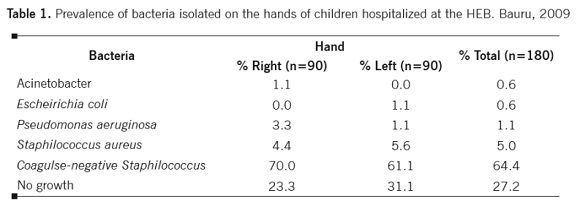
<body><![CDATA[<p><font size="3" face="Verdana"><b>METODOLOGY</b></font></p>     <p>A descriptive and cross-sectional study was developed in 2009. The convenience sample included 90 children between six and ten years of age.</p>     <p>The study was developed at Hospital Estadual Bauru (HEB), a health institution that uses resources from the S&atilde;o Paulo State Health Secretary. The Hospital Estadual Bauru offers a pediatric hospitalization service with 44 beds (11 intensive care and 33 internal medicine and surgery), including three isolation beds. This hospitalization unit includes a toy library that is open 24-hours per day and provides leisure and entertainment to children and their companions. Activities are scheduled and oriented and supervised by the hospital psychologist, some residents and volunteers.</p>     <p>No washing routine exists for the toys used at the toy library. The volunteers only disinfect some toys with 70% alcohol and dry them with clean cloths. The use of plastic toys and history books, comics and magazines is permitted, in accordance with the orientations of the hospital's Hospital Infection Control Service. The inclusion criteria were: child between six and 10 years of age, hospitalized for at least 24 hours at the HEB and companion's signature of the informed consent term. Samples were collected from the children's two hands, using sterile swabs.</p>     <p>In total, 90 children were observed, equivalent to 180 samples. Stuart transport medium was used. The samples were analyzed at the hospital's clinical analysis laboratory to identify the microorganisms according to its protocol, which included seeding on Petri dishes in Agar MacConkey and Manitol culture media, followed by 24 hours of incubation at 37&#176;, after which the presence or absence of bacterial growth was analyzed. In case of non-growth, samples were incubated for an additional 24 hours and, if no microorganisms grew, the sample was considered negative. If bacterial colonies were present, morphology and staining characteristics were analyzed through Gram colonization, followed by the respective identification tests in line with the laboratory protocol. Bacterial prevalence was calculated by dividing the number of samples in which the bacteria was isolated by the total number of samples. The result of this quotient was multiplied by 100.</p>     <p>This research received approval from the Research Ethics Committee at Botucatu Medical School (No. 2971-2008). The children's companions or responsible caregivers were invited to permit the children's participation in the study and, after explanations, they signed the informed consent term.</p>     <p>&nbsp;</p>     <p><font size="3" face="Verdana"><b>RESULTS</b></font></p>     <p>In the sample of 90 children, 61.1% were male. In total, 52.2% of the children's hospitalizations were due to surgery (52.2%) and the remainder (48.8%) to clinical reasons. Concerning the hands, bacterial growth was found on 77.7% of right and 68.8% of left hands (X<sup>2</sup>=1.82, p=0.177). The analysis of hands per gender revealed statistically significant differences: for the right hands, 51.1% of girls and 85.5% of boys showed bacterial growth, against 51.1% of girls and 70.9% of boys for the left hands (right: X<sup>2</sup>=13.90, p&#60;0.001 and left: X<sup>2</sup>=4.14, p=0.04)</p>     <p>No bacteria were isolated from any of both hands in only two children (2.3%), 25 (27.7%) showed the growth of microorganisms on one hand and, among the remaining 63 (70.0%) bacteria were isolated from both hands (the same microorganism in 59 and different ones in four children).</p>     ]]></body>
<body><![CDATA[<p><i>Coagulase-negative Staphilococcus</i> was the most isolated bacteria in all samples (64.4%), followed by <i>Staphilococcus aureus</i> (5.0%). <a href="#t1">Table 1</a> displays the prevalence levels of bacteria isolated on the right and left hands.</p>     <p align="center"><a name="t1"></a><img src="/img/revistas/iee/v30n2/v30n02a09t01.png"></p>     <p>In two samples, <i>Coagulase-negative Staphilococcus</i> and <i>Pseudomonas</i> were found simultaneously, both on the right hand.</p>      <p>&nbsp;</p>      <p><font size="3" face="Verdana"><b>DISCUSSION</b></font></p>     <p>The hands are one of the most concerning vehicles in the transmission of microorganisms and hand hygiene is related with reduced infection risks among hospitalized children.</p>     <p>The results obtained in this research show that bacteria were isolated in 98% of hospitalized children, higher than the results Ray <i>et al.</i><sup>14</sup> reported among Hindu school-age children. In this study, <i>Coagulase-negative Staphilococcus</i> was the most isolated pathogen (64.4%), followed by S. aureus (5.0%). For Ray <i>et al.</i><sup>14</sup>, the most frequent microorganism was S. <i>aureus</i> with 44.0%. These results underline that hands serve as vehicles to transmit microorganisms, which makes the hand washing technique fundamental for control purposes.</p>     <p>The difference between the bacterial growth results obtained for the right and left hands, with higher prevalence rates of pathogens on both hands among males in comparison with females, could be associated with development characteristics: boys develop different kinds of games, generally involving body contact (fights and pushes) and explore the environment with the help of their hands, while girls consider bodily hygiene more important.<sup>15-17</sup></p>     <p>Health education is one of the core strategies to reduce HAI. Therefore, adult orientation and supervision in some hygiene practices is fundamental.<sup>18</sup> The present study results suggest that hand washing habits may not be present among adults, and therefore is not required of the children. This situation has been confirmed in some studies, indicating that adults are not good models for this practice, including kindergarten educators<sup>20</sup> and even health staff.<sup>7,11,19,20</sup> Adults should encourage children concerning basic hygiene principles and uphold these as values and principles in their education.<sup>21</sup></p>     <p>In conclusion, bacteria were isolated in most of the samples from the hands of hospitalized children. Therefore, educative actions about hygiene habits in- and outside the hospital environment should be reinforced, aimed at children and their companions.</p>     ]]></body>
<body><![CDATA[<p>&nbsp;</p>      <p><font size="3" face="Verdana"><b>REFERENCES</b></font></p>      <!-- ref --><p>1. Centers for Disease Control and Prevention. Influenza A (H1N1). &#91;Internet&#93;. Atlanta: Centers for Disease Control and Prevention; 2003 &#91;cited 2009 September 22&#93;. Avalaible in: <a href="http://www.cdc.gov/flu/weekly/" target="_blank">http://www.cdc.gov/flu/weekly/</a>&nbsp;&nbsp;&nbsp;&nbsp;&nbsp;&nbsp;&nbsp;&nbsp;[&#160;<a href="javascript:void(0);" onclick="javascript: window.open('/scielo.php?script=sci_nlinks&ref=000065&pid=S0120-5307201200020000900001&lng=','','width=640,height=500,resizable=yes,scrollbars=1,menubar=yes,');">Links</a>&#160;]<!-- end-ref --><!-- ref --><p>2. Figueiredo CE. Import&acirc;ncia de lavar as m&atilde;os desde a inf&acirc;ncia.Higieniza&ccedil;&atilde;o. &#91;Internet&#93;; 2010 &#91;cited 2010 November 28&#93;. Avalaible in: <a href="http:www.douradosagora.com.br/not&iacute;cias/ciencia-e-saude/infectologista" target="_blank">http:www.douradosagora.com.br/not&iacute;cias/ciencia-e-saude/infectologista</a>.&nbsp;&nbsp;&nbsp;&nbsp;&nbsp;&nbsp;&nbsp;&nbsp;[&#160;<a href="javascript:void(0);" onclick="javascript: window.open('/scielo.php?script=sci_nlinks&ref=000066&pid=S0120-5307201200020000900002&lng=','','width=640,height=500,resizable=yes,scrollbars=1,menubar=yes,');">Links</a>&#160;]<!-- end-ref --><!-- ref --><p>3. Fundo das Na&ccedil;&otilde;es Unidas para a Inf&acirc;ncia -UNICEF. Prioridades do UNICEF para 2006. &#91;Internet&#93;; 2006 &#91;cited 2006 September 7&#93;. Avalaible in: <a href="http://www.unicef.org/brazil/prioridades06.htm" target="_blank">http://www.unicef.org/brazil/prioridades06.htm</a>&nbsp;&nbsp;&nbsp;&nbsp;&nbsp;&nbsp;&nbsp;&nbsp;[&#160;<a href="javascript:void(0);" onclick="javascript: window.open('/scielo.php?script=sci_nlinks&ref=000067&pid=S0120-5307201200020000900003&lng=','','width=640,height=500,resizable=yes,scrollbars=1,menubar=yes,');">Links</a>&#160;]<!-- end-ref --><!-- ref --><p>4. Mundy LM. Contamination, acquisition, and transmission of pathogens: implications for research and practice of infection control. Infect Control Hosp Epidemiol. 2008;29(7):590-2.&nbsp;&nbsp;&nbsp;&nbsp;&nbsp;&nbsp;&nbsp;&nbsp;[&#160;<a href="javascript:void(0);" onclick="javascript: window.open('/scielo.php?script=sci_nlinks&ref=000068&pid=S0120-5307201200020000900004&lng=','','width=640,height=500,resizable=yes,scrollbars=1,menubar=yes,');">Links</a>&#160;]<!-- end-ref --><!-- ref --><p>5. Andrade D, Angerami ELS, Padovani CR. Condi&ccedil;&atilde;o microbiol&oacute;gica dos leitos hospitalares antes e depois de sua limpeza. Rev Sa&uacute;de P&uacute;blica. 2000; 34(2):163-9.&nbsp;&nbsp;&nbsp;&nbsp;&nbsp;&nbsp;&nbsp;&nbsp;[&#160;<a href="javascript:void(0);" onclick="javascript: window.open('/scielo.php?script=sci_nlinks&ref=000069&pid=S0120-5307201200020000900005&lng=','','width=640,height=500,resizable=yes,scrollbars=1,menubar=yes,');">Links</a>&#160;]<!-- end-ref --><!-- ref --><p>6. Santos IBC, Filho LS, Xavier DE. Investiga&ccedil;&atilde;o sobre coloniza&ccedil;&atilde;o bacteriana de m&atilde;os de profissionais de enfermagem. Rev SOBECC. 2004;9(2):29-34.&nbsp;&nbsp;&nbsp;&nbsp;&nbsp;&nbsp;&nbsp;&nbsp;[&#160;<a href="javascript:void(0);" onclick="javascript: window.open('/scielo.php?script=sci_nlinks&ref=000070&pid=S0120-5307201200020000900006&lng=','','width=640,height=500,resizable=yes,scrollbars=1,menubar=yes,');">Links</a>&#160;]<!-- end-ref --><!-- ref --><p>7. Corr&ecirc;a I, Ranali J, Pignatari ACC. Observa&ccedil;&atilde;o do comportamento dos profissionais em rela&ccedil;&atilde;o ao procedimento de lavagem das m&atilde;os no plano assistencial &agrave; crian&ccedil;a internada. Nursing. 2001;4(42):18-21.&nbsp;&nbsp;&nbsp;&nbsp;&nbsp;&nbsp;&nbsp;&nbsp;[&#160;<a href="javascript:void(0);" onclick="javascript: window.open('/scielo.php?script=sci_nlinks&ref=000071&pid=S0120-5307201200020000900007&lng=','','width=640,height=500,resizable=yes,scrollbars=1,menubar=yes,');">Links</a>&#160;]<!-- end-ref --><!-- ref --><p>8. Scheidt K, Carvalho M. Avalia&ccedil;&atilde;o pr&aacute;tica da lavagem das m&atilde;os pelos profissionais de sa&uacute;de em atividades l&uacute;dico-educativas. Rev Enfern UERJ. 2006;14(1):221-5.&nbsp;&nbsp;&nbsp;&nbsp;&nbsp;&nbsp;&nbsp;&nbsp;[&#160;<a href="javascript:void(0);" onclick="javascript: window.open('/scielo.php?script=sci_nlinks&ref=000072&pid=S0120-5307201200020000900008&lng=','','width=640,height=500,resizable=yes,scrollbars=1,menubar=yes,');">Links</a>&#160;]<!-- end-ref --><!-- ref --><p>9. Cust&oacute;dio J, Alves JF, Silva FM, Dolinger EJO, Santos JGS, Brito DVD. Avalia&ccedil;&atilde;o microbiol&oacute;gica das m&atilde;os de profissionais de sa&uacute;de de um hospital particular de Itumbiara, Goi&aacute;s. Rev Ci&ecirc;nc M&eacute;d. 2009;18(1):7-11.&nbsp;&nbsp;&nbsp;&nbsp;&nbsp;&nbsp;&nbsp;&nbsp;[&#160;<a href="javascript:void(0);" onclick="javascript: window.open('/scielo.php?script=sci_nlinks&ref=000073&pid=S0120-5307201200020000900009&lng=','','width=640,height=500,resizable=yes,scrollbars=1,menubar=yes,');">Links</a>&#160;]<!-- end-ref --><!-- ref --><p>10. Felix CCP, Miyadahira AMK. Avalia&ccedil;&atilde;o da t&eacute;cnica de lavagem das m&atilde;os executada por alunos do Curso de Gradua&ccedil;&atilde;o em Enfermagem. Rev Esc EnfermUSP. 2009;43(1):139-45.&nbsp;&nbsp;&nbsp;&nbsp;&nbsp;&nbsp;&nbsp;&nbsp;[&#160;<a href="javascript:void(0);" onclick="javascript: window.open('/scielo.php?script=sci_nlinks&ref=000074&pid=S0120-5307201200020000900010&lng=','','width=640,height=500,resizable=yes,scrollbars=1,menubar=yes,');">Links</a>&#160;]<!-- end-ref --><!-- ref --><p>11. Martinez MR, Campos LA, Nogueira PCK. Ades&atilde;o &agrave; t&eacute;cnica da lavagem das m&atilde;os em Unidade de Terapia Intensiva Neonatal. Rev Paul Pediatr. 2009;27(2):179-85.&nbsp;&nbsp;&nbsp;&nbsp;&nbsp;&nbsp;&nbsp;&nbsp;[&#160;<a href="javascript:void(0);" onclick="javascript: window.open('/scielo.php?script=sci_nlinks&ref=000075&pid=S0120-5307201200020000900011&lng=','','width=640,height=500,resizable=yes,scrollbars=1,menubar=yes,');">Links</a>&#160;]<!-- end-ref --><!-- ref --><p>12. Barreto RS, Rocha LO, Soza ACS, Tipple AFV, Suzuki K, Bisinoto AS. Higieniza&ccedil;&atilde;o das m&atilde;os: a ades&atilde;o entre os profissionais de enfermagem da sala de recupera&ccedil;&atilde;o p&oacute;s-anest&eacute;sica. Rev Eletron Enferm. 2009;11(2):334-40.&nbsp;&nbsp;&nbsp;&nbsp;&nbsp;&nbsp;&nbsp;&nbsp;[&#160;<a href="javascript:void(0);" onclick="javascript: window.open('/scielo.php?script=sci_nlinks&ref=000076&pid=S0120-5307201200020000900012&lng=','','width=640,height=500,resizable=yes,scrollbars=1,menubar=yes,');">Links</a>&#160;]<!-- end-ref --><!-- ref --><p>13. Corr&ecirc;a I, Nunes IMM. Higieniza&ccedil;&atilde;o das manos. O cotidiano do profissional da sa&uacute;de em uma unidade de interna&ccedil;&atilde;o pedi&aacute;trica. Invest Educ Enferm. 2011;29(1):54-60.&nbsp;&nbsp;&nbsp;&nbsp;&nbsp;&nbsp;&nbsp;&nbsp;[&#160;<a href="javascript:void(0);" onclick="javascript: window.open('/scielo.php?script=sci_nlinks&ref=000077&pid=S0120-5307201200020000900013&lng=','','width=640,height=500,resizable=yes,scrollbars=1,menubar=yes,');">Links</a>&#160;]<!-- end-ref --><!-- ref --><p>14. Ray SK, Amarchand R, Srikanth J, Majumdar KK. A study on prevalence of bacteria in the hands of children and their perception on hand washing in two schools of Bangalore and Kolkata. Indian J Public Health. 2011;55(4):293-7.&nbsp;&nbsp;&nbsp;&nbsp;&nbsp;&nbsp;&nbsp;&nbsp;[&#160;<a href="javascript:void(0);" onclick="javascript: window.open('/scielo.php?script=sci_nlinks&ref=000078&pid=S0120-5307201200020000900014&lng=','','width=640,height=500,resizable=yes,scrollbars=1,menubar=yes,');">Links</a>&#160;]<!-- end-ref --><!-- ref --><p>15. Health Latin-America. A import&acirc;ncia da higiene como melhoria na qualidade de vida das crian&ccedil;as. &#91;Internet&#93;. Belo Horizonte: Bibliomed Inc; 2010 &#91;cited 2010 January 14&#93;. Available in: <a href="www.boasaude.com.br">www.boasaude.com.br</a>.&nbsp;&nbsp;&nbsp;&nbsp;&nbsp;&nbsp;&nbsp;&nbsp;[&#160;<a href="javascript:void(0);" onclick="javascript: window.open('/scielo.php?script=sci_nlinks&ref=000079&pid=S0120-5307201200020000900015&lng=','','width=640,height=500,resizable=yes,scrollbars=1,menubar=yes,');">Links</a>&#160;]<!-- end-ref --><!-- ref --><p>16. Teixeira P. Crian&ccedil;as n&atilde;o sabem lavar as m&atilde;os corretamente. &#91;Internet&#93;. &#91;cited 2010 January 14&#93;. Available in: <a href="http://jornal.publico.clix.pt/noticias.asp?a=2006&m=07&d=31&uid=&id=91632&sid=9993" target="_blank">http://jornal.publico.clix.pt/noticias.asp?a=2006m=07d=31uid=id=91632sid=9993</a>&nbsp;&nbsp;&nbsp;&nbsp;&nbsp;&nbsp;&nbsp;&nbsp;[&#160;<a href="javascript:void(0);" onclick="javascript: window.open('/scielo.php?script=sci_nlinks&ref=000080&pid=S0120-5307201200020000900016&lng=','','width=640,height=500,resizable=yes,scrollbars=1,menubar=yes,');">Links</a>&#160;]<!-- end-ref --><!-- ref --><p>17. Mayes L, Cohen DJ. The Yale Child Study Center Guide to Understanding Your Child: Healthy Development from Birth to Adolescence. New York: Little Brown &amp; Company; 2003.&nbsp;&nbsp;&nbsp;&nbsp;&nbsp;&nbsp;&nbsp;&nbsp;[&#160;<a href="javascript:void(0);" onclick="javascript: window.open('/scielo.php?script=sci_nlinks&ref=000081&pid=S0120-5307201200020000900017&lng=','','width=640,height=500,resizable=yes,scrollbars=1,menubar=yes,');">Links</a>&#160;]<!-- end-ref --><!-- ref --><p>18. Whaley LF, Wong DL. A crian&ccedil;a: seu ambiente e seu desnvolvimento. In: Whaley LF, organizador. Enfermagem pedi&aacute;trica: elementos essenciais &agrave; interven&ccedil;&atilde;o efetiva. Rio de Janeiro: Guanabara Koogan; 1999.&nbsp;&nbsp;&nbsp;&nbsp;&nbsp;&nbsp;&nbsp;&nbsp;[&#160;<a href="javascript:void(0);" onclick="javascript: window.open('/scielo.php?script=sci_nlinks&ref=000082&pid=S0120-5307201200020000900018&lng=','','width=640,height=500,resizable=yes,scrollbars=1,menubar=yes,');">Links</a>&#160;]<!-- end-ref --><!-- ref --><p>19. Correa I, Ranali J, Pignatari ACC. Observa&ccedil;&atilde;o do comportamento dos profissionais em rela&ccedil;&atilde;o ao procedimento da lavagem das m&atilde;os no plano assistencial &agrave; crian&ccedil;a internada. Rev T&eacute;c Enfern Nursing. 2001;4:18-21.&nbsp;&nbsp;&nbsp;&nbsp;&nbsp;&nbsp;&nbsp;&nbsp;[&#160;<a href="javascript:void(0);" onclick="javascript: window.open('/scielo.php?script=sci_nlinks&ref=000083&pid=S0120-5307201200020000900019&lng=','','width=640,height=500,resizable=yes,scrollbars=1,menubar=yes,');">Links</a>&#160;]<!-- end-ref --><!-- ref --><p>20. Corr&ecirc;a I. Avalia&ccedil;&atilde;o do procedimento da lavagem das m&atilde;os no plano assistencial &agrave; crian&ccedil;a portadora de diarr&eacute;ia aguda bacteriana &#91;tesis&#93;. Campinas: Universidade Estadual de Campinas; 1995.&nbsp;&nbsp;&nbsp;&nbsp;&nbsp;&nbsp;&nbsp;&nbsp;[&#160;<a href="javascript:void(0);" onclick="javascript: window.open('/scielo.php?script=sci_nlinks&ref=000084&pid=S0120-5307201200020000900020&lng=','','width=640,height=500,resizable=yes,scrollbars=1,menubar=yes,');">Links</a>&#160;]<!-- end-ref --><!-- ref --><p>21. Nesti MMM, Goldbaun M. As creches e pr&eacute;-escolares e as doen&ccedil;as transmiss&iacute;veis. J Pediatr. 2007; 83:299-312.&nbsp;&nbsp;&nbsp;&nbsp;&nbsp;&nbsp;&nbsp;&nbsp;[&#160;<a href="javascript:void(0);" onclick="javascript: window.open('/scielo.php?script=sci_nlinks&ref=000085&pid=S0120-5307201200020000900021&lng=','','width=640,height=500,resizable=yes,scrollbars=1,menubar=yes,');">Links</a>&#160;]<!-- end-ref --><p>&nbsp;</p> </font>      ]]></body><back>
<ref-list>
<ref id="B1">
<label>1</label><nlm-citation citation-type="book">
<collab>Centers for Disease Control and Prevention</collab>
<source><![CDATA[Influenza A (H1N1)]]></source>
<year>2003</year>
<publisher-loc><![CDATA[Atlanta ]]></publisher-loc>
<publisher-name><![CDATA[Centers for Disease Control and Prevention]]></publisher-name>
</nlm-citation>
</ref>
<ref id="B2">
<label>2</label><nlm-citation citation-type="">
<person-group person-group-type="author">
<name>
<surname><![CDATA[Figueiredo]]></surname>
<given-names><![CDATA[CE.]]></given-names>
</name>
</person-group>
<source><![CDATA[Importância de lavar as mãos desde a infância.Higienização]]></source>
<year>2010</year>
</nlm-citation>
</ref>
<ref id="B3">
<label>3</label><nlm-citation citation-type="">
<collab>Fundo das Nações Unidas para a Infância -UNICEF</collab>
<source><![CDATA[Prioridades do UNICEF para 2006]]></source>
<year>2006</year>
</nlm-citation>
</ref>
<ref id="B4">
<label>4</label><nlm-citation citation-type="journal">
<person-group person-group-type="author">
<name>
<surname><![CDATA[Mundy]]></surname>
<given-names><![CDATA[LM.]]></given-names>
</name>
</person-group>
<article-title xml:lang="en"><![CDATA[Contamination, acquisition, and transmission of pathogens: implications for research and practice of infection control]]></article-title>
<source><![CDATA[Infect Control Hosp Epidemiol]]></source>
<year>2008</year>
<volume>29</volume>
<numero>7</numero>
<issue>7</issue>
<page-range>590-2</page-range></nlm-citation>
</ref>
<ref id="B5">
<label>5</label><nlm-citation citation-type="journal">
<person-group person-group-type="author">
<name>
<surname><![CDATA[Andrade]]></surname>
<given-names><![CDATA[D]]></given-names>
</name>
<name>
<surname><![CDATA[Angerami]]></surname>
<given-names><![CDATA[ELS]]></given-names>
</name>
<name>
<surname><![CDATA[Padovani]]></surname>
<given-names><![CDATA[CR.]]></given-names>
</name>
</person-group>
<article-title xml:lang="pt"><![CDATA[Condição microbiológica dos leitos hospitalares antes e depois de sua limpeza]]></article-title>
<source><![CDATA[Rev Saúde Pública]]></source>
<year>2000</year>
<volume>34</volume>
<numero>2</numero>
<issue>2</issue>
<page-range>163-9</page-range></nlm-citation>
</ref>
<ref id="B6">
<label>6</label><nlm-citation citation-type="journal">
<person-group person-group-type="author">
<name>
<surname><![CDATA[Santos]]></surname>
<given-names><![CDATA[IBC]]></given-names>
</name>
<name>
<surname><![CDATA[Filho]]></surname>
<given-names><![CDATA[LS]]></given-names>
</name>
<name>
<surname><![CDATA[Xavier]]></surname>
<given-names><![CDATA[DE.]]></given-names>
</name>
</person-group>
<article-title xml:lang="pt"><![CDATA[Investigação sobre colonização bacteriana de mãos de profissionais de enfermagem]]></article-title>
<source><![CDATA[Rev SOBECC]]></source>
<year>2004</year>
<volume>9</volume>
<numero>2</numero>
<issue>2</issue>
<page-range>29-34</page-range></nlm-citation>
</ref>
<ref id="B7">
<label>7</label><nlm-citation citation-type="journal">
<person-group person-group-type="author">
<name>
<surname><![CDATA[Corrêa]]></surname>
<given-names><![CDATA[I]]></given-names>
</name>
<name>
<surname><![CDATA[Ranali]]></surname>
<given-names><![CDATA[J]]></given-names>
</name>
<name>
<surname><![CDATA[Pignatari]]></surname>
<given-names><![CDATA[ACC.]]></given-names>
</name>
</person-group>
<article-title xml:lang="pt"><![CDATA[Observação do comportamento dos profissionais em relação ao procedimento de lavagem das mãos no plano assistencial à criança internada]]></article-title>
<source><![CDATA[Nursing]]></source>
<year>2001</year>
<volume>4</volume>
<numero>42</numero>
<issue>42</issue>
<page-range>18-21</page-range></nlm-citation>
</ref>
<ref id="B8">
<label>8</label><nlm-citation citation-type="journal">
<person-group person-group-type="author">
<name>
<surname><![CDATA[Scheidt]]></surname>
<given-names><![CDATA[K]]></given-names>
</name>
<name>
<surname><![CDATA[Carvalho]]></surname>
<given-names><![CDATA[M.]]></given-names>
</name>
</person-group>
<article-title xml:lang="pt"><![CDATA[Avaliação prática da lavagem das mãos pelos profissionais de saúde em atividades lúdico-educativas]]></article-title>
<source><![CDATA[Rev Enfern UERJ]]></source>
<year>2006</year>
<volume>14</volume>
<numero>1</numero>
<issue>1</issue>
<page-range>221-5</page-range></nlm-citation>
</ref>
<ref id="B9">
<label>9</label><nlm-citation citation-type="journal">
<person-group person-group-type="author">
<name>
<surname><![CDATA[Custódio]]></surname>
<given-names><![CDATA[J]]></given-names>
</name>
<name>
<surname><![CDATA[Alves]]></surname>
<given-names><![CDATA[JF]]></given-names>
</name>
<name>
<surname><![CDATA[Silva]]></surname>
<given-names><![CDATA[FM]]></given-names>
</name>
<name>
<surname><![CDATA[Dolinger]]></surname>
<given-names><![CDATA[EJO]]></given-names>
</name>
<name>
<surname><![CDATA[Santos]]></surname>
<given-names><![CDATA[JGS]]></given-names>
</name>
<name>
<surname><![CDATA[Brito]]></surname>
<given-names><![CDATA[DVD.]]></given-names>
</name>
</person-group>
<article-title xml:lang="pt"><![CDATA[Avaliação microbiológica das mãos de profissionais de saúde de um hospital particular de Itumbiara, Goiás]]></article-title>
<source><![CDATA[Rev Ciênc Méd]]></source>
<year>2009</year>
<volume>18</volume>
<numero>1</numero>
<issue>1</issue>
<page-range>7-11</page-range></nlm-citation>
</ref>
<ref id="B10">
<label>10</label><nlm-citation citation-type="journal">
<person-group person-group-type="author">
<name>
<surname><![CDATA[Felix]]></surname>
<given-names><![CDATA[CCP]]></given-names>
</name>
<name>
<surname><![CDATA[Miyadahira]]></surname>
<given-names><![CDATA[AMK.]]></given-names>
</name>
</person-group>
<article-title xml:lang="pt"><![CDATA[Avaliação da técnica de lavagem das mãos executada por alunos do Curso de Graduação em Enfermagem]]></article-title>
<source><![CDATA[Rev Esc EnfermUSP]]></source>
<year>2009</year>
<volume>43</volume>
<numero>1</numero>
<issue>1</issue>
<page-range>139-45</page-range></nlm-citation>
</ref>
<ref id="B11">
<label>11</label><nlm-citation citation-type="journal">
<person-group person-group-type="author">
<name>
<surname><![CDATA[Martinez]]></surname>
<given-names><![CDATA[MR]]></given-names>
</name>
<name>
<surname><![CDATA[Campos]]></surname>
<given-names><![CDATA[LA]]></given-names>
</name>
<name>
<surname><![CDATA[Nogueira]]></surname>
<given-names><![CDATA[PCK.]]></given-names>
</name>
</person-group>
<article-title xml:lang="pt"><![CDATA[Adesão à técnica da lavagem das mãos em Unidade de Terapia Intensiva Neonatal]]></article-title>
<source><![CDATA[Rev Paul Pediatr]]></source>
<year>2009</year>
<volume>27</volume>
<numero>2</numero>
<issue>2</issue>
<page-range>179-85</page-range></nlm-citation>
</ref>
<ref id="B12">
<label>12</label><nlm-citation citation-type="journal">
<person-group person-group-type="author">
<name>
<surname><![CDATA[Barreto]]></surname>
<given-names><![CDATA[RS]]></given-names>
</name>
<name>
<surname><![CDATA[Rocha]]></surname>
<given-names><![CDATA[LO]]></given-names>
</name>
<name>
<surname><![CDATA[Soza]]></surname>
<given-names><![CDATA[ACS]]></given-names>
</name>
<name>
<surname><![CDATA[Tipple]]></surname>
<given-names><![CDATA[AFV]]></given-names>
</name>
<name>
<surname><![CDATA[Suzuki]]></surname>
<given-names><![CDATA[K]]></given-names>
</name>
<name>
<surname><![CDATA[Bisinoto]]></surname>
<given-names><![CDATA[AS.]]></given-names>
</name>
</person-group>
<article-title xml:lang="pt"><![CDATA[Higienização das mãos: a adesão entre os profissionais de enfermagem da sala de recuperação pós-anestésica]]></article-title>
<source><![CDATA[Rev Eletron Enferm]]></source>
<year>2009</year>
<volume>11</volume>
<numero>2</numero>
<issue>2</issue>
<page-range>334-40</page-range></nlm-citation>
</ref>
<ref id="B13">
<label>13</label><nlm-citation citation-type="journal">
<person-group person-group-type="author">
<name>
<surname><![CDATA[Corrêa]]></surname>
<given-names><![CDATA[I]]></given-names>
</name>
<name>
<surname><![CDATA[Nunes]]></surname>
<given-names><![CDATA[IMM.]]></given-names>
</name>
</person-group>
<article-title xml:lang="pt"><![CDATA[Higienização das manos. O cotidiano do profissional da saúde em uma unidade de internação pediátrica]]></article-title>
<source><![CDATA[Invest Educ Enferm.]]></source>
<year>2011</year>
<volume>29</volume>
<numero>1</numero>
<issue>1</issue>
<page-range>54-60</page-range></nlm-citation>
</ref>
<ref id="B14">
<label>14</label><nlm-citation citation-type="journal">
<person-group person-group-type="author">
<name>
<surname><![CDATA[Ray]]></surname>
<given-names><![CDATA[SK]]></given-names>
</name>
<name>
<surname><![CDATA[Amarchand]]></surname>
<given-names><![CDATA[R]]></given-names>
</name>
<name>
<surname><![CDATA[Srikanth]]></surname>
<given-names><![CDATA[J]]></given-names>
</name>
<name>
<surname><![CDATA[Majumdar]]></surname>
<given-names><![CDATA[KK.]]></given-names>
</name>
</person-group>
<article-title xml:lang="en"><![CDATA[A study on prevalence of bacteria in the hands of children and their perception on hand washing in two schools of Bangalore and Kolkata]]></article-title>
<source><![CDATA[Indian J Public Health]]></source>
<year>2011</year>
<volume>55</volume>
<numero>4</numero>
<issue>4</issue>
<page-range>293-7</page-range></nlm-citation>
</ref>
<ref id="B15">
<label>15</label><nlm-citation citation-type="book">
<collab>Health Latin-America</collab>
<source><![CDATA[A importância da higiene como melhoria na qualidade de vida das crianças]]></source>
<year>2010</year>
<publisher-loc><![CDATA[Belo Horizonte ]]></publisher-loc>
<publisher-name><![CDATA[Bibliomed Inc]]></publisher-name>
</nlm-citation>
</ref>
<ref id="B16">
<label>16</label><nlm-citation citation-type="">
<person-group person-group-type="author">
<name>
<surname><![CDATA[Teixeira]]></surname>
<given-names><![CDATA[P.]]></given-names>
</name>
</person-group>
<source><![CDATA[Crianças não sabem lavar as mãos corretamente]]></source>
<year></year>
</nlm-citation>
</ref>
<ref id="B17">
<label>17</label><nlm-citation citation-type="book">
<person-group person-group-type="author">
<name>
<surname><![CDATA[Mayes]]></surname>
<given-names><![CDATA[L]]></given-names>
</name>
<name>
<surname><![CDATA[Cohen]]></surname>
<given-names><![CDATA[DJ.]]></given-names>
</name>
</person-group>
<source><![CDATA[The Yale Child Study Center Guide to Understanding Your Child: Healthy Development from Birth to Adolescence]]></source>
<year>2003</year>
<publisher-loc><![CDATA[New York ]]></publisher-loc>
<publisher-name><![CDATA[Little Brown & Company]]></publisher-name>
</nlm-citation>
</ref>
<ref id="B18">
<label>18</label><nlm-citation citation-type="book">
<person-group person-group-type="author">
<name>
<surname><![CDATA[Whaley]]></surname>
<given-names><![CDATA[LF]]></given-names>
</name>
<name>
<surname><![CDATA[Wong]]></surname>
<given-names><![CDATA[DL.]]></given-names>
</name>
</person-group>
<article-title xml:lang="pt"><![CDATA[A criança: seu ambiente e seu desnvolvimento]]></article-title>
<person-group person-group-type="editor">
<name>
<surname><![CDATA[Whaley]]></surname>
<given-names><![CDATA[LF]]></given-names>
</name>
</person-group>
<source><![CDATA[Enfermagem pediátrica: elementos essenciais à intervenção efetiva]]></source>
<year>1999</year>
<publisher-loc><![CDATA[Rio de Janeiro ]]></publisher-loc>
<publisher-name><![CDATA[Guanabara Koogan]]></publisher-name>
</nlm-citation>
</ref>
<ref id="B19">
<label>19</label><nlm-citation citation-type="journal">
<person-group person-group-type="author">
<name>
<surname><![CDATA[Correa]]></surname>
<given-names><![CDATA[I]]></given-names>
</name>
<name>
<surname><![CDATA[Ranali]]></surname>
<given-names><![CDATA[J]]></given-names>
</name>
<name>
<surname><![CDATA[Pignatari]]></surname>
<given-names><![CDATA[ACC.]]></given-names>
</name>
</person-group>
<article-title xml:lang="pt"><![CDATA[Observação do comportamento dos profissionais em relação ao procedimento da lavagem das mãos no plano assistencial à criança internada]]></article-title>
<source><![CDATA[Rev Téc Enfern Nursing]]></source>
<year>2001</year>
<volume>4</volume>
<page-range>18-21</page-range></nlm-citation>
</ref>
<ref id="B20">
<label>20</label><nlm-citation citation-type="">
<person-group person-group-type="author">
<name>
<surname><![CDATA[Corrêa]]></surname>
<given-names><![CDATA[I.]]></given-names>
</name>
</person-group>
<source><![CDATA[Avaliação do procedimento da lavagem das mãos no plano assistencial à criança portadora de diarréia aguda bacteriana]]></source>
<year></year>
</nlm-citation>
</ref>
<ref id="B21">
<label>21</label><nlm-citation citation-type="journal">
<person-group person-group-type="author">
<name>
<surname><![CDATA[Nesti]]></surname>
<given-names><![CDATA[MMM]]></given-names>
</name>
<name>
<surname><![CDATA[Goldbaun]]></surname>
<given-names><![CDATA[M.]]></given-names>
</name>
</person-group>
<article-title xml:lang="pt"><![CDATA[As creches e pré-escolares e as doenças transmissíveis]]></article-title>
<source><![CDATA[J Pediatr]]></source>
<year>2007</year>
<volume>83</volume>
<page-range>299-312</page-range></nlm-citation>
</ref>
</ref-list>
</back>
</article>
