<?xml version="1.0" encoding="ISO-8859-1"?><article xmlns:mml="http://www.w3.org/1998/Math/MathML" xmlns:xlink="http://www.w3.org/1999/xlink" xmlns:xsi="http://www.w3.org/2001/XMLSchema-instance">
<front>
<journal-meta>
<journal-id>0120-5307</journal-id>
<journal-title><![CDATA[Investigación y Educación en Enfermería]]></journal-title>
<abbrev-journal-title><![CDATA[Invest. educ. enferm]]></abbrev-journal-title>
<issn>0120-5307</issn>
<publisher>
<publisher-name><![CDATA[Imprenta Universidad de Antioquia]]></publisher-name>
</publisher>
</journal-meta>
<article-meta>
<article-id>S0120-53072013000100008</article-id>
<title-group>
<article-title xml:lang="en"><![CDATA[Knowledge, attitudes, and practices regarding legal and illegal substances by nursing students from Cartagena (Colombia)]]></article-title>
<article-title xml:lang="es"><![CDATA[Conocimientos, actitudes y prácticas frente a las sustancias lícitas e ilícitas de los estudiantes de enfermería de Cartagena(Colombia)]]></article-title>
<article-title xml:lang="pt"><![CDATA[Conhecimentos, atitudes e práticas frente às substâncias lícitas e ilícitas dos estudantes de enfermagem de Cartagena (Colômbia)]]></article-title>
</title-group>
<contrib-group>
<contrib contrib-type="author">
<name>
<surname><![CDATA[Montalvo Prieto]]></surname>
<given-names><![CDATA[Amparo]]></given-names>
</name>
<xref ref-type="aff" rid="A01"/>
</contrib>
<contrib contrib-type="author">
<name>
<surname><![CDATA[Castillo ávila]]></surname>
<given-names><![CDATA[Irma Yolanda]]></given-names>
</name>
<xref ref-type="aff" rid="A02"/>
</contrib>
</contrib-group>
<aff id="A01">
<institution><![CDATA[,Universidad de Cartagena  ]]></institution>
<addr-line><![CDATA[ ]]></addr-line>
<country>Colombia</country>
</aff>
<aff id="A02">
<institution><![CDATA[,Universidad de Cartagena  ]]></institution>
<addr-line><![CDATA[ ]]></addr-line>
<country>Colombia</country>
</aff>
<pub-date pub-type="pub">
<day>00</day>
<month>03</month>
<year>2013</year>
</pub-date>
<pub-date pub-type="epub">
<day>00</day>
<month>03</month>
<year>2013</year>
</pub-date>
<volume>31</volume>
<numero>1</numero>
<fpage>63</fpage>
<lpage>69</lpage>
<copyright-statement/>
<copyright-year/>
<self-uri xlink:href="http://www.scielo.org.co/scielo.php?script=sci_arttext&amp;pid=S0120-53072013000100008&amp;lng=en&amp;nrm=iso"></self-uri><self-uri xlink:href="http://www.scielo.org.co/scielo.php?script=sci_abstract&amp;pid=S0120-53072013000100008&amp;lng=en&amp;nrm=iso"></self-uri><self-uri xlink:href="http://www.scielo.org.co/scielo.php?script=sci_pdf&amp;pid=S0120-53072013000100008&amp;lng=en&amp;nrm=iso"></self-uri><abstract abstract-type="short" xml:lang="en"><p><![CDATA[Objective. This article sought to describe knowledge, attitudes, and practices regarding the use of legal and illegal substances by nursing students from Cartagena (Colombia). Methodology. This was a descriptive study conducted on a probabilistic sample of 689 students matriculated in three nursing programs. The study used the Predisposing Factors instrument associated to the use of psychoactive substances by Cepeda, Aldana, and Ossío. Results. The mean age of the participants was 20.5 years, 91.9% were women, 92.4% belonged to socio-economic levels 1 to 3, 87.5% were single. Of the 12 psychoactive substances (PAS) consulted, eight were considered by over 90% of the students as harmful to health. A total of 94% considered that the brain is the organ most affected by drug consumption. The students considered production (80.4%), trafficking (79.4%), and use of substances (80.0%) as problems of great importance; and they agreed with investing financial resources for prevention, rehabilitation, and follow-up programs for the population affected (89.1%). They expressed that use of PAS is mainly influenced by friends (26.9%) and by family problems (26.7%). The highest life prevalence of legal PAS use were: alcohol (77.6%) and cigarettes (17.6%); along with marihuana for illegal PAS use (1.8%). Conclusion. Knowledge of nursing students on legal and illegal PAS is not satisfactory, although they have favorable attitudes for their prevention and control. Use of PAS by the students, although not of great magnitude, is a problem deserving attention from organisms in charge of university welfare programs. Curricular contents should be enhanced on the phenomenon of PAS use of future nursing professionals.]]></p></abstract>
<abstract abstract-type="short" xml:lang="pt"><p><![CDATA[Objetivo. Descrever os conhecimentos, atitudes e práticas frente ao consumo de substâncias lícitas e ilícitas dos estudantes de enfermagem de Cartagena (Colômbia). Metodologia. Estudo descritivo realizado numa mostra probabilístico de 689 estudantes matriculados em três programas de enfermagem. Utilizou-se o instrumento Fatores predisponentes e sócios ao consumo de substâncias psicoativas de Cepeda, Aldana e Ossío. Resultados. O A idade média dos participantes é de 20.5 anos, o 91.9% são mulheres, 92.4% pertencem aos estratos 1 a 3, 87.5% são solteiros. Das 12 substâncias psicoativas (SPA) conferidas, oito são consideradas por mais do 90% dos estudantes como prejudiciais para a saúde. O 94% considera que é o cérebro o órgão mais afetado pelo consumo. Os alunos consideram a produção (80.4%), o tráfico (79.4%) e o consumo de substâncias (80.0%), como problemas de grande importância; e estão de acordo em investir recursos financeiros para programas de prevenção e reabilitação e seguimento à população afetada (89.1%). Expressam que o consumo de SPA está influenciado principalmente pelos amigos (26.9%) e pelos problemas familiares (26.7%). As prevalências de vida de consumo de SPA de tipo lícito mais altas foram: o álcool (77.6%) e o cigarro (17.6%); e para as ilícitas a maconha (1.8%). Conclusão. Os conhecimentos dos estudantes de enfermagem sobre SPA licitas e ilícitas não são satisfatórios, ainda que têm atitudes favoráveis para sua prevenção e controle. O consumo de SPA pelos estudantes, ainda que não é de grande magnitude, é um problema que merece atendimento dos organismos encarregados dos programas de bem-estar universitário. Devem fortalecer-se os conteúdos curriculares sobre o fenômeno do consumo de SPA dos futuros enfermeiros.]]></p></abstract>
<kwd-group>
<kwd lng="en"><![CDATA[conocimiento]]></kwd>
<kwd lng="en"><![CDATA[actitudes y práctica en salud]]></kwd>
<kwd lng="en"><![CDATA[estudiantes de enfermería]]></kwd>
<kwd lng="en"><![CDATA[consumo de bebidas alcohólicas]]></kwd>
<kwd lng="en"><![CDATA[tabaquismo]]></kwd>
<kwd lng="en"><![CDATA[drogas ilícitas]]></kwd>
<kwd lng="pt"><![CDATA[conhecimentos]]></kwd>
<kwd lng="pt"><![CDATA[atitudes e prática em saúde]]></kwd>
<kwd lng="pt"><![CDATA[alumnos de enfermería]]></kwd>
<kwd lng="pt"><![CDATA[consumo de bebidas alcoólicas]]></kwd>
<kwd lng="pt"><![CDATA[tabagismo]]></kwd>
<kwd lng="pt"><![CDATA[drogas ilícitas]]></kwd>
</kwd-group>
</article-meta>
</front><body><![CDATA[ <font size="2" face="Verdana">     <p align="right"> <b>ORIGINAL ARTICLE / ART&Iacute;CULO ORIGINAL/ ARTIGO ORIGINAL</b> </p>     <p>&nbsp;</p>     <p align="center"><font size="4" face="Verdana"><b>Knowledge, attitudes, and practices regarding legal and illegal substances by nursing students from Cartagena (Colombia)</b> </font></p>      <p>&nbsp;</p>     <p align="center"><font size="3" face="Verdana"><b>Conhecimentos, atitudes e pr&aacute;ticas frente &agrave;s subst&acirc;ncias l&iacute;citas e il&iacute;citas dos estudantes de enfermagem de Cartagena (Col&ocirc;mbia)</b> </font></p>     <p>&nbsp;</p>     <p>&nbsp;</p>     <p> <b>Amparo Montalvo Prieto<sup>1</sup>; Irma Yolanda Castillo &aacute;vila<sup>2</sup> </b></p>     <p>&nbsp;</p>     ]]></body>
<body><![CDATA[<p> <sup>1</sup> RN, M.SC., Professor. Universidad de Cartagena, Colombia. email: <a href="mailto:amontalvop1@unicartagena.edu.co" target="_blank">amontalvop1@unicartagena.edu.co</a>. </p>     <p> <sup>2</sup> RN, M.SC., Professor. Universidad de Cartagena, Colombia. email: <a href="mailto:icastilloa@unicartagena.edu.co" target="_blank">icastilloa@unicartagena.edu.co</a>. </p>     <p>&nbsp;</p>     <p> <b>Receipt date:</b> January 31<sup>st</sup> 2012. <b>   Approval date:</b> February 4<sup>th</sup> 2013. </p>     <p>&nbsp;</p>     <p> <b>Article associated with the research:</b> Conocimientos, actitudes y pr&aacute;cticas frente a sustancias l&iacute;citas e il&iacute;citas de los estudiantes de enfermer&iacute;a de la Universidad de Cartagena, 2010. </p>     <p> <b>Subventions:</b> Organizaci&oacute;n de Estados Americanos (OEA), proyecto internacional de la CICAD, acerca de la Capacitaci&oacute;n sobre el fen&oacute;meno de las drogas en Am&eacute;rica Latina. </p>     <p> <b>Conflicts of interest:</b> none. </p>     <p> <b>How to cite this article:</b> Amparo Montalvo- Prieto A, Castillo-&aacute;vila IY. Knowledge, attitudes, and practices regarding legal and illegal substances by nursing students from Cartagena (Colombia). Invest Educ Enferm. 2013;31(1): 63-69. </p>     <p>&nbsp;</p> <hr noshade>      ]]></body>
<body><![CDATA[<p> <b>ABSTRACT</b> </p>     <p> <b>Objective.</b> This article sought to describe knowledge, attitudes, and practices regarding the use of legal and illegal substances by nursing students from Cartagena (Colombia). <b>Methodology.</b> This was a descriptive study conducted on a probabilistic sample of 689 students matriculated in three nursing programs. The study used the Predisposing Factors instrument associated to the use of psychoactive substances by Cepeda, Aldana, and Oss&iacute;o. <b>Results.</b> The mean age of the participants was 20.5 years, 91.9% were women, 92.4% belonged to socio-economic levels 1 to 3, 87.5% were single. Of the 12 psychoactive substances (PAS) consulted, eight were considered by over 90% of the students as harmful to health. A total of 94% considered that the brain is the organ most affected by drug consumption. The students considered production (80.4%), trafficking (79.4%), and use of substances (80.0%) as problems of great importance; and they agreed with investing financial resources for prevention, rehabilitation, and follow-up programs for the population affected (89.1%). They expressed that use of PAS is mainly influenced by friends (26.9%) and by family problems (26.7%). The highest life prevalence of legal PAS use were: alcohol (77.6%) and cigarettes (17.6%); along with marihuana for illegal PAS use (1.8%). <b>Conclusion.</b> Knowledge of nursing students on legal and illegal PAS is not satisfactory, although they have favorable attitudes for their prevention and control. Use of PAS by the students, although not of great magnitude, is a problem deserving attention from organisms in charge of university welfare programs. Curricular contents should be enhanced on the phenomenon of PAS use of future nursing professionals. </p>     <p> <b>Key words:</b> <i>health knowledge, attitudes, practice; students, nursing; alcohol drinking; smoking; street drugs. </i> </p>     <hr noshade>      <p> <b>RESUMO</b> </p>     <p> <b>Objetivo.</b> Descrever os conhecimentos, atitudes e pr&aacute;ticas frente ao consumo de subst&acirc;ncias l&iacute;citas e il&iacute;citas dos estudantes de enfermagem de Cartagena (Col&ocirc;mbia). <b>Metodologia.</b> Estudo descritivo realizado numa mostra probabil&iacute;stico de 689 estudantes matriculados em tr&ecirc;s programas de enfermagem. Utilizou-se o instrumento Fatores predisponentes e s&oacute;cios ao consumo de subst&acirc;ncias psicoativas de Cepeda, Aldana e Oss&iacute;o. <b>Resultados.</b> O A idade m&eacute;dia dos participantes &eacute; de 20.5 anos, o 91.9% s&atilde;o mulheres, 92.4% pertencem aos estratos 1 a 3, 87.5% s&atilde;o solteiros. Das 12 subst&acirc;ncias psicoativas (SPA) conferidas, oito s&atilde;o consideradas por mais do 90% dos estudantes como prejudiciais para a sa&uacute;de. O 94% considera que &eacute; o c&eacute;rebro o &oacute;rg&atilde;o mais afetado pelo consumo. Os alunos consideram a produ&ccedil;&atilde;o (80.4%), o tr&aacute;fico (79.4%) e o consumo de subst&acirc;ncias (80.0%), como problemas de grande import&acirc;ncia; e est&atilde;o de acordo em investir recursos financeiros para programas de preven&ccedil;&atilde;o e reabilita&ccedil;&atilde;o e seguimento &agrave; popula&ccedil;&atilde;o afetada (89.1%). Expressam que o consumo de SPA est&aacute; influenciado principalmente pelos amigos (26.9%) e pelos problemas familiares (26.7%). As preval&ecirc;ncias de vida de consumo de SPA de tipo l&iacute;cito mais altas foram: o &aacute;lcool (77.6%) e o cigarro (17.6%); e para as il&iacute;citas a maconha (1.8%). <b>Conclus&atilde;o.</b> Os conhecimentos dos estudantes de enfermagem sobre SPA licitas e il&iacute;citas n&atilde;o s&atilde;o satisfat&oacute;rios, ainda que t&ecirc;m atitudes favor&aacute;veis para sua preven&ccedil;&atilde;o e controle. O consumo de SPA pelos estudantes, ainda que n&atilde;o &eacute; de grande magnitude, &eacute; um problema que merece atendimento dos organismos encarregados dos programas de bem-estar universit&aacute;rio. Devem fortalecer-se os conte&uacute;dos curriculares sobre o fen&ocirc;meno do consumo de SPA dos futuros enfermeiros. </p>      <p> <b>Palavras chaves: </b><i>conhecimentos, atitudes e pr&aacute;tica em sa&uacute;de; alumnos de enfermer&iacute;a; consumo de bebidas alco&oacute;licas; tabagismo; drogas il&iacute;citas.</i> </p>  <hr noshade>     <p>&nbsp;</p>     <p>&nbsp;</p>     <p><font size="3" face="Verdana"><b>INTRODUCTION</b></font></p>     <p> Use of legal and illegal substances among youth has generated concern because of its constant increase. According to the 2002 WHO report,<sup>1</sup> alcohol causes 4% of the morbidity load, which represents 58.3-million disability-adjusted life years and 3.2% (1.8-million) of all deaths in the world. Of the 26 risk factors evaluated by the WHO,<sup>1</sup> alcohol was the fifth most important risk factor with respect to premature deaths and disabilities in the world.<sup>1</sup> Likewise, tobacco use is one of the main risk factors of several chronic diseases.<sup>2</sup> </p>     ]]></body>
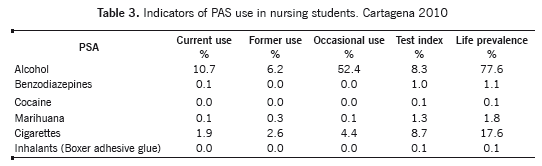
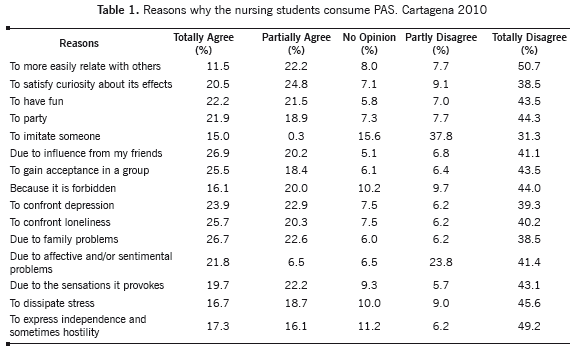
<body><![CDATA[<p> Substance abuse among adolescents constitutes an important public health problem. The risks and associated damage vary for each substance and the negative consequences of dependence affect many aspects of life. These habits, on occasion, are maintained during adolescence and remain throughout life.<sup>3</sup> Studies conducted in Colombia with a general population in 2008 reveal that 86% of the participants had consumed alcohol sometime during their lives.<sup>4</sup> A total of 9.1% of the people had used some illegal drug at least once in their lives and 2.7% reported recent consumption or within the last year of any of them, with the group with the highest prevalence of illegal substance use being those from 18 to 24 years of age.<sup>4</sup> </p>     <p> The presence or absence of preconceptions and positive assessments of drugs facilitates the risk or protection of consumption.<sup>5,6 </sup>University formation should be prepared to act on reducing the demand for psychoactive substances (PAS), converting education as a pedagogical model to promote health.<sup>7,8</sup> Nursing, from caretaking, plays an important role in promoting health and care of individuals, families, and communities with problems related to PAS use. Beliefs and attitudes regarding the problem of consuming legal and illegal substances are important for nursing; these permit carrying out healthy life styles congruent with the education they offer and making sure the activities they engage in during their leisure time do not contradict their teachings and the learning acquired during their career.<sup>9</sup> This study sought to describe the knowledge, attitudes, and practices of nursing students from Cartagena regarding the use of legal and illegal substances. </p>        <p>&nbsp;</p>     <p><font size="3" face="Verdana"><b>METHODOLOGY</b> </font></p>     <p> A descriptive study was conducted with a population of 1078 students matriculated in three nursing programs in Cartagena (Colombia). The participants were selected through stratified probabilistic sampling, via proportional allocation based on the number of students matriculated in each program and semester. A sample size of 689 subjects was determined. The study utilized the survey used in the study of <i>Predisposing Factors and associated to the use of psychoactive substances by adolescents and young adults from the city of Barranquilla in 2002,</i> designed by Cepeda JF, Aldana G, and Ossio A, which comprises 37 questions distributed into four aspects: socio-demographic aspects (11 questions), knowledge (4 questions), attitudes (4 questions), and practices (18 questions). Prior to gathering the information, a pilot test was conducted with 50 students to determine comprehension by the pollsters and the time employed to fill out the survey. </p>     <p> The research respected the ethical parameters for studies with human beings contained in Resolution 008430 of 1993 from the Colombian Ministry of Health and the Code of Nursing Ethics for Colombia.<sup>10</sup> Authorization was requested to use the instrument<sup>8</sup> and the research was approved by the Ethics Committee. The participants who wished to be included in the study signed and placed their index fingerprint on the informed consent, with prior explanation of the study objectives. Confidentiality and anonymity was guaranteed. Gathering of data was carried out during the second semester of 2010. </p>     <p>&nbsp;</p>     <p><font size="3" face="Verdana"><b>RESULTS</b> </font></p>     <p> Socio-demographic characteristics. A total of 689 university students participated in the study. Their mean age was 20.5&plusmn;3.1 years; 91.9% were females. With respect to socio-economic level, the lowest levels predominated (1 = 26.9%, 2 = 39.8%, 3 = 25.7%, 4 = 5.5%, and 5 = 1.0%). Regarding marital status, 87.4% were single, 6.4% were married, 4.9% were common law spouses, and 1.3% were separated. Some 82.2% of the students lived with their parents and other family members, 7.8% lived with their partner, 6.8% lived alone, and the smallest percentage (3.2%) lived with friends. </p>     <p> Knowledge of PAS. The nursing students recognized marihuana (66.0%), heroin (65.7%), and cocaine (65.5%) as hallucinogenic psychoactive substances. The PAS identified by students as depressants were benzodiazepine (31.6%) and alcohol (21.6%); alcohol (56.6%) and cigarettes (49.6%) were identified as stimulant PAS. Likewise, they do not recognize Orlastein (67.5%) and LSD (66.5%). Of the 12 substances consulted, eight were considered by over 90% of the students as health hazards. Amphetamines (63.9%), LSD (52.0%), benzodiazepines (51.2%), and Orlastein (48.3%) were identified as non-harmful. </p>     ]]></body>
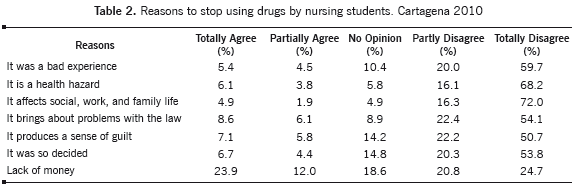
<body><![CDATA[<p> Some 94% of those surveyed considered the brain as the organ that is affected most with drug use and relate being red eyed (88.4%), hyperactive (88.0%), drinking alcohol (72.3%), dilated pupils (68.2%), drinking water (57.6%), over eating (45.3%), being inhibited (41.7%), not eating (41.5%), and eating sweets (13.2%) as effects of PAS use. </p>     <p> Attitude regarding PAS use. The students considered the production (80.4%), trafficking (79.4%), and use of substances (80.0%) as problems of great importance; they agree with investing financial resources for drug addiction prevention programs in adolescents (87.5%), as well as rehabilitation and follow-up programs for the population affected (89.1%). The students expressed that PAS use is mainly influenced by friends (26.9%) and by family problems (26.7%) (<a href="#t1">Table 1</a>). The main reasons to abandon their consumption are affectation of social, work, and family life (72.0%), harmful effects (68.2%), problems with the law (54.1%), and lack of money (24.7%) (<a href="#t2">Table 2</a>). </p>     <p> PAS use. <a href="#t3">Table 3</a> shows that the highest life prevalence of legal PAS use was alcohol (77.6%) and cigarettes (17.6%); along with marihuana for illegal PAS use (1.8%). Other consumption indicators can be observed in the same table. The average age to start drug use is 18 years for all substances. </p>      <p>&nbsp;</p>     <p><font size="3" face="Verdana"><b>DISCUSSION</b> </font></p>     <p> The nursing students participating in the study were mostly single women, living with their parents, and from the lowest socio-economic levels; these data are similar to the studies by Rodr&iacute;guez<sup>11</sup> and Rojas.<sup>12</sup> The study participants consider marihuana, heroin, and cocaine as hallucinogenic substances; benzodiazepines and alcohol as depressants; alcohol along with tobacco is identified as a stimulant. It is important to note the ignorance the students revealed regarding type of substance and the effects through its use. Studies conducted with adolescents5,6 report that they can have varying opinions on PAS; their attitudes depend on the little knowledge and on minimizing the effects of marihuana, alcohol, and cigarette use. Morel13 reports that knowledge received on the harmful consequences of cigarette smoking was in lower proportion in the university compared to high school, even though these concepts are part of the academic program of the nursing career. </p>     <p> For the study group, experimental use of any legal or illegal substance and its regular use are related to the increase of pleasant sensations, greater ease to express opinions and feelings, acceptance by their peers, and better academic, work, sports, and creative performance. Beco&ntilde;a<sup>14</sup> states that the low perception of risk becomes an important factor in maintaining the use of these substances. Contrary to that presented, adolescents from a study carried out in Colombia classified the habit of cigarette smoking as risky.<sup>15</sup> Our participants report alcohol and nicotine use and another type of substance in lower frequency. Baus<sup>16</sup> describes that the figures of use of these types of substances tend to be higher than those reported, given an expected tendency to hide this type of information, although the students considered themes related to the production, traffic, and use of PAS as important and reject their legalization. Navarro<sup>15</sup>, likewise, reports that the majority of the subjects agree with increasing restrictions to tobacco use in the workplace. </p>     <p align="center"><a name="t1"></a><img src="/img/revistas/iee/v31n1/en_v31n01a08t01.png"></p>     <p align="center"><a name="t2"></a><img src="/img/revistas/iee/v31n1/en_v31n01a08t02.png"></p>     <p align="center"><a name="t3"></a><img src="/img/revistas/iee/v31n1/en_v31n01a08t03.png"></p>     ]]></body>
<body><![CDATA[<p> The nursing students state resources should be dedicated to drug use prevention and rehabilitation programs. Romero<sup>17</sup> reports, in this regard, that it is vitally important to prevent the use of marihuana, cocaine, and any other illegal substance, given that although the figures are comparatively low, there are medical students with clearly problematic frequencies and intensities of drug use. Several authors<sup>18-22</sup> consider it necessary to strengthen formal education regarding the risks of PAS use because their perception is one of the most important factors to diminish their use. Prevention measures must necessarily focus on the young population, given that marihuana and cocaine have their maximum use during this age.<sup>22</sup> The use of legal and illegal substances by the participants begins around 18 years of age and curiosity is the primary cause indicated; similar to Rodr&iacute;guez,<sup>11</sup> who reports the starting age from 18 to 25 years, and contrary to this, another research<sup>20</sup> reports that the starting age is 14 years, independent of the type of population and gender. The main causes for the use of substances reported in this study are family problems, influence from friends, a way of confronting depression and loneliness. Influence from friends agrees with similar findings from other studies.<sup>11-13,17</sup> </p>     <p> In this study, alcohol is the substance of greater use, followed by cigarettes, but it is important that students who have abandoned the use of any of these substances adduce to reasons to stop their use: family problems or problems with the law, lack of money, being harmful to health and feelings of guilt; similar studies report that alcoholic beverages are the most used PAS, followed by tobacco.<sup>17,18</sup> For Romero,<sup>17</sup> awareness of the damage and risk of addiction, which would act as dissuasive elements could explain why some substances were consumed more than others. This study concludes that students' knowledge on legal and illegal drugs is not satisfactory, although they consider it very important to enhance programs for the prevention and rehabilitation of the use of substances. The most often used legal PSA is alcohol and marihuana is the most often used illegal substance. </p>     <p> Commitment is required from the directions of the nursing programs to enhance curricular content on the phenomenon of legal and illegal PAS use. Use of PAS by nursing students, although not of great magnitude, is a problem that deserves attention from organisms in charge of university welfare programs. </p>     <p> <b>Acknowledgments.</b> This research was funded by the Organization of American States (OAS), CICAD international project, on Training about the Drug Phenomenon in Latin America. The authors also thank ACOFAEN for facilitating the training processes and for the initiation and development of this research project. </p>      <p>&nbsp;</p>     <p><font size="3" face="Verdana"><b>REFERENCES</b></font></p>       <!-- ref --><p> 1. Organizaci&oacute;n Panamericana de la Salud. Monteiro MG. Alcohol y Salud P&uacute;blica en las Am&eacute;ricas. Un caso para la acci&oacute;n. Washington D.C: OPS; 2007.    &nbsp;&nbsp;&nbsp;&nbsp;&nbsp;&nbsp;&nbsp;&nbsp;[&#160;<a href="javascript:void(0);" onclick="javascript: window.open('/scielo.php?script=sci_nlinks&ref=000059&pid=S0120-5307201300010000800001&lng=','','width=640,height=500,resizable=yes,scrollbars=1,menubar=yes,');">Links</a>&#160;]<!-- end-ref --> </p>     <!-- ref --><p> 2. Organizaci&oacute;n Mundial de la Salud. Tabaquismo &#91;Website&#93;. Geneve: OMS; 2006 &#91;Cited 2011 Nov 12&#93;. Available from: <a href="http://www.who.int/topics/tobacco/es/" target="_blank">http://www.who.int/topics/tobacco/es/ </a>&nbsp;&nbsp;&nbsp;&nbsp;&nbsp;&nbsp;&nbsp;&nbsp;[&#160;<a href="javascript:void(0);" onclick="javascript: window.open('/scielo.php?script=sci_nlinks&ref=000061&pid=S0120-5307201300010000800002&lng=','','width=640,height=500,resizable=yes,scrollbars=1,menubar=yes,');">Links</a>&#160;]<!-- end-ref --><!-- ref --><p> 3. Rhode P, Kahler CW, Lewinsohn PM, Brown RA. Psychiatric disorders, familial factors, and cigarette smoking: II. Associations with progression to daily smoking. Nicotine Tob Res. 2004; 6(3):119-32.    &nbsp;&nbsp;&nbsp;&nbsp;&nbsp;&nbsp;&nbsp;&nbsp;[&#160;<a href="javascript:void(0);" onclick="javascript: window.open('/scielo.php?script=sci_nlinks&ref=000062&pid=S0120-5307201300010000800003&lng=','','width=640,height=500,resizable=yes,scrollbars=1,menubar=yes,');">Links</a>&#160;]<!-- end-ref --> </p>     <!-- ref --><p> 4. Rep&uacute;blica de Colombia, Ministerio de Protecci&oacute;n Social, Direcci&oacute;n Nacional de Estupefacientes. Estudio Nacional de Consumo de sustancias psicoactivas en Colombia 2008.Informe final. Bogot&aacute;: Editora Guadalupe; 2009.    &nbsp;&nbsp;&nbsp;&nbsp;&nbsp;&nbsp;&nbsp;&nbsp;[&#160;<a href="javascript:void(0);" onclick="javascript: window.open('/scielo.php?script=sci_nlinks&ref=000064&pid=S0120-5307201300010000800004&lng=','','width=640,height=500,resizable=yes,scrollbars=1,menubar=yes,');">Links</a>&#160;]<!-- end-ref --> </p>     <!-- ref --><p> 5. Gra&ntilde;a J, Mu&ntilde;oz M. Factores psicol&oacute;gicos de riesgo y de protecci&oacute;n para el consumo de drogas en adolescentes. Psicol conductual.2002; 8(2):249-69.    &nbsp;&nbsp;&nbsp;&nbsp;&nbsp;&nbsp;&nbsp;&nbsp;[&#160;<a href="javascript:void(0);" onclick="javascript: window.open('/scielo.php?script=sci_nlinks&ref=000066&pid=S0120-5307201300010000800005&lng=','','width=640,height=500,resizable=yes,scrollbars=1,menubar=yes,');">Links</a>&#160;]<!-- end-ref --> </p>     <!-- ref --><p> 6. Marsden J, Boys A, Farrell M, Stillwell G, Hutchings K, Hillebrand J. et al. Personal and social correlates of alcohol consumption among midadolescents. Br J Dev Psychol. 2005; 23:427-50.    &nbsp;&nbsp;&nbsp;&nbsp;&nbsp;&nbsp;&nbsp;&nbsp;[&#160;<a href="javascript:void(0);" onclick="javascript: window.open('/scielo.php?script=sci_nlinks&ref=000068&pid=S0120-5307201300010000800006&lng=','','width=640,height=500,resizable=yes,scrollbars=1,menubar=yes,');">Links</a>&#160;]<!-- end-ref --> </p>     <!-- ref --><p> 7. Armelin MG. Preven&ccedil;&atilde;o &agrave;s drogas na escola. O mundo da Sa&uacute;de. 1999; 23(1):48-52.    &nbsp;&nbsp;&nbsp;&nbsp;&nbsp;&nbsp;&nbsp;&nbsp;[&#160;<a href="javascript:void(0);" onclick="javascript: window.open('/scielo.php?script=sci_nlinks&ref=000070&pid=S0120-5307201300010000800007&lng=','','width=640,height=500,resizable=yes,scrollbars=1,menubar=yes,');">Links</a>&#160;]<!-- end-ref --> </p>     <!-- ref --><p> 8. V&aacute;squez EM, Pillon SC. La formaci&oacute;n de enfermeras y el fen&oacute;meno de las drogas en Colombia: conocimientos, actitudes y creencias. Rev Latino-am Enfermagem. 2005; 13(special issue): 845-53.    &nbsp;&nbsp;&nbsp;&nbsp;&nbsp;&nbsp;&nbsp;&nbsp;[&#160;<a href="javascript:void(0);" onclick="javascript: window.open('/scielo.php?script=sci_nlinks&ref=000072&pid=S0120-5307201300010000800008&lng=','','width=640,height=500,resizable=yes,scrollbars=1,menubar=yes,');">Links</a>&#160;]<!-- end-ref --> </p>     <!-- ref --><p> 9. Mart&iacute;nez M, Rubio G. Manual de drogodependencias para Enfermer&iacute;a. Madrid: Ediciones D&iacute;az de Santos; 2002.    &nbsp;&nbsp;&nbsp;&nbsp;&nbsp;&nbsp;&nbsp;&nbsp;[&#160;<a href="javascript:void(0);" onclick="javascript: window.open('/scielo.php?script=sci_nlinks&ref=000074&pid=S0120-5307201300010000800009&lng=','','width=640,height=500,resizable=yes,scrollbars=1,menubar=yes,');">Links</a>&#160;]<!-- end-ref --> </p>     <!-- ref --><p> 10. Colombia. Tribunal Nacional &eacute;tico de Enfermer&iacute;a. Ley 911: Por la cual se dictan disposiciones en materia de responsabilidad deontol&oacute;gica para el ejercicio de la profesi&oacute;n de enfermer&iacute;a en Colombia; se establece el r&eacute;gimen disciplinario correspondiente y se dictan otras disposiciones. (2004 Oct 5).    &nbsp;&nbsp;&nbsp;&nbsp;&nbsp;&nbsp;&nbsp;&nbsp;[&#160;<a href="javascript:void(0);" onclick="javascript: window.open('/scielo.php?script=sci_nlinks&ref=000076&pid=S0120-5307201300010000800010&lng=','','width=640,height=500,resizable=yes,scrollbars=1,menubar=yes,');">Links</a>&#160;]<!-- end-ref --> </p>     <!-- ref --><p> 11. Rodr&iacute;guez MA, Pineda SA, V&eacute;lez LF. Caracter&iacute;sticas del consumo de tabaco en estudiantes de enfermer&iacute;a de la Universidad de Antioquia (Colombia). Invest Educ Enferm. 2010; 28(3):370-83.    &nbsp;&nbsp;&nbsp;&nbsp;&nbsp;&nbsp;&nbsp;&nbsp;[&#160;<a href="javascript:void(0);" onclick="javascript: window.open('/scielo.php?script=sci_nlinks&ref=000078&pid=S0120-5307201300010000800011&lng=','','width=640,height=500,resizable=yes,scrollbars=1,menubar=yes,');">Links</a>&#160;]<!-- end-ref --> </p>     <!-- ref --><p> 12. Rojas-Valenciano L. Opini&oacute;n y factores que motivan el consumo de drogas l&iacute;citas e il&iacute;citas en algunos estudiantes de la Licenciatura en Enfermer&iacute;a. Rev Enferm Actual (Costa Rica) &#91;Internet&#93;. 2008 &#91;Cited 2011 Apr 18&#93;; Available from: <a href="http://www.latindex.ucr.ac.cr/enf15/enf-2008-15-1.pdf" target="_blank">http://www.latindex.ucr.ac.cr/enf15/enf-2008-15-1.pdf </a>&nbsp;&nbsp;&nbsp;&nbsp;&nbsp;&nbsp;&nbsp;&nbsp;[&#160;<a href="javascript:void(0);" onclick="javascript: window.open('/scielo.php?script=sci_nlinks&ref=000080&pid=S0120-5307201300010000800012&lng=','','width=640,height=500,resizable=yes,scrollbars=1,menubar=yes,');">Links</a>&#160;]<!-- end-ref --><!-- ref --><p> 13. Morel JC. Conocimientos, actitudes y pr&aacute;cticas sobre el tabaquismo en estudiantes de Enfermer&iacute;a y Obstetricia del Instituto 'Dr. Andr&eacute;s Barbero', 2007. Mem Inst Investig Cienc. Salud. 2008; 6(2):38-47.    &nbsp;&nbsp;&nbsp;&nbsp;&nbsp;&nbsp;&nbsp;&nbsp;[&#160;<a href="javascript:void(0);" onclick="javascript: window.open('/scielo.php?script=sci_nlinks&ref=000081&pid=S0120-5307201300010000800013&lng=','','width=640,height=500,resizable=yes,scrollbars=1,menubar=yes,');">Links</a>&#160;]<!-- end-ref --> </p>     ]]></body>
<body><![CDATA[<!-- ref --><p> 14. Beco&ntilde;a E, V&aacute;zquez F. Consumo problem&aacute;tico de sustancias. In: Caballo V (Editor). Manual de psicopatolog&iacute;a cl&iacute;nica infantil y del adolescente. Trastornos generales. Madrid: Siglo XXI; 2001.    &nbsp;&nbsp;&nbsp;&nbsp;&nbsp;&nbsp;&nbsp;&nbsp;[&#160;<a href="javascript:void(0);" onclick="javascript: window.open('/scielo.php?script=sci_nlinks&ref=000083&pid=S0120-5307201300010000800014&lng=','','width=640,height=500,resizable=yes,scrollbars=1,menubar=yes,');">Links</a>&#160;]<!-- end-ref --> </p>     <!-- ref --><p> 15. Navarro-Reyes E. Droga: Factores causales de la adicci&oacute;n, fases y consecuencias de la misma. &#91;Internet&#93;. &#91;Cited 2011 Apr 18&#93;; Available from: <a href="http://www.encolombia.com/medicina/academedicina/Academ39feb1995/Drogasfactorescasualesdelaadiccion.htm" target="_blank">http://www.encolombia.com/medicina/academedicina/Academ39feb1995/Drogasfactorescasualesdelaadiccion.htm</a>.    &nbsp;&nbsp;&nbsp;&nbsp;&nbsp;&nbsp;&nbsp;&nbsp;[&#160;<a href="javascript:void(0);" onclick="javascript: window.open('/scielo.php?script=sci_nlinks&ref=000085&pid=S0120-5307201300010000800015&lng=','','width=640,height=500,resizable=yes,scrollbars=1,menubar=yes,');">Links</a>&#160;]<!-- end-ref --> </p>     <!-- ref --><p> 16. Baus J, Kupek E, Pires M. Prevalence and risk factors associated with drug use among school students, Brazil. Rev Saude Publica. 2002; 36(1):40-6.    &nbsp;&nbsp;&nbsp;&nbsp;&nbsp;&nbsp;&nbsp;&nbsp;[&#160;<a href="javascript:void(0);" onclick="javascript: window.open('/scielo.php?script=sci_nlinks&ref=000087&pid=S0120-5307201300010000800016&lng=','','width=640,height=500,resizable=yes,scrollbars=1,menubar=yes,');">Links</a>&#160;]<!-- end-ref --> </p>     <!-- ref --><p> 17. Romero MI, Santander J, Hitschfeld MJ, Labb&eacute; M, Zamora V. Consumo de sustancias il&iacute;citas y psicotr&oacute;picos entre los estudiantes de medicina de la Pontificia Universidad Cat&oacute;lica de Chile. Rev Med Chile. 2009; 137(4):459-65.    &nbsp;&nbsp;&nbsp;&nbsp;&nbsp;&nbsp;&nbsp;&nbsp;[&#160;<a href="javascript:void(0);" onclick="javascript: window.open('/scielo.php?script=sci_nlinks&ref=000089&pid=S0120-5307201300010000800017&lng=','','width=640,height=500,resizable=yes,scrollbars=1,menubar=yes,');">Links</a>&#160;]<!-- end-ref --> </p>     <!-- ref --><p> 18. CONACE. Sexto estudio nacional de drogas en poblaci&oacute;n escolar de Chile de 8o B&aacute;sico a 4 Medio 2005. &#91;Internet&#93;. &#91;Cited 2011 Apr 18&#93;; Available from: <a href="http://www.mineduc.cl/usuarios/cuarta/doc/200607131720320.conace.pdf" target="_blank">http://www.mineduc.cl/usuarios/cuarta/doc/200607131720320.conace.pdf</a>.    &nbsp;&nbsp;&nbsp;&nbsp;&nbsp;&nbsp;&nbsp;&nbsp;[&#160;<a href="javascript:void(0);" onclick="javascript: window.open('/scielo.php?script=sci_nlinks&ref=000091&pid=S0120-5307201300010000800018&lng=','','width=640,height=500,resizable=yes,scrollbars=1,menubar=yes,');">Links</a>&#160;]<!-- end-ref --> </p>     ]]></body>
<body><![CDATA[<!-- ref --><p> 19. CONACE. Informe sobre uso de drogas en estudiantes de la educaci&oacute;n superior. Quinto estudio nacional de drogas en poblaci&oacute;n general de Chile 2002; Junio 2003. &#91;Internet&#93;. &#91;Cited 2011 Apr 18&#93;; Available from: <a href="http://ebookbrowse.com/uso-drogas-estudiantes-educacion-superior-conace-2004-pdf-d249347354" target="_blank">http://www.intranet.injuv.gob.cl/cedoc/CONACE/Uso_drogas_estudiantes_educacion_superior_CONACE_2004.pdf</a>.    &nbsp;&nbsp;&nbsp;&nbsp;&nbsp;&nbsp;&nbsp;&nbsp;[&#160;<a href="javascript:void(0);" onclick="javascript: window.open('/scielo.php?script=sci_nlinks&ref=000093&pid=S0120-5307201300010000800019&lng=','','width=640,height=500,resizable=yes,scrollbars=1,menubar=yes,');">Links</a>&#160;]<!-- end-ref --> </p>     <!-- ref --><p> 20. CONACE. Consumo de drogas en j&oacute;venes. Sexto estudio nacional de drogas en poblaci&oacute;n general de Chile 2004. &#91;Internet&#93;. &#91;Cited 2011 Apr 18&#93;. Available from: <a href="http://extranet.injuv.gob.cl/cedoc/CONACE/V_Estudio_de_drogas_Poblacion_General_Introduccion_2003%20.pdf" target="_blank">http://intranet.injuv.gob.cl/cedoc/Coleccion%20Prevencion%20Drogas/Drogas_Nivel_Ingresos_PobGral_2004.pdf</a>.    &nbsp;&nbsp;&nbsp;&nbsp;&nbsp;&nbsp;&nbsp;&nbsp;[&#160;<a href="javascript:void(0);" onclick="javascript: window.open('/scielo.php?script=sci_nlinks&ref=000095&pid=S0120-5307201300010000800020&lng=','','width=640,height=500,resizable=yes,scrollbars=1,menubar=yes,');">Links</a>&#160;]<!-- end-ref --> </p>     <!-- ref --><p> 21. CONACE. Situaci&oacute;n del consumo de drogas en mujeres de Chile. Quinto estudio nacional de drogas en poblaci&oacute;n general de Chile 2002. &#91;Internet&#93; &#91;Cited 2011 Apr 18&#93;; Available from: <a href="http://200.29.90.110/inicio/pdf/consumo_drogas_MUJERES_chilenas2004_versionPORTAL.pdf" target="_blank">http://200.29.90.110/inicio/pdf/consumo_drogas_MUJERES_chilenas2004_versionPORTAL.pdf</a>.    &nbsp;&nbsp;&nbsp;&nbsp;&nbsp;&nbsp;&nbsp;&nbsp;[&#160;<a href="javascript:void(0);" onclick="javascript: window.open('/scielo.php?script=sci_nlinks&ref=000097&pid=S0120-5307201300010000800021&lng=','','width=640,height=500,resizable=yes,scrollbars=1,menubar=yes,');">Links</a>&#160;]<!-- end-ref --> </p>     <!-- ref --><p> 22. Mendoza-V&aacute;squez EM, Pillon SC. La formaci&oacute;n de enfermeras y el fen&oacute;meno de las drogas en Colombia: conocimientos, actitudes y creencias. Rev Latino-am Enfermagem.2005;13 (n&uacute;mero especial):845-53.    &nbsp;&nbsp;&nbsp;&nbsp;&nbsp;&nbsp;&nbsp;&nbsp;[&#160;<a href="javascript:void(0);" onclick="javascript: window.open('/scielo.php?script=sci_nlinks&ref=000099&pid=S0120-5307201300010000800022&lng=','','width=640,height=500,resizable=yes,scrollbars=1,menubar=yes,');">Links</a>&#160;]<!-- end-ref --> </p>       <p>&nbsp;</p> </font>      ]]></body><back>
<ref-list>
<ref id="B1">
<label>1</label><nlm-citation citation-type="book">
<person-group person-group-type="author">
<name>
<surname><![CDATA[Monteiro]]></surname>
<given-names><![CDATA[MG.]]></given-names>
</name>
</person-group>
<collab>Organización Panamericana de la Salud</collab>
<source><![CDATA[Alcohol y Salud Pública en las Américas. Un caso para la acción]]></source>
<year>2007</year>
<publisher-loc><![CDATA[Washington^eD.C D.C]]></publisher-loc>
<publisher-name><![CDATA[OPS]]></publisher-name>
</nlm-citation>
</ref>
<ref id="B2">
<label>2</label><nlm-citation citation-type="book">
<collab>Organización Mundial de la Salud</collab>
<source><![CDATA[Tabaquismo]]></source>
<year>2006</year>
<publisher-loc><![CDATA[Geneve ]]></publisher-loc>
<publisher-name><![CDATA[OMS]]></publisher-name>
</nlm-citation>
</ref>
<ref id="B3">
<label>3</label><nlm-citation citation-type="journal">
<person-group person-group-type="author">
<name>
<surname><![CDATA[Rhode]]></surname>
<given-names><![CDATA[P]]></given-names>
</name>
<name>
<surname><![CDATA[Kahler]]></surname>
<given-names><![CDATA[CW]]></given-names>
</name>
<name>
<surname><![CDATA[Lewinsohn]]></surname>
<given-names><![CDATA[PM]]></given-names>
</name>
<name>
<surname><![CDATA[Brown]]></surname>
<given-names><![CDATA[RA.]]></given-names>
</name>
</person-group>
<article-title xml:lang="en"><![CDATA[Psychiatric disorders, familial factors, and cigarette smoking: II. Associations with progression to daily smoking]]></article-title>
<source><![CDATA[Nicotine Tob Res.]]></source>
<year>2004</year>
<volume>6</volume>
<numero>3</numero>
<issue>3</issue>
<page-range>119-32</page-range></nlm-citation>
</ref>
<ref id="B4">
<label>4</label><nlm-citation citation-type="book">
<collab>República de Colombia^dMinisterio de Protección Social, Dirección Nacional de Estupefacientes</collab>
<source><![CDATA[Estudio Nacional de Consumo de sustancias psicoactivas en Colombia 2008.Informe final]]></source>
<year>2009</year>
<publisher-loc><![CDATA[Bogotá ]]></publisher-loc>
<publisher-name><![CDATA[Editora Guadalupe]]></publisher-name>
</nlm-citation>
</ref>
<ref id="B5">
<label>5</label><nlm-citation citation-type="journal">
<person-group person-group-type="author">
<name>
<surname><![CDATA[Graña]]></surname>
<given-names><![CDATA[J]]></given-names>
</name>
<name>
<surname><![CDATA[Muñoz]]></surname>
<given-names><![CDATA[M.]]></given-names>
</name>
</person-group>
<article-title xml:lang="es"><![CDATA[Factores psicológicos de riesgo y de protección para el consumo de drogas en adolescentes]]></article-title>
<source><![CDATA[Psicol conductual]]></source>
<year>2002</year>
<volume>8</volume>
<numero>2</numero>
<issue>2</issue>
<page-range>249-69</page-range></nlm-citation>
</ref>
<ref id="B6">
<label>6</label><nlm-citation citation-type="journal">
<person-group person-group-type="author">
<name>
<surname><![CDATA[Marsden]]></surname>
<given-names><![CDATA[J]]></given-names>
</name>
<name>
<surname><![CDATA[Boys]]></surname>
<given-names><![CDATA[A]]></given-names>
</name>
<name>
<surname><![CDATA[Farrell]]></surname>
<given-names><![CDATA[M]]></given-names>
</name>
<name>
<surname><![CDATA[Stillwell]]></surname>
<given-names><![CDATA[G]]></given-names>
</name>
<name>
<surname><![CDATA[Hutchings]]></surname>
<given-names><![CDATA[K]]></given-names>
</name>
<name>
<surname><![CDATA[Hillebrand]]></surname>
<given-names><![CDATA[J.]]></given-names>
</name>
</person-group>
<article-title xml:lang="en"><![CDATA[Personal and social correlates of alcohol consumption among midadolescents]]></article-title>
<source><![CDATA[Br J Dev Psychol.]]></source>
<year>2005</year>
<volume>23</volume>
<page-range>427-50</page-range></nlm-citation>
</ref>
<ref id="B7">
<label>7</label><nlm-citation citation-type="journal">
<person-group person-group-type="author">
<name>
<surname><![CDATA[Armelin]]></surname>
<given-names><![CDATA[MG.]]></given-names>
</name>
</person-group>
<article-title xml:lang="pt"><![CDATA[Prevenção às drogas na escola]]></article-title>
<source><![CDATA[O mundo da Saúde]]></source>
<year>1999</year>
<volume>23</volume>
<numero>1</numero>
<issue>1</issue>
<page-range>48-52</page-range></nlm-citation>
</ref>
<ref id="B8">
<label>8</label><nlm-citation citation-type="journal">
<person-group person-group-type="author">
<name>
<surname><![CDATA[Vásquez]]></surname>
<given-names><![CDATA[EM]]></given-names>
</name>
<name>
<surname><![CDATA[Pillon]]></surname>
<given-names><![CDATA[SC.]]></given-names>
</name>
</person-group>
<article-title xml:lang="es"><![CDATA[La formación de enfermeras y el fenómeno de las drogas en Colombia: conocimientos, actitudes y creencias]]></article-title>
<source><![CDATA[Rev Latino-am Enfermagem]]></source>
<year>2005</year>
<volume>13</volume>
<numero>special issue</numero>
<issue>special issue</issue>
<page-range>845-53</page-range></nlm-citation>
</ref>
<ref id="B9">
<label>9</label><nlm-citation citation-type="book">
<person-group person-group-type="author">
<name>
<surname><![CDATA[Martínez]]></surname>
<given-names><![CDATA[M]]></given-names>
</name>
<name>
<surname><![CDATA[Rubio]]></surname>
<given-names><![CDATA[G.]]></given-names>
</name>
</person-group>
<source><![CDATA[Manual de drogodependencias para Enfermería]]></source>
<year>2002</year>
<publisher-loc><![CDATA[Madrid ]]></publisher-loc>
<publisher-name><![CDATA[Ediciones Díaz de Santos]]></publisher-name>
</nlm-citation>
</ref>
<ref id="B10">
<label>10</label><nlm-citation citation-type="">
<collab>Colombia^dTribunal Nacional ético de Enfermería</collab>
<source><![CDATA[Ley 911: Por la cual se dictan disposiciones en materia de responsabilidad deontológica para el ejercicio de la profesión de enfermería en Colombia; se establece el régimen disciplinario correspondiente y se dictan otras disposiciones]]></source>
<year>2004</year>
<month> O</month>
<day>ct</day>
</nlm-citation>
</ref>
<ref id="B11">
<label>11</label><nlm-citation citation-type="journal">
<person-group person-group-type="author">
<name>
<surname><![CDATA[Rodríguez]]></surname>
<given-names><![CDATA[MA]]></given-names>
</name>
<name>
<surname><![CDATA[Pineda]]></surname>
<given-names><![CDATA[SA]]></given-names>
</name>
<name>
<surname><![CDATA[Vélez]]></surname>
<given-names><![CDATA[LF.]]></given-names>
</name>
</person-group>
<article-title xml:lang="es"><![CDATA[Características del consumo de tabaco en estudiantes de enfermería de la Universidad de Antioquia (Colombia)]]></article-title>
<source><![CDATA[Invest Educ Enferm]]></source>
<year>2010</year>
<volume>28</volume>
<numero>3</numero>
<issue>3</issue>
<page-range>370-83</page-range></nlm-citation>
</ref>
<ref id="B12">
<label>12</label><nlm-citation citation-type="journal">
<person-group person-group-type="author">
<name>
<surname><![CDATA[Rojas-Valenciano]]></surname>
<given-names><![CDATA[L.]]></given-names>
</name>
</person-group>
<article-title xml:lang="es"><![CDATA[Opinión y factores que motivan el consumo de drogas lícitas e ilícitas en algunos estudiantes de la Licenciatura en Enfermería]]></article-title>
<source><![CDATA[Rev Enferm Actual]]></source>
<year>2008</year>
</nlm-citation>
</ref>
<ref id="B13">
<label>13</label><nlm-citation citation-type="journal">
<person-group person-group-type="author">
<name>
<surname><![CDATA[Morel]]></surname>
<given-names><![CDATA[JC.]]></given-names>
</name>
</person-group>
<article-title xml:lang="es"><![CDATA[Conocimientos, actitudes y prácticas sobre el tabaquismo en estudiantes de Enfermería y Obstetricia del Instituto 'Dr. Andrés Barbero', 2007]]></article-title>
<source><![CDATA[Mem Inst Investig Cienc. Salud.]]></source>
<year>2008</year>
<volume>6</volume>
<numero>2</numero>
<issue>2</issue>
<page-range>38-47</page-range></nlm-citation>
</ref>
<ref id="B14">
<label>14</label><nlm-citation citation-type="book">
<person-group person-group-type="author">
<name>
<surname><![CDATA[Becoña]]></surname>
<given-names><![CDATA[E]]></given-names>
</name>
<name>
<surname><![CDATA[Vázquez]]></surname>
<given-names><![CDATA[F.]]></given-names>
</name>
</person-group>
<article-title xml:lang="es"><![CDATA[Consumo problemático de sustancias]]></article-title>
<person-group person-group-type="editor">
<name>
<surname><![CDATA[Caballo]]></surname>
<given-names><![CDATA[V]]></given-names>
</name>
</person-group>
<source><![CDATA[Manual de psicopatología clínica infantil y del adolescente. Trastornos generales]]></source>
<year>2001</year>
<publisher-loc><![CDATA[Madrid ]]></publisher-loc>
<publisher-name><![CDATA[Siglo XXI]]></publisher-name>
</nlm-citation>
</ref>
<ref id="B15">
<label>15</label><nlm-citation citation-type="">
<person-group person-group-type="author">
<name>
<surname><![CDATA[Navarro-Reyes]]></surname>
<given-names><![CDATA[E.]]></given-names>
</name>
</person-group>
<source><![CDATA[Droga: Factores causales de la adicción, fases y consecuencias de la misma]]></source>
<year></year>
</nlm-citation>
</ref>
<ref id="B16">
<label>16</label><nlm-citation citation-type="journal">
<person-group person-group-type="author">
<name>
<surname><![CDATA[Baus]]></surname>
<given-names><![CDATA[J]]></given-names>
</name>
<name>
<surname><![CDATA[Kupek]]></surname>
<given-names><![CDATA[E]]></given-names>
</name>
<name>
<surname><![CDATA[Pires]]></surname>
<given-names><![CDATA[M.]]></given-names>
</name>
</person-group>
<article-title xml:lang="en"><![CDATA[Prevalence and risk factors associated with drug use among school students, Brazil]]></article-title>
<source><![CDATA[Rev Saude Publica]]></source>
<year>2002</year>
<volume>36</volume>
<numero>1</numero>
<issue>1</issue>
<page-range>40-6</page-range></nlm-citation>
</ref>
<ref id="B17">
<label>17</label><nlm-citation citation-type="journal">
<person-group person-group-type="author">
<name>
<surname><![CDATA[Romero]]></surname>
<given-names><![CDATA[MI]]></given-names>
</name>
<name>
<surname><![CDATA[Santander]]></surname>
<given-names><![CDATA[J]]></given-names>
</name>
<name>
<surname><![CDATA[Hitschfeld]]></surname>
<given-names><![CDATA[MJ]]></given-names>
</name>
<name>
<surname><![CDATA[Labbé]]></surname>
<given-names><![CDATA[M]]></given-names>
</name>
<name>
<surname><![CDATA[Zamora]]></surname>
<given-names><![CDATA[V.]]></given-names>
</name>
</person-group>
<article-title xml:lang="es"><![CDATA[Consumo de sustancias ilícitas y psicotrópicos entre los estudiantes de medicina de la Pontificia Universidad Católica de Chile]]></article-title>
<source><![CDATA[Rev Med Chile]]></source>
<year>2009</year>
<volume>137</volume>
<numero>4</numero>
<issue>4</issue>
<page-range>459-65</page-range></nlm-citation>
</ref>
<ref id="B18">
<label>18</label><nlm-citation citation-type="">
<collab>CONACE</collab>
<source><![CDATA[Sexto estudio nacional de drogas en población escolar de Chile de 8o Básico a 4 Medio 2005]]></source>
<year></year>
</nlm-citation>
</ref>
<ref id="B19">
<label>19</label><nlm-citation citation-type="">
<collab>CONACE</collab>
<source><![CDATA[Informe sobre uso de drogas en estudiantes de la educación superior. Quinto estudio nacional de drogas en población general de Chile 2002]]></source>
<year>Juni</year>
<month>o </month>
<day>20</day>
</nlm-citation>
</ref>
<ref id="B20">
<label>20</label><nlm-citation citation-type="">
<collab>CONACE</collab>
<source><![CDATA[Consumo de drogas en jóvenes. Sexto estudio nacional de drogas en población general de Chile 2004]]></source>
<year></year>
</nlm-citation>
</ref>
<ref id="B21">
<label>21</label><nlm-citation citation-type="">
<collab>CONACE</collab>
<source><![CDATA[Situación del consumo de drogas en mujeres de Chile. Quinto estudio nacional de drogas en población general de Chile 2002]]></source>
<year></year>
</nlm-citation>
</ref>
<ref id="B22">
<label>22</label><nlm-citation citation-type="journal">
<person-group person-group-type="author">
<name>
<surname><![CDATA[Mendoza-Vásquez]]></surname>
<given-names><![CDATA[EM]]></given-names>
</name>
<name>
<surname><![CDATA[Pillon]]></surname>
<given-names><![CDATA[SC.]]></given-names>
</name>
</person-group>
<article-title xml:lang="es"><![CDATA[La formación de enfermeras y el fenómeno de las drogas en Colombia: conocimientos, actitudes y creencias]]></article-title>
<source><![CDATA[Rev Latino-am Enfermagem]]></source>
<year>2005</year>
<volume>13</volume>
<numero>número especial</numero>
<issue>número especial</issue>
<page-range>845-53</page-range></nlm-citation>
</ref>
</ref-list>
</back>
</article>