<?xml version="1.0" encoding="ISO-8859-1"?><article xmlns:mml="http://www.w3.org/1998/Math/MathML" xmlns:xlink="http://www.w3.org/1999/xlink" xmlns:xsi="http://www.w3.org/2001/XMLSchema-instance">
<front>
<journal-meta>
<journal-id>0120-548X</journal-id>
<journal-title><![CDATA[Acta Biológica Colombiana]]></journal-title>
<abbrev-journal-title><![CDATA[Acta biol.Colomb.]]></abbrev-journal-title>
<issn>0120-548X</issn>
<publisher>
<publisher-name><![CDATA[Universidad Nacional de Colombia, Facultad de Ciencias, Departamento de Biología]]></publisher-name>
</publisher>
</journal-meta>
<article-meta>
<article-id>S0120-548X2007000200001</article-id>
<title-group>
<article-title xml:lang="en"><![CDATA[EXPORT AND TRAFFICKING OF Plasmodium PROTEINS WITHIN THE HOST ERYTHROCYTE]]></article-title>
<article-title xml:lang="es"><![CDATA[Tráfico y exportación de proteínas de Plasmodium en el eritrocito hospedero]]></article-title>
</title-group>
<contrib-group>
<contrib contrib-type="author">
<name>
<surname><![CDATA[WISER]]></surname>
<given-names><![CDATA[MARK F]]></given-names>
</name>
<xref ref-type="aff" rid="A01"/>
</contrib>
</contrib-group>
<aff id="A01">
<institution><![CDATA[,Tulane University School of Public Health Department of Tropical Medicine ]]></institution>
<addr-line><![CDATA[New Orleans LA]]></addr-line>
</aff>
<pub-date pub-type="pub">
<day>00</day>
<month>11</month>
<year>2007</year>
</pub-date>
<pub-date pub-type="epub">
<day>00</day>
<month>11</month>
<year>2007</year>
</pub-date>
<volume>12</volume>
<numero>2</numero>
<fpage>3</fpage>
<lpage>18</lpage>
<copyright-statement/>
<copyright-year/>
<self-uri xlink:href="http://www.scielo.org.co/scielo.php?script=sci_arttext&amp;pid=S0120-548X2007000200001&amp;lng=en&amp;nrm=iso"></self-uri><self-uri xlink:href="http://www.scielo.org.co/scielo.php?script=sci_abstract&amp;pid=S0120-548X2007000200001&amp;lng=en&amp;nrm=iso"></self-uri><self-uri xlink:href="http://www.scielo.org.co/scielo.php?script=sci_pdf&amp;pid=S0120-548X2007000200001&amp;lng=en&amp;nrm=iso"></self-uri><abstract abstract-type="short" xml:lang="en"><p><![CDATA[The export and trafficking of parasite proteins within the infected erythrocyte is a complex process and not well understood. Export of proteins from the parasite was previously speculated to involve a specialized compartment originally designated as the secondary endoplasmic reticulum of the Apicomplexa, or sERA. The properties of this Plasmodium export compartment are reviewed in regards to more recent observations about the trafficking of Plasmodium proteins within the host erythrocyte. In addition, a calcium ATPase unique to the Apicomplexa and with homology to the sarcoplasmicendoplasmic reticulum calcium ATPase is discussed in the context of this unique export compartment. It is also speculated that the Plasmodium export element, PEXEL, may play a role in targeting proteins to this parasite export compartment. Exported proteins are then proposed to move into the parasitophorous vacuole and those destined for the host erythrocyte are transported to the erythrocyte cytoplasm as soluble proteins. Chaperones probably play a role in escorting parasite proteins to their final destinations and assembly on the erythrocyte membrane]]></p></abstract>
<abstract abstract-type="short" xml:lang="es"><p><![CDATA[El tráfico y exportación de proteínas del parásito dentro del citoplasma del eritrocito es un proceso complejo, que no es bien comprendido. Inicialmente se especuló sobre la manera como el parásito exporta éstas proteínas y se involucró un compartimiento que se denominó retículo endoplasmático secundario de los Apicomplexa (sERA). En este trabajo se revisan las propiedades de este compartimiento exportador de acuerdo con las observaciones más recientes del tráfico de proteínas de Plasmodium al salir del parásito. La discusión se enmarca dentro del contexto de este único compartimiento exportador relacionado con una ATPasa de calcio única de los Apicomplexa que presenta homología con la ATPasa de calcio del retículo endoplasmático sarcoplásmico (SERCA). Además, se especula que Plasmodium exporta elementos PEXEL, que podrían estar asociados con el direccionamiento de proteínas de Plasmodium hacia el compartimiento exportador y se propone que éstas proteínas van posteriormente a la vacuola parasitófora, y aquellas cuyo destino es la célula hospedera se transportan al citoplasma del eritrocito como proteínas solubles. Las chaperonas posiblemente escoltan las proteínas del parásito hasta su destino final y se ensamblan en la membrana del eritrocito]]></p></abstract>
<kwd-group>
<kwd lng="en"><![CDATA[secretory pathway]]></kwd>
<kwd lng="en"><![CDATA[SERCA]]></kwd>
<kwd lng="en"><![CDATA[protein trafficking]]></kwd>
<kwd lng="en"><![CDATA[malaria]]></kwd>
<kwd lng="la"><![CDATA[Plasmodium]]></kwd>
<kwd lng="es"><![CDATA[vía secretoria]]></kwd>
<kwd lng="es"><![CDATA[SERCA]]></kwd>
<kwd lng="es"><![CDATA[tráfico de proteínas]]></kwd>
<kwd lng="es"><![CDATA[malaria]]></kwd>
<kwd lng="la"><![CDATA[Plasmodium]]></kwd>
</kwd-group>
</article-meta>
</front><body><![CDATA[ <P align="center"    ><B>EXPORT AND TRAFFICKING OF <i>Plasmodium</i> PROTEINS WITHIN THE HOST ERYTHROCYTE</B></P >     <P align="center">Tr&aacute;fico y exportaci&oacute;n de prote&iacute;nas de <i>Plasmodium </i>en el eritrocito hospedero</P >     <P   >MARK F. WISER<Sup>1</Sup>, Ph. D. <Sup>1</Sup>Department of Tropical Medicine, Tulane University School of Public   Health. 1440 Canal Street, Suite 2210, SL17, New Orleans, LA.   701122824 504.988.2507 (voice), 504.988.7313 (fax)   <a href="mailto:wiser@tulane.edu">wiser@tulane.edu</a></P >     <P    >Presentado por invitaci&oacute;n el 24 de mayo de 2007. </P >     <p   align="left" ><B>SUMMARY </b></p >     <P    >The export and trafficking of parasite proteins within the infected erythrocyte is a complex process and not well understood. Export of proteins from the parasite was previously speculated to involve a specialized compartment originally designated as the secondary endoplasmic reticulum of the Apicomplexa, or sERA. The properties of this <i>Plasmodiu</i><i>m </i>export compartment are reviewed in regards to more recent observations about the trafficking of <i>Plasmodiu</i><i>m </i>proteins within the host erythrocyte. In addition, a calcium ATPase unique to the Apicomplexa and with homology to the sarcoplasmicendoplasmic reticulum calcium ATPase is discussed in the context of this unique export compartment. It is also speculated that the <i>Plasmodiu</i><i>m </i>export element, PEXEL, may play a role in targeting proteins to this parasite export compartment. Exported proteins are then proposed to move into the parasitophorous vacuole and those destined for the host erythrocyte are transported to the erythrocyte cytoplasm as soluble proteins. Chaperones probably play a role in escorting parasite proteins to their final destinations and assembly on the erythrocyte membrane. </P >     <P    ><B>Key words:</B> secretory pathway, SERCA, protein trafficking, malaria, <i>Plasmodium</i><i>. </i></P >     <p   align="left" ><B>RESUMEN </b></p >     <P    >El tr&aacute;fico y exportaci&oacute;n de prote&iacute;nas del par&aacute;sito dentro del citoplasma del eritrocito es un proceso complejo, que no es bien comprendido. Inicialmente se especul&oacute; sobre la manera como el par&aacute;sito exporta &eacute;stas prote&iacute;nas y se involucr&oacute; un compartimiento que se denomin&oacute; ret&iacute;culo endoplasm&aacute;tico secundario de los Apicomplexa (sERA). En este trabajo se revisan las propiedades de este compartimiento exportador de acuerdo con las observaciones m&aacute;s recientes del tr&aacute;fico de prote&iacute;nas de <i>Plasmodiu</i><i>m </i>al salir del par&aacute;sito. La discusi&oacute;n se enmarca dentro del contexto de este &uacute;nico compartimiento exportador relacionado con una ATPasa de calcio &uacute;nica de los Apicomplexa que presenta homolog&iacute;a con la ATPasa de calcio del ret&iacute;culo endoplasm&aacute;tico sarcopl&aacute;smico (SERCA). Adem&aacute;s, se especula que <i>Plasmodiu</i><i>m </i>exporta elementos PEXEL, que podr&iacute;an estar asociados con el direccionamiento de prote&iacute;nas de <i>Plasmodiu</i><i>m </i>hacia el compartimiento exportador y se propone que &eacute;stas prote&iacute;nas van posteriormente a la vacuola parasit&oacute;fora, y aquellas cuyo destino es la c&eacute;lula hospedera se transportan al citoplasma del eritrocito como prote&iacute;nas solubles. Las chaperonas posiblemente escoltan las prote&iacute;nas del par&aacute;sito hasta su destino final y se ensamblan en la membrana del eritrocito. </P >     <P    ><B>Palabras clave:</B> v&iacute;a secretoria<i>, </i>SERCA, tr&aacute;fico de prote&iacute;nas, malaria, <i>Plasmodium</i><i>. </i></P >     ]]></body>
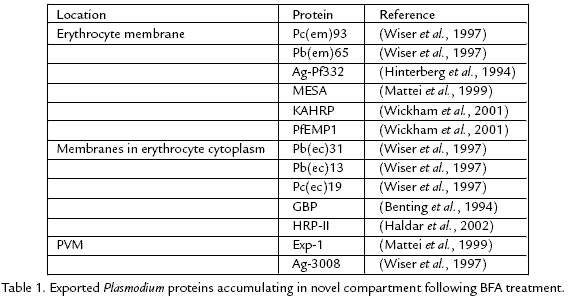
<body><![CDATA[<p   align="left" ><B>INTRODUCTION </b></p >     <P    >The malaria parasite exhibits a complex life cycle involving a mosquito vector and a vertebrate host. During one stage of its life cycle the parasite infects erythrocytes. The blood stage is primarily responsible for the disease manifestations and generally establishes a chronic infection within the host. Like other Apicomplexa, the malaria parasite has specialized invasive forms (eg., merozoites) which are capable of entering the host cell. Invasion of host cells is accomplished through specialized secretory organelles called rhoptries, micronemes and dense granules (Cowman and Crabb, 2006). During parasite entry the merozoite forms a parasitophorous vacuole which is derived in part from the host erythrocyte membrane and the contents of the rhoptries (Soldati <i>et al.</i>, 2004). Thus, the parasite does not lie within the cytoplasm of the erythrocyte, but is surrounded by a parasitophorous vacuolar membrane (PVM). In addition to these organelles that are specialized in the invasion process, there are other unique organelles within the parasite such as the food vacuole and apicoplast (Tonkin <i>et al.</i>, 2006). </P >     <P    >The malaria parasite also extensively modifies the host erythrocyte during the intraerythrocytic stage (Cooke <i>et al.</i>, 2004b). For example, following infection the host erythrocyte becomes more permeable to low molecular metabolites and nutrients and new permeability pathways are induced in the host erythrocyte membrane (Kirk, 2004). This reflects the huge demand the actively growing and replicating parasite has for metabolites in the relatively impermeable erythrocyte. These new permeability pathways are probably the result of parasite proteins transported to the erythrocyte membrane (Baumeister <i>et al.</i>, 2006). </P >     <P    >Ultrastructural alterations are also observed in the host erythrocyte following infection. Well known ultrastructural alterations include the electrondense knobs on <i>P. falciparum</i>infected erythrocytes and caveolavesicle complexes on <i>P. vivax</i>infected erythrocytes. The knobs on <i>P. falciparum</i>infected erythrocytes play a role in the cytoadherence of infected erythrocytes to endothelial cells. This cytoadherence leads to a sequestration of the infected erythrocytes in the tissues and contributes to parasite survival by avoidance of the spleen and providing an environment of low oxygen tension. This sequestration of infected erythrocytes also plays a role in the pathogenesis of severe malaria. </P >     <P    >Membranous structures are found throughout the host cell cytoplasm of infected erythrocytes. For example, Maurer's clefts are flattened lamellae of a single unit membrane usually located close to the erythrocyte membrane (Lanzer <i>et al.</i>, 2006). Other membranous structures which appear to be extensions of the PVM are also found in the cytoplasm of the infected erythrocyte (Atkinson and Aikawa, 1990; Elford and Ferguson, 1993). These extensions of the PVM have also been referred to as the tubovesicular membrane (TVM) network (Elmendorf and Haldar, 1993a). Serial sections of infected erythrocytes suggest that the Maurer's clefts form a continuous membrane network which originates from the PVM at multiple sites and extends across the host erythrocyte (Wickert <i>et al.</i>, 2004). It has also been suggested that the Maurer's clefts bud off from this membranous network and are distinct entities (Spycher <i>et al.</i>, 2006). </P >     <P    >In summary, the malaria parasite exhibits an unique cell biology with many specialized compartments that will require specific protein targeting and trafficking within the parasite (Tonkin <i>et al.</i>, 2006). In addition, the parasite induces new compartments in the host erythrocyte and is able to specifically target proteins to distinct extracellular locations: the parasitophorous vacuole, the PVM (including membranous extensions continuous with the PVM), Maurer's clefts, and the modified host erythrocyte membrane. How the parasite induces these new compartments in the host erythrocyte and is able to specifically target proteins to extracellular locations is a central question in <i>Plasmodiu</i><i>m </i>cell biology. This review will discuss a novel secretory compartment in the malaria parasite and its possible role in modifying the host erythrocyte. </P >     <p    ><B>A NOVEL SECRETORY COMPARTMENT IN <i>PLASMODIUM</i></b></p >     <P    >The malaria parasite is a eukaryotic organism and presumably exhibits a secretory pathway similar to other eukaryotic organisms. In this regard, components of the secretory pathway have been identified in the genome of <i>Plasmodiu</i><i>m </i>(Carlton <i>et al.</i>, 2002; Gardner <i>et al.</i>, 2002). The first step in the export of proteins is generally the endoplasmic reticulum. However, many <i>Plasmodiu</i><i>m </i>proteins destined for export into the host erythrocyte appear to accumulate in a compartment distinct from the ER following treatment with brefeldin A (BFA). BFA is a fungal metabolite that blocks secretion by leading to disassembly of the Golgi apparatus and an accumulation of exported proteins in the ER (Chardin and McCormick, 1999). Treatment of infected erythrocytes with BFA results in the accumulation of exported <i>Plasmodiu</i><i>m </i>proteins in a single compartment located near the parasite periphery (Wiser <i>et al.</i>, 1997; Wiser <i>et al.</i>, 1999b). This compartment appears as either a flattened disk or has a tubular shape when examined by immunofluorsecence. Ultrastructural studies and analysis by density gradients indicate that this novel compartment is membrane bound (Wiser <i>et al.</i>, 1999a). Several <i>Plasmodiu</i><i>m </i>proteins, which are exported into the host erythrocyte, accumulate in this novel comparment located at the parasite periphery following BFA treatment <a href="#tabla1">(Table 1)</a>. Furthermore, proteins destined for different locations within the infected erythrocyte colocalize to the same compartment following BFA treatment (Wiser <i>et al.</i>, 1997). </P > <a name="tabla1"></a><img src="/img/revistas/abc/v12n2/v12n2a1t1.gif" >     <P    >In contrast, merozoite surface protein1, a protein on the plasma membrane of the parasite, exhibits a diffuse mottled pattern throughout the cytoplasm of the parasite following BFA treatment, which is similar to the pattern exhibited by ER protein BiP (Wiser <i>et al.</i>, 1997). This same reticular pattern has been previously reported for BiP (Kumar <i>et al.</i>, 1991; Elmendorf and Haldar, 1993b) as well as the <i>P. falciparum </i>reticulocalbin homologue, a Ca<Sup>2+</Sup>binding protein localized to the ER (La Greca <i>et al.</i>, 1997). This reticulated pattern and the ultrastructural localization of BiP and reticulocalbin to endomembranes throughout the parasite cytoplasm are consistent with the parasite ER being a loose network of vesicles as previously described (Langreth <i>e</i><i>t </i>al., 1978). Thus it appears that there are two BFAsensitive export pathways in the malaria parasite: one characterized by a diffuse reticular distribution and representing the classical ER, and the other characterized by a single compartment located at the periphery of the parasite. </P >      <P    >This BFAinduced compartment at the parasite periphery is proposed to be involved in the export of <i>Plasmodiu</i><i>m </i>proteins into the host erythrocyte. Proteins destined to be exported to the host erythrocyte traverse this <i>Plasmodiu</i><i>m </i>export compartment instead of the ER. This novel export compartment may be part of an alternate secretory pathway distinct from the classical ER and Golgi. Although many exported <i>Plasmodiu</i><i>m </i>proteins utilize this novel compartment, other mechanisms of protein export probably coexist since some protein export occurs via a BFAinsensitive pathway (Elmendorf <i>e</i><i>t </i><i>al.</i>, 1992; Moura and Pudles, 1999). </P >     ]]></body>
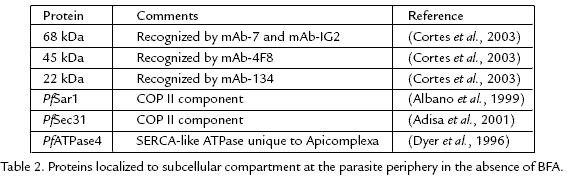
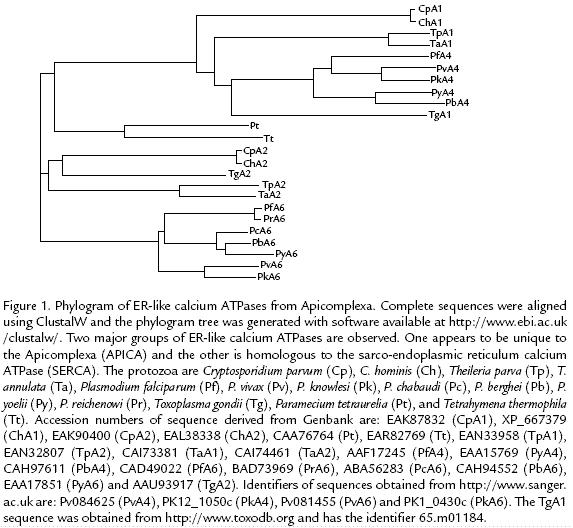
<body><![CDATA[<P    >Several <i>Plasmodiu</i><i>m </i>proteins are associated with a compartment with a similar morphology as the proposed <i>Plasmodiu</i><i>m </i>export compartment in the absence of BFA treatment <a href="#tabla2">(Table 2)</a>. For example, several monoclonal antibodies raised against a membranous fraction isolated from <i>P. falciparum</i>infected erythrocytes exhibited an immunofluorescence pattern similar to the novel BFAinduced compartment (Cortes et al., 2003). Colocalization studies confirm that the proteins recognized by these monoclonal antibodies are localized to the proposed <i>Plasmodiu</i><i>m </i>export compartment. These colocalization studies indicate that this compartment is not simply an artifact of BFA treatment in that this compartment exists in the absence of BFA. Three distinct proteins of molecular masses 68, 45 and 22 kDa are localized to the <i>Plasmodiu</i><i>m </i>export compartment and these three proteins are conserved between <i>P. falciparu</i><i>m </i>and the rodent malaria parasites. The identities of these proteins are not known. Knowing the identities of these proteins will provide some insight into the nature of this <i>Plasmodiu</i><i>m </i>export compartment.</P > <a name="tabla2"></a><img src="/img/revistas/abc/v12n2/v12n2a1t2.gif" >     <P    >These monoclonal antibodies have been used to characterize the export compartment during erythrocytic stage schizogony. The structure recognized by these monoclonal antibodies is observed in the early ring stage and is continuously present throughout the entire blood stage (Cortes <i>et al.</i>, 2003). The structure increases in size during the trophozoite stage as the parasite grows and may reflect an increase in protein trafficking as the parasite matures. During schizogony the compartment recognized by the monoclonal antibodies divides into smaller structures that are associated with the individual budding merozoites. </P >     <P    >Two other proteins possibly localized to the <i>Plasmodiu</i><i>m </i>export compartment are <i>Pf</i>Sar1 (Albano <i>et al.</i>, 1999) and <i>Pf</i>Sec31 (Adisa <i>et al.</i>, 2001). Both of these proteins are homologues of COPII components of which form coats around vesicles involved in ERGolgi transport (Wieland and Harter, 1999). Colocalization studies using antibodies against the COPII components and monoclonal antibodies discussed above reveal that there is substantial overlap between the compartments recognized by the antiCOPII antibodies and these monoclonal antibodies. However, the compartments recognized by anti<i>Pf</i>Sar1p and anti<i>Pf</i>Sec31p do not coincide exactly with the monoclonal antibodies (Cortes <i>et al.</i>, 2003). The COPII components and the 68, 45 and 22 kDa proteins colocalize to the compartment along the parasite periphery. But the COPII components exhibit a more extensive distribution within the parasite in that there is a diffuse mottled labeling over the entire parasite. This diffuse mottled pattern is quite reminiscent of the ER and these COPII components partially colocalize with the ER markers BiP and <i>Pf</i>ERC (Albano <i>et al.</i>, 1999; Adisa <i>et al.</i>, 2001). These results suggest that COPII components are localized to both the ER and to the <i>Plasmodiu</i><i>m </i>export compartment. </P >     <P    >The accumulation of exported proteins following BFA treatment and the colocalization of COPII components to the <i>Plasmodiu</i><i>m </i>export compartment suggests that it has similar properties as the ER. In addition, an ERlike calcium ATPase is speculated to be localized to this novel compartment (see below). These observations suggest that the <i>Plasmodiu</i><i>m </i>export compartment may be a specialized domain of the ER or a separate ERlike organelle. The more extensive distribution of the COPII components in the parasite as compared to the 68, 45 and 22 kDa proteins is consistent with functionally distinct regions of ER. Similarities between this novel compartment and the ER have been previously noted (Wiser <i>et al.</i>, 1997; Wiser <i>et al.</i>, 1999b) and this compartment was called the secondary ER of Apicomplexa (sERA). These ERlike properties are also consistent with the proposal that this novel export compartment is the first step in an alternate secretory pathway specialized in the export of proteins into the host erythrocyte. Proteins destined for export into the host erythrocyte would be targeted to this special ER domain or ERlike organelle whereas proteins destined for compartments within the parasite would be targeted to other domains of the ER. </P >     <p    ><B>ERLIKE CALCIUM ATPASES OF APICOMPLEXA </b></p >     <P    >Antibodies raised against a Ptype ATPase from <i>P. falciparum</i><i>, </i>called ATPase4, label a flattened diskshaped structure at the parasite periphery (Dyer <i>et al.</i>, 1996). Unfortunately these antibodies were no longer available and it could not be determined if this compartment is the same as the novel <i>Plasmodiu</i><i>m </i>export compartment (Wiser <i>et al.</i>, 1997). ATPase4 and another <i>P</i><i>. </i><i>falciparu</i><i>m </i>ATPase, called ATPase6, both exhibit homology to the sarcoplasmicendoplasmic reticulum calcium ATPase (SERCA). The observation that <i>Plasmodiu</i><i>m </i>has two distinct SERCAlike genes and that both <i>Pf</i>ATPase4 (Dyer <i>et al.</i>, 1996) and <i>Pf</i>ATPase6 (Kimura <i>et al.</i>, 1993) are expressed during the blood stage is consistent with the hypothesis that <i>Plasmodiu</i><i>m </i>has functionally distinct ERlike compartments. No localization data are available for ATPase6. </P >     <P    >Searching all of the available sequence databases indicate that orthologs of both ATPase4 and ATPase6 are found in other <i>Plasmodiu</i><i>m </i>species as well as other Apicomplexa. Othologs for both ATPase4 and ATPase6 were found in all Apicomplexa genomes which are completely sequenced. Phylogenetic analysis indicates that the ATPase4 orthologs form a clade distinct from the ATPase6 orthologs (<a href="#fig1">Figure 1</a>). Previous studies also indicate that ATPase6 is more homologous to SERCA and that ATPase4 may define a group of Ca<Sup>2+</Sup>ATPases which is specific to Apicomplexa (Krishna <i>et al.</i>, 2001; Nagamune and Sibley, 2006). </P >     <P    >Interestingly, antibodies raised against the <i>Cryptosporidiu</i><i>m </i>ATPase4 ortholog recognize two distinct proteins of 160 kDa and 146 kDa on immunoblots and localization studies reveal two distinct patterns (Zhu and Keithly, 1997). One pattern is a diffuse perinuclear location, presumably the ER, and the other pattern is discrete vesicles near the parasite periphery at its apical end. These results suggest that the antibodies are recognizing two distinct proteins in two separate compartments. Furthermore, the sizes of the proteins recognized by the antibody are consistent with the predicted sizes of the ATPase4 and ATPase6 orthologs from <i>Cryptosporidium. Cryptosporidiu</i><i>m </i>is more closely related to the gregarines and probably emerged early in Apicomplexan evolution (Zhu <i>et al.</i>, 2000) suggesting that the duality of ERlike calcium ATPases may be a feature common among the Apicomplexa. Clearly more work on the locations and functions of the SERCAlike ATPases from the Apicomplexa is needed. </P >     <P    >Other interesting observations in regards to Ca<Sup>2+</Sup>ATPases are the labeling of clefts within  ><i>P.</i><i> vivax</i> infected erythrocytes with monoclonal antibodies which recognizes SERCA from a wide variety of organisms (Bracho <i>et al.</i>, 2002) and the histochemical localization of Ca<Sup>2+</Sup>ATPase activity to Mauers' clefts in <i>P. falciparu</i><i>m </i>(Caldas and Wasserman, 2001). </P > <a name="fig1"></a><img src="/img/revistas/abc/v12n2/v12n2a1f1.gif" >     <P    >The SERCA ATPase from ciliates exhibits approximately equal homology to both ATPase4 and ATPase6 (<a href="#fig1">Figure 1</a>). The ciliates are a sister group to the apicomplexa and dinoflagellates within the Alveolata (Leander and Keeling, 2004). The ciliates probably only have one SERCA since the genome of <i>Tetrahymen</i><i>a </i>is completely sequenced (Eisen <i>et al.</i>, 2006). Therefore the duplication of SERCA in the apicomplexa likely occurred after the divergence of the apicomplexa and ciliates. SERCA from the ciliates is localized to the alveolar sacs (Hauser <i>et al.</i>, 1998), which are flatten membranebound compartments found just below the plasma membrane. In Apicomplexa the structures homologous to aveolar sacs are found in the invasive stages and are often called the inner membrane complex. Similarities between alveolar sacs and the ER have been previously noted (L&auml;nge <i>et al.</i>, 1995; de Melo and de Souza, 1997). </P >     ]]></body>
<body><![CDATA[<p    ><B>EXTRAPARASITE TRAFFICKING </b></p >     <P    >The observation that many parasite proteins destined for different locations within the host erythrocyte appear to utilize this novel <i>Plasmodiu</i><i>m </i>export compartment raises some questions about the sorting process within the infected erythrocyte. Presumably proteins will move from this novel compartment into the parasitophorous vacuole. Some exported proteins are known to pass through the parasitophorous vacuole en route to their final destinations within the infected erythrocyte (Ansorge <i>et al.</i>, 1996; Wickham <i>et al.</i>, 2001). The juxtaposition of the novel export compartment with the parasite plasma membrane implies that proteins may move directly into the parasitophorous vacuole. However, there is no evidence of any transient direct connections between the export compartment and the plasma membrane. </P >     <P    >Once within the parasitophorous vacuole the exported proteins need to be sorted and trafficked to their final destinations. The movement of proteins from compartments within the parasite to compartments in the host erythrocyte presents some topological problems and models to account for these problems have been proposed (Przyborski and Lanzer, 2005; Lingelbach and Przyborski, 2006). Many of these models involve a vesiclemediated transport within the infected erythrocyte. However, many exported <i>Plasmodiu</i><i>m </i>proteins appear to be exported into the host erythrocyte as soluble proteins. For example, studies on the trafficking of <i>P</i><i>. </i><i>falciparu</i><i>m </i>erythrocyte membrane protein1 (<i>Pf</i>EMP1) suggest that the protein is trafficked as a complex rather than in vesicles (Knuepfer <i>et al.</i>, 2005a; Papakrivos <i>et al.</i>, 2005). In addition, the Cterminal region of PfEMP1 binds to knobassociated histidine rich protein (KAHRP; Rug, 2006). These observations imply that <i>Pf</i>EMP1 is exported into the host erythrocyte as a soluble protein and is directed to its final destination via interactions with other proteins. <i>Pf</i>EMP3 is also trafficked as a complex with other proteins in the cytoplasm of the host erythrocyte (Knuepfer <i>et al.</i>, 2005b). </P >     <P    >In addition, several <i>Plasmodiu</i><i>m </i>proteins that are localized to the host erythrocyte membrane, including KAHRP, bind to the submembrane cytoskeleton on the cytoplasmic face of the erythrocyte membrane (Lustigman <i>et al.</i>, 1990; Wiser <i>et al.</i>, 1990; Foley <i>et al.</i>, 1991; Kilejian <i>et al.</i>, 1991). These observations imply that a potential mechanism of trafficking within the infected erythrocyte involves the secretion of soluble proteins into the erythrocyte cytoplasm and targeting involves binding to other proteins. Interestingly, many of the proposed exported proteins are chaperones (Hiller <i>et al.</i>, 2004; Sargeant <i>e</i><i>t </i><i>al.</i>, 2006) and several chaperones are found in parasitophorous vacuole (Nyalwidhe and Lingelbach, 2006). The role of these exported chaperones may be to escort secreted proteins to their final destinations and assist in the formation of supramolecular structures such as knobs. Host chaperones have also been shown to be associated with knobenriched erythrocyte membrane fractions (Banumathy <i>et al.</i>, 2001). </P >     <P    >Such a model for trafficking within the erythrocyte raises questions about how proteins are released from the parasitophorous vacuole. One possibility is that transporters are found on the PVM which transfer proteins from the parasitophorous vacuole to the erythrocyte cytoplasm. However, no such transporters have been identified on the PVM. </P >     <P    >Pores on alveolar membranes of the malaria parasite have been described and these pores are speculated to be involved in protein transport (Raibaud <i>et al.</i>, 2001). In addition, diffuse membranous structures found at the PVM have been proposed to be involved in the release of material from the parasitophorous vacuole into the erythrocyte cytoplasm (Lanners <i>et al.</i>, 1999). Once released into the erythrocyte cytoplasm the exported proteins could then bind to their final destination or associate with chaperones which will assist in targeting the proteins to their correct destinations. </P >     <P    >Several exported proteins destined for the erythrocyte membrane are transiently found on Maurer's clefts before arriving at their final erythrocyte membrane destination (Hinterberg <i>et al.</i>, 1994; Wickham <i>et al.</i>, 2001; Kriek <i>et al.</i>, 2003). This suggests that the Maurer's clefts function as an intermediate step in the trafficking of proteins within the host erythrocyte. In particular, the KAHRP (Wickham <i>et al.</i>, 2001) and <i>Pf</i>EMP1 (Kriek <i>et al.</i>, 2003) are known to be associated with Maurer's clefts before the final assembly of the knobs on the erythrocyte membrane. For example, <i>Pf</i>EMP1 is synthesized and trafficked as a peripheral membrane protein to the Maurer's clefts and then subsequently inserted through erythrocyte membrane from the Maurer's clefts (Papakrivos <i>et al.</i>, 2005). This trafficking to the Maurer's clefts and insertion of PfEMP1 into the erythrocyte membrane requires a Maurer's cleft protein called skeleton binding protein1 (SBP1) (Cooke <i>et al.</i>, 2006; Maier <i>et al.</i>, 2007). However, other erythrocyte membrane associated proteins do not require SBP1 for their trafficking to erythrocyte membrane. Therefore, SBP1 may play a specific role in the trafficking of PfEMP1 and its insertion into the host membrane. In addition, the cholesterol rich domains on the erythrocyte membrane are important for the insertion of PfEMP1 into the erythrocyte membrane (Frankland <i>et al.</i>, 2006). </P >     <P    >Another possibility is that proteins can move along the extensions of the PVM. Such a mechanism may be used by proteins which are resident within these PVM extensions and ultimately the Maurer's clefts. For example, GRA3, a <i>Toxoplasm</i><i>a </i>protein, integrates into the PVM following secretion of a soluble form into the parasitophorous vacuole (Ossorio <i>et al.</i>, 1994), and a similar mechanism for the incorporation of <i>P</i><i>. </i><i>falciparu</i><i>m </i>Exp2 in the PVM has been proposed (Fischer <i>et al.</i>, 1998).</P >     <P    ><B>TARGETING SEQUENCES </b></P >     <P    >Another major question in regards to the trafficking of proteins to the host erythrocyte concerns targeting sequences. Some exported <i>Plasmodiu</i><i>m </i>proteins contain canonical Nterminal signal sequences, whereas other exported proteins contain a hydrophobic region resembling a signal sequence that is recessed by up to 80 amino acids (Cooke <i>e</i><i>t </i>al., 2004a). This hydrophobic signal sequence is sufficient for targeting proteins to the parasitophorous vacuole but additional signals are needed for trafficking into the host erythrocyte. A short sequence motif necessary for transport beyond the PVM has been identified (Hiller <i>et al.</i>, 2004; Marti <i>et al.</i>, 2004). This <i>Plasmodiu</i><i>m </i>export element (PEXEL) is located 1520 amino acids downstream of the hydrophobic signal sequence and has a consensus sequence of RxLxE/Q. Many of the genes contain an intron between the signal sequence and PEXEL with the PEXEL motif close to the beginning of the second exon. Not all exported proteins have this targeting motif though. SBP1 has neither a signal sequence nor the PEXEL, <i>Pf</i>EMP1 has the PEXEL but no signal sequence, and EXP1 has a signal sequence, but no PEXEL. Such proteins may need to be escorted to their final destinations by other proteins with the proper signals. </P >     ]]></body>
<body><![CDATA[<P    >Proteins destined for different locations within the infected erythrocyte contain the PEXEL. In addition, both soluble and membrane exported proteins have the PEXEL. This implies that the PEXEL functions at a step before the proteins have separated into distinct trafficking pathways. In other words, PEXEL probably functions in the secretory pathway before the parasitophorous vacuole. For example, PEXEL in combination with the signal sequence may target proteins to <i>Plasmodiu</i><i>m </i>export compartment. As discussed above, the exported proteins are then transferred to the parasitophorous vacuole for subsequent sorting and trafficking. Thus, PEXEL may function twice in the secretory process. The first function is to target the protein to the <i>Plasmodiu</i><i>m </i>export compartment and then later as a signal to exit the parasitophorous vacuole. </P >     <P    >The PEXEL motif has not been identified in other apicomplexa and may be unique to <i>Plasmodiu</i><i>m </i>(Sargeant <i>et al.</i>, 2006). If PEXEL is involved in targeting exported proteins to the <i>Plasmodiu</i><i>m </i>export compartment, then this compartment may also be unique to <i>Plasmodium</i>. Thus, the earlier designation of this compartment as the secondary ER of the apicomplexa (sERA) may not be accurate. However, all Apicomplexa do appear to have the unique SERCAlike calcium ATPase. Clearly more work is needed on resolving if PEXEL plays a role in targeting proteins to the <i>Plasmodiu</i><i>m </i>export compartment and the function and location of the Apicomplexan calcium ATPase. </P >     <p    ><B>SUMMARY AND MODEL </b></p >     <P    >The malaria parasite exports many proteins to distinct locations within the host erythrocyte. Many of these exported proteins appear to traverse a specialized compartment within the parasite that functions in the export of proteins into the host erythrocyte. This <i>Plasmodiu</i><i>m </i>export compartment exhibits many ERlike properties and may be a specialized domain of the ER or a distinct ERlike organelle. The observation that <i>Plasmodiu</i><i>m </i>and other Apicomplexa have two SERCAlike ATPases is consistent with two ERlike organelles. It is proposed that proteins destined for compartments within the parasite utilize the classical ER, whereas proteins destined for export into the host erythrocyte are targeted for the <i>Plasmodiu</i><i>m </i>export compartment (<a href="#fig2">Figure 2</a>). Proteins then move from the <i>Plasmodiu</i><i>m </i>export compartment into the parasitophorous vacuole by an unknown mechanism. Some sorting may occur within the parasitophorous vacuole. For example, proteins that are resident to the PVM or the extensions of the PVM and possibly the Maurer's clefts may move along these extensions. Proteins destined for the erythrocyte are likely exported into the cytoplasm of the host erythrocyte as soluble proteins. Some of these proteins may bind directly to their final destination such as the erythrocyte membrane. Others may associate transiently with Maurer's clefts or other membranes within the infected erythrocyte. Chaperones may also be involved in the trafficking of proteins to their final destinations and the assembly of supramolecular complexes such as knobs. </P>  <a name="fig2"></a><img src="/img/revistas/abc/v12n2/v12n2a1f2.jpg">     <P    >erythrocyte. Proteins destined for locations within the parasite are trafficked through the endoplasmic reticulum (ER) and sorted to the various compartments such as the apicoplast (Ap), food vacuole (FV), and parasite plasma membrane. Many exported proteins are targeted to the <i>Plasmodiu</i><i>m </i>export compartment (PEC) instead of the ER in route to the parasitophorous vacuole (PV). The PEC could also be a specialized domain of the ER. Some proteins will be retained in the PV or associate with the PVM or the extensions of the PVM, whereas others will be transported into the host erythrocyte cytoplasm as soluble proteins. These proteins will then associate with membranous compartments within the erythrocyte or the erythrocyte membrane. Chaperones may play a role in the trafficking of exported proteins or their association with supramolecular structures. Many proteins, especially those associated with knobs, assemble on the Maurer's clefts or other membranes within the cytoplasm of the host erythrocyte before their final transfer to the erythrocyte membrane. </P >     <p   align="left" ><B>ACKNOWLEDGEMENT </b></p >     <P    ><B>I </b>thank Gladys Cort&eacute;s for her help in translating the summary into Spanish. </P >     <p   align="left" ><B>BIBLIOGRAPHY </b></p >     <!-- ref --><P    >ADISA A, REEDER J, ALBANO FR, FOLEY M, TILLEY L. Evidence for a Role for a <i>Plasmodiu</i><i>m </i><i>falciparu</i><i>m </i>Homologue of Sec31p in the Export of Proteins to the Surface of Malaria ParasiteInfected Erythrocytes. J Cell Sci. 2001;114:3377-3386. </P >     &nbsp;&nbsp;&nbsp;&nbsp;&nbsp;&nbsp;&nbsp;&nbsp;[&#160;<a href="javascript:void(0);" onclick="javascript: window.open('/scielo.php?script=sci_nlinks&ref=000051&pid=S0120-548X200700020000100001&lng=','','width=640,height=500,resizable=yes,scrollbars=1,menubar=yes,');">Links</a>&#160;]<!-- end-ref --><!-- ref --><P    >ALBANO FR, BERMAN A, LA GRECA N, HIBBS AR, WICKHAM M, FOLEY M <i>et al</i><i>. </i>A Homologue of Sar1p Localises to a Novel Trafficking Pathway in MalariaInfected Erythrocytes. Eur J Cell Biol. 1999;78:453-462. </P >     &nbsp;&nbsp;&nbsp;&nbsp;&nbsp;&nbsp;&nbsp;&nbsp;[&#160;<a href="javascript:void(0);" onclick="javascript: window.open('/scielo.php?script=sci_nlinks&ref=000052&pid=S0120-548X200700020000100002&lng=','','width=640,height=500,resizable=yes,scrollbars=1,menubar=yes,');">Links</a>&#160;]<!-- end-ref --><!-- ref --><P    >ANSORGE I, BENTING J, BHAKDI S, LINGELBACH K. Protein Sorting in <i>Plasmodiu</i><i>m </i><i>falciparum</i>Infected Red Blood Cells Permeabilized with the PoreForming Protein Streptolysin O. Biochem J. 1996;315:307-314. </P >     &nbsp;&nbsp;&nbsp;&nbsp;&nbsp;&nbsp;&nbsp;&nbsp;[&#160;<a href="javascript:void(0);" onclick="javascript: window.open('/scielo.php?script=sci_nlinks&ref=000053&pid=S0120-548X200700020000100003&lng=','','width=640,height=500,resizable=yes,scrollbars=1,menubar=yes,');">Links</a>&#160;]<!-- end-ref --><!-- ref --><P    >ATKINSON CT, AIKAWA M. Ultrastructure of MalariaInfected Erythrocytes. Blood Cells. 1990;16:351-368. </P >     &nbsp;&nbsp;&nbsp;&nbsp;&nbsp;&nbsp;&nbsp;&nbsp;[&#160;<a href="javascript:void(0);" onclick="javascript: window.open('/scielo.php?script=sci_nlinks&ref=000054&pid=S0120-548X200700020000100004&lng=','','width=640,height=500,resizable=yes,scrollbars=1,menubar=yes,');">Links</a>&#160;]<!-- end-ref --><!-- ref --><P    >BANUMATHY G, SINGH V, TATU U. Host Chaperones Are Recruited in MembraneBound Complexes by <i>Plasmodiu</i><i>m </i><i>falciparum</i>. J Biol Chem. 2001;277:3902-3912. </P >     &nbsp;&nbsp;&nbsp;&nbsp;&nbsp;&nbsp;&nbsp;&nbsp;[&#160;<a href="javascript:void(0);" onclick="javascript: window.open('/scielo.php?script=sci_nlinks&ref=000055&pid=S0120-548X200700020000100005&lng=','','width=640,height=500,resizable=yes,scrollbars=1,menubar=yes,');">Links</a>&#160;]<!-- end-ref --><!-- ref --><P    >BAUMEISTER S, WINTERBERG M, DURANTON C, HUBER SM, LANG F, KIRK K, <i>et al</i><i>. </i>Evidence for the Involvement of <i>Plasmodiu</i><i>m </i>falciparu<i>m </i>Proteins in the Formation of New Permeability Pathways in the Erythrocyte Membrane. Mol Microbiol. 2006;60:493-504. </P >     &nbsp;&nbsp;&nbsp;&nbsp;&nbsp;&nbsp;&nbsp;&nbsp;[&#160;<a href="javascript:void(0);" onclick="javascript: window.open('/scielo.php?script=sci_nlinks&ref=000056&pid=S0120-548X200700020000100006&lng=','','width=640,height=500,resizable=yes,scrollbars=1,menubar=yes,');">Links</a>&#160;]<!-- end-ref --><!-- ref --><P    >BENTING J, MATTEI D, LINGELBACH K. Brefeldin A Inhibits Transport of the GlycophorinBinding Protein from <i>Plasmodiu</i><i>m </i><i>falciparu</i><i>m </i>into the Host Erythrocyte. Biochem J. 1994;300:821-826. </P >     &nbsp;&nbsp;&nbsp;&nbsp;&nbsp;&nbsp;&nbsp;&nbsp;[&#160;<a href="javascript:void(0);" onclick="javascript: window.open('/scielo.php?script=sci_nlinks&ref=000057&pid=S0120-548X200700020000100007&lng=','','width=640,height=500,resizable=yes,scrollbars=1,menubar=yes,');">Links</a>&#160;]<!-- end-ref --><!-- ref --><P    >BRACHO C, DUNIA I, DE LR, BENEDETTI EL, PEREZ HA. Traffic Pathways of <i>Plasmodiu</i><i>m </i><i>viva</i><i>x </i>Antigens During Intraerythrocytic Parasite Development. Parasitol Res. 2002;88:253-258. </P >     &nbsp;&nbsp;&nbsp;&nbsp;&nbsp;&nbsp;&nbsp;&nbsp;[&#160;<a href="javascript:void(0);" onclick="javascript: window.open('/scielo.php?script=sci_nlinks&ref=000058&pid=S0120-548X200700020000100008&lng=','','width=640,height=500,resizable=yes,scrollbars=1,menubar=yes,');">Links</a>&#160;]<!-- end-ref --><!-- ref --><P    >CALDAS ML, WASSERMAN M. Cytochemical Localisation of Calcium Atpase Activity During the Erythrocytic Cell Cycle of <i>Plasmodiu</i><i>m </i><i>falciparum</i>. Int J Parasitol. 2001;31:776-782. </P >     &nbsp;&nbsp;&nbsp;&nbsp;&nbsp;&nbsp;&nbsp;&nbsp;[&#160;<a href="javascript:void(0);" onclick="javascript: window.open('/scielo.php?script=sci_nlinks&ref=000059&pid=S0120-548X200700020000100009&lng=','','width=640,height=500,resizable=yes,scrollbars=1,menubar=yes,');">Links</a>&#160;]<!-- end-ref --><!-- ref --><P    >CARLTON JM, ANGIUOLI SV, SUH BB, KOOIJ TW, PERTEA M, SILVA JC <i>et al</i><i>. </i>Genome Sequence and Comparative Analysis of the Model Rodent Malaria Parasite <i>Plasmodium yoelii yoelii</i><i>. </i>Nature. 2002;419:512-519. </P >     &nbsp;&nbsp;&nbsp;&nbsp;&nbsp;&nbsp;&nbsp;&nbsp;[&#160;<a href="javascript:void(0);" onclick="javascript: window.open('/scielo.php?script=sci_nlinks&ref=000060&pid=S0120-548X200700020000100010&lng=','','width=640,height=500,resizable=yes,scrollbars=1,menubar=yes,');">Links</a>&#160;]<!-- end-ref --><!-- ref --><P    >CHARDIN P, MCCORMICK F. Brefeldin A: The Advantage of Being Uncompetitive. Cell. 1999;97:153-155. </P >     &nbsp;&nbsp;&nbsp;&nbsp;&nbsp;&nbsp;&nbsp;&nbsp;[&#160;<a href="javascript:void(0);" onclick="javascript: window.open('/scielo.php?script=sci_nlinks&ref=000061&pid=S0120-548X200700020000100011&lng=','','width=640,height=500,resizable=yes,scrollbars=1,menubar=yes,');">Links</a>&#160;]<!-- end-ref --><!-- ref --><P    >COOKE BM, LINGELBACH K, BANNISTER LH, TILLEY L. Protein Trafficking in <i>Plasmodiu</i><i>m </i><i>falciparum</i>Infected Red Blood Cells. Trends Parasitol. 2004a;20:581-589. </P >     &nbsp;&nbsp;&nbsp;&nbsp;&nbsp;&nbsp;&nbsp;&nbsp;[&#160;<a href="javascript:void(0);" onclick="javascript: window.open('/scielo.php?script=sci_nlinks&ref=000062&pid=S0120-548X200700020000100012&lng=','','width=640,height=500,resizable=yes,scrollbars=1,menubar=yes,');">Links</a>&#160;]<!-- end-ref --><!-- ref --><P    >COOKE BM, MOHANDAS N, COPPEL RL. Malaria and the Red Blood Cell Membrane. Semin Hematol. 2004b;41:173-188. </P >     &nbsp;&nbsp;&nbsp;&nbsp;&nbsp;&nbsp;&nbsp;&nbsp;[&#160;<a href="javascript:void(0);" onclick="javascript: window.open('/scielo.php?script=sci_nlinks&ref=000063&pid=S0120-548X200700020000100013&lng=','','width=640,height=500,resizable=yes,scrollbars=1,menubar=yes,');">Links</a>&#160;]<!-- end-ref --><!-- ref --><P    >COOKE BM, BUCKINGHAM DW, GLENISTER FK, FERNANDEZ KM, BANNISTER LH, MARTI M <i>et al</i><i>. </i>A Maurer's CleftAssociated Protein Is Essential for Expression of the Major Malaria Virulence Antigen on the Surface of Infected Red Blood Cells. J Cell Biol. 2006;172:899-908. </P >     &nbsp;&nbsp;&nbsp;&nbsp;&nbsp;&nbsp;&nbsp;&nbsp;[&#160;<a href="javascript:void(0);" onclick="javascript: window.open('/scielo.php?script=sci_nlinks&ref=000064&pid=S0120-548X200700020000100014&lng=','','width=640,height=500,resizable=yes,scrollbars=1,menubar=yes,');">Links</a>&#160;]<!-- end-ref --><!-- ref --><P    >CORTES GT, WINOGRAD E, WISER MF. Characterization of Proteins Localized to a Subcellular Compartment Associated with an Alternate Secretory Pathway of the Malaria Parasite. Mol Biochem Parasitol. 2003;129:127-135. </P >     &nbsp;&nbsp;&nbsp;&nbsp;&nbsp;&nbsp;&nbsp;&nbsp;[&#160;<a href="javascript:void(0);" onclick="javascript: window.open('/scielo.php?script=sci_nlinks&ref=000065&pid=S0120-548X200700020000100015&lng=','','width=640,height=500,resizable=yes,scrollbars=1,menubar=yes,');">Links</a>&#160;]<!-- end-ref --><!-- ref --><P    >COWMAN AF, CRABB BS. Invasion of Red Blood Cells by Malaria Parasites. Cell. 2006;124:755-766. </P >     &nbsp;&nbsp;&nbsp;&nbsp;&nbsp;&nbsp;&nbsp;&nbsp;[&#160;<a href="javascript:void(0);" onclick="javascript: window.open('/scielo.php?script=sci_nlinks&ref=000066&pid=S0120-548X200700020000100016&lng=','','width=640,height=500,resizable=yes,scrollbars=1,menubar=yes,');">Links</a>&#160;]<!-- end-ref --><!-- ref --><P    >DE MELO EJT, DE SOUZA W. A Cytochemical Study of the Inner Membrane Complex of the Pellicle of Tachyzoites of <i>Toxoplasma gondii</i><i>. </i>Parasitol Res. 1997;83:252-256. </P >     &nbsp;&nbsp;&nbsp;&nbsp;&nbsp;&nbsp;&nbsp;&nbsp;[&#160;<a href="javascript:void(0);" onclick="javascript: window.open('/scielo.php?script=sci_nlinks&ref=000067&pid=S0120-548X200700020000100017&lng=','','width=640,height=500,resizable=yes,scrollbars=1,menubar=yes,');">Links</a>&#160;]<!-- end-ref --><!-- ref --><P    >DYER M, JACKSON M, MCWHINNEY C, ZHAO G, MIKKELSEN R. Analysis of a CationTransporting Atpase of <i>Plasmodiu</i><i>m </i><i>falciparum</i>. Mol Biochem Parasitol. 1996;78:1-12. </P >     &nbsp;&nbsp;&nbsp;&nbsp;&nbsp;&nbsp;&nbsp;&nbsp;[&#160;<a href="javascript:void(0);" onclick="javascript: window.open('/scielo.php?script=sci_nlinks&ref=000068&pid=S0120-548X200700020000100018&lng=','','width=640,height=500,resizable=yes,scrollbars=1,menubar=yes,');">Links</a>&#160;]<!-- end-ref --><!-- ref --><P    >EISEN JA, COYNE RS, WU M, WU D, THIAGARAJAN M, WORTMAN JR <i>et al</i><i>. </i>Macronuclear Genome Sequence of the Ciliate <i>Tetrahymena thermophila</i><i>, </i>a Model Eukaryote. PLoS Biology. 2006;4:e286. </P >     &nbsp;&nbsp;&nbsp;&nbsp;&nbsp;&nbsp;&nbsp;&nbsp;[&#160;<a href="javascript:void(0);" onclick="javascript: window.open('/scielo.php?script=sci_nlinks&ref=000069&pid=S0120-548X200700020000100019&lng=','','width=640,height=500,resizable=yes,scrollbars=1,menubar=yes,');">Links</a>&#160;]<!-- end-ref --><!-- ref --><P    >ELFORD BC, FERGUSON DJP. Secretory Processes in <i>Plasmodium</i>. Parasitol Today. 1993;9:80-81. </P >     &nbsp;&nbsp;&nbsp;&nbsp;&nbsp;&nbsp;&nbsp;&nbsp;[&#160;<a href="javascript:void(0);" onclick="javascript: window.open('/scielo.php?script=sci_nlinks&ref=000070&pid=S0120-548X200700020000100020&lng=','','width=640,height=500,resizable=yes,scrollbars=1,menubar=yes,');">Links</a>&#160;]<!-- end-ref --><!-- ref --><P    >ELMENDORF HG, BANGS JD, HALDAR K. Synthesis and Secretion of Proteins by Released Malarial Parasites. Mol Biochem Parasitol. 1992;52:215-230. </P >     &nbsp;&nbsp;&nbsp;&nbsp;&nbsp;&nbsp;&nbsp;&nbsp;[&#160;<a href="javascript:void(0);" onclick="javascript: window.open('/scielo.php?script=sci_nlinks&ref=000071&pid=S0120-548X200700020000100021&lng=','','width=640,height=500,resizable=yes,scrollbars=1,menubar=yes,');">Links</a>&#160;]<!-- end-ref --><!-- ref --><P    >ELMENDORF HG, HALDAR K. Secretory Transport in <i>Plasmodium</i>. Parasitol Today. 1993a;9:98-102. </P >     &nbsp;&nbsp;&nbsp;&nbsp;&nbsp;&nbsp;&nbsp;&nbsp;[&#160;<a href="javascript:void(0);" onclick="javascript: window.open('/scielo.php?script=sci_nlinks&ref=000072&pid=S0120-548X200700020000100022&lng=','','width=640,height=500,resizable=yes,scrollbars=1,menubar=yes,');">Links</a>&#160;]<!-- end-ref --><!-- ref --><P    >ELMENDORF HG, HALDAR K. Identification and Localization of Erd2 in the Malaria Parasite <i>Plasmodium</i><i>falciparu</i><i>m </i>Separation from Sites of Sphingomyelin Synthesis and Implications for Organization of the Golgi. EMBO J. 1993b;12:4763-4773. </P >     &nbsp;&nbsp;&nbsp;&nbsp;&nbsp;&nbsp;&nbsp;&nbsp;[&#160;<a href="javascript:void(0);" onclick="javascript: window.open('/scielo.php?script=sci_nlinks&ref=000073&pid=S0120-548X200700020000100023&lng=','','width=640,height=500,resizable=yes,scrollbars=1,menubar=yes,');">Links</a>&#160;]<!-- end-ref --><!-- ref --><P    >FISCHER K, MARTI T, RICK B, JOHNSON D, BENTING J, BAUMEISTER S <i>et al</i><i>. </i>Characterization and Cloning of the Gene Encoding the Vacuolar Membrane Protein Exp2 from <i>Plasmodiu</i><i>m </i><i>falciparum</i>. Mol Biochem Parasitol. 1998;92:47-57. </P >     &nbsp;&nbsp;&nbsp;&nbsp;&nbsp;&nbsp;&nbsp;&nbsp;[&#160;<a href="javascript:void(0);" onclick="javascript: window.open('/scielo.php?script=sci_nlinks&ref=000074&pid=S0120-548X200700020000100024&lng=','','width=640,height=500,resizable=yes,scrollbars=1,menubar=yes,');">Links</a>&#160;]<!-- end-ref --><!-- ref --><P    >FOLEY M, TILLEY L, SAWYER WH, ANDERS RF. The RingInfected Erythrocyte Surface Antigen of <i>Plasmodiu</i><i>m </i><i>falciparu</i><i>m </i>Associates with Spectrin in the Erythrocyte Membrane. Mol Biochem Parasitol. 1991;46:137-148. </P >     &nbsp;&nbsp;&nbsp;&nbsp;&nbsp;&nbsp;&nbsp;&nbsp;[&#160;<a href="javascript:void(0);" onclick="javascript: window.open('/scielo.php?script=sci_nlinks&ref=000075&pid=S0120-548X200700020000100025&lng=','','width=640,height=500,resizable=yes,scrollbars=1,menubar=yes,');">Links</a>&#160;]<!-- end-ref --><!-- ref --><P    >FRANKLAND S, ADISA A, HORROCKS P, TARASCHI TF, SCHNEIDER T, ELLIOT SR <i>et al</i><i>. </i>Delivery of the Malaria Virulence Protein Pfemp1 to the Erythrocyte Surface Requires CholesterolRich Domains. Eukaryotic Cell. 2006;5:849-860. </P >     &nbsp;&nbsp;&nbsp;&nbsp;&nbsp;&nbsp;&nbsp;&nbsp;[&#160;<a href="javascript:void(0);" onclick="javascript: window.open('/scielo.php?script=sci_nlinks&ref=000076&pid=S0120-548X200700020000100026&lng=','','width=640,height=500,resizable=yes,scrollbars=1,menubar=yes,');">Links</a>&#160;]<!-- end-ref --><!-- ref --><P    >GARDNER MJ, HALL N, FUNG E, WHITE O, BERRIMAN M, HYMAN RW <i>et al</i><i>. </i>Genome Sequence of the Human Malaria Parasite <i>Plasmodiu</i><i>m </i><i>falciparum</i>. Nature. 2002;419:498-511. </P >     &nbsp;&nbsp;&nbsp;&nbsp;&nbsp;&nbsp;&nbsp;&nbsp;[&#160;<a href="javascript:void(0);" onclick="javascript: window.open('/scielo.php?script=sci_nlinks&ref=000077&pid=S0120-548X200700020000100027&lng=','','width=640,height=500,resizable=yes,scrollbars=1,menubar=yes,');">Links</a>&#160;]<!-- end-ref --><!-- ref --><P    >HALDAR K, MOHANDAS N, SAMUEL BU, HARRISON T, HILLER NL, AKOMPONG T <i>et al</i><i>. </i>Protein and Lipid Trafficking Induced in Erythrocytes Infected by Malaria Parasites. Cell Microbiol. 2002;4:383-395. </P >     &nbsp;&nbsp;&nbsp;&nbsp;&nbsp;&nbsp;&nbsp;&nbsp;[&#160;<a href="javascript:void(0);" onclick="javascript: window.open('/scielo.php?script=sci_nlinks&ref=000078&pid=S0120-548X200700020000100028&lng=','','width=640,height=500,resizable=yes,scrollbars=1,menubar=yes,');">Links</a>&#160;]<!-- end-ref --><!-- ref --><P    >HAUSER K, PAVOLVIC N, KISSMEHL R, PLATTNER H. Molecular Characterization of a Sarco(Endo)Plasmic Reticulum Ca<Sup>2+</Sup>Atpase Gene from <i>Paramecium tetraureli</i><i>a </i>and Localization of Its Gene Product Ot SubPlasmalemmal Calcium Stores. Biochem J. 1998;334:31-38. </P >     &nbsp;&nbsp;&nbsp;&nbsp;&nbsp;&nbsp;&nbsp;&nbsp;[&#160;<a href="javascript:void(0);" onclick="javascript: window.open('/scielo.php?script=sci_nlinks&ref=000079&pid=S0120-548X200700020000100029&lng=','','width=640,height=500,resizable=yes,scrollbars=1,menubar=yes,');">Links</a>&#160;]<!-- end-ref --><!-- ref --><P    >HILLER NL, BHATTACHARJEE S, VAN OOIJ C, LIOLIOS K, HARRISON T, LOPEZESTRA&Ntilde;O C <i>et al</i><i>. </i>A HostTargeting Signal in Virulence Proteins Reveals a Secretome in Malarial Infection. Science. 2004;306:1934-1937. </P >     &nbsp;&nbsp;&nbsp;&nbsp;&nbsp;&nbsp;&nbsp;&nbsp;[&#160;<a href="javascript:void(0);" onclick="javascript: window.open('/scielo.php?script=sci_nlinks&ref=000080&pid=S0120-548X200700020000100030&lng=','','width=640,height=500,resizable=yes,scrollbars=1,menubar=yes,');">Links</a>&#160;]<!-- end-ref --><!-- ref --><P    >HINTERBERG K, SCHERF A, GYSIN J, TOYOSHIMA T, AIKAWA M, MAZIE JC <i>et al</i><i>. </i><i>Plasmodiu</i><i>m </i><i>falciparum</i>: The <i>Pf</i>332 Antigen Is Secreted from the Parasite by a Brefeldin ADependent Pathway and Is Translocated to the Erythroycyte Membrane Via the Maurer's Clefts. Exp Parasitol. 1994;79: </P >     &nbsp;&nbsp;&nbsp;&nbsp;&nbsp;&nbsp;&nbsp;&nbsp;[&#160;<a href="javascript:void(0);" onclick="javascript: window.open('/scielo.php?script=sci_nlinks&ref=000081&pid=S0120-548X200700020000100031&lng=','','width=640,height=500,resizable=yes,scrollbars=1,menubar=yes,');">Links</a>&#160;]<!-- end-ref --><!-- ref --><P    >KILEJIAN A, RASHID MA, AIKAWA M, AJI T, YANG YF. Selective Association of a Fragment of the Knob Protein with Spectrin. Mol Biochem Parasitol. 1991;44:175-182. </P >     &nbsp;&nbsp;&nbsp;&nbsp;&nbsp;&nbsp;&nbsp;&nbsp;[&#160;<a href="javascript:void(0);" onclick="javascript: window.open('/scielo.php?script=sci_nlinks&ref=000082&pid=S0120-548X200700020000100032&lng=','','width=640,height=500,resizable=yes,scrollbars=1,menubar=yes,');">Links</a>&#160;]<!-- end-ref --><!-- ref --><P    >KIMURA M, YAMAGUCHI Y, TAKADA S, TANABE K. Cloning of a Ca<Sup>2+</Sup>Atpase Gene of <i>Plasmodiu</i><i>m </i><i>falciparu</i><i>m </i>and Comparison with Vertebrate Ca<Sup>2+</Sup>Atpases. J Cell Sci. 1993;104:1129-1136. </P >     &nbsp;&nbsp;&nbsp;&nbsp;&nbsp;&nbsp;&nbsp;&nbsp;[&#160;<a href="javascript:void(0);" onclick="javascript: window.open('/scielo.php?script=sci_nlinks&ref=000083&pid=S0120-548X200700020000100033&lng=','','width=640,height=500,resizable=yes,scrollbars=1,menubar=yes,');">Links</a>&#160;]<!-- end-ref --><!-- ref --><P    >KIRK K. Channels and Transporters as Drug Targets in the <i>Plasmodium</i>Infected Erythrocyte. Acta Trop. 2004;89:285-298. </P >     &nbsp;&nbsp;&nbsp;&nbsp;&nbsp;&nbsp;&nbsp;&nbsp;[&#160;<a href="javascript:void(0);" onclick="javascript: window.open('/scielo.php?script=sci_nlinks&ref=000084&pid=S0120-548X200700020000100034&lng=','','width=640,height=500,resizable=yes,scrollbars=1,menubar=yes,');">Links</a>&#160;]<!-- end-ref --><!-- ref --><P    >KNUEPFER E, RUG M, KLONIS N, TILLEY L, COWMAN AF. Trafficking of the Major Virulence Factor to the Surface of Transfected <i>P. falciparum</i>Infected Erythrocytes. Blood. 2005a;105:4078-4087. </P >     &nbsp;&nbsp;&nbsp;&nbsp;&nbsp;&nbsp;&nbsp;&nbsp;[&#160;<a href="javascript:void(0);" onclick="javascript: window.open('/scielo.php?script=sci_nlinks&ref=000085&pid=S0120-548X200700020000100035&lng=','','width=640,height=500,resizable=yes,scrollbars=1,menubar=yes,');">Links</a>&#160;]<!-- end-ref --><!-- ref --><P    >KNUEPFER E, RUG M, KLONIS N, TILLEY L, COWMAN AF. Trafficking Determinants for Pfemp3 Export and Assembly under the <i>Plasmodiu</i><i>m </i><i>falciparum</i>Infected Red Blood Cell Membrane. Mol Microbiol. 2005b;58:1039-1053. </P >     &nbsp;&nbsp;&nbsp;&nbsp;&nbsp;&nbsp;&nbsp;&nbsp;[&#160;<a href="javascript:void(0);" onclick="javascript: window.open('/scielo.php?script=sci_nlinks&ref=000086&pid=S0120-548X200700020000100036&lng=','','width=640,height=500,resizable=yes,scrollbars=1,menubar=yes,');">Links</a>&#160;]<!-- end-ref --><!-- ref --><P    >KRIEK N, TILLEY L, HORROCKS P, PINCHES R, ELFORD BC, FERGUSON DJ et al<i>. </i>Characterization of the Pathway for Transport of the CytoadherenceMediating Protein, Pfemp1, to the Host Cell Surface in Malaria ParasiteInfected Erythrocytes. Mol Microbiol. 2003;50:1215-1227. </P >     &nbsp;&nbsp;&nbsp;&nbsp;&nbsp;&nbsp;&nbsp;&nbsp;[&#160;<a href="javascript:void(0);" onclick="javascript: window.open('/scielo.php?script=sci_nlinks&ref=000087&pid=S0120-548X200700020000100037&lng=','','width=640,height=500,resizable=yes,scrollbars=1,menubar=yes,');">Links</a>&#160;]<!-- end-ref --><!-- ref --><P    >KRISHNA S, WOODROW C, WEBB R, PENNY J, TAKEYASU K, KIMURA M <i>e</i><i>t </i><i>al</i><i>. </i>Expression and Functional Characterization of a <i>Plasmodiu</i><i>m </i><i>falciparu</i><i>m </i>Ca<Sup>2+</Sup>Atpase (Pfatp4) Belonging to a Subclass Unique to Apicomplexan Organisms. J Biol Chem. 2001;276:10782-10787. </P >     &nbsp;&nbsp;&nbsp;&nbsp;&nbsp;&nbsp;&nbsp;&nbsp;[&#160;<a href="javascript:void(0);" onclick="javascript: window.open('/scielo.php?script=sci_nlinks&ref=000088&pid=S0120-548X200700020000100038&lng=','','width=640,height=500,resizable=yes,scrollbars=1,menubar=yes,');">Links</a>&#160;]<!-- end-ref --><!-- ref --><P    >KUMAR N, KOSKI G, HARADA M, AIKAWA M, ZHENG H. Induction and Localization of <i>Plasmodiu</i><i>m </i><i>falciparu</i><i>m </i>Stress Proteins Related to the Heat Shock Protein 70 Family. Mol Biochem Parasitol. 1991;48:47-58. </P >     &nbsp;&nbsp;&nbsp;&nbsp;&nbsp;&nbsp;&nbsp;&nbsp;[&#160;<a href="javascript:void(0);" onclick="javascript: window.open('/scielo.php?script=sci_nlinks&ref=000089&pid=S0120-548X200700020000100039&lng=','','width=640,height=500,resizable=yes,scrollbars=1,menubar=yes,');">Links</a>&#160;]<!-- end-ref --><!-- ref --><P    >LA GRECA N, HIBBS AR, RIFFKIN C, FOLEY M, TILLEY L. Identification of an Endoplasmic ReticulumResident CalciumBinding Protein with Multiple EfHand Motifs in Asexual Stages of <i>Plasmodiu</i><i>m </i><i>falciparum</i>. Mol Biochem Parasitol. 1997;89:283-293. </P >     &nbsp;&nbsp;&nbsp;&nbsp;&nbsp;&nbsp;&nbsp;&nbsp;[&#160;<a href="javascript:void(0);" onclick="javascript: window.open('/scielo.php?script=sci_nlinks&ref=000090&pid=S0120-548X200700020000100040&lng=','','width=640,height=500,resizable=yes,scrollbars=1,menubar=yes,');">Links</a>&#160;]<!-- end-ref --><!-- ref --><P    >L&Auml;NGE S, KLAUKE N, PLATTNER H. Subplasmalemmal Ca<Sup>2+ </Sup>Stores of Probable Relevance for Exocytosis in Paramecium. Aveolar Sacs Share Some but Not All Characteristics with Sarcoplasmic Reticulum. Cell Calcium. 1995;17:335-344. </P >     &nbsp;&nbsp;&nbsp;&nbsp;&nbsp;&nbsp;&nbsp;&nbsp;[&#160;<a href="javascript:void(0);" onclick="javascript: window.open('/scielo.php?script=sci_nlinks&ref=000091&pid=S0120-548X200700020000100041&lng=','','width=640,height=500,resizable=yes,scrollbars=1,menubar=yes,');">Links</a>&#160;]<!-- end-ref --><!-- ref --><P    >LANGRETH SG, JENSEN JB, REESE RT, TRAGER W. Fine Structure of Human Malaria <i>in vitro</i><i>. </i>J Protozool. 1978;25:443-452. </P >     &nbsp;&nbsp;&nbsp;&nbsp;&nbsp;&nbsp;&nbsp;&nbsp;[&#160;<a href="javascript:void(0);" onclick="javascript: window.open('/scielo.php?script=sci_nlinks&ref=000092&pid=S0120-548X200700020000100042&lng=','','width=640,height=500,resizable=yes,scrollbars=1,menubar=yes,');">Links</a>&#160;]<!-- end-ref --><!-- ref --><P    >LANNERS HN, BAFFORD RA, WISER MF. Characterization of the Parasitophorous Vacuole Membrane from <i>Plasmodium chabaud</i><i>i </i>and Implications About Its Role in the Export of Parasite Proteins. Parasitol Res. 1999;85:349-355. </P >     &nbsp;&nbsp;&nbsp;&nbsp;&nbsp;&nbsp;&nbsp;&nbsp;[&#160;<a href="javascript:void(0);" onclick="javascript: window.open('/scielo.php?script=sci_nlinks&ref=000093&pid=S0120-548X200700020000100043&lng=','','width=640,height=500,resizable=yes,scrollbars=1,menubar=yes,');">Links</a>&#160;]<!-- end-ref --><!-- ref --><P    >LANZER M, WICKERT H, KROHNE G, VINCENSINI L, BRAUN BC. Maurer's Clefts: A Novel MultiFunctional Organelle in the Cytoplasm of <i>Plasmodiu</i><i>m </i><i>falciparum</i>Infected Erythroyctes. Int J Parasitol. 2006;36:23-36. </P >     &nbsp;&nbsp;&nbsp;&nbsp;&nbsp;&nbsp;&nbsp;&nbsp;[&#160;<a href="javascript:void(0);" onclick="javascript: window.open('/scielo.php?script=sci_nlinks&ref=000094&pid=S0120-548X200700020000100044&lng=','','width=640,height=500,resizable=yes,scrollbars=1,menubar=yes,');">Links</a>&#160;]<!-- end-ref --><!-- ref --><P    >LEANDER BS, KEELING PJ. Early Evolutionary History of Dinoflagellates and Apicomplexans (Alveolata) as Inferred from Hsp90 and Actin Phylogenies. Journal of Phycology. 2004;40:341-350. </P >     &nbsp;&nbsp;&nbsp;&nbsp;&nbsp;&nbsp;&nbsp;&nbsp;[&#160;<a href="javascript:void(0);" onclick="javascript: window.open('/scielo.php?script=sci_nlinks&ref=000095&pid=S0120-548X200700020000100045&lng=','','width=640,height=500,resizable=yes,scrollbars=1,menubar=yes,');">Links</a>&#160;]<!-- end-ref --><!-- ref --><P    >LINGELBACH K, PRZYBORSKI JM. The Long and Winding Road: Protein Trafficking Mechanisms in the <i>Plasmodiu</i><i>m </i><i>falciparu</i><i>m </i>Infected Erythrocyte. Mol Biochem Parasitol. 2006;147:1-8. </P >     &nbsp;&nbsp;&nbsp;&nbsp;&nbsp;&nbsp;&nbsp;&nbsp;[&#160;<a href="javascript:void(0);" onclick="javascript: window.open('/scielo.php?script=sci_nlinks&ref=000096&pid=S0120-548X200700020000100046&lng=','','width=640,height=500,resizable=yes,scrollbars=1,menubar=yes,');">Links</a>&#160;]<!-- end-ref --><!-- ref --><P    >LUSTIGMAN S, ANDERS RF, BROWN GV, COPPEL RL. The Mature ParasiteInfected Erythrocyte Surface Antigen (Mesa) Associates with the Erythrocyte Membrane Skeletal Protein, Band 4.1. Mol Biochem Parasitol. 1990;38:261-270. </P >     &nbsp;&nbsp;&nbsp;&nbsp;&nbsp;&nbsp;&nbsp;&nbsp;[&#160;<a href="javascript:void(0);" onclick="javascript: window.open('/scielo.php?script=sci_nlinks&ref=000097&pid=S0120-548X200700020000100047&lng=','','width=640,height=500,resizable=yes,scrollbars=1,menubar=yes,');">Links</a>&#160;]<!-- end-ref --><!-- ref --><P    >MAIER AG, RUG M, O'NEILL MT, BEESON JG, MARTI M, REEDER J <i>et al</i><i>. </i>SkeletonBinding Protein 1 Functions at the Parasitophorous Vacuole Membrane to Traffic Pfemp1 to the <i>Plasmodiu</i><i>m </i><i>falciparum</i>Infected Erythrocyte Surface. Blood. 2007;109:1289-1297. </P >     &nbsp;&nbsp;&nbsp;&nbsp;&nbsp;&nbsp;&nbsp;&nbsp;[&#160;<a href="javascript:void(0);" onclick="javascript: window.open('/scielo.php?script=sci_nlinks&ref=000098&pid=S0120-548X200700020000100048&lng=','','width=640,height=500,resizable=yes,scrollbars=1,menubar=yes,');">Links</a>&#160;]<!-- end-ref --><!-- ref --><P    >MARTI M, GOOD RT, RUG M, KNUEPFER E, COWMAN AF. Targeting Malaria Virulence and Remodeling Proteins to the Host Erythrocyte. Science. 2004;306:1930-1933. </P >     &nbsp;&nbsp;&nbsp;&nbsp;&nbsp;&nbsp;&nbsp;&nbsp;[&#160;<a href="javascript:void(0);" onclick="javascript: window.open('/scielo.php?script=sci_nlinks&ref=000099&pid=S0120-548X200700020000100049&lng=','','width=640,height=500,resizable=yes,scrollbars=1,menubar=yes,');">Links</a>&#160;]<!-- end-ref --><!-- ref --><P    >MATTEI D, BERRY L, COUFFIN S, RICHARD O. The Transport of the HistidineRich Protein 1 (Hrp1) from <i>Plasmodiu</i><i>m </i><i>falciparu</i><i>m </i>Is Insensitive to Brefeldin A. In: Bock Gr, Cardew G, eds. Transport and Trafficking in the MalariaInfected Erythrocyte (Novartis Foundation Symposium 226). Chichester: Wiley; 1999. p. 215-230. </P >     &nbsp;&nbsp;&nbsp;&nbsp;&nbsp;&nbsp;&nbsp;&nbsp;[&#160;<a href="javascript:void(0);" onclick="javascript: window.open('/scielo.php?script=sci_nlinks&ref=000100&pid=S0120-548X200700020000100050&lng=','','width=640,height=500,resizable=yes,scrollbars=1,menubar=yes,');">Links</a>&#160;]<!-- end-ref --><!-- ref --><P    >MOURA IC, PUDLES J. A <i>Plasmodium chabaudi chabaud</i><i>i </i>High Molecular Mass Glycoprotein Translocated to the Host Cell Membrane by a NonClassical Secretory Pathway. Eur J Cell Biol. 1999;78:186-193. </P >     &nbsp;&nbsp;&nbsp;&nbsp;&nbsp;&nbsp;&nbsp;&nbsp;[&#160;<a href="javascript:void(0);" onclick="javascript: window.open('/scielo.php?script=sci_nlinks&ref=000101&pid=S0120-548X200700020000100051&lng=','','width=640,height=500,resizable=yes,scrollbars=1,menubar=yes,');">Links</a>&#160;]<!-- end-ref --><!-- ref --><P    >NAGAMUNE K, SIBLEY LD. Comparative Genomic and Phylogenetic Analyses of Calcium Atpases and CalciumRegulated Proteins in Apicomplexa. Mol Biol Evol. 2006;23:1613-1627. </P >     &nbsp;&nbsp;&nbsp;&nbsp;&nbsp;&nbsp;&nbsp;&nbsp;[&#160;<a href="javascript:void(0);" onclick="javascript: window.open('/scielo.php?script=sci_nlinks&ref=000102&pid=S0120-548X200700020000100052&lng=','','width=640,height=500,resizable=yes,scrollbars=1,menubar=yes,');">Links</a>&#160;]<!-- end-ref --><!-- ref --><P    >NYALWIDHE J, LINGELBACH K. Proteases and Chaperones Are the Most Abundant Proteins in the Parasitophorous Vacuole of <i>Plasmodiu</i><i>m </i><i>falciparum</i>Infected Erythrocytes. Proteomics. 2006;6:1563-1573. </P >     &nbsp;&nbsp;&nbsp;&nbsp;&nbsp;&nbsp;&nbsp;&nbsp;[&#160;<a href="javascript:void(0);" onclick="javascript: window.open('/scielo.php?script=sci_nlinks&ref=000103&pid=S0120-548X200700020000100053&lng=','','width=640,height=500,resizable=yes,scrollbars=1,menubar=yes,');">Links</a>&#160;]<!-- end-ref --><!-- ref --><P    >OSSORIO PN, DUBREMETZ JF, JOINER KA. A Soluble Secretory Protein of the Intracellular Parasite <i>Toxoplasma gondi</i><i>i </i>Associates with the Parasitophorous Vacuole Membrane through Hydrophobic Interactions. J Biol Chem. 1994;269:15350-15357. </P >     &nbsp;&nbsp;&nbsp;&nbsp;&nbsp;&nbsp;&nbsp;&nbsp;[&#160;<a href="javascript:void(0);" onclick="javascript: window.open('/scielo.php?script=sci_nlinks&ref=000104&pid=S0120-548X200700020000100054&lng=','','width=640,height=500,resizable=yes,scrollbars=1,menubar=yes,');">Links</a>&#160;]<!-- end-ref --><!-- ref --><P    >PAPAKRIVOS J, NEWBOLD CI, LINGELBACH K. A Potential Novel Mechanism for the Insertion of a Membrane Protein Revealed by a Biochemical Analysis of the <i>Plasmodiu</i><i>m </i><i>falciparu</i><i>m </i>Cytoadherence Molecule Pfemp1. Mol Microbiol. 2005;55:1272-1284. </P >     &nbsp;&nbsp;&nbsp;&nbsp;&nbsp;&nbsp;&nbsp;&nbsp;[&#160;<a href="javascript:void(0);" onclick="javascript: window.open('/scielo.php?script=sci_nlinks&ref=000105&pid=S0120-548X200700020000100055&lng=','','width=640,height=500,resizable=yes,scrollbars=1,menubar=yes,');">Links</a>&#160;]<!-- end-ref --><!-- ref --><P    >PRZYBORSKI JM, LANZER M. Protein Transport and Trafficking in <i>Plasmodiu</i><i>m </i><i>falciparum</i>Infected Erythrocytes. Parasitology. 2005;130:373-388. </P >     &nbsp;&nbsp;&nbsp;&nbsp;&nbsp;&nbsp;&nbsp;&nbsp;[&#160;<a href="javascript:void(0);" onclick="javascript: window.open('/scielo.php?script=sci_nlinks&ref=000106&pid=S0120-548X200700020000100056&lng=','','width=640,height=500,resizable=yes,scrollbars=1,menubar=yes,');">Links</a>&#160;]<!-- end-ref --><!-- ref --><P    >RAIBAUD A, LUPETTI P, PAUL REL, MERCATI D, BREY PT, SINDEN RE <i>et al</i><i>. </i>Cryofracture Electron Microscopy of the Ookinete Pellicle of <i>Plasmodiu</i><i>m </i><i>gallinaceu</i><i>m </i>Reveals the Existence of Novel Pores in the Alveolar Membranes. J Struct Biol. 2001;135:47-57. </P >     &nbsp;&nbsp;&nbsp;&nbsp;&nbsp;&nbsp;&nbsp;&nbsp;[&#160;<a href="javascript:void(0);" onclick="javascript: window.open('/scielo.php?script=sci_nlinks&ref=000107&pid=S0120-548X200700020000100057&lng=','','width=640,height=500,resizable=yes,scrollbars=1,menubar=yes,');">Links</a>&#160;]<!-- end-ref --><!-- ref --><P    >RAU M, PRESCOTT SW, FERNANDEZ KM, COOKE BM, COWMAN AF. The Role of KAHRP Domains in Knop Formation  and Cytoadherence in P. falciparumInfected Human Erythrocytes. Blood. 2006;108:370-378. </P >     &nbsp;&nbsp;&nbsp;&nbsp;&nbsp;&nbsp;&nbsp;&nbsp;[&#160;<a href="javascript:void(0);" onclick="javascript: window.open('/scielo.php?script=sci_nlinks&ref=000108&pid=S0120-548X200700020000100058&lng=','','width=640,height=500,resizable=yes,scrollbars=1,menubar=yes,');">Links</a>&#160;]<!-- end-ref --><!-- ref --><P    >SARGEANT TJ, MARTI M, CALER E, CARLTON JM, SIMPSON K, SPEED TP <i>et al</i><i>. </i>LineageSpecific Expansion of Proteins Exported to Erythrocytes in Malaria Parasites. Genome Biol. 2006;7:R12. </P >     &nbsp;&nbsp;&nbsp;&nbsp;&nbsp;&nbsp;&nbsp;&nbsp;[&#160;<a href="javascript:void(0);" onclick="javascript: window.open('/scielo.php?script=sci_nlinks&ref=000109&pid=S0120-548X200700020000100059&lng=','','width=640,height=500,resizable=yes,scrollbars=1,menubar=yes,');">Links</a>&#160;]<!-- end-ref --><!-- ref --><P    >SOLDATI D, FOTH BJ, COWMAN AF. Molecular and Functional Aspects of Parasite Invasion. Trends Parasitol. 2004;20:567-574. </P >     &nbsp;&nbsp;&nbsp;&nbsp;&nbsp;&nbsp;&nbsp;&nbsp;[&#160;<a href="javascript:void(0);" onclick="javascript: window.open('/scielo.php?script=sci_nlinks&ref=000110&pid=S0120-548X200700020000100060&lng=','','width=640,height=500,resizable=yes,scrollbars=1,menubar=yes,');">Links</a>&#160;]<!-- end-ref --><!-- ref --><P    >SPYCHER C, RUG M, KLONIS N, FERGUSON DJP, COWMAN AF, BECK HP <i>e</i><i>t </i><i>al</i><i>. </i>Genesis of and Trafficking to Maurer's Clefts of <i>Plasmodiu</i><i>m </i><i>falciparum</i>Infected Erythrocytes. Mol Cell Biol. 2006;26:4074-4085. </P >     &nbsp;&nbsp;&nbsp;&nbsp;&nbsp;&nbsp;&nbsp;&nbsp;[&#160;<a href="javascript:void(0);" onclick="javascript: window.open('/scielo.php?script=sci_nlinks&ref=000111&pid=S0120-548X200700020000100061&lng=','','width=640,height=500,resizable=yes,scrollbars=1,menubar=yes,');">Links</a>&#160;]<!-- end-ref --><!-- ref --><P    >TONKIN CJ, PEARCE JA, MCFADDEN GI, COWMAN AF. Protein Targeteing to Destinations of the Secretory Pathway in the Malaria Parasite <i>Plasmodiu</i><i>m </i><i>falciparum</i>. Curr Opin Microbiol. 2006;9(4):381-387. </P >     &nbsp;&nbsp;&nbsp;&nbsp;&nbsp;&nbsp;&nbsp;&nbsp;[&#160;<a href="javascript:void(0);" onclick="javascript: window.open('/scielo.php?script=sci_nlinks&ref=000112&pid=S0120-548X200700020000100062&lng=','','width=640,height=500,resizable=yes,scrollbars=1,menubar=yes,');">Links</a>&#160;]<!-- end-ref --><!-- ref --><P    >WICKERT H, GOTTLER W, KROHNE G, LANZER M. Maurer's Cleft Organization in the Cytoplasm of <i>Plasmodiu</i><i>m </i><i>falciparum</i>Infected Erythrocytes: New Insights from ThreeDimensional Reconstruction of Serial Ultrathin Sections. Eur J Cell Biol. 2004;83:567-582. </P >     &nbsp;&nbsp;&nbsp;&nbsp;&nbsp;&nbsp;&nbsp;&nbsp;[&#160;<a href="javascript:void(0);" onclick="javascript: window.open('/scielo.php?script=sci_nlinks&ref=000113&pid=S0120-548X200700020000100063&lng=','','width=640,height=500,resizable=yes,scrollbars=1,menubar=yes,');">Links</a>&#160;]<!-- end-ref --><!-- ref --><P    >WICKHAM ME, RUG M, RALPH SA, KLONIS N, MCFADDEN GI, TILLEY L <i>e</i><i>t </i><i>al</i><i>. </i>Trafficking and Assembly of the Cytoadherence Complex in <i>Plasmodiu</i><i>m </i><i>falciparum</i>Infected Human Erythrocytes. EMBO J. 2001;20:5636-5649. </P >     &nbsp;&nbsp;&nbsp;&nbsp;&nbsp;&nbsp;&nbsp;&nbsp;[&#160;<a href="javascript:void(0);" onclick="javascript: window.open('/scielo.php?script=sci_nlinks&ref=000114&pid=S0120-548X200700020000100064&lng=','','width=640,height=500,resizable=yes,scrollbars=1,menubar=yes,');">Links</a>&#160;]<!-- end-ref --><!-- ref --><P    >WIELAND F, HARTER C. Mechanisms of Vesicle Formation: Insights from the Cop System. Curr Opin Cell Biol. 1999;11:440-446. </P >     &nbsp;&nbsp;&nbsp;&nbsp;&nbsp;&nbsp;&nbsp;&nbsp;[&#160;<a href="javascript:void(0);" onclick="javascript: window.open('/scielo.php?script=sci_nlinks&ref=000115&pid=S0120-548X200700020000100065&lng=','','width=640,height=500,resizable=yes,scrollbars=1,menubar=yes,');">Links</a>&#160;]<!-- end-ref --><!-- ref --><P    >WISER MF, SARTORELLI AC, PATTON CL. Association of <i>Plasmodium berghe</i><i>i </i>Proteins with the Host Erythrocyte Membrane: Binding to insideout Vesicles. Mol Biochem Parasitol. 1990;38:121-134. </P >     &nbsp;&nbsp;&nbsp;&nbsp;&nbsp;&nbsp;&nbsp;&nbsp;[&#160;<a href="javascript:void(0);" onclick="javascript: window.open('/scielo.php?script=sci_nlinks&ref=000116&pid=S0120-548X200700020000100066&lng=','','width=640,height=500,resizable=yes,scrollbars=1,menubar=yes,');">Links</a>&#160;]<!-- end-ref --><!-- ref --><P    >WISER MF, LANNERS HN, BAFFORD RA, FAVALORO JM. A Novel Alternate Secretory Pathway for the Export of <i>Plasmodiu</i><i>m </i>Proteins into the Host Erythrocyte. Proc Natl Acad Sci U S A. 1997;94:9108-9113. </P >     &nbsp;&nbsp;&nbsp;&nbsp;&nbsp;&nbsp;&nbsp;&nbsp;[&#160;<a href="javascript:void(0);" onclick="javascript: window.open('/scielo.php?script=sci_nlinks&ref=000117&pid=S0120-548X200700020000100067&lng=','','width=640,height=500,resizable=yes,scrollbars=1,menubar=yes,');">Links</a>&#160;]<!-- end-ref --><!-- ref --><P    >WISER MF, GRAB DJ, LANNERS HN. An Alternate Secretory Pathway in <i>Plasmodium</i>: More Questions Than Answers. In: Bock Gr, Cardew G, eds. Transport and Trafficking in the MalariaInfected Erythrocyte. Chichester: John Wiley & Sons, Ltd.; 1999a. p. 199-214. </P >     &nbsp;&nbsp;&nbsp;&nbsp;&nbsp;&nbsp;&nbsp;&nbsp;[&#160;<a href="javascript:void(0);" onclick="javascript: window.open('/scielo.php?script=sci_nlinks&ref=000118&pid=S0120-548X200700020000100068&lng=','','width=640,height=500,resizable=yes,scrollbars=1,menubar=yes,');">Links</a>&#160;]<!-- end-ref --><!-- ref --><P    >WISER MF, LANNERS HN, BAFFORD RA. Export of <i>Plasmodiu</i><i>m </i>Proteins Via a Novel Secretory Pathway. Parasitol Today. 1999b;15:194-198. </P >     &nbsp;&nbsp;&nbsp;&nbsp;&nbsp;&nbsp;&nbsp;&nbsp;[&#160;<a href="javascript:void(0);" onclick="javascript: window.open('/scielo.php?script=sci_nlinks&ref=000119&pid=S0120-548X200700020000100069&lng=','','width=640,height=500,resizable=yes,scrollbars=1,menubar=yes,');">Links</a>&#160;]<!-- end-ref --><!-- ref --><P    >ZHU G, KEITHLY JS. Molecular Analysis of a PType Atpase from <i>Cryptosporidiu</i><i>m </i><i>parvum</i><i>. </i>Mol Biochem Parasitol. 1997;90:307-316. </P >     &nbsp;&nbsp;&nbsp;&nbsp;&nbsp;&nbsp;&nbsp;&nbsp;[&#160;<a href="javascript:void(0);" onclick="javascript: window.open('/scielo.php?script=sci_nlinks&ref=000120&pid=S0120-548X200700020000100070&lng=','','width=640,height=500,resizable=yes,scrollbars=1,menubar=yes,');">Links</a>&#160;]<!-- end-ref --><!-- ref --><P    >ZHU G, KEITHLY JS, PHILIPPE H. What Is the Phylogenetic Position of <i>Cryptosporidium</i><i>. </i>Int J Sys Evol Biol. 2000;50:1673-1681. </P >     &nbsp;&nbsp;&nbsp;&nbsp;&nbsp;&nbsp;&nbsp;&nbsp;[&#160;<a href="javascript:void(0);" onclick="javascript: window.open('/scielo.php?script=sci_nlinks&ref=000121&pid=S0120-548X200700020000100071&lng=','','width=640,height=500,resizable=yes,scrollbars=1,menubar=yes,');">Links</a>&#160;]<!-- end-ref --> ]]></body><back>
<ref-list>
<ref id="B1">
<nlm-citation citation-type="journal">
<person-group person-group-type="author">
<name>
<surname><![CDATA[A]]></surname>
<given-names><![CDATA[ADISA]]></given-names>
</name>
<name>
<surname><![CDATA[REEDER]]></surname>
<given-names><![CDATA[J]]></given-names>
</name>
<name>
<surname><![CDATA[ALBANO]]></surname>
<given-names><![CDATA[FR]]></given-names>
</name>
<name>
<surname><![CDATA[FOLEY]]></surname>
<given-names><![CDATA[M]]></given-names>
</name>
<name>
<surname><![CDATA[TILLEY]]></surname>
<given-names><![CDATA[L]]></given-names>
</name>
</person-group>
<article-title xml:lang="en"><![CDATA[Evidence for a Role for a Plasmodium falciparum Homologue of Sec31p in the Export of Proteins to the Surface of Malaria ParasiteInfected Erythrocytes]]></article-title>
<source><![CDATA[J Cell Sci]]></source>
<year>2001</year>
<volume>114</volume>
<page-range>3377-3386</page-range></nlm-citation>
</ref>
<ref id="B2">
<nlm-citation citation-type="journal">
<person-group person-group-type="author">
<name>
<surname><![CDATA[ALBANO]]></surname>
<given-names><![CDATA[FR]]></given-names>
</name>
<name>
<surname><![CDATA[BERMAN]]></surname>
<given-names><![CDATA[A]]></given-names>
</name>
<name>
<surname><![CDATA[LA GRECA]]></surname>
<given-names><![CDATA[N]]></given-names>
</name>
<name>
<surname><![CDATA[HIBBS]]></surname>
<given-names><![CDATA[AR]]></given-names>
</name>
<name>
<surname><![CDATA[WICKHAM]]></surname>
<given-names><![CDATA[M]]></given-names>
</name>
<name>
<surname><![CDATA[FOLEY]]></surname>
<given-names><![CDATA[M]]></given-names>
</name>
</person-group>
<article-title xml:lang="en"><![CDATA[A Homologue of Sar1p Localises to a Novel Trafficking Pathway in MalariaInfected Erythrocytes]]></article-title>
<source><![CDATA[Eur J Cell Biol]]></source>
<year>1999</year>
<volume>78</volume>
<page-range>453-462</page-range></nlm-citation>
</ref>
<ref id="B3">
<nlm-citation citation-type="journal">
<person-group person-group-type="author">
<name>
<surname><![CDATA[ANSORGE]]></surname>
<given-names><![CDATA[I]]></given-names>
</name>
<name>
<surname><![CDATA[BENTING]]></surname>
<given-names><![CDATA[J]]></given-names>
</name>
<name>
<surname><![CDATA[BHAKDI]]></surname>
<given-names><![CDATA[S]]></given-names>
</name>
<name>
<surname><![CDATA[LINGELBACH]]></surname>
<given-names><![CDATA[K]]></given-names>
</name>
</person-group>
<article-title xml:lang="en"><![CDATA[Protein Sorting in Plasmodium falciparumInfected Red Blood Cells Permeabilized with the PoreForming Protein Streptolysin O]]></article-title>
<source><![CDATA[Biochem J]]></source>
<year>1996</year>
<volume>315</volume>
<page-range>307-314</page-range></nlm-citation>
</ref>
<ref id="B4">
<nlm-citation citation-type="journal">
<person-group person-group-type="author">
<name>
<surname><![CDATA[ATKINSON]]></surname>
<given-names><![CDATA[CT]]></given-names>
</name>
<name>
<surname><![CDATA[AIKAWA]]></surname>
<given-names><![CDATA[M]]></given-names>
</name>
</person-group>
<article-title xml:lang="en"><![CDATA[Ultrastructure of MalariaInfected Erythrocytes]]></article-title>
<source><![CDATA[Blood Cells]]></source>
<year>1990</year>
<volume>16</volume>
<page-range>351-368</page-range></nlm-citation>
</ref>
<ref id="B5">
<nlm-citation citation-type="journal">
<person-group person-group-type="author">
<name>
<surname><![CDATA[BANUMATHY]]></surname>
<given-names><![CDATA[G]]></given-names>
</name>
<name>
<surname><![CDATA[SINGH]]></surname>
<given-names><![CDATA[V]]></given-names>
</name>
<name>
<surname><![CDATA[TATU]]></surname>
<given-names><![CDATA[U]]></given-names>
</name>
</person-group>
<article-title xml:lang="en"><![CDATA[Host Chaperones Are Recruited in MembraneBound Complexes by Plasmodium falciparum]]></article-title>
<source><![CDATA[J Biol Chem]]></source>
<year>2001</year>
<volume>277</volume>
<page-range>3902-3912</page-range></nlm-citation>
</ref>
<ref id="B6">
<nlm-citation citation-type="journal">
<person-group person-group-type="author">
<name>
<surname><![CDATA[BAUMEISTER]]></surname>
<given-names><![CDATA[S]]></given-names>
</name>
<name>
<surname><![CDATA[WINTERBERG]]></surname>
<given-names><![CDATA[M]]></given-names>
</name>
<name>
<surname><![CDATA[DURANTON]]></surname>
<given-names><![CDATA[C]]></given-names>
</name>
<name>
<surname><![CDATA[HUBER]]></surname>
<given-names><![CDATA[SM]]></given-names>
</name>
<name>
<surname><![CDATA[LANG]]></surname>
<given-names><![CDATA[F]]></given-names>
</name>
<name>
<surname><![CDATA[KIRK]]></surname>
<given-names><![CDATA[K]]></given-names>
</name>
</person-group>
<article-title xml:lang="en"><![CDATA[Evidence for the Involvement of Plasmodium falciparum Proteins in the Formation of New Permeability Pathways in the Erythrocyte Membrane]]></article-title>
<source><![CDATA[Mol Microbiol]]></source>
<year>2006</year>
<volume>60</volume>
<page-range>493-504</page-range></nlm-citation>
</ref>
<ref id="B7">
<nlm-citation citation-type="journal">
<person-group person-group-type="author">
<name>
<surname><![CDATA[BENTING]]></surname>
<given-names><![CDATA[J]]></given-names>
</name>
<name>
<surname><![CDATA[MATTEI]]></surname>
<given-names><![CDATA[D]]></given-names>
</name>
<name>
<surname><![CDATA[LINGELBACH]]></surname>
<given-names><![CDATA[K]]></given-names>
</name>
</person-group>
<article-title xml:lang="en"><![CDATA[Brefeldin A Inhibits Transport of the GlycophorinBinding Protein from Plasmodium falciparum into the Host Erythrocyte]]></article-title>
<source><![CDATA[Biochem J]]></source>
<year>1994</year>
<volume>300</volume>
<page-range>821-826</page-range></nlm-citation>
</ref>
<ref id="B8">
<nlm-citation citation-type="journal">
<person-group person-group-type="author">
<name>
<surname><![CDATA[BRACHO]]></surname>
<given-names><![CDATA[C]]></given-names>
</name>
<name>
<surname><![CDATA[DUNIA]]></surname>
<given-names><![CDATA[I]]></given-names>
</name>
<name>
<surname><![CDATA[DE]]></surname>
<given-names><![CDATA[LR]]></given-names>
</name>
<name>
<surname><![CDATA[BENEDETTI]]></surname>
<given-names><![CDATA[EL]]></given-names>
</name>
<name>
<surname><![CDATA[PEREZ]]></surname>
<given-names><![CDATA[HA]]></given-names>
</name>
</person-group>
<article-title xml:lang="en"><![CDATA[Traffic Pathways of Plasmodium vivax Antigens During Intraerythrocytic Parasite Development]]></article-title>
<source><![CDATA[Parasitol Res]]></source>
<year>2002</year>
<volume>88</volume>
<page-range>253-258</page-range></nlm-citation>
</ref>
<ref id="B9">
<nlm-citation citation-type="journal">
<person-group person-group-type="author">
<name>
<surname><![CDATA[CALDAS]]></surname>
<given-names><![CDATA[ML]]></given-names>
</name>
<name>
<surname><![CDATA[WASSERMAN]]></surname>
<given-names><![CDATA[M]]></given-names>
</name>
</person-group>
<article-title xml:lang="en"><![CDATA[Cytochemical Localisation of Calcium Atpase Activity During the Erythrocytic Cell Cycle of Plasmodium falciparum]]></article-title>
<source><![CDATA[Int J Parasitol]]></source>
<year>2001</year>
<volume>31</volume>
<page-range>776-782</page-range></nlm-citation>
</ref>
<ref id="B10">
<nlm-citation citation-type="journal">
<person-group person-group-type="author">
<name>
<surname><![CDATA[CARLTON]]></surname>
<given-names><![CDATA[JM]]></given-names>
</name>
<name>
<surname><![CDATA[ANGIUOLI]]></surname>
<given-names><![CDATA[SV]]></given-names>
</name>
<name>
<surname><![CDATA[SUH]]></surname>
<given-names><![CDATA[BB]]></given-names>
</name>
<name>
<surname><![CDATA[KOOIJ]]></surname>
<given-names><![CDATA[TW]]></given-names>
</name>
<name>
<surname><![CDATA[PERTEA]]></surname>
<given-names><![CDATA[M]]></given-names>
</name>
<name>
<surname><![CDATA[SILVA]]></surname>
<given-names><![CDATA[JC]]></given-names>
</name>
</person-group>
<article-title xml:lang="en"><![CDATA[Genome Sequence and Comparative Analysis of the Model Rodent Malaria Parasite Plasmodium yoelii yoelii]]></article-title>
<source><![CDATA[Nature]]></source>
<year>2002</year>
<volume>419</volume>
<page-range>512-519</page-range></nlm-citation>
</ref>
<ref id="B11">
<nlm-citation citation-type="journal">
<person-group person-group-type="author">
<name>
<surname><![CDATA[CHARDIN]]></surname>
<given-names><![CDATA[P]]></given-names>
</name>
<name>
<surname><![CDATA[MCCORMICK]]></surname>
<given-names><![CDATA[F]]></given-names>
</name>
</person-group>
<article-title xml:lang="en"><![CDATA[Brefeldin A: The Advantage of Being Uncompetitive]]></article-title>
<source><![CDATA[Cell]]></source>
<year>1999</year>
<volume>97</volume>
<page-range>153-155</page-range></nlm-citation>
</ref>
<ref id="B12">
<nlm-citation citation-type="journal">
<person-group person-group-type="author">
<name>
<surname><![CDATA[COOKE]]></surname>
<given-names><![CDATA[BM]]></given-names>
</name>
<name>
<surname><![CDATA[LINGELBACH]]></surname>
<given-names><![CDATA[K]]></given-names>
</name>
<name>
<surname><![CDATA[BANNISTER]]></surname>
<given-names><![CDATA[LH]]></given-names>
</name>
<name>
<surname><![CDATA[TILLEY]]></surname>
<given-names><![CDATA[L]]></given-names>
</name>
</person-group>
<article-title xml:lang="en"><![CDATA[Protein Trafficking in Plasmodium falciparumInfected Red Blood Cells]]></article-title>
<source><![CDATA[Trends Parasitol]]></source>
<year>2004</year>
<month>a</month>
<volume>20</volume>
<page-range>581-589</page-range></nlm-citation>
</ref>
<ref id="B13">
<nlm-citation citation-type="journal">
<person-group person-group-type="author">
<name>
<surname><![CDATA[COOKE]]></surname>
<given-names><![CDATA[BM]]></given-names>
</name>
<name>
<surname><![CDATA[MOHANDAS]]></surname>
<given-names><![CDATA[N]]></given-names>
</name>
<name>
<surname><![CDATA[COPPEL]]></surname>
<given-names><![CDATA[RL]]></given-names>
</name>
</person-group>
<article-title xml:lang="en"><![CDATA[Malaria and the Red Blood Cell Membrane]]></article-title>
<source><![CDATA[Semin Hematol]]></source>
<year>2004</year>
<month>b</month>
<volume>41</volume>
<page-range>173-188</page-range></nlm-citation>
</ref>
<ref id="B14">
<nlm-citation citation-type="journal">
<person-group person-group-type="author">
<name>
<surname><![CDATA[COOKE]]></surname>
<given-names><![CDATA[BM]]></given-names>
</name>
<name>
<surname><![CDATA[BUCKINGHAM]]></surname>
<given-names><![CDATA[DW]]></given-names>
</name>
<name>
<surname><![CDATA[GLENISTER]]></surname>
<given-names><![CDATA[FK]]></given-names>
</name>
<name>
<surname><![CDATA[FERNANDEZ]]></surname>
<given-names><![CDATA[KM]]></given-names>
</name>
<name>
<surname><![CDATA[BANNISTER]]></surname>
<given-names><![CDATA[LH]]></given-names>
</name>
<name>
<surname><![CDATA[MARTI]]></surname>
<given-names><![CDATA[M]]></given-names>
</name>
</person-group>
<article-title xml:lang="en"><![CDATA[A Maurer's CleftAssociated Protein Is Essential for Expression of the Major Malaria Virulence Antigen on the Surface of Infected Red Blood Cells]]></article-title>
<source><![CDATA[J Cell Biol]]></source>
<year>2006</year>
<volume>172</volume>
<page-range>899-908</page-range></nlm-citation>
</ref>
<ref id="B15">
<nlm-citation citation-type="journal">
<person-group person-group-type="author">
<name>
<surname><![CDATA[CORTES]]></surname>
<given-names><![CDATA[GT]]></given-names>
</name>
<name>
<surname><![CDATA[WINOGRAD]]></surname>
<given-names><![CDATA[E]]></given-names>
</name>
<name>
<surname><![CDATA[WISER]]></surname>
<given-names><![CDATA[MF]]></given-names>
</name>
</person-group>
<article-title xml:lang="en"><![CDATA[Characterization of Proteins Localized to a Subcellular Compartment Associated with an Alternate Secretory Pathway of the Malaria Parasite]]></article-title>
<source><![CDATA[Mol Biochem Parasitol]]></source>
<year>2003</year>
<volume>129</volume>
<page-range>127-135</page-range></nlm-citation>
</ref>
<ref id="B16">
<nlm-citation citation-type="journal">
<person-group person-group-type="author">
<name>
<surname><![CDATA[COWMAN]]></surname>
<given-names><![CDATA[AF]]></given-names>
</name>
<name>
<surname><![CDATA[CRABB]]></surname>
<given-names><![CDATA[BS]]></given-names>
</name>
</person-group>
<article-title xml:lang="en"><![CDATA[Invasion of Red Blood Cells by Malaria Parasites]]></article-title>
<source><![CDATA[Cell]]></source>
<year>2006</year>
<volume>124</volume>
<page-range>755-766</page-range></nlm-citation>
</ref>
<ref id="B17">
<nlm-citation citation-type="journal">
<person-group person-group-type="author">
<name>
<surname><![CDATA[DE MELO]]></surname>
<given-names><![CDATA[EJT]]></given-names>
</name>
<name>
<surname><![CDATA[DE SOUZA]]></surname>
<given-names><![CDATA[W]]></given-names>
</name>
</person-group>
<article-title xml:lang="en"><![CDATA[A Cytochemical Study of the Inner Membrane Complex of the Pellicle of Tachyzoites of Toxoplasma gondii]]></article-title>
<source><![CDATA[Parasitol Res]]></source>
<year>1997</year>
<volume>83</volume>
<page-range>252-256</page-range></nlm-citation>
</ref>
<ref id="B18">
<nlm-citation citation-type="journal">
<person-group person-group-type="author">
<name>
<surname><![CDATA[DYER]]></surname>
<given-names><![CDATA[M]]></given-names>
</name>
<name>
<surname><![CDATA[JACKSON]]></surname>
<given-names><![CDATA[M]]></given-names>
</name>
<name>
<surname><![CDATA[MCWHINNEY]]></surname>
<given-names><![CDATA[C]]></given-names>
</name>
<name>
<surname><![CDATA[ZHAO]]></surname>
<given-names><![CDATA[G]]></given-names>
</name>
<name>
<surname><![CDATA[MIKKELSEN]]></surname>
<given-names><![CDATA[R]]></given-names>
</name>
</person-group>
<article-title xml:lang="en"><![CDATA[Analysis of a CationTransporting Atpase of Plasmodium falciparum]]></article-title>
<source><![CDATA[Mol Biochem Parasitol]]></source>
<year>1996</year>
<volume>78</volume>
<page-range>1-12</page-range></nlm-citation>
</ref>
<ref id="B19">
<nlm-citation citation-type="journal">
<person-group person-group-type="author">
<name>
<surname><![CDATA[EISEN]]></surname>
<given-names><![CDATA[JA]]></given-names>
</name>
<name>
<surname><![CDATA[COYNE]]></surname>
<given-names><![CDATA[RS]]></given-names>
</name>
<name>
<surname><![CDATA[WU]]></surname>
<given-names><![CDATA[M]]></given-names>
</name>
<name>
<surname><![CDATA[WU]]></surname>
<given-names><![CDATA[D]]></given-names>
</name>
<name>
<surname><![CDATA[THIAGARAJAN]]></surname>
<given-names><![CDATA[M]]></given-names>
</name>
<name>
<surname><![CDATA[WORTMAN]]></surname>
<given-names><![CDATA[JR]]></given-names>
</name>
</person-group>
<article-title xml:lang="en"><![CDATA[Macronuclear Genome Sequence of the Ciliate Tetrahymena thermophila, a Model Eukaryote]]></article-title>
<source><![CDATA[PLoS Biology]]></source>
<year>2006</year>
<volume>4</volume>
<page-range>e286</page-range></nlm-citation>
</ref>
<ref id="B20">
<nlm-citation citation-type="journal">
<person-group person-group-type="author">
<name>
<surname><![CDATA[ELFORD]]></surname>
<given-names><![CDATA[BC]]></given-names>
</name>
<name>
<surname><![CDATA[FERGUSON]]></surname>
<given-names><![CDATA[DJP]]></given-names>
</name>
</person-group>
<article-title xml:lang="en"><![CDATA[Secretory Processes in Plasmodium]]></article-title>
<source><![CDATA[Parasitol Today]]></source>
<year>1993</year>
<volume>9</volume>
<page-range>80-81</page-range></nlm-citation>
</ref>
<ref id="B21">
<nlm-citation citation-type="journal">
<person-group person-group-type="author">
<name>
<surname><![CDATA[ELMENDORF]]></surname>
<given-names><![CDATA[HG]]></given-names>
</name>
<name>
<surname><![CDATA[BANGS]]></surname>
<given-names><![CDATA[JD]]></given-names>
</name>
<name>
<surname><![CDATA[HALDAR]]></surname>
<given-names><![CDATA[K]]></given-names>
</name>
</person-group>
<article-title xml:lang="en"><![CDATA[Synthesis and Secretion of Proteins by Released Malarial Parasites]]></article-title>
<source><![CDATA[Mol Biochem Parasitol]]></source>
<year>1992</year>
<volume>52</volume>
<page-range>215-230</page-range></nlm-citation>
</ref>
<ref id="B22">
<nlm-citation citation-type="journal">
<person-group person-group-type="author">
<name>
<surname><![CDATA[ELMENDORF]]></surname>
<given-names><![CDATA[HG]]></given-names>
</name>
<name>
<surname><![CDATA[HALDAR]]></surname>
<given-names><![CDATA[K]]></given-names>
</name>
</person-group>
<article-title xml:lang="en"><![CDATA[Secretory Transport in Plasmodium]]></article-title>
<source><![CDATA[Parasitol Today]]></source>
<year>1993</year>
<month>a</month>
<volume>9</volume>
<page-range>98-102</page-range></nlm-citation>
</ref>
<ref id="B23">
<nlm-citation citation-type="journal">
<person-group person-group-type="author">
<name>
<surname><![CDATA[ELMENDORF]]></surname>
<given-names><![CDATA[HG]]></given-names>
</name>
<name>
<surname><![CDATA[HALDAR]]></surname>
<given-names><![CDATA[K]]></given-names>
</name>
</person-group>
<article-title xml:lang="en"><![CDATA[Identification and Localization of Erd2 in the Malaria Parasite Plasmodiumfalciparum Separation from Sites of Sphingomyelin Synthesis and Implications for Organization of the Golgi]]></article-title>
<source><![CDATA[EMBO J]]></source>
<year>1993</year>
<month>b</month>
<volume>12</volume>
<page-range>4763-4773</page-range></nlm-citation>
</ref>
<ref id="B24">
<nlm-citation citation-type="journal">
<person-group person-group-type="author">
<name>
<surname><![CDATA[FISCHER]]></surname>
<given-names><![CDATA[K]]></given-names>
</name>
<name>
<surname><![CDATA[MARTI]]></surname>
<given-names><![CDATA[T]]></given-names>
</name>
<name>
<surname><![CDATA[RICK]]></surname>
<given-names><![CDATA[B]]></given-names>
</name>
<name>
<surname><![CDATA[JOHNSON]]></surname>
<given-names><![CDATA[D]]></given-names>
</name>
<name>
<surname><![CDATA[BENTING]]></surname>
<given-names><![CDATA[J]]></given-names>
</name>
<name>
<surname><![CDATA[BAUMEISTER]]></surname>
<given-names><![CDATA[S]]></given-names>
</name>
</person-group>
<article-title xml:lang="en"><![CDATA[Characterization and Cloning of the Gene Encoding the Vacuolar Membrane Protein Exp2 from Plasmodium falciparum]]></article-title>
<source><![CDATA[Mol Biochem Parasitol]]></source>
<year>1998</year>
<volume>92</volume>
<page-range>47-57</page-range></nlm-citation>
</ref>
<ref id="B25">
<nlm-citation citation-type="journal">
<person-group person-group-type="author">
<name>
<surname><![CDATA[FOLEY]]></surname>
<given-names><![CDATA[M]]></given-names>
</name>
<name>
<surname><![CDATA[TILLEY]]></surname>
<given-names><![CDATA[L]]></given-names>
</name>
<name>
<surname><![CDATA[SAWYER]]></surname>
<given-names><![CDATA[WH]]></given-names>
</name>
<name>
<surname><![CDATA[ANDERS]]></surname>
<given-names><![CDATA[RF]]></given-names>
</name>
</person-group>
<article-title xml:lang="en"><![CDATA[The RingInfected Erythrocyte Surface Antigen of Plasmodium falciparum Associates with Spectrin in the Erythrocyte Membrane]]></article-title>
<source><![CDATA[Mol Biochem Parasitol]]></source>
<year>1991</year>
<volume>46</volume>
<page-range>137-148</page-range></nlm-citation>
</ref>
<ref id="B26">
<nlm-citation citation-type="journal">
<person-group person-group-type="author">
<name>
<surname><![CDATA[FRANKLAND]]></surname>
<given-names><![CDATA[S]]></given-names>
</name>
<name>
<surname><![CDATA[ADISA]]></surname>
<given-names><![CDATA[A]]></given-names>
</name>
<name>
<surname><![CDATA[HORROCKS]]></surname>
<given-names><![CDATA[P]]></given-names>
</name>
<name>
<surname><![CDATA[TARASCHI]]></surname>
<given-names><![CDATA[TF]]></given-names>
</name>
<name>
<surname><![CDATA[SCHNEIDER]]></surname>
<given-names><![CDATA[T]]></given-names>
</name>
<name>
<surname><![CDATA[ELLIOT]]></surname>
<given-names><![CDATA[SR]]></given-names>
</name>
</person-group>
<article-title xml:lang="en"><![CDATA[Delivery of the Malaria Virulence Protein Pfemp1 to the Erythrocyte Surface Requires CholesterolRich Domains]]></article-title>
<source><![CDATA[Eukaryotic Cell]]></source>
<year>2006</year>
<volume>5</volume>
<page-range>849-860</page-range></nlm-citation>
</ref>
<ref id="B27">
<nlm-citation citation-type="journal">
<person-group person-group-type="author">
<name>
<surname><![CDATA[GARDNER]]></surname>
<given-names><![CDATA[MJ]]></given-names>
</name>
<name>
<surname><![CDATA[HALL]]></surname>
<given-names><![CDATA[N]]></given-names>
</name>
<name>
<surname><![CDATA[FUNG]]></surname>
<given-names><![CDATA[E]]></given-names>
</name>
<name>
<surname><![CDATA[WHITE]]></surname>
<given-names><![CDATA[O]]></given-names>
</name>
<name>
<surname><![CDATA[BERRIMAN]]></surname>
<given-names><![CDATA[M]]></given-names>
</name>
<name>
<surname><![CDATA[HYMAN]]></surname>
<given-names><![CDATA[RW]]></given-names>
</name>
</person-group>
<article-title xml:lang="en"><![CDATA[Genome Sequence of the Human Malaria Parasite Plasmodium falciparum]]></article-title>
<source><![CDATA[Nature]]></source>
<year>2002</year>
<volume>419</volume>
<page-range>498-511</page-range></nlm-citation>
</ref>
<ref id="B28">
<nlm-citation citation-type="journal">
<person-group person-group-type="author">
<name>
<surname><![CDATA[HALDAR]]></surname>
<given-names><![CDATA[K]]></given-names>
</name>
<name>
<surname><![CDATA[MOHANDAS]]></surname>
<given-names><![CDATA[N]]></given-names>
</name>
<name>
<surname><![CDATA[SAMUEL]]></surname>
<given-names><![CDATA[BU]]></given-names>
</name>
<name>
<surname><![CDATA[HARRISON]]></surname>
<given-names><![CDATA[T]]></given-names>
</name>
<name>
<surname><![CDATA[HILLER]]></surname>
<given-names><![CDATA[NL]]></given-names>
</name>
<name>
<surname><![CDATA[AKOMPONG]]></surname>
<given-names><![CDATA[T]]></given-names>
</name>
</person-group>
<article-title xml:lang="en"><![CDATA[Protein and Lipid Trafficking Induced in Erythrocytes Infected by Malaria Parasites]]></article-title>
<source><![CDATA[Cell Microbiol]]></source>
<year>2002</year>
<volume>4</volume>
<page-range>383-395</page-range></nlm-citation>
</ref>
<ref id="B29">
<nlm-citation citation-type="journal">
<person-group person-group-type="author">
<name>
<surname><![CDATA[HAUSER]]></surname>
<given-names><![CDATA[K]]></given-names>
</name>
<name>
<surname><![CDATA[PAVOLVIC]]></surname>
<given-names><![CDATA[N]]></given-names>
</name>
<name>
<surname><![CDATA[KISSMEHL]]></surname>
<given-names><![CDATA[R]]></given-names>
</name>
<name>
<surname><![CDATA[PLATTNER]]></surname>
<given-names><![CDATA[H]]></given-names>
</name>
</person-group>
<article-title xml:lang="en"><![CDATA[Molecular Characterization of a Sarco(Endo)Plasmic Reticulum Ca2+Atpase Gene from Paramecium tetraurelia and Localization of Its Gene Product Ot SubPlasmalemmal Calcium Stores]]></article-title>
<source><![CDATA[Biochem J]]></source>
<year>1998</year>
<volume>334</volume>
<page-range>31-38</page-range></nlm-citation>
</ref>
<ref id="B30">
<nlm-citation citation-type="journal">
<person-group person-group-type="author">
<name>
<surname><![CDATA[HILLER]]></surname>
<given-names><![CDATA[NL]]></given-names>
</name>
<name>
<surname><![CDATA[BHATTACHARJEE]]></surname>
<given-names><![CDATA[S]]></given-names>
</name>
<name>
<surname><![CDATA[VAN OOIJ]]></surname>
<given-names><![CDATA[C]]></given-names>
</name>
<name>
<surname><![CDATA[LIOLIOS]]></surname>
<given-names><![CDATA[K]]></given-names>
</name>
<name>
<surname><![CDATA[HARRISON]]></surname>
<given-names><![CDATA[T]]></given-names>
</name>
<name>
<surname><![CDATA[LOPEZESTRAÑO]]></surname>
<given-names><![CDATA[C]]></given-names>
</name>
</person-group>
<article-title xml:lang="en"><![CDATA[A HostTargeting Signal in Virulence Proteins Reveals a Secretome in Malarial Infection]]></article-title>
<source><![CDATA[Science]]></source>
<year>2004</year>
<volume>306</volume>
<page-range>1934-1937</page-range></nlm-citation>
</ref>
<ref id="B31">
<nlm-citation citation-type="journal">
<person-group person-group-type="author">
<name>
<surname><![CDATA[HINTERBERG]]></surname>
<given-names><![CDATA[K]]></given-names>
</name>
<name>
<surname><![CDATA[SCHERF]]></surname>
<given-names><![CDATA[A]]></given-names>
</name>
<name>
<surname><![CDATA[GYSIN]]></surname>
<given-names><![CDATA[J]]></given-names>
</name>
<name>
<surname><![CDATA[TOYOSHIMA]]></surname>
<given-names><![CDATA[T]]></given-names>
</name>
<name>
<surname><![CDATA[AIKAWA]]></surname>
<given-names><![CDATA[M]]></given-names>
</name>
<name>
<surname><![CDATA[MAZIE]]></surname>
<given-names><![CDATA[JC]]></given-names>
</name>
</person-group>
<article-title xml:lang="en"><![CDATA[Plasmodium falciparum: The Pf332 Antigen Is Secreted from the Parasite by a Brefeldin ADependent Pathway and Is Translocated to the Erythroycyte Membrane Via the Maurer's Clefts]]></article-title>
<source><![CDATA[Exp Parasitol]]></source>
<year>1994</year>
<volume>79</volume>
</nlm-citation>
</ref>
<ref id="B32">
<nlm-citation citation-type="journal">
<person-group person-group-type="author">
<name>
<surname><![CDATA[KILEJIAN]]></surname>
<given-names><![CDATA[A]]></given-names>
</name>
<name>
<surname><![CDATA[RASHID]]></surname>
<given-names><![CDATA[MA]]></given-names>
</name>
<name>
<surname><![CDATA[AIKAWA]]></surname>
<given-names><![CDATA[M]]></given-names>
</name>
<name>
<surname><![CDATA[AJI]]></surname>
<given-names><![CDATA[T]]></given-names>
</name>
<name>
<surname><![CDATA[YANG]]></surname>
<given-names><![CDATA[YF]]></given-names>
</name>
</person-group>
<article-title xml:lang="en"><![CDATA[Selective Association of a Fragment of the Knob Protein with Spectrin]]></article-title>
<source><![CDATA[Mol Biochem Parasitol]]></source>
<year>1991</year>
<volume>44</volume>
<page-range>175-182</page-range></nlm-citation>
</ref>
<ref id="B33">
<nlm-citation citation-type="journal">
<person-group person-group-type="author">
<name>
<surname><![CDATA[KIMURA]]></surname>
<given-names><![CDATA[M]]></given-names>
</name>
<name>
<surname><![CDATA[YAMAGUCHI]]></surname>
<given-names><![CDATA[Y]]></given-names>
</name>
<name>
<surname><![CDATA[TAKADA]]></surname>
<given-names><![CDATA[S]]></given-names>
</name>
<name>
<surname><![CDATA[TANABE]]></surname>
<given-names><![CDATA[K]]></given-names>
</name>
</person-group>
<article-title xml:lang="en"><![CDATA[Cloning of a Ca2+Atpase Gene of Plasmodium falciparum and Comparison with Vertebrate Ca2+Atpases]]></article-title>
<source><![CDATA[J Cell Sci]]></source>
<year>1993</year>
<volume>104</volume>
<page-range>1129-1136</page-range></nlm-citation>
</ref>
<ref id="B34">
<nlm-citation citation-type="journal">
<person-group person-group-type="author">
<name>
<surname><![CDATA[KIRK]]></surname>
<given-names><![CDATA[K]]></given-names>
</name>
</person-group>
<article-title xml:lang="en"><![CDATA[Channels and Transporters as Drug Targets in the PlasmodiumInfected Erythrocyte]]></article-title>
<source><![CDATA[Acta Trop]]></source>
<year>2004</year>
<volume>89</volume>
<page-range>285-298</page-range></nlm-citation>
</ref>
<ref id="B35">
<nlm-citation citation-type="journal">
<person-group person-group-type="author">
<name>
<surname><![CDATA[KNUEPFER]]></surname>
<given-names><![CDATA[E]]></given-names>
</name>
<name>
<surname><![CDATA[RUG]]></surname>
<given-names><![CDATA[M]]></given-names>
</name>
<name>
<surname><![CDATA[KLONIS]]></surname>
<given-names><![CDATA[N]]></given-names>
</name>
<name>
<surname><![CDATA[TILLEY]]></surname>
<given-names><![CDATA[L]]></given-names>
</name>
<name>
<surname><![CDATA[COWMAN]]></surname>
<given-names><![CDATA[AF]]></given-names>
</name>
</person-group>
<article-title xml:lang="en"><![CDATA[Trafficking of the Major Virulence Factor to the Surface of Transfected P. falciparumInfected Erythrocytes]]></article-title>
<source><![CDATA[Blood]]></source>
<year>2005</year>
<month>a</month>
<volume>105</volume>
<page-range>4078-4087</page-range></nlm-citation>
</ref>
<ref id="B36">
<nlm-citation citation-type="journal">
<person-group person-group-type="author">
<name>
<surname><![CDATA[KNUEPFER]]></surname>
<given-names><![CDATA[E]]></given-names>
</name>
<name>
<surname><![CDATA[RUG]]></surname>
<given-names><![CDATA[M]]></given-names>
</name>
<name>
<surname><![CDATA[KLONIS]]></surname>
<given-names><![CDATA[N]]></given-names>
</name>
<name>
<surname><![CDATA[TILLEY]]></surname>
<given-names><![CDATA[L]]></given-names>
</name>
<name>
<surname><![CDATA[COWMAN]]></surname>
<given-names><![CDATA[AF]]></given-names>
</name>
</person-group>
<article-title xml:lang="en"><![CDATA[Trafficking Determinants for Pfemp3 Export and Assembly under the Plasmodium falciparumInfected Red Blood Cell Membrane]]></article-title>
<source><![CDATA[Mol Microbiol]]></source>
<year>2005</year>
<month>b</month>
<volume>58</volume>
<page-range>1039-1053</page-range></nlm-citation>
</ref>
<ref id="B37">
<nlm-citation citation-type="journal">
<person-group person-group-type="author">
<name>
<surname><![CDATA[KRIEK]]></surname>
<given-names><![CDATA[N]]></given-names>
</name>
<name>
<surname><![CDATA[TILLEY]]></surname>
<given-names><![CDATA[L]]></given-names>
</name>
<name>
<surname><![CDATA[HORROCKS]]></surname>
<given-names><![CDATA[P]]></given-names>
</name>
<name>
<surname><![CDATA[PINCHES]]></surname>
<given-names><![CDATA[R]]></given-names>
</name>
<name>
<surname><![CDATA[ELFORD]]></surname>
<given-names><![CDATA[BC]]></given-names>
</name>
<name>
<surname><![CDATA[FERGUSON]]></surname>
<given-names><![CDATA[DJ]]></given-names>
</name>
</person-group>
<article-title xml:lang="en"><![CDATA[Characterization of the Pathway for Transport of the CytoadherenceMediating Protein, Pfemp1, to the Host Cell Surface in Malaria ParasiteInfected Erythrocytes]]></article-title>
<source><![CDATA[Mol Microbiol]]></source>
<year>2003</year>
<volume>50</volume>
<page-range>1215-1227</page-range></nlm-citation>
</ref>
<ref id="B38">
<nlm-citation citation-type="journal">
<person-group person-group-type="author">
<name>
<surname><![CDATA[KRISHNA]]></surname>
<given-names><![CDATA[S]]></given-names>
</name>
<name>
<surname><![CDATA[WOODROW]]></surname>
<given-names><![CDATA[C]]></given-names>
</name>
<name>
<surname><![CDATA[WEBB]]></surname>
<given-names><![CDATA[R]]></given-names>
</name>
<name>
<surname><![CDATA[PENNY]]></surname>
<given-names><![CDATA[J]]></given-names>
</name>
<name>
<surname><![CDATA[TAKEYASU]]></surname>
<given-names><![CDATA[K]]></given-names>
</name>
<name>
<surname><![CDATA[KIMURA]]></surname>
<given-names><![CDATA[M]]></given-names>
</name>
</person-group>
<article-title xml:lang="en"><![CDATA[Expression and Functional Characterization of a Plasmodium falciparum Ca2+Atpase (Pfatp4) Belonging to a Subclass Unique to Apicomplexan Organisms]]></article-title>
<source><![CDATA[J Biol Chem]]></source>
<year>2001</year>
<volume>276</volume>
<page-range>10782-10787</page-range></nlm-citation>
</ref>
<ref id="B39">
<nlm-citation citation-type="journal">
<person-group person-group-type="author">
<name>
<surname><![CDATA[KUMAR]]></surname>
<given-names><![CDATA[N]]></given-names>
</name>
<name>
<surname><![CDATA[KOSKI]]></surname>
<given-names><![CDATA[G]]></given-names>
</name>
<name>
<surname><![CDATA[HARADA]]></surname>
<given-names><![CDATA[M]]></given-names>
</name>
<name>
<surname><![CDATA[AIKAWA]]></surname>
<given-names><![CDATA[M]]></given-names>
</name>
<name>
<surname><![CDATA[ZHENG]]></surname>
<given-names><![CDATA[H]]></given-names>
</name>
</person-group>
<article-title xml:lang="en"><![CDATA[Induction and Localization of Plasmodium falciparum Stress Proteins Related to the Heat Shock Protein 70 Family]]></article-title>
<source><![CDATA[Mol Biochem Parasitol]]></source>
<year>1991</year>
<volume>48</volume>
<page-range>47-58</page-range></nlm-citation>
</ref>
<ref id="B40">
<nlm-citation citation-type="journal">
<person-group person-group-type="author">
<name>
<surname><![CDATA[LA GRECA]]></surname>
<given-names><![CDATA[N]]></given-names>
</name>
<name>
<surname><![CDATA[HIBBS]]></surname>
<given-names><![CDATA[AR]]></given-names>
</name>
<name>
<surname><![CDATA[RIFFKIN]]></surname>
<given-names><![CDATA[C]]></given-names>
</name>
<name>
<surname><![CDATA[FOLEY]]></surname>
<given-names><![CDATA[M]]></given-names>
</name>
<name>
<surname><![CDATA[TILLEY]]></surname>
<given-names><![CDATA[L]]></given-names>
</name>
</person-group>
<article-title xml:lang="en"><![CDATA[Identification of an Endoplasmic ReticulumResident CalciumBinding Protein with Multiple EfHand Motifs in Asexual Stages of Plasmodium falciparum]]></article-title>
<source><![CDATA[Mol Biochem Parasitol]]></source>
<year>1997</year>
<volume>89</volume>
<page-range>283-293</page-range></nlm-citation>
</ref>
<ref id="B41">
<nlm-citation citation-type="journal">
<person-group person-group-type="author">
<name>
<surname><![CDATA[LÄNGE]]></surname>
<given-names><![CDATA[S]]></given-names>
</name>
<name>
<surname><![CDATA[KLAUKE]]></surname>
<given-names><![CDATA[N]]></given-names>
</name>
<name>
<surname><![CDATA[PLATTNER]]></surname>
<given-names><![CDATA[H]]></given-names>
</name>
</person-group>
<article-title xml:lang="en"><![CDATA[Subplasmalemmal Ca2+ Stores of Probable Relevance for Exocytosis in Paramecium. Aveolar Sacs Share Some but Not All Characteristics with Sarcoplasmic Reticulum]]></article-title>
<source><![CDATA[Cell Calcium]]></source>
<year>1995</year>
<volume>17</volume>
<page-range>335-344</page-range></nlm-citation>
</ref>
<ref id="B42">
<nlm-citation citation-type="journal">
<person-group person-group-type="author">
<name>
<surname><![CDATA[LANGRETH]]></surname>
<given-names><![CDATA[SG]]></given-names>
</name>
<name>
<surname><![CDATA[JENSEN]]></surname>
<given-names><![CDATA[JB]]></given-names>
</name>
<name>
<surname><![CDATA[REESE]]></surname>
<given-names><![CDATA[RT]]></given-names>
</name>
<name>
<surname><![CDATA[TRAGER]]></surname>
<given-names><![CDATA[W]]></given-names>
</name>
</person-group>
<article-title xml:lang="en"><![CDATA[Fine Structure of Human Malaria in vitro]]></article-title>
<source><![CDATA[J Protozool]]></source>
<year>1978</year>
<volume>25</volume>
<page-range>443-452</page-range></nlm-citation>
</ref>
<ref id="B43">
<nlm-citation citation-type="journal">
<person-group person-group-type="author">
<name>
<surname><![CDATA[LANNERS]]></surname>
<given-names><![CDATA[HN]]></given-names>
</name>
<name>
<surname><![CDATA[BAFFORD]]></surname>
<given-names><![CDATA[RA]]></given-names>
</name>
<name>
<surname><![CDATA[WISER]]></surname>
<given-names><![CDATA[MF]]></given-names>
</name>
</person-group>
<article-title xml:lang="en"><![CDATA[Characterization of the Parasitophorous Vacuole Membrane from Plasmodium chabaudi and Implications About Its Role in the Export of Parasite Proteins]]></article-title>
<source><![CDATA[Parasitol Res]]></source>
<year>1999</year>
<volume>85</volume>
<page-range>349-355</page-range></nlm-citation>
</ref>
<ref id="B44">
<nlm-citation citation-type="journal">
<person-group person-group-type="author">
<name>
<surname><![CDATA[LANZER]]></surname>
<given-names><![CDATA[M]]></given-names>
</name>
<name>
<surname><![CDATA[WICKERT]]></surname>
<given-names><![CDATA[H]]></given-names>
</name>
<name>
<surname><![CDATA[KROHNE]]></surname>
<given-names><![CDATA[G]]></given-names>
</name>
<name>
<surname><![CDATA[VINCENSINI]]></surname>
<given-names><![CDATA[L]]></given-names>
</name>
<name>
<surname><![CDATA[BRAUN]]></surname>
<given-names><![CDATA[BC]]></given-names>
</name>
</person-group>
<article-title xml:lang="en"><![CDATA[Maurer's Clefts: A Novel MultiFunctional Organelle in the Cytoplasm of Plasmodium falciparumInfected Erythroyctes]]></article-title>
<source><![CDATA[Int J Parasitol]]></source>
<year>2006</year>
<volume>36</volume>
<page-range>23-36</page-range></nlm-citation>
</ref>
<ref id="B45">
<nlm-citation citation-type="journal">
<person-group person-group-type="author">
<name>
<surname><![CDATA[LEANDER]]></surname>
<given-names><![CDATA[BS]]></given-names>
</name>
<name>
<surname><![CDATA[KEELING]]></surname>
<given-names><![CDATA[PJ]]></given-names>
</name>
</person-group>
<article-title xml:lang="en"><![CDATA[Early Evolutionary History of Dinoflagellates and Apicomplexans (Alveolata) as Inferred from Hsp90 and Actin Phylogenies]]></article-title>
<source><![CDATA[Journal of Phycology]]></source>
<year>2004</year>
<volume>40</volume>
<page-range>341-350</page-range></nlm-citation>
</ref>
<ref id="B46">
<nlm-citation citation-type="journal">
<person-group person-group-type="author">
<name>
<surname><![CDATA[LINGELBACH]]></surname>
<given-names><![CDATA[K]]></given-names>
</name>
<name>
<surname><![CDATA[PRZYBORSKI]]></surname>
<given-names><![CDATA[JM]]></given-names>
</name>
</person-group>
<article-title xml:lang="en"><![CDATA[The Long and Winding Road: Protein Trafficking Mechanisms in the Plasmodium falciparum Infected Erythrocyte]]></article-title>
<source><![CDATA[Mol Biochem Parasitol]]></source>
<year>2006</year>
<volume>147</volume>
<page-range>1-8</page-range></nlm-citation>
</ref>
<ref id="B47">
<nlm-citation citation-type="journal">
<person-group person-group-type="author">
<name>
<surname><![CDATA[LUSTIGMAN]]></surname>
<given-names><![CDATA[S]]></given-names>
</name>
<name>
<surname><![CDATA[ANDERS]]></surname>
<given-names><![CDATA[RF]]></given-names>
</name>
<name>
<surname><![CDATA[BROWN]]></surname>
<given-names><![CDATA[GV]]></given-names>
</name>
<name>
<surname><![CDATA[COPPEL]]></surname>
<given-names><![CDATA[RL]]></given-names>
</name>
</person-group>
<article-title xml:lang="en"><![CDATA[The Mature ParasiteInfected Erythrocyte Surface Antigen (Mesa) Associates with the Erythrocyte Membrane Skeletal Protein, Band 4.1]]></article-title>
<source><![CDATA[Mol Biochem Parasitol]]></source>
<year>1990</year>
<volume>38</volume>
<page-range>261-270</page-range></nlm-citation>
</ref>
<ref id="B48">
<nlm-citation citation-type="journal">
<person-group person-group-type="author">
<name>
<surname><![CDATA[MAIER]]></surname>
<given-names><![CDATA[AG]]></given-names>
</name>
<name>
<surname><![CDATA[RUG]]></surname>
<given-names><![CDATA[M]]></given-names>
</name>
<name>
<surname><![CDATA[O'NEILL]]></surname>
<given-names><![CDATA[MT]]></given-names>
</name>
<name>
<surname><![CDATA[BEESON]]></surname>
<given-names><![CDATA[JG]]></given-names>
</name>
<name>
<surname><![CDATA[MARTI]]></surname>
<given-names><![CDATA[M]]></given-names>
</name>
<name>
<surname><![CDATA[REEDER]]></surname>
<given-names><![CDATA[J]]></given-names>
</name>
</person-group>
<article-title xml:lang="en"><![CDATA[SkeletonBinding Protein 1 Functions at the Parasitophorous Vacuole Membrane to Traffic Pfemp1 to the Plasmodium falciparumInfected Erythrocyte Surface]]></article-title>
<source><![CDATA[Blood]]></source>
<year>2007</year>
<volume>109</volume>
<page-range>1289-1297</page-range></nlm-citation>
</ref>
<ref id="B49">
<nlm-citation citation-type="journal">
<person-group person-group-type="author">
<name>
<surname><![CDATA[MARTI]]></surname>
<given-names><![CDATA[M]]></given-names>
</name>
<name>
<surname><![CDATA[GOOD]]></surname>
<given-names><![CDATA[RT]]></given-names>
</name>
<name>
<surname><![CDATA[RUG]]></surname>
<given-names><![CDATA[M]]></given-names>
</name>
<name>
<surname><![CDATA[KNUEPFER]]></surname>
<given-names><![CDATA[E]]></given-names>
</name>
<name>
<surname><![CDATA[COWMAN]]></surname>
<given-names><![CDATA[AF]]></given-names>
</name>
</person-group>
<article-title xml:lang="en"><![CDATA[Targeting Malaria Virulence and Remodeling Proteins to the Host Erythrocyte]]></article-title>
<source><![CDATA[Science]]></source>
<year>2004</year>
<volume>306</volume>
<page-range>1930-1933</page-range></nlm-citation>
</ref>
<ref id="B50">
<nlm-citation citation-type="">
<person-group person-group-type="author">
<name>
<surname><![CDATA[MATTEI]]></surname>
<given-names><![CDATA[D]]></given-names>
</name>
<name>
<surname><![CDATA[BERRY]]></surname>
<given-names><![CDATA[L]]></given-names>
</name>
<name>
<surname><![CDATA[COUFFIN]]></surname>
<given-names><![CDATA[S]]></given-names>
</name>
<name>
<surname><![CDATA[RICHARD]]></surname>
<given-names><![CDATA[O]]></given-names>
</name>
</person-group>
<article-title xml:lang="en"><![CDATA[The Transport of the HistidineRich Protein 1 (Hrp1) from Plasmodium falciparum Is Insensitive to Brefeldin A]]></article-title>
<person-group person-group-type="editor">
<name>
<surname><![CDATA[Bock]]></surname>
<given-names><![CDATA[Gr]]></given-names>
</name>
<name>
<surname><![CDATA[Cardew]]></surname>
<given-names><![CDATA[G]]></given-names>
</name>
</person-group>
<source><![CDATA[Transport and Trafficking in the MalariaInfected Erythrocyte]]></source>
<year>1999</year>
<page-range>215-230</page-range><publisher-loc><![CDATA[Chichester ]]></publisher-loc>
</nlm-citation>
</ref>
<ref id="B51">
<nlm-citation citation-type="journal">
<person-group person-group-type="author">
<name>
<surname><![CDATA[MOURA]]></surname>
<given-names><![CDATA[IC]]></given-names>
</name>
<name>
<surname><![CDATA[PUDLES]]></surname>
<given-names><![CDATA[J]]></given-names>
</name>
</person-group>
<article-title xml:lang="en"><![CDATA[A Plasmodium chabaudi chabaudi High Molecular Mass Glycoprotein Translocated to the Host Cell Membrane by a NonClassical Secretory Pathway]]></article-title>
<source><![CDATA[Eur J Cell Biol]]></source>
<year>1999</year>
<volume>78</volume>
<page-range>186-193</page-range></nlm-citation>
</ref>
<ref id="B52">
<nlm-citation citation-type="journal">
<person-group person-group-type="author">
<name>
<surname><![CDATA[NAGAMUNE]]></surname>
<given-names><![CDATA[K]]></given-names>
</name>
<name>
<surname><![CDATA[SIBLEY]]></surname>
<given-names><![CDATA[LD]]></given-names>
</name>
</person-group>
<article-title xml:lang="en"><![CDATA[Comparative Genomic and Phylogenetic Analyses of Calcium Atpases and CalciumRegulated Proteins in Apicomplexa]]></article-title>
<source><![CDATA[Mol Biol Evol]]></source>
<year>2006</year>
<volume>23</volume>
<page-range>1613-1627</page-range></nlm-citation>
</ref>
<ref id="B53">
<nlm-citation citation-type="journal">
<person-group person-group-type="author">
<name>
<surname><![CDATA[NYALWIDHE]]></surname>
<given-names><![CDATA[J]]></given-names>
</name>
<name>
<surname><![CDATA[LINGELBACH]]></surname>
<given-names><![CDATA[K]]></given-names>
</name>
</person-group>
<article-title xml:lang="en"><![CDATA[Proteases and Chaperones Are the Most Abundant Proteins in the Parasitophorous Vacuole of Plasmodium falciparumInfected Erythrocytes]]></article-title>
<source><![CDATA[Proteomics]]></source>
<year>2006</year>
<volume>6</volume>
<page-range>1563-1573</page-range></nlm-citation>
</ref>
<ref id="B54">
<nlm-citation citation-type="journal">
<person-group person-group-type="author">
<name>
<surname><![CDATA[OSSORIO]]></surname>
<given-names><![CDATA[PN]]></given-names>
</name>
<name>
<surname><![CDATA[DUBREMETZ]]></surname>
<given-names><![CDATA[JF]]></given-names>
</name>
<name>
<surname><![CDATA[JOINER]]></surname>
<given-names><![CDATA[KA]]></given-names>
</name>
</person-group>
<article-title xml:lang="en"><![CDATA[A Soluble Secretory Protein of the Intracellular Parasite Toxoplasma gondii Associates with the Parasitophorous Vacuole Membrane through Hydrophobic Interactions]]></article-title>
<source><![CDATA[J Biol Chem]]></source>
<year>1994</year>
<volume>269</volume>
<page-range>15350-15357</page-range></nlm-citation>
</ref>
<ref id="B55">
<nlm-citation citation-type="journal">
<person-group person-group-type="author">
<name>
<surname><![CDATA[PAPAKRIVOS]]></surname>
<given-names><![CDATA[J]]></given-names>
</name>
<name>
<surname><![CDATA[NEWBOLD]]></surname>
<given-names><![CDATA[CI]]></given-names>
</name>
<name>
<surname><![CDATA[LINGELBACH]]></surname>
<given-names><![CDATA[K]]></given-names>
</name>
</person-group>
<article-title xml:lang="en"><![CDATA[A Potential Novel Mechanism for the Insertion of a Membrane Protein Revealed by a Biochemical Analysis of the Plasmodium falciparum Cytoadherence Molecule Pfemp1]]></article-title>
<source><![CDATA[Mol Microbiol]]></source>
<year>2005</year>
<volume>55</volume>
<page-range>1272-1284</page-range></nlm-citation>
</ref>
<ref id="B56">
<nlm-citation citation-type="journal">
<person-group person-group-type="author">
<name>
<surname><![CDATA[PRZYBORSKI]]></surname>
<given-names><![CDATA[JM]]></given-names>
</name>
<name>
<surname><![CDATA[LANZER]]></surname>
<given-names><![CDATA[M]]></given-names>
</name>
</person-group>
<article-title xml:lang="en"><![CDATA[Protein Transport and Trafficking in Plasmodium falciparumInfected Erythrocytes]]></article-title>
<source><![CDATA[Parasitology]]></source>
<year>2005</year>
<volume>130</volume>
<page-range>373-388</page-range></nlm-citation>
</ref>
<ref id="B57">
<nlm-citation citation-type="journal">
<person-group person-group-type="author">
<name>
<surname><![CDATA[RAIBAUD]]></surname>
<given-names><![CDATA[A]]></given-names>
</name>
<name>
<surname><![CDATA[LUPETTI]]></surname>
<given-names><![CDATA[P]]></given-names>
</name>
<name>
<surname><![CDATA[PAUL]]></surname>
<given-names><![CDATA[REL]]></given-names>
</name>
<name>
<surname><![CDATA[MERCATI]]></surname>
<given-names><![CDATA[D]]></given-names>
</name>
<name>
<surname><![CDATA[BREY]]></surname>
<given-names><![CDATA[PT]]></given-names>
</name>
<name>
<surname><![CDATA[SINDEN]]></surname>
<given-names><![CDATA[RE]]></given-names>
</name>
</person-group>
<article-title xml:lang="en"><![CDATA[Cryofracture Electron Microscopy of the Ookinete Pellicle of Plasmodium gallinaceum Reveals the Existence of Novel Pores in the Alveolar Membranes]]></article-title>
<source><![CDATA[J Struct Biol]]></source>
<year>2001</year>
<volume>135</volume>
<page-range>47-57</page-range></nlm-citation>
</ref>
<ref id="B58">
<nlm-citation citation-type="journal">
<person-group person-group-type="author">
<name>
<surname><![CDATA[RAU]]></surname>
<given-names><![CDATA[M]]></given-names>
</name>
<name>
<surname><![CDATA[PRESCOTT]]></surname>
<given-names><![CDATA[SW]]></given-names>
</name>
<name>
<surname><![CDATA[FERNANDEZ]]></surname>
<given-names><![CDATA[KM]]></given-names>
</name>
<name>
<surname><![CDATA[COOKE]]></surname>
<given-names><![CDATA[BM]]></given-names>
</name>
<name>
<surname><![CDATA[COWMAN]]></surname>
<given-names><![CDATA[AF]]></given-names>
</name>
</person-group>
<article-title xml:lang="en"><![CDATA[The Role of KAHRP Domains in Knop Formation and Cytoadherence in P. falciparumInfected Human Erythrocytes]]></article-title>
<source><![CDATA[Blood]]></source>
<year>2006</year>
<volume>108</volume>
<page-range>370-378</page-range></nlm-citation>
</ref>
<ref id="B59">
<nlm-citation citation-type="journal">
<person-group person-group-type="author">
<name>
<surname><![CDATA[SARGEANT]]></surname>
<given-names><![CDATA[TJ]]></given-names>
</name>
<name>
<surname><![CDATA[MARTI]]></surname>
<given-names><![CDATA[M]]></given-names>
</name>
<name>
<surname><![CDATA[CALER]]></surname>
<given-names><![CDATA[E]]></given-names>
</name>
<name>
<surname><![CDATA[CARLTON]]></surname>
<given-names><![CDATA[JM]]></given-names>
</name>
<name>
<surname><![CDATA[SIMPSON]]></surname>
<given-names><![CDATA[K]]></given-names>
</name>
<name>
<surname><![CDATA[SPEED]]></surname>
<given-names><![CDATA[TP]]></given-names>
</name>
</person-group>
<article-title xml:lang="en"><![CDATA[LineageSpecific Expansion of Proteins Exported to Erythrocytes in Malaria Parasites]]></article-title>
<source><![CDATA[Genome Biol]]></source>
<year>2006</year>
<volume>7</volume>
<page-range>R12</page-range></nlm-citation>
</ref>
<ref id="B60">
<nlm-citation citation-type="journal">
<person-group person-group-type="author">
<name>
<surname><![CDATA[SOLDATI]]></surname>
<given-names><![CDATA[D]]></given-names>
</name>
<name>
<surname><![CDATA[FOTH]]></surname>
<given-names><![CDATA[BJ]]></given-names>
</name>
<name>
<surname><![CDATA[COWMAN]]></surname>
<given-names><![CDATA[AF]]></given-names>
</name>
</person-group>
<article-title xml:lang="en"><![CDATA[Molecular and Functional Aspects of Parasite Invasion]]></article-title>
<source><![CDATA[Trends Parasitol]]></source>
<year>2004</year>
<volume>20</volume>
<page-range>567-574</page-range></nlm-citation>
</ref>
<ref id="B61">
<nlm-citation citation-type="journal">
<person-group person-group-type="author">
<name>
<surname><![CDATA[SPYCHER]]></surname>
<given-names><![CDATA[C]]></given-names>
</name>
<name>
<surname><![CDATA[RUG]]></surname>
<given-names><![CDATA[M]]></given-names>
</name>
<name>
<surname><![CDATA[KLONIS]]></surname>
<given-names><![CDATA[N]]></given-names>
</name>
<name>
<surname><![CDATA[FERGUSON]]></surname>
<given-names><![CDATA[DJP]]></given-names>
</name>
<name>
<surname><![CDATA[COWMAN]]></surname>
<given-names><![CDATA[AF]]></given-names>
</name>
<name>
<surname><![CDATA[BECK]]></surname>
<given-names><![CDATA[HP]]></given-names>
</name>
</person-group>
<article-title xml:lang="en"><![CDATA[Genesis of and Trafficking to Maurer's Clefts of Plasmodium falciparumInfected Erythrocytes]]></article-title>
<source><![CDATA[Mol Cell Biol]]></source>
<year>2006</year>
<volume>26</volume>
<page-range>4074-4085</page-range></nlm-citation>
</ref>
<ref id="B62">
<nlm-citation citation-type="journal">
<person-group person-group-type="author">
<name>
<surname><![CDATA[TONKIN]]></surname>
<given-names><![CDATA[CJ]]></given-names>
</name>
<name>
<surname><![CDATA[PEARCE]]></surname>
<given-names><![CDATA[JA]]></given-names>
</name>
<name>
<surname><![CDATA[MCFADDEN]]></surname>
<given-names><![CDATA[GI]]></given-names>
</name>
<name>
<surname><![CDATA[COWMAN]]></surname>
<given-names><![CDATA[AF]]></given-names>
</name>
</person-group>
<article-title xml:lang="en"><![CDATA[Protein Targeteing to Destinations of the Secretory Pathway in the Malaria Parasite Plasmodium falciparum]]></article-title>
<source><![CDATA[Curr Opin Microbiol]]></source>
<year>2006</year>
<volume>9</volume>
<numero>4</numero>
<issue>4</issue>
<page-range>381-387</page-range></nlm-citation>
</ref>
<ref id="B63">
<nlm-citation citation-type="journal">
<person-group person-group-type="author">
<name>
<surname><![CDATA[WICKERT]]></surname>
<given-names><![CDATA[H]]></given-names>
</name>
<name>
<surname><![CDATA[GOTTLER]]></surname>
<given-names><![CDATA[W]]></given-names>
</name>
<name>
<surname><![CDATA[KROHNE]]></surname>
<given-names><![CDATA[G]]></given-names>
</name>
<name>
<surname><![CDATA[LANZER]]></surname>
<given-names><![CDATA[M]]></given-names>
</name>
</person-group>
<article-title xml:lang="en"><![CDATA[Maurer's Cleft Organization in the Cytoplasm of Plasmodium falciparumInfected Erythrocytes: New Insights from ThreeDimensional Reconstruction of Serial Ultrathin Sections]]></article-title>
<source><![CDATA[Eur J Cell Biol]]></source>
<year>2004</year>
<volume>83</volume>
<page-range>567-582</page-range></nlm-citation>
</ref>
<ref id="B64">
<nlm-citation citation-type="journal">
<person-group person-group-type="author">
<name>
<surname><![CDATA[WICKHAM]]></surname>
<given-names><![CDATA[ME]]></given-names>
</name>
<name>
<surname><![CDATA[RUG]]></surname>
<given-names><![CDATA[M]]></given-names>
</name>
<name>
<surname><![CDATA[RALPH]]></surname>
<given-names><![CDATA[SA]]></given-names>
</name>
<name>
<surname><![CDATA[KLONIS]]></surname>
<given-names><![CDATA[N]]></given-names>
</name>
<name>
<surname><![CDATA[MCFADDEN]]></surname>
<given-names><![CDATA[GI]]></given-names>
</name>
<name>
<surname><![CDATA[TILLEY]]></surname>
<given-names><![CDATA[L]]></given-names>
</name>
</person-group>
<article-title xml:lang="en"><![CDATA[Trafficking and Assembly of the Cytoadherence Complex in Plasmodium falciparumInfected Human Erythrocytes]]></article-title>
<source><![CDATA[EMBO J]]></source>
<year>2001</year>
<volume>20</volume>
<page-range>5636-5649</page-range></nlm-citation>
</ref>
<ref id="B65">
<nlm-citation citation-type="journal">
<person-group person-group-type="author">
<name>
<surname><![CDATA[WIELAND]]></surname>
<given-names><![CDATA[F]]></given-names>
</name>
<name>
<surname><![CDATA[HARTER]]></surname>
<given-names><![CDATA[C]]></given-names>
</name>
</person-group>
<article-title xml:lang="en"><![CDATA[Mechanisms of Vesicle Formation: Insights from the Cop System]]></article-title>
<source><![CDATA[Curr Opin Cell Biol]]></source>
<year>1999</year>
<volume>11</volume>
<page-range>440-446</page-range></nlm-citation>
</ref>
<ref id="B66">
<nlm-citation citation-type="journal">
<person-group person-group-type="author">
<name>
<surname><![CDATA[WISER]]></surname>
<given-names><![CDATA[MF]]></given-names>
</name>
<name>
<surname><![CDATA[SARTORELLI]]></surname>
<given-names><![CDATA[AC]]></given-names>
</name>
<name>
<surname><![CDATA[PATTON]]></surname>
<given-names><![CDATA[CL]]></given-names>
</name>
</person-group>
<article-title xml:lang="en"><![CDATA[Association of Plasmodium berghei Proteins with the Host Erythrocyte Membrane: Binding to insideout Vesicles]]></article-title>
<source><![CDATA[Mol Biochem Parasitol]]></source>
<year>1990</year>
<volume>38</volume>
<page-range>121-134</page-range></nlm-citation>
</ref>
<ref id="B67">
<nlm-citation citation-type="journal">
<person-group person-group-type="author">
<name>
<surname><![CDATA[WISER]]></surname>
<given-names><![CDATA[MF]]></given-names>
</name>
<name>
<surname><![CDATA[LANNERS]]></surname>
<given-names><![CDATA[HN]]></given-names>
</name>
<name>
<surname><![CDATA[BAFFORD]]></surname>
<given-names><![CDATA[RA]]></given-names>
</name>
<name>
<surname><![CDATA[FAVALORO]]></surname>
<given-names><![CDATA[JM]]></given-names>
</name>
</person-group>
<article-title xml:lang="en"><![CDATA[A Novel Alternate Secretory Pathway for the Export of Plasmodium Proteins into the Host Erythrocyte]]></article-title>
<source><![CDATA[Proc Natl Acad Sci U S A]]></source>
<year>1997</year>
<volume>94</volume>
<page-range>9108-9113</page-range></nlm-citation>
</ref>
<ref id="B68">
<nlm-citation citation-type="book">
<person-group person-group-type="author">
<name>
<surname><![CDATA[WISER]]></surname>
<given-names><![CDATA[MF]]></given-names>
</name>
<name>
<surname><![CDATA[GRAB]]></surname>
<given-names><![CDATA[DJ]]></given-names>
</name>
<name>
<surname><![CDATA[LANNERS]]></surname>
<given-names><![CDATA[HN]]></given-names>
</name>
</person-group>
<article-title xml:lang="en"><![CDATA[An Alternate Secretory Pathway in Plasmodium: More Questions Than Answers]]></article-title>
<person-group person-group-type="editor">
<name>
<surname><![CDATA[Bock]]></surname>
<given-names><![CDATA[Gr]]></given-names>
</name>
<name>
<surname><![CDATA[Cardew]]></surname>
<given-names><![CDATA[G]]></given-names>
</name>
</person-group>
<source><![CDATA[Transport and Trafficking in the MalariaInfected Erythrocyte]]></source>
<year>1999</year>
<month>a</month>
<page-range>199-214</page-range><publisher-loc><![CDATA[Chichester ]]></publisher-loc>
<publisher-name><![CDATA[John Wiley & Sons]]></publisher-name>
</nlm-citation>
</ref>
<ref id="B69">
<nlm-citation citation-type="journal">
<person-group person-group-type="author">
<name>
<surname><![CDATA[WISER]]></surname>
<given-names><![CDATA[MF]]></given-names>
</name>
<name>
<surname><![CDATA[LANNERS]]></surname>
<given-names><![CDATA[HN]]></given-names>
</name>
<name>
<surname><![CDATA[BAFFORD]]></surname>
<given-names><![CDATA[RA]]></given-names>
</name>
</person-group>
<article-title xml:lang="en"><![CDATA[Export of Plasmodium Proteins Via a Novel Secretory Pathway]]></article-title>
<source><![CDATA[Parasitol Today]]></source>
<year>1999</year>
<month>b</month>
<volume>15</volume>
<page-range>194-198</page-range></nlm-citation>
</ref>
<ref id="B70">
<nlm-citation citation-type="journal">
<person-group person-group-type="author">
<name>
<surname><![CDATA[ZHU]]></surname>
<given-names><![CDATA[G]]></given-names>
</name>
<name>
<surname><![CDATA[KEITHLY]]></surname>
<given-names><![CDATA[JS]]></given-names>
</name>
</person-group>
<article-title xml:lang="en"><![CDATA[Molecular Analysis of a PType Atpase from Cryptosporidium parvum]]></article-title>
<source><![CDATA[Mol Biochem Parasitol]]></source>
<year>1997</year>
<volume>90</volume>
<page-range>307-316</page-range></nlm-citation>
</ref>
<ref id="B71">
<nlm-citation citation-type="journal">
<person-group person-group-type="author">
<name>
<surname><![CDATA[ZHU]]></surname>
<given-names><![CDATA[G]]></given-names>
</name>
<name>
<surname><![CDATA[KEITHLY]]></surname>
<given-names><![CDATA[JS]]></given-names>
</name>
<name>
<surname><![CDATA[PHILIPPE]]></surname>
<given-names><![CDATA[H]]></given-names>
</name>
</person-group>
<article-title xml:lang="en"><![CDATA[What Is the Phylogenetic Position of Cryptosporidium]]></article-title>
<source><![CDATA[Int J Sys Evol Biol]]></source>
<year>2000</year>
<volume>50</volume>
<page-range>1673-1681</page-range></nlm-citation>
</ref>
</ref-list>
</back>
</article>