<?xml version="1.0" encoding="ISO-8859-1"?><article xmlns:mml="http://www.w3.org/1998/Math/MathML" xmlns:xlink="http://www.w3.org/1999/xlink" xmlns:xsi="http://www.w3.org/2001/XMLSchema-instance">
<front>
<journal-meta>
<journal-id>0120-548X</journal-id>
<journal-title><![CDATA[Acta Biológica Colombiana]]></journal-title>
<abbrev-journal-title><![CDATA[Acta biol.Colomb.]]></abbrev-journal-title>
<issn>0120-548X</issn>
<publisher>
<publisher-name><![CDATA[Universidad Nacional de Colombia, Facultad de Ciencias, Departamento de Biología]]></publisher-name>
</publisher>
</journal-meta>
<article-meta>
<article-id>S0120-548X2007000200009</article-id>
<title-group>
<article-title xml:lang="en"><![CDATA[SOME ASPECTS OF THE BIOLOGY OF Macrobrachium dux (LENZ, 1910) (CRUSTACEA:DECAPODA:NATANTIA) IN RIVER OROGODO, NIGER DELTA, NIGERIA]]></article-title>
<article-title xml:lang="es"><![CDATA[Algunos aspectos de la biología de Macrobrachium dux (Lenz, 1910) (Crustacea:Decapoda:Natantia) en el río Orogodo, delta del Niger, Nigeria]]></article-title>
</title-group>
<contrib-group>
<contrib contrib-type="author">
<name>
<surname><![CDATA[ARIMORO]]></surname>
<given-names><![CDATA[FRANCIS O]]></given-names>
</name>
<xref ref-type="aff" rid="A01"/>
</contrib>
<contrib contrib-type="author">
<name>
<surname><![CDATA[MEYE]]></surname>
<given-names><![CDATA[JACOB A]]></given-names>
</name>
<xref ref-type="aff" rid="A02"/>
</contrib>
</contrib-group>
<aff id="A01">
<institution><![CDATA[,Delta State University Department of Zoology ]]></institution>
<addr-line><![CDATA[Abraka ]]></addr-line>
<country>Nigeria</country>
</aff>
<aff id="A02">
<institution><![CDATA[,Delta State Polytechnic Department of Fisheries Technology ]]></institution>
<addr-line><![CDATA[Ozoro ]]></addr-line>
<country>Nigeria</country>
</aff>
<pub-date pub-type="pub">
<day>00</day>
<month>11</month>
<year>2007</year>
</pub-date>
<pub-date pub-type="epub">
<day>00</day>
<month>11</month>
<year>2007</year>
</pub-date>
<volume>12</volume>
<numero>2</numero>
<fpage>111</fpage>
<lpage>122</lpage>
<copyright-statement/>
<copyright-year/>
<self-uri xlink:href="http://www.scielo.org.co/scielo.php?script=sci_arttext&amp;pid=S0120-548X2007000200009&amp;lng=en&amp;nrm=iso"></self-uri><self-uri xlink:href="http://www.scielo.org.co/scielo.php?script=sci_abstract&amp;pid=S0120-548X2007000200009&amp;lng=en&amp;nrm=iso"></self-uri><self-uri xlink:href="http://www.scielo.org.co/scielo.php?script=sci_pdf&amp;pid=S0120-548X2007000200009&amp;lng=en&amp;nrm=iso"></self-uri><abstract abstract-type="short" xml:lang="en"><p><![CDATA[Preliminary investigation into some aspects of the biology of the palaemonid prawn, Macrobrachium dux (Lenz, 1910) in River Orogodo at Abavo, southern Nigeria was carried out between March and August 1995. The freshwater prawns were collected with properly baited cage traps and scooping with hand basket. The study revealed that the prawn species were widespread and abundant in the river. Abundance in terms of number and biomass was more during the wet season with a peak in August. Both adults and juveniles showed a progressive increase from late dry season to midrainy season (August). The malefemale ratio was 1:1.2. The fluctuation in the number and percentage of ovigerous females indicated that the prawn spawned during the midrainy season (JuneAugust). Ovigerous females ranged from 4.6 to 7.5 cm and egg size varied from 1.5 to 1.7 mm. The prawn attained a maximum total length and weight of 7.5 cm and 7.0 g respectively. Its growth pattern was allometric. The mean monthly condition factor (k) ranged from 1.43 to 2.37 and generally showed a monthly fluctuation with a peak in July.]]></p></abstract>
<abstract abstract-type="short" xml:lang="es"><p><![CDATA[Una investigación preliminar de algunos aspectos de la biología del langostino Macrobrachium dux (Lenz, 1910) fue realizada en el río Orogota en Abavo, sur de Nigeria entre marzo y agosto de 1995. Los langostinos de agua dulce fueron recolectados con trampas y removidos con una canasta de mano. Este estudio reveló que las especies de langostinos se encontraban distribuídas ampliamente y en abundancia en este río. La abundancia en términos de número y biomasa fue mayor en la estación lluviosa con un pico en agosto. Tanto adultos como juveniles mostraron un crecimiento progresivo desde el final de la estación seca hasta la mitad de la estación luuviosa (agosto). La relación machoshembras fue de 1:1,2. La fluctuación entre el número y porcentaje de hembras ovígeras que los langostinos depositan sus huevos durante la mitad de la estación lluviosa. Hembras ovígeras oscilaron entre 4,6 y 7,5 cm y el tamaño de los huevos varió entre 1,5 y 1,7 cm. Los langostinos alcanzaron longitudes y pesos totales de 7,5 cm y 7 g respectivamente. Su patrón de crecimiento fue alométrico. El promedio mensual del factor de condición osciló entre 1,43 y 2,37 y mostró fluctuación mensual con el pico en julio.]]></p></abstract>
<kwd-group>
<kwd lng="la"><![CDATA[Macrobrachium dux]]></kwd>
<kwd lng="en"><![CDATA[growth pattern]]></kwd>
<kwd lng="en"><![CDATA[gravid]]></kwd>
<kwd lng="en"><![CDATA[condition factor]]></kwd>
<kwd lng="en"><![CDATA[River Orogodo]]></kwd>
<kwd lng="en"><![CDATA[Nigeria]]></kwd>
<kwd lng="la"><![CDATA[Macrobrachium dux]]></kwd>
<kwd lng="es"><![CDATA[patrón de crecimiento]]></kwd>
<kwd lng="es"><![CDATA[gravidez]]></kwd>
<kwd lng="es"><![CDATA[factor de condición]]></kwd>
<kwd lng="es"><![CDATA[río Orogodo]]></kwd>
<kwd lng="es"><![CDATA[Nigeria]]></kwd>
</kwd-group>
</article-meta>
</front><body><![CDATA[ <P   align="center" >SOME ASPECTS OF THE BIOLOGY OF <I>Macrobrachium du</I><I>x </I>(LENZ, 1910) (CRUSTACEA:DECAPODA:NATANTIA)   IN RIVER OROGODO, NIGER DELTA, NIGERIA</P >     <p   align="center" >Algunos aspectos de la biolog&iacute;a de <I>Macrobrachium du</I><I>x </I>(Lenz, 1910) (Crustacea:Decapoda:Natantia) en el r&iacute;o Orogodo,   delta del Niger, Nigeria </p >     <P   >FRANCIS O. ARIMORO<Sup>1</Sup>, JACOB A. MEYE<Sup>2 </Sup><Sup>1</Sup>Department of Zoology, Delta State University, P.M.B 1,   Abraka, Nigeria. <Sup>2</Sup>Department of Fisheries Technology, Delta State Polytechnic, P.M.B 5,   Ozoro, Nigeria.   Correspondence to: <a href="mailto:fransarimoro@yahoo.com">fransarimoro@yahoo.com</a> </P >     <P   >Presentado 25 de junio de 2007, aceptado 1 de junio 2007, correcciones 16 de junio de 2007. </P >     <p   align="left" ><B>ABSTRACT </b></p >     <P   >Preliminary investigation into some aspects of the biology of the palaemonid prawn, <I>Macrobrachium du</I><I>x </I>(Lenz, 1910) in River Orogodo at Abavo, southern Nigeria was carried out between March and August 1995. The freshwater prawns were collected with properly baited cage traps and scooping with hand basket. The study revealed that the prawn species were widespread and abundant in the river. Abundance in terms of number and biomass was more during the wet season with a peak in August. Both adults and juveniles showed a progressive increase from late dry season to midrainy season (August). The malefemale ratio was 1:1.2. The fluctuation in the number and percentage of ovigerous females indicated that the prawn spawned during the midrainy season (JuneAugust). Ovigerous females ranged from 4.6 to 7.5 cm and egg size varied from 1.5 to 1.7 mm. The prawn attained a maximum total length and weight of 7.5 cm and 7.0 g respectively. Its growth pattern was allometric. The mean monthly condition factor (k) ranged from 1.43 to 2.37 and generally showed a monthly fluctuation with a peak in July. </P >     <P   ><B>Key words:</B> <I>Macrobrachium dux</I>, growth pattern, gravid, condition factor, River Orogodo, Nigeria. </P >     <P   align="left" ><B>RESUMEN </b></P >     <P   align="justify" >Una investigaci&oacute;n preliminar de algunos aspectos de la biolog&iacute;a del langostin</b>o Macrobrachium du<I>x </I>(Lenz, 1910) fue realizada en el r&iacute;o Orogota en Abavo, sur de Nigeria entre marzo y agosto de 1995. Los langostinos de agua dulce fueron recolectados con trampas <I>y </I>removidos con una canasta de mano. Este estudio revel&oacute; que las especies de langostinos se encontraban distribu&iacute;das ampliamente y en abundancia en este r&iacute;o. La abundancia en t&eacute;rminos de n&uacute;mero y biomasa fue mayor en la estaci&oacute;n lluviosa con un pico en agosto. Tanto adultos como juveniles mostraron un crecimiento progresivo desde el final de la estaci&oacute;n seca hasta la mitad de la estaci&oacute;n luuviosa (agosto). La relaci&oacute;n machoshembras fue de 1:1,2. La fluctuaci&oacute;n entre el n&uacute;mero y porcentaje de hembras ov&iacute;geras que los langostinos depositan sus huevos durante la mitad de la estaci&oacute;n lluviosa. Hembras ov&iacute;geras oscilaron entre 4,6 y 7,5 cm y el tama&ntilde;o de los huevos vari&oacute; entre 1,5 y 1,7 cm. Los langostinos alcanzaron longitudes y pesos totales de 7,5 cm y 7 g respectivamente. Su patr&oacute;n de crecimiento fue alom&eacute;trico. El promedio mensual del factor de condici&oacute;n oscil&oacute; entre 1,43 y 2,37 y mostr&oacute; fluctuaci&oacute;n mensual con el pico en julio. </P >     <P   align="justify" ><B>Palabras clave</B>: <I>Macrobrachium dux</I>, patr&oacute;n de crecimiento, gravidez, factor de condici&oacute;n, r&iacute;o Orogodo, Nigeria. </P >     ]]></body>
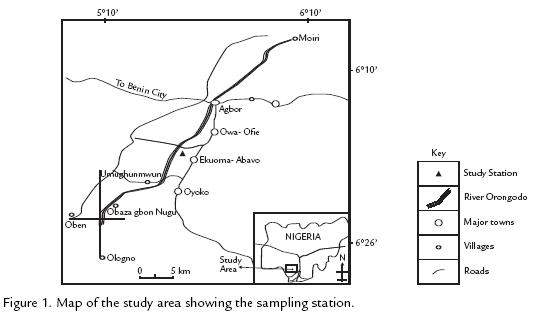
<body><![CDATA[<p   align="left" ><B>INTRODUCTION </b></p >     <P   align="justify" >The lower reaches of tropical rivers contain appreciable number of decapods crustaceans. In West Africa, the groups extending into freshwate</b>r are the atyid, Palaemonid and alpheid shrimps and the sesamine and camptandriine crabs (Jonathan and Powell, 1989). The freshwater prawn, <I>Macrobrachiu</I><I>m </I>species are widely distributed and abundant macroinvertebrates in most aquatic system (Cook <I>et al.</I><I>, </I>2002). In spite of this, <I>Macrobrachium du</I><I>x </I>is presumed to be restricted in its distribution inhabiting small rivers and some swamp forest waters of tropical Africa (Powell, 1982). </P >     <P   align="justify" >Interest on prawns has increased recently largely due to the possibility of the commercial culture of some of them (Ajuzie and Fagade, 1992; Marioghae and Ayinla, 1995). They are highly valued as food sources for humans. In the local markets close to freshwater streams of the Niger Delta they are sold either fresh or dried. There has hitherto been little research into the reproductive, growth characteristics and condition factor of these prawns in recent times. Most available information has been basically taxonomic (Powell, 1982; Naiyanetr, 2001; Mej&iacute;a <I>et al.</I><I>, </I>2003; Murphy and Austin, 2005), on the migratory behaviour (Osuamkpe and Powell, 1981), and on the general ecology of the group (Inyang, 1981; Marioghae, 1982; Keys, 2003). This paper attempts to fill gaps in the existing literature and to present unique ecological features exhibited by <I>Macrobrachium du</I><I>x </I>in the clear water stretch of Orogodo River were it exist as a single species of the genus in the Niger Delta. </P >     <p   align="left" ><B>DESCRIPTION OF STUDY AREA </b></p >     <P   align="justify" >The study area is a stretch of Orogodo River flowing north to south from Agbo</b>r through Abavo, both in Delta State and to parts of Orhionmwon Local Government Area in Edo State, Nigeria. The river is located between latitude 6.12O N and longitude 6.16O E (<a href="#fig1">Fig. 1</a>). The river in its upper reaches flows through a secondary rainforest zone, while its terrain in the vicinity of Abavo, Nigeria, where the study was carried out, is presently subjected to extensive land clearing and farming activities. The study site is a meandering stretch of about 1 km long. The riparian vegetation of this area could be described as farm bush. Land clearing activities for farming and sand dredging are the predominant form of land use. For most of its length, the river is flanked by Indian bamboo trees (<I>Bambus</I><I>a </I>sp.), rubber trees, (<I>Havea brasiliensis</I>) and palm trees (<I>Elaie</I><I>s </I>sp.), which provide a canopy. In areas where tree cover is absent, the marginal vegetation is composed of grasses such as <I>Panicu</I><I>m </I>sp. and ferns. The midchannel of the river is mostly open and the current velocity is relatively low. The substratum is predominantly clay and silt. The stretch could be described as nontidal clear water. </P >    <P ><a name="fig1"></a><img src="/img/revistas/abc/v12n2/v12n2a9f1.JPG" ></P >     <p   align="left" ><B>MATERIALS AND METHODS </b></p >      <p   align="left" >MEASUREMENT OF SOME PHYSICOCHEMICAL PARAMETERS </p >     <P   align="justify" >The important physiochemical characteristics measured at the study stretch were pH, dissolved oxygen and flow velocity. The pH of the surface water was measured with the aid of a pH meter. Dissolved oxygen was measured titrimetrically by fixing with Winkler solution A and B and titrating with sodium thiosulphate (APHA, 1985). Flow velocity was measured in the mid channel on three occasions by timing a float (average of three trials) as it moved over a distance of 10 m. </P >     <p   align="left" >SAMPLING FOR PRAWN </p >     ]]></body>
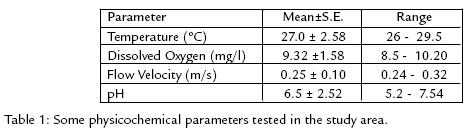
<body><![CDATA[<P   align="justify" >Prawn samples were collected for a period of six months between March and August, 1995 on a fortnightly sampling frequency. Cage traps properly baited with palm fruits, cassava tubers and onion bulbs were used for sampling. A total of ten traps were set at ten specific locations of about 100 m apart along the stretch of the river. Samples were periodically removed from the fishing gear between 0600 h and 1600 h after two days of setting. In addition, prawns were scooped from under debris and leaf litters using hand baskets. Captured prawns were preserved in fresh 4% formalin for Laboratory analysis. The prawns were identified using the taxonomic keys of F.A.O., (1978) and Powell (1982). Biometric measurements recorded for each prawn were Carapace length (CL), Abdominal length (AL) and Total length (TL) to the nearest 0.1 mm as defined by F.A.O (1978). The Wetweights (WT) of the crabs were also measured to the nearest 0.1 g. Sexes of prawns were determined by visual examination of the second pereopods or chelipeds and the sides of the carapace as described by Powell (1982); also confirmation was by the presence of the appendix masculina in the second chelipeds of the males (Edokpayi, 1990). Computational methods used were as adopted from Bagenal (1978) and Zar (1984). Simple correlations were estimated between Wet weight (WT) and Total length (TL), and Abdominal length (AL) and carapace length (CL). Regression analysis was done between wetweight and total length (TL) and the scattergrams plotted according to the model of Stooldley <I>et al</I>. (1980). This plot is best described by the formula: </P >     <P   align="center" >Y = a+bx </P >     <P   align="justify" >Where Y is wetweight (WT), a is the intercept on the Y axis, b is the regression coefficient and x is the Total length (TL). The condition factor (K) was calculated from data obtained from the length and weight measurement using the equation. </P >     <P   align="center" >K = 100 Wt / TL<sup>3 </sup></P >     <P   align="justify" >The monthly occurrences of prawns in the study site was analysed using Loglikeli hood test as described by the equation. </P >     <P   align="center" >a = 4.60517 (&sum;fi Log fi &sum;fi Log Fi) </P >     <P   align="justify" >Where fi=observed frequency of occurrence and Fi=expected frequency of occurrence. The percentages of gravid females were also calculated for each month. The sex ratio was tested for significance using the chisquare test.</P >     <p   align="left" ><B>RESULTS </b></p >      <p   align="justify" >SOME PHYSICOCHEMICAL PARAMETERS OF RIVER OROGODO, NIGERIA </p >     <P   align="justify" >The amount of dissolved oxygen was in the range of 8.5 to 10.2 with a mean of 9.32 mg/l. Flow velocity in the study stations fluctuated between 0.24 and 0.32 ms<Sup>1 </Sup>with a mean and standard error of 0.25 and 0.10 respectively (<a href="#table1">Table 1</a>). </P >    ]]></body>
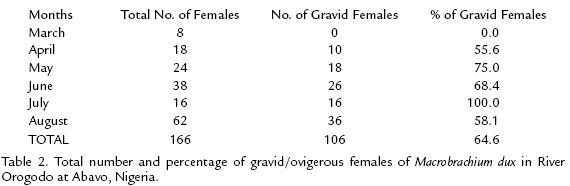
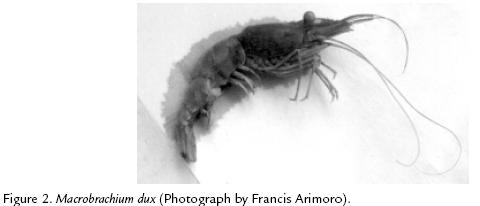
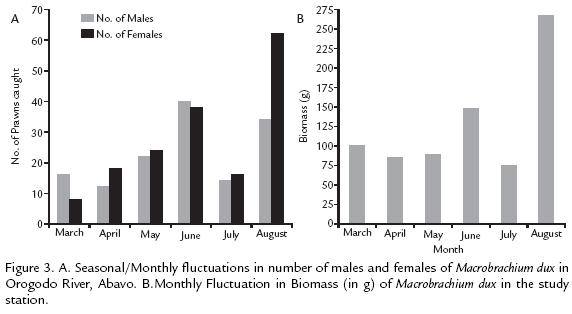
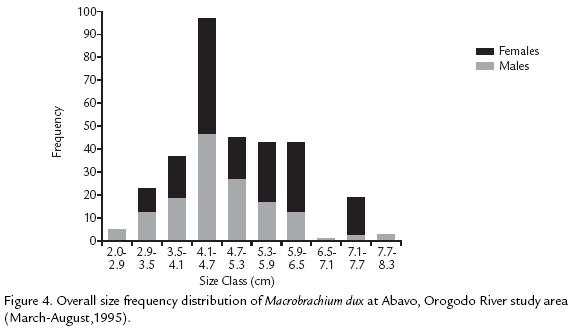
<body><![CDATA[<P ><a name="table1"></a><img src="/img/revistas/abc/v12n2/v12n2a9t1.JPG" ></P >     <p   align="justify" >SEASONALITY AND ABUNDANCE </p >     <P   align="justify" >The freshwater prawn, <I>Macrobrachium du</I><I>x </I>showed a relative high abundance in the study stretch where it maintained a single population. The prawn species has very striking distinguishing features (<a href="#fig2">Fig. 2</a>); include a dark body with broad mid dorsal light coloured band extending full length of the abdomen and onto the carapace. The palm is much longer than the fingers; fingers lacking furlike covering, curved and gaping with two large teeth on the basal half of each finger. The rostrum is slightly shorter than the antennal scale with the dorsal edge slightly convex over the eyes. The monthly/seasonal fluctuation in abundance is shown in <a href="#fig3">figure 3A</a>. In April, 30 prawns were caught. It was 78 in June and highest in the month of August (96). The lowest catch was in the month of March 1995 that recorded only 24 prawns of the total catch. LogLikely hood test indicated that this fluctuation in monthly abundance was significantly different for <I>Macrobrachium du</I><I>x </I>(a=41.31, p<0.05). The monthly fluctuation in biomass for <I>M. du</I><I>x </I>is shown in <a href="#fig3">figure 3B</a>. The lowest biomass was recorded in the month of July. The highest abundance in terms of biomass was recorded in August (the peak of the rainy season). </P >    <P ><a name="fig2"></a><img src="/img/revistas/abc/v12n2/v12n2a9f2.JPG" ></P >    <P ><a name="fig3"></a><img src="/img/revistas/abc/v12n2/v12n2a9f3.JPG" ></P >     <p   align="justify" >POPULATION STRUCTURE </p >     <P   align="justify" >Detailed analyses of the population structure in terms of sizefrequency distribution were made for both sexes of <I>Macrobrachium dux</I>. The analysis revealed a total of ten size classes. The total length (TL) ranges for male and female were 2.57.8 cm and 2.67.5 cm respectively. Generally, the monthly size frequency distribution indicated that there was a progressive increase in the young from late dry season (March) to midrainy season (August; <a href="#fig4">Fig. 4</a>). The medium size class or young adult (TL=4.16.5 cm) predominated the population throughout the study period. The overall size frequency distribution showed a modal size class for both sexes of <I>Macrobrachium du</I><I>x </I>as 424.7 cm. </P >    <P ><a name="fig4"></a><img src="/img/revistas/abc/v12n2/v12n2a9f4.JPG" ></P >     <p   align="justify" >REPRODUCTIVE CHARACTERISTICS </p >     <P   align="justify" >Of the 304 specimens examined, 138 (45.4%) were males and 166 (54.6%) females. A sex ratio of 1:1.2 of males to females recorded was not significantly different from the expected 1:1 ratio (&macr;&Ccedil; = 1.29; p > 0.05). The total number of females, number of gravid/ovigerous females and percentage of gravid females are presented in <a href="#table2">Table 2</a>. The overall number of gravid females (106) represents about 63.9% of the number of female individual (166) of the species. There was no gravid female in the month of March while in the month of July all females caught were all gravid. The least percentage (55.6%) was obtained in April were 10 out of the 18 females caught were gravid. Total length of gravid/ovigerous females ranged from 4.6 to 7.5 cm and egg size varied from 1.51.7 mm. </P >    ]]></body>
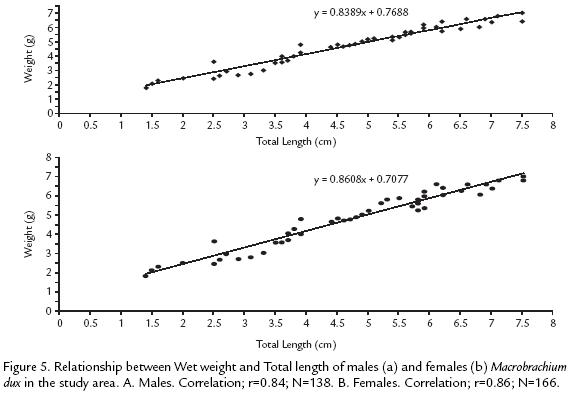
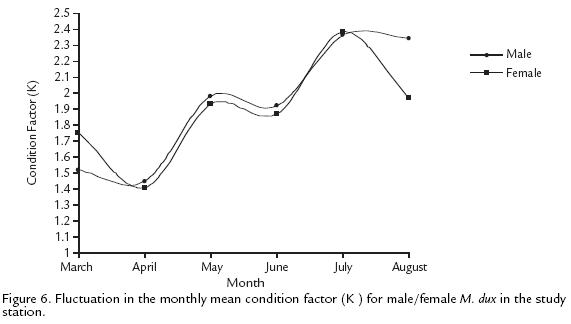
<body><![CDATA[<P ><a name="table2"></a><img src="/img/revistas/abc/v12n2/v12n2a9t2.JPG" ></P >     <p   align="justify" >GROWTH CHARACTERISTICS </p >     <P   align="justify" >The growth characteristics were analysed in terms of lengthweight relationship and condition factor (K) of the species. The relationship between Total length (TL) and Wetweight (WT) of <I>M. du</I><I>x </I>showed a linear relationship (<a href="#fig5"> Fig. 5</a>). Positive correlation between Total length (TL) and Wetweight (WT) for males (r=0.84) and females (r=0.86) were estimated. A weak positive relationship between abdominal length (AL) and carapace length (CL) for males (r=0.27) and females (r=0.42) were estimated in the study stretch. </P >    <P ><a name="fig5"></a><img src="/img/revistas/abc/v12n2/v12n2a9f5.JPG" ></P >     <P   align="justify" >Condition factor (K) was used as an indicator to evaluate variation in the individuals in different months of study as well as different size (length) classes. The mean monthly condition factor (K) ranged from 1.43 to 2.37. The mean Kvalue was highest in July 1995 (2.37) and lowest in April (1.43). Generally, the males appear to have better mean condition factor (k) than the females (<a href="#fig6"> Fig. 6</a>). The fluctuation in the mean condition factor (k) in the entire study period, for males and females indicates that the growth phase was during the late peak of the rainy season (JulyAugust).</P >    <P ><a name="fig6"></a><img src="/img/revistas/abc/v12n2/v12n2a9f6.JPG" ></P >     <p   align="left" ><B>DISCUSSION </b></p >     <P   align="justify" >The physicochemical qualities of water, immediate substrate of occupation and food availability are important factors affecting the abundance of benthic invertebrates (Dobso</b>n et al.<I>, </I>2002; Arimoro <I>et al.</I><I>, </I>2007). The near acidic nature of the stream (5.27.2) and adequate amount of oxygen recorded through out the study period allowed for survival of the prawn species. It is well documented that prawn species will fail to thrive in perturbed waters (Ogbeibu and Oribhabor, 2002). The freshwater prawn, <I>Macrobrachiu</I><I>m </I>du<I>x </I>in this study was identified by the general morphology of the rostrum and colour. The rostrum was slightly shorter than the antennal scale with the dorsal edge slightly convex over the eyes. Fewer than 11 dorsal teeth of which 1 or 2 are on the carapace posterior to the orbital margin. The body is dark with broad mid dorsal light, coloured band extending full length of the abdomen and unto the carapace. Second cheliped with carpus shorter than palm and palm longer than fingers. This fits the description of the species as presented by Powell (1982). Rostrum, teeth, morphology of the cheliped, palm and fingers has been viewed as a useful and diagnostic taxonomic character in the prawn (Powell, 1982; Naiyanetr, 2001; Mej&iacute;a <I>et al.</I><I>, </I>2003; Murphy and Austin, 2005). </P >     <P   align="justify" >The results of this preliminary ecological study indicate that the freshwater prawn, <I>Macrobrachium du</I><I>x </I>showed a monthly fluctuation in abundance both in number and biomass of individuals. The highest biomass or weight of organic matter was recorded in August, which marked the peak of the rainy season. This could be attributed to increase in the number of all age/size classes resulting from spawning. Similarly, the low biomass recorded from March to May particularly for the female could be attributed to inadequate food supply that can support larger individuals of the species. Also the large numbers of ovigerous female recorded at the peak of the rainy season probably would explain the high biomass observed for this species at the same period. The fluctuation in abundance in terms of number also revealed a seasonal trend with a peak towards the midrainy season, which suggests that the rainy season changes in the habitat probably favoured the growth and development of the species, hence the large number in the field at this period of the year. Similar monthly fluctuation in number or abundance has been reported generally in prawns by Adetayo and Ajayi (1982), for <i>Macrobrachium felicinu</i><i>m </i>by Inyang (1981), for <i>M. sirindhor</i><i>n </i>(Naiyanetr, 2001), <i>Macrobrachium totonacu</i><i>m </i>by Mej&iacute;a <i>e</i><i>t </i><i>al</i><i>. </i>(2003). During the dry season months, most of the habitats dry up and as such the samples are not easily collected at this period. Species abundance could also be influenced by biological factors such as predation, competition and shortage of food supply (Mann, 1980), but these were not evaluated in this present study. </P >     <P   align="justify" >Gears used for fisheries studies are usually size elective. Thus in a study describing size frequency distribution, the ranges observed often depend on the gears used. The oilpalm fruits, onionbulbs and cassava tubers used as baits in this study are commonly utilized by artisanal fishermen to catch prawns in the study area. The size structure, like the biomass and number fluctuations also varies with season for <I>Macrobrachiu</I><I>m </I><I>dux</I>. All size classes showed highest abundance during the midrainy season (MayAugust). Though <I>M. du</I><I>x </I>can attain large size, only medium size individuals or young adults predominate in the study stretch. </P >     ]]></body>
<body><![CDATA[<P   align="justify" >The male to female sex ratio of 1:1.2 in this study is not significantly by different (p> 0.05) from the expected 1:1 sex ratio. A similar sex ratio has been reported by Inyang (1981) for <I>M. felicinu</I><I>m </I>and for <I>M. vollehoven</I><I>i </I>and <I>M. macrobrachio</I><I>n </I>by Marioghae (1982). Factors such as sex reversal, temperature, crowding and starvation have been reported to cause marked departure from the expected sex ratio of 1:1 in some fish species (Atz, 1964, Harrington, 1967). However, such factors have not been identified for crabs. (Edokpayi, 1990). </P >     <P   align="justify" >Breeding of <I>M. du</I><I>x </I>at the study stretch appears to be seasonal as reflected in the fluctuations in biomass, number of size classes, size structures and percentage of gravid females. Seasonal breeding has been reported in tropical prawns, (Inyang, 1981; Marioghae, 1982; Hla <I>et al.</I><I>, </I>2005; Murphy and Austin, 2005). There were a relatively high percentage of ovigerous females of <I>M. du</I><I>x </I>in the study stretch. The monthly fluctuation in the percentage of ovigerous females indicated that the prawn spawn during the rainy season (MayAugust). Total length of ovigerous females ranged from 4.3  to 7.3 cm and egg size varied from 1.5 to 1.7 mm. Compared to other species, the eggs of <I>M. du</I><I>x </I>are larger than those of <I>M. lanchester</I><I>i </I>0.81.0 mm and <I>M. olfersi</I><I>i </I>0.40.6 mm reported by Hla <I>et al</I><I>. </I>(2005) but similar to those of <I>M. lamarrei </I>(1.11.5 mm) reported by the same authors. The maximum length attained by <I>M. du</I><I>x </I>in this study was 7.5  cm. Powell (1982), reported that this species rarely exceed 8.0 cm in fresh and brackish water in the Niger Delta. The positive correlation between Total length (TL) and Wet weight (WT) suggest that growth changes in these parameters are uniform. Similar observation was reported for the brown tiger prawn, <I>Penaeus esculentu</I><I>s </I>by Keys (2003). </P >     <P   align="justify" >The condition factor (K) is used here to compare the &ldquo;condition or fatness&rdquo; or wellbeing of the individuals of the species. The prawn showed a highest mean condition factor (K) when there were relatively fewer individuals. The lowest mean condition factor (k) was observed in the month of April. Better condition factors were recorded in the rainy season months (MayAugust) than during the dry season months (MarchApril) It could be that biological interaction involving intraspecific competition for food and space is probably the reason for the reduction in the value of the mean condition factor during the dry season months. </P >     <P   align="justify" >The fluctuations observed in the mean monthly condition factor (k) for both males and females of <I>M. du</I><I>x </I>indicate one growth phase. This is during the early rainy season (JuneAugust) for both sexes. The increase in food supply during the rainy season months might have aided the fattening of the individuals of the species during this period of the year. The growth period just before reproduction exhibited by <I>M. du</I><I>x </I>is not uncommon with carideans. This might have been included by the premating moult preceding spawning (Edokpayi, 1990). </P >     <P   align="justify" >From the findings of this investigation, <I>M. du</I><I>x </I>can be cultured in captivity like the other species of the genus, although smaller in size than <I>M. macobrachio</I><I>n </I>and <I>M. felicinu</I><I>m </I>found in other freshwater bodies of the Niger Delta. Efforts should therefore be intensified to fully document and exploit the reproductive output of pond broodstock of this species comparable to the wild stock related directly or indirectly to human consumption. </P >     <p   align="left" ><B>REFERENCES </b></p >     <!-- ref --><P   align="justify" >ADETAYO JA, AJAYI TO. On the Fish by Catch and Discard of the Shrimp Fishery of Nigeria. Nigerian Institute for Oceanography and Marine Research Technical Paper. 1982;5:3-13. </P >    &nbsp;&nbsp;&nbsp;&nbsp;&nbsp;&nbsp;&nbsp;&nbsp;[&#160;<a href="javascript:void(0);" onclick="javascript: window.open('/scielo.php?script=sci_nlinks&ref=000059&pid=S0120-548X200700020000900001&lng=','','width=640,height=500,resizable=yes,scrollbars=1,menubar=yes,');">Links</a>&#160;]<!-- end-ref --><!-- ref --><P   align="justify" >AJUZIE CC, FAGADE SO. African River Prawn has Commercial Potential. Fish Farmer International File. 1992;6(3):15-16. </P >    &nbsp;&nbsp;&nbsp;&nbsp;&nbsp;&nbsp;&nbsp;&nbsp;[&#160;<a href="javascript:void(0);" onclick="javascript: window.open('/scielo.php?script=sci_nlinks&ref=000060&pid=S0120-548X200700020000900002&lng=','','width=640,height=500,resizable=yes,scrollbars=1,menubar=yes,');">Links</a>&#160;]<!-- end-ref --><!-- ref --><P   align="justify" >ARIMORO FO, IKOMI RB, IWEGBUE CMA. Water Quality Changes in Relation to Diptera Community Patterns and Diversity Measured at an Organic Effluent Impacted Stream in the Niger Delta, Nigeria. Ecological indicators. 2007;7:541-552. </P >    &nbsp;&nbsp;&nbsp;&nbsp;&nbsp;&nbsp;&nbsp;&nbsp;[&#160;<a href="javascript:void(0);" onclick="javascript: window.open('/scielo.php?script=sci_nlinks&ref=000061&pid=S0120-548X200700020000900003&lng=','','width=640,height=500,resizable=yes,scrollbars=1,menubar=yes,');">Links</a>&#160;]<!-- end-ref --><!-- ref --><P   align="justify" >ATZ J. Intersexuality in Fishes. In. C. N. Amstrong and A. J. Marshall (eds). Vertebrates Including Man. London Academic press; 1964. </P >    &nbsp;&nbsp;&nbsp;&nbsp;&nbsp;&nbsp;&nbsp;&nbsp;[&#160;<a href="javascript:void(0);" onclick="javascript: window.open('/scielo.php?script=sci_nlinks&ref=000062&pid=S0120-548X200700020000900004&lng=','','width=640,height=500,resizable=yes,scrollbars=1,menubar=yes,');">Links</a>&#160;]<!-- end-ref --><!-- ref --><P   align="justify" >BAGENAL TB. Age and Growth: In: Methods for Assessment of Production in Freshwaters. In Bagenal eds. IBP Handbook No. 3. Oxford, London. Blackwell scientific Publication; 1978. p. 101-136. </P >    &nbsp;&nbsp;&nbsp;&nbsp;&nbsp;&nbsp;&nbsp;&nbsp;[&#160;<a href="javascript:void(0);" onclick="javascript: window.open('/scielo.php?script=sci_nlinks&ref=000063&pid=S0120-548X200700020000900005&lng=','','width=640,height=500,resizable=yes,scrollbars=1,menubar=yes,');">Links</a>&#160;]<!-- end-ref --><!-- ref --><P   align="justify" >COOK BD, BUNN SE, HUGHES. Genetic Structure and Dispersal of <I>M</I><I>. </I><I>australiens</I><I>e </I>(Decapoda; Palaemonidae) in The Western Queensland, Australia. Freshwater Biol. 2002;47:2098-2112. </P >    &nbsp;&nbsp;&nbsp;&nbsp;&nbsp;&nbsp;&nbsp;&nbsp;[&#160;<a href="javascript:void(0);" onclick="javascript: window.open('/scielo.php?script=sci_nlinks&ref=000064&pid=S0120-548X200700020000900006&lng=','','width=640,height=500,resizable=yes,scrollbars=1,menubar=yes,');">Links</a>&#160;]<!-- end-ref --><!-- ref --><P   align="justify" >DOBSON M, MAGANA A, MATHOOKO JM, NDEGWA FK. Detritivores in Kenyan Highland Streams: More Evidence for the Paucity of Shredders in the Tropics? Freshwater Biol. 2002;47:909-919. </P >    &nbsp;&nbsp;&nbsp;&nbsp;&nbsp;&nbsp;&nbsp;&nbsp;[&#160;<a href="javascript:void(0);" onclick="javascript: window.open('/scielo.php?script=sci_nlinks&ref=000065&pid=S0120-548X200700020000900007&lng=','','width=640,height=500,resizable=yes,scrollbars=1,menubar=yes,');">Links</a>&#160;]<!-- end-ref --><!-- ref --><P   align="justify" >EDOKPAYI CA. Biology of Prawns (Crustacea: Decapoda: Natantia) in Benin River at Koko, Bendel State [Ph. D Thesis University of Benin]. Nigeria. 1990. </P >    &nbsp;&nbsp;&nbsp;&nbsp;&nbsp;&nbsp;&nbsp;&nbsp;[&#160;<a href="javascript:void(0);" onclick="javascript: window.open('/scielo.php?script=sci_nlinks&ref=000066&pid=S0120-548X200700020000900008&lng=','','width=640,height=500,resizable=yes,scrollbars=1,menubar=yes,');">Links</a>&#160;]<!-- end-ref --><!-- ref --><P   align="justify" >F.A.O. Technical terms and Principle. Measurement Used for Shrimps and Prawns, Fishery Areas. 34, 47 (in part; E. C. Atlantic); 1978. </P >    &nbsp;&nbsp;&nbsp;&nbsp;&nbsp;&nbsp;&nbsp;&nbsp;[&#160;<a href="javascript:void(0);" onclick="javascript: window.open('/scielo.php?script=sci_nlinks&ref=000067&pid=S0120-548X200700020000900009&lng=','','width=640,height=500,resizable=yes,scrollbars=1,menubar=yes,');">Links</a>&#160;]<!-- end-ref --><!-- ref --><P   align="justify" >HARRINGTON RW JR. Environmentally Controlled Induction of Primary Male Gonochorists from Eggs of Self Fertilizing Fish, <I>Rivulies marmoralus</I><I>. </I>Poet Biol Bull Inter Biol. Lah woods Hole; 1967. </P >    &nbsp;&nbsp;&nbsp;&nbsp;&nbsp;&nbsp;&nbsp;&nbsp;[&#160;<a href="javascript:void(0);" onclick="javascript: window.open('/scielo.php?script=sci_nlinks&ref=000068&pid=S0120-548X200700020000900010&lng=','','width=640,height=500,resizable=yes,scrollbars=1,menubar=yes,');">Links</a>&#160;]<!-- end-ref --><!-- ref --><P   align="justify" >HLA S,HIROSHI, OHTOMI J. Reproductive Biology of the Freshwater Palaemonid Prawn, <I>Macrobrachium lanchester</I><I>i </I>(De Man, 1911) from Myanmar. Crustaceana. 2005;78(2):201-213. </P >    &nbsp;&nbsp;&nbsp;&nbsp;&nbsp;&nbsp;&nbsp;&nbsp;[&#160;<a href="javascript:void(0);" onclick="javascript: window.open('/scielo.php?script=sci_nlinks&ref=000069&pid=S0120-548X200700020000900011&lng=','','width=640,height=500,resizable=yes,scrollbars=1,menubar=yes,');">Links</a>&#160;]<!-- end-ref --><!-- ref --><P   align="justify" >INYANG NM. On the biology of <I>Macrobrachium felicinu</I><I>m </I>(Holthius) in the Lower Niger River of Southern Nigeria. Rev Zool Afri. 1981;98(2):440-449. </P >    &nbsp;&nbsp;&nbsp;&nbsp;&nbsp;&nbsp;&nbsp;&nbsp;[&#160;<a href="javascript:void(0);" onclick="javascript: window.open('/scielo.php?script=sci_nlinks&ref=000070&pid=S0120-548X200700020000900012&lng=','','width=640,height=500,resizable=yes,scrollbars=1,menubar=yes,');">Links</a>&#160;]<!-- end-ref --><!-- ref --><P   align="justify" >JONATHAN GE, POWELL CB. The Crab Larvae (Crustacea, Decapoda, Brachyura of the Tidal Freshwater and Low Salinity Estuaries in West Africa. Tropical Freshwater Biol. 1898;2:158-168. </P >    &nbsp;&nbsp;&nbsp;&nbsp;&nbsp;&nbsp;&nbsp;&nbsp;[&#160;<a href="javascript:void(0);" onclick="javascript: window.open('/scielo.php?script=sci_nlinks&ref=000071&pid=S0120-548X200700020000900013&lng=','','width=640,height=500,resizable=yes,scrollbars=1,menubar=yes,');">Links</a>&#160;]<!-- end-ref --><!-- ref --><P   align="justify" >KEYS SJ. Aspects of the Biology and Ecology of the Brown Tiger Prawn <I>Penaeu</I><I>s </I><I>esculentus</I>, Relevant to Aquaculture. Aquaculture. 2003;217(14):325-334. </P >    &nbsp;&nbsp;&nbsp;&nbsp;&nbsp;&nbsp;&nbsp;&nbsp;[&#160;<a href="javascript:void(0);" onclick="javascript: window.open('/scielo.php?script=sci_nlinks&ref=000072&pid=S0120-548X200700020000900014&lng=','','width=640,height=500,resizable=yes,scrollbars=1,menubar=yes,');">Links</a>&#160;]<!-- end-ref --><!-- ref --><P   align="justify" >MANN KH. Benthic Secondary Productions. In: S.K Barnes and K Mann (eds). Fundamentals of Aquatic Ecosystems. Blackwell Scientific  Publications. 1980. p. 103-118. </P >    &nbsp;&nbsp;&nbsp;&nbsp;&nbsp;&nbsp;&nbsp;&nbsp;[&#160;<a href="javascript:void(0);" onclick="javascript: window.open('/scielo.php?script=sci_nlinks&ref=000073&pid=S0120-548X200700020000900015&lng=','','width=640,height=500,resizable=yes,scrollbars=1,menubar=yes,');">Links</a>&#160;]<!-- end-ref --><!-- ref --><P   align="justify" >MARIOGHAE IE. Notes on the Biology and Distribution of <I>Macrobrachiu</I><I>m </I><I>vollehoven</I><I>i </I>and <I>Macrobrachium macrobrio</I><I>n </I>in Lagos Lagoon. Rev Zool Afri. 1982;96(3):493-508. </P >    &nbsp;&nbsp;&nbsp;&nbsp;&nbsp;&nbsp;&nbsp;&nbsp;[&#160;<a href="javascript:void(0);" onclick="javascript: window.open('/scielo.php?script=sci_nlinks&ref=000074&pid=S0120-548X200700020000900016&lng=','','width=640,height=500,resizable=yes,scrollbars=1,menubar=yes,');">Links</a>&#160;]<!-- end-ref --><!-- ref --><P   align="justify" >MARIOGHAE IE, AYINLA OA. The Reproductive Biology and Culture of <I>Macrobrachium vollenhoveni</I><I>i </I>(Herklots,1857) and <I>Macrobrachium macrobrachio</I><I>n </I>(Herklots,1851) in Nigeria. Nigeria Inst. for Oceanogr. and Marine Res.Tech. pap. 1995;100. </P >    &nbsp;&nbsp;&nbsp;&nbsp;&nbsp;&nbsp;&nbsp;&nbsp;[&#160;<a href="javascript:void(0);" onclick="javascript: window.open('/scielo.php?script=sci_nlinks&ref=000075&pid=S0120-548X200700020000900017&lng=','','width=640,height=500,resizable=yes,scrollbars=1,menubar=yes,');">Links</a>&#160;]<!-- end-ref --><!-- ref --><P   align="justify" >MEJ&Iacute;A LM, &Aacute;LVAREZ F, HARTNOLL RG. New Species of Freshwater Prawn, <I>Macrobrachium totonacu</I><I>m </I>(Decapoda, Palaemonidae) with Abbreviated Development from Mexico. Crustaceana. 2003;76(1):77-86. </P >    &nbsp;&nbsp;&nbsp;&nbsp;&nbsp;&nbsp;&nbsp;&nbsp;[&#160;<a href="javascript:void(0);" onclick="javascript: window.open('/scielo.php?script=sci_nlinks&ref=000076&pid=S0120-548X200700020000900018&lng=','','width=640,height=500,resizable=yes,scrollbars=1,menubar=yes,');">Links</a>&#160;]<!-- end-ref --><!-- ref --><P   align="justify" >MURPHY NP, AUSTIN CM. Phylogenetic Relationship of the Globally Distributed Freshwater Prawn Genus <I>Macrobrachiu</I><I>m </I>(Crustacea: Decapoda: Palaemonidae): Biogeography, Taxonomy and the Convergent Evolution of he Abbreviated larval Development. Zoologica Scripta. 2005;34(2):187-197. </P >    &nbsp;&nbsp;&nbsp;&nbsp;&nbsp;&nbsp;&nbsp;&nbsp;[&#160;<a href="javascript:void(0);" onclick="javascript: window.open('/scielo.php?script=sci_nlinks&ref=000077&pid=S0120-548X200700020000900019&lng=','','width=640,height=500,resizable=yes,scrollbars=1,menubar=yes,');">Links</a>&#160;]<!-- end-ref --><!-- ref --><P   align="justify" >NAIYANETR P. <I>Macribrachium sirindhor</I><I>n </I>N. sp. A New Freshwater prawn from Northen Thailand (Decapoda, Caridea, Palaemonidae. Crustaceana. 2001;74:609-616. </P >    &nbsp;&nbsp;&nbsp;&nbsp;&nbsp;&nbsp;&nbsp;&nbsp;[&#160;<a href="javascript:void(0);" onclick="javascript: window.open('/scielo.php?script=sci_nlinks&ref=000078&pid=S0120-548X200700020000900020&lng=','','width=640,height=500,resizable=yes,scrollbars=1,menubar=yes,');">Links</a>&#160;]<!-- end-ref --><!-- ref --><P   align="justify" >OGBEIBU AE, ORIBHABOR BJ. Ecological Impact of River Impoundment using Benthic Macroinvertebrates as indictor. Water Research. 2002;36:2427-2436 </P >    &nbsp;&nbsp;&nbsp;&nbsp;&nbsp;&nbsp;&nbsp;&nbsp;[&#160;<a href="javascript:void(0);" onclick="javascript: window.open('/scielo.php?script=sci_nlinks&ref=000079&pid=S0120-548X200700020000900021&lng=','','width=640,height=500,resizable=yes,scrollbars=1,menubar=yes,');">Links</a>&#160;]<!-- end-ref --><!-- ref --><P   align="justify" >OSUAMKPE A, POWELL CB. The Migration and Fishery of the Juveniles of the Freshwater Shrimp <I>Macrobrachium felicinu</I><I>m </I>in the NunOrashi Sector of the Niger Delta. Abstracts of National Conference in Agriculture, River State University of Science and Technology, Portharcourt, May; 1981. p. 64. </P >    &nbsp;&nbsp;&nbsp;&nbsp;&nbsp;&nbsp;&nbsp;&nbsp;[&#160;<a href="javascript:void(0);" onclick="javascript: window.open('/scielo.php?script=sci_nlinks&ref=000080&pid=S0120-548X200700020000900022&lng=','','width=640,height=500,resizable=yes,scrollbars=1,menubar=yes,');">Links</a>&#160;]<!-- end-ref --><!-- ref --><P   align="justify" >POWELL CB. Fresh and Brackish Water Shrimps of Economic Importance in the Niger Delta. In the Proceedings of the 2nd Annual Conference of Fisheries Society of Nigeria (FISON), Calabar 2527 Jan; 1982. p. 254-285. </P >    &nbsp;&nbsp;&nbsp;&nbsp;&nbsp;&nbsp;&nbsp;&nbsp;[&#160;<a href="javascript:void(0);" onclick="javascript: window.open('/scielo.php?script=sci_nlinks&ref=000081&pid=S0120-548X200700020000900023&lng=','','width=640,height=500,resizable=yes,scrollbars=1,menubar=yes,');">Links</a>&#160;]<!-- end-ref --><!-- ref --><P   align="justify" >STOOLDLEY KC, LEVIS J, STAINTON CLS. Applied statistical techniques. In: G. M. Bill (ed) Elli Horwood services in Mathematics and its application; Ellis Horwood Ltd., Publishers, Chichester; 1980. </P >    &nbsp;&nbsp;&nbsp;&nbsp;&nbsp;&nbsp;&nbsp;&nbsp;[&#160;<a href="javascript:void(0);" onclick="javascript: window.open('/scielo.php?script=sci_nlinks&ref=000082&pid=S0120-548X200700020000900024&lng=','','width=640,height=500,resizable=yes,scrollbars=1,menubar=yes,');">Links</a>&#160;]<!-- end-ref --><!-- ref --><P   align="justify" >ZAR JH. Biostatistical Analysis. Prentice Hall. Inc., England Cliff, New Jersey; 1984. </P >    &nbsp;&nbsp;&nbsp;&nbsp;&nbsp;&nbsp;&nbsp;&nbsp;[&#160;<a href="javascript:void(0);" onclick="javascript: window.open('/scielo.php?script=sci_nlinks&ref=000083&pid=S0120-548X200700020000900025&lng=','','width=640,height=500,resizable=yes,scrollbars=1,menubar=yes,');">Links</a>&#160;]<!-- end-ref --> ]]></body><back>
<ref-list>
<ref id="B1">
<nlm-citation citation-type="journal">
<person-group person-group-type="author">
<name>
<surname><![CDATA[ADETAYO]]></surname>
<given-names><![CDATA[JA]]></given-names>
</name>
<name>
<surname><![CDATA[AJAYI]]></surname>
<given-names><![CDATA[TO]]></given-names>
</name>
</person-group>
<article-title xml:lang="en"><![CDATA[On the Fish by Catch and Discard of the Shrimp Fishery of Nigeria]]></article-title>
<source><![CDATA[Nigerian Institute for Oceanography and Marine Research Technical Paper]]></source>
<year>1982</year>
<numero>5</numero>
<issue>5</issue>
<page-range>3-13</page-range></nlm-citation>
</ref>
<ref id="B2">
<nlm-citation citation-type="journal">
<person-group person-group-type="author">
<name>
<surname><![CDATA[AJUZIE]]></surname>
<given-names><![CDATA[CC]]></given-names>
</name>
<name>
<surname><![CDATA[FAGADE]]></surname>
<given-names><![CDATA[SO]]></given-names>
</name>
</person-group>
<article-title xml:lang="en"><![CDATA[African River Prawn has Commercial Potential]]></article-title>
<source><![CDATA[Fish Farmer International File]]></source>
<year>1992</year>
<volume>6</volume>
<numero>3</numero>
<issue>3</issue>
<page-range>15-16</page-range></nlm-citation>
</ref>
<ref id="B3">
<nlm-citation citation-type="journal">
<person-group person-group-type="author">
<name>
<surname><![CDATA[ARIMORO]]></surname>
<given-names><![CDATA[FO]]></given-names>
</name>
<name>
<surname><![CDATA[IKOMI]]></surname>
<given-names><![CDATA[RB]]></given-names>
</name>
<name>
<surname><![CDATA[IWEGBUE]]></surname>
<given-names><![CDATA[CMA]]></given-names>
</name>
</person-group>
<article-title xml:lang="en"><![CDATA[Water Quality Changes in Relation to Diptera Community Patterns and Diversity Measured at an Organic Effluent Impacted Stream in the Niger Delta, Nigeria]]></article-title>
<source><![CDATA[Ecological indicators]]></source>
<year>2007</year>
<volume>7</volume>
<page-range>541-552</page-range></nlm-citation>
</ref>
<ref id="B4">
<nlm-citation citation-type="book">
<person-group person-group-type="author">
<name>
<surname><![CDATA[ATZ]]></surname>
<given-names><![CDATA[J]]></given-names>
</name>
</person-group>
<article-title xml:lang="en"><![CDATA[Intersexuality in Fishes]]></article-title>
<person-group person-group-type="editor">
<name>
<surname><![CDATA[Amstrong]]></surname>
<given-names><![CDATA[C. N]]></given-names>
</name>
<name>
<surname><![CDATA[Marshall]]></surname>
<given-names><![CDATA[A. J]]></given-names>
</name>
</person-group>
<source><![CDATA[Vertebrates Including Man]]></source>
<year>1964</year>
<publisher-name><![CDATA[London Academic press]]></publisher-name>
</nlm-citation>
</ref>
<ref id="B5">
<nlm-citation citation-type="book">
<person-group person-group-type="author">
<name>
<surname><![CDATA[BAGENAL]]></surname>
<given-names><![CDATA[TB]]></given-names>
</name>
</person-group>
<article-title xml:lang="en"><![CDATA[Age and Growth]]></article-title>
<person-group person-group-type="editor">
<name>
<surname><![CDATA[Bagenal]]></surname>
<given-names><![CDATA[In]]></given-names>
</name>
</person-group>
<source><![CDATA[Methods for Assessment of Production in Freshwaters]]></source>
<year>1978</year>
<volume>3</volume>
<page-range>101-136</page-range><publisher-loc><![CDATA[London ]]></publisher-loc>
<publisher-name><![CDATA[Blackwell scientific Publication]]></publisher-name>
</nlm-citation>
</ref>
<ref id="B6">
<nlm-citation citation-type="journal">
<person-group person-group-type="author">
<name>
<surname><![CDATA[COOK]]></surname>
<given-names><![CDATA[BD]]></given-names>
</name>
<name>
<surname><![CDATA[BUNN]]></surname>
<given-names><![CDATA[SE]]></given-names>
</name>
<name>
<surname><![CDATA[HUGHES]]></surname>
</name>
</person-group>
<article-title xml:lang="en"><![CDATA[Genetic Structure and Dispersal of M. australiense (Decapoda; Palaemonidae) in The Western Queensland, Australia]]></article-title>
<source><![CDATA[Freshwater Biol]]></source>
<year>2002</year>
<volume>47</volume>
<page-range>2098-2112</page-range></nlm-citation>
</ref>
<ref id="B7">
<nlm-citation citation-type="journal">
<person-group person-group-type="author">
<name>
<surname><![CDATA[DOBSON]]></surname>
<given-names><![CDATA[M]]></given-names>
</name>
<name>
<surname><![CDATA[MAGANA]]></surname>
<given-names><![CDATA[A]]></given-names>
</name>
<name>
<surname><![CDATA[MATHOOKO]]></surname>
<given-names><![CDATA[JM]]></given-names>
</name>
<name>
<surname><![CDATA[NDEGWA]]></surname>
<given-names><![CDATA[FK]]></given-names>
</name>
</person-group>
<article-title xml:lang="en"><![CDATA[Detritivores in Kenyan Highland Streams: More Evidence for the Paucity of Shredders in the Tropics?]]></article-title>
<source><![CDATA[Freshwater Biol]]></source>
<year>2002</year>
<volume>47</volume>
<page-range>909-919</page-range></nlm-citation>
</ref>
<ref id="B8">
<nlm-citation citation-type="">
<person-group person-group-type="author">
<name>
<surname><![CDATA[EDOKPAYI]]></surname>
<given-names><![CDATA[CA]]></given-names>
</name>
</person-group>
<source><![CDATA[Biology of Prawns (Crustacea: Decapoda: Natantia) in Benin River at Koko, Bendel State]]></source>
<year></year>
</nlm-citation>
</ref>
<ref id="B9">
<nlm-citation citation-type="">
<collab>F.A.O</collab>
<source><![CDATA[Technical terms and Principle. Measurement Used for Shrimps and Prawns, Fishery Areas. 34, 47 (in part; E. C. Atlantic)]]></source>
<year>1978</year>
</nlm-citation>
</ref>
<ref id="B10">
<nlm-citation citation-type="journal">
<person-group person-group-type="author">
<name>
<surname><![CDATA[HARRINGTON]]></surname>
<given-names><![CDATA[RW JR]]></given-names>
</name>
</person-group>
<article-title xml:lang="en"><![CDATA[Environmentally Controlled Induction of Primary Male Gonochorists from Eggs of Self Fertilizing Fish, Rivulies marmoralus]]></article-title>
<source><![CDATA[Poet Biol Bull Inter Biol. Lah woods Hole]]></source>
<year>1967</year>
</nlm-citation>
</ref>
<ref id="B11">
<nlm-citation citation-type="journal">
<person-group person-group-type="author">
<name>
<surname><![CDATA[HLA]]></surname>
<given-names><![CDATA[S]]></given-names>
</name>
<name>
<surname><![CDATA[HIROSHI]]></surname>
</name>
<name>
<surname><![CDATA[OHTOMI]]></surname>
<given-names><![CDATA[J]]></given-names>
</name>
</person-group>
<article-title xml:lang="en"><![CDATA[Reproductive Biology of the Freshwater Palaemonid Prawn, Macrobrachium lanchesteri (De Man, 1911) from Myanmar]]></article-title>
<source><![CDATA[Crustaceana]]></source>
<year>2005</year>
<volume>78</volume>
<numero>2</numero>
<issue>2</issue>
<page-range>201-213</page-range></nlm-citation>
</ref>
<ref id="B12">
<nlm-citation citation-type="journal">
<person-group person-group-type="author">
<name>
<surname><![CDATA[INYANG]]></surname>
<given-names><![CDATA[NM]]></given-names>
</name>
</person-group>
<article-title xml:lang="en"><![CDATA[On the biology of Macrobrachium felicinum (Holthius) in the Lower Niger River of Southern Nigeria]]></article-title>
<source><![CDATA[Rev Zool Afri]]></source>
<year>1981</year>
<volume>98</volume>
<numero>2</numero>
<issue>2</issue>
<page-range>440-449</page-range></nlm-citation>
</ref>
<ref id="B13">
<nlm-citation citation-type="journal">
<person-group person-group-type="author">
<name>
<surname><![CDATA[JONATHAN]]></surname>
<given-names><![CDATA[GE]]></given-names>
</name>
<name>
<surname><![CDATA[POWELL]]></surname>
<given-names><![CDATA[CB]]></given-names>
</name>
</person-group>
<article-title xml:lang="en"><![CDATA[The Crab Larvae (Crustacea, Decapoda, Brachyura of the Tidal Freshwater and Low Salinity Estuaries in West Africa]]></article-title>
<source><![CDATA[Tropical Freshwater Biol]]></source>
<year>1898</year>
<volume>2</volume>
<page-range>158-168</page-range></nlm-citation>
</ref>
<ref id="B14">
<nlm-citation citation-type="journal">
<person-group person-group-type="author">
<name>
<surname><![CDATA[KEYS]]></surname>
<given-names><![CDATA[SJ]]></given-names>
</name>
</person-group>
<article-title xml:lang="en"><![CDATA[Aspects of the Biology and Ecology of the Brown Tiger Prawn Penaeus esculentus, Relevant to Aquaculture]]></article-title>
<source><![CDATA[Aquaculture]]></source>
<year>2003</year>
<volume>217</volume>
<numero>14</numero>
<issue>14</issue>
<page-range>325-334</page-range></nlm-citation>
</ref>
<ref id="B15">
<nlm-citation citation-type="book">
<person-group person-group-type="author">
<name>
<surname><![CDATA[MANN]]></surname>
<given-names><![CDATA[KH]]></given-names>
</name>
</person-group>
<article-title xml:lang="en"><![CDATA[Benthic Secondary Productions]]></article-title>
<person-group person-group-type="editor">
<name>
<surname><![CDATA[Barnes]]></surname>
<given-names><![CDATA[S.K]]></given-names>
</name>
<name>
<surname><![CDATA[Mann]]></surname>
<given-names><![CDATA[K]]></given-names>
</name>
</person-group>
<source><![CDATA[Fundamentals of Aquatic Ecosystems]]></source>
<year>1980</year>
<page-range>103-118</page-range><publisher-name><![CDATA[Blackwell Scientific Publications]]></publisher-name>
</nlm-citation>
</ref>
<ref id="B16">
<nlm-citation citation-type="journal">
<person-group person-group-type="author">
<name>
<surname><![CDATA[MARIOGHAE]]></surname>
<given-names><![CDATA[IE]]></given-names>
</name>
</person-group>
<article-title xml:lang="en"><![CDATA[Notes on the Biology and Distribution of Macrobrachium vollehoveni and Macrobrachium macrobrion in Lagos Lagoon]]></article-title>
<source><![CDATA[Rev Zool Afri]]></source>
<year>1982</year>
<volume>96</volume>
<numero>3</numero>
<issue>3</issue>
<page-range>493-508</page-range></nlm-citation>
</ref>
<ref id="B17">
<nlm-citation citation-type="journal">
<person-group person-group-type="author">
<name>
<surname><![CDATA[MARIOGHAE]]></surname>
<given-names><![CDATA[IE]]></given-names>
</name>
<name>
<surname><![CDATA[AYINLA]]></surname>
<given-names><![CDATA[OA]]></given-names>
</name>
</person-group>
<article-title xml:lang="en"><![CDATA[The Reproductive Biology and Culture of Macrobrachium vollenhovenii (Herklots,1857) and Macrobrachium macrobrachion (Herklots,1851) in Nigeria]]></article-title>
<source><![CDATA[Nigeria Inst. for Oceanogr. and Marine Res.Tech. pap]]></source>
<year>1995</year>
</nlm-citation>
</ref>
<ref id="B18">
<nlm-citation citation-type="journal">
<person-group person-group-type="author">
<name>
<surname><![CDATA[MEJÍA]]></surname>
<given-names><![CDATA[LM]]></given-names>
</name>
<name>
<surname><![CDATA[ÁLVAREZ]]></surname>
<given-names><![CDATA[F]]></given-names>
</name>
<name>
<surname><![CDATA[HARTNOLL]]></surname>
<given-names><![CDATA[RG]]></given-names>
</name>
</person-group>
<article-title xml:lang="en"><![CDATA[New Species of Freshwater Prawn, Macrobrachium totonacum (Decapoda, Palaemonidae) with Abbreviated Development from Mexico]]></article-title>
<source><![CDATA[Crustaceana]]></source>
<year>2003</year>
<volume>76</volume>
<numero>1</numero>
<issue>1</issue>
<page-range>77-86</page-range></nlm-citation>
</ref>
<ref id="B19">
<nlm-citation citation-type="journal">
<person-group person-group-type="author">
<name>
<surname><![CDATA[MURPHY]]></surname>
<given-names><![CDATA[NP]]></given-names>
</name>
<name>
<surname><![CDATA[AUSTIN]]></surname>
<given-names><![CDATA[CM]]></given-names>
</name>
</person-group>
<article-title xml:lang="en"><![CDATA[Phylogenetic Relationship of the Globally Distributed Freshwater Prawn Genus Macrobrachium (Crustacea: Decapoda: Palaemonidae): Biogeography, Taxonomy and the Convergent Evolution of he Abbreviated larval Development]]></article-title>
<source><![CDATA[Zoologica Scripta]]></source>
<year>2005</year>
<volume>34</volume>
<numero>2</numero>
<issue>2</issue>
<page-range>187-197</page-range></nlm-citation>
</ref>
<ref id="B20">
<nlm-citation citation-type="journal">
<person-group person-group-type="author">
<name>
<surname><![CDATA[NAIYANETR]]></surname>
<given-names><![CDATA[P]]></given-names>
</name>
</person-group>
<article-title xml:lang="en"><![CDATA[Macribrachium sirindhorn N. sp. A New Freshwater prawn from Northen Thailand (Decapoda, Caridea, Palaemonidae]]></article-title>
<source><![CDATA[Crustaceana]]></source>
<year>2001</year>
<volume>74</volume>
<page-range>609-616</page-range></nlm-citation>
</ref>
<ref id="B21">
<nlm-citation citation-type="journal">
<person-group person-group-type="author">
<name>
<surname><![CDATA[OGBEIBU]]></surname>
<given-names><![CDATA[AE]]></given-names>
</name>
<name>
<surname><![CDATA[ORIBHABOR]]></surname>
<given-names><![CDATA[BJ]]></given-names>
</name>
</person-group>
<article-title xml:lang="en"><![CDATA[Ecological Impact of River Impoundment using Benthic Macroinvertebrates as indictor]]></article-title>
<source><![CDATA[Water Research]]></source>
<year>2002</year>
<volume>36</volume>
<page-range>2427-2436</page-range></nlm-citation>
</ref>
<ref id="B22">
<nlm-citation citation-type="confpro">
<person-group person-group-type="author">
<name>
<surname><![CDATA[OSUAMKPE]]></surname>
<given-names><![CDATA[A]]></given-names>
</name>
<name>
<surname><![CDATA[POWELL]]></surname>
<given-names><![CDATA[CB]]></given-names>
</name>
</person-group>
<article-title xml:lang="en"><![CDATA[The Migration and Fishery of the Juveniles of the Freshwater Shrimp Macrobrachium felicinum in the NunOrashi Sector of the Niger Delta]]></article-title>
<source><![CDATA[]]></source>
<year></year>
<conf-name><![CDATA[ Abstracts of National Conference in Agriculture]]></conf-name>
<conf-date>May; 1981</conf-date>
<conf-loc>Portharcourt </conf-loc>
</nlm-citation>
</ref>
<ref id="B23">
<nlm-citation citation-type="confpro">
<person-group person-group-type="author">
<name>
<surname><![CDATA[POWELL]]></surname>
<given-names><![CDATA[CB]]></given-names>
</name>
</person-group>
<article-title xml:lang="en"><![CDATA[Fresh and Brackish Water Shrimps of Economic Importance in the Niger Delta]]></article-title>
<source><![CDATA[]]></source>
<year>2527</year>
<month> J</month>
<day>an</day>
<conf-name><![CDATA[ In the Proceedings of the 2nd Annual Conference of Fisheries Society of Nigeria (FISON)]]></conf-name>
<conf-loc> </conf-loc>
<page-range>254-285</page-range><publisher-loc><![CDATA[Calabar ]]></publisher-loc>
</nlm-citation>
</ref>
<ref id="B24">
<nlm-citation citation-type="book">
<person-group person-group-type="author">
<name>
<surname><![CDATA[STOOLDLEY]]></surname>
<given-names><![CDATA[KC]]></given-names>
</name>
<name>
<surname><![CDATA[LEVIS]]></surname>
<given-names><![CDATA[J]]></given-names>
</name>
<name>
<surname><![CDATA[STAINTON]]></surname>
<given-names><![CDATA[CLS]]></given-names>
</name>
</person-group>
<article-title xml:lang="en"><![CDATA[Applied statistical techniques]]></article-title>
<person-group person-group-type="editor">
<name>
<surname><![CDATA[Bill]]></surname>
<given-names><![CDATA[G. M]]></given-names>
</name>
</person-group>
<source><![CDATA[Elli Horwood services in Mathematics and its application]]></source>
<year>1980</year>
<publisher-loc><![CDATA[Chichester ]]></publisher-loc>
<publisher-name><![CDATA[Ellis Horwood Ltd., Publishers]]></publisher-name>
</nlm-citation>
</ref>
<ref id="B25">
<nlm-citation citation-type="book">
<person-group person-group-type="author">
<name>
<surname><![CDATA[ZAR]]></surname>
<given-names><![CDATA[JH]]></given-names>
</name>
</person-group>
<source><![CDATA[Biostatistical Analysis]]></source>
<year>1984</year>
<publisher-loc><![CDATA[New Jersey ]]></publisher-loc>
<publisher-name><![CDATA[Prentice Hall. Inc]]></publisher-name>
</nlm-citation>
</ref>
</ref-list>
</back>
</article>