<?xml version="1.0" encoding="ISO-8859-1"?><article xmlns:mml="http://www.w3.org/1998/Math/MathML" xmlns:xlink="http://www.w3.org/1999/xlink" xmlns:xsi="http://www.w3.org/2001/XMLSchema-instance">
<front>
<journal-meta>
<journal-id>0120-548X</journal-id>
<journal-title><![CDATA[Acta Biológica Colombiana]]></journal-title>
<abbrev-journal-title><![CDATA[Acta biol.Colomb.]]></abbrev-journal-title>
<issn>0120-548X</issn>
<publisher>
<publisher-name><![CDATA[Universidad Nacional de Colombia, Facultad de Ciencias, Departamento de Biología]]></publisher-name>
</publisher>
</journal-meta>
<article-meta>
<article-id>S0120-548X2007000200010</article-id>
<title-group>
<article-title xml:lang="en"><![CDATA[THE PERCEPTION OF DIPLOPODA (ARTHROPODA, MYRIAPODA) BY THE INHABITANTS OF THE COUNTY OF PEDRA BRANCA, SANTA TERESINHA, BAHIA, BRAZIL]]></article-title>
<article-title xml:lang="es"><![CDATA[La percepción de diplopoda (Arthropoda, Myriapoda) por los habitantes del poblado de Pedra Branca, Santa Teresinha, Bahía, Brasil]]></article-title>
</title-group>
<contrib-group>
<contrib contrib-type="author">
<name>
<surname><![CDATA[COSTA NETO]]></surname>
<given-names><![CDATA[ERALDO M]]></given-names>
</name>
<xref ref-type="aff" rid="A01"/>
</contrib>
</contrib-group>
<aff id="A01">
<institution><![CDATA[,Universidade Estadual de Feira de Santana Departamento de Ciências Biológicas Laboratório de Etnobiologia]]></institution>
<addr-line><![CDATA[Feira de Santana Bahia]]></addr-line>
<country>Brasil</country>
</aff>
<pub-date pub-type="pub">
<day>00</day>
<month>11</month>
<year>2007</year>
</pub-date>
<pub-date pub-type="epub">
<day>00</day>
<month>11</month>
<year>2007</year>
</pub-date>
<volume>12</volume>
<numero>2</numero>
<fpage>123</fpage>
<lpage>134</lpage>
<copyright-statement/>
<copyright-year/>
<self-uri xlink:href="http://www.scielo.org.co/scielo.php?script=sci_arttext&amp;pid=S0120-548X2007000200010&amp;lng=en&amp;nrm=iso"></self-uri><self-uri xlink:href="http://www.scielo.org.co/scielo.php?script=sci_abstract&amp;pid=S0120-548X2007000200010&amp;lng=en&amp;nrm=iso"></self-uri><self-uri xlink:href="http://www.scielo.org.co/scielo.php?script=sci_pdf&amp;pid=S0120-548X2007000200010&amp;lng=en&amp;nrm=iso"></self-uri><abstract abstract-type="short" xml:lang="en"><p><![CDATA[This paper deals with the conceptions, knowledge and attitudes of the inhabitants of the county of Pedra Branca, Bahia State, on the arthropods of the class Diplopoda. Data were collected from February to June 2005 by means of openended interviews carried out with 28 individuals, which ages ranged from 13 to 86 years old. It was recorded some traditional knowledge regarding the following items: taxonomy, biology, habitat, ecology, seasonality, and behavior. Results show that the diplopods are classified as &#8220;insects&#8221;. The characteristic of coiling the body was the most commented, as well as the fact that these animals are considered as &#8220;poisonous&#8221;. In general, the traditional zoological knowledge of Pedra Branca&#8217;s inhabitants concerning the diplopods is coherent with the academic knowledge.]]></p></abstract>
<abstract abstract-type="short" xml:lang="es"><p><![CDATA[Este artículo registra las concepciones, los conocimientos y los comportamientos que los habitantes del poblado de Pedra Branca, en el estado de Bahía, poseen sobre los artrópodos de la clase Diplopoda. Los datos fueron obtenidos desde febrero hasta junio de 2005 a través de entrevistas abiertas y semiestructuradas realizadas con 28 individuos de ambos sexos, con edades que variaron de 13 a 86 años. Se registraron los conocimientos tradicionales relacionados con taxonomía, biología, hábitat, ecología, estacionalidad y comportamiento. Los resultados muestran que los diplópodos son clasificados como &#8220;insectos&#8221;. La característica de enrollar el cuerpo fue la más comentada, así como el hecho de que la mayoría de los individuos cree que estos animales son ponzoñosos. En general, el conocimiento zoológico tradicional que los pobladores de Pedra Branca tienen acerca de los diplópodos se mostró coherente con el conocimiento académico.]]></p></abstract>
<kwd-group>
<kwd lng="en"><![CDATA[Ethnozoology]]></kwd>
<kwd lng="en"><![CDATA[ethnomyriapodology]]></kwd>
<kwd lng="en"><![CDATA[perception]]></kwd>
<kwd lng="en"><![CDATA[millipede]]></kwd>
<kwd lng="es"><![CDATA[Etnozoología]]></kwd>
<kwd lng="es"><![CDATA[etnomiriapodología]]></kwd>
<kwd lng="es"><![CDATA[percepción]]></kwd>
<kwd lng="es"><![CDATA[milpiés]]></kwd>
</kwd-group>
</article-meta>
</front><body><![CDATA[ <P   align="center" >THE PERCEPTION OF DIPLOPODA (ARTHROPODA, MYRIAPODA) BY THE INHABITANTS OF THE COUNTY OF PEDRA BRANCA, SANTA TERESINHA, BAHIA, BRAZIL </P >     <p   align="center" >La percepci&oacute;n de diplopoda (Arthropoda, Myriapoda) por los habitantes del poblado de Pedra Branca, Santa Teresinha, Bah&iacute;a, Brasil </p >     <P   >ERALDO M. COSTA NETO<Sup>1</Sup>, Ph. D. <Sup>1</Sup>Universidade Estadual de Feira de Santana, Departamento de Ci&ecirc;ncias Biol&oacute;gicas, Laborat&oacute;rio de Etnobiologia, Km 03, BR 116, Campus Universit&aacute;rio, CEP 44031460, Feira de Santana, Bahia, Brasil Fone/Fax: 75 32248019. <a href="mailto:eraldont@hotmail.com">eraldont@hotmail.com</a> </P >     <P   align="justify" >Presentado 30 de junio de 2006, aceptado 5 de diciembre 2006, correcciones 22 de mayo de 2007. </P >     <p   align="left" ><B>ABSTRACT </b></p >     <P   align="justify" >This paper deals with the conceptions, knowledge and attitudes of the inhabitants of the county of Pedra Branca, Bahia State, on the arthropods of the class Diplopoda. Data were collected from February to June 2005 by means of openended interviews carried out with 28 individuals, which ages ranged from 13 to 86 years old. It was recorded some traditional knowledge regarding the following items: taxonomy, biology, habitat, ecology, seasonality, and behavior. Results show that the diplopods are classified as &ldquo;insects&rdquo;. The characteristic of coiling the body was the most commented, as well as the fact that these animals are considered as &ldquo;poisonous&rdquo;. In general, the traditional zoological knowledge of Pedra Branca&rsquo;s inhabitants concerning the diplopods is coherent with the academic knowledge. </P >     <P   align="justify" ><B>Key words:</B> Ethnozoology, ethnomyriapodology, perception, millipede. </P >     <p   align="left" ><B>RESUMEN </b></p >     <P   align="justify" >Este art&iacute;culo registra las concepciones, los conocimientos y los comportamientos qu</b>e los habitantes del poblado de Pedra Branca, en el estado de Bah&iacute;a, poseen sobre los artr&oacute;podos de la clase Diplopoda. Los datos fueron obtenidos desde febrero hasta junio de 2005 a trav&eacute;s de entrevistas abiertas y semiestructuradas realizadas con 28 individuos de ambos sexos, con edades que variaron de 13 a 86 a&ntilde;os. Se registraron los conocimientos tradicionales relacionados con taxonom&iacute;a, biolog&iacute;a, h&aacute;bitat, ecolog&iacute;a, estacionalidad y comportamiento. Los resultados muestran que los dipl&oacute;podos son clasificados como &ldquo;insectos&rdquo;. La caracter&iacute;stica de enrollar el cuerpo fue la m&aacute;s comentada, as&iacute; como el hecho de que la mayor&iacute;a de los individuos cree que estos animales son ponzo&ntilde;osos. En general, el conocimiento zool&oacute;gico tradicional que los pobladores de Pedra Branca tienen acerca de los dipl&oacute;podos se mostr&oacute; coherente con el conocimiento acad&eacute;mico. </P >     <P   align="justify" ><B>Palabras clave:</B> Etnozoolog&iacute;a, etnomiriapodolog&iacute;a, percepci&oacute;n, milpi&eacute;s. </P >     ]]></body>
<body><![CDATA[<p   align="left" ><B>INTRODUCTION </b></p >     <P   align="justify" >Millipedes are arthropods that may be found all over the world except Antarctic</b>a (Hoffman <I>et al.</I>, 2002). They constitute the largest group of Myriapoda (Ruppert <I>et al.</I>, 2005). Approximately 11 thousand species/subspecies have been already recorded, and they are allocated in more than 4,500 genera, 170 families and 15 orders (Hoffman <I>et al.</I>, 2002). According to these authors, knowledge on the animals of this group in Neotropical regions is restricted to 1,100 species/subspecies, 800 genera, 47 families, and 13 orders. Most of its specific richness and diversity concentrates in the tropical  and subtropical areas of the world (Sielfeld, 2002). Nine out of the eleven orders included in the superorder Helminthomorpha occur in the Neotropics, but Polydesmida, Spirostreptida and Spirobolida are dominant (Hogue, 1993). This author says that diplopodofauna from Latin America is diverse, but very little studied. Brazilian species are not well defined regarding their classification and geographical distribution (Knysak and Martins, 1999). Hoffman (review by Hogue, 1993) recorded about 470 species for Brazil. In Brazil they are popularly known as <I>gongos, gongolos</I><I>, </I><I>gongol&ocirc;s, caramugis, embo&aacute;s, embu&aacute;s, ambu&aacute;s, imbu&aacute;s, bichosdoouvido </I>and <I>piolhosdecobr</I><I>a </I>(Santos, 1982; Nomura, 2001). </P >     <P   align="justify" >Diplopods have their body divided into a head, which bears a pair of short antennae with eight segments, a trunk, and a telson (Hopkin and Read, 1992). They differ from other myriapods for having two pairs of legs per segment (except the first four segments; Ruppert <I>et al.</I>, 2005). They vary largely in size, ranging from species with only 23 mm length, such as <I>Polyxenus laguru</I><I>s </I>(Linnaeus, 1758), to those species with 28 cm length and a trunk with more than 80 segments, such as <I>Graphidostreptus giga</I><I>s </I>(Peters, 1855; Ramel, 2005). <I>Illacme plenipe</I><I>s </I>Cook & Loomis, 1928 has the biggest number of legs presenting 375 pairs (Ramel, 2005). They are gonocorical animals; in most of the taxa one of the two or both legs of the seventh segment of the males are modified in copulatory gonopodia (Hopkin y Read, 1992; Ruppert <I>et al.</I>, 2005). Diplopods are detritivorous and play an important role in the reduction of litter and soil formation. Although these arthropods do not present cephalic venom inoculating fangs (Guenneugues and M&eacute;nez, 1997), some species may cause dermatological problems (Cardoso and Haddad J&uacute;nior, 2003), as well as they can constitute elements of phytosanitary importance (Boccardo <I>et al.</I>, 1997; Boccardo <I>et al.</I>, 2002; Garcia and Campos, 2001). </P >     <P   align="justify" >There is little information available in the literature about the perception, classification, and traditional uses of diplopods by human societies, which usually present negative attitudes towards these and other arthropods. However, some more positive reactions are observed when, for example, the anthropomorphized image of a millipede is used in shoe advertisement by obvious reasons (Costa Neto, 2000). Due to the way they move, diplopods are investigated in scientific research in robotics to transport heavy loads under limited conditions, where many turns and curves are needed (Beattie and Ehrlich, 2001). Diplopods also find some significance in religion, mythology, and traditional medical practices from different cultures. In 1983, Davis published a study on the ethnopharmacology of the poison prepared by the Voodoo priests of Haiti used to transform innocent victims into livingdead slaves (zombies). Millipedes were one of the several ingredients used. As medicinal resources, the Azteca used to employ live millipedes to alleviate toothache by holding coiled specimens against the cheek (Curran, 1937). Still in Mexico, diplopods (probably <I>Lulus terrestri</I><I>s </I>Linnaeus, 1758) are used to treat joint illnesses, together with herbs, snakes, and scorpions; all that is boiled, powdered and put as a plaster on the affected area (Barajas, 1961). In Zambia, Africa, several species, including <I>Lophostreptus camerani</I><I>i </I>Silvestri, 1896, <I>Proteroiulus fuscu</I><I>s </I>(Am Stein, 1857), <I>Ommatoiulus morelet</I><I>i </I>(Lucas, 1860), <I>Brachyiulus pusillu</I><I>s </I>(Leach, 1815) and <I>Allajulus latestriatu</I><I>s </I>(Curtis, 1845) are smashed and the resulting mass is used topically to treat wounds (Mbata, 1999). For the Bafia people from the Cameroon Republic, the juice of a millipede (<I>Spirostreptu</I><I>s </I>sp.) is recommended in cases of earache (Guarisma, 2003). In Alagoas State, northeastern Brazil, Amorim (1963) recorded the following medical recommendation: a living millipede is crushed, then some water is added, and then the mixture is drunk as medicine against asthma. In the state of Bahia, people recommend smashing a whole diplopod and rubbing this mass on zits, chilblains and feet cracking (Costa Neto, 1999a). Considering that ethnozoological studies on Diplopoda are rare in Brazil (Domingues <I>et al.</I>, 2003), the present paper deals with the conception, knowledge and behavior of a small community from Bahia State about millipedes. A new branch of ethnozoology is proposed here: ethnomyriapodology, which is defined as the transdisciplinary study of the human/myriapods relationships. </P >     <p   align="left" ><B>MATERIALS AND METHODS </b></p >     <P   align="justify" ><B>Dat</b>a presented here are part of a broader research project that aims to record the ethnozoology of the inhabitants of Pedra Branca village. This human settlement is located in the west central region of Bahia State, northeastern Brazil. It is inside the municipality of Santa Terezinha (which is also the capital), but it is about 13 km away from it. It is situated at the base of the Serra da Jib&oacute;ia, a mountain range of about 225 km<Sup>2 </Sup>of area whose peak elevation is 805 m above sea level. It lies between 12&ordm;46&rsquo; south latitude and 39&ordm;32&rsquo; west longitude (Junc&aacute; <I>et al.</I>, 1999). The region, which is totally included in the Drought Polygon, has a semiarid climate with an average annual temperature of 24.3 &ordm;C and an average annual rainfall of 582 mm. The rainy period lasts from November to January. The soil is good for agricultural activities and not bad for livestockraising (Centro de Estat&iacute;stica e Informa&ccedil;&otilde;es, 1994). </P >     <P   align="justify" >Data were obtained from February to June 2005 by means of openended interviews using the pattern techniques of the ethnographical research focused on the cognitive anthropology (Sturtevant, 1964). An Open and Clarified Consent Term was done based on the Resolution 196/96. It was read and distributed among those villagers who participated in the study. People of both genders whose ages ranged from 13 to 86 years old were interviewed. The main objectives of the research were explained clearly in the beginning of each new interview asking the people if they wanted to participate. Researcher maintained visual contact with the interviewees using a micro taperecorder; semiliteral transcriptions are kept at the Laboratory of Ethnobiology of the Universidade Estadual de Feira de Santana (UEFS). </P >     <P   align="justify" >Glass jars filled with 70% alcohol were left in some residencies in order to get diplopod species from the area and to make a survey about the collected specimens. Projective tests were possible thanks to these collections, when people were inquired about the content and the common names, the local impressions on the animals, and their uses were noted down. Different animals were frequently keept in these jars: lizards, toads, frogs, scorpions, spiders, insects, and centipedes. Field trips in the surroundings of the village were also done in order to collect diplopods. All specimens were taken to the UEFS for taxonomical identification. </P >     <P   align="justify" >Data were analyzed using the union model, which involves considering all available information on the surveyed subject (review by Marques, 1991). Controls were performed both through consistency checking tests and reply validity tests, which make use of repeated inquiries in synchronic and diachronic conditions, respectively (Marques, 1991). The former occurred when the same question was asked to different people in very close times; the latter occurred when the same question was asked to the same person in different moments. </P >     <p   align="left" ><B>RESULTS AND DISCUSSION </b></p >      ]]></body>
<body><![CDATA[<p   align="justify" >ETHNOTAXONOMY OF THE MILLIPEDES </p >     <P   align="justify" >Diplopod species are generically known as <I>gongo</I><I>s </I>or <I>ingongo</I><I>s </I>in the village of Pedra Branca. The common label <I>piolhodecobra</I><I>, </I>which names millipede species in other Brazilian regions, in this town is used to refer to those centipedes of the <I>Geophilomorph</I><I>a </I>Order. People usually compare the millipedes to the centipedes (Chilopoda), since both animals present an extended body and many pairs of legs. The phylogenetic relationship between Chilopoda and Diplopoda is evidenced in the following testimony: &ldquo;The <I>santop&eacute;i</I><I>a </I>is a nation of <I>gongo</I><I>, </I>isn&rsquo;t it? It is a relative. I say it is a relative&rdquo; (Mrs. M., 59 years old). However, some inhabitants differentiate the centipedes from the millipedes in terms of body size and due to the ability these latter have to roll up their bodies: &ldquo;The lacrau is larger. The <I>gong</I><I>o </I>is round&rdquo; (Mr. Z., 47 years old); &ldquo;The <I>gong</I><I>o </I>is smaller&rdquo; (Dona N., 58 years old). It is interesting to note that the lexeme lacrau is also used to designate the scorpions in Brazilian countryside. A study about the ethnozoological aspects of diplopods, carried out with some citizens from the city of Jequi&eacute;, Bahia State has revealed that the term <I>gong</I><I>o </I>appears with a higher frequency (83%). Other local names were also recorded such as <I>piolhodecobra</I><I>, </I><I>minhoca</I>, and <I>lagart</I><I>a </I>(Domingues <I>et al.</I>, 2003). </P >     <P   align="justify" >Although the several types of millipedes that exist in the surveyed region do not receive specific popular names, they are mainly differentiated based on the color of their tegument: &ldquo;There is white, black, red&rdquo; (Mrs. D., 70 years old); &ldquo;There is a yellow big one&rdquo; (Mrs. E., 60 years old); &ldquo;There is one whose back is silverish&rdquo; (L., 28 years old); &ldquo;Red, black, dark yellow and another yellow, flattened and full of legs that resembles the lacraia&rdquo; (Mrs. V., 58 years old). Literature records that most diplopods show a black coloration and brown tints, but many show brilliant and remarkable colors, including orange, red, yellow, blue, and green (Ruppert <I>et al.</I>, 2005). There are also some cases of bioluminescence, such as it is shown by most species of <I>Motyxi</I><I>a </I>(<I>Luminodesmus</I>; Polydesmidae) from the south of California (Ramel, 2005). </P >     <P   align="justify" >In the local imaginary, there is a kind of millipede that changes into a centipede: &ldquo;There is a big one that turns into a lacraia. It is gross. Now it is full of that yellow big leg&rdquo; (Mrs. D., 70 years old). This traditional knowledge concerning the ontogeny and biological transformations of the organisms is important because it affects the way people perceive and classify the existent relationships among different categories of animals (Ellen, 1985). The isomorphic relationship expressions, such as &ldquo;nation of &rdquo; and &ldquo;a kind of &rdquo;, denote classificatory similarity between those elements that are compared with each other. This way, researchers carrying out studies on ethnozoological classification must be attentive both to the ontogeny and biotransformation processes, since they are meaningful in the formation and structuration of the zoological cognitive categories of a given ethnobiological classification system (Costa Neto, 2004). </P >     <p   align="left" >THE CULTURAL CONSTRUCTION OF THE ETHNOTAXON <I>gongo</I>IN PEDRA BRANCA VILLAGE </p >     <P   align="justify" >In what it concerns the zoological ethnotaxonomy recorded in Pedra Branca, millipedes as well as all other arthropods and some nonarthropod animals (rat, bat, lizard, serpent, toad, slug, earthworm, and others) are perceived and classified as &ldquo;insects&rdquo;. As one interviewee stated regarding the millipede: &ldquo;It is a disgusting insect&rdquo; (Mrs. D., 70 years old). This kind of folk cognitive construction is identified as an ethnotaxonomical complex within the ethnobiological classification systems (Berlin, 1992). Thereby, cognitive categories cannot be considered as universal and, therefore, one should go for a methodological approach that permits &ldquo;to discover&rdquo; the conceptual paradigms instead of imposing them on the society under study (Posey, 1983). </P >     <P   align="justify" >The junction of animals with so varied evolutive histories in just one culturally constructed taxon has been observed in different socialcultural contexts, both ancient and contemporary. Aristotle included insects, arachnids, myriapods, and worms in the <I>Entom</I><I>a </I>group (Morge, 1973). In the Biblical times the Hebraic term <I>sheret</I><I>z </I>was used to refer to all those crawling creatures, like reptiles, mollusks, amphibians, arthropods, and, possibly, small mammals (Harpaz, 1973). The Azteca people classified centipedes, millipedes and small lizards as insects (Curran, 1937). The P&auml;lawan people from The Philippines use the term <I>r&auml;mur&auml;m</I><I>u </I>to designate all the small animals, including those that bite, sting and suck human blood (Revel, 1990). The Kayap&oacute; Indians who live in the state of Par&aacute;, North Brasil classify the millipedes and other arthropods as <I>maja</I><I>, </I>which means &ldquo;shellless and fleshless animals&rdquo; (Posey, 1983). The Waur&aacute; Indians who inhabit in the region of the Alto Rio Xingu, in the northeast of the Mato Grosso State, have the word <I>yakawak</I><I>a </I>that is the corresponding category to the &ldquo;small bugs with many legs that fly or not&rdquo; (Barcelos Neto, 2000). </P >     <P   align="justify" >According to Costa Neto and Pacheco (2005), the ethnozoological dominium &ldquo;insect&rdquo; seems to occur as a pattern in the ethnobiological classification systems (paying attention, however, to the native equivalent terms and to the unnamed categories). This pattern has been explained by means of the entomoprojective ambivalence hypothesis. According to it, human beings tend to project feelings of noxiousness, dangerousness, edginess, repugnance and underestimation to those noninsect animals, and thus associate them to the &ldquo;insect&rdquo; category culturally determined (Costa Neto, 1999b). The idea of ambivalence is employed in the sociological sense, which refers to the positive and negative attitudes one presents towards things or people. Projection results from the psychological process by which the individual attributes his own conflicts to another being. </P >     <p   align="justify" >ETHNOBIOLOGICAL KNOWLEDGE ON MILLIPEDES </p >     <P   align="justify" >In consideration of morphology, the following testimony about internal organs was recorded: &ldquo;The bowls of the <I>gong</I><I>o </I>are all complete. It&rsquo;s like brains&rdquo; (Mr. E., 66 years old). Probably, this interviewee made this comment taking into account that when a millipede suffers a section in its body the digestive apparatus almost always comes together. Ruppert <I>et al</I><I>. </I>(2005) state that the digestive tract of these animals is typically a rightangle tube with a long middle intestine. </P >     ]]></body>
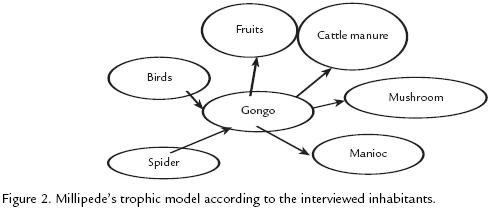
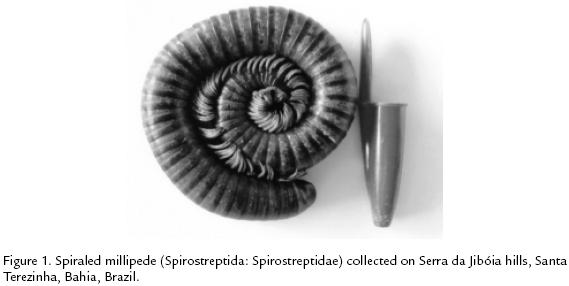
<body><![CDATA[<P   align="justify" >According to the interviewed people, millipedes are found in rotten woods, baseboard, firewood, and in the litter. A big specimen inhabits the caatinga, which is the Brazilian biome from the northeastern of the country (&ldquo;The yellow big one only appears in the caatinga&rdquo;, Mrs. E., 60 years old). Another large one is found preferentially on the lower side of the Serra da Jib&oacute;ia (&ldquo;The big species lives more often on the hill. Here in the lowlands it is not able to survive. It is always on the slopes&rdquo;, L., 28 years old). Apparently, interviewees are referring to the millipedes of the Spirostreptidae family and Spirostreptida order (<a href="#fig1">Fig. 1</a>). </P >    <P ><a name="fig1"></a><img src="/img/revistas/abc/v12n2/v12n2a10f1.JPG" ></P >     <P   align="justify" >Diplopods are mesophilous and hygrophilous animals that generally present nocturnal habits. They are always escaping from the sunlight, and therefore are found hidden in humid and dark places, such as under litter, mosses, stones or pieces of wood, inside rotten trunks or on the soil surface (Garcia and Campos, 2001). Sometimes they make migrations searching for humidity (Santos, 1982), or are associated to reproduction (Boccardo <I>et al.</I>, 2002). Then they invade homes and damage vegetable gardens, orchards, and small plantations (Boccardo <I>et al.</I>, 1997; Boccardo <I>et al.</I>, 2002). </P >     <P   align="justify" >Most of the interviewees stated that these animals are more active during the rain time: &ldquo;When it rains they enjoy going out&rdquo; (Mrs. V., 58 years old); &ldquo;They appear more often in times of rain&rdquo; (Mrs. E., 60 years old). There is probably a correspondence between the seasonality of their appearance and the period of rains, since diplopods are considered as indicators of weather conditions in the folk meteorology. There is even a common saying: &ldquo;<I>embu</I><I>&aacute; </I>travelling, rain coming&rdquo; (Nomura, 2001). For the people from the county of  Tanquinho, Bahia State, the presence of many white millipedes in the beginning of the winter is interpreted as a signal that there will be nonstop rains and that crops of the coming period will be good (Oliveira, 2006). C&eacute;sar (1941 <I>i</I><I>n </I>Nomura, 2001) claims that in those years, when millipedes appear on the roads and fields, winter will be good. </P >     <P   align="justify" >The food habit of the <I>gong</I><I>o </I>was also recorded. A schema of trophic model based on the Pedra Branca villagers&rsquo; traditional knowledge is shown in <a href="#fig2">figure 2</a>. According to them, diplopods feed on fruits, cattle manure, mushrooms and pieces of manioc stem. On the other hand, they are eaten by spiders and birds, like the anum (Cuculidae family). Diplopods are herbivorous and detritivorous and they feed mainly on decomposing vegetation, but some species eat animal substances such as the lysiopetalids that inhabit rocks (Santos, 1982; Ruppert <I>et al.</I>, 2005). In some tropical regions these animals are more important than earthworms in what it concerns to soil recycling once when they feed on decomposing plant material eating fungi, bacteria, and the material they have already torn in pieces (Ramel, 2005). Some species attack living plants and sometimes cause serious problems in greenhouses and gardens (Garcia and Campos, 2001). These authors claim that diplopods may reach plague levels. That is why their phytosanitary importance should be taken into consideration. </P >    <P ><a name="fig2"></a><img src="/img/revistas/abc/v12n2/v12n2a10f2.JPG" ></P >     <P   align="justify" >Millipedes&rsquo; ability of coiling their bodies was commented by nine individuals, and two of them recognized a defense mechanism in this attitude: &ldquo;The <I>gongo</I>&hellip; its defense&hellip; when we mess with it, it protects itself, it rolls up&rdquo; (Mr. E., 66 years old). Only one interviewee associated the behavior of rolling up (&ldquo;ingongar&rdquo;, a verb created from the animal&rsquo;s popular name, as he said) with the sex of the animal: &ldquo;The one that rolls up is the female. The male, the more you mess with it, the more it goes away&rdquo; (A., 40 years old). Literature records that in many diplopods both sexes are capable of executing a dorsoventral flexion and roll their bodies in spirals when resting or disturbed, and thus providing greater rigidity through body contraction into a small block (Moore, 2003). Members of the Glomerida order (Oniscomorpha superorder), as well as some other orders can roll up in spheres (Ruppert <I>et al.</I>, 2005). Another advantage of this spiraled formation is reducing the loss of water on body surface when the surroundings get less humid (Meglitsch and Schram, 1991). Additionally, it provokes the excretion of a liquid from the repugnatory glands, which has the function of repelling the natural enemies (Hopkin and Read, 1992; review by Nomura, 2001). Few species have developed the habit of ejecting their corporal fluids up to 20 or 30 centimeters away. The natives from Malaysia use this defensive secretion as arrow poison (Ruppert <I>et al.</I>, 2005). <I>Rhinocrisis</I><I>, </I>from Haiti, can spray its noxious secretion up to almost one meter away (Meglitsch and Schram, 1991). </P >     <p   align="justify" >&ldquo;OFFENSIVE&rdquo; MILLIPEDES </p >     <P   align="justify" >In what it concerns the local perception on millipede noxiousness (&ldquo;offensive&rdquo;), 41% of the interviewees stated that the <I>gong</I><I>o </I>hurts (&ldquo;It has a poison like that of the snake&rsquo;s&rdquo;, Mrs. P., 72 years old). However, 23% of them have considered it harmless (&ldquo;This animal is the traveler which never hurts anyone&rdquo;, Mr. E., 66 years old; &ldquo;It is a small bug that bothers nobody&rdquo;, Mr. A. M., 78 years old). In the city of Jequi&eacute; Domingues <I>et al</I><I>. </I>(2003) have obtained different results: 58% of the people claimed these animals are not poisonous, against 32% who considered them noxious. In Pedra Branca, if someone is injured by a millipede, he/she has to count all its legs. Such a procedure however is generally taken as a superstition: &ldquo;I want to see who is going to count the legs of a millipede!&rdquo; (Mrs. P., 72 years old); &ldquo;I never saw a millipede biting&rdquo; (E., 38 years old); &ldquo;It never injured anybody, but on the day it hurts someone has to count all its legs. But did you count them? This is a legend&rdquo; (Mrs. E., 60 years old). Even though, millipedes are exterminated with insecticide. </P >     <P   align="justify" >It is interesting to note the perceptions of noxiousness people from Jequi&eacute; have attributed to millipedes: &ldquo;If it spits fire someone has to count its 100 legs&rdquo;; &ldquo;When it bites or rolls up, it only releases the victim and the person only survives if he/she counts its legs&rdquo;; &ldquo;When it bites there is no cure unless you toast its skin (exoskeleton) and put the powder on the affected area&rdquo;; &ldquo;If it stings it makes a kind of cancer and that eats up the body&rdquo;; &ldquo;The little one may enter their ears when people are sleeping&rdquo; (Domingues <I>et al.</I>, 2003). Although the accidents caused by diplopods do not present serious consequences, they still give rise to troubles and must be viewed with some concern. Accident occurs when the animal is compressed against the skin. This can happen when someone puts his shoes on. The main component of the diplopods&rsquo; secretion varies according to the species: aldehydes, quinones, phenols and hydrogen cyanide. As Cardoso and Haddad J&uacute;nior (2003) state, the corporal fluids can provoke erythema, edema, bladders, and brown or black pigmentation around the affected skin. It can evolve to residual hypocromy, also being reported hypercromic lesions that can persist for months (for instance, the Mexican species of the <I>Orthoporus </I>genus Fern&aacute;ndezRubio, 1997). If the caustic substance reaches the eye it can cause intense ache, with acute conjunctivitis, burn sensation and having the same effect as chemical burning (Fern&aacute;ndezRubio, 1997). The use of alcohol and ether on the area is encouraged because they function as solvents of the venoms. The risk of having an accident with corporal fluids was not neglected in the traditional medical systems of indigenous peoples. The Yora/ Yaminahua Indians from the Peruvian Amazon attribute several sicknesses to the evil spirits of noxious invertebrates, such as wasps (<I>wina</I>) and caustic diplopods (<I>xaco</I>). Many of the respiratory conditions are associated, directly and indirectly, to these latter that probably belong to the Spirobolida or Spirostreptida order. Eating food or drinking water contaminated with the caustic secretions causes itching in the throat, cough and production of mucus with blood, a condition that is known as <I>xaco xea</I>, or &ldquo;swallowed diplopod&rdquo; (Shepard Junior, 1999). </P >     ]]></body>
<body><![CDATA[<P   align="justify" >On the other hand, the pharmaceutical industries should search new chemical structures in diplopods for discovering biologically active compounds. Some animals present a behavior of selfmedication (zoopharmacognosy) and that can point out to that direction. In Venezuela, capuchin monkeys (<I>Cebus olivaceu</I><I>s </I>Schomburgk, 1848) rub the highly toxic diplopod secretions on their bodies during rainy seasons, when insect bites (especially of mosquitoes) are merciless. These secretions are antimicrobial and contain insect repellents called benzoquinones (Valderrama <I>et al.</I>, 2000; Engel, 2002). </P > </b>     <p   align="left" ><B>CONCLUSION </b></p >     <P   align="justify" >In general, Pedra Branca inhabitants&rsquo; traditional zoological knowledge regardin</b>g millipede species has shown to be rationally coherent with the academic knowledge. The complex set of feelings, knowledge and behavior towards this animal group and other arthropods may as well be translated as a valuable cultural resource, which in turn has to be taken into account both in the developmental processes addressed to the region  maybe the transformation of it in some kind of Conservation Unity, and in studies of local fauna inventory. </P >     <p   align="left" ><B>ACKNOWLEDGMENTS </b></p >     <P   align="justify" >Lilian Boccardo of the Universidade Estadual do Sudoeste da Bahia for havin</b>g reviewed and commented an earlier draft, and Cl&aacute;udia Cunha Kachimareck for her English corrections. </P >     <p   align="left" ><B>REFERENCES </b></p >     <!-- ref --><P   align="justify" >AMORIM JP. Medicina popular em Alagoas. Macei&oacute;: Departamento Estadual de Cultura; 1963. </P >    &nbsp;&nbsp;&nbsp;&nbsp;&nbsp;&nbsp;&nbsp;&nbsp;[&#160;<a href="javascript:void(0);" onclick="javascript: window.open('/scielo.php?script=sci_nlinks&ref=000049&pid=S0120-548X200700020001000001&lng=','','width=640,height=500,resizable=yes,scrollbars=1,menubar=yes,');">Links</a>&#160;]<!-- end-ref --><!-- ref --><P   align="justify" >BARAJAS ECL. Los animales usados en la medicina popular mexicana. M&eacute;xico: Imprenta Universitaria; 1961. </P >    &nbsp;&nbsp;&nbsp;&nbsp;&nbsp;&nbsp;&nbsp;&nbsp;[&#160;<a href="javascript:void(0);" onclick="javascript: window.open('/scielo.php?script=sci_nlinks&ref=000050&pid=S0120-548X200700020001000002&lng=','','width=640,height=500,resizable=yes,scrollbars=1,menubar=yes,');">Links</a>&#160;]<!-- end-ref --><!-- ref --><P   align="justify" >BARCELOS NETO A. Monstros amaz&ocirc;nicos. Imagens Waur&aacute; da (sobre) natureza. Ci&ecirc;ncia Hoje. 2000;27(162):48-53. </P >    &nbsp;&nbsp;&nbsp;&nbsp;&nbsp;&nbsp;&nbsp;&nbsp;[&#160;<a href="javascript:void(0);" onclick="javascript: window.open('/scielo.php?script=sci_nlinks&ref=000051&pid=S0120-548X200700020001000003&lng=','','width=640,height=500,resizable=yes,scrollbars=1,menubar=yes,');">Links</a>&#160;]<!-- end-ref --><!-- ref --><P   align="justify" >BEATTIE A, EHRLICH PR. Wild Solutions: How Biodiversity is Money in the Bank. New Haven: Yale University Press; 2001. </P >    &nbsp;&nbsp;&nbsp;&nbsp;&nbsp;&nbsp;&nbsp;&nbsp;[&#160;<a href="javascript:void(0);" onclick="javascript: window.open('/scielo.php?script=sci_nlinks&ref=000052&pid=S0120-548X200700020001000004&lng=','','width=640,height=500,resizable=yes,scrollbars=1,menubar=yes,');">Links</a>&#160;]<!-- end-ref --><!-- ref --><P   align="justify" >BERLIN B. Ethnobiological Classification: Principles of Categorization of Plants and Animals in Traditional Societies. New Jersey: Princeton University Press; 1993. </P >    &nbsp;&nbsp;&nbsp;&nbsp;&nbsp;&nbsp;&nbsp;&nbsp;[&#160;<a href="javascript:void(0);" onclick="javascript: window.open('/scielo.php?script=sci_nlinks&ref=000053&pid=S0120-548X200700020001000005&lng=','','width=640,height=500,resizable=yes,scrollbars=1,menubar=yes,');">Links</a>&#160;]<!-- end-ref --><!-- ref --><P   align="justify" >BOCCARDO L, PENTEADO CHS, JUC&Aacute;CHAGAS R. Swarming of Millipedes, a New Case Noticed in the District of Patroc&iacute;nioMGBrazil. J Advanced Zool. 1997;8(1):62-63. </P >    &nbsp;&nbsp;&nbsp;&nbsp;&nbsp;&nbsp;&nbsp;&nbsp;[&#160;<a href="javascript:void(0);" onclick="javascript: window.open('/scielo.php?script=sci_nlinks&ref=000054&pid=S0120-548X200700020001000006&lng=','','width=640,height=500,resizable=yes,scrollbars=1,menubar=yes,');">Links</a>&#160;]<!-- end-ref --><!-- ref --><P   align="justify" >BOCCARDO L, JUC&Aacute;CHAGAS R, PENTEADO CHS. Migration and Population Outbreaks of Millipedes in the Coffee Plantations, Region of Alto Paranaiba, MG, Brazil. Holos Environm. 2002;2(2):220-223. </P >    &nbsp;&nbsp;&nbsp;&nbsp;&nbsp;&nbsp;&nbsp;&nbsp;[&#160;<a href="javascript:void(0);" onclick="javascript: window.open('/scielo.php?script=sci_nlinks&ref=000055&pid=S0120-548X200700020001000007&lng=','','width=640,height=500,resizable=yes,scrollbars=1,menubar=yes,');">Links</a>&#160;]<!-- end-ref --><!-- ref --><P   align="justify" >CARDOSO JLC, HADDAD J&Uacute;NIOR V. Acidentes por cole&oacute;pteros vesicantes e outros artr&oacute;podes. En: Cardoso JLC, Fran&ccedil;a, FOS, Wen, FH, M&aacute;laque, CMS, Haddad J&uacute;nior V, organizers. Animais pe&ccedil;onhentos no Brasil: biologia, cl&iacute;nica e terap&ecirc;utica dos acidentes. S&atilde;o Paulo: SARVIER; 2003. p. 258-264. </P >    &nbsp;&nbsp;&nbsp;&nbsp;&nbsp;&nbsp;&nbsp;&nbsp;[&#160;<a href="javascript:void(0);" onclick="javascript: window.open('/scielo.php?script=sci_nlinks&ref=000056&pid=S0120-548X200700020001000008&lng=','','width=640,height=500,resizable=yes,scrollbars=1,menubar=yes,');">Links</a>&#160;]<!-- end-ref --><!-- ref --><P   align="justify" >CENTRO DE ESTAT&Iacute;STICA E INFORMA&Ccedil;&Atilde;O. Informa&ccedil;&otilde;es b&aacute;sicas dos munic&iacute;pios baianos: rec&ocirc;ncavo sul. Salvador: Governo do Estado da Bahia; 1994. p. 543-563. </P >    &nbsp;&nbsp;&nbsp;&nbsp;&nbsp;&nbsp;&nbsp;&nbsp;[&#160;<a href="javascript:void(0);" onclick="javascript: window.open('/scielo.php?script=sci_nlinks&ref=000057&pid=S0120-548X200700020001000009&lng=','','width=640,height=500,resizable=yes,scrollbars=1,menubar=yes,');">Links</a>&#160;]<!-- end-ref --><!-- ref --><P   align="justify" >COSTA NETO EM. &quot;Barata &eacute; um santo rem&eacute;dio&quot;: introdu&ccedil;&atilde;o &agrave; zooterapia popular no estado da Bahia. Feira de Santana: UEFS; 1999a. </P >    &nbsp;&nbsp;&nbsp;&nbsp;&nbsp;&nbsp;&nbsp;&nbsp;[&#160;<a href="javascript:void(0);" onclick="javascript: window.open('/scielo.php?script=sci_nlinks&ref=000058&pid=S0120-548X200700020001000010&lng=','','width=640,height=500,resizable=yes,scrollbars=1,menubar=yes,');">Links</a>&#160;]<!-- end-ref --><!-- ref --><P   align="justify" >COSTA NETO EM. A etnocategoria &quot;inseto&quot; e a hip&oacute;tese da ambival&ecirc;ncia entomoprojetiva. Acta Biol Leopoldensia. 1996b;21(1):7-14. </P >    &nbsp;&nbsp;&nbsp;&nbsp;&nbsp;&nbsp;&nbsp;&nbsp;[&#160;<a href="javascript:void(0);" onclick="javascript: window.open('/scielo.php?script=sci_nlinks&ref=000059&pid=S0120-548X200700020001000011&lng=','','width=640,height=500,resizable=yes,scrollbars=1,menubar=yes,');">Links</a>&#160;]<!-- end-ref --><!-- ref --><P   align="justify" >COSTA NETO EM. O uso de est&iacute;mulossinais entomomorfos na publicidade. Bioikos. 2000;14(1):49-53. </P >    &nbsp;&nbsp;&nbsp;&nbsp;&nbsp;&nbsp;&nbsp;&nbsp;[&#160;<a href="javascript:void(0);" onclick="javascript: window.open('/scielo.php?script=sci_nlinks&ref=000060&pid=S0120-548X200700020001000012&lng=','','width=640,height=500,resizable=yes,scrollbars=1,menubar=yes,');">Links</a>&#160;]<!-- end-ref --><!-- ref --><P   align="justify" >COSTA NETO EM. Biotransforma&ccedil;&otilde;es de insetos no povoado de Pedra Branca, estado da Bahia, Brasil. Interciencia. 2004;29(5):280-283. </P >    &nbsp;&nbsp;&nbsp;&nbsp;&nbsp;&nbsp;&nbsp;&nbsp;[&#160;<a href="javascript:void(0);" onclick="javascript: window.open('/scielo.php?script=sci_nlinks&ref=000061&pid=S0120-548X200700020001000013&lng=','','width=640,height=500,resizable=yes,scrollbars=1,menubar=yes,');">Links</a>&#160;]<!-- end-ref --><!-- ref --><P   align="justify" >COSTA NETO EM, PACHECO JM. A constru&ccedil;&atilde;o do dom&iacute;nio etnozool&oacute;gico &quot;inseto&quot; pelos moradores do povoado de Pedra Branca, Santa Terezinha, estado da Bahia. Acta Scientiarum Biol Science. 2004;26(1):81-90. </P >    &nbsp;&nbsp;&nbsp;&nbsp;&nbsp;&nbsp;&nbsp;&nbsp;[&#160;<a href="javascript:void(0);" onclick="javascript: window.open('/scielo.php?script=sci_nlinks&ref=000062&pid=S0120-548X200700020001000014&lng=','','width=640,height=500,resizable=yes,scrollbars=1,menubar=yes,');">Links</a>&#160;]<!-- end-ref --><!-- ref --><P   align="justify" >CURRAN CH. Insect lore of the Aztecs. Nat Hist. 1937;39:196-203. </P >    &nbsp;&nbsp;&nbsp;&nbsp;&nbsp;&nbsp;&nbsp;&nbsp;[&#160;<a href="javascript:void(0);" onclick="javascript: window.open('/scielo.php?script=sci_nlinks&ref=000063&pid=S0120-548X200700020001000015&lng=','','width=640,height=500,resizable=yes,scrollbars=1,menubar=yes,');">Links</a>&#160;]<!-- end-ref --><!-- ref --><P   align="justify" >DAVIS EW. The Ethnobiology of the Haitian Zombie. J Ethnopharm. 1983;9:85-104. </P >    &nbsp;&nbsp;&nbsp;&nbsp;&nbsp;&nbsp;&nbsp;&nbsp;[&#160;<a href="javascript:void(0);" onclick="javascript: window.open('/scielo.php?script=sci_nlinks&ref=000064&pid=S0120-548X200700020001000016&lng=','','width=640,height=500,resizable=yes,scrollbars=1,menubar=yes,');">Links</a>&#160;]<!-- end-ref --><!-- ref --><P   align="justify" >DOMINGUES AMT, OLIVEIRA CG, RANGEL LS, ROM&Atilde;O JA, PEIXOTO AV, BOCCARDO L. Identifica&ccedil;&atilde;o das representa&ccedil;&otilde;es sobre dipl&oacute;podos por populares, no munic&iacute;pio de Jequi&eacute;, BA. En: Anais do VII Semin&aacute;rio de Inicia&ccedil;&atilde;o Cient&iacute;fica da UESB. Vit&oacute;ria da Conquista: UESB; 2003. p. 210-211. </P >    &nbsp;&nbsp;&nbsp;&nbsp;&nbsp;&nbsp;&nbsp;&nbsp;[&#160;<a href="javascript:void(0);" onclick="javascript: window.open('/scielo.php?script=sci_nlinks&ref=000065&pid=S0120-548X200700020001000017&lng=','','width=640,height=500,resizable=yes,scrollbars=1,menubar=yes,');">Links</a>&#160;]<!-- end-ref --><!-- ref --><P   align="justify" >ENGEL C. Wild Health. How Animals Keep Themselves Well and What We Can Learn from Them. New York: Houghton Mifflin Company; 2002. </P >    &nbsp;&nbsp;&nbsp;&nbsp;&nbsp;&nbsp;&nbsp;&nbsp;[&#160;<a href="javascript:void(0);" onclick="javascript: window.open('/scielo.php?script=sci_nlinks&ref=000066&pid=S0120-548X200700020001000018&lng=','','width=640,height=500,resizable=yes,scrollbars=1,menubar=yes,');">Links</a>&#160;]<!-- end-ref --><!-- ref --><P   align="justify" >FERN&Aacute;NDEZRUBIO F. Artr&oacute;podos y salud humana. Bol SEA. 1997;20:67-191. </P >    &nbsp;&nbsp;&nbsp;&nbsp;&nbsp;&nbsp;&nbsp;&nbsp;[&#160;<a href="javascript:void(0);" onclick="javascript: window.open('/scielo.php?script=sci_nlinks&ref=000067&pid=S0120-548X200700020001000019&lng=','','width=640,height=500,resizable=yes,scrollbars=1,menubar=yes,');">Links</a>&#160;]<!-- end-ref --><!-- ref --><P   align="justify" >GARCIA FRM, CAMPOS JV. Biologia e controle de artr&oacute;podes de import&acirc;ncia fitossanit&aacute;ria (Diplopoda, Symphyla, Isopoda), pouco conhecidos no Brasil. Biol&oacute;gico. 2001;63(1/2):7-13. </P >    &nbsp;&nbsp;&nbsp;&nbsp;&nbsp;&nbsp;&nbsp;&nbsp;[&#160;<a href="javascript:void(0);" onclick="javascript: window.open('/scielo.php?script=sci_nlinks&ref=000068&pid=S0120-548X200700020001000020&lng=','','width=640,height=500,resizable=yes,scrollbars=1,menubar=yes,');">Links</a>&#160;]<!-- end-ref --><!-- ref --><P   align="justify" >GUARISMA G. Insectes nuisibles, bienfaiteurs, protecteurs et m&eacute;dicinaux chez les Bafia (Cameroun). En: MotteFlorac E, Thomas JMC, editors. Insects in oral literature and traditions. ParisLouvain: PeetersSELAF (Ethnosciences); 2003. p. 381-393. </P >    &nbsp;&nbsp;&nbsp;&nbsp;&nbsp;&nbsp;&nbsp;&nbsp;[&#160;<a href="javascript:void(0);" onclick="javascript: window.open('/scielo.php?script=sci_nlinks&ref=000069&pid=S0120-548X200700020001000021&lng=','','width=640,height=500,resizable=yes,scrollbars=1,menubar=yes,');">Links</a>&#160;]<!-- end-ref --><!-- ref --><P   align="justify" >GUENNEUGUES M, M&Eacute;NEZ A. Structures et Fonctions de Toxines Animales. Comptes Rendus S&eacute;ances Soc Biol. 1997;191(3):329-344. </P >    &nbsp;&nbsp;&nbsp;&nbsp;&nbsp;&nbsp;&nbsp;&nbsp;[&#160;<a href="javascript:void(0);" onclick="javascript: window.open('/scielo.php?script=sci_nlinks&ref=000070&pid=S0120-548X200700020001000022&lng=','','width=640,height=500,resizable=yes,scrollbars=1,menubar=yes,');">Links</a>&#160;]<!-- end-ref --><!-- ref --><P   align="justify" >HARPAZ I. Early Entomology in the Middle East. En: Smith RF, editor. History of entomology. Palo Alto: Annual Reviews Inc.; 1973. p. 21-36. </P >    &nbsp;&nbsp;&nbsp;&nbsp;&nbsp;&nbsp;&nbsp;&nbsp;[&#160;<a href="javascript:void(0);" onclick="javascript: window.open('/scielo.php?script=sci_nlinks&ref=000071&pid=S0120-548X200700020001000023&lng=','','width=640,height=500,resizable=yes,scrollbars=1,menubar=yes,');">Links</a>&#160;]<!-- end-ref --><!-- ref --><P   align="justify" >HOGUE CL. Latin American Insects and Entomology. Berkeley: University of California Press; 1993. </P >    &nbsp;&nbsp;&nbsp;&nbsp;&nbsp;&nbsp;&nbsp;&nbsp;[&#160;<a href="javascript:void(0);" onclick="javascript: window.open('/scielo.php?script=sci_nlinks&ref=000072&pid=S0120-548X200700020001000024&lng=','','width=640,height=500,resizable=yes,scrollbars=1,menubar=yes,');">Links</a>&#160;]<!-- end-ref --><!-- ref --><P   align="justify" >HOFFMAN RL, GOLOVATCH SI, ADIS J, MORAIS JW. Diplopoda. En: Adis J, editor. Amazonian Arachnida and Myriapoda. Pensoft, Sofia (Moscow); 2002. p. 505-533. </P >    &nbsp;&nbsp;&nbsp;&nbsp;&nbsp;&nbsp;&nbsp;&nbsp;[&#160;<a href="javascript:void(0);" onclick="javascript: window.open('/scielo.php?script=sci_nlinks&ref=000073&pid=S0120-548X200700020001000025&lng=','','width=640,height=500,resizable=yes,scrollbars=1,menubar=yes,');">Links</a>&#160;]<!-- end-ref --><!-- ref --><P   align="justify" >HOPKIN SP, READ HJ. The Biology of Millipedes. Oxford: Oxford University Press; 1992. </P >    &nbsp;&nbsp;&nbsp;&nbsp;&nbsp;&nbsp;&nbsp;&nbsp;[&#160;<a href="javascript:void(0);" onclick="javascript: window.open('/scielo.php?script=sci_nlinks&ref=000074&pid=S0120-548X200700020001000026&lng=','','width=640,height=500,resizable=yes,scrollbars=1,menubar=yes,');">Links</a>&#160;]<!-- end-ref --><!-- ref --><P   align="justify" >JUNC&Aacute; FA, FREITAS MA, ALVES L, GUERREIRO W, PASCHOAl E. Herpetofauna da Serra da Jib&oacute;ia  Bahia: novas ocorr&ecirc;ncias. En: Resumos do 12 Encontro de Zoologia do Nordeste. Feira de Santana: UEFS; 1999. p. 412. </P >    &nbsp;&nbsp;&nbsp;&nbsp;&nbsp;&nbsp;&nbsp;&nbsp;[&#160;<a href="javascript:void(0);" onclick="javascript: window.open('/scielo.php?script=sci_nlinks&ref=000075&pid=S0120-548X200700020001000027&lng=','','width=640,height=500,resizable=yes,scrollbars=1,menubar=yes,');">Links</a>&#160;]<!-- end-ref --><!-- ref --><P   align="justify" >KNYSAK I, MARTINS R. Myriapoda. En: Joly CA, Bicudo CEM, organizers. Biodiversidade do Estado de S&atilde;o Paulo, Brasil: s&iacute;ntese do conhecimento ao final do s&eacute;culo XX. S&atilde;o Paulo: FAPESP; 1999. p. 67-72. </P >    &nbsp;&nbsp;&nbsp;&nbsp;&nbsp;&nbsp;&nbsp;&nbsp;[&#160;<a href="javascript:void(0);" onclick="javascript: window.open('/scielo.php?script=sci_nlinks&ref=000076&pid=S0120-548X200700020001000028&lng=','','width=640,height=500,resizable=yes,scrollbars=1,menubar=yes,');">Links</a>&#160;]<!-- end-ref --><!-- ref --><P   align="justify" >MARQUES JGW. Aspectos ecol&oacute;gicos na etnoictiologia dos pescadores do Complexo Estuarinolagunar Munda&uacute;Manguaba [tesis de doctorado]. Campinas: Universidade Estadual de Campinas; 1991. </P >    &nbsp;&nbsp;&nbsp;&nbsp;&nbsp;&nbsp;&nbsp;&nbsp;[&#160;<a href="javascript:void(0);" onclick="javascript: window.open('/scielo.php?script=sci_nlinks&ref=000077&pid=S0120-548X200700020001000029&lng=','','width=640,height=500,resizable=yes,scrollbars=1,menubar=yes,');">Links</a>&#160;]<!-- end-ref --><!-- ref --><P   align="justify" >MBATA KJ. Traditional Uses of Arthropods in Zambia: II. Medicinal and Miscellaneous Uses. The Food Insects News. 1999;12(2):1-7. </P >    &nbsp;&nbsp;&nbsp;&nbsp;&nbsp;&nbsp;&nbsp;&nbsp;[&#160;<a href="javascript:void(0);" onclick="javascript: window.open('/scielo.php?script=sci_nlinks&ref=000078&pid=S0120-548X200700020001000030&lng=','','width=640,height=500,resizable=yes,scrollbars=1,menubar=yes,');">Links</a>&#160;]<!-- end-ref --><!-- ref --><P   align="justify" >MEGLITSCH PA, SCHRAM RF. Invertebrate Zoology. 3 ed. Oxford: Oxford University Press; 1991. </P >    &nbsp;&nbsp;&nbsp;&nbsp;&nbsp;&nbsp;&nbsp;&nbsp;[&#160;<a href="javascript:void(0);" onclick="javascript: window.open('/scielo.php?script=sci_nlinks&ref=000079&pid=S0120-548X200700020001000031&lng=','','width=640,height=500,resizable=yes,scrollbars=1,menubar=yes,');">Links</a>&#160;]<!-- end-ref --><!-- ref --><P   align="justify" >MOORE J. Uma introdu&ccedil;&atilde;o aos invertebrados. S&atilde;o Paulo: Santos Editora; 2003. </P >    &nbsp;&nbsp;&nbsp;&nbsp;&nbsp;&nbsp;&nbsp;&nbsp;[&#160;<a href="javascript:void(0);" onclick="javascript: window.open('/scielo.php?script=sci_nlinks&ref=000080&pid=S0120-548X200700020001000032&lng=','','width=640,height=500,resizable=yes,scrollbars=1,menubar=yes,');">Links</a>&#160;]<!-- end-ref --><!-- ref --><P   align="justify" >NOMURA H. Os animais no folclore: aracn&iacute;deos e miri&aacute;podos. Mossor&oacute;: Funda&ccedil;&atilde;o VingtUm Rosado; 2001. </P >    &nbsp;&nbsp;&nbsp;&nbsp;&nbsp;&nbsp;&nbsp;&nbsp;[&#160;<a href="javascript:void(0);" onclick="javascript: window.open('/scielo.php?script=sci_nlinks&ref=000081&pid=S0120-548X200700020001000033&lng=','','width=640,height=500,resizable=yes,scrollbars=1,menubar=yes,');">Links</a>&#160;]<!-- end-ref --><!-- ref --><P   align="justify" >OLIVEIRA MVM. 2006. Prevendo o tempo em Tanquinho, Bahia. Sitientibus ser C Biol; 2002;6:120-124. </P >    &nbsp;&nbsp;&nbsp;&nbsp;&nbsp;&nbsp;&nbsp;&nbsp;[&#160;<a href="javascript:void(0);" onclick="javascript: window.open('/scielo.php?script=sci_nlinks&ref=000082&pid=S0120-548X200700020001000034&lng=','','width=640,height=500,resizable=yes,scrollbars=1,menubar=yes,');">Links</a>&#160;]<!-- end-ref --><!-- ref --><P   align="justify" >POSEY DA. O conhecimento entomol&oacute;gico Kayap&oacute;: etnometodologia e sistema cultural. Anu&aacute;rio Antrop. 1983;81:109-121. </P >    &nbsp;&nbsp;&nbsp;&nbsp;&nbsp;&nbsp;&nbsp;&nbsp;[&#160;<a href="javascript:void(0);" onclick="javascript: window.open('/scielo.php?script=sci_nlinks&ref=000083&pid=S0120-548X200700020001000035&lng=','','width=640,height=500,resizable=yes,scrollbars=1,menubar=yes,');">Links</a>&#160;]<!-- end-ref --><!-- ref --><P   align="justify" >REVEL N. Fleurs de Paroles. Histoire Naturelle Palawan I: Lens dons de N&auml;gsalad. Paris: Editions Peeters; 1990. </P >    &nbsp;&nbsp;&nbsp;&nbsp;&nbsp;&nbsp;&nbsp;&nbsp;[&#160;<a href="javascript:void(0);" onclick="javascript: window.open('/scielo.php?script=sci_nlinks&ref=000084&pid=S0120-548X200700020001000036&lng=','','width=640,height=500,resizable=yes,scrollbars=1,menubar=yes,');">Links</a>&#160;]<!-- end-ref --><!-- ref --><P   align="justify" >RUPPERT EE, FOX RS, BARNES RD. Zoologia dos invertebrados: uma abordagem funcionalevolutiva. 7 ed. S&atilde;o Paulo: Editora Roca; 2005 </P >    &nbsp;&nbsp;&nbsp;&nbsp;&nbsp;&nbsp;&nbsp;&nbsp;[&#160;<a href="javascript:void(0);" onclick="javascript: window.open('/scielo.php?script=sci_nlinks&ref=000085&pid=S0120-548X200700020001000037&lng=','','width=640,height=500,resizable=yes,scrollbars=1,menubar=yes,');">Links</a>&#160;]<!-- end-ref --><!-- ref --><P   align="" >SANTOS E. O mundo dos artr&oacute;podes. Belo Horizonte: Itatiaia; 1982.    &nbsp;&nbsp;&nbsp;&nbsp;&nbsp;&nbsp;&nbsp;&nbsp;[&#160;<a href="javascript:void(0);" onclick="javascript: window.open('/scielo.php?script=sci_nlinks&ref=000086&pid=S0120-548X200700020001000038&lng=','','width=640,height=500,resizable=yes,scrollbars=1,menubar=yes,');">Links</a>&#160;]<!-- end-ref --><!-- ref --> SHEPARD JUNIOR GH. Pharmacognosy and the Senses in Two Amazonian Societies [tesis de dosctorado]. Berkeley: University of California; 1999.    &nbsp;&nbsp;&nbsp;&nbsp;&nbsp;&nbsp;&nbsp;&nbsp;[&#160;<a href="javascript:void(0);" onclick="javascript: window.open('/scielo.php?script=sci_nlinks&ref=000087&pid=S0120-548X200700020001000039&lng=','','width=640,height=500,resizable=yes,scrollbars=1,menubar=yes,');">Links</a>&#160;]<!-- end-ref --><!-- ref --> SIELFELD W. Clase Diplopoda. Gu&iacute;as de identificaci&oacute;n y biodiversidad fauna chilena. Apuntes de Zoolog&iacute;a. Iquique: Universidad Arturo Prat; 2002.</P >    &nbsp;&nbsp;&nbsp;&nbsp;&nbsp;&nbsp;&nbsp;&nbsp;[&#160;<a href="javascript:void(0);" onclick="javascript: window.open('/scielo.php?script=sci_nlinks&ref=000088&pid=S0120-548X200700020001000040&lng=','','width=640,height=500,resizable=yes,scrollbars=1,menubar=yes,');">Links</a>&#160;]<!-- end-ref --><!-- ref --><P   > STURTEVANT WC. Studies in ethnoscience. Am Anthrop. 1964;66(3):99131.    &nbsp;&nbsp;&nbsp;&nbsp;&nbsp;&nbsp;&nbsp;&nbsp;[&#160;<a href="javascript:void(0);" onclick="javascript: window.open('/scielo.php?script=sci_nlinks&ref=000089&pid=S0120-548X200700020001000041&lng=','','width=640,height=500,resizable=yes,scrollbars=1,menubar=yes,');">Links</a>&#160;]<!-- end-ref --><!-- ref --> VALDERRAMA X, ROBINSON JG, ATTYGALE AB, EISNEr T. Seasonal Anointment with Millipedes in a Wild Primate: A chemical Defense Against Insects? J Chem Ecol. 2000;26:2781-2790. </P >    &nbsp;&nbsp;&nbsp;&nbsp;&nbsp;&nbsp;&nbsp;&nbsp;[&#160;<a href="javascript:void(0);" onclick="javascript: window.open('/scielo.php?script=sci_nlinks&ref=000090&pid=S0120-548X200700020001000042&lng=','','width=640,height=500,resizable=yes,scrollbars=1,menubar=yes,');">Links</a>&#160;]<!-- end-ref --> ]]></body><back>
<ref-list>
<ref id="B1">
<nlm-citation citation-type="book">
<person-group person-group-type="author">
<name>
<surname><![CDATA[AMORIM]]></surname>
<given-names><![CDATA[JP]]></given-names>
</name>
</person-group>
<source><![CDATA[Medicina popular em Alagoas]]></source>
<year>1963</year>
<publisher-name><![CDATA[Departamento Estadual de Cultura]]></publisher-name>
</nlm-citation>
</ref>
<ref id="B2">
<nlm-citation citation-type="book">
<person-group person-group-type="author">
<name>
<surname><![CDATA[BARAJAS]]></surname>
<given-names><![CDATA[ECL]]></given-names>
</name>
</person-group>
<source><![CDATA[Los animales usados en la medicina popular mexicana]]></source>
<year>1961</year>
<publisher-name><![CDATA[Imprenta Universitaria]]></publisher-name>
</nlm-citation>
</ref>
<ref id="B3">
<nlm-citation citation-type="journal">
<person-group person-group-type="author">
<name>
<surname><![CDATA[BARCELOS NETO]]></surname>
<given-names><![CDATA[A]]></given-names>
</name>
</person-group>
<article-title xml:lang="pt"><![CDATA[Monstros amazônicos. Imagens Waurá da (sobre) natureza]]></article-title>
<source><![CDATA[Ciência Hoje]]></source>
<year>2000</year>
<volume>27</volume>
<numero>162</numero>
<issue>162</issue>
<page-range>48-53</page-range></nlm-citation>
</ref>
<ref id="B4">
<nlm-citation citation-type="book">
<person-group person-group-type="author">
<name>
<surname><![CDATA[BEATTIE]]></surname>
<given-names><![CDATA[A]]></given-names>
</name>
<name>
<surname><![CDATA[EHRLICH]]></surname>
<given-names><![CDATA[PR]]></given-names>
</name>
</person-group>
<source><![CDATA[Wild Solutions: How Biodiversity is Money in the Bank]]></source>
<year>2001</year>
<publisher-loc><![CDATA[New Haven ]]></publisher-loc>
<publisher-name><![CDATA[Yale University Press]]></publisher-name>
</nlm-citation>
</ref>
<ref id="B5">
<nlm-citation citation-type="book">
<person-group person-group-type="author">
<name>
<surname><![CDATA[BERLIN]]></surname>
<given-names><![CDATA[B]]></given-names>
</name>
</person-group>
<source><![CDATA[Ethnobiological Classification: Principles of Categorization of Plants and Animals in Traditional Societies]]></source>
<year>1993</year>
<publisher-loc><![CDATA[New Jersey ]]></publisher-loc>
<publisher-name><![CDATA[Princeton University Press]]></publisher-name>
</nlm-citation>
</ref>
<ref id="B6">
<nlm-citation citation-type="journal">
<person-group person-group-type="author">
<name>
<surname><![CDATA[BOCCARDO]]></surname>
<given-names><![CDATA[L]]></given-names>
</name>
<name>
<surname><![CDATA[PENTEADO]]></surname>
<given-names><![CDATA[CHS]]></given-names>
</name>
<name>
<surname><![CDATA[JUCÁCHAGAS]]></surname>
<given-names><![CDATA[R]]></given-names>
</name>
</person-group>
<article-title xml:lang="en"><![CDATA[Swarming of Millipedes, a New Case Noticed in the District of PatrocínioMGBrazil]]></article-title>
<source><![CDATA[J Advanced Zool]]></source>
<year>1997</year>
<volume>8</volume>
<numero>1</numero>
<issue>1</issue>
<page-range>62-63</page-range></nlm-citation>
</ref>
<ref id="B7">
<nlm-citation citation-type="journal">
<person-group person-group-type="author">
<name>
<surname><![CDATA[BOCCARDO]]></surname>
<given-names><![CDATA[L]]></given-names>
</name>
<name>
<surname><![CDATA[JUCÁCHAGAS]]></surname>
<given-names><![CDATA[R]]></given-names>
</name>
<name>
<surname><![CDATA[PENTEADO]]></surname>
<given-names><![CDATA[CHS]]></given-names>
</name>
</person-group>
<article-title xml:lang="en"><![CDATA[Migration and Population Outbreaks of Millipedes in the Coffee Plantations, Region of Alto Paranaiba, MG, Brazil]]></article-title>
<source><![CDATA[Holos Environm]]></source>
<year>2002</year>
<volume>2</volume>
<numero>2</numero>
<issue>2</issue>
<page-range>220-223</page-range></nlm-citation>
</ref>
<ref id="B8">
<nlm-citation citation-type="book">
<person-group person-group-type="author">
<name>
<surname><![CDATA[CARDOSO]]></surname>
<given-names><![CDATA[JLC]]></given-names>
</name>
<name>
<surname><![CDATA[HADDAD JÚNIOR]]></surname>
<given-names><![CDATA[V]]></given-names>
</name>
</person-group>
<article-title xml:lang="pt"><![CDATA[Acidentes por coleópteros vesicantes e outros artrópodes]]></article-title>
<person-group person-group-type="editor">
<name>
<surname><![CDATA[Cardoso]]></surname>
<given-names><![CDATA[JLC]]></given-names>
</name>
<name>
<surname><![CDATA[França]]></surname>
<given-names><![CDATA[FOS]]></given-names>
</name>
<name>
<surname><![CDATA[Wen]]></surname>
<given-names><![CDATA[FH]]></given-names>
</name>
<name>
<surname><![CDATA[Málaque]]></surname>
<given-names><![CDATA[CMS]]></given-names>
</name>
<name>
<surname><![CDATA[Haddad]]></surname>
<given-names><![CDATA[Júnior V]]></given-names>
</name>
</person-group>
<source><![CDATA[Animais peçonhentos no Brasil: biologia, clínica e terapêutica dos acidentes]]></source>
<year>2003</year>
<page-range>258-264</page-range><publisher-loc><![CDATA[São Paulo ]]></publisher-loc>
<publisher-name><![CDATA[SARVIER]]></publisher-name>
</nlm-citation>
</ref>
<ref id="B9">
<nlm-citation citation-type="">
<collab>CENTRO DE ESTATÍSTICA E INFORMAÇÃO</collab>
<source><![CDATA[Informações básicas dos municípios baianos: recôncavo sul]]></source>
<year>1994</year>
<page-range>543-563</page-range><publisher-loc><![CDATA[Salvador^eEstado da Bahia Estado da Bahia]]></publisher-loc>
</nlm-citation>
</ref>
<ref id="B10">
<nlm-citation citation-type="book">
<person-group person-group-type="author">
<name>
<surname><![CDATA[COSTA NETO]]></surname>
<given-names><![CDATA[EM]]></given-names>
</name>
</person-group>
<source><![CDATA["Barata é um santo remédio": introdução à zooterapia popular no estado da Bahia]]></source>
<year>1999</year>
<month>a</month>
<publisher-loc><![CDATA[^eFeira de Santana Feira de Santana]]></publisher-loc>
<publisher-name><![CDATA[UEFS]]></publisher-name>
</nlm-citation>
</ref>
<ref id="B11">
<nlm-citation citation-type="journal">
<person-group person-group-type="author">
<name>
<surname><![CDATA[COSTA NETO]]></surname>
<given-names><![CDATA[EM]]></given-names>
</name>
</person-group>
<article-title xml:lang="pt"><![CDATA[A etnocategoria "inseto" e a hipótese da ambivalência entomoprojetiva]]></article-title>
<source><![CDATA[Acta Biol Leopoldensia]]></source>
<year>1996</year>
<month>b</month>
<volume>21</volume>
<numero>1</numero>
<issue>1</issue>
<page-range>7-14</page-range></nlm-citation>
</ref>
<ref id="B12">
<nlm-citation citation-type="journal">
<person-group person-group-type="author">
<name>
<surname><![CDATA[COSTA NETO]]></surname>
<given-names><![CDATA[EM]]></given-names>
</name>
</person-group>
<article-title xml:lang="pt"><![CDATA[O uso de estímulossinais entomomorfos na publicidade]]></article-title>
<source><![CDATA[Bioikos]]></source>
<year>2000</year>
<volume>14</volume>
<numero>1</numero>
<issue>1</issue>
<page-range>49-53</page-range></nlm-citation>
</ref>
<ref id="B13">
<nlm-citation citation-type="journal">
<person-group person-group-type="author">
<name>
<surname><![CDATA[COSTA NETO]]></surname>
<given-names><![CDATA[EM]]></given-names>
</name>
</person-group>
<article-title xml:lang="pt"><![CDATA[Biotransformações de insetos no povoado de Pedra Branca, estado da Bahia, Brasil]]></article-title>
<source><![CDATA[Interciencia]]></source>
<year>2004</year>
<volume>29</volume>
<numero>5</numero>
<issue>5</issue>
<page-range>280-283</page-range></nlm-citation>
</ref>
<ref id="B14">
<nlm-citation citation-type="journal">
<person-group person-group-type="author">
<name>
<surname><![CDATA[COSTA NETO]]></surname>
<given-names><![CDATA[EM]]></given-names>
</name>
<name>
<surname><![CDATA[PACHECO]]></surname>
<given-names><![CDATA[JM]]></given-names>
</name>
</person-group>
<article-title xml:lang="pt"><![CDATA[A construção do domínio etnozoológico "inseto" pelos moradores do povoado de Pedra Branca, Santa Terezinha, estado da Bahia]]></article-title>
<source><![CDATA[Acta Scientiarum Biol Science]]></source>
<year>2004</year>
<volume>26</volume>
<numero>1</numero>
<issue>1</issue>
<page-range>81-90</page-range></nlm-citation>
</ref>
<ref id="B15">
<nlm-citation citation-type="journal">
<person-group person-group-type="author">
<name>
<surname><![CDATA[CURRAN]]></surname>
<given-names><![CDATA[CH]]></given-names>
</name>
</person-group>
<article-title xml:lang="en"><![CDATA[Insect lore of the Aztecs]]></article-title>
<source><![CDATA[Nat Hist]]></source>
<year>1937</year>
<volume>39</volume>
<page-range>196-203</page-range></nlm-citation>
</ref>
<ref id="B16">
<nlm-citation citation-type="journal">
<person-group person-group-type="author">
<name>
<surname><![CDATA[DAVIS]]></surname>
<given-names><![CDATA[EW]]></given-names>
</name>
</person-group>
<article-title xml:lang="en"><![CDATA[The Ethnobiology of the Haitian Zombie]]></article-title>
<source><![CDATA[J Ethnopharm]]></source>
<year>1983</year>
<volume>9</volume>
<page-range>85-104</page-range></nlm-citation>
</ref>
<ref id="B17">
<nlm-citation citation-type="confpro">
<person-group person-group-type="author">
<name>
<surname><![CDATA[DOMINGUES]]></surname>
<given-names><![CDATA[AMT]]></given-names>
</name>
<name>
<surname><![CDATA[OLIVEIRA]]></surname>
<given-names><![CDATA[CG]]></given-names>
</name>
<name>
<surname><![CDATA[RANGEL]]></surname>
<given-names><![CDATA[LS]]></given-names>
</name>
<name>
<surname><![CDATA[ROMÃO]]></surname>
<given-names><![CDATA[JA]]></given-names>
</name>
<name>
<surname><![CDATA[PEIXOTO]]></surname>
<given-names><![CDATA[AV]]></given-names>
</name>
<name>
<surname><![CDATA[BOCCARDO]]></surname>
<given-names><![CDATA[L]]></given-names>
</name>
</person-group>
<article-title xml:lang="pt"><![CDATA[Identificação das representações sobre diplópodos por populares, no município de Jequié, BA]]></article-title>
<source><![CDATA[]]></source>
<year></year>
<conf-name><![CDATA[ Anais do VII Seminário de Iniciação Científica da UESB]]></conf-name>
<conf-date>2003</conf-date>
<conf-loc>Vitória da Conquista UESB</conf-loc>
</nlm-citation>
</ref>
<ref id="B18">
<nlm-citation citation-type="book">
<person-group person-group-type="author">
<name>
<surname><![CDATA[ENGEL]]></surname>
<given-names><![CDATA[C]]></given-names>
</name>
</person-group>
<source><![CDATA[Wild Health: How Animals Keep Themselves Well and What We Can Learn from Them]]></source>
<year>2002</year>
<publisher-loc><![CDATA[New York ]]></publisher-loc>
<publisher-name><![CDATA[Houghton Mifflin Company]]></publisher-name>
</nlm-citation>
</ref>
<ref id="B19">
<nlm-citation citation-type="journal">
<person-group person-group-type="author">
<name>
<surname><![CDATA[FERNÁNDEZRUBIO]]></surname>
<given-names><![CDATA[F]]></given-names>
</name>
</person-group>
<article-title xml:lang="es"><![CDATA[Artrópodos y salud humana]]></article-title>
<source><![CDATA[Bol SEA]]></source>
<year>1997</year>
<volume>20</volume>
<page-range>67-191</page-range></nlm-citation>
</ref>
<ref id="B20">
<nlm-citation citation-type="journal">
<person-group person-group-type="author">
<name>
<surname><![CDATA[GARCIA]]></surname>
<given-names><![CDATA[FRM]]></given-names>
</name>
<name>
<surname><![CDATA[CAMPOS]]></surname>
<given-names><![CDATA[JV]]></given-names>
</name>
</person-group>
<article-title xml:lang="pt"><![CDATA[Biologia e controle de artrópodes de importância fitossanitária (Diplopoda, Symphyla, Isopoda), pouco conhecidos no Brasil]]></article-title>
<source><![CDATA[Biológico]]></source>
<year>2001</year>
<volume>63</volume>
<numero>1/2</numero>
<issue>1/2</issue>
<page-range>7-13</page-range></nlm-citation>
</ref>
<ref id="B21">
<nlm-citation citation-type="book">
<person-group person-group-type="author">
<name>
<surname><![CDATA[GUARISMA]]></surname>
<given-names><![CDATA[G]]></given-names>
</name>
</person-group>
<article-title xml:lang="fr"><![CDATA[Insectes nuisibles, bienfaiteurs, protecteurs et médicinaux chez les Bafia (Cameroun)]]></article-title>
<person-group person-group-type="editor">
<name>
<surname><![CDATA[MotteFlorac]]></surname>
<given-names><![CDATA[E]]></given-names>
</name>
<name>
<surname><![CDATA[Thomas]]></surname>
<given-names><![CDATA[JMC]]></given-names>
</name>
</person-group>
<source><![CDATA[Insects in oral literature and traditions]]></source>
<year>2003</year>
<page-range>381-393</page-range><publisher-loc><![CDATA[Paris ]]></publisher-loc>
<publisher-name><![CDATA[PeetersSELAF (Ethnosciences)]]></publisher-name>
</nlm-citation>
</ref>
<ref id="B22">
<nlm-citation citation-type="journal">
<person-group person-group-type="author">
<name>
<surname><![CDATA[GUENNEUGUES]]></surname>
<given-names><![CDATA[M]]></given-names>
</name>
<name>
<surname><![CDATA[MÉNEZ]]></surname>
<given-names><![CDATA[A]]></given-names>
</name>
</person-group>
<article-title xml:lang="fr"><![CDATA[Structures et Fonctions de Toxines Animales]]></article-title>
<source><![CDATA[Comptes Rendus Séances Soc Biol]]></source>
<year>1997</year>
<volume>191</volume>
<numero>3</numero>
<issue>3</issue>
<page-range>329-344</page-range></nlm-citation>
</ref>
<ref id="B23">
<nlm-citation citation-type="book">
<person-group person-group-type="author">
<name>
<surname><![CDATA[HARPAZ]]></surname>
<given-names><![CDATA[I]]></given-names>
</name>
</person-group>
<article-title xml:lang="en"><![CDATA[Early Entomology in the Middle East]]></article-title>
<person-group person-group-type="editor">
<name>
<surname><![CDATA[Smith]]></surname>
<given-names><![CDATA[RF]]></given-names>
</name>
</person-group>
<source><![CDATA[History of entomology. Palo Alto]]></source>
<year>1973</year>
<page-range>21-36</page-range><publisher-name><![CDATA[Annual Reviews Inc]]></publisher-name>
</nlm-citation>
</ref>
<ref id="B24">
<nlm-citation citation-type="book">
<person-group person-group-type="author">
<name>
<surname><![CDATA[HOGUE]]></surname>
<given-names><![CDATA[CL]]></given-names>
</name>
</person-group>
<source><![CDATA[Latin American Insects and Entomology]]></source>
<year>1993</year>
<publisher-loc><![CDATA[Berkeley ]]></publisher-loc>
<publisher-name><![CDATA[University of California Press]]></publisher-name>
</nlm-citation>
</ref>
<ref id="B25">
<nlm-citation citation-type="">
<person-group person-group-type="author">
<name>
<surname><![CDATA[HOFFMAN]]></surname>
<given-names><![CDATA[RL]]></given-names>
</name>
<name>
<surname><![CDATA[GOLOVATCH]]></surname>
<given-names><![CDATA[SI]]></given-names>
</name>
<name>
<surname><![CDATA[ADIS]]></surname>
<given-names><![CDATA[J]]></given-names>
</name>
<name>
<surname><![CDATA[MORAIS]]></surname>
<given-names><![CDATA[JW]]></given-names>
</name>
</person-group>
<article-title xml:lang="en"><![CDATA[Diplopoda]]></article-title>
<person-group person-group-type="editor">
<name>
<surname><![CDATA[Adis]]></surname>
<given-names><![CDATA[J]]></given-names>
</name>
</person-group>
<source><![CDATA[Amazonian Arachnida and Myriapoda]]></source>
<year>2002</year>
<page-range>505-533</page-range><publisher-loc><![CDATA[Moscow ]]></publisher-loc>
</nlm-citation>
</ref>
<ref id="B26">
<nlm-citation citation-type="book">
<person-group person-group-type="author">
<name>
<surname><![CDATA[HOPKIN]]></surname>
<given-names><![CDATA[SP]]></given-names>
</name>
<name>
<surname><![CDATA[READ]]></surname>
<given-names><![CDATA[HJ]]></given-names>
</name>
</person-group>
<source><![CDATA[The Biology of Millipedes]]></source>
<year>1992</year>
<publisher-loc><![CDATA[Oxford ]]></publisher-loc>
<publisher-name><![CDATA[Oxford University Press]]></publisher-name>
</nlm-citation>
</ref>
<ref id="B27">
<nlm-citation citation-type="confpro">
<person-group person-group-type="author">
<name>
<surname><![CDATA[JUNCÁ]]></surname>
<given-names><![CDATA[FA]]></given-names>
</name>
<name>
<surname><![CDATA[FREITAS]]></surname>
<given-names><![CDATA[MA]]></given-names>
</name>
<name>
<surname><![CDATA[ALVES]]></surname>
<given-names><![CDATA[L]]></given-names>
</name>
<name>
<surname><![CDATA[GUERREIRO]]></surname>
<given-names><![CDATA[W]]></given-names>
</name>
<name>
<surname><![CDATA[PASCHOAl]]></surname>
<given-names><![CDATA[E]]></given-names>
</name>
</person-group>
<article-title xml:lang="pt"><![CDATA[Herpetofauna da Serra da Jibóia Bahia: novas ocorrências]]></article-title>
<source><![CDATA[]]></source>
<year></year>
<conf-name><![CDATA[ Resumos do 12 Encontro de Zoologia do Nordeste. Feira de Santana]]></conf-name>
<conf-date>1999</conf-date>
<conf-loc>UEFS UEFS</conf-loc>
</nlm-citation>
</ref>
<ref id="B28">
<nlm-citation citation-type="">
<person-group person-group-type="author">
<name>
<surname><![CDATA[KNYSAK]]></surname>
<given-names><![CDATA[I]]></given-names>
</name>
<name>
<surname><![CDATA[MARTINS]]></surname>
<given-names><![CDATA[R]]></given-names>
</name>
</person-group>
<article-title xml:lang="pt"><![CDATA[Myriapoda]]></article-title>
<person-group person-group-type="editor">
<name>
<surname><![CDATA[Joly]]></surname>
<given-names><![CDATA[CA]]></given-names>
</name>
<name>
<surname><![CDATA[Bicudo]]></surname>
<given-names><![CDATA[CEM]]></given-names>
</name>
</person-group>
<source><![CDATA[Biodiversidade do Estado de São Paulo, Brasil: síntese do conhecimento ao final do século XX]]></source>
<year>1999</year>
<page-range>67-72</page-range><publisher-loc><![CDATA[São Paulo^eFAPESP FAPESP]]></publisher-loc>
</nlm-citation>
</ref>
<ref id="B29">
<nlm-citation citation-type="">
<person-group person-group-type="author">
<name>
<surname><![CDATA[MARQUES]]></surname>
<given-names><![CDATA[JGW]]></given-names>
</name>
</person-group>
<source><![CDATA[Aspectos ecológicos na etnoictiologia dos pescadores do Complexo Estuarinolagunar MundaúManguaba]]></source>
<year></year>
</nlm-citation>
</ref>
<ref id="B30">
<nlm-citation citation-type="journal">
<person-group person-group-type="author">
<name>
<surname><![CDATA[MBATA]]></surname>
<given-names><![CDATA[KJ]]></given-names>
</name>
</person-group>
<article-title xml:lang="en"><![CDATA[Traditional Uses of Arthropods in Zambia: II. Medicinal and Miscellaneous Uses]]></article-title>
<source><![CDATA[The Food Insects News]]></source>
<year>1999</year>
<volume>12</volume>
<numero>2</numero>
<issue>2</issue>
<page-range>1-7</page-range></nlm-citation>
</ref>
<ref id="B31">
<nlm-citation citation-type="book">
<person-group person-group-type="author">
<name>
<surname><![CDATA[MEGLITSCH]]></surname>
<given-names><![CDATA[PA]]></given-names>
</name>
<name>
<surname><![CDATA[SCHRAM]]></surname>
<given-names><![CDATA[RF]]></given-names>
</name>
</person-group>
<source><![CDATA[Invertebrate Zoology]]></source>
<year>1991</year>
<edition>3</edition>
<publisher-loc><![CDATA[Oxford ]]></publisher-loc>
<publisher-name><![CDATA[Oxford University Press]]></publisher-name>
</nlm-citation>
</ref>
<ref id="B32">
<nlm-citation citation-type="book">
<person-group person-group-type="author">
<name>
<surname><![CDATA[MOORE]]></surname>
<given-names><![CDATA[J]]></given-names>
</name>
</person-group>
<source><![CDATA[Uma introdução aos invertebrados]]></source>
<year>2003</year>
<publisher-loc><![CDATA[São Paulo ]]></publisher-loc>
<publisher-name><![CDATA[Santos Editora]]></publisher-name>
</nlm-citation>
</ref>
<ref id="B33">
<nlm-citation citation-type="book">
<person-group person-group-type="author">
<name>
<surname><![CDATA[NOMURA]]></surname>
<given-names><![CDATA[H]]></given-names>
</name>
</person-group>
<source><![CDATA[Os animais no folclore: aracnídeos e miriápodos]]></source>
<year>2001</year>
<publisher-name><![CDATA[Fundação VingtUm Rosado]]></publisher-name>
</nlm-citation>
</ref>
<ref id="B34">
<nlm-citation citation-type="journal">
<person-group person-group-type="author">
<name>
<surname><![CDATA[OLIVEIRA]]></surname>
<given-names><![CDATA[MVM]]></given-names>
</name>
</person-group>
<article-title xml:lang="pt"><![CDATA[Prevendo o tempo em Tanquinho, Bahia]]></article-title>
<source><![CDATA[Sitientibus ser C Biol]]></source>
<year>2006</year>
<month>20</month>
<day>02</day>
<volume>6</volume>
<page-range>120-124</page-range></nlm-citation>
</ref>
<ref id="B35">
<nlm-citation citation-type="journal">
<person-group person-group-type="author">
<name>
<surname><![CDATA[POSEY]]></surname>
<given-names><![CDATA[DA]]></given-names>
</name>
</person-group>
<article-title xml:lang="pt"><![CDATA[O conhecimento entomológico Kayapó: etnometodologia e sistema cultural]]></article-title>
<source><![CDATA[Anuário Antrop]]></source>
<year>1983</year>
<volume>81</volume>
<page-range>109-121</page-range></nlm-citation>
</ref>
<ref id="B36">
<nlm-citation citation-type="book">
<person-group person-group-type="author">
<name>
<surname><![CDATA[REVEL]]></surname>
<given-names><![CDATA[N]]></given-names>
</name>
</person-group>
<source><![CDATA[Fleurs de Paroles. Histoire Naturelle Palawan I: Lens dons de Nägsalad]]></source>
<year>1990</year>
<publisher-loc><![CDATA[Paris ]]></publisher-loc>
<publisher-name><![CDATA[Editions Peeters]]></publisher-name>
</nlm-citation>
</ref>
<ref id="B37">
<nlm-citation citation-type="book">
<person-group person-group-type="author">
<name>
<surname><![CDATA[RUPPERT]]></surname>
<given-names><![CDATA[EE]]></given-names>
</name>
<name>
<surname><![CDATA[FOX]]></surname>
<given-names><![CDATA[RS]]></given-names>
</name>
<name>
<surname><![CDATA[BARNES]]></surname>
<given-names><![CDATA[RD]]></given-names>
</name>
</person-group>
<source><![CDATA[Zoologia dos invertebrados: uma abordagem funcionalevolutiva]]></source>
<year>2005</year>
<edition>7</edition>
<publisher-loc><![CDATA[São Paulo ]]></publisher-loc>
<publisher-name><![CDATA[Editora Roca]]></publisher-name>
</nlm-citation>
</ref>
<ref id="B38">
<nlm-citation citation-type="">
<person-group person-group-type="author">
<name>
<surname><![CDATA[SANTOS]]></surname>
<given-names><![CDATA[E]]></given-names>
</name>
</person-group>
<source><![CDATA[O mundo dos artrópodes]]></source>
<year>1982</year>
<publisher-loc><![CDATA[Belo Horizonte ]]></publisher-loc>
</nlm-citation>
</ref>
<ref id="B39">
<nlm-citation citation-type="">
<person-group person-group-type="author">
<name>
<surname><![CDATA[SHEPARD JUNIOR]]></surname>
<given-names><![CDATA[GH]]></given-names>
</name>
</person-group>
<source><![CDATA[Pharmacognosy and the Senses in Two Amazonian Societies]]></source>
<year></year>
</nlm-citation>
</ref>
<ref id="B40">
<nlm-citation citation-type="book">
<person-group person-group-type="author">
<name>
<surname><![CDATA[SIELFELD]]></surname>
<given-names><![CDATA[W]]></given-names>
</name>
</person-group>
<source><![CDATA[Clase Diplopoda. Guías de identificación y biodiversidad fauna chilena: Apuntes de Zoología]]></source>
<year>2002</year>
<publisher-name><![CDATA[Universidad Arturo Prat]]></publisher-name>
</nlm-citation>
</ref>
<ref id="B41">
<nlm-citation citation-type="journal">
<person-group person-group-type="author">
<name>
<surname><![CDATA[STURTEVANT]]></surname>
<given-names><![CDATA[WC]]></given-names>
</name>
</person-group>
<article-title xml:lang="en"><![CDATA[Studies in ethnoscience]]></article-title>
<source><![CDATA[Am Anthrop]]></source>
<year>1964</year>
<volume>66</volume>
<numero>3</numero>
<issue>3</issue>
<page-range>99131</page-range></nlm-citation>
</ref>
<ref id="B42">
<nlm-citation citation-type="journal">
<person-group person-group-type="author">
<name>
<surname><![CDATA[VALDERRAMA]]></surname>
<given-names><![CDATA[X]]></given-names>
</name>
<name>
<surname><![CDATA[ROBINSON]]></surname>
<given-names><![CDATA[JG]]></given-names>
</name>
<name>
<surname><![CDATA[ATTYGALE]]></surname>
<given-names><![CDATA[AB]]></given-names>
</name>
<name>
<surname><![CDATA[EISNEr]]></surname>
<given-names><![CDATA[T]]></given-names>
</name>
</person-group>
<article-title xml:lang="en"><![CDATA[Seasonal Anointment with Millipedes in a Wild Primate: A chemical Defense Against Insects?]]></article-title>
<source><![CDATA[J Chem Ecol]]></source>
<year>2000</year>
<volume>26</volume>
<page-range>2781-2790</page-range></nlm-citation>
</ref>
</ref-list>
</back>
</article>