<?xml version="1.0" encoding="ISO-8859-1"?><article xmlns:mml="http://www.w3.org/1998/Math/MathML" xmlns:xlink="http://www.w3.org/1999/xlink" xmlns:xsi="http://www.w3.org/2001/XMLSchema-instance">
<front>
<journal-meta>
<journal-id>0120-5609</journal-id>
<journal-title><![CDATA[Ingeniería e Investigación]]></journal-title>
<abbrev-journal-title><![CDATA[Ing. Investig.]]></abbrev-journal-title>
<issn>0120-5609</issn>
<publisher>
<publisher-name><![CDATA[Facultad de Ingeniería, Universidad Nacional de Colombia.]]></publisher-name>
</publisher>
</journal-meta>
<article-meta>
<article-id>S0120-56092014000300002</article-id>
<article-id pub-id-type="doi">10.15446/ing.investig.v34n3.40835</article-id>
<title-group>
<article-title xml:lang="en"><![CDATA[Numerical simulation of the sucker-rod pumping system]]></article-title>
<article-title xml:lang="es"><![CDATA[Simulación numérica de un sistema de bombeo mecánico]]></article-title>
</title-group>
<contrib-group>
<contrib contrib-type="author">
<name>
<surname><![CDATA[Romero]]></surname>
<given-names><![CDATA[O. J]]></given-names>
</name>
<xref ref-type="aff" rid="A01"/>
</contrib>
<contrib contrib-type="author">
<name>
<surname><![CDATA[Almeida]]></surname>
<given-names><![CDATA[P]]></given-names>
</name>
<xref ref-type="aff" rid="A02"/>
</contrib>
</contrib-group>
<aff id="A01">
<institution><![CDATA[,Federal University of Espirito Santo (UFES)  ]]></institution>
<addr-line><![CDATA[Espirito Santo ]]></addr-line>
<country>Brazil</country>
</aff>
<aff id="A02">
<institution><![CDATA[,Universidade Estadual do Norte Fluminense (UENF)  ]]></institution>
<addr-line><![CDATA[Rio de Janeiro ]]></addr-line>
<country>Brazil</country>
</aff>
<pub-date pub-type="pub">
<day>01</day>
<month>12</month>
<year>2014</year>
</pub-date>
<pub-date pub-type="epub">
<day>01</day>
<month>12</month>
<year>2014</year>
</pub-date>
<volume>34</volume>
<numero>3</numero>
<fpage>4</fpage>
<lpage>11</lpage>
<copyright-statement/>
<copyright-year/>
<self-uri xlink:href="http://www.scielo.org.co/scielo.php?script=sci_arttext&amp;pid=S0120-56092014000300002&amp;lng=en&amp;nrm=iso"></self-uri><self-uri xlink:href="http://www.scielo.org.co/scielo.php?script=sci_abstract&amp;pid=S0120-56092014000300002&amp;lng=en&amp;nrm=iso"></self-uri><self-uri xlink:href="http://www.scielo.org.co/scielo.php?script=sci_pdf&amp;pid=S0120-56092014000300002&amp;lng=en&amp;nrm=iso"></self-uri><abstract abstract-type="short" xml:lang="en"><p><![CDATA[The sucker rod pump is an artificial lift method frequently applied in onshore petroleum wells. This system can be described using a numerical simulation based on the behavior of a rod string. In the past, the elastic behavior of the rod string made it difficult to model the system. However, since the 1960s and with the advent of digital computers, it has been modeled numerically. The rod string behaves like a slender bar, and thus, the propagation of elastic waves along the bar can be represented by a one-dimensional equation. Gibbs (1963) presented a mathematical model based on the wave equation, which is described on the basis of the analysis of forces on the rod string and is incorporated into a boundary value problem involving partial differential equations. The use of the finite difference method allows for a numerical solution by the discretization of the wave equation developed in the mathematical formulation with appropriate boundary and initial conditions. This work presents a methodology for implementing an academic computer code that allows simulation of the upstroke and downstroke motion of the rod string described by the wave equation under ideal operating conditions, assuming a harmonic motion of the rod at one end and downhole pump at the other end. The goal of this study is to generate the downhole dynamometer card, an important and consolidated tool that controls the pump system by diagnosing operational conditions of the downhole pump.]]></p></abstract>
<abstract abstract-type="short" xml:lang="es"><p><![CDATA[El bombeo mecánico es un método de elevación artificial, utilizado principalmente en campos terrestres. Este sistema, puede ser entendido mediante la simulación numérica del comportamiento de la sarta de varillas, que conecta la superficie con la bomba en el subsuelo. En el pasado, el comportamiento elástico de la sarta de varillas era difícil de modelar, sin embargo, desde 1960 con el surgimiento de los computadores digitales este proceso fue facilitado. La sarta de varillas se comporta como una barra esbelta, donde la propagación de las ondas elásticas es representada por una ecuación unidimensional y trascendente, la cual fue propuesta por Gibbs (1963), así mismo, el método de diferencias finitas permite obtener la solución numérica de dicha ecuación. En este trabajo, se explica la metodología para la implementación de un código computacional académico, que permite simular el movimiento alternativo de la sarta de varillas descrita matemáticamente por la ecuación de las ondas de Gibbs. De esta manera, se consideran como condiciones de entorno: el movimiento armónico en la superficie y la presencia de la bomba de fondo en el subsuelo, en condiciones ideales de operación. Finalmente, el objetivo es obtener la carta dinamométrica de fondo, que es una importante y consolidada herramienta de control y diagnóstico para las condiciones operacionales de la bomba de fondo.]]></p></abstract>
<kwd-group>
<kwd lng="en"><![CDATA[Rod string]]></kwd>
<kwd lng="en"><![CDATA[sucker rod pump]]></kwd>
<kwd lng="en"><![CDATA[dynamometer cards]]></kwd>
<kwd lng="en"><![CDATA[petroleum artificial lift]]></kwd>
<kwd lng="en"><![CDATA[finite difference method]]></kwd>
<kwd lng="es"><![CDATA[sarta de varillas]]></kwd>
<kwd lng="es"><![CDATA[bombeo mecánico]]></kwd>
<kwd lng="es"><![CDATA[carta dinamométrica]]></kwd>
<kwd lng="es"><![CDATA[elevación artificial de petróleo]]></kwd>
<kwd lng="es"><![CDATA[diferencias finitas]]></kwd>
</kwd-group>
</article-meta>
</front><body><![CDATA[  <font size="2" face="verdana">     <p>DOI: <a href="http://dx.doi.org/10.15446/ing.investig.v34n3.40835" target="_blank">http://dx.doi.org/10.15446/ing.investig.v34n3.40835</a></p>     <p>    <center> <font size="4"><b>Numerical  simulation of the sucker-rod pumping system</b></font> </center></p>     <p>    <center> <font size="3"><b>Simulaci&oacute;n num&eacute;rica de un sistema de bombeo mec&aacute;nico</b></font> </center></p>     <p>O. J. Romero<sup>1</sup> and P. Almeida<sup>2</sup></p>     <p><sup>1</sup> Oldrich Joel Romero. Mechanical Engineer, UNI, Lima, Peru. MSc, PUC-Rio, Rio de  Janeiro, Brazil. DSc, PUC-Rio, Rio de Janeiro, Brazil. Affiliation: Professor, Federal  University of Espirito Santo (UFES), Espirito Santo, Brazil.  E-mail: <a href="mailto:oldrichjoel@gmail.com">oldrichjoel@gmail.com</a></p>     <p> <sup>2</sup> Paula Almeida. BSc, Federal University of Espirito Santo (UFES). Affiliation: MSc student, Universidade Estadual do Norte Fluminense (UENF), Rio de Janeiro, Brazil. E-mail: <a href="mailto:paula-almeida@hotmail.com.br">paula-almeida@hotmail.com.br</a></p> <hr>     <p><b>How to cite:</b> Romero, O. J., &amp; Almeida, P. (2014). Microstructure, morphology,  adhesion and tribological behavior of sputtered niobium carbide and bismuth films on tool steel. Ingenier&iacute;a e Investigaci&oacute;n, 34(3), 4-11.</p> <hr>     ]]></body>
<body><![CDATA[<p><b>ABSTRACT</b></p>     <p>  The sucker rod pump is an  artificial lift method frequently applied in onshore petroleum wells. This system  can be described using a numerical simulation based on the behavior of a rod  string. In the past, the elastic behavior of the rod string made it difficult  to model the system. However, since the 1960s and with the advent of digital  computers, it has been modeled numerically. The rod string behaves like a  slender bar, and thus, the propagation of elastic waves along the bar can be  represented by a one-dimensional equation. Gibbs (1963) presented a  mathematical model based on the wave equation, which is described on the basis  of the analysis of forces on the rod string and is incorporated into a boundary  value problem involving partial differential equations. The use of the finite  difference method allows for a numerical solution by the discretization of the  wave equation developed in the mathematical formulation with appropriate  boundary and initial conditions. This work presents a methodology for  implementing an academic computer code that allows simulation of the upstroke  and downstroke motion of the rod string described by the wave equation under  ideal operating conditions, assuming a harmonic motion of the rod at one end  and downhole pump at the other end. The goal of this study is to generate the  downhole dynamometer card, an important and consolidated tool that controls the  pump system by diagnosing operational conditions of the downhole pump.</p>     <p><b>Keywords:</b> Rod  string, sucker rod pump, dynamometer cards, petroleum artificial lift, finite  difference method. </p> <hr>     <p><b>RESUMEN</b></p>     <p>  El bombeo mec&aacute;nico es un m&eacute;todo de elevaci&oacute;n  artificial, utilizado principalmente en campos terrestres. Este sistema, puede  ser entendido mediante la simulaci&oacute;n num&eacute;rica del comportamiento de la sarta de  varillas, que conecta la superficie con la bomba en el subsuelo. En el pasado,  el comportamiento el&aacute;stico de la sarta de varillas era dif&iacute;cil de modelar, sin  embargo, desde 1960 con el surgimiento de los computadores digitales este  proceso fue facilitado. </p>     <p>  La sarta de varillas se comporta como una barra  esbelta, donde la propagaci&oacute;n de las ondas el&aacute;sticas es representada por una  ecuaci&oacute;n unidimensional y trascendente, la cual fue propuesta por Gibbs (1963),  as&iacute; mismo, el m&eacute;todo de diferencias finitas permite obtener la soluci&oacute;n  num&eacute;rica de dicha ecuaci&oacute;n. En este trabajo, se explica la metodolog&iacute;a para la  implementaci&oacute;n de un c&oacute;digo computacional acad&eacute;mico, que permite simular el  movimiento alternativo de la sarta de varillas descrita matem&aacute;ticamente por la  ecuaci&oacute;n de las ondas de Gibbs. De esta manera, se consideran como condiciones  de entorno: el movimiento arm&oacute;nico en la superficie y la presencia de la bomba  de fondo en el subsuelo, en condiciones ideales de operaci&oacute;n. </p>     <p>  Finalmente, el objetivo es obtener la carta  dinamom&eacute;trica de fondo, que es una importante y consolidada herramienta de  control y diagn&oacute;stico para las condiciones operacionales de la bomba de fondo.</p>     <p><b>Palabras clave:</b> sarta de  varillas, bombeo mec&aacute;nico, carta dinamom&eacute;trica, elevaci&oacute;n artificial de  petr&oacute;leo y diferencias finitas. </p> <hr>     <p><b>Received:</b> November 13th 2013 <b>Accepted:</b> July 7th 2014</p> <hr>     <p><font size="3"><b>Introduction</b></font></p>     ]]></body>
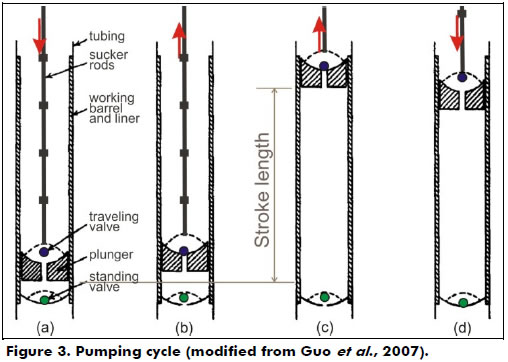
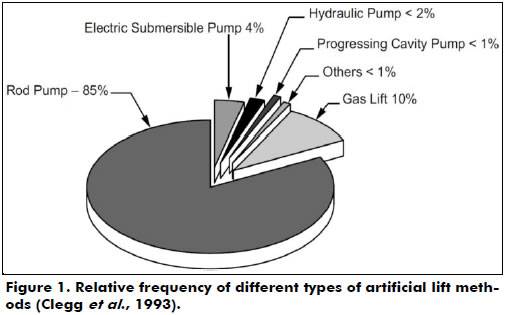
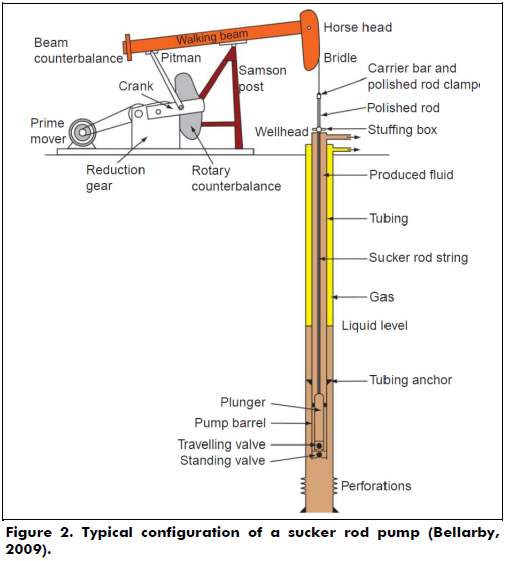
<body><![CDATA[<p>In the beginning of a  petroleum reservoir's productive life, fluid lift occurs naturally because  there is enough energy to raise fluids to the surface by natural lift. With the  raise, this energy is gradually lost due to the decay of the reservoir's  pressure. As a consequence, it is necessary to implement an artificial lift  completion technique to transfer the fluid from the formation to the surface.  The most common types of artificial lift are the sucker rod pump, centrifugal  pump, progressive cavity pump, and gas lift. These techniques utilize specific  tools to reduce the flow pressure at the bottom of the well, therefore raising the pressure differential over  the reservoir (Thomas, 2004). The choice of the most appropriate lift method  for each well depends on several factors, including economy, environment,  security, properties of the fluids to be produced, depth of the reservoir and  available equipment (Gomes, 2009). According to Tak&aacute;cs (2002) and Clegg <i>et al.</i> (1993), over 85% of all petroleum  wells equipped with an artificial lift use a sucker rod pump method. This high  percentage can be attributed to the low cost of production throughout the  productive life of a well. There are also other advantages of using this  method, such as flow flexibility, energy efficiency, operation simplicity,  maintenance of new facilities and availability of pumping capacity according to  well conditions (Thomas, 2004).</p>     <p> <a href="#f1">Figure 1</a> shows the relative frequency of the different types of  artificial lifts installed in the USA in 1992. The predominance of rod pumps  (85%) indicates that the vast majority of wells are on land locations in mature  fields with low well production.</p>     <p>    <center><a name="f1"></a><img src="/img/revistas/iei/v34n3/v34n3a02f1.jpg"></center></p>     <p>  The components of a sucker rod pump system can be sorted into  surface and sub-surface categories. Surface components include the motor,  gearbox, pumping unit, polished rod and well head. Subsurface equipment  consists of a rod string, tubing and a downhole pump (or plunger pump)  submerged in the production liquid of the well. <a href="#f2">Figure 2</a> shows a typical installation  of a sucker rod pump system. The pumping unit transforms the rotating motion  given by the motor into an alternative motion to turn on the rod string. The  polished rod and the stuffing box combine to make a high efficiency seal at the  surface. The string moves the plunger in the lower end at the well's bottom,  which transmits energy to the fluid in order to be driven to the surface. </p>     <p>    <center><a name="f2"></a><img src="/img/revistas/iei/v34n3/v34n3a02f2.jpg"></center></p>     <p>  The downhole pump is installed below the dynamic liquid level. It  consists of a working barrel, a plunger that is connected to sucker rods, a  standing valve and a traveling valve (<a href="#f3">Figure 3</a>). As the plunger is moved  downward by the sucker rod string, the traveling valve is opened, allowing the  fluid to pass through the valve; this lets the plunger move to a position just  above the standing valve. During this downward motion of the plunger, the  standing valve is closed, and thus, the fluid is forced to pass through the  traveling valve. When the plunger is at the bottom of the stroke and begins an  upward stroke, the traveling valve closes, and the standing valve opens. As the  upward motion continues, the fluid in the well below the standing valve is  drawn into the volume above the standing valve (fluid passing through the open  standing valve). The fluid continues to fill the volume above the standing  valve until the plunger reaches the top of its stroke (Guo <i>et al.</i>, 2007).</p>     <p>    <center><a name="f3"></a><img src="/img/revistas/iei/v34n3/v34n3a02f3.jpg"></center></p>     ]]></body>
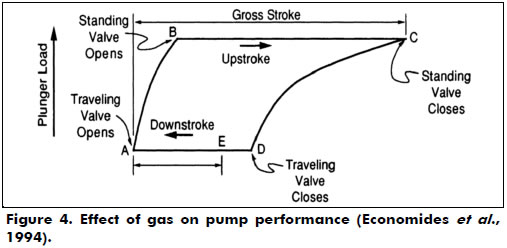
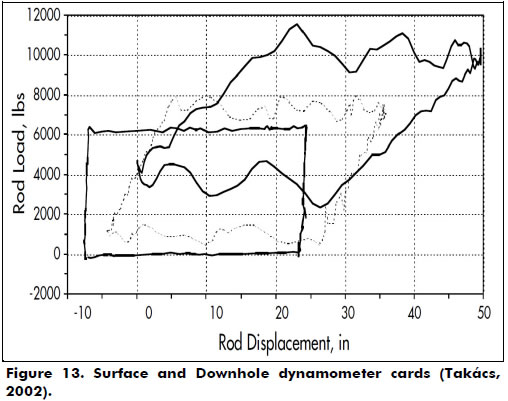
<body><![CDATA[<p>  The performance characteristics of sucker rod pumps are monitored by  measuring the load on the polished rod with a dynamometer. A recording of the  polished rod load over one complete cycle is called the dynamometer card, which  plots the polished rod load as a function of rod position. An example is  presented in <a href="#f4">Figure 4</a> (Economides <i>et al.</i>,  1994).</p>     <p>    <center><a name="f4"></a><img src="/img/revistas/iei/v34n3/v34n3a02f4.jpg"></center></p>     <p>  As noted by Tak&aacute;cs (2002), "The rod string is composed of individual  sucker rods that are connected to each other until the required pumping depth  is reached. The sucker-rod string is the most vital part of the pumping system,  since it provides the link between the surface pumping unit and the subsurface  pump. It is a peculiar piece of mechanical equipment and has almost no  analogies in man-made structures, being several thousand feet long and having a  maximum diameter of slightly more than one inch. The behavior of this perfect  'slender bar' can have a fundamental impact on the efficiency of fluid lifting  and its eventual failure leads to a total loss of production. Therefore, a  properly designed rod string not only assures good operating conditions but can  considerably reduce total production costs as well". </p>     <p>  The sucker rod pump was the first  method of artificial lift created in the petroleum industry, and in view of its  wide usage in onshore wells, the need for studies about its behavior has risen.  The application of the sucker rod pump and behavior of the rod and consequently  the downhole pump can directly influence the efficiency of the lift method. For  this reason, it is necessary to verify if the system is operating close to its  maximum lift efficiency to avoid system stops. </p>     <p>  Tak&aacute;cs (2002) notes that the disadvantages of using a sucker rod  pump are limited depth of pumping, limited mechanical resistance of material of  rods and free gas presence in the pump's admission, which is related to a gas  locking problem. Additionally, application in deactivated wells causes friction  in metallic parts and can provoke mechanical failures. A heavy pump unit that  occupies a large space on a surface drastically reduces the pumping efficiency.  In the case of mature oil fields, the wellbore fluid behavior becomes complex,  and the production and pumping efficiency gradually decline (Suling <i>et al</i>., 2013).</p>     <p>  Gas locking has been a problem accompanying the ball and seat sucker  rod pump ever since the inception of this pump into the oil industry. A gas  lock occurs when a gas influx from the standing valve causes the pressure  exerted by the fluid below the traveling valve in the closed chamber to not be  able to overcome the weight of the liquid column lying above the traveling  valve in the pump barrel. <a href="#f4">Figure 4</a> illustrates this effect on the dynamometric  card. This fails to lift the ball off of the seat. Gala (2013) addressed this  problem by proposing the design of a sucker rod pump consisting of a solenoid  actuated hydraulic valve in the traveling plunger seat.</p>     <p>  Gareeb and Beck (2013) discussed the main concepts in sand handling  by highlighting some exclusion devices, which provided the most practical  solution for best sand handling pump and completion design as a function of  conditions. Jim&eacute;nez <i>et al</i>. (2013) presented an application  in heavy and extra heavy oil wells using rod pumping in the Samaria Field.</p>     <p>  An oil well with an installed sucker rod pump emits a characteristic  sound spectrum that can be assessed, according to Chevelcha <i>et al.</i> (2013). Every change to the  system (wear, beginning failures, etc) should be reflected in a corresponding  change of the sound spectrum. The scope of the research of Chevelcha <i>et al.</i> was to study noise produced by  the well and analyze the relationship between emitted noise and the production  state of the system.</p>     <p>  A simulation of the behavior of the rod string is the most adequate  way to describe the sucker rod pump system. Through the rod string, the  transmission of motion occurs. Motion is generated on the surface by the pump  unit to the downhole pump through the rod string, and energy is generated by  charges in the surface pump (Tak&aacute;cs, 2002). However, it is mathematically  hardened by the elastic behavior of the rod string, which makes the course of  the plunger different from the course of the polished rod on the surface. Gibbs  (1963) proposed the first model for the dynamic behavior of the rod string as a  boundary value problem for a wave equation. This was described by Gibbs in  analyzing active forces in the rod string.</p>     ]]></body>
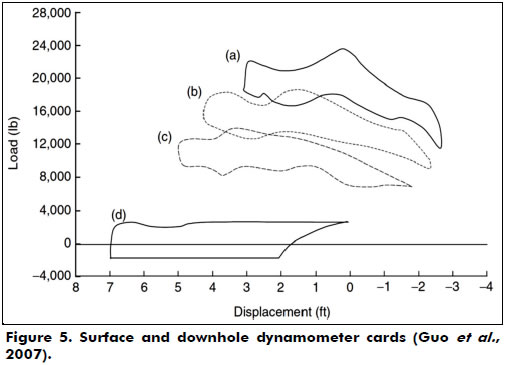
<body><![CDATA[<p>  This article aims to study the rod string's behavior in wells  equipped with an artificial lift system by a sucker rod pump. The numerical  solution of the transient wave equation that heads the problem with  appropriated initial and boundary conditions was obtained by using finite  differences and implemented through a computational code in Matlab&reg;.  The outputs of the computational modeling are the surface dynamometer cards,  SDCs, and the downhole dynamometer cards, DDCs (<a href="#f5">Figure 5</a>). These cards  constitute an important consolidated tool that helps in the control of the  pumping system by diagnosing the operational conditions of the downhole pump  (Ordo&ntilde;ez, 2008).</p>     <p>    <center><a name="f5"></a><img src="/img/revistas/iei/v34n3/v34n3a02f5.jpg"></center></p>     <p>  An SDC is a chart that shows the charge variation that operates in a  polished rod during its displacement in the pumping cycle. An installed dynamometer  between the clip and pump unit's table, on the surface, allows the registration  of active forces in the polished rod at the top of the rod string during its  displacement. </p>     <p>  The DDC is a graphical representation of the effects generated by  active forces in a downhole pump after propagation on a rod string. The elastic  rod string behavior influences the effects generated in a downhole pump. For  that reason, the SDC does not represent the actual downhole pump's behavior.  Thus, to obtain a DDC, one can utilize special tools at the bottom of the well  or use the mathematical models that calculate them from the SDC.</p>     <p>  If the DDC shows a rectangle on the chart, that indicates the ideal  conditions of pumping. Therefore, a hard and inelastic rod string with a low  speed of pumping (which eliminates dynamic forces), incompressible pumped fluid  and anchored rod tube are also ideal conditions. All energy losses along the  rod are undesirable.</p>     <p><a href="#f5">  Figure 5a</a> presents a typical SDC from a strain-gage type of dynamometer  measured from a conventional unit operated with a 74-in stroke at 15.4 strokes  per minute (spm). The peak load is 22,649 lb at the top of the 1 in rod. In  <a href="#f5">Figure 5b</a>, the peak load is 17,800 lb at the top of the 7/8 in rod. In <a href="#f5">Figure  5c</a>, the peak load is 13,400 lb at the top of the 3/4 in rod. In <a href="#f5">Figure 5d</a>, the  DDC is at the plunger. This DDC indicates a gross pump stroke of 7.1 ft, a net  liquid stroke of 4.6 ft and fluid load of 3,200 lb. The shape of the DDC also  indicates some downhole gas compression and that the tubing anchor is holding  properly. The negative load value in <a href="#f5">Figure 5d</a> is due to the buoyancy of the  rod string (Guo <i>et al</i>., 2007).</p>     <p>  <font size="3"><b>Methods</b></font></p>     <p>  <b>Physical model</b></p>     <p>  Adopted geometry consists of an ideal vertical rod string without  gloves and without centralizers, of length <i>L</i> and diameter <i>d</i> constants. The rod has  an alternative motion inside the fixed tubing. The positions represented by <i>A</i> and <i>B</i> points are, respectively, the connections with a polished rod (on  the surface) and with a downhole pump (on the subsurface) (<a href="#f6">Figure 6</a>). At these  points, boundary conditions are applied in order to complete the mathematical  formulation in which the solution describes the rod string's behavior: (<i>i</i>) <i>A</i>:  kinematic of pump unit and (<i>ii</i>) <i>B</i>: operation of the downhole pump.</p>     ]]></body>
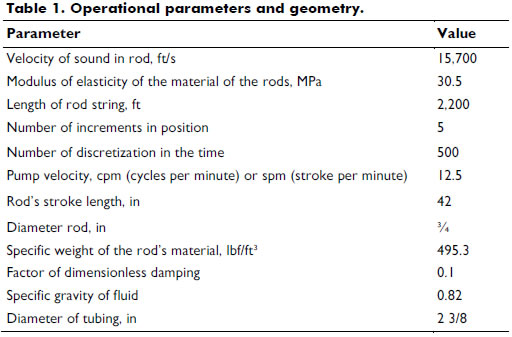
<body><![CDATA[<p>    <center><a name="f6"></a><img src="/img/revistas/iei/v34n3/v34n3a02f6.jpg"></center></p>     <p>  Sucker rod pump systems utilize a rod string to transmit an  alternative surface motion to the downhole pump. Rods are steel tubes - they  also can be made of fiberglass with an average length of 9 m and a diameter  between 5/8 in (1.5875 cm) and 1 in (2,54 cm). They have connection gloves at  each end, which allows for linking to other rods and forming a rod string with  a total length that can be over 1,000 m. The input data related to the  geometrical and operational features of the system and required to start the iterative  process are shown in <a href="#t1">Table 1</a>.</p>     <p>    <center><a name="t1"></a><img src="/img/revistas/iei/v34n3/v34n3a02t1.jpg"></center></p>     <p>  <b>Mathematical model</b></p>     <p>  The governing equation is described as a function of the analysis of  active forces in the rod string. <a href="#f7">Figure 7</a> shows the active forces in a long  element of the rod string in an upward motion. </p>     <p>    <center><a name="f7"></a><img src="/img/revistas/iei/v34n3/v34n3a02f7.jpg"></center></p>     <p>  The element has a cross-sectional area <i>A </i>constant. At time <i>t,</i> the variable <i>x</i> represents any point  in the rod string, and &Delta;<i>x</i> is the displacement  starting from this point. <i>T(x+</i><i>&Delta;x,t)</i> and <i>T(x,t)</i> are the traction forces in  both boundaries of the differential element, which are related to the sections  above and below the element. <i>W</i> is the  rod element's weight, <i>Fa</i> is the fluid's damping force in the annular space rod string/tubing that  opposes the rod string, <i>g </i>is gravity,  and <i>v</i> is the element's velocity.</p>     ]]></body>
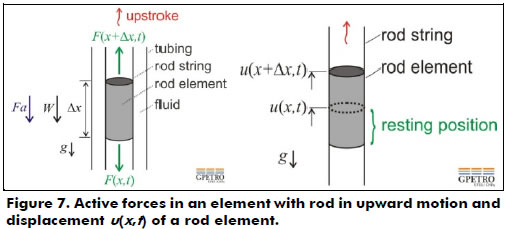
<body><![CDATA[<p>  From the rate of change of its linear momentum in an inertial  referential frame, it follows that  </p>     <p>    <center><img src="/img/revistas/iei/v34n3/v34n3a02e1.jpg"></center></p>     <p>whereas the damping force is approximated by the product of the rod  string's velocity <i>v</i> and a constant <i>k,</i> <i>F<sub>a</sub></i> = -<i>kv.</i> The negative exponent is  due to the velocity of the rod being positive in the direction of motion, while  the damping must act in the opposite direction, <i>&rho;</i> is a constant density, and <i>t</i> is the time. <a href="#f5">Figure 5</a> also shows a draft of the displacement <i>u</i> of a differential element length &Delta;<i>x</i> as a function of the position <i>x</i> of the rod string from a starting position <i>u</i>(<i>x</i>,<i>t</i>) to another  position <i>u</i>(<i>x</i>+&Delta;<i>x</i>,<i>t</i>) along the  upward motion. Hooke's law, which is valid for the behavior of the elastic  region, can be written as <i>T = EA &part;u/&part;x</i>, where <i>E</i> is the modulus of constant elasticity or Young's modulus and <i>A</i> is the cross-sectional area of the  rod. A constant should be assumed for <i>A</i>,  which implies that changes in the area of the gloves and centralizers were not  considered. The velocity   of the rod can be obtained by  the variation of a position in time,  <i>v = &part;u</i>(<i>x,t</i>)/<i>&part;t</i>.</p>     <p>  Finally, if the cross-sectional area <i>A</i> of the rod, Young's modulus <i>E</i> of the material, and the density of material <i>&rho;</i> and <i>k</i> are constant, equation (4) can be rewritten as</p>     <p>    <center><img src="/img/revistas/iei/v34n3/v34n3a02e2.jpg"></center></p>     <p>  which is a one-dimensional transient partial differential equation  of a second order known as the one-dimensional wave equation with viscous  friction. The solution returns to the displacement <i>u</i> of a point <i>x</i> of the  rod and time <i>t</i>. This equation, without gravitational effects, was initially  presented by Gibbs in his pioneering work in 1963.</p>     <p>  The damping factor portrays irreversible energy losses during the  operation of the pump unit. According to Tak&aacute;cs (2002), although these losses  are derived from several varieties of complex phenomena, the effects are  commonly considered to be of a viscous nature only. Gibbs (1963) stated that  the damping factor is defined as <i>&ccedil;</i> = <i>&pi;ac</i>/(2<i>L</i>), where <i>c </i>is the  dimensionless damping factor, which can be found through field measurements,  and <i>L</i> is the length of the rod  string.</p>     <p>  To complete the mathematical formulation, the initial condition and  boundary conditions are needed. As an initial condition, that is, at time <i>t </i>= 0, the system is considered at rest  and mathematically represented by equation (3).</p>     ]]></body>

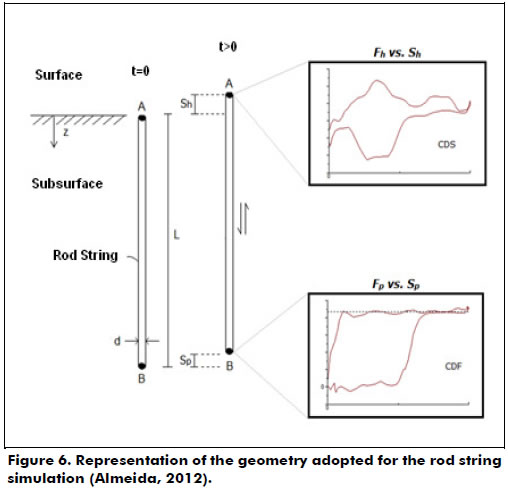
<body><![CDATA[<p>    <center><img src="/img/revistas/iei/v34n3/v34n3a02e3.jpg"></center></p>     <p>The boundary conditions are applied at the ends of the rod string.</p>     <p>  (<b><i>i</i></b>) Through the polished rod position on the surface, the simplest  and most common approach that describes the rod string's motion is an  assumption of a simple harmonic motion. Thus, considering <a href="#f2">Figure 2</a>, the  construction of a surface dynamometer card (SDC) consists of plotting the  active charges on point <i>A</i> as a  function of the motion of a polished rod. Equation (4) expresses the surface  motion <i>Sh(</i><i>&thetasym;) </i>of a polished rod using a crank angle <i>(</i><i>&theta;)</i> (Tak&aacute;cs, 2002).</p>     <p>    <center><img src="/img/revistas/iei/v34n3/v34n3a02e4.jpg"></center></p>     <p>  where <i>S</i> represents the stroke length of polished rod.</p>     <p>  Construction of a downhole dynamometer card (DDC) must be plotted  with the active charge in the position represented by point <i>B</i> in <a href="#f6">Figure 6</a> as a function of the  plunger motion. For low velocities of pumping, the difference between the  stroke length (<i>S<sub>h</sub></i>) of the polished rod and the length of the plunger (<i>S<sub>P</sub></i>) is the sum of tubing stretch (<i>e<sub>t</sub></i>) and the rod string stretch (<i>e<sub>r</sub></i>), which occurs during the pumping process as shown in equation (5)  (Tak&aacute;cs, 2002)</p>     <p>    <center><img src="/img/revistas/iei/v34n3/v34n3a02e5.jpg"></center></p>     ]]></body>
<body><![CDATA[<p>  The application of Hooke's Law allows for the determination of the  tubing (non-anchored) and rod string stretching, represented by </p>     <p>    <center><img src="/img/revistas/iei/v34n3/v34n3a02e6.jpg"></center></p>     <p>  where <i>F<sub>o</sub></i> is the fluid weight above the plunger and <i>E<sub>t</sub></i> and <i>E<sub>r</sub></i> are the elastic constants of tubing and rod material, respectively.</p>     <p>  (<b><i>ii</i></b>) On the subsurface and at the operational conditions of the  pump, Gibbs (1963) is represented by</p>     <p>    <center><img src="/img/revistas/iei/v34n3/v34n3a02e7.jpg"></center></p>     <p>  where <i>&alpha;</i>, <i>&beta;</i> e <i>P</i>(<i>t</i>) depends on  the type of pump operation which is being simulated and <i>L</i> is the length of the rod string.</p>     <p>  For further details regarding the mathematical formulation briefly  presented, we suggest consulting Doty and Schmidt (1983), Schmidt and Doty  (1989), and Adams (2012).</p>     <p>  <b>Numerical model</b></p>     ]]></body>
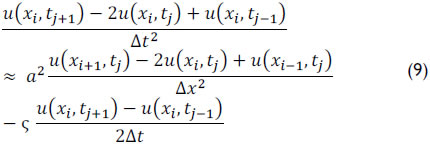
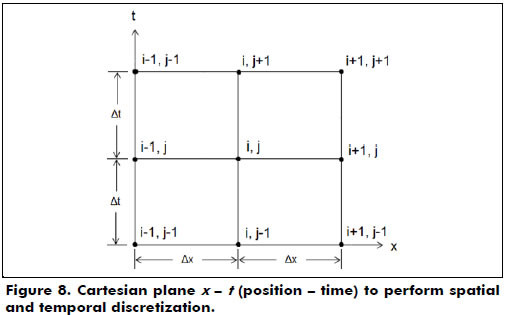
<body><![CDATA[<p>  The rod string, regarded as one-dimensional and schematized in  Figure 6, was segmented in the context of spatial discretization in various  small parts as shown in <a href="#f7">Figure 7</a>. The wave equation represented by equation  (2), along with the initial and boundary conditions, equations (3), (4), (5)  and (6), that govern the deformation of the rod string, was discretized by a  finite differences method. The computational simulation of physical processes  obtains time-dependent solutions of partial differential equations.</p>     <p>  Discretization of the temporal terms was performed using an explicit  method. In this approach, the unknown displacement at time instant <i>n</i>+1 is represented by  <i>u(x,t)<sup>n+1</sup></i>, or  <i>u(x<sub>i</sub>,t<sub>j+1</sub>)</i>, and the known variables, at time <i>n</i>, represented by  <i>u(x,t)<sup>n</sup></i>, or  <i>u(x<sub>i</sub>,t<sub>j</sub>)</i>.</p>     <p>  The continuous equation, equation (2), is evaluated in discrete  points (<i>xi</i>, <i>tj</i>), shown in <a href="#f8">Figure 8</a>, resulting in</p>     <p>    <center><img src="/img/revistas/iei/v34n3/v34n3a02e8.jpg"></center></p>     <p>  An approximation by finite differences for each of the three terms  of equation (8) results in</p>     <p>    <center><img src="/img/revistas/iei/v34n3/v34n3a02e9.jpg"></center></p>     <p>  for <i>i </i>= 0,1,2,..., <i>N</i>-1 and j= 0,1,2,...,<i>M</i>-1.</p>     <p>    ]]></body>
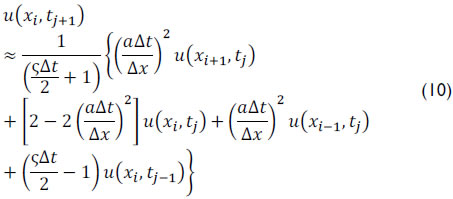
<body><![CDATA[<center><a name="f8"></a><img src="/img/revistas/iei/v34n3/v34n3a02f8.jpg"></center></p>     <p>  Putting unknowns <i>tj+1</i> in terms of <i>tj</i> and <i>tj-1</i>, equation (9) can be rewritten by isolating the term  , resulting in</p>     <p>    <center><img src="/img/revistas/iei/v34n3/v34n3a02e10.jpg"></center></p>     <p>  Thomas (1995) presented the CFL - Courant-Friedrichs-Lewy condition  in order to obtain solutions for these discrete equations, which creates a  dimensionless number known as the Courant number (<i>Nc</i>) </p>     <p>    <center><img src="/img/revistas/iei/v34n3/v34n3a02e11.jpg"></center></p>     <p>  where <i>a</i> is the wave  velocity, <i>&Delta;</i><i>t</i> is the time interval, and <i>&Delta;x</i> is the size of the mesh element. The CFL condition states that for  the method to be stable, the Courant number should be less than or equal to  one. Thus, adopting <i>N<sub>C</sub></i> = 1  it can be said that <img src="/img/revistas/iei/v34n3/v34n3a02e1p.jpg" align="absmiddle">. Therefore equation (10) can be simplified to</p>     <p>    <center><img src="/img/revistas/iei/v34n3/v34n3a02e12.jpg"></center></p>     ]]></body>
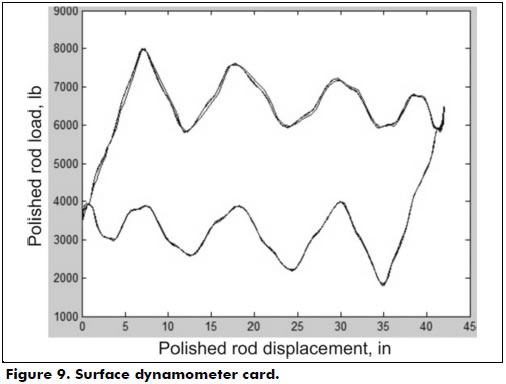
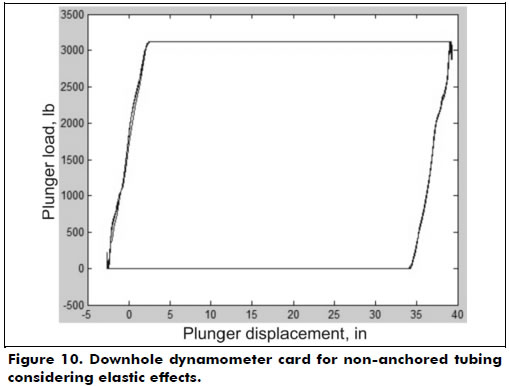
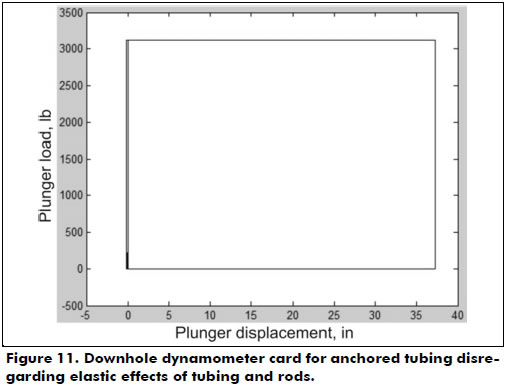
<body><![CDATA[<p>  where <i>A</i>, <i>B</i> and <i>C</i> are constant defined by</p>     <p>    <center><img src="/img/revistas/iei/v34n3/v34n3a02e13.jpg"></center></p>     <p>  Note that equation (12) provides a solution for   in terms of three points (<i>x<sub>i+1</sub>,t<sub>j</sub></i>), (<i>x<sub>i-1</sub>,t<sub>j</sub></i>) and (<i>x<sub>i</sub>,t<sub>j-1</sub></i>). Details are referenced in Doty and Schmidt (1983) and Schmidt and  Doty (1989). In addition, it is necessary to write the initial and boundary  condition in discrete form (Almeida, 2012).</p>     <p>  The resulting discrete equations were implemented in Matlab<sup>&reg;</sup>  because the software has libraries that facilitate iterative calculations in  space and time and provides a better graphical display of dynamometer card  results.    <br>   The counterweight's constant angular velocity was assumed for the  numerical simulation. With no gas interference, the pump is completely filled  by the fluid and the fluid inertia is disregarded. Finally, the input data  required to start the iterative process are shown in <a href="#t1">Table 1</a>.</p>     <p><font size="3"><b>Results and discussion</b></font></p>     <p>Figures <a href="#f9">9</a>, <a href="#f10">10</a> and <a href="#f11">11</a> present the results of numerical simulations  performed with the data listed in <a href="#t1">Table 1</a>. The surface dynamometer card (Figure  9) shows the load in the polished rod based on its position. From this card, it  was possible to obtain several operating parameters from the system. The  maximum (PPRL - Peak polished road load) and minimum loads (MPRL - Minimal  polished road load) on the polished rod were 8,002 lbs and 1,774 lbs,  respectively. It was also possible to calculate the maximum torque that would  be required of the gearbox's output shaft when moving.</p>     <p>    <center><a name="f9"></a><img src="/img/revistas/iei/v34n3/v34n3a02f9.jpg"></center></p>     ]]></body>
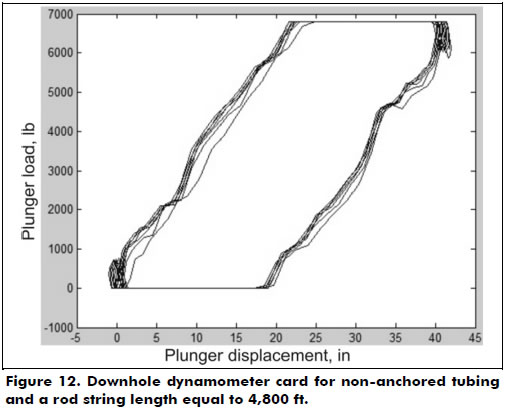
<body><![CDATA[<p>    <center><a name="f10"></a><img src="/img/revistas/iei/v34n3/v34n3a02f10.jpg"></center></p>     <p>    <center><a name="f11"></a><img src="/img/revistas/iei/v34n3/v34n3a02f11.jpg"></center></p>     <p>  As previously mentioned, a downhole dynamometer card shows the  active load on the subsurface plunge. <a href="#f10">Figure 10</a> illustrates a downhole  dynamometer card with non-anchored tubing. In addition to the elastic behavior  of the tubing, the elastic behavior of the rod string shows the card has  assumed the shape of a parallelogram, <i>i.e.,</i> the charge transfer from the standing valve to the traveling valve in the  upward motion and the charge transfer from the traveling valve to the standing  valve in the downward motion occurs gradually as a function of the rod's  elongation. </p>     <p> <a href="#f10">Figure 10</a> was obtained by plotting the load on the piston by  function of the plunger stroke represented by equation (5). Once the effective  piston stroke length <i>Sp</i> is calculated  by equation (5), it is possible to obtain volumetric displacement of the  downhole pump (<i>PD</i>). Assuming that the  pump barrel is completely filled with fluid during all the cycles, this  displacement can be expressed by  where <i>N</i> is the pump  velocity and <i>Ap</i> is the  transversal area of the piston (square inches) of 2 1/4 in diameter.</p>     <p>  If the elastic effect did not exist, <i>i.e.,</i> if the stretching of equation (5) were equal to zero, then  the card would present a rectangular shape, as plotted in <a href="#f11">Figure 11</a>.</p>     <p> <a href="#f12">Figure 12</a> shows a variation of the downhole dynamometer card  presented in <a href="#f10">Figure 10</a>, increasing the total length of the rod from 2,200 ft  (671 m) to 4,800 ft (1,463 m). When compared to <a href="#f10">Figure 10</a>, it is observed that  the result of <a href="#f12">Figure 12</a> shows a more pronounced stretching and a greater  distortion of calculations in upward and downward motions. This is due to the increased  size of the new rod string. According to Gomes (2009), distortions of the  surface card from the propagation effect generated by the rod string may result  in an inefficient analysis in certain cases. This problem is further aggravated  by increasing the depth of wells past 3,280 ft (1,000 m).</p>     <p>    <center><a name="f12"></a><img src="/img/revistas/iei/v34n3/v34n3a02f12.jpg"></center></p>     ]]></body>
<body><![CDATA[<p>  In order to qualitatively verify the validity of the computational  code implemented, the results were compared to those of Tack&aacute;cs (2002), and the  calculations of the surface dynamometer (SDC) and the pump (DDC) cards by the  FINWAVE1 computer program are presented in <a href="#f13">Figure 13</a>. The software performs a  diagnostic analysis of the pumping system using the finite difference solution  of the wave equation for a pump setting depth of 3,000 ft, dynamic liquid level  of 3,000 ft, measured productive rate of 198 bpd, liquid specific gravity of  1.0, plunger size of 2.5 in, stroke length of 50 in, pumping speed of 9 spm,  anchored tubing, pumping unit API size C-228-213-120, rod string steel of 0.31  psi, Young's modulus 3/4 in, 1.956 ft and 5/8 in 1.044. A qualitative comparison  with Figures <a href="#f9">9</a> and <a href="#f10">10</a> corroborates our results.</p>     <p>    <center><a name="f13"></a><img src="/img/revistas/iei/v34n3/v34n3a02f13.jpg"></center></p>     <p><font size="3"><b>Conclusions</b></font></p>     <p>This work presents the mathematical formulation of the Gibbs wave  equation (1963) to predict the behavior of a sucker rod pump system, as well as  the methodology for implementing an academic, non-commercial code that can  simulate the behavior of the rod string through the generation of downhole and  surface dynamometer cards in ideal pumping conditions. Appropriate initial  conditions and surface and bottom-hole boundary conditions are considered in  order to apply the finite difference technique to numerically solve the  proposed problem.</p>     <p>  Calculation of the downhole card consists of finding the charge  immediately above the downhole pump from the surface data, and thus inferring  operating conditions at the bottom of the well.</p>     <p>  The simulation performed portrays the comparison of the downhole  dynamometer cards in two cases. The first case is the elastic behavior of the  rod string and the non-anchored string, and the second disregards such effects.  The results are promising because they represent the expected behavior,  according to the literature, of the dynamometer card for the simulated cases.</p>     <p>  For future proposals, the implemented code will be the basis for the  development of a simulation of more complex sucker rod pump systems. Other  situations not considered in this study can dramatically alter the shape of the  card, such as the presence of dynamic charges on the rod string, the fluid  compressibility, non-Newtonian viscosity, induction of stress waves in the rod  string and any operational problems (lack of synchronization of the valves,  blow fluid, gas interference, among others).</p>     <p>  The Gibbs damping factor (1963) was used in this study, which  presents a problem for estimating the value of the dimensionless damping  coefficient for new wells. Moreover, these coefficients are different during  the upstroke and downstroke, which Gibbs did not consider. This simplification  was used, but a more comprehensive model has been proposed by Lea (1990) for a  damping term that takes into account the viscosity of the fluid and the  diameters of the plunger, tubing and rods.</p>     <p>  An important consideration is the incorporation of various geometries  of the pump unit, which can change boundary conditions at the surface.  Substituting the consideration of a simple harmonic motion by a kinematic  analysis of pump units allows for calculation of the polished rod's position as  a function of the crank angle according to pump unit geometry.</p>     ]]></body>
<body><![CDATA[<p>  Another proposal is the adaptation of the code to enable the  simulation of cases such as a combined rod string, deviated wells and  consideration of the annular level from the background knowledge in the bottom  hole pressure.</p>     <p><font size="3"><b>Acknowledgements</b></font></p>     <p>  We are grateful to Jean Carlos Dias de Araujo and Gelson Heraldo  Nico Filho, professionals at Petrobras SA, for their helpful technical comments  during the development of this work. Professor Oldrich Joel Romero thanks the  National Council of Technological and Scientific Development (CNPq) and  "Funda&ccedil;&atilde;o de Amparo &agrave; Pesquisa do Esp&iacute;rito Santo" (FAPES). Also our thanks go  to Ms. Connie Galt, Chemical Engineering and Materials Science, University of Minnesota,  for her valuable comments.</p> <hr>     <p><font size="3"><b>References</b></font></p>     <!-- ref --><p>Almeida,  P. (2012). Previs&atilde;o do comportamento de sistemas de bombeio mec&acirc;nico (in  Portuguese). <i>Graduation Project</i>. Federal University of Espirito  Santo. S&atilde;o Mateus, ES, Brazil.    &nbsp;&nbsp;&nbsp;&nbsp;&nbsp;&nbsp;&nbsp;&nbsp;[&#160;<a href="javascript:void(0);" onclick="javascript: window.open('/scielo.php?script=sci_nlinks&ref=000147&pid=S0120-5609201400030000200001&lng=','','width=640,height=500,resizable=yes,scrollbars=1,menubar=yes,');">Links</a>&#160;]<!-- end-ref --></p>     <!-- ref --><p>  Bellarby, J. (2009) <i>Well Completion Design.</i> Jordan Hill, OX: Elsevier (DPS 56).    &nbsp;&nbsp;&nbsp;&nbsp;&nbsp;&nbsp;&nbsp;&nbsp;[&#160;<a href="javascript:void(0);" onclick="javascript: window.open('/scielo.php?script=sci_nlinks&ref=000149&pid=S0120-5609201400030000200002&lng=','','width=640,height=500,resizable=yes,scrollbars=1,menubar=yes,');">Links</a>&#160;]<!-- end-ref --></p>     <!-- ref --><p>  Chevelcha, E., Langbauer, C. J., &amp;  Hofstaetter, H. (2013). Listening  Sucker Rod Pumps: Stroke's Signature. SPE 165035-MS. <i>SPE Artificial Lift Conference - Americas</i>,  May 21 - 22, 2013, Cartagena, Colombia.    &nbsp;&nbsp;&nbsp;&nbsp;&nbsp;&nbsp;&nbsp;&nbsp;[&#160;<a href="javascript:void(0);" onclick="javascript: window.open('/scielo.php?script=sci_nlinks&ref=000151&pid=S0120-5609201400030000200003&lng=','','width=640,height=500,resizable=yes,scrollbars=1,menubar=yes,');">Links</a>&#160;]<!-- end-ref --> </p>     ]]></body>
<body><![CDATA[<!-- ref --><p>  Clegg, J. D., Bucaran, S. M., &amp; Hein Jr.,  N. W. (1993). Recommendations and Comparisons for Selecting Artificial Lift  Methods. <i>Journal of Petroleum Technology</i>,  SPE 24834-PA, 45(12), 1128-1167.    &nbsp;&nbsp;&nbsp;&nbsp;&nbsp;&nbsp;&nbsp;&nbsp;[&#160;<a href="javascript:void(0);" onclick="javascript: window.open('/scielo.php?script=sci_nlinks&ref=000153&pid=S0120-5609201400030000200004&lng=','','width=640,height=500,resizable=yes,scrollbars=1,menubar=yes,');">Links</a>&#160;]<!-- end-ref --></p>     <!-- ref --><p>  Doty, D. R., &amp; Schmidt, Z. (1983). An improved model for zucker rod pumping. <i>SPE Journal</i>, <i>23</i>(1), 33-41.  dox: 10.2118/10249-PA.    &nbsp;&nbsp;&nbsp;&nbsp;&nbsp;&nbsp;&nbsp;&nbsp;[&#160;<a href="javascript:void(0);" onclick="javascript: window.open('/scielo.php?script=sci_nlinks&ref=000155&pid=S0120-5609201400030000200005&lng=','','width=640,height=500,resizable=yes,scrollbars=1,menubar=yes,');">Links</a>&#160;]<!-- end-ref --></p>     <!-- ref --><p>  Economides, M. J., Hill, A. D., &amp;  Ehlig-Economides, C. (1994). <i>Petroleum  production systems</i>. Upper Saddle River, NJ: Prentice Hall.    &nbsp;&nbsp;&nbsp;&nbsp;&nbsp;&nbsp;&nbsp;&nbsp;[&#160;<a href="javascript:void(0);" onclick="javascript: window.open('/scielo.php?script=sci_nlinks&ref=000157&pid=S0120-5609201400030000200006&lng=','','width=640,height=500,resizable=yes,scrollbars=1,menubar=yes,');">Links</a>&#160;]<!-- end-ref --></p>     <!-- ref --><p>Gala, R. D. (2013). Preventing Gas Locking in Sucker Rod Pumps Using an Actuated Traveling  Solenoid Valve. SPE 165039-MS. <i>SPE  Artificial Lift Conference - Americas</i>, May 21 - 22, 2013, Cartagena,  Colombia.    &nbsp;&nbsp;&nbsp;&nbsp;&nbsp;&nbsp;&nbsp;&nbsp;[&#160;<a href="javascript:void(0);" onclick="javascript: window.open('/scielo.php?script=sci_nlinks&ref=000159&pid=S0120-5609201400030000200007&lng=','','width=640,height=500,resizable=yes,scrollbars=1,menubar=yes,');">Links</a>&#160;]<!-- end-ref --></p>     <!-- ref --><p>  Ghareeb, M., &amp; Beck, A. (2012). Design of Sucker Rod Pumping Systems for  Effectively Handling Solids and Sand. SPE 157126-MS. <i>SPE International Production and Operations  Conference &amp; Exhibition</i>, 14-16 May 2012, Doha, Qatar.    &nbsp;&nbsp;&nbsp;&nbsp;&nbsp;&nbsp;&nbsp;&nbsp;[&#160;<a href="javascript:void(0);" onclick="javascript: window.open('/scielo.php?script=sci_nlinks&ref=000161&pid=S0120-5609201400030000200008&lng=','','width=640,height=500,resizable=yes,scrollbars=1,menubar=yes,');">Links</a>&#160;]<!-- end-ref --></p>     ]]></body>
<body><![CDATA[<!-- ref --><p>  Gibbs, S. G. (1963). Predicting the  Behavior of Sucker-Rod Pumping Systems. <i>Journal of Petroleum Technology</i>, 15(7),  769-778. doi: 10.2118/588-PA.    &nbsp;&nbsp;&nbsp;&nbsp;&nbsp;&nbsp;&nbsp;&nbsp;[&#160;<a href="javascript:void(0);" onclick="javascript: window.open('/scielo.php?script=sci_nlinks&ref=000163&pid=S0120-5609201400030000200009&lng=','','width=640,height=500,resizable=yes,scrollbars=1,menubar=yes,');">Links</a>&#160;]<!-- end-ref --></p>     <!-- ref --><p>Gomes, H. P. (2009). Desenvolvimento  de um sistema inteligente para a an&aacute;lise de cartas dinamom&eacute;tricas no m&eacute;todo de  eleva&ccedil;&atilde;o por bombeio mec&acirc;nico (in Portuguese). <i>Master's Dissertation</i>. Federal  University of Rio Grande do North. Natal, RN, Brazil.    &nbsp;&nbsp;&nbsp;&nbsp;&nbsp;&nbsp;&nbsp;&nbsp;[&#160;<a href="javascript:void(0);" onclick="javascript: window.open('/scielo.php?script=sci_nlinks&ref=000165&pid=S0120-5609201400030000200010&lng=','','width=640,height=500,resizable=yes,scrollbars=1,menubar=yes,');">Links</a>&#160;]<!-- end-ref --></p>     <!-- ref --><p>  Guo, B., Lyons, W. C., &amp; Ghalambor, A.  (2007). <i>Petroleum Production Engineering:  A Computer-Assisted Approach</i>. Burlington, MA: Gulf Professional Publishing.    &nbsp;&nbsp;&nbsp;&nbsp;&nbsp;&nbsp;&nbsp;&nbsp;[&#160;<a href="javascript:void(0);" onclick="javascript: window.open('/scielo.php?script=sci_nlinks&ref=000167&pid=S0120-5609201400030000200011&lng=','','width=640,height=500,resizable=yes,scrollbars=1,menubar=yes,');">Links</a>&#160;]<!-- end-ref --></p>     <!-- ref --><p>  Jim&eacute;nez, H. M. G., Naranjo, J. E. C., &amp;  P&eacute;rez Herrera, R. (2013). Results From  Annular Injection in Heavy and Extra Heavy Oil Wells Producing With Rod Pumping  in the Samaria Field: A Field Test. SPE 65069-MS. <i>SPE Artificial Lift Conference - Ameri</i>cas, May 21 - 22, 2013,  Cartagena, Colombia.    &nbsp;&nbsp;&nbsp;&nbsp;&nbsp;&nbsp;&nbsp;&nbsp;[&#160;<a href="javascript:void(0);" onclick="javascript: window.open('/scielo.php?script=sci_nlinks&ref=000169&pid=S0120-5609201400030000200012&lng=','','width=640,height=500,resizable=yes,scrollbars=1,menubar=yes,');">Links</a>&#160;]<!-- end-ref --></p>     <!-- ref --><p>  Lea, J. F. (1990). Modeling forces on a bean pump system when pumping highly viscous crude. <i>SPE Production Engineering, </i>6(4)<i>,</i> 420-426. doi:  10.2118/20672-PA&nbsp;&nbsp;&nbsp;&nbsp;&nbsp;&nbsp;&nbsp;&nbsp;[&#160;<a href="javascript:void(0);" onclick="javascript: window.open('/scielo.php?script=sci_nlinks&ref=000171&pid=S0120-5609201400030000200013&lng=','','width=640,height=500,resizable=yes,scrollbars=1,menubar=yes,');">Links</a>&#160;]<!-- end-ref --><!-- ref --><p>  Ordo&ntilde;ez, B. (2008). Proposta de controle de  opera&ccedil;&atilde;o de po&ccedil;os com bombeio mec&acirc;nico atrav&eacute;s da press&atilde;o de fundo (in Portuguese). <i>Master's Dissertation</i>.  Federal University of Santa Catarina. Florianopolis, SC, Brazil.    &nbsp;&nbsp;&nbsp;&nbsp;&nbsp;&nbsp;&nbsp;&nbsp;[&#160;<a href="javascript:void(0);" onclick="javascript: window.open('/scielo.php?script=sci_nlinks&ref=000172&pid=S0120-5609201400030000200014&lng=','','width=640,height=500,resizable=yes,scrollbars=1,menubar=yes,');">Links</a>&#160;]<!-- end-ref --> </p>     <!-- ref --><p>  Schmidt, Z., &amp; Doty, D. R. (1989). System Analysis for Sucker-Rod Pumping. <i>SPE Production Engineering</i>, 4(2). doi: 10.2118/15426-PA.    &nbsp;&nbsp;&nbsp;&nbsp;&nbsp;&nbsp;&nbsp;&nbsp;[&#160;<a href="javascript:void(0);" onclick="javascript: window.open('/scielo.php?script=sci_nlinks&ref=000174&pid=S0120-5609201400030000200015&lng=','','width=640,height=500,resizable=yes,scrollbars=1,menubar=yes,');">Links</a>&#160;]<!-- end-ref --></p>     <!-- ref --><p>Suling,  W., Tiejun, W., Gao, Y., &amp; Ying, L. (2013). Analysis and Countermeasures on  the Efficiency of the Pumping Wells System in the Old Oil-field. SPE 165861-MS. <i>SPE Asia Pacific Oil and Gas Conference  and Exhibition</i>, 22-24 October 2013, Jakarta, Indonesia.    &nbsp;&nbsp;&nbsp;&nbsp;&nbsp;&nbsp;&nbsp;&nbsp;[&#160;<a href="javascript:void(0);" onclick="javascript: window.open('/scielo.php?script=sci_nlinks&ref=000176&pid=S0120-5609201400030000200016&lng=','','width=640,height=500,resizable=yes,scrollbars=1,menubar=yes,');">Links</a>&#160;]<!-- end-ref --></p>     <!-- ref --><p>  Tak&aacute;cs, G.  (2003). <i>Sucker-rod pumping manual</i>.  Tulsa, Oklahoma: PennWell Books.    &nbsp;&nbsp;&nbsp;&nbsp;&nbsp;&nbsp;&nbsp;&nbsp;[&#160;<a href="javascript:void(0);" onclick="javascript: window.open('/scielo.php?script=sci_nlinks&ref=000178&pid=S0120-5609201400030000200017&lng=','','width=640,height=500,resizable=yes,scrollbars=1,menubar=yes,');">Links</a>&#160;]<!-- end-ref --></p>     <!-- ref --><p>  Thomas, J.  E. (Ed.) (2004). <i>Fundamentos de engenharia de petr&oacute;leo</i> (in Portuguese)(2nd ed.). Rio de Janeiro: Editora Interciencia.    &nbsp;&nbsp;&nbsp;&nbsp;&nbsp;&nbsp;&nbsp;&nbsp;[&#160;<a href="javascript:void(0);" onclick="javascript: window.open('/scielo.php?script=sci_nlinks&ref=000180&pid=S0120-5609201400030000200018&lng=','','width=640,height=500,resizable=yes,scrollbars=1,menubar=yes,');">Links</a>&#160;]<!-- end-ref --></p>     <!-- ref --><p>  Thomas, J. W. (1995). <i>Numerical partial differential equations: Finite difference methods</i>. New York, NY: Springer-Verlag.    &nbsp;&nbsp;&nbsp;&nbsp;&nbsp;&nbsp;&nbsp;&nbsp;[&#160;<a href="javascript:void(0);" onclick="javascript: window.open('/scielo.php?script=sci_nlinks&ref=000182&pid=S0120-5609201400030000200019&lng=','','width=640,height=500,resizable=yes,scrollbars=1,menubar=yes,');">Links</a>&#160;]<!-- end-ref --></p> </font>      ]]></body><back>
<ref-list>
<ref id="B1">
<nlm-citation citation-type="">
<person-group person-group-type="author">
<name>
<surname><![CDATA[Almeida]]></surname>
<given-names><![CDATA[P]]></given-names>
</name>
</person-group>
<source><![CDATA[Previsão do comportamento de sistemas de bombeio mecânico (in Portuguese)]]></source>
<year>2012</year>
</nlm-citation>
</ref>
<ref id="B2">
<nlm-citation citation-type="book">
<person-group person-group-type="author">
<name>
<surname><![CDATA[Bellarby]]></surname>
<given-names><![CDATA[J]]></given-names>
</name>
</person-group>
<source><![CDATA[Well Completion Design]]></source>
<year>2009</year>
<publisher-loc><![CDATA[Jordan Hill^eOX OX]]></publisher-loc>
<publisher-name><![CDATA[Elsevier (DPS 56)]]></publisher-name>
</nlm-citation>
</ref>
<ref id="B3">
<nlm-citation citation-type="confpro">
<person-group person-group-type="author">
<name>
<surname><![CDATA[Chevelcha]]></surname>
<given-names><![CDATA[E]]></given-names>
</name>
<name>
<surname><![CDATA[Langbauer]]></surname>
<given-names><![CDATA[C. J]]></given-names>
</name>
<name>
<surname><![CDATA[Hofstaetter]]></surname>
<given-names><![CDATA[H]]></given-names>
</name>
</person-group>
<article-title xml:lang="en"><![CDATA[Listening Sucker Rod Pumps: Stroke's Signature]]></article-title>
<source><![CDATA[]]></source>
<year>2013</year>
<conf-name><![CDATA[ SPE Artificial Lift Conference - Americas]]></conf-name>
<conf-date>May 21 - 22, 2013</conf-date>
<conf-loc>Cartagena </conf-loc>
</nlm-citation>
</ref>
<ref id="B4">
<nlm-citation citation-type="journal">
<person-group person-group-type="author">
<name>
<surname><![CDATA[Clegg]]></surname>
<given-names><![CDATA[J. D]]></given-names>
</name>
<name>
<surname><![CDATA[Bucaran]]></surname>
<given-names><![CDATA[S. M]]></given-names>
</name>
<name>
<surname><![CDATA[Hein Jr]]></surname>
<given-names><![CDATA[N. W]]></given-names>
</name>
</person-group>
<source><![CDATA[Journal of Petroleum Technology]]></source>
<year>1993</year>
<volume>45</volume>
<numero>12</numero>
<issue>12</issue>
<page-range>1128-1167</page-range></nlm-citation>
</ref>
<ref id="B5">
<nlm-citation citation-type="journal">
<person-group person-group-type="author">
<name>
<surname><![CDATA[Doty]]></surname>
<given-names><![CDATA[D. R]]></given-names>
</name>
<name>
<surname><![CDATA[Schmidt]]></surname>
<given-names><![CDATA[Z]]></given-names>
</name>
</person-group>
<article-title xml:lang="en"><![CDATA[An improved model for zucker rod pumping]]></article-title>
<source><![CDATA[SPE Journal]]></source>
<year>1983</year>
<volume>23</volume>
<numero>1</numero>
<issue>1</issue>
<page-range>33-41</page-range></nlm-citation>
</ref>
<ref id="B6">
<nlm-citation citation-type="book">
<person-group person-group-type="author">
<name>
<surname><![CDATA[Economides]]></surname>
<given-names><![CDATA[M. J]]></given-names>
</name>
<name>
<surname><![CDATA[Hill]]></surname>
<given-names><![CDATA[A. D]]></given-names>
</name>
<name>
<surname><![CDATA[Ehlig-Economides]]></surname>
<given-names><![CDATA[C]]></given-names>
</name>
</person-group>
<source><![CDATA[Petroleum production systems]]></source>
<year>1994</year>
<publisher-loc><![CDATA[Upper Saddle River^eNJ NJ]]></publisher-loc>
<publisher-name><![CDATA[Prentice Hall]]></publisher-name>
</nlm-citation>
</ref>
<ref id="B7">
<nlm-citation citation-type="confpro">
<person-group person-group-type="author">
<name>
<surname><![CDATA[Gala]]></surname>
<given-names><![CDATA[R. D]]></given-names>
</name>
</person-group>
<article-title xml:lang="en"><![CDATA[Preventing Gas Locking in Sucker Rod Pumps Using an Actuated Traveling Solenoid Valve]]></article-title>
<source><![CDATA[SPE 165039-MS]]></source>
<year>2013</year>
<conf-name><![CDATA[ SPE Artificial Lift Conference - Americas]]></conf-name>
<conf-date>May 21 - 22, 2013</conf-date>
<conf-loc>Cartagena </conf-loc>
</nlm-citation>
</ref>
<ref id="B8">
<nlm-citation citation-type="confpro">
<person-group person-group-type="author">
<name>
<surname><![CDATA[Ghareeb]]></surname>
<given-names><![CDATA[M]]></given-names>
</name>
<name>
<surname><![CDATA[Beck]]></surname>
<given-names><![CDATA[A]]></given-names>
</name>
</person-group>
<article-title xml:lang="en"><![CDATA[Design of Sucker Rod Pumping Systems for Effectively Handling Solids and Sand]]></article-title>
<source><![CDATA[SPE 157126-MS]]></source>
<year>2012</year>
<conf-name><![CDATA[ SPE International Production and Operations Conference & Exhibition]]></conf-name>
<conf-date>14-16 May 2012</conf-date>
<conf-loc>Doha </conf-loc>
</nlm-citation>
</ref>
<ref id="B9">
<nlm-citation citation-type="journal">
<person-group person-group-type="author">
<name>
<surname><![CDATA[Gibbs]]></surname>
<given-names><![CDATA[S. G]]></given-names>
</name>
</person-group>
<article-title xml:lang="en"><![CDATA[Predicting the Behavior of Sucker-Rod Pumping Systems]]></article-title>
<source><![CDATA[Journal of Petroleum Technology]]></source>
<year>1963</year>
<volume>15</volume>
<numero>7</numero>
<issue>7</issue>
<page-range>769-778</page-range></nlm-citation>
</ref>
<ref id="B10">
<nlm-citation citation-type="">
<person-group person-group-type="author">
<name>
<surname><![CDATA[Gomes]]></surname>
<given-names><![CDATA[H. P]]></given-names>
</name>
</person-group>
<source><![CDATA[Desenvolvimento de um sistema inteligente para a análise de cartas dinamométricas no método de elevação por bombeio mecânico (in Portuguese)]]></source>
<year>2009</year>
</nlm-citation>
</ref>
<ref id="B11">
<nlm-citation citation-type="book">
<person-group person-group-type="author">
<name>
<surname><![CDATA[Guo]]></surname>
<given-names><![CDATA[B]]></given-names>
</name>
<name>
<surname><![CDATA[Lyons]]></surname>
<given-names><![CDATA[W. C]]></given-names>
</name>
<name>
<surname><![CDATA[Ghalambor]]></surname>
<given-names><![CDATA[A]]></given-names>
</name>
</person-group>
<source><![CDATA[Petroleum Production Engineering: A Computer-Assisted Approach]]></source>
<year>2007</year>
<publisher-loc><![CDATA[Burlington^eMA MA]]></publisher-loc>
<publisher-name><![CDATA[Gulf Professional Publishing]]></publisher-name>
</nlm-citation>
</ref>
<ref id="B12">
<nlm-citation citation-type="confpro">
<person-group person-group-type="author">
<name>
<surname><![CDATA[Jiménez]]></surname>
<given-names><![CDATA[H. M. G]]></given-names>
</name>
<name>
<surname><![CDATA[Naranjo]]></surname>
<given-names><![CDATA[J. E. C]]></given-names>
</name>
<name>
<surname><![CDATA[Pérez Herrera]]></surname>
<given-names><![CDATA[R]]></given-names>
</name>
</person-group>
<article-title xml:lang="en"><![CDATA[Results From Annular Injection in Heavy and Extra Heavy Oil Wells Producing With Rod Pumping in the Samaria Field: A Field Test]]></article-title>
<source><![CDATA[SPE 65069-MS]]></source>
<year>2013</year>
<conf-name><![CDATA[ SPE Artificial Lift Conference - Americas]]></conf-name>
<conf-date>May 21 - 22, 2013</conf-date>
<conf-loc>Cartagena </conf-loc>
</nlm-citation>
</ref>
<ref id="B13">
<nlm-citation citation-type="journal">
<person-group person-group-type="author">
<name>
<surname><![CDATA[Lea]]></surname>
<given-names><![CDATA[J. F]]></given-names>
</name>
</person-group>
<article-title xml:lang="en"><![CDATA[Modeling forces on a bean pump system when pumping highly viscous crude]]></article-title>
<source><![CDATA[SPE Production Engineering]]></source>
<year>1990</year>
<volume>6</volume>
<numero>4</numero>
<issue>4</issue>
<page-range>420-426</page-range></nlm-citation>
</ref>
<ref id="B14">
<nlm-citation citation-type="">
<person-group person-group-type="author">
<name>
<surname><![CDATA[Ordoñez]]></surname>
<given-names><![CDATA[B]]></given-names>
</name>
</person-group>
<source><![CDATA[Proposta de controle de operação de poços com bombeio mecânico através da pressão de fundo (in Portuguese)]]></source>
<year>2008</year>
</nlm-citation>
</ref>
<ref id="B15">
<nlm-citation citation-type="journal">
<person-group person-group-type="author">
<name>
<surname><![CDATA[Schmidt]]></surname>
<given-names><![CDATA[Z]]></given-names>
</name>
<name>
<surname><![CDATA[Doty]]></surname>
<given-names><![CDATA[D. R]]></given-names>
</name>
</person-group>
<article-title xml:lang="en"><![CDATA[System Analysis for Sucker-Rod Pumping]]></article-title>
<source><![CDATA[SPE Production Engineering]]></source>
<year>1989</year>
<volume>4</volume>
<numero>2</numero>
<issue>2</issue>
</nlm-citation>
</ref>
<ref id="B16">
<nlm-citation citation-type="confpro">
<person-group person-group-type="author">
<name>
<surname><![CDATA[Suling]]></surname>
<given-names><![CDATA[W]]></given-names>
</name>
<name>
<surname><![CDATA[Tiejun]]></surname>
<given-names><![CDATA[W]]></given-names>
</name>
<name>
<surname><![CDATA[Gao]]></surname>
<given-names><![CDATA[Y]]></given-names>
</name>
<name>
<surname><![CDATA[Ying]]></surname>
<given-names><![CDATA[L]]></given-names>
</name>
</person-group>
<article-title xml:lang="en"><![CDATA[Analysis and Countermeasures on the Efficiency of the Pumping Wells System in the Old Oil-field]]></article-title>
<source><![CDATA[SPE 165861-MS]]></source>
<year>2013</year>
<conf-name><![CDATA[ SPE Asia Pacific Oil and Gas Conference and Exhibition]]></conf-name>
<conf-date>22-24 October 2013</conf-date>
<conf-loc>Jakarta </conf-loc>
</nlm-citation>
</ref>
<ref id="B17">
<nlm-citation citation-type="book">
<person-group person-group-type="author">
<name>
<surname><![CDATA[Takács]]></surname>
<given-names><![CDATA[G]]></given-names>
</name>
</person-group>
<source><![CDATA[Sucker-rod pumping manual]]></source>
<year>2003</year>
<publisher-loc><![CDATA[Tulsa^eOklahoma Oklahoma]]></publisher-loc>
<publisher-name><![CDATA[PennWell Books]]></publisher-name>
</nlm-citation>
</ref>
<ref id="B18">
<nlm-citation citation-type="book">
<person-group person-group-type="author">
<name>
<surname><![CDATA[Thomas]]></surname>
<given-names><![CDATA[J. E]]></given-names>
</name>
</person-group>
<source><![CDATA[Fundamentos de engenharia de petróleo]]></source>
<year>2004</year>
<edition>2</edition>
<publisher-loc><![CDATA[Rio de Janeiro ]]></publisher-loc>
<publisher-name><![CDATA[Editora Interciencia]]></publisher-name>
</nlm-citation>
</ref>
<ref id="B19">
<nlm-citation citation-type="book">
<person-group person-group-type="author">
<name>
<surname><![CDATA[Thomas]]></surname>
<given-names><![CDATA[J. W]]></given-names>
</name>
</person-group>
<source><![CDATA[Numerical partial differential equations: Finite difference methods]]></source>
<year>1995</year>
<publisher-loc><![CDATA[New York^eNY NY]]></publisher-loc>
<publisher-name><![CDATA[Springer-Verlag]]></publisher-name>
</nlm-citation>
</ref>
</ref-list>
</back>
</article>