<?xml version="1.0" encoding="ISO-8859-1"?><article xmlns:mml="http://www.w3.org/1998/Math/MathML" xmlns:xlink="http://www.w3.org/1999/xlink" xmlns:xsi="http://www.w3.org/2001/XMLSchema-instance">
<front>
<journal-meta>
<journal-id>0120-5609</journal-id>
<journal-title><![CDATA[Ingeniería e Investigación]]></journal-title>
<abbrev-journal-title><![CDATA[Ing. Investig.]]></abbrev-journal-title>
<issn>0120-5609</issn>
<publisher>
<publisher-name><![CDATA[Facultad de Ingeniería, Universidad Nacional de Colombia.]]></publisher-name>
</publisher>
</journal-meta>
<article-meta>
<article-id>S0120-56092014000300003</article-id>
<article-id pub-id-type="doi">10.15446/ing.investig.v34n3.41938</article-id>
<title-group>
<article-title xml:lang="en"><![CDATA[Microstructure, morphology, adhesion and tribological behavior of sputtered niobium carbide and bismuth films on tool steel]]></article-title>
<article-title xml:lang="es"><![CDATA[Microestructura, morfología, adherencia y comportamiento tribológico de películas de bismuto y carburo de niobio depositadas mediante pulverización catódica sobre acero para herramientas]]></article-title>
</title-group>
<contrib-group>
<contrib contrib-type="author">
<name>
<surname><![CDATA[Ardila]]></surname>
<given-names><![CDATA[L. A]]></given-names>
</name>
<xref ref-type="aff" rid="A01"/>
</contrib>
<contrib contrib-type="author">
<name>
<surname><![CDATA[Olaya]]></surname>
<given-names><![CDATA[J. J]]></given-names>
</name>
<xref ref-type="aff" rid="A02"/>
</contrib>
<contrib contrib-type="author">
<name>
<surname><![CDATA[Arroyo]]></surname>
<given-names><![CDATA[J. M]]></given-names>
</name>
<xref ref-type="aff" rid="A03"/>
</contrib>
</contrib-group>
<aff id="A01">
<institution><![CDATA[,Universidad Nacional de Colombia  ]]></institution>
<addr-line><![CDATA[ ]]></addr-line>
<country>Colombia</country>
</aff>
<aff id="A02">
<institution><![CDATA[,Universidad Nacional de Colombia  ]]></institution>
<addr-line><![CDATA[ ]]></addr-line>
<country>Colombia</country>
</aff>
<aff id="A03">
<institution><![CDATA[,Universidad Nacional de Colombia  ]]></institution>
<addr-line><![CDATA[ ]]></addr-line>
<country>Colombia</country>
</aff>
<pub-date pub-type="pub">
<day>01</day>
<month>12</month>
<year>2014</year>
</pub-date>
<pub-date pub-type="epub">
<day>01</day>
<month>12</month>
<year>2014</year>
</pub-date>
<volume>34</volume>
<numero>3</numero>
<fpage>12</fpage>
<lpage>18</lpage>
<copyright-statement/>
<copyright-year/>
<self-uri xlink:href="http://www.scielo.org.co/scielo.php?script=sci_arttext&amp;pid=S0120-56092014000300003&amp;lng=en&amp;nrm=iso"></self-uri><self-uri xlink:href="http://www.scielo.org.co/scielo.php?script=sci_abstract&amp;pid=S0120-56092014000300003&amp;lng=en&amp;nrm=iso"></self-uri><self-uri xlink:href="http://www.scielo.org.co/scielo.php?script=sci_pdf&amp;pid=S0120-56092014000300003&amp;lng=en&amp;nrm=iso"></self-uri><abstract abstract-type="short" xml:lang="en"><p><![CDATA[NbC, Bi and Bi/NbC coatings were deposited on AISI M2 steel substrates using unbalanced magnetron sputtering at room temperature with zero bias voltage. Were studied the phase structure, the morphology, the adhesion and the tribological behavior of the three coatings. The niobium carbide film crystallized in the NbC cubic structure, and the bismuth layers had a rhombohedral phase with random orientation. The NbC coating had a smooth surface with low roughness, while the Bi layers on steel and on NbC coating had higher roughness and a morphology composed of large particles. By using a ductile Nb interlayer good adhesion between the NbC coating and the steel substrate was achieved. The Bi coating had better adhesion with the NbC layer than with the steel substrate. The tribological performance of the Bi coating on steel was not satisfactory, but according to the preliminary results, the produced NbC and Bi/NbC coatings have the potential to improve the tribological performance of the steel.]]></p></abstract>
<abstract abstract-type="short" xml:lang="es"><p><![CDATA[Recubrimientos de NbC, Bi y Bi/NbC fueron depositados en acero AISI M2, usando pulverización catódica con magnetrón desbalanceado, a temperatura ambiente y con voltaje de polarización cero, además, fueron estudiados: la estructura cristalina, la morfología, la adherencia y el comportamiento tribológico de los tres recubrimientos. De esta manera, la película de carburo de niobio cristalizó en estructura cubica y las capas de bismuto presentaron estructura romboédrica con orientación aleatoria. El recubrimiento de NbC presentó una superficie suave con baja rugosidad, mientras que las películas de bismuto depositadas sobre acero y sobre la capa de NbC, presentaron mayor rugosidad y morfología compuesta de grandes partículas. Mediante el uso de una capa intermedia de Nb dúctil, se obtuvo buena adherencia entre el recubrimiento NbC y el sustrato de acero, además, el recubrimiento de Bi presentó mejor adherencia con la capa NbC que con el sustrato de acero y el desempeño tribológico del recubrimiento de bismuto depositado sobre el acero no fue satisfactorio, pero según los resultados preliminares, los recubrimientos NbC y Bi/NbC producidos tienen potencial para mejorar el desempeño tribológico del mismo.]]></p></abstract>
<kwd-group>
<kwd lng="en"><![CDATA[Niobium carbide]]></kwd>
<kwd lng="en"><![CDATA[bismuth]]></kwd>
<kwd lng="en"><![CDATA[magnetron sputtering]]></kwd>
<kwd lng="en"><![CDATA[friction]]></kwd>
<kwd lng="en"><![CDATA[wear]]></kwd>
<kwd lng="es"><![CDATA[carburo de Niobio]]></kwd>
<kwd lng="es"><![CDATA[bismuto]]></kwd>
<kwd lng="es"><![CDATA[pulverización catódica con magnetrón]]></kwd>
<kwd lng="es"><![CDATA[fricción]]></kwd>
<kwd lng="es"><![CDATA[desgaste]]></kwd>
</kwd-group>
</article-meta>
</front><body><![CDATA[  <font size="2" face="verdana">     <p>DOI: <a href="http://dx.doi.org/10.15446/ing.investig.v34n3.41938" target="_blank">http://dx.doi.org/10.15446/ing.investig.v34n3.41938</a></p>     <p>       <center>     <font size="4"><b>Microstructure,  morphology, adhesion and tribological        behavior  of sputtered niobium carbide and      bismuth films on tool steel</b></font>   </center> </p>     <p>    <center> <font size="3"><b>Microestructura, morfolog&iacute;a, adherencia y comportamiento  tribol&oacute;gico de pel&iacute;culas de bismuto y carburo de niobio depositadas mediante    pulverizaci&oacute;n cat&oacute;dica sobre acero para herramientas</b></font> </center></p>     <p>L. A. Ardila<sup>1</sup>,  J. J. Olaya<sup>2</sup> and J. M. Arroyo<sup>3</sup></p>     <p><sup>1</sup>Laura Ang&eacute;lica Ardila Rodr&iacute;guez. Mechanical Engineer and MSc in Materials and Processes, Universidad Nacional de Colombia, Colombia. E-mail: <a href="mailto:laardilar@unal.edu.co">laardilar@unal.edu.co</a></p>     <p><sup>2</sup> Jhon Jairo Olaya Fl&oacute;rez.  MSc in Materials and Processes, Universidad Nacional de Colombia, Colombia. PhD  in Materials Science, Universidad Nacional Aut&oacute;noma de M&eacute;xico, Mexico. Affilliation:  Associate Professor, Universidad Nacional de Colombia, Colombia. E-mail: <a href="mailto:jjolayaf@unal.edu.co">jjolayaf@unal.edu.co</a></p>     <p><sup>3</sup> Jos&eacute; Manuel Arroyo Osorio.  MSc in Systems Engineering, Universidad Nacional de Colombia, Colombia. PhD in  Mechanical Engineering, Universidade Estadual De Campinas, Brasil. Affiliation:  Associate Professor, Universidad Nacional de Colombia, Colombia. E-mail: <a href="mailto:jmarroyoo@unal.edu.co">jmarroyoo@unal.edu.co</a></p> <hr>     ]]></body>
<body><![CDATA[<p><b>How    to cite: </b>Ardila,    L. A., Olaya, J. J., &amp; Arroyo, J. M. (2014). Microstructure, morphology,    adhesion and tribological behavior of sputtered niobium carbide and bismuth    films on tool steel. <i>Ingenier&iacute;a e    Investigaci&oacute;n</i>, <i>34</i>(3), 12-18.</p> <hr>     <p><b>ABSTRACT</b></p>     <p>  NbC, Bi and Bi/NbC  coatings were deposited on AISI M2 steel substrates using unbalanced magnetron  sputtering at room temperature with zero bias voltage. Were studied the phase  structure, the morphology, the adhesion and the tribological behavior of the  three coatings. The niobium carbide film crystallized in the NbC cubic  structure, and the bismuth layers had a rhombohedral phase with random  orientation. The NbC coating had a smooth surface with low roughness, while the  Bi layers on steel and on NbC coating had higher roughness and a morphology  composed of large particles. By using a ductile Nb interlayer good adhesion  between the NbC coating and the steel substrate was achieved. The Bi coating  had better adhesion with the NbC layer than with the steel substrate. The  tribological performance of the Bi coating on steel was not satisfactory, but  according to the preliminary results, the produced NbC and Bi/NbC coatings have  the potential to improve the tribological performance of the steel.</p>     <p>  <b>Keywords:</b> Niobium  carbide, bismuth, magnetron sputtering, friction, wear. </p> <hr>     <p><b>RESUMEN</b></p>     <p>  Recubrimientos de NbC, Bi y Bi/NbC fueron  depositados en acero AISI M2, usando pulverizaci&oacute;n cat&oacute;dica con magnetr&oacute;n desbalanceado,  a temperatura ambiente y con voltaje de polarizaci&oacute;n cero, adem&aacute;s, fueron  estudiados: la estructura cristalina, la morfolog&iacute;a, la adherencia y el  comportamiento tribol&oacute;gico de los tres recubrimientos. De esta manera, la  pel&iacute;cula de carburo de niobio cristaliz&oacute; en estructura cubica y las capas de  bismuto presentaron estructura rombo&eacute;drica con orientaci&oacute;n aleatoria. El  recubrimiento de NbC present&oacute; una superficie suave con baja rugosidad, mientras  que las pel&iacute;culas de bismuto depositadas sobre acero y sobre la capa de NbC,  presentaron mayor rugosidad y morfolog&iacute;a compuesta de grandes part&iacute;culas.</p>     <p>  Mediante el uso de una capa intermedia de Nb  d&uacute;ctil, se obtuvo buena adherencia entre el recubrimiento NbC y el sustrato de  acero, adem&aacute;s, el recubrimiento de Bi present&oacute; mejor adherencia con la capa NbC  que con el sustrato de acero y el desempe&ntilde;o tribol&oacute;gico del recubrimiento de  bismuto depositado sobre el acero no fue satisfactorio, pero seg&uacute;n los  resultados preliminares, los recubrimientos NbC y Bi/NbC producidos tienen  potencial para mejorar el desempe&ntilde;o tribol&oacute;gico del mismo.</p>     <p>  <b>Palabras clave:</b> carburo  de Niobio, bismuto, pulverizaci&oacute;n cat&oacute;dica con magnetr&oacute;n, fricci&oacute;n y desgaste. </p> <hr>     <p><b>Received:</b> February 6th 2014 <b>Accepted:</b> June 16th 2014</p> <hr>     <p><font size="3"><b>Introduction</b></font></p>     ]]></body>
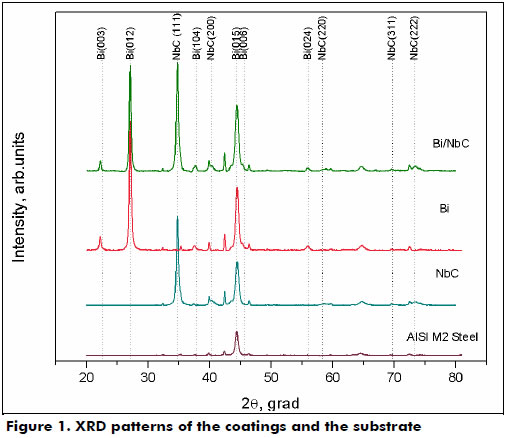
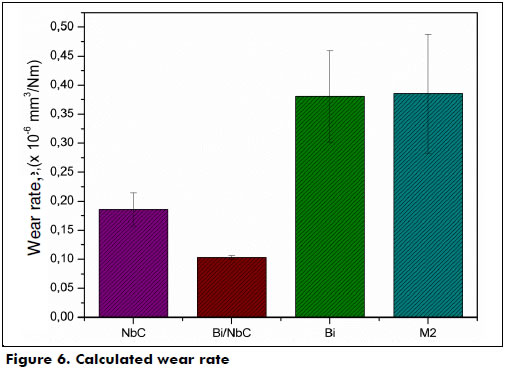
<body><![CDATA[<p>To improve the performance  of many components and tools hard coatings are used because they generally have  high melting points, high hardness, good chemical stability and high wear  resistance (Carrera et al., 2003; Derflinger et al., 1999; Renevier et al.,  2000). One drawback is that these coatings often have a high friction  coefficient. Therefore, there is great interest in new developments to reduce  friction, thereby improving the tribological performance of the coatings  (Daming et al., 1997).</p>     <p>  The carbides of transition metals, such as vanadium, chromium,  niobium, tungsten or titanium are materials with many technological  applications due to their high strength and durability. Among existing  hard-coating materials available to date niobium carbide (NbC) is highlighted.  This material has high hardness (Amriou et al., 2003), high toughness, high  elasticity modulus, excellent chemical stability, high wear resistance (Zoita  et al., 2010) and high melting temperature (3873 K) (Bendavid et al., 2003),  (Sustarsic et al., 2003). This properties combination makes NbC an excellent  candidate for a wide range of industrial applications. NbC also has high  conductivity, good corrosion resistance and even a superconducting phase at low  temperatures. For these reasons it has been tested in applications requiring biocompatibility  and applications in microelectronics components (Eisenbarth et al., 2004).</p>     <p>  Solid lubricant coatings are used for components in operating  environments where lubricating oils either cannot be used or have limited  efficiency (Teer et al., 1997). Such applications include vacuum and aerospace  equipment (Watanabe et al., 2004a, 2004b). In order to obtain coatings with  simultaneously high hardness and low coefficient of friction (COF), multilayer  coatings with combinations of hard ceramic and solid lubricating layers have  been developed, in which a combination of the properties in each layer have  been obtained (Haider et al., 2005). Multilayer coatings are used in many  applications, such as in a wide variety of cutting tools, among others (Carrera  et al., 2003).</p>     <p>  Among the materials that might be used as a solid coating with  tribological purposes is bismuth (Bi), a highly anisotropic semi-metal of the  group V with low melting point (544 K) and thermal conductivity with an order  of magnitude less than typical metals (Boffoue et al., 1998). Bi crystallizes  in a rhombohedral structure and forms layers between which there are weak bonds  compared with the internal bonds of the layer itself. This characteristic allows  Bi crystals to slide easily between the layers formed by (001) planes (Hofmann,  2006). This behavior resembles that of molybdenum disulfide (MoS<sub>2</sub>),  which has very low friction values (Daming et al., 1997; Teer et al., 1997;  Waghray et al., 1995) and is also used as lubricant coating in several  applications. Bi nanoparticles added directly as an additive in lubricating  oils, form homogeneous and stable distributions. Under mechanical load the Bi  melts and provides instantaneous protection by preventing direct contact  between the sliding surfaces (Zhao et al., 2004). Films of Bi have been  produced by sputtering (Kim et al., 2006), by pulsed laser deposition (Boffoue  et al., 1998) and by thermal evaporation (Kumari et al., 2007).</p>     <p>  The AISI M2 steel is typically used for the manufacture of cutting  tools for machining operations such as turning, drilling and milling; other  applications include cutting tools for sheet and forming tools (Arias et al.,  2010). This steel has high toughness and maintains its hardness up to  approximately 773 K, which is why it has remained in widespread use for more  than hundred years of evolution of cutting tool materials (Trent &amp; Wright,  2000). There have been many developments to improve the work properties of AISI  M2 steel; among these, the use of hard coatings applied by physical vapor  deposition (PVD) especially stands out (Krahmer et al., 2003).</p>     <p>  In this work, we try to explore alternatives to improve the tribological  behavior of AISI M2 steel by coating this material with films of NbC, Bi and  Bi/NbC. We chose to experiment with NbC because this carbide has the highest  melting point (3600<sup>o</sup>C) compared with that of the carbides of vanadium (2830<sup>o</sup>C),  titanium (3067<sup>o</sup>C) and zirconium (3420<sup>o</sup>C).</p>     <p>  The three types of coatings were deposited to make comparisons and  to assess the individual effect of both the NbC and the Bi layers. The coatings  were deposited by sputtering with an unbalanced magnetron. With the aim of  reducing the presence of residual stresses in the coatings and to avoid structural  alterations by heating of the steel substrate, the deposition of the coating  was made at room temperature (Zhang et al., 2012; Zoita et al., 2010).</p>     <p>  <font size="3"><b>Experimental Procedure</b></font></p>     <p>  Onto substrates of AISI M2 steel quenched and tempered with a final  hardness of 64 HRC were deposited coatings of Bi, NbC and Bi/NbC by sputtering  with an unbalanced magnetron. The deposition process was made without heating  the substrates and with zero bias voltage. Before the deposition process, the  substrates were polished to a mirror finishing using SiC emery paper with  1200-mesh grit and were then degreased using an ultrasonic bath of acetone and  alcohol for 120 s.</p>     <p>  To produce all the coatings, the base pressure in the deposition  chamber was 3&times;10<sup>-3</sup> Pa and the distance between the cathode and the  substrates was 5 cm. The NbC coatings were deposited by reactive sputtering  using a mix of Ar (99.999%) and CH<sub>4</sub> (99.99%) gases in discharging  with a niobium (99.95%) target. The Nb target was pre-sputtered by discharging  with Ar gas for 300 s to remove the surface NbOx layer, then a Nb  interlayer was deposited on the steel substrate for 60 s in order to improve  NbC adherence to the substrate (Borawski et al., 2011; Gerth &amp; Wiklund,  2008; Hong et al., 2010). Then, discharge with the mixed Ar and CH<sub>4</sub>  gases was carried out for 390 s. The applied current on the Nb target was 0.3  A, the total pressure was 0.86 Pa, the Ar flow was 22.0 sccm, and the CH<sub>4</sub>  flow was 0.008 sccm. The very low flow of CH<sub>4</sub> was established after  several trial-and-error experiments to overcome a problem of target poisoning  by CH<sub>4</sub> saturation that hampered the steady-state reaction between Nb  and C. Poisoning occurred because with the equipment used was not able to  operate at a faster pumping speed. The Bi coatings were deposited by a  discharge of Ar (99.999%) with Bi (99.95%) target used as the source material.  The target current was 0.11 A, the work pressure was 0.5 Pa, and the Ar flow  was 9.0 sccm. The NbC coating had an approximate deposition rate of 29 nm min<sup>-1</sup>  while the Bi coatings were deposited at 350 nm min<sup>-1</sup>. As a  reference, in <a href="#t1">Table 1</a> are listed the hardness values of the materials involved  in the present work.</p>     ]]></body>
<body><![CDATA[<p>    <center><a name="t1"></a><img src="/img/revistas/iei/v34n3/v34n3a03t1.jpg"></center></p>     <p>  An Xpress Revetest CSM was used as a scratch tester using a 0.2 mm  tip radius Rockwell C diamond indenter, under a loading rate of 100 N min<sup>-1</sup>,  a sliding speed of 10 mm min<sup>-1</sup> and a scratch length of 9 mm. The  crystallographic structure of the films was investigated using a X-PertPro  Panalytical X-ray diffraction (XRD) system using Cu K&alpha; radiation (1.5418 &Aring;)  with the 2&theta;/&theta; set-up over a 20-80<sup>o</sup> range. An Asylum Research MFP3D-Bio atomic  force microscope (AFM) was used to observe the surface morphology and to  measure the surface roughness.</p>     <p>  The tribological properties of the films were determined using a  CETR-UMT-2-110 ball-on-disk tribometer in the unidirectional speed mode with a  6 mm Al<sub>2</sub>O<sub>3</sub> ball as the sliding counterpart in air (293 K  temperature, 41-52% humidity). We used the alumina ball because it has a higher  hardness than the substrate and the NbC, and in this initial study we primarily  intended to observe the wear of the coating and the substrate without  significant influence of debris and wear of the test ball. The sliding speed  was adjusted at 6 m s<sup>-1</sup>, and the load was fixed at 4 N. The sliding  distance was 120 m. The scratch and wear tracks were observed via stereoscopic  microscopy and scanning electron microscopy (SEM) JEOL JSM 6490-LV. The  energy-dispersive X-ray (EDS) analysis in the SEM was used to identify chemical  elements in the wear tracks.</p>     <p>  <font size="3"><b>Results and discussion</b></font> </p>     <p>  <b>Microstructure and morphology</b></p>     <p> <a href="#f1">Figure 1</a> shows the XRD patterns in a symmetric &theta;-2&theta; configuration for the  coatings and the substrate. For the M2 steel substrate, the characteristic  peaks of martensite (&alpha;-Fe), iron carbide M<sub>6</sub>C,  tungsten carbide Fe<sub>3</sub>W<sub>3</sub>C  and vanadium carbide V<sub>4</sub>C<sub>3</sub> can be observed, which match  the JCPDS (Joint Committee on Powder Diffraction Standards, 2000a, 2000b)  charts 01-087-0721, 01-089-7205 and 00-001-1159, respectively. For the niobium  carbide films, the cubic NbC phase is observed with a mixed texture of  preferred (111) and (200) orientations although there are also evidence for  (220), (311) and (222) orientations (JCPDS card No. 38-1364). The crystallite  size calculated from Scherrer's formula (Guinier, 1963) was 26.96 nm, and this  value is an approximated reference value because it is assumed that there are  no microdeformations. The lattice parameter calculated from Bragg's law (4.4634  &Aring;) is smaller than that reported in JCPDS card No. 38-1364 (4.4698 &Aring;),  indicating the existence of compressive intrinsic stresses in agreement with  the report by Zhang et al. (Zhang et al., 2012) on niobium carbide coatings  also deposited by sputtering on silicon substrates. The texture coefficient  calculated for the &#91;111&#93; direction was 2.79, indicating a strong orientation in  this direction, which is similar to the case of transition metal nitride films  with thicknesses less than 500 nm that have the lowest strain energy in the  (111) orientation (Braic et al., 2011; Zhang et al., 2012). Based on the  carbon-niobium binary phase diagram and on the NbC phase obtained, it can be  estimated that the carbon content is between 40 and 50%. (Kimura &amp; Sasaki,  1961).</p>     <p>    <center><a name="f1"></a><img src="/img/revistas/iei/v34n3/v34n3a03f1.jpg"></center></p>     <p>  For the bismuth layers (<a href="#f1">Figure 1</a>) the characteristic XRD peaks of the  rhombohedral phase were observed (JCPDS card No. 44-1246) with (003), (012),  (104), (015), (006) and (204) mixed orientations. However, as can be observed  there is a preferential (012) texture, and this result is similar to that  reported by Kim et al. (Kim et al., 2006), who deposited bismuth thin films on  glass substrates by RF magnetron sputtering. The calculated crystallite size  was 22.4 nm. The comparison between the calculated lattice parameters (a =  4.5297 &Aring;, c = 11.9853 &Aring;) with the values reported in the JCPDS No. 44-1246  chart (a = 4.5460 &Aring;, c = 11.8600 &Aring;) indicate the existence of a combination of  intrinsic stresses. For the Bi/NbC coating (<a href="#f1">Figure 1</a>), peaks are observed from  Bi, NbC and the steel substrate. The overlaps in the peaks of the three materials  were resolved by applying deconvolution using Origin software.</p>     ]]></body>
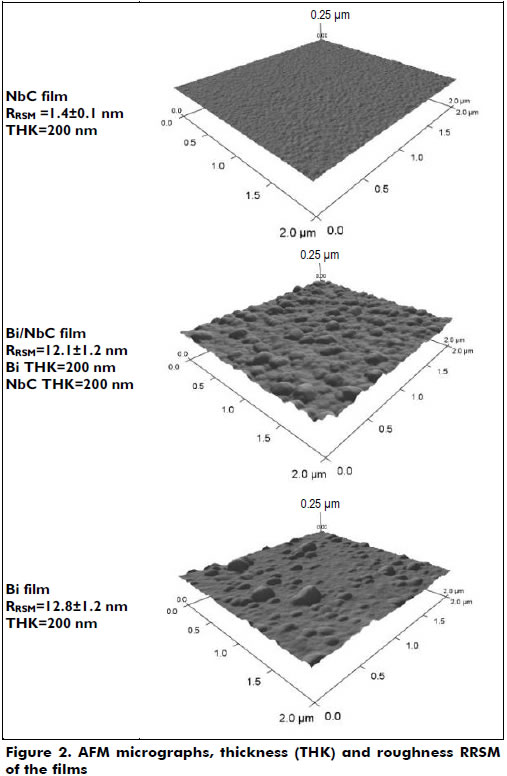
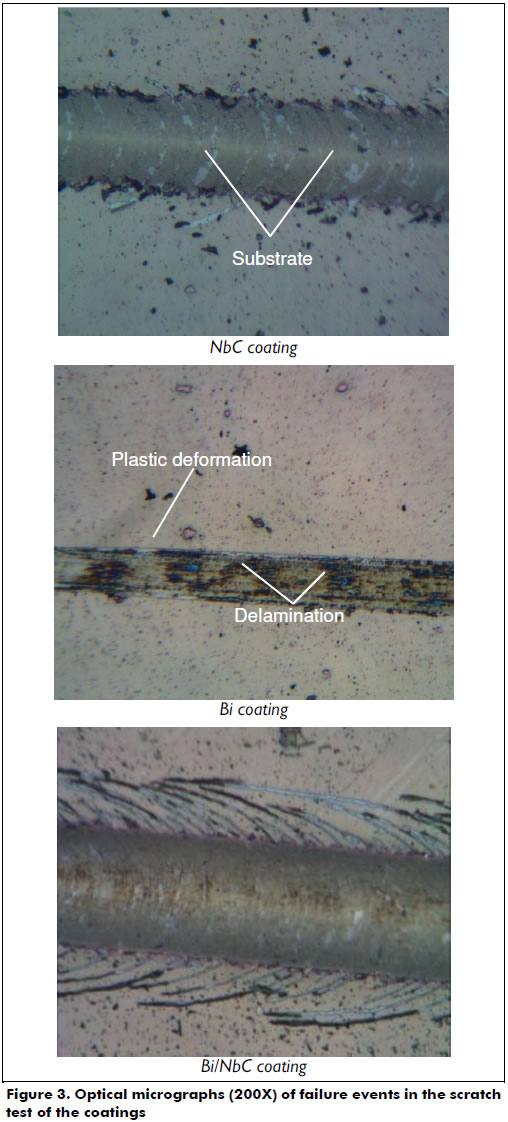
<body><![CDATA[<p>  AFM micrographs of the NbC, Bi/NbC and Bi coatings are show in <a href="#f2">Figure  2</a>. In other works, it was reported that increasing the absolute value of the  bias voltage produces smoother NbC films (Zhang et al., 2012), but that  increasing the growth temperature produces greater film roughness due to an  increased in grain size (Zoita et al., 2010).</p>     <p>    <center><a name="f2"></a><img src="/img/revistas/iei/v34n3/v34n3a03f2.jpg"></center></p>     <p>  The produced NbC coating (<a href="#f2">Figure  2</a>) had a smooth surface composed of  small peaks with a low roughness value (RRSM =1.4 nm). Although this  NbC coating was produced with zero bias voltage, the low roughness obtained is  explained by the low temperature of deposition and also by the high Ar gas  concentration used, which produces large amounts of Ar+ ions that erode the protrusions  on the surface. The effect of high Ar concentration on lowering the roughness  was also reported in studies of C:H films produced by unbalanced magnetron  sputtering (Dai et al., 2008). In the Bi/NbC coating (<a href="#f2">Figure  2</a>) a surface  topography was observed with particles of homogenous size distributed  homogeneously. This coating had a higher roughness (RRSM =12.1 nm)  than the NbC coating. The monolayer bismuth coating (<a href="#f2">Figure  2</a>) has a similar  roughness (RRSM =12.8 nm) but with particles of heterogeneous size.  These results are in line with the report of Sande et al. (Sande et al., 1996)  who stated that bismuth films deposited by DC sputtering showed a high surface  roughness, related both to columnar growth and to the presence of abnormally  large grains. A similar result was also reported by Kim et al. in studies of  bismuth films deposited by RF sputtering (Kim et al., 2006).</p>     <p>  <b>Scratch testing of the coatings</b></p>     <p>  The film adhesion was evaluated by scratch testing. In <a href="#f3">Figure 3</a> are  shown example optical micrographs of the scratch tracks on the NbC, Bi and  Bi/NbC coatings. The first fault load (L<sub>c1</sub>) was determined visually  at the point on the track where the film was pulled off from the substrate with  adhesive failure of the flaking.</p>     <p>    <center><a name="f3"></a><img src="/img/revistas/iei/v34n3/v34n3a03f3.jpg"></center></p>     <p>  The critical load characteristic of total failure of the coating (L<sub>c2</sub>)  was determined visually at the point on the track where the complete failure of  the coating initiated at the first full contact of the diamond stylus with the  substrate. In <a href="#f3">Figure 3</a> it is observed that the NbC coating exhibited good  adhesion with the steel substrate (L<sub>c1</sub>= 10 &plusmn; 1.1 N, L<sub>c2</sub>=  25 &plusmn; 3 N). This good adhesion is seen because the ductile Nb interlayer reduces  the shear stress in the coating-substrate interface (Borawski et al., 2011;  Gerth &amp; Wiklund, 2008; Hong et al., 2010). A protective effect of the  bismuth on the Bi/NbC coating could be verified because both critical loads  related to the NbC layer of this coating were higher (L<sub>c1</sub>= 30 &plusmn; 4 N,  L<sub>c2</sub>= 45 &plusmn; 5 N). In the <a href="#f3">Figure 3</a> it is observed that soft Bi layer on  the harder substrates exhibit plastic deformation and thinning over the track.  The Bi coating had better adhesion with the NbC layer (L<sub>c1</sub>= 3.0 &plusmn;  0.5 N, L<sub>c2</sub>= 14 &plusmn; 2 N) than with the steel substrate (L<sub>c1</sub>=  2.0 &plusmn; 0.25 N, L<sub>c2</sub>= 4.5 &plusmn; 0.3 N), and this fact is probably because  the Bi lattice parameters (rhombohedral, a = 4.5460 &Aring;) are closer to those of  NbC (4.4698 &Aring;) than those of steel.</p>     <p>  <b>Tribological behavior</b></p>     ]]></body>
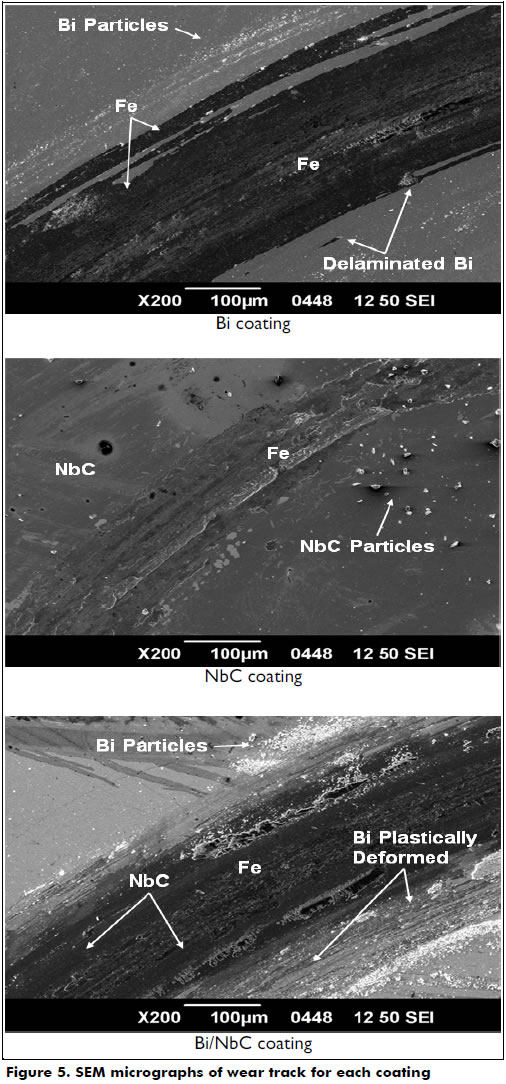
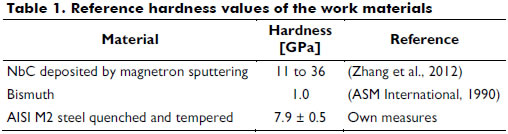
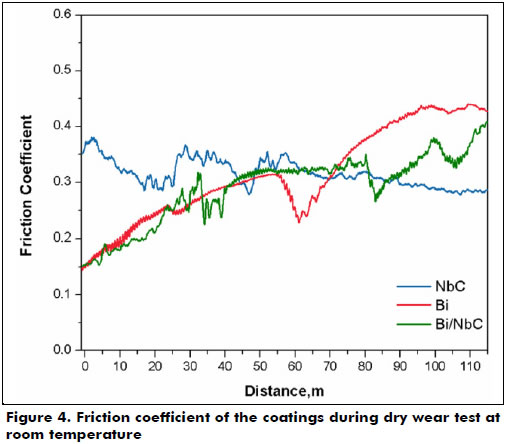
<body><![CDATA[<p>  <a href="#f4">Figure 4</a> shows the coefficient of friction (COF) for the NbC, Bi and  Bi/NbC coatings against the Al<sub>2</sub>O<sub>3</sub> ball as a function of  sliding distance. As a reference the final stable value obtained for the M2 steel is also included. For the NbC coating a COF between 0.3 and 0.35 has been  obtained, in the case of Bi/NbC coating its COF is lower than that of the NbC  coating until a distance of 80 m possibly due to a retardant effect of direct  contact with the ball produced by the Bi layer. </p>     <p>    <center><a name="f4"></a><img src="/img/revistas/iei/v34n3/v34n3a03f4.jpg"></center></p>     <p>  It is worth noting that for the NbC and Bi/NbC films the COF  evolution is accompanied by a rattling, which might be because the as-deposited  NbC film is partially flaked away until direct contact between the ball and the  substrate. Zhang et al. (Zhang et al., 2012) assessed the wear resistance of  NbC coatings obtained by sputtering and found a COF of 0.25 with roughness  values of the coating between 0.854 nm and 5.69 nm. The results of these  authors are similar to the results obtained in this investigation. The COF of  the Bi coating exhibits a relatively smooth increase until 55 m at which point  it decreases to a minimum at 60 m  and  again experiences sustained growth until the end of the test. This fluctuation  is probably because, substrate exposure occurred at 55 m and continued until  complete exposure at the end of the test.</p>     <p> <a href="#f5">Figure 5</a> exhibits SEM images with EDS analysis of the wear track  after 120 m sliding for the three coatings. The Bi coating was almost  completely removed though laminated segments of Bi are observed in the wear  track. Those segments exhibit severe plastic deformation produced by sliding  contact with the ball. The smooth increase in COF on the Bi coating corresponds  to its progressive delamination accompanied by plastic deformation until it had  been almost completely removed at the end of the test.</p>     <p>    <center><a name="f5"></a><img src="/img/revistas/iei/v34n3/v34n3a03f5.jpg"></center></p>     <p>  In the wear track of the NbC coating (<a href="#f5">Figure 5</a>), there is much less  substrate exposure than for the Bi coating, NbC particles removed by abrasion  are also observed which might be because, during the wear testing, microcracks  initiated after several sliding cycles and readily propagated, leading to  spalling and delamination of the hard film from the substrate. The repeated  deflection of the hard NbC coating onto the tougher steel substrate causes  nucleation and propagation of cracks that ultimately lead to detachment of  coating particles (Holmberg &amp; Matthews, 1994). In the wear track of Bi/NbC  coating severe plastic deformation is observed in the Bi layer and also small  Bi particles removed from the surface and located on the border of the wear  track can be seen. Also, the worn area of the NbC layer is seen to exhibit spalling  and delamination as well as the smaller substrate exposure of the three  coatings. Apparently, for the Bi/NbC coating, where the Bi layer had slightly  better adhesion, the particles that had been removed from Bi layer offered an  additional protection against the direct contact between the ball and the NbC  layer. Although the presence of Fe is observed in the traces of the three  coatings, the COF increase was not significant because the remaining coating  exerted influence on the overall system performance. Sen &amp; Sen (Sen &amp;  Sen, 2005) applied the pin-on-disk test to NbC coatings obtained by reactive  thermodiffusion. For the test with an alumina ball, they observed abrasive wear  with oxidation, while in the test with a steel ball they observed adhesive wear  with more oxidation. According to these authors, the fracture of the formed  iron oxide increased the friction coefficient, especially in the test with  steel ball.</p>     <p>  In <a href="#f6">Figure 6</a> is illustrated the calculated wear rate for each coating  after the pin-on-disk test. The Bi/NbC coating had the lowest wear rate  followed by the NbC coating. The Bi coating apparently had a wear rate similar  to that of the steel substrate, but this result actually reflects that this  coating alone was quickly removed and offered little protection to the  substrate. The wear resistance of the NbC coating is consistent with its high  hardness (see <a href="#t1">Table 1</a>), and the lubricating effect provided by the Bi in the  Bi/NbC system is also clear.</p>     <p>    ]]></body>
<body><![CDATA[<center><a name="f6"></a><img src="/img/revistas/iei/v34n3/v34n3a03f6.jpg"></center></p>     <p>  <font size="3"><b>Conclusions</b></font></p>     <p>NbC, Bi and Bi/NbC coatings  were deposited onto AISI M2 steel substrates using unbalanced magnetron  sputtering at room temperature with zero bias voltage. The phase structure,  morphology, adhesion and tribological behavior of the three coatings were  examined. The niobium carbide crystallized in the cubic structure with a  particularly strong (111) texture. The bismuth layers had a rhombohedral phase  with random orientation but with preferential (012) texture. The NbC coating  had a smooth surface with low roughness, which is explained by the low  temperature of deposition and also by the high Ar gas concentration used. The  Bi layer on steel and on the Bi/NbC coating had higher roughness than the NbC  coating on steel. The morphology of the Bi layer was characterized by large particles  distributed homogeneously. By using a ductile Nb interlayer was achieved good  adhesion between the NbC coating and the steel substrate. The Bi coating had  better adhesion with the NbC layer than with the steel substrate. Mainly due to  low adhesion of the Bi coating deposited directly onto the steel substrate, its  tribological performance was not satisfactory. The produced NbC coating have  the potential to protect the steel from wear, and the Bi layer on the Bi/NbC  coating has a moderately beneficial effect as evidenced by the lower exposure  of the substrate at the end of the wear tests.</p>     <p>  <font size="3"><b>Acknowledgments</b></font></p>     <p>  This work was financed by the Research Direction of the Bogot&aacute;  campus of the Universidad Nacional de Colombia (DIB-15859 project) and by the  project FP7-NMP-2010 EU-Mexico (Grant Agreement No. 263878).</p> <hr>     <p><font size="3"><b>References</b></font> </p>     <!-- ref --><p>Amriou,  T., Bouhafs, B., Aourag, H., Khelifa, B., Bresson, S., &amp; Mathieu, C.  (2003). FP-LAPW investigations of electronic structure and bonding mechanism of  NbC and NbN compounds. <i>Physica B: Condensed Matter, 325</i>, 46-56. doi:10.1016/S0921-4526 (02)01429-1&nbsp;&nbsp;&nbsp;&nbsp;&nbsp;&nbsp;&nbsp;&nbsp;[&#160;<a href="javascript:void(0);" onclick="javascript: window.open('/scielo.php?script=sci_nlinks&ref=000069&pid=S0120-5609201400030000300001&lng=','','width=640,height=500,resizable=yes,scrollbars=1,menubar=yes,');">Links</a>&#160;]<!-- end-ref --><!-- ref --><p>  Arias, J.,  Cabeza, M., Castro, G., Feijoo, I., Merino, P., &amp; Pena, G. (2010). Modificaci&oacute;n de los aceros r&aacute;pidos de  herramientas AISI M2 por fusi&oacute;n superficial con l&aacute;ser bajo diferentes condiciones  de operaci&oacute;n. <i>Revista de Metalurgia, 46</i>(3), 206-218.    &nbsp;&nbsp;&nbsp;&nbsp;&nbsp;&nbsp;&nbsp;&nbsp;[&#160;<a href="javascript:void(0);" onclick="javascript: window.open('/scielo.php?script=sci_nlinks&ref=000070&pid=S0120-5609201400030000300002&lng=','','width=640,height=500,resizable=yes,scrollbars=1,menubar=yes,');">Links</a>&#160;]<!-- end-ref -->  doi:10.3989/revmetalm.0918</p>     <!-- ref --><p>  Bendavid,  A., Martin, P., Kinder, T., &amp; Preston, E. (2003). The deposition of NbN and NbC thin films by  filtered vacuum cathodic arc deposition. <i>Surface  and Coatings Technology, 163-164</i>, 347-352. doi:10.1016/S0257-8972(02)00623-0&nbsp;&nbsp;&nbsp;&nbsp;&nbsp;&nbsp;&nbsp;&nbsp;[&#160;<a href="javascript:void(0);" onclick="javascript: window.open('/scielo.php?script=sci_nlinks&ref=000072&pid=S0120-5609201400030000300003&lng=','','width=640,height=500,resizable=yes,scrollbars=1,menubar=yes,');">Links</a>&#160;]<!-- end-ref --><!-- ref --><p>  Boffoue, M. O., Lenoir, B., Scherrer, H.,  &amp; Dauscher, A. (1998). Pulsed laser deposition of bismuth in the presence  of different ambient atmospheres. <i>Thin  Solid Films, 322</i>(1-2), 132-137. doi:10.1016/ S0040-6090(97)00912-7&nbsp;&nbsp;&nbsp;&nbsp;&nbsp;&nbsp;&nbsp;&nbsp;[&#160;<a href="javascript:void(0);" onclick="javascript: window.open('/scielo.php?script=sci_nlinks&ref=000073&pid=S0120-5609201400030000300004&lng=','','width=640,height=500,resizable=yes,scrollbars=1,menubar=yes,');">Links</a>&#160;]<!-- end-ref --><!-- ref --><p>  Borawski, B., Todd, J. A., Singh, J.,  &amp; Wolfe, D. E. (2011). The influence of ductile interlayer material on the  particle erosion resistance of multilayered TiN based coatings. <i>Wear, 271</i>(11-12),  2890-2898. doi:10.1016/j.wear.2011.06.004&nbsp;&nbsp;&nbsp;&nbsp;&nbsp;&nbsp;&nbsp;&nbsp;[&#160;<a href="javascript:void(0);" onclick="javascript: window.open('/scielo.php?script=sci_nlinks&ref=000074&pid=S0120-5609201400030000300005&lng=','','width=640,height=500,resizable=yes,scrollbars=1,menubar=yes,');">Links</a>&#160;]<!-- end-ref --><!-- ref --><p>  Braic, M.,  Braic, V., Balaceanu, M., Vladescu, A., Zoita, C. N., Titorencu, I., &amp;  Miculescu, F. (2011). Preparation and characterization  of biocompatible Nb-C coatings. <i>Thin  Solid Films, 519</i>(12), 4064-4068. doi:10.1016/j.tsf.2011.01.193&nbsp;&nbsp;&nbsp;&nbsp;&nbsp;&nbsp;&nbsp;&nbsp;[&#160;<a href="javascript:void(0);" onclick="javascript: window.open('/scielo.php?script=sci_nlinks&ref=000075&pid=S0120-5609201400030000300006&lng=','','width=640,height=500,resizable=yes,scrollbars=1,menubar=yes,');">Links</a>&#160;]<!-- end-ref --><!-- ref --><p>  Carrera, S., Salas, O., Moore, J. J.,  Woolverton, A., &amp; Sutter, E. (2003). Performance of CrN/MoS<sub>2</sub>(Ti)  coatings for high wear low friction applications. <i>Surface and Coatings Technology, 167</i>(1), 25-32.  doi:10.1016/S0257-8972(02)00885-X&nbsp;&nbsp;&nbsp;&nbsp;&nbsp;&nbsp;&nbsp;&nbsp;[&#160;<a href="javascript:void(0);" onclick="javascript: window.open('/scielo.php?script=sci_nlinks&ref=000076&pid=S0120-5609201400030000300007&lng=','','width=640,height=500,resizable=yes,scrollbars=1,menubar=yes,');">Links</a>&#160;]<!-- end-ref --><!-- ref --><p>  Dai, H., Jiang, H., Zhan, C., &amp; Huang,  N. (2008). Effects of Ratio of Mixed Gases on the Surface Roughness and  Nano-hardness of aC: H films. <i>Journal of  the Korean Physical Society, 52</i>, s124-s127. Retrieved from  http://www.kps.or.kr/jkps/downloadPdf.asp?articleuid=%7BBF83594F-722E-4862-9228-031C88CF173D%7D&nbsp;&nbsp;&nbsp;&nbsp;&nbsp;&nbsp;&nbsp;&nbsp;[&#160;<a href="javascript:void(0);" onclick="javascript: window.open('/scielo.php?script=sci_nlinks&ref=000077&pid=S0120-5609201400030000300008&lng=','','width=640,height=500,resizable=yes,scrollbars=1,menubar=yes,');">Links</a>&#160;]<!-- end-ref --><!-- ref --><p>  Daming, Z., Jiajun, L., Baoliang, Z.,  &amp; Wenzhi, L. (1997). A study of the friction and wear performance of MoS  thin films produced by ion beam enhanced deposition and magnetron sputtering. <i>Wear, 210</i>(1-2), 45-49. doi:10.1016/S0043-1648(97)00039-2&nbsp;&nbsp;&nbsp;&nbsp;&nbsp;&nbsp;&nbsp;&nbsp;[&#160;<a href="javascript:void(0);" onclick="javascript: window.open('/scielo.php?script=sci_nlinks&ref=000078&pid=S0120-5609201400030000300009&lng=','','width=640,height=500,resizable=yes,scrollbars=1,menubar=yes,');">Links</a>&#160;]<!-- end-ref --><!-- ref --><p>  Derflinger, V., Br&auml;ndle, H., &amp;  Zimmermann, H. (1999). New hard/lubricant coating for dry machining. Surface  and Coatings Technology, 113(3), 286-292. doi:10.1016/S0257-8972(99)00004-3&nbsp;&nbsp;&nbsp;&nbsp;&nbsp;&nbsp;&nbsp;&nbsp;[&#160;<a href="javascript:void(0);" onclick="javascript: window.open('/scielo.php?script=sci_nlinks&ref=000079&pid=S0120-5609201400030000300010&lng=','','width=640,height=500,resizable=yes,scrollbars=1,menubar=yes,');">Links</a>&#160;]<!-- end-ref --><!-- ref --><p>  Eisenbarth, E., Velten, D., M&uuml;ller, M., Thull,  R., &amp; Breme, J. (2004). Biocompatibility of beta-stabilizing elements of  titanium alloys. <i>Biomaterials, 25</i>(26),  5705-5713. doi:10.1016/j.biomaterials.2004.01.021&nbsp;&nbsp;&nbsp;&nbsp;&nbsp;&nbsp;&nbsp;&nbsp;[&#160;<a href="javascript:void(0);" onclick="javascript: window.open('/scielo.php?script=sci_nlinks&ref=000080&pid=S0120-5609201400030000300011&lng=','','width=640,height=500,resizable=yes,scrollbars=1,menubar=yes,');">Links</a>&#160;]<!-- end-ref --><!-- ref --><p>  Gerth, J., &amp; Wiklund, U. (2008). The  influence of metallic interlayers on the adhesion of PVD TiN coatings on  high-speed steel. <i>Wear, 264</i>(9-10),  885-892. doi:10.1016/j.wear.2006.11.053&nbsp;&nbsp;&nbsp;&nbsp;&nbsp;&nbsp;&nbsp;&nbsp;[&#160;<a href="javascript:void(0);" onclick="javascript: window.open('/scielo.php?script=sci_nlinks&ref=000081&pid=S0120-5609201400030000300012&lng=','','width=640,height=500,resizable=yes,scrollbars=1,menubar=yes,');">Links</a>&#160;]<!-- end-ref --><!-- ref --><p>  Guinier, A. (1963). <i>X-ray Diffraction in Crystals, Imperfect Crystals and Amorphous Bodies</i>.  San Francisco: W. F. &amp; Company.    &nbsp;&nbsp;&nbsp;&nbsp;&nbsp;&nbsp;&nbsp;&nbsp;[&#160;<a href="javascript:void(0);" onclick="javascript: window.open('/scielo.php?script=sci_nlinks&ref=000082&pid=S0120-5609201400030000300013&lng=','','width=640,height=500,resizable=yes,scrollbars=1,menubar=yes,');">Links</a>&#160;]<!-- end-ref --></p>     <!-- ref --><p>  Haider, J.,  Rahman, M., Corcoran, B., &amp; Hashmi, M. S. J. (2005). Deposition and  characterization of hard-solid lubricant coating by closed-field magnetron  sputtering. <i>Surface and Coatings  Technology, 200</i>(1-4), 1080-1083. doi:10.1016/j.surfcoat.2005.02.058&nbsp;&nbsp;&nbsp;&nbsp;&nbsp;&nbsp;&nbsp;&nbsp;[&#160;<a href="javascript:void(0);" onclick="javascript: window.open('/scielo.php?script=sci_nlinks&ref=000084&pid=S0120-5609201400030000300014&lng=','','width=640,height=500,resizable=yes,scrollbars=1,menubar=yes,');">Links</a>&#160;]<!-- end-ref --><!-- ref --><p>  Hofmann, Ph.  (2006). The surfaces of bismuth: Structural and electronic properties. <i>Progress in Surface Science, 81</i>(5),  191-245. doi:10.1016/j.progsurf.2006.03.001&nbsp;&nbsp;&nbsp;&nbsp;&nbsp;&nbsp;&nbsp;&nbsp;[&#160;<a href="javascript:void(0);" onclick="javascript: window.open('/scielo.php?script=sci_nlinks&ref=000085&pid=S0120-5609201400030000300015&lng=','','width=640,height=500,resizable=yes,scrollbars=1,menubar=yes,');">Links</a>&#160;]<!-- end-ref --><!-- ref --><p>  Holmberg, K.,  &amp; Matthews A. (1994). Coatings Tribology: Properties, Techniques and  Applications. In D. Dowson (Ed.), <i>Tribology  Series 28</i> (pp. 1-441), Amsterdam: Elsevier.    &nbsp;&nbsp;&nbsp;&nbsp;&nbsp;&nbsp;&nbsp;&nbsp;[&#160;<a href="javascript:void(0);" onclick="javascript: window.open('/scielo.php?script=sci_nlinks&ref=000086&pid=S0120-5609201400030000300016&lng=','','width=640,height=500,resizable=yes,scrollbars=1,menubar=yes,');">Links</a>&#160;]<!-- end-ref --></p>     <!-- ref --><p>  Hong, Y. S.,  Kwon, S. H., Wang, T., Kim, D., Choi, J., &amp; Kim, K. H. (2010). Effects of  Cr interlayer on mechanical and tribological properties of Cr-Al-Si-N  nanocomposite coating. <i>Transactions of  Nonferrous Metals Society of China, 21</i>(1), s62-s67. doi:10.1016/S1003-6326(11)61062-5&nbsp;&nbsp;&nbsp;&nbsp;&nbsp;&nbsp;&nbsp;&nbsp;[&#160;<a href="javascript:void(0);" onclick="javascript: window.open('/scielo.php?script=sci_nlinks&ref=000088&pid=S0120-5609201400030000300017&lng=','','width=640,height=500,resizable=yes,scrollbars=1,menubar=yes,');">Links</a>&#160;]<!-- end-ref --><!-- ref --><p>  Joint Committee  on Powder Diffraction Standards. (2000a). Diffraction Data File 38-1364.  Newtown Square, PA: International Centre for Diffraction Data.    &nbsp;&nbsp;&nbsp;&nbsp;&nbsp;&nbsp;&nbsp;&nbsp;[&#160;<a href="javascript:void(0);" onclick="javascript: window.open('/scielo.php?script=sci_nlinks&ref=000089&pid=S0120-5609201400030000300018&lng=','','width=640,height=500,resizable=yes,scrollbars=1,menubar=yes,');">Links</a>&#160;]<!-- end-ref --></p>     <!-- ref --><p>  Joint Committee  on Powder Diffraction Standards. (2000b). Diffraction Data File 44-1246.  Newtown Square, PA: International Centre for Diffraction Data.    &nbsp;&nbsp;&nbsp;&nbsp;&nbsp;&nbsp;&nbsp;&nbsp;[&#160;<a href="javascript:void(0);" onclick="javascript: window.open('/scielo.php?script=sci_nlinks&ref=000091&pid=S0120-5609201400030000300019&lng=','','width=640,height=500,resizable=yes,scrollbars=1,menubar=yes,');">Links</a>&#160;]<!-- end-ref --></p>     ]]></body>
<body><![CDATA[<!-- ref --><p>  Kim, D.-H., Lee,  S.-H., Kim, J.-K., &amp; Lee, G.-H. (2006). Structure and electrical transport  properties of bismuth thin films prepared by RF magnetron sputtering. <i>Applied Surface Science, 252</i>(10),  3525-3531. doi:10.1016/j.apsusc.2005.05.046&nbsp;&nbsp;&nbsp;&nbsp;&nbsp;&nbsp;&nbsp;&nbsp;[&#160;<a href="javascript:void(0);" onclick="javascript: window.open('/scielo.php?script=sci_nlinks&ref=000093&pid=S0120-5609201400030000300020&lng=','','width=640,height=500,resizable=yes,scrollbars=1,menubar=yes,');">Links</a>&#160;]<!-- end-ref --><!-- ref --><p>  Kimura, H., &amp; Sasaki, Y. (1961). The Phase Diagram of the  Niobium-Carbon system. <i>Materials  Transactions JIM, 2</i>(2), 98-104. Retrieved from  https://www.jim.or.jp/journal/e/2/02/98.html &nbsp;&nbsp;&nbsp;&nbsp;&nbsp;&nbsp;&nbsp;&nbsp;[&#160;<a href="javascript:void(0);" onclick="javascript: window.open('/scielo.php?script=sci_nlinks&ref=000094&pid=S0120-5609201400030000300021&lng=','','width=640,height=500,resizable=yes,scrollbars=1,menubar=yes,');">Links</a>&#160;]<!-- end-ref --><!-- ref --><p>  Krahmer, D. M., Russo, D., Egidi, D., Traverso, M. G., Corengia, P.,  &amp; Cabo, A. (2003). Rendimiento  de brocas helicoidales de acero AISI M2 nitruradas por plasma DC-pulsado y sin  nitrurar. In <i>Actas de las Jornadas SAM/  CONAMET/ Simposio MATERIA</i> (pp. 4-7). San Carlos de Bariloche, Argentina:  Asociaci&oacute;n Argentina de Materiales&nbsp;&nbsp;&nbsp;&nbsp;&nbsp;&nbsp;&nbsp;&nbsp;[&#160;<a href="javascript:void(0);" onclick="javascript: window.open('/scielo.php?script=sci_nlinks&ref=000095&pid=S0120-5609201400030000300022&lng=','','width=640,height=500,resizable=yes,scrollbars=1,menubar=yes,');">Links</a>&#160;]<!-- end-ref --><!-- ref --><p>  Kumari, L., Lin, S.-J., Lin, J.-H., Ma, Y.-R., Lee, P.-C., &amp; Liou,  Y. (2007). Effects of deposition temperature and  thickness on the structural properties of thermal evaporated bismuth thin  films. <i>Applied Surface Science, 253</i>(14),  5931-5938. doi:10.1016/j.apsusc.2006.12.125&nbsp;&nbsp;&nbsp;&nbsp;&nbsp;&nbsp;&nbsp;&nbsp;[&#160;<a href="javascript:void(0);" onclick="javascript: window.open('/scielo.php?script=sci_nlinks&ref=000096&pid=S0120-5609201400030000300023&lng=','','width=640,height=500,resizable=yes,scrollbars=1,menubar=yes,');">Links</a>&#160;]<!-- end-ref --><!-- ref --><p>  Renevier, N. M.  U., Fox, V. C., Teer, D. G., &amp; Hampshire, J. (2000). Performance of low  friction MoS<sub>2</sub>/titanium composite coatings used in forming  applications. <i>Materials and Design, 21</i>(4), 337-343.  doi:10.1016/S0261-3069(99)00083-7&nbsp;&nbsp;&nbsp;&nbsp;&nbsp;&nbsp;&nbsp;&nbsp;[&#160;<a href="javascript:void(0);" onclick="javascript: window.open('/scielo.php?script=sci_nlinks&ref=000097&pid=S0120-5609201400030000300024&lng=','','width=640,height=500,resizable=yes,scrollbars=1,menubar=yes,');">Links</a>&#160;]<!-- end-ref --><!-- ref --><p>  Sande, de J. C. G., Missana, T., &amp; Afonso, C. N. (1996). Optical properties of pulsed laser deposited bismuth films. <i>Journal of applied physics, 80</i>,  7023-7027. doi: http://dx.doi.org/10.1063/1.363775&nbsp;&nbsp;&nbsp;&nbsp;&nbsp;&nbsp;&nbsp;&nbsp;[&#160;<a href="javascript:void(0);" onclick="javascript: window.open('/scielo.php?script=sci_nlinks&ref=000098&pid=S0120-5609201400030000300025&lng=','','width=640,height=500,resizable=yes,scrollbars=1,menubar=yes,');">Links</a>&#160;]<!-- end-ref --><!-- ref --><p>  Sen, S., &amp;  Sen, U. (2008) Sliding wear behavior of niobium carbide coated AISI 1040 steel. <i>Wear, 264</i>(3-4), 219-225. doi:10.1016/j.wear.2007.03.006&nbsp;&nbsp;&nbsp;&nbsp;&nbsp;&nbsp;&nbsp;&nbsp;[&#160;<a href="javascript:void(0);" onclick="javascript: window.open('/scielo.php?script=sci_nlinks&ref=000099&pid=S0120-5609201400030000300026&lng=','','width=640,height=500,resizable=yes,scrollbars=1,menubar=yes,');">Links</a>&#160;]<!-- end-ref --><!-- ref --><p>  Sustarsic, B.,  Jenko, M., Godec, M., &amp;  Kosec, L.  (2003). Microstructural investigation of NbC-doped vacuum-sintered  tool-steel-based composites. <i>Vacuum, 71</i>(1-2),  77-82. doi:10.1016/S0042-207X(02)00717-0&nbsp;&nbsp;&nbsp;&nbsp;&nbsp;&nbsp;&nbsp;&nbsp;[&#160;<a href="javascript:void(0);" onclick="javascript: window.open('/scielo.php?script=sci_nlinks&ref=000100&pid=S0120-5609201400030000300027&lng=','','width=640,height=500,resizable=yes,scrollbars=1,menubar=yes,');">Links</a>&#160;]<!-- end-ref --><!-- ref --><p>  Teer, D. G., Hampshire, J., Fox, V., &amp; Bellido-Gonzalez, V. (1997). The tribological properties of MoS<sub>2</sub>/metal composite  coatings deposited by closed field magnetron sputtering. <i>Surface and Coatings Technology, 94-95</i>, 572-577. doi:10.1016/S0257-8972(97)00498-2&nbsp;&nbsp;&nbsp;&nbsp;&nbsp;&nbsp;&nbsp;&nbsp;[&#160;<a href="javascript:void(0);" onclick="javascript: window.open('/scielo.php?script=sci_nlinks&ref=000101&pid=S0120-5609201400030000300028&lng=','','width=640,height=500,resizable=yes,scrollbars=1,menubar=yes,');">Links</a>&#160;]<!-- end-ref --><!-- ref --><p>  Trent, E. M.,  &amp; Wright, P. K. (2000). Cutting Tool Materials I: High Speed Steels. In <i>Metal Cutting</i> (pp. 132-174), Woburn, MA:  Butterworth-Heinemann&nbsp;&nbsp;&nbsp;&nbsp;&nbsp;&nbsp;&nbsp;&nbsp;[&#160;<a href="javascript:void(0);" onclick="javascript: window.open('/scielo.php?script=sci_nlinks&ref=000102&pid=S0120-5609201400030000300029&lng=','','width=640,height=500,resizable=yes,scrollbars=1,menubar=yes,');">Links</a>&#160;]<!-- end-ref --><!-- ref --><p>  Waghray, H., Lee,  T., &amp; Tatarchuk, B. J. (1995). A study of the tribological and electrical  properties of sputtered and burnished transition metal dichalcogenide films. <i>Surface and Coatings Technology, 76-77</i>(2),  415-420. doi:10.1016/0257-8972(95)02564-2&nbsp;&nbsp;&nbsp;&nbsp;&nbsp;&nbsp;&nbsp;&nbsp;[&#160;<a href="javascript:void(0);" onclick="javascript: window.open('/scielo.php?script=sci_nlinks&ref=000103&pid=S0120-5609201400030000300030&lng=','','width=640,height=500,resizable=yes,scrollbars=1,menubar=yes,');">Links</a>&#160;]<!-- end-ref --><!-- ref --><p>  Watanabe,  S., Noshiro, J., &amp; Miyake, S. (2004a). Friction  properties of WS2/MoS<sub>2</sub> multilayer films under vacuum  environment. <i>Surface and Coatings  Technology, 188-189</i>, 644-648. doi:10.1016/j.surfcoat.2004.07.029&nbsp;&nbsp;&nbsp;&nbsp;&nbsp;&nbsp;&nbsp;&nbsp;[&#160;<a href="javascript:void(0);" onclick="javascript: window.open('/scielo.php?script=sci_nlinks&ref=000104&pid=S0120-5609201400030000300031&lng=','','width=640,height=500,resizable=yes,scrollbars=1,menubar=yes,');">Links</a>&#160;]<!-- end-ref --><!-- ref --><p>  Watanabe,  S., Noshiro, J., &amp; Miyake, S. (2004b). Tribological  characteristics of WS2/MoS<sub>2</sub> solid lubricating multilayer  films. Surface and Coatings Technology, 183(2-3), 347-351.  doi:10.1016/j.surfcoat.2003.09.063&nbsp;&nbsp;&nbsp;&nbsp;&nbsp;&nbsp;&nbsp;&nbsp;[&#160;<a href="javascript:void(0);" onclick="javascript: window.open('/scielo.php?script=sci_nlinks&ref=000105&pid=S0120-5609201400030000300032&lng=','','width=640,height=500,resizable=yes,scrollbars=1,menubar=yes,');">Links</a>&#160;]<!-- end-ref --><!-- ref --><p>  Zhang, K., Wen, M., Meng, Q. N., Hu, C.  Q., Li, X., Liu, C., &amp; Zheng, W. T.  (2012).  Effects  of substrate bias  voltage on the  microstructure, mechanical properties and tribological  behavior of reactive sputtered niobium carbide films.  Surface and Coatings Technology, 212, 185-191.  doi:10.1016/j.surfcoat.2012.09.046&nbsp;&nbsp;&nbsp;&nbsp;&nbsp;&nbsp;&nbsp;&nbsp;[&#160;<a href="javascript:void(0);" onclick="javascript: window.open('/scielo.php?script=sci_nlinks&ref=000106&pid=S0120-5609201400030000300033&lng=','','width=640,height=500,resizable=yes,scrollbars=1,menubar=yes,');">Links</a>&#160;]<!-- end-ref --><!-- ref --><p>  Zhao, Y., Zhang, Z., &amp; Dang, H.  (2004). A simple way to prepare bismuth nanoparticles. <i>Materials Letters, 58</i>(5), 790-793. doi:10.1016/j.matlet.2003.07.013&nbsp;&nbsp;&nbsp;&nbsp;&nbsp;&nbsp;&nbsp;&nbsp;[&#160;<a href="javascript:void(0);" onclick="javascript: window.open('/scielo.php?script=sci_nlinks&ref=000107&pid=S0120-5609201400030000300034&lng=','','width=640,height=500,resizable=yes,scrollbars=1,menubar=yes,');">Links</a>&#160;]<!-- end-ref --><!-- ref --><p>  Zoita, C.  N., Braic, L., Kiss, A., &amp; Braic, M. (2010). Characterization of NbC  coatings deposited by magnetron sputtering method. <i>Surface and Coatings  Technology, 204</i>(12-13),  2002-2005. doi:10.1016/j.surfcoat.2009.08.050 &nbsp;&nbsp;&nbsp;&nbsp;&nbsp;&nbsp;&nbsp;&nbsp;[&#160;<a href="javascript:void(0);" onclick="javascript: window.open('/scielo.php?script=sci_nlinks&ref=000108&pid=S0120-5609201400030000300035&lng=','','width=640,height=500,resizable=yes,scrollbars=1,menubar=yes,');">Links</a>&#160;]<!-- end-ref --> ]]></body><back>
<ref-list>
<ref id="B1">
<nlm-citation citation-type="journal">
<person-group person-group-type="author">
<name>
<surname><![CDATA[Amriou]]></surname>
<given-names><![CDATA[T]]></given-names>
</name>
<name>
<surname><![CDATA[Bouhafs]]></surname>
<given-names><![CDATA[B]]></given-names>
</name>
<name>
<surname><![CDATA[Aourag]]></surname>
<given-names><![CDATA[H]]></given-names>
</name>
<name>
<surname><![CDATA[Khelifa]]></surname>
<given-names><![CDATA[B]]></given-names>
</name>
<name>
<surname><![CDATA[Bresson]]></surname>
<given-names><![CDATA[S]]></given-names>
</name>
<name>
<surname><![CDATA[Mathieu]]></surname>
<given-names><![CDATA[C]]></given-names>
</name>
</person-group>
<article-title xml:lang="en"><![CDATA[FP-LAPW investigations of electronic structure and bonding mechanism of NbC and NbN compounds]]></article-title>
<source><![CDATA[Physica B: Condensed Matter]]></source>
<year>2003</year>
<volume>325</volume>
<page-range>46-56</page-range></nlm-citation>
</ref>
<ref id="B2">
<nlm-citation citation-type="journal">
<person-group person-group-type="author">
<name>
<surname><![CDATA[Arias]]></surname>
<given-names><![CDATA[J]]></given-names>
</name>
<name>
<surname><![CDATA[Cabeza]]></surname>
<given-names><![CDATA[M]]></given-names>
</name>
<name>
<surname><![CDATA[Castro]]></surname>
<given-names><![CDATA[G]]></given-names>
</name>
<name>
<surname><![CDATA[Feijoo]]></surname>
<given-names><![CDATA[I]]></given-names>
</name>
<name>
<surname><![CDATA[Merino]]></surname>
<given-names><![CDATA[P]]></given-names>
</name>
<name>
<surname><![CDATA[Pena]]></surname>
<given-names><![CDATA[G]]></given-names>
</name>
</person-group>
<article-title xml:lang="es"><![CDATA[Modificación de los aceros rápidos de herramientas AISI M2 por fusión superficial con láser bajo diferentes condiciones de operación]]></article-title>
<source><![CDATA[Revista de Metalurgia]]></source>
<year>2010</year>
<volume>46</volume>
<numero>3</numero>
<issue>3</issue>
<page-range>206-218</page-range></nlm-citation>
</ref>
<ref id="B3">
<nlm-citation citation-type="journal">
<person-group person-group-type="author">
<name>
<surname><![CDATA[Bendavid]]></surname>
<given-names><![CDATA[A]]></given-names>
</name>
<name>
<surname><![CDATA[Martin]]></surname>
<given-names><![CDATA[P]]></given-names>
</name>
<name>
<surname><![CDATA[Kinder]]></surname>
<given-names><![CDATA[T]]></given-names>
</name>
<name>
<surname><![CDATA[Preston]]></surname>
<given-names><![CDATA[E]]></given-names>
</name>
</person-group>
<article-title xml:lang="en"><![CDATA[The deposition of NbN and NbC thin films by filtered vacuum cathodic arc deposition]]></article-title>
<source><![CDATA[Surface and Coatings Technology]]></source>
<year>2003</year>
<volume>163-164</volume>
<page-range>347-352</page-range></nlm-citation>
</ref>
<ref id="B4">
<nlm-citation citation-type="journal">
<person-group person-group-type="author">
<name>
<surname><![CDATA[Boffoue]]></surname>
<given-names><![CDATA[M. O]]></given-names>
</name>
<name>
<surname><![CDATA[Lenoir]]></surname>
<given-names><![CDATA[B]]></given-names>
</name>
<name>
<surname><![CDATA[Scherrer]]></surname>
<given-names><![CDATA[H]]></given-names>
</name>
<name>
<surname><![CDATA[Dauscher]]></surname>
<given-names><![CDATA[A]]></given-names>
</name>
</person-group>
<article-title xml:lang="en"><![CDATA[Pulsed laser deposition of bismuth in the presence of different ambient atmospheres]]></article-title>
<source><![CDATA[Thin Solid Films]]></source>
<year>1998</year>
<volume>322</volume>
<numero>1-2</numero>
<issue>1-2</issue>
<page-range>132-137</page-range></nlm-citation>
</ref>
<ref id="B5">
<nlm-citation citation-type="journal">
<person-group person-group-type="author">
<name>
<surname><![CDATA[Borawski]]></surname>
<given-names><![CDATA[B]]></given-names>
</name>
<name>
<surname><![CDATA[Todd]]></surname>
<given-names><![CDATA[J. A]]></given-names>
</name>
<name>
<surname><![CDATA[Singh]]></surname>
<given-names><![CDATA[J]]></given-names>
</name>
<name>
<surname><![CDATA[Wolfe]]></surname>
<given-names><![CDATA[D. E]]></given-names>
</name>
</person-group>
<article-title xml:lang="en"><![CDATA[The influence of ductile interlayer material on the particle erosion resistance of multilayered TiN based coatings]]></article-title>
<source><![CDATA[Wear]]></source>
<year>2011</year>
<volume>271</volume>
<numero>11-12</numero>
<issue>11-12</issue>
<page-range>2890-2898</page-range></nlm-citation>
</ref>
<ref id="B6">
<nlm-citation citation-type="journal">
<person-group person-group-type="author">
<name>
<surname><![CDATA[Braic]]></surname>
<given-names><![CDATA[M]]></given-names>
</name>
<name>
<surname><![CDATA[Braic]]></surname>
<given-names><![CDATA[V]]></given-names>
</name>
<name>
<surname><![CDATA[Balaceanu]]></surname>
<given-names><![CDATA[M]]></given-names>
</name>
<name>
<surname><![CDATA[Vladescu]]></surname>
<given-names><![CDATA[A]]></given-names>
</name>
<name>
<surname><![CDATA[Zoita]]></surname>
<given-names><![CDATA[C. N]]></given-names>
</name>
<name>
<surname><![CDATA[Titorencu]]></surname>
<given-names><![CDATA[I]]></given-names>
</name>
<name>
<surname><![CDATA[Miculescu]]></surname>
<given-names><![CDATA[F]]></given-names>
</name>
</person-group>
<article-title xml:lang="en"><![CDATA[Preparation and characterization of biocompatible Nb-C coatings]]></article-title>
<source><![CDATA[Thin Solid Films]]></source>
<year>2011</year>
<volume>519</volume>
<numero>12</numero>
<issue>12</issue>
<page-range>4064-4068</page-range></nlm-citation>
</ref>
<ref id="B7">
<nlm-citation citation-type="journal">
<person-group person-group-type="author">
<name>
<surname><![CDATA[Carrera]]></surname>
<given-names><![CDATA[S]]></given-names>
</name>
<name>
<surname><![CDATA[Salas]]></surname>
<given-names><![CDATA[O]]></given-names>
</name>
<name>
<surname><![CDATA[Moore]]></surname>
<given-names><![CDATA[J. J]]></given-names>
</name>
<name>
<surname><![CDATA[Woolverton]]></surname>
<given-names><![CDATA[A]]></given-names>
</name>
<name>
<surname><![CDATA[Sutter]]></surname>
<given-names><![CDATA[E]]></given-names>
</name>
</person-group>
<article-title xml:lang="en"><![CDATA[Performance of CrN/MoS2(Ti) coatings for high wear low friction applications]]></article-title>
<source><![CDATA[Surface and Coatings Technology]]></source>
<year>2003</year>
<volume>167</volume>
<numero>1</numero>
<issue>1</issue>
<page-range>25-32</page-range></nlm-citation>
</ref>
<ref id="B8">
<nlm-citation citation-type="journal">
<person-group person-group-type="author">
<name>
<surname><![CDATA[Dai]]></surname>
<given-names><![CDATA[H]]></given-names>
</name>
<name>
<surname><![CDATA[Jiang]]></surname>
<given-names><![CDATA[H]]></given-names>
</name>
<name>
<surname><![CDATA[Zhan]]></surname>
<given-names><![CDATA[C]]></given-names>
</name>
<name>
<surname><![CDATA[Huang]]></surname>
<given-names><![CDATA[N]]></given-names>
</name>
</person-group>
<article-title xml:lang="en"><![CDATA[Effects of Ratio of Mixed Gases on the Surface Roughness and Nano-hardness of aC: H films]]></article-title>
<source><![CDATA[Journal of the Korean Physical Society]]></source>
<year>2008</year>
<volume>52</volume>
<page-range>s124-s127</page-range></nlm-citation>
</ref>
<ref id="B9">
<nlm-citation citation-type="journal">
<person-group person-group-type="author">
<name>
<surname><![CDATA[Daming]]></surname>
<given-names><![CDATA[Z]]></given-names>
</name>
<name>
<surname><![CDATA[Jiajun]]></surname>
<given-names><![CDATA[L]]></given-names>
</name>
<name>
<surname><![CDATA[Baoliang]]></surname>
<given-names><![CDATA[Z]]></given-names>
</name>
<name>
<surname><![CDATA[Wenzhi]]></surname>
<given-names><![CDATA[L]]></given-names>
</name>
</person-group>
<article-title xml:lang="en"><![CDATA[A study of the friction and wear performance of MoS thin films produced by ion beam enhanced deposition and magnetron sputtering]]></article-title>
<source><![CDATA[Wear]]></source>
<year>1997</year>
<volume>210</volume>
<numero>1-2</numero>
<issue>1-2</issue>
<page-range>45-49</page-range></nlm-citation>
</ref>
<ref id="B10">
<nlm-citation citation-type="journal">
<person-group person-group-type="author">
<name>
<surname><![CDATA[Derflinger]]></surname>
<given-names><![CDATA[V]]></given-names>
</name>
<name>
<surname><![CDATA[Brändle]]></surname>
<given-names><![CDATA[H]]></given-names>
</name>
<name>
<surname><![CDATA[Zimmermann]]></surname>
<given-names><![CDATA[H]]></given-names>
</name>
</person-group>
<article-title xml:lang="en"><![CDATA[New hard/lubricant coating for dry machining]]></article-title>
<source><![CDATA[Surface and Coatings Technology]]></source>
<year>1999</year>
<volume>113</volume>
<numero>3</numero>
<issue>3</issue>
<page-range>286-292</page-range></nlm-citation>
</ref>
<ref id="B11">
<nlm-citation citation-type="journal">
<person-group person-group-type="author">
<name>
<surname><![CDATA[Eisenbarth]]></surname>
<given-names><![CDATA[E]]></given-names>
</name>
<name>
<surname><![CDATA[Velten]]></surname>
<given-names><![CDATA[D]]></given-names>
</name>
<name>
<surname><![CDATA[Müller]]></surname>
<given-names><![CDATA[M]]></given-names>
</name>
<name>
<surname><![CDATA[Thull]]></surname>
<given-names><![CDATA[R]]></given-names>
</name>
<name>
<surname><![CDATA[Breme]]></surname>
<given-names><![CDATA[J]]></given-names>
</name>
</person-group>
<article-title xml:lang="en"><![CDATA[Biocompatibility of beta-stabilizing elements of titanium alloys]]></article-title>
<source><![CDATA[Biomaterials]]></source>
<year>2004</year>
<volume>25</volume>
<numero>26</numero>
<issue>26</issue>
<page-range>5705-5713</page-range></nlm-citation>
</ref>
<ref id="B12">
<nlm-citation citation-type="journal">
<person-group person-group-type="author">
<name>
<surname><![CDATA[Gerth]]></surname>
<given-names><![CDATA[J]]></given-names>
</name>
<name>
<surname><![CDATA[Wiklund]]></surname>
<given-names><![CDATA[U]]></given-names>
</name>
</person-group>
<article-title xml:lang="en"><![CDATA[The influence of metallic interlayers on the adhesion of PVD TiN coatings on high-speed steel]]></article-title>
<source><![CDATA[Wear]]></source>
<year>2008</year>
<volume>264</volume>
<numero>9-10</numero>
<issue>9-10</issue>
<page-range>885-892</page-range></nlm-citation>
</ref>
<ref id="B13">
<nlm-citation citation-type="book">
<person-group person-group-type="author">
<name>
<surname><![CDATA[Guinier]]></surname>
<given-names><![CDATA[A]]></given-names>
</name>
</person-group>
<source><![CDATA[X-ray Diffraction in Crystals, Imperfect Crystals and Amorphous Bodies]]></source>
<year>1963</year>
<publisher-loc><![CDATA[San Francisco ]]></publisher-loc>
<publisher-name><![CDATA[W. F. & Company]]></publisher-name>
</nlm-citation>
</ref>
<ref id="B14">
<nlm-citation citation-type="journal">
<person-group person-group-type="author">
<name>
<surname><![CDATA[Haider]]></surname>
<given-names><![CDATA[J]]></given-names>
</name>
<name>
<surname><![CDATA[Rahman]]></surname>
<given-names><![CDATA[M]]></given-names>
</name>
<name>
<surname><![CDATA[Corcoran]]></surname>
<given-names><![CDATA[B]]></given-names>
</name>
<name>
<surname><![CDATA[Hashmi]]></surname>
<given-names><![CDATA[M. S. J]]></given-names>
</name>
</person-group>
<article-title xml:lang="en"><![CDATA[Deposition and characterization of hard-solid lubricant coating by closed-field magnetron sputtering]]></article-title>
<source><![CDATA[Surface and Coatings Technology]]></source>
<year>2005</year>
<volume>200</volume>
<numero>1-4</numero>
<issue>1-4</issue>
<page-range>1080-1083</page-range></nlm-citation>
</ref>
<ref id="B15">
<nlm-citation citation-type="journal">
<person-group person-group-type="author">
<name>
<surname><![CDATA[Hofmann]]></surname>
<given-names><![CDATA[Ph]]></given-names>
</name>
</person-group>
<article-title xml:lang="en"><![CDATA[The surfaces of bismuth: Structural and electronic properties]]></article-title>
<source><![CDATA[Progress in Surface Science]]></source>
<year>2006</year>
<volume>81</volume>
<numero>5</numero>
<issue>5</issue>
<page-range>191-245</page-range></nlm-citation>
</ref>
<ref id="B16">
<nlm-citation citation-type="book">
<person-group person-group-type="author">
<name>
<surname><![CDATA[Holmberg]]></surname>
<given-names><![CDATA[K]]></given-names>
</name>
</person-group>
<collab>& Matthews A.</collab>
<article-title xml:lang="en"><![CDATA[Coatings Tribology: Properties, Techniques and Applications]]></article-title>
<person-group person-group-type="editor">
<name>
<surname><![CDATA[Dowson]]></surname>
<given-names><![CDATA[D]]></given-names>
</name>
</person-group>
<source><![CDATA[Tribology Series 28]]></source>
<year>1994</year>
<page-range>1-441</page-range><publisher-loc><![CDATA[Amsterdam ]]></publisher-loc>
<publisher-name><![CDATA[Elsevier]]></publisher-name>
</nlm-citation>
</ref>
<ref id="B17">
<nlm-citation citation-type="journal">
<person-group person-group-type="author">
<name>
<surname><![CDATA[Hong]]></surname>
<given-names><![CDATA[Y. S]]></given-names>
</name>
<name>
<surname><![CDATA[Kwon]]></surname>
<given-names><![CDATA[S. H]]></given-names>
</name>
<name>
<surname><![CDATA[Wang]]></surname>
<given-names><![CDATA[T]]></given-names>
</name>
<name>
<surname><![CDATA[Kim]]></surname>
<given-names><![CDATA[D]]></given-names>
</name>
<name>
<surname><![CDATA[Choi]]></surname>
<given-names><![CDATA[J]]></given-names>
</name>
<name>
<surname><![CDATA[Kim]]></surname>
<given-names><![CDATA[K. H]]></given-names>
</name>
</person-group>
<article-title xml:lang="en"><![CDATA[Effects of Cr interlayer on mechanical and tribological properties of Cr-Al-Si-N nanocomposite coating]]></article-title>
<source><![CDATA[Transactions of Nonferrous Metals Society of China]]></source>
<year>2010</year>
<volume>21</volume>
<numero>1</numero>
<issue>1</issue>
<page-range>s62-s67</page-range></nlm-citation>
</ref>
<ref id="B18">
<nlm-citation citation-type="book">
<collab>Joint Committee on Powder Diffraction Standards.</collab>
<source><![CDATA[Diffraction Data File 38-1364]]></source>
<year>2000</year>
<month>a</month>
<publisher-loc><![CDATA[Newtown Square^ePA PA]]></publisher-loc>
<publisher-name><![CDATA[International Centre for Diffraction Data]]></publisher-name>
</nlm-citation>
</ref>
<ref id="B19">
<nlm-citation citation-type="book">
<collab>Joint Committee on Powder Diffraction Standards.</collab>
<source><![CDATA[Diffraction Data File 44-1246]]></source>
<year>2000</year>
<month>b</month>
<publisher-loc><![CDATA[Newtown Square^ePA PA]]></publisher-loc>
<publisher-name><![CDATA[International Centre for Diffraction Data]]></publisher-name>
</nlm-citation>
</ref>
<ref id="B20">
<nlm-citation citation-type="journal">
<person-group person-group-type="author">
<name>
<surname><![CDATA[Kim]]></surname>
<given-names><![CDATA[D.-H]]></given-names>
</name>
<name>
<surname><![CDATA[Lee]]></surname>
<given-names><![CDATA[S.-H]]></given-names>
</name>
<name>
<surname><![CDATA[Kim]]></surname>
<given-names><![CDATA[J.-K]]></given-names>
</name>
<name>
<surname><![CDATA[Lee]]></surname>
<given-names><![CDATA[G.-H]]></given-names>
</name>
</person-group>
<article-title xml:lang="en"><![CDATA[Structure and electrical transport properties of bismuth thin films prepared by RF magnetron sputtering]]></article-title>
<source><![CDATA[Applied Surface Science]]></source>
<year>2006</year>
<volume>252</volume>
<numero>10</numero>
<issue>10</issue>
<page-range>3525-3531</page-range></nlm-citation>
</ref>
<ref id="B21">
<nlm-citation citation-type="journal">
<person-group person-group-type="author">
<name>
<surname><![CDATA[Kimura]]></surname>
<given-names><![CDATA[H]]></given-names>
</name>
<name>
<surname><![CDATA[Sasaki]]></surname>
<given-names><![CDATA[Y]]></given-names>
</name>
</person-group>
<article-title xml:lang="en"><![CDATA[The Phase Diagram of the Niobium-Carbon system]]></article-title>
<source><![CDATA[Materials Transactions JIM]]></source>
<year>1961</year>
<volume>2</volume>
<numero>2</numero>
<issue>2</issue>
<page-range>98-104</page-range></nlm-citation>
</ref>
<ref id="B22">
<nlm-citation citation-type="book">
<person-group person-group-type="author">
<name>
<surname><![CDATA[Krahmer]]></surname>
<given-names><![CDATA[D. M]]></given-names>
</name>
<name>
<surname><![CDATA[Russo]]></surname>
<given-names><![CDATA[D]]></given-names>
</name>
<name>
<surname><![CDATA[Egidi]]></surname>
<given-names><![CDATA[D]]></given-names>
</name>
<name>
<surname><![CDATA[Traverso]]></surname>
<given-names><![CDATA[M. G]]></given-names>
</name>
<name>
<surname><![CDATA[Corengia]]></surname>
<given-names><![CDATA[P]]></given-names>
</name>
<name>
<surname><![CDATA[Cabo]]></surname>
<given-names><![CDATA[A]]></given-names>
</name>
</person-group>
<article-title xml:lang="es"><![CDATA[Rendimiento de brocas helicoidales de acero AISI M2 nitruradas por plasma DC-pulsado y sin nitrurar]]></article-title>
<source><![CDATA[Actas de las Jornadas SAM/ CONAMET/ Simposio MATERIA]]></source>
<year>2003</year>
<page-range>4-7</page-range><publisher-loc><![CDATA[San Carlos de Bariloche ]]></publisher-loc>
<publisher-name><![CDATA[Asociación Argentina de Materiales]]></publisher-name>
</nlm-citation>
</ref>
<ref id="B23">
<nlm-citation citation-type="journal">
<person-group person-group-type="author">
<name>
<surname><![CDATA[Kumari]]></surname>
<given-names><![CDATA[L]]></given-names>
</name>
<name>
<surname><![CDATA[Lin]]></surname>
<given-names><![CDATA[S.-J]]></given-names>
</name>
<name>
<surname><![CDATA[Lin]]></surname>
<given-names><![CDATA[J.-H]]></given-names>
</name>
<name>
<surname><![CDATA[Ma]]></surname>
<given-names><![CDATA[Y.-R]]></given-names>
</name>
<name>
<surname><![CDATA[Lee]]></surname>
<given-names><![CDATA[P.-C]]></given-names>
</name>
<name>
<surname><![CDATA[Liou]]></surname>
<given-names><![CDATA[Y]]></given-names>
</name>
</person-group>
<article-title xml:lang="en"><![CDATA[Effects of deposition temperature and thickness on the structural properties of thermal evaporated bismuth thin films]]></article-title>
<source><![CDATA[Applied Surface Science]]></source>
<year>2007</year>
<volume>253</volume>
<numero>14</numero>
<issue>14</issue>
<page-range>5931-5938</page-range></nlm-citation>
</ref>
<ref id="B24">
<nlm-citation citation-type="journal">
<person-group person-group-type="author">
<name>
<surname><![CDATA[Renevier]]></surname>
<given-names><![CDATA[N. M. U]]></given-names>
</name>
<name>
<surname><![CDATA[Fox]]></surname>
<given-names><![CDATA[V. C]]></given-names>
</name>
<name>
<surname><![CDATA[Teer]]></surname>
<given-names><![CDATA[D. G]]></given-names>
</name>
<name>
<surname><![CDATA[Hampshire]]></surname>
<given-names><![CDATA[J]]></given-names>
</name>
</person-group>
<article-title xml:lang="en"><![CDATA[Performance of low friction MoS2/titanium composite coatings used in forming applications]]></article-title>
<source><![CDATA[Materials and Design]]></source>
<year>2000</year>
<volume>21</volume>
<numero>4</numero>
<issue>4</issue>
<page-range>337-343</page-range></nlm-citation>
</ref>
<ref id="B25">
<nlm-citation citation-type="journal">
<person-group person-group-type="author">
<name>
<surname><![CDATA[Sande]]></surname>
<given-names><![CDATA[de J. C. G]]></given-names>
</name>
<name>
<surname><![CDATA[Missana]]></surname>
<given-names><![CDATA[T]]></given-names>
</name>
<name>
<surname><![CDATA[Afonso]]></surname>
<given-names><![CDATA[C. N]]></given-names>
</name>
</person-group>
<article-title xml:lang="en"><![CDATA[Optical properties of pulsed laser deposited bismuth films]]></article-title>
<source><![CDATA[Journal of applied physics]]></source>
<year>1996</year>
<volume>80</volume>
<page-range>7023-7027</page-range></nlm-citation>
</ref>
<ref id="B26">
<nlm-citation citation-type="journal">
<person-group person-group-type="author">
<name>
<surname><![CDATA[Sen]]></surname>
<given-names><![CDATA[S]]></given-names>
</name>
<name>
<surname><![CDATA[Sen]]></surname>
<given-names><![CDATA[U]]></given-names>
</name>
</person-group>
<article-title xml:lang="en"><![CDATA[Sliding wear behavior of niobium carbide coated AISI 1040 steel]]></article-title>
<source><![CDATA[Wear]]></source>
<year>2008</year>
<volume>264</volume>
<numero>3-4</numero>
<issue>3-4</issue>
<page-range>219-225</page-range></nlm-citation>
</ref>
<ref id="B27">
<nlm-citation citation-type="journal">
<person-group person-group-type="author">
<name>
<surname><![CDATA[Sustarsic]]></surname>
<given-names><![CDATA[B]]></given-names>
</name>
<name>
<surname><![CDATA[Jenko]]></surname>
<given-names><![CDATA[M]]></given-names>
</name>
<name>
<surname><![CDATA[Godec]]></surname>
<given-names><![CDATA[M]]></given-names>
</name>
<name>
<surname><![CDATA[Kosec]]></surname>
<given-names><![CDATA[L]]></given-names>
</name>
</person-group>
<article-title xml:lang="en"><![CDATA[Microstructural investigation of NbC-doped vacuum-sintered tool-steel-based composites]]></article-title>
<source><![CDATA[Vacuum]]></source>
<year>2003</year>
<volume>71</volume>
<numero>1-2</numero>
<issue>1-2</issue>
<page-range>77-82</page-range></nlm-citation>
</ref>
<ref id="B28">
<nlm-citation citation-type="journal">
<person-group person-group-type="author">
<name>
<surname><![CDATA[Teer]]></surname>
<given-names><![CDATA[D. G]]></given-names>
</name>
<name>
<surname><![CDATA[Hampshire]]></surname>
<given-names><![CDATA[J]]></given-names>
</name>
<name>
<surname><![CDATA[Fox]]></surname>
<given-names><![CDATA[V]]></given-names>
</name>
<name>
<surname><![CDATA[Bellido-Gonzalez]]></surname>
<given-names><![CDATA[V]]></given-names>
</name>
</person-group>
<article-title xml:lang="en"><![CDATA[The tribological properties of MoS2/metal composite coatings deposited by closed field magnetron sputtering]]></article-title>
<source><![CDATA[Surface and Coatings Technology]]></source>
<year>1997</year>
<volume>94-95</volume>
<page-range>572-577</page-range></nlm-citation>
</ref>
<ref id="B29">
<nlm-citation citation-type="book">
<person-group person-group-type="author">
<name>
<surname><![CDATA[Trent]]></surname>
<given-names><![CDATA[E. M]]></given-names>
</name>
<name>
<surname><![CDATA[Wright]]></surname>
<given-names><![CDATA[P. K]]></given-names>
</name>
</person-group>
<article-title xml:lang="en"><![CDATA[Cutting Tool Materials I: High Speed Steels]]></article-title>
<source><![CDATA[Metal Cutting]]></source>
<year>2000</year>
<page-range>132-174</page-range><publisher-loc><![CDATA[Woburn^eMA MA]]></publisher-loc>
<publisher-name><![CDATA[Butterworth-Heinemann]]></publisher-name>
</nlm-citation>
</ref>
<ref id="B30">
<nlm-citation citation-type="journal">
<person-group person-group-type="author">
<name>
<surname><![CDATA[Waghray]]></surname>
<given-names><![CDATA[H]]></given-names>
</name>
<name>
<surname><![CDATA[Lee]]></surname>
<given-names><![CDATA[T]]></given-names>
</name>
<name>
<surname><![CDATA[Tatarchuk]]></surname>
<given-names><![CDATA[B. J]]></given-names>
</name>
</person-group>
<article-title xml:lang="en"><![CDATA[A study of the tribological and electrical properties of sputtered and burnished transition metal dichalcogenide films]]></article-title>
<source><![CDATA[Surface and Coatings Technology]]></source>
<year>1995</year>
<volume>76-77</volume>
<numero>2</numero>
<issue>2</issue>
<page-range>415-420</page-range></nlm-citation>
</ref>
<ref id="B31">
<nlm-citation citation-type="journal">
<person-group person-group-type="author">
<name>
<surname><![CDATA[Watanabe]]></surname>
<given-names><![CDATA[S]]></given-names>
</name>
<name>
<surname><![CDATA[Noshiro]]></surname>
<given-names><![CDATA[J]]></given-names>
</name>
<name>
<surname><![CDATA[Miyake]]></surname>
<given-names><![CDATA[S]]></given-names>
</name>
</person-group>
<article-title xml:lang="en"><![CDATA[Friction properties of WS2/MoS2 multilayer films under vacuum environment]]></article-title>
<source><![CDATA[Surface and Coatings Technology]]></source>
<year>2004</year>
<month>a</month>
<volume>188-189</volume>
<page-range>644-648</page-range></nlm-citation>
</ref>
<ref id="B32">
<nlm-citation citation-type="journal">
<person-group person-group-type="author">
<name>
<surname><![CDATA[Watanabe]]></surname>
<given-names><![CDATA[S]]></given-names>
</name>
<name>
<surname><![CDATA[Noshiro]]></surname>
<given-names><![CDATA[J]]></given-names>
</name>
<name>
<surname><![CDATA[Miyake]]></surname>
<given-names><![CDATA[S]]></given-names>
</name>
</person-group>
<article-title xml:lang="en"><![CDATA[Tribological characteristics of WS2/MoS2 solid lubricating multilayer films]]></article-title>
<source><![CDATA[Surface and Coatings Technology]]></source>
<year>2004</year>
<month>b</month>
<volume>183</volume>
<numero>2-3</numero>
<issue>2-3</issue>
<page-range>347-351</page-range></nlm-citation>
</ref>
<ref id="B33">
<nlm-citation citation-type="journal">
<person-group person-group-type="author">
<name>
<surname><![CDATA[Zhang]]></surname>
<given-names><![CDATA[K]]></given-names>
</name>
<name>
<surname><![CDATA[Wen]]></surname>
<given-names><![CDATA[M]]></given-names>
</name>
<name>
<surname><![CDATA[Meng]]></surname>
<given-names><![CDATA[Q. N]]></given-names>
</name>
<name>
<surname><![CDATA[Hu]]></surname>
<given-names><![CDATA[C. Q]]></given-names>
</name>
<name>
<surname><![CDATA[Li]]></surname>
<given-names><![CDATA[X]]></given-names>
</name>
<name>
<surname><![CDATA[Liu]]></surname>
<given-names><![CDATA[C]]></given-names>
</name>
<name>
<surname><![CDATA[Zheng]]></surname>
<given-names><![CDATA[W. T]]></given-names>
</name>
</person-group>
<article-title xml:lang="en"><![CDATA[Effects of substrate bias voltage on the microstructure, mechanical properties and tribological behavior of reactive sputtered niobium carbide films]]></article-title>
<source><![CDATA[Surface and Coatings Technology]]></source>
<year>2012</year>
<volume>212</volume>
<page-range>185-191</page-range></nlm-citation>
</ref>
<ref id="B34">
<nlm-citation citation-type="journal">
<person-group person-group-type="author">
<name>
<surname><![CDATA[Zhao]]></surname>
<given-names><![CDATA[Y]]></given-names>
</name>
<name>
<surname><![CDATA[Zhang]]></surname>
<given-names><![CDATA[Z]]></given-names>
</name>
<name>
<surname><![CDATA[Dang]]></surname>
<given-names><![CDATA[H]]></given-names>
</name>
</person-group>
<article-title xml:lang="en"><![CDATA[A simple way to prepare bismuth nanoparticles]]></article-title>
<source><![CDATA[Materials Letters]]></source>
<year>2004</year>
<volume>58</volume>
<numero>5</numero>
<issue>5</issue>
<page-range>790-793</page-range></nlm-citation>
</ref>
<ref id="B35">
<nlm-citation citation-type="journal">
<person-group person-group-type="author">
<name>
<surname><![CDATA[Zoita]]></surname>
<given-names><![CDATA[C. N]]></given-names>
</name>
<name>
<surname><![CDATA[Braic]]></surname>
<given-names><![CDATA[L]]></given-names>
</name>
<name>
<surname><![CDATA[Kiss]]></surname>
<given-names><![CDATA[A]]></given-names>
</name>
<name>
<surname><![CDATA[Braic]]></surname>
<given-names><![CDATA[M]]></given-names>
</name>
</person-group>
<article-title xml:lang="en"><![CDATA[Characterization of NbC coatings deposited by magnetron sputtering method]]></article-title>
<source><![CDATA[Surface and Coatings Technology]]></source>
<year>2010</year>
<volume>204</volume>
<numero>12-13</numero>
<issue>12-13</issue>
<page-range>2002-2005</page-range></nlm-citation>
</ref>
</ref-list>
</back>
</article>