<?xml version="1.0" encoding="ISO-8859-1"?><article xmlns:mml="http://www.w3.org/1998/Math/MathML" xmlns:xlink="http://www.w3.org/1999/xlink" xmlns:xsi="http://www.w3.org/2001/XMLSchema-instance">
<front>
<journal-meta>
<journal-id>0120-5609</journal-id>
<journal-title><![CDATA[Ingeniería e Investigación]]></journal-title>
<abbrev-journal-title><![CDATA[Ing. Investig.]]></abbrev-journal-title>
<issn>0120-5609</issn>
<publisher>
<publisher-name><![CDATA[Facultad de Ingeniería, Universidad Nacional de Colombia.]]></publisher-name>
</publisher>
</journal-meta>
<article-meta>
<article-id>S0120-56092014000300004</article-id>
<article-id pub-id-type="doi">10.15446/ing.investig.v34n3.42950</article-id>
<title-group>
<article-title xml:lang="en"><![CDATA[Biaxial bending of slender HSC columns and tubes filled with concrete under short- and long-term loads: II) Verification]]></article-title>
<article-title xml:lang="es"><![CDATA[Flexión biaxial de las columnas esbeltas de concreto en alta resistencia y los tubos llenos de concreto bajo cargas a corto y largo plazo: Verificación]]></article-title>
</title-group>
<contrib-group>
<contrib contrib-type="author">
<name>
<surname><![CDATA[Rodríguez-Gutiérrez]]></surname>
<given-names><![CDATA[J. A]]></given-names>
</name>
<xref ref-type="aff" rid="A01"/>
</contrib>
<contrib contrib-type="author">
<name>
<surname><![CDATA[Aristizabal-Ochoa]]></surname>
<given-names><![CDATA[J. D]]></given-names>
</name>
<xref ref-type="aff" rid="A02"/>
</contrib>
</contrib-group>
<aff id="A01">
<institution><![CDATA[,Universidad Nacional de Colombia  ]]></institution>
<addr-line><![CDATA[Medellín ]]></addr-line>
<country>Colombia</country>
</aff>
<aff id="A02">
<institution><![CDATA[,Universidad Nacional de Colombia  ]]></institution>
<addr-line><![CDATA[Medellín ]]></addr-line>
<country>Colombia</country>
</aff>
<pub-date pub-type="pub">
<day>01</day>
<month>12</month>
<year>2014</year>
</pub-date>
<pub-date pub-type="epub">
<day>01</day>
<month>12</month>
<year>2014</year>
</pub-date>
<volume>34</volume>
<numero>3</numero>
<fpage>19</fpage>
<lpage>25</lpage>
<copyright-statement/>
<copyright-year/>
<self-uri xlink:href="http://www.scielo.org.co/scielo.php?script=sci_arttext&amp;pid=S0120-56092014000300004&amp;lng=en&amp;nrm=iso"></self-uri><self-uri xlink:href="http://www.scielo.org.co/scielo.php?script=sci_abstract&amp;pid=S0120-56092014000300004&amp;lng=en&amp;nrm=iso"></self-uri><self-uri xlink:href="http://www.scielo.org.co/scielo.php?script=sci_pdf&amp;pid=S0120-56092014000300004&amp;lng=en&amp;nrm=iso"></self-uri><abstract abstract-type="short" xml:lang="en"><p><![CDATA[An analytical method that calculates both the short- and long-term response of slender columns made of high-strength concrete (HSC) and of tubes filled with concrete with generalized end conditions that are subjected to transverse loads along the span and to axial loads at the ends (causing single- or double-curvature under uniaxial or biaxial bending) is presented in a companion paper. The columns that can be analyzed with this method include those with solid and hollow (rectangular, circular, oval, C-, T-, L-, or any arbitrary shape) cross sections and columns made of circular and rectangular steel tubes filled with HSC. In this paper, the validity of the proposed method is tested against experimental results from the technical literature that examined over seventy column specimens.]]></p></abstract>
<abstract abstract-type="short" xml:lang="es"><p><![CDATA[En un artículo adjunto se presenta el método analítico para calcular las respuestas, a corto y largo plazo, de las columnas esbeltas de concreto en alta resistencia (HSC) y de los tubos rellenos de hormigón; con condiciones de apoyo generalizados, sometidos a cargas transversales de luz y a cargas axiales excéntricas en los extremos (causando curvatura simple o doble bajo flexión uniaxial o biaxial). Los tipos de columnas que pueden ser analizadas son: ovaladas, rectangulares, circulares, C, T, L o de cualquier sección transversal arbitraria, sólida o hueca, además, las que están hechas de tubos de acero circulares y rectangulares llenos de concreto en alta resistencia. En esta publicación se presenta la validez del método y los resultados obtenidos son comparados con otros, que han sido reportados por diferentes investigadores en la literatura técnica, con más de setenta muestras de columnas.]]></p></abstract>
<kwd-group>
<kwd lng="en"><![CDATA[Axial load]]></kwd>
<kwd lng="en"><![CDATA[Biaxial bending]]></kwd>
<kwd lng="en"><![CDATA[Columns]]></kwd>
<kwd lng="en"><![CDATA[Composite materials]]></kwd>
<kwd lng="en"><![CDATA[High-strength concrete]]></kwd>
<kwd lng="en"><![CDATA[Deflections]]></kwd>
<kwd lng="es"><![CDATA[arriostramiento]]></kwd>
<kwd lng="es"><![CDATA[pandeo]]></kwd>
<kwd lng="es"><![CDATA[columnas]]></kwd>
<kwd lng="es"><![CDATA[fundación elástica]]></kwd>
<kwd lng="es"><![CDATA[pilas]]></kwd>
<kwd lng="es"><![CDATA[conexiones semirrígidas]]></kwd>
<kwd lng="es"><![CDATA[estabilidad]]></kwd>
</kwd-group>
</article-meta>
</front><body><![CDATA[  <font size="2" face="verdana">     <p>DOI: <a href="http://dx.doi.org/10.15446/ing.investig.v34n3.42950" target="_blank">http://dx.doi.org/10.15446/ing.investig.v34n3.42950</a></p>     <p>       <center>     <font size="4"><b>Biaxial  bending of slender HSC columns and tubes filled with concrete under short- and  long-term loads:</b></font>  <font size="3"><b>II) Verification</b></font>   </center> </p>     <p>    <center> <font size="3"><b>Flexi&oacute;n  biaxial de las columnas esbeltas de concreto en alta resistencia y los tubos  llenos de concreto bajo cargas a corto y largo plazo: II)  Verificaci&oacute;n</b></font> </center></p>     <p>J. A. Rodr&iacute;guez-Guti&eacute;rrez<sup>1</sup> and J. D.  Aristizabal-Ochoa<sup>2</sup></p>     <p><sup>1</sup> Jose A. Rodr&iacute;guez-Guti&eacute;rrez. Ingeniero Civil, Universidad Nacional de  Colombia, Medell&iacute;n, Colombia. Affilliation: Universidad Nacional de Colombia,  Medell&iacute;n, Colombia. E-mail: <a href="mailto:alfredo1704@gmail.com">alfredo1704@gmail.com</a></p>     <p><sup>2</sup> J. Dar&iacute;o Aristizabal-Ochoa. Ingeniero Civil, Universidad Nacional de  Colombia, Medell&iacute;n, Colombia. M. Sc. and Ph. D. University of Illinois, Urbana-Champaign, USA. Affilliation: Profesor Titular, Universidad Nacional de Colombia,  Medell&iacute;n, Colombia.     <br> E-mail: <a href="mailto:jdaristi@unal.edu.co">jdaristi@unal.edu.co</a> </p> <hr>     ]]></body>
<body><![CDATA[<p><b>How    to cite: </b>Rodr&iacute;guez-Guti&eacute;rrez, J. A., &amp; Aristizabal-Ochoa, J. D. (2014). Biaxial    bending of slender HSC columns and tubes filled with concrete under short-    and long-term loads: II) Verification. <i>Ingenier&iacute;a    e Investigaci&oacute;n</i>, <i>34</i>(3), 19-25.</p> <hr>     <p><b>ABSTRACT</b></p>     <p>  An analytical method that  calculates both the short- and long-term response of slender columns made of  high-strength concrete (HSC) and of tubes filled with concrete with generalized  end conditions that are subjected to transverse loads along the span and to  axial loads at the ends (causing single- or double-curvature under uniaxial or  biaxial bending) is presented in a companion paper. The columns that can be  analyzed with this method include those with solid and hollow (rectangular,  circular, oval, C-, T-, L-, or any arbitrary shape) cross sections and columns  made of circular and rectangular steel tubes filled with HSC. In this paper,  the validity of the proposed method is tested against experimental results from  the technical literature that examined over seventy column specimens.</p>     <p>  <b>Keywords:</b> Axial load, Biaxial bending, Columns, Composite  materials, High-strength concrete, Deflections. </p> <hr>     <p><b>RESUMEN</b></p>     <p>  En un art&iacute;culo adjunto se presenta el m&eacute;todo  anal&iacute;tico para calcular las respuestas, a corto y largo plazo, de las columnas  esbeltas de concreto en alta resistencia (HSC) y de los tubos rellenos de  hormig&oacute;n; con condiciones de apoyo generalizados, sometidos a cargas transversales  de luz y a cargas axiales exc&eacute;ntricas en los extremos (causando curvatura  simple o doble bajo flexi&oacute;n uniaxial o biaxial).     <br> Los tipos de columnas que pueden ser analizadas  son: ovaladas, rectangulares, circulares, C, T, L o de cualquier secci&oacute;n  transversal arbitraria, s&oacute;lida o hueca, adem&aacute;s, las que est&aacute;n hechas de tubos  de acero circulares y rectangulares llenos de concreto en alta resistencia. En  esta publicaci&oacute;n se presenta la validez del m&eacute;todo y los resultados obtenidos  son comparados con otros, que han sido reportados por diferentes investigadores  en la literatura t&eacute;cnica, con m&aacute;s de setenta muestras de columnas.</p>     <p>  <b>Palabras clave:</b> arriostramiento, pandeo, columnas, fundaci&oacute;n  el&aacute;stica, pilas, conexiones semirr&iacute;gidas y estabilidad. </p> <hr>     <p><b>Received:</b> April 4th 2014 <b>Accepted:</b> April 25th 2014</p> <hr>     <p><font size="3"><b>Introduction</b></font></p>     ]]></body>
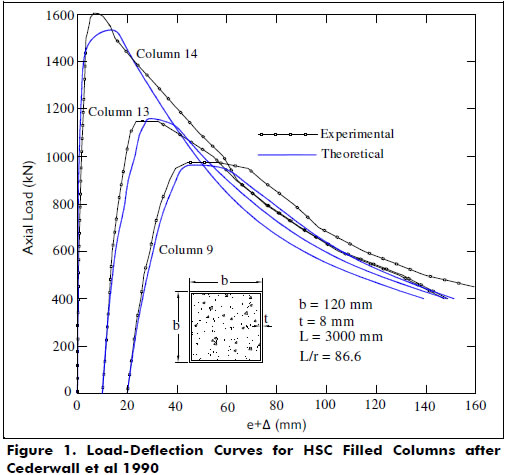
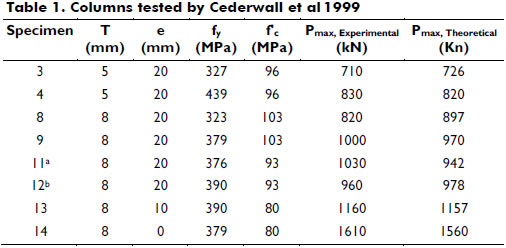
<body><![CDATA[<p>  An analytical method that  calculates both the short- and long-term response of slender columns made of  high-strength concrete (HSC) and of tubes filled with concrete with generalized  end conditions that are subjected to transverse loads along the span and to  axial loads at the ends (causing single- or double-curvature under uniaxial or  biaxial bending) is presented in a companion paper published by the authors in  2014.    <br>   The main objective of this paper is to verify the iterative analytical  procedure and corresponding equations that were presented in the companion  paper. The proposed model, which is capable of predicting not only the complete  load-rotation and load-deflection curves (both the ascending and descending  parts) but also the maximum load capacity of slender concrete columns, is  verified against test results of over seventy specimens of columns reported by  several researchers in the technical literature. The columns analyzed include  solid and hollow (rectangular, circular, oval, C-, T-, L-, or any arbitrary  shape) cross sections and columns made of circular or rectangular steel tubes  filled with HSC.</p>     <p><font size="3"><b>Verification of Proposed Model</b></font></p>     <p>  It is assumed that: 1) f<sub>c</sub>" = f<sub>c</sub>' for all test specimens. This is particularly  valid for tubular columns subjected to axial load with large eccentricities in  which the effects of the confinement of the concrete provided by the steel tube  are relatively low; and 2) for circular tubular columns, the concrete core is  approximated by a polygon with 16 sides, and the cross-sectional area of the  tube is estimated as a total of 20 rebars uniformly distributed around the  perimeter of the circle.</p>     <p><b>Columns after Cederwall et al. 1990-. </b>A series of 22 columns made of  4.72 in. (120-mm) square, steel tubes filled with concrete and with a height of  118.11 in. (3 m) were tested under short-term loads. Column specimens made of  concrete with a strength greater than or equal to 11,603 psi (80 MPa) were  selected from this series to study their behavior using the proposed method.  These eight specimens were subjected to end loads applied simultaneously to the  steel tube and to the concrete core causing a single-curvature up to failure.  <a href="#t1">Table 1</a> lists the thicknesses of the steel tubes, the applied end  eccentricities, the yield strength of the steel tube, the compressive strength  of the concrete, and the maximum experimental and theoretical axial load.</p>     <p>    <center><a name="t1"></a><img src="/img/revistas/iei/v34n3/v34n3a04t1.jpg"></center></p>     <p>  Excellent agreement between the calculated and the experimental  maximum values of the axial load are shown when comparing the last two columns of <a href="#t1">Table 1</a>. <a href="#f1">Figure 1</a> also shows excellent agreement  between the calculated and the experimental curves (loading and unloading  load-deflection responses). It is important to note that the effects of the confinement  of the concrete provided by the square steel tubes in the experimental results  of all specimens subjected to an axial load with low eccentricity are rather  insignificant.</p>     <p>    <center><a name="f1"></a><img src="/img/revistas/iei/v34n3/v34n3a04f1.jpg"></center></p>     ]]></body>
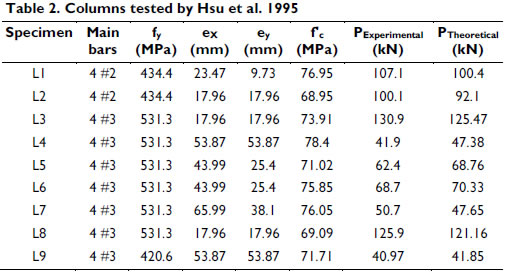
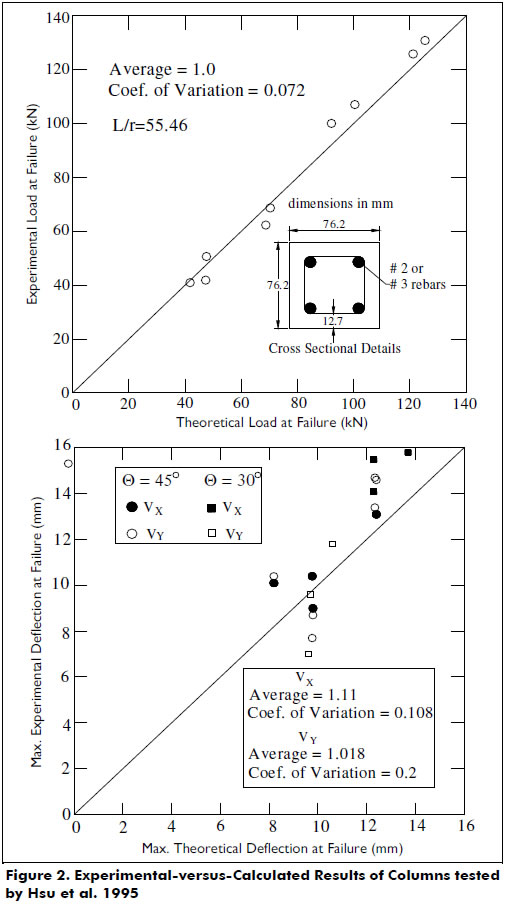
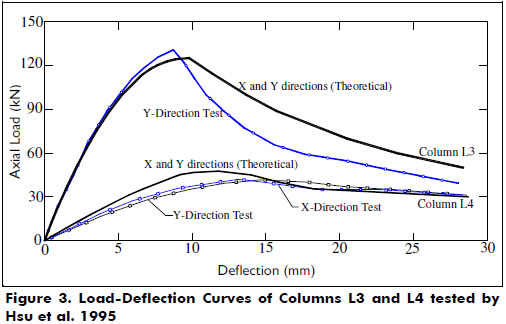
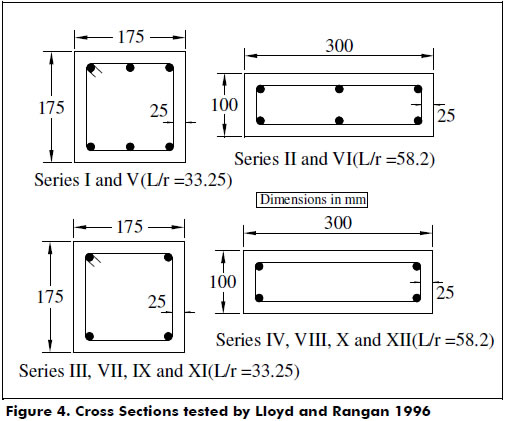
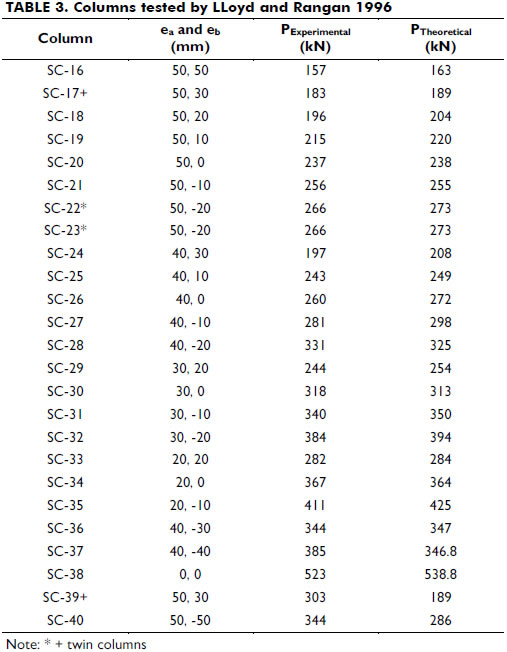
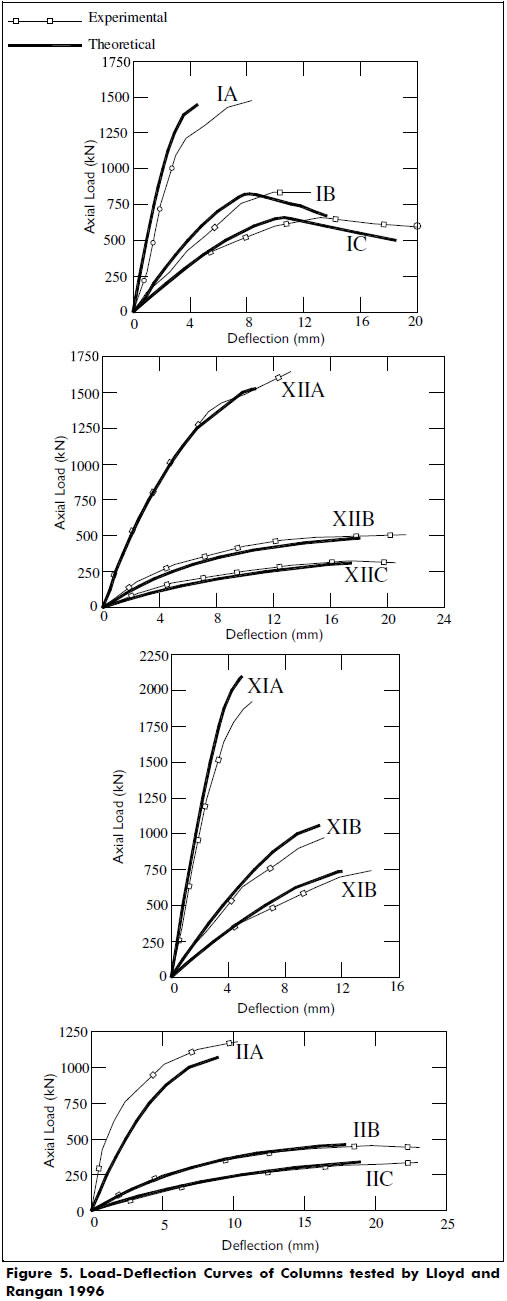
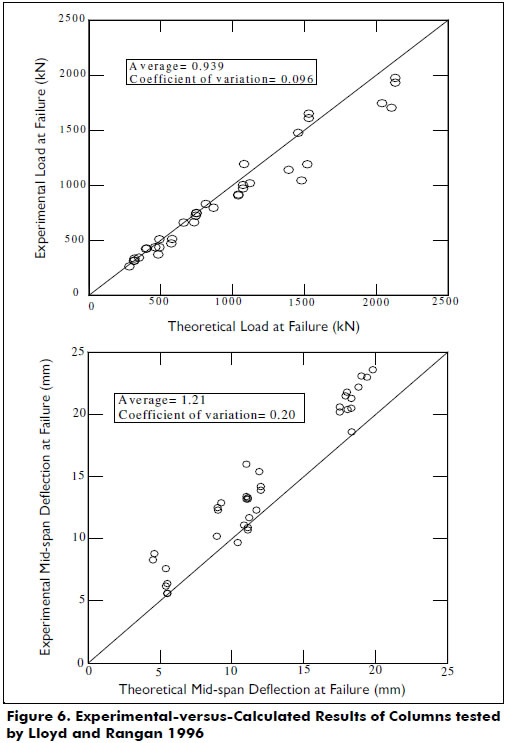
<body><![CDATA[<p><b>Columns tested  by Hsu et al 1995-. </b>A series of 9  columns identified as L-columns made of high-strength concrete were tested  under a short-term axial load and biaxial bending. The effects of concrete  strength, axial load eccentricity, steel ratio and ratio eccentricities (&Theta; = Tan<sup>-1</sup>(e<sub>y</sub>/e<sub>x</sub>))  were studied. All column specimens had a span length of 48 in. (1.22 m). <a href="#t2">Table  2</a> presents the properties of all L-columns and their corresponding experimental  and calculated axial load at failure.</p>     <p>    <center><a name="t2"></a><img src="/img/revistas/iei/v34n3/v34n3a04t2.jpg"></center></p>     <p>  The proposed model predicts with good accuracy both the axial load  and the maximum lateral deflection at failure, as well as the load-deflection  response as shown by Figures <a href="#f2">2</a> and <a href="#f3">3</a>. <a href="#f3">Figure 3</a> shows good agreement between the  calculated and experimental curves (for both loading and unloading) for the  load-deflection responses of specimens L3 and L4.</p>     <p>    <center><a name="f2"></a><img src="/img/revistas/iei/v34n3/v34n3a04f2.jpg"></center></p>     <p>    <center><a name="f3"></a><img src="/img/revistas/iei/v34n3/v34n3a04f3.jpg"></center></p>     <p><b>Columns tested by Lloyd  and Rangan 1996-. </b>A series of 36 columns with an  effective height of 66.14 in. (1.68 m) were subjected to short-term axial load  up to failure at the University of Curtin, Australia. The columns were simply  supported and subjected to an eccentric axial load P causing equal moments (Pe)  at both ends. The properties of the materials are as follows:    <br> <i>Concrete:</i> Series I-IV: 8,410 psi (58 MPa); Series V-VIII: 13,340 psi (92  MPa); Series IX-XIII: 14,065 psi (97 MPa).</p>     ]]></body>
<body><![CDATA[<p><i>Reinforcements</i>: The longitudinal reinforcement consisted of 12-mm steel rebars  with a yield strength f<sub>y</sub> = 62 ksi (430 MPa). The transverse  reinforcementconsisted of closed steel  stirrups that were 4 mm in diameter with a yield strength f<sub>y</sub> = 65  ksi (450 MPa).</p>     <p>  Details of the cross-sectional properties of the columns are shown  in <a href="#f4">Figure 4</a>. End eccentricities, experimental and theoretical axial load and  mid-span deflection at failure are all listed in <a href="#t3">Table 3</a>. <a href="#f5">Figure 5</a> shows the  full load-deflection responses. <a href="#f6">Figure 6</a> shows the correlations of the ratios  between the experimental and the theoretical values for both the axial load and  the mid-span deflection. Good agreements between the calculated and  experimental results were obtained.</p>     <p>    <center><a name="f4"></a><img src="/img/revistas/iei/v34n3/v34n3a04f4.jpg"></center></p>     <p>    <center><a name="t3"></a><img src="/img/revistas/iei/v34n3/v34n3a04t3.jpg"></center></p>     <p>    <center><a name="f5"></a><img src="/img/revistas/iei/v34n3/v34n3a04f5.jpg"></center></p>     <p>    <center><a name="f6"></a><img src="/img/revistas/iei/v34n3/v34n3a04f6.jpg"></center></p>     ]]></body>
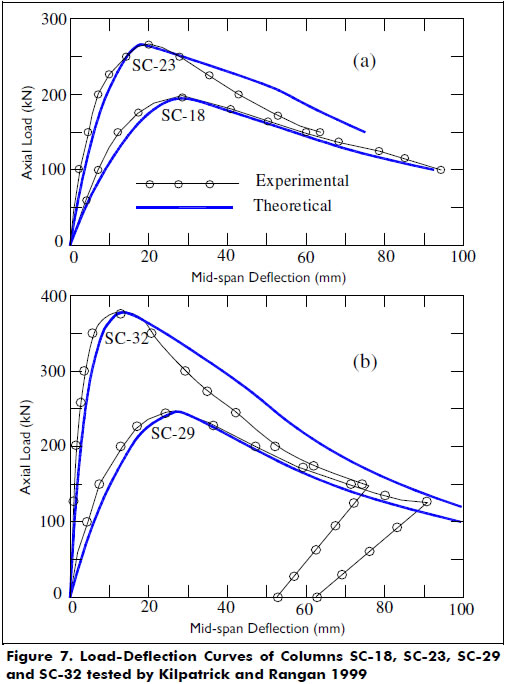
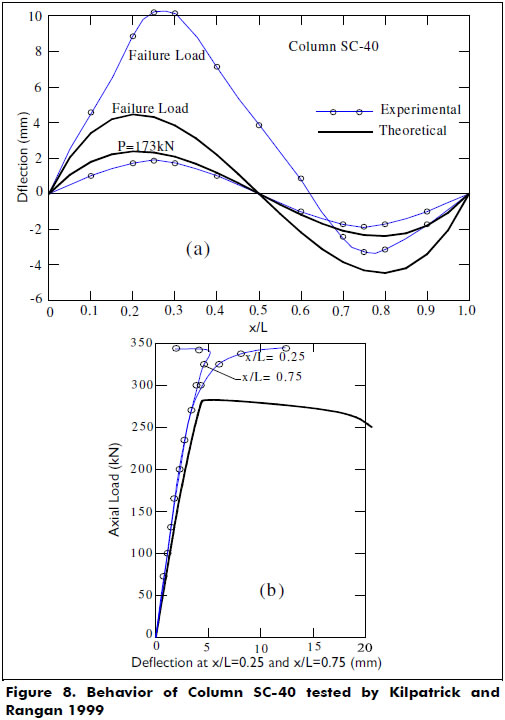
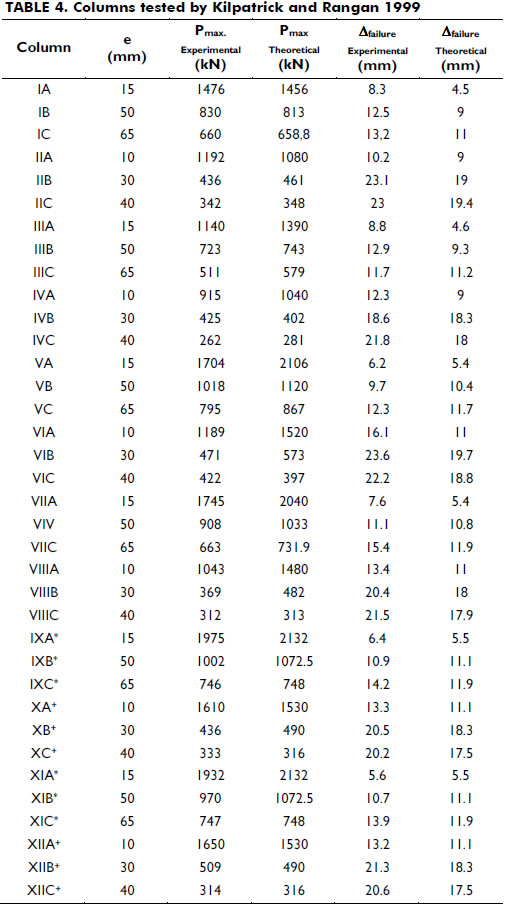
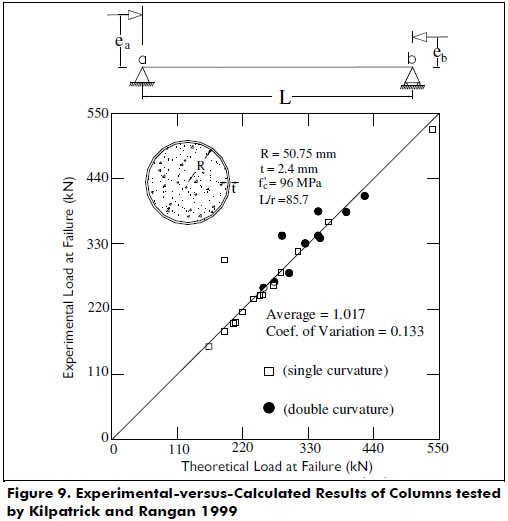
<body><![CDATA[<p><b>Columns tested by Kilpatrick and Rangan 1999-. </b>Forty-one circular tubular steel columns filled with concrete were  tested under short-term loads. Eleven test specimens were subjected to double  curvature, the rest (thirty specimens) to single-curvature. The test specimens  were made of 0.094 in. (2.4 mm) thick steel tubes of 4.05 in.  (0.1015 m) in diameter and 85.63 in. (2.175  m) in length.<b> </b>The average concrete strength was f<sub>c</sub>'= 13,923 psi (96 MPa). The properties of the steel  tube were: yield stress f<sub>y</sub> = 59.465 ksi (410 MPa), ultimate strength  f<sub>u</sub> = 68.893 ksi (475 MPa), and modulus of elasticity E<sub>s</sub> =  29,733 ksi (205,000 MPa). </p>     <p>  In the theoretical analyses, the concrete core was  approximated by a regular polygon with 16 sides, and the steel tube was assumed  to be equivalent to 20 rebars around the concrete core. The test results from  25 specimens out of the 41 circular tubular steel columns were used in this  study. <a href="#f7">Figure 7</a> shows correlations between the calculated results and the experimental  load-deflection responses for several specimens. <a href="#f8">Figures 8(a)-(b)</a> show the  phenomenon that was observed by other researchers in the columns subjected  initially to double-curvature (or axial compressive load with opposite  eccentricities at the ends) of an instability or abrupt change in the deflected  shape to a more stable single-curvature shape. The anti-symmetric deformed  shape (double-curvature) of the column is maintained only up to a certain value  of the applied eccentric axial load. However, the proposed model does not  capture the phenomenon of instability in the deflected shape, because it  assumes a perfectly anti-symmetric moment diagram and consequently a  double-curvature deformed shape at all load levels. To capture this phenomenon,  the numerical process must be capable of predicting any change in the deflected  shape of the column (i.e., it must be controlled by deflection rather than by  load).</p>     <p><a href="#t4">Table 4</a> shows the applied end  eccentricities ea and eb, and the experimental and  theoretical axial load values at failure, and <a href="#f9">Figure 9</a> shows the correlation  between these axial load values.</p>     <p>    <center><a name="f7"></a><img src="/img/revistas/iei/v34n3/v34n3a04f7.jpg"></center></p>     <p>    <center><a name="f8"></a><img src="/img/revistas/iei/v34n3/v34n3a04f8.jpg"></center></p>     <p>    <center><a name="t4"></a><img src="/img/revistas/iei/v34n3/v34n3a04t4.jpg"></center></p>     <p>    ]]></body>
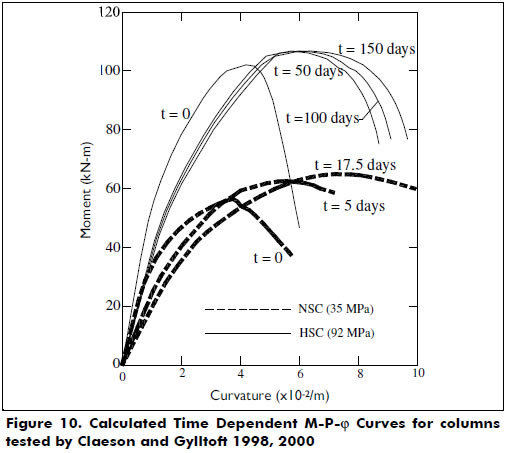
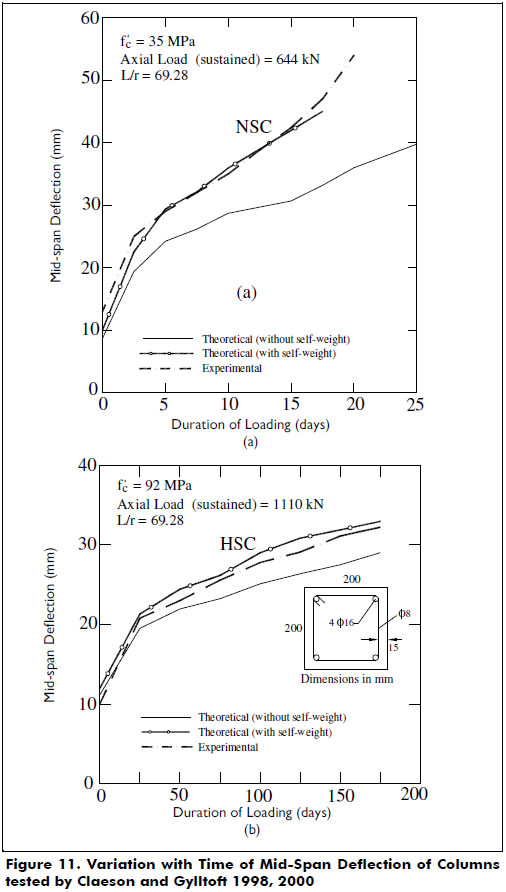
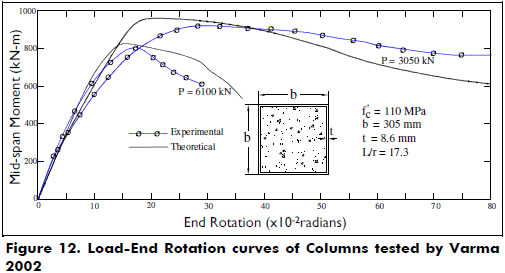
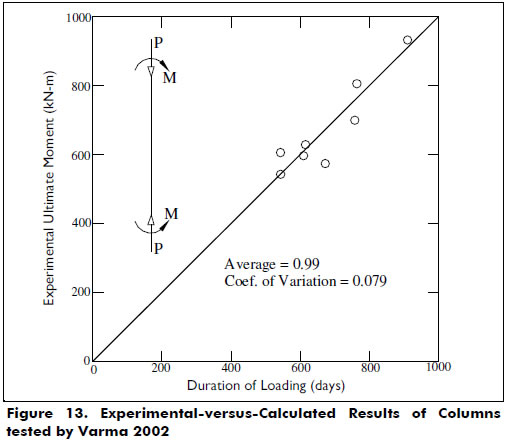
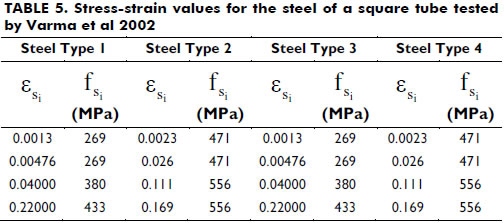
<body><![CDATA[<center><a name="f9"></a><img src="/img/revistas/iei/v34n3/v34n3a04f9.jpg"></center></p>     <p><b>Columns tested by Claeson and  Gylltoft 1998, 2000-. </b>Slender columns made of HSC and normal strength concrete (NSC) subjected to  long-term loadings (i.e., sustained loads) were tested. All column specimens  had a span length of 4 m. To take into account the long-term effects of creep  and shrinkage in the concrete, the creep coefficient proposed by Han &#91;6&#93;, &chi; = 1 and the expression: &epsilon;<sub>sh</sub>(t) = 0.004t/(t + 35) (ACI 209  Committee) for shrinkage strain in the concrete were utilized in the proposed  method. Because all columns were tested horizontally, the analysis also  included the transverse deflections caused by the weight of the columns. <a href="#f10">Figure  10</a> shows the calculated (theoretical) M-P-&phi; curves used in the analysis. <a href="#f11">Figure 11</a> shows good agreement between the  calculated and experimental curves.</p>     <p>    <center><a name="f10"></a><img src="/img/revistas/iei/v34n3/v34n3a04f10.jpg"></center></p>     <p>    <center><a name="f11"></a><img src="/img/revistas/iei/v34n3/v34n3a04f11.jpg"></center></p>     <p><b>Columns tested by Varma et  al 2002-. </b>A  series of columns made of square 305-mm steel tubes of 8.9 and 5.8 mm in thickness  filled with high strength concrete f<sub>c</sub>' = 15,954 psi (110 MPa) and with a height of 59.84 in.  (1.52 m) were tested. The column specimens were made of four types of steel, as  indicated in <a href="#t5">Table 5</a>. All column specimens were tested under short-term loads  with an increasing bending moment up to failure and at a constant axial load P.  <a href="#f12">Figure 12</a> shows the predicted end rotations at various axial load levels. To obtain the rotation along the descending part of the end  moment-rotation curve for a given value of P, the ascending value of the  rotation was multiplied by L/&pi;. <a href="#f13">Figure 13</a> shows good agreement between the experimental and the theoretical values of the moments at failure. </p>     <p>    <center><a name="t5"></a><img src="/img/revistas/iei/v34n3/v34n3a04t5.jpg"></center></p>     <p>    ]]></body>
<body><![CDATA[<center><a name="f12"></a><img src="/img/revistas/iei/v34n3/v34n3a04f12.jpg"></center></p>     <p>    <center><a name="f13"></a><img src="/img/revistas/iei/v34n3/v34n3a04f13.jpg"></center></p>     <p><font size="3"><b>Conclusions</b></font></p>     <p>  The  validity of the proposed method and numerical algorithm was tested against  experimental results reported by different researchers of over seventy column  specimens. The proposed method can be used to analyze any prismatic slender  beam-column, including those made of a solid or hollow (rectangular, circular,  oval, C-, T-, L-, or any arbitrary shape) cross section and of beam-columns  made of circular and rectangular steel tubes filled with HSC.<b></b></p>     <p><font size="3"><b>Acknowledgements</b></font></p>     <p>  This paper is based on research  sponsored by DIME and the Civil Engineering School of the National University  of Colombia at Medell&iacute;n. The authors appreciate their support.</p> <hr>     <p><font size="3"><b>References</b></font> </p>     <!-- ref --><p>Cederwall, K., Engstrom, B., &amp; Grauers, M. (1990).  High-Strength Concrete used in composite columns. <i>ACI</i>, (SP-121), 195-214.    &nbsp;&nbsp;&nbsp;&nbsp;&nbsp;&nbsp;&nbsp;&nbsp;[&#160;<a href="javascript:void(0);" onclick="javascript: window.open('/scielo.php?script=sci_nlinks&ref=000081&pid=S0120-5609201400030000400001&lng=','','width=640,height=500,resizable=yes,scrollbars=1,menubar=yes,');">Links</a>&#160;]<!-- end-ref --></p>     ]]></body>
<body><![CDATA[<!-- ref --><p>  Claeson, C., &amp; Gylltoft, K. (2000). Slender  Concrete Column Subjected to Sustained and Short-Term Eccentric Loading. <i>ACI structural J.</i>, <i>97</i>(1), 45-52.    &nbsp;&nbsp;&nbsp;&nbsp;&nbsp;&nbsp;&nbsp;&nbsp;[&#160;<a href="javascript:void(0);" onclick="javascript: window.open('/scielo.php?script=sci_nlinks&ref=000083&pid=S0120-5609201400030000400002&lng=','','width=640,height=500,resizable=yes,scrollbars=1,menubar=yes,');">Links</a>&#160;]<!-- end-ref --></p>     <!-- ref --><p>  Hsu, C-T. T., Hsu, L. S. M., &amp; Tsao, W-H. (1995). Biaxially  Loaded Slender High-Strength Reinforced Concrete with and without Steel Fibres. <i>Magazine of concrete Research</i>, <i>47</i>(173), 299-310.    &nbsp;&nbsp;&nbsp;&nbsp;&nbsp;&nbsp;&nbsp;&nbsp;[&#160;<a href="javascript:void(0);" onclick="javascript: window.open('/scielo.php?script=sci_nlinks&ref=000085&pid=S0120-5609201400030000400003&lng=','','width=640,height=500,resizable=yes,scrollbars=1,menubar=yes,');">Links</a>&#160;]<!-- end-ref --></p>     <!-- ref --><p>  Kilpatrick, A. E., &amp; Rangan, B. V. (1999). Test on  High-Strength Concrete-Filled Steel Tubular Columns. <i>ACI structural J.</i>, <i>96</i>(2),  268-274.    &nbsp;&nbsp;&nbsp;&nbsp;&nbsp;&nbsp;&nbsp;&nbsp;[&#160;<a href="javascript:void(0);" onclick="javascript: window.open('/scielo.php?script=sci_nlinks&ref=000087&pid=S0120-5609201400030000400004&lng=','','width=640,height=500,resizable=yes,scrollbars=1,menubar=yes,');">Links</a>&#160;]<!-- end-ref --></p>     <!-- ref --><p>  Lloyd, N. A., &amp; Rangan, B. V. (1996). Studies on  High Strength Concrete Columns under Eccentric Compression. <i>ACI Structural J.</i>, <i>93</i>(6), 631-638.    &nbsp;&nbsp;&nbsp;&nbsp;&nbsp;&nbsp;&nbsp;&nbsp;[&#160;<a href="javascript:void(0);" onclick="javascript: window.open('/scielo.php?script=sci_nlinks&ref=000089&pid=S0120-5609201400030000400005&lng=','','width=640,height=500,resizable=yes,scrollbars=1,menubar=yes,');">Links</a>&#160;]<!-- end-ref --></p>     <!-- ref --><p>  Rodriguez-Gutierrez, J. A., &amp; Aristizabal-Ochoa, J. D. (2014). Biaxial bending of slender HSC columns and tubes  filled with concrete <i>under short and long  term loads: I) Theory. Ingenier&iacute;a e Investigaci&oacute;n</i>, <i>34</i>(2), 23-28.    &nbsp;&nbsp;&nbsp;&nbsp;&nbsp;&nbsp;&nbsp;&nbsp;[&#160;<a href="javascript:void(0);" onclick="javascript: window.open('/scielo.php?script=sci_nlinks&ref=000091&pid=S0120-5609201400030000400006&lng=','','width=640,height=500,resizable=yes,scrollbars=1,menubar=yes,');">Links</a>&#160;]<!-- end-ref --></p>     ]]></body>
<body><![CDATA[<!-- ref --><p>  Varma, A. H., Ricles, J. M., Sause, R., &amp; Lu, L.  (2002).  Experimental Behavior of High  Strength Square Concrete-Filled Steel Tube Beam-Columns. <i>J. Struct. Engrg.</i>, <i>128</i>(3),  309-318.    &nbsp;&nbsp;&nbsp;&nbsp;&nbsp;&nbsp;&nbsp;&nbsp;[&#160;<a href="javascript:void(0);" onclick="javascript: window.open('/scielo.php?script=sci_nlinks&ref=000093&pid=S0120-5609201400030000400007&lng=','','width=640,height=500,resizable=yes,scrollbars=1,menubar=yes,');">Links</a>&#160;]<!-- end-ref --> </p> </font>      ]]></body><back>
<ref-list>
<ref id="B1">
<nlm-citation citation-type="journal">
<person-group person-group-type="author">
<name>
<surname><![CDATA[Cederwall]]></surname>
<given-names><![CDATA[K]]></given-names>
</name>
<name>
<surname><![CDATA[Engstrom]]></surname>
<given-names><![CDATA[B]]></given-names>
</name>
<name>
<surname><![CDATA[Grauers]]></surname>
<given-names><![CDATA[M]]></given-names>
</name>
</person-group>
<article-title xml:lang="en"><![CDATA[High-Strength Concrete used in composite columns]]></article-title>
<source><![CDATA[ACI]]></source>
<year>1990</year>
<numero>SP-121</numero>
<issue>SP-121</issue>
<page-range>195-214</page-range></nlm-citation>
</ref>
<ref id="B2">
<nlm-citation citation-type="journal">
<person-group person-group-type="author">
<name>
<surname><![CDATA[Claeson]]></surname>
<given-names><![CDATA[C]]></given-names>
</name>
<name>
<surname><![CDATA[Gylltoft]]></surname>
<given-names><![CDATA[K]]></given-names>
</name>
</person-group>
<article-title xml:lang="en"><![CDATA[Slender Concrete Column Subjected to Sustained and Short-Term Eccentric Loading]]></article-title>
<source><![CDATA[ACI structural J.]]></source>
<year>2000</year>
<volume>97</volume>
<numero>1</numero>
<issue>1</issue>
<page-range>45-52</page-range></nlm-citation>
</ref>
<ref id="B3">
<nlm-citation citation-type="journal">
<person-group person-group-type="author">
<name>
<surname><![CDATA[Hsu]]></surname>
<given-names><![CDATA[C-T. T]]></given-names>
</name>
<name>
<surname><![CDATA[Hsu]]></surname>
<given-names><![CDATA[L. S. M]]></given-names>
</name>
<name>
<surname><![CDATA[Tsao]]></surname>
<given-names><![CDATA[W-H]]></given-names>
</name>
</person-group>
<article-title xml:lang="en"><![CDATA[Biaxially Loaded Slender High-Strength Reinforced Concrete with and without Steel Fibres]]></article-title>
<source><![CDATA[Magazine of concrete Research]]></source>
<year>1995</year>
<volume>47</volume>
<numero>173</numero>
<issue>173</issue>
<page-range>299-310</page-range></nlm-citation>
</ref>
<ref id="B4">
<nlm-citation citation-type="journal">
<person-group person-group-type="author">
<name>
<surname><![CDATA[Kilpatrick]]></surname>
<given-names><![CDATA[A. E]]></given-names>
</name>
<name>
<surname><![CDATA[Rangan]]></surname>
<given-names><![CDATA[B. V]]></given-names>
</name>
</person-group>
<article-title xml:lang="en"><![CDATA[Test on High-Strength Concrete-Filled Steel Tubular Columns]]></article-title>
<source><![CDATA[ACI structural J.]]></source>
<year>1999</year>
<volume>96</volume>
<numero>2</numero>
<issue>2</issue>
<page-range>268-274</page-range></nlm-citation>
</ref>
<ref id="B5">
<nlm-citation citation-type="journal">
<person-group person-group-type="author">
<name>
<surname><![CDATA[Lloyd]]></surname>
<given-names><![CDATA[N. A]]></given-names>
</name>
<name>
<surname><![CDATA[Rangan]]></surname>
<given-names><![CDATA[B. V]]></given-names>
</name>
</person-group>
<article-title xml:lang="en"><![CDATA[Studies on High Strength Concrete Columns under Eccentric Compression]]></article-title>
<source><![CDATA[ACI Structural J.]]></source>
<year>1996</year>
<volume>93</volume>
<numero>6</numero>
<issue>6</issue>
<page-range>631-638</page-range></nlm-citation>
</ref>
<ref id="B6">
<nlm-citation citation-type="journal">
<person-group person-group-type="author">
<name>
<surname><![CDATA[Rodriguez-Gutierrez]]></surname>
<given-names><![CDATA[J. A]]></given-names>
</name>
<name>
<surname><![CDATA[Aristizabal-Ochoa]]></surname>
<given-names><![CDATA[J. D]]></given-names>
</name>
</person-group>
<article-title xml:lang="en"><![CDATA[Biaxial bending of slender HSC columns and tubes filled with concrete under short and long term loads: I) Theory]]></article-title>
<source><![CDATA[Ingeniería e Investigación]]></source>
<year>2014</year>
<volume>34</volume>
<numero>2</numero>
<issue>2</issue>
<page-range>23-28</page-range></nlm-citation>
</ref>
<ref id="B7">
<nlm-citation citation-type="journal">
<person-group person-group-type="author">
<name>
<surname><![CDATA[Varma]]></surname>
<given-names><![CDATA[A. H]]></given-names>
</name>
<name>
<surname><![CDATA[Ricles]]></surname>
<given-names><![CDATA[J. M]]></given-names>
</name>
<name>
<surname><![CDATA[Sause]]></surname>
<given-names><![CDATA[R]]></given-names>
</name>
<name>
<surname><![CDATA[Lu]]></surname>
<given-names><![CDATA[L]]></given-names>
</name>
</person-group>
<article-title xml:lang="en"><![CDATA[Experimental Behavior of High Strength Square Concrete-Filled Steel Tube Beam-Columns]]></article-title>
<source><![CDATA[J. Struct. Engrg.]]></source>
<year>2002</year>
<volume>128</volume>
<numero>3</numero>
<issue>3</issue>
<page-range>309-318</page-range></nlm-citation>
</ref>
</ref-list>
</back>
</article>