<?xml version="1.0" encoding="ISO-8859-1"?><article xmlns:mml="http://www.w3.org/1998/Math/MathML" xmlns:xlink="http://www.w3.org/1999/xlink" xmlns:xsi="http://www.w3.org/2001/XMLSchema-instance">
<front>
<journal-meta>
<journal-id>0120-5609</journal-id>
<journal-title><![CDATA[Ingeniería e Investigación]]></journal-title>
<abbrev-journal-title><![CDATA[Ing. Investig.]]></abbrev-journal-title>
<issn>0120-5609</issn>
<publisher>
<publisher-name><![CDATA[Facultad de Ingeniería, Universidad Nacional de Colombia.]]></publisher-name>
</publisher>
</journal-meta>
<article-meta>
<article-id>S0120-56092014000300008</article-id>
<article-id pub-id-type="doi">10.15446/ing.investig.v34n3.43002</article-id>
<title-group>
<article-title xml:lang="en"><![CDATA[Evaluation of indices for voltage stability monitoring using PMU measurements]]></article-title>
<article-title xml:lang="es"><![CDATA[Evaluación de índices para el monitoreo de la estabilidad de tensión, usando mediciones PMU]]></article-title>
</title-group>
<contrib-group>
<contrib contrib-type="author">
<name>
<surname><![CDATA[Ramírez-Perodomo]]></surname>
<given-names><![CDATA[L]]></given-names>
</name>
<xref ref-type="aff" rid="A01"/>
</contrib>
<contrib contrib-type="author">
<name>
<surname><![CDATA[Lozano]]></surname>
<given-names><![CDATA[A]]></given-names>
</name>
<xref ref-type="aff" rid="A02"/>
</contrib>
</contrib-group>
<aff id="A01">
<institution><![CDATA[,Universidad del Valle  ]]></institution>
<addr-line><![CDATA[ ]]></addr-line>
<country>Colombia</country>
</aff>
<aff id="A02">
<institution><![CDATA[,Universidad del Valle  ]]></institution>
<addr-line><![CDATA[ ]]></addr-line>
<country>Colombia</country>
</aff>
<pub-date pub-type="pub">
<day>01</day>
<month>12</month>
<year>2014</year>
</pub-date>
<pub-date pub-type="epub">
<day>01</day>
<month>12</month>
<year>2014</year>
</pub-date>
<volume>34</volume>
<numero>3</numero>
<fpage>44</fpage>
<lpage>49</lpage>
<copyright-statement/>
<copyright-year/>
<self-uri xlink:href="http://www.scielo.org.co/scielo.php?script=sci_arttext&amp;pid=S0120-56092014000300008&amp;lng=en&amp;nrm=iso"></self-uri><self-uri xlink:href="http://www.scielo.org.co/scielo.php?script=sci_abstract&amp;pid=S0120-56092014000300008&amp;lng=en&amp;nrm=iso"></self-uri><self-uri xlink:href="http://www.scielo.org.co/scielo.php?script=sci_pdf&amp;pid=S0120-56092014000300008&amp;lng=en&amp;nrm=iso"></self-uri><abstract abstract-type="short" xml:lang="en"><p><![CDATA[Large disturbances such as voltage collapse and its consequences represent a large challenge to the operational safety of power systems. Therefore, it is important to have indicators of the presence of voltage stability problems in real time. Using phasor measurements of voltage and current that are presented in Phasor Measurement Units (PMU), indices for voltage stability monitoring can be calculated in real time. This paper presents some indices for voltage stability monitoring using PMU measurements. Evaluation of such indices on a simplified system was carried out, and the indices were classified according to their method of calculation. Finally, one of these indices was used with the New England 39-bus system under different operating scenarios, including load increments, line output and generator output, to check the indices' behavior for voltage stability monitoring based on synchronized local measurements.]]></p></abstract>
<abstract abstract-type="short" xml:lang="es"><p><![CDATA[Las grandes perturbaciones, tales como: el colapso de tensión y sus consecuencias, representan un gran desafío para la seguridad operativa de los sistemas de potencia. Por lo tanto, es importante contar con indicadores para alertar la presencia de problemas de estabilidad de tensión, en tiempo real. A partir de mediciones fasoriales de voltaje y corriente proporcionadas por las unidades de medición fasorial -PMU, se pueden calcular los índices para el monitoreo de la estabilidad de tensión en tiempo real. Así, este articulo presenta algunos índices para el monitoreo de dicha estabilidad, utilizando mediciones PMU. Se realizó la evaluación de los índices en un sistema simplificado y se clasificaron de acuerdo a su método de cálculo. Finalmente, uno de estos índices fue utilizado con el sistema New England 39-nodos, bajo diferentes escenarios de operación, incluyendo incrementos de carga, salida de línea y salida de generador, para comprobar de esta manera, el comportamiento de los índices de monitoreo de estabilidad de tensión basado en mediciones locales sincronizadas.]]></p></abstract>
<kwd-group>
<kwd lng="en"><![CDATA[Contingency]]></kwd>
<kwd lng="en"><![CDATA[Phasor measurement unit (PMU)]]></kwd>
<kwd lng="en"><![CDATA[voltage stability]]></kwd>
<kwd lng="en"><![CDATA[wide area measurement system (WAMS)]]></kwd>
<kwd lng="en"><![CDATA[power system]]></kwd>
<kwd lng="es"><![CDATA[Contingencia]]></kwd>
<kwd lng="es"><![CDATA[Unidad de Medición Fasorial (PMU)]]></kwd>
<kwd lng="es"><![CDATA[estabilidad de tensión]]></kwd>
<kwd lng="es"><![CDATA[sistemas de medición de área amplia (WAMS)]]></kwd>
<kwd lng="es"><![CDATA[sistema de potencia]]></kwd>
</kwd-group>
</article-meta>
</front><body><![CDATA[  <font size="2" face="verdana">     <p>DOI: <a href="http://dx.doi.org/10.15446/ing.investig.v34n3.43002" target="_blank">http://dx.doi.org/10.15446/ing.investig.v34n3.43002</a></p>     <p>    <center> <font size="4"><b>Evaluation  of indices for voltage stability monitoring using PMU measurements</b></font> </center></p>     <p>    <center> <font size="3"><b>Evaluaci&oacute;n de  &iacute;ndices para el monitoreo de la estabilidad de tensi&oacute;n, usando mediciones PMU</b></font> </center></p>     <p>L. Ram&iacute;rez-Perodomo<sup>1</sup> and A. Lozano<sup>2</sup></p>     <p><sup>1</sup>Sindy Lorena Ram&iacute;rez Perdomo. M. Sc. Ingenier&iacute;a El&eacute;ctrica, Universidad  del Valle, Colombia. Affiliation: Universidad del Valle, Colombia.  E-mail:  <a href="mailto:sindy.lorena.ramirez@correounivalle.edu.co">sindy.lorena.ramirez@correounivalle.edu.co</a></p>     <p> <sup>2</sup>Carlos Arturo Lozano Moncada. PhD., Universidad de Strathclyde, Reino  Unido. Affiliation: Universidad del Valle, Colombia. E-mail:  <a href="mailto:carlos.a.lozano@correounivalle.edu.co">carlos.a.lozano@correounivalle.edu.co</a></p> <hr>     <p><b>How    to cite: </b>Ram&iacute;rez-Perdomo, S. L., &amp; Lozano, C. A. (2014).    Evaluation of indices for voltage stability monitoring using PMU    measurements. <i>Ingenier&iacute;a e    Investigaci&oacute;n</i>, <i>34</i>(3), 44-49.</p> <hr>     ]]></body>
<body><![CDATA[<p><b>ABSTRACT</b></p>     <p>  Large disturbances such as  voltage collapse and its consequences represent a large challenge to the  operational safety of power systems. Therefore, it is important to have  indicators of the presence of voltage stability problems in real time. Using  phasor measurements of voltage and current that are presented in Phasor  Measurement Units (PMU), indices for voltage stability monitoring can be  calculated in real time. This paper presents some indices for voltage stability  monitoring using PMU measurements. Evaluation of such indices on a simplified  system was carried out, and the indices were classified according to their  method of calculation. Finally, one of these indices was used with the New  England 39-bus system under different operating scenarios, including load  increments, line output and generator output, to check the indices' behavior  for voltage stability monitoring based on synchronized local measurements.</p>     <p>  <b>Keywords:</b> Contingency, Phasor measurement unit (PMU), voltage  stability, wide area measurement system (WAMS), power system. </p> <hr>     <p>  <b>RESUMEN</b></p>     <p>  Las grandes perturbaciones, tales como: el colapso  de tensi&oacute;n y sus consecuencias, representan un gran desaf&iacute;o para la seguridad  operativa de los sistemas de potencia. Por lo tanto, es importante contar con  indicadores para alertar la presencia de problemas de estabilidad de tensi&oacute;n,  en tiempo real. A partir de mediciones fasoriales de voltaje y corriente  proporcionadas por las unidades de medici&oacute;n fasorial -PMU, se pueden calcular  los &iacute;ndices para el monitoreo de la estabilidad de tensi&oacute;n en tiempo real. As&iacute;,  este articulo presenta algunos &iacute;ndices para el monitoreo de dicha estabilidad,  utilizando mediciones PMU. </p>     <p>  Se realiz&oacute; la evaluaci&oacute;n de los &iacute;ndices en un  sistema simplificado y se clasificaron de acuerdo a su m&eacute;todo de c&aacute;lculo.  Finalmente, uno de estos &iacute;ndices fue utilizado con el sistema New England  39-nodos, bajo diferentes escenarios de operaci&oacute;n, incluyendo incrementos de  carga, salida de l&iacute;nea y salida de generador, para comprobar de esta manera, el  comportamiento de los &iacute;ndices de monitoreo de estabilidad de tensi&oacute;n basado en  mediciones locales sincronizadas.</p>     <p>  <b>Palabras clave:</b> Contingencia, Unidad de Medici&oacute;n Fasorial (PMU),  estabilidad de tensi&oacute;n, sistemas de medici&oacute;n de &aacute;rea amplia (WAMS) y sistema de  potencia.</p> <hr>     <p><b>Received:</b> April 9th 2014 <b>Accepted:</b> July 21st 2014</p> <hr>     <p><font size="3"><b>Introduction</b></font></p>     <p>  A system goes into a state  of voltage instability when there is a large disturbance or a change in demand  or operating conditions, which causes a progressive and uncontrollable voltage  drop. The large disturbances in power systems, such as a voltage collapse and  its consequences, represent a challenge for the industry. For the latter, the  implementation of monitoring technologies and distributed control such as PMU  and WAMS are being carried out, which have become available in recent times (Lim; &amp; DeMarco, 2013). </p>     ]]></body>
<body><![CDATA[<p>  Some indices based on actual data collection have emerged to monitor  voltage stability, which allow defining operating states, critical  network areas, limits and voltage stability  margins.  These     <br>   indices are used to detect and predict on-line voltage instability.  They do not use simulations as the voltage security-oriented methods do;  instead, they are based only on the measurements taken from the power system  itself.</p>     <p>  This paper presents a comparison and evaluation of several  voltage-stability monitoring indices using PMU measurements in a simplified  2-Bus system. One of these indices was tested in the New England 39-bus system  for evaluation under different operating scenarios and to check its behavior  for voltage stability monitoring based on synchronized local measures. The  purpose of the article was to review, analyze and evaluate the indices present  in the literature for voltage stability monitoring based on PMU measurements.</p>     <p>  <font size="3"><b>Indices for monitoring voltage stability</b></font></p>     <p>  Many indicators have proven to be useful tools for the system  operators, who must make decisions about the operating states of the network (Liu &amp; Chu, 2013). However, acquiring such data measurements, which is necessary to  calculate the indices, involves delays related to the differences in times at  which each measurement was taken. This limits the speed of reaction in case of  contingencies and affects the results' reliability for corrective actions to  avoid the system outage. Synchrophasors overcome the difficulty faced with time  delays in data acquisition for phasor measurements; when smartly located, they  can display the system status without involving a heavy data processing load.  In addition, the time stamp that a PMU prints on each measurement enables the  definition of a temporal pattern for each required index, ensuring that the  measurements obtained reflect the same system operating status (Genet, 2009).</p>     <p>  Security indices based on voltage synchronized local measurements  have been developed for the real-time detection of voltage-stability problems.  These methods are based on real-time measurements taken from PMU, which are  called local phasors (Dasgupta, Paramasivam,  Vaidya &amp; Ajjarapu, 2013).</p>     <p>  The premise of these methods is that the measurements taken by the  PMU contain sufficient information to determine the dynamic state of the system  in real time  (Zapata, Rios &amp; Arias,  2010).</p>     <p>  <b><i>ISI Index (Impedance Stability Index)</i></b></p>     <p>  ISI index is based on two consecutive measurements of the voltage  and current that are taken at a substation at two different moments, <i>t<sub>k</sub></i> and <i>t<sub>k+1</sub></i>. A comparison between the magnitudes of the load  impedance at the substation and the Th&eacute;venin equivalent impedance of the  system, as observed from this substation, is made according to the maximum  power theorem. For a substation <i>j</i>,  this index is defined in equation (1):</p>     <p>    ]]></body>
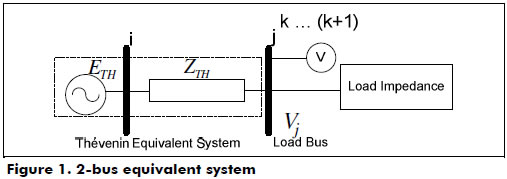
<body><![CDATA[<center><img src="/img/revistas/iei/v34n3/v34n3a08e1.jpg"></center></p>     <p>Consecutive measurements are taken by the PMU at the buses, where <i>&Delta;V<sub>j</sub></i> y <i>&Delta;I<sub>ij</sub></i> is the difference between two consecutive measurements  of voltage and current, respectively, at moments, <i>t<sub>k</sub></i> and <i>t<sub>k+1</sub></i> at the load bus. Under normal operating conditions, <i>ISI = 1</i>, and from the point of maximum power transfer, i.e., in  voltage instability, <i>ISI = 0 </i>(Smon, Verbic &amp; Gubina,  2006).</p>     <p> <a href="#f1">Figure 1</a> shows the 2-bus equivalent system used in the circuit. From  this system, the mathematical analysis of all indices based on PMU measurements  is derived.</p>     <p>    <center><a name="f1"></a><img src="/img/revistas/iei/v34n3/v34n3a08f1.jpg"></center></p>     <p><b><i>VSLBI index (Voltage Stability Load Bus Index)</i></b></p>     <p>  The voltage stability index in the load bus is defined (2), where <i>&Delta;VZTH</i> is the voltage drop  across the transmission impedance, <i>ZTH</i>,  and Vj is the voltage of the load bus, as observed in <a href="#f1">Figure 1</a>. </p>     <p>  When the load is of the constant power type, the voltage instability  point coincides with the point of maximum power transfer where <i>&Delta;V<sub>ZTH</sub>= V<sub>j</sub></i>.</p>     <p>    <center><img src="/img/revistas/iei/v34n3/v34n3a08e2.jpg"></center></p>     ]]></body>
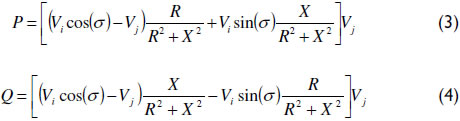
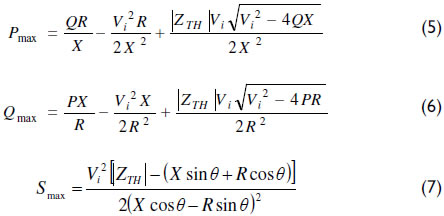
<body><![CDATA[<p>When the system is in a condition of proximity to voltage collapse,  then <i>VSLBI&asymp;1</i>; otherwise its value is  in the range (1.5 to 5). The index for a system with <i>j</i> load buses is the lowest <i>VSLBI</i> value obtained (Milosevic &amp; Begovic,  2003).</p>     <p>  <b><i>VSI Index (Voltage Stability Index)</i></b><i></i></p>     <p>  Given a model of a simplified power system, as shown in <a href="#f1">Figure 1</a>,  the active power <i>P</i> and the reactive  power <i>Q</i> can be expressed by equations  (3) and (4):</p>     <p>    <center><img src="/img/revistas/iei/v34n3/v34n3a08e3y4.jpg"></center></p>     <p>where &sigma; is the angle of the generator  bus. The maximum power transfer, Pmax, demanded can be calculated by (5), where <i>Z<sub>TH</sub> = &radic;(R<sup>2</sup>+X<sup>2</sup>)</i>,  assuming that the reactive power demand, <i>Q</i>,  is constant. Similarly, the maximum reactive power, <i>Q<sub>max</sub></i>, transfer and the maximum complex power demand can  be calculated by (6) and (7), assuming that the power demand, <i>P</i>, and the power angle, <i>&theta;</i>=tan<sup>-1</sup>(<i>Q/P</i>), are constants:</p>     <p>    <center><img src="/img/revistas/iei/v34n3/v34n3a08e5-7.jpg"></center></p>     <p>For transmission lines with a high relation of <i>X/R</i> and neglecting the resistance <i>R</i>, the equations are reduced to (8), (9) and (10):</p>     <p>    ]]></body>
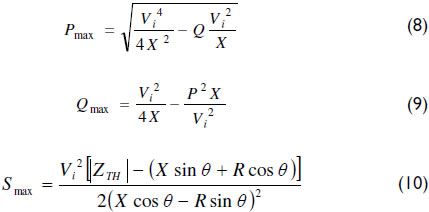
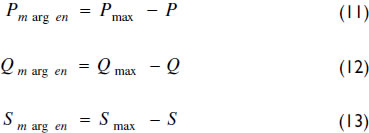
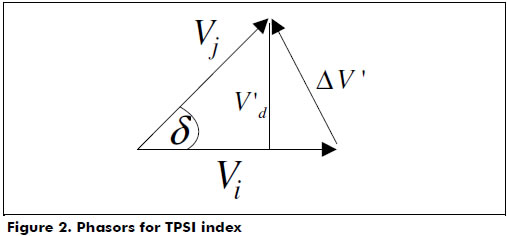
<body><![CDATA[<center><img src="/img/revistas/iei/v34n3/v34n3a08e8-10.jpg"></center></p>     <p>With the prediction of <i>Pmax</i>, <i>Qmax</i> and <i>Smax</i>, the load ranges are calculated using equations (11), (12) and  (13):</p>     <p>    <center><img src="/img/revistas/iei/v34n3/v34n3a08e11-13.jpg"></center></p>     <p>The <i>VSI</i> index, based on  the margin's prediction, is shown in (14):</p>     <p>    <center><img src="/img/revistas/iei/v34n3/v34n3a08e14.jpg"></center></p>     <p>Smaller <i>VSI</i> values  indicate that the load bus is close to the stable marginal voltage. Once the  loading bus has reached the point of marginal stable voltage operation, its <i>VSI</i> is zero (Salehi, Mazloomzadeh &amp;  Mohammed, 2011).</p>     <p>  <b><i>TPSI Index (Transmission Path Stability Index)</i></b><i></i></p>     <p>  This index is based on an analytical method for determining the  proximity to voltage collapse for radial systems. The radial network is  transformed into a network of two buses, as in <a href="#f1">Figure 1</a>, with the corresponding  phasors represented in <a href="#f2">Figure 2</a>.</p>     ]]></body>
<body><![CDATA[<p>    <center><a name="f2"></a><img src="/img/revistas/iei/v34n3/v34n3a08f2.jpg"></center></p>     <p>  The maximum power transfer is achieved when (15) is reached. Here, <i>&delta;</i> is the angle of the load bus:</p>     <p>    <center><img src="/img/revistas/iei/v34n3/v34n3a08e15.jpg"></center></p>     <p>This expression defines the point of singularity for the Jacobian,  which would be the point of voltage collapse of a radial system. Therefore, the  line impedance and the load impedance are the same.</p>      <p>Using equation (16), the <i>TPSI</i> index is calculated for the equivalent of the radial transmission network:</p>     <p>    <center><img src="/img/revistas/iei/v34n3/v34n3a08e16.jpg"></center></p>     <p>For <i>TPSI = 0</i>, the power  transfer of the radial network is unstable. The proposed procedure has been  tested on real radial networks with inductive and capacitive loads (Gubina &amp; Strmcnik,  1995).</p>     ]]></body>
<body><![CDATA[<p>  <b><i>VIP Index (Voltage Index Predictor)</i></b><i></i></p>     <p>  The <i>VIP</i> index analyzes the  proximity to the voltage collapse (or instability), expressed in terms of power  margins. </p>     <p>  The proximity to voltage collapse is calculated using the system  shown in <a href="#f1">Figure 1</a>. The maximum power transfer occurs when <i>|Z<sub>load</sub>|=|Z<sub>TH</sub></i>| (Duong &amp; Uhlen, 2013)<i>|</i>, where the load  impedance <i>Zload</i> is the  relation between the measurements of both voltage and current phasors at the  load bus. When the loadability is normal, the following condition is obtained: <i>|Z<sub>load</sub>|&gt;Z<sub>TH</sub></i>.  At the beginning of the voltage instability, the difference between the  impedances is close to zero. Therefore, tracking the proximity of voltage  instability is performed following the distance between <i>|Z<sub>load</sub>|</i> and <i>Z<sub>TH</sub></i>.  This is the essence of the <i>VIP</i> index.</p>     <p>  In terms of power, the difference between the maximum power using  linear estimation and the actual power observed by the voltage predictor <i>VIP</i> is the margin of power. This can be  expressed by (17), where <i>V<sub>j</sub></i> and <i>I<sub>ij</sub></i> are the actual  measurements of voltage and current in the load, respectively, and <i>ZTH</i> is the actual Th&eacute;venin  impedance:</p>     <p>    <center><img src="/img/revistas/iei/v34n3/v34n3a08e17.jpg"></center></p>     <p>When <i>&Delta;S</i> is zero, the system is in maximum  power transfer, which is the point of voltage collapse (Julian et al., 2000).</p>     <p><i>PTSI Index (Power Transfer  Stability Index)</i></p>     <p>  This index is based on the limit of maximum power transfer.  Considering the load to be a constant impedance element thus dynamically  predicts the voltage collapse in a power system.</p>     <p>  In the circuit of <a href="#f1">Figure 1</a>, the load current is calculated using (18).</p>     ]]></body>
<body><![CDATA[<p>    <center><img src="/img/revistas/iei/v34n3/v34n3a08e18.jpg"></center></p>     <p>Using equation (19), the apparent load power is calculated:</p>     <p>    <center><img src="/img/revistas/iei/v34n3/v34n3a08e19.jpg"></center></p>     <p>Substituting the above two equations and considering that <img src="/img/revistas/iei/v34n3/v34n3a08e19p.jpg" align="absmiddle"> and       , equation (20) is obtained. Here,       is the angle of the load impedance, and       is the phase angle of the Th&eacute;venin impedance.</p>     <p>    <center><img src="/img/revistas/iei/v34n3/v34n3a08e20.jpg"></center></p>     <p>Expanding the above equation, the following equation is obtained:</p>     <p>    ]]></body>

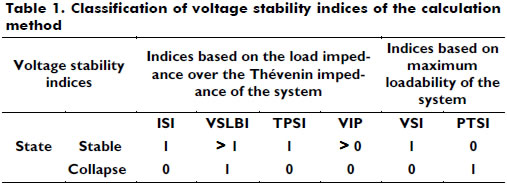
<body><![CDATA[<center><img src="/img/revistas/iei/v34n3/v34n3a08e21.jpg"></center></p>     <p>To evaluate the distance from the load bus to the voltage collapse,  a power margin is defined as <i>Sloadmax-Sload</i>.  The power range is equal to "0" if <i>Zload=ZTH</i>, and it indicates that the power  transfer cannot be transferred to that point and that voltage collapse occurs.  Therefore, voltage collapse occurs when <i>(Sload/Sloadmax)=1.</i> </p>     <p>  Therefore, by replacing terms with the previous equations, we arrive  at the PTSI index in (22):</p>     <p>    <center><img src="/img/revistas/iei/v34n3/v34n3a08e22.jpg"></center></p>     <p>The <i>PTSI</i> index requires  information about the involved bus voltage phasors and the admittance matrix of  the network. The index value is between zero and one; when the <i>PTSI</i> index reaches one, it means that  voltage collapse has occurred (Nizam, Mohamed, &amp;  Hussain, 2007).</p>     <p>  <b>Indices evaluation</b></p>     <p>  The indices used to evaluate the real-time safe operation based on  phasor measurements presented above were classified according to the  calculation method shown in <a href="#t1">Table 1</a>. </p>     <p>    <center><a name="t1"></a><img src="/img/revistas/iei/v34n3/v34n3a08t1.jpg"></center></p>     ]]></body>
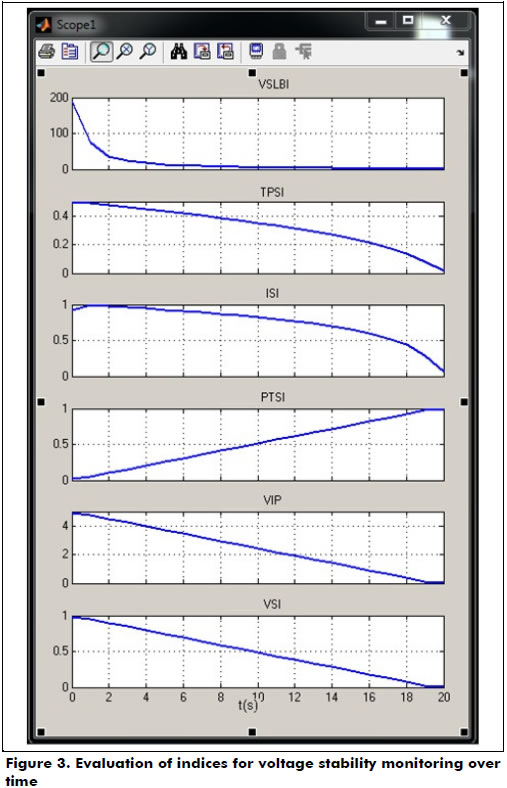
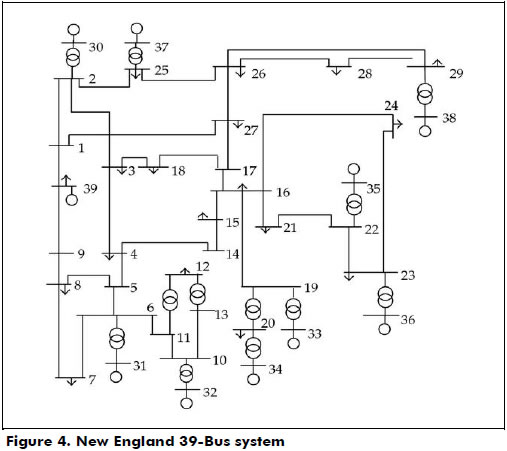
<body><![CDATA[<p>  The indices were evaluated using a dynamic simulation in Matlab-Simulink  for the system in <a href="#f1">Figure 1</a>, where<i> E<sub>TH</sub>=1</i> pu, <i>Z<sub>TH</sub>=0.04+0.03i</i> pu<i>, S<sub>load</sub>=1+0.33i</i> pu. The load  model used was the polynomial ZIP model (constant impedance, constant current  and constant power), which expresses both the active and reactive power in the  function for the electrical voltage to which the load is subjected. This model  is widely used for voltage-stability dynamic analysis. The load was increased,  keeping the power factor constant until the system reaches its maximum power  transfer, where a voltage collapse occurs. The system considers the load  increase to be a disturbance. </p>     <p> <a href="#f3">Figure 3</a> presents the evolution of each index for a dynamic  simulation with respect to the time axis, "x". In this figure, all of  the indices indicate that the system reaches voltage collapse at the same  instant, i.e., the same strain stability problems are detected but with  different scales of measurement.</p>     <p>    <center><a name="f3"></a><img src="/img/revistas/iei/v34n3/v34n3a08f3.jpg"></center></p>     <p>The curves behave with different nonlinearities and features, which  occur because indices are based on the same theoretical principle and the same  equations, which are treated algebraically differently in each index.</p>     <p>  None of the analyzed indices considers the capability constraints  for generating reactive power (limited by rotor and stator currents). In both  the index-calculating methodologies and the simulations, it was assumed that  reactive power would always be available in the source or the system; thus, the  maximum power transfer from the network was analyzed. It should be noted that  the system can reach voltage collapse due to a deficiency of reactive power in  either the generation or static sources; thus, the system has the ability to  transport power through the network.</p>      <p><font size="3"><b>Case study</b></font></p>     <p>  The results obtained from the index assessments for the simplified  2-bus system indicate that the use of any index is indifferent because they all  indicated voltage collapse at the same time. Thus, the index selection for the  New England 39-bus system is irrelevant. The New England 39-bus system shown in  <a href="#f4">Figure 4</a> was used to determine the ISI index in different operation modes.</p>     <p>    <center><a name="f4"></a><img src="/img/revistas/iei/v34n3/v34n3a08f4.jpg"></center></p>     ]]></body>
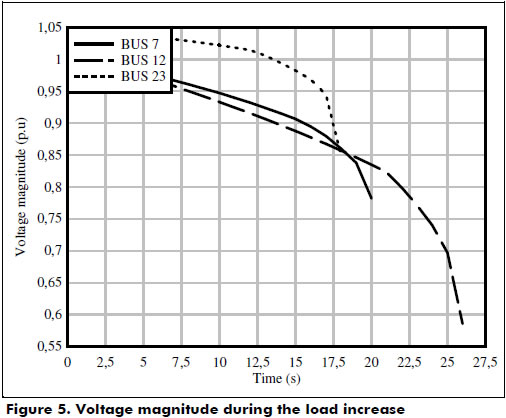
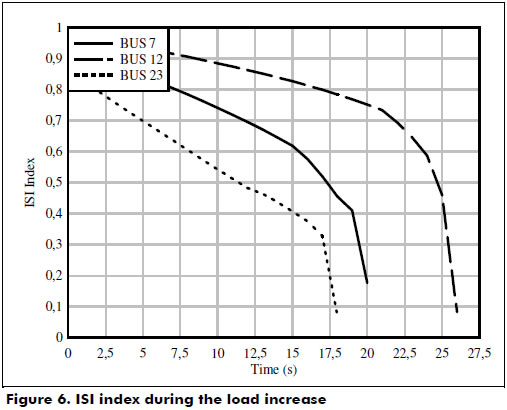
<body><![CDATA[<p>  Simulations were performed using power systems analysis software to  test the ISI index performance in different operating scenarios. At each load  bus with a PMU installed, indices were determined to monitor voltage-stability  problems.</p>     <p><b>Load increments</b></p>     <p> <a href="#f5">Figure 5</a> shows the voltage magnitude for load increments on each  monitored bus. Load increments were made in each bus independently for each ISI  index calculation. <a href="#f6">Figure 6</a> shows the index ISI for the load increments on  buses 7, 12 and 23 over time.</p>     <p>    <center><a name="f5"></a><img src="/img/revistas/iei/v34n3/v34n3a08f5.jpg"></center></p>     <p>    <center><a name="f6"></a><img src="/img/revistas/iei/v34n3/v34n3a08f6.jpg"></center></p>     <p>  From these results, the indices showed that the stability limits are  being reached; however, at the same time, the operating voltage limits have  been already violated. An example is bus 12, which, under normal operating  conditions, has an ISI index of 0.97 and a voltage of 1 p.u., but at  approximately 13 seconds, the voltage reaches the operational lower limit of  0.9 p.u. and the ISI index decreases to 0.85.</p>     <p>  If a system operator takes these indices as indicators of stability,  it can lead to an inaccurate analysis because the system could reach voltage  collapse without being detected.</p>     <p>  This happens because the indices' theoretical formulation is based  on evaluating the margins over the critical point of the PV curve, regardless  of the voltage operational limits.</p>     ]]></body>
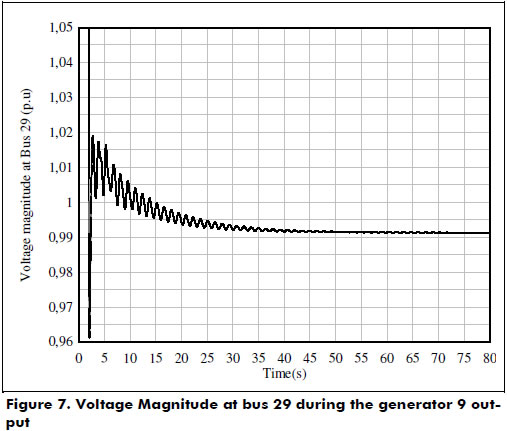
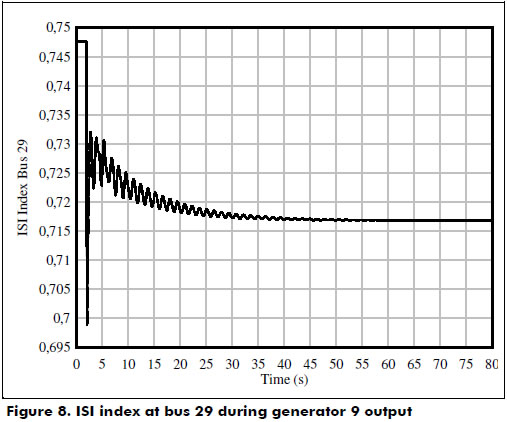
<body><![CDATA[<p><b>Scenario: generator output</b></p>     <p>  In this scenario, the output of generator 9 located at bus 38 is  simulated using dynamic stability software. The disconnection of the generator  is considered 2 seconds after starting the simulation. </p>     <p>  In <a href="#f7">Figure 7</a>, the results of the voltage magnitude at bus 29, which  is closer to the contingency, are presented.</p>     <p>    <center><a name="f7"></a><img src="/img/revistas/iei/v34n3/v34n3a08f7.jpg"></center></p>     <p>  The monitored bus 29 voltage drops quickly due to the disturbance  and oscillates at acceptable levels and ranges of operation. Approximately 40  seconds after the start of the contingency, the voltage reaches the balance and  is set to a new value of approximately 0.99 p.u. </p>     <p>  The indices' behavior is similar to the voltage behavior but has a  smaller oscillation, as shown in <a href="#f8">Figure 8</a>.</p>     <p>    <center><a name="f8"></a><img src="/img/revistas/iei/v34n3/v34n3a08f8.jpg"></center></p>     <p>  <b>Scenario: line output</b></p>     ]]></body>
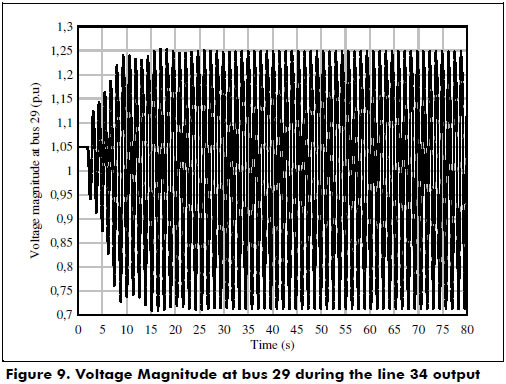
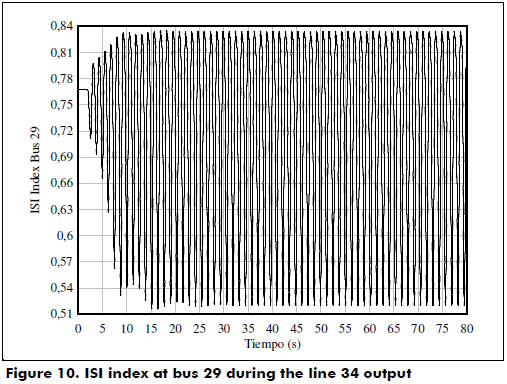
<body><![CDATA[<p>  Line 34 located between buses 28 and 29 was removed from the system.  The output of the network internal components causes a change in its topology.  For this contingency, the Th&eacute;venin impedance was previously determined. The  impedance calculation cannot be performed with the phasors because there is a  topology change and using the <i>ISI</i> index method results in a difference between phasors in two different operating  points, <i>t<sub>k</sub></i> and <i>t<sub>k+1</sub></i>. At the instant of the  contingency (line output), phasors from two different networks would be  compared, i.e., with different topologies.</p>     <p>  From <a href="#f9">Figure 9</a>, it can be observed that the voltage at bus 29 fails  to stay within the operating range limits after the contingency; such large  deviations would increase the low voltage protections, creating islands in the  power system and leading progressively to voltage collapse. <a href="#f10">Figure 10</a> shows the <i>ISI</i> index of bus 29 during the output  of line 34, which also decreases rapidly after the contingency and follows the  same trend presented at the voltage buses. In this case, the index does not  indicate that the system reaches collapse, i.e., the index does not become  zero, which is an indicator that there is a voltage-stability problem in the system.  This is not a good indicator for a system operator.</p>     <p>    <center><a name="f9"></a><img src="/img/revistas/iei/v34n3/v34n3a08f9.jpg"></center></p>     <p>    <center><a name="f10"></a><img src="/img/revistas/iei/v34n3/v34n3a08f10.jpg"></center></p>     <p><font size="3"><b>Conclusions</b></font></p>     <p>  In this article, the online voltage-stability monitoring was conducted  using indices based on measurements presented as PMU in a simplified 2-Bus  system. After all of these indices were evaluated, one was used in the New  England 39-bus system under different operating scenarios. However, some  limitations were found in the indices that were analyzed and used as indicators  of the system status, such as voltage levels that indicate stability problems  well below the operational limits. At the same time, the indices assumed that  reactive power is always available at the source or system. Therefore, these  indices are not good indicators of the presence of voltage-stability problems.</p>     <p>  For our work, it was important to evaluate the performance of the  indices on a simplified system and then, based on the results, to choose an  index for use in a more complex system. Therefore, because all of the indices  indicated the proximity to collapse at the same time, the choice of index was  irrelevant to the New England 39-bus system.</p>     <p>  The indices used for voltage-stability monitoring with the PMU data  are quickly calculated compared with the conventional methods, which are based  on power flow simulations. Additionally, the accuracy of the data provided by  the PMU that are used as input parameters in the calculations guarantee  accurate results.</p>     ]]></body>
<body><![CDATA[<p>  From the simulations, it can be concluded that all of the indices  detect the voltage collapse at the same instant, i.e., they detect the same  voltage-stability problems but use different measurement scales, and that the  curves behave with different linearity and features. This simultaneity occurs  because all are based on the same theoretical principle, although the equations  are applied differently.</p>     <p>  All of the indices studied are based on evaluating the voltage  stability margins at the critical point (at the peak of the PV curve). This  critical point is considered the limit of stability in the analysis, which  means that the system reaches the maximum power transfer and the voltage levels  reach values below the operational limits.</p>     <p>  The PTSI and VSI indices do not depend on the voltage of the load  bus; instead, they depend on the loadability and maximum power transfer of the  system. Conversely, the ISI, VSBLI, TPSI and VIP indices depend on the voltage  at the loading bus and the ability to deliver power to the grid.</p> <hr>     <p><font size="3"><b>References</b></font> </p>     <!-- ref --><p>Dasgupta, S.,  Paramasivam, M., Vaidya, U., &amp; Ajjarapu, V. (2013). Real-Time Monitoring of Short-Term  Voltage Stability Using PMU Data. <i>Power  Systems, IEEE Transactions on</i>, <i>28</i>(4),  3702-3711. DOI:10.1109/TPWRS.2013.2258946&nbsp;&nbsp;&nbsp;&nbsp;&nbsp;&nbsp;&nbsp;&nbsp;[&#160;<a href="javascript:void(0);" onclick="javascript: window.open('/scielo.php?script=sci_nlinks&ref=000147&pid=S0120-5609201400030000800001&lng=','','width=640,height=500,resizable=yes,scrollbars=1,menubar=yes,');">Links</a>&#160;]<!-- end-ref --><!-- ref --><p>  Duong, D.  T., &amp; Uhlen, K. (2013). Online voltage stability monitoring based on PMU  measurements and system topology. In <i>Electric  Power and Energy Conversion Systems (EPECS)</i>, 3rd International Conference  on, 1-6. DOI:10.1109/EPECS.2013.6713056&nbsp;&nbsp;&nbsp;&nbsp;&nbsp;&nbsp;&nbsp;&nbsp;[&#160;<a href="javascript:void(0);" onclick="javascript: window.open('/scielo.php?script=sci_nlinks&ref=000148&pid=S0120-5609201400030000800002&lng=','','width=640,height=500,resizable=yes,scrollbars=1,menubar=yes,');">Links</a>&#160;]<!-- end-ref --><!-- ref --><p>  Genet, B.  (2009). On monitoring methods and load modeling to improve voltage stability  assessment efficiency (Doctoral thesis). Universit&eacute; Libre de Bruxelles (U. L. B.),  Brussels, Belgium.    &nbsp;&nbsp;&nbsp;&nbsp;&nbsp;&nbsp;&nbsp;&nbsp;[&#160;<a href="javascript:void(0);" onclick="javascript: window.open('/scielo.php?script=sci_nlinks&ref=000149&pid=S0120-5609201400030000800003&lng=','','width=640,height=500,resizable=yes,scrollbars=1,menubar=yes,');">Links</a>&#160;]<!-- end-ref --> </p>     <!-- ref --><p>  Gubina,  F., &amp; Strmcnik, B. (1995). Voltage collapse proximity index determination  using voltage phasors approach. <i>IEEE  Transactions on Power Systems</i>, <i>10</i>(2),  788-794. DOI: 10.1109/59.387918&nbsp;&nbsp;&nbsp;&nbsp;&nbsp;&nbsp;&nbsp;&nbsp;[&#160;<a href="javascript:void(0);" onclick="javascript: window.open('/scielo.php?script=sci_nlinks&ref=000151&pid=S0120-5609201400030000800004&lng=','','width=640,height=500,resizable=yes,scrollbars=1,menubar=yes,');">Links</a>&#160;]<!-- end-ref --><!-- ref --><p>  Julian, D.  E., Schulz, R. P., Vu, K. T., Quaintance, W. H., Bhatt, N. B., &amp; Novosel,  D. (2000). Quantifying proximity to voltage collapse using the Voltage  Instability Predictor (VIP). IEEE Power Engineering Society Summer Meeting, 2,  931-936. DOI: 10.1109/PESS. 2000.867496.    &nbsp;&nbsp;&nbsp;&nbsp;&nbsp;&nbsp;&nbsp;&nbsp;[&#160;<a href="javascript:void(0);" onclick="javascript: window.open('/scielo.php?script=sci_nlinks&ref=000152&pid=S0120-5609201400030000800005&lng=','','width=640,height=500,resizable=yes,scrollbars=1,menubar=yes,');">Links</a>&#160;]<!-- end-ref --></p>     <!-- ref --><p>  Lim, J.  M., &amp; DeMarco, C. L. (2013). Model-free voltage stability assessments via  singular value analysis of PMU data. IN <i>Bulk  Power System Dynamics and Control - IX Optimization, Security and Control of  the Emerging Power Grid (IREP)</i>, IREP Symposium, 1-10. DOI:10.1109/IREP.2013.6629399&nbsp;&nbsp;&nbsp;&nbsp;&nbsp;&nbsp;&nbsp;&nbsp;[&#160;<a href="javascript:void(0);" onclick="javascript: window.open('/scielo.php?script=sci_nlinks&ref=000154&pid=S0120-5609201400030000800006&lng=','','width=640,height=500,resizable=yes,scrollbars=1,menubar=yes,');">Links</a>&#160;]<!-- end-ref --><!-- ref --><p>  Liu, J.,  &amp; Chu, C. (2014). Wide-Area Measurement-Based Voltage Stability Indicators  by Modified Coupled Single-Port Models. <i>Power  Systems, IEEE Transactions on</i>, <i>29</i>(2),  756-764. DOI:10.1109/ TPWRS.2013.2284475.    &nbsp;&nbsp;&nbsp;&nbsp;&nbsp;&nbsp;&nbsp;&nbsp;[&#160;<a href="javascript:void(0);" onclick="javascript: window.open('/scielo.php?script=sci_nlinks&ref=000155&pid=S0120-5609201400030000800007&lng=','','width=640,height=500,resizable=yes,scrollbars=1,menubar=yes,');">Links</a>&#160;]<!-- end-ref --></p>     <!-- ref --><p>  Milosevic,  B., &amp; Begovic, M. (2003). Voltage-Stability Protection and Control Using a  Wide-Area Network of Phasor Measurements. <i>IEEE  Transactions on Power Systems</i>, <i>18</i>(1),  121-127. DOI: 10.1109/ TPWRS.2002.805018&nbsp;&nbsp;&nbsp;&nbsp;&nbsp;&nbsp;&nbsp;&nbsp;[&#160;<a href="javascript:void(0);" onclick="javascript: window.open('/scielo.php?script=sci_nlinks&ref=000157&pid=S0120-5609201400030000800008&lng=','','width=640,height=500,resizable=yes,scrollbars=1,menubar=yes,');">Links</a>&#160;]<!-- end-ref --><!-- ref --><p>  Nizam, M.,  Mohamed, A., &amp; Hussain, A. (2007). Dynamic Voltage Collapse Prediction on a  Practical Power System Using Power Transfer Stability Index. Research and Development,  SCOReD 5th Student Conference on, 1-6. DOI:10.1109/SCORED.2007.4451398.    &nbsp;&nbsp;&nbsp;&nbsp;&nbsp;&nbsp;&nbsp;&nbsp;[&#160;<a href="javascript:void(0);" onclick="javascript: window.open('/scielo.php?script=sci_nlinks&ref=000158&pid=S0120-5609201400030000800009&lng=','','width=640,height=500,resizable=yes,scrollbars=1,menubar=yes,');">Links</a>&#160;]<!-- end-ref --></p>     <!-- ref --><p>  Salehi,  V., Mazloomzadeh, A., &amp; Mohammed, O. (2011). Development and Implementation  of a Phasor Measurement Unit for Real-Time Monitoring, Control and Protection  of Power Systems. IEEE Power and Energy Society General Meeting, 1-7. DOI:  10.1109/PES.2011.6039757&nbsp;&nbsp;&nbsp;&nbsp;&nbsp;&nbsp;&nbsp;&nbsp;[&#160;<a href="javascript:void(0);" onclick="javascript: window.open('/scielo.php?script=sci_nlinks&ref=000160&pid=S0120-5609201400030000800010&lng=','','width=640,height=500,resizable=yes,scrollbars=1,menubar=yes,');">Links</a>&#160;]<!-- end-ref --><!-- ref --><p>  Smon, I.,  Verbic, G., &amp; Gubina, F. (2006). Local Voltage-Stability Index Using  Tellegen's Theorem. <i>IEEE Transactions on Power  Systems</i>, <i>21</i>(3), 1267-1275.  doi:10.1109/TPWRS.2006.876702&nbsp;&nbsp;&nbsp;&nbsp;&nbsp;&nbsp;&nbsp;&nbsp;[&#160;<a href="javascript:void(0);" onclick="javascript: window.open('/scielo.php?script=sci_nlinks&ref=000161&pid=S0120-5609201400030000800011&lng=','','width=640,height=500,resizable=yes,scrollbars=1,menubar=yes,');">Links</a>&#160;]<!-- end-ref --><!-- ref --><p>  Zapata, C.  J., Rios, M., &amp; Arias, J. M. (2010). &Iacute;ndices para detectar en tiempo real problemas de estabilidad de  voltaje. <i>Scientia et Technica A&ntilde;o XVI  Universidad Tecnol&oacute;gica de Pereira</i>, <i>1</i>(44),  19-24.    &nbsp;&nbsp;&nbsp;&nbsp;&nbsp;&nbsp;&nbsp;&nbsp;[&#160;<a href="javascript:void(0);" onclick="javascript: window.open('/scielo.php?script=sci_nlinks&ref=000162&pid=S0120-5609201400030000800012&lng=','','width=640,height=500,resizable=yes,scrollbars=1,menubar=yes,');">Links</a>&#160;]<!-- end-ref --></p> </font>      ]]></body><back>
<ref-list>
<ref id="B1">
<nlm-citation citation-type="journal">
<person-group person-group-type="author">
<name>
<surname><![CDATA[Dasgupta]]></surname>
<given-names><![CDATA[S]]></given-names>
</name>
<name>
<surname><![CDATA[Paramasivam]]></surname>
<given-names><![CDATA[M]]></given-names>
</name>
<name>
<surname><![CDATA[Vaidya]]></surname>
<given-names><![CDATA[U]]></given-names>
</name>
<name>
<surname><![CDATA[Ajjarapu]]></surname>
<given-names><![CDATA[V]]></given-names>
</name>
</person-group>
<article-title xml:lang="en"><![CDATA[Real-Time Monitoring of Short-Term Voltage Stability Using PMU Data]]></article-title>
<source><![CDATA[Power Systems, IEEE Transactions on]]></source>
<year>2013</year>
<volume>28</volume>
<numero>4</numero>
<issue>4</issue>
<page-range>3702-3711</page-range></nlm-citation>
</ref>
<ref id="B2">
<nlm-citation citation-type="confpro">
<person-group person-group-type="author">
<name>
<surname><![CDATA[Duong]]></surname>
<given-names><![CDATA[D. T]]></given-names>
</name>
<name>
<surname><![CDATA[Uhlen]]></surname>
<given-names><![CDATA[K]]></given-names>
</name>
</person-group>
<article-title xml:lang="en"><![CDATA[Online voltage stability monitoring based on PMU measurements and system topology]]></article-title>
<source><![CDATA[]]></source>
<year>2013</year>
<conf-name><![CDATA[3 Electric Power and Energy Conversion Systems (EPECS)]]></conf-name>
<conf-loc> </conf-loc>
<page-range>1-6</page-range></nlm-citation>
</ref>
<ref id="B3">
<nlm-citation citation-type="">
<person-group person-group-type="author">
<name>
<surname><![CDATA[Genet]]></surname>
<given-names><![CDATA[B]]></given-names>
</name>
</person-group>
<source><![CDATA[On monitoring methods and load modeling to improve voltage stability assessment efficiency]]></source>
<year>2009</year>
</nlm-citation>
</ref>
<ref id="B4">
<nlm-citation citation-type="journal">
<person-group person-group-type="author">
<name>
<surname><![CDATA[Gubina]]></surname>
<given-names><![CDATA[F]]></given-names>
</name>
<name>
<surname><![CDATA[Strmcnik]]></surname>
<given-names><![CDATA[B]]></given-names>
</name>
</person-group>
<article-title xml:lang="en"><![CDATA[Voltage collapse proximity index determination using voltage phasors approach]]></article-title>
<source><![CDATA[IEEE Transactions on Power Systems]]></source>
<year>1995</year>
<volume>10</volume>
<numero>2</numero>
<issue>2</issue>
<page-range>788-794</page-range></nlm-citation>
</ref>
<ref id="B5">
<nlm-citation citation-type="journal">
<person-group person-group-type="author">
<name>
<surname><![CDATA[Julian]]></surname>
<given-names><![CDATA[D. E]]></given-names>
</name>
<name>
<surname><![CDATA[Schulz]]></surname>
<given-names><![CDATA[R. P]]></given-names>
</name>
<name>
<surname><![CDATA[Vu]]></surname>
<given-names><![CDATA[K. T]]></given-names>
</name>
<name>
<surname><![CDATA[Quaintance]]></surname>
<given-names><![CDATA[W. H]]></given-names>
</name>
<name>
<surname><![CDATA[Bhatt]]></surname>
<given-names><![CDATA[N. B]]></given-names>
</name>
<name>
<surname><![CDATA[Novosel]]></surname>
<given-names><![CDATA[D]]></given-names>
</name>
</person-group>
<article-title xml:lang="en"><![CDATA[Quantifying proximity to voltage collapse using the Voltage Instability Predictor (VIP)]]></article-title>
<source><![CDATA[IEEE Power Engineering Society Summer Meeting]]></source>
<year>2000</year>
<volume>2</volume>
<page-range>931-936</page-range></nlm-citation>
</ref>
<ref id="B6">
<nlm-citation citation-type="journal">
<person-group person-group-type="author">
<name>
<surname><![CDATA[Lim]]></surname>
<given-names><![CDATA[J. M]]></given-names>
</name>
<name>
<surname><![CDATA[DeMarco]]></surname>
<given-names><![CDATA[C. L]]></given-names>
</name>
</person-group>
<article-title xml:lang="en"><![CDATA[Model-free voltage stability assessments via singular value analysis of PMU data]]></article-title>
<source><![CDATA[IN Bulk Power System Dynamics and Control - IX Optimization]]></source>
<year>2013</year>
<volume>Security and Control of the Emerging Power Grid</volume>
<numero>IREP</numero>
<issue>IREP</issue>
<page-range>IREP Symposium, 1-10</page-range></nlm-citation>
</ref>
<ref id="B7">
<nlm-citation citation-type="journal">
<person-group person-group-type="author">
<name>
<surname><![CDATA[Liu]]></surname>
<given-names><![CDATA[J]]></given-names>
</name>
<name>
<surname><![CDATA[Chu]]></surname>
<given-names><![CDATA[C]]></given-names>
</name>
</person-group>
<article-title xml:lang="en"><![CDATA[Wide-Area Measurement-Based Voltage Stability Indicators by Modified Coupled Single-Port Models]]></article-title>
<source><![CDATA[Power Systems]]></source>
<year>2014</year>
<volume>IEEE Transactions on, 29</volume>
<numero>2</numero>
<issue>2</issue>
<page-range>756-764</page-range></nlm-citation>
</ref>
<ref id="B8">
<nlm-citation citation-type="journal">
<person-group person-group-type="author">
<name>
<surname><![CDATA[Milosevic]]></surname>
<given-names><![CDATA[B]]></given-names>
</name>
<name>
<surname><![CDATA[Begovic]]></surname>
<given-names><![CDATA[M]]></given-names>
</name>
</person-group>
<article-title xml:lang="en"><![CDATA[Voltage-Stability Protection and Control Using a Wide-Area Network of Phasor Measurements]]></article-title>
<source><![CDATA[IEEE Transactions on Power Systems]]></source>
<year>2003</year>
<volume>18</volume>
<numero>1</numero>
<issue>1</issue>
<page-range>121-127</page-range></nlm-citation>
</ref>
<ref id="B9">
<nlm-citation citation-type="confpro">
<person-group person-group-type="author">
<name>
<surname><![CDATA[Nizam]]></surname>
<given-names><![CDATA[M]]></given-names>
</name>
<name>
<surname><![CDATA[Mohamed]]></surname>
<given-names><![CDATA[A]]></given-names>
</name>
<name>
<surname><![CDATA[Hussain]]></surname>
<given-names><![CDATA[A]]></given-names>
</name>
</person-group>
<article-title xml:lang="en"><![CDATA[Dynamic Voltage Collapse Prediction on a Practical Power System Using Power Transfer Stability Index]]></article-title>
<source><![CDATA[]]></source>
<year>2007</year>
<conf-name><![CDATA[5 Research and Development, SCOReD]]></conf-name>
<conf-loc> </conf-loc>
<page-range>1-6</page-range></nlm-citation>
</ref>
<ref id="B10">
<nlm-citation citation-type="">
<person-group person-group-type="author">
<name>
<surname><![CDATA[Salehi]]></surname>
<given-names><![CDATA[V]]></given-names>
</name>
<name>
<surname><![CDATA[Mazloomzadeh]]></surname>
<given-names><![CDATA[A]]></given-names>
</name>
<name>
<surname><![CDATA[Mohammed]]></surname>
<given-names><![CDATA[O]]></given-names>
</name>
</person-group>
<article-title xml:lang="en"><![CDATA[Development and Implementation of a Phasor Measurement Unit for Real-Time Monitoring, Control and Protection of Power Systems]]></article-title>
<source><![CDATA[]]></source>
<year>2011</year>
<page-range>1-7</page-range></nlm-citation>
</ref>
<ref id="B11">
<nlm-citation citation-type="journal">
<person-group person-group-type="author">
<name>
<surname><![CDATA[Smon]]></surname>
<given-names><![CDATA[I]]></given-names>
</name>
<name>
<surname><![CDATA[Verbic]]></surname>
<given-names><![CDATA[G]]></given-names>
</name>
<name>
<surname><![CDATA[Gubina]]></surname>
<given-names><![CDATA[F]]></given-names>
</name>
</person-group>
<article-title xml:lang="en"><![CDATA[Local Voltage-Stability Index Using Tellegen's Theorem]]></article-title>
<source><![CDATA[IEEE Transactions on Power Systems]]></source>
<year>2006</year>
<volume>21</volume>
<numero>3</numero>
<issue>3</issue>
<page-range>1267-1275</page-range></nlm-citation>
</ref>
<ref id="B12">
<nlm-citation citation-type="journal">
<person-group person-group-type="author">
<name>
<surname><![CDATA[Zapata]]></surname>
<given-names><![CDATA[C. J]]></given-names>
</name>
<name>
<surname><![CDATA[Rios]]></surname>
<given-names><![CDATA[M]]></given-names>
</name>
<name>
<surname><![CDATA[Arias]]></surname>
<given-names><![CDATA[J. M]]></given-names>
</name>
</person-group>
<article-title xml:lang="es"><![CDATA[Índices para detectar en tiempo real problemas de estabilidad de voltaje]]></article-title>
<source><![CDATA[Scientia et Technica Año XVI Universidad Tecnológica de Pereira]]></source>
<year>2010</year>
<volume>1</volume>
<numero>44</numero>
<issue>44</issue>
<page-range>19-24</page-range></nlm-citation>
</ref>
</ref-list>
</back>
</article>