<?xml version="1.0" encoding="ISO-8859-1"?><article xmlns:mml="http://www.w3.org/1998/Math/MathML" xmlns:xlink="http://www.w3.org/1999/xlink" xmlns:xsi="http://www.w3.org/2001/XMLSchema-instance">
<front>
<journal-meta>
<journal-id>0120-5609</journal-id>
<journal-title><![CDATA[Ingeniería e Investigación]]></journal-title>
<abbrev-journal-title><![CDATA[Ing. Investig.]]></abbrev-journal-title>
<issn>0120-5609</issn>
<publisher>
<publisher-name><![CDATA[Facultad de Ingeniería, Universidad Nacional de Colombia.]]></publisher-name>
</publisher>
</journal-meta>
<article-meta>
<article-id>S0120-56092014000300011</article-id>
<article-id pub-id-type="doi">10.15446/ing.investig.v34n3.41638</article-id>
<title-group>
<article-title xml:lang="en"><![CDATA[Quality measures for fuzzy predicates in conjunctive and disjunctive normal forms]]></article-title>
<article-title xml:lang="es"><![CDATA[Medidas de calidad para predicados difusos en forma normal conjuntiva y disyuntiva]]></article-title>
</title-group>
<contrib-group>
<contrib contrib-type="author">
<name>
<surname><![CDATA[Ceruto]]></surname>
<given-names><![CDATA[T]]></given-names>
</name>
<xref ref-type="aff" rid="A01"/>
</contrib>
<contrib contrib-type="author">
<name>
<surname><![CDATA[Lapeira]]></surname>
<given-names><![CDATA[O]]></given-names>
</name>
<xref ref-type="aff" rid="A02"/>
</contrib>
<contrib contrib-type="author">
<name>
<surname><![CDATA[Rosete]]></surname>
<given-names><![CDATA[A]]></given-names>
</name>
<xref ref-type="aff" rid="A03"/>
</contrib>
</contrib-group>
<aff id="A01">
<institution><![CDATA[,Instituto Superior Politécnico José Antonio Echeverría  ]]></institution>
<addr-line><![CDATA[ ]]></addr-line>
<country>Cuba</country>
</aff>
<aff id="A02">
<institution><![CDATA[,Instituto Superior Politécnico José Antonio Echeverría  ]]></institution>
<addr-line><![CDATA[ ]]></addr-line>
<country>Cuba</country>
</aff>
<aff id="A03">
<institution><![CDATA[,Instituto Superior Politécnico José Antonio Echeverría  ]]></institution>
<addr-line><![CDATA[ ]]></addr-line>
<country>Cuba</country>
</aff>
<pub-date pub-type="pub">
<day>01</day>
<month>12</month>
<year>2014</year>
</pub-date>
<pub-date pub-type="epub">
<day>01</day>
<month>12</month>
<year>2014</year>
</pub-date>
<volume>34</volume>
<numero>3</numero>
<fpage>63</fpage>
<lpage>69</lpage>
<copyright-statement/>
<copyright-year/>
<self-uri xlink:href="http://www.scielo.org.co/scielo.php?script=sci_arttext&amp;pid=S0120-56092014000300011&amp;lng=en&amp;nrm=iso"></self-uri><self-uri xlink:href="http://www.scielo.org.co/scielo.php?script=sci_abstract&amp;pid=S0120-56092014000300011&amp;lng=en&amp;nrm=iso"></self-uri><self-uri xlink:href="http://www.scielo.org.co/scielo.php?script=sci_pdf&amp;pid=S0120-56092014000300011&amp;lng=en&amp;nrm=iso"></self-uri><abstract abstract-type="short" xml:lang="en"><p><![CDATA[Association rule mining is a very popular data mining technique. Rules in this technique are often used to identify and represent dependencies between attributes in databases. Specifically, fuzzy association rules are rules that use the concepts of fuzzy sets and can be considered as a special case of fuzzy predicates. Many quality measures have been defined for fuzzy association rules, but all consider a specific structure: antecedent and consequence. In the case of fuzzy predicates in the normal form (i.e., conjunctive or disjunctive), it is necessary to define different quality measures that do not consider the structure as an antecedent or a consequence. The only available measure for this scenario is the fuzzy predicate truth value (FPTV), which has serious limitations. The evaluation of fuzzy predicates in the normal form through appropriate quality measures has not yet been clearly defined in the literature. Thus, we propose several quality measures specifically for fuzzy predicates in the conjunctive (CNF) and disjunctive (DNF) normal forms. Experimental studies illustrate the use of the proposed measures and allow some general conclusions about each measure.]]></p></abstract>
<abstract abstract-type="short" xml:lang="es"><p><![CDATA[La extracción de las reglas de asociación es una técnica de minería de datos muy popular, las cuales son utilizadas a menudo para identificar y representar dependencias entre atributos en bases de datos. Específicamente, las reglas de asociación difusas utilizan conceptos de conjuntos difusos y pueden ser vistas como un caso especial de predicados difusos. Muchas medidas de calidad han sido definidas para reglas de asociación difusa, pero todas consideran la estructura específica de reglas: antecedente y consecuente. En el caso general de predicados difusos en forma normal (conjuntiva o disyuntiva), es necesario definir diferentes medidas de calidad que no estén en función de antecedente y consecuente, puesto que la única medida disponible para ello, es el valor de verdad para predicados difusos (FPTV) y tiene serias limitaciones. La evaluación de un predicado difuso en forma normal, a través de medidas adecuadas de calidad no ha sido todavía claramente definida por otros autores. Por esa razón, en este trabajo se proponen varias medidas de calidad para los predicados difusos, en formas normal conjuntiva o disyuntiva. Los experimentos demuestran el uso que se le puede dar a las métricas propuestas y permiten llegar a conclusiones generales de cada una de ellas.]]></p></abstract>
<kwd-group>
<kwd lng="en"><![CDATA[data mining]]></kwd>
<kwd lng="en"><![CDATA[fuzzy predicate]]></kwd>
<kwd lng="en"><![CDATA[quality measures]]></kwd>
<kwd lng="en"><![CDATA[conjunctive and disjunctive normal forms]]></kwd>
<kwd lng="es"><![CDATA[minería de datos]]></kwd>
<kwd lng="es"><![CDATA[predicados difusos]]></kwd>
<kwd lng="es"><![CDATA[medidas de calidad]]></kwd>
<kwd lng="es"><![CDATA[forma normal conjuntiva y disyuntiva]]></kwd>
</kwd-group>
</article-meta>
</front><body><![CDATA[  <font size="2" face="verdana">     <p>DOI: <a href="http://dx.doi.org/10.15446/ing.investig.v34n3.41638" target="_blank">http://dx.doi.org/10.15446/ing.investig.v34n3.41638</a></p>     <p>    <center> <font size="4"><b>Quality  measures for fuzzy predicates in conjunctive and disjunctive normal forms</b></font> </center></p>     <p>    <center> <font size="3"><b>Medidas de calidad para predicados difusos en forma  normal conjuntiva y disyuntiva</b></font> </center></p>     <p>T. Ceruto<sup>1</sup>, O.  Lapeira<sup>2</sup> and A. Rosete<sup>3</sup></p>     <p><sup>1</sup>Taymi Ceruto. Ingeniero  Inform&aacute;tico, Master en Ciencias, Instituto Superior Polit&eacute;cnico "Jos&eacute; Antonio  Echeverr&iacute;a", Cuba. Affiliation: Cujae, Cuba.  E-mail:  <a href="mailto:tceruto@ceis.cujae.edu.cu">tceruto@ceis.cujae.edu.cu</a></p>     <p> <sup>2</sup>Orenia Lapeira. Ingeniero Inform&aacute;tico, Instituto Superior Polit&eacute;cnico  "Jos&eacute; Antonio Echeverr&iacute;a", Cuba. Affiliation: Cujae, Cuba. E-mail:  <a href="mailto:olapeira@ceis.cujae.edu.cu">olapeira@ceis.cujae.edu.cu</a></p>     <p> <sup>3</sup>Alejandro Rosete Su&aacute;rez. Ingeniero Inform&aacute;tico, Doctor en Ciencias ,  Instituto Superior Polit&eacute;cnico "Jos&eacute; Antonio Echeverr&iacute;a", Cuba.  Affiliation: Cujae, Cuba.    E-mail: <a href="mailto:rosete@ceis.cujae.edu.cu">rosete@ceis.cujae.edu.cu</a></p> <hr>       ]]></body>
<body><![CDATA[<p><b>How to cite:</b> Rodr&iacute;guez-Guti&eacute;rrez, J. A., &amp;    Aristizabal-Ochoa, J. D. (2014). Biaxial bending of slender HSC columns and    tubes filled with concrete under short- and long-term loads: II)    Verification. <i>Ingenier&iacute;a e Investigaci&oacute;n</i>, <i>34</i>(3), 63-69.</p> <hr>     <p><b>ABSTRACT</b></p>     <p>  Association rule mining is  a very popular data mining technique. Rules in this technique are often used to  identify and represent dependencies between attributes in databases.  Specifically, fuzzy association rules are rules that use the concepts of fuzzy  sets and can be considered as a special case of fuzzy predicates. Many quality  measures have been defined for fuzzy association rules, but all consider a  specific structure: antecedent and consequence. In the case of fuzzy predicates  in the normal form (i.e., conjunctive or disjunctive), it is necessary to  define different quality measures that do not consider the structure as an  antecedent or a consequence. The only available measure for this scenario is  the fuzzy predicate truth value (FPTV), which has serious limitations. The evaluation  of fuzzy predicates in the normal form through appropriate quality measures has  not yet been clearly defined in the literature. Thus, we propose several  quality measures specifically for fuzzy predicates in the conjunctive (CNF) and  disjunctive (DNF) normal forms. Experimental studies illustrate the use of the  proposed measures and allow some general conclusions about each measure.</p>     <p>  <b>Keywords:</b> data  mining, fuzzy predicate, quality measures, conjunctive and disjunctive normal  forms. </p> <hr>     <p><b>RESUMEN</b></p>     <p>  La extracci&oacute;n de las reglas de asociaci&oacute;n es una  t&eacute;cnica de miner&iacute;a de datos muy popular, las cuales son utilizadas a menudo  para identificar y representar dependencias entre atributos en bases de datos.  Espec&iacute;ficamente, las reglas de asociaci&oacute;n difusas utilizan conceptos de  conjuntos difusos y pueden ser vistas como un caso especial de predicados  difusos. Muchas medidas de calidad han sido definidas para reglas de asociaci&oacute;n  difusa, pero todas consideran la estructura espec&iacute;fica de reglas: antecedente y  consecuente. </p>     <p>  En el caso general de predicados difusos en forma  normal (conjuntiva o disyuntiva), es necesario definir diferentes medidas de  calidad que no est&eacute;n  en funci&oacute;n de  antecedente y consecuente, puesto que la &uacute;nica medida disponible para ello, es  el valor de verdad para predicados difusos (FPTV) y tiene serias limitaciones.  La evaluaci&oacute;n de un predicado difuso en forma normal, a trav&eacute;s de medidas  adecuadas de calidad no ha sido todav&iacute;a claramente definida por otros autores.  Por esa raz&oacute;n, en este trabajo se proponen varias medidas de calidad para los  predicados difusos, en formas normal conjuntiva o disyuntiva. Los experimentos  demuestran el uso que se le puede dar a las m&eacute;tricas propuestas y permiten  llegar a conclusiones generales de cada una de ellas.</p>     <p>  <b>Palabras clave:</b> miner&iacute;a  de datos, predicados difusos, medidas de calidad, forma normal conjuntiva y  disyuntiva. </p> <hr>     <p><b>Received:</b> January 20th 2014 <b>Accepted:</b> May 5th 2014</p> <hr>     <p><font size="3"><b>Introduction</b></font>    </p>     ]]></body>
<body><![CDATA[<p>  Knowledge discovery, whose  objective is to obtain useful knowledge from data, is recognized as a basic  necessity. The theory of fuzzy sets can certainly aid in the data-mining  process to reach this goal. Fuzzy sets handle numerical values better than existing  methods because fuzzy sets soften the effect of sharp boundaries (Zadeh, 1965;  Fayyad, Piatetsky-Shapiro &amp; Smyth, 1996; Duarte, 1999; Han &amp; Kamber,  2006; Venugopal, Srinivasa &amp; Patnaik, 2009).</p>     <p>  Many techniques used in datasets have their corresponding "fuzzy  version." For instance, fuzzy association rules described by the natural  language are well suited for human comprehension and help to increase the  flexibility for supporting users in making decisions (Delgado, Mar&iacute;n, S&aacute;nchez  &amp; Vila, 2003). Fuzzy clustering generally provides a more suitable  partition of a set of objects than does classical clustering (Han &amp; Kamber,  2006).</p>     <p>  The discovery of fuzzy predicates in conjunctive (CNF) and  disjunctive normal form (DNF) provides a convenient and effective general way  to identify and represent certain dependencies among items in fuzzy  transactions (Ceruto, Lapeira, Rosete &amp; Espin, 2013). We believe that fuzzy  predicates in CNF and DNF can be generalized somewhat because they produce  patterns that the classic methods cannot obtain; we can also use it to generate  an equivalent pattern. For instance, in classic logic &not;A &or; B is equivalent to a conditional rule A &rarr; B  (Bruno, 1998; Trillas, 2009).</p>     <p>  It is worth clarifying that some logical expressions that are equivalent  in classical logic may have different truth values in fuzzy logic. In addition,  the truth value of a formula depends on the type of fuzzy operator used. This  implies that two formulas that are equivalent in classical logic are only  approximately equivalent (i.e., only to a certain degree) in fuzzy logic. For  example, it has been stated that the Axioms of Kleene Algebra are more true  than false in Compensatory Fuzzy Logic (Espin, Fernandez, Mazcorro, Marx-G&oacute;mez  &amp; Lecich, 2006). </p>     <p>  Fuzzy predicate mining is a task that can be faced as an optimization  problem. You can combine fuzzy set concepts and higher-level procedures (i.e.,  metaheuristics) to find and generate automatically good fuzzy predicates. This  learning process is not supervised.</p>     <p>  All techniques require a suitable measure to evaluate the model  correctly. When mining fuzzy predicates, only one quality measure is of value:  the <b>F</b>uzzy <b>P</b>redicate <b>T</b>ruth <b>V</b>alue (<b>FPTV</b>) (Ceruto, Lapeira, Rosete &amp; Espin, 2013). Although the  FPTV is not robust to outliers, it penalizes the presence of zeros strongly  (i.e., veto criteria). This property introduces the necessary capacity of  restriction in compensation when certain goals are not fully satisfied (Espin,  Fernandez, Mazcorro, Marx-G&oacute;mez &amp; Lecich, 2006). The use of a universal  quantifier also restricts the final output, which will be determined by the  type of fuzzy logic operator selected. As a result, we can conclude that other  formulas that can be used to evaluate the quality of the predicates must be  determined. </p>     <p>  Measuring the quality of the discovered patterns is an active and  important area of data mining research. For example, measures for association  rules such as confidence, lift and certainty factor have been used extensively  (Guillet &amp; Hamilton, 2007; Chandraveer, Sana &amp; Zaid, 2013). However,  these measures are defined in terms of the antecedent and consequence (i.e.,  the structure of the model). Some of the measures that have been proposed for association  rules, such as "support," may be used as a basic inspiration for measuring the  quality of fuzzy predicates; in this paper, we focus on the limitations of some  of the association rule measures and how they can be adapted to fuzzy  predicates. Then, we propose several new quality measures for fuzzy predicates  under a different knowledge representation model.</p>     <p>  Section 2 addresses the basic definitions of the association rules  and support measure. The second important pillar in this paper is the explanation  of the primary concepts of fuzzy predicates in CNF and DNF (section 3). In  section 4, we present the proposed quality measures for fuzzy predicates in CNF  and DNF. Section 5 shows and discusses the results that are obtained using the  proposed measures with real-world datasets. Section 6 presents some concluding  remarks.</p>       <p><font size="3"><b>Association rules</b></font></p>       <p>    An association rule is an expression of the form A &rarr; B,  where 'A' and 'B' are different sets of attributes. This rule can be evaluated  by a number of quality measures, but "support" is one of the best-known  measures that is not defined in terms of the antecedent and consequence  (Agrawal &amp; Srikant, 1994).</p>       ]]></body>
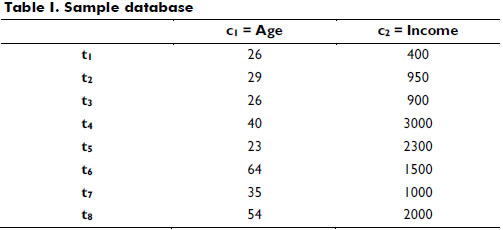
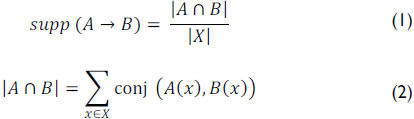
<body><![CDATA[<p><b>Support</b> is the percentage of transactions that contain both A and B:</p>     <p>    <center><img src="/img/revistas/iei/v34n3/v34n3a11e1y2.jpg"></center></p>       <p>In (1), the numerator is the number of transactions that contain the  itemset (A and B), and X is the size (i.e., number of transactions) of the  database.<b> </b>Its values are in the  range &#91;0, 1&#93;. If the antecedent and consequence are not present in any  transaction, then it is equal to 0. If they occur in all transactions, its  value is equal to 1.<b></b></p>       <p>    An itemset with a support greater than the minimum support threshold  is called a frequent or large itemset.</p>       <p>    The disadvantage of support arises in the rare item problem. Items  that occur very infrequently in the data set are deleted, although they would  still produce interesting and potentially valuable rules (Sheikh &amp; Tanveer,  2004).</p>       <p>    If T = {t<sub>1</sub>, t<sub>2</sub>, ..., tn} is the  database, and ti represents one tuple in T, C = {c<sub>1</sub>, c<sub>2</sub>,  ..., cm} can represent all attributes of the database. <a href="#t1">Table 1</a> shows  a sample database with quantitative attributes (e.g., age and income). Thus, T  = {t<sub>1</sub>, t<sub>2</sub>, t<sub>3</sub>, t<sub>4</sub>, t<sub>5</sub>, t<sub>6</sub>,  t<sub>7</sub>, t<sub>8</sub> } and C = {Age, Income}. For example, if the value  of Income in the fourth record is required, t<sub>4</sub> &#91;c<sub>2</sub>&#93; can  be used to get the value 3000.</p>     <p>    <center><a name="t1"></a><img src="/img/revistas/iei/v34n3/v34n3a11t1.jpg"></center></p>       <p>    The theory of fuzzy sets can certainly help data mining reach this  goal. The adjective "fuzzy" seems to be very popular and frequently  used in contemporary studies concerning the logical and set-theoretical  foundations of mathematics. Using the fuzzy set concept, the discovered  patterns are more understandable to human comprehension. Fuzzy sets manage  values more efficiently than existing methods because fuzzy sets soften the  effect of sharp boundaries (Zadeh, 1965; Zadeh, 1975; Fayyad, Piatetsky-Shapiro  &amp; Smyth, 1996; Duarte, 1999; Han &amp; Kamber, 2006; Venugopal, Srinivasa  &amp; Patnaik, 2009).</p>       ]]></body>
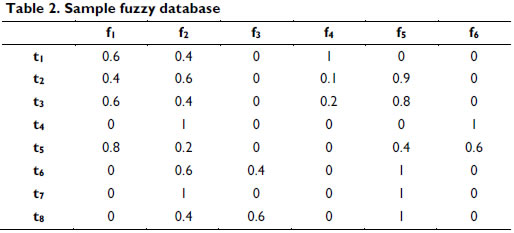
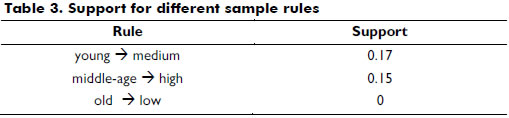
<body><![CDATA[<p>    We can define a set of meaningful linguistic labels represented by  fuzzy sets on the domain of the quantitative attributes in <a href="#t1">Table 1</a>; these are  used as a new domain (Galindo, Urrutia &amp; Piattini, 2006). </p>       <p>Several fuzzy sets F= {f<sub>1</sub>, f<sub>2</sub>,..., f<sub>k</sub>}  may be associated by attribute; for instance, if each attribute has three fuzzy  sets, FAge may equal {f<sub>1</sub>=young, f<sub>2</sub>=middle-age, f<sub>3</sub>=old},  and FIncome may equal {f<sub>4</sub>=low, f<sub>5</sub>=medium, f<sub>6</sub>=high}.</p>       <p>    This process is called fuzzification and may be performed using many  of the available membership functions; for example, triangle, trapezoidal or  left and right shoulder functions are commonly used because they yield good  results, and their computation is simple. Other authors have proposed the use  of other shapes including Sigmoid and Gaussian shapes (Cox, 1994; Mitsuishi,  Endou &amp; Shidama, 2000; Galindo, Urrutia &amp; Piattini, 2006). <a href="#t2">Table 2</a> presents what could occur if the quantitative attributes (<a href="#t1">Table 1</a>) were  replaced by fuzzy attributes. </p>     <p>    <center><a name="t2"></a><img src="/img/revistas/iei/v34n3/v34n3a11t2.jpg"></center></p>         <p>    The standard approach to generalizing the quality measures for fuzzy  association rules (Delgado, Mar&iacute;n, S&aacute;nchez &amp; Vila, 2003) is to replace the  set-theoretic operations, namely the Cartesian product and cardinality, with corresponding  fuzzy set-theoretic operations: negation, t-norm and t-conorm (Dubois,  H&uuml;llermeier &amp; Prade, 2003). These definitions establish families of  measures, depending of the evaluation method and the quantifier of choice  (Mitsuishi, Endou &amp; Shidama, 2000). </p>       <p> <a href="#t3">Table 3</a> illustrates the computation of support for different examples  of fuzzy association rules based on the database in <a href="#t2">Table 2</a> using the  definitions of Zadeh (1965) (i.e., minimum for conjunction and maximum for  disjunction). </p>     <p>    <center><a name="t3"></a><img src="/img/revistas/iei/v34n3/v34n3a11t3.jpg"></center></p>        <p>    <font size="3"><b>Fuzzy predicates in CNF and DNF</b></font></p>       ]]></body>
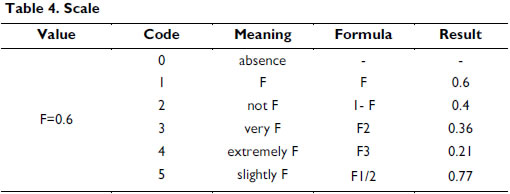
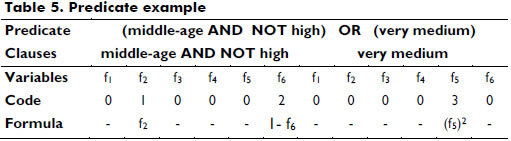
<body><![CDATA[<p>    Predicates are commonly used to refer to the properties of objects  by defining the set of all objects that have some property in common. In  general, a predicate is a statement that may be true or false depending on the  values of its variables. However, in fuzzy logic, the strict true/false  valuation of the predicate is replaced by a quantity interpreted as the degree  of truth (Trillas, 2009).</p>       <p>    A fuzzy predicate may be a tree where each internal node may be a  fuzzy operator (e.g., conjunction, disjunction, and negation), and each leaf is  a fuzzy variable of the database (Trillas, 2009). Each fuzzy variable can be  associated with adverbs called hedges, which are terms that modify the shape of  fuzzy sets. Hedges have two primary behaviors: reinforcement, such as  "very", or weakening, such as "little" (Bouchon-Meunier  &amp; Yao, 1992).</p>       <p>    A formula is in conjunctive normal form (CNF) if it is a conjunction  of clauses, where a clause is a disjunction of literals; otherwise put, it is  an AND of ORs. A formula is in disjunctive normal form (DNF) if it is a  disjunction of clauses, where a clause is a conjunction of literals. As in the  DNF, the only propositional connectives that a formula in CNF can contain are  AND, OR, and NOT. The NOT operator can only be used as part of a literal, which  indicates that it can only precede a propositional variable or a predicate  symbol.</p>       <p>    We believe that fuzzy predicates in CNF and DNF have some grade of  generality because they yield patterns that classic methods cannot obtain;  also, equivalent patterns can be generated. This transformation is based on the  rules of logical equivalences (Bruno, 1998) (Trillas, 2009). Even when these  equivalences are more true than false in multivalued logic, fuzzy predicates in  CNF and DNF is a good pattern representation to generalize knowledge. </p>       <p>    These predicates are sometimes created by a human expert or, in the  best circumstances, by the mutual consent of a group of them. However, they can  also be created by algorithms that "learn" when "processing" real data.  Predicate mining is a task that can be examined as an optimization problem and  metaheuristics can be used to solve it.</p>       <p>    Each fuzzy predicate in CNF or DNF can code by a vector that  represents the attributes in different clauses and values. You can use  positional integer encoding, where each value has a translation according to  the following scale (see <a href="#t4">Table 4</a>). In the predicate, variables can appear more  than once (i.e., they may be included in two or more clauses).}</p>     <p>    <center><a name="t4"></a><img src="/img/revistas/iei/v34n3/v34n3a11t4.jpg"></center></p>       <p>    An example of one predicate and its corresponding code solution is  shown in <a href="#t5">Table 5</a>.</p>     <p>    ]]></body>
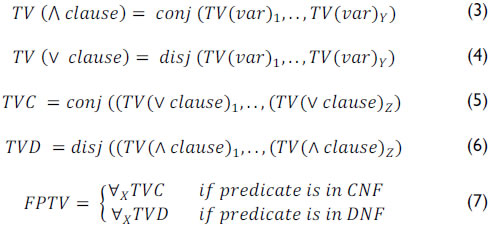
<body><![CDATA[<center><a name="t5"></a><img src="/img/revistas/iei/v34n3/v34n3a11t5.jpg"></center></p>       <p>For each predicate, the unique quality measure that is known is the  FPTV (Ceruto, Rosete &amp; Espin, 2010), which depends on the number of clauses  (Z), variables (Y) and records (X) of the data set. The fuzzy value of the FPTV  is in range &#91;0, 1&#93;:</p>     <p>    <center><img src="/img/revistas/iei/v34n3/v34n3a11e3-7.jpg"></center></p>       <p>The procedure to compute FPTV is summarized in the next pseudocode.</p>     <p>BEGIN    <br>      &nbsp;For each record in the database (X)    <br>      &nbsp;&nbsp;&nbsp;&nbsp;For  each clause in the predicate (Z)    <br>      &nbsp;&nbsp;&nbsp;&nbsp;&nbsp;&nbsp;&nbsp;&nbsp;For each attribute of the clause (Y)    <br>      &nbsp;&nbsp;&nbsp;&nbsp;&nbsp;&nbsp;&nbsp;&nbsp;&nbsp;&nbsp;&nbsp;&nbsp;Calculate the real value (TV<sub>var</sub>) of all attributes involved in the predicate (use <a href="#t4">Table  4</a>)    ]]></body>
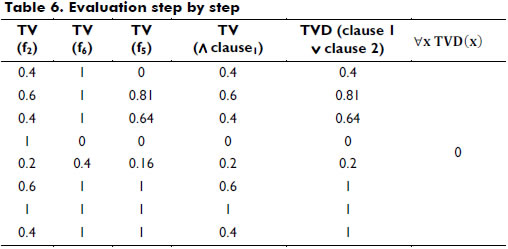
<body><![CDATA[<br>      &nbsp;&nbsp;&nbsp;&nbsp;&nbsp;&nbsp;&nbsp;&nbsp;Calculate the TV of the clauses (TV<sub>&and;clause</sub> or                TV<sub>&or;clause</sub>) depending on the operator (<i>equation</i> 3-4)    <br>      &nbsp;&nbsp;&nbsp;&nbsp;Calculate the TV of the predicate in the  record (TVC or TVF)  according to the normal form (<i>equation</i> 5-6).    <br>     &nbsp;Calculate the final value using the universal quantifier (conjunction)  in all rows (<i>equation 7</i>)    <br> END </p>     <p>The FPTV is computed using fuzzy logic operators. Fuzzy logic does  not give a unique definition of the classic operations such as union or  intersection. Different operators that can be used imply differences in the  truth value that will be obtained. Zadeh operators (i.e., min-max) are  insensitive (Zadeh, 1965). In this case, the change of one argument may not  change the value of the result (e.g., 0.5 &and; <b>0.5</b> = 0.5; 0.5 &and; <b>0.8</b> = 0.5). Probability operators  (Mizumoto, 1981a) are not idempotent; the conjunction of two variables with the  same values does not result in the same number (0.5 &and; 0.5 =  0.25). Compensatory fuzzy logic is sensitive and idempotent (Espin, Fernandez,  Mazcorro, Marx-G&oacute;mez &amp; Lecich, 2006) because associativity is excluded;  examples of this include the Geometric Mean and their dual (Mizumoto, 1989). </p>       <p>    To illustrate the computation of FPTV, we show a simple example  based on the database in <a href="#t2">Table 2</a>, the predicate in <a href="#t5">Table 5</a> (i.e., DNF with two  clauses) and the Zadeh fuzzy operator (i.e., minimum and maximum) using the  pseudocode described above. In <a href="#t6">Table 6</a>, the first three columns represent the  TV of all variables. The fourth denotes the result of computing the TV of the  first clause (i.e., middle-age AND NOT high) using a minimum to create the  conjunction between the first and second column. The TV (clause 2) has the same  value of TV (very medium).</p>     <p>    <center><a name="t6"></a><img src="/img/revistas/iei/v34n3/v34n3a11t6.jpg"></center></p>       <p>    As shown in this example, the FPTV of this predicate is 0 (i.e.,  conjunction of the values obtained in TVD) because there is a zero in the  fourth row. Veto criteria introduce this hard restriction when certain goals  are not satisfied (Espin, Fernandez, Mazcorro, Marx-G&oacute;mez &amp; Lecich, 2006).  This record is only an outlier; in general, the predicate functions well in  this database. If it happens during the search, the predicate obtained would be  wrongly discarded.</p>       <p>    Conversely, it always uses the universal quantifier (i.e., conjunction  of all results). This operator tends to restrict the output that will be  determined by the type of fuzzy logic operator that is selected. FPTV will only  return a high true value when all records have higher values.</p>       ]]></body>
<body><![CDATA[<p>    For all of the reasons mentioned before, it is important to have  others measures to evaluate the quality of fuzzy predicates in normal form to  guide the search. </p>       <p>    <font size="3"><b>New quality measures of fuzzy predicates in CNF or DNF</b></font></p>       <p>    The first measure proposed is the <b>F</b>uzzy <b>P</b>redicate <b>S</b>upport (FPS). In this case, the  numerator is the sum of the truth values of the predicate in each tuple without  applying the universal quantifier in each transaction divided by the absolute  number of transactions. FPS can be interpreted as the average support of the  predicate:</p>     <p>    <center><img src="/img/revistas/iei/v34n3/v34n3a11e8.jpg"></center></p>       <p>    The second measure is the <b>F</b>uzzy <b>P</b>redicate <b>B</b>inary <b>S</b>upport (FPBS).  FPBS allows the determination of which percentage of records in the databases  has a truth value below the threshold. Depending of the threshold selected, if  the value of FPBS is low, then the predicate is not good:</p>     <p>    <center><img src="/img/revistas/iei/v34n3/v34n3a11e9.jpg"></center></p>     <p>    In this case, a threshold is used to calculate the <b>F</b>uzzy <b>P</b>redicate<b> B</b>inary <b>T</b>ruth <b>V</b>alue (FPBTV) in each record. FPBTV can be considered <i>alpha-cut</i> (i.e., a subset of elements with membership grades of at least <i>alpha</i>).    <br>   <a href="#t7">Table 7</a> shows the computation of FPS and FPBS following the previous  example. The selected threshold was 0.4, and all values greater than or equal to the threshold were set to 1.</p>     ]]></body>
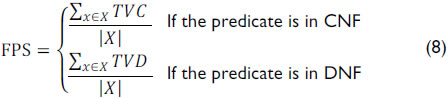
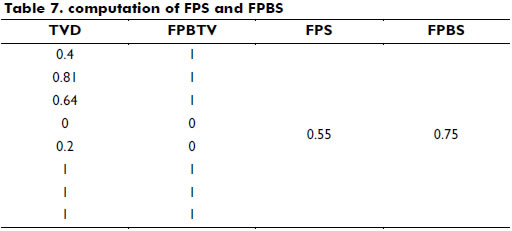
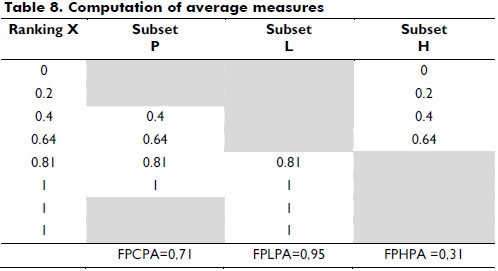
<body><![CDATA[<p>    <center><a name="t7"></a><img src="/img/revistas/iei/v34n3/v34n3a11t7.jpg"></center></p>       <p>The other proposals are associated with measures of central  tendency. The mean or average is affected by the asymmetry of the data  distribution and the presence of "outliers." For these reasons,  average pruning, a technique in machine learning that reduces the size of the  instances by removing sections that may be based on noisy or mistaken data, is  selected for use (Han &amp; Kamber, 2006). To calculate it, the data are first  sorted in ascending order, and then a certain percentage of data in each end of  the distribution is removed.</p>       <p>    We propose three new measures (see <a href="#t8">Table 8</a>): </p> <ul>     <li><b>F</b>uzzy <b>P</b>redicate <b>C</b>entral <b>P</b>runing <b>A</b>verage (FPCPA): remove 25% of the low extremes and 25% of the high  extremes, and create the subset P:</li>       <p>    <center><img src="/img/revistas/iei/v34n3/v34n3a11e10.jpg"></center></p>     <p>This measure may be interpreted as the average truth value of the  transaction with median truth values; it yields a version of the Fuzzy  Predicate Support (FPS) that is less sensible to the extreme truth values in  the transactions.</p>      <li><b>F</b>uzzy <b>P</b>redicate <b>L</b>ow <b>P</b>runing <b>A</b>verage (FPLPA):  remove 50%  of the lower values and create the subset L.:</li>     <p>    ]]></body>
<body><![CDATA[<center><img src="/img/revistas/iei/v34n3/v34n3a11e11.jpg"></center></p>     <p>This measure may be interpreted as the average truth value of the  transaction with high truth values; it yields an optimistic version of the FPS.</p>     <li><b>F</b>uzzy <b>P</b>redicate <b>H</b>igh <b>A</b>verage <b>P</b>runing (FPHPA): remove 50% of the higher values and create the  subset H:</li>     <p>    <center><img src="/img/revistas/iei/v34n3/v34n3a11e12.jpg"></center></p>     <p>This measure may be interpreted as the average truth value of the  transaction with low truth values; it yields a pessimistic version of the FPS.</p>     </ul>     <p>    <center><a name="t8"></a><img src="/img/revistas/iei/v34n3/v34n3a11t8.jpg"></center></p>     <p>    In addition, we propose a measure of comprehensibility, which  attempts to quantify how easy it can be to understand the predicate. The  generated predicates may have a large number of attributes, making them  difficult to understand. In the cases of association rules, there have been  some measures to manage this subject by evaluating the number of variables that  are included in the rule (Mart&iacute;n, Rosete, Alcala-Fdez &amp; Herrera, 2013). The  same idea may be applied to fuzzy predicates.</p>     ]]></body>
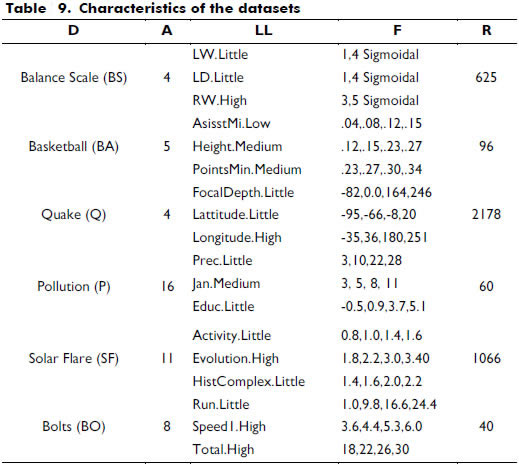
<body><![CDATA[<p>  The <b>F</b>uzzy <b>P</b>redicate <b>C</b>omprehensibility (FPC) is defined as:</p>     <p>    <center><img src="/img/revistas/iei/v34n3/v34n3a11E13.jpg"></center></p>     <p>In equation 13, Y is the number of variables involved in the predicate.<b> </b>This measure may be interpreted as the  inverse of the number of variables that are used in the predicate. As shown,  this measure does not depend on the number of fuzzy variables in the databases.  The value of FPC in the previous example is 0.33. </p>     <p>    The fuzzy value of all measures proposed in this section is in the  range &#91;0, 1&#93;, where the value 1 indicates the best possible value (i.e., the  given knowledge is true in all database); if the value drops to 0, the fuzzy  value is more false than true.</p>     <p>    The last measure proposed is the <b>Q</b>uantity of <b>Z</b>eros (QZ)  in the databases. This measure helps to determine if the value of FTPV is  accurate. If the value of QZ is low, while the other measures have a high true  value, then the value in question is likely an outlier, and the predicate then  provides relevant knowledge.</p>     <p>    <font size="3"><b>Experiments</b></font> </p>     <p>    This section illustrates how the proposed measures can be used to  evaluate the quality of fuzzy predicates in normal form. Experiments were  conducted with real-world datasets available in UC Irvine Machine Learning  Repository (http://archive.ics.uci.edu/ ml/). The algorithm used in this  experiment to discover fuzzy predicates in CNF or DNF is called FuzzyPred,  which was proposed by Ceruto, Rosete &amp; Espin (2010); Rosete, Ceruto, Espin  &amp; Marx-G&oacute;mez (2011); and Ceruto, Lapeira, Rosete &amp; Espin (2013).</p>       <p> <a href="#t9">Table 9</a> summarizes the primary characteristics of the datasets,  which uses the following labels: <b>D </b>=  databases; <b>A</b> = total number of  attributes; <b>LL</b> = linguistic labels  used; <b>F</b> = parameters of fuzzification; <b>R</b> = quantity of records. We  extracted three quantitative attributes randomly from each database. The  membership functions of each attribute were defined primarily by a uniform  partition with trapezoidal membership functions. The linguistic label for each  variable selected was also selected randomly.</p>     <p>    ]]></body>
<body><![CDATA[<center><a name="t9"></a><img src="/img/revistas/iei/v34n3/v34n3a11t9.jpg"></center></p>       <p>    We perform 30 runs, each with a maximum of 500 iterations, using  several metaheuristics to obtain predicates with high truth values (FPTV) using  FuzzyPred. The FPTV was computed using the Zadeh Operator (Min-Max).</p>       <p><a href="#t10">Table 10</a> contains the evaluations of the best three predicates in    each database using all proposed measures. The first column (<b>F</b>uzzy <b>P</b>redicated <b>Id</b>entifier,  FPId) corresponds to an identifier associated with each predicate in each  database. The first part of the FPId identifies the corresponding database; for  example, BS2 is a predicate obtained from the database Balance Scale  (BS). The selected threshold to compute the measure FPBS was 0.2. </p>     <p>    <center><a name="t10"></a><img src="/img/revistas/iei/v34n3/v34n3a11t10.jpg"></center></p>       <p>Because the number of potentially applicable predicates may be large,  we illustrate one example for each database:</p>   <ul>         <li><b>BS<sub>1</sub></b>: (slightly LD.Little) AND  (slightly LW.Little   OR  LD.Little)</li>         <li><b>BA<sub>1</sub></b>: slightly AsisstMi.Low OR  NOT Height.Medium AND  (NOT AsisstMi.Low)</li>         <li><b>Q<sub>1</sub></b>: (FocalDepth.Little) AND  (Longitude.High)</li>         <li><b>P<sub>1</sub></b>: NOT Jan.Medium AND  Educ.Little</li>         ]]></body>
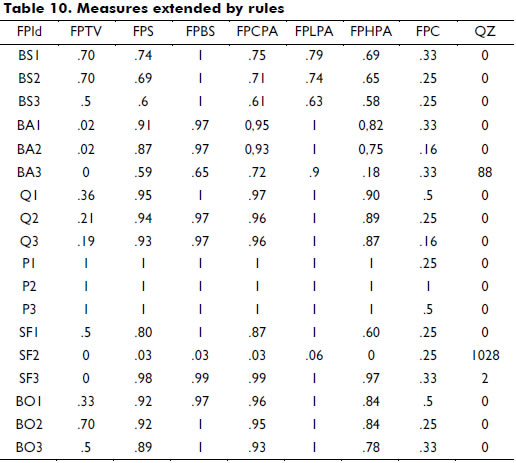
<body><![CDATA[<li><b>SF<sub>1</sub></b>: (NOT Evolution.High) AND  (NOT Activity.Little) </li>         <li><b>BO<sub>1</sub></b>: (NOT Total.High) AND  (NOT Run.Little)</li>       </ul>       <p>Analyzing the results presented in the <a href="#t10">Table 10</a>, the following facts  can be stated:</p>   <ul>         <li>If 50% of the highest values  are removed (FPHPA), good performance is still shown; the predicate has good  coverage in the database (database Q).</li>         <li>When FPTV is near 1, no other  measure is required for good performance because other measures would be more  relaxed than those proposed and would thus not provide any new knowledge  (database P).</li>         <li>When FPTV=0, the veto criteria  may be the cause, but another analysis is required to be certain. </li>         <li>If the predicate is penalized  for every measure (e.g., due to the presence of 1028 zeros at 1066 tuples, like  SF<sub>2</sub>), then the quality of this predicate is poor. </li>         <li>When the other measures have a  high true value, then the value of interest can be considered an outlier (e.g.,  the value only has two zeros, like in SF<sub>3</sub>). For example, when the  measure FPLPA is very small, the value of FPTV is not caused by a veto of a  tuple. This conclusion can be reaffirmed by FPBS, depending on the threshold  selected. This is a great example of a predicate (SF<sub>3</sub>) that can be  lost if only FPTV were considered.</li>       </ul>       ]]></body>
<body><![CDATA[<p>This section has shown how the proposed measures can be used to  understand the meaning of the predicates and the real characteristics of the  databases. </p>       <p><font size="3"><b>Conclusions</b></font> </p>       <p>    The approach outlined in this paper  justifies the use of different types of quality measures for fuzzy predicates  in CNF and DNF. We compared fuzzy predicate truth values to seven other  measures, three of which were statistical. The experiments show that when FPTV  is near 1, no other measure is required for good performance. We suggest that  the new measures are a good choice in other cases, particularly when FPTV is  equal to 0 because they can help determine if the veto criteria are important.  The proposed measures may be used to evaluate fuzzy predicates in different  contexts independently of the way they are obtained. We also intend to use  diverse and extensive test data to confirm the claims made in this paper.</p> <hr>     <p><font size="3"><b>References</b></font> </p>       <!-- ref --><p>Agrawal, R., &amp; Srikant, R. (1994).  Fast Algorithms for Mining Association Rules. In Proc. 20th Very Large Data  Bases, 487-499.    &nbsp;&nbsp;&nbsp;&nbsp;&nbsp;&nbsp;&nbsp;&nbsp;[&#160;<a href="javascript:void(0);" onclick="javascript: window.open('/scielo.php?script=sci_nlinks&ref=000147&pid=S0120-5609201400030001100001&lng=','','width=640,height=500,resizable=yes,scrollbars=1,menubar=yes,');">Links</a>&#160;]<!-- end-ref --></p>       <!-- ref --><p>    Bruno, A. (1998). Normal forms. <i>Mathematics and Computers in Simulation</i>, <i>45</i>, 413-427.    &nbsp;&nbsp;&nbsp;&nbsp;&nbsp;&nbsp;&nbsp;&nbsp;[&#160;<a href="javascript:void(0);" onclick="javascript: window.open('/scielo.php?script=sci_nlinks&ref=000149&pid=S0120-5609201400030001100002&lng=','','width=640,height=500,resizable=yes,scrollbars=1,menubar=yes,');">Links</a>&#160;]<!-- end-ref --></p>       <!-- ref --><p>    Bouchon-Meunier,  B., &amp; Yao, J. (1992). Linguistic modifiers and imprecise categories. <i>International Journal of Intelligent Systems</i>, <i>7</i>(1), 25-36.    &nbsp;&nbsp;&nbsp;&nbsp;&nbsp;&nbsp;&nbsp;&nbsp;[&#160;<a href="javascript:void(0);" onclick="javascript: window.open('/scielo.php?script=sci_nlinks&ref=000151&pid=S0120-5609201400030001100003&lng=','','width=640,height=500,resizable=yes,scrollbars=1,menubar=yes,');">Links</a>&#160;]<!-- end-ref --></p>       ]]></body>
<body><![CDATA[<!-- ref --><p>    Ceruto,  T., Lapeira, O., Rosete, A., &amp; Esp&iacute;n, R. (2013). Discovery  of fuzzy predicates in database. <i>Advances  in Intelligent Systems Research</i>, <i>51</i>,  45-54.    &nbsp;&nbsp;&nbsp;&nbsp;&nbsp;&nbsp;&nbsp;&nbsp;[&#160;<a href="javascript:void(0);" onclick="javascript: window.open('/scielo.php?script=sci_nlinks&ref=000153&pid=S0120-5609201400030001100004&lng=','','width=640,height=500,resizable=yes,scrollbars=1,menubar=yes,');">Links</a>&#160;]<!-- end-ref --></p>       <!-- ref --><p>    Ceruto,  T., Rosete, A., &amp; Esp&iacute;n, R. (2014). Knowledge  Discovery by Fuzzy Predicates. <i>Soft  Computing for Business Intelligence</i>, <i>537</i>,  187-196.    &nbsp;&nbsp;&nbsp;&nbsp;&nbsp;&nbsp;&nbsp;&nbsp;[&#160;<a href="javascript:void(0);" onclick="javascript: window.open('/scielo.php?script=sci_nlinks&ref=000155&pid=S0120-5609201400030001100005&lng=','','width=640,height=500,resizable=yes,scrollbars=1,menubar=yes,');">Links</a>&#160;]<!-- end-ref --></p>       <!-- ref --><p>    Chandraveer,  S., Sana, A., &amp; Zaid, M. (2013). Comparison of Interestingness Measures:  Support-Confidence Framework versus Lift-rule Framework. <i>International Journal of Engineering Research and Applications</i>, <i>3</i>(2), 208-215.    &nbsp;&nbsp;&nbsp;&nbsp;&nbsp;&nbsp;&nbsp;&nbsp;[&#160;<a href="javascript:void(0);" onclick="javascript: window.open('/scielo.php?script=sci_nlinks&ref=000157&pid=S0120-5609201400030001100006&lng=','','width=640,height=500,resizable=yes,scrollbars=1,menubar=yes,');">Links</a>&#160;]<!-- end-ref --> </p>       <!-- ref --><p>    Cox, E. (1994). <i>The Fuzzy Systems Handbook: A Practitioner's Guide to Building, Using,  and Maintaining Fuzzy Systems</i>.  Boston: AP Professional.    &nbsp;&nbsp;&nbsp;&nbsp;&nbsp;&nbsp;&nbsp;&nbsp;[&#160;<a href="javascript:void(0);" onclick="javascript: window.open('/scielo.php?script=sci_nlinks&ref=000159&pid=S0120-5609201400030001100007&lng=','','width=640,height=500,resizable=yes,scrollbars=1,menubar=yes,');">Links</a>&#160;]<!-- end-ref --> </p>       <!-- ref --><p>    Delgado,  M., Mar&iacute;n, N., S&aacute;nchez, D., &amp; Vila, M. (2003). Fuzzy  association rules: general model and applications. <i>IEEE Transactions on</i><i> Fuzzy Systems, 11</i>(2), 214-225.    &nbsp;&nbsp;&nbsp;&nbsp;&nbsp;&nbsp;&nbsp;&nbsp;[&#160;<a href="javascript:void(0);" onclick="javascript: window.open('/scielo.php?script=sci_nlinks&ref=000161&pid=S0120-5609201400030001100008&lng=','','width=640,height=500,resizable=yes,scrollbars=1,menubar=yes,');">Links</a>&#160;]<!-- end-ref --></p>       ]]></body>
<body><![CDATA[<!-- ref --><p>    Duarte, O.  (1999). Sistemas de  L&oacute;gica Difusa-Fundamentos. <i>Revista Ingenier&iacute;a e Investigaci&oacute;n</i>, <i>42</i>,  22-30.    &nbsp;&nbsp;&nbsp;&nbsp;&nbsp;&nbsp;&nbsp;&nbsp;[&#160;<a href="javascript:void(0);" onclick="javascript: window.open('/scielo.php?script=sci_nlinks&ref=000163&pid=S0120-5609201400030001100009&lng=','','width=640,height=500,resizable=yes,scrollbars=1,menubar=yes,');">Links</a>&#160;]<!-- end-ref --></p>       <!-- ref --><p>    Dubois, D., H&uuml;llermeier,  E., &amp; Prade, H. (2003). A note on quality measures for fuzzy association rules. In <i>Fuzzy  Sets and Systems-IFSA 2003</i>, 346-353.    &nbsp;&nbsp;&nbsp;&nbsp;&nbsp;&nbsp;&nbsp;&nbsp;[&#160;<a href="javascript:void(0);" onclick="javascript: window.open('/scielo.php?script=sci_nlinks&ref=000165&pid=S0120-5609201400030001100010&lng=','','width=640,height=500,resizable=yes,scrollbars=1,menubar=yes,');">Links</a>&#160;]<!-- end-ref --></p>       <!-- ref --><p>    Espin, R., Fernandez,  E., Mazcorro, G., Marx-G&oacute;mez, J., &amp; Lecich, M. (2006). Compensatory Logic: A fuzzy  normative model for decision making. <i>Investigaci&oacute;n  Operacional</i>, <i>27</i>(2), 178-193.    &nbsp;&nbsp;&nbsp;&nbsp;&nbsp;&nbsp;&nbsp;&nbsp;[&#160;<a href="javascript:void(0);" onclick="javascript: window.open('/scielo.php?script=sci_nlinks&ref=000167&pid=S0120-5609201400030001100011&lng=','','width=640,height=500,resizable=yes,scrollbars=1,menubar=yes,');">Links</a>&#160;]<!-- end-ref --></p>       <!-- ref --><p>    Fayyad,  U., Piatetsky-Shapiro, G., &amp; Smyth, P. (1996). The KDD Process for Extracting  Useful Knowledge. <i>Communications of the  ACM</i>, <i>39</i>, 27-34.    &nbsp;&nbsp;&nbsp;&nbsp;&nbsp;&nbsp;&nbsp;&nbsp;[&#160;<a href="javascript:void(0);" onclick="javascript: window.open('/scielo.php?script=sci_nlinks&ref=000169&pid=S0120-5609201400030001100012&lng=','','width=640,height=500,resizable=yes,scrollbars=1,menubar=yes,');">Links</a>&#160;]<!-- end-ref --></p>       <!-- ref --><p>    Galindo,  J., Urrutia, A., &amp; Piattini, M. (2006). Fuzzy Databases: Modeling, Design  and Implementation (pp. 341). Idea Group Publishing.    &nbsp;&nbsp;&nbsp;&nbsp;&nbsp;&nbsp;&nbsp;&nbsp;[&#160;<a href="javascript:void(0);" onclick="javascript: window.open('/scielo.php?script=sci_nlinks&ref=000171&pid=S0120-5609201400030001100013&lng=','','width=640,height=500,resizable=yes,scrollbars=1,menubar=yes,');">Links</a>&#160;]<!-- end-ref --></p>       ]]></body>
<body><![CDATA[<!-- ref --><p>    Guillet,  F., &amp; Hamilton, H. (2007). Quality Measures in Data Mining. <i>Studies in Computational Intelligence</i>, <i>43</i>.    &nbsp;&nbsp;&nbsp;&nbsp;&nbsp;&nbsp;&nbsp;&nbsp;[&#160;<a href="javascript:void(0);" onclick="javascript: window.open('/scielo.php?script=sci_nlinks&ref=000173&pid=S0120-5609201400030001100014&lng=','','width=640,height=500,resizable=yes,scrollbars=1,menubar=yes,');">Links</a>&#160;]<!-- end-ref --></p>       <!-- ref --><p>    Han, J.,  &amp; Kamber, M. (2006). Data Mining: Concepts and Techniques (pp. 1-14) (2nd  ed.). The Morgan Kaufmann Series in DataManagement Systems.    &nbsp;&nbsp;&nbsp;&nbsp;&nbsp;&nbsp;&nbsp;&nbsp;[&#160;<a href="javascript:void(0);" onclick="javascript: window.open('/scielo.php?script=sci_nlinks&ref=000175&pid=S0120-5609201400030001100015&lng=','','width=640,height=500,resizable=yes,scrollbars=1,menubar=yes,');">Links</a>&#160;]<!-- end-ref --></p>       <!-- ref --><p>    Mart&iacute;n, D., Rosete, A., Alcala-Fdez,  J., &amp; Herrera, F. (2013). QAR-CIP-NSGA-II: A new multi-objective evolutionary algorithm to mine  quantitative association rules. <i>Information  Sciencies</i>, <i>258</i>, 1-28.    &nbsp;&nbsp;&nbsp;&nbsp;&nbsp;&nbsp;&nbsp;&nbsp;[&#160;<a href="javascript:void(0);" onclick="javascript: window.open('/scielo.php?script=sci_nlinks&ref=000177&pid=S0120-5609201400030001100016&lng=','','width=640,height=500,resizable=yes,scrollbars=1,menubar=yes,');">Links</a>&#160;]<!-- end-ref -->  </p>       <!-- ref --><p>Mitsuishi,  T., Endou, N., &amp; Shidama, Y. (2000). The concept of fuzzy set and  membership function and basic properties of fuzzy set operation. <i>Journal of  Formalized Mathematics</i>, <i>9</i>(2), 315-356.    &nbsp;&nbsp;&nbsp;&nbsp;&nbsp;&nbsp;&nbsp;&nbsp;[&#160;<a href="javascript:void(0);" onclick="javascript: window.open('/scielo.php?script=sci_nlinks&ref=000179&pid=S0120-5609201400030001100017&lng=','','width=640,height=500,resizable=yes,scrollbars=1,menubar=yes,');">Links</a>&#160;]<!-- end-ref --></p>       <!-- ref --><p>    Mizumoto, M. (1981). Fuzzy Sets and their  Operations I. <i>Information and Control</i>, <i>48</i>(1), 31-48.    &nbsp;&nbsp;&nbsp;&nbsp;&nbsp;&nbsp;&nbsp;&nbsp;[&#160;<a href="javascript:void(0);" onclick="javascript: window.open('/scielo.php?script=sci_nlinks&ref=000181&pid=S0120-5609201400030001100018&lng=','','width=640,height=500,resizable=yes,scrollbars=1,menubar=yes,');">Links</a>&#160;]<!-- end-ref --></p>       ]]></body>
<body><![CDATA[<!-- ref --><p>    Mizumoto, M. (1989). Pictorial Representations  of fuzzy conectives, Part II: cases of Compensatory operators and Self-dual operators. <i>Fuzzy Sets and Systems</i>, <i>32</i>, 45-79.    &nbsp;&nbsp;&nbsp;&nbsp;&nbsp;&nbsp;&nbsp;&nbsp;[&#160;<a href="javascript:void(0);" onclick="javascript: window.open('/scielo.php?script=sci_nlinks&ref=000183&pid=S0120-5609201400030001100019&lng=','','width=640,height=500,resizable=yes,scrollbars=1,menubar=yes,');">Links</a>&#160;]<!-- end-ref --></p>       <!-- ref --><p>    Rosete, A., Ceruto, T., Espin, R., &amp;  Marx-G&oacute;mez, J. (2011). A General Method for Knowledge Discovery  Using Compensatory Fuzzy Logic  and  Metaheuristics.  In  Gathering   Knowledge  Discovery, Knowledge Management and Decision  Making (pp. 240-271).    &nbsp;&nbsp;&nbsp;&nbsp;&nbsp;&nbsp;&nbsp;&nbsp;[&#160;<a href="javascript:void(0);" onclick="javascript: window.open('/scielo.php?script=sci_nlinks&ref=000185&pid=S0120-5609201400030001100020&lng=','','width=640,height=500,resizable=yes,scrollbars=1,menubar=yes,');">Links</a>&#160;]<!-- end-ref --> </p>       <!-- ref --><p>    Sheikh,  L., Tanveer, B., Hamdani, M. (2004). Interesting measures for mining  association rules. In Proceedings of  INMIC 2004 (pp. 641-644).    &nbsp;&nbsp;&nbsp;&nbsp;&nbsp;&nbsp;&nbsp;&nbsp;[&#160;<a href="javascript:void(0);" onclick="javascript: window.open('/scielo.php?script=sci_nlinks&ref=000187&pid=S0120-5609201400030001100021&lng=','','width=640,height=500,resizable=yes,scrollbars=1,menubar=yes,');">Links</a>&#160;]<!-- end-ref --></p>       <!-- ref --><p>    Trillas, E. (2009). On a model for the meaning  of predicates. A naive approach to the genesis of fuzzy sets. <i>Studies in Fuzziness and Soft Computing</i>, <i>243</i>(9), 175-205.    &nbsp;&nbsp;&nbsp;&nbsp;&nbsp;&nbsp;&nbsp;&nbsp;[&#160;<a href="javascript:void(0);" onclick="javascript: window.open('/scielo.php?script=sci_nlinks&ref=000189&pid=S0120-5609201400030001100022&lng=','','width=640,height=500,resizable=yes,scrollbars=1,menubar=yes,');">Links</a>&#160;]<!-- end-ref --></p>       <!-- ref --><p>    Venugopal, K., Srinivasa, K., &amp; Patnaik, L.  (2009). Soft Computing for Data Mining Applications. <i>Studies in Computational Intelligence</i>, <i>190</i>, 1-15.    &nbsp;&nbsp;&nbsp;&nbsp;&nbsp;&nbsp;&nbsp;&nbsp;[&#160;<a href="javascript:void(0);" onclick="javascript: window.open('/scielo.php?script=sci_nlinks&ref=000191&pid=S0120-5609201400030001100023&lng=','','width=640,height=500,resizable=yes,scrollbars=1,menubar=yes,');">Links</a>&#160;]<!-- end-ref --></p>       ]]></body>
<body><![CDATA[<!-- ref --><p>    Zadeh, L. (1965). Fuzzy Sets. <i>Information Control</i>, <i>8</i>,  338-353.    &nbsp;&nbsp;&nbsp;&nbsp;&nbsp;&nbsp;&nbsp;&nbsp;[&#160;<a href="javascript:void(0);" onclick="javascript: window.open('/scielo.php?script=sci_nlinks&ref=000193&pid=S0120-5609201400030001100024&lng=','','width=640,height=500,resizable=yes,scrollbars=1,menubar=yes,');">Links</a>&#160;]<!-- end-ref --> </p> </font>      ]]></body><back>
<ref-list>
<ref id="B1">
<nlm-citation citation-type="confpro">
<person-group person-group-type="author">
<name>
<surname><![CDATA[Agrawal]]></surname>
<given-names><![CDATA[R]]></given-names>
</name>
<name>
<surname><![CDATA[Srikant]]></surname>
<given-names><![CDATA[R]]></given-names>
</name>
</person-group>
<article-title xml:lang="en"><![CDATA[Fast Algorithms for Mining Association Rules]]></article-title>
<source><![CDATA[]]></source>
<year>1994</year>
<conf-name><![CDATA[20 Very Large Data Bases]]></conf-name>
<conf-loc> </conf-loc>
<page-range>487-499</page-range></nlm-citation>
</ref>
<ref id="B2">
<nlm-citation citation-type="journal">
<person-group person-group-type="author">
<name>
<surname><![CDATA[Bruno]]></surname>
<given-names><![CDATA[A]]></given-names>
</name>
</person-group>
<article-title xml:lang="en"><![CDATA[Normal forms]]></article-title>
<source><![CDATA[Mathematics and Computers in Simulation]]></source>
<year>1998</year>
<volume>45</volume>
<page-range>413-427</page-range></nlm-citation>
</ref>
<ref id="B3">
<nlm-citation citation-type="journal">
<person-group person-group-type="author">
<name>
<surname><![CDATA[Bouchon-Meunier]]></surname>
<given-names><![CDATA[B]]></given-names>
</name>
<name>
<surname><![CDATA[Yao]]></surname>
<given-names><![CDATA[J]]></given-names>
</name>
</person-group>
<article-title xml:lang="en"><![CDATA[Linguistic modifiers and imprecise categories]]></article-title>
<source><![CDATA[International Journal of Intelligent Systems]]></source>
<year>1992</year>
<volume>7</volume>
<numero>1</numero>
<issue>1</issue>
<page-range>25-36</page-range></nlm-citation>
</ref>
<ref id="B4">
<nlm-citation citation-type="journal">
<person-group person-group-type="author">
<name>
<surname><![CDATA[Ceruto]]></surname>
<given-names><![CDATA[T]]></given-names>
</name>
<name>
<surname><![CDATA[Lapeira]]></surname>
<given-names><![CDATA[O]]></given-names>
</name>
<name>
<surname><![CDATA[Rosete]]></surname>
<given-names><![CDATA[A]]></given-names>
</name>
<name>
<surname><![CDATA[Espín]]></surname>
<given-names><![CDATA[R]]></given-names>
</name>
</person-group>
<article-title xml:lang="en"><![CDATA[Discovery of fuzzy predicates in database]]></article-title>
<source><![CDATA[Advances in Intelligent Systems Research]]></source>
<year>2013</year>
<volume>51</volume>
<page-range>45-54</page-range></nlm-citation>
</ref>
<ref id="B5">
<nlm-citation citation-type="journal">
<person-group person-group-type="author">
<name>
<surname><![CDATA[Ceruto]]></surname>
<given-names><![CDATA[T]]></given-names>
</name>
<name>
<surname><![CDATA[Rosete]]></surname>
<given-names><![CDATA[A]]></given-names>
</name>
<name>
<surname><![CDATA[Espín]]></surname>
<given-names><![CDATA[R]]></given-names>
</name>
</person-group>
<article-title xml:lang="en"><![CDATA[Knowledge Discovery by Fuzzy Predicates]]></article-title>
<source><![CDATA[Soft Computing for Business Intelligence]]></source>
<year>2014</year>
<volume>537</volume>
<page-range>187-196</page-range></nlm-citation>
</ref>
<ref id="B6">
<nlm-citation citation-type="journal">
<person-group person-group-type="author">
<name>
<surname><![CDATA[Chandraveer]]></surname>
<given-names><![CDATA[S]]></given-names>
</name>
<name>
<surname><![CDATA[Sana]]></surname>
<given-names><![CDATA[A]]></given-names>
</name>
<name>
<surname><![CDATA[Zaid]]></surname>
<given-names><![CDATA[M]]></given-names>
</name>
</person-group>
<article-title xml:lang="en"><![CDATA[Comparison of Interestingness Measures: Support-Confidence Framework versus Lift-rule Framework]]></article-title>
<source><![CDATA[International Journal of Engineering Research and Applications]]></source>
<year>2013</year>
<volume>3</volume>
<numero>2</numero>
<issue>2</issue>
<page-range>208-215</page-range></nlm-citation>
</ref>
<ref id="B7">
<nlm-citation citation-type="book">
<person-group person-group-type="author">
<name>
<surname><![CDATA[Cox]]></surname>
<given-names><![CDATA[E]]></given-names>
</name>
</person-group>
<source><![CDATA[The Fuzzy Systems Handbook: A Practitioner's Guide to Building, Using, and Maintaining Fuzzy Systems]]></source>
<year>1994</year>
<publisher-loc><![CDATA[Boston ]]></publisher-loc>
<publisher-name><![CDATA[AP Professional]]></publisher-name>
</nlm-citation>
</ref>
<ref id="B8">
<nlm-citation citation-type="journal">
<person-group person-group-type="author">
<name>
<surname><![CDATA[Delgado]]></surname>
<given-names><![CDATA[M]]></given-names>
</name>
<name>
<surname><![CDATA[Marín]]></surname>
<given-names><![CDATA[N]]></given-names>
</name>
<name>
<surname><![CDATA[Sánchez]]></surname>
<given-names><![CDATA[D]]></given-names>
</name>
<name>
<surname><![CDATA[Vila]]></surname>
<given-names><![CDATA[M]]></given-names>
</name>
</person-group>
<article-title xml:lang="en"><![CDATA[Fuzzy association rules: general model and applications]]></article-title>
<source><![CDATA[IEEE Transactions on Fuzzy Systems]]></source>
<year>2003</year>
<volume>11</volume>
<numero>2</numero>
<issue>2</issue>
<page-range>214-225</page-range></nlm-citation>
</ref>
<ref id="B9">
<nlm-citation citation-type="journal">
<person-group person-group-type="author">
<name>
<surname><![CDATA[Duarte]]></surname>
<given-names><![CDATA[O]]></given-names>
</name>
</person-group>
<article-title xml:lang="es"><![CDATA[Sistemas de Lógica Difusa-Fundamentos]]></article-title>
<source><![CDATA[Revista Ingeniería e Investigación]]></source>
<year>1999</year>
<volume>42</volume>
<page-range>22-30</page-range></nlm-citation>
</ref>
<ref id="B10">
<nlm-citation citation-type="confpro">
<person-group person-group-type="author">
<name>
<surname><![CDATA[Dubois]]></surname>
<given-names><![CDATA[D]]></given-names>
</name>
<name>
<surname><![CDATA[Hüllermeier]]></surname>
<given-names><![CDATA[E]]></given-names>
</name>
<name>
<surname><![CDATA[Prade]]></surname>
<given-names><![CDATA[H]]></given-names>
</name>
</person-group>
<article-title xml:lang="en"><![CDATA[A note on quality measures for fuzzy association rules]]></article-title>
<source><![CDATA[]]></source>
<year>2003</year>
<conf-name><![CDATA[ Fuzzy Sets and Systems-IFSA 2003]]></conf-name>
<conf-loc> </conf-loc>
<page-range>346-353</page-range></nlm-citation>
</ref>
<ref id="B11">
<nlm-citation citation-type="journal">
<person-group person-group-type="author">
<name>
<surname><![CDATA[Espin]]></surname>
<given-names><![CDATA[R]]></given-names>
</name>
<name>
<surname><![CDATA[Fernandez]]></surname>
<given-names><![CDATA[E]]></given-names>
</name>
<name>
<surname><![CDATA[Mazcorro]]></surname>
<given-names><![CDATA[G]]></given-names>
</name>
<name>
<surname><![CDATA[Marx-Gómez]]></surname>
<given-names><![CDATA[J]]></given-names>
</name>
<name>
<surname><![CDATA[Lecich]]></surname>
<given-names><![CDATA[M]]></given-names>
</name>
</person-group>
<article-title xml:lang="en"><![CDATA[Compensatory Logic: A fuzzy normative model for decision making]]></article-title>
<source><![CDATA[Investigación Operacional]]></source>
<year>2006</year>
<volume>27</volume>
<numero>2</numero>
<issue>2</issue>
<page-range>178-193</page-range></nlm-citation>
</ref>
<ref id="B12">
<nlm-citation citation-type="journal">
<person-group person-group-type="author">
<name>
<surname><![CDATA[Fayyad]]></surname>
<given-names><![CDATA[U]]></given-names>
</name>
<name>
<surname><![CDATA[Piatetsky-Shapiro]]></surname>
<given-names><![CDATA[G]]></given-names>
</name>
<name>
<surname><![CDATA[Smyth]]></surname>
<given-names><![CDATA[P]]></given-names>
</name>
</person-group>
<article-title xml:lang="en"><![CDATA[The KDD Process for Extracting Useful Knowledge]]></article-title>
<source><![CDATA[Communications of the ACM]]></source>
<year>1996</year>
<volume>39</volume>
<page-range>27-34</page-range></nlm-citation>
</ref>
<ref id="B13">
<nlm-citation citation-type="book">
<person-group person-group-type="author">
<name>
<surname><![CDATA[Galindo]]></surname>
<given-names><![CDATA[J]]></given-names>
</name>
<name>
<surname><![CDATA[Urrutia]]></surname>
<given-names><![CDATA[A]]></given-names>
</name>
<name>
<surname><![CDATA[& Piattini]]></surname>
<given-names><![CDATA[M]]></given-names>
</name>
</person-group>
<source><![CDATA[Fuzzy Databases: Modeling, Design and Implementation]]></source>
<year>2006</year>
<page-range>341</page-range><publisher-name><![CDATA[Idea Group Publishing]]></publisher-name>
</nlm-citation>
</ref>
<ref id="B14">
<nlm-citation citation-type="journal">
<person-group person-group-type="author">
<name>
<surname><![CDATA[Guillet]]></surname>
<given-names><![CDATA[F]]></given-names>
</name>
<name>
<surname><![CDATA[Hamilton]]></surname>
<given-names><![CDATA[H]]></given-names>
</name>
</person-group>
<article-title xml:lang="en"><![CDATA[Quality Measures in Data Mining]]></article-title>
<source><![CDATA[Studies in Computational Intelligence]]></source>
<year>2007</year>
<volume>43</volume>
</nlm-citation>
</ref>
<ref id="B15">
<nlm-citation citation-type="">
<person-group person-group-type="author">
<name>
<surname><![CDATA[Han]]></surname>
<given-names><![CDATA[J]]></given-names>
</name>
<name>
<surname><![CDATA[Kamber]]></surname>
<given-names><![CDATA[M]]></given-names>
</name>
</person-group>
<source><![CDATA[Data Mining: Concepts and Techniques]]></source>
<year>2006</year>
<edition>2</edition>
<page-range>1-14</page-range></nlm-citation>
</ref>
<ref id="B16">
<nlm-citation citation-type="journal">
<person-group person-group-type="author">
<name>
<surname><![CDATA[Martín]]></surname>
<given-names><![CDATA[D]]></given-names>
</name>
<name>
<surname><![CDATA[Rosete]]></surname>
<given-names><![CDATA[A]]></given-names>
</name>
<name>
<surname><![CDATA[Alcala-Fdez]]></surname>
<given-names><![CDATA[J]]></given-names>
</name>
<name>
<surname><![CDATA[Herrera]]></surname>
<given-names><![CDATA[F]]></given-names>
</name>
</person-group>
<article-title xml:lang="en"><![CDATA[QAR-CIP-NSGA-II: A new multi-objective evolutionary algorithm to mine quantitative association rules]]></article-title>
<source><![CDATA[Information Sciencies]]></source>
<year>2013</year>
<volume>258</volume>
<page-range>1-28</page-range></nlm-citation>
</ref>
<ref id="B17">
<nlm-citation citation-type="journal">
<person-group person-group-type="author">
<name>
<surname><![CDATA[Mitsuishi]]></surname>
<given-names><![CDATA[T]]></given-names>
</name>
<name>
<surname><![CDATA[Endou]]></surname>
<given-names><![CDATA[N]]></given-names>
</name>
<name>
<surname><![CDATA[Shidama]]></surname>
<given-names><![CDATA[Y]]></given-names>
</name>
</person-group>
<article-title xml:lang="en"><![CDATA[The concept of fuzzy set and membership function and basic properties of fuzzy set operation]]></article-title>
<source><![CDATA[Journal of Formalized Mathematics]]></source>
<year>2000</year>
<volume>9</volume>
<numero>2</numero>
<issue>2</issue>
<page-range>315-356</page-range></nlm-citation>
</ref>
<ref id="B18">
<nlm-citation citation-type="journal">
<person-group person-group-type="author">
<name>
<surname><![CDATA[Mizumoto]]></surname>
<given-names><![CDATA[M]]></given-names>
</name>
</person-group>
<article-title xml:lang="en"><![CDATA[Fuzzy Sets and their Operations I]]></article-title>
<source><![CDATA[Information and Control]]></source>
<year>1981</year>
<volume>48</volume>
<numero>1</numero>
<issue>1</issue>
<page-range>31-48</page-range></nlm-citation>
</ref>
<ref id="B19">
<nlm-citation citation-type="journal">
<person-group person-group-type="author">
<name>
<surname><![CDATA[Mizumoto]]></surname>
<given-names><![CDATA[M]]></given-names>
</name>
</person-group>
<article-title xml:lang="en"><![CDATA[Pictorial Representations of fuzzy conectives, Part II: cases of Compensatory operators and Self-dual operators]]></article-title>
<source><![CDATA[Fuzzy Sets and Systems]]></source>
<year>1989</year>
<volume>32</volume>
<page-range>45-79</page-range></nlm-citation>
</ref>
<ref id="B20">
<nlm-citation citation-type="">
<person-group person-group-type="author">
<name>
<surname><![CDATA[Rosete]]></surname>
<given-names><![CDATA[A]]></given-names>
</name>
<name>
<surname><![CDATA[Ceruto]]></surname>
<given-names><![CDATA[T]]></given-names>
</name>
<name>
<surname><![CDATA[Espin]]></surname>
<given-names><![CDATA[R]]></given-names>
</name>
<name>
<surname><![CDATA[Marx-Gómez]]></surname>
<given-names><![CDATA[J]]></given-names>
</name>
</person-group>
<article-title xml:lang="en"><![CDATA[A General Method for Knowledge Discovery Using Compensatory Fuzzy Logic and Metaheuristics]]></article-title>
<source><![CDATA[Gathering Knowledge Discovery, Knowledge Management and Decision Making]]></source>
<year>2011</year>
<page-range>240-271</page-range></nlm-citation>
</ref>
<ref id="B21">
<nlm-citation citation-type="confpro">
<person-group person-group-type="author">
<name>
<surname><![CDATA[Sheikh]]></surname>
<given-names><![CDATA[L]]></given-names>
</name>
<name>
<surname><![CDATA[Tanveer]]></surname>
<given-names><![CDATA[B]]></given-names>
</name>
<name>
<surname><![CDATA[Hamdani]]></surname>
<given-names><![CDATA[M]]></given-names>
</name>
</person-group>
<article-title xml:lang="en"><![CDATA[Interesting measures for mining association rules]]></article-title>
<source><![CDATA[]]></source>
<year>2004</year>
<conf-name><![CDATA[ INMIC 2004]]></conf-name>
<conf-loc> </conf-loc>
<page-range>641-644</page-range></nlm-citation>
</ref>
<ref id="B22">
<nlm-citation citation-type="journal">
<person-group person-group-type="author">
<name>
<surname><![CDATA[Trillas]]></surname>
<given-names><![CDATA[E]]></given-names>
</name>
</person-group>
<article-title xml:lang="en"><![CDATA[On a model for the meaning of predicates: A naive approach to the genesis of fuzzy sets]]></article-title>
<source><![CDATA[Studies in Fuzziness and Soft Computing]]></source>
<year>2009</year>
<volume>243</volume>
<numero>9</numero>
<issue>9</issue>
<page-range>175-205</page-range></nlm-citation>
</ref>
<ref id="B23">
<nlm-citation citation-type="journal">
<person-group person-group-type="author">
<name>
<surname><![CDATA[Venugopal]]></surname>
<given-names><![CDATA[K]]></given-names>
</name>
<name>
<surname><![CDATA[Srinivasa]]></surname>
<given-names><![CDATA[K]]></given-names>
</name>
<name>
<surname><![CDATA[Patnaik]]></surname>
<given-names><![CDATA[L]]></given-names>
</name>
</person-group>
<article-title xml:lang="en"><![CDATA[Soft Computing for Data Mining Applications]]></article-title>
<source><![CDATA[Studies in Computational Intelligence]]></source>
<year>2009</year>
<volume>190</volume>
<page-range>1-15</page-range></nlm-citation>
</ref>
<ref id="B24">
<nlm-citation citation-type="journal">
<person-group person-group-type="author">
<name>
<surname><![CDATA[Zadeh]]></surname>
<given-names><![CDATA[L]]></given-names>
</name>
</person-group>
<article-title xml:lang="en"><![CDATA[Fuzzy Sets]]></article-title>
<source><![CDATA[Information Control]]></source>
<year>1965</year>
<volume>8</volume>
<page-range>338-353</page-range></nlm-citation>
</ref>
</ref-list>
</back>
</article>