<?xml version="1.0" encoding="ISO-8859-1"?><article xmlns:mml="http://www.w3.org/1998/Math/MathML" xmlns:xlink="http://www.w3.org/1999/xlink" xmlns:xsi="http://www.w3.org/2001/XMLSchema-instance">
<front>
<journal-meta>
<journal-id>0120-5609</journal-id>
<journal-title><![CDATA[Ingeniería e Investigación]]></journal-title>
<abbrev-journal-title><![CDATA[Ing. Investig.]]></abbrev-journal-title>
<issn>0120-5609</issn>
<publisher>
<publisher-name><![CDATA[Facultad de Ingeniería, Universidad Nacional de Colombia.]]></publisher-name>
</publisher>
</journal-meta>
<article-meta>
<article-id>S0120-56092014000300012</article-id>
<article-id pub-id-type="doi">10.15446/ing.investig.v34n3.43602</article-id>
<title-group>
<article-title xml:lang="en"><![CDATA[Intelligent systems for analyzing soccer games: The weighted centroid]]></article-title>
<article-title xml:lang="es"><![CDATA[Sistemas Inteligentes para el análisis de fútbol: centroide ponderado]]></article-title>
</title-group>
<contrib-group>
<contrib contrib-type="author">
<name>
<surname><![CDATA[Clemente]]></surname>
<given-names><![CDATA[F]]></given-names>
</name>
<xref ref-type="aff" rid="A01"/>
</contrib>
<contrib contrib-type="author">
<name>
<surname><![CDATA[Santos-Couceiro]]></surname>
<given-names><![CDATA[M]]></given-names>
</name>
<xref ref-type="aff" rid="A02"/>
</contrib>
<contrib contrib-type="author">
<name>
<surname><![CDATA[Lourenço-Martins]]></surname>
<given-names><![CDATA[F]]></given-names>
</name>
<xref ref-type="aff" rid="A03"/>
</contrib>
<contrib contrib-type="author">
<name>
<surname><![CDATA[Sousa]]></surname>
<given-names><![CDATA[R]]></given-names>
</name>
<xref ref-type="aff" rid="A04"/>
</contrib>
<contrib contrib-type="author">
<name>
<surname><![CDATA[Figueiredo]]></surname>
<given-names><![CDATA[A]]></given-names>
</name>
<xref ref-type="aff" rid="A05"/>
</contrib>
</contrib-group>
<aff id="A01">
<institution><![CDATA[,Polytechnic Institute of Coimbra Department of Education ]]></institution>
<addr-line><![CDATA[Coimbra ]]></addr-line>
<country>Portugal</country>
</aff>
<aff id="A02">
<institution><![CDATA[,Ingeniarius Lda.  ]]></institution>
<addr-line><![CDATA[Mealhada ]]></addr-line>
<country>Portugal</country>
</aff>
<aff id="A03">
<institution><![CDATA[,Instituto de Telecomunicações Delegação da Covilhã ]]></institution>
<addr-line><![CDATA[ ]]></addr-line>
<country>Portugal</country>
</aff>
<aff id="A04">
<institution><![CDATA[,Polytechnic Institute of Coimbra Department of Education ]]></institution>
<addr-line><![CDATA[ ]]></addr-line>
<country>Portugal</country>
</aff>
<aff id="A05">
<institution><![CDATA[,University of Coimbra Faculty of Sport Sciences and Physical Education ]]></institution>
<addr-line><![CDATA[ ]]></addr-line>
<country>Portugal</country>
</aff>
<pub-date pub-type="pub">
<day>01</day>
<month>12</month>
<year>2014</year>
</pub-date>
<pub-date pub-type="epub">
<day>01</day>
<month>12</month>
<year>2014</year>
</pub-date>
<volume>34</volume>
<numero>3</numero>
<fpage>70</fpage>
<lpage>75</lpage>
<copyright-statement/>
<copyright-year/>
<self-uri xlink:href="http://www.scielo.org.co/scielo.php?script=sci_arttext&amp;pid=S0120-56092014000300012&amp;lng=en&amp;nrm=iso"></self-uri><self-uri xlink:href="http://www.scielo.org.co/scielo.php?script=sci_abstract&amp;pid=S0120-56092014000300012&amp;lng=en&amp;nrm=iso"></self-uri><self-uri xlink:href="http://www.scielo.org.co/scielo.php?script=sci_pdf&amp;pid=S0120-56092014000300012&amp;lng=en&amp;nrm=iso"></self-uri><abstract abstract-type="short" xml:lang="en"><p><![CDATA[New, intelligent systems have been developed recently to improve the quality of match analysis. These systems analyze the tactical behavior of the teams. However, the existing methods leave room for improvement. Thus, the main goal of this study is to refine the team centroid metric by considering all of the players on the team and the ball position. Furthermore, this study analyzes the relationship between the centroids of the two opposing teams. One 11-on-11 soccer match was analyzed to test the new centroid algorithm. The results provided strong evidence of the positive relation between the centroids of the two teams over time in the x-axis (r s = 0.781) and the y-axis (r s = 0.0707). This study confirmed the results of previous studies that analyzed the relationship between team centroids. Furthermore, it was possible to prove the effectiveness of the new tactical metric and its relevance for adding information during a match.]]></p></abstract>
<abstract abstract-type="short" xml:lang="es"><p><![CDATA[Nuevos sistemas inteligentes se han desarrollado recientemente, con el fin de mejorar la calidad de análisis del partido. Estos sistemas basan su análisis en el comportamiento táctico de los equipos, sin embargo, todos los métodos innovadores necesitan algunos cambios para aumentar su potencial en las implicaciones prácticas. Por lo tanto, el objetivo principal de este trabajo es proponer una actualización del centroide y métrica del equipo, teniendo en cuenta a todos los jugadores del equipo y también la posición de la bola, además, tiene como objetivo analizar la relación entre los centroides de los equipos oponentes. Un partido de fútbol 11, fue analizado con el fin de aplicar el nuevo algoritmo del centroide; los principales resultados mostraron una fuerte evidencia de la relación positiva entre centroides en el eje x (r s = 0.781) y el eje y (r s = 0.0707). Este estudio, confirma trabajos previos que analizaron la relación positiva y fuerte entre equipos centroides. Además, fue posible demostrar la pertinencia de la nueva actualización de métrica táctica y su importancia para el aumento de la información en las aplicaciones prácticas durante el partido.]]></p></abstract>
<kwd-group>
<kwd lng="en"><![CDATA[Match Analysis]]></kwd>
<kwd lng="en"><![CDATA[Soccer]]></kwd>
<kwd lng="en"><![CDATA[Tactics]]></kwd>
<kwd lng="en"><![CDATA[Collective Behavior]]></kwd>
<kwd lng="en"><![CDATA[Centroid]]></kwd>
<kwd lng="es"><![CDATA[análisis del partido de fútbol]]></kwd>
<kwd lng="es"><![CDATA[táctica]]></kwd>
<kwd lng="es"><![CDATA[comportamiento colectivo]]></kwd>
<kwd lng="es"><![CDATA[Centroide]]></kwd>
</kwd-group>
</article-meta>
</front><body><![CDATA[  <font size="2" face="verdana">     <p>DOI: <a href="http://dx.doi.org/10.15446/ing.investig.v34n3.43602" target="_blank">http://dx.doi.org/10.15446/ing.investig.v34n3.43602</a></p>     <p>    <center> <font size="4"><b>Intelligent  systems for analyzing soccer games:</b></font> <font size="3"><b>The weighted centroid</b></font> </center></p>     <p>    <center> <font size="3"><b>Sistemas  Inteligentes para el an&aacute;lisis de f&uacute;tbol: centroide ponderado</b></font> </center></p>     <p>F. Clemente<sup>1</sup>,  M. Santos-Couceiro<sup>2</sup>, F. Louren&ccedil;o-Martins<sup>3</sup>, R. Sousa<sup>4</sup> and A. Figueiredo<sup>5</sup></p>     <p><sup>1</sup>Filipe Manuel  Clemente. PhD Student  in Sports Sciences, Polytechnic Institute of Coimbra, ESEC, Department of  Education, Coimbra, Portugal. Affiliation: Polytechnic Institute of Coimbra,  ESEC, Department of Education, Coimbra, Portugal. E-mail: <a href="mailto:filipe.clemente5@gmail.com">filipe.clemente5@gmail.com</a> </p>     <p> <sup>2</sup>Micael Santos Couceiro. PhD degree on Electrical and Computer Engineering  (Automation and Robotics), University of Coimbra, Portugal. Affiliation: Ingeniarius  Lda., Mealhada, Portugal. E-mail: <a href="mailto:micaelcouceiro@isr.uc.pt">micaelcouceiro@isr.uc.pt</a></p>     <p> <sup>3</sup>Fernando Manuel Louren&ccedil;o Martins. PhD in Mathematics, Universidade da Beira  Interior, Portugal. Affiliation: Instituto de Telecomunica&ccedil;&otilde;es, Delega&ccedil;&atilde;o da  Covilh&atilde;,  Portugal. E-mail: <a href="mailto:fmlmartins@esec.pt">fmlmartins@esec.pt</a></p>     ]]></body>
<body><![CDATA[<p> <sup>4</sup>Rui  Sousa  Mendes. Ph.D. degree at FMH in Human Kinetics  Sciences - Motor Control and Learning, Technical University of Lisboa,  Portugal. Affiliation: Polytechnic Institute of Coimbra, ESEC, Department  of Education. E-mail: <a href="mailto:rmendes@esec.pt">rmendes@esec.pt</a></p>     <p> <sup>5</sup>Ant&oacute;nio Jos&eacute; Figueiredo. PhD degree in Sport Sciences, University of  Coimbra, Portugal. Affiliation: CIDAF, Faculty of Sport Sciences and Physical  Education, University of Coimbra, Portugal. E-mail: <a href="mailto:afigueiredo@fcdef.uc.pt">afigueiredo@fcdef.uc.pt</a></p> <hr>     <p><b>How to cite:</b> Clemente, F. M., Santos-Couceiro, M., Louren&ccedil;o-Martins, F., Sousa, R., &amp; Figueiredo,    A. J. (2014). Intelligent systems for analyzing soccer games: The weighted centroid. <i>Ingenier&iacute;a e Investigaci&oacute;n</i>, <i>34</i>(3), 70-75. </p> <hr>     <p><b>ABSTRACT</b></p>     <p>  New, intelligent systems  have been developed recently to improve the quality of match analysis. These  systems analyze the tactical behavior of the teams. However, the existing  methods leave room for improvement. Thus, the main goal of this study is to  refine the team centroid metric by considering all of the players on the team  and the ball position. Furthermore, this study analyzes the relationship  between the centroids of the two opposing teams. One 11-on-11 soccer match was  analyzed to test the new centroid algorithm. The results provided strong evidence  of the positive relation between the centroids of the two teams over time in  the <i>x</i>-axis (<i>r<sub>s</sub></i> = 0.781) and the <i>y</i>-axis (<i>r<sub>s</sub></i> = 0.0707). This  study confirmed the results of previous studies that analyzed the relationship  between team centroids. Furthermore, it was possible to prove the effectiveness  of the new tactical metric and its relevance for adding information during a  match.</p>     <p>  <b>Keywords:</b> Match  Analysis, Soccer, Tactics, Collective Behavior, Centroid. </p> <hr>     <p><b>RESUMEN</b></p>     <p>  Nuevos  sistemas inteligentes se han desarrollado recientemente, con el fin de mejorar  la calidad de an&aacute;lisis del partido. Estos sistemas basan su an&aacute;lisis en el  comportamiento t&aacute;ctico de los equipos, sin embargo, todos los m&eacute;todos  innovadores necesitan algunos cambios para aumentar su potencial en las  implicaciones pr&aacute;cticas. Por lo tanto, el objetivo principal de este trabajo es  proponer una actualizaci&oacute;n del centroide y m&eacute;trica del equipo, teniendo en  cuenta a todos los jugadores del equipo y tambi&eacute;n la posici&oacute;n de la bola,  adem&aacute;s, tiene como objetivo analizar la relaci&oacute;n entre los centroides de los  equipos oponentes. </p>     <p>  Un  partido de f&uacute;tbol 11, fue analizado con el fin de aplicar el nuevo algoritmo  del centroide; los principales resultados mostraron una fuerte evidencia de la  relaci&oacute;n positiva entre centroides en el eje x (<i>r<sub>s</sub></i> = 0.781) y el eje y (<i>r<sub>s</sub></i> = 0.0707). Este estudio, confirma trabajos previos que analizaron la relaci&oacute;n  positiva y fuerte entre equipos centroides. Adem&aacute;s, fue posible demostrar la  pertinencia de la nueva actualizaci&oacute;n de m&eacute;trica t&aacute;ctica y su importancia para  el aumento de la informaci&oacute;n en las aplicaciones pr&aacute;cticas durante el partido.</p>     <p>  <b>Palabras clave:</b> an&aacute;lisis  del partido de f&uacute;tbol, t&aacute;ctica, comportamiento colectivo y Centroide. </p> <hr>     ]]></body>
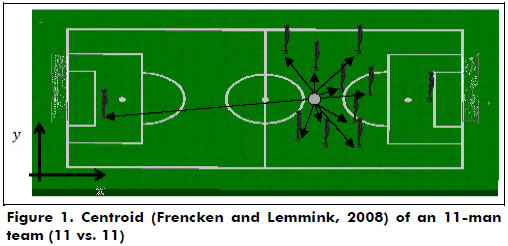
<body><![CDATA[<p><b>Received:</b> May 21st 2014 <b>Accepted:</b> August 28th 2014</p> <hr>     <p><font size="3"><b>Introduction</b></font></p>     <p>  Athletic performance  consists of a complex series of interrelationships among a wide variety of  performance variables (Borrie, Jonsson and Magnusson, 2002). Therefore, the  structures and configurations of play should be considered as a whole rather  than analyzed in an individual manner (Clemente, Couceiro, Martins, Dias and  Mendes, 2012). Systems with many dynamically interacting elements can produce  rich and varied patterns of behavior that are clearly different from the  behavior of individual players. Following this line of thought, McGarry et al.  (2002) proposed that the rich and varied patterns that arise in team sports are  the result of self-organization among many coupled oscillators (e.g., players).  Thus, for many team sports specific methods and metrics are required to analyze  and evaluate the dynamic collective behavior, i.e., the tactical behavior  (Clemente, 2012).</p>     <p>  For the game of soccer, several match analysis techniques have been  developed to assist coaches in decision making (Carling, Williams and Reilly,  2005). Notational analysis is the most common method for match analysis  (Clemente, Couceiro, Martins and Mendes, 2012). However, this method does not  make use of intrinsic knowledge of the procedures that lead to the results used  in the analysis (Lees, 2002). Recently, intelligent systems have been developed  to reach a deeper understanding of team behaviors, i.e., collective tactical  behavior (Passos et al., 2011; Frencken et al., 2011). Through automatic  tracking of player movements, it is possible to identify with reasonable  accuracy the players' positions on the field. The position information can be  analyzed to determine the collective behavior during a match. One of the most  relevant and most used metrics is the centroid, which represents the team's  geometrical center. </p>     <p>  <b>Related work: Team Centroid</b></p>     <p>  The first application of the centroid method was presented by Frencken  and Lemmink (2008) at the Fifth World Congress on Science and Football. This  analysis method was applied to a 4-on-4 soccer game; only 9 offensive plays  that resulted in shots on goal (excluding long shots) were recorded and  analyzed. The centroid was defined as the average position of all of the  players on a team (excluding the goalkeeper). From the centroid, three measures  were derived: i) the x-distance (m), representing the longitudinal  displacement; ii) the y-distance (m), representing the lateral displacement;  and iii) the radial distance (m), comprising both the longitudinal and lateral  displacements. For example, for an 11-man team the centroid defined by Frencken  and Lemmink (2008) would be as shown in <a href="#f1">Figure 1</a>.</p>     <p>    <center><a name="f1"></a><img src="/img/revistas/iei/v34n3/v34n3a12f1.jpg"></center></p>     <p>The results suggested an in-phase relationship between the centroids  of the two teams; i.e., the motions of the two centroids were coupled. Frencken  and Lemmink (2008) also noted that in 7 of 9 goal-scoring opportunities, the  distance between the two centroids was nearly zero or the positions of the two  centroids reversed; i.e., the attacking team's centroid was between the  defending team's goal and its centroid. Nevertheless,  these specific situations cannot be generalized. Considering the defensive  tactical principles of concentration and unit, it is to be expected that most  of the time the centroid of the defending team would be closer to that team's  goal to prevent the attacking team from penetrating.  Goal-scoring opportunities are generated by  defensive imbalances and may not represent the majority of collective behavior,  only an occasional situation. Furthermore, a 4-on-4 game may not represent the  collective behavior in an 11-on-11 game.</p>     <p>  Yue et al. (2008) developed the concept of the geometrical centroid,  representing the same analysis of centroid. Its formula was:</p>     ]]></body>
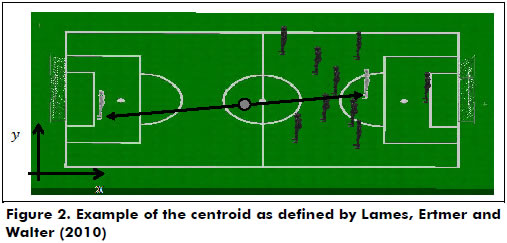
<body><![CDATA[<p>    <center><img src="/img/revistas/iei/v34n3/v34n3a12e1.jpg"></center></p>     <p>Analyzing an 11-on-11 game, Yue et al. (2008) calculated centroids  for 92 temporal series. The authors showed that the method can provide useful  information for coaching and for predicting match outcomes.</p>     <p>  Lames et al. (2010) analyzed the final match of the 2006 FIFA World  Cup between Italy and France. The centroid was calculated excluding 9 players  and only considering the difference between the maximum and minimum positions  of the players except the goalkeeper:</p>     <p>    <center><img src="/img/revistas/iei/v34n3/v34n3a12e2.jpg"></center></p>     <p>This formulation is substantially different from that of Frencken  and Lemmink (2008). At any instant, only two players determine the team's  centroid (see <a href="#f2">Figure 2</a>).</p>     <p>    <center><a name="f2"></a><img src="/img/revistas/iei/v34n3/v34n3a12f2.jpg"></center></p>     <p>There could be a case where nine players are at the maximum point  and only one player is at the minimum point. Thus, this method may be  misleading. Nevertheless, using 25 unspecified recordings, the authors  presented results that corroborated the tendency of the team centroids to be  coupled, as observed by Frencken and Lemmink (2008) in games with fewer players  on a side. The in-phase relationship was momentarily absent when possession of  the ball was lost or gained.</p>     ]]></body>
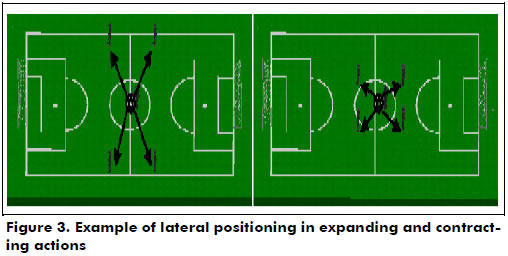
<body><![CDATA[<p>  The centroid method was applied to a 5-on-5 basketball game by  Bourbousson et al. (2010). The centroid was calculated as in Frencken and  Lemmink (2008). Six sequences of play recorded during one professional  basketball match and of sufficient duration to include intermittent changes in  ball possession were analyzed. The results confirmed those of previous studies  (Frencken and Lemmink, 2008; Lames et al, 2010); i.e., an in-phase relationship  between the team centroids was observed, except for changes in ball possession  and acyclic events. In the longitudinal axis, Bourbousson et al. (2010) showed  that the defensive team spent less time changing their positions. The authors  found strong evidence of anti-phase behavior in the lateral axis due to  contraction or expansion; an example is shown in <a href="#f3">Figure 3</a>.</p>     <p>    <center><a name="f3"></a><img src="/img/revistas/iei/v34n3/v34n3a12f3.jpg"></center></p>     <p>Despite the different player positions in the lateral field axis  (cf. <a href="#f3">Figure 3</a>), the position of the centroid is the same in both cases. Thus,  the anti-phase relationship may be due to transitions of ball possession  followed by a return to the in-phase state rather than to  expansion/contraction. </p>     <p>  Frencken et al. (2011) analyzed team centroids in 5-on-5 games.  Using the formulation used in Frencken and Lemmink (2008), Frencken et al.  (2011) analyzed 19 open plays that resulted in goals being scored. Using the  Pearson correlation test, the authors (Frencken et al., 2011) showed high and  positive correlations between centroids in the longitudinal and lateral axes,  suggesting that the two centroids tend to move in the same direction during the  game, i.e., predominantly maintaining an in-phase relationship. Similar to the  results of Bourbousson, S&egrave;ve and McGarry (2010), it appeared that there was a  higher correlation between centroids in the longitudinal axis, demonstrating  their prevalence and association with offensive actions that resulted in  scoring a goal (Frencken et al., 2011).</p>     <p>  Calculating centroid positions in a manner similar to that of  Frencken and Lemmink (2008), Duarte et al. (2012) analyzed 3 vs. 3 sub-phases  of play in soccer games and confirmed that the predominant state was in-phase.  As in two previous studies (Frencken et al., 2011; Bourbousson et al., 2010),  the correlation between centroids was higher in the longitudinal axis. The  results from the statistical analysis showed significantly superior centroid  mean values at the moment of ball control by the passing player, compared to  the moment of assisted pass or the ball crossing the defensive line.     <br>   In a study by Bartlett et al. (Bartlett, Button, Robins,  Dutt-Mazumder and Kennedy, 2012), 5 soccer games from 11 European championships  were analyzed. The sample consisted only of open plays, i.e., excluding  set-pieces or interruptions of play. A total of 305 open plays were analyzed.  The sample was composed of 4 groups of open attacking plays: i) those leading  to goals, ii) those leading to a kick or a header that did not score a goal;  iii) those that resulted in an active loss of possession; and iv) other plays  in which possession was lost passively. Using calculations of the average  player positions (the authors did not specify whether the goalkeeper was  included), the authors found that the centroids of the two teams were highly  correlated in the longitudinal and lateral axes. The authors (Bartlett et al.,  2012) suggested that when comparing groups of plays, the correlation between  the centroids is higher in the plays that lead to goals or shots on goal than  in those that result in loss of the ball, which was contrary to the authors'  expectations. However, it may be speculated that plays with less instability  and efficacy showed lower correlation values because of an imbalance, resulting  in ineffective attacker actions.</p>     <p>  <b>Statement of Contribution</b></p>     <p>  Previous studies presented general results for team centroids that  showed a predominantly in-phase relationship. These studies typically analyzed  the longitudinal and lateral axes, and the highest values of positive  correlation between centroids arose in the longitudinal axis.</p>     <p>  It has been widely suggested that in-phase relationships are broken  only by particular events such as a loss of ball possession or  defense-to-attack or attack-to-defense transitions. However, the analyses of  previous studies mostly focused on the centroid, i.e., investigating only the  synchronized behavior of teams. A systemic analysis is fundamental and should  not be dismissed; however, the centroid method can and should be properly  exploited, particularly for an online match analysis. For this purpose, some changes  can and should be implemented.</p>     ]]></body>
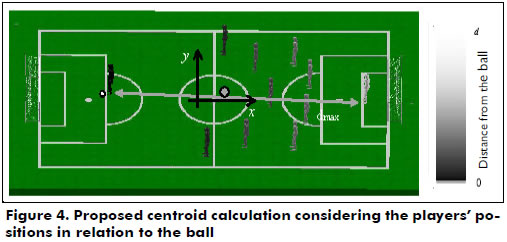
<body><![CDATA[<p>  Only three of the studies discussed (Yue et al., 2008; Lames et al.,  2010; Bartlett et al., 2012) calculated the centroid of an 11-man soccer team.  Furthermore, one of these three studies (Lames et al., 2010) does not satisfy  the requirements of observation, as discussed previously. Additionally, the  goalkeeper is typically excluded from the centroid calculation (Frencken et  al., 2011), and the position of the ball and the influence of the players  closest to the ball are ignored. </p>     <p>  Thus, the main goal of this study is to revise the centroid methodology  to include the positions of the goalkeeper and the ball. Furthermore, this  study analyzes the relationship between the centroids of the teams and the  movement of the centroids in relation to the state of ball possession.</p>     <p>  <font size="3"><b>Methods</b></font></p>     <p>  <b>Participants</b></p>     <p>  The tactical metrics were evaluated in an 11-on-11 soccer game. The  analysis was performed during an official soccer match between two professional  teams in the Portuguese premier league.  </p>     <p>  <b>Material</b></p>     <p>  The actions of both teams were captured using a digital camera  (GoPro Hero with 1280 x 960 pixels resolution) with a frame rate of 30 frames  per second. The camera was placed at an elevation above the field to capture  the entire field. </p>     <p>  <b>Procedures</b></p>     <p>  Play was captured using a digital camera (GoPro Hero with 1280 &times; 960  pixels resolution) with a frame rate of 30 frames per second. The camera was  placed 15 meters above the field and 10 meters from the touchline at mid-field  to capture the entire field. The field dimensions were in 104&times;68 meters. The  first step in collecting the data was to record the players' movements using  the digital camera as previously described. Because the camera had a field of  view of 180<sup>o</sup>, it was not necessary to move the camera, thus ensuring consistent  reference points on the images. The field was calibrated using 19 markers  positioned on the field lines. After recording the soccer match, the physical  space was calibrated using a direct linear transformation (DLT), which measures  the positions of the elements (i.e., the players and the ball) in pixels in the  metric space (Abdel-Aziz and Karara, 1971).</p>     <p>  Following calibration, the positions of the players were tracked,  and the virtual coordinates were transformed into physical coordinates at each  second, thus providing the Cartesian (x and y) positions of the players during  the match. The entire process associated with this approach (i.e., detection  and identification of player trajectories, spatial transformations, and  computation of the metrics) was performed using the MATLAB (R2013) programming  environment. The process of identifying the virtual positions of the players  and the ball in each frame was performed manually. For a more detailed  description of the process, see Couceiro, Clemente and Martins (2013).</p>     ]]></body>
<body><![CDATA[<p>  For the sake of efficiency, only the time when the ball was in play  was considered, and the periods when the ball was not on the field (i.e., out  of bounds) were excluded from the analysis. Because the methodology proposed here  has some computational complexity, each second corresponded to an analyzed  instant for each player and the ball.</p>     <p>  <b>Calculation Procedures: Weighted Centroid</b></p>     <p>  Although the goalkeeper's movements are more limited, they should  not be excluded from the centroid calculation; i.e., if the ball is closest to  the goalkeeper, he or she will be more relevant than any forward player. Thus,  assigning weights to the players' positions in relation to the ball should be  considered in the centroid computation (cf. <a href="#f4">Figure 4</a>).</p>     <p>    <center><a name="f4"></a><img src="/img/revistas/iei/v34n3/v34n3a12f4.jpg"></center></p>     <p>According to Frencken et al. (2011), the centroids of the teams can  provide three measures: i) the <i>x</i>-distance (<i>m</i>) representing the lengthwise displacement  (i.e., down-field); ii) the <i>y</i>-distance (<i>m</i>) representing the lateral displacement (i.e.,  across the field); and iii) the radial distance (<i>m</i>) comprising both the lengthwise and lateral  displacements. These measures were obtained based on the centroid position  relative to the origin <i>0</i>, i.e., (0,0), which was defined at the center of the field.</p>     <p>    <center><img src="/img/revistas/iei/v34n3/v34n3a12e3.jpg"></center></p>     <p>The position of the <i>i<sup>th</sup></i> player  is defined as (<i>x<sub>i</sub></i>,<i>y<sub>i</sub></i>). The relevance of each player to the team's  centroid, i.e., the weight w<sub>i</sub>, could be based on the Euclidean distance from  each player to the ball (Clemente et al., 2013), i.e.,</p>     <p>    ]]></body>
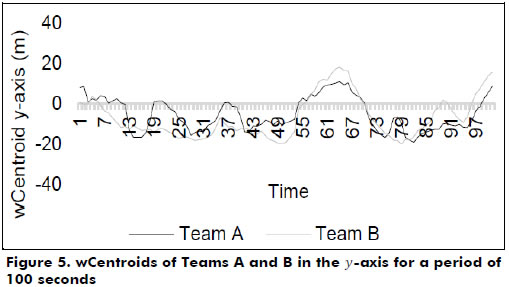
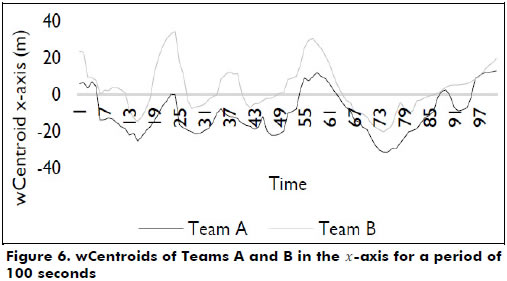
<body><![CDATA[<center><img src="/img/revistas/iei/v34n3/v34n3a12e4.jpg"></center></p>     <p>where (<i>x<sub>b</sub></i>,<i>y<sub>b</sub></i>) corresponds to the position of the ball and d<sub>max</sub> is the  Euclidean distance of the farthest player from the ball at each iteration  (Clemente et al., 2013). Thus, closer players have higher weights than farther  players.</p>     <p>  <b>Statistical Analysis</b></p>     <p>  To compute the correlations for the tactical metrics and the teams,  the Spearman test of positive and negative variables was used. The correlation  tests were performed using the software SPSS version 19 (IBM Corp.) with a  significance level of 5%.</p>     <p>  A one-way ANOVA was performed to determine if there were  statistically significant differences between a team's centroid with and  without possession of the ball. The assumption of a normal distribution in the  one-way ANOVA for the three practice conditions (i.e., conservative, neutral  and risky) was investigated using the Kolmogorov-Smirnov test with the  Lilliefors correction. It was found that the distributions were not normal in  the dependent variable. The distributions were not normal because n = 110, but  by the Central Limit Theorem (Maroco and Bispo, 2003; Pedrosa and Gama, 2004)  we assumed a normal distribution (Akritas and Papadatos, 2004). The analysis of  homogeneity was performed using the Levene test. It was found that there was no  uniformity of practice under the previously mentioned conditions. However,  despite the lack of homogeneity, the F-test (ANOVA) is robust to homogeneity  violations when the number of observations in each group is equal or  approximately equal (Vicent, 1999; Pestana and Gageiro, 2010; Maroco, 2010), as  in our case. As with the assumption of normality, violating this assumption  does not radically change the F-value. A classification of effect size (i.e.,  the measure of the proportion of the total variation in the dependent variable  explained by the independent variable) was performed as in Maroco (2010) and  Pallant (2011). This analysis was performed using SPSS with a significance  level of 5%.</p>     <p><font size="3"><b>Results</b></font></p>     <p>  Spearman's correlation test showed strong evidence of the positive  relation between the wCentroids of the two teams over time in the y-axis (<i>r<sub>s</sub></i> = 0.707). This relationship can be observed in <a href="#f5">Figure  5</a>, where the oscillations are similar for both teams.</p>     <p>    <center><a name="f5"></a><img src="/img/revistas/iei/v34n3/v34n3a12f5.jpg"></center></p>     <p>Similarly, the centroids of the teams in the -axis showed a very high positive correlation (<i>r<sub>s</sub></i> = 0.781). This relationship can be observed in <a href="#f6">Figure  6</a>.</p>     ]]></body>
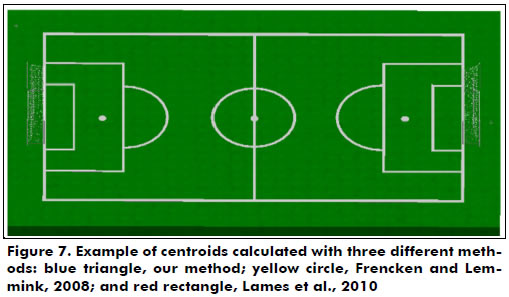
<body><![CDATA[<p>    <center><a name="f6"></a><img src="/img/revistas/iei/v34n3/v34n3a12f6.jpg"></center></p>     <p>The wCentroid positions in the -axis showed statistically significant  differences, with a small difference between the moments with and without  possession of the ball for Team A (<i>F</i> = 86.171; <i>p-value</i> = 0.001; &eta;<sup>2</sup> = 0.052; <i>Power</i> = 1.000; small effect size) and  Team B (<i>F</i> = 43.553; <i>p-value</i> &le; 0.001; &eta;<sup>2</sup> = 0.027; <i>Power</i> = 1.000; small effect size). In both cases, the results suggested that when not  in possession of the ball, teams move closer to their defensive zone.</p>     <p>  The wCentroid positions in the y-axis showed statistically significant  differences with a very small difference between the moments with and without  possession of the ball for team A (<i>F</i> = 11.545; <i>p-value</i> = 0.001;  &eta;<sup>2</sup> = 0.007; <i>Power</i> = 0.994; very small effect  size); no differences were found for Team B (<i>F</i> = 0.213; <i>p-value</i> =  0.809; &eta;<sup>2</sup> = 0.001; <i>Power</i> = 0.083; very small effect  size).</p>     <p>  <font size="3"><b>Discussion</b></font></p>     <p>  First, it is important to emphasize the significance of the new  method of calculating centroids proposed in this study. Including the position  of the ball and all of the team members and their importance in relation to the  ball in the calculation of the centroid improves its usefulness. As suggested  previously, if the ball is closer to the goalkeeper, his or her influence will  be substantially higher than that of the other team members. The following  example compares the three methods of calculating centroids (cf. <a href="#f7">Figure 7</a>).</p>     <p>    <center><a name="f7"></a><img src="/img/revistas/iei/v34n3/v34n3a12f7.jpg"></center></p>     <p>In considering the figure, the watertight nature of the centroid of  Lames et al. (2010), where only two players determine the team's centroid,  should be noted. This definition is unlikely to fully capture the dynamics of  the team. The metric with the highest scientific application (Frencken and  Lemmink, 2008) does not include the ball position. Thus, this metric implies  that the player farthest from the ball is equally as crucial as the one closest  to the ball, thus distorting the influence of the player closest to the ball,  i.e., his or her influence in the center of the game (Costa et al., 2010). The  proposed metric is more inclusive, considering all members of the team and the  ball position, integrating all data as determinants of the centroid and its subsequent  interpretation.</p>     <p>  Considering Spearman's correlation test, it was possible to observe  strong evidence of the positive relation between the centroids of the two teams  over time. Additionally, it was possible to verify regular oscillations of the  centroids between positive and negative values in the <i>y</i>-axis, a reflection of the attempts by the  attacking team to unbalance the defense by moving the centroid away from the  center of the field, which the defenders normally maintain to prevent the  advance of their opponents. Evidence of the importance of an imbalance can be  observed in the sequence that led to the goal by Team A (cf. <a href="#f6">Figure 6</a>), where  the team took possession of the ball on one side of the field, i.e., negative y  values of the centroid, subsequently moved to the other side, i.e., positive y  values of the centroid, and immediately shifted back to the other side again,  thus unbalancing the defensive formation of the opponents. Hence, one can then  observe that while on the offensive, lateral attacks are fundamental to  overcoming the defense (Lucchesi, 2001).</p>     ]]></body>
<body><![CDATA[<p>  Similar to the results in the <i>y</i>-axis, a high positive correlation was found  between the centroids of the two teams in the <i>x</i>-axis (i.e., lengthwise), confirming the  tendency toward an in-phase relation between the teams over time because they  try to maintain a defensive balance to protect their goal (Frencken et al.,  2011). It is important to note that the positive values in the graph indicate  that Team B is on the defensive and the negative values indicate that Team A is  on the defensive. Nevertheless, through <a href="#f7">Figure 7</a> it is possible to verify that  Team A defends by maintaining a larger distance in relation to the opponents  and, conversely, Team B allows a greater proximity of Team A.</p>     <p>  In the case where Team A is defending, the ability to maintain a  greater distance between team centroids may suggest a smaller dispersion of the  Team A players or a higher dispersion of the Team B players. This would  represent a playing style with fewer players involved on offense and  consequently result in a higher dispersion in the <i>x</i>-axis. Thus, it is possible to conclude that  the centroid metric should include an indicator of the dispersion of the  players. </p>     <p>  We next consider the ability to detect defensive imbalances.  Whenever the centroid of the attacking team is very close to that of the  defending team (the distance is nearly 0), there is a greater chance that the  attacking team will score (Frencken and Lemmink, 2008). If this situation  occurs frequently during a match, it should be detected and corrected; the  players should be repositioned to ensure the in-phase relationship and adjust  the distance between the centroids.</p>     <p>  The proposed metrics offer more possibilities in the analysis of  soccer because it is easy to adjust them with automatic tracking systems. These  metrics can provide greater knowledge about tactical behavior and thus measure  the accomplishment of playing principles (Costa et al., 2010). It is also  possible to measure the distance between centroids and identify the  oscillations with various styles of play. This information can be useful for  identifying the characteristics of tactical behaviors and collective organization.  The relevance of such methods should be understood in the context of the principles  of the game and not interpreted without considering the dynamics.</p>     <p>  <font size="3"><b>Conclusions</b></font></p>     <p>  The main goal of this paper was to propose a modification of the  centroid metric used in the analysis of soccer games. Including the positions  of all team members and the position of the ball allows a greater understanding  of team behaviors. Furthermore, this intelligent system improves match  analysis, allowing new feedback and understanding during a soccer game. An  analysis using the revised definition of the centroid  revealed strong correlations between the team  centroids in the lateral and longitudinal directions. Additionally, it was  concluded that winning teams, when on the defensive, maintained a separation  between their own centroid and that of the opposing team, which made the  defense more effective.</p>     <p>  <font size="3"><b>Acknowledgements</b></font></p>     <p>  This study was supported by FCT project, PEst-OE/EEI/ LA0008/2013.</p> <hr>     <p><font size="3"><b>References</b></font></p>     <!-- ref --><p>Abdel-Aziz, Y., &amp;  Karara, H. (1971). Direct linear transformation from  comparator coordinates into object space coordinates in close-range  photogrammetry. In <i>ASP symposium on  close-range photogrammetry </i>(pp. 1-18). Falls Church, VA: American Society  of Photogrammetry.    &nbsp;&nbsp;&nbsp;&nbsp;&nbsp;&nbsp;&nbsp;&nbsp;[&#160;<a href="javascript:void(0);" onclick="javascript: window.open('/scielo.php?script=sci_nlinks&ref=000102&pid=S0120-5609201400030001200001&lng=','','width=640,height=500,resizable=yes,scrollbars=1,menubar=yes,');">Links</a>&#160;]<!-- end-ref --></p>     <!-- ref --><p>  Akritas, M. G., &amp;  Papadatos, N. (2004). Heteroscedastioc One-Way ANOVA  and Lack-of-Fit Tests. <i>Journal of the  American Statistical Association</i>, <i>99</i>(466),  368-390.    &nbsp;&nbsp;&nbsp;&nbsp;&nbsp;&nbsp;&nbsp;&nbsp;[&#160;<a href="javascript:void(0);" onclick="javascript: window.open('/scielo.php?script=sci_nlinks&ref=000104&pid=S0120-5609201400030001200002&lng=','','width=640,height=500,resizable=yes,scrollbars=1,menubar=yes,');">Links</a>&#160;]<!-- end-ref --></p>     <!-- ref --><p>  Bartlett, R., Button, C., Robins, M.,  Dutt-Mazumder, A., &amp; Kennedy, G. (2012). Analysing Team Coordination  Patterns from Player Movement Trajectories in Soccer: Methodological Considerations. <i>International Journal of Performance  Analysis in Sport</i>, <i>12</i>(2),  398-424.    &nbsp;&nbsp;&nbsp;&nbsp;&nbsp;&nbsp;&nbsp;&nbsp;[&#160;<a href="javascript:void(0);" onclick="javascript: window.open('/scielo.php?script=sci_nlinks&ref=000106&pid=S0120-5609201400030001200003&lng=','','width=640,height=500,resizable=yes,scrollbars=1,menubar=yes,');">Links</a>&#160;]<!-- end-ref --></p>     <!-- ref --><p>  Borrie, A., Jonsson, G., &amp; Magnusson,  M. (2002). Temporal pattern analysis and its applicability in sport: An  explanation and exemplar data. <i>Journal of  Sports Science</i>, <i>20</i>(10), 845-852.    &nbsp;&nbsp;&nbsp;&nbsp;&nbsp;&nbsp;&nbsp;&nbsp;[&#160;<a href="javascript:void(0);" onclick="javascript: window.open('/scielo.php?script=sci_nlinks&ref=000108&pid=S0120-5609201400030001200004&lng=','','width=640,height=500,resizable=yes,scrollbars=1,menubar=yes,');">Links</a>&#160;]<!-- end-ref --></p>     <!-- ref --><p>  Bourbousson, J., S&egrave;ve, C., &amp; McGarry,  T. (2010). Space-time coordination dynamics in basketball: Part 2. The  interaction between the two teams. <i>Journal  of Sports Sciences</i>, <i>28</i>(3),  349-358.    &nbsp;&nbsp;&nbsp;&nbsp;&nbsp;&nbsp;&nbsp;&nbsp;[&#160;<a href="javascript:void(0);" onclick="javascript: window.open('/scielo.php?script=sci_nlinks&ref=000110&pid=S0120-5609201400030001200005&lng=','','width=640,height=500,resizable=yes,scrollbars=1,menubar=yes,');">Links</a>&#160;]<!-- end-ref --></p>     <!-- ref --><p>  Carling, C., Williams, A.M., &amp; Reilly,  T. (2005). <i>Handbook of soccer match  analysis: A systematic approach to improving performance</i>. Abingdon, UK:  Routledge.    &nbsp;&nbsp;&nbsp;&nbsp;&nbsp;&nbsp;&nbsp;&nbsp;[&#160;<a href="javascript:void(0);" onclick="javascript: window.open('/scielo.php?script=sci_nlinks&ref=000112&pid=S0120-5609201400030001200006&lng=','','width=640,height=500,resizable=yes,scrollbars=1,menubar=yes,');">Links</a>&#160;]<!-- end-ref --></p>     <!-- ref --><p>  Clemente, F. M. (2012). Pedagogical  Principles of Teaching Games for Understanding and Nonlinear Pedagogy in the  Physical Education Teaching. <i>Movimento</i>, <i>18</i>(2), 315-335.    &nbsp;&nbsp;&nbsp;&nbsp;&nbsp;&nbsp;&nbsp;&nbsp;[&#160;<a href="javascript:void(0);" onclick="javascript: window.open('/scielo.php?script=sci_nlinks&ref=000114&pid=S0120-5609201400030001200007&lng=','','width=640,height=500,resizable=yes,scrollbars=1,menubar=yes,');">Links</a>&#160;]<!-- end-ref --></p>     <!-- ref --><p>  Clemente, F.,  Couceiro, M., Martins, F., Dias, G., &amp; Mendes, R. (2012). The influence of task constraints on attacker trajectories during  1v1 sub-phase in soccer practice. <i>SportLogia</i>, <i>8</i>(1), 13-20.    &nbsp;&nbsp;&nbsp;&nbsp;&nbsp;&nbsp;&nbsp;&nbsp;[&#160;<a href="javascript:void(0);" onclick="javascript: window.open('/scielo.php?script=sci_nlinks&ref=000116&pid=S0120-5609201400030001200008&lng=','','width=640,height=500,resizable=yes,scrollbars=1,menubar=yes,');">Links</a>&#160;]<!-- end-ref --> </p>     <!-- ref --><p>  Clemente, F., Couceiro, M., Martins, F.,  &amp; Mendes, R. (2012). Team's Performance on FIFA U17 World Cup 2011: Study  based on Notational Analysis. <i>Journal of  Physical Education and Sport</i>, <i>12</i>(1),  13-17.    &nbsp;&nbsp;&nbsp;&nbsp;&nbsp;&nbsp;&nbsp;&nbsp;[&#160;<a href="javascript:void(0);" onclick="javascript: window.open('/scielo.php?script=sci_nlinks&ref=000118&pid=S0120-5609201400030001200009&lng=','','width=640,height=500,resizable=yes,scrollbars=1,menubar=yes,');">Links</a>&#160;]<!-- end-ref --></p>     <!-- ref --><p>  Clemente, F. M., Couceiro, M. S., Martins,  F. M., &amp; Mendes, R. (2013). An online tactical metrics applied to football  game. <i>Research Journal of Applied  Sciences, Engineering and Technology</i>, <i>5</i>(5),  1700-1719.    &nbsp;&nbsp;&nbsp;&nbsp;&nbsp;&nbsp;&nbsp;&nbsp;[&#160;<a href="javascript:void(0);" onclick="javascript: window.open('/scielo.php?script=sci_nlinks&ref=000120&pid=S0120-5609201400030001200010&lng=','','width=640,height=500,resizable=yes,scrollbars=1,menubar=yes,');">Links</a>&#160;]<!-- end-ref --></p>     <!-- ref --><p>  Costa, I. T.,  Garganta, J., Greco, P. J., Mesquita, I., &amp; Seabra, A. (2010). Influence of Relative Age Effects and Quality of Tactical Behaviour  in the Performance of Youth Soccer Players. <i>International  Journal of Performance Analysis in Sport</i>, <i>10</i>(2), 82-97.    &nbsp;&nbsp;&nbsp;&nbsp;&nbsp;&nbsp;&nbsp;&nbsp;[&#160;<a href="javascript:void(0);" onclick="javascript: window.open('/scielo.php?script=sci_nlinks&ref=000122&pid=S0120-5609201400030001200011&lng=','','width=640,height=500,resizable=yes,scrollbars=1,menubar=yes,');">Links</a>&#160;]<!-- end-ref --></p>     <!-- ref --><p>  Couceiro,  M. S., Clemente, F. M., &amp; Martins, F. M. (2013). Analysis  of football player's motion in view of fractional calculus. <i>Central European Journal of Physics</i>, <i>11</i>(6), 714-723.    &nbsp;&nbsp;&nbsp;&nbsp;&nbsp;&nbsp;&nbsp;&nbsp;[&#160;<a href="javascript:void(0);" onclick="javascript: window.open('/scielo.php?script=sci_nlinks&ref=000124&pid=S0120-5609201400030001200012&lng=','','width=640,height=500,resizable=yes,scrollbars=1,menubar=yes,');">Links</a>&#160;]<!-- end-ref --></p>     <!-- ref --><p>  Duarte, R., Ara&uacute;jo, D., Freire, L.,  Folgado, H., Fernandes, O., &amp; Davids, K. (2012). Intra- and inter-group  coordination patterns reveal collective behaviors of football players near the  scoring zone. <i>Human Movement Science</i>, <i>31</i>(6), 1639-1651.    &nbsp;&nbsp;&nbsp;&nbsp;&nbsp;&nbsp;&nbsp;&nbsp;[&#160;<a href="javascript:void(0);" onclick="javascript: window.open('/scielo.php?script=sci_nlinks&ref=000126&pid=S0120-5609201400030001200013&lng=','','width=640,height=500,resizable=yes,scrollbars=1,menubar=yes,');">Links</a>&#160;]<!-- end-ref --></p>     <!-- ref --><p>  Frencken, W., &amp; Lemmink, K. (2008).  Team kinematics of small-sided soccer games: A  systematic approach. In T. Reilly, &amp; F. Korkusuz (Eds.), <i>Science and Football VI</i> (pp. 161-166).  Oxon: Routledge Taylor and Francis Group.    &nbsp;&nbsp;&nbsp;&nbsp;&nbsp;&nbsp;&nbsp;&nbsp;[&#160;<a href="javascript:void(0);" onclick="javascript: window.open('/scielo.php?script=sci_nlinks&ref=000128&pid=S0120-5609201400030001200014&lng=','','width=640,height=500,resizable=yes,scrollbars=1,menubar=yes,');">Links</a>&#160;]<!-- end-ref --></p>     <!-- ref --><p>  Frencken,  W., Lemmink, K., Delleman, N., &amp; Visscher, C. (2011). Oscillations of  centroid position and surface area of soccer teams in  small-sided games. <i>European Journal of  Sport Science</i>, <i>11</i>(4), 215-223.    &nbsp;&nbsp;&nbsp;&nbsp;&nbsp;&nbsp;&nbsp;&nbsp;[&#160;<a href="javascript:void(0);" onclick="javascript: window.open('/scielo.php?script=sci_nlinks&ref=000130&pid=S0120-5609201400030001200015&lng=','','width=640,height=500,resizable=yes,scrollbars=1,menubar=yes,');">Links</a>&#160;]<!-- end-ref --></p>     <!-- ref --><p>Lames, M., Erdmann, J., &amp; Walter, F.  (2010). Oscillations in football - Order and disorder in spatial interactions  between the two teams. <i>International  Journal of Sport Psychology</i>, <i>41</i>(4),  85-86.    &nbsp;&nbsp;&nbsp;&nbsp;&nbsp;&nbsp;&nbsp;&nbsp;[&#160;<a href="javascript:void(0);" onclick="javascript: window.open('/scielo.php?script=sci_nlinks&ref=000132&pid=S0120-5609201400030001200016&lng=','','width=640,height=500,resizable=yes,scrollbars=1,menubar=yes,');">Links</a>&#160;]<!-- end-ref --></p>     <!-- ref --><p>  Lees, A. (2012). Technique analysis in  sports: a critical review. <i>Journal of  Sports Sciences</i>, <i>20</i>(10), 813-828.    &nbsp;&nbsp;&nbsp;&nbsp;&nbsp;&nbsp;&nbsp;&nbsp;[&#160;<a href="javascript:void(0);" onclick="javascript: window.open('/scielo.php?script=sci_nlinks&ref=000134&pid=S0120-5609201400030001200017&lng=','','width=640,height=500,resizable=yes,scrollbars=1,menubar=yes,');">Links</a>&#160;]<!-- end-ref --></p>     <!-- ref --><p>  Lucchesi, M. (2001). <i>Attacking Soccer: A Tactical Analysis</i>. Auburn, Michigan: Reedswain Publishing.    &nbsp;&nbsp;&nbsp;&nbsp;&nbsp;&nbsp;&nbsp;&nbsp;[&#160;<a href="javascript:void(0);" onclick="javascript: window.open('/scielo.php?script=sci_nlinks&ref=000136&pid=S0120-5609201400030001200018&lng=','','width=640,height=500,resizable=yes,scrollbars=1,menubar=yes,');">Links</a>&#160;]<!-- end-ref --></p>     <!-- ref --><p>  Maroco, J. (2010). <i>An&aacute;lise Estat&iacute;stica com o PASW Statistics</i> &#91;Statistical Analysis  with PASW Statistics&#93;. Lisboa:  Edi&ccedil;&otilde;es S&iacute;labo.    &nbsp;&nbsp;&nbsp;&nbsp;&nbsp;&nbsp;&nbsp;&nbsp;[&#160;<a href="javascript:void(0);" onclick="javascript: window.open('/scielo.php?script=sci_nlinks&ref=000138&pid=S0120-5609201400030001200019&lng=','','width=640,height=500,resizable=yes,scrollbars=1,menubar=yes,');">Links</a>&#160;]<!-- end-ref --></p>     <!-- ref --><p>  Maroco, J.,  &amp; Bispo, R. (2003). <i>Estat&iacute;stica  Aplicada &agrave;s Ci&ecirc;ncias Sociais e Humanas</i> &#91;Applied Statistics at the Social  and Human Sciences&#93;. Lisboa: Climepsi Editores.    &nbsp;&nbsp;&nbsp;&nbsp;&nbsp;&nbsp;&nbsp;&nbsp;[&#160;<a href="javascript:void(0);" onclick="javascript: window.open('/scielo.php?script=sci_nlinks&ref=000140&pid=S0120-5609201400030001200020&lng=','','width=640,height=500,resizable=yes,scrollbars=1,menubar=yes,');">Links</a>&#160;]<!-- end-ref --></p>     <!-- ref --><p>  McGarry, T., Anderson, D., Wallace, S.,  Hughes, M., &amp; Franks, I. (2002). Sport competition as a dynamical  self-organizing system. <i>Journal of Sports  Sciences</i>, <i>20</i>(10), 771-781.    &nbsp;&nbsp;&nbsp;&nbsp;&nbsp;&nbsp;&nbsp;&nbsp;[&#160;<a href="javascript:void(0);" onclick="javascript: window.open('/scielo.php?script=sci_nlinks&ref=000142&pid=S0120-5609201400030001200021&lng=','','width=640,height=500,resizable=yes,scrollbars=1,menubar=yes,');">Links</a>&#160;]<!-- end-ref --></p>     <!-- ref --><p>  Pallant, J. (2011). <i>SPSS Survival Manual: A step by step guide to data analysis using the  SPSS program</i>. Australia: Allen and Unwin.    &nbsp;&nbsp;&nbsp;&nbsp;&nbsp;&nbsp;&nbsp;&nbsp;[&#160;<a href="javascript:void(0);" onclick="javascript: window.open('/scielo.php?script=sci_nlinks&ref=000144&pid=S0120-5609201400030001200022&lng=','','width=640,height=500,resizable=yes,scrollbars=1,menubar=yes,');">Links</a>&#160;]<!-- end-ref --></p>     <!-- ref --><p>  Passos, P., Davids, K., Ara&uacute;jo, D., Paz,  N., Mingu&eacute;ns, J., &amp; Mendes, J. (2011). Networks as a novel tool for  studying team ball sports as complex social systems. <i>Journal of Science and Medicine in Sport</i>, <i>14</i>(2), 170-176.    &nbsp;&nbsp;&nbsp;&nbsp;&nbsp;&nbsp;&nbsp;&nbsp;[&#160;<a href="javascript:void(0);" onclick="javascript: window.open('/scielo.php?script=sci_nlinks&ref=000146&pid=S0120-5609201400030001200023&lng=','','width=640,height=500,resizable=yes,scrollbars=1,menubar=yes,');">Links</a>&#160;]<!-- end-ref --></p>     <!-- ref --><p>  Pedrosa, A. C., &amp; Gama, S. M. A.  (2004). <i>Introdu&ccedil;&atilde;o computacional &agrave; probabilidade e estat&iacute;stica</i> &#91;Introduction Computational Probability and  Statistics&#93;. Porto: Porto  Editora.    &nbsp;&nbsp;&nbsp;&nbsp;&nbsp;&nbsp;&nbsp;&nbsp;[&#160;<a href="javascript:void(0);" onclick="javascript: window.open('/scielo.php?script=sci_nlinks&ref=000148&pid=S0120-5609201400030001200024&lng=','','width=640,height=500,resizable=yes,scrollbars=1,menubar=yes,');">Links</a>&#160;]<!-- end-ref --></p>     <!-- ref --><p>  Pestana, M. H.,  &amp; Gageiro, J. N. (2008). <i>An&aacute;lise de  dados para as ci&ecirc;ncias sociais: A complementaridade do SPSS</i> &#91;Data Analysis  for the Social Sciences: The complamentarity of the SPSS&#93; (5th ed.). Lisboa, Portugal: Edi&ccedil;&otilde;es S&iacute;labo.    &nbsp;&nbsp;&nbsp;&nbsp;&nbsp;&nbsp;&nbsp;&nbsp;[&#160;<a href="javascript:void(0);" onclick="javascript: window.open('/scielo.php?script=sci_nlinks&ref=000150&pid=S0120-5609201400030001200025&lng=','','width=640,height=500,resizable=yes,scrollbars=1,menubar=yes,');">Links</a>&#160;]<!-- end-ref --> </p>     <!-- ref --><p>  Vincent, W. J. (1999). <i>Statistics in Kinesiology</i> (2nd ed.). Champaign:  Human Kinetics.    &nbsp;&nbsp;&nbsp;&nbsp;&nbsp;&nbsp;&nbsp;&nbsp;[&#160;<a href="javascript:void(0);" onclick="javascript: window.open('/scielo.php?script=sci_nlinks&ref=000152&pid=S0120-5609201400030001200026&lng=','','width=640,height=500,resizable=yes,scrollbars=1,menubar=yes,');">Links</a>&#160;]<!-- end-ref --></p>     <!-- ref --><p>  Yue, Z.,  Broich, H., Seifriz, F., &amp; Mester, J. (2008). Mathematical Analysis of a  Soccer Game. Part I: Individual and Collective Behaviors. <i>Studies in Applied Mathematics</i>, <i>121</i>(3),  223-243.    &nbsp;&nbsp;&nbsp;&nbsp;&nbsp;&nbsp;&nbsp;&nbsp;[&#160;<a href="javascript:void(0);" onclick="javascript: window.open('/scielo.php?script=sci_nlinks&ref=000154&pid=S0120-5609201400030001200027&lng=','','width=640,height=500,resizable=yes,scrollbars=1,menubar=yes,');">Links</a>&#160;]<!-- end-ref --></p> </font>      ]]></body><back>
<ref-list>
<ref id="B1">
<nlm-citation citation-type="book">
<person-group person-group-type="author">
<name>
<surname><![CDATA[Abdel-Aziz]]></surname>
<given-names><![CDATA[Y]]></given-names>
</name>
<name>
<surname><![CDATA[Karara]]></surname>
<given-names><![CDATA[H]]></given-names>
</name>
</person-group>
<article-title xml:lang="en"><![CDATA[Direct linear transformation from comparator coordinates into object space coordinates in close-range photogrammetry]]></article-title>
<source><![CDATA[ASP symposium on close-range photogrammetry]]></source>
<year>1971</year>
<page-range>1-18</page-range><publisher-loc><![CDATA[Falls Church^eVA VA]]></publisher-loc>
<publisher-name><![CDATA[American Society of Photogrammetry]]></publisher-name>
</nlm-citation>
</ref>
<ref id="B2">
<nlm-citation citation-type="journal">
<person-group person-group-type="author">
<name>
<surname><![CDATA[Akritas]]></surname>
<given-names><![CDATA[M. G]]></given-names>
</name>
<name>
<surname><![CDATA[Papadatos]]></surname>
<given-names><![CDATA[N]]></given-names>
</name>
</person-group>
<article-title xml:lang="en"><![CDATA[Heteroscedastioc One-Way ANOVA and Lack-of-Fit Tests]]></article-title>
<source><![CDATA[Journal of the American Statistical Association]]></source>
<year>2004</year>
<volume>99</volume>
<numero>466</numero>
<issue>466</issue>
<page-range>368-390</page-range></nlm-citation>
</ref>
<ref id="B3">
<nlm-citation citation-type="journal">
<person-group person-group-type="author">
<name>
<surname><![CDATA[Bartlett]]></surname>
<given-names><![CDATA[R]]></given-names>
</name>
<name>
<surname><![CDATA[Button]]></surname>
<given-names><![CDATA[C]]></given-names>
</name>
<name>
<surname><![CDATA[Robins]]></surname>
<given-names><![CDATA[M]]></given-names>
</name>
<name>
<surname><![CDATA[Dutt-Mazumder]]></surname>
<given-names><![CDATA[A]]></given-names>
</name>
<name>
<surname><![CDATA[Kennedy]]></surname>
<given-names><![CDATA[G]]></given-names>
</name>
</person-group>
<article-title xml:lang="en"><![CDATA[Analysing Team Coordination Patterns from Player Movement Trajectories in Soccer: Methodological Considerations]]></article-title>
<source><![CDATA[International Journal of Performance Analysis in Sport]]></source>
<year>2012</year>
<volume>12</volume>
<numero>2</numero>
<issue>2</issue>
<page-range>398-424</page-range></nlm-citation>
</ref>
<ref id="B4">
<nlm-citation citation-type="journal">
<person-group person-group-type="author">
<name>
<surname><![CDATA[Borrie]]></surname>
<given-names><![CDATA[A]]></given-names>
</name>
<name>
<surname><![CDATA[Jonsson]]></surname>
<given-names><![CDATA[G]]></given-names>
</name>
<name>
<surname><![CDATA[Magnusson]]></surname>
<given-names><![CDATA[M]]></given-names>
</name>
</person-group>
<article-title xml:lang="en"><![CDATA[Temporal pattern analysis and its applicability in sport: An explanation and exemplar data]]></article-title>
<source><![CDATA[Journal of Sports Science]]></source>
<year>2002</year>
<volume>20</volume>
<numero>10</numero>
<issue>10</issue>
<page-range>845-852</page-range></nlm-citation>
</ref>
<ref id="B5">
<nlm-citation citation-type="journal">
<person-group person-group-type="author">
<name>
<surname><![CDATA[Bourbousson]]></surname>
<given-names><![CDATA[J]]></given-names>
</name>
<name>
<surname><![CDATA[Sève]]></surname>
<given-names><![CDATA[C]]></given-names>
</name>
<name>
<surname><![CDATA[McGarry]]></surname>
<given-names><![CDATA[T]]></given-names>
</name>
</person-group>
<article-title xml:lang="en"><![CDATA[Space-time coordination dynamics in basketball: Part 2]]></article-title>
<source><![CDATA[The interaction between the two teams. Journal of Sports Sciences]]></source>
<year>2010</year>
<volume>28</volume>
<numero>3</numero>
<issue>3</issue>
<page-range>349-358</page-range></nlm-citation>
</ref>
<ref id="B6">
<nlm-citation citation-type="book">
<person-group person-group-type="author">
<name>
<surname><![CDATA[Carling]]></surname>
<given-names><![CDATA[C]]></given-names>
</name>
<name>
<surname><![CDATA[Williams]]></surname>
<given-names><![CDATA[A. M]]></given-names>
</name>
<name>
<surname><![CDATA[Reilly]]></surname>
<given-names><![CDATA[T]]></given-names>
</name>
</person-group>
<source><![CDATA[Handbook of soccer match analysis: A systematic approach to improving performance]]></source>
<year>2005</year>
<publisher-loc><![CDATA[Abingdon ]]></publisher-loc>
<publisher-name><![CDATA[Routledge]]></publisher-name>
</nlm-citation>
</ref>
<ref id="B7">
<nlm-citation citation-type="journal">
<person-group person-group-type="author">
<name>
<surname><![CDATA[Clemente]]></surname>
<given-names><![CDATA[F. M]]></given-names>
</name>
</person-group>
<article-title xml:lang="en"><![CDATA[Pedagogical Principles of Teaching Games for Understanding and Nonlinear Pedagogy in the Physical Education Teaching]]></article-title>
<source><![CDATA[Movimento]]></source>
<year>2012</year>
<volume>18</volume>
<numero>2</numero>
<issue>2</issue>
<page-range>315-335</page-range></nlm-citation>
</ref>
<ref id="B8">
<nlm-citation citation-type="journal">
<person-group person-group-type="author">
<name>
<surname><![CDATA[Clemente]]></surname>
<given-names><![CDATA[F]]></given-names>
</name>
<name>
<surname><![CDATA[Couceiro]]></surname>
<given-names><![CDATA[M]]></given-names>
</name>
<name>
<surname><![CDATA[Martins]]></surname>
<given-names><![CDATA[F]]></given-names>
</name>
<name>
<surname><![CDATA[Dias]]></surname>
<given-names><![CDATA[G]]></given-names>
</name>
<name>
<surname><![CDATA[Mendes]]></surname>
<given-names><![CDATA[R]]></given-names>
</name>
</person-group>
<article-title xml:lang="en"><![CDATA[The influence of task constraints on attacker trajectories during 1v1 sub-phase in soccer practice]]></article-title>
<source><![CDATA[SportLogia]]></source>
<year>2012</year>
<volume>8</volume>
<numero>1</numero>
<issue>1</issue>
<page-range>13-20</page-range></nlm-citation>
</ref>
<ref id="B9">
<nlm-citation citation-type="journal">
<person-group person-group-type="author">
<name>
<surname><![CDATA[Clemente]]></surname>
<given-names><![CDATA[F]]></given-names>
</name>
<name>
<surname><![CDATA[Couceiro]]></surname>
<given-names><![CDATA[M]]></given-names>
</name>
<name>
<surname><![CDATA[Martins]]></surname>
<given-names><![CDATA[F]]></given-names>
</name>
<name>
<surname><![CDATA[Mendes]]></surname>
<given-names><![CDATA[R]]></given-names>
</name>
</person-group>
<article-title xml:lang="en"><![CDATA[Team's Performance on FIFA U17 World Cup 2011: Study based on Notational Analysis]]></article-title>
<source><![CDATA[Journal of Physical Education and Sport]]></source>
<year>2012</year>
<volume>12</volume>
<numero>1</numero>
<issue>1</issue>
<page-range>13-17</page-range></nlm-citation>
</ref>
<ref id="B10">
<nlm-citation citation-type="journal">
<person-group person-group-type="author">
<name>
<surname><![CDATA[Clemente]]></surname>
<given-names><![CDATA[F. M]]></given-names>
</name>
<name>
<surname><![CDATA[Couceiro]]></surname>
<given-names><![CDATA[M. S]]></given-names>
</name>
<name>
<surname><![CDATA[Martins]]></surname>
<given-names><![CDATA[F. M]]></given-names>
</name>
<name>
<surname><![CDATA[Mendes]]></surname>
<given-names><![CDATA[R]]></given-names>
</name>
</person-group>
<article-title xml:lang="en"><![CDATA[An online tactical metrics applied to football game]]></article-title>
<source><![CDATA[Research Journal of Applied Sciences]]></source>
<year>2013</year>
<volume>Engineering and Technology, 5</volume>
<numero>5</numero>
<issue>5</issue>
<page-range>1700-1719</page-range></nlm-citation>
</ref>
<ref id="B11">
<nlm-citation citation-type="journal">
<person-group person-group-type="author">
<name>
<surname><![CDATA[Costa]]></surname>
<given-names><![CDATA[I. T]]></given-names>
</name>
<name>
<surname><![CDATA[Garganta]]></surname>
<given-names><![CDATA[J]]></given-names>
</name>
<name>
<surname><![CDATA[Greco]]></surname>
<given-names><![CDATA[P. J]]></given-names>
</name>
<name>
<surname><![CDATA[Mesquita]]></surname>
<given-names><![CDATA[I]]></given-names>
</name>
<name>
<surname><![CDATA[Seabra]]></surname>
<given-names><![CDATA[A]]></given-names>
</name>
</person-group>
<article-title xml:lang="en"><![CDATA[Influence of Relative Age Effects and Quality of Tactical Behaviour in the Performance of Youth Soccer Players]]></article-title>
<source><![CDATA[International Journal of Performance Analysis in Sport]]></source>
<year>2010</year>
<volume>10</volume>
<numero>2</numero>
<issue>2</issue>
<page-range>82-97</page-range></nlm-citation>
</ref>
<ref id="B12">
<nlm-citation citation-type="journal">
<person-group person-group-type="author">
<name>
<surname><![CDATA[Couceiro]]></surname>
<given-names><![CDATA[M. S]]></given-names>
</name>
<name>
<surname><![CDATA[Clemente]]></surname>
<given-names><![CDATA[F. M]]></given-names>
</name>
<name>
<surname><![CDATA[Martins]]></surname>
<given-names><![CDATA[F. M]]></given-names>
</name>
</person-group>
<article-title xml:lang="en"><![CDATA[Analysis of football player's motion in view of fractional calculus]]></article-title>
<source><![CDATA[Central European Journal of Physics]]></source>
<year>2013</year>
<volume>11</volume>
<numero>6</numero>
<issue>6</issue>
<page-range>714-723</page-range></nlm-citation>
</ref>
<ref id="B13">
<nlm-citation citation-type="journal">
<person-group person-group-type="author">
<name>
<surname><![CDATA[Duarte]]></surname>
<given-names><![CDATA[R]]></given-names>
</name>
<name>
<surname><![CDATA[Araújo]]></surname>
<given-names><![CDATA[D]]></given-names>
</name>
<name>
<surname><![CDATA[Freire]]></surname>
<given-names><![CDATA[L]]></given-names>
</name>
<name>
<surname><![CDATA[Folgado]]></surname>
<given-names><![CDATA[H]]></given-names>
</name>
<name>
<surname><![CDATA[Fernandes]]></surname>
<given-names><![CDATA[O]]></given-names>
</name>
<name>
<surname><![CDATA[Davids]]></surname>
<given-names><![CDATA[K]]></given-names>
</name>
</person-group>
<article-title xml:lang="en"><![CDATA[Intra- and inter-group coordination patterns reveal collective behaviors of football players near the scoring zone]]></article-title>
<source><![CDATA[Human Movement Science]]></source>
<year>2012</year>
<volume>31</volume>
<numero>6</numero>
<issue>6</issue>
<page-range>1639-1651</page-range></nlm-citation>
</ref>
<ref id="B14">
<nlm-citation citation-type="book">
<person-group person-group-type="author">
<name>
<surname><![CDATA[Frencken]]></surname>
<given-names><![CDATA[W]]></given-names>
</name>
<name>
<surname><![CDATA[Lemmink]]></surname>
<given-names><![CDATA[K]]></given-names>
</name>
</person-group>
<article-title xml:lang="en"><![CDATA[Team kinematics of small-sided soccer games: A systematic approach]]></article-title>
<source><![CDATA[Science and Football VI]]></source>
<year>2008</year>
<page-range>161-166</page-range><publisher-loc><![CDATA[Oxon ]]></publisher-loc>
<publisher-name><![CDATA[Routledge Taylor and Francis Group]]></publisher-name>
</nlm-citation>
</ref>
<ref id="B15">
<nlm-citation citation-type="journal">
<person-group person-group-type="author">
<name>
<surname><![CDATA[Frencken]]></surname>
<given-names><![CDATA[W]]></given-names>
</name>
<name>
<surname><![CDATA[Lemmink]]></surname>
<given-names><![CDATA[K]]></given-names>
</name>
<name>
<surname><![CDATA[Delleman]]></surname>
<given-names><![CDATA[N]]></given-names>
</name>
<name>
<surname><![CDATA[Visscher]]></surname>
<given-names><![CDATA[C]]></given-names>
</name>
</person-group>
<article-title xml:lang="en"><![CDATA[Oscillations of centroid position and surface area of soccer teams in small-sided games]]></article-title>
<source><![CDATA[European Journal of Sport Science]]></source>
<year>2011</year>
<volume>11</volume>
<numero>4</numero>
<issue>4</issue>
<page-range>215-223</page-range></nlm-citation>
</ref>
<ref id="B16">
<nlm-citation citation-type="journal">
<person-group person-group-type="author">
<name>
<surname><![CDATA[Lames]]></surname>
<given-names><![CDATA[M]]></given-names>
</name>
<name>
<surname><![CDATA[Erdmann]]></surname>
<given-names><![CDATA[J]]></given-names>
</name>
<name>
<surname><![CDATA[Walter]]></surname>
<given-names><![CDATA[F]]></given-names>
</name>
</person-group>
<article-title xml:lang="en"><![CDATA[Oscillations in football - Order and disorder in spatial interactions between the two teams]]></article-title>
<source><![CDATA[International Journal of Sport Psychology]]></source>
<year>2010</year>
<volume>41</volume>
<numero>4</numero>
<issue>4</issue>
<page-range>85-86</page-range></nlm-citation>
</ref>
<ref id="B17">
<nlm-citation citation-type="journal">
<person-group person-group-type="author">
<name>
<surname><![CDATA[Lees]]></surname>
<given-names><![CDATA[A]]></given-names>
</name>
</person-group>
<article-title xml:lang="en"><![CDATA[Technique analysis in sports: a critical review]]></article-title>
<source><![CDATA[Journal of Sports Sciences]]></source>
<year>2012</year>
<volume>20</volume>
<numero>10</numero>
<issue>10</issue>
<page-range>813-828</page-range></nlm-citation>
</ref>
<ref id="B18">
<nlm-citation citation-type="book">
<person-group person-group-type="author">
<name>
<surname><![CDATA[Lucchesi]]></surname>
<given-names><![CDATA[M]]></given-names>
</name>
</person-group>
<source><![CDATA[Attacking Soccer: A Tactical Analysis]]></source>
<year>2001</year>
<publisher-loc><![CDATA[Auburn^eMichigan Michigan]]></publisher-loc>
<publisher-name><![CDATA[Reedswain Publishing]]></publisher-name>
</nlm-citation>
</ref>
<ref id="B19">
<nlm-citation citation-type="book">
<person-group person-group-type="author">
<name>
<surname><![CDATA[Maroco]]></surname>
<given-names><![CDATA[J]]></given-names>
</name>
</person-group>
<source><![CDATA[Análise Estatística com o PASW Statistics]]></source>
<year>2010</year>
<publisher-loc><![CDATA[Lisboa ]]></publisher-loc>
<publisher-name><![CDATA[Edições Sílabo]]></publisher-name>
</nlm-citation>
</ref>
<ref id="B20">
<nlm-citation citation-type="book">
<person-group person-group-type="author">
<name>
<surname><![CDATA[Maroco]]></surname>
<given-names><![CDATA[J]]></given-names>
</name>
<name>
<surname><![CDATA[& Bispo]]></surname>
<given-names><![CDATA[R]]></given-names>
</name>
</person-group>
<source><![CDATA[Estatística Aplicada às Ciências Sociais e Humanas]]></source>
<year>2003</year>
<publisher-loc><![CDATA[Lisboa ]]></publisher-loc>
<publisher-name><![CDATA[Climepsi Editores]]></publisher-name>
</nlm-citation>
</ref>
<ref id="B21">
<nlm-citation citation-type="journal">
<person-group person-group-type="author">
<name>
<surname><![CDATA[McGarry]]></surname>
<given-names><![CDATA[T]]></given-names>
</name>
<name>
<surname><![CDATA[Anderson]]></surname>
<given-names><![CDATA[D]]></given-names>
</name>
<name>
<surname><![CDATA[Wallace]]></surname>
<given-names><![CDATA[S]]></given-names>
</name>
<name>
<surname><![CDATA[Hughes]]></surname>
<given-names><![CDATA[M]]></given-names>
</name>
<name>
<surname><![CDATA[Franks]]></surname>
<given-names><![CDATA[I]]></given-names>
</name>
</person-group>
<article-title xml:lang="en"><![CDATA[Sport competition as a dynamical self-organizing system]]></article-title>
<source><![CDATA[Journal of Sports Sciences]]></source>
<year>2002</year>
<volume>20</volume>
<numero>10</numero>
<issue>10</issue>
<page-range>771-781</page-range></nlm-citation>
</ref>
<ref id="B22">
<nlm-citation citation-type="book">
<person-group person-group-type="author">
<name>
<surname><![CDATA[Pallant]]></surname>
<given-names><![CDATA[J]]></given-names>
</name>
</person-group>
<source><![CDATA[SPSS Survival Manual: A step by step guide to data analysis using the SPSS program]]></source>
<year>2011</year>
<publisher-name><![CDATA[Allen and Unwin]]></publisher-name>
</nlm-citation>
</ref>
<ref id="B23">
<nlm-citation citation-type="journal">
<person-group person-group-type="author">
<name>
<surname><![CDATA[Passos]]></surname>
<given-names><![CDATA[P]]></given-names>
</name>
<name>
<surname><![CDATA[Davids]]></surname>
<given-names><![CDATA[K]]></given-names>
</name>
<name>
<surname><![CDATA[Araújo]]></surname>
<given-names><![CDATA[D]]></given-names>
</name>
<name>
<surname><![CDATA[Paz]]></surname>
<given-names><![CDATA[N]]></given-names>
</name>
<name>
<surname><![CDATA[Minguéns]]></surname>
<given-names><![CDATA[J]]></given-names>
</name>
<name>
<surname><![CDATA[Mendes]]></surname>
<given-names><![CDATA[J]]></given-names>
</name>
</person-group>
<article-title xml:lang="en"><![CDATA[Networks as a novel tool for studying team ball sports as complex social systems]]></article-title>
<source><![CDATA[Journal of Science and Medicine in Sport]]></source>
<year>2011</year>
<volume>14</volume>
<numero>2</numero>
<issue>2</issue>
<page-range>170-176</page-range></nlm-citation>
</ref>
<ref id="B24">
<nlm-citation citation-type="book">
<person-group person-group-type="author">
<name>
<surname><![CDATA[Pedrosa]]></surname>
<given-names><![CDATA[A. C]]></given-names>
</name>
<name>
<surname><![CDATA[Gama]]></surname>
<given-names><![CDATA[S. M. A]]></given-names>
</name>
</person-group>
<source><![CDATA[Introdução computacional à probabilidade e estatística]]></source>
<year>2004</year>
<publisher-loc><![CDATA[Porto ]]></publisher-loc>
<publisher-name><![CDATA[Porto Editora]]></publisher-name>
</nlm-citation>
</ref>
<ref id="B25">
<nlm-citation citation-type="book">
<person-group person-group-type="author">
<name>
<surname><![CDATA[Pestana]]></surname>
<given-names><![CDATA[M. H]]></given-names>
</name>
<name>
<surname><![CDATA[Gageiro]]></surname>
<given-names><![CDATA[J. N]]></given-names>
</name>
</person-group>
<source><![CDATA[Análise de dados para as ciências sociais: A complementaridade do SPSS]]></source>
<year>2008</year>
<edition>5</edition>
<publisher-loc><![CDATA[Lisboa ]]></publisher-loc>
<publisher-name><![CDATA[Edições Sílabo]]></publisher-name>
</nlm-citation>
</ref>
<ref id="B26">
<nlm-citation citation-type="book">
<person-group person-group-type="author">
<name>
<surname><![CDATA[Vincent]]></surname>
<given-names><![CDATA[W. J]]></given-names>
</name>
</person-group>
<source><![CDATA[Statistics in Kinesiology]]></source>
<year>1999</year>
<edition>2</edition>
<publisher-loc><![CDATA[Champaign ]]></publisher-loc>
<publisher-name><![CDATA[Human Kinetics]]></publisher-name>
</nlm-citation>
</ref>
<ref id="B27">
<nlm-citation citation-type="journal">
<person-group person-group-type="author">
<name>
<surname><![CDATA[Yue]]></surname>
<given-names><![CDATA[Z]]></given-names>
</name>
<name>
<surname><![CDATA[Broich]]></surname>
<given-names><![CDATA[H]]></given-names>
</name>
<name>
<surname><![CDATA[Seifriz]]></surname>
<given-names><![CDATA[F]]></given-names>
</name>
<name>
<surname><![CDATA[Mester]]></surname>
<given-names><![CDATA[J]]></given-names>
</name>
</person-group>
<article-title xml:lang="en"><![CDATA[Mathematical Analysis of a Soccer Game. Part I: Individual and Collective Behaviors]]></article-title>
<source><![CDATA[Studies in Applied Mathematics]]></source>
<year>2008</year>
<volume>121</volume>
<numero>3</numero>
<issue>3</issue>
<page-range>223-243</page-range></nlm-citation>
</ref>
</ref-list>
</back>
</article>