<?xml version="1.0" encoding="ISO-8859-1"?><article xmlns:mml="http://www.w3.org/1998/Math/MathML" xmlns:xlink="http://www.w3.org/1999/xlink" xmlns:xsi="http://www.w3.org/2001/XMLSchema-instance">
<front>
<journal-meta>
<journal-id>0120-5609</journal-id>
<journal-title><![CDATA[Ingeniería e Investigación]]></journal-title>
<abbrev-journal-title><![CDATA[Ing. Investig.]]></abbrev-journal-title>
<issn>0120-5609</issn>
<publisher>
<publisher-name><![CDATA[Facultad de Ingeniería, Universidad Nacional de Colombia.]]></publisher-name>
</publisher>
</journal-meta>
<article-meta>
<article-id>S0120-56092014000300013</article-id>
<article-id pub-id-type="doi">10.15446/ing.investig.v34n3.42902</article-id>
<title-group>
<article-title xml:lang="en"><![CDATA[A novel dispersion monitoring technique in W-band radio-over-fiber signals using clustering on asynchronous histograms]]></article-title>
<article-title xml:lang="es"><![CDATA[Nueva técnica de monitoreo sobre la dispersión en las señales de radio- sobre-fibra en la banda W usando clustering en histogramas asíncronos]]></article-title>
</title-group>
<contrib-group>
<contrib contrib-type="author">
<name>
<surname><![CDATA[Granada]]></surname>
<given-names><![CDATA[J. J]]></given-names>
</name>
<xref ref-type="aff" rid="A01"/>
</contrib>
<contrib contrib-type="author">
<name>
<surname><![CDATA[Cárdenas]]></surname>
<given-names><![CDATA[A. M]]></given-names>
</name>
<xref ref-type="aff" rid="A02"/>
</contrib>
<contrib contrib-type="author">
<name>
<surname><![CDATA[Guerrero]]></surname>
<given-names><![CDATA[N]]></given-names>
</name>
<xref ref-type="aff" rid="A03"/>
</contrib>
</contrib-group>
<aff id="A01">
<institution><![CDATA[,Universidad de Antioquia  ]]></institution>
<addr-line><![CDATA[ ]]></addr-line>
<country>Colombia</country>
</aff>
<aff id="A02">
<institution><![CDATA[,Universidad de Antioquia  ]]></institution>
<addr-line><![CDATA[ ]]></addr-line>
<country>Colombia</country>
</aff>
<aff id="A03">
<institution><![CDATA[,Centro de Pesquisa e Desenvolvimento em Telecomunicações  ]]></institution>
<addr-line><![CDATA[ ]]></addr-line>
<country>Brazil</country>
</aff>
<pub-date pub-type="pub">
<day>01</day>
<month>12</month>
<year>2014</year>
</pub-date>
<pub-date pub-type="epub">
<day>01</day>
<month>12</month>
<year>2014</year>
</pub-date>
<volume>34</volume>
<numero>3</numero>
<fpage>76</fpage>
<lpage>80</lpage>
<copyright-statement/>
<copyright-year/>
<self-uri xlink:href="http://www.scielo.org.co/scielo.php?script=sci_arttext&amp;pid=S0120-56092014000300013&amp;lng=en&amp;nrm=iso"></self-uri><self-uri xlink:href="http://www.scielo.org.co/scielo.php?script=sci_abstract&amp;pid=S0120-56092014000300013&amp;lng=en&amp;nrm=iso"></self-uri><self-uri xlink:href="http://www.scielo.org.co/scielo.php?script=sci_pdf&amp;pid=S0120-56092014000300013&amp;lng=en&amp;nrm=iso"></self-uri><abstract abstract-type="short" xml:lang="en"><p><![CDATA[Radio over Fiber (RoF) systems have been proposed as a promising solution for transmitting radiofrequency signals at high data rates over long distances. To reach data rates in the Gbps range, studies indicate using the W-Band (75 -110 GHz). However, in this frequency band, chromatic dispersion becomes an issue that increases the bit-error-rate. This paper presents a novel digital dispersion monitoring technique for RoF systems based on asynchronous histogram analysis. This method quantifies the intensity level of the distortion of a radiofrequency demodulated signal by a dispersion factor. This dispersion factor is calculated using an enhanced clustering approach, which carries out a Gaussian fitting technique through the expectation-maximization algorithm. Dispersion monitoring was performed on radiofrequency transmission simulations using non-return-to-zero and binary phase-shift keying modulated signals over 80 km of optical fiber at 60, 75 and 100 GHz. The bit error rate is estimated and compared to the dispersion factor, showing that the behavior of the dispersion effects are not proportional to the increase of carrier frequency, bit rate and distances. This novel monitoring method can be used to estimate the feasibility of RoF systems for future hybrid networks under specific transmission parameters such as fiber length, modulation format, and carrier frequency.]]></p></abstract>
<abstract abstract-type="short" xml:lang="es"><p><![CDATA[Los sistemas de Radio sobre Fibra (RoF), se proponen como una solución prometedora para transmitir señales de radiofrecuencia a altas tasas de transmisión y sobre largas distancias. Algunos estudios proponen el uso de frecuencias portadoras en la banda W (75 - 110 GHz), para lograr transmisiones en el rango de los Gbps. Sin embargo, en este rango de frecuencias la dispersión cromática, se convierte en uno de los principales factores para el incremento de la tasa de error del bit. Este artículo presenta un nuevo método de monitoreo de la dispersión, basado en histogramas asíncronos para sistemas de RoF. El método planteado cuantifica el nivel de distorsión de la señal de radiofrecuencia, mediante un valor adimensional llamado: factor de dispersión. Dicho factor, se calcula mediante una técnica de agrupamiento, la cual se lleva a cabo usando ajustamiento gaussiano, mediante el algoritmo de máxima esperanza sobre histogramas asíncronos. El monitoreo de la dispersión se realiza sobre una plataforma de simulación, donde se transmiten las señales de radiofrecuencia, empleando modulación No retorno a cero (NRZ) y modulación binaria con desplazamiento de fase (BPSK), sobre 80 km de fibra óptica a 60, 75 y 100 GHz. Así, se estima la tasa de error de bit y se compara con el factor de dispersión; dónde se evidencia que los efectos de la dispersión no son proporcionales al incremento en la frecuencia de la portadora, la velocidad de transmisión y la distancia. El novedoso método de monitoreo, puede ser usado para estimar la viabilidad de los futuros sistemas de telecomunicaciones híbridos, basados en redes de fibra y bajo ciertos parámetros de transmisión tales como: la distancia, el formato de modulación y la frecuencia de la portadora.]]></p></abstract>
<kwd-group>
<kwd lng="en"><![CDATA[Chromatic Dispersion]]></kwd>
<kwd lng="en"><![CDATA[Optical Monitoring]]></kwd>
<kwd lng="en"><![CDATA[Radio-over-Fiber]]></kwd>
<kwd lng="en"><![CDATA[dispersión cromática]]></kwd>
<kwd lng="en"><![CDATA[monitoreo óptico]]></kwd>
<kwd lng="en"><![CDATA[Radio sobre Fibra]]></kwd>
</kwd-group>
</article-meta>
</front><body><![CDATA[  <font size="2" face="verdana">     <p>DOI: <a href="http://dx.doi.org/10.15446/ing.investig.v34n3.42902" target="_blank">http://dx.doi.org/10.15446/ing.investig.v34n3.42902</a></p>     <p>    <center> <font size="4"><b>A novel dispersion  monitoring technique in W-band radio-over-fiber  signals using clustering on asynchronous histograms</b></font> </center> </p>     <p>    <center> <font size="3"><b>Nueva t&eacute;cnica  de monitoreo sobre la dispersi&oacute;n en las se&ntilde;ales de radio- sobre-fibra en la  banda W usando clustering en histogramas as&iacute;ncronos</b></font> </center></p>     <p>J. J. Granada<sup>1</sup>,  A. M. C&aacute;rdenas<sup>2</sup> and N. Guerrero<sup>3</sup></p>     <p><sup>1</sup>Jhon James Granada Torres.  Electronic Engineer and Magister in Telecommunications Engineering, Universidad  Nacional de Colombia, Colombia.  Affiliation:  PhD Student, Universidad de  Antioquia, Colombia. E-mail: <a href="mailto:jhon.granada@udea.edu.co">jhon.granada@udea.edu.co</a></p>     <p> <sup>2</sup>Ana Mar&iacute;a C&aacute;rdenas Soto. Electronic  Engineer, Universidad de Antioquia, Colombia. Ph.D in telecommunications,  Universidad Polit&eacute;cnica de Valencia, Espa&ntilde;a. Affiliation: Professor in  Universidad de Antioquia, Colombia. E-mail: <a href="mailto:ana.cardenas@udea.edu.co">ana.cardenas@udea.edu.co</a></p>     <p> <sup>3</sup>Neil Guerrero Gonz&aacute;lez. Electronic Engineer and Magister in  Industrial Automatization Universidad Nacional de Colombia.   PhD in  photonics, Denmark University of Denmark. Affiliation: Manager of High Speed  Optical Networks in CPqD (Centro de Pesquisa e Desenvolvimento em  Telecomunica&ccedil;&otilde;es), Brazil. E-mail: <a href="mailto:neilg@cpqd.com.br">neilg@cpqd.com.br<u></u></a></p> <hr>     ]]></body>
<body><![CDATA[<p><b>How to cite:</b> Granada, J. J., Cardenas, A. M., &amp; Guerrero, N. (2014). A Novel    Dispersion Monitoring Technique in W-Band Radio-over-Fiber Signals using    Clustering on Asynchronous Histograms. <i>Ingenier&iacute;a    e Investigaci&oacute;n</i>, <i>34</i>(3), 76-80. </p> <hr>     <p><b>ABSTRACT</b> </p>     <p>  Radio over Fiber (RoF) systems have been proposed as a promising  solution for transmitting radiofrequency signals at high data rates over long  distances. To reach data rates in the Gbps range, studies indicate using the  W-Band (75 -110 GHz). However, in this frequency band, chromatic dispersion  becomes an issue that increases the bit-error-rate.  This paper presents a novel digital  dispersion monitoring technique for RoF systems based on asynchronous histogram  analysis. This method quantifies the intensity level of the distortion of a  radiofrequency demodulated signal by a dispersion factor.  This dispersion factor is calculated using an  enhanced clustering approach, which carries out a Gaussian fitting technique  through the expectation-maximization algorithm. Dispersion monitoring was  performed on radiofrequency transmission simulations using non-return-to-zero  and binary phase-shift keying modulated signals over 80 km of optical fiber at  60, 75 and 100 GHz. The bit error rate is estimated and compared to the  dispersion factor, showing that the behavior of the dispersion effects are not  proportional to the increase of carrier frequency, bit rate and distances. This  novel monitoring method can be used to estimate the feasibility of RoF systems  for future hybrid networks under specific transmission parameters such as fiber  length, modulation format, and carrier frequency.</p>     <p>  <b>Keywords:</b> Chromatic  Dispersion, Optical Monitoring, Radio-over-Fiber. </p> <hr>     <p><b>RESUMEN</b></p>     <p>  Los sistemas de Radio sobre Fibra (RoF), se  proponen como una soluci&oacute;n prometedora para transmitir se&ntilde;ales de  radiofrecuencia a altas tasas de transmisi&oacute;n y sobre largas distancias. Algunos  estudios proponen el uso de frecuencias portadoras en la banda W (75  - 110 GHz), para lograr transmisiones en el  rango de los Gbps. Sin embargo, en este rango de frecuencias la dispersi&oacute;n  crom&aacute;tica, se convierte en uno de los principales factores para el incremento  de la tasa de error del bit. </p>     <p>  Este art&iacute;culo presenta un nuevo m&eacute;todo de monitoreo  de la dispersi&oacute;n, basado en histogramas as&iacute;ncronos para sistemas de RoF. El  m&eacute;todo planteado cuantifica el nivel de distorsi&oacute;n de la se&ntilde;al de  radiofrecuencia, mediante un valor adimensional llamado: factor de dispersi&oacute;n.  Dicho factor, se calcula mediante una t&eacute;cnica de agrupamiento, la cual se lleva  a cabo usando ajustamiento gaussiano, mediante el algoritmo de m&aacute;xima esperanza  sobre histogramas as&iacute;ncronos. El monitoreo de la dispersi&oacute;n se realiza sobre  una plataforma de simulaci&oacute;n, donde se transmiten las se&ntilde;ales de radiofrecuencia,  empleando modulaci&oacute;n No retorno a cero (NRZ) y modulaci&oacute;n binaria con  desplazamiento de fase (BPSK), sobre 80 km de fibra &oacute;ptica a 60, 75 y 100 GHz.  As&iacute;, se estima la tasa de error de bit y se compara con el factor de  dispersi&oacute;n; d&oacute;nde se evidencia que los efectos de la dispersi&oacute;n no son  proporcionales al incremento en la frecuencia de la portadora, la velocidad de  transmisi&oacute;n y la distancia. El novedoso m&eacute;todo de monitoreo, puede ser usado  para estimar la viabilidad de los futuros sistemas de telecomunicaciones  h&iacute;bridos, basados en redes de fibra y bajo ciertos par&aacute;metros de transmisi&oacute;n  tales como: la distancia, el formato de modulaci&oacute;n y la frecuencia de la  portadora.</p>     <p>  <b>Palabras clave:</b> dispersi&oacute;n  crom&aacute;tica, monitoreo &oacute;ptico y Radio sobre Fibra. </p> <hr>     <p><b>Received:</b> April 1st 2014  <b>Accepted:</b> September 3rd 2014</p> <hr>     <p><font size="3"><b>Introduction</b></font></p>     ]]></body>
<body><![CDATA[<p>The convergence of wired  and wireless services suggests designing and implementing hybrid optical  telecommunication platforms that allow signal transmissions of radio frequency  (RF) carriers from central offices (CO) to base stations (BS) through optical  fiber.  Radio over Fiber (RoF) systems  have been proposed as a solution to transmit RF signals at high data rates over  long distances, centralizing equipment at COs, thus overcoming free-space attenuation  and reducing system complexity at BSs (Taniguchi, et al, 2009). Important  efforts in the standardization of research and development for the migration to  millimeter wave (mmw) frequencies are in progress (Beas, et al, 2013). In RoF  technology, different studies have been reported including full-duplex 60-GHz  RoF system architecture that has enabled converged wireless services including  multi-gigabit wireless data access over both 50-km SSMF (Hsueh, et al, 2008)  and a WDM-RoF system based on remote up-conversion over 125 km (Hsueh, et al,  2012). RoF W-Band (range of 75 - 110 GHz) transmissions work on the  availability of higher bandwidths for signal transmission in the Gbps range by  avoiding the RF saturation of licensed bands (St&ouml;hr, et al, 2009).</p>     <p>  However, the intensity distortion of RF carriers and cyclic optical  power variations become more critical for W-band RoF transmission due to  optical fiber impairments such as chromatic dispersion (CD) and polarization  mode dispersion (PMD) (Avo, et al, 2010), (Hilt, et al, 1998). </p>     <p>  Estimation and compensation of CD and PMD have been extensively  studied for the optical baseband of 40G and 100G coherent systems (Wang, et al,  2013). Several compensation methods using digital equalizations based on  extracted information from asynchronous histograms (Minglun, et al, 2009), (Kozicki,  et al, 2008) and digital signal processing in coherent optical systems (Faruk,  et al, 2010) have been demonstrated and experimentally validated.</p>     <p>  In this paper, we numerically show the CD effects on RoF  transmission simulations using Non-Return-to-Zero (NRZ) and  Binary-Phase-Shift-Keying (BPSK) modulated signals over 80 km at 60, 75 and 100  GHz. Demodulated signals present undesirable intensity levels increasing the  bit error rate. Eye diagrams are obtained in a signal analyzer and a frame of  the received signal is stored to calculate asynchronous histograms (AH). AHs  are used as statistical tools to recognize undesirable patterns on the expected  signal shape. A novel dispersion monitoring method is proposed, giving a  dimensionless dispersion factor (DF) to quantify the distortion in the received  signals. The DF is calculated using the Gaussian fitting technique, grouping  the points of the AH and creating different clusters.  The paper is divided into the following  sections: RoF Systems Description, simulation framework, Chromatic Dispersion  Effects over RoF Signals, Simulation Setup, Dispersion Monitoring Technique  Description, Results and Conclusions.</p>     <p>  <font size="3"><b>Radio over Fiber Systems Descriptions</b></font></p>     <p>  The convergence of wireless communications and optical fiber systems  have become a promising technique to provide services for broadband wireless  access in a range of applications including accessing network solutions,  expanding coverage and radio network capacities. In this sense,  Radio-over-Fiber (RoF) systems provide adequate synergy between optical and  wireless communications, allowing for the fusion of these technologies, which  have been essential in the development of telecommunications. It is expected  that the next generation access networks will ensure the provision of broadband  services and multimedia applications to end users at any time and any place,  trying to achieve fixed network data rates in wireless communication (Granada, et al, 2011).</p>     <p>  RoF systems are telecommunication platforms, where radiofrequency  (RF) signals are optically modulated in a central office (CO) and transmitted  into the fiber to different base stations (see <a href="#f1">figure 1</a>). RoF systems transmit  RF modulated signals over longer distance than wireless telecommunication  systems due to the lower signal power attenuation of optical fiber in  comparison to air. One of the most important advantages of RoF technology is  the ability to centralize expensive high-frequency RF equipment at the CO. BSs  are used only for the optical-electrical conversion, allowing for easy  installation and operation. Therefore, generating high-frequencies in the BS is  avoided (Milosavljevic, et al, 2009). Additionally, BSs are small and have low  power consumption (Taniguchi, et al, 2009).</p>     <p>    <center><a name="f1"></a><img src="/img/revistas/iei/v34n3/v34n3a13f1.jpg"></center></p>     <p>The high bandwidth of the optical fiber is efficiently exploited  when signals are transmitted in the millimeter-wave band. However, when the  transmitted signal is radiated through free space, it is attenuated, reaching  only short distances. Therefore, mmw band systems are being considered for  applications within buildings and indoors, using micro- and picocells. In this  frequency band, optical transmission impairments, such as chromatic dispersion,  more drastically affect the transmitted signal.</p>     ]]></body>
<body><![CDATA[<p>  <font size="3"><b>Chromatic Dispersion Effects over RoF Signals</b></font></p>     <p>  Optical fiber impairments affect the transmitted information signal  to a greater or lesser extent depending on the type of fiber, transmission  distance, modulation formats and detection techniques used. One of the most  influential impairments is the chromatic dispersion (CD). CD has been widely  studied in optical baseband system and successfully compensated using several  electrical and optical techniques. CD was not considered an important  degradation factor in the first RoF systems due to their low data rates and  carrier frequencies lower than 10 GHz ( Mitchell, 2009). However, the next  generation of RoF systems are foreseen as high-capacity systems (above Gbps),  reaching distances greater than a km in the W-Band (75 - 110 GHz) carrier  frequency. For W-band RoF systems, intensity distortions of RF carriers and  cyclic optical power variations due to CD become more critical.</p>     <p>  CD is a linear effect inherent of the optical fiber, which results  from differences in the propagation time (delays) of the different spectral  components of the transmitted signal. CD is caused by the interaction of 2  dispersions effects: i) material dispersion and ii) waveguide dispersion (Agrawal,  1997). CD in Optical fiber can be modeled as a bandpass filter (Gliese, et al,  1996) as follows:</p>     <p>    <center><img src="/img/revistas/iei/v34n3/v34n3a13e1.jpg"></center></p>     <p>where <i>z</i> is the distance of  propagation, <i>D</i> is the dispersion parameter  of the fiber defined by the manufacturer, <i>f</i> is the offset frequency of the optical carrier, and <i>c</i> is the speed of light. The optical signal at the output of the  fiber, <i>Y<sub>out</sub></i>(<i>f</i>), is given by</p>     <p>    <center><img src="/img/revistas/iei/v34n3/v34n3a13e2.jpg"></center></p>     <p>where  <i>Y<sub>in</sub></i>(<i>f</i>) is the Fourier transform of  the input signal (unmodulated) in the optical channel,  <i>Y<sub>in</sub></i>(<i>ft</i>), defined as</p>     <p>    ]]></body>
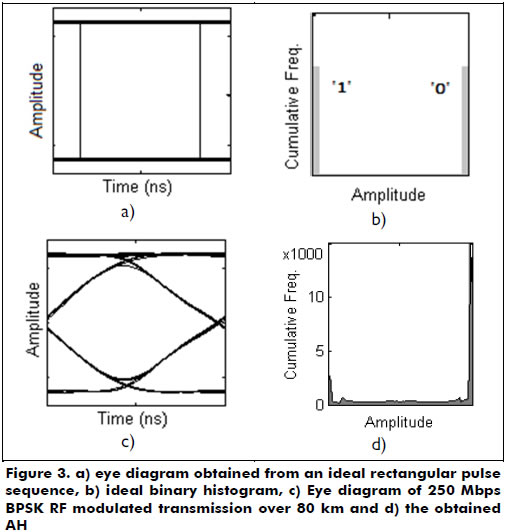
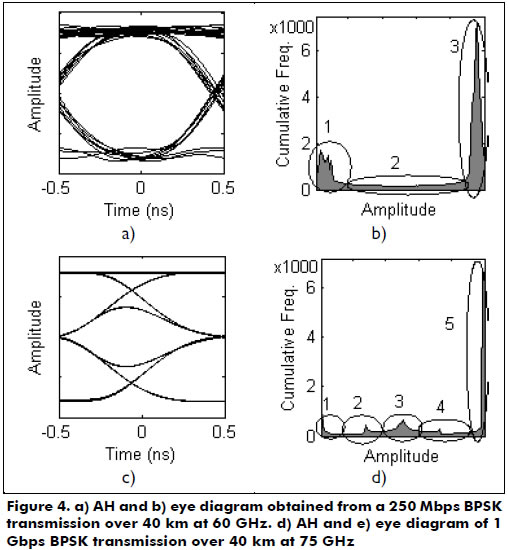
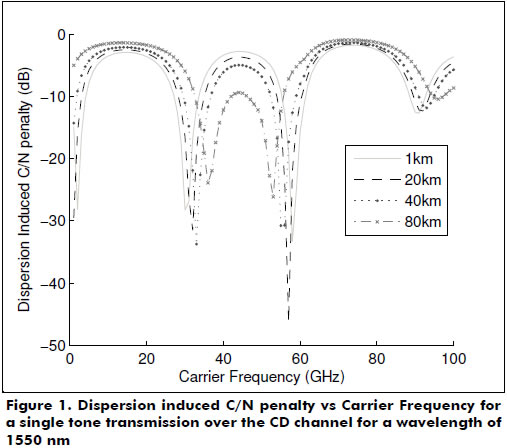
<body><![CDATA[<center><img src="/img/revistas/iei/v34n3/v34n3a13e3.jpg"></center></p>     <p>where <i>f<sub>opt</sub></i> is the frequency of the  optical carrier and <i>fc</i> is  the radiofrequency carrier. The output signal in the time domain can be  observed in equation (4), where its power intensity has a cyclical behavior  depending on the systems parameters:</p>     <p>    <center><img src="/img/revistas/iei/v34n3/v34n3a13e4.jpg"></center></p>     <p>After detection, the transmitted signal has a power loss that  depends on the different transmission parameters and mainly from the <i>f<sub>c</sub></i>. From equation (4), we can  derive that the transmitted signal power has a cyclical behavior due to  sinusoidal functions. It can be shown in a carrier to noise ratio (C/N) plot as  in <a href="#f2">figure 2</a>, where C/N is induced by CD. A single carrier is transmitted  without modulation through the channel modeled by equation (1). It is observed  that the C/N penalty changes for each value of the carrier frequency in a  non-logarithmic way for transmission distances of 1, 20, 40 and 80 km. Hence,  the C/N and carrier frequency relation is not proportional to the transmission  distance. For example, for <i>f<sub>c</sub></i> =  20 GHz the lower C/N penalty is reached for 80 km and the higher C/N penalty is  reached for 1 km, but for <i>f<sub>c</sub></i> =  50 GHz, the opposite case holds.</p>     <p>    <center><a name="f2"></a><img src="/img/revistas/iei/v34n3/v34n3a13f2.jpg"></center></p>     <p>In RoF, the power penalty effects due to CD cannot be characterized  as in <a href="#f2">figure 2</a> because each of the transmission parameters, including the  modulation format, changes the transmitted signal drastically. Furthermore, the  CD effects with other physical impairments, such as polarization mode  dispersion, attenuation, scattering, non-linear effects, among others, can  deteriorate the signal to a greater extent or even improve it due to the  cancellation of some effects (Berceli, et al, 2008).</p>     <p><a href="#f3">Figures 3.c</a> and <a href="#f4">4.a</a> show an eye diagram of a 250 Mbps RoF  transmission for 40 and 80 km, respectively. In spite of the eye-opening and a  low power loss, the rising and falling edge in <a href="#f3">figure 3.c</a> has a large slope,  indicating a sensitivity to timing error. In<a href="#f4"> figure 4.a</a>, the signal distortion  is represented by an appreciable jitter. In the eye diagram of <a href="#f4">figure 4.c</a> the  eye diagram is observed to have several amplitude power levels. In this case, a  1 Gbps RoF transmission at 40 km, the information cannot be recovered. </p>     <p>    ]]></body>
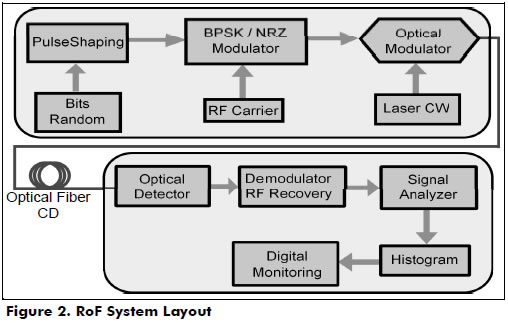
<body><![CDATA[<center><a name="f3"></a><img src="/img/revistas/iei/v34n3/v34n3a13f3.jpg"></center></p>     <p>    <center><a name="f4"></a><img src="/img/revistas/iei/v34n3/v34n3a13f4.jpg"></center></p>     <p>As we have mentioned and explained in (Maeda, et al, 2014), the  received RF power level suffers from periodic power fading caused by cyclical  changes in the relative phase between the lower sideband and the upper side  band in the optical domain. This phenomenon is called <i>dispersion-induced fading frequency. </i>Optical single side band modulation  using optical filtering has been proven to alleviate the fading effect.  However, it also causes additional signal distortion (Chen, et al, 2013). In  addition, the dispersion-induced phase noise increases with greater dispersion  (different types of fibers) and wider laser linewidth, which was evaluated in (Wei,  et al, 2014) for W-band transmission. Thus, monitoring dispersion is needed in  W-Band RoF systems.</p>     <p><font size="3"><b>Simulation Setup</b></font></p>     <p>  Radio-over-Fiber (RoF) transmission simulations, with  Non-return-to-zero (NRZ) on-off keying and Binary-phase-shift-keying (BPSK)  modulation, evaluate the impact of the Chromatic dispersion (CD) effects in the  demodulated signals. The simulation setup (<a href="#f2">figure 2</a>) is carried out in the  Virtual Photonics Inc (VPI) software.</p>     <p>  The transmitter consists of an optical source of continuous waves,  with a linewidth of 2 MHz in the 1550 nm range. The output of the laser is  connected to an optical external intensity modulator with ideal  characteristics. The bit sequences are digitally modulated in an electrical  format, and NRZ and BPSK have carrier frequencies of 60, 75 and 100 GHz.  The optical power of the laser is 1 mW. The  optical fiber model used is a standard single mode fiber (SSMF) with a length  of 40 and 80 km. At the receiver, transmitted signals are detected with a  photodiode that has a responsivity of 1 A/W. Electrical NRZ signal demodulation  is performed using an envelope-detector Gaussian filter and electrical BPSK  signal demodulation is carried out using a local oscillator which operates at  the same frequency as the RF transmitter signal. </p>     <p>  The recovered electrical signal is analyzed in the temporal domain  to build asynchronous histograms, and a digital dispersion monitoring technique  is performed from this.</p>     <p>  <font size="3"><b>Dispersion Monitoring Technique Description</b></font></p>     <p>  The proposed digital dispersion monitoring technique is explained as  follows: </p>     ]]></body>
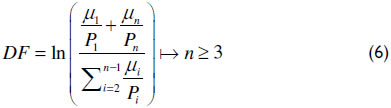
<body><![CDATA[<p>  i) Asynchronous histograms (AH) are generated by projecting the eye  diagram of the electrical demodulated signal on its vertical axis and  normalizing its amplitude. <a href="#f3">Figure 3a</a> shows an eye diagram obtained from an  ideal rectangular pulse sequence, the AH obtained from this eye diagram is  shown in the <a href="#f3">figure 3.b</a>. Cumulative frequencies represent the number of times  that a specific amplitude value is repeated in the time domain signal.  Intensity distortion due to the chromatic dispersion (CD) effects are seen as  variations in the cumulative frequencies in the AH. For example, <a href="#f3">figure 3d</a> shows an AH obtained from the eye diagram (<a href="#f3">figure 3c</a>) of a RoF BPSK 250 Mbps transmission  over 40 km at 75 GHz.</p>     <p>  ii) The points of an AH are grouped in different clusters. The  number of peaks and valleys in the AH are calculated. Each "peak" in the AH,  means an intensity level in the time domain signal. The number of clusters (n)  is defined as the number of peaks. However, if there is a valley in the x-axis  center of the AH (<a href="#f4">figure 4.b</a>), the number of clusters (n) is equal to the  number of peaks plus one (<a href="#f4">figure 4.d</a>).</p>     <p>  iii) A Gaussian fitting technique using an expectation-maximization  (EM) algorithm (Alder, 2001) is performed to calculate the number of points  belonging to each cluster. The data inputs in the algorithm are n, points of an  AH, and number of iterations.</p>     <p>  iv) According to the total number of points in the AH, the statistical  mean value (&micro;) for each cluster and the points proportionally (<i>P</i>) belonging to each cluster are  calculated, as follows:</p>     <p>    <center><img src="/img/revistas/iei/v34n3/v34n3a13e5.jpg"></center></p>     <p>v) With n, &micro;, and <i>P</i>, a  dimensionless dispersion factor (DF) is proposed in equation 6, the numerator is  associated with the 2 clusters that represent the '1' and the '0' logic in the  demodulated signal, and the denominator represents the cluster or the clusters  located in unwanted regions of the AH. Therefore, a low-dispersion demodulated  signal will have higher DF values than a high-dispersion demodulated signal.</p>     <p>    <center><img src="/img/revistas/iei/v34n3/v34n3a13e6.jpg"></center></p>     <p><font size="3"><b>Results</b></font></p>     ]]></body>
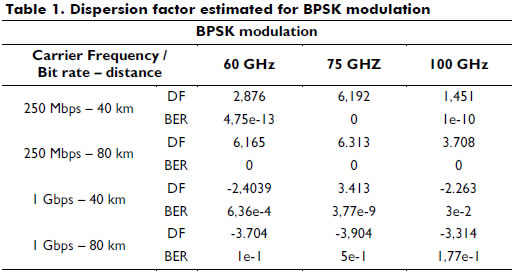
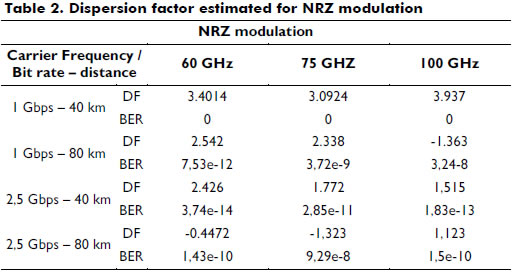
<body><![CDATA[<p>  Tables <a href="#t1">1</a> and <a href="#t2">2</a> show the dispersion factors (DF) and the bit error  rate (BER) calculated for different RoF transmissions. Because the EM algorithm  can converge with approximate values, DF was averaged after 5 runs. BER is  calculated in the VPI simulator using a probabilistic estimation with a  Gaussian distribution.</p>     <p>    <center><a name="t1"></a><img src="/img/revistas/iei/v34n3/v34n3a13t1.jpg"></center></p>     <p>    <center><a name="t2"></a><img src="/img/revistas/iei/v34n3/v34n3a13t2.jpg"></center></p>     <p>According to table <a href="#t1">1</a> and <a href="#t2">2</a>, in most cases, NRZ shows better  performance with higher DF values and lower BER values than the BPSK case. It  is observed, comparing the results of the NRZ case for the 1 Gbps transmission  over 80 km, that the DF values are between -1.363 and 2.542 for different  carriers, whereas in the BPSK case, the DF values are between -3.314 and  -3.904. Nevertheless, with a 75 GHz carrier frequency, the BPSK case shows  better performance than the NRZ case, with a DF value of 3.413 compared to a DF  of 3.094 in the NRZ case. Otherwise, making a comparison among the 3 different  carrier frequencies (60, 75 and 100 GHz), the DF and BER values are not proportional  as the carrier frequency increase. For example, in the BPSK case, a 250 Mbps  transmission over 40 km, shows better DF and BER values with a 75 GHz carrier  than with 60 GHz and 100 GHz carriers. In a 250 Mbps BPSK transmission, a  better transmission performance is obtained over 80 km than over 40 km. However,  at 1 Gbps a better performance was obtained over 40 km than over 80 km.</p>     <p>  Dispersion effects are not proportional with the increase of carrier  frequency, distances and bit rate because CD effects are related to the power  penalty, which was explained in section III, where a non-logarithmic curve  represented the carrier variation according to the distance (<a href="#f2">figure 2</a>). Hence,  BER has an inverse relation with regard to <i>DF</i>:  when BER increases, <i>DF</i> values decrease. However, in some cases, transmissions  have similar <i>DF</i> values but different BER values because CD is not the only parameter  that increases physical impairments and other noises affect the transmission  systems. Tables <a href="#t1">1</a> and <a href="#t2">2</a> prove that small variations in the parameters of RoF  systems can significantly change the received signal quality.</p>     <p>  <font size="3"><b>Conclusions</b></font></p>     <p>  In this paper, we proposed a novel  dispersion monitoring method using asynchronous histograms. The EM algorithm  performs Gaussian distribution fittings, and it estimates the statistical mean  and the cardinality of each cluster generated in histograms and from these  values, equation (6) determines the dispersion factor of the demodulated  signals. DF values showed that small variations in the parameters of RoF  systems such as fiber length, carrier frequency and data rate can significantly  change the quality of the received signal. For future network scenarios, this  method can be used to estimate the feasibility of implementing RoF systems that  work with certain optical network conditions.</p>     <p><font size="3"><b>References</b></font> </p>     ]]></body>
<body><![CDATA[<!-- ref --><p>Agrawal, G. (1997). <i>Fiber-Optic Communication Systems</i>. John Wiley and Sons, Inc.    &nbsp;&nbsp;&nbsp;&nbsp;&nbsp;&nbsp;&nbsp;&nbsp;[&#160;<a href="javascript:void(0);" onclick="javascript: window.open('/scielo.php?script=sci_nlinks&ref=000083&pid=S0120-5609201400030001300001&lng=','','width=640,height=500,resizable=yes,scrollbars=1,menubar=yes,');">Links</a>&#160;]<!-- end-ref --></p>     <!-- ref --><p>  Alder, M. (2001). <i>An introduction to pattern recognition: Statistical, Neural Net and  Syntactic methods of getting robots to see and hear</i>. &copy;Mike Alder.    &nbsp;&nbsp;&nbsp;&nbsp;&nbsp;&nbsp;&nbsp;&nbsp;[&#160;<a href="javascript:void(0);" onclick="javascript: window.open('/scielo.php?script=sci_nlinks&ref=000085&pid=S0120-5609201400030001300002&lng=','','width=640,height=500,resizable=yes,scrollbars=1,menubar=yes,');">Links</a>&#160;]<!-- end-ref --></p>     <!-- ref --><p>  Avo, R., Laurencio, P., &amp; Medeiros, M.  (2010). 60 GHz radio-over-fiber transmission impairments for broadband wireless  signals. In Transparent Optical Networks (ICTON), 12th International Conference,  (pp. 1-4).    &nbsp;&nbsp;&nbsp;&nbsp;&nbsp;&nbsp;&nbsp;&nbsp;[&#160;<a href="javascript:void(0);" onclick="javascript: window.open('/scielo.php?script=sci_nlinks&ref=000087&pid=S0120-5609201400030001300003&lng=','','width=640,height=500,resizable=yes,scrollbars=1,menubar=yes,');">Links</a>&#160;]<!-- end-ref --></p>     <!-- ref --><p>  Beas, J., Castanon, G., Aldaya, I.,  Aragon-Zavala, A., &amp; Campuzano, G. (2013). Millimeter-Wave Frequency Radio  over Fiber Systems: A Survey. <i>Communications  Surveys &amp; Tutorials</i>, (99), 1-27.    &nbsp;&nbsp;&nbsp;&nbsp;&nbsp;&nbsp;&nbsp;&nbsp;[&#160;<a href="javascript:void(0);" onclick="javascript: window.open('/scielo.php?script=sci_nlinks&ref=000089&pid=S0120-5609201400030001300004&lng=','','width=640,height=500,resizable=yes,scrollbars=1,menubar=yes,');">Links</a>&#160;]<!-- end-ref --></p>     <!-- ref --><p>  Berceli, T., Udvary, E., &amp; Hilt, A.  (2008). A new equalization method for dispersion effects in optical links. In  10th Anniversary International Conference Transparent Optical Networks (ICTON)  (Vol. 4) (pp. 98-101).    &nbsp;&nbsp;&nbsp;&nbsp;&nbsp;&nbsp;&nbsp;&nbsp;[&#160;<a href="javascript:void(0);" onclick="javascript: window.open('/scielo.php?script=sci_nlinks&ref=000091&pid=S0120-5609201400030001300005&lng=','','width=640,height=500,resizable=yes,scrollbars=1,menubar=yes,');">Links</a>&#160;]<!-- end-ref --></p>     ]]></body>
<body><![CDATA[<!-- ref --><p>  Chen,  D.,  Sun,  C., &amp;  Yu, P. (2013).  Origin of  high linearity  in  radio-over-fiber  link with cascaded filter. Avionics, Fiber-Optics and Photonics Conference  (AVFOP) (pp. 53-54), IEEE.    &nbsp;&nbsp;&nbsp;&nbsp;&nbsp;&nbsp;&nbsp;&nbsp;[&#160;<a href="javascript:void(0);" onclick="javascript: window.open('/scielo.php?script=sci_nlinks&ref=000093&pid=S0120-5609201400030001300006&lng=','','width=640,height=500,resizable=yes,scrollbars=1,menubar=yes,');">Links</a>&#160;]<!-- end-ref --></p>     <!-- ref --><p>  Faruk, M., Mori, Y., Zhang, C., &amp;  Kikuchi, K. (2010). Multi-impairments monitoring from the equalizer in a  digital coherent optical receiver. In Optical Communication (ECOC), 36th European  Conference and Exhibition (pp. 1-3).    &nbsp;&nbsp;&nbsp;&nbsp;&nbsp;&nbsp;&nbsp;&nbsp;[&#160;<a href="javascript:void(0);" onclick="javascript: window.open('/scielo.php?script=sci_nlinks&ref=000095&pid=S0120-5609201400030001300007&lng=','','width=640,height=500,resizable=yes,scrollbars=1,menubar=yes,');">Links</a>&#160;]<!-- end-ref --></p>     <!-- ref --><p>  Gliese, U., Norskov, S., &amp; Nielsen, T.  (1996). Chromatic dispersion in fiber-optic microwave and millimeter-wave  links. <i>Microwave Theory and Techniques,  IEEE Transactions</i>, <i>44</i>(10),  1716-1724.    &nbsp;&nbsp;&nbsp;&nbsp;&nbsp;&nbsp;&nbsp;&nbsp;[&#160;<a href="javascript:void(0);" onclick="javascript: window.open('/scielo.php?script=sci_nlinks&ref=000097&pid=S0120-5609201400030001300008&lng=','','width=640,height=500,resizable=yes,scrollbars=1,menubar=yes,');">Links</a>&#160;]<!-- end-ref --></p>     <!-- ref --><p>  Granada, J. J., Serpa, C., Var&oacute;n, G. M.,  &amp; Guerrero, N. (2011). Hacia  la pr&oacute;xima generaci&oacute;n de sistemas de Radio sobre Fibra de banda ancha: retos  tecnol&oacute;gicos en la banda de las ondas milim&eacute;tricas. <i>Ingenier&iacute;a y Desarrollo</i>, <i>29</i>(2).    &nbsp;&nbsp;&nbsp;&nbsp;&nbsp;&nbsp;&nbsp;&nbsp;[&#160;<a href="javascript:void(0);" onclick="javascript: window.open('/scielo.php?script=sci_nlinks&ref=000099&pid=S0120-5609201400030001300009&lng=','','width=640,height=500,resizable=yes,scrollbars=1,menubar=yes,');">Links</a>&#160;]<!-- end-ref --></p>     <!-- ref --><p>  Hilt, A., Vilcot, A.,  Berceli, T., Marozsak, T., &amp; Cabon, B. (1998). <i>New carrier generation approach for fiber-radio  systems to overcome</i>. In Microwave Symposium Digest  (Vol. 3) (pp. 1525-1528). IEEE MTT-S International.    &nbsp;&nbsp;&nbsp;&nbsp;&nbsp;&nbsp;&nbsp;&nbsp;[&#160;<a href="javascript:void(0);" onclick="javascript: window.open('/scielo.php?script=sci_nlinks&ref=000101&pid=S0120-5609201400030001300010&lng=','','width=640,height=500,resizable=yes,scrollbars=1,menubar=yes,');">Links</a>&#160;]<!-- end-ref --></p>     ]]></body>
<body><![CDATA[<!-- ref --><p>  Hsueh, Y.-T., Cheng, L., Shu-Hao, F., Yu,  J., &amp; Chang, G.-K. (2012). A novel full-duplex testbed demonstration of  converged all-band 60-GHz radio-over-fiber access architecture. In Optical  Fiber Communication Conference and Exposition (OFC/NFOEC) and the National Fiber  Optic Engineers Conference (pp. 1-3).    &nbsp;&nbsp;&nbsp;&nbsp;&nbsp;&nbsp;&nbsp;&nbsp;[&#160;<a href="javascript:void(0);" onclick="javascript: window.open('/scielo.php?script=sci_nlinks&ref=000103&pid=S0120-5609201400030001300011&lng=','','width=640,height=500,resizable=yes,scrollbars=1,menubar=yes,');">Links</a>&#160;]<!-- end-ref --></p>     <!-- ref --><p>  Hsueh, Y.-T., Chien, H.-C., Jia, Z.,  Chowdhury, A., Yu, J., &amp; Chang, G.-K. (2008). 8x2.5Gb/s, 60-GHz  Radio-over-Fiber acces network with 125-km extended reach using remote optical  carrier suppression (pp.  798-799). IEEE Lasers and Electro-Optics Society.    &nbsp;&nbsp;&nbsp;&nbsp;&nbsp;&nbsp;&nbsp;&nbsp;[&#160;<a href="javascript:void(0);" onclick="javascript: window.open('/scielo.php?script=sci_nlinks&ref=000105&pid=S0120-5609201400030001300012&lng=','','width=640,height=500,resizable=yes,scrollbars=1,menubar=yes,');">Links</a>&#160;]<!-- end-ref --></p>     <!-- ref --><p>  Kozicki, B., Takuya, O., &amp; Hidehiko,  T. (2008). Optical Performance Monitoring of Phase-Modulated Signals Using  Asynchronous Amplitude Histogram Analysis. <i>Lightwave  Technology</i>, <i>26</i>(10), 1353-1361.    &nbsp;&nbsp;&nbsp;&nbsp;&nbsp;&nbsp;&nbsp;&nbsp;[&#160;<a href="javascript:void(0);" onclick="javascript: window.open('/scielo.php?script=sci_nlinks&ref=000107&pid=S0120-5609201400030001300013&lng=','','width=640,height=500,resizable=yes,scrollbars=1,menubar=yes,');">Links</a>&#160;]<!-- end-ref --></p>     <!-- ref --><p>  Maeda, J., Kimura,  K., &amp; Ebisawa, S. (2014). Experimental Study on  Variation of Signal Amplitude in Radio-Over-Fiber Transmission Induced by  Harmonics of Modulation Sidebands Through Fiber Dispersion. <i>Lightwave Technology</i>, <i>32</i>(20), 3536-3544.    &nbsp;&nbsp;&nbsp;&nbsp;&nbsp;&nbsp;&nbsp;&nbsp;[&#160;<a href="javascript:void(0);" onclick="javascript: window.open('/scielo.php?script=sci_nlinks&ref=000109&pid=S0120-5609201400030001300014&lng=','','width=640,height=500,resizable=yes,scrollbars=1,menubar=yes,');">Links</a>&#160;]<!-- end-ref --></p>     <!-- ref --><p>  Milosavljevic, M., Kourtessis, P., Gliwan,  A., &amp; Senior, J. (2009). Advanced PON topologies with wireless  connectivity. In 11th International Conference Transparent Optical Networks  (ICTON) (pp. 1-4).    &nbsp;&nbsp;&nbsp;&nbsp;&nbsp;&nbsp;&nbsp;&nbsp;[&#160;<a href="javascript:void(0);" onclick="javascript: window.open('/scielo.php?script=sci_nlinks&ref=000111&pid=S0120-5609201400030001300015&lng=','','width=640,height=500,resizable=yes,scrollbars=1,menubar=yes,');">Links</a>&#160;]<!-- end-ref --></p>     ]]></body>
<body><![CDATA[<!-- ref --><p>  Minglun, Z., Yangan,  Z., Xueguang, Y., Jin-nan, Z., &amp; Xiaoguang, Z. (2009). Analyses of amplitude histogram methods used for optical performance  monitoring. In Communications and Signal Processing, ICICS, 7th International  Conference (pp. 1-3).    &nbsp;&nbsp;&nbsp;&nbsp;&nbsp;&nbsp;&nbsp;&nbsp;[&#160;<a href="javascript:void(0);" onclick="javascript: window.open('/scielo.php?script=sci_nlinks&ref=000113&pid=S0120-5609201400030001300016&lng=','','width=640,height=500,resizable=yes,scrollbars=1,menubar=yes,');">Links</a>&#160;]<!-- end-ref --></p>     <!-- ref --><p>  Mitchell, J. (2009). Radio over fibre  networks: Advances and challenges. In 35th European Conference Optical Communication  (ECOC) (pp. 1-4).    &nbsp;&nbsp;&nbsp;&nbsp;&nbsp;&nbsp;&nbsp;&nbsp;[&#160;<a href="javascript:void(0);" onclick="javascript: window.open('/scielo.php?script=sci_nlinks&ref=000115&pid=S0120-5609201400030001300017&lng=','','width=640,height=500,resizable=yes,scrollbars=1,menubar=yes,');">Links</a>&#160;]<!-- end-ref --></p>     <!-- ref --><p>  St&ouml;hr, A. (2009). 60 GHz radio-over-fiber  technologies for broadband wireless services. <i>Optical Networking</i>, <i>8</i>(5),  471-487.    &nbsp;&nbsp;&nbsp;&nbsp;&nbsp;&nbsp;&nbsp;&nbsp;[&#160;<a href="javascript:void(0);" onclick="javascript: window.open('/scielo.php?script=sci_nlinks&ref=000117&pid=S0120-5609201400030001300018&lng=','','width=640,height=500,resizable=yes,scrollbars=1,menubar=yes,');">Links</a>&#160;]<!-- end-ref --></p>     <!-- ref --><p>  Taniguchi, T., Sakurai, N., Kimura, H.,  &amp; Kumozaki, K. (2009). Technical trends in millimeter-wave band  Radio-on-Fiber acces system (pp. 24-27). Beijing: PIERS Proceedings.    &nbsp;&nbsp;&nbsp;&nbsp;&nbsp;&nbsp;&nbsp;&nbsp;[&#160;<a href="javascript:void(0);" onclick="javascript: window.open('/scielo.php?script=sci_nlinks&ref=000119&pid=S0120-5609201400030001300019&lng=','','width=640,height=500,resizable=yes,scrollbars=1,menubar=yes,');">Links</a>&#160;]<!-- end-ref --></p>     <!-- ref --><p>  Wang, D., Lu, C., Lau, A., Wai, P., &amp;  He, S. (2013). Adaptive CD Estimation for Coherent Optical Receivers Based. <i>Photonics Technology Letters IEEE</i>, <i>25</i>(10), 985-988.    &nbsp;&nbsp;&nbsp;&nbsp;&nbsp;&nbsp;&nbsp;&nbsp;[&#160;<a href="javascript:void(0);" onclick="javascript: window.open('/scielo.php?script=sci_nlinks&ref=000121&pid=S0120-5609201400030001300020&lng=','','width=640,height=500,resizable=yes,scrollbars=1,menubar=yes,');">Links</a>&#160;]<!-- end-ref --></p>     ]]></body>
<body><![CDATA[<!-- ref --><p>  Wei, C., Lin, C., Huang, H., Liang, W.,  &amp; Chi, S. (2014). Estimation and Suppression of Dispersion-Induced Phase  Noise in W-band Direct-Detection OFDM Radio-Over-Fiber Systems. <i>Lightwave Technology</i>, <i>32</i>(20), 3874-3884.    &nbsp;&nbsp;&nbsp;&nbsp;&nbsp;&nbsp;&nbsp;&nbsp;[&#160;<a href="javascript:void(0);" onclick="javascript: window.open('/scielo.php?script=sci_nlinks&ref=000123&pid=S0120-5609201400030001300021&lng=','','width=640,height=500,resizable=yes,scrollbars=1,menubar=yes,');">Links</a>&#160;]<!-- end-ref --></p> </font>      ]]></body><back>
<ref-list>
<ref id="B1">
<nlm-citation citation-type="book">
<person-group person-group-type="author">
<name>
<surname><![CDATA[Agrawal]]></surname>
<given-names><![CDATA[G]]></given-names>
</name>
</person-group>
<source><![CDATA[Fiber-Optic Communication Systems]]></source>
<year>1997</year>
<publisher-name><![CDATA[John Wiley and Sons, Inc]]></publisher-name>
</nlm-citation>
</ref>
<ref id="B2">
<nlm-citation citation-type="book">
<person-group person-group-type="author">
<name>
<surname><![CDATA[Alder]]></surname>
<given-names><![CDATA[M]]></given-names>
</name>
</person-group>
<source><![CDATA[An introduction to pattern recognition: Statistical, Neural Net and Syntactic methods of getting robots to see and hear]]></source>
<year>2001</year>
<publisher-name><![CDATA[©Mike Alder]]></publisher-name>
</nlm-citation>
</ref>
<ref id="B3">
<nlm-citation citation-type="confpro">
<person-group person-group-type="author">
<name>
<surname><![CDATA[Avo]]></surname>
<given-names><![CDATA[R]]></given-names>
</name>
<name>
<surname><![CDATA[Laurencio]]></surname>
<given-names><![CDATA[P]]></given-names>
</name>
<name>
<surname><![CDATA[Medeiros]]></surname>
<given-names><![CDATA[M]]></given-names>
</name>
</person-group>
<article-title xml:lang="en"><![CDATA[60 GHz radio-over-fiber transmission impairments for broadband wireless signals]]></article-title>
<source><![CDATA[]]></source>
<year>2010</year>
<conf-name><![CDATA[12 Transparent Optical Networks (ICTON)]]></conf-name>
<conf-loc> </conf-loc>
<page-range>1-4</page-range></nlm-citation>
</ref>
<ref id="B4">
<nlm-citation citation-type="journal">
<person-group person-group-type="author">
<name>
<surname><![CDATA[Beas]]></surname>
<given-names><![CDATA[J]]></given-names>
</name>
<name>
<surname><![CDATA[Castanon]]></surname>
<given-names><![CDATA[G]]></given-names>
</name>
<name>
<surname><![CDATA[Aldaya]]></surname>
<given-names><![CDATA[I]]></given-names>
</name>
<name>
<surname><![CDATA[Aragon-Zavala]]></surname>
<given-names><![CDATA[A]]></given-names>
</name>
<name>
<surname><![CDATA[Campuzano]]></surname>
<given-names><![CDATA[G]]></given-names>
</name>
</person-group>
<article-title xml:lang="en"><![CDATA[Millimeter-Wave Frequency Radio over Fiber Systems: A Survey]]></article-title>
<source><![CDATA[Communications Surveys & Tutorials]]></source>
<year>2013</year>
<volume>(99)</volume>
<page-range>1-27</page-range></nlm-citation>
</ref>
<ref id="B5">
<nlm-citation citation-type="confpro">
<person-group person-group-type="author">
<name>
<surname><![CDATA[Berceli]]></surname>
<given-names><![CDATA[T]]></given-names>
</name>
<name>
<surname><![CDATA[Udvary]]></surname>
<given-names><![CDATA[E]]></given-names>
</name>
<name>
<surname><![CDATA[Hilt]]></surname>
<given-names><![CDATA[A]]></given-names>
</name>
</person-group>
<article-title xml:lang="en"><![CDATA[A new equalization method for dispersion effects in optical links]]></article-title>
<source><![CDATA[]]></source>
<year>2008</year>
<volume>4</volume>
<conf-name><![CDATA[ 10th Anniversary International Conference Transparent Optical Networks (ICTON)]]></conf-name>
<conf-loc> </conf-loc>
<page-range>98-101</page-range></nlm-citation>
</ref>
<ref id="B6">
<nlm-citation citation-type="confpro">
<person-group person-group-type="author">
<name>
<surname><![CDATA[Chen]]></surname>
<given-names><![CDATA[D]]></given-names>
</name>
<name>
<surname><![CDATA[Sun]]></surname>
<given-names><![CDATA[C]]></given-names>
</name>
<name>
<surname><![CDATA[Yu]]></surname>
<given-names><![CDATA[P]]></given-names>
</name>
</person-group>
<article-title xml:lang="en"><![CDATA[Origin of high linearity in radio-over-fiber link with cascaded filter]]></article-title>
<source><![CDATA[]]></source>
<year>2013</year>
<conf-name><![CDATA[ Avionics, Fiber-Optics and Photonics Conference (AVFOP)]]></conf-name>
<conf-loc> </conf-loc>
<page-range>53-54</page-range><publisher-name><![CDATA[IEEE]]></publisher-name>
</nlm-citation>
</ref>
<ref id="B7">
<nlm-citation citation-type="confpro">
<person-group person-group-type="author">
<name>
<surname><![CDATA[Faruk]]></surname>
<given-names><![CDATA[M]]></given-names>
</name>
<name>
<surname><![CDATA[Mori]]></surname>
<given-names><![CDATA[Y]]></given-names>
</name>
<name>
<surname><![CDATA[Zhang]]></surname>
<given-names><![CDATA[C]]></given-names>
</name>
<name>
<surname><![CDATA[Kikuchi]]></surname>
<given-names><![CDATA[K]]></given-names>
</name>
</person-group>
<article-title xml:lang="en"><![CDATA[Multi-impairments monitoring from the equalizer in a digital coherent optical receiver]]></article-title>
<source><![CDATA[]]></source>
<year>2010</year>
<conf-name><![CDATA[36 Optical Communication (ECOC)]]></conf-name>
<conf-loc> </conf-loc>
<page-range>1-3</page-range></nlm-citation>
</ref>
<ref id="B8">
<nlm-citation citation-type="journal">
<person-group person-group-type="author">
<name>
<surname><![CDATA[Gliese]]></surname>
<given-names><![CDATA[U]]></given-names>
</name>
<name>
<surname><![CDATA[Norskov]]></surname>
<given-names><![CDATA[S]]></given-names>
</name>
<name>
<surname><![CDATA[Nielsen]]></surname>
<given-names><![CDATA[T]]></given-names>
</name>
</person-group>
<article-title xml:lang="en"><![CDATA[Chromatic dispersion in fiber-optic microwave and millimeter-wave links]]></article-title>
<source><![CDATA[Microwave Theory and Techniques]]></source>
<year>1996</year>
<volume>IEEE Transactions, 44</volume>
<numero>10</numero>
<issue>10</issue>
<page-range>1716-1724</page-range></nlm-citation>
</ref>
<ref id="B9">
<nlm-citation citation-type="journal">
<person-group person-group-type="author">
<name>
<surname><![CDATA[Granada]]></surname>
<given-names><![CDATA[J. J]]></given-names>
</name>
<name>
<surname><![CDATA[Serpa]]></surname>
<given-names><![CDATA[C]]></given-names>
</name>
<name>
<surname><![CDATA[Varón]]></surname>
<given-names><![CDATA[G. M]]></given-names>
</name>
<name>
<surname><![CDATA[Guerrero]]></surname>
<given-names><![CDATA[N]]></given-names>
</name>
</person-group>
<article-title xml:lang="es"><![CDATA[Hacia la próxima generación de sistemas de Radio sobre Fibra de banda ancha: retos tecnológicos en la banda de las ondas milimétricas]]></article-title>
<source><![CDATA[Ingeniería y Desarrollo]]></source>
<year>2011</year>
<volume>29</volume>
<numero>2</numero>
<issue>2</issue>
</nlm-citation>
</ref>
<ref id="B10">
<nlm-citation citation-type="book">
<person-group person-group-type="author">
<name>
<surname><![CDATA[Hilt]]></surname>
<given-names><![CDATA[A]]></given-names>
</name>
<name>
<surname><![CDATA[Vilcot]]></surname>
<given-names><![CDATA[A]]></given-names>
</name>
<name>
<surname><![CDATA[Berceli]]></surname>
<given-names><![CDATA[T]]></given-names>
</name>
<name>
<surname><![CDATA[Marozsak]]></surname>
<given-names><![CDATA[T]]></given-names>
</name>
<name>
<surname><![CDATA[Cabon]]></surname>
<given-names><![CDATA[B]]></given-names>
</name>
</person-group>
<article-title xml:lang="en"><![CDATA[New carrier generation approach for fiber-radio systems to overcome]]></article-title>
<source><![CDATA[Microwave Symposium Digest]]></source>
<year>1998</year>
<volume>3</volume>
<page-range>1525-1528</page-range><publisher-name><![CDATA[IEEE MTT-S International]]></publisher-name>
</nlm-citation>
</ref>
<ref id="B11">
<nlm-citation citation-type="confpro">
<person-group person-group-type="author">
<name>
<surname><![CDATA[Hsueh]]></surname>
<given-names><![CDATA[Y.-T]]></given-names>
</name>
<name>
<surname><![CDATA[Cheng]]></surname>
<given-names><![CDATA[L]]></given-names>
</name>
<name>
<surname><![CDATA[Shu-Hao]]></surname>
<given-names><![CDATA[F]]></given-names>
</name>
<name>
<surname><![CDATA[Yu]]></surname>
<given-names><![CDATA[J]]></given-names>
</name>
<name>
<surname><![CDATA[Chang]]></surname>
<given-names><![CDATA[G.-K]]></given-names>
</name>
</person-group>
<article-title xml:lang="en"><![CDATA[A novel full-duplex testbed demonstration of converged all-band 60-GHz radio-over-fiber access architecture]]></article-title>
<source><![CDATA[]]></source>
<year>2012</year>
<conf-name><![CDATA[ Optical Fiber Communication Conference and Exposition (OFC/NFOEC) and the National Fiber Optic Engineers Conference]]></conf-name>
<conf-loc> </conf-loc>
<page-range>1-3</page-range></nlm-citation>
</ref>
<ref id="B12">
<nlm-citation citation-type="book">
<person-group person-group-type="author">
<name>
<surname><![CDATA[Hsueh]]></surname>
<given-names><![CDATA[Y.-T]]></given-names>
</name>
<name>
<surname><![CDATA[Chien]]></surname>
<given-names><![CDATA[H.-C]]></given-names>
</name>
<name>
<surname><![CDATA[Jia]]></surname>
<given-names><![CDATA[Z]]></given-names>
</name>
<name>
<surname><![CDATA[Chowdhury]]></surname>
<given-names><![CDATA[A]]></given-names>
</name>
<name>
<surname><![CDATA[Yu]]></surname>
<given-names><![CDATA[J]]></given-names>
</name>
<name>
<surname><![CDATA[Chang]]></surname>
<given-names><![CDATA[G.-K]]></given-names>
</name>
</person-group>
<source><![CDATA[8x2.5Gb/s, 60-GHz Radio-over-Fiber acces network with 125-km extended reach using remote optical carrier suppression]]></source>
<year>2008</year>
<page-range>798-799</page-range><publisher-name><![CDATA[IEEE Lasers and Electro-Optics Society]]></publisher-name>
</nlm-citation>
</ref>
<ref id="B13">
<nlm-citation citation-type="journal">
<person-group person-group-type="author">
<name>
<surname><![CDATA[Kozicki]]></surname>
<given-names><![CDATA[B]]></given-names>
</name>
<name>
<surname><![CDATA[Takuya]]></surname>
<given-names><![CDATA[O]]></given-names>
</name>
<name>
<surname><![CDATA[Hidehiko]]></surname>
<given-names><![CDATA[T]]></given-names>
</name>
</person-group>
<article-title xml:lang="en"><![CDATA[Optical Performance Monitoring of Phase-Modulated Signals Using Asynchronous Amplitude Histogram Analysis]]></article-title>
<source><![CDATA[Lightwave Technology]]></source>
<year>2008</year>
<volume>26</volume>
<numero>10</numero>
<issue>10</issue>
<page-range>1353-1361</page-range></nlm-citation>
</ref>
<ref id="B14">
<nlm-citation citation-type="journal">
<person-group person-group-type="author">
<name>
<surname><![CDATA[Maeda]]></surname>
<given-names><![CDATA[J]]></given-names>
</name>
<name>
<surname><![CDATA[Kimura]]></surname>
<given-names><![CDATA[K]]></given-names>
</name>
<name>
<surname><![CDATA[Ebisawa]]></surname>
<given-names><![CDATA[S]]></given-names>
</name>
</person-group>
<article-title xml:lang="en"><![CDATA[Experimental Study on Variation of Signal Amplitude in Radio-Over-Fiber Transmission Induced by Harmonics of Modulation Sidebands Through Fiber Dispersion]]></article-title>
<source><![CDATA[Lightwave Technology]]></source>
<year>2014</year>
<volume>32</volume>
<numero>20</numero>
<issue>20</issue>
<page-range>3536-3544</page-range></nlm-citation>
</ref>
<ref id="B15">
<nlm-citation citation-type="confpro">
<person-group person-group-type="author">
<name>
<surname><![CDATA[Milosavljevic]]></surname>
<given-names><![CDATA[M]]></given-names>
</name>
<name>
<surname><![CDATA[Kourtessis]]></surname>
<given-names><![CDATA[P]]></given-names>
</name>
<name>
<surname><![CDATA[Gliwan]]></surname>
<given-names><![CDATA[A]]></given-names>
</name>
<name>
<surname><![CDATA[Senior]]></surname>
<given-names><![CDATA[J]]></given-names>
</name>
</person-group>
<article-title xml:lang="en"><![CDATA[Advanced PON topologies with wireless connectivity]]></article-title>
<source><![CDATA[]]></source>
<year>2009</year>
<conf-name><![CDATA[11 International Conference Transparent Optical Networks (ICTON)]]></conf-name>
<conf-loc> </conf-loc>
<page-range>1-4</page-range></nlm-citation>
</ref>
<ref id="B16">
<nlm-citation citation-type="confpro">
<person-group person-group-type="author">
<name>
<surname><![CDATA[Minglun]]></surname>
<given-names><![CDATA[Z]]></given-names>
</name>
<name>
<surname><![CDATA[Yangan]]></surname>
<given-names><![CDATA[Z]]></given-names>
</name>
<name>
<surname><![CDATA[Xueguang]]></surname>
<given-names><![CDATA[Y]]></given-names>
</name>
<name>
<surname><![CDATA[Jin-nan]]></surname>
<given-names><![CDATA[Z]]></given-names>
</name>
<name>
<surname><![CDATA[Xiaoguang]]></surname>
<given-names><![CDATA[Z]]></given-names>
</name>
</person-group>
<article-title xml:lang="en"><![CDATA[Analyses of amplitude histogram methods used for optical performance monitoring]]></article-title>
<source><![CDATA[]]></source>
<year>2009</year>
<conf-name><![CDATA[7 Communications and Signal Processing, ICICS]]></conf-name>
<conf-loc> </conf-loc>
<page-range>1-3</page-range></nlm-citation>
</ref>
<ref id="B17">
<nlm-citation citation-type="confpro">
<person-group person-group-type="author">
<name>
<surname><![CDATA[Mitchell]]></surname>
<given-names><![CDATA[J]]></given-names>
</name>
</person-group>
<article-title xml:lang="en"><![CDATA[Radio over fibre networks: Advances and challenges]]></article-title>
<source><![CDATA[]]></source>
<year>2009</year>
<conf-name><![CDATA[35 European Conference Optical Communication (ECOC)]]></conf-name>
<conf-loc> </conf-loc>
<page-range>1-4</page-range></nlm-citation>
</ref>
<ref id="B18">
<nlm-citation citation-type="journal">
<person-group person-group-type="author">
<name>
<surname><![CDATA[Stöhr]]></surname>
<given-names><![CDATA[A]]></given-names>
</name>
</person-group>
<article-title xml:lang="en"><![CDATA[60 GHz radio-over-fiber technologies for broadband wireless services]]></article-title>
<source><![CDATA[Optical Networking]]></source>
<year>2009</year>
<volume>8</volume>
<numero>5</numero>
<issue>5</issue>
<page-range>471-487</page-range></nlm-citation>
</ref>
<ref id="B19">
<nlm-citation citation-type="book">
<person-group person-group-type="author">
<name>
<surname><![CDATA[Taniguchi]]></surname>
<given-names><![CDATA[T]]></given-names>
</name>
<name>
<surname><![CDATA[Sakurai]]></surname>
<given-names><![CDATA[N]]></given-names>
</name>
<name>
<surname><![CDATA[Kimura]]></surname>
<given-names><![CDATA[H]]></given-names>
</name>
<name>
<surname><![CDATA[Kumozaki]]></surname>
<given-names><![CDATA[K]]></given-names>
</name>
</person-group>
<source><![CDATA[Technical trends in millimeter-wave band Radio-on-Fiber acces system]]></source>
<year>2009</year>
<page-range>24-27</page-range><publisher-loc><![CDATA[Beijing ]]></publisher-loc>
<publisher-name><![CDATA[PIERS Proceedings]]></publisher-name>
</nlm-citation>
</ref>
<ref id="B20">
<nlm-citation citation-type="journal">
<person-group person-group-type="author">
<name>
<surname><![CDATA[Wang]]></surname>
<given-names><![CDATA[D]]></given-names>
</name>
<name>
<surname><![CDATA[Lu]]></surname>
<given-names><![CDATA[C]]></given-names>
</name>
<name>
<surname><![CDATA[Lau]]></surname>
<given-names><![CDATA[A]]></given-names>
</name>
<name>
<surname><![CDATA[Wai]]></surname>
<given-names><![CDATA[P]]></given-names>
</name>
<name>
<surname><![CDATA[He]]></surname>
<given-names><![CDATA[S]]></given-names>
</name>
</person-group>
<article-title xml:lang="en"><![CDATA[Adaptive CD Estimation for Coherent Optical Receivers Based]]></article-title>
<source><![CDATA[Photonics Technology Letters IEEE]]></source>
<year>2013</year>
<volume>25</volume>
<numero>10</numero>
<issue>10</issue>
<page-range>985-988</page-range></nlm-citation>
</ref>
<ref id="B21">
<nlm-citation citation-type="journal">
<person-group person-group-type="author">
<name>
<surname><![CDATA[Wei]]></surname>
<given-names><![CDATA[C]]></given-names>
</name>
<name>
<surname><![CDATA[Lin]]></surname>
<given-names><![CDATA[C]]></given-names>
</name>
<name>
<surname><![CDATA[Huang]]></surname>
<given-names><![CDATA[H]]></given-names>
</name>
<name>
<surname><![CDATA[Liang]]></surname>
<given-names><![CDATA[W]]></given-names>
</name>
<name>
<surname><![CDATA[Chi]]></surname>
<given-names><![CDATA[S]]></given-names>
</name>
</person-group>
<article-title xml:lang="en"><![CDATA[Estimation and Suppression of Dispersion-Induced Phase Noise in W-band Direct-Detection OFDM Radio-Over-Fiber Systems]]></article-title>
<source><![CDATA[Lightwave Technology]]></source>
<year>2014</year>
<volume>32</volume>
<numero>20</numero>
<issue>20</issue>
<page-range>3874-3884</page-range></nlm-citation>
</ref>
</ref-list>
</back>
</article>